UMBC’s Summer Undergraduate Research Fest 2018 spotlights talents of emerging scientists
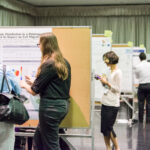
UMBC’s University Center ballroom was standing-room only earlier this week as visitors gathered to learn about new student research on topics from HIV replication to enhancing art conservation through wireless temperature monitoring.
The Summer Undergraduate Research Fest (SURF) presenters were high school students and undergraduates from UMBC and other colleges who chose to spend their summers conducting research at UMBC. In all, 126 students participated in the event, which included two poster sessions and an awards ceremony following the presentations. More than 30 faculty members across five departments and two colleges at UMBC guided the students in their research.
“The experience helped us to think like scientists,” says Olufolake Majekodunmi ’21, biological sciences and psychology. She and her research partner, Avantika Krishna ’21, biochemistry, conducted research for a new project on e-cigarette flavorings with neurobiologist Weihong Lin. As participants in the UMBC STEM BUILD Training Program, they have also received training in writing personal statements, analyzing academic journal articles, constructing their résumés, and more.
“The internship prepared us for giving oral presentations and applying to the workforce or grad school,” says Krishna. Both Krishna and Majekodunmi plan to continue their work with Lin this fall.
For some students, the summer offered a chance to step outside their comfort zones. Sarah Carpe ‘20, environmental science, who transferred to UMBC from Baltimore City Community College, worked with biologist Steve Miller through an NSF Research Experience and Mentoring (REM) award. Her project seeks to enhance algal biofuels by manipulating algae genetics. This stretched her beyond her typical focus areas, but she sees it as very relevant to her passion for the environment because of its potential to help the planet, she says.
Ewnet Sisay ‘20, mechanical engineering, studied zebrafish embryos with developmental biologist Rachel Brewster. “I hope to go for a Ph.D. in biomedical engineering, so I wanted to try biology before committing to a Ph.D,” Sisay says. The result? “I really love it.”
On the other hand, Rakan El-Mayta ‘18, chemical engineering and biological sciences, has been conducting research with biochemical engineer Erin Lavik for two years. This summer, El-Mayta continued work on a project to generate a 3D model of the human colon that will make testing new therapies more efficient. The work has confirmed his enthusiasm for engineering. “Everything is so applicable,” El-Mayta says, “and I get to work with my hands and really think like an engineer.”
Sahle Gebremichael, a student at Baltimore City Community College, spent time in Steve Miller’s lab this summer through the NSF REM program. He intends to transfer to UMBC next year. “I think getting research experience here will help me make the transition to UMBC,” he says.
In addition to sharing the benefits of their experiences, the student also spoke to how research can sometimes be an emotional rollercoaster, peppered with challenges and failures. But by working through those issues, they came to see failures as growth opportunities, rather than setbacks.
“I’ve hit a couple roadblocks along the way,” says Carpe, “which has helped me understand the project better because I have to really think to solve the problem.”
Brett Lucht, a student at Marist College and recipient of an NSF Research Experience for Undergraduates award, also found a way to see the positive in the challenges he faced while working with physical chemist Lisa Kelly. “Failures are a part of research,” he says, “and we’ve learned from them, so they were good failures.”
Bill LaCourse, dean of the College of Natural and Mathematical Sciences, which organized the event, took a moment at the research festival to tell the students that although they are still early in their scientific careers, working to answer questions no one has ever answered before is a noble and exciting challenge. He shared his hope that their time as UMBC researchers “lights a flame of passion that will drive you to greater undertakings…with joy and wonderment.”
“It has been our privilege to host you here at UMBC,” said LaCourse. “Your spirit is an inspiration to us all.”
Image: Students explain their research to attendees at SURF 2017. Photo by Marlayna Demond ’11 for UMBC.
]]>
UMBC’s University Center ballroom was standing-room only earlier this week as visitors gathered to learn about new student research on topics from HIV replication to enhancing art conservation...
https://umbc.edu/stories/umbcs-summer-undergraduate-research-fest-2018-spotlights-talents-of-emerging-scientists/
https://my3.my.umbc.edu/api/v0/pixel/news/120356/guest@my.umbc.edu/a586a1275cff2ea8687ee4bf9e3eb236/api/pixel
biology
cbee
chembiochem
cnms
coeit
meche
science-and-technology
stembuild
undergradresearch
UMBC News & Magazine
https://my3.my.umbc.edu/groups/umbc-news-magazine
https://assets1-my.umbc.edu/system/shared/avatars/groups/000/001/943/24435aa6207c452e7bc15cc74b42c7bb/xsmall.png?1748556657
https://assets1-my.umbc.edu/system/shared/avatars/groups/000/001/943/24435aa6207c452e7bc15cc74b42c7bb/original.png?1748556657
https://assets2-my.umbc.edu/system/shared/avatars/groups/000/001/943/24435aa6207c452e7bc15cc74b42c7bb/xxlarge.png?1748556657
https://assets2-my.umbc.edu/system/shared/avatars/groups/000/001/943/24435aa6207c452e7bc15cc74b42c7bb/xlarge.png?1748556657
https://assets3-my.umbc.edu/system/shared/avatars/groups/000/001/943/24435aa6207c452e7bc15cc74b42c7bb/large.png?1748556657
https://assets1-my.umbc.edu/system/shared/avatars/groups/000/001/943/24435aa6207c452e7bc15cc74b42c7bb/medium.png?1748556657
https://assets2-my.umbc.edu/system/shared/avatars/groups/000/001/943/24435aa6207c452e7bc15cc74b42c7bb/small.png?1748556657
https://assets1-my.umbc.edu/system/shared/avatars/groups/000/001/943/24435aa6207c452e7bc15cc74b42c7bb/xsmall.png?1748556657
https://assets2-my.umbc.edu/system/shared/avatars/groups/000/001/943/24435aa6207c452e7bc15cc74b42c7bb/xxsmall.png?1748556657
UMBC News & Magazine
0
0
false
Tue, 14 Aug 2018 14:55:10 -0400
UMBC’s BUILD a Bridge to STEM internship offers students a transformative research experience
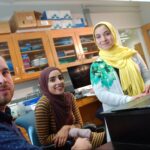
For six weeks this summer, 18 students from Baltimore-area community colleges, Gallaudet University, and Morgan State University worked as full-time scientists at UMBC. Their paid summer research experience was part of the BUILD a Bridge to STEM internship, an arm of UMBC’s STEM BUILD initiative funded by the National Institutes of Health under the Diversity Program Consortium.
The students worked in small teams to learn biomedical techniques and tackle real research questions with the guidance of faculty mentors. Like professional scientists, they shared their progress in lab meetings, discussed research papers in a journal club, and formally presented their work at a research symposium.
“I think the greatest thing about this experience was how we were treated as equals,” shares Zulekha Karachiwalla, a sophomore at Howard Community College (HCC). “We really got a feel for what it would be like to have a career in research.”
“Learning to work independently, think about the research problems, and troubleshoot on our own was the hardest thing,” adds Rahaf Alhabashi, also a sophomore at HCC. “It’s been challenging in a way that’s made us better scientists.”
 Mercedes Burns with her lab group at UMBC. From left to right: Daniel DeWaters ’18, Mayukha Pakala ’18, Zulekha Karachiwalla, Mercedes Burns, Rahaf Alhabashi, and Michael Mercado. Photo courtesy Mercedes Burns.
Karachiwalla, Alhabashi, and Michael Mercado, a senior at Gallaudet University, formed a research team that worked with Mercedes Burns, assistant professor of biological sciences at UMBC, to conduct research examining the genetic diversity of harvestmen—commonly known as daddy long legs. The team format epitomizes the BUILD Group Research paradigm, a key component of BUILD at UMBC.
Through their lab experience, the students learned skills like how to keep a lab notebook and conduct experiments safely, which will serve them throughout their careers. “We’ve had to learn hands-on skills related to dissection and using different types of microscopes,” shares Mercado. He is confident those skills will be helpful as he pursues dental school.
Karachiwalla also found the internship to be helpful in thinking through her future career goals, and the best route to get there. After considering several different potential majors, “this internship has definitely shown me that the career path I want is not just biology or computer engineering—it’s putting them together,” she says.
Alhabashi came in with a more defined sense of her path forward, with a plan to pursue graduate school in physical therapy. But after this internship, she says, “I’ve gotten a lot more interested in doing research, too.”
 Joseph Forbin presents his group’s research at the BUILD a Bridge to STEM final presentations July 19. His group worked with UMBC biologist Jeffrey Gardner to test designs for a new research tool. Photo by Marlayna Demond ’11 for UMBC.
The summer at UMBC also came with benefits beyond learning how to use scientific instruments—benefits from working on a diverse team to solve real challenges in the lab. “This internship has been a great opportunity to interact with many people from different backgrounds,” shares Mercado, who is Deaf and spoke through an ASL interpreter. “At first it was awkward, but we had different conversations about our needs and how we could approach them throughout the internship. I would absolutely recommend that other Deaf students come to this program.”
“This experience gave us more than just the scientific background. It taught us how to learn with people who have a different culture or communication method,” says Karachiwalla, “so I think we were lucky to be put in such a dynamic team. I would definitely choose this group again.”
The team’s diversity contributed to its success, Alhabashi adds. “I love that we all have different ideas that we put together that give us a better way and different ways of seeing and solving problems.”
Team members also shared that their summer research internship would not have been such as success without the support of their faculty mentor. “Dr. Burns not only helped us with the research, but also guided us in our career paths,” shares Karchiwalla. “By actually meeting the people that do the research at UMBC, I learned that they’re very open to helping students.”
“It taught me to take advantage of all the resources that are available to me, wherever I am,” says Alhabashi. Mercado adds, “I would encourage people who are still in college to get involved with as many internships as they can, even if it’s not directly related to their major, because it may change your major or help you gain skills that apply to your future.”
Burns is proud of all the team has accomplished in such a short time period. “They all really hit the ground running,” she shares.
Thinking back to a day the whole group spent in the field, she says, “Seeing a diverse group of students and ASL interpreters having fun collecting arthropods was just awesome.” It may have been a short summer experience, but, she says, the way they collaborated so successfully to progress in their research gave her a feeling of “real pride” and excitement for the future.
Banner image: Michael Mercado (left), Zulekha Karachiwalla (center) and Rahaf Alhabashi (right). Photo by Tim Ford.
]]>
For six weeks this summer, 18 students from Baltimore-area community colleges, Gallaudet University, and Morgan State University worked as full-time scientists at UMBC. Their paid summer research...
https://umbc.edu/stories/umbcs-build-a-bridge-to-stem-internship-offers-students-a-transformative-research-experience/
https://my3.my.umbc.edu/api/v0/pixel/news/120369/guest@my.umbc.edu/014ab1c848950f1c3cb4c27adbf9358a/api/pixel
biology
cnms
community
science-and-technology
stembuild
undergradresearch
UMBC News & Magazine
https://my3.my.umbc.edu/groups/umbc-news-magazine
https://assets1-my.umbc.edu/system/shared/avatars/groups/000/001/943/24435aa6207c452e7bc15cc74b42c7bb/xsmall.png?1748556657
https://assets1-my.umbc.edu/system/shared/avatars/groups/000/001/943/24435aa6207c452e7bc15cc74b42c7bb/original.png?1748556657
https://assets2-my.umbc.edu/system/shared/avatars/groups/000/001/943/24435aa6207c452e7bc15cc74b42c7bb/xxlarge.png?1748556657
https://assets2-my.umbc.edu/system/shared/avatars/groups/000/001/943/24435aa6207c452e7bc15cc74b42c7bb/xlarge.png?1748556657
https://assets3-my.umbc.edu/system/shared/avatars/groups/000/001/943/24435aa6207c452e7bc15cc74b42c7bb/large.png?1748556657
https://assets1-my.umbc.edu/system/shared/avatars/groups/000/001/943/24435aa6207c452e7bc15cc74b42c7bb/medium.png?1748556657
https://assets2-my.umbc.edu/system/shared/avatars/groups/000/001/943/24435aa6207c452e7bc15cc74b42c7bb/small.png?1748556657
https://assets1-my.umbc.edu/system/shared/avatars/groups/000/001/943/24435aa6207c452e7bc15cc74b42c7bb/xsmall.png?1748556657
https://assets2-my.umbc.edu/system/shared/avatars/groups/000/001/943/24435aa6207c452e7bc15cc74b42c7bb/xxsmall.png?1748556657
UMBC News & Magazine
0
0
false
Mon, 23 Jul 2018 14:11:31 -0400
Undergraduate Research Symposium award winners embody success of UMBC STEM BUILD program

This fall, hundreds of students from across the East Coast gathered to present their research and compete for awards at UMBC’s Undergraduate Research Symposium in the Chemical and Biological Sciences (URS). Fifty-two of the student scientists attend UMBC and participate in a program designed to provide research opportunities to a broad range of students in STEM and boost their confidence, increase the likelihood they pursue STEM graduate degrees, and set them on a path to success.
The program is UMBC STEM Building Infrastructure Leading to Diversity (BUILD). Eight BUILD students won awards, which is a good sign for the effectiveness of this relative newcomer among UMBC’s cohort programs. UMBC is one of 10 lead institutions on the STEM BUILD initiative nationwide and received $18 million from the National Institutes of Health to launch it in 2014 with the goal to “create a national model of comprehensive support to expand and increase the success of students in STEM.”
“The BUILD participants at URS exemplify the objectives of the program,” says Laura Ott, STEM BUILD active learning coordinator and director of UMBC’s Science Education Research Unit. All BUILD participants complete summer research, either in opportunities they arrange themselves or in small groups on campus organized by the program. BUILD students also receive financial support and extensive academic advising.
STEM BUILD is also a scientific study, so participants’ progress is carefully tracked to try to tease out which supports have the biggest impact on student success. “By participating in the BUILD program, they’re helping us explore novel strategies to increase participation in undergraduate research for all students,” Ott says.
Teodora (“Roxie”) Danaila ’20, biological sciences, Arjun Sharma ’20, biological sciences, and Amber Thompson ’20, biochemistry and molecular biology and mathematics, worked together to characterize antibiotic resistance genes present in local freshwater samples. Their team won second place in their biochemical and molecular biology group at URS. Mohammed Arafat ‘20, psychology; Yasmin Khan ‘20, biological sciences; and Sharanja Mathyvannan ‘20, pre-mechanical engineering, completed a similar project and won second place in their group.
Caitlin Kowalewski ’14, biological sciences, M.S. ’15, applied molecular biology, and now research coordinator for the College of Natural and Mathematical Sciences; Josh Wilhide, M.S. ’10, chemistry, and manager of UMBC’s Molecular Characterization and Analysis Complex; and their assistants, Dave Varisco and Tim Cain ’18, chemistry education, mentored the students in the on-campus, three-week “Summer Bridge” experience.
“Ms. Kowalewski was able to get me to step my game up and allowed me to see what I was capable of,” Arafat shares. “If you ever had questions or were having trouble,” Danaila says, “they were there.” The mentors “allowed us to relay ideas back and forth with people who had much more experience and knowledge than us,” adds Sharma.
Presenting at the symposium had benefits, too. “It allowed me to explore fields of research that may interest me, and also helped me improve my presentation and research methods,” Sharma says. Thompson appreciated the opportunity to speak with students from other schools. “I was interested in how they got into their labs and what it was like for them in a different lab environment,” she shared.
“I felt that my role in mentoring the students was not only to teach them the laboratory skills, but to help them grow as scientists and researchers,” Kowalewski says. She was impressed by their rapid progress in the content-intensive program. “The fact that they were able to understand the information and present it well enough to win an award at URS was a testament to all of their hard work,” she says. Overall, the summer experience under Kowalewski’s tutelage is intended to build the students’ proficiency in a wide range of scientific techniques and prepare them for independent research opportunities.
Temiloluwa Okusolubo ’19, biological sciences, and Ifeoma (“Fefe”) Azinge ’19, biological sciences, are in their second year of BUILD participation and both earned first place in their biochemical and molecular biology groups at URS for independent research. Okusolubo studied the folding of serpin proteins, which are implicated in various diseases related to lung function, at the University of Massachusetts Amherst. Azinge’s research at the National Institute on Aging in Baltimore focused on calcium transport in sweat glands, which is critical for temperature regulation.
Okusolubo and Azinge’s successes are the kind of outcomes that UMBC STEM BUILD hopes to facilitate, using systems that other schools can eventually adopt. Ott is proud of the students in the program, she says, “and I have high hopes for where they’ll go in the future.”
Image: Students and faculty at the 2017 UMBC Undergraduate Research Symposium. Photo by Mohammed Arafat ’20.
]]>
This fall, hundreds of students from across the East Coast gathered to present their research and compete for awards at UMBC’s Undergraduate Research Symposium in the Chemical and Biological...
https://umbc.edu/stories/undergraduate-research-symposium-award-winners-embody-success-of-umbc-stem-build-program/
https://my3.my.umbc.edu/api/v0/pixel/news/120595/guest@my.umbc.edu/6306e2093e5f7231cacfc322b45964aa/api/pixel
biology
chembiochem
cnms
community
psychology
science-and-technology
stembuild
undergradresearch
UMBC News & Magazine
https://my3.my.umbc.edu/groups/umbc-news-magazine
https://assets1-my.umbc.edu/system/shared/avatars/groups/000/001/943/24435aa6207c452e7bc15cc74b42c7bb/xsmall.png?1748556657
https://assets1-my.umbc.edu/system/shared/avatars/groups/000/001/943/24435aa6207c452e7bc15cc74b42c7bb/original.png?1748556657
https://assets2-my.umbc.edu/system/shared/avatars/groups/000/001/943/24435aa6207c452e7bc15cc74b42c7bb/xxlarge.png?1748556657
https://assets2-my.umbc.edu/system/shared/avatars/groups/000/001/943/24435aa6207c452e7bc15cc74b42c7bb/xlarge.png?1748556657
https://assets3-my.umbc.edu/system/shared/avatars/groups/000/001/943/24435aa6207c452e7bc15cc74b42c7bb/large.png?1748556657
https://assets1-my.umbc.edu/system/shared/avatars/groups/000/001/943/24435aa6207c452e7bc15cc74b42c7bb/medium.png?1748556657
https://assets2-my.umbc.edu/system/shared/avatars/groups/000/001/943/24435aa6207c452e7bc15cc74b42c7bb/small.png?1748556657
https://assets1-my.umbc.edu/system/shared/avatars/groups/000/001/943/24435aa6207c452e7bc15cc74b42c7bb/xsmall.png?1748556657
https://assets2-my.umbc.edu/system/shared/avatars/groups/000/001/943/24435aa6207c452e7bc15cc74b42c7bb/xxsmall.png?1748556657
UMBC News & Magazine
0
0
false
Wed, 22 Nov 2017 19:42:46 -0500
UMBC’s 20th Summer Undergraduate Research Fest spotlights emerging science talent from across the nation
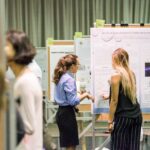
Marking the last weeks of the season, UMBC’s University Center Ballroom buzzed with a contagious energy last month as more than 150 undergraduate and high school students from across the U.S. shared the results of summer research they had conducted with UMBC faculty and graduate student mentors.
“It is a privilege to have so many students coming from far and near to participate in the authentic research experience UMBC provides,” shared Dean Bill LaCourse, of the College of Natural and Mathematical Sciences. As he told the crowd gathered for UMBC’s 20th Summer Undergraduate Research Fest (SURF), “It’s not cookbook—it’s real science we’re doing here.”
LaCourse acknowledged that spending a summer away from home can be challenging, but by immersing themselves in their summer research, students also gain “another community: a scholarly community.”
 Kaaliyah McDowell, Morgan State University, and Carl Bannerman, Community College of Baltimore County, present their research at SURF.
To kick off the day’s program, five groups of students presented their research, beginning with Kaaliyah McDowell, of Morgan State University, and Carl Bannerman, Community College of Baltimore County, who explained their study exploring phages (viruses that infect bacterial cells) in nearby freshwater sources. The team also included Jonathan Poole, of Gallaudet University, and Jackson Narrett ‘17, biological sciences. Together, they worked with Tagide deCarvalho, manager of UMBC’s Keith Porter Imaging Facility, through the STEM BUIILD program.
Angelie Matar, a rising junior at Louisiana State University, shared her progress in improving a chemotherapy drug delivery mechanism. Working with Marie-Christine Daniel-Onuta, associate professor of chemistry and biochemistry, Matar succeeded in attaching a drug molecule and a fluorescent dye to gold nanoparticles, which creates “a more efficient, multi-functional nanoparticle for chemotherapy,” that also reduces chemotherapy’s toxicity to healthy cells, Matar explained.
Caroline Larkin ’17, bioinformatics, is researching cancer from a very different angle. Working with Daniel Lobo, assistant professor of biological sciences, she’s using artificial intelligence to create a computer program that will decode how different cell types within a tumor interact to influence its growth, metastasis, or collapse. The eventual goal is personalized medicine, by using a similar program to predict what course of treatment would be most effective at destroying a particular tumor in a particular patient.
Adam Ring, a rising senior at Emory University, participated in this summer’s SCIART fellowship, a collaboration between UMBC, Johns Hopkins, and the Walters Art Museum in Baltimore. Ring and fellow SCIART participants Chloe Cao, rising senior at Johns Hopkins University, and Hope La Farge, recent alumna of the University of British Columbia, worked with Daniel Rowlands, visiting lecturer in chemistry and biochemistry at UMBC, and Terry Drayman-Weisser, retired director of conservation and technical research at the Walters, to develop techniques for determining the origins of illegal ivory. By detecting trace metals in ivory samples, the team could locate the ivory’s origin based on which water sources the elephants consumed. The findings are critical to helping governments crack down on illegal poaching and ivory trade.
 Students discuss their research during a SURF poster session.
Students also expressed how much the summer experience meant to them as they prepare to make choices about their futures. Mark Minnis ’18, information systems, spent his summer working in the UMBC lab of Amy Hurst, associate professor of human-centered computing, as well as a makerspace she developed in Baltimore for local high school students. There, Minnis helped to devise and implement a more effective workflow system for student staff members, which gave him a broader sense of the possibilities for a research career. He shared, “I had an amazing experience.”
Chelsea Mikal worked with Lee Blaney, associate professor of chemical and environmental engineering, to measure the absorbance characteristics of sunscreens. Sunscreens can end up in waterways, and the light they absorb can affect photosynthetic life. Mikal is a rising junior at Mt. Hebron High School in Howard County. Though not yet an undergraduate, she already knows where her research interests lie. The experience has “definitely pushed me in the research direction,” she shares, “and Dr. Blaney is an amazing mentor.”
Dean LaCourse encouraged these presenters, and the dozens of others who participated in SURF, to be proud of their work, not just for how it helped them grow as researchers, but also as tangible contributions to their scientific fields. “I assure you that your discoveries have added to scientific knowledge, which in the end benefits society through empowerment,” he shared.
As the students prepared to return to their homes and universities across the nation, LaCourse reflected that the UMBC student research experience would always be a part of them. “Hopefully,” he said, “this summer we’ve lit a flame of passion that will drive you to greater undertakings.”
Banner image: Students discuss their summer research during a SURF poster session. All photos by Marlayna Demond ’11 for UMBC.
]]>
Marking the last weeks of the season, UMBC’s University Center Ballroom buzzed with a contagious energy last month as more than 150 undergraduate and high school students from across the U.S....
https://umbc.edu/stories/umbcs-20th-summer-undergraduate-research-fest-spotlights-emerging-science-talent-from-across-the-nation/
https://my3.my.umbc.edu/api/v0/pixel/news/120686/guest@my.umbc.edu/308f763970c9f4a3dd153daa8d61b5f9/api/pixel
biology
cbee
chembiochem
cnms
coeit
is
science-and-technology
stembuild
undergradresearch
UMBC News & Magazine
https://my3.my.umbc.edu/groups/umbc-news-magazine
https://assets1-my.umbc.edu/system/shared/avatars/groups/000/001/943/24435aa6207c452e7bc15cc74b42c7bb/xsmall.png?1748556657
https://assets1-my.umbc.edu/system/shared/avatars/groups/000/001/943/24435aa6207c452e7bc15cc74b42c7bb/original.png?1748556657
https://assets2-my.umbc.edu/system/shared/avatars/groups/000/001/943/24435aa6207c452e7bc15cc74b42c7bb/xxlarge.png?1748556657
https://assets2-my.umbc.edu/system/shared/avatars/groups/000/001/943/24435aa6207c452e7bc15cc74b42c7bb/xlarge.png?1748556657
https://assets3-my.umbc.edu/system/shared/avatars/groups/000/001/943/24435aa6207c452e7bc15cc74b42c7bb/large.png?1748556657
https://assets1-my.umbc.edu/system/shared/avatars/groups/000/001/943/24435aa6207c452e7bc15cc74b42c7bb/medium.png?1748556657
https://assets2-my.umbc.edu/system/shared/avatars/groups/000/001/943/24435aa6207c452e7bc15cc74b42c7bb/small.png?1748556657
https://assets1-my.umbc.edu/system/shared/avatars/groups/000/001/943/24435aa6207c452e7bc15cc74b42c7bb/xsmall.png?1748556657
https://assets2-my.umbc.edu/system/shared/avatars/groups/000/001/943/24435aa6207c452e7bc15cc74b42c7bb/xxsmall.png?1748556657
UMBC News & Magazine
0
0
false
Thu, 07 Sep 2017 16:28:42 -0400
UMBC a case study for success supporting STEM students of all backgrounds
In a new article for Issues in Science and Technology, President Freeman Hrabowski and Peter Henderson, senior advisor to the president, describe the concerning continued underrepresentation of minorities in the STEM workforce, and what UMBC has done to tackle this problem head-on.
“If the nation’s policymakers and education leaders take the deliberate steps needed to expand the participation and success of underrepresented minorities in STEM based on what we know works,” they write, “success is possible.” But there’s a long way to go.
A 2011 report published by the National Academies, Expanding Underrepresented Minority Participation: America’s Science and Technology Talent at the Crossroads, noted that only 9.1 percent of the U.S. STEM workforce identified as African American, Hispanic, or Native American, compared to 28.5 percent of the nation’s overall population. Also, only about 20 percent of black, Latino, and Native American students who started in STEM majors graduated with a degree in a STEM field within five years. White and Asian American students did not fare well either, but their degree attainment rates were notably higher (33 and 42 percent, respectively).
“This is not a problem for minorities only; it’s a national problem,” write Hrabowski and Henderson. “To solve the problem, we in academia just need to look in the mirror.”
Since the 2011 report, there has been little overall movement in the national statistics. Some institutions, however, have made significant progress in supporting students from underrepresented groups to achieve success in advanced degree programs and careers in STEM. Hrabowski and Henderson cite several deliberate steps UMBC has taken to more effectively support underrepresented minority students in STEM.
At the highest levels, UMBC has rejected the concept of “weed-out” courses, which assume it is inevitable that only a small portion of students can succeed. Instead, the university has held firm that the institution is responsible for supporting student success across the board.
Faculty have redesigned introductory and other courses accordingly, and the article highlights UMBC’s Anne Spence in mechanical engineering, Taryn Bayles formerly of chemical engineering, and Jeff Leips in biological sciences for their work with pedagogical techniques like the “flipped classroom” approach and team-based learning. The authors also spotlight Dean Bill LaCourse, of the College of Natural and Mathematical Sciences, who spearheaded the creation of the Chemistry Discovery Center, an interactive learning space for introductory chemistry courses.
Federal agencies have also joined the effort to increase minority participation in STEM. UMBC is involved in the NIH’s Building Infrastructure Leading to Diversity program, as well as NSF programs including the Louis Stokes Alliances for Minority Participation, Alliances for Graduate Education and the Professoriate, and Maximizing Access to Research Careers Undergraduate Student Training in Academic Research.
UMBC is perhaps best known for its Meyerhoff Scholars Program, founded in 1989 and now over 1,000 alumni strong, which provides students with financial, academic, and social support as well as professional development and intensive mentorship. Graduates of the Meyerhoff program are five times more likely to earn doctoral degrees than students who were admitted to the program but chose to attend another university, and the Meyerhoff program’s success has led to an $8 million investment from the Howard Hughes Medical Institute to adapt the program at Pennsylvania State University and University of North Carolina at Chapel Hill.
“The strategy is to deliberately form a sense of belonging and community that nurtures the students,” write Hrabowski and Henderson.
As a result of all these efforts, UMBC has climbed the list of institutions that best support minority students in STEM. Today, UMBC graduates the most black students who go on to complete M.D.-Ph.D. degrees in the nation, and only follows MIT for the percentage of black undergraduate degree recipients who go on to earn Ph.D.s in STEM. UMBC is also the sixth top university in graduating black undergraduates who then earn doctoral degrees in any field, with the top five all being Historically Black College and Universities.
“We must identify and learn from institutions that have been successful in educating African American undergraduates in the natural sciences and engineering through a focused effort,” write Hrabowski and Henderson. Additionally, they note, “We have learned that a campus that helps underrepresented minority students is also one that helps students in general.”
Now, “the nation must decide whether or not it will take the path leading to a science and technology talent pool…that draws from people throughout our population,” Henderson and Hrabowski suggest. “It is only by tapping all of that talent pool that the country will succeed in realizing the economic, security, and health goals the American people prize.”
Read the full article, “Toward a more diverse research community: Models of success.”
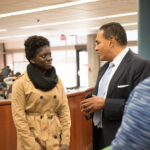
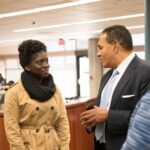
Image: President Hrabowski speaks with students in the UMBC Commons. Photo by Marlayna Demond ’11 for UMBC.
]]>
In a new article for Issues in Science and Technology, President Freeman Hrabowski and Peter Henderson, senior advisor to the president, describe the concerning continued underrepresentation of...
https://umbc.edu/stories/umbc-a-case-study-for-supporting-stem-students-of-all-backgrounds/
https://my3.my.umbc.edu/api/v0/pixel/news/120822/guest@my.umbc.edu/9ed94b12194562da667f483efbb79117/api/pixel
biology
cbee
cnms
community
hrabowski
marcustar
meche
meyerhoffscholars
science-and-technology
stembuild
UMBC News & Magazine
https://my3.my.umbc.edu/groups/umbc-news-magazine
https://assets1-my.umbc.edu/system/shared/avatars/groups/000/001/943/24435aa6207c452e7bc15cc74b42c7bb/xsmall.png?1748556657
https://assets1-my.umbc.edu/system/shared/avatars/groups/000/001/943/24435aa6207c452e7bc15cc74b42c7bb/original.png?1748556657
https://assets2-my.umbc.edu/system/shared/avatars/groups/000/001/943/24435aa6207c452e7bc15cc74b42c7bb/xxlarge.png?1748556657
https://assets2-my.umbc.edu/system/shared/avatars/groups/000/001/943/24435aa6207c452e7bc15cc74b42c7bb/xlarge.png?1748556657
https://assets3-my.umbc.edu/system/shared/avatars/groups/000/001/943/24435aa6207c452e7bc15cc74b42c7bb/large.png?1748556657
https://assets1-my.umbc.edu/system/shared/avatars/groups/000/001/943/24435aa6207c452e7bc15cc74b42c7bb/medium.png?1748556657
https://assets2-my.umbc.edu/system/shared/avatars/groups/000/001/943/24435aa6207c452e7bc15cc74b42c7bb/small.png?1748556657
https://assets1-my.umbc.edu/system/shared/avatars/groups/000/001/943/24435aa6207c452e7bc15cc74b42c7bb/xsmall.png?1748556657
https://assets2-my.umbc.edu/system/shared/avatars/groups/000/001/943/24435aa6207c452e7bc15cc74b42c7bb/xxsmall.png?1748556657
UMBC News & Magazine
0
0
false
Wed, 26 Apr 2017 14:11:33 -0400
AAMC highlights UMBC’s national model to support minority student success in med school
The American Association of Medical Colleges (AAMC) has published a new article by UMBC President Freeman Hrabowski and Peter Henderson, senior advisor to the president, emphasizing the need for more scientists from underrepresented minority groups in research and health careers. The piece also details how UMBC’s Meyerhoff Scholars Program serves as a gold-standard model in addressing this national need.
Recent AAMC data reveal that UMBC is the #1 producer of African American undergraduates who go on to enroll in M.D./Ph.D. programs, and the Meyerhoff Scholars Program is a major factor in that achievement. Meyerhoff alumni are more than five times as likely to graduate from or be enrolled in a STEM Ph.D. or M.D./Ph.D. program as students who were accepted to the program but chose not to attend, say Pres. Hrabowski and Henderson.
“Our program is successful in part because of its core principle,” they suggest. “The university is responsible for supporting student success, not weeding students out.”
The Meyerhoff Scholars Program emphasizes mentorship, student research, and a sense of community, while also providing financial support. “These components help students develop a vision of themselves based on high expectations,” the authors explain.
The program invites applicants from all underrepresented groups in STEM, including low-income and first-generation college students. Among over 1,000 Meyerhoff alumni are more than 230 who have already completed Ph.D.s.
Program alumni include people like Kafui Dzirasa ’01, chemical engineering, now an assistant professor at Duke University and recipient of the Presidential Early Career Award for Scientists and Engineers from President Obama. Dzirasa will return to UMBC February 20 to kick off Engineers Week, along with his brother Delali Dzirasa ’04, computer engineering, a Meyerhoff alumnus whose cybersecurity company, housed in the bwtech@UMBC Research and Technology Park, was named 2016 Design/Development Firm of the Year at Baltimore Innovation Week.
The Meyerhoff Scholars Program has also increasingly had an impact beyond the students it touches directly. A 2011 report by the National Academies of Sciences, Engineering, and Medicine found that two-thirds of all students left a STEM major within the first two years, even if they were high achievers previously. With this knowledge in mind, UMBC has created a range of new student programs that offer supports found to be successful in the Meyerhoff Scholars Program to students across populations and disciplines, from the Center for Women in Technology Scholars to UMBC’s intensive, research-driven version of the national MARC U*STAR Scholars program.
Recently, STEM BUILD launched at UMBC with an $18 million grant from the NIH. The initiative’s motto? “Think 500, not 50.” Beyond being a program that offers student support, BUILD is a research study working to create a model for universities to provide comprehensive support on a large scale without requiring a high level of additional resources.
The Meyerhoff Scholars Program has also served as a model to other institutions. Penn State and the University of North Carolina–Chapel Hill have been working since 2014 to adapt the program to their universities, through support from the Howard Hughes Medical Institute.
Michael Summers, Robert E. Meyerhoff Chair for Excellence in Research and Mentoring and University Distinguished Professor of chemistry and biochemistry at UMBC, has played a major role in this expansion of the vision for the scholars program, and he’s driven by the massive societal impacts he believes it can achieve.
“Significant racial/ethnic health disparities persist,” Summers says, “and African American research scientists are the ones most likely to tackle diseases that disproportionately affect the black community.”
“The ultimate goal,” write Pres. Hrabowski and Henderson, in their AAMC article, “is to help these students eventually improve the health of African American and other minority communities, as well as the nation as a whole.”
Read “How undergraduate programs can boost minority success in medical school.”
Image: President Hrabowski talks with a UMBC student in the Retriever Learning Center; photo Marlayna Demond ’11 for UMBC.
]]>
The American Association of Medical Colleges (AAMC) has published a new article by UMBC President Freeman Hrabowski and Peter Henderson, senior advisor to the president, emphasizing the need for...
https://umbc.edu/stories/aamc-highlights-umbcs-national-model-to-support-minority-student-success-in-med-school/
https://my3.my.umbc.edu/api/v0/pixel/news/120897/guest@my.umbc.edu/16040d5baec145ffabd124a0921a4b3a/api/pixel
cnms
coeit
cwit
hrabowski
marcustar
meyerhoffscholars
science-and-technology
stembuild
UMBC News & Magazine
https://my3.my.umbc.edu/groups/umbc-news-magazine
https://assets1-my.umbc.edu/system/shared/avatars/groups/000/001/943/24435aa6207c452e7bc15cc74b42c7bb/xsmall.png?1748556657
https://assets1-my.umbc.edu/system/shared/avatars/groups/000/001/943/24435aa6207c452e7bc15cc74b42c7bb/original.png?1748556657
https://assets2-my.umbc.edu/system/shared/avatars/groups/000/001/943/24435aa6207c452e7bc15cc74b42c7bb/xxlarge.png?1748556657
https://assets2-my.umbc.edu/system/shared/avatars/groups/000/001/943/24435aa6207c452e7bc15cc74b42c7bb/xlarge.png?1748556657
https://assets3-my.umbc.edu/system/shared/avatars/groups/000/001/943/24435aa6207c452e7bc15cc74b42c7bb/large.png?1748556657
https://assets1-my.umbc.edu/system/shared/avatars/groups/000/001/943/24435aa6207c452e7bc15cc74b42c7bb/medium.png?1748556657
https://assets2-my.umbc.edu/system/shared/avatars/groups/000/001/943/24435aa6207c452e7bc15cc74b42c7bb/small.png?1748556657
https://assets1-my.umbc.edu/system/shared/avatars/groups/000/001/943/24435aa6207c452e7bc15cc74b42c7bb/xsmall.png?1748556657
https://assets2-my.umbc.edu/system/shared/avatars/groups/000/001/943/24435aa6207c452e7bc15cc74b42c7bb/xxsmall.png?1748556657
UMBC News & Magazine
0
0
false
Thu, 26 Jan 2017 21:02:55 -0500


