Robert Barry ’25 returns to Greece as a summer research assistant at an archaeological field school
For the last seven weeks, Robert Barry ’25, ancient studies and visual arts, worked in a trench under the sweltering 90-degree sun. It may sound grueling, but this is Barry’s second year working in this archeological site in Greece with Michael F. Lane, associate professor of ancient studies and field director on the Kopaic Cultures, Economies, and Landscapes (KOCECOLA) research program. KOCECOLA is an archaeological investigation of a prehistoric settlement in its physical, human, and historical circumstances in the Kopaic Basin of central mainland Greece. Lane has conducted fieldwork in this area since 2010.
“What I really like about ancient studies is the faculty,” shares Barry. “They show a lot of interest in their students, and I feel like I belong.” Barry has taken archaeology and ancient Greek language classes with Lane, where he has excelled.
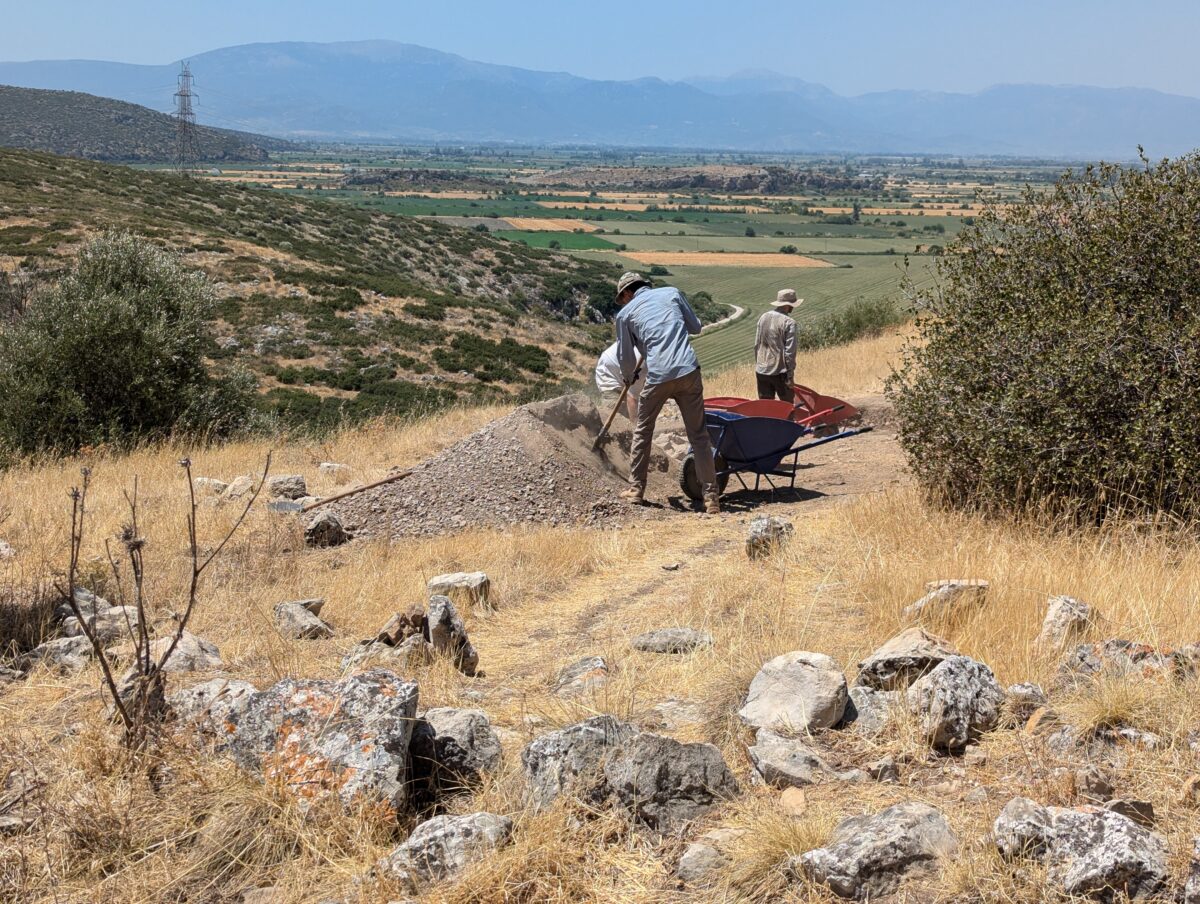 Students at UMBC’s 2024 archeological field school in Greece prepare the site for winter by backfilling trenches with soil. (Michael F. Lane/UMBC)
Barry learned about the project in Lane’s ancient Greek language class. Lane was seeking undergraduate research assistants to join the 2023 six-week summer archeological fieldwork opportunity, and Barry joined the team. This year, he returned as a trench supervisor with more responsibilities.
From excavating to supervising
Student research assistants use satellite-based differential Global Navigation Satellite Systems (DGNSS) and optical survey equipment. “We use the DGNSS and optical equipment both to plot the location of our trenches and to record the position of discoveries in three dimensions: latitude, longitude, and elevation above sea level,” explains Lane. Once an excavation site is identified, students use trigonometry to measure trenches and then large shovels to reveal distinct layers of soil. Excavation teams are made up of 2 – 3 students spread across six trenches.
“This year, I was a trench supervisor and learned a lot about myself. My priorities changed,” explains Barry. “Last year, I was digging and following directions from my supervisor. Now, I’m giving the orders and having to be responsible for the health and safety of everyone else while getting the job done.”
Lane says the senior staff at KOCECOLA regarded Barry as a peer. “He’s smart, meticulous, punctual, responsible, untiring, even-keeled, good-humored, and funny,” says Lane. “For this reason, I gave him a trench of his own to supervise for the last three weeks this summer, and he exceeded expectations.”
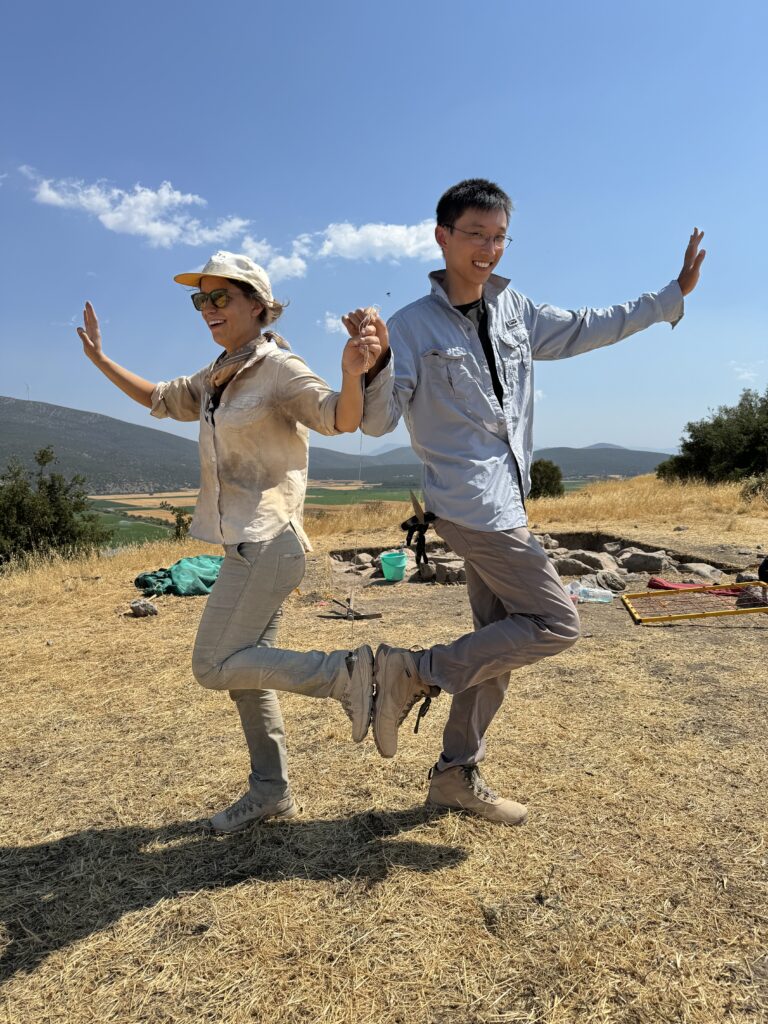 (l-r): Rachel Channell, a crew supervisor from Greece, teaches Barry a traditional Greek dance. (Brady E. Cavanagh/UMBC)
To get the job done, the team’s daily routine meant leaving the village at 5 a.m., taking a 20-minute drive to the dig site, hiking up a mountain, and beginning work around 5:30 a.m. Barry’s team of three students used small hand trowels and brushes to help reveal soil layers and artifacts, such as pottery. A fine mesh screen helped sift the soil removed during excavation, leaving behind finer artifacts. They would take soil samples for scientific dating and chemical analysis, as well as basic soil and sedimentary descriptions. Thanks to a 2024 UMBC Strategic Awards for Research Transitions grant that Lane received, students also had the opportunity to sample for radiocarbon dating and luminescence dating, which measures the energy of photons released from minerals to determine the age of exposed strata.
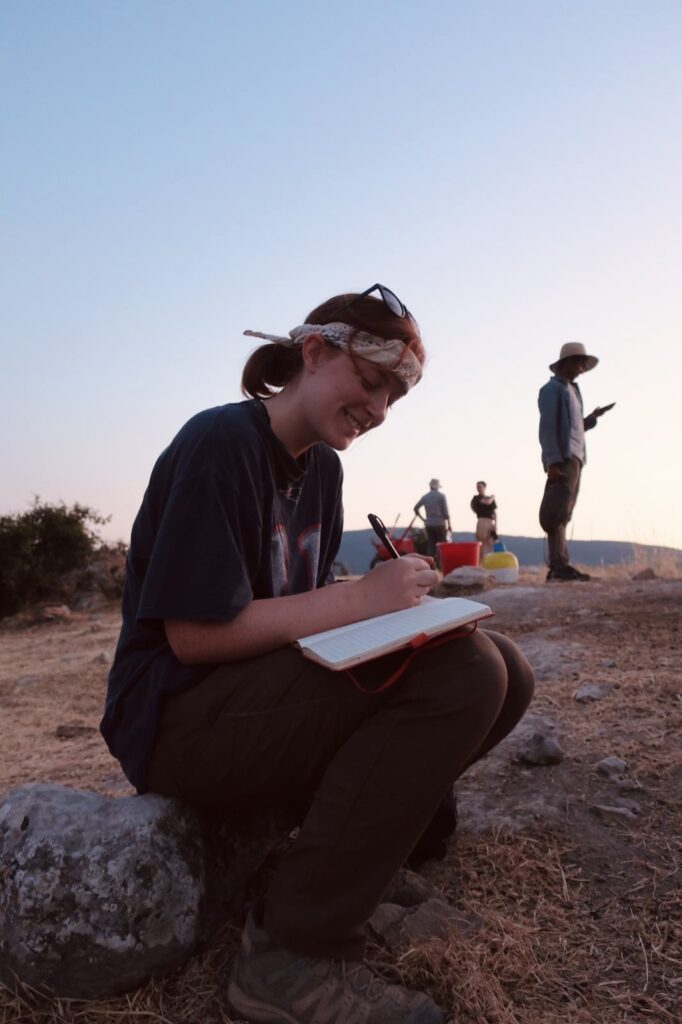 Brady E. Cavanagh ’26, visual arts, documents her work. (Elliott G. Alvey/University of Virginia)
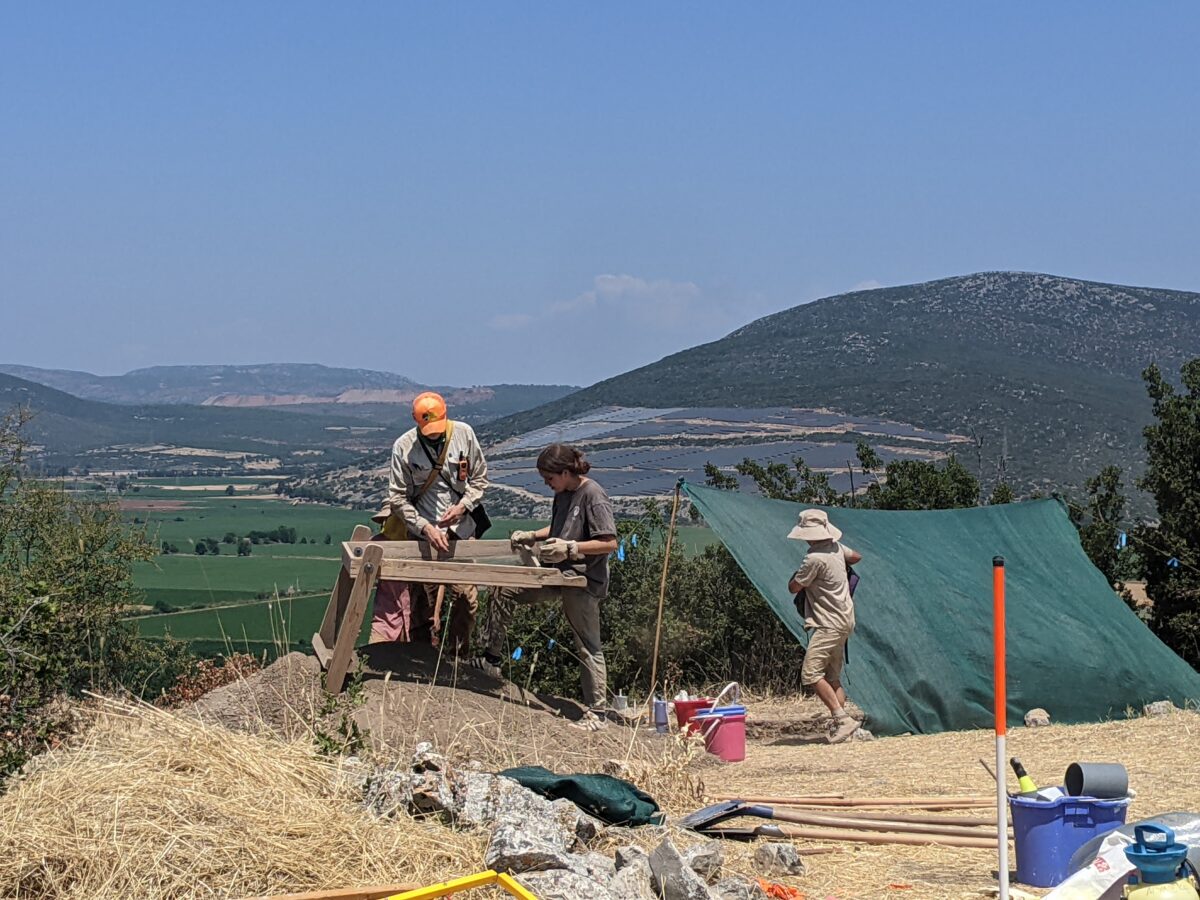 2023 crew screen soil for fine artifacts. (l-r): Damian V. Koropeckyj ’16, global studies, supervises India J. Kelly ’24, history, and Naomi Morales Glen, a master’s student at the University of the Peloponnese in Kalamata, Greece. (Michael F. Lane/UMBC)
“We record where each artifact is, define its features and its chronological, historical, cultural, and social contexts,” says Barry. “It can get complicated when there are numerous artifacts to identify, map, excavate, bag, and label.” At 1 p.m., the crew would head to the lab for three hours to wash the day’s finds, scrub them with toothbrushes, and catalog finds. The rest of the afternoon would be all theirs until 8 p.m. when they would gather for a communal dinner at the local taverna (Greek for restaurant).
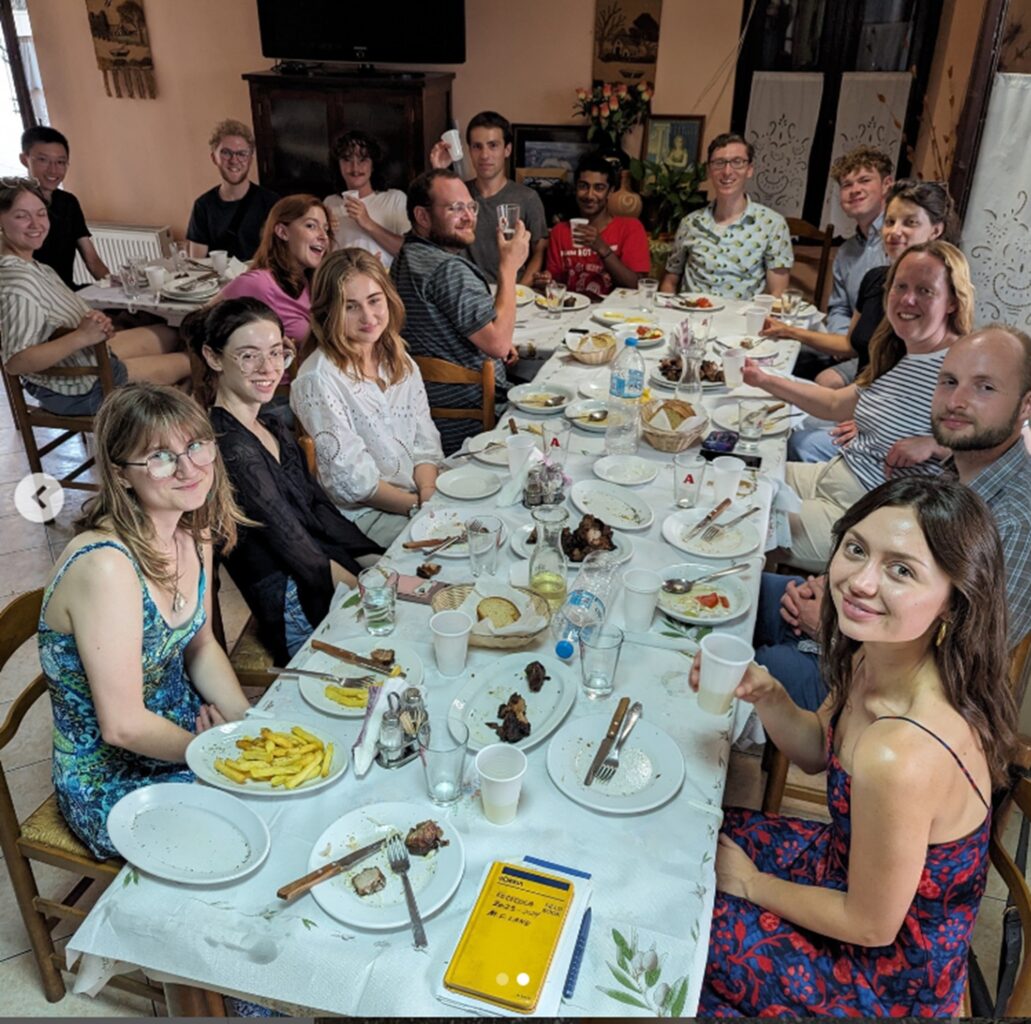 The 2024 crew enjoys dinner in the local village after a long day. (Michael F. Lane/UMBC)
To Greece and beyond
Now that the internship has ended, Barry is sightseeing in Austria before returning to the U.S. “My favorite part of this year’s experience was the international collaboration. I enjoyed getting to know students from the United Kingdom, the Netherlands, Germany, and Greece,” says Barry, who used these opportunities to practice his Greek and Latin skills, which are important in the ancient studies graduate programs he’ll apply to after returning to UMBC.
“Probably the moment that most touched me this summer was when Robert sat down at the kitchen table at the staff house with me and said, ‘Lane, can I tell you something…? I think I want to do this for the rest of my life’,” Lane shares. “I now consider it my duty to help him continue to excel, doing everything in my power to get him into the best academic programs and relevant jobs.”
Learn more about UMBC’s ancient studies program.
]]>
For the last seven weeks, Robert Barry ’25, ancient studies and visual arts, worked in a trench under the sweltering 90-degree sun. It may sound grueling, but this is Barry’s second year working...
https://umbc.edu/stories/robert-barry-in-greece-research-assistant-archaeological-field-school/
https://my3.my.umbc.edu/api/v0/pixel/news/143021/guest@my.umbc.edu/d761882da02d66065b8dad941c9ce281/api/pixel
ancient-studies
arts-and-culture
cahss
cahss-research
careercenter
global-studies
history
international
news
story
visual-arts
UMBC News & Magazine
https://my3.my.umbc.edu/groups/umbc-news-magazine
https://assets1-my.umbc.edu/system/shared/avatars/groups/000/001/943/24435aa6207c452e7bc15cc74b42c7bb/xsmall.png?1748556657
https://assets1-my.umbc.edu/system/shared/avatars/groups/000/001/943/24435aa6207c452e7bc15cc74b42c7bb/original.png?1748556657
https://assets2-my.umbc.edu/system/shared/avatars/groups/000/001/943/24435aa6207c452e7bc15cc74b42c7bb/xxlarge.png?1748556657
https://assets2-my.umbc.edu/system/shared/avatars/groups/000/001/943/24435aa6207c452e7bc15cc74b42c7bb/xlarge.png?1748556657
https://assets3-my.umbc.edu/system/shared/avatars/groups/000/001/943/24435aa6207c452e7bc15cc74b42c7bb/large.png?1748556657
https://assets1-my.umbc.edu/system/shared/avatars/groups/000/001/943/24435aa6207c452e7bc15cc74b42c7bb/medium.png?1748556657
https://assets2-my.umbc.edu/system/shared/avatars/groups/000/001/943/24435aa6207c452e7bc15cc74b42c7bb/small.png?1748556657
https://assets1-my.umbc.edu/system/shared/avatars/groups/000/001/943/24435aa6207c452e7bc15cc74b42c7bb/xsmall.png?1748556657
https://assets2-my.umbc.edu/system/shared/avatars/groups/000/001/943/24435aa6207c452e7bc15cc74b42c7bb/xxsmall.png?1748556657
UMBC News & Magazine
0
0
false
Wed, 31 Jul 2024 16:35:54 -0400
Wed, 31 Jul 2024 16:35:54 -0400
Infrastructure of support after Key Bridge collapse

In 1987, Paul Flinton, then a 23-year-old senior studying at UMBC, decided to make a short documentary focused on the tollbooth workers on the Francis Scott Key Bridge.
The six-minute documentary “One Dollar”—named after the toll’s cost for cars at the time—captures a vehicle’s journey across the bridge from the driver’s point of view in one continuous take. As Flinton ’87, visual arts, drives across the bridge, audio of the tollbooth workers interviewed for the project act as the film’s narrators in which they share some of their experiences as toll operators.
Flinton, who is now a location sound manager for NFL Films, went on to win an award for “One Dollar” from the Maryland State Arts Council following its release. Nearly four decades later, Flinton all but forgot about the film’s existence until learning of the bridge’s collapse following a collision with a malfunctioning cargo ship on March 26, sending eight construction workers into the water and taking the lives of six.
“It hit a nerve,” Flinton told local news after the disaster. “[The film is] sort of a treasure…This captures something that in a lot of ways can’t really happen again.”
Paul Flinton’s short documentary entitled “One Dollar” (1987).
Supporting the impacted families
The Key Bridge opened to traffic in 1977, and regularly 30,000 vehicles crossed the 1.6 mile span over the Patapsco River. An integral part of Baltimore’s beltway, commuters, community members, and experts are now struggling to make sense of the literal change of transportation landscape. Now that the wreckage is completely cleared away and as the eventual construction commences, UMBC experts offer up their expertise and resources to confront the tragedy.
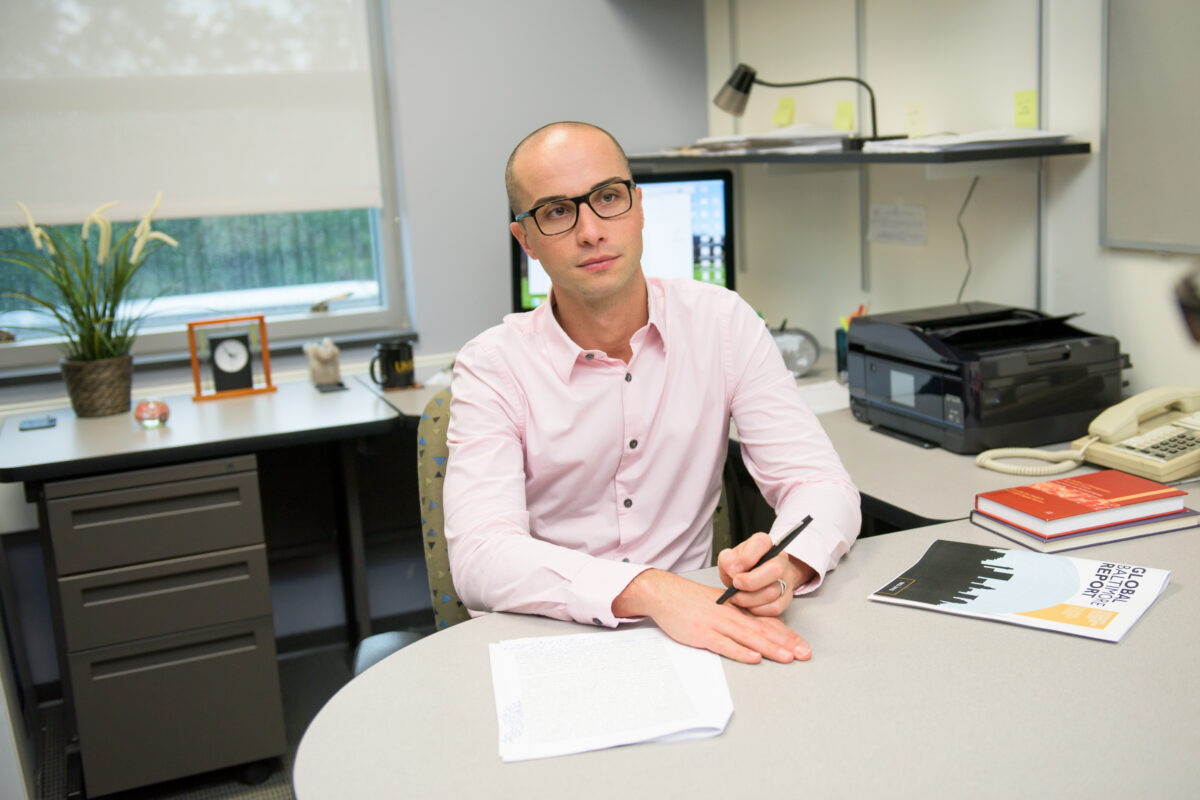 Felipe Filomeno. (Marlayna Demond ’11/UMBC)
After learning that all of the direct victims of the collapse were immigrants from countries throughout Latin America, Felipe Filomeno, associate professor of political science and global studies, immediately sprang into action with fellow members of the grassroots organization Latino Racial Justice Circle (LRJC). Filomeno, who is president of the LRJC, worked with the organization’s leadership team to establish a fundraiser in support of the families of the victims of the bridge collapse.
The crowdfunded campaign initially had a goal of raising about $5,000 for each of the families impacted, Filomeno said. Within hours of going live with the GoFundMe campaign, the organization raised $100,000 from donors located all around the world.
“The fundraiser caught a lot of traction. I have been overwhelmed by the outpouring of solidarity that we got from across the world in that week when the tragedy happened,” says Filomeno.
Following the fundraising success, the group has since directed prospective supporters to the Mayor’s Office of Immigrant Affairs’ Key Bridge Emergency Response Fund. The Mayor’s Office is working with the LRJC and case managers to distribute the funding to the six impacted families.
The tragedy has underlined key issues impacting the Latino immigrant community, challenges that Filomeno amplifies through his community-centered research at UMBC. “[The collapse] has highlighted and publicized to the world issues that we already know exist—the fact that Latino immigrants are over-represented in dangerous occupations,” says Filomeno. “There are higher incidents of work-related accidents among the Latino populations.”
Filomeno’s forthcoming book, Christian Cosmopolitanism: Faith Communities Talk Immigration (Temple University Press, 2024), explores the Honest Conversations on Immigration program he co-developed in 2017 in partnership with the LRJC. The program, Filomeno explains, was designed to build mutual understanding and collaboration between people who are diverse, but share the same religion.
“One of the goals is to build solidarity across differences,” says Filomeno. “The solidarity across differences is a principle that we also see in the Key Bridge fundraiser.”
Through his advocacy and academic scholarship, Filomeno is working to amplify the need for more long lasting efforts to stand in solidarity with Latino immigrant communities beyond moments of tragedy. “Those problems that became evident with the fall of the bridge, those challenges that the Latino immigrant population faces, they are still there,” he says. “To move the needle on those issues, it has to be more than helping those six families at this point in time.”
Examining the environmental impacts of the collapse
The ship that collided into the bridge was carrying 56 containers of hazardous materials, including corrosives, flammables, and lithium-ion batteries. The cargo ship was also carrying more than one million gallons of fuel at the time of the impact. City officials began their investigations into the incident, which included determining the environmental impacts to the Patapsco River and surrounding communities.
Upal Ghosh, professor of chemical, biochemical, and environmental engineering, whose research includes examining the effects of toxic pollutants in soils, sediments, and aquatic environments, was among the experts who weighed in on assessing the potentially hazardous effects of the containers that were resting at the bottom of the river.
 Maryland Comptroller Brooke Lierman and representatives of the Office of the Governor take a tour of the Francis Scott Key Bridge collapse site on a Maryland Department of Natural Resources police boat. (Photo source: Corey Jennings ’10, Maryland Comptroller/Flickr)
Ghosh told the Baltimore Sun days after the collapse that environmental officials’ first priority would likely be making sure none of the intact containers were breached.
“If you have containers that contain oily material, those things will, if they are breached, be releasing over time,” Ghosh said. “I would think if there is a release that goes down into the sediments under the water, it would be a local impact right there.”
Farah Nibbs, assistant professor of emergency and disaster health systems, is also thinking about future ways to contain the effects of similar disasters. Contributing factors to the bridge’s collapse, she says, can be tied to the 2012 expansion and modernization of the Port of Baltimore. Those changes did not happen hand in hand with improvements in safety management needed to accommodate ships of such huge sizes that now were able to port in the city. Risks from collisions, fuel spills, and contamination still lack proper oversight and regulation.
“A novel approach for decision-makers may be to view Maryland’s emergency management and transportation experts and service providers—as well as the physical bridge infrastructure itself—as part of the community’s lifeline systems,” said Nibbs.
More than a disaster
As plans for the bridge’s rebuilding process begins to take shape, Brian Grodsky, professor of political science, shed light on why Maryland Governor Wes Moore likely did not request a presidential disaster declaration in response to the collapse. Presidential disaster declarations, Grodsky said in a local tv news segment, are usually limited to tragedies that involve fires, floods, or explosives.
“Man-made disasters are more likely to be declined [for a presidential disaster declaration] because there is that question of public versus private ownership of the disaster,” he added. “If this ship caught on fire or exploded under the bridge, this would easily be qualified as a major disaster.”
Deborah Rudacille, professor of the practice in English, is well aware of the lives connected to the construction and opening of the Key Bridge. In 2010, she published Roots of Steel: Boom and Bust in an American Mill Town, a book exploring Baltimore’s industrial history of the Sparrows Point steel mill, but also capturing her family’s connection to the mill and Baltimore staples like the Key Bridge.
Rudacille’s mother was one of the original employees—collecting the toll that Flinton documented in his film— when the bridge first opened in 1977, and her brother worked as one of the bridge’s painters.
“They were kind of reminiscing about the fact that everything down there is now gone,” Rudacille told local media about her family. “First the steelworks, now the Key Bridge is gone. It’s like this world that they lived and worked in has vanished completely.”
]]>
In 1987, Paul Flinton, then a 23-year-old senior studying at UMBC, decided to make a short documentary focused on the tollbooth workers on the Francis Scott Key Bridge. The six-minute...
https://umbc.edu/stories/support-after-key-bridge-collapse/
https://my3.my.umbc.edu/api/v0/pixel/news/142431/guest@my.umbc.edu/85f4487fb5eddd76a8baa59270f45a52/api/pixel
cahss
cbee
coeit
discovery
edhs
english
magazine
political-science
spring-2024
story
visual-arts
UMBC News & Magazine
https://my3.my.umbc.edu/groups/umbc-news-magazine
https://assets1-my.umbc.edu/system/shared/avatars/groups/000/001/943/24435aa6207c452e7bc15cc74b42c7bb/xsmall.png?1748556657
https://assets1-my.umbc.edu/system/shared/avatars/groups/000/001/943/24435aa6207c452e7bc15cc74b42c7bb/original.png?1748556657
https://assets2-my.umbc.edu/system/shared/avatars/groups/000/001/943/24435aa6207c452e7bc15cc74b42c7bb/xxlarge.png?1748556657
https://assets2-my.umbc.edu/system/shared/avatars/groups/000/001/943/24435aa6207c452e7bc15cc74b42c7bb/xlarge.png?1748556657
https://assets3-my.umbc.edu/system/shared/avatars/groups/000/001/943/24435aa6207c452e7bc15cc74b42c7bb/large.png?1748556657
https://assets1-my.umbc.edu/system/shared/avatars/groups/000/001/943/24435aa6207c452e7bc15cc74b42c7bb/medium.png?1748556657
https://assets2-my.umbc.edu/system/shared/avatars/groups/000/001/943/24435aa6207c452e7bc15cc74b42c7bb/small.png?1748556657
https://assets1-my.umbc.edu/system/shared/avatars/groups/000/001/943/24435aa6207c452e7bc15cc74b42c7bb/xsmall.png?1748556657
https://assets2-my.umbc.edu/system/shared/avatars/groups/000/001/943/24435aa6207c452e7bc15cc74b42c7bb/xxsmall.png?1748556657
UMBC News & Magazine
2
0
false
Thu, 13 Jun 2024 13:40:41 -0400
Thu, 13 Jun 2024 13:40:41 -0400
PEZ—The Sweetest Hobby

Beware of crushes. Especially as a 10-year-old in 1995. They might lead to a lifelong hobby, rooms of your house dedicated to your collection, a quirky and supportive community, and even a spot in an Emmy-winning documentary. Katie Chrzanowski, however, has no regrets.
After a brief crush on someone who collected PEZ, and thinking that starting her own collection would be a fun competition, she’s now the proud owner of more than several thousand PEZ dispensers, the host of the Maryland PEZ Gathering, and an extra on the set of The Pez Outlaw. But Chrzanowski ’07, visual arts, doesn’t just collect PEZ paraphernalia for the fame and glory.
She started her collection with a pumpkin head and a snowman, gifts she held onto before knowing they would snowball into a collection requiring dozens of professional plexiglass PEZ dispenser displays. (“Otherwise, they just fall over like dominos.”) Chrzanowski, who is a senior web experience/digital designer for commonvision, UMBC’s student-facing print and design shop, attributes her long connection with the fanciful candy company to the community.
Chrzanowski gives a tour of her PEZ collection.
When she began collecting, PEZheads (as they call themselves) were already active on the nascent internet. In addition to being active on the online forum, in the mid-1990s she signed up for a monthly print newsletter, which she still receives. “Everyone was so welcoming and engaging. It’s been amazing to be a part of for so many years.”
Like the animation major she was, Chrzanowski has a sweet system for organizing her collection, starting with the studio the licensed dispenser is from—Pixar, Disney, Blue Sky, and so on. “Then I organize it by franchise release date and then oldest on the left and newer on the right.” The result is a meticulous, museum-worthy, 360-degree PEZ accumulation that lets Chrzanowski show off her almost 30-year hobby.
For anyone interested in joining Chrzanowski, she says, “Start with what you love. Whatever makes you happy—there’s no right or wrong way to collect.”
]]>
Beware of crushes. Especially as a 10-year-old in 1995. They might lead to a lifelong hobby, rooms of your house dedicated to your collection, a quirky and supportive community, and even a spot in...
https://umbc.edu/stories/pez-the-sweetest-hobby/
https://my3.my.umbc.edu/api/v0/pixel/news/142142/guest@my.umbc.edu/110a2712be5f196f472494943de87c1f/api/pixel
alumni
cahss
campus-life
magazine
spring-2024
story
visual-arts
wild-card
UMBC News & Magazine
https://my3.my.umbc.edu/groups/umbc-news-magazine
https://assets1-my.umbc.edu/system/shared/avatars/groups/000/001/943/24435aa6207c452e7bc15cc74b42c7bb/xsmall.png?1748556657
https://assets1-my.umbc.edu/system/shared/avatars/groups/000/001/943/24435aa6207c452e7bc15cc74b42c7bb/original.png?1748556657
https://assets2-my.umbc.edu/system/shared/avatars/groups/000/001/943/24435aa6207c452e7bc15cc74b42c7bb/xxlarge.png?1748556657
https://assets2-my.umbc.edu/system/shared/avatars/groups/000/001/943/24435aa6207c452e7bc15cc74b42c7bb/xlarge.png?1748556657
https://assets3-my.umbc.edu/system/shared/avatars/groups/000/001/943/24435aa6207c452e7bc15cc74b42c7bb/large.png?1748556657
https://assets1-my.umbc.edu/system/shared/avatars/groups/000/001/943/24435aa6207c452e7bc15cc74b42c7bb/medium.png?1748556657
https://assets2-my.umbc.edu/system/shared/avatars/groups/000/001/943/24435aa6207c452e7bc15cc74b42c7bb/small.png?1748556657
https://assets1-my.umbc.edu/system/shared/avatars/groups/000/001/943/24435aa6207c452e7bc15cc74b42c7bb/xsmall.png?1748556657
https://assets2-my.umbc.edu/system/shared/avatars/groups/000/001/943/24435aa6207c452e7bc15cc74b42c7bb/xxsmall.png?1748556657
UMBC News & Magazine
3
0
false
Wed, 22 May 2024 12:16:26 -0400
Wed, 22 May 2024 12:16:26 -0400
Kelley Bell named Baker Artist Awardee, Corrie Francis Parks and Katie Hileman are finalists
On May 30, Kelley Bell, M.F.A. ’06, associate professor of visual arts, was named one of the six 2024 Baker Artist Awardees, receiving the $10,000 Mary Sawyers Baker Prize. The awardees were selected by an anonymous jury from a field of almost 700 artists from across the greater Baltimore region. Corrie Francis Parks, associate professor of visual arts, and Katie Hileman ’12, theatre, and general associate in the department of theatre, were among the finalists for the prestigious 2024 Baker Artist Award.
Established in 2009, the Baker Artist program was created to support artists and promote greater Baltimore as a strong creative community. Since then, more than 150 artists have been awarded $1.3 million in grant money. The program was established by the William G. Baker, Jr. Memorial Fund and is managed by the Greater Baltimore Cultural Alliance.
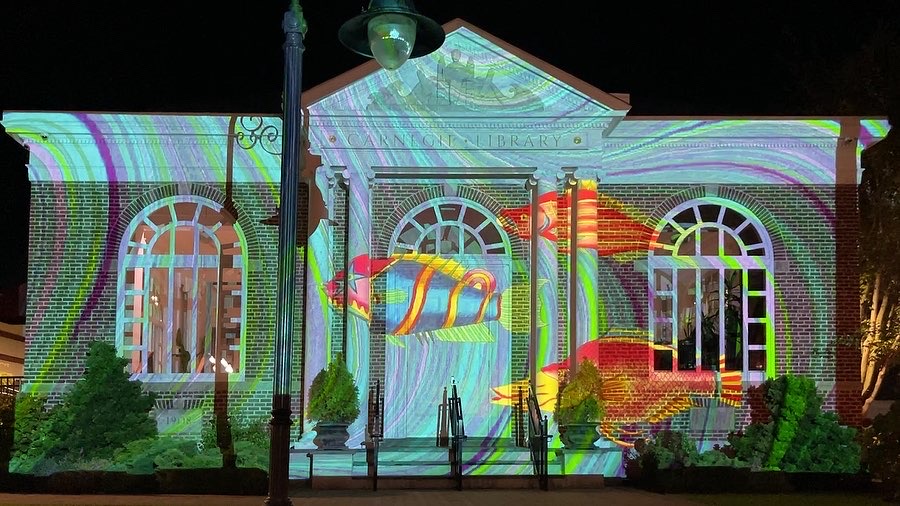 Still from Paper Palazzo by Kelley Bell. Image courtesy of the artist.
As part of the Baker program, artists across six disciplines—visual arts, film/video, interdisciplinary, literary arts, performance, and music—are invited to establish online portfolios of their work, which are housed on the Baker Artist Awards website. The 2024 portfolios, numbering more than 700, were reviewed by an anonymous jury which selected the 36 finalists. One artist in each of the disciplines was awarded the $10,000 Mary Sawyers Baker prize, and one of those six awardees was selected to receive the additional $30,000 Mary Sawyers Imboden prize.
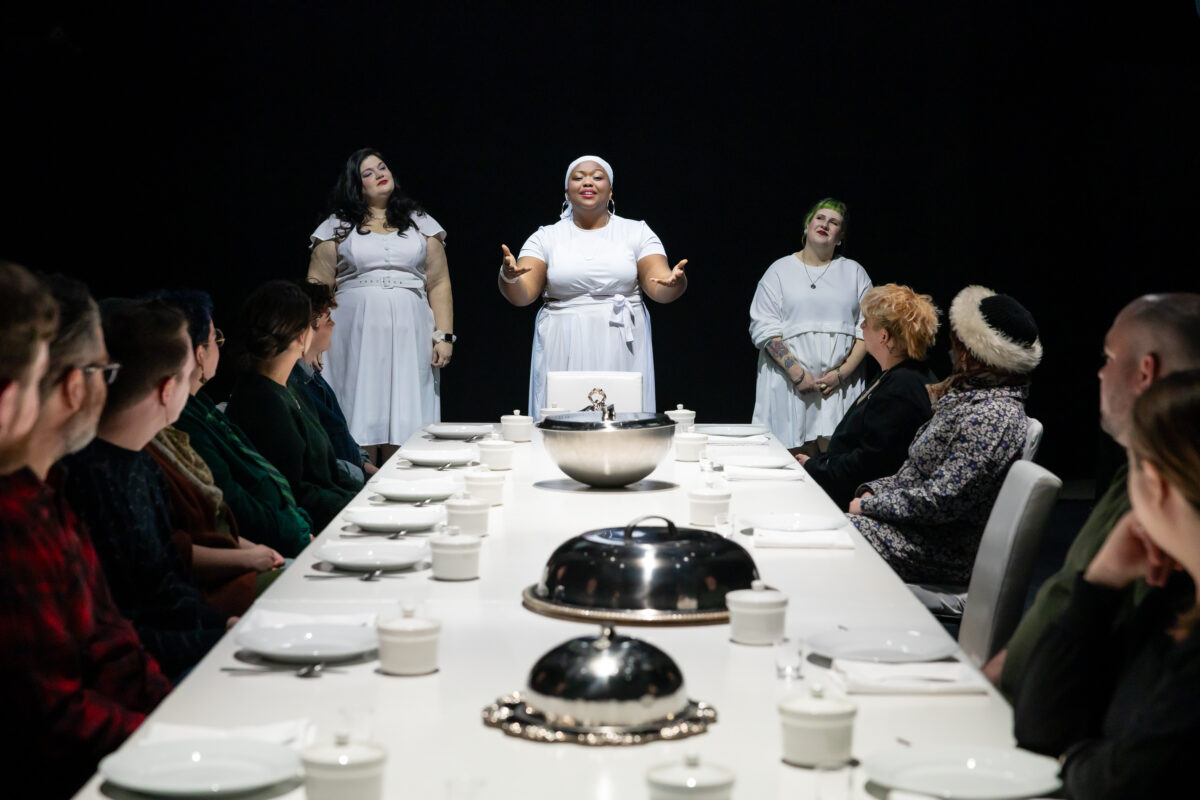 I Will Eat You Alive, written and directed by Katie Hileman ’12. Pictured from left, actors Betse Lyons, Vicky Graham ’20, and Meghan Taylor. Photo by Kiirstn Pagan ’11.
The work of Bell, Parks, Hileman, and other finalists will be featured in a series of finalist showcases. Kelley Bell’s work (in the interdisciplinary category) will be on display at Current Space from April 20 to June 2; Katie Hileman’s work (in the performance category) will be featured at Theatre Project on April 27 at 7:30 p.m. and on April 28 at 4 p.m. The showcase that will feature the work of Corrie Parks (and others in the film/video category) has yet to be scheduled.
UMBC is no stranger to the Baker Artist Awards. Previous recipients have included:
- 2011—Andrew Liang, M.F.A. ’24 ($1,000 b-grant)
- 2013—Jenny O’Grady, assistant vice president, strategic content ($1,000 b-grant)
- 2015—Eric Dyer ’95, visual arts, and professor, visual arts ($25,000 Mary Sawyers Baker prize); and Dominique Zeltzman, M.F.A. ’14, ($5,000 Nancy Haragan award)
- 2018—Lafayette Gilchrist ’92 ($10,000 Mary Sawyers Baker prize)
- 2021—Rahne Alexander, M.F.A. ’21, ($2,500 Baker Artist award); and Mina Cheon, M.F.A. ’02 ($2,500 Baker Artist award)
“Being counted among the 2024 Mary Sawyers Baker Prize awardees is amazing,” said Bell. “I am fiercely proud to call Baltimore my home and inspirational wellspring—it‘s a city like no other, and there is no other creative community I‘d rather be a part of. My colleagues from CAHSS, Katie Hileman and Corrie Francis Parks, were also included in the finalist‘s circle for this prestigious acknowledgment, and that’s a testament to the wonderful things that can happen when UMBC supports and invests in the arts and culture—our colleagues, our institution, and our city all reap the benefits of an active and vibrant creative community.”
Bell’s work will be featured in an exhibition of works by Baker Award recipients at the Baltimore Museum of Art in spring 2025.
]]>
On May 30, Kelley Bell, M.F.A. ’06, associate professor of visual arts, was named one of the six 2024 Baker Artist Awardees, receiving the $10,000 Mary Sawyers Baker Prize. The awardees were...
https://umbc.edu/stories/umbc-artists-named-baker-artist-award-finalists/
https://my3.my.umbc.edu/api/v0/pixel/news/140718/guest@my.umbc.edu/814e0714b03b3e788a512d5b30275cf0/api/pixel
arts-and-culture
cahss
imda
news
story
theatre
visual-arts
UMBC News & Magazine
https://my3.my.umbc.edu/groups/umbc-news-magazine
https://assets1-my.umbc.edu/system/shared/avatars/groups/000/001/943/24435aa6207c452e7bc15cc74b42c7bb/xsmall.png?1748556657
https://assets1-my.umbc.edu/system/shared/avatars/groups/000/001/943/24435aa6207c452e7bc15cc74b42c7bb/original.png?1748556657
https://assets2-my.umbc.edu/system/shared/avatars/groups/000/001/943/24435aa6207c452e7bc15cc74b42c7bb/xxlarge.png?1748556657
https://assets2-my.umbc.edu/system/shared/avatars/groups/000/001/943/24435aa6207c452e7bc15cc74b42c7bb/xlarge.png?1748556657
https://assets3-my.umbc.edu/system/shared/avatars/groups/000/001/943/24435aa6207c452e7bc15cc74b42c7bb/large.png?1748556657
https://assets1-my.umbc.edu/system/shared/avatars/groups/000/001/943/24435aa6207c452e7bc15cc74b42c7bb/medium.png?1748556657
https://assets2-my.umbc.edu/system/shared/avatars/groups/000/001/943/24435aa6207c452e7bc15cc74b42c7bb/small.png?1748556657
https://assets1-my.umbc.edu/system/shared/avatars/groups/000/001/943/24435aa6207c452e7bc15cc74b42c7bb/xsmall.png?1748556657
https://assets2-my.umbc.edu/system/shared/avatars/groups/000/001/943/24435aa6207c452e7bc15cc74b42c7bb/xxsmall.png?1748556657
UMBC News & Magazine
1
0
false
Tue, 09 Apr 2024 10:45:44 -0400
Thu, 13 Jun 2024 10:45:44 -0400
Mellon Foundation grants CAHSS $750K to establish Global Asias Initiative
Kimberly Moffitt, dean of the College of Arts, Humanities, and Socials Sciences, and co-pi Tamara Bhalla, associate professor of American studies and director of the Asian American studies minor, have been awarded a $750,000 grant from the Mellon Foundation to establish the Global Asias Initiative. The initiative will support the rethinking of Asian American issues on campus in a global, diasporic, and collaborative framework through community-engaged, public-facing scholarship and teaching.
“The impact and influence of the Asian diaspora in this region makes it clear that our world has more to offer in providing valuable opportunities for our students, while also creating additional partnerships with the greater Baltimore community,” says Moffitt.
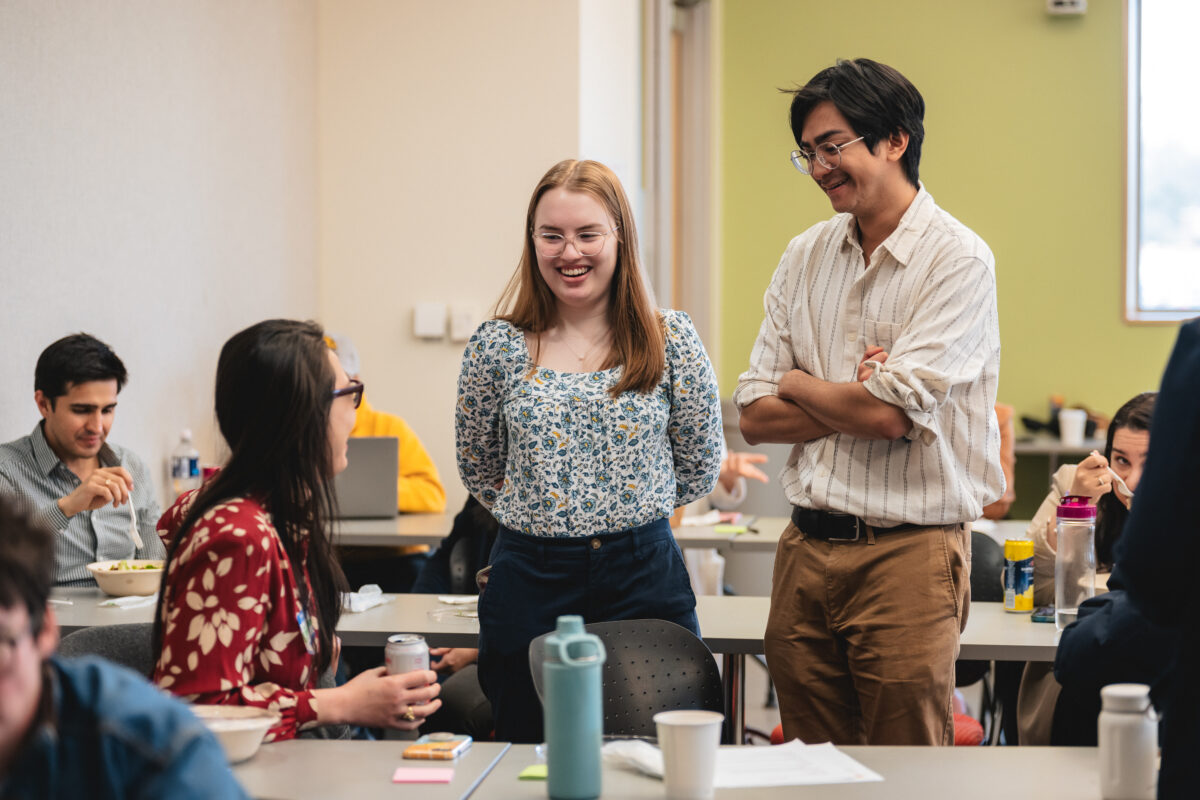 (l-r) Emily Yoon and students at the Global Asias Initiative launch workshop.
(Abnet Shiferaw)
UMBC’s existing Asian studies program and Asian American studies minor will grow into a more expansive Global Asias program that better serves and represents UMBC’s Asian American community, interested students, and beyond. This includes launching an undergraduate community-based research fellowship in Global Asias and the conversation series “Reframing Global Asias,” which invites prominent leaders, scholars, and community members in the field to present and discuss key issues, possibilities, challenges, and new research.
“Together,” says Bhalla, “we will create a forum for engaging in difficult yet productive intellectual conversations in Asian American studies, Asian diaspora studies, and Asian studies.”
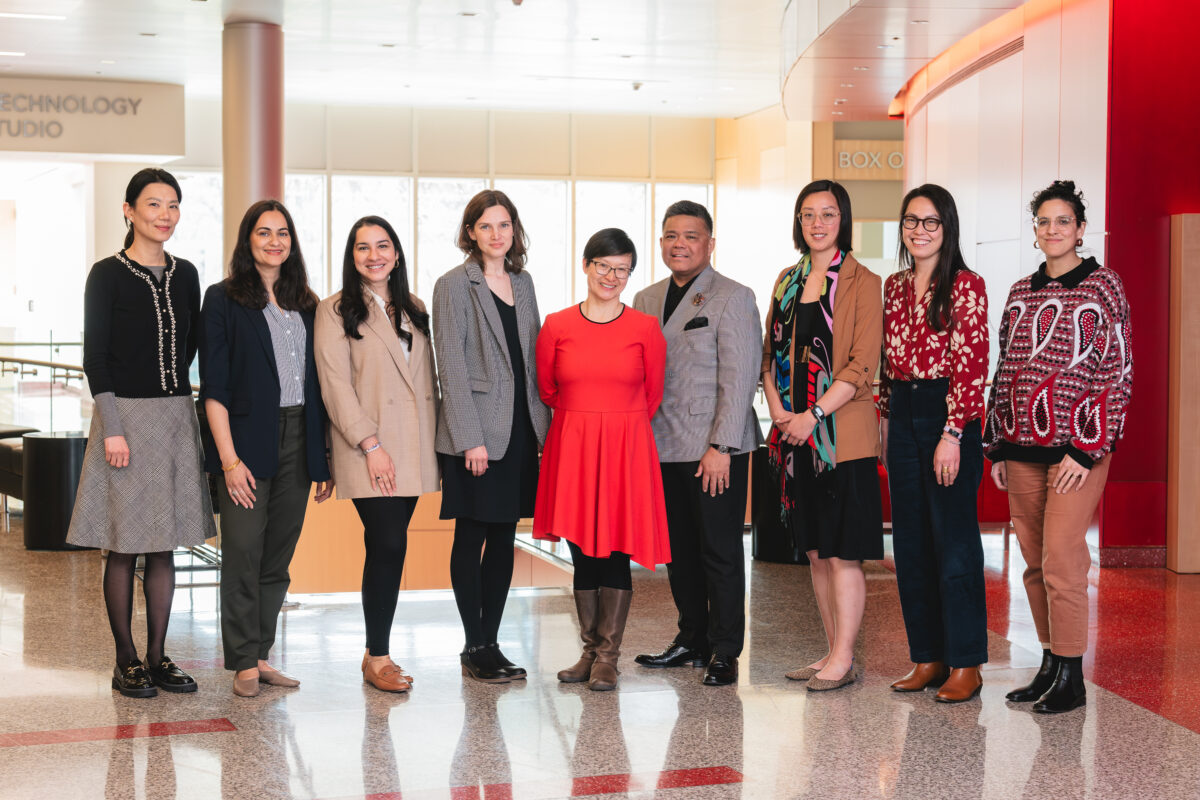 Global Asias Advisory Board, AY2023-2024. (l-r) Tamara Bhalla, Noor Zaidi, Meredith Oyen, Fan Yang, Theo Gonzalvez, Emily Yoon, and Priya Bhayana, project manager for the Global Asias Initiative. (Abnet Shiferaw)
Faculty across UMBC are collaborating to bring the Global Asia Initiative to fruition along with community partners:
-
Meredith Oyen, associate professor of history and director of the Asian studies program
-
Shin Yon Kim, Asian studies lecturer
-
Fan Yang, associate professor of media and communication studies
-
Emily Yoon, assistant professor of English
-
Noor Zaidi, assistant professor of history
-
Christopher Tong, associate professor of modern languages, linguistics, and intercultural communication
-
Theo Gonzalves, former American studies chair and professor, curator of Asian-Pacific American history at the Smithsonian National Museum of American History
-
Robbin Lee ’13, visual arts and media and communications studies, director of partnerships and mobilization at UpSurge Baltimore
Learn more about the Global Asias Iniatiave and Asian studies program.
]]>
Kimberly Moffitt, dean of the College of Arts, Humanities, and Socials Sciences, and co-pi Tamara Bhalla, associate professor of American studies and director of the Asian American studies minor,...
https://umbc.edu/quick-posts/umbc-to-establish-global-asias-initiative/
https://my3.my.umbc.edu/api/v0/pixel/news/140528/guest@my.umbc.edu/32bd2a6ff02002d0cfa31ee10d13251e/api/pixel
american-studies
asian-studies
cahss
english
history
mcs
mlli
news
policy-and-society
quick-post
quick-posts
research
visual-arts
UMBC News & Magazine
https://my3.my.umbc.edu/groups/umbc-news-magazine
https://assets1-my.umbc.edu/system/shared/avatars/groups/000/001/943/24435aa6207c452e7bc15cc74b42c7bb/xsmall.png?1748556657
https://assets1-my.umbc.edu/system/shared/avatars/groups/000/001/943/24435aa6207c452e7bc15cc74b42c7bb/original.png?1748556657
https://assets2-my.umbc.edu/system/shared/avatars/groups/000/001/943/24435aa6207c452e7bc15cc74b42c7bb/xxlarge.png?1748556657
https://assets2-my.umbc.edu/system/shared/avatars/groups/000/001/943/24435aa6207c452e7bc15cc74b42c7bb/xlarge.png?1748556657
https://assets3-my.umbc.edu/system/shared/avatars/groups/000/001/943/24435aa6207c452e7bc15cc74b42c7bb/large.png?1748556657
https://assets1-my.umbc.edu/system/shared/avatars/groups/000/001/943/24435aa6207c452e7bc15cc74b42c7bb/medium.png?1748556657
https://assets2-my.umbc.edu/system/shared/avatars/groups/000/001/943/24435aa6207c452e7bc15cc74b42c7bb/small.png?1748556657
https://assets1-my.umbc.edu/system/shared/avatars/groups/000/001/943/24435aa6207c452e7bc15cc74b42c7bb/xsmall.png?1748556657
https://assets2-my.umbc.edu/system/shared/avatars/groups/000/001/943/24435aa6207c452e7bc15cc74b42c7bb/xxsmall.png?1748556657
UMBC News & Magazine
0
0
false
Wed, 03 Apr 2024 11:06:07 -0400
Wed, 03 Apr 2024 11:06:07 -0400
Résumés in hand, 2,000+ hopeful and prepared Retrievers attend the 2024 Career Fair
On a perfect 55-degree sunny February day, hundreds of undergraduate and graduate students across all colleges stood in a line that began at the RAC and wrapped its way to Sherman Hall. Instead of exercise gear, Retrievers were dressed to impress with résumés in hand, ready to land a summer internship or a job with one of the 180-plus employers across multiple industry sectors at UMBC’s Spring 2024 Career and Internship Fair.
“We are excited to help employers develop a strong talent pipeline and diverse future workforce, shaping the leaders and innovators of tomorrow,” said Paige Bauder, associate director of employer relations and recruitment programs at UMBC.
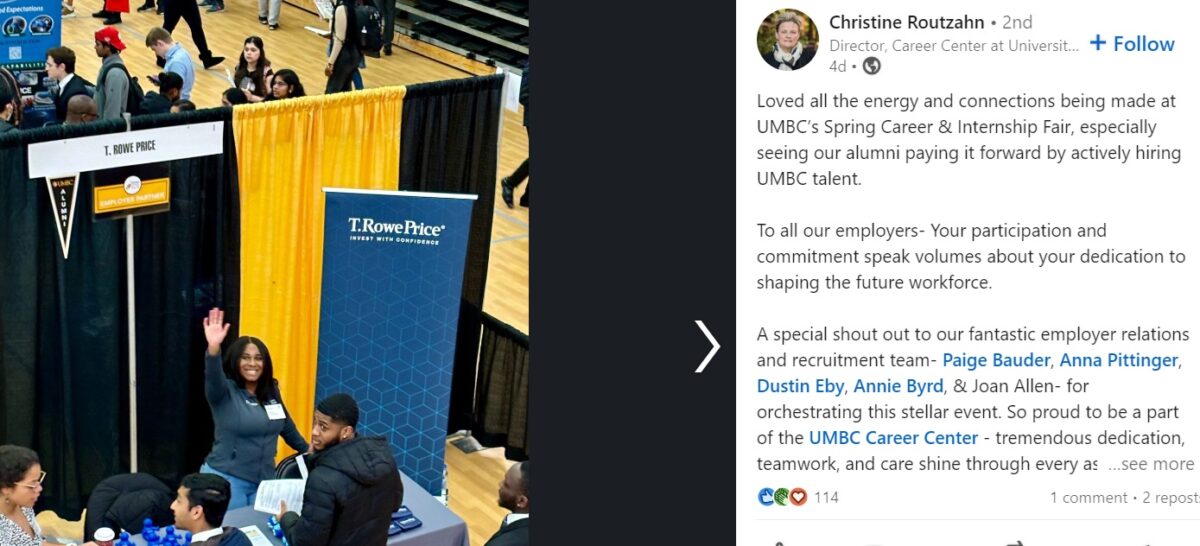 Image courtesy of Christine Routzahn, director of UMBC’s Career Center.
The leading edge
“Give strong handshakes. Maintain eye contact,” said Leon Tang ’26, information systems, in a booming voice, as he scanned IDs as a volunteer at the event.
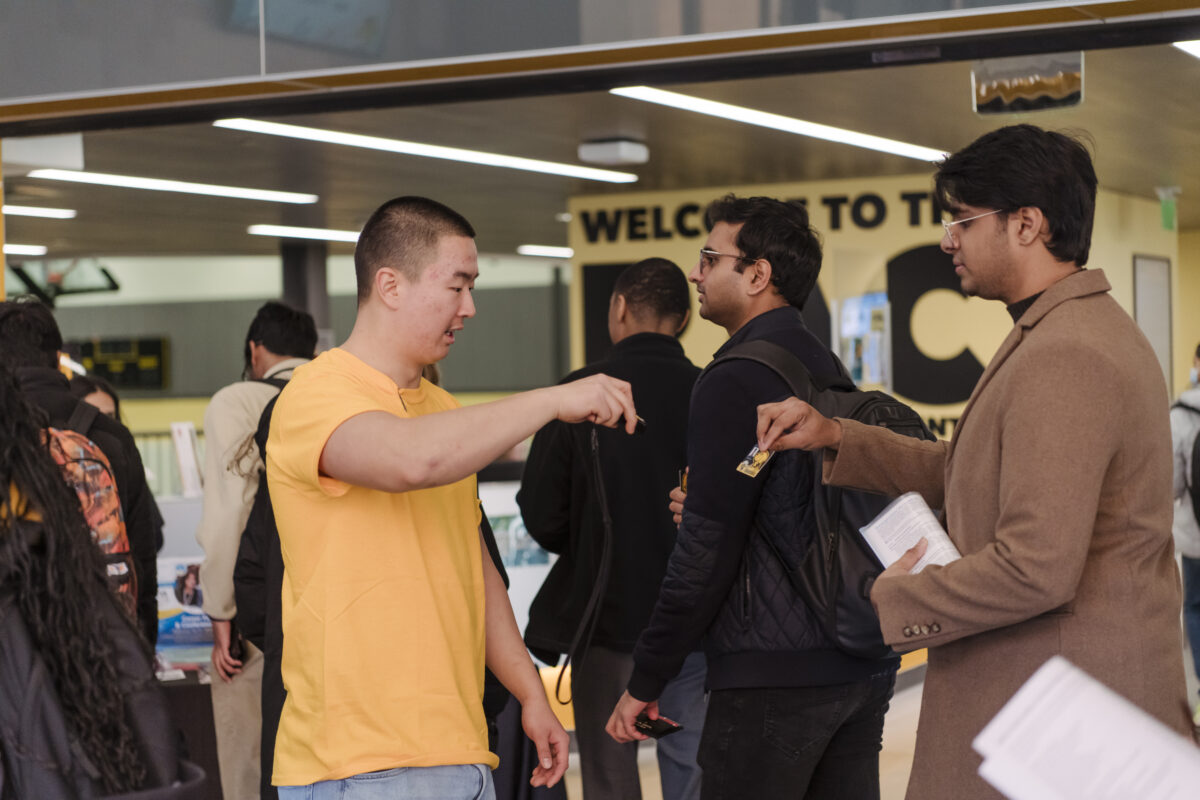 Leon Tang welcoming Career Fair attendees. (Marlayna Demond ’11/UMBC)
“Some people might come in nervous. It’s over 180 companies, so it can be pretty hard,” said Tang. He currently has two internships, one as a business technology intern at Agile Care Enterprises, based at bwtech@UMBC, and another as a research assistant in the information systems department. “It’s a good way to tell everyone to be calm and be confident. It’s the little things that can go pretty far in obtaining something.” For the nearly 2,200 Retrievers that made it through the door that day, this was sage advice.
A professional headshot is one of those little things. After making it past Tang, Bhargavi Gudapati, a current master’s student in information systems, headed straight back to grab the 10th spot in a line that, over the next four hours, would consistently have dozens of excited and grateful students waiting for their free headshot. Gudapati, an international student from India, has attended every career fair since she arrived in 2022. She wants to get ahead of the steep competition of international students looking to launch the next phase of their career in the U.S.
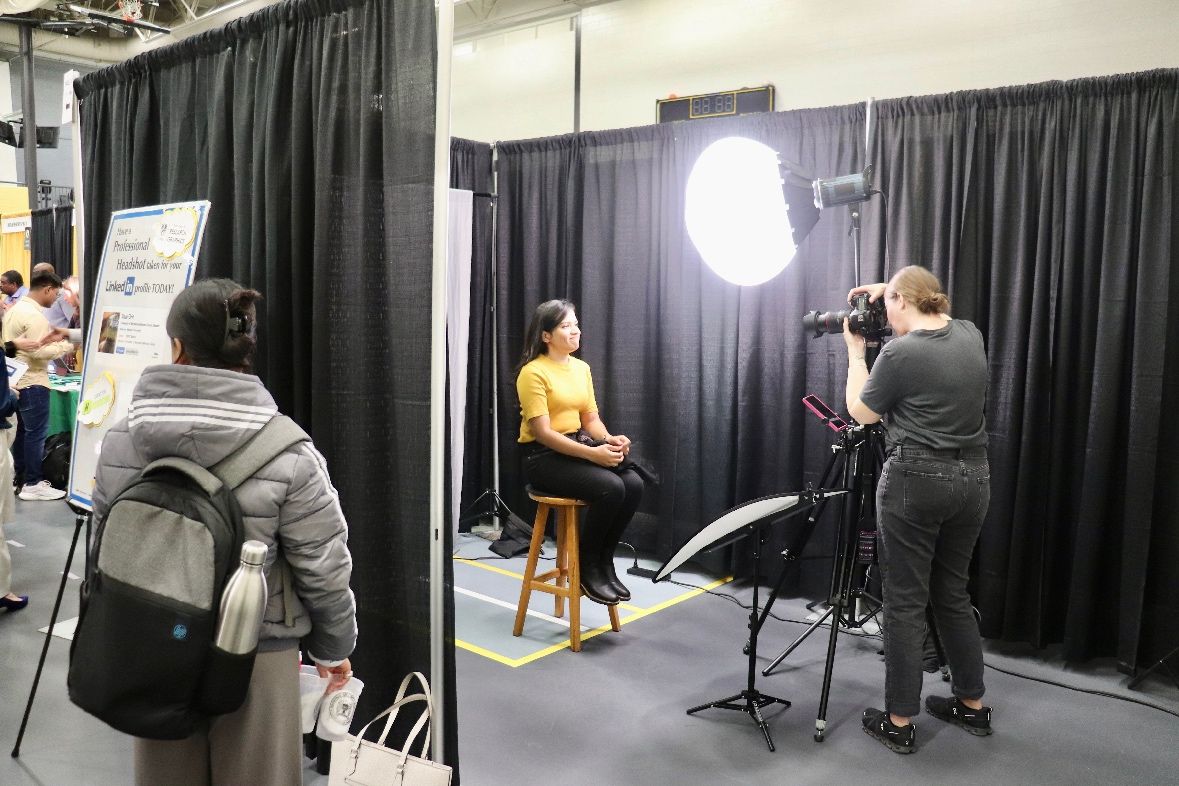 Spring 2024 Career and Internship Fair headshot station. (Image courtesy of Christine Routzahn)
“It’s incredibly important to get to know employers in person instead of only on their online portal,” says Gudapati.“You want to know what they require and the current technology they are using.”
One of those employers, Ed Belsinger ’90, M.S. ’93, mechanical engineering, is a newbie to UMBC’s career fairs. He proudly wore his UMBC sweatshirt and a smile that became a beacon of friendliness in a sea of students seeking opportunities. Belsinger is the director of product development at RPM Tech, a company that turns an idea into a prototype and a prototype into a fully manufacturable product. Because RPM does all the engineering and design in-house with a full shop and lab, it can offer students a wide range of expertise.
Belsinger notes that RPM is currently in a growth mode and has three internships available as well as full-time positions. “As an alum, I said, ‘This is a great school—we have to go there.’ Whether it’s an internship or someone right out of college, we’re looking for students with curiosity, who want to learn, are willing to do new things, to be challenged, and be part of a team.”
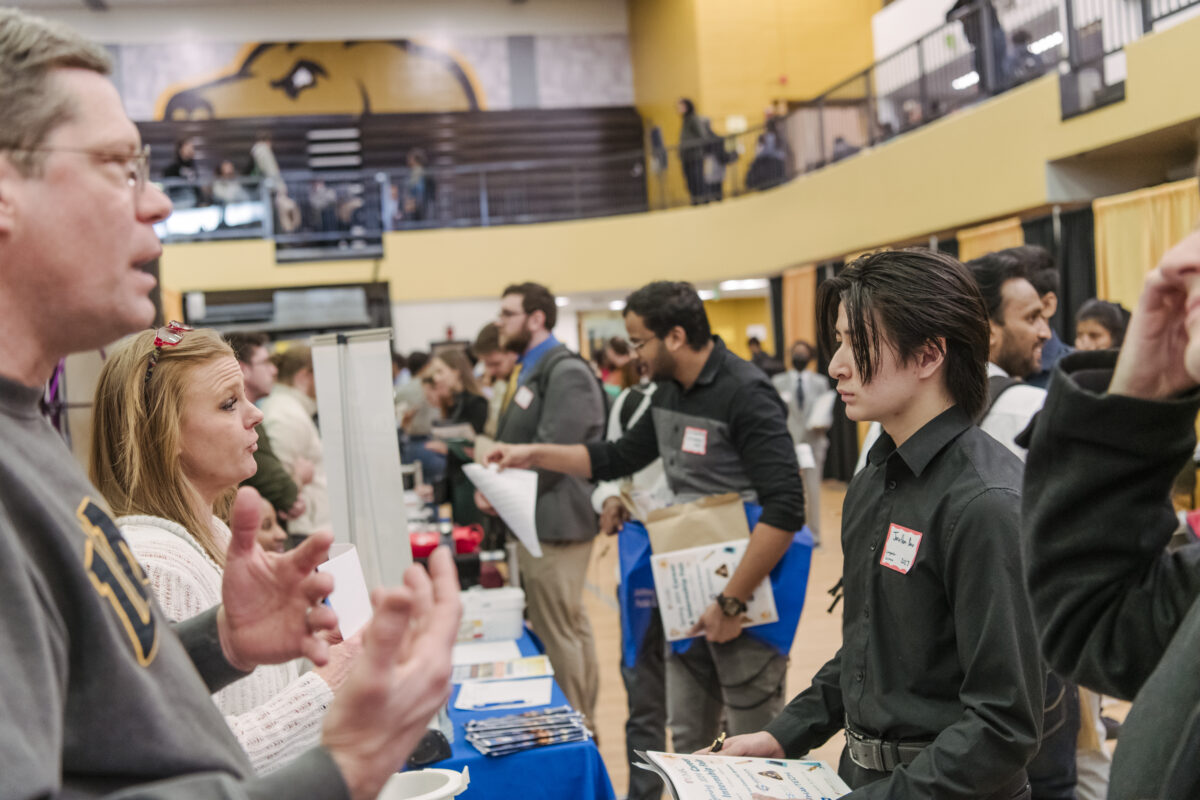 (l – r): Ed Belsinger (in grey) and Jonathan Dao (in black). (Marlayna Demond ’11/UMBC)
Hoping to grab one of the RPM internships is Jonathan Dao, computer science, a first-year student waiting in line to speak with Belsinger. “I saw tech in the name and wanted to learn more. I want to see if I can start early to have a competitive advantage,” said Dao. “I think first-year students should definitely give the career fair a shot. Come in with confidence, try rehearsing how to present yourself, and dress well.”
Part of the team
Sekinat Dosunmu ’24 agrees with Dao’s approach. After spending her first year of college remote, she has made it a point to attend every career fair in person. Toward the end of the day, she lined up at the FBI table, ready to discuss what the FBI had to offer someone like her with a global studies major, an Africana studies minor, and certificates in tech and intercultural communication. As she stepped forward, a recruiter immediately welcomed her.
While waiting to continue talking with Dosunmu, other recruiters shared that the FBI welcomes all majors, including the arts and humanities. They noted that the most important skill the FBI is looking for is how someone approaches and solves a problem in a team environment.
The artists approach
Solving problems creatively is the bread (or blood) and butter of C.C. Smith ’24, theatre, formerly known as Dracula in UMBC’s fall 2023 production of Dracula: a Feminist Revenge Fantasy, Really. That role earned him an audition for a film later on in the day, so Smith is hurrying through the fair.
Later in the spring, UMBC’s Career Center hosts boutique career fairs, one of which is focused on creative careers, and on March 7, it will host the CAHSS Career Connection Social for arts, humanities, and social science majors, but that doesn’t stop Smith from checking things out. As an actor, Smith explains, you never know when someone is looking to do a commercial. “This is my first time here. I would like to see more performing arts employers in this larger career fair, especially with how good the arts programs are here,” says Smith. “As a senior, it’s still important to be poking around this fair.”
Luna Siesko ’25, visual arts, and Alexander Schobitz ’22, visual arts, agree with Smith that UMBC students excel in the arts, and would like local employers to know about that. Siesko, a photographer and videographer at commonvision, UMBC’s design shop, used her skillset to bring personally designed business cards and résumés to the fair. Siesko is unsure what she is looking for but hopes that by speaking with some of the employers, like the folks at the Baltimore County Arts Guild, she can get a sense of how to best move forward.
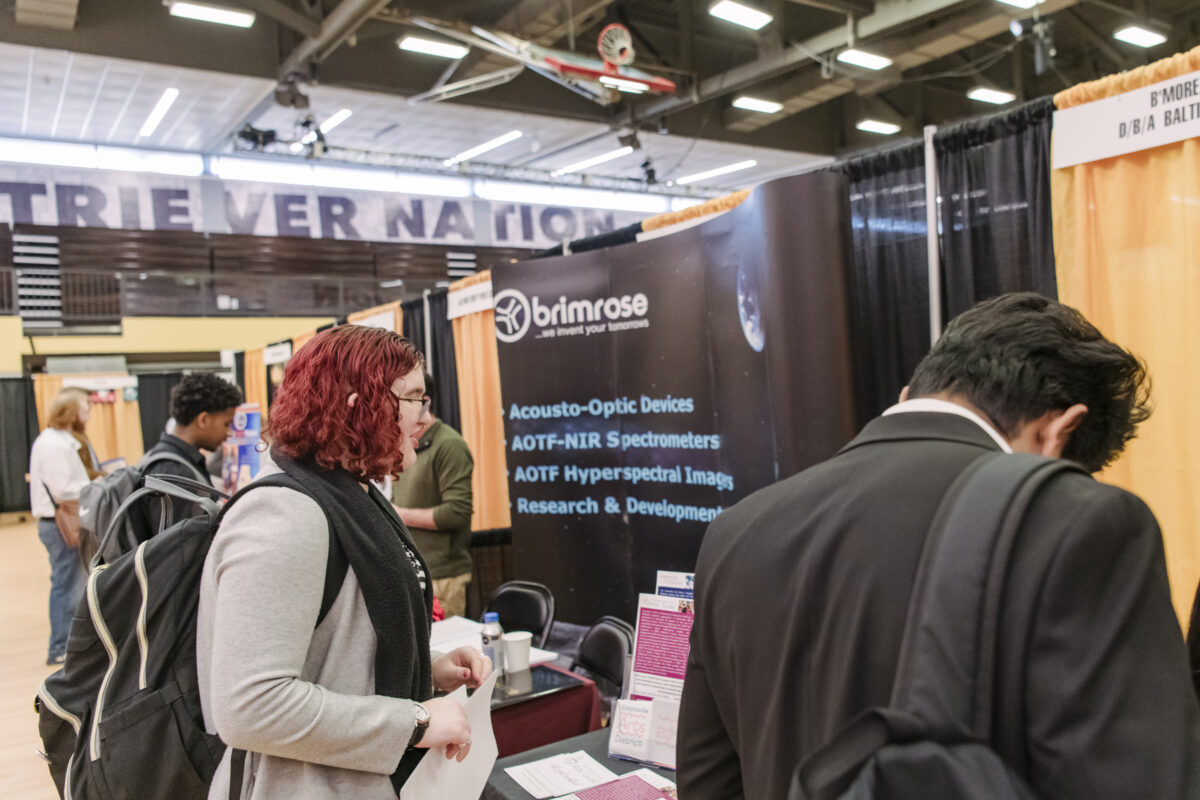 Luna Siesko at the Baltimore County Arts Guild table. (Marlayna Demond ’11/UMBC)
“We’re a small non-profit five minutes from UMBC. We want to make sure that artists feel seen and heard and know there is a place for them to work,” said Gloria Fajimolu, program and events manager at the Baltimore County Arts Guild, a new employer at the Career Fair. “We’re very welcoming. If a student doesn’t get the internship or the job, they can still be a paid instructor. If they are in animation, we will pay them to teach animation classes to the community.”
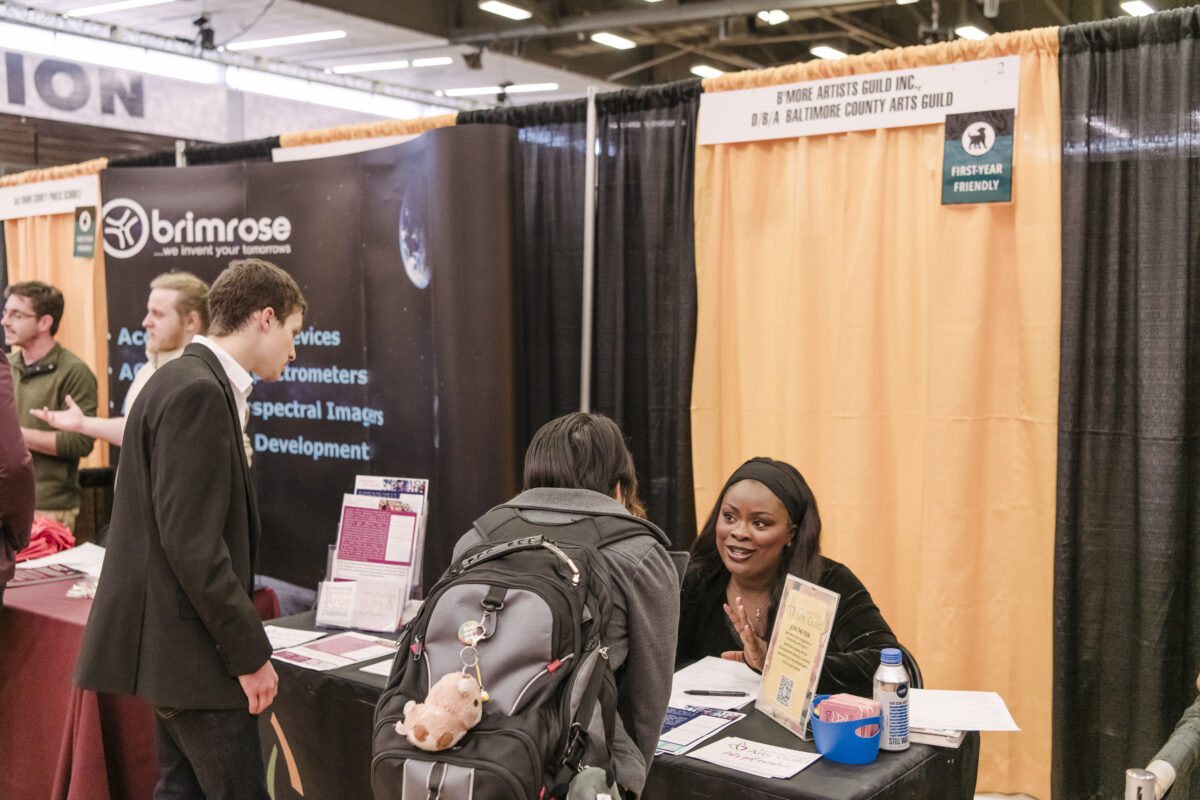 Gloria Fajimolu, program and events manager at the Baltimore County Arts Guild. (Marlayna Demond ’11/UMBC)
As a recent alum, Schobitz has one goal—to get a job in animation. He is grateful UMBC gives alumni access to the career fairs and Handshake, a job listing app. “I apply to about 10 jobs per day. I use sites like Indeed and Handshake to find jobs and apply,” says Schobitz. “While I was a student, I used UMBC’s résumé services and made a lot of appointments. I’m still trying. I won’t give up.”
The end and beginning
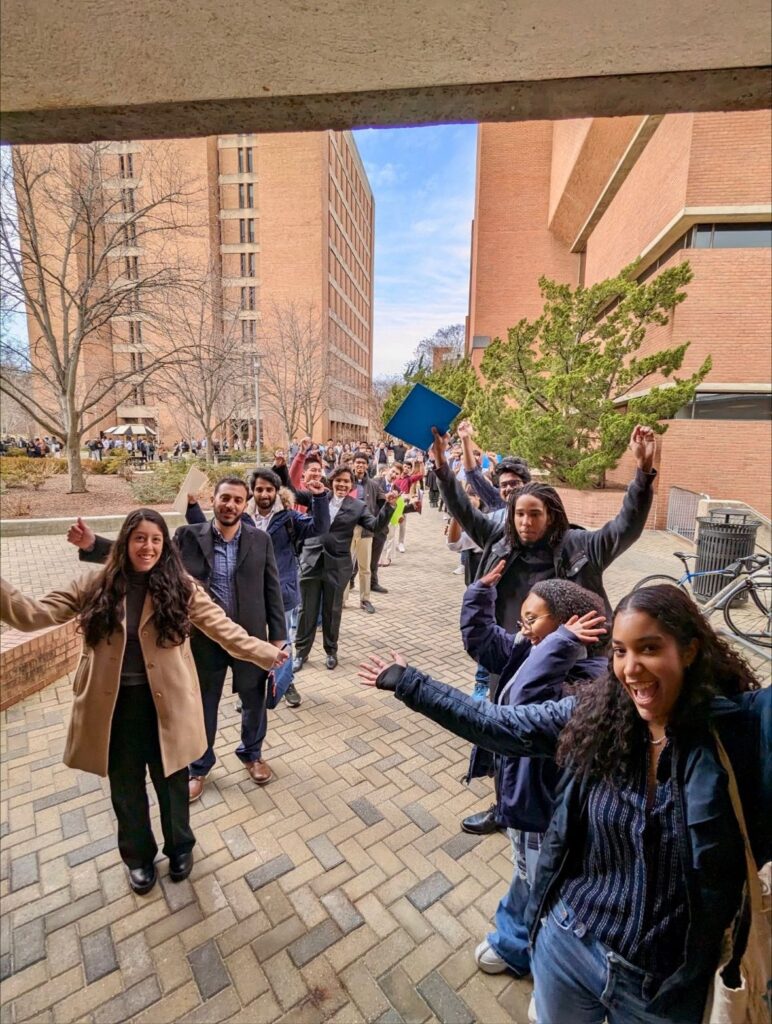 UMBC students lineup for the Spring 2024 Career and Internship Fair.
(Image courtesy of Routzhan)
Back at the headshot line, Cristian Castro, M.S. ’24, cybersecurity, joined the still-growing line as the last wave of students filed in. Castro is from Colombia and is looking to find a company to sponsor him to work in the U.S. “The Career Fair is a very good opportunity to see what’s out there. A professional photo is important in a LinkedIn profile,” says Castro. He also found some job leads earlier this year while representing UMBC as part of the Society of Advancing Chicanos/Hispanics and Native Americans in Science. “When it comes to what happens after graduation, every detail helps.”
Follow the Career Center on myUMBC and RSVP to the CAHSS Career Connection Social on Thursday, March 7, to network with alumni and employers in the arts, humanities, and social sciences.
]]>
On a perfect 55-degree sunny February day, hundreds of undergraduate and graduate students across all colleges stood in a line that began at the RAC and wrapped its way to Sherman Hall. Instead of...
https://umbc.edu/stories/the-2024-career-fair/
https://my3.my.umbc.edu/api/v0/pixel/news/139041/guest@my.umbc.edu/21c9b154d9df23acc2fa66d5d7b9f73e/api/pixel
africana-studies
cahss
career-center
coeit
community
computer-science
cybersecurity
global-studies
is
meche
news
story
theatre
visual-arts
UMBC News & Magazine
https://my3.my.umbc.edu/groups/umbc-news-magazine
https://assets1-my.umbc.edu/system/shared/avatars/groups/000/001/943/24435aa6207c452e7bc15cc74b42c7bb/xsmall.png?1748556657
https://assets1-my.umbc.edu/system/shared/avatars/groups/000/001/943/24435aa6207c452e7bc15cc74b42c7bb/original.png?1748556657
https://assets2-my.umbc.edu/system/shared/avatars/groups/000/001/943/24435aa6207c452e7bc15cc74b42c7bb/xxlarge.png?1748556657
https://assets2-my.umbc.edu/system/shared/avatars/groups/000/001/943/24435aa6207c452e7bc15cc74b42c7bb/xlarge.png?1748556657
https://assets3-my.umbc.edu/system/shared/avatars/groups/000/001/943/24435aa6207c452e7bc15cc74b42c7bb/large.png?1748556657
https://assets1-my.umbc.edu/system/shared/avatars/groups/000/001/943/24435aa6207c452e7bc15cc74b42c7bb/medium.png?1748556657
https://assets2-my.umbc.edu/system/shared/avatars/groups/000/001/943/24435aa6207c452e7bc15cc74b42c7bb/small.png?1748556657
https://assets1-my.umbc.edu/system/shared/avatars/groups/000/001/943/24435aa6207c452e7bc15cc74b42c7bb/xsmall.png?1748556657
https://assets2-my.umbc.edu/system/shared/avatars/groups/000/001/943/24435aa6207c452e7bc15cc74b42c7bb/xxsmall.png?1748556657
UMBC News & Magazine
1
0
false
Thu, 15 Feb 2024 16:23:39 -0500
Thu, 15 Feb 2024 16:23:39 -0500
Alumna brings biology mural back to life
Walking down Academic Row, the ground floor windows of the Biological Sciences Building reflect the flow of student traffic, and colorful renditions of animals and microbes, silhouettes of researchers, and other elements of biology seem to pop off the wall and join the campus milieu.
For many, the images on the mural blend into the background of campus—just another wall in just another building. But the artist remembers the blank wall 10 years ago, covered sparsely in inspirational posters and placards.
“It was a huge wall, and visible from the outside,” says Anna Vikhlyayeva ’15, visual arts. In addition to wanting to beautify the space, Vikhlyayeva thought to herself, “The research of scientists can be very interesting and colorful and very inspiring for artists. What if by highlighting the biology research that people do in this building, other students will become more interested in biology?”
More than a mural
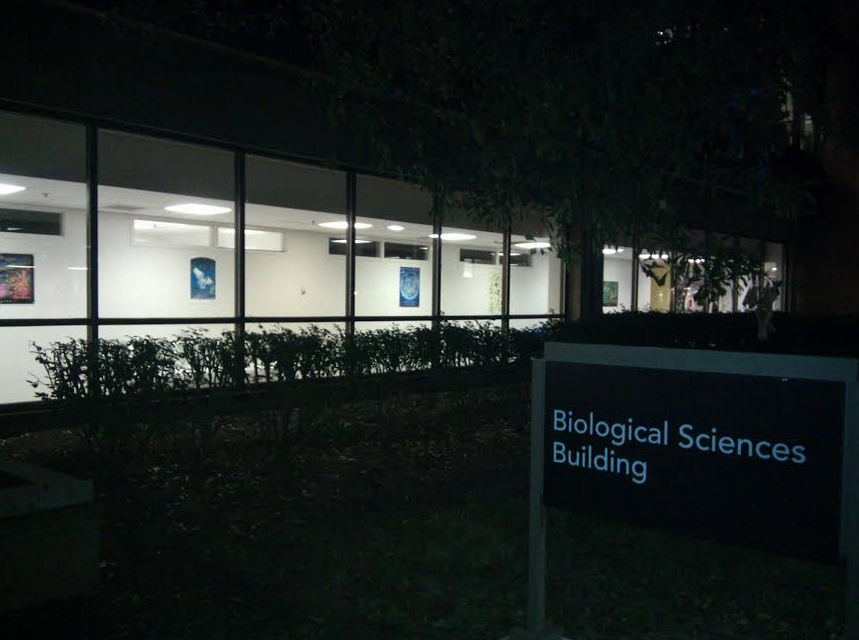 A “before” picture of the hallway in the biology building that the artist saw as an opportunity to emphasize the beauty of the world. (Photo courtesy of Vikhlyayeva)
In 2013 Vikhlyayeva took her plan to then-chair of the biology department Professor Philip Farabaugh, and it was perfect timing, he says. “I’d been thinking about branding the building in some way…and a mural was an obvious means to do that.” And in the decade since its installation, Farabaugh says, “I’m really gratified that the mural acts as a uniting image for all our faculty, staff, and students.”
But in December 2022 a combination of freezing temperatures and burst pipes resulted in damage across campus and significant flooding in the biology building. The bottom half of the mural fell victim to the water.
The challenges caused by the flood were hard to bear, particularly following COVID, says Farabaugh. “But, despite the disaster fatigue that everyone felt, the faculty, staff, and students responded with grace, energy, and yes, resiliency to the challenge.”
Vikhlyayeva, a working artist, still lives in the area, so when the biology building was reopened, Farabaugh emailed her to see if she’d be interested in repainting the damaged section. “I was happy to know that people in the building appreciate this wall so much that they want me to repair it,” says Vikhlyayeva. “Based on my images of the original mural, I’ve attempted to replicate the colors and designs the same.”
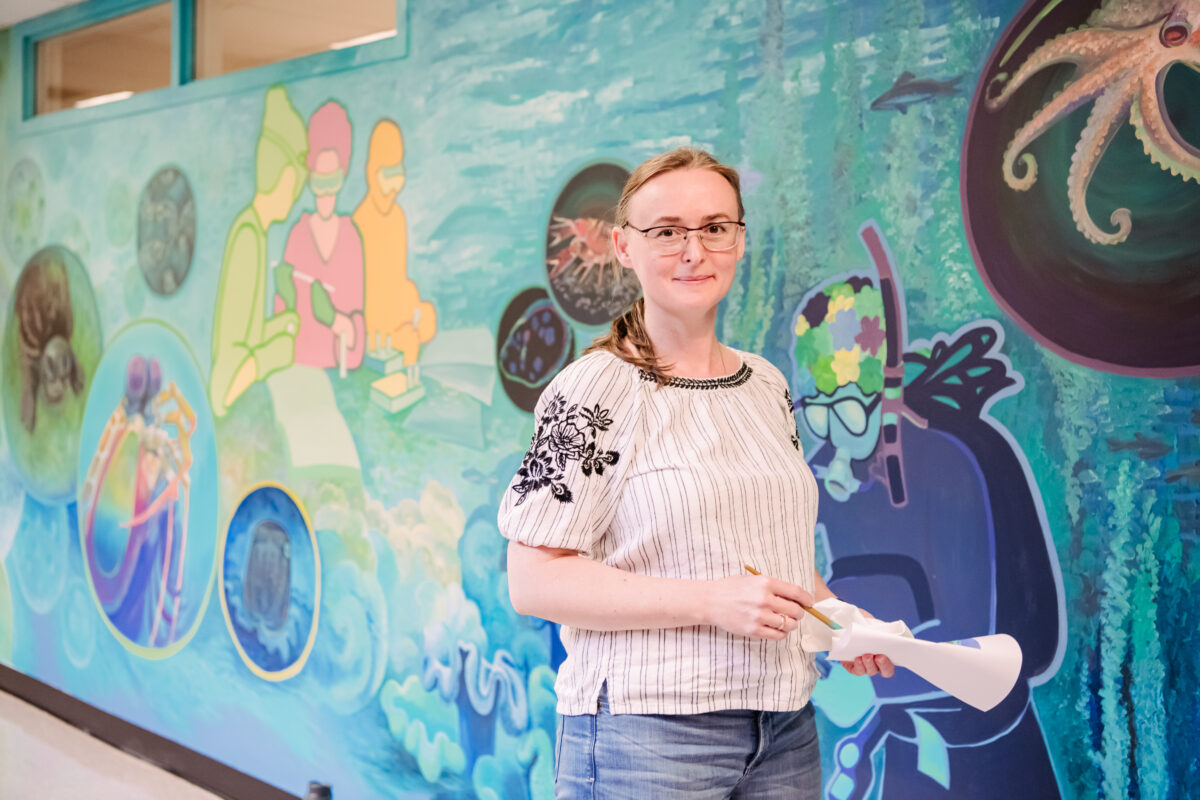 Anna Vikhlyayeva ’15 originally planned and painted the mural 10 years ago, but after water damage, she returned to repair it. (Marlayna Demond ’11/UMBC)
Farabaugh says different elements of the mural stick out to him at different times, including that “the integration of the realistic animals and stylized students works to emphasize their direct relationships.” He sees the figures in the mural “representing all the thousands of students who have passed through the building in the last almost 60 years. I hope that many of them feel that their experience of research in our building set them on a life path and the mural is a visible representation of that.”
A glow up, 10 years later
In summer 2023, Vikhlyayeva brought a folding camping stool and a vibrant palette of green and blue hues to tackle the lower portion of her mural.
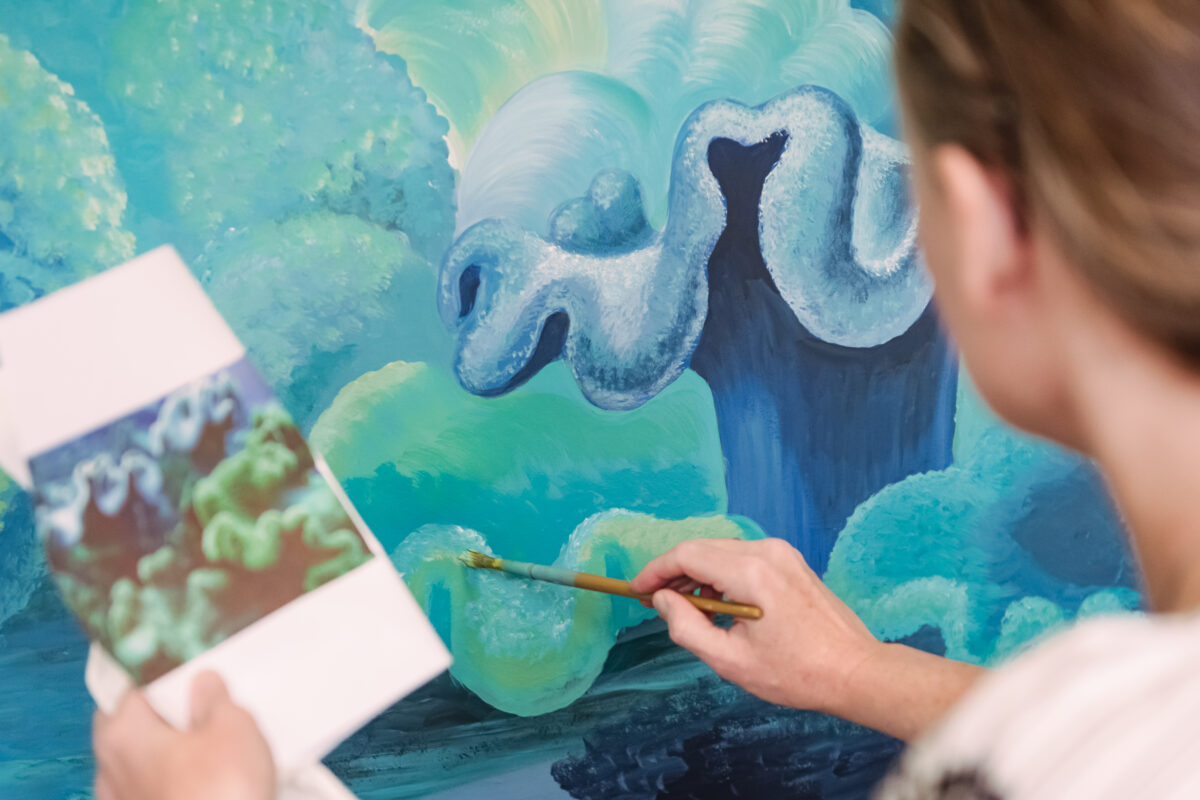 The artist chose her subject matter for the mural based on actual research happening in the building. (Marlayna Demond ’11/UMBC)
“I thought that bright colors, these nice pictures, will put other students in a good mood and give them inspiration to study and even to be more happy,” she says.
Farabaugh says that he’s enjoyed watching students and researchers claim the re-beautified space as their own, holding poster sessions in the hallway with the mural as the backdrop. “It really has become the heart of the building and, mixing a metaphor, its public face.”
]]>
Walking down Academic Row, the ground floor windows of the Biological Sciences Building reflect the flow of student traffic, and colorful renditions of animals and microbes, silhouettes of...
https://umbc.edu/stories/alumna-brings-mural-back-to-life/
https://my3.my.umbc.edu/api/v0/pixel/news/138351/guest@my.umbc.edu/00d4c5a608768c725983068949e8ecef/api/pixel
alumni
biology
cahss
campus-life
cnms
magazine
story
visual-arts
UMBC News & Magazine
https://my3.my.umbc.edu/groups/umbc-news-magazine
https://assets1-my.umbc.edu/system/shared/avatars/groups/000/001/943/24435aa6207c452e7bc15cc74b42c7bb/xsmall.png?1748556657
https://assets1-my.umbc.edu/system/shared/avatars/groups/000/001/943/24435aa6207c452e7bc15cc74b42c7bb/original.png?1748556657
https://assets2-my.umbc.edu/system/shared/avatars/groups/000/001/943/24435aa6207c452e7bc15cc74b42c7bb/xxlarge.png?1748556657
https://assets2-my.umbc.edu/system/shared/avatars/groups/000/001/943/24435aa6207c452e7bc15cc74b42c7bb/xlarge.png?1748556657
https://assets3-my.umbc.edu/system/shared/avatars/groups/000/001/943/24435aa6207c452e7bc15cc74b42c7bb/large.png?1748556657
https://assets1-my.umbc.edu/system/shared/avatars/groups/000/001/943/24435aa6207c452e7bc15cc74b42c7bb/medium.png?1748556657
https://assets2-my.umbc.edu/system/shared/avatars/groups/000/001/943/24435aa6207c452e7bc15cc74b42c7bb/small.png?1748556657
https://assets1-my.umbc.edu/system/shared/avatars/groups/000/001/943/24435aa6207c452e7bc15cc74b42c7bb/xsmall.png?1748556657
https://assets2-my.umbc.edu/system/shared/avatars/groups/000/001/943/24435aa6207c452e7bc15cc74b42c7bb/xxsmall.png?1748556657
UMBC News & Magazine
6
0
false
Tue, 23 Jan 2024 15:31:38 -0500
Tue, 23 Jan 2024 15:31:38 -0500
UMBC’s galleries deliver interactive and thoughtful art
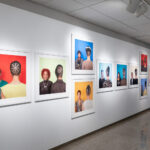
UMBC’s art galleries are already in full bloom for the spring. With exhibits showcasing historic and innovative 20th century photography, interactive hip-hop data visualization, and the legacies of political resistance as seen through Black hair, the university’s exhibition spaces are bountiful with thought-provoking work.
Hip-Hop and Data at CADVC
Tahir Hemphill: Rap Research Lab runs at the Center for Art, Design, and Visual Culture (CADVC) through March 18. In this exhibition, Tahir Hemphill, the inaugural Fellow for Faculty Diversity in the Visual Arts at UMBC, presents a collection of interactive works that explore what he calls “the hybrid area between art, technology, social engagement, and interdisciplinary research.”
Visitors are invited to participate in Hemphill’s design and research process through evolving artworks, including “Visualisation of Authority,” a kinetic sculpture drawing on Library of Congress research data, and “Mapper’s Delight,” an interactive augmented reality-based middle-school curriculum Hemphill designed in collaboration with Verizon Innovative Learning.
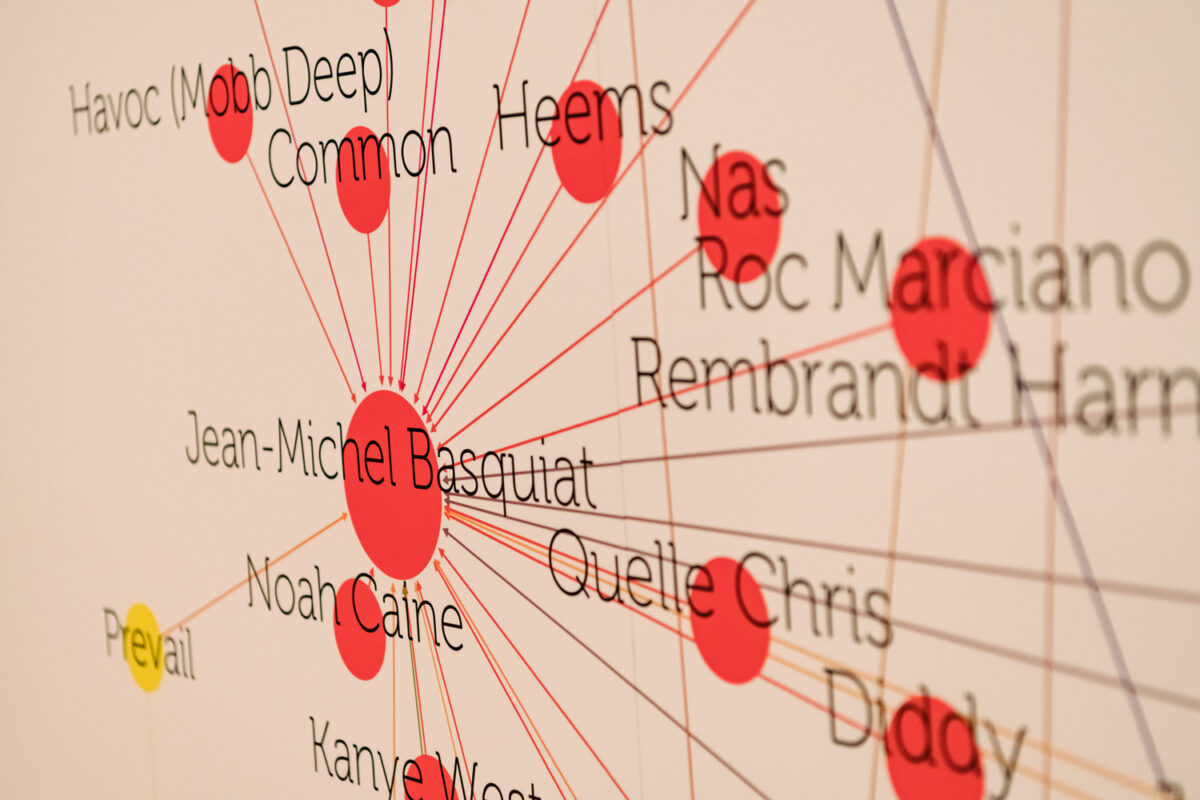 Data visualization from Hemphill’s Rap Research Lab at the CADVC. (Marlayna Demond ’11/UMBC)
Hemphill is using the exhibition space for teaching as well. In a course offered in collaboration between Visual Arts and the UMBC Image Research Center (IRC) students have the opportunity to mine the “Rap Almanac,” Hemphill’s expansive dataset of rap lyrics, to produce work in an internship-based research practicum.
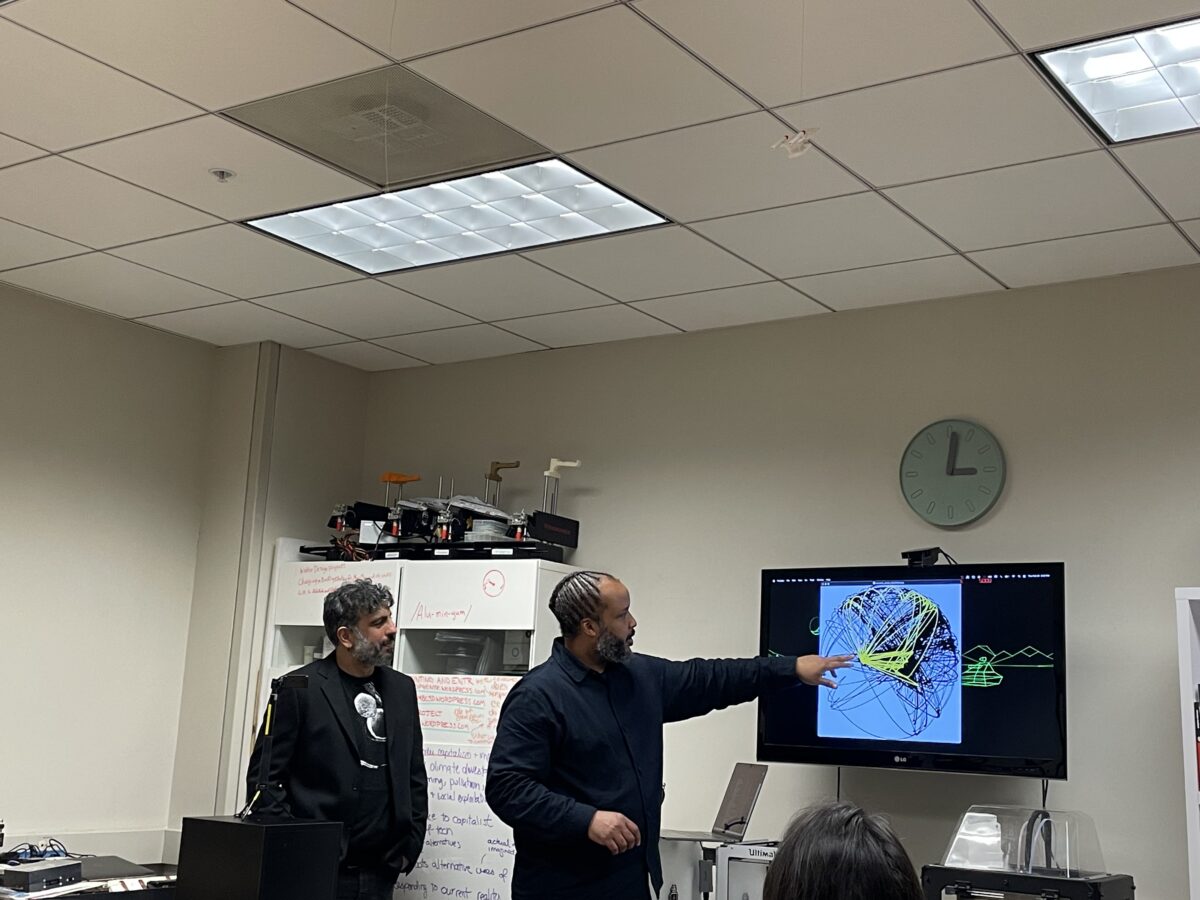 Hamidi, left, and Hemphill, right, talk through data visualization. (Marlayna Demond ’11/UMBC)
“CADVC operates as an art gallery and research center dedicated to scholarship and experimentation in art and culture,” says CADVC Director Rebecca Uchill. “This exhibition demonstrates a terrific range of scholarly inquiries, by Hemphill and his collaborators, into many facets of cultural history and the power of creative data visualization strategies. It is very exciting to watch this research develop in a public-facing presentation!”
Additional programming for the exhibition will include a series of public events such as a choreographed activation of a programmable robot arm, a partnership project with assistant professor Foad Hamidi from the Human-Centered Computing program in Information Systems, and a series of pop-up events.
Historic Hair and Formative Photography at AOK
The Albin O. Kuhn Library Gallery currently features two shows—Aaron Siskind: Formations and Sonya Clark: Hair/Craft—both on view through March 12.
Multidisciplinary artist Sonya Clark presents five works made with human hair and fiber art techniques to explore Black visibility and identity, and to examine the ways Black hair has been employed as an instrument of political resistance across the African diaspora. Clark, whose work explores issues of identity, race, cultural heritage, and collective memory, engages everyday objects and craft traditions to examine narrative threads connecting modern issues with historical origins, including the Black national anthem “Lift Every Voice and Sing” and the biography of Madam C. J. Walker, who became the first female self-made millionaire by selling hair care products to Black women.
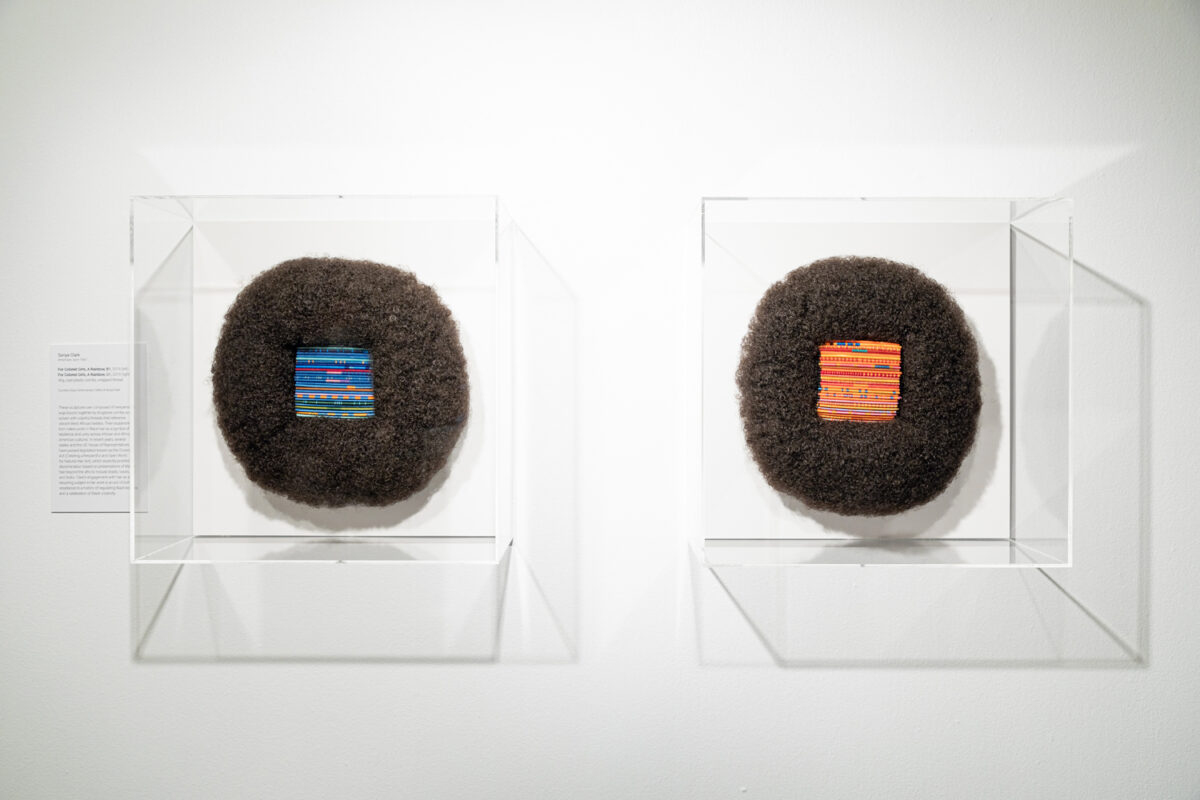 Sonya Clark’s Hair/Craft exhibit at the AOK Library Gallery. (Melissa Penley Cormier, M.F.A. ’17, for Research Graphics)
Influential photographer Aaron Siskind is celebrated through 55 works spanning his prolific career, all part of UMBC’s Photography Collections. Beginning with early documentary works Siskind made as part of the New York Film and Photo League in the 1930s and his groundbreaking abstract works of the 1940s and 1950s, the exhibition continues through phases of architectural studies, travel photography, and Siskind’s famous series focused on divers suspended in mid-air, “Terrors and Pleasures of Levitation.”
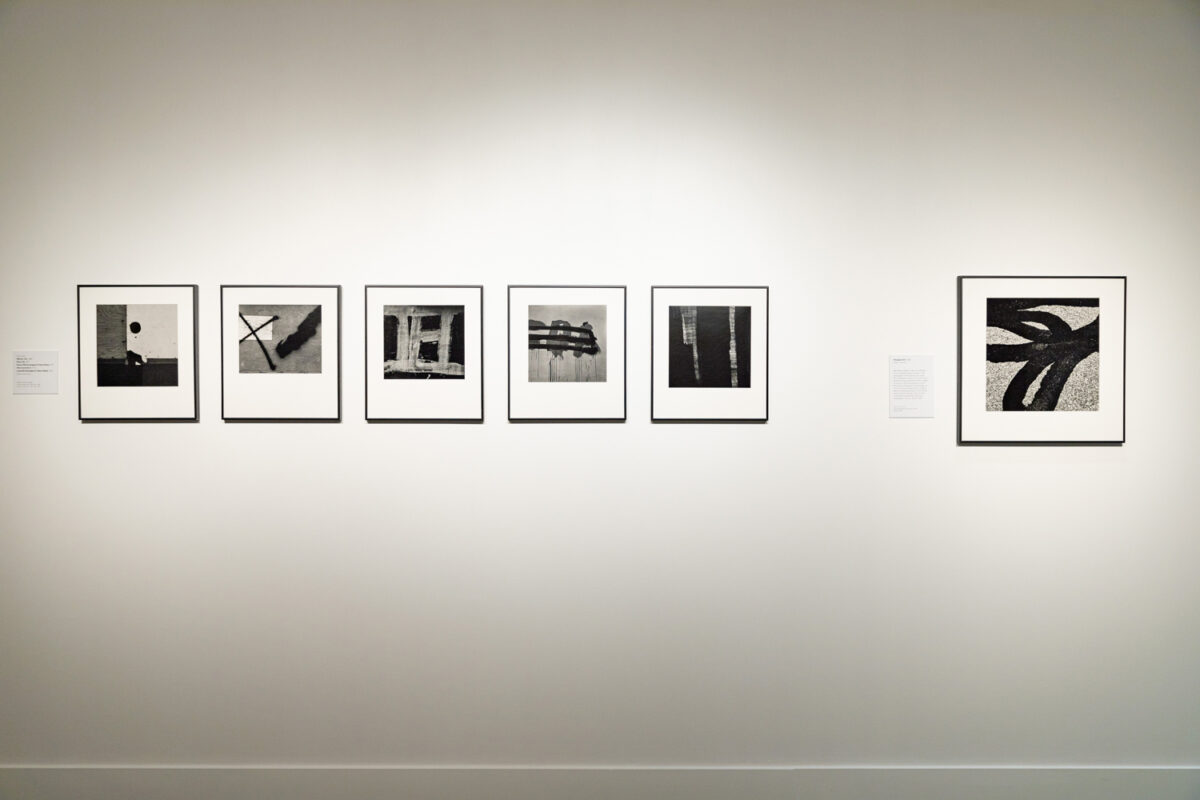 The Aaron Siskind exhibit in the AOK Library Gallery. (Melissa Penley Cormier, M.F.A. ’17, for Research Graphics)
Mind’s Eye in Toronto
With Mind’s Eye: The Psychic Photographs of Ted Serios, UMBC’s Special Collections has gone international. The Image Centre of Toronto Metropolitan University invited UMBC’s Curator of Exhibitions Emily Cullen to curate a show featuring one of AOK’s more fascinating collections, the Jule Eisenbud Collection on Ted Serios and Thoughtographic Photography.
Serios claimed to have the ability to psychically transfer his thoughts onto Polaroid film, a process called “thoughtography.” Chicago psychiatrist Jule Eisenbud investigated these claims, experimenting with Serios for several years in the mid-1960s, and the archive of those results is now part of UMBC’s permanent collection.
Mind’s Eye: The Psychic Photographs of Ted Serios opens at the IMC tomorrow, on view January 25–April 1!
]]>
UMBC’s art galleries are already in full bloom for the spring. With exhibits showcasing historic and innovative 20th century photography, interactive hip-hop data visualization, and the legacies...
https://umbc.edu/stories/umbcs-galleries-deliver-interactive-art/
https://my3.my.umbc.edu/api/v0/pixel/news/131356/guest@my.umbc.edu/5fd578a744572090ba95cb818c844cba/api/pixel
aok-library
arts-and-culture
cadvc
campus-life
is
magazine
media-and-communication-studies
news
special-collections
visual-arts
UMBC News & Magazine
https://my3.my.umbc.edu/groups/umbc-news-magazine
https://assets1-my.umbc.edu/system/shared/avatars/groups/000/001/943/24435aa6207c452e7bc15cc74b42c7bb/xsmall.png?1748556657
https://assets1-my.umbc.edu/system/shared/avatars/groups/000/001/943/24435aa6207c452e7bc15cc74b42c7bb/original.png?1748556657
https://assets2-my.umbc.edu/system/shared/avatars/groups/000/001/943/24435aa6207c452e7bc15cc74b42c7bb/xxlarge.png?1748556657
https://assets2-my.umbc.edu/system/shared/avatars/groups/000/001/943/24435aa6207c452e7bc15cc74b42c7bb/xlarge.png?1748556657
https://assets3-my.umbc.edu/system/shared/avatars/groups/000/001/943/24435aa6207c452e7bc15cc74b42c7bb/large.png?1748556657
https://assets1-my.umbc.edu/system/shared/avatars/groups/000/001/943/24435aa6207c452e7bc15cc74b42c7bb/medium.png?1748556657
https://assets2-my.umbc.edu/system/shared/avatars/groups/000/001/943/24435aa6207c452e7bc15cc74b42c7bb/small.png?1748556657
https://assets1-my.umbc.edu/system/shared/avatars/groups/000/001/943/24435aa6207c452e7bc15cc74b42c7bb/xsmall.png?1748556657
https://assets2-my.umbc.edu/system/shared/avatars/groups/000/001/943/24435aa6207c452e7bc15cc74b42c7bb/xxsmall.png?1748556657
UMBC News & Magazine
1
0
false
Wed, 01 Mar 2023 14:37:02 -0500
Wed, 01 Mar 2023 14:37:02 -0500
Connecting the Dots

Students come to UMBC for many reasons—to find community, to explore a passion, to make change in the world. Once they figure out the “why” that truly drives their interests, the Retriever community is ready to kick in with the “how” to help make those plans a reality. Part of that looks like the traditional classroom experience with a professor, of course—but just as important are the experiential-learning moments that help many students actively connect the knowledge to careers they hope to pursue after graduation.
UMBC students pursue applied learning in huge numbers. Despite the pandemic, nearly 80 percent of our recent graduates engaged in applied learning, including internships, research, co-ops, and service learning during their time at UMBC. An impressive 91 percent of new grads head directly to a job, advanced degree, or both within six months of graduating—and of those, more than half interned or worked for their employer as a student.
“When it comes to impact, there is nothing more valuable than engaging in applied-learning opportunities to help clarify one’s career direction, build professional skills, and increase one’s professional network,” shares Susan Hindle, the Career Center’s assistant director of internships and employment.
For students pursuing experiential learning through internships, campus jobs, research, and community engagement, it’s not just about learning how to do the thing they want to do. It’s about connecting the work to the passions that brought them to UMBC in the first place. These students and alumni working in their chosen fields tell the whole picture—what hands-on learning looks like when it comes full circle.
Essential connections
The desire to help people comes from deep within. But knowing how to do it successfully on a large scale—and understanding the systems and politics that can make the job more or less challenging—takes more than just compassion.
On the morning of the monthly food delivery from the Maryland Food Bank, the brigade of students who keep the Retriever Essentials food pantry running see all sides of the work. Together, they unload and shelve staples like rice, pasta, and huge crates of broccoli for the more than 2,100 visits to the pantry so far this year. At the same time, they connect with community members to understand what might make life better—halal meats, for one; more campus job opportunities, another biggie—and then put their heads together to try to make those changes happen.
 Photos by Marlayna Demond ’11/UMBC, design by Jim Lord ’99.
For Ariel Barbosa, a grad student in UMBC’s community leadership program, working in this space is part of a journey that started with her trying to understand her Brazilian father’s immigrant experience better. As she works with Retriever Essentials, she’s learning about the complexities of these experiences in a way that will help her as she carves out a career in service.
“There are so many signs showing me that I’m supposed to be right here, right now. I feel like I’m preparing,” she says. “Right now, I feel like I’m in a confidence-building, skill-building phase where I’m just trying to pick up as many skills as I can to be able to create what I feel I need to create at the right time.”
As a student, Matthew Dolamore ’08, modern languages and linguistics, caught a first glimpse of what would later become a service-based career when he tutored Spanish-speaking clients for an immigration services office in Baltimore. After graduating, he went on to serve with AmeriCorps and the Peace Corps and earned a master’s degree in community planning before pulling all of those skills together into a full-circle career in Baltimore.
Today, Dolamore is program director for the Esperanza Center, a project of Catholic Charities that assists more than 3,000 individuals each year with walk-in immigration services, including healthcare, legal assistance, and education tools. Dolamore serves as a connector between people and solutions, helping people get what they need when they need it and looking for ways to help improve the system.
 Matthew Dolamore ’08 at the Esperanza Center. Photos by Marlayna Demond ’11/UMBC, design by Jim Lord ’99.
“Among our managers we have a nurse practitioner, a managing attorney, a licensed social worker, an individual who got their master’s in teaching English from UMBC, and a woman who oversees our one-touch client services desk who’s a former immigrant and just has a really dynamic background. And just those five people alone is symbolic of what I love about my job,” says Dolamore.
“I’m not a medical professional. I’m not a legal professional. I’m not a social worker. I’m something myself of a generalist nonprofit manager at this stage in my career, but I get the opportunity every day to come in and out of these really focused professional engagements and try to help all five of them think of each other as teammates, and that’s the part of my job I really enjoy.”
Lydia Sannella, a Peaceworker and grad student in applied sociology at UMBC, also enjoys the organizational aspect of her job with Retriever Essentials. As she looks ahead to her post-academic career, she’s already thinking about how she can continue to marry her values with her career—knowing that it won’t likely be quite the same as what she’s experiencing at UMBC.
“I find that, whenever we want to do something, there are supportive, knowledgeable experts who want to help,” she says. “There’s just hoards of students who want to be involved and engaged and do any variety of work, from physical lifting to technical projects. And it’s just this canvas for creativity and possibility. It’s very reciprocal. What I’m able to contribute ends up being more significant and then what I get ends up being more significant.”
— Jenny O’Grady
Becoming part of the solution
Students come to higher education for a variety of reasons, and among them, many have the goal of learning to create new things—from innovative water-quality solutions to entire companies. For many students, in fact, learning while doing is an integral part of going to college.
If you ask Premal S. Shah ’98, biochemistry and molecular biology, however, he’ll tell you that there’s a world of difference between learning while doing and learning from doing.
That’s not to say that Shah, who earned a Ph.D. from the California Institute of Technology on his way to founding and leading a string of successful healthcare-related companies, doesn’t believe in academics. But from his vantage point as CEO at MyOme, a genomics firm based in northern California, classroom-based learning is only a part of the puzzle.
 Premal S. Shah ’98 interned at National Institutes of Health before founding a genomics firm. Photos by Barak Shrama, design by Jim Lord ’99.
Shah said he’s always had a practical streak, but he found out how much experiential learning can boost classroom learning thanks to a hands-on internship and fellowship at the National Institutes of Health, beginning while he was a student at UMBC.
“When I got to grad school, there were a lot of people who hadn’t really worked in a lab or done stuff,” he said. “I had a huge head start, just because I was able to pick up a pipette and actually use it. I knew what a DNA extraction protocol was. I knew how to use certain machinery.”
It was a vivid object lesson—one Shah has carried forward into his career. “When you start building companies, there’s always that challenge…of analysis paralysis, right?” he said. “There’s a notion of, ‘We could do this or that. Let’s read and learn more or get additional inputs in search of the perfect answer.’ Or we can actually go build something that will benefit people and iterate even faster as we learn more to make it much better.”
That’s the big difference between studying science and, for example, running science-based companies, Shah says: “The hypotheticals are great. The theories are great. But you’ve got to get [things] done.”
Getting things done is Matt Stromberg’s perennial modus operandi. Being a Ph.D. student studying environmental engineering means he is very much both an environmental scientist—someone who studies environmental problems—and an engineer: someone who works to solve those problems. “I always knew I was a passionate environmentalist, but I also knew I liked to build things,” he said.
In fact, Stromberg, who graduated in 2019 from the University of Virginia with bachelor’s degrees in both environmental engineering and environmental science, is a literal embodiment of learning while doing. Working as both a graduate research assistant and a researcher in the jointly run University System of Maryland Institute for Marine and Environmental Technology (IMET), he sometimes finds himself simultaneously running experiments and keeping the experiments running.
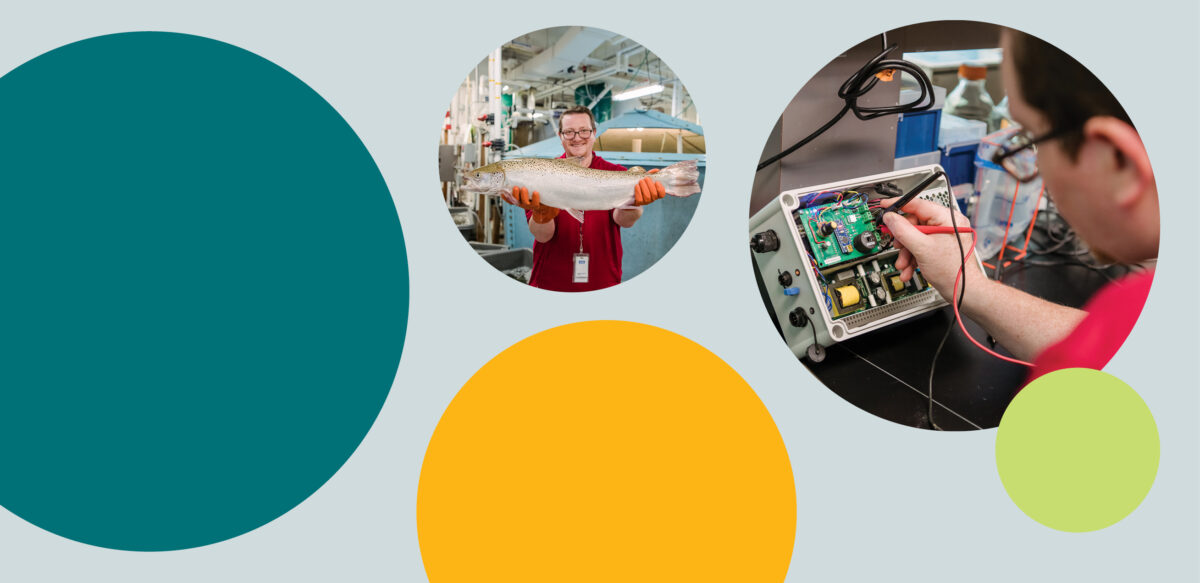 Matt Stromberg is studying aquaculture at the University System of Maryland Institute for Marine and Environmental Technology. Photos by Marlayna Demond ’11/UMBC, design by Jim Lord ’99.
A few months ago, Stromberg said, the night before an experiment was scheduled to start, a pump failed in IMET’s Aquaculture Research Center, a 1,800-square-meter facility with hundreds of fish tanks.
“It was a large pump, and it needed to be replaced—and it was eight o’clock at night,” Stromberg said. “I had already worked 12 hours that day, [but] I realized that there’s no way this experiment is going to run if I don’t have a pump tomorrow. So…I got the wrenches and I got all the fittings I needed,” and found a way to fix it.
Stromberg’s ability to save that experiment is part and parcel of his approach. One of his main research projects is unclogging a major bottleneck that prevents more farm-raised fish from getting to market: purging them of an unsavory flavor that’s sometimes characteristic of fish that aren’t caught in the wild. As Stromberg put it, “You’re not going to sell the fish if it tastes like dirt.”
That’s a problem not only for aquaculture companies—which have to use lots of water, time, money, and energy to purge the fish of this taste—but also for the planet. That’s because the only alternative to aquaculture is fishing in the wild, which can destroy ecosystems but is still cheaper than aquaculture, due to the expensive purging process.
He’s working with advanced oxidative processes and a technology of his own that would effectively create a shortcut, making it more cost-effective to farm fish and thus helping to protect wild habitat in the process. And Stromberg aims to eventually put his Ph.D. to work in a similarly practical way: His goal is to create a company that performs chemical analysis and remediation of water contaminants.
“I’ve learned a lot from my time here,” he says. “Especially not to over-engineer things!”
— Scott Cech
Community-centered art
Visual art is all around us—in flyers, television commercials, and even clothes. And while many of us may never know the artists creating work behind the scenes, their lives and experiences certainly do shape their work.
For instance, earlier this year, Jennifer White-Johnson ’08, visual arts, designed a collection for Target’s national Latino Heritage Month campaign, including a tumbler with stacked text reading sonando vivamente vividly dreaming and a T-shirt proudly proclaiming piel canela pelo rizado (brown/cinnamon skin curly hair). As a disabled, neurodiverse, Afro-Latina designer from Baltimore, White-Johnson sees her inclusion as an opportunity to highlight and provide a voice to communities that often aren’t heard or represented.
 Former Student Events Board member Jennifer White-Johnson ’08 now has designs at Target. Photos by Marlayna Demond ’11/UMBC, design by Jim Lord ’99.
“I am really honored to have been chosen and included in this year’s Target Latino Heritage Month collection and campaign,” says White-Johnson. “Using art and design to celebrate and elevate my cultural stories, the strength, and legacy of my ancestors, felt like something that was meant to be!”
Living with undiagnosed ADHD as a student, White-Johnson often felt like her intensity, excitement, and point of view were unwelcome or just too much. That changed when she transferred to UMBC, where she immediately felt at home. In particular, her time as director of promotions for the Student Events Board [(seb)] gave her her first taste of how graphic design could marry with communit-ycentric work.
Working closely with the Office of Student Life, White-Johnson and other members of (seb) volunteered during an alternative spring-break trip to post-Hurricane Katrina New Orleans. White-Johnson also designed the T-shirts.
“This was in 2007, so we could help offer some sort of relief from Hurricane Katrina,” says White-Johnson. “It was life-changing because I was able to surround myself with other like-minded scholars that were serious about academic life but who also understood that school is about self-discovery.”
Enter Patch Hatley, a sophomore visual arts major with a concentration in animation. Fresh from a session learning how to create stop-motion animation puppets from paper, she is excited to test out some of what she’s learned on the job at commonvision, the student-driven print and design center in The Commons. On any given day, one might find her working on anything from animating cute countdowns for student activities to designing stickers.
“I’m always constantly learning in an environment like commonvision,” she says. “Each new skill helps transition to the next project, and each project creates new and exciting opportunities. You’re always surrounded by a team who are all community-driven, so I always feel like I can ask for help or constructive criticism. commonvision supports, drives, and motivates me to keep reaching for the stars and will always be an important part of how I’ve grown—not just as an artist but as a team player.”
 Patch Hatley learns while working on animations at commonvision. Photos by Marlayna Demond ’11/UMBC, design by Jim Lord ’99.
Hatley finds work at commonvision particularly helpful because it stretches her creative muscles and opens up her craft to new programs, tools, and mediums, and also because other creators surround her. After spending a decade in animation and illustration before becoming a Retriever, Hatley loves the opportunity to expand her craft in a place that has fostered the foundation for budding designers for years—and getting to bring her personal perspective into work for clients.
“At the end of the day, you’re drawing for yourself and for the people around you whether you realize it implicitly or not,” says Hatley. At the core of both artists’ practices is community. Both White-Johnson and Hatley recognize that their art doesn’t live in a vacuum but exists as a letter of inspiration, solidarity, and encouragement to their respective communities. Both artists, years apart in their practice, found similar communities to nurture and invest in them.
“Being given the space to bring visibility to themes of cultural intersectionality, specifically the parts of our natural beauty that aren’t always celebrated, our caramel brown, cinnamon skin, and our natural curls,” says White-Johnson. “I hope my work can culturally inspire others to center what they want to see more of.”
— Sharéa Harris
Taking experiential learning to the next level
Developing high-level skills in a highly technical field like computer science is difficult enough. But the ability to both master and successfully teach those skills to others takes the challenge to a whole new level.
Fortunately, Amina Mahmood and Zach Margulies thrive at that level. With their dedication to passing along computer-science knowledge, these Retrievers amply demonstrate that doing while teaching and learning while doing are just different parts of the same equation.
As Mahmood ’21, computer science, tells it, she started learning while doing quite literally. Just weeks into her first year at UMBC, Mahmood found herself working 20 hours a week as a junior malware analyst at Huntress, a cybersecurity firm that was then still in the startup phase at the bwtech@UMBC Research and Technology Park.
“I didn’t really have any experience, but I was pretty ambitious, so I learned everything on the job,” she said.
Mahmood, part of UMBC’s Cyber Scholars Program, quickly learned how to run different types of malware on a virtual machine, dissect the particulars of each, and create mitigation reports. The nascent company’s culture also helped boost her confidence. If she ran into a problem, she said, the people she worked with were glad to bring her up to speed.
 Amina Mahmood ’21 at the Johns Hopkins University Applied Physics Lab. Photos courtesy of Johns Hopkins Applied Physics Laboratory, design by Jim Lord ’99.
“It was just like, ‘Oh, you don’t know this—let me teach it to you.’ And then I picked up on it and then I was like, ‘OK—I can do this,’” Mahmood said. Mahmood was quick to apply such on-the-job learning to her academics, even persuading an academic advisor to allow her to add her to his overenrolled, graduate-level software reverse-engineering course at the same time she was enrolled in an undergraduate prerequisite class.
Mahmood not only aced the graduate-level class, she also started using what she had learned to complete the experiential-learning cycle at her new part-time job at Parsons Corp., a technology-focused defense, intelligence, security, and infrastructure engineering firm.
“One of my mentors at Parsons—he really supported me, and he said, ‘You know a lot about reverse engineering. Why don’t you just make a course and teach coworkers?’” That’s exactly what Mahmood did— and now does for new summer interns as a full-time reverse engineer at the Johns Hopkins University Applied Physics Lab.
Recently she found herself completing the circle, coming back to UMBC for the same kind of career fair where she’d found her first job as a first-year student. “But [this time] I didn’t go as a student,” she noted. “I went as an employer.”
Margulies ’14, biological sciences, is completing his own trajectory: Nearly a decade after earning his first bachelor’s degree, he has returned to UMBC to earn a bachelor’s in computer science and a master’s in education, with the goal of teaching computer science to Baltimore high school students when he graduates in 2024.
Margulies started his career pivot before diving back into academics immersing himself in on-the-job data science and programming—including a Maryland Institute for Innovative Computing internship at the Maryland Department of Health after starting in the computer science program. Because of this, he’s able to pursue his studies with a greater sense of perspective.
“I feel like it inspires confidence and it builds your self-esteem, taking what you’ve learned in the class and not even a semester later applying it in a real-world setting,” he said.
Margulies noted that, as a teacher, he’ll also be able to fully address high schoolers’ perennial classroom question: ‘When am I ever going to use this in real life?’
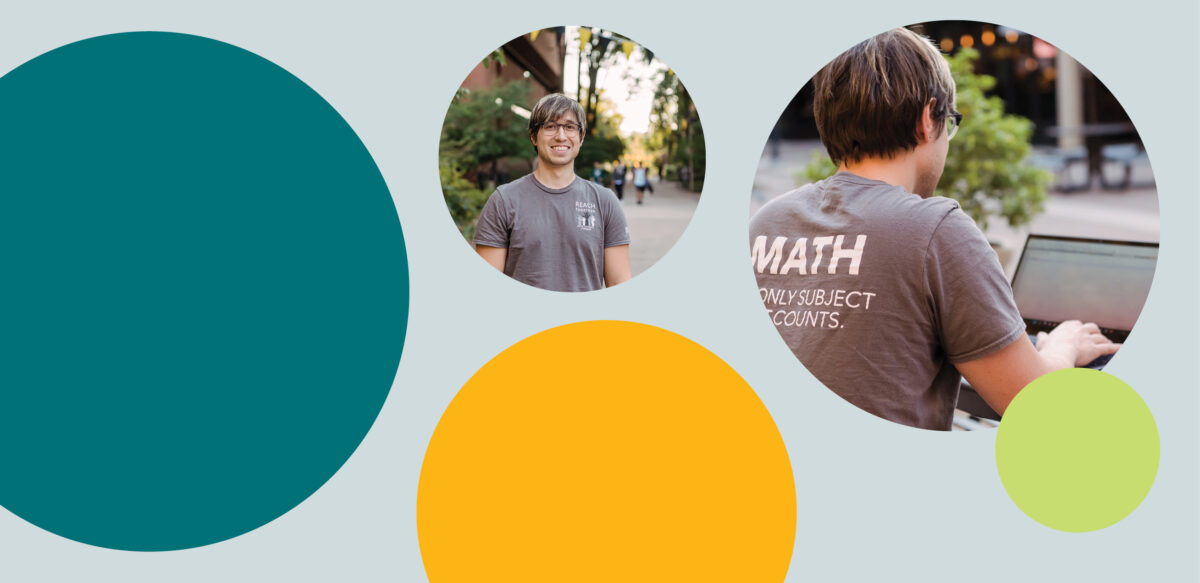 Zach Margulies took part in a Maryland Institute for Innovative Computing internship with the Maryland Department of Health. Photos by Marlayna Demond ’11/UMBC, design by Jim Lord ’99.
“It’s really important for teachers to know what the practical application of [schoolwork] is going to be and what working in a computer science job will look like,” he said.
A case in point, Margulies said, was the work he did as part of a Maryland Department of Health internship last summer, reviewing and finding improvements for data collection, including the creation of a data dashboard.
“Last semester, I took Computer Science 201, and we learned the programming language Python, and I really wanted to start applying that language at the internship,” he said. Because he’d had both practical experience and formal training, Margulies said, he was able to see that he’d have to adapt what he’d learned to suit the task at hand.
“[I had] to figure out a way that I could take Python and apply it to developing the database because that’s not something we necessarily learned in the class,” he said. “I had a lot of fun taking the thing that I learned academically and not just applying it, but also taking it to the next level.”
— Scott Cech
]]>
Students come to UMBC for many reasons—to find community, to explore a passion, to make change in the world. Once they figure out the “why” that truly drives their interests, the Retriever...
https://umbc.edu/stories/connecting-the-dots-through-experiential-learning/
https://my3.my.umbc.edu/api/v0/pixel/news/129595/guest@my.umbc.edu/19c7c86c3aa950e73d30a2d31a2a7667/api/pixel
applied-sociology
biochemistry-and-molecular-biology
biological-sciences
career-center
commonvision
community-leadership
computer-science
discovery
environmental-engineering
fall-2022
magazine
mll
peaceworker
retriever-essentials
visual-arts
UMBC News & Magazine
https://my3.my.umbc.edu/groups/umbc-news-magazine
https://assets1-my.umbc.edu/system/shared/avatars/groups/000/001/943/24435aa6207c452e7bc15cc74b42c7bb/xsmall.png?1748556657
https://assets1-my.umbc.edu/system/shared/avatars/groups/000/001/943/24435aa6207c452e7bc15cc74b42c7bb/original.png?1748556657
https://assets2-my.umbc.edu/system/shared/avatars/groups/000/001/943/24435aa6207c452e7bc15cc74b42c7bb/xxlarge.png?1748556657
https://assets2-my.umbc.edu/system/shared/avatars/groups/000/001/943/24435aa6207c452e7bc15cc74b42c7bb/xlarge.png?1748556657
https://assets3-my.umbc.edu/system/shared/avatars/groups/000/001/943/24435aa6207c452e7bc15cc74b42c7bb/large.png?1748556657
https://assets1-my.umbc.edu/system/shared/avatars/groups/000/001/943/24435aa6207c452e7bc15cc74b42c7bb/medium.png?1748556657
https://assets2-my.umbc.edu/system/shared/avatars/groups/000/001/943/24435aa6207c452e7bc15cc74b42c7bb/small.png?1748556657
https://assets1-my.umbc.edu/system/shared/avatars/groups/000/001/943/24435aa6207c452e7bc15cc74b42c7bb/xsmall.png?1748556657
https://assets2-my.umbc.edu/system/shared/avatars/groups/000/001/943/24435aa6207c452e7bc15cc74b42c7bb/xxsmall.png?1748556657
UMBC News & Magazine
0
0
false
Wed, 30 Nov 2022 15:17:19 -0500
Wed, 30 Nov 2022 15:17:19 -0500
Connecting the Dots
Students come to UMBC for many reasons—to find community, to explore a passion, to make change in the world. Once they figure out the “why” that truly drives their interests, the Retriever community is ready to kick in with the “how” to help make those plans a reality. Part of that looks like the traditional classroom experience with a professor, of course—but just as important are the experiential-learning moments that help many students actively connect the knowledge to careers they hope to pursue after graduation.
UMBC students pursue applied learning in huge numbers. Despite the pandemic, nearly 80 percent of our recent graduates engaged in applied learning, including internships, research, co-ops, and service learning during their time at UMBC. An impressive 91 percent of new grads head directly to a job, advanced degree, or both within six months of graduating—and of those, more than half interned or worked for their employer as a student.
“When it comes to impact, there is nothing more valuable than engaging in applied-learning opportunities to help clarify one’s career direction, build professional skills, and increase one’s professional network,” shares Susan Hindle, the Career Center’s assistant director of internships and employment.
For students pursuing experiential learning through internships, campus jobs, research, and community engagement, it’s not just about learning how to do the thing they want to do. It’s about connecting the work to the passions that brought them to UMBC in the first place. These students and alumni working in their chosen fields tell the whole picture—what hands-on learning looks like when it comes full circle.
Essential Connections
The desire to help people comes from deep within. But knowing how to do it successfully on a large scale—and understanding the systems and politics that can make the job more or less challenging—takes more than just compassion.
On the morning of the monthly food delivery from the Maryland Food Bank, the brigade of students who keep the Retriever Essentials food pantry running see all sides of the work. Together, they unload and shelve staples like rice, pasta, and huge crates of broccoli for the more than 2,100 visits to the pantry so far this year. At the same time, they work with community members to understand what might make life better—halal meats, for one; more campus job opportunities, another biggie—and then put their heads together to try to make those changes happen.
Nyla Howell (left) and Lydia Sannella and Ariel Barbosa (L-R) sort canned goods for Retriever Essentials. Photos by Marlayna Demond ’11/UMBC, design by Jim Lord ’99.
For Ariel Barbosa, a grad student in UMBC’s community leadership program, working in this space is part of a journey that started with her trying to understand her Brazilian father’s immigrant experience better. As she works with Retriever Essentials, she’s learning about the complexities of these experiences in a way that will help her as she carves out a career in service. “There are so many signs showing me that I’m supposed to be right here, right now. I feel like I’m preparing,” she says. “Right now, I feel like I’m in a confidence-building, skill-building phase where I’m just trying to pick up as many skills as I can to be able to create what I feel I need to create at the right time.”
As a student, Matthew Dolamore ’08, modern languages and linguistics, caught a first glimpse of what would later become a service-based career when he tutored Spanish-speaking clients for an immigration services office in Baltimore. After graduating, he went on to serve with AmeriCorps and the Peace Corps and earned a master’s degree in community planning before pulling all of those skills together into a full-circle career in Baltimore.
Today, Dolamore is program director for the Esperanza Center, a project of Catholic Charities that assists more than 3,000 individuals each year with walk-in immigration services, including healthcare, legal assistance, and education tools. Dolamore serves as a connector between people and solutions, helping people get what they need when they need it and looking for ways to help improve the system.
Matthew Dolamore ’08 at the Esperanza Center. Photos by Marlayna Demond ’11/UMBC, design by Jim Lord ’99.
“Among our managers we have a nurse practitioner, a managing attorney, a licensed social worker, an individual who got their master’s in teaching English from UMBC, and a woman who oversees our one-touch client services desk who’s a former immigrant and just has a really dynamic background. And just those five people alone is symbolic of what I love about my job,” says Dolamore.
“I’m not a medical professional. I’m not a legal professional. I’m not a social worker. I’m something myself of a generalist nonprofit manager at this stage in my career, but I get the opportunity every day to come in and out of these really focused professional engagements and try to help all five of them think of each other as teammates, and that’s the part of my job I really enjoy.”
Lydia Sannella, a Peaceworker and grad student in applied sociology at UMBC, also enjoys the organizational aspect of her job with Retriever Essentials. As she looks ahead to her post-academic career, she’s already thinking about how she can continue to marry her values with her career—knowing that it won’t likely be quite the same as what she’s experiencing at UMBC.
“I find that, whenever we want to do something, there are supportive, knowledgeable experts who want to help,” she says. “There’s just hoards of students who want to be involved and engaged and do any variety of work, from physical lifting to technical projects. And it’s just this canvas for creativity and possibility. It’s very reciprocal. What I’m able to contribute ends up being more significant and then what I get ends up being more significant.”
— Jenny O’Grady
Becoming part of the solution
Students come to higher education for a variety of reasons, and among them, many have the goal of learning to create new things—from innovative water-quality solutions to entire companies. For many students, in fact, learning while doing is an integral part of going to college.
If you ask Premal S. Shah ’98, biochemistry and molecular biology, however, he’ll tell you that there’s a world of difference between learning while doing and learning from doing.
That’s not to say that Shah, who earned a Ph.D. from the California Institute of Technology on his way to founding and leading a string of successful healthcare-related companies, doesn’t believe in academics. But from his vantage point as CEO at MyOme, a genomics firm based in northern California, classroom-based learning is only a part of the puzzle.
Premel S. Shah ’98 interned at National Institutes of Health before founding a genomics firm. Photos by Barack Shrama, design by Jim Lord ’99.
Shah said he’s always had a practical streak, but he found out how much experiential learning can boost classroom learning thanks to a hands-on internship and fellowship at the National Institutes of Health, beginning while he was a student at UMBC.
“When I got to grad school, there were a lot of people who hadn’t really worked in a lab or done stuff,” he said. “I had a huge head start, just because I was able to pick up a pipette and actually use it. I knew what a DNA extraction protocol was. I knew how to use certain machinery.”
It was a vivid object lesson—one Shah has carried forward into his career. “When you start building companies, there’s always that challenge…of analysis paralysis, right?” he said. “There’s a notion of, ‘We could do this or that. Let’s read and learn more or get additional inputs in search of the perfect answer.’ Or we can actually go build something that will benefit people and iterate even faster as we learn more to make it much better.”
That’s the big difference between studying science and, for example, running science-based companies, Shah says: “The hypotheticals are great. The theories are great. But you’ve got to get [things] done.”
Getting things done is Matt Stromberg’s perennial modus operandi. Being a Ph.D. student studying environmental engineering means he is very much both an environmental scientist—someone who studies environmental problems—and an engineer: someone who works to solve those problems. “I always knew I was a passionate environmentalist, but I also knew I liked to build things,” he said.
In fact, Stromberg, who graduated in 2019 from the University of Virginia with bachelor’s degrees in both environmental engineering and environmental science, is a literal embodiment of learning while doing. Working as both a graduate research assistant and a researcher in the jointly run University System of Maryland Institute for Marine and Environmental Technology (IMET), he sometimes finds himself simultaneously running experiments and keeping the experiments running.
Matt Stromberg is studying aquaculture at the University System of Maryland Institute for Marine and Environmental Technology. Photos by Marlayna Demond ’11/UMBC, design by Jim Lord ’99.
A few months ago, Stromberg said, the night before an experiment was scheduled to start, a pump failed in IMET’s Aquaculture Research Center, a 1,800-square-meter facility with hundreds of fish tanks.
“It was a large pump, and it needed to be replaced—and it was eight o’clock at night,” Stromberg said. “I had already worked 12 hours that day, [but] I realized that there’s no way this experiment is going to run if I don’t have a pump tomorrow. So…I got the wrenches and I got all the fittings I needed,” and found a way to fix it.
Stromberg’s ability to save that experiment is part and parcel of his approach. One of his main research projects is unclogging a major bottleneck that prevents more farm-raised fish from getting to market: purging them of an unsavory flavor that’s sometimes characteristic of fish that aren’t caught in the wild. As Stromberg put it, “You’re not going to sell the fish if it tastes like dirt.”
That’s a problem not only for aquaculture companies—which have to use lots of water, time, money, and energy to purge the fish of this taste—but also for the planet. That’s because the only alternative to aquaculture is fishing in the wild, which can destroy ecosystems but is still cheaper than aquaculture, due to the expensive purging process.
He’s working with advanced oxidative processes and a technology of his own that would effectively create a shortcut, making it more cost-effective to farm fish and thus helping to protect wild habitat in the process. And Stromberg aims to eventually put his Ph.D. to work in a similarly practical way: His goal is to create a company that performs chemical analysis and remediation of water contaminants.
“I’ve learned a lot from my time here,” he says. “Especially not to over-engineer things!”
— Scott Cech
Community-centered art
Visual art is all around us—in flyers, television commercials, and even clothes. And while many of us may never know the artists creating work behind the scenes, their lives and experiences certainly do shape their work.
For instance, earlier this year, Jennifer White-Johnson ’08, visual arts, designed a collection for Target’s national Latino Heritage Month campaign, including a tumbler with stacked text reading sonando vivamente vividly dreaming and a T-shirt proudly proclaiming piel canela pelo rizado (brown/cinnamon skin curly hair). As a disabled, neurodiverse, Afro-Latina designer from Baltimore, White-Johnson sees her inclusion as an opportunity to highlight and provide a voice to communities that often aren’t heard or represented.
Former Student Events Board member Jennifer White-Johnson ’08 now has designs at Target. Photos by Marlayna Demond ’11/UMBC, design by Jim Lord ’99.
“I am really honored to have been chosen and included in this year’s Target Latino Heritage Month collection and campaign,” says White-Johnson. “Using art and design to celebrate and elevate my cultural stories, the strength, and legacy of my ancestors, felt like something that was meant to be!”
Living with undiagnosed ADHD as a student, White-Johnson often felt like her intensity, excitement, and point of view were unwelcome or just too much. That changed when she transferred to UMBC, where she immediately felt at home. In particular, her time as director of promotions for the Student Events Board [(seb)] gave her her first taste of how graphic design could marry with communit-ycentric work.
Working closely with the Office of Student Life, White-Johnson and other members of (seb) volunteered during an alternative spring-break trip to post-Hurricane Katrina New Orleans. White-Johnson also designed the T-shirts.
“This was in 2007, so we could help offer some sort of relief from Hurricane Katrina,” says White-Johnson. “It was life-changing because I was able to surround myself with other like-minded scholars that were serious about academic life but who also understood that school is about self-discovery.”
Enter Patch Hatley, a sophomore visual arts major with a concentration in animation. Fresh from a session learning how to create stop-motion animation puppets from paper, she is excited to test out some of what she’s learned on the job at commonvision, the student-driven print and design center in The Commons. On any given day, one might find her working on anything from animating cute countdowns for student activities to designing stickers.
“I’m always constantly learning in an environment like commonvision,” she says. “Each new skill helps transition to the next project, and each project creates new and exciting opportunities. You’re always surrounded by a team who are all community-driven, so I always feel like I can ask for help or constructive criticism. commonvision supports, drives, and motivates me to keep reaching for the stars and will always be an important part of how I’ve grown—not just as an artist but as a team player.”
Patch Hatley learns while working on animations at commonvision. Photos by Marlayna Demond ’11/UMBC, design by Jim Lord ’99.
Hatley finds work at commonvision particularly helpful because it stretches her creative muscles and opens up her craft to new programs, tools, and mediums, and also because other creators surround her. After spending a decade in animation and illustration before becoming a Retriever, Hatley loves the opportunity to expand her craft in a place that has fostered the foundation for budding designers for years—and getting to bring her personal perspective into work for clients.
“At the end of the day, you’re drawing for yourself and for the people around you whether you realize it implicitly or not,” says Hatley. At the core of both artists’ practices is community. Both White-Johnson and Hatley recognize that their art doesn’t live in a vacuum but exists as a letter of inspiration, solidarity, and encouragement to their respective communities. Both artists, years apart in their practice, found similar communities to nurture and invest in them.
“Being given the space to bring visibility to themes of cultural intersectionality, specifically the parts of our natural beauty that aren’t always celebrated, our caramel brown, cinnamon skin, and our natural curls,” says White-Johnson. “I hope my work can culturally inspire others to center what they want to see more of.”
— Sharéa Harris
Taking experiential learning to the next level
Developing high-level skills in a highly technical field like computer science is difficult enough. But the ability to both master and successfully teach those skills to others takes the challenge to a whole new level.
Fortunately, Amina Mahmood and Zach Margulies thrive at that level. With their dedication to passing along computer-science knowledge, these Retrievers amply demonstrate that doing while teaching and learning while doing are just different parts of the same equation.
As Mahmood ’21, computer science, tells it, she started learning while doing quite literally. Just weeks into her first year at UMBC, Mahmood found herself working 20 hours a week as a junior malware analyst at Huntress, a cybersecurity firm that was then still in the startup phase at the bwtech@UMBC Research and Technology Park.
“I didn’t really have any experience, but I was pretty ambitious, so I learned everything on the job,” she said.
Mahmood, part of UMBC’s Cyber Scholars Program, quickly learned how to run different types of malware on a virtual machine, dissect the particulars of each, and create mitigation reports. The nascent company’s culture also helped boost her confidence. If she ran into a problem, she said, the people she worked with were glad to bring her up to speed.
Amina Mahmood ’21 at the Johns Hopkins University Applied Physics Lab. Photos courtesy of Johns Hopkins Applied Physics Laboratory, design by Jim Lord ’99.
“It was just like, ‘Oh, you don’t know this—let me teach it to you.’ And then I picked up on it and then I was like, ‘OK—I can do this,’” Mahmood said. Mahmood was quick to apply such on-the-job learning to her academics, even persuading an academic advisor to allow her to add her to his overenrolled, graduate-level software reverse-engineering course at the same time she was enrolled in an undergraduate prerequisite class.
Mahmood not only aced the graduate-level class, she also started using what she had learned to complete the experiential-learning cycle at her new part-time job at Parsons Corp., a technology-focused defense, intelligence, security, and infrastructure engineering firm.
“One of my mentors at Parsons—he really supported me, and he said, ‘You know a lot about reverse engineering. Why don’t you just make a course and teach coworkers?’” That’s exactly what Mahmood did— and now does for new summer interns as a full-time reverse engineer at the Johns Hopkins University Applied Physics Lab.
Recently she found herself completing the circle, coming back to UMBC for the same kind of career fair where she’d found her first job as a first-year student. “But [this time] I didn’t go as a student,” she noted. “I went as an employer.”
Margulies ’14, biological sciences, is completing his own trajectory: Nearly a decade after earning his first bachelor’s degree, he has returned to UMBC to earn a bachelor’s in computer science and a master’s in education, with the goal of teaching computer science to Baltimore high school students when he graduates in 2024.
Margulies started his career pivot before diving back into academics immersing himself in on-the-job data science and programming—including a Maryland Institute for Innovative Computing internship at the Maryland Department of Health after starting in the computer science program. Because of this, he’s able to pursue his studies with a greater sense of perspective.
“I feel like it inspires confidence and it builds your self-esteem, taking what you’ve learned in the class and not even a semester later applying it in a real-world setting,” he said.
Margulies noted that, as a teacher, he’ll also be able to fully address high schoolers’ perennial classroom question: ‘When am I ever going to use this in real life?’
Zach Margulies took part in a Maryland Institute for Innovative Computing internship with the Maryland Department of Health. Photos by Marlayna Demond ’11/UMBC, design by Jim Lord ’99.
“It’s really important for teachers to know what the practical application of [schoolwork] is going to be and what working in a computer science job will look like,” he said.
A case in point, Margulies said, was the work he did as part of a Maryland Department of Health internship last summer, reviewing and finding improvements for data collection, including the creation of a data dashboard.
“Last semester, I took Computer Science 201, and we learned the programming language Python, and I really wanted to start applying that language at the internship,” he said. Because he’d had both practical experience and formal training, Margulies said, he was able to see that he’d have to adapt what he’d learned to suit the task at hand.
“[I had] to figure out a way that I could take Python and apply it to developing the database because that’s not something we necessarily learned in the class,” he said. “I had a lot of fun taking the thing that I learned academically and not just applying it, but also taking it to the next level.”
— Scott Cech
]]>
Students come to UMBC for many reasons—to find community, to explore a passion, to make change in the world. Once they figure out the “why” that truly drives their interests, the Retriever...
https://umbc.edu/stories/connecting-the-dots/
https://my3.my.umbc.edu/api/v0/pixel/news/129482/guest@my.umbc.edu/38f4c1bff401ad3aed0a5d74a732610b/api/pixel
applied-sociology
biochemistry-and-molecular-biology
biological-sciences
career-center
commonvision
community-leadership
computer-science
discovery
environmental-engineering
fall-2022
feature
magazine
mll
peaceworker
retriever-essentials
visual-arts
UMBC News & Magazine
https://my3.my.umbc.edu/groups/umbc-news-magazine
https://assets1-my.umbc.edu/system/shared/avatars/groups/000/001/943/24435aa6207c452e7bc15cc74b42c7bb/xsmall.png?1748556657
https://assets1-my.umbc.edu/system/shared/avatars/groups/000/001/943/24435aa6207c452e7bc15cc74b42c7bb/original.png?1748556657
https://assets2-my.umbc.edu/system/shared/avatars/groups/000/001/943/24435aa6207c452e7bc15cc74b42c7bb/xxlarge.png?1748556657
https://assets2-my.umbc.edu/system/shared/avatars/groups/000/001/943/24435aa6207c452e7bc15cc74b42c7bb/xlarge.png?1748556657
https://assets3-my.umbc.edu/system/shared/avatars/groups/000/001/943/24435aa6207c452e7bc15cc74b42c7bb/large.png?1748556657
https://assets1-my.umbc.edu/system/shared/avatars/groups/000/001/943/24435aa6207c452e7bc15cc74b42c7bb/medium.png?1748556657
https://assets2-my.umbc.edu/system/shared/avatars/groups/000/001/943/24435aa6207c452e7bc15cc74b42c7bb/small.png?1748556657
https://assets1-my.umbc.edu/system/shared/avatars/groups/000/001/943/24435aa6207c452e7bc15cc74b42c7bb/xsmall.png?1748556657
https://assets2-my.umbc.edu/system/shared/avatars/groups/000/001/943/24435aa6207c452e7bc15cc74b42c7bb/xxsmall.png?1748556657
UMBC News & Magazine
0
0
false
Wed, 30 Nov 2022 15:17:19 -0500