National Institutes of Environmental Health Sciences highlight Professor Upal Ghosh’s work cleaning contaminated waterways
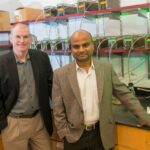
The positive environmental and health impacts of work led by Upal Ghosh, professor of chemical, biochemical, and environmental engineering at UMBC, was recently highlighted by the National Institutes of Environmental Health Sciences (NIEHS). The agency showcased a low-cost technology that Ghosh and his colleagues developed to clean waterways contaminated with polychlorinated biphenyls (PCBs), a group of likely carcinogenic chemicals that were used in insulation, coolants, and electrical equipment for decades before being banned in the U.S. in 1979.
The chemicals are stable and persist in the environment, often accumulating in fish that live in contaminated waterways and posing a risk to humans who consume those fish. NIEHS funded Ghosh’s research into using activated carbon pellets to bind the chemicals in place at the bottom of the waterways. This prevents the PCBs from circulating through the aquatic food chain. In projects carried out in contaminated lakes, rivers, and harbors in Delaware, Maryland, and elsewhere, Ghosh’s team demonstrated that the technique could significantly reduce the concentration of PCBs in the water and in aquatic lifeforms. Importantly, the technique is also significantly cheaper than standard clean-up approaches, such as dredging and disposing of contaminated sediment.
In related work performed with Kevin Sowers, from the Institute of Marine and Environmental Technology, Ghosh’s team also developed a way to combine the activated carbon with microbes that break down PCBs, reducing their toxicity.
With NIEHS support, Ghosh has co-founded two companies—Sediment Solutions and RemBac—to commercialize the technology and deploy it at full-scale to clean up contaminated sites across the country, such as at Mirror Lake in Delaware.
“The technology brings together innovations in material science and biology,” says Ghosh. It’s an honor, he says, that the NIEHS, the leading agency in the country that funds research on public health and the environment, recognized “the real impact our research is having on improving public health.”
]]>
The positive environmental and health impacts of work led by Upal Ghosh, professor of chemical, biochemical, and environmental engineering at UMBC, was recently highlighted by the National...
https://umbc.edu/quick-posts/niehs-highlights-upal-ghoshs-work-cleaning-contaminated-waterways/
https://my3.my.umbc.edu/api/v0/pixel/news/139274/guest@my.umbc.edu/cd3baad4df895ca15888f8fccb6f77c3/api/pixel
cbee
cnms
coeit
imet
news
quick-post
quick-posts
research
science-and-tech
UMBC News & Magazine
https://my3.my.umbc.edu/groups/umbc-news-magazine
https://assets1-my.umbc.edu/system/shared/avatars/groups/000/001/943/24435aa6207c452e7bc15cc74b42c7bb/xsmall.png?1748556657
https://assets1-my.umbc.edu/system/shared/avatars/groups/000/001/943/24435aa6207c452e7bc15cc74b42c7bb/original.png?1748556657
https://assets2-my.umbc.edu/system/shared/avatars/groups/000/001/943/24435aa6207c452e7bc15cc74b42c7bb/xxlarge.png?1748556657
https://assets2-my.umbc.edu/system/shared/avatars/groups/000/001/943/24435aa6207c452e7bc15cc74b42c7bb/xlarge.png?1748556657
https://assets3-my.umbc.edu/system/shared/avatars/groups/000/001/943/24435aa6207c452e7bc15cc74b42c7bb/large.png?1748556657
https://assets1-my.umbc.edu/system/shared/avatars/groups/000/001/943/24435aa6207c452e7bc15cc74b42c7bb/medium.png?1748556657
https://assets2-my.umbc.edu/system/shared/avatars/groups/000/001/943/24435aa6207c452e7bc15cc74b42c7bb/small.png?1748556657
https://assets1-my.umbc.edu/system/shared/avatars/groups/000/001/943/24435aa6207c452e7bc15cc74b42c7bb/xsmall.png?1748556657
https://assets2-my.umbc.edu/system/shared/avatars/groups/000/001/943/24435aa6207c452e7bc15cc74b42c7bb/xxsmall.png?1748556657
UMBC News & Magazine
1
0
false
Fri, 23 Feb 2024 15:53:29 -0500
Professor Curtis Menyuk honored for pioneering work that helped transform global telecommunications

Curtis Menyuk, professor of computer science and electrical engineering at UMBC, has won the 2024 SPIE G.G. Stokes Award in Optical Polarization. The award honors Menyuk’s pioneering work in the 1980’s developing equations to describe how light propagates through optical fibers, as well as his ongoing contributions to the fields of optics and photonics.
The fast and reliable internet we enjoy today would not be possible without the fundamental work that Menyuk and his colleagues performed decades ago. Modern global telecommunication systems are built on backbones of optical fiber, and the rate of information flow through the fibers is limited by physical phenomena that affect the way light spreads. Over time and distance, these phenomena can turn a crisp signal into indecipherable garbage, and so optical communication system engineers must account for them in their designs.
Menyuk developed equations that allow engineers to effectively model optical communication, most importantly by being the first equations to incorporate the effects of a property of light called its polarization. (Light travels as an oscillating electric field coupled to an oscillating magnetic field, and the direction of the electric field determines the polarization.)
One consequence of the equations was the realization that spinning optical fiber can minimize signal distortion.
“Curtis is a renowned pioneer in the field of optical communications, and over the years I witnessed the tremendous impact of his group’s work on the telecom industry, photonic technologies, and the field of optics in general,” says DEVCOM Army Research Laboratory physicist Michael Brodsky in a news story from SPIE announcing the award.
For his part, Menyuk credits much of the impact of his work to his successful collaborations with colleagues and students. “It’s what comes from working with good people,” he says.
]]>
Curtis Menyuk, professor of computer science and electrical engineering at UMBC, has won the 2024 SPIE G.G. Stokes Award in Optical Polarization. The award honors Menyuk’s pioneering work in the...
https://umbc.edu/quick-posts/curtis-menyuk-honored-for-global-telecom-work/
https://my3.my.umbc.edu/api/v0/pixel/news/139066/guest@my.umbc.edu/246e3af984aa78b930490d8213b9a976/api/pixel
coeit
csee
news
quick-post
quick-posts
science-and-tech
UMBC News & Magazine
https://my3.my.umbc.edu/groups/umbc-news-magazine
https://assets1-my.umbc.edu/system/shared/avatars/groups/000/001/943/24435aa6207c452e7bc15cc74b42c7bb/xsmall.png?1748556657
https://assets1-my.umbc.edu/system/shared/avatars/groups/000/001/943/24435aa6207c452e7bc15cc74b42c7bb/original.png?1748556657
https://assets2-my.umbc.edu/system/shared/avatars/groups/000/001/943/24435aa6207c452e7bc15cc74b42c7bb/xxlarge.png?1748556657
https://assets2-my.umbc.edu/system/shared/avatars/groups/000/001/943/24435aa6207c452e7bc15cc74b42c7bb/xlarge.png?1748556657
https://assets3-my.umbc.edu/system/shared/avatars/groups/000/001/943/24435aa6207c452e7bc15cc74b42c7bb/large.png?1748556657
https://assets1-my.umbc.edu/system/shared/avatars/groups/000/001/943/24435aa6207c452e7bc15cc74b42c7bb/medium.png?1748556657
https://assets2-my.umbc.edu/system/shared/avatars/groups/000/001/943/24435aa6207c452e7bc15cc74b42c7bb/small.png?1748556657
https://assets1-my.umbc.edu/system/shared/avatars/groups/000/001/943/24435aa6207c452e7bc15cc74b42c7bb/xsmall.png?1748556657
https://assets2-my.umbc.edu/system/shared/avatars/groups/000/001/943/24435aa6207c452e7bc15cc74b42c7bb/xxsmall.png?1748556657
UMBC News & Magazine
1
0
false
Fri, 16 Feb 2024 15:14:05 -0500
UMBC scientists and engineers celebrate launch of HARP2 instrument on NASA’s PACE mission
By Anne Wainscott-Sargent
The third time’s the charm. Against a calm and crisp dark night sky on Florida’s Cape Canaveral last Thursday, February 8, just after 1:30 a.m., the Plankton, Aerosol, Cloud, Ocean Ecosystem (PACE) spacecraft rocketed to orbit carrying on board Hyper-Angular Rainbow Polarimeter (HARP2)―UMBC’s wide-angle imaging polarimeter. The launch marked the first time NASA deployed a university payload on a large operational Earth science space mission.
Following two scrubbed night launches on Tuesday and Wednesday due to strong winds, Thursday’s successful takeoff was well worth the wait for the core team of UMBC Earth and Space Institute researchers, graduate students, and their family and friends who journeyed from Baltimore to watch the historic launch.
Arriving by bus a little before midnight to the Banana Creek Launch Viewing Area at Kennedy Space Center, just over six miles from Space Launch Complex-40, the close-knit UMBC entourage huddled together waiting for the final countdown.
When it came, they—along with hundreds of other space launch watchers—held their breath and then yelled and clapped as SpaceX’s Falcon 9 rocket blasted off and propelled PACE 400 miles above Earth into sun-synchronous orbit. Minutes later the Falcon 9’s first stage—SpaceX’s reusable rocket booster—successfully landed at Landing Zone 1. The crowd gasped audibly at the sonic boom, caused when the spacecraft broke the sound barrier.
“It still doesn’t quite feel real,” said Noah Christian Sienkiewicz, a calibration scientist who earned his master’s degree in atmospheric physics from UMBC in 2019 and expects to complete his physics doctorate this summer. “I grew up watching Carl Sagan and dreamed of going into astrophysics. I never thought I’d be the person making the instruments that will go up and do the measurements.”
“It’s so exciting—I’m going to cry,” uttered Margo Young from the upper bleacher. “I don’t always see the pieces and parts put together, so this is really historic.”
Young serves as UMBC’s HARP program administrator, where she has overseen procurement and other back-end support for HARP since the program’s inception in 2013. “I get to see students come full circle—working in the lab and then graduating and becoming civil servants where they continue to be involved because it’s such an amazing project,” she explained.
On the path to PACE
The UMBC HARP team’s remarkable journey from idea to mission reality spanned over 15 years, and involved countless hours of design, modeling, testing, and validation. Earlier iterations of HARP flew first on private aircraft over the Maryland countryside and then an award-winning “cubesat” version launched into orbit from the International Space Station (ISS), all stepping stones on the path to PACE.
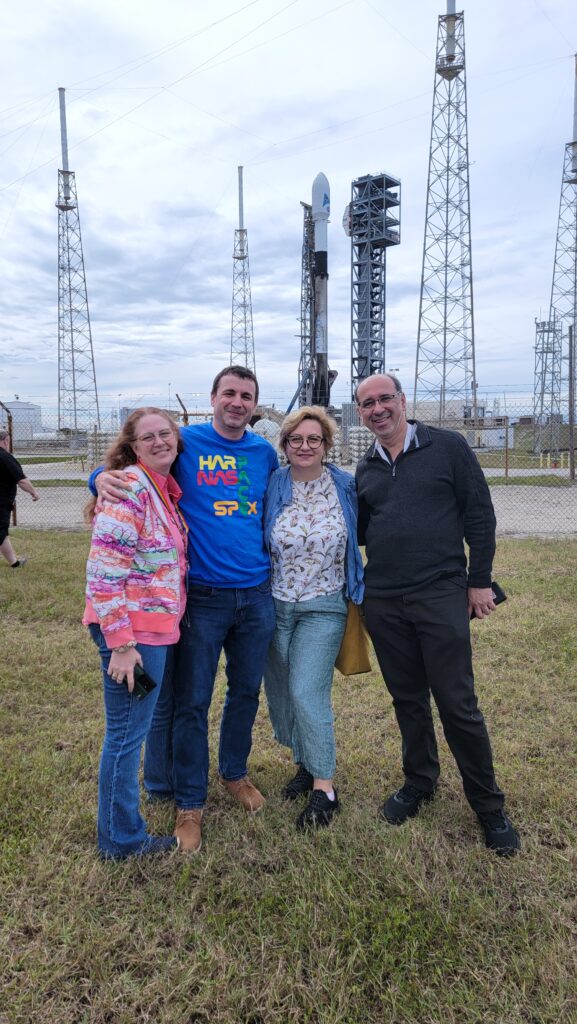 Left to right: Margo Young, Dominik Cieslak, Magdalena Kuzmicz-Cieslak, and Vanderlei Martins stand in front of the PACE spacecraft the day before its launch. (Image courtesy of Margo Young)
For the three multidisciplinary HARP2 physics, optics, and research engineering leads, Vanderlei Martins, Roberto Borda, and Dominik Cieslak, HARP2’s launch represents a career-defining moment that at times seemed against all odds for a mid-size public university. UMBC’s strong partnerships with NASA, such as the Goddard Earth Science Technology and Research (GESTAR) Center II that supports Borda’s and Cieslak’s roles, help enable milestones like this.
“I feel like I’m still dreaming,” said a visibly emotional Cieslak, research engineer, who captured the launch on his long-range camera.
Transfixed by the sight of live satellite footage of the PACE spacecraft heading to orbit, he added, “This is the last time we will physically see it [HARP2],” before hugging his long-time colleague, Borda.
“We’re very proud to have UMBC in space,” added Martins, professor of physics, who watched the big moment from a VIP viewing area three miles from the launch site. “We dreamed big from the beginning. The team persevered and just kept going.”
“I never despaired of having HARP2 on the PACE satellite,” admitted UMBC’s HARP2 manager, Lorraine Remer, research professor in the Joint Center for Earth Systems Technology. Her bigger worry wasn’t HARP2’s viability, but whether PACE would ever launch. “PACE was canceled four times and reinstated four times,” she recalled, noting that the program “survived a lengthy government shutdown and a global pandemic that destroyed our supply chains.”
Immediately after launch, Remer had to return to Maryland and the Goddard Space Flight Center to oversee HARP2 being turned on within 36 hours of launch. “It would be nice to bask in the successful launch, but I haven’t had much time to contemplate the success. There is just more work to do all the time,” she said.
An international effort
NASA’s PACE mission clears the path for revolutionary new measurements of Earth’s oceans and atmosphere. HARP2 measures aerosol particles and clouds, as well as properties of land and water surfaces. By analyzing particles like dust, wildfire smoke, or urban pollution, the science community gains deeper insights into air quality as well as global warming and its impacts. Scientists will be able see through things like sun glint to ascertain patterns never before possible.
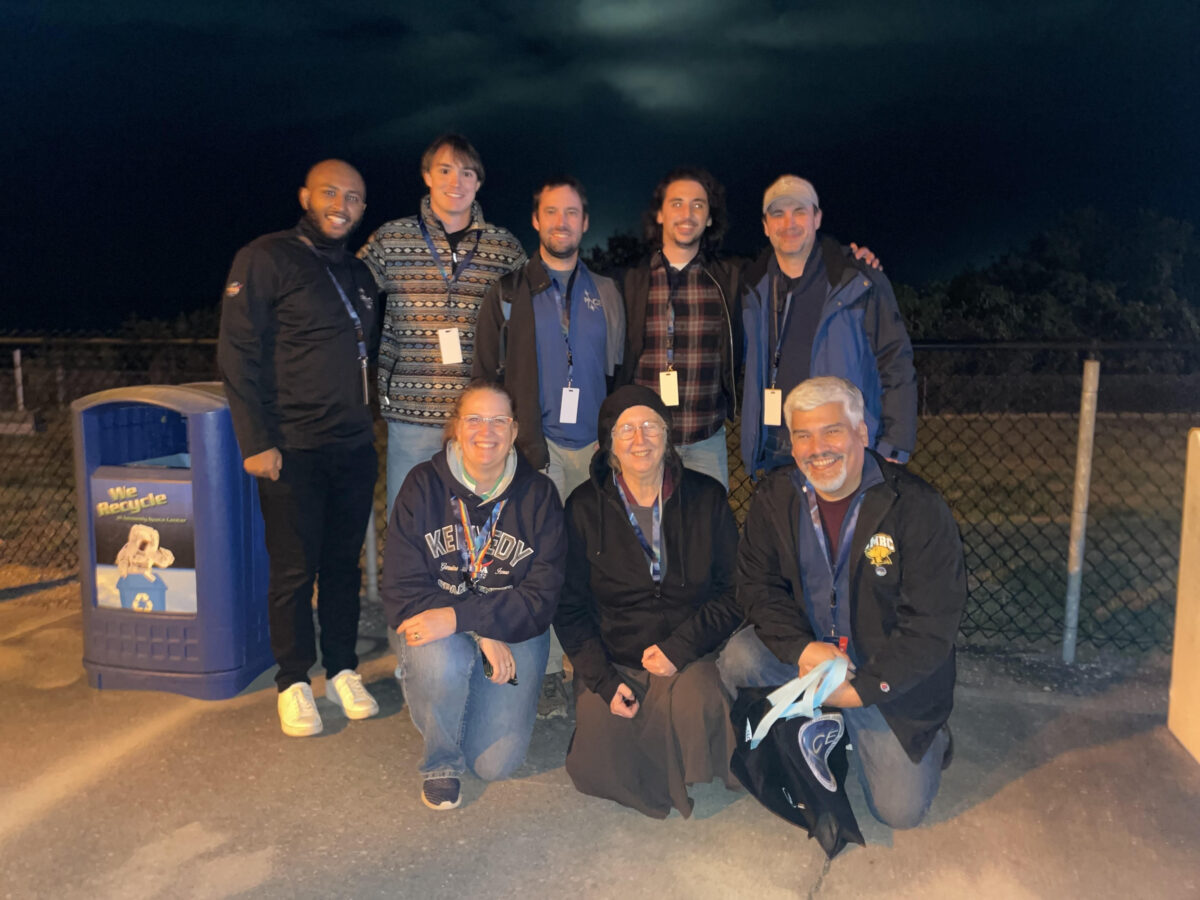 Members of the HARP team eagerly await the PACE launch at Kennedy Space Center’s Banana Creek Launch Viewing Area before the final countdown. Top, left to right: Yomiyu Fekadu, Ian Decker, Ben Cramer, Noah Sienkiewicz, Dominik Cieslak. Bottom, left to right: Margo Young, Lorraine Remer, Roberto Borda. (Image by Anne Wainscott-Sargent)
A second polarimeter on PACE, the Spectro-polarimeter for Planetary Exploration (SPEXone), developed through a Dutch consortium consisting of SRON Netherlands Institute for Space Research and Airbus Defence and Space Netherlands, will measure sunlight reflected from Earth’s atmosphere, land surface and ocean.
These two companion polarimeter instruments are important because the interaction between aerosols and clouds is the biggest unknown factor in atmospheric temperature change, according to reports from the U.N.’s Intergovernmental Panel on Climate Change.
“I have watched Dr. Martins and his team work toward this moment for about a decade, and have been aware of the trials and tribulations along the way. Seeing the smiles on their faces in the control station after the launch made it all worthwhile,” shared UMBC Vice President for Research Karl V. Steiner. “The HARP2 mission as an integral part of PACE is making all of us proud here on the UMBC campus. We cannot wait to see the science that will come from this engineering masterpiece conceptualized and created right here in Maryland.”
Waiting game
In the days leading up to the PACE launch, the HARP2 team knew there might be delays because of the weather so they rented a large Airbnb in neighboring Cocoa Beach for the full week. Earlier in the week, over grilled food at the shared house, the team reflected on their journey.
According to Martins, a key strategy was bringing together engineering and physics students, who typically don’t communicate well across disciplines.
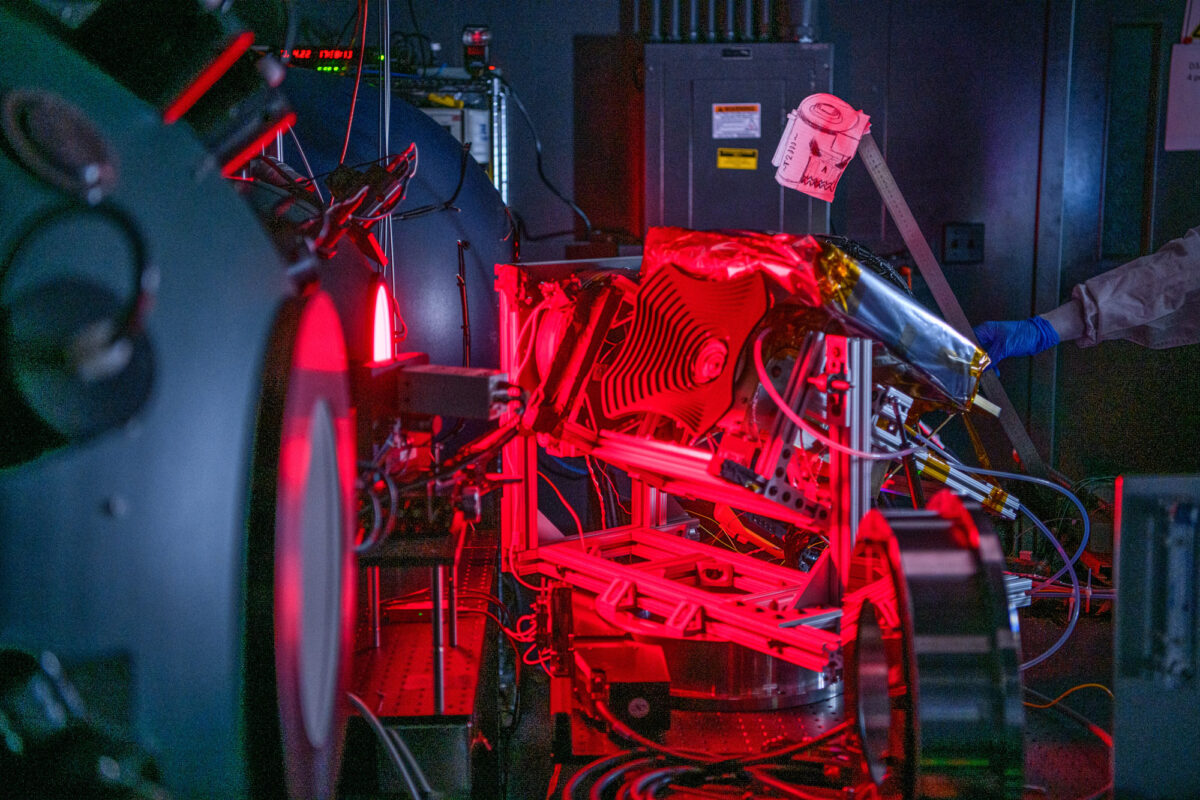 The HARP2 instrument undergoes calibration testing with red light. (Image by NASA)
“We introduced engineering students to the physics students and made them work together very quickly so they spoke the same language,” he said, crediting this multidisciplinary collaboration to the team’s ability to rapidly iterate and problem solve.
Borda, senior research engineer overseeing HARP2’s optical design, said a key technical challenge was determining how to best compensate for the effects of polarized light waves inside the instrument.
“It’s continuous work and you cannot do it alone. We needed a fantastic team with not only the staff but also students working at different levels,” Borda said. “There are undergraduate students and Ph.D.s integrated into the team who put in a lot of effort to make this real. We’re really thankful for the environment at this university—we’re able to work with students who find a career in this industry and field of research.”
Nurturing future career scientists
Martins echoed Borda’s pride in the broad level of participation in the HARP program, from high school students to senior scientists.
“We’ve had people from our team who now work in all levels of industry—at NASA, at NOAA, or in private industry. We’ve even had some students start their own company.”
Young, the program administrator, estimates that the cooperative agreements between UMBC and NASA have resulted in 20 UMBC graduates finding roles with NASA.
“It was everything I could have asked for. No other place would have let me be involved in the entire process, including making parts for HARP2 in the machine shop. Not only did I get to do hands-on stuff, but I also was part of the design and saw it all come together on a NASA mission.”
Yomiyu Fekadu ’20, mechanical engineering, M.S. ’23, engineering management
UMBC alumna Elissa Ogburn is one such graduate. She began working on HARP2 as a computer science major, tasked with creating a database that supported ground communications so researchers could communicate with the instrument when it was in space.
After graduating from UMBC in 2021, Ogburn joined NASA on the PACE project as a test conductor (TC)―responsible for integrating and testing the instruments onto the PACE spacecraft. During launch, she was one of five TCs in the PACE Control Room in Titusville, Florida, who powered up the spacecraft for the last time and configured it for launch.
“I never imagined having a job at NASA or working with people who were this smart, helpful, and kind. Every single person I’ve worked with was so fun. It’s also cool to have seen the whole process beginning as a student at UMBC. PACE is my first mission, so I’m learning everything as I go,” Ogburn said.
Close collaboration
The partnership between NASA and UMBC goes back over two decades. NASA Goddard Space Flight Center and UMBC are located just up the road from one another.
Jeremy Werdell, PACE project scientist at Goddard, recalled how initial calls to industry and academia for a polarimetry instrument for PACE were not promising due to cost and other factors.
However, Martins immediately suggested to Werdell that his lab develop a polarimeter, given his team’s experience with airborne instruments and the HARP cubesat, and the rest is history. In the end, NASA selected two polarimeters—HARP2 and SPEXone.
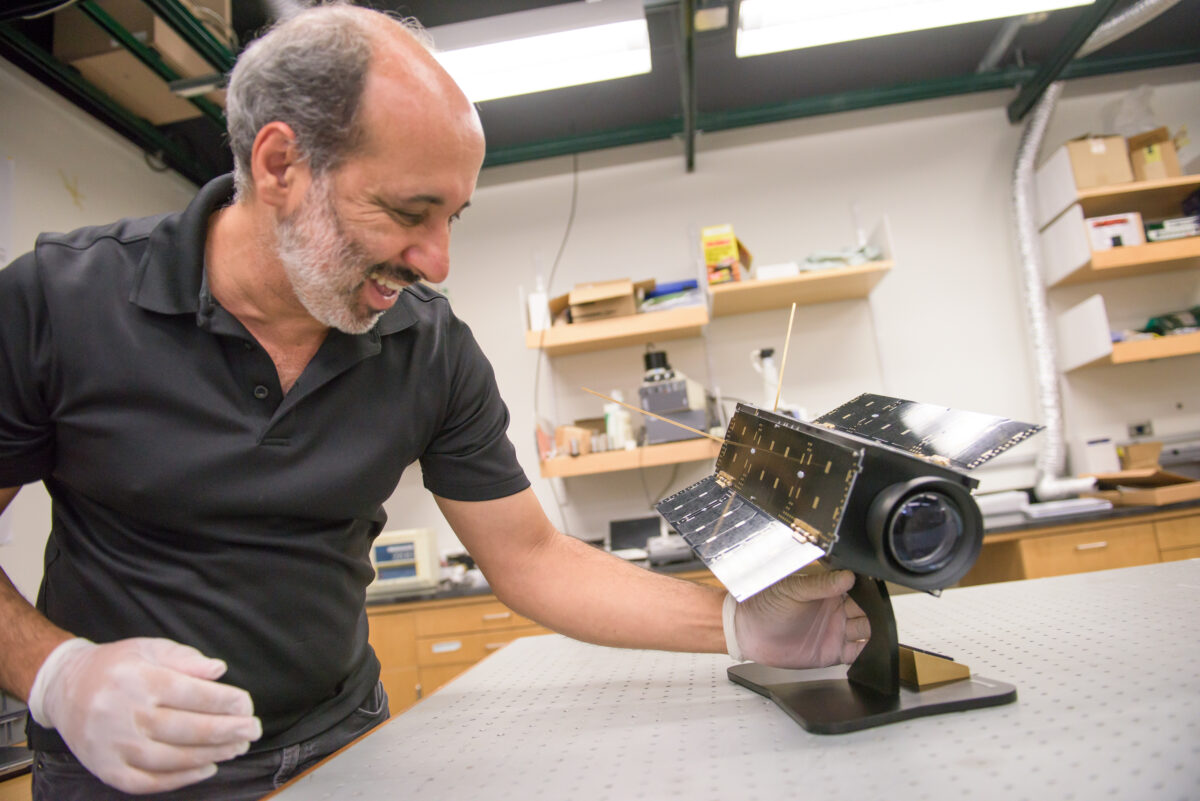 Vanderlei Martins inspects the HARP cubesat, which launched in 2019. (Image by Marlayna Demond ’11/UMBC)
Each instrument measures polarization differently: HARP2 is multispectral (measuring only four wavelengths of light) and hyperangular, so it looks at the same piece of real estate multiple times from dozens of different viewing directions. Its wide swath coverage means HARP2 will cover the globe every two days. SPEXone, on the other hand, is hyperspectral (measuring a continuous spectrum of light from the ultraviolet to near-infrared) but only views Earth at five angles. It has a narrower swath, meaning it will take almost a month to cover the globe.
“They’re small and mighty and miraculously complement each other very, very well,” said Werdell. “Having multi-band, multi-angle polarimetry is going to open up a lot of really interesting opportunities for discovery, because we can see clouds and aerosols in very different ways.”
HARP2 provides daily views that will help scientists understand how aerosols and clouds interact and their role in warming and cooling in the atmosphere.
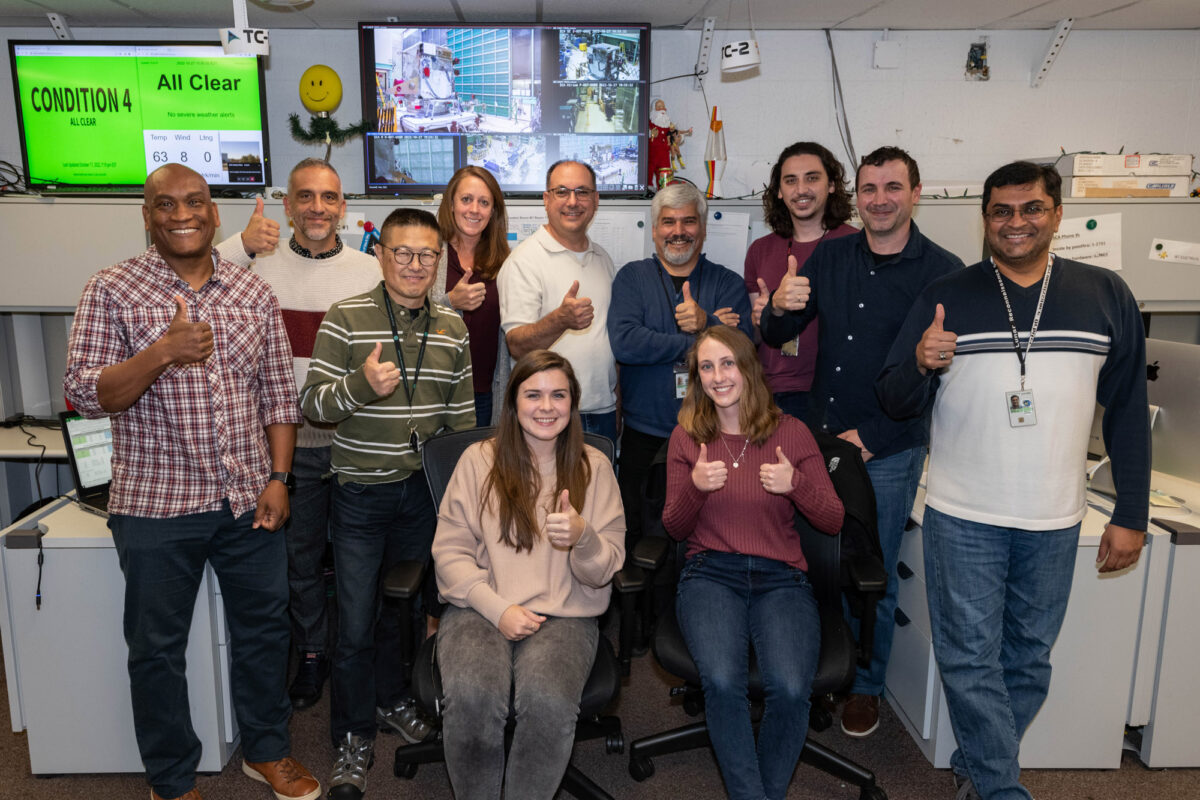 Some members of the HARP2 team successfully test HARP2’s electrical Integration to the Spacecraft. (Image by NASA)
“Understanding where aerosols are, how they’re transported, how they interact with clouds, and whether they absorb or reflect radiation is important to everybody because those characteristics are what drive warming of the atmosphere.” Werdell said.
Better air quality models
Onsite at the Cape for the first launch attempts, Nirandi Jayasinghe and Rachel Smith, both physics graduate research assistants at UMBC, shared their excitement for the PACE mission and HARP2’s potential to help modelers predict air quality, rain, or if the atmosphere is warming or cooling.
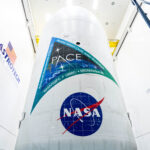
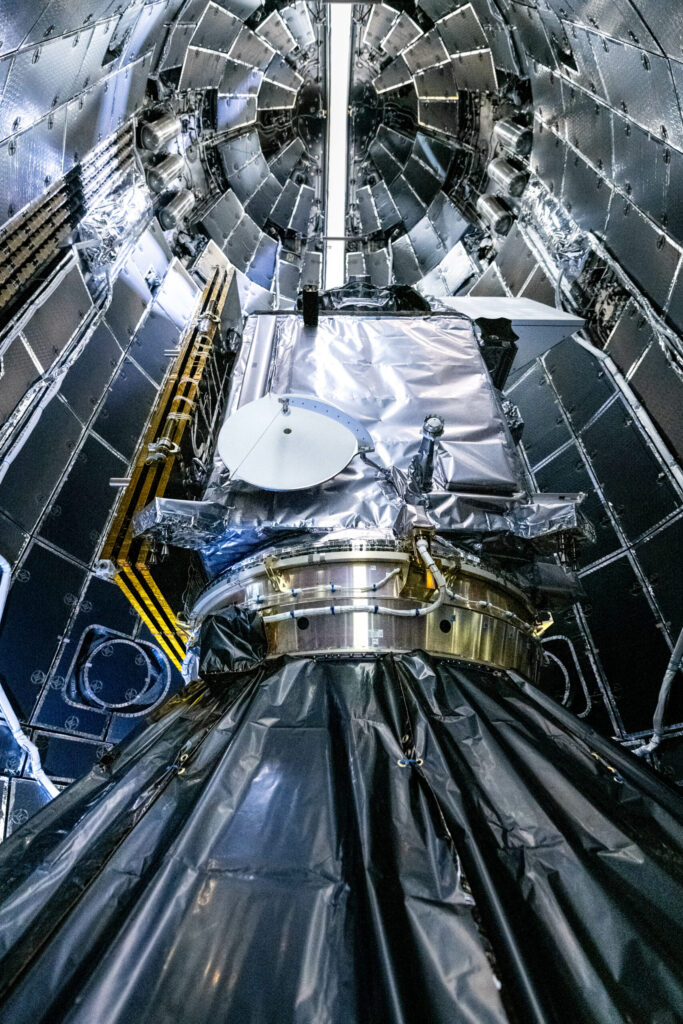 NASA and SpaceX technicians safely encapsulated NASA’s PACE spacecraft in SpaceX’s Falcon 9 payload fairings–a protective shell for the instruments on PACE during launch. (Image by NASA)
Jayasinghe is a data modeler who comes up with different methods to retrieve information from HARP2. Originally from Sri Lanka, Jayasinghe notes that her hometown used to be one of her country’s cleanest cities, and now due to development in Sri Lanka’s dominant neighbor, India, the air quality is extremely bad. She said HARP2 can help close the gap that exists in understanding the twilight zone—where a cloud starts and where it stops—by providing more accurate measurements.
Smith adds that this will go a long way in understanding cloud formation processes, weather patterns, forecasting, and climate modeling—information important for agriculture, transportation, disaster preparedness, and infrastructure planning.
“Even simple things like weather forecasting are impacted by how much dust is in the air,” said Smith, a 2026 doctoral candidate who earned her M.S. in atmospheric physics from UMBC in 2023. HARP2 will help address whether clouds have a net cooling effect or a net warming effect, which will allow for more accurate models of where Earth’s climate is headed. Smith notes that during events like the Canadian wildfires in 2023 no one could accurately predict rainfall, because the forecasting models were not accounting for the number of airborne aerosols.
“I’m really excited to see what new science questions come out of the instruments that we’re putting up in space,” she concluded.
Bouncing back from disaster
The HARP2 team has come a long way from initial concept to PACE. What impresses Werdell the most is the UMBC team’s resilience in the face of setbacks.
The most devastating moment came in February 2022, one month before the team was set to deliver HARP2 to NASA for integration on the spacecraft. As the instrument was in the last few seconds of vibration tests, the bonding on one of the prisms loosened and shattered.
“It tactically put us to point zero,” recalled Cieslak, who was shocked and humbled when so many NASA scientists volunteered their time and expertise to help the HARP2 team get back on track.
“We got an extension, and within two months we had built a new engineering model and were able to prove the new solution worked. By September, we were back to where we were before the incident,” he added.
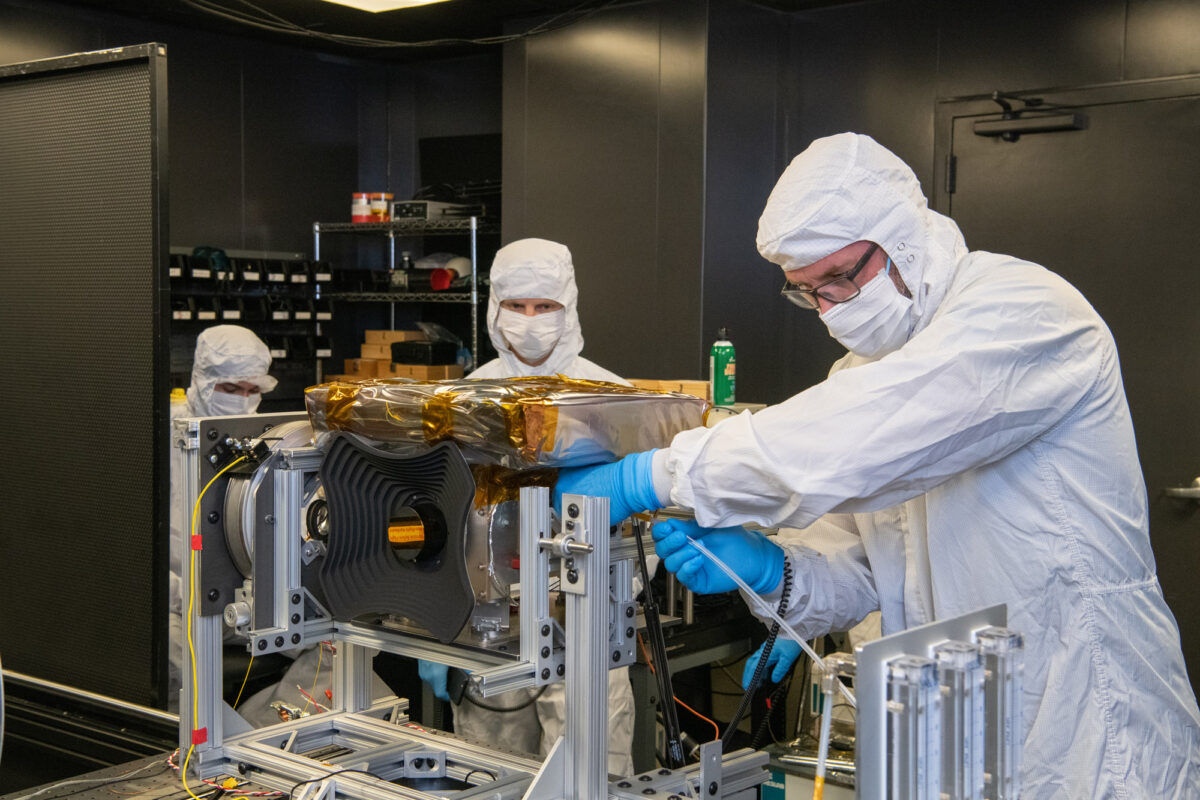 HARP2 calibration testing at Goddard Space Flight Center in Maryland, before the instrument was delivered to NASA. (Image by NASA)
First-time NASA launch attendee Yomiyu Fekadu ’20, mechanical engineering, M.S. ’23, engineering management, recalled that time well, as he helped assemble HARP2 as an intern under Benjamin Cramer ’17, M.S. ’20, mechanical engineer on the program.
“Especially after the failure, and the review board assessment, I helped put everything back together and do the test plans for construction and other documentation so NASA could give us the go-ahead to move on,” Fekadu said.
The experience was pivotal to his career. “It was everything I could have asked for,” said Fekado, now a systems engineer at Northrop Grumman. “No other place would have let me be involved in the entire process, including making parts for HARP2 in the machine shop. Not only did I get to do hands-on stuff, but I also was part of the design and saw it all come together on a NASA mission.”
As the HARP2 group left the viewing platform to line up for bus rides back to the Space Center, the smiles and easy camaraderie conveyed a collective sense of pride, relief, and excitement.
“I‘m now just anxious to see the first bytes of data,” said Cieslak, echoing the feeling of his colleagues.
In addition to the HARP team, several additional GESTAR II scientists and engineers were instrumental in their contributions to the overall PACE mission, including Ivona Cetinić, Andrew Sayer, Violeta Sanjuan Calzado, Bridget Seegers, Susanne Craig, Dirk Aurin, Meng Gao, Inia Soto Ramos, and Ian Carroll.
Update: On February 10, HARP2 successfully connected with instrumentation on the ground and all of its systems appear to be working as intended.
Follow along with what’s learned from the HARP2 project.
]]>
By Anne Wainscott-Sargent The third time’s the charm. Against a calm and crisp dark night sky on Florida’s Cape Canaveral last Thursday, February 8, just after 1:30 a.m., the Plankton,...
https://umbc.edu/stories/harp2-launches-on-nasa-pace-mission/
https://my3.my.umbc.edu/api/v0/pixel/news/139053/guest@my.umbc.edu/e0dbaea402ea1a164a7f168d63631a1e/api/pixel
cnms
coeit
compsci
engineering-management
esi
feature
gestar
gestar2
meche
news
physics
rca
research
science-and-tech
story
UMBC News & Magazine
https://my3.my.umbc.edu/groups/umbc-news-magazine
https://assets1-my.umbc.edu/system/shared/avatars/groups/000/001/943/24435aa6207c452e7bc15cc74b42c7bb/xsmall.png?1748556657
https://assets1-my.umbc.edu/system/shared/avatars/groups/000/001/943/24435aa6207c452e7bc15cc74b42c7bb/original.png?1748556657
https://assets2-my.umbc.edu/system/shared/avatars/groups/000/001/943/24435aa6207c452e7bc15cc74b42c7bb/xxlarge.png?1748556657
https://assets2-my.umbc.edu/system/shared/avatars/groups/000/001/943/24435aa6207c452e7bc15cc74b42c7bb/xlarge.png?1748556657
https://assets3-my.umbc.edu/system/shared/avatars/groups/000/001/943/24435aa6207c452e7bc15cc74b42c7bb/large.png?1748556657
https://assets1-my.umbc.edu/system/shared/avatars/groups/000/001/943/24435aa6207c452e7bc15cc74b42c7bb/medium.png?1748556657
https://assets2-my.umbc.edu/system/shared/avatars/groups/000/001/943/24435aa6207c452e7bc15cc74b42c7bb/small.png?1748556657
https://assets1-my.umbc.edu/system/shared/avatars/groups/000/001/943/24435aa6207c452e7bc15cc74b42c7bb/xsmall.png?1748556657
https://assets2-my.umbc.edu/system/shared/avatars/groups/000/001/943/24435aa6207c452e7bc15cc74b42c7bb/xxsmall.png?1748556657
UMBC News & Magazine
4
0
false
Fri, 16 Feb 2024 10:36:17 -0500
Fri, 16 Feb 2024 10:36:17 -0500
Résumés in hand, 2,000+ hopeful and prepared Retrievers attend the 2024 Career Fair
On a perfect 55-degree sunny February day, hundreds of undergraduate and graduate students across all colleges stood in a line that began at the RAC and wrapped its way to Sherman Hall. Instead of exercise gear, Retrievers were dressed to impress with résumés in hand, ready to land a summer internship or a job with one of the 180-plus employers across multiple industry sectors at UMBC’s Spring 2024 Career and Internship Fair.
“We are excited to help employers develop a strong talent pipeline and diverse future workforce, shaping the leaders and innovators of tomorrow,” said Paige Bauder, associate director of employer relations and recruitment programs at UMBC.
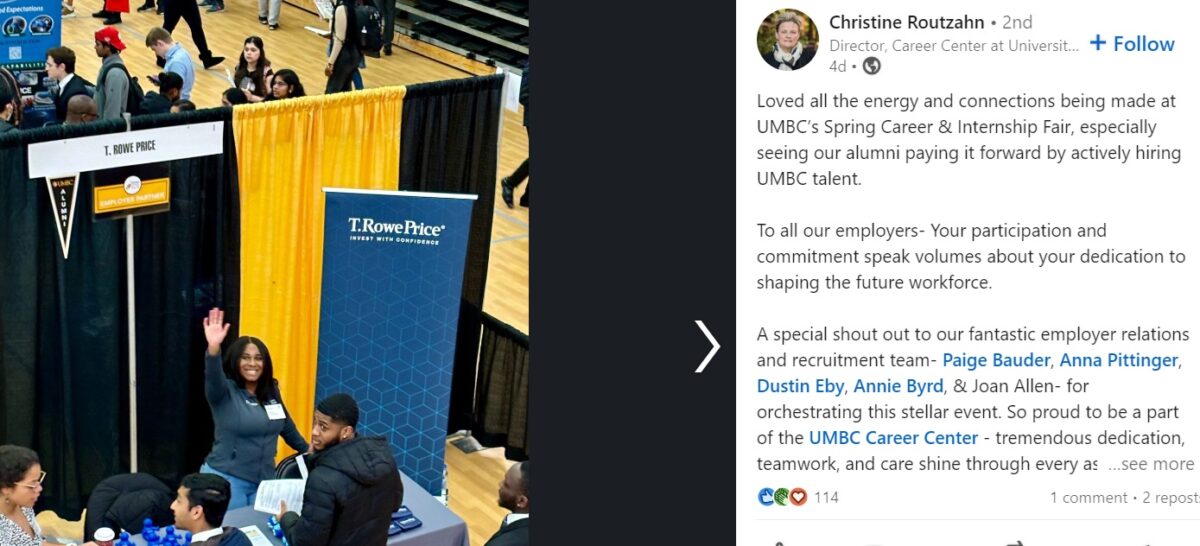 Image courtesy of Christine Routzahn, director of UMBC’s Career Center.
The leading edge
“Give strong handshakes. Maintain eye contact,” said Leon Tang ’26, information systems, in a booming voice, as he scanned IDs as a volunteer at the event.
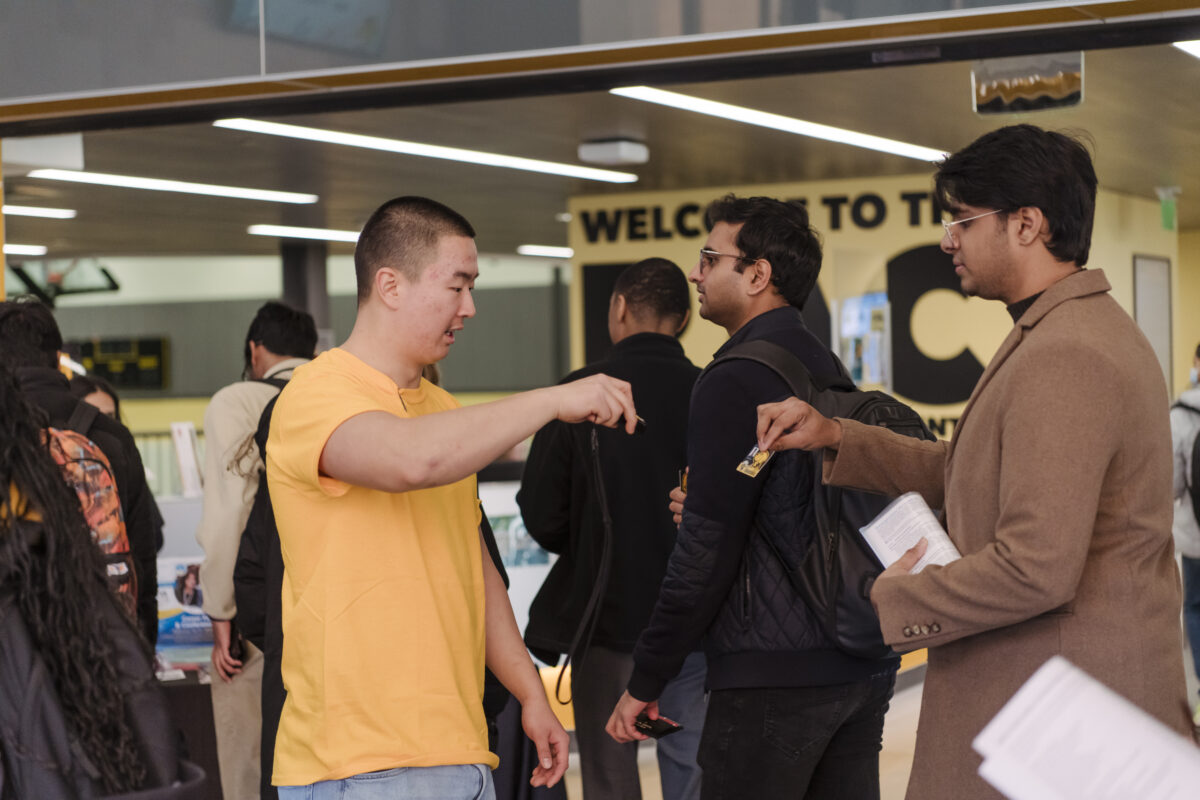 Leon Tang welcoming Career Fair attendees. (Marlayna Demond ’11/UMBC)
“Some people might come in nervous. It’s over 180 companies, so it can be pretty hard,” said Tang. He currently has two internships, one as a business technology intern at Agile Care Enterprises, based at bwtech@UMBC, and another as a research assistant in the information systems department. “It’s a good way to tell everyone to be calm and be confident. It’s the little things that can go pretty far in obtaining something.” For the nearly 2,200 Retrievers that made it through the door that day, this was sage advice.
A professional headshot is one of those little things. After making it past Tang, Bhargavi Gudapati, a current master’s student in information systems, headed straight back to grab the 10th spot in a line that, over the next four hours, would consistently have dozens of excited and grateful students waiting for their free headshot. Gudapati, an international student from India, has attended every career fair since she arrived in 2022. She wants to get ahead of the steep competition of international students looking to launch the next phase of their career in the U.S.
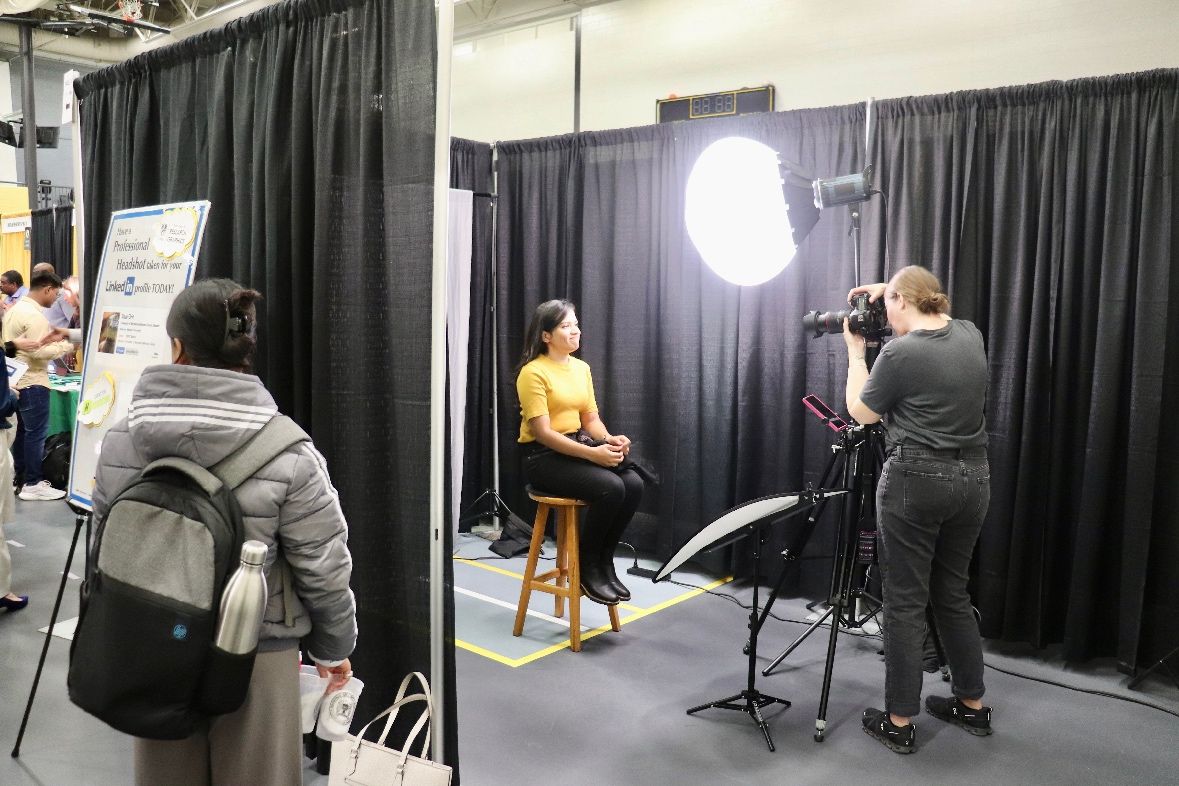 Spring 2024 Career and Internship Fair headshot station. (Image courtesy of Christine Routzahn)
“It’s incredibly important to get to know employers in person instead of only on their online portal,” says Gudapati.“You want to know what they require and the current technology they are using.”
One of those employers, Ed Belsinger ’90, M.S. ’93, mechanical engineering, is a newbie to UMBC’s career fairs. He proudly wore his UMBC sweatshirt and a smile that became a beacon of friendliness in a sea of students seeking opportunities. Belsinger is the director of product development at RPM Tech, a company that turns an idea into a prototype and a prototype into a fully manufacturable product. Because RPM does all the engineering and design in-house with a full shop and lab, it can offer students a wide range of expertise.
Belsinger notes that RPM is currently in a growth mode and has three internships available as well as full-time positions. “As an alum, I said, ‘This is a great school—we have to go there.’ Whether it’s an internship or someone right out of college, we’re looking for students with curiosity, who want to learn, are willing to do new things, to be challenged, and be part of a team.”
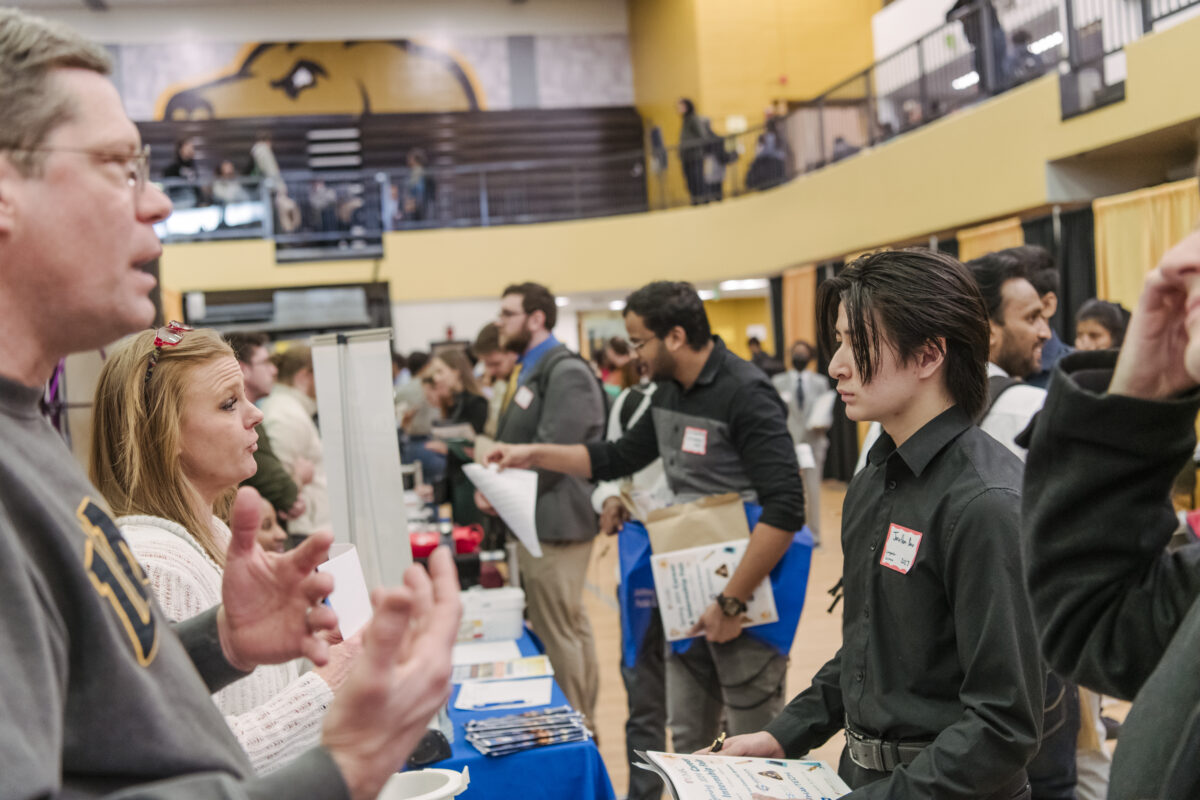 (l – r): Ed Belsinger (in grey) and Jonathan Dao (in black). (Marlayna Demond ’11/UMBC)
Hoping to grab one of the RPM internships is Jonathan Dao, computer science, a first-year student waiting in line to speak with Belsinger. “I saw tech in the name and wanted to learn more. I want to see if I can start early to have a competitive advantage,” said Dao. “I think first-year students should definitely give the career fair a shot. Come in with confidence, try rehearsing how to present yourself, and dress well.”
Part of the team
Sekinat Dosunmu ’24 agrees with Dao’s approach. After spending her first year of college remote, she has made it a point to attend every career fair in person. Toward the end of the day, she lined up at the FBI table, ready to discuss what the FBI had to offer someone like her with a global studies major, an Africana studies minor, and certificates in tech and intercultural communication. As she stepped forward, a recruiter immediately welcomed her.
While waiting to continue talking with Dosunmu, other recruiters shared that the FBI welcomes all majors, including the arts and humanities. They noted that the most important skill the FBI is looking for is how someone approaches and solves a problem in a team environment.
The artists approach
Solving problems creatively is the bread (or blood) and butter of C.C. Smith ’24, theatre, formerly known as Dracula in UMBC’s fall 2023 production of Dracula: a Feminist Revenge Fantasy, Really. That role earned him an audition for a film later on in the day, so Smith is hurrying through the fair.
Later in the spring, UMBC’s Career Center hosts boutique career fairs, one of which is focused on creative careers, and on March 7, it will host the CAHSS Career Connection Social for arts, humanities, and social science majors, but that doesn’t stop Smith from checking things out. As an actor, Smith explains, you never know when someone is looking to do a commercial. “This is my first time here. I would like to see more performing arts employers in this larger career fair, especially with how good the arts programs are here,” says Smith. “As a senior, it’s still important to be poking around this fair.”
Luna Siesko ’25, visual arts, and Alexander Schobitz ’22, visual arts, agree with Smith that UMBC students excel in the arts, and would like local employers to know about that. Siesko, a photographer and videographer at commonvision, UMBC’s design shop, used her skillset to bring personally designed business cards and résumés to the fair. Siesko is unsure what she is looking for but hopes that by speaking with some of the employers, like the folks at the Baltimore County Arts Guild, she can get a sense of how to best move forward.
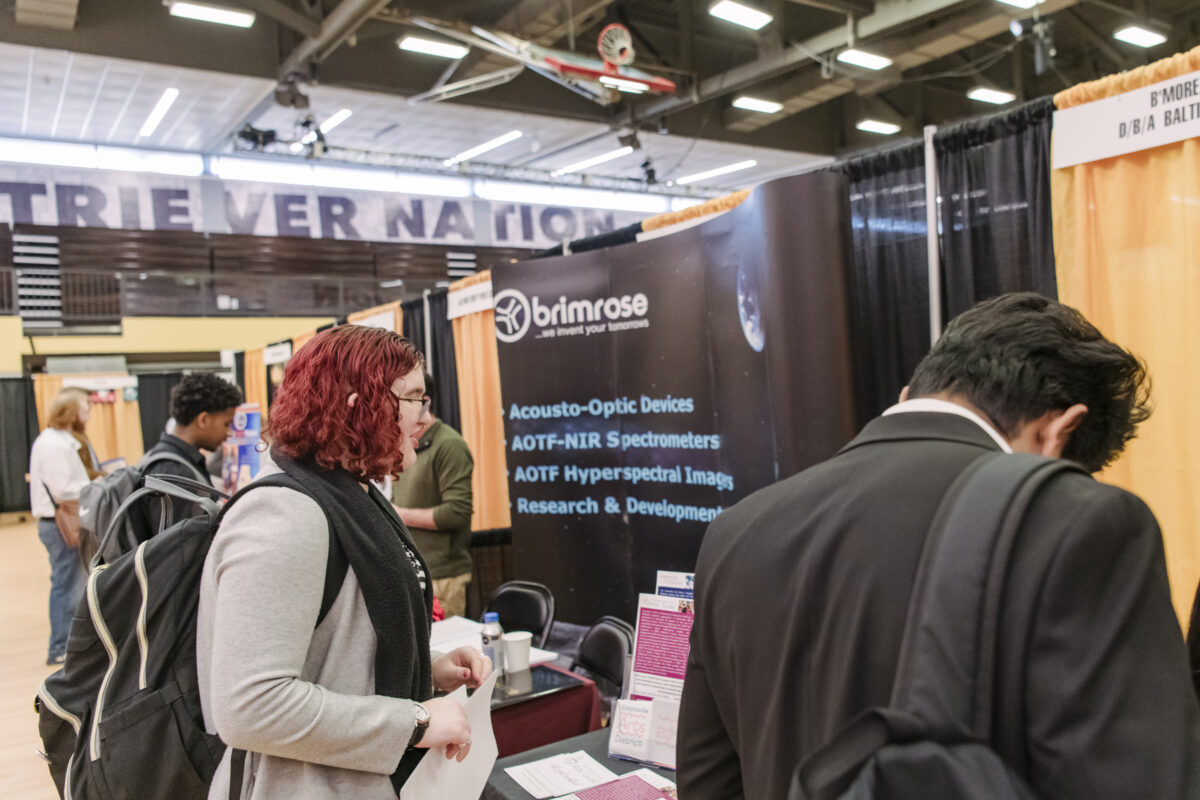 Luna Siesko at the Baltimore County Arts Guild table. (Marlayna Demond ’11/UMBC)
“We’re a small non-profit five minutes from UMBC. We want to make sure that artists feel seen and heard and know there is a place for them to work,” said Gloria Fajimolu, program and events manager at the Baltimore County Arts Guild, a new employer at the Career Fair. “We’re very welcoming. If a student doesn’t get the internship or the job, they can still be a paid instructor. If they are in animation, we will pay them to teach animation classes to the community.”
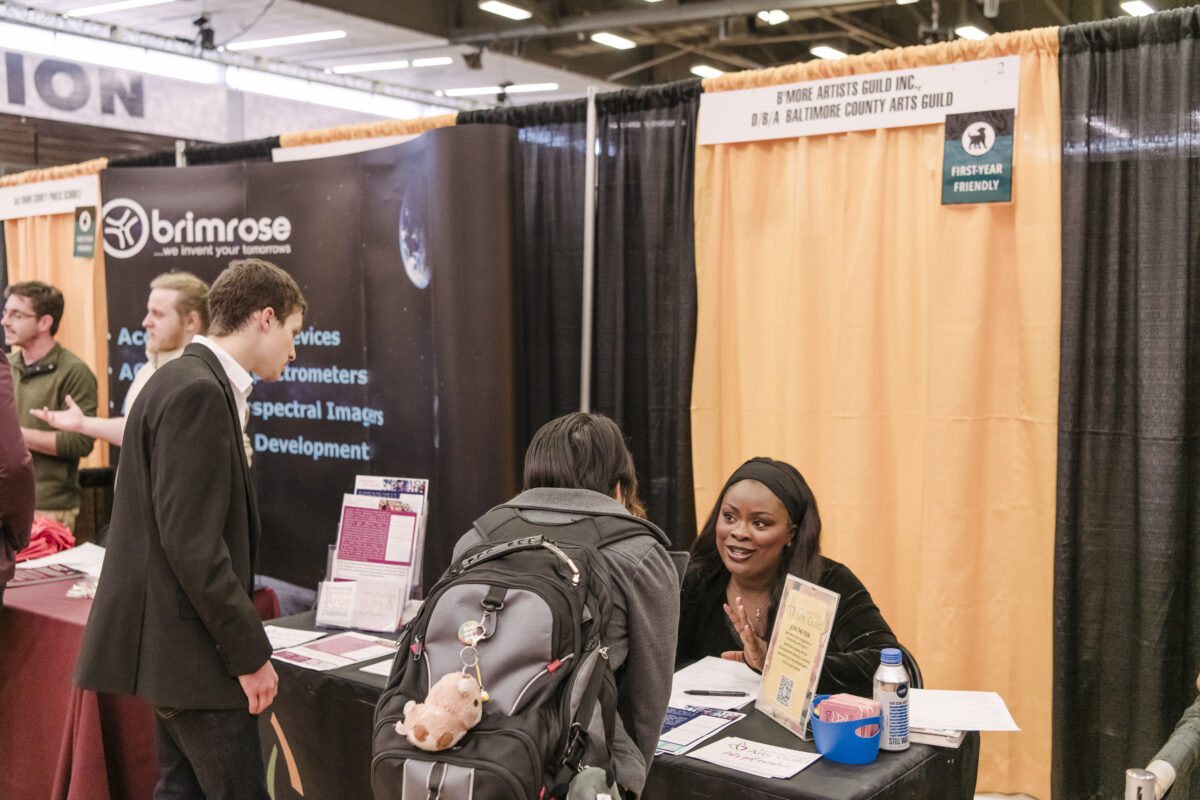 Gloria Fajimolu, program and events manager at the Baltimore County Arts Guild. (Marlayna Demond ’11/UMBC)
As a recent alum, Schobitz has one goal—to get a job in animation. He is grateful UMBC gives alumni access to the career fairs and Handshake, a job listing app. “I apply to about 10 jobs per day. I use sites like Indeed and Handshake to find jobs and apply,” says Schobitz. “While I was a student, I used UMBC’s résumé services and made a lot of appointments. I’m still trying. I won’t give up.”
The end and beginning
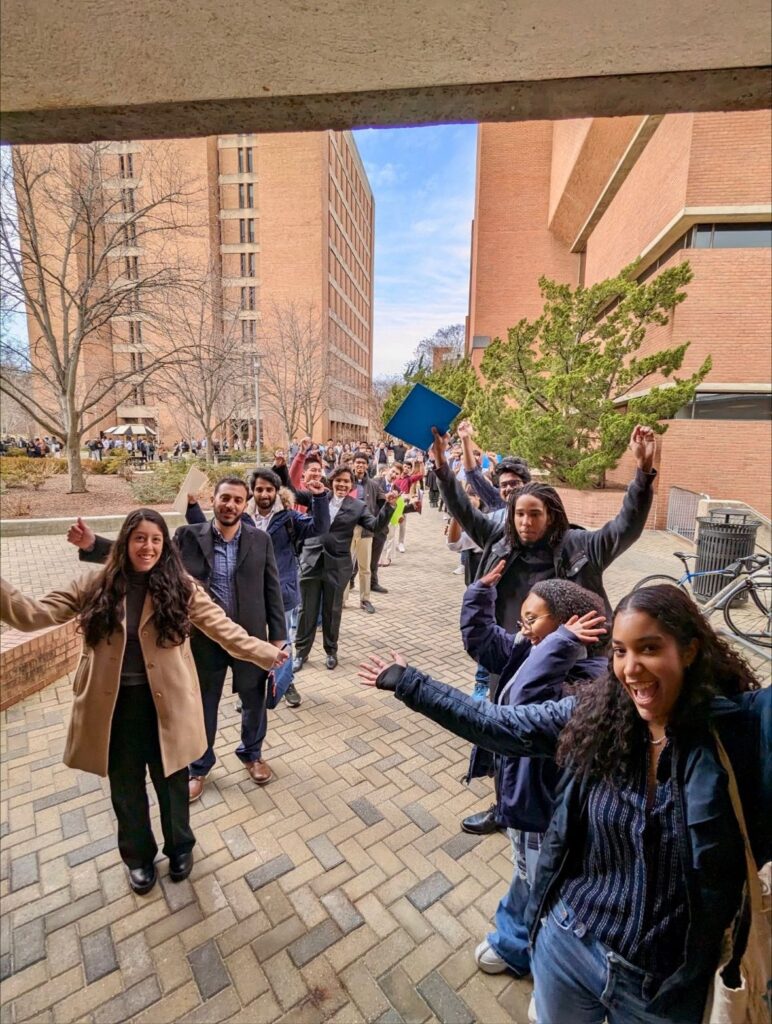 UMBC students lineup for the Spring 2024 Career and Internship Fair.
(Image courtesy of Routzhan)
Back at the headshot line, Cristian Castro, M.S. ’24, cybersecurity, joined the still-growing line as the last wave of students filed in. Castro is from Colombia and is looking to find a company to sponsor him to work in the U.S. “The Career Fair is a very good opportunity to see what’s out there. A professional photo is important in a LinkedIn profile,” says Castro. He also found some job leads earlier this year while representing UMBC as part of the Society of Advancing Chicanos/Hispanics and Native Americans in Science. “When it comes to what happens after graduation, every detail helps.”
Follow the Career Center on myUMBC and RSVP to the CAHSS Career Connection Social on Thursday, March 7, to network with alumni and employers in the arts, humanities, and social sciences.
]]>
On a perfect 55-degree sunny February day, hundreds of undergraduate and graduate students across all colleges stood in a line that began at the RAC and wrapped its way to Sherman Hall. Instead of...
https://umbc.edu/stories/the-2024-career-fair/
https://my3.my.umbc.edu/api/v0/pixel/news/139041/guest@my.umbc.edu/21c9b154d9df23acc2fa66d5d7b9f73e/api/pixel
africana-studies
cahss
career-center
coeit
community
computer-science
cybersecurity
global-studies
is
meche
news
story
theatre
visual-arts
UMBC News & Magazine
https://my3.my.umbc.edu/groups/umbc-news-magazine
https://assets1-my.umbc.edu/system/shared/avatars/groups/000/001/943/24435aa6207c452e7bc15cc74b42c7bb/xsmall.png?1748556657
https://assets1-my.umbc.edu/system/shared/avatars/groups/000/001/943/24435aa6207c452e7bc15cc74b42c7bb/original.png?1748556657
https://assets2-my.umbc.edu/system/shared/avatars/groups/000/001/943/24435aa6207c452e7bc15cc74b42c7bb/xxlarge.png?1748556657
https://assets2-my.umbc.edu/system/shared/avatars/groups/000/001/943/24435aa6207c452e7bc15cc74b42c7bb/xlarge.png?1748556657
https://assets3-my.umbc.edu/system/shared/avatars/groups/000/001/943/24435aa6207c452e7bc15cc74b42c7bb/large.png?1748556657
https://assets1-my.umbc.edu/system/shared/avatars/groups/000/001/943/24435aa6207c452e7bc15cc74b42c7bb/medium.png?1748556657
https://assets2-my.umbc.edu/system/shared/avatars/groups/000/001/943/24435aa6207c452e7bc15cc74b42c7bb/small.png?1748556657
https://assets1-my.umbc.edu/system/shared/avatars/groups/000/001/943/24435aa6207c452e7bc15cc74b42c7bb/xsmall.png?1748556657
https://assets2-my.umbc.edu/system/shared/avatars/groups/000/001/943/24435aa6207c452e7bc15cc74b42c7bb/xxsmall.png?1748556657
UMBC News & Magazine
1
0
false
Thu, 15 Feb 2024 16:23:39 -0500
Thu, 15 Feb 2024 16:23:39 -0500
For the third time in five years, UMBC is named a Fulbright Top Producing Institution

Within just a few months of living in Piątek, a small town in central Poland, Leah Michaels, M.F.A ’19, intermedia and digital arts, has already traveled to Romania, where many recipients of the Fulbright U.S. Student award placed throughout Europe gathered at a media literacy conference. She has also had an opportunity to research Polish film at Poland’s Film Archive and connect with a local genealogist who helped her find details about her Polish roots for a short documentary she is producing about her ancestry.
Michaels and nine other UMBC Fulbright student recipients researching and teaching English abroad this year helped propel UMBC, once again, to the elite ranks of a Fulbright Top Producing Institution, as reported today in The Chronicle of Higher Education. The designation recognizes colleges and universities with the highest number of students selected for the Fulbright U.S. Student Program, the U.S. government’s flagship international academic exchange program. UMBC first received this designation from the U.S. Department of State’s Bureau of Educational and Cultural Affairs in 2019 – 2020 and again in 2020 – 2021.
UMBC is one of 57 doctoral universities nationwide and three in Maryland to receive a Fulbright Top Producing Institution designation for Fulbright U.S. Students in 2023 – 2024.
More than 2,200 U.S. students from hundreds of colleges and universities are awarded Fulbright grants annually. However, only a few of these institutions are designated top producers yearly. In the last decade, UMBC students and recent graduates have received over 60 Fulbright U.S. Student Program awards in Africa, Asia and the Pacific, the Middle East, South America, and Europe.
“This achievement is a testament to your institution’s deep commitment to international exchange,” wrote Secretary of State Antony Blinken in a letter to President Valerie Sheares Ashby, congratulating her on UMBC’s Fulbright Top Producer designation, “and to building lasting connections between the people of the United States and the people of other countries.”
Mutual understanding
In partnership with more than 140 countries worldwide, the Fulbright U.S. Student Program offers unparalleled opportunities in all academic disciplines to graduating college seniors, graduate students, and young professionals from all backgrounds. Fulbright recipients play a critical role in U.S. public diplomacy, establishing long-term relationships between people and nations through graduate study, research, or teaching as English Teaching Assistants (ETAs). ETAs develop their own language skills and knowledge of the host country while teaching English to elementary, middle school, or college students.
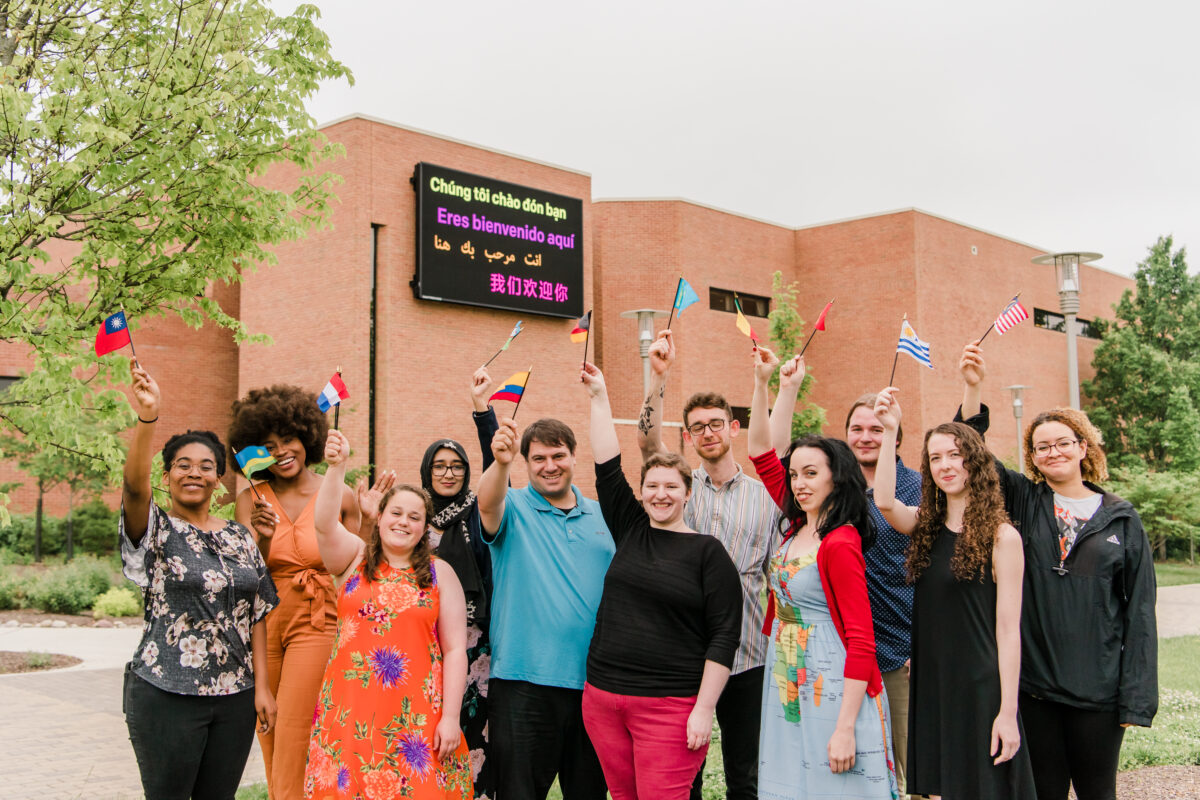 2019 – 2020 UMBC Fulbright U.S. Student recipients. (Marlayna Demond ’11/UMBC)
“As a public research university, it is imperative that we provide students with opportunities for global engagement,” says David Di Maria, associate vice provost for international education. “Fulbright is among the most prestigious of these opportunities.”
While Michaels has flourished in Poland, her 2023 – 2024 Fulbright class peers have also settled into their placements, which generally start in September with the new school year. Paul Ocone ’22, individualized study, is conducting research at the Meiji University School of Global Japanese Studies in Japan, and eight ETAs are teaching English across Europe and Asia:
- North Macedonia: David Bullman ’22, ancient studies
- Romania: Tiffany Powell, M.A.’23, teaching English to speakers of other languages (TESOL)
- Slovak Republic: Sianna Serio ’23, computer science
- South Korea: Tasneem Mansour ’20, modern languages, linguistics, and intercultural communication
- Taiwan: Nailah-Benā Chambers ’23, global studies; Kara Gavin ’20, English; and Milan Richardson ’23, bioinformatics
- Turkey: Grant Clifton, M.A. ’23, TESOL
“Being named a Top Producing Fulbright Institution is a tremendous honor—it not only shows the world what we already know about our amazing students, but it also lets our current students know that the Fulbright is a realistic opportunity for them,” says Brian Souders, Ph.D. ’09, language, literacy, and culture, M.A.’19, TESOL, and associate director of global learning at the Center for Global Engagement (CGE). Souders has led students through the Fulbright application process as UMBC’s Fulbright Program advisor for the last decade.
For Michaels, the experience has been life-changing. “My home city has been incredibly welcoming. I learned Polish folk dances, made Old Bay pierogi from scratch with some of my students, and joined a school trip to an art gallery,” says Michaels.
The Fulbright family
The Fulbright experience also includes college and university faculty and staff, as well as artists and professionals from a wide range of fields, who can join over 400,000 Fulbright alumni.
In October 2023,Renique Kersh, vice president of student affairs, and Souders traveled to Germany after receiving Fulbright International Education Administrator awards. Katherine Heird, director of education abroad and global learning, received the same award to travel to Taiwan in spring 2024. The award is geared to provide staff who support Fulbright applicants with a greater understanding of higher education worldwide.
Brian Souders is our assoc. director for global learning in the Center for Global Engagement and after years of helping faculty and students achieve their overseas learning and research goals, Brian recently took part in his own Fulbright exchange program. https://t.co/LvrOoabMou
— UMBC (@UMBC) November 15, 2023
Many UMBC faculty members and staff have received a Fulbright U.S. Scholar award over the years. This year, Lynn Cazabon, professor of visual arts and director of the Center for Innovation, Research, and Creativity in the Arts, received a Fulbright U.S. Scholar award to work at Queensland University, Australia, to create a public artwork based on local communities’ responses to climate change. Cazabon received her first Fulbright award in 2015 to the University of Liepāja, Latvia.
Fulbright Scholars globally are also drawn to UMBC’s welcoming community. Shannon Sauro, associate professor of education, hosted Jules Buendgens-Kosten, a research assistant at the Institute of English and American Studies at Goethe-Universität Frankfurt, Germany. Buendgens-Kosten joined UMBC as the institution’s first Fulbright Scholar-in-Residence to teach and share their research on inclusive education in teaching English as a foreign language to students in UMBC’s TESOL master’s program.
My uni (@UMBC) just got so much geekier and cooler.
]]>
Within just a few months of living in Piątek, a small town in central Poland, Leah Michaels, M.F.A ’19, intermedia and digital arts, has already traveled to Romania, where many recipients of the...
https://umbc.edu/stories/umbc-a-fulbright-top-producing-institution-2/
https://my3.my.umbc.edu/api/v0/pixel/news/138957/guest@my.umbc.edu/05838e8345b6084d69684b1796077d12/api/pixel
ancient-studies
biological-sciences
cahss
cnms
coeit
community
computer-science
education
english
fulbright-scholarship
global-studies
international
mlli
news
story
UMBC News & Magazine
https://my3.my.umbc.edu/groups/umbc-news-magazine
https://assets1-my.umbc.edu/system/shared/avatars/groups/000/001/943/24435aa6207c452e7bc15cc74b42c7bb/xsmall.png?1748556657
https://assets1-my.umbc.edu/system/shared/avatars/groups/000/001/943/24435aa6207c452e7bc15cc74b42c7bb/original.png?1748556657
https://assets2-my.umbc.edu/system/shared/avatars/groups/000/001/943/24435aa6207c452e7bc15cc74b42c7bb/xxlarge.png?1748556657
https://assets2-my.umbc.edu/system/shared/avatars/groups/000/001/943/24435aa6207c452e7bc15cc74b42c7bb/xlarge.png?1748556657
https://assets3-my.umbc.edu/system/shared/avatars/groups/000/001/943/24435aa6207c452e7bc15cc74b42c7bb/large.png?1748556657
https://assets1-my.umbc.edu/system/shared/avatars/groups/000/001/943/24435aa6207c452e7bc15cc74b42c7bb/medium.png?1748556657
https://assets2-my.umbc.edu/system/shared/avatars/groups/000/001/943/24435aa6207c452e7bc15cc74b42c7bb/small.png?1748556657
https://assets1-my.umbc.edu/system/shared/avatars/groups/000/001/943/24435aa6207c452e7bc15cc74b42c7bb/xsmall.png?1748556657
https://assets2-my.umbc.edu/system/shared/avatars/groups/000/001/943/24435aa6207c452e7bc15cc74b42c7bb/xxsmall.png?1748556657
UMBC News & Magazine
2
0
false
Tue, 13 Feb 2024 11:32:48 -0500
Tue, 13 Feb 2024 11:32:48 -0500
U.S. News ranks UMBC’s online master’s in information systems among best in the nation

U.S. News and World Report has recognized UMBC’s online master’s degree in information systems as #34 on their national list of 2024 Best Online Master’s in Information Technology Programs. The program moved up seven spots from last year’s ranking.
The U.S. News rankings evaluate programs based on qualities such as strong faculty credentials, a good reputation among peer institutions, and the opportunity for students to use diverse online learning tools and engage with their instructors and classmates.
In response to surging interest in artificial intelligence, this year the UMBC program added a new class on AI fundamentals. AI is also one of four program tracks that students can choose to tailor their degree to their career goals. The other tracks are cybersecurity, data science, and user experience.
Recently, the program also launched five certificates, which students can pursue on their way to a master’s degree, or as a stand-alone credential.
In September, in honor of national online learning day, the information systems department interviewed the new graduate program director for the online master’s program, Jimmy Foulds, an associate professor in information systems at UMBC.
Below is a lightly edited version of the interview, which touches on trends in information technology, and the advantages of UMBC’s brand of education.
 Jimmy Foulds (Marlayna Demond ’11/UMBC)
Information Systems: Can you shed light on some of the biggest trends, milestones, and challenges shaping online programs right now?
Jimmy Foulds: With the rapid advancement of artificial intelligence in recent years, the field is coming to the point where we need to take stock of the impacts of AI and other computing technologies in our world, both good and bad, and to better account for humans in the design of computerized systems. Large language models such as ChatGPT are poised to both make our lives easier and to possibly tip over the apple cart of the entire workforce. More than ever, there is a need for skilled computing professionals. Online programs, such as the online M.S. at UMBC, provide a flexible opportunity to advance your knowledge and get ahead in your career while keeping up to date with the rapidly changing computing landscape.
Information Systems: In thinking about these advantages and trends, what are some of your immediate and long-term goals for the program?
Jimmy Foulds: In the short-term, we are increasing our (already broad) AI course offerings, including a new AI course that I will teach myself next semester. We have also recently created program tracks that allow students to specialize in the cutting-edge areas of artificial intelligence, cybersecurity, data science, and user experience. In a new addition to our program, you can now earn certificates in these areas, as well as the foundations of information systems, without committing to completing a full master’s degree, which provides more flexibility.
In the long-term, as more computing professionals look to upskill themselves, we want to grow the program to reach more students, while maintaining the rigor and high quality of instruction that our students have come to expect. I will not compromise on that.
Information Systems: As online options become more prevalent and important among universities, and students wanting even more online options, how do you address the concerns of those that may still be skeptical of online learning?
Jimmy Foulds: I understand the concerns, as there are some programs out there that give online learning a bad name in the eyes of some prospective students. The UMBC online M.S. is not one of those programs. We have exceptional instructors in our program, including many of the tenure track faculty in the department who are leading experts in their fields, as well as highly experienced lecturers and professors of the practice (i.e., professors who specialize in teaching) with doctoral qualifications. UMBC has a reputation for teaching excellence and is a national leader in student-centered learning. Regarding the expertise of our faculty, the university is renowned as a doctoral university with very high research activity under the Carnegie Classification system, commonly known as an R1 institution. The courses offered in our online M.S. program aim to fulfill the full educational experience of our on-campus offerings.
Information Systems: Your research interests are in the area of socially conscious machine learning and artificial intelligence. How does your work aim to improve AI’s role in society regarding fairness and privacy?
Jimmy Foulds: Data-driven artificial intelligence systems now make many decisions that impact our lives, both big and small, from what restaurant we are recommended to try, to whether we get access to medical care, to whether we get offered a job interview. While it’s easy to think of data as being inherently objective and algorithms as being neutral and unprejudiced, the reality is that data reflects bias and inequity in our society, even if it were perfectly representative of the population, which is far from guaranteed. Bias in data leads to bias in algorithms, and to biased, unfair decisions by AI systems. In my research, I aim to help combat AI bias, and I try to shift the field toward taking a more human-centered perspective on the design of these systems. I have also worked on privacy-preserving machine learning algorithms, protecting users from having their personal data leaked by the algorithms themselves.
Information Systems: With your expertise in artificial intelligence and AI being a specialization in the M.S. online program, how will you be expanding the student experience for those interested in this path?
Jimmy Foulds: I am teaching a new introductory course on artificial intelligence that covers high-demand skills sought after by companies in both the public and private sector, including search, constraint satisfaction, and reinforcement learning. The course also covers reasoning and decision-making via propositional logic, probability, and Bayesian networks. As the incoming graduate program director, together with our faculty and staff, I also plan to take a close look at our curricula and see if and where we can make any improvements to take our course offerings to the next level.
Information Systems: The program just launched five new certificates, AI, cybersecurity, data science, UX design and foundations of information systems, all available 100 percent online. What are the advantages of a certificate versus the full master’s degree?
Jimmy Foulds: I am excited about our new certificate programs as they provide students with the opportunity to upskill themselves in a specific area and get recognition from employers without having to invest in completing a full master’s program. Flexibility is what online learning programs are all about, so these certificates are a welcome addition. Students can take up to two certificates concurrently. If they choose to go further, building on their certificate studies they may enroll in and finish an M.S. degree. Our online M.S. degree students can also earn these certificates along the way to their master’s degrees if they so desire. The freedom that the certificates offer to students is really empowering, and is much needed as it allows students to adapt their educational goals to fit into their busy lives.
]]>
U.S. News and World Report has recognized UMBC’s online master’s degree in information systems as #34 on their national list of 2024 Best Online Master’s in Information Technology Programs. The...
https://umbc.edu/stories/u-s-news-online-masters-in-information-systems/
https://my3.my.umbc.edu/api/v0/pixel/news/138863/guest@my.umbc.edu/62ee6fafe4cf4efc71a131a026167291/api/pixel
coeit
is
news
rankings
science-and-tech
story
UMBC News & Magazine
https://my3.my.umbc.edu/groups/umbc-news-magazine
https://assets1-my.umbc.edu/system/shared/avatars/groups/000/001/943/24435aa6207c452e7bc15cc74b42c7bb/xsmall.png?1748556657
https://assets1-my.umbc.edu/system/shared/avatars/groups/000/001/943/24435aa6207c452e7bc15cc74b42c7bb/original.png?1748556657
https://assets2-my.umbc.edu/system/shared/avatars/groups/000/001/943/24435aa6207c452e7bc15cc74b42c7bb/xxlarge.png?1748556657
https://assets2-my.umbc.edu/system/shared/avatars/groups/000/001/943/24435aa6207c452e7bc15cc74b42c7bb/xlarge.png?1748556657
https://assets3-my.umbc.edu/system/shared/avatars/groups/000/001/943/24435aa6207c452e7bc15cc74b42c7bb/large.png?1748556657
https://assets1-my.umbc.edu/system/shared/avatars/groups/000/001/943/24435aa6207c452e7bc15cc74b42c7bb/medium.png?1748556657
https://assets2-my.umbc.edu/system/shared/avatars/groups/000/001/943/24435aa6207c452e7bc15cc74b42c7bb/small.png?1748556657
https://assets1-my.umbc.edu/system/shared/avatars/groups/000/001/943/24435aa6207c452e7bc15cc74b42c7bb/xsmall.png?1748556657
https://assets2-my.umbc.edu/system/shared/avatars/groups/000/001/943/24435aa6207c452e7bc15cc74b42c7bb/xxsmall.png?1748556657
UMBC News & Magazine
0
0
false
Fri, 09 Feb 2024 13:25:10 -0500
Fri, 09 Feb 2024 13:25:10 -0500
Mechanical engineering professor Timmie Topoleski honored for his service to the Society for Biomaterials

Timmie Topoleski, professor of mechanical engineering at UMBC, has received the 2024 Society for Biomaterials Award for Service, which honors individuals who have devoted significant time and energy to advancing the goals of the professional society.
The Society for Biomaterials brings together professionals from academia, government, and business to promote advancements in biomaterials science, education, and professional standards to enhance human health and quality of life.
“I do not know anyone for whom “Service” is written in their DNA as it is for Tim,” said Paul Ducheyne, a professor of bioengineering at the University of Pennsylvania who nominated Topoleski for the award and is quoted in a society press release.
Topoleski has served on and chaired many Society for Biomaterials committees and has taken on leadership positions for many years. His own research has focused on understanding the behavior of a range of biomaterials, from the harmful plaques that can build up in people’s arteries, to the metal, ceramic, and cement used in joint replacements. The work may lead to better ways to diagnose and treat diseases such as arthritis and heart disease.
“I enjoy working to make the Society for Biomaterials a society that serves the needs of our members and provides a forum for the exchange of the latest developments in our biomaterials research,” Topoleski says. “It is an honor and very humbling to be in the company of those who previously received the award.”
]]>
Timmie Topoleski, professor of mechanical engineering at UMBC, has received the 2024 Society for Biomaterials Award for Service, which honors individuals who have devoted significant time and...
https://umbc.edu/quick-posts/mechanical-engineering-professor-timmie-topoleski-honored-for-his-service-to-the-society-for-biomaterials/
https://my3.my.umbc.edu/api/v0/pixel/news/138779/guest@my.umbc.edu/f6a4ccfbfc717d28785a677fc7a8715a/api/pixel
coeit
meche
news
quick-post
quick-posts
science-and-tech
UMBC News & Magazine
https://my3.my.umbc.edu/groups/umbc-news-magazine
https://assets1-my.umbc.edu/system/shared/avatars/groups/000/001/943/24435aa6207c452e7bc15cc74b42c7bb/xsmall.png?1748556657
https://assets1-my.umbc.edu/system/shared/avatars/groups/000/001/943/24435aa6207c452e7bc15cc74b42c7bb/original.png?1748556657
https://assets2-my.umbc.edu/system/shared/avatars/groups/000/001/943/24435aa6207c452e7bc15cc74b42c7bb/xxlarge.png?1748556657
https://assets2-my.umbc.edu/system/shared/avatars/groups/000/001/943/24435aa6207c452e7bc15cc74b42c7bb/xlarge.png?1748556657
https://assets3-my.umbc.edu/system/shared/avatars/groups/000/001/943/24435aa6207c452e7bc15cc74b42c7bb/large.png?1748556657
https://assets1-my.umbc.edu/system/shared/avatars/groups/000/001/943/24435aa6207c452e7bc15cc74b42c7bb/medium.png?1748556657
https://assets2-my.umbc.edu/system/shared/avatars/groups/000/001/943/24435aa6207c452e7bc15cc74b42c7bb/small.png?1748556657
https://assets1-my.umbc.edu/system/shared/avatars/groups/000/001/943/24435aa6207c452e7bc15cc74b42c7bb/xsmall.png?1748556657
https://assets2-my.umbc.edu/system/shared/avatars/groups/000/001/943/24435aa6207c452e7bc15cc74b42c7bb/xxsmall.png?1748556657
UMBC News & Magazine
0
0
false
Wed, 07 Feb 2024 11:51:47 -0500
Meet a Retriever—Kevin Yang ’07, Alumni Association Executive Vice President

Meet Kevin Yang ’07, computer science and financial economics. Kevin is a real estate entrepreneur, the current executive vice president and vice president of finance of the UMBC Alumni Association Board of Directors, and one half of an alumni power couple. Kevin met his wife, Katelyn Niu ’05, biochemistry, when the pair found themselves in the same physics study group as undergrads (because where else do you find love at UMBC?). They both share a passion for UMBC that runs deep. Take it away, Kevin!
Q: What is your WHY? What brought you to UMBC?
A. I grew up in an immigrant family and witnessed the sacrifices that my parents made to give me an opportunity to achieve the American dream. Although they never had the chance to finish high school, my parents firmly believed in the importance of higher education. I came to UMBC for a quality STEM education and found it to be a perfect fit. UMBC offered the resources of a larger university and the individualized attention of a smaller college.
Q: What’s your favorite part of Retriever Nation?
A. I love UMBC’s commitment to inclusive excellence. Retriever Nation welcomes students from diverse backgrounds and provides them with the necessary support to succeed at UMBC and beyond. I am forever grateful for the amazing experience that I had at UMBC! In addition to receiving a quality education, I made many lifelong friends, including my wife. I have stayed engaged since graduation, and I am proud of UMBC’s commitment to inclusive excellence.
Q: Tell us what you love about your academic program or an organization you’re involved in.
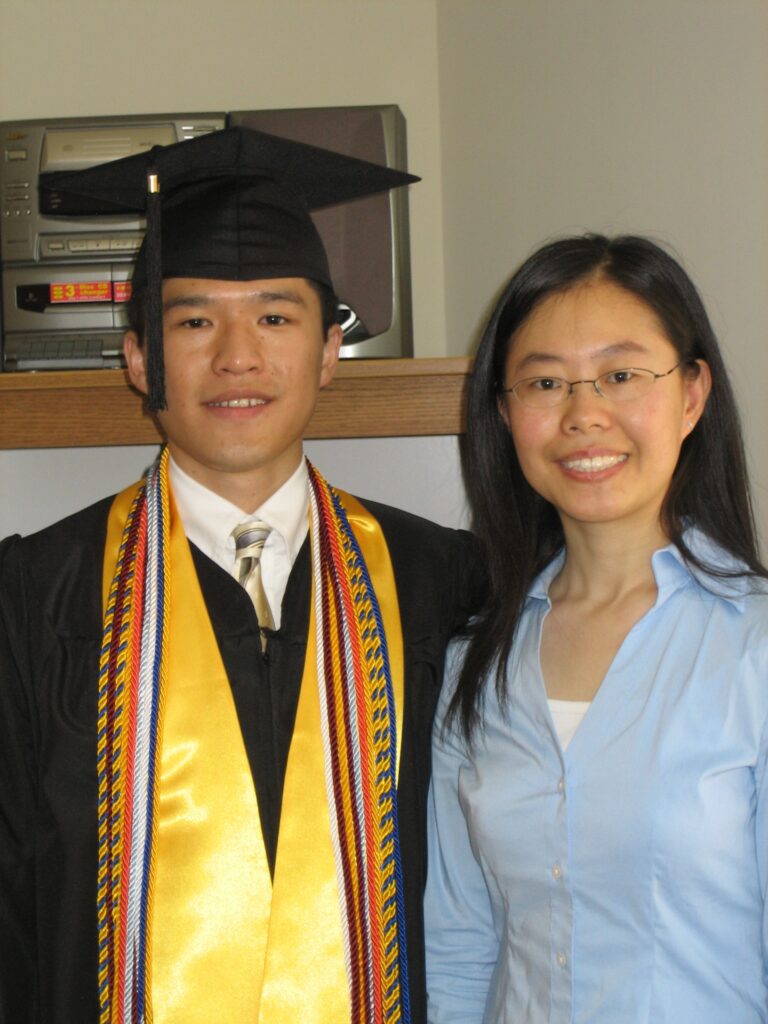
A. I had an excellent experience with the computer science program, which offered many opportunities beyond the classroom. As a tutor, teaching assistant, and research assistant in the computer science department, I learned valuable written and verbal communication skills, which was a highlight of my UMBC education.
UMBC community members work together to help our students achieve their academic and professional goals.
Today, I am a real estate entrepreneur, the Founder of KRY Properties. As a business owner, I love the ability to chart my own path. I often have to assume multiple roles, which is both challenging and rewarding. The analytical, problem-solving, and communication skills that I developed at UMBC gave me the confidence to pursue entrepreneurship.
Q: Where did you find support?
A. I built meaningful and long-lasting relationships at UMBC. I attribute much of my personal growth and academic achievements to my peers. We struggled together in challenging engineering courses, contemplated our futures from late night into early morning, and celebrated our birthdays at the local Olive Garden. We strengthened our bonds through highs and lows, and I will forever cherish those special memories.
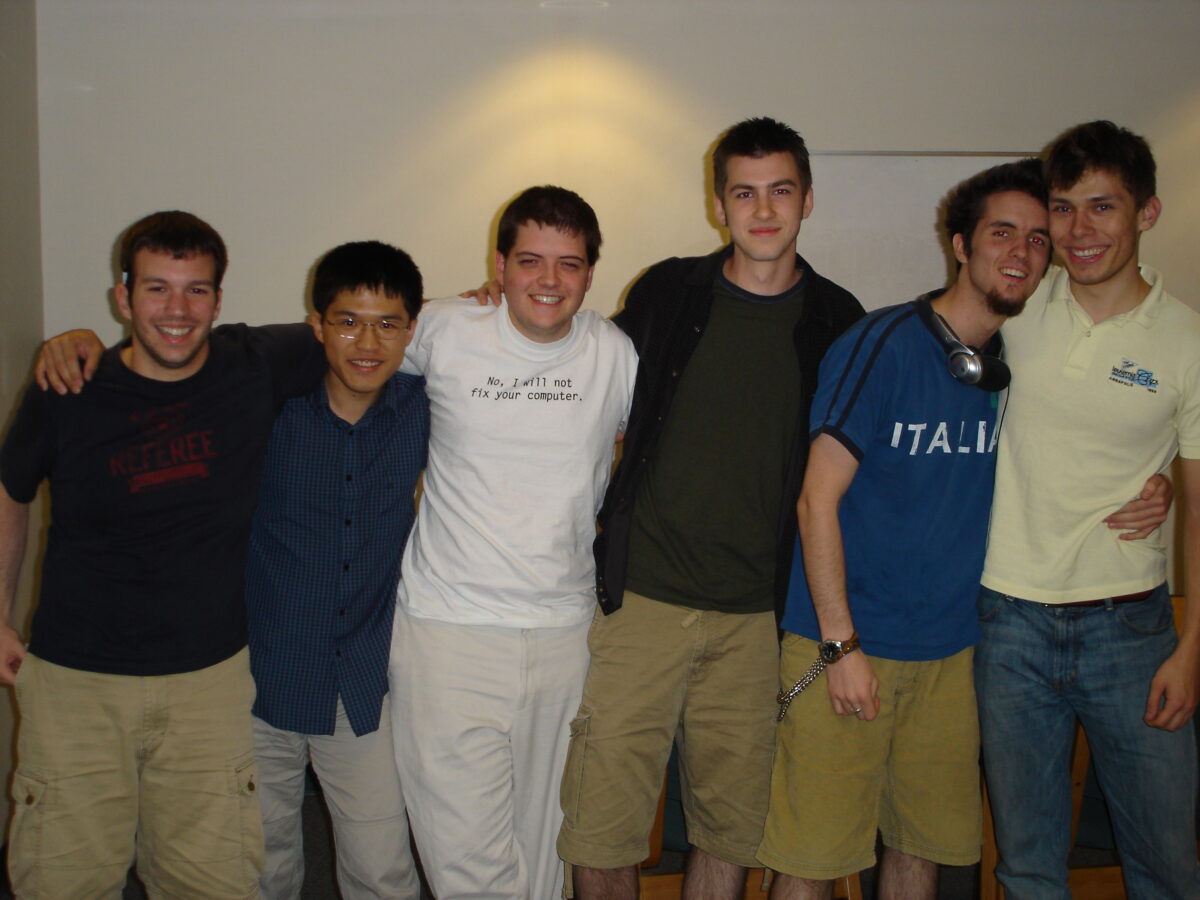 CMSC 441H, Algorithms with Professor Richard Chang, study group in Harbor Hall with fellow UMBC alumni JC Montminy, Kevin Yang, Donald Miner, Corey Weidenhammer, Alessandro Ferrucci, and Brandon Wilson.
Q: Tell us about someone in the community who has inspired you.
A. I received substantial financial and academic support from the Meyerhoff Scholars Program, which laid the foundation for my personal and professional successes. As a Meyerhoff Scholar, I learned about and took advantage of many incredible opportunities, such as summer internships at Georgia Tech and MIT. The Meyerhoff Scholars Program and its co-founder, Dr. Freeman A. Hrabowski, III, have inspired me to give back to the community that gave me so much.
Q: As alumni, how have you and Katelyn given back?
A. “To whom much is given, much is required.” I have been a donor every year since I graduated in 2007. My support focuses on scholarships, including the Meyerhoff Scholars Program and the Alumni Endowed Scholarship Fund. My wife, Katelyn, and I established an endowed scholarship in 2014 to support undergraduate students. Katelyn and I were fortunate to receive scholarships at UMBC. We are giving back so students who come after us can continue to have the same extraordinary experience that shaped our future.
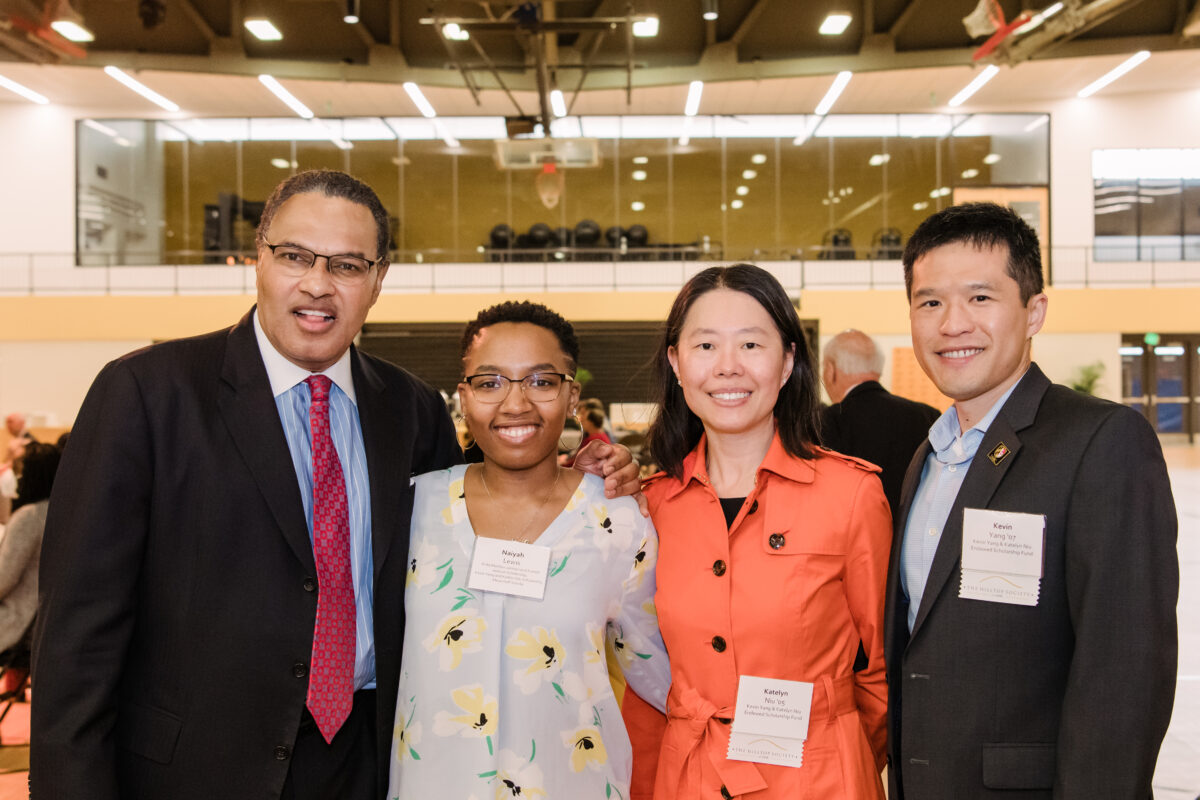 Katelyn Niu and Kevin Yang pose for a photo with Naiyah Lewis, one of their scholars, and UMBC President Emeritus Dr. Freeman A. Hrabowski, III, at the 2022 Endowed Scholars Luncheon.
Q: What’s the one thing you’d want someone who hasn’t joined the UMBC community to know about the support you find here?
A. UMBC community members work together to help our students achieve their academic and professional goals. We are proud of our collaborative culture!
* * * * *
UMBC’s greatest strength is its people. When people meet Retrievers and hear about the passion they bring, the relationships they create, the ways they support each other, and the commitment they have to inclusive excellence, they truly get a sense of our community. That’s what “Meet a Retriever” is all about.
Learn more about how UMBC can help you achieve your goals.
]]>
Meet Kevin Yang ’07, computer science and financial economics. Kevin is a real estate entrepreneur, the current executive vice president and vice president of finance of the UMBC Alumni...
https://umbc.edu/stories/meet-kevin-yang-alumni-association-vice-president/
https://my3.my.umbc.edu/api/v0/pixel/news/138486/guest@my.umbc.edu/a3688e5e3b57ddc1135a96deb38440d4/api/pixel
alumni
alumni-association
alumni-endowed-scholarship
biochemistry
coeit
compsci
financial-economics
impact
magazine
meet-a-retriever
meyerhoff-scholars
story
UMBC News & Magazine
https://my3.my.umbc.edu/groups/umbc-news-magazine
https://assets1-my.umbc.edu/system/shared/avatars/groups/000/001/943/24435aa6207c452e7bc15cc74b42c7bb/xsmall.png?1748556657
https://assets1-my.umbc.edu/system/shared/avatars/groups/000/001/943/24435aa6207c452e7bc15cc74b42c7bb/original.png?1748556657
https://assets2-my.umbc.edu/system/shared/avatars/groups/000/001/943/24435aa6207c452e7bc15cc74b42c7bb/xxlarge.png?1748556657
https://assets2-my.umbc.edu/system/shared/avatars/groups/000/001/943/24435aa6207c452e7bc15cc74b42c7bb/xlarge.png?1748556657
https://assets3-my.umbc.edu/system/shared/avatars/groups/000/001/943/24435aa6207c452e7bc15cc74b42c7bb/large.png?1748556657
https://assets1-my.umbc.edu/system/shared/avatars/groups/000/001/943/24435aa6207c452e7bc15cc74b42c7bb/medium.png?1748556657
https://assets2-my.umbc.edu/system/shared/avatars/groups/000/001/943/24435aa6207c452e7bc15cc74b42c7bb/small.png?1748556657
https://assets1-my.umbc.edu/system/shared/avatars/groups/000/001/943/24435aa6207c452e7bc15cc74b42c7bb/xsmall.png?1748556657
https://assets2-my.umbc.edu/system/shared/avatars/groups/000/001/943/24435aa6207c452e7bc15cc74b42c7bb/xxsmall.png?1748556657
UMBC News & Magazine
0
0
false
Fri, 26 Jan 2024 15:34:40 -0500
Fri, 26 Jan 2024 15:34:40 -0500
UMBC expands its next-generation tech analytics research with Phase II of the Center for Accelerated Real Time Analytics
UMBC’s Center for Accelerated Real Time Analytics (CARTA) team will advance its work in investigating data analytics using next-generation computing hardware with the launch of the next phase of the multi-institutional research collaboration.
UMBC is partnering with Rutgers University, the University of Miami, and Arizona State University to deploy CARTA Phase II, a five-year initiative that explores data analytics research to develop new accelerated and real-time approaches to address advanced technology integration in industries such as health care, finance, and security.
CARTA initially launched in 2018 with funding provided by the National Science Foundation’s Industry-University Cooperative Research Centers (IUCRC) program to develop next-generation computing hardware to address data-intensive infrastructure challenges. The IUCRC grant has been extended to fund new and existing CARTA sites with an additional $100,000 per year (for the next five years) to build on the centers’ work in data analytics research.
 Karuna Joshi.
“CARTA’s focus has been on real-time analytics of large datasets on next generation technologies, or accelerated technologies, like high-performance computing, cloud computing, and quantum computing. This work will continue in Phase II,” says Karuna Joshi, associate professor of information systems and director of UMBC’s CARTA site.
Advancing industry collaborations
Since its launch, UMBC-CARTA faculty and student researchers have conducted more than 40 projects examining data analytics in Blockchain technology, malware analysis, medical data sharing, and evaluating bias in artificial intelligence in medical imaging. UMBC-CARTA collaborator Milton Halem, research professor of computer science and electrical engineering, will continue his work in weather and wildfire prediction research in the next phase of the initiative.
CARTA Phase II projects will largely focus on medical analytics (medical images and dataset sharing) and scientific and environmental datasets that can inform weather and wildfire predictions, Joshi explains, adding that “security is going to be the overlying paradigm across all of those various areas of research.”
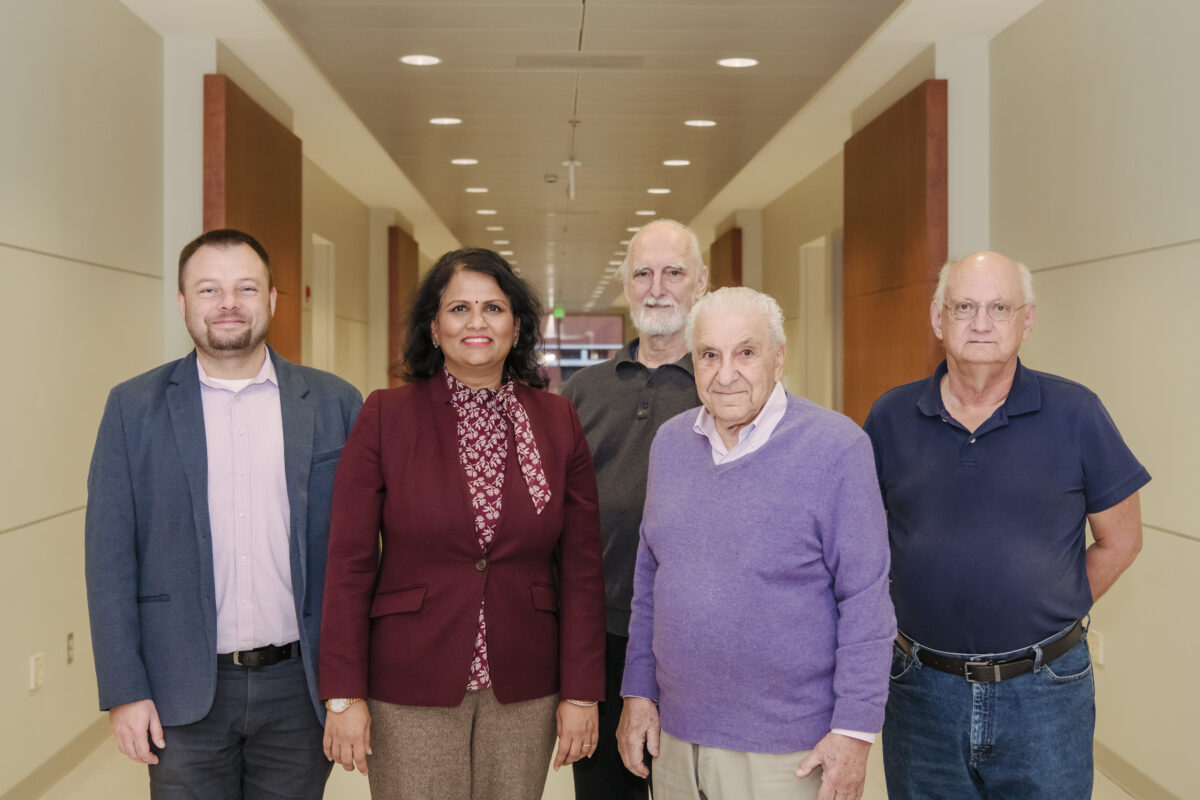 UMBC-CARTA faculty team, from left to right: Michal Mielech, Karuna Joshi, Tim Finin, Milton Halem, and John Dorband.
The CARTA sites are also aiming to expand their number of industry partner collaborations. In CARTA Phase I, UMBC worked with a range of industry partners that included NASA, IBM, the National Security Agency, Laboratory for Physical Sciences, the Department of Homeland Security, Morgan Stanley, RAD-AID, and Carestream.
“In Phase II, we are focusing more on collaborative projects with our university partners and building on those collaborations and making them stronger,” says Joshi. “We’re also looking at new avenues that our industry partners might be interested in such as smart cities, next-generation airports, and how to build secure image analytics and algorithms.”
As Phase II evolves, UMBC-CARTA research will also focus on large language models that are rising in popularity, such as ChatGPT, and digital twinning technologies, which is the process of creating a virtual model of a physical object.
Student collaboration at every level
Undergraduate, graduate, and post-doctoral students will continue to work on research projects at UMBC-CARTA. Since its inception, UMBC-CARTA has supported more than 15 graduate students and has provided opportunities for undergraduate students to strengthen their research skills through the NSF-funded Research Experiences for Undergraduates program.
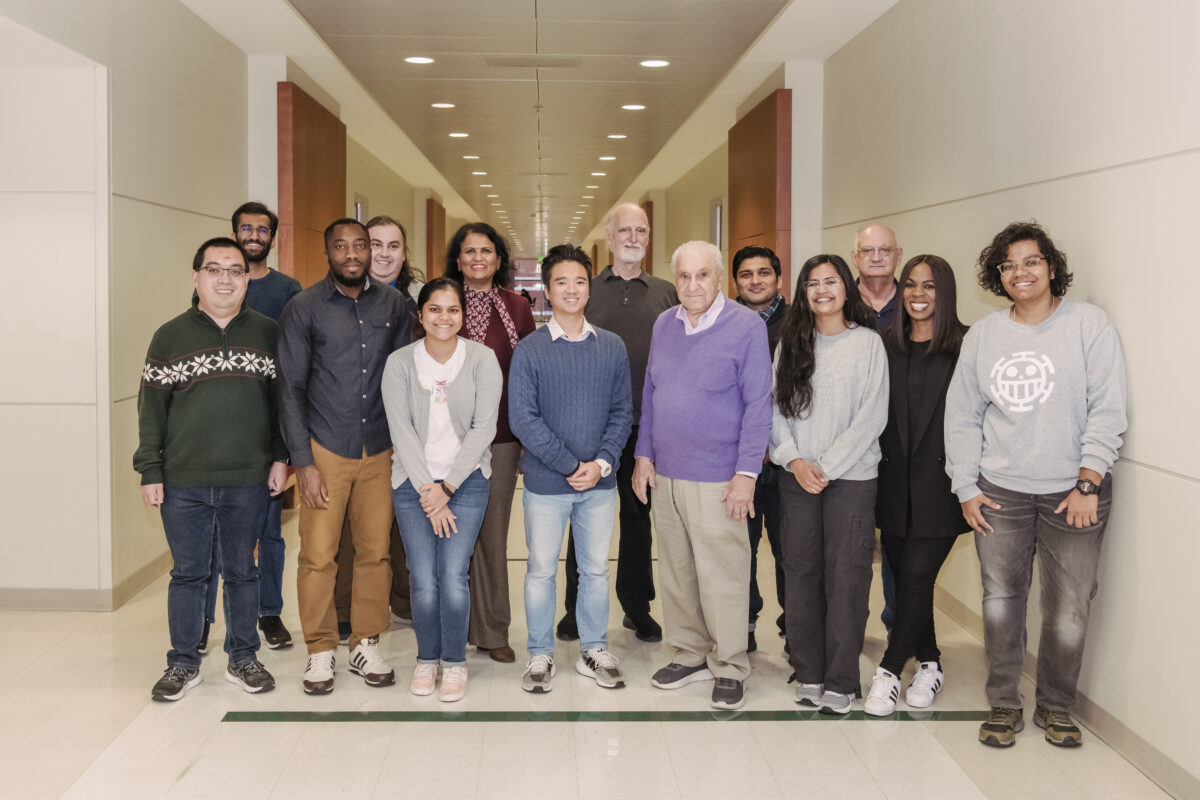 The UMBC-CARTA faculty and student team.
Kelvin Echenim, a second-year information systems Ph.D. student at UMBC, has worked on the CARTA team developing a scoring system to assess the comprehensiveness and user-friendliness of internet of things privacy policies.
“The scoring system aims to improve user comprehension and involvement in privacy matters by finding a balance between strict legal compliance and end-user practical accessibility,” says Echenim.
He adds that current and future research in CARTA Phase II will help expand his knowledge in solving complex problems in data-driven AI systems.
Read more about UMBC’s Center for Accelerated Real Time Analytics
]]>
UMBC’s Center for Accelerated Real Time Analytics (CARTA) team will advance its work in investigating data analytics using next-generation computing hardware with the launch of the next phase of...
https://umbc.edu/stories/center-for-accelerated-real-time-analytics/
https://my3.my.umbc.edu/api/v0/pixel/news/138235/guest@my.umbc.edu/e5020213f1745092504d89e69d3011f5/api/pixel
coeit
csee
is
news
research
science-and-tech
story
UMBC News & Magazine
https://my3.my.umbc.edu/groups/umbc-news-magazine
https://assets1-my.umbc.edu/system/shared/avatars/groups/000/001/943/24435aa6207c452e7bc15cc74b42c7bb/xsmall.png?1748556657
https://assets1-my.umbc.edu/system/shared/avatars/groups/000/001/943/24435aa6207c452e7bc15cc74b42c7bb/original.png?1748556657
https://assets2-my.umbc.edu/system/shared/avatars/groups/000/001/943/24435aa6207c452e7bc15cc74b42c7bb/xxlarge.png?1748556657
https://assets2-my.umbc.edu/system/shared/avatars/groups/000/001/943/24435aa6207c452e7bc15cc74b42c7bb/xlarge.png?1748556657
https://assets3-my.umbc.edu/system/shared/avatars/groups/000/001/943/24435aa6207c452e7bc15cc74b42c7bb/large.png?1748556657
https://assets1-my.umbc.edu/system/shared/avatars/groups/000/001/943/24435aa6207c452e7bc15cc74b42c7bb/medium.png?1748556657
https://assets2-my.umbc.edu/system/shared/avatars/groups/000/001/943/24435aa6207c452e7bc15cc74b42c7bb/small.png?1748556657
https://assets1-my.umbc.edu/system/shared/avatars/groups/000/001/943/24435aa6207c452e7bc15cc74b42c7bb/xsmall.png?1748556657
https://assets2-my.umbc.edu/system/shared/avatars/groups/000/001/943/24435aa6207c452e7bc15cc74b42c7bb/xxsmall.png?1748556657
UMBC News & Magazine
0
0
false
Wed, 17 Jan 2024 14:25:58 -0500
Wed, 17 Jan 2024 14:25:58 -0500
UMBC manufacturing research center gets boost from new partnership with U.S. Army

The Center for Research in Emergent Manufacturing (CREM), which started as the ambitious idea of two UMBC researchers in 2019, is launching a major new project with the U.S. Army and other partners this year. UMBC has received an initial amount of more than $3 million to fund the first year of the project, which will investigate ways to digitize the army’s supply chain.
CREM is led by director Nilanjan Banerjee, professor of computer science and electrical engineering, and associate director Donna Ruginski, associate vice president for center development in the Office of Research and Creative Achievement at UMBC. It aims to help manufacturers reap the benefits, and manage the risks, of new manufacturing approaches increasingly centered around computer systems—a concept known as digital manufacturing.
Since its founding, the center has already established programs to educate manufacturing professionals in cybersecurity. The new project will significantly advance the center’s research activities and impact.
“The partnership with the army is an important step in our evolution as a research center. We will be working on cutting edge problems for the Army in the areas of digitization,” says Banerjee.
“We’re new and full of energy,” says Ruginski. “I’m confident we’ll make a difference.”
From spinning jennies to generative AI
Manufacturing has come a long way since the 18th-century textile industry was revolutionized by the invention of machines such as spinning jennies, which greatly increased the amount of thread a single worker could produce. Since then, new technologies, such as the electric grid in the early 20th century and computers in the mid-century, brought further waves of change to the way goods are made.
On a modern factory floor, robots and their computer control systems increasingly take the place of humans in the assembly process, and the future of manufacturing will likely be even more automated and digitized than it is today. Companies are increasingly turning to new technologies such as smart sensors, AI, cloud computing, and advanced analytics to increase the flexibility, resilience, and efficiency of their operations. This transformation—called industry 4.0—holds enormous promise to improve living standards by increasing productivity, but it also comes with some perils, including vulnerability to cyberattacks.
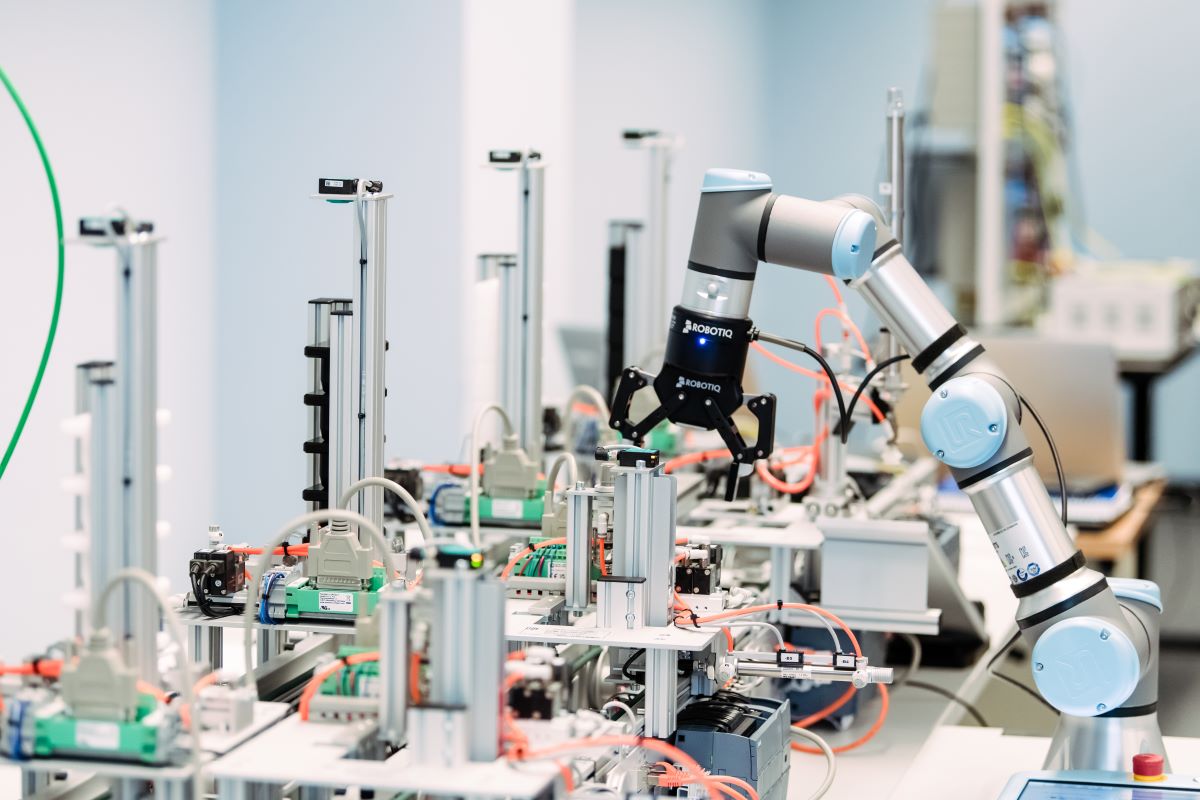 Equipment in the operations technology cyber range. (Marlayna Demond ’11/UMBC)
Training and research
UMBC aims to help manufacturers navigate the industry 4.0 shift. Part of that mission will be to educate future workers in digital manufacturing, be they UMBC students or working professionals looking to expand their skill set.
In 2020, under the auspices of CREM, Banerjee and Ruginski launched the Cybersecurity for Manufacturing Operational Technology (CyMOT) program to train manufacturing professionals in best practices for preventing cyberattacks on manufacturing operations. Through the program, CREM has educated more than 300 manufacturers from small and medium-sized businesses.
“The manufacturing sector has suffered a number of cyberattacks recently, so it’s important to make sure people in the sector are trained in cybersecurity,” says Banerjee.
CREM also hosts a state-of-the-art cybersecurity training and research facility, called a cyber range, specifically focused on digital manufacturing technology—one of only a few in the country. In the coming months, the cyber range will move to a new and dedicated location on the UMBC campus.
“The research and training efforts conducted by CREM under Dr. Banerjee’s leadership have wide-ranging consequences,” says Karl Steiner, the vice president for research and creative achievement at UMBC. “As digital manufacturing rapidly becomes a national and global standard, it is critical to develop adaptive cybersecurity strategies and protocols to secure the global supply pipeline. I am delighted that CREM is supported through one of three major research partnerships that UMBC developed in recent years with the U.S. Army.”
]]>
The Center for Research in Emergent Manufacturing (CREM), which started as the ambitious idea of two UMBC researchers in 2019, is launching a major new project with the U.S. Army and other...
https://umbc.edu/stories/crem-manufacturing-research-army/
https://my3.my.umbc.edu/api/v0/pixel/news/138230/guest@my.umbc.edu/9951b58bbc0b842e87c48f87014b9c88/api/pixel
coeit
crem
csee
news
rca-1
research
science-and-tech
story
UMBC News & Magazine
https://my3.my.umbc.edu/groups/umbc-news-magazine
https://assets1-my.umbc.edu/system/shared/avatars/groups/000/001/943/24435aa6207c452e7bc15cc74b42c7bb/xsmall.png?1748556657
https://assets1-my.umbc.edu/system/shared/avatars/groups/000/001/943/24435aa6207c452e7bc15cc74b42c7bb/original.png?1748556657
https://assets2-my.umbc.edu/system/shared/avatars/groups/000/001/943/24435aa6207c452e7bc15cc74b42c7bb/xxlarge.png?1748556657
https://assets2-my.umbc.edu/system/shared/avatars/groups/000/001/943/24435aa6207c452e7bc15cc74b42c7bb/xlarge.png?1748556657
https://assets3-my.umbc.edu/system/shared/avatars/groups/000/001/943/24435aa6207c452e7bc15cc74b42c7bb/large.png?1748556657
https://assets1-my.umbc.edu/system/shared/avatars/groups/000/001/943/24435aa6207c452e7bc15cc74b42c7bb/medium.png?1748556657
https://assets2-my.umbc.edu/system/shared/avatars/groups/000/001/943/24435aa6207c452e7bc15cc74b42c7bb/small.png?1748556657
https://assets1-my.umbc.edu/system/shared/avatars/groups/000/001/943/24435aa6207c452e7bc15cc74b42c7bb/xsmall.png?1748556657
https://assets2-my.umbc.edu/system/shared/avatars/groups/000/001/943/24435aa6207c452e7bc15cc74b42c7bb/xxsmall.png?1748556657
UMBC News & Magazine
0
0
false
Wed, 17 Jan 2024 11:45:52 -0500
Wed, 17 Jan 2024 11:45:52 -0500