New UMBC research suggests need to rethink goals of global reforestation efforts

Many countries have made commitments to restore huge areas of forest as part of the Bonn Challenge, organized by the International Union for Conservation of Nature. For example, Costa Rica has promised to preserve 1 million hectares (3,861 square miles) of forest by 2020—about 20 percent of the nation’s total area. However, a new paper in Conservation Letters suggests that quickly reforesting large areas may not be the best strategy to yield many of the benefits forests can provide.
Forests store carbon, clean water, prevent soil erosion, and provide habitat for a wide range of species, “but all those benefits start kicking in when forests are older,” says Matthew Fagan, assistant professor of geography and environmental systems at UMBC and second author on the paper. That’s why the new paper’s findings were alarming: By analyzing a massive data set spanning 1947 – 2014, the authors found that in Costa Rica, 50 percent of secondary forest patches were re-cleared within 20 years, and 85 percent were re-cleared within 54 years.
A long-term commitment
“Young forests take something like 100 years to get to peak biodiversity, and as many as 80 years to store enough carbon to make a big difference,” Fagan says. “A lot of these benefits accumulate over time, and they don’t accrue linearly,” he adds, so a 100-year-old forest is more than ten times as beneficial as a 10-year-old forest.
Committing to preserve a huge number of hectares of forest by 2020 might be appealing to a government trying to make a statement, but “for every 100 hectares restored in 2020, 20 years later they’re going to have 50, and 50 years later they’re only going to have 15,” Fagan says.
Lead study author Leighton Reid, an assistant scientist at the Missouri Botanical Garden’s Center for Conservation and Sustainable Development, says that he would prefer to see countries “commit to restore an area of 100-year-old forest by 2120.” He added, “What I hope is that this research is going to lead to countries taking a more long-term view of their restoration commitments.”
 Joshua Slaughter (left) and Matthew Fagan discuss a map of forest patches in Costa Rica. Photo by Marlayna Demond ’11 for UMBC.
Green highways
The good news is that the study found certain types of forest patches were less likely to be re-cleared, particularly larger patches and those alongside rivers. That’s critical, because as research partner Joshua Slaughter ’22, computer engineering, explains, previous research has found that “patches just 30 feet across can serve as highways for rare endangered bird species to travel through the landscape.” By teasing apart the relationships between external factors and the likelihood of a patch to persist, Slaughter hopes the team’s work will inform new, targeted restoration policies.
“As long as these forests are being protected, it can help prevent extinction of endangered species,” Slaughter says. “And being directly related to something as big as that has a huge impact on me and why I want to continue pursuing research.”
Slaughter has been working with Fagan since his junior year of high school, and is now a first-year student at UMBC and an author on the new paper. The project brings his interests together seamlessly.
“I want to incorporate my passion for geography with my passion for coding and making devices, so GIS [geographic information systems] is the middle ground where I can reach both fields without dedicating myself to just one,” says Slaughter. He plans to pursue a Ph.D. and then a research career combining computer engineering, environmental systems, and GIS.
Taking a closer look
Overall, “all of our hopes and needs for secondary forests rely on them getting old, and what this study shows is that they aren’t,” Reid says. His main hope for this study is that it will lead to “people, and in particular, national governments, taking more seriously the problems of ensuring that restoration projects persist into the future.”
“We want a world with more forests—where soil isn’t eroding off hillsides, and where trees take carbon dioxide out of the air to help limit climate change. We want to see people drinking clean water and breathing clean air, and secondary forests are seen as a major way to get to that,” Fagan says. “The tropics have been deforested for decades, and now they’re starting to regrow. It’s a really big positive story, but we need to take a closer look.”
Banner image: Matthew Fagan (left) and Joshua Slaughter. Photo by Marlayna Demond ’11 for UMBC.
]]>
Many countries have made commitments to restore huge areas of forest as part of the Bonn Challenge, organized by the International Union for Conservation of Nature. For example, Costa Rica has...
https://umbc.edu/stories/new-umbc-research-suggests-need-to-rethink-goals-of-global-reforestation-efforts/
https://my3.my.umbc.edu/api/v0/pixel/news/120284/guest@my.umbc.edu/8bf23460a5a35c8ce0f8100097862c41/api/pixel
cahss
ges
research
science-and-technology
undergradresearch
UMBC News & Magazine
https://my3.my.umbc.edu/groups/umbc-news-magazine
https://assets1-my.umbc.edu/system/shared/avatars/groups/000/001/943/24435aa6207c452e7bc15cc74b42c7bb/xsmall.png?1748556657
https://assets1-my.umbc.edu/system/shared/avatars/groups/000/001/943/24435aa6207c452e7bc15cc74b42c7bb/original.png?1748556657
https://assets2-my.umbc.edu/system/shared/avatars/groups/000/001/943/24435aa6207c452e7bc15cc74b42c7bb/xxlarge.png?1748556657
https://assets2-my.umbc.edu/system/shared/avatars/groups/000/001/943/24435aa6207c452e7bc15cc74b42c7bb/xlarge.png?1748556657
https://assets3-my.umbc.edu/system/shared/avatars/groups/000/001/943/24435aa6207c452e7bc15cc74b42c7bb/large.png?1748556657
https://assets1-my.umbc.edu/system/shared/avatars/groups/000/001/943/24435aa6207c452e7bc15cc74b42c7bb/medium.png?1748556657
https://assets2-my.umbc.edu/system/shared/avatars/groups/000/001/943/24435aa6207c452e7bc15cc74b42c7bb/small.png?1748556657
https://assets1-my.umbc.edu/system/shared/avatars/groups/000/001/943/24435aa6207c452e7bc15cc74b42c7bb/xsmall.png?1748556657
https://assets2-my.umbc.edu/system/shared/avatars/groups/000/001/943/24435aa6207c452e7bc15cc74b42c7bb/xxsmall.png?1748556657
UMBC News & Magazine
0
0
false
Tue, 06 Nov 2018 18:07:03 -0500
UMBC launches Center for Democracy and Civic Life at a critical national moment

UMBC’s Division of Student Affairs has announced the launch of the Center for Democracy and Civic Life, led by Director David Hoffman and Assistant Director Romy Hübler. In collaboration with on- and off-campus partners, the center will help students develop knowledge, skills, and approaches for deep and effective community work.
“The Center for Democracy and Civic Life’s launch comes at a critical time for our nation, when our divisions and challenges dominate the news and hope for democracy’s future can seem elusive,” said Nancy Young, vice president for Student Affairs, in a campus message earlier today. She described how the center “will generate, inspire, and share innovations in civic and democratic engagement, and support collaborative activity that helps to build thriving civic cultures at UMBC and in communities involved in the center’s work.”
“Our work builds from the idea that civic life is everywhere: not just in elections or community service opportunities, but in our everyday interactions in nearly every space in which we live and work,” explains Hübler ‘09, modern languages and linguistics, M.A. ‘11, intercultural communication, Ph.D. ‘15, language, literacy and culture.
“That’s a very empowering idea, because it suggests that meaningful social progress is within our reach,” adds Hoffman, Ph.D. ’13, language, literacy, and culture.
 David Hoffman and UMBC students in a class on democracy and civic engagement.
Hoffman came to UMBC in 2003. In the past 15 years he has guided student leadership, engagement, and government work, and has led the development and implementation of UMBC’s BreakingGround initiative. Beyond UMBC, Hoffman serves as a national thought leader on democratic engagement and higher education. Hoffman was named an inaugural American Democracy Project Civic Fellow and is a member of the Steering Committee for the American Democracy Project and the National Advisory Board for Imagining America.
Hübler joined the UMBC staff in 2016 as coordinator of campus life for student organizations. She has focused on creating programs to support students’ development as leaders with a meaningful impact on their communities. She has also served as a key strategist for BreakingGround, and has held fellowships with Campus Compact, the International Center on Nonviolent Conflict, and Imagining America.
 Hübler and Hoffman in front of The Commons.
The scholarship and strategies around civic engagement that Hoffman, Hübler, and their colleagues are developing are already impacting national conversations. Just a few days ago, Bennington College President Mariko Silver highlighted UMBC in Forbes as a model for how universities can align their practices with civic ideals, such as creating democratic classrooms, fostering humane relationships, welcoming dissent, and making engagement with external communities a campus priority.
Democracy scholar Harry Boyte also highlights UMBC as a national model in his new book Awakening Democracy Through Public Work: Pedagogies of Empowerment.
Through the new Center for Democracy and Civic Life, and the partnerships it will help grow, says Hoffman, “We can develop the knowledge, skills, and resourcefulness to work across differences and address challenges together, and to build thriving civic communities. UMBC is the perfect setting for that kind of learning, with so many people and programs already contributing to a vibrant civic culture.”
Featured image: Romy Hübler and David Hoffman in front of The Commons at UMBC. All photos by Marlayna Demond ’11 for UMBC.
]]>
UMBC’s Division of Student Affairs has announced the launch of the Center for Democracy and Civic Life, led by Director David Hoffman and Assistant Director Romy Hübler. In collaboration with on-...
https://umbc.edu/stories/umbc-launches-center-for-democracy-and-civic-life-at-a-critical-national-moment/
https://my3.my.umbc.edu/api/v0/pixel/news/120285/guest@my.umbc.edu/32fe6da9d201b1d8704aa5316da21c47/api/pixel
breakingground
cahss
community
studentaffairs
UMBC News & Magazine
https://my3.my.umbc.edu/groups/umbc-news-magazine
https://assets1-my.umbc.edu/system/shared/avatars/groups/000/001/943/24435aa6207c452e7bc15cc74b42c7bb/xsmall.png?1748556657
https://assets1-my.umbc.edu/system/shared/avatars/groups/000/001/943/24435aa6207c452e7bc15cc74b42c7bb/original.png?1748556657
https://assets2-my.umbc.edu/system/shared/avatars/groups/000/001/943/24435aa6207c452e7bc15cc74b42c7bb/xxlarge.png?1748556657
https://assets2-my.umbc.edu/system/shared/avatars/groups/000/001/943/24435aa6207c452e7bc15cc74b42c7bb/xlarge.png?1748556657
https://assets3-my.umbc.edu/system/shared/avatars/groups/000/001/943/24435aa6207c452e7bc15cc74b42c7bb/large.png?1748556657
https://assets1-my.umbc.edu/system/shared/avatars/groups/000/001/943/24435aa6207c452e7bc15cc74b42c7bb/medium.png?1748556657
https://assets2-my.umbc.edu/system/shared/avatars/groups/000/001/943/24435aa6207c452e7bc15cc74b42c7bb/small.png?1748556657
https://assets1-my.umbc.edu/system/shared/avatars/groups/000/001/943/24435aa6207c452e7bc15cc74b42c7bb/xsmall.png?1748556657
https://assets2-my.umbc.edu/system/shared/avatars/groups/000/001/943/24435aa6207c452e7bc15cc74b42c7bb/xxsmall.png?1748556657
UMBC News & Magazine
0
0
false
Mon, 05 Nov 2018 22:07:49 -0500
Inspired Career: Lafayette Gilchrist ’92, Africana studies

 The first time Lafayette Gilchrist ’92 touched a piano was the summer before his first semester at UMBC. He was taking an English class in the Fine Arts Building and wandered into the recital hall, which was empty and completely dark with the exception of a single spotlight on the nine-foot Steinway piano. The 17-year-old felt drawn to it.
“It sounds like a movie but it is actually the truth. I sat down at the piano, put my foot on the pedal to the right and began to play; first I played just the black keys, then just the white keys,” said Gilchrist.
Today his life is music. A celebrated jazz pianist and composer, he steadily leads both the New Volcanoes – a band he began as a quartet in 1993 and grew to an octet and sometime nontet over the years – and the Sonic Trip Masters All Stars. Both are genre-defying bands that reflect his deep experience playing and listening to jazz, hip-hop, and African rhythms and his commitment to musical collaboration. In addition to the two bands and his solo work, he has been playing, recording and touring with saxophonist David Murray in his quartets and octets since 2000, touring and playing festivals around the world. And, this past spring, he received a Baker Artist Award for his years of hard work.
An Artist’s Beginnings
Gilchrist grew up in Washington, D.C., and later Prince George’s County, and was planning to join the Army until his mother and stepfather urged him to go to college. He agreed to try it for a year. He started at UMBC as an economics major that first year, in deference to the wishes of his mother, and graduated with a degree in Africana Studies in 1992 that still enriches his life today, he says. But most significantly, when he left UMBC he was a musician.
At the recital hall that first time at the piano, another student, Michael Wutah, from Salisbury by way of Ghana, wandered in and assumed Gilchrist could play. They ended up as first year roommates and musical friends for life. Lacking the formal training that most have before majoring in music in college, Gilchrist instead pursued a musical training of his own design while at UMBC, noting “the resources I was able to tap as a student were no less formative to me than had I been a music major.”
Checking out records and videos from the AOK Library to expand upon his musical and artistic knowledge, he spent evenings, as he puts it, haunting the practice rooms in the music department. “I had access to the best pianos at UMBC,” says Gilchrist, who sometimes was able to convince members of the cleaning crew to let him into the practice spaces.
He learned to play and compose at the same time, auditing Stuart Smith’s new music composition classes, and pestering his music major friends to help him translate his compositions to paper for weekly assignments as he caught up. He especially credits Michael Cerri, former head of music recording, with “helping me separate the distance of what was in my head to a recording.” So immersed was he in music, Gilchrist’s cousin, a fellow student on campus, occasionally had to find him in the practice rooms and remind him of his other classes.
Making His Mark
Gilchrist mentions that 2017 was a big year for him professionally. It’s a bit of an understatement.
His composition, “Assume the Position,” was selected in 2017 as the outro music of each episode of David Simon’s latest HBO series “The Deuce.” Gilchrist, who reworked the piece for the series, chuckles and says it’s his “moneymaker.” The new arrangement is included on Deep Dancing Suite, Lafayette Gilchrist & The New Volcanoes’ latest album, released in July.
That same year, the band released their New Urban World Blues album and the song and video “Blues For Freddie Gray,” dedicated to the young West Baltimore man who died in 2015 of severe spinal injuries sustained while in the custody of the Baltimore City Police. Gilchrist, who lives in West Baltimore, remembers the days surrounding the death of Freddie Gray; the song was inspired by his experience and listening to the way friends and neighbors processed Gray’s death and the eruption in the city that followed.
I want to know that there’s a day that’s coming soon and fast
I want a justice and a peace that’s made to last and last
Don’t ya tell me
That we can’t all get it done
You see I got this little one on my shoulders.
— excerpt of lyrics from Blues For Freddie Gray
Gilchrist says “Blues for Freddie Gray is a cry…it’s a response” to the horrific events of Gray’s death and the fact that none of the police officers connected with his death was convicted of any crime.
“People don’t have guns, media, voices — the only power we have is in numbers,” says Gilchrist. “I thought what can I do to have an impact, I could get in the street, I could carry a sign, but that is not what I do best. What I do best is music.”
In May 2018, Gilchrist received a Baker Artist Award, an honor granted to accomplished artists, and a cash award that will help him continue to compose, perform, and record.
“I was surprised and honored,” he said. “As a Baltimore-based artist laboring in the vineyards for quite a few years, often taking more losses than wins in order to keep the band afloat and get the music out, the award means a great deal to me because it’s confirmation in many ways that it’s been worth it.”
While the process of composing and writing can be lonely, he says, “the Baker Artist Award for me is just another sign to know I’m not alone.”
— Catherine Borg
Header image by Theresa Keil.
]]>
The first time Lafayette Gilchrist ’92 touched a piano was the summer before his first semester at UMBC. He was taking an English class in the Fine Arts Building and wandered into the recital...
https://umbc.edu/stories/inspired-career-lafayette-gilchrist-92-africana-studies/
https://my3.my.umbc.edu/api/v0/pixel/news/120286/guest@my.umbc.edu/b05df0643d55077b6c72f2d46b7e5975/api/pixel
alumni
fall-2018
UMBC News & Magazine
https://my3.my.umbc.edu/groups/umbc-news-magazine
https://assets1-my.umbc.edu/system/shared/avatars/groups/000/001/943/24435aa6207c452e7bc15cc74b42c7bb/xsmall.png?1748556657
https://assets1-my.umbc.edu/system/shared/avatars/groups/000/001/943/24435aa6207c452e7bc15cc74b42c7bb/original.png?1748556657
https://assets2-my.umbc.edu/system/shared/avatars/groups/000/001/943/24435aa6207c452e7bc15cc74b42c7bb/xxlarge.png?1748556657
https://assets2-my.umbc.edu/system/shared/avatars/groups/000/001/943/24435aa6207c452e7bc15cc74b42c7bb/xlarge.png?1748556657
https://assets3-my.umbc.edu/system/shared/avatars/groups/000/001/943/24435aa6207c452e7bc15cc74b42c7bb/large.png?1748556657
https://assets1-my.umbc.edu/system/shared/avatars/groups/000/001/943/24435aa6207c452e7bc15cc74b42c7bb/medium.png?1748556657
https://assets2-my.umbc.edu/system/shared/avatars/groups/000/001/943/24435aa6207c452e7bc15cc74b42c7bb/small.png?1748556657
https://assets1-my.umbc.edu/system/shared/avatars/groups/000/001/943/24435aa6207c452e7bc15cc74b42c7bb/xsmall.png?1748556657
https://assets2-my.umbc.edu/system/shared/avatars/groups/000/001/943/24435aa6207c452e7bc15cc74b42c7bb/xxsmall.png?1748556657
UMBC News & Magazine
0
0
false
Mon, 05 Nov 2018 20:25:18 -0500
New Fulbright Accelerator connects CAHSS faculty with international opportunities
“My Fulbright experience changed the course of my life and my career,” remembers Eugene C. Schaffer, professor of education.
Early in his career, Shaffer earned a Fulbright Scholar award to bring his knowledge of curriculum development and teaching practices to a collaboration with Taiwanese educators for two years. “There is always so much to learn and understand about history and how different cultures work together to hope for peace,” he says. “My work in Taiwan helped me to see the need for sharing research on innovative and effective curriculum practices globally.” Shaffer went on to travel the world and lived and worked with educators in the UK and Japan. Recently, he earned another Fulbright to work with educators in Kosovo. “The most salient takeaway of my Fulbright experiences is how much the cultures and the people gave to me. I am a better teacher and a better person for trying to understand another cultural form,” shares Shaffer.
UMBC’s College of Arts, Humanities, and Social Sciences (CAHSS) is working to connect more faculty with Fulbright opportunities, particularly given CAHSS faculty’s long and successful history of transformative international research and teaching. UMBC faculty have already completed Fulbrights on every continent except Antarctica, and there’s great interest in expanding their international work even further.
“We have had tremendous success with the Fulbright U.S. Student Program,” says Brian Souders, Ph.D. ’09, language literacy, and culture, and Fulbright Program advisor. “We hope that by promoting this opportunity with CAHSS faculty, we can encourage similar success with faculty awards.”
UMBC’s Office of International Education; Center for Social Science Scholarship; Center for Innovation, Research and Creativity in the Arts (CIRCA); and Dresher Center for the Humanities are partnering with the Council of the International Exchange of Scholars (which sponsors the Fulbright Scholar Programs) to host the first CAHSS Fulbright Accelerator. All CAHSS faculty are invited to attend the session on Monday, November 5, at noon, in Performing Arts and Humanities Building room 216.
Through the Fulbright Accelerator, faculty will learn more about semester- and year-long fellowships, short-term research stays, teaching visits, and postdoctoral scholarships the Fulbright Program offers. Along with Schaffer, former CAHSS Fulbright Scholars across the arts, the humanities, and the social sciences will share their experiences.
Charissa Cheah, professor of psychology, just returned from her Fulbright experience in Italy this summer and will present at the Fulbright Accelerator. She worked with groups of Tunisian Muslim adolescents to try to understand how they and their families adapted to Italian culture. “The more I immersed myself in the community,” says Cheah, “the more questions I had about how these adolescents navigate their intersecting religious, ethnic, and national identities across family, school, community, particularly with the current socio-political climate in Italy.” She hopes these insights will help her gain some comparative insights with her work with Muslim adolescents in Maryland.
 Charissa Cheah in Italy at the 70th celebration of Fulbright Italy at The Ministry of Foreign Affairs and International Cooperation. Photo courtesy of Cheah.
John Stolle-McAllister, associate dean of CAHSS, will share his experience as a Fulbright Scholar in Ecuador researching indigenous identity. “I was able to bring my wife, my son, and daughter. By the end of our year we all were more fluent and part of the local community,” remembers Stolle-McAllister.
“The most profound part of my Fulbright experience was being open to letting go of assumptions and go deeper into my research in a way I could not have done at home,” Stolle-Mcallister says. “What I found were more complex questions and layered answers that helped me to gain a broader perspective.”
 John Stolle-McAllister in Ecuador with his English class from the Kayambi Confederation’s Free Study System. They asked him to march/dance with them in their Inti Raymi festival (Sun Festival celebrated on summer solstice). Photo courtesy of Stolle-McAllister.
Tim Nohe, professor of visual arts and director of CIRCA, will represent the visual arts Fulbright experience along with Eric Dyer, associate professor of animation and interactive media who will share his scholarship in Denmark. Nohe’s work engages with traditional and electronic media in public spaces and in daily life, and he has worked in close collaboration with artist colleagues in Australia. In one video produced in collaboration with composer Warren Burt and broadcast across Australia by the ABC Classic network, Nohe worked under the iconic Sydney Harbor Bridge:
Through international work, says Nohe, “Scholars transform their teaching and scope of experience and share that with UMBC faculty and students. The perspective and broad scope of references is truly invaluable, and we as scholars serve as ambassadors for our institutions abroad.”
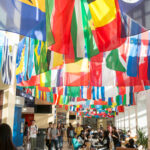
Featured image: International flags in the UMBC Commons. Photo by Marlayna Demond ’11 for UMBC.
]]>
“My Fulbright experience changed the course of my life and my career,” remembers Eugene C. Schaffer, professor of education. Early in his career, Shaffer earned a Fulbright Scholar award to...
https://umbc.edu/stories/new-fulbright-accelerator-connects-cahss-faculty-with-international-opportunities/
https://my3.my.umbc.edu/api/v0/pixel/news/120287/guest@my.umbc.edu/b425ef54ff79f1527549c0056cb13568/api/pixel
arts-and-culture
cahss
circa
cs3
dreshercenter
international
policy-and-society
UMBC News & Magazine
https://my3.my.umbc.edu/groups/umbc-news-magazine
https://assets1-my.umbc.edu/system/shared/avatars/groups/000/001/943/24435aa6207c452e7bc15cc74b42c7bb/xsmall.png?1748556657
https://assets1-my.umbc.edu/system/shared/avatars/groups/000/001/943/24435aa6207c452e7bc15cc74b42c7bb/original.png?1748556657
https://assets2-my.umbc.edu/system/shared/avatars/groups/000/001/943/24435aa6207c452e7bc15cc74b42c7bb/xxlarge.png?1748556657
https://assets2-my.umbc.edu/system/shared/avatars/groups/000/001/943/24435aa6207c452e7bc15cc74b42c7bb/xlarge.png?1748556657
https://assets3-my.umbc.edu/system/shared/avatars/groups/000/001/943/24435aa6207c452e7bc15cc74b42c7bb/large.png?1748556657
https://assets1-my.umbc.edu/system/shared/avatars/groups/000/001/943/24435aa6207c452e7bc15cc74b42c7bb/medium.png?1748556657
https://assets2-my.umbc.edu/system/shared/avatars/groups/000/001/943/24435aa6207c452e7bc15cc74b42c7bb/small.png?1748556657
https://assets1-my.umbc.edu/system/shared/avatars/groups/000/001/943/24435aa6207c452e7bc15cc74b42c7bb/xsmall.png?1748556657
https://assets2-my.umbc.edu/system/shared/avatars/groups/000/001/943/24435aa6207c452e7bc15cc74b42c7bb/xxsmall.png?1748556657
UMBC News & Magazine
0
0
false
Fri, 02 Nov 2018 20:32:54 -0400
Twenty years of the Baltimore Ecosystem Study: An icon of urban ecology research

The Baltimore Ecosystem Study (BES) is one of only two urban Long-Term Ecological Research projects initially funded by the National Science Foundation, and this year it turns 20. When the BES was founded in 1998, “The field of urban ecology basically didn’t exist,” says Claire Welty, director of UMBC’s Center for Urban Environmental Research and Education. Since then, the field has flourished, in no small part thanks to dedicated researchers in Baltimore.
The BES has succeeded in compiling massive datasets on the Baltimore region’s watershed, ecology, and sociological issues related to the environment. The extent of these data are unparalleled anywhere else in the world. That makes the study “an international icon,” Welty says, and its wealth of fully public data provides “a rich resource for people to use in their research.”
“We’re living in a rapidly changing environment,” says Andy Miller, professor of geography and environmental systems (GES) and chair of the department when the study was founded. The long-term data the BES collects allows researchers to document “how systems change in response to what we do” on and to the landscape, Miller explains. That includes large-scale development of previously undisturbed ecosystems. If we can learn enough, Miller says, that knowledge may create “opportunities to mitigate the effects of urbanization.”
 Claire Welty, director of UMBC’s Center for Urban Environmental Research and Education.
Moving on those opportunities requires collaboration with policymakers at many levels. Over the course of the BES, its researchers have gained the trust of local and state officials who have found BES data helpful in informing policy discussions, says Miller. Employees from the Maryland Department of the Environment, Department of Natural Resources, and others regularly attend BES quarterly meetings.
At the federal level, scientists and managers from the USDA Forest Service’s Baltimore Field Station and from the US Geological Survey’s MD-DE-DC Water Science Center have been long-term partners, contributing to and benefiting from the BES program. Both are located at the bwtech@UMBC Research & Technology Park.
Beyond the flood of data and influence on policy, “The impact of the BES on research infrastructure and training in Baltimore has been so important,” says Miller. The BES is headquartered on UMBC’s campus, and the presence of the program here has helped faculty successfully apply for funding to support related projects. It even enabled the launch of UMBC’s graduate program in GES by facilitating funding of the program’s first students through the NSF’s Integrative Graduate Education and Research Traineeship program.
The education component of the BES extends far beyond the graduate level. Its education arm works with K-12 students throughout the Baltimore region to teach them about their local ecosystems and the importance of caring for the environment, with the goal of raising a generation of young people committed to environmental stewardship.
 Andy Miller (left) and Matthew Baker, professors of geography and environmental systems at UMBC.
Today, “More than half of the world’s population lives in cities,” says Chris Swan, professor of GES and a BES scientist, “and understanding how these environments function from the natural, physical and social science perspectives has never been more important.”
Plus, the effects of climate change don’t necessarily show up immediately, but can accumulate over time, explains Welty, “so it’s important that the data collection continue,” especially as climate change accelerates.
The BES is unique because it “brings scientists, stakeholders, policy makers, and students to the table on a regular basis to perform research, interpret results and understand outcomes,” says Swan. This level of collaboration on such a large scale enables BES to have a substantial impact, locally and in other urban areas around the world. This impact can be felt in the well-being of urban residents, he adds, “none more so than the people of Baltimore.”
Banner image: Chris Swan tends native plants at a UMBC greenhouse. All photos by Marlayna Demond ’11 for UMBC.
]]>
The Baltimore Ecosystem Study (BES) is one of only two urban Long-Term Ecological Research projects initially funded by the National Science Foundation, and this year it turns 20. When the BES was...
https://umbc.edu/stories/twenty-years-of-the-baltimore-ecosystem-study-an-icon-of-urban-ecology-research/
https://my3.my.umbc.edu/api/v0/pixel/news/120288/guest@my.umbc.edu/7a9e9ef2f7dad128bb9f573ad5905715/api/pixel
cahss
coeit
cuere
ges
research
science-and-technology
UMBC News & Magazine
https://my3.my.umbc.edu/groups/umbc-news-magazine
https://assets1-my.umbc.edu/system/shared/avatars/groups/000/001/943/24435aa6207c452e7bc15cc74b42c7bb/xsmall.png?1748556657
https://assets1-my.umbc.edu/system/shared/avatars/groups/000/001/943/24435aa6207c452e7bc15cc74b42c7bb/original.png?1748556657
https://assets2-my.umbc.edu/system/shared/avatars/groups/000/001/943/24435aa6207c452e7bc15cc74b42c7bb/xxlarge.png?1748556657
https://assets2-my.umbc.edu/system/shared/avatars/groups/000/001/943/24435aa6207c452e7bc15cc74b42c7bb/xlarge.png?1748556657
https://assets3-my.umbc.edu/system/shared/avatars/groups/000/001/943/24435aa6207c452e7bc15cc74b42c7bb/large.png?1748556657
https://assets1-my.umbc.edu/system/shared/avatars/groups/000/001/943/24435aa6207c452e7bc15cc74b42c7bb/medium.png?1748556657
https://assets2-my.umbc.edu/system/shared/avatars/groups/000/001/943/24435aa6207c452e7bc15cc74b42c7bb/small.png?1748556657
https://assets1-my.umbc.edu/system/shared/avatars/groups/000/001/943/24435aa6207c452e7bc15cc74b42c7bb/xsmall.png?1748556657
https://assets2-my.umbc.edu/system/shared/avatars/groups/000/001/943/24435aa6207c452e7bc15cc74b42c7bb/xxsmall.png?1748556657
UMBC News & Magazine
0
0
false
Fri, 02 Nov 2018 20:06:44 -0400
UMBC community leaders launch Retriever Courage, a sexual assault prevention and response initiative

UMBC community leaders have announced the Retriever Courage initiative—the next phase in UMBC’s collaborative work to prevent and respond to sexual assault and other forms of sexual misconduct. In a message sent to the campus community yesterday, November 1, President Freeman Hrabowski, Provost Philip Rous, and University Steering Committee representatives from faculty, staff, and student senates noted:
Change requires the courage to speak out, to listen, to learn, and to take action. We must fully live our campus values—inclusive excellence, collaboration, innovation, and impact—to make UMBC a safer, more caring living, learning, and working environment for all.
The university has also just launched a Retriever Courage website to document progress in this long-term work, provide resources, share informative documents (e.g., policies, reports, research), and serve as a space for ongoing updates.
This new website also describes the shared governance and administrative teams moving this work forward:
- University Steering Committee, serving as an advisory body to the implementation team;
- Student Advisory Committee, to provide a voice for and share feedback from students, with representation on the procurement advisory group;
- Faculty/Staff Advisory Team, to provide a voice for and share feedback from faculty and staff, with representation on the procurement advisory group;
- Evaluation Committee, which will select an external consultant or firm to review all aspects of the university’s sexual misconduct prevention and response policies and practices, and training and awareness programs, to help determine where we can learn from other institutions’ best practices and evidence-based research;
- Training Implementation Team, to roll out and manage mandatory training; and
- Implementation Team, to continue addressing immediate, short-term campus needs, such as lighting, signage, and the new campus ID card, and other recommendations from faculty, staff, students, and alumni.
Community members interested in serving on a committee or providing feedback in other ways are encouraged to contact their shared governance representatives or email retrievercourage@umbc.edu.
As the new Retriever Courage website describes, Faculty/Staff and Student Advisory Committees will take recommendations to the University Steering Committee. That group will then work with the Implementation Team to finalize recommendations to submit to UMBC’s vice presidents and deans. After these leaders review and sign off on proposed actions, policies, budget allocations, etc., they will then go the university president for final approval.
“Through continued work together, UMBC will become a stronger community,” yesterday’s university message concluded, “and we know this work will have a lasting impact on campus and beyond.”
Featured image: Retriever Courage description; photo by Marlayna Demond ’11 for UMBC.
]]>
UMBC community leaders have announced the Retriever Courage initiative—the next phase in UMBC’s collaborative work to prevent and respond to sexual assault and other forms of sexual misconduct. In...
https://umbc.edu/stories/retrievercourage/
https://my3.my.umbc.edu/api/v0/pixel/news/120289/guest@my.umbc.edu/3cc9d9f1190b35bdf7ed79d6092b01eb/api/pixel
community
retrievercourage
UMBC News & Magazine
https://my3.my.umbc.edu/groups/umbc-news-magazine
https://assets1-my.umbc.edu/system/shared/avatars/groups/000/001/943/24435aa6207c452e7bc15cc74b42c7bb/xsmall.png?1748556657
https://assets1-my.umbc.edu/system/shared/avatars/groups/000/001/943/24435aa6207c452e7bc15cc74b42c7bb/original.png?1748556657
https://assets2-my.umbc.edu/system/shared/avatars/groups/000/001/943/24435aa6207c452e7bc15cc74b42c7bb/xxlarge.png?1748556657
https://assets2-my.umbc.edu/system/shared/avatars/groups/000/001/943/24435aa6207c452e7bc15cc74b42c7bb/xlarge.png?1748556657
https://assets3-my.umbc.edu/system/shared/avatars/groups/000/001/943/24435aa6207c452e7bc15cc74b42c7bb/large.png?1748556657
https://assets1-my.umbc.edu/system/shared/avatars/groups/000/001/943/24435aa6207c452e7bc15cc74b42c7bb/medium.png?1748556657
https://assets2-my.umbc.edu/system/shared/avatars/groups/000/001/943/24435aa6207c452e7bc15cc74b42c7bb/small.png?1748556657
https://assets1-my.umbc.edu/system/shared/avatars/groups/000/001/943/24435aa6207c452e7bc15cc74b42c7bb/xsmall.png?1748556657
https://assets2-my.umbc.edu/system/shared/avatars/groups/000/001/943/24435aa6207c452e7bc15cc74b42c7bb/xxsmall.png?1748556657
UMBC News & Magazine
0
0
false
Fri, 02 Nov 2018 19:08:24 -0400
UMBC among the best universities in the world in 2019 U.S. News global ranking
After honoring UMBC as one of the top ten universities in the nation for both teaching and innovation, U.S. News and World Report has now recognized the university on a global scale. UMBC is featured among 242 U.S. institutions in the 2019 Best Global Universities Rankings, which includes 1,250 institutions from around the world.
Now in its fifth year, the Best Global Universities ranking focuses on academic research and reputation, and includes universities in 75 countries. Thirteen areas of achievement are used to determine rankings, including global research reputation, regional research reputation, journal citations, and books published. Full methodology can be found here.
Five universities in Maryland made the list, including UMBC; Johns Hopkins University; University of Maryland, College Park; University of Maryland, Baltimore; and Uniformed Services University of the Health Sciences (a federal service postgraduate academy).
UMBC performed well in several notable areas, including regional research reputation, international collaboration, and the percentage of faculty papers that are among the top 1 percent most cited.
 UMBC students working collaboratively outside the classroom.
“We are pleased that our efforts in regional research continue being recognized,” says Karl Steiner, vice president for research. “Our UMBC community is proud of our close partnerships with many of the federal labs in Maryland, as well with other academic institutions.”
“We are also delighted that our international collaborations have increased significantly in recent years, with a growing portfolio of meaningful research collaborations with partners in Europe, in Asia and in South America,” Steiner shares.
 UMBC and Peru’s Universidad de Piura establish new collaboration in 2017.
In addition to the institution-wide rankings, UMBC also received acclaim on two “subject lists,” as a global leader in particular focus areas. UMBC ranked #194 in geosciences and #161 in space science of all universities worldwide. UMBC and the University of Maryland, College Park are the only institutions in Maryland to make these lists.
“I’m very proud of the ranking, especially in light of our recent renewal of the Center for Research and Exploration in Space Science and Technology (CRESST II) last year and our close connection with NASA/Goddard,” says Eileen Meyer, assistant professor of physics. “We recently revised our astrophysics minor in the physics department and are definitely seeing an increase in interest in astronomy and astrophysics from our undergrads, many of whom have gone on to top graduate schools in recent years.”
 UMBC and NASA Goddard representatives cut a ribbon to dedicate the ESI.
UMBC has been nationally and internationally recognized as a leader in space science and related fields for several years. Jane Turner, professor of physics, serves as director of the Center for Space Science and Technology (CSST), established in 2006. One year ago, UMBC expanded this work through dedicating the Earth and Space Institute (ESI) under the leadership of Vanderlei Martins, professor of physics.
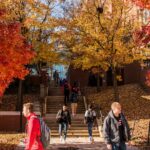
Banner image: Fall scenes at UMBC. All photos by Marlayna Demond ’11 for UMBC.
]]>
After honoring UMBC as one of the top ten universities in the nation for both teaching and innovation, U.S. News and World Report has now recognized the university on a global scale. UMBC is...
https://umbc.edu/stories/umbc-among-the-best-universities-in-the-world-in-2019-u-s-news-global-ranking/
https://my3.my.umbc.edu/api/v0/pixel/news/120290/guest@my.umbc.edu/eb71c8ce967c39afe4f07de5f444c564/api/pixel
cnms
community
rankings
UMBC News & Magazine
https://my3.my.umbc.edu/groups/umbc-news-magazine
https://assets1-my.umbc.edu/system/shared/avatars/groups/000/001/943/24435aa6207c452e7bc15cc74b42c7bb/xsmall.png?1748556657
https://assets1-my.umbc.edu/system/shared/avatars/groups/000/001/943/24435aa6207c452e7bc15cc74b42c7bb/original.png?1748556657
https://assets2-my.umbc.edu/system/shared/avatars/groups/000/001/943/24435aa6207c452e7bc15cc74b42c7bb/xxlarge.png?1748556657
https://assets2-my.umbc.edu/system/shared/avatars/groups/000/001/943/24435aa6207c452e7bc15cc74b42c7bb/xlarge.png?1748556657
https://assets3-my.umbc.edu/system/shared/avatars/groups/000/001/943/24435aa6207c452e7bc15cc74b42c7bb/large.png?1748556657
https://assets1-my.umbc.edu/system/shared/avatars/groups/000/001/943/24435aa6207c452e7bc15cc74b42c7bb/medium.png?1748556657
https://assets2-my.umbc.edu/system/shared/avatars/groups/000/001/943/24435aa6207c452e7bc15cc74b42c7bb/small.png?1748556657
https://assets1-my.umbc.edu/system/shared/avatars/groups/000/001/943/24435aa6207c452e7bc15cc74b42c7bb/xsmall.png?1748556657
https://assets2-my.umbc.edu/system/shared/avatars/groups/000/001/943/24435aa6207c452e7bc15cc74b42c7bb/xxsmall.png?1748556657
UMBC News & Magazine
0
0
false
Thu, 01 Nov 2018 20:18:15 -0400
Trax on Wax: A Staple of Catonsville’s Music Scene

Enjoy this peek inside one of the most interesting spots in neighboring Catonsville (AKA, “Music City Maryland”), as told and photographed by UMBC editorial intern Anjali DasSarma ’21.

Tucked between a dive bar and a pretty pink beauty parlor lies Catonsville’s resident vinyl store: Trax on Wax. The light smell of incense hangs in the air of the store, emanating from bottles stacked neatly on the display shelves. The owner, Gary Gebler, has been selling records since he was 15 years old. Gebler is 60 now. He stands behind the counter, brown fedora perched jauntily on his head with thin silver hoops in each ear. His white scarf is tied in a loose knot around his neck and his black shirt underneath has the logo for the shop emboldened across the front, as he carefully wraps records in bubble wrap. The shop is packed with records in blue and green crates and wooden shelves, birds made of vinyl crafted by a local artist, bowls made of warped records, and anything else related to the vinyl industry.
Right when customers enter the store, they are greeted by rows of photographs of Gebler with icons like Tina Turner, all in the same style of thin black frames. Some are slightly tilted, and others are faded, but they all show the same thing: Gebler, with a slight smile on his face, standing next to an artist (oftentimes holding their own record proudly).
A Picture is Worth a Thousand Words
Each of the photos has a story behind it. One photo from around 1987 shows a young Gebler with a ginger beard next to Tina Turner. Gebler now sports whiskery white stubble, but the look in his pale blue eyes is the same as in the photo. “I met Tina Turner and she  was huge at the time. We were instructed not to look her in the eye but then when we met her she was like ‘oh those guys, they do that all the time’ so she was really cool,” he says.
In the past, he was oftentimes invited out on stage to “just jam out” with artists like Bob Seger at Merriweather Post Pavilion. “Back in the day, I got to go out on the stage and play with him. I don’t play anything, they just put me behind the congas,” he says.
Gebler has an effortless way of talking, the kind of ease that only comes with years of experience. “The first day I went in and [sold records], I was still in high school. I thought to myself ‘well this is what I’m gonna do with the rest of my life,’ and I knew it! My day is still exactly the same day as when I was 15,” he says.
Silk tapestries and woven blankets hang from the ceiling alongside t-shirts with sayings like “Rocknroll Motherf&*er.” Next to the counter, there is a listening station, complete with a shiny leather stool and a pair of worn gray headphones plugged into a record player.
Growing Up With Vinyl
Trax on Wax has now been open for nine years. “When I first opened up, it was a bunch of old people like me, and so the people would come in and talk about their first concert. Then as the years progressed, there’s been a lot of younger people who are digging the store which is cool too. We get a lot of high school and college kids now and they come back on a regular basis, and it’s really cool to see them grow up,” he says.
Gebler doesn’t run Trax on Wax alone. His store manager, Jeff Ball, has been working in the vinyl industry, selling records or working in the entertainment section of department stores since 1986. He has been working at Trax on Wax for five years. He, like Gebler, found his interest in records early on, milling around vinyl shops as a teenager.

He took the summer off from working one year, and found himself at a party, where he ran into an old friend who encouraged him to come work at Towson’s Record and Tape Traders. “He said ‘I guarantee you’ll have a job right from the start.’ And it was true,” he says. The store manager, John Lewis, hired him on the spot. “I never filled out an application for a company that I worked for over twenty years. At that store, within a month or two I was manager.”
Ball now stands behind the counter wearing light blue jeans with a worn hole in the left knee and a green flannel casuallydraped over his black t-shirt with the Trax on Wax logo. He is ringing up a young woman who can’t be older than 25, who sets ten incense sticks on the glass surface. Ball taps the charge into the gray cash register, hitting the keys deliberately, before reading out the cost. The girl hands him the bills, and tells him to keep the change. He waves her back to the incense stand and tells her to “take a couple more sticks!” before she and her long-haired boyfriend leave the store.
Every store has its regulars, and Ball recalls one man named Danny from the “CD era… probably 1991” who would arrive every Tuesday when the store Ball worked at, Waxie Maxie’s, would get new arrivals and buy one of every single CD. “He had a good job, but he was quite the character. His car was loaded with bags and newspapers and you couldn’t even see out the back window, and my suspicion was that he was a hoarder. It was all great, but then suddenly Danny lost his job,” Ball says, his eyes widening a little. “He’d be begging his mother for money on the phone. It was like his drug, you know? I don’t know what happened to him after that.”
An Element of Danger
Even though both Gebler and Ball have followed similar routines their entire lives in the business, Ball’s involvement in the selling of bootleg records added an element of danger and excitement. Bootleg records are unauthorized, unreleased songs that are sold with no profit to the artist. Ball first heard about bootleg records at “rebellious” music store, Music Liberated. “They would actually go and slide a door open under the counter,” he says, gesturing to the smooth counter in front of him. “It was run by a bunch of hippies, and they had an F-U attitude to a lot of things.”
 Ball himself was involved in the selling of bootlegs, especially Bruce Springsteen bootlegs, as the owner had a soft spot for his music. “Springsteen’s label had been in touch, because they got wind about how big we were. We even sent out mailers filled with nothing but bootlegs! One Monday, we had just opened. My employee showed up, hungover as usual. This guy walked into the store, bought a one dollar record and walks right out, doesn’t say a word. A couple minutes later, I’m standing at the counter, and I see the same guy walking up, and he’s got a state trooper with him, and I’m like ‘we’re going to get busted.’” he says, with a sly smile.
“This one guy comes out and says ‘picture time!’ and hands us each a bootleg. And I’m like ‘I’m not having my picture taken.’ And he goes, ‘oh really? Then let’s get in the car. We’re going downtown.’ And I said ‘where’s that record?’” Ball says, snatching a Smithereens album and holding it up like he would an identifier in a mugshot.
When it comes down to it though, excitement or not, Ball cherishes the feeling of listening to records. He, like Gebler, believes that vinyl makes the listener value the surrounding experience more than other forms that music takes on.
Gebler appreciates the aforementioned. “It just sounds good. It’s just a real interactive experience. Don’t get me wrong, I’m not a snob, I’ve got an iPod, I listen to CDs in my car,” he says, laughing. “But when I really wanna sit down and experience music, [vinyl is] how I prefer to do it. And luckily there’s enough people who want to do that too to keep me in business.”
And Gebler knows the value of history. Hanging above the door, facing inwards is a sign for the “Kozy Korner Record Shop” that closed in the late 70s. Gebler bought all of their old records when they closed down, but he left the sign up in Trax on Wax. “It’s good to keep that bit of history alive,” he says.
]]>
Enjoy this peek inside one of the most interesting spots in neighboring Catonsville (AKA, “Music City Maryland”), as told and photographed by UMBC editorial intern Anjali DasSarma ’21. ...
https://umbc.edu/stories/trax-on-wax-a-staple-of-catonsvilles-music-scene/
https://my3.my.umbc.edu/api/v0/pixel/news/120291/guest@my.umbc.edu/94ec3ef22797c0495ec1cf39c4c01d91/api/pixel
campus-life
catonsville
UMBC News & Magazine
https://my3.my.umbc.edu/groups/umbc-news-magazine
https://assets1-my.umbc.edu/system/shared/avatars/groups/000/001/943/24435aa6207c452e7bc15cc74b42c7bb/xsmall.png?1748556657
https://assets1-my.umbc.edu/system/shared/avatars/groups/000/001/943/24435aa6207c452e7bc15cc74b42c7bb/original.png?1748556657
https://assets2-my.umbc.edu/system/shared/avatars/groups/000/001/943/24435aa6207c452e7bc15cc74b42c7bb/xxlarge.png?1748556657
https://assets2-my.umbc.edu/system/shared/avatars/groups/000/001/943/24435aa6207c452e7bc15cc74b42c7bb/xlarge.png?1748556657
https://assets3-my.umbc.edu/system/shared/avatars/groups/000/001/943/24435aa6207c452e7bc15cc74b42c7bb/large.png?1748556657
https://assets1-my.umbc.edu/system/shared/avatars/groups/000/001/943/24435aa6207c452e7bc15cc74b42c7bb/medium.png?1748556657
https://assets2-my.umbc.edu/system/shared/avatars/groups/000/001/943/24435aa6207c452e7bc15cc74b42c7bb/small.png?1748556657
https://assets1-my.umbc.edu/system/shared/avatars/groups/000/001/943/24435aa6207c452e7bc15cc74b42c7bb/xsmall.png?1748556657
https://assets2-my.umbc.edu/system/shared/avatars/groups/000/001/943/24435aa6207c452e7bc15cc74b42c7bb/xxsmall.png?1748556657
UMBC News & Magazine
0
0
false
Wed, 31 Oct 2018 15:02:15 -0400
4 Reasons Gerrymandering is Getting Worse
John Rennie Short, Professor, School of Public Policy, UMBC
November’s midterm elections are some of the most eagerly awaited, closely watched and hyperpartisan for many years.
But the results for many congressional House seats are already known because the election will occur at a time of rampant gerrymandering.
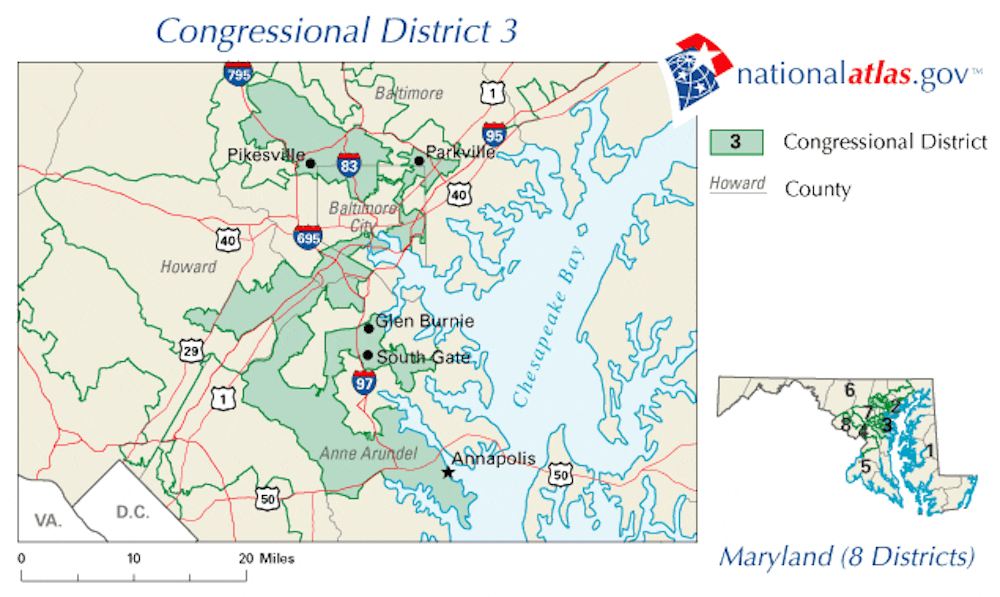
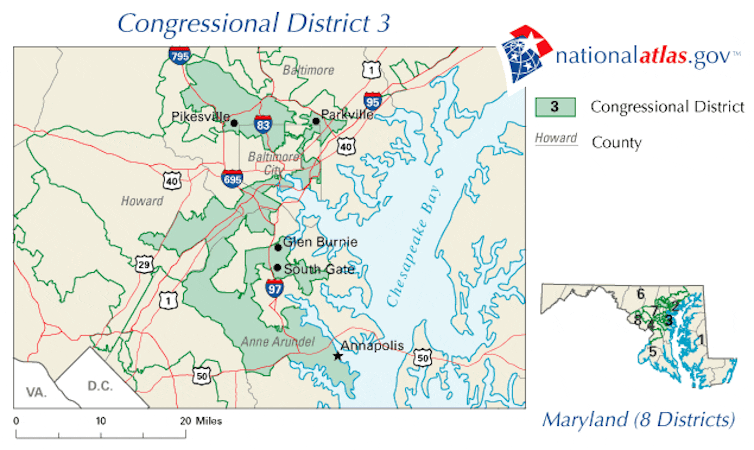 Maryland’s 3rd Congressional District.
For example, Maryland’s 3rd Congressional District is drawn up in a way that guarantees the 2018 election victory of Democratic incumbent John Sarbanes. Congressional districts in Texas are drawn up to favor Republicans, such as Mike Conway who is assured victory in the 11th District.
The mechanism is simple: The political party that controls state legislatures gets to redraw congressional boundaries every 10 years after the results of the most recent Census. Gerrymandering is the partisan redrawing of these boundaries. Basically, it allows politicians to select their voters rather than the voters to choose their representatives.
In 2012, Republicans won a majority of 33 seats in the House despite getting 1.4 million fewer votes than their Democratic opponents. In the past four congressional elections, Republicans have won a larger share of seats than their share of nationwide votes. These results are a sure sign that gerrymandering is involved.
The term “gerrymandering” originates with the activities of Elbridge Gerry, who in 1810 as governor of Massachusetts signed a bill that created legislative boundaries that favored his political party. A cartoonist of the day depicted the boundaries as a salamander. The system was so “gerrymandered” that the Democratic-Republicans won only 49 percent of the votes but picked up 72 percent of the seats.
Gerrymandering involves what’s called the “cracking and packing” of voters by moving the boundaries of voting districts. Cracking spreads opposition voters thinly across many districts to dilute their power. Packing concentrates opposition voters in fewer districts to reduce the number of seats they can win.
There are four main reasons why gerrymandering has gotten worse in the last 20 years.
1. It makes a difference
First, gerrymandering is effective in helping political parties hold power in the House.
Since 1995, after 40 years of uninterrupted Democratic dominance, the House has become more competitive because in large part the South turned Republican.
As the Dixie Democratic stronghold became a Republican bastion, the House came into play. Republicans took control from 1995 to 2007, Democrats won back the house in 2007 and Republicans regained control in 2011. Gerrymandering is now seen as a way to tip the scales in a more competitive climate.
One political consultant, Thomas Hofeller, described by many as a gerrymander genius, was particularly effective in designing redistricting strategies for Republicans between 1992 and 2017. He was one of the first to realize that redrawing boundaries was one way to elect as many Republicans as possible. In 1992 he worked for the Republican National Committee in drawing congressional maps in Arizona, Michigan, Minnesota and Ohio. He subsequently advised Republican politicians across the country on how to redraw electoral maps to their advantage.
2. More effective technology
Second, gerrymandering has become a much more effective tool in the last 20 years. With sophisticated computer programs and ever more detailed information on voters’ location and preferences, politicians can now crack and pack with surgical precision.
Maryland’s 3rd Congressional District slithers and slides across the state to pick up as many Democratic voters as possible. A Republican Texas packs Democratic voters into a few seats to ensure a Republican majority. With pinpoint accuracy afforded by these new technologies, state legislatures are able to ensure victory for their party.
3. The Supreme Court
The third reason is that the Supreme Court has effectively sanctioned gerrymandering.
In 1986, the court in Thornburg v. Gingles ruled against a Democratic legislature’s attempt to thinly spread minority voters among seven new districts in North Carolina. The case was brought by minority groups in the state who felt it impaired their ability to elect representatives of their choice in violation of the Voting Rights Act of 1965. The ruling helped create districts where minority voters were concentrated, so-called majority-minority seats, and hence encouraged the future packing of voters.
When the Republican-controlled Pennsylvania legislature proposed a partisan redistricting plan after the 2000 Census, members of the Democratic Party sued in federal court that it was unconstitutional under the one-person, one-vote principle of Article 1, Section 2 of the Constitution. In Vieth v. Jubelirer in 2004, the court ruled 5-4 not to intervene. Predictably, partisan gerrymandering then increased especially after the redistricting round after the 2010 Census.
Shelby County Alabama filed a case against the constitutionality of the 1965 Voting Rights Act that protected voters’ rights in the South. In Shelby v. Holder in 2013, the court in a 5-4 ruling overturned key elements of the act. The ruling encouraged partisan gerrymandering in areas of the country previously under federal scrutiny.
In 2017, and again in 2018, the Supreme Court passed up numerous opportunities to decide upon the constitutional legality or illegality of gerrymandering. The Supreme Court’s choice not to intervene has emboldened ever more partisan gerrymandering.
4. No likely solution
A fourth reason is that it is difficult for the courts to agree on solutions. There are numerous potential solutions.
The efficiency gap for example measures the number of “wasted” votes for a party that cannot win in a district. The difference between the wasted votes for each side, divided by the total number of votes, is the efficiency gap. It was used to assess the Republican 2011 redistricting plan in Wisconsin.
But technical problems
remain in dealing with the complexity of creating fair elections under the “winner take all” system we currently have.
So, some people argue for a major overhaul of our electoral system to overcome gerrymandering. For example, under equal weighting, voters rank candidates in order of preference rather than just choosing one. Proportional representation would involve major changes to our current electoral system and is unlikely in the near future.
Polarized politics
Gerrymandering has a pernicious impact on the electoral system and on the wider democratic process. It encourages long-term incumbency and a consequent polarization of political discourses. In gerrymandered districts, politicians only need to appeal to their base rather than to a wider electorate.
Legal challenges to gerrymandering may succeed, but until then it remains an ugly fact of the U.S. electoral system that belies our claim to be a democracy. The results of the upcoming election will reflect the redistricting designs of politicians as much as the will of the people.
* * * * *
John Rennie Short, Professor, School of Public Policy, University of Maryland, Baltimore County
This article is republished from The Conversation under a Creative Commons license. Read the original article.
Header image by Joey Csunyo on Unsplash
]]>
John Rennie Short, Professor, School of Public Policy, UMBC November’s midterm elections are some of the most eagerly awaited, closely watched and hyperpartisan for many years. But the results...
https://umbc.edu/stories/4-reasons-gerrymandering-is-getting-worse/
https://my3.my.umbc.edu/api/v0/pixel/news/120292/guest@my.umbc.edu/f479fe78d1e8e5d8550c81dac5064470/api/pixel
discovery
polisci
UMBC News & Magazine
https://my3.my.umbc.edu/groups/umbc-news-magazine
https://assets1-my.umbc.edu/system/shared/avatars/groups/000/001/943/24435aa6207c452e7bc15cc74b42c7bb/xsmall.png?1748556657
https://assets1-my.umbc.edu/system/shared/avatars/groups/000/001/943/24435aa6207c452e7bc15cc74b42c7bb/original.png?1748556657
https://assets2-my.umbc.edu/system/shared/avatars/groups/000/001/943/24435aa6207c452e7bc15cc74b42c7bb/xxlarge.png?1748556657
https://assets2-my.umbc.edu/system/shared/avatars/groups/000/001/943/24435aa6207c452e7bc15cc74b42c7bb/xlarge.png?1748556657
https://assets3-my.umbc.edu/system/shared/avatars/groups/000/001/943/24435aa6207c452e7bc15cc74b42c7bb/large.png?1748556657
https://assets1-my.umbc.edu/system/shared/avatars/groups/000/001/943/24435aa6207c452e7bc15cc74b42c7bb/medium.png?1748556657
https://assets2-my.umbc.edu/system/shared/avatars/groups/000/001/943/24435aa6207c452e7bc15cc74b42c7bb/small.png?1748556657
https://assets1-my.umbc.edu/system/shared/avatars/groups/000/001/943/24435aa6207c452e7bc15cc74b42c7bb/xsmall.png?1748556657
https://assets2-my.umbc.edu/system/shared/avatars/groups/000/001/943/24435aa6207c452e7bc15cc74b42c7bb/xxsmall.png?1748556657
UMBC News & Magazine
0
0
false
Mon, 29 Oct 2018 14:18:21 -0400
UMBC welcomes Dana Bradley as new dean of the Erickson School for Aging Studies

Dana Bradley, the new dean of the Erickson School for Aging Studies, considers herself an accidental gerontologist. Many leaders in aging services are inspired to work in the field through personal experiences with family members aging, but Bradley’s interest emerged in the classroom. She began to pursue research on programs and services for older adults and their families as a graduate student through curiosity about big questions and a passion for innovation across disciplines.
“I knew I would always find an interesting job in the field of aging,” says Bradley. “I came to UMBC because the Erickson School’s focus is on leading and being on the edge through engaged scholarship with endless possibilities.”
Bradley holds a Ph.D. in applied history and public policy from Carnegie Mellon University and has served in faculty and leadership positions at the University of North Carolina-Charlotte and Western Kentucky University, where she directed the Center for Gerontology. At UMBC, in addition to serving as dean of the Erickson School, she is a professor of sociology, anthropology, and health administration and policy, and serves on the advisory board The Hilltop Institute, which focuses on healthcare policy.
Addressing the process of aging
Throughout her career, Bradley’s goal has been to help people understand the process of aging. “We are all aging,” she explains. “The better we understand how people manage life as they age the better products, services, and living environments we can create, with a lasting impact for our families and communities.”
This spirit of empowerment about how we think of aging led Bradley to become a founding member of the Global Aging Research Network and leader in the Age-Friendly Cities movement. In recognition of her decades of contributions to the field, she was elected a fellow of the Gerontological Society of America and the Academy for Gerontology in Higher Education.
Bradley is energized by the breadth of expertise in the Erickson School, and the opportunities available through UMBC ’s entrepreneurial and collaborative culture, and close proximity to Washington D.C. “The Erickson School covers a lot of policy issues and issues that are not related to long-term care,” she shares. “We are developing programs and research collaborations looking at how we support and maintain people as they age in the workforce, whether that may be out of choice or because they may not be able to afford retirement. We want to innovate solutions for a workforce that is engaged much longer than ever before.”
Calling all innovators
Innovation, engaged research, and collaboration all have one thing in common, Bradley points out — questions. “The questions are mind-boggling,” she says. It isn’t just how to serve an aging workforce that keeps her busy but looking beyond. Bradley believes, “This is a world where engineers, designers, coders, visual artists, musicians, writers, mathematicians, economists—you name it—they are all needed to design living, working, and transportation spaces that are responsive to how humans age. This is a collective question that needs answers from all fields.”
For the year ahead, Bradley is particularly excited about the Erickson School’s annual summit for leading researchers in memory care at Disney World. Even in the “Happiest Place on Earth,” Dr. Bradley is applying research to help create inclusive experiences. “This year we are focusing on creating environments which are supportive for people with dementia,” she says. “We are spending some time behind the scenes at Disney World, understanding how they as a company think about that issue with their guests.”
Whether it’s in the classroom, at an academic conference, or working with a company or a community, Bradley explains, “Our work is always about supporting engaged conversations to discuss aging given the resources and tools to plan and act accordingly, to be responsible and ethical citizens, to be engaged with people of many different ages in their lifetime.”
Banner image: Dean Bradley outside of the Performing Arts and Humanities Building. Photo by Marlayna Demond ’11 for UMBC.
]]>
Dana Bradley, the new dean of the Erickson School for Aging Studies, considers herself an accidental gerontologist. Many leaders in aging services are inspired to work in the field through...
https://umbc.edu/stories/umbc-welcomes-dana-bradley-as-new-dean-of-the-erickson-school-for-aging-services/
https://my3.my.umbc.edu/api/v0/pixel/news/120293/guest@my.umbc.edu/867b0e183e648cedaa257a951d2618c7/api/pixel
cahss
cnms
coeit
community
ericksonschool
UMBC News & Magazine
https://my3.my.umbc.edu/groups/umbc-news-magazine
https://assets1-my.umbc.edu/system/shared/avatars/groups/000/001/943/24435aa6207c452e7bc15cc74b42c7bb/xsmall.png?1748556657
https://assets1-my.umbc.edu/system/shared/avatars/groups/000/001/943/24435aa6207c452e7bc15cc74b42c7bb/original.png?1748556657
https://assets2-my.umbc.edu/system/shared/avatars/groups/000/001/943/24435aa6207c452e7bc15cc74b42c7bb/xxlarge.png?1748556657
https://assets2-my.umbc.edu/system/shared/avatars/groups/000/001/943/24435aa6207c452e7bc15cc74b42c7bb/xlarge.png?1748556657
https://assets3-my.umbc.edu/system/shared/avatars/groups/000/001/943/24435aa6207c452e7bc15cc74b42c7bb/large.png?1748556657
https://assets1-my.umbc.edu/system/shared/avatars/groups/000/001/943/24435aa6207c452e7bc15cc74b42c7bb/medium.png?1748556657
https://assets2-my.umbc.edu/system/shared/avatars/groups/000/001/943/24435aa6207c452e7bc15cc74b42c7bb/small.png?1748556657
https://assets1-my.umbc.edu/system/shared/avatars/groups/000/001/943/24435aa6207c452e7bc15cc74b42c7bb/xsmall.png?1748556657
https://assets2-my.umbc.edu/system/shared/avatars/groups/000/001/943/24435aa6207c452e7bc15cc74b42c7bb/xxsmall.png?1748556657
UMBC News & Magazine
0
0
false
Mon, 29 Oct 2018 14:14:40 -0400
 Joshua Slaughter (left) and Matthew Fagan discuss a map of forest patches in Costa Rica. Photo by Marlayna Demond ’11 for UMBC.