UMBC and community colleges collaborate to boost transfer student success in STEM
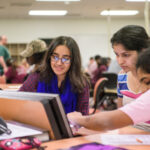
UMBC welcomes a large number of students from community colleges every semester, including in STEM majors. To better support these students, UMBC partnered with Anne Arundel Community College, Community College of Baltimore County, Howard Community College, and Montgomery College to develop and implement the STEM Transfer Student Success Initiative (t-STEM). This initiative was sponsored by the Provost’s office and initially funded by the Bill & Melinda Gates Foundation.
Too often, efforts in higher education to support transfer students are grounded in a “deficit model,” focusing on assumed needs or gaps, says Sarah Jewett, executive director of t-STEM at UMBC. She sees things differently.
“I was really interested in looking at transfer from an asset-based perspective,” Jewett says. “Transfer students bring so many experiences and talents to this campus, just like every other student, and I think those strengths need to be recognized and tapped.”
When looking at factors that challenge transfer student success, Jewett suggests, “Rather than asking, ‘What do you not have?’ we should be asking, ‘What are we not doing?’” Figuring out the best plan forward depended on important collaborative work from the Office of Undergraduate Education, Off-Campus Student Services, the Office for Academic and Pre-Professional Advising, and the College of Natural and Mathematical Sciences, all of which sponsored important outcomes of the Initiative, and helped to develop key processes, resources, and services.
Strong foundations
An asset-based approach opened the door to forming strong relationships between UMBC and partner community colleges. “The whole t-STEM project was really about building foundational relationships between students, colleagues, and institutions,” explains Jewett. “That was our initial goal in all of this—to build those relationships in ways that felt real to people.”
Working collaboratively within and across institutions, t-STEM provided access to customized advising, peer networks, and a range of resources for transfer students both before and after their transition. With the support of staff from the Division of Information Technology and Common Vision, the team was able to create and deliver an online library of instructional resources, interactive tools, animated videos, and student/faculty testimonials.
That collaborative approach made it possible to pilot solutions to longstanding problems, like aligning curricula across campuses. Could a student who successfully completed courses at a community college smoothly move forward in the next level of those subjects at UMBC? If not, how could partner institutions work together to better support that transition?
A great quintet
With support from Bill LaCourse, dean of the College of Natural and Mathematical Sciences and professor of chemistry at UMBC, faculty from UMBC and partner community colleges began by examining introductory chemistry.
Rather than simply check if topics listed on a UMBC syllabus were also listed on community college syllabi, teams of instructors engaged in meaningful conversation around all aspects of teaching and learning introductory chemistry. Partners from all five institutions published their results in the Journal of Chemical Education, providing a model for other institutions to follow.
“The chemistry curriculum alignment was groundbreaking, as everything was evaluated for alignment: curriculum, pedagogy, assessment, course policies, facilities,” says Patti Turner ’74, biological sciences, and professor of anatomy and physiology at Howard Community College.
“The process played out like a great quintet,” adds Margaret Latimer, vice president and provost at Montgomery College. “Each of the five colleges was heard and the faculty developed a rhythm as they worked together to ensure that students would be successful and meet expected standards.”
Both UMBC and the community colleges made changes to help ensure the success of transfer students in chemistry. For example, students were advised to take introductory course sequences at the same institution in order to avoid missing key course content. Additionally, participating faculty at the community colleges began including a few multiple-choice questions on their tests to better prepare students for assessments in large classes at UMBC, and UMBC faculty added open-response questions.
Ongoing growth
For faculty, “The project has enabled us to create long-standing relationships that make working on other projects seamless,” says Turner. “Because we worked really hard on building those relationships, and didn’t rush them, they’re still around, and they’re being leveraged for new opportunities,” adds Jewett.
“UMBC is in a unique position to support transfer students because of our foundation in inclusive excellence,” says Jewett. “The attention to transfer students has really grown in my time here,” she adds, but as UMBC president Freeman Hrabowski is known to say, “Success is never final.”
In that spirit, the current focus of UMBC and our community college partners is leveraging the t-STEM partnership for new and innovative proposals to support transfer success across the disciplines. “We still have a lot of work to do,” Jewett says. “There’s always work to be done.”
Image: Students work together at UMBC’s CNMS Active Science Teaching and Learning Environment (CASTLE). Photo by Marlayna Demond ’11 for UMBC.
]]>
UMBC welcomes a large number of students from community colleges every semester, including in STEM majors. To better support these students, UMBC partnered with Anne Arundel Community College,...
https://umbc.edu/stories/umbc-and-community-colleges-collaborate-to-boost-transfer-student-success-in-stem/
https://my3.my.umbc.edu/api/v0/pixel/news/120304/guest@my.umbc.edu/afaffc6823657b676d97325bf8dd5cd7/api/pixel
chembiochem
cnms
community
science-and-technology
UMBC News & Magazine
https://my3.my.umbc.edu/groups/umbc-news-magazine
https://assets1-my.umbc.edu/system/shared/avatars/groups/000/001/943/24435aa6207c452e7bc15cc74b42c7bb/xsmall.png?1748556657
https://assets1-my.umbc.edu/system/shared/avatars/groups/000/001/943/24435aa6207c452e7bc15cc74b42c7bb/original.png?1748556657
https://assets2-my.umbc.edu/system/shared/avatars/groups/000/001/943/24435aa6207c452e7bc15cc74b42c7bb/xxlarge.png?1748556657
https://assets2-my.umbc.edu/system/shared/avatars/groups/000/001/943/24435aa6207c452e7bc15cc74b42c7bb/xlarge.png?1748556657
https://assets3-my.umbc.edu/system/shared/avatars/groups/000/001/943/24435aa6207c452e7bc15cc74b42c7bb/large.png?1748556657
https://assets1-my.umbc.edu/system/shared/avatars/groups/000/001/943/24435aa6207c452e7bc15cc74b42c7bb/medium.png?1748556657
https://assets2-my.umbc.edu/system/shared/avatars/groups/000/001/943/24435aa6207c452e7bc15cc74b42c7bb/small.png?1748556657
https://assets1-my.umbc.edu/system/shared/avatars/groups/000/001/943/24435aa6207c452e7bc15cc74b42c7bb/xsmall.png?1748556657
https://assets2-my.umbc.edu/system/shared/avatars/groups/000/001/943/24435aa6207c452e7bc15cc74b42c7bb/xxsmall.png?1748556657
UMBC News & Magazine
0
0
false
Thu, 18 Oct 2018 20:08:41 -0400
Third annual UMBC GRIT-X talks highlight thought-provoking ideas, experiences, and discoveries

Artists, scientists, and social change agents from across UMBC presented the third annual GRIT-X talks on October 13, sharing their ideas and perspectives on stage in UMBC’s Dance Cube. “All our talks gave a different facet, a different beam of light, on what we do at UMBC,” said Vice President for Research Karl Steiner, who spearheaded the event.
The value of stories
Documentary filmmaker Richard Chisolm ’82, interdisciplinary studies, explained how many documentaries and reality television shows today are tightly scripted and controlled, and how, in contrast, he uses an in-the-moment style of filmmaking to produce films that honestly represent a microcosm of the larger story.
Through films like Cafeteria Man, focused on school food reform, and Gun Show, about an artist who makes sculptures of assault weapons out of found objects, Chisolm gives viewers an entry point into thorny issues. Each topic he tackles is a “huge iceberg, the tip of which is an hour documentary,” Chisolm says. “The noblest thing to do is to tell stories in a way that the tip of the iceberg represents the iceberg fairly.”
Manil Suri, mathematics, emphasized in his talk that storytelling can benefit disciplines beyond literature and film. “Stories underlie so much of what we do, including math and other STEM subjects,” he said.
Suri weaves together his passions for storytelling and math on a daily basis: He teaches a course with Michele Osherow, English, about the relationship between math and the humanities, and he’s written a novel, The Godfather of Numbers, that is a sort of creation story for mathematics. He’s using excerpts from it in his math classes this fall.
Suri also urges people who are less keen on mathematics to broaden their perspective of what math is. “Math is about more than calculations,” he says. “It’s about ideas, and ideas, such as infinity, can be enjoyed by everyone.”
 Nicole King, American studies, at GRIT-X.
Nicole King, American studies, enjoys listening to and learning from others’ stories, with a focus on residents of Baltimore City. After an accident totaled her Corolla in 2010, King decided to go carless, which, she says, removed a barrier to her truly listening to Baltimore. Through taking the bus and more closely connecting with Baltimore in other ways, King shared, “I started to really see the beauty—that cacophony of voices and sounds—that make a city a city.”
King’s research seeks to understand how Baltimore residents are responding to change across the city, with a particular focus on public markets like Lexington Market, and arts districts like Station North. Through that work, “I found listening, really listening, has been the most important, but also the most difficult, method I have used in my research,” she said. She creates opportunities for her students to “show up and listen” through immersive class projects.
Listening to her students has helped shape her teaching and research, too. “Give students the agency to shape projects,” she recommends. “They have good ideas and should be taken seriously.”
Doing things differently
Deborah Thompson Eisenberg ’91, political science, is a professor of law at the University of Maryland Carey School of Law, where she directs the Center for Dispute Resolution. She was motivated to pursue a law career because, she explained, “When our democracy encounters crisis, lawyers and the judiciary tend to step in to give voice to the powerless, enforce our laws and our Constitutional rights, and protect the most vulnerable.” However, over time, she reflected, “I’ve come to believe that if lawyers and judges truly want to foster a culture of conflict resolution, we need more than the power of the rule of law.”
Eisenberg began to focus on alternatives to traditional litigation: mediation and restorative justice practices, teaching our youth to “talk it out to work it out,” and teaching our politicians “to use consensus-building policies.” Conflict is inevitable and has been intensifying, Eisenberg argued, but “we can transform our culture of conflict to a culture of conflict resolution if we use all of our superpowers,” combining the rule of law, alternative dispute resolution, community connections, and education.
 Kimberly Moffitt, language, literacy, and culture and Africana studies, at GRIT-X.
Disney’s Princess Tiana may not be a superhero, but, as the first black Disney princess, she is larger than life in the eyes of many young girls of color. Kimberly Moffitt, associate professor of language, literacy, and culture and Africana studies, discussed how Tiana broke the mold of the traditional Disney princess with her entrepreneurial, ambitious spirit in The Princess and the Frog. “Princess Tiana pushes the bounds of the princess trope and says, ‘No more. We can do this differently,’” Moffitt said.
However, Moffitt explained, Tiana is also an example of the “glass cliff,” a phenomenon in business where companies are more likely to hire women and people of color to leadership roles when those companies are in times of crisis and the risk of failure is highest. When Tiana came out in 2009, Disney hadn’t had a new princess-style protagonist since Mulan in 1998, and the brand was faltering. The Princess and the Frog didn’t achieve box office success itself, but, Moffitt argued, “Tiana created space for the next three princesses,” who all were more independent than their predecessors: Rapunzel in Tangled, Merida in Brave, and Moana in Moana. “Tiana was a catalyst to shift our perception of what a princess could look like—in skin tone as well as her actions.”
 Eric Dyer ’95, visual arts, demonstrates his art at GRIT-X.
Eric Dyer ’95, professor of visual arts, shifts our perception of what moving pictures can be by reimagining the zoetrope, one of the original forms of motion picture. Zoetropes use a series of snapshots in a spinning cylinder to trick the mind into seeing a moving scene. “As an artist, I pick up the tactile and interactive zoetrope where it was abandoned 120 years ago,” Dyer said, “and continuously reinvent it to make films, interactive animated sculptures, and immersive installations.”
At GRIT-X, Dyer demonstrated his work for the audience and, for the first time, shared the story behind each piece. Attendees enjoyed frolicking onions and peppers and reflected on Dyer’s exploration of the industrial heydays of the U.S. and China. “Thank you for sharing this performance storytelling experience with me today,” Dyer shared as he closed. “There’s something very human about it that isn’t possible either virtually or remotely.”
Shifting the culture
Diane Bell McKoy ’73, social work and sociology, is the CEO of Associated Black Charities of Maryland. She used her GRIT-X talk as an opportunity to share a powerful personal story of seeking treatment for depression in a broken mental healthcare system. Systems in place in the United States, she argued, perpetuate stigma and fail to support a sense of self-worth for people of color, and she is working to change them.
 Diane Bell McKoy ’73, social work and sociology, at GRIT-X.
McKoy’s work has a particular focus on closing the racial wealth gap. If wealth continues to accrue at current rates, it would take a black family 228 years to accrue as much wealth as a white family, McKoy said, and it would take a Latino family 84 years. McKoy encouraged attendees to “look at the world through a new lens” and be willing to question current systems, from employment to education to healthcare.
Shawn Bediako, psychology, is also interested in changing perceptions around race, with a focus on health and science. “Ideas about race can become inscribed in our minds if they’re repeated often enough,” he said at GRIT-X, using the example that many people seem to believe, incorrectly, that sickle cell disease is exclusive to black people.
 Bediako went on to explain how race is a complex legal, social, and cultural construct that impacts people’s lives in dramatic ways. But he also shared that he has hope this can change, and that UMBC can develop leaders who will impact the way we think about race. “I feel confident that an institution like ours, with a commitment to inclusive excellence at all levels of the arts, humanities, and sciences,” he said, “can help…change this inscription and hopefully shift this paradigm.”
To close the program, Kavita Krishnaswamy ’07, computer science and mathematics, Ph.D. ’19, computer science, shared her work developing solutions to assist people with disabilities and mobility challenges. Krishnaswamy, who has spinal muscular atrophy, gave her presentation via a telepresence device that allows her to navigate the world from her home in Columbia, Maryland.
Krishnaswamy is the recipient of the Google Lime Scholarship, was named a Microsoft Fellow, and was included among the Baltimore Sun’s “25 Women to Watch.” She is currently working on projects including a bed that allows people with mobility challenges to adjust their position along many different axes of movement, and a robot to enable people who previously could not use the bathroom unassisted to do so independently.
 Alumna and Ph.D. student Kavita Krishnaswamy presents at GRIT-X via telepresence device.
“We have a lot of problems in the world, and I really feel that robotics can solve many of those problems,” Krishnaswamy said. “So in that way we can really promote social progress and elevate the global living standards. That, in turn, can increase the quality of life for people with disabilities, seniors, and their families.”
One of her closing remarks echoed the sentiments of others at GRIT-X. “Even though our perspectives are many and diverse, our vision is one,” she concluded. Whether dismantling stigma, finding new ways to connect students with intimidating subjects, or changing how we think about conflict, all the speakers emphasized how the UMBC community can reach together to improve the world of tomorrow.
Banner image: Manil Suri, mathematics, at GRIT-X. All photos by Marlayna Demond ’11 for UMBC.
Explore video of all GRIT-X talks on the Research at UMBC website.
]]>
Artists, scientists, and social change agents from across UMBC presented the third annual GRIT-X talks on October 13, sharing their ideas and perspectives on stage in UMBC’s Dance Cube. “All our...
https://umbc.edu/stories/third-annual-umbc-grit-x-talks-highlight-thought-provoking-ideas-experiences-and-discoveries/
https://my3.my.umbc.edu/api/v0/pixel/news/120305/guest@my.umbc.edu/9d191177a3ec74be6f5c96ff2de1b313/api/pixel
africanastudies
americanstudies
cahss
cnms
coeit
community
csee
inds
llc
mathstat
politicalscience
psychology
saph
socialwork
visualarts
UMBC News & Magazine
https://my3.my.umbc.edu/groups/umbc-news-magazine
https://assets1-my.umbc.edu/system/shared/avatars/groups/000/001/943/24435aa6207c452e7bc15cc74b42c7bb/xsmall.png?1748556657
https://assets1-my.umbc.edu/system/shared/avatars/groups/000/001/943/24435aa6207c452e7bc15cc74b42c7bb/original.png?1748556657
https://assets2-my.umbc.edu/system/shared/avatars/groups/000/001/943/24435aa6207c452e7bc15cc74b42c7bb/xxlarge.png?1748556657
https://assets2-my.umbc.edu/system/shared/avatars/groups/000/001/943/24435aa6207c452e7bc15cc74b42c7bb/xlarge.png?1748556657
https://assets3-my.umbc.edu/system/shared/avatars/groups/000/001/943/24435aa6207c452e7bc15cc74b42c7bb/large.png?1748556657
https://assets1-my.umbc.edu/system/shared/avatars/groups/000/001/943/24435aa6207c452e7bc15cc74b42c7bb/medium.png?1748556657
https://assets2-my.umbc.edu/system/shared/avatars/groups/000/001/943/24435aa6207c452e7bc15cc74b42c7bb/small.png?1748556657
https://assets1-my.umbc.edu/system/shared/avatars/groups/000/001/943/24435aa6207c452e7bc15cc74b42c7bb/xsmall.png?1748556657
https://assets2-my.umbc.edu/system/shared/avatars/groups/000/001/943/24435aa6207c452e7bc15cc74b42c7bb/xxsmall.png?1748556657
UMBC News & Magazine
0
0
false
Wed, 17 Oct 2018 21:09:38 -0400
Alumni startup at bwtech@UMBC earns unique award for artificial intelligence work with UMBC research team
The artificial intelligence startup RedShred—cofounded by two UMBC alumni and housed in the bwtech@UMBC incubator—has received a rare Phase II Small Business Innovation Research Award from the National Science Foundation to expand in a new direction, in collaboration with UMBC faculty and graduate students.
Jeehye Yun ‘97, computer science, and Jim Kukla ‘97, M.S ‘00, computer science, launched RedShred in 2014, with the support of a Phase I Small Business Technology Transfer Award from NSF. For the past four years, RedShred has created software to help universities and other institutions sort through complex government listings in search of opportunities (requests for proposals, or RFPs) that meet their needs and expertise. The new Phase II award will support RedShred as they make their products available to companies in the commercial sector.
“At RedShred our mission is to help people read less and win more,” says Yun. “We’re excited about this Phase II grant, which allows us to commercialize our Phase I research and development, and develop new mechanisms to help people understand increasingly complicated documents.”
UMBC faculty and students have collaborated with RedShred to advance the technologies behind their products. Tim Finin, professor of computer science and electrical engineering, and several graduate students have worked with RedShred to better understand how large documents, such as RFPs, tend to be structured, even when each one is formatted differently and doesn’t follow a template. They describe this process as identifying the document’s semantic DNA.
By defining and identifying the core elements of each RFP, UMBC student researchers have been able to create “at-a-glance” summaries of these highly complex documents that provide all the necessary information and save the client the time of wading through levels of detail.
“Our collaboration with RedShred has given UMBC students great opportunities to participate in both basic and applied research focused on developing an innovative commercial product,” explains Finin. “This has involved both undergraduate and graduate students majoring in computing as well as the arts and humanities. For example, computer science graduate student Muhammad Rahman Ph.D. ‘18, computer science, developed a problem he encountered when working with RedShed into his Ph.D. dissertation, which he completed his summer.”
]]>
The artificial intelligence startup RedShred—cofounded by two UMBC alumni and housed in the bwtech@UMBC incubator—has received a rare Phase II Small Business Innovation Research Award from the...
https://umbc.edu/stories/alumni-startup-at-bwtechumbc-earns-unique-award-for-artificial-intelligence-work-with-umbc-research-team/
https://my3.my.umbc.edu/api/v0/pixel/news/120306/guest@my.umbc.edu/9d20073bf88cd0cf353e204d4d3f7a83/api/pixel
alumni
bwtech
coeit
csee
science-and-technology
UMBC News & Magazine
https://my3.my.umbc.edu/groups/umbc-news-magazine
https://assets1-my.umbc.edu/system/shared/avatars/groups/000/001/943/24435aa6207c452e7bc15cc74b42c7bb/xsmall.png?1748556657
https://assets1-my.umbc.edu/system/shared/avatars/groups/000/001/943/24435aa6207c452e7bc15cc74b42c7bb/original.png?1748556657
https://assets2-my.umbc.edu/system/shared/avatars/groups/000/001/943/24435aa6207c452e7bc15cc74b42c7bb/xxlarge.png?1748556657
https://assets2-my.umbc.edu/system/shared/avatars/groups/000/001/943/24435aa6207c452e7bc15cc74b42c7bb/xlarge.png?1748556657
https://assets3-my.umbc.edu/system/shared/avatars/groups/000/001/943/24435aa6207c452e7bc15cc74b42c7bb/large.png?1748556657
https://assets1-my.umbc.edu/system/shared/avatars/groups/000/001/943/24435aa6207c452e7bc15cc74b42c7bb/medium.png?1748556657
https://assets2-my.umbc.edu/system/shared/avatars/groups/000/001/943/24435aa6207c452e7bc15cc74b42c7bb/small.png?1748556657
https://assets1-my.umbc.edu/system/shared/avatars/groups/000/001/943/24435aa6207c452e7bc15cc74b42c7bb/xsmall.png?1748556657
https://assets2-my.umbc.edu/system/shared/avatars/groups/000/001/943/24435aa6207c452e7bc15cc74b42c7bb/xxsmall.png?1748556657
UMBC News & Magazine
0
0
false
Tue, 16 Oct 2018 19:13:09 -0400
UMBC researchers develop new method to address deep-seated biases in science, starting with birds

New UMBC research is helping dismantle gender and publication biases in science. A team of researchers working across disciplines has developed a new statistical technique to understand similarity, rather than difference, in the natural world. With this new technique, they’ve determined that among Eastern Bluebirds the structure of songs female birds sing is statistically indistinguishable from songs males sing.
Awareness of female birdsong is growing worldwide, thanks in part to a breakthrough paper by Karan Odom, Ph.D. ’16, biological sciences, but it’s still understood as a trait found primarily in tropical birds. Evangeline Rose, a current Ph.D. student in the same lab and first author on a new paper in Animal Behavior, wanted to look at song in a temperate species.
During Rose’s fieldwork, “I was finding that the females were singing, to me, what sounded just like male songs,” she says. “So we started thinking about equality, and equivalence, and how to test for it.” On the advice of her advisor, Kevin Omland, professor of biological sciences, she reached out to Thomas Mathew, professor of statistics, who has expertise in statistical equivalence.
Challenging a paradigm
Working together, the team modified a statistical method used in generic drug testing to meet their needs for ecology and animal behavior studies. The existing test helps determine whether generic and brand name drugs are “statistically equivalent,” meaning they are similar enough to be prescribed safely for the same purpose. The new modification will allow scientists in other fields to test for equivalence. Before, researchers could only report they did not find a significant difference—a very different statement than saying two things are conclusively equivalent.
“We’re really hoping this new method is going to address some issues with what kinds of data get published,” Rose says. “The most important thing about being a good scientist is to be unbiased. And the whole tradition of testing for difference really leads to incredible biases in scientists,” Omland says. He adds, “There’s a whole realm of things in nature that we find interesting and important because of their similarity.”
For example, in addition to similarities in songs between the sexes in birds, researchers could use the new test to ask if two species use the same type of habitat, respond the same way to predators, or consume the same food sources. Answers to those questions could fill long-standing knowledge gaps, or even inform conservation efforts.
“This test is really broadly applicable,” says Rose, “and we’re hoping to introduce it more to the ecology and evolution field.”
A new approach
One advantage of the new method is it accounts for unequal sample sizes. In a medical study, researchers can carefully control the size of treatment and control groups. In other fields, from ecology, to engineering, to agriculture, that’s often not possible. The new test also allows researchers to determine the equivalence of several traits simultaneously, Mathew explains. For example, in this study, the authors found that the male and female birds’ songs were statistically equivalent across five different characteristics, such as duration of each song and the range of pitches the birds produced.
Rather than testing whether two things are exactly equal, the team was looking for a way to determine if two things were “close enough,” given a defined allowable margin of difference. Because of that added layer, “There are additional challenges here,” Mathew says.
“Even though this methodology is out there, it hasn’t been applied—even in statistics—with this kind of data. That’s why I was very excited when they brought this project to me,” Mathew says. Rose adds, “It ended up being a really great partnership to look at these questions that hadn’t been asked before for female song, and we also ended up modifying this test in a really cool, new way.”
Changing science
As research on similarities grows, there is also a growing drive to remove the bias against publishing studies that do not find a significant difference, often termed a “negative result.” This paper “is part of an amazing drumbeat that’s building up in the scientific community,” Omland says. “There’s a broader problem with the scientific method that’s being increasingly acknowledged, and the test we’ve developed can at least play a small role, and I hope a big role, in addressing it.”
Rose, who plans to next investigate the function of female bluebird songs, says she will carry these new techniques with her as she moves through her research career. “I think in the future, I’ll be thinking about how equivalence can change the questions we’re asking, and I’ll always keep in mind that we have extra tools in the toolkit.”
Image: An Eastern Bluebird, Rose’s study organism, sits on a fence. Photo by Dolan Trout, used under CC 2.0.
]]>
New UMBC research is helping dismantle gender and publication biases in science. A team of researchers working across disciplines has developed a new statistical technique to understand...
https://umbc.edu/stories/umbc-researchers-develop-new-method-to-address-deep-seated-biases-in-science-starting-with-birds/
https://my3.my.umbc.edu/api/v0/pixel/news/120307/guest@my.umbc.edu/6dc16f83dc2c193ab8c1171738f68a55/api/pixel
biology
cnms
gradresearch
research
science-and-technology
UMBC News & Magazine
https://my3.my.umbc.edu/groups/umbc-news-magazine
https://assets1-my.umbc.edu/system/shared/avatars/groups/000/001/943/24435aa6207c452e7bc15cc74b42c7bb/xsmall.png?1748556657
https://assets1-my.umbc.edu/system/shared/avatars/groups/000/001/943/24435aa6207c452e7bc15cc74b42c7bb/original.png?1748556657
https://assets2-my.umbc.edu/system/shared/avatars/groups/000/001/943/24435aa6207c452e7bc15cc74b42c7bb/xxlarge.png?1748556657
https://assets2-my.umbc.edu/system/shared/avatars/groups/000/001/943/24435aa6207c452e7bc15cc74b42c7bb/xlarge.png?1748556657
https://assets3-my.umbc.edu/system/shared/avatars/groups/000/001/943/24435aa6207c452e7bc15cc74b42c7bb/large.png?1748556657
https://assets1-my.umbc.edu/system/shared/avatars/groups/000/001/943/24435aa6207c452e7bc15cc74b42c7bb/medium.png?1748556657
https://assets2-my.umbc.edu/system/shared/avatars/groups/000/001/943/24435aa6207c452e7bc15cc74b42c7bb/small.png?1748556657
https://assets1-my.umbc.edu/system/shared/avatars/groups/000/001/943/24435aa6207c452e7bc15cc74b42c7bb/xsmall.png?1748556657
https://assets2-my.umbc.edu/system/shared/avatars/groups/000/001/943/24435aa6207c452e7bc15cc74b42c7bb/xxsmall.png?1748556657
UMBC News & Magazine
0
0
false
Tue, 16 Oct 2018 17:43:43 -0400
UMBC inaugurates new center to serve as hub for social science research

UMBC’s Center for Social Science Scholarship has opened its doors this fall with Christine Mallinson, professor of language, literacy and culture, as its inaugural director. The new center, which will promote faculty, student, and alumni research across multiple fields of study, is the result of many years of cultivating deep levels of scholarship on campus as well as collaboration and planning by the social science faculty.
“The Center for Social Science Scholarship answers a longstanding need at UMBC: to provide a hub, a connector, and a microphone for our extraordinary work on critical issues facing communities and societies today,” explains Scott Casper, dean of the College of Arts, Humanities, and Social Sciences (CAHSS).
The Center will emphasize areas of research such as civic and political participation, global patterns of labor and migration, educational access, the relationship between humans and the environment, human behavior and health equity across the lifespan, the social context of technology, and policy impact.
Mallinson, who joined UMBC in 2006, researches the context of and mechanisms involved in communication within major social institutions, including education, the workplace, and the legal system. By working with teachers, lawyers, and judges to better understand how perceptions cause bias, Mallinson’s has developed research-based strategies to remove inequalities and barriers.
 Christine Mallinson presents her research at the Labs@Light City, April 2018.
“Christine Mallinson’s innovative, collaborative scholarship has influenced academic debates, informed policy, and empowered communities. I look forward to her leadership on behalf of UMBC’s social science research community,” says Casper.
Through her interdisciplinary work in language, literacy, and culture, Mallinson said she has immersed herself in multiple campus partnerships and experienced first hand the extent of dynamic social science research happening across UMBC.
Banner image (l-r): Mejdulene B. Shomali, gender, women’s, & sexuality studies; Carole McCann, gender, women’s, and sexuality studies; Christine Mallinson, director of the Center for Social Science Scholarship; Charissa Cheah, psychology. All images by Marlayna Demond ’11 for UMBC.
]]>
UMBC’s Center for Social Science Scholarship has opened its doors this fall with Christine Mallinson, professor of language, literacy and culture, as its inaugural director. The new center, which...
https://umbc.edu/stories/umbc-inaugurates-new-center-to-serve-as-hub-for-social-science-research-2/
https://my3.my.umbc.edu/api/v0/pixel/news/120308/guest@my.umbc.edu/72d60693770528cd6b09f0be82653a8a/api/pixel
cahss
cs3
policy-and-society
UMBC News & Magazine
https://my3.my.umbc.edu/groups/umbc-news-magazine
https://assets1-my.umbc.edu/system/shared/avatars/groups/000/001/943/24435aa6207c452e7bc15cc74b42c7bb/xsmall.png?1748556657
https://assets1-my.umbc.edu/system/shared/avatars/groups/000/001/943/24435aa6207c452e7bc15cc74b42c7bb/original.png?1748556657
https://assets2-my.umbc.edu/system/shared/avatars/groups/000/001/943/24435aa6207c452e7bc15cc74b42c7bb/xxlarge.png?1748556657
https://assets2-my.umbc.edu/system/shared/avatars/groups/000/001/943/24435aa6207c452e7bc15cc74b42c7bb/xlarge.png?1748556657
https://assets3-my.umbc.edu/system/shared/avatars/groups/000/001/943/24435aa6207c452e7bc15cc74b42c7bb/large.png?1748556657
https://assets1-my.umbc.edu/system/shared/avatars/groups/000/001/943/24435aa6207c452e7bc15cc74b42c7bb/medium.png?1748556657
https://assets2-my.umbc.edu/system/shared/avatars/groups/000/001/943/24435aa6207c452e7bc15cc74b42c7bb/small.png?1748556657
https://assets1-my.umbc.edu/system/shared/avatars/groups/000/001/943/24435aa6207c452e7bc15cc74b42c7bb/xsmall.png?1748556657
https://assets2-my.umbc.edu/system/shared/avatars/groups/000/001/943/24435aa6207c452e7bc15cc74b42c7bb/xxsmall.png?1748556657
UMBC News & Magazine
0
0
false
Mon, 15 Oct 2018 17:44:06 -0400
UMBC’s Sebastian Deffner receives FQXi support for pioneering work to define laws of the universe

Sebastian Deffner plans to spend his career expanding on the work of physics giants to refine our understanding of the fundamental laws of nature, from the inner workings of the tiniest cells to the dynamics of the largest cosmic phenomena. Deffner, an assistant professor of physics at UMBC, recently moved forward in this work through a pioneering paper in Physical Review X with CalTech collaborator Anthony Bartolotta, and now has a new grant to push the envelope even further.
As their paper describes, Deffner and Bartolotta have developed more accurate ways to determine how energy is used, released, and transformed in very small systems with very high energy, which had previously been poorly understood. Deffner’s new grant from the Foundational Questions Institute (FQXi) will enable him to further develop a new field of physics that focuses on energy and information processing.
The origin of intelligence
The FQXi sought research projects that would address the question of agency in the physical world. It’s common to think about actions as being caused by some external force—flipping a switch, pushing a lever—but those levers and switches “are all part of the same universe,” Deffner explains. “We don’t have any scientific idea that there could be something acting on the universe from the outside, which means that anything that happens within the universe actually arises from interaction of different parts of the universe. Nothing comes for free.”
“Now, if this is true, how does something like intelligence or agency actually arise from the very fundamental laws of physics that describe the universe?” he asks. To address that question, Deffner has turned to a new field of physics known as the thermodynamics of information. Classic thermodynamics considers how energy in the forms of heat and work is transformed in physical systems. But Deffner thinks there’s more to it.
Including information
“We don’t get a complete thermodynamic picture if we neglect information. If we only think about heat and work, we will always end up with statements that seem to violate the axioms of thermodynamics,” Deffner says. “Only if we include information processing, and understand what that actually means, do we get a complete thermodynamic picture.”
The idea is that writing and erasing information in a system involves energy, so evaluations of the overall energy in a system must consider information processing. Understanding energy and information processing is important for describing the universe, but it’s also important for more practical applications.
Scientists and engineers are working to develop the next generation of information storage, and it may take the form of “quantum memory”—systems that rely on quantum mechanics and the stability of extremely cold groups of atoms (near absolute zero) to store information.
“If you want to build a quantum memory out of these ultra-cold atoms,” Deffner explains, “you have to understand how information actually is written and how you can stabilize the information content of these systems.”
A universe in flux
Current theories, such as thermodynamics, work well when a system is in equilibrium. However, “if you look at the universe, it’s not in thermal equilibrium. It’s not even close,” Deffner says. For example, think of a star like our Sun constantly releasing heat and light through extremely high-energy reactions.
So, “What I want to do is to take stochastic thermodynamics that we’ve developed for small quantum systems and small biological systems, and apply these concepts and notions to cosmology to get a better understanding of the extremes of the universe,” Deffner says. He’ll be charting new territory in the extraordinarily complex math that describes, at a fundamental level, how the world works.
Following the dream
As his career progresses, Deffner hopes to help generate “a better, more concise understanding of the universe,” he says, “but for that we need a lot of bits and pieces, and almost nothing like this has been done yet.”
The Physical Review X paper took the first baby steps toward developing the basis to move forward with this work. Now, Deffner is off and running, but he recognizes the journey will be a marathon, not a sprint.
“We know which direction we’re going now, and we know which steps to take,” he says, “but we will not be able to describe the universe in 2020. If we’re lucky, that’s something for 2050.”
One thing Deffner does know is that he’s committed to the marathon. “If you don’t dream big, what are you going to do?” he asks. “Sometimes you have to take a risk and follow the dream.”
]]>
Sebastian Deffner plans to spend his career expanding on the work of physics giants to refine our understanding of the fundamental laws of nature, from the inner workings of the tiniest cells to...
https://umbc.edu/stories/umbcs-sebastian-deffner-receives-fqxi-support-for-pioneering-work-to-define-laws-of-the-universe/
https://my3.my.umbc.edu/api/v0/pixel/news/120309/guest@my.umbc.edu/a620e55eb13dc2be42e72b47d08b05c5/api/pixel
cnms
physics
research
science-and-technology
UMBC News & Magazine
https://my3.my.umbc.edu/groups/umbc-news-magazine
https://assets1-my.umbc.edu/system/shared/avatars/groups/000/001/943/24435aa6207c452e7bc15cc74b42c7bb/xsmall.png?1748556657
https://assets1-my.umbc.edu/system/shared/avatars/groups/000/001/943/24435aa6207c452e7bc15cc74b42c7bb/original.png?1748556657
https://assets2-my.umbc.edu/system/shared/avatars/groups/000/001/943/24435aa6207c452e7bc15cc74b42c7bb/xxlarge.png?1748556657
https://assets2-my.umbc.edu/system/shared/avatars/groups/000/001/943/24435aa6207c452e7bc15cc74b42c7bb/xlarge.png?1748556657
https://assets3-my.umbc.edu/system/shared/avatars/groups/000/001/943/24435aa6207c452e7bc15cc74b42c7bb/large.png?1748556657
https://assets1-my.umbc.edu/system/shared/avatars/groups/000/001/943/24435aa6207c452e7bc15cc74b42c7bb/medium.png?1748556657
https://assets2-my.umbc.edu/system/shared/avatars/groups/000/001/943/24435aa6207c452e7bc15cc74b42c7bb/small.png?1748556657
https://assets1-my.umbc.edu/system/shared/avatars/groups/000/001/943/24435aa6207c452e7bc15cc74b42c7bb/xsmall.png?1748556657
https://assets2-my.umbc.edu/system/shared/avatars/groups/000/001/943/24435aa6207c452e7bc15cc74b42c7bb/xxsmall.png?1748556657
UMBC News & Magazine
0
0
false
Mon, 15 Oct 2018 14:16:57 -0400
UMBC inaugurates new center to serve as hub for social science research

UMBC’s Center for Social Science Scholarship has opened its doors this fall with Christine Mallinson, professor of language, literacy, and culture, as its inaugural director. The new center, which will promote faculty, student, and alumni research across multiple fields of study, is the result of many years of cultivating deep levels of scholarship on campus as well as collaboration and planning by the social science faculty.
“The Center for Social Science Scholarship answers a longstanding need at UMBC: to provide a hub, a connector, and a microphone for our extraordinary work on critical issues facing communities and societies today,” explains Scott Casper, dean of the College of Arts, Humanities, and Social Sciences (CAHSS).
The center will emphasize areas of research such as civic and political participation, global patterns of labor and migration, educational access, the relationship between humans and the environment, human behavior and health equity across the lifespan, the social context of technology, and policy impact.
Mallinson, who joined UMBC in 2006, researches the context of and mechanisms involved in communication within major social institutions, including education, the workplace, and the legal system. By working with teachers, lawyers, and judges to better understand how perceptions cause bias, Mallinson has developed research-based strategies to remove inequalities and barriers.
“Christine Mallinson’s innovative, collaborative scholarship has influenced academic debates, informed policy, and empowered communities. I look forward to her leadership on behalf of UMBC’s social science research community,” says Casper.
Through her interdisciplinary work in language, literacy, and culture, Mallinson said she has immersed herself in multiple campus partnerships and experienced first-hand the extent of dynamic social science research happening across UMBC.
“What I am most excited for with the Center for Social Science Scholarship is the ability to spotlight the depth and breadth of the social science research that our faculty and students commit to on a daily basis,” says Mallinson.
 MIPAR grant workshop.
As part of these efforts, current social science programming—such as the research-based events and assistance offered by the Maryland Institute for Public Policy and Research (MIPAR), and the Social Science Forum lecture series—will be housed in and managed by the Center for Social Science Scholarship. Located in the Public Policy building, the center will also serve as a partner in connecting and sharing key insights and perspectives of social science alumni and community partners.
Mallinson sees this collaborative work as a continuation of UMBC’s values and commitment to applied research. “This is an opportunity at a pivotal time in our country,” she says, “to tackle some of the big picture questions that are significant in the social sciences, but that also have applicability to other fields, are relevant across UMBC, and matter to our communities.”
Featured image: Christine Mallinson. All photos by Marlayna Demond ‘11 for UMBC
]]>
UMBC’s Center for Social Science Scholarship has opened its doors this fall with Christine Mallinson, professor of language, literacy, and culture, as its inaugural director. The new center, which...
https://umbc.edu/stories/umbc-inaugurates-new-center-to-serve-as-hub-for-social-science-research/
https://my3.my.umbc.edu/api/v0/pixel/news/120310/guest@my.umbc.edu/f5eeb8cc815c0104a6d47e751047d5b2/api/pixel
cahss
mipar
policy-and-society
UMBC News & Magazine
https://my3.my.umbc.edu/groups/umbc-news-magazine
https://assets1-my.umbc.edu/system/shared/avatars/groups/000/001/943/24435aa6207c452e7bc15cc74b42c7bb/xsmall.png?1748556657
https://assets1-my.umbc.edu/system/shared/avatars/groups/000/001/943/24435aa6207c452e7bc15cc74b42c7bb/original.png?1748556657
https://assets2-my.umbc.edu/system/shared/avatars/groups/000/001/943/24435aa6207c452e7bc15cc74b42c7bb/xxlarge.png?1748556657
https://assets2-my.umbc.edu/system/shared/avatars/groups/000/001/943/24435aa6207c452e7bc15cc74b42c7bb/xlarge.png?1748556657
https://assets3-my.umbc.edu/system/shared/avatars/groups/000/001/943/24435aa6207c452e7bc15cc74b42c7bb/large.png?1748556657
https://assets1-my.umbc.edu/system/shared/avatars/groups/000/001/943/24435aa6207c452e7bc15cc74b42c7bb/medium.png?1748556657
https://assets2-my.umbc.edu/system/shared/avatars/groups/000/001/943/24435aa6207c452e7bc15cc74b42c7bb/small.png?1748556657
https://assets1-my.umbc.edu/system/shared/avatars/groups/000/001/943/24435aa6207c452e7bc15cc74b42c7bb/xsmall.png?1748556657
https://assets2-my.umbc.edu/system/shared/avatars/groups/000/001/943/24435aa6207c452e7bc15cc74b42c7bb/xxsmall.png?1748556657
UMBC News & Magazine
0
0
false
Mon, 15 Oct 2018 00:00:00 -0400
UMBC students win top prize at Maryland Cyber Challenge
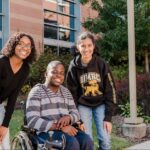
Busy teams of students clustered around laptops in a room overlooking Baltimore’s Inner Harbor on Tuesday, focused on solving as many challenges as possible during a “capture-the-flag” style competition. After hours of intense competition in cyberspace, UMBC’s team emerged victorious, named champions of the college division of the 2018 Maryland Cyber Challenge.
Started in 2011, the competition is part of the annual CyberMaryland Conference. UMBC’s team included Niara Richards ‘22, computer science; Nithya Prakash ‘22, information systems; Josh Mpere ‘19, computer science; Seamus Burke ‘20 computer science; and Swathi Krithivasan ‘22, computer science. They worked together to test their skills in a series of real-world cybersecurity challenges over the course of two virtual qualifying rounds and then the final competition, beating talented teams from the U.S. Air Force Academy and University of Maryland, University College.
 Nithya Prakash, Swathi Krithivasan, and Josh Mpere being recognized at the award ceremony. Photo by Mike Lackner, computer science and informatics, and technology instructor at Loyola Blakefield High School.
“It was my first time competing in the Maryland Cyber Challenge, although I have a pretty extensive competition background,” said Burke. “I am especially proud of my freshman teammates who put in a ton of effort, solved challenges, and didn’t get discouraged when the challenges got more difficult.”
Burke is a Center for Women in Technology (CWIT) Scholar and Mpere is a Cyber affiliate. Richards, Prakash, and Krithivasan all participate in UMBC’s Cyber Scholars Program, which works to prepare the next generation of cybersecurity professionals.
All five members of the winning team will receive a monetary award and an offer to complete a summer internship to continue growing their experience and skills. Additionally, the university will receive new technologies (including software) to support more UMBC students in developing their cybersecurity skills.
“The competition was a fantastic experience and gave me a lot of exposure into topics that I otherwise would not have gained, especially as a freshman,” said Krithivasan. “We had a mix of both upper and underclassmen on our team, which really enabled us to learn and grow from working with each other.”
Banner image: Niara Richards, left, Josh Mpere, and Nithya Prakash. Photo by Marlayna Demond ’11 for UMBC.
]]>
Busy teams of students clustered around laptops in a room overlooking Baltimore’s Inner Harbor on Tuesday, focused on solving as many challenges as possible during a “capture-the-flag” style...
https://umbc.edu/stories/umbc-students-win-top-prize-at-maryland-cyber-challenge/
https://my3.my.umbc.edu/api/v0/pixel/news/120311/guest@my.umbc.edu/25dff770eb6b36d90077c19063f4ea70/api/pixel
coeit
csee
cwit
cyberscholars
cybersecurity
is
science-and-technology
UMBC News & Magazine
https://my3.my.umbc.edu/groups/umbc-news-magazine
https://assets1-my.umbc.edu/system/shared/avatars/groups/000/001/943/24435aa6207c452e7bc15cc74b42c7bb/xsmall.png?1748556657
https://assets1-my.umbc.edu/system/shared/avatars/groups/000/001/943/24435aa6207c452e7bc15cc74b42c7bb/original.png?1748556657
https://assets2-my.umbc.edu/system/shared/avatars/groups/000/001/943/24435aa6207c452e7bc15cc74b42c7bb/xxlarge.png?1748556657
https://assets2-my.umbc.edu/system/shared/avatars/groups/000/001/943/24435aa6207c452e7bc15cc74b42c7bb/xlarge.png?1748556657
https://assets3-my.umbc.edu/system/shared/avatars/groups/000/001/943/24435aa6207c452e7bc15cc74b42c7bb/large.png?1748556657
https://assets1-my.umbc.edu/system/shared/avatars/groups/000/001/943/24435aa6207c452e7bc15cc74b42c7bb/medium.png?1748556657
https://assets2-my.umbc.edu/system/shared/avatars/groups/000/001/943/24435aa6207c452e7bc15cc74b42c7bb/small.png?1748556657
https://assets1-my.umbc.edu/system/shared/avatars/groups/000/001/943/24435aa6207c452e7bc15cc74b42c7bb/xsmall.png?1748556657
https://assets2-my.umbc.edu/system/shared/avatars/groups/000/001/943/24435aa6207c452e7bc15cc74b42c7bb/xxsmall.png?1748556657
UMBC News & Magazine
0
0
false
Thu, 11 Oct 2018 16:51:12 -0400
UMBC connects thousands of students with top employers, from Google to GM

More than 1,800 students arrived with resumes in hand to connect directly with top global and local companies, government agencies, and nonprofit organizations at UMBC’s Fall Career and Internship Fair. Recruiters from 140 employers were drawn to UMBC’s largest annual recruiting event to share opportunities with students across all colleges and programs. In the days before and after the fair, several organizations—such as Google—also made special pitches to UMBC students.
Google’s visit was part of a larger trend at the university. In the fall semester alone, more than twenty Fortune 500 companies will visit campus through the UMBC Career Center to recruit students for internship and job opportunities. This list includes household names like Google, Facebook, ExxonMobil, Microsoft, Northrop Grumman, Morgan Stanley, Wells Fargo, General Motors, and Goldman Sachs. Strong local employers visiting campus to recruit UMBC talent include McCormick, T. Rowe Price, Legg Mason, Big Huge Games, and the Johns Hopkins University Applied Physics Lab, among others.
During Google’s campus visit, UMBC students had several opportunities to connect with recruiters from the company. At their information session, Google provided helpful tips on applying for internships and jobs with the company. Later in the week, Google representatives met with students to answer specific questions about working at Google, offered a tech talk, and hosted a coding competition for students.
“Having graduated from UMBC myself, I know firsthand that students here are well prepared for opportunities during and after college,” said Eric Griswold ’13, computer science, an engineer at Google, who led the tech talk on campus. “I am truly inspired by the energy and passion UMBC students have; they are definitely on their way to thriving careers in the tech industry.”
 Students filled the room during the tech talk with Google. Photo courtesy of Dustin Eby, program assistant in UMBC’s Career Center.
Several current students completed internships at the company last summer, including William Gao ‘19, computer science; Deepika Rajani ‘19, computer science; and Ashley Copenhaver ‘19, mathematics, who has completed multiple Google internships.
“Over the course of my internships with Google,” Copenhaver says, “the most unique aspect I noticed was that Google promotes a constant learning environment. I collaborated with people not only in my office, but also across the globe, and there was never a meeting that I walked out of without learning something new.” She hopes to intern again with the company in summer 2019.
Gao shared a similar experience, noting, “Google helped me learn from industry professionals and use industry level tools.”
That experience also shaped his approach to learning when back on campus. “After the internship,” he says, “I adjusted my approach in the classroom so that I can start cultivating the skills I know I will need in the work environment.”
Students seeking job and internship opportunities can follow the Career Center through myUMBC, utilize the UMBCworks jobs database, and can also take advantage of personalized coaching and support provided by UMBC Career Center staff.
Employers interested in recruiting at UMBC can contact careers@umbc.edu for assistance.
Banner image: Students at a Career and Internship Fair in 2017. Photo by Marlayna Demond ’11 for UMBC.
]]>
More than 1,800 students arrived with resumes in hand to connect directly with top global and local companies, government agencies, and nonprofit organizations at UMBC’s Fall Career and Internship...
https://umbc.edu/stories/umbc-connects-thousands-of-students-with-top-employers-from-google-to-gm/
https://my3.my.umbc.edu/api/v0/pixel/news/120312/guest@my.umbc.edu/987dd9de2c13c15c226b68c786818618/api/pixel
careercenter
cfr
cnms
coeit
community
UMBC News & Magazine
https://my3.my.umbc.edu/groups/umbc-news-magazine
https://assets1-my.umbc.edu/system/shared/avatars/groups/000/001/943/24435aa6207c452e7bc15cc74b42c7bb/xsmall.png?1748556657
https://assets1-my.umbc.edu/system/shared/avatars/groups/000/001/943/24435aa6207c452e7bc15cc74b42c7bb/original.png?1748556657
https://assets2-my.umbc.edu/system/shared/avatars/groups/000/001/943/24435aa6207c452e7bc15cc74b42c7bb/xxlarge.png?1748556657
https://assets2-my.umbc.edu/system/shared/avatars/groups/000/001/943/24435aa6207c452e7bc15cc74b42c7bb/xlarge.png?1748556657
https://assets3-my.umbc.edu/system/shared/avatars/groups/000/001/943/24435aa6207c452e7bc15cc74b42c7bb/large.png?1748556657
https://assets1-my.umbc.edu/system/shared/avatars/groups/000/001/943/24435aa6207c452e7bc15cc74b42c7bb/medium.png?1748556657
https://assets2-my.umbc.edu/system/shared/avatars/groups/000/001/943/24435aa6207c452e7bc15cc74b42c7bb/small.png?1748556657
https://assets1-my.umbc.edu/system/shared/avatars/groups/000/001/943/24435aa6207c452e7bc15cc74b42c7bb/xsmall.png?1748556657
https://assets2-my.umbc.edu/system/shared/avatars/groups/000/001/943/24435aa6207c452e7bc15cc74b42c7bb/xxsmall.png?1748556657
UMBC News & Magazine
0
0
false
Tue, 09 Oct 2018 15:22:16 -0400
30th UMBC Alumni Awards celebrate leadership, service, and community

UMBC community members from the university’s first class to today kicked off Homecoming 2018 on October 4 with a celebration of UMBC Alumni Award winners. Held in the Earl and Danielle Linehan Concert Hall, the moving and memorable ceremony reflected the rich community that is UMBC and honored the tremendous achievements of eight exceptional awardees.
As the evening began, John Becker ’01, information systems, president of the UMBC Alumni Association, remarked, “The alumni and faculty we will recognize tonight truly capture the depth of the UMBC community.” President Freeman Hrabowski encouraged attendees to “listen, learn, and be inspired.”
Kimberly Ellison-Taylor ’93, information systems, received the 2018 Outstanding Alumna in Engineering and Information Technology Award. She bridges her knowledge in technology and finance as a global strategy director at Oracle. She is also the youngest person and first African-American woman to be elected as chair of the American Institute of Certified Public Accountants.
 Awardee Kimberly Ellison-Taylor ’93 (left) with Karen Shaheed ’85.
Greg Simmons, M.P.P. ’04, public policy, and vice president of institutional advancement, described Ellison-Taylor as “a visionary in her field” who can “see the future in the work that she does.” Still, he says, despite her success, “she’s never forgotten where she’s come from, and she’s made sure she’s opened pathways for others to have success that she’s modeled so well.”
Ellison-Taylor grew up in Baltimore’s Sandtown-Winchester neighborhood. “Statistically, I shouldn’t be here,” she shared, but “UMBC provided a foundation of unparalleled opportunity. It empowered, enabled, equipped, and energized me to succeed.”
Through her participation in the Sigma Gamma Rho sorority, Ellison-Taylor began paying it forward, supporting others in finding their paths. “Everyone deserves respect and dignity,” she said, “whether they’re the CEO or the janitor.”
Allan Kittleman ’81, political science, introduced Zainab Alkebsi ’09, political science, this year’s Rising Star Award recipient. Alkebsi serves as policy counsel for the National Association for the Deaf.
As a child, Alkebsi was frustrated by the lack of accessibility for deaf and hard-of-hearing people like herself. She recalled attending a movie and seeing everyone around her laughing while she couldn’t follow the dialogue. So, at 11 years old, “I resolved that I was going to go to law school and advocate for full, equal access,” she told the crowd through an interpreter. “Now, here I am—in the trenches of the battle to break down barriers to accessibility for the Deaf and hard-of-hearing communities.”
 Awardee Zainab Alkebsi ’09 (center) with family members.
Among her many achievements as an advocate, Alkebsi recently negotiated 100 percent captioning for in-flight entertainment on several major airlines. Now a mother, she imagines her daughter “boarding a flight and knowing the role her mother played in ensuring greater accessibility.”
Alkebsi thanked her UMBC professors for encouraging her personal and professional growth. She shared that she continues to give back to UMBC by presenting guest lectures focused on the Deaf community.
Kathleen Hoffman, mathematics, and David Mitch, economics, introduced Mark Doms ’86, mathematics and economics, the 2018 Outstanding Alumnus in Natural and Mathematical Sciences Award recipient. A leading economic policy expert, Doms served on the Board of Governors for the Federal Reserve and as the Under Secretary for Economic Affairs at the Department of Commerce under the Obama administration, and worked at Japan’s largest investment bank.
“I couldn’t have gotten a better education anywhere else,” Doms shared, of his time at UMBC. His math classes taught him to analyze data appropriately, and his economics classes taught him “how to think about the world’s problems in a rigorous manner.”
In addition to a strong academic preparation, “UMBC instilled in me a sense of public service,” Doms said. His career has been primarily in the public sector, and he intends to teach at a public university when he returns to the United States from his current work in Europe.
 Award recipient Saira Khan ’09 addresses the audience.
Saira Khan ’09, English, is UMBC’s 2018 Outstanding Alumna in the Humanities. Chris Corbett, English, noted, “She has achieved more in just a few years than some aspiring journalists achieve in an entire career.”
Khan began her career as a freelancer for Dawn, an English-language publication in her native Pakistan, “moving seamlessly between two very complicated worlds,” Corbett said. Less than a decade later, she is now director of social media for The New Yorker.
Attending UMBC was “one of the best decisions I have made in my life,” Khan shared. “I left this place with relationships that I have carried with me for the last 10 years, and I know I will have them with me for the rest of my life. For that, I will be forever grateful.”
Mina Cheon, M.F.A. ’02, imaging and digital arts, also moves seamless between worlds, from Korea to New York City to UMBC. She says “artists are agents of change,” and they become leaders who “perform art projects in social spaces that matter.”
Her often-controversial art includes a series of political videos framed as art history lessons, which she placed on flash drives inside balloons and launched from South Korea over the border with North Korea. The South Korean president and first lady visited her most recent exhibition.
 Awardee Mina Cheon, M.F.A. ’02, speaks at the Alumni Awards.
Cheon’s connection to the university has been long-lasting. She graduated from UMBC with her infant son in her arms, and now he is studying math at UMBC. “Thank you for being the leading, visionary STEAM research community where I grew abundantly and where my son will be nurtured to flourish in his academic track,” she shared.
Cheon also mentioned her gratitude for UMBC faculty and staff’s dedication to “shaping the future by empowering the artist in society.” Her nominator, Kathy O’Dell, visual arts, said simply, “Dr. Cheon is a treasure.”
Wanda Keyes Heard ’79, political science, the 2018 Outstanding Alumna in Social Sciences Award recipient, is the first female chief judge of the 8th Judicial Circuit. Keyes Heard holds this position following 19 years of service as a circuit court judge in Baltimore City. She has mentored dozens of UMBC students and fellow judges.
 Carolyn Forestiere (left), Wanda Keyes Heard ‘79 (center), and President Freeman Hrabowski.
“UMBC helped prepare me to accomplish my professional goals,” she says, “to break through race and gender bias and barriers, because I was a woman headed into a field where people just didn’t look like me.”
Like other recipients, Keyes Heard also talked about relationships and community. “I embraced this campus, and it embraced me,” she said. She described UMBC as “not only my academic home, but my home away from home.” Many of her former classmates, who remain her close friends, attended the ceremony to cheer her achievement. “They’re here tonight,” Keyes Heard said, “because they are still my family after 40 years.”
Mimi Haw Dietrich ’70, American studies, received the 2018 Outstanding Alumna for Distinguished Service Award. As a founder of the “Fab Four” group (comprised of members of UMBC’s first four graduating classes), Dietrich remembers a time when UMBC included just three buildings.
“We planted the seeds for UMBC’s greatness many years ago just by believing in a new university,” she shared. She chose to attend because Albin O. Kuhn, UMBC’s first president, “promised that we would be pioneers.”
 Mimi Haw Dietrich ’70 hugs her close friend and nominator, Donna Hekler ’70, English, at the Alumni Awards.
For UMBC’s 50th anniversary, Dietrich was one of the first to galvanize alumni to organize and participate in the celebrations. She continues to serve UMBC by organizing Fab Four events. She previously served on the Alumni Association Board of Directors and was named UMBC Volunteer of the Year in 1999 along with her husband, Bob Dietrich ’70, biological sciences.
Professionally, Dietrich has been dedicated to spreading her love of quilting and needlework as an educator for 50 years. She was inducted into the Quilters Hall of Fame in 2015 and named the Professional Quilter of the Year in 2013.
Mariajose Castellanos, chemical, biochemical, and environmental engineering, is the 2018 Outstanding Faculty Award recipient. Castellanos, a teaching faculty member, expressed gratitude that her department supported her when she “chose to pursue teaching and leadership through service,” rather than continue in research.
 Left to right: John Becker ’01, Jeremy Drew ’17, Mariajose Castellanos, and President Hrabowski.
Jeremy Drew ’17, chemical engineering, reflected on the great impact of her work as an educator, for him and so many others. “She showed me the value of trying a problem I wasn’t sure how to solve,” said Drew. He continued,“Dr. C. cares about the well-being of her students, and adapts to each of their individual needs in order to bring them the most comprehensive education possible.”
Throughout the event, speaker after speaker reflected on meaningful friendships and strong bonds with mentors at UMBC—connections that have lasted over decades. President Hrabowski drew on this theme as he offered closing remarks. “The older I get, the more I realize there’s nothing more important than friends and family,” he said. “It is the notion of community through which we are all connected.”
Banner image: Wanda Keyes Heard ’79 speaks to a full Linehan Concert Hall. All images by Marlayna Demond ’11 for UMBC.
]]>
UMBC community members from the university’s first class to today kicked off Homecoming 2018 on October 4 with a celebration of UMBC Alumni Award winners. Held in the Earl and Danielle Linehan...
https://umbc.edu/stories/30th-umbc-alumni-awards-celebrate-leadership-service-and-community/
https://my3.my.umbc.edu/api/v0/pixel/news/120313/guest@my.umbc.edu/b269c3c6f473b3cbaf42d76bf4a30cc3/api/pixel
americanstudies
biology
cahss
cbee
cnms
coeit
community
economics
english
is
mathstat
politicalscience
visualarts
UMBC News & Magazine
https://my3.my.umbc.edu/groups/umbc-news-magazine
https://assets1-my.umbc.edu/system/shared/avatars/groups/000/001/943/24435aa6207c452e7bc15cc74b42c7bb/xsmall.png?1748556657
https://assets1-my.umbc.edu/system/shared/avatars/groups/000/001/943/24435aa6207c452e7bc15cc74b42c7bb/original.png?1748556657
https://assets2-my.umbc.edu/system/shared/avatars/groups/000/001/943/24435aa6207c452e7bc15cc74b42c7bb/xxlarge.png?1748556657
https://assets2-my.umbc.edu/system/shared/avatars/groups/000/001/943/24435aa6207c452e7bc15cc74b42c7bb/xlarge.png?1748556657
https://assets3-my.umbc.edu/system/shared/avatars/groups/000/001/943/24435aa6207c452e7bc15cc74b42c7bb/large.png?1748556657
https://assets1-my.umbc.edu/system/shared/avatars/groups/000/001/943/24435aa6207c452e7bc15cc74b42c7bb/medium.png?1748556657
https://assets2-my.umbc.edu/system/shared/avatars/groups/000/001/943/24435aa6207c452e7bc15cc74b42c7bb/small.png?1748556657
https://assets1-my.umbc.edu/system/shared/avatars/groups/000/001/943/24435aa6207c452e7bc15cc74b42c7bb/xsmall.png?1748556657
https://assets2-my.umbc.edu/system/shared/avatars/groups/000/001/943/24435aa6207c452e7bc15cc74b42c7bb/xxsmall.png?1748556657
UMBC News & Magazine
0
0
false
Mon, 08 Oct 2018 19:40:48 -0400


