Before 3 amputations, Chandra Smith was already an accessibility-for-all advocate
By Jessie Newburn
It’s 4 a.m. on a Wednesday—earlier than most people rise, though a preference for Chandra Smith, M.S. ’21, information systems. After saying her daily devotion, she begins to get ready for the day ahead: brushing her teeth, taking a shower, getting dressed and having some breakfast.
If she’s lucky, the day ahead is one where her employer’s “reasonable accommodations” for her disabilities allow her to work from home rather than having to schedule a Paratransit bus pickup near Baltimore, then get on the Marc train to D.C., then get picked up by another Paratransit bus to take her to work at the Defense Intelligence Agency: a process that takes several hours—each way—assuming the bus even shows up, which doesn’t always happen.
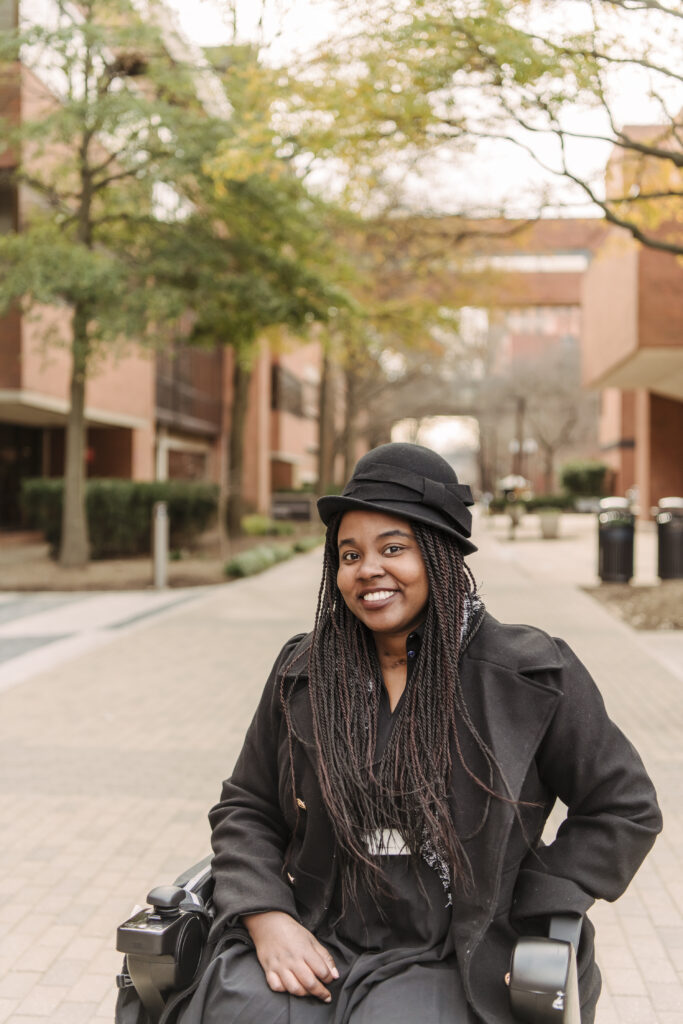 Smith on a visit to campus in 2023. (Marlayna Demond ’11/UMBC)
Everything Smith does now, even previously simple tasks such as getting dressed, have become complicated, time-consuming, and in her words, “close to an Olympic sport,” ever since Chandra’s Life As She Knew It screeched to a halt in the fall of 2021 when she fainted after fasting for religious purposes. She was medevaced to Georgetown University Hospital, when her body started shutting down, and then she was pumped with medicines to keep her organs functioning.
While life-saving, the emergency medicine she was given caused blood from her extremities to move to her core, essentially causing medical burns on 25 percent of her body and sepsis, triggering yet another medical emergency.
When a doctor told her she had 10 minutes to decide whether she wanted to live or die—with one small caveat: she’d be a triple amputee—Smith chose life.
She would go on to clock one year and one day from entering the hospital to exiting it, experiencing along the way: a stroke, dialysis, severe liver ketosis, three amputations, 10 painful surgeries (on one foot alone), and a host of other medical issues, procedures, and therapies.
Little did Smith know then, but the master’s degree in information systems she received from UMBC earlier that year would soon position her for a new role, a new voice and, ultimately, a new mission, not just within her job at the Defense Intelligence Agency (DIA), but in life.
“An upfront and center seat”
At age 32, Smith wasn’t looking for the campus-immersion experience she’d had when she was younger. “UMBC’s online masters program was the perfect mix of everything I wanted,” Smith says. Easy access to courses, professors with real-world experience, and fellow students from many walks of life and many parts of the world made picking UMBC an easy choice for Smith.
“I felt like I had an upfront and center seat in the field I was studying, as my professors wove challenges they faced in their jobs into the class instruction,” Smith says. Though, when reflecting on her experience at UMBC, the connections with other students stood out as most memorable to her.
“As I continued in the program, I often found myself in classes with people I’d met and worked with in previous classes,” she says. “To this day, I still come across people I recognize from the program when attending various professional conferences and events.”
A door opens
Long cloaked behind a “national-security exemption,” the nation’s seven intelligence agencies—including Smith’s employer, the DIA—had in recent years started addressing the complications of providing accessible technologies for disabled employees who needed what are called “reasonable accommodations” in order to do their work. This issue was particularly complex for those whose work involved top-clearance activities. For the DIA, a key area of concern was making sure their internal website met federal accessibility standards and requirements for online content.
The agency needed an IT engineer who could review various technologies used by employees—such as a Bluetooth hearing device for deaf or hard-of-hearing employees who need to access sensitive compartmented Information rooms or voice-to-text tools for someone with limited hand mobility. The official could then grant approval to use these technologies in national intelligence and top-secret environments. Smith, with her new degree in information systems, was the only person in her department with the skills to do this work.
 From left to right: Anne Arundel County Executive Steuart Pittman; Carol Beatty, Maryland Department of Disabilities; Chandra Smith, Ms. Wheelchair America 2024; Karrisa Kelly, director, Department of Aging and Disabilities. (Photo courtesy of Smith)
“The job just fell in my lap after I graduated,” Smith says, who notes that in this “before” version of her life, she saw the position as important, but it had yet to become personal to her. “As I dove in, I found the field and challenges fascinating in that I had to balance significant national-security concerns with the legitimate and legally compelling needs for people with various disabilities to be given ‘reasonable accommodations’ to do their intelligence-related work.”
And then things became personal
Only several months after earning her master’s degree, Smith experienced her medical trauma and began her year-long hospital stay of surgeries, occupational therapy, and recovery—including six months in the burn unit. But in the midst of this, Smith found time to apply for a higher government position, received the promotion, and came back to the DIA a notch up in her career, with more fire in her than ever and now positioned as a team lead, mentor, and accessibility policy creator.
“It’s one thing to try and think like someone who has various disabilities,” Smith says. “It’s another thing to be that person: to be a triple amputee and someone who, essentially, doesn’t have functioning appendages.” (Her one remaining appendage—her right hand—was rendered near-useless and stiff when she had a stroke in the hospital.) “There are so many more nuances and deeper levels of understanding about universal design and accessible technology I understand now because I have to face these hurdles and challenges myself.”
At UMBC, I felt like I had an upfront and center seat in the field I was studying, as my professors wove challenges they faced in their jobs into the class instruction.
Chandra Smith, M.S. ’21
In her new role, she still advocates for expanded definitions of reasonable accommodation hardware and software for employees, but now Smith gravitates toward policy and agency-wide mandates. And she’s creating change not just at the DIA, but across all the nation’s intelligence agencies. “I’m absolutely and avidly an advocate for universal design and making these technologies available to more people.”
Smith has had to advocate for herself and her own needs, too, including a desk printer she can access from her wheelchair, a sit-to-stand desk, working from home for a significant portion of the week, voice-recognition software, speech-to-text software, and a policy change for the need to provide biodata such as fingerprints. She asks, “How can someone provide a fingerprint if they don’t have a hand?”
There she is …
Of all the things a younger Smith never saw in her future, being crowned Ms. Wheelchair America 2024 was certainly one of them.
 Top 5 contestants and members of the board at the 2024 Ms. Wheelchair America (MWA) pageant. For the past 52 years, MWA has given women with disabilities an opportunity to enact meaningful change in society. (Photo courtesy of Smith)
But after her medical trauma, she was encouraged to compete in the Ms. Wheelchair Maryland 2023 contest, which she won; and that title allowed her to compete nationally, which she also won. More of a competition about resilience, advocacy, and helping to eliminate architectural and attitudinal barriers people with disabilities experience in the world, Smith’s response was, “I can do that!”
“The contest judges and members of the board were quite taken with Chandra’s presence, the clarity and logic with which she advocates about universal design, her personal story and challenges… and coming out all the stronger,” says Shelly Loose, president of Ms. Wheelchair America.
“Even before I was so personally impacted by these workplace and daily accessibility challenges of being disabled,” says Smith, “I could already see how designing for the few helps the many.”
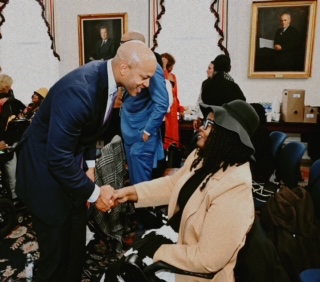 Maryland governor Wes Moore shakes hands with Smith at the governor’s mansion. (Photo courtesy of Smith)
For example, closed captioning of videos for hearing-impaired people helps many others with improved comprehension and retention. Ramps into buildings help people in wheelchairs and parents with strollers. “Universal design is inclusive. It should be the starting point, not an afterthought,” Smith says.
Maryland Governor Wes Moore heard of Smith’s work after she testified for a Prince George’s County universal-access bill. Soon after, he appointed her to a three-year term on the Maryland Commission on Disabilities, where she’s already working on accessibility policy recommendations to support a variety of disabilities. “We just recommended rewriting the MVA manual to a 6th-grade level to accommodate those with learning and reading disabilities,” Smith says. “Disabilities manifest in many ways—seen and unseen.”
Architecture and attitudes toward accessibility
For as much as Smith and others advocate for universal design and reasonable accommodations at work, at the end of the day, people and their attitudes about their peers with disabilities are the biggest hurdle to overcome, she says.
When Smith returned to work after her medical trauma, one coworker said, “If that happened to me, I’d kill myself.” Another one asked, “Do you know you’re missing a leg?”
Eyes rolled but mind set, Smith plows on. “There aren’t many people who look like me in a military-focused work environment, as most people who are disabled or use a wheelchair are discharged and don’t return to their former jobs,” she says.
While Smith has suffered quite a few “slings and arrows of outrageous fortune,” as Shakespeare put it, she knows the way forward is, well, forward. “When I was an able-bodied person, I had some bad days. As a disabled person, I have some incapacitating days. But I’ve come to understand that having difficult days doesn’t make a bad life. I appreciate more things now. I have more gratitude,” Smith says.
“I know it’s cliché and a bit corny, but if I help one employer add voice-to-text software for their employees or one property manager install a ramp for a building, I’ve done my job,” Smith says. “Universal design is a core value; it’s a perspective; it’s a way of seeing the world and making things accessible for all because—and I can speak from experience here—being disabled is a club anyone can join at any moment for any reason.”
]]>
By Jessie Newburn It’s 4 a.m. on a Wednesday—earlier than most people rise, though a preference for Chandra Smith, M.S. ’21, information systems. After saying her daily devotion, she begins...
https://umbc.edu/stories/chandra-smith-works-for-accessibility-for-all/
https://my3.my.umbc.edu/api/v0/pixel/news/138143/guest@my.umbc.edu/a99abdc07778f2d5e79b60d650ed79dc/api/pixel
alumni
coeit
is
magazine
story
UMBC News & Magazine
https://my3.my.umbc.edu/groups/umbc-news-magazine
https://assets1-my.umbc.edu/system/shared/avatars/groups/000/001/943/24435aa6207c452e7bc15cc74b42c7bb/xsmall.png?1748556657
https://assets1-my.umbc.edu/system/shared/avatars/groups/000/001/943/24435aa6207c452e7bc15cc74b42c7bb/original.png?1748556657
https://assets2-my.umbc.edu/system/shared/avatars/groups/000/001/943/24435aa6207c452e7bc15cc74b42c7bb/xxlarge.png?1748556657
https://assets2-my.umbc.edu/system/shared/avatars/groups/000/001/943/24435aa6207c452e7bc15cc74b42c7bb/xlarge.png?1748556657
https://assets3-my.umbc.edu/system/shared/avatars/groups/000/001/943/24435aa6207c452e7bc15cc74b42c7bb/large.png?1748556657
https://assets1-my.umbc.edu/system/shared/avatars/groups/000/001/943/24435aa6207c452e7bc15cc74b42c7bb/medium.png?1748556657
https://assets2-my.umbc.edu/system/shared/avatars/groups/000/001/943/24435aa6207c452e7bc15cc74b42c7bb/small.png?1748556657
https://assets1-my.umbc.edu/system/shared/avatars/groups/000/001/943/24435aa6207c452e7bc15cc74b42c7bb/xsmall.png?1748556657
https://assets2-my.umbc.edu/system/shared/avatars/groups/000/001/943/24435aa6207c452e7bc15cc74b42c7bb/xxsmall.png?1748556657
UMBC News & Magazine
0
0
false
Wed, 10 Jan 2024 16:06:00 -0500
Wed, 10 Jan 2024 16:06:00 -0500
UMBC joins national effort to improve pathways for women of color in tech
Earlier this month, UMBC joined dozens of other founding institutions at the kick-off meeting of a newly launched initiative to ensure sustained resources and opportunities in tech fields for women of color.
The effort, called the Action Collaborative on Transforming Trajectories for Women of Color in Tech, is organized by the National Academies of Science, Engineering, and Medicine and guided by the findings and recommendations detailed in a 2022 National Academies report. According to the report, while women of color make up a substantial and growing percentage of the female population in the United States, they earn a small percentage of computing degrees, and remain significantly underrepresented in the tech workforce.
UMBC has a history of success running programs, such the nationally recognized Meyerhoff Scholars Program and the Center for Women in Technology, that work to advance equity and inclusion and increase diversity among future leaders in science, technology, engineering, and related fields.
“Tech jobs are a vital part of our society,” says Anupam Joshi, the acting dean of the College of Engineering and Information Technology at UMBC. “We need to tap the entire talent base of the country to fill these jobs.”
UMBC’s efforts as part of the action collaborative will be a continuation of the university’s commitment to supporting students from underrepresented groups as they pursue technical education, he says. “UMBC has a solid foundation that we can build on.”
The action collaborative will offer participating institutions—representing higher education, national laboratories, and government—a platform to exchange ideas and promising practices for increasing the recruitment, retention, and advancement in tech fields of women who identify as African American, Black, Hispanic, Latina, Native American, Asian American, Alaska Native, Native Hawaiian, or Pacific Islander.
The action collaborative’s member institutions will collaborate over the coming four years to share novel, promising, and evidence-based practices, discuss and advance research priorities, share data collection practices, and more.
“This initiative will require dedication and collaboration from all of us,” said National Academy of Sciences President Marcia McNutt, in a press release. “We are committed to facilitating research, collaboration, and action that reflect the representation and lived experiences of women of color, in hopes of driving substantial change in the tech and engineering ecosystem.”
More information can be found on the action collaborative’s website.
]]>
Earlier this month, UMBC joined dozens of other founding institutions at the kick-off meeting of a newly launched initiative to ensure sustained resources and opportunities in tech fields for...
https://umbc.edu/stories/umbc-joins-national-effort-to-improve-pathways-for-women-of-color-in-tech/
https://my3.my.umbc.edu/api/v0/pixel/news/137923/guest@my.umbc.edu/fc46c4b4fedb5d73fe4d09257e4a3dc4/api/pixel
coeit
news
science-and-tech
UMBC News & Magazine
https://my3.my.umbc.edu/groups/umbc-news-magazine
https://assets1-my.umbc.edu/system/shared/avatars/groups/000/001/943/24435aa6207c452e7bc15cc74b42c7bb/xsmall.png?1748556657
https://assets1-my.umbc.edu/system/shared/avatars/groups/000/001/943/24435aa6207c452e7bc15cc74b42c7bb/original.png?1748556657
https://assets2-my.umbc.edu/system/shared/avatars/groups/000/001/943/24435aa6207c452e7bc15cc74b42c7bb/xxlarge.png?1748556657
https://assets2-my.umbc.edu/system/shared/avatars/groups/000/001/943/24435aa6207c452e7bc15cc74b42c7bb/xlarge.png?1748556657
https://assets3-my.umbc.edu/system/shared/avatars/groups/000/001/943/24435aa6207c452e7bc15cc74b42c7bb/large.png?1748556657
https://assets1-my.umbc.edu/system/shared/avatars/groups/000/001/943/24435aa6207c452e7bc15cc74b42c7bb/medium.png?1748556657
https://assets2-my.umbc.edu/system/shared/avatars/groups/000/001/943/24435aa6207c452e7bc15cc74b42c7bb/small.png?1748556657
https://assets1-my.umbc.edu/system/shared/avatars/groups/000/001/943/24435aa6207c452e7bc15cc74b42c7bb/xsmall.png?1748556657
https://assets2-my.umbc.edu/system/shared/avatars/groups/000/001/943/24435aa6207c452e7bc15cc74b42c7bb/xxsmall.png?1748556657
UMBC News & Magazine
0
0
false
Thu, 21 Dec 2023 12:16:45 -0500
UMBC joins national effort to improve pathways for women of color in tech
Earlier this month, UMBC joined dozens of other founding institutions at the kick-off meeting of a newly launched initiative to ensure sustained resources and opportunities in tech fields for women of color.
The effort, called the Action Collaborative on Transforming Trajectories for Women of Color in Tech, is organized by the National Academies of Science, Engineering, and Medicine and guided by the findings and recommendations detailed in a 2022 National Academies report. According to the report, while women of color make up a substantial and growing percentage of the female population in the United States, they earn a small percentage of computing degrees, and remain significantly underrepresented in the tech workforce.
UMBC has a history of success running programs, such the nationally recognized Meyerhoff Scholars Program and the Center for Women in Technology, that work to advance equity and inclusion and increase diversity among future leaders in science, technology, engineering, and related fields.
“Tech jobs are a vital part of our society,” says Anupam Joshi, the acting dean of the College of Engineering and Information Technology at UMBC. “We need to tap the entire talent base of the country to fill these jobs.”
UMBC’s efforts as part of the action collaborative will be a continuation of the university’s commitment to supporting students from underrepresented groups as they pursue technical education, he says. “UMBC has a solid foundation that we can build on.”
The action collaborative will offer participating institutions—representing higher education, national laboratories, and government—a platform to exchange ideas and promising practices for increasing the recruitment, retention, and advancement in tech fields of women who identify as African American, Black, Hispanic, Latina, Native American, Asian American, Alaska Native, Native Hawaiian, or Pacific Islander.
The action collaborative’s member institutions will collaborate over the coming four years to share novel, promising, and evidence-based practices, discuss and advance research priorities, share data collection practices, and more.
“This initiative will require dedication and collaboration from all of us,” said National Academy of Sciences President Marcia McNutt, in a press release. “We are committed to facilitating research, collaboration, and action that reflect the representation and lived experiences of women of color, in hopes of driving substantial change in the tech and engineering ecosystem.”
More information can be found on the action collaborative’s website.
]]>
Earlier this month, UMBC joined dozens of other founding institutions at the kick-off meeting of a newly launched initiative to ensure sustained resources and opportunities in tech fields for...
https://umbc.edu/stories/action-collective-women-of-color-in-tech/
https://my3.my.umbc.edu/api/v0/pixel/news/137929/guest@my.umbc.edu/1917641fc956dca993f320cfa475caf8/api/pixel
coeit
news
science-and-tech
UMBC News & Magazine
https://my3.my.umbc.edu/groups/umbc-news-magazine
https://assets1-my.umbc.edu/system/shared/avatars/groups/000/001/943/24435aa6207c452e7bc15cc74b42c7bb/xsmall.png?1748556657
https://assets1-my.umbc.edu/system/shared/avatars/groups/000/001/943/24435aa6207c452e7bc15cc74b42c7bb/original.png?1748556657
https://assets2-my.umbc.edu/system/shared/avatars/groups/000/001/943/24435aa6207c452e7bc15cc74b42c7bb/xxlarge.png?1748556657
https://assets2-my.umbc.edu/system/shared/avatars/groups/000/001/943/24435aa6207c452e7bc15cc74b42c7bb/xlarge.png?1748556657
https://assets3-my.umbc.edu/system/shared/avatars/groups/000/001/943/24435aa6207c452e7bc15cc74b42c7bb/large.png?1748556657
https://assets1-my.umbc.edu/system/shared/avatars/groups/000/001/943/24435aa6207c452e7bc15cc74b42c7bb/medium.png?1748556657
https://assets2-my.umbc.edu/system/shared/avatars/groups/000/001/943/24435aa6207c452e7bc15cc74b42c7bb/small.png?1748556657
https://assets1-my.umbc.edu/system/shared/avatars/groups/000/001/943/24435aa6207c452e7bc15cc74b42c7bb/xsmall.png?1748556657
https://assets2-my.umbc.edu/system/shared/avatars/groups/000/001/943/24435aa6207c452e7bc15cc74b42c7bb/xxsmall.png?1748556657
UMBC News & Magazine
0
0
false
Thu, 21 Dec 2023 12:16:45 -0500
Three sisters—all alums—share their family’s recipes for food and comfort

Aimee, Jamie, and Gina Joshua have a lot in common. All three went to UMBC as members of the Meyerhoff Scholars Program. And the sisters all have great memories of growing up in a house filled with delicious food and love. So, when their mother’s YouTube channel focusing on Indian cooking techniques started to take off, the trio made it their mission to create a cookbook of family recipes that would honor their beloved parents.
Our parents, Sara and Abraham Joshua, known to us as Mummy and Chacha, immigrated from India in their twenties separately to begin their careers and continued education to help provide for their families back home. Coming to America in the ’70s, they were learning how to navigate a new country and a new culture. After getting married and starting a family, they began raising three daughters in Baltimore, Maryland. The challenge was to figure out how to teach and preserve our Indian culture and traditions when it was over 8,000 miles away.
 The Joshua Sisters: Gina, Jamie, and Aimee.
Growing up as “the Joshua sisters,” we did many things together—singing songs in church at talent shows, Girl Scouts, karate, and even attending UMBC! They wanted the best for us and every day showed us the value and importance of hard work and being and staying humble. Since we were young girls, Mummy and Chacha taught us that everything is possible if you put your mind to it and work hard. Our parents encouraged us to chase our dreams, but as with many parents, they didn’t think about pursuing their own, only providing for their family.
Mummy, affectionately known as “Ammini Aunty,” was a nurse at the University of Maryland Medical System and Chacha, affectionately known as “Bejoy Uncle,” was a realtor. They both kept busy outside of work hours with community and church activities.
If you wanted to find our parents in the house, it was usually in the kitchen—and the garden was a close second. Mummy loved to cook our traditional South Indian dishes and prepare food for others and Chacha enjoyed being her sous chef. Food was their love language and we had so many conversations around the kitchen table.
During our years at UMBC, we often brought Mummy’s home-cooked food when we returned to campus, always willing to share some chicken biriyani or beans mezhukkupuratti with our friends. Mummy didn’t often have time to do more than cooking for her family or special events because of her nursing career and her focus on our education. This meant she didn’t get to cook and experiment as much as she would have liked. It was only once we were in college that we began to understand the joy being in the kitchen would bring her.
Once we were older, some of our favorite memories were when we gathered in the kitchen to catch up on how everyone’s day had been. When we came home with our friends, Mummy would recruit them to help prepare whatever was on the menu, even if they had never cooked before. We did our best and Mummy would walk us through the recipe and cooking techniques with a lot of patience. Mummy always said “If you put your mind to it, you can do it. It’s a passion, and it takes hard work. But at the end of it all, you get something great.”
Food is meant to be shared, and while Mummy was teaching us to cook, she was also teaching us to curate and nurture relationships and be proud of our culture.
The Joshua Sisters
Whether we were peeling ginger, grating coconut, or chopping vegetables, we knew we were not just creating a meal, we were also building and creating something better: loving memories and an appreciation for our Kerala food. Because that’s what it’s about.
Food is meant to be shared, and while Mummy was teaching us to cook, she was also teaching us to curate and nurture relationships and be proud of our culture. Cooking together is creating together, which involves trust and building a connection between each person helping create the meal. In addition, we are Indian American and are so proud of what it means to be both Indian and American.
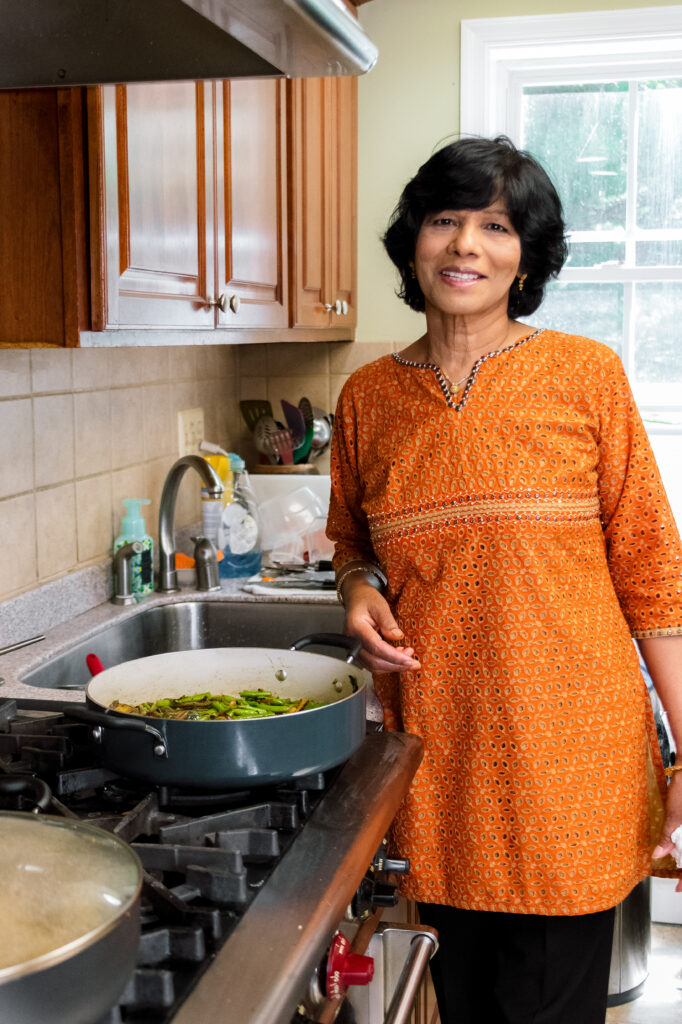 Known as Mummy to her three girls, Sara Joshua poses in her kitchen.
We learned an important lesson during our time at UMBC, taught to us by the late great Lamont Toliver, “Mr. T,” former director of the Meyerhoff Scholarship Program. In a moment of vulnerability, Aimee shared with Mr. T that she had been rejected by all of the Ph.D. programs she had applied to but had gotten into a master’s program.
In all his wisdom, Mr. T comforted Aimee with these wise words: “Not all paths from point A to point B are a straight line. Sometimes you have to take the long way to get where you want to go.” That’s a lesson that has stayed with us for some time and that, we soon realized during the pandemic, applied to Mummy.
By this time, Gina had started a family and we welcomed our next generation of children. The pandemic taught us how precious life is and that making every moment count is important. As sisters, we decided that we would work together to make Mummy’s dream of teaching our generation and future generations how to cook Kerala food come true.
After the pandemic began, Mummy retired from an over 40-year nursing career to help care for Chacha and avoid any risk due to COVID-19. With more time as a retiree, Mummy began experimenting with recipes and sharing them with close by family, who would pick up the care packages she would leave on the porch. They would then text or call her with feedback, helping perfect the recipes.
In April 2020, Mummy came into our room and asked if we wanted to take a picture of what she was cooking in the kitchen. So Jamie and Aimee, armed only with their iPhones and short notice to their friends online, began to livestream Mummy making Mango curry. Then the unexpected happened.
Thousands of people watched it within the first three days, and a flame was lit. Instead of waiting for perfection, we continued to dive into video after video, each an improvement on the one before. What started as a fun project became a thriving YouTube channel, Ammini Aunty’s A Pinch of Kerala, and a full-blown community of “Pinchers.” People were excited to learn from Mummy, and we were all thrilled to share her love for cooking with everyone.
Fast forward to today, our first cookbook, Ammini Aunty’s A Pinch of Kerala: A South Indian Inspired Cookbook, is being published. Thanks to the power of Kickstarter and Pinchers worldwide, what was just once a dream is now becoming a reality. As Mummy reminds her Pinchers, “If you put your mind to it, you can do it.” Don’t let your dreams stay a dream. Work toward making it a reality.
Jamie Joshua ’02, biological sciences, is the diversity, equity, and inclusion manager for Giant Food. Aimee Joshua ’03, M.S. ’05, computer science, is the senior manager, IT contracts, at PBS Distribution. Gina Wright ’05, biological sciences, is a dentist at a Veterans Affairs Medical Center.
]]>
Aimee, Jamie, and Gina Joshua have a lot in common. All three went to UMBC as members of the Meyerhoff Scholars Program. And the sisters all have great memories of growing up in a house filled...
https://umbc.edu/stories/three-sisters-keep-family-recipes-alive-in-book/
https://my3.my.umbc.edu/api/v0/pixel/news/137616/guest@my.umbc.edu/8b9de66ee2fe755d391c1d9411f14bcb/api/pixel
alumni
alumni-essay
biological-sciences
coeit
computer-science
fall-2023
magazine
meyerhoff-scholar
UMBC News & Magazine
https://my3.my.umbc.edu/groups/umbc-news-magazine
https://assets1-my.umbc.edu/system/shared/avatars/groups/000/001/943/24435aa6207c452e7bc15cc74b42c7bb/xsmall.png?1748556657
https://assets1-my.umbc.edu/system/shared/avatars/groups/000/001/943/24435aa6207c452e7bc15cc74b42c7bb/original.png?1748556657
https://assets2-my.umbc.edu/system/shared/avatars/groups/000/001/943/24435aa6207c452e7bc15cc74b42c7bb/xxlarge.png?1748556657
https://assets2-my.umbc.edu/system/shared/avatars/groups/000/001/943/24435aa6207c452e7bc15cc74b42c7bb/xlarge.png?1748556657
https://assets3-my.umbc.edu/system/shared/avatars/groups/000/001/943/24435aa6207c452e7bc15cc74b42c7bb/large.png?1748556657
https://assets1-my.umbc.edu/system/shared/avatars/groups/000/001/943/24435aa6207c452e7bc15cc74b42c7bb/medium.png?1748556657
https://assets2-my.umbc.edu/system/shared/avatars/groups/000/001/943/24435aa6207c452e7bc15cc74b42c7bb/small.png?1748556657
https://assets1-my.umbc.edu/system/shared/avatars/groups/000/001/943/24435aa6207c452e7bc15cc74b42c7bb/xsmall.png?1748556657
https://assets2-my.umbc.edu/system/shared/avatars/groups/000/001/943/24435aa6207c452e7bc15cc74b42c7bb/xxsmall.png?1748556657
UMBC News & Magazine
2
0
false
Thu, 07 Dec 2023 16:32:28 -0500
Thu, 07 Dec 2023 16:32:28 -0500
As summer wildfire smoke choked Baltimore, UMBC air pollution researchers leapt into action

Starting this May, a series of wildfires in Eastern Canada sent enormous smoke clouds wafting into the U.S., triggering air quality warnings in cities from the Midwest to the Northeast. For days, orange skies backdropped landscapes clouded by acrid air. People who could hunkered inside with the doors and windows shut. Those who had to go out faced itchy eyes, burning throats, and worse.
As a resident of the Baltimore area—which was blanketed with particularly bad smoke in both early and late June—UMBC Professor Chris Hennigan looked at the haze with dismay. But as an environmental engineer who studies air pollution, he had an additional thought: “We were looking at the air quality forecasts, and we thought ‘We have to gather data,’” he says.
The public found many colorful words to describe the summer’s unwanted smoke: brutal, eerie, dystopian.
Hennigan and his team have been working to put numbers to the adjectives. On the roof of the engineering building, the researchers installed a squat, white sensor that monitors the levels of tiny particles in the air, particularly those measuring 2.5 micrometers in diameter or less—smaller than most bacteria. Called PM2.5, these particles are released in large numbers during fires. They are dangerous to human health because they can work their way into the deepest parts of the lungs and even enter the bloodstream.
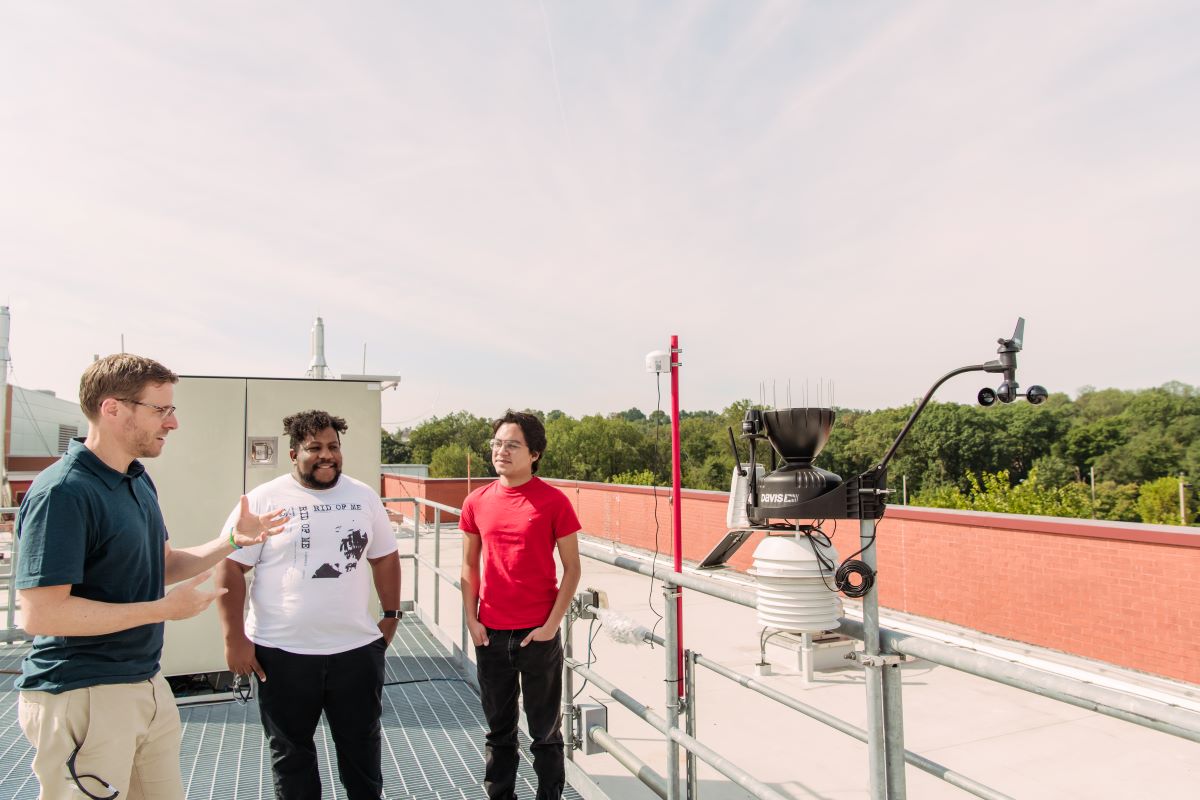 Chris Hennigan, Joel Tyson, Ph.D. ’23, and Luis Rodriguez ’25 (left to right) on the roof of the engineering building next to an air quality sensor. (Marlayna Demond ’11/UMBC)
The sensor showed huge spikes in PM2.5 when the smoke blew through, on some days reaching levels considered unhealthy for anyone to breathe.
The researchers also set up equipment to filter particles out of the air. After 24 hours, they collected the filters, which they are storing, neatly labeled, in a refrigerator in Hennigan’s lab.
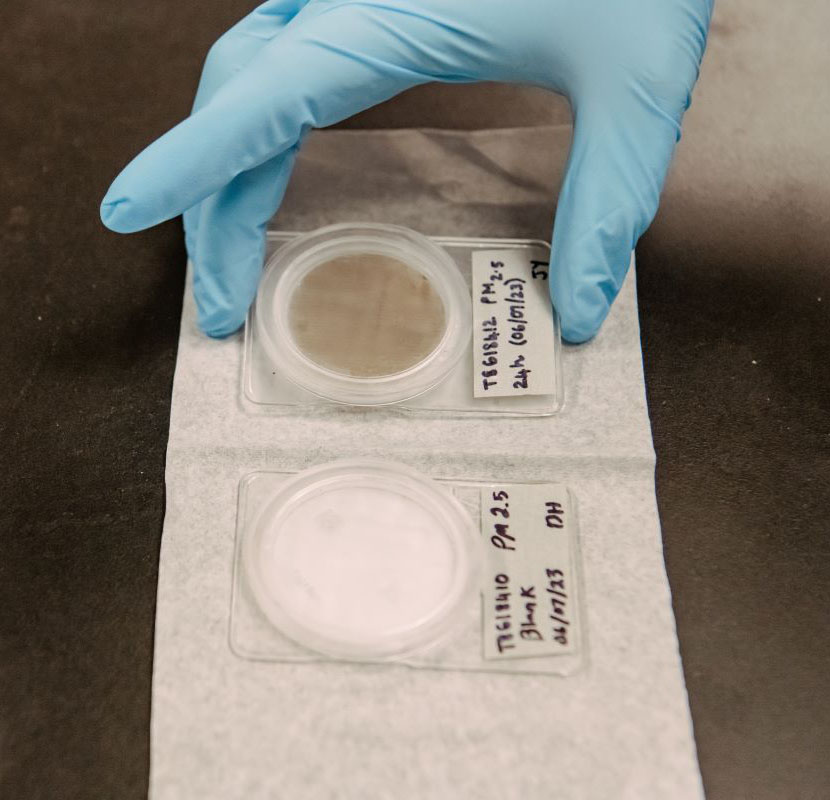 Hennigan shows samples of smoke particles collected this summer. (Marlayna Demond ’11/UMBC)
The filtered samples will advance at least two ongoing investigations, Hennigan says. In one avenue of inquiry, Joel Tyson, Ph.D. ’23, biochemical engineering, is studying how tiny particles can harm human lung cells. Before this year’s smoky summer, Tyson had been studying the toxic effects of particulate matter normally found in the Baltimore air. With the new smoke samples, he will start to investigate whether wildfire smoke particles, per unit, are more toxic than regular urban particulate matter, which comes from sources such as cars and power plants. Some studies have indicated that wildfire particulate matter is indeed more toxic, but more research is needed before any definitive conclusions can be reached.
In another line of research, Hennigan is also studying how particles in the air, including from smoke, may affect the climate. Undergraduate chemical engineering students Danielle Larios ’25 and Luis Rodriguez ’25 are assisting in the investigations.
The researchers study how particles of brown-colored carbon-containing material absorb light. Burning vegetation sends large amounts of this brown carbon into the atmosphere. It’s possible that the particles are trapping significant heat from the sun, accelerating the pace of planetary warming. Such effects are not normally included in global climate models, and better understanding of the process could improve humanity’s ability to predict, and manage, the coming years of climate upheaval.
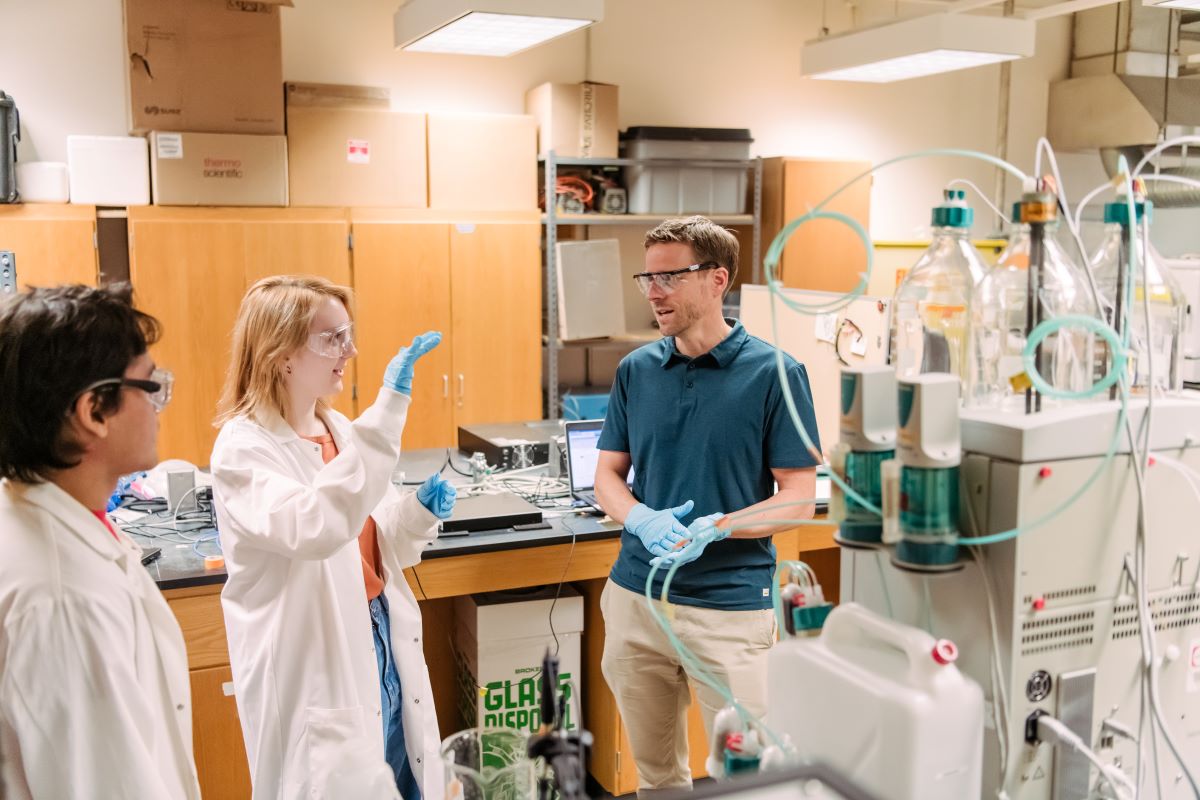 Rodriguez, Danielle Larios ’25 and Hennigan (left to right) discuss research in the lab. (Marlayna Demond ’11/UMBC)
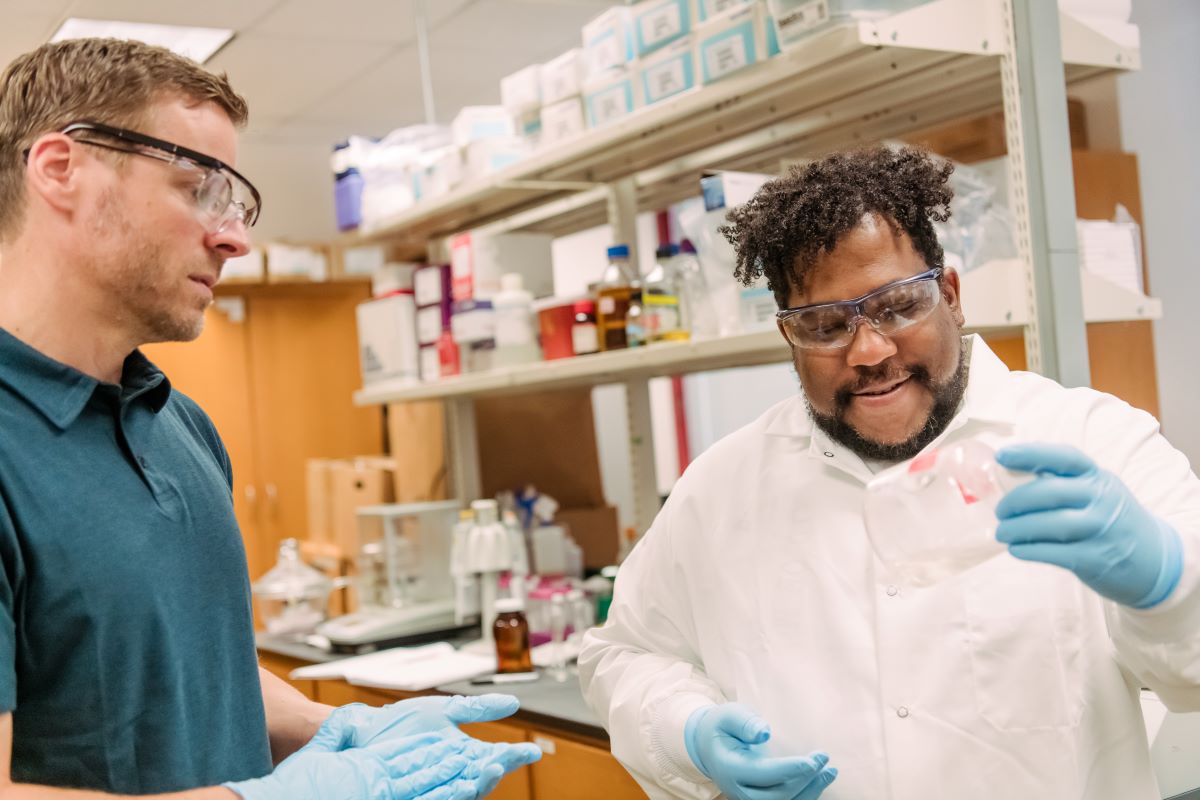 Hennigan and Tyson in the lab. (Marlayna Demond ’11/UMBC)
Climate change and wildfires are intimately linked. This summer was not only smoky, but also scorching. July marked the hottest month ever recorded, and scientists predict that as the world continues to warm, wildfires will continue to increase in quantity and intensity. “Smokeageddon,” as headlines put it, may become the new normal.
Hennigan says recent research illuminates how much wildfire smoke has contributed to air pollution trends. He points to a paper published in September in the scientific journal Nature that estimated that since 2016, wildfire smoke in the contiguous United States has undone around 25% of the progress in air quality made between 2000 and 2016.
For the researchers in Hennigan’s lab, those effects have been felt personally.
Rodriguez recalled how in June he had to go out to buy a fresh pack of N95 masks. “The smoke was just awful,” he says. Larios says she felt a burning at the back of her throat in just 15 minutes walking to her car.
For Tyson, the effects of the smoke were so bad that at one point he struggled to breathe and had to visit the doctor. The episode, he says, drove home the importance of his toxicology research.
All three note both the complexity of the systems they are studying and the importance of discovering new knowledge that might help society handle the environmental challenges it faces.
“Our work can have real-world impact, and that’s exciting,” says Larios.
]]>
Starting this May, a series of wildfires in Eastern Canada sent enormous smoke clouds wafting into the U.S., triggering air quality warnings in cities from the Midwest to the Northeast. For days,...
https://umbc.edu/stories/wildfire-smoke-research/
https://my3.my.umbc.edu/api/v0/pixel/news/137596/guest@my.umbc.edu/c05ae348755b0ec976c77402d2616d21/api/pixel
cbee
coeit
discovery
fall-2023
magazine
research
UMBC News & Magazine
https://my3.my.umbc.edu/groups/umbc-news-magazine
https://assets1-my.umbc.edu/system/shared/avatars/groups/000/001/943/24435aa6207c452e7bc15cc74b42c7bb/xsmall.png?1748556657
https://assets1-my.umbc.edu/system/shared/avatars/groups/000/001/943/24435aa6207c452e7bc15cc74b42c7bb/original.png?1748556657
https://assets2-my.umbc.edu/system/shared/avatars/groups/000/001/943/24435aa6207c452e7bc15cc74b42c7bb/xxlarge.png?1748556657
https://assets2-my.umbc.edu/system/shared/avatars/groups/000/001/943/24435aa6207c452e7bc15cc74b42c7bb/xlarge.png?1748556657
https://assets3-my.umbc.edu/system/shared/avatars/groups/000/001/943/24435aa6207c452e7bc15cc74b42c7bb/large.png?1748556657
https://assets1-my.umbc.edu/system/shared/avatars/groups/000/001/943/24435aa6207c452e7bc15cc74b42c7bb/medium.png?1748556657
https://assets2-my.umbc.edu/system/shared/avatars/groups/000/001/943/24435aa6207c452e7bc15cc74b42c7bb/small.png?1748556657
https://assets1-my.umbc.edu/system/shared/avatars/groups/000/001/943/24435aa6207c452e7bc15cc74b42c7bb/xsmall.png?1748556657
https://assets2-my.umbc.edu/system/shared/avatars/groups/000/001/943/24435aa6207c452e7bc15cc74b42c7bb/xxsmall.png?1748556657
UMBC News & Magazine
2
0
false
Thu, 07 Dec 2023 08:43:35 -0500
Thu, 07 Dec 2023 08:43:35 -0500
UMBC chapter of National Society of Black Engineers (NSBE) shines at regional conference
Members of UMBC’s chapter of the National Society of Black Engineers (NSBE) traveled to Norfolk, Virginia for their annual regional conference in November and came home with numerous awards.
The UMBC team defeated Carnegie Mellon University and North Carolina State University to win the Tech Bowl competition, a Jeopardy-style game that tests teams’ knowledge of fundamental engineering principles. UMBC also claimed first through third place in the research poster presentation contest, which involved a 10-minute technical research talk followed by questions from the judges and audience.
The team relied on prior knowledge to excel in the Tech Bowl, only having decided to participate upon arriving at the conference. “It was really exciting getting so many questions right with our only practice being from our coursework,” shares UMBC NSBE chapter president Nelanne Bolima ’24, chemical engineering. “That just goes to show how well UMBC’s College of Engineering and IT prepares students to succeed.”
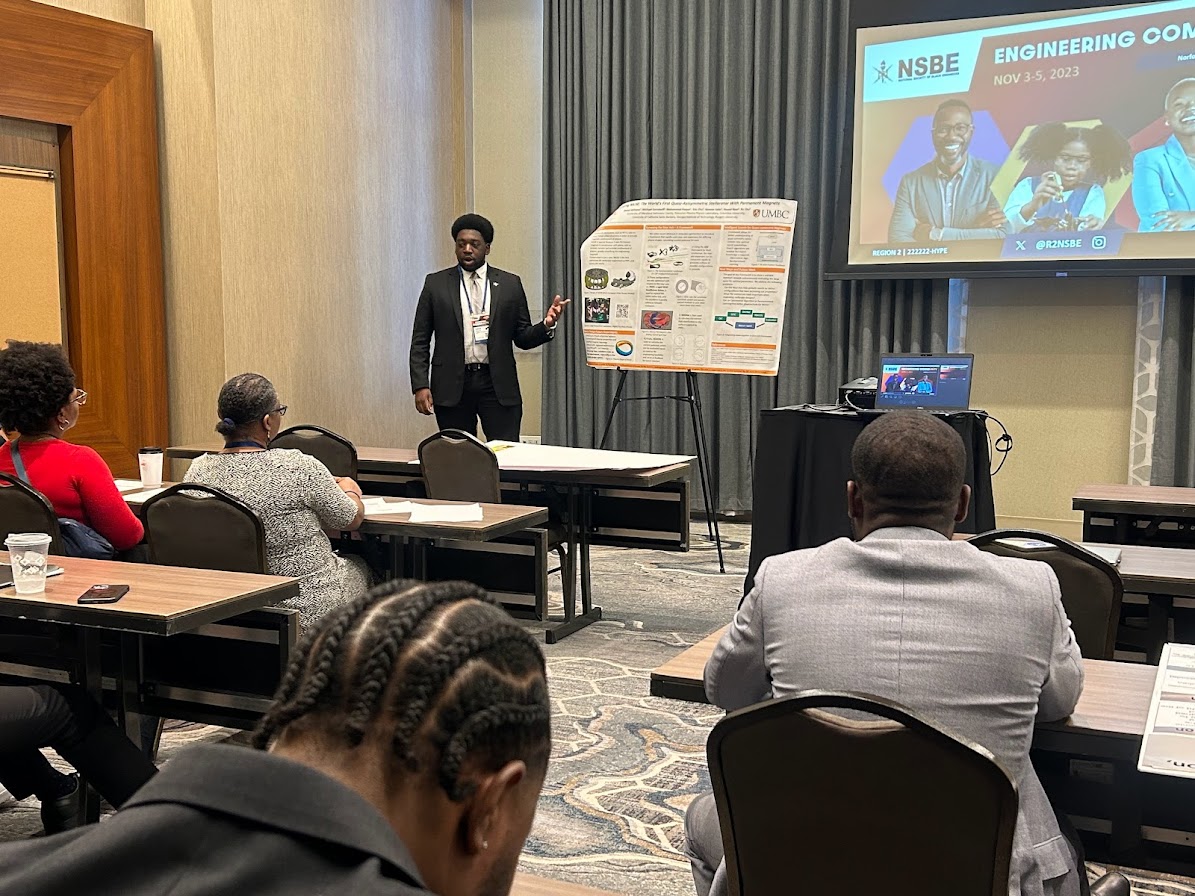 Daniel Williams gives his research presentation at the NSBE conference. (Image by Nelanne Bolima)
In addition to Bolima, the Tech Bowl team members included Kayla Magruder ’26, chemical engineering; Saleem Lawal ’25, computer science; and Daniel Williams ’24, computer science. Presentation winners were Williams (first), Bolima (second), and Christopher Appiah ’24, mechanical engineering (third). Keith Harmon, director of the UMBC Meyerhoff Scholars Program, serves as the chapter advisor.
“We are so proud of the UMBC NSBE Chapter,” Harmon shares. “They do tremendous work supporting UMBC STEM majors and offering service impacting youth in the Baltimore-Washington corridor.”
Students supporting students
NSBE is a completely student-run organization, creating leadership opportunities for hundreds of students across the country. UMBC’s NSBE chapter supports members through activities such as mentoring initiatives, conference preparation, networking opportunities, and leadership development programming. The chapter also focuses on community outreach, such as visiting high schools, collaborating with non-profits, and welcoming younger students to shadow the chapter’s board meetings.
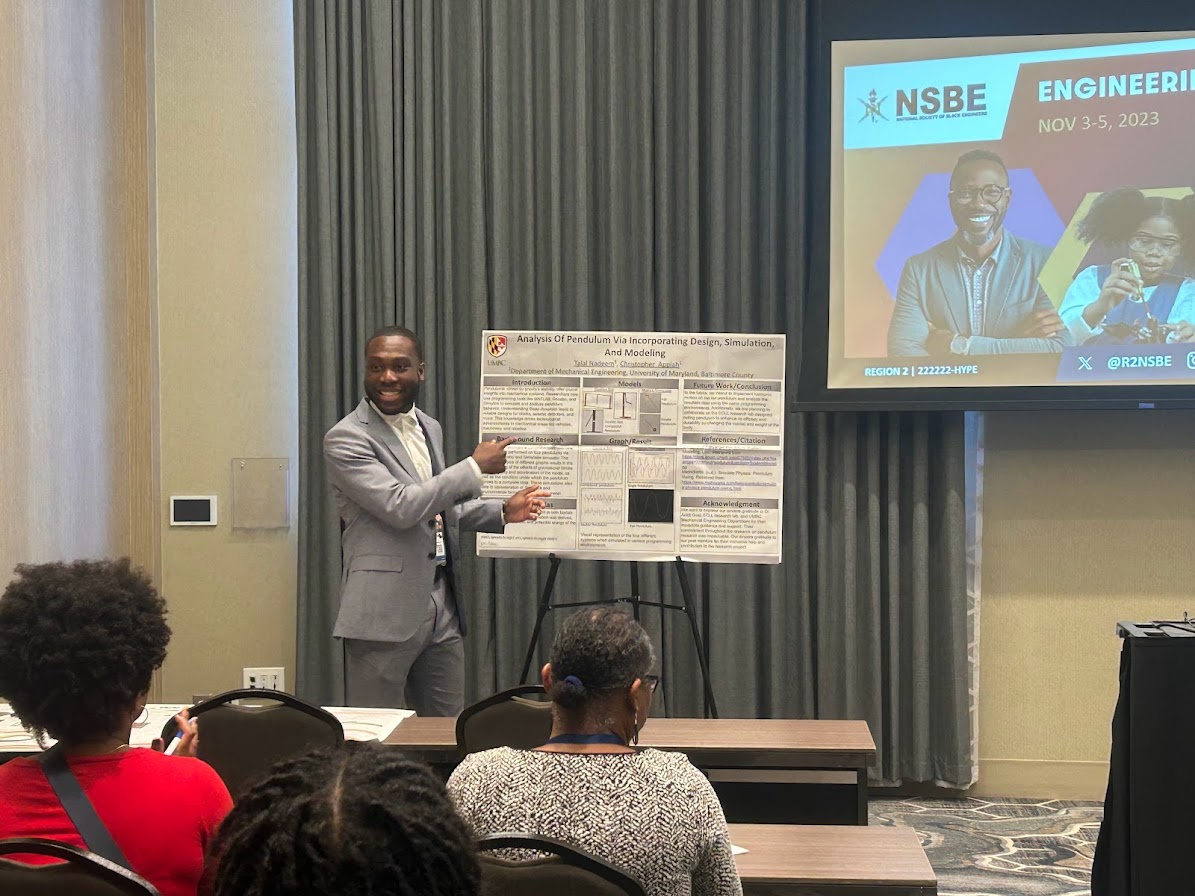 Christopher Appiah gives his research presentation at the NSBE conference. (Image by Nelanne Bolima)
“I have benefitted from being a member of this team by gaining invaluable public speaking and collaboration skills,” Appiah shares. “I learned how to effectively present, detailing the broader impact of research I have done.” Appiah conducts research with Ankit Goel, assistant professor of mechanical engineering. Goel’s group works on complex applications of control theory in robotics and autonomous systems.
For Jaden Somerville ’25, mechanical engineering, “the competition not only improved my technical skills, but also taught me teamwork, problem-solving, and effective time management.”
In March 2024, the chapter will take its talents to the 50th annual NSBE convention in Atlanta, Georgia.
]]>
Members of UMBC’s chapter of the National Society of Black Engineers (NSBE) traveled to Norfolk, Virginia for their annual regional conference in November and came home with numerous awards. ...
https://umbc.edu/stories/nsbe-shines-at-regional-conference/
https://my3.my.umbc.edu/api/v0/pixel/news/137559/guest@my.umbc.edu/101e4ba6879ab3f49b2abd337b9db36c/api/pixel
cbee
coeit
csee
meche
news
rca-2
science-and-tech
UMBC News & Magazine
https://my3.my.umbc.edu/groups/umbc-news-magazine
https://assets1-my.umbc.edu/system/shared/avatars/groups/000/001/943/24435aa6207c452e7bc15cc74b42c7bb/xsmall.png?1748556657
https://assets1-my.umbc.edu/system/shared/avatars/groups/000/001/943/24435aa6207c452e7bc15cc74b42c7bb/original.png?1748556657
https://assets2-my.umbc.edu/system/shared/avatars/groups/000/001/943/24435aa6207c452e7bc15cc74b42c7bb/xxlarge.png?1748556657
https://assets2-my.umbc.edu/system/shared/avatars/groups/000/001/943/24435aa6207c452e7bc15cc74b42c7bb/xlarge.png?1748556657
https://assets3-my.umbc.edu/system/shared/avatars/groups/000/001/943/24435aa6207c452e7bc15cc74b42c7bb/large.png?1748556657
https://assets1-my.umbc.edu/system/shared/avatars/groups/000/001/943/24435aa6207c452e7bc15cc74b42c7bb/medium.png?1748556657
https://assets2-my.umbc.edu/system/shared/avatars/groups/000/001/943/24435aa6207c452e7bc15cc74b42c7bb/small.png?1748556657
https://assets1-my.umbc.edu/system/shared/avatars/groups/000/001/943/24435aa6207c452e7bc15cc74b42c7bb/xsmall.png?1748556657
https://assets2-my.umbc.edu/system/shared/avatars/groups/000/001/943/24435aa6207c452e7bc15cc74b42c7bb/xxsmall.png?1748556657
UMBC News & Magazine
1
0
false
Tue, 05 Dec 2023 17:40:28 -0500
Tue, 05 Dec 2023 17:40:28 -0500
Office Hours

Each week during her student-facing office hours, UMBC President Valerie Sheares Ashby meets with students to chat about their lives and experiences at UMBC. Today, she’s speaking with Okechukwu Tabugbo ’25, computer engineering, president of UMBC’s Black Men’s Society, a group that provides mentorship, skills training, and community to students while trying to eliminate negative narratives and stigma around what it means to be a Black man in America.
Okechukwu Tabugbo: I found out about UMBC’s Black Men’s Society when I was in my first year. I knew Marvin Onwukwe, the club secretary at the time. He was always walking around campus smiling, and I would ask him, “Why are you smiling so much, Marvin?” He would say, “It’s because I have my life together. I have everything going for me. So what reason do I have to frown?” I would say, “Why do you have everything going for you?” He said, “Because I’m on top of my work. I can help you out, too. You should come to Black Men’s Society so that we can all be on top of our work.”
President Sheares Ashby: Oh, that is so good.
Tabugbo: But, in all honesty, I did not go to the first one. Then Amery Thompson…the current advisor, told me that I should come out, and I have to be honest, I did not go at that time either. [Laughs.] Then, finally, our current vice president, Israel Funmilayo…invited me, and he said, “It’s about financial literacy…I just need you to come out.” I looked at my bank account, and I said, “Okay.”
After getting there, I sat down. Amery was giving the introduction on financial literacy and telling us everything that we need to know. It honestly just made me feel at home and appreciated, the fact that someone took the time out of their day to teach me something that I constantly left on the back burner. I took that for what the club is.
I take it especially as a safe space for Black men on campus—to make them feel appreciated, to give them the time they need to grow in a world that rushes them so often. I appreciate the overall aspect of giving Black people on campus a space for professional development that they may not have had before and giving us a space to talk about issues surrounding the community. The Society allows everyone, despite their views, to be understood and to have time to understand others.
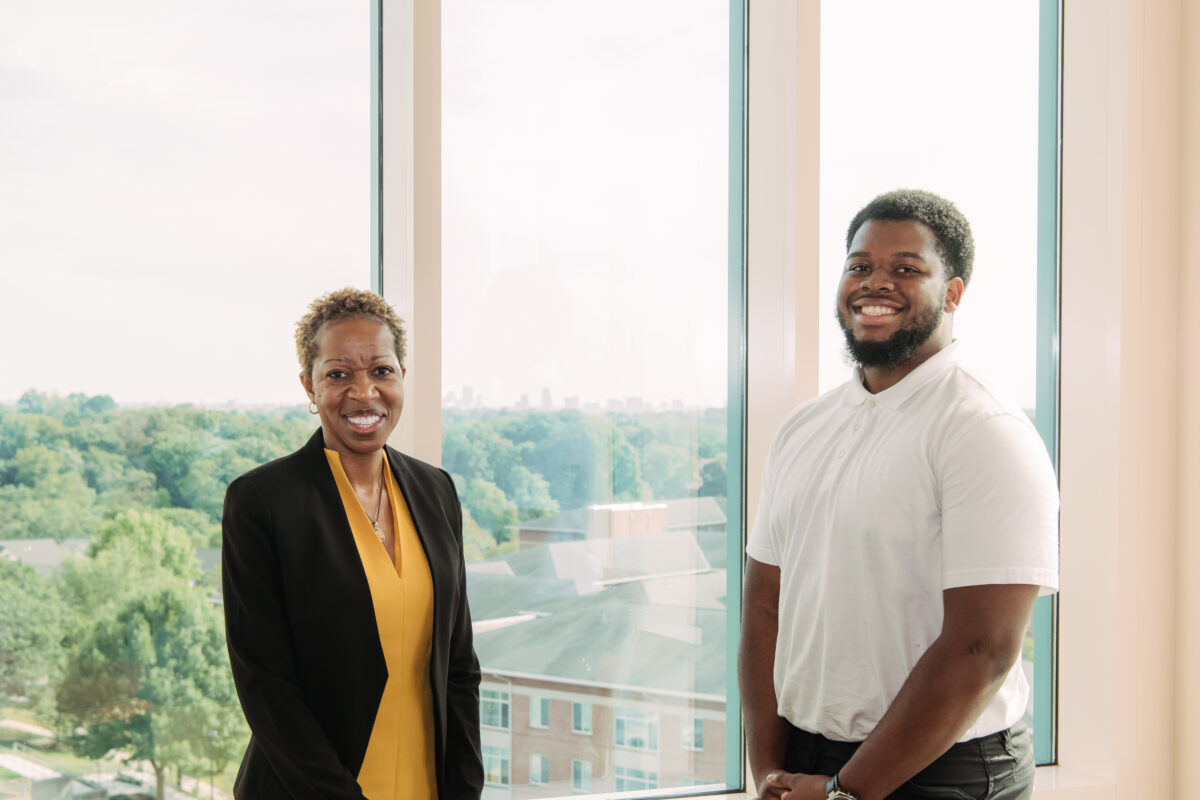 Sheares Ashby and Tabugbo pose on the 7th floor of the library. (Marlayna Demond ’11/UMBC)
Sheares Ashby: That is amazing. And what is so interesting to me is the mentorship of the more senior students to the younger students because I see it all the time. I see the senior students saying, “Hey, come on over here. This is where we are. This is what we’re doing. This is how we can support you.” They’re really living out the mentorship in ways that are so important. And it is so wonderful to see the younger students come in and then become those mentors to other people. I can see that growth even in a year.
Tabugbo: Exactly. And on that note of mentorship, that’s why we wanted to start moving toward outreach programs, especially to local high schools and middle schools. This effort is spearheaded by our secretary, Daniel Bajulaiye. If we can get to these students early and make them know that they’re appreciated, make them know that they can be heard, that will be important in fostering a good relationship, especially as they come into UMBC. Just letting people know that you’re there for them is so important because a lot of people, especially on this campus, don’t know their potential.
Sheares Ashby: I one hundred percent agree. One of the things I’m really excited about for UMBC is the work that we continue to do in Baltimore. We’re right here, and we know that there are a lot of Black men, young men, in Baltimore who would benefit. I don’t think too many Black men in Baltimore walk around feeling appreciated.
If we can get to these students early and make them know that they’re appreciated, make them know that they can be heard, that will be important in fostering a good relationship, especially as they come into UMBC.
Okechukwu Tabugbo ’25
Tabugbo: Even when I did get the role [as president of Black Men’s Society], I still had imposter syndrome. I didn’t truly feel I belonged until actually stepping into the shoes and having to take over. Talking to my brother all summer, the amount of encouragement he had to give me to say just, “You can do this. You are here for a reason.” Hearing it from Amery, hearing it from Israel, it took a lot to be able to have the confidence to come and do this again and again every day.
Sheares Ashby: Mentorship has always been important. Sometimes it just takes somebody to look at you and tell you, “I see you, and I think you’re pretty special,” or, “I see this gift or talent that you have,” and it can change somebody’s life just like that. I don’t know anybody who doesn’t need encouragement.
]]>
Each week during her student-facing office hours, UMBC President Valerie Sheares Ashby meets with students to chat about their lives and experiences at UMBC. Today, she’s speaking with Okechukwu...
https://umbc.edu/stories/office-hours-with-president-shears-ashby/
https://my3.my.umbc.edu/api/v0/pixel/news/137162/guest@my.umbc.edu/fb1a98339cc8ace85e30431255ecdccc/api/pixel
campus-life
coeit
computer-engineering
fall-2023
magazine
office-hours
perspectives
UMBC News & Magazine
https://my3.my.umbc.edu/groups/umbc-news-magazine
https://assets1-my.umbc.edu/system/shared/avatars/groups/000/001/943/24435aa6207c452e7bc15cc74b42c7bb/xsmall.png?1748556657
https://assets1-my.umbc.edu/system/shared/avatars/groups/000/001/943/24435aa6207c452e7bc15cc74b42c7bb/original.png?1748556657
https://assets2-my.umbc.edu/system/shared/avatars/groups/000/001/943/24435aa6207c452e7bc15cc74b42c7bb/xxlarge.png?1748556657
https://assets2-my.umbc.edu/system/shared/avatars/groups/000/001/943/24435aa6207c452e7bc15cc74b42c7bb/xlarge.png?1748556657
https://assets3-my.umbc.edu/system/shared/avatars/groups/000/001/943/24435aa6207c452e7bc15cc74b42c7bb/large.png?1748556657
https://assets1-my.umbc.edu/system/shared/avatars/groups/000/001/943/24435aa6207c452e7bc15cc74b42c7bb/medium.png?1748556657
https://assets2-my.umbc.edu/system/shared/avatars/groups/000/001/943/24435aa6207c452e7bc15cc74b42c7bb/small.png?1748556657
https://assets1-my.umbc.edu/system/shared/avatars/groups/000/001/943/24435aa6207c452e7bc15cc74b42c7bb/xsmall.png?1748556657
https://assets2-my.umbc.edu/system/shared/avatars/groups/000/001/943/24435aa6207c452e7bc15cc74b42c7bb/xxsmall.png?1748556657
UMBC News & Magazine
0
0
false
Fri, 17 Nov 2023 11:24:07 -0500
Fri, 17 Nov 2023 11:24:07 -0500
Grab a Seat at the Table

These days, it’s tempting to grow numb to the polarization of society and the breakdown in public discourse and to retreat into our silos of solidarity. But a liberal arts education has the potential to offer an antidote to these seemingly inevitable fates—through modeling and practicing empathy. At UMBC, students are invited to the table to share their stories and listen to their peers. These acts of educational hospitality help Retrievers find their why and pursue the public good.
Want weekly Top Stories sent to your inbox?

It’s the first day of class. You’re looking around, bright-eyed and a little nervous, and then your instructor smiles at the class and says, “One day you are all going to die.” Are you offended? Shocked? Titillated? Horrified? Collectively, the class titters. Already social bonds are forming as Christine Armstrong Mair, associate professor of sociology who specializes in gerontology, continues her spiel. “And if we’re all lucky, that won’t be for a long time.”
As sociologists, says Mair, or more broadly as leaders in an educational setting, “it’s not our task to make somebody think a certain way. Our task is to show them what exists in society and help them feel empathy for the human experience.”
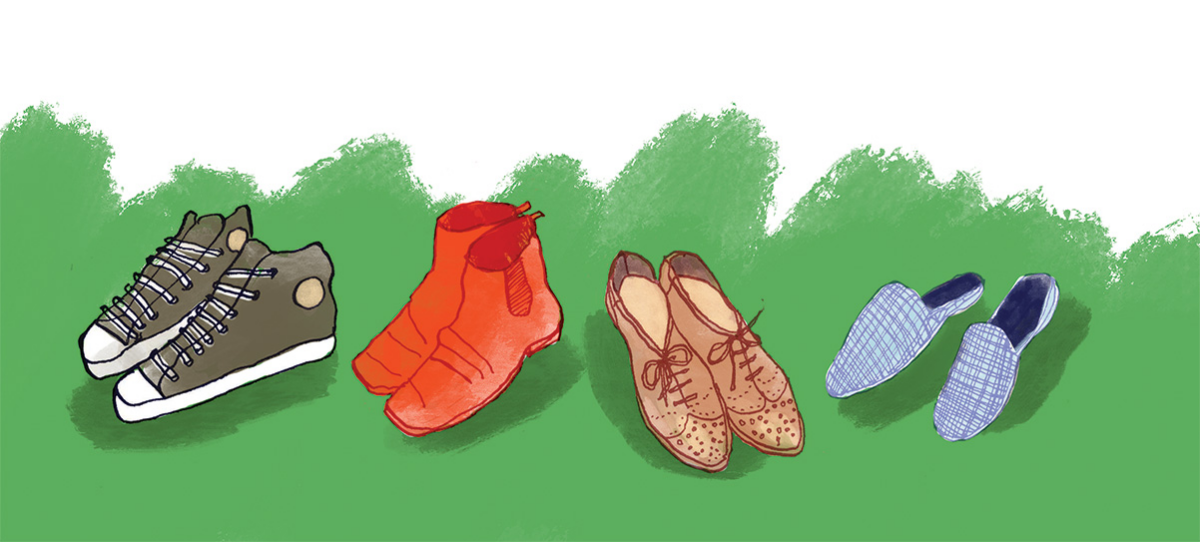
At its most pedestrian roots, empathy is putting yourself in someone else’s shoes. How can someone else’s emotional experience inform your own personal perspective?
In the best-case scenario, a college campus is a microcosm of its society: a crosshatch of races, ages, and socio-economic backgrounds. And UMBC holds true to those measures. But something different happens when you step into the Loop—you sit next to someone who didn’t go to your high school. You eat at the same table with someone outside of your cultural background. You take a test side by side with someone who voted differently than you. And even more than sharing space, you start sharing notes and books and stories—even your own story—with these strangers and then suddenly they’re no longer strangers.
When empathy is on the table, students and colleagues expand their capacity for hard work. You might change your thesis to address human trafficking or leave your home island to work toward healthy aging for all populations. So pull up a chair, step into someone else’s shoes, and partake in this grand educational potluck.
“With my background—what I’ve seen with human trafficking and migrant smuggling—what can I do as a person with my knowledge and responsibility?”
– Saydeh Karabatis, Ph.D. candidate
Building bridges across campus
You’re sitting at a beach-side cafe in Greece with your husband. It’s 2015 and Greece’s financial troubles are in the news, but the waves of migrants washing ashore are not yet as publicized. As you enjoy your coffee, you see a group of 40 to 50 people sitting seemingly aimless and distraught nearby. Based on their clothing, you make a guess that they are Muslims and Arabic speakers. What do you do?
If you’re Saydeh Karabatis, originally from Lebanon—and a survivor of the 17-year Lebanon civil war—and fluent in Arabic, you let that immediate moment of empathy guide you and approach the group.
Karabatis and her husband George, a professor of information systems at UMBC and from Greece, changed the plans for their summer in the Mediterranean to volunteer as translators, food finders, and listeners for the refugees, primarily fleeing the war in Syria and arriving in Greece in dire straits. They did so again in 2017.
As Karabatis interacted with these desperate groups and read more about their plight, she realized familiar patterns were emerging in their stories. They were not just migrants fleeing a war, they were trafficked people, paying dearly for not-safe passage, and many others headed toward labor and a life they did not sign up for. Struck by the limits of her actions—and even her emotional capacity for empathy—when Karabatis returned home to Maryland, she found her next step.
Karabatis, who has a master’s in computer science from UMBC and works for the university’s Division of Information Technology, knew she would need to fill her time when her two sons left for college. Karabatis asked herself, “With my background—what I’ve seen with human trafficking and migrant smuggling—what can I do as a person with my knowledge and responsibility?”

She contacted Vandana Janeja, then chair of information systems, and explained the project she wanted to complete for her Ph.D. During her master’s, Karabatis had tried to conduct a research project on human trafficking for a class with Janeja but couldn’t find a robust data set to use for her project and ended up having to leave the work incomplete. This time, she pitched using the stories of trafficked people. “Instead of dealing with numbers, numbers as data, I am now dealing with stories as data—the stories of people being trafficked,” says Karabatis.
It’s not been easy going. Many trafficked people are not open about their stories, for fear of retribution or simply because of how horrific the experience was. Additionally, it’s hard for Karabatis to take in their trauma. “I’m reading about all these abuses,” says Karabatis. “I’m reading about sex trafficking, labor trafficking, organ trafficking, human smuggling. I can’t imagine—how can a human being do something like that to another human?”
Eventually though, with the end goal of combating the network of smuggling routes, Karabatis says, you need to reach a level where you can try to put your emotions aside: “You need to detach yourself from these emotions if you want to do something to help these people. If your emotions are the only thing driving you, you wouldn’t be able to produce the research. Use these emotions as a spark and then put them on the side.”
Caring starts with listening
You’re a teenager riding the bus for fun in Puerto Rico, killing time by people watching. You’re struck by the number of older adults on the bus, noticing their many bags stuffed with x-rays and other apparent medical paperwork. Unthinkingly, you just assume they’re enjoying the ride like yourself, but this older generation seems eager to talk.
If you’re Jaminette Nazario, a curious if bored high schooler, you strike up a conversation.
What she heard from her fellow travelers shook her: “‘We don’t have people to help….’ ‘My wife just died of cancer….’ ‘I need to use this bus to get to my medical appointments.’” It wasn’t until she was pursuing her bachelor’s degree in social sciences that Nazario was hit by the realization that those conversations might have been the only time those older bus riders had talked to someone that day. “So I started thinking about the many barriers older adults have in order to achieve healthy aging,” she says. “When older adults don’t have resources or people, they miss out on social networks that are vital to healthy aging.”
This aha moment would propel Nazario to a master’s degree in public health with a focus on gerontology, but in order to study further, she’d have to leave her island for the next academic step.
Now in her second year of UMBC’s Ph.D. program in gerontology—a joint program with the University of Maryland, Baltimore—Nazario is beginning to research aging Hispanic immigrants and their increasing challenges accessing medical care.
And unlike her fellow bus riders, she’s not doing this alone. “Even though it’s really hard to be far from family, I feel like I’m home here. And I love how Dr. Mair teaches.” Like most classes, says Nazario, there are readings and discussion, but Mair brings a “specific dynamic” to the setting. Each class starts with questions prepared by the students, which is really empowering, says Nazario. It might end up that the class all resonates with one question and they stay on that topic, guiding the trajectory of the discussion.
In summer 2022, Nazario joined Mair and others from the gerontology program at a conference in Japan. She presented a poster on her research and walked away from her talk with a new level of confidence. “There were professionals from Japan and China and they’re asking me about something in the United States…it was kind of cool. People came up and treated me with so much respect.”
Students in Mair’s gerontology classes are finding their drive to solve crises in aging care not only because they might have loved ones suffering, but because aging (if we’re lucky) and death are unifying elements. “It’s something that really applies to all of us,” says Mair, “to make sure that we’re taking care and setting up a good system so that when we all arrive there, that us and all of our people that we care about are okay.”
Inclusive classrooms by design
You walk to the front of the media and communications class you’re teaching. Students are sitting in traditional desks in rows, facing the whiteboard where you’ll teach. They’re silent, spaced out or on their phones. They seem to breathe a sigh of relief when you walk in, grateful to know where to put their attention. Later, in a different section of that class, you meet in a newly designed lecture hall filled with round tables and no clear lectern space. In this format, the students are already grouped together and chatting.
If you’re Donald Snyder, principal lecturer in media and communication studies, you know there is science behind what forms good class cohesion and participation. He learned it from the experts in UMBC’s Faculty Development Center (FDC).
In addition to learning about and playing around with classroom set-up to facilitate more natural conversations (and to rid the learning experience from a “perceived hierarchy” as FDC Director Linda Hodges calls it), Snyder and others who use the FDC are supported in using inclusive and culturally responsive teaching.
While culturally responsive pedagogy isn’t a new concept—it centers and nurtures students’ unique cultural strengths—Hodges says that recent world events have brought the teaching style more into focus. Citing the death of George Floyd and the nation’s response—especially young people—and the COVID-19 pandemic as two significant flashpoints, Hodges says inclusive pedagogy and empathetic practices have become more imperative than ever. Room design is just one tool in the FDC toolbelt that can work to democratize students’ experience. It can erase the divide between the front row handraiser and the back row hider, giving equal footing to all types of students and their stories.
“Instructors are recognizing that they need to try to connect with and hear their students’ voices,” says Hodges. “This will create a sense of belonging. It’s become quite clear in the research that one of the key factors in whether students succeed and persist in education is the feeling of belonging.”
Snyder has made the most of the FDC’s offerings, including inviting Hodges’ team to observe his teaching and offer feedback. He starts many of his classes with some tools for students to learn about self-regulation, basically how to use available resources to make the most of education. He introduces them to Bloom’s Taxonomy, which places rote memorization at the bottom of the pyramid and evaluating and creating a unique argument at top. “I want the students to know, I’m not asking to memorize anything,” says Snyder, “but we need to learn to be critical when we’re thinking about media and communication texts and how these things operate.”
Giving students tools to succeed in college—go to office hours, block out time for studying, get enough sleep—may seem basic and far afield from teaching and practicing empathy, but in the taxonomy of educational success, says Snyder, this foundation leads to the heavy-lifting tools at the top of the pyramid.
Snyder helps them harness existing interests, in tech or media, and then run with it, academically. He wants them to ask, “‘How can I turn that switch? What is the thing that I can grab onto? What do I really want to know about?’”
He also listens to them, and attempts to model vulnerability in the classroom. “Yes, these are students and they need to understand content, but they’re also humans who are struggling and we’re all struggling and there’s a human condition aspect we can’t ignore as instructors.”

Swapping stories strengthens neighborly bonds
You’re driving your car on tour in Texas when you’re hit by a criminally intoxicated drunk driver. You survive, but a host of physical and psychological repercussions are still taking their toll 10 years later. As a musician, you fuel your art with your resiliency and work through the healing process by creating music. But when the pandemic hits, and live, in-person music disappears, you look for a pivot point—and the community you’re missing.
If you’re Kristin Putchinski, a student in UMBC’s M.F.A. program for intermedia and digital arts, you lean into the concept of “platonic intimacy.”
Putchinski coined the term to sum up her goal of “trying to strengthen neighborly bonds. What I’m looking for is an intimate experience between two people. And when people hear intimacy, they tend to think that it’s about a romantic or sexual component. But how do I frame that intimacy—and how important intimacy is—in terms of friendship and neighborliness?”
Through a graduate assistantship jointly funded by jointly funded by UMBC and the University of Maryland, Baltimore’s Community Engagement Center (CEC), Putchinski was given the opportunity to shadow CEC’s then-director Tyrone Roper and learn about the center’s mission, which includes strengthening neighborly bonds. Roper told Putchinski they were looking for ways to engage the 18- to 24-year-old demographic. When Putchinski was tasked with creating an art project for CEC the following semester, she kept this age goal in mind.
As a student in UMBC’s intermedia program, Putchinski “explores the textures between mediums,” she says. As a musical artist who performed under the stage name ellen cherry, “I have 25 years of experience as a performing songwriter and storyteller, creating my own and interpreting other people’s stories.” So she began to imagine a strange game of telephone that would give participants the opportunity to swap stories, with the end result of creating instances of platonic intimacy.
This multifaceted project connected post-high-school-aged individuals with older generations through curated, facilitated sessions. The participant-pairs met four different times and talked about a song, a photograph, and a memory—and at the last session, the neighbors “swapped” their stories. A recording of the swap was sent to local artists who interpreted the stories into their own mediums—painting, poetry, and a video soundscape. Then, at an event open to the public in the CEC, the storytellers took the stage, retelling their neighbor’s story. For example, a Latinx college graduate took to the stage to reshare her stranger-turned-partner’s tale of being raised in foster care in 1970s Baltimore.
Putchinski was eager to find out “when you talk to somebody that’s 40 years different from you…did your perceptions change about yourself, about them, and what were those changes and the answers?”
It makes sense she’s asking these questions based on her ongoing empathy toward the man who altered her life in an accident 10 years ago. “It was very conflicting for me to be the victim of a crime that I really feel like was committed not by a criminal but by a person who abuses alcohol. At the base level, he’s a human being. How can we think about his human potential after this experience and mine?”
“Imagine intensely” a better way forward
One of the greatest assertions of the liberal arts comes from Percy Bysshe Shelley’s essay “A Defence of Poetry.” The short-lived husband of Frankenstein’s creator writes, “A man, to be greatly good, must imagine intensely and comprehensively; he must put himself in the place of another and of many others; the pains and pleasures of his species must become his own.”
On college campuses, and at UMBC in particular, through thoughtful classroom instruction and intentional commitment to community, students trade their stories—pains and pleasures alike. Less of a transaction and more of a gift, these stories are invitations to grow in understanding, change your opinion, or shape your research.
But walking in someone else’s shoes doesn’t mean you misplace your own shoes along the way—in fact professors hope it helps you find your footing at UMBC. “That open-mindedness and appreciation and empathy does not necessarily mean that you lose other parts of yourself,” says Anne Brodsky, professor and chair of the psychology department. “It shouldn’t be a zero-sum game.”
You’re walking down Academic Row. You’re a first-generation college student with a lot of questions. You’re a returning student giving college a second (or third) chance. You’re a first-year who misses the familiar halls of high school. You see other Retrievers walking in groups, heading into classrooms, rubbing True Grit’s bronze nose, making conversation with their peers. What do you do?
]]>
These days, it’s tempting to grow numb to the polarization of society and the breakdown in public discourse and to retreat into our silos of solidarity. But a liberal arts education has the...
https://umbc.edu/stories/grab-a-seat-at-the-table-empathy/
https://my3.my.umbc.edu/api/v0/pixel/news/137271/guest@my.umbc.edu/777eb34ff02b7fc72d1664adf771099a/api/pixel
campus-life
coeit
computer-science
fall-2023
feature
imda
information-systems
magazine
mcs
UMBC News & Magazine
https://my3.my.umbc.edu/groups/umbc-news-magazine
https://assets1-my.umbc.edu/system/shared/avatars/groups/000/001/943/24435aa6207c452e7bc15cc74b42c7bb/xsmall.png?1748556657
https://assets1-my.umbc.edu/system/shared/avatars/groups/000/001/943/24435aa6207c452e7bc15cc74b42c7bb/original.png?1748556657
https://assets2-my.umbc.edu/system/shared/avatars/groups/000/001/943/24435aa6207c452e7bc15cc74b42c7bb/xxlarge.png?1748556657
https://assets2-my.umbc.edu/system/shared/avatars/groups/000/001/943/24435aa6207c452e7bc15cc74b42c7bb/xlarge.png?1748556657
https://assets3-my.umbc.edu/system/shared/avatars/groups/000/001/943/24435aa6207c452e7bc15cc74b42c7bb/large.png?1748556657
https://assets1-my.umbc.edu/system/shared/avatars/groups/000/001/943/24435aa6207c452e7bc15cc74b42c7bb/medium.png?1748556657
https://assets2-my.umbc.edu/system/shared/avatars/groups/000/001/943/24435aa6207c452e7bc15cc74b42c7bb/small.png?1748556657
https://assets1-my.umbc.edu/system/shared/avatars/groups/000/001/943/24435aa6207c452e7bc15cc74b42c7bb/xsmall.png?1748556657
https://assets2-my.umbc.edu/system/shared/avatars/groups/000/001/943/24435aa6207c452e7bc15cc74b42c7bb/xxsmall.png?1748556657
UMBC News & Magazine
1
0
false
Wed, 15 Nov 2023 14:07:28 -0500
GRIT-X 2023 explores wide range of UMBC’s research and creative achievement around campus and beyond
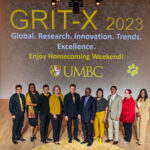
Spiders, robots, climate change, Vaudevillian history, and more—this year’s GRIT-X event had something for inquiring minds of all kinds, with explorations into elements of the past, our collective present, and possibilities for the future.
Back for its seventh year, GRIT-X returned to the Fine Arts Recital Hall during Homecoming 2023 with presentations from faculty and accomplished alumni addressing some of the most pressing issues facing society now and throughout history, and how UMBC scholars are working to build a better tomorrow.
“The goal of GRIT-X is to provide a sneak peek behind the scenes of some of the exciting and impactful research and creative achievement initiatives across our campus community,” says Karl V. Steiner, UMBC’s vice president of research and creative achievement. “[GRIT-X] takes you around the whole campus and beyond.”
Watch the GRIT-X 2023 talks.
“Disruptive” and intercultural thinking in the workforce
GRIT-X 2023 showcased how UMBC alumni are working to fuel innovation within the workforce and how faculty are strengthening the employability of future graduates. Melanie Harrison Okokoro, Ph.D. ’11, environmental science, opened this year’s GRIT-X with her discussion on how “bold and disruptive thinking” can help executives to lead, innovate, and transform their companies in the 21st century. Okokoro is the co-founder and CEO of Eco-Alpha, a firm that provides environmental compliance services and engineering workforce development training. Her talk outlined how leaders can create “disruptive strategies” in order to stay at the forefront of changes happening in their industries.
“Disruptive thinking is in my DNA,” said Okokoro during her presentation. “It defines how [Eco-Alpha] outcompetes our competitors in the marketplace and allows us to target a segment of the population that’s been traditionally overlooked.”
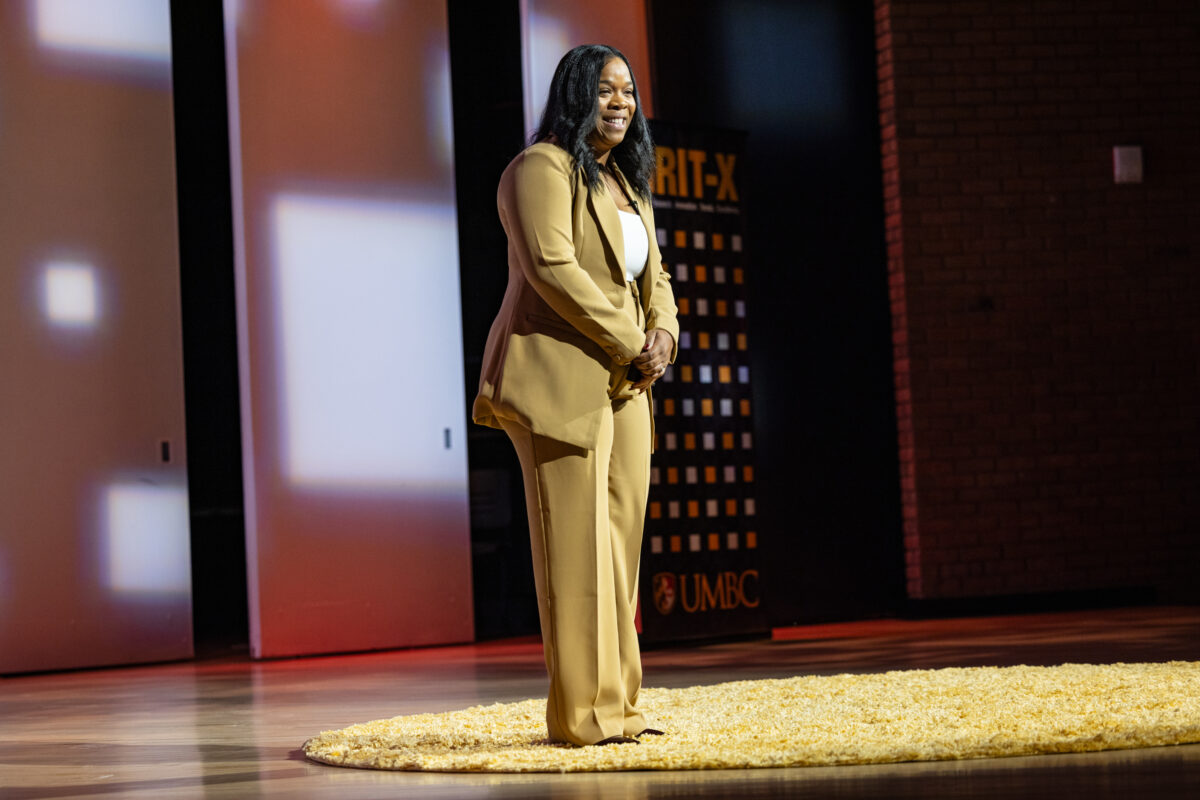 Melanie Harrison Okokoro presenting her GRIT-X 2023 talk entitled “Disruptive Thinking: A Bold Business Strategy to Change How We Lead, Innovate, and Transform Companies in the 21st Century.”
Similarly to Okokoro, Zhensen Huang, M.S. ’00, Ph.D. ’04, information systems, used bold thinking to propel himself forward in his current career as CEO and founder of Precise Software Solutions, a firm that helps government and private sector clients modernize their IT systems. Huang spoke of his student experience at UMBC after emigrating to the U.S. from a small rural village in China—a future he says he didn’t think was possible when growing up. He shared how UMBC helped even when “It’s hard for us to make a connection between what we’re doing now to the great possibilities down the road,” says Huang.
“Embrace the present and envision the future,” Huang shared during his talk. “Sometimes you don’t know what your future possibilities are, and that’s okay. What’s important is to embrace what’s in front of you, especially the challenges.”
 Zhensen Huang
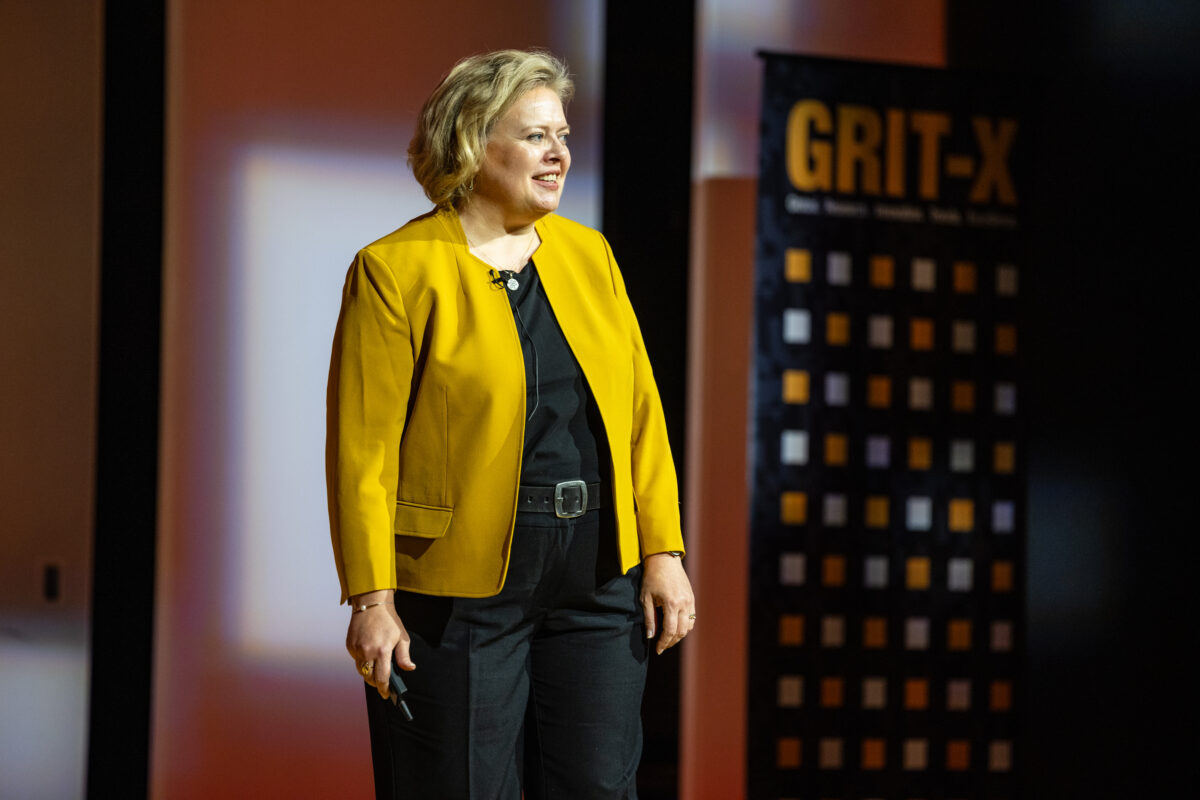 Irina Golubeva
Irina Golubeva, professor and director of UMBC’s intercultural communication graduate program, is working to address some of those challenges students face, such as navigating culturally-diverse environments. Her GRIT-X presentation focused on her research on intercultural learning, which includes the InterEqual training program she created based on student feedback. Golubeva shared how she’s helping UMBC students develop their intercultural competence as they prepare for their professional careers.
“We cannot ignore and disregard these tendencies of job markets, and we must prepare our students to work and live in multicultural societies by equipping them with essential intercultural and language skills,” says Golubeva.
Investigating earthly phenomena with math and science
Justin Webster, associate professor of mathematics and statistics, explored the “relationship between mathematical models and the phenomena in the world” during his presentation. He highlighted specific examples of how mathematical modeling can deepen our understanding of infrastructure disasters like the Tacoma Narrows Bridge collapse of 1940, and how his mathematical process helped researchers find a possible hypothesis for detecting the onset of glaucoma.
“Mathematical modeling is a scientific empowerment tool. Anyone, anywhere, can do math modeling and study anything that they’re interested in,” says Webster. “That’s why it is so important that our students at UMBC, and students more broadly, are mathematically competent and excited so that they can go on to be students of the world.”
 Justin Webster delivering his GRIT-X 2023 talk entitled “The Map is Not the Territory: Tales of Interest in Nonlinear Elasticity.”
Charles Ichoku, director of the UMBC-led Goddard Earth Science Technology and Research (GESTAR) Center II, also explored a phenomena that’s causing global concern—how rapidly the Earth is changing. Ichoku explained in his GRIT-X talk how climate change, people, and wildfire emissions are contributing to those changes to the Earth and the work he’s done with NASA’s Fire Energetics and Emissions Research project to understand causes of climate change.
“The world is warming dangerously, and human activities are driving the warming trend through the emission of heat-trapping long-lived greenhouse gasses (GHGs), particularly carbon dioxide (CO2), which has continued its upward trend over the last several decades. Wildfires are [also] contributing significantly to that,” shared Ichoku.
 Charles Ichoku
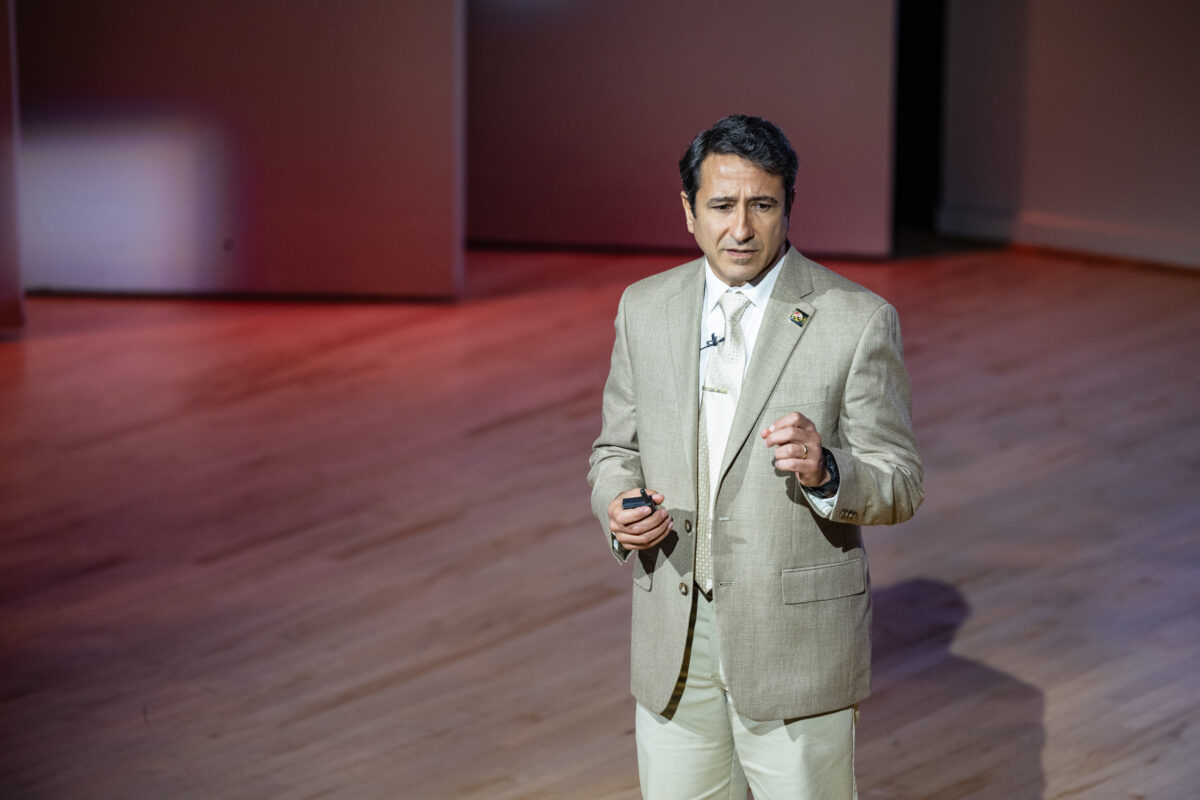 Carlos Romero-Talamás
Similarly, Carlos Romero-Talamás, associate professor of mechanical engineering, explained in his presentation how most sources of energy produce carbon and GHGs, and the work that’s being done to bring the global energy-related CO2 emission levels down to net zero. He discussed the benefits of using fusion energy to achieve that goal, which includes the work he’s doing as the principal investigator of the Centrifugal Mirror Fusion Experiment, a research effort between UMBC and the University of Maryland, College Park that explores a promising alternative to traditional fusion power approaches.
“Fusion energy is considered the ultimate source of energy—the fuel is abundant and is non radioactive,” says Romero-Talamás. “It is urgent to decarbonize our economy and our energy infrastructure because we are harming the planet [and] are running towards a climate disaster.”
Past histories and future possibilities
Michelle R. Scott, associate professor of history, brought the GRIT-X audience back to a moment in time in which Black Vaudeville performers used economic empowerment as a form of resistance in the 1920s. Scott explained her research into the institutional history of the Theater Owners’ Booking Association’s (T.O.B.A.) origins, which she wrote about in her book T.O.B.A. Time: Black Vaudeville and the Theater Owners’ Booking Association in Jazz Age America(University of Illinois Press, 2023).
“The [Vaudeville] circuit itself—its success—was a testament to Black excellence in terms of business, Black artistic skill, and a momentary period of interracial cooperation. It was truly an example of Jazz-age resistance,” Scott said during her presentation.
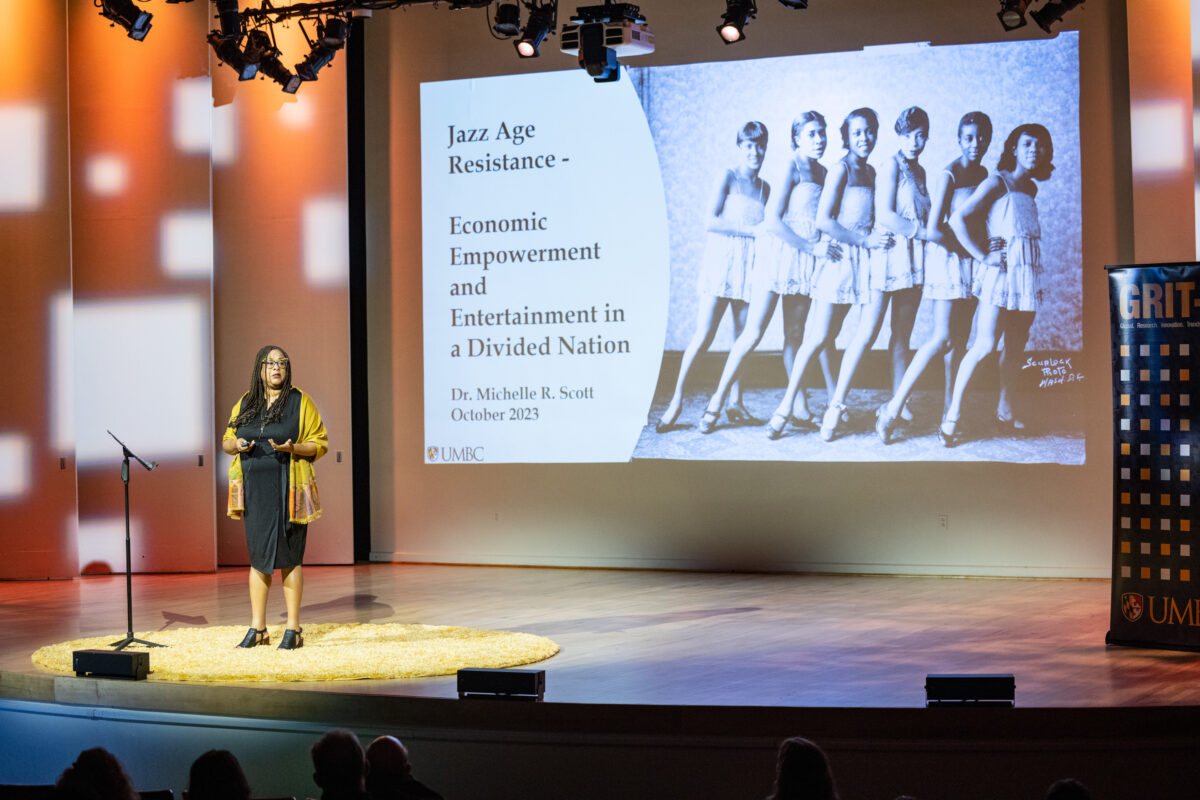 Michelle R. Scott delivering her GRIT-X 2023 talk entitled “Jazz Age Resistance: Economic Empowerment and Entertainment in a Divided Nation.”
Mercedes Burns, assistant professor of biological sciences, explained a different kind of history—the history of arachnids. Burns, who received an NSF CAREER Award earlier this year, enlightened the audience with her research on spiders, opiliones (commonly known as daddy longlegs), and other kinds of arachnids. She outlined reasons why we should appreciate these “unloveable” creatures.
“Spiders have been living their lives for much longer than any vertebrate has —they’ve persisted over a millennia,” Burns explained in her GRIT-X talk. “Arachnids…thoughtfully consume unloveable things in our habitats. Arachnids are [also] quite attentive to their environment. They are master architects and material scientists. If you’re curious about the organisms that surround you and you’re interested in learning more or appreciating what those organisms do for the environment and their ecosystem, that leaves no room for fear.”
As a result of her being the first known female African American arachnologist, Burns had a species of trapdoor spiders named after her in 2021, called Ummidia mercedesburnsae. She reflected on the accomplishment, saying “Having experienced that honor of being the matranim of a described species really underscores the legacy that I want to leave.”
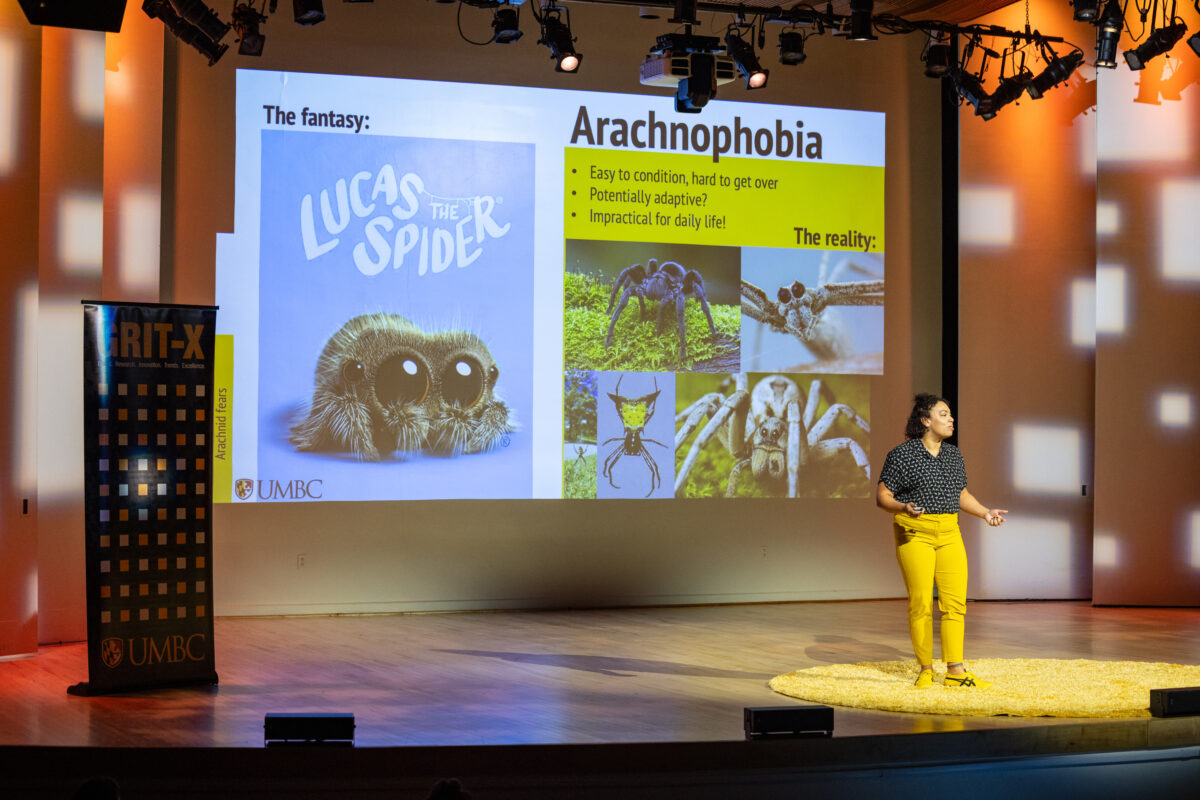 Mercedes Burns
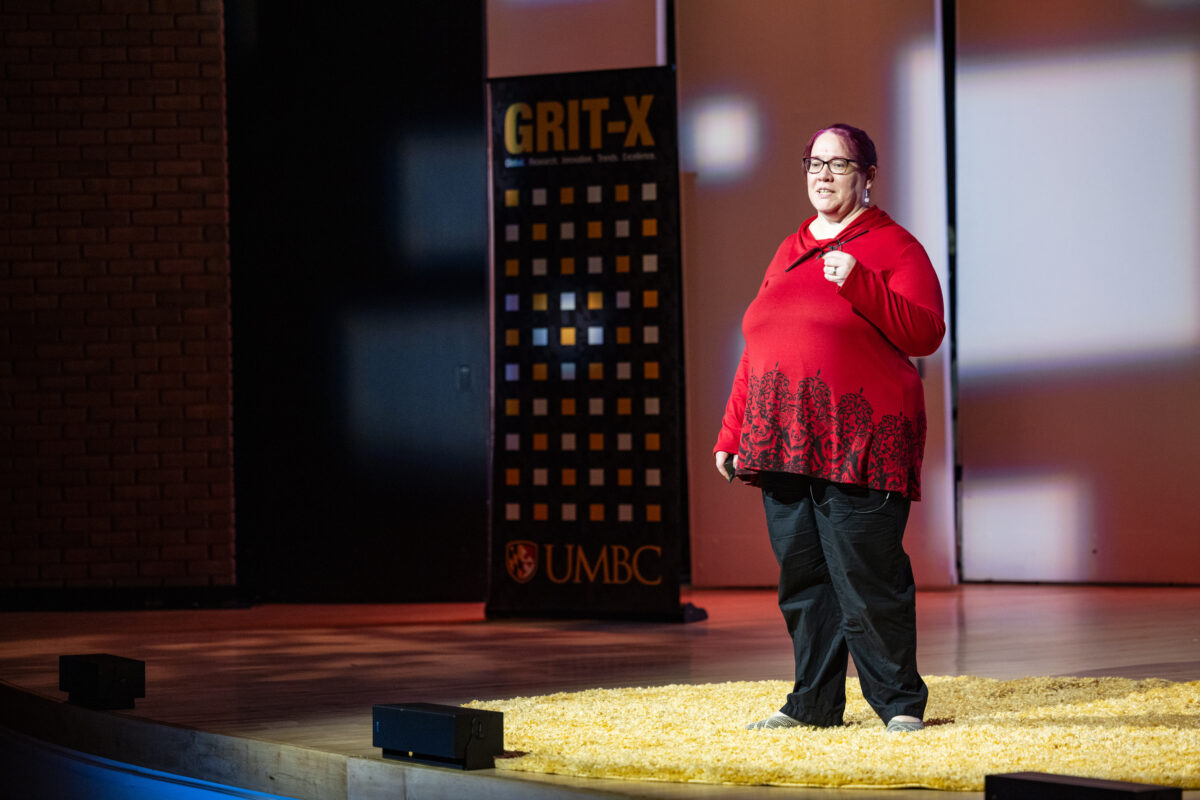 Cynthia Matuszek
Fellow UMBC NSF CAREER Award recipient Cynthia Matuszek, assistant professor of computer science and electrical engineering, brought the GRIT-X audience into the future with her presentation on the possibilities of human-robot interaction. Matuszek explained how humans and robots can interact and exist in the same space and how robots can be more useful.
Her work in UMBC’s Interactive Robotics and Language Lab focuses on using grounded language—which refers to language that has meaning in and pertains to the physical world—as a tool to build robots that can perform tasks in real-world environments, instead of being programmed to handle a fixed set of predetermined tasks.
“In order to have robots that are useful in human spaces, we need robots that are flexible and capable of interacting in a variety of contexts,” Matuszek explained in her presentation. “When people use language, we don’t just use words. We use gestures, we point to things, we look at things, and we use body language. Useful language learning for robots needs to take all of these factors into account.”
Learn more about GRIT-X 2023, past speakers, and their research.
]]>
Spiders, robots, climate change, Vaudevillian history, and more—this year’s GRIT-X event had something for inquiring minds of all kinds, with explorations into elements of the past, our collective...
https://umbc.edu/stories/grit-x-2023/
https://my3.my.umbc.edu/api/v0/pixel/news/136915/guest@my.umbc.edu/11dc6c9f4ebc3adc6cc062d7bde6fd42/api/pixel
cahss
cnms
coeit
community
grit-x
news
rca-1
research
science-and-tech
UMBC News & Magazine
https://my3.my.umbc.edu/groups/umbc-news-magazine
https://assets1-my.umbc.edu/system/shared/avatars/groups/000/001/943/24435aa6207c452e7bc15cc74b42c7bb/xsmall.png?1748556657
https://assets1-my.umbc.edu/system/shared/avatars/groups/000/001/943/24435aa6207c452e7bc15cc74b42c7bb/original.png?1748556657
https://assets2-my.umbc.edu/system/shared/avatars/groups/000/001/943/24435aa6207c452e7bc15cc74b42c7bb/xxlarge.png?1748556657
https://assets2-my.umbc.edu/system/shared/avatars/groups/000/001/943/24435aa6207c452e7bc15cc74b42c7bb/xlarge.png?1748556657
https://assets3-my.umbc.edu/system/shared/avatars/groups/000/001/943/24435aa6207c452e7bc15cc74b42c7bb/large.png?1748556657
https://assets1-my.umbc.edu/system/shared/avatars/groups/000/001/943/24435aa6207c452e7bc15cc74b42c7bb/medium.png?1748556657
https://assets2-my.umbc.edu/system/shared/avatars/groups/000/001/943/24435aa6207c452e7bc15cc74b42c7bb/small.png?1748556657
https://assets1-my.umbc.edu/system/shared/avatars/groups/000/001/943/24435aa6207c452e7bc15cc74b42c7bb/xsmall.png?1748556657
https://assets2-my.umbc.edu/system/shared/avatars/groups/000/001/943/24435aa6207c452e7bc15cc74b42c7bb/xxsmall.png?1748556657
UMBC News & Magazine
0
0
false
Tue, 07 Nov 2023 16:53:48 -0500
Tue, 07 Nov 2023 16:53:48 -0500
Alumni Awards 2023—Making impact through relationships
On the stage of the 35th annual Alumni Awards, awardees and their nominators repeated a shared theme: the freedom and flexibility to grow at UMBC—not alone—but in community.
Presented by the Alumni Association Board of Directors, the event recognizes inspiring alumni in a range of fields, as well as a rising star and an outstanding faculty and staff member. Rehana Shafi, recipient of the inaugural staff award, emphasized that she was only able to do so much “with so many.” Shafi, director emerita of the Sherman Teacher Scholars Program, said: “This work, this way, isn’t an individual endeavor….Impact happens inside of relationships.”
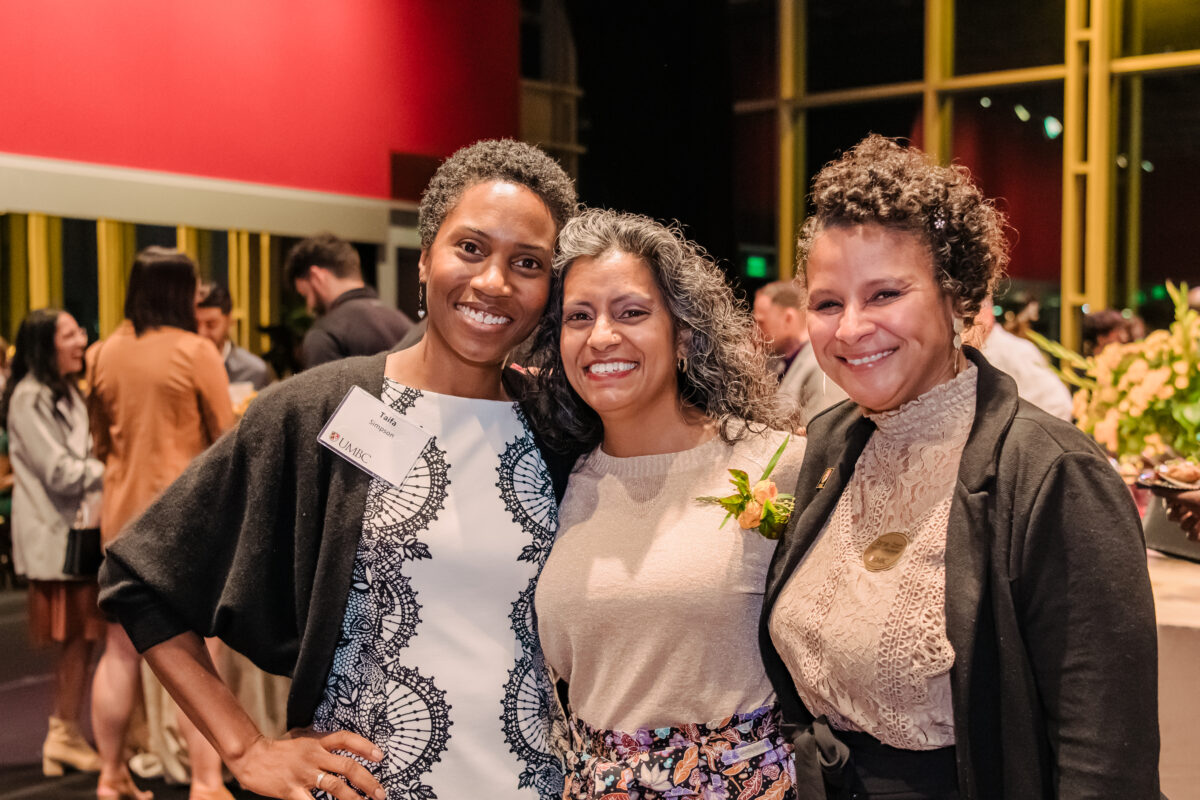 Taifa Simpson, former assistant director of MARC U*STAR, Rehana Shafi, and Stanyell Odom, director of Alumni Engagement at the 2023 Alumni Award reception. (Marlayna Demond ’11/UMBC)
The full circle moment
Several of the alumni recipients have come back to work at UMBC. Recipient of the Outstanding Engineering and Information Technology alumna award, Annica Wayman ’99, mechanical engineering, called it her “full circle” moment. Wayman, now associate dean for Shady Grove Affairs in the College of Natural and Mathematical Sciences, said, “Now that I’m on the ‘inside’ as a faculty member, it’s the same as I observed as a student and alumna—UMBC’s commitment to inclusive excellence, innovative teaching, and supportive community is authentic and I have the chance to see it every day working with UMBC faculty and staff.”
Annica Wayman ’99, left, and Josh Michael, right, speak at the 2023 Alumni Awards.
Josh Michael ’10, political science, Ph.D. ’22, public policy, found his why at UMBC. “I knew I was planted in the right place,” he said, “a place where I would evolve and grow…. It is here at UMBC where I developed a voice and confidence to lead in public education.” Michael, the awardee for Outstanding Alumnus in Social and Behavioral Sciences, is dedicated to public service and community engagement.
A former Baltimore City math teacher and now executive director of the Sherman Family Foundation, Michael took the opportunity on the stage to remind the audience, “For as a community, it is how we treat other people’s children that demonstrates our collective belief in our future.”
Creativity rooted in big ideas
Another teacher was honored for his long commitment to Maryland’s children. James Dorsey ’05, music technology and vocal performance, is in his 19th year as an elementary music teacher. He shared that, “All of our creativity is rooted in big ideas. Ideas that relate to our shared human experience and how we interact in our world.”
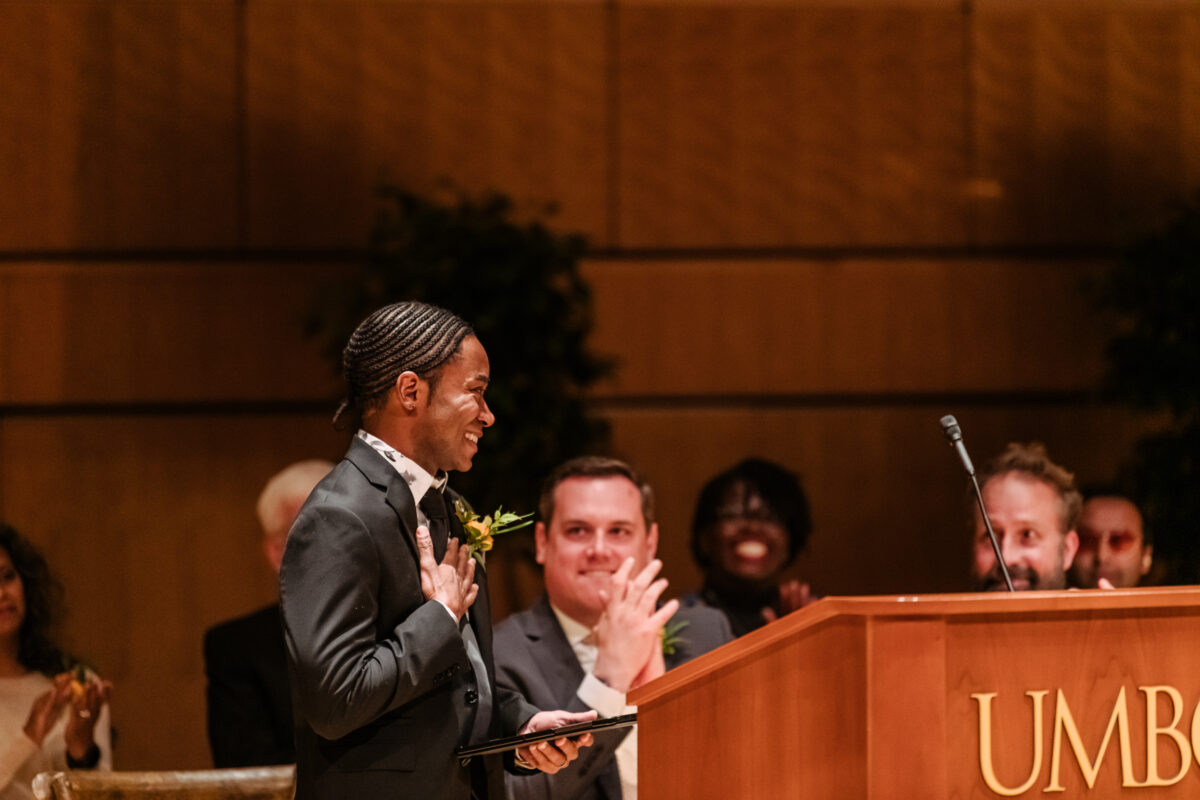 James Dorsey after giving his remarks at the 2023 Alumni Awards. (Marlayna Demond ’11/UMBC)
Dorsey, who received the award for Outstanding Alumnus in the Visual and Performing Arts, said, “I’m blessed to get to help students express their messages and respond to their cultures through creating. It sets a precedent that the arts are a natural way to respond to the issues of our community, self-expression, coping with change, and social justice.”
Other 2023 Outstanding Alumni awardees include: Humanities—Aaron Ralby ’05, English and modern languages and linguistics; and, Natural and Mathematical Sciences—Kay Bidle ’91, biological sciences. The Rising Star award was given to Asif Majid ’13, interdisciplinary studies, and the Outstanding Faculty award was presented to E.F. Charles LaBerge, Ph.D. ’03, professor of the practice in computer science and electrical engineering at UMBC.
]]>
On the stage of the 35th annual Alumni Awards, awardees and their nominators repeated a shared theme: the freedom and flexibility to grow at UMBC—not alone—but in community. Presented by the...
https://umbc.edu/stories/alumni-awards-making-impact-through-relationships/
https://my3.my.umbc.edu/api/v0/pixel/news/136729/guest@my.umbc.edu/e5045b2d07c000dd5467d178c9b199c2/api/pixel
alumni
alumni-awards
cahss
cnms
coeit
fall-2023
magazine
sherman-stem-teacher-scholars-program
UMBC News & Magazine
https://my3.my.umbc.edu/groups/umbc-news-magazine
https://assets1-my.umbc.edu/system/shared/avatars/groups/000/001/943/24435aa6207c452e7bc15cc74b42c7bb/xsmall.png?1748556657
https://assets1-my.umbc.edu/system/shared/avatars/groups/000/001/943/24435aa6207c452e7bc15cc74b42c7bb/original.png?1748556657
https://assets2-my.umbc.edu/system/shared/avatars/groups/000/001/943/24435aa6207c452e7bc15cc74b42c7bb/xxlarge.png?1748556657
https://assets2-my.umbc.edu/system/shared/avatars/groups/000/001/943/24435aa6207c452e7bc15cc74b42c7bb/xlarge.png?1748556657
https://assets3-my.umbc.edu/system/shared/avatars/groups/000/001/943/24435aa6207c452e7bc15cc74b42c7bb/large.png?1748556657
https://assets1-my.umbc.edu/system/shared/avatars/groups/000/001/943/24435aa6207c452e7bc15cc74b42c7bb/medium.png?1748556657
https://assets2-my.umbc.edu/system/shared/avatars/groups/000/001/943/24435aa6207c452e7bc15cc74b42c7bb/small.png?1748556657
https://assets1-my.umbc.edu/system/shared/avatars/groups/000/001/943/24435aa6207c452e7bc15cc74b42c7bb/xsmall.png?1748556657
https://assets2-my.umbc.edu/system/shared/avatars/groups/000/001/943/24435aa6207c452e7bc15cc74b42c7bb/xxsmall.png?1748556657
UMBC News & Magazine
0
0
false
Wed, 01 Nov 2023 12:56:42 -0400
Wed, 01 Nov 2023 12:56:42 -0400