McNair Scholar reflects on the power of research mentorship and leadership through supporting others
Joana Hernandez
Degree: B.S., Chemical Engineering
Hometown: Hyattsville, MD
Post-grad plans: Applying to biochemical engineering Ph.D. programs
McNair Scholar Joana Hernandez is a research enthusiast who found her interest in scientific exploration and mentorship while at UMBC. Since 2019, Hernandez has worked as a research assistant in the lab of Fernando Vonhoff, assistant professor of biological sciences. The lab uses fruit flies as a model to study human neurological diseases. It was in Vonhoff’s lab where she realized that there were opportunities to turn her love of learning into a career in research.
Hernandez has taken her interest in conducting research to the next level by helping to guide fellow students who may be unfamiliar with the academic research process. As a teaching fellow in the McNair Scholars Program, Hernandez led workshops in a class dedicated to teaching students how to develop research proposals. During these workshops, she presented on topics ranging from how to give a research presentation to how to apply to Research Experiences for Undergraduates (REUs).
Hernadez shares that she’s proud to be a McNair Scholar. “As a first-generation college student, it can be difficult to navigate academic spaces and obtain resources on applying to graduate programs,” Hernandez says. “McNair welcomed me with open arms and helped grow my confidence by providing me with opportunities to conduct research and present at national conferences.”
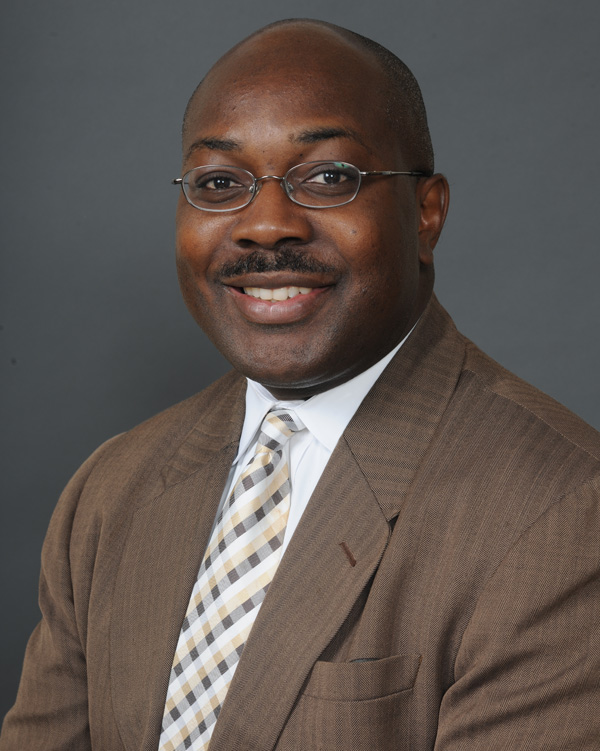
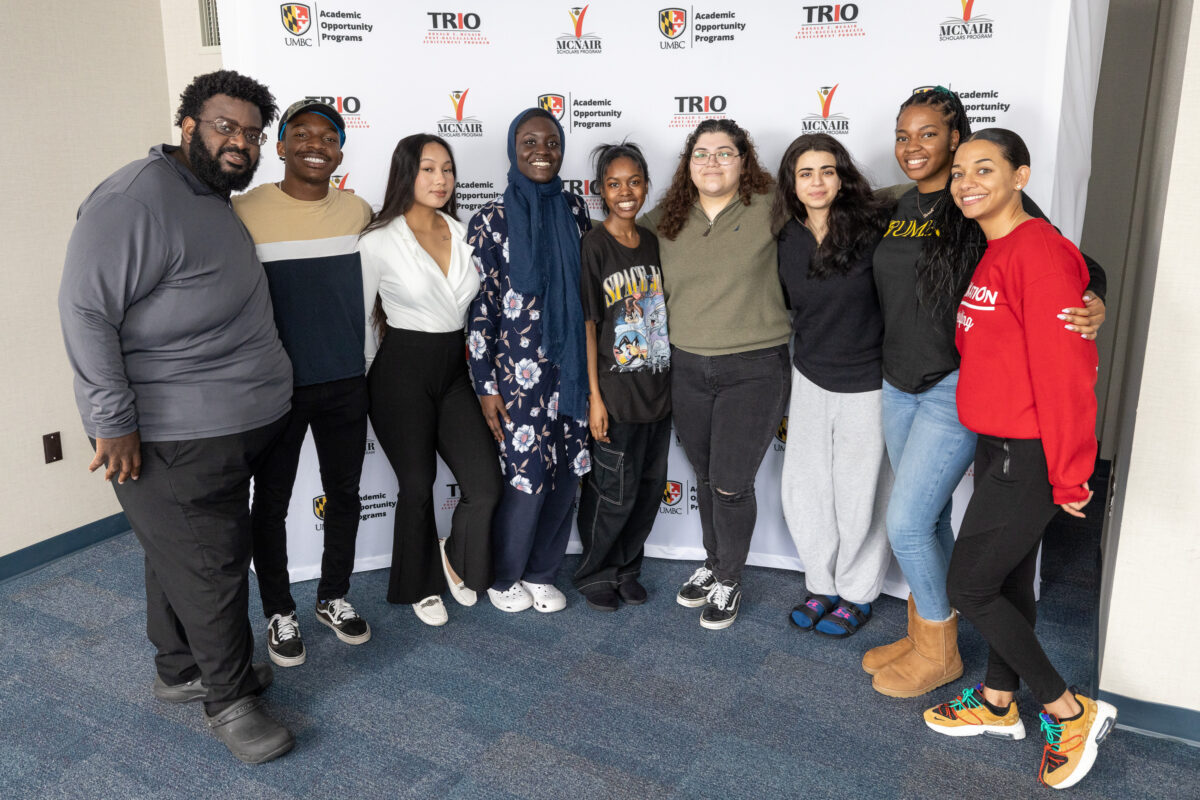 Joana Hernandez (fourth from the right, in glasses) with fellow McNair Scholars and Michael Hunt (far left), director of UMBC’s McNair Scholars Program. (Photo courtesy of Joana Hernandez)
Has there been a mentor or fellow student who influenced your time at UMBC?
“My mentors Fernando Vonhoff and María Célleri, assistant professor of gender, women’s, and sexuality studies, have both had a positive influence on me. As a first-generation college student, I was unaware that undergraduates could participate in research or present at research conferences. When Dr. Vonhoff enabled me to join his lab my freshman year, it opened the doors to a lot of future opportunities. I am very grateful to have had a research mentor that was so understanding and encouraging.
“Dr. Celleri, my McNair mentor, is someone I can always count on to give me advice about navigating academic spaces as a Latina, and how to balance my life between my immigrant household and school. I appreciate all the wisdom I have gathered from her.”
What academic achievement are you most proud of?
“I am most proud of when I presented the research I did in the Vonhoff lab at the 2019 Annual Biomedical Research Conference for Minoritized Scientists (ABRCMS). That was the first time that I had attended a national conference and flew out to the West Coast. It was an eye-opening experience being able to see other undergraduate researchers from diverse backgrounds who were also just as passionate about communicating their work.”
]]>
Joana Hernandez Degree: B.S., Chemical Engineering Hometown: Hyattsville, MD Post-grad plans: Applying to biochemical engineering Ph.D. programs McNair Scholar Joana Hernandez is a...
https://umbc.edu/stories/mcnair-scholar-reflects-on-mentorship-leadership/
https://my3.my.umbc.edu/api/v0/pixel/news/133322/guest@my.umbc.edu/631907fa90562b1041cf1b62fbb77c11/api/pixel
biological-sciences
chemical-engineering
class-of-2023
cnms
coeit
mcnairscholars
news
research
UMBC News & Magazine
https://my3.my.umbc.edu/groups/umbc-news-magazine
https://assets1-my.umbc.edu/system/shared/avatars/groups/000/001/943/24435aa6207c452e7bc15cc74b42c7bb/xsmall.png?1748556657
https://assets1-my.umbc.edu/system/shared/avatars/groups/000/001/943/24435aa6207c452e7bc15cc74b42c7bb/original.png?1748556657
https://assets2-my.umbc.edu/system/shared/avatars/groups/000/001/943/24435aa6207c452e7bc15cc74b42c7bb/xxlarge.png?1748556657
https://assets2-my.umbc.edu/system/shared/avatars/groups/000/001/943/24435aa6207c452e7bc15cc74b42c7bb/xlarge.png?1748556657
https://assets3-my.umbc.edu/system/shared/avatars/groups/000/001/943/24435aa6207c452e7bc15cc74b42c7bb/large.png?1748556657
https://assets1-my.umbc.edu/system/shared/avatars/groups/000/001/943/24435aa6207c452e7bc15cc74b42c7bb/medium.png?1748556657
https://assets2-my.umbc.edu/system/shared/avatars/groups/000/001/943/24435aa6207c452e7bc15cc74b42c7bb/small.png?1748556657
https://assets1-my.umbc.edu/system/shared/avatars/groups/000/001/943/24435aa6207c452e7bc15cc74b42c7bb/xsmall.png?1748556657
https://assets2-my.umbc.edu/system/shared/avatars/groups/000/001/943/24435aa6207c452e7bc15cc74b42c7bb/xxsmall.png?1748556657
UMBC News & Magazine
0
0
false
Mon, 08 May 2023 12:44:10 -0400
Tue, 09 May 2023 12:44:10 -0400
Innies, outies and omphalophobia: 7 navel-gazing questions about belly buttons answered

Written by Sarah Leupen, senior lecturer of biological sciences, UMBC
Everyone has one, but you might not know much about it. Here biologist Sarah Leupen, who teaches human and comparative animal physiology, explains the ins and outs of belly buttons.
1. Why do I even have a belly button?
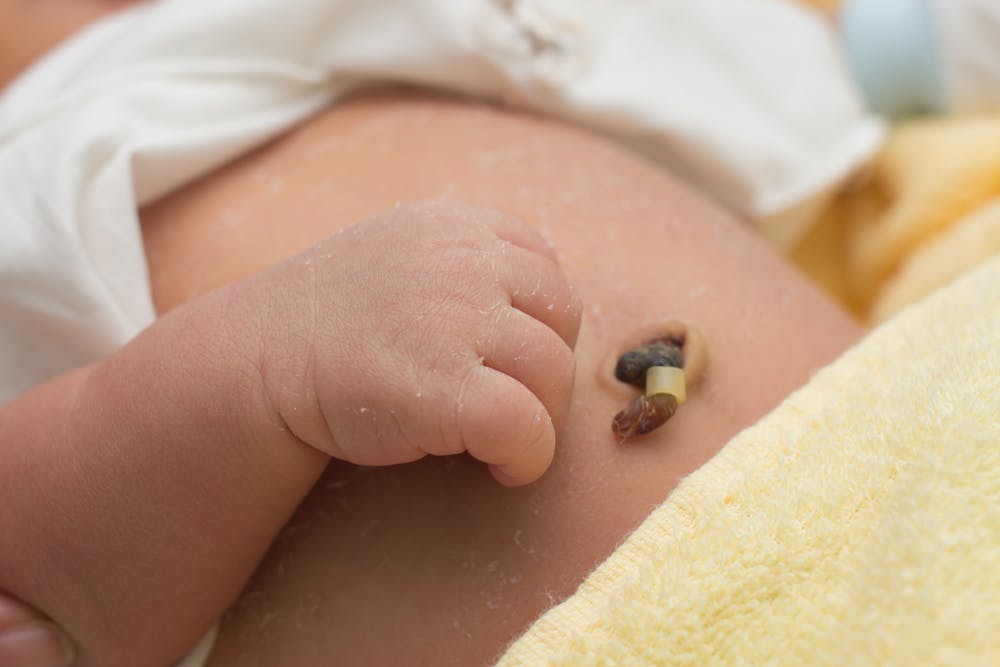
Your belly button, or navel – clinically, your umbilicus – is the permanent scar left from where your umbilical cord connected your circulatory system, when you were a fetus, to the placenta. Fetuses don’t breathe, eat or eliminate waste, so the placenta provides an exchange site for the mother to deliver oxygen and nutrients from her bloodstream to the fetus, as well as collecting its wastes to eliminate from her body.
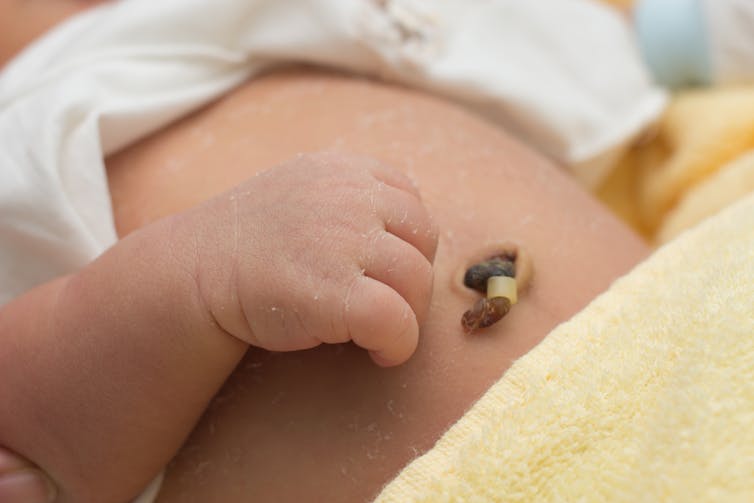 Once the umbilical cord is cut, the stump dries up and falls off, revealing the baby’s navel. Wacharaphong/iStock via Getty Images Plus
After the baby is born, the physician or other attendant cuts the cord and clamps off the stub, which then dries and falls off after about a week, leaving the point of connection – your belly button – remaining.
If the cord is not cut, as has been the practice in some times and places and as is becoming trendy again in others, it will close off after an hour or so, then naturally detach a few days after birth. Some health care practitioners are concerned that this “lotus birth” could be an infection risk, since the umbilical cord remains attached to the placenta, which is dead tissue once out of the mother’s body.
2. If it’s a scar, why doesn’t it disappear over time?
If you injure just the outer layers of your skin, as in a cut or burn, the scar will soon completely disappear, especially in young people. And newborns are very young people. But unlike in those situations, the umbilicus involves more tissue layers — not just the skin but the connective tissue underneath – so it makes sense it doesn’t just blend in with the rest of your abdominal wall once it’s healed.
What about some pretty complicated surgeries that don’t leave scars? Doctors perform many operations in ways that deliberately avoid scarring, which is not nature’s way. In fact, one way to minimize scarring for surgeries uses this existing scar – surgeons can take advantage of the navel as an incision site for removing your appendix or gall bladder or for weight-loss surgery.
But if you don’t like the way your umbilical scar looks, plastic surgery to change its appearance, called umbilicoplasty, is possible. People sometimes take this cosmetic option after pregnancy or the removal of a piercing, or just to make an “outie” into an “innie.”
 Outies are much less common than innies. Zeev Barkan/Flickr, CC BY
3. But why do some people have outies, anyway?
The look of your belly button is not related to the location of the clamp or where your doctor cut the cord.
Outies are simply an example of normal human variation, like the way some people have curly hair or dimples. When the tip of the umbilical cord’s remnant pokes out past the skin around it, you have an outie; about 10% of people have these. Any concave navel is called an “innie” and a convex one an “outie.”
Sometimes outies can be caused by an umbilical hernia in the baby or another medical problem, but most of it is just due to what your genes encoded. You might also temporarily have an outie during late pregnancy, when the abdominal pressure from the growing fetus stretches your navel and may push it out.
4. How deep does it go?
You can probably easily probe the depth of your own navel – there are no hidden recesses there. What’s under it is the same as what’s under the skin of the rest of your abdomen: your abdominal muscles, to which the navel is attached by a short umbilical stalk, and the peritoneum, the membrane that lines the abdominal cavity. Under that lie your guts – that is, your intestines and other abdominal organs. If you keep following this imaginary journey back, you’ll get to your spine – the belly button is usually lined up between the third and fourth lumbar vertebrae (L3 and L4).
Learn how to find your pet’s belly button.
5. Do other animals have belly buttons?
Because the navel is a scar from where the umbilical cord connected the fetus to the placenta, all placental mammals have them. That includes all mammals except marsupials (like kangaroos and possums) and monotremes (like platypuses and echidnas).
Your cat or dog or guinea pig does have a belly button, but because it’s a flatter scar than a person’s rather than a concave one, and is covered in fur, you might have missed it.
6. Is there anything besides lint in there?
Like any concave surface, if you have an innie, it probably gathers bits of debris occasionally. Your navel also has a microbial community, just like the rest of your skin. Because it’s pretty protected from soap and abrasion, a more stable and diverse bacterial community lives in your navel than elsewhere on your skin’s surface.
The innovative Belly Button Biodiversity project at North Carolina State University has revealed a lot about these little friends. The researchers found over 2,000 species of bacteria in the first 60 belly buttons they investigated.
It looks like most people have a set of eight common belly button bacteria, but the project is discovering new ones all the time.
7. Why do belly buttons gross out some people?
There hasn’t really been much research into why some people find belly buttons to be repulsive.
It may overlap with omphalophobia, the fear of belly buttons and touching them. There’s no specific treatment beyond the therapy or anti-anxiety medications a doctor might prescribe for any other phobia.
Whatever your feelings about belly buttons, they’re harmless. What’s more, they’re part of your evolutionary legacy as a mammal, the group of animals so invested in their offspring that they invented a way to deliver nutrients and oxygen, the mother’s bread and breath, straight into their developing young. Your navel can be a reminder of that first life-sustaining care you received from another person before you were even born.
This article is republished from The Conversation under a Creative Commons license. Read the original article and see more than 250 UMBC articles available in The Conversation.
]]>
Written by Sarah Leupen, senior lecturer of biological sciences, UMBC Everyone has one, but you might not know much about it. Here biologist Sarah Leupen, who teaches human and comparative...
https://umbc.edu/stories/questions-about-belly-buttons-answered/
https://my3.my.umbc.edu/api/v0/pixel/news/132302/guest@my.umbc.edu/4dda39ebf01cbe4ec2a1c677ea958d28/api/pixel
biological-sciences
biologicalsciences
biology
cnms
discovery
magazine
the-conversation
UMBC News & Magazine
https://my3.my.umbc.edu/groups/umbc-news-magazine
https://assets1-my.umbc.edu/system/shared/avatars/groups/000/001/943/24435aa6207c452e7bc15cc74b42c7bb/xsmall.png?1748556657
https://assets1-my.umbc.edu/system/shared/avatars/groups/000/001/943/24435aa6207c452e7bc15cc74b42c7bb/original.png?1748556657
https://assets2-my.umbc.edu/system/shared/avatars/groups/000/001/943/24435aa6207c452e7bc15cc74b42c7bb/xxlarge.png?1748556657
https://assets2-my.umbc.edu/system/shared/avatars/groups/000/001/943/24435aa6207c452e7bc15cc74b42c7bb/xlarge.png?1748556657
https://assets3-my.umbc.edu/system/shared/avatars/groups/000/001/943/24435aa6207c452e7bc15cc74b42c7bb/large.png?1748556657
https://assets1-my.umbc.edu/system/shared/avatars/groups/000/001/943/24435aa6207c452e7bc15cc74b42c7bb/medium.png?1748556657
https://assets2-my.umbc.edu/system/shared/avatars/groups/000/001/943/24435aa6207c452e7bc15cc74b42c7bb/small.png?1748556657
https://assets1-my.umbc.edu/system/shared/avatars/groups/000/001/943/24435aa6207c452e7bc15cc74b42c7bb/xsmall.png?1748556657
https://assets2-my.umbc.edu/system/shared/avatars/groups/000/001/943/24435aa6207c452e7bc15cc74b42c7bb/xxsmall.png?1748556657
UMBC News & Magazine
0
0
false
Wed, 05 Apr 2023 13:34:16 -0400
Wed, 05 Apr 2023 13:34:16 -0400
Mini creatures with mighty voices know their audience and focus on a single frequency
Written by Bernard Lohr, associate professor of biological sciences, UMBC
In the cloud forests of South America, amid the constant cacophony of bird and insect noise, a deafening blare pierces through the background from time to time. Belonging to the loudest known bird, the white bellbird, Procnias albus, this sound would be painful to humans listening nearby and capable of causing immediate hearing damage from about a yard away.
Listen to the world’s loudest bird call.
Made exclusively by males serenading females, these vocalizations can reach peak levels of more than 120 decibels on the sound pressure level scale (dB SPL), which is equivalent to a jet aircraft taking off from 100 yards away. The female bellbird listens some distance from the male, presumably trading off being close enough to assess his quality as a mate without damaging her ears.
I study the hearing ability of animals and the sounds they make to communicate. A great number of calls exist throughout the animal kingdom – and many are used to attract mates or defend territories. Evolution has favored those able to make sounds efficiently. The louder and more focused the energy in the call and the closer in pitch it is to the intended listener’s optimal hearing range, the farther away a potential mate or rival will hear it.
Many large mammals, such as singing whales, roaring lions and rumbling elephants, produce loud low-pitched sounds that travel especially well through most habitats. Because of their petite physical size, small animals are not capable of making these far-reaching low-frequency sounds.
Ultrasonic calls
Human ears are most sensitive to the highest notes on a piano – about 4 kHz – a unit of measurement that is the physical metric for pitch. Anything above 20 kHz is considered ultrasonic – undetectable to human ears. But such sounds are not undetectable to all ears.
 The greater bulldog bat’s ear is engineered for ultrasonic hearing. (Thomas Cuypers/flickr, CC BY-NC-ND)
For example, the greater bulldog bat, Noctilio leporinus, can produce ultrasonic echolocation calls between 30 and 60 kHz when hunting prey and maneuvering during flight. These calls can also get incredibly loud – above 140 dB SPL.
Many other small mammals, including other bats, and even some primates such as tiny tarsiers, produce loud ultrasonic sounds humans can’t perceive. In part, these sounds can reach such volumes because their acoustic power is concentrated in a pure tone or single frequency.
Creating speakers
Insects are some of the smallest animals to produce loud sounds, chief among them the cicadas and the orthopterans, which include katydids, grasshoppers and crickets.
In North America, the robust conehead, Neoconocephalus robustus, a type of katydid, regularly surpasses 105 dB SPL. These calls are produced to attract mates and, like many such calls, are competing against a clamor of comparable sounds from similar species.
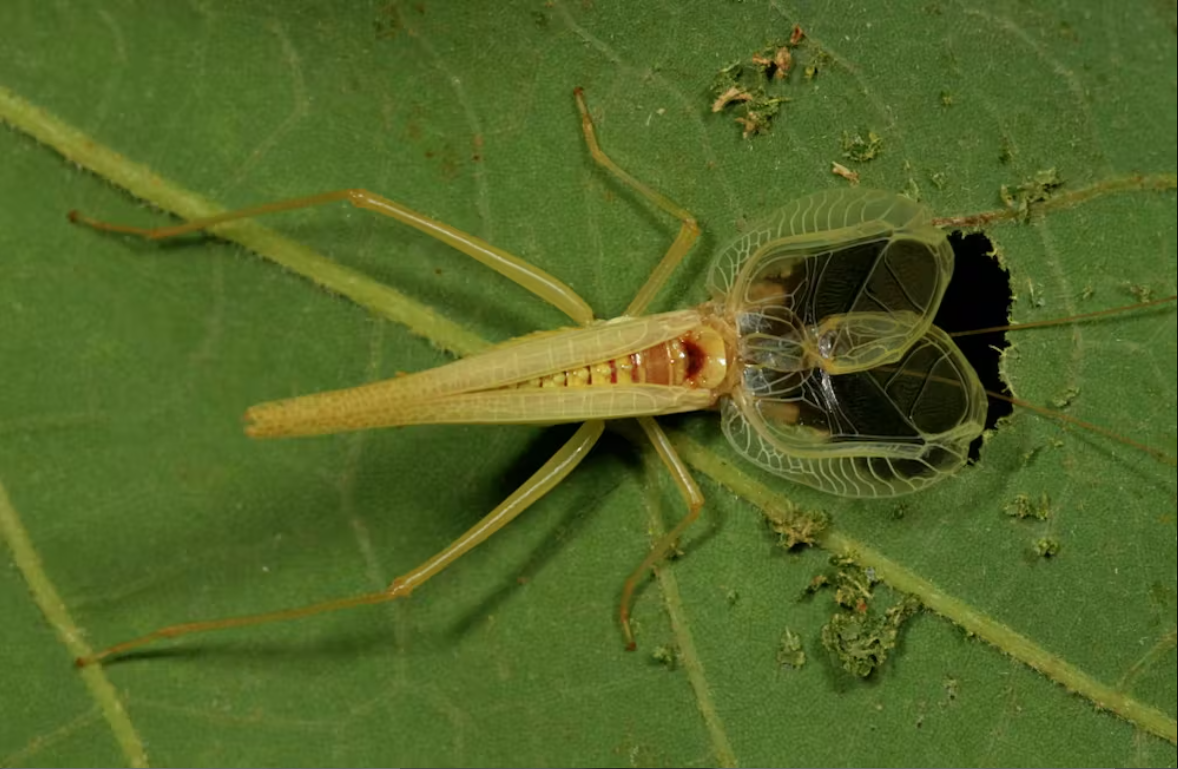 A two-spotted tree cricket, Neoxabea bipunctata, chews a hole just the right size for its fore wings. It then ‘sings’ by poking the wings through the hole and rubbing them together. (Patrick Coin/flickr, CC BY-NC-SA)
Some insects go one step further, amplifying their sounds by building the functional equivalent of audio speakers. Some tree crickets chew holes in leaves, place their vibrating wings in the opening and use the surrounding leaf as a baffle to prevent the loss of sound energy around the edges of their wings.
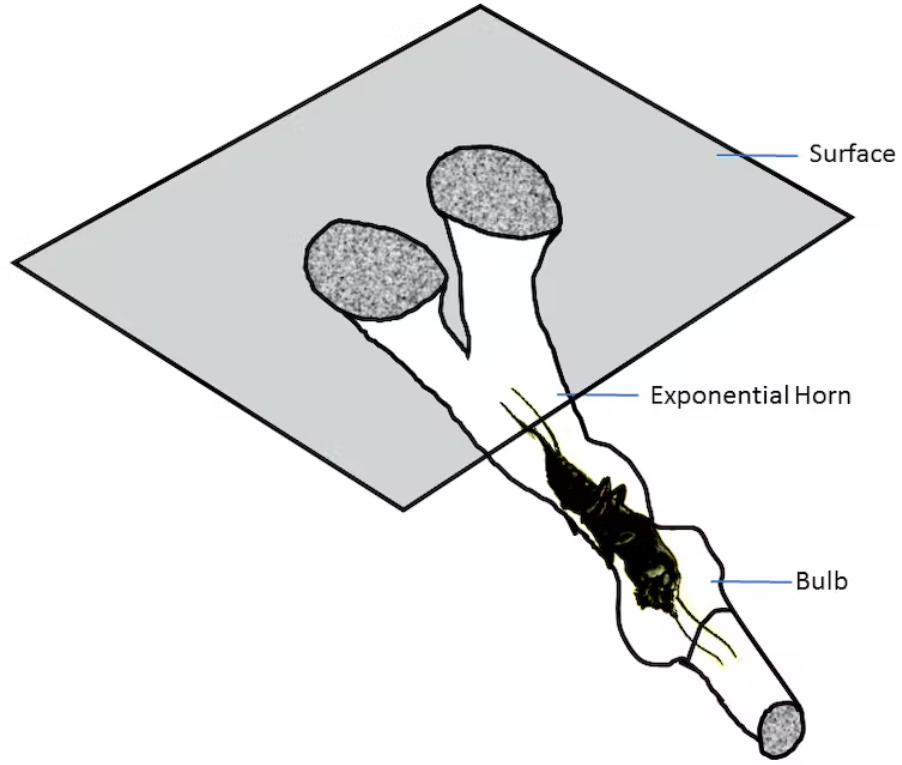 The male mole cricket sings from his specially designed burrow, which amplifies sound like a horn. (Ian Alexander, new drawing based on Bennet-Clark, 1970 with public domain insect from Lydekker 1879, CC BY-SA)
Mole crickets, Gryllotalpa vineae, go even further by constructing a burrow that acts like a wind instrument, creating a cavity of vibrating air that amplifies the sound energy they produce. These crickets’ songs can travel almost half a mile (0.8 kilometer).
Irksome invaders
The official mascot of Puerto Rico is a 1-to-2-inch (2-5-centimeter) frog called the coquí, Eleutherodactylus coqui, whose call is a combination of two pure tones – “ko” and “kee,” from which it gets its name. At 114-120 dB SPL, the frog’s calls are so loud they actually must protect their own hearing when vocalizing, by increasing the air pressure inside their middle ear.
Unfortunately, in the past few decades humans have accidentally introduced the coquí to a number of areas outside their native range, in particular the Hawaiian islands, where they have no natural predators and have become invasive pests. Since coquí calls are within an octave of humans’ best hearing – and they’re nocturnal – many Hawaiians suffer sleep disruptions because of the tiny frogs.
So even if you’re small, it’s not impossible to make yourself heard. You just have to blast all your acoustic energy in a single frequency, and hit the sweet spot of your audience’s hearing.
This article is republished from The Conversation under a Creative Commons license. Read the original article and see more than 250 UMBC articles available in The Conversation.
]]>
Written by Bernard Lohr, associate professor of biological sciences, UMBC In the cloud forests of South America, amid the constant cacophony of bird and insect noise, a deafening blare...
https://umbc.edu/stories/mini-creatures-with-mighty-voices/
https://my3.my.umbc.edu/api/v0/pixel/news/130522/guest@my.umbc.edu/0f7dca78ddc416a99930d7a81b7788b5/api/pixel
biological-sciences
cnms
discovery
magazine
the-conversation
theconversation
UMBC News & Magazine
https://my3.my.umbc.edu/groups/umbc-news-magazine
https://assets1-my.umbc.edu/system/shared/avatars/groups/000/001/943/24435aa6207c452e7bc15cc74b42c7bb/xsmall.png?1748556657
https://assets1-my.umbc.edu/system/shared/avatars/groups/000/001/943/24435aa6207c452e7bc15cc74b42c7bb/original.png?1748556657
https://assets2-my.umbc.edu/system/shared/avatars/groups/000/001/943/24435aa6207c452e7bc15cc74b42c7bb/xxlarge.png?1748556657
https://assets2-my.umbc.edu/system/shared/avatars/groups/000/001/943/24435aa6207c452e7bc15cc74b42c7bb/xlarge.png?1748556657
https://assets3-my.umbc.edu/system/shared/avatars/groups/000/001/943/24435aa6207c452e7bc15cc74b42c7bb/large.png?1748556657
https://assets1-my.umbc.edu/system/shared/avatars/groups/000/001/943/24435aa6207c452e7bc15cc74b42c7bb/medium.png?1748556657
https://assets2-my.umbc.edu/system/shared/avatars/groups/000/001/943/24435aa6207c452e7bc15cc74b42c7bb/small.png?1748556657
https://assets1-my.umbc.edu/system/shared/avatars/groups/000/001/943/24435aa6207c452e7bc15cc74b42c7bb/xsmall.png?1748556657
https://assets2-my.umbc.edu/system/shared/avatars/groups/000/001/943/24435aa6207c452e7bc15cc74b42c7bb/xxsmall.png?1748556657
UMBC News & Magazine
0
0
false
Tue, 31 Jan 2023 17:29:46 -0500
Tue, 31 Jan 2023 17:29:46 -0500
Connecting the Dots

Students come to UMBC for many reasons—to find community, to explore a passion, to make change in the world. Once they figure out the “why” that truly drives their interests, the Retriever community is ready to kick in with the “how” to help make those plans a reality. Part of that looks like the traditional classroom experience with a professor, of course—but just as important are the experiential-learning moments that help many students actively connect the knowledge to careers they hope to pursue after graduation.
UMBC students pursue applied learning in huge numbers. Despite the pandemic, nearly 80 percent of our recent graduates engaged in applied learning, including internships, research, co-ops, and service learning during their time at UMBC. An impressive 91 percent of new grads head directly to a job, advanced degree, or both within six months of graduating—and of those, more than half interned or worked for their employer as a student.
“When it comes to impact, there is nothing more valuable than engaging in applied-learning opportunities to help clarify one’s career direction, build professional skills, and increase one’s professional network,” shares Susan Hindle, the Career Center’s assistant director of internships and employment.
For students pursuing experiential learning through internships, campus jobs, research, and community engagement, it’s not just about learning how to do the thing they want to do. It’s about connecting the work to the passions that brought them to UMBC in the first place. These students and alumni working in their chosen fields tell the whole picture—what hands-on learning looks like when it comes full circle.
Essential connections
The desire to help people comes from deep within. But knowing how to do it successfully on a large scale—and understanding the systems and politics that can make the job more or less challenging—takes more than just compassion.
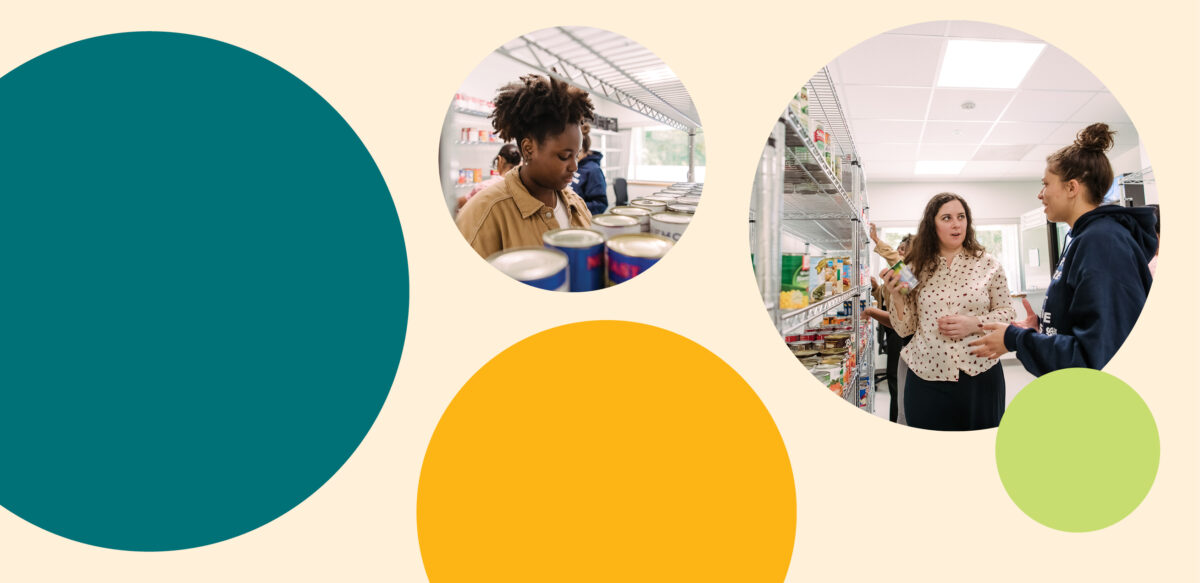
On the morning of the monthly food delivery from the Maryland Food Bank, the brigade of students who keep the Retriever Essentials food pantry running see all sides of the work. Together, they unload and shelve staples like rice, pasta, and huge crates of broccoli for the more than 2,100 visits to the pantry so far this year. At the same time, they connect with community members to understand what might make life better—halal meats, for one; more campus job opportunities, another biggie—and then put their heads together to try to make those changes happen.
 Photos by Marlayna Demond ’11/UMBC, design by Jim Lord ’99.
For Ariel Barbosa, a grad student in UMBC’s community leadership program, working in this space is part of a journey that started with her trying to understand her Brazilian father’s immigrant experience better. As she works with Retriever Essentials, she’s learning about the complexities of these experiences in a way that will help her as she carves out a career in service.
“There are so many signs showing me that I’m supposed to be right here, right now. I feel like I’m preparing,” she says. “Right now, I feel like I’m in a confidence-building, skill-building phase where I’m just trying to pick up as many skills as I can to be able to create what I feel I need to create at the right time.”
As a student, Matthew Dolamore ’08, modern languages and linguistics, caught a first glimpse of what would later become a service-based career when he tutored Spanish-speaking clients for an immigration services office in Baltimore. After graduating, he went on to serve with AmeriCorps and the Peace Corps and earned a master’s degree in community planning before pulling all of those skills together into a full-circle career in Baltimore.
Today, Dolamore is program director for the Esperanza Center, a project of Catholic Charities that assists more than 3,000 individuals each year with walk-in immigration services, including healthcare, legal assistance, and education tools. Dolamore serves as a connector between people and solutions, helping people get what they need when they need it and looking for ways to help improve the system.
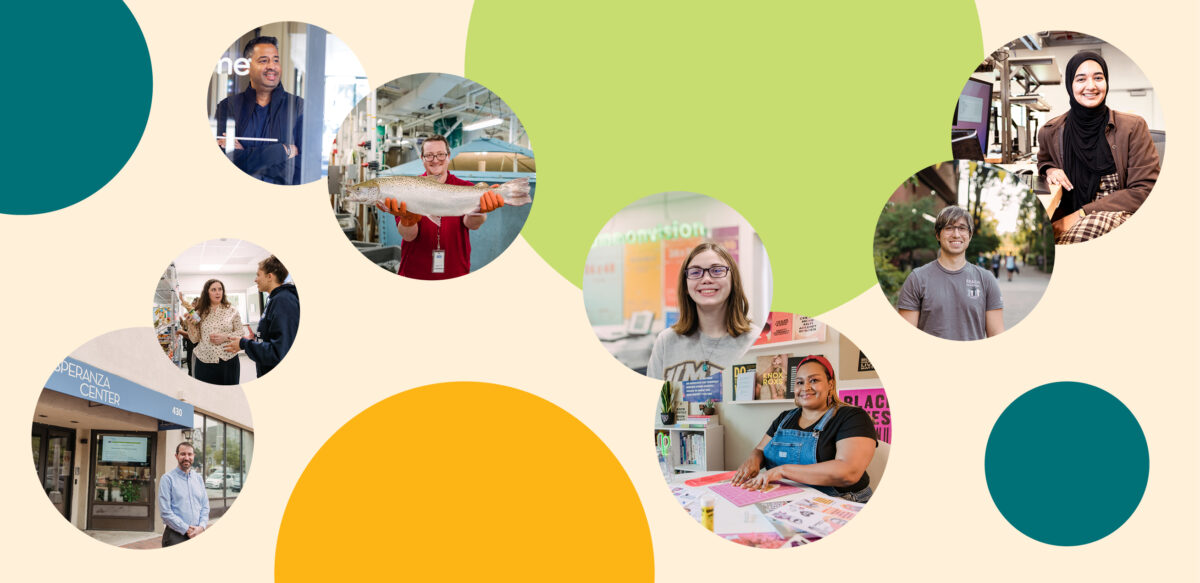 Matthew Dolamore ’08 at the Esperanza Center. Photos by Marlayna Demond ’11/UMBC, design by Jim Lord ’99.
“Among our managers we have a nurse practitioner, a managing attorney, a licensed social worker, an individual who got their master’s in teaching English from UMBC, and a woman who oversees our one-touch client services desk who’s a former immigrant and just has a really dynamic background. And just those five people alone is symbolic of what I love about my job,” says Dolamore.
“I’m not a medical professional. I’m not a legal professional. I’m not a social worker. I’m something myself of a generalist nonprofit manager at this stage in my career, but I get the opportunity every day to come in and out of these really focused professional engagements and try to help all five of them think of each other as teammates, and that’s the part of my job I really enjoy.”
Lydia Sannella, a Peaceworker and grad student in applied sociology at UMBC, also enjoys the organizational aspect of her job with Retriever Essentials. As she looks ahead to her post-academic career, she’s already thinking about how she can continue to marry her values with her career—knowing that it won’t likely be quite the same as what she’s experiencing at UMBC.
“I find that, whenever we want to do something, there are supportive, knowledgeable experts who want to help,” she says. “There’s just hoards of students who want to be involved and engaged and do any variety of work, from physical lifting to technical projects. And it’s just this canvas for creativity and possibility. It’s very reciprocal. What I’m able to contribute ends up being more significant and then what I get ends up being more significant.”
— Jenny O’Grady
Becoming part of the solution
Students come to higher education for a variety of reasons, and among them, many have the goal of learning to create new things—from innovative water-quality solutions to entire companies. For many students, in fact, learning while doing is an integral part of going to college.
If you ask Premal S. Shah ’98, biochemistry and molecular biology, however, he’ll tell you that there’s a world of difference between learning while doing and learning from doing.
That’s not to say that Shah, who earned a Ph.D. from the California Institute of Technology on his way to founding and leading a string of successful healthcare-related companies, doesn’t believe in academics. But from his vantage point as CEO at MyOme, a genomics firm based in northern California, classroom-based learning is only a part of the puzzle.
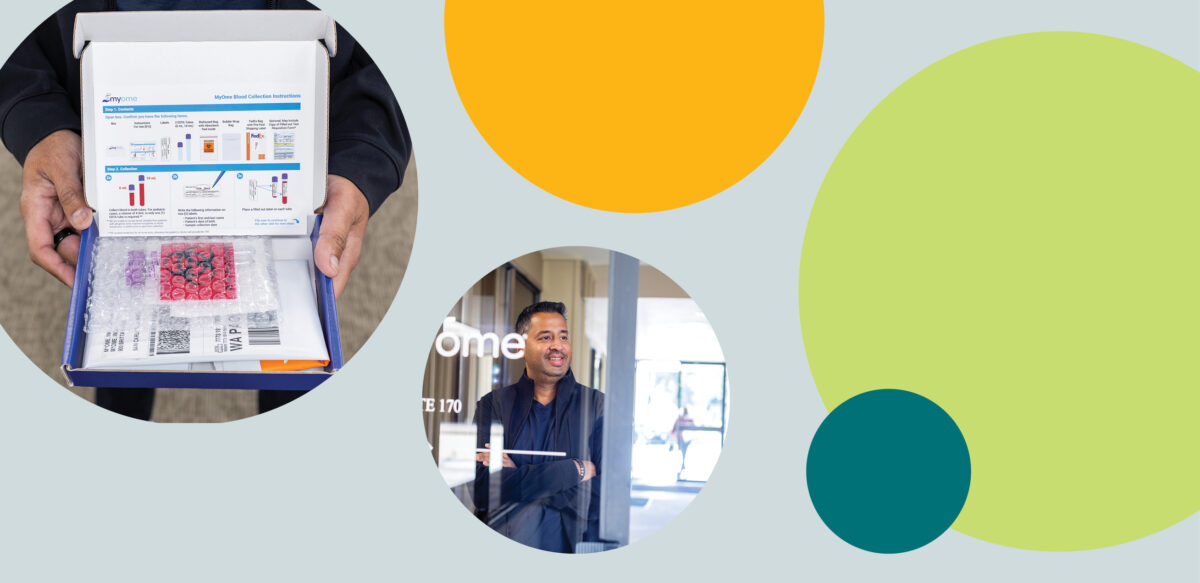 Premal S. Shah ’98 interned at National Institutes of Health before founding a genomics firm. Photos by Barak Shrama, design by Jim Lord ’99.
Shah said he’s always had a practical streak, but he found out how much experiential learning can boost classroom learning thanks to a hands-on internship and fellowship at the National Institutes of Health, beginning while he was a student at UMBC.
“When I got to grad school, there were a lot of people who hadn’t really worked in a lab or done stuff,” he said. “I had a huge head start, just because I was able to pick up a pipette and actually use it. I knew what a DNA extraction protocol was. I knew how to use certain machinery.”
It was a vivid object lesson—one Shah has carried forward into his career. “When you start building companies, there’s always that challenge…of analysis paralysis, right?” he said. “There’s a notion of, ‘We could do this or that. Let’s read and learn more or get additional inputs in search of the perfect answer.’ Or we can actually go build something that will benefit people and iterate even faster as we learn more to make it much better.”
That’s the big difference between studying science and, for example, running science-based companies, Shah says: “The hypotheticals are great. The theories are great. But you’ve got to get [things] done.”
Getting things done is Matt Stromberg’s perennial modus operandi. Being a Ph.D. student studying environmental engineering means he is very much both an environmental scientist—someone who studies environmental problems—and an engineer: someone who works to solve those problems. “I always knew I was a passionate environmentalist, but I also knew I liked to build things,” he said.
In fact, Stromberg, who graduated in 2019 from the University of Virginia with bachelor’s degrees in both environmental engineering and environmental science, is a literal embodiment of learning while doing. Working as both a graduate research assistant and a researcher in the jointly run University System of Maryland Institute for Marine and Environmental Technology (IMET), he sometimes finds himself simultaneously running experiments and keeping the experiments running.
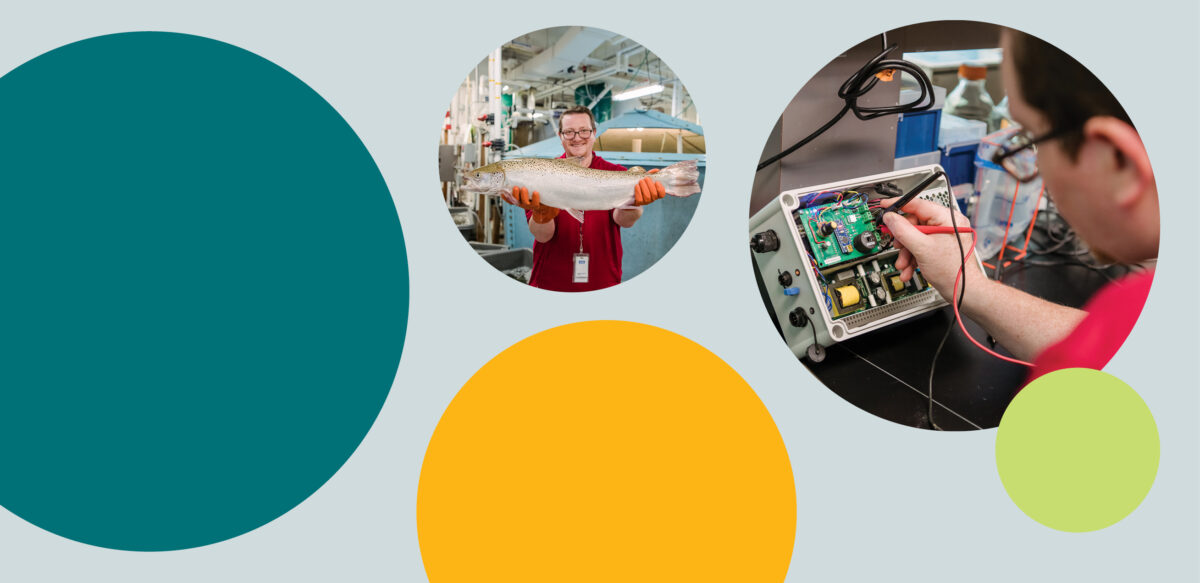 Matt Stromberg is studying aquaculture at the University System of Maryland Institute for Marine and Environmental Technology. Photos by Marlayna Demond ’11/UMBC, design by Jim Lord ’99.
A few months ago, Stromberg said, the night before an experiment was scheduled to start, a pump failed in IMET’s Aquaculture Research Center, a 1,800-square-meter facility with hundreds of fish tanks.
“It was a large pump, and it needed to be replaced—and it was eight o’clock at night,” Stromberg said. “I had already worked 12 hours that day, [but] I realized that there’s no way this experiment is going to run if I don’t have a pump tomorrow. So…I got the wrenches and I got all the fittings I needed,” and found a way to fix it.
Stromberg’s ability to save that experiment is part and parcel of his approach. One of his main research projects is unclogging a major bottleneck that prevents more farm-raised fish from getting to market: purging them of an unsavory flavor that’s sometimes characteristic of fish that aren’t caught in the wild. As Stromberg put it, “You’re not going to sell the fish if it tastes like dirt.”
That’s a problem not only for aquaculture companies—which have to use lots of water, time, money, and energy to purge the fish of this taste—but also for the planet. That’s because the only alternative to aquaculture is fishing in the wild, which can destroy ecosystems but is still cheaper than aquaculture, due to the expensive purging process.
He’s working with advanced oxidative processes and a technology of his own that would effectively create a shortcut, making it more cost-effective to farm fish and thus helping to protect wild habitat in the process. And Stromberg aims to eventually put his Ph.D. to work in a similarly practical way: His goal is to create a company that performs chemical analysis and remediation of water contaminants.
“I’ve learned a lot from my time here,” he says. “Especially not to over-engineer things!”
— Scott Cech
Community-centered art
Visual art is all around us—in flyers, television commercials, and even clothes. And while many of us may never know the artists creating work behind the scenes, their lives and experiences certainly do shape their work.
For instance, earlier this year, Jennifer White-Johnson ’08, visual arts, designed a collection for Target’s national Latino Heritage Month campaign, including a tumbler with stacked text reading sonando vivamente vividly dreaming and a T-shirt proudly proclaiming piel canela pelo rizado (brown/cinnamon skin curly hair). As a disabled, neurodiverse, Afro-Latina designer from Baltimore, White-Johnson sees her inclusion as an opportunity to highlight and provide a voice to communities that often aren’t heard or represented.
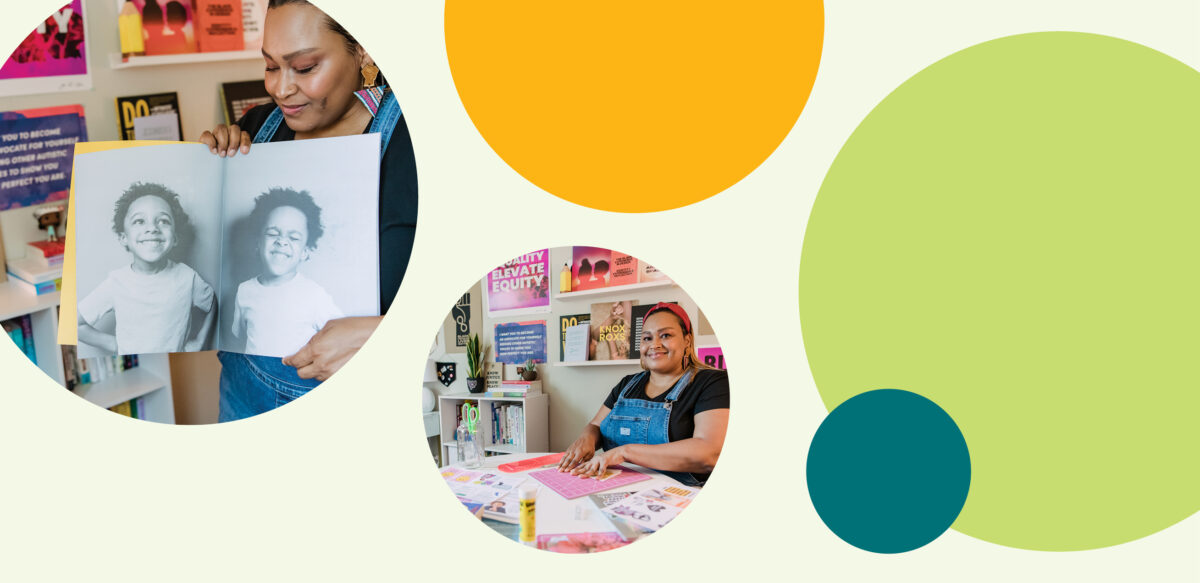 Former Student Events Board member Jennifer White-Johnson ’08 now has designs at Target. Photos by Marlayna Demond ’11/UMBC, design by Jim Lord ’99.
“I am really honored to have been chosen and included in this year’s Target Latino Heritage Month collection and campaign,” says White-Johnson. “Using art and design to celebrate and elevate my cultural stories, the strength, and legacy of my ancestors, felt like something that was meant to be!”
Living with undiagnosed ADHD as a student, White-Johnson often felt like her intensity, excitement, and point of view were unwelcome or just too much. That changed when she transferred to UMBC, where she immediately felt at home. In particular, her time as director of promotions for the Student Events Board [(seb)] gave her her first taste of how graphic design could marry with communit-ycentric work.
Working closely with the Office of Student Life, White-Johnson and other members of (seb) volunteered during an alternative spring-break trip to post-Hurricane Katrina New Orleans. White-Johnson also designed the T-shirts.
“This was in 2007, so we could help offer some sort of relief from Hurricane Katrina,” says White-Johnson. “It was life-changing because I was able to surround myself with other like-minded scholars that were serious about academic life but who also understood that school is about self-discovery.”
Enter Patch Hatley, a sophomore visual arts major with a concentration in animation. Fresh from a session learning how to create stop-motion animation puppets from paper, she is excited to test out some of what she’s learned on the job at commonvision, the student-driven print and design center in The Commons. On any given day, one might find her working on anything from animating cute countdowns for student activities to designing stickers.
“I’m always constantly learning in an environment like commonvision,” she says. “Each new skill helps transition to the next project, and each project creates new and exciting opportunities. You’re always surrounded by a team who are all community-driven, so I always feel like I can ask for help or constructive criticism. commonvision supports, drives, and motivates me to keep reaching for the stars and will always be an important part of how I’ve grown—not just as an artist but as a team player.”
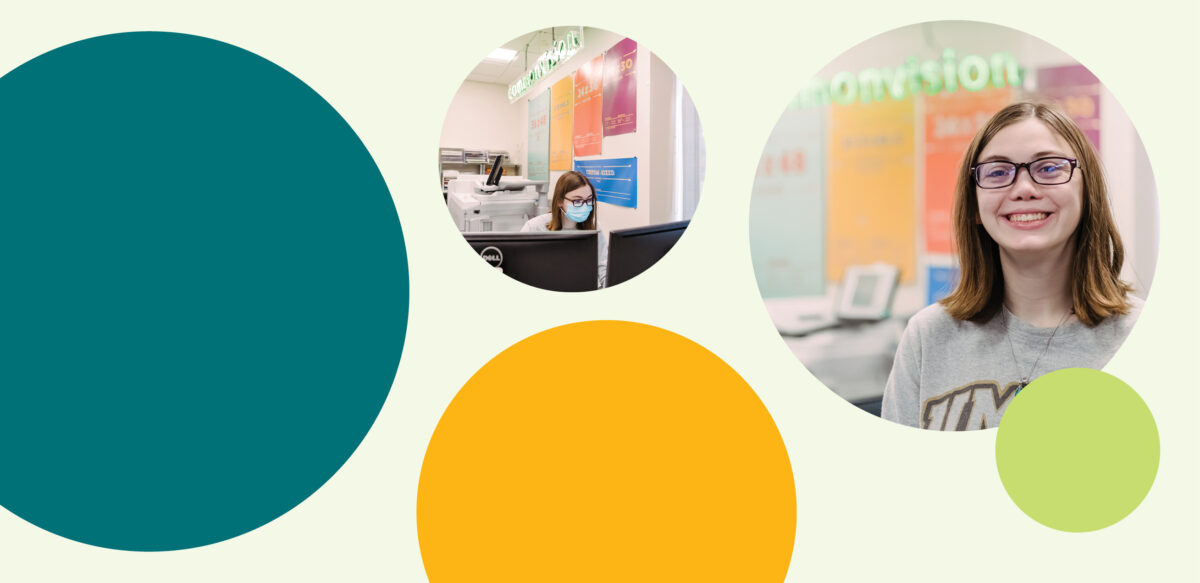 Patch Hatley learns while working on animations at commonvision. Photos by Marlayna Demond ’11/UMBC, design by Jim Lord ’99.
Hatley finds work at commonvision particularly helpful because it stretches her creative muscles and opens up her craft to new programs, tools, and mediums, and also because other creators surround her. After spending a decade in animation and illustration before becoming a Retriever, Hatley loves the opportunity to expand her craft in a place that has fostered the foundation for budding designers for years—and getting to bring her personal perspective into work for clients.
“At the end of the day, you’re drawing for yourself and for the people around you whether you realize it implicitly or not,” says Hatley. At the core of both artists’ practices is community. Both White-Johnson and Hatley recognize that their art doesn’t live in a vacuum but exists as a letter of inspiration, solidarity, and encouragement to their respective communities. Both artists, years apart in their practice, found similar communities to nurture and invest in them.
“Being given the space to bring visibility to themes of cultural intersectionality, specifically the parts of our natural beauty that aren’t always celebrated, our caramel brown, cinnamon skin, and our natural curls,” says White-Johnson. “I hope my work can culturally inspire others to center what they want to see more of.”
— Sharéa Harris
Taking experiential learning to the next level
Developing high-level skills in a highly technical field like computer science is difficult enough. But the ability to both master and successfully teach those skills to others takes the challenge to a whole new level.
Fortunately, Amina Mahmood and Zach Margulies thrive at that level. With their dedication to passing along computer-science knowledge, these Retrievers amply demonstrate that doing while teaching and learning while doing are just different parts of the same equation.
As Mahmood ’21, computer science, tells it, she started learning while doing quite literally. Just weeks into her first year at UMBC, Mahmood found herself working 20 hours a week as a junior malware analyst at Huntress, a cybersecurity firm that was then still in the startup phase at the bwtech@UMBC Research and Technology Park.
“I didn’t really have any experience, but I was pretty ambitious, so I learned everything on the job,” she said.
Mahmood, part of UMBC’s Cyber Scholars Program, quickly learned how to run different types of malware on a virtual machine, dissect the particulars of each, and create mitigation reports. The nascent company’s culture also helped boost her confidence. If she ran into a problem, she said, the people she worked with were glad to bring her up to speed.
 Amina Mahmood ’21 at the Johns Hopkins University Applied Physics Lab. Photos courtesy of Johns Hopkins Applied Physics Laboratory, design by Jim Lord ’99.
“It was just like, ‘Oh, you don’t know this—let me teach it to you.’ And then I picked up on it and then I was like, ‘OK—I can do this,’” Mahmood said. Mahmood was quick to apply such on-the-job learning to her academics, even persuading an academic advisor to allow her to add her to his overenrolled, graduate-level software reverse-engineering course at the same time she was enrolled in an undergraduate prerequisite class.
Mahmood not only aced the graduate-level class, she also started using what she had learned to complete the experiential-learning cycle at her new part-time job at Parsons Corp., a technology-focused defense, intelligence, security, and infrastructure engineering firm.
“One of my mentors at Parsons—he really supported me, and he said, ‘You know a lot about reverse engineering. Why don’t you just make a course and teach coworkers?’” That’s exactly what Mahmood did— and now does for new summer interns as a full-time reverse engineer at the Johns Hopkins University Applied Physics Lab.
Recently she found herself completing the circle, coming back to UMBC for the same kind of career fair where she’d found her first job as a first-year student. “But [this time] I didn’t go as a student,” she noted. “I went as an employer.”
Margulies ’14, biological sciences, is completing his own trajectory: Nearly a decade after earning his first bachelor’s degree, he has returned to UMBC to earn a bachelor’s in computer science and a master’s in education, with the goal of teaching computer science to Baltimore high school students when he graduates in 2024.
Margulies started his career pivot before diving back into academics immersing himself in on-the-job data science and programming—including a Maryland Institute for Innovative Computing internship at the Maryland Department of Health after starting in the computer science program. Because of this, he’s able to pursue his studies with a greater sense of perspective.
“I feel like it inspires confidence and it builds your self-esteem, taking what you’ve learned in the class and not even a semester later applying it in a real-world setting,” he said.
Margulies noted that, as a teacher, he’ll also be able to fully address high schoolers’ perennial classroom question: ‘When am I ever going to use this in real life?’
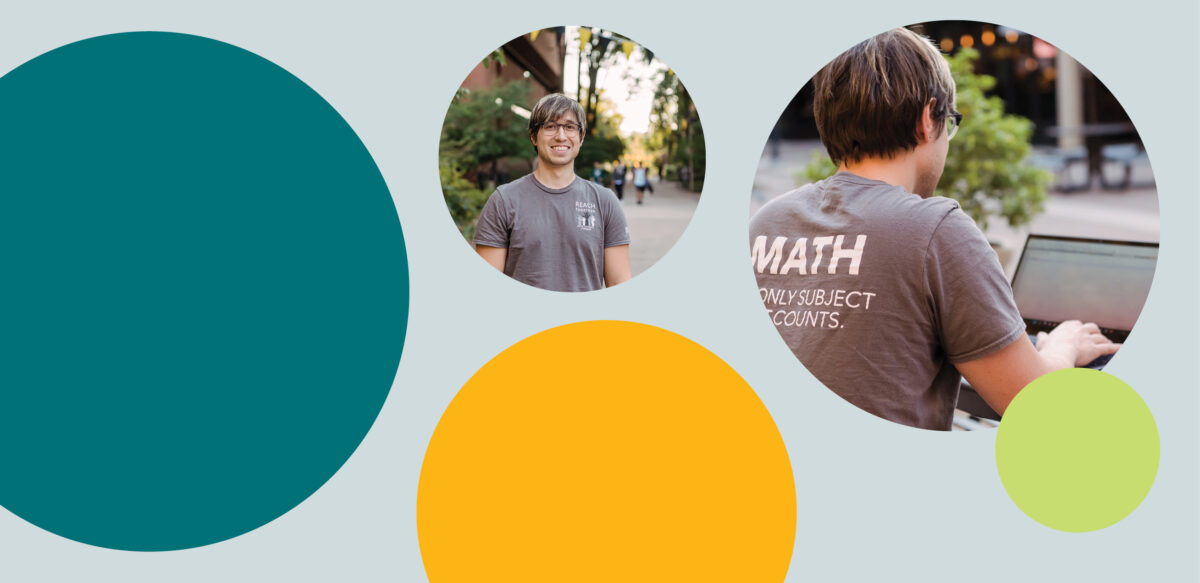 Zach Margulies took part in a Maryland Institute for Innovative Computing internship with the Maryland Department of Health. Photos by Marlayna Demond ’11/UMBC, design by Jim Lord ’99.
“It’s really important for teachers to know what the practical application of [schoolwork] is going to be and what working in a computer science job will look like,” he said.
A case in point, Margulies said, was the work he did as part of a Maryland Department of Health internship last summer, reviewing and finding improvements for data collection, including the creation of a data dashboard.
“Last semester, I took Computer Science 201, and we learned the programming language Python, and I really wanted to start applying that language at the internship,” he said. Because he’d had both practical experience and formal training, Margulies said, he was able to see that he’d have to adapt what he’d learned to suit the task at hand.
“[I had] to figure out a way that I could take Python and apply it to developing the database because that’s not something we necessarily learned in the class,” he said. “I had a lot of fun taking the thing that I learned academically and not just applying it, but also taking it to the next level.”
— Scott Cech
]]>
Students come to UMBC for many reasons—to find community, to explore a passion, to make change in the world. Once they figure out the “why” that truly drives their interests, the Retriever...
https://umbc.edu/stories/connecting-the-dots-through-experiential-learning/
https://my3.my.umbc.edu/api/v0/pixel/news/129595/guest@my.umbc.edu/19c7c86c3aa950e73d30a2d31a2a7667/api/pixel
applied-sociology
biochemistry-and-molecular-biology
biological-sciences
career-center
commonvision
community-leadership
computer-science
discovery
environmental-engineering
fall-2022
magazine
mll
peaceworker
retriever-essentials
visual-arts
UMBC News & Magazine
https://my3.my.umbc.edu/groups/umbc-news-magazine
https://assets1-my.umbc.edu/system/shared/avatars/groups/000/001/943/24435aa6207c452e7bc15cc74b42c7bb/xsmall.png?1748556657
https://assets1-my.umbc.edu/system/shared/avatars/groups/000/001/943/24435aa6207c452e7bc15cc74b42c7bb/original.png?1748556657
https://assets2-my.umbc.edu/system/shared/avatars/groups/000/001/943/24435aa6207c452e7bc15cc74b42c7bb/xxlarge.png?1748556657
https://assets2-my.umbc.edu/system/shared/avatars/groups/000/001/943/24435aa6207c452e7bc15cc74b42c7bb/xlarge.png?1748556657
https://assets3-my.umbc.edu/system/shared/avatars/groups/000/001/943/24435aa6207c452e7bc15cc74b42c7bb/large.png?1748556657
https://assets1-my.umbc.edu/system/shared/avatars/groups/000/001/943/24435aa6207c452e7bc15cc74b42c7bb/medium.png?1748556657
https://assets2-my.umbc.edu/system/shared/avatars/groups/000/001/943/24435aa6207c452e7bc15cc74b42c7bb/small.png?1748556657
https://assets1-my.umbc.edu/system/shared/avatars/groups/000/001/943/24435aa6207c452e7bc15cc74b42c7bb/xsmall.png?1748556657
https://assets2-my.umbc.edu/system/shared/avatars/groups/000/001/943/24435aa6207c452e7bc15cc74b42c7bb/xxsmall.png?1748556657
UMBC News & Magazine
0
0
false
Wed, 30 Nov 2022 15:17:19 -0500
Wed, 30 Nov 2022 15:17:19 -0500
Connecting the Dots
Students come to UMBC for many reasons—to find community, to explore a passion, to make change in the world. Once they figure out the “why” that truly drives their interests, the Retriever community is ready to kick in with the “how” to help make those plans a reality. Part of that looks like the traditional classroom experience with a professor, of course—but just as important are the experiential-learning moments that help many students actively connect the knowledge to careers they hope to pursue after graduation.
UMBC students pursue applied learning in huge numbers. Despite the pandemic, nearly 80 percent of our recent graduates engaged in applied learning, including internships, research, co-ops, and service learning during their time at UMBC. An impressive 91 percent of new grads head directly to a job, advanced degree, or both within six months of graduating—and of those, more than half interned or worked for their employer as a student.
“When it comes to impact, there is nothing more valuable than engaging in applied-learning opportunities to help clarify one’s career direction, build professional skills, and increase one’s professional network,” shares Susan Hindle, the Career Center’s assistant director of internships and employment.
For students pursuing experiential learning through internships, campus jobs, research, and community engagement, it’s not just about learning how to do the thing they want to do. It’s about connecting the work to the passions that brought them to UMBC in the first place. These students and alumni working in their chosen fields tell the whole picture—what hands-on learning looks like when it comes full circle.
Essential Connections
The desire to help people comes from deep within. But knowing how to do it successfully on a large scale—and understanding the systems and politics that can make the job more or less challenging—takes more than just compassion.
On the morning of the monthly food delivery from the Maryland Food Bank, the brigade of students who keep the Retriever Essentials food pantry running see all sides of the work. Together, they unload and shelve staples like rice, pasta, and huge crates of broccoli for the more than 2,100 visits to the pantry so far this year. At the same time, they work with community members to understand what might make life better—halal meats, for one; more campus job opportunities, another biggie—and then put their heads together to try to make those changes happen.
Nyla Howell (left) and Lydia Sannella and Ariel Barbosa (L-R) sort canned goods for Retriever Essentials. Photos by Marlayna Demond ’11/UMBC, design by Jim Lord ’99.
For Ariel Barbosa, a grad student in UMBC’s community leadership program, working in this space is part of a journey that started with her trying to understand her Brazilian father’s immigrant experience better. As she works with Retriever Essentials, she’s learning about the complexities of these experiences in a way that will help her as she carves out a career in service. “There are so many signs showing me that I’m supposed to be right here, right now. I feel like I’m preparing,” she says. “Right now, I feel like I’m in a confidence-building, skill-building phase where I’m just trying to pick up as many skills as I can to be able to create what I feel I need to create at the right time.”
As a student, Matthew Dolamore ’08, modern languages and linguistics, caught a first glimpse of what would later become a service-based career when he tutored Spanish-speaking clients for an immigration services office in Baltimore. After graduating, he went on to serve with AmeriCorps and the Peace Corps and earned a master’s degree in community planning before pulling all of those skills together into a full-circle career in Baltimore.
Today, Dolamore is program director for the Esperanza Center, a project of Catholic Charities that assists more than 3,000 individuals each year with walk-in immigration services, including healthcare, legal assistance, and education tools. Dolamore serves as a connector between people and solutions, helping people get what they need when they need it and looking for ways to help improve the system.
Matthew Dolamore ’08 at the Esperanza Center. Photos by Marlayna Demond ’11/UMBC, design by Jim Lord ’99.
“Among our managers we have a nurse practitioner, a managing attorney, a licensed social worker, an individual who got their master’s in teaching English from UMBC, and a woman who oversees our one-touch client services desk who’s a former immigrant and just has a really dynamic background. And just those five people alone is symbolic of what I love about my job,” says Dolamore.
“I’m not a medical professional. I’m not a legal professional. I’m not a social worker. I’m something myself of a generalist nonprofit manager at this stage in my career, but I get the opportunity every day to come in and out of these really focused professional engagements and try to help all five of them think of each other as teammates, and that’s the part of my job I really enjoy.”
Lydia Sannella, a Peaceworker and grad student in applied sociology at UMBC, also enjoys the organizational aspect of her job with Retriever Essentials. As she looks ahead to her post-academic career, she’s already thinking about how she can continue to marry her values with her career—knowing that it won’t likely be quite the same as what she’s experiencing at UMBC.
“I find that, whenever we want to do something, there are supportive, knowledgeable experts who want to help,” she says. “There’s just hoards of students who want to be involved and engaged and do any variety of work, from physical lifting to technical projects. And it’s just this canvas for creativity and possibility. It’s very reciprocal. What I’m able to contribute ends up being more significant and then what I get ends up being more significant.”
— Jenny O’Grady
Becoming part of the solution
Students come to higher education for a variety of reasons, and among them, many have the goal of learning to create new things—from innovative water-quality solutions to entire companies. For many students, in fact, learning while doing is an integral part of going to college.
If you ask Premal S. Shah ’98, biochemistry and molecular biology, however, he’ll tell you that there’s a world of difference between learning while doing and learning from doing.
That’s not to say that Shah, who earned a Ph.D. from the California Institute of Technology on his way to founding and leading a string of successful healthcare-related companies, doesn’t believe in academics. But from his vantage point as CEO at MyOme, a genomics firm based in northern California, classroom-based learning is only a part of the puzzle.
Premel S. Shah ’98 interned at National Institutes of Health before founding a genomics firm. Photos by Barack Shrama, design by Jim Lord ’99.
Shah said he’s always had a practical streak, but he found out how much experiential learning can boost classroom learning thanks to a hands-on internship and fellowship at the National Institutes of Health, beginning while he was a student at UMBC.
“When I got to grad school, there were a lot of people who hadn’t really worked in a lab or done stuff,” he said. “I had a huge head start, just because I was able to pick up a pipette and actually use it. I knew what a DNA extraction protocol was. I knew how to use certain machinery.”
It was a vivid object lesson—one Shah has carried forward into his career. “When you start building companies, there’s always that challenge…of analysis paralysis, right?” he said. “There’s a notion of, ‘We could do this or that. Let’s read and learn more or get additional inputs in search of the perfect answer.’ Or we can actually go build something that will benefit people and iterate even faster as we learn more to make it much better.”
That’s the big difference between studying science and, for example, running science-based companies, Shah says: “The hypotheticals are great. The theories are great. But you’ve got to get [things] done.”
Getting things done is Matt Stromberg’s perennial modus operandi. Being a Ph.D. student studying environmental engineering means he is very much both an environmental scientist—someone who studies environmental problems—and an engineer: someone who works to solve those problems. “I always knew I was a passionate environmentalist, but I also knew I liked to build things,” he said.
In fact, Stromberg, who graduated in 2019 from the University of Virginia with bachelor’s degrees in both environmental engineering and environmental science, is a literal embodiment of learning while doing. Working as both a graduate research assistant and a researcher in the jointly run University System of Maryland Institute for Marine and Environmental Technology (IMET), he sometimes finds himself simultaneously running experiments and keeping the experiments running.
Matt Stromberg is studying aquaculture at the University System of Maryland Institute for Marine and Environmental Technology. Photos by Marlayna Demond ’11/UMBC, design by Jim Lord ’99.
A few months ago, Stromberg said, the night before an experiment was scheduled to start, a pump failed in IMET’s Aquaculture Research Center, a 1,800-square-meter facility with hundreds of fish tanks.
“It was a large pump, and it needed to be replaced—and it was eight o’clock at night,” Stromberg said. “I had already worked 12 hours that day, [but] I realized that there’s no way this experiment is going to run if I don’t have a pump tomorrow. So…I got the wrenches and I got all the fittings I needed,” and found a way to fix it.
Stromberg’s ability to save that experiment is part and parcel of his approach. One of his main research projects is unclogging a major bottleneck that prevents more farm-raised fish from getting to market: purging them of an unsavory flavor that’s sometimes characteristic of fish that aren’t caught in the wild. As Stromberg put it, “You’re not going to sell the fish if it tastes like dirt.”
That’s a problem not only for aquaculture companies—which have to use lots of water, time, money, and energy to purge the fish of this taste—but also for the planet. That’s because the only alternative to aquaculture is fishing in the wild, which can destroy ecosystems but is still cheaper than aquaculture, due to the expensive purging process.
He’s working with advanced oxidative processes and a technology of his own that would effectively create a shortcut, making it more cost-effective to farm fish and thus helping to protect wild habitat in the process. And Stromberg aims to eventually put his Ph.D. to work in a similarly practical way: His goal is to create a company that performs chemical analysis and remediation of water contaminants.
“I’ve learned a lot from my time here,” he says. “Especially not to over-engineer things!”
— Scott Cech
Community-centered art
Visual art is all around us—in flyers, television commercials, and even clothes. And while many of us may never know the artists creating work behind the scenes, their lives and experiences certainly do shape their work.
For instance, earlier this year, Jennifer White-Johnson ’08, visual arts, designed a collection for Target’s national Latino Heritage Month campaign, including a tumbler with stacked text reading sonando vivamente vividly dreaming and a T-shirt proudly proclaiming piel canela pelo rizado (brown/cinnamon skin curly hair). As a disabled, neurodiverse, Afro-Latina designer from Baltimore, White-Johnson sees her inclusion as an opportunity to highlight and provide a voice to communities that often aren’t heard or represented.
Former Student Events Board member Jennifer White-Johnson ’08 now has designs at Target. Photos by Marlayna Demond ’11/UMBC, design by Jim Lord ’99.
“I am really honored to have been chosen and included in this year’s Target Latino Heritage Month collection and campaign,” says White-Johnson. “Using art and design to celebrate and elevate my cultural stories, the strength, and legacy of my ancestors, felt like something that was meant to be!”
Living with undiagnosed ADHD as a student, White-Johnson often felt like her intensity, excitement, and point of view were unwelcome or just too much. That changed when she transferred to UMBC, where she immediately felt at home. In particular, her time as director of promotions for the Student Events Board [(seb)] gave her her first taste of how graphic design could marry with communit-ycentric work.
Working closely with the Office of Student Life, White-Johnson and other members of (seb) volunteered during an alternative spring-break trip to post-Hurricane Katrina New Orleans. White-Johnson also designed the T-shirts.
“This was in 2007, so we could help offer some sort of relief from Hurricane Katrina,” says White-Johnson. “It was life-changing because I was able to surround myself with other like-minded scholars that were serious about academic life but who also understood that school is about self-discovery.”
Enter Patch Hatley, a sophomore visual arts major with a concentration in animation. Fresh from a session learning how to create stop-motion animation puppets from paper, she is excited to test out some of what she’s learned on the job at commonvision, the student-driven print and design center in The Commons. On any given day, one might find her working on anything from animating cute countdowns for student activities to designing stickers.
“I’m always constantly learning in an environment like commonvision,” she says. “Each new skill helps transition to the next project, and each project creates new and exciting opportunities. You’re always surrounded by a team who are all community-driven, so I always feel like I can ask for help or constructive criticism. commonvision supports, drives, and motivates me to keep reaching for the stars and will always be an important part of how I’ve grown—not just as an artist but as a team player.”
Patch Hatley learns while working on animations at commonvision. Photos by Marlayna Demond ’11/UMBC, design by Jim Lord ’99.
Hatley finds work at commonvision particularly helpful because it stretches her creative muscles and opens up her craft to new programs, tools, and mediums, and also because other creators surround her. After spending a decade in animation and illustration before becoming a Retriever, Hatley loves the opportunity to expand her craft in a place that has fostered the foundation for budding designers for years—and getting to bring her personal perspective into work for clients.
“At the end of the day, you’re drawing for yourself and for the people around you whether you realize it implicitly or not,” says Hatley. At the core of both artists’ practices is community. Both White-Johnson and Hatley recognize that their art doesn’t live in a vacuum but exists as a letter of inspiration, solidarity, and encouragement to their respective communities. Both artists, years apart in their practice, found similar communities to nurture and invest in them.
“Being given the space to bring visibility to themes of cultural intersectionality, specifically the parts of our natural beauty that aren’t always celebrated, our caramel brown, cinnamon skin, and our natural curls,” says White-Johnson. “I hope my work can culturally inspire others to center what they want to see more of.”
— Sharéa Harris
Taking experiential learning to the next level
Developing high-level skills in a highly technical field like computer science is difficult enough. But the ability to both master and successfully teach those skills to others takes the challenge to a whole new level.
Fortunately, Amina Mahmood and Zach Margulies thrive at that level. With their dedication to passing along computer-science knowledge, these Retrievers amply demonstrate that doing while teaching and learning while doing are just different parts of the same equation.
As Mahmood ’21, computer science, tells it, she started learning while doing quite literally. Just weeks into her first year at UMBC, Mahmood found herself working 20 hours a week as a junior malware analyst at Huntress, a cybersecurity firm that was then still in the startup phase at the bwtech@UMBC Research and Technology Park.
“I didn’t really have any experience, but I was pretty ambitious, so I learned everything on the job,” she said.
Mahmood, part of UMBC’s Cyber Scholars Program, quickly learned how to run different types of malware on a virtual machine, dissect the particulars of each, and create mitigation reports. The nascent company’s culture also helped boost her confidence. If she ran into a problem, she said, the people she worked with were glad to bring her up to speed.
Amina Mahmood ’21 at the Johns Hopkins University Applied Physics Lab. Photos courtesy of Johns Hopkins Applied Physics Laboratory, design by Jim Lord ’99.
“It was just like, ‘Oh, you don’t know this—let me teach it to you.’ And then I picked up on it and then I was like, ‘OK—I can do this,’” Mahmood said. Mahmood was quick to apply such on-the-job learning to her academics, even persuading an academic advisor to allow her to add her to his overenrolled, graduate-level software reverse-engineering course at the same time she was enrolled in an undergraduate prerequisite class.
Mahmood not only aced the graduate-level class, she also started using what she had learned to complete the experiential-learning cycle at her new part-time job at Parsons Corp., a technology-focused defense, intelligence, security, and infrastructure engineering firm.
“One of my mentors at Parsons—he really supported me, and he said, ‘You know a lot about reverse engineering. Why don’t you just make a course and teach coworkers?’” That’s exactly what Mahmood did— and now does for new summer interns as a full-time reverse engineer at the Johns Hopkins University Applied Physics Lab.
Recently she found herself completing the circle, coming back to UMBC for the same kind of career fair where she’d found her first job as a first-year student. “But [this time] I didn’t go as a student,” she noted. “I went as an employer.”
Margulies ’14, biological sciences, is completing his own trajectory: Nearly a decade after earning his first bachelor’s degree, he has returned to UMBC to earn a bachelor’s in computer science and a master’s in education, with the goal of teaching computer science to Baltimore high school students when he graduates in 2024.
Margulies started his career pivot before diving back into academics immersing himself in on-the-job data science and programming—including a Maryland Institute for Innovative Computing internship at the Maryland Department of Health after starting in the computer science program. Because of this, he’s able to pursue his studies with a greater sense of perspective.
“I feel like it inspires confidence and it builds your self-esteem, taking what you’ve learned in the class and not even a semester later applying it in a real-world setting,” he said.
Margulies noted that, as a teacher, he’ll also be able to fully address high schoolers’ perennial classroom question: ‘When am I ever going to use this in real life?’
Zach Margulies took part in a Maryland Institute for Innovative Computing internship with the Maryland Department of Health. Photos by Marlayna Demond ’11/UMBC, design by Jim Lord ’99.
“It’s really important for teachers to know what the practical application of [schoolwork] is going to be and what working in a computer science job will look like,” he said.
A case in point, Margulies said, was the work he did as part of a Maryland Department of Health internship last summer, reviewing and finding improvements for data collection, including the creation of a data dashboard.
“Last semester, I took Computer Science 201, and we learned the programming language Python, and I really wanted to start applying that language at the internship,” he said. Because he’d had both practical experience and formal training, Margulies said, he was able to see that he’d have to adapt what he’d learned to suit the task at hand.
“[I had] to figure out a way that I could take Python and apply it to developing the database because that’s not something we necessarily learned in the class,” he said. “I had a lot of fun taking the thing that I learned academically and not just applying it, but also taking it to the next level.”
— Scott Cech
]]>
Students come to UMBC for many reasons—to find community, to explore a passion, to make change in the world. Once they figure out the “why” that truly drives their interests, the Retriever...
https://umbc.edu/stories/connecting-the-dots/
https://my3.my.umbc.edu/api/v0/pixel/news/129482/guest@my.umbc.edu/38f4c1bff401ad3aed0a5d74a732610b/api/pixel
applied-sociology
biochemistry-and-molecular-biology
biological-sciences
career-center
commonvision
community-leadership
computer-science
discovery
environmental-engineering
fall-2022
feature
magazine
mll
peaceworker
retriever-essentials
visual-arts
UMBC News & Magazine
https://my3.my.umbc.edu/groups/umbc-news-magazine
https://assets1-my.umbc.edu/system/shared/avatars/groups/000/001/943/24435aa6207c452e7bc15cc74b42c7bb/xsmall.png?1748556657
https://assets1-my.umbc.edu/system/shared/avatars/groups/000/001/943/24435aa6207c452e7bc15cc74b42c7bb/original.png?1748556657
https://assets2-my.umbc.edu/system/shared/avatars/groups/000/001/943/24435aa6207c452e7bc15cc74b42c7bb/xxlarge.png?1748556657
https://assets2-my.umbc.edu/system/shared/avatars/groups/000/001/943/24435aa6207c452e7bc15cc74b42c7bb/xlarge.png?1748556657
https://assets3-my.umbc.edu/system/shared/avatars/groups/000/001/943/24435aa6207c452e7bc15cc74b42c7bb/large.png?1748556657
https://assets1-my.umbc.edu/system/shared/avatars/groups/000/001/943/24435aa6207c452e7bc15cc74b42c7bb/medium.png?1748556657
https://assets2-my.umbc.edu/system/shared/avatars/groups/000/001/943/24435aa6207c452e7bc15cc74b42c7bb/small.png?1748556657
https://assets1-my.umbc.edu/system/shared/avatars/groups/000/001/943/24435aa6207c452e7bc15cc74b42c7bb/xsmall.png?1748556657
https://assets2-my.umbc.edu/system/shared/avatars/groups/000/001/943/24435aa6207c452e7bc15cc74b42c7bb/xxsmall.png?1748556657
UMBC News & Magazine
0
0
false
Wed, 30 Nov 2022 15:17:19 -0500
How to Bridge Your Two Homes
With Jess Presuel ’23, biological sciences, an international student from Mexico
Jess Presuel’s route to UMBC was not a direct flight from Mérida, Yucatán—her home state in Mexico—to UMBC. She originally arrived in Maryland in 2015 as an au pair to a family with five children. There, she immediately felt accepted and as she cared for the children, they helped her learn English. Over time, Presuel realized she was ready to pursue her dream of becoming a surgeon, starting in fall 2021 working toward a degree in biological science. At UMBC, Presuel knew that she wasn’t just on campus to take classes; she wanted to bring her Mexican and Mayan heritage to her time as a Retriever. Now, as a global ambassador through the Center for Global Engagement and through other connections on campus, Presuel has found platforms to bridge her two homes and she wants to share how she’s going about it.
Tools of the Trade
1. A sense of adventure
2. Backpack of study skills
3. Openness to joining clubs and volunteering
4. Grandma’s recipe book
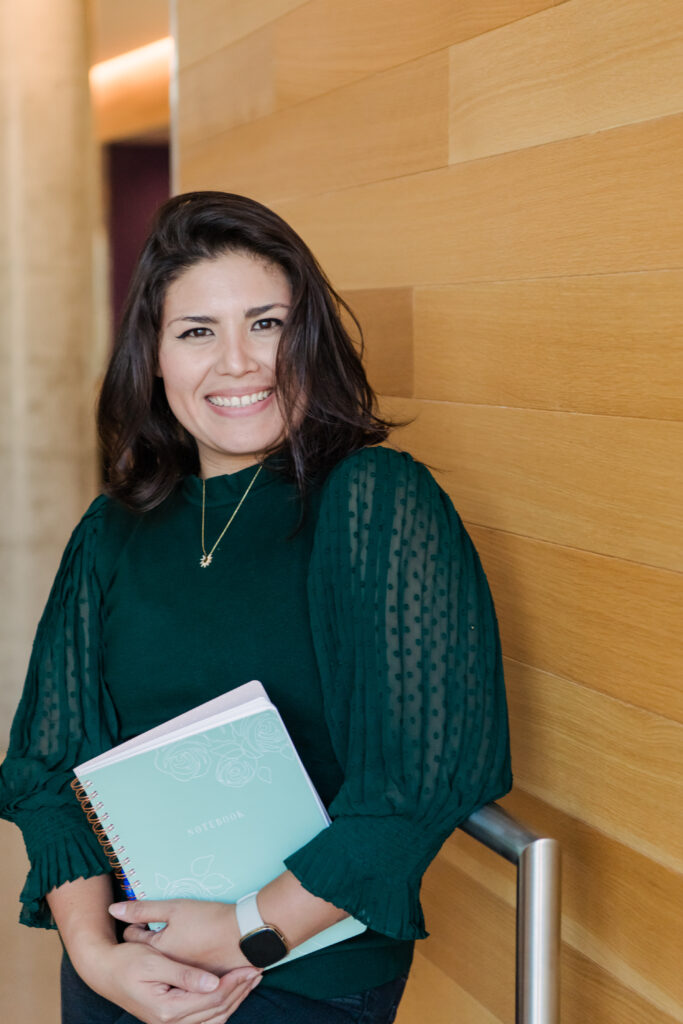
Jess Presuel (Marlayna Demond ’11/UMBC)
Step 1: Find your family
For Presuel, this was both easy and hard. When she arrived in the U.S., still using Google Translate to communicate with her au pair family, she found the parents and kids eager to help her learn English and navigate life in Maryland. Most importantly, she says, they supported her personally when she shared that she was gay. “Part of the rough patch of my life in Mexico,” Presuel shares, “was that at the time, my mom didn’t accept me as being gay. So when I first got here, the family was welcoming to me. Just for me, I began to experience how American culture, especially in Maryland, can be welcoming to the LGBTQ community. It made me feel safe.”
Presuel would later meet her fiancée, Lyana Cortes, in D.C. and over time, she says, her mother has grown to accept her daughter and love her future daughter-in-law. “My mom was a single mom, so she was always working. At the time, she sustained three jobs and I raised my siblings. So when I left, she felt my absence. Now, we’ve patched things up and she’s finally accepted me. She adores Lyana,” says Presuel. In fact, the couple got engaged on their most recent trip to Mexico, building stronger family ties internationally.
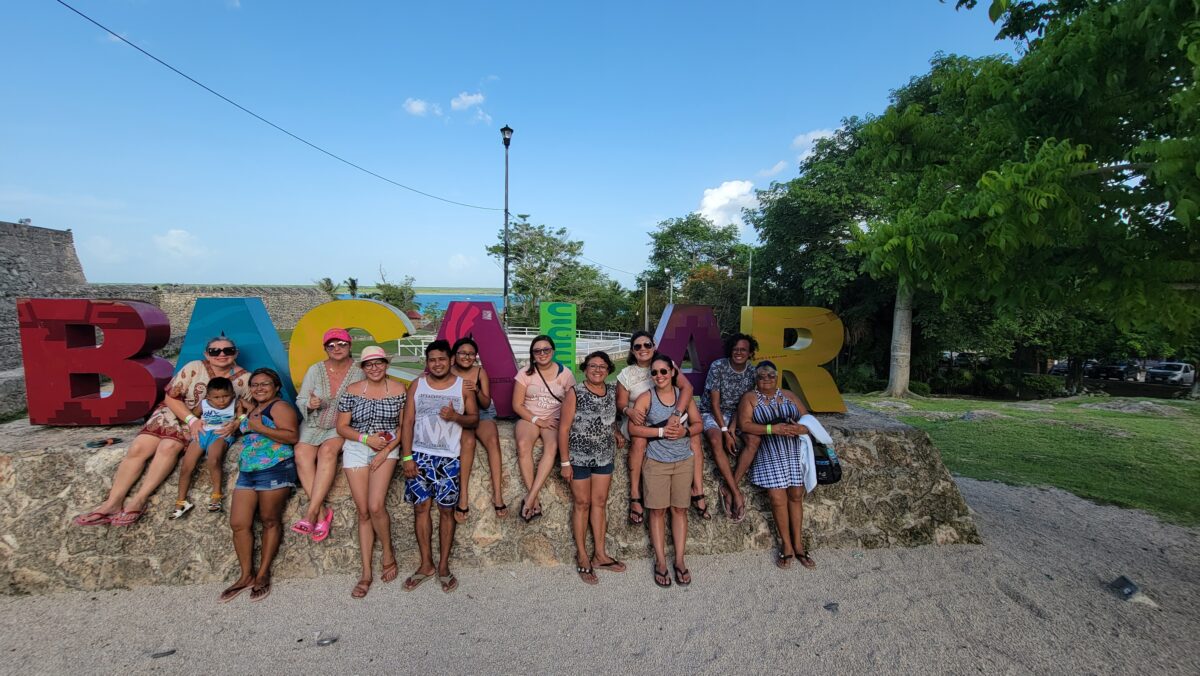 Presuel, seated, second from right, with her fiancée, Lyana Cortes, in front, with other members of Presuel’s family in Mexico. Photo courtesy of Presuel.
Step 2: Share your favorite things from home
“For me, being a Latina means always taking the time to cook something from my hometown,” says Presuel. “In addition to being Mexican, I’m Mayan too. Not many people know that the Mayan community is still alive. So I’m spreading the word, we’re here.”
Presuel uses any opportunity to make food for her communities on campus, including her medical fraternity Phi Delta Epsilon. For her Mayan dishes, she incorporates pumpkin seeds into many different recipes, and on Mexican Independence Day, September 16, she made pozole, a rich stew.
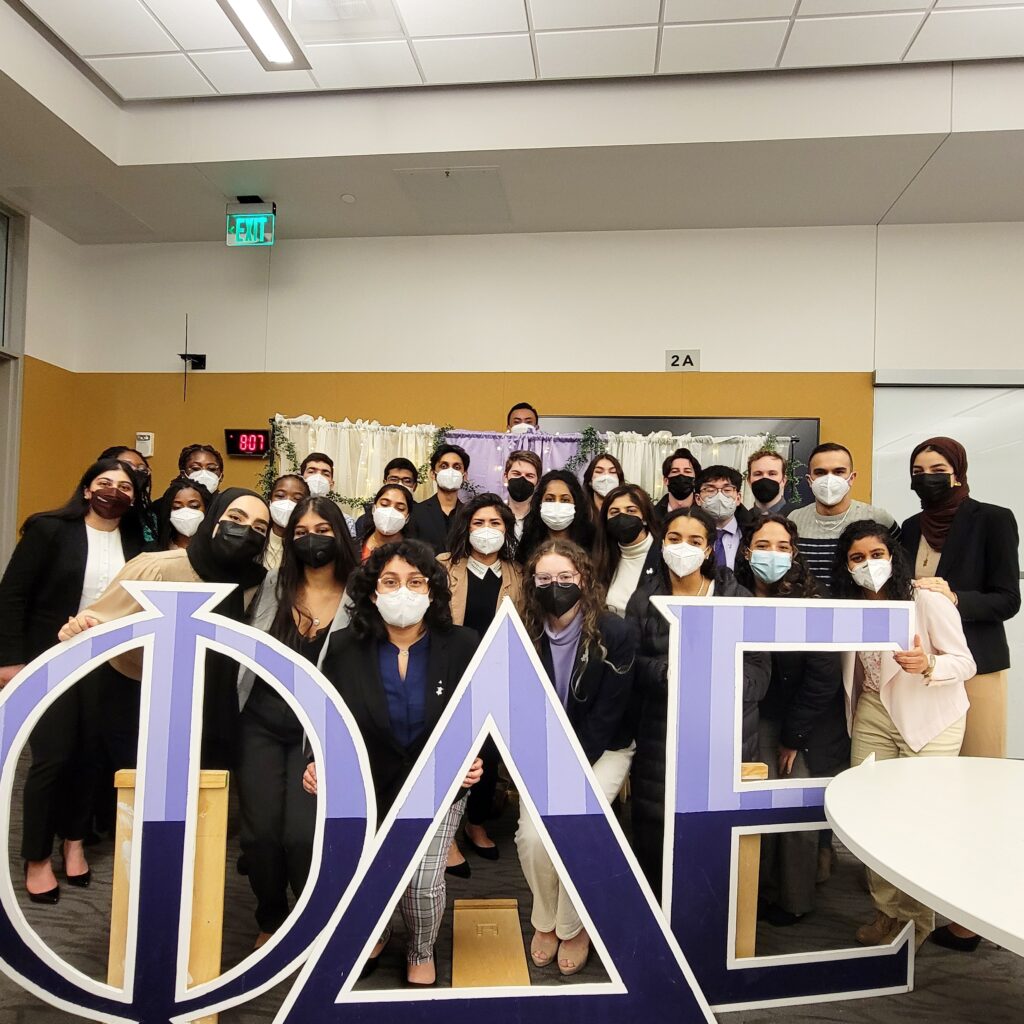 Presuel, center, in a black sweater with a white collar, with other members of her fraternity, Phi Delta Epsilon.
In addition to food, Presuel wants to share a sense of Latina empowerment. She’s currently in the process of replicating Harvard’s Latina Empowerment & Development (LEAD) conference at UMBC. “I am trying to get more Latinas involved in any type of workshops and educational settings,” says Presuel. “I want to showcase Latina leadership.”
Step 3: Get the lay of the land
Higher education in the States is a convoluted process for someone coming from outside of the system. For international students in particular, specific and important paperwork must be submitted to the right authorities. At UMBC, staff in International Student and Scholar Services (ISSS) help handle this bureaucratic burden. “I knew that when I finally picked UMBC as my university, ISSS was the first office I needed to connect with.”
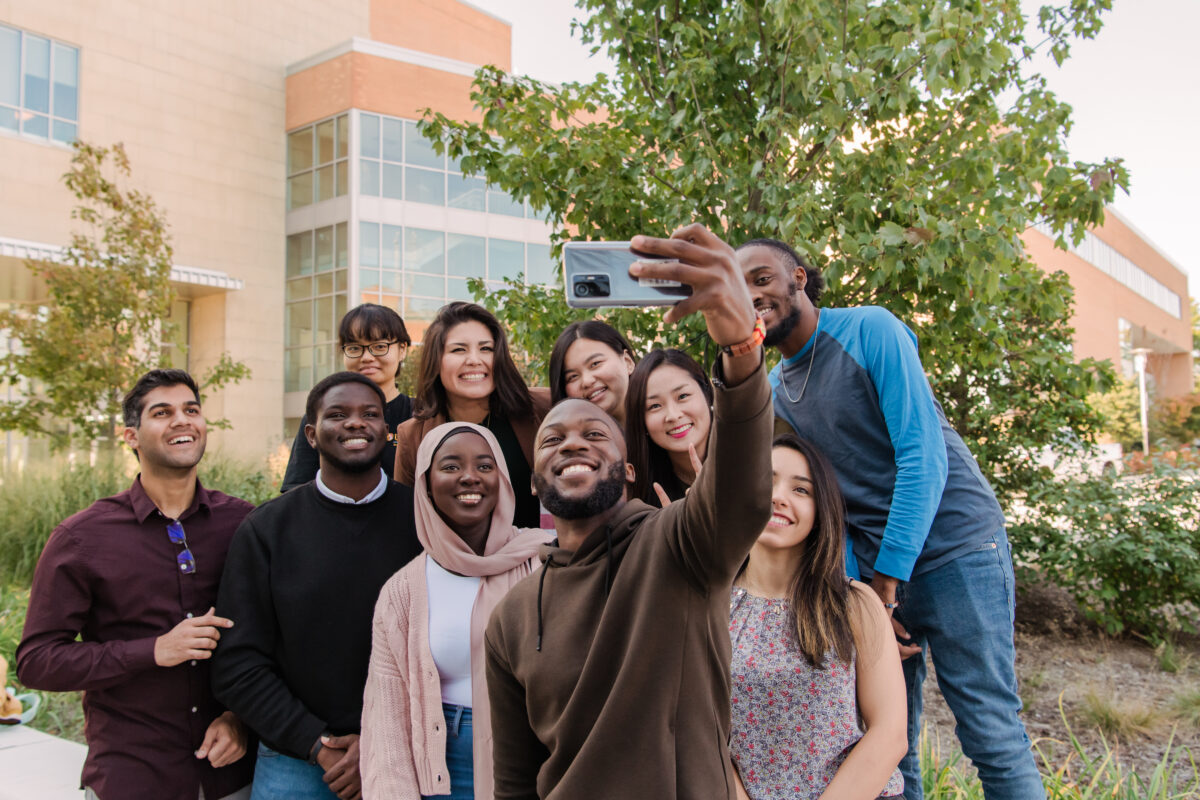 Presuel, second from left in the back, poses with other members of CGE’s global ambassador team. (Marlayna Demond ’11/UMBC)
In addition to ISSS, Presuel says, she doesn’t hesitate to ask her advisor Philip Farabaugh, professor in biological sciences, endless questions, even things she might be able to find online, because inevitably the conversation ends up being so useful to her. “He always gives me good advice. And he’s so funny, that makes me feel like, ‘Okay, I got this. I definitely can do this.’”
Step 4: Tell your story
After a year taking classes at UMBC, Presuel felt like she was ready to start offering advice to other international students. She’s now a global ambassador through the Center for Global Engagement.
“It’s such a rewarding role,” says Presuel, “because I finally get to share my experience. When you first get here from another country, you likely feel lost, so having someone who can help or speak your own language, it’s so relieving.”
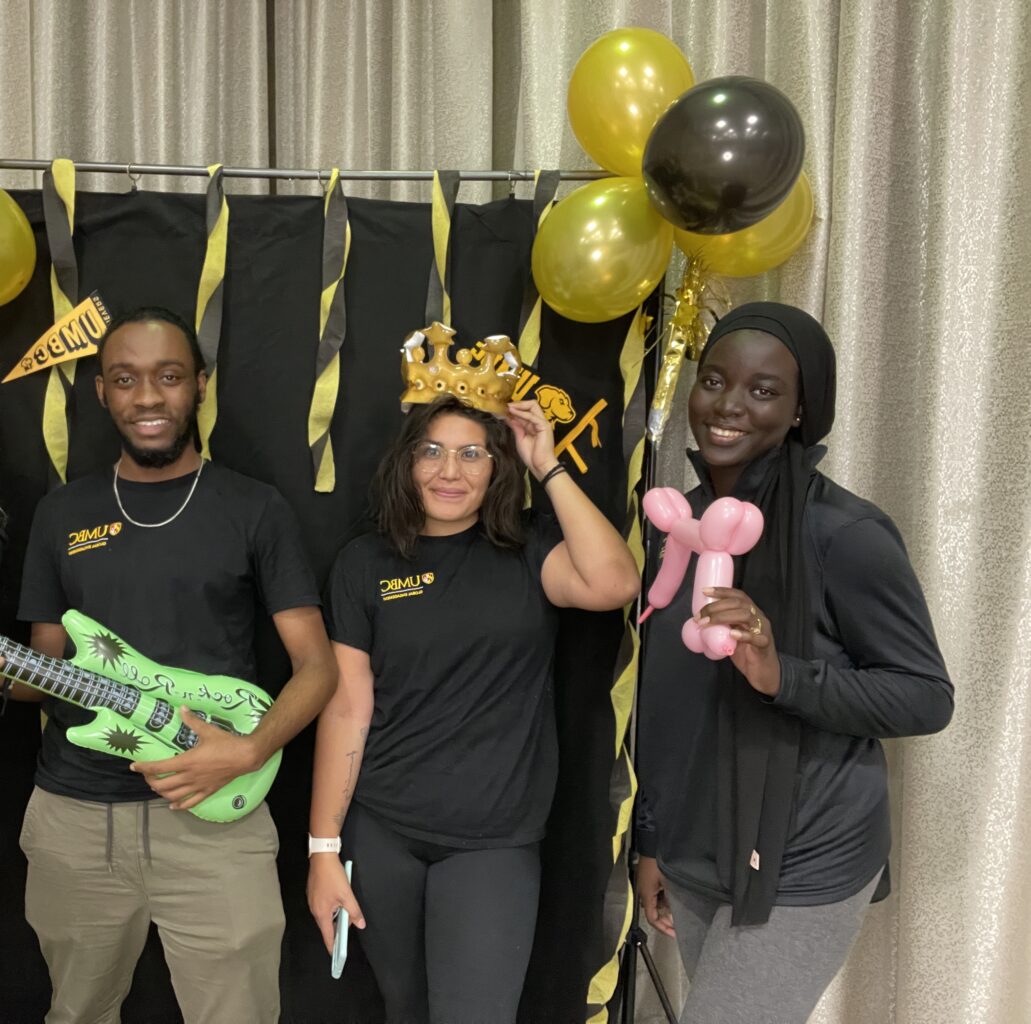
Presuel, center, has fun with other global ambassadors at a Welcome Week event. Photo courtesy of CGE.
Step 5: Find ways to give back to your community
“As an international student, it’s important to have a community even outside of campus,” says Presuel. She wanted to find a way to give back to other Mexicans and Spanish speakers in the area and found a home at the Esperanza Center in Baltimore City. This nonprofit is a comprehensive resource center for immigrant communities. “I do absolutely anything that’s possible for me to do,” says Presuel, who has been volunteering there for the past year.
“I help from the front desk. I’ve been assisting dentists. I translate for doctors. So being part of the immigrant community in Baltimore, it has filled my heart,” says Presuel. “I wouldn’t call it a hole, but something was missing from Mexico. I needed to have that link between my American culture, my Mexican culture here.”
]]>
With Jess Presuel ’23, biological sciences, an international student from Mexico Jess Presuel’s route to UMBC was not a direct flight from Mérida, Yucatán—her home state in Mexico—to UMBC....
https://umbc.edu/stories/how-to-bridge-your-two-homes/
https://my3.my.umbc.edu/api/v0/pixel/news/129381/guest@my.umbc.edu/99b66d5573cafaa0e5674257e47c5cc5/api/pixel
biological-sciences
campus-life
cge
cnms
fall-2022
how-to
international
magazine
UMBC News & Magazine
https://my3.my.umbc.edu/groups/umbc-news-magazine
https://assets1-my.umbc.edu/system/shared/avatars/groups/000/001/943/24435aa6207c452e7bc15cc74b42c7bb/xsmall.png?1748556657
https://assets1-my.umbc.edu/system/shared/avatars/groups/000/001/943/24435aa6207c452e7bc15cc74b42c7bb/original.png?1748556657
https://assets2-my.umbc.edu/system/shared/avatars/groups/000/001/943/24435aa6207c452e7bc15cc74b42c7bb/xxlarge.png?1748556657
https://assets2-my.umbc.edu/system/shared/avatars/groups/000/001/943/24435aa6207c452e7bc15cc74b42c7bb/xlarge.png?1748556657
https://assets3-my.umbc.edu/system/shared/avatars/groups/000/001/943/24435aa6207c452e7bc15cc74b42c7bb/large.png?1748556657
https://assets1-my.umbc.edu/system/shared/avatars/groups/000/001/943/24435aa6207c452e7bc15cc74b42c7bb/medium.png?1748556657
https://assets2-my.umbc.edu/system/shared/avatars/groups/000/001/943/24435aa6207c452e7bc15cc74b42c7bb/small.png?1748556657
https://assets1-my.umbc.edu/system/shared/avatars/groups/000/001/943/24435aa6207c452e7bc15cc74b42c7bb/xsmall.png?1748556657
https://assets2-my.umbc.edu/system/shared/avatars/groups/000/001/943/24435aa6207c452e7bc15cc74b42c7bb/xxsmall.png?1748556657
UMBC News & Magazine
3
0
false
Wed, 23 Nov 2022 13:23:36 -0500
Wed, 23 Nov 2022 13:23:36 -0500
Carrying on a Philanthropic Legacy
Behind every story of giving lies a story about someone’s generosity. For Hema Gowda ’01, biological sciences, this story was about continuing a generational legacy through philanthropy.
“My mom came to this country in the late ’60s, and education was a huge foundation for her in propelling her forward,” says Gowda, a Prince George’s County native who works in pharmaceutical research.
“When she retired, she set up endowments at [The University of Maryland,] College Park in the name of her parents because they were the ones that pushed her for higher education. She is the person she is today because of them…So I’d always been inspired by that and wanted to give back to UMBC because it was the foundation for my career.”
UMBC’s Alumni Endowment Scholarship Fund presents the perfect opportunity for alumni to give back to the university by directly contributing to the success of students in their undergraduate years. In Gowda’s case, the fund allowed her to follow in her mom’s charitable footsteps by establishing the Gowda Scholarship Endowment for UMBC in 2016 (and a similar scholarship at the University of Maryland School of Pharmacy in 2015) to help students interested in pursuing graduate studies in pharmacy find success at UMBC.
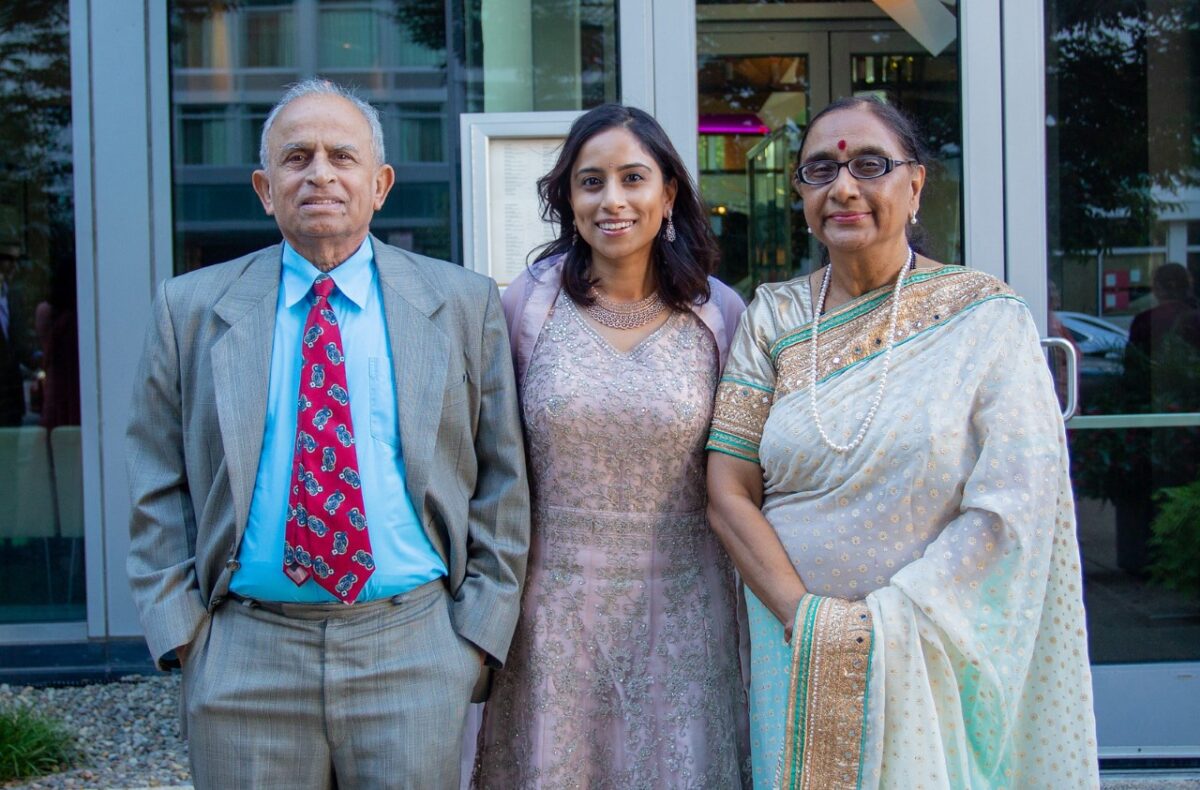 Hema Gowda ’01, center, shares a moment with her parents, Mrs. Vijayalakshmi and Dr. Kusumadhara Gowda. (Image courtesy of Gowda.)
Defining her path
Even as an undergraduate, Gowda knew she wanted to give back to her alma mater, but it took her longer to decide what she really wanted to study at UMBC. When it came to deciding a major, she wanted to pursue the sciences after having been involved in a science and technology program at Eleanor Roosevelt High School. But even after deciding that certain routes like medical school were not for her, it took more steps to narrow down what path called out to her most.
Gowda applied to the University of Maryland School of Pharmacy in her senior year at UMBC and entered the next stage of her academic career. Prior to graduation in 2005, she caught sight of a posting for an editorial internship at the American Society of Health-System Pharmacists —an experience that would eventually lead her to a medical writing position at a medical communications agency in the Philadelphia area the following year. There, Gowda collaborated with pharmaceutical and biotechnology companies to help develop their clinical trial publications and scientific communications for products that were marketed or in development.
After about five years at the agency, Gowda joined the biopharmaceutical company, Incyte, and gained experience in the company’s medical affairs and clinical development groups. This latter opportunity allowed her to take advantage of the communication skills and clinical expertise she had gained through her previous positions and educational experience.
In April 2020, a month into the pandemic, Gowda started her new position as a global development scientist director at AstraZeneca.
“I collaborate with colleagues from many other functions to execute registrational clinical trials in lung cancer. We conduct the trials globally, and gather and submit data for regulatory agencies in hopes of getting new drugs approved for different types of cancers,” explains Gowda.
Gowda’s journey down multiple routes in pharmacy has shown that taking the time to figure out the right path was not at all a setback. Even if it took a bit longer for her to settle on the research route, Gowda did not regret any of the experiences she had gained along the way.
“Each segment of my career helped define my path a little bit better,” Gowda puts it.
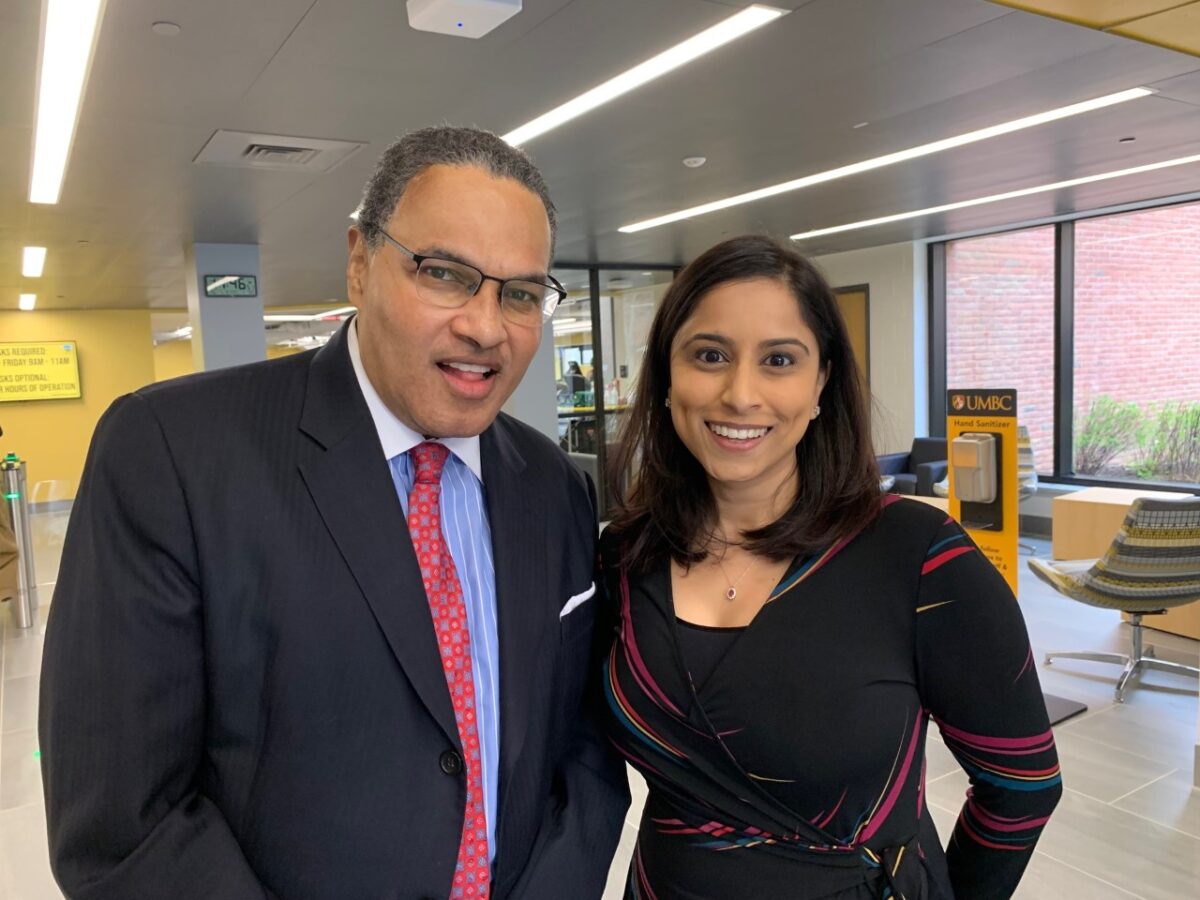 Gowda, right, chats with UMBC president Freeman Hrabowski. (Image courtesy of Gowda.)
Reconnecting to her foundations
The Gowda Scholarship Endowment, open to students interested in pursuing a career in the pharmaceutical sciences, gives preference to students who graduated from a Prince George’s County high school or current residents of the county. On top of wanting to give back to the school system that helped build the foundation for her career, Gowda hopes the scholarship will benefit students who are juggling their responsibilities in the D.C. region.
In describing the time during the pandemic when she met virtually with her first scholar, Adam Kouyate ’22, biological sciences, Gowda says, “[My scholar] was brimming with excitement…and to me, it’s a small amount, but I know it’s a lot for them. And maybe 10 or 20 years from now, that might inspire them to do something similar.”
“Because of this scholarship, I was able to work less hours during the school year and focus more on classes and finding myself.”
– Adam Kouyate ’22
The scholarship lifted a huge burden off Kouyate’s shoulders during a period of burnout. At the time she applied, Kouyate was working at a music store to help pay her tuition. Because she wanted to cover most of the tuition costs on her own, the scholarship allowed her to do so with only $200 coming from her parents. Kouyate was extremely grateful to have been chosen as a scholar, as it also meant she no longer needed to turn to student loans.
“Because of this scholarship, I was able to work less hours during the school year and focus more on classes and finding myself. Though I did end up switching from pharmacy to nursing, this scholarship gave me the peace of mind to focus on what I really wanted to do with my life,” says Kouyate.
Kouyate graduated from UMBC this past spring and will be attending the University of Maryland School of Nursing’s Master’s-Level Entry-Into-Nursing Clinical Nurse Leader program in the fall.
A second recipient of the scholarship, who graduated from Eleanor Roosevelt High School, is also currently studying at UMBC with plans to pursue a graduate degree in pharmacy.
Setting up lifetimes of success
Gowda’s connection to UMBC isn’t just limited to the endowed scholarship, but can be seen through her interactions with friends from her undergraduate days, connections to relatives interested in attending UMBC, and sponsored events such as the Endowed Scholarship Luncheon that is hosted annually at UMBC.
Now and moving forward, Gowda hopes to echo a legacy of giving that has been modeled by her mother as well as inspired by familiar faces at UMBC. Most importantly, she is eager to pass on a future of giving to her scholars—a future that may consist of trial and error, but also with valuable experiences along the way.
“It’s the gift that I want to keep giving, and I can only hope that this small amount for a semester or a year sets them up for a lifetime of success.”
]]>
Behind every story of giving lies a story about someone’s generosity. For Hema Gowda ’01, biological sciences, this story was about continuing a generational legacy through philanthropy. “My...
https://umbc.edu/stories/carrying-on-a-philanthropic-legacy/
https://my3.my.umbc.edu/api/v0/pixel/news/125731/guest@my.umbc.edu/30e5b1d629596f38290c95be093eb18c/api/pixel
alumni-profile
biological-sciences
cnms
impact
magazine
summer-2022
UMBC News & Magazine
https://my3.my.umbc.edu/groups/umbc-news-magazine
https://assets1-my.umbc.edu/system/shared/avatars/groups/000/001/943/24435aa6207c452e7bc15cc74b42c7bb/xsmall.png?1748556657
https://assets1-my.umbc.edu/system/shared/avatars/groups/000/001/943/24435aa6207c452e7bc15cc74b42c7bb/original.png?1748556657
https://assets2-my.umbc.edu/system/shared/avatars/groups/000/001/943/24435aa6207c452e7bc15cc74b42c7bb/xxlarge.png?1748556657
https://assets2-my.umbc.edu/system/shared/avatars/groups/000/001/943/24435aa6207c452e7bc15cc74b42c7bb/xlarge.png?1748556657
https://assets3-my.umbc.edu/system/shared/avatars/groups/000/001/943/24435aa6207c452e7bc15cc74b42c7bb/large.png?1748556657
https://assets1-my.umbc.edu/system/shared/avatars/groups/000/001/943/24435aa6207c452e7bc15cc74b42c7bb/medium.png?1748556657
https://assets2-my.umbc.edu/system/shared/avatars/groups/000/001/943/24435aa6207c452e7bc15cc74b42c7bb/small.png?1748556657
https://assets1-my.umbc.edu/system/shared/avatars/groups/000/001/943/24435aa6207c452e7bc15cc74b42c7bb/xsmall.png?1748556657
https://assets2-my.umbc.edu/system/shared/avatars/groups/000/001/943/24435aa6207c452e7bc15cc74b42c7bb/xxsmall.png?1748556657
UMBC News & Magazine
1
0
false
Fri, 03 Jun 2022 14:42:27 -0400
Fri, 03 Jun 2022 14:42:27 -0400
Pres. Freeman Hrabowski honors Class of 2022 at final commencement as UMBC leader

Nearly 1,800 students walked across the stage at Chesapeake Employers Insurance Arena this week during UMBC’s 78th graduate and undergraduate commencement ceremonies. After pausing to receive their congratulatory elbow bumps from President Freeman Hrabowski and other leaders, they could breathe a sigh of relief, knowing their hard work and perseverance paid off.
After another unprecedented year, many of the commencement speeches touched upon the resilience and drive of the Class of 2022. Their time at UMBC was marked by tradition and change, a new normal and questioning “what is normal?,” and a collective focus on supporting each other and having a positive impact.
Joel Tyson ‘18, chemical engineering, president of UMBC’s Graduate Student Association, addressed master’s and Ph.D. graduates saying, “I’ve seen you reach forward for help and for mentorship, looking ahead not just at a path of personal success, but a path in service of making the world a better place.”
Encouraging graduates to build upon the lessons they learned at UMBC, honorary degree recipient Judge Ricardo Zwaig ‘77, Spanish, said, “Whatever your calling, the elevation of humanity should be your primary goal regardless of boundaries.”
A legacy of mentorship
This year, six Retriever alumni were awarded honorary degrees and served as distinguished speakers during the ceremonies. Now in their own established careers, they’ve continued the UMBC tradition of paying it forward as mentors.
Kafui Dzirasa’01, M8, chemical engineering, mentioned what an impactful mentor President Hrabowski has been to him. “Every time I tripped and fell, when the world saturated me with adversity and tribulation, he would gently reach back his hand and pull me forward with a word of encouragement,” he recalled.
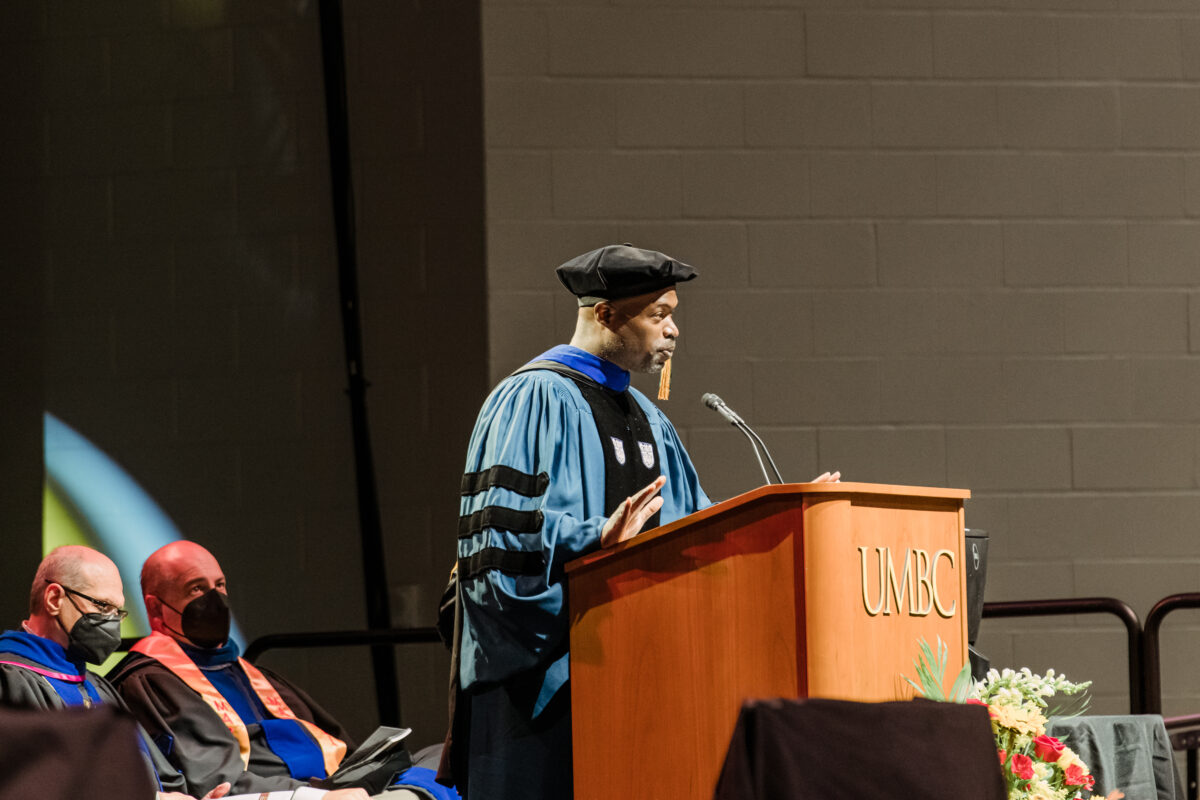 Dzirasa addresses the master’s and Ph.D. students. (Marlayna Demond ’11/UMBC)
“As Doc’s grandmother would tell him, the higher you go, the more people will try to pull you down,” Dzirasa said. He went on to let the audience know with levity that that’s “the modern day translation of ‘haters gonna hate.’ And when they do, it’s the mentors that will be there to sustain you. They are a refuge in the midst of the storm.”
The speakers promised to keep that legacy of support going amongst themselves, as well. In a tweet, Kaitlyn Sadtler’11, biological sciences, responded to a shout-out from fellow speaker Kizzmekia Corbett’08, M16, biological sciences and sociology, saying, “I credit you to being a huge reason why I’m on this list. Your email saying ‘Hey there’s another UMBC alum at NIH doing some COVID work’ was a catalyst. I’ll do my best to pay it forward.”
Combining potential with support
Corbett delivered her remarks by video, as she was at a meeting with Nobel Laureates at the time of commencement. She has often commented on the profound role President Hrabowski and other mentors have had on her life and career, and has carried that forward through mentoring emerging scientists.
Focusing on what people can achieve when they have support and a belief in themselves, she shared, “I hope you dare to dream so big that no one else can imagine the possibility. I hope that you take this degree and you make this world a better place. I hope for you scientists out there, that you take this degree and you cure cancer. I hope for you humanitarians that you stop world hunger. And I hope that you live and I hope that you love.”
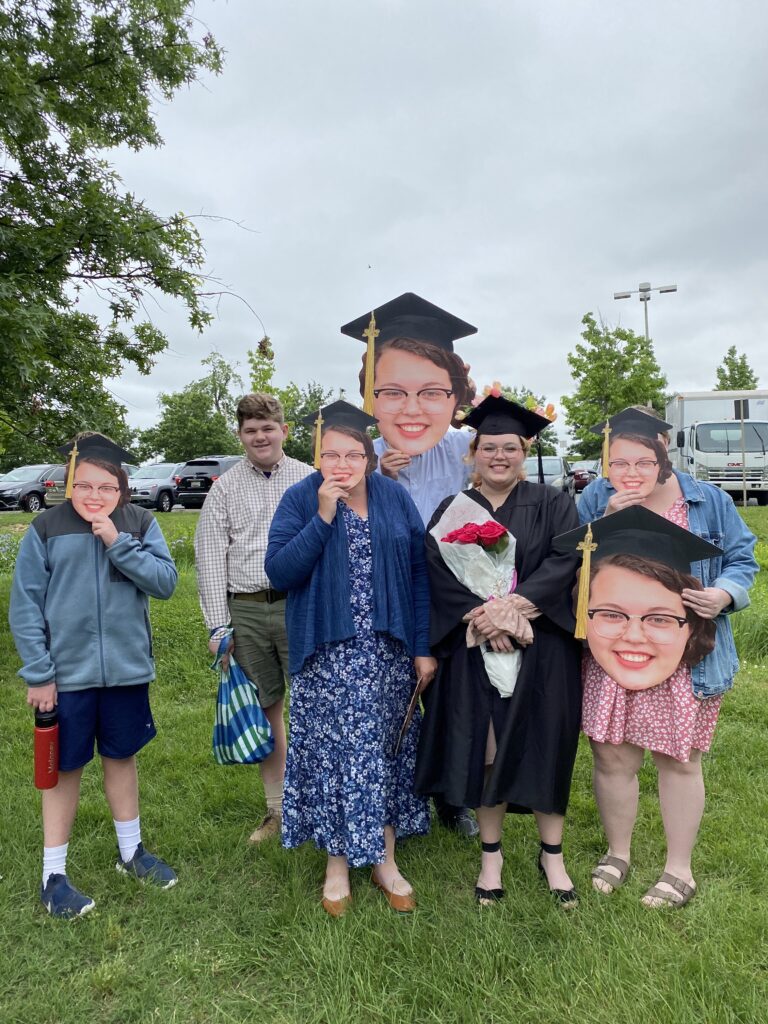 Reilly Moloney ’22, visual arts, poses with Reilly Moloney and Reilly Moloney and Reilly Moloney and Reilly Moloney after the commencement ceremony. (Kait McCaffrey/UMBC)
Co-valedictorian Shahreen Zannat ‘22, biological sciences, also spotlighted the greatness that students and communities can achieve with the right support.
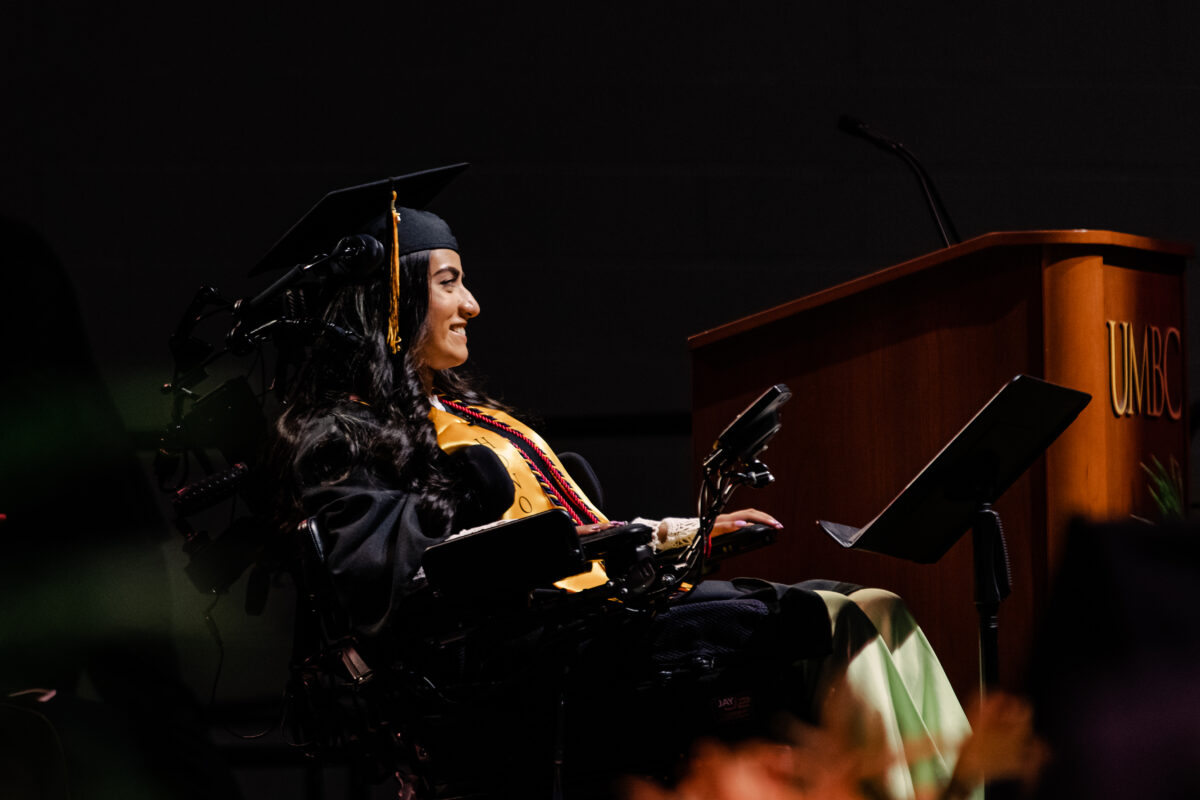 Zannat addresses her classmates during the afternoon commencement ceremony. (Marlayna Demond ’11/UMBC)
“Our journey at UMBC was not one we took alone—advisors came to our rescue during moments of panic, professors connected us with their networks for employment opportunities, and all of the support staff ensured our safety and well-being on campus,” said Zannat. “This support has helped shape leaders, resulting in international recognition of UMBC’s innovative research, creative teaching methods, and its cultural and ethnic diversity.”
Sadtler recognized that support can also come from unlikely places saying, “You will meet people that will bring out the best and worst in you. Learn from both because if you don’t get lost, you will never find your way.”
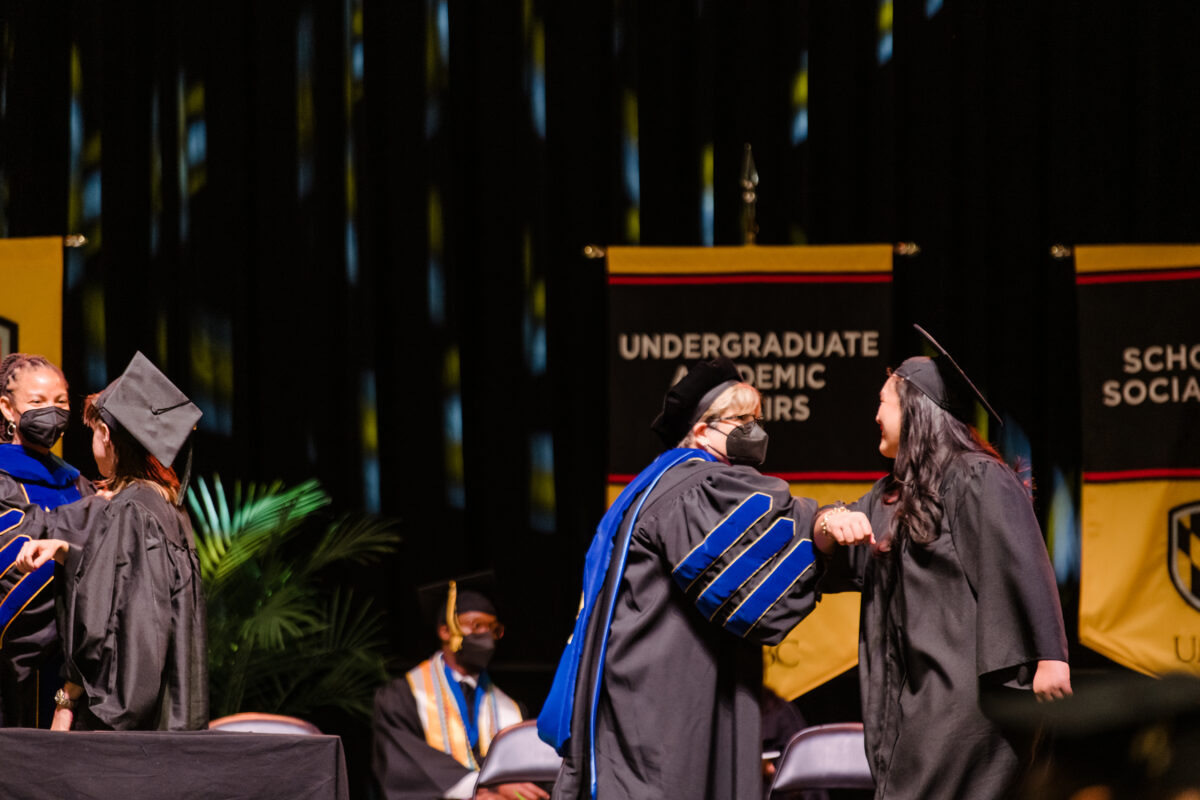 A graduate stops for an elbow bump on the commencement stage. (Marlayna Demond ’11/UMBC)
The importance of you
While many speakers touched on the idea of mutual support and “paying it forward,” others recognized the need to couple that with taking care of oneself.
Co-valedictorian Viola Lis ‘21, psychology, reminded her classmates that, “To make a difference once we leave UMBC, we have to be doing the things that bring us joy, the things we find fulfilling and meaningful. Otherwise, our imprint will be faint. In order to show up for others, you have to show up for yourself first.”
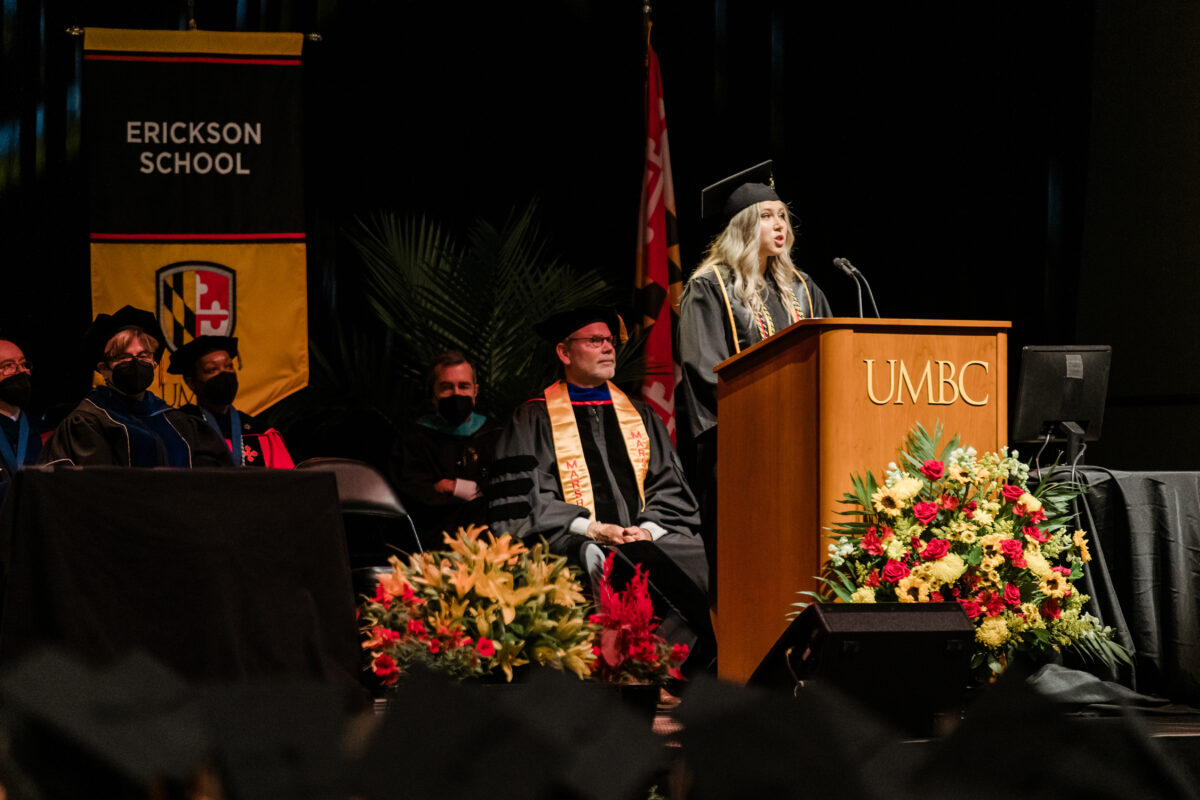 Co-valedictorian Viola Lis addresses the crowd. (Marlayna Demond ’11/UMBC)
Echoing these statements, honorary degree recipient Mark Doms’86, economics and mathematics, admitted that the road would be hard for graduates, but implored them to listen to themselves and their abilities.
“You will hit roadblocks, setbacks will blindside you,” he said. “But please, don’t surrender to self-doubt. Instead, persevere. You are extremely gifted and, please, don’t deprive us of your gifts.”
Tiffany Holmes, M.F.A. ’99, imaging and digital arts,was once a student who thought she had her life figured out. But as she shared in her address, the “key message to you today is to have a plan that is endlessly adaptable. Work hard at something that brings you joy, and your path will lead you somewhere fascinating that is just right for you.”
The places you will go
The ceremonies were bittersweet—an important moment of transition for both the graduates and President Hrabowski.
“In many ways, today we’re really celebrating two commencements: all of you, most of you, who graduated in four years. And then the second commencement is my buddy Freeman. Now, it took him 31 years to finish his work,” joked Mike Gill from the University System of Maryland Board of Regents.
Gill went on to share the news of a significant new way in which Hrabowski’s legacy would be carried forward: the $1.5 billion Freeman Hrabowski Scholars Program just launched by the Howard Hughes Medical Institute.
Dr. Hrabowski (@umbc) sees the last of his graduates across the stage today, and then BOOM @HHMINEWS names a young investigator scholars program after him… https://t.co/HV26BzP8XK
The way my mentors are retiring into their purposes is purely aspirational.
]]>
Nearly 1,800 students walked across the stage at Chesapeake Employers Insurance Arena this week during UMBC’s 78th graduate and undergraduate commencement ceremonies. After pausing to receive...
https://umbc.edu/stories/freeman-hrabowski-honors-class-of-2022-at-final-commencement/
https://my3.my.umbc.edu/api/v0/pixel/news/125644/guest@my.umbc.edu/6af52a7641286ad069ad4057f2de6c50/api/pixel
biological-sciences
cahss
chemeng
class-of-2022
cnms
coeit
community
economics
hrabowski
meche
modern-languages-and-linguistics
news
UMBC News & Magazine
https://my3.my.umbc.edu/groups/umbc-news-magazine
https://assets1-my.umbc.edu/system/shared/avatars/groups/000/001/943/24435aa6207c452e7bc15cc74b42c7bb/xsmall.png?1748556657
https://assets1-my.umbc.edu/system/shared/avatars/groups/000/001/943/24435aa6207c452e7bc15cc74b42c7bb/original.png?1748556657
https://assets2-my.umbc.edu/system/shared/avatars/groups/000/001/943/24435aa6207c452e7bc15cc74b42c7bb/xxlarge.png?1748556657
https://assets2-my.umbc.edu/system/shared/avatars/groups/000/001/943/24435aa6207c452e7bc15cc74b42c7bb/xlarge.png?1748556657
https://assets3-my.umbc.edu/system/shared/avatars/groups/000/001/943/24435aa6207c452e7bc15cc74b42c7bb/large.png?1748556657
https://assets1-my.umbc.edu/system/shared/avatars/groups/000/001/943/24435aa6207c452e7bc15cc74b42c7bb/medium.png?1748556657
https://assets2-my.umbc.edu/system/shared/avatars/groups/000/001/943/24435aa6207c452e7bc15cc74b42c7bb/small.png?1748556657
https://assets1-my.umbc.edu/system/shared/avatars/groups/000/001/943/24435aa6207c452e7bc15cc74b42c7bb/xsmall.png?1748556657
https://assets2-my.umbc.edu/system/shared/avatars/groups/000/001/943/24435aa6207c452e7bc15cc74b42c7bb/xxsmall.png?1748556657
UMBC News & Magazine
0
0
false
Fri, 27 May 2022 16:12:03 -0400
Fri, 27 May 2022 16:12:03 -0400
For the Love of Dirty Jobs

First Mate Alex Barnard ’09, American Studies spends many mornings high atop the mast on the 150-foot sailing ship Kwai, watching the bright horizon of the Pacific Ocean through binoculars for the shimmer of an abandoned fishing net. When she spots a clump of plastic waste, she guides the captain toward the tangle of fishing nets and the garbage they accumulate.
Then sailors on deck throw grappling hooks into the floating trash. A hydraulic crane hauls onto the deck the dripping hunks of degrading plastic nets—sometimes the size of Volkswagen Bug, sometimes 100 feet long. Barnard and the crew stumble through tangles slick with algae and seaweed, throwing the trash’s resident crabs and fish back overboard. Those moments are cathartic, Barnard says, as if they’ve just pulled a rotten tooth from the mouth of the ocean.
“I just think about that moment as beautiful. I love seeing that net up on deck,” Barnard says. “It’s so toxic and then to watch it come out. Just to be able to do that all day every day. It’s pretty amazing.”
Walking down a steep hill on her family’s farm, Roxann Brooks Motroni ’06, M14, biological sciences is searching for her cattle.
“Hey mamas! Hey cows!” the veterinarian calls. A fuzzy black head pops up over the next hill and bellows. The cattle gallop toward Motroni and her bucket, which rattles with hay cookies.
She steps into the pasture and is mobbed by her family’s cattle, the flies clustered on their backs in the late autumn heat. Cookie, the black Lowline Angus most fond of the treats, pushes to the front of the herd. The cow’s foot-long tongue curls around Motroni’s forearm, leaving bubbly trails of slobber and grass bits.
Ignoring the fresh cow patty her black boot has just stepped in, Motroni hands out cookies, then tosses the rest of the nuggets into the scrum. She swipes off her freshly slimed arm and continues naming the cattle—The Hereford, Valentino the bull, and her favorite, Nellie, named for a great-grandmother because they’re a bit alike.
“Sweet, but a little suspicious of new people,” Motroni says and wades out of the herd distributing scratches all around, oblivious to the flies and slobber and excrement.
Stephen Bradley, associate professor in the Department of Visual Arts, hauls on a braided cord connected to a white lifesaving ring that bobs on the water of the Jones Falls in Baltimore. A Doritos package, two latex gloves, a slick of oil, and some liquor bottles float nearby. And that’s just what’s visible. Other ingredients in the toxic stew flowing toward the Inner Harbor are heavy metals, fertilizer, microbes, pesticides, and sewage, as well as industrial sound pollution.
Bradley, an artist who adds video and audio sensory layers to his sculptures, pulls out his dripping hydrophones and fiddles with their connections. Then he lowers the receivers back in, to record the underwater sounds of mussels, gizzard shad, and blue crabs, along with the urban noise of HVAC systems and traffic.
Chatting away, Bradley pulls out his sketch pad to show some drawings, then licks his thumb to turn the page. He stops to grimace at his thumb, which was just mucking about in the murky water.
“Guess I shouldn’t have done that,” he says.
Making a difference in the world isn’t always a neat endeavor. Hard to keep your hands clean when you’re raising cattle humanely and safely, pulling communities together to pick up trash and make art, or hauling tons of plastic waste from the Pacific Ocean. These three Retrievers all find immense joy in work that is sometimes smelly, usually dirty, and always requires an intrepid spirit.
Sustainability sparked Barnard’s quest
Alex Barnard wrote her UMBC honors thesis on her attempts to live sustainably in Baltimore. “Extremely challenging,” Barnard summarizes, with a wry chuckle. “It completely changed my life. I see everything through this lens now.”
For nearly 10 years, she traveled, trying to live lightly on the planet. She worked in an eco-cafe in Fiji, labored on an organic farm in Hawaii, sailed on eco-tourism voyages in the South Pacific, and biked New Zealand.
Now, she has her captain’s license and sails as a chief mate on National Geographic voyages to Costa Rica, Alaska, and Baja with Lindblad Expeditions, a company known for its green approach to travel.
 Alex Barnard (top, center) poses with her team. All photos of Barnard, courtesy of Ocean Voyages Institute.
Barnard’s schedule of two months on, two months off gives her time to volunteer on the Kwai for the Ocean Voyages Institute. The institute partners with companies that turn the trash into fuel, shoes, clothing, and building blocks for construction.
Through overconsumption and improper trash disposal, humans have created five garbage patches in the Pacific, Atlantic, and Indian oceans, where trash is concentrated by currents.
 Courtesy of Alex Barnard and Ocean Voyages Institute.
Discarded nets and lines from fishing boats now make up 46% of the waste in the Great Pacific Garbage Patch, according to the World Wildlife Fund. Dubbed “ghostnets” or “ghost gear,” the fishing waste kills marine life by the thousands—turtles and whales and dolphins tangle themselves in the nets that are tossed off fishing boats. But because oceans are vast, and the nets sink and bob in the waves, they’re difficult to find.
“It’s not like wading through trash,” Barnard explains. “There are big spaces in between. If you were at sea level, the nets are hard to see. We could be sailing right by one and not see it until we’re past it. The plastic breaks down in UV light. A lot of it is microplastic, which is deadly to the ocean.”
Last summer, Barnard and the Kwai crew hauled 170 tons of plastic from the ocean, a fraction of the 17 billion tons dumped into the world’s waters every year. Other organizations, like Sea Shepherd Conservation Society, Greenpeace, The Ocean Cleanup, and the 5 Gyres Institute, are also focusing on ghostnet removal. Many environmental groups are pushing the Global Ghost Gear Initiative, a collaborative effort by the fishing industry, NGOs, governments, and researchers to regulate plastic dumping.
“This work is possible and successful,” Barnard says. “The idea is to show that we need more boats, a fleet of vessels doing the same thing. It feels like a starting point more than anything.”
Temporarily on land, in a remote cabin in Michigan where she’s doing some writing for Lindblad, Barnard hikes often, always with a trash bag.
“It’s my dream to go somewhere and not have to pick up trash,” Barnard says. “I could spend my whole life picking up trash everywhere I go. That’s not very efficient. It has to be bigger than just one person. But it’s better than not picking it up.”
A family farm affair
Every morning and evening, Roxann Brooks Motroni visits her cattle, not just to offer treats but to check the herd for a limp, some pinkeye, a calf that’s not thriving.
Her family started 804 Cattle Company in Upper Marlboro in 2016 with three cows. They now raise 25 cattle on 33 acres. A vet married to an agricultural business expert, Motroni works the farm with her parents, John and Chantal Brooks, both retired doctors. And while Motroni has a day job as a National Program Leader for Animal Health for the USDA’s Agricultural Research Service, focusing on research solutions for livestock diseases, she begins and ends her days on the farm.
“This is a family affair. My mom is the chief cow operator. I do the vet work, my husband does the finances and handyman work,” Motroni explains, plus he’s the beekeeper.


The farm is also devoted to teaching the next generation of farmers and veterinarians. Today, two interns hoping to be veterinarians are chasing Nutmeg the goat and grooming horses. The family brings in veterans seeking help getting started in agriculture, through the Arcadia Center for Sustainable Food and Agriculture. The farm also sells at the Capital Market, whose mission is to provide quality food, produced by businesses and farms run by people of color, to residents of Prince George’s County’s food deserts.
A Meyerhoff Scholar, Motroni quotes its motto, “To Whom Much Is Given, Much Is Expected” and says she lives by it.
Their farm prides itself on their humane and safe practices with their cattle. The animals and their health comes first. No hormones or steroids go into their cattle and they limit antibiotic use to only sick cows. Their chutes and corrals are designed to reduce their cattle’s stress. All animals spend all their lives on grass pastures.
The family also uses regenerative agriculture practices to improve soil health and combat climate change through carbon sequestration while limiting fertilizer and pesticide usage. Motroni crouches in the pasture to show off the shoots of radishes, hairy vetch, turnips, oats, and rye that she interplants with grass, to aerate and fix nitrogen and carbon in the soil. Plus they offer her herd fine dining.
“I didn’t know when I became a cattle farmer that I would also become a grass farmer. I’ve come to realize how magical cow poop is. Every year our pastures get better and better,” she says, laughing. “All those plant physiology classes at UMBC really served me well.”
She hikes up the hill again, squelching through the mud around a water pump.
“Wow, now you can really smell the cow,” she says and smiles at the odor and the view.
Traces of life fuel his art
As an artist, Stephen Bradley sees and hears things a little differently. From the pop of color of a blue plastic container handle to the squelching clicks of the mussels underwater, the evidence of life is fascinating to him.
For more than 12 years, he has labored in the Brooklyn and Curtis Bay area of Baltimore, partnering with the Enoch Pratt Free Library, the National Aquarium, the local Boys and Girls Club, and the Masonville Cove Environmental Education Center to clean up the alleys and streets and to make art, from sidewalk paintings and murals to trash sculptures.
Right now, he’s bent closely over a pier in the Inner Harbor, lowering a round lifesaver strung with microphones and chum to attract fish into the water. He occasionally catches the attention of passersby and eagerly explains his artistic vision to them.
The project that inspired his recording in the Jones Falls waterway is a collaborative biodiversity study with the National Aquarium and the Institute of Marine and Environmental Technology (IMET). IMET has sunk a biodisk in the same areas Bradley is recording, to track biodiversity in the waters by collecting DNA samples. Those findings will be paired with Bradley’s recordings to provide a fuller picture of what’s living in Baltimore’s waterways. Bradley’s Inner Harbor’s soundtrack is run through a spectrograph to determine what species made the sounds, most of which can’t be heard by human ears, such as the mating songs of water bugs.
“With these recordings, it’s almost as if I have my ear to the water,” he says. “The gift is going home and listening.”
Bradley’s portion of the IMET project, called Bio-Buggy: Ear to the Harbor, will draw attention to the harm that human-generated noise pollution inflicts on aquatic species, including disrupting mating and growth.
In the fall, Bradley was recording at Marshy Point Nature Center and heard explosions coming from his underwater recorders, from the direction of Aberdeen Proving Ground, nearly 30 miles away.
“Hundreds of small minnows leaped out of the water each time there was an explosion, and there were nine huge discharges,” Bradley says. But in between, he heard the complex harmonies of bubbles and critter sounds, something he calls “musical marshlands.”
He has also built an exhibit, called the “Oh, Murky Waters Chorus,” with trash compositions, an aquarium with teeny water critters still living on one of those IMET DNA sampling biodisks, and an interactive video of microscopic creatures paired with their noises. The art installation showed at UMBC’s Center for Art, Design, and Visual Culture in 2019, and Bradley hopes to exhibit it again, as a work-in-progress later in 2022.


“The trash-filled sculptural elements in the art installation…are there to represent the stress and urgency for us as a society to gain control of our waste before we drown from it,” Bradley explains. Baltimore has taken recent steps, including banning polystyrene and taxing plastic bags, to reduce the trash in the Inner Harbor enough that if it hasn’t rained in 48 hours, according to Blue Water Baltimore, some areas are swimmable.
At the IMET open house next spring, Bradley hopes to show a prototype of the Bio-Buggy, a mobile science and sound collection lab, which engineering students at UMBC will work to design with him as their capstone project. The Bio-Buggy exhibit will also feature Bradley’s sound compositions based on the Inner Harbor and other Chesapeake Bay recordings.
“I have no aspiration to be a scientist, but I am inspired by science, the tools, the rigor, the process,” he says and tucks his headphones back on, listening for evidence of life in the waters. Perhaps, Bradley hopes, if people hear and see the life below the surface, they’ll pocket their Doritos packages and recycle their water bottles, instead of tossing them in the gutter for him to find later.
People who care about change must be willing to plunge their hands deep into the mess of this world. It’s a dirty job, but someone’s gotta do it.
— By Susan Thornton Hobby
*****
All photos courtesy of Marlayna Demond ’11 unless otherwise noted.
]]>
First Mate Alex Barnard ’09, American Studies spends many mornings high atop the mast on the 150-foot sailing ship Kwai, watching the bright horizon of the Pacific Ocean through binoculars for the...
https://umbc.edu/stories/for-the-love-of-dirty-jobs/
https://my3.my.umbc.edu/api/v0/pixel/news/119512/guest@my.umbc.edu/4697d91b126c234476387a30740851b2/api/pixel
american-studies
biological-sciences
discovery
fall-2021
feature
meyerhoff-alumni
umbc-magazine
visual-arts
UMBC News & Magazine
https://my3.my.umbc.edu/groups/umbc-news-magazine
https://assets1-my.umbc.edu/system/shared/avatars/groups/000/001/943/24435aa6207c452e7bc15cc74b42c7bb/xsmall.png?1748556657
https://assets1-my.umbc.edu/system/shared/avatars/groups/000/001/943/24435aa6207c452e7bc15cc74b42c7bb/original.png?1748556657
https://assets2-my.umbc.edu/system/shared/avatars/groups/000/001/943/24435aa6207c452e7bc15cc74b42c7bb/xxlarge.png?1748556657
https://assets2-my.umbc.edu/system/shared/avatars/groups/000/001/943/24435aa6207c452e7bc15cc74b42c7bb/xlarge.png?1748556657
https://assets3-my.umbc.edu/system/shared/avatars/groups/000/001/943/24435aa6207c452e7bc15cc74b42c7bb/large.png?1748556657
https://assets1-my.umbc.edu/system/shared/avatars/groups/000/001/943/24435aa6207c452e7bc15cc74b42c7bb/medium.png?1748556657
https://assets2-my.umbc.edu/system/shared/avatars/groups/000/001/943/24435aa6207c452e7bc15cc74b42c7bb/small.png?1748556657
https://assets1-my.umbc.edu/system/shared/avatars/groups/000/001/943/24435aa6207c452e7bc15cc74b42c7bb/xsmall.png?1748556657
https://assets2-my.umbc.edu/system/shared/avatars/groups/000/001/943/24435aa6207c452e7bc15cc74b42c7bb/xxsmall.png?1748556657
UMBC News & Magazine
0
0
false
Wed, 08 Dec 2021 18:02:57 -0500
Sherman Scholars Live Out Founder’s Legacy
In Baltimore City, middle schoolers are making roller coasters out of insulation tubing and tape. High schoolers are dunking basketballs to learn math equations. And not too far away at UMBC, the Sherman STEM Teacher Scholars are prepping to spread even more innovative, inclusive lessons throughout city schools.
The Sherman STEM Teacher Scholars Program began in the fall of 2007 thanks to the generosity of philanthropists George and Betsy Sherman. The goal of the program is to support scholars to become culturally responsive and compassionate STEM educators in historically underserved, urban schools.
 George and Betsy Sherman at the celebration of the Meyerhoff Scholars Program 30th anniversary in 2019. Photo by Jim Berger.
“They’re working in the school buildings that people tend to shy away from because they’ve got those ‘bad kids’ or they don’t have a lot of resources. Our scholars are gravitating to those spaces,” says program director Rehana Shafi.
George Sherman passed away earlier this year but the legacy he left continues to be felt in the lives of the scholars who bear his name. Fourteen years later, the program supports 80 current scholars who will one day join the 140 program alumni who are teaching in high needs schools in Baltimore and throughout the region. All scholars receive scholarships towards their education as well as advising and coaching to embody the Sherman Program’s values.
Putting the fun in active learning
Ben Davis ’11, biological sciences, M.A.T. ’13, was one of the first Sherman scholars to enter the workforce. Today he is teaching at KIPP Ujima Village Academy in Baltimore, where he tries to make sure his middle school science students do one hands-on project a week like making the roller coasters out of household materials or dissecting sharks or frogs. “The kids are able to use scalpels and surgical scissors and… look inside and see what’s going on, [asking] is this similar to what we see in a human or is this different?” says Davis.
 Davis on campus with a group of his students. Photo courtesy of Davis.
Davis has also started a summer program to get middle-school girls onto the UMBC campus to attend college courses and engage in lab work like discovering a virus, sequencing its DNA, and even naming it. “They’re building that skill of optimism and grit and growth mindset,” he says.
Sherman scholar Maria Packard ’19, mathematics, M.A.T. ’20, meanwhile, is at Green Street Academy in Baltimore challenging the stigma that math is boring. She has her 11th graders shooting basketball hoops for extra points, giving Algebra 2 an unexpectedly exciting and competitive edge for students she cherishes.
Both Davis’ and Packard’s jobs were made possible through connections made in the Sherman Program. Davis also credits Shafi and other Sherman staff with giving him much-needed support and guidance. “[Shafi] was the person really there every step of the way—she was there for me no matter if it was something that had to do with teaching or science or life,” he says.
Connecting with different lived experiences
Shafi has been with the program since its beginning, guiding it as it evolved from smaller to larger cohorts of students who are likely to teach in urban or other historically underserved schools. To prepare scholars for this, the Sherman Program requires applied learning experiences or volunteering in local classrooms. The program also provides coursework that helps scholars reflect on their own cultural lens and to understand the historical context of schooling in Baltimore. Experiences like this make space for scholars to embrace the humility required to listen to “kids whose own lived experiences are generally different from their own,” says Shafi.
That aspect of cultural humility and social responsibility is what drew Haleemat Adekoya ’22, political science, to UMBC. “I can’t engage my student in academics if I’m not engaging their mind and their soul,” says Adekoya, who plans to be an elementary school teacher who nurtures her students’ identities. “I’m not going to just start talking to you and teaching you—I cannot push you to where I think you should be or your biggest potential without engaging your community and the communities you come from,” she says.
Left, Adekoya with Dr. Darryl Williams, superintendent of Baltimore County Public Schools. Right, Packard teaching her students.
Helping the Sherman scholars reach their own potential was important to George Sherman, says Shafi, and part of that is the scholarship money that helps keep scholars focused on learning. “He profoundly cared about people and their ability to be successful,” she says.
Today, the people in the Sherman program help each other succeed in a close-knit community, Packard says. Alumni get together to chat, discuss books on social issues, and support each other with advice in a challenging field.
Adekoya, student member of the Maryland Higher Education Commission, is optimistic about her future and that of the program. “I see the legacy of the Sherman program as a seed—it’s been planted and people will continue to water that seed…it will be one of those trees in a folk tale that does not die out because the community and the people who have benefited from its impact see the importance of that tree living beyond generations,” she says.
— Karen Stysley
*****
Header image of Adekoya in the classroom, courtesy of the Sherman STEM Teacher Scholars Program.
]]>
In Baltimore City, middle schoolers are making roller coasters out of insulation tubing and tape. High schoolers are dunking basketballs to learn math equations. And not too far away at UMBC, the...
https://umbc.edu/stories/sherman-scholars-live-out-founders-legacy/
https://my3.my.umbc.edu/api/v0/pixel/news/119516/guest@my.umbc.edu/41e570483af637510c78a023b689dc4d/api/pixel
biological-sciences
education
fall-2021
impact
m-a-t
mathematics
political-science
sherman-stem-teacher-scholars-program
teaching
UMBC News & Magazine
https://my3.my.umbc.edu/groups/umbc-news-magazine
https://assets1-my.umbc.edu/system/shared/avatars/groups/000/001/943/24435aa6207c452e7bc15cc74b42c7bb/xsmall.png?1748556657
https://assets1-my.umbc.edu/system/shared/avatars/groups/000/001/943/24435aa6207c452e7bc15cc74b42c7bb/original.png?1748556657
https://assets2-my.umbc.edu/system/shared/avatars/groups/000/001/943/24435aa6207c452e7bc15cc74b42c7bb/xxlarge.png?1748556657
https://assets2-my.umbc.edu/system/shared/avatars/groups/000/001/943/24435aa6207c452e7bc15cc74b42c7bb/xlarge.png?1748556657
https://assets3-my.umbc.edu/system/shared/avatars/groups/000/001/943/24435aa6207c452e7bc15cc74b42c7bb/large.png?1748556657
https://assets1-my.umbc.edu/system/shared/avatars/groups/000/001/943/24435aa6207c452e7bc15cc74b42c7bb/medium.png?1748556657
https://assets2-my.umbc.edu/system/shared/avatars/groups/000/001/943/24435aa6207c452e7bc15cc74b42c7bb/small.png?1748556657
https://assets1-my.umbc.edu/system/shared/avatars/groups/000/001/943/24435aa6207c452e7bc15cc74b42c7bb/xsmall.png?1748556657
https://assets2-my.umbc.edu/system/shared/avatars/groups/000/001/943/24435aa6207c452e7bc15cc74b42c7bb/xxsmall.png?1748556657
UMBC News & Magazine
0
0
false
Mon, 29 Nov 2021 20:02:58 -0500