UMBC scientists show twisted carbon nanotubes might power “wind-up” sensors and other devices
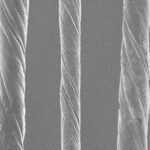
An international team of scientists, including two researchers who now work in the Center for Advanced Sensor Technology (CAST) at UMBC, has shown that twisted carbon nanotubes can store three times more energy per unit mass than advanced lithium-ion batteries. The finding may advance carbon nanotubes as a promising solution for storing energy in devices that need to be lightweight, compact, and safe, such as medical implants and sensors. The research was published recently in the journal Nature Nanotechnology.
Sanjeev Kumar Ujjain, from CAST, was a lead researcher on the work. He started the project while at Shinshu University, in Nagano, Japan, and continued after arriving at UMBC in 2022. Preety Ahuja, from CAST, also contributed to the material characterization aspects of the research.
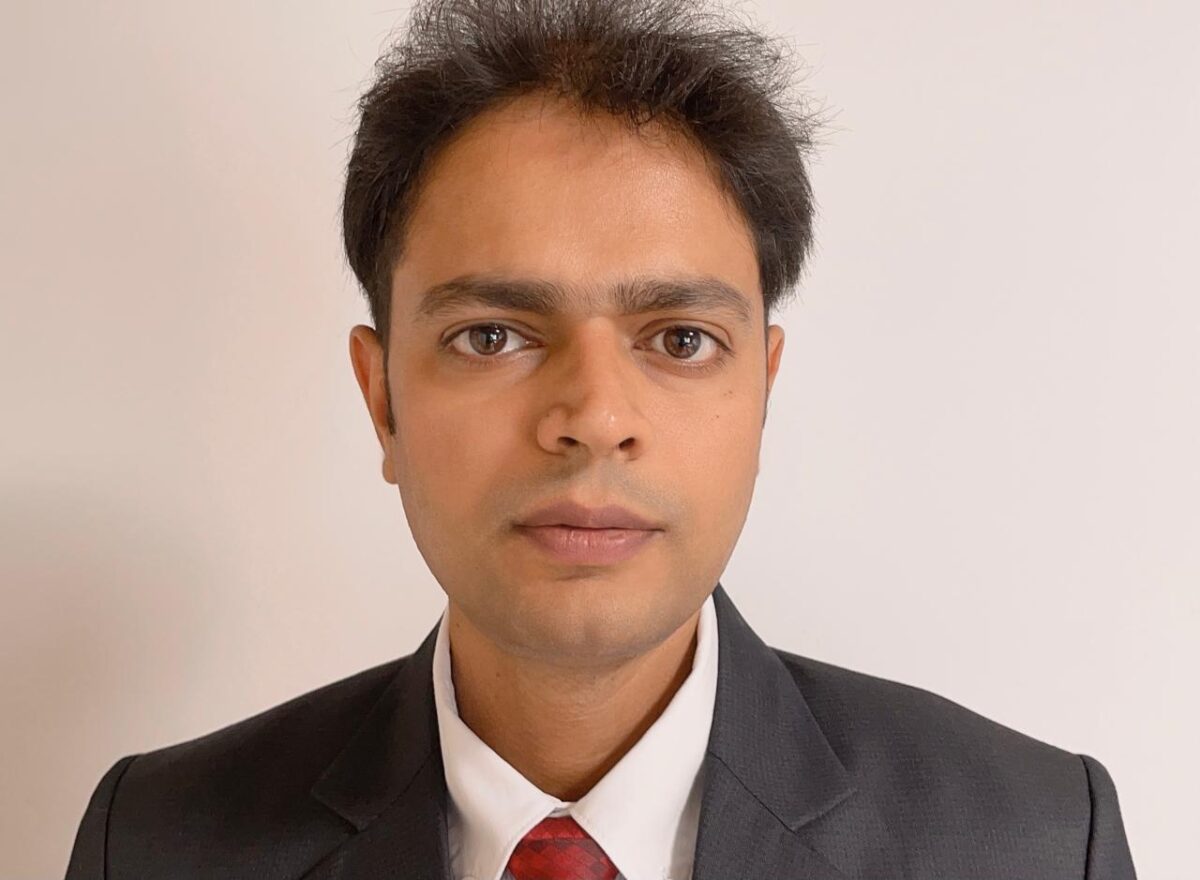

Sanjeev Kumar Ujjain (left) and Preety Ahuja (right). (Images courtesy of Kumar Ujjain and Ahuja)
Straws of 1-atom-thick carbon
The researchers studied single-walled carbon nanotubes, which are like straws made from pure carbon sheets only 1-atom thick. Carbon nanotubes are lightweight, relatively easy to manufacture, and about 100 times stronger than steel. Their amazing properties have led scientists to explore their potential use in a wide range of futuristic-sounding technology, including space elevators.
To investigate carbon nanotubes’ potential for storing energy, the UMBC researchers and their colleagues manufactured carbon nanotube “ropes” from bundles of commercially available nanotubes. After pulling and twisting the tubes into a single thread, the researchers then coated them with different substances intended to increase the ropes’ strength and flexibility.
The team tested how much energy the ropes could store by twisting them up and measuring the energy that was released as the ropes unwound. They found that the best-performing ropes could store 15,000 times more energy per unit mass than steel springs, and about three times more energy than lithium-ion batteries. The stored energy remains consistent and accessible at temperatures ranging from -76 to +212 °F (-60 to +100 °C). The materials in the carbon nanotube ropes are also safer for the human body than those used in batteries.
 The researchers envision that twisted carbon nanotube ropes may one day power a range of devices, including wearable health sensors and medical implants that could harvest energy from the body’s movements. (Graphic “NanoRope Mobility” created by Sanjeev Kumar Ujjain using Copilot AI.)
“Humans have long stored energy in mechanical coil springs to power devices such as watches and toys,” Kumar Ujjain says. “This research shows twisted carbon nanotubes have great potential for mechanical energy storage, and we are excited to share the news with the world.” He says the CAST team is already working to incorporate twisted carbon nanotubes as an energy source for a prototype sensor they are developing.
]]>
An international team of scientists, including two researchers who now work in the Center for Advanced Sensor Technology (CAST) at UMBC, has shown that twisted carbon nanotubes can store three...
https://umbc.edu/stories/carbon-nanotubes-power-source/
https://my3.my.umbc.edu/api/v0/pixel/news/142988/guest@my.umbc.edu/9c4f6492762d621d47bf444b4420ded4/api/pixel
cbee
coeit
news
research
science-and-tech
story
UMBC News & Magazine
https://my3.my.umbc.edu/groups/umbc-news-magazine
https://assets1-my.umbc.edu/system/shared/avatars/groups/000/001/943/24435aa6207c452e7bc15cc74b42c7bb/xsmall.png?1748556657
https://assets1-my.umbc.edu/system/shared/avatars/groups/000/001/943/24435aa6207c452e7bc15cc74b42c7bb/original.png?1748556657
https://assets2-my.umbc.edu/system/shared/avatars/groups/000/001/943/24435aa6207c452e7bc15cc74b42c7bb/xxlarge.png?1748556657
https://assets2-my.umbc.edu/system/shared/avatars/groups/000/001/943/24435aa6207c452e7bc15cc74b42c7bb/xlarge.png?1748556657
https://assets3-my.umbc.edu/system/shared/avatars/groups/000/001/943/24435aa6207c452e7bc15cc74b42c7bb/large.png?1748556657
https://assets1-my.umbc.edu/system/shared/avatars/groups/000/001/943/24435aa6207c452e7bc15cc74b42c7bb/medium.png?1748556657
https://assets2-my.umbc.edu/system/shared/avatars/groups/000/001/943/24435aa6207c452e7bc15cc74b42c7bb/small.png?1748556657
https://assets1-my.umbc.edu/system/shared/avatars/groups/000/001/943/24435aa6207c452e7bc15cc74b42c7bb/xsmall.png?1748556657
https://assets2-my.umbc.edu/system/shared/avatars/groups/000/001/943/24435aa6207c452e7bc15cc74b42c7bb/xxsmall.png?1748556657
UMBC News & Magazine
0
0
false
Tue, 30 Jul 2024 14:01:50 -0400
Tue, 30 Jul 2024 14:01:50 -0400
Infrastructure of support after Key Bridge collapse
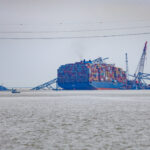
In 1987, Paul Flinton, then a 23-year-old senior studying at UMBC, decided to make a short documentary focused on the tollbooth workers on the Francis Scott Key Bridge.
The six-minute documentary “One Dollar”—named after the toll’s cost for cars at the time—captures a vehicle’s journey across the bridge from the driver’s point of view in one continuous take. As Flinton ’87, visual arts, drives across the bridge, audio of the tollbooth workers interviewed for the project act as the film’s narrators in which they share some of their experiences as toll operators.
Flinton, who is now a location sound manager for NFL Films, went on to win an award for “One Dollar” from the Maryland State Arts Council following its release. Nearly four decades later, Flinton all but forgot about the film’s existence until learning of the bridge’s collapse following a collision with a malfunctioning cargo ship on March 26, sending eight construction workers into the water and taking the lives of six.
“It hit a nerve,” Flinton told local news after the disaster. “[The film is] sort of a treasure…This captures something that in a lot of ways can’t really happen again.”
Paul Flinton’s short documentary entitled “One Dollar” (1987).
Supporting the impacted families
The Key Bridge opened to traffic in 1977, and regularly 30,000 vehicles crossed the 1.6 mile span over the Patapsco River. An integral part of Baltimore’s beltway, commuters, community members, and experts are now struggling to make sense of the literal change of transportation landscape. Now that the wreckage is completely cleared away and as the eventual construction commences, UMBC experts offer up their expertise and resources to confront the tragedy.
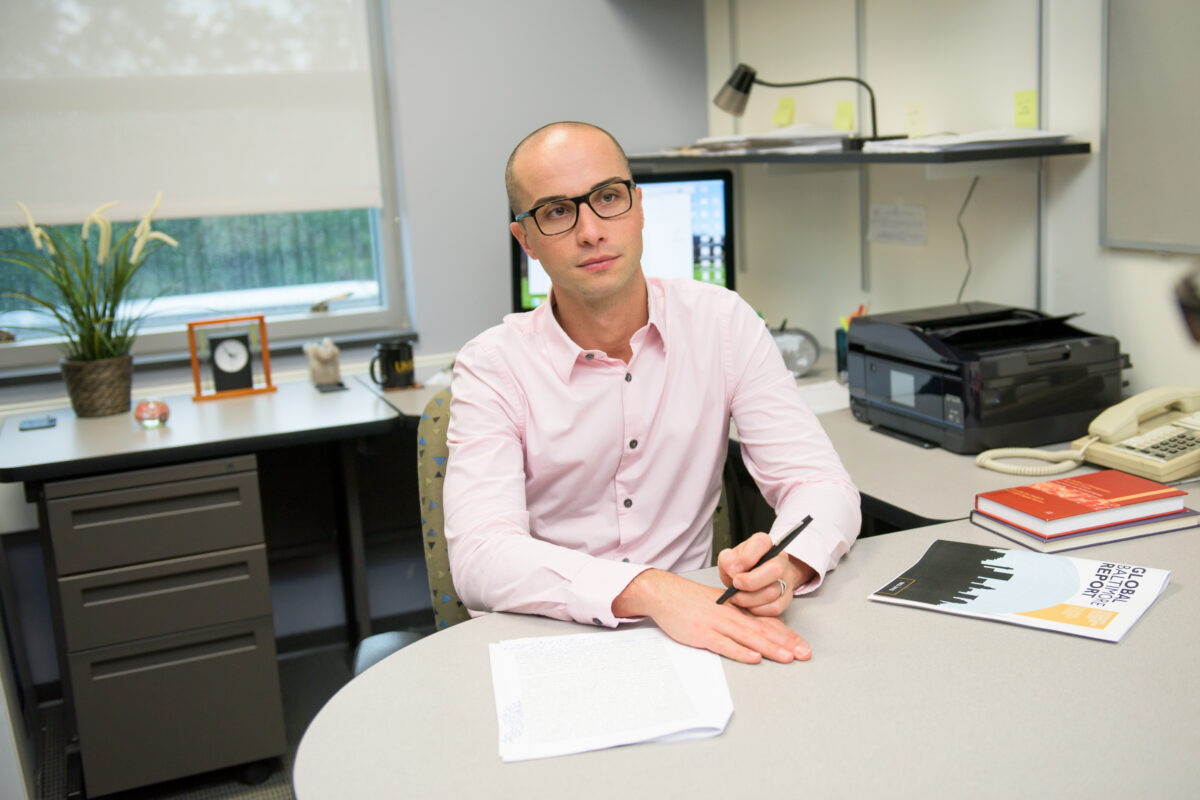 Felipe Filomeno. (Marlayna Demond ’11/UMBC)
After learning that all of the direct victims of the collapse were immigrants from countries throughout Latin America, Felipe Filomeno, associate professor of political science and global studies, immediately sprang into action with fellow members of the grassroots organization Latino Racial Justice Circle (LRJC). Filomeno, who is president of the LRJC, worked with the organization’s leadership team to establish a fundraiser in support of the families of the victims of the bridge collapse.
The crowdfunded campaign initially had a goal of raising about $5,000 for each of the families impacted, Filomeno said. Within hours of going live with the GoFundMe campaign, the organization raised $100,000 from donors located all around the world.
“The fundraiser caught a lot of traction. I have been overwhelmed by the outpouring of solidarity that we got from across the world in that week when the tragedy happened,” says Filomeno.
Following the fundraising success, the group has since directed prospective supporters to the Mayor’s Office of Immigrant Affairs’ Key Bridge Emergency Response Fund. The Mayor’s Office is working with the LRJC and case managers to distribute the funding to the six impacted families.
The tragedy has underlined key issues impacting the Latino immigrant community, challenges that Filomeno amplifies through his community-centered research at UMBC. “[The collapse] has highlighted and publicized to the world issues that we already know exist—the fact that Latino immigrants are over-represented in dangerous occupations,” says Filomeno. “There are higher incidents of work-related accidents among the Latino populations.”
Filomeno’s forthcoming book, Christian Cosmopolitanism: Faith Communities Talk Immigration (Temple University Press, 2024), explores the Honest Conversations on Immigration program he co-developed in 2017 in partnership with the LRJC. The program, Filomeno explains, was designed to build mutual understanding and collaboration between people who are diverse, but share the same religion.
“One of the goals is to build solidarity across differences,” says Filomeno. “The solidarity across differences is a principle that we also see in the Key Bridge fundraiser.”
Through his advocacy and academic scholarship, Filomeno is working to amplify the need for more long lasting efforts to stand in solidarity with Latino immigrant communities beyond moments of tragedy. “Those problems that became evident with the fall of the bridge, those challenges that the Latino immigrant population faces, they are still there,” he says. “To move the needle on those issues, it has to be more than helping those six families at this point in time.”
Examining the environmental impacts of the collapse
The ship that collided into the bridge was carrying 56 containers of hazardous materials, including corrosives, flammables, and lithium-ion batteries. The cargo ship was also carrying more than one million gallons of fuel at the time of the impact. City officials began their investigations into the incident, which included determining the environmental impacts to the Patapsco River and surrounding communities.
Upal Ghosh, professor of chemical, biochemical, and environmental engineering, whose research includes examining the effects of toxic pollutants in soils, sediments, and aquatic environments, was among the experts who weighed in on assessing the potentially hazardous effects of the containers that were resting at the bottom of the river.
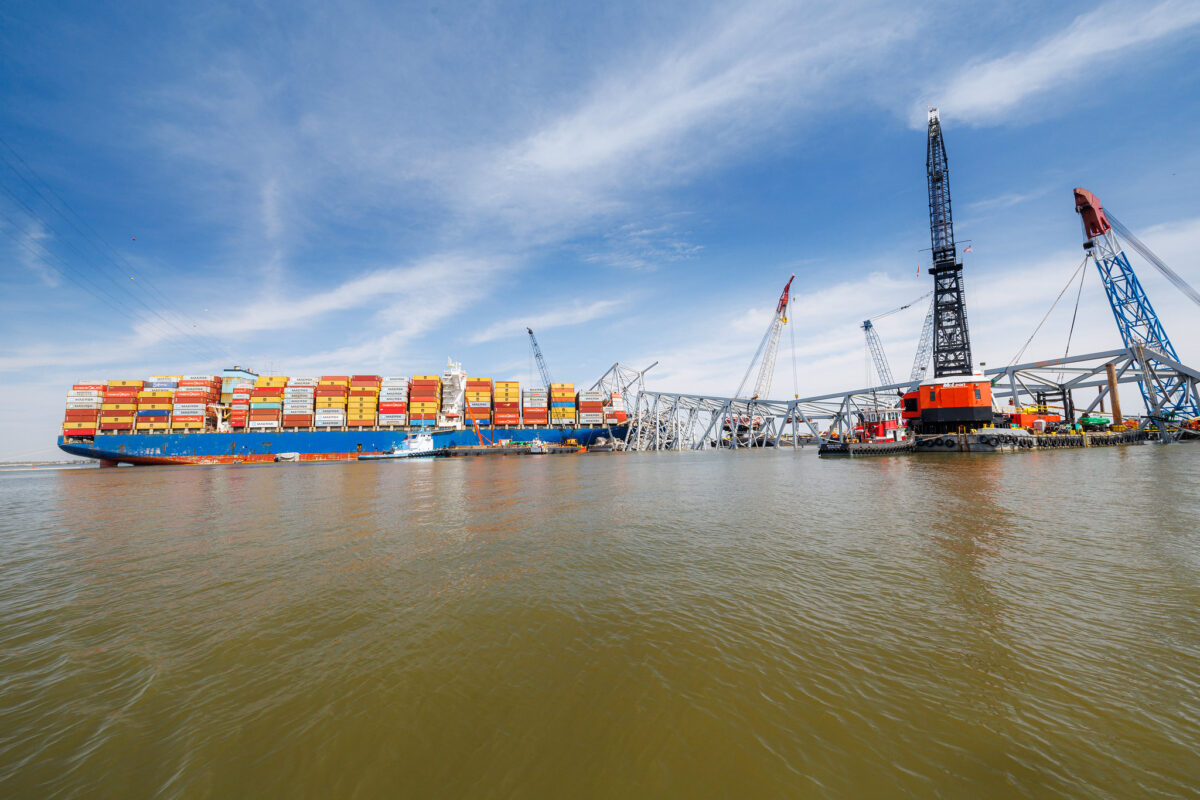 Maryland Comptroller Brooke Lierman and representatives of the Office of the Governor take a tour of the Francis Scott Key Bridge collapse site on a Maryland Department of Natural Resources police boat. (Photo source: Corey Jennings ’10, Maryland Comptroller/Flickr)
Ghosh told the Baltimore Sun days after the collapse that environmental officials’ first priority would likely be making sure none of the intact containers were breached.
“If you have containers that contain oily material, those things will, if they are breached, be releasing over time,” Ghosh said. “I would think if there is a release that goes down into the sediments under the water, it would be a local impact right there.”
Farah Nibbs, assistant professor of emergency and disaster health systems, is also thinking about future ways to contain the effects of similar disasters. Contributing factors to the bridge’s collapse, she says, can be tied to the 2012 expansion and modernization of the Port of Baltimore. Those changes did not happen hand in hand with improvements in safety management needed to accommodate ships of such huge sizes that now were able to port in the city. Risks from collisions, fuel spills, and contamination still lack proper oversight and regulation.
“A novel approach for decision-makers may be to view Maryland’s emergency management and transportation experts and service providers—as well as the physical bridge infrastructure itself—as part of the community’s lifeline systems,” said Nibbs.
More than a disaster
As plans for the bridge’s rebuilding process begins to take shape, Brian Grodsky, professor of political science, shed light on why Maryland Governor Wes Moore likely did not request a presidential disaster declaration in response to the collapse. Presidential disaster declarations, Grodsky said in a local tv news segment, are usually limited to tragedies that involve fires, floods, or explosives.
“Man-made disasters are more likely to be declined [for a presidential disaster declaration] because there is that question of public versus private ownership of the disaster,” he added. “If this ship caught on fire or exploded under the bridge, this would easily be qualified as a major disaster.”
Deborah Rudacille, professor of the practice in English, is well aware of the lives connected to the construction and opening of the Key Bridge. In 2010, she published Roots of Steel: Boom and Bust in an American Mill Town, a book exploring Baltimore’s industrial history of the Sparrows Point steel mill, but also capturing her family’s connection to the mill and Baltimore staples like the Key Bridge.
Rudacille’s mother was one of the original employees—collecting the toll that Flinton documented in his film— when the bridge first opened in 1977, and her brother worked as one of the bridge’s painters.
“They were kind of reminiscing about the fact that everything down there is now gone,” Rudacille told local media about her family. “First the steelworks, now the Key Bridge is gone. It’s like this world that they lived and worked in has vanished completely.”
]]>
In 1987, Paul Flinton, then a 23-year-old senior studying at UMBC, decided to make a short documentary focused on the tollbooth workers on the Francis Scott Key Bridge. The six-minute...
https://umbc.edu/stories/support-after-key-bridge-collapse/
https://my3.my.umbc.edu/api/v0/pixel/news/142431/guest@my.umbc.edu/85f4487fb5eddd76a8baa59270f45a52/api/pixel
cahss
cbee
coeit
discovery
edhs
english
magazine
political-science
spring-2024
story
visual-arts
UMBC News & Magazine
https://my3.my.umbc.edu/groups/umbc-news-magazine
https://assets1-my.umbc.edu/system/shared/avatars/groups/000/001/943/24435aa6207c452e7bc15cc74b42c7bb/xsmall.png?1748556657
https://assets1-my.umbc.edu/system/shared/avatars/groups/000/001/943/24435aa6207c452e7bc15cc74b42c7bb/original.png?1748556657
https://assets2-my.umbc.edu/system/shared/avatars/groups/000/001/943/24435aa6207c452e7bc15cc74b42c7bb/xxlarge.png?1748556657
https://assets2-my.umbc.edu/system/shared/avatars/groups/000/001/943/24435aa6207c452e7bc15cc74b42c7bb/xlarge.png?1748556657
https://assets3-my.umbc.edu/system/shared/avatars/groups/000/001/943/24435aa6207c452e7bc15cc74b42c7bb/large.png?1748556657
https://assets1-my.umbc.edu/system/shared/avatars/groups/000/001/943/24435aa6207c452e7bc15cc74b42c7bb/medium.png?1748556657
https://assets2-my.umbc.edu/system/shared/avatars/groups/000/001/943/24435aa6207c452e7bc15cc74b42c7bb/small.png?1748556657
https://assets1-my.umbc.edu/system/shared/avatars/groups/000/001/943/24435aa6207c452e7bc15cc74b42c7bb/xsmall.png?1748556657
https://assets2-my.umbc.edu/system/shared/avatars/groups/000/001/943/24435aa6207c452e7bc15cc74b42c7bb/xxsmall.png?1748556657
UMBC News & Magazine
2
0
false
Thu, 13 Jun 2024 13:40:41 -0400
Thu, 13 Jun 2024 13:40:41 -0400
Capping years of rising success, UMBC chemical engineering club shines as student conference hosts
On the first weekend of April, hundreds of chemical engineering students from across the Mid-Atlantic converged on the UMBC campus for two days of learning, networking, and friendly competition. They heard talks from academic and industry leaders, attended workshops and a career fair, competed in rounds of ChemE Jeopardy, mixed chemicals to power small cars along a track in the ChemE Car competition, and mingled over catered lunches, dinners, and cups of evening hot cocoa.
The activities were all part of the 2024 Mid-Atlantic Student Regional Conference of the American Institute of Chemical Engineers (AIChE)—hosted by the UMBC student chapter of the national group. Around 400 people attended the event, an increase from last year’s conference at Virginia Tech. Organizing the logistics, recruiting speakers and sponsors, securing rooms, and ordering thousands of plates worth of food presented a formidable challenge—one that the UMBC students tackled with aplomb.
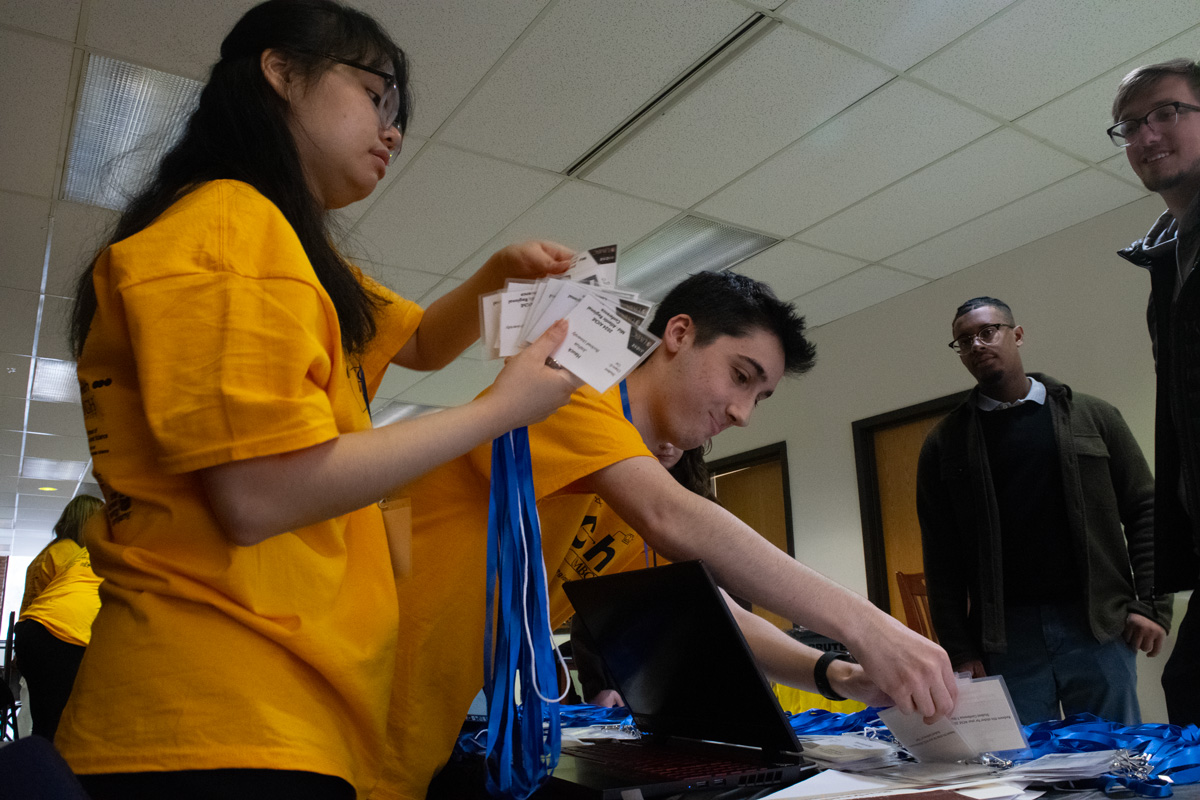 Managing check-in. (Photo by Danielle Clark)
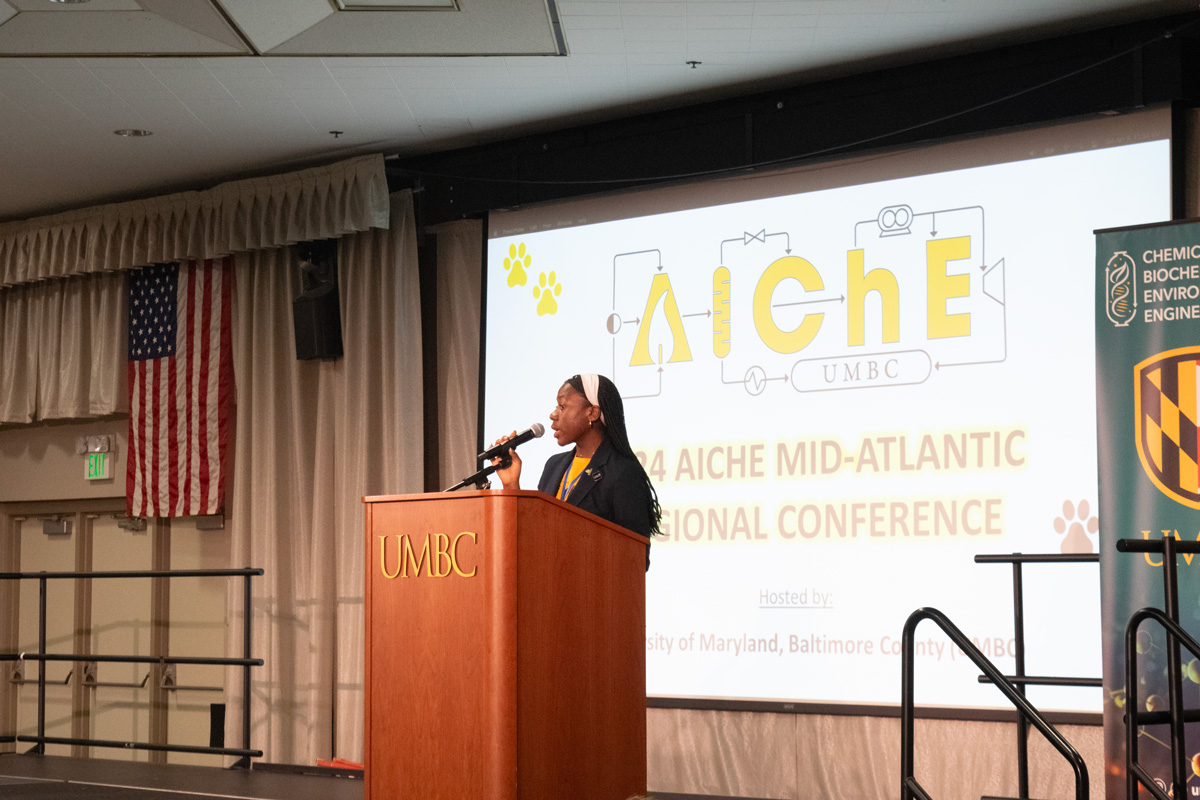 Welcoming attendees. (Photo by Danielle Clark)
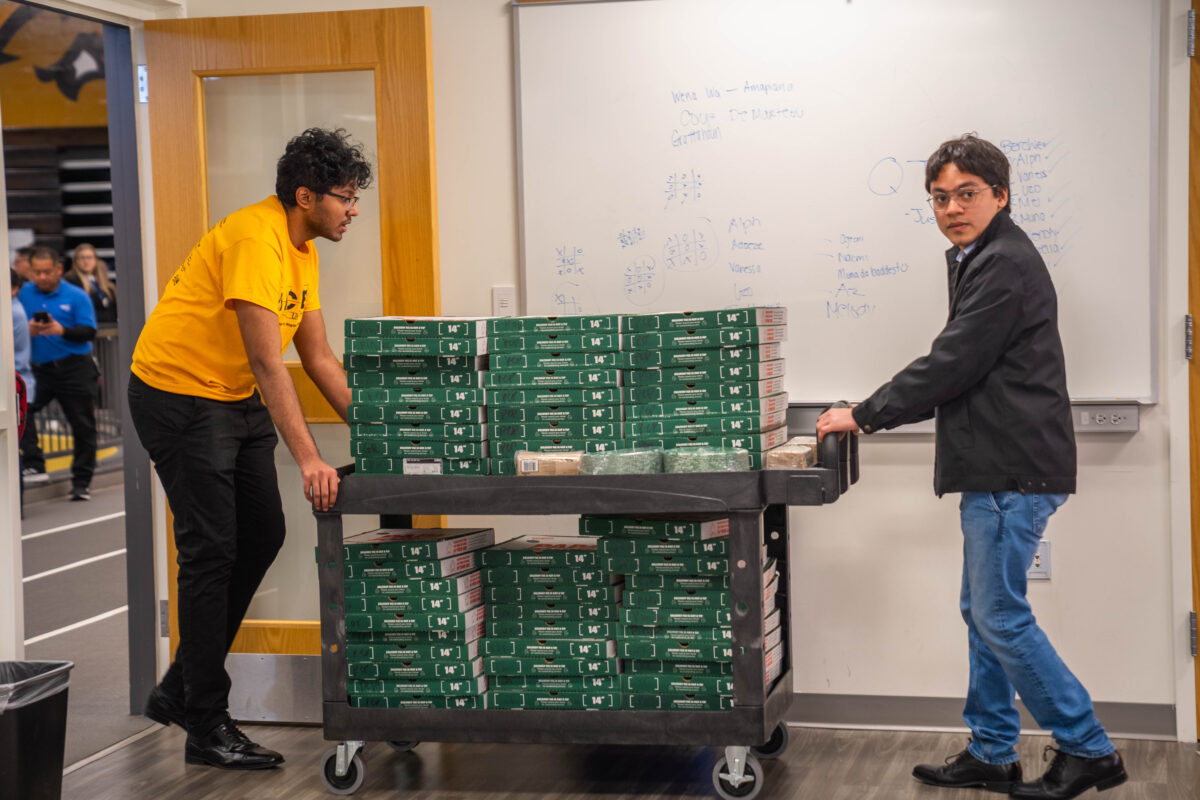 Delivering pizza. (Photo by Julianna Falconer)
“I am feeling fantastic after the conference,” says Pavan Umashankar ’25, chemical engineering and biochemistry and molecular biology, who served as the chair of the conference organizing committee. “I am super proud of everyone’s commitment and dedication to make it a resounding success.”
“Truly, I could gush about the UMBC conference planning team all day,” says Alyssa Block, the membership associate of ChemE student programs for AIChE. “These students really are the future leaders of their profession and of AIChE: engaged, excited, collaborative, supportive of each other, and willing to lend a hand.”
A club on the upswing
Hosting an AIChE regional conference for the first time at UMBC marked a milestone for a student club that has seen increasing levels of engagement and success in recent years. While many college clubs across the country are in decline post-Covid, UMBC’s AIChE student chapter is on a clear upward trajectory. The club sent its first team to compete in ChemE Jeopardy at the spring 2019 AIChE regional meeting. Just three years later, the UMBC team won the national ChemE Jeopardy competition.
Neha Raikar, a senior lecturer in the Department of Chemical, Biochemical, and Environmental Engineering (CBEE) and one of the advisors to the student AIChE chapter, remembers attending the 2019 meeting: “Back then, we wondered if we would ever be able to host a regional conference at UMBC,” she says. “We’ve achieved that goal.”
It was especially remarkable, she adds, to see some members of UMBC’s first ChemE Jeopardy and ChemE car teams return to this year’s conference as industry representatives.
Strong attendance and smooth conference logistics weren’t the only successes of the weekend—UMBC also triumphed in the ChemE Jeopardy and ChemE car competitions.
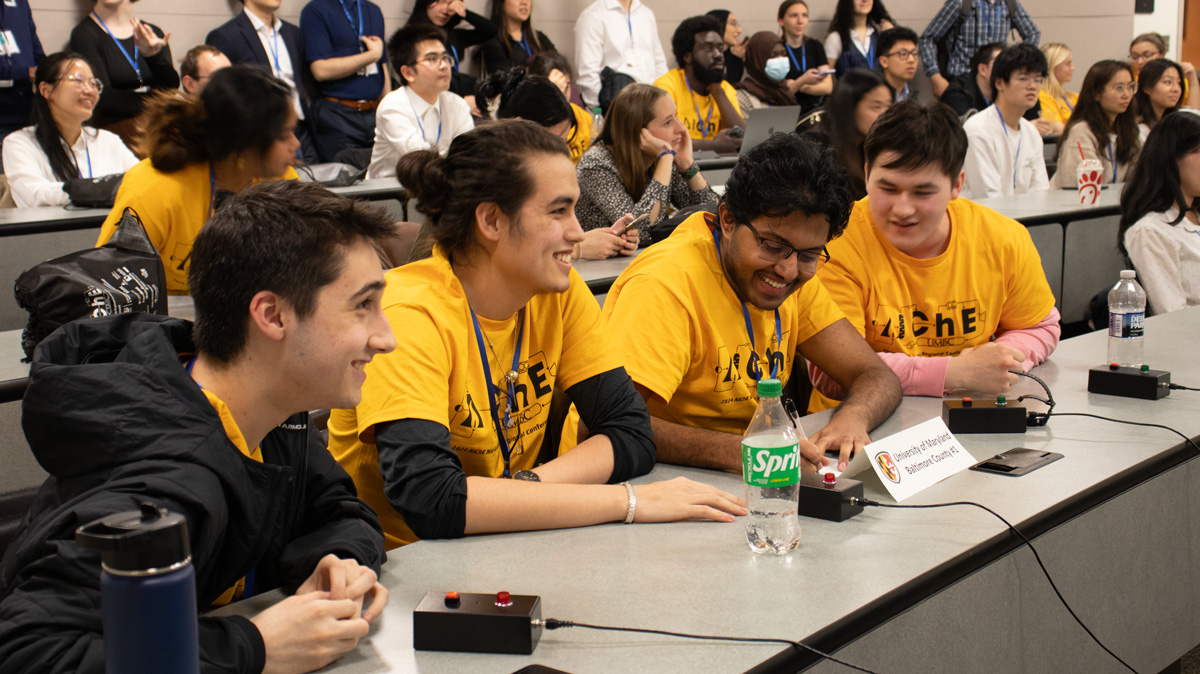 The UMBC #1 Jeopardy team during a preliminary round. (Photo by Patch Hatley)
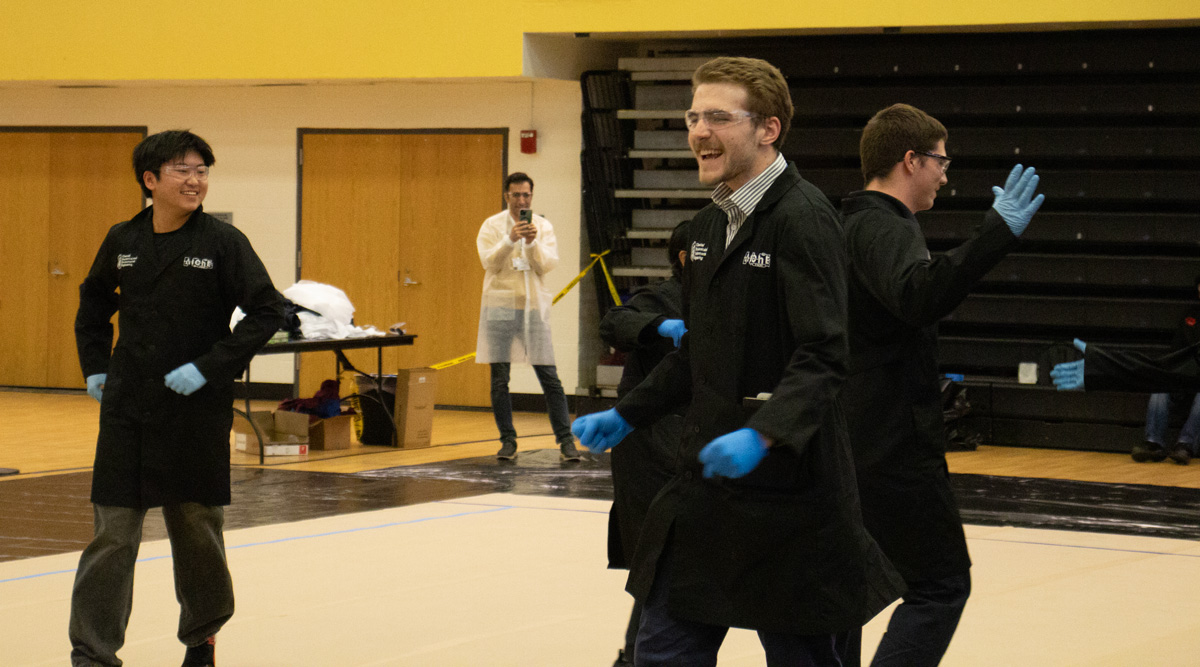 The UMBC ChemE Car team celebrates a good run. (Photo by Patch Hatley)
“Planning for the conference was already a significant undertaking, and on top of that, many of our students participated, and excelled, in the competitions,” says Raikar. “Their achievements not only showcased their individual capabilities but also the strength of our club as a whole, which is growing and thriving.”
A winning formula
AIChE chapter members and their advisors ascribe the club’s success to the hard work and dedication of the students coupled with the support of the CBEE department, college, and university. Thirteen CBEE students formed the conference planning committee, which met regularly to ensure all conference planning efforts were on track. An additional 37 students and 14 faculty and staff also volunteered their time—as check-in staff, poster and presentation judges, and more. About 10 UMBC alumni actively participated in the conference, and others contributed to fundraising efforts, helping the organizing committee secure sponsorships from notable companies such as AstraZeneca, ExxonMobil, Advanced Thermal Batteries, and Astek Diagnostics and from the chemical engineering department of Columbia University.
An Dang ’24, chemical engineering, led the fundraising efforts. She gamely approached industry representatives at the UMBC career fair and made the pitch. “I’m not an extrovert, and being in these roles forced me to go out of my comfort zone,” she says.
“Securing sponsorships was vital for making the conference possible, and An did a remarkable job” says Mariajosé Castellanos, another CBEE faculty who advises the AIChE chapter. Castellanos also praised the management skills of conference planning committee chair Umashankar. “Despite his modesty, Pavan is a true mastermind in everything he does,” she says.
For their part, the students applauded the support of the CBEE department, especially the work of their two advisors, Raikar and Castellanos, and the event planning support of Andrea Miller, the CBEE graduate program coordinator.
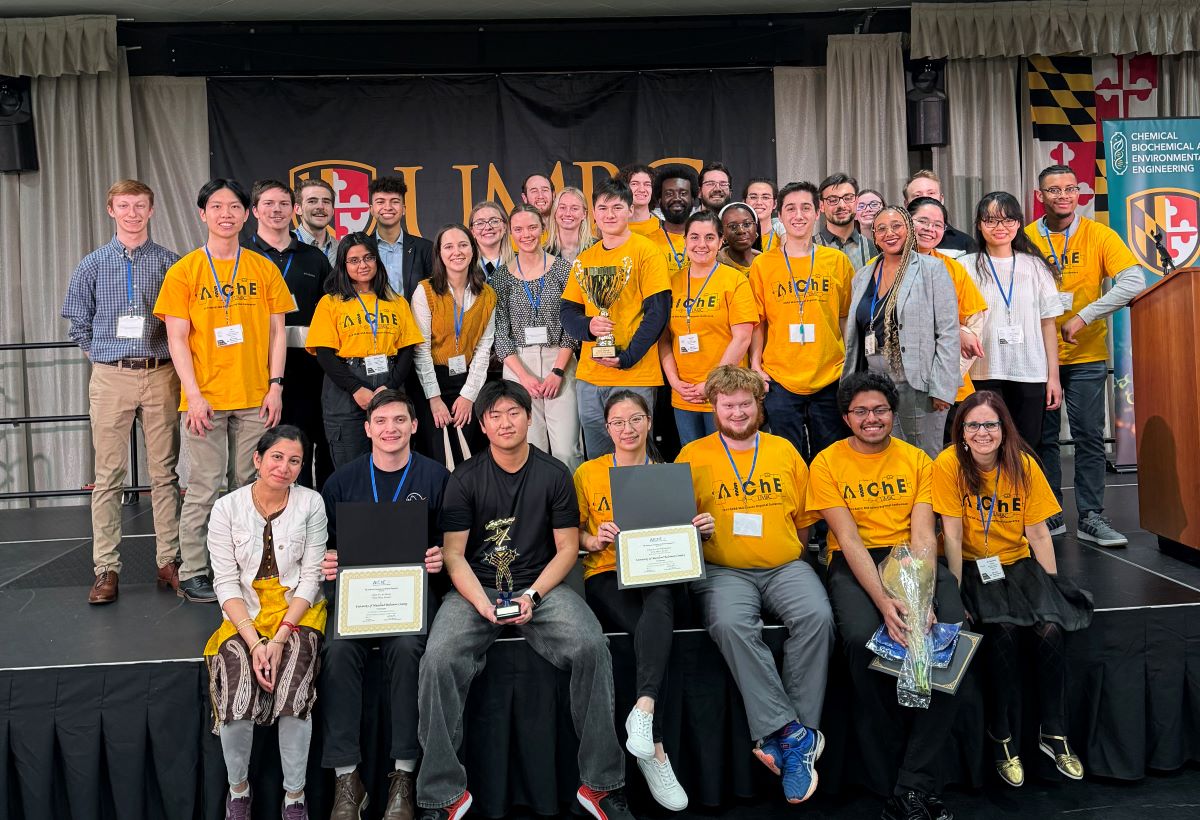 UMBC AIChE chapter students and faculty advisors pose for a group photo after a successful conference. (Photo courtesy of Mariajosé Castellanos.)
The conference was both a marker of the club’s success and an opportunity for individual students to grow their skill sets.
“I have developed leadership and project management skills, which will be incredibly useful throughout my professional career,” says Umashankar.
Ben Welling ’25, chemical engineering, the leader of the UMBC ChemE car team, believes his experience with the competition helped him land internships. “I talked about it extensively with employers. They like leadership experience and it shows you are willing to do more than is required.”
Raikar sees a bright future for the student stars of this year’s conference and for the club as a whole. “I hope the conference will boost the club membership and participation of students in other AIChE activities,” she says. And, she adds, the conference shows that with support, “UMBC students can accomplish any task.”
]]>
On the first weekend of April, hundreds of chemical engineering students from across the Mid-Atlantic converged on the UMBC campus for two days of learning, networking, and friendly competition....
https://umbc.edu/stories/umbc-chemical-engineering-club-shines-as-student-conference-hosts/
https://my3.my.umbc.edu/api/v0/pixel/news/142266/guest@my.umbc.edu/73e17cd25ad64e55b2130e8bf14c39f0/api/pixel
cbee
coeit
community
news
story
UMBC News & Magazine
https://my3.my.umbc.edu/groups/umbc-news-magazine
https://assets1-my.umbc.edu/system/shared/avatars/groups/000/001/943/24435aa6207c452e7bc15cc74b42c7bb/xsmall.png?1748556657
https://assets1-my.umbc.edu/system/shared/avatars/groups/000/001/943/24435aa6207c452e7bc15cc74b42c7bb/original.png?1748556657
https://assets2-my.umbc.edu/system/shared/avatars/groups/000/001/943/24435aa6207c452e7bc15cc74b42c7bb/xxlarge.png?1748556657
https://assets2-my.umbc.edu/system/shared/avatars/groups/000/001/943/24435aa6207c452e7bc15cc74b42c7bb/xlarge.png?1748556657
https://assets3-my.umbc.edu/system/shared/avatars/groups/000/001/943/24435aa6207c452e7bc15cc74b42c7bb/large.png?1748556657
https://assets1-my.umbc.edu/system/shared/avatars/groups/000/001/943/24435aa6207c452e7bc15cc74b42c7bb/medium.png?1748556657
https://assets2-my.umbc.edu/system/shared/avatars/groups/000/001/943/24435aa6207c452e7bc15cc74b42c7bb/small.png?1748556657
https://assets1-my.umbc.edu/system/shared/avatars/groups/000/001/943/24435aa6207c452e7bc15cc74b42c7bb/xsmall.png?1748556657
https://assets2-my.umbc.edu/system/shared/avatars/groups/000/001/943/24435aa6207c452e7bc15cc74b42c7bb/xxsmall.png?1748556657
UMBC News & Magazine
0
0
false
Thu, 30 May 2024 12:51:16 -0400
Thu, 30 May 2024 12:51:16 -0400
An Dang ’24: A chemical engineer who helped pull off a big student conference
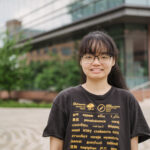
An Dang ’24, chemical engineering, an international student from Vietnam, arrived at UMBC in 2021 as a transfer student from Montgomery College. When switching colleges, she also switched majors: from biology to chemical engineering. She quickly became involved in activities in the Department of Chemical, Biochemical, and Environmental Engineering and this year helped the student chapter of the American Institute of Chemical Engineers (AIChE) pull together a major student conference for the first time.
Q: What drew you to UMBC?
A: I talked to Mark Marten, the chair of the Department of Chemical, Biochemical, and Environmental Engineering (CBEE), and I got the sense that the department is small and they really support their students. That caring environment is what I wanted. It’s also, honestly, an affordable option.
Q: Who were some of your mentors?
A: I’m working in the lab of Lee Blaney, one of the environmental engineering professors. He’s my research advisor and really helped me navigate the process of applying to grad school. In the fall, I’m going to the University of Michigan in Ann Arbor to pursue my Ph.D. And Neha Raikar, a senior lecturer in the department, devotes so much of her time to making sure students are supported. She’s like a motherly figure for a lot of us.
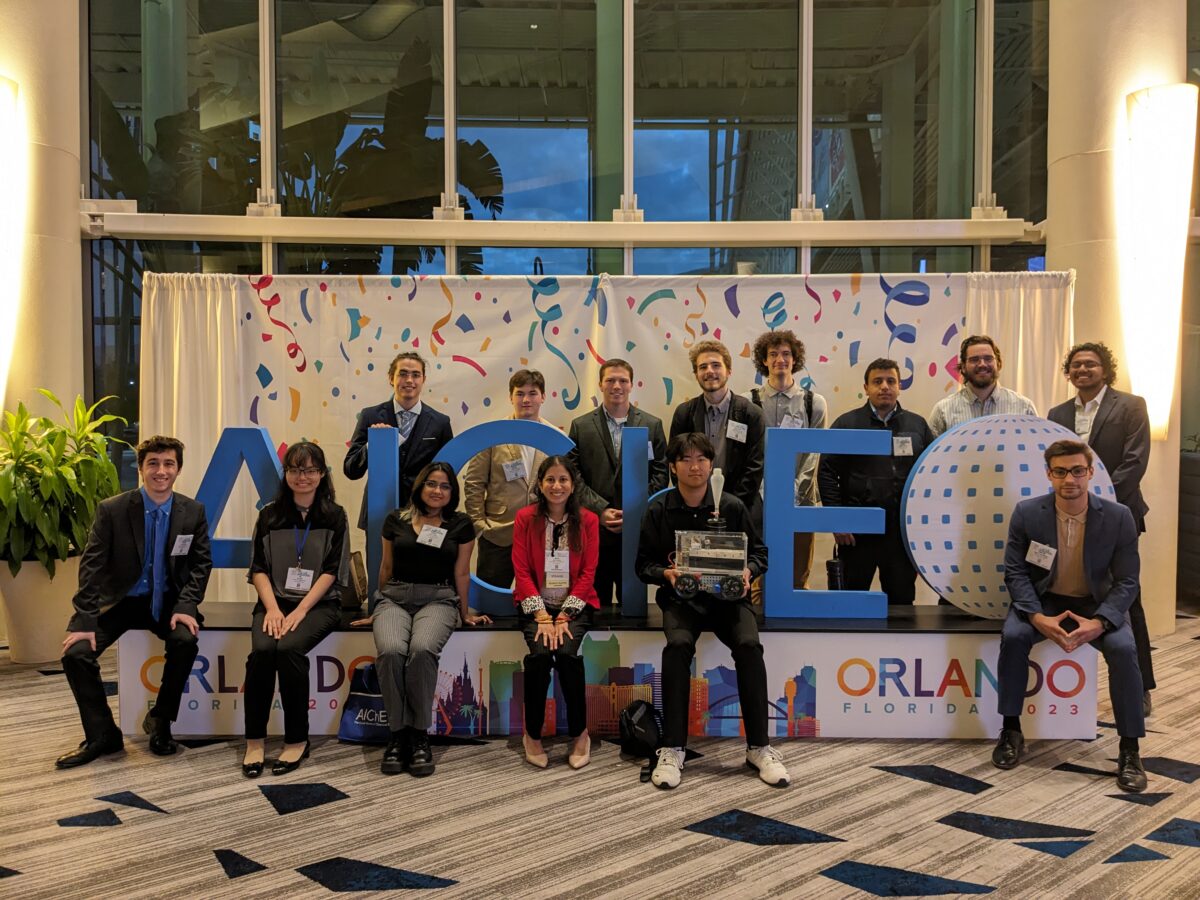 An Dang (seated second from left) and other UMBC AIChE student chapter members with advisor Neha Raikar at the AIChE Annual Meeting in Orlando in November. (Photo courtesy of An Dang.)
Q: What clubs and activities were you involved in?
A: I was a CBEE student ambassador. We went to high schools and community colleges to advertise the department and answer student questions. I’m also involved in the AIChE student chapter. At first I was the service chair and I mostly helped with planning K-12 outreach events. This year, we hosted the AIChE Mid-Atlantic Regional Conference and I was on the planning committee. I was in charge of corporate and university relations—I helped secure sponsors for the conference, and made sure we had funding.
Q: What were some of the skills you developed serving in these roles?
A: I’m not an extrovert, and being in these roles forced me to go out of my comfort zone. I learned how to speak professionally with people in higher positions, so they take me seriously, and maybe even want to give us money. The other big thing I realized is that no matter how well I prepare, sometimes things will go wrong, and that’s okay. We all need to give ourselves grace.
Q: How did it feel to host a big conference?
A: It was a lot of hard work! The student organizers spent a lot of time together, and we really got to know each other well and develop close relationships. There are only 28 people from the department in my graduating class, and many of them are in AIChE. When the conference went well, it felt great!
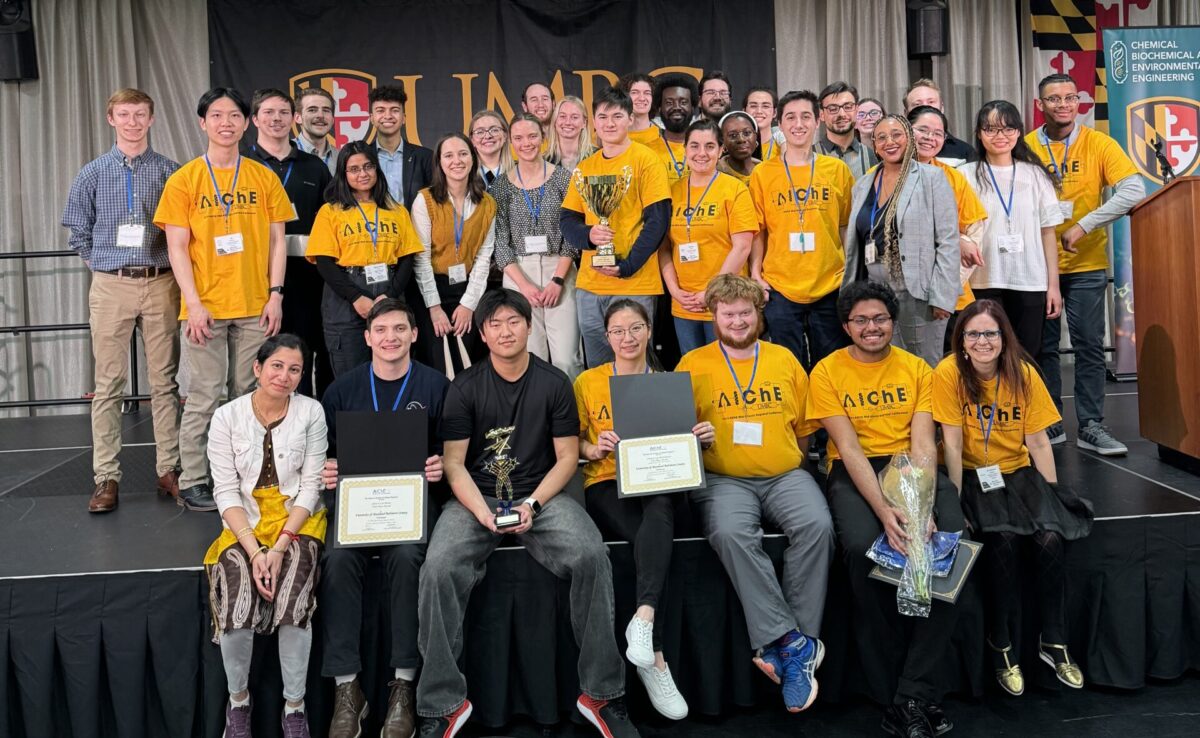 Volunteers, including An Dang (second from right) gather for a photo after the successful hosting of the AIChE Mid-Atlantic Student Regional Conference at UMBC. (Photo courtesy of An Dang)
Q: What other places did you find community at UMBC?
A: I am an international student, and I worked for International Student and Scholar Services (ISSS). I got to know some of the staff in the office really well. One problem that I ran into while I was here is that I lost my social security card. I had a lot of challenges getting a new one because there was a mix-up in the social security office with my middle and first name. ISSS helped me write a very good letter to justify my case, and I finally got my card. I’m very grateful that I got that help from them because it’s an important piece of documentation.
Q: What are your plans for the future?
A: I’m continuing in chemical engineering and plan to go to grad school to study catalysis engineering, which is studying how to speed up chemical reactions. I’d like to work in industry, particularly in the field of renewable energy. Anything that helps with the environment—that’s what I want to focus on.
]]>
An Dang ’24, chemical engineering, an international student from Vietnam, arrived at UMBC in 2021 as a transfer student from Montgomery College. When switching colleges, she also switched majors:...
https://umbc.edu/stories/an-dang-chemical-engineer/
https://my3.my.umbc.edu/api/v0/pixel/news/142119/guest@my.umbc.edu/0b3dcf2da3f70e5f89bd7842f6ae0f35/api/pixel
cbee
class-of-2024
coeit
news
story
UMBC News & Magazine
https://my3.my.umbc.edu/groups/umbc-news-magazine
https://assets1-my.umbc.edu/system/shared/avatars/groups/000/001/943/24435aa6207c452e7bc15cc74b42c7bb/xsmall.png?1748556657
https://assets1-my.umbc.edu/system/shared/avatars/groups/000/001/943/24435aa6207c452e7bc15cc74b42c7bb/original.png?1748556657
https://assets2-my.umbc.edu/system/shared/avatars/groups/000/001/943/24435aa6207c452e7bc15cc74b42c7bb/xxlarge.png?1748556657
https://assets2-my.umbc.edu/system/shared/avatars/groups/000/001/943/24435aa6207c452e7bc15cc74b42c7bb/xlarge.png?1748556657
https://assets3-my.umbc.edu/system/shared/avatars/groups/000/001/943/24435aa6207c452e7bc15cc74b42c7bb/large.png?1748556657
https://assets1-my.umbc.edu/system/shared/avatars/groups/000/001/943/24435aa6207c452e7bc15cc74b42c7bb/medium.png?1748556657
https://assets2-my.umbc.edu/system/shared/avatars/groups/000/001/943/24435aa6207c452e7bc15cc74b42c7bb/small.png?1748556657
https://assets1-my.umbc.edu/system/shared/avatars/groups/000/001/943/24435aa6207c452e7bc15cc74b42c7bb/xsmall.png?1748556657
https://assets2-my.umbc.edu/system/shared/avatars/groups/000/001/943/24435aa6207c452e7bc15cc74b42c7bb/xxsmall.png?1748556657
UMBC News & Magazine
2
0
false
Tue, 21 May 2024 12:49:54 -0400
Tue, 21 May 2024 12:49:54 -0400
Lee Blaney awarded funding to develop new ways to remove “forever chemicals” from water
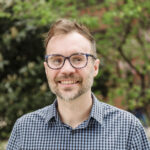
Professor Lee Blaney, in the Department of Chemical, Biochemical, and Environmental Engineering, received $750,000 in funding from the Department of Defense’s Strategic Environmental Research and Development Program (SERDP) to develop new ways to remove substances dubbed “forever chemicals” from water.
Per- and polyfluoroalkyl substances, or PFAS, are used in products ranging from cleaning products and clothing to fire-fighting foam. They earned the nickname “forever chemicals” because of the way they persist in the environment. PFAS have been linked to decreased fertility in women, developmental effects in children, reduced immune function, and increased risk of cancer and obesity. The Environmental Protection Agency recently announced limitations on the amount of certain PFAS in drinking water.
Current technology such as activated carbon and anion-exchange resins can effectively remove the most common PFAS found in water, but do not perform well at removing short- and ultrashort-chain PFAS (which have fewer than eight carbon atoms in their chemical structure.)
The award from SERDP will fund Blaney’s work to develop materials called adsorbents specifically designed for treatment of these short-chain PFAS. Blaney’s colleagues on the project include Ke He, Ph.D. ’17, chemical and biochemical engineering, an assistant research scientist at UMBC, Wenqing Xu, an associate professor in civil and environmental engineering at Villanova University, and Jessica Ray, an assistant professor in civil and environmental engineering at the University of Washington.
]]>
Professor Lee Blaney, in the Department of Chemical, Biochemical, and Environmental Engineering, received $750,000 in funding from the Department of Defense’s Strategic Environmental Research and...
https://umbc.edu/quick-posts/lee-blaney-wins-funding-to-develop-new-ways-to-remove-forever-chemicals-from-water/
https://my3.my.umbc.edu/api/v0/pixel/news/142036/guest@my.umbc.edu/0a1bf138bc9415c48b8e98588cb7885a/api/pixel
cbee
coeit
news
quick-post
research
science-and-tech
UMBC News & Magazine
https://my3.my.umbc.edu/groups/umbc-news-magazine
https://assets1-my.umbc.edu/system/shared/avatars/groups/000/001/943/24435aa6207c452e7bc15cc74b42c7bb/xsmall.png?1748556657
https://assets1-my.umbc.edu/system/shared/avatars/groups/000/001/943/24435aa6207c452e7bc15cc74b42c7bb/original.png?1748556657
https://assets2-my.umbc.edu/system/shared/avatars/groups/000/001/943/24435aa6207c452e7bc15cc74b42c7bb/xxlarge.png?1748556657
https://assets2-my.umbc.edu/system/shared/avatars/groups/000/001/943/24435aa6207c452e7bc15cc74b42c7bb/xlarge.png?1748556657
https://assets3-my.umbc.edu/system/shared/avatars/groups/000/001/943/24435aa6207c452e7bc15cc74b42c7bb/large.png?1748556657
https://assets1-my.umbc.edu/system/shared/avatars/groups/000/001/943/24435aa6207c452e7bc15cc74b42c7bb/medium.png?1748556657
https://assets2-my.umbc.edu/system/shared/avatars/groups/000/001/943/24435aa6207c452e7bc15cc74b42c7bb/small.png?1748556657
https://assets1-my.umbc.edu/system/shared/avatars/groups/000/001/943/24435aa6207c452e7bc15cc74b42c7bb/xsmall.png?1748556657
https://assets2-my.umbc.edu/system/shared/avatars/groups/000/001/943/24435aa6207c452e7bc15cc74b42c7bb/xxsmall.png?1748556657
UMBC News & Magazine
1
0
false
Thu, 16 May 2024 14:39:36 -0400
Thu, 16 May 2024 14:39:36 -0400
From solar energy harvesting to advanced batteries: Cohort of new engineering faculty bolster UMBC’s commitment to Earth-friendly research
This April 22, as the campus community celebrated Earth Day, the feel of spring’s natural reawakening was in the air. Birds chirped from newly leafed trees and students strolled in the bright sunshine. But the pleasant day belied a concerning trend: In Maryland and beyond, the balance of Earth’s life-supporting systems is shifting, driven in large part by the heat-trapping greenhouse gasses we humans send into the atmosphere. The Earth is getting hotter; weather patterns are changing; and ecosystems are under stress.
“Climate change is pressing us to adopt a more Earth-friendly lifestyle, to develop renewable energy,” says Özgür Çapraz, an associate professor in the department of chemical, biochemical, and environmental engineering at UMBC, who studies advanced battery technologies. Çapraz, who joined UMBC in fall 2023 from a faculty position at Oklahoma State University, was one of three recent faculty hires in the College of Engineering and Information Technology (COEIT) who all specialize in different aspects of sustainability and renewable energy-related research.
The three hires were part of a COEIT effort to build off recognized strength in the environmental domain, while expanding expertise in important areas such as energy, says Lee Blaney, a professor in the department of chemical, biochemical, and environmental engineering who chaired the search.
The other two hires are Alok Ghanekar, an assistant professor in mechanical engineering, who studies materials that can improve some solar energy harvesting systems, turn waste heat into electricity, and better cool buildings; and Rajasekhar Anguluri, an assistant professor in computer science and electrical engineering, who specializes in the math describing large, complex systems such as the power grid.
The energy conundrum
“Ever since I studied science in high school, I have been interested in energy,” says Ghanekar, who was a postdoctoral researcher at the University of Southern California prior to joining UMBC this spring semester. “Growing up in India, there were regular power outages every week. It is less of a problem now, but energy demand is still growing.”
Across the world, in many ways, energy consumption drives progress and improves people’s lives. But the burning of fossil fuels to produce much of that energy is increasing the concentration of heat-trapping gasses in the atmosphere. While the exact consequences of this change are uncertain, it’s clear the Earth is warming, and that trend is likely to put extreme pressures on societies in the decades to come.
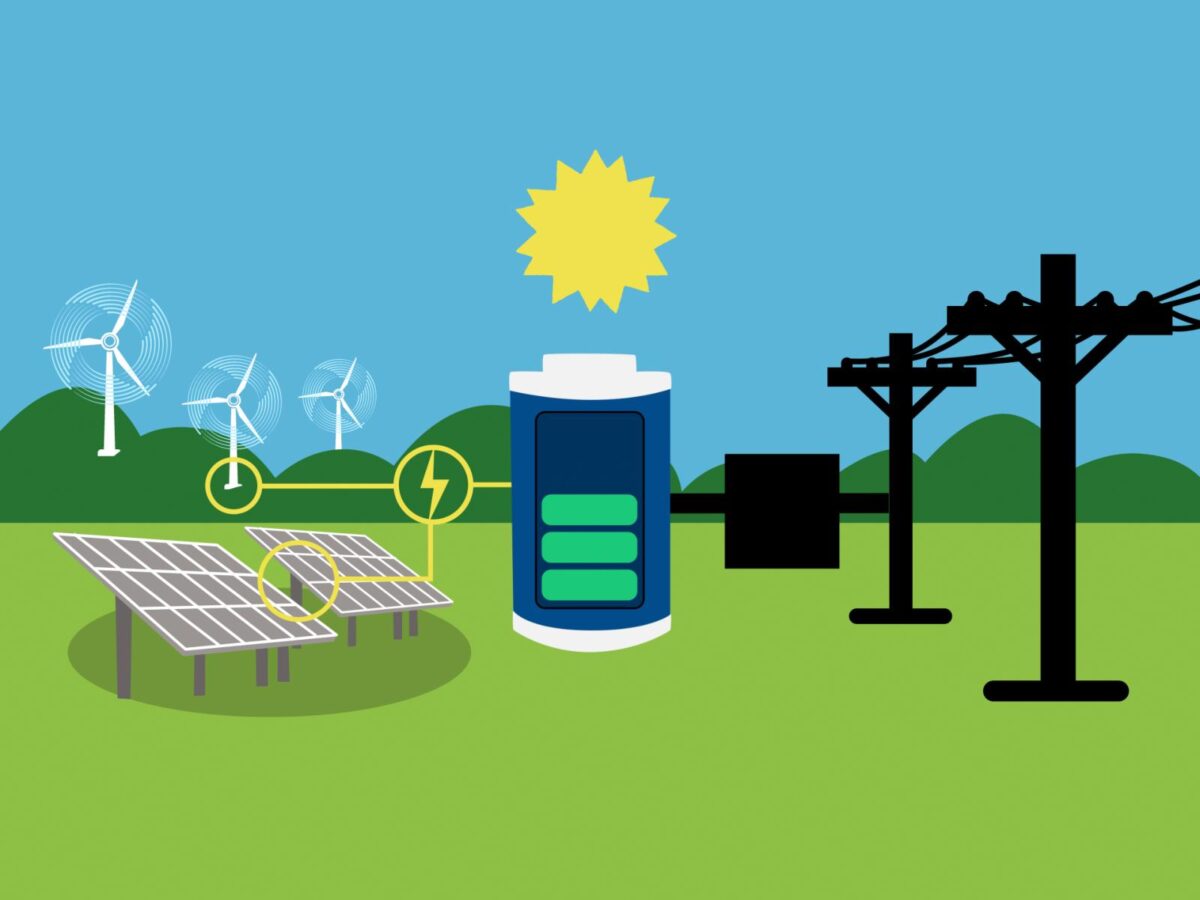 To tap intermittent renewable energy sources, we also need to develop solutions for storing and distributing the energy. (Image by Sara Levine | Pacific Northwest National Laboratory)
A big shift toward clean and renewable sources of energy could be part of the solution. Each of the new hires’ research touches this goal in some ways. In Ghanekar’s case, he studies human-designed materials called metamaterials that, among other potential uses, might one day help significantly increase the amount of energy from the sun that we are able to efficiently turn into electricity.
Getting more energy from the sun could help reduce greenhouse gas emissions, but since the sun doesn’t always shine, we also need ways to store that energy (perhaps with new battery technologies, the expertise of Çapraz) and ways to share that energy on the power grid without disrupting its delicate balance (a challenge that Anguluri has explored).
As academic researchers, they operate at the frontiers of knowledge, asking and seeking to answer fundamental questions that could push the technology forward: How exactly do batteries with new chemistries work, for example, or why does a material degrade over time? Anguluri’s math expertise spans a range of engineering disciplines. He and Ghanekar have already talked about collaborating to mathematically model the behavior of Ghanekar’s metamaterials.
No scientific “Eureka!” moment or technical advance by itself is likely to be a panacea to a problem as complex as global warming, but these incremental steps do offer people more tools.
“As scholars, we like to think, to solve interesting problems,” says Anguluri, who was a postdoc at Arizona State University before arriving at UMBC this year. “As citizens of the world, we must also look at our values and make wise choices.”
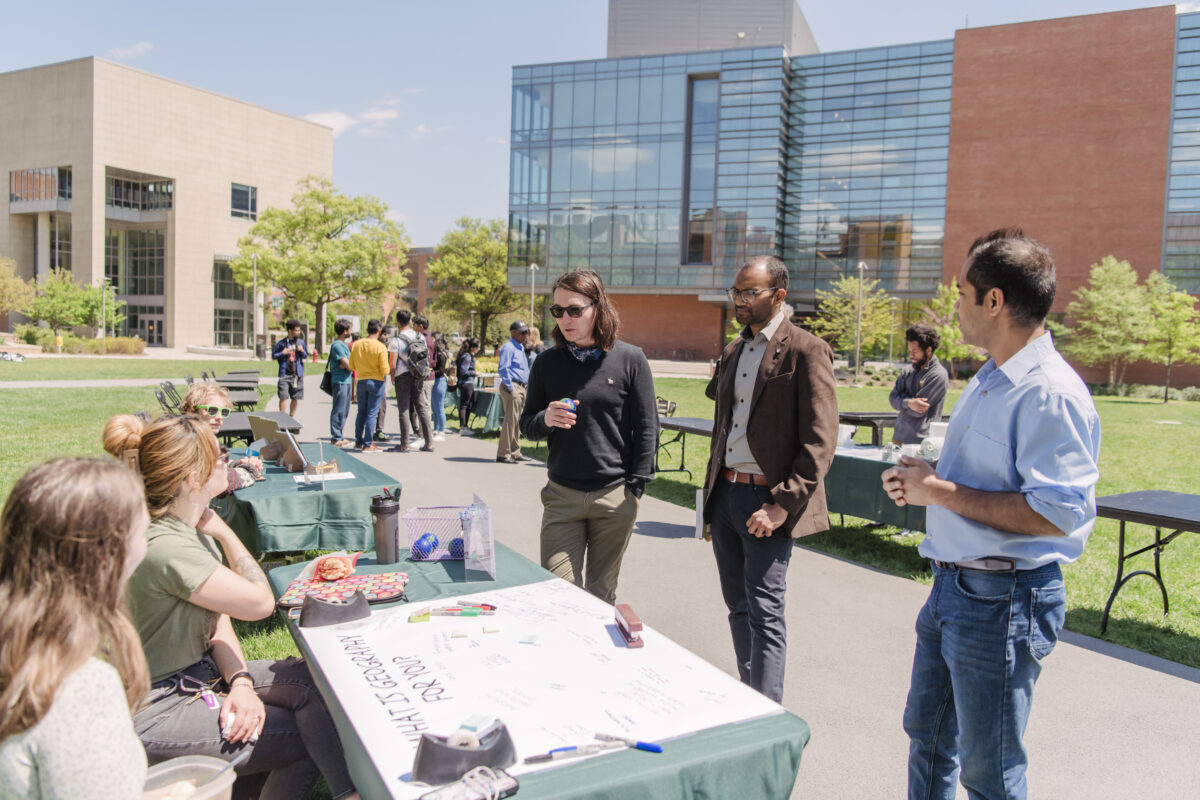 Çapraz, Anguluri, and Ghanekar chat with community members at the Earth Day Community Day event celebrating UMBC environmental research.(Marlayna Demond ’11/UMBC)
Building on a long-standing commitment
Studying people’s impact on the Earth, and working to mitigate environmental harms, is nothing new for researchers at UMBC.
The university boasts multiple research centers that advance environmental research, from the Center for Urban Environmental Research and Education to the Institute for Harnessing Data and Model Revolution in the Polar Regions. The university also has long-standing partnerships with NASA to develop new technology for environmental remote sensing.
Çapraz, Ghanekar, and Anguluri will join faculty at the university who study sustainable aquaculture, wildfire smoke, water and sediment pollution, fusion energy, and more.
“Sustainability research is an area of strength in COEIT,” says Vandana Janeja, the associate dean for research and faculty development in COEIT. “Now there’s a new sense of urgency about it and our recent hires are a testament to that.”
“Climate change is an issue that so many of our students are tapped into,” adds Blaney. “They’re really worried about the impacts of climate change and want to do something to address this global challenge.”
As the new UMBC faculty launch research projects and expand their labs, there will be growing opportunities for interested students to learn about and join their important work. And that’s good news, because as the Earth Day festivities on campus showcased, safeguarding our shared home is a duty shared by all of us.
]]>
This April 22, as the campus community celebrated Earth Day, the feel of spring’s natural reawakening was in the air. Birds chirped from newly leafed trees and students strolled in the bright...
https://umbc.edu/stories/new-sustainability-renewable-energy-faculty/
https://my3.my.umbc.edu/api/v0/pixel/news/141880/guest@my.umbc.edu/d4b5a640a511273cafe1b4d4c119478b/api/pixel
cbee
coeit
csee
meche
news
research
science-and-tech
story
sustainability
UMBC News & Magazine
https://my3.my.umbc.edu/groups/umbc-news-magazine
https://assets1-my.umbc.edu/system/shared/avatars/groups/000/001/943/24435aa6207c452e7bc15cc74b42c7bb/xsmall.png?1748556657
https://assets1-my.umbc.edu/system/shared/avatars/groups/000/001/943/24435aa6207c452e7bc15cc74b42c7bb/original.png?1748556657
https://assets2-my.umbc.edu/system/shared/avatars/groups/000/001/943/24435aa6207c452e7bc15cc74b42c7bb/xxlarge.png?1748556657
https://assets2-my.umbc.edu/system/shared/avatars/groups/000/001/943/24435aa6207c452e7bc15cc74b42c7bb/xlarge.png?1748556657
https://assets3-my.umbc.edu/system/shared/avatars/groups/000/001/943/24435aa6207c452e7bc15cc74b42c7bb/large.png?1748556657
https://assets1-my.umbc.edu/system/shared/avatars/groups/000/001/943/24435aa6207c452e7bc15cc74b42c7bb/medium.png?1748556657
https://assets2-my.umbc.edu/system/shared/avatars/groups/000/001/943/24435aa6207c452e7bc15cc74b42c7bb/small.png?1748556657
https://assets1-my.umbc.edu/system/shared/avatars/groups/000/001/943/24435aa6207c452e7bc15cc74b42c7bb/xsmall.png?1748556657
https://assets2-my.umbc.edu/system/shared/avatars/groups/000/001/943/24435aa6207c452e7bc15cc74b42c7bb/xxsmall.png?1748556657
UMBC News & Magazine
0
0
false
Fri, 10 May 2024 14:05:56 -0400
Fri, 10 May 2024 14:05:56 -0400
COEIT convenes inaugural research day to encourage interdisciplinary collaborations
On April 19, more than 150 people gathered for the inaugural College of Engineering and Information Technology (COEIT) Research Day. The event was an opportunity for faculty and students to showcase their research and forge interdisciplinary collaborations, including with potential industry partners in attendance. Close to 100 COEIT researchers presented work, either in talks during four concurrent morning sessions or in the afternoon poster session.
“We are asking you to see how you can get together and solve major societal problems,” said Anupam Joshi, acting dean of COEIT, in opening remarks.
To incentivize such collaboration, COEIT is offering funding to teams that propose projects involving researchers from two or more of the colleges’ departments.
“The day was very well attended and several folks made new connections across departments in COEIT,” said Vandana Janeja, the associate dean for research and faculty development in COEIT. “I am already seeing a lot of interest in the interdisciplinary proposals.”
For Tasnim Nishat Islam, a Ph.D student in computer engineering, the day was a great chance to share her work and engage with other researchers. Islam presented a poster about research she is conducting with Mohamed Younis, computer science and electrical engineering, investigating ways to measure mental stress. “I’ve already connected with others who study similar ideas,” she said.
]]>
On April 19, more than 150 people gathered for the inaugural College of Engineering and Information Technology (COEIT) Research Day. The event was an opportunity for faculty and students to...
https://umbc.edu/quick-posts/coeit-research-day/
https://my3.my.umbc.edu/api/v0/pixel/news/141819/guest@my.umbc.edu/43f9e61f7f2d47aa5f7775ff02158c27/api/pixel
cbee
coeit
csee
is
meche
news
quick-post
research
science-and-tech
UMBC News & Magazine
https://my3.my.umbc.edu/groups/umbc-news-magazine
https://assets1-my.umbc.edu/system/shared/avatars/groups/000/001/943/24435aa6207c452e7bc15cc74b42c7bb/xsmall.png?1748556657
https://assets1-my.umbc.edu/system/shared/avatars/groups/000/001/943/24435aa6207c452e7bc15cc74b42c7bb/original.png?1748556657
https://assets2-my.umbc.edu/system/shared/avatars/groups/000/001/943/24435aa6207c452e7bc15cc74b42c7bb/xxlarge.png?1748556657
https://assets2-my.umbc.edu/system/shared/avatars/groups/000/001/943/24435aa6207c452e7bc15cc74b42c7bb/xlarge.png?1748556657
https://assets3-my.umbc.edu/system/shared/avatars/groups/000/001/943/24435aa6207c452e7bc15cc74b42c7bb/large.png?1748556657
https://assets1-my.umbc.edu/system/shared/avatars/groups/000/001/943/24435aa6207c452e7bc15cc74b42c7bb/medium.png?1748556657
https://assets2-my.umbc.edu/system/shared/avatars/groups/000/001/943/24435aa6207c452e7bc15cc74b42c7bb/small.png?1748556657
https://assets1-my.umbc.edu/system/shared/avatars/groups/000/001/943/24435aa6207c452e7bc15cc74b42c7bb/xsmall.png?1748556657
https://assets2-my.umbc.edu/system/shared/avatars/groups/000/001/943/24435aa6207c452e7bc15cc74b42c7bb/xxsmall.png?1748556657
UMBC News & Magazine
1
0
false
Wed, 08 May 2024 12:50:07 -0400
Wed, 08 May 2024 12:50:07 -0400
UMBC students receive prestigious Goldwater Scholarship for fifth consecutive year
For the fifth consecutive year, multiple UMBC students have been awarded a Barry Goldwater Scholarship. Gabriel Otubu ’25, biochemistry, Nathaniel Glover ’25, chemical engineering, and Samuel Barnett ’25, biochemistry, were recently named among the 2024 Goldwater Scholars recipients, joining UMBC’s growing list of students to receive this prestigious research scholarship. Since 2005, 31 UMBC students have been awarded a Goldwater Scholarship.
The goal of the Barry Goldwater Scholarship and Excellence in Education Foundation includes ensuring that the “U.S. is producing the number of highly-qualified professionals the nation needs” in the natural sciences, mathematics, and engineering. Otubu, Barnett, and Glover are among the 438 recipients of this year’s scholarship, the largest number of scholars ever supported in a single year in the program’s history.
“UMBC’s continued success with the recent Goldwater recipients is a direct result of the strong faculty mentoring that our students receive,” says April Householder ’95, visual and performing arts, UMBC’s director of undergraduate research and prestigious scholarships. “This is also a reflection of the incredible support programs and staff that UMBC makes available to students, helping them go the extra mile.”
Supported by multiple scholars programs
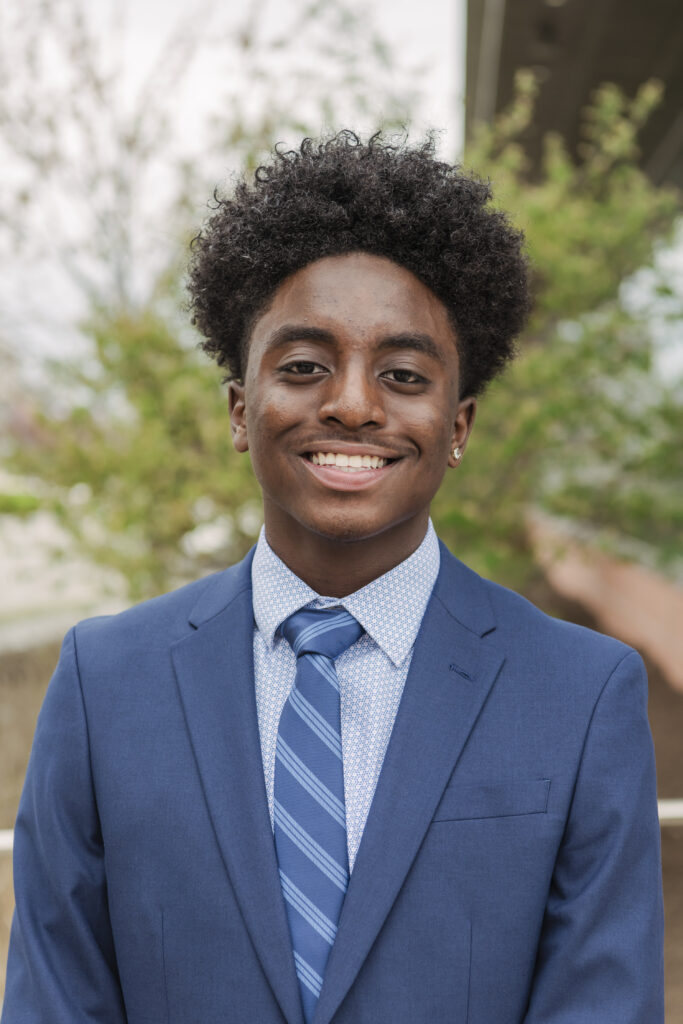 Gabriel Otubu.
As an undergraduate research fellow in biology professor Rachel Brewster’s lab, Gabriel Otubu is investigating the role of the Ndrg1b gene in neurulation—the process of forming a neural tube that takes a hollow shape that differentiates into the brain and spinal cord—and how it affects other genes. This research, Otubu says, is aiming to understand the genetic risk factors associated with specific congenital disorders, such as spina bifida, with a goal of finding treatment options for these disorders.
Otubu, a Meyerhoff Scholar who plans on pursuing an M.D./Ph.D., shares that with Brewster’s guidance, “I learned that the M.D./Ph.D [route] was possible for me, as well as the possibility of being able to have a commitment to helping people in the clinic and also doing research to support that.” He is also an Undergraduate Research Training Initiative for Student Enhancement (U-RISE) Scholar, an experience he says inspired him to pursue a career in research because he was able to be supported by like-minded people.
“One of the most important things about getting the Goldwater Scholarship is the motivation it gives me to be the best researcher I can be,” says Otubu. “It’s great to get that recognition that I’m really committed to research and using my platform to help other people from diverse backgrounds become interested in research.”
Nathaniel Glover, a fellow Meyerhoff Scholar, says that receiving the Goldwater scholarship will “open up a lot of opportunities for me to be a competitive grad school applicant.” His Goldwater proposal included the research he worked on to develop a dual-phase steel that can combat hydrogen embrittlement, the mechanical damage of metal due to the penetration of hydrogen, which causes a reduction in ductility.
Glover worked in the lab of C. Cem Taşan, associate professor of metallurgy at the Massachusetts Institute of Technology (MIT), as an MIT Summer Research Program participant in 2023.
The program, he shares, “was very helpful in teaching me how to write about my research, which was extremely beneficial in the Goldwater application process. Taşan and my research mentor, Dr. Kyung-Shik Kim, were instrumental in developing my research in this project, introducing me to the science behind it, and working with me throughout my work in the project. I learned how to write and portray my research in a way that’s well communicated, interesting, and educational.”
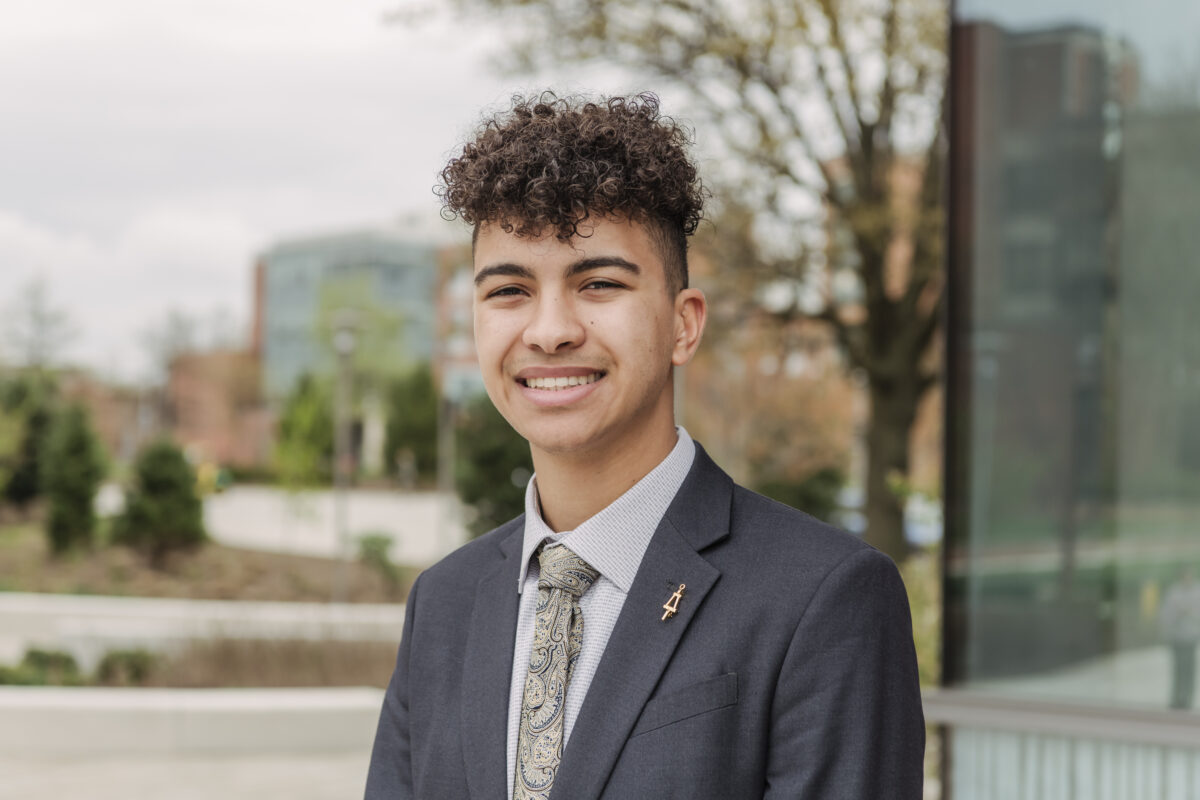 Nathaniel Glover.
Developing into a researcher
Samuel Barnett’s journey in becoming a Goldwater Scholar began during his time as a student at Howard Community College (HCC). Barnett, who transferred to UMBC last fall, was able to take advantage of the updated eligibility requirements for prospective scholarship applicants. The 2024 application cycle amended its eligibility criteria allowing transfer students to be nominated by the school they are currently enrolled in or by the school they matriculated from. With the help of the HCC research department and Householder, Barnett was nominated by HCC to receive the scholarship.
With this recent change, Householder shares that “cross-institutional collaborations like these are opening new pathways between UMBC and its transfer institutions [while] providing an additional layer of support to transfer students who come to UMBC with a strong research background, like Sam.”
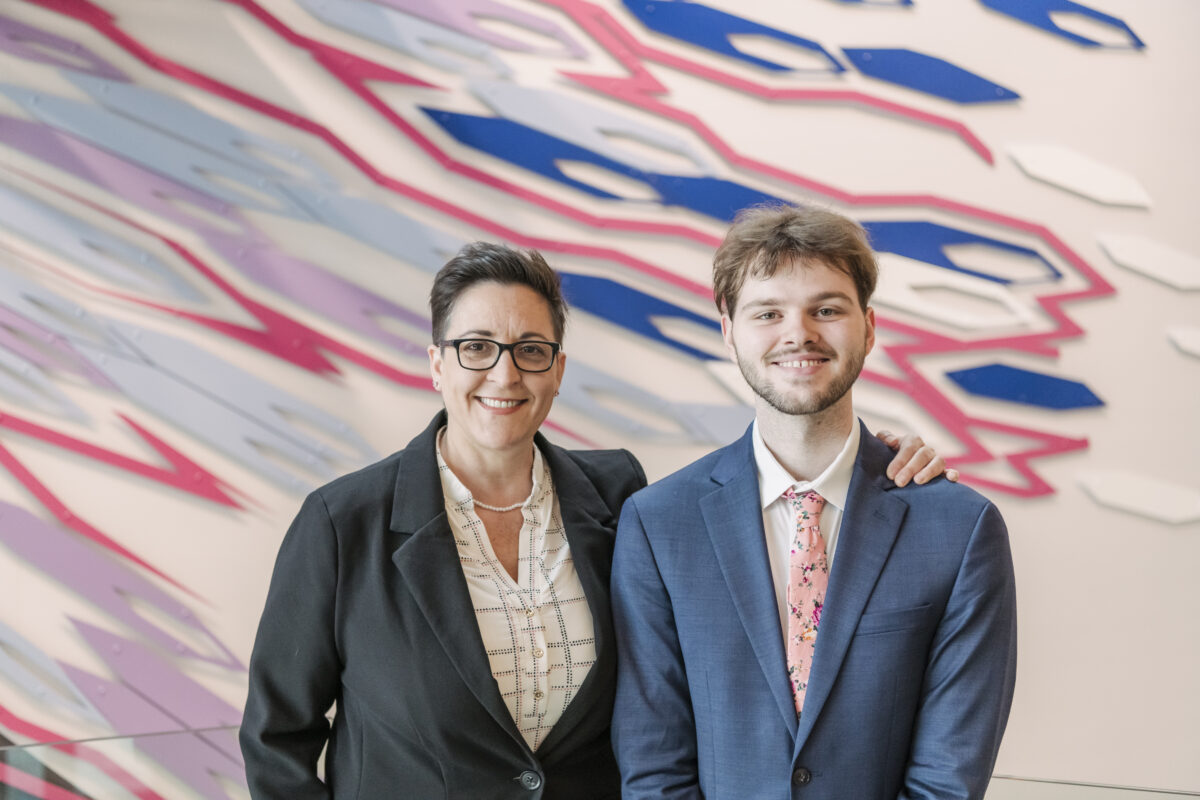 April Householder and Samuel Barnett.
Barnett worked with his mentor Joseph Sparenberg, professor of chemistry at HCC, on a project that uses a species of yeast, Saccharomyces cerevisiae, to model a type of cancer in humans that occurs from mutations in the KRAS gene. The model, which is still in the proof of concept stage, visualizes a live cell to see pathways and tumor growth in real-time.
Barnett nearly called it quits with his academic journey upon enrolling at HCC, saying that he “had no motivation to continue on with my education.” After participating in HCC’s research program, Barnett found a renewed sense of purpose and took his research interests to the next level.
Before transferring to UMBC, Barnett took part in the BUILD a Bridge to STEM internship program, a component of STEM BUILD at UMBC, which he says was vital for “my development in this Goldwater process.” During the internship, Barnett worked with Maria Cambraia Guimaro, assistant director of research and international affairs in the College of Natural and Mathematical Sciences, who he says played a significant role in his research journey at UMBC.
“It was extremely empowering to know that as a community college student, I could experience research there and also win a prestigious award for it,” adds Barnett. “I now have a collection of wonderful mentors throughout my research journey that’s helped to shape who I am today.”
]]>
For the fifth consecutive year, multiple UMBC students have been awarded a Barry Goldwater Scholarship. Gabriel Otubu ’25, biochemistry, Nathaniel Glover ’25, chemical engineering, and Samuel...
https://umbc.edu/stories/goldwater-scholars-24/
https://my3.my.umbc.edu/api/v0/pixel/news/141626/guest@my.umbc.edu/381303eddd955eec99840a46abcd0a28/api/pixel
biochemistry
cbee
chemical-engineering
cnms
coeit
community
meyerhoff
news
research
science-and-tech
stembuild
story
undergraduate-research
UMBC News & Magazine
https://my3.my.umbc.edu/groups/umbc-news-magazine
https://assets1-my.umbc.edu/system/shared/avatars/groups/000/001/943/24435aa6207c452e7bc15cc74b42c7bb/xsmall.png?1748556657
https://assets1-my.umbc.edu/system/shared/avatars/groups/000/001/943/24435aa6207c452e7bc15cc74b42c7bb/original.png?1748556657
https://assets2-my.umbc.edu/system/shared/avatars/groups/000/001/943/24435aa6207c452e7bc15cc74b42c7bb/xxlarge.png?1748556657
https://assets2-my.umbc.edu/system/shared/avatars/groups/000/001/943/24435aa6207c452e7bc15cc74b42c7bb/xlarge.png?1748556657
https://assets3-my.umbc.edu/system/shared/avatars/groups/000/001/943/24435aa6207c452e7bc15cc74b42c7bb/large.png?1748556657
https://assets1-my.umbc.edu/system/shared/avatars/groups/000/001/943/24435aa6207c452e7bc15cc74b42c7bb/medium.png?1748556657
https://assets2-my.umbc.edu/system/shared/avatars/groups/000/001/943/24435aa6207c452e7bc15cc74b42c7bb/small.png?1748556657
https://assets1-my.umbc.edu/system/shared/avatars/groups/000/001/943/24435aa6207c452e7bc15cc74b42c7bb/xsmall.png?1748556657
https://assets2-my.umbc.edu/system/shared/avatars/groups/000/001/943/24435aa6207c452e7bc15cc74b42c7bb/xxsmall.png?1748556657
UMBC News & Magazine
4
0
false
Thu, 02 May 2024 11:17:37 -0400
Thu, 02 May 2024 11:17:37 -0400
Watch: A recap of URCAD 2024
UMBC’s Undergraduate Research and Creative Achievement Day (URCAD) returned earlier this month for its 28th year, bringing together more than 400 student presenters and the broader university community for a day filled with posters, performances, demonstrations, and much more.
With excitement and energy in the air of the University Center, undergraduate students—many accompanied by faculty mentors—presented a broad range of research and creative projects to peers, family, friends, and inquiring minds of all kinds. The day included a film festival, interactive video game demonstrations, musical performances, a photography and painting exhibition, as well as poster board and oral presentations from students across colleges.
“This showcase event not only exemplifies UMBC’s commitment to our students from all disciplines, but defines our commitment by providing them the opportunity to engage in mentored projects, and, through creative thought and focused inquiry, to discover in themselves their passion,” said Katherine Cole, dean and vice provost of undergraduate academic affairs.
Among this year’s group of presenters was Chiad Onyeje ’24, chemical engineering, who explained the research he’s worked on for nearly three years to develop “spherical shells that we can use as internal Band-Aids” he said in this URCAD 2024 recap video.
“URCAD is different from any other presentations that I’ve been able to give on my research thus far. It really felt like a celebration in comparison,” said Onyeje. “I could go in, have a good time, talk about my research to interested parties, and share why I love this project so much—because it can help people.”
UMBC’s 2024 Undergraduate Research and Creative Achievement Day (URCAD). (Elijah Davis, M.F.A. ’21/UMBC)
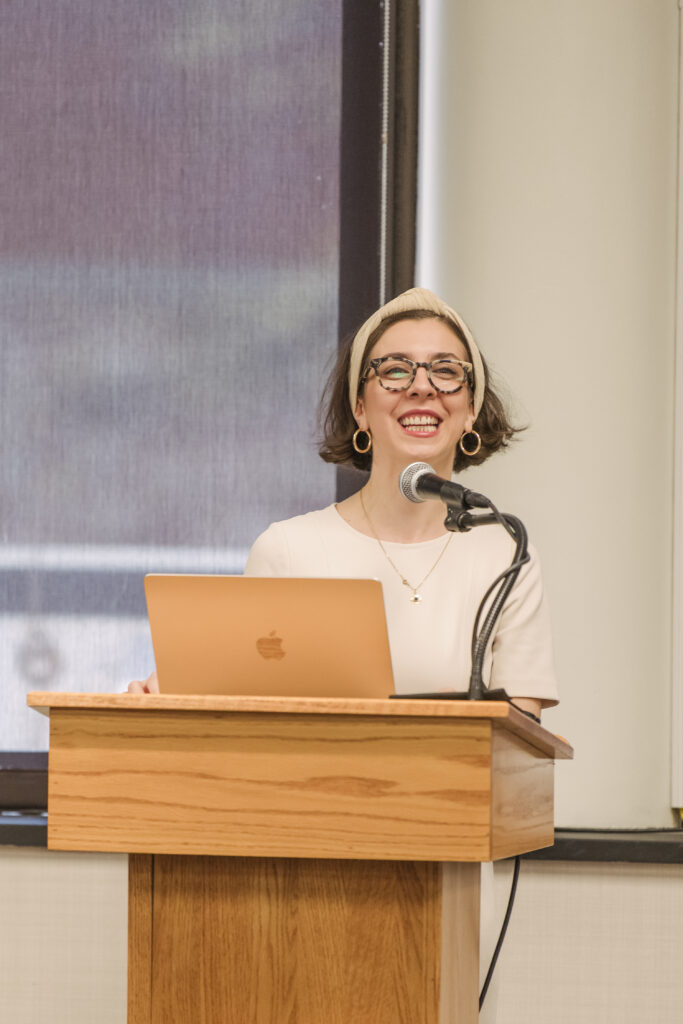 Stefanie Mavronis delivering the URCAD 2024 keynote speech.
From URCAD to the Mayor’s Office
Stefanie Mavronis ’12, political science, media and communication studies, delivered this year’s URCAD keynote speech. Just over a decade ago, Mavronis, who is the director of the Mayor’s Office of Safety and Engagement (MONSE) in Baltimore City, was once a student presenter at URCAD where she premiered her short documentary titled, “Reclamation and Resistance: Audiovisual Tools in Bolivia.”
“The documentary captured the experiences of indigenous Bolivians who were using art and media technologies to challenge and transform the legacy of hundreds of years of colonization in Bolivia. I learned about decolonization, self determination, reciprocity, and representation,” Mavronis shared with the audience.
Mavronis, a UMBC Sondheim Public Affairs Scholar alumna, spoke of her journey to finding her passion for public service and how it led to her positions within Baltimore Mayor Brandon Scott’s election campaign and then office. Her work in MONSE has resulted in the office’s implementation of Baltimore’s Comprehensive Violence Prevention Plan—the city’s first ever comprehensive, 5-year public safety strategy.
“When I think back to it, it was UMBC that was the first to help me see myself as a creative practitioner. It’s the place that prepared me to confront the challenges and harsh realities of the world head on and to do so while embracing clear values,” says Mavronis. “It was through my time at UMBC that I uncovered my commitment to Baltimore…through the opportunities that the institution afforded me to see the world outside of the city.”
“Supporting our students’ applied learning experiences is central to our mission at UMBC,” added Cole, “as it develops creative thinking skills, the ability to communicate effectively, analyze information, share stories, and connect with people from diverse cultures, disciplines, and ideologies. These are the skills our students will take forward as leaders of the future.”
For more on UMBC’s undergraduate research and creative work, check out the 2024 UMBC Review, the journal of undergraduate research, volume 25. Free copies of the current issue are available for pick up at the Office of Undergraduate Research and Prestigious Scholarships, located in the Albin O. Kuhn Library and Gallery.
]]>
UMBC’s Undergraduate Research and Creative Achievement Day (URCAD) returned earlier this month for its 28th year, bringing together more than 400 student presenters and the broader university...
https://umbc.edu/stories/watch-a-recap-of-urcad-2024/
https://my3.my.umbc.edu/api/v0/pixel/news/141350/guest@my.umbc.edu/27ac972da9f508eb4826ff0caf48d7a3/api/pixel
cahss
cbee
cnms
coeit
community
news
research
story
undergraduate-research
urcad
UMBC News & Magazine
https://my3.my.umbc.edu/groups/umbc-news-magazine
https://assets1-my.umbc.edu/system/shared/avatars/groups/000/001/943/24435aa6207c452e7bc15cc74b42c7bb/xsmall.png?1748556657
https://assets1-my.umbc.edu/system/shared/avatars/groups/000/001/943/24435aa6207c452e7bc15cc74b42c7bb/original.png?1748556657
https://assets2-my.umbc.edu/system/shared/avatars/groups/000/001/943/24435aa6207c452e7bc15cc74b42c7bb/xxlarge.png?1748556657
https://assets2-my.umbc.edu/system/shared/avatars/groups/000/001/943/24435aa6207c452e7bc15cc74b42c7bb/xlarge.png?1748556657
https://assets3-my.umbc.edu/system/shared/avatars/groups/000/001/943/24435aa6207c452e7bc15cc74b42c7bb/large.png?1748556657
https://assets1-my.umbc.edu/system/shared/avatars/groups/000/001/943/24435aa6207c452e7bc15cc74b42c7bb/medium.png?1748556657
https://assets2-my.umbc.edu/system/shared/avatars/groups/000/001/943/24435aa6207c452e7bc15cc74b42c7bb/small.png?1748556657
https://assets1-my.umbc.edu/system/shared/avatars/groups/000/001/943/24435aa6207c452e7bc15cc74b42c7bb/xsmall.png?1748556657
https://assets2-my.umbc.edu/system/shared/avatars/groups/000/001/943/24435aa6207c452e7bc15cc74b42c7bb/xxsmall.png?1748556657
UMBC News & Magazine
1
0
false
Thu, 25 Apr 2024 08:42:48 -0400
Thu, 25 Apr 2024 08:42:48 -0400
Hundreds of East Coast chemical engineering students to gather at UMBC for regional conference
Over the weekend of April 6 – 7, the UMBC student chapter of the American Institute of Chemical Engineers (AIChE) will host the 2024 Mid-Atlantic Regional Conference on campus. The event will feature workshops, research presentations, and a career fair with companies such as AstraZeneca and Astek Diagnostics and schools including Johns Hopkins University, Rutgers University, the University of Delaware, and Lehigh University. It will also feature the conferences’ two signature competitive events: Chemical Engineering Jeopardy and ChemE Car—a competition to build and operate a car powered and stopped by chemical reactions.
Organizers expect more than 350 attendees from more than 30 universities across the region. UMBC students are encouraged to register to attend, even if they aren’t chemical engineering majors. “As the premier student chemical engineering conference in the region, this event will offer great opportunities for networking, presenting research, landing internships and jobs, and general professional development,” says Terra Miley ’25, chemical engineering, who is serving as the communications chair for the student organizing committee.
]]>
Over the weekend of April 6 – 7, the UMBC student chapter of the American Institute of Chemical Engineers (AIChE) will host the 2024 Mid-Atlantic Regional Conference on campus. The event will...
https://umbc.edu/quick-posts/umbc-hosts-chemical-engineering-conference/
https://my3.my.umbc.edu/api/v0/pixel/news/140342/guest@my.umbc.edu/17d0be334ad4e2e0114406b43801fe6c/api/pixel
cbee
coeit
news
quick-post
quick-posts
science-and-tech
UMBC News & Magazine
https://my3.my.umbc.edu/groups/umbc-news-magazine
https://assets1-my.umbc.edu/system/shared/avatars/groups/000/001/943/24435aa6207c452e7bc15cc74b42c7bb/xsmall.png?1748556657
https://assets1-my.umbc.edu/system/shared/avatars/groups/000/001/943/24435aa6207c452e7bc15cc74b42c7bb/original.png?1748556657
https://assets2-my.umbc.edu/system/shared/avatars/groups/000/001/943/24435aa6207c452e7bc15cc74b42c7bb/xxlarge.png?1748556657
https://assets2-my.umbc.edu/system/shared/avatars/groups/000/001/943/24435aa6207c452e7bc15cc74b42c7bb/xlarge.png?1748556657
https://assets3-my.umbc.edu/system/shared/avatars/groups/000/001/943/24435aa6207c452e7bc15cc74b42c7bb/large.png?1748556657
https://assets1-my.umbc.edu/system/shared/avatars/groups/000/001/943/24435aa6207c452e7bc15cc74b42c7bb/medium.png?1748556657
https://assets2-my.umbc.edu/system/shared/avatars/groups/000/001/943/24435aa6207c452e7bc15cc74b42c7bb/small.png?1748556657
https://assets1-my.umbc.edu/system/shared/avatars/groups/000/001/943/24435aa6207c452e7bc15cc74b42c7bb/xsmall.png?1748556657
https://assets2-my.umbc.edu/system/shared/avatars/groups/000/001/943/24435aa6207c452e7bc15cc74b42c7bb/xxsmall.png?1748556657
UMBC News & Magazine
0
0
false
Fri, 29 Mar 2024 12:13:05 -0400
Fri, 29 Mar 2024 12:13:05 -0400