Business—not as usual
At UMBC, entrepreneurship transcends a traditional business education: It empowers scientists, artists, and technologists to transform their expertise into real-world impact. Through business accelerators, ambassador programs, interdisciplinary courses, and other innovation pathways, the university offers many avenues for ideas to flourish.
Kushani Mendis and her labmates have developed novel nanomaterials that could transform biomedical technology. She wants to translate their discoveries into a business opportunity, but initially, wasn’t sure what steps to take. So, early in her chemistry Ph.D. with Zeev Rosenzweig, professor of chemistry and biochemistry, Mendis told him that she wanted to become an entrepreneur—and he jumped at the chance to creatively support her with internal and external resources.
UMBC has no formal business school. Yet it may be one of the best places in the country to learn entrepreneurial thinking—precisely because the best ideas so often come from those with technical expertise rather than MBAs. Also, many UMBC entrepreneurs are motivated by a desire to drive positive social change rather than profit, which is supported by courses on “socialpreneurship.” Overall, the university’s model rests on a simple but powerful dual thesis: 1) Disciplinary excellence paired with an entrepreneurial mindset produces graduates who create real-world impact, and 2) entrepreneurship is for everyone.
Employers repeatedly say they need graduates who excel in communication, creative problem-solving, collaboration, and constructive conflict navigation. Traits like resilience and empathy are in high demand—after all, finding effective solutions often requires understanding problems from another’s perspective. UMBC’s courses and programs deliberately train these skills, which can enhance the success of entrepreneurs—and every UMBC graduate.
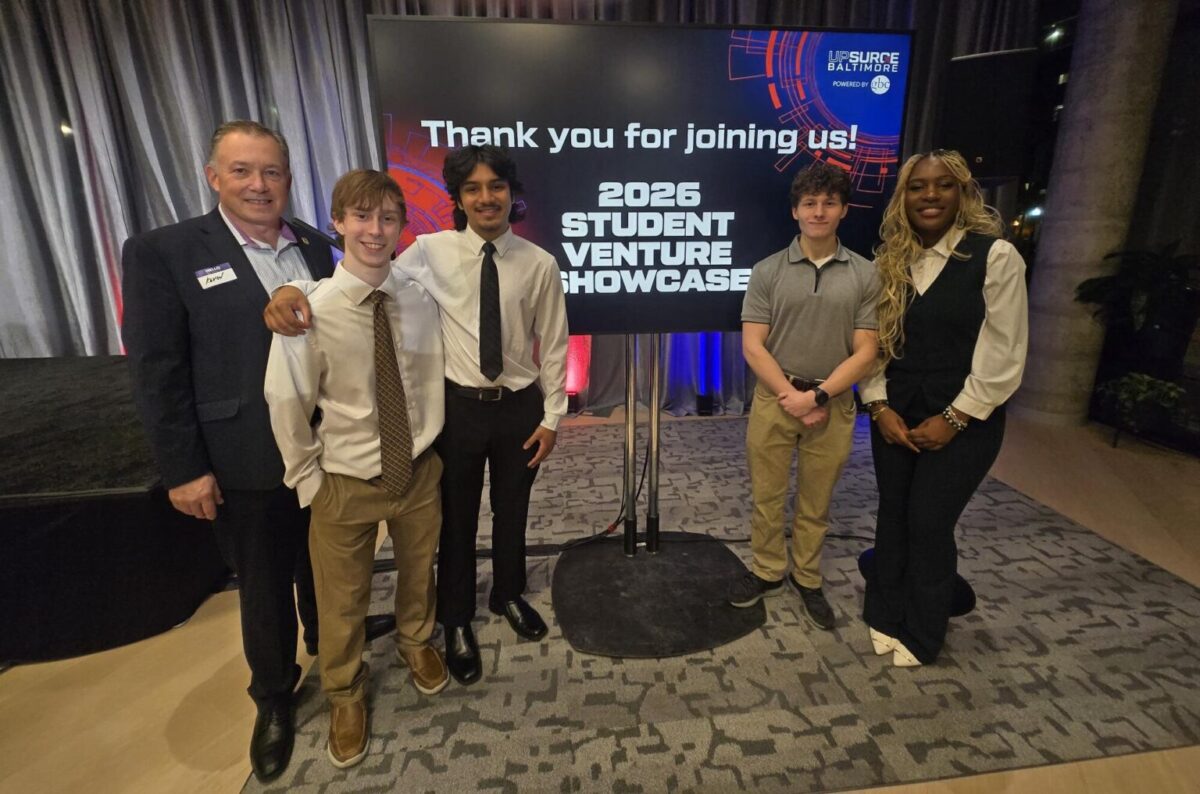 From left to right, Kevin Fulmer, director of the The Alex. Brown Center for Entrepreneurship and Innovation at UMBC, and students Charles Nerad, Abhinav Patel, Aidan Fleischer, and Velma Funebe at the 2026 Maryland Student Venture Showcase in Baltimore. (Photo courtesy of Kevin Fulmer)
The results speak for themselves. Students are winning state and national funding, launching ventures, gaining versatile life skills, and contributing to Maryland’s innovation economy. This spring, two UMBC student teams—iBraid and StrikeSense—each received $50,000 Pava LePere Innovation Awards. Others have advanced through the university’s Summer Launchpad accelerator and secured funding totaling more than $300,000 in the past three years.
An entrepreneurial environment
The roots of UMBC’s entrepreneurship emphasis trace back to 2000, with the founding of the Alex. Brown Center for Entrepreneurship and Innovation. Initially led by Vivian Armour and supported by Constellation Energy Group and the Bearman Foundation, the center took off in 2006 the Kauffman Foundation awarded funds to a small cohort of universities including UMBC, as well as Brown, Carnegie Mellon, Arizona State, and Purdue, to further their entrepreneurship efforts. Armour invited Gib Mason ’95, economics, a serial entrepreneur who had been guest lecturing at UMBC, to help steward UMBC’s $2 million Kauffman award.
“Kauffman’s research had shown that it wasn’t the business school students bringing entrepreneurial ideas to the marketplace,” Mason recalls. “It was the engineers and the tech guys and gals.” The foundation’s premise was that exposing disciplinary experts to entrepreneurial environments could help them develop and commercialize new ideas, he explains.
That initiative led to the creation of UMBC’s minor in Entrepreneurship and Innovation. The 18-credit program combines two core entrepreneurship courses with 12 credits from designated courses across UMBC’s three colleges, where faculty have infused entrepreneurial principles into existing major curricula. Today, more than 70 courses in biology, public health, information systems, art, and engineering count toward the minor, making it broadly accessible.
 Gib Mason (standing) leads entrepreneurship programming at the UMBC Training Centers. (Marlayna Demond ’11/UMBC)
The center turned 25 this academic year. Kevin Fulmer, its first full-time director and a lifelong entrepreneur, has spent the past five years expanding its reach and visibility. “Before there were any full-time staff, awareness of the center was fairly minimal,” he says. Under his leadership, Introduction to Entrepreneurship—which fills up quickly every semester—was approved as a General Education Program course. The center also launched a student ambassador program, and now six students promote events, support programming, and serve as peer mentors. Faculty can apply for funding to embed entrepreneurial thinking in their courses, and designated faculty fellows from each college are designing discipline-specific tracks within the minor. “We’re trying to make it as accessible for as many students as possible,” Fulmer explains.
A separate master’s in Entrepreneurship, Innovation, and Leadership—developed by Mason and offered through UMBC’s Division of Professional Studies—has served working professionals since 2019 and draws on the same philosophy of practical application. Meanwhile, the center’s summer Launchpad accelerator has supported more than 20 student ventures since 2022; participants receive an $8,000 stipend to dedicate 10-weeks to full-time customer discovery and problem validation. iBraid and StrikeSense, the Maryland award winners, emerged from the accelerator’s pipeline. Additional opportunities include the fall Idea and Innovation Challenge (with a popular social-impact category) and the spring Cangialosi Business Innovation Competition for more developed concepts.
All of this exists without a traditional business school. Instead, UMBC has built an ecosystem that meets students where they are—inside their technical and creative majors—and provides the tools to translate discovery into impact. “Entrepreneurship is for everyone,” the Alex. Brown Center’s website proclaims, regardless of major or career aspirations.
Not-so-risky business

Entrepreneurship at UMBC emphasizes mindset over venture creation alone. “It’s really just about solving problems and using an entrepreneurial mindset to do that,” Fulmer stresses.
Studies suggest that only 30 to 50 percent of graduates nationally are employed in roles directly related to their specific field of study, Fulmer notes. “You may have all the technical skills in the world, but not get these life skills from your major,” he adds. UMBC’s approach prepares students for diverse careers—launching startups, innovating inside a corporation, teaching, or pursuing research—by developing empathy and resilience and building creative problem-solving and communication skills.
Mason challenges the stereotype that entrepreneurs are reckless risk takers. “Most entrepreneurs are constantly making informed decisions to mitigate risks,” he says. He draws from childhood summers working on his grandfather’s Kansas farm, where he earned money from “his” acres of wheat—until one year a tornado destroyed the crop. The experience taught him that “there’s a lot that you can control and a lot that you can’t.” True entrepreneurs, he says, take calculated risks and then work diligently to reduce them.
Many UMBC students are drawn to “socialpreneurship”—ventures that solve societal problems rather than chase profit. “Students today seem especially geared toward trying to do things for social impact,” Mason says. The center’s social-impact track in competitions reflects this, and courses like Creative Problem Solving and The Socialpreneur have led to tangible outcomes, such as OCA Mocha, a coffee shop connecting UMBC with the Baltimore community.
Braiding the future
Velma Funebe, a public health major, embodies this orientation. Her venture, iBraid, uses augmented reality to help users part and braid their own hair—transforming protective styling that can become a multi-day ordeal into a more manageable process. Inspired by braiding her own hair since age 11 and running a professional braiding business since ninth grade, Funebe validated demand via TikTok and conversations. “I realized it was a major problem because so many people struggled with it,” she says. “I couldn’t find any solutions out there.”
As an Entrepreneurship Ambassador, she now supports programming and events like 1 Million Cups, another Kauffman Foundation initiative where entrepreneurs pitch ideas and get feedback. The Baltimore edition meets at OCA Mocha twice monthly. “The scariest part is when the idea is not just in your brain, but other people hear it,” Funebe says. “But I think it’s a great space to get feedback and say, ‘Okay, I can live through an application rejection.’”
Funebe’s faith helps anchor her while she balances classes, leadership in the Public Health Council of Majors, weekend braiding appointments, and venture development. iBraid has gained strong traction: a second-place finish in UMBC’s Idea and Innovation Challenge, the Pava LaPere Innovation Award, a waitlist approaching 4,000, and more than 10,000 TikTok followers. Beta testing is underway, supported in part by two UMBC data science graduate fellows through the Maryland New Venture program at bwtech@UMBC, a business incubator adjacent to campus. iBraid’s momentum continued to build at Maryland New Venture Pitch Night ’26, where Funebe took third place and received the Audience Choice Visionary Award.
“The Alex. Brown Center has played an essential role in helping me to grow my confidence,” she says. To others considering giving entrepreneurship a try, she says, “Don’t be afraid to fail—at least you get a result out of failing, and can learn a lot from it.”
Striking while it’s hot
Abhinav Patel, Charles Nerad, and Aidan Fleischer, co-founders of StrikeSense, channeled frustration with their Taekwondo training into innovation. In competition, expensive electronic wearables detect hits and record scores, but most athletes lack access to that equipment in practice. “I had the idea for a sparring vest with a health bar like something from a video game,” Nerad says.
The team developed an affordable sensor attachment that turns any existing sparring vest into a smart vest capable of detecting and scoring hits, with a gamified “health bar” interface. After placing second in the 2025 Cangialosi Business Innovation Competition, they joined the summer Launchpad program.

“All of the support we have gotten from UMBC has been instrumental, and we wouldn’t be where we are today without it.” Patel notes. Mentors like Donald Miner ’06, Ph.D. 2010, computer science; and Chris Ewing, an “entrepreneur in residence” at bwtech@UMBC, and especially Fulmer provided guidance: “Without him, we would not have had the encouragement to continue, the accountability to work hard, and the guidance to grow,” Nerad adds.
They are now refining software and preparing a pilot program with local dojos. “There is no better time to take a chance on an idea than right now,” Nerad advises. “You are surrounded by thousands of brilliant minds at UMBC, and have access to dedicated mentors who genuinely want you to succeed.”
And Kushani Mendis is now thriving at the intersection of research and entrepreneurship. She’s participated in the Center for Sustainable Nanotechnology, represented UMBC in the regional 3-Minute Thesis competition, and completed training at Brookhaven National Lab through UMBC’s Chemistry and Biology Interface program. To younger scientists, she says: “Being a scientist does not have to mean being confined in a lab. You are a human who has a lot of potential that you can give out to the community.”
As Fulmer puts it, “We’ve always been really great at UMBC at training students’ analytical, left-brain development—but our entrepreneurship programs are promoting right-brain skills as well, which are just as important.”
Extending the ecosystem
Faculty, alumni, and the broader community benefit, too. bwtech@UMBC offers state-of-the-art labs and work spaces, educational programming, mentorship, and industry connections. Many alumni and community members have built businesses there that contribute jobs and innovative products and services to the regional economy.
 bwtech@UMBC, located adjacent to main campus, supports Maryland entrepreneurs at every stage of business growth. (Marlayna Demond ’11/UMBC)
In addition, the Entrepreneurial Skills Training program for faculty in the College of Natural and Mathematical Sciences helps principal investigators apply strategic, startup-style thinking to manage their multi-million-dollar research labs. “They’re running a business, whether they like it or not,” says Mason, who originally designed the program that’s now run by Fulmer. “They’re hiring people, buying resources, creating stuff.”
Finally, the new Entrepreneurial Learning Lab (ELL) pairs faculty with trained students to evaluate research for commercialization potential—without requiring faculty to become full-time CEOs. The inaugural cohort drew strong interest: 23 faculty applied for 10 spots alongside 54 student applications. “We’re not trying to change what faculty do in terms of research and teaching,” Fulmer explains, “but while they’re doing that, think about potential impact.”
This diverse array of entry points—from minors and master’s programs to accelerators, competitions, and faculty-student collaborations—deliberately creates an inclusive entrepreneurial ecosystem. Ideas from any discipline or career stage have room to grow.
The bigger picture
UMBC’s entrepreneurial ecosystem does more than launch student ventures; it strengthens Maryland’s innovation economy, particularly in biotech, health tech, and advanced materials. The university’s strengths in these areas—coupled with proximity to federal labs and funding—creates what Fulmer calls a “target-rich environment.” Many Launchpad teams naturally transition into bwtech@UMBC’s incubation programs, forming a clear pathway from classroom concept to scalable company.
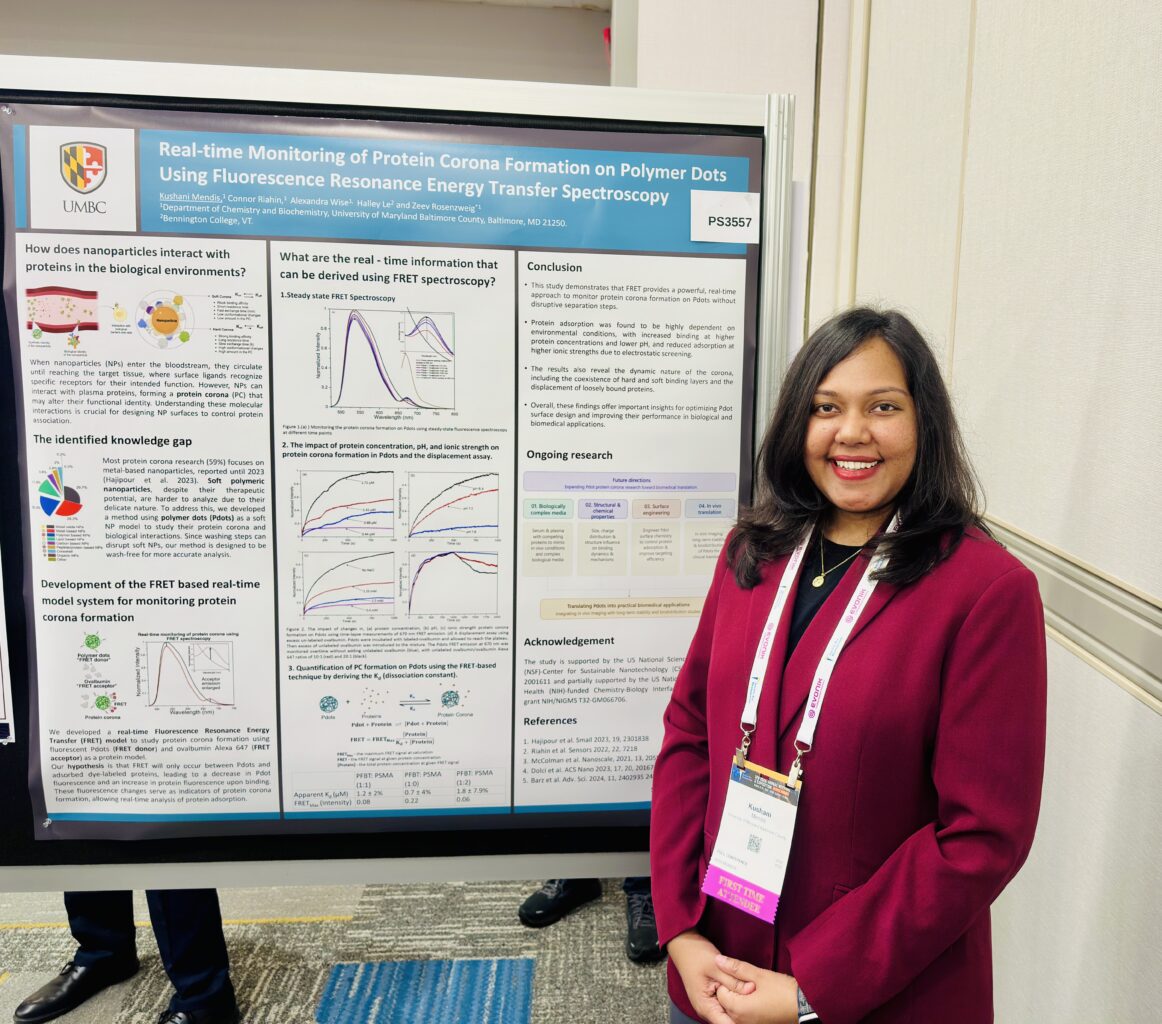 Kushani Mendis presented her research at the 2026 Society for Biomaterials Annual Meeting. (Courtesy of Mendis)
Today, Mendis’s schedule is packed with interviews of biomedical technology researchers in government, academia, and industry. Her probing questions are helping determine whether her lab’s novel nanomaterials have commercial potential. Rosenzweig’s encouragement and programs like the National Science Foundation Innovation Corps (I-Corps), which trains scientists to translate research into societal impact, have been key. She is thriving, balancing independent laboratory research, teaching and mentoring undergraduates, and her entrepreneurial work; she even occasionally finds time to engage her artistic side.
Whether or not students like Mendis ultimately launch businesses, at UMBC, they gain versatile skills—problem-solving, communication, empathy, and resilience—that will serve them across diverse careers. Here, entrepreneurial thinking is not an elective add-on but foundational preparation for an unpredictable world.
“UMBC’s model—technical excellence plus mindset training—prepares graduates to innovate anywhere,” Fulmer says, “making the university a powerful driver of Maryland’s future.”
]]>
At UMBC, entrepreneurship transcends a traditional business education: It empowers scientists, artists, and technologists to transform their expertise into real-world impact. Through business...
https://umbc.edu/stories/business-not-as-usual/
https://my3.my.umbc.edu/api/v0/pixel/news/160676/guest@my.umbc.edu/3eb018960d350b6c9c83e9cf0bcdf92a/api/pixel
alexbrowncenter
alumni
bwtech
cahss
campus-life
chemistry-and-biochemistry
cnms
coeit
csee
discovery
economics
entrepreneurship
feature
graduate-research
magazine
public-health
story
UMBC News & Magazine
https://my3.my.umbc.edu/groups/umbc-news-magazine
https://assets1-my.umbc.edu/system/shared/avatars/groups/000/001/943/24435aa6207c452e7bc15cc74b42c7bb/xsmall.png?1748556657
https://assets1-my.umbc.edu/system/shared/avatars/groups/000/001/943/24435aa6207c452e7bc15cc74b42c7bb/original.png?1748556657
https://assets2-my.umbc.edu/system/shared/avatars/groups/000/001/943/24435aa6207c452e7bc15cc74b42c7bb/xxlarge.png?1748556657
https://assets2-my.umbc.edu/system/shared/avatars/groups/000/001/943/24435aa6207c452e7bc15cc74b42c7bb/xlarge.png?1748556657
https://assets3-my.umbc.edu/system/shared/avatars/groups/000/001/943/24435aa6207c452e7bc15cc74b42c7bb/large.png?1748556657
https://assets1-my.umbc.edu/system/shared/avatars/groups/000/001/943/24435aa6207c452e7bc15cc74b42c7bb/medium.png?1748556657
https://assets2-my.umbc.edu/system/shared/avatars/groups/000/001/943/24435aa6207c452e7bc15cc74b42c7bb/small.png?1748556657
https://assets1-my.umbc.edu/system/shared/avatars/groups/000/001/943/24435aa6207c452e7bc15cc74b42c7bb/xsmall.png?1748556657
https://assets2-my.umbc.edu/system/shared/avatars/groups/000/001/943/24435aa6207c452e7bc15cc74b42c7bb/xxsmall.png?1748556657
UMBC News & Magazine
0
0
false
Fri, 12 Jun 2026 11:42:24 -0400
Fri, 12 Jun 2026 11:42:24 -0400
Inaugural “MyRCA” interdisciplinary faculty cohort empowers researchers to bring their work to life
UMBC’s new Make Your Research Come Alive (MyRCA) program is helping faculty translate their scholarship into compelling stories that resonate across disciplines, sectors, and audiences. Launched in November 2025, the program wrapped up its inaugural cohort with a May showcase.
“We created the MyRCA program to help faculty strengthen their research communication skills and effectively convey the significance and real-world impact of their work beyond traditional academic audiences and funding pathways,” says Christine Mallinson, assistant vice president for research and scholarly impact. “It also encourages faculty to think strategically and creatively about visibility, partnerships, collaboration, and long-term impact,” she adds.
Led by the Division of Research and Creative Achievement in partnership with the Office of Institutional Advancement, MyRCA brought together 14 faculty members for twice-monthly workshops and working group sessions, a January mini-retreat, and the culminating showcase. The program focused on identifying and articulating research impact, translating specialized scholarship for broad audiences, developing compelling narratives and pitches, understanding funding landscapes, exploring pathways for engagement with corporate, community, and philanthropic partners, and strengthening interdisciplinary collaboration.
“The value of this program is in connecting with each other,” cohort member Foad Hamidi, associate professor of information systems, shared at the showcase. “Strong research communication and collaboration can help our research come alive,” adds Dong Li, another cohort member and assistant professor of computer science and electrical engineering. Li added, “We are not just researchers, we are telling our story to our audience.”
The value of connection
The program intentionally grouped faculty into smaller interdisciplinary teams organized around broad themes such as health, youth, and the environment. These connections quickly sparked new ideas and collaborations.
For instance, Lauren Clay, professor and chair of emergency and disaster health systems, connected with Li, after learning about his work on wearable health-monitoring devices. Clay wondered how Li’s technology could support a colleague’s research on paramedic response during extreme heat events, including monitoring heat stroke risks for marathon runners.
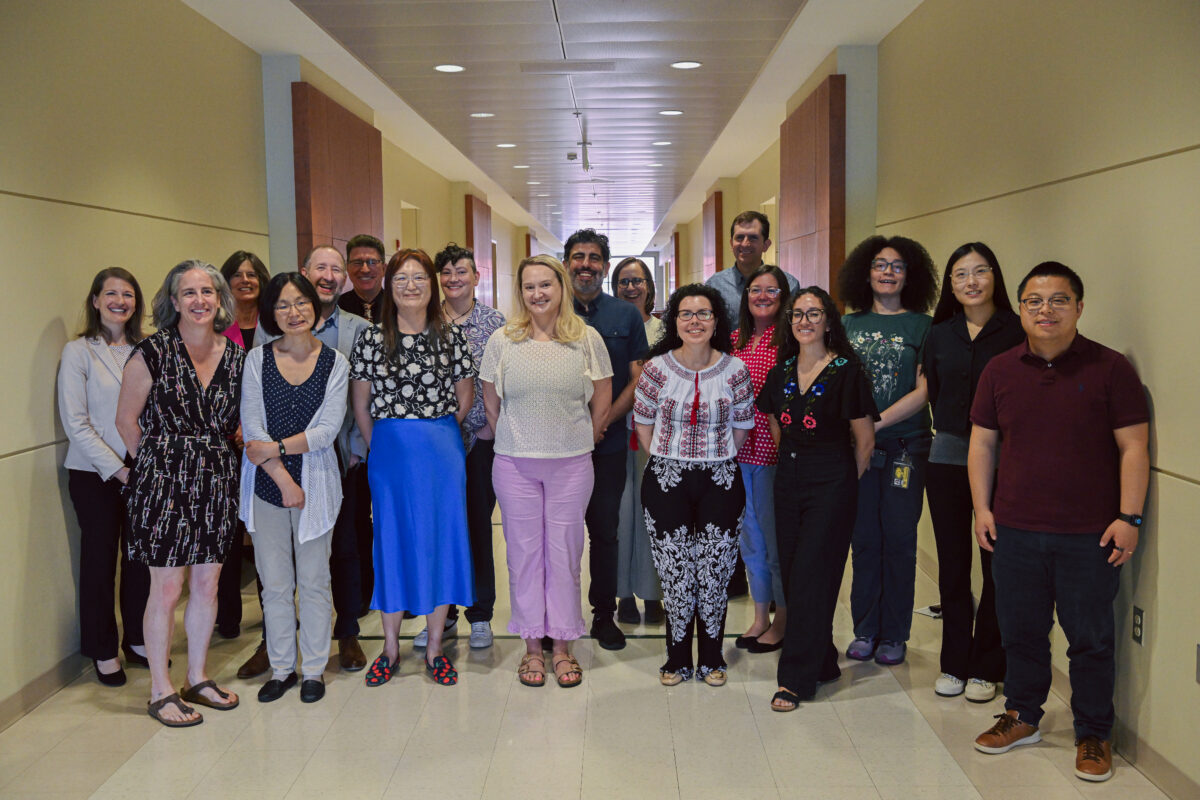 The inaugural MyRCA cohort and program organizers, left to right: Christine Mallinson, Ellen Kohl, Donna Ruginski, Karen Chen, Brian Kaufman, Karl Steiner, Shuling Yang, Sophie Comer-Warner, Amy Tondreau, Foad Hamidi, Linda Kidder Yarlott, Marie Christine-Daniel, Don Engel, Lauren Clay, Gabriella Weiss, Rebecca Williams, Yiwen Hu, Dong Li. Not pictured: Charissa Cheah.
A group including Gabriella Weiss, postdoctoral researcher with the Center for Spaces Sciences and Technology; Marie-Christine Daniel, associate professor of chemistry and biochemistry; and Sophie Comer-Warner, assistant professor of geography and environmental systems, examined remediation strategies for microplastics, heavy metals, and volatile organic compounds with a focus on wetlands. Their collaboration pointed to promising local funding opportunities with Maryland Sea Grant and Chesapeake Bay organizations.
Ellen Kohl, assistant professor of geography and environmental systems, strengthened a new science communication course with the skills she gained, and Shuling Yang, assistant professor of education, advanced her research using generative AI and Chinese pop music for biliteracy development. Brian Kaufman, professor of music, built on the UMBC Create Music Festival, which brings collaborative problem-solving into a typically performance-based discipline.
By the showcase, participants had developed polished pitches, public-facing materials, and broader impact narratives ready for funding proposals, donor outreach, and the media. Each received $500 in research support, along with new cross-campus and external connections.
MyRCA stretches faculty beyond their comfort zones
Mallinson has been excited to see the 14 faculty “stretch beyond their usual disciplinary comfort zones and immediately begin putting the skills and approaches they were learning into practice—developing cross-disciplinary proposals, crafting pitches, appearing in videos and podcasts, participating in panels, and bringing what they learned in the program back to their graduate students and colleagues.”
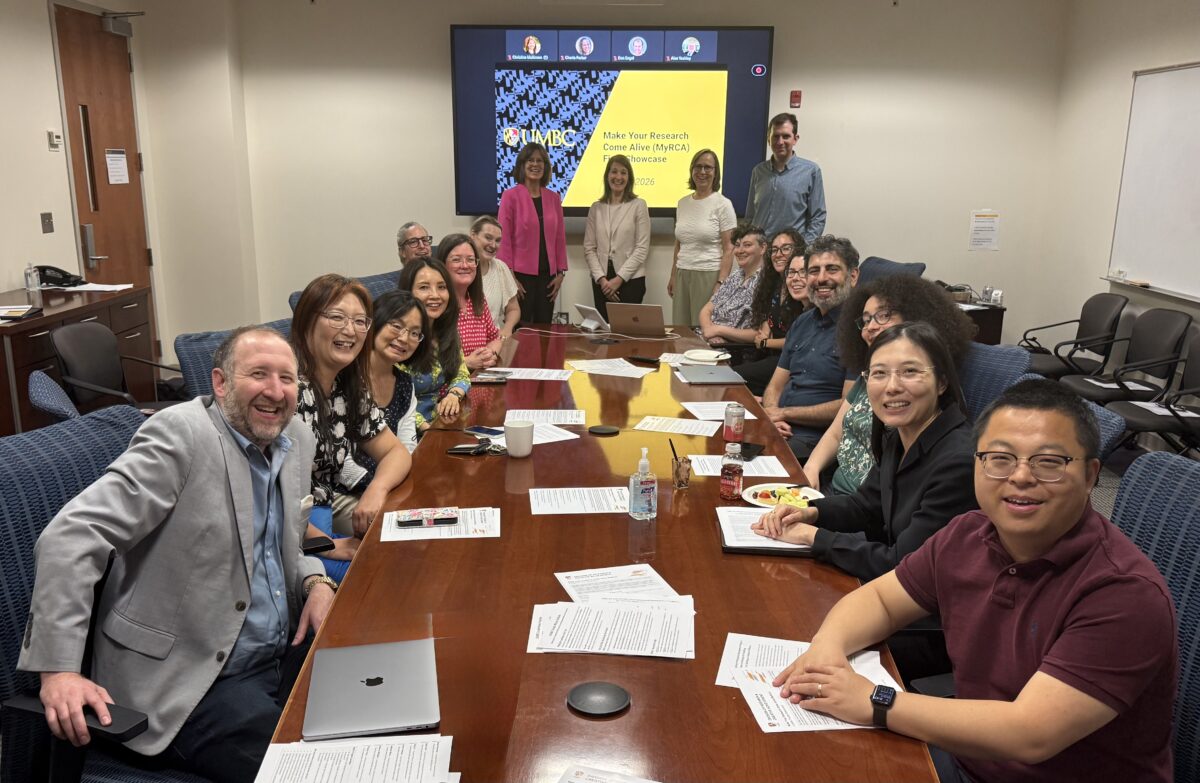 The inaugural MyRCA cohort shared progress and celebrated their accomplishments at a showcase event in May. (Photo by Karl Steiner)
Linda Kidder Yarlott, associate director for corporate research partnerships, highlighted the value of the partnership between the Division of Research and Creative Achievement and the Office of Institutional Advancement. “While federal funding agencies are looking for highly technical, methodology-driven proposals, it’s visionary, outcome-oriented narratives that clearly articulate the human impact and real-world return on investment that entice corporate and philanthropic partners,” Yarlott says.
Yarlott and Jocelyn Kehl, major gift officer for the College of Natural and Mathematical Sciences, worked with the cohort on practical skills—from strategic networking and optimizing LinkedIn profiles to crafting stories that resonate with donors and foundations. “Mentoring this cohort has been an incredibly rewarding experience, culminating in a spectacular program showcase where faculty teams powerfully demonstrated new communication skills that will help unlock new philanthropic pathways,” Yarlott shares.
For more information and to learn about the full 2025 – 2026 cohort, visit research.umbc.edu/myrca.
]]>
UMBC’s new Make Your Research Come Alive (MyRCA) program is helping faculty translate their scholarship into compelling stories that resonate across disciplines, sectors, and audiences. Launched...
https://umbc.edu/stories/myrca-empowers-interdisciplinary-researchers/
https://my3.my.umbc.edu/api/v0/pixel/news/160483/guest@my.umbc.edu/52d7d3b40ae47b848cd3806898a3a63d/api/pixel
cahss
chemistry-and-biochemistry
cnms
coeit
csee
edhs
education
ges
is
music
news
policy-and-society
rca
science-and-tech
story
UMBC News & Magazine
https://my3.my.umbc.edu/groups/umbc-news-magazine
https://assets1-my.umbc.edu/system/shared/avatars/groups/000/001/943/24435aa6207c452e7bc15cc74b42c7bb/xsmall.png?1748556657
https://assets1-my.umbc.edu/system/shared/avatars/groups/000/001/943/24435aa6207c452e7bc15cc74b42c7bb/original.png?1748556657
https://assets2-my.umbc.edu/system/shared/avatars/groups/000/001/943/24435aa6207c452e7bc15cc74b42c7bb/xxlarge.png?1748556657
https://assets2-my.umbc.edu/system/shared/avatars/groups/000/001/943/24435aa6207c452e7bc15cc74b42c7bb/xlarge.png?1748556657
https://assets3-my.umbc.edu/system/shared/avatars/groups/000/001/943/24435aa6207c452e7bc15cc74b42c7bb/large.png?1748556657
https://assets1-my.umbc.edu/system/shared/avatars/groups/000/001/943/24435aa6207c452e7bc15cc74b42c7bb/medium.png?1748556657
https://assets2-my.umbc.edu/system/shared/avatars/groups/000/001/943/24435aa6207c452e7bc15cc74b42c7bb/small.png?1748556657
https://assets1-my.umbc.edu/system/shared/avatars/groups/000/001/943/24435aa6207c452e7bc15cc74b42c7bb/xsmall.png?1748556657
https://assets2-my.umbc.edu/system/shared/avatars/groups/000/001/943/24435aa6207c452e7bc15cc74b42c7bb/xxsmall.png?1748556657
UMBC News & Magazine
1
0
false
Mon, 01 Jun 2026 15:17:46 -0400
Mon, 01 Jun 2026 15:17:46 -0400
Meet a Retriever—Hailey Turney, M.A. ’21, a COEIT academic advisor who’s found a trusted team to rely on
Hailey Turney, M.A. ’21, first came to UMBC as a student pursuing an academic passion in the text, technologies, and literature program. She connected right away with faculty and other community members. Now, as an undergraduate academic advisor in the College of Engineering and Information Technology and an instructor teaching introductory English and university orientation classes, she helps current UMBC connect and find their own path, too.
Hailey shares what she loves about UMBC and her advising job. Take it away, Hailey!
Q: Tell us about yourself.
A: I am a COEIT academic advisor. I mostly work with mechanical engineering students now. I also teach a section of ENGL 100 each semester and UNIV 101 in the fall semesters. I love being able to help students and engage in my community, so advising and teaching feels like a great way to reach students on different levels.
When I was an undergrad, I did not have the best advising experience, so being able to make a difference as an advisor now feels like an interesting, but great, twist of fate. I also like to play Volo soccer in Baltimore and do Dog’s Day Out at BARCS outside of work!
Q: Who are some of the people at UMBC who have most supported you?
A: My amazing boss Emily Abrams-Stephens is spectacular. She supports me and my fellow advisors every day. She is always advocating for us and showing us how much she cares everyday. Working with her, I never doubt that I am valued here. She always listens to our ideas and is a fantastic (and popular) morning chat partner.
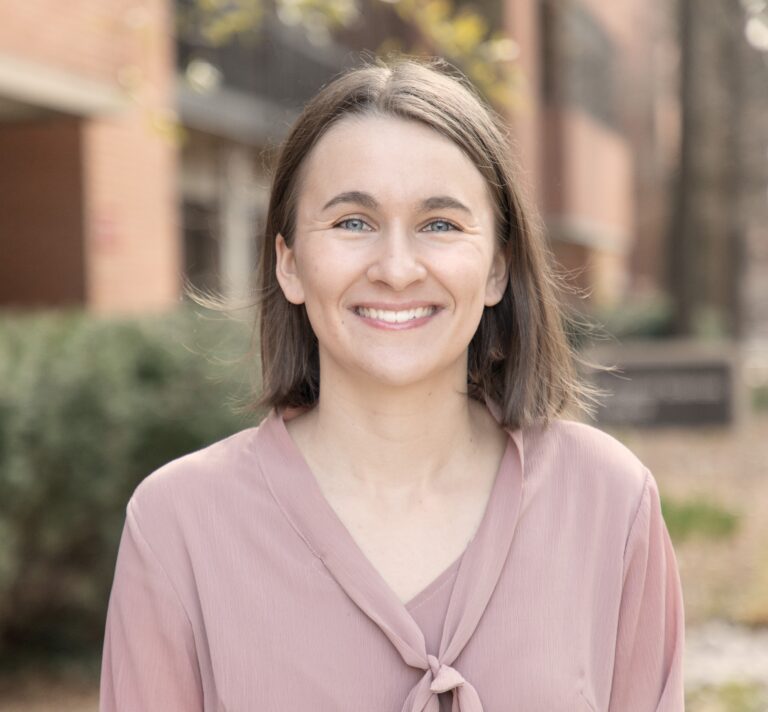
I had a previous job that weighed on me every minute of the day—even outside of work. I missed the activities I loved to do because of it. At UMBC, I have a trusting team—my boss and my fellow advisors—that supports me. If I am ever away, I know my students will be taken care of by my colleagues. The trust I have in my team is something I will never be able to replace. The most remarkable thing about UMBC is the people.
Q: What’s the one thing you’d want someone who hasn’t joined the UMBC community to know about the support you find here?
A: There will always be someone in your corner. I did my master’s here and it was the first time I immediately felt seen in my academic career. When I came to work here, I immediately felt wanted and supported. There are so many resources available to the UMBC community and there is always someone there to help you find them. As an advisor, it is now my job and honor to help students find those resources and their own supporting community.
 Hailey Turney (center) laughs with Assistant Director of Transfer Success Initiatives Krista Wallace at the 2024 COEIT Celebration. (Photo courtesy of Turney)
Q: What part of your job do you enjoy the most and why?
A: I love interacting with students and helping them find their way. Being that person that they can turn to when they don’t know where to go is the most important part of our job. We want students to succeed and feel secure in their place here at UMBC.
Q: What brought you to UMBC in the first place?
A: I came to UMBC because I wanted to expand my knowledge on a topic I was passionate about. The faculty in the English department had so many interesting areas of study that I knew I would be well-supported in finding my own. After meeting with some faculty members for a graduate assistantship, I felt hopeful that this would be an interactive community. The faculty responded to my emails right away, were interested in what I had to say, and were encouraging from the beginning. I came for the academics and stayed for the community. This continued as I found a job here at UMBC as well—I was hesitant to leave.
Q: What would you tell someone who is considering a career at UMBC?
A: You will find a great community here. You will also find ways to continue to improve and learn no matter where you end up.
* * * * *
UMBC’s greatest strength is its people. When people meet Retrievers and hear about the passion they bring, the relationships they create, the ways they support each other, and the commitment they have to inclusive excellence, they truly get a sense of our community. That’s what “Meet a Retriever” is all about.
Learn more about how UMBC can help you achieve your goals.
]]>
Hailey Turney, M.A. ’21, first came to UMBC as a student pursuing an academic passion in the text, technologies, and literature program. She connected right away with faculty and other community...
https://umbc.edu/stories/meet-a-retriever-hailey-turney-coeit-advisor/
https://my3.my.umbc.edu/api/v0/pixel/news/160430/guest@my.umbc.edu/da776ba878d2262d39dfe97a4983ea50/api/pixel
alumni
cahss
coeit
impact
magazine
meet-a-retriever
perspectives
spring-2026
story
UMBC News & Magazine
https://my3.my.umbc.edu/groups/umbc-news-magazine
https://assets1-my.umbc.edu/system/shared/avatars/groups/000/001/943/24435aa6207c452e7bc15cc74b42c7bb/xsmall.png?1748556657
https://assets1-my.umbc.edu/system/shared/avatars/groups/000/001/943/24435aa6207c452e7bc15cc74b42c7bb/original.png?1748556657
https://assets2-my.umbc.edu/system/shared/avatars/groups/000/001/943/24435aa6207c452e7bc15cc74b42c7bb/xxlarge.png?1748556657
https://assets2-my.umbc.edu/system/shared/avatars/groups/000/001/943/24435aa6207c452e7bc15cc74b42c7bb/xlarge.png?1748556657
https://assets3-my.umbc.edu/system/shared/avatars/groups/000/001/943/24435aa6207c452e7bc15cc74b42c7bb/large.png?1748556657
https://assets1-my.umbc.edu/system/shared/avatars/groups/000/001/943/24435aa6207c452e7bc15cc74b42c7bb/medium.png?1748556657
https://assets2-my.umbc.edu/system/shared/avatars/groups/000/001/943/24435aa6207c452e7bc15cc74b42c7bb/small.png?1748556657
https://assets1-my.umbc.edu/system/shared/avatars/groups/000/001/943/24435aa6207c452e7bc15cc74b42c7bb/xsmall.png?1748556657
https://assets2-my.umbc.edu/system/shared/avatars/groups/000/001/943/24435aa6207c452e7bc15cc74b42c7bb/xxsmall.png?1748556657
UMBC News & Magazine
2
0
false
Fri, 29 May 2026 14:22:58 -0400
Fri, 29 May 2026 14:22:58 -0400
UMBC Class of 2026: Ready to contribute their voices
With full hearts and eyes fixed on the future, the UMBC Class of 2026 stepped across the stage last week, crossing the threshold into life’s next chapter. Surrounded by family, friends, and mentors, UMBC’s newest alumni embody the university’s spirit of curiosity, resilience, and community.
Baltimore Symphony Orchestra Music Director Jonathon Heyward, who addressed graduates from the College of Arts, Humanities, and Social Sciences, captured the moment: “You are standing in a very unusual place today,” he told the graduates. “You are simultaneously at the end of one journey, and at the very beginning of another.”
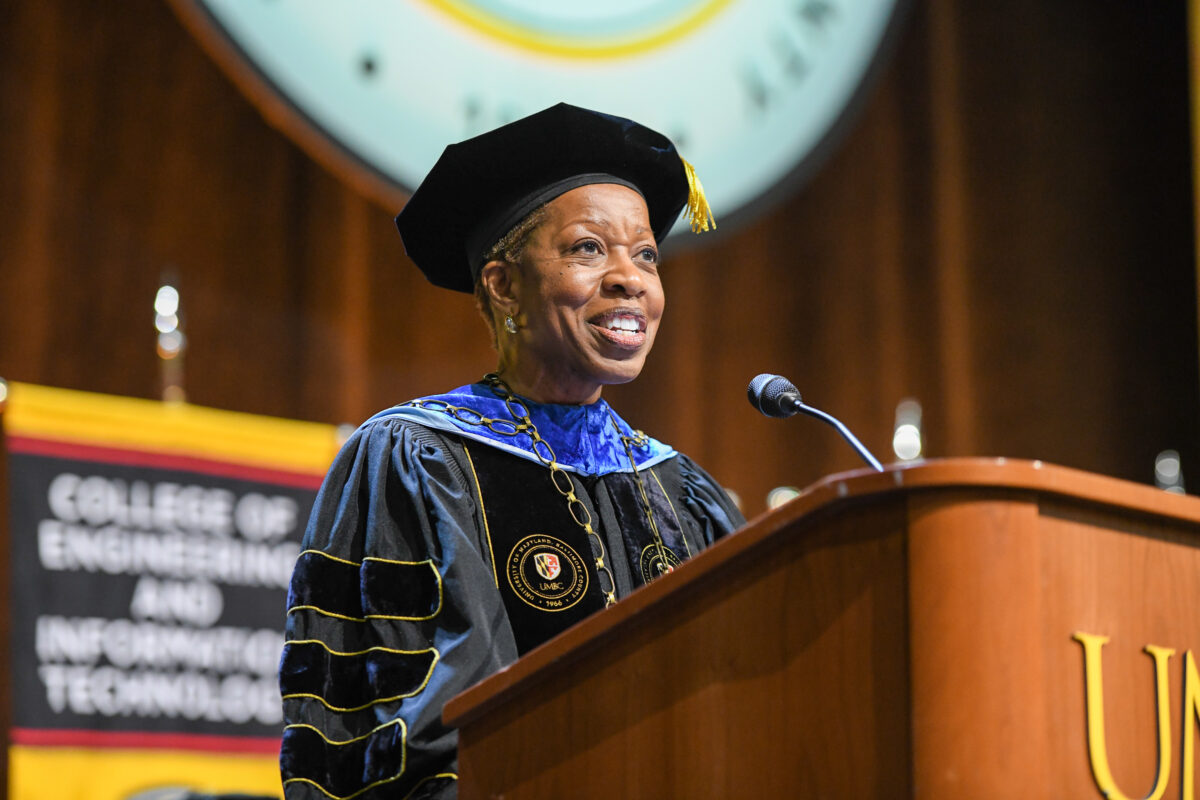
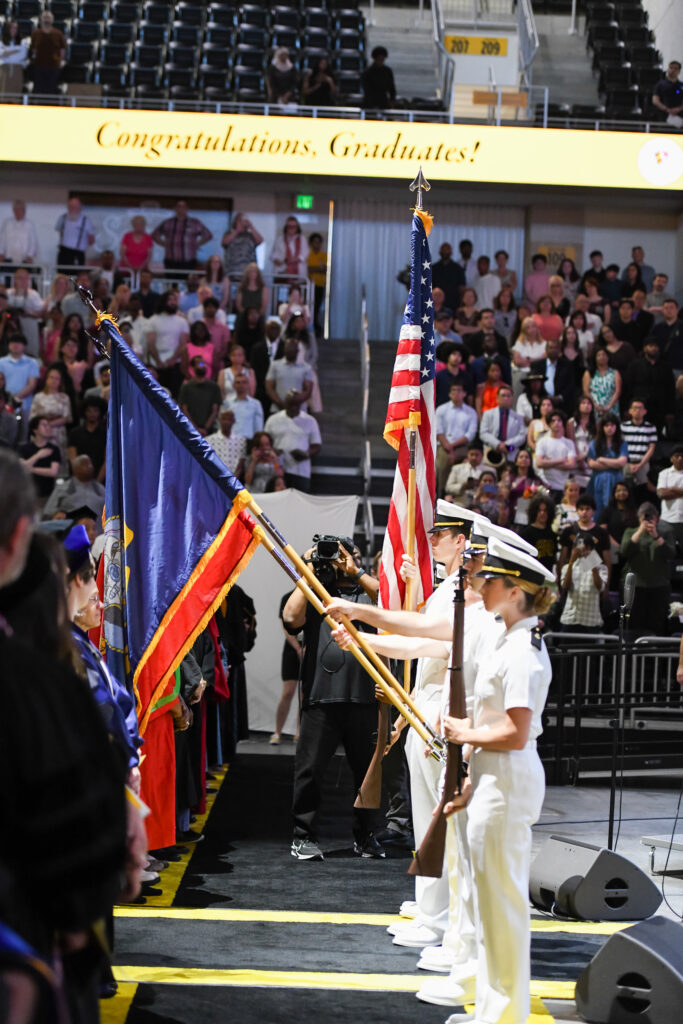 Left: President Valerie Sheares Ashby addresses graduates. Right: Members of UMBC’s ROTC programs present the colors.
Heyward shared his own winding path—from a disastrous childhood solo performance to his unexpected choice of the cello—and encouraged graduates to embrace life’s detours. “Opportunity rarely arrives when you feel fully prepared for it. It arrives unexpectedly,” he said. “Sometimes disguised as inconvenience. Sometimes disguised as failure. … But perspective and resilience allow you to recognize opportunity when it finally appears.”
Holden Thorp, editor-in-chief of the Science family of academic journals, brought candor and optimism to graduates in the College of Natural and Mathematical Sciences and the College of Engineering and Information Technology. Celebrating the Retrievers’ perseverance through the pandemic, divisive politics, and more, Thorp reminded graduates that “nobody’s normal,” openly sharing his own autism diagnosis and affirming that mental health challenges do not limit potential. His core messages—“Do the work” and “You’re right on schedule”—resonated with graduates from UMBC, which he described as “the original place where grit translates to achievement.”

 Left: Holden Thorp, editor-in-chief of the Science family of academic journals, addressed graduates from the College of Natural and Mathematical Sciences and the College of Engineering and Information Technology. Right: Jonathon Heyward, music director of the Baltimore Symphony Orchestra, receives his honorary degree from President Valerie Sheares Ashby and Provost Manfred van Dulmen.
A strong and supportive community
The personal stories of the Class of 2026 reflect these same themes of resilience, community, and bold possibility.
Graduates like Katie King’26, a biology and dance double major, Linehan Artist Scholar, and Dance Team co-captain, discovered at UMBC that they needn’t choose between seemingly disparate passions. “When looking at colleges, a lot of them told me I had to choose, but UMBC allowed me to do both,” King says. She leaves prepared to become a physician assistant while continuing to integrate science and the arts.
Others found a supportive community that helped them see new possibilities. Maia Turman Cooke ’26, an English and political science double major and McNair Scholar, reflected, “I never knew what a strong and supportive academic community could look like”—until she arrived at UMBC. That environment propelled her forward, and she will begin a Ph.D. in English while continuing her advocacy work.

 Graduates celebrated with friends and family outside the Chesapeake Employers Insurance Arena after the Commencement ceremony.
Still other graduates overcame self-doubt in demanding technical fields. Carter Gerhardt ’26 switched into computer engineering mid-journey and gained confidence through faculty and peer support. “I’m getting a degree that I originally thought that I couldn’t do,” he said, as he graduates ready for a career in cybersecurity.
Equipped to lead and serve
UMBC awarded nearly 500 master’s and Ph.D. degrees this spring, along with nearly 1,400 bachelor’s degrees across its three colleges, the School of Social Work, and the Erickson School of Aging Studies. Across disciplines—from the humanities and social sciences to natural sciences, engineering, and the arts—UMBC graduates are positioned “to lead and to serve—to strengthen workforces and economies, families and communities, and ultimately, to bring a brighter future for our state, our nation, and our world,” as Maryland Governor Wes Moore said in a Commencement video message.

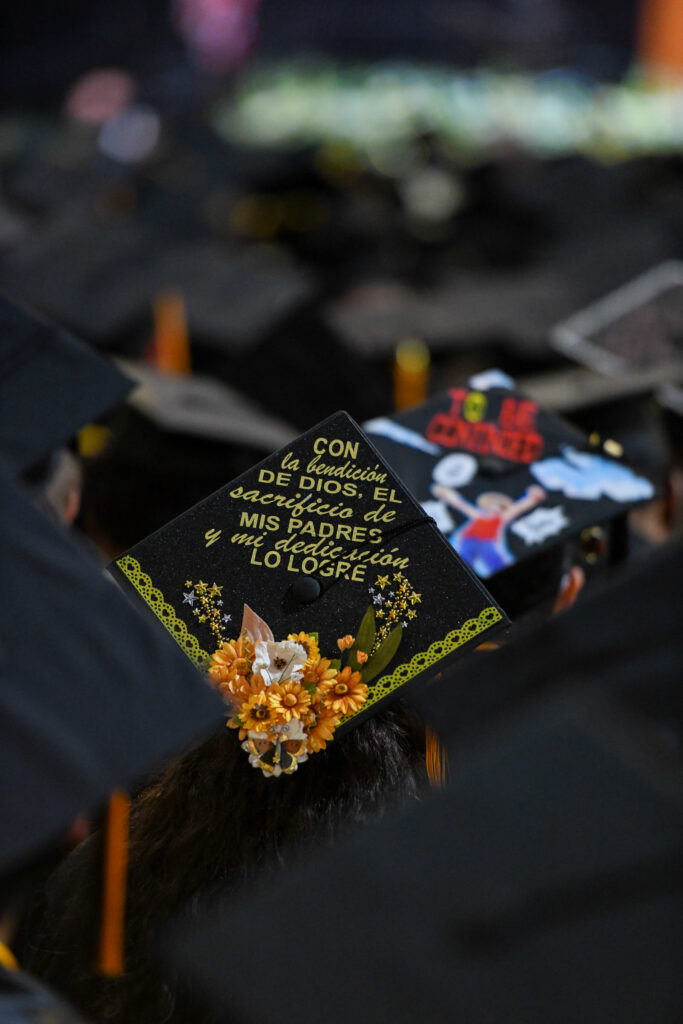
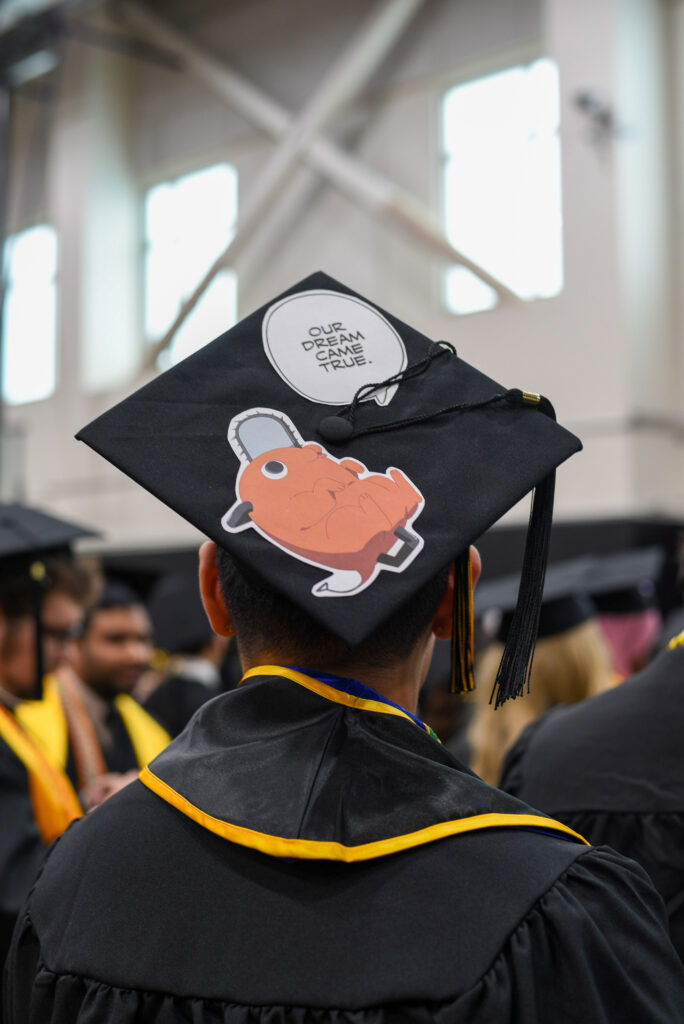


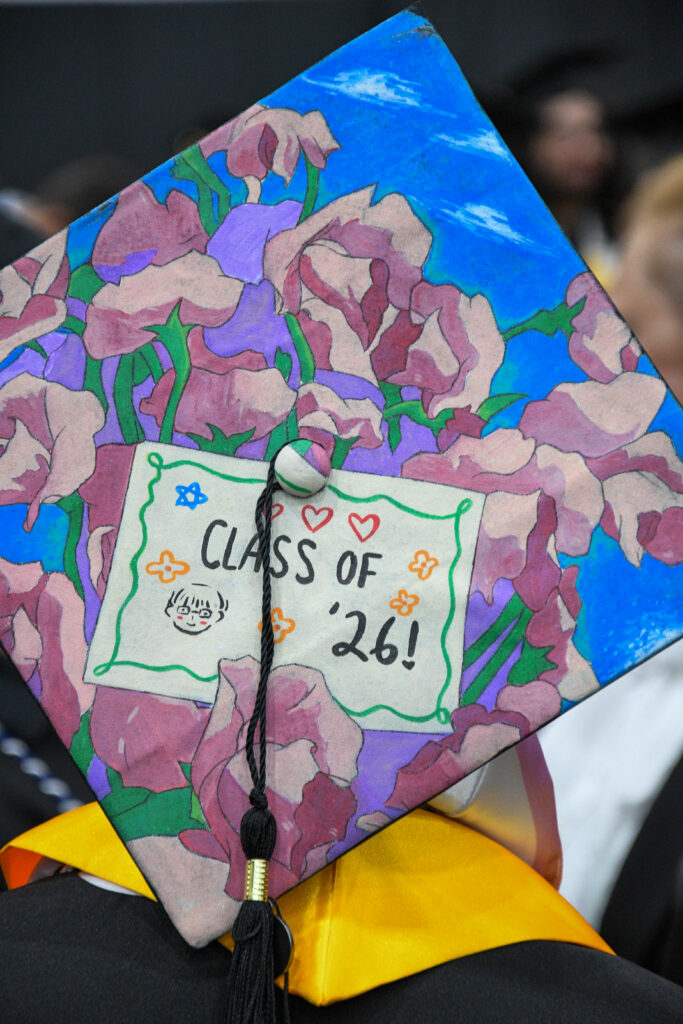 Graduates continued the tradition of decorating their mortarboards to mark their milestone achievement.
Zareen Taj, Ph.D. ’26, who earned her doctorate in language, literacy, and culture after fleeing oppression in Afghanistan and Pakistan, described how UMBC empowered her voice and work, epitomizing the university’s commitment to inclusive excellence. “I learned from this journey that I am different. I look different. I work differently. I see things differently, but my difference is not a problem,” she said. “My experience is an asset. It’s my wealth. The UMBC community…supported me at each stage of my life.”
As Heyward told the Class of 2026—just as Taj and so many others have realized through their experiences at UMBC—“The world does not need you to be flawless. It needs you to be bold enough to contribute your voice.”
Any graduates who plan to continue their academic journey at UMBC should take advantage of Free Graduate Application Week May 27 – June 3.
Read more about this year’s inspiring Class of 2026.
 Onward and upward for the Class of 2026!
]]>
With full hearts and eyes fixed on the future, the UMBC Class of 2026 stepped across the stage last week, crossing the threshold into life’s next chapter. Surrounded by family, friends, and...
https://umbc.edu/stories/class-of-2026-ready-to-contribute-their-voices/
https://my3.my.umbc.edu/api/v0/pixel/news/160346/guest@my.umbc.edu/dbe911fe04976f2fea4d2933f0cd6407/api/pixel
cahss
class-of-2026
cnms
coeit
commencement
community
feature
news
story
UMBC News & Magazine
https://my3.my.umbc.edu/groups/umbc-news-magazine
https://assets1-my.umbc.edu/system/shared/avatars/groups/000/001/943/24435aa6207c452e7bc15cc74b42c7bb/xsmall.png?1748556657
https://assets1-my.umbc.edu/system/shared/avatars/groups/000/001/943/24435aa6207c452e7bc15cc74b42c7bb/original.png?1748556657
https://assets2-my.umbc.edu/system/shared/avatars/groups/000/001/943/24435aa6207c452e7bc15cc74b42c7bb/xxlarge.png?1748556657
https://assets2-my.umbc.edu/system/shared/avatars/groups/000/001/943/24435aa6207c452e7bc15cc74b42c7bb/xlarge.png?1748556657
https://assets3-my.umbc.edu/system/shared/avatars/groups/000/001/943/24435aa6207c452e7bc15cc74b42c7bb/large.png?1748556657
https://assets1-my.umbc.edu/system/shared/avatars/groups/000/001/943/24435aa6207c452e7bc15cc74b42c7bb/medium.png?1748556657
https://assets2-my.umbc.edu/system/shared/avatars/groups/000/001/943/24435aa6207c452e7bc15cc74b42c7bb/small.png?1748556657
https://assets1-my.umbc.edu/system/shared/avatars/groups/000/001/943/24435aa6207c452e7bc15cc74b42c7bb/xsmall.png?1748556657
https://assets2-my.umbc.edu/system/shared/avatars/groups/000/001/943/24435aa6207c452e7bc15cc74b42c7bb/xxsmall.png?1748556657
UMBC News & Magazine
1
0
false
Tue, 26 May 2026 11:51:54 -0400
Tue, 26 May 2026 11:51:54 -0400
Simone Kruse ’26, business technology administration, drawn to UMBC by her career goals and the welcoming community
Onward and upward for the Class of 2026!
]]>
With full hearts and eyes fixed on the future, the UMBC Class of 2026 stepped across the stage last week, crossing the threshold into life’s next chapter. Surrounded by family, friends, and...
https://umbc.edu/stories/class-of-2026-ready-to-contribute-their-voices/
https://my3.my.umbc.edu/api/v0/pixel/news/160346/guest@my.umbc.edu/dbe911fe04976f2fea4d2933f0cd6407/api/pixel
cahss
class-of-2026
cnms
coeit
commencement
community
feature
news
story
UMBC News & Magazine
https://my3.my.umbc.edu/groups/umbc-news-magazine
https://assets1-my.umbc.edu/system/shared/avatars/groups/000/001/943/24435aa6207c452e7bc15cc74b42c7bb/xsmall.png?1748556657
https://assets1-my.umbc.edu/system/shared/avatars/groups/000/001/943/24435aa6207c452e7bc15cc74b42c7bb/original.png?1748556657
https://assets2-my.umbc.edu/system/shared/avatars/groups/000/001/943/24435aa6207c452e7bc15cc74b42c7bb/xxlarge.png?1748556657
https://assets2-my.umbc.edu/system/shared/avatars/groups/000/001/943/24435aa6207c452e7bc15cc74b42c7bb/xlarge.png?1748556657
https://assets3-my.umbc.edu/system/shared/avatars/groups/000/001/943/24435aa6207c452e7bc15cc74b42c7bb/large.png?1748556657
https://assets1-my.umbc.edu/system/shared/avatars/groups/000/001/943/24435aa6207c452e7bc15cc74b42c7bb/medium.png?1748556657
https://assets2-my.umbc.edu/system/shared/avatars/groups/000/001/943/24435aa6207c452e7bc15cc74b42c7bb/small.png?1748556657
https://assets1-my.umbc.edu/system/shared/avatars/groups/000/001/943/24435aa6207c452e7bc15cc74b42c7bb/xsmall.png?1748556657
https://assets2-my.umbc.edu/system/shared/avatars/groups/000/001/943/24435aa6207c452e7bc15cc74b42c7bb/xxsmall.png?1748556657
UMBC News & Magazine
1
0
false
Tue, 26 May 2026 11:51:54 -0400
Tue, 26 May 2026 11:51:54 -0400
Simone Kruse ’26, business technology administration, drawn to UMBC by her career goals and the welcoming community
Simone Kruse had a circuitous route to UMBC. She studied fashion design in her native country, Germany, and later, came to the U.S. as an au pair and began studying at Howard Community College. The community at UMBC and her ideal degree program—business technology administration with a minor in entrepreneurship and innovation and an honors college certificate—prompted her to transfer.
“Simone has exhibited an amazing drive for success and community,” says Kendyl Walker, assistant director of recruitment and assessment in the Honors College, who got to know Kruse through the Honors College community. At UMBC, Kruse found the resources and people to meet her goals.
Q: How did you decide to come to UMBC?
A: I first learned about UMBC just by driving by. I loved that it was a large campus but still small compared to the University of Maryland, College Park. Then just walking around on campus—even before I was a student, I saw there were so many people outside enjoying the weather, or talking and studying together in The Commons. I could see that there was such a great, diverse community and I definitely wanted to be part of that. So when I learned that UMBC had a program that fit what I was studying, which is business technology administration, it was a very easy decision for me to apply and to accept my offer to go to UMBC.
Q: What have been some of the best parts of your experience here?
A: The best parts are definitely the connections. People truly want to help you. What I heard from friends at other colleges is that they go to their lectures and then that’s it. But at UMBC, you can truly make a connection and learn from the professors, not just in the classroom but also outside of the classroom.
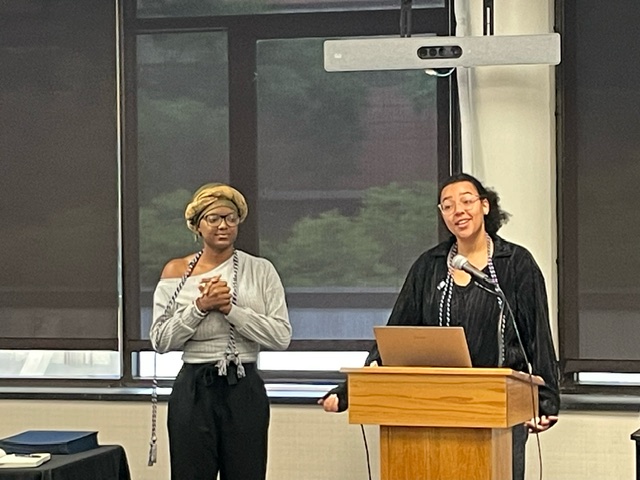 Kruse (right) speaks during this spring’s Tri-Alpha induction ceremony. Kruse is the vice president of the UMBC chapter of this honor society for first-generation college students. Cenia Sims (left) is the president. (Photo courtesy of Kruse)
Q: Are there particular instructors who you have made a special connection with?
A: Prof. B (engineering and computing education assistant teaching professor Mark Berczynski, M.S. ’17, information systems) is definitely one of them. Also, Kendyl Walker and Dr. Julie Oakes (assistant director of curriculum and retention in the Honor College). All three were just great instructors. They always wanted to support their students and make sure they felt comfortable in their classrooms. It’s not just that they were teaching us their subject, they wanted us to experience their subjects while allowing us to share our thoughts and experiences in a safe setting as well.
Q: Is there anything that surprised you at UMBC?
A: I was surprised by some of the amazing classes offered through the Honors College. They would never have fit into my major in any obvious way, but I loved them because they kept my mind open to other subjects. I took a class on how disasters have shaped societies, and another about Hello Kitty and kawaii culture. I just love talking about that class because there’s so much history and so much pop culture behind a little kitty character.
Q: What are your plans for after graduation?
A: I’m hoping to work for Turner Construction, as a field engineer in the DMV area. Once my visa is approved, it would be part of an optional practical training (OPT) program. As a field engineer, I would work on the job sites, coordinating subcontractors and ensuring that construction follows the design while staying on schedule and within budget.
This role aligns well with my business technology degree, especially because I completed a project management course where we worked on a project with a construction company. That experience solidified my decision to pursue a career in the construction industry. I’m especially fascinated by how different teams can come together to build something from the ground up.
Q: What are you hoping to get out of this opportunity?
A: I think it’s learning a new skill. I’m a very hands-on person. I really like being in the field, understanding what the managers are talking about, and then seeing something new come to life. Because of my project management class with Prof. Kahl (information systems assistant teaching professor Margaret Kahl), I’ve become really excited about focusing more on construction and gaining hands-on experience. I’m especially interested in applying and deepening what we learned through our semester project in a real-world setting.
Q: What do you think will be some of your strongest memories from UMBC?
 Kruse tackles a rope course during a Commuter Connections event in 2024. (Photo courtesy of Kruse)
A: My strongest memory is just the community. UMBC is so big on community—you can see it everywhere. I have friends from so many different kinds of classes, when we see each other we always say “hi,” and check in with each other.
I took a Java class in my first semester and I was terrified of that class because I’d never done any programming before. I’m an introvert, so I usually hesitate to talk to other people, but I knew I might need some help. So I asked a classmate if I could sit next to him because he looked like he knew what he was doing. To this day, we still talk almost every week and I still call him sometimes when I need help.
Everyone here is very friendly. People are interested in each other and always very supportive. College life is not just about preparing for a career, it’s also for you to learn something about yourself. UMBC really helps with that, and you can always get as much help as you need.
]]>
Simone Kruse had a circuitous route to UMBC. She studied fashion design in her native country, Germany, and later, came to the U.S. as an au pair and began studying at Howard Community College....
https://umbc.edu/stories/simone-kruse-2026/
https://my3.my.umbc.edu/api/v0/pixel/news/160180/guest@my.umbc.edu/081f05fe8c8bb47bf74eb8d103c99609/api/pixel
class-of-2026
coeit
is
news
science-and-tech
story
UMBC News & Magazine
https://my3.my.umbc.edu/groups/umbc-news-magazine
https://assets1-my.umbc.edu/system/shared/avatars/groups/000/001/943/24435aa6207c452e7bc15cc74b42c7bb/xsmall.png?1748556657
https://assets1-my.umbc.edu/system/shared/avatars/groups/000/001/943/24435aa6207c452e7bc15cc74b42c7bb/original.png?1748556657
https://assets2-my.umbc.edu/system/shared/avatars/groups/000/001/943/24435aa6207c452e7bc15cc74b42c7bb/xxlarge.png?1748556657
https://assets2-my.umbc.edu/system/shared/avatars/groups/000/001/943/24435aa6207c452e7bc15cc74b42c7bb/xlarge.png?1748556657
https://assets3-my.umbc.edu/system/shared/avatars/groups/000/001/943/24435aa6207c452e7bc15cc74b42c7bb/large.png?1748556657
https://assets1-my.umbc.edu/system/shared/avatars/groups/000/001/943/24435aa6207c452e7bc15cc74b42c7bb/medium.png?1748556657
https://assets2-my.umbc.edu/system/shared/avatars/groups/000/001/943/24435aa6207c452e7bc15cc74b42c7bb/small.png?1748556657
https://assets1-my.umbc.edu/system/shared/avatars/groups/000/001/943/24435aa6207c452e7bc15cc74b42c7bb/xsmall.png?1748556657
https://assets2-my.umbc.edu/system/shared/avatars/groups/000/001/943/24435aa6207c452e7bc15cc74b42c7bb/xxsmall.png?1748556657
UMBC News & Magazine
0
0
false
Mon, 18 May 2026 16:07:20 -0400
Mon, 18 May 2026 16:07:20 -0400
Playing softball and excelling in the hard sciences, Emily Riggs ’26, is knocking it out of the park
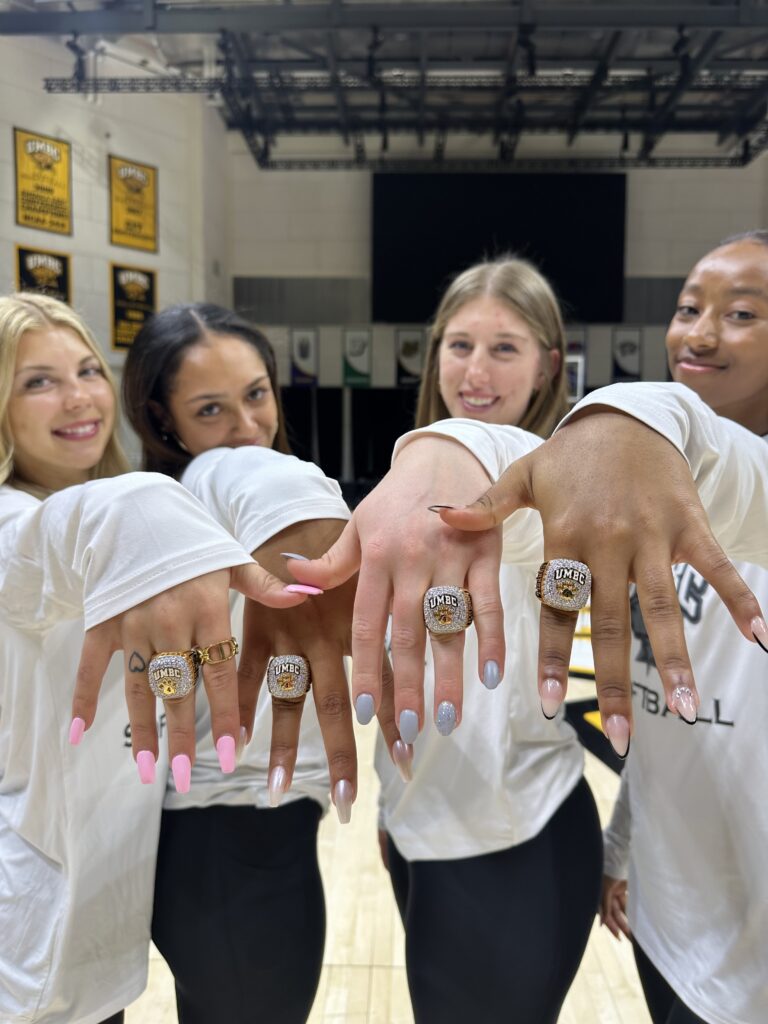
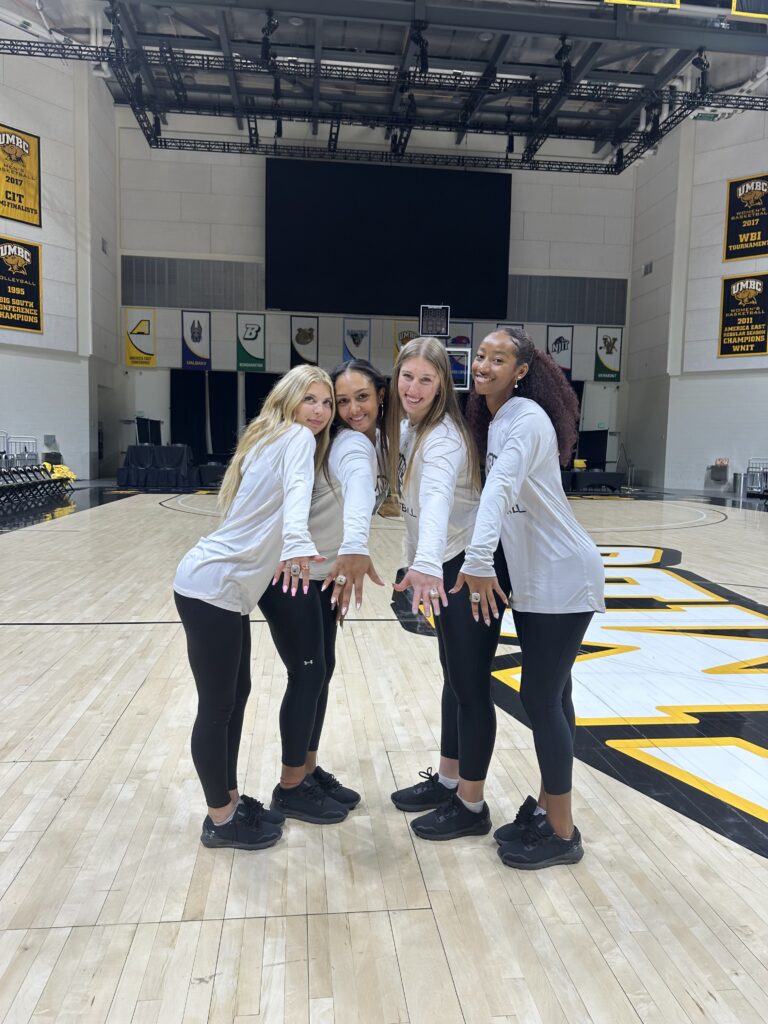
Emily Riggs came to UMBC from Lancaster, Pennsylvania, to study mechanical engineering while playing for UMBC’s championship-level softball team. She was rewarded for her decision early on—in her first year, she was named to the America East All-Rookie team and helped the Retrievers win their fourth-straight America East championship. In the following NCAA Tournament game against Nebraska, Riggs hit UMBC’s first home run in an NCAA Tournament game in 21 years, and the program’s second ever overall. She’s a two-time Academic All-District Honoree and was named to the 2025 America East All-Conference First team after she batted .343 with 11 homers in 49 games.
Q: What’s your experience at UMBC been like, balancing academics and athletics?
A: It’s busy and it means a lot of time management because my days are pretty booked. Usually this means classes in the morning, then practice, and then come home. Maybe I take an hour or two break and then do a bunch of homework. It’s tough but manageable.
Q: What difficulty does your major add because of the technical course load?
A: In my junior and senior years, I’ve had quite a few intensive projects. I’m in a capstone class right now, and we’re making an intelligent convoy system. So it’s coordinating team meetings, extra work, making requirement documentation, and more.
Q: What would you say your favorite class has been here and why?
A: My mechanical engineering capstone class. We’re part of actually making the intelligent convoy vehicles, and then there’s two other teams that are focusing on software design. It’s been really cool to see all the stuff that I’ve been learning in school kind of all come together and apply to this one project.
Q: What do you plan to do after you graduate?
A: Get a job in the field of engineering, specifically mechanical engineering. Luckily, there are a lot of options around here! They range anywhere from aerospace to design to construction. So I’m just trying to find somewhere that fits me right now.
Q: How has UMBC helped you get ready for that job after college?
A: Many of our major courses, especially at the 400 level, are structured like a corporation. For example, you’ll have documents that you have to present. It’s still graded, but the professors will have a conversation with you: “Hey, here are the standards that we’re seeing in the real world right now, and here’s how you can meet it.”
Q: What would you say your favorite athletic moment has been?
A: Winning the America East softball championship my freshman year, and playing in the NCAA Tournament at Oklahoma State
Q: Do you have a mentor who has helped you while at UMBC
A: This year, I’m with my capstone professor—Dr. E.F. Charles LaBerge—the whole year around, and he’s been really helpful and has focused on preparing us for the real world. He’s there to answer questions, whether they’re about school or not about school.
Q: What opportunities stand out to you from your four years at UMBC?
A: I’ve learned a lot. I’ve had opportunities working here in the Athletics Department helping keep in-game statistics for soccer, volleyball and basketball. I didn’t think that I was going to do that. I got an internship last year through UMBC, I worked in field service engineering with Beckman Culture Life Sciences. It allowed me to travel around the region and work on a bunch of automation systems. I definitely feel grateful for the academic opportunities I’ve had here.
Visit UMBC Athletics for more information on what our athletes are getting up to.
All photos courtesy of Riggs. Story by Zach Seidel ’12, media and communication studies, director of digital media for UMBC athletics.
]]>
Emily Riggs came to UMBC from Lancaster, Pennsylvania, to study mechanical engineering while playing for UMBC’s championship-level softball team. She was rewarded for her decision early on—in her...
https://umbc.edu/stories/softball-and-excelling-in-science-emily-riggs-26/
https://my3.my.umbc.edu/api/v0/pixel/news/160095/guest@my.umbc.edu/09fbe87a3d39392cf0015cd9d94c72cd/api/pixel
athletics
class-of-2026
coeit
news
story
UMBC News & Magazine
https://my3.my.umbc.edu/groups/umbc-news-magazine
https://assets1-my.umbc.edu/system/shared/avatars/groups/000/001/943/24435aa6207c452e7bc15cc74b42c7bb/xsmall.png?1748556657
https://assets1-my.umbc.edu/system/shared/avatars/groups/000/001/943/24435aa6207c452e7bc15cc74b42c7bb/original.png?1748556657
https://assets2-my.umbc.edu/system/shared/avatars/groups/000/001/943/24435aa6207c452e7bc15cc74b42c7bb/xxlarge.png?1748556657
https://assets2-my.umbc.edu/system/shared/avatars/groups/000/001/943/24435aa6207c452e7bc15cc74b42c7bb/xlarge.png?1748556657
https://assets3-my.umbc.edu/system/shared/avatars/groups/000/001/943/24435aa6207c452e7bc15cc74b42c7bb/large.png?1748556657
https://assets1-my.umbc.edu/system/shared/avatars/groups/000/001/943/24435aa6207c452e7bc15cc74b42c7bb/medium.png?1748556657
https://assets2-my.umbc.edu/system/shared/avatars/groups/000/001/943/24435aa6207c452e7bc15cc74b42c7bb/small.png?1748556657
https://assets1-my.umbc.edu/system/shared/avatars/groups/000/001/943/24435aa6207c452e7bc15cc74b42c7bb/xsmall.png?1748556657
https://assets2-my.umbc.edu/system/shared/avatars/groups/000/001/943/24435aa6207c452e7bc15cc74b42c7bb/xxsmall.png?1748556657
UMBC News & Magazine
0
0
false
Thu, 14 May 2026 12:37:09 -0400
Thu, 14 May 2026 12:37:09 -0400
Carter Gerhardt ’26, computer engineering, navigated a mid-degree major change and his community provided the support he needed to succeed
In February 2020, Carter Gerhardt visited the UMBC campus as a newly admitted student. Six years later, he attended the same event, this time as a senior computer engineering student answering questions about his experience. During his time at UMBC Gerhardt faced the challenge of virtual learning during the COVID pandemic and doubt over whether his math skills were strong enough to pursue a major he was interested in. Supportive friends and faculty encouraged him and this May he will walk across the stage with a degree he was close to giving up on. “I’m getting a degree that I originally thought that I couldn’t do,” he says. “I’m proud of that.”
Q: Why did you choose UMBC?
A: I picked UMBC because I knew the class sizes were smaller. The financial aid was also generous, and that was certainly a big factor. I wasn’t 100 percent sure what major I wanted to do—I was considering mechanical engineering, computer science, and computer engineering. When I looked at companies and organizations in the area that I might want to work for, I saw that a lot of UMBC graduates ended up at those places.
Q: What are some of the challenges you faced during your college experience?
A: My entire first year of college was virtual because of COVID. My math grades were not as high as I was used to them being in high school. So you could say that college was a wake-up call. It was partly for that reason that I first chose computer science as a major—it was less intimidating than computer engineering.
But I still enjoyed working with hardware and working with my hands.
So about two years later, I revisited that decision, encouraged by my friends in the computer engineering major. I talked to my advisor about what changing majors would involve and he walked me through it. Classes were back in person, and that was helpful. I decided I could do it.
Q: What do you like most about the computer engineering degree?
A: Computer engineers have to be good at a lot of things. You learn about electrical signals and power distribution on the hardware side. And you also need to understand software and algorithms. The breadth of topics you get exposed to is really fun to explore.
The sense of community within the major itself is also very strong, especially as you get into upper-level computer engineering courses and your class sizes get a lot smaller. Last fall, I took a communication engineering class with Dr. Seung-Jun Kim and there were five undergraduates in the entire class. (It was cross-listed as a graduate course.)
The depth of material that you can dive into and the level of instructor support here is fantastic.
Q: What are your next steps after graduation?
A: I’m part of a scholarship program here at UMBC called Scholarship for Service. It’s a cybersecurity focused scholarship, and for every year of support you receive, you commit to a year of working in the government on cybersecurity. Most of the scholars in that program go into federal service, but you can also work at the state, local, or tribal level, or you can be a cyber educator. I’ll fulfill that commitment, and then see what happens.
My interests are mainly in wireless/hardware security and radio-frequency engineering, and I would be interested in making medical devices secure. Whether it’s in government service, or in the private sector, the idea of developing products that make people’s lives safer is very appealing to me.
Q: What are some of the student activities you were involved with during your time at UMBC?
A: Since May of 2021, I’ve been a student worker in the Division of Information Technology (DoIT). My supervisor, Courtney Burkett, has been a great mentor and it has been a great experience. It’s taught me job skills and time management, and also it’s been a fun way to learn about the campus and make friends. I’ve been part of the Tau Beta Pi Engineering Honors Society, the UMBC CyberDawgs, and part of the Baja Racing Team.
Currently, a few other students and I have been working with Dr. Kim to develop a computer engineering Council of Majors. As a student organization, it would link students and faculty in the major. We [envision the organization growing to be able to] plan social events, networking events, and try to educate students about the opportunities available to them, such as working on research in faculty members’ labs.
 In 2021, Carter Gerhardt was part of the UMBC Baja Racing team. Team members, from left to right are Manny Conrad, Carter Gerhardt, Emilie Shoff, Nick Myers, Michael O’Connor, Peter Stein, Alec Atwell, Zachary Love, and Alex Povodyrev. (Image courtesy of Gerhardt)
Q: Has there been a piece of advice that someone at UMBC has given you that has really stuck out in your mind?
A: I’d say the advice that’s stuck the most would be to take the path less traveled. I am currently taking the Computer Engineering capstone engineering class with Dr. E. F. Charles LaBerge [Ph.D. ’03]. When it came time to decide on our project, my teammates and I were leaning toward a flashy project building a vehicle and its sensor systems. But Dr. LaBerge encouraged us to take on a project focusing on an error detecting and correcting algorithm called Reed-Solomon. It’s the same algorithm that helps your phone read QR codes, even if you’re not lining everything up perfectly. It was a topic none of us were really familiar with and it has pushed us out of our comfort zone in a great way. I’ve seen how things I’ve learned across my classes are really coming together in this project and it has been super interesting.
Q: Looking back, how do you think you’ve changed the most since senior year of high school?
A: Overall, I guess you can say I’ve matured. I would say my ability to look at a problem and break it down into manageable pieces is much better. I’ve come to realize no matter how big a problem you’re presented with, you can tackle it with the right tools.
And the other thing that I’ve learned, especially after having my first year be virtual, is the importance of taking care of yourself, both physically and mentally. It can be easy with the rush of assignments and deadlines to let everything else fall to the side. Some of the things that I’ve incorporated are that I make my bed every morning. That’s definitely not something I did when I was in high school! I exercise regularly and try to get a good night’s sleep every night. I’ve learned I need to take care of myself so I can take care of other people and put my best work forward.
]]>
In February 2020, Carter Gerhardt visited the UMBC campus as a newly admitted student. Six years later, he attended the same event, this time as a senior computer engineering student answering...
https://umbc.edu/stories/carter-gerhardt-2026/
https://my3.my.umbc.edu/api/v0/pixel/news/160025/guest@my.umbc.edu/75b561297cded22e5308b3d4cc8d9a06/api/pixel
class-of-2026
coeit
csee
news
science-and-tech
story
UMBC News & Magazine
https://my3.my.umbc.edu/groups/umbc-news-magazine
https://assets1-my.umbc.edu/system/shared/avatars/groups/000/001/943/24435aa6207c452e7bc15cc74b42c7bb/xsmall.png?1748556657
https://assets1-my.umbc.edu/system/shared/avatars/groups/000/001/943/24435aa6207c452e7bc15cc74b42c7bb/original.png?1748556657
https://assets2-my.umbc.edu/system/shared/avatars/groups/000/001/943/24435aa6207c452e7bc15cc74b42c7bb/xxlarge.png?1748556657
https://assets2-my.umbc.edu/system/shared/avatars/groups/000/001/943/24435aa6207c452e7bc15cc74b42c7bb/xlarge.png?1748556657
https://assets3-my.umbc.edu/system/shared/avatars/groups/000/001/943/24435aa6207c452e7bc15cc74b42c7bb/large.png?1748556657
https://assets1-my.umbc.edu/system/shared/avatars/groups/000/001/943/24435aa6207c452e7bc15cc74b42c7bb/medium.png?1748556657
https://assets2-my.umbc.edu/system/shared/avatars/groups/000/001/943/24435aa6207c452e7bc15cc74b42c7bb/small.png?1748556657
https://assets1-my.umbc.edu/system/shared/avatars/groups/000/001/943/24435aa6207c452e7bc15cc74b42c7bb/xsmall.png?1748556657
https://assets2-my.umbc.edu/system/shared/avatars/groups/000/001/943/24435aa6207c452e7bc15cc74b42c7bb/xxsmall.png?1748556657
UMBC News & Magazine
1
0
false
Tue, 12 May 2026 20:09:42 -0400
Tue, 12 May 2026 20:09:42 -0400
Chinonso Ezeobi, Ph.D. ’26, channels his own challenges to become a better teacher and mentor
When Chinonso Ezeobi decided to pack up his life and come to the United States to pursue his Ph.D. in electrical engineering at UMBC, he was thrilled at the prospect of finding a program that would bring him fulfillment. However, financial struggles and the impact of COVID pandemic quickly threatened Ezeobi’s plans for the future. Never one to be derailed, he found mentors across campus who made it their mission to keep him on the path to his Ph.D. Ezeobi recognized how invaluable their support was and found his own ways to give back to the place and people who gave him so much, including founding two organizations on campus and keeping his door open to any students who may be struggling.
Q: What brought you to the United States and to UMBC to earn your doctorate?
A: After earning my bachelor’s degree in Nigeria, I went into the telecommunications industry for about 15 years. Then I went to graduate school in Finland with the hope of completing my Ph.D. to qualify me to be a teacher, as I believed that I would impact people more by becoming a teacher. But, none of the Ph.D. programs I was interested in in Finland could give me full funding.
As part of my search for fully funded Ph.D. programs, my wife and I visited the United States in 2018 and had the opportunity to come to UMBC. I had a meeting with the chair of the Department of Computer Science and Electrical Engineering (CSEE). After that, my wife and I ate lunch in The Commons. There was a Nigerian flag hanging from the ceiling. When I saw it, I thought, “Oh, my people are represented here.” I applied for several Ph.D. programs and was offered admission to UMBC. Seeing the Nigerian flag that day played a big part in choosing UMBC for my doctoral study.
Q: What is your most meaningful memory from your time at UMBC?
A: When I came to UMBC, I actually didn’t have funding in my very first semester. So I struggled. I paid out of pocket from my savings. I discovered this wasn’t sustainable. At the end of my first semester, I had made up my mind to leave UMBC and transfer to a different university I had been admitted to because I still couldn’t get funding, and I couldn’t afford to pay anymore. I was stressed; I was anxious; I was depressed. I went to the inaugural meeting of the Black Graduate Student Organization. There were about 15 students in attendance as well as [President Emeritus] Freeman A. Hrabowski and [Dean Emerita of Graduate Studies] Janet Rutledge. Dr. Hrabowski and Dr. Rutledge went around the table and asked each student to share how we were faring and what our experiences at UMBC had been like. I told them it wasn’t easy. And the president directed me to work with Dr. Rutledge to sort my situation out. I and Dr. Rutledge had several one-on-one meetings afterwards where she helped me to navigate my challenges at UMBC. When I reached out to Dr. Rutledge the week I wanted to leave UMBC, she asked me to give her one more week to figure out how to fund me. That was what changed everything. I was able to get the support I needed, and the rest, they say, is history.
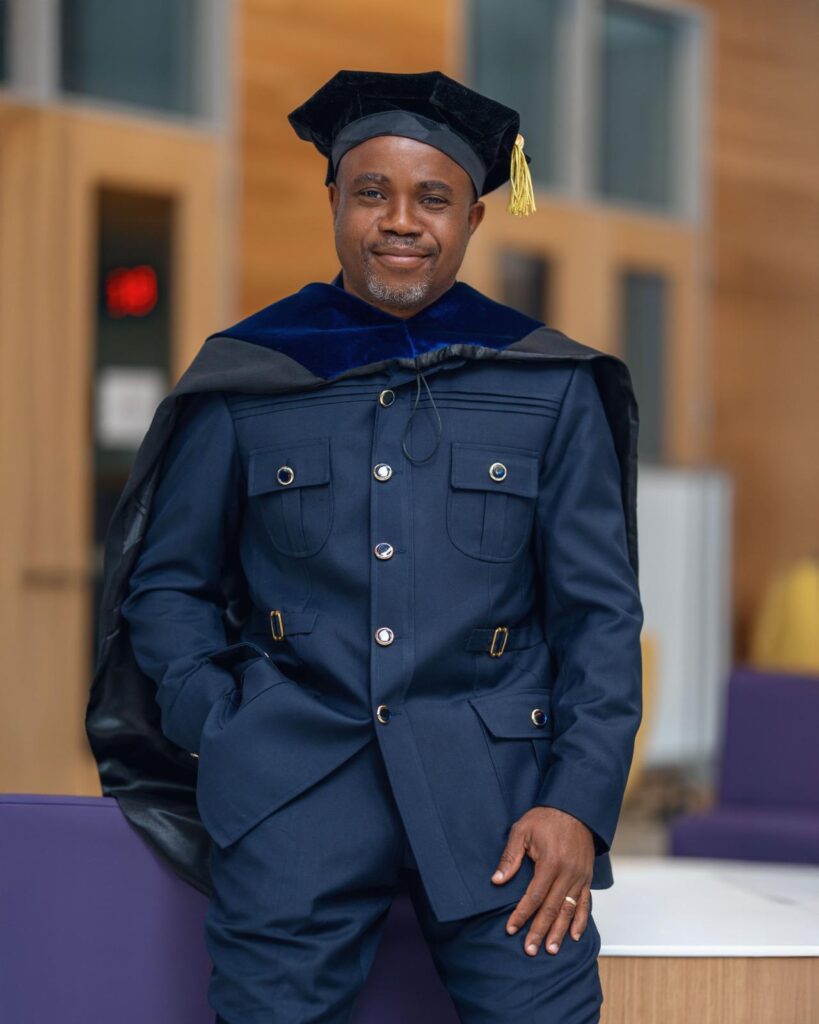 Ezeobi in Commencement regalia. (Courtesy of Ezeobi)
Q: How have you navigated and overcome the challenges you’ve faced during your time at UMBC?
A: I faced a lot of challenges in my time at UMBC. I was coming in from industry, and I had not been in school for a long time. I was trying to acclimatize. But then the COVID-19 pandemic hit in my second semester, and everybody was at home. It was so devastating for me as someone who loves to interact with other people in person. I had left a good job to come to graduate school, and I started to wonder, “Did I do the right thing?”
The kind of research I was doing in my previous lab was difficult to adjust, and I needed a little more help, but because everything was virtual it wasn’t easy to get the kind of help I needed. The lab was able to fund me for a semester, but unfortunately, the day my wife arrived in the United States they informed me that they couldn’t support me any longer. So now my wife had joined me but I had no source of income and funding for my Ph.D. program. The graduate program director of CSEE department offered me a grader position without tuition remission, which I accepted.
Then I got an email from Dr. Robin Cresiski asking if I was available to work with her in the Graduate School based on Dr. Rutledge’s recommendation. She was able to give me a position that could pay for my tuition and still allow me to work in the CSEE department. That was how my relationship with Dr. Cresiski started. She and the Graduate School have always been there for me.
The challenges with my research were similarly massive. Because my lab didn’t have funding, it was very self-driven research. My mentor, Dr. Anthony Johnson, was skeptical about the novelty of my research in the beginning since the ZBLAN sample [a fiber optics slab sample] I used had been around for a long time. Not only did I have to search for and obtain the samples and materials I needed, but I had to convince him that my research was worth it. I went the extra mile to go to the company where I got my samples (Thorlabs) and pulled them into a meeting with Dr. Johnson and I discussed my approach and possible outcome. The meeting highlighted the novelty of my approach to the ZBLAN material and that was how he came on board.
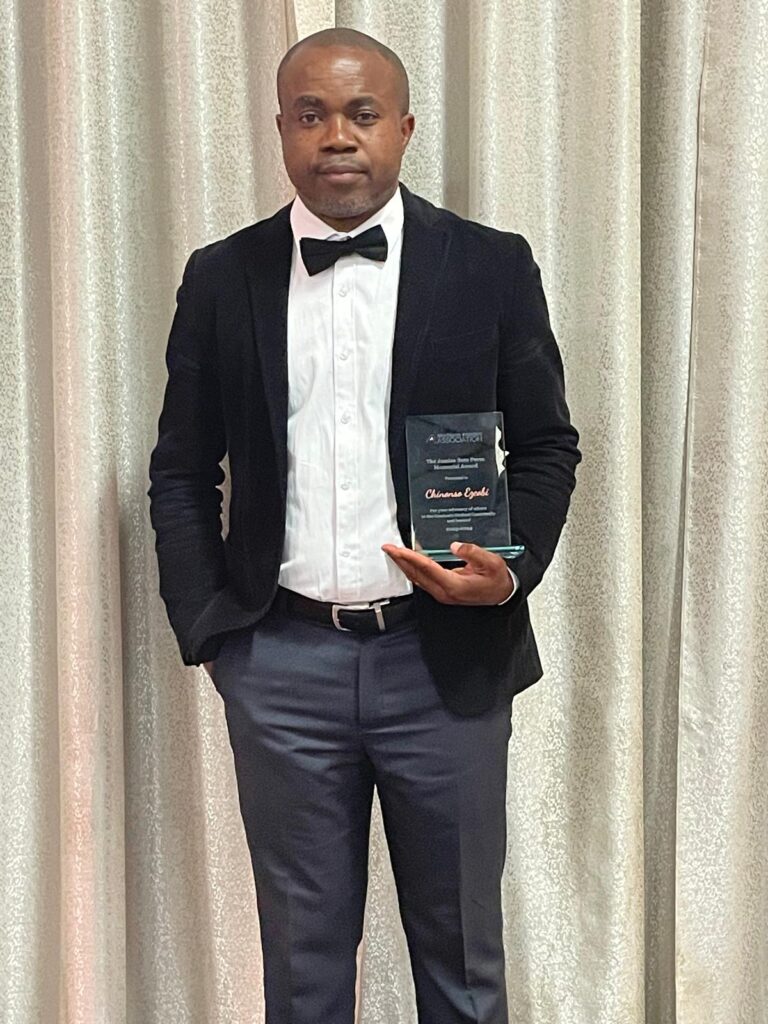 Ezeobi stands with an award for his work. (Courtesy of Ezeobi)
Once I navigated through one challenge, another one came in. But at the end of the day—it was worth it. I was able to pull through all of those challenges. I was also able to transition from being an international student to having a green card through self-petition and self-advocacy, so I’m able to graduate without the additional pressure of thinking about my visa status while looking for jobs. My faith and the community at UMBC were essential in navigating through all challenges. The motivation was that I had a community of people who wanted my success, people who I felt would advocate for me even when I’m not in the room.
I wouldn’t change my UMBC experience for anything. The struggles I’ve faced have been very, very challenging, but I’m glad I went through them. It has made me a better person. It has prepared me for the next phase of my life, which will be teaching. And when you’re teaching students, you teach with context of all of the challenges you have been through to try to make sure that the students have a good experience.
Q: How have your experiences engaging and organizing within UMBC’s graduate student community enhanced your journey here?
A: I know a lot of people on campus. When other graduate students have serious issues, they will come to me and share their challenges. I have ideas of who they can talk to and am able to connect them with people who can help. I follow through with whatever issues students are having and make sure they are solved. Some of the students will even request that I sit in meetings with them and help them navigate the conversation! Because of my advocacy and engagement work, I was also nominated to serve on a lot of committees, including a Student Emergency Fund disbursement committee that supports students when they experience financial hardships and need support with groceries. It’s been a good opportunity to get to know more people, and I’m glad that we’re able to make UMBC a better place.
I also have helped in organizing most of the Graduate School’s events through PROMISE. I make sure that I advertise the events in such a way that we bring graduate students together. After the COVID lockdowns ended, I helped improve turn-out at our in-person events. Many international graduate students like myself feel like when they come here, they want to be the best in everything: best in their class, best in their research. There’s nothing wrong with that, but what happens is that they end up not living. They don’t experience the school. Based on my experiences, I have seen that those who advance more in life are those who know people who can mention their names when they’re not in the room. One of the events we organize in the Graduate School is to help students understand how to access the resources on campus before they need it in order to enhance their experience at UMBC. We organize events as simple as a coffee hour with graduate students, where students can come and talk about their classes. It helps them to destress and creates an opportunity for them to see graduate students from other departments.
Doing all of this gives me fulfillment. It’s the same reason that I want to be a teacher: Whenever I help students solve their problems, I feel good about it. I feel that the struggles I have experienced throughout my UMBC journey have given me this capacity to help others.
Q: As an aspiring educator, what teaching practices from your time as a UMBC student do you want to carry forward?
A: Several of my UMBC professors, including Dr. Johnson, Dr. Fow-Sen Choa, and Dr. Gary Carter, have exemplified what it means to be a teacher. They make sure that every student is heard and seen. They assign amazing class projects. And they’re very responsive to email, even when I reach out to them late at night. I don’t think I’ve ever sent an email that they didn’t get back to almost immediately.
I also took some trainings with UMBC’s Center for Research, Teaching, and Learning on how to be a better teacher, on how to engage students and support active learning. I would highly recommend that UMBC graduate students who are aspiring faculty take this training in teaching, because earning a Ph.D. or being a good researcher does not automatically make one a good teacher.
In the course of my study here, I have also had the opportunity to participate in the UMBC Summer Enrichment Academy as an instructor and as a mentor to other instructors. I’ve been able to connect with high school students, teach them optics, try to help them be interested in engineering, and it has been fulfilling.
I’m hoping to get a faculty position and eventually a tenure track position around here after I graduate. I believe that having a bigger stage will present a bigger challenge, and will result to a bigger impact.
Written by Tess McRae ’22, Assistant Director for Connective Learning, Center for Democracy and Civic Life
]]>
When Chinonso Ezeobi decided to pack up his life and come to the United States to pursue his Ph.D. in electrical engineering at UMBC, he was thrilled at the prospect of finding a program that...
https://umbc.edu/stories/chinonso-ezeobi-26-strives-to-be-better-mentor/
https://my3.my.umbc.edu/api/v0/pixel/news/159963/guest@my.umbc.edu/de68b0595dacd9ca0cf41d44f8399207/api/pixel
class-of-2026
coeit
csee
graduate-research
news
science-and-tech
story
UMBC News & Magazine
https://my3.my.umbc.edu/groups/umbc-news-magazine
https://assets1-my.umbc.edu/system/shared/avatars/groups/000/001/943/24435aa6207c452e7bc15cc74b42c7bb/xsmall.png?1748556657
https://assets1-my.umbc.edu/system/shared/avatars/groups/000/001/943/24435aa6207c452e7bc15cc74b42c7bb/original.png?1748556657
https://assets2-my.umbc.edu/system/shared/avatars/groups/000/001/943/24435aa6207c452e7bc15cc74b42c7bb/xxlarge.png?1748556657
https://assets2-my.umbc.edu/system/shared/avatars/groups/000/001/943/24435aa6207c452e7bc15cc74b42c7bb/xlarge.png?1748556657
https://assets3-my.umbc.edu/system/shared/avatars/groups/000/001/943/24435aa6207c452e7bc15cc74b42c7bb/large.png?1748556657
https://assets1-my.umbc.edu/system/shared/avatars/groups/000/001/943/24435aa6207c452e7bc15cc74b42c7bb/medium.png?1748556657
https://assets2-my.umbc.edu/system/shared/avatars/groups/000/001/943/24435aa6207c452e7bc15cc74b42c7bb/small.png?1748556657
https://assets1-my.umbc.edu/system/shared/avatars/groups/000/001/943/24435aa6207c452e7bc15cc74b42c7bb/xsmall.png?1748556657
https://assets2-my.umbc.edu/system/shared/avatars/groups/000/001/943/24435aa6207c452e7bc15cc74b42c7bb/xxsmall.png?1748556657
UMBC News & Magazine
1
0
false
Mon, 11 May 2026 15:12:11 -0400
Mon, 11 May 2026 15:12:11 -0400
Diving into a new sport
Kaleb Cave’s story is unique among almost all collegiate swimming and diving athletes: When he started college, he was not a strong swimmer.
He is, however, the youngest person ever to perform a standing double backflip. His athletic prowess had also earned him a spot on the USA Gymnastics national team in the Senior Elite Trampoline and Tumbling division.
So how did this mechanical engineering major and gymnast end up on the swimming and diving team? It started on Instagram: Cave’s account (@lub.lub), where he chronicles his athletic feats, has over 140,000 followers.
Junior computer science major Andy Vines, a member of the diving team, messaged Cave when he saw the tumbler was a fellow Retriever. “My mom always told me to find a way to get involved at UMBC, and I thought this might be it,” Cave says. “After reaching out to head dive coach Jeff Fisher, a few months later, I was on the team and in the water.”
From setback to success
While diving and tumbling have many similarities, the transition was anything but smooth water for Cave.
“Learning how to dive was more of a mental than a physical battle for me. With my gymnastics background, the flipping and twisting came naturally. However, I struggled —and still struggle—with my approach and entries into the water,” Cave says. “Landing on my head was definitely weird to get used to, especially when I’ve been landing on my feet all my life. My aerial awareness is pretty good, though. As a gymnast, I’m used to doubles and triples, so when I have to dial it down, my body doesn’t quite understand.”
Cave officially joined the UMBC swimming and diving team as a sophomore. He had a solid rookie campaign, qualifying for the finals in both the one- and three-meter board events at the America East Championships. However, less than a month later, his diving journey suffered a big setback.
 Kaleb Cave competes in the qualifying round of the one-meter diving event at the America East Championships in February, 2026.
In March 2025, he ruptured his Achilles tendon at a tumbling national team camp. He had surgery five days later and started physical therapy eight weeks post-operation.
“My physical therapist did an amazing job getting me back to where I need to be, and he is still helping me become stronger,” Cave says. “In the beginning, physical therapy frustrated me—seeing how weak I was and how long it was taking to gain back little bits of strength was taxing on my mental health.”
However, he persisted with rehab and returned to competition in October 2025, just under seven months after the injury—much faster than anyone expected.
“It felt great,” said Cave. “My return didn’t feel rushed at all, just natural and smooth.”
Two for the team
In January 2026, Cave broke a 14-year-old school record en route to winning the three-meter competition at the Towson Diving Invitational. He qualified for NCAA Zones, the preliminary event for the NCAA Diving Championships, in the one- and three-meter events.
Two weeks later, Cave won bronze in both the one- and three-meter events at the America East Championships, helping lead the men’s swimming and diving team to its 15th title.
 For Kaleb Cave (left), earning two individual medals was not as meaningful as contributing to the team championship.
Cave’s two medals “contributed to the team winning that title, which means more to me than if I had felt like I didn’t contribute to it. Those were also my first diving-related medals ever, which is special to me,” he adds.
With two full seasons of diving under his belt, Cave feels ready to level up. “Next year, I definitely think I can start pushing the difficulty, now that I’ve cleaned up my form a bit since my very first season.”
Being a student athlete is time-consuming, especially when learning a new sport and alongside a technical major like mechanical engineering, but Cave says UMBC has allowed him to succeed.
“UMBC provides so much support for student-athletes, whether it be a quiet place for us to study or one-on-one tutoring sessions. Teachers are always here to provide help when needed and guide you through the course content.” It seems that Cave has landed on his feet after all.
By Zachary Seidel ’12, M.S. ’15
]]>
Kaleb Cave’s story is unique among almost all collegiate swimming and diving athletes: When he started college, he was not a strong swimmer. He is, however, the youngest person ever to...
https://umbc.edu/stories/diving-into-a-new-sport/
https://my3.my.umbc.edu/api/v0/pixel/news/159886/guest@my.umbc.edu/76bb68addcbfd14eec15a9b49a043c36/api/pixel
at-play
athletics
campus-life
coeit
meche
spring-2026
story
swimming-and-diving
themes
UMBC News & Magazine
https://my3.my.umbc.edu/groups/umbc-news-magazine
https://assets1-my.umbc.edu/system/shared/avatars/groups/000/001/943/24435aa6207c452e7bc15cc74b42c7bb/xsmall.png?1748556657
https://assets1-my.umbc.edu/system/shared/avatars/groups/000/001/943/24435aa6207c452e7bc15cc74b42c7bb/original.png?1748556657
https://assets2-my.umbc.edu/system/shared/avatars/groups/000/001/943/24435aa6207c452e7bc15cc74b42c7bb/xxlarge.png?1748556657
https://assets2-my.umbc.edu/system/shared/avatars/groups/000/001/943/24435aa6207c452e7bc15cc74b42c7bb/xlarge.png?1748556657
https://assets3-my.umbc.edu/system/shared/avatars/groups/000/001/943/24435aa6207c452e7bc15cc74b42c7bb/large.png?1748556657
https://assets1-my.umbc.edu/system/shared/avatars/groups/000/001/943/24435aa6207c452e7bc15cc74b42c7bb/medium.png?1748556657
https://assets2-my.umbc.edu/system/shared/avatars/groups/000/001/943/24435aa6207c452e7bc15cc74b42c7bb/small.png?1748556657
https://assets1-my.umbc.edu/system/shared/avatars/groups/000/001/943/24435aa6207c452e7bc15cc74b42c7bb/xsmall.png?1748556657
https://assets2-my.umbc.edu/system/shared/avatars/groups/000/001/943/24435aa6207c452e7bc15cc74b42c7bb/xxsmall.png?1748556657
UMBC News & Magazine
0
0
false
Fri, 08 May 2026 14:10:24 -0400
Fri, 08 May 2026 14:10:24 -0400
Meyerhoff Scholars Program celebrates 500th Ph.D.
This spring, the Meyerhoff Scholars Program at UMBC celebrates a landmark achievement: 500 program graduates have earned a Ph.D.
The milestone highlights the program’s success as the nation’s original model for increasing diversity in science, technology, engineering, and mathematics (STEM). Grounded in high expectations and robust support, Meyerhoff Scholars consistently go on to excel in top graduate programs and lead in academia, industry, and government while mentoring the next generation. UMBC has maintained its position as the national leader in producing Black M.D./Ph.D. graduates: Between 2014 and 2024, UMBC alumni accounted for 15 percent of all such dual-degree recipients nationwide, far outpacing any other institution. UMBC is also the leader in graduating Black students who go on to earn Ph.D.s in the life sciences, math and computer sciences, and engineering.
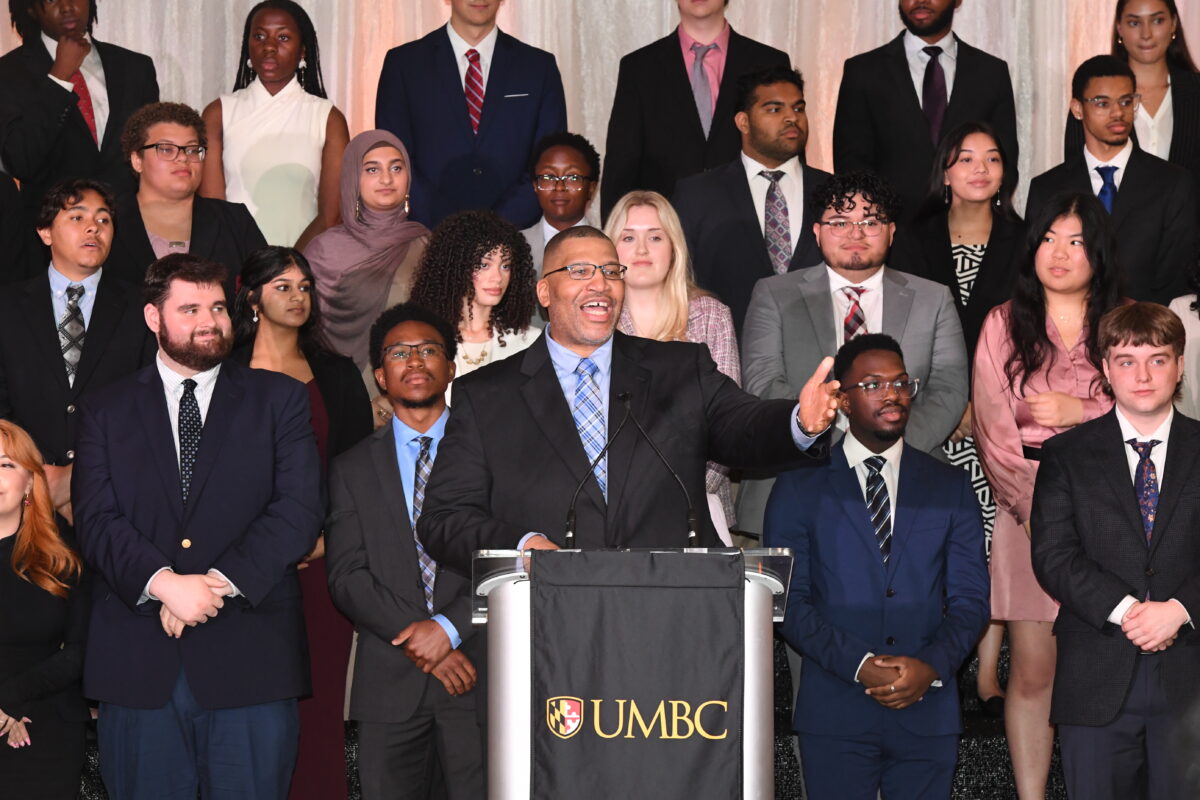 Keith Harmon, director of the Meyerhoff Scholars Program, celebrates graduating scholars at the 2024 Meyerhoff Senior Reception. (Jim Burger for UMBC)
Joseph Washington ’97, mechanical engineering, a member of the fourth Meyerhoff cohort (M4), embodies this trajectory. A first-generation college student, he initially considered trade school after a knee injury derailed his plans to attend the U.S. Naval Academy. The Meyerhoff scholarship changed his path. In particular, Selection Weekend for admitted Meyerhoff Scholars and Summer Bridge, intensive group programming prior to the scholars’ first UMBC semester, affirmed his identity and potential: “The most important message I internalized from the Meyerhoff program was that I can be Black and intelligent,” he recalls.
Washington earned a master’s degree before returning to UMBC for his Ph.D. Today, he serves as an assistant teaching professor at UMBC at the Universities at Shady Grove. He mentors students informally, advises the UMBC chapter of the American Institute of Aeronautics and Astronautics, and creates space for Meyerhoff Scholars to discuss graduate school and careers. “UMBC has always felt like home,” he says. “I would not be here if not for the Meyerhoff Scholars Program.”
A family tradition
Sadella Santos ’12, chemical engineering, M20, and her sister Melissa Santos ’12, chemical engineering, M19, also credit the program with shaping their journeys. Sadella, a senior scientist at Exponent, Inc. with a Ph.D. in chemical engineering, values the emphasis on community. “Academic success is a collective effort, rather than individual competition,” she says. “At work, I champion the message that diverse perspectives are necessary to drive scientific progress.” She pays it forward by reviewing abstracts for the Annual Biomedical Research Conference for Minoritized Scientists (ABRCMS) and hosting lab visits to expose high school students to possible careers.
 Meyerhoff Scholar alumni gathered at the 2022 Meyerhoff Family Meeting. (Marlayna Demond ’11/UMBC)
Melissa, who earned a Ph.D. in chemical engineering followed by a J.D., applies problem-solving and adaptability skills honed through Meyerhoff to her legal career. She recently participated in a panel for McNair Scholars on summer research experiences. “Community and network are important,” she notes. “Surround yourself with people who will support you but also challenge you to grow.”
Meyerhoff scholars often refer to themselves as family—and that’s especially true for the Santoses. Justin Santos ’17, biochemistry and molecular biology, M25, is the third scholar in the family. He is completing his M.D./Ph.D. in neuroscience at Emory University this spring and will begin residency in emergency medicine at Washington University in St. Louis. He mentors students pursuing clinical-scientist careers and assists with ABRCMS abstract reviews. “High-quality, comprehensive mentorship” was invaluable to him, and he works to provide that same guidance to others.
Reaching back to pay it forward
Naomi Mburu ’18, M26, chemical engineering, was UMBC’s first Rhodes Scholar, attending Oxford University on one of the world’s oldest and most prestigious scholarships. She earned a D.Phil. in engineering science from the University of Oxford and today serves as lead analyst at Fusion Advisory Services, providing analysis of the fusion industry to a wide range of stakeholders. Meyerhoff pushed her beyond her comfort zone into leadership roles and strengthened her public speaking and networking skills, she says. She now reviews scholarship essays for UMBC students and organizes summer internships to bring diverse talent into the fusion energy field. “Supporting the next generation is so important,” she says. “I have only come this far myself with the help of my own mentors.”
 From left to right, UMBC sophomore Amir Walton-Irvin, and juniors Jessica Slaughter, Deeya Mistry, and Phoenix Bryant all received a Goldwater Scholarship this year—and all four are Meyerhoff Scholars. (Brad Ziegler/UMBC)
These alumni illustrate the program’s lasting influence. Meyerhoff Scholars do not simply succeed—they reach back, creating opportunities and building communities for current students and early-career researchers. The model’s impact now extends even further: universities including Penn State, UNC-Chapel Hill, UC Berkeley, Stony Brook, and others have adapted key elements of the Meyerhoff approach with support from funders such as the Chan Zuckerberg Initiative and Simons Foundation. The Howard Hughes Medical Institutehas also been a long-term supporter of Meyerhoff and its replications.
With more than 2,200 undergraduates supported to date and a national reputation for producing leaders committed to diversity in STEM, the 500th Ph.D. stands as compelling proof of the Meyerhoff model’s effectiveness. As alumni advance in their fields and invest in those who follow, the Meyerhoff Scholars Program continues to change lives one by one, transforming the face of American science through excellence, community, and a powerful ripple effect that will benefit generations to come.
]]>
This spring, the Meyerhoff Scholars Program at UMBC celebrates a landmark achievement: 500 program graduates have earned a Ph.D. The milestone highlights the program’s success as the nation’s...
https://umbc.edu/stories/meyerhoff-scholars-program-celebrates-500th-ph-d/
https://my3.my.umbc.edu/api/v0/pixel/news/159662/guest@my.umbc.edu/842d203280497d3bf9ff4f93dcf9ec8f/api/pixel
alumni
biochemistry-and-molecular-biology
chemical-biochemical-and-environmental-engineering
chemical-engineering
chemistry-and-biochemistry
class-of-2026
cnms
coeit
community
mechanical-engineering
meche
meyerhoff-scholars
news
science-and-tech
story
UMBC News & Magazine
https://my3.my.umbc.edu/groups/umbc-news-magazine
https://assets1-my.umbc.edu/system/shared/avatars/groups/000/001/943/24435aa6207c452e7bc15cc74b42c7bb/xsmall.png?1748556657
https://assets1-my.umbc.edu/system/shared/avatars/groups/000/001/943/24435aa6207c452e7bc15cc74b42c7bb/original.png?1748556657
https://assets2-my.umbc.edu/system/shared/avatars/groups/000/001/943/24435aa6207c452e7bc15cc74b42c7bb/xxlarge.png?1748556657
https://assets2-my.umbc.edu/system/shared/avatars/groups/000/001/943/24435aa6207c452e7bc15cc74b42c7bb/xlarge.png?1748556657
https://assets3-my.umbc.edu/system/shared/avatars/groups/000/001/943/24435aa6207c452e7bc15cc74b42c7bb/large.png?1748556657
https://assets1-my.umbc.edu/system/shared/avatars/groups/000/001/943/24435aa6207c452e7bc15cc74b42c7bb/medium.png?1748556657
https://assets2-my.umbc.edu/system/shared/avatars/groups/000/001/943/24435aa6207c452e7bc15cc74b42c7bb/small.png?1748556657
https://assets1-my.umbc.edu/system/shared/avatars/groups/000/001/943/24435aa6207c452e7bc15cc74b42c7bb/xsmall.png?1748556657
https://assets2-my.umbc.edu/system/shared/avatars/groups/000/001/943/24435aa6207c452e7bc15cc74b42c7bb/xxsmall.png?1748556657
UMBC News & Magazine
0
0
false
Mon, 04 May 2026 15:15:30 -0400
Mon, 04 May 2026 15:15:30 -0400