UMBC’s Jason Schiffman and his YouthFIRST lab advance early identification and treatment of psychosis
UMBC’s Jason Schiffman and his team conduct research on the screening, assessment, and treatment of young people experiencing psychosis. He has recently been awarded two prestigious grants from the National Institute of Mental Health (NIMH) and one from the Substance Abuse and Mental Health Services Administration (SAMHSA) to train clinicians that serve this vulnerable population on how to detect psychosis early, and to offer clinical services to youth in need, dramatically extending the impact of his work nationwide.
Reports by SAMHSA, the Centers for Disease Control and Prevention (CDC), and the U.S. Department of Justice show that one in five adults and one in six youth ages 6-17 experience mental health issues each year. Many of these people experience serious disorders associated with psychosis, which can significantly impact quality of life. Schiffman, psychology professor and director of clinical training, is relentlessly working to change this narrative.
 Schiffman.
Schiffman and his YouthFIRST lab focus on the early identification of young people suffering from disorders associated with psychosis, such as schizophrenia, schizoaffective disorder, major depressive disorder with psychotic features, and bipolar disorder with psychotic features. Further, he is dedicated to addressing concerns about mental health disparities impacting marginalized communities by studying the validity of screening approaches across diverse populations and communities. Schiffman also incorporates his biological approach to understanding early signs of psychosis by using fMRI to measure brain activity, highlighted in a 2017 UMBC Magazine feature.
For Schiffman, research “translating basic science to real-world applications” and “bringing clarity to the nature and identification of poorly misunderstood mental illnesses” goes hand in hand with his work to reduce stigma and ameliorate suffering “through the lens of prevention science.”
A multi-layered approach
Schiffman is one of only three national trainers on the Structured Interview for Psychosis-Risk Syndromes (SIPS), the “gold standard interview” for identifying people at risk for psychosis. He has trained research and clinical teams in cities in Maryland, Texas, Illinois, Virginia, Pennsylvania, and Tennessee on how to use this tool. His trainings have helped psychologists, social workers, and psychiatrists more effectively identify and monitor people at risk for psychosis.
He has been working for years in Maryland to expand the reach of early intervention services. Now, he says, “I am sharing best practices and lessons learned with other mental health professionals across the globe who also provide therapy and services to the people most at risk.”

Schiffman with YouthFirst lab.His team is one of twenty-two partners on a $1.6 million SAMHSA grant that provides services for people who are at risk of psychosis. Most of the twenty-two Clinical High Risk for Psychosis (CHiRP) teams are state and private providers. Just a few are academic institutions, including UMBC and Yale University. Schiffman’s CHiRP grant will provide much-needed mental health services to scores of young people in Maryland using a needs-based approach.
“The biggest calling for me is that these disorders are potentially devastating to young people who struggle with them, as well as to their families. They can suffer immensely, lose everything, and disconnect from society if they don’t receive the appropriate help,” explains Schiffman. “I am most interested in social and psychological therapies that can be implemented early on in an effort to limit the impact of emerging psychosis.”
Expanding community reach
Schiffman and his team are also part of a National Institute of Mental Health (NIMH) multi-state grant with Northwestern University and Temple University. The grant funds mental health screening and identification of people in the general population experiencing symptoms related to psychosis. This $2.25 million project expands the target population from the clinical setting to the community.
In addition, NIMH awarded Schiffman a grant to develop an online training and continuing education platform to teach social workers about reducing the duration of untreated psychosis. The three-hour program has been used to train over 1,200 social workers in Maryland. This training helped to increase the number of referrals to the Maryland Early Intervention Program, a collaboration between Schiffman’s team and his colleagues from the University of Maryland School of Medicine.
 Schiffman with YouthFirst lab.
A team focused on prevention
This multi-layered process is the work of many people. Schiffman is quick to highlight that he surrounds himself with dedicated and insightful collaborators. He is proud to have a team of undergraduate and graduate students, a postdoctoral research associate, and staff who help to implement each level of the project.
Dawn Bunch ‘22, psychology, began her position as an undergraduate research assistant in Schiffman’s lab because she was looking to get involved in research impacting mental healthcare. “It’s been an extremely valuable and inspirational learning experience for me,” explains Bunch. “Working in this lab taught me so much about psychological assessment and the research process, which is very important to me since I plan to do both clinical and research work in my career.”
In addition to gaining knowledge about the psychosis risk field, Bunch and the other YouthFIRST undergraduate research assistants contribute to the lab’s mission by entering data, performing data quality checks, and preparing for study visits.
Combating stigma
Schiffman is also dedicated to supporting a positive campus culture around mental health. He is the faculty advisor for the student chapter of the UMBC National Alliance on Mental Illness (NAMI). Each year, with the support of UMBC’s NAMI group, Schiffman holds a panel discussion during Mental Health Awareness Week, where students share their stories of dealing with mental health challenges and successes.
The YouthFIRST lab also created a mental health awareness video with students sharing their stories. In addition to increasing awareness, two doctoral students found that students in distress who watch this video are more likely to seek support at the UMBC Counseling Center.
In all this work, Schiffman and his team are driven by a singular focus: intervening early to help young people suffering from psychosis. And the stakes are high. “On average, life expectancy for someone with schizophrenia is twenty years less than someone without schizophrenia,” says Schiffman. “We are changing the paradigm by moving away from institutionalization and incarceration, and towards prevention—enabling people with psychosis a chance to live a life of their choosing in the community and the opportunity to reach towards their highest potential.”
Banner image: Schiffman with YouthFirst lab.
All images by Marlayna Demond ’11.
]]>
UMBC’s Jason Schiffman and his team conduct research on the screening, assessment, and treatment of young people experiencing psychosis. He has recently been awarded two prestigious grants from...
https://umbc.edu/stories/umbcs-jason-schiffman-and-his-youthfirst-lab-advance-early-identification-and-treatment-of-psychosis/
https://my3.my.umbc.edu/api/v0/pixel/news/119987/guest@my.umbc.edu/9e6e11aaa18c528ddf6297752d5abda4/api/pixel
cahss
cs3
policy-and-society
psychology
UMBC News & Magazine
https://my3.my.umbc.edu/groups/umbc-news-magazine
https://assets1-my.umbc.edu/system/shared/avatars/groups/000/001/943/24435aa6207c452e7bc15cc74b42c7bb/xsmall.png?1748556657
https://assets1-my.umbc.edu/system/shared/avatars/groups/000/001/943/24435aa6207c452e7bc15cc74b42c7bb/original.png?1748556657
https://assets2-my.umbc.edu/system/shared/avatars/groups/000/001/943/24435aa6207c452e7bc15cc74b42c7bb/xxlarge.png?1748556657
https://assets2-my.umbc.edu/system/shared/avatars/groups/000/001/943/24435aa6207c452e7bc15cc74b42c7bb/xlarge.png?1748556657
https://assets3-my.umbc.edu/system/shared/avatars/groups/000/001/943/24435aa6207c452e7bc15cc74b42c7bb/large.png?1748556657
https://assets1-my.umbc.edu/system/shared/avatars/groups/000/001/943/24435aa6207c452e7bc15cc74b42c7bb/medium.png?1748556657
https://assets2-my.umbc.edu/system/shared/avatars/groups/000/001/943/24435aa6207c452e7bc15cc74b42c7bb/small.png?1748556657
https://assets1-my.umbc.edu/system/shared/avatars/groups/000/001/943/24435aa6207c452e7bc15cc74b42c7bb/xsmall.png?1748556657
https://assets2-my.umbc.edu/system/shared/avatars/groups/000/001/943/24435aa6207c452e7bc15cc74b42c7bb/xxsmall.png?1748556657
UMBC News & Magazine
0
0
false
Tue, 17 Dec 2019 17:10:05 -0500
UMBC welcomes European Union ambassadors to the U.S.
Ambassadors from the European countries of Slovenia, Estonia, and the Czech Republic convened at UMBC this month as part of the first joint European Union (E.U.) State outreach trip outside of Washington, D.C. Delegations from over twenty E.U. member states participated in the day of engagement with Maryland state and local officials, students, educators, and environmental and trade organizations.
The visit’s aim was to showcase and further strengthen the close cultural and commercial ties between Maryland and European Union member states. The E.U. is Maryland’s biggest source of foreign direct investment. Over 100,000 jobs in Maryland have been created due to trade with and investment from European Union member states.
The three leaders who visited UMBC participated in a panel at the Albin O. Kuhn Library, moderated by Brian Grodsky, professor and associate chair of political science. They included Stanislav Vidovič, ambassador of Slovenia to the United States; Jonatan Vseviov, ambassador of Estonia to the United States; and Hynek Kmoníček, ambassador of the Czech Republic to the United States. In addition to discussing economic and policy matters, the leaders answered questions from students, staff, and faculty.
“We find it very practical out of Washington D.C., out of the diplomatic bubble, to meet the real people living in the States because you can get a refreshing perspective on the issues, where Washington D.C. is in the trenches of the party discussion. This allows us to get closer to the real voice of the real United States,” shared Kmoníček.
 UMBC students, faculty, and staff listen to the ambassadors as they discuss current affairs of their nations.
During the discussion session, Ukrainian student Danylo Leschchyshyn ‘22, history and political science, a Humanities Scholar and member of the Honors College, asked the visiting ambassadors about the hope of eliminating corruption in his homeland. The panel responded by discussing the importance of combating corruption as a means of upholding democracy through diplomacy and the rule of law.
“If you cannot handle corruption effectively, you will not only be unable to build a free society, but you will lose your freedom. The aim of corruption is to undermine the feasibility, the success of our societies. Our system of governance cannot coexist with corruption that is out of control,” explained Vseviov.
He continued, “Ukraine’s challenge is not only about how it handles the war in the east. Ukraine’s challenge is also the battle that is taking place in the hearts and minds of every Ukrainian. That battle is a battle of corruption and whether Ukrainians believe they have managed to take their country back not only from foreign interventions but also from their own corrupt businessmen.”
 Ambassadors fielding questions from audience.
Romy Hübler, assistant director of UMBC’s Center for Democracy and Civic Life, shared her experience growing up in East Germany before the fall of the Berlin Wall. She asked the guests about how older adults in post-Soviet regions are experiencing democracy today in ways different from the theoretical democracy they imagined during the Cold War. Hübler found the ambassadors’ descriptions of life during the Cold War—without democracy, and with human rights abuses and limited freedom—to be familiar.
“I have never had the opportunity to hear firsthand from representatives of Eastern European countries about their experiences and their thinking about their country’s path toward democracy as well as challenges that still persist,” explains Hübler. “I believe that we have much to learn from one another about those pathways, not only in Eastern Europe but also in the United States, including how people who live in these countries feel empowered or disempowered to participate fully and shape their futures.”
Banner image: (Front row, L to R) Ambassador Hynek Kmoníček; Ambassador Stanislav Vidovič; Ambassador Jonatan Vseviov; Carolyn Forestiere, associate professor and chair of political science. (Back row, L to R) Member of the E.U. delegation; David Di Maria, associate vice provost for international education; Irina Golubeva, associate professor of intercultural communication; and Brian Grodsky, professor of political science. All images by Marlayna Demond ’11.
]]>
Ambassadors from the European countries of Slovenia, Estonia, and the Czech Republic convened at UMBC this month as part of the first joint European Union (E.U.) State outreach trip outside of...
https://umbc.edu/stories/umbc-welcomes-european-union-ambassadors-to-the-u-s/
https://my3.my.umbc.edu/api/v0/pixel/news/119993/guest@my.umbc.edu/a2f5849aa2108e6751219e506c51b892/api/pixel
cahss
cs3
policy-and-society
political-science
public-policy
UMBC News & Magazine
https://my3.my.umbc.edu/groups/umbc-news-magazine
https://assets1-my.umbc.edu/system/shared/avatars/groups/000/001/943/24435aa6207c452e7bc15cc74b42c7bb/xsmall.png?1748556657
https://assets1-my.umbc.edu/system/shared/avatars/groups/000/001/943/24435aa6207c452e7bc15cc74b42c7bb/original.png?1748556657
https://assets2-my.umbc.edu/system/shared/avatars/groups/000/001/943/24435aa6207c452e7bc15cc74b42c7bb/xxlarge.png?1748556657
https://assets2-my.umbc.edu/system/shared/avatars/groups/000/001/943/24435aa6207c452e7bc15cc74b42c7bb/xlarge.png?1748556657
https://assets3-my.umbc.edu/system/shared/avatars/groups/000/001/943/24435aa6207c452e7bc15cc74b42c7bb/large.png?1748556657
https://assets1-my.umbc.edu/system/shared/avatars/groups/000/001/943/24435aa6207c452e7bc15cc74b42c7bb/medium.png?1748556657
https://assets2-my.umbc.edu/system/shared/avatars/groups/000/001/943/24435aa6207c452e7bc15cc74b42c7bb/small.png?1748556657
https://assets1-my.umbc.edu/system/shared/avatars/groups/000/001/943/24435aa6207c452e7bc15cc74b42c7bb/xsmall.png?1748556657
https://assets2-my.umbc.edu/system/shared/avatars/groups/000/001/943/24435aa6207c452e7bc15cc74b42c7bb/xxsmall.png?1748556657
UMBC News & Magazine
0
0
false
Thu, 12 Dec 2019 21:34:38 -0500
UMBC convenes research forum on immigration and mobility in higher education
In the late spring, the UMBC Center for Social Science Scholarship (CS3) convened researchers for the 2019 Research Forum: Immigration and Mobility in Higher Education. The event was the fifth in a UMBC research forum series that highlights original research and interdisciplinary discussions about pressing national and international issues. Christine Mallinson, director of CS3, co-hosted the event with Karl Steiner, vice president for research, to spotlight UMBC’s immigration research and to enable new collaborations.
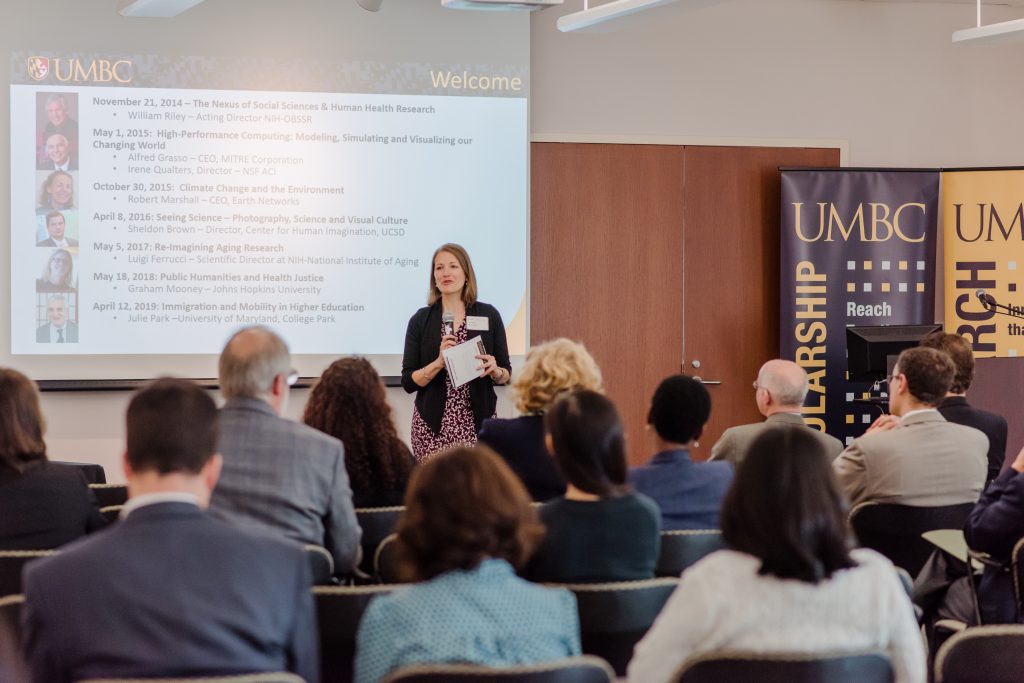 Mallinson welcoming forum attendees.
Through the forum, Mallinson aimed to create a space for discussion and brainstorming for both students and faculty. “This critically relevant forum creates new collaborations and research that can change conversations about the effect immigration has on education, economics, workforce, and policy,” she explained.
Panelists and attendees included UMBC faculty, staff, and students from the College of Arts, Humanities, and Social Sciences (CAHSS), College of Engineering and Information Technology (COEIT), and College of Natural and Mathematical Sciences (CNMS), as well as the Office of International Education Services.
Julie Park, associate professor of sociology and director of Asian American studies at the University of Maryland, College Park, delivered the event’s keynote address. Park spoke to the changing demographics and intergenerational mobility of new immigrants who are working to attain secondary and postsecondary degrees.
Trauma-informed services
The first panel, “Borders of Opportunity: Migration, Education, and Mobility and Immigration Policies,” focused on global education, the social welfare of immigrants in the U.S., and the information-seeking behavior of highly educated immigrants.
In this panel, Jayshree Jani, associate professor of social work, shared research on the burdens that undocumented students carry. Daunting situations such as being separated from their parents, having a parent incarcerated, and being unable to access social services cause long-term trauma for children, even years after reunification or receiving support services. “When someone is undocumented and living in fear, it is really hard for them to have a stable life,” explained Jani.
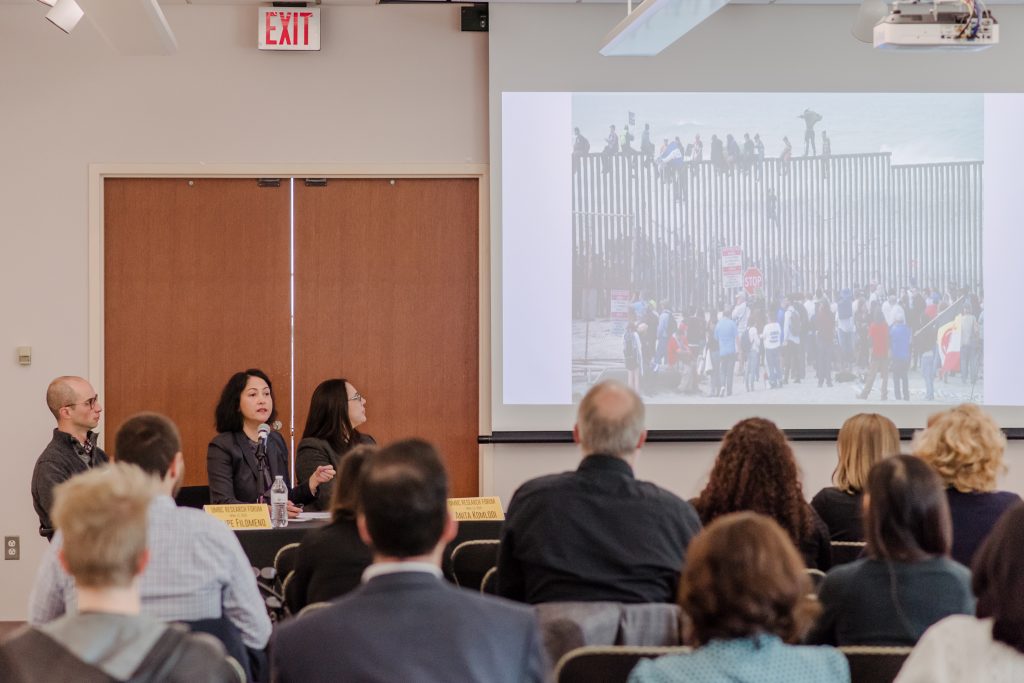 Jani, center, discussing immigrant family separations.
Her research showed how visible and invisible consequences of trauma currently overwhelm local schools, communities, and law enforcement. She described a significant need for training in how to provide trauma-informed services, and noted that this gap has had major negative impacts.
Jani’s call to action was to inspire her colleagues and future providers to conduct more research. “In order to support trauma-informed services in schools,” she argued, “universities need to encourage research on this population and prepare future professionals to create, expand, and provide services.”
International student perspective
Awareness of and access to services is a hurdle that undocumented and documented immigrants, as well as international students and faculty, must navigate. Doctoral student Wajanat Rayes, information systems, attended the forum, bringing to the event her perspective as both an international student and a researcher.
Rayes investigates the role that information networks play in the lives of international students. She specifically focuses on the transition to the U.S. of highly skilled Saudi Arabian international students who are also mothers. “I like how information can empower people and mitigate the challenges we have day today,” she says.
“I am a faculty member at a university in Saudi Arabia and a mother,” Rayes shares. “I have had a lot of challenges in my transition to studying in the U.S. I hope my research will help other mothers navigate the system in the future.”
Immigration and higher education
The second panel examined “Immigration Policies and Politics: Local, National, and International Impact.” Four UMBC faculty presented the latest research about higher education policies and their effects on immigrant and international students. They also discussed the current landscape of international research exchange in higher education and the role of higher education associations in immigration policy debates.
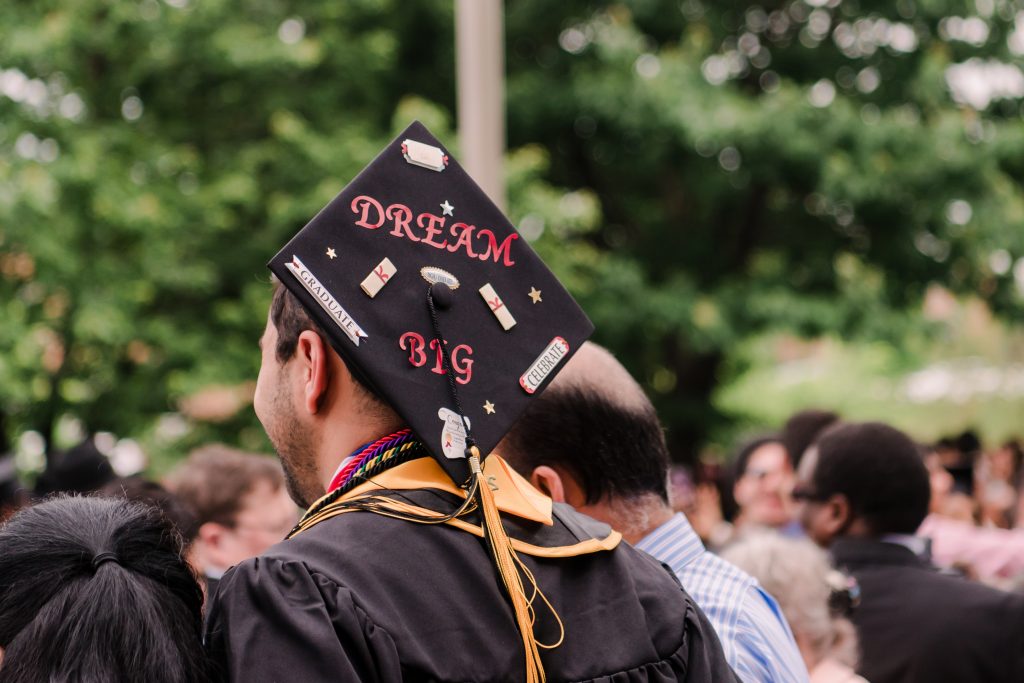 Mortarboard from commencement 2018.
In this session, UMBC researchers Tim Gindling, professor of economics, and Lisa Dickson, associate professor of economics, focused on access to higher education for undocumented youth. Their ongoing research covers the cost-benefit analysis of policies that determine the price of higher education for undocumented students—access to-state resident tuition and additional financial aid. They also examine the impact of the national Deferred Action for Childhood Arrivals (DACA) policy on students’ enrollment, graduation, and persistence in higher education.
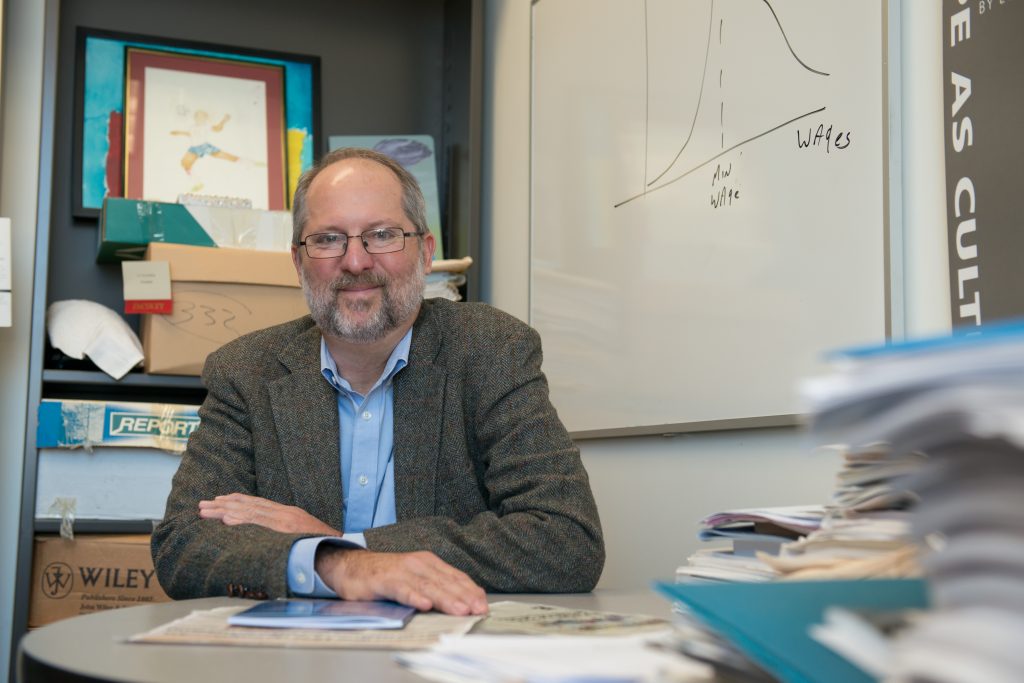 Gindling in his office.
“The takeaway, however we looked at the data, was that the benefits were greater than the costs,” explained Gindling. The research results showed that for each undocumented student who graduates from a four-year college, who would not have gone otherwise, the net benefits to the state were $350,000.
“Providing access to higher education and financial aid to undocumented youth is a good investment for the individual, for the state, and for the government as a whole,” said Gindling.
The power of listening
After participants and audience members listened to the panelists they were given an opportunity to share different perspectives on these issues through microtalk roundtables. Groups joined sessions on law and policy, transnational migration, and higher education.
One discussion centered around what a stronger, more positive relationship between immigrants and the United States would look like. Immigrants who are able to access higher education and financial aid are more likely to move into the white-collar workforce. Entering the professional workforce means immigrants also earn more and pay higher taxes. Greater earning power opens opportunities to buy property, start businesses, and contribute to a thriving state and national economy.
“It is important to listen to the array of immigrant experiences,” explained Ruth Temesgen ‘19, sociology, who attended the event as part of her Immigration and Refugee Law class. Her parents were highly skilled government employees in Ethiopia who left during the country’s civil war. Their credentials did not transfer in the United States. They could only access service-level jobs.
Seeing how much her parents and other immigrants have struggled inspired Temesgen to pursue a path to law school. “Reaching beyond our comfort zones to understand how global events impact people at a personal, economic, educational, and mental health level can change what is now an isolating experience to a welcoming and prosperous partnership.”
To learn about future CS3 events, join the conversation on Twitter at @UMBCSocSci.
Banner image: (L to R): Steiner, Mallinson, Don Engel, assistant vice president for research, and Casper. All images by Marlayna Demond ’11 for UMBC.
]]>
In the late spring, the UMBC Center for Social Science Scholarship (CS3) convened researchers for the 2019 Research Forum: Immigration and Mobility in Higher Education. The event was the fifth in...
https://umbc.edu/stories/umbc-convenes-research-forum-on-immigration-and-mobility-in-higher-education/
https://my3.my.umbc.edu/api/v0/pixel/news/120094/guest@my.umbc.edu/787f550c2fff505b69a78035bec4f012/api/pixel
cahss
cnms
coeit
cs3
economics
interdisciplinary
international
policy-and-society
politicalscience
research
sociology
UMBC News & Magazine
https://my3.my.umbc.edu/groups/umbc-news-magazine
https://assets1-my.umbc.edu/system/shared/avatars/groups/000/001/943/24435aa6207c452e7bc15cc74b42c7bb/xsmall.png?1748556657
https://assets1-my.umbc.edu/system/shared/avatars/groups/000/001/943/24435aa6207c452e7bc15cc74b42c7bb/original.png?1748556657
https://assets2-my.umbc.edu/system/shared/avatars/groups/000/001/943/24435aa6207c452e7bc15cc74b42c7bb/xxlarge.png?1748556657
https://assets2-my.umbc.edu/system/shared/avatars/groups/000/001/943/24435aa6207c452e7bc15cc74b42c7bb/xlarge.png?1748556657
https://assets3-my.umbc.edu/system/shared/avatars/groups/000/001/943/24435aa6207c452e7bc15cc74b42c7bb/large.png?1748556657
https://assets1-my.umbc.edu/system/shared/avatars/groups/000/001/943/24435aa6207c452e7bc15cc74b42c7bb/medium.png?1748556657
https://assets2-my.umbc.edu/system/shared/avatars/groups/000/001/943/24435aa6207c452e7bc15cc74b42c7bb/small.png?1748556657
https://assets1-my.umbc.edu/system/shared/avatars/groups/000/001/943/24435aa6207c452e7bc15cc74b42c7bb/xsmall.png?1748556657
https://assets2-my.umbc.edu/system/shared/avatars/groups/000/001/943/24435aa6207c452e7bc15cc74b42c7bb/xxsmall.png?1748556657
UMBC News & Magazine
0
0
false
Tue, 25 Jun 2019 15:07:42 -0400
CS3 leads research summit on community-based violence prevention in Baltimore
Lauren and Vibha sit in a conference room deep in the middle of the University of Maryland School of Medicine. They wait patiently as faculty and staff from UMBC; the University of Maryland, Baltimore (UMB); the University of Maryland, College Park; Baltimore City government officials; and staff from Baltimore-based non-profit organizations fill the round tables.
This is the Research Summit on Violence Prevention and Community Engagement hosted by UMBC and UMB. In a room of about fifty attendees ready to discuss the impact of violence prevention efforts in Baltimore, Lauren and Vibha look at each other, knowing they bring a different voice. Both recent UMBC alumni and graduate presidential fellows at UMB, they are here to speak as young Baltimore researchers, who care deeply about their communities and want to be involved in the research aimed at making their city safer.
 UMB graduate students discuss violence prevention in Baltimore with UMBC’s Lauren Edwards, public policy (right). Photo by Marlayna Demond ’11 for UMBC.
“I am the community”
Lauren Highsmith ‘15, education, introduces herself to the room after a conversation about the need to work with the community. “I am the community. Please remember me,” she says. “I am a master’s student in social work at the University of Maryland, Baltimore. I was born in West Baltimore and continue to live in the area. Don’t assume the community is just what you see on television. The community are also people like me who are working in the field and doing research.”
Vibha Rao ‘14, biological sciences, M22, claps after her friend’s statement. She is from Gaithersburg, Maryland, but lives, studies, and works in Baltimore. In the last decade, she has earned her undergraduate degree and a medical degree from the University of Maryland School of Medicine, and she is currently pursuing an M.S. in clinical research.
Rao has been deeply affected by the experiences of her undergraduate and graduate peers from Baltimore whose family members have been killed by gun violence. “Their experience having grown up and gone to college and medical school in Baltimore is starkly different than students outside of Baltimore,” she says. She worries about the normalization of gun violence and wants to be part of research to address it from a medical perspective. She shares, “I don’t want violence to be normal anymore.”
Human- and community-centered research
The research summit was organized by Christine Mallinson, director of UMBC’s Center for Social Science Scholarship (CS3) and professor of Language, Literacy, and Culture, and Kate Tracy ‘03 Ph.D. and ‘01 M.A., psychology and human services, who is associate professor of epidemiology and public health and director of The Richard and Jane Sherman Center for Health Care Innovation at the University of Maryland, Baltimore. As one focus for the day’s work, Mallinson and Tracy asked participants to explore both immediate and long-term supports for communities served through the UMB Community Engagement Center. During the breakout sessions, they asked attendees to identify how they might engage more undergraduate and graduate students from Baltimore, like Highsmith and Rao, in community-facing research on violence prevention.
 Mallinson (l) and Tracy (r) address the purpose of the summit. Photo courtesy of UMB.
“We wanted to purposefully use this summit to convene as many researchers as possible to examine, discuss, and share expertise and data,” Mallinson says. “Our intent is increasing collaboration and resources beyond this room, between institutions and the community, to create tangible, applicable and responsive human- and community-centered research in violence prevention with and for Baltimore.”
During the day-long event, UMBC faculty and staff representing the School of Public Policy, media and communication studies, visual arts, The Hilltop Institute, The Shriver Center, Division of Student Affairs, emergency health services, and psychology gathered for group discussion in different areas of violence prevention research. They met as cohorts focused on data, community involvement, K-12 and higher education, clinical interventions, and the intersection of the correctional and health systems.
Responding to the call from the morning discussion, the groups developed ideas for how to support the UMB Community Engagement Center through each of their focus areas, particularly building on existing work by community members. They also identified a timeline to continue the cohort work beyond the conference.
 UMBC President Freeman Hrabowski (l) speaks to summit participants. Photo courtesy of UMB.
“Collaboration between academic and community partners is key for successful violence prevention research, and developing the next generation of innovators by harnessing the talents of our undergraduate and graduate students in this process is essential,” shared Lucy Wilson, M.D., graduate program director of emergency health services at UMBC.
After the summit, the participants walked through two thought-provoking exhibitions, David Hess’s “Gun Show,” with life-size sculptures of assault rifles made from ordinary objects, and a photo series of homicide locations in Baltimore City by Amy Berbert’s ’17, visual arts. Both artists created the pieces to foster dialogue and awareness about guns and violence.
 Highsmith and Berbert discussing the photo exhibit. Photo by Marlayna Demond ’11, for UMBC.
As everyone spoke with the artists, and with each other, reflecting on the day, Mallinson took this opportunity to connect with Lauren Highsmith and Vibha Rao. She wanted to hear their perspectives, and their advice, on how to engage and include more undergraduate and graduate students from Baltimore in violence prevention work, to ensure it tackles the most pressing issues, recognizes community work already underway, and can have a lasting impact.
Banner image: Event organizer Christine Mallinson (r) speaks with summit participants. Photo by Marlayna Demond ’11 for UMBC.
]]>
Lauren and Vibha sit in a conference room deep in the middle of the University of Maryland School of Medicine. They wait patiently as faculty and staff from UMBC; the University of Maryland,...
https://umbc.edu/stories/cs3-leads-research-summit-on-community-based-violence-prevention-in-baltimore/
https://my3.my.umbc.edu/api/v0/pixel/news/120250/guest@my.umbc.edu/0c1a83adcf2fb9ee8ac4430723901b48/api/pixel
cahss
cec
cirsca
cs3
ehs
hilltopinstitute
mcs
policy-and-society
psychology
publicpolicy
shrivercenter
strategic-planning
visualarts
UMBC News & Magazine
https://my3.my.umbc.edu/groups/umbc-news-magazine
https://assets1-my.umbc.edu/system/shared/avatars/groups/000/001/943/24435aa6207c452e7bc15cc74b42c7bb/xsmall.png?1748556657
https://assets1-my.umbc.edu/system/shared/avatars/groups/000/001/943/24435aa6207c452e7bc15cc74b42c7bb/original.png?1748556657
https://assets2-my.umbc.edu/system/shared/avatars/groups/000/001/943/24435aa6207c452e7bc15cc74b42c7bb/xxlarge.png?1748556657
https://assets2-my.umbc.edu/system/shared/avatars/groups/000/001/943/24435aa6207c452e7bc15cc74b42c7bb/xlarge.png?1748556657
https://assets3-my.umbc.edu/system/shared/avatars/groups/000/001/943/24435aa6207c452e7bc15cc74b42c7bb/large.png?1748556657
https://assets1-my.umbc.edu/system/shared/avatars/groups/000/001/943/24435aa6207c452e7bc15cc74b42c7bb/medium.png?1748556657
https://assets2-my.umbc.edu/system/shared/avatars/groups/000/001/943/24435aa6207c452e7bc15cc74b42c7bb/small.png?1748556657
https://assets1-my.umbc.edu/system/shared/avatars/groups/000/001/943/24435aa6207c452e7bc15cc74b42c7bb/xsmall.png?1748556657
https://assets2-my.umbc.edu/system/shared/avatars/groups/000/001/943/24435aa6207c452e7bc15cc74b42c7bb/xxsmall.png?1748556657
UMBC News & Magazine
0
0
false
Fri, 14 Dec 2018 18:56:55 -0500
New Fulbright Accelerator connects CAHSS faculty with international opportunities

“My Fulbright experience changed the course of my life and my career,” remembers Eugene C. Schaffer, professor of education.
Early in his career, Shaffer earned a Fulbright Scholar award to bring his knowledge of curriculum development and teaching practices to a collaboration with Taiwanese educators for two years. “There is always so much to learn and understand about history and how different cultures work together to hope for peace,” he says. “My work in Taiwan helped me to see the need for sharing research on innovative and effective curriculum practices globally.” Shaffer went on to travel the world and lived and worked with educators in the UK and Japan. Recently, he earned another Fulbright to work with educators in Kosovo. “The most salient takeaway of my Fulbright experiences is how much the cultures and the people gave to me. I am a better teacher and a better person for trying to understand another cultural form,” shares Shaffer.
UMBC’s College of Arts, Humanities, and Social Sciences (CAHSS) is working to connect more faculty with Fulbright opportunities, particularly given CAHSS faculty’s long and successful history of transformative international research and teaching. UMBC faculty have already completed Fulbrights on every continent except Antarctica, and there’s great interest in expanding their international work even further.
“We have had tremendous success with the Fulbright U.S. Student Program,” says Brian Souders, Ph.D. ’09, language literacy, and culture, and Fulbright Program advisor. “We hope that by promoting this opportunity with CAHSS faculty, we can encourage similar success with faculty awards.”
UMBC’s Office of International Education; Center for Social Science Scholarship; Center for Innovation, Research and Creativity in the Arts (CIRCA); and Dresher Center for the Humanities are partnering with the Council of the International Exchange of Scholars (which sponsors the Fulbright Scholar Programs) to host the first CAHSS Fulbright Accelerator. All CAHSS faculty are invited to attend the session on Monday, November 5, at noon, in Performing Arts and Humanities Building room 216.
Through the Fulbright Accelerator, faculty will learn more about semester- and year-long fellowships, short-term research stays, teaching visits, and postdoctoral scholarships the Fulbright Program offers. Along with Schaffer, former CAHSS Fulbright Scholars across the arts, the humanities, and the social sciences will share their experiences.
Charissa Cheah, professor of psychology, just returned from her Fulbright experience in Italy this summer and will present at the Fulbright Accelerator. She worked with groups of Tunisian Muslim adolescents to try to understand how they and their families adapted to Italian culture. “The more I immersed myself in the community,” says Cheah, “the more questions I had about how these adolescents navigate their intersecting religious, ethnic, and national identities across family, school, community, particularly with the current socio-political climate in Italy.” She hopes these insights will help her gain some comparative insights with her work with Muslim adolescents in Maryland.
 Charissa Cheah in Italy at the 70th celebration of Fulbright Italy at The Ministry of Foreign Affairs and International Cooperation. Photo courtesy of Cheah.
John Stolle-McAllister, associate dean of CAHSS, will share his experience as a Fulbright Scholar in Ecuador researching indigenous identity. “I was able to bring my wife, my son, and daughter. By the end of our year we all were more fluent and part of the local community,” remembers Stolle-McAllister.
“The most profound part of my Fulbright experience was being open to letting go of assumptions and go deeper into my research in a way I could not have done at home,” Stolle-Mcallister says. “What I found were more complex questions and layered answers that helped me to gain a broader perspective.”
 John Stolle-McAllister in Ecuador with his English class from the Kayambi Confederation’s Free Study System. They asked him to march/dance with them in their Inti Raymi festival (Sun Festival celebrated on summer solstice). Photo courtesy of Stolle-McAllister.
Tim Nohe, professor of visual arts and director of CIRCA, will represent the visual arts Fulbright experience along with Eric Dyer, associate professor of animation and interactive media who will share his scholarship in Denmark. Nohe’s work engages with traditional and electronic media in public spaces and in daily life, and he has worked in close collaboration with artist colleagues in Australia. In one video produced in collaboration with composer Warren Burt and broadcast across Australia by the ABC Classic network, Nohe worked under the iconic Sydney Harbor Bridge:
Through international work, says Nohe, “Scholars transform their teaching and scope of experience and share that with UMBC faculty and students. The perspective and broad scope of references is truly invaluable, and we as scholars serve as ambassadors for our institutions abroad.”
Featured image: International flags in the UMBC Commons. Photo by Marlayna Demond ’11 for UMBC.
]]>
“My Fulbright experience changed the course of my life and my career,” remembers Eugene C. Schaffer, professor of education. Early in his career, Shaffer earned a Fulbright Scholar award to...
https://umbc.edu/stories/new-fulbright-accelerator-connects-cahss-faculty-with-international-opportunities/
https://my3.my.umbc.edu/api/v0/pixel/news/120287/guest@my.umbc.edu/b425ef54ff79f1527549c0056cb13568/api/pixel
arts-and-culture
cahss
circa
cs3
dreshercenter
international
policy-and-society
UMBC News & Magazine
https://my3.my.umbc.edu/groups/umbc-news-magazine
https://assets1-my.umbc.edu/system/shared/avatars/groups/000/001/943/24435aa6207c452e7bc15cc74b42c7bb/xsmall.png?1748556657
https://assets1-my.umbc.edu/system/shared/avatars/groups/000/001/943/24435aa6207c452e7bc15cc74b42c7bb/original.png?1748556657
https://assets2-my.umbc.edu/system/shared/avatars/groups/000/001/943/24435aa6207c452e7bc15cc74b42c7bb/xxlarge.png?1748556657
https://assets2-my.umbc.edu/system/shared/avatars/groups/000/001/943/24435aa6207c452e7bc15cc74b42c7bb/xlarge.png?1748556657
https://assets3-my.umbc.edu/system/shared/avatars/groups/000/001/943/24435aa6207c452e7bc15cc74b42c7bb/large.png?1748556657
https://assets1-my.umbc.edu/system/shared/avatars/groups/000/001/943/24435aa6207c452e7bc15cc74b42c7bb/medium.png?1748556657
https://assets2-my.umbc.edu/system/shared/avatars/groups/000/001/943/24435aa6207c452e7bc15cc74b42c7bb/small.png?1748556657
https://assets1-my.umbc.edu/system/shared/avatars/groups/000/001/943/24435aa6207c452e7bc15cc74b42c7bb/xsmall.png?1748556657
https://assets2-my.umbc.edu/system/shared/avatars/groups/000/001/943/24435aa6207c452e7bc15cc74b42c7bb/xxsmall.png?1748556657
UMBC News & Magazine
0
0
false
Fri, 02 Nov 2018 20:32:54 -0400
UMBC inaugurates new center to serve as hub for social science research

UMBC’s Center for Social Science Scholarship has opened its doors this fall with Christine Mallinson, professor of language, literacy and culture, as its inaugural director. The new center, which will promote faculty, student, and alumni research across multiple fields of study, is the result of many years of cultivating deep levels of scholarship on campus as well as collaboration and planning by the social science faculty.
“The Center for Social Science Scholarship answers a longstanding need at UMBC: to provide a hub, a connector, and a microphone for our extraordinary work on critical issues facing communities and societies today,” explains Scott Casper, dean of the College of Arts, Humanities, and Social Sciences (CAHSS).
The Center will emphasize areas of research such as civic and political participation, global patterns of labor and migration, educational access, the relationship between humans and the environment, human behavior and health equity across the lifespan, the social context of technology, and policy impact.
Mallinson, who joined UMBC in 2006, researches the context of and mechanisms involved in communication within major social institutions, including education, the workplace, and the legal system. By working with teachers, lawyers, and judges to better understand how perceptions cause bias, Mallinson’s has developed research-based strategies to remove inequalities and barriers.
 Christine Mallinson presents her research at the Labs@Light City, April 2018.
“Christine Mallinson’s innovative, collaborative scholarship has influenced academic debates, informed policy, and empowered communities. I look forward to her leadership on behalf of UMBC’s social science research community,” says Casper.
Through her interdisciplinary work in language, literacy, and culture, Mallinson said she has immersed herself in multiple campus partnerships and experienced first hand the extent of dynamic social science research happening across UMBC.
Banner image (l-r): Mejdulene B. Shomali, gender, women’s, & sexuality studies; Carole McCann, gender, women’s, and sexuality studies; Christine Mallinson, director of the Center for Social Science Scholarship; Charissa Cheah, psychology. All images by Marlayna Demond ’11 for UMBC.
]]>
UMBC’s Center for Social Science Scholarship has opened its doors this fall with Christine Mallinson, professor of language, literacy and culture, as its inaugural director. The new center, which...
https://umbc.edu/stories/umbc-inaugurates-new-center-to-serve-as-hub-for-social-science-research-2/
https://my3.my.umbc.edu/api/v0/pixel/news/120308/guest@my.umbc.edu/72d60693770528cd6b09f0be82653a8a/api/pixel
cahss
cs3
policy-and-society
UMBC News & Magazine
https://my3.my.umbc.edu/groups/umbc-news-magazine
https://assets1-my.umbc.edu/system/shared/avatars/groups/000/001/943/24435aa6207c452e7bc15cc74b42c7bb/xsmall.png?1748556657
https://assets1-my.umbc.edu/system/shared/avatars/groups/000/001/943/24435aa6207c452e7bc15cc74b42c7bb/original.png?1748556657
https://assets2-my.umbc.edu/system/shared/avatars/groups/000/001/943/24435aa6207c452e7bc15cc74b42c7bb/xxlarge.png?1748556657
https://assets2-my.umbc.edu/system/shared/avatars/groups/000/001/943/24435aa6207c452e7bc15cc74b42c7bb/xlarge.png?1748556657
https://assets3-my.umbc.edu/system/shared/avatars/groups/000/001/943/24435aa6207c452e7bc15cc74b42c7bb/large.png?1748556657
https://assets1-my.umbc.edu/system/shared/avatars/groups/000/001/943/24435aa6207c452e7bc15cc74b42c7bb/medium.png?1748556657
https://assets2-my.umbc.edu/system/shared/avatars/groups/000/001/943/24435aa6207c452e7bc15cc74b42c7bb/small.png?1748556657
https://assets1-my.umbc.edu/system/shared/avatars/groups/000/001/943/24435aa6207c452e7bc15cc74b42c7bb/xsmall.png?1748556657
https://assets2-my.umbc.edu/system/shared/avatars/groups/000/001/943/24435aa6207c452e7bc15cc74b42c7bb/xxsmall.png?1748556657
UMBC News & Magazine
0
0
false
Mon, 15 Oct 2018 17:44:06 -0400
 Schiffman.

 Schiffman with YouthFirst lab.


