GRIT-X talks showcase experiences of outstanding faculty and alumni “from outer space to inner space”
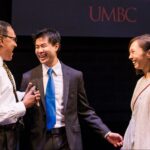
Nine distinguished faculty and alumni shared their stories at GRIT-X, a TED talk-style event during UMBC’s Homecoming. Karl Steiner, UMBC vice president for research, introduced the event, which debuted at last year’s 50th anniversary celebration. “We’ll take you from outer space to inner space,” he said, “from black holes in the universe to a pacemaker for the brain.”
Kafui Dzirasa ’01, chemical engineering, kicked off the program by discussing the latter. Now associate professor of psychiatry and behavioral sciences at the Duke School of Medicine, Dzirasa has a personal connection to his groundbreaking work. “My family has struggled with mental illness for generations,” he shares. While much mental health research has focused on chemical imbalances in the brain, Dzirasa is using new tools and techniques to detect rhythmic waves of electric pulses in the active brain.
 Kafui Dzirasa ’01 (left), Gymama Slaughter (center), and President Freeman Hrabowski at the GRIT-X event.
“These rhythms work together in the same way that a conductor can allow all the instruments in a symphony orchestra to work together to produce music,” he says. “These little rhythms allow brain cells to coordinate—to produce motions, and thoughts, and feelings.” He calls these rhythms the “metronomic system” of the brain, and is investigating whether psychiatric disorders, such as bipolar and schizophrenia, are a result of faulty metronomes. Dzirasa’s lab is learning about how these metronomes function through animal studies, and he hopes to one day apply the results to humans.
“In the future that I see, our family members would have lived out their life’s greatest dreams,” he says, “because we won’t simply treat psychiatric disorders by tuning electricity, we will cure them.”
 Christine Mallinson, professor of language, literacy, and culture, discusses her research on linguistic diversity in schools.
Christine Mallinson, professor of language, literacy, and culture, is looking to cure a different ill: the negative biases teachers may harbor against students who speak differently than they do, even if they’re speaking English. Hearing “coffee” pronounced several different ways as a child sparked Mallinson’s lifelong interest in linguistic diversity, which she says “is a resource, not a deficit.”
Demonstrating the value of diverse linguistic patterns in the classroom shows students they are valued, which makes them likely to value school, Mallinson explains. Overall, educators must “give the students the tools they need to succeed on the tests that we require of them, while sustaining and empowering their diverse voices,” she says, “so that we can have all our students with all their diverse voices right here in the front row of our classes at UMBC.”
Nilanjan Banerjee, associate professor of computer science and electrical engineering, is working on wearable sensors—communication of a very different kind. After the iPhone revolutionized “smart” technology in 2007, he says, “Ten years later, we are at the brink of yet another revolution: the revolution of the next generation of wearables.”
Banerjee explained how these tiny computers can make people with spinal injuries more independent, by allowing them to control appliances or communicate via motions as minute as tongue movements. Ankle straps could track health-related statistics from sleep patterns to cardiac conditions, reducing the strain on clinics facing an ever-increasing demand for services as the population ages. Banerjee also sees applications in driving safety, with sensors able to detect whole-body movements that may indicate distracted, drunk, or drowsy driving.
 Nilanjan Banerjee, associate professor of computer science and electrical engineering, says we are “on the brink of a revolution” in wearable devices.
Banerjee acknowledges that “all of these sensors are useless unless people use them,” so this work requires perspective from an array of disciplines, such as human-centered computing, design, software development, and materials science. And of course, privacy and ethics concerns loom large when devices are collecting this much data. To conclude, Banerjee encouraged audience members to “think about what you want these next-generation wearables to do, and more importantly, think about what you want them not to do.”
The second session began with Sean Pang ’09, English, and M.A. ’11, teaching, who recounted his “fortune of misfortunes,” including culture shock and a language barrier upon his immigration to the U.S. as a small child, and poverty and eviction during his undergraduate studies. When he started teaching in Baltimore City after graduating from UMBC, he was the only Asian person in the room, but his background of challenges helped him connect with students. “When they see me come into the classroom, with a smile on my face, with passion, and dedication, and kindness, they see hope,” he shares, “hope that they can make something better from their lives.”
Pang, who was The Washington Post’s 2017 Teacher of the Year, had three recommendations for audience members. First, he said, be kind. In kindergarten, a classmate gave him a plastic dinosaur that Pang keeps to this day—it was the first act of kindness he remembers from a peer in the U.S. Second, “Try everything, because that will lead you to find your passion.” And once you find it, “use it to give hope, because hope is the greatest gift you can give.”
 Gymama Slaughter, associate professor of computer science and electrical engineering, discusses her research on powering implantable devices with biological energy.
Gymama Slaughter, associate professor of computer science and electrical engineering, is hoping for a future of implantable medical devices that are safe, environmentally friendly, and powered by the metabolism of our own bodies. Her lab has created thin membranes made of nanocellulose—a flexible, permeable, transparent, biocompatible material produced by genetically engineered bacteria—and tiny attachable circuits that harness the body’s energy. Because the byproduct of the energy production process is simply water, it’s completely safe.
So far, Slaughter’s bio-power devices, only a few millimeters on a side, can light up an LED light. “This gives us hope that eventually, with such a small device, we can develop a power system that harnesses the biochemical energy of glucose within our body,” she says, “to power implantable devices that can monitor disease, diagnose diseases, and one day deliver therapeutics into our body to enable our bodies to heal.”
 Kate Brown, professor of history, describes how families living near the Chernobyl disaster pick and sell radioactive berries that will enter the European market labeled only as “wild and organic.”
Kate Brown, professor of history, closed the second session with a talk on radioactive blueberries. Brown traveled to the Chernobyl zone expecting to find sadness and isolation. Instead, she found a booming, revitalized economy based on foraging—blueberries in the summer, cranberries and mushrooms in the fall.
“These women and children pickers have made it happen with human-powered resourcefulness. So economically it’s a good idea,” Brown says. “What about biologically? That’s a trickier question.” Brown explains that berries are extremely efficient at absorbing radiation from the soil, and limits have been set on the radiation level allowed in the EU market. But the berries are simply marked as “wild and organic,” so consumers have no idea they are ingesting radiation. There is very little research on the effects of long-term, low-dose exposure to radiation, but in the area surrounding the berry picking region, birth defects are six times as high as the European average.
“I’m here to tell you that even though we think of Chernobyl as something that’s very far away, it’s being brought to us by the global market that’s been so successful,” Brown says. She recommends paying the pickers the same amount to pick the berries, except then disposing of them as waste in the effort to reduce radiation in the area.. Brown even speculates that tourists might be willing to pay to experience picking radioactive berries. “That might be a better way of solving this problem, than just pretending it’s not happening.”
 Jane Turner, director of UMBC’s Center for Space Sciences and Technology, explains her research on the relationship between black holes and galaxy formation.
Next, Jane Turner, director of UMBC’s Center for Space Sciences and Technology and professor of physics, took listeners much, much farther away to black holes at the centers of galaxies. The Milky Way contains a black hole 2.6 million times as massive as our Sun, she explained, and “there’s evidence for supermassive black holes at the center of all galaxy nuclei. This is one of the big discoveries of the last decade or so in astronomy.” These black holes are proportional in mass to the mass of the galaxy they’re in, so “these things must grow together,” she says.
Most of the black holes at the centers of galaxies are dark and only detected by their gravitational influence, but a few percent emit an incredible amount of light—these are called “active nuclei.” Turner’s work involves investigating why those few are so bright, by looking at X-rays coming from very close to the black hole “event horizon,” beyond which we cannot make observations. These X-rays can tell scientists about what material is present close to the black hole and how that material is moving. Astrophysicists like Turner have found that black holes are pulling in about one star’s-worth of material per year, which is “enough to feed these active nuclei.” The black holes are also pushing some of that material back out —enough to affect star formation in the surrounding galaxy. It’s by analyzing results like these, Turner says, that “we’re going to be able to understand the connection between the growth of the black hole and the host galaxy, and from that the growth of structure in the universe on the whole.”
 Corey Fleischer ’08, mechanical engineering, discusses The Foundery, a makerspace he co-founded in Baltimore City.
While black holes are helping build galaxies far away, Corey Fleischer ’08, mechanical engineering, is helping people build things in Maryland. As co-founder and general manager of The Foundery, a makerspace in Baltimore, Fleischer’s goal “is to have anybody walk in with a hand sketch on a napkin, for a product or an invention they want to build, and with our tools and classes be able to walk out with a polished, professional-looking prototype.”
Fleischer’s career path has been largely informed by his experience on UMBC’s mini-Baja team, which involved designing and constructing a one-person vehicle and then navigating it around an obstacle course at competitions. “We were learning textbook knowledge in classrooms, but at the same time we were learning firsthand how to build things,” he says. The Foundery provides a space for people with ideas to make them reality, and quickly, by speeding up the design feedback cycle—which involves a lot of failure. “Failure is an empowering way to learn,” Fleischer says. “And makerspaces allow people to fail faster.”
 Doug Hamby, associate professor of dance, leads two UMBC students in creating a new dance on the spot.
Finally, Doug Hamby, associate professor of dance, and two UMBC dance students, Emily Godfrey ’20 and Samantha Siegel ’18, created an original dance right before the audience’s eyes. Hamby gave them instructions and they absorbed them on the spot, performing turns, rolls, and pliés to the audience’s delight. “When I make a dance,” Hamby shared as he moved fluidly across the stage, “I like to think of it as an investigation of the human body in motion, and in space, and in time.”
After the dancers performed the full sequence to close the program, Hamby tied all the GRIT-X talks together. “That’s one of the ways art is made,” he said, “through serendipity and experimentation.” Replace “art” with language, science, or technology, and the statement holds. UMBC faculty and alumni are creatively exploring the edge of knowledge, and the physical and mental world, from inner to outer space—from black holes to brain pacemakers, from language usage to radioactive fallout, from driver safety to dance—and sharing it with the world.
Watch videos of the complete GRIT-X presentations to learn more.
Banner image: Sean Pang ’09, English, and M.A. ’11, teaching, chats with his wife (right) and President Hrabowski (left) after his presentation. All photos by Marlayna Demond ’11 for UMBC.
]]>
Nine distinguished faculty and alumni shared their stories at GRIT-X, a TED talk-style event during UMBC’s Homecoming. Karl Steiner, UMBC vice president for research, introduced the event, which...
https://umbc.edu/stories/grit-x-talks-showcase-experiences-of-outstanding-faculty-and-alumni-from-outer-space-to-inner-space/
https://my3.my.umbc.edu/api/v0/pixel/news/120620/guest@my.umbc.edu/643d02d163df2f0ee2478c16151f486b/api/pixel
alumni
arts-and-culture
cahss
cbee
cnms
coeit
community
csee
csst
dance
english
history
llc
meche
physics
policy-and-society
science-and-technology
UMBC News & Magazine
https://my3.my.umbc.edu/groups/umbc-news-magazine
https://assets1-my.umbc.edu/system/shared/avatars/groups/000/001/943/24435aa6207c452e7bc15cc74b42c7bb/xsmall.png?1748556657
https://assets1-my.umbc.edu/system/shared/avatars/groups/000/001/943/24435aa6207c452e7bc15cc74b42c7bb/original.png?1748556657
https://assets2-my.umbc.edu/system/shared/avatars/groups/000/001/943/24435aa6207c452e7bc15cc74b42c7bb/xxlarge.png?1748556657
https://assets2-my.umbc.edu/system/shared/avatars/groups/000/001/943/24435aa6207c452e7bc15cc74b42c7bb/xlarge.png?1748556657
https://assets3-my.umbc.edu/system/shared/avatars/groups/000/001/943/24435aa6207c452e7bc15cc74b42c7bb/large.png?1748556657
https://assets1-my.umbc.edu/system/shared/avatars/groups/000/001/943/24435aa6207c452e7bc15cc74b42c7bb/medium.png?1748556657
https://assets2-my.umbc.edu/system/shared/avatars/groups/000/001/943/24435aa6207c452e7bc15cc74b42c7bb/small.png?1748556657
https://assets1-my.umbc.edu/system/shared/avatars/groups/000/001/943/24435aa6207c452e7bc15cc74b42c7bb/xsmall.png?1748556657
https://assets2-my.umbc.edu/system/shared/avatars/groups/000/001/943/24435aa6207c452e7bc15cc74b42c7bb/xxsmall.png?1748556657
UMBC News & Magazine
0
0
false
Wed, 18 Oct 2017 15:36:06 -0400
UMBC dedicates new Earth and Space Institute, building on decades of NASA collaboration
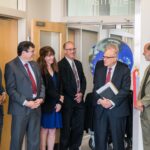
On the third floor of the UMBC Physics Building, a glass sign with crisp white lettering announces UMBC’s newest research center: the Earth and Space Institute (ESI).
The institute includes a prototyping lab, operations center, and offices, but it is also much more than a collection of rooms, explains Karl Steiner, UMBC’s vice president for research. The ESI is a physical home for the interdisciplinary earth and space science UMBC researchers do with support from NASA, NOAA, and other federal agencies as well as collaborators around the world. It’s a hub where scientists, engineers, and students will take UMBC’s earth and space research to the next level.
The ESI, administered by UMBC’s College of Natural and Mathematical Sciences (CNMS), joins a set of other distinguished UMBC research centers, including the Center for Space Science and Technology (CSST), Goddard Planetary and Heliophysics Institute (GPHI), and Joint Center for Earth Systems Technology (JCET), all of which are collaborations with the NASA Goddard Spaceflight Center in Greenbelt, Maryland.
 ESI director Vanderlei Martins (right), discusses research projects with Chris Scolese, director of NASA Goddard, in the prototyping room.
CNMS Dean Bill LaCourse believes NASA has served as “a role model and inspirational force,” that has led people to reach for the stars for generations, and he is excited to expand UMBC’s collaborative work with NASA. “The Earth and Space Institute is our opportunity to reach for new heights,” he shares. “To take that chance in the name of science, commitment, passion, and basic human curiosity.”
At a ribbon cutting for the new space, leaders from the three other centers, as well as the director of NASA Goddard, gathered to discuss current projects and ideas for future collaborations. They emphasized the strong and ongoing relationship between UMBC and NASA, which is only expected to deepen with the dedication of the new institute.
“It’s great to be here. The partnership with UMBC is just fantastic,” said NASA Goddard director Christopher Scolese. “All this happens because of the strength of your work, and we should say thank you to all of you,” added UMBC President Freeman Hrabowski, speaking to the scientists in the room. “It takes researchers to produce researchers.”
 Guests learn about the ESI operation center.
Vanderlei Martins, professor of physics and director of the new institute, describes the ESI as a place “to develop new technologies and new science in earth and space fields.” Martins is currently working on HARP, a CubeSat mission intended to launch within the next year. But he and other UMBC scientists have their eyes on an ever bigger goal: a full-blown NASA mission with their equipment on it. The ESI will make planning and successfully proposing such a mission a real possibility.
Another important aspect of the institute is its role as a platform to boost collaboration across disciplines. “We want to collaborate even more with Goddard on the engineering side, on the science side, on the education side,” says Martins, noting that this could mean pulling in faculty and students at all levels and from a broad range of focus areas.
 Lorraine Remer, JCET, discusses JCET’s current projects and areas for growth.
Jane Turner, director of CSST, shares that “one of our important roles is to connect our graduate and undergraduate students to mentors and project opportunities at Goddard”—a goal the new ESI shares. Lorraine Remer, a JCET research professor, adds that recruiting UMBC students to careers at NASA or other federal agencies via experiences with UMBC collaborative centers could also play a role in diversifying the federal workforce, because of UMBC’s strong track record for supporting the success of students from all backgrounds in STEM fields.
Alan Yeakley, chair of geography and environmental systems, also envisions opportunities for the ESI to utilize the social sciences in its work. “I see geography and environmental science as the connective tissue between the natural sciences and the social sciences,” he shares. Data collected by NOAA satellites, for example, can contribute to public health research on air quality, urbanization, and the effects of climate change.
 UMBC and NASA Goddard representatives cut a ribbon to dedicate the ESI.
The ESI is intended to bring the UMBC community together in new ways, just as it came together to support the institute’s creation. “It takes a community—a wide spectrum of people giving support from all kinds of directions—to bring something like this together,” LaCourse says. From the crews that renovated the space to university administrators at the highest level, “There has been cross-campus support… This is a university facility that was a feat to get off the ground, and now it’s here.”
“The Earth and Space Institute leverages our resources and expands our potential,” LaCourse says. Inspired by NASA, “it allows UMBC to dream bigger and reach higher.”
Banner image: Dean LaCourse addresses guests just before they cut a ribbon at the entrance of the new Earth and Space Institute to dedicate the space. From left to right: Felicia Jones Selden ’81, biological sciences, director of applied engineering and technology at NASA Goddard; UMBC President Freeman Hrabowski; Chris Scolese, director of NASA Goddard; Colleen Hartman, director of sciences and exploration at NASA Goddard; Michael Hayden, UMBC professor and chair of physics; Bill LaCourse, dean of UMBC College of Natural and Mathematical Sciences; UMBC Provost Philip Rous (behind Dean LaCourse); Vanderlei Martins, ESI director and UMBC professor of physics; Karl Steiner, UMBC vice president for research.
All photos by Marlayna Demond ’11 for UMBC.
]]>
On the third floor of the UMBC Physics Building, a glass sign with crisp white lettering announces UMBC’s newest research center: the Earth and Space Institute (ESI). The institute includes a...
https://umbc.edu/stories/umbc-dedicates-new-earth-and-space-institute-building-on-decades-of-nasa-collaboration/
https://my3.my.umbc.edu/api/v0/pixel/news/120672/guest@my.umbc.edu/851bf3cf4f824f77b10d179a72900f86/api/pixel
cnms
csst
esi
ges
gphi
interdisciplinary
jcet
physics
research
science-and-technology
UMBC News & Magazine
https://my3.my.umbc.edu/groups/umbc-news-magazine
https://assets1-my.umbc.edu/system/shared/avatars/groups/000/001/943/24435aa6207c452e7bc15cc74b42c7bb/xsmall.png?1748556657
https://assets1-my.umbc.edu/system/shared/avatars/groups/000/001/943/24435aa6207c452e7bc15cc74b42c7bb/original.png?1748556657
https://assets2-my.umbc.edu/system/shared/avatars/groups/000/001/943/24435aa6207c452e7bc15cc74b42c7bb/xxlarge.png?1748556657
https://assets2-my.umbc.edu/system/shared/avatars/groups/000/001/943/24435aa6207c452e7bc15cc74b42c7bb/xlarge.png?1748556657
https://assets3-my.umbc.edu/system/shared/avatars/groups/000/001/943/24435aa6207c452e7bc15cc74b42c7bb/large.png?1748556657
https://assets1-my.umbc.edu/system/shared/avatars/groups/000/001/943/24435aa6207c452e7bc15cc74b42c7bb/medium.png?1748556657
https://assets2-my.umbc.edu/system/shared/avatars/groups/000/001/943/24435aa6207c452e7bc15cc74b42c7bb/small.png?1748556657
https://assets1-my.umbc.edu/system/shared/avatars/groups/000/001/943/24435aa6207c452e7bc15cc74b42c7bb/xsmall.png?1748556657
https://assets2-my.umbc.edu/system/shared/avatars/groups/000/001/943/24435aa6207c452e7bc15cc74b42c7bb/xxsmall.png?1748556657
UMBC News & Magazine
0
0
false
Tue, 19 Sep 2017 21:43:19 -0400
UMBC’s Jason Link leads development of cosmic ray detector headed for International Space Station
A white box the size of a refrigerator, called Cosmic Ray Energetics and Mass (CREAM), will head to the International Space Station (ISS) this month, thanks to the work of UMBC astrophysicist Jason Link and colleagues. Inside, four scientific detectors will work together to detect cosmic rays coming from far flung regions of the universe. The instruments will transmit the data from the ISS to Earth, to scientists reckoning with the tantalizing question, “What is the universe made of?”
Link, an astrophysicist with UMBC’s Center for Space Science and Technology, part of the recently-renewed CRESST consortium, is a co-investigator on the project and the technical lead for one of the detectors. Cosmic rays, particles from beyond the solar system, arrive with hundreds of times more energy than the Large Hadron Collider particle accelerator can produce, Link explains. Some of these particles will pass through the detector and interact inside, where they break up into a “shower of subatomic particles.” CREAM’s goal is to measure the composition and energy of individual particles, which will help scientists deduce where the rays came from and what phenomena caused them to accelerate so much.
Are the particles produced by supernovae or perhaps merging binary stars? “If we get into what accelerates the cosmic rays, we’re getting into one of the murky mysteries of science,” Link says.
Link has been working for more than 15 years on hardware to detect cosmic rays, including a version of CREAM that has taken seven balloon flights above Antarctica. Sending instruments to space poses new challenges, and also creates new opportunities.
 CREAM in preparation for launch. Photo provided by Jason Link.
“Balloons have a relatively short mission life,” Link shares, usually only a few dozen days. “But going up on the space station, you’re now talking about years.” Also, “When particles enter Earth’s atmosphere, they start to interact,” Link says. That means data analyses must incorporate a correction factor to account for these interactions, which introduces error. That’s much less of a problem in space.
Research instruments traveling to the ISS must reckon with constraints on size and mass, and be able to withstand extreme vibration. Link’s balloon-based instruments didn’t fit these constraints, so he and colleagues from NASA Goddard Space Flight Center, Penn State, and Northern Kentucky University undertook the challenge of building a new detector, based on the balloon detectors, that could safely survive the rigors of a rocket launch and deploy on the International Space Station.
The new detector can also collect additional scientific measurements. It can distinguish between negatively charged electrons and positively charged protons, based on the way they interact inside the detector.
“Designing a new detector from scratch on the limited budget for building balloon hardware required creativity, innovation and a bit of luck,” Link notes. “We did it and it successfully passed all of the environmental and safety requirements for deployment on the ISS.”
Colleagues from Kyungpook National University in South Korea built a detector that serves the same purpose, but with a different approach. Together, Link says, the two detectors provide a powerful way to distinguish between electrons and protons, and quickly verify findings, specifically because they use different techniques.
Link looks forward to diving into the data the instruments send from outer space. “If we see an excess of electrons,” he says, “that suggests that there is a local source of cosmic rays. That’s not something we expect.” That discovery would spur further research into what and where the source might be.
Instruments on CREAM will also help physicists better understand the “cosmic energy spectrum,” Link says. The energy of detected rays falls along a spectrum, with many more rays coming in with lower energies, and very few at the highest energies. The number of rays at each energy level falls off in a smooth curve, but, Link says, “There’s a kink in the cosmic energy spectrum,” where there’s an unexpected bump up in the number of rays with a specific energy. Scientists are very interested in what might be causing that kink, and CREAM is intended to help explain it.
Beyond the potential for groundbreaking scientific discovery about the fundamental makeup of the universe, the CREAM launch is special for Link. “This is the first time that I’ve actually built something that’s going to go into space,” he says.
Scientists are often heavily involved in designing instruments and analyzing the resulting data, but most of the time the actual construction of space instrumentation is handed over to engineers and technicians with specialized expertise. Not this time. “Yes, I actually tightened bolts and wired sensors on the detector,” Link is proud to report, “and it’s going to fly in space.”
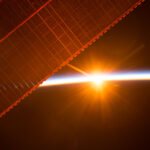
Image: Sunrise from the International Space Station. Photo provided by NASA, captured by a member of the Expedition 52 crew.
The CREAM mission is headed by Dr. Eun-Suk Seo at the University of Maryland, College Park. NASA’s Wallops Flight Facility in Virginia provided overall management of CREAM and integration for space station deployment, led by Linda Thompson. The full project team includes scientists from the United States, France, Mexico, and South Korea.
]]>
A white box the size of a refrigerator, called Cosmic Ray Energetics and Mass (CREAM), will head to the International Space Station (ISS) this month, thanks to the work of UMBC astrophysicist...
https://umbc.edu/stories/umbcs-jason-link-leads-development-of-cosmic-ray-detector-headed-for-international-space-station/
https://my3.my.umbc.edu/api/v0/pixel/news/120697/guest@my.umbc.edu/2670dd8788b8d6afa2af1ab4b86d6a74/api/pixel
cnms
csst
research
science-and-technology
UMBC News & Magazine
https://my3.my.umbc.edu/groups/umbc-news-magazine
https://assets1-my.umbc.edu/system/shared/avatars/groups/000/001/943/24435aa6207c452e7bc15cc74b42c7bb/xsmall.png?1748556657
https://assets1-my.umbc.edu/system/shared/avatars/groups/000/001/943/24435aa6207c452e7bc15cc74b42c7bb/original.png?1748556657
https://assets2-my.umbc.edu/system/shared/avatars/groups/000/001/943/24435aa6207c452e7bc15cc74b42c7bb/xxlarge.png?1748556657
https://assets2-my.umbc.edu/system/shared/avatars/groups/000/001/943/24435aa6207c452e7bc15cc74b42c7bb/xlarge.png?1748556657
https://assets3-my.umbc.edu/system/shared/avatars/groups/000/001/943/24435aa6207c452e7bc15cc74b42c7bb/large.png?1748556657
https://assets1-my.umbc.edu/system/shared/avatars/groups/000/001/943/24435aa6207c452e7bc15cc74b42c7bb/medium.png?1748556657
https://assets2-my.umbc.edu/system/shared/avatars/groups/000/001/943/24435aa6207c452e7bc15cc74b42c7bb/small.png?1748556657
https://assets1-my.umbc.edu/system/shared/avatars/groups/000/001/943/24435aa6207c452e7bc15cc74b42c7bb/xsmall.png?1748556657
https://assets2-my.umbc.edu/system/shared/avatars/groups/000/001/943/24435aa6207c452e7bc15cc74b42c7bb/xxsmall.png?1748556657
UMBC News & Magazine
0
0
false
Fri, 11 Aug 2017 19:14:28 -0400
CRESST II space science consortium to receive $87.5 million from NASA Goddard
The Center for Research and Exploration in Space Science and Technology (CRESST II) is prepared to embark on a new era of innovative research and teaching with the commitment of $87.5 million from the National Aeronautics and Space Administration (NASA) Goddard Space Flight Center.
UMBC and the University of Maryland, College Park are the leading partners in a consortium formed to compete for this program. New consortium partners under this renewal agreement include Howard University, Catholic University of America, and the Southeastern Universities Research Association (SURA).
CRESST was first launched in 2006 under a ten-year cooperative agreement. The CRESST II agreement is valued at $87.5 million over the next five years, and provides for a renewal option for another five years.
“We are very proud of our long-term relationship with NASA Goddard,” states Karl V. Steiner, UMBC vice president for research. “The CRESST II program builds on the complementary scientific strengths at both UMBC and at College Park, and highlights the value that strong USM partnerships bring to the federal labs in Maryland and their national and global scientific missions. We are especially excited to grow our partnerships with Howard University, Catholic University and SURA. ”
The funding will primarily be used to support CRESST scientists who will work on specific, short-term projects at NASA’s Goddard Space Flight Center in Greenbelt, MD. The collaboration “opens up a broad range of projects in hardware, theory, and observation,” says T. Jane Turner, professor of physics and director of the Center for Space Science and Technology (CSST), the UMBC arm of CRESST.
CSST represents one of three major Cooperative Agreements between NASA Goddard and UMBC. The other two are the Joint Center for Earth Systems Technology (JCET) and the Goddard Planetary Heliophysics Institute (GPHI).
This partnership provides significant opportunities for university scientists to make major contributions to space science through cutting-edge research in areas like high energy astrophysics, gravitational waves, exoplanet exploration, and the study of planets within our own solar system. Additionally, says Turner, “We offer these scientists an enhanced career path,” by seamlessly connecting them with classroom experiences that relate to their work in the lab.
Turner explains that CSST scientists get “the best of both worlds—the research, networking, and facilities at Goddard and the opportunity to get teaching experience and work with graduate and undergraduate researchers here. There’s a symbiosis.” In turn, the program creates opportunities for UMBC students to learn from expert space scientists in the classroom and the lab, and to contribute to innovative and impactful research.
“This grant—and the important partnership it represents—will enable us to continue research that advances science and benefits our state and beyond,” says President Freeman Hrabowski. “Moreover, it will create opportunities for students to prepare for careers by working alongside world-class experts.”
NASA also benefits from the educational aspect of the work, as many students go on to postdoctoral and research scientist positions with the agency. “Goddard loves new talent,” says Turner. “They want to have young people involved, and there’s a lot of work that’s really suitable for providing research experience to the students.”
“NASA has played a key role in making the Baltimore region a national leader in scientific research,” says Congressman Elijah Cummings. “This grant will help UMD and UMBC to continue providing students from diverse backgrounds with opportunities to learn and grow so they can launch successful careers in STEM fields.”
Turner is particularly excited to collaborate with the new partners through this new, expanded stage of the consortium’s work. She’s looking forward to “bringing together other local astrophysics students and networking them in,” which aligns with UMBC’s mission to diversify the scientific community. Turner is also working with UMBC’s Meyerhoff Scholars Program to help undergraduates obtain summer internships with NASA through CRESST II.
The renewal is here just in time to create an all-around win. “Several exciting projects are now ramping up at Goddard,” says Turner, “and our scientists and students will move that work forward.”
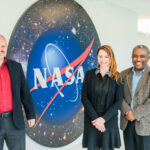
Image: Jan Merka, GPHI director; T. Jane Turner, CSST director; and Belay Demoz, JCET director (l to r). Photo by Marlayna Demond ’11 for UMBC.
The CRESST II renewal has also been featured in The Baltimore Sun, The Daily Record, Baltimore Business Journal, and Washington Business Journal.
]]>
The Center for Research and Exploration in Space Science and Technology (CRESST II) is prepared to embark on a new era of innovative research and teaching with the commitment of $87.5 million from...
https://umbc.edu/stories/cresst-ii-space-science-consortium-to-receive-87-5-million-from-nasa-goddard/
https://my3.my.umbc.edu/api/v0/pixel/news/120852/guest@my.umbc.edu/eeef2ce149f154786f4bc618a6fa3783/api/pixel
cnms
csst
gphi
jcet
majoraward
physics
research
science-and-technology
UMBC News & Magazine
https://my3.my.umbc.edu/groups/umbc-news-magazine
https://assets1-my.umbc.edu/system/shared/avatars/groups/000/001/943/24435aa6207c452e7bc15cc74b42c7bb/xsmall.png?1748556657
https://assets1-my.umbc.edu/system/shared/avatars/groups/000/001/943/24435aa6207c452e7bc15cc74b42c7bb/original.png?1748556657
https://assets2-my.umbc.edu/system/shared/avatars/groups/000/001/943/24435aa6207c452e7bc15cc74b42c7bb/xxlarge.png?1748556657
https://assets2-my.umbc.edu/system/shared/avatars/groups/000/001/943/24435aa6207c452e7bc15cc74b42c7bb/xlarge.png?1748556657
https://assets3-my.umbc.edu/system/shared/avatars/groups/000/001/943/24435aa6207c452e7bc15cc74b42c7bb/large.png?1748556657
https://assets1-my.umbc.edu/system/shared/avatars/groups/000/001/943/24435aa6207c452e7bc15cc74b42c7bb/medium.png?1748556657
https://assets2-my.umbc.edu/system/shared/avatars/groups/000/001/943/24435aa6207c452e7bc15cc74b42c7bb/small.png?1748556657
https://assets1-my.umbc.edu/system/shared/avatars/groups/000/001/943/24435aa6207c452e7bc15cc74b42c7bb/xsmall.png?1748556657
https://assets2-my.umbc.edu/system/shared/avatars/groups/000/001/943/24435aa6207c452e7bc15cc74b42c7bb/xxsmall.png?1748556657
UMBC News & Magazine
0
0
false
Thu, 30 Mar 2017 16:59:12 -0400
New Science cover story on massive Moon crater features innovative UMBC research techniques
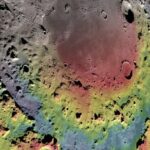
New research published in Science provides unprecedented detail about the structure of the Orientale basin, a huge crater on the Moon. The latest findings offer “an important clue in trying to unravel the formation history of the solar system,” says Sander Goossens, associate research scientist at UMBC’s Center for Space Science and Technology (CSST) and a lead analyst of satellite data for the project.
Two Gravity Recovery and Interior Laboratory (GRAIL) spacecraft measured the gravitational pull above the crater on a mission in 2012, flying within two kilometers of the surface in some locations. “We were able to use data from GRAIL to make an extremely high resolution map of the gravity field of a feature on the Moon,” says Goossens. “That hasn’t been done before, anywhere in the solar system.”
Goossens explains, “The surface topography of the moon has already been measured very precisely by the ongoing Lunar Reconnaissance Orbiter mission, so we have those data in hand.” Those data combined with the new gravitational map allow researchers to better understand what’s going on below the surface. For example, gravitational data reveal high mass concentrations beneath some topographical depressions, which indicates geological processes deep within the Moon. The new data also suggest that the original crater diameter was between 320 and 460 kilometers, and that during impact about 3.4 million cubic kilometers of material was displaced.
Analysis of the data suggests that the moon has been “battered by impacts,” and it’s likely that Earth and other planets experienced the same thing as the solar system took shape, says Goossens. What scientists learn about processes on the Moon that resulted from these frequent impacts may apply to similar moons and planets such as Mars, Mercury, and Earth. “A lot of the planets have a similar make-up, so you can extrapolate,” he says.
Even today, Goossens points out, “Impact cratering is perhaps the most significant geologic process going on throughout the solar system.” Exploring it on Earth is challenging, as surface material is constantly being recycled by plate tectonics, but Goossens would like to see a GRAIL-type mission to Mars, to better understand the relationship between gravity and topography that exists there.
The research team expected GRAIL to map the gravitational field of the Orientale basin to a resolution of about 30 square kilometers. But when GRAIL delivered, “The data were so good,” Goossens says, “that it was easy to double and then double again the resolution.” With such a high volume of data pouring in from GRAIL, “We had to move our processing from our own local computer cluster to a super computer at Goddard [Space Flight Center].”
With their traditional processing program, the team would map the entire Moon at once, but the unprecedented volume of data delivered by the GRAIL instruments meant computations on a moon-sized scale would take an extremely long time to complete, even on a super computer. Goossens responded by developing a new local modeling method that uses data specifically from the Orientale basin area. It allows the team to take advantage of the high resolution data GRAIL provides and complete the processing in a reasonable amount of time.
The hard work the team put in to quickly devise the new modeling method was worth it. Science featured their research, including a stunning full-color visualization of the Moon, on its cover. As it turns out, Goossens says, the challenge of finding the most effective way to process a massive amount of data “is a good problem to have.”
Read “UMBC research analyzes close-up of massive moon crater, a remnant of early solar system” in The Baltimore Sun.
Image: Visualization of the Orientale basin on the Moon from the cover of Science; Ernest Wright, NASA/Goddard Space Flight Center Scientific Visualization Studio.
]]>
New research published in Science provides unprecedented detail about the structure of the Orientale basin, a huge crater on the Moon. The latest findings offer “an important clue in trying to...
https://umbc.edu/stories/new-science-cover-story-on-massive-moon-crater-features-innovative-umbc-research-techniques/
https://my3.my.umbc.edu/api/v0/pixel/news/120958/guest@my.umbc.edu/c8249699ea02eaf5a6de391e73289f42/api/pixel
csst
research
science-and-technology
UMBC News & Magazine
https://my3.my.umbc.edu/groups/umbc-news-magazine
https://assets1-my.umbc.edu/system/shared/avatars/groups/000/001/943/24435aa6207c452e7bc15cc74b42c7bb/xsmall.png?1748556657
https://assets1-my.umbc.edu/system/shared/avatars/groups/000/001/943/24435aa6207c452e7bc15cc74b42c7bb/original.png?1748556657
https://assets2-my.umbc.edu/system/shared/avatars/groups/000/001/943/24435aa6207c452e7bc15cc74b42c7bb/xxlarge.png?1748556657
https://assets2-my.umbc.edu/system/shared/avatars/groups/000/001/943/24435aa6207c452e7bc15cc74b42c7bb/xlarge.png?1748556657
https://assets3-my.umbc.edu/system/shared/avatars/groups/000/001/943/24435aa6207c452e7bc15cc74b42c7bb/large.png?1748556657
https://assets1-my.umbc.edu/system/shared/avatars/groups/000/001/943/24435aa6207c452e7bc15cc74b42c7bb/medium.png?1748556657
https://assets2-my.umbc.edu/system/shared/avatars/groups/000/001/943/24435aa6207c452e7bc15cc74b42c7bb/small.png?1748556657
https://assets1-my.umbc.edu/system/shared/avatars/groups/000/001/943/24435aa6207c452e7bc15cc74b42c7bb/xsmall.png?1748556657
https://assets2-my.umbc.edu/system/shared/avatars/groups/000/001/943/24435aa6207c452e7bc15cc74b42c7bb/xxsmall.png?1748556657
UMBC News & Magazine
0
0
false
Tue, 15 Nov 2016 19:28:15 -0500
Astrophysicist Robin Corbet discovers rare, high-energy binary star system beyond the Milky Way
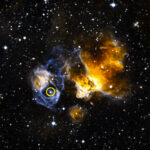
Until recently, humans had only detected five binary star systems—pairs of stars orbiting each other—that emit extremely high-energy gamma rays. Robin Corbet, an astrophysicist at UMBC’s Center for Space Sciences and Technology (CSST), just discovered the sixth, and most luminous, and this one is special. Instead of being in our Milky Way galaxy, it’s located in the Large Magellanic Cloud, our next-door neighbor galaxy, 163,000 light years away.
This marks Corbet’s second gamma ray binary discovery, following his initial detection of such a system through the Fermi gamma-ray space telescope five years ago. After that initial find in 2011, he thought more would follow quickly, but the systems proved elusive. The fact that he found the sixth known gamma ray binary outside of the Milky Way came as quite a surprise. At first, he shares, “I didn’t believe it.”
In order to emit gamma rays, which contain one million times the energy of visible light waves, one of the “stars” in the binary system must be a black hole or neutron star, a star that has collapsed in on itself. “These are more massive than our own Sun but squeezed down to something about the size of Washington, DC,” explains Corbet. Hundreds of these binary systems have been found that emit X-rays, but only a handful emit even higher-energy gamma rays.
Corbet detected the system by analyzing variations in gamma rays coming from about 3,000 known gamma ray sources. In a gamma ray binary system, the intensity of the gamma rays as they strike the telescope varies depending on the relative position of the stars as they orbit each other. Because the gamma ray sources are so far away, only a small percentage of the rays ever reach the telescope. That means it can take a long time to collect enough data to detect a pattern.
Once the Fermi satellite collected enough data, Corbet ran analyses on a 12-core computer for a few months. Looking at gamma rays from all 3,000 sources, the analyses identified two stars orbiting each other every 10.3 days—a new binary system. Then Corbet requested data sets from colleagues around the world that included X-ray, radio wave, and visible light wave data. He hoped the additional information would corroborate the gamma ray signal and confirm the orbital period, which it did. The visible light data also supported the idea that the system contains a neutron star, but there’s still a small chance it could be a black hole.
Binary systems can only generate the energy required to emit gamma rays when the neutron star is rotating very fast. The fact that only six of these systems have ever been discovered suggests that very few neutron stars rotate that quickly, and there may be more slowly-rotating neutron stars than scientists thought.
Calculations suggest the neutron star in the system Corbet just discovered rotates around its axis in less than 39 milliseconds, compared to Earth’s 24-hour rotation. As a star rotates, it flings particles away from its surface, creating a “stellar wind.” With one star in a binary rotating so fast, interactions between particles in the stellar wind from each star can be intense, which is what creates the gamma rays. “It’s like having a particle accelerator in space,” says Corbet.
Next steps for the research include confirming that one star in the system is indeed a neutron star by making observations to directly detect its rotation period, although this is very difficult. Corbet is also interested in tracking the two stars’ orbits, to see if they are truly circular or more elliptical. Because there are so few of these systems, and this is the only one outside the Milky Way, anything learned will inform future research goals and theories about extreme binary star systems.
Read the full paper in The Astrophysical Journal here: A luminous gamma-ray binary in the Large Magellanic Cloud
Image: Yellow circle indicates the gamma-ray binary discovered by Robin Corbet in the Large Magellanic Cloud; photo courtesy NASA Goddard.
]]>
Until recently, humans had only detected five binary star systems—pairs of stars orbiting each other—that emit extremely high-energy gamma rays. Robin Corbet, an astrophysicist at UMBC’s Center...
https://umbc.edu/stories/astrophysicist-robin-corbet-discovers-rare-high-energy-binary-star-system-beyond-the-milky-way/
https://my3.my.umbc.edu/api/v0/pixel/news/120998/guest@my.umbc.edu/eea18e327cafe398ea6ee37da3f3594e/api/pixel
cnms
csst
physics
research
science-and-technology
UMBC News & Magazine
https://my3.my.umbc.edu/groups/umbc-news-magazine
https://assets1-my.umbc.edu/system/shared/avatars/groups/000/001/943/24435aa6207c452e7bc15cc74b42c7bb/xsmall.png?1748556657
https://assets1-my.umbc.edu/system/shared/avatars/groups/000/001/943/24435aa6207c452e7bc15cc74b42c7bb/original.png?1748556657
https://assets2-my.umbc.edu/system/shared/avatars/groups/000/001/943/24435aa6207c452e7bc15cc74b42c7bb/xxlarge.png?1748556657
https://assets2-my.umbc.edu/system/shared/avatars/groups/000/001/943/24435aa6207c452e7bc15cc74b42c7bb/xlarge.png?1748556657
https://assets3-my.umbc.edu/system/shared/avatars/groups/000/001/943/24435aa6207c452e7bc15cc74b42c7bb/large.png?1748556657
https://assets1-my.umbc.edu/system/shared/avatars/groups/000/001/943/24435aa6207c452e7bc15cc74b42c7bb/medium.png?1748556657
https://assets2-my.umbc.edu/system/shared/avatars/groups/000/001/943/24435aa6207c452e7bc15cc74b42c7bb/small.png?1748556657
https://assets1-my.umbc.edu/system/shared/avatars/groups/000/001/943/24435aa6207c452e7bc15cc74b42c7bb/xsmall.png?1748556657
https://assets2-my.umbc.edu/system/shared/avatars/groups/000/001/943/24435aa6207c452e7bc15cc74b42c7bb/xxsmall.png?1748556657
UMBC News & Magazine
0
0
false
Thu, 29 Sep 2016 17:14:58 -0400
Congressman Elijah Cummings discusses UMBC’s research leadership and commitment to Baltimore during campus visit

Congressman Elijah Cummings visited UMBC this month to speak with faculty, staff, and students from across the university about UMBC’s national leadership as a research university and commitment to growing Baltimore through long-term partnerships in local communities.
The morning focused on several major UMBC research centers and labs. Joining Congressman Cummings were Belay Demoz, director of the Joint Center for Earth Systems Technology (JCET); Jan Merka, director of the Goddard Planetary Heliophysics Institute (GPHI); Jane Turner, associate director of the Center for Research and Exploration in Space Science and Technology (CRESST); Gymama Slaughter, assistant professor of computer science and electrical engineering and director of the Bioelectronics Laboratory; and Lee Boot, associate director of the Imaging Research Center (IRC).
Tyson King-Meadows, incoming associate dean of the College of Arts, Humanities and Social Sciences and Karl V. Steiner, vice president for research, also offered their perspectives on UMBC’s well-rounded research portfolio, beyond the conversation’s focus on research strengths in physics, geosciences, space science, and bioengineering.
After a brief campus tour, Congressman Cummings met with several leaders among UMBC staff whose work focuses on students’ academic success, including Renetta Tull, associate vice provost for graduate student development; Keith Harmon, director of the Meyerhoff Scholars Program, and others.
The congressman also spoke at length with scholars from UMBC’s three colleges: Sheniqua Brown ’15, M.S. chemical engineering; Marina Congedo ’17, physics and ancient studies; Ciara Davis ’17, mechanical engineering; Joseph Hunter ’16, biological sciences; Da’Kuawn Johnson ’17, biochemistry; Naomi Mburu ’17, chemical engineering; Larry Morton ’16, biological sciences; Alexis O’Malley ’16, psychology and mathematical sciences; Andreas Seas ’16, mechanical engineering; and Manisha Vepa ’18, economics and global studies.
These students represented the Sherman STEM Teacher Scholars Program, Meyerhoff Scholars Program, and UMBC Honors College. They are pursuing a range of PhD and MD/PhD programs and the most prestigious national and internships and fellowships available. They also spoke of their experiences with and deep personal commitments to community engagement in Baltimore, supporting local groups from refugee communities to elementary school students.

Images: Congressman Elijah Cummings visits UMBC on March 10, 2016. Photo by Marlayna Demond ’11 for UMBC.
]]>
Congressman Elijah Cummings visited UMBC this month to speak with faculty, staff, and students from across the university about UMBC’s national leadership as a research university and commitment...
https://umbc.edu/stories/congressman-elijah-cummings-visits-umbc/
https://my3.my.umbc.edu/api/v0/pixel/news/121274/guest@my.umbc.edu/529128dca6a4c53f13b6eba249225780/api/pixel
biology
cahss
cbee
chembiochem
cnms
coeit
community
csee
csst
economics
globalstudies
gphi
graduateschool
irc
jcet
mathstat
meche
meyerhoffscholars
physics
psychology
research
shermanscholars
UMBC News & Magazine
https://my3.my.umbc.edu/groups/umbc-news-magazine
https://assets1-my.umbc.edu/system/shared/avatars/groups/000/001/943/24435aa6207c452e7bc15cc74b42c7bb/xsmall.png?1748556657
https://assets1-my.umbc.edu/system/shared/avatars/groups/000/001/943/24435aa6207c452e7bc15cc74b42c7bb/original.png?1748556657
https://assets2-my.umbc.edu/system/shared/avatars/groups/000/001/943/24435aa6207c452e7bc15cc74b42c7bb/xxlarge.png?1748556657
https://assets2-my.umbc.edu/system/shared/avatars/groups/000/001/943/24435aa6207c452e7bc15cc74b42c7bb/xlarge.png?1748556657
https://assets3-my.umbc.edu/system/shared/avatars/groups/000/001/943/24435aa6207c452e7bc15cc74b42c7bb/large.png?1748556657
https://assets1-my.umbc.edu/system/shared/avatars/groups/000/001/943/24435aa6207c452e7bc15cc74b42c7bb/medium.png?1748556657
https://assets2-my.umbc.edu/system/shared/avatars/groups/000/001/943/24435aa6207c452e7bc15cc74b42c7bb/small.png?1748556657
https://assets1-my.umbc.edu/system/shared/avatars/groups/000/001/943/24435aa6207c452e7bc15cc74b42c7bb/xsmall.png?1748556657
https://assets2-my.umbc.edu/system/shared/avatars/groups/000/001/943/24435aa6207c452e7bc15cc74b42c7bb/xxsmall.png?1748556657
UMBC News & Magazine
0
0
false
Mon, 21 Mar 2016 16:19:17 -0400
Mehdi Benna, CSST, Confirms Presence of Neon in Moon’s Exosphere
Mehdi Benna, a Center for Space Science and Technology planetary scientist, is the lead author of a paper confirming the presence of neon in the Moon’s exosphere. The paper was published in Geophysical Research Letters and has received widespread international media attention.
 In the paper, Benna describes observations from NASA’s Lunar Atmosphere and Dust Environment Explorer, known as LADEE. Though many have suspected that the Moon’s exosphere contained neon, Benna’s paper is the first to confirm its presence. “The presence of neon in the exosphere of the moon has been a subject of speculation since the Apollo missions, but no credible detections were made,” Benna said. “We were very pleased to not only finally confirm its presence, but to show that it is relatively abundant.”
Benna spoke to Discovery News about the importance of the finding, saying, “It’s critical to learn about the lunar exosphere before sustained human exploration substantially alters it.”
Additional Media Coverage:
NASA’s LADEE spacecraft finds neon in lunar atmosphere (Astronomy Now)
NASA spacecraft finds glowing neon gas on moon (Zee News)
Nasa Ladee Probe Finds Neon in the Moon’s Atmosphere (NDTV Gadgets)
Radical! Neon Found on the Moon (Space.com)
The moon has a NEON atmosphere: Ladee spacecraft confirms presence of the gas for the first time (Daily Mail)
NASA spacecraft finds glowing neon gas on moon (Bharat Press)
]]>
Mehdi Benna, a Center for Space Science and Technology planetary scientist, is the lead author of a paper confirming the presence of neon in the Moon’s exosphere. The paper was published in...
https://umbc.edu/stories/mehdi-benna-csst-confirms-presence-of-neon-in-moons-exosphere/
https://my3.my.umbc.edu/api/v0/pixel/news/121617/guest@my.umbc.edu/eaf61bd113f5c3116c284a88a8a6fafb/api/pixel
cnms
csst
science-and-technology
UMBC News & Magazine
https://my3.my.umbc.edu/groups/umbc-news-magazine
https://assets1-my.umbc.edu/system/shared/avatars/groups/000/001/943/24435aa6207c452e7bc15cc74b42c7bb/xsmall.png?1748556657
https://assets1-my.umbc.edu/system/shared/avatars/groups/000/001/943/24435aa6207c452e7bc15cc74b42c7bb/original.png?1748556657
https://assets2-my.umbc.edu/system/shared/avatars/groups/000/001/943/24435aa6207c452e7bc15cc74b42c7bb/xxlarge.png?1748556657
https://assets2-my.umbc.edu/system/shared/avatars/groups/000/001/943/24435aa6207c452e7bc15cc74b42c7bb/xlarge.png?1748556657
https://assets3-my.umbc.edu/system/shared/avatars/groups/000/001/943/24435aa6207c452e7bc15cc74b42c7bb/large.png?1748556657
https://assets1-my.umbc.edu/system/shared/avatars/groups/000/001/943/24435aa6207c452e7bc15cc74b42c7bb/medium.png?1748556657
https://assets2-my.umbc.edu/system/shared/avatars/groups/000/001/943/24435aa6207c452e7bc15cc74b42c7bb/small.png?1748556657
https://assets1-my.umbc.edu/system/shared/avatars/groups/000/001/943/24435aa6207c452e7bc15cc74b42c7bb/xsmall.png?1748556657
https://assets2-my.umbc.edu/system/shared/avatars/groups/000/001/943/24435aa6207c452e7bc15cc74b42c7bb/xxsmall.png?1748556657
UMBC News & Magazine
0
0
false
Wed, 19 Aug 2015 19:21:56 -0400
Mehdi Benna, CSST, Discusses Importance of New Horizons Pluto Mission in the Baltimore Sun
As images were released from NASA’s historic New Horizons mission to Pluto, Mehdi Benna was quoted in a Baltimore Sun story and described the significance of the event. He said the science of the mission is most important and determining how Pluto’s history fits in the story of the formation of the solar system.
“By completing the flyby of Pluto, we will have visited all the nine planets of the traditional solar system — the way we know it, the way we were taught it in school,” said Benna, a Center for Space Science and Technology (CSST) planetary scientist.
Benna told the Sun that the key data being collected during the mission is on the origins of the solar system.
“Pluto is part of basically a family of what we call the Kuiper Belt objects,” he said. “By looking at these objects, basically, we’re looking at the remains of the formation of the solar system. These objects actually were the building blocks of the outer planets.”
“The most compelling result will be these images, these high resolution images beyond anything we were able to gather through remote observation from earth,” Benna said.
Read “UMBC scientist calls Pluto flyby a different kind of history lesson,” in the Baltimore Sun.
]]>
As images were released from NASA’s historic New Horizons mission to Pluto, Mehdi Benna was quoted in a Baltimore Sun story and described the significance of the event. He said the science of the...
https://umbc.edu/stories/mehdi-benna-csst-discusses-importance-of-new-horizons-pluto-mission-in-the-baltimore-sun/
https://my3.my.umbc.edu/api/v0/pixel/news/121668/guest@my.umbc.edu/b53d3761432805fbd3032de913b6acec/api/pixel
csst
science-and-technology
UMBC News & Magazine
https://my3.my.umbc.edu/groups/umbc-news-magazine
https://assets1-my.umbc.edu/system/shared/avatars/groups/000/001/943/24435aa6207c452e7bc15cc74b42c7bb/xsmall.png?1748556657
https://assets1-my.umbc.edu/system/shared/avatars/groups/000/001/943/24435aa6207c452e7bc15cc74b42c7bb/original.png?1748556657
https://assets2-my.umbc.edu/system/shared/avatars/groups/000/001/943/24435aa6207c452e7bc15cc74b42c7bb/xxlarge.png?1748556657
https://assets2-my.umbc.edu/system/shared/avatars/groups/000/001/943/24435aa6207c452e7bc15cc74b42c7bb/xlarge.png?1748556657
https://assets3-my.umbc.edu/system/shared/avatars/groups/000/001/943/24435aa6207c452e7bc15cc74b42c7bb/large.png?1748556657
https://assets1-my.umbc.edu/system/shared/avatars/groups/000/001/943/24435aa6207c452e7bc15cc74b42c7bb/medium.png?1748556657
https://assets2-my.umbc.edu/system/shared/avatars/groups/000/001/943/24435aa6207c452e7bc15cc74b42c7bb/small.png?1748556657
https://assets1-my.umbc.edu/system/shared/avatars/groups/000/001/943/24435aa6207c452e7bc15cc74b42c7bb/xsmall.png?1748556657
https://assets2-my.umbc.edu/system/shared/avatars/groups/000/001/943/24435aa6207c452e7bc15cc74b42c7bb/xxsmall.png?1748556657
UMBC News & Magazine
0
0
false
Thu, 16 Jul 2015 20:02:41 -0400
 Kafui Dzirasa ’01 (left), Gymama Slaughter (center), and President Freeman Hrabowski at the GRIT-X event.
 Christine Mallinson, professor of language, literacy, and culture, discusses her research on linguistic diversity in schools.
 Nilanjan Banerjee, associate professor of computer science and electrical engineering, says we are “on the brink of a revolution” in wearable devices.
 Gymama Slaughter, associate professor of computer science and electrical engineering, discusses her research on powering implantable devices with biological energy.
 Kate Brown, professor of history, describes how families living near the Chernobyl disaster pick and sell radioactive berries that will enter the European market labeled only as “wild and organic.”
 Jane Turner, director of UMBC’s Center for Space Sciences and Technology, explains her research on the relationship between black holes and galaxy formation.
 Corey Fleischer ’08, mechanical engineering, discusses The Foundery, a makerspace he co-founded in Baltimore City.
 Doug Hamby, associate professor of dance, leads two UMBC students in creating a new dance on the spot.


