Deporting international students risks making the US a less attractive destination, putting its economic engine at risk
Written by David L. Di Maria, vice provost for Global Engagement, UMBC
In early April 2025, the Trump administration terminated the immigration statuses of thousands of international students listed in a government database, meaning they no longer had legal permission to be in the country. Some students self-deported instead of facing deportation.
The U.S. Department of Homeland Security recently announced that it would reverse the terminations after courts across the country determined they did not have merit.
These moves come as the White House seeks to enhance vetting and screening of all foreign nationals.
The State Department in March announced plans to use artificial intelligence to review international students’ social media accounts.
As an administrator and scholar who specializes in international higher education, I know that international students in the United States have long been subjected to a high level of vetting, screening and monitoring.
Inserting additional bureaucracy into current processes could make the U.S. a less attractive study destination. I believe this would ultimately hamper the Trump administration’s ability to achieve its “America First” priorities related to the economy, science and technology, and national security.
International students in the US

The U.S. has long been the global leader in attracting international students. But competition for these students is increasing as other countries, such as Germany and South Korea, enact strategies for attracting international education.
The U.S. hosts 16% of all students studying outside of their home country, down from 22% in 2014 and 28% in 2001, according to the Institute of International Education. Of the more than 1 million international students who were present in the U.S. during the 2023-2024 academic year, 54% came from just two countries, China and India.
Most international students pursue graduate degrees in STEM fields – science, technology, engineering and mathematics. And, according to the National Science Foundation, international students make up a significant portion of enrollment at the master’s and doctoral levels.
How international students are screened
International students in the U.S. are already subjected to intense screening and continuous monitoring. These measures include:
• Vetting the student’s school. Before they can apply for a visa, international students must be admitted to a school authorized by the Department of Homeland Security to enroll people on student visas.
• Vetting at the embassy. As part of the visa application process, international students are subjected to national security reviews carried out by various intelligence and law enforcement agencies. In some cases, such as when a U.S. consular officer in their home country decides that more information is required from external sources to determine visa eligibility, additional screenings occur. That is done through a process known as administrative processing.
• Vetting upon arrival. When they arrive in the U.S., international students are again screened by a U.S. Customs and Border Protection officer. If the officer is unable to verify any information, the student is sent to secondary inspection, a secure interview area where the student waits while officers complete additional assessment. The student is then either admitted to the U.S. or forced to depart the country.
• Ongoing monitoring while in the U.S. If permitted to enter the country, students must enroll full time, earn good grades and notify their school within 10 days of substantive changes to their circumstances.
Examples include a change to their address, academic major or financial sponsor. And school officials are required to report this information to the Student and Exchange Visitor Program, part of U.S. Immigration and Customs Enforcement’s National Security Investigations Division.
Students participating in temporary, postgraduation training programs must continue to comply with reporting requirements. And certain STEM graduates, and their employers, are subject to additional requirements. They include certification of training plans, annual evaluations and site visits.
Most international students prefer to study in the U.S., recent research shows. But they are willing to change their preferences as other countries introduce friendlier visa policies, such as more flexible post-study work opportunities and lower visa costs.
Given the current level of screening and monitoring already imposed on international students in the U.S., it is unclear how additional measures would add value.
Critical to an America First agenda
President Donald Trump’s “America First” agenda aims to grow the U.S. economy.
It also intends to maintain U.S. leadership in science and technology and enhance national security.
Trump administration officials have underlined the importance of recruiting top global talent. And Trump has said that international students who graduate from U.S. colleges should be awarded a green card with their degree.
During the 2023-2024 academic year, international students contributed US$43.8 billion to the U.S. economy through tuition and living expenses, which supported an estimated 378,175 U.S. jobs.
Their contributions don’t end following graduation, according to the National Bureau of Economic Research. Many go on to launch successful startups at a rate that is eight to nine times higher than their domestic peers. In fact, 25% of billion-dollar companies in the U.S. were founded by a former international student.
Such companies include Eventbrite, Grammarly, Moderna, OpenAI, Robinhood and SpaceX.
International students also help the U.S. maintain global leadership in STEM.
Consider that 45% of STEM workers in the U.S. holding a doctoral degree were born outside the U.S.
A 2024 report cautions that the U.S. is failing to develop domestic STEM talent at all levels of the education system. Just 3.2% of U.S. high school graduates are estimated to enter the STEM workforce.
Moreover, the country’s ability to attract and retain international STEM talent is decreasing due to immigration restrictions and increased global competition.
Finally, international students are critical to establishing global networks and promoting soft power diplomacy. This is evidenced by the U.S. having graduated more world leaders than any other nation.
Further restricting the ability of international students to study in the U.S. will ultimately redirect talent to other countries, allies and adversaries alike.
This article is republished from The Conversation under a Creative Commons license. Read the original article and see more than 250 UMBC articles available in The Conversation.
]]>
Written by David L. Di Maria, vice provost for Global Engagement, UMBC In early April 2025, the Trump administration terminated the immigration statuses of thousands of international students...
https://umbc.edu/stories/deporting-international-students-risks-us-economy/
https://my3.my.umbc.edu/api/v0/pixel/news/149687/guest@my.umbc.edu/229020641e1d332a21a91b6f40886801/api/pixel
cahss
cge
cnms
coeit
discovery
internantional
magazine
research
story
UMBC News & Magazine
https://my3.my.umbc.edu/groups/umbc-news-magazine
https://assets1-my.umbc.edu/system/shared/avatars/groups/000/001/943/24435aa6207c452e7bc15cc74b42c7bb/xsmall.png?1748556657
https://assets1-my.umbc.edu/system/shared/avatars/groups/000/001/943/24435aa6207c452e7bc15cc74b42c7bb/original.png?1748556657
https://assets2-my.umbc.edu/system/shared/avatars/groups/000/001/943/24435aa6207c452e7bc15cc74b42c7bb/xxlarge.png?1748556657
https://assets2-my.umbc.edu/system/shared/avatars/groups/000/001/943/24435aa6207c452e7bc15cc74b42c7bb/xlarge.png?1748556657
https://assets3-my.umbc.edu/system/shared/avatars/groups/000/001/943/24435aa6207c452e7bc15cc74b42c7bb/large.png?1748556657
https://assets1-my.umbc.edu/system/shared/avatars/groups/000/001/943/24435aa6207c452e7bc15cc74b42c7bb/medium.png?1748556657
https://assets2-my.umbc.edu/system/shared/avatars/groups/000/001/943/24435aa6207c452e7bc15cc74b42c7bb/small.png?1748556657
https://assets1-my.umbc.edu/system/shared/avatars/groups/000/001/943/24435aa6207c452e7bc15cc74b42c7bb/xsmall.png?1748556657
https://assets2-my.umbc.edu/system/shared/avatars/groups/000/001/943/24435aa6207c452e7bc15cc74b42c7bb/xxsmall.png?1748556657
UMBC News & Magazine
6
0
false
Thu, 01 May 2025 12:53:31 -0400
Thu, 01 May 2025 12:53:31 -0400
Popular AIs head-to-head: OpenAI beats DeepSeek on sentence-level reasoning
Written by Manas Gaur, assistant professor in computer science and electrical engineering, UMBC
ChatGPT and other AI chatbots based on large language models are known to occasionally make things up, including scientific and legal citations. It turns out that measuring how accurate an AI model’s citations are is a good way of assessing the model’s reasoning abilities.
An AI model “reasons” by breaking down a query into steps and working through them in order. Think of how you learned to solve math word problems in school.
Ideally, to generate citations an AI model would understand the key concepts in a document, generate a ranked list of relevant papers to cite, and provide convincing reasoning for how each suggested paper supports the corresponding text. It would highlight specific connections between the text and the cited research, clarifying why each source matters.
The question is, can today’s models be trusted to make these connections and provide clear reasoning that justifies their source choices? The answer goes beyond citation accuracy to address how useful and accurate large language models are for any information retrieval purpose.
I’m a computer scientist. My colleagues − researchers from the AI Institute at the University of South Carolina, Ohio State University and University of Maryland Baltimore County − and I have developed the Reasons benchmark to test how well large language models can automatically generate research citations and provide understandable reasoning.
We used the benchmark to compare the performance of two popular AI reasoning models, DeepSeek’s R1 and OpenAI’s o1. Though DeepSeek made headlines with its stunning efficiency and cost-effectiveness, the Chinese upstart has a way to go to match OpenAI’s reasoning performance.
Sentence specific
The accuracy of citations has a lot to do with whether the AI model is reasoning about information at the sentence level rather than paragraph or document level. Paragraph-level and document-level citations can be thought of as throwing a large chunk of information into a large language model and asking it to provide many citations.
In this process, the large language model overgeneralizes and misinterprets individual sentences. The user ends up with citations that explain the whole paragraph or document, not the relatively fine-grained information in the sentence.
Further, reasoning suffers when you ask the large language model to read through an entire document. These models mostly rely on memorizing patterns that they typically are better at finding at the beginning and end of longer texts than in the middle. This makes it difficult for them to fully understand all the important information throughout a long document.
Large language models get confused because paragraphs and documents hold a lot of information, which affects citation generation and the reasoning process. Consequently, reasoning from large language models over paragraphs and documents becomes more like summarizing or paraphrasing.
The Reasons benchmark addresses this weakness by examining large language models’ citation generation and reasoning.
How DeepSeek R1 and OpenAI o1 compare generally on logic problems.
Testing citations and reasoning
Following the release of DeepSeek R1 in January 2025, we wanted to examine its accuracy in generating citations and its quality of reasoning and compare it with OpenAI’s o1 model. We created a paragraph that had sentences from different sources, gave the models individual sentences from this paragraph, and asked for citations and reasoning.
To start our test, we developed a small test bed of about 4,100 research articles around four key topics that are related to human brains and computer science: neurons and cognition, human-computer interaction, databases and artificial intelligence. We evaluated the models using two measures: F-1 score, which measures how accurate the provided citation is, and hallucination rate, which measures how sound the model’s reasoning is − that is, how often it produces an inaccurate or misleading response.
Our testing revealed significant performance differences between OpenAI o1 and DeepSeek R1 across different scientific domains. OpenAI’s o1 did well connecting information between different subjects, such as understanding how research on neurons and cognition connects to human-computer interaction and then to concepts in artificial intelligence, while remaining accurate. Its performance metrics consistently outpaced DeepSeek R1’s across all evaluation categories, especially in reducing hallucinations and successfully completing assigned tasks.
OpenAI o1 was better at combining ideas semantically, whereas R1 focused on making sure it generated a response for every attribution task, which in turn increased hallucination during reasoning. OpenAI o1 had a hallucination rate of approximately 35% compared with DeepSeek R1’s rate of nearly 85% in the attribution-based reasoning task.
In terms of accuracy and linguistic competence, OpenAI o1 scored about 0.65 on the F-1 test, which means it was right about 65% of the time when answering questions. It also scored about 0.70 on the BLEU test, which measures how well a language model writes in natural language. These are pretty good scores.
DeepSeek R1 scored lower, with about 0.35 on the F-1 test, meaning it was right about 35% of the time. However, its BLEU score was only about 0.2, which means its writing wasn’t as natural-sounding as OpenAI’s o1. This shows that o1 was better at presenting that information in clear, natural language.
OpenAI holds the advantage
On other benchmarks, DeepSeek R1 performs on par with OpenAI o1 on math, coding and scientific reasoning tasks. But the substantial difference on our benchmark suggests that o1 provides more reliable information, while R1 struggles with factual consistency.
Though we included other models in our comprehensive testing, the performance gap between o1 and R1 specifically highlights the current competitive landscape in AI development, with OpenAI’s offering maintaining a significant advantage in reasoning and knowledge integration capabilities.
These results suggest that OpenAI still has a leg up when it comes to source attribution and reasoning, possibly due to the nature and volume of the data it was trained on. The company recently announced its deep research tool, which can create reports with citations, ask follow-up questions and provide reasoning for the generated response.
The jury is still out on the tool’s value for researchers, but the caveat remains for everyone: Double-check all citations an AI gives you.
This article is republished from The Conversation under a Creative Commons license. Read the original article and see more than 250 UMBC articles available in The Conversation.
]]>
Written by Manas Gaur, assistant professor in computer science and electrical engineering, UMBC ChatGPT and other AI chatbots based on large language models are known to occasionally make...
https://umbc.edu/stories/openai-beats-deepseek-on-sentence-level-reasoning/
https://my3.my.umbc.edu/api/v0/pixel/news/149488/guest@my.umbc.edu/69dcefe3fe9f16a5fbdeffeebfd38916/api/pixel
coeit
discovery
magazine
research
story
the-conversation
UMBC News & Magazine
https://my3.my.umbc.edu/groups/umbc-news-magazine
https://assets1-my.umbc.edu/system/shared/avatars/groups/000/001/943/24435aa6207c452e7bc15cc74b42c7bb/xsmall.png?1748556657
https://assets1-my.umbc.edu/system/shared/avatars/groups/000/001/943/24435aa6207c452e7bc15cc74b42c7bb/original.png?1748556657
https://assets2-my.umbc.edu/system/shared/avatars/groups/000/001/943/24435aa6207c452e7bc15cc74b42c7bb/xxlarge.png?1748556657
https://assets2-my.umbc.edu/system/shared/avatars/groups/000/001/943/24435aa6207c452e7bc15cc74b42c7bb/xlarge.png?1748556657
https://assets3-my.umbc.edu/system/shared/avatars/groups/000/001/943/24435aa6207c452e7bc15cc74b42c7bb/large.png?1748556657
https://assets1-my.umbc.edu/system/shared/avatars/groups/000/001/943/24435aa6207c452e7bc15cc74b42c7bb/medium.png?1748556657
https://assets2-my.umbc.edu/system/shared/avatars/groups/000/001/943/24435aa6207c452e7bc15cc74b42c7bb/small.png?1748556657
https://assets1-my.umbc.edu/system/shared/avatars/groups/000/001/943/24435aa6207c452e7bc15cc74b42c7bb/xsmall.png?1748556657
https://assets2-my.umbc.edu/system/shared/avatars/groups/000/001/943/24435aa6207c452e7bc15cc74b42c7bb/xxsmall.png?1748556657
UMBC News & Magazine
0
0
false
Fri, 25 Apr 2025 14:56:38 -0400
Fri, 25 Apr 2025 14:56:38 -0400
From pulpits to protest, the surprising history of the phrase ‘pride and prejudice’
Written by Margie Burns, assistant teaching professor of English, UMBC
Most readers hear “pride and prejudice” and immediately think of Jane Austen’s most famous novel, that salty-sweet confection of romance and irony with a fairy-tale ending.
Few people, however, know the history of the phrase “pride and prejudice,” which I explore in my new book, “Jane Austen, Abolitionist: The Loaded History of the Phrase ‘Pride and Prejudice.’”
Like most Austen fans and scholars, I had read and loved her novels for years without learning much about the history of the title, which Austen chose after scrapping the original one, “First Impressions.”
By the 20th century, “pride and prejudice” became solely associated with Austen’s 1813 novel.
The phrase, which has religious origins, appeared in hundreds of works before Austen was born. From Britain it traveled to America, and from religious tomes it expanded to secular works. It even became a hallmark of abolitionist writing.
Fighting words for religious factions
While 2025 marks Austen’s 250th birthday, the phrase “pride and prejudice” first appeared more than 400 years ago, in religious writings by English Protestants. As the daughter, sister, cousin and granddaughter of Church of England ministers, Austen was certainly aware of the tradition.
If ministers wanted to reproach their parishioners or their opponents, they attributed criticism of their sermons to “pride and prejudice” – as coming from people too arrogant and narrow-minded to entertain their words in good faith.
While the usage began in the Church of England, other denominations, even radical ones, soon adopted it: “Pride and prejudice” appears in the writings of Nonconformists, Anabaptists, Quakers, Dissenters and other representatives of “Schism, Faction and Sedition,” as one anonymous writer called them.
One early takeaway is that, amid fervent religious conflicts, various denominations similarly used “pride and prejudice” as a criticism.
The unnamed minister himself complained that, owing to “the Pride and Prejudice of mens Spirits, the prevailing Interests of some Factions and Parties, the greatest part of the Nation are miserably wanting in their Duty.”
At the same time, the phrase could be invoked to support religious toleration and in pleas for inclusiveness.
“When all Pride and Prejudice, all Interests and Designs, being submitted to the Honour of God, and the Discharge of our Duty,” an anonymous clergyman wrote in 1734, “the Holy Scriptures shall again triumph over the vain Traditions of Men; and Religion no longer take its Denomination from little Sects and Factions.”
From politics to prose
In the 18th century, advances in publishing led to an explosion of secular writing. For the first time, regular people could buy books about history, politics and philosophy. These popular texts spread the phrase “pride and prejudice” to even more distant shores.
One fan was American founding father Thomas Paine.
In his 47-page pamphlet “Common Sense,” Paine argued that kings could not be trusted to protect democracy: “laying aside all national pride and prejudice in favour of modes and forms, the plain truth is, that it is wholly owing to the constitution of the people, and not to the constitution of the government[,] that the crown is not as repressive in England as in Turkey.”
Others included Daniel Defoe, author of “Robinson Crusoe.” In his 1708 essay “Review of the State of the British Nation,” Defoe satirically exhorted the public to vote Tory rather than electing men of sense, to “dispell the Poisons” that “Sloth, Envy, Pride and Prejudice may have contracted, and bring the Blood of the Party into a true circulation.”
After the philosophers, the historians and the political commentators came the novelists. And among the novelists, female writers were especially important. My annotated list in “Jane Austen, Abolitionist” includes more than a dozen female writers using the phrase between 1758 and 1812, the year Austen finished revising “Pride and Prejudice.”
Among them was Frances Burney. Scholars have often attributed Austen’s famous title to Burney, who used the phrase “pride and prejudice” in her novel “Cecilia.”
But Burney was not alone. Female novelists who used the expression before Austen included Charlotte Lennox, sisters Harriet and Sophia Lee, Charlotte Turner Smith, Mrs. Colpoys, Anne Seymour Damer and mother and daughter Susannah and Elizabeth Gunning, who jointly authored their novel “The Heir Apparent.”
An abolitionist rallying cry
As the critique embodied in the phrase progressed beyond religious and partisan conflict, it became increasingly used in the context of ethics and social reform.
My most striking discovery in this research is the long-standing association of the phrase “pride and prejudice” with abolitionism, the movement to eradicate enslavement and the slave trade.
The leaders of transnational antislavery organizations used it at their conventions and in the books and periodicals they published. In 1843, 30 years after the publication of Austen’s “Pride and Prejudice,” British Quaker Thomas Clarkson wrote to the General Antislavery Convention, which was meeting in London.
He exhorted the faithful to repudiate slavery “at once and forever” if there were any among them “whose eyes may be so far blinded, or their consciences so far seared by interest or ignorance, pride or prejudice, as still to sanction or uphold this unjust and sinful system.”
He even used the phrase twice. Acknowledging that some violent abolitionists had aroused reaction, he warned his audience that “this state of feeling arises as much from pride and prejudice on the one hand, as from indiscretion or impropriety on the other.”
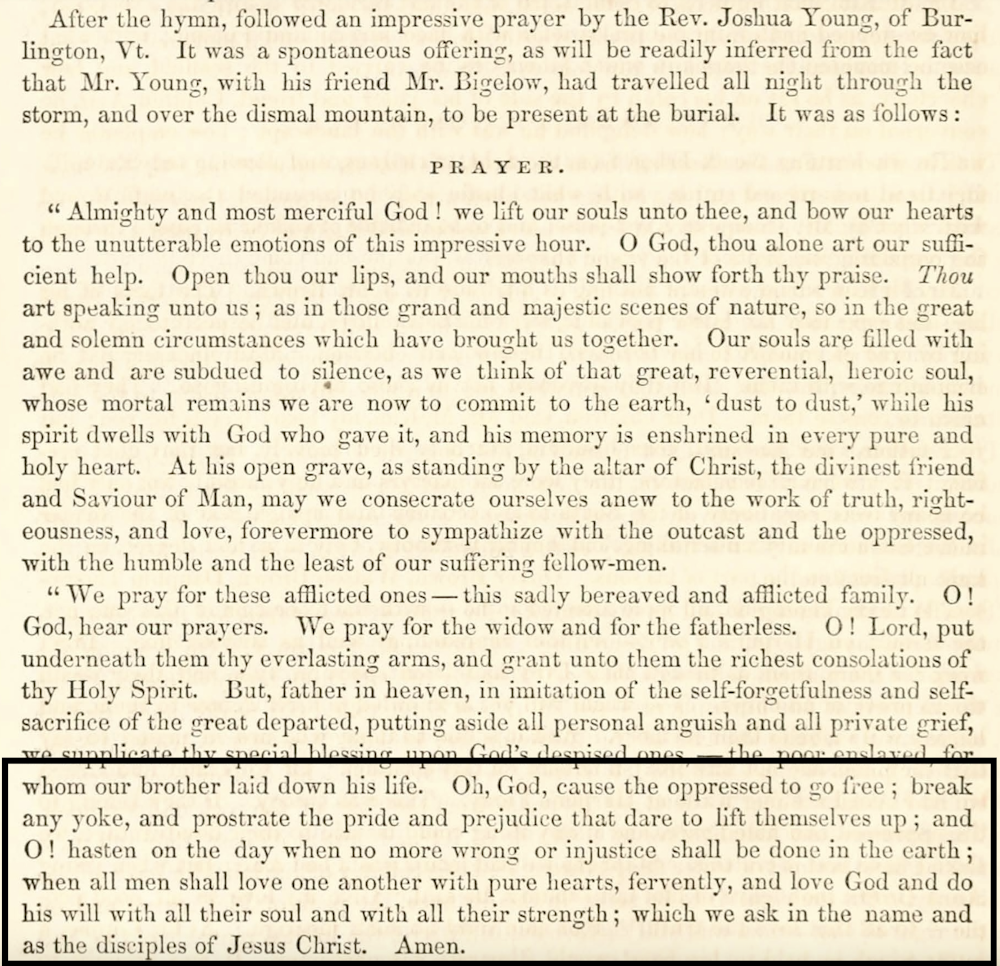
At the funeral for abolitionist John Brown, the minister prayed over his body, “Oh, God, cause the oppressed to go free; break any yoke, and prostrate the pride and prejudice that dare to lift themselves up.”
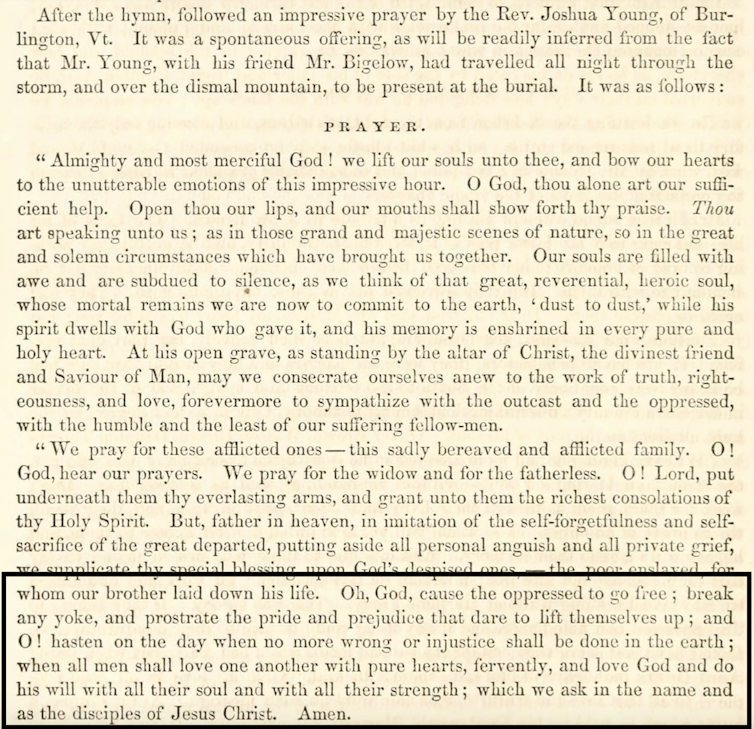 The prayer uttered at John Brown’s burial. Library of Congress
Use of the phrase did not end with Emancipation or the end of the U.S. Civil War.
In fact, it was one of Frederick Douglass’ favorite phrases. On Oct. 22, 1883, in his “Address at Lincoln Hall,” Douglass excoriated the Supreme Court’s decision rendering the Civil Rights Act of 1875 unconstitutional.
As was typical of Douglass, the speech ranged beyond racial inequities: “Color prejudice is not the only prejudice against which a Republic like ours should guard. The spirit of caste is malignant and dangerous everywhere. There is the prejudice of the rich against the poor, the pride and prejudice of the idle dandy against the hard-handed workingman.”
Austen’s independent women
Early on in “Pride and Prejudice,” the conceited Caroline Bingley snipes that Elizabeth Bennet shows “an abominable sort of conceited independence.” Later, the snobbish Lady Catherine accuses Bennet of being “headstrong.” But near the ending, Mr. Darcy tells Bennet that he loves her for “the liveliness” of her “mind.”
In this respect, Bennet reflects a quality that all of Austen’s heroines possess. While they try to adhere to standards of courtesy and respect, none are guilty of saying only what the leading man wants to hear.
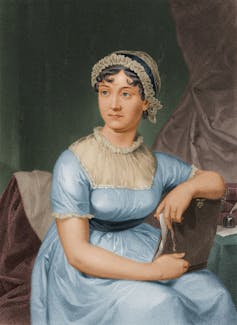 Jane Austen. Stock Montage/Getty Images
Given that Austen chose her title to honor the phrase and its history, it is ironic that her own fame ended up drowning out the abolitionist associations of “pride and prejudice” after the Civil War.
If there is any work of fiction that successfully makes self-sufficiency, independent thinking and open-mindedness look good – and makes sycophants, rigidity and hysterical devotion to rank and status look bad – it is “Pride and Prejudice.”
Yet the lasting popularity of Austen’s novel demonstrates that the ethics contained in the phrase continue to resonate today, even if its context has been lost.
This article is republished from The Conversation under a Creative Commons license. Read the original article and see more than 250 UMBC articles available in The Conversation.
]]>
Written by Margie Burns, assistant teaching professor of English, UMBC Most readers hear “pride and prejudice” and immediately think of Jane Austen’s most famous novel, that salty-sweet...
https://umbc.edu/stories/from-pulpits-to-protest-the-surprising-history-of-the-phrase-pride-and-prejudice/
https://my3.my.umbc.edu/api/v0/pixel/news/149046/guest@my.umbc.edu/0605e3cbd0322ab8b8f1c4d01684ccac/api/pixel
cahss
discovery
english
international
magazine
research
story
UMBC News & Magazine
https://my3.my.umbc.edu/groups/umbc-news-magazine
https://assets1-my.umbc.edu/system/shared/avatars/groups/000/001/943/24435aa6207c452e7bc15cc74b42c7bb/xsmall.png?1748556657
https://assets1-my.umbc.edu/system/shared/avatars/groups/000/001/943/24435aa6207c452e7bc15cc74b42c7bb/original.png?1748556657
https://assets2-my.umbc.edu/system/shared/avatars/groups/000/001/943/24435aa6207c452e7bc15cc74b42c7bb/xxlarge.png?1748556657
https://assets2-my.umbc.edu/system/shared/avatars/groups/000/001/943/24435aa6207c452e7bc15cc74b42c7bb/xlarge.png?1748556657
https://assets3-my.umbc.edu/system/shared/avatars/groups/000/001/943/24435aa6207c452e7bc15cc74b42c7bb/large.png?1748556657
https://assets1-my.umbc.edu/system/shared/avatars/groups/000/001/943/24435aa6207c452e7bc15cc74b42c7bb/medium.png?1748556657
https://assets2-my.umbc.edu/system/shared/avatars/groups/000/001/943/24435aa6207c452e7bc15cc74b42c7bb/small.png?1748556657
https://assets1-my.umbc.edu/system/shared/avatars/groups/000/001/943/24435aa6207c452e7bc15cc74b42c7bb/xsmall.png?1748556657
https://assets2-my.umbc.edu/system/shared/avatars/groups/000/001/943/24435aa6207c452e7bc15cc74b42c7bb/xxsmall.png?1748556657
UMBC News & Magazine
3
0
false
Mon, 14 Apr 2025 10:56:40 -0400
How ticket-splitting voters could shape the 2026 midterms
Written by Ian Anson, associate professor of political science, UMBC
With the 2024 U.S. election over and done with, political analysts and both major parties are already turning their attention to the upcoming midterm elections in 2026.
All 435 seats in the House of Representatives and 33 Senate seats will be up for grabs. The Democrats are as desperate to retake control of Congress as Republicans are to keep it. A Democratic-controlled Congress in 2026 would do everything in its power to halt President Donald Trump’s legislative agenda in its tracks.
To edge out their opponent, candidates in highly competitive districts will have to win over some voters who rejected their own party’s presidential candidate in 2024. Democratic candidates will need to get support from at least some Trump voters; Republicans will need some support from Kamala Harris voters.
Despite the intensely polarized U.S. political environment, a significant number of Americans routinely cross party lines to support both Democratic and Republican candidates at the polls. When it happens on the same ballot, this is called ticket-splitting.
Just who are these voters, and when do they choose to split their tickets?
I am a political scientist who studies American voting behavior. I see these questions as key to understanding how long Trump’s total control of government will last.
Split tickets in North Carolina and Arizona
Ticket-splitting created some surprising election returns in 2024, mostly benefiting down-ballot Democrats.
For instance, Republican Donald Trump won North Carolina by around 3 percentage points, but voters elected a Democrat, Josh Stein, for governor by a margin of almost 15 percentage points. Several hundred thousand North Carolinians split their tickets to produce this outcome.
More than 100,000 Arizonans likewise split their tickets in 2024, electing Trump with 52% of the vote, yet rejecting the Trump-aligned Senate candidate Kari Lake in favor of Democrat Ruben Gallego.
Many experts believe that candidates such as Gallego and Stein were simply perceived as less extreme than their opponents, and so they lured moderate voters and even some Republicans.
In this theory, extreme MAGA-aligned candidates win primary elections because they attract the most partisan voters. But they turn off many people in the general electorate.
Marylanders split their tickets
One of the most extreme examples of ticket-splitting in 2024 was in the race to replace U.S. Sen. Ben Cardin of Maryland.
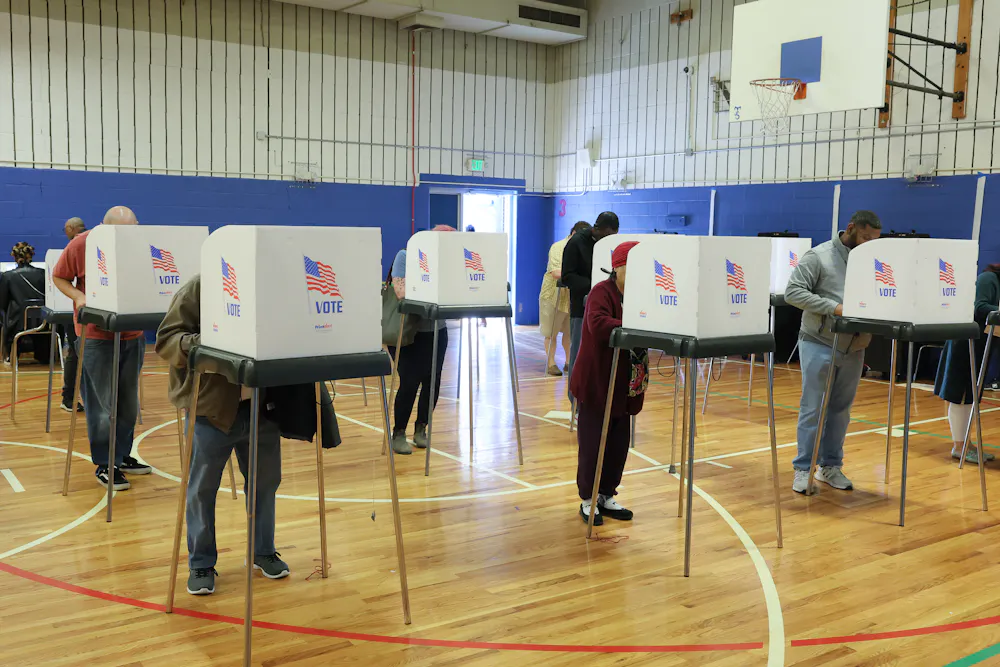
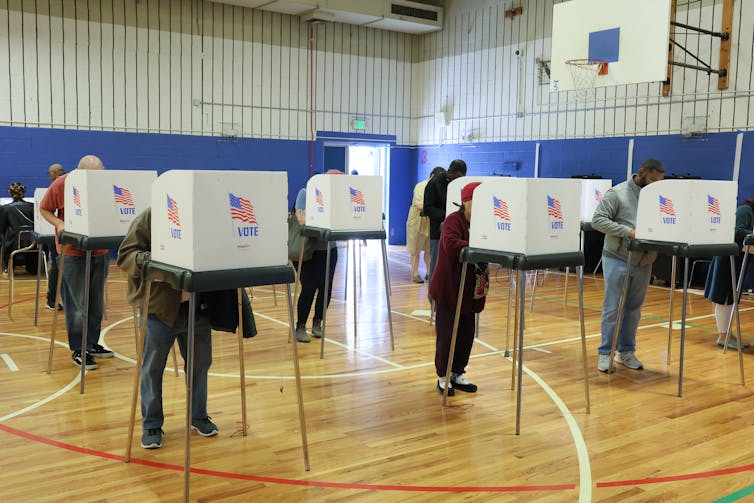 Partyliners or ticket-splitters? Maryland voters cast their ballots in Baltimore on Nov. 5, 2024. J. Countess/Getty Images
Cardin was a retiring three-term Democrat who had last won reelection in 2018 by an astronomical margin of over 34 percentage points. Initially, many expert analysts saw the seat as safe for Democrats.
Then, in February 2024, former Maryland Gov. Larry Hogan, who had previously ruled out a Senate run, surprised political analysts by entering the Republican primary. After winning the primary handily, Hogan eventually squared off against Prince George’s County Executive Angela Alsobrooks, a Democrat, in the general election.
Suddenly, a matchup that should have been Alsobrook’s to lose got competitive.
 Angela Alsobrooks celebrates her win on Nov. 5, 2024, in College Park, Md. Graeme Sloan for The Washington Post via Getty Images
Hogan, who left office in 2023, was a successful Republican governor who won election twice in reliably blue Maryland. Perceived by many voters as an ideological moderate, he was also a vocal Trump opponent in a state that supported Biden over Trump in 2020 by around 33 percentage points. During his governorship, Hogan routinely outperformed MAGA-aligned Republicans who ran for Congress in Maryland.
Ultimately, Hogan did lose to Alsobrooks. She became Maryland’s first female U.S. senator and first Black U.S. senator. Yet Hogan came an incredible 17 percentage points closer to winning than Trump did. Kamala Harris beat Trump by 1.9 million votes, winning 63% of the electorate to Trump’s 34%.
This means that Hogan exceeded Trump’s vote total by over 300,000 votes. That’s an immense amount of ticket-splitting by Marylanders in 2024.
Who are the Hogan Democrats?
To better understand ticket-splitting in Maryland’s 2024 election, I analyzed a survey that my university conducted in Baltimore County. Baltimore County is a bellwether county that has backed the winning gubernatorial candidate in every election since 2006.
The UMBC Battleground Exit Poll surveyed 1,119 voters at election precincts across Baltimore County during early voting and on Election Day 2024. The results were weighted to ensure demographic representativeness.
This extensive survey shows that around 10% of all voters in Baltimore County supported the surprising combination of the Democrat Harris and the Republican Hogan.
In contrast, fewer than 2% of Trump voters split their tickets to back the Democratic Senate candidate Alsobrooks.
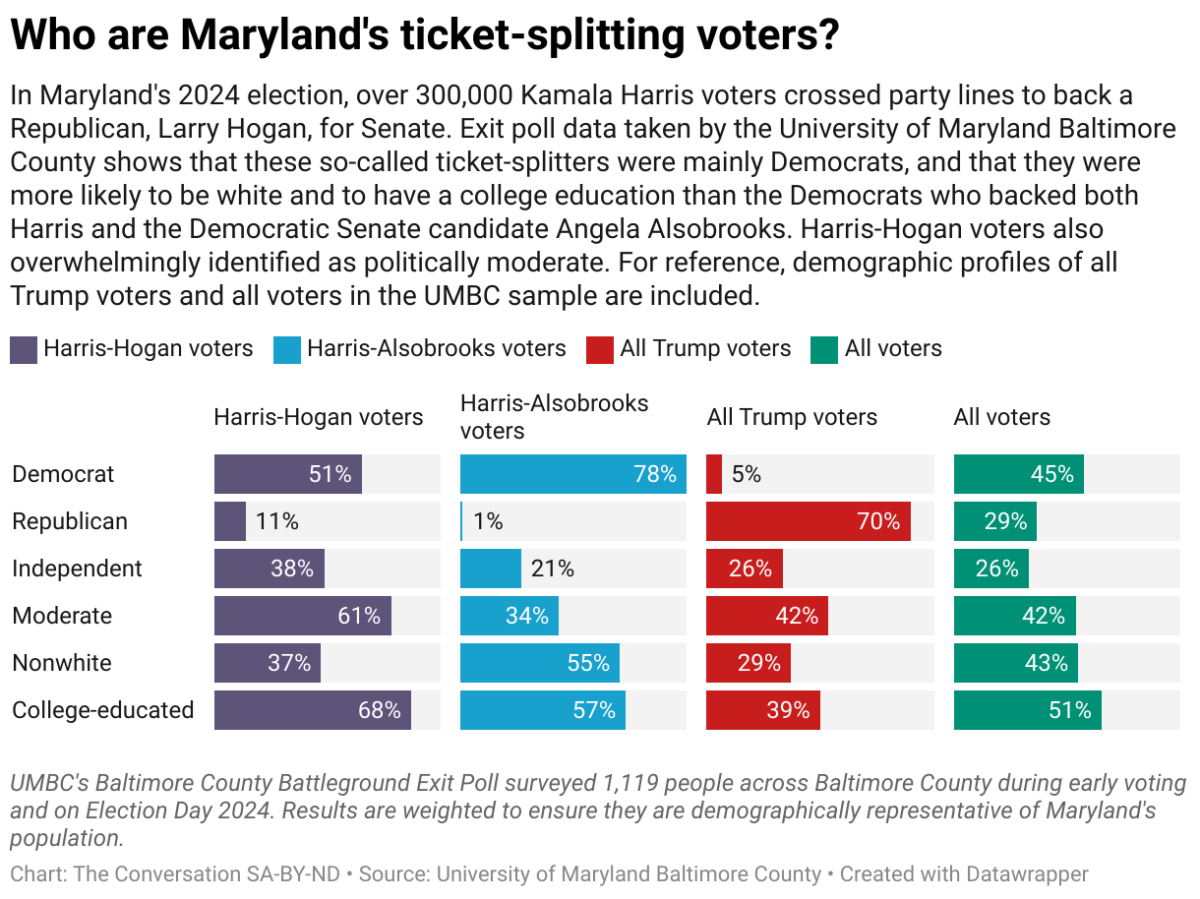
My team’s data analysis shows that roughly half of Harris-Hogan voters – 51% – were Democrats. These ticket-splitters included a higher percentage of white voters than the Democrats who supported both Harris and Alsobrooks. Around 37% of Harris-Hogan voters identified as Black, Asian, Hispanic, Middle Eastern or another nonwhite racial category, compared with 55% of Harris-Alsobrooks voters.
We found virtually no gender differences between Democrats who split their tickets to back a woman for president and a man for Senate and those who backed two women candidates.
Harris-Hogan Democrats tended to be better educated than other voting groups. Around 68% reported having a college degree, compared with around 51% of all survey respondents.
Perhaps the most striking feature of Harris-Hogan voters is their self-declared moderation.
On a seven-point ideological scale ranging from “very liberal” to “very conservative,” around 61% of Harris-Hogan ticket-splitters put themselves at the exact midpoint of the scale. Only around 42% of the full sample of Maryland voters categorized themselves as centrist.
Can moderates survive in Trump’s shadow?
As our study shows, Hogan’s popularity in Maryland is due in part to his appeal among moderates. This finding helps to explain how this Republican has remained popular among Democrats and independent voters.
However, Hogan still lost. Unlike in Arizona, where the Democratic Senate candidate Ruben Gallego won by wooing moderate Republicans, the tenuous balance of power in the U.S. House and Senate may have prevented some Democratic and independent voters in Maryland from crossing the aisle to support a moderate Republican.
Of course, Hogan also faced a formidable opponent. Alsobrooks had already emerged victorious in a tight primary against a well-funded and popular incumbent U.S. House representative, David Trone. I suspect a less-skilled Democratic candidate would have created even more Harris-Hogan voters.
Ultimately, my analysis of ticket-splitting in 2024 reveals that even in an era of entrenched polarization, many voters approach congressional and presidential races with different mindsets.
This dynamic will likely influence the next election cycle, too.
The party of the president often takes heavy losses in midterm elections. In 2026, congressional candidates – and Democrats in particular – will be doing everything they can to woo moderates.
This will be especially true if Trump’s aggressive policies, such as widespread government layoffs and mass deportations, prove unpopular.
Let the campaigning begin.
This article is republished from The Conversation under a Creative Commons license. Read the original article and see more than 250 UMBC articles available in The Conversation.
]]>
Written by Ian Anson, associate professor of political science, UMBC With the 2024 U.S. election over and done with, political analysts and both major parties are already turning their...
https://umbc.edu/stories/ticket-splitting-voters-and-2026-midterms/
https://my3.my.umbc.edu/api/v0/pixel/news/147672/guest@my.umbc.edu/5e1b65cb73b881f26d15ea965cce7a64/api/pixel
cahss
cahss-research
discovery
magazine
politicalscience
story
UMBC News & Magazine
https://my3.my.umbc.edu/groups/umbc-news-magazine
https://assets1-my.umbc.edu/system/shared/avatars/groups/000/001/943/24435aa6207c452e7bc15cc74b42c7bb/xsmall.png?1748556657
https://assets1-my.umbc.edu/system/shared/avatars/groups/000/001/943/24435aa6207c452e7bc15cc74b42c7bb/original.png?1748556657
https://assets2-my.umbc.edu/system/shared/avatars/groups/000/001/943/24435aa6207c452e7bc15cc74b42c7bb/xxlarge.png?1748556657
https://assets2-my.umbc.edu/system/shared/avatars/groups/000/001/943/24435aa6207c452e7bc15cc74b42c7bb/xlarge.png?1748556657
https://assets3-my.umbc.edu/system/shared/avatars/groups/000/001/943/24435aa6207c452e7bc15cc74b42c7bb/large.png?1748556657
https://assets1-my.umbc.edu/system/shared/avatars/groups/000/001/943/24435aa6207c452e7bc15cc74b42c7bb/medium.png?1748556657
https://assets2-my.umbc.edu/system/shared/avatars/groups/000/001/943/24435aa6207c452e7bc15cc74b42c7bb/small.png?1748556657
https://assets1-my.umbc.edu/system/shared/avatars/groups/000/001/943/24435aa6207c452e7bc15cc74b42c7bb/xsmall.png?1748556657
https://assets2-my.umbc.edu/system/shared/avatars/groups/000/001/943/24435aa6207c452e7bc15cc74b42c7bb/xxsmall.png?1748556657
UMBC News & Magazine
1
0
false
Wed, 26 Feb 2025 14:08:34 -0500
Wed, 26 Feb 2025 14:08:34 -0500
A fiscal crisis is looming for many US cities

Written by John Rennie Short, professor emeritus of public policy, UMBC
Five years after the start of the COVID-19 pandemic, many U.S. cities are still adjusting to a new normal, with more people working remotely and less economic activity in city centers. Other factors, such as underfunded pension plans for municipal employees, are pushing many city budgets into the red.
Urban fiscal struggles are not new, but historically they have mainly affected U.S. cities that are small, poor or saddled with incompetent managers. Today, however, even large cities, including Chicago, Houston and San Francisco, are under serious financial stress.
This is a looming nationwide threat, driven by factors that include climate change, declining downtown activity, loss of federal funds and large pension and retirement commitments.
Why cities struggle
Many U.S. cities have faced fiscal crises over the past century, for diverse reasons. Most commonly, stress occurs after an economic downturn or sharp fall in tax revenues.
Florida municipalities began to default in 1926 after the collapse of a land boom. Municipal defaults were common across the nation in the 1930s during the Great Depression: As unemployment rose, relief burdens swelled and tax collections dwindled.
 The New York Daily News, Oct. 30, 1975, after U.S. President Gerald Ford ruled out providing federal aid to save the city from bankruptcy. Several months later, Ford signed legislation authorizing federal loans. Edward Stojakovic/Flickr, CC BY
In 1934 Congress amended the U.S. bankruptcy code to allow municipalities to file formally for bankruptcy. Subsequently, 27 states enacted laws that authorized cities to become debtors and seek bankruptcy protection.
Declaring bankruptcy was not a cure-all. It allowed cities to refinance debt or stretch out payment schedules, but it also could lead to higher taxes and fees for residents, and lower pay and benefits for city employees. And it could stigmatize a city for many years afterward.
In the 1960s and 1970s, many urban residents and businesses left cities for adjoining suburbs. Many cities, including New York, Cleveland and Philadelphia, found it difficult to repay debts as their tax bases shrank.
In the wake of the 2008-2009 housing market collapse, cities including Detroit, San Bernardino, California, and Stockton, California, filed for bankruptcy. Other cities faced similar difficulties but were located in states that did not allow municipalities to declare bankruptcy.
Even large, affluent jurisdictions could go off the financial rails. For example, Orange County, California, went bankrupt in 2002 after its treasurer, Robert Citron, pursued a risky investment strategy of complex leveraging deals, losing some $1.65 billion in taxpayer funds.
Today, cities face a convergence of rising costs and decreasing revenues in many places. As I see it, the urban fiscal crisis is now a pervasive national challenge.
Climate-driven disasters
Climate change and its attendant increase in major disasters are putting financial pressure on municipalities across the country.
Events like wildfires and flooding have twofold effects on city finances. First, money has to be spent on rebuilding damaged infrastructure, such as roads, water lines and public buildings. Second, after the disaster, cities may either act on their own or be required under state or federal law to make expensive investments in preparation for the next storm or wildfire.
 Los Angeles Mayor Karen Bass (center) discusses wildfire recovery in Pacific Palisades, Calif., Jan. 27, 2025. Cleaning up after the wildfires, which destroyed more than 16,000 structures, will include disposing of several million tons of toxic ash and debris. Drew A. Kelley/MediaNews Group/Long Beach Press-Telegram via Getty Images
In Houston, for example, court rulings after multiple years of severe flooding are forcing the city to spend $100 million on street repairs and drainage by mid-2025. This requirement will expand the deficit in Houston’s annual budget to $330 million.
In Massachusetts, towns on Cape Cod are spending millions of dollars to switch from septic systems to public sewer lines and upgrade wastewater treatment plants. Population growth has sharply increased water pollution on the Cape, and climate change is promoting blooms of toxic algae that feed on nutrients in wastewater.
Increasing uncertainty about the total costs of mitigating and adapting to climate change will inevitably lead rating agencies to downgrade municipal credit ratings. This raises cities’ costs to borrow money for climate-related projects like protecting shorelines and improving wastewater treatment.
Underfunded pensions
Cities also spend a lot of money on employees, and many large cities are struggling to fund pensions and health benefits for their workforces. As municipal retirees live longer and require more health care, the costs are mounting.
For example, Chicago currently faces a budget deficit of nearly $1 billion, which stems partly from underfunded retirement benefits for nearly 30,000 public employees. The city has $35 billion in unfunded pension liabilities and almost $2 billion in unfunded retiree health benefits. Chicago’s teachers are owed $14 billion in unfunded benefits.
Policy studies have shown for years that politicians tend to underfund retirement and pension benefits for public employees. This approach offloads the real cost of providing police, fire protection and education onto future taxpayers.
Struggling downtowns and less federal support
Cities aren’t just facing rising costs – they’re also losing revenues. In many U.S. cities, retail and commercial office economies are declining. Developers have overbuilt commercial properties, creating an excess supply. More unleased properties will mean lower tax revenues.
At the same time, pandemic-related federal aid that cushioned municipal finances from 2020 through 2024 is dwindling.
State and local governments received $150 billion through the 2020 Coronavirus Aid, Relief, and Economic Security (CARES) Act and an additional $130 billion through the 2021 American Rescue Plan Act. Now, however, this federal largesse – which some cities used to fill mounting fiscal cracks – is at an end.
In my view, President Donald Trump’s administration is highly unlikely to bail out urban areas – especially more liberal cities like Detroit, Philadelphia and San Francisco. Trump has portrayed large cities governed by Democrats in the darkest terms – for example, calling Baltimore a “rodent-infested mess” and Washington, D.C., a “dirty, crime-ridden death trap.” I expect that Trump’s animus against big cities, which was a staple of his 2024 campaign, could become a hallmark of his second term.
Resistance to new taxes
Cities can generate revenue from taxes on sales, businesses, property and utilities. However, increasing municipal taxes – particularly property taxes – can be very difficult.
In 1978, California adopted Proposition 13 – a ballot measure that limited property tax increases to the rate of inflation or 2% per year, whichever is lower. This high-profile campaign created a widespread narrative that property taxes were out of control and made it very hard for local officials to support property tax increases.
Thanks to caps like Prop 13, a persistent public view that taxes are too high and political resistance, property taxes have tended to lag behind inflation in many parts of the country.
The crunch
 Workers in North Miami Beach, Fla., distribute sandbags to residents to help prevent flooding as Hurricane Milton approaches the state on Oct. 8, 2024. AP Photo/Wilfredo Lee
Taking these factors together, I see a fiscal crunch coming for U.S. cities. Small cities with low budgets are particularly vulnerable. But so are larger, more affluent cities, such as San Francisco with its collapsing downtown office market, or Houston, New York and Miami, which face growing costs from climate change.
One city manager who runs an affluent municipality in the Pacific Northwest told me that in these difficult circumstances, politicians need to be more frank and open with their constituents and explain convincingly and compellingly how and why taxpayer money is being spent.
Efforts to balance city budgets are opportunities to build consensus with the public about what municipalities can do, and at what cost. The coming months will show whether politicians and city residents are ready for these hard conversations.
This article is republished from The Conversation under a Creative Commons license. Read the original article and see more than 250 UMBC articles available in The Conversation.
]]>
Written by John Rennie Short, professor emeritus of public policy, UMBC Five years after the start of the COVID-19 pandemic, many U.S. cities are still adjusting to a new normal, with more...
https://umbc.edu/stories/a-fiscal-crisis-is-looming-for-many-us-cities/
https://my3.my.umbc.edu/api/v0/pixel/news/147507/guest@my.umbc.edu/fc65968ee4ebe77a7381c45111887c53/api/pixel
cahss
cahss-research
discovery
magazine
publicpolicy
research
story
UMBC News & Magazine
https://my3.my.umbc.edu/groups/umbc-news-magazine
https://assets1-my.umbc.edu/system/shared/avatars/groups/000/001/943/24435aa6207c452e7bc15cc74b42c7bb/xsmall.png?1748556657
https://assets1-my.umbc.edu/system/shared/avatars/groups/000/001/943/24435aa6207c452e7bc15cc74b42c7bb/original.png?1748556657
https://assets2-my.umbc.edu/system/shared/avatars/groups/000/001/943/24435aa6207c452e7bc15cc74b42c7bb/xxlarge.png?1748556657
https://assets2-my.umbc.edu/system/shared/avatars/groups/000/001/943/24435aa6207c452e7bc15cc74b42c7bb/xlarge.png?1748556657
https://assets3-my.umbc.edu/system/shared/avatars/groups/000/001/943/24435aa6207c452e7bc15cc74b42c7bb/large.png?1748556657
https://assets1-my.umbc.edu/system/shared/avatars/groups/000/001/943/24435aa6207c452e7bc15cc74b42c7bb/medium.png?1748556657
https://assets2-my.umbc.edu/system/shared/avatars/groups/000/001/943/24435aa6207c452e7bc15cc74b42c7bb/small.png?1748556657
https://assets1-my.umbc.edu/system/shared/avatars/groups/000/001/943/24435aa6207c452e7bc15cc74b42c7bb/xsmall.png?1748556657
https://assets2-my.umbc.edu/system/shared/avatars/groups/000/001/943/24435aa6207c452e7bc15cc74b42c7bb/xxsmall.png?1748556657
UMBC News & Magazine
0
0
false
Thu, 20 Feb 2025 11:02:22 -0500
Thu, 20 Feb 2025 11:02:22 -0500
International exchange brings opportunities to question assumptions—in science and life

Making assumptions is a habit of life, a way to speed up decisions. Sometimes these mental short-cuts, however, lead us astray.
Such was the situation when Lorenz Kopp, an engineering master’s student at Germany’s Regensburg University of Applied Sciences who was visiting UMBC this fall for a 50-day exchange project, assumed the ovens in the U.S. lab he was working in would use the Fahrenheit temperature scale. He filled a mold with a plastic-like gel the group was using to make flexible accordion-shaped structures, put it in the oven to set, and sat back.
“And then I started to smell burning,” he says, with a smile. The ovens were in fact operating in Celsius, and he had set the temperature too high.
Kopp came to the U.S. with fellow Regensburg student Björn Michelmann to work with mechanical engineering professor Paris von Lockette. Their project was part of a bigger assumption-questioning enterprise—in particular probing the behavior of materials called soft magnets.
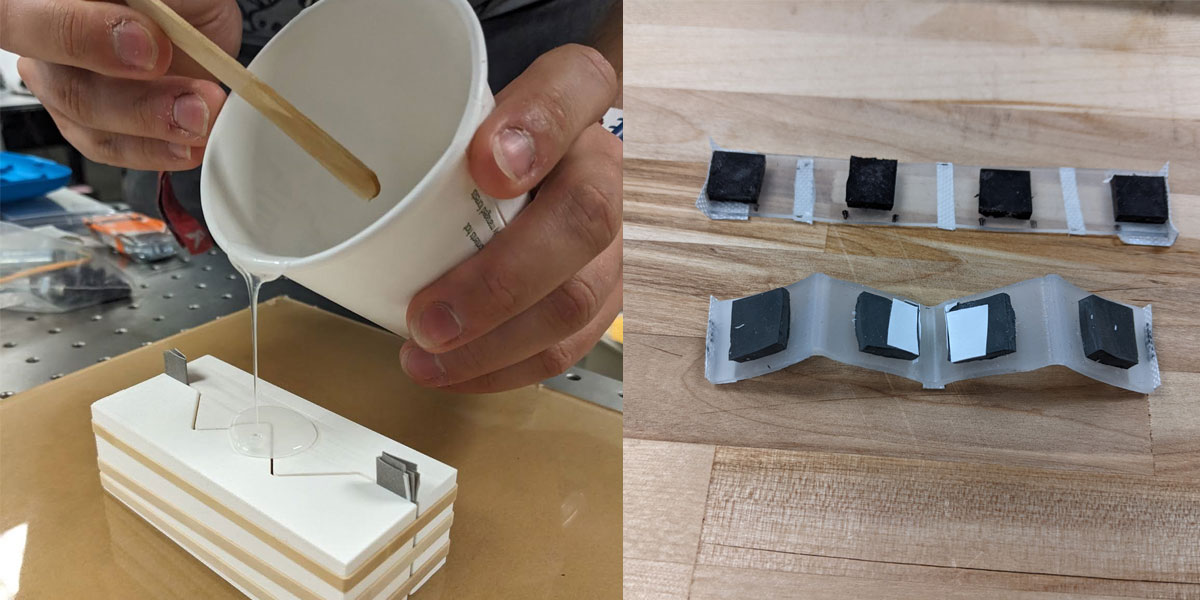 Kopp and Michelmann designed and made magnetically active accordion structures from a flexible, plastic-like material. (Images courtesy of Lorenz Kopp)
Soft magnetic materials tend to be metals that easily respond to (become magnetized in) the presence of a magnetic field, but go back to “normal” when the field is removed. This is in contrast to hard magnetic materials, which can be permanently magnetized. A typical fridge magnet is an example of a hard magnetic material, while a piece of iron is an example of a soft magnetic material.
Engineers are interested in magnets as a way to wirelessly control robots, but soft magnets are often assumed to offer a less versatile range of movements for these applications than hard magnets.
For about seven weeks during the fall semester, Kopp and Michelmann set up and ran a series of experiments putting some of these assumptions to the test. They designed accordion structures made from a flexible plastic-like material and embedded either soft or hard magnets in the accordions’ pleats. They then recorded how the structures folded or unfolded when exposed to magnetic fields. Early analysis of the results hints that the soft magnets may offer more versatility than initially assumed.
“It was great working with Lorenz and Björn. They were exceptionally productive,” von Lockette says. “We got interesting results and we’re working to write them up in a paper.”
Soft magnetic materials are appealing to engineers because they are cheaper and more biocompatible than hard magnetic materials, and also require less energy to be magnetized and demagnetized. If the group can demonstrate novel ways to get extra degrees of control over their movement, it could open a host of new applications, including in robots that assist in surgery or devices that are implanted in the human body to deliver drugs, monitor diseases, or substitute for the function of lost or damaged organs.
An international collaboration
 Kopp near the truck he and Michelmann drove to Shenandoah National Park. (Image courtesy of Lorenz Kopp)
Kopp and Michelmann got the opportunity to visit UMBC through funding by the German Academic Exchange Service. Their advisor at Regensburg University of Applied Sciences—Mikhail Chamonine—knew von Lockette through the American Society of Mechanical Engineers, and together they arranged the details of the visit with the help of the Office of International Students and Scholars at UMBC. Chamonine specializes in the physics of electromagnetic fields, and his lab in Germany performs many experiments with rubber-based soft magnetic materials. Von Lockette has developed his career around turning science insights about magnetically active soft materials into new applications and devices. The area of magnetic control of robots was a natural overlap.
While Kopp and Michelmann spent plenty of time in the lab during their visit, they also had chances to explore the areas surrounding UMBC on weekends. They visited the National Aquarium in Baltimore, took in a Raven’s football game, and drove to Shenandoah National Park in Virginia. They also enjoyed campus life, attending Homecoming weekend in October and regularly visiting the Retriever Activity Center to work out.
Michelmann says it was eye-opening to experience life on a U.S. university campus. “In a lot of U.S. films, there are fraternities and sororities with houses where they party every night. But I learned that stereotype doesn’t apply to UMBC.” He says he was pleasantly surprised by the variety of activities on campus, from sporting events, to tabletop games, to events such as bingo and craft nights organized by the Student Events Board.
Advancing science and technology
Von Lockette says he hopes to continue the collaboration with Regensburg University of Applied Sciences, and to arrange trips for UMBC students to visit Germany in the future.
Kopp, Michelmann, von Lockette, and Chamonine remain in touch as they write up the results of their experiments. When they noticed some unexpected behavior of the soft magnet accordions, von Lockette says he found himself thinking back to discussions he had with Chamonine about the importance of what are called demagnetizing terms in equations describing the magnetization of materials. The terms are affected by the geometry of the material and explain, for example, why when you put an iron nail in a magnetic field, it is easier for the nail to magnetize along its length, rather than perpendicular to it.
The researchers are testing whether they can explain the behavior of the soft magnets they tested—and the difference from the hard magnets—using demagnetizing field calculations. A better understanding of the behavior could guide future experiments trying to demonstrate greater versatility of movements and finer control.
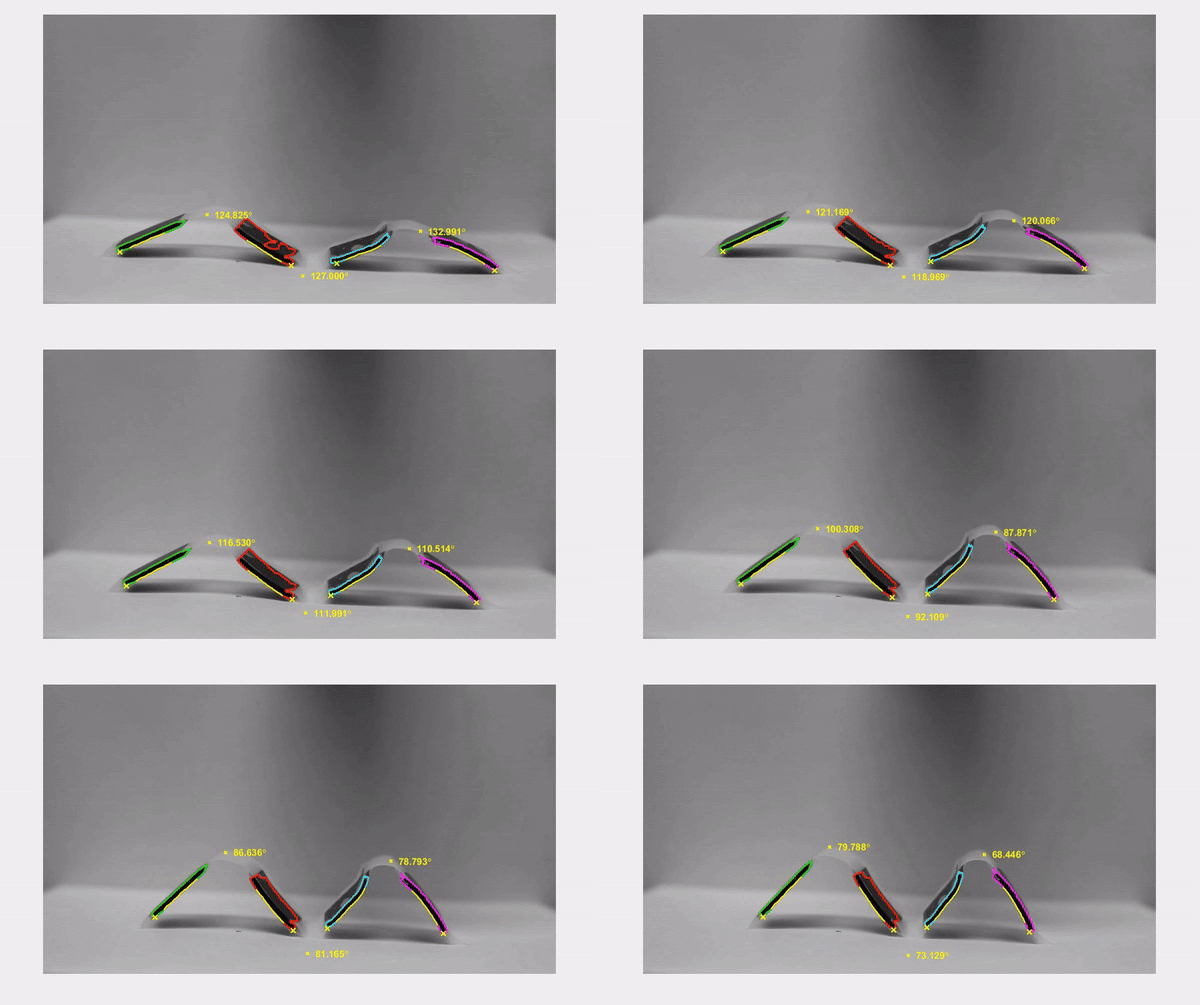 The researchers recorded and analyzed how the accordion structures folded or unfolded when exposed to magnetic fields. (Video courtesy of Lorenz Kopp)
“We’ll experiment with different materials and different geometries. We’re wondering: If we apply this field, what can we make it do that we didn’t think it could do?” von Lockette says.
Von Lockette has a history of getting fellow researchers to consider the usefulness of materials they may have overlooked. Earlier in his career, he published a paper demonstrating the potential of a new type of magnetically active material—in that case made with hard magnets.
“That was my first big splash,” he says. Now he’s happy to give soft magnets their due too, while also encouraging a new generation of researchers, including Kopp and Michelmann.
Chamonine is also pleased with the work of his students. “They are working to get the results published, which is not typical for a short project,” he says.
Beyond pushing the assumptions of what could get done in the lab in seven weeks, Kopp and Michelmann also enjoyed the typical world-expanding experience of international travel. “It was not only the science,” Chamonine says, “but they also had a chance to stay in the United States. I think for them it was absolutely an exciting moment in life.”
 Kopp and Michelmann visited New York at the end of their U.S. trip. (Image courtesy of Lorenz Kopp)
]]>
Making assumptions is a habit of life, a way to speed up decisions. Sometimes these mental short-cuts, however, lead us astray. Such was the situation when Lorenz Kopp, an engineering...
https://umbc.edu/stories/international-exchange-questioning-assumptions/
https://my3.my.umbc.edu/api/v0/pixel/news/147447/guest@my.umbc.edu/b3e4c78b14007557bb86daaa0944ad41/api/pixel
coeit
discovery
international
magazine
meche
story
UMBC News & Magazine
https://my3.my.umbc.edu/groups/umbc-news-magazine
https://assets1-my.umbc.edu/system/shared/avatars/groups/000/001/943/24435aa6207c452e7bc15cc74b42c7bb/xsmall.png?1748556657
https://assets1-my.umbc.edu/system/shared/avatars/groups/000/001/943/24435aa6207c452e7bc15cc74b42c7bb/original.png?1748556657
https://assets2-my.umbc.edu/system/shared/avatars/groups/000/001/943/24435aa6207c452e7bc15cc74b42c7bb/xxlarge.png?1748556657
https://assets2-my.umbc.edu/system/shared/avatars/groups/000/001/943/24435aa6207c452e7bc15cc74b42c7bb/xlarge.png?1748556657
https://assets3-my.umbc.edu/system/shared/avatars/groups/000/001/943/24435aa6207c452e7bc15cc74b42c7bb/large.png?1748556657
https://assets1-my.umbc.edu/system/shared/avatars/groups/000/001/943/24435aa6207c452e7bc15cc74b42c7bb/medium.png?1748556657
https://assets2-my.umbc.edu/system/shared/avatars/groups/000/001/943/24435aa6207c452e7bc15cc74b42c7bb/small.png?1748556657
https://assets1-my.umbc.edu/system/shared/avatars/groups/000/001/943/24435aa6207c452e7bc15cc74b42c7bb/xsmall.png?1748556657
https://assets2-my.umbc.edu/system/shared/avatars/groups/000/001/943/24435aa6207c452e7bc15cc74b42c7bb/xxsmall.png?1748556657
UMBC News & Magazine
11
0
false
Tue, 18 Feb 2025 16:07:11 -0500
Tue, 18 Feb 2025 16:07:11 -0500
If FEMA didn’t exist, could states handle the disaster response alone?
Kopp and Michelmann visited New York at the end of their U.S. trip. (Image courtesy of Lorenz Kopp)
]]>
Making assumptions is a habit of life, a way to speed up decisions. Sometimes these mental short-cuts, however, lead us astray. Such was the situation when Lorenz Kopp, an engineering...
https://umbc.edu/stories/international-exchange-questioning-assumptions/
https://my3.my.umbc.edu/api/v0/pixel/news/147447/guest@my.umbc.edu/b3e4c78b14007557bb86daaa0944ad41/api/pixel
coeit
discovery
international
magazine
meche
story
UMBC News & Magazine
https://my3.my.umbc.edu/groups/umbc-news-magazine
https://assets1-my.umbc.edu/system/shared/avatars/groups/000/001/943/24435aa6207c452e7bc15cc74b42c7bb/xsmall.png?1748556657
https://assets1-my.umbc.edu/system/shared/avatars/groups/000/001/943/24435aa6207c452e7bc15cc74b42c7bb/original.png?1748556657
https://assets2-my.umbc.edu/system/shared/avatars/groups/000/001/943/24435aa6207c452e7bc15cc74b42c7bb/xxlarge.png?1748556657
https://assets2-my.umbc.edu/system/shared/avatars/groups/000/001/943/24435aa6207c452e7bc15cc74b42c7bb/xlarge.png?1748556657
https://assets3-my.umbc.edu/system/shared/avatars/groups/000/001/943/24435aa6207c452e7bc15cc74b42c7bb/large.png?1748556657
https://assets1-my.umbc.edu/system/shared/avatars/groups/000/001/943/24435aa6207c452e7bc15cc74b42c7bb/medium.png?1748556657
https://assets2-my.umbc.edu/system/shared/avatars/groups/000/001/943/24435aa6207c452e7bc15cc74b42c7bb/small.png?1748556657
https://assets1-my.umbc.edu/system/shared/avatars/groups/000/001/943/24435aa6207c452e7bc15cc74b42c7bb/xsmall.png?1748556657
https://assets2-my.umbc.edu/system/shared/avatars/groups/000/001/943/24435aa6207c452e7bc15cc74b42c7bb/xxsmall.png?1748556657
UMBC News & Magazine
11
0
false
Tue, 18 Feb 2025 16:07:11 -0500
Tue, 18 Feb 2025 16:07:11 -0500
If FEMA didn’t exist, could states handle the disaster response alone?

Written by Ming Xie, assistant professor of emergency health management and public health systems, UMBC.
Imagine a world in which a hurricane devastates the Gulf Coast, and the U.S. has no federal agency prepared to quickly send supplies, financial aid and temporary housing assistance.
Could the states manage this catastrophic event on their own?
Normally, the Federal Emergency Management Agency, known as FEMA, is prepared to marshal supplies within hours of a disaster and begin distributing financial aid to residents who need help.
However, with President Donald Trump questioning FEMA’s future and suggesting states take over recovery instead, and climate change causing more frequent and severe disasters, it’s worth asking how prepared states are to face these growing challenges without help.
What FEMA does
FEMA was created in 1979 with the job of coordinating national responses to disasters, but the federal government has played important roles in disaster relief since the 1800s.
During a disaster, FEMA’s assistance can begin only after a state requests an emergency declaration and the U.S. president approves it. The request has to show that the disaster is so severe that the state can’t handle the response on its own.
FEMA’s role is to support state and local governments by coordinating federal agencies and providing financial aid and recovery assistance that states would otherwise struggle to supply on their own. FEMA doesn’t “take over,” as a misinformation campaign launched during Hurricane Helene claimed. Instead, it pools federal resources to allow states to recover faster from expensive disasters.
During a disaster, FEMA:
- Coordinates federal resources. For example, during Hurricane Ian in 2022, FEMA coordinated with the U.S. Coast Guard, the Department of Defense and search-and-rescue teams to conduct rescue operations, organized utility crews to begin restoring power and also delivered water and millions of meals.
- Provides financial assistance. FEMA distributes billions of dollars in disaster relief funds to help individuals, businesses and local governments recover. As of Feb. 3, 2025, FEMA aid from 2024 storms included US$1.04 billion related to Hurricane Milton, $416.1 million for Hurricane Helene and $112.6 million for Hurricane Debby.
- Provides logistical support. FEMA coordinates with state and local governments, nonprofits such as the American Red Cross and federal agencies to supply cots, blankets and hygiene supplies for emergency shelters. It also works with state and local partners to distribute critical supplies such as food, water and medical aid.
The agency also manages the National Flood Insurance Program, offers disaster preparedness training and helps states develop response plans to improve their overall responses systems.
What FEMA aid looks like in a disaster
When wildfires swept through Maui, Hawaii, in August 2023, FEMA provided emergency grants to cover immediate needs such as food, clothing and essential supplies for survivors.
The agency arranged hotel rooms, rental assistance and financial aid for residents who lost homes or belongings. Its Direct Housing Program has spent $295 million to lease homes for more than 1,200 households. This comprehensive support helped thousands of people begin rebuilding their lives after losing almost everything.
FEMA also helped fund construction of a temporary school to ensure that students whose schools burned could continue their classes. Hawaii, with its relatively small population and limited emergency funds, would have struggled to mount a comparable response on its own.
 Hawaii Gov. Josh Green, center, and then-FEMA Administrator Deanne Criswell speak to reporters in Lahaina, Hawaii, on Aug. 12, 2023, while assessing the wildfire damage there. AP Photo/Rick Bowmer
Larger states often need help, too. When a 2021 winter storm overwhelmed Texas’ power grid and water infrastructure, FEMA coordinated the delivery of essential supplies, including water, fuel, generators and blankets, following the disaster declaration on Feb. 19, 2021. Within days, it awarded more than $2.8 million in grants to help people with temporary housing and home repairs.
Which states would suffer most without FEMA?
Without FEMA or other federal support, states would have to manage the disaster response and recovery on their own.
States prone to frequent disasters, such as Louisiana and Florida, would face expensive recurring challenges that would likely exacerbate recovery delays and reduce their overall resilience.
Smaller, more rural and less wealthy states that lack the financial resources and logistical capabilities to respond effectively would be disproportionately affected.
“States don’t have that capability built to handle a disaster every single year,” Lynn Budd, director of the Wyoming Office of Homeland Security, told Stateline in an interview. Access to FEMA avoids the need for expensive disaster response infrastructure in each state.
States might be able to arrange regional cooperation. But state-led responses and regional models have limitations. The National Guard could assist with supply distribution, but it isn’t designed to provide fast financial aid, housing or long-term recovery options, and the supplies and the recovery effort still come at a cost.
 Members of the National Guard and a FEMA search-and-rescue team work together in the disaster response after Hurricane Florence pounded Wilmington, N.C., in September 2018. Andrew Caballero-Reynolds/AFP via Getty Images
Wealthier states might be better equipped to manage on their own, but poorer states would likely struggle. States with less funding and infrastructure would be left relying on nonprofits and community-based efforts. But these organizations are not capable of providing the scope of services FEMA can.
Any federal funding would also be slow if Congress had to approve aid after each disaster, rather than having FEMA already prepared to respond. States would be at the mercy of congressional infighting.
In the absence of a federal response and coordinating role, recovery would be uneven, with wealthier areas recovering faster and poorer areas likely seeing more prolonged hardships.
What does this mean?
Coordinating disaster response is complex, the paperwork for federal assistance can be frustrating, and the agency does draw criticism. However, it also fills an important role.
As the frequency of natural disasters continues to rise due to climate change, ask yourself: How prepared is your state for a disaster, and could it get by without federal aid?
This article is republished from The Conversation under a Creative Commons license. Read the original article and see more than 250 UMBC articles available in The Conversation.
]]>
Written by Ming Xie, assistant professor of emergency health management and public health systems, UMBC. Imagine a world in which a hurricane devastates the Gulf Coast, and the U.S. has no...
https://umbc.edu/stories/if-fema-didnt-exist-could-states-handle-the-disaster-response-alone/
https://my3.my.umbc.edu/api/v0/pixel/news/147189/guest@my.umbc.edu/5d16cf42692e67578f7d00921038968c/api/pixel
cahss
discovery
edhs
magazine
research
story
the-conversation
UMBC News & Magazine
https://my3.my.umbc.edu/groups/umbc-news-magazine
https://assets1-my.umbc.edu/system/shared/avatars/groups/000/001/943/24435aa6207c452e7bc15cc74b42c7bb/xsmall.png?1748556657
https://assets1-my.umbc.edu/system/shared/avatars/groups/000/001/943/24435aa6207c452e7bc15cc74b42c7bb/original.png?1748556657
https://assets2-my.umbc.edu/system/shared/avatars/groups/000/001/943/24435aa6207c452e7bc15cc74b42c7bb/xxlarge.png?1748556657
https://assets2-my.umbc.edu/system/shared/avatars/groups/000/001/943/24435aa6207c452e7bc15cc74b42c7bb/xlarge.png?1748556657
https://assets3-my.umbc.edu/system/shared/avatars/groups/000/001/943/24435aa6207c452e7bc15cc74b42c7bb/large.png?1748556657
https://assets1-my.umbc.edu/system/shared/avatars/groups/000/001/943/24435aa6207c452e7bc15cc74b42c7bb/medium.png?1748556657
https://assets2-my.umbc.edu/system/shared/avatars/groups/000/001/943/24435aa6207c452e7bc15cc74b42c7bb/small.png?1748556657
https://assets1-my.umbc.edu/system/shared/avatars/groups/000/001/943/24435aa6207c452e7bc15cc74b42c7bb/xsmall.png?1748556657
https://assets2-my.umbc.edu/system/shared/avatars/groups/000/001/943/24435aa6207c452e7bc15cc74b42c7bb/xxsmall.png?1748556657
UMBC News & Magazine
4
0
false
Mon, 10 Feb 2025 10:57:18 -0500
Mon, 10 Feb 2025 10:57:18 -0500
Is DOGE a cybersecurity threat? A security expert explains the dangers of violating protocols and regulations that protect government computer systems

Written by Richard Forno, principal lecturer in computer science and electrical engineering, UMBC
The Department of Government Efficiency (DOGE), President Donald Trump’s special commission tasked with slashing federal spending, continues to disrupt Washington and the federal bureaucracy. According to published reports, its teams are dropping into federal agencies with a practically unlimited mandate to reform the federal government in accordance with recent executive orders.
As a 30-year cybersecurity veteran, I find the activities of DOGE thus far concerning. Its broad mandate across government, seemingly nonexistent oversight, and the apparent lack of operational competence of its employees have demonstrated that DOGE could create conditions that are ideal for cybersecurity or data privacy incidents that affect the entire nation.
Traditionally, the purpose of cybersecurity is to ensure the confidentiality and integrity of information and information systems while helping keep those systems available to those who need them. But in DOGE’s first few weeks of existence, reports indicate that its staff appears to be ignoring those principles and potentially making the federal government more vulnerable to cyber incidents.
Technical competence
Cybersecurity and information technology, like any other business function, depend on employees trained specifically for their jobs. Just as you wouldn’t let someone only qualified in first aid to perform open heart surgery, technology professionals require a baseline set of credentialed education, training and experience to ensure that the most qualified people are on the job.
Currently, the general public, federal agencies and Congress have little idea who is tinkering with the government’s critical systems. DOGE’s hiring process, including how it screens applicants for technical, operational or cybersecurity competency, as well as experience in government, is opaque. And journalists investigating the backgrounds of DOGE employees have been intimidated by the acting U.S. attorney in Washington.
DOGE has hired young people fresh out of – or still in – college or with little or no experience in government, but who reportedly have strong technical prowess. But some have questionable backgrounds for such sensitive work. And one leading DOGE staffer working at the Treasury Department has since resigned over a series of racist social media posts.
Wired’s Katie Drummond explains what the magazine’s reporters have uncovered about DOGE staffers and their activities.
According to reports, these DOGE staffers have been granted administrator-level technical access to a variety of federal systems. These include systems that process all federal payments, including Social Security, Medicare and the congressionally appropriated funds that run the government and its contracting operations.
DOGE operatives are quickly developing and deploying major software changes to very complex old systems and databases, according to reports. But given the speed of change, it’s likely that there is little formal planning or quality control involved to ensure such changes don’t break the system. Such actions run contrary to cybersecurity principles and best practices for technology management.
As a result, there’s probably no way of knowing if these changes make it easier for malware to be introduced into government systems, if sensitive data can be accessed without authorization, or if DOGE’s work is making government systems otherwise more unstable and more vulnerable.
If you don’t know what you’re doing in IT, really bad things can happen. A notable example is the failed launch of the healthcare.gov website in 2013. In the case of the Treasury Department’s systems, that’s fairly important to remember as the nation careens toward another debt-ceiling crisis and citizens look for their Social Security payments.
On Feb. 6, 2025, a federal judge ordered that DOGE staff be restricted to read-only access to the Treasury Department’s payment systems, but the legal proceedings challenging the legality of their access to government IT systems are ongoing.
DOGE email servers
DOGE’s apparent lack of cybersecurity competence is reflected in some of its first actions. DOGE installed its own email servers across the federal government to facilitate direct communication with rank-and-file employees outside official channels, disregarding time-tested best practices for cybersecurity and IT administration. A lawsuit by federal employees alleges that these systems did not undergo a security review as required by current federal cybersecurity standards.
There is an established process in the federal government to configure and deploy new systems to ensure they are stable, secure and unlikely to create cybersecurity problems. But DOGE ignored those practices, with predictable results.
For example, a journalist was able to send invitations to his newsletter to over 13,000 National Oceanic and Atmospheric Administration employees through one of these servers. In another case, the way in which employee responses to DOGE’s Fork in the Road buyout offer to federal employees are collected could easily be manipulated by someone with malicious intent – a simple social engineering attack could wrongly end a worker’s employment. And DOGE staff members reportedly are connecting their own untrusted devices to government networks, which potentially introduces new ways for cyberattackers to penetrate sensitive systems.
However, DOGE appears to be embracing creative cybersecurity practices in shielding itself. It’s reorganizing its internal communications in order to dodge Freedom of Information Act requests into its work, and it’s using cybersecurity techniques for tracking insider threats to prevent and investigate leaks of its activities.
Lacking management controls
But it’s not just technical security that DOGE is ignoring. On Feb. 2, two security officials for the U.S. Agency for International Development resisted granting a DOGE team access to sensitive financial and personnel systems until their identities and clearances were verified, in accordance with federal requirements. Instead, the officials were threatened with arrest and placed on administrative leave, and DOGE’s team gained access.
The Trump administration also has reclassified federal chief information officers, normally senior career employees with years of specialized knowledge, to be general employees subject to dismissal for political reasons. So there may well be a brain drain of IT talent in the federal government, or a constant turnover of both senior IT leadership and other technical experts. This change will almost certainly have ramifications for cybersecurity.
DOGE operatives now have direct access to the Office of Personnel Management’s database of millions of federal employees, including those with security clearances holding sensitive positions. Without oversight, this access opens up the possibilities of privacy violations, tampering with employment records, intimidation or political retribution.
Support from all levels of management is crucial to provide accountability for cybersecurity and technology management. This is especially important in the public sector, where oversight and accountability is a critical function of good democratic governance and national security. After all, if people don’t know what you’re doing, they don’t know what you’re doing wrong.
At the moment, DOGE appears to be operating with very little oversight by anyone in position willing or able to hold it responsible for its actions.
Mitigating the damage
Career federal employees trying to follow legal or cybersecurity practices for federal systems and data are now placed in a difficult position. They either capitulate to DOGE staffers’ instructions, thereby abandoning best practices and ignoring federal standards, or resist them and run the risk of being fired or disciplined.
The federal government’s vast collections of data touch every citizen and company. While government systems may not be as trustworthy as they once were, people can still take steps to protect themselves from adverse consequences of DOGE’s activities. Two good starting points are to lock your credit bureau records in case your government data is disclosed and using different logins and passwords on federal websites to conduct business.
It’s crucial for the administration, Congress and the public to recognize the cybersecurity dangers that DOGE’s activities pose and take meaningful steps to bring the organization under reasonable control and oversight.
This article is republished from The Conversation under a Creative Commons license. Read the original article and see more than 250 UMBC articles available in The Conversation.
]]>
Written by Richard Forno, principal lecturer in computer science and electrical engineering, UMBC The Department of Government Efficiency (DOGE), President Donald Trump’s special commission...
https://umbc.edu/stories/is-doge-a-cybersecurity-threat-a-security-expert-explains-the-dangers-of-violating-protocols-and-regulations-that-protect-government-computer-systems/
https://my3.my.umbc.edu/api/v0/pixel/news/147183/guest@my.umbc.edu/5b767c36739cb25e8c5fec2d28595c49/api/pixel
coeit
csee
cybersecurity
discovery
magazine
story
the-conversation
UMBC News & Magazine
https://my3.my.umbc.edu/groups/umbc-news-magazine
https://assets1-my.umbc.edu/system/shared/avatars/groups/000/001/943/24435aa6207c452e7bc15cc74b42c7bb/xsmall.png?1748556657
https://assets1-my.umbc.edu/system/shared/avatars/groups/000/001/943/24435aa6207c452e7bc15cc74b42c7bb/original.png?1748556657
https://assets2-my.umbc.edu/system/shared/avatars/groups/000/001/943/24435aa6207c452e7bc15cc74b42c7bb/xxlarge.png?1748556657
https://assets2-my.umbc.edu/system/shared/avatars/groups/000/001/943/24435aa6207c452e7bc15cc74b42c7bb/xlarge.png?1748556657
https://assets3-my.umbc.edu/system/shared/avatars/groups/000/001/943/24435aa6207c452e7bc15cc74b42c7bb/large.png?1748556657
https://assets1-my.umbc.edu/system/shared/avatars/groups/000/001/943/24435aa6207c452e7bc15cc74b42c7bb/medium.png?1748556657
https://assets2-my.umbc.edu/system/shared/avatars/groups/000/001/943/24435aa6207c452e7bc15cc74b42c7bb/small.png?1748556657
https://assets1-my.umbc.edu/system/shared/avatars/groups/000/001/943/24435aa6207c452e7bc15cc74b42c7bb/xsmall.png?1748556657
https://assets2-my.umbc.edu/system/shared/avatars/groups/000/001/943/24435aa6207c452e7bc15cc74b42c7bb/xxsmall.png?1748556657
UMBC News & Magazine
18
0
false
Mon, 10 Feb 2025 09:40:17 -0500
Mon, 10 Feb 2025 09:40:17 -0500
What is Salt Typhoon? A security expert explains the Chinese hackers and their attack on US telecommunications networks

Written by Richard Forno, principal lecturer in computer science and electrical engineering, UMBC
Cyberattacks linked to the Chinese government that compromised large portions of the American telecommunications network have the U.S. government sounding the alarm. The chair of the Senate Intelligence Committee, Sen. Mark Warner (D-VA), has called it the “worst telecom hack in our nation’s history” and noted that it makes prior cyberattacks by Russian operatives look like “child’s play” by comparison.
The complex cyberattack, carried out by a group of Chinese hackers dubbed Salt Typhoon, began as far back as 2022. Its purpose, according to U.S. officials, was to give Chinese operatives persistent access to telecommunications networks across the U.S. by compromising devices like routers and switches run by companies like AT&T, Verizon, Lumen and others.
This attack comes on the heels of reports that the FBI and Cybersecurity and Infrastructure Security Agency were assisting telephone companies with countering other China-connected compromises of their networks. The earlier hacking was part of an attack targeting people in the Washington area in government or political roles, including candidates for the 2024 presidential election.
But Salt Typhoon is not just targeting Americans. Research from security vendor Trend Micro shows that attacks by Salt Typhoon compromised other critical infrastructure around the world in recent years. U.S. officials have confirmed these findings as well – and their level of concern is noteworthy.
Chinese officials have denied the allegations that they’re behind this operation, as they have in response to allegations about previous cyberattacks.
As a cybersecurity researcher, I find this attack is indeed breathtaking in its scope and severity. But it’s not surprising that such an incident took place. Many organizations of all sizes still fail to follow good cybersecurity practices, have limited resources, or operate IT infrastructures that are too complex to effectively monitor, manage and secure.
How bad is it?
Salt Typhoon exploited technical vulnerabilities in some of the cybersecurity products like firewalls used to protect large organizations. Once inside the network, the attackers used more conventional tools and knowledge to expand their reach, gather information, stay hidden and deploy malware for later use.
According to the FBI, Salt Typhoon allowed Chinese officials to obtain a large amount of records showing where, when and who specific individuals were communicating with. In some cases, they noted that Salt Typhoon gave access to the contents of phone calls and text messages as well.
‘PBS News Hour’ reports on updates from the White House about Salt Typhoon.
Salt Typhoon also compromised the private portals, or backdoors, that telephone companies provide to law enforcement to request court-ordered monitoring of phone numbers pursuant to investigations. This is also the same portal that is used by U.S. intelligence to surveil foreign targets inside the United States.
As a result, Salt Typhoon attackers may have obtained information about which Chinese spies and informants counterintelligence agencies were monitoring – knowledge that can help those targets try to evade such surveillance.
On Dec. 3, the Cybersecurity and Infrastructure Security Agency, National Security Agency and FBI, along with their counterparts in Australia, New Zealand and Canada, released guidance to the public on how to address the Salt Typhoon attack. Their Enhanced Visibility and Hardening Guidance for Communications Infrastructure guide essentially reiterates best cybersecurity practices for organizations that could help mitigate the impact of Salt Typhoon or future copycat attacks.
It does, however, include recommendations to protect specific telecommunication equipment for some of the Cisco products that were targeted in this attack.
As of this writing, U.S. officials and affected companies have not been able to fully ascertain the scope, depth and severity of the attack – or remove the attackers from compromised systems – even though this attack has been ongoing for months.
What can be done?
U.S. officials have said that many of the ways Salt Typhoon penetrated its targets was through existing weaknesses with the infrastructure. As I’ve written previously, failing to implement basic cybersecurity best practices can lead to debilitating incidents for organizations of all sizes. Given how dependent the world is on networked information systems, it is more important than ever to maintain cybersecurity programs that make it difficult for attacks to succeed, especially for critical infrastructure like the phone network.
In addition to following the best practices guidance issued by the Cybersecurity and Infrastructure Security Agency earlier this week, organizations should remain vigilant. They should monitor not only the news for information about this attack but the various free, proprietary or private threat intelligence feeds and informal professional networks to stay up to date on attackers’ tactics and techniques – and ways to counter them.
Companies and governments should also ensure their IT departments and cybersecurity programs are adequately staffed and funded to meet their needs and ensure that best practices are implemented. The Federal Communications Commission is already threatening companies with fines for failing to bolster their defenses against Chinese hacking.
Although any illicit surveillance is concerning, the average American probably has little to worry about from Salt Typhoon. It’s unlikely that your family phone calls or text messages to friends are of interest to the Chinese government. However, if you want to increase your security and privacy a bit, consider using end-to-end encrypted messaging services like Signal, FaceTime or Messages.
Also make sure you’re not using default or easily guessed passwords on your devices, including your home router. And consider using two-factor authentication to further strengthen the security of any critical internet accounts.
Backdoors and bad guys
Lost in the noise of the story is that Salt Typhoon has proved that the decades of warnings by the internet security community were correct. No mandated secret or proprietary access to technology products is likely to remain undiscovered or used only by “the good guys” – and efforts to require them are likely to backfire.
So it’s somewhat ironic that one of the countermeasures recommended by the government to guard against Salt Typhoon spying is to use strongly encrypted services for phone calls and text messages – encryption capabilities that it has spent decades trying to undermine so that only “the good guys” can use it.
This article is republished from The Conversation under a Creative Commons license. Read the original article and see more than 300 UMBC articles available in The Conversation.
]]>
Written by Richard Forno, principal lecturer in computer science and electrical engineering, UMBC Cyberattacks linked to the Chinese government that compromised large portions of the American...
https://umbc.edu/stories/what-is-salt-typhoon-a-security-expert-explains-the-chinese-hackers-and-their-attack-on-us-telecommunications-networks/
https://my3.my.umbc.edu/api/v0/pixel/news/146120/guest@my.umbc.edu/e8c940e77114f1aea179b6800c6ab420/api/pixel
coeit
cybersecurity
discovery
magazine
story
the-conversation
UMBC News & Magazine
https://my3.my.umbc.edu/groups/umbc-news-magazine
https://assets1-my.umbc.edu/system/shared/avatars/groups/000/001/943/24435aa6207c452e7bc15cc74b42c7bb/xsmall.png?1748556657
https://assets1-my.umbc.edu/system/shared/avatars/groups/000/001/943/24435aa6207c452e7bc15cc74b42c7bb/original.png?1748556657
https://assets2-my.umbc.edu/system/shared/avatars/groups/000/001/943/24435aa6207c452e7bc15cc74b42c7bb/xxlarge.png?1748556657
https://assets2-my.umbc.edu/system/shared/avatars/groups/000/001/943/24435aa6207c452e7bc15cc74b42c7bb/xlarge.png?1748556657
https://assets3-my.umbc.edu/system/shared/avatars/groups/000/001/943/24435aa6207c452e7bc15cc74b42c7bb/large.png?1748556657
https://assets1-my.umbc.edu/system/shared/avatars/groups/000/001/943/24435aa6207c452e7bc15cc74b42c7bb/medium.png?1748556657
https://assets2-my.umbc.edu/system/shared/avatars/groups/000/001/943/24435aa6207c452e7bc15cc74b42c7bb/small.png?1748556657
https://assets1-my.umbc.edu/system/shared/avatars/groups/000/001/943/24435aa6207c452e7bc15cc74b42c7bb/xsmall.png?1748556657
https://assets2-my.umbc.edu/system/shared/avatars/groups/000/001/943/24435aa6207c452e7bc15cc74b42c7bb/xxsmall.png?1748556657
UMBC News & Magazine
0
0
false
Fri, 06 Dec 2024 11:43:12 -0500
Fri, 06 Dec 2024 11:43:12 -0500
Intercultural conversations: Exploring politics in a global context, even at home

Middle school sweethearts, Ellyn Fennema and Joseph Patarini came to UMBC to pursue global studies (her) and geography and environmental studies (him). Despite their busy schedules, they were able to squeeze in a wedding between their sophomore and junior years, followed by a two-week van camping trip around Iceland. While it wasn’t their main goal for the trip, their majors seemed to align perfectly with learning about a new country and its geography. It wasn’t until Joseph found himself sitting outside Ellyn’s Research Methods in Global Studies and Approaches to Globalization classes with Felipe Filomeno, associate professor of political science and director of UMBC’s global studies program, that his interest was piqued by how to connect both their fields in a real-world setting.
“We used to carpool, so while I waited for her, I could hear Filomeno’s lecture,” says Joseph. “I was like, ‘Oh, he’s really cool and the discussions they have are really interesting.” Ellyn felt this was an excellent way to deepen his knowledge of the world. “Professor Filomeno makes learning these topics interactive and fun.”
 (l-r): Joseph Patarini and Ellyn Fennema. (Image courtesy of Joseph Patarini)
When Joseph learned about Filomeno’s 2024 Collaborative Online International Learning (COIL) Brazil project on climate change, he quickly enrolled. It equips students with the technical and interpersonal skills to thrive in professional online international and intercultural environments. COIL makes international scholarship and intercultural learning accessible by removing barriers of cost and travel while preparing students with essential skills for future in-person exchanges. COIL Brazil was part of Filomeno’s spring Global Citizenship class in collaboration with former colleague Clarissa Dri, a professor of international relations at his alma mater, Universidade Federal de Santa Catarina (UFSC, the Federal University of Santa Catarina), in southern Brazil.
Dri’s expertise includes Brazilian foreign policy, international cooperation, and human rights. “Clarissa and I teamed up because we value intercultural exchanges. We were both international students,” says Filomeno. “Clarissa earned a Ph.D. from the University of Bordeaux in France. I earned mine at Johns Hopkins Hopkins as a Fulbright Scholar.”
 (l-r): Felipe Filomeno and Clarissa Dri. (Image courtesy of Filomeno)
The program enrolls Retrievers and Brazilian students to enhance their intercultural competence and knowledge of human rights, democracy, and climate change policy advocacy. Spring 2024 was its third iteration with plans of future offerings
“COIL has become another major pedagogical tool I use for active global learning,” says Filomeno, noting along with Dri the growing interest in COIL from one day in the first year to four weeks in spring 2025 “The students are very interested and happy with the intercultural interactions, exploring cultural differences, and the possibility to interact in English,” says Dri. “They are amazed by the concrete possibility of talking to someone who is in the U.S. right now and to listen to what they think of our country.”
Politics without borders
Ellyn saw COIL as a way for Joseph to combine his ongoing GES research with a global studies perspective. “Since Brazil holds the lungs of the earth—the Amazon rainforest—getting the ideas and perspectives of Brazilian students would be valuable for his future career.” Before participating in COIL, Joseph’s understanding of Brazil was at a more physical level. At the GES research lab, he tracked forest plantations, deforestation, and land use change using global satellite imagery. COIL was an extra opportunity to develop a personal, qualitative understanding of land-use change, deforestation, and Brazilian environmental policies.
Filomeno and Dri coordinated the classes on Webex to align with the one-hour time difference. Students implement online social science research methods to gather and analyze data in 10 to 30-minute increments before sharing their findings. Each group schedules time outside of class to further their research and final presentations.
In Joseph’s class, students took on roles from various U.S. and Brazilian constituents including political parties, worker’s unions, philanthropic organizations, and Brazilian indigenous rights groups. Teams researched their constituents’ climate stance and proposed two goals for the their country to pursue at the 2025 United Nations Climate Change Conference. Joseph’s group proposed that the Bill and Melinda Gates Foundation focus on developing and deploying green technologies in agriculture and biodiversity preservation in Brazil.
Courage in politics
Gustavo Peres, a first-year international relations student at UFSC, believes it takes courage to actively engage in international political discourse. Initially, Peres was hesitant to apply to COIL Brazil 2023 because of the English language requirement but he was intrigued by the subject material which focused on democracy in the context of the presidential elections in the U.S. in 2020 and in Brazil in 2022.
 Gustavo Peres. (Image courtesy of Peres)
“I could have just seen the email and said, ‘No, it’s not for me because I felt a little bit intimidated to be judged about how I speak,” says Peres, a native Portuguese speaker and English language learner. He followed his COIL experience with an internship in international trade. “I can lose a big opportunity to practice English and also know more about other people, their culture, and other things that are very valuable to our life. The West can provide a lot of things to other countries, but I think the other countries can also give a lot to the West.”
UMBC students were surprised by Brazil’s universal public healthcare and free public education without student loans or copays to receive medical care. UFSC students were intrigued that the U.S. lacks compulsory voting. “In Brazil, if you are 18, you have to vote or pay a small tax,” says Peres. “But it’s good that in both Brazil and the U.S. you can vote. I think the voting process is something very important and valuable for democracies.”
Paths to global understanding
Filomeno says students in the U.S. often think about democracy in procedural terms—free and fair elections, the rule of law, etc. “Brazilian students tend to emphasize substantive aspects of democracy—people’s right to education and health care, equality of economic opportunity, etc.,” says Filomeno. “Through dialogue, they realize their understanding of democracy is culturally specific.”

 Filomeno with nephew in Brazil. (Images courtesy of Filomeno)
Filomeno is all too familiar with these cultural differences. When he left Brazil for graduate school in the U.S., he became aware of his way of being. “My ancestors came from Portugal, Lebanon, Italy, and other countries. These cultures appeared in my family’s cuisine, language, and traditions,” says Filomeno. “I realized that the food I was used to eating was not just food but Brazilian food, that the way I greeted people in hallways was not just how people greet each other but how Brazilians greet each other.”
 The Patarinis celebrating their wedding anniversary in Rabat, Morocco. (Image courtesy of Joseph Patarini)
The Patarinis were inspired to fulfill Ellyn’s global studies education abroad requirement together—spending their senior summer in Morocco and Spain. “I felt very excited and fortunate,” says Ellyn. “Many things had to line up to make it happen; however, we put a lot of effort into the application for the CAHSS Dean’s Education Abroad Scholarship process, which made it all possible.”
The Patarinis celebrated their first anniversary in traditional Moroccan style with their friends and host family in Rabat the capital of Morocco during their UMBC faculty-led Intercultural Communication in Morocco and Spain education abroad classes. COIL and education abroad lay the groundwork for students to continue learning and engaging with the world beyond the U.S. Even with busy careers, Ellyn and Joseph plan to continue making time for travel. “Reading and studying global issues is one thing, but experiencing them firsthand offers an entirely new perspective—it ignites a deeper understanding and fuels a powerful drive to create meaningful change,” says Ellyn.
Register for Global Studies Spring 2025 classes.
Learn more about UMBC’s political science department and global studies program on Instagram @global.umbc.
]]>
Middle school sweethearts, Ellyn Fennema and Joseph Patarini came to UMBC to pursue global studies (her) and geography and environmental studies (him). Despite their busy schedules, they were able...
https://umbc.edu/stories/intercultural-politics-in-a-global-contex/
https://my3.my.umbc.edu/api/v0/pixel/news/146098/guest@my.umbc.edu/c98a2e297a5e721a285305559454c190/api/pixel
cahss
discovery
ges
global-studies
international
magazine
political-science
story
UMBC News & Magazine
https://my3.my.umbc.edu/groups/umbc-news-magazine
https://assets1-my.umbc.edu/system/shared/avatars/groups/000/001/943/24435aa6207c452e7bc15cc74b42c7bb/xsmall.png?1748556657
https://assets1-my.umbc.edu/system/shared/avatars/groups/000/001/943/24435aa6207c452e7bc15cc74b42c7bb/original.png?1748556657
https://assets2-my.umbc.edu/system/shared/avatars/groups/000/001/943/24435aa6207c452e7bc15cc74b42c7bb/xxlarge.png?1748556657
https://assets2-my.umbc.edu/system/shared/avatars/groups/000/001/943/24435aa6207c452e7bc15cc74b42c7bb/xlarge.png?1748556657
https://assets3-my.umbc.edu/system/shared/avatars/groups/000/001/943/24435aa6207c452e7bc15cc74b42c7bb/large.png?1748556657
https://assets1-my.umbc.edu/system/shared/avatars/groups/000/001/943/24435aa6207c452e7bc15cc74b42c7bb/medium.png?1748556657
https://assets2-my.umbc.edu/system/shared/avatars/groups/000/001/943/24435aa6207c452e7bc15cc74b42c7bb/small.png?1748556657
https://assets1-my.umbc.edu/system/shared/avatars/groups/000/001/943/24435aa6207c452e7bc15cc74b42c7bb/xsmall.png?1748556657
https://assets2-my.umbc.edu/system/shared/avatars/groups/000/001/943/24435aa6207c452e7bc15cc74b42c7bb/xxsmall.png?1748556657
UMBC News & Magazine
7
0
false
Thu, 05 Dec 2024 15:51:07 -0500
Thu, 05 Dec 2024 15:51:07 -0500