Incoming Athletics Director Tiffany Tucker brings student-centric leadership to the role
She may be new to Retriever Nation, but it seems like Tiffany D. Tucker won’t have any problem as UMBC’s leader of the pack. Addressing a crowd of student-athletes, administrators, coaches, and staff, at a press conference on Monday, Tucker, UMBC’s newly-appointed director of athletics, physical education, and recreation, made a promise to uphold the values that have become synonymous with the UMBC community.
“As we take this journey together, let’s embrace the Retriever spirit—tenacious, innovative, always punching above our weight class. Together, we will write the next chapter of UMBC’s athletic legacy,” she said.
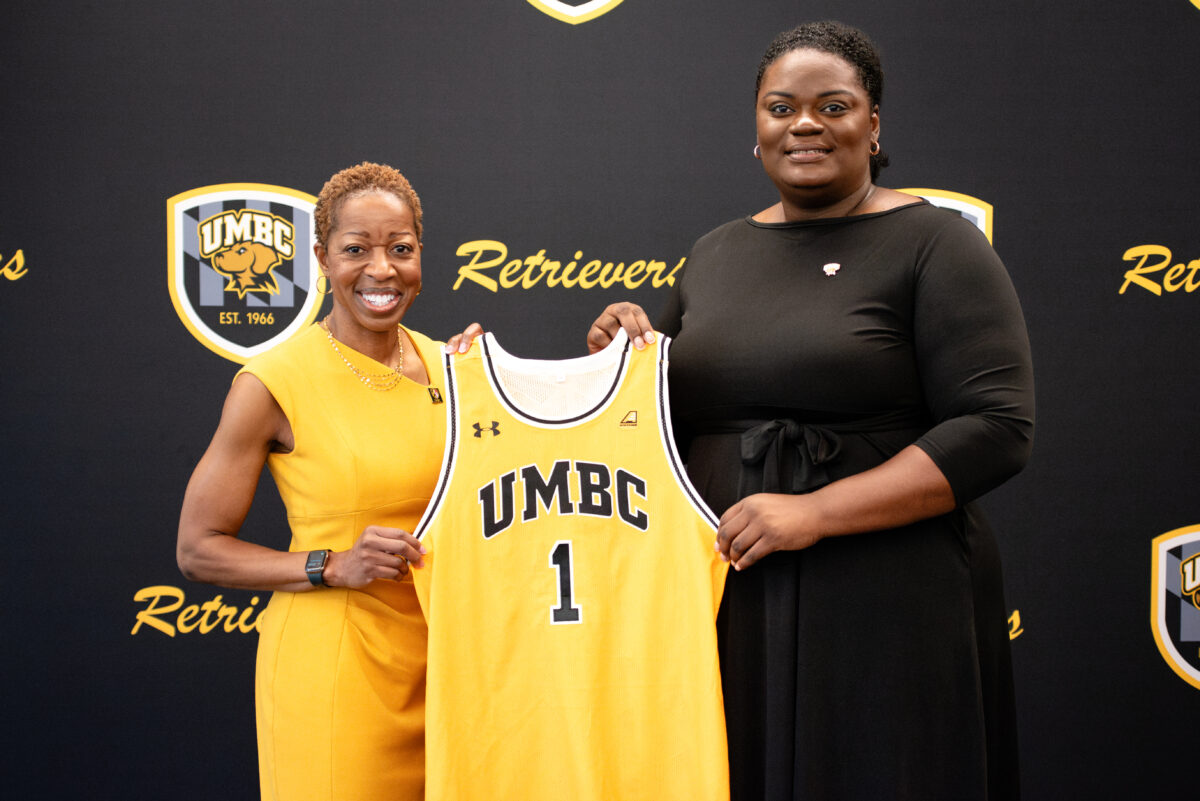 President Shears Ashby welcomes Tucker to #RetrieverNation with her own jersey. (Photo by Eric Thompson ’12)
When Tucker was announced as UMBC’s sixth athletics director (AD) last week, she began laying the groundwork to leave a lasting legacy of her own. When she officially starts on August 15, she’ll be the first woman and person of color to lead the university’s athletics program.
“This isn’t just about making history, it’s about creating a new standard where diversity in leadership is the norm, not the exception,” said Tucker.
Seeing the whole student
Tucker joins UMBC from the University of North Carolina Wilmington, where she has served as deputy athletics director since August 2021. Her appointment follows a nationwide search, during which she emerged as a highly-experienced and accomplished athletics administrator.
“Tiffany’s experience and growing leadership roles would make her a great fit for many AD positions at D1 schools. But let me tell you why she is especially perfect for us,” President Valerie Sheares Ashby said at the press conference. “Here, student-athletes can participate in a Division I program while also reaching the highest levels of academic achievement. Here, we have a diverse student body that excels academically across all subjects. We believe there is no excellence without inclusion, and to be truly inclusive, we know we need to create an environment where everyone can thrive.”
Tucker knows the mindset of an athlete firsthand. She was a four-year member of the women’s basketball team at the University of North Carolina at Chapel Hill. This experience allows her to understand the unique rigors of performing both academically and athletically. This also means that Tucker knows the value of seeing students as more than just who they are on the field, court, or track.
“As we nurture our student-athletes, we will focus on their holistic development—not just as competitors, but as scholars, leaders, and engaged citizens,” she said.
“Our program is in good hands”
Tucker will join an athletics program that has won dozens of America East titles, individual and team honors, and coaching awards. This past academic year, 12 UMBC athletic programs posted perfect Academic Progress Rate (APR) scores in the NCAA Academic Progress Rate Report. Implemented in 2003 as part of an ambitious academic reform effort in Division I, APR holds institutions accountable for the educational progress of their student-athletes through a team-based metric that accounts for the eligibility and retention of each student-athlete for each academic term.
This past season, UMBC volleyball secured their fourth-straight America East championship and returned to the NCAA tournament. Volleyball head coach Kasey Crider looks forward to Tucker taking charge.
“The last couple of months have been tough, without a doubt. To be on the other side of the transition with a leader of Tiffany’s caliber is a big deal,” Crider said. “Our department has demonstrated its resolve and character, and now with her vision and guidance, it feels like we’re on the brink of something pretty special.”
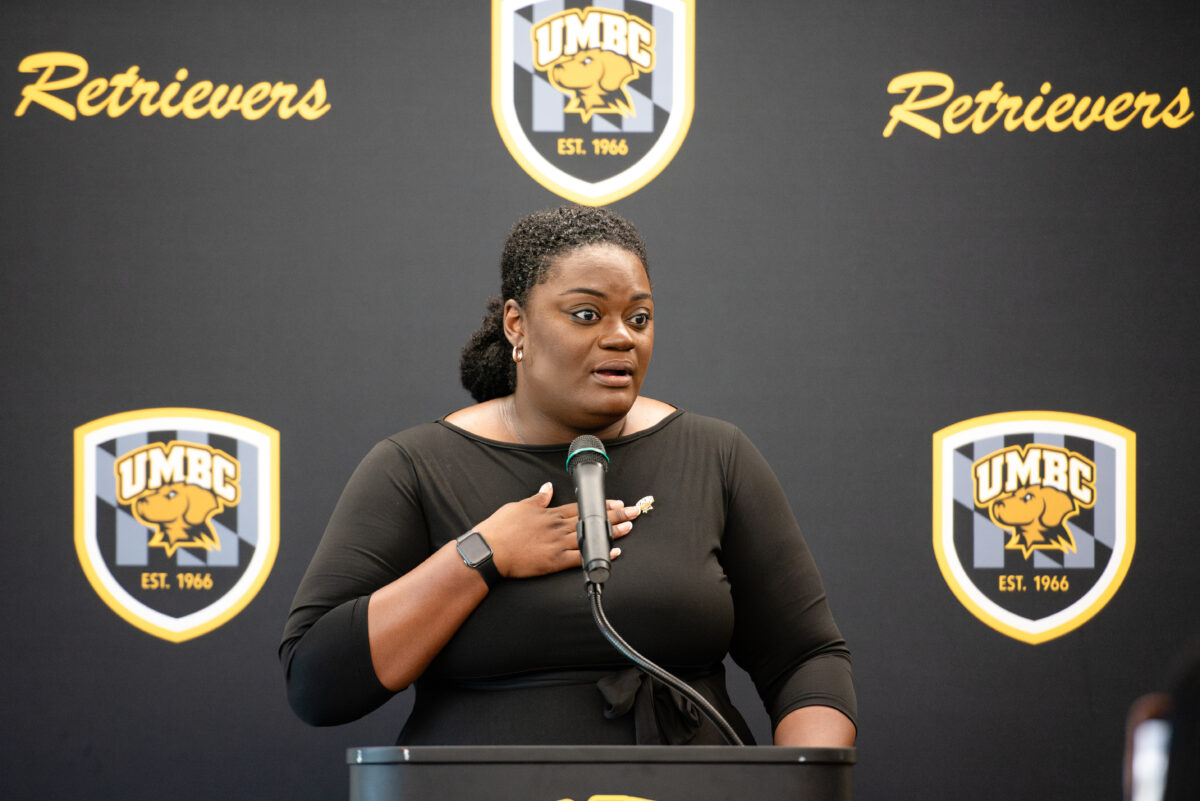 Tucker addresses the crowd at a press conference on July 22. (Photo by Eric Thompson ’12)
Just one of the over two dozen student-athletes bedecked in black and gold at Monday’s press conference, volleyball player Aysia Miller ’24, biological sciences, echoed Crider’s excitement.
“Tiffany’s innovative approach and mindset give me hope that our program is in good hands,” said Miller. “As a student-athlete, it is refreshing to hear someone care so much about our well-being and success.”
Tucker made it clear that students will be her priority when she takes the helm in August. She closed yesterday’s press conference by directly addressing the student-athletes in the room.
“You are the heart and soul of UMBC athletics. Your well-being—physical, mental, and emotional—are paramount. I’m here to support you, challenge you, and celebrate you.”
]]>
She may be new to Retriever Nation, but it seems like Tiffany D. Tucker won’t have any problem as UMBC’s leader of the pack. Addressing a crowd of student-athletes, administrators, coaches, and...
https://umbc.edu/stories/incoming-athletics-director-tiffany-tucker-b/
https://my3.my.umbc.edu/api/v0/pixel/news/142898/guest@my.umbc.edu/fb8c4ecbde07ecd96dd572dba3c9ef9b/api/pixel
athletics
community
feature
news
story
UMBC News & Magazine
https://my3.my.umbc.edu/groups/umbc-news-magazine
https://assets1-my.umbc.edu/system/shared/avatars/groups/000/001/943/24435aa6207c452e7bc15cc74b42c7bb/xsmall.png?1748556657
https://assets1-my.umbc.edu/system/shared/avatars/groups/000/001/943/24435aa6207c452e7bc15cc74b42c7bb/original.png?1748556657
https://assets2-my.umbc.edu/system/shared/avatars/groups/000/001/943/24435aa6207c452e7bc15cc74b42c7bb/xxlarge.png?1748556657
https://assets2-my.umbc.edu/system/shared/avatars/groups/000/001/943/24435aa6207c452e7bc15cc74b42c7bb/xlarge.png?1748556657
https://assets3-my.umbc.edu/system/shared/avatars/groups/000/001/943/24435aa6207c452e7bc15cc74b42c7bb/large.png?1748556657
https://assets1-my.umbc.edu/system/shared/avatars/groups/000/001/943/24435aa6207c452e7bc15cc74b42c7bb/medium.png?1748556657
https://assets2-my.umbc.edu/system/shared/avatars/groups/000/001/943/24435aa6207c452e7bc15cc74b42c7bb/small.png?1748556657
https://assets1-my.umbc.edu/system/shared/avatars/groups/000/001/943/24435aa6207c452e7bc15cc74b42c7bb/xsmall.png?1748556657
https://assets2-my.umbc.edu/system/shared/avatars/groups/000/001/943/24435aa6207c452e7bc15cc74b42c7bb/xxsmall.png?1748556657
UMBC News & Magazine
0
0
false
Tue, 23 Jul 2024 12:47:06 -0400
Tue, 23 Jul 2024 12:47:06 -0400
UMBC’s exploratory artist in residence Levester Williams examines history of Cockeysville marble in film project

Since 2014, multimedia artist Levester Williams has developed a personal connection and exploration with a natural material that is a historic staple of Baltimore life—Cockeysville, Maryland, marble.
Go down specific streets in neighborhoods like Highlandtown, Charles Village, Cherry Hill, or Mount Vernon and you’ll see the ubiquitous, three-to-four tiered steps made of marble outfitting the exterior of many rowhomes throughout Baltimore, much of it from Cockeysville. Beyond the steps, you’ll also find the stone in landmarks such as Baltimore’s City Hall, the Washington monuments in Baltimore and D.C., and the 108 columns of the U.S. Capitol Building.
“The stone is a literal and figurative bedrock of our nation. It’s used in many prominent monuments and institutions,” explains Williams, who is a 2023 – 2024 artist in residence in UMBC’s Exploratory Research Residency Program, a component of the university’s Center for Art, Design, and Visual Culture (CADVC).
In this pilot artist residency program, Williams is collaborating with the CADVC to complete a new video art project called “dreaming of a beyond: Baltimore,” in which the artist is researching the history of Cockeysville marble, underscoring the “intertwined history of African Americans’ plight to self-determined agency and full citizenship, and a rather benign stone.”
More than just marble
In his work, Williams examines the relationship between objects, humans, and the physical world with art that includes sculptures, installations, sound, animations, drawings, and videos. Williams is continuing that exploration in “dreaming of a beyond: Baltimore,” part of his ongoing series focused on the dolomitic stone that is quarried in Cockeysville, 25 miles from Catonsville. The series explores Williams’ desire to examine his idea of “the beyond—where race is no longer tethered to value; where my body matters just as much as other bodies matter,” he says.
 A drone image of the Texas Quarry in Cockeysville, Maryland, one of the locations where Cockeysville marble is mined. (Photo courtesy of Levester Williams)
The artist began his exploration into the stone after reading a passage in Lindon Barrett’s book Blackness and Value: Seeing Double about jazz singer Billie Holiday’s time growing up in Baltimore. The book references Holiday’s autobiography, Lady Sings the Blues, which documents her stint cleaning the marble steps in Baltimore as a teenager.
“White homeowners were obsessed with keeping the white marble stoops clean, and didn’t care how the inside of their homes looked, as long as the steps were clean,” says Williams in reference to the passage about Holiday in Blackness and Value. The steps were seen as a marker of class and economic status, he adds, explaining how “Holiday knew that and was able to bargain to get more money for cleaning the stoops.”
Through archival research, Williams learned more about the stone’s connection to Black people in Baltimore and their bodies as they handled, cleaned, and labored over the marble. As part of his CADVC residency, Williams conducted research at the Maryland Center for History and Culture, using the center’s digital archives of Baltimore’s historic Afro-American newspaper and photographer Paul Henderson’s collection of images he captured for the paper from 1930 through 1960. The archives showcase the long history of Baltimore’s Black residents who cleaned and maintained the marble steps as part of their daily routines.
“Bodies in space”
The “dreaming of a beyond” series consists of short vignettes capturing performers touching and physically engaging with structures, objects, and buildings made with Cockeysville marble at different sites throughout the northeast region. Beyond Maryland, the marble can be found in places such as the Buffalo AKG Art Museum in upstate New York; the Fisher Building in Detroit; Girard College in Philadelphia; and St. Patrick’s Cathedral in New York City.
In Baltimore, Williams filmed performers interacting with the (original) Washington Monument in Mount Vernon Place. Nia Hampton, an intermedia and digital arts (IMDA) graduate student at UMBC, and her mother, Sheila Gaskins, were featured in “dreaming of a beyond: Baltimore,” filmed with the assistance of IMDA student Bao Nguyen. A sneak peek of Williams’ in-development projection demo was on display at the CADVC in February.
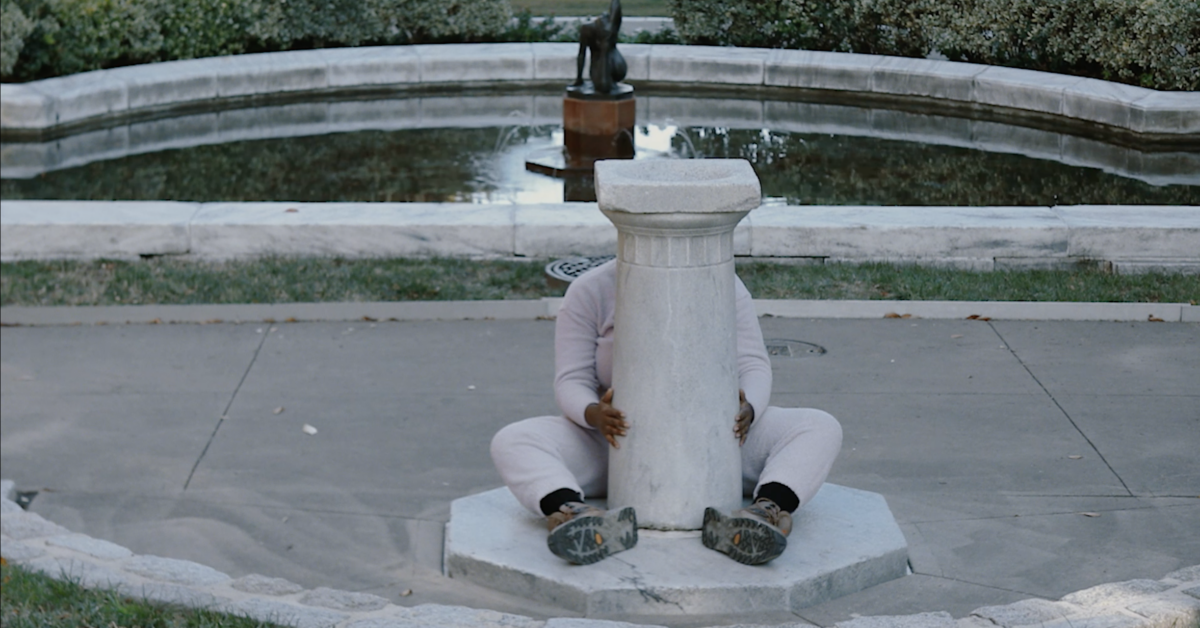 Video still of Nia Hampton in the vignette “Nia’s Embrace” from “dreaming of a beyond: Baltimore,” filmed at Mount Vernon Park Place in November 2023. (Photo by Levester Williams)
The film—which was projected onto the side of a building across from the CADVC’s outdoor amphitheater space—captures the mother-daughter duo physically engaging with the monument with movements that included hugging, caressing, scaling, and sprawling various body parts across the marble-encased statue. Williams worked with artist and intimacy coordinator Savannah Knoop to “reconfigure and think about bodies in space, non-human bodies, and what it is to give consent to these things,” he says.
“What I appreciate about Levester’s work is its level of obscurity,” says Hampton. “When I saw his work, I thought it was different—I never saw anything like it before.”
When she learned that the artist wanted the film’s subjects to be local residents with a deep connection to Baltimore’s history, Hampton referred Williams to her mother. Gaskins, a multi-disciplined artist who has been a local arts advocate and educator for more than four decades, wrote and directed “Last House Standing: A Play About the Highway to Nowhere”in 2016. The play included performers playing the role of the marbled stoop steps.
“When I was interacting with the marble [in the work with Williams], it wasn’t a pretty thing. I was thinking about my ancestors. Nia and I were having conversations about the slaves that probably built the monument. All of that was in our minds when we were interacting with the marble,” says Gaskins.
 Nia Hampton (left) and Sheila Gaskins in “standing ground (On Washington)” from “dreaming of a beyond: Baltimore,” filmed at the base of the Washington Monument in Baltimore. (Photo by Levester Williams)
“Black folks touching the stone have been an anchor in this master-slave dynamic. I reimagined this relationship between the Black body and the stone, which is not in service of this power dynamic,” says Williams. “I’m using this stone as a way to reimagine Black folks in public spaces.”
Artistic practice as research
This fall, the CADVC gallery is set to premiere a selection of Williams’ artwork that emerges from his “dreaming of a beyond: Baltimore” research as part of the introduction to the center’s public video projection gallery series, which will be on display in the Fine Arts Building Amphitheater. The series is anticipated to rotate new video artwork presentations and will run for the next several years, says Rebecca Uchill, director of the CADVC.
The fall projection presentation will also coincide with the “all matters aside” exhibition at the CADVC that will feature a retrospective of Williams’ work from the last 10 years, organized by curator Lisa Freiman. Williams’ work was previously featured in “Declaration,” the inaugural exhibition at the Institute for Contemporary Art at Virginia Commonwealth University that Freiman curated as the institute’s inaugural director.
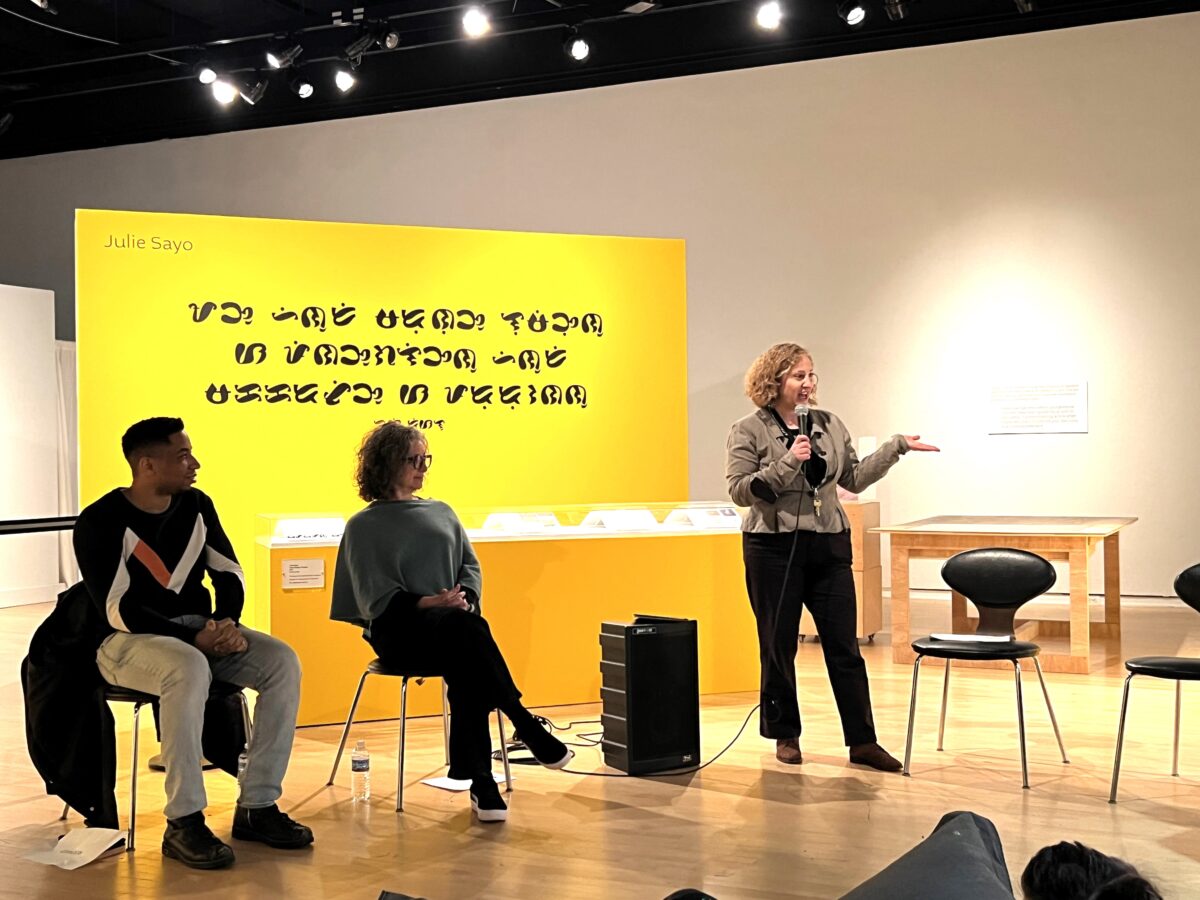 Levester Williams, Lisa Freiman, and Rebecca Uchill at the sneak peak projection demo of “dreaming of a beyond: Baltimore” in February 2024 at the CADVC. (Photo by Tedd Henn, courtesy of the CADVC)
Wiliams’ projection work will also feature an accompanying booklet that includes an essay by Michelle Wright, professor of history and Africana studies at the Community College of Baltimore County. Wright’s essay, “Scrubbed Clean,” examines the complex history of Beaver Dam marble, its use in Baltimore’s Washington Monument, and its connections to the city’s history of racial division.
Along with Williams, the CADVC Exploratory Research Residency Program also hosted artists Tomashi Jackson and Paul Rucker. Portions of the program have been funded by the Maryland State Arts Council, the Baltimore County Commission on Arts and Culture, and UMBC’s College of Arts, Humanities, and Social Sciences’ Big Ideas initiative. The pilot program, which launched in 2022, “recognizes the inherent research that is artistic practice,” Uchill explains.
“Artists are researchers, technicians, and producers. I think some of that occasionally may be underemphasized in certain contexts, but fortunately not at UMBC. CADVC’s residency program aligns with the rigor, creativity, and civic engagement of the university at large, and feeds into other areas of our center’s programs in exhibition, publication, and creative production,” says Uchill. “This has been an especially enriching opportunity because of UMBC’s laudable, sincere belief in the importance of the arts as research.”
For Williams, the exploratory residency program is helping him to expand his interpretation of being Black and existing in public spaces: “There’s no hierarchy of us existing in space and doing that through touch is what my project is focused on. Having these performers touch the stone in any way that they want is [my idea of] pushing back and getting to that ‘beyond’.”
]]>
Since 2014, multimedia artist Levester Williams has developed a personal connection and exploration with a natural material that is a historic staple of Baltimore life—Cockeysville, Maryland,...
https://umbc.edu/stories/exploratory-artist-levester-williams-marble/
https://my3.my.umbc.edu/api/v0/pixel/news/142784/guest@my.umbc.edu/6451d2c213b5ef5e11ff25ba1ef6b2c4/api/pixel
arts-and-culture
cadvc
cahss
community
feature
imda
news
rca-2
research
story
visualarts
UMBC News & Magazine
https://my3.my.umbc.edu/groups/umbc-news-magazine
https://assets1-my.umbc.edu/system/shared/avatars/groups/000/001/943/24435aa6207c452e7bc15cc74b42c7bb/xsmall.png?1748556657
https://assets1-my.umbc.edu/system/shared/avatars/groups/000/001/943/24435aa6207c452e7bc15cc74b42c7bb/original.png?1748556657
https://assets2-my.umbc.edu/system/shared/avatars/groups/000/001/943/24435aa6207c452e7bc15cc74b42c7bb/xxlarge.png?1748556657
https://assets2-my.umbc.edu/system/shared/avatars/groups/000/001/943/24435aa6207c452e7bc15cc74b42c7bb/xlarge.png?1748556657
https://assets3-my.umbc.edu/system/shared/avatars/groups/000/001/943/24435aa6207c452e7bc15cc74b42c7bb/large.png?1748556657
https://assets1-my.umbc.edu/system/shared/avatars/groups/000/001/943/24435aa6207c452e7bc15cc74b42c7bb/medium.png?1748556657
https://assets2-my.umbc.edu/system/shared/avatars/groups/000/001/943/24435aa6207c452e7bc15cc74b42c7bb/small.png?1748556657
https://assets1-my.umbc.edu/system/shared/avatars/groups/000/001/943/24435aa6207c452e7bc15cc74b42c7bb/xsmall.png?1748556657
https://assets2-my.umbc.edu/system/shared/avatars/groups/000/001/943/24435aa6207c452e7bc15cc74b42c7bb/xxsmall.png?1748556657
UMBC News & Magazine
0
0
false
Mon, 15 Jul 2024 14:48:42 -0400
Mon, 15 Jul 2024 14:48:42 -0400
Putting UMBC Research on the Map
Spring on UMBC’s main campus brings a host of familiar sights and sounds: blooms on the magnolia trees, the chatter of red-winged blackbirds calling from the reeds around Library Pond, greening grass on the campus Quad, and black-and-gold-bedecked Grit Guides leading groups of prospective Retrievers around what may soon become a home away from home.
The guides cover the usual highlights—Academic Row, the Retriever Activity Center, the AOK Library, eating establishments, and residential halls. UMBC is a place to live, to learn, and to find community. And while some of the functions of campus spaces are obvious, others are often hidden.
Look more closely, and you’ll see faculty and students turning the everyday infrastructure and green oases of UMBC into out-of-the-ordinary laboratories. Beeswax sculptures, tactile maps, robots helping other robots—read on to discover some of the amazing ways Retrievers are using the campus itself for experiential learning and diverse research.
Written by: Catherine Meyers & Sarah L. Hansen, M.S. ’15

Two students wearing knee-high waders stand several meters apart in the middle of a rapidly flowing stream at the north end of UMBC’s campus. One releases a Ping-Pong ball, which bobs along with the current, as the second starts a timer, stopping it when the ball reaches his feet to determine the stream’s flow rate.
Nearby, another student measures the size of rocks in the streambed using a device called a gravelometer—a rectangular piece of metal with square holes of various sizes. The smallest hole a given rock will fit through becomes its measurement.
Farther along, other students capture photos that include reference posts on the stream bank. Each small group of students also takes measurements of the water depth at one-foot intervals along strings hung from one bank to the other. The students (with the help of specialized software) will use these measurements and photos to generate 3D models of the streambed.
“It’s a little DIY, but we get some amazing pictures,” says Charles Kaylor, the instructor and director of GIS and cartography labs in the Department of Geography and Environmental Systems (GES).
This is the “stream lab” in Exploring the Environment: A Geospatial Perspective, a course best known in the UMBC community for its semesterly launch of a dozen or so brightly-colored balloons that dot the campus skyline. Throughout the semester, students train their brains in the ways geographic data can help answer a wide range of research questions.
For the students, there are a range of perks to the course. “It’s cool to see different applications of computer science, which can sometimes feel pretty theoretical,” says George Rush ’24, computer science. Luke Thomas ’27, GES, who was partnered with Rush, is grateful for the senior’s support with the programming aspects of the coursework.
Rhonda Plofkin, Ph.D. student in GES and the graduate assistant for the class, concurs that having students with different strengths facilitates peer learning. “This is real-life stuff that geomorphologists do in the field,” she adds.
For some, the benefits are just as real, but simpler: “The cold water wakes me up,” Anthony Roytenberg ’24, computer science, says with a smile.
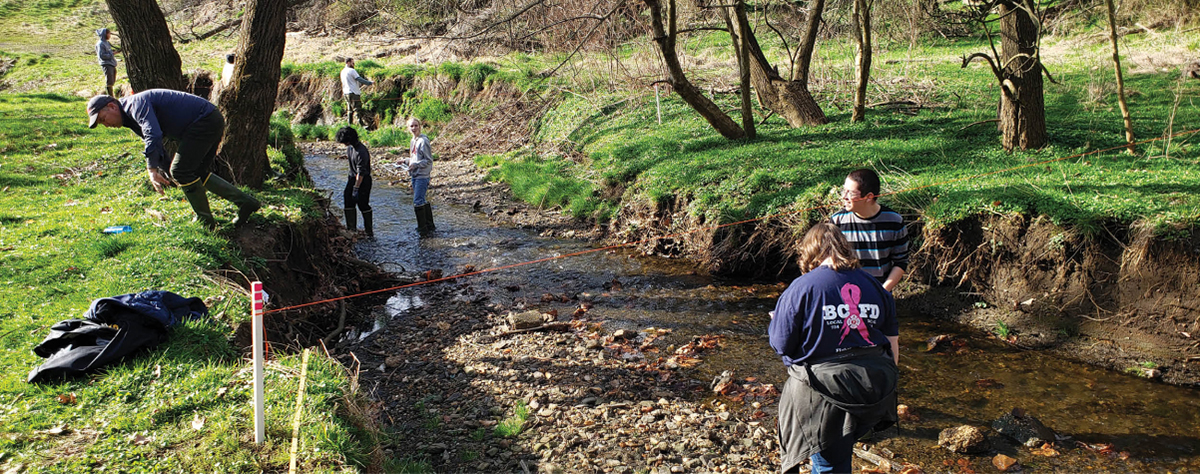 Students collect data that measure flow rate, depth, pebble size, and more as part of the “stream lab” in a popular, interdisciplinary GES course. Photo by Sarah Hansen, M.S. ’15.

When Alieh Rezaei arrived at UMBC from Iran, she couldn’t take her eyes off the ground. Almost immediately she was mesmerized by the flora and fauna of her new residence, and as an master of fine
arts student in the intermedia and digital arts (IMDA) program, she decided to incorporate pieces of UMBC into her artwork. She walked around campus, picking up windfalls of seeds and exploring hidden nooks of nature. A place that would come to be her sanctuary,
Rezaei, M.F.A. ’22, says, was Joseph Beuys Sculpture Park.
“The solidity of the stones alongside the growth of the oaksand the evolving shape of the garden reflect concepts of erosion and growth,” says Rezaei. “As an immigrant, I found solace in my attachment to the settled and solid stones, representing a sense of
grounding to me.”
Rezaei was drawn to UMBC’s M.F.A. program because of its multidisciplinary approach and the freedom she felt to choose an unconventional path. She praised Kathy O’Dell, IMDA professor emerita, who was her advisor. “Kathy was someone who—it was like I was floating in the air and Kathy held my hand and grounded me. She was very supportive for the whole journey.”
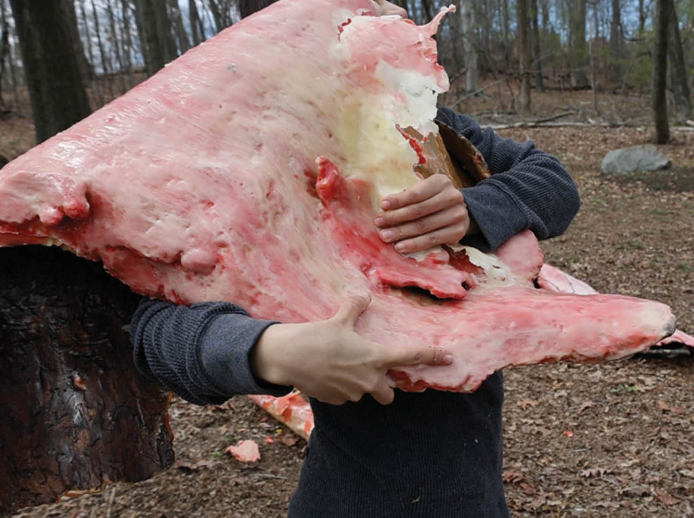
A photograph from Rezaei’s three-hour performance “The Tongue in the Landscape” at the Joseph Beuys Sculpture Park featuring the artist laboriously peeling the wax layer off the pieces of bark. Photo courtesy of Rezaei.
To create the art for her thesis project, Rezaei used almost exclusively materials collected on or near campus, including fallen tree bark, shattered wood, and seeds. She bought her main material—beeswax— from Baltimore beekeepers. One piece, “The Collective Womb,” featured hundreds of native seeds, called Devil’s Darning Needles, held together by beeswax around orange peels.
When the pieces were finished, Rezaei immediately knew the stage she wanted to showcase them on—Joseph Beuys Sculpture Park. “I installed my pieces there and had a performance as a way to extend the concept of public sculpture, aiming to reactivate the space and revive the concept of ecological engagement central to Beuys’ 7000 Oaks project.”


A composite of several microscope images of phages discovered by UMBC students in the Phage Hunters program demonstrates the variety of shapes phages can take. Photo by Tagide deCarvalho.
IchabodCrane. MindFlayer. Annihilus. TonyStarch. These are viruses previously completely unknown to science discovered by UMBC students in the Phage Hunters program, a two-course undergraduate genetics and bioinformatics sequence.
Since its launch in 2008, UMBC students have discovered 661 viruses that infect bacteria, called phages. Ninety-seven of them originated in samples collected on campus, with the most popular location being the Library Pond. Seventy-seven phages have been sequenced and 60 have been fully characterized and submitted to GenBank, an international digital repository of genetic and protein sequences.
Steven Caruso ’94, Ph.D. ’02, biological sciences, principal lecturer of biological sciences, runs the genetics course where the students collect samples, isolate their phages, image them with help from Tagide deCarvalho, “and growth,” says Rezaei. “As an immigrant, I found present their findings. They learn foundational laboratory techniques and get a taste for research.
Phage Hunters gives students “a first glimpse of what research is, with all that goes with it: determination, grit, inspiration, frustration, and more,” says Ivan Erill, professor of biological sciences and co-instructor for the bioinformatics course with Caruso. “Students get to see all the possible outcomes of a research project, from total success culminating in a DNA extraction for sequencing to failure to isolate a phage in the first place.”

In the basement of the Meyerhoff Chemistry Building, in a tiled expanse called the Molecular Characterization and Analysis Complex, sits a sleek, roughly human-sized instrument with the power to measure extremely tiny amounts of chemicals. Amanda Belunis, a chemistry Ph.D. student now in her final year, knows the instrument like an old friend, having turned to it to analyze a smorgasbord of UMBC water samples.
Belunis studies a group of chemicals called per- and polyfluoroalkyl substances, or PFAS. The chemicals are used in products as varied as makeup, clothing, and fire-fighting foam and are found in trace amounts in many water sources as well as in human blood. Dubbed “forever chemicals” because of the way they persist in the environment, they present a growing concern to human health.
Belunis’s research is part of a growing effort by scientists to understand how PFAS enter and travel through the environment and, ultimately, figure out ways to remove them.
To validate her procedures for measuring PFAS concentrations, Belunis tested water from drinking fountains, the sink in her chemistry lab, the pool, and the pond and streams around UMBC, all of which contained trace amounts of PFAS, as would be expected. Confident her methods worked on real-life samples, she then turned her attention to analyzing water in aquaculture fish tanks.
“My lab mates and I sometimes discuss how all of us have these chemicals in our bodies,” says Belunis. “It’s concerning, which is why we need to do more studies.”
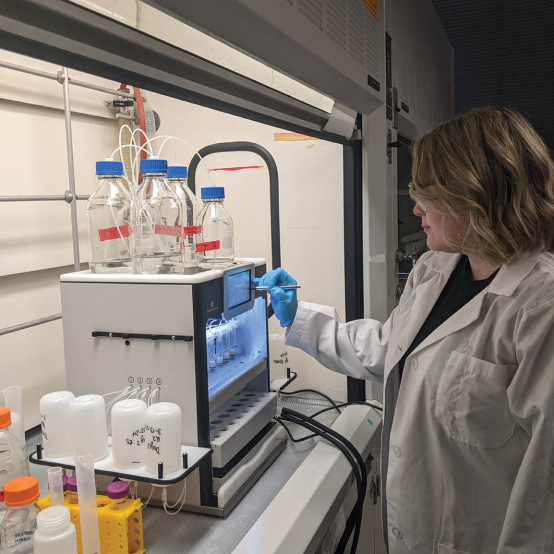
Amanda Belunis prepares samples for later analysis in the Molecular Characterization and Analysis Complex. Photo by Catherine Meyers.

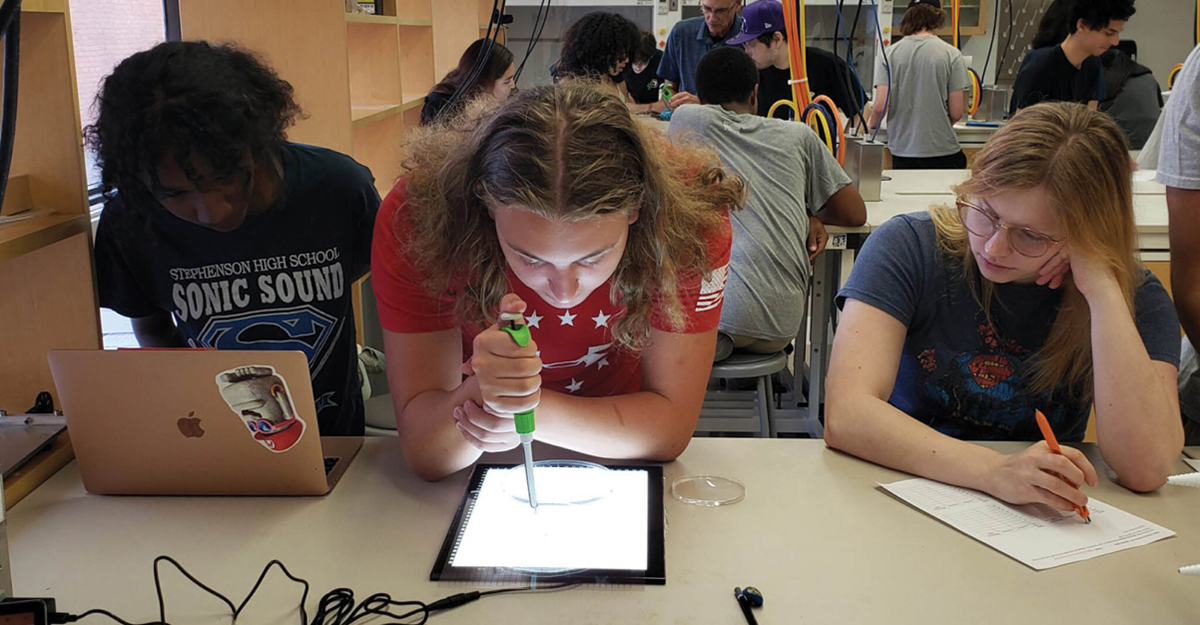 In addition to measuring buildings, students in Math in Action discovered other ways that math naturally interacts with their lives and studies. Here they are recording the movements of brine shrimp. Photo by Sarah Hansen, M.S. ’15.
When asked how to measure the height of a building, most students in Math in Action, a new laboratory course for non-STEM majors, “came up with various ways to measure the height directly—for example, by dropping down a string and then measuring the string or stacking up various objects,” says Alexis O’Malley ’18, mathematics and psychology, who teaches the lab.
But today, students are peering along the edges of homemade clinometers—plastic protractors with drinking straws attached—taking measurements from safely on the ground with a meter stick, and running simple calculations based on the properties of triangles to measure the height of UMBC’s Administration Building (123 feet, 2 inches).
Throughout the course, “I want students to see how math can be used to solve problems creatively,” O’Malley says.
Math in Action covers different math concepts each week through hands-on activities. The purpose of the clinometer activity is to remind students that “science is based on measurement, and you can build a tool to measure almost anything,” shares William R. LaCourse, dean of the College of Natural and Mathematical Sciences, who originally generated the idea for the course to help a wider range of students develop math skills relevant to their everyday lives. The course, he adds, “is a doorway to a lot of different math concepts.”

Shawn Abraham ’24, political science, has gotten lost on the UMBC campus more times than he can remember. As a blind student, he finds his way using a white cane, auditory cues, mental maps, and by asking people for directions. “People are surprised when I tell them, but big cities are much easier to navigate,” Abraham says. “College campuses are hard to get around.”
Tactile maps are one tool that could help. Erin Higgins and Kirk Crawford, Ph.D. students in human-centered computing, have recently been working with blind students at UMBC to create and test 3D-printed maps of campus.
The researchers launched the project after being approached by Michael Canale, assistant director of the Office of Student Disability Services. He says UMBC currently has four completely blind students enrolled and his office wants to provide personalized maps that each student can carry with them as they navigate campus. He’d also like to see a large 3D-printed map mounted somewhere on campus.
“A beautiful tactile map could be used by visitors of all kinds,” Canale said. “It’s the principle of universal design.”
Meanwhile, Md Osman Gani, an assistant professor of information systems, is spearheading a new project, named MyPath, to develop a Google Maps–style app to help wheelchair users navigate campus.
“Uneven surfaces, discontinuous sidewalks, and steep slopes can make wheelchair travel challenging, and even impossible” Gani says. The MyPath app would help by providing users with personalized turn-by-turn navigation with real-time updates. The app will rely on a machine learning model that recognizes path accessibility conditions based on crowd-sourced data, and Gani is currently recruiting wheelchair users to contribute data using their smartphones.
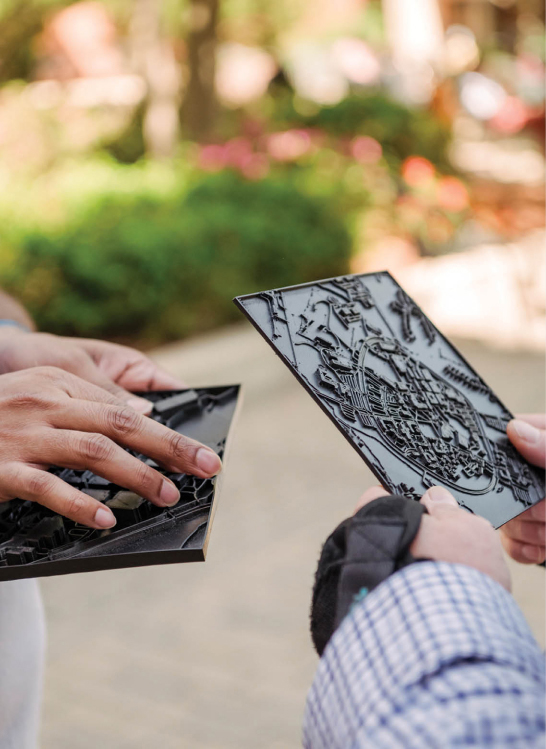
Shawn Abraham (left) tests prototype tactile maps made with 3-D printers with Michael Canale (right).

It’s 7 a.m. in July, and Megan Curtiss ’23, GES, is standing next to a tree just outside The Loop on UMBC’s southeast corner. It’s wrapped in a thin metal band at about chest height. Curtiss carefully measures the small gap between the two ends of the band with digital calipers three times, takes the average, and then moves on to the next tree. Only 98 to go.
This scene played out weekly from March to October 2023 as Curtiss collected data for a study led by Matthew Baker, GES professor, and Nancy Sonti, a research ecologist with the U.S. Forest Service. “It became like a morning meditation,” Curtiss shares.
The metal bands, call dendrobands, “are a cheap and easy way to get pretty detailed information,” Curtiss says. By measuring the trees’ growth over time, the goal is to look at how trees of different species and in different immediate environments (such as a parking lot versus a forest) handle conditions like fluctuating temperatures and water availability.
After attending Anne Arundel Community College in her 30s, Curtiss then found a home at UMBC. She began working with Baker in fall 2022 and will enter the GES master’s program at UMBC this fall. A graduate degree was not something Curtiss originally planned on, but now she’s excited about the further experiences it will bring. “I’m looking forward to the unexpected,” Curtiss says.

Take a left off Hilltop Circle, just past the greenhouse on the right and toward the Walker Avenue apartments, and you’ll find yourself outside a traditional brick building that used to house trial rooms and detention cells. In 2021, UMBC turned this former courthouse into the main hub for the Center for Real-time Distributed Sensing and Autonomy (CARDS). Researchers here develop artificial intelligence-enabled smart robots for military and search-and-rescue operations.
On a sunny day in spring, you will likely see students gathered in the courthouse’s “backyard,” huddled around dog-like Spot robots and wheeled vehicles called Jackals and Huskies.
The researchers outfit the robots with a host of custom devices, such as cameras and radar to sense their surroundings and microprocessors to run on-board algorithms. While the robots can be commanded via voice and gesture, the ultimate goal is for them to operate mostly autonomously.
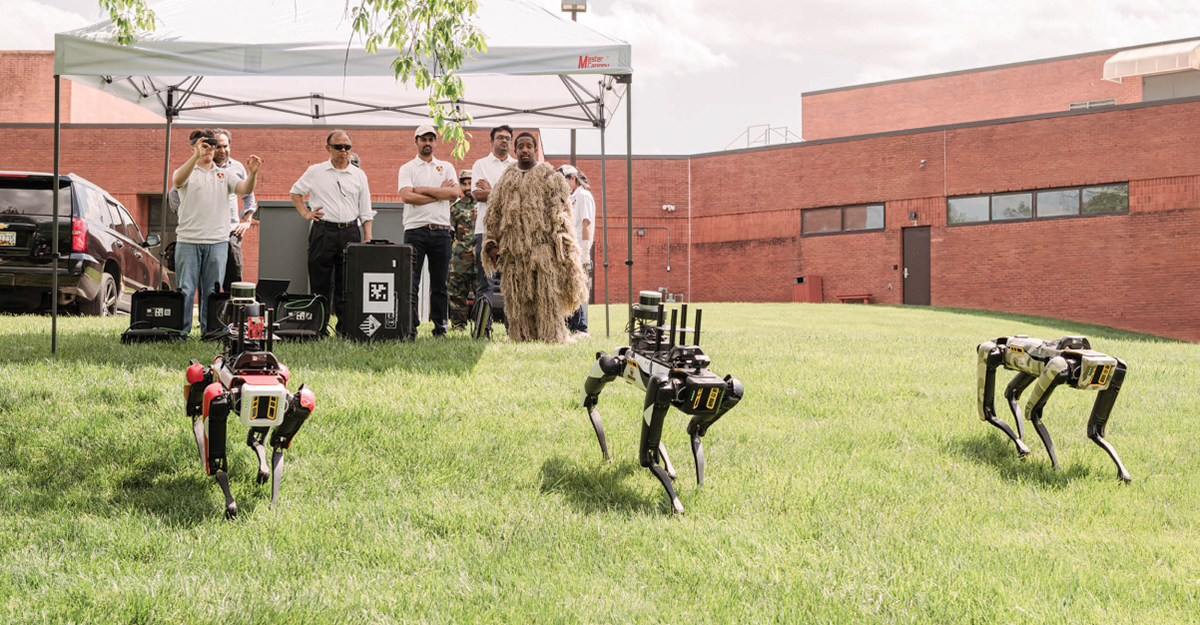 On the back lawn of the courthouse building, student researcher Kevin Rippy, left, controls three Spot robots with gestures. Another student stands by in a ghillie suit, a type of camouflage clothing.
Recently, the team has demonstrated this capability by verbally assigning the robots the task of jointly surveying a given area. The robots must translate the instructions from plain English into machine-level commands, divide up duties, detect and avoid obstacles, come to a fellow robot’s aid in the case of unexpected problems, and identify and keep track of the objects and people within their assigned perimeter.
“People from around campus will see us testing and will stop to watch,” says Aryya Gangopadhyay, a professor in information systems who directs CARDS. “The robots are an attention getter.”

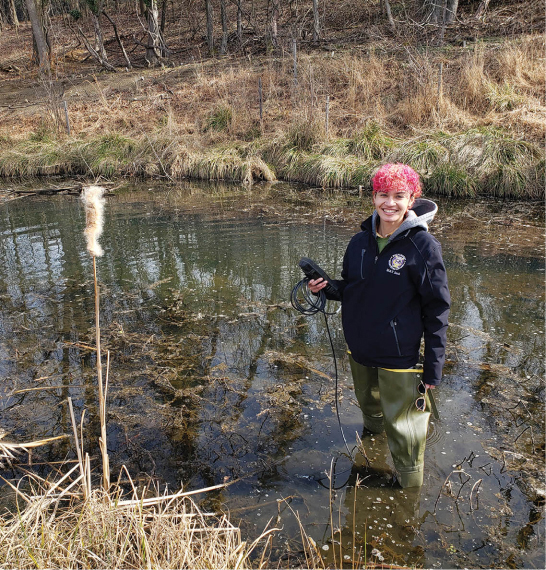
Erin Hamner collected weekly water quality data from this stream for six months, using the battery-powered digital probe she’s holding. (Image by Sarah L. Hansen, M.S. ’15)
After traipsing across a swampy field between research sites, Erin Hamner ’22, GES, and a current master’s student in the Interdisciplinary Consortium for Applied Research in the Environment program, scampers down a streambank in thigh-high waders and plunges a battery-powered probe into the water. It reports concentrations of ammonia and nitrates—key water quality measures. The probe also measures the water’s conductivity, which indicates the level of ions, such as salts used to melt snow.
It’s beautiful out today, but Hamner completed the trek to a dozen campus sites weekly from September 2023 to February 2024, sometimes dealing with mud, snow, or rain. The goal of her master’s thesis is to confirm that stormwater management features UMBC has installed to reduce flooding, filter storm runoff, and otherwise improve water quality are working as intended—or if they aren’t, to suggest improvements.
Hamner and her collaborators in Facilities Management and the Office of Sustainability want to see the data collection effort continue after she graduates. So she is working with faculty in GES to incorporate crowd-sourced stormwater monitoring into the undergraduate curriculum, including generating a public dashboard.
“Erin has done incredible groundwork collecting water quality data across our campus, generating useful data that can tell us about the health of UMBC’s waterways,” says Taylor Smith, assistant director of sustainability.
Long-term data will help the university “see how our development affects our watershed so we can continue to be good stewards,” Smith adds, noting that, “data like Erin’s can help us advocate for more greenspace and stream buffers around campus.”
]]>
Spring on UMBC’s main campus brings a host of familiar sights and sounds: blooms on the magnolia trees, the chatter of red-winged blackbirds calling from the reeds around Library Pond, greening...
https://umbc.edu/stories/putting-umbc-research-on-the-map/
https://my3.my.umbc.edu/api/v0/pixel/news/142303/guest@my.umbc.edu/93196282138c9d99f3c2930689edf3cd/api/pixel
biological-sciences
cahss
campus-life
cards
chemistry
cnms
coeit
computer-science
feature
ges
humancentered-computing
icare
imda
information-systems
joseph-beuys
magazine
mathematics
political-science
psychology
science-and-tech
sds
spring-2024
story
UMBC News & Magazine
https://my3.my.umbc.edu/groups/umbc-news-magazine
https://assets1-my.umbc.edu/system/shared/avatars/groups/000/001/943/24435aa6207c452e7bc15cc74b42c7bb/xsmall.png?1748556657
https://assets1-my.umbc.edu/system/shared/avatars/groups/000/001/943/24435aa6207c452e7bc15cc74b42c7bb/original.png?1748556657
https://assets2-my.umbc.edu/system/shared/avatars/groups/000/001/943/24435aa6207c452e7bc15cc74b42c7bb/xxlarge.png?1748556657
https://assets2-my.umbc.edu/system/shared/avatars/groups/000/001/943/24435aa6207c452e7bc15cc74b42c7bb/xlarge.png?1748556657
https://assets3-my.umbc.edu/system/shared/avatars/groups/000/001/943/24435aa6207c452e7bc15cc74b42c7bb/large.png?1748556657
https://assets1-my.umbc.edu/system/shared/avatars/groups/000/001/943/24435aa6207c452e7bc15cc74b42c7bb/medium.png?1748556657
https://assets2-my.umbc.edu/system/shared/avatars/groups/000/001/943/24435aa6207c452e7bc15cc74b42c7bb/small.png?1748556657
https://assets1-my.umbc.edu/system/shared/avatars/groups/000/001/943/24435aa6207c452e7bc15cc74b42c7bb/xsmall.png?1748556657
https://assets2-my.umbc.edu/system/shared/avatars/groups/000/001/943/24435aa6207c452e7bc15cc74b42c7bb/xxsmall.png?1748556657
UMBC News & Magazine
1
0
false
Thu, 30 May 2024 10:42:29 -0400
Thu, 30 May 2024 10:42:29 -0400
The Senior Class
Retrievers for life, that’s UMBC’s promise, and a group of residents at Charlestown’s senior living community are keeping their end of the bargain. Located two miles away from UMBC’s Catonsville campus, 60 or so retired and current faculty, staff, alumni, and friends at Charlestown are enjoying the ongoing cultural and educational perks of the two institutions. Several of these “Friends of UMBC” are laying the groundwork for continued exchange and connection—jazz concerts, classes about gender and sexuality, high-profile speakers—leaving a legacy for future generations to follow.
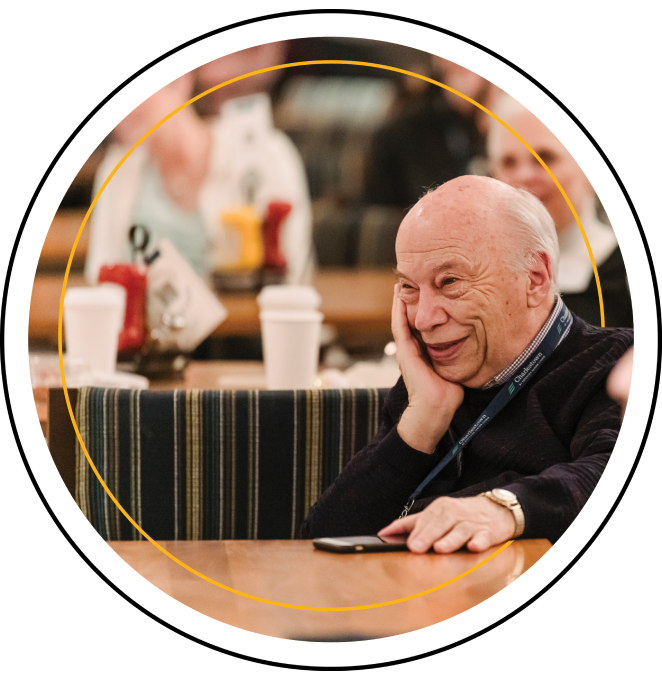 Art Johnson, professor emeritus, enjoys a jazz concert at Charlestown.
Around the café tables, heads are bobbing in rhythm tonight.
A duo of UMBC jazz students—Henry Smith ’24, on alto saxophone, and Leo Hickman ’27, on electric mandolin—are deep into their own takes on jazz standards. “Caravan,” “Misty,” and “There is No Greater Love” pour jauntily from their instruments.
The seniors here at Charlestown Senior Living know those tunes. Every song the UMBC jazz duo played was composed long before the student musicians were born, but just in the sweet spot for the audience. In the café where many have just eaten their crab soup and burgers for dinner, more than 100 Charlestown residents, including at least six who have tight connections to UMBC, clapped for the efforts of the young jazz players.
After the two finished playing “All of Me,” the crowd erupted in applause.
“That was ‘All of Me,’” Smith said into the microphone. “I feel like lots of you know that one. We’re having a great time playing for you. This is super fun!”
By 8 p.m. the crowd was stuffing dollar bills and fivers into the musicians’ tip jar by the mic and in paper bags held by volunteers at each exit. Then the seniors headed back to their apartments at the end of long corridors and in different buildings, very much like college dorms for older folks.
Strengthening Connections
A dedicated group of nearly 60 retired and current faculty and staff, alumni, or relatives have formed to promote connections between UMBC and Charlestown, a sprawling senior community with 2,000 residents. Thanks to their efforts, UMBC professors are teaching classes at the senior living community, Charlestown residents are traveling to UMBC for events, and helping the senior community’s restaurant staff with scholarship applications, funded by Charlestown residents, to UMBC and other Maryland colleges.
“That’s what I’m trying to do here, make connections,” said Art Johnson, provost emeritus who retired in 2019 from his position as political science professor and director of the Sondheim Scholars program. He moved to Charlestown in 2022 and since then, like a first-year student in search of college social groups, he has been indefatigably recruiting residents to join the Friends of UMBC at Charlestown.
“It helps maintain my connection to UMBC and lets me brag a little bit about UMBC,” Johnson said, laughing. “I meet people I wouldn’t have met otherwise. As provost, I used to promote UMBC all over. This is just an extension of that.”
Johnson met Lucy McKean on the bocce court, learned one of her kids went to UMBC, and reeled her into the group.
“Any connection will do,” Johnson said. “That’s how you build a long mailing list.”
Sitting at a dinner table on the Charlestown campus, McKean and Johnson laughed together. Thanks to the Friends of UMBC group, she’s now attending jazz concerts, which she never thought she would do.
The idea for a formal-ish group sprang from a walk that Johnson and Sam Lomonaco, computer science and electrical engineering professor, took around Charlestown in the fall of 2022. They wanted to create a web of connections between UMBC and Charlestown.
Lomonaco, who has lived at Charlestown for three years, still teaches at UMBC. His commute is nicely short, he said, and having a partnership between UMBC and Charlestown offers “a good chance to do things together. I meet a lot of interesting people I would not have met otherwise. And,” he said with a grin, “I’ve gotten interested in jazz.”
Johnson and Lomonaco started small, with a social for UMBC-connected folks at Charlestown. They’ve grown to arrange trips to programs by UMBC’s arts and culture departments, as well as the Wisdom Institute (the association for retired UMBC faculty and staff), and those monthly jazz concerts. As well, Johnson and others publish a newsletter and are recruiting UMBC faculty to teach courses at Charlestown through ELLIC (Elderhostel’s Lifelong Learning Institute at Charlestown), including classes on galaxies, genes, and gender.
“Art has been a binder, keeping us together,” said Bernice De Bels ’76, English, the first Black honors graduate at UMBC, who later worked in the foreign language department and now lives at Charlestown. “With UMBC we should explore what we have to offer them and what they have to offer us.”
Keeping Memory Alive
 Diane Lee hugs Pamela Morgan, the former director of the Office of Field Experiences and Clinical Practice in UMBC’s education department and a Wisdom Institute Board Member.
Of the many courses offered at Charlestown’s ELLIC program, nine are taught by UMBC faculty. That’s not a coincidence. Though the connections between Charlestown and UMBC have been sporadic, the institutions do have history.
John Erickson, who founded Erickson Living, which owns Charlestown, has long worked with UMBC to promote the study of getting older. Through joint efforts of Erickson and then-president Freeman Hrabowski, in 2004 the state funded the Erickson School of Aging Studies at UMBC, and Erickson Living donated $5 million for the school’s development.
Jeff Watson, who is on the faculty for the Erickson School of Aging Studies and serves as Erickson’s director of operations, also researches geriatric cognition.
“The literature and growing academic consensus is that whatever is good for the heart is good for the lungs is good for the brain,” Watson said. “Thus a healthy lifestyle, reducing inflammation and injury, while increasing physical and cognitive strength, and engaging in life, builds better brain health.”
Erickson researchers have published a study in the American Journal of Geriatric Psychiatry testing UCLA Longevity Center researchers’ findings about memory fitness on two of Erickson’s campuses, Riderwood and Oak Crest. Watson said they found that “eating wisely, exercising daily, learning consistently, relaxing meaningfully, and connecting socially” is optimal for a healthy lifestyle for seniors.
The Friends of UMBC are all about learning and socializing while they’re matchmaking between UMBC and Charlestown. For years, Johnson said, UMBC talked about collaborating with Charlestown, but it never really manifested to the extent they envisioned.
“One of our long-term goals is to try to bring the two institutions closer together,” Johnson said. “We could cooperate on issues: sustainability, local transportation, good health care…. We talked about it years ago when I was at UMBC, but it never happened.”
Same Goals, From Different Directions
UMBC’s Wisdom Institute is trying to accomplish the same community-building as the UMBC group at the senior village. But now, they’re working together.
Johnson, who serves on the Wisdom Institute’s board, is the hub, said Diane Lee, director of the UMBC organization for retirees.
“He brilliantly brought people together,” Lee said. “What a wonderful way to reconnect with these folks.”
The Wisdom Institute is printing extra copies of its newsletters for distribution at Charlestown, and for a recent event, the institute rented out the Charlestown bus to bring UMBC-curious residents to a lunch and keynote by WJZ-TV anchor Denise Koch. The institute plans to invite Charlestown residents to other events, including observatory tours in UMBC’s Physics Building, monthly lunches, discussions, and concerts.
“We really want to forge this tie,” Lee said. “We like the idea of reciprocity.”
For 30 years, Lee taught at UMBC in the education department and worked in the administration. “I came as a visiting assistant professor with no intention of staying. But it was an exciting place and an exciting time to be there.”
She, like many of the longtime UMBC staff and faculty who now live at Charlestown, helped build UMBC from the ground up into the institution it is today.
“It’s a wonderful place to be,” Lee said. The work was demanding but energizing, she said. “And people cared. We’re trying to capture the spirit, to continue that sense of self and community and the kind of work we did together. UMBC was not just a campus. We talked about one another as family.”
Dream Students
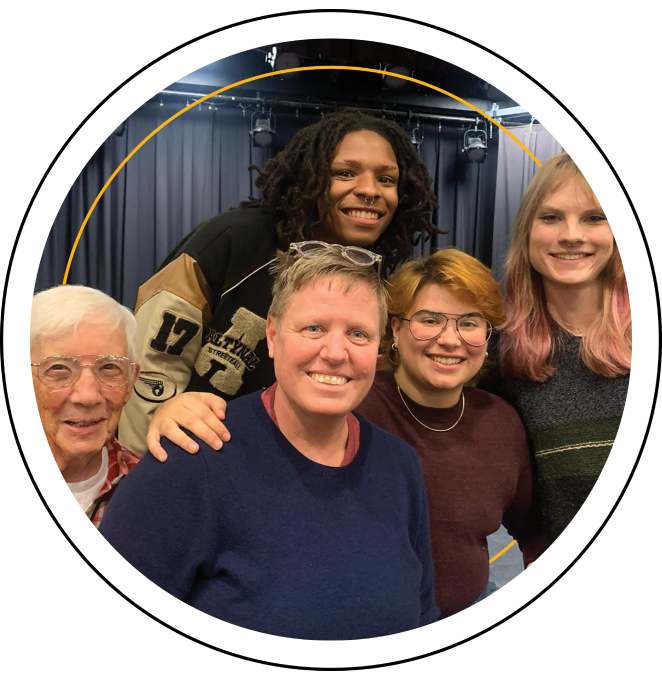 Donna Martin, Kate Drabinski, and students Marcus Ross, Sage Zoz, and August Wichman pose together after a class about gender and sexuality through the Enjoy Lifelong Learning in Charlestown program. Photo courtesy of Drabinski.
Kate Drabinski, principal lecturer in gender and women’s and sexuality studies, has visited Charlestown eight times to teach over three years. She jokes that if she teaches two more classes, she’ll earn a punch card for a free meal at Charlestown’s restaurant.
“It’s been some of the most valuable teaching I’ve done,” Drabinski said of the senior students learning through the ELLIC program, Enjoy Lifelong Learning in Charlestown. “They are rapt, they take notes, they ask questions. It’s a dream setup.”
On a spring Tuesday, Drabinski brought UMBC students who identify as gay, transgender, and nonbinary to the senior living community to tell their coming out stories, along with their struggles and joys around gender and sexuality.
“It’s been really moving for us, and also for the residents, to make these connections,” Drabinski said.
One student, who performs in drag shows, grew up on the same block as one of the residents, Drabinski said. The resident stood up and said she was proud of the student, Drabinski said, “for being brave and sharing her story.”
At least one of the Charlestown residents has a nonbinary grandchild, Drabinski said. “They probably feel uncomfortable asking their grandchild these questions,” she continued, but were curious and asked many questions of the students without the fear of rejection from a family member.
And she asked the students a question in front of the residents: “What do you wish your grandparents had said to you when you told them your coming out story? They said, ‘I want you to be part of my life—I trust you and this is a gift I’m giving.’”
They also discussed the generational misunderstandings, Drabinski said, “hot-button issues.” One resident asked why drag queens were reading stories at libraries. Students were worried about the question, but Drabinski said she maneuvered the fear in the room and, ultimately, they had a “fantastic discussion, the kind of discussion you only have when you have dedicated intergenerational space.”
Drabinski said her students came away from the interaction enriched. “Just because people are old doesn’t mean they are hostile. It was a huge benefit to students to get to practice telling their stories, to build confidence, and to learn from the questions the seniors are asking. It was a really positive experience.”
Familiar Tunes in a New Way
Now that he’s retired, Johnson has time to fulfill the goal of bringing UMBC and Charlestown closer.
One evening before the jazz concert, Johnson pulled together members of his group of UMBC folks to chat in the atrium of one of Charlestown’s buildings.
Pat Bettridge, who came to UMBC in 1966 and did graduate work in English, was married to English professor William Bettridge, and remembers UMBC in the 1960s as “a hole in the ground.” Bettridge, who has lived at Charlestown for 11 years, helped bring UMBC artists, dancers and theater productions to the senior living community over the years.
“It’s a good idea to get us together, to continue what we started 10 years ago,” Bettridge said.
Sebastian Petix, organizer of Charlestown’s jazz club and a friend of the Friends of UMBC, has worked with Matt Belzer, senior lecturer in jazz studies at UMBC, to bring the jazz groups to Charlestown. Petix, who played piano and trumpet and organized concert series before retirement, formed the Charlestown Jazz Club, and quickly signed onto the idea of bringing Retriever musicians onto Charlestown’s campus.
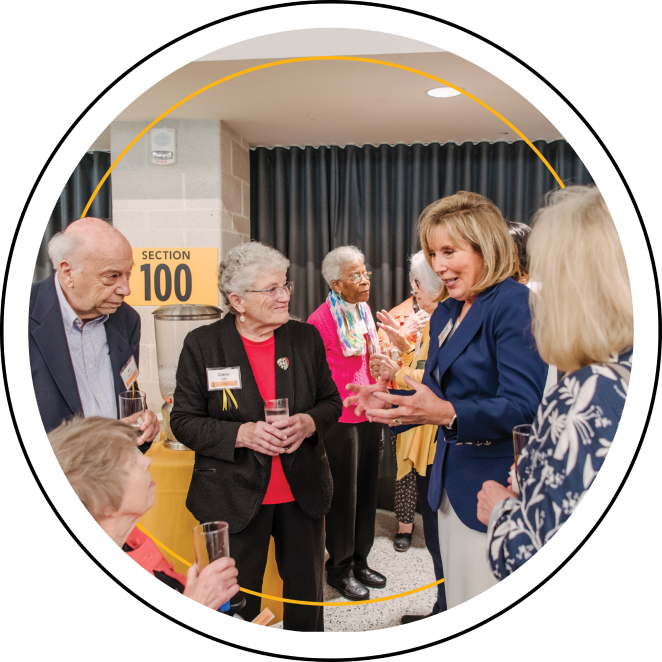 Art Johnson, Diane Lee, and Denise Koch chat with community members at the Wisdom Institute’s Signature Event in April 2024
“The audiences have really loved them,” Petix said. His jazz club, including some UMBC members, are planning a trip to see the UMBC semester’s final jazz recitals.
Valerie Woolston, whose husband Charles started as UMBC’s admissions director in 1968, helps edit the Friends of UMBC newsletter. She’s attended every jazz concert.
“They’re terrific,” Woolston said, nodding at the duo warming up in front of the crowd. “It’s really great to see how young people develop. They write their own music,” she said, almost as proud as a grandparent.
“I’m really pulled to UMBC,” said Woolston. “I’m really proud of it.”
Then she settled down with friends to watch the students play old, familiar tunes in a new way.
“I’m really pulled to UMBC,” said Woolston. “I’m really proud of it.”
Then she settled down with friends to watch the students play old, familiar tunes in a new way.
]]>
Retrievers for life, that’s UMBC’s promise, and a group of residents at Charlestown’s senior living community are keeping their end of the bargain. Located two miles away from UMBC’s Catonsville...
https://umbc.edu/stories/the-senior-class-charlestown-cultural-exchange/
https://my3.my.umbc.edu/api/v0/pixel/news/142344/guest@my.umbc.edu/355422fcb02e43ca3b6d40c2be3c039e/api/pixel
aging-studies
campus-life
erickson
feature
gwss
magazine
music
spring-2024
story
wisdom-institute
UMBC News & Magazine
https://my3.my.umbc.edu/groups/umbc-news-magazine
https://assets1-my.umbc.edu/system/shared/avatars/groups/000/001/943/24435aa6207c452e7bc15cc74b42c7bb/xsmall.png?1748556657
https://assets1-my.umbc.edu/system/shared/avatars/groups/000/001/943/24435aa6207c452e7bc15cc74b42c7bb/original.png?1748556657
https://assets2-my.umbc.edu/system/shared/avatars/groups/000/001/943/24435aa6207c452e7bc15cc74b42c7bb/xxlarge.png?1748556657
https://assets2-my.umbc.edu/system/shared/avatars/groups/000/001/943/24435aa6207c452e7bc15cc74b42c7bb/xlarge.png?1748556657
https://assets3-my.umbc.edu/system/shared/avatars/groups/000/001/943/24435aa6207c452e7bc15cc74b42c7bb/large.png?1748556657
https://assets1-my.umbc.edu/system/shared/avatars/groups/000/001/943/24435aa6207c452e7bc15cc74b42c7bb/medium.png?1748556657
https://assets2-my.umbc.edu/system/shared/avatars/groups/000/001/943/24435aa6207c452e7bc15cc74b42c7bb/small.png?1748556657
https://assets1-my.umbc.edu/system/shared/avatars/groups/000/001/943/24435aa6207c452e7bc15cc74b42c7bb/xsmall.png?1748556657
https://assets2-my.umbc.edu/system/shared/avatars/groups/000/001/943/24435aa6207c452e7bc15cc74b42c7bb/xxsmall.png?1748556657
UMBC News & Magazine
0
0
false
Wed, 29 May 2024 16:34:41 -0400
Wed, 29 May 2024 16:34:41 -0400
A Journey of Growth
International travel offers ample opportunities to stretch yourself—one minute you may be the expert and the next, completely clueless about how something works. Retrievers currently in the Fulbright U.S. Student Program—teaching English or researching around the globe—find themselves oscillating between their teaching and student roles on a daily or hourly basis. By engaging their host communities through openness and cultural humility (and many shared cups of tea or coffee), these Fulbrighters are finding their balance along the way.
All eyes are on Milan Richardson ’23 as she helps her co-teacher keep score in a Jeopardy-like game her students are playing. Richardson teaches English to several classes of first through sixth-grade students at Jinsha Elementary School in Kinmen County, Taiwan. As she completes the Mandarin character for the numeral 5, a wave of giggles and chatter flows through the room.
Similar to a U.S. tally—four strokes and a strike though, the Mandarin character has 5 strokes total and needs to be written a certain way to represent 1, 2, 3, 4, or 5. “The students were so confused because I wrote the character strokes in the wrong order,” says Richardson, who is used to solving complex math as a Meyerhoff Scholar having earned a bachelor’s degree in bioinformatics and computational biology and minors in computer science and modern, languages, linguistics, and intercultural communication.
“I wanted to write the character correctly. I asked, and they showed me the proper order to write the strokes,” says Richardson, a Fulbright English Teaching Assistant (ETA). “They started clapping once I got it right. This was one of the many cool moments where my students were able to teach me.”
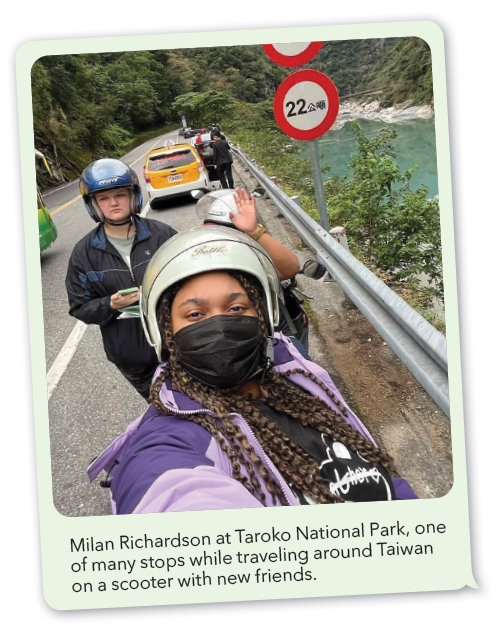
While she may be new to teaching in Taiwan, Richardson brings with her four years as an English and math tutor and a minor in Mandarin. “Taiwan was so different from any place I’ve ever been to. I was overwhelmed at first,” says Richardson. “I like it a lot, now. In my second month, I applied for a scooter license. Now I ride around the island and have taken my scooter other places on trips.”
Diplomas earned. Visas in hand. Vaccines completed. Luggage packed. Destination confirmed. Last summer, UMBC’s eight participants in the 2023 – 2024 Fulbright U.S. Student Program checked off all the important items on their to-do lists. The only thing left was to get to their placements on islands and in landlocked countries, cities, and countrysides across East Asia and Eastern Europe. It’s easier written than done. To adapt well to a new community, job, language, and culture, they must practice the art of humility and flexibility as their roles shift regularly from teacher to student.
Leading the Fulbright charge
All technicalities aside, the Fulbright experience is the beginning of building an international network of teachers and researchers who share the diversity and possibility of the U.S. with the world. In return, across the globe, communities welcome the next generation of leaders into their cities, neighborhoods, schools, and homes to share their country’s history, innovations, and culture. Since Fulbright’s inception in 1946, these reciprocal acts of kindness have created multiple paths forward to lifelong worldwide collaboration and understanding based on the simple act of giving someone different than yourself a chance.
“The Fulbright Program truly demonstrates public diplomacy in action,” says Brian Souders, M.A.’19, TESOL, and Ph.D. ’09, language, literacy, and culture, the associate director of global learning at UMBC’s Center for Global Engagement. In this role, Souders, who received a 2023 Fulbright International Education Administrator award to Germany, has led hundreds of Retrievers through the Fulbright application process as UMBC’s Fulbright Program advisor. “Whether in the classroom as teachers, students, or researchers, recipients learn about the world as much as they share what it means to be from the U.S. and UMBC alumni,” says Souders.
Thanks to Souders’ guidance, UMBC is one of 57 doctoral universities nationwide and three in Maryland to receive a Fulbright Top Producing Institution designation for 2023 – 2024, for the third time in the last five years. In the last decade, more than 80 UMBC alumni have received Fulbright awards. Out of the 10 Retrievers who received a 2023 – 2024 Fulbright, eight are currently placed internationally, seven are ETAs and one is on a research grant.
The hard work of play
There are U.S. Fulbright student scholars in more than 100 countries worldwide. Three Retrievers were placed in Taiwan—they keep in touch regularly, see each other at ETA trainings, and are planning to travel together during their Fulbright year. But they all arrived in Taiwan separately and faced different challenges settling in.
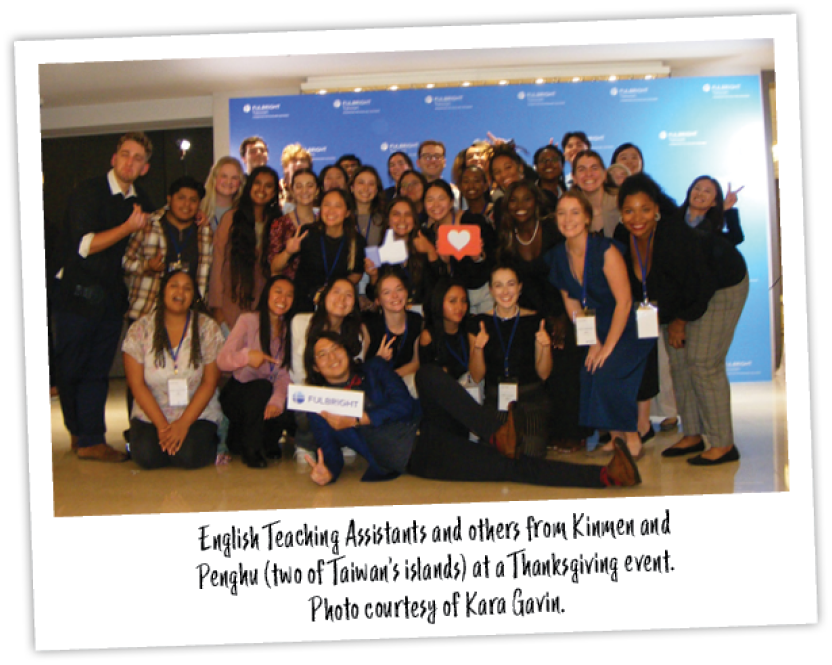
“I arrived in Taiwan and immediately changed my plans because the airline lost my luggage,” says Humanities Scholar Kara Gavin ’20, English. She was grateful to have a carry-on. “It was chaotic. I was taking it all in,” says Gavin. A day and a 50-minute plane ride later, she arrived in Penghu County, Taiwan, an archipelago of about 90 islands between China and the main island of Taiwan. “The little beach town is in its own little world,” says Gavin. “The smell of the sand gave me comfort.”
Gavin teaches beginner English at two local junior high schools. New to Asia and Mandarin, Gavin’s thinking cap is on 24 – 7, including learning Mandarin in between teaching classes. “Living independently for the first time is hard on its own, but doing it in a foreign country is a whole other ball game,” says Gavin. “I’m acquiring many new life skills that will last me a lifetime.”

One of those is sympathizing with her students and anyone learning a new language and culture. “I teach the English pronunciation and spelling of a word,” says Gavin. “Then, they like to share the Mandarin equivalent with me. It’s all about patience, balance, and trust.” She also models intercultural teamwork by developing and teaching lessons with her bilingual (Mandarin/English) Taiwanese co-teacher to foster student engagement and enrichment.
For Fulbright Scholars, it is equally important to engage with communities beyond the classroom. When they apply for the grant, the Fulbright Program asks them to develop ideas to share their passions and skills in a community project. For Gavin, this meant adding a little drama to have a lot of fun. As a performing artist, Gavin knows the theatre can be a powerful community-building outlet. “I wanted to encourage students and other community members to express themselves and share their culture with me and others,” says Gavin.
She found a kindred spirit in a professor at a local university. They formed a drama club at the university for English language learners at all levels to explore American play formats with Taiwanese traditions and histories.“Writing original bilingual plays, in English and Mandarin, based on folktales about island traditions is creating an artistic and fun cultural exchange and understanding outside of my ETA duties,” says Gavin.
Finding the right pace
For fellow Humanities Scholar Nailah-Benā Chambers ’23, global studies, a Fulbright award to Taiwan was a natural next step. Chambers began learning Mandarin and all things Taiwanese in sixth grade at a Taiwanese Mandarin language immersion school in her hometown of Richmond, Virginia. As her Mandarin improved, she tutored other English speakers. This oscillating pattern of being a student and a teacher makes Chambers adaptable and persistent, she says.
But it hasn’t always been easy. When she first visited Taipei, Taiwan, in the spring of 2023 on a Mandarin language-intensive study abroad program, “I was so confident. I walked into a 7-Eleven to shop. No one could understand me,” says Chambers. “It was a bit embarrassing. Even with my language and cultural skills, I had a long way to go to mastering Mandarin.”
Now on her Fulbright ETA grant, Chambers arrived on solid ground, both culturally and linguistically. “I felt such a sense of calm and familiarity. Taiwan is so welcoming,” says Chambers. “It calms you down. Things are much slower here than in the U.S.” Soon enough, Chambers was balancing classrooms at Huludun Elementary and Fu Chun Elementary in Taichung City, on the main island of Taiwan, with students at both schools on the extreme spectrum of English proficiency.
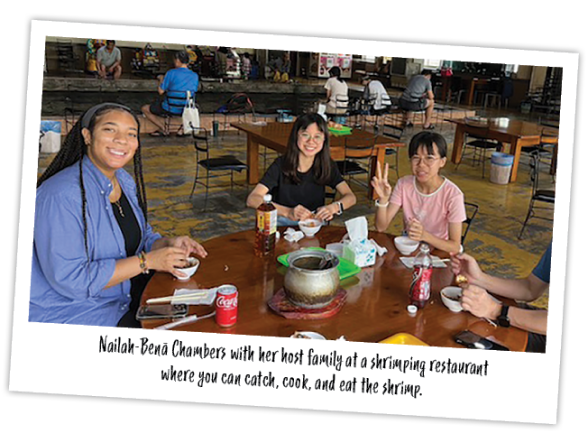
The upside of working with proficient English language learners is connecting on more advanced topics and sticking to Fulbright’s English-only immersion model. At one of her schools, the students are beginning English language learners, and the administrators only speak Mandarin. “My experience as a bilingual teacher and learner with a high level of understanding of the local language and culture has helped with classroom management and fostering powerful connections with students and administrators,” says Chambers. “It also helps to advance their grasp of the nuances of American English, especially when there are gray areas or misunderstandings.”
Keeping your ears open
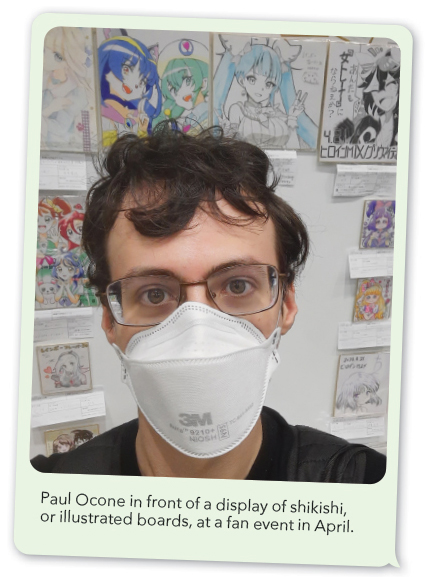
Watching anime, reading manga, (Japanese graphic novels), and participating in their fandom inspired Paul Ocone ’22, individualized study, a Linehan Artist Scholar, to research these subjects and learn Japanese. “I have deeply engaged in fan social life and communities—from leading an anime club to participating in and running conventions to moderating online communities—my affinity for and interest in anime fan spaces runs deep,” says Ocone. Part of Ocone’s observations include witnessing how some fan subcultures limit their membership in fear that a broader fanbase would weaken their subculture identity. In contrast, he says, other fan subcultures are more flexible while maintaining their identity.
Interested in adding to his initial research in U.S. fan spaces, Ocone is now at the epicenter of anime and manga culture as a Fulbright Student Researcher doing anthropological research with Morikawa Kaichirō, a leading scholar in this field at Meiji University’s School of Global Japanese Studies in Tokyo, also home to the Yoshihiro Yonezawa Memorial Library of Manga and Subcultures.
“I have had some amazing experiences participating in anime pilgrimage or anime tourism, including learning much from other fans and benefitting from their generosity,” says Ocone. “My Japanese is conversational—sometimes it’s challenging to understand specialized topics, but this has not deterred me from adding anime and manga tourism as a second research project.” In January, Ocone presented his work at the Popular Culture Tourism Stakeholders Summit in Japan.
Ocone is a sort of tourist himself, enjoying various aspects of Japanese pop culture. The daily musicality of Tokyo teaches him about enjoying the rhythm of the day. “Each train station plays a unique melody when the train departs,” says Ocone. These melodies or “hassha merodii,” are catchy and echo around in his brain like the convenience store jingles that also greet customers. “I was happily surprised when I heard a loudspeaker playing a symphony in my neighborhood,” says Ocone. “Another one played the following day and the next. I learned this was a daily sunset ritual.” He knows these sound experiences will play in his head long after returning to the U.S.
Learning new languages
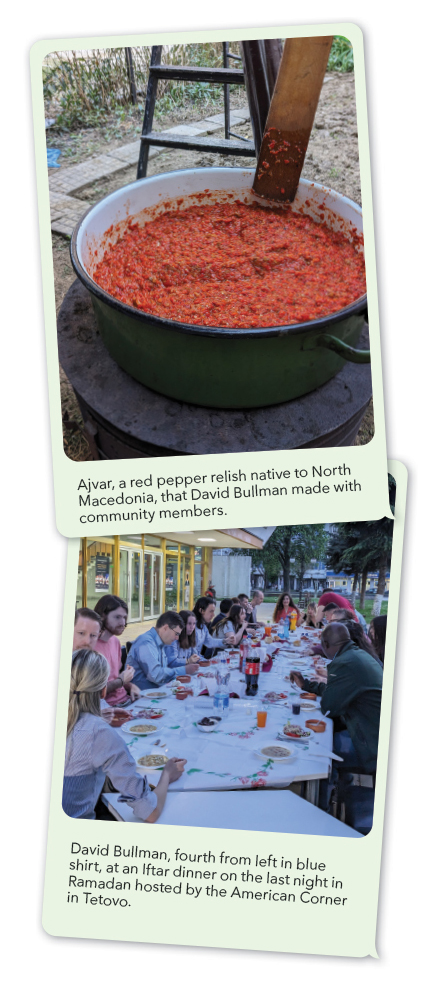
This is not the first time David Bullman ’22, ancient studies, visited North Macedonia. He first went in 1995 as a performing musician and public affairs representative for the U.S. Army.
“North Macedonia was very different coming out of the Cold War,” says Bullman. “The infrastructure and general state of repair of public spaces and businesses is much better than I recall from that time.”
Now, as an ETA, Bullman teaches British civilization and American civilization in addition to three different levels of English at the University of Totovo in the Republic of North Macedonia, a landlocked country north of Greece. In Totovo, students begin learning English in elementary school and are fluent by the time they reach college. “I thought I would be teaching English basics,” says Bullman, “but it’s been great to teach a complex subject in the context of where my students live.”
His students are equally glad to help him with the local language. Macedonian and Albanian are the country’s two official languages. Bullman began learning some key Macedonian phrases in preparation for his trip. However, Albanian is the preferred language in Tetovo. After traveling with the Army to more than 15 countries on three continents, Bullman is used to rapidly switching gears and accepting help.
He eagerly takes on the student role when it comes to learning about new foods. Bullman’s apartment faces the Hapësira Socio-Kulturore Tetovë, a community center where locals and the nearby Peace Corps Volunteers sometimes organize activities, like an ajvar-making gathering. Ajvar is a delicacy across the Balkans made every fall. It’s a tradition passed down through centuries with many recipe variations. “Ajvar is made by charring red bell peppers that are then peeled, minced, seasoned, and cooked for hours,” says Bullman. It boils down to a relish that can be preserved for months, but locals tell Bullman that’s rare because it’s too good to keep for even one week. After participating in the preparation and getting to take home a few jars, Bullman agrees with the locals. Ajvar is now his go-to condiment on eggs, pasta, toast—anything goes.
Albanian and cooking are not the only languages Bullman tapped into while in Tetovo. As a lifelong clarinet player, Bullman hoped to create a musical exchange with local musicians. The opportunity presented itself when the dean of the Faculty of Art wanted to celebrate Thanksgiving. Bullman collaborated with the music faculty, the orchestra director, and students to create a concert of six songs. “I’m glad I returned to North Macedonia. The people are as warm and friendly as I remembered them to be,” says Bullman. “I wanted to come back and experience it myself again.”
Tapping into curiosity
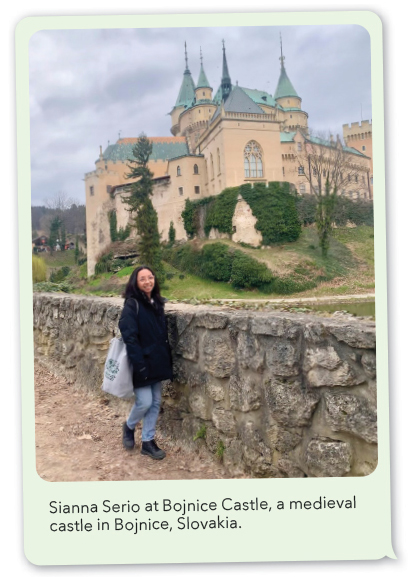
On her way to her Fulbright placement, Sianna Serio ’23, computer science, went city hopping. “I was headed to Žilina, Slovakia, east of Austria and south of Poland,” says Serio. “I flew into Vienna, Austria, then I took a one-hour bus ride crossing Austria’s eastern border into Slovakia to get to Bratislava, the capital.“ There she met other ETAs for orientation. “A week later, I hopped on a two-hour train ride to my teaching placement in Žilina and I met my wonderful mentor, Maria Veršova, who became my second mom.”
Serio teaches at the Hotel Academy, Žilina. The academy focuses on hotel management, gastronomy, and tourism. “My students are beginning English language learners,” says Serio. “I teach what the class is interested in, like American pop culture, because they rarely meet a native English speaker.” During outings with her students, they ask about a wide range of topics. “There are many topics that I would not have thought to cover if it were not for time spent outside of the classroom,” says Serio, “Some of those conversations became formal lessons, like the lesson on the three branches of the U. S. government.”
Serio appreciates her students’ curiosity. She tapped into her love of website development and design to improve her students’ confidence in writing and speaking English and prepare for their Maturita exam, a national high school exit exam. “Some of my students are helping me design a class webpage for them where I will showcase their class and post some of their practice writing in English,” says Serio. “These posts will include topics covered in the Maturita exam, information about their school, and answers to questions about Slovakia.”
Serio’s mentor Maria Veršova, head of the English department, is her motivation. She guides her through lesson planning, class schedules, and the challenges of relocating to a new country. “When my original housing plans fell through, Maria found housing for me five minutes from her house,” says Serio. “She helped me find health insurance and open a bank account. Her husband set up my internet.” They have welcomed Serio almost daily into their home for dinner, tea, coffee, or wine. Serio is a gracious guest and lent her graphic design expertise to help Veršova design invitation cards for her 50th birthday party. Veršova tells Serio she will always have a place to stay in Žilina.
Fulbright: The next generation
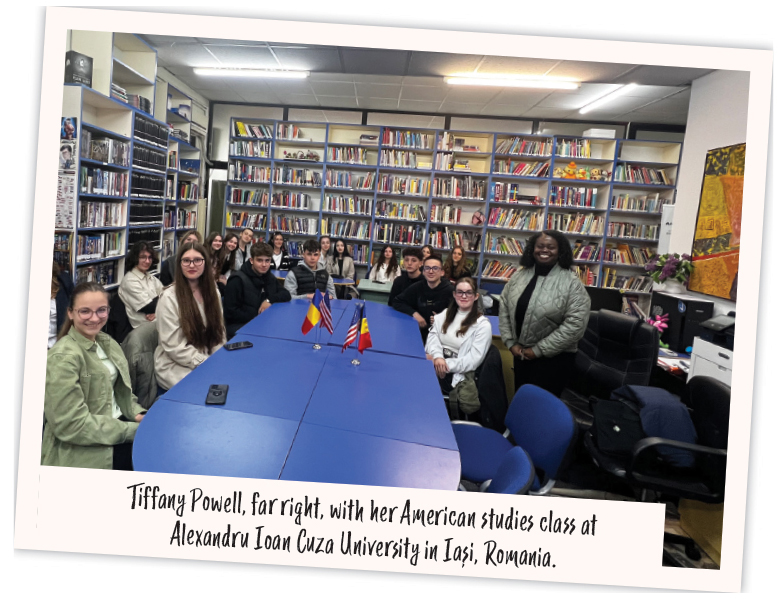
Teaching has defined the last decade for Tiffany Powell, a master’s student in UMBC’s TESOL program, a passion she invested in as an English language learner teacher in Seoul and in Miryang City, South Korea, for five years, and in Florida this past year. Now, she is in Iași, Romania, southwest of Ukraine, at the Alexandru Ioan Cuza University teaching American studies. Powell is committed to bridging culture, community, and belonging by bringing technology into the classroom.
Powell also decided to bring the research and cultural understanding closer to home by partnering with Romanian teachers to develop a five-part series on African American women’s history. “We talked about Black women in science in the context of the movie Hidden Figures and discussed Hollywood’s portrayal of Black life,” says Powell. The class is now creating a series on Romanian women. Helping students better understand the similarities and differences between U.S. and Romanian cultures has been an eye-opening experience for Powell.
She sees the impact of a country formerly under communism. In Iași, sometimes the internet doesn’t work and, in her school, there are no clubs or student organizations to gain the skills needed to earn a Fulbright award. “My students have given me a new perspective. You may want to come in and make changes, but you must understand where they’re coming from. There is a saying in Iași, ‘It’s not impossible. It’s just difficult,’” says Powell. She is trying to help with the difficult part by leading Fulbright application and leadership workshops.
Powell, like the other Fulbrighters, will bring her experiences home with her and wherever she ends up teaching English next. When their Fulbright year ends, these Retriever ambassadors will find themselves as emissaries yet again, returning to their hometowns, sharing the good news of ajvar made in community, the freedom of a scooter ride along a Taiwanese beach, or the correct stroke order for writing the Mandarin number five. The lessons their students and host families passed along—including pausing to take a breath and appreciate their international successes small and large—will continue to form and shape the way they see the world.
“Having a flexible mindset and under-standing the historical context of your placement is key,” says Powell. “I carry myself as a U.S. representative. Living abroad teaches humility, adaptability, and open-mindedness to press on through challenging times.”
]]>
International travel offers ample opportunities to stretch yourself—one minute you may be the expert and the next, completely clueless about how something works. Retrievers currently in the...
https://umbc.edu/stories/a-journey-of-growth-retriever-fulbright/
https://my3.my.umbc.edu/api/v0/pixel/news/142404/guest@my.umbc.edu/ed280c216f570c718be808f58bf7c55a/api/pixel
alumni
ancient-studies
bioinformatics-and-computational-biology
cahss
cge
computer-science
education-abroad
english
feature
fulbright
global-studies
humanities
inds
linehan
llc
magazine
meyerhoff
spring-2024
story
UMBC News & Magazine
https://my3.my.umbc.edu/groups/umbc-news-magazine
https://assets1-my.umbc.edu/system/shared/avatars/groups/000/001/943/24435aa6207c452e7bc15cc74b42c7bb/xsmall.png?1748556657
https://assets1-my.umbc.edu/system/shared/avatars/groups/000/001/943/24435aa6207c452e7bc15cc74b42c7bb/original.png?1748556657
https://assets2-my.umbc.edu/system/shared/avatars/groups/000/001/943/24435aa6207c452e7bc15cc74b42c7bb/xxlarge.png?1748556657
https://assets2-my.umbc.edu/system/shared/avatars/groups/000/001/943/24435aa6207c452e7bc15cc74b42c7bb/xlarge.png?1748556657
https://assets3-my.umbc.edu/system/shared/avatars/groups/000/001/943/24435aa6207c452e7bc15cc74b42c7bb/large.png?1748556657
https://assets1-my.umbc.edu/system/shared/avatars/groups/000/001/943/24435aa6207c452e7bc15cc74b42c7bb/medium.png?1748556657
https://assets2-my.umbc.edu/system/shared/avatars/groups/000/001/943/24435aa6207c452e7bc15cc74b42c7bb/small.png?1748556657
https://assets1-my.umbc.edu/system/shared/avatars/groups/000/001/943/24435aa6207c452e7bc15cc74b42c7bb/xsmall.png?1748556657
https://assets2-my.umbc.edu/system/shared/avatars/groups/000/001/943/24435aa6207c452e7bc15cc74b42c7bb/xxsmall.png?1748556657
UMBC News & Magazine
0
0
false
Wed, 29 May 2024 14:32:52 -0400
A Journey of Growth
International travel offers ample opportunities to stretch yourself—one minute you may be the expert and the next, completely clueless about how something works. Retrievers currently in the Fulbright U.S. Student Program—teaching English or researching around the globe—find themselves oscillating between their teaching and student roles on a daily or hourly basis. By engaging their host communities through openness and cultural humility (and many shared cups of tea or coffee), these Fulbrighters are finding their balance along the way.
All eyes are on Milan Richardson ’23 as she helps her co-teacher keep score in a Jeopardy-like game her students are playing. Richardson teaches English to several classes of first through sixth-grade students at Jinsha Elementary School in Kinmen County, Taiwan. As she completes the Mandarin character for the numeral 5, a wave of giggles and chatter flows through the room.
Similar to a U.S. tally—four strokes and a strike though, the Mandarin character has 5 strokes total and needs to be written a certain way to represent 1, 2, 3, 4, or 5. “The students were so confused because I wrote the character strokes in the wrong order,” says Richardson, who is used to solving complex math as a Meyerhoff Scholar having earned a bachelor’s degree in bioinformatics and computational biology and minors in computer science and modern, languages, linguistics, and intercultural communication.
“I wanted to write the character correctly. I asked, and they showed me the proper order to write the strokes,” says Richardson, a Fulbright English Teaching Assistant (ETA). “They started clapping once I got it right. This was one of the many cool moments where my students were able to teach me.”
While she may be new to teaching in Taiwan, Richardson brings with her four years as an English and math tutor and a minor in Mandarin. “Taiwan was so different from any place I’ve ever been to. I was overwhelmed at first,” says Richardson. “I like it a lot, now. In my second month, I applied for a scooter license. Now I ride around the island and have taken my scooter other places on trips.”
Diplomas earned. Visas in hand. Vaccines completed. Luggage packed. Destination confirmed. Last summer, UMBC’s eight participants in the 2023 – 2024 Fulbright U.S. Student Program checked off all the important items on their to-do lists. The only thing left was to get to their placements on islands and in landlocked countries, cities, and countrysides across East Asia and Eastern Europe. It’s easier written than done. To adapt well to a new community, job, language, and culture, they must practice the art of humility and flexibility as their roles shift regularly from teacher to student.
Leading the Fulbright charge
All technicalities aside, the Fulbright experience is the beginning of building an international network of teachers and researchers who share the diversity and possibility of the U.S. with the world. In return, across the globe, communities welcome the next generation of leaders into their cities, neighborhoods, schools, and homes to share their country’s history, innovations, and culture. Since Fulbright’s inception in 1946, these reciprocal acts of kindness have created multiple paths forward to lifelong worldwide collaboration and understanding based on the simple act of giving someone different than yourself a chance.
“The Fulbright Program truly demonstrates public diplomacy in action,” says Brian Souders, M.A.’19, TESOL, and Ph.D. ’09, language, literacy, and culture, the associate director of global learning at UMBC’s Center for Global Engagement. In this role, Souders, who received a 2023 Fulbright International Education Administrator award to Germany, has led hundreds of Retrievers through the Fulbright application process as UMBC’s Fulbright Program advisor. “Whether in the classroom as teachers, students, or researchers, recipients learn about the world as much as they share what it means to be from the U.S. and UMBC alumni,” says Souders.
Thanks to Souders’ guidance, UMBC is one of 57 doctoral universities nationwide and three in Maryland to receive a Fulbright Top Producing Institution designation for 2023 – 2024, for the third time in the last five years. In the last decade, more than 80 UMBC alumni have received Fulbright awards. Out of the 10 Retrievers who received a 2023 – 2024 Fulbright, eight are currently placed internationally, seven are ETAs and one is on a research grant.
The hard work of play
There are U.S. Fulbright student scholars in more than 100 countries worldwide. Three Retrievers were placed in Taiwan—they keep in touch regularly, see each other at ETA trainings, and are planning to travel together during their Fulbright year. But they all arrived in Taiwan separately and faced different challenges settling in.
“I arrived in Taiwan and immediately changed my plans because the airline lost my luggage,” says Humanities Scholar Kara Gavin ’20, English. She was grateful to have a carry-on. “It was chaotic. I was taking it all in,” says Gavin. A day and a 50-minute plane ride later, she arrived in Penghu County, Taiwan, an archipelago of about 90 islands between China and the main island of Taiwan. “The little beach town is in its own little world,” says Gavin. “The smell of the sand gave me comfort.”
Gavin teaches beginner English at two local junior high schools. New to Asia and Mandarin, Gavin’s thinking cap is on 24 – 7, including learning Mandarin in between teaching classes. “Living independently for the first time is hard on its own, but doing it in a foreign country is a whole other ball game,” says Gavin. “I’m acquiring many new life skills that will last me a lifetime.”
One of those is sympathizing with her students and anyone learning a new language and culture. “I teach the English pronunciation and spelling of a word,” says Gavin. “Then, they like to share the Mandarin equivalent with me. It’s all about patience, balance, and trust.” She also models intercultural teamwork by developing and teaching lessons with her bilingual (Mandarin/English) Taiwanese co-teacher to foster student engagement and enrichment.
For Fulbright Scholars, it is equally important to engage with communities beyond the classroom. When they apply for the grant, the Fulbright Program asks them to develop ideas to share their passions and skills in a community project. For Gavin, this meant adding a little drama to have a lot of fun. As a performing artist, Gavin knows the theatre can be a powerful community-building outlet. “I wanted to encourage students and other community members to express themselves and share their culture with me and others,” says Gavin.
She found a kindred spirit in a professor at a local university. They formed a drama club at the university for English language learners at all levels to explore American play formats with Taiwanese traditions and histories.“Writing original bilingual plays, in English and Mandarin, based on folktales about island traditions is creating an artistic and fun cultural exchange and understanding outside of my ETA duties,” says Gavin.
Finding the right pace
For fellow Humanities Scholar Nailah-Benā Chambers ’23, global studies, a Fulbright award to Taiwan was a natural next step. Chambers began learning Mandarin and all things Taiwanese in sixth grade at a Taiwanese Mandarin language immersion school in her hometown of Richmond, Virginia. As her Mandarin improved, she tutored other English speakers. This oscillating pattern of being a student and a teacher makes Chambers adaptable and persistent, she says.
But it hasn’t always been easy. When she first visited Taipei, Taiwan, in the spring of 2023 on a Mandarin language-intensive study abroad program, “I was so confident. I walked into a 7-Eleven to shop. No one could understand me,” says Chambers. “It was a bit embarrassing. Even with my language and cultural skills, I had a long way to go to mastering Mandarin.”
Now on her Fulbright ETA grant, Chambers arrived on solid ground, both culturally and linguistically. “I felt such a sense of calm and familiarity. Taiwan is so welcoming,” says Chambers. “It calms you down. Things are much slower here than in the U.S.” Soon enough, Chambers was balancing classrooms at Huludun Elementary and Fu Chun Elementary in Taichung City, on the main island of Taiwan, with students at both schools on the extreme spectrum of English proficiency.
The upside of working with proficient English language learners is connecting on more advanced topics and sticking to Fulbright’s English-only immersion model. At one of her schools, the students are beginning English language learners, and the administrators only speak Mandarin. “My experience as a bilingual teacher and learner with a high level of understanding of the local language and culture has helped with classroom management and fostering powerful connections with students and administrators,” says Chambers. “It also helps to advance their grasp of the nuances of American English, especially when there are gray areas or misunderstandings.”
Keeping your ears open
Watching anime, reading manga, (Japanese graphic novels), and participating in their fandom inspired Paul Ocone ’22, individualized study, a Linehan Artist Scholar, to research these subjects and learn Japanese. “I have deeply engaged in fan social life and communities—from leading an anime club to participating in and running conventions to moderating online communities—my affinity for and interest in anime fan spaces runs deep,” says Ocone. Part of Ocone’s observations include witnessing how some fan subcultures limit their membership in fear that a broader fanbase would weaken their subculture identity. In contrast, he says, other fan subcultures are more flexible while maintaining their identity.
Interested in adding to his initial research in U.S. fan spaces, Ocone is now at the epicenter of anime and manga culture as a Fulbright Student Researcher doing anthropological research with Morikawa Kaichirō, a leading scholar in this field at Meiji University’s School of Global Japanese Studies in Tokyo, also home to the Yoshihiro Yonezawa Memorial Library of Manga and Subcultures.
“I have had some amazing experiences participating in anime pilgrimage or anime tourism, including learning much from other fans and benefitting from their generosity,” says Ocone. “My Japanese is conversational—sometimes it’s challenging to understand specialized topics, but this has not deterred me from adding anime and manga tourism as a second research project.” In January, Ocone presented his work at the Popular Culture Tourism Stakeholders Summit in Japan.
Ocone is a sort of tourist himself, enjoying various aspects of Japanese pop culture. The daily musicality of Tokyo teaches him about enjoying the rhythm of the day. “Each train station plays a unique melody when the train departs,” says Ocone. These melodies or “hassha merodii,” are catchy and echo around in his brain like the convenience store jingles that also greet customers. “I was happily surprised when I heard a loudspeaker playing a symphony in my neighborhood,” says Ocone. “Another one played the following day and the next. I learned this was a daily sunset ritual.” He knows these sound experiences will play in his head long after returning to the U.S.
Learning new languages
This is not the first time David Bullman ’22, ancient studies, visited North Macedonia. He first went in 1995 as a performing musician and public affairs representative for the U.S. Army.
“North Macedonia was very different coming out of the Cold War,” says Bullman. “The infrastructure and general state of repair of public spaces and businesses is much better than I recall from that time.”
Now, as an ETA, Bullman teaches British civilization and American civilization in addition to three different levels of English at the University of Totovo in the Republic of North Macedonia, a landlocked country north of Greece. In Totovo, students begin learning English in elementary school and are fluent by the time they reach college. “I thought I would be teaching English basics,” says Bullman, “but it’s been great to teach a complex subject in the context of where my students live.”
His students are equally glad to help him with the local language. Macedonian and Albanian are the country’s two official languages. Bullman began learning some key Macedonian phrases in preparation for his trip. However, Albanian is the preferred language in Tetovo. After traveling with the Army to more than 15 countries on three continents, Bullman is used to rapidly switching gears and accepting help.
He eagerly takes on the student role when it comes to learning about new foods. Bullman’s apartment faces the Hapësira Socio-Kulturore Tetovë, a community center where locals and the nearby Peace Corps Volunteers sometimes organize activities, like an ajvar-making gathering. Ajvar is a delicacy across the Balkans made every fall. It’s a tradition passed down through centuries with many recipe variations. “Ajvar is made by charring red bell peppers that are then peeled, minced, seasoned, and cooked for hours,” says Bullman. It boils down to a relish that can be preserved for months, but locals tell Bullman that’s rare because it’s too good to keep for even one week. After participating in the preparation and getting to take home a few jars, Bullman agrees with the locals. Ajvar is now his go-to condiment on eggs, pasta, toast—anything goes.
Albanian and cooking are not the only languages Bullman tapped into while in Tetovo. As a lifelong clarinet player, Bullman hoped to create a musical exchange with local musicians. The opportunity presented itself when the dean of the Faculty of Art wanted to celebrate Thanksgiving. Bullman collaborated with the music faculty, the orchestra director, and students to create a concert of six songs. “I’m glad I returned to North Macedonia. The people are as warm and friendly as I remembered them to be,” says Bullman. “I wanted to come back and experience it myself again.”
Tapping into curiosity
On her way to her Fulbright placement, Sianna Serio ’23, computer science, went city hopping. “I was headed to Žilina, Slovakia, east of Austria and south of Poland,” says Serio. “I flew into Vienna, Austria, then I took a one-hour bus ride crossing Austria’s eastern border into Slovakia to get to Bratislava, the capital.“ There she met other ETAs for orientation. “A week later, I hopped on a two-hour train ride to my teaching placement in Žilina and I met my wonderful mentor, Maria Veršova, who became my second mom.”
Serio teaches at the Hotel Academy, Žilina. The academy focuses on hotel management, gastronomy, and tourism. “My students are beginning English language learners,” says Serio. “I teach what the class is interested in, like American pop culture, because they rarely meet a native English speaker.” During outings with her students, they ask about a wide range of topics. “There are many topics that I would not have thought to cover if it were not for time spent outside of the classroom,” says Serio, “Some of those conversations became formal lessons, like the lesson on the three branches of the U. S. government.”
Serio appreciates her students’ curiosity. She tapped into her love of website development and design to improve her students’ confidence in writing and speaking English and prepare for their Maturita exam, a national high school exit exam. “Some of my students are helping me design a class webpage for them where I will showcase their class and post some of their practice writing in English,” says Serio. “These posts will include topics covered in the Maturita exam, information about their school, and answers to questions about Slovakia.”
Serio’s mentor Maria Veršova, head of the English department, is her motivation. She guides her through lesson planning, class schedules, and the challenges of relocating to a new country. “When my original housing plans fell through, Maria found housing for me five minutes from her house,” says Serio. “She helped me find health insurance and open a bank account. Her husband set up my internet.” They have welcomed Serio almost daily into their home for dinner, tea, coffee, or wine. Serio is a gracious guest and lent her graphic design expertise to help Veršova design invitation cards for her 50th birthday party. Veršova tells Serio she will always have a place to stay in Žilina.
Fulbright: The next generation
Teaching has defined the last decade for Tiffany Powell, a master’s student in UMBC’s TESOL program, a passion she invested in as an English language learner teacher in Seoul and in Miryang City, South Korea, for five years, and in Florida this past year. Now, she is in Iași, Romania, southwest of Ukraine, at the Alexandru Ioan Cuza University teaching American studies. Powell is committed to bridging culture, community, and belonging by bringing technology into the classroom.
Powell also decided to bring the research and cultural understanding closer to home by partnering with Romanian teachers to develop a five-part series on African American women’s history. “We talked about Black women in science in the context of the movie Hidden Figures and discussed Hollywood’s portrayal of Black life,” says Powell. The class is now creating a series on Romanian women. Helping students better understand the similarities and differences between U.S. and Romanian cultures has been an eye-opening experience for Powell.
She sees the impact of a country formerly under communism. In Iași, sometimes the internet doesn’t work and, in her school, there are no clubs or student organizations to gain the skills needed to earn a Fulbright award. “My students have given me a new perspective. You may want to come in and make changes, but you must understand where they’re coming from. There is a saying in Iași, ‘It’s not impossible. It’s just difficult,’” says Powell. She is trying to help with the difficult part by leading Fulbright application and leadership workshops.
Powell, like the other Fulbrighters, will bring her experiences home with her and wherever she ends up teaching English next. When their Fulbright year ends, these Retriever ambassadors will find themselves as emissaries yet again, returning to their hometowns, sharing the good news of ajvar made in community, the freedom of a scooter ride along a Taiwanese beach, or the correct stroke order for writing the Mandarin number five. The lessons their students and host families passed along—including pausing to take a breath and appreciate their international successes small and large—will continue to form and shape the way they see the world.
“Having a flexible mindset and under-standing the historical context of your placement is key,” says Powell. “I carry myself as a U.S. representative. Living abroad teaches humility, adaptability, and open-mindedness to press on through challenging times.”
]]>
International travel offers ample opportunities to stretch yourself—one minute you may be the expert and the next, completely clueless about how something works. Retrievers currently in the...
https://umbc.edu/stories/a-journey-of-growth/
https://my3.my.umbc.edu/api/v0/pixel/news/142391/guest@my.umbc.edu/429a43e449ef9d4187b1ae1d4e63ca4e/api/pixel
alumni
ancient-studies
bioinformatics-and-computational-biology
cahss
cge
computer-science
education-abroad
english
feature
fulbright
global-studies
humanities
inds
linehan
llc
magazine
meyerhoff
spring-2024
story
UMBC News & Magazine
https://my3.my.umbc.edu/groups/umbc-news-magazine
https://assets1-my.umbc.edu/system/shared/avatars/groups/000/001/943/24435aa6207c452e7bc15cc74b42c7bb/xsmall.png?1748556657
https://assets1-my.umbc.edu/system/shared/avatars/groups/000/001/943/24435aa6207c452e7bc15cc74b42c7bb/original.png?1748556657
https://assets2-my.umbc.edu/system/shared/avatars/groups/000/001/943/24435aa6207c452e7bc15cc74b42c7bb/xxlarge.png?1748556657
https://assets2-my.umbc.edu/system/shared/avatars/groups/000/001/943/24435aa6207c452e7bc15cc74b42c7bb/xlarge.png?1748556657
https://assets3-my.umbc.edu/system/shared/avatars/groups/000/001/943/24435aa6207c452e7bc15cc74b42c7bb/large.png?1748556657
https://assets1-my.umbc.edu/system/shared/avatars/groups/000/001/943/24435aa6207c452e7bc15cc74b42c7bb/medium.png?1748556657
https://assets2-my.umbc.edu/system/shared/avatars/groups/000/001/943/24435aa6207c452e7bc15cc74b42c7bb/small.png?1748556657
https://assets1-my.umbc.edu/system/shared/avatars/groups/000/001/943/24435aa6207c452e7bc15cc74b42c7bb/xsmall.png?1748556657
https://assets2-my.umbc.edu/system/shared/avatars/groups/000/001/943/24435aa6207c452e7bc15cc74b42c7bb/xxsmall.png?1748556657
UMBC News & Magazine
5
0
false
Wed, 29 May 2024 14:32:52 -0400
A resilient Class of 2024 celebrates its successes
UMBC’s graduating Class of 2024 knows a thing or two about resilience. Many of this year’s 1,900-plus graduates began their collegiate journey at the onset of a global pandemic.
This week, as they walked across the Commencement stage adorned in black and gold regalia and mortarboards elaborately decorated with sayings such as “The tassel was worth the hassle,” “I did it,” and “The end is here,” the Class of 2024 reveled in the celebratory moment of reaching this milestone in the face of much adversity.
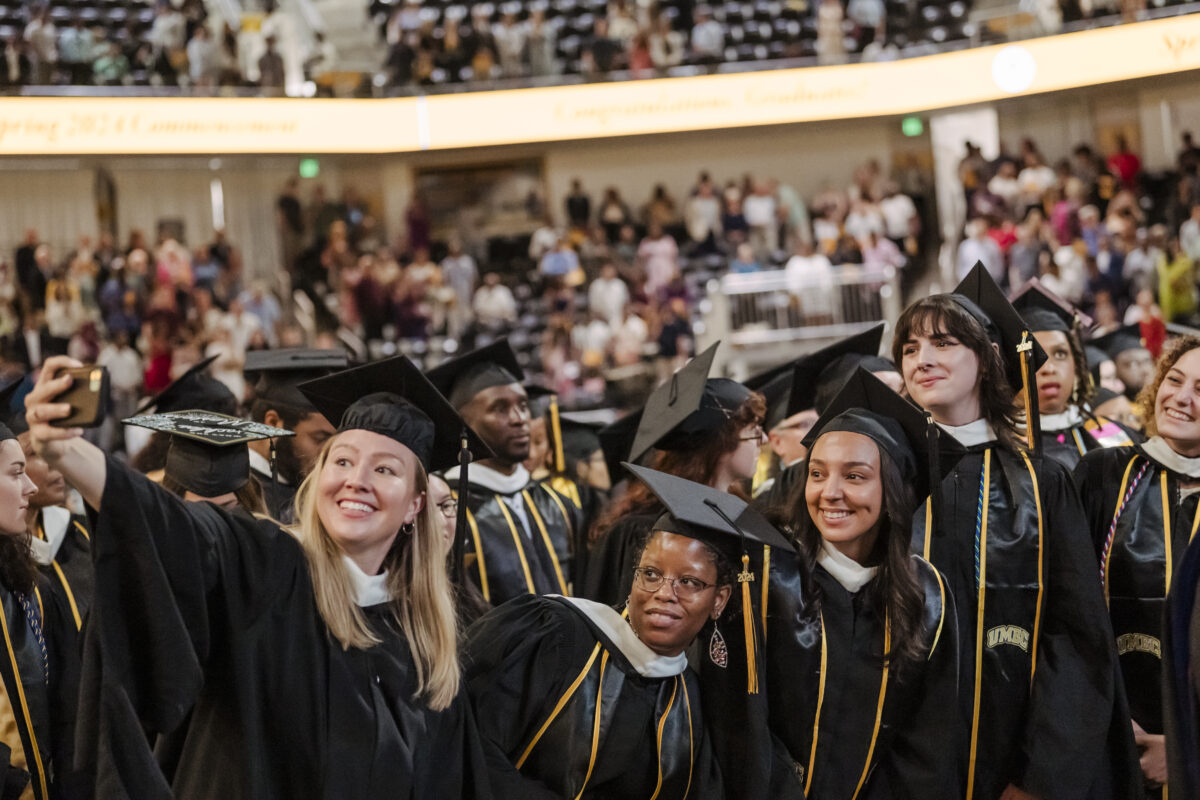 Class of 2024 graduates capturing Commencement day excitement.
“Resilience is a dynamic process. It’s a journey that we embark on in the face of challenges. Resilience is not just bouncing back or being able to recover—It’s the ability to bounce forward,” said graduate student speaker Grace De Oro, M.P.P. ’19, a Ph.D. candidate in public policy and president of the Graduate Student Association.
“We’ve all bounced forward to get here, right now, in this moment. This journey of resilience has not only brought us here, but it’s transformed us into stronger and more capable individuals.”
UMBC’s Spring 2024 Commencement video. (Elijah Davis, M.F.A. ’21/UMBC)
Service as a Retriever
During Thursday morning’s undergraduate ceremony for students in the College of Arts, Humanities, and Social Sciences; School of Social Work; and Erickson School of Aging Studies, co-valedictorian Nyla Howell ’24, geography and environmental systems and sociology, spoke to the value of service and how the graduating class will “serve with more than our degrees.”
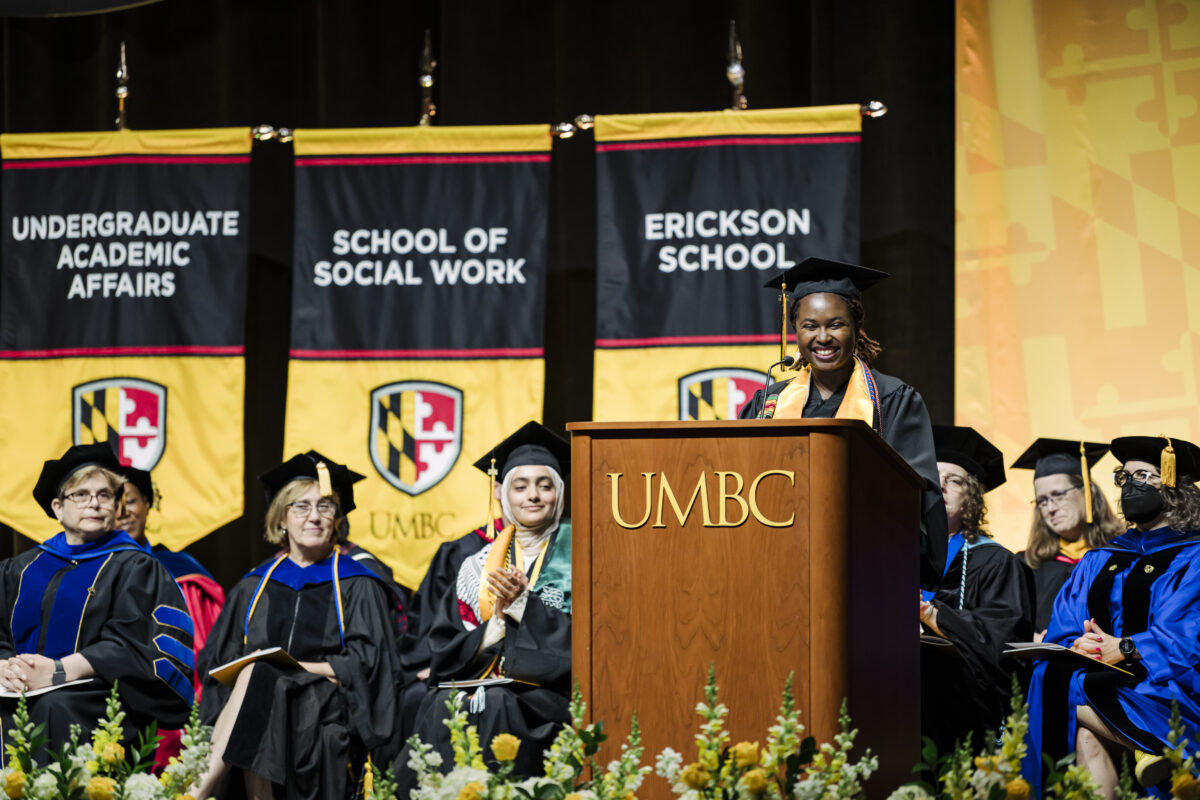 Valedictorian for the College of Arts, Humanities, and Social Sciences; School of Social Work; and Erickson School of Aging Studies morning ceremony, Nyla Howell ’24, speaks at Commencement.
“We all serve those around us daily by using our time and talent to encourage each other, give advice to each other, and take care of one another,” Howell said. “I believe that if we approach this next phase of life, despite all its uncertainty, with the intention of genuinely caring for others and living out our personal understandings of service, we will have the launch pads we need to do more than we ever believed we could.”
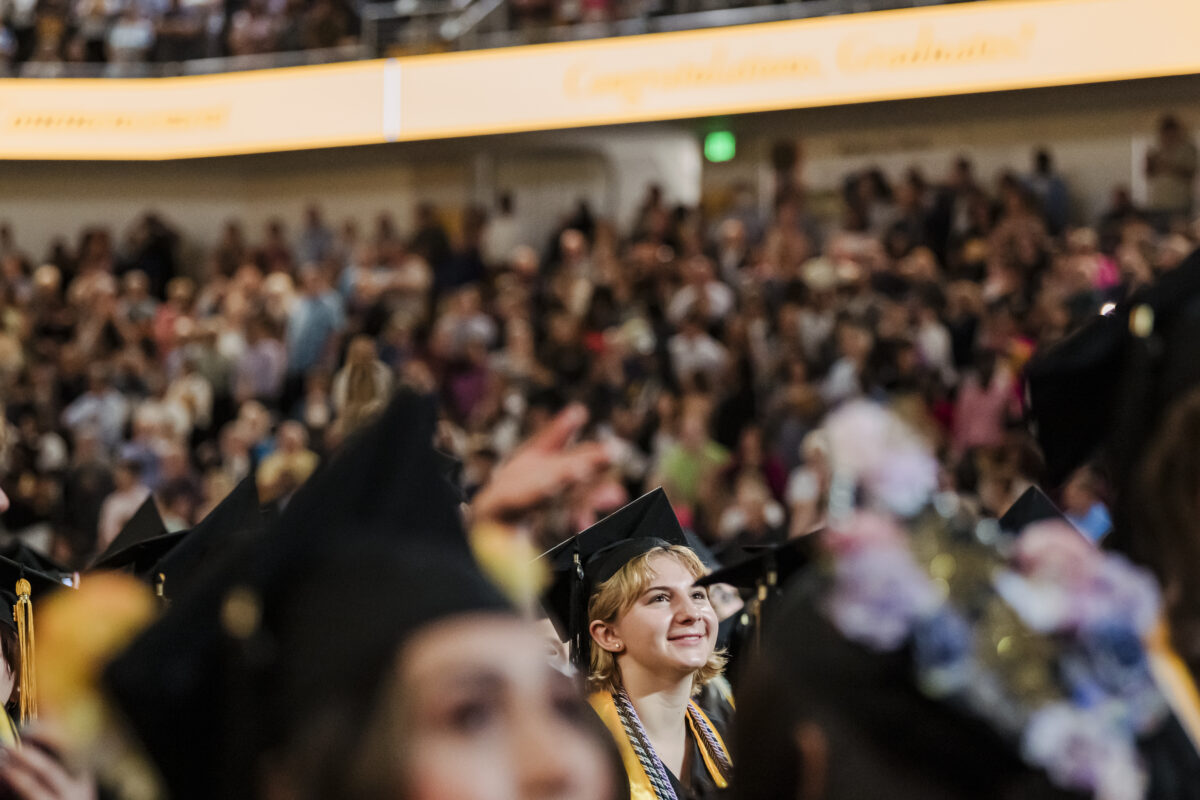

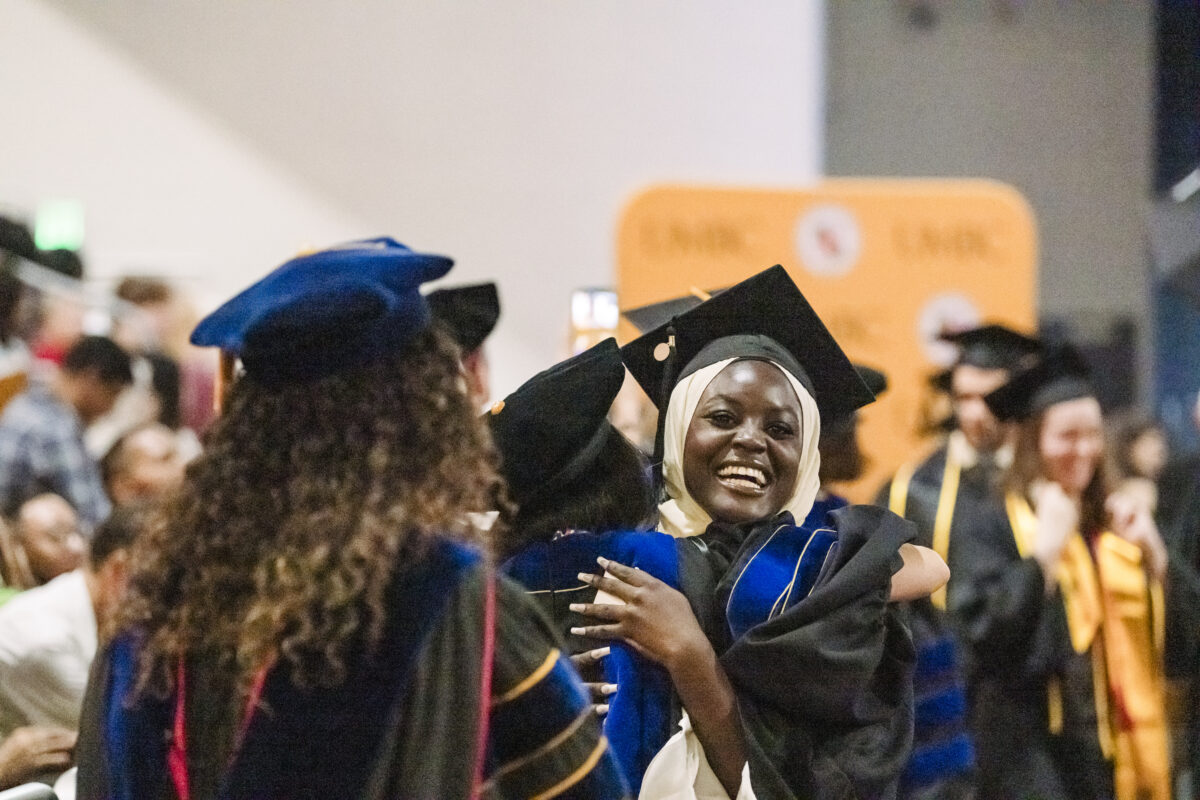
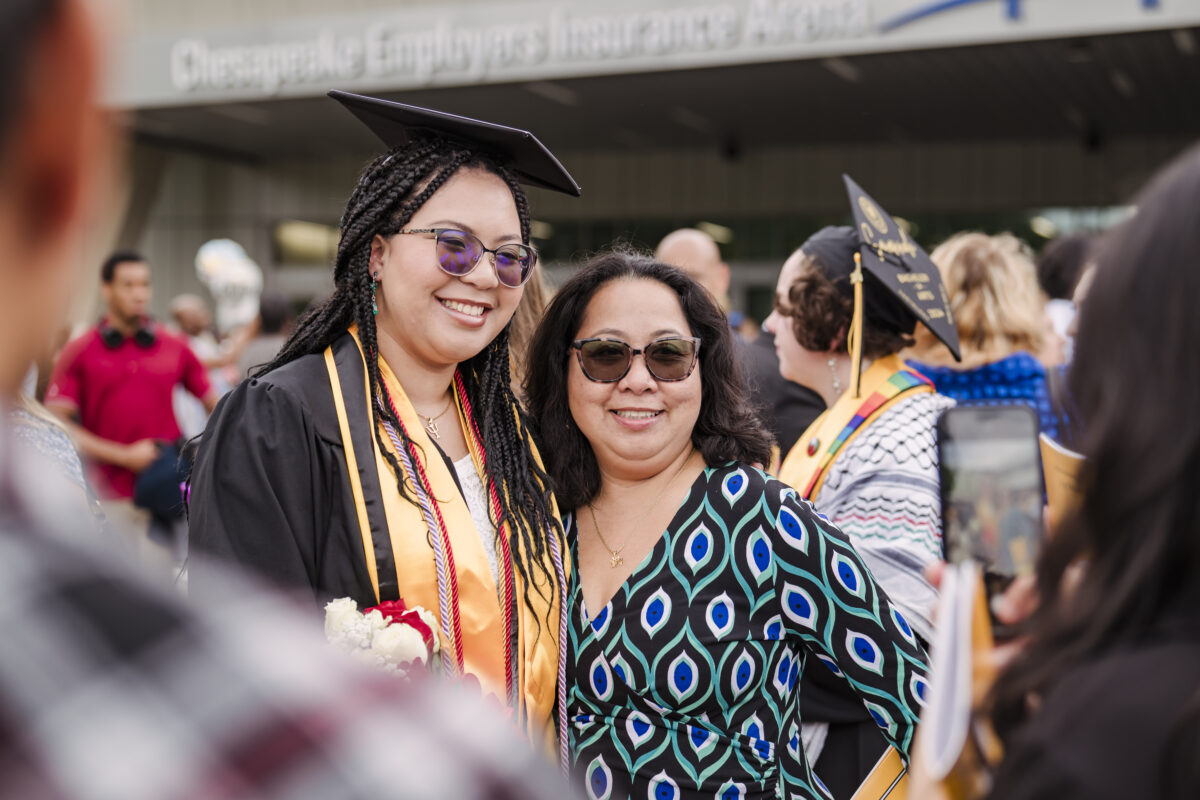
Howell, who is the first McNair Scholar to be a valedictorian at UMBC, has dedicated much of her time as an undergraduate in service to local communities and engaged in research examining how vulnerable and underrepresented communities can be better protected when disasters strike. Since 2021, Howell has worked as the food pantry manager of Retriever Essentials helping to combat food insecurity at UMBC. Howell’s leadership and public service efforts earned her scholarships from the France and Merrick Scholars Endowment and the Jacqueline C. Hrabowski Endowment.
She will continue her studies in geography as a Ph.D. student at Rutgers University as a fellow of the National Science Foundation’s Graduate Research Fellowship Program.
A dedication to STEM and the arts
During the afternoon ceremony for the College of Natural and Mathematical Sciences; College of Engineering and Information Technology; and Division of Undergraduate Academic Affairs, co-valedictorian D’Juan Moreland ’24, biological sciences and music, shared with his fellow graduates the lessons he has learned, particularly ones imparted to him by his mother.
Congratulations to our Engineering and Computing students #UMBCgrad @UMBC #UMBCengineering #UMBCComputing pic.twitter.com/M3gk0HkFLu
— Jamie Gurganus, PhD (@JamieRGurganus) May 23, 2024
“The first [lesson] is to celebrate yourself even in the little victories. The secondis to recognize who supported you. The lastis to set a good example because other people are watching your every move,” said Moreland. “Part of our achievement today is to set a strong example for those who are watching us right now. They don’t just see our success, but also our perseverance, as encouragement and inspiration for themselves.”
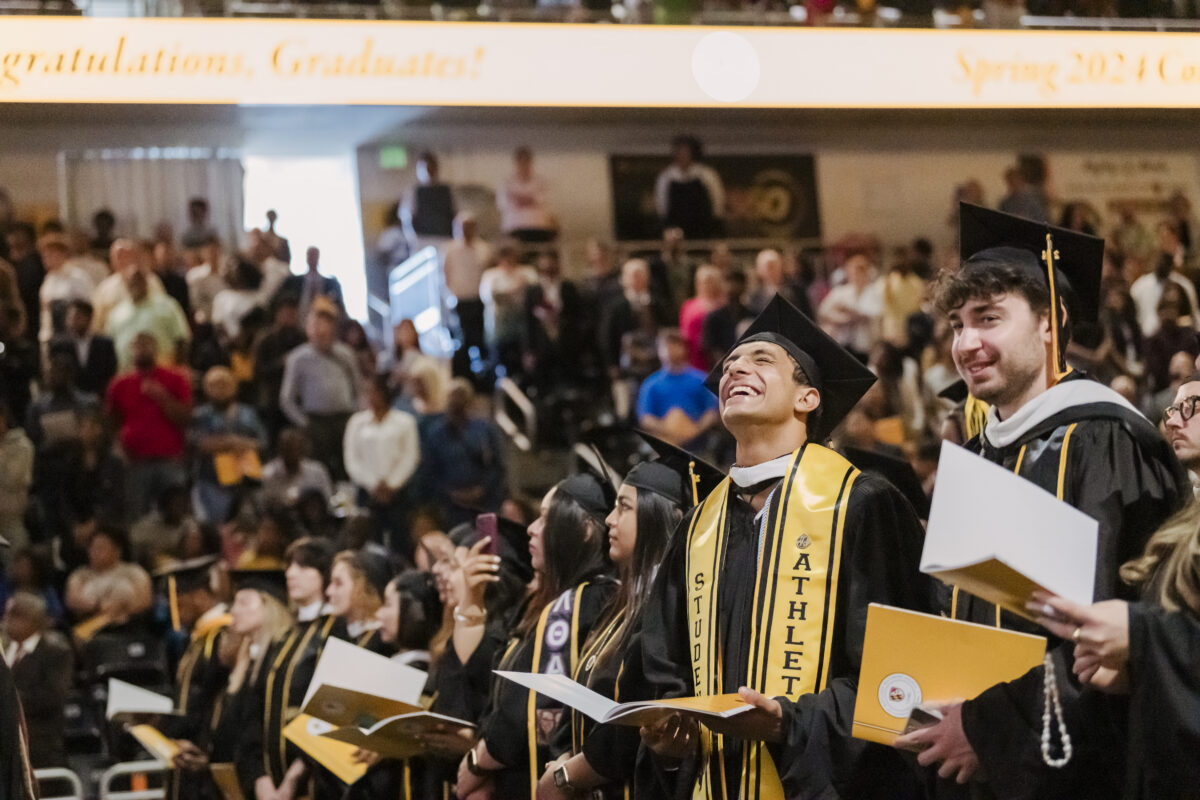 UMBC Class of 2024 graduates all smiles during Commencement.
During his time at UMBC, Moreland, a Meyherhoff Scholar, balanced and even found a way to intertwine his interests in biological sciences and music. He was a 2022 – 2023 recipient of a prestigious Goldwater Scholarship, for which he used his research on the song syllable use differences in female and male songbirds as the basis of his application. Moreland’s original composition “Ascension” won the inaugural UMBC Symphony Orchestra Composer Competition last year.
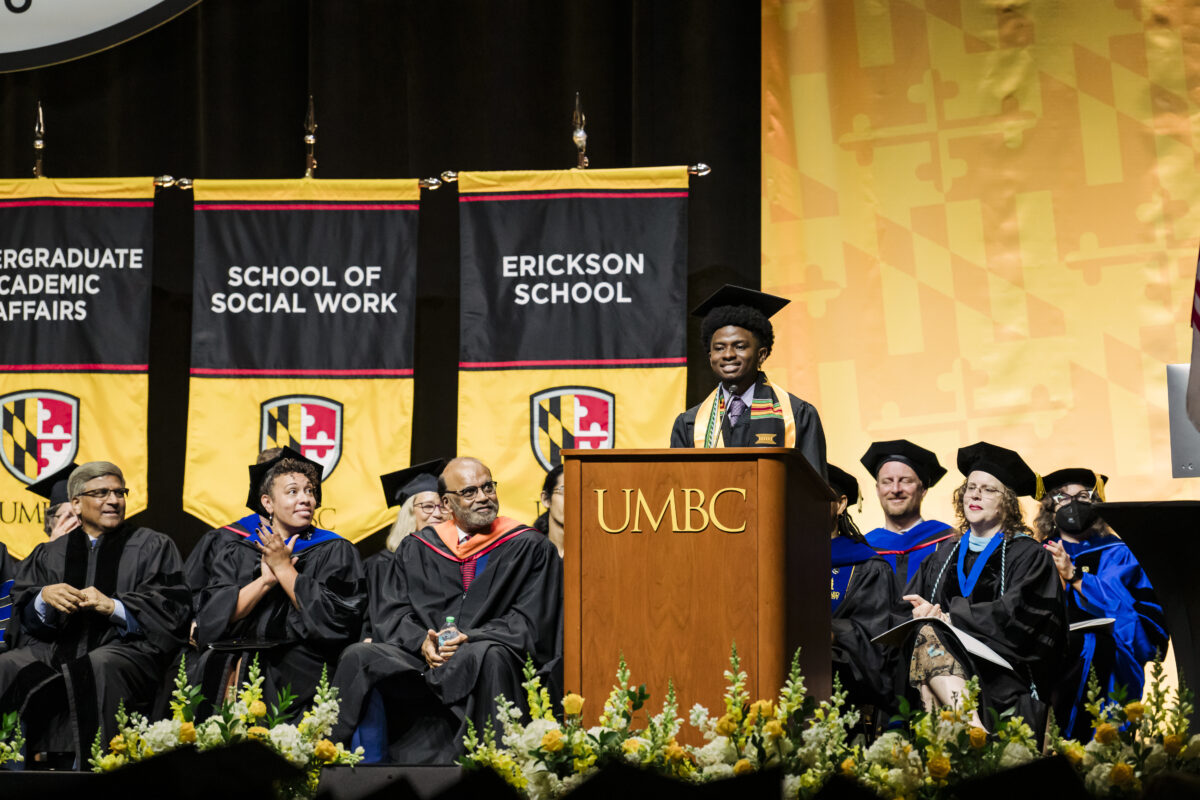 Valedictorian of the College of Natural and Mathematical Sciences; College of Engineering and Information Technology; and Division of Undergraduate Academic Affairs afternoon ceremony co-valedictorian, D’Juan Moreland ’24, addressing the audience during Commencement.
Additionally, he is a recipient of the Thomas V. Marsho and Martin Schwartz Memorial Fund scholarship and a recipient of the Ronald and Kathryn Shapiro Meyerhoff Mentoring scholarship. Moreland has dedicated much of his time to mentoring younger students, a passion that inspired him to create a mentoring program at his church for young Black men in middle and high school. Following graduation, Moreland will pursue a Ph.D. in neuroscience at the University of Pennsylvania.
“The DNA of UMBC”
The lineup of this year’s Commencement speakers included Mina Cheon, M.F.A. ’02, imaging and digital arts, the dean of undergraduate studies at the Maryland Institute College of Art and a 2018 UMBC Alumni Award winner. Farah Helal ’24, political science and global studies, also delivered remarks as the University System of Maryland student regent representative.
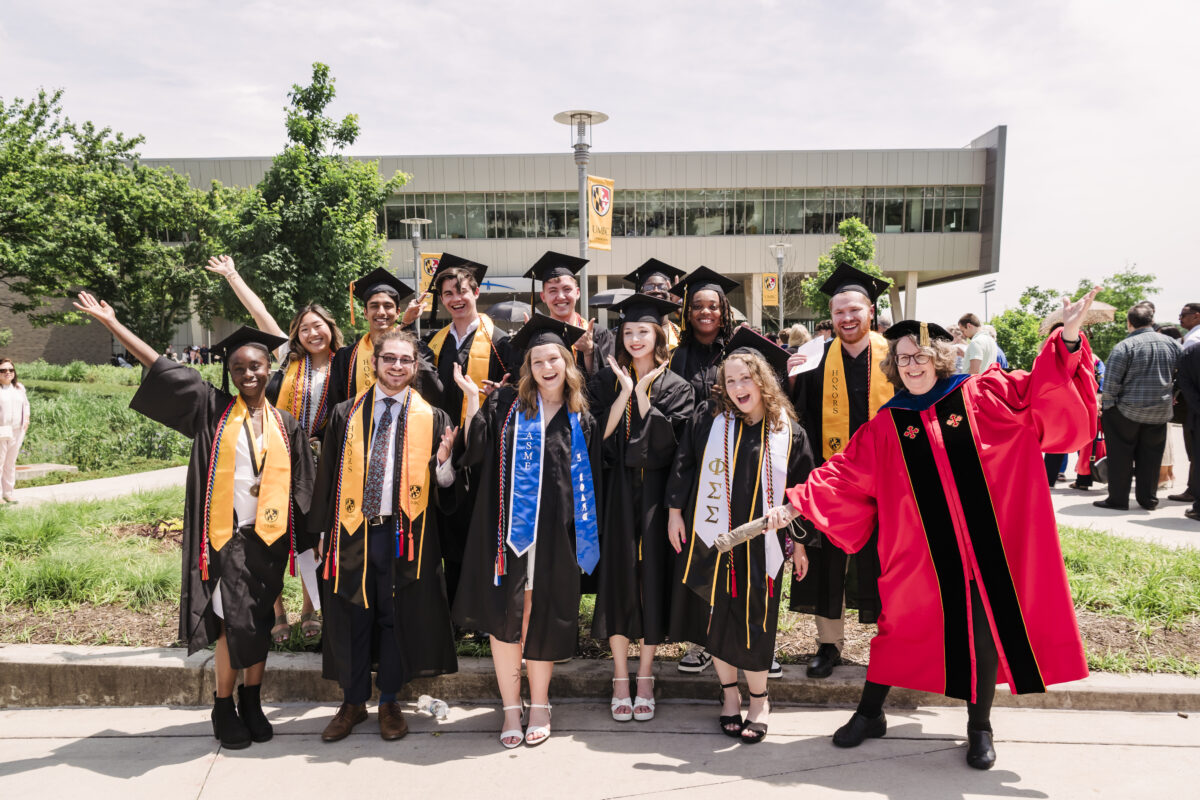
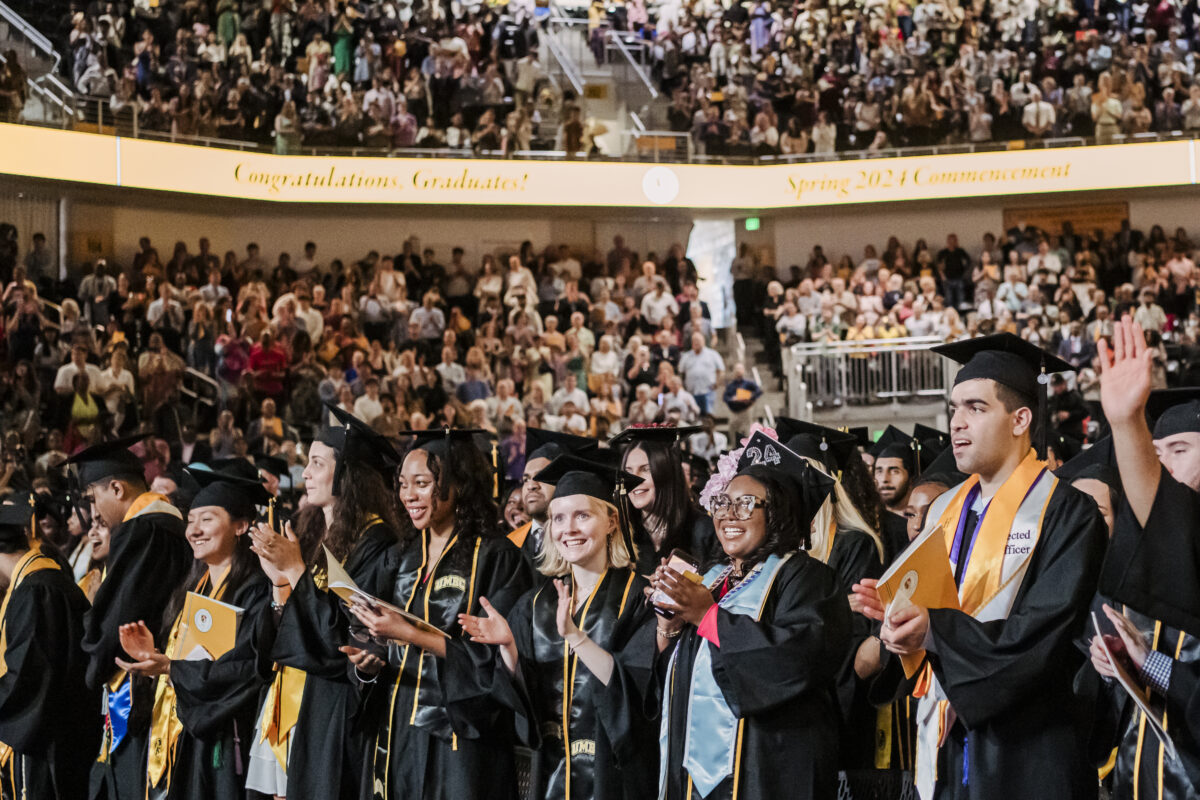
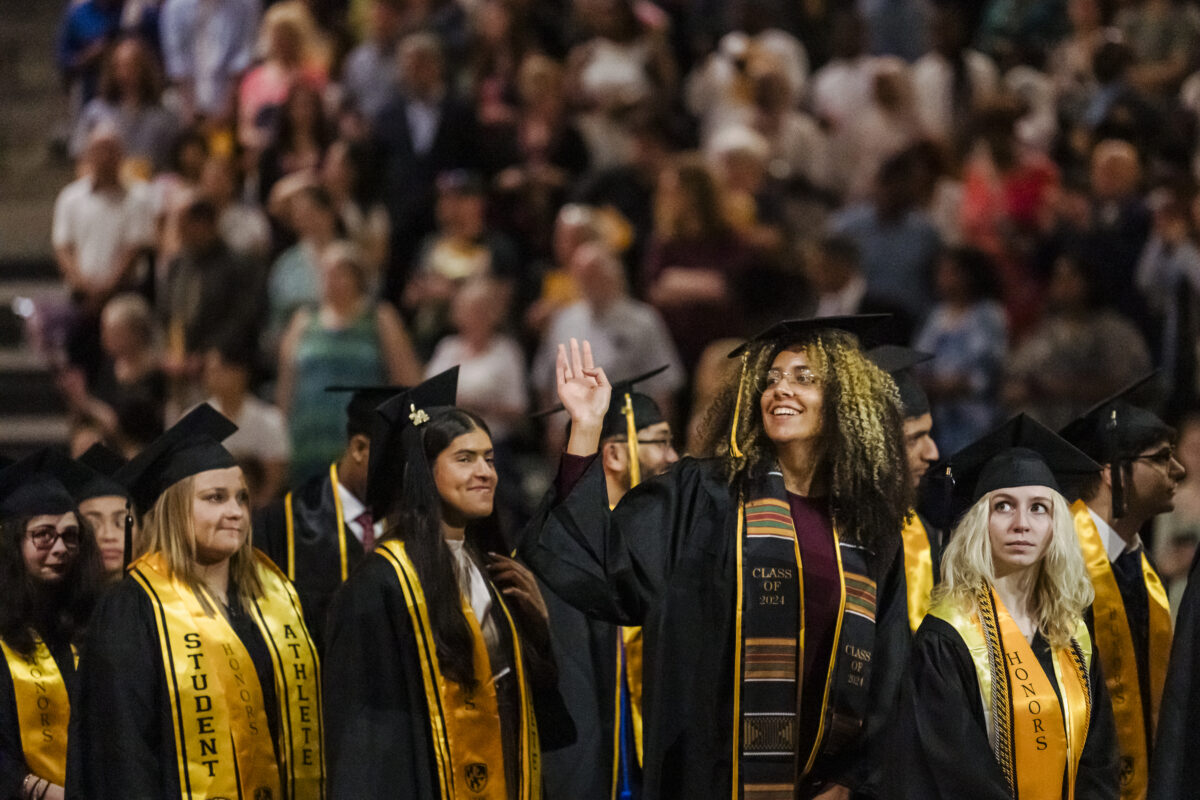
Sethuraman Panchanathan, director of the National Science Foundation, received an honorary doctor of science degree during the afternoon ceremony. He dazzled the crowd with an energetic speech advising new graduates to follow “the 10 C’s”—words like “commitment,” “courage,” “collaboration,” and “curiosity”—as they go on to the next chapter of their lives.
After grad, Chiad Onyeje, chem eng, will go to Johns Hopkins via the new Vivien Thomas Scholars Initiative program. His research will concentrate on the development of drug delivery biomaterials to open up new opportunities for disease & trauma treatment & prevention. #UMBCgrad pic.twitter.com/pVZ10ieEVs
— UMBC (@UMBC) May 17, 2024
“Retrievers, you have the DNA of UMBC,” Panchanathan said to the graduates. “That DNA is about lifting people up…and making sure people are given chances, making things accessible, and inspiring people.”
Congratulations to the Class of 2024! Please continue to share your messages of congratulations on social media using #UMBCgrad. Read more about Class of 2024 graduates on the UMBC News Site.
]]>
UMBC’s graduating Class of 2024 knows a thing or two about resilience. Many of this year’s 1,900-plus graduates began their collegiate journey at the onset of a global pandemic. This week,...
https://umbc.edu/stories/class-of-2024-commencement/
https://my3.my.umbc.edu/api/v0/pixel/news/142185/guest@my.umbc.edu/ba783fd9283fc597f7356a4051373b34/api/pixel
cahss
campus-life
class-of-2024
cnms
coeit
commencement
erickson-school
feature
magazine
public-policy
social-work
story
UMBC News & Magazine
https://my3.my.umbc.edu/groups/umbc-news-magazine
https://assets1-my.umbc.edu/system/shared/avatars/groups/000/001/943/24435aa6207c452e7bc15cc74b42c7bb/xsmall.png?1748556657
https://assets1-my.umbc.edu/system/shared/avatars/groups/000/001/943/24435aa6207c452e7bc15cc74b42c7bb/original.png?1748556657
https://assets2-my.umbc.edu/system/shared/avatars/groups/000/001/943/24435aa6207c452e7bc15cc74b42c7bb/xxlarge.png?1748556657
https://assets2-my.umbc.edu/system/shared/avatars/groups/000/001/943/24435aa6207c452e7bc15cc74b42c7bb/xlarge.png?1748556657
https://assets3-my.umbc.edu/system/shared/avatars/groups/000/001/943/24435aa6207c452e7bc15cc74b42c7bb/large.png?1748556657
https://assets1-my.umbc.edu/system/shared/avatars/groups/000/001/943/24435aa6207c452e7bc15cc74b42c7bb/medium.png?1748556657
https://assets2-my.umbc.edu/system/shared/avatars/groups/000/001/943/24435aa6207c452e7bc15cc74b42c7bb/small.png?1748556657
https://assets1-my.umbc.edu/system/shared/avatars/groups/000/001/943/24435aa6207c452e7bc15cc74b42c7bb/xsmall.png?1748556657
https://assets2-my.umbc.edu/system/shared/avatars/groups/000/001/943/24435aa6207c452e7bc15cc74b42c7bb/xxsmall.png?1748556657
UMBC News & Magazine
3
0
false
Fri, 24 May 2024 16:03:51 -0400
Fri, 24 May 2024 16:03:51 -0400
UMBC scientists and engineers celebrate launch of HARP2 instrument on NASA’s PACE mission

By Anne Wainscott-Sargent
The third time’s the charm. Against a calm and crisp dark night sky on Florida’s Cape Canaveral last Thursday, February 8, just after 1:30 a.m., the Plankton, Aerosol, Cloud, Ocean Ecosystem (PACE) spacecraft rocketed to orbit carrying on board Hyper-Angular Rainbow Polarimeter (HARP2)―UMBC’s wide-angle imaging polarimeter. The launch marked the first time NASA deployed a university payload on a large operational Earth science space mission.
Following two scrubbed night launches on Tuesday and Wednesday due to strong winds, Thursday’s successful takeoff was well worth the wait for the core team of UMBC Earth and Space Institute researchers, graduate students, and their family and friends who journeyed from Baltimore to watch the historic launch.
Arriving by bus a little before midnight to the Banana Creek Launch Viewing Area at Kennedy Space Center, just over six miles from Space Launch Complex-40, the close-knit UMBC entourage huddled together waiting for the final countdown.
When it came, they—along with hundreds of other space launch watchers—held their breath and then yelled and clapped as SpaceX’s Falcon 9 rocket blasted off and propelled PACE 400 miles above Earth into sun-synchronous orbit. Minutes later the Falcon 9’s first stage—SpaceX’s reusable rocket booster—successfully landed at Landing Zone 1. The crowd gasped audibly at the sonic boom, caused when the spacecraft broke the sound barrier.
“It still doesn’t quite feel real,” said Noah Christian Sienkiewicz, a calibration scientist who earned his master’s degree in atmospheric physics from UMBC in 2019 and expects to complete his physics doctorate this summer. “I grew up watching Carl Sagan and dreamed of going into astrophysics. I never thought I’d be the person making the instruments that will go up and do the measurements.”
“It’s so exciting—I’m going to cry,” uttered Margo Young from the upper bleacher. “I don’t always see the pieces and parts put together, so this is really historic.”
Young serves as UMBC’s HARP program administrator, where she has overseen procurement and other back-end support for HARP since the program’s inception in 2013. “I get to see students come full circle—working in the lab and then graduating and becoming civil servants where they continue to be involved because it’s such an amazing project,” she explained.
On the path to PACE
The UMBC HARP team’s remarkable journey from idea to mission reality spanned over 15 years, and involved countless hours of design, modeling, testing, and validation. Earlier iterations of HARP flew first on private aircraft over the Maryland countryside and then an award-winning “cubesat” version launched into orbit from the International Space Station (ISS), all stepping stones on the path to PACE.
 Left to right: Margo Young, Dominik Cieslak, Magdalena Kuzmicz-Cieslak, and Vanderlei Martins stand in front of the PACE spacecraft the day before its launch. (Image courtesy of Margo Young)
For the three multidisciplinary HARP2 physics, optics, and research engineering leads, Vanderlei Martins, Roberto Borda, and Dominik Cieslak, HARP2’s launch represents a career-defining moment that at times seemed against all odds for a mid-size public university. UMBC’s strong partnerships with NASA, such as the Goddard Earth Science Technology and Research (GESTAR) Center II that supports Borda’s and Cieslak’s roles, help enable milestones like this.
“I feel like I’m still dreaming,” said a visibly emotional Cieslak, research engineer, who captured the launch on his long-range camera.
Transfixed by the sight of live satellite footage of the PACE spacecraft heading to orbit, he added, “This is the last time we will physically see it [HARP2],” before hugging his long-time colleague, Borda.
“We’re very proud to have UMBC in space,” added Martins, professor of physics, who watched the big moment from a VIP viewing area three miles from the launch site. “We dreamed big from the beginning. The team persevered and just kept going.”
“I never despaired of having HARP2 on the PACE satellite,” admitted UMBC’s HARP2 manager, Lorraine Remer, research professor in the Joint Center for Earth Systems Technology. Her bigger worry wasn’t HARP2’s viability, but whether PACE would ever launch. “PACE was canceled four times and reinstated four times,” she recalled, noting that the program “survived a lengthy government shutdown and a global pandemic that destroyed our supply chains.”
Immediately after launch, Remer had to return to Maryland and the Goddard Space Flight Center to oversee HARP2 being turned on within 36 hours of launch. “It would be nice to bask in the successful launch, but I haven’t had much time to contemplate the success. There is just more work to do all the time,” she said.
An international effort
NASA’s PACE mission clears the path for revolutionary new measurements of Earth’s oceans and atmosphere. HARP2 measures aerosol particles and clouds, as well as properties of land and water surfaces. By analyzing particles like dust, wildfire smoke, or urban pollution, the science community gains deeper insights into air quality as well as global warming and its impacts. Scientists will be able see through things like sun glint to ascertain patterns never before possible.
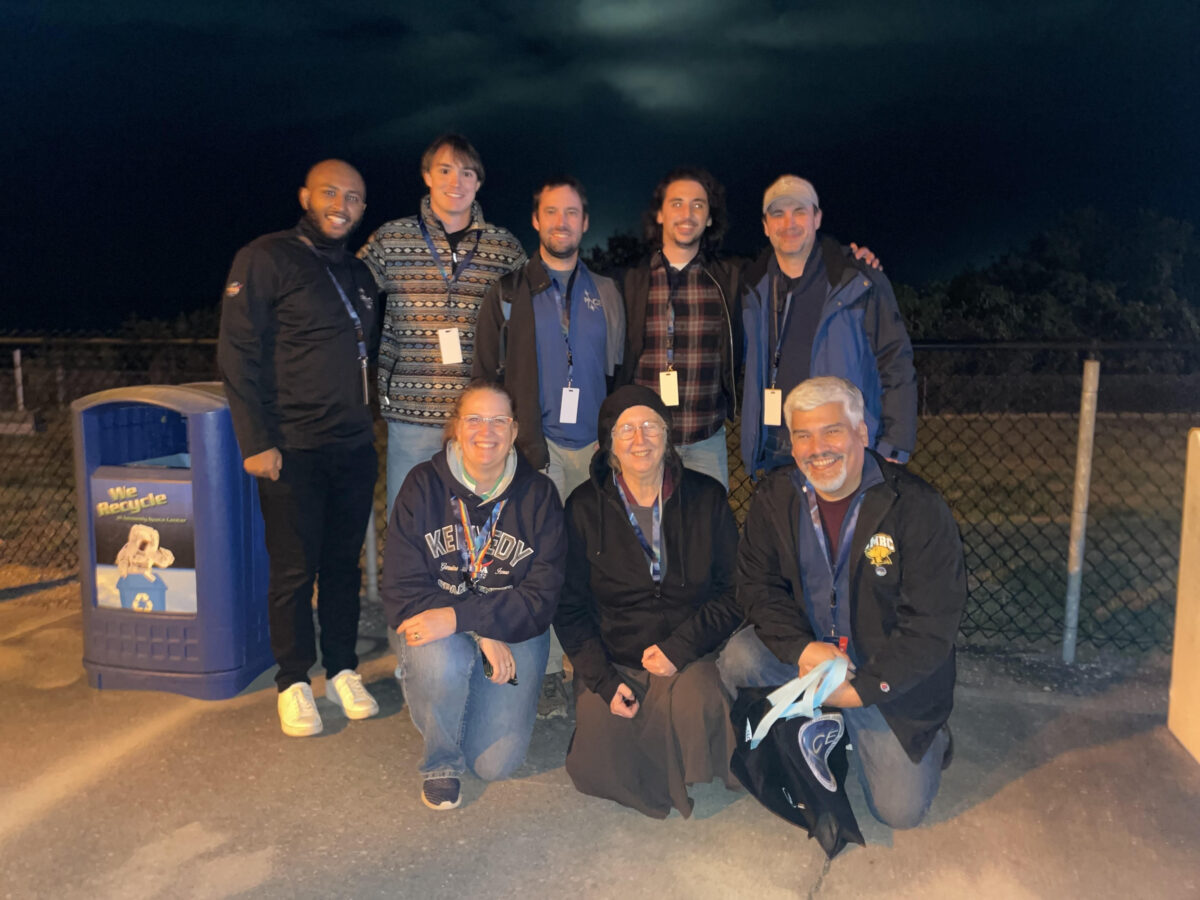 Members of the HARP team eagerly await the PACE launch at Kennedy Space Center’s Banana Creek Launch Viewing Area before the final countdown. Top, left to right: Yomiyu Fekadu, Ian Decker, Ben Cramer, Noah Sienkiewicz, Dominik Cieslak. Bottom, left to right: Margo Young, Lorraine Remer, Roberto Borda. (Image by Anne Wainscott-Sargent)
A second polarimeter on PACE, the Spectro-polarimeter for Planetary Exploration (SPEXone), developed through a Dutch consortium consisting of SRON Netherlands Institute for Space Research and Airbus Defence and Space Netherlands, will measure sunlight reflected from Earth’s atmosphere, land surface and ocean.
These two companion polarimeter instruments are important because the interaction between aerosols and clouds is the biggest unknown factor in atmospheric temperature change, according to reports from the U.N.’s Intergovernmental Panel on Climate Change.
“I have watched Dr. Martins and his team work toward this moment for about a decade, and have been aware of the trials and tribulations along the way. Seeing the smiles on their faces in the control station after the launch made it all worthwhile,” shared UMBC Vice President for Research Karl V. Steiner. “The HARP2 mission as an integral part of PACE is making all of us proud here on the UMBC campus. We cannot wait to see the science that will come from this engineering masterpiece conceptualized and created right here in Maryland.”
Waiting game
In the days leading up to the PACE launch, the HARP2 team knew there might be delays because of the weather so they rented a large Airbnb in neighboring Cocoa Beach for the full week. Earlier in the week, over grilled food at the shared house, the team reflected on their journey.
According to Martins, a key strategy was bringing together engineering and physics students, who typically don’t communicate well across disciplines.
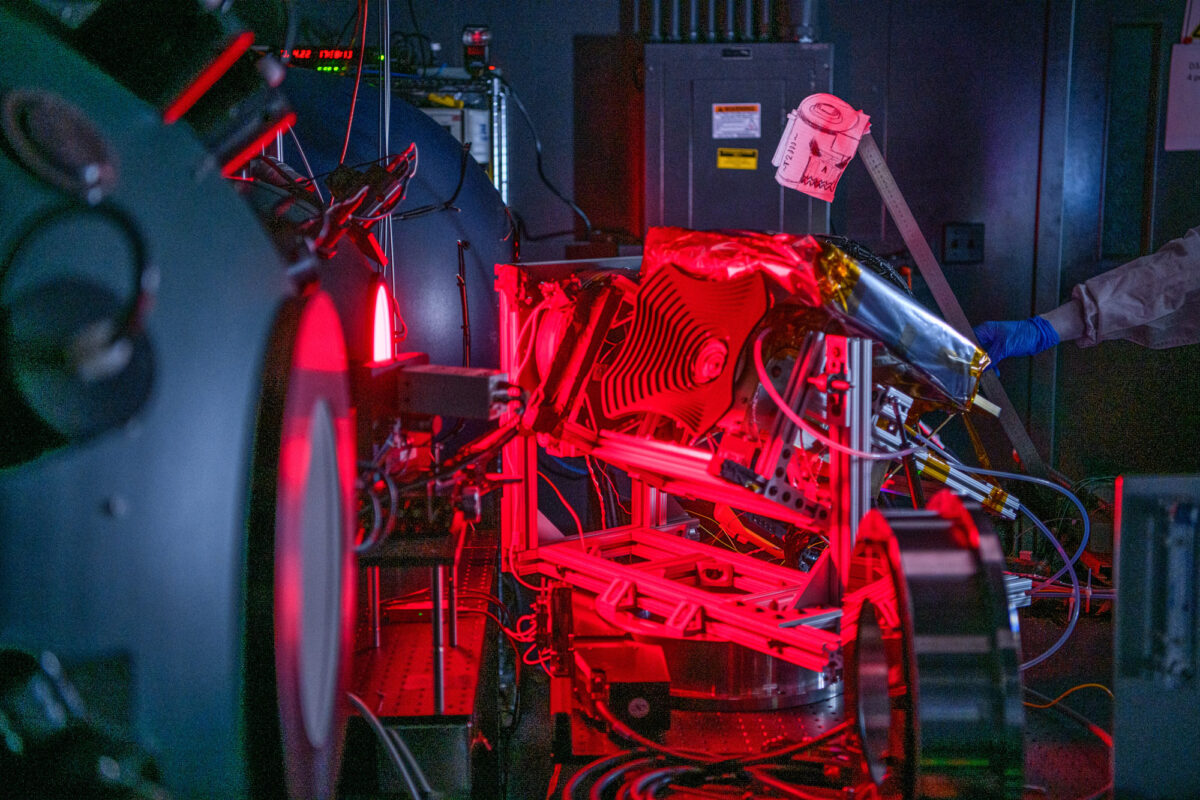 The HARP2 instrument undergoes calibration testing with red light. (Image by NASA)
“We introduced engineering students to the physics students and made them work together very quickly so they spoke the same language,” he said, crediting this multidisciplinary collaboration to the team’s ability to rapidly iterate and problem solve.
Borda, senior research engineer overseeing HARP2’s optical design, said a key technical challenge was determining how to best compensate for the effects of polarized light waves inside the instrument.
“It’s continuous work and you cannot do it alone. We needed a fantastic team with not only the staff but also students working at different levels,” Borda said. “There are undergraduate students and Ph.D.s integrated into the team who put in a lot of effort to make this real. We’re really thankful for the environment at this university—we’re able to work with students who find a career in this industry and field of research.”
Nurturing future career scientists
Martins echoed Borda’s pride in the broad level of participation in the HARP program, from high school students to senior scientists.
“We’ve had people from our team who now work in all levels of industry—at NASA, at NOAA, or in private industry. We’ve even had some students start their own company.”
Young, the program administrator, estimates that the cooperative agreements between UMBC and NASA have resulted in 20 UMBC graduates finding roles with NASA.
“It was everything I could have asked for. No other place would have let me be involved in the entire process, including making parts for HARP2 in the machine shop. Not only did I get to do hands-on stuff, but I also was part of the design and saw it all come together on a NASA mission.”
Yomiyu Fekadu ’20, mechanical engineering, M.S. ’23, engineering management
UMBC alumna Elissa Ogburn is one such graduate. She began working on HARP2 as a computer science major, tasked with creating a database that supported ground communications so researchers could communicate with the instrument when it was in space.
After graduating from UMBC in 2021, Ogburn joined NASA on the PACE project as a test conductor (TC)―responsible for integrating and testing the instruments onto the PACE spacecraft. During launch, she was one of five TCs in the PACE Control Room in Titusville, Florida, who powered up the spacecraft for the last time and configured it for launch.
“I never imagined having a job at NASA or working with people who were this smart, helpful, and kind. Every single person I’ve worked with was so fun. It’s also cool to have seen the whole process beginning as a student at UMBC. PACE is my first mission, so I’m learning everything as I go,” Ogburn said.
Close collaboration
The partnership between NASA and UMBC goes back over two decades. NASA Goddard Space Flight Center and UMBC are located just up the road from one another.
Jeremy Werdell, PACE project scientist at Goddard, recalled how initial calls to industry and academia for a polarimetry instrument for PACE were not promising due to cost and other factors.
However, Martins immediately suggested to Werdell that his lab develop a polarimeter, given his team’s experience with airborne instruments and the HARP cubesat, and the rest is history. In the end, NASA selected two polarimeters—HARP2 and SPEXone.
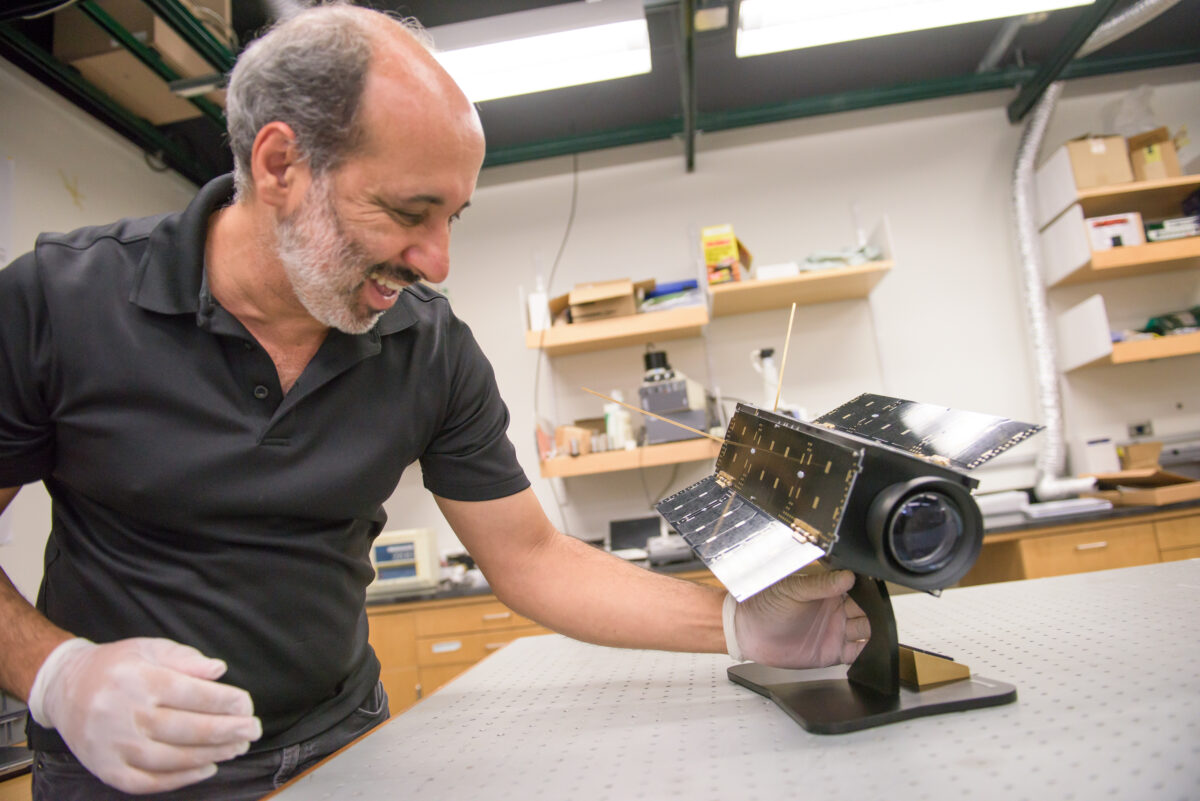 Vanderlei Martins inspects the HARP cubesat, which launched in 2019. (Image by Marlayna Demond ’11/UMBC)
Each instrument measures polarization differently: HARP2 is multispectral (measuring only four wavelengths of light) and hyperangular, so it looks at the same piece of real estate multiple times from dozens of different viewing directions. Its wide swath coverage means HARP2 will cover the globe every two days. SPEXone, on the other hand, is hyperspectral (measuring a continuous spectrum of light from the ultraviolet to near-infrared) but only views Earth at five angles. It has a narrower swath, meaning it will take almost a month to cover the globe.
“They’re small and mighty and miraculously complement each other very, very well,” said Werdell. “Having multi-band, multi-angle polarimetry is going to open up a lot of really interesting opportunities for discovery, because we can see clouds and aerosols in very different ways.”
HARP2 provides daily views that will help scientists understand how aerosols and clouds interact and their role in warming and cooling in the atmosphere.
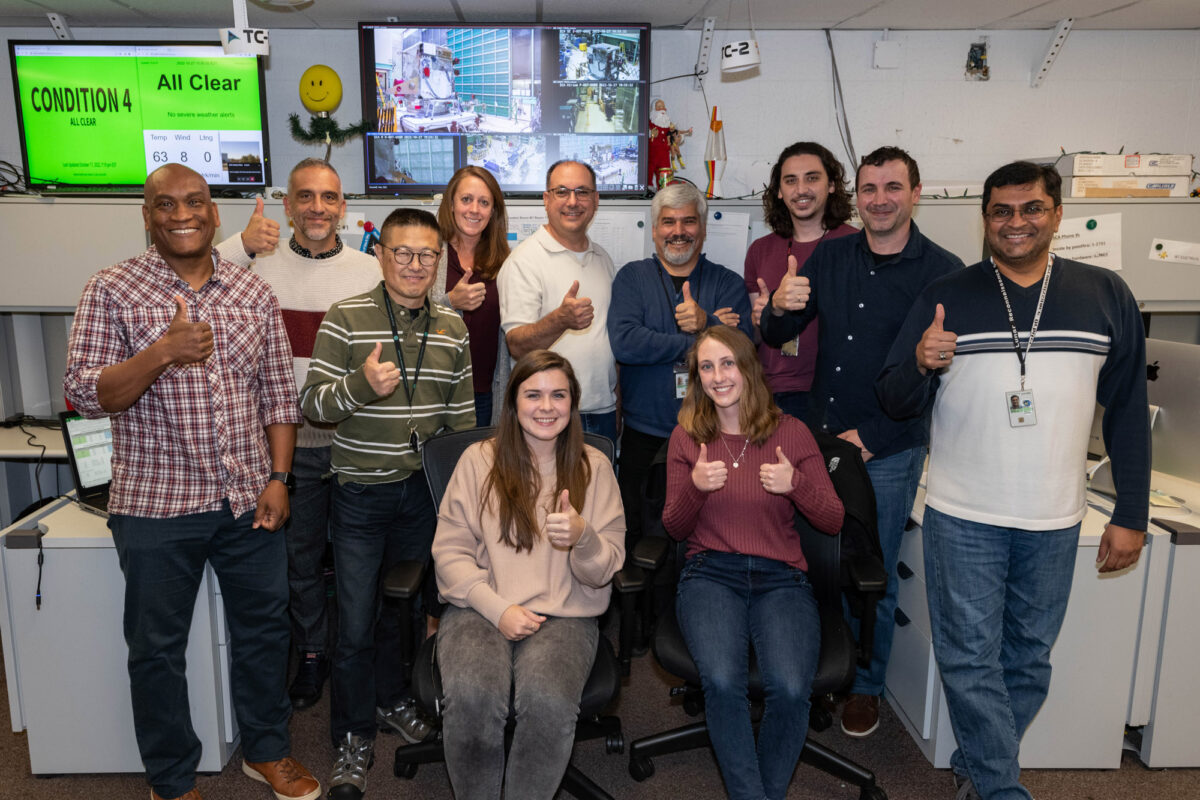 Some members of the HARP2 team successfully test HARP2’s electrical Integration to the Spacecraft. (Image by NASA)
“Understanding where aerosols are, how they’re transported, how they interact with clouds, and whether they absorb or reflect radiation is important to everybody because those characteristics are what drive warming of the atmosphere.” Werdell said.
Better air quality models
Onsite at the Cape for the first launch attempts, Nirandi Jayasinghe and Rachel Smith, both physics graduate research assistants at UMBC, shared their excitement for the PACE mission and HARP2’s potential to help modelers predict air quality, rain, or if the atmosphere is warming or cooling.
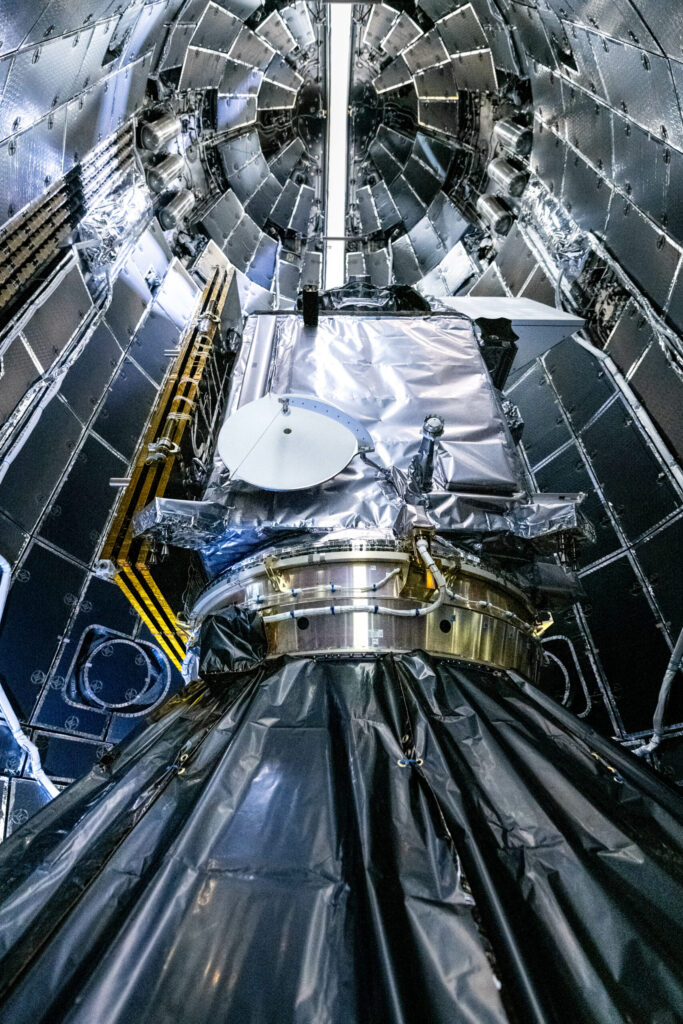 NASA and SpaceX technicians safely encapsulated NASA’s PACE spacecraft in SpaceX’s Falcon 9 payload fairings–a protective shell for the instruments on PACE during launch. (Image by NASA)
Jayasinghe is a data modeler who comes up with different methods to retrieve information from HARP2. Originally from Sri Lanka, Jayasinghe notes that her hometown used to be one of her country’s cleanest cities, and now due to development in Sri Lanka’s dominant neighbor, India, the air quality is extremely bad. She said HARP2 can help close the gap that exists in understanding the twilight zone—where a cloud starts and where it stops—by providing more accurate measurements.
Smith adds that this will go a long way in understanding cloud formation processes, weather patterns, forecasting, and climate modeling—information important for agriculture, transportation, disaster preparedness, and infrastructure planning.
“Even simple things like weather forecasting are impacted by how much dust is in the air,” said Smith, a 2026 doctoral candidate who earned her M.S. in atmospheric physics from UMBC in 2023. HARP2 will help address whether clouds have a net cooling effect or a net warming effect, which will allow for more accurate models of where Earth’s climate is headed. Smith notes that during events like the Canadian wildfires in 2023 no one could accurately predict rainfall, because the forecasting models were not accounting for the number of airborne aerosols.
“I’m really excited to see what new science questions come out of the instruments that we’re putting up in space,” she concluded.
Bouncing back from disaster
The HARP2 team has come a long way from initial concept to PACE. What impresses Werdell the most is the UMBC team’s resilience in the face of setbacks.
The most devastating moment came in February 2022, one month before the team was set to deliver HARP2 to NASA for integration on the spacecraft. As the instrument was in the last few seconds of vibration tests, the bonding on one of the prisms loosened and shattered.
“It tactically put us to point zero,” recalled Cieslak, who was shocked and humbled when so many NASA scientists volunteered their time and expertise to help the HARP2 team get back on track.
“We got an extension, and within two months we had built a new engineering model and were able to prove the new solution worked. By September, we were back to where we were before the incident,” he added.
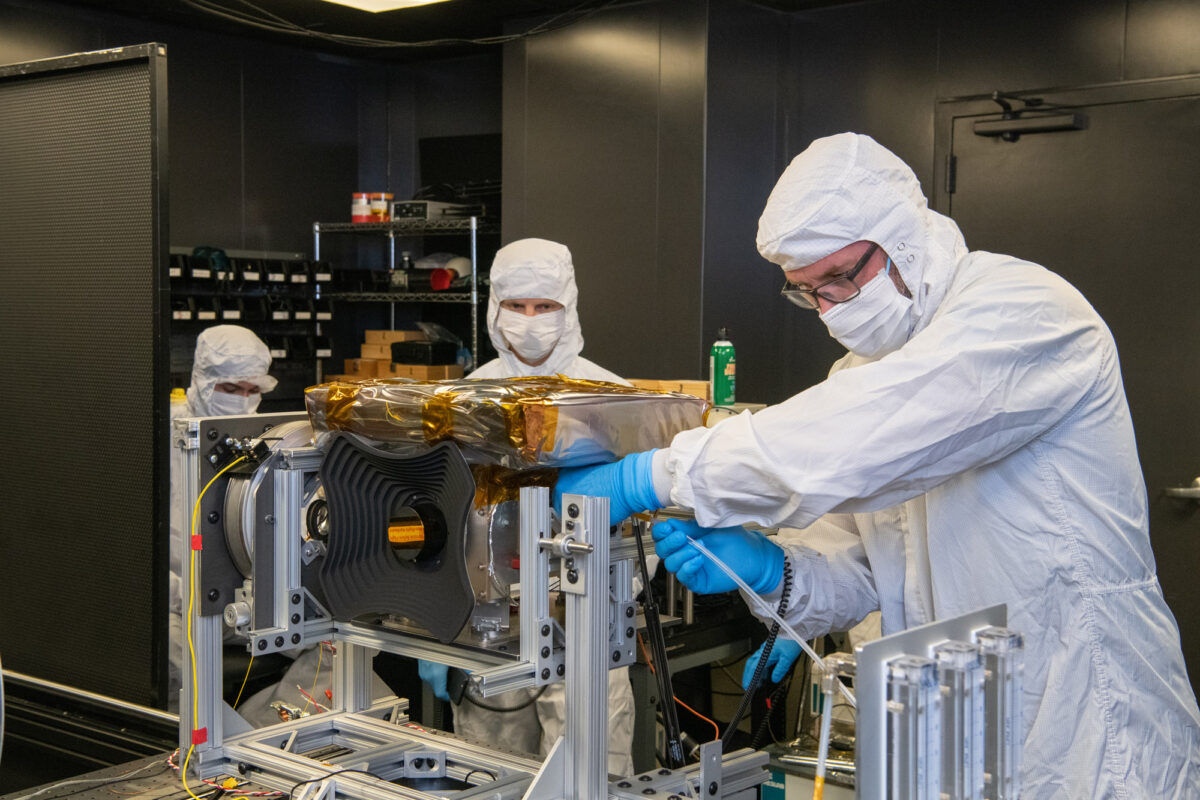 HARP2 calibration testing at Goddard Space Flight Center in Maryland, before the instrument was delivered to NASA. (Image by NASA)
First-time NASA launch attendee Yomiyu Fekadu ’20, mechanical engineering, M.S. ’23, engineering management, recalled that time well, as he helped assemble HARP2 as an intern under Benjamin Cramer ’17, M.S. ’20, mechanical engineer on the program.
“Especially after the failure, and the review board assessment, I helped put everything back together and do the test plans for construction and other documentation so NASA could give us the go-ahead to move on,” Fekadu said.
The experience was pivotal to his career. “It was everything I could have asked for,” said Fekado, now a systems engineer at Northrop Grumman. “No other place would have let me be involved in the entire process, including making parts for HARP2 in the machine shop. Not only did I get to do hands-on stuff, but I also was part of the design and saw it all come together on a NASA mission.”
As the HARP2 group left the viewing platform to line up for bus rides back to the Space Center, the smiles and easy camaraderie conveyed a collective sense of pride, relief, and excitement.
“I‘m now just anxious to see the first bytes of data,” said Cieslak, echoing the feeling of his colleagues.
In addition to the HARP team, several additional GESTAR II scientists and engineers were instrumental in their contributions to the overall PACE mission, including Ivona Cetinić, Andrew Sayer, Violeta Sanjuan Calzado, Bridget Seegers, Susanne Craig, Dirk Aurin, Meng Gao, Inia Soto Ramos, and Ian Carroll.
Update: On February 10, HARP2 successfully connected with instrumentation on the ground and all of its systems appear to be working as intended.
Follow along with what’s learned from the HARP2 project.
]]>
By Anne Wainscott-Sargent The third time’s the charm. Against a calm and crisp dark night sky on Florida’s Cape Canaveral last Thursday, February 8, just after 1:30 a.m., the Plankton,...
https://umbc.edu/stories/harp2-launches-on-nasa-pace-mission/
https://my3.my.umbc.edu/api/v0/pixel/news/139053/guest@my.umbc.edu/e0dbaea402ea1a164a7f168d63631a1e/api/pixel
cnms
coeit
compsci
engineering-management
esi
feature
gestar
gestar2
meche
news
physics
rca
research
science-and-tech
story
UMBC News & Magazine
https://my3.my.umbc.edu/groups/umbc-news-magazine
https://assets1-my.umbc.edu/system/shared/avatars/groups/000/001/943/24435aa6207c452e7bc15cc74b42c7bb/xsmall.png?1748556657
https://assets1-my.umbc.edu/system/shared/avatars/groups/000/001/943/24435aa6207c452e7bc15cc74b42c7bb/original.png?1748556657
https://assets2-my.umbc.edu/system/shared/avatars/groups/000/001/943/24435aa6207c452e7bc15cc74b42c7bb/xxlarge.png?1748556657
https://assets2-my.umbc.edu/system/shared/avatars/groups/000/001/943/24435aa6207c452e7bc15cc74b42c7bb/xlarge.png?1748556657
https://assets3-my.umbc.edu/system/shared/avatars/groups/000/001/943/24435aa6207c452e7bc15cc74b42c7bb/large.png?1748556657
https://assets1-my.umbc.edu/system/shared/avatars/groups/000/001/943/24435aa6207c452e7bc15cc74b42c7bb/medium.png?1748556657
https://assets2-my.umbc.edu/system/shared/avatars/groups/000/001/943/24435aa6207c452e7bc15cc74b42c7bb/small.png?1748556657
https://assets1-my.umbc.edu/system/shared/avatars/groups/000/001/943/24435aa6207c452e7bc15cc74b42c7bb/xsmall.png?1748556657
https://assets2-my.umbc.edu/system/shared/avatars/groups/000/001/943/24435aa6207c452e7bc15cc74b42c7bb/xxsmall.png?1748556657
UMBC News & Magazine
4
0
false
Fri, 16 Feb 2024 10:36:17 -0500
Fri, 16 Feb 2024 10:36:17 -0500
Historical lens—3 stories that scratch the surface of a 5,400 image archive

One of the most influential sets of historical photos in UMBC’s Special Collections is an archive of more than 5,400 images documenting the harsh conditions of child laborers in early 20th-century America. Recently the team in Special Collections—which celebrates its 50th anniversary this year—undertook a massive project to digitize and rehouse the photos in more protective sheaths to help safeguard the images and the hand-written details on them.
The preservation effort gave UMBC student workers hands-on practice with handling the delicate photographs and allowed staff to dive deep into these historical records in order to comment on timely issues around current child labor conditions in the U.S. Their work will allow future students, faculty, and visiting scholars to access this important material for many years to come.
Preserving the photography of Lewis Hine
In the first article in this three-part feature, Rahne Alexander, M.F.A. ’21, writes about how photographer Lewis Hine secured a place in history as an investigative documentarian by observing and sharing the conditions for child laborers. From 1908 through 1930, Hine worked closely with the National Child Labor Committee (NCLC), an organization devoted to preventing the exploitation of children in the workplace. Hine crisscrossed the U.S. creating portraits of a diverse array of children working in fields and factories.
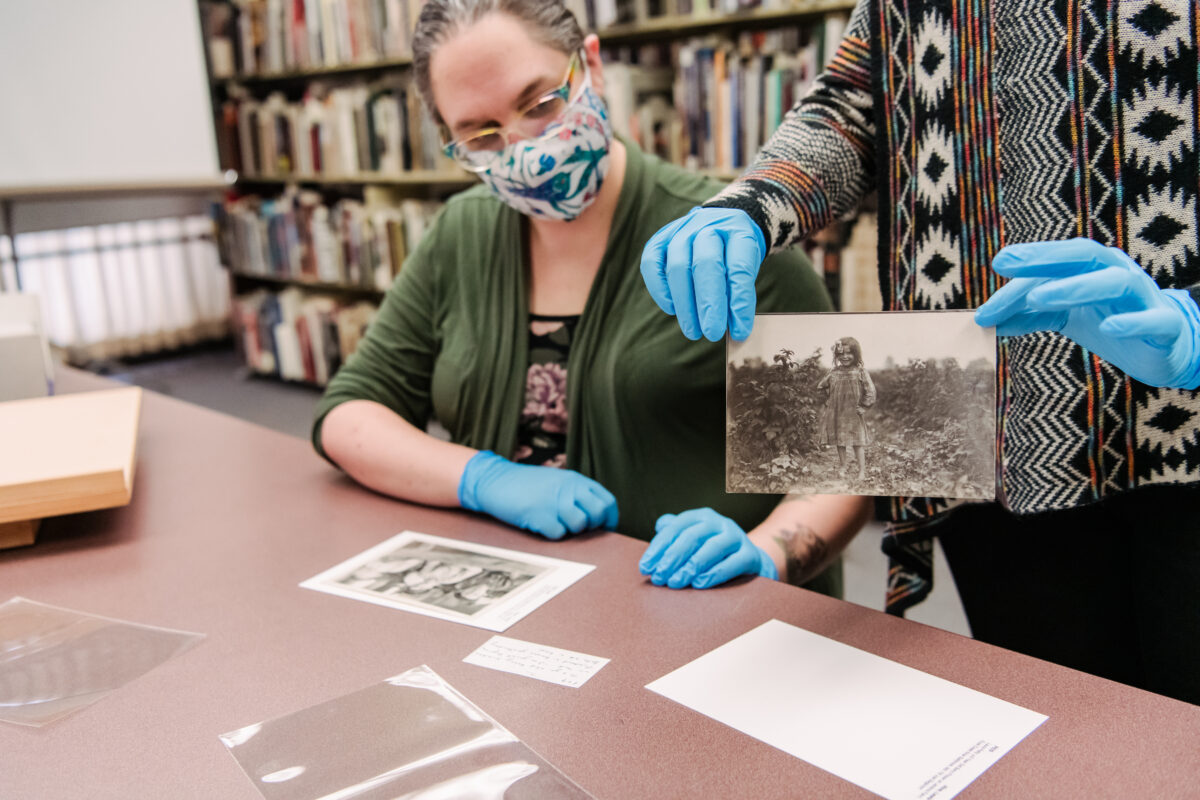 Meredith Power, left, and Susan Graham, right, handle the century-old
photographs. (Marlayna Demond ’11/UMBC)
Meredith Power, left, and Susan Graham, right, handle the century-old
photographs. (Marlayna Demond ’11/UMBC)
Handle with care
Uncovering the work UMBC students put into the project of preserving these historical photos, Catalina Sofia Dansberger Duque interview Special Collections interns Meredith Power ’21, history, a public history graduate student, and Gabe Morrison ’23, anthropology. Along with library staff members, these two worked diligently to ensure that the images of the families and children who lived through these harrowing work conditions are accessible to the public for research and learning.
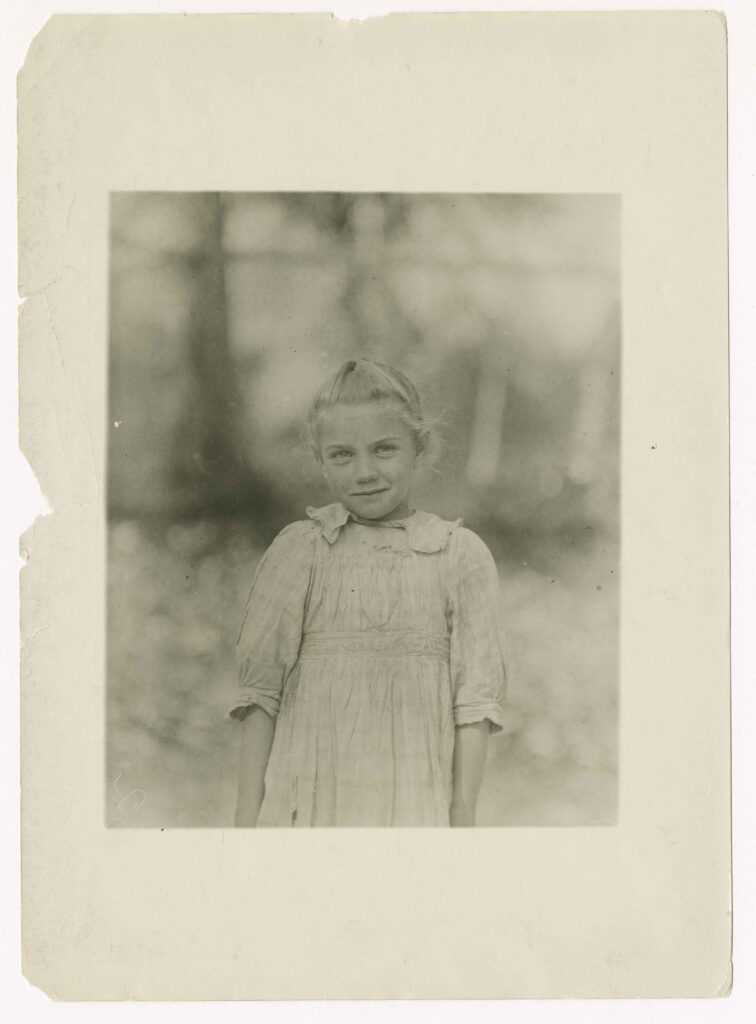
7-year old Rosie. Regular shucker. Her second year at it. Illiterate. Works all day. Shucks only a few pots a day. Varn & Platt Canning Co. in Bluffton, South Carolina, 1911 – 1913.
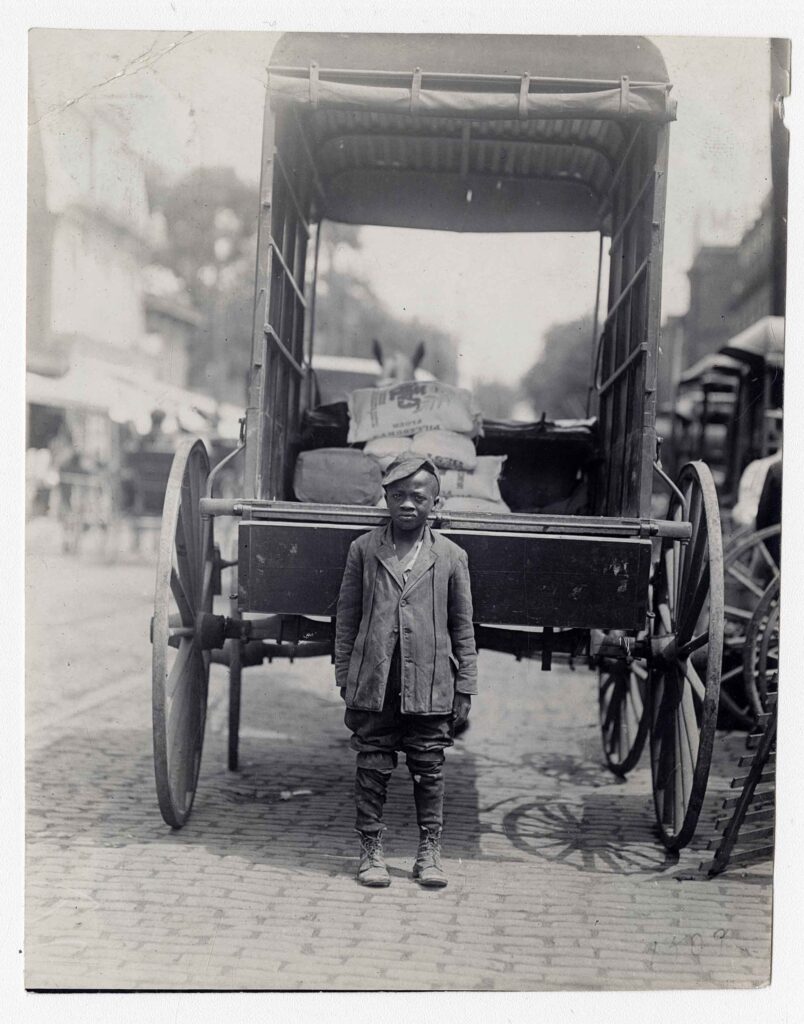
Elwood Palmer Cooper, helper on miller’s wagon, 7 years of age. Carries bags of flour, weighing 25 pounds, from wagon to stores. Receives 25 cents per week. Money not needed at home. Wants money to spend. Wilmington, Delaware, 1910.
The U.S. has a child labor problem
Lastly, in a piece originally published in The Conversation, Curator of Special Collections Beth Saunders, writes, “As I’ve worked with this collection over the last two years, the social and political implications of Hine’s photographs have been very much on my mind. The patina of these black-and-white photographs suggests a bygone era—an embarrassing past that many Americans might imagine they’ve left behind. But with numerous reports of child labor violations, many involving immigrants, occurring in the U.S., along with an uptick in state legislation rolling back the legal working age, it’s clear that Hine’s work is as relevant today as it was a century ago.”
]]>
One of the most influential sets of historical photos in UMBC’s Special Collections is an archive of more than 5,400 images documenting the harsh conditions of child laborers in early 20th-century...
https://umbc.edu/stories/historical-lens-documenting-us-child-labor/
https://my3.my.umbc.edu/api/v0/pixel/news/137603/guest@my.umbc.edu/b7755fbea649a8e09779561afccb2f86/api/pixel
cahss
discovery
fall-2023
feature
history
magazine
special-collections
UMBC News & Magazine
https://my3.my.umbc.edu/groups/umbc-news-magazine
https://assets1-my.umbc.edu/system/shared/avatars/groups/000/001/943/24435aa6207c452e7bc15cc74b42c7bb/xsmall.png?1748556657
https://assets1-my.umbc.edu/system/shared/avatars/groups/000/001/943/24435aa6207c452e7bc15cc74b42c7bb/original.png?1748556657
https://assets2-my.umbc.edu/system/shared/avatars/groups/000/001/943/24435aa6207c452e7bc15cc74b42c7bb/xxlarge.png?1748556657
https://assets2-my.umbc.edu/system/shared/avatars/groups/000/001/943/24435aa6207c452e7bc15cc74b42c7bb/xlarge.png?1748556657
https://assets3-my.umbc.edu/system/shared/avatars/groups/000/001/943/24435aa6207c452e7bc15cc74b42c7bb/large.png?1748556657
https://assets1-my.umbc.edu/system/shared/avatars/groups/000/001/943/24435aa6207c452e7bc15cc74b42c7bb/medium.png?1748556657
https://assets2-my.umbc.edu/system/shared/avatars/groups/000/001/943/24435aa6207c452e7bc15cc74b42c7bb/small.png?1748556657
https://assets1-my.umbc.edu/system/shared/avatars/groups/000/001/943/24435aa6207c452e7bc15cc74b42c7bb/xsmall.png?1748556657
https://assets2-my.umbc.edu/system/shared/avatars/groups/000/001/943/24435aa6207c452e7bc15cc74b42c7bb/xxsmall.png?1748556657
UMBC News & Magazine
3
0
false
Thu, 07 Dec 2023 12:28:52 -0500
Thu, 07 Dec 2023 12:28:52 -0500
Handle with care—students help digitize and rehouse thousands of historical photos
A nine-year-old stands at the mouth of a coal mine covered in coal dust, wearing a small headlamp. A woman holds her baby on her lap as she packs boxes in a warehouse along with her 5-, 8-, and 12-year-olds. These are just two of thousands of evocative black-and white historical photographs handled by Special Collections interns Meredith Power ’21, history, a public history graduate student, and Gabe Morrison ’23, anthropology. Along with library staff members, these two worked diligently to ensure that the images of the families and children who lived through these harrowing work conditions are accessible to the public for research and learning.
Fine motor skills
“Photos from the early 1900s were developed on fine photographic paper that is prone to crinkling around the edges, ripping, and fading,” Power says. Wearing blue nitrile medical gloves, they rehouse photos from their cellophane sleeves to museum-grade mylar sleeves, keeping them from further discoloration, tears, wrinkles, and sticking to the sleeves.
“They’re very delicate,” Power says. “You need good eye-hand coordination to pick up the photos from the corners, remove them from whatever packaging they are in, and slide them into the mylar sleeve.”
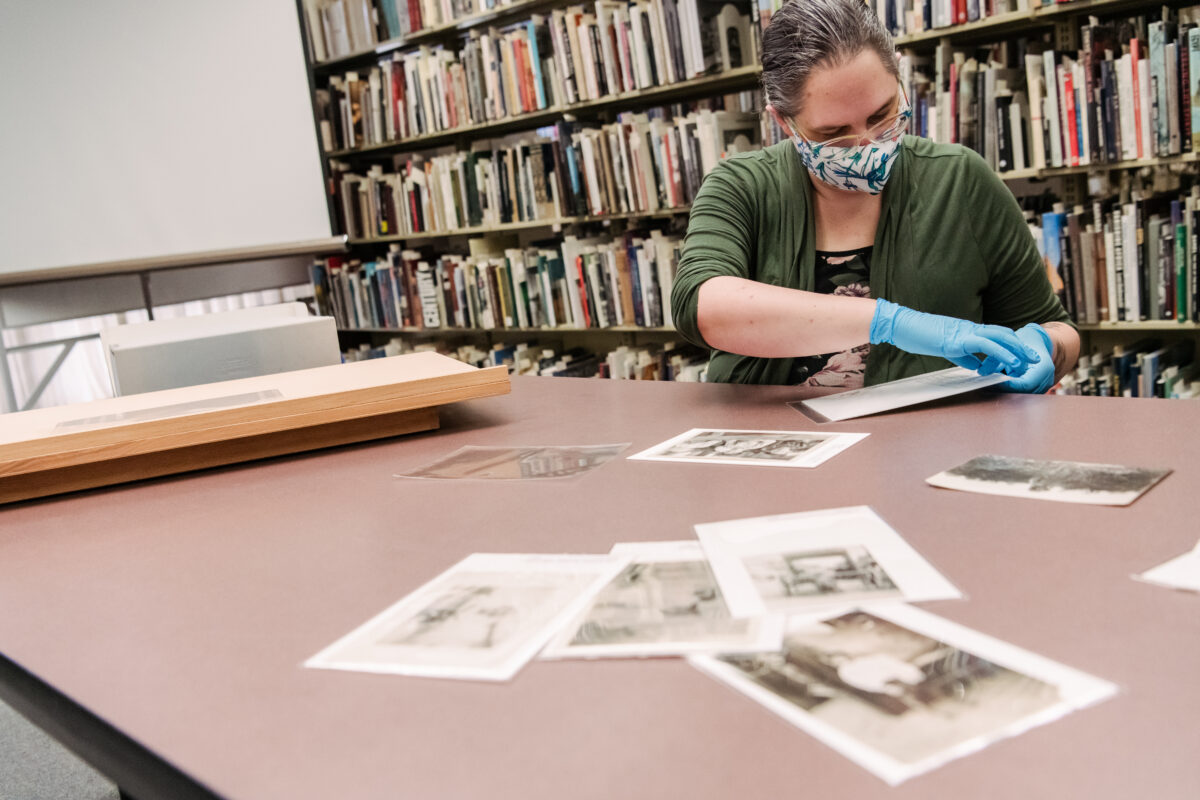 Power puts the historical photos into a mylar sleeve. (Marlayna Demond ’11/UMBC)
This process is second nature for Morrison, who has been working at Special Collections for over a year. He has worked with securing the Lewis Hine photos as part of his public humanities minor, as well as the Maryland Folklife Program Collection, the Coslet-Sapienza Fantasy and Science Fiction Fanzine Collection, and the George Cruikshank illustrations and papers.
“I had to learn how to properly handle photographs and manuscripts and how to catalog them according to the Library of Congress classification system,” Morrison says. For both Power and Morrison, developing greater patience and manual dexterity and embracing working through hundreds of documents alone in a quiet space surrounded by stacks of materials was well worth the effort to broaden access to these historic documents.
“The value of this project is ensuring people understand that this resource exists,” says Power, “to help these photos live beyond a heavily controlled and restricted space on campus into a digital space where more people are able to access the information.”
Digital accessibility
Protecting delicate, historic documents includes digitizing them. The digitizing process is another lesson in precision and patience. Power begins the process by taking a photo out of the mylar sleeve—making sure to only touch the corners—along with a small rectangular white piece of paper describing the photo. They gently place the photo underneath a camera, delicately straightening the image before the camera snaps the picture and sends it to a computer where Power edits it using Adobe Lightroom.
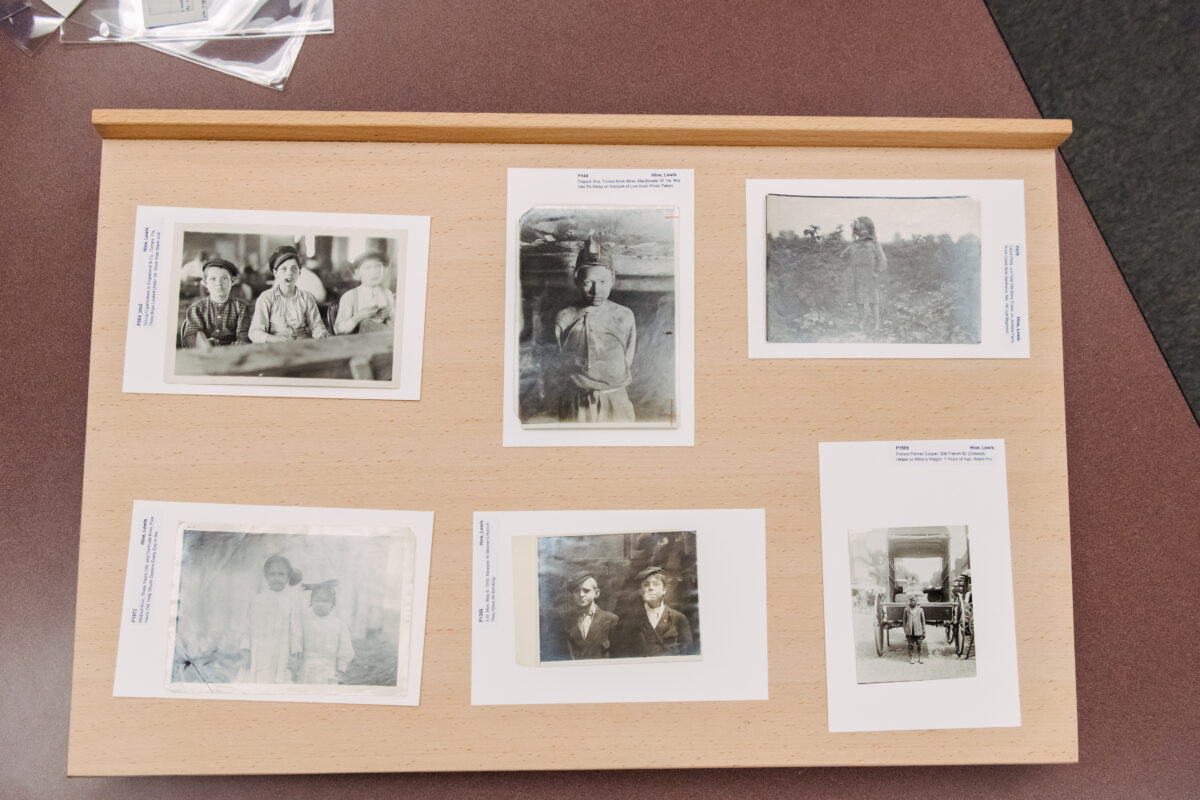 A small collection of the 5,400 photographs that were digitized and rehoused in more protective plastic sleeves. (Marlayna Demond ’11/UMBC)
“It’s an elaborate setup with lights at 45-degree angles, and the camera pointed straight down at a small white stand where I place the image,” explains Power, who would work on digitizing for six to eight hours at a time. “Once I take the image, I edit the size and angle of the photo. The metadata is then added into an Excel spreadsheet, which includes noting if there was a corner missing or if the photo had adhesive stuck to it.”
Digitizing rare books, something Morrison has spent months working on, requires using a special book scanning machine with raised sides, like hands cradling the book open, and small snakelike bean bag weights to keep the pages flat without using his fingers. “I make sure I’m not blocking any text or any important image. And then I press a button, flip a page, press a button, flip a page for hours on end until I finish digitizing that book,” Morrison says, smiling. “So, it’s not the most exciting work, but I find digitization specifically important because it’s a process that helps preserve documents too fragile to be in public circulation. Digitally, you can share it with a broader audience.”
Workforce skills
Both Power and Morrison brought many special collections skills to their public humanities internships. Archaeology camp inspired Morrison to learn about how to study and take care of important and fragile objects. He worked at the Montgomery Parks Archeology Program throughout high school, where he met a friend who introduced him to UMBC’s Special Collections. “I’ve always had an interest in historic things, in the preservation of artifacts,” Morrison says, who plans to apply to a master’s program in library and museum studies after graduation. “I think Special Collections has helped me realize I want to do archival work.”
Power found their footing working full time in the conservation rooms at Baltimore’s Walters Art Museum. “I was the administrative assistant in the Conservation Division and was around a lot of conversations on handling art objects and special collections materials, but I did not work with the materials directly,” says Power. “Working with the Hine Collection was a great opportunity for hands-on experience working with physical items and digitization.” These skills have also come in handy for Power, whose master’s degree focuses on 14th-century religious women hermits in Yorkshire, England. In 2022, Power had the opportunity to visit parish archives in Yorkshire to read through medieval-primary source documents.
For Power, history isn’t just books, dates, and lists of events. They say that there are a lot of living materials out there, whether that’s parish churches or photographs from the early 20th century, like the Hine collection. There is a connection between public history work and the people who lived before us. “It’s important to continue to help students remember that history is not dead and dusty. It’s alive,” says Power. They feel that the connection element is essential, and sometimes it gets lost. “Special Collections prove that these events really happened. They can inspire students to visit those places. To stand in that space where it happened and say, ‘Yeah, I was here too.’ I love that.”
]]>
A nine-year-old stands at the mouth of a coal mine covered in coal dust, wearing a small headlamp. A woman holds her baby on her lap as she packs boxes in a warehouse along with her 5-, 8-, and...
https://umbc.edu/stories/handle-with-care-preserving-historical-photos/
https://my3.my.umbc.edu/api/v0/pixel/news/137604/guest@my.umbc.edu/9c59b0ed09326ab14e553d046e7794b9/api/pixel
anthropology
campus-life
fall-2023
feature
history
magazine
special-collections
UMBC News & Magazine
https://my3.my.umbc.edu/groups/umbc-news-magazine
https://assets1-my.umbc.edu/system/shared/avatars/groups/000/001/943/24435aa6207c452e7bc15cc74b42c7bb/xsmall.png?1748556657
https://assets1-my.umbc.edu/system/shared/avatars/groups/000/001/943/24435aa6207c452e7bc15cc74b42c7bb/original.png?1748556657
https://assets2-my.umbc.edu/system/shared/avatars/groups/000/001/943/24435aa6207c452e7bc15cc74b42c7bb/xxlarge.png?1748556657
https://assets2-my.umbc.edu/system/shared/avatars/groups/000/001/943/24435aa6207c452e7bc15cc74b42c7bb/xlarge.png?1748556657
https://assets3-my.umbc.edu/system/shared/avatars/groups/000/001/943/24435aa6207c452e7bc15cc74b42c7bb/large.png?1748556657
https://assets1-my.umbc.edu/system/shared/avatars/groups/000/001/943/24435aa6207c452e7bc15cc74b42c7bb/medium.png?1748556657
https://assets2-my.umbc.edu/system/shared/avatars/groups/000/001/943/24435aa6207c452e7bc15cc74b42c7bb/small.png?1748556657
https://assets1-my.umbc.edu/system/shared/avatars/groups/000/001/943/24435aa6207c452e7bc15cc74b42c7bb/xsmall.png?1748556657
https://assets2-my.umbc.edu/system/shared/avatars/groups/000/001/943/24435aa6207c452e7bc15cc74b42c7bb/xxsmall.png?1748556657
UMBC News & Magazine
0
0
false
Thu, 07 Dec 2023 12:15:38 -0500