From brine shrimp to blood pressure: New UMBC laboratory course brings math to life
UMBC’s Science Learning Collaboratory buzzes with activity as small groups of students use pipettes to suck brine shrimp out of glass vials, squirt them into petri dishes set over graph paper, then stare intently at the wriggling shrimp while running stopwatches and recording data. They’ll then analyze the data using Excel and write up a laboratory report.
It may not sound like a math class, but this is a typical day in MATH 110: Math in Action, a new laboratory course for non-STEM majors who haven’t taken calculus.
The course, which launched this fall, is a UMBC innovation designed for students “who don’t generally have the most positive association with math,” says lead lab instructor Alexis O’Malley ’18, mathematics and psychology. “But personally,” she adds, “I believe everyone can benefit from some math in their life, so this course is trying to show how different math concepts are applied across various fields.”
Lara Scott, a mathematics Ph.D. student who teaches the lecture portion of the class, concurs. “The hope is that by showing students how prevalent math is in every subject,” Scott says, “they will begin to make those connections themselves and those connections will inspire them to independently wonder how certain concepts can be explained mathematically.”
Empowering students with math
Each week, the students attend Scott’s lecture, then participate in a lab session where they apply what they learned in hands-on activities. The labs are co-designed by O’Malley and a rotating cast of faculty members from departments across the College of Natural and Mathematical Sciences (CNMS). As one might expect, faculty in mathematics and statistics contributed, and so did professors in biological sciences, chemistry and biochemistry, and physics, each exploring math concepts through their own discipline’s lens.
Lab topics include progressive tax rates and mortgage interest rates, the chemistry of mixing dyes for cake icing, card and dice games to learn probability, and more. Chuck Bieberich,professor of biological sciences, co-led the brine shrimp lab, which focused on calculating distance and velocity. William R. LaCourse, dean of CNMS and professor of chemistry and biochemistry, developed a lab where the students built and used clinometers, simple mechanical devices for estimating the height of tall objects, such as trees or buildings.
More than a year before he was teaching in MATH 110, LaCourse saw a need for a more interactive math course and began advocating for its creation. Kathleen Hoffman, professor of mathematics and associate dean in CNMS, came on board and worked with the math department to move the course forward. The resulting class is but one example of the many CNMS courses instructors have reimagined to promote active learning and engage students who otherwise might not take an interest in the natural sciences.
“Math is everywhere, and a math lab course creates opportunities for students to interact with the material in fresh, creative ways,” LaCourse says. “MATH 110 is about empowering students to make decisions and analyze situations in their daily lives—whether they’re critically evaluating statistics in the media or doubling a recipe.”
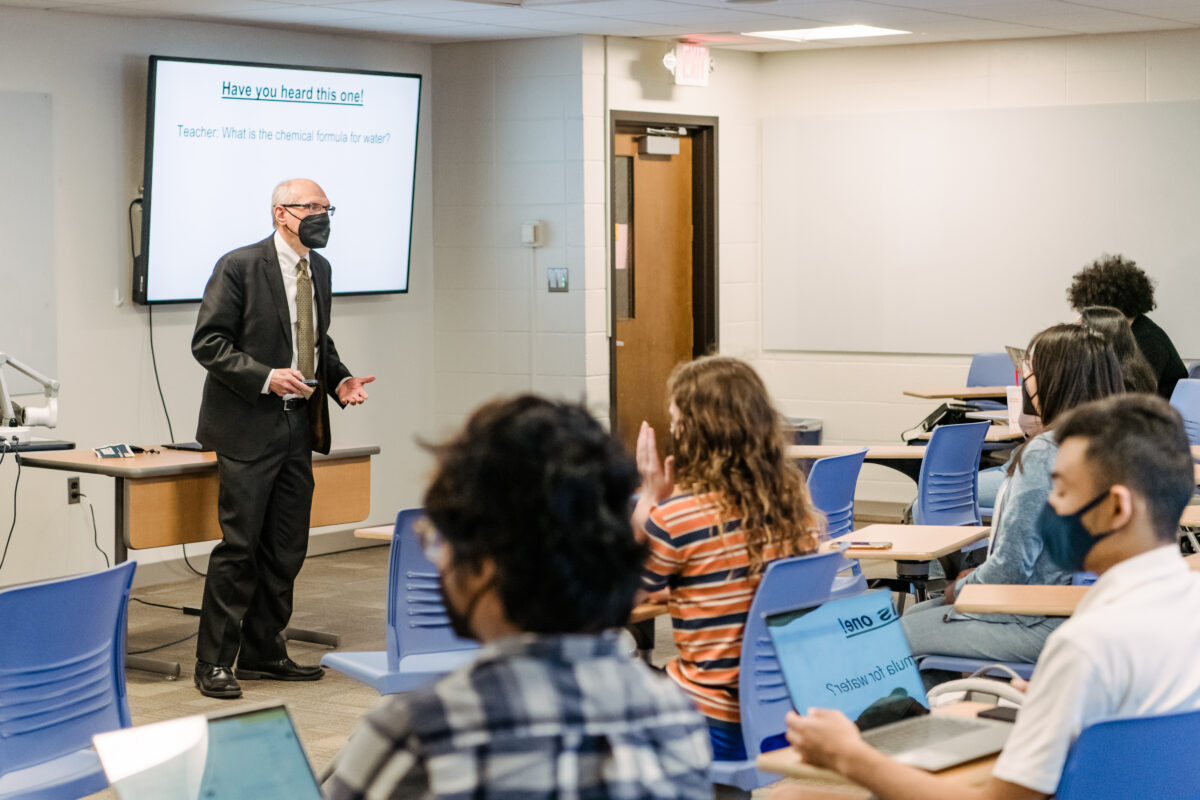 Dean LaCourse teaches CHEM 101 in spring 2022. The chemistry course for non-majors is another example of a CNMS class on a subject that sometimes intimidates students and connects it to their daily lives—with a dose of humor. (Marlayna Demond ’11/UMBC)
Swapping fear for fun in math class
The course is personal for O’Malley, who did not always love math herself. “I thought I was bad at it, and I hated doing things I was bad at,” she candidly recalls. “It wasn’t the math itself, it was the feeling that I had in a math class—which is how it is for a lot of people.”
A fortuitous sequence of events, including a campus job helping with professional development events for math teachers, led O’Malley from initially pursuing an English degree at UMBC to a combination of math and psychology majors as a Sherman Teacher Scholar. After that, O’Malley set out to make math courses less of a bear for her math-phobic students—and maybe even fun.
She first returned to UMBC as an adjunct professor for introductory calculus while still teaching math at Western Technical High School in Baltimore County. She now serves as a program management specialist in CNMS, and the opportunity to continue her passion—teaching math—in that role came as a delightful surprise.
Unlike calculus, where the curriculum is largely set, MATH 110 “is a growing, evolving, living course,” O’Malley says. “This lab is new and has the potential to always be new. I’m really excited about it.”
Learning to think like a mathematician
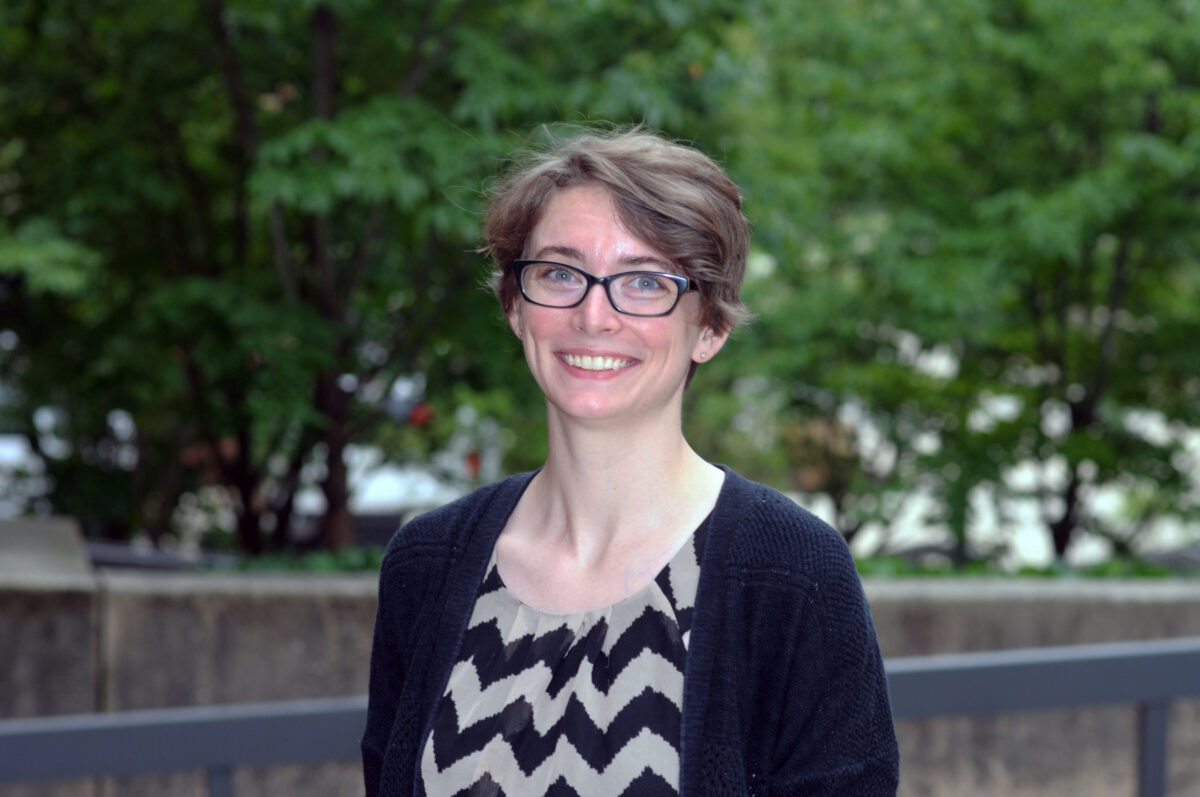 For Alexis O’Malley ’18, teaching MATH 110 is a perfect fit, and it gives her the opportunity to help students connect to math in new ways. (Image courtesy of O’Malley)
O’Malley and Scott have both witnessed substantial growth in their students this fall. Each lab report asks students to connect their work to previous labs, STEM fields, and their own lives. “That’s one of my favorite sections to read, because they always come up with examples I never would have thought of,” O’Malley says. “Sometimes they take away something that has even more depth than was my intention.”
The investigative nature of the course also supported students’ increasingly independent problem solving. Later in the semester, “Suddenly, students weren’t walking up with a blank page and asking for help, but instead explaining where they started and the specific point where they couldn’t bridge the gap on their own,” Scott shares.
As for lightbulb moments, “I wish that I had cataloged them,” O’Malley says. “But I remember their ‘aha!’ faces.”
By the end, “even in the labs where students struggled with the math, they could easily explain why and how the lab related to their life,” Scott says. “For students who won’t continue in the math field, it’s pretty incredible to watch them (sometimes begrudgingly) accept how intertwined mathematics is with our world.”
Changing minds, creating opportunities
During the last few weeks of the fall semester, rather than conducting faculty-designed labs, the students are developing their own. Next semester, the curriculum will incorporate one of the students’ labs. That process will continue, and eventually, with enough different labs to choose from, the course might become adaptable to the interests of students each semester, O’Malley says.
The spring course is filling up, which speaks to its positive reception with students. If that section fills, the college will open another. A more advanced math laboratory course is also in the early stages of development.
The new course is already opening students’ eyes to what a math class can be.
“I didn’t think you could do math and lab at the same time,” shares Taye Olorunsola ’25, management of aging services, who took a chance on the new course this fall. But now? “I recommend it to a lot of my friends.”
]]>
UMBC’s Science Learning Collaboratory buzzes with activity as small groups of students use pipettes to suck brine shrimp out of glass vials, squirt them into petri dishes set over graph paper,...
https://umbc.edu/stories/lab-course-brings-math-to-life/
https://my3.my.umbc.edu/api/v0/pixel/news/137906/guest@my.umbc.edu/301c3db76abc3e07e3d1324ecc1e9ee5/api/pixel
cnms
mathstat
news
science-and-tech
UMBC News & Magazine
https://my3.my.umbc.edu/groups/umbc-news-magazine
https://assets1-my.umbc.edu/system/shared/avatars/groups/000/001/943/24435aa6207c452e7bc15cc74b42c7bb/xsmall.png?1748556657
https://assets1-my.umbc.edu/system/shared/avatars/groups/000/001/943/24435aa6207c452e7bc15cc74b42c7bb/original.png?1748556657
https://assets2-my.umbc.edu/system/shared/avatars/groups/000/001/943/24435aa6207c452e7bc15cc74b42c7bb/xxlarge.png?1748556657
https://assets2-my.umbc.edu/system/shared/avatars/groups/000/001/943/24435aa6207c452e7bc15cc74b42c7bb/xlarge.png?1748556657
https://assets3-my.umbc.edu/system/shared/avatars/groups/000/001/943/24435aa6207c452e7bc15cc74b42c7bb/large.png?1748556657
https://assets1-my.umbc.edu/system/shared/avatars/groups/000/001/943/24435aa6207c452e7bc15cc74b42c7bb/medium.png?1748556657
https://assets2-my.umbc.edu/system/shared/avatars/groups/000/001/943/24435aa6207c452e7bc15cc74b42c7bb/small.png?1748556657
https://assets1-my.umbc.edu/system/shared/avatars/groups/000/001/943/24435aa6207c452e7bc15cc74b42c7bb/xsmall.png?1748556657
https://assets2-my.umbc.edu/system/shared/avatars/groups/000/001/943/24435aa6207c452e7bc15cc74b42c7bb/xxsmall.png?1748556657
UMBC News & Magazine
0
0
false
Wed, 20 Dec 2023 14:07:59 -0500
Wed, 20 Dec 2023 14:07:59 -0500
UMBC mathematician Kathleen Hoffman contributes to research on animal decision-making, with robotics applications
Animals must constantly make the choice between using energy to gather information about their environment or to carry out goal-driven tasks. Animals use sensory input, including humans’ five senses and other senses like electromagnetics and echolocation, to make those decisions.
A new study published in Nature Machine Intelligencefinds that all 11 species the research team investigated—ranging from amoebas to humans—demonstrate similar patterns of movement. These results have implications for robotics, because robots must be programmed to make the same kinds of decisions animals do to move safely and efficiently through unpredictable environments.
The research team ran experiments with glass knifefish, and then analyzed data available in the scientific literature on 10 other species: humans, mice, bats, moles, three butterflies, cockroaches, and two amoebas. Every single species demonstrated the same pattern of decision making, which involved turning the information-gathering mode, called “explore,” on and off depending on how uncertain the animals were about their environment.
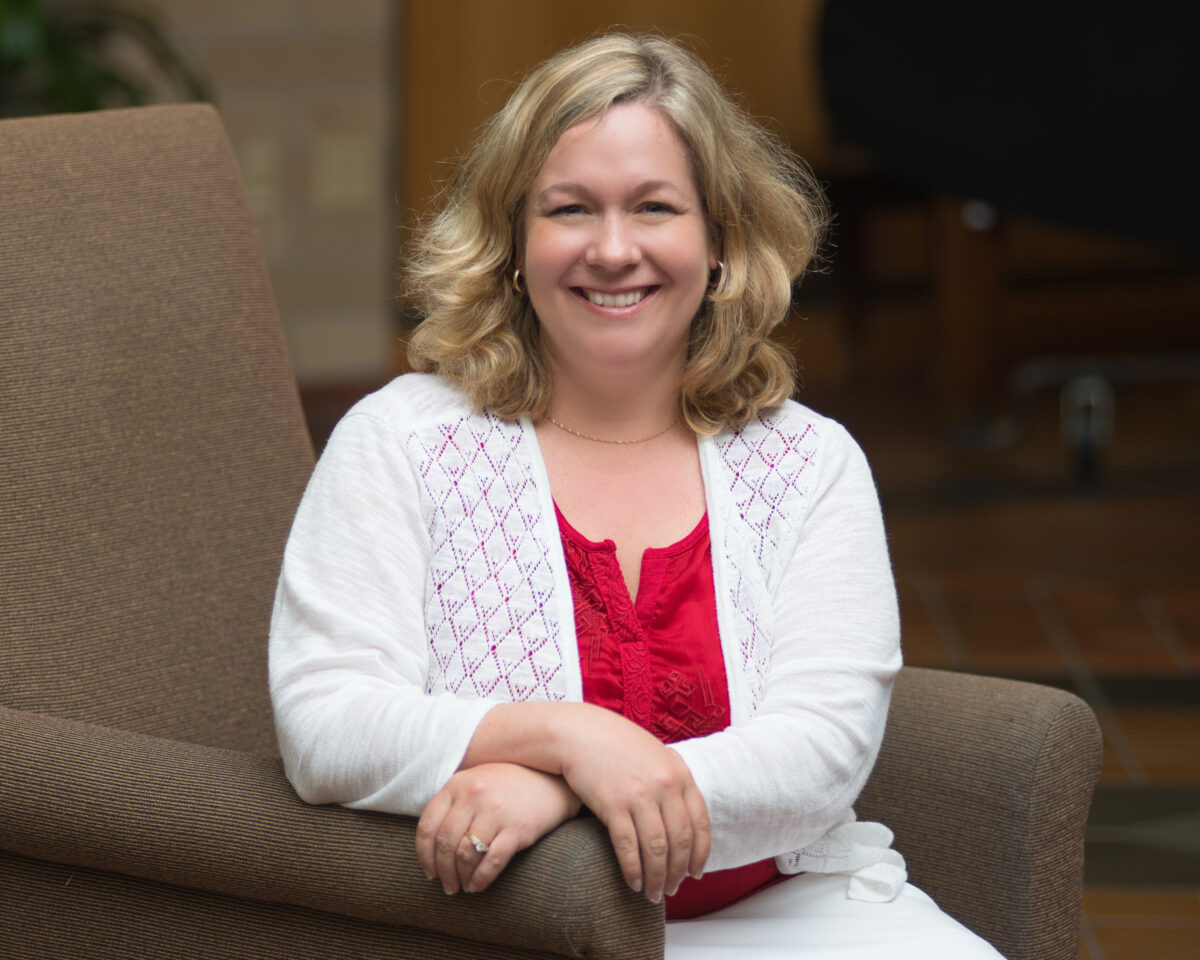 Kathleen Hoffman says the research team for this project “was one of the coolest interdisciplinary groups I’ve worked in.” (Image courtesy of Hoffman)
The mathematical strategy that best represented the animals’ behavior “is the trace of a covariance matrix—which I don’t think the fish is actually computing,” jokes Kathleen Hoffman, professor of mathematics and statistics and an author on the new paper.
Robots, too, must constantly interpret the sensory input they’re receiving and use that information to make decisions. Understanding how real animals tackle that process, even if they don’t know themselves, is useful for robotics, Hoffman explains, “because the robot actually can compute the trace of a covariance matrix.”
Interdisciplinary innovation advances robotics
Specifically, the paper’s results showed that an animal explores until its certainty about its environment decreases below a given threshold. Then it switches to using that information for tasks, which is called “exploit” mode. When uncertainty rises again, it goes back to exploring. This kind of mode-switching is called “triggered excitation.” It differs from a model called “persistent excitation,” which involves constant exploring.
Applications involving sensory processing, like robots, often use the persistent excitation model, so the team was surprised to discover that persistent excitation is not consistent with their observations and analysis. The team’s findings could have a significant impact in the field of sensory modeling.
The work for this paper required many areas of expertise, and the team included researchers in mathematics, engineering, and biology. Debojyoti Biswas, a postdoctoral fellow at Johns Hopkins University, is the first author on the new paper, and the other authors include Hoffman and researchers at University of Minnesota, Cornell University, and the New Jersey Institute of Technology.
The project grew out of a conversation between Hoffman and John Guckenheimer, an emeritus professor of mathematics at Cornell. They invited the rest of the team members on board as their expertise was needed. From figuring out how to track the position of the knifefish in the experiments with extreme precision, to analyzing the data on other species, to interpreting the math in a way that made sense in a biological context, everyone had a role to play.
“This was one of the coolest interdisciplinary groups I’ve worked in,” Hoffman says. “I really don’t think that any one of us could have done it on our own.”
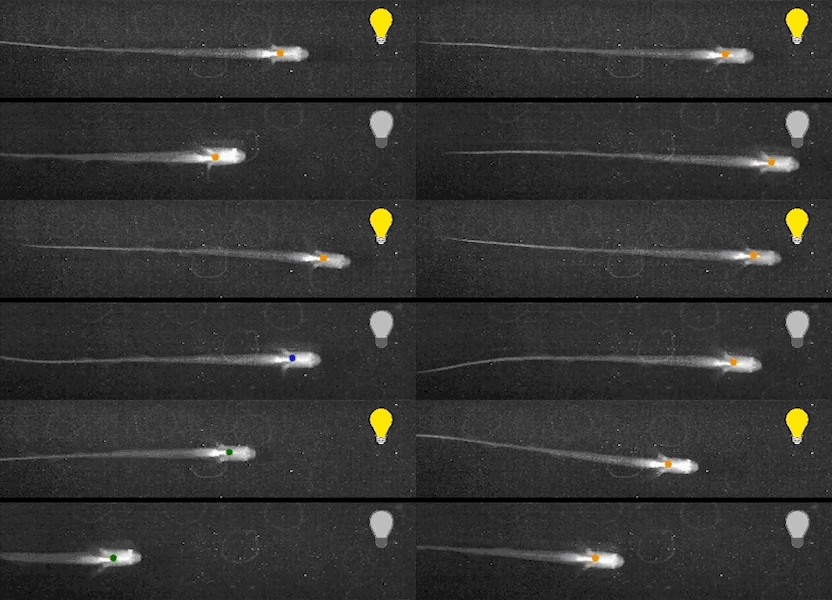 This clip of the knifefish in the team’s experiments shows how they switch between darting forward and back to “explore” their surroundings and “exploiting” that information to keep themselves in the middle. (Video courtesy of Debojyoti Biswas)
The remaining “head-scratcher”
The new paper has generated new questions as well as answers. “Here’s the head-scratcher,” Hoffman says: “What’s the mechanism that leads to this?” The team observed the same pattern in species as different as butterflies and moles, which use completely different senses. And they were able to deduce the pattern from published research that was originally undertaken to answer completely different questions.
Moving forward, some of the same team members, including Hoffman, plan to dig deeper into the mechanism behind this surprising pattern—and whether the mechanism is the same or different across species. “To me,” Hoffman says, “this is fundamental and really important.”
Hoffman is grateful to have been a part of the team. She took the opportunity to grow as a mathematician by contributing primarily to the project’s data analysis, when her focus is usually in mathematical modeling.
“I wanted to really push the limits of what I could do and make it broader. I wanted to develop skills that I didn’t have before,” she says. Overall, “I had fun. You never know what you’re going to be working on as an applied mathematician.”
]]>
Animals must constantly make the choice between using energy to gather information about their environment or to carry out goal-driven tasks. Animals use sensory input, including humans’ five...
https://umbc.edu/stories/animal-decision-making-with-robotics-applications/
https://my3.my.umbc.edu/api/v0/pixel/news/136596/guest@my.umbc.edu/8afd71252e517d05e89ad06926198b36/api/pixel
cnms
mathstat
news
research
science-and-tech
UMBC News & Magazine
https://my3.my.umbc.edu/groups/umbc-news-magazine
https://assets1-my.umbc.edu/system/shared/avatars/groups/000/001/943/24435aa6207c452e7bc15cc74b42c7bb/xsmall.png?1748556657
https://assets1-my.umbc.edu/system/shared/avatars/groups/000/001/943/24435aa6207c452e7bc15cc74b42c7bb/original.png?1748556657
https://assets2-my.umbc.edu/system/shared/avatars/groups/000/001/943/24435aa6207c452e7bc15cc74b42c7bb/xxlarge.png?1748556657
https://assets2-my.umbc.edu/system/shared/avatars/groups/000/001/943/24435aa6207c452e7bc15cc74b42c7bb/xlarge.png?1748556657
https://assets3-my.umbc.edu/system/shared/avatars/groups/000/001/943/24435aa6207c452e7bc15cc74b42c7bb/large.png?1748556657
https://assets1-my.umbc.edu/system/shared/avatars/groups/000/001/943/24435aa6207c452e7bc15cc74b42c7bb/medium.png?1748556657
https://assets2-my.umbc.edu/system/shared/avatars/groups/000/001/943/24435aa6207c452e7bc15cc74b42c7bb/small.png?1748556657
https://assets1-my.umbc.edu/system/shared/avatars/groups/000/001/943/24435aa6207c452e7bc15cc74b42c7bb/xsmall.png?1748556657
https://assets2-my.umbc.edu/system/shared/avatars/groups/000/001/943/24435aa6207c452e7bc15cc74b42c7bb/xxsmall.png?1748556657
UMBC News & Magazine
0
0
false
Thu, 26 Oct 2023 11:06:50 -0400
Thu, 26 Oct 2023 11:06:50 -0400
‘Big Bang of Numbers’ – The Conversation’s book club explores with author Manil Suri how math alone could create the universe
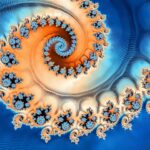
The Conversation U.S. launched its new book club with a bang – talking to mathematician Manil Suri about his nonfiction work “The Big Bang of Numbers: How to Build the Universe Using Only Math.” Suri, a previous author in The Conversation, has also written an award-winning fiction trilogy, in addition to being a professor of mathematics and statistics at the University of Maryland, Baltimore County.
Below is an edited excerpt from the book club discussion between Maggie Villiger, senior science editor for The Conversation US and Suri.
Watch the full book club meeting and leave your own question in the comments at the bottom of this article.
What is the Big Bang of numbers and where do you go from there in the book?
I think the story for me started way back when I was an undergraduate in Bombay. My algebra professor told us this very famous saying by Leopold Kronecker, the famous mathematician, that God gave us the integers and all the rest is the work of human beings. What he meant was that once you have the whole numbers – 1, 2, 3, 4 – which are somehow coming from heaven, then you can build up the rest of mathematics from it.
And then he went on and said, Hey, I can actually do better. I don’t need God. I can actually, as a mathematician, create the numbers out of nothing. And he showed us this marvelous, almost magic trick, where you start with something called the empty set and then you start building the numbers.
It was the closest I’ve been to a religious experience, almost like the walls just dissolved and suddenly there were numbers everywhere.
Once I started writing my novels, I was meeting a lot of people who were artists and writers. And they would always say, you know, we used to love math when we were in school, but afterward we never had a chance to really pursue it. And can you tell us something about your mathematics?
So, I started building a kind of talk, which started with this big bang, as I call it, building the numbers out of nothing. I finally decided I should write a math book, and it would be aimed at a wide audience.
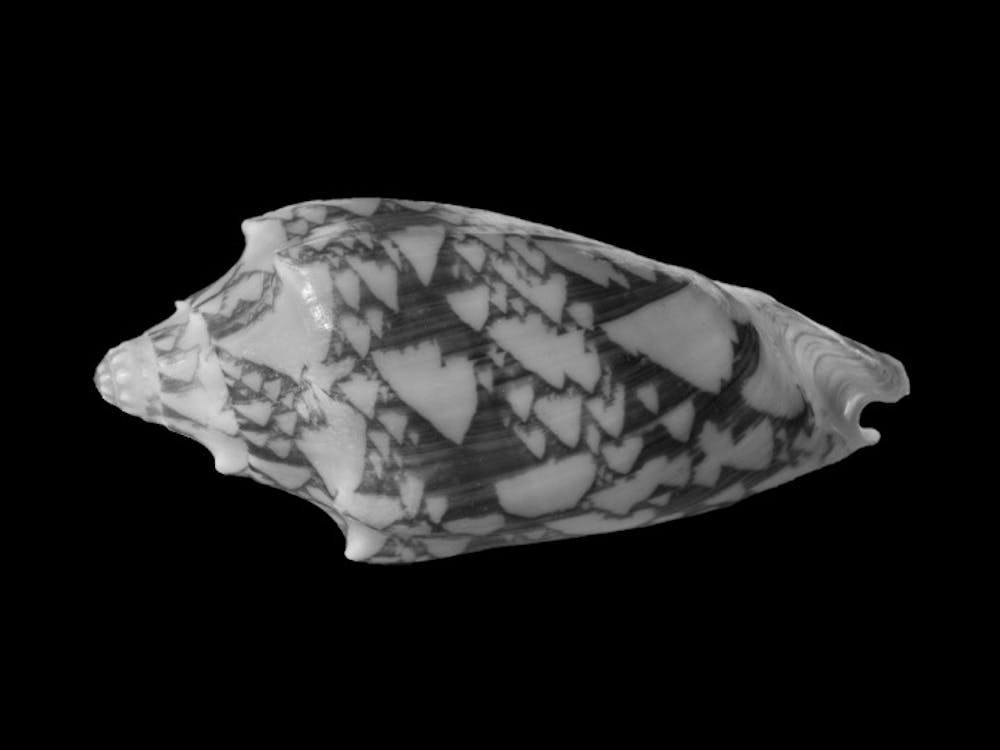
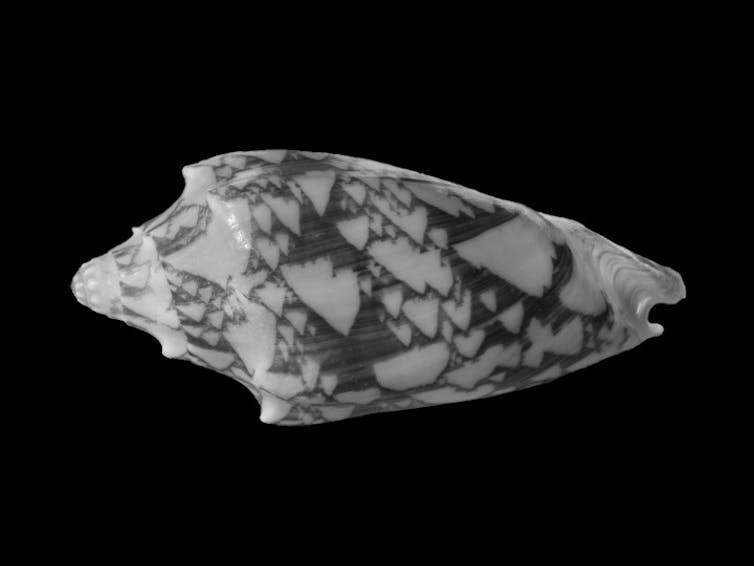 Patterns in nature, like the triangles on this shell, can be explained by simple mathematical rules. Larry Cole
And I said, well, can you go further? You can create the numbers, but can you actually start building everything, including the whole universe from that? So that was a way to try to lay out mathematics almost as a story where one thing follows from the other and everything is embedded in one narrative.
Who were you imagining to be your readers as you were writing the book?
There’s just so much joy to be had out of mathematics, so many things that you don’t really see in normal courses where the emphasis is always on doing the calculations, finding the right answer. So this book is written for people who want to really engage with mathematics on the level of ideas rather than get into computations and calculations.
After you set off your Big Bang of numbers, you dig in to some of life’s big questions. What do you see as math’s role in grappling with those big thoughts, like where the universe came from, why we even exist and so on?
Once you start talking about the Big Bang, what comes into your mind is creation. There is a doctrine called creatio ex nihilo, which is basically creating everything out of nothing.
That’s a cornerstone of many religions where God creates the universe out of nothing. It’s also in some sense being explored by physicists, where you have some sort of singularity and from that, everything emerges in the Big Bang.
So my thought was, both these areas, religion and physics, are in the public’s imagination much more than mathematics is. Is there a way to posit math as the creative force of everything?
Physicist Eugene Wigner, who was a Nobel laureate, talked about the “unreasonable effectiveness” of mathematics at describing everything in our physical universe. It’s so good at modeling physics and what have you. Could it be that math is really the true driving force of the universe? Rather than us just inventing it and using it to describe the universe, could the universe really be describing mathematics? Then the universe is just a physical manifestation, an approximation, if you will, of those mathematical ideas. It’s a completely different view of math.
There’s an ongoing debate over whether math is something that people invented or whether it’s something that exists independently of us. In the book, you say that perhaps the deepest insight that math can offer us is that it’s both of those things.
So the glib answer to your question whether math’s invented or discovered is that you have to create a new word. Instead of discovered or invented it’s “disvented.”
What I mean by that is simply that there are some questions we really can’t get to any kind of logical or supportable answer. One is the question of our own existence – people might believe one thing or the other, but it always comes down to: Is there some real purpose to our lives, or is our creation just something that happened randomly – you know, molecules getting together?
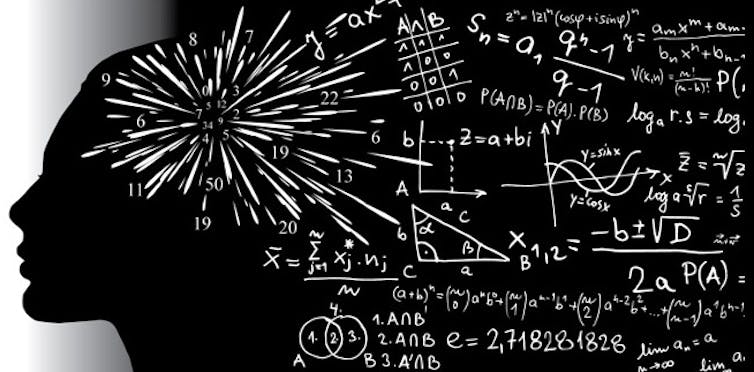 Is math something that is born from the human mind? ‘The Big Bang of Numbers’
Now if we invent mathematics, then we’re inventing it for a purpose. If it just generates by itself, starting with emptiness, building around numbers in some strange realm that we don’t know about, then it’s just wafting around, purposeless.
Math has that duality that can’t be resolved. So it’s a metaphor, telling us, hey, you can’t decide for math, and you’ll never be able to decide for yourself about your own existence.
Can you tell us a bit about your previous books, the Indian novels?
The first one was called “The Death of Vishnu.” I went back to visit my parents in Mumbai in around 1995, and this man Vishnu, who used to live in our building and do errands, was dying on our steps. I started writing this as a short story.
It started going into a more philosophical realm when a writing teacher said, you know, Vishnu is also the name of the caretaker of the universe in Hindu mythology. So if you name somebody Vishnu, you need to somehow explore that. So that’s what opened up this whole new world for me.
The second book was “The Age of Shiva.” That one’s the journey of a woman right after India’s independence in 1947. She’s making her way in a very male-dominated world, and she’s not perfect.
Then the third one, I decided, OK, I need to put in some science and math characters. So “The City of Devi” actually has both a physicist and a statistician. Again it’s in Mumbai, set in the future with the threat of a nuclear war with Pakistan and a love triangle unfolding in front of that.
It’s kind of interesting. I thought that I was done with this mythical “where do we come from?” kind of philosophy that I had in the three books, but apparently not, because now “The Big Bang of Numbers” looks at it from a mathematical perspective.
This article is republished from The Conversation under a Creative Commons license. Read the original article and see more than 250 UMBC articles available in The Conversation.
]]>
The Conversation U.S. launched its new book club with a bang – talking to mathematician Manil Suri about his nonfiction work “The Big Bang of Numbers: How to Build the Universe Using Only Math.”...
https://umbc.edu/stories/big-bang-of-numbers-book-club-explores-how-math-could-create-the-universe/
https://my3.my.umbc.edu/api/v0/pixel/news/135534/guest@my.umbc.edu/dab203a6ad90ae97a91aa23633fa7bc4/api/pixel
cnms
discovery
magazine
mathstat
the-conversation
UMBC News & Magazine
https://my3.my.umbc.edu/groups/umbc-news-magazine
https://assets1-my.umbc.edu/system/shared/avatars/groups/000/001/943/24435aa6207c452e7bc15cc74b42c7bb/xsmall.png?1748556657
https://assets1-my.umbc.edu/system/shared/avatars/groups/000/001/943/24435aa6207c452e7bc15cc74b42c7bb/original.png?1748556657
https://assets2-my.umbc.edu/system/shared/avatars/groups/000/001/943/24435aa6207c452e7bc15cc74b42c7bb/xxlarge.png?1748556657
https://assets2-my.umbc.edu/system/shared/avatars/groups/000/001/943/24435aa6207c452e7bc15cc74b42c7bb/xlarge.png?1748556657
https://assets3-my.umbc.edu/system/shared/avatars/groups/000/001/943/24435aa6207c452e7bc15cc74b42c7bb/large.png?1748556657
https://assets1-my.umbc.edu/system/shared/avatars/groups/000/001/943/24435aa6207c452e7bc15cc74b42c7bb/medium.png?1748556657
https://assets2-my.umbc.edu/system/shared/avatars/groups/000/001/943/24435aa6207c452e7bc15cc74b42c7bb/small.png?1748556657
https://assets1-my.umbc.edu/system/shared/avatars/groups/000/001/943/24435aa6207c452e7bc15cc74b42c7bb/xsmall.png?1748556657
https://assets2-my.umbc.edu/system/shared/avatars/groups/000/001/943/24435aa6207c452e7bc15cc74b42c7bb/xxsmall.png?1748556657
UMBC News & Magazine
0
0
false
Mon, 18 Sep 2023 16:14:23 -0400
Mon, 18 Sep 2023 16:14:23 -0400
Justin Webster receives NSF grant to study mathematical models behind oscillation of plane wings, bridges, energy harvesters

Although objects like bridges, buildings, and airplane wings may seem quite rigid, by design they are capable of a surprising deal of bending. This elasticity allows them to deform safely and temporarily in windy conditions. However, very rarely, “Elastic systems like bridges, buildings, and planes can become oscillatory or unstable in the presence of everyday wind, with potential for the oscillations to become damaging,” says Justin Webster, associate professor of mathematics and statistics. “Understanding this has big implications for fields like civil engineering or alternative energy.”
Webster has received a new $290,000 National Science Foundation Division of Mathematical Sciences grant to “look at the mathematical models that describe these wind-structure systems,” he says, “and try to answer the questions, ‘What gives rise to these self-destabilization effects? And do I understand it well enough to stop it, or better yet, to prevent it altogether?’” In other words, can we prevent the bridge collapsing or the wings snapping off the plane in windy conditions?
The Tacoma Narrows Bridge collapse in November 1940 is a classic example of wind-induced oscillations having catastrophic effects.
In contrast, certain energy harvesting devices require oscillation to function. As wind flows over one of these flag-like surfaces, it flaps, or “flutters,” generating electrical current. With these energy harvesters—as opposed to planes and bridges—says Webster, “It’s the opposite: You want the oscillations to happen. Not only do we want this to happen, but we want it to happen in an optimal way.”
For some of these systems, there are no existing mathematical models. For others, models exist, but they don’t seem to capture the way these systems behave in the physical world very well. As a first step, Webster and his students, including new members brought on board with the NSF support, will work to generate new, relevant models or refine existing ones. Next, they will analyze how the models address key questions in three applications: a bridge, an airfoil (like a plane wing), and a flutter-driven energy harvesting device.
In each scenario, Webster and his team will ask, “What conditions give rise to flow-induced oscillations that appear to be spontaneous? And if they do happen, can the model predict what they will look like—such as bending, or, more dangerously, twisting?” Right now, the answer to the latter is “no.” The new grant will help Webster get closer to “yes,” and as a result, eventually improve infrastructure safety and the efficiency of some alternative energy devices.
]]>
Although objects like bridges, buildings, and airplane wings may seem quite rigid, by design they are capable of a surprising deal of bending. This elasticity allows them to deform safely and...
https://umbc.edu/stories/math-models-behind-oscillation/
https://my3.my.umbc.edu/api/v0/pixel/news/135195/guest@my.umbc.edu/ad3595c026f0b7b2f9c7eee2ffa44460/api/pixel
cnms
mathstat
news
rca-2
research
science-and-tech
UMBC News & Magazine
https://my3.my.umbc.edu/groups/umbc-news-magazine
https://assets1-my.umbc.edu/system/shared/avatars/groups/000/001/943/24435aa6207c452e7bc15cc74b42c7bb/xsmall.png?1748556657
https://assets1-my.umbc.edu/system/shared/avatars/groups/000/001/943/24435aa6207c452e7bc15cc74b42c7bb/original.png?1748556657
https://assets2-my.umbc.edu/system/shared/avatars/groups/000/001/943/24435aa6207c452e7bc15cc74b42c7bb/xxlarge.png?1748556657
https://assets2-my.umbc.edu/system/shared/avatars/groups/000/001/943/24435aa6207c452e7bc15cc74b42c7bb/xlarge.png?1748556657
https://assets3-my.umbc.edu/system/shared/avatars/groups/000/001/943/24435aa6207c452e7bc15cc74b42c7bb/large.png?1748556657
https://assets1-my.umbc.edu/system/shared/avatars/groups/000/001/943/24435aa6207c452e7bc15cc74b42c7bb/medium.png?1748556657
https://assets2-my.umbc.edu/system/shared/avatars/groups/000/001/943/24435aa6207c452e7bc15cc74b42c7bb/small.png?1748556657
https://assets1-my.umbc.edu/system/shared/avatars/groups/000/001/943/24435aa6207c452e7bc15cc74b42c7bb/xsmall.png?1748556657
https://assets2-my.umbc.edu/system/shared/avatars/groups/000/001/943/24435aa6207c452e7bc15cc74b42c7bb/xxsmall.png?1748556657
UMBC News & Magazine
0
0
false
Wed, 06 Sep 2023 14:15:07 -0400
Wed, 06 Sep 2023 14:15:07 -0400
NEXUS Institute for Quantitative Biology celebrates student success, community college partnerships
In 2018, faculty at UMBC and four of its top-sending community colleges embarked on a project with an ambitious mission: improve students’ quantitative skills in biological contexts, and eliminate the achievement gap between transfer and direct-entry students in courses requiring these skills. The urgent need for students in the life sciences to be proficient in a range of mathematical concepts has been made clear again and again by various national reports. The project, dubbed the NEXUS Institute for Quantitative Biology (NIQB), arose to address that need.
 Dean William R. LaCourse has led numerous projects designed to increase student success in STEM at UMBC. (Image by Melissa Penley Cormier/UMBC)
“The world is quantitative,” says William R. LaCourse, dean of the College of Natural and Mathematical Sciences at UMBC. “To do science, and even to make informed decisions in your everyday life, you need to be able to interpret graphs, understand statistics, and more. Having the knowledge to make decisions on your own, and interpret information, empowers you to be successful.”
The NIQB is an arm of the $1.4 million Improving Undergraduate Science Education (IUSE) grant funded by the National Science Foundation that involves UMBC, Howard Community College, Montgomery College, Anne Arundel Community College, and Community College of Baltimore County. At UMBC, the project is led by LaCourse and Jeff Leips, professor of biological sciences. The grant formally concludes in September, and feedback at the group’s fifth annual symposium held in June made clear that it has been a resounding success. Many of its outcomes will continue to benefit students and the partner institutions moving forward.
Promising results
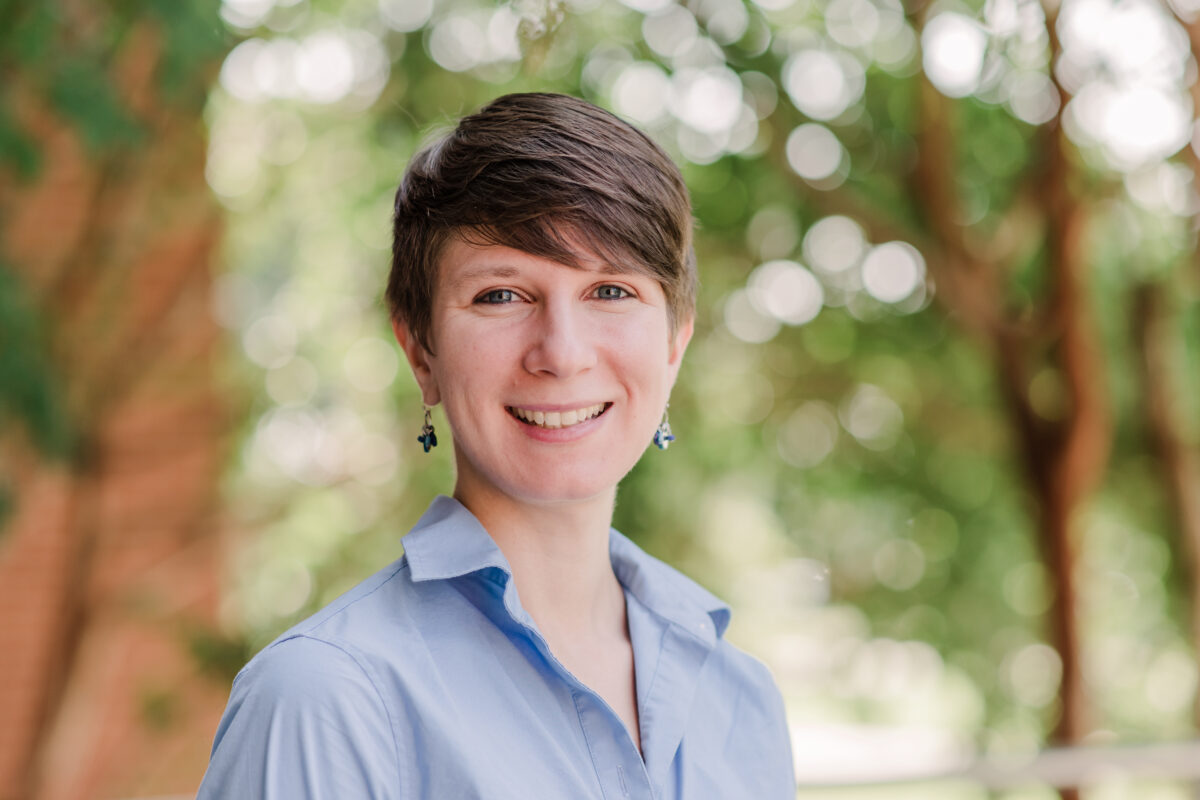 Tory Williams leads the evaluation effort for NIQB. In her role at the UMBC Faculty Development Center, she conducts research that supports teaching innovation across UMBC. (Image by Marlayna Demond ’11/UMBC)
Over the five years of the NIQB project, faculty teams comprised of math and biology instructors and administrators from multiple institutions developed 21 new curricular modules that teach quantitative skills through exploring biological concepts. For example, students studied exponential change through a “Rat Attack” module about population growth. Other modules covered cell division, natural selection, concentration and saturation, and the immune response.
An analysis by Tory Williams, assistant director for pedagogical research in UMBC’s Faculty Development Center, found that after participating in the modules, students showed statistically significant improvement on the desired skills, such as working with algorithms and using quantitative language.
“Our students have really gained a lot in their quantitative skills. It not only helped them better understand the math side of things, but it helped them better understand the biology,” shares Hannah Pie, a biology instructor at Howard Community College.
Growing skills, changing minds
Students at all of the institutions performed at the same level on nine of the modules. On four other modules, performance across institutions only differed on a few items. These are promising signs that the performance gap between transfer and direct entry students is likely to shrink as these students transfer to four-year institutions. The remaining modules were implemented later in the project and require additional analysis from spring 2023 to get meaningful results.
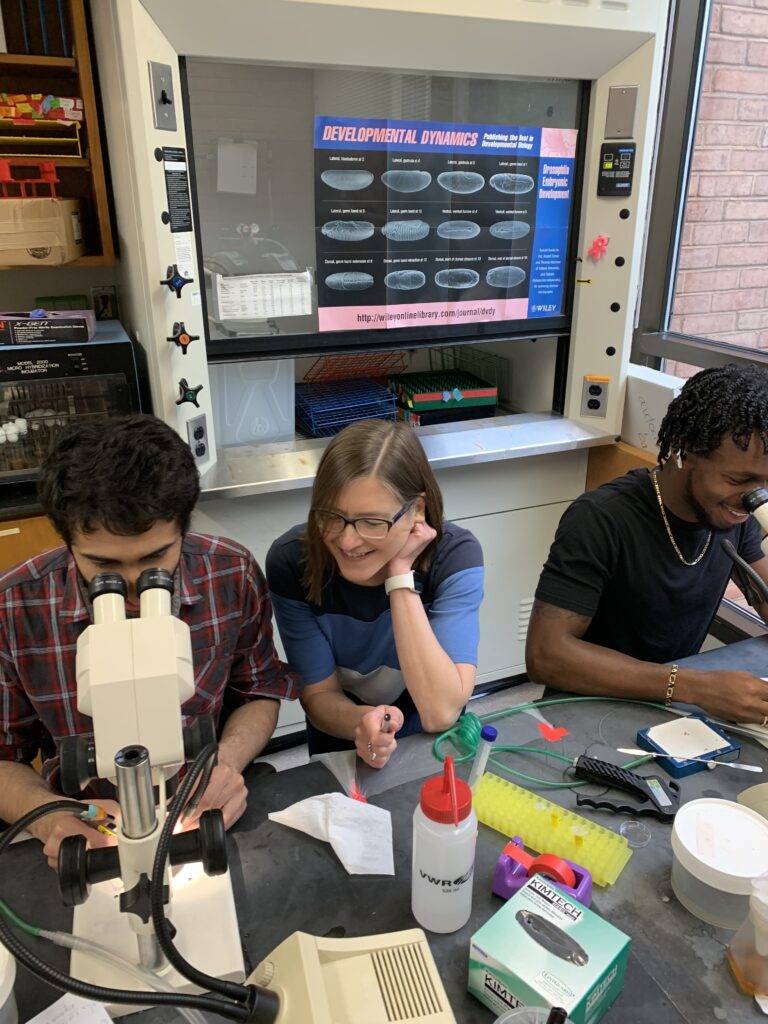 Michelle Starz-Gaiano (center), professor of biological sciences, has been involved with integrating quantitative skills into biology courses at UMBC through NIQB and other efforts. (Image courtesy of Starz-Gaiano)
In spring 2021, some faculty began teaching the modules in their courses. Each semester, new modules became available, and more faculty adopted the new and existing modules in their curricula. By spring 2023, the modules were being taught at five different institutions.
A large majority of faculty said that given the choice, they would use the modules again, according to Williams’ analysis. The students also reported changes in their attitudes toward using math in biology after taking courses using the modules. Their ratings of how intriguing, fun, and appealing they found using math for biology increased, and worry and intimidation decreased.
“Math and biology fit really well together—who would have known?” joked Sybille Clayton, a math instructor at Anne Arundel Community College. “The STEM field has so much to offer, and our math students are still starving for applications at their level. I have always been a proponent of that, and now we have wonderful biology examples.”
Rewarding relationships
In addition to introducing the modules, some institutions made larger curriculum modifications as a result of the NIQB faculty teams’ work, such as shifting content between courses or altering course sequencing or prerequisite requirements. All the changes were in service of optimizing student learning and preparing community college students to succeed at UMBC or another four-year institution.
A committee with similar goals was formed in years prior to the NIQB project, “but it was really a one way street,” reflects Stephen Miller, associate professor of biological sciences at UMBC. Rather than community colleges solely adapting to UMBC’s curriculum, “It was much better to make it a two-way conversation with NIQB,” he says.
The faculty teams discussed everything from different class period lengths to different methods of assessment across institutions in their regular meetings. Addressing challenges together helped the team members build rewarding relationships that they plan to continue to nurture.
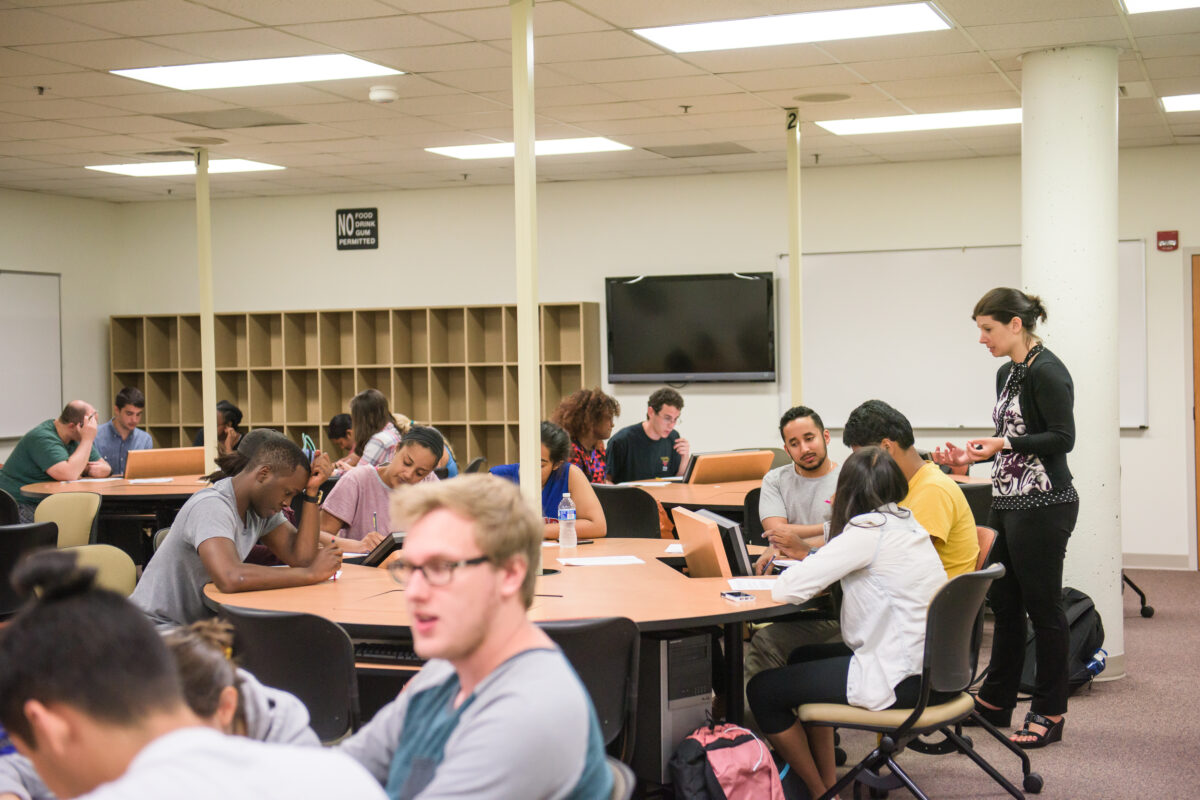 Tracy Smith (standing, right), senior lecturer of biological sciences, teaches in UMBC’s CNMS Active Science Teaching and Learning Environment (CASTLE). Faculty at UMBC have been increasingly adopting innovative active learning techniques for several years, which are known to help students more effectively take ownership of their learning. (Image by Marlayna Demond ’11/UMBC)
“I would like to continue to have these rich collaborations, and meet with other faculty teaching the same courses that I am,” Pie says. “It’s really rewarding to bounce ideas off other people and make your course the best that it can be.”
“It was interesting to see what other topics would come up in our team meetings not related directly to this project,” adds Rebecca Thomas, professor of biology at Montgomery College. “It’s opening up those bigger conversations about how we teach and what are our practices,” which benefits students and faculty alike.
Engaging students in the work
Laura Ott, former IUSE director at UMBC and now teaching assistant professor in biology at the University of North Carolina at Chapel Hill, gave the keynote address at the annual symposium in June. She has taken module development a step farther: She included curriculum design in one of her undergraduate courses.
Students create modules in Ott’s course and later analyze their success when other courses use them. The process creates independent research opportunities beyond typical lab research. Participating in what Ott calls disciplinary-based education research led to “huge gains in research self-efficacy, even more so than in traditional research experiences,” Ott says.
Faculty at the symposium were intrigued, and some started brainstorming ways to implement similar ideas at their institutions, such as in honors projects.
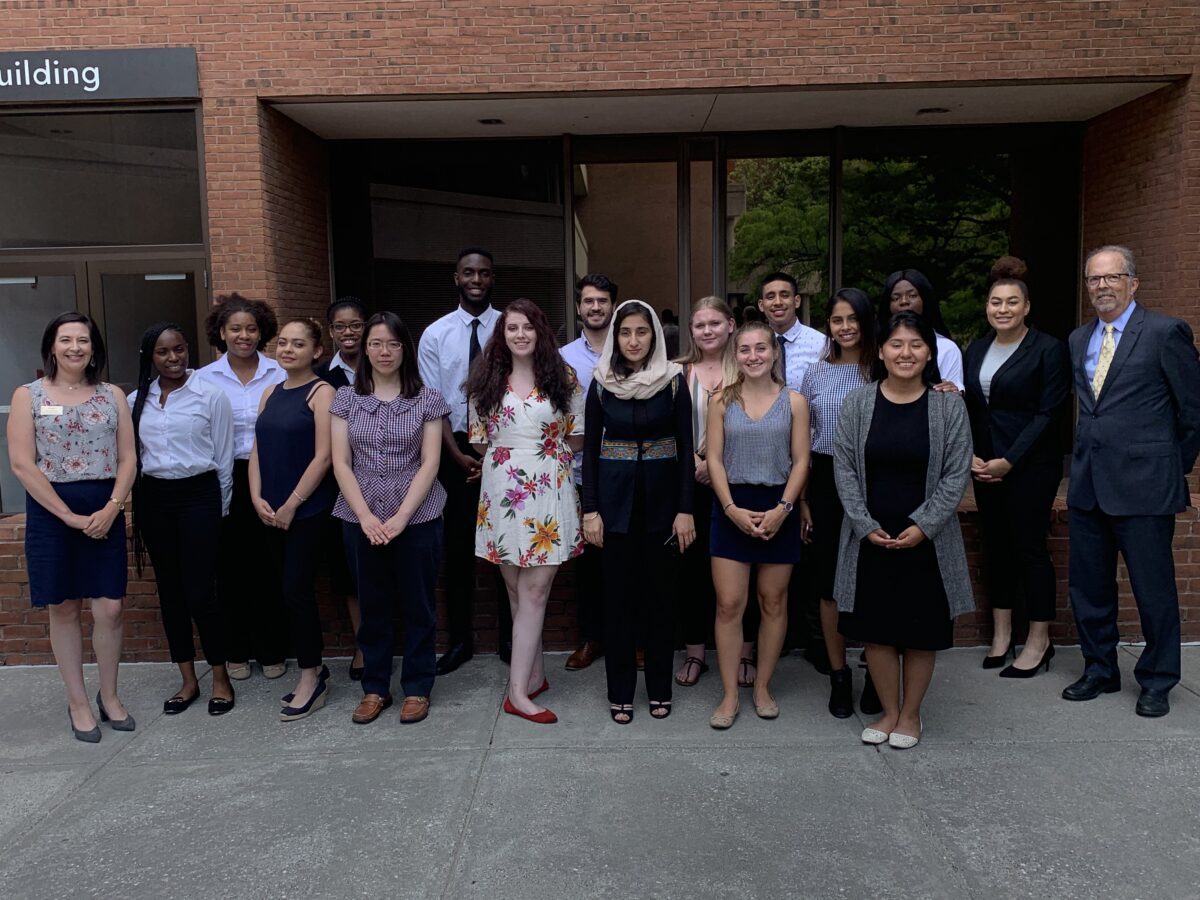 Laura Ott (far left) and Philip Farabaugh (far right), professor of biological sciences, with students in the UMBC STEM BUILD program in 2019. Ott was a lead staff member in the program, which is designed to support student success in STEM, from 2014 – 2019.
Spreading the word
Moving forward, the partner institutions are determined to find ways to keep the connections they’ve built alive and to continue to innovate their teaching to support student success. The faculty will also focus on sharing their results and the modules more broadly through publications, presentations, and word of mouth.
To start, Leips plans to share the modules with Carroll Community College, where he serves as a STEM advisor. Already, the modules are spreading to instructors at the partner institutions who are not directly involved in NIQB. In addition, the NIQB is disseminating their modules worldwide through the Quantitative Undergraduate Biology Education and Synthesis (QUBES) website.
“The faculty involved in this project have really taken this work back and disseminated it at our institution. The modules have become a part of the culture of our teaching,” Thomas says. Given the success of the modules in supporting student learning, “That’s a huge benefit for the faculty and for the students.”
]]>
In 2018, faculty at UMBC and four of its top-sending community colleges embarked on a project with an ambitious mission: improve students’ quantitative skills in biological contexts, and eliminate...
https://umbc.edu/stories/quantitative-biology-initiative-celebrates-success/
https://my3.my.umbc.edu/api/v0/pixel/news/134757/guest@my.umbc.edu/0fecc319d773dd07eac49a1fe1fef7c7/api/pixel
biology
cnms
mathstat
news
science-and-tech
UMBC News & Magazine
https://my3.my.umbc.edu/groups/umbc-news-magazine
https://assets1-my.umbc.edu/system/shared/avatars/groups/000/001/943/24435aa6207c452e7bc15cc74b42c7bb/xsmall.png?1748556657
https://assets1-my.umbc.edu/system/shared/avatars/groups/000/001/943/24435aa6207c452e7bc15cc74b42c7bb/original.png?1748556657
https://assets2-my.umbc.edu/system/shared/avatars/groups/000/001/943/24435aa6207c452e7bc15cc74b42c7bb/xxlarge.png?1748556657
https://assets2-my.umbc.edu/system/shared/avatars/groups/000/001/943/24435aa6207c452e7bc15cc74b42c7bb/xlarge.png?1748556657
https://assets3-my.umbc.edu/system/shared/avatars/groups/000/001/943/24435aa6207c452e7bc15cc74b42c7bb/large.png?1748556657
https://assets1-my.umbc.edu/system/shared/avatars/groups/000/001/943/24435aa6207c452e7bc15cc74b42c7bb/medium.png?1748556657
https://assets2-my.umbc.edu/system/shared/avatars/groups/000/001/943/24435aa6207c452e7bc15cc74b42c7bb/small.png?1748556657
https://assets1-my.umbc.edu/system/shared/avatars/groups/000/001/943/24435aa6207c452e7bc15cc74b42c7bb/xsmall.png?1748556657
https://assets2-my.umbc.edu/system/shared/avatars/groups/000/001/943/24435aa6207c452e7bc15cc74b42c7bb/xxsmall.png?1748556657
UMBC News & Magazine
1
0
false
Thu, 17 Aug 2023 15:23:33 -0400
Thu, 17 Aug 2023 15:23:33 -0400
Mock Trial champ pursuing economics for public good
Zinedine Partipilo Cornielles
Degree: B.S., Financial Economics; B.A., Mathematics
Hometown: Barquisimeto, Venezuela
Post-grad plans: Predoctoral research fellow
Zinedine Partipilo Cornielles fled Venezuela at age 16 with his family to seek asylum in the U.S., an experience that has fueled his passion for public service, from his research to his work with communities he identifies with.
PartipiloCornielles, a Sondheim Public Affairs Scholar and member of the Honors College, has conducted independent research projects with Tim Gindling, professor of economics, and Salem Abo-Zaid, associate professor of economics. His project with Gindling on the impact of financial literacy on student loan decisions among undergraduates across the United States earned the Economics Department Chair Award in 2022. Meanwhile, he has served as a teaching assistant and tutor for fellow students and has taught English to local immigrants through the Esperanza Center and UMBC’s Shriver Center.
PartipiloCornielles is also a member of UMBC Mock Trial and helped the team win the American Mock Trial Association National Championship in 2021 against perennial frontrunner Yale University. He is part of the Sloan Predoctoral Program through the UMBC economics department and, after pursuing a Ph.D. in economics, plans to conduct research on labor economics with a focus on Latin America.
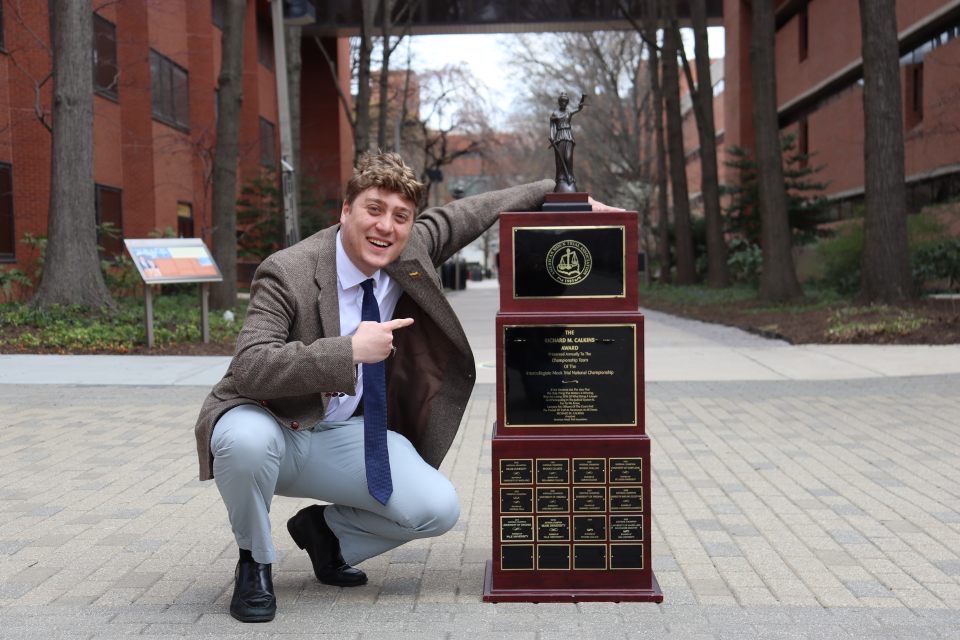 Zinedine Partipilo Cornielles with the 2021 Mock Trial championship trophy. (Image courtesy of Partipilo Cornielles)
Has there been a mentor or fellow student who influenced your time at UMBC?
“Professor Tim Gindling provided me with great insights as a research mentor, course instructor, and academic advisor. Thanks to Professor Gindling, I was supported in my research interests and gained invaluable experiences that have helped me fall in love with the research process. Brevin Franklin and Seth Thomas, fellow Sondheim Scholars who graduated in 2022, also helped me navigate through college when I first came to UMBC, and I appreciate their friendship.”
What has been the best part of your UMBC experience?
“On one hand, winning a Mock Trial National Championship against the odds, through Zoom, and against Yale, was incredible. On the other hand, I also want to highlight my service learning experiences as great experiences I have had. I was able to give back to the community by helping others and understand first-hand the value of education and human capital.”
]]>
Zinedine Partipilo Cornielles Degree: B.S., Financial Economics; B.A., Mathematics Hometown: Barquisimeto, Venezuela Post-grad plans: Predoctoral research fellow Zinedine Partipilo...
https://umbc.edu/stories/mock-trial-champ-pursuing-economics-for-public-good/
https://my3.my.umbc.edu/api/v0/pixel/news/132905/guest@my.umbc.edu/1b28a2d108bb60125841c853587c2929/api/pixel
cahss
class-of-2023
cnms
economics
mathstat
news
undergraduate-research
UMBC News & Magazine
https://my3.my.umbc.edu/groups/umbc-news-magazine
https://assets1-my.umbc.edu/system/shared/avatars/groups/000/001/943/24435aa6207c452e7bc15cc74b42c7bb/xsmall.png?1748556657
https://assets1-my.umbc.edu/system/shared/avatars/groups/000/001/943/24435aa6207c452e7bc15cc74b42c7bb/original.png?1748556657
https://assets2-my.umbc.edu/system/shared/avatars/groups/000/001/943/24435aa6207c452e7bc15cc74b42c7bb/xxlarge.png?1748556657
https://assets2-my.umbc.edu/system/shared/avatars/groups/000/001/943/24435aa6207c452e7bc15cc74b42c7bb/xlarge.png?1748556657
https://assets3-my.umbc.edu/system/shared/avatars/groups/000/001/943/24435aa6207c452e7bc15cc74b42c7bb/large.png?1748556657
https://assets1-my.umbc.edu/system/shared/avatars/groups/000/001/943/24435aa6207c452e7bc15cc74b42c7bb/medium.png?1748556657
https://assets2-my.umbc.edu/system/shared/avatars/groups/000/001/943/24435aa6207c452e7bc15cc74b42c7bb/small.png?1748556657
https://assets1-my.umbc.edu/system/shared/avatars/groups/000/001/943/24435aa6207c452e7bc15cc74b42c7bb/xsmall.png?1748556657
https://assets2-my.umbc.edu/system/shared/avatars/groups/000/001/943/24435aa6207c452e7bc15cc74b42c7bb/xxsmall.png?1748556657
UMBC News & Magazine
3
0
false
Mon, 24 Apr 2023 13:22:25 -0400
Mon, 24 Apr 2023 13:22:25 -0400
Declines in math readiness underscore the urgency of math awareness
Written by Manil Suri, professor of mathematics and statistics, UMBC
When President Ronald Reagan proclaimed the first National Math Awareness Week in April 1986, one of the problems he cited was that too few students were devoted to the study of math.
“Despite the increasing importance of mathematics to the progress of our economy and society, enrollment in mathematics programs has been declining at all levels of the American educational system,” Reagan wrote in his proclamation.
Nearly 40 years later, the problem that Reagan lamented during the first National Math Awareness Week – which has since evolved to become “Mathematics and Statistics Awareness Month” – not only remains but has gotten worse.
Whereas 1.63%, or about 16,000, of the nearly 1 million bachelor’s degrees awarded in the U.S. in the 1985-1986 school year went to math majors, in 2020, just 1.4%, or about 27,000, of the 1.9 million bachelor’s degrees were awarded in the field of math – a small but significant decrease in the proportion.
Post-pandemic data suggests the number of students majoring in math in the U.S. is likely to decrease in the future.
A key factor is the dramatic decline in math learning that took place during the lockdown. For instance, whereas 34% of eighth graders were proficient in math in 2019, test data shows the percentage dropped to 26% after the pandemic.
These declines will undoubtedly affect how much math U.S. students can do at the college level. For instance, in 2022, only 31% of graduating high school seniors were ready for college-level math – down from 39% in 2019.
These declines will also affect how many U.S. students are able to take advantage of the growing number of high-paying math occupations, such as data scientists and actuaries. Employment in math occupations is projected to increase by 29% in the period from 2021 to 2031.
About 30,600 math jobs are expected to open up per year from growth and replacement needs. That exceeds the 27,000 or so math graduates being produced each year – and not all math degree holders go into math fields. Shortages will also arise in several other areas, since math is a gateway to many STEM fields.
For all of these reasons and more, as a mathematician who thinks deeply about the importance of math and what it means to our world – and even to our existence as human beings – I believe this year, and probably for the foreseeable future, educators, policymakers and employers need to take Mathematics and Statistics Awareness Month more seriously than ever before.
Struggles with mastery
Subpar math achievement has been endemic in the U.S. for a long time.
Data from the National Assessment of Educational Progress shows that no more than 26% of 12th graders have been rated proficient in math since 2005.
The pandemic disproportionately affected racially and economically disadvantaged groups. During the lockdown, these groups had less access to the internet and quiet studying spaces than their peers. So securing Wi-Fi and places to study are key parts of the battle to improve math learning.
Some people believe math teaching techniques need to be revamped, as they were through the Common Core, a new set of educational standards that stressed alternative ways to solve math problems. Others want a return to more traditional methods. Advocates also argue there is a need for colleges to produce better-prepared teachers.
Other observers believe the problem lies with the “fixed mindset” many students have – where failure leads to the conviction that they can’t do math – and say the solution is to foster a “growth” mindset – by which failure spurs students to try harder.
Although all these factors are relevant, none address what in my opinion is a root cause of math underachievement: our nation’s ambivalent relationship with mathematics.
Low visibility
Many observers worry about how U.S. children fare in international rankings, even though math anxiety makes many adults in the U.S. steer clear of the subject themselves.
Mathematics is not like art or music, which people regularly enjoy all over the country by visiting museums or attending concerts. It’s true that there is a National Museum of Mathematics in New York, and some science centers in the U.S. devote exhibit space to mathematics, but these can be geographically inaccessible for many.
A 2020 study on media portrayals of math found an overall “invisibility of mathematics” in popular culture. Other findings were that math is presented as being irrelevant to the real world and of little interest to most people, while mathematicians are stereotyped to be singular geniuses or socially inept nerds, and white and male.
Math is tough and typically takes much discipline and perseverance to succeed in. It also calls for a cumulative learning approach – you need to master lessons at each level because you’re going to need them later.
While research in neuroscience shows almost everyone’s brain is equipped to take up the challenge, many students balk at putting in the effort when they don’t score well on tests. The myth that math is just about procedures and memorization can make it easier for students to give up. So can negative opinions about math ability conveyed by peers and parents, such as declarations of not being “a math person.”
A positive experience
Here’s the good news. A 2017 Pew poll found that despite the bad rap the subject gets, 58% of U.S. adults enjoyed their school math classes. It’s members of this legion who would make excellent recruits to help promote April’s math awareness. The initial charge is simple: Think of something you liked about math – a topic, a puzzle, a fun fact – and go over it with someone. It could be a child, a student, or just one of the many adults who have left school with a negative view of math.
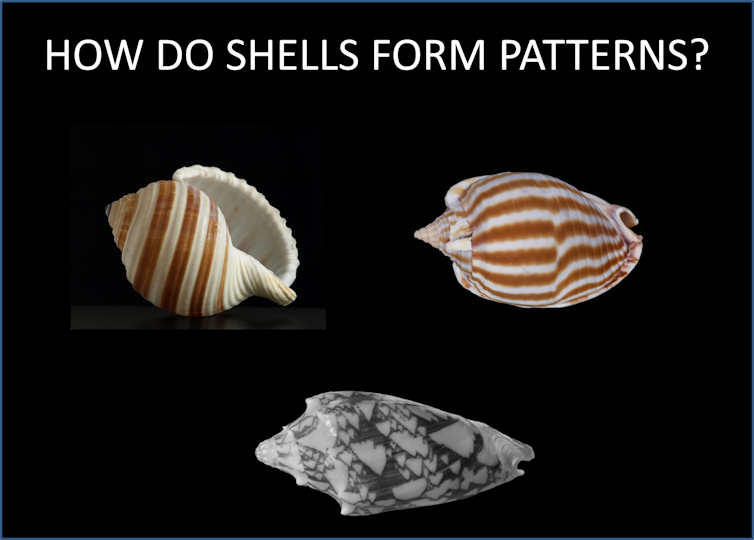 Math exercise for shells can be downloaded at https://www.manilsuri.com/assets/shell_patterns.pptx. Manil Suri, Author provided
Can something that sounds so simplistic make a difference? Based on my years of experience as a mathematician, I believe it can – if nothing else, for the person you talk to. The goal is to stimulate curiosity and convey that mathematics is much more about exhilarating ideas that inform our universe than it is about the school homework-type calculations so many dread.
Raising math awareness is a first step toward making sure people possess the basic math skills required not only for employment, but also to understand math-related issues – such as gerrymandering or climate change – well enough to be an informed and participating citizen. However, it’s not something that can be done in one month.
Given the decline in both math scores and the percentage of students studying math, it may take many years before America realizes the stronger relationship with math that President Reagan’s proclamation called for during the first National Math Awareness Week in 1986.
This article is republished from The Conversation under a Creative Commons license. Read the original article and see more than 250 UMBC articles available in The Conversation.
]]>
Written by Manil Suri, professor of mathematics and statistics, UMBC When President Ronald Reagan proclaimed the first National Math Awareness Week in April 1986, one of the problems he cited...
https://umbc.edu/stories/math-awareness-needed-to-raise-math-readiness/
https://my3.my.umbc.edu/api/v0/pixel/news/132166/guest@my.umbc.edu/efda1e890b49c0d6462271d892092a7d/api/pixel
cnms
discovery
magazine
mathstat
UMBC News & Magazine
https://my3.my.umbc.edu/groups/umbc-news-magazine
https://assets1-my.umbc.edu/system/shared/avatars/groups/000/001/943/24435aa6207c452e7bc15cc74b42c7bb/xsmall.png?1748556657
https://assets1-my.umbc.edu/system/shared/avatars/groups/000/001/943/24435aa6207c452e7bc15cc74b42c7bb/original.png?1748556657
https://assets2-my.umbc.edu/system/shared/avatars/groups/000/001/943/24435aa6207c452e7bc15cc74b42c7bb/xxlarge.png?1748556657
https://assets2-my.umbc.edu/system/shared/avatars/groups/000/001/943/24435aa6207c452e7bc15cc74b42c7bb/xlarge.png?1748556657
https://assets3-my.umbc.edu/system/shared/avatars/groups/000/001/943/24435aa6207c452e7bc15cc74b42c7bb/large.png?1748556657
https://assets1-my.umbc.edu/system/shared/avatars/groups/000/001/943/24435aa6207c452e7bc15cc74b42c7bb/medium.png?1748556657
https://assets2-my.umbc.edu/system/shared/avatars/groups/000/001/943/24435aa6207c452e7bc15cc74b42c7bb/small.png?1748556657
https://assets1-my.umbc.edu/system/shared/avatars/groups/000/001/943/24435aa6207c452e7bc15cc74b42c7bb/xsmall.png?1748556657
https://assets2-my.umbc.edu/system/shared/avatars/groups/000/001/943/24435aa6207c452e7bc15cc74b42c7bb/xxsmall.png?1748556657
UMBC News & Magazine
5
0
false
Fri, 31 Mar 2023 16:59:22 -0400
Fri, 31 Mar 2023 16:59:22 -0400
Pi gets all the fanfare, but other numbers also deserve their own math holidays

Written by Manil Suri, professor of mathematics and statistics, UMBC
March 14 is celebrated as Pi Day because the date, when written as 3/14, matches the start of the decimal expansion 3.14159… of the most famous mathematical constant.
By itself, pi is simply a number, one among countless others between 3 and 4. What makes it famous is that it’s built into every circle you see – circumference equals pi times diameter – not to mention a range of other, unrelated contexts in nature, from the bell curve distribution to general relativity.
The true reason to celebrate Pi Day is that mathematics, which is a purely abstract subject, turns out to describe our universe so well. My book “The Big Bang of Numbers” explores how remarkably hardwired into our reality math is. Perhaps the most striking evidence comes from mathematical constants: those rare numbers, including pi, that break out of the pack by appearing so frequently – and often, unexpectedly – in natural phenomena and related equations, that mathematicians like me exalt them with special names and symbols.
So, what other mathematical constants are worth celebrating? Here are my proposals to start filling out the rest of the calendar.
The Golden Ratio
For January, I nominate the Golden Ratio, phi. Two quantities are said to be in this ratio if dividing the larger by the smaller quantity gives the same answer as dividing the sum of the two quantities by the larger quantity. Phi equals 1.618…, and since there’s no Jan. 61, we could celebrate it on Jan. 6.
First calculated by Euclid, this ratio was popularized by Italian mathematician Luca Pacioli, who wrote a book in 1509 extravagantly extolling its aesthetic properties. Supposedly, Leonardo da Vinci, who drew 60 drawings for this book, incorporated it into the dimensions of Mona Lisa’s features, a choice some claim is responsible for her beauty.
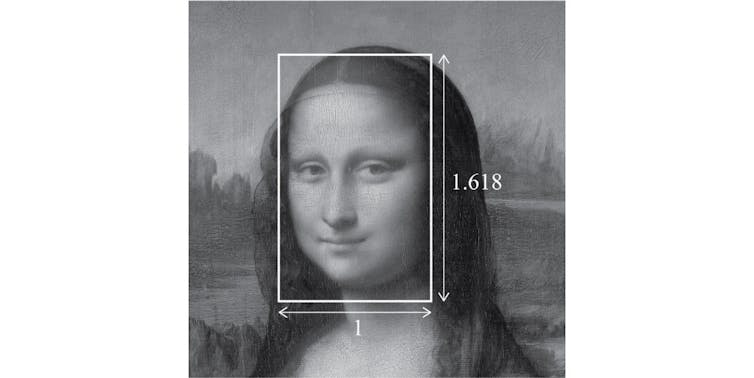 The vertical and horizontal measures of Mona Lisa’s face fit the Golden Ratio. (Image from ‘The Big Bang of Numbers’)
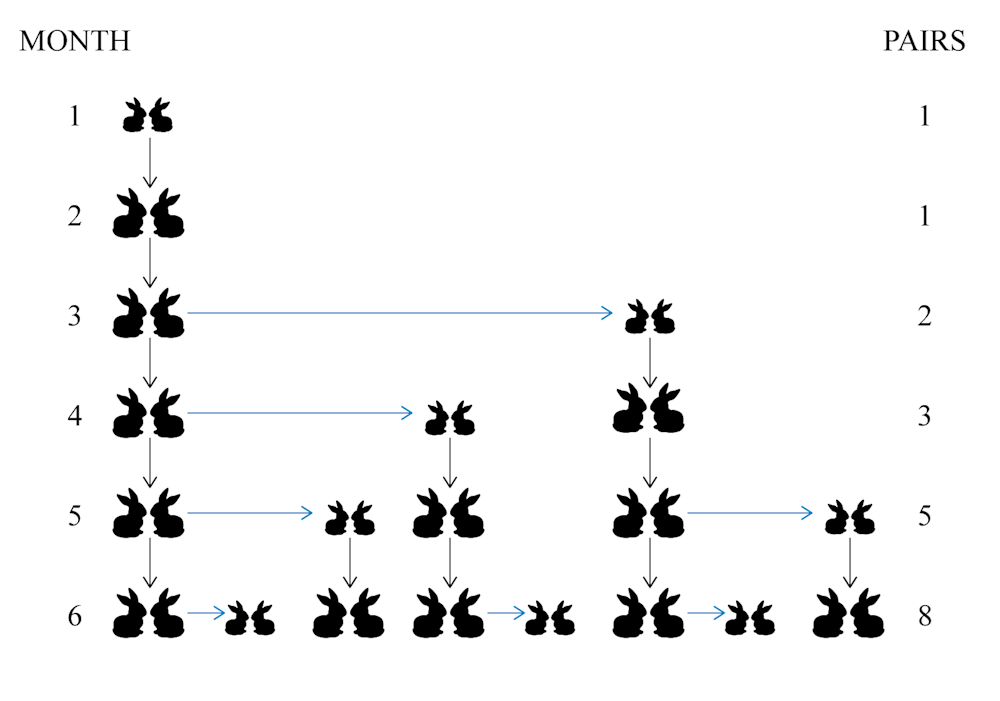
The first inkling that phi occurs in nature came from another Italian, Fibonacci, while studying how rabbits multiply. A common reproductive assumption was that each pair of rabbits begets another pair every month. Start with a single rabbit pair, and successive populations will then follow the sequence 1, 2, 4, 8, 16, 32, 64, 128, 256 and so on – that is, get multiplied by a monthly “growth ratio” of 2.
What Fibonacci observed, though, was that rabbits spent the first cycle reaching sexual maturity and only began reproducing after that. A single pair now gives the new, slower progression 1, 1, 2, 3, 5, 8, 13, 21, 34… instead. This is the famous sequence named after Fibonacci; notice that each population turns out to be the sum of its two predecessors.
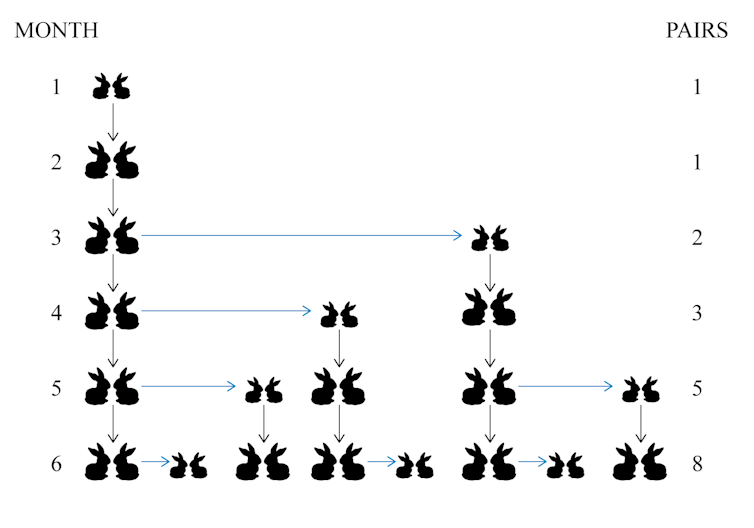 Fibonacci’s rabbits don’t really double their population each generation – their growth ratio actually approaches the 1.618… of phi. (Image from ‘The Big Bang of Numbers’)
How does phi show up amid all these randy rabbits? Well, progressing through the sequence, you see that each number is about 1.6 times the previous one. In fact, this growth ratio keeps getting closer and closer to 1.618…. For instance, 21 equals about 1.615 times 13, and 34 equals about 1.619 times 21. This means the rabbits settle down to reproducing with a growth ratio that is no longer 2, but rather, gets closer and closer to the Golden Ratio.
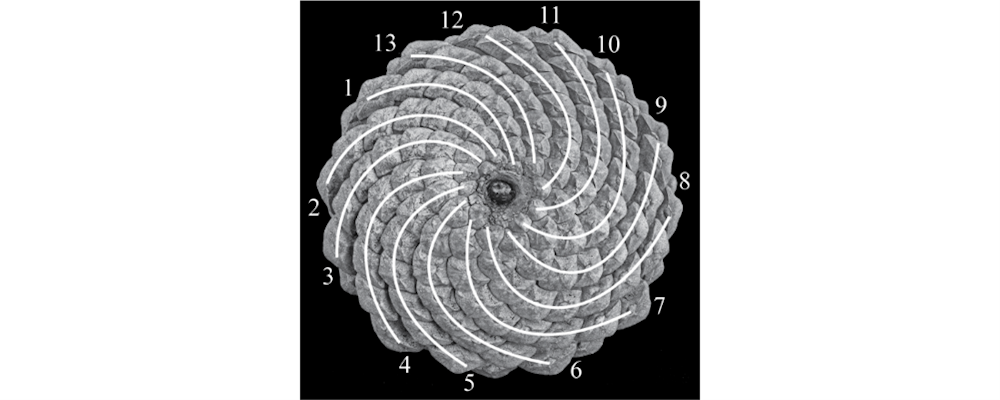
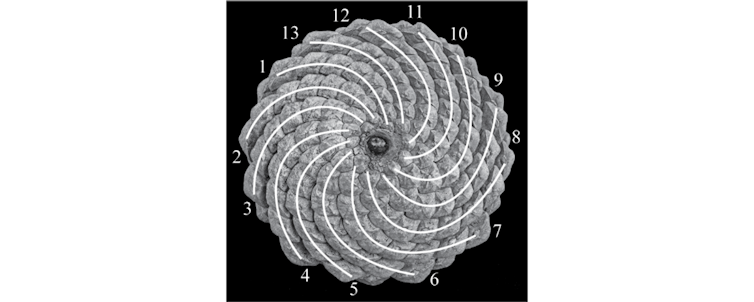 The number of spirals in a pine cone is usually a Fibonacci number. (Image from ‘The Big Bang of Numbers’)
Actual rabbits are unlikely to follow this rule precisely. For one, they have the unfortunate tendency to get eaten by predators. But the Fibonacci numbers – like 5, 8, 13 and so on – show up extensively in nature, like in the number of spirals you might see in a typical pine cone. And yes, phi itself makes a few appearances as well, perhaps most notably in the way leaves arrange themselves around a stem to maximize exposure to sunlight.
The constant ‘e’
February offers another blockbuster constant, Euler’s number e, which has the value 2.718…. So mark next Feb. 7 for the shindig.
To understand e, consider “doubling” growth again, but now in terms of the “population” of dollars in your bank account. By some miracle, your money in this example is earning you 100% interest, compounded each year. Each $1 invested becomes $2 at year’s end.
Suppose, however, the interest is compounded semiannually. Then 50% of the interest is credited midyear, giving you $1.50. You get the remaining 50% interest on this $1.50 at the end of the year, which works out to $0.75, giving you $2.25 ($1.50 + $0.75). So your investment gets multiplied by 2.25, rather than 2.
What if a war broke out between banks, each offering to compound the same 100% interest over shorter and more frequent intervals? Would the sky be the limit in terms of your payout? The answer is no. You could raise your growth ratio from 2 to about 2.718 – more precisely, to e – but no higher. Although you get more frequent credits, they have progressively diminishing returns.
(Table by The Conversation, CC-BY-ND. Source: ‘50 Maths Ideas You Really Need to Know’ by Tony Crilly.)
In the late 17th century, the discovery of calculus led to a quantum leap in people’s ability to grapple with the universe. Math could now analyze anything that changed – which extended its domain to most phenomena in nature. The constant e is famous because of its iconic role in calculus: It turns out to be the most natural growth factor to track change. Consequently, it shows up in laws describing many natural processes – from population growth to radioactive decay. The constant e is a big part of calculus – and turns up in all kinds of natural phenomena.
The constant e is a big part of calculus – and turns up in all kinds of natural phenomena.
Next on our calendar of mathematical constants would come pi, of course, for March. My nominee for April is Feigenbaum’s constant delta, which equals 4.669… and measures how quickly growth processes spin off into chaos.
I’ll wait for my first batch to achieve official holiday status before going any further – happy to consider any candidates you want to nominate.
This article is republished from The Conversation under a Creative Commons license. Read the original article and see more than 250 UMBC articles available in The Conversation.
]]>
Written by Manil Suri, professor of mathematics and statistics, UMBC March 14 is celebrated as Pi Day because the date, when written as 3/14, matches the start of the decimal expansion...
https://umbc.edu/stories/pi-gets-all-the-fanfare-but-other-numbers-also-deserve-their-own-math-holidays/
https://my3.my.umbc.edu/api/v0/pixel/news/131551/guest@my.umbc.edu/d2499dc23a6d0d0c6e520f517bdd825a/api/pixel
cnms
discovery
magazine
mathstat
UMBC News & Magazine
https://my3.my.umbc.edu/groups/umbc-news-magazine
https://assets1-my.umbc.edu/system/shared/avatars/groups/000/001/943/24435aa6207c452e7bc15cc74b42c7bb/xsmall.png?1748556657
https://assets1-my.umbc.edu/system/shared/avatars/groups/000/001/943/24435aa6207c452e7bc15cc74b42c7bb/original.png?1748556657
https://assets2-my.umbc.edu/system/shared/avatars/groups/000/001/943/24435aa6207c452e7bc15cc74b42c7bb/xxlarge.png?1748556657
https://assets2-my.umbc.edu/system/shared/avatars/groups/000/001/943/24435aa6207c452e7bc15cc74b42c7bb/xlarge.png?1748556657
https://assets3-my.umbc.edu/system/shared/avatars/groups/000/001/943/24435aa6207c452e7bc15cc74b42c7bb/large.png?1748556657
https://assets1-my.umbc.edu/system/shared/avatars/groups/000/001/943/24435aa6207c452e7bc15cc74b42c7bb/medium.png?1748556657
https://assets2-my.umbc.edu/system/shared/avatars/groups/000/001/943/24435aa6207c452e7bc15cc74b42c7bb/small.png?1748556657
https://assets1-my.umbc.edu/system/shared/avatars/groups/000/001/943/24435aa6207c452e7bc15cc74b42c7bb/xsmall.png?1748556657
https://assets2-my.umbc.edu/system/shared/avatars/groups/000/001/943/24435aa6207c452e7bc15cc74b42c7bb/xxsmall.png?1748556657
UMBC News & Magazine
1
0
false
Wed, 08 Mar 2023 12:31:42 -0500
Wed, 08 Mar 2023 12:31:42 -0500
Getting Your Research Off the Ground—Balloons Give Students New Perspectives

On a brisk but clear day in early December, half a dozen brightly colored weather balloons barely squeeze through the double doors of Sondheim Hall’s lower level one by one.
A group of four or five students handles each balloon, proceeding to the quad in front of the Interdisciplinary Life Sciences Building in a makeshift parade. A red balloon rises aloft as a demonstration, and then the remaining groups fan out across campus to follow suit. By 9:30 a.m., anyone walking across campus can see colorful dots hundreds of feet high, tethered by ropes that each end at a student on the ground.
This is the peak experience of GES 286, “Exploring the Environment: A Geospatial Perspective.” The course is structured around various data gathering projects, explains Charles Kaylor, the instructor and director of GIS (geographic information systems) and cartography labs in the department of geography and environmental systems (GES). “We use the campus as a laboratory,” he says.
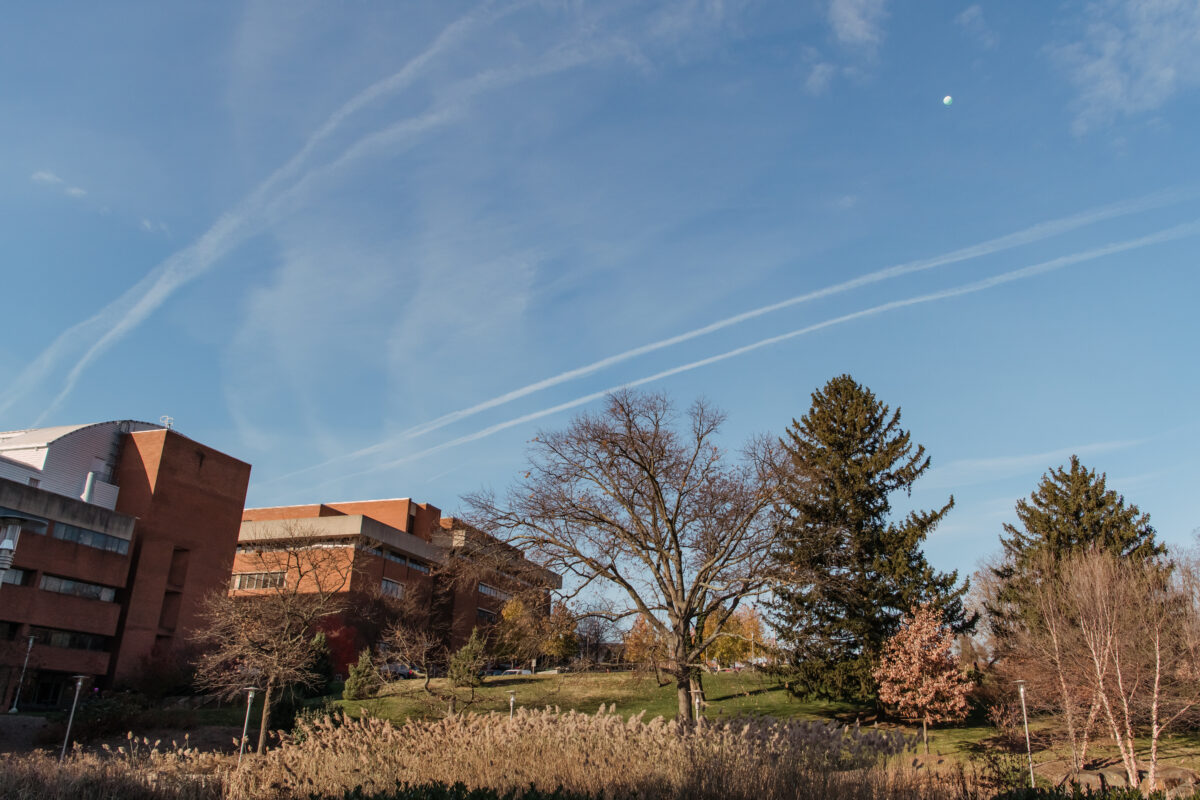
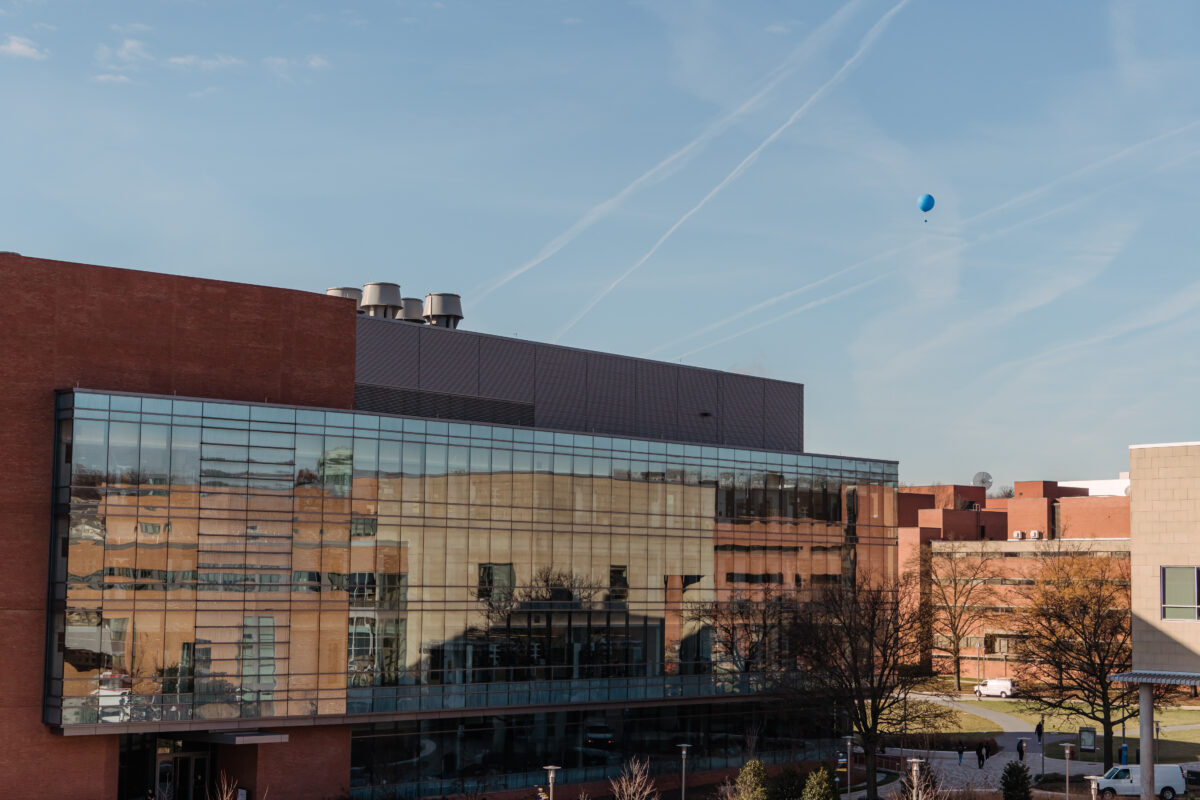
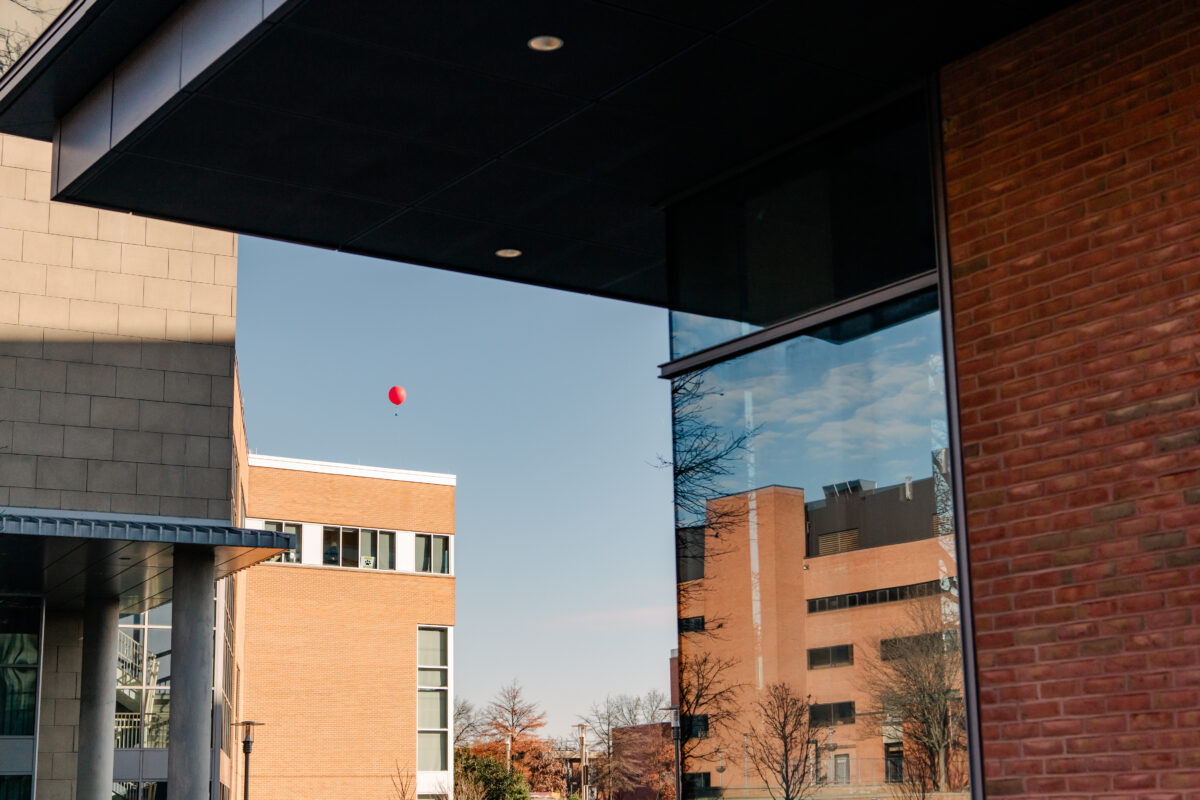
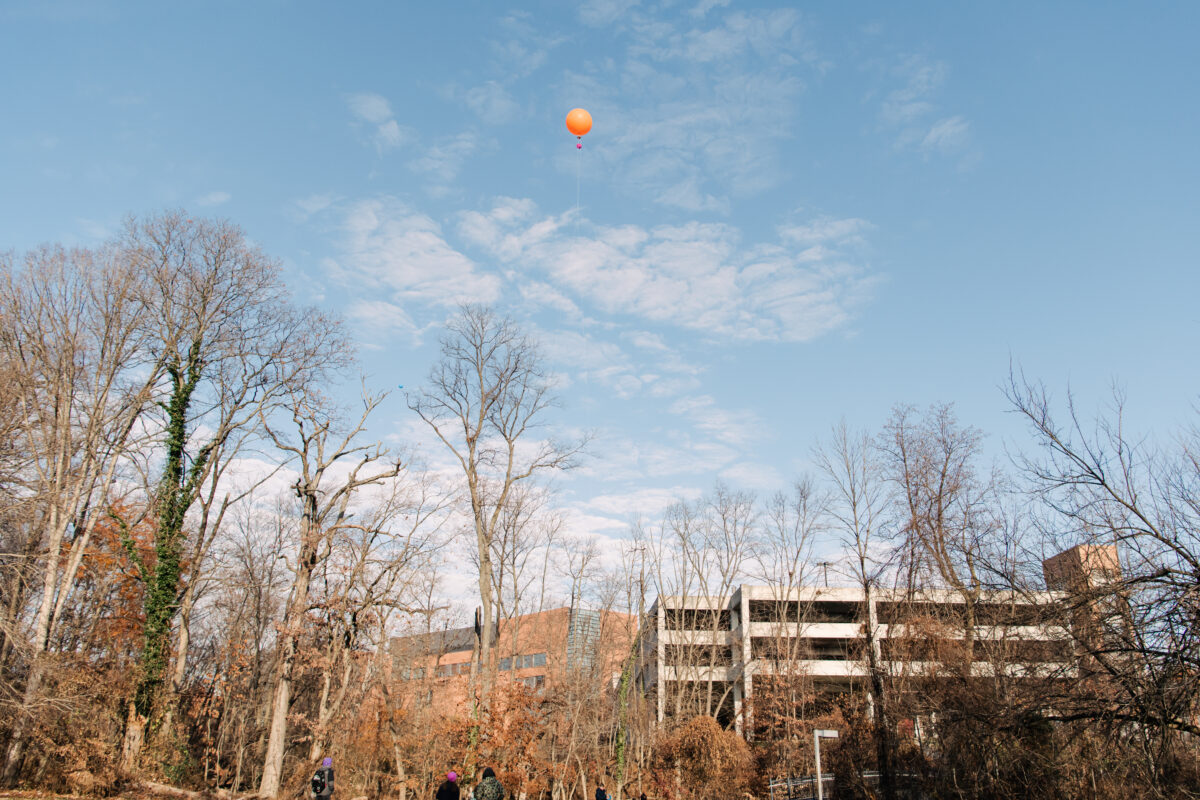
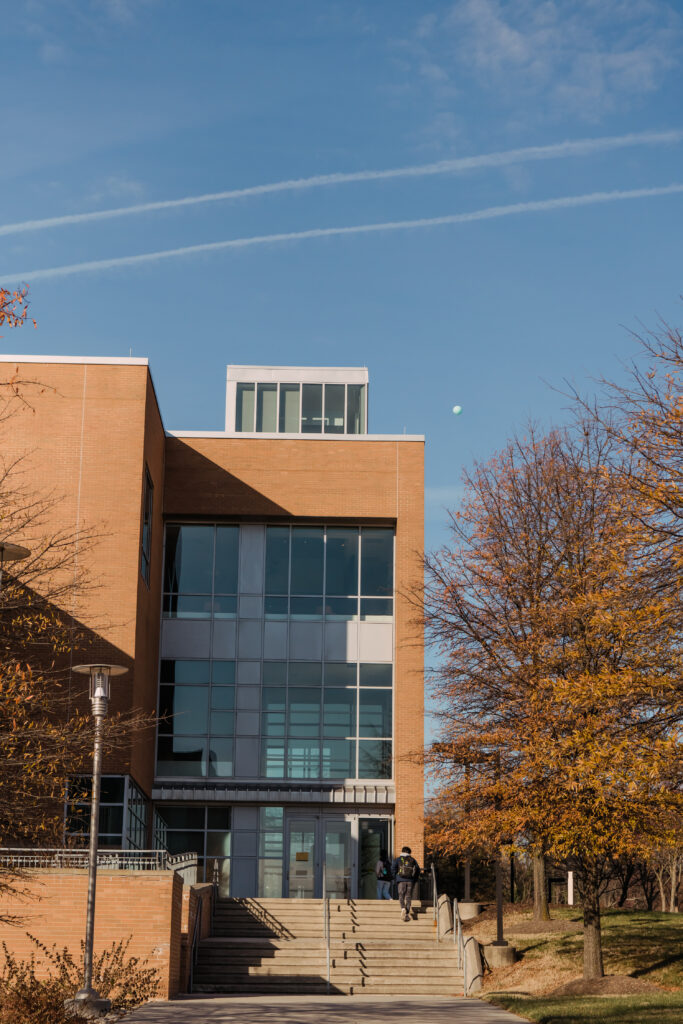
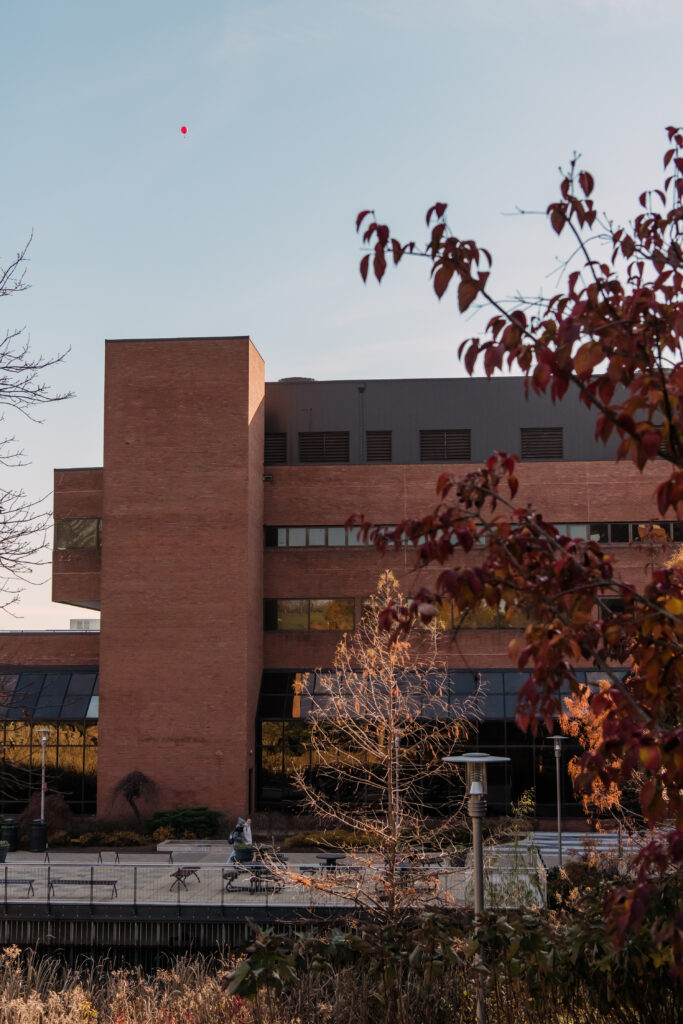 On “balloon day,” the balloons are visible from all over campus. (Marlayna Demond ’11/UMBC)
“Where are we?”
Kaylor opens the first class with a deceptively simple question: “Where are we, and how do we know that?” After beginning with a basic orienteering activity (no smartphones allowed!), the course advances through the surprisingly complex answer to Kaylor’s question, which leads students to develop skills in statistics, data analysis, and various software programs. They also pick up knowledge in disciplines like ecology, sociology, and hydrology.
Given its interdisciplinary bent, the course attracts students from a range of majors, most often those in the GES department (like environmental science) and computer science. With a background in GIS and environmental education, Kaylor is a perfect fit to teach the course to this mixed audience.
At the beginning of the semester, “computer science students will understand that it’s data science-driven. GES students will understand the hands-on sciences,” Kaylor says. By the end, “they’ll meet in the middle. It’s actually a really interesting blend of students to work with, and it’s fun to see how their strengths play off each other.”
Learning in real time
But back to the balloons. Each balloon flies with a digital camera attached, pointed at the ground. Previous students in the course coded a hack into the cameras that commands them to take a picture every 15 seconds as they float above campus.
Far below, students lay what look like paper archery targets flat on the ground and record their precise coordinates using GPS. These targets will show up in the photos taken by the camera on the balloon. Using the targets as reference points, the students will then be able to “geolocate” (tie to a point on the Earth’s surface) other objects—like buildings, trees, even people—in the camera’s photos.
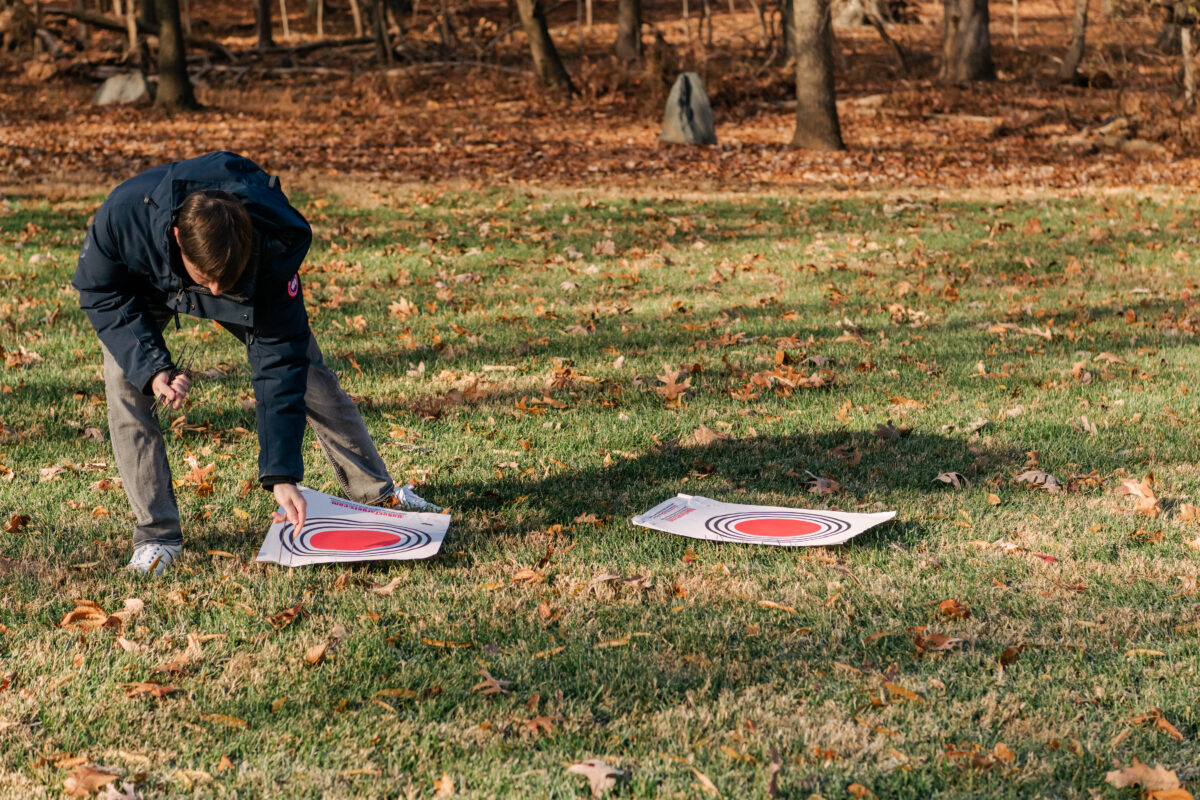 Matthew Parsons, computer science, sets reference targets on the ground. (Marlayna Demond ’11/UMBC)
Kaylor creates a blank digital map at the start of the morning to record the coordinates. “It’s fun to watch in the lab while students are out in the field doing it,” Kaylor says, “because it starts blooming. You see students adding points in real time.”
In what other class…
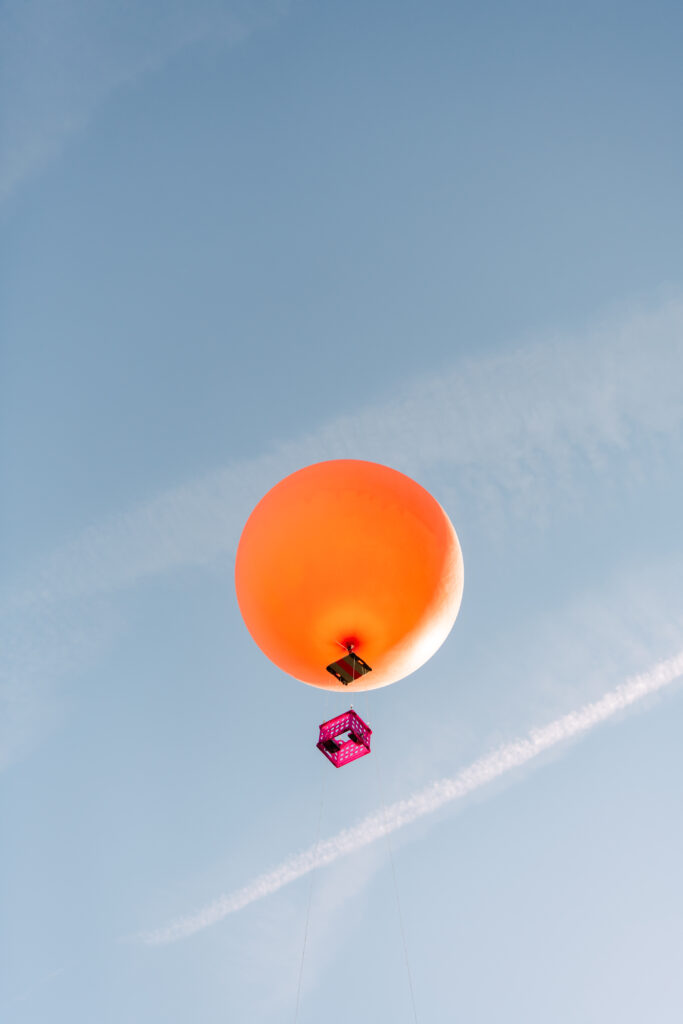 A pink crate dangling from the bottom of a balloon holds a small digital camera horizontal as the balloon flies. (Marlayna Demond ’11/UMBC)
The balloons have been a mystery to much of the campus community for years, with the colorful orbs dotting the campus sky in the tenth week of the semester. But for the students in Kaylor’s class, the balloons represent a culmination of the knowledge and skills they’ve gained.
Each student has their own reasons for taking the course. For some, it’s an opportunity to learn GIS skills—a must in the environmental field today—without spending too much time in front of a computer. As Kamsy Nwaiwau ’23, geography and environmental systems, puts it, “What other class do you get to hold a balloon 450 feet in the air? It’s something different.”
Whereas Alex Flitter ’23, mathematics and computer science, has a different perspective. He’s conducting research with Bedřich Sousedik, associate professor of mathematics, on how to model disease spread using ArcGIS—the same tool the students are using to locate points on the ground. GES 286 is “adding to my ability to visualize my research,” he says.
Learning openness
The course integrates a range of activities to get students thinking about how they could apply GIS to many fields of study. For one assignment, the students explore their own neighborhoods and mark the location of different businesses, like restaurants, pharmacies, and retail shops, and other neighborhood elements, like parks or bus stops. Then they use available data sets to see if they can identify associations with other neighborhood factors, like median income or education level.
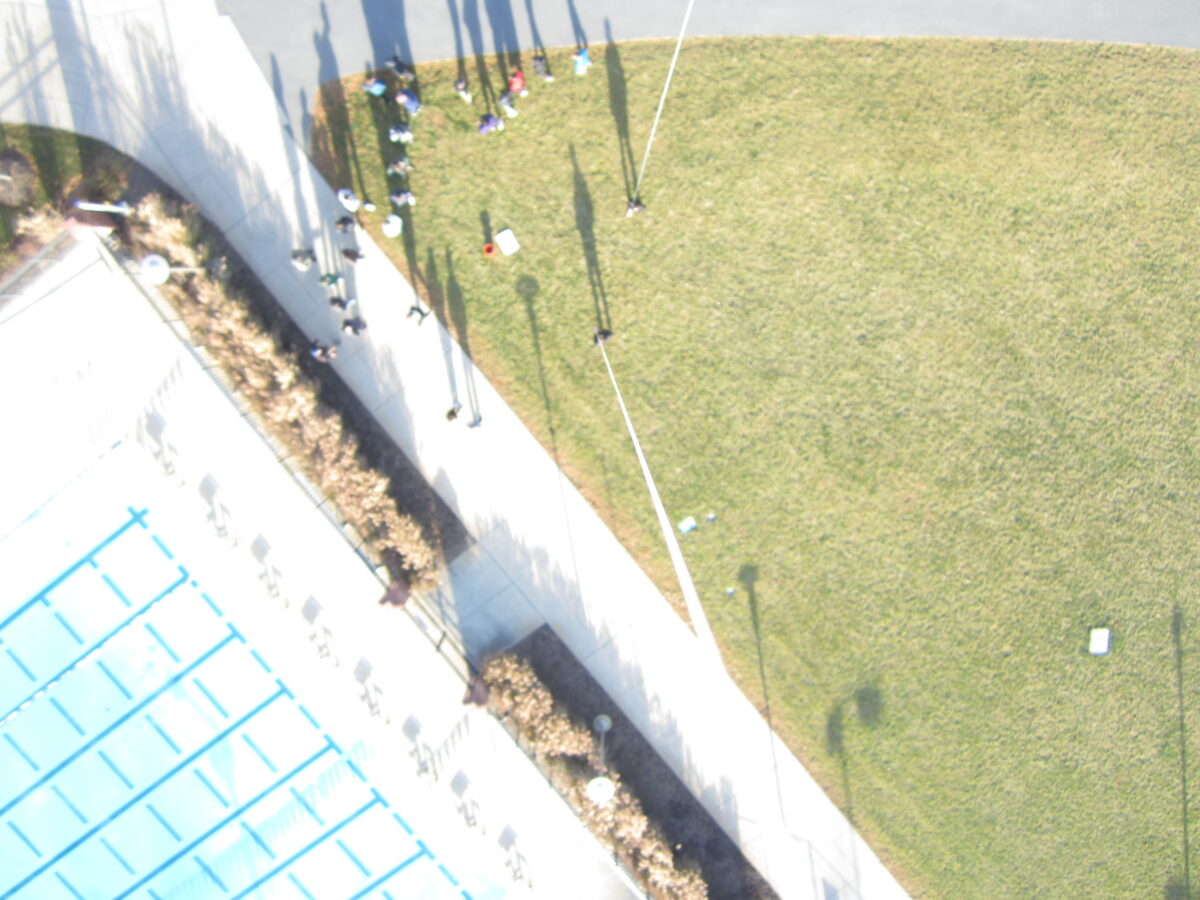
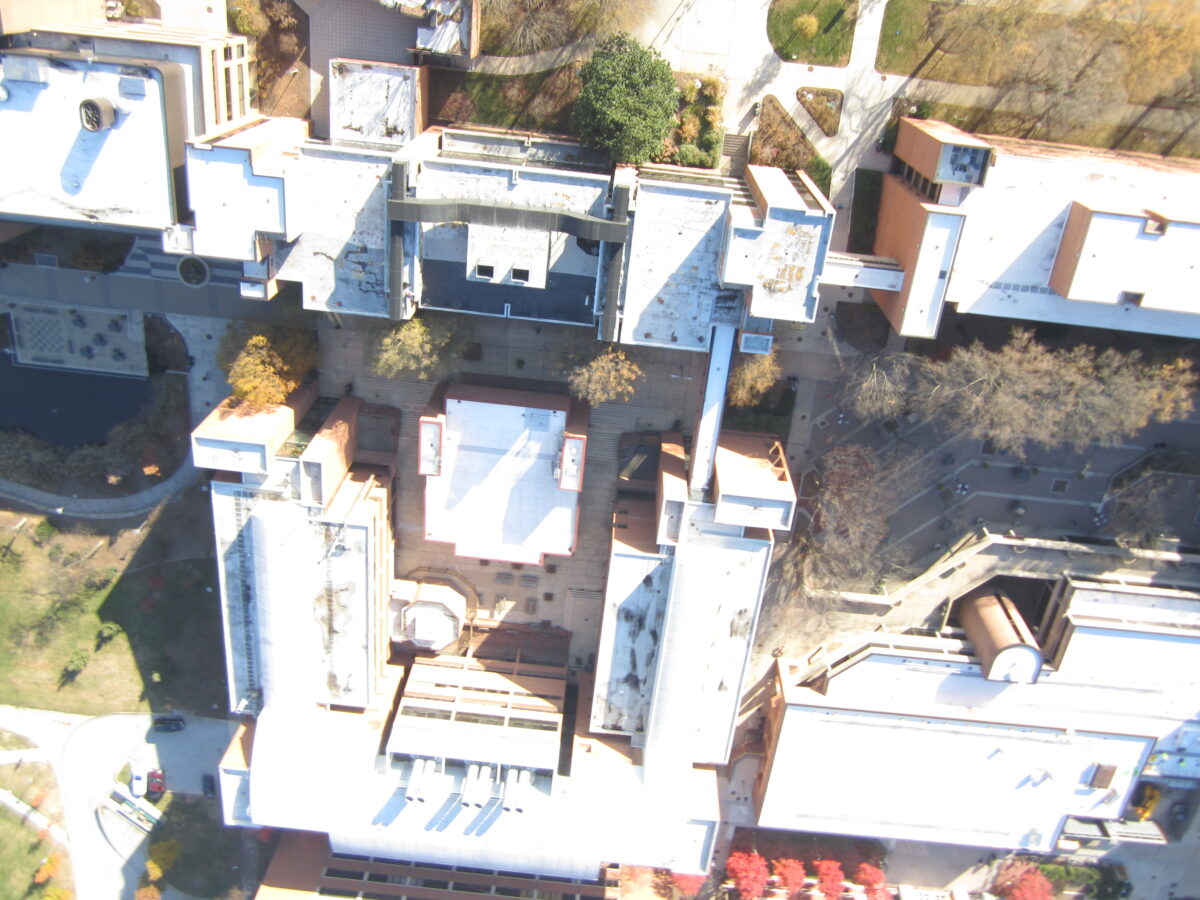
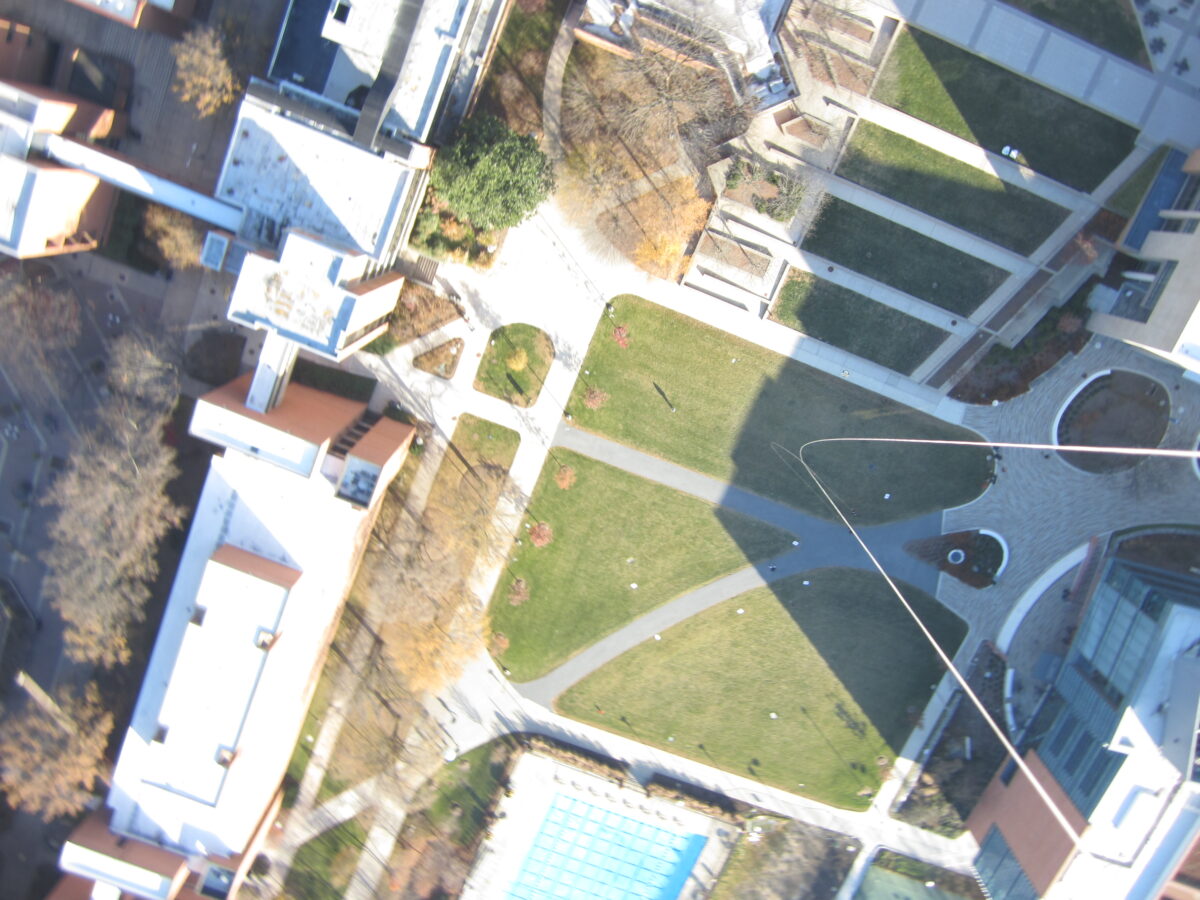 Images captured by one of the balloons. At left, the class gathers to observe the first balloon launch of the morning. (Images courtesy of Charles Kaylor)
This project “gets at the scientific process,” Kaylor says. He tells his students, “Any time a data set floats by, take a look at it and go, ‘What questions could I ask with this data?’ It’s a certain mode of openness.” Each in their own time, students get the idea. “What I love about GIS is—and you can count on it—any student who tries is going to have a GIS epiphany and start figuring things out,” Kaylor says, “and because it’s so applied and so tangible, it’s captivating.”
Making it real
This is Kaylor’s second time teaching the course after coming to UMBC from Temple University. He inherited the course backbone from Joe School, emeritus professor of GES, who still teaches the course in the summer. Kaylor has already made substantial changes, but has more in mind. One major goal is to create more opportunities for the students’ efforts to connect to real research projects.
“What I love about GIS is—and you can count on it—any student who tries is going to have a GIS epiphany and start figuring things out. And because it’s so applied and so tangible, it’s captivating.”
Charles Kaylor
Kaylor has already launched a collaboration with Facilities Management at UMBC to compare the latest data set of campus trees to the reality on the ground. So far, the students have checked about 10 percent of the listed trees, and Kaylor plans to add more each semester.
“I’m hoping to integrate more things like that, that have an obvious practical application or benefit to campus,” Kaylor says. “Since we’re measuring things on campus, we might as well see what we can do with that.” For example, Kaylor has discussed with Matthew Baker, professor of geography and environmental systems, how his students might be able to support Baker’s environmental monitoring work on campus.
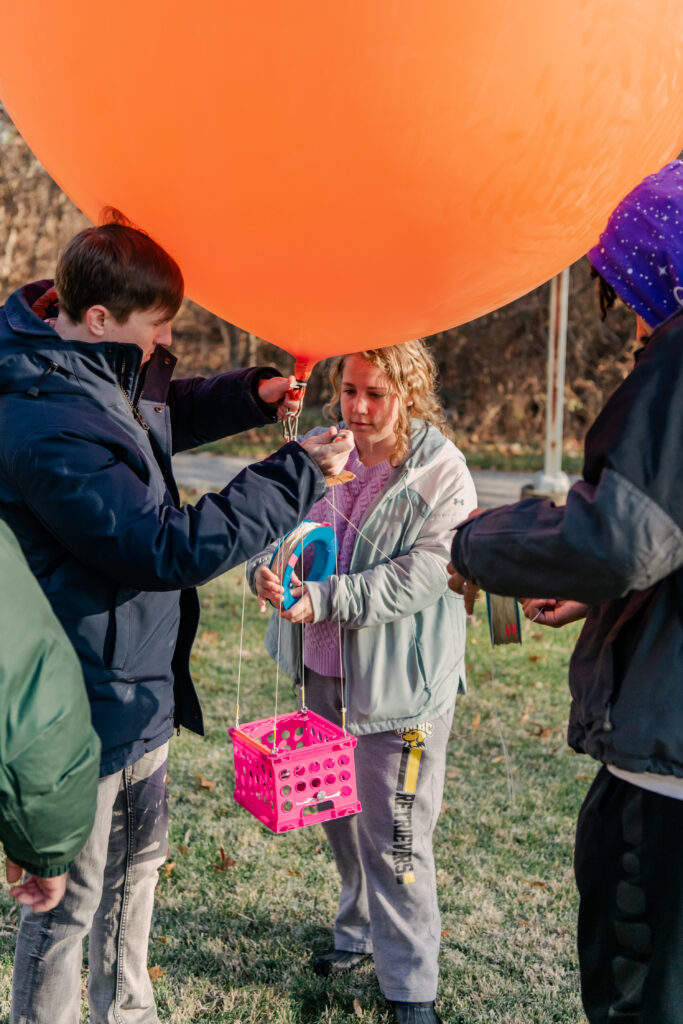 Matthew Parsons, computer science, Olivia Amaral, computer science, and Langston Smith, GES, attach the camera to their balloon and prepare for launch. (Marlayna Demond ’11/UMBC)
No matter what direction they go—whether epidemiology, ecology, or other fields—students who complete GES 286 will be better prepared to ask and answer useful questions about the world around them.
Teaching the class has been a rewarding experience for Kaylor as an instructor, too. The course “reconnected me with something that makes [GIS] live and breathe in a different way—a more exciting way,” he says. “Taking a more applied approach to it is a fun challenge. I’ve been having a great time teaching this class.”
Geography applies to everything
Finally, it’s time for the balloons to come down. As the students are wrangling them down and heading back to Sondheim Hall for a debrief, Joey Laiosa ’23, environmental science, shares that he previously worked in public safety as a dispatcher, then came back to school. He’s interested in conservation ecology, and using remote sensing to measure environmental health has particularly caught his attention.
“GIS is a really sought-after skill to have in a range of industries,” he says. That includes public safety, Laiosa says, where it could involve better pinpointing the location of an emergency in a complex environment like a construction site or an amusement park. “Geography applies to everything.”
Learn more about undergraduate research opportunities at UMBC.
]]>
On a brisk but clear day in early December, half a dozen brightly colored weather balloons barely squeeze through the double doors of Sondheim Hall’s lower level one by one. A group of four...
https://umbc.edu/stories/getting-your-research-off-the-ground-gis-balloons/
https://my3.my.umbc.edu/api/v0/pixel/news/130542/guest@my.umbc.edu/7b6e1b2bd1fb1d7c780b2953ccfd4562/api/pixel
cahss
cnms
coeit
csee
discovery
ges
magazine
mathstat
UMBC News & Magazine
https://my3.my.umbc.edu/groups/umbc-news-magazine
https://assets1-my.umbc.edu/system/shared/avatars/groups/000/001/943/24435aa6207c452e7bc15cc74b42c7bb/xsmall.png?1748556657
https://assets1-my.umbc.edu/system/shared/avatars/groups/000/001/943/24435aa6207c452e7bc15cc74b42c7bb/original.png?1748556657
https://assets2-my.umbc.edu/system/shared/avatars/groups/000/001/943/24435aa6207c452e7bc15cc74b42c7bb/xxlarge.png?1748556657
https://assets2-my.umbc.edu/system/shared/avatars/groups/000/001/943/24435aa6207c452e7bc15cc74b42c7bb/xlarge.png?1748556657
https://assets3-my.umbc.edu/system/shared/avatars/groups/000/001/943/24435aa6207c452e7bc15cc74b42c7bb/large.png?1748556657
https://assets1-my.umbc.edu/system/shared/avatars/groups/000/001/943/24435aa6207c452e7bc15cc74b42c7bb/medium.png?1748556657
https://assets2-my.umbc.edu/system/shared/avatars/groups/000/001/943/24435aa6207c452e7bc15cc74b42c7bb/small.png?1748556657
https://assets1-my.umbc.edu/system/shared/avatars/groups/000/001/943/24435aa6207c452e7bc15cc74b42c7bb/xsmall.png?1748556657
https://assets2-my.umbc.edu/system/shared/avatars/groups/000/001/943/24435aa6207c452e7bc15cc74b42c7bb/xxsmall.png?1748556657
UMBC News & Magazine
2
0
false
Wed, 01 Feb 2023 11:11:15 -0500
Wed, 01 Feb 2023 11:11:15 -0500
Manil Suri’s new book, “The Big Bang of Numbers,” introduces readers to the wonder of math

It’s rare to meet a mathematician who is also a bestselling novelist, but UMBC’s Manil Suri, professor of mathematics, is happy to be unique. Suri is the author of a famed trilogy named for Hindu gods, including The Death of Vishnu (2001), which was long-listed for the Booker Prize, The Age of Shiva (2008), and The City of Devi (2013). He recently published his latest book, The Big Bang of Numbers: How to Build the Universe Using Only Math, to global acclaim.
The Big Bang of Numbers is Suri’s first nonfiction book, written to show people who aren’t necessarily fond of math that the discipline is foundational to our world—and can even be fun.
“The concept is intriguing, if hard to get your head around: Can you understand the creation of the universe purely through basic mathematics?” writes The Washingtonian. Suri’s answer with The Big Bang of Numbers is a resounding ‘yes.’ The book “explores many areas of seemingly pure math that explain the natural world, from the shapes of galaxies and living creatures to weather, gravity, beauty, and even art,” Kirkus Reviewswrites.
In his role as math professor, Suri works hard to convince his students that math doesn’t just matter, it is also endlessly interesting—extending his instruction well beyond the basics of calculations and into the field’s fundamental ideas.
“All your life, you keep hearing that maths is all about calculations,” Suri told Telegraph India, “while in essence, maths is all about ideas.” Suri first expounded on this theme in a 2013 New York Times op-ed, “How to Fall in Love with Math.” When the op-ed became shockingly popular, the idea for a book grew from there.
Manil Suri speaks about The Big Bang of Numbers at a special event to mark the book’s publication and success on November 14 at UMBC’s Albin O. Kuhn Library & Gallery.
A new challenge
With The Big Bang of Numbers, which the Wall Street Journal has called “imaginative and organized,” Suri isn’t just seeking to help a wider audience understand or feel comfortable with math, but feel a sense of fascination with it. According to the Mathematical Association of America, Suri’s approach—rich in humor and narrative elements—goes beyond “simply telling the reader about these ideas”; instead, he “allow[s] readers to experience the attitude of curious exploration that attracts mathematicians to the discipline, but is often absent from low-level math classes.”
“With evocative and engaging examples ranging from multidimensional crochet to the Mona Lisa’s asymmetrical smile, as well as ingenious storytelling that helps illuminate complex concepts like infinity and relativity, The Big Bang of Numbers charts a playful, inventive course to existence,” writes the Deccan Herald, which named the book its “read of the week” in mid-October.
For Suri, while the book was very different in some ways from his previous works of fiction, The Big Bang of Numbers hews closely to his style that relies on humor and engaging narrative to draw the reader into unfamiliar topics. His novels all take place in India, a place that feels far away and unknown to many of his readers. “After explaining India in three internationally released books to many readers who didn’t know much about the country, I was ready to take on an even bigger challenge,” he told Frontline, a major English-language magazine in India, “—explaining mathematics to a general audience!”
Manil Suri speaks at GRIT-X, an event during UMBC’s Homecoming festivities, in 2018.
Math as a game
“Usually math is thought of as something that we invent, perhaps, to explain things around us. I’m kind of reversing this perspective and saying that math is the true driver of the universe, and the universe itself is a model of the mathematical principles,” Suri recently told NPR’s Marketplace.
Put another way, the Sunday Times of London explains the central thesis of the book is that “maths, the creative language in which reality is written, is ‘the life force that drives the universe,’ and you could build one—stars, worlds, you and me—from scratch using maths alone.” The review notes, “It sounds intimidating, but Suri has a knack for clarity and a welcome habit of grounding tricky concepts in the tangible.”
In the end, according to Suri’s book, math is a “force that forever enthralls, not just through the answers it gives but also through the new mysteries it poses.” But he hopes his readers will also understand math as a game.
“For mathematicians, I suspect the most appealing characteristic of the subject is its playfulness,” Suri told Frontline. “Maths is a game in which you start with a bunch of rules and then deduce away to see where you can get. You can play it anywhere—in the shower, on the bus, while eating lunch—all you need is your mind.”
]]>
It’s rare to meet a mathematician who is also a bestselling novelist, but UMBC’s Manil Suri, professor of mathematics, is happy to be unique. Suri is the author of a famed trilogy named for Hindu...
https://umbc.edu/stories/the-big-bang-of-numbers/
https://my3.my.umbc.edu/api/v0/pixel/news/130097/guest@my.umbc.edu/16dad0e299dce213100136c2d82a5735/api/pixel
cnms
mathstat
news
science-and-tech
UMBC News & Magazine
https://my3.my.umbc.edu/groups/umbc-news-magazine
https://assets1-my.umbc.edu/system/shared/avatars/groups/000/001/943/24435aa6207c452e7bc15cc74b42c7bb/xsmall.png?1748556657
https://assets1-my.umbc.edu/system/shared/avatars/groups/000/001/943/24435aa6207c452e7bc15cc74b42c7bb/original.png?1748556657
https://assets2-my.umbc.edu/system/shared/avatars/groups/000/001/943/24435aa6207c452e7bc15cc74b42c7bb/xxlarge.png?1748556657
https://assets2-my.umbc.edu/system/shared/avatars/groups/000/001/943/24435aa6207c452e7bc15cc74b42c7bb/xlarge.png?1748556657
https://assets3-my.umbc.edu/system/shared/avatars/groups/000/001/943/24435aa6207c452e7bc15cc74b42c7bb/large.png?1748556657
https://assets1-my.umbc.edu/system/shared/avatars/groups/000/001/943/24435aa6207c452e7bc15cc74b42c7bb/medium.png?1748556657
https://assets2-my.umbc.edu/system/shared/avatars/groups/000/001/943/24435aa6207c452e7bc15cc74b42c7bb/small.png?1748556657
https://assets1-my.umbc.edu/system/shared/avatars/groups/000/001/943/24435aa6207c452e7bc15cc74b42c7bb/xsmall.png?1748556657
https://assets2-my.umbc.edu/system/shared/avatars/groups/000/001/943/24435aa6207c452e7bc15cc74b42c7bb/xxsmall.png?1748556657
UMBC News & Magazine
6
0
false
Fri, 06 Jan 2023 15:52:34 -0500
Fri, 06 Jan 2023 15:52:34 -0500