UMBC teams up with disability advocacy organization on Kinetic Sculpture Race—and wins best art award
On a pleasant Saturday in early May, nearly 30 teams gathered in Baltimore to pedal elaborate all-terrain sculptures 15 miles through a course featuring pavement, water, sand, and mud. The 25th year of the Kinetic Sculpture Race, organized by the American Visionary Art Museum, brought out Baltimore residents to cheer on the wacky sculptures, such as a kilt-wearing platypus and a BLT sandwich, and their human pedalers. This year UMBC, which has regularly gathered a team to compete in the race, partnered with The IMAGE Center of Maryland, a non-profit organization dedicated to “new thinking about disability,” to build and race a sculpture named IMAGE Man. The larger-than-life teal superhero sits in a wheelchair and wears an orange cape—The IMAGE Center’s branded colors. With football in hand, he flies over some of Baltimore’s iconic buildings, such as the Bromo Seltzer Arts Tower and the Baltimore World Trade Center.
IMAGE Man successfully navigated the hazardous terrain of the race—including a floating lap around a dock in the Baltimore Harbor—and was also recognized with a best art award, a category that, according to the race organizers “includes consideration of color, costumes, two and three dimensional ‘artistic designs,’ kinetic motion, humor, theatrical appeal, and mass crowd- and media glory-seeking.” The team also won second place in the overall standings.
 Mechanical engineer Jasmine Pearcy, a volunteer with a program from The IMAGE Center called Volunteers for Medical Engineering, paints part of the sculpture. (Image courtesy of the VME Collection)
It took many months, and hundreds of volunteer hours, to bring the kinetic sculpture to life from foam, wood and paint and mount it on a recycled quadricycle in a workspace at the 900 Walker Ave building on the UMBC campus. Volunteers from UMBC pitched in alongside partners from Volunteers for Medical Engineering (VME) Program Services, a part of The IMAGE Center that provides innovative custom devices to empower people with disabilities to live life more fully.
 UMBC student Dulcey Comeau breaks out the power tools. (Image courtesy of the VME collection)
The partnership between The IMAGE Center and UMBC on the Kinetic Sculpture Race was a spinoff of a long-term collaboration, says Angela Tyler, the director of VME. In that partnership, UMBC engineering students collaborate with VME to design and build the custom devices. Many graduating students return to volunteer on other VME projects. This year, four UMBC mechanical engineering students participated in a project to design and build a fishing rod holder and casting device for a disabled client. All four also volunteered their time on the kinetic sculpture project.
Alex Brunkhorst was one of those students. He participated in the race as a member of the pit crew, pedaling alongside the sculpture and offering technical (and emotional) support as needed. “The race was a lot of fun and challenged all of us physically, mentally, and mechanically,” he says. “We did run into some difficulty with our kinetic sculpture’s braking system, but with some quick thinking and a little luck, the pit crew was able to rig something together and keep IMAGE Man in the race.”
Tyler says the collaboration for this year’s race was a win-win. “We’d like to thank UMBC for providing the space, thanks to UMBC faculty Steve McAlpine and Dr. Jamie Gurganus for help leading the volunteer team, and many thanks to all the volunteers! It was a natural fit, and a great partnership.”
Gurganus, who has nurtured the partnership with VME for many years, says the expansion of the collaboration to the Kinetic Sculpture Race this year made the race-day experience much more than just a fun and wacky day. “The race became a moving stage to amplify VME’s mission, and their presence was unforgettable,” she says. “It became a celebration of purpose, empathy, and community.”
]]>
On a pleasant Saturday in early May, nearly 30 teams gathered in Baltimore to pedal elaborate all-terrain sculptures 15 miles through a course featuring pavement, water, sand, and mud. The 25th...
https://umbc.edu/stories/kinetic-sculpture-race-25/
https://my3.my.umbc.edu/api/v0/pixel/news/150461/guest@my.umbc.edu/072bbda338846cd50661d82c646f15b1/api/pixel
coeit
community
inds
meche
news
story
UMBC News & Magazine
https://my3.my.umbc.edu/groups/umbc-news-magazine
https://assets1-my.umbc.edu/system/shared/avatars/groups/000/001/943/24435aa6207c452e7bc15cc74b42c7bb/xsmall.png?1748556657
https://assets1-my.umbc.edu/system/shared/avatars/groups/000/001/943/24435aa6207c452e7bc15cc74b42c7bb/original.png?1748556657
https://assets2-my.umbc.edu/system/shared/avatars/groups/000/001/943/24435aa6207c452e7bc15cc74b42c7bb/xxlarge.png?1748556657
https://assets2-my.umbc.edu/system/shared/avatars/groups/000/001/943/24435aa6207c452e7bc15cc74b42c7bb/xlarge.png?1748556657
https://assets3-my.umbc.edu/system/shared/avatars/groups/000/001/943/24435aa6207c452e7bc15cc74b42c7bb/large.png?1748556657
https://assets1-my.umbc.edu/system/shared/avatars/groups/000/001/943/24435aa6207c452e7bc15cc74b42c7bb/medium.png?1748556657
https://assets2-my.umbc.edu/system/shared/avatars/groups/000/001/943/24435aa6207c452e7bc15cc74b42c7bb/small.png?1748556657
https://assets1-my.umbc.edu/system/shared/avatars/groups/000/001/943/24435aa6207c452e7bc15cc74b42c7bb/xsmall.png?1748556657
https://assets2-my.umbc.edu/system/shared/avatars/groups/000/001/943/24435aa6207c452e7bc15cc74b42c7bb/xxsmall.png?1748556657
UMBC News & Magazine
4
0
false
Thu, 29 May 2025 10:58:02 -0400
Thu, 29 May 2025 10:58:02 -0400
Research days foster collaboration and showcase research across the College of Engineering and Information Technology
A dynamic research ecosystem was on display in a series of events showcasing existing projects and encouraging new collaborations across the College of Engineering and Information Technology (COEIT) this spring.
On April 11, the second annual COEIT Research Day brought together more than 180 students and faculty from COEIT’s four academic departments, as well as outside speakers and visitors. Attendance increased by around 20 percent from last year’s inaugural Research Day.
More than 100 researchers presented either talks or posters at the meeting, and several students won awards for their posters and were recognized at the COEIT Awards and Celebration event on May 4.
“A major success of this year’s Research Day was the presence of visitors and speakers from industry, nonprofits, and government,” says Vandana Janeja, the associate dean for research in COEIT. “The event gave these guests an opportunity to visit UMBC and to engage in the vibrant research happening within COEIT, making connections with our research community that we hope to see grow into long-lasting partnerships.”
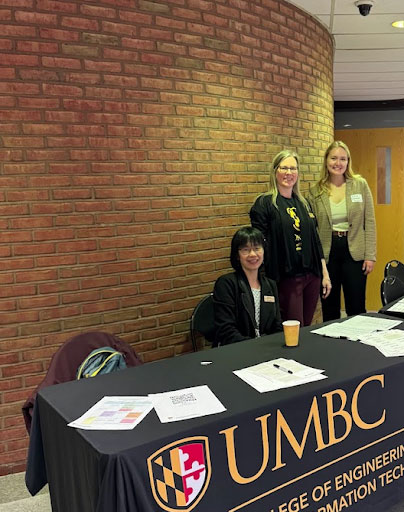 COEIT dean’s office staff Emily Tien, Amy Heckhaus, and Chloe Evered at COEIT Research Day. (Image courtesy of Vandana Janeja)
The college also launched a new call for COEIT Interdisciplinary Proposals. Last year, COEIT funded 11 projects from teams made up of researchers from two or more academic departments. The teams presented their results at this year’s event, on topics ranging from cybersecurity in manufacturing to thermally stable energy-harvesting materials.
On May 2, the Department of Computer Science and Electrical Engineering also hosted its annual research day, bringing together faculty, staff, and students to highlight the department’s latest advancements in research, from robotics to AI weather forecasting.
]]>
A dynamic research ecosystem was on display in a series of events showcasing existing projects and encouraging new collaborations across the College of Engineering and Information Technology...
https://umbc.edu/quick-posts/coeit-research-days/
https://my3.my.umbc.edu/api/v0/pixel/news/150553/guest@my.umbc.edu/2dabfa0e25e152f93f40d0b49805aa6b/api/pixel
cbee
coeit
csee
is
meche
news
quick-post
research
science-and-tech
UMBC News & Magazine
https://my3.my.umbc.edu/groups/umbc-news-magazine
https://assets1-my.umbc.edu/system/shared/avatars/groups/000/001/943/24435aa6207c452e7bc15cc74b42c7bb/xsmall.png?1748556657
https://assets1-my.umbc.edu/system/shared/avatars/groups/000/001/943/24435aa6207c452e7bc15cc74b42c7bb/original.png?1748556657
https://assets2-my.umbc.edu/system/shared/avatars/groups/000/001/943/24435aa6207c452e7bc15cc74b42c7bb/xxlarge.png?1748556657
https://assets2-my.umbc.edu/system/shared/avatars/groups/000/001/943/24435aa6207c452e7bc15cc74b42c7bb/xlarge.png?1748556657
https://assets3-my.umbc.edu/system/shared/avatars/groups/000/001/943/24435aa6207c452e7bc15cc74b42c7bb/large.png?1748556657
https://assets1-my.umbc.edu/system/shared/avatars/groups/000/001/943/24435aa6207c452e7bc15cc74b42c7bb/medium.png?1748556657
https://assets2-my.umbc.edu/system/shared/avatars/groups/000/001/943/24435aa6207c452e7bc15cc74b42c7bb/small.png?1748556657
https://assets1-my.umbc.edu/system/shared/avatars/groups/000/001/943/24435aa6207c452e7bc15cc74b42c7bb/xsmall.png?1748556657
https://assets2-my.umbc.edu/system/shared/avatars/groups/000/001/943/24435aa6207c452e7bc15cc74b42c7bb/xxsmall.png?1748556657
UMBC News & Magazine
0
0
false
Tue, 27 May 2025 07:37:00 -0400
Tue, 27 May 2025 07:37:00 -0400
A class reunion half a world away
With such a large population of Marylanders at UMBC, it’s not that unusual to run into someone you went to high school with. But when that someone is from your high school in Canberra, Australia, that’s a little more unexpected.
It was the love of the game that unexpectedly brought senior Annie Grove, biology,and junior Erin Behel, mechanical engineering,back together a few years after and a few thousand miles from where they first became friends. Behel is a softball player and daughter of a U.S. Marine, so moving was a regular family pastime. When she found herself in Australia (her mother’s home country) in grade seven, she met Grove, a soccer player, in high school. Once Behel’s father’s contract ended in 2018, she returned to Maryland. Unbeknownst to one another, they were both looking for athletic opportunities in the United States.
“I posted my announcement on social media saying I committed to UMBC, and I started getting all these messages from friends in Canberra saying ‘We’re pretty sure that’s where Grove is going!’” recalls Behel. “It was just insanity that out of all the colleges in the U.S., we’d both end up here.”
The friends can’t remember their first on-campus meeting (probably either the first student-athlete meeting or a visit to Behel’s dorm where Grove recalls “seeing all her pretty plants!”). But it’s certain they’ve enjoyed each other’s support since reconnecting and cheering from the stands at one another’s games.
There’s no “I” in team
Grove and Behel are just two of the many international student-athletes who have made UMBC their home away from home and support is at the forefront of those decisions.
Bruna De Padua, media and communications studies, originally traveled from Brazil to a small university in rural Missouri to pursue swimming. After a few months, she knew the fit wasn’t right and joined the NCAA transfer portal. Enter UMBC.
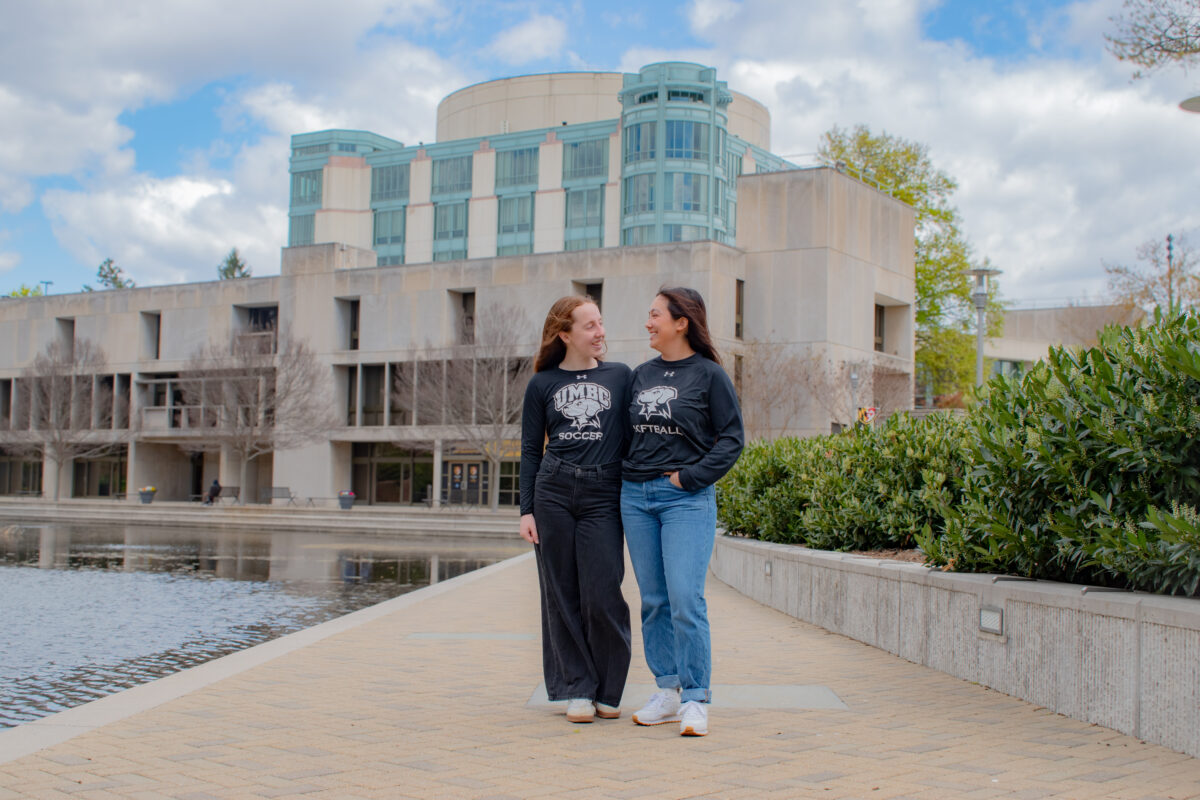 Grove, left, and Behel, right, are still on the same wavelength after all this time, unintentionally twinning in front of the library. (Mashaal Awan ’25/UMBC)
“As soon as I committed to UMBC, the process was so different from my other university,” De Padua says. For example, she appreciated how head swim coach Matt Donovan made sure she knew who to contact around campus for questions and help. Behel and Grove echo these sentiments, especially as it pertains to being able to focus on academics.
“I’ve heard from former teammates at other schools that they feel like they’re being punished if they choose to go to class and I’ve never, ever felt that,” says Behel.
Grove agreed, sharing, “Our coaches have always said that we need to go to class. And there’s so much emphasis on communication.”
Follow the leader
While they all agree the coaching staff has been invaluable in making their time at UMBC successful, they’re also grateful for fellow Retrievers who have helped throughout their journey.
De Padua is navigating her junior year now and knew she needed an internship to fulfill her academic requirements. After doing commercial modeling at an agency a fellow swim team alum Rola Hussein ’24 from Egypt worked for, De Padua was able to parlay that into her own spring/summer internship opportunity for the agency, doing social media and marketing.
 De Padua, right, congratulates teammate Makaela Hill. (Ian Feldmann ’21/UMBC Athletics)
She’s not the only one who was helped academically by her peers. Behel recalls a mechanical engineering softball player several years ahead of her who “paved the way for us to be able to show our coach and ourselves it’s possible to do both.”
In turn, Behel, De Padua, and Grove all seek to offer others support. “I’ve had so many conversations with people about how to get a bank account, how to get a phone number…really adult tasks that I had to figure out early on and now I’m passing it along,” says Grove.
They see UMBC as their home away from home and would encourage any international student-athlete to consider joining them. When asked what advice she would give to any new Retrievers from across the world, Grove simply summed up her experience by suggesting, “Just say yes to things and see what happens.”
]]>
With such a large population of Marylanders at UMBC, it’s not that unusual to run into someone you went to high school with. But when that someone is from your high school in Canberra, Australia,...
https://umbc.edu/stories/a-class-reunion-half-a-world-away/
https://my3.my.umbc.edu/api/v0/pixel/news/150330/guest@my.umbc.edu/10dcc2960210a68b1ecb561c2c57c95d/api/pixel
at-play
athletics
biology
campus-life
cnms
coeit
international
magazine
meche
spring-2025
story
UMBC News & Magazine
https://my3.my.umbc.edu/groups/umbc-news-magazine
https://assets1-my.umbc.edu/system/shared/avatars/groups/000/001/943/24435aa6207c452e7bc15cc74b42c7bb/xsmall.png?1748556657
https://assets1-my.umbc.edu/system/shared/avatars/groups/000/001/943/24435aa6207c452e7bc15cc74b42c7bb/original.png?1748556657
https://assets2-my.umbc.edu/system/shared/avatars/groups/000/001/943/24435aa6207c452e7bc15cc74b42c7bb/xxlarge.png?1748556657
https://assets2-my.umbc.edu/system/shared/avatars/groups/000/001/943/24435aa6207c452e7bc15cc74b42c7bb/xlarge.png?1748556657
https://assets3-my.umbc.edu/system/shared/avatars/groups/000/001/943/24435aa6207c452e7bc15cc74b42c7bb/large.png?1748556657
https://assets1-my.umbc.edu/system/shared/avatars/groups/000/001/943/24435aa6207c452e7bc15cc74b42c7bb/medium.png?1748556657
https://assets2-my.umbc.edu/system/shared/avatars/groups/000/001/943/24435aa6207c452e7bc15cc74b42c7bb/small.png?1748556657
https://assets1-my.umbc.edu/system/shared/avatars/groups/000/001/943/24435aa6207c452e7bc15cc74b42c7bb/xsmall.png?1748556657
https://assets2-my.umbc.edu/system/shared/avatars/groups/000/001/943/24435aa6207c452e7bc15cc74b42c7bb/xxsmall.png?1748556657
UMBC News & Magazine
2
0
false
Wed, 21 May 2025 11:34:52 -0400
Wed, 21 May 2025 11:34:52 -0400
Three UMBC juniors receive prestigious Goldwater Scholarships
Lea-Pearl Njei, biological sciences; Caly Ferguson, mechanical engineering; and Jariatu Kargbo, biological sciences, have each received the prestigious Goldwater Scholarship for the 2025 – 2026 academic year. The Barry Goldwater Scholarship and Excellence in Education Foundation strives to promote a strong STEM workforce in the U.S., and Njei, Ferguson, and Kargbo are among this year’s 441 awardees nationwide. Since 2005, 34 UMBC students have been awarded a Goldwater Scholarship.
“Caly, Lea-Pearl, and Jariatu emerged from a field of well-qualified students to represent UMBC in the Goldwater competition,” shares April Householder ’95, director of undergraduate research and prestigious scholarships. “They worked with me and the Goldwater faculty committee to strengthen their applications, and their dedication paid off. For several years in a row, UMBC has had multiple winners for this extremely competitive award.”
Njei is conducting colorectal cancer research with Jean-Pierre Raufman at the University of Maryland School of Medicine, after an internship at Yale sparked her interest in gastrointestinal organs. Njei has found support in the Meyerhoff Scholars program, especially from staff such as Jacqueline King.
“Sometimes I have that fear, where I know I can do something, but I need a little push, or someone to give me that confidence that I can do it,” Njei says. “And Dr. King’s support has been wonderful.”
Raufman, too, “has always been incredibly supportive of me as a young researcher and continually challenges me to grow and reach my full potential,” Njei says.
Njei also appreciates how much assistance she’s received as an international student and the diversity among biological sciences majors. “There are people who want to go to medical school, who want to go to graduate school, and others who want to go into the pharmaceutical industry or engineering,” she says. Njei serves as president of the UMBC chapter of Phi Delta Epsilon, the international medical fraternity. The fraternity offered “another community on campus that, besides seeing myself as a researcher, helped me see myself in the world of medicine.”

 Left: Lea-Pearl Njei presents her research at an NIH symposium. (Courtesy of Njei) Right: Jariatu Kargbo presents her research at a conference. (Courtesy of Kargbo)
The perfect place to grow
Ferguson is developing a prosthetic arm that runs on software driven by machine learning and is also affordable—a tricky combination. His work with Ramana Vinjamuri, associate professor of computer science and electrical engineering, has taken Vinjamuri’s lab in a new direction.
Vinjamuri is “open to ideas,” and tells his students that “the biggest thing you have to do is learn,” Ferguson says. “He’s been an incredible help to me over these past couple of years working on this project. UMBC has been the perfect place for me to grow.”
The project is making good progress, and right now Ferguson is working on a live simulation and moving toward a prototype that other lab members can use in experiments. He’s picked up substantial coding skills from his time in Vinjamuri’s group.
Ferguson is inspired to pursue the prosthetic arm in part because of a birth defect that caused portions of two fingers on each of his hands not to develop. It doesn’t affect his daily life much—Ferguson says he can still type, play basketball, and play video games, for example. “But it got me thinking about people with much bigger challenges,” he says. “Being able to impact that community with technology that I created would be pretty cool, so that’s how I got started with this idea.”

 Caly Ferguson (foreground, right) is developing an affordable robotic hand that runs on machine learning. Parthan Olikkal (background, right) works with Ferguson in Ramana Vinjamuri’s research group. (Melissa Penley Cormier, M.F.A. ’17/UMBC)
Right at your doorstep
Kargbo is studying melanopsin, a protein in the eye, with Phyllis Robinson, professor of biological sciences. “I singled out UMBC because of its emphasis on community and research—that’s what I wanted out of my university experience,” Kargbo says, and she found what she was looking for. She chose Robinson’s lab because of her interactions with other lab members. “It felt like a really safe lab environment for me to make mistakes, learn from them, and then grow as a researcher,” she says, “even though I didn’t understand that much when I first started out.”
Kargbo encourages aspiring researchers not to sell themselves short. “You don’t know what you’re capable of until you actually try to accomplish your goal,” she says. “And if you don’t have the confidence to show what you’re able to do, nobody’s ever going to know about it.”
All of the recipients agreed that receiving the Goldwater will open up a new support network among current and former recipients, and that the application process improved their communication skills and helped them sharpen their career goals.
“Goldwater is another opportunity for me to practice communicating my science,” Kargbo says. “I can now use the skills that I learned from applying for Goldwater, even if I hadn’t won the award, to apply for other grants, for example the NSF Graduate Research Fellowship for graduate school or Fulbright.”
The newest Goldwater scholars also felt that UMBC offered the environment and resources they needed to succeed. To go after big goals, “You need people who believe in you. You need mentors, you need support groups, and you can and will find them at UMBC,” Njei says. “You don’t even have to look too far, because they are all right there at your doorstep.”
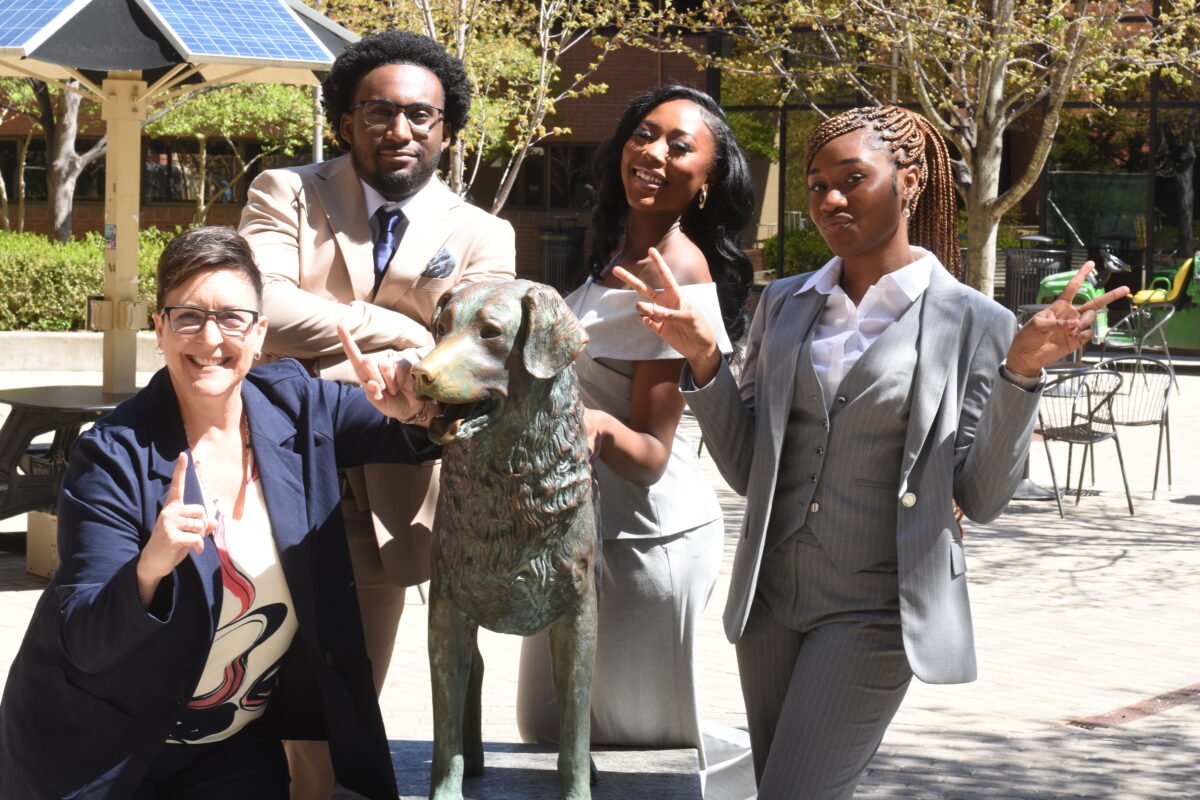 April Householder, left, supports UMBC students through the Goldwater application process. (Michael Mower/UMBC)
]]>
Lea-Pearl Njei, biological sciences; Caly Ferguson, mechanical engineering; and Jariatu Kargbo, biological sciences, have each received the prestigious Goldwater Scholarship for the 2025 – 2026...
https://umbc.edu/stories/goldwater-scholarships-2025/
https://my3.my.umbc.edu/api/v0/pixel/news/149973/guest@my.umbc.edu/aacb0612ba9d283960dfd1e5e25f0516/api/pixel
biology
cnms
coeit
community
meche
news
science-and-tech
story
undergradresearch
UMBC News & Magazine
https://my3.my.umbc.edu/groups/umbc-news-magazine
https://assets1-my.umbc.edu/system/shared/avatars/groups/000/001/943/24435aa6207c452e7bc15cc74b42c7bb/xsmall.png?1748556657
https://assets1-my.umbc.edu/system/shared/avatars/groups/000/001/943/24435aa6207c452e7bc15cc74b42c7bb/original.png?1748556657
https://assets2-my.umbc.edu/system/shared/avatars/groups/000/001/943/24435aa6207c452e7bc15cc74b42c7bb/xxlarge.png?1748556657
https://assets2-my.umbc.edu/system/shared/avatars/groups/000/001/943/24435aa6207c452e7bc15cc74b42c7bb/xlarge.png?1748556657
https://assets3-my.umbc.edu/system/shared/avatars/groups/000/001/943/24435aa6207c452e7bc15cc74b42c7bb/large.png?1748556657
https://assets1-my.umbc.edu/system/shared/avatars/groups/000/001/943/24435aa6207c452e7bc15cc74b42c7bb/medium.png?1748556657
https://assets2-my.umbc.edu/system/shared/avatars/groups/000/001/943/24435aa6207c452e7bc15cc74b42c7bb/small.png?1748556657
https://assets1-my.umbc.edu/system/shared/avatars/groups/000/001/943/24435aa6207c452e7bc15cc74b42c7bb/xsmall.png?1748556657
https://assets2-my.umbc.edu/system/shared/avatars/groups/000/001/943/24435aa6207c452e7bc15cc74b42c7bb/xxsmall.png?1748556657
UMBC News & Magazine
8
0
false
Fri, 09 May 2025 14:55:58 -0400
Fri, 09 May 2025 14:55:58 -0400
Students celebrate Engineering and Computing Week with fun and networking
April Householder, left, supports UMBC students through the Goldwater application process. (Michael Mower/UMBC)
]]>
Lea-Pearl Njei, biological sciences; Caly Ferguson, mechanical engineering; and Jariatu Kargbo, biological sciences, have each received the prestigious Goldwater Scholarship for the 2025 – 2026...
https://umbc.edu/stories/goldwater-scholarships-2025/
https://my3.my.umbc.edu/api/v0/pixel/news/149973/guest@my.umbc.edu/aacb0612ba9d283960dfd1e5e25f0516/api/pixel
biology
cnms
coeit
community
meche
news
science-and-tech
story
undergradresearch
UMBC News & Magazine
https://my3.my.umbc.edu/groups/umbc-news-magazine
https://assets1-my.umbc.edu/system/shared/avatars/groups/000/001/943/24435aa6207c452e7bc15cc74b42c7bb/xsmall.png?1748556657
https://assets1-my.umbc.edu/system/shared/avatars/groups/000/001/943/24435aa6207c452e7bc15cc74b42c7bb/original.png?1748556657
https://assets2-my.umbc.edu/system/shared/avatars/groups/000/001/943/24435aa6207c452e7bc15cc74b42c7bb/xxlarge.png?1748556657
https://assets2-my.umbc.edu/system/shared/avatars/groups/000/001/943/24435aa6207c452e7bc15cc74b42c7bb/xlarge.png?1748556657
https://assets3-my.umbc.edu/system/shared/avatars/groups/000/001/943/24435aa6207c452e7bc15cc74b42c7bb/large.png?1748556657
https://assets1-my.umbc.edu/system/shared/avatars/groups/000/001/943/24435aa6207c452e7bc15cc74b42c7bb/medium.png?1748556657
https://assets2-my.umbc.edu/system/shared/avatars/groups/000/001/943/24435aa6207c452e7bc15cc74b42c7bb/small.png?1748556657
https://assets1-my.umbc.edu/system/shared/avatars/groups/000/001/943/24435aa6207c452e7bc15cc74b42c7bb/xsmall.png?1748556657
https://assets2-my.umbc.edu/system/shared/avatars/groups/000/001/943/24435aa6207c452e7bc15cc74b42c7bb/xxsmall.png?1748556657
UMBC News & Magazine
8
0
false
Fri, 09 May 2025 14:55:58 -0400
Fri, 09 May 2025 14:55:58 -0400
Students celebrate Engineering and Computing Week with fun and networking
Where can UMBC engineering and computing students mingle with friends and mentors over sweet treats, test their knowledge and design skills in friendly competition, and network with potential employers? If it’s February, the answer is the annual Engineering and Computing Week, a traditional celebration of technology, held each year at UMBC to coincide with National Engineers Week.
The UMBC chapter of the engineering honors society Tau Beta Pi, in collaboration with various student engineering organizations on campus, organizes the week of activities each year. This year, the line-up of events featured a mix of social activities, such as painting and crafting, presentations from student organizations, and chances for teams to compete in games testing engineering knowledge and design skills.
UMBC chapters of the Information Systems Security Association, the American Institute of Chemical Engineers, the American Society of Mechanical Engineers, the Society of Women Engineers, Engineers without Borders, and the Institute of Electrical and Electronics Engineers all helped organize sessions. UMBC CyberDawgs, a group of UMBC students who share a common interest in cybersecurity, also participated.
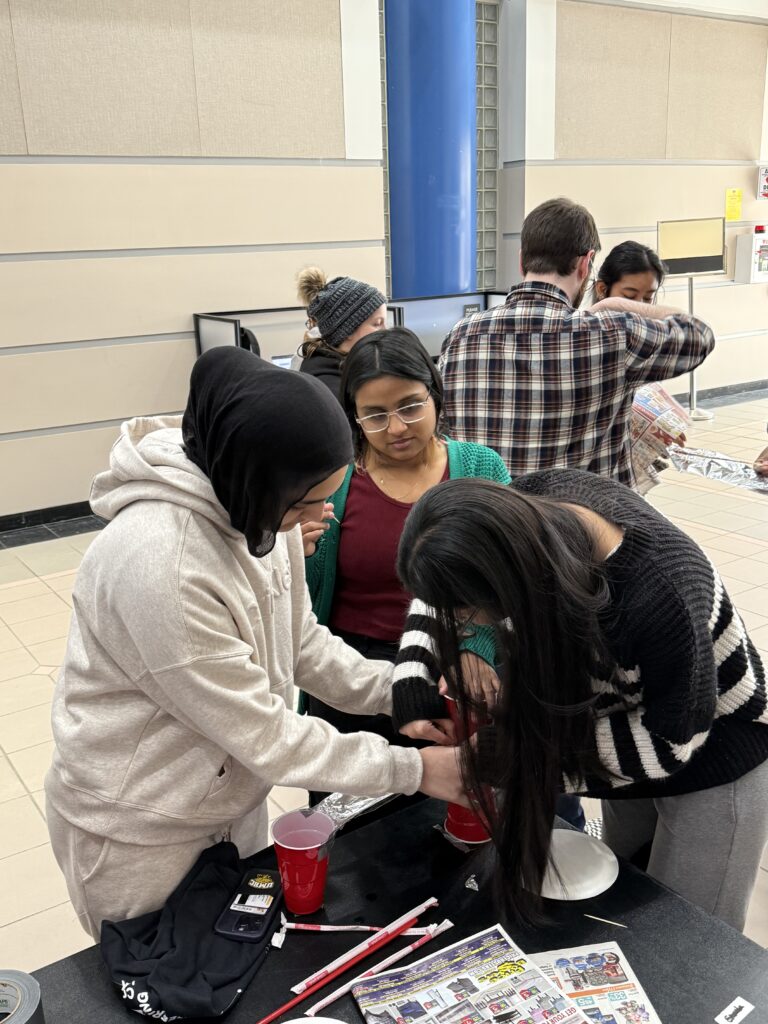 Students build devices to direct water flow, during the Engineers Without Borders “Where’s My Water” event. (Image courtesy of August Phelps)
Students could also join faculty, staff, and alumni from the College of Engineering and Information Technology at an evening reception at the Guinness Brewery near UMBC to socialize and network.
“I think the biggest success from the week was the great turnout and engagement we got from the students,” says August Phelps, a mechanical engineering senior and vice president of the UMBC chapter of Tau Beta Pi.
He says the event showcases the wide variety of engineering-focused student organizations at UMBC, which hold events throughout the year and offer great opportunities for students to develop leadership skills and form lasting connections with their peers.
“I hope attendees left feeling more connected as a community,” he says.
]]>
Where can UMBC engineering and computing students mingle with friends and mentors over sweet treats, test their knowledge and design skills in friendly competition, and network with potential...
https://umbc.edu/quick-posts/students-celebrate-engineering-and-computing-week-with-fun-and-networking/
https://my3.my.umbc.edu/api/v0/pixel/news/148657/guest@my.umbc.edu/763eaad2001e19f4587a5384d1725c09/api/pixel
cbee
coeit
csee
is
meche
news
quick-post
science-and-tech
UMBC News & Magazine
https://my3.my.umbc.edu/groups/umbc-news-magazine
https://assets1-my.umbc.edu/system/shared/avatars/groups/000/001/943/24435aa6207c452e7bc15cc74b42c7bb/xsmall.png?1748556657
https://assets1-my.umbc.edu/system/shared/avatars/groups/000/001/943/24435aa6207c452e7bc15cc74b42c7bb/original.png?1748556657
https://assets2-my.umbc.edu/system/shared/avatars/groups/000/001/943/24435aa6207c452e7bc15cc74b42c7bb/xxlarge.png?1748556657
https://assets2-my.umbc.edu/system/shared/avatars/groups/000/001/943/24435aa6207c452e7bc15cc74b42c7bb/xlarge.png?1748556657
https://assets3-my.umbc.edu/system/shared/avatars/groups/000/001/943/24435aa6207c452e7bc15cc74b42c7bb/large.png?1748556657
https://assets1-my.umbc.edu/system/shared/avatars/groups/000/001/943/24435aa6207c452e7bc15cc74b42c7bb/medium.png?1748556657
https://assets2-my.umbc.edu/system/shared/avatars/groups/000/001/943/24435aa6207c452e7bc15cc74b42c7bb/small.png?1748556657
https://assets1-my.umbc.edu/system/shared/avatars/groups/000/001/943/24435aa6207c452e7bc15cc74b42c7bb/xsmall.png?1748556657
https://assets2-my.umbc.edu/system/shared/avatars/groups/000/001/943/24435aa6207c452e7bc15cc74b42c7bb/xxsmall.png?1748556657
UMBC News & Magazine
0
0
false
Fri, 28 Feb 2025 14:24:34 -0500
Tree sap batteries: Student entrepreneur Samuel Bendek imagines a clean energy future less reliant on critical minerals
When Samuel Bendek, a current mechanical engineering sophomore at UMBC, was still in high school, he worked in a soccer ball factory in his native country of Colombia. At some point, he was given the job of figuring out how much energy the balls retained after bouncing off a wall.
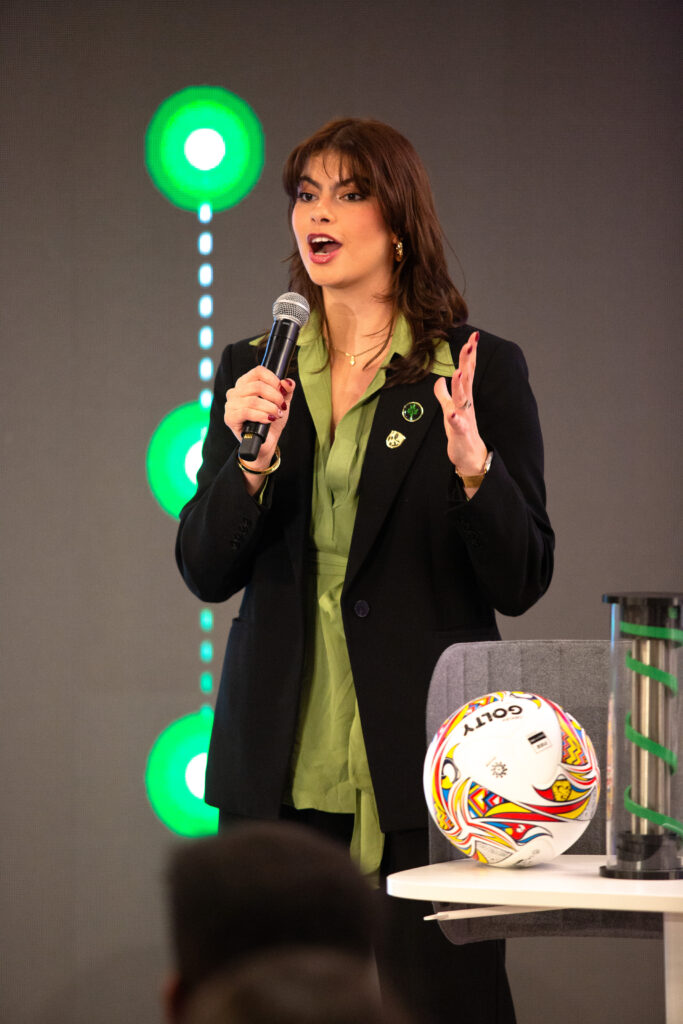 Juliana Bendek, co-founder of Elastic Energy. (Photo courtesy of UpSurge Baltimore)
He went to work, measuring and calculating. “And it turned out, it was greater than 90 percent,” Bendek says. “I was surprised that a soccer ball is so energy efficient!”
The balls were made from natural rubber, made from the sap of certain trees. When the balls hit a wall, the rubber compresses, storing the kinetic energy from their motion in elastic potential energy. Then, as the balls bounce back, the elastic potential energy turns back into kinetic energy, with very low energy loss.
The experience got Bendek thinking—what if rubber could store more than the energy of a soccer player’s kick? What if it could store energy from the sun and the wind?
About five years later, Bendek and his sister and fellow entrepreneur Juliana Bendek pitched that very idea on the stage at the inaugural Maryland Student Ventures Showcase, held February 18 in Baltimore to celebrate the nine local student ventures selected for the first-ever Pava LaPere Innovation Awards. As an award-winner, the Bendeks’ company Elastic Energy will receive $50,000 from the state of Maryland to further its development of a mechanical battery made from natural rubber.
The award and showcase marked the latest step in Bendek’s entrepreneurial journey. Along the way he has embraced the support and guidance of friends, family, and mentors, from UMBC and beyond.
“I have always wanted to create things, since I was a kid destroying my grandmother’s clock to build a new toy,” says Bendek. “This is an opportunity to create something that makes the world a better place.”
From garage tinkering to investor meetings
Shortly after his soccer-ball-inspired light-bulb moment, Bendek got to work in his proverbial garage, experimenting with different ways to stretch rubber and store energy. When he had a decent prototype, he recruited his sister to join his efforts.
“My sister is super smart and very good at connecting to people,” says Bendek. “When I had the prototype, I called her up at like 2 a.m. in the morning. I said, ‘It’ll work. Let’s do this thing together.’”
With some initial funding from family and friends the two started developing the next phase of the technology, while also pitching new investors and building out their team.
Along the way, Bendek, who is also a competitive swimmer, was recruited by UMBC and decided to become a Retriever. He took his dreams to Maryland, and it didn’t take him long to connect with UMBC’s resources for student entrepreneurs.
He reached out to Kevin Fulmer, the director of the Alex. Brown Center for Entrepreneurship and Innovation, which supports the entrepreneurial mindset at UMBC with courses, speaker series featuring business leaders, startup accelerator programs, and assistance with business ideas and networking with experts.
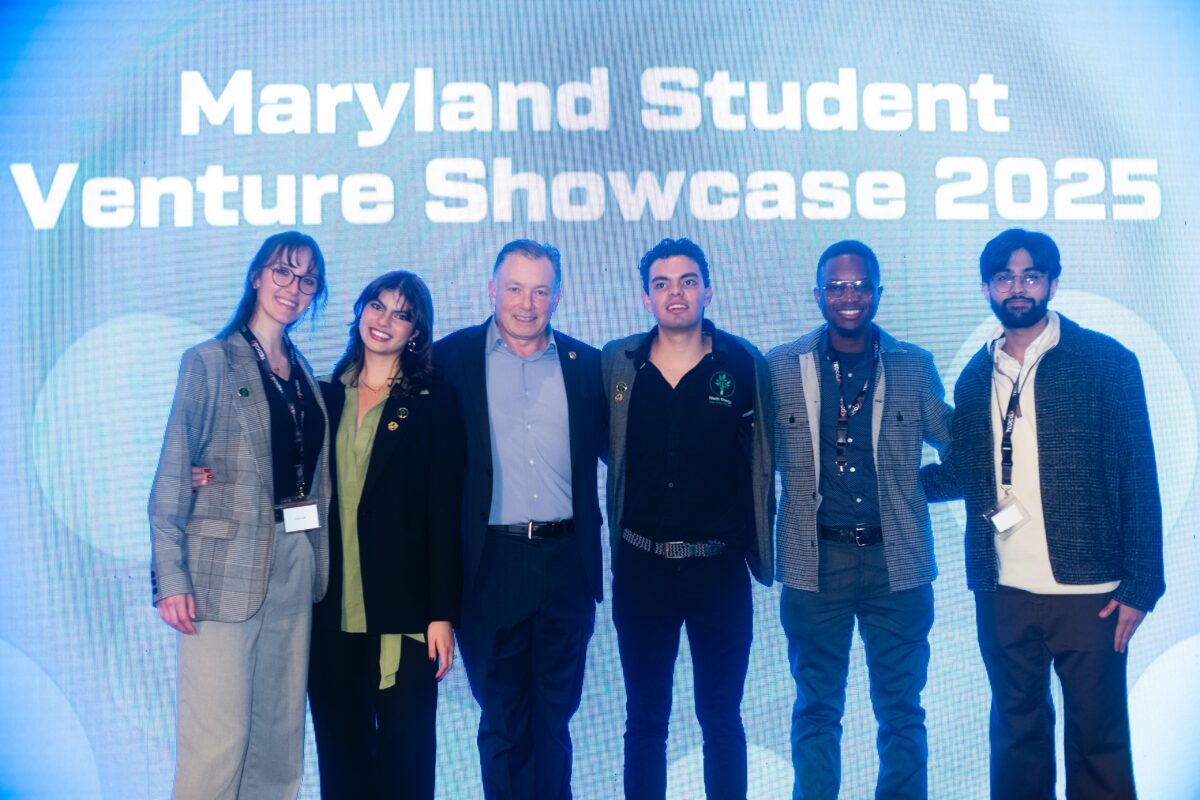 UMBC student Sophia Grillo, Juliana Bendek, Kevin Fulmer, Samuel Bendek, UMBC student Femi Adisa, and Hamza Umar ’21, M.S. ’24, mechanical engineering, gather at the Maryland Student Venture Showcase. (Photo courtesy of UpSurge Baltimore)
“I met Samuel when he was still a first-year student,” says Fulmer. “He came in with a slide deck that included pictures of a working prototype, and I was really impressed. We started meeting on a regular basis and it’s been really fun to see his progress and certainly exciting to see him win things like this $50,000 grant.”
“Kevin has helped me a lot,” says Bendek. “He helped me build a business plan, put me in touch with local experts, and helped find opportunities like the Pava LaPere Innovation Grant.”
Imagining a clean energy future
The batteries Bendek’s company plans to build are slim cylinders a little taller than an average person. Inside, a motor, ideally powered by solar cells or other renewable sources of energy, stretches a 100-meter elastic band to more than ten times its original length by winding it around an inner core. When the power to the motor is turned off, the system can go into reverse. The motor becomes an electric generator, powered by the unwinding elastic band.
Each battery can store about 1 kilowatt-hours of energy—For comparison, a typical American household uses about 30 kilowatt hours of electricity a day.
While Elastic Energy’s batteries cannot provide as much energy as chemical batteries of the same weight, Bendek says their main selling points are that they are long-lasting, relatively inexpensive, and don’t require the mining of minerals like lithium, which can damage the environment and also lead to geopolitical tensions due to the minerals’ uneven distribution around the world.
The company plans to first target the consumer market, offering the batteries as backup power for homes or RVs. Eventually, they hope they can become part of the solution for grid-scale energy storage.
Bendek plans to test the technology this summer in a remote, off-grid town in Colombia to demonstrate its viability.
“These batteries are a technology that really has the potential to grow, I’m confident of that,” says Fulmer. “And Samuel has a great mindset—the entrepreneurial mindset of making things happen.”
]]>
When Samuel Bendek, a current mechanical engineering sophomore at UMBC, was still in high school, he worked in a soccer ball factory in his native country of Colombia. At some point, he was given...
https://umbc.edu/stories/tree-sap-batteries-student-entrepreneur/
https://my3.my.umbc.edu/api/v0/pixel/news/147619/guest@my.umbc.edu/c7be942672570f27e39d81a30648fb49/api/pixel
alex-brown-center-for-entrepreneurship
coeit
meche
news
science-and-tech
story
UMBC News & Magazine
https://my3.my.umbc.edu/groups/umbc-news-magazine
https://assets1-my.umbc.edu/system/shared/avatars/groups/000/001/943/24435aa6207c452e7bc15cc74b42c7bb/xsmall.png?1748556657
https://assets1-my.umbc.edu/system/shared/avatars/groups/000/001/943/24435aa6207c452e7bc15cc74b42c7bb/original.png?1748556657
https://assets2-my.umbc.edu/system/shared/avatars/groups/000/001/943/24435aa6207c452e7bc15cc74b42c7bb/xxlarge.png?1748556657
https://assets2-my.umbc.edu/system/shared/avatars/groups/000/001/943/24435aa6207c452e7bc15cc74b42c7bb/xlarge.png?1748556657
https://assets3-my.umbc.edu/system/shared/avatars/groups/000/001/943/24435aa6207c452e7bc15cc74b42c7bb/large.png?1748556657
https://assets1-my.umbc.edu/system/shared/avatars/groups/000/001/943/24435aa6207c452e7bc15cc74b42c7bb/medium.png?1748556657
https://assets2-my.umbc.edu/system/shared/avatars/groups/000/001/943/24435aa6207c452e7bc15cc74b42c7bb/small.png?1748556657
https://assets1-my.umbc.edu/system/shared/avatars/groups/000/001/943/24435aa6207c452e7bc15cc74b42c7bb/xsmall.png?1748556657
https://assets2-my.umbc.edu/system/shared/avatars/groups/000/001/943/24435aa6207c452e7bc15cc74b42c7bb/xxsmall.png?1748556657
UMBC News & Magazine
1
0
false
Tue, 25 Feb 2025 13:45:44 -0500
Tue, 25 Feb 2025 13:45:44 -0500
International exchange brings opportunities to question assumptions—in science and life
Making assumptions is a habit of life, a way to speed up decisions. Sometimes these mental short-cuts, however, lead us astray.
Such was the situation when Lorenz Kopp, an engineering master’s student at Germany’s Regensburg University of Applied Sciences who was visiting UMBC this fall for a 50-day exchange project, assumed the ovens in the U.S. lab he was working in would use the Fahrenheit temperature scale. He filled a mold with a plastic-like gel the group was using to make flexible accordion-shaped structures, put it in the oven to set, and sat back.
“And then I started to smell burning,” he says, with a smile. The ovens were in fact operating in Celsius, and he had set the temperature too high.
Kopp came to the U.S. with fellow Regensburg student Björn Michelmann to work with mechanical engineering professor Paris von Lockette. Their project was part of a bigger assumption-questioning enterprise—in particular probing the behavior of materials called soft magnets.
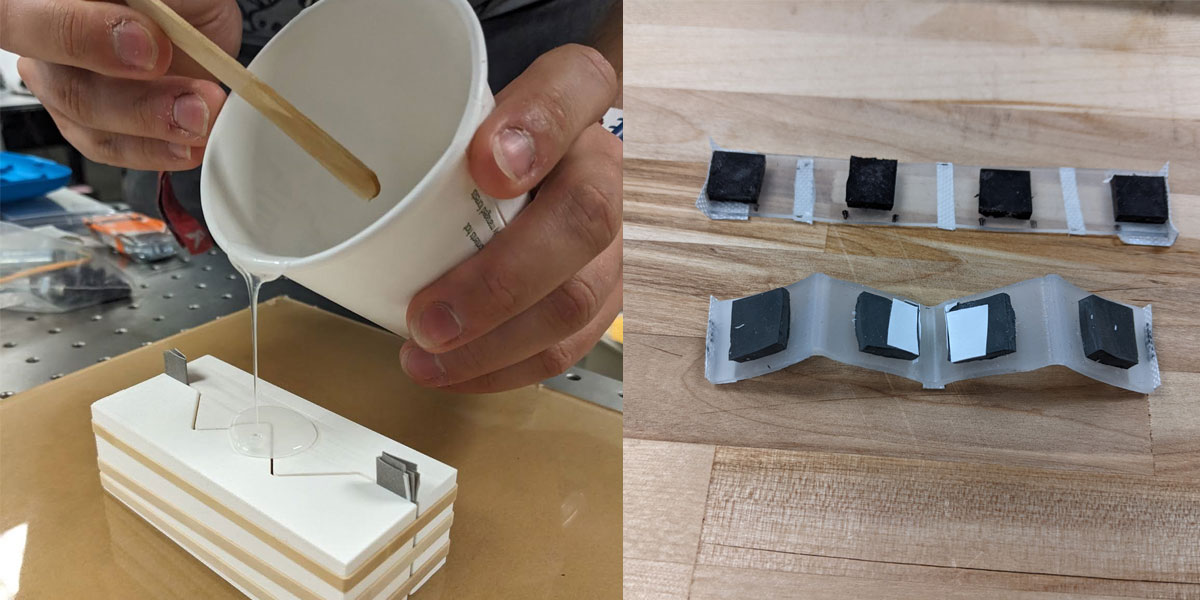 Kopp and Michelmann designed and made magnetically active accordion structures from a flexible, plastic-like material. (Images courtesy of Lorenz Kopp)
Soft magnetic materials tend to be metals that easily respond to (become magnetized in) the presence of a magnetic field, but go back to “normal” when the field is removed. This is in contrast to hard magnetic materials, which can be permanently magnetized. A typical fridge magnet is an example of a hard magnetic material, while a piece of iron is an example of a soft magnetic material.
Engineers are interested in magnets as a way to wirelessly control robots, but soft magnets are often assumed to offer a less versatile range of movements for these applications than hard magnets.
For about seven weeks during the fall semester, Kopp and Michelmann set up and ran a series of experiments putting some of these assumptions to the test. They designed accordion structures made from a flexible plastic-like material and embedded either soft or hard magnets in the accordions’ pleats. They then recorded how the structures folded or unfolded when exposed to magnetic fields. Early analysis of the results hints that the soft magnets may offer more versatility than initially assumed.
“It was great working with Lorenz and Björn. They were exceptionally productive,” von Lockette says. “We got interesting results and we’re working to write them up in a paper.”
Soft magnetic materials are appealing to engineers because they are cheaper and more biocompatible than hard magnetic materials, and also require less energy to be magnetized and demagnetized. If the group can demonstrate novel ways to get extra degrees of control over their movement, it could open a host of new applications, including in robots that assist in surgery or devices that are implanted in the human body to deliver drugs, monitor diseases, or substitute for the function of lost or damaged organs.
An international collaboration
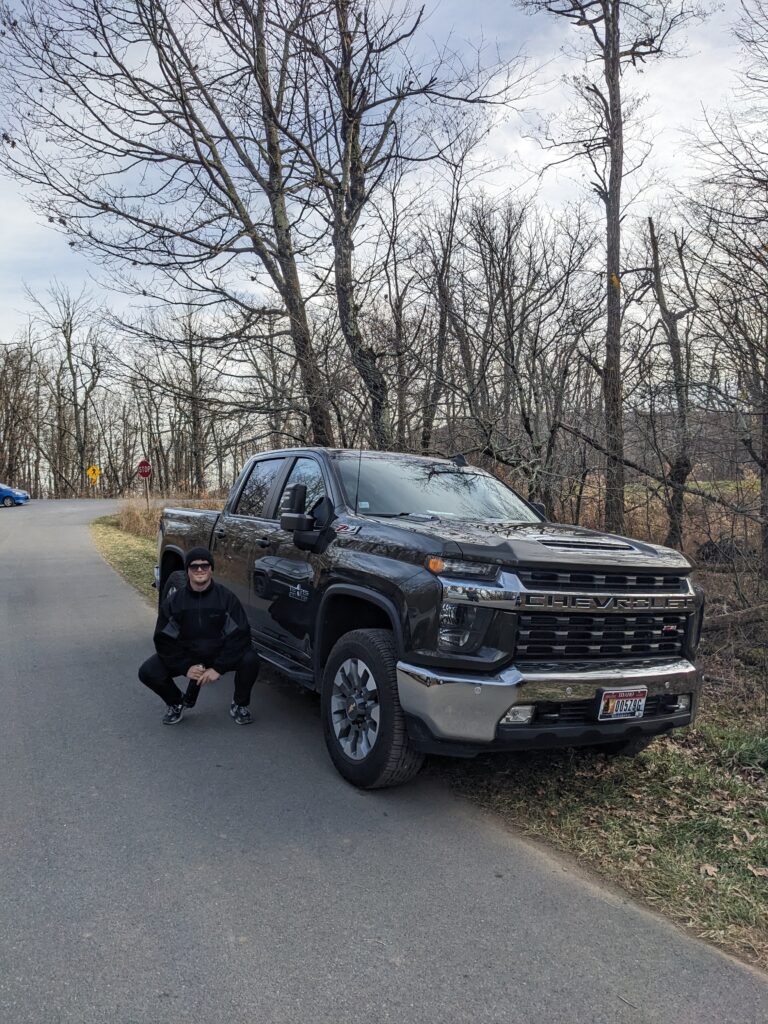 Kopp near the truck he and Michelmann drove to Shenandoah National Park. (Image courtesy of Lorenz Kopp)
Kopp and Michelmann got the opportunity to visit UMBC through funding by the German Academic Exchange Service. Their advisor at Regensburg University of Applied Sciences—Mikhail Chamonine—knew von Lockette through the American Society of Mechanical Engineers, and together they arranged the details of the visit with the help of the Office of International Students and Scholars at UMBC. Chamonine specializes in the physics of electromagnetic fields, and his lab in Germany performs many experiments with rubber-based soft magnetic materials. Von Lockette has developed his career around turning science insights about magnetically active soft materials into new applications and devices. The area of magnetic control of robots was a natural overlap.
While Kopp and Michelmann spent plenty of time in the lab during their visit, they also had chances to explore the areas surrounding UMBC on weekends. They visited the National Aquarium in Baltimore, took in a Raven’s football game, and drove to Shenandoah National Park in Virginia. They also enjoyed campus life, attending Homecoming weekend in October and regularly visiting the Retriever Activity Center to work out.
Michelmann says it was eye-opening to experience life on a U.S. university campus. “In a lot of U.S. films, there are fraternities and sororities with houses where they party every night. But I learned that stereotype doesn’t apply to UMBC.” He says he was pleasantly surprised by the variety of activities on campus, from sporting events, to tabletop games, to events such as bingo and craft nights organized by the Student Events Board.
Advancing science and technology
Von Lockette says he hopes to continue the collaboration with Regensburg University of Applied Sciences, and to arrange trips for UMBC students to visit Germany in the future.
Kopp, Michelmann, von Lockette, and Chamonine remain in touch as they write up the results of their experiments. When they noticed some unexpected behavior of the soft magnet accordions, von Lockette says he found himself thinking back to discussions he had with Chamonine about the importance of what are called demagnetizing terms in equations describing the magnetization of materials. The terms are affected by the geometry of the material and explain, for example, why when you put an iron nail in a magnetic field, it is easier for the nail to magnetize along its length, rather than perpendicular to it.
The researchers are testing whether they can explain the behavior of the soft magnets they tested—and the difference from the hard magnets—using demagnetizing field calculations. A better understanding of the behavior could guide future experiments trying to demonstrate greater versatility of movements and finer control.
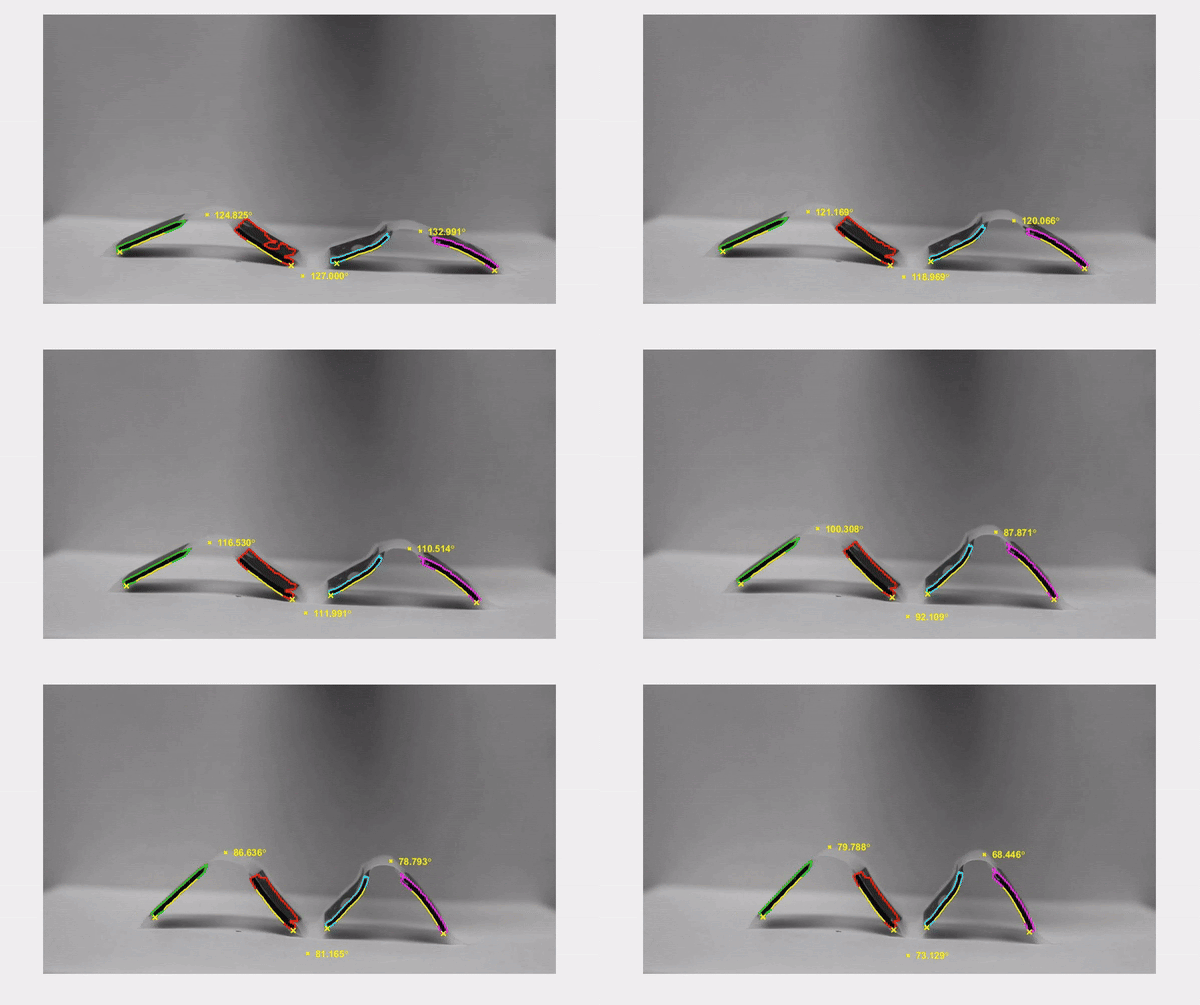 The researchers recorded and analyzed how the accordion structures folded or unfolded when exposed to magnetic fields. (Video courtesy of Lorenz Kopp)
“We’ll experiment with different materials and different geometries. We’re wondering: If we apply this field, what can we make it do that we didn’t think it could do?” von Lockette says.
Von Lockette has a history of getting fellow researchers to consider the usefulness of materials they may have overlooked. Earlier in his career, he published a paper demonstrating the potential of a new type of magnetically active material—in that case made with hard magnets.
“That was my first big splash,” he says. Now he’s happy to give soft magnets their due too, while also encouraging a new generation of researchers, including Kopp and Michelmann.
Chamonine is also pleased with the work of his students. “They are working to get the results published, which is not typical for a short project,” he says.
Beyond pushing the assumptions of what could get done in the lab in seven weeks, Kopp and Michelmann also enjoyed the typical world-expanding experience of international travel. “It was not only the science,” Chamonine says, “but they also had a chance to stay in the United States. I think for them it was absolutely an exciting moment in life.”
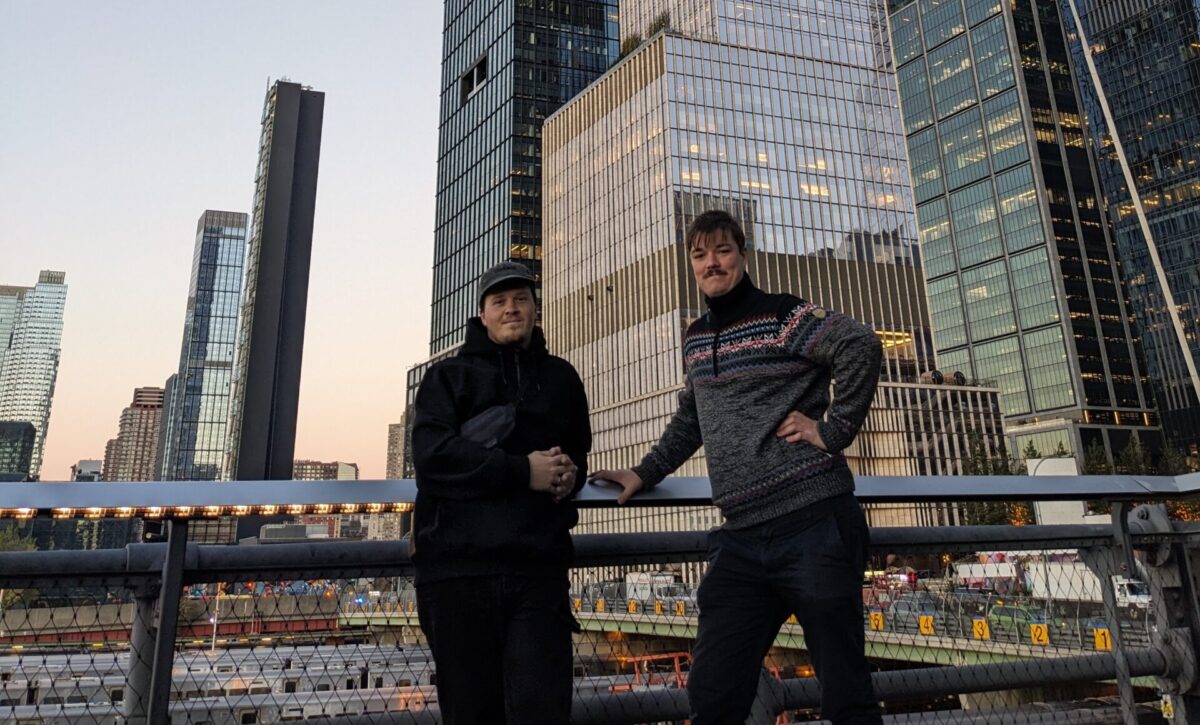 Kopp and Michelmann visited New York at the end of their U.S. trip. (Image courtesy of Lorenz Kopp)
]]>
Making assumptions is a habit of life, a way to speed up decisions. Sometimes these mental short-cuts, however, lead us astray. Such was the situation when Lorenz Kopp, an engineering...
https://umbc.edu/stories/international-exchange-questioning-assumptions/
https://my3.my.umbc.edu/api/v0/pixel/news/147447/guest@my.umbc.edu/b3e4c78b14007557bb86daaa0944ad41/api/pixel
coeit
discovery
international
magazine
meche
story
UMBC News & Magazine
https://my3.my.umbc.edu/groups/umbc-news-magazine
https://assets1-my.umbc.edu/system/shared/avatars/groups/000/001/943/24435aa6207c452e7bc15cc74b42c7bb/xsmall.png?1748556657
https://assets1-my.umbc.edu/system/shared/avatars/groups/000/001/943/24435aa6207c452e7bc15cc74b42c7bb/original.png?1748556657
https://assets2-my.umbc.edu/system/shared/avatars/groups/000/001/943/24435aa6207c452e7bc15cc74b42c7bb/xxlarge.png?1748556657
https://assets2-my.umbc.edu/system/shared/avatars/groups/000/001/943/24435aa6207c452e7bc15cc74b42c7bb/xlarge.png?1748556657
https://assets3-my.umbc.edu/system/shared/avatars/groups/000/001/943/24435aa6207c452e7bc15cc74b42c7bb/large.png?1748556657
https://assets1-my.umbc.edu/system/shared/avatars/groups/000/001/943/24435aa6207c452e7bc15cc74b42c7bb/medium.png?1748556657
https://assets2-my.umbc.edu/system/shared/avatars/groups/000/001/943/24435aa6207c452e7bc15cc74b42c7bb/small.png?1748556657
https://assets1-my.umbc.edu/system/shared/avatars/groups/000/001/943/24435aa6207c452e7bc15cc74b42c7bb/xsmall.png?1748556657
https://assets2-my.umbc.edu/system/shared/avatars/groups/000/001/943/24435aa6207c452e7bc15cc74b42c7bb/xxsmall.png?1748556657
UMBC News & Magazine
11
0
false
Tue, 18 Feb 2025 16:07:11 -0500
Tue, 18 Feb 2025 16:07:11 -0500
Mechanical engineering Ph.D. student Md Badrul Hasan recognized for research modeling hurricanes with machine learning
Kopp and Michelmann visited New York at the end of their U.S. trip. (Image courtesy of Lorenz Kopp)
]]>
Making assumptions is a habit of life, a way to speed up decisions. Sometimes these mental short-cuts, however, lead us astray. Such was the situation when Lorenz Kopp, an engineering...
https://umbc.edu/stories/international-exchange-questioning-assumptions/
https://my3.my.umbc.edu/api/v0/pixel/news/147447/guest@my.umbc.edu/b3e4c78b14007557bb86daaa0944ad41/api/pixel
coeit
discovery
international
magazine
meche
story
UMBC News & Magazine
https://my3.my.umbc.edu/groups/umbc-news-magazine
https://assets1-my.umbc.edu/system/shared/avatars/groups/000/001/943/24435aa6207c452e7bc15cc74b42c7bb/xsmall.png?1748556657
https://assets1-my.umbc.edu/system/shared/avatars/groups/000/001/943/24435aa6207c452e7bc15cc74b42c7bb/original.png?1748556657
https://assets2-my.umbc.edu/system/shared/avatars/groups/000/001/943/24435aa6207c452e7bc15cc74b42c7bb/xxlarge.png?1748556657
https://assets2-my.umbc.edu/system/shared/avatars/groups/000/001/943/24435aa6207c452e7bc15cc74b42c7bb/xlarge.png?1748556657
https://assets3-my.umbc.edu/system/shared/avatars/groups/000/001/943/24435aa6207c452e7bc15cc74b42c7bb/large.png?1748556657
https://assets1-my.umbc.edu/system/shared/avatars/groups/000/001/943/24435aa6207c452e7bc15cc74b42c7bb/medium.png?1748556657
https://assets2-my.umbc.edu/system/shared/avatars/groups/000/001/943/24435aa6207c452e7bc15cc74b42c7bb/small.png?1748556657
https://assets1-my.umbc.edu/system/shared/avatars/groups/000/001/943/24435aa6207c452e7bc15cc74b42c7bb/xsmall.png?1748556657
https://assets2-my.umbc.edu/system/shared/avatars/groups/000/001/943/24435aa6207c452e7bc15cc74b42c7bb/xxsmall.png?1748556657
UMBC News & Magazine
11
0
false
Tue, 18 Feb 2025 16:07:11 -0500
Tue, 18 Feb 2025 16:07:11 -0500
Mechanical engineering Ph.D. student Md Badrul Hasan recognized for research modeling hurricanes with machine learning
Mechanical engineering Ph.D. student Md Badrul Hasan has received the 2025 Professor Kirti “Karman” Ghia Memorial Award from the American Institute of Aeronautics and Astronautics (AIAA), for his research modeling the fluid flow inside hurricanes with physics-informed machine learning.
The award recognizes an international graduate student in the U.S. who has developed an innovative approach to computational fluid dynamics, in which computers are used to analyze and predict how fluids flow, with applications in aerospace engineering, weather forecasting, and more. Hasan, who is from Bangladesh, is the inaugural recipient of the award. His research explores new ways to improve the modeling of energy flow in hurricanes.
Machine learning for better weather forecasting
Hasan and his UMBC mentors—Meilin Yu, mechanical engineering, and Tim Oates, computer science and electrical engineering—looked at the layer of atmosphere in a hurricane that is directly above the ocean surface. Called the hurricane boundary layer, it is where turbulent flows bring heat and moisture from the water into the air, and it plays a crucial role in determining a hurricane’s intensity and track.
Traditional modeling of this layer fails to account for ways that energy within the smaller eddies in a flowing fluid can feed back into larger scale eddies. Hasan, Yu, and Oates explored how physics-informed machine learning models—which analyze large datasets to spot patterns—could better capture this phenomenon. Ultimately, they are looking to integrate their machine learning models into larger physics-based hurricane simulations to improve the simulations’ accuracy.
 Hurricane Humberto, as captured by a NOAA satellite Sept. 15, 2019. (Image credit: NOAA Satellites)
“This work sets up the cornerstone of our ongoing research towards more accurate numerical simulation of hurricane boundary layer flows at the scale of tens to hundreds of miles,” says Yu. “It is also a key step in our renewable energy research, where improving offshore wind farms’ resiliency to tropical storms is our ultimate goal as mechanical engineers. Badrul’s hard work pays off, and we are very proud of him.”
Hasan accepted the award for his work at the 2025 AIAA SciTech Forum, held in early January in Orlando, Florida, where he also presented his research. He says that while the community is filled with many researchers specializing in the traditional physics-based simulations, there is more and more interest in machine learning.
Hasan says he is grateful for the guidance of Tim Oates, from the computer science and electrical engineering department, in selecting and understanding the machine learning models.
“It was a great team effort between mechanical engineering and computer science—really productive and rewarding for both sides,” he says.
]]>
Mechanical engineering Ph.D. student Md Badrul Hasan has received the 2025 Professor Kirti “Karman” Ghia Memorial Award from the American Institute of Aeronautics and Astronautics (AIAA), for his...
https://umbc.edu/quick-posts/modeling-hurricanes-with-machine-learning/
https://my3.my.umbc.edu/api/v0/pixel/news/146813/guest@my.umbc.edu/0d9ce5f17baa386f96e293d1a6e3780c/api/pixel
coeit
csee
meche
news
quick-post
research
science-and-tech
UMBC News & Magazine
https://my3.my.umbc.edu/groups/umbc-news-magazine
https://assets1-my.umbc.edu/system/shared/avatars/groups/000/001/943/24435aa6207c452e7bc15cc74b42c7bb/xsmall.png?1748556657
https://assets1-my.umbc.edu/system/shared/avatars/groups/000/001/943/24435aa6207c452e7bc15cc74b42c7bb/original.png?1748556657
https://assets2-my.umbc.edu/system/shared/avatars/groups/000/001/943/24435aa6207c452e7bc15cc74b42c7bb/xxlarge.png?1748556657
https://assets2-my.umbc.edu/system/shared/avatars/groups/000/001/943/24435aa6207c452e7bc15cc74b42c7bb/xlarge.png?1748556657
https://assets3-my.umbc.edu/system/shared/avatars/groups/000/001/943/24435aa6207c452e7bc15cc74b42c7bb/large.png?1748556657
https://assets1-my.umbc.edu/system/shared/avatars/groups/000/001/943/24435aa6207c452e7bc15cc74b42c7bb/medium.png?1748556657
https://assets2-my.umbc.edu/system/shared/avatars/groups/000/001/943/24435aa6207c452e7bc15cc74b42c7bb/small.png?1748556657
https://assets1-my.umbc.edu/system/shared/avatars/groups/000/001/943/24435aa6207c452e7bc15cc74b42c7bb/xsmall.png?1748556657
https://assets2-my.umbc.edu/system/shared/avatars/groups/000/001/943/24435aa6207c452e7bc15cc74b42c7bb/xxsmall.png?1748556657
UMBC News & Magazine
2
0
false
Tue, 28 Jan 2025 14:44:32 -0500
Tue, 28 Jan 2025 14:44:32 -0500
Biotech Buzz

UMBC at the Universities at Shady Grove finds itself uniquely situated—at home within the country’s third largest biotech hub where the demand for highly skilled workers is growing. These Retrievers are filling specialized roles after graduating with the training they need to succeed in this booming industry.
It’s an early Friday morning in the Biological Sciences and Engineering Building and nine students, working in small groups, are bustling back and forth between fume hoods and a large centrifuge. They carefully swish flasks containing cells and growth medium. The smell of sanitizing alcohol pervades the space. Neon orange test tube racks and turquoise tube caps stand out within the sterile white look of the work benches, hoods, and lab coats.
As the cells use oxygen to release energy, they produce carbon dioxide. The CO2 turns the solution yellow, indicating successful cell growth. After the experiment, students sterilize their solution with bleach for disposal; in response to the alkalinity, it blooms to a brilliant magenta. In another room, one student offers tips to her classmate on how to use a pipet more effectively, and the instructor flits between groups, answering questions as needed—but for the most part, the students operate confidently on their own.
This is a regular day in Biotechnology 303: Applied Cell Biology in UMBC’s Translational Life Science Technology (TLST) program. The program, offered by UMBC’s College of Natural and Mathematical Sciences (CNMS) exclusively at the Universities at Shady Grove (USG), a multi-institution education facility in Rockville, Maryland, is designed to offer hands-on training to prepare students for careers in the booming biotech industry in USG’s backyard.
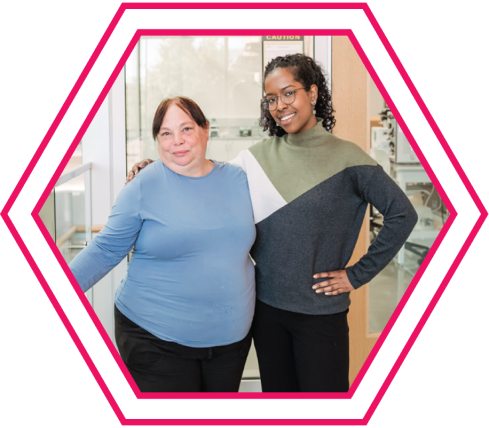
Elizabeth Friar (left) and Samantha Petros ’23 have stayed in touch since Petros graduated.
A clear direction
It was the promise of experiential work with real-world applications that drew Samantha Petros ’23 to the TLST program. “I really liked the convenience of the USG campus, and a lot of the courses were really focused on hands-on learning,” she says. Without really knowing what the work would look like before she started the program, “I was able to try out a lot of different things in a very low-stakes environment and get an idea as to what I found interesting.”
That turned out to be cell culture work. Applied Cell Biology with Elizabeth Friar, lecturer and undergraduate program director in TLST, “cemented that benchwork is what I enjoy doing,” Petros says. From then on, “There was a clearly defined arrowhead in the direction I wanted to go.”
That was a big shift from where she started, as a film major at Montgomery College (MC). A virology course to meet her science requirement turned her on to MC’s biotech associate degree, and then she transitioned to the TLST program at UMBC. After learning some basic lab techniques in TLST classes, she landed a part-time job, where she carried out entry-level manufacturing tasks for malaria vaccines. Today, Petros is thriving as a cell culture specialist studying malaria at Axle Informatics, a contractor for the National Institute of Allergy and Infectious Diseases.
The position she’s in now traditionally requires a master’s degree, which she doesn’t have—yet, anyway. “Knowing that I have valuable skill sets from TLST—working in manufacturing, getting good connections with my professors, and going to the networking events that TLST offers—all of that compounds and has got me to where I am now,” Petros says. “I genuinely believe that I wouldn’t be here if it weren’t for all of those factors, with TLST obviously being the biggest one.”
Location, location, location
TLST is a young program, but it is growing quickly. The first class—just two students—arrived in fall 2019. Friar joined in summer 2020 and began laying the groundwork for the program’s eventual growth. Today, “It’s humming along,” she says. There are currently 50 students who have declared TLST as their major. “Now we’re thinking about what we can do next. How can we expand?”
TLST is unique as the only undergraduate STEM program at UMBC without a footprint on the main campus. The location choice at USG is intentional. The Capital Biohealth Region, encompassing the District of Columbia, Virginia, and Maryland, is the third most competitive biotech hub in the country—and Montgomery County, Maryland, is the hub of the hub, boasting more than 350 life science companies and located a stone’s throw from the NIH, FDA, and National Institute of Standards and Technology (NIST). For TLST alumni, the employment options are seemingly limitless: 80 percent of American pharmaceutical companies are within a two-hour drive, and they can expect a nearly 23 percent growth rate in the biotech industry over the next 10 years—well above the national average.
As Friar puts it, “Regenxbio is down the street. MacroGenics is down the street. MilliporeSigma is opening their new lab right next door, and they’ve now hired eight of our alumni. Soon we’ll have an NIH vaccine lab right down the street. ATCC is right down the street.” All these biotech companies need qualified workers—and TLST is providing them.
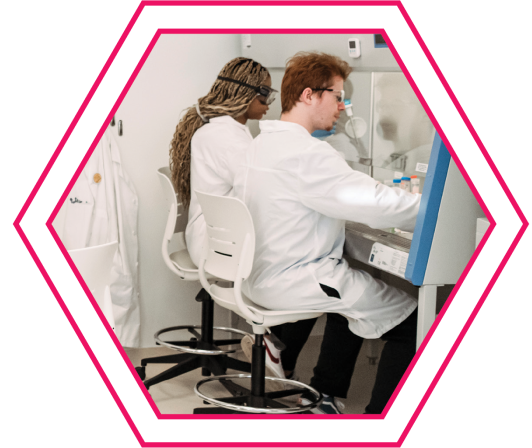
Steven Schaffer (right) and Princess Nyamali work under a biosafety cabinet in Elizabeth Friar’s Applied Cell Biology course.
Training lifetime learners
Jeff Galvin, CEO of American Gene Technologies (AGT), has hired TLST alumni and would hire more. “The TLST program seems to provide a great overview of not just biotechnology techniques,” he says, but it gives students “an understanding of the business in general. I find that UMBC students lean toward being self-motivated problem-solvers. It seems that the administration from the top all the way down promotes that idea of creating value through creative, hard work.”
Titina Sirak ’20, TLST, had a major impact at AGT. She established a brand-new laboratory certified to handle human cells from scratch, Galvin says, “And that’s not easy—there’s a lot of regulations associated with that, even economics.” While she wasn’t an expert at first, “she was able to do enough things right that the project came to life.”
Galvin emphasizes the importance of “learning how to learn,” saying, “Things are changing so fast, that it’s the folks who can adapt and become lifetime learners who are going to be the most successful.And that’s something I saw from the students coming out of TLST.”
A vision fulfilled
So far, TLST has graduated 25 students, and 94 percent of them were employed in the biotech industry within three months of walking across the Commencement stage. “We’ve had a number of really standout students who have gone on to do really great things, so I’m very excited about how it’s going,” Friar says.
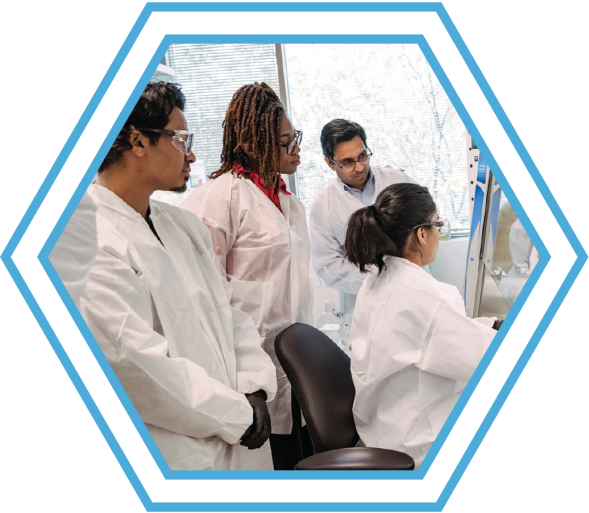
Merryll Kallungal ’24 works under a biosafety cabinet at ATCC. Interns Jason Bose (left) and Tamilore Akinde (second from left) and an ATCC lead scientist observe.
So is William R. LaCourse, CNMS dean, which offers the TLST program. He envisioned the program years before the first two students walked onto the USG campus, and it came together with input from faculty at Montgomery College and five departments at UMBC.
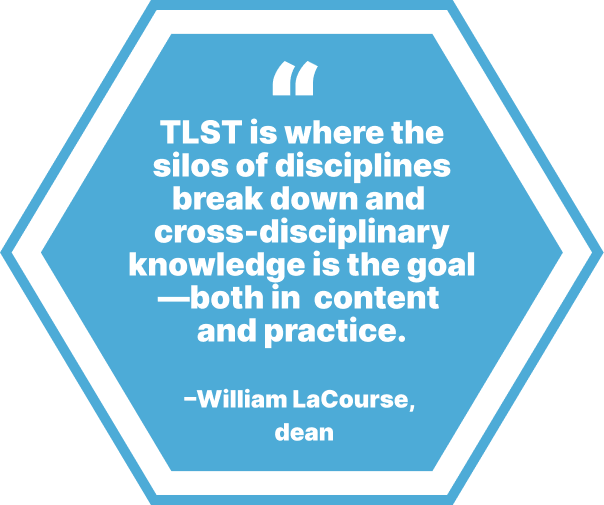
“TLST is an innovative and practical education that combines ‘know-what’ and ‘know-how,’” says LaCourse. “It is a highly flexible program with various pathways to serve the ever-changing needs of a growing industry. TLST is where the silos of disciplines break down and cross-disciplinary knowledge is the goal—both in content and practice.”
The program is shaping up just as LaCourse and Annica Wayman ’99, mechanical engineering, and former associate dean for Shady Grove Affairs in CNMS who led TLST’s launch, had hoped. The state of Maryland is growing its biotech hub while UMBC students are gaining the skills they need to succeed in the workplace and getting well-paying jobs, and the student population is growing.
Connections that build confidence
Just as important as high-demand lab skills, students and alumni value the relationships they’ve formed with faculty. “Every teacher I had was very supportive, very understanding, very willing to work with me,” Petros says. “I think it’s important to get your money’s worth out of college, and I definitely feel like I got that and more in TLST because of the support network that I had there and my teachers.”
Petros is still in touch periodically with Wayman and Friar. “Dr. Wayman was a shining inspiration. She’s just a wonderful person. She’s so knowledgeable and always willing to help,” Petros says. The support she has and the success she’s found now have inspired Petros to look back and help those coming up behind her. In addition to USG resources, as a student Petros attended networking events offered by BioBuzz, a community resource for biotech industry professionals and job seekers in the Capital Biohealth Region. In fact, it’s how she found her current role.
Today Petros is a BioBuzz Ambassador. “I wish I had known about BioBuzz when I first started in biotech,” she says. “Now I want to be that advocate for younger students or people who are just starting in science.”
A strong foundation
“Our students come to us because they want to make a difference in people’s lives, but they don’t necessarily want to go to medical school,” Friar says. It doesn’t hurt that “we have some really spectacular facilities that are a real draw for students,” she adds.
The Biological Sciences and Engineering Building opened at USG in fall 2019 and boasts beautiful modern laboratories and classrooms plus plenty of comfy nooks for meeting with a study group or just relaxing. TLST has also received over $1 million dollars from the National Institute for Innovation in Manufacturing Pharmaceuticals, some of which has supported further upgrades and additions to the teaching laboratories.
A flow cytometer, a machine that can detect properties of interest in up to 10,000 cells per minute, will enable a new mixed undergraduate/graduate course in flow cytometry launching next spring, for example. And equipment to practice skills like protein purification, biomanufacturing processes, and cell culture create rare opportunities for undergraduates. A required TLST course covers the wide range of instrumentation you might find in a modern biotech laboratory.
It’s normal for students to start off nervous when they use complicated and expensive equipment or work with human cells for the first time. “But by the end, they are old hands, and I think they would feel comfortable tackling anything in that lab on their own,” Friar says. “And it’s because the curriculum is really well scaffolded. We add skills as they go along, and then we repeat the old skills. The program is set up to foster growth and independence.”
Princess Nyamali stepped away from the centrifuge for a moment during Biotechnology 303 to share that the TLST coursework “is a really good foundation.” She’s currently completing an internship at NIST, and “everything I’m learning in this cell culture class is stuff I’m doing at NIST.” While it might have been daunting at first, trying so many different things across the TLST curriculum “helps you know that you want to do it,” she says, in addition to showing potential employers that you can.
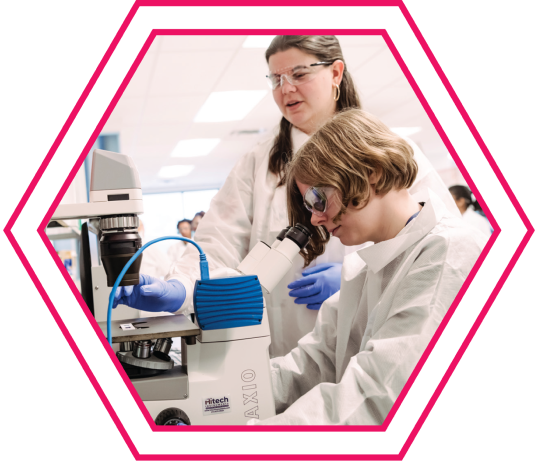
TLST student Fae Switzer works at the microscope with guidance from her mentor, Emma Todd, at ATCC.
Thinking ahead
Although the two-year program initially targeted transfers from regional community colleges, “we were getting so much interest from students on the Catonsville campus, we went ahead and put it on the list of majors for freshmen applying to UMBC,” Friar says. “That’s been the fastest growing cohort in our major.”
Steven Schaffer transferred to TLST after starting on the main campus in bioinformatics. Now he is in the bioinformatics track within TLST; the other option is a biomanufacturing track. Schaffer likes that there is a strong cohort connection because everyone takes mostly the same classes together. “I would recommend TLST. It’s a growing field and the skills you learn are very versatile,” Schaffer adds.
Schaffer hopes to eventually take on a role that leans into engineering at a place like Northrop Grumman. But before that, he’s eyeing UMBC’s Master of Professional Studies in biotechnology. The M.P.S. degree offers advanced instruction in the life sciences, plus coursework in regulatory affairs, leadership, management, and financial management. Friar describes it as “a cross between a science master’s and an M.B.A.”
Academic decathletes
Soon, the confident students in Friar’s cell biology class will arrive in labs across Montgomery County, the capital region, and beyond. They will contribute to drug discovery and production, design manufacturing processes, and, eventually, lead teams and make strategic decisions for major biotech companies.
Jeff Galvin, the ATG CEO, referred to TLST alumni as “academic decathletes.” Like decathletes, they have an array of skills and perform all of them admirably. But rather than medals, they’re seeking an opportunity to contribute to positive change through their work. They’ll translate basic science into diagnostic tests, treatments for disease, and more to improve the lives of their neighbors in Maryland and those in need around the world.
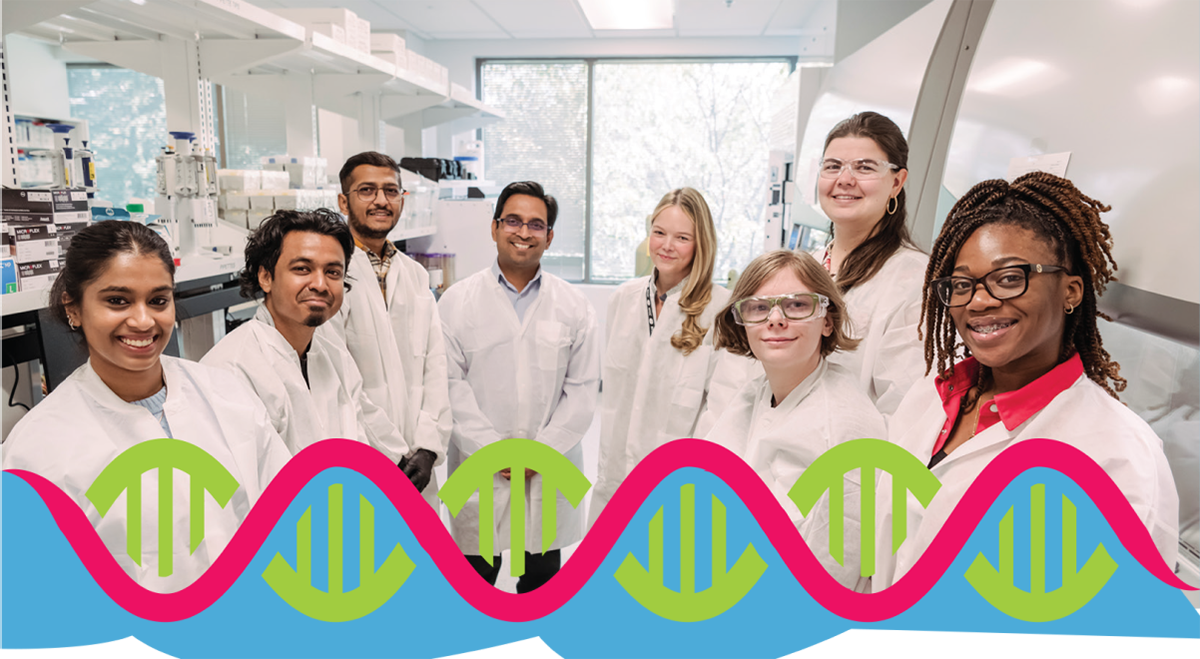
ATCC’s SPARC internship program offers opportunities for TLST students to conduct meaningful work in the biotech industry. Merryll Kallungal (far left) transitioned from her internship to a full-time role at ATCC this summer.
SPARC-ing Rewarding Careers
Just 10 minutes from USG in Gaithersburg, Maryland, biotech company ATCC has capitalized on the TLST talent pipeline. Their Student Partnership and Research Collaboration (SPARC) Program requires USG enrollment and offers qualified students paid, part-time career opportunities throughout the academic year at ATCC’s research facility. As the leading developer and supplier of authenticated cell lines, microorganisms, and associated data for academia, industry, and government, a successful internship at ATCC is a feather in the cap for students pursuing a TLST degree.
Of the seven interns selected for the SPARC program this year, four are TLST students—and they are thriving. The interns praised their SPARC experience while donning lab coats, shoe booties, safety glasses, and gloves in one of ATCC’s labs—where keeping employees safe and protecting lab samples and products from contamination is mission critical.
“I love the TLST program!” exclaimed Fae Switzer, who has wanted to pursue a career in biotech since she learned about CRISPR, the gene-editing platform, as a child. Switzer, a SPARC associate biologist in the microphysiological unit, notes that things she learned in her UMBC classes prepared her for the internship, and things she’s learning at ATCC now are helping her in her classes.
Jason Bose, a SPARC associate biologist on the microbiology team, knew he was interested in biologybut not medical school. When Bose learned about TLST, he thought, “Wow, this aligns with what I want to do,” he says. “It’s been really great so far.” He even uses the basic coding skills and tricks for Excel spreadsheets that he learned in class—which at the time he wasn’t so sure about. “Yep, I use them all the time at ATCC,” he says.
Tamilore Akinde completed an internship last summer at ATCC’s headquarters in Manassas, Virginia, and now she is a SPARC intern. “I like that TLST teaches multidisciplinary skills,” she says. Being able to pivot toward different opportunities that come her way is valuable, she adds.
“The hands-on lab training provided by the TLST program has prepared students for impactful careers at ATCC,” shares Ruth Cheng, general manager and senior vice president for research and industrial solutions at ATCC. “Witnessing students like Merryll Kallungal transition from the SPARC program to a full-time role in cryobiology R&D is a testament to the power of this collaboration.”
After interning at ATCC, Kallungal graduated from TLST in May and assumed a full-time associate biologist role in the cryobiology group in June. The lab techniques she learned in TLST came in handy at ATCC, and she has already learned a lot of new things, too. “I absolutely love what I do,” she says.
The elevator in the Shanghai Tower in China can reach speeds of more than 45 miles per hour, whisking passengers up more than 100 floors in under a minute. For elevators this fast and tall, understanding—and ultimately controlling—the vibrations in the cables is key to keeping the ride smooth. It’s a problem that mechanical engineering professor Weidong Zhu has studied, and his analysis of high-speed elevators is just one of the ways his research touches everyday life. His work analyzing sound and vibration also has applications to improving wind turbines, automotive timing belts, and more.
The American Society of Mechanical Engineers recently honored Zhu’s pioneering body of research by selecting him to deliver the Rayleigh Lecture at the society’s annual meeting this November. The lecture is named after British scientist Lord Rayleigh, who, in addition to correctly explaining why the sky is blue and discovering the noble gas argon, wrote a groundbreaking book on the theory of sound.
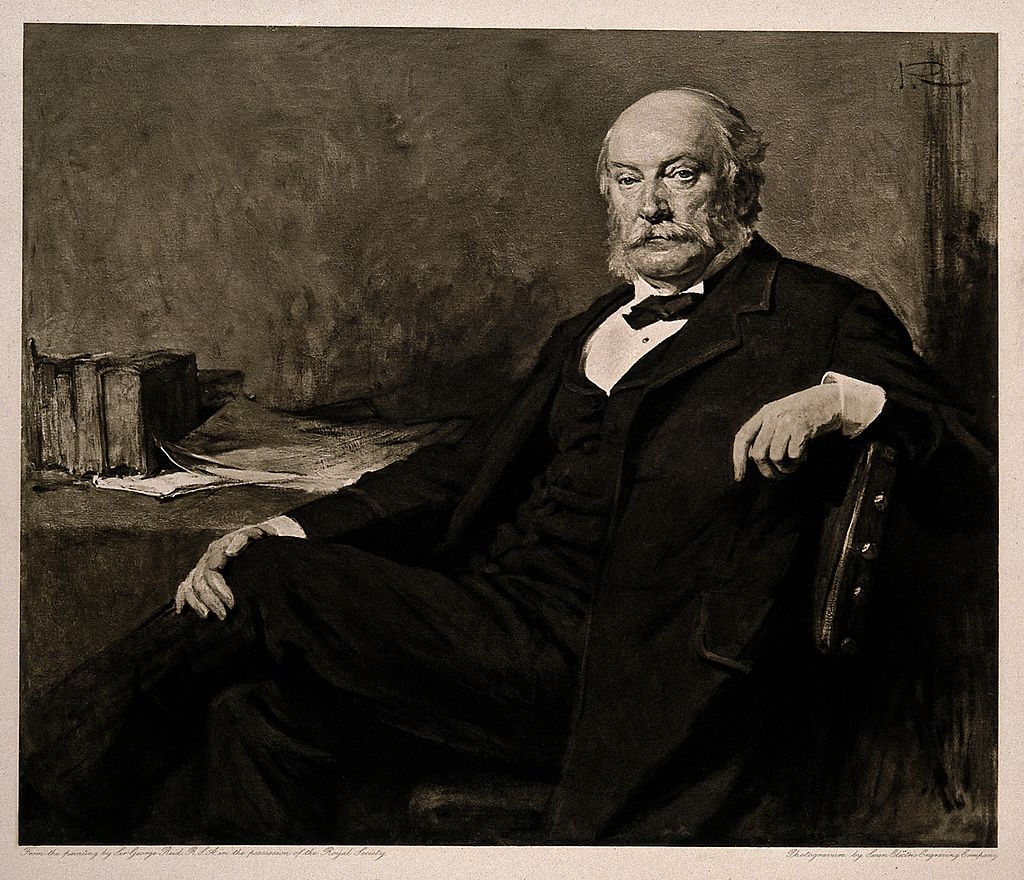 Photogravure of scientist John William Strutt, otherwise known as Lord Rayleigh. (Image credit: Wellcome Library, London, CC BY 4.0)
In his lecture delivered Nov. 20, Zhu presented new methodologies he has developed for analyzing difficult noise and vibration problems. “I’m very honored to give the Rayleigh Lecture,” says Zhu. “It’s a lifetime achievement award and one of the highest recognitions for people doing research in this area.”
Zhu’s impactful research has also been recognized with the 2020 University System of Maryland Board of Regents’ Faculty Award for Excellence in Scholarship, Research, or Creative Activity.
]]>
The elevator in the Shanghai Tower in China can reach speeds of more than 45 miles per hour, whisking passengers up more than 100 floors in under a minute. For elevators this fast and tall,...
https://umbc.edu/quick-posts/mechanical-engineering-professor-weidong-zhu-honored-for-pioneering-work-analyzing-sound-and-vibration/
https://my3.my.umbc.edu/api/v0/pixel/news/145853/guest@my.umbc.edu/d5c534390967aea9595f7019b32af078/api/pixel
coeit
meche
news
quick-post
research
science-and-tech
UMBC News & Magazine
https://my3.my.umbc.edu/groups/umbc-news-magazine
https://assets1-my.umbc.edu/system/shared/avatars/groups/000/001/943/24435aa6207c452e7bc15cc74b42c7bb/xsmall.png?1748556657
https://assets1-my.umbc.edu/system/shared/avatars/groups/000/001/943/24435aa6207c452e7bc15cc74b42c7bb/original.png?1748556657
https://assets2-my.umbc.edu/system/shared/avatars/groups/000/001/943/24435aa6207c452e7bc15cc74b42c7bb/xxlarge.png?1748556657
https://assets2-my.umbc.edu/system/shared/avatars/groups/000/001/943/24435aa6207c452e7bc15cc74b42c7bb/xlarge.png?1748556657
https://assets3-my.umbc.edu/system/shared/avatars/groups/000/001/943/24435aa6207c452e7bc15cc74b42c7bb/large.png?1748556657
https://assets1-my.umbc.edu/system/shared/avatars/groups/000/001/943/24435aa6207c452e7bc15cc74b42c7bb/medium.png?1748556657
https://assets2-my.umbc.edu/system/shared/avatars/groups/000/001/943/24435aa6207c452e7bc15cc74b42c7bb/small.png?1748556657
https://assets1-my.umbc.edu/system/shared/avatars/groups/000/001/943/24435aa6207c452e7bc15cc74b42c7bb/xsmall.png?1748556657
https://assets2-my.umbc.edu/system/shared/avatars/groups/000/001/943/24435aa6207c452e7bc15cc74b42c7bb/xxsmall.png?1748556657
UMBC News & Magazine
0
0
false
Fri, 22 Nov 2024 14:40:08 -0500
Fri, 22 Nov 2024 14:40:08 -0500