The Academic Minute: Democratizing access to digital tools in the documentation of the Innu language
For centuries, books have been the primary method of documenting spoken and written languages. This method has given us insights into the formal and informal uses of language within communities and those outside the community. However, books and even tape recordings haven’t always captured the intricacies and uniqueness of a language. Advances in technology have broadened the scope and quality of language documentation and preservation, but these digital tools have also created a skills gap between researchers and communities.
UMBC’s Renée Lambert-Brétière, associate professor of modern languages, linguistics, and intercultural communication, is working on bridging this gap through a collaborative and community-engaged research project with Innu-speaking communities in Quebec, Canada, that seeks to democratize access to digital tools involved in the documentation of their language.
“Mobilizing methodologies of linguistics, digital and public humanities, this research makes an important contribution to current developments in language documentation research and constitutes a major step in broadening the tools for language preservation within the Innu speech communities,” Lambert-Brétière explains to Lynn Pasquerella, president of the American Association of Colleges and Universities and host of The Academic Minute, a daily show featuring faculty from colleges and universities worldwide speaking about their cutting-edge research.
UMBC’s Academic Minute takeover week
Lambert-Brétière joined five UMBC scholars this fall in UMBC’s first Academic Minute Takeover Week, featuring the latest research in media and communication studies; philosophy; language, literacy, and culture; and history. This series is republished on NPR podcasts and Inside Higher Ed.https://academicminute.org/2023/09/renee-lambert-bretiere-democratizing-access-to-digital-tools-in-the-documentation-of-the-innu-language/
Lambert-Brétière’s book, À la recherche d’un signe perdu: Jean-Baptiste de La Brosse, S.J., Éléments de langue montagnaise (1768) (Chemins de tr@verse, 2018), is the first edition of the grammar of the Innu language written in Latin in 1768 by the Jesuit Jean-Baptiste de La Brosse. It offers a unique testimony on the state of this nomadic language in the middle of the eighteenth century. Her research has appeared in peer-reviewed outlets that include the Journal of Language Diversity, Anthropological Linguistics, Journal de la société des océanistes, and Annual Review of Cognitive Linguistics.
Learn more about UMBC’s modern languages, linguistics, and intercultural communication program.
]]>
For centuries, books have been the primary method of documenting spoken and written languages. This method has given us insights into the formal and informal uses of language within communities...
https://umbc.edu/stories/the-academic-minute-democratizing-digital-tools/
https://my3.my.umbc.edu/api/v0/pixel/news/136640/guest@my.umbc.edu/8ea7fcb92183c1ad22a767dc4ee80790/api/pixel
cahss
mlli
news
policy-and-society
research
UMBC News & Magazine
https://my3.my.umbc.edu/groups/umbc-news-magazine
https://assets1-my.umbc.edu/system/shared/avatars/groups/000/001/943/24435aa6207c452e7bc15cc74b42c7bb/xsmall.png?1748556657
https://assets1-my.umbc.edu/system/shared/avatars/groups/000/001/943/24435aa6207c452e7bc15cc74b42c7bb/original.png?1748556657
https://assets2-my.umbc.edu/system/shared/avatars/groups/000/001/943/24435aa6207c452e7bc15cc74b42c7bb/xxlarge.png?1748556657
https://assets2-my.umbc.edu/system/shared/avatars/groups/000/001/943/24435aa6207c452e7bc15cc74b42c7bb/xlarge.png?1748556657
https://assets3-my.umbc.edu/system/shared/avatars/groups/000/001/943/24435aa6207c452e7bc15cc74b42c7bb/large.png?1748556657
https://assets1-my.umbc.edu/system/shared/avatars/groups/000/001/943/24435aa6207c452e7bc15cc74b42c7bb/medium.png?1748556657
https://assets2-my.umbc.edu/system/shared/avatars/groups/000/001/943/24435aa6207c452e7bc15cc74b42c7bb/small.png?1748556657
https://assets1-my.umbc.edu/system/shared/avatars/groups/000/001/943/24435aa6207c452e7bc15cc74b42c7bb/xsmall.png?1748556657
https://assets2-my.umbc.edu/system/shared/avatars/groups/000/001/943/24435aa6207c452e7bc15cc74b42c7bb/xxsmall.png?1748556657
UMBC News & Magazine
0
0
false
Fri, 27 Oct 2023 13:59:17 -0400
Fri, 27 Oct 2023 13:59:17 -0400
UMBC’s 2023-2024 Fulbright Student Program recipients announced
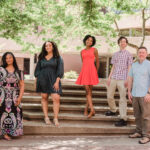
This year, the U.S. Fulbright Student Program, the U.S. government’s flagship international exchange program, has awarded nine UMBC students and alumni top research and teaching placements in countries such as Japan, Taiwan, and North Macedonia.
Each year, more than 10,000 students apply with just over 2,000 selected from hundreds of colleges and universities across the U.S. In the last decade, UMBC students and alumni have received more than 85 Fulbright U.S. Student Program awards for research and teaching placements in Africa, Asia and the Pacific, the Middle East, South America, and Europe. UMBC was named a Fulbright Top Producing Institution in 2019 – 2020.
This year’s class includes research award recipient Paul Ocone ’22, individualized study, who will be conducting research at Meiji University School of Global Japanese Studies in Japan. Fulbright research awards provide funding for research and training efforts overseas with a focus on non-Western foreign languages and area studies. Additionally, there are eight UMBC recipients of the English Teaching Assistant (ETA) award. ETA’s develop their own language skills and knowledge of their host country while working with student in elementary through college to strengthen their English-language abilities and knowledge of the U.S.
Three alumni will be headed to Taiwan to further their passion for global languages and communities: Nailah-Benā Chambers ’23, global studies, Kara Gavin ’20, English, and Milan Richardson ’23, bioinformatics.
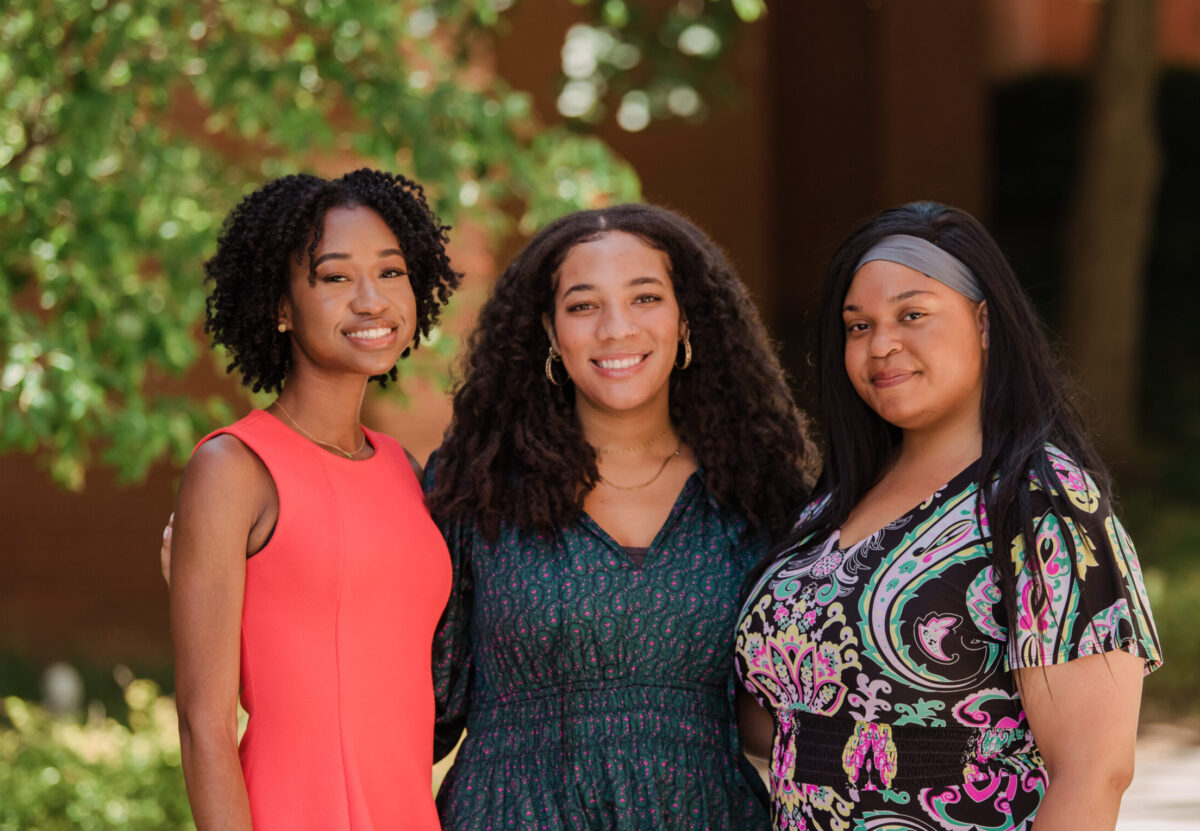 Kara Gavin, Nailah-Benā Chambers, and Milan Richardson. (Marlayna Demond ’11/UMBC)
Gavin brings experience as a Teaching of English as a Second Language (TESOL) volunteer which she completed during her study abroad program at the University of Brighton in the U.K. Chambers began learning how to move between different languages early in life as a student in a Chinese-language skills course. She later became a tutor, a skill she continued at UMBC’s English Language Institute (ELI). Teaching Baltimore Public City School’s diverse student population inspired Richardson to apply to the Fulbright program where she will continue working with students from all backgrounds.
David Bullman ’22, ancient studies, served in the U.S. Army as a musician and public diplomat. He will be returning to North Macedonia, one of the countries he previously served in.
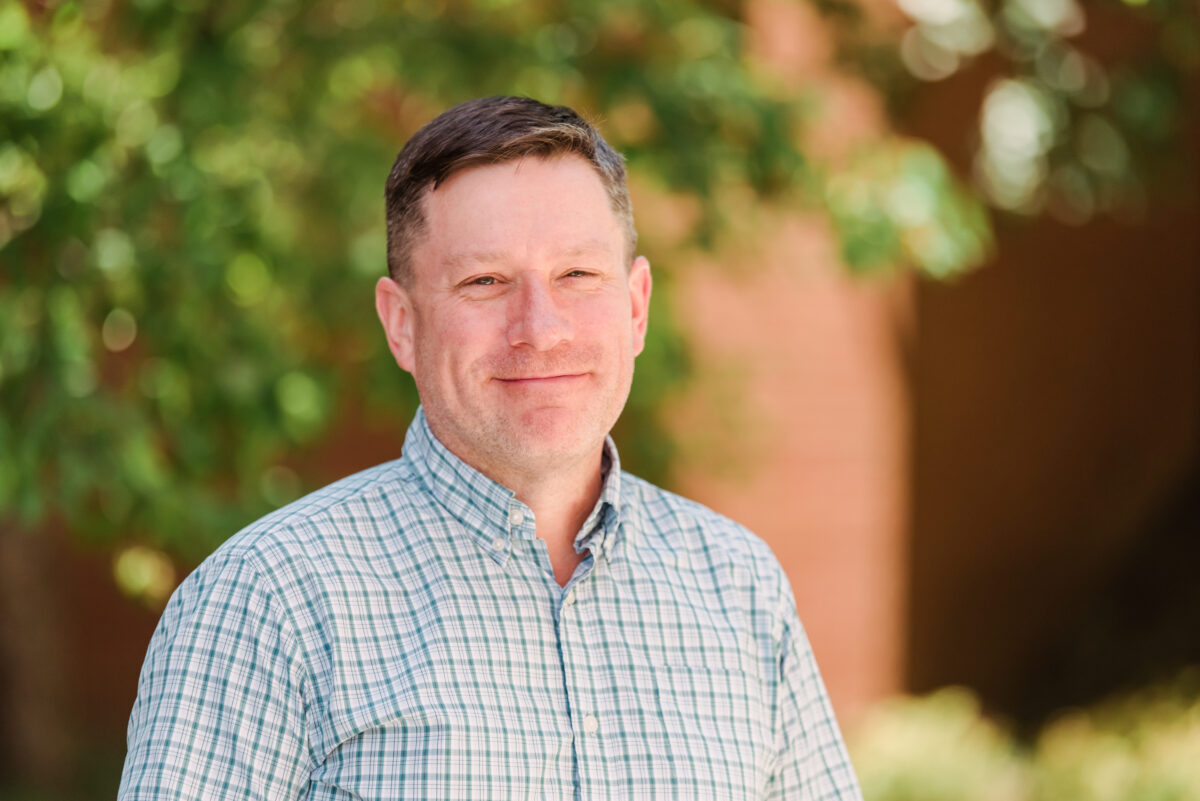 David Bullman. (Marlayna Demond ’11/UMBC)
In addition to teaching English, Leah Michaels, M.F.A ’21, intermedia and digital arts, will be conducting research for two films and teaching film workshops for the community in Piła, Poland.
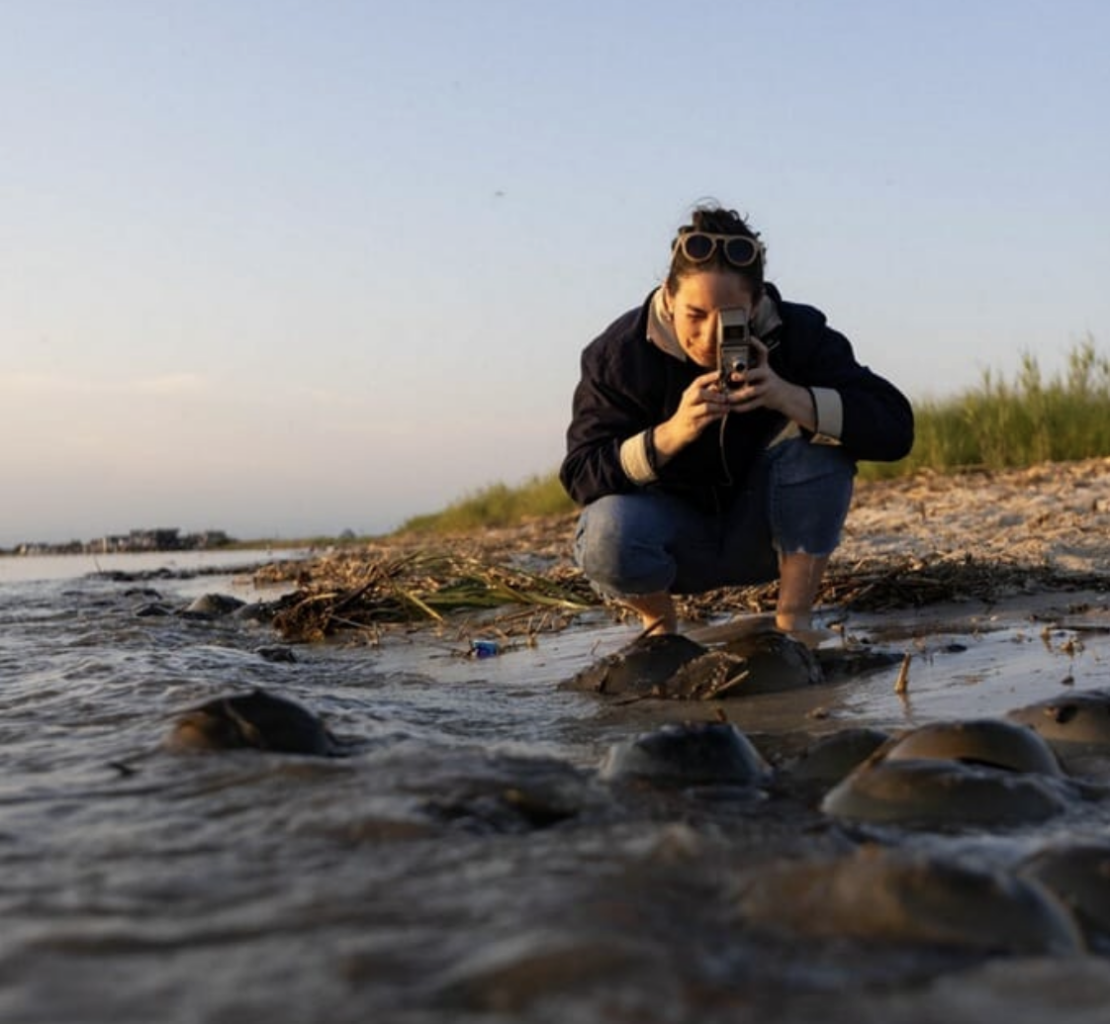 Leah Michaels in Cape May shooting the horseshoe crab mating period for a film she’s working on. (Image courtesy of Leah Michaels)
Tiffany Powell ’23, TESOL, spent three years teaching English in Seoul, Korea and will continue teaching in Romania after she graduates in December.
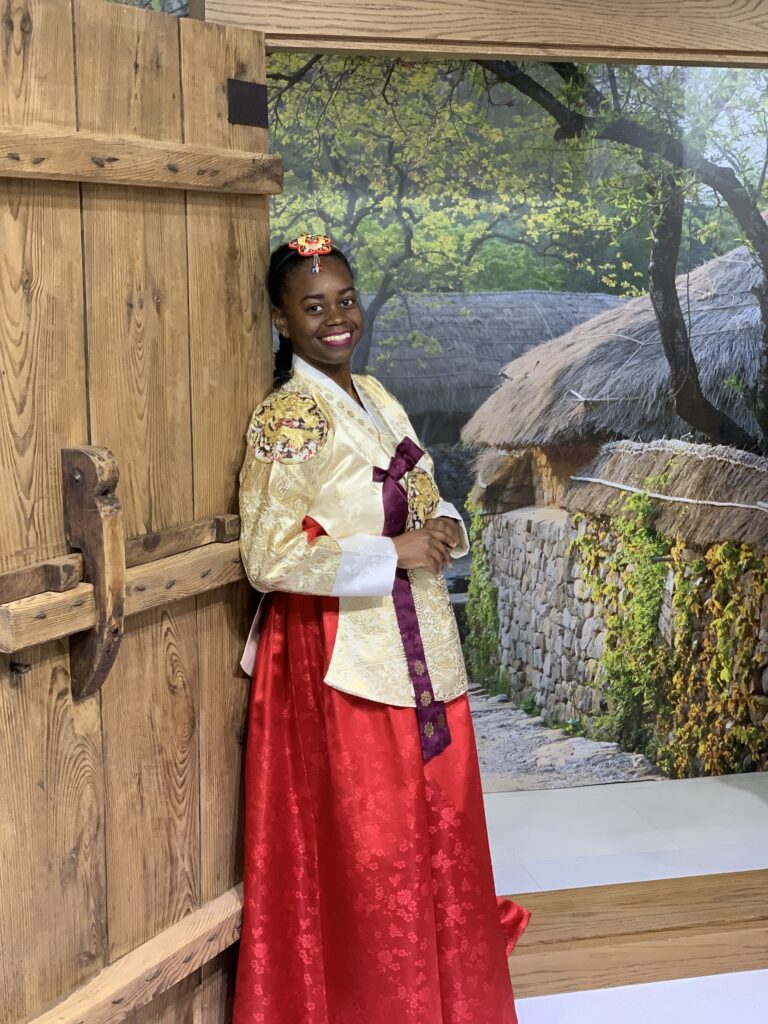 Tiffany Powell in Seoul wearing a hanbok, South Korean traditional clothing. (Image courtesy of Tiffany Powell)
Sianna Serio ’23, computer science, who studied abroad in France, Spain, and the U.K., will head to the Slovak Republic to teach high school students.
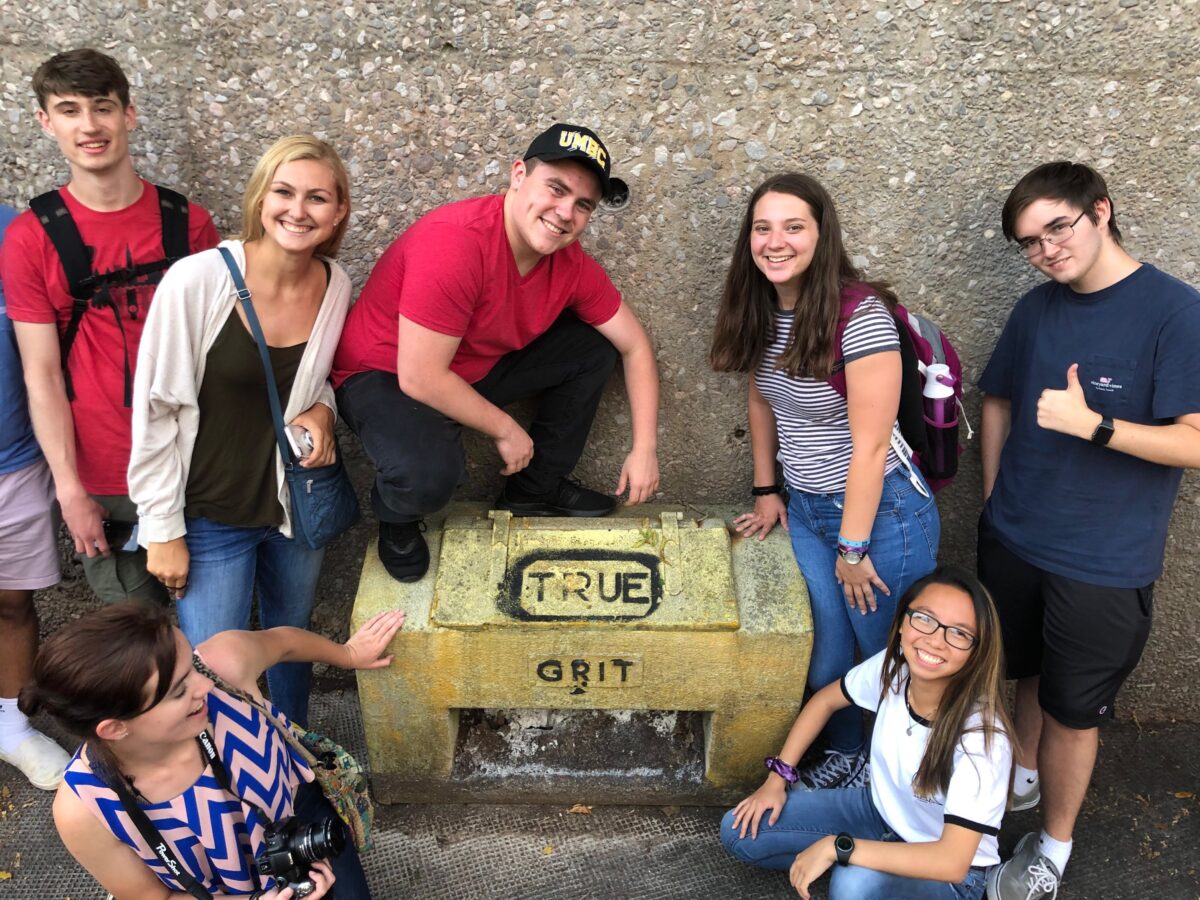 Sianna Serio, kneeling on right, in Bristol, U.K. (Image courtesy of Sianna Serios)
As a former marketing assistant at the ELI, Tasneem Mansour ’20, modern languages, linguistics and intercultural communication, supported visiting students from Peru, Nagoya and Tokyo, Japan. Mansour will head to South Korea.
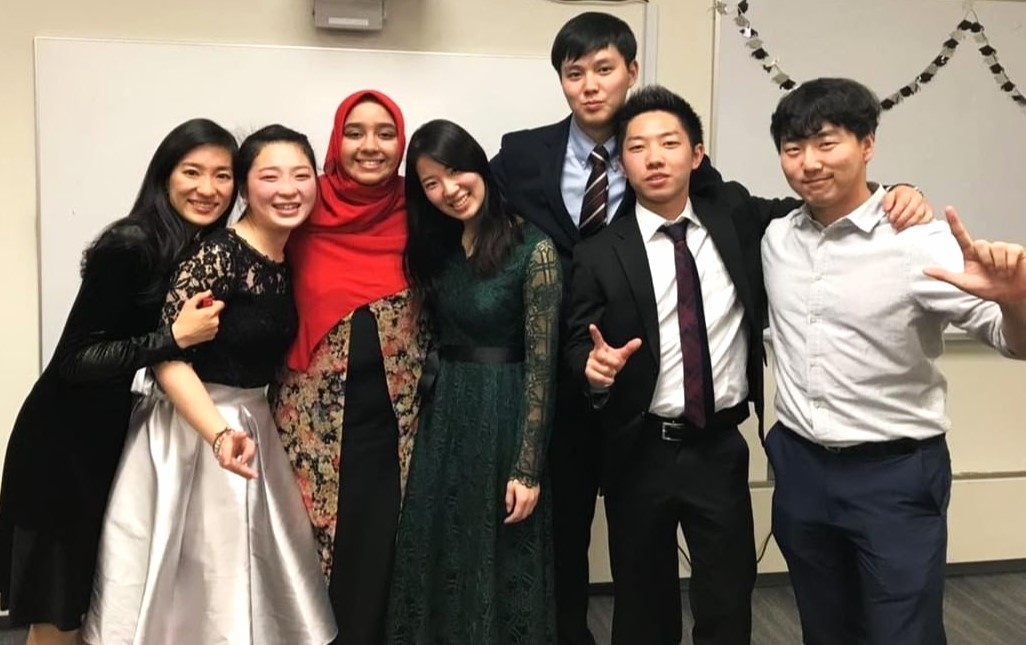
Tasneem Mansour, third from the left, with students from Nippon Sport-Science University in Tokyo, Japan. (Image courtesy of Tasneem Mansour)
UMBC’s global outlook
UMBC’s commitment to international collaboration and research begins at the Center for Global Engagement, which connects students and faculty from the U.S. with students and distinguished faculty from more than 100 countries with unique international academic opportunities. Together, they further the research and skills needed to address long-standing and new global challenges.
Brian Souders, M.A.’19, TESOL and Ph.D. ’09, language, literacy and culture, the associate director of global learning of the Center for Global Engagement, has led students through the Fulbright application process, as UMBC’s Fulbright Program advisor, for the last decade. “Our students are high achievers, the application process is a place for them to share their story,” says Souders. “Faculty and staff are there to ensure each student’s application reflects their years of hard work and the skills they have developed to collaborate with partners across the world.”
Research at home and abroad
With the vast network of Fulbright alumni at UMBC and across the U.S., it’s always helpful to get tips on how to conduct research in a new country and in a new language. Fulbright recipient Ocone, a long time fan of all things anime, began developing his ethnographic research skills with the support of Bambi Chapin, associate professor of anthropology. Chapin, a 1999 – 2000 Fulbright recipient, taught Ocone the theoretical and practical aspects of ethnographic research which he will now use to research the politics of inclusion and exclusion in otaku (anime/manga fan) spaces.
Chapin, along with Julie Christ Oakes, the assistant director of curriculum and retention of the Honors College and a 2001 – 2002 Fulbright research award recipient to Japan, also workshopped Ocone’s research proposal and Fulbright application. Oakes also shared her insights on the Fulbright experience.
“I went to Japan to do research for my dissertation research,” says Oakes. “I have a good idea of what [Ocone] will face as a relative “newbie” abroad and a non-native Japanese speaker and reader.”
The Fulbright experience is also about nurturing relationships with faculty abroad. Ocone said he feels honored for the opportunity to further his research with Kaichiro Morikawa, an associate professor at Meiji University and author of one of the foundational books on otaku spaces. Morikawa will help Ocone navigate the various resources on otaku culture. He wrote in Ocone’s recommendation letter that his “research is highly original as well as effectively focused,” and says he looks forward to supporting Ocone during his time at the university and in Japan.
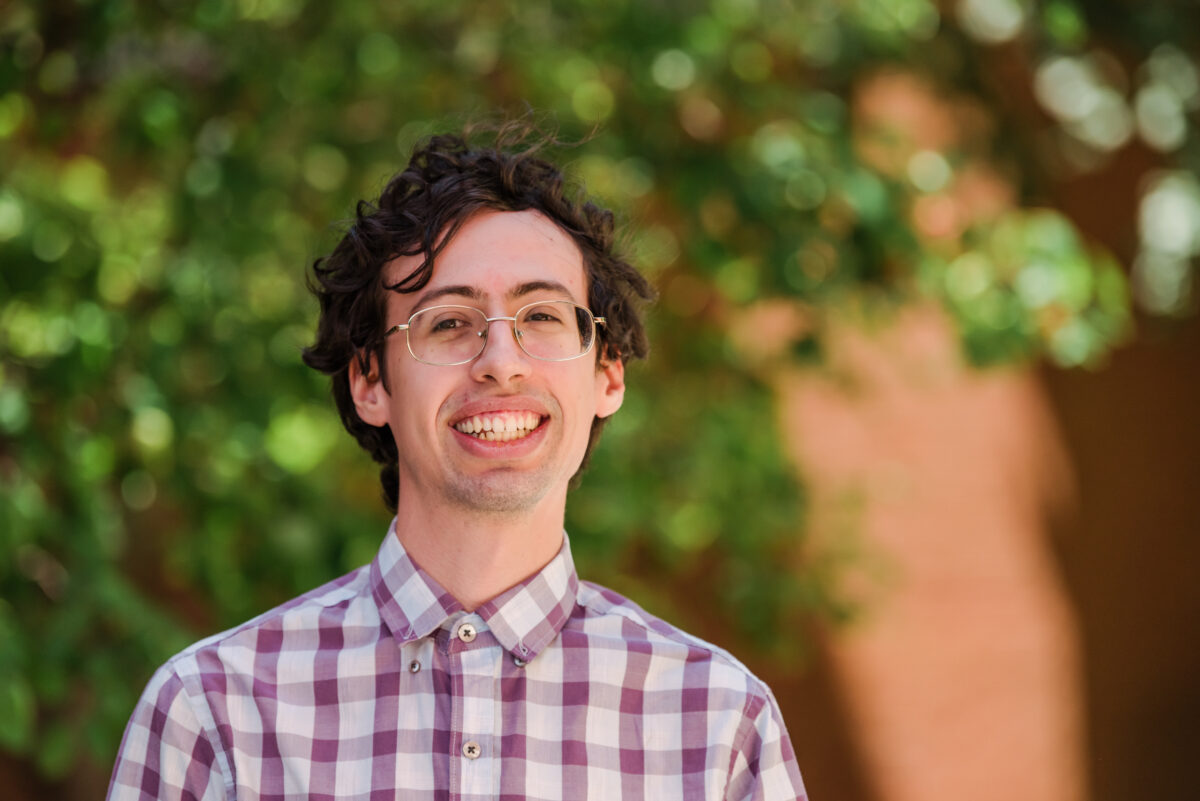 Paul Ocone. (Marlayna Demond ’11/UMBC)
“I am immensely grateful to all of my mentors for guiding me on my journey through my undergraduate degree—from my earliest fuzzy and broad ideas of what I wanted to do, to the more specific research plans, and to the rewarding thesis that eventually emerged,” says Ocone. “I’ll be continuing research on topics that I care deeply about, research that I will likely build upon in graduate school and beyond.”
Fulbright support network
The road to being a Fulbright recipient begins day one students’ UMBC experience as they explore majors, create a network of mentors, and hone their research skills. At the end of their junior year, students develop their initial application at the Fulbright Base Camp led by Souders, who is a 2023 – 2024 Fulbright International Education Administrator award recipient. “The camp helps elevate and support students to reach their Fulbright goals,” says Souders. “Students share drafts of their essays with me for feedback prior to the campus deadline, the first day of the fall semester. They participate in a campus evaluation process with UMBC faculty and staff to receive feedback on their applications.”
Souders, Chapin, and Maryam Elhabashy ’21, anthropology, a research assistant at Rutgers University and a 2022 Fulbright recipient to Kuwait City, discuss this process on the Retrieving the Social Science podcast, produced by UMBC’s Center for Social Science Scholarship.
“The panel gives students advice about how to craft a project, like how to take it apart and re-put it back together, what we see as strengths,” says Chapin. “We support them and encourage them as they go through that really difficult intellectual work, emotional work of figuring out how to make their strong projects even stronger.”
Learn more about the UMBC’s international education opportunities.
]]>
This year, the U.S. Fulbright Student Program, the U.S. government’s flagship international exchange program, has awarded nine UMBC students and alumni top research and teaching placements in...
https://umbc.edu/stories/2023-fulbright-recipients/
https://my3.my.umbc.edu/api/v0/pixel/news/134370/guest@my.umbc.edu/516ede6d25c349e81ae689cbf97868dc/api/pixel
ancientstudies
anthropology
cahss
coeit
computer-science
english
globalstudies
honorscollege
inds
intermedia-and-digital-arts
international-stories
llc
mlli
news
policy-and-society
rca-2
tesol
UMBC News & Magazine
https://my3.my.umbc.edu/groups/umbc-news-magazine
https://assets1-my.umbc.edu/system/shared/avatars/groups/000/001/943/24435aa6207c452e7bc15cc74b42c7bb/xsmall.png?1748556657
https://assets1-my.umbc.edu/system/shared/avatars/groups/000/001/943/24435aa6207c452e7bc15cc74b42c7bb/original.png?1748556657
https://assets2-my.umbc.edu/system/shared/avatars/groups/000/001/943/24435aa6207c452e7bc15cc74b42c7bb/xxlarge.png?1748556657
https://assets2-my.umbc.edu/system/shared/avatars/groups/000/001/943/24435aa6207c452e7bc15cc74b42c7bb/xlarge.png?1748556657
https://assets3-my.umbc.edu/system/shared/avatars/groups/000/001/943/24435aa6207c452e7bc15cc74b42c7bb/large.png?1748556657
https://assets1-my.umbc.edu/system/shared/avatars/groups/000/001/943/24435aa6207c452e7bc15cc74b42c7bb/medium.png?1748556657
https://assets2-my.umbc.edu/system/shared/avatars/groups/000/001/943/24435aa6207c452e7bc15cc74b42c7bb/small.png?1748556657
https://assets1-my.umbc.edu/system/shared/avatars/groups/000/001/943/24435aa6207c452e7bc15cc74b42c7bb/xsmall.png?1748556657
https://assets2-my.umbc.edu/system/shared/avatars/groups/000/001/943/24435aa6207c452e7bc15cc74b42c7bb/xxsmall.png?1748556657
UMBC News & Magazine
3
0
false
Sat, 22 Jul 2023 01:43:12 -0400
Sat, 22 Jul 2023 01:43:12 -0400
Shared Stories, Shared Purpose

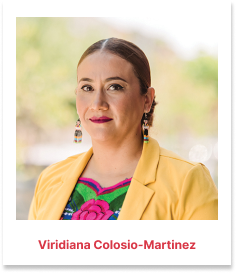
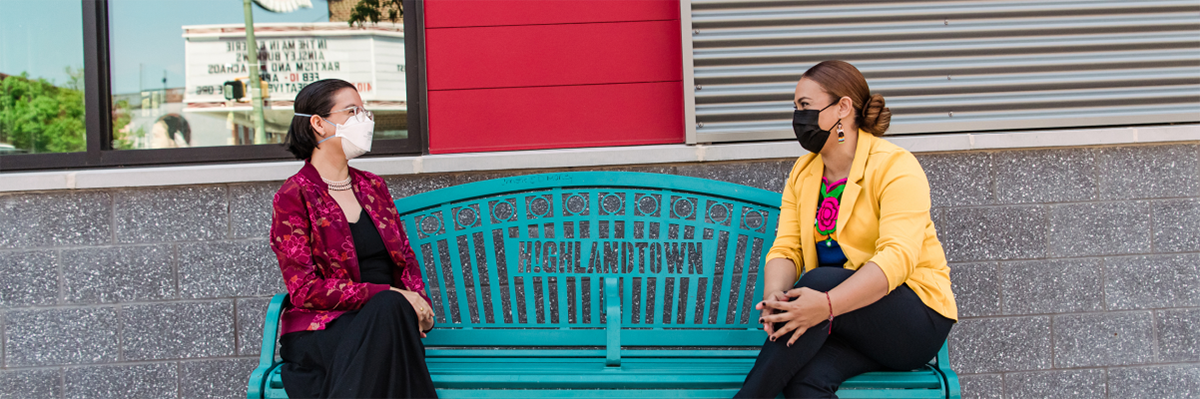
On a warm and bright sunny day in April when the trees in Baltimore City’s Patterson Park are changing from bright green buds to full leaf and the birds are competing with the car horns, Viridiana Colosio-Martinez ’22, modern languages, linguistics, and intercultural communication, and M.A. ’24, intercultural communication, waits in front of the Creative Alliance, a community and performance space a few blocks away from the park. After three years of undergraduate and graduate classes with her professor Tania Lizarazo, Colosio-Martinez is finally meeting her in person.
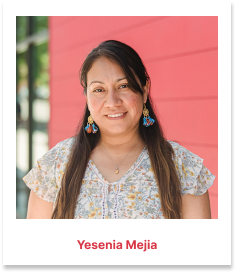
“I’m nervous and excited,” she says, waving to Lizarazo, associate professor of modern languages, linguistics and intercultural communication and global studies, as Lizarazo crosses the street to meet her and collaborator Yesenia Mejia, director of Creative Immigrant Educators of Latin American Origin (CIELO) and the Artesanas Latin American cultural enrichment program coordinator at the Creative Alliance.
“I can’t believe it’s the first time I’m seeing them outside of Webex,” says Colosio-Martinez.
There was a lot of hugging—the kind of hugging that is reserved for a friend you haven’t seen in years. Together, the group is gathering to review digital storytelling projects they’ve been working on together virtually for the past year, which they will present at the International Digital Storytelling Conference in Baltimore this summer.
Led by Lizarazo, and in collaboration with local Latin American communities, they are working to center the human experience by collecting and sharing a range of immigrant journeys that have previously been unrecognized.
“Lived experience is knowledge and should be part of knowledge production. A lot of our students are immigrants or their parents are immigrants and seeing experiences of migration beyond academic writing motivates them to explore their own personal and family stories,” says Lizarazo.
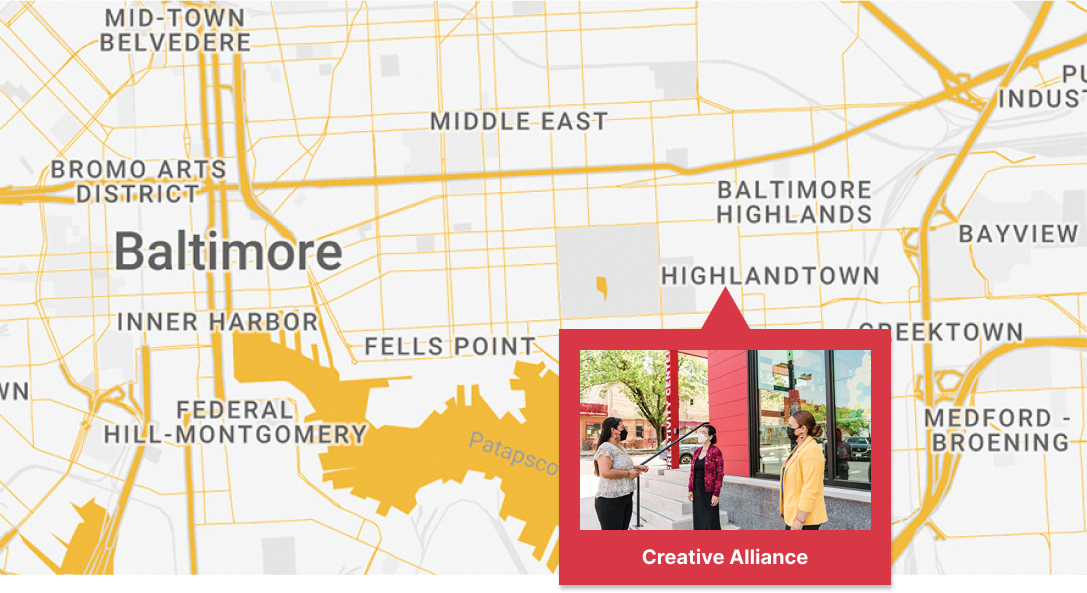
Tania Lizarazo, Viridiana Colosio-Martinez ’22, M.A. ’24, and Yesenia Mejia have been working together to tell the immigration stories of Baltimore’s Latin American communities.
Making teaching and research accessible
When Lizarazo moved from the University of California, Davis (UC Davis) to teach at UMBC in 2015, she felt an urgent need to create community. It had been easy to find a Latinx community in Davis but less so in Maryland.
“I arrived in Baltimore and suddenly I’m walking into places where I’m the only Latina. I don’t think that it’s healthy for anyone,” says Lizarazo. She began volunteering at the Creative Alliance where she met Mejia and started Latinas in Baltimore.
During the pandemic, Lizarazo, who is chronically ill and immunocompromised, has found that virtual classes and tools allow her to continue teaching and engaging in research with the community. In fact, the pandemic made accessibility that had previously been considered impossible the norm.
“We were so close to reimagining what community care could look like in 2020. We should not leave anyone behind or require people to choose between showing up or protecting themselves, their families, and their communities,” says Lizarazo.
“I am also committed to showing that we don’t have to choose between presence and safety. We can imagine collaborations that do not require additional exposures during an ongoing pandemic, that acknowledge that we have different access to resources such as healthcare, and that value interdependence and community care. Not only do I want to collaborate in producing knowledge but I want to be mindful of the context of these collaborations and not pick and choose what justice is when marginalized people keep being the most affected by the pandemic.”
Together with the Baltimore Field School, a part of UMBC’s overarching public humanities programming, and her partner researchers, Lizarazo has spent numerous hours building the relationships needed to help community members tell their stories.
“In the same way, community members rarely feel included in academia in different ways than research subjects. Creating opportunities for dialogues opens up opportunities to imagine new interactions and collaborations where not only the researcher’s knowledge is valued. Researchers would not be able to do anything without relationships and collaborations with students and community members.”
Slow research
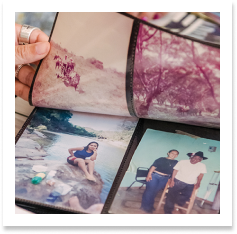
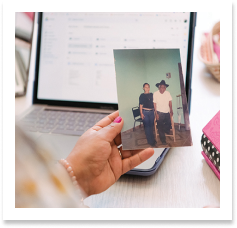
The researchers sit around a table and listen to Mejia describe photos of her family back in Santa María Zacatepec, Oaxaca, Mexico, during the 1990s. A faded photo shows her and her sister riding horses at a ranch. She picks up a picture of her father and pauses. “I didn’t get to see him.” Mejia has not been able to return to Mexico for almost 20 years, during which her father died. Colosio-Martinez and Lizarazo nod, understanding the pain and joy in between Baltimore and Oaxaca.
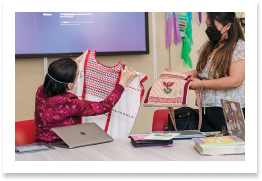
Mejia, a Baltimore Field School fellow, is working on a digital story, a story map, and website for her project on Representations of Indigenous Traditions from Latin America in Baltimore. She unfolds a calf-length, white cotton huipil (tunic) hand embroidered with red and orange nahuales and proudly shows a family picture with her mom wearing the same huipil.
“My mom always wears her huipil,” says Mejia. “Nahuales are spirit animals that are assigned to a baby according to the day they were born.” This spurs a lot of questions about the nahuales while she shows another hand-embroidered item, a bag with nahuales made by a fellow Indigenous Tacuate artist from Zacatepec.
This community-centered approach to research where students and community members are the knowledge creators is a key approach to Lizarazo’s community-engaged research on Latin American studies, transnational feminism using collaborative methods. It’s a shift away from the colonial-minded ethnography methods created by academics in the global north to research communities in the global south.
“We need to recognize that trust-building is a slow process,” says Lizarazo. “It’s based on reciprocity and it’s essential to meaningful communication and collaboration with communities.”
“Academia has historically excluded marginalized groups while extracting their knowledge. This extraction translates into personal gain for researchers but rarely benefits the communities that have been researched. As universities are not always reflections of the local communities where they are located, I have always been interested in learning from community members,” says Lizarazo. “I enjoy creating, collaborating on, and supporting projects that would not have an exclusively academic audience and won’t exist (only) behind paywalls. This is particularly important in public universities.”
Lizarazo calls this “slow research.” She had been practicing it in her home country of Colombia and at UC Davis as a doctoral student.
“Tania was an early proponent of experimenting with digital storytelling as a research method. Uncomfortable with academic ‘interventions’ into communities, she liked the idea of putting digital communication tools in the hands of vulnerable groups, like migrants, who might not otherwise have access to share their experiences in the public sphere,” shares Lizarazo’s mentor, Robert Irwin, director of the UC Davis Global Migration Center.
“She was an advocate for listening to and learning from migrants. Hers was an important voice in the research group that designed our first strategies for deploying this methodology.”
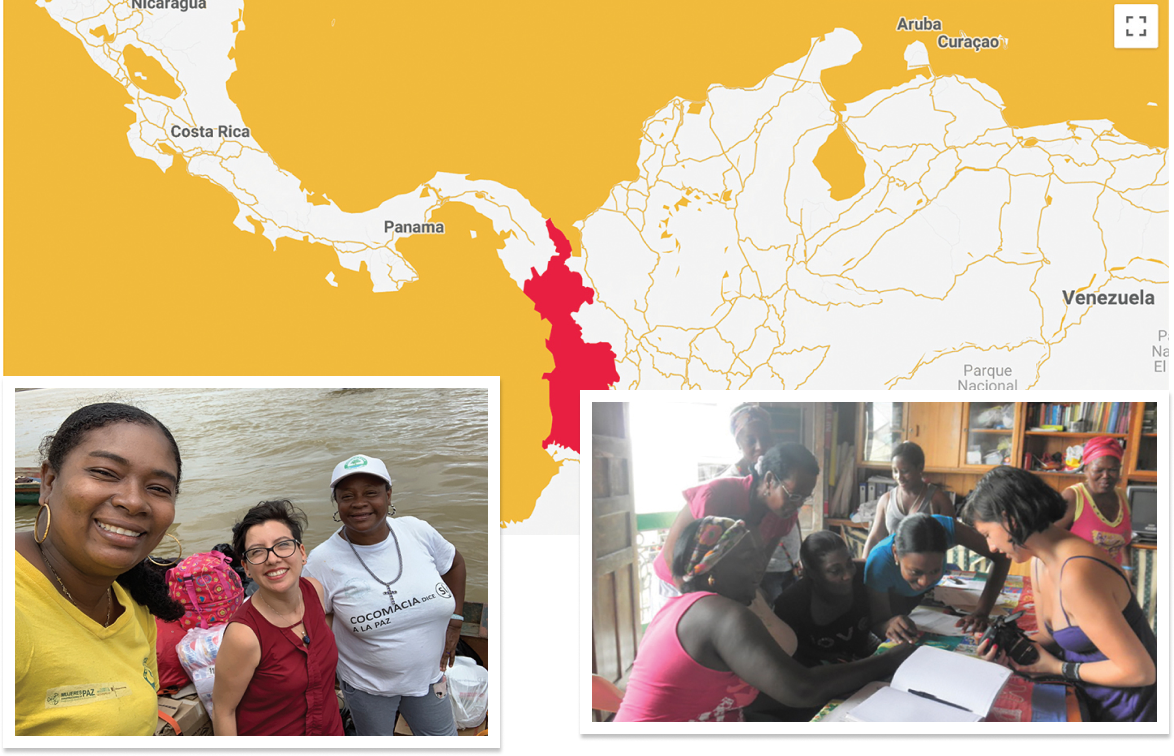 At left: Lizarazo (center) meets with community journalist Lucely Rivas (left) and Gender Commissioner Julia Susana Mena Becerra at the Atrato River. At right: Working with partners on the Mujeres Pacíficas project at the Gender Commission’s office in downtown Quibdó in 2013. Pictured (l-r): Rubiela Cuesta Córdoba, María del Socorro Mosquera Pérez, Yenny Palacios Romaña, Carmen Aides Navia Mena, Banessa Rivas López (in blue), Luz Adonis Mena Becerra and Ana Rosa Heredia Cuesta. Photos courtesy of Lizarazo.
Listening and learning
“Mujeres Pacíficas” was Lizarazo’s first digital storytelling project in collaboration with Afro-Colombian women activists in the department of Chocó, in Western Colombia, who were also advocates for land rights and women’s rights. She met the group in 2008. “Women were doing the work alongside men for years but their work had gone unrecognized,” says Lizarazo.
One of the first shared stories, recorded after five years of community building, was created in collaboration with Luz Adonis Mena Becerra, a member of the Main Community Council of the Integral Peasant Association of the Atrato River, a Black farmers’ association in the Colombian Pacific, where Black communities were officially granted territorial rights in 1993.
“In the process of creating Luz Adonis’s story, I found out she had faced forced displacement and had lost everything she owned in a fire years later,” says Lizarazo. “Despite this, she reconstructed her memories through community photographs for her story.”
The project inspired Lizarazo’s forthcoming book from the University of Illinois Press, Postconflict Utopias: Performing Everyday Survival in the Colombian Pacific, a part of the “Dissident Feminisms” series. “The willingness to imagine these stories before they had audiences, and in spite of the absence of personal archives, is utopian,” says Lizarazo. “Not because these stories are ideal or unrealistic but because they invite the audience to imagine what seems impossible: the end of decades of violent conflict into a material reality.”
Student-teacher and the teacher-student
Parting with colonial-minded immigration research means developing new frameworks that humanize data and shift the process of gathering and disseminating information from one person to a community with a diverse and evolving set of skills and expertise.
“Equipping immigrants with the tools and methods to co-create personal stories can help us understand migration as a hemispheric experience in the context of globalization, colonialism, neoliberalism, genocide, and marginalization, especially of Black and Indigenous communities in Latin America,” says Lizarazo.
These voices highlight the multitude of paths immigrants take that are equally stories of joy, success, family, and community love as they are stories of survival, sacrifice, separation, and pain. There isn’t one Central American experience, Mexican American life, or Latin American journey. Before immigrants became people of color, Latinos, or minorities, they were Aymara, Taino, Mayan, Colombian, Mexican.
“It’s important to critically study the connections between local and global contexts of production and consumption of these stories,” says Lizarazo.
“It’s a more horizontal teaching-learning experience, where students, community members, and instructors are teaching and learning. The world is messy; when we listen to each other, we can do things that we didn’t know were possible before.”
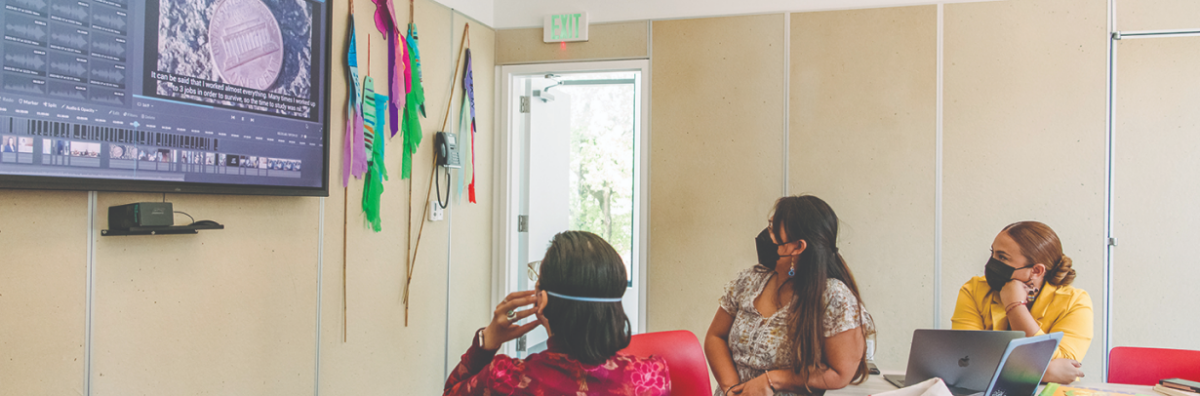 Colosio-Martinez shares photos and stories of her family’s journey with Mejia and Lizarazo.
One penny
After Mejia places her photos and huipil on the table, Colosio-Martinez, research assistant for the Moving Stories: Latinas In Baltimore digital storytelling project led by Lizarazo, takes a deep breath and preempts the debut of her digital story draft by apologizing for the tears to come. A clip of a map shows a blue line tracing the miles of her life from Caborca, Sonora, Mexico, three hours from Phoenix, Arizona, to New Haven, Connecticut, to Baltimore.
A small picture of a penny appears on the screen.
“I’ll never forget when me and my mom tried to register for community college,” she begins, “but we were short one penny.” With each description, the penny gets bigger. “The registrar said she didn’t have a penny and shut the window in our faces.” The penny fills the screen. “My mom and I went outside and searched the floor until we found a penny.”
The pursuit of education is the connecting thread throughout the narrative. A photo of Colosio-Martinez wearing her cap and gown and celebrating with her husband after earning her associate’s degree is followed later by a screenshot of an email welcoming her to UMBC.
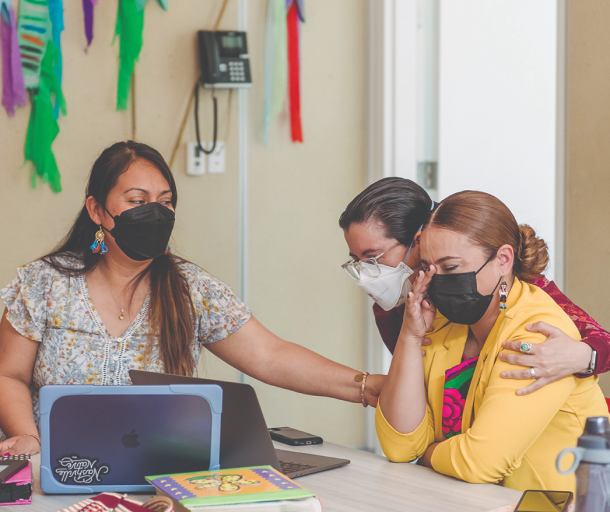
Colosio-Martinez covered her eyes to hide her tears. Lizarazo hugged her. Mejia touched her shoulder. They suggest she not cut her story.
]]>
On a warm and bright sunny day in April when the trees in Baltimore City’s Patterson Park are changing from bright green buds to full leaf and the birds are competing with the car horns, Viridiana...
https://umbc.edu/stories/shared-stories-shared-purpose-slow-research/
https://my3.my.umbc.edu/api/v0/pixel/news/133967/guest@my.umbc.edu/211995ee0714763b85b5693f515054b1/api/pixel
baltimore-field-school
cahss
discovery
global-studies
magazine
mlli
public-humanities
research
spring-2023
UMBC News & Magazine
https://my3.my.umbc.edu/groups/umbc-news-magazine
https://assets1-my.umbc.edu/system/shared/avatars/groups/000/001/943/24435aa6207c452e7bc15cc74b42c7bb/xsmall.png?1748556657
https://assets1-my.umbc.edu/system/shared/avatars/groups/000/001/943/24435aa6207c452e7bc15cc74b42c7bb/original.png?1748556657
https://assets2-my.umbc.edu/system/shared/avatars/groups/000/001/943/24435aa6207c452e7bc15cc74b42c7bb/xxlarge.png?1748556657
https://assets2-my.umbc.edu/system/shared/avatars/groups/000/001/943/24435aa6207c452e7bc15cc74b42c7bb/xlarge.png?1748556657
https://assets3-my.umbc.edu/system/shared/avatars/groups/000/001/943/24435aa6207c452e7bc15cc74b42c7bb/large.png?1748556657
https://assets1-my.umbc.edu/system/shared/avatars/groups/000/001/943/24435aa6207c452e7bc15cc74b42c7bb/medium.png?1748556657
https://assets2-my.umbc.edu/system/shared/avatars/groups/000/001/943/24435aa6207c452e7bc15cc74b42c7bb/small.png?1748556657
https://assets1-my.umbc.edu/system/shared/avatars/groups/000/001/943/24435aa6207c452e7bc15cc74b42c7bb/xsmall.png?1748556657
https://assets2-my.umbc.edu/system/shared/avatars/groups/000/001/943/24435aa6207c452e7bc15cc74b42c7bb/xxsmall.png?1748556657
UMBC News & Magazine
0
0
false
Thu, 08 Jun 2023 19:47:46 -0400
Thu, 08 Jun 2023 19:47:46 -0400
Centering Thriving Immigrant Voices in Immigration Research
UMBC faculty are leading interdisciplinary, community-engaged immigration research that is shifting the relationship between higher education institutions and immigrant communities. Their approaches include centering the economic, academic, social, and cultural contributions of immigrants to the well-being of U.S. cities. This scholarship challenges stereotypes and also works to dismantle systemic racism in higher education.
In 2020, New York Times reported that U.S.-born children of immigrants or immigrant students raised in the U.S. accounted for nearly 60 percent of the growth in U.S. university enrollment since 2000. The majority of these students are the children of international students from India who stayed in the U.S. to work, and the children of Latin Americans, and refugees who came to the U.S. in search of better living conditions.
Felipe Filomeno, associate professor of political science and global studies, and associate director of the Center for Social Science Scholarship, and Christopher Brown, a global studies lecturer, explore how immigrant students can be an asset to higher education with their study “Immigrant Students and Global Education.”
Filomeno and Brown designed a collaborative, project-based undergraduate course to study the intercultural experiences of immigrant students at UMBC. Students developed the ability to collect and analyze qualitative data and empathy for immigrants as they learned about diverse peer experiences. The study determined that project-based assignments designed to take advantage of immigrant students’ intercultural experiences could yield significant contributions to the global education of immigrant and non-immigrant students alike.
“It is important that there are such stellar colleagues committed to the vital work of exploring the realities, lived experiences, and challenges of our immigrant communities,” says Kimberly R. Moffitt, dean of the College of Arts, Humanities, and Social Sciences. “We can only thrive as a society by supporting and working together with all members of our community and recognizing their contributions to a global society.”
Digital storytelling for education and advocacy
Several of UMBC’s community-engaged researchers use digital storytelling to shift the focus away from the researcher creating information toward information being created by the community. One such project is “Intercultural Tales: Learning with Maryland’s Immigrant Communities,” developed by Thania Muñoz Davaslıoğlu, assistant professor of modern languages, linguistics, and intercultural communication (MLLI), and Tania Lizarazo, associate professor of MLLI and global studies.
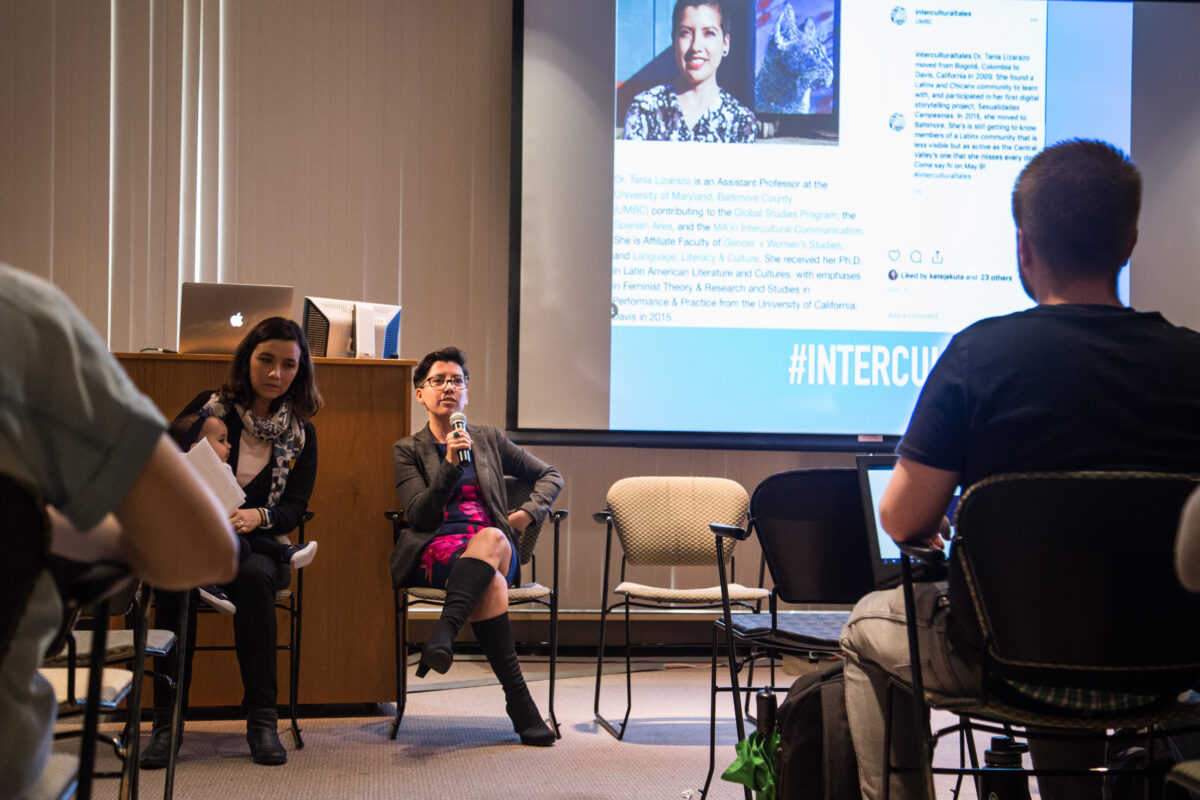 Tania Lizarazo speaking at Intercultural Tales with Thania Muñoz. Photo by Rachel Wallace
This project approaches digital storytelling from a feminist lens where non-academic knowledge such as lived experience is considered equally valuable in teaching and research. “Our project is informed by feminist theory and the field of critical intercultural communication in which power structures and hierarchies are emphasized when thinking about communication,” says Lizarazo, “Intercultural Tales is shaped by all of these fields/practices to facilitate (not guarantee) a more nuanced understanding of immigration as part of UMBC (instead of outside of it).”
This project, now in its third year, brings together students studying Spanish or global studies to produce digital stories of immigrant experiences with the goal of countering stereotypes. In one of the digital stories, “Pack Your Bag,” Heejin Hong ’18, MLLI, speaks of her parents’ transition from Korea to Paraguay, her time living in Brazil, moving to Mexico, and eventually settling in the U.S.
“My parents were first-generation immigrants from South Korea to Paraguay, where I was born. Their life as immigrants was not easy. They worked day and night to support our family,” Hong shared. “They constantly moved to other cities and countries looking for work. When I was little, I moved to Brazil to be with my grandparents because my parents had to work. Brazil was my first experience with immigration and learning a new language, new places, new food, and new cultures.”
She continued, “I have now been living in the U.S. for more than ten years. I used to see all of the changes that made me grow up quickly and think of what I didn’t have. Now, I realize that I gained something greater: courage, independence, patience, a positive outlook, not to lament, and to keep moving forward.”
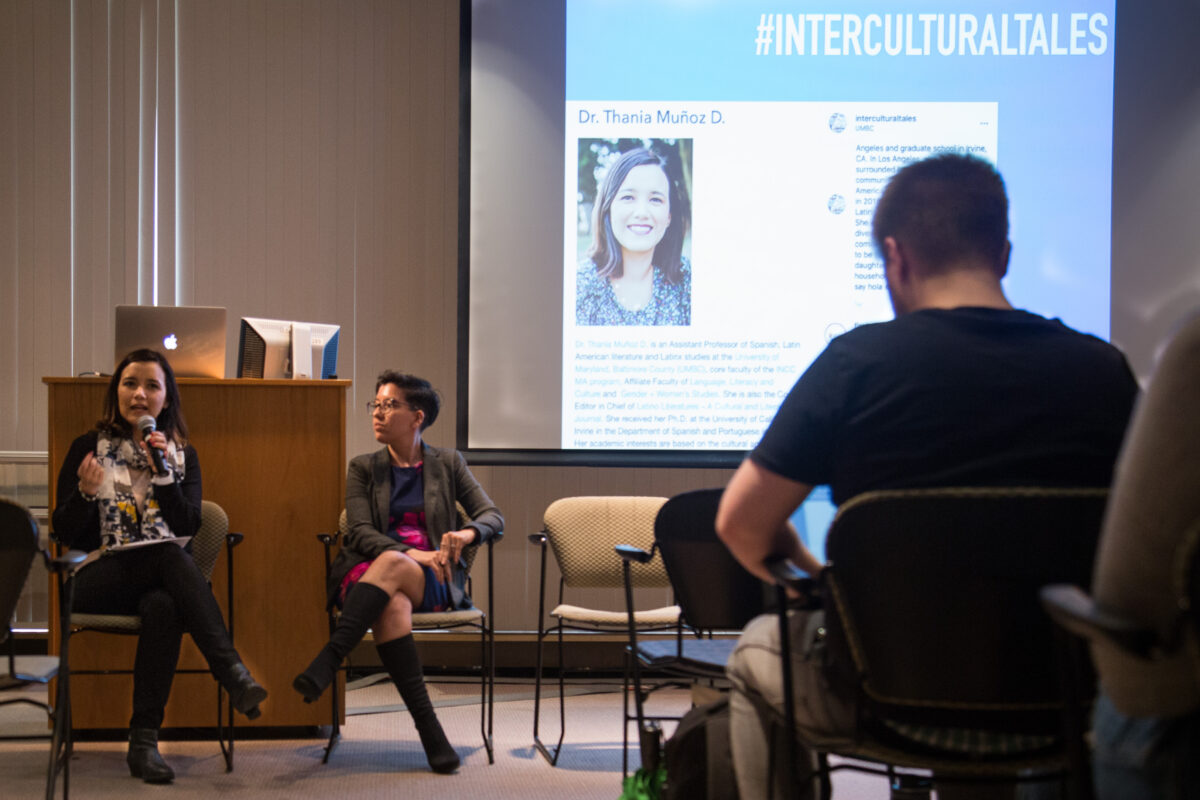 Thania Muñoz speaking about Intercultural Tales with Tania Lizarazo. Photo by Rachel Wallace.
Muñoz notes the findings, which were published in the Journal of Community Engagement and Higher Education, show the process of sharing and valuing knowledge through the project in some cases enabled the students to reframe fear, confusion, and shame through a new lens that revealed feelings of pride, solidarity, and insight.
“Most students had a more nuanced understanding of immigration,” says Lizarazo, “and a renewed appreciation for their classmate’s knowledge, which, in turn, shaped a less hierarchical learning space.”
Community-building through digital storytelling
Lizarazo also collaborated with local immigrant women to create “Moving Stories: Latinas en Baltimore.” The digital storytelling archive visualizes the immigrant experience from the perspective of Latinas in Baltimore. It aims to dispel stereotypes and share the diversity of their experiences.
Camila Daniel shared her experience of being a Black-Brazilian Latina living in Baltimore in her digital story “When Baltimore Became My Home.”
“In 2006 when I came to Baltimore, I lived the experience of what it means to be Black and Latina at the same time in a country that expects people to be only of one race. When people saw me with my accent, my hair, and my Black skin, they assumed I was African American. Many of the Brazilians were white. I didn’t feel I fit in anywhere. I suffered a lot,” says Daniel.
She continues, “Now, I feel it was good for me to come to Baltimore, live in a predominantly Black city, and learn from Black people what it is to have pride in how you look and your history. At the same time, with Spanish and Baltimore, I have created a family that does not have my blood or nationality but one heart.”
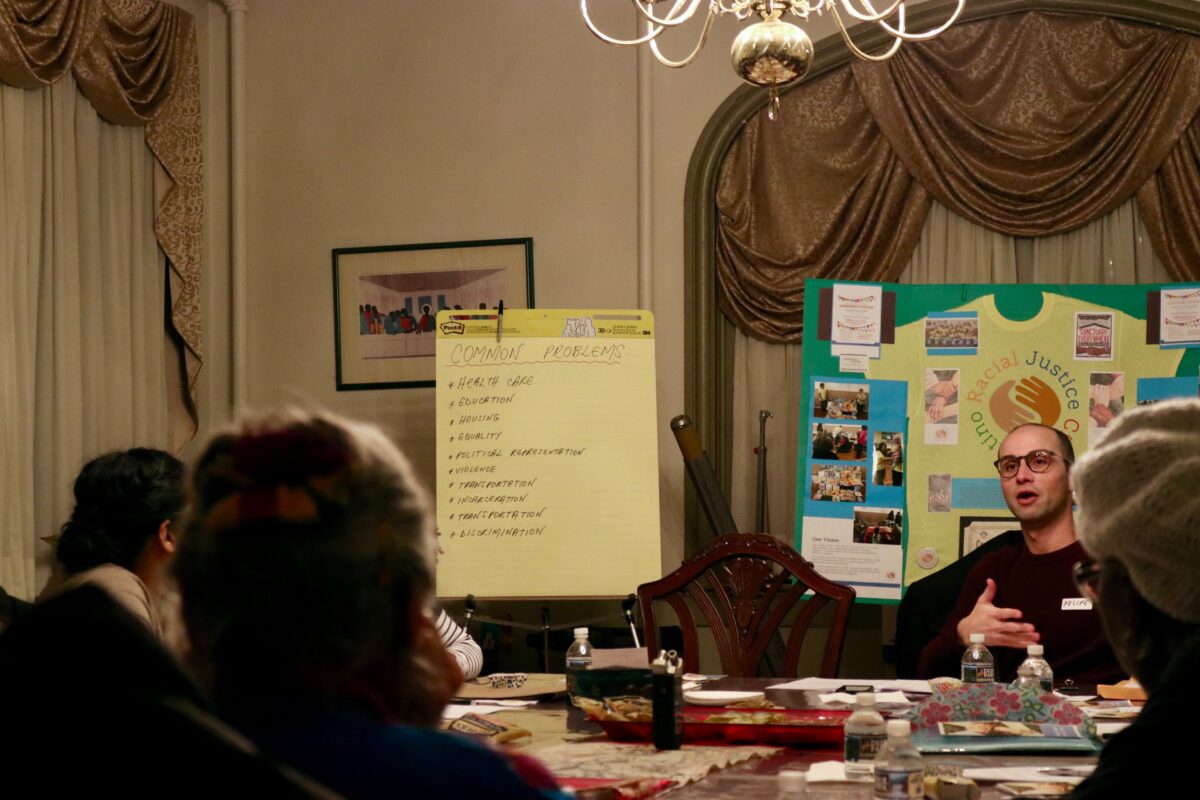 Filomeno leads a discussion with Baltimore’s Latino Racial Justice Circle. Photo courtesy of Filomeno.
Since 2017, Lizarazo and Filomeno have also worked in partnership with Baltimore’s Latino Racial Justice Circle to develop, design, execute, evaluate, and share the “Honest Conversations on Immigration” project. Through dialogue, and digital storytelling, the program fosters conversations between U.S.-born citizens and immigrants that share faith-based spaces but rarely engage in dialogue. Since 2019, about 85 members of 15 congregations have participated.
“Our goal as researchers is to use dialogue and digital stories as ways to bring different communities together around religion, race, and immigration,” explains Filomeno. “Through that process, we hope to create the potential to change the relationships among individuals, and between communities and society for the better.”
Baltimore’s immigration policies
Filomeno last year received the Hispanic Heritage Award from Baltimore Mayor Brandon Scott in recognition of his work facilitating dialogue as well as an earlier comprehensive assessment of Baltimore’s immigration policies. The study “Baltimore’s Policies to Attract and Retain Immigrants: A Community-Engaged Evaluation” was critical in shaping the strategic vision of the Mayor’s Office of Immigrant Affairs. It built on a prior study in which Filomeno reviewed Baltimore’s economic development, multicultural, and law enforcement policies, collaboration with civil society, and policy advocacy.
“In all these studies, I have engaged local groups and organizations in the creation of knowledge about immigration and the application of this knowledge to help solve real-world problems,” says Filomeno. “This research has helped a local government trying to encourage the city’s growth through immigration, a faith community trying to build connections between congregants of different nationalities, and a university trying to leverage student diversity of national origin to promote global learning. As we say at UMBC, it is public research for public good.”
Documenting places of belonging and meaning
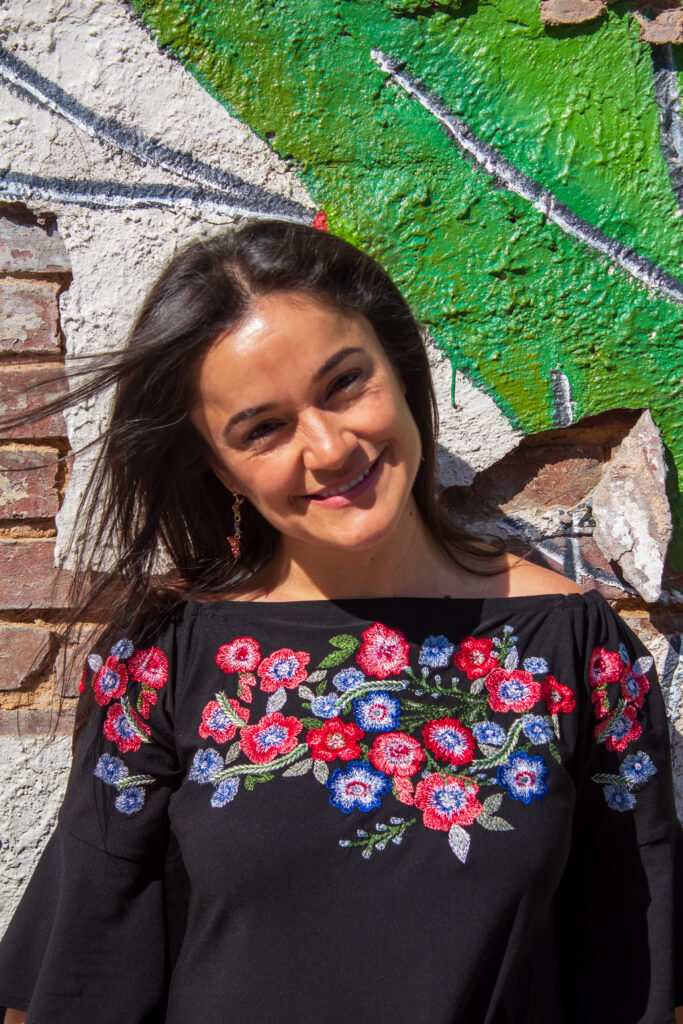 Headshot courtesy of Yolanda Valencia.
Beyond Maryland, Yolanda Valencia, assistant professor of geography and environmental systems, explores the Mexican immigrant community of Pasco, Washington, and how this community creates places of peace, tranquility, and family—places of belonging and meaning—under disadvantaged conditions. In the forthcoming book Relational Life: Legal Death, Valencia draws on years of fieldwork in Pasco, transnational ethnography, archival research, interviews with city leaders, and testimonies from undocumented Mexican immigrants.
“I aim to provide a historical political economy analysis of geographies of oppression overlaid with an analysis of spaces where this community thrives, as they both happen simultaneously across scale, time, and border,” says Valencia.
This year, Valencia received a 12-month Career Enhancement Fellowship, funded by the Mellon Foundation and administered by the Institute for Citizens and Scholars. She was also selected as a 2020 – 2022 Summer Institute on Tenure and Professional Advancement (SITPA) scholar. The mentoring and professional initiative is designed to facilitate junior faculty members’ successful transition to tenured associate professor status.
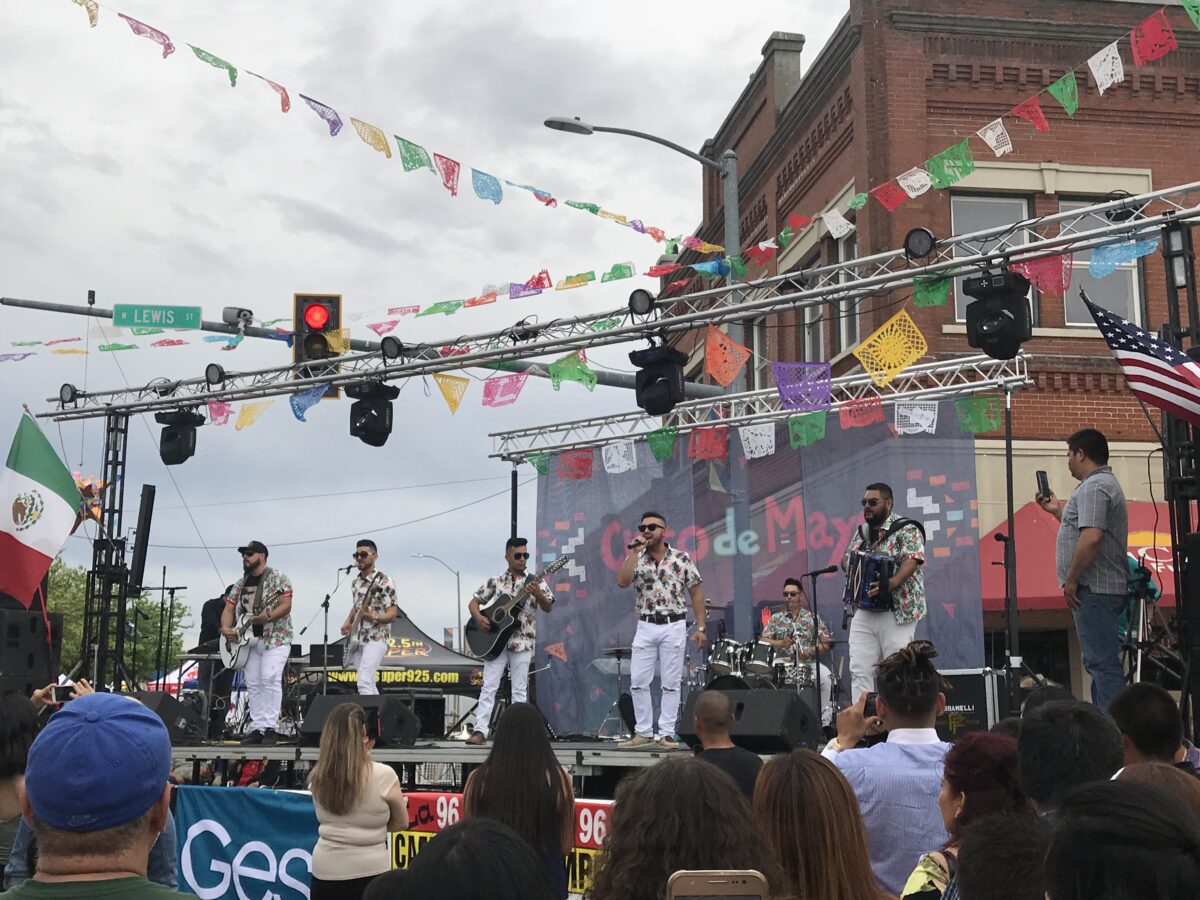 This Cinco de Mayo event in Pasco features second-generation Mexican immigrant musicians who have learned how to play, sing, and love traditional Mexican (and Latinx) music. Photo courtesy of Valencia.
Another faculty member has been highly engaged with immigrant communities in New Orleans. The success of taco trucks and Soul Food pop-ups there have raised complex questions about food truck regulation, worker rights, and immigration. The Whiting Foundation awarded a $50,000 Public Engagement Fellowship to Sarah Fouts, assistant professor of American studies, along with local New Orleans organizers Toya Ex Lewis and Fernando López, to implement “Project Neutral Grounds: At the Intersection of People, Street Food, and the Hustle.”
Lewis is the organizer of Project Hustle, born in New Orleans, and López is a Mexican-born documentarian. The three partners have worked together since 2013. Their latest collaboration will bring together Black, Brown, LGBTQ+, and immigrant food vendors in New Orleans to celebrate, share, and document their experiences and histories.
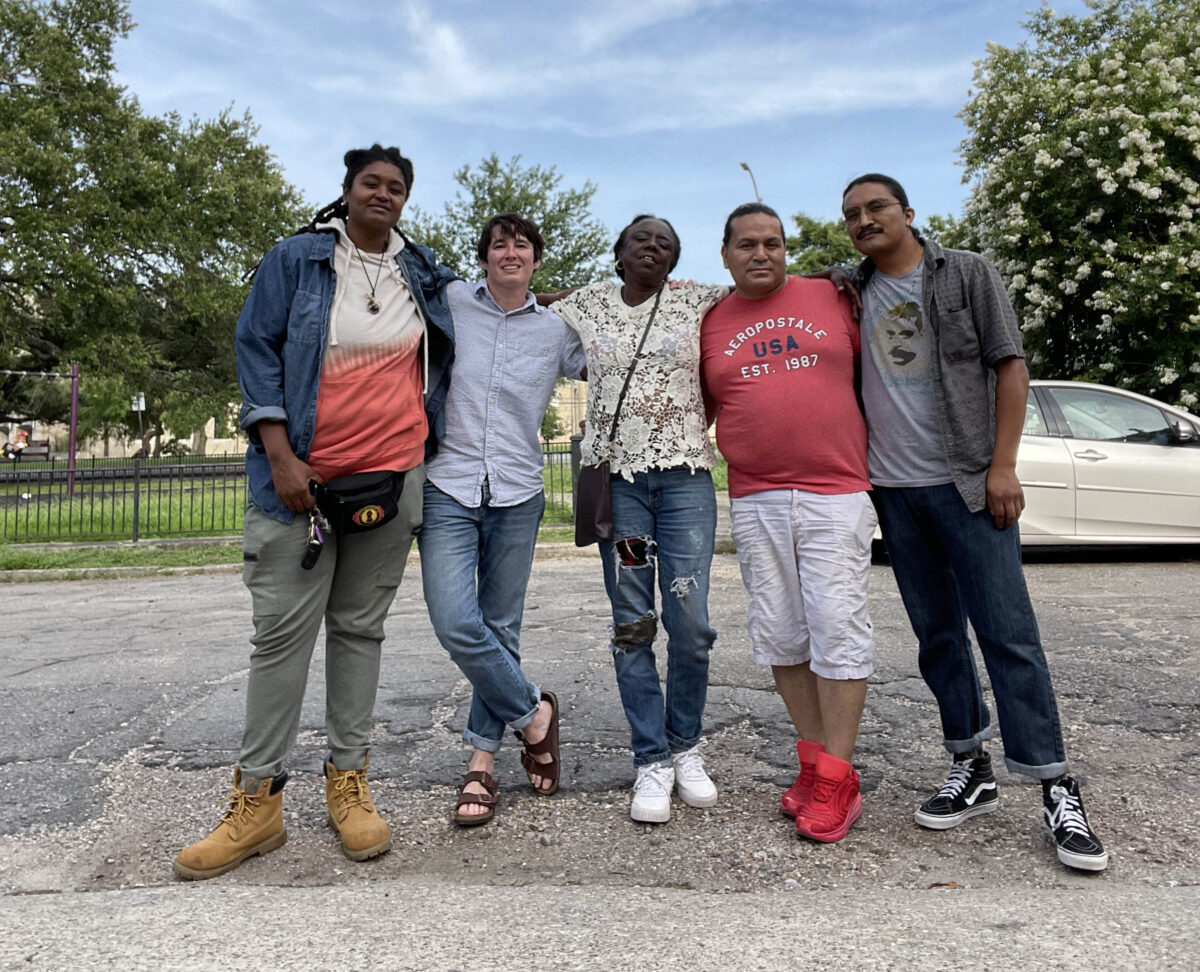 Left to right: Toya Ex Lewis, Sarah Fouts, community members, and Fernando Lopez. Photo courtesy of Fouts.
Challenging extractive research
This innovative research intentionally values the knowledge of immigrants and creates new ways for academics to think about primary sources. It highlights thriving communities and enables communication, personal reflection, and empathy while challenging systemic racism and the role of education and institutions in perpetuating inequalities.
“Recognizing each other’s humanity is not an abstract process. It requires a commitment to questioning pedagogies that reproduce the hierarchies we critique,” Muñoz Davaslıoğlu and Lizarazo explain. “Teaching and learning are inextricable from struggles against the dehumanization of immigrants and minorities.”
]]>
UMBC faculty are leading interdisciplinary, community-engaged immigration research that is shifting the relationship between higher education institutions and immigrant communities. Their...
https://umbc.edu/stories/immigrant-voices-in-immigration-research/
https://my3.my.umbc.edu/api/v0/pixel/news/129593/guest@my.umbc.edu/b0f32c6867d89407d88e1ee16c263f2e/api/pixel
americanstudies
arts-and-culture
cahss
csss
discovery
ges
globalstudies
magazine
mlli
news
politicalscience
rca-2
UMBC News & Magazine
https://my3.my.umbc.edu/groups/umbc-news-magazine
https://assets1-my.umbc.edu/system/shared/avatars/groups/000/001/943/24435aa6207c452e7bc15cc74b42c7bb/xsmall.png?1748556657
https://assets1-my.umbc.edu/system/shared/avatars/groups/000/001/943/24435aa6207c452e7bc15cc74b42c7bb/original.png?1748556657
https://assets2-my.umbc.edu/system/shared/avatars/groups/000/001/943/24435aa6207c452e7bc15cc74b42c7bb/xxlarge.png?1748556657
https://assets2-my.umbc.edu/system/shared/avatars/groups/000/001/943/24435aa6207c452e7bc15cc74b42c7bb/xlarge.png?1748556657
https://assets3-my.umbc.edu/system/shared/avatars/groups/000/001/943/24435aa6207c452e7bc15cc74b42c7bb/large.png?1748556657
https://assets1-my.umbc.edu/system/shared/avatars/groups/000/001/943/24435aa6207c452e7bc15cc74b42c7bb/medium.png?1748556657
https://assets2-my.umbc.edu/system/shared/avatars/groups/000/001/943/24435aa6207c452e7bc15cc74b42c7bb/small.png?1748556657
https://assets1-my.umbc.edu/system/shared/avatars/groups/000/001/943/24435aa6207c452e7bc15cc74b42c7bb/xsmall.png?1748556657
https://assets2-my.umbc.edu/system/shared/avatars/groups/000/001/943/24435aa6207c452e7bc15cc74b42c7bb/xxsmall.png?1748556657
UMBC News & Magazine
0
0
false
Mon, 05 Dec 2022 15:44:58 -0500
Mon, 05 Dec 2022 15:44:58 -0500
U.S. News highlights UMBC’s national leadership in teaching, innovation, diversity
The 2022–23 U.S. News and World Report Best Colleges undergraduate rankings released this week illustrate why a record number of students chose to call UMBC home this fall. This year’s rankings show UMBC jumping an impressive 25 spots on the list of Best National Universities and appearing on several other prestigious lists, distinguishing the university’s achievements on a national stage.
“Notable increases in UMBC’s six-year graduation rate, at a time when UMBC was also recognized as an Research 1 university, likely supported this jump,” says Constance A. Pierson ’90, M.A. ’92, associate vice provost for Institutional Research, Analysis and Decision Support. “We are particularly proud that the graduation rate trend is consistent for students of different economic backgrounds.”
This year UMBC ranks at #9 nationally for undergraduate teaching, joined in the top ten by such institutions as Brown, Princeton, and Dartmouth, and tied with the University of Notre Dame. UMBC also maintains its longstanding position on the list of the nation’s most innovative universities, tied at #10 with Johns Hopkins University. UMBC ranks #64 on the Top Public Universities list, #137 on the overall Top National Universities list, and #46 for undergraduate research and creative projects.
Student-centered education
At the core of this year’s rankings are students who already distinguish themselves as budding entrepreneurs, global citizens, advocates, and leaders. Farah Helal ’24, global studies and political science, began her term as University System of Maryland (USM) student regent on July 1, 2022. UMBC’s U.S. News ranking as one of the country’s Best Value Schools and universities with the least student debt speaks directly to the work Helal will be doing as part of her tenure: weighing in on topics like setting tuition and fee rates, approving new degree programs, and approving capital and operating budgets.
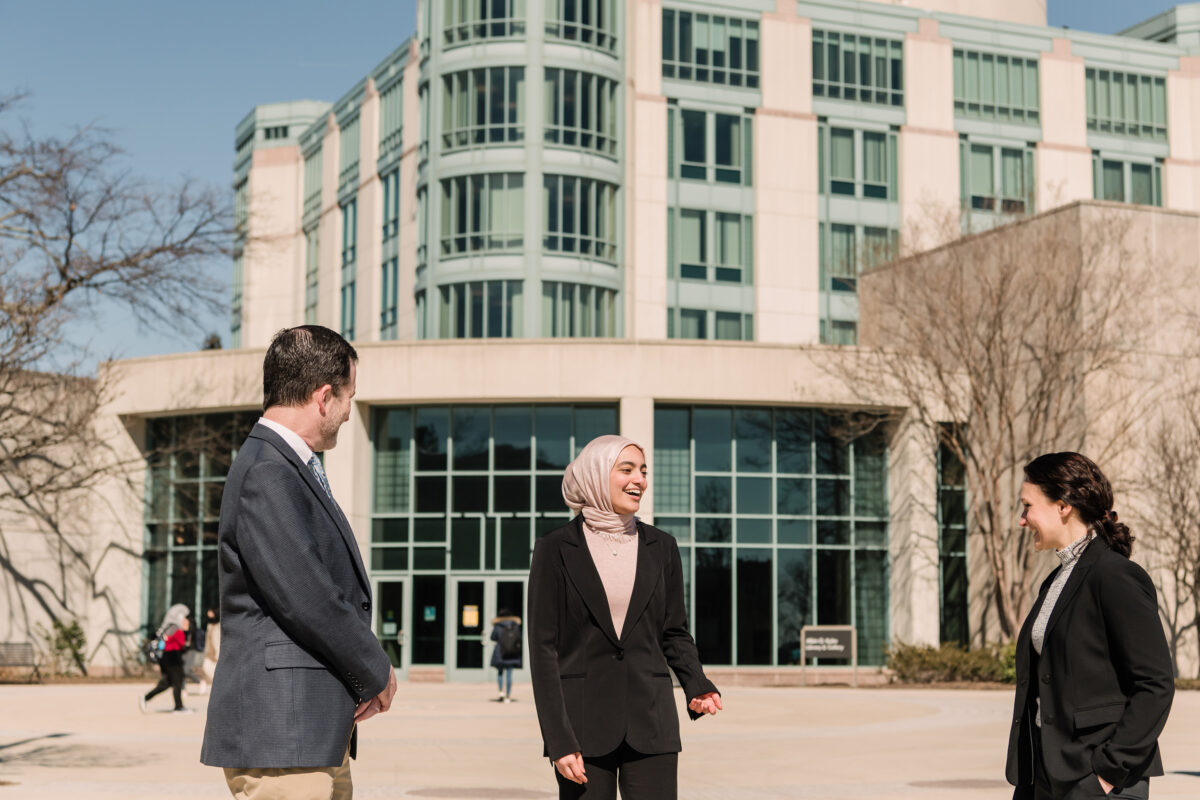 Helal (center) with Romy Hübler ‘09, modern languages and linguistics, M.A. ‘11, intercultural communication, Ph.D. ‘15, language, literacy, and culture (LLC), right, and David Hoffman, Ph.D. ’13, LLC, left. (Marlayna Demond ’11/UMBC)
“UMBC is a meeting ground for students, faculty, and staff who want to be engaged in our communities every day, doing deep and creative work to solve problems and promote justice and inclusion,” says David Hoffman, director of the Center for Democracy and Civic Life.
In addition to the latest U.S. News rankings, Hoffman highlights that the 2022 College Rankings issue of The Washington Monthly names UMBC one of America’s Best Colleges for Student Voting. “I love that we have been recognized by Washington Monthly for our efforts in connection with voting, and I love knowing that voting is just the tip of the iceberg for us when it comes to our students’ engagement and impact.”
Both teaching and research
The latest U.S. News rankings are primarily university-wide, but they also include recognition for a few specific undergraduate programs. UMBC is listed as a top-100 university this year for both computer science and engineering. Coming in at #86 for computer science, UMBC shares the rank with George Mason University, Texas Tech University, and Howard University. Ascending to #94 for engineering this year, UMBC is joined by Clemson University, George Washington University, and University of Delaware.
It’s essential to understand these rankings in the context of another important milestone, notes Keith J Bowman, dean of the College of Engineering and Information Technology (COEIT): UMBC’s recent Carnegie Classification as a doctoral university with very high research activity, popularly known as Research 1 (or R1). UMBC is now ranked as one of only 146 R1 institutions nationally, including 107 public and 39 private universities.
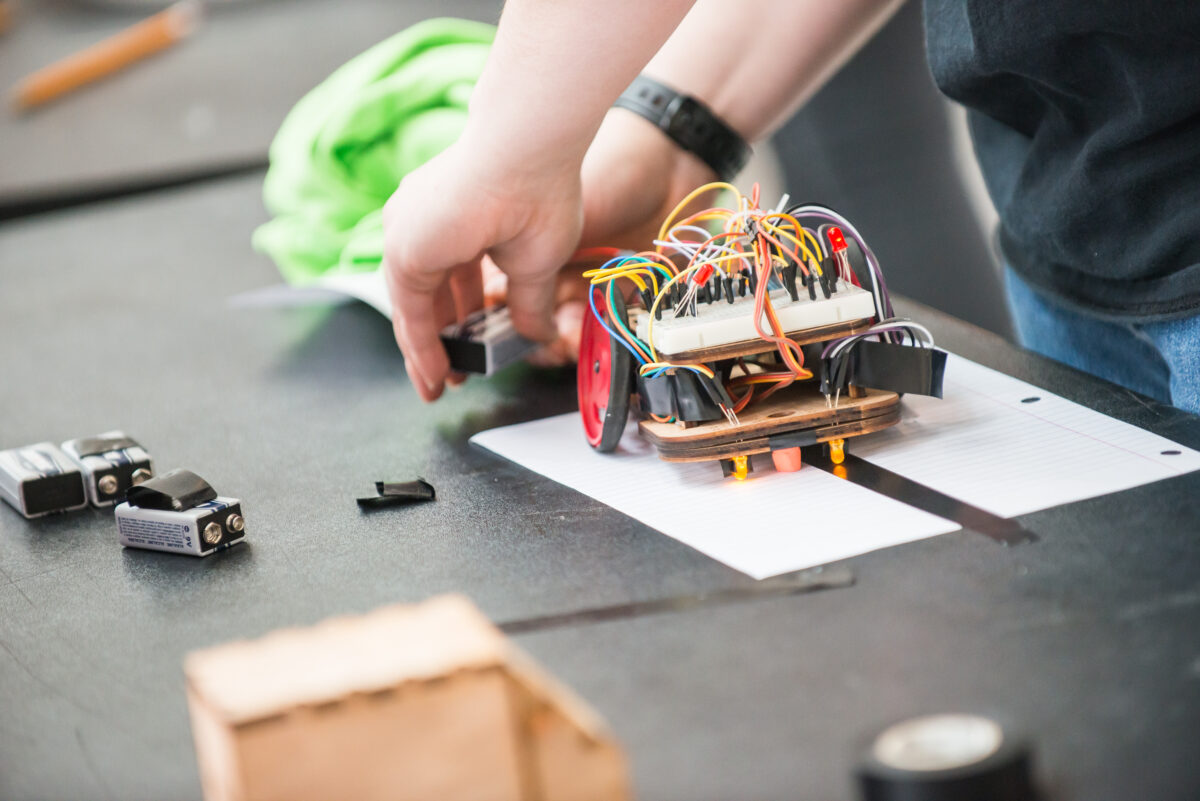 A student works on an engineering project. (Marlayna Demond ’11/UMBC)
“UMBC’s designation as an R1 institution combined with increasing recognition for our engineering, computing and information systems programs has enabled us to recruit incredible faculty talent,” says Bowman. “Those faculty are attracted to UMBC for our potential to both advance their success as researchers and educators and our emphasis on inclusion as essential to excellence.”
Promoting diversity and innovation
UMBC’s recognition as one of the nation’s most innovative universities, alongside Johns Hopkins, goes hand-in-hand with recognition as a top university for ethnic diversity. The National Institute of Health (NIH) and National Science Foundation (NSF) have recently awarded UMBC over $15 million for programs specifically to support underrepresented STEM students—an area where UMBC is known as an innovative national model.
The College of Natural and Mathematical Sciences (CNMS) will receive $5.6 million over five years from the NIH to fund the Graduate Research Training Initiative for Student Enhancement (G-RISE). This program will support graduate students from underrepresented groups in STEM with up to three years of funding and an array of training opportunities. The goal is to help participants select and prepare for a range of career paths in academia, industry, government, entrepreneurship, or beyond.
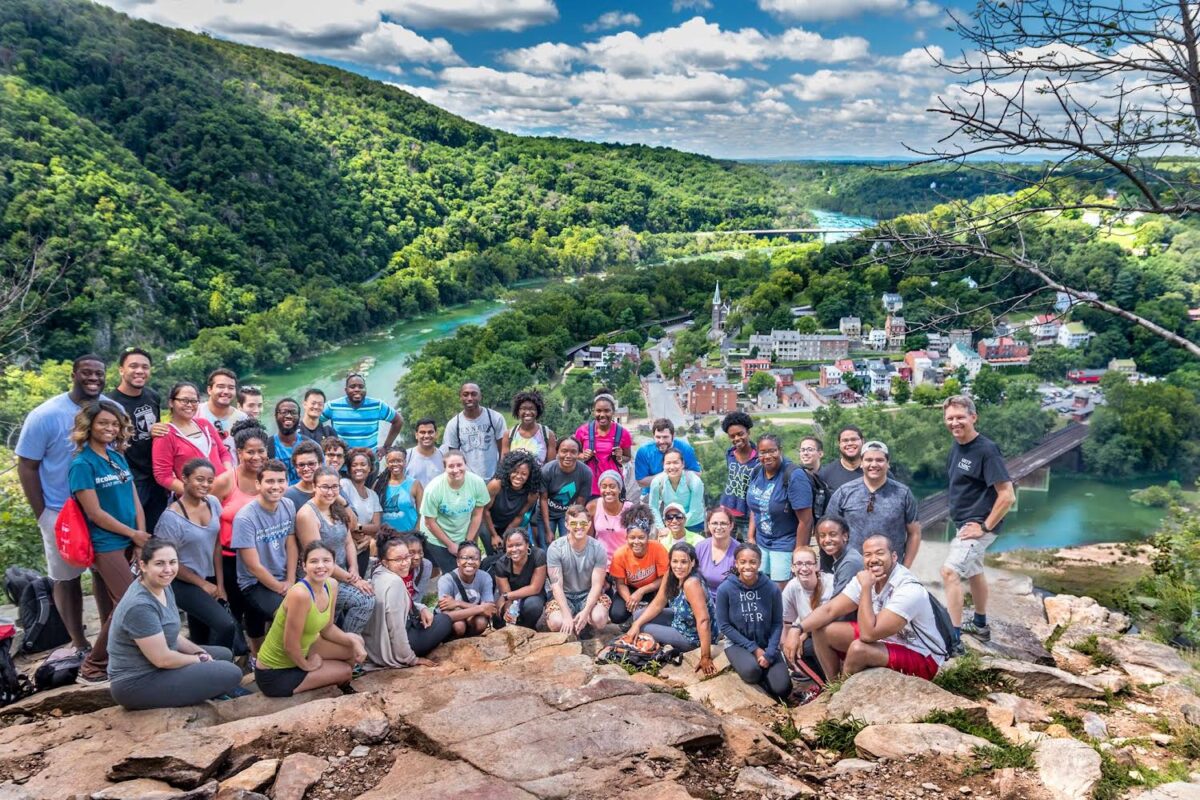 Students and faculty in the Initiative for Maximizing Student Development (IMSD) Meyerhoff Graduate Fellows program celebrate reaching the summit of their hike at Harper’s Ferry on one of the program’s annual summer retreats. IMSD launched in 1996 and transitions to G-RISE this year. Over 150 UMBC participants earned their Ph.D. in that time period. (Image courtesy of the Meyerhoff Graduate Fellows)
UMBC will expand its work boosting diversity in academia from Maryland to the national level through a new NSF INCLUDES Alliance: Re-Imagining STEM Equity Utilizing Postdoc Pathways (RISE UPP). The RISE UPP Alliance, anticipated to officially launch in fall 2022, is modeled after the AGEP PROMISE Academy, a high-impact initiative co-led by UMBC that supports faculty diversification in the biomedical sciences across USM institutions.
The university has also received support from a broad range of other groups and agencies to expand and replicate UMBC’s student success models. This includes $2.5 million from the Simons Foundation to create a Meyerhoff Scholars-like program within the public university system in New York, among other initiatives.
Vision of leadership
This commitment to diversity and inclusion can also be seen at the faculty and administrative leadership levels. Kimberly R. Moffitt, dean of UMBC’s College of Arts, Humanities, and Social Sciences (CAHSS) and professor of language, literacy, and culture, serves as the lead principal investigator for Breaking the M.O.L.D. UMBC, Morgan State University, and the University of Maryland, College Park are partnering in this $3 million initiative funded by the Andrew W. Mellon Foundation to develop a pipeline to higher ed leadership for diverse scholars in the arts and humanities.
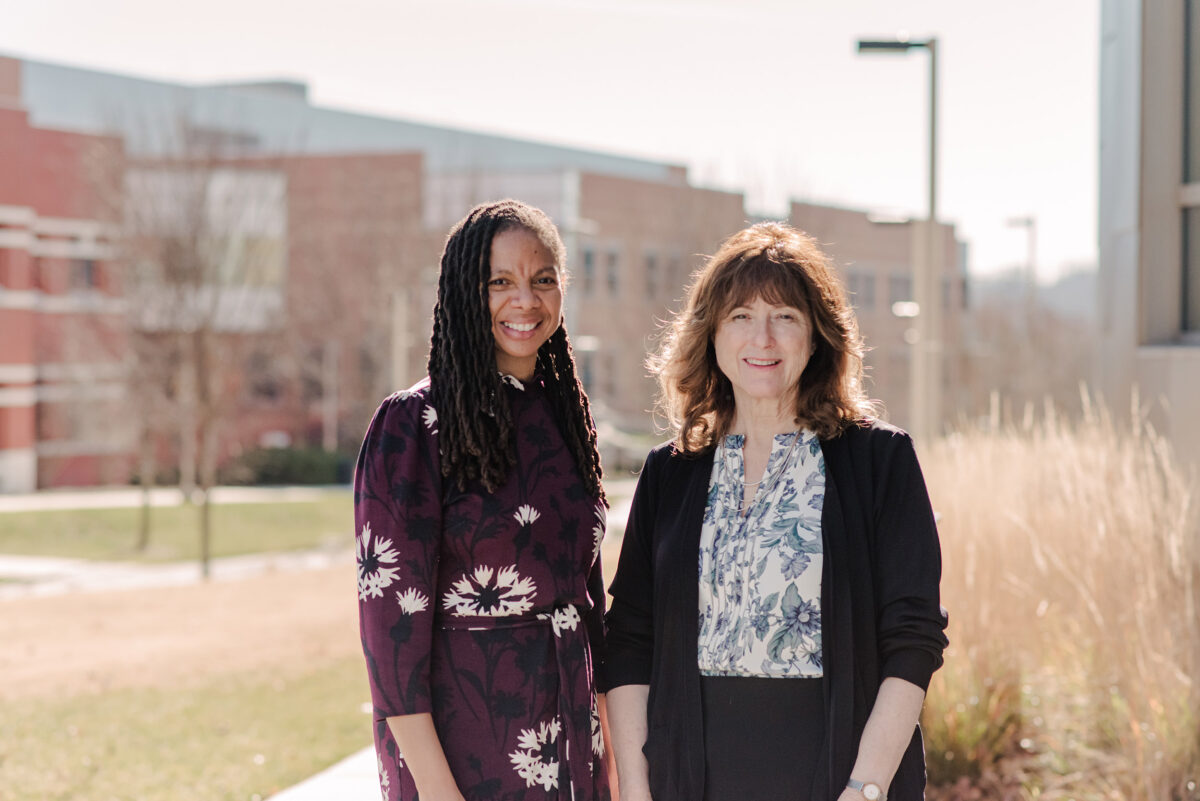 Kimberly Moffitt (l), dean of UMBC’s College of Arts, Humanities, and Social Sciences (CAHSS), serves as Breaking the M.O.L.D.’s lead PI. Joining her in leading UMBC’s implementation of Breaking the M.O.L.D. is Patrice McDermott, vice provost for faculty affairs. (Marlayna Demond ’11/UMBC)
Following through on “redefin[ing] excellence in higher education through an inclusive culture” is an essential part of what makes UMBC such a special and distinctive place, says UMBC President Valerie Sheares Ashby. “This is an extraordinary institution,” she recently told WYPR’s Tom Hall. She shares, “The university is true to the values and vision that it states.”
]]>
The 2022–23 U.S. News and World Report Best Colleges undergraduate rankings released this week illustrate why a record number of students chose to call UMBC home this fall. This year’s rankings...
https://umbc.edu/stories/us-news-2022-23/
https://my3.my.umbc.edu/api/v0/pixel/news/127542/guest@my.umbc.edu/eacccc71a5100eea5cb5511cf6654531/api/pixel
cahss
civic
cnms
coeit
community
diversityandinclusion
globalstudies
llc
mlli
news
politicalscience
rankings
UMBC News & Magazine
https://my3.my.umbc.edu/groups/umbc-news-magazine
https://assets1-my.umbc.edu/system/shared/avatars/groups/000/001/943/24435aa6207c452e7bc15cc74b42c7bb/xsmall.png?1748556657
https://assets1-my.umbc.edu/system/shared/avatars/groups/000/001/943/24435aa6207c452e7bc15cc74b42c7bb/original.png?1748556657
https://assets2-my.umbc.edu/system/shared/avatars/groups/000/001/943/24435aa6207c452e7bc15cc74b42c7bb/xxlarge.png?1748556657
https://assets2-my.umbc.edu/system/shared/avatars/groups/000/001/943/24435aa6207c452e7bc15cc74b42c7bb/xlarge.png?1748556657
https://assets3-my.umbc.edu/system/shared/avatars/groups/000/001/943/24435aa6207c452e7bc15cc74b42c7bb/large.png?1748556657
https://assets1-my.umbc.edu/system/shared/avatars/groups/000/001/943/24435aa6207c452e7bc15cc74b42c7bb/medium.png?1748556657
https://assets2-my.umbc.edu/system/shared/avatars/groups/000/001/943/24435aa6207c452e7bc15cc74b42c7bb/small.png?1748556657
https://assets1-my.umbc.edu/system/shared/avatars/groups/000/001/943/24435aa6207c452e7bc15cc74b42c7bb/xsmall.png?1748556657
https://assets2-my.umbc.edu/system/shared/avatars/groups/000/001/943/24435aa6207c452e7bc15cc74b42c7bb/xxsmall.png?1748556657
UMBC News & Magazine
0
0
false
Tue, 13 Sep 2022 16:34:18 -0400
Tue, 13 Sep 2022 16:34:18 -0400
Turning the Tides

For Christopher Tong, discovering clues hidden in texts documenting history’s most devastating floods isn’t just about the promise of making social, cultural, and political change. It’s also a personal journey inspired by generations of his own family.
In July of 2021, the city of Zhengzhou, China, had more than seven inches of rain in one hour, flooding subway train cars filled with commuters and forcing hundreds of thousands to evacuate.
Around this time Christopher K. Tong, an assistant professor of modern languages, linguistics, and intercultural communication, was surrounded by materials he had collected during his trip to the People’s Republic of China at the Hubei Provincial Archive in Wuhan and from the No. 2 Historical Archive in Nanjing, the national repository for Republican-era government documents. He was translating and analyzing historical, government, and personal documents regarding two major environmental disasters in China during the 1930s: the Yangzi River and Yellow River floods.
Nearly a century ago, the communities surrounding the third- and sixth-longest river systems in the world experienced the most severe flooding in modern China’s history, inundating thousands of miles of land, killing millions of people, and leading to extensive disease and famine.
Witnessing the coverage of the Zhengzhou flood, and watching the past and present intersect, was an extraordinary moment for Tong. Live, minute-by-minute social media posts gave insight into the catastrophic experience. By contrast, the floods from the 1930s did not have such personal coverage. First-person accounts tended to be handwritten letters and only some reached audiences beyond their villages, allowing for a select few, in cities far away from the areas most impacted, to understand what was happening on the ground.
“The Zhengzhou floods confirmed for me how important environmental humanities research is and how this scholarship sheds light on society and politics,” says Tong, who compares the impact of the floods to the impact the Dust Bowl of America’s Great Depression had on American society and politics. This deep research into the political—and personal—nature of environmental disasters like these has won Tong recognition among humanities scholars, social scientists, and policy analysts alike.
The Henry Luce Foundation and the American Council of Learned Societies recently awarded Tong one of 11 prestigious Early Career Fellowships in China Studies, providing funding for an academic year of research, writing, and curriculum development to help meet the needs of China studies in the 21st century. Tong will use this time and rich material to write his book on ecological consciousness and political representation in modern China.
“One of the goals of my book is to offer readers resources to ‘think with China’ on shared concerns such as ecological crises, human rights, and animal advocacy,” says Tong. “I see my work as contributing to cultural diplomacy and what people in the policy world call ‘China literacy.’”
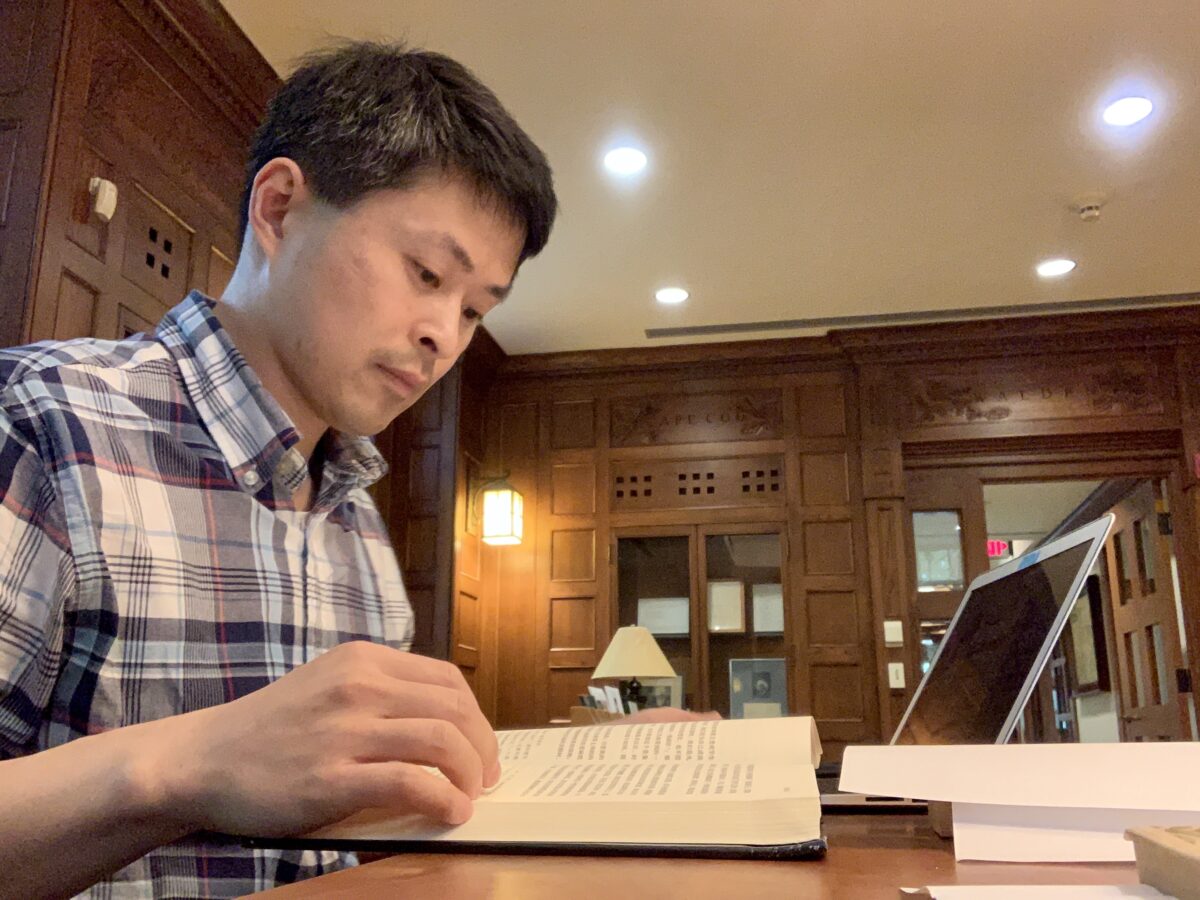
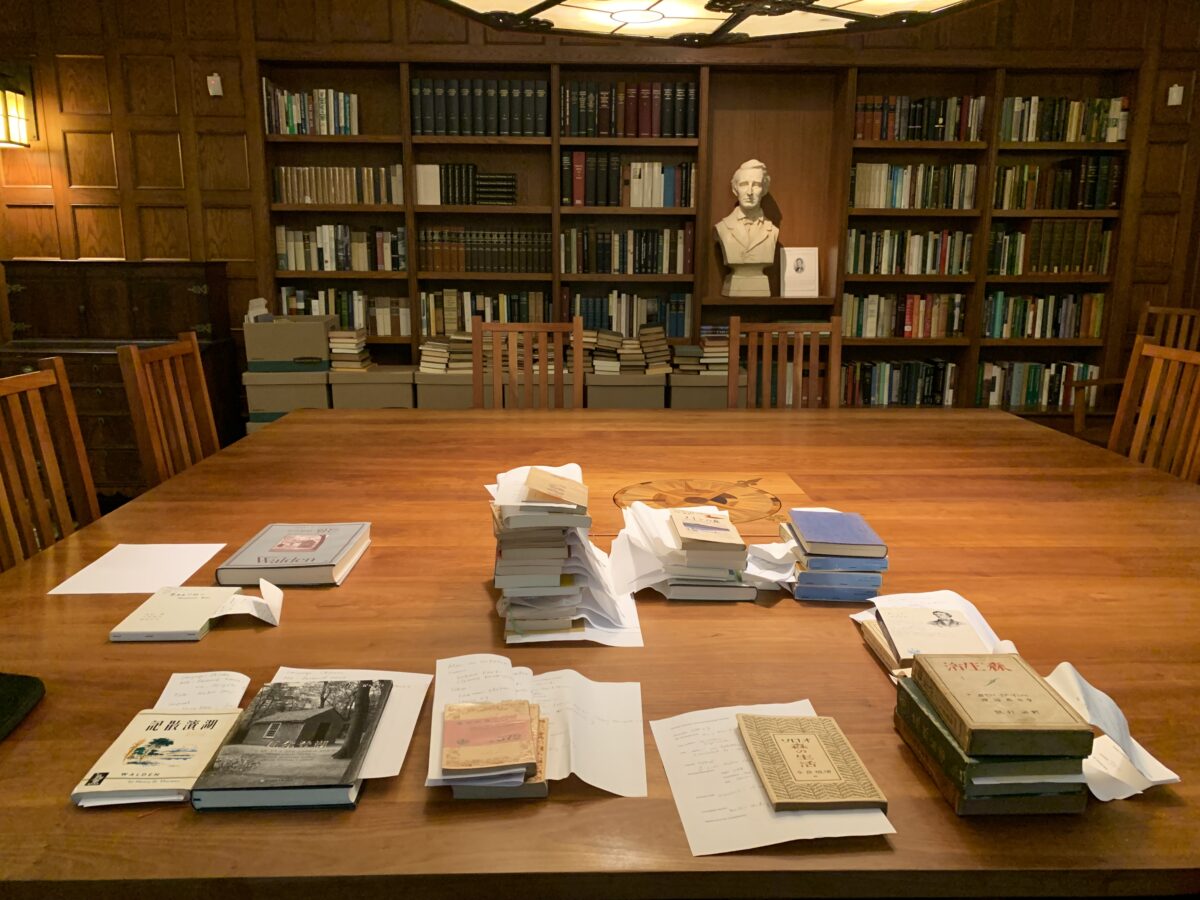 In September 2021, Tong spent two days examining, scanning, and taking notes on a number of Asian translations at the Thoreau Institute. Images courtesy of Tong.
Silent all these years
Historical and literary narratives of the Yangzi River and Yellow River floods tend to shift between focusing on facts and offering a political party’s explanation. The events are inevitably understood within the larger framework of building a national identity, especially the revolutionary history of the People’s Republic of China.
“Official narratives generally serve to build national unity, but there are always gaps and discrepancies in these narratives. It’s about whose voices are missing in the official narratives and why,” says Tong. “Unfortunately, people forget these voices over time, and my project is to recover them.
Wanting to delve into the archives on the floods to see what histories emerged, Tong first had to secure access to the archives. With access granted and the assistance of a Fulbright grant and Nanjing University, between 2018 and 2019 Tong spent 10 months in China analyzing thousands of documents written in classical and modern Chinese. In the archives, amongst letters written by survivors, correspondence between county officials and provincial and central governments lists of survivors at refugee camps, maps, logistical documents, and photos never before studied, was one of many untold stories:
“There are those who try to rescue their parents, but die in the water…There are those who hold their wives and children by the hand, but end up drowning together…[and] families that manage to escape on a single raft, but sink in the middle of the current.”
This excerpt of a rare petition letter written by a village representative was in the archives and mirrored accounts throughout the archives that spoke of death and survival. These voices, silent for decades, were not a story of revolutionary action as many histories of modern China would imply. What Tong unearthed bears witness to the lived experience of rural communities focused on repairing and managing loss. They sought help from government officials, relief workers, each other, and were more civically engaged than previously thought.
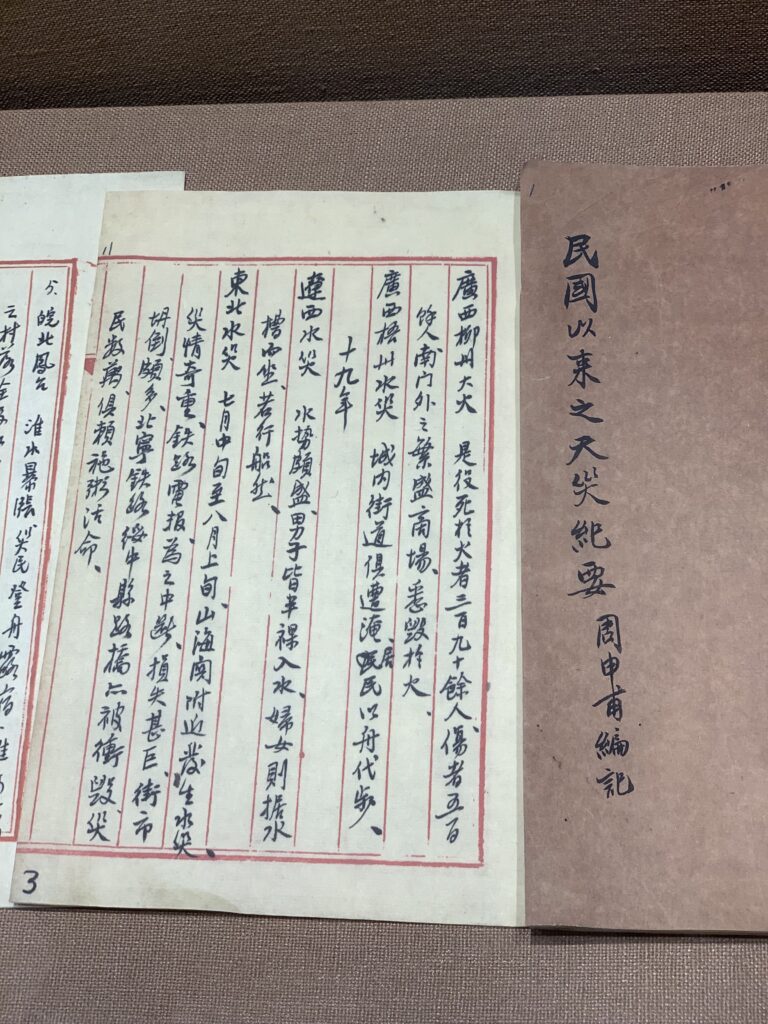 An archival document listing major environmental disasters in Republican China. Image courtesy of Tong.
“Sometimes these efforts are not given enough consideration in disaster narratives and national histories,” says Tong. “But I believe them to be important as building blocks of proto-democratic practices.” He hopes it will inspire the reconceptualization of Chinese literature and history in the early 20th century.
Kirk Denton, professor emeritus of Chinese literature at the Ohio State University and a mentor to Tong through UMBC’s Eminent Scholar Mentoring Program, gave Tong important feedback based on his own research on the representation of historical memory in Chinese and Taiwanese museums. Over the years, Denton has witnessed the evolution of Tong’s work.
“I was heartened to see a young man mature into such an accomplished scholar,” says Denton, who notes that Tong’s work “is at the forefront of the environmental humanities.”
Jessica Berman, professor of English and director of UMBC’s Dresher Center for the Humanities, says that as a scholar of comparative literature, “Christopher uses the core methods of textual analysis, critical theory, and intellectual history to bring out the ramifications of cross-cultural environmental thinking between China and the U.S. in the early 20th century.”
“The climate crisis is often portrayed as something serious that happens over time, like global warming,” says Tong. “However, with the Dust Bowl in the U. S. and floods in China, these disasters were fast and extreme and often contributed to immediate shifts in public sentiment and the government’s capacity to govern.”
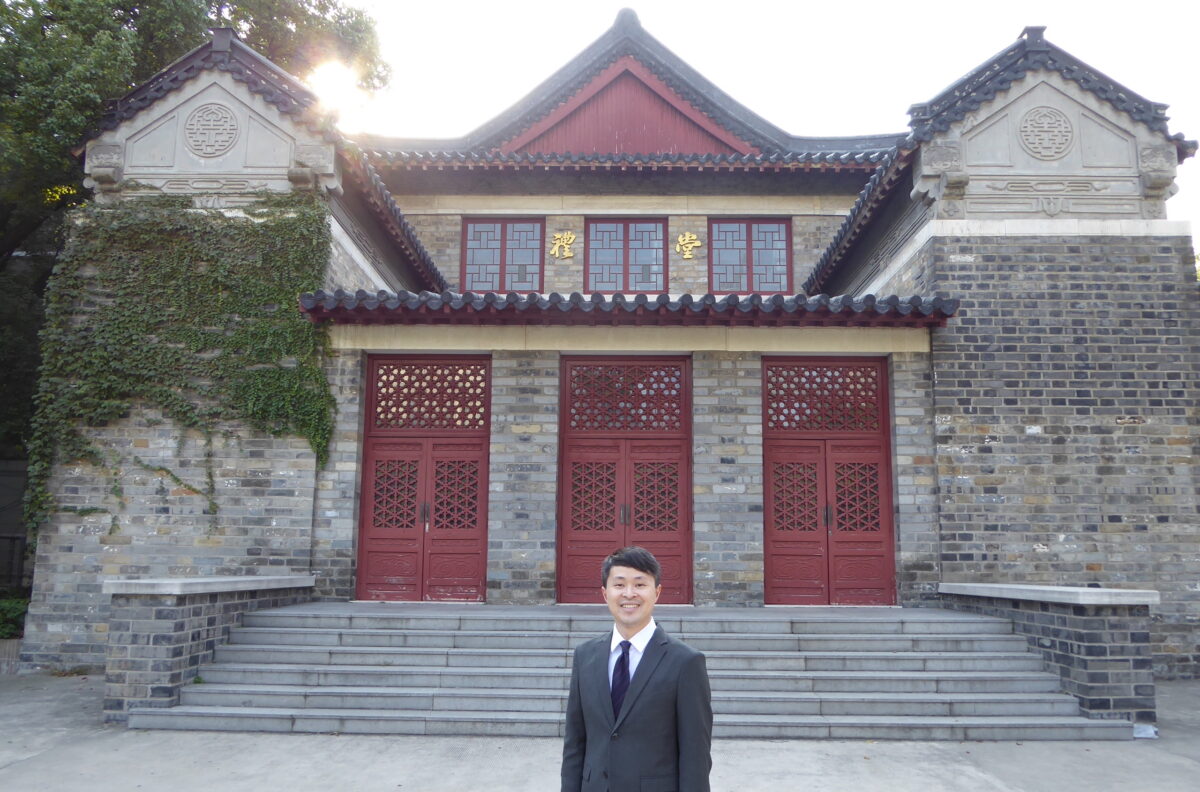 Tong stands in front of Nanjing University’s auditorium at the downtown campus, which features the fusion of traditional Chinese architectural elements and modern Western construction methods. Image courtesy of Tong.
Windows to the past
For Tong, the interconnectedness of his work is both personal and professional. His interest in 20th‑century China and Hong Kong stems from his maternal grandmother’s stories about her life in mainland China in the early 20th century.
“My maternal grandmother and her sibling were artists. She went to an art academy in China briefly during W WII and was the director of a clothing company in Hong Kong after the war. One of her sisters was a film star in Hong Kong who acted opposite a young Bruce Lee in the film Thunderstorm in 1957,” he says.
He remembers learning about his great‑great‑grandfather, Jiang Kong yin, a government official and well‑respected member of the gentry during the Qing dynasty, the last imperial dynasty in China. Jiang helped with the transition from the Qing dynasty to the Republic of China (ROC). Tong’s maternal grandfather learned English early because he was from one of the founding families whose fortune was tied to British Hong Kong. This was especially useful during WWII when he worked for Allied forces in southwestern China with Chinese aviators and the Flying Tigers, U. S. volunteer aviators who fought against Japan.
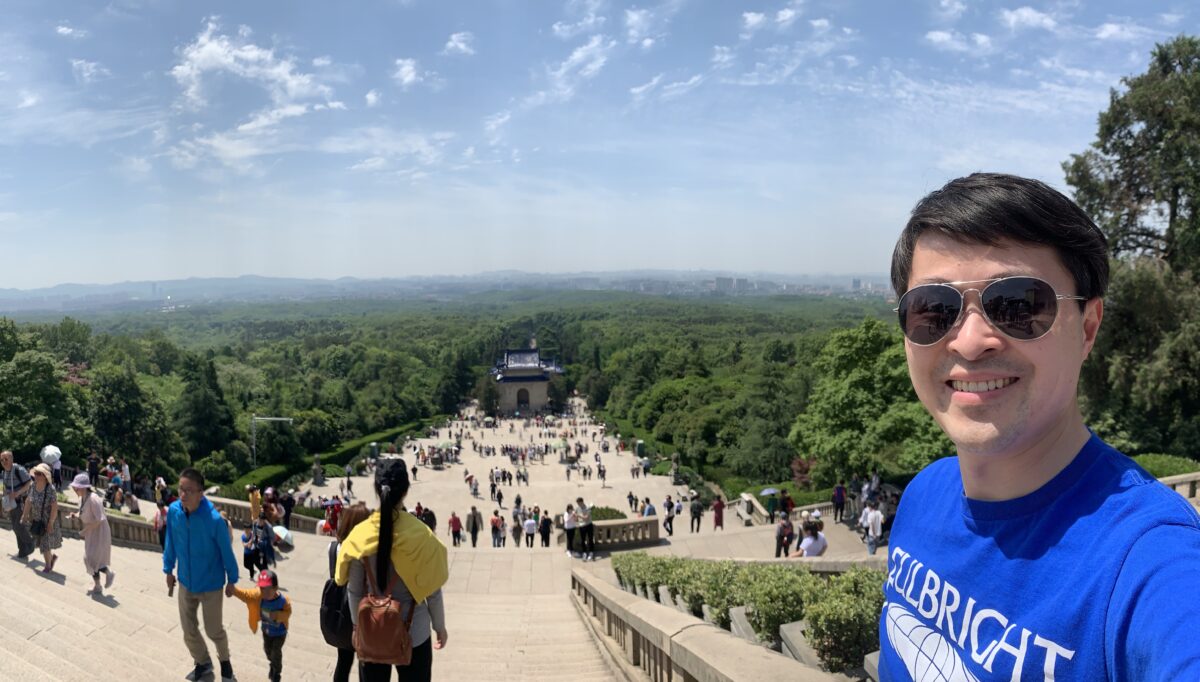
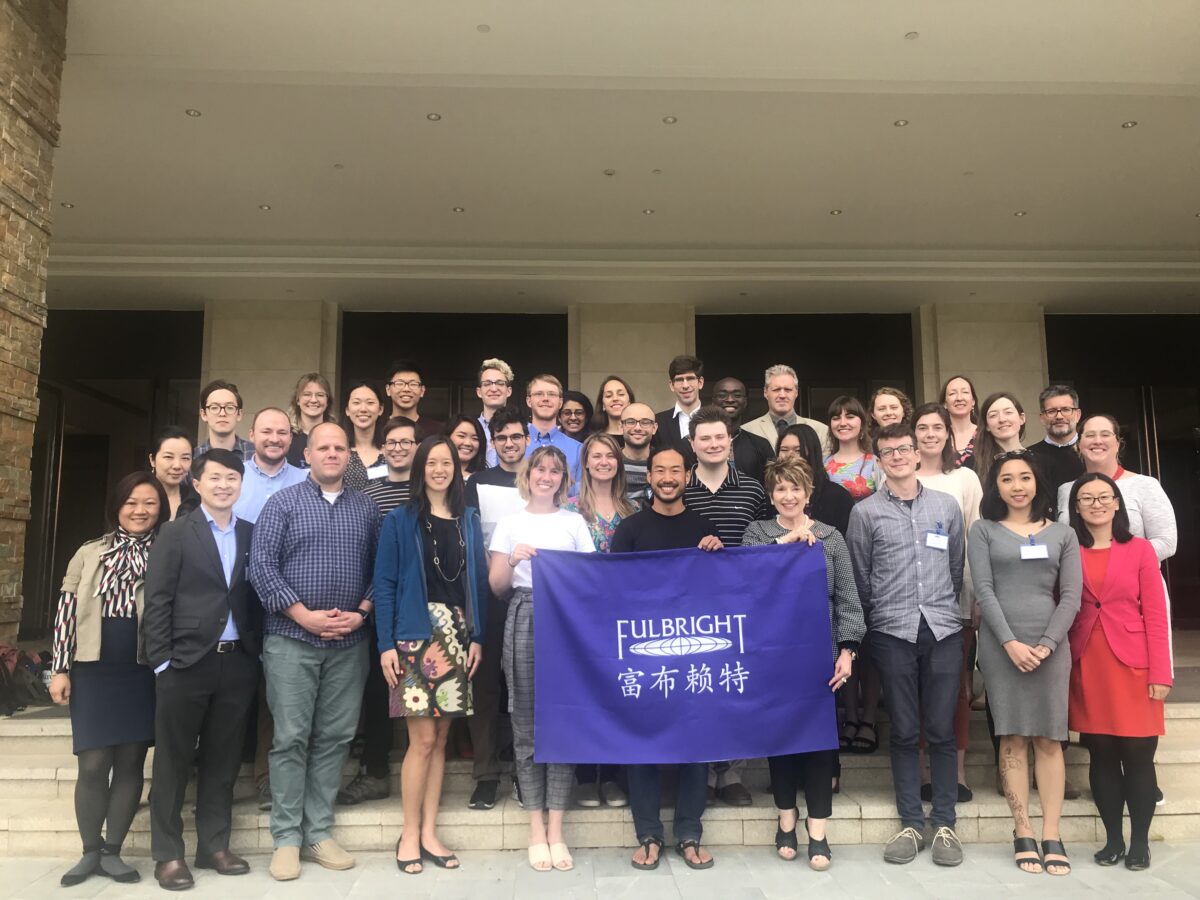 Left: Tong visited Dr. Sun Yat-sen’s Mausoleum on Nanjing’s Purple Mountain and wore his Fulbright shirt as a way to commemorate the US-China connection and his Fulbright experience in China. Right: The Fulbright program in China was cut short in 2020 by the pandemic and subsequently canceled, making Tong’s visit the last full year of Fulbright exchange in the People’s Republic of China. Images courtesy of Tong.
Tong also listened to the stories of his paternal grandfather who worked for an American company in Hong Kong after WWII. His paternal grandmother came from a peasant family and joined her siblings in the U.S. Her siblings ran a Chinese restaurant in Bakersfield, California. This side of Tong’s family eventually moved to the San Francisco Bay Area where his uncles would later work for the U. S. military. California has been home to most of Tong’s family since the late 1960s.
“I’m proud that my research not only broadens scholarship in the humanities,” shares Tong, “but it is also a way to maintain my connection to my family history and imagine what it was like for them to live through those periods.”
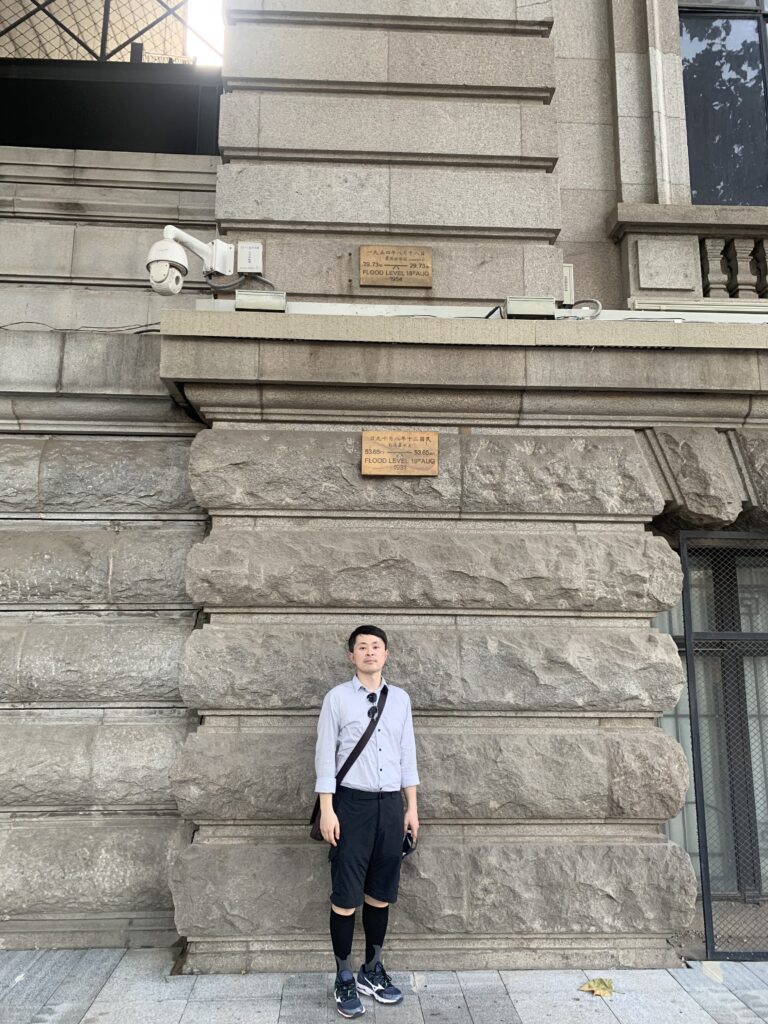 Tong stands below two plaques on the side of the former Hankow Customs House in Wuhan, China. The plaques are placed at the high-water marks of the 1931 floods (lower) and 1954 floods (higher). Image courtesy of Tong.
Mirrors
Tong’s work also holds space for voices missing in the humanities and the environmental movement. “Ecological thought draws heavily on European and North American traditions. Non-Western cultures are often viewed as derivative or marginal,” explains Tong. “Women, people of color, and disabled people are also underrepresented as contributors to environmentalism and animal advocacy.”
He remembers how his family often didn’t feel comfortable using green space, and when they did, people often assumed they were tourists. “Before COVID, I was visiting my grandmother and went for a hike in Muir Woods,” north of San Francisco, says Tong. “People asked me where I was from and were surprised to hear I grew up in the Bay Area.” The times when they did feel comfortable, when they enjoyed spending time outdoors, those experiences were memorable and inspired his career path.
Tong hopes to spur more inclusion and representation in the humanities. The STEM fields (science, technology, engineering, and math) have benefited from the talents and scholarship of Asian Americans and Pacific Islanders, he says, but the humanities have not had equal representation. As an Asian American with Hong Kong roots, Tong has often been the sole person of color or Asian American in classes and conferences. Often, he is mistaken as the “tech-person” or assumed to be in a STEM field, he explains.
Tamara Bhalla, an associate professor of American studies and affiliate faculty in the Asian Studies program, works with Tong on the board of the UMBC Asian and Asian American Faculty and Staff Council (AAAFSC). She says, “Chris has been a tremendous leader…He has brought his expansive intellect and global knowledge to bear in his approach to leadership in AAAFSC.”
Part of this work means going beyond the classroom. Tong participated in a series of talks at the Asian Art Museum of San Francisco on the theme of “After Hope.” His project helped raise awareness of Chinese-language literature in the context of Asian American history and addressed the pandemic, immigration policies, and what wellbeing means. He includes poetry found on Angel Island in the San Francisco Bay where Chinese immigrants were detained in the early 20th century because of the Chinese Exclusion Act.
“We’re an important part of the conversation on culture, politics, and history in American society,” he says. He wants to be one of the people that students can look to and think, “I can also pursue this path and have a career in academia in a humanistic field.”
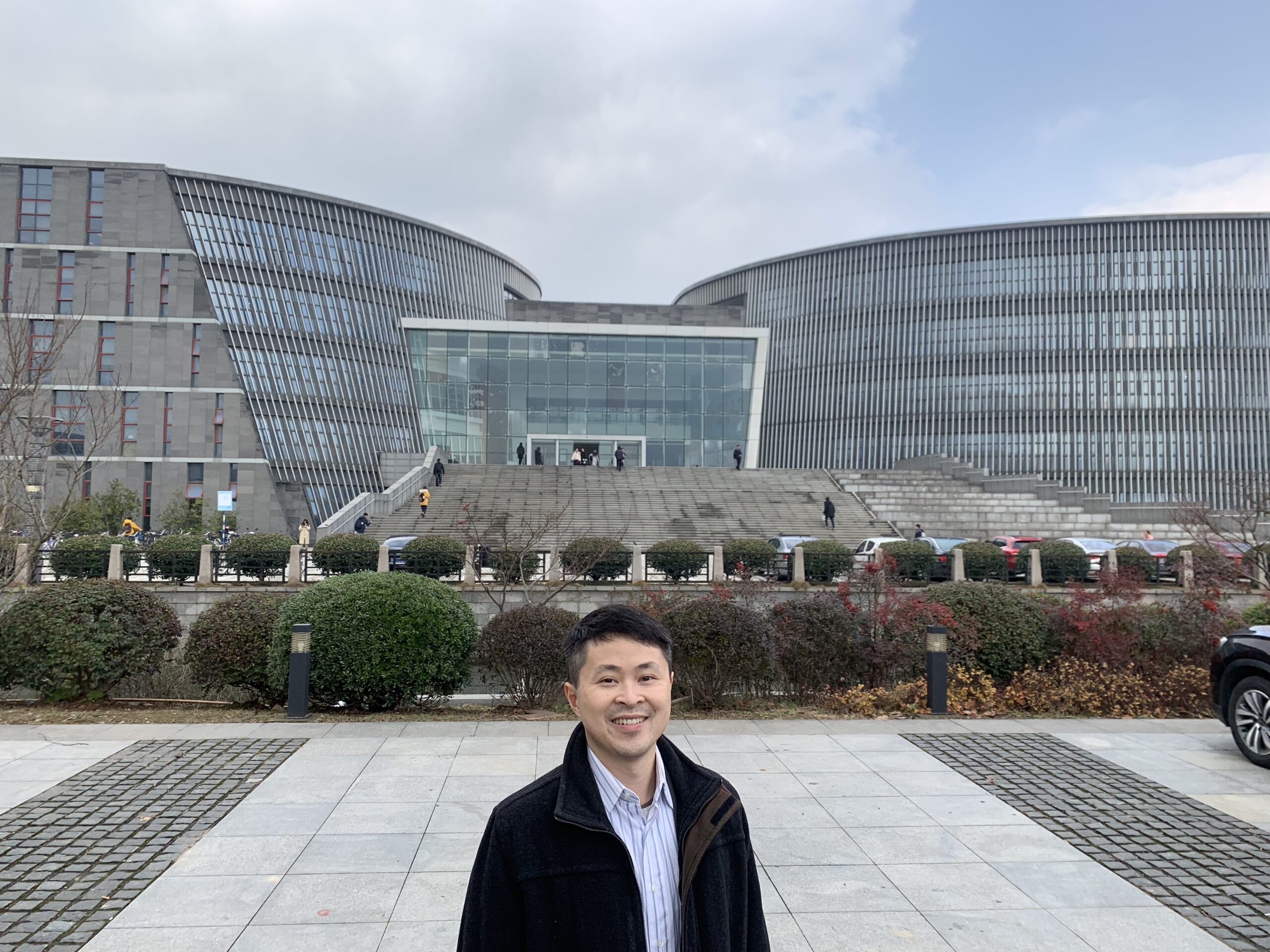
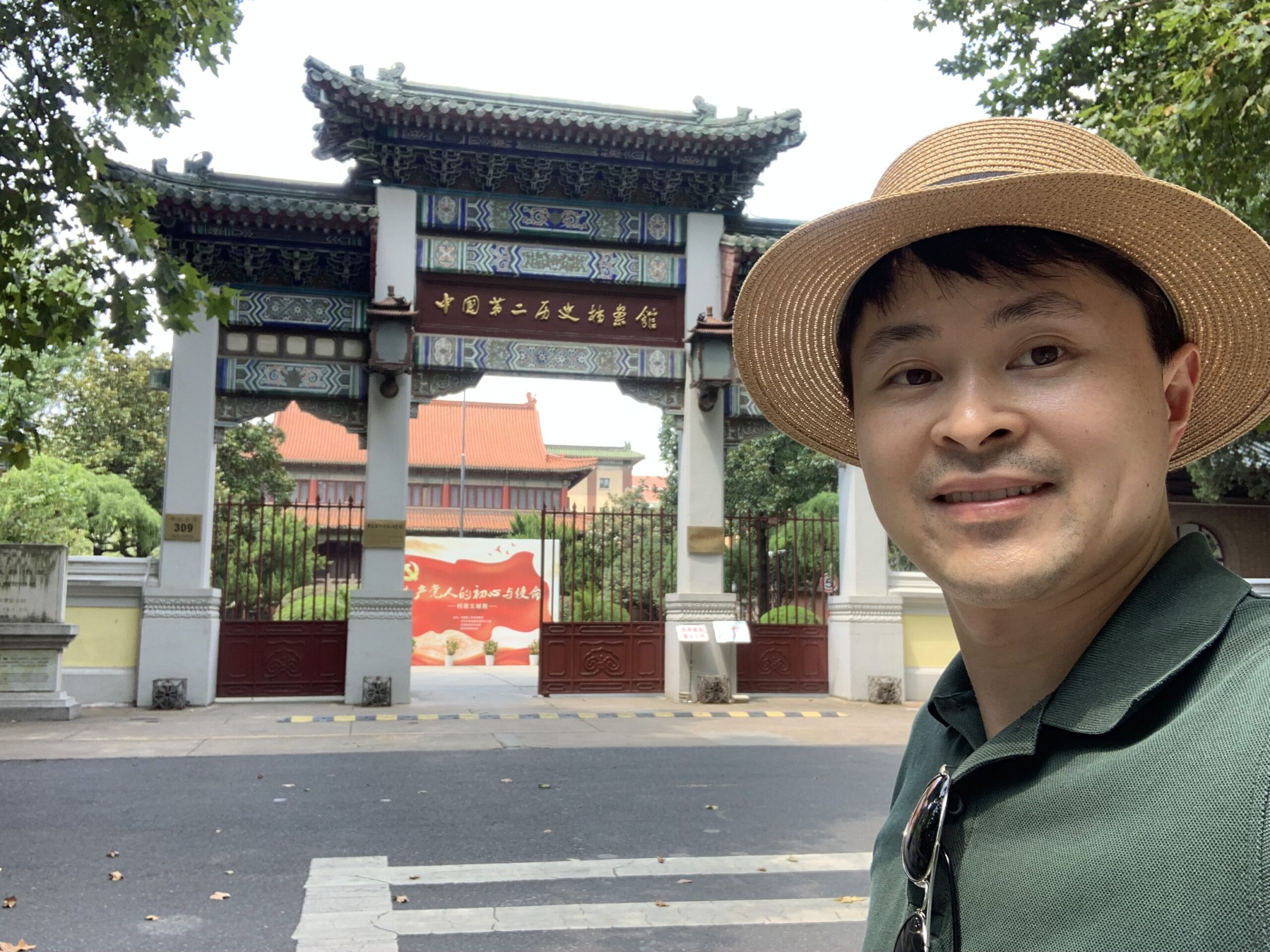 Left: At Nanjing University’s main library at the new campus in the Xianlin district. Right: At The No. 2 Historical Archive, the national repository for Republican-era government documents, in Nanjing. Images courtesy of Tong.
Last year’s flood in Zhengzhou was one of many extreme weather events in China that summer. Many cities and villages in various provinces were bombarded by the floods, killing hundreds and displacing millions.
The New York Times reported on the different accounts given by government officials, meteorologists, and on social media, including those trapped in the flooded subway, wading in the water, leaving their homes, and taking care of the dead while also dealing with COVID-19.
In the meantime, Tong has documents that remain to be analyzed in hopes they will unveil more voices and bring further clarity to China’s environmental history and its future.
“The climate crisis affects everyone every where in some way. It’s the most important issue of our generation,” says Tong. “It affects every domain of knowledge production.”
* * * * *
Header Image: A scene from the Yangzi River in China. Photo by Dong Zhang on Unsplash (2017). All other photos shared by Tong.
]]>
For Christopher Tong, discovering clues hidden in texts documenting history’s most devastating floods isn’t just about the promise of making social, cultural, and political change. It’s also a...
https://umbc.edu/stories/turning-the-tides-historic-flood-research/
https://my3.my.umbc.edu/api/v0/pixel/news/126254/guest@my.umbc.edu/e9ebe414caba9c1c343094233c3e1206/api/pixel
cahss
cahssresearch
discovery
interdisciplinary
international-stories
magazine
mlli
summer-2022
UMBC News & Magazine
https://my3.my.umbc.edu/groups/umbc-news-magazine
https://assets1-my.umbc.edu/system/shared/avatars/groups/000/001/943/24435aa6207c452e7bc15cc74b42c7bb/xsmall.png?1748556657
https://assets1-my.umbc.edu/system/shared/avatars/groups/000/001/943/24435aa6207c452e7bc15cc74b42c7bb/original.png?1748556657
https://assets2-my.umbc.edu/system/shared/avatars/groups/000/001/943/24435aa6207c452e7bc15cc74b42c7bb/xxlarge.png?1748556657
https://assets2-my.umbc.edu/system/shared/avatars/groups/000/001/943/24435aa6207c452e7bc15cc74b42c7bb/xlarge.png?1748556657
https://assets3-my.umbc.edu/system/shared/avatars/groups/000/001/943/24435aa6207c452e7bc15cc74b42c7bb/large.png?1748556657
https://assets1-my.umbc.edu/system/shared/avatars/groups/000/001/943/24435aa6207c452e7bc15cc74b42c7bb/medium.png?1748556657
https://assets2-my.umbc.edu/system/shared/avatars/groups/000/001/943/24435aa6207c452e7bc15cc74b42c7bb/small.png?1748556657
https://assets1-my.umbc.edu/system/shared/avatars/groups/000/001/943/24435aa6207c452e7bc15cc74b42c7bb/xsmall.png?1748556657
https://assets2-my.umbc.edu/system/shared/avatars/groups/000/001/943/24435aa6207c452e7bc15cc74b42c7bb/xxsmall.png?1748556657
UMBC News & Magazine
0
0
false
Thu, 14 Jul 2022 10:53:19 -0400
Thu, 14 Jul 2022 10:53:19 -0400
UMBC’s 2022 Fulbright student scholars will travel the world to explore difficult questions
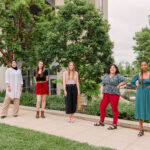
Eight recent UMBC graduates and alumni will soon travel to countries across three continents as 2022 Fulbright U.S. Student scholars. They include emerging leaders in education, astrophysics, cybersecurity, human rights, and more, and they are excited to explore difficult questions through fresh perspectives.
The Fulbright Program is the U.S. government’s flagship international exchange program. UMBC was named a Fulbright Top Producing Institution in 2019 – 2020. In the last decade, UMBC has received over 60 Fulbright U.S. Student Program awards for research and teaching placements in Africa, Asia and the Pacific, the Middle East, South America, and Europe.
Creating new paths
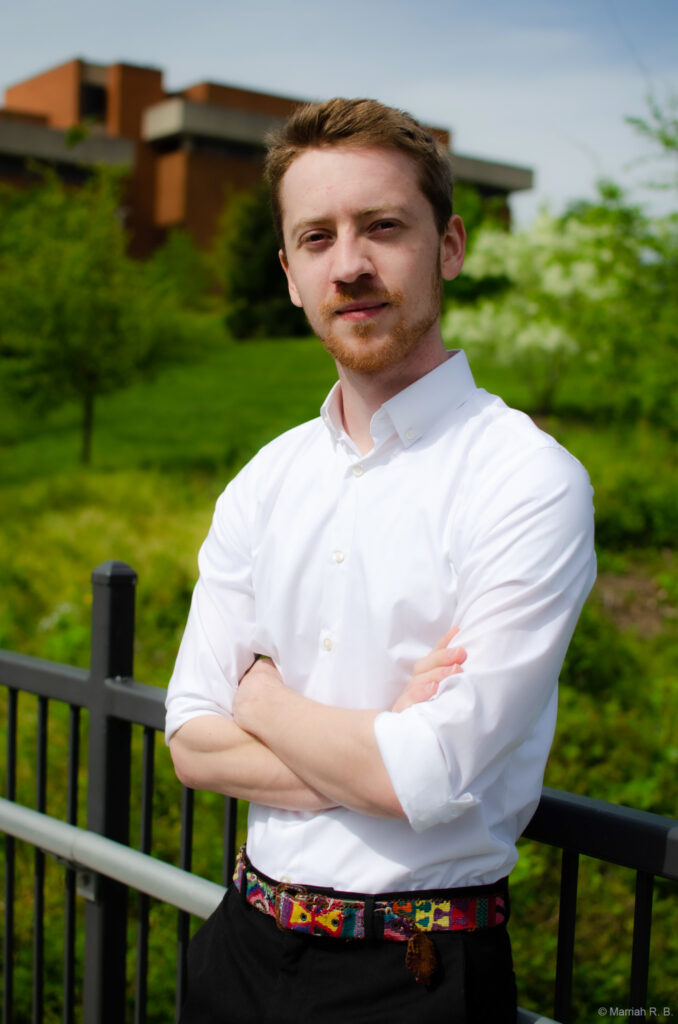 Caleb Jacobson.
(Image courtesy of Jacobson)
This year marks UMBC’s first Fulbright awards to El Salvador and to the UK. Caleb Jacobson ’21, global studies, and M.A. ’23, sociology, will research human rights and the transition to peace in post-conflict El Salvador. Kaitlyn Keaton ’22, computer engineering, a Cyber Scholar in the Center for Women In Technology, will head to Newcastle University (NU) in North East England to complete a master’s in cybersecurity. NU is recognized jointly by the UK’s National Cyber Security Center and the Engineering and Physical Sciences Research Council as an Academic Centre of Excellence in cyber security research.
Keaton has focused on making the most of her college education by pursuing a wide range of learning experiences. She has held competitive software engineering internships at General Dynamics Mission and Systems and Northrop Grumman Mission Systems, and has participated in Capture the Flags cybersecurity competitions, but this will be her first learning experience abroad.
As a Cyber Scholar and Tau Beta Pi Engineering Honors Society member, Keaton is determined to further develop the skills necessary to be on the cutting edge of cybersecurity research. She is also committed to creating new pathways for more women and girls to be leaders in engineering.
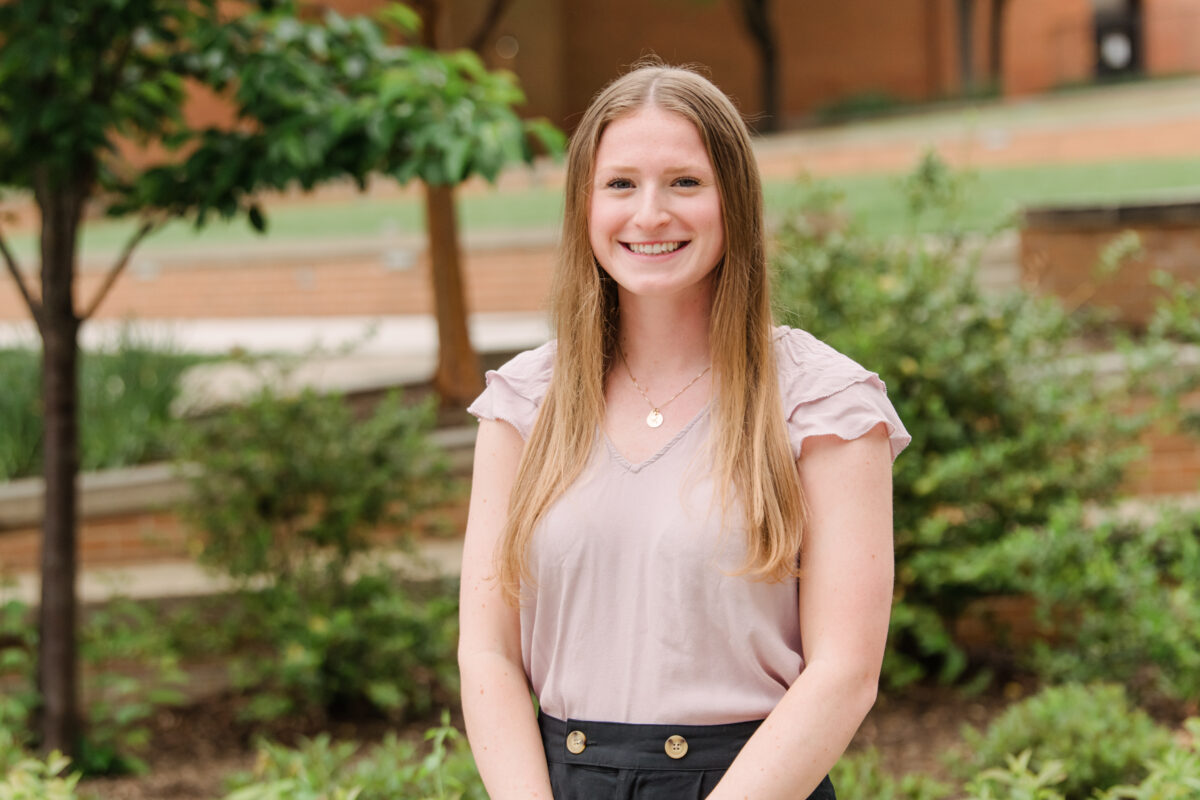 Kaitlyn Keaton. (Marlayna Demond ’11/UMBC)
“I want to inspire and encourage even more girls and young women to join the cybersecurity world,” says Keaton. “There is a critical need to get girls interested at younger ages to show them they can do it too.”
Intercultural understanding in medicine
Maryam Elhabashy ’21, anthropology, developed an interest in the process of healing early in her life while surrounded by a family of physicians. In high school, she shadowed a physician at a hospital and saw instances where patients’ cultural backgrounds sometimes conflicted with the physician’s concerns. She wondered if a lack of intercultural understanding in medicine can get in the way of good medical care, leading to health disparities.
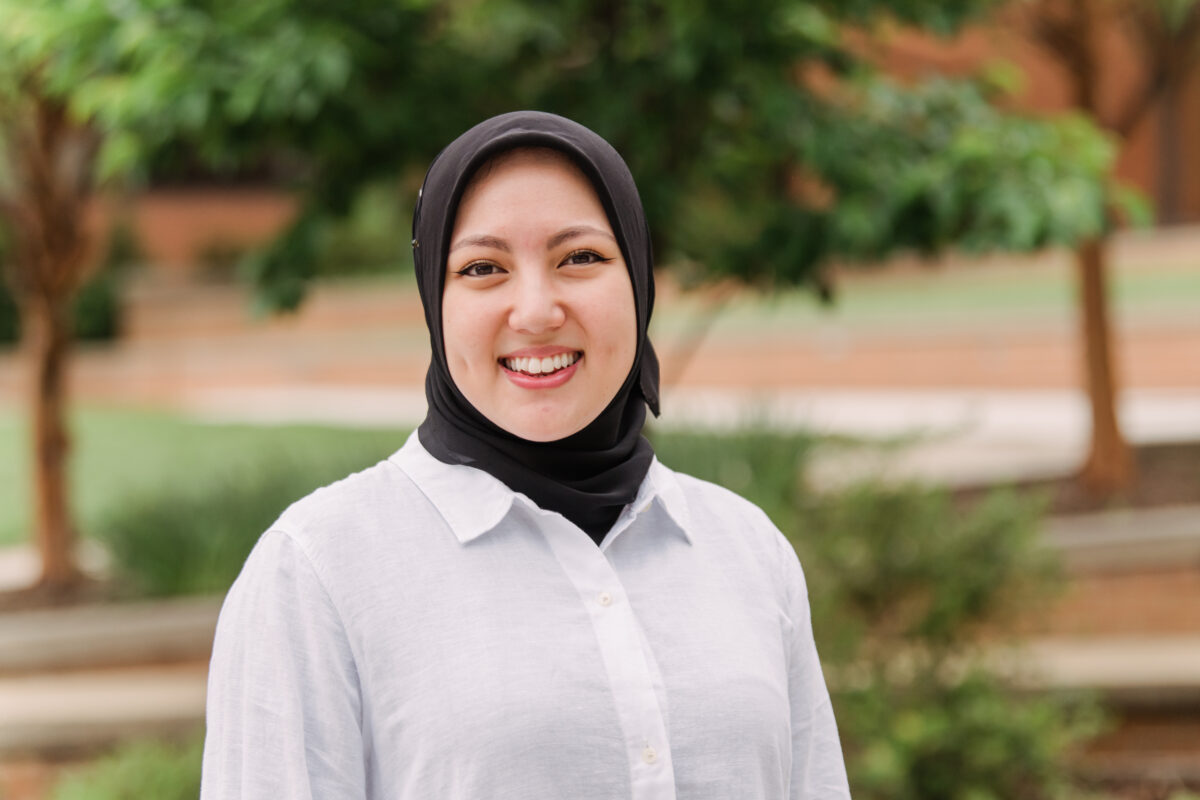 Maryam Elhabashy. (Marlayna Demond ’11/UMBC)
Elhabashy found an answer in listening to culturally diverse perspectives. As a student of anthropology with a focus on medical anthropology, she found that listening to people’s stories can help physicians develop empathy. This is one way to ensure patients feel heard, understood, and are able to navigate medical processes that can give them access to the best care possible.
While at UMBC, Elhabashy received an Undergraduate Research Award to research “Cupping and Wellness Among Muslims In the Baltimore-Washington Area.” She also served as a research assistant in sociology, anthropology, and public health (SAPH), studying physical activity among older African Americans in Baltimore.
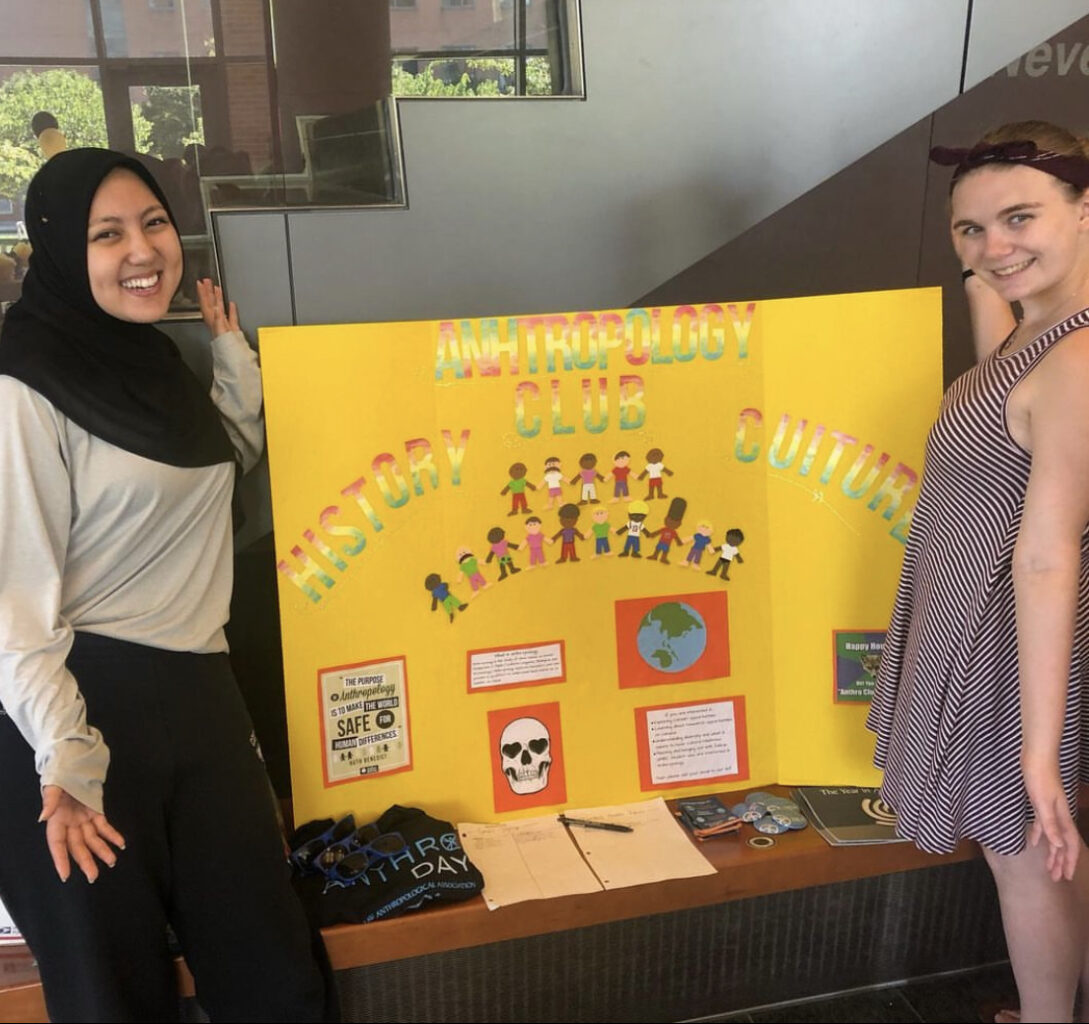 Elhabashy presenting with the Anthropology Club at SAPH’s Welcome Week Open House. (Image courtesy of Elhabashy)
After graduating, Elhabashy worked at Rutgers University as a research assistant studying tobacco and e-cigarette use among minority populations. In the past year, she interned at the Amgen Scholar Program at the National Institute of Health, working with leading biomedical scientists to identify and address health disparities as a potential result of societal, cultural, and environmental influences.
During her Fulbright year, Elhabashy will live in Kuwait City to work on her research project at Kuwait University titled, “Faith, Family, Food, and Fitness: Exploring Trends of Obesity Amongst Kuwaiti Women.”
“I hope to one day be at the forefront of a movement towards truly personalized medicine that embraces individuality and intercultural communication as a foundational tenet of the field,” she notes. “I hope my experience in Kuwait will serve as a strong foundation for this work.”
Latine teachers needed
Adrianna-Marie Urbina-Ruiz ’21, mathematics, and M.A.T., secondary education, was raised in Montgomery County, Maryland, but her roots are in Venezuela. She remembers only having four Hispanic teachers growing up. All were Spanish language teachers and supported her academic and personal growth. However, Urbina-Ruiz felt some of her other teachers had lower expectations of her, limiting her opportunities, and she saw other Hispanic students struggle with this same experience.
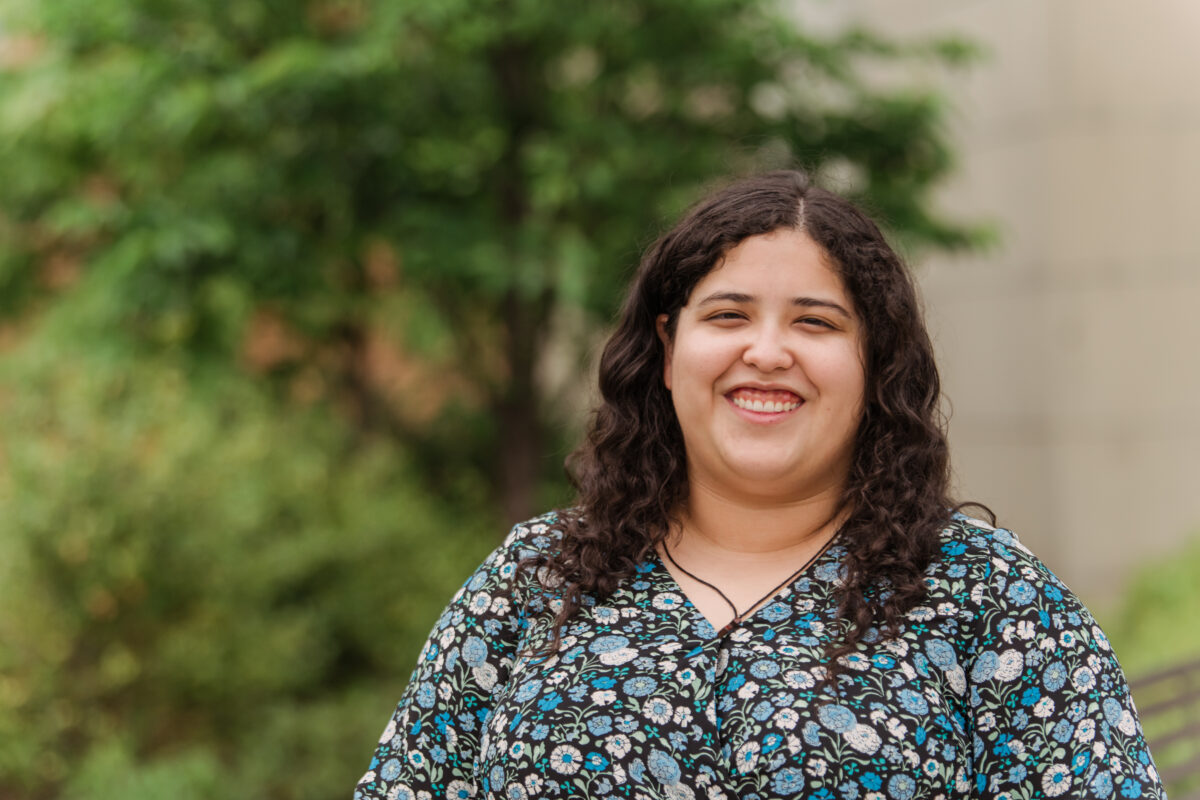 Adrianna-Marie Urbina-Ruiz. (Marlayna Demond ’11/UMBC)
“Many Hispanic students learning English and those who are bilingual have been seen as having limited academic knowledge, limited potential,” says Urbina-Ruiz. “I want to stop that narrative.”
At UMBC, Urbina-Ruiz met Bonny Tighe, a senior lecturer of mathematics, who encouraged her to become a math major and a math teacher through the Sherman STEM Teacher Scholars Program.
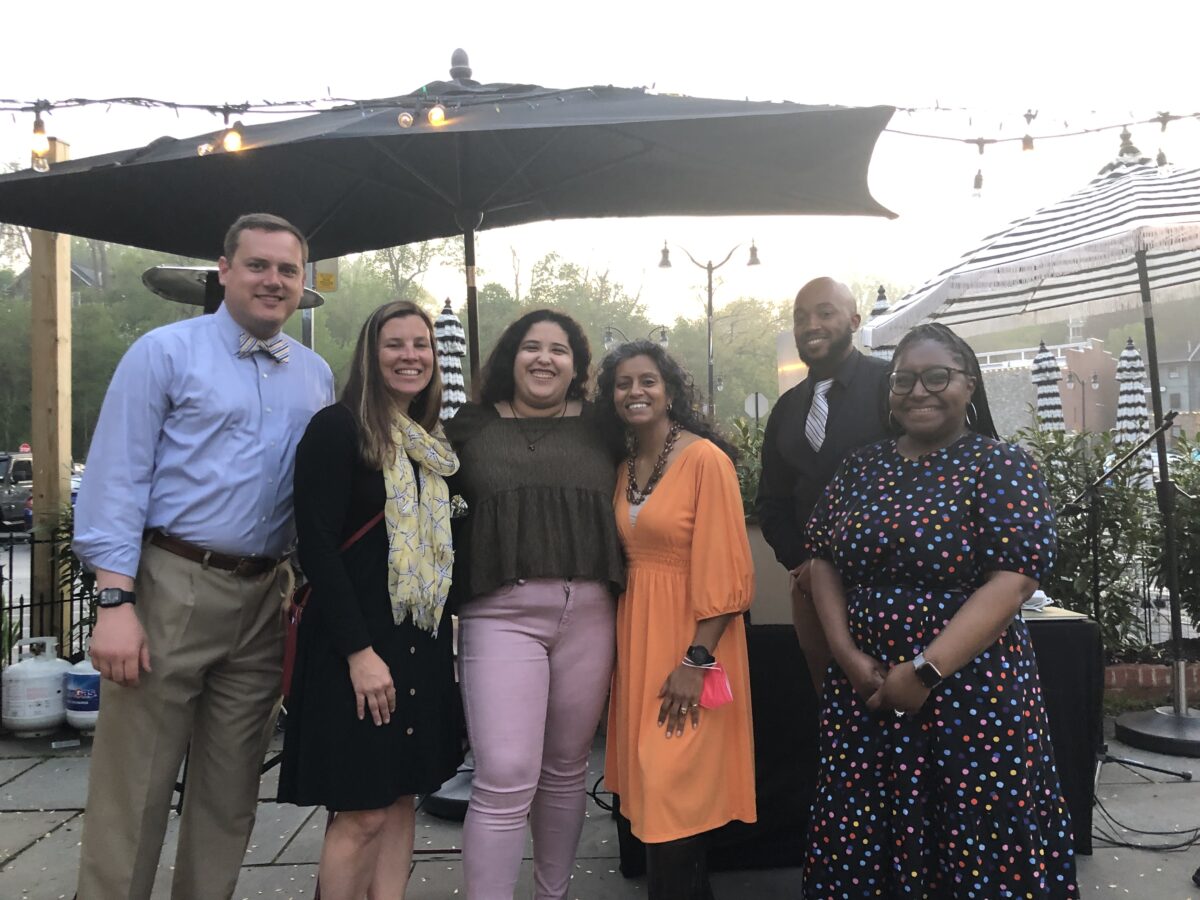 Urbina-Ruiz (in pink) with the Sherman STEM Teacher Scholar Program staff. (Image courtesy of Urbina-Ruiz)
“I will never forget walking into her office hours for the first time. She recognized me as having one of the highest grades in her Calculus I class,” says Urbina-Ruiz. “She and the Sherman staff had confidence that I would rise to any challenge. They built a strong foundation for my success.”
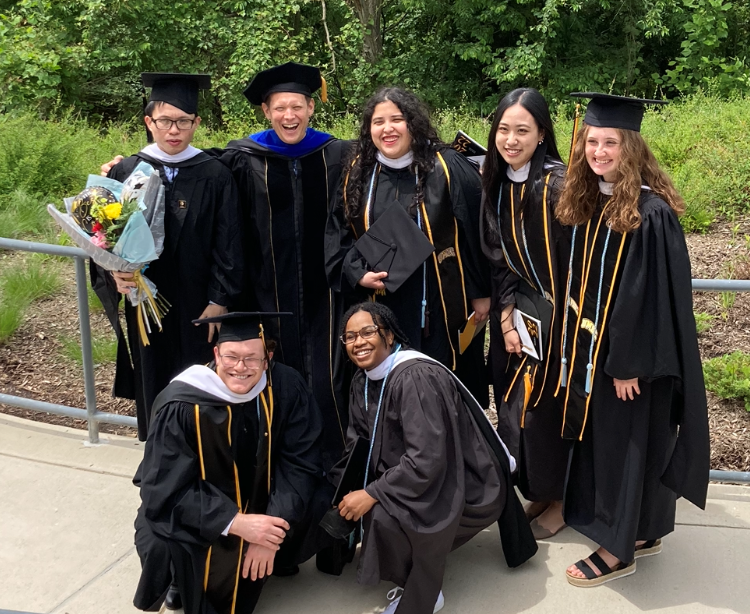 Urbina-Ruiz (standing row, center).
(Image courtesy of Urbina-Ruiz)
Urbina-Ruiz also completed a master’s in teaching and earned a certificate in teaching English to Speakers of Other Languages while student-teaching at Lakeland Elementary/Middle School in Baltimore City, which serves many Hispanic families. “I want to have as many tools at my disposal to make my classroom as accessible as possible,” says Urbina-Ruiz. “I want to be the Latine STEM teacher I never had.”
Urbina-Ruiz will work towards creating her first Collaborative Online International Learning program during her Fulbright year. She will connect college students at the Universidad Industrial de Santander in Colombia with students in Maryland while teaching English. “Latine teachers are needed around the world,” says Urbina-Ruiz.
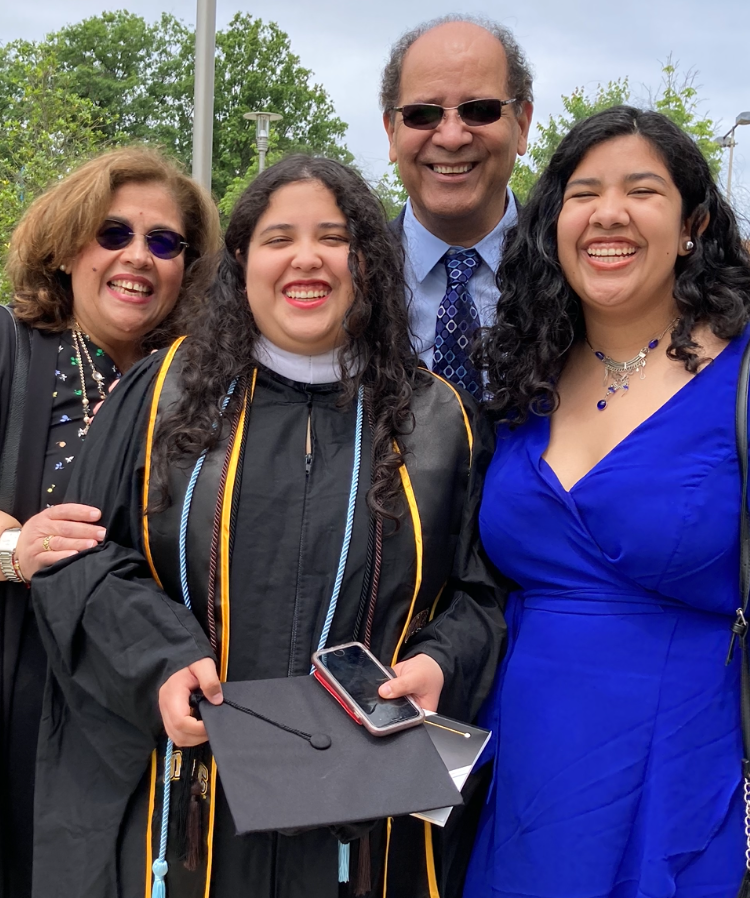 Urbina-Ruiz (wearing cap and gown) with her family at her master’s graduation. (Image courtesy of Urbina-Ruiz)
Urbina-Ruiz plans to return to teach in Baltimore City Public Schools where there is a high demand for bilingual Hispanic teachers.
Representation in science
Similar to Elhabashy, Maithily Diana Díaz ’21, biology and modern languages, linguistics, and intercultural communication, is pursuing a career focused on health equity. As a first-generation student, Díaz encourages other Latinos to go to college and to be ambitious even if it means they are in spaces where they are the only Latino, something she has experienced as a Latina in STEM.
“I’m usually the only Latina, but now it means something more,” says Díaz. “Now, it’s just the jump of saying Latinos can be scientists, researchers, physicians. If we believe in ourselves then someone else will too. And once that door is opened, then who knows how far we can go.”
Díaz recently moved to Tijuana, Mexico to work at a non-profit health clinic serving a largely refugee and migrant population. For the past school year she has been teaching science and medicine to predominantly Hispanic and African American K-12 students for Refugee Health Alliance in Harlem, while completing remote research in mental health at the Johns Hopkins School of Public Health.
During her Fulbright year, Díaz will complete a master’s in immunology and work on cancer research at the French National Institute of Health while mentoring undergraduate students at Sorbonne University. .
“It’s a dream come true that someone like me received a Fulbright at such prestigious institutions. My students were shocked,” says Díaz. “I want more and I intend to achieve it. But at the end of the day, this is for my community.”
While in France, Díaz will work with researchers seeking to identify more effective means of treating soft tissue sarcomas. The findings may reveal potentially novel immunotherapy targets for a variety of cancers.
As a linguist with proficiency in English, Spanish, French, Portuguese, and Russian, Díaz knows her ability to successfully communicate across multiple cultures and languages can lead to greater opportunities. She wants to show Latinos what can happen when they value their multicultural and multilingual lives as assets.
Following her Fulbright, Díaz plans to pursue an M.D., promoting equity in both research and healthcare.
Global education and disability
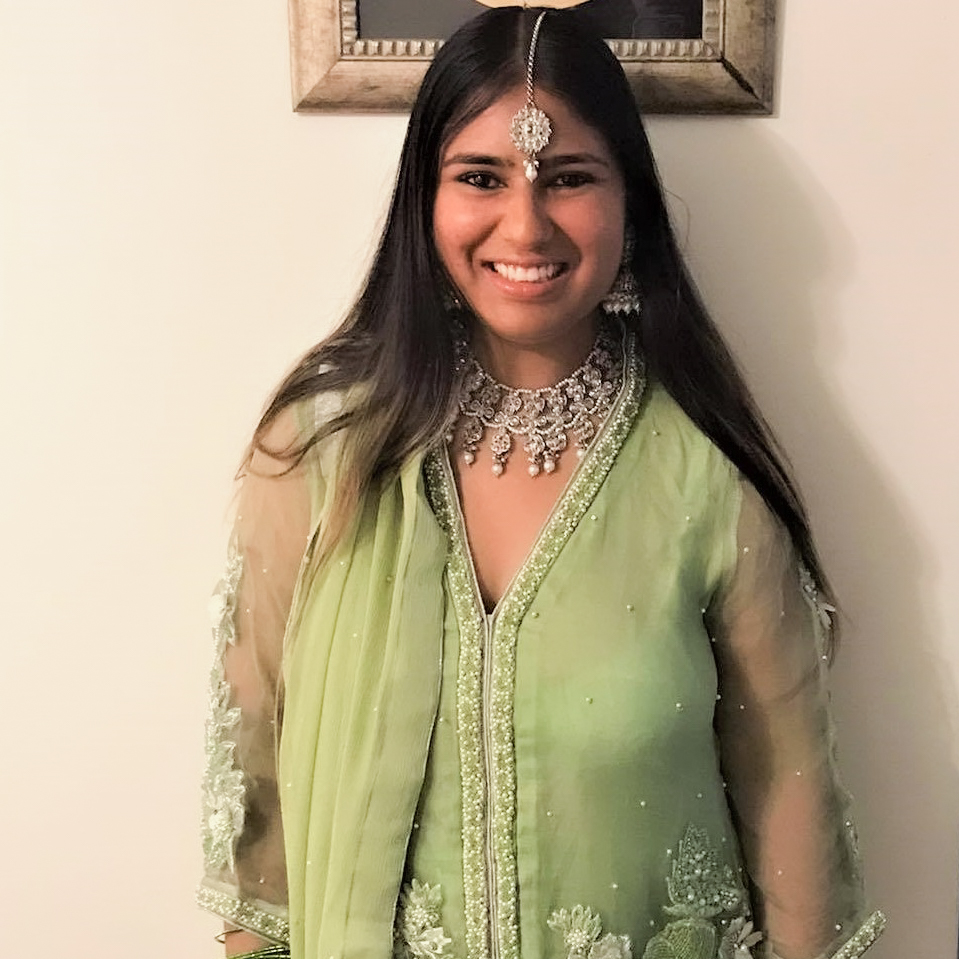 Mimi Yaldram in traditional Pakistani dress. (Image courtesy of Yaldram)
Mimi Yaldram ’20, history, is very familiar with the process of acclimating to a new culture and country. When she was seven years old, her family left their home in Karachi, Pakistan for the United States to seek better mental health services.
“We came in 1999 right before 9/11,” says Yaldram. “It was a lot to manage the racism towards my Muslim family while learning how to live, study, access services, and work in the U.S.”
This experience inspired Yaldram’s passion for living and learning within multiple cultures, religions, and languages, which she began to explore at Montgomery College. There she held numerous executive student leadership roles and traveled abroad to Ethiopia, where she researched the influence of India on ancient trade routes and currency.
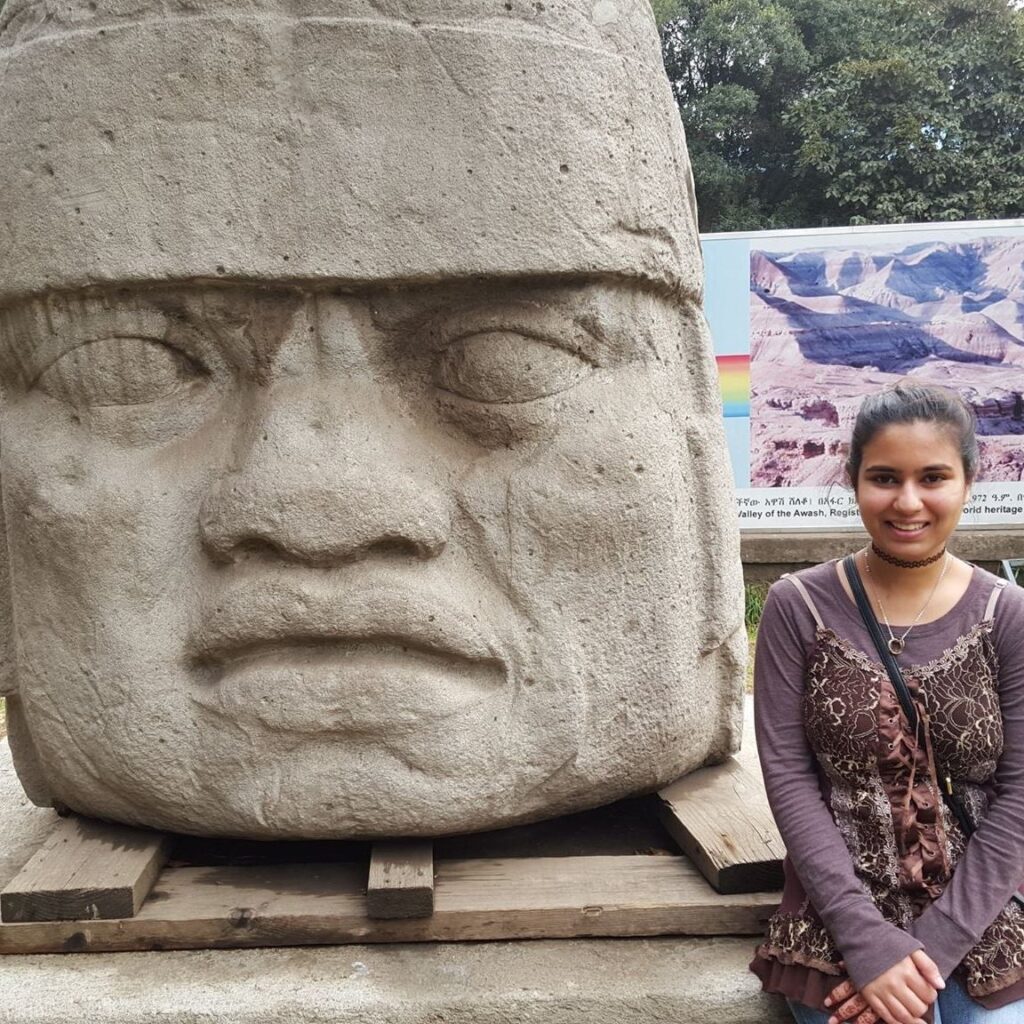 Yaldram in Ethiopia next to an ancient stone head sculpture of the Olmec civilization of Mexico. (Image courtesy of Yaldram)
In 2017, Yaldram joined UMBC’s Shady Grove campus, embarking on new student leadership opportunities, including serving as president of the Student History Association and studying abroad in Denmark. She learned about Viking history and participated in a dance project focusing on Danish pop dances and Pakistani Bollywood dances.
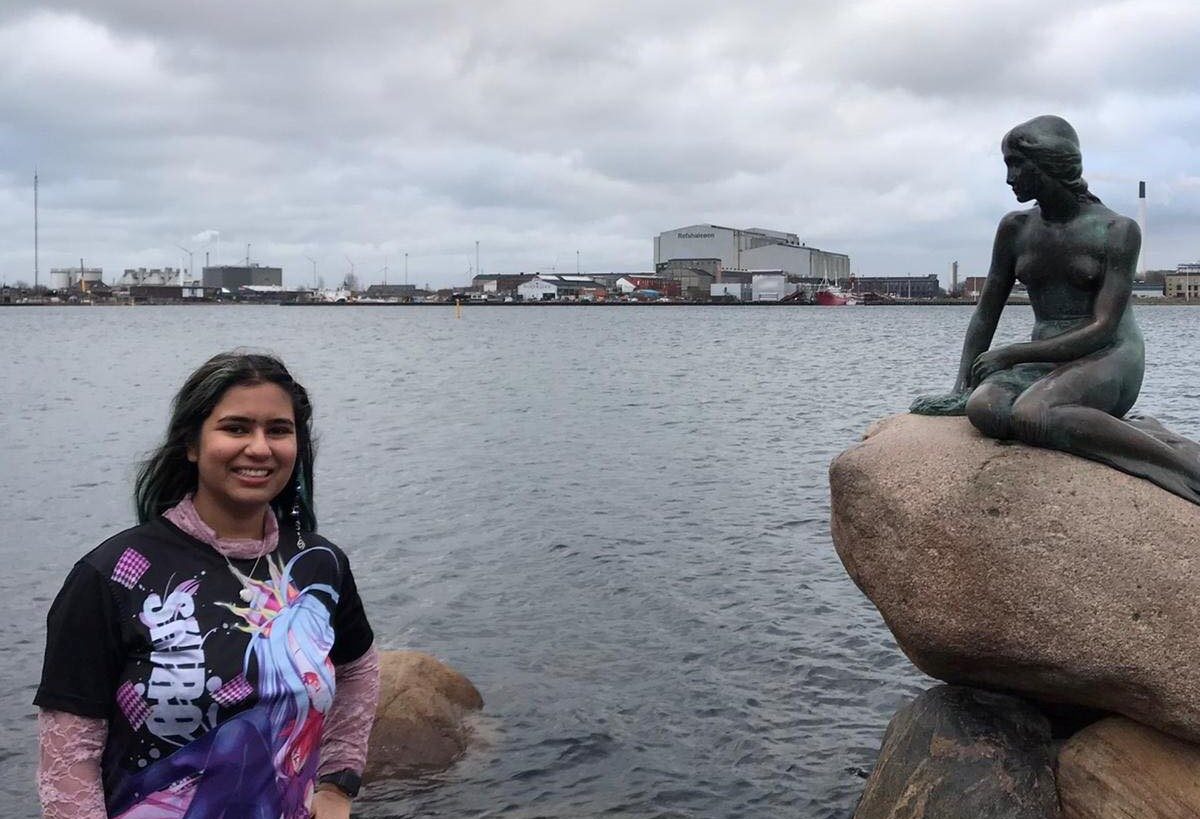 Yaldram next to a sculpture of the Little Mermaid in Copenhagen, Denmark. (Image courtesy of Yaldram)
Yaldram identifies as a student with a mental health disability, and she is passionate about advocating for and teaching other students with disabilities and neurological differences. For the past two years, she has tutored students with autism spectrum disorder on strengthening their writing, communication, and social skills.
Now that she has earned her both her Teaching English as a Second Language and mental health first-aid certifications, she is ready to spend her Fulbright year teaching English in Taiwan. She is excited to be part of Taiwan’s goal to become a bilingual nation by 2030 by raising English proficiency. She also looks forward to sharing her skills in disability education and services while teaching.
“My dream is to make a positive impact on immigrant communities by utilizing my own experiences and education,” says Yaldram. “I hope to make a difference and bring that to the Fulbright program in Taiwan.”
Yaldram plans on a career at the intersection of global education, social justice, and disability beginning with humanitarian work in Pakistan after her Fulbright experience.
Korean world influence
Chemutai Wangui Nganga ’21, global studies, comes from a Kenyan family in the United States. During elementary school, she lived in Kenya for four years where she improved her Swahili skills and learned more about her Kenyan culture. When she moved back to the U.S., her family settled in Howard County, Maryland, home to numerous international communities, especially a thriving Korean community. Nganga learned about the influence the Korean economy, cuisine, music, art, and technology have had on the world.
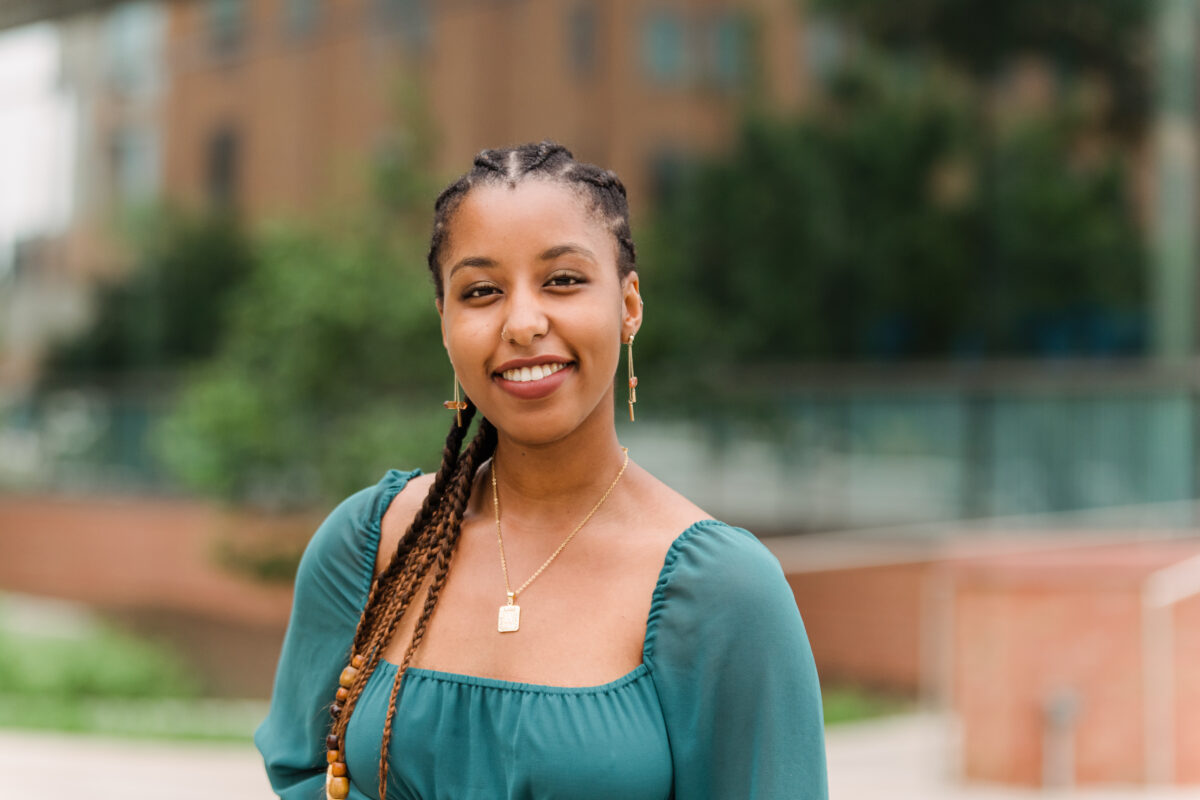 Chemutai Wangui Nganga. (Marlayna Demond ’11/UMBC)
Living in a diverse community, led Nganga to major in global studies at UMBC. She gained a greater understanding of the opportunities and conflicts of globalization and decided to focus on international politics and French. Her Asian studies courses increased her interest in Korean culture, which led her to pursue a Fulbright year in South Korea.
“For me, Korea is a full step into a new world,” says Nganga, who will be teaching English. “It is another chance to push the boundaries of my worldview as well as serve others.” She plans to explore a career path in foreign service on her return to the U.S.
Stellar research
As a burgeoning astrophysicist, Kaitlyn Szekerczes ’22, physics, lives and breathes for exploring the infinite universe. She didn’t know that all those nights stargazing on her deck with her dad and discussing the plausibility of science fiction shows would lead her to pursue a career in space science research.
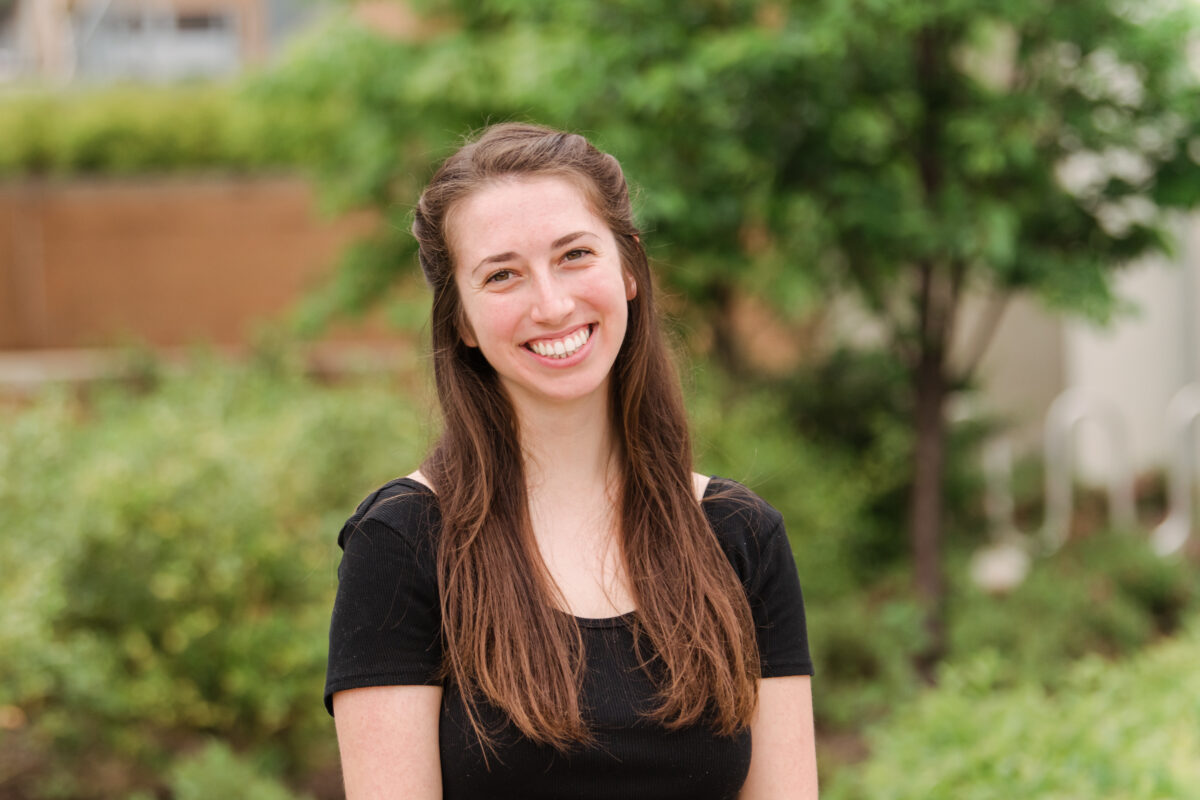 Kaitlyn Szekerczes. (Marlayna Demond ’11/UMBC)
“I was always fascinated by the questions we were not able to answer. We are not even close to knowing nearly everything when it comes to astronomy,” says Szekerczes. “My goal is to contribute to answering lesser-known big and challenging research questions.”
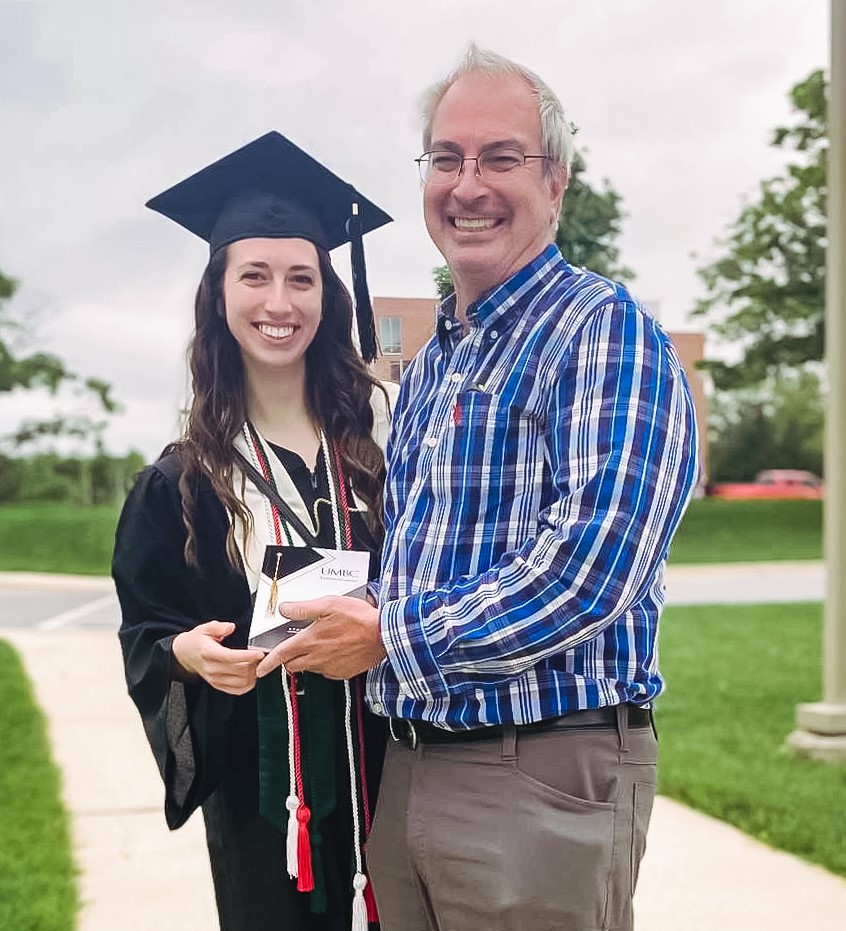 Szekerczes (l) with her dad.
(Image courtesy of Szekerczes)
Szekerczes will lead a project on gravitational lensing of tidal disruption events at the Max-Planck Institute for Astrophysics in Garching, Germany. It will be the first study to apply the technique of gravitational lensing—the bending of light by gravity—to researching tidal disruption events, which are events that happen when a supermassive black hole tidally disrupts a star.
“My dream job is to work as an astrophysicist for NASA,” says Szekerczes. “UMBC was the perfect fit for me because I was encouraged to pursue my passion for tackling challenging unanswered questions. I was also given the resources and support to piece together the puzzle of how to work towards my goals.”
After returning from Germany, Szekerczes will begin a Ph.D. program in astrophysics at Penn State University in fall 2023.
]]>
Eight recent UMBC graduates and alumni will soon travel to countries across three continents as 2022 Fulbright U.S. Student scholars. They include emerging leaders in education, astrophysics,...
https://umbc.edu/stories/umbc-2022-fulbright-student-scholars/
https://my3.my.umbc.edu/api/v0/pixel/news/125930/guest@my.umbc.edu/ba2dfd241a4dc3b3530386c46cc83d0a/api/pixel
anthropology
biology
cahss
cahssresearch
cnms
coeit
community
computer-engineering
cwit
education
globalstudies
history
international-stories
mathematics
mlli
news
physics
policy-and-society
research
saph
science-and-tech
shermanscholars
UMBC News & Magazine
https://my3.my.umbc.edu/groups/umbc-news-magazine
https://assets1-my.umbc.edu/system/shared/avatars/groups/000/001/943/24435aa6207c452e7bc15cc74b42c7bb/xsmall.png?1748556657
https://assets1-my.umbc.edu/system/shared/avatars/groups/000/001/943/24435aa6207c452e7bc15cc74b42c7bb/original.png?1748556657
https://assets2-my.umbc.edu/system/shared/avatars/groups/000/001/943/24435aa6207c452e7bc15cc74b42c7bb/xxlarge.png?1748556657
https://assets2-my.umbc.edu/system/shared/avatars/groups/000/001/943/24435aa6207c452e7bc15cc74b42c7bb/xlarge.png?1748556657
https://assets3-my.umbc.edu/system/shared/avatars/groups/000/001/943/24435aa6207c452e7bc15cc74b42c7bb/large.png?1748556657
https://assets1-my.umbc.edu/system/shared/avatars/groups/000/001/943/24435aa6207c452e7bc15cc74b42c7bb/medium.png?1748556657
https://assets2-my.umbc.edu/system/shared/avatars/groups/000/001/943/24435aa6207c452e7bc15cc74b42c7bb/small.png?1748556657
https://assets1-my.umbc.edu/system/shared/avatars/groups/000/001/943/24435aa6207c452e7bc15cc74b42c7bb/xsmall.png?1748556657
https://assets2-my.umbc.edu/system/shared/avatars/groups/000/001/943/24435aa6207c452e7bc15cc74b42c7bb/xxsmall.png?1748556657
UMBC News & Magazine
0
0
false
Thu, 16 Jun 2022 15:23:06 -0400
Thu, 16 Jun 2022 15:23:06 -0400
Language enthusiast wants to broaden his perspective
Caleb Ruck
Degree: B.A., Modern Languages & Linguistics (Spanish and German)
Minors: Anthropology and Latin American Studies, certificate in Intercultural Communication
Hometown: Ellicott City, MD
Plans: M.A., Intercultural Communication at UMBC
“I like that grittiness we have at UMBC—that you chose to be here and everyone is here because they’re just into what they study and want to grow.”
An aspiring polyglot, Caleb Ruck ’22, modern languages and linguistics, collected languages like Pokemon when he was young. No college felt right, however, until the day he toured UMBC. He knew right away that it was where he belonged. “I genuinely think that UMBC is the best possible fit that I could have gotten,” he says, “it has a very deliberate underdog spirit.”
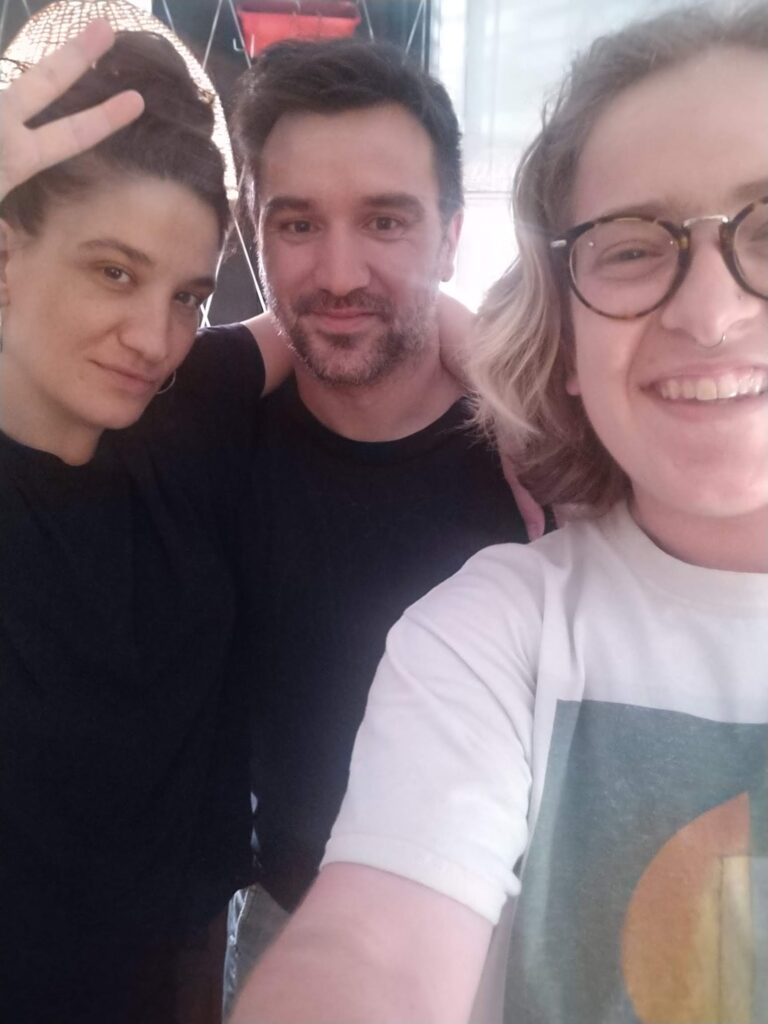
Caleb Ruck with host family in Argentina. (Image courtesy of Ruck)
Soon he began to find that the cultural aspects of language were just as appealing as the mechanics. His advisor Elizabeth Arévalo-Guerrero, who he calls his “main cheerleader,” pointed out that he could earn an intercultural communication certificate with just a few more classes, so he decided to go for it. Ruck delved into how people use language and never looked back.
In Fall 2019 he studied abroad in Argentina, which gave him “a taste of communicating with people who experience the world in a very different way.” Back at UMBC, he went on to do a research project and presentation focused on understanding differences in the perceived prestige of native English-speaking bilinguals versus English language learners on social media.
Ruck looks forward to continuing his studies with a master’s degree in intercultural communication, a field he describes as “vital” for broadening perspectives and opening doors.
Story by Karen Stysley.
]]>
Caleb Ruck Degree: B.A., Modern Languages & Linguistics (Spanish and German) Minors: Anthropology and Latin American Studies, certificate in Intercultural Communication Hometown: Ellicott...
https://umbc.edu/stories/language-enthusiast/
https://my3.my.umbc.edu/api/v0/pixel/news/119413/guest@my.umbc.edu/47f3b440fa7bdbd65c1febaf04f177de/api/pixel
cahss
class-of-2022
intercultural
international-stories
mlli
news
UMBC News & Magazine
https://my3.my.umbc.edu/groups/umbc-news-magazine
https://assets1-my.umbc.edu/system/shared/avatars/groups/000/001/943/24435aa6207c452e7bc15cc74b42c7bb/xsmall.png?1748556657
https://assets1-my.umbc.edu/system/shared/avatars/groups/000/001/943/24435aa6207c452e7bc15cc74b42c7bb/original.png?1748556657
https://assets2-my.umbc.edu/system/shared/avatars/groups/000/001/943/24435aa6207c452e7bc15cc74b42c7bb/xxlarge.png?1748556657
https://assets2-my.umbc.edu/system/shared/avatars/groups/000/001/943/24435aa6207c452e7bc15cc74b42c7bb/xlarge.png?1748556657
https://assets3-my.umbc.edu/system/shared/avatars/groups/000/001/943/24435aa6207c452e7bc15cc74b42c7bb/large.png?1748556657
https://assets1-my.umbc.edu/system/shared/avatars/groups/000/001/943/24435aa6207c452e7bc15cc74b42c7bb/medium.png?1748556657
https://assets2-my.umbc.edu/system/shared/avatars/groups/000/001/943/24435aa6207c452e7bc15cc74b42c7bb/small.png?1748556657
https://assets1-my.umbc.edu/system/shared/avatars/groups/000/001/943/24435aa6207c452e7bc15cc74b42c7bb/xsmall.png?1748556657
https://assets2-my.umbc.edu/system/shared/avatars/groups/000/001/943/24435aa6207c452e7bc15cc74b42c7bb/xxsmall.png?1748556657
UMBC News & Magazine
0
0
false
Thu, 12 May 2022 15:22:31 -0400
Thu, 12 May 2022 15:22:31 -0400
UMBC Responds to Putin’s War in Ukraine

On February 24, just one day after a Russian holiday celebrating the “defenders of the Fatherland,” Russian President Vladimir Putin ordered his military forces to invade Ukraine. The ensuing assault catalyzed a mass of destruction and action.
In the classroom of Kyiv-born Vira Zhdanovych, an instructor of Russian at UMBC, students are using their language skills to take in information from different perspectives. Zhdanovych notes that both her students and colleagues from the Department of Modern Languages, Linguistics, and Intercultural Communication (MLLI) reached out to her during the first days of the invasion and have been extremely supportive since.
“Like everyone, I have been very upset and confused by Putin’s invasion of Ukraine,” says Zhdanovych. “This was especially difficult for me because I am from Kyiv and have relatives who were forced to evacuate. Fortunately, my immediate family—my sister, niece and nephew—have made it out, though my brother-in-law remained behind to defend Kyiv. I also have many friends who are still in Kyiv and in surrounding areas and I worry about them each day.”
Additional faces and voices of those impacted have since risen to the surface through several virtual UMBC town halls that highlight Ukrainian American voices as well as faculty experts on the region.
UMBC professors and students share their expertise
In the early weeks following the initial invasion, UMBC’s Center for Social Sciences Scholarship, History Department, and the Political Science Department hosted a virtual discussion about the history leading up to the current crisis, as well as the political and economic impacts that it is having today on surrounding countries and globally. Present at the panel were Devin Hagerty and Brian Grodsky, professors of political science and affiliate faculty in Asian studies, and Mirjam Voerkelius, assistant professor of history. Joining them were three undergraduate students who shared their personal experiences and reactions to the current climate in Ukraine.
 Hagerty (standing) teaching a global studies course. All photos by Marlayna Demond ’11, unless otherwise noted.
Maria Kutishcheva ’24, political science and MLLI, shared that the conflict has had a devastating effect on her family. With relatives in both Ukraine and Russia, Kutishcheva talked about two sides of the crisis from a personal standpoint, mentioning the divisions that have been deepened by Russian propaganda. She ended her story on a compelling note: inaccurate portrayals of the war cannot keep up with reality, but Ukraine still needs our continued attention and support.
Although it can be difficult to absorb everything that has happened leading up to the crisis, the Retriever community is fortunate to have students and faculty who can provide insight on the subject. Many people, especially those with personal ties to the situation, have been deeply affected and wish to stay informed through their communities—a desire that was again met by UMBC’s second virtual discussion about Asia’s influence on the Russia-Ukraine War in mid-March.
Brian Carlson, head of the Global Security Team of the Think Tank at the Center for Security Studies, returning panelists Brian Grodsky and Devin Hagerty, and Meredith Oyen, associate professor of history and director of UMBC’s Asian studies program, led the discussion and helped answer attendees’ questions about global relations across Asia and Europe. Carlson opened up the discussion by describing Russia’s ties to China.
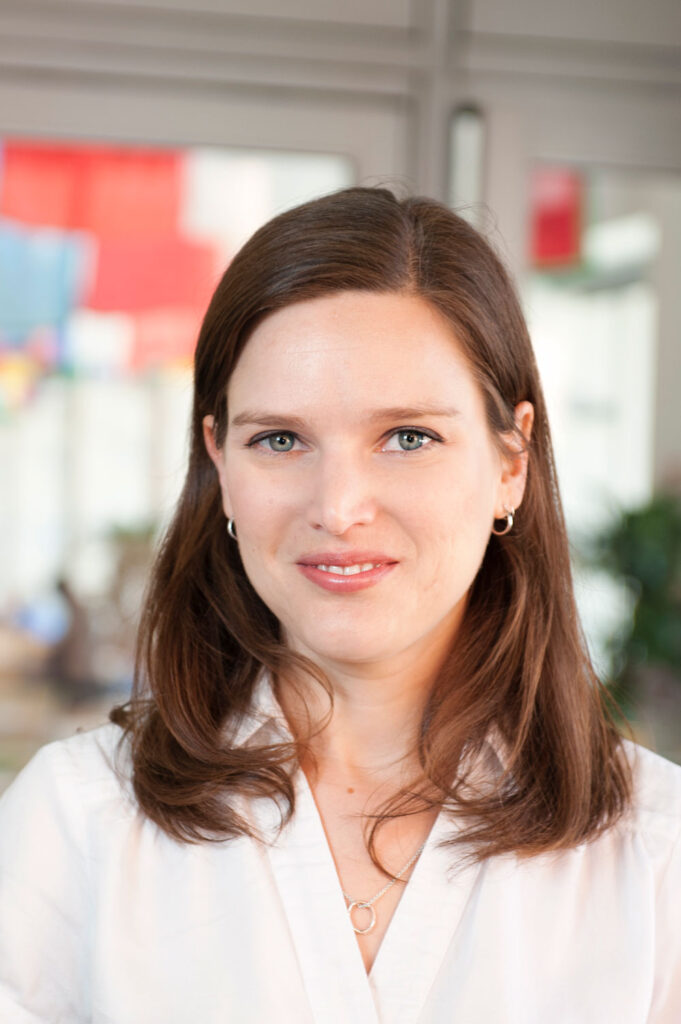 Meredith Oyen
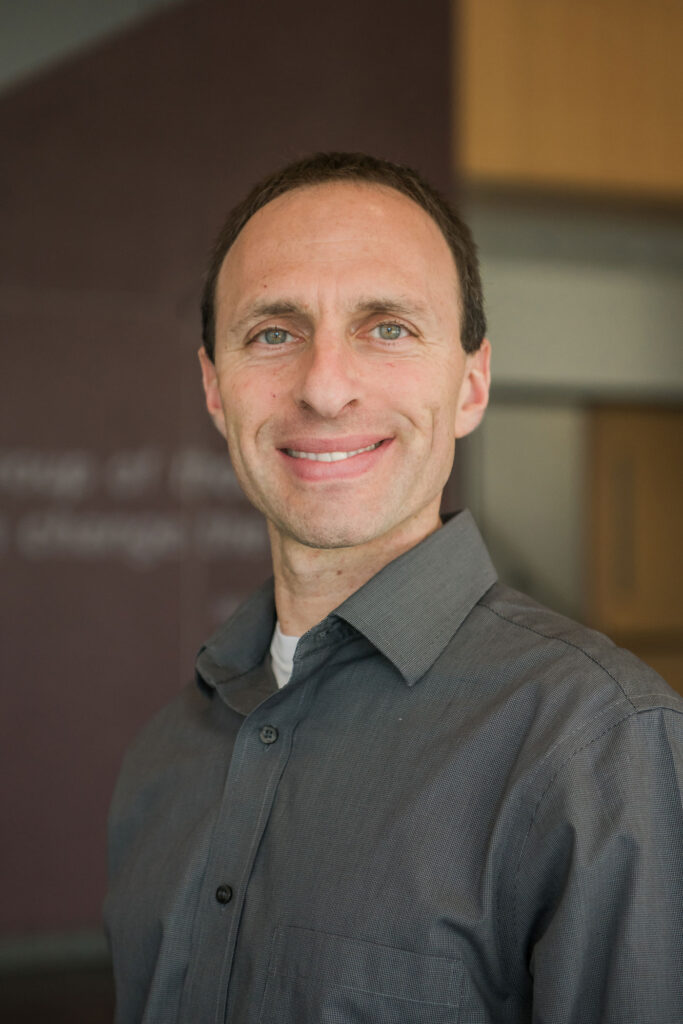 Brian Grodsky
“China has played an important, enabling role in Russia’s actions in Ukraine. China and Russia have built a close partnership based on a common desire to oppose the United States in aspects of the existing international order,” says Carlson. “In early February, just weeks before the invasion…they issued a joint declaration in which they said their partnership had no limits and there were no forbidden areas of cooperation.”
Although, he adds, “China has probably been surprised by the ineptitude of the invasion and by the fierceness of the Ukrainian resistance.”
Grodsky, the chair of the political science department, was next to share his expertise about Central Asia’s response, or lack thereof, to the Russian invasion of Ukraine. “Not surprisingly,” Grodsky notes, “Central Asia has been neutral in its reaction to the invasion. Russia expected a lot more support than it got, but this really reflects a long-standing foreign policy to balance stronger powers in the region.”
Grodsky, expanding on an earlier article he wrote about economic sanctions on Russia, added that economic links were becoming more difficult for Central Asian countries to maintain with Russia. These sanctions, he stated, would likely lead to political instability in the region.
Ongoing conversations provide support
Broad conversations about geographic implications of the Russian military aggression combined with personal stories of Ukrainian displacement and resistance are ongoing and they won’t end soon. Students, staff, and faculty, including Zhdanovych and those present at the panels, are speaking from personal and informational standpoints to put a face to the people who are struggling and fighting in Ukraine. But Zhdanovych points out that we also shouldn’t forget about those in Russia.
“I think that it is important to emphasize that not all Russians—particularly those in the U.S.—support this invasion. I know many, many Russians in the greater community and do not know of one who supports this invasion. I think of this as Putin’s invasion of Ukraine, rather than Russia’s invasion,” Zhdanovych says.
With this mindset moving forward, we can strive to build networks of support and to grow together as multiple communities all impacted by this crisis. Though the future ahead remains uncertain, there is strength in the voices and actions that stretch across and beyond UMBC.
UMBC supports Ukrainians: If you’re interested in supporting Ukrainian students, scholars, and artists at risk, UMBC’s Center for Global Engagement recommends giving to an established organization, like IIE.” In April, President Biden announced a new initiative to support Ukrainians. Welcome.us, an organization of which UMBC is a member, has created a new website that contains information about this initiative as well as various ways to help Ukrainians.
******
Header image: Photo on Pexel by Mathias P.R. Reding
]]>
On February 24, just one day after a Russian holiday celebrating the “defenders of the Fatherland,” Russian President Vladimir Putin ordered his military forces to invade Ukraine. The ensuing...
https://umbc.edu/stories/umbc-responds-to-putins-war-in-ukraine/
https://my3.my.umbc.edu/api/v0/pixel/news/119450/guest@my.umbc.edu/0e2495bac50e528fa14b7900a1369c39/api/pixel
asian-studies
campus-life
cge
cs3
history
magazine
mlli
political-science
russian
ukraine
webfeature
UMBC News & Magazine
https://my3.my.umbc.edu/groups/umbc-news-magazine
https://assets1-my.umbc.edu/system/shared/avatars/groups/000/001/943/24435aa6207c452e7bc15cc74b42c7bb/xsmall.png?1748556657
https://assets1-my.umbc.edu/system/shared/avatars/groups/000/001/943/24435aa6207c452e7bc15cc74b42c7bb/original.png?1748556657
https://assets2-my.umbc.edu/system/shared/avatars/groups/000/001/943/24435aa6207c452e7bc15cc74b42c7bb/xxlarge.png?1748556657
https://assets2-my.umbc.edu/system/shared/avatars/groups/000/001/943/24435aa6207c452e7bc15cc74b42c7bb/xlarge.png?1748556657
https://assets3-my.umbc.edu/system/shared/avatars/groups/000/001/943/24435aa6207c452e7bc15cc74b42c7bb/large.png?1748556657
https://assets1-my.umbc.edu/system/shared/avatars/groups/000/001/943/24435aa6207c452e7bc15cc74b42c7bb/medium.png?1748556657
https://assets2-my.umbc.edu/system/shared/avatars/groups/000/001/943/24435aa6207c452e7bc15cc74b42c7bb/small.png?1748556657
https://assets1-my.umbc.edu/system/shared/avatars/groups/000/001/943/24435aa6207c452e7bc15cc74b42c7bb/xsmall.png?1748556657
https://assets2-my.umbc.edu/system/shared/avatars/groups/000/001/943/24435aa6207c452e7bc15cc74b42c7bb/xxsmall.png?1748556657
UMBC News & Magazine
0
0
false
Tue, 12 Apr 2022 20:12:39 -0400
Tue, 12 Apr 2022 20:12:39 -0400
Women leaders from UMBC, Morgan State, and UMD receive $3M Mellon grant to diversify senior leadership in higher ed
The Andrew W. Mellon Foundation has granted UMBC, Morgan State University, and the University of Maryland, College Park (UMD) $3 million to launch Breaking the M.O.L.D. (Mellon/Maryland Opportunities for Leadership Development). Many existing faculty leadership programs in higher education focus on leadership in STEM fields, the organizers note. This program will develop a pipeline to higher ed leadership for scholars in the arts and humanities. It will focus on interested faculty members at the rank of associate and full professor, particularly women faculty and Black, Hispanic, and American Indian/Alaska Native faculty.
Breaking the M.O.L.D. is also unique in its design with six women in senior leadership serving as principal investigators (PI), five of whom are Black. UMBC’s Kimberly Moffitt, interim dean of UMBC’s College of Arts, Humanities, and Social Sciences (CAHSS) and professor of language, literacy, and culture, serves as the project’s lead PI. Joining her in leading UMBC’s implementation of Breaking the M.O.L.D. will be Patrice McDermott, vice provost for faculty affairs.
Leading Morgan State’s implementation will be PI Patricia Williams Lessane, associate vice president for Academic Affairs and associate professor of sociology and anthropology, and Co-PI Charlene Chester, assistant dean for the James H. Gilliam College of Liberal Arts (CLA). At UMD, Psyche Williams-Forson, professor and chair of American studies, will serve as PI. Bonnie Thornton Dill, dean of the College of Arts and Humanities (ARHU) and professor in the Harriet Tubman Department of Women, Gender, and Sexuality Studies, will serve as co-PI.
L to R: Lessane (photo courtesy of Morgan State), Moffitt, Psyche Williams-Forson (photo courtesy of UMD)
A structural answer
“The many health, social justice, economic, and political challenges facing our society today place important demands on higher education institutions,” says UMBC’s Kimberly Moffitt.She points out that colleges and universities must shift how they approach engaging with societal problems, which often means reflecting on how higher ed itself works.
“This experienced team of diverse senior leaders has an opportunity to create a structural answer to elevate diverse leaders from the arts and humanities,” says Moffitt. “This will enable faculty to apply distinct knowledge, skills, and perspectives to address our communities’ needs as leaders at their respective institutions.”
Breaking the M.O.L.D.
As a minority-serving institution (MSI), Historically Black College and University (HBCU), and predominantly white institution (PWI), respectively, UMBC, Morgan State, and UMD are uniquely positioned to collaboratively lead this charge.
This ambitious project will include two cohorts of faculty—associate and full professors—guided by senior faculty over a three-year period. Participants will engage in skill-building seminars, learn key leadership skills from experts who hold senior leadership positions at the three universities, and take part in leadership experiences with their faculty mentors. The cohorts will travel to each campus to gain insights on how PWIs, HBCUs, and MSIs create different pathways to senior leadership.
 Some of UMBC’s 2015-19 postdoctoral fellows (L to R): Keisha Allen, assistant professor of education; Emily Yoon Perez, English; Lisa Cassell, assistant professor of philosophy; Noor Zaidi, assistant professor of history; Camee Maddox-Wingfield, assistant professor of sociology, anthropology, and public health policy; Moffitt.
This work builds on the success of previous initiatives, such as UMBC’s Postdoctoral Fellows for Diversity program. That program has brought 20 talented postdoctoral fellows to UMBC, in fields ranging from dance to history. It provides extensive mentoring and other support to enable postdocs to transition to faculty positions. Seventeen have already done so, including 11 at UMBC.
It also builds on UMD’s ADVANCE Program, a year-long professional development program that prepares faculty for leadership positions in their department, college, or the university.
 2019 postdoctoral fellows (L to R): Blake Francis, philosophy; Perez; Fernando Tormos-Aponte, public policy and political science.
One goal, three approaches
Breaking the M.O.L.D. will offer a flexible model that can be adapted to meet the diversity challenges and needs of individual campuses, while including all faculty from the arts and humanities who are committed to supporting diversity and inclusion in the academy.
UMBC’s CAHSS faculty includes dozens of scholars who identify as Black, Hispanic, American Indian or Alaska Native, but only ten hold the title of full professor. Most are associate professors. And just a handful serve in leadership positions, such as department chair or roles in the dean’s or provost’s office. While women, broadly, are more represented among CAHSS faculty, most women in CAHSS are associate professors.
As a result of these factors, UMBC’s Breaking the M.O.L.D. program will focus on supporting the leadership of Black, Hispanic, American Indian or Alaska Native, and women faculty in the arts and humanities while also being open to others committed to diversifying academic leadership. UMD and Morgan State’s approaches will be similar, but tailored to their institutions.
Investing in and nurturing tomorrow’s leaders
Morgan State will develop and implement a Summer Leadership Academy to address the unique, historical barriers that often impede the ascension of women, Black, Hispanic, and American Indian and Alaska Native faculty in the arts and humanities, with a focus on Black women faculty. The academy will help Morgan State faculty further develop leadership skills, balance research and leadership responsibilities, and navigate the higher education landscape. They will also explore the role of HBCUs in higher education.
“Leaders beget leaders. It is through this model initiative that we are creating the infrastructure and blueprint for our diverse faculty to thrive,” says Lessane. “Humanities scholars are needed in senior executive leadership positions because they understand the value of human-centered education and its impact as a driving force in equitable scientific and technological innovation, business enterprise, and social justice reform during volatile, unprecedented times.”
Diverse voices at the leadership table
UMD’s ARHU faculty will tackle barriers Black women faculty face to access and succeed in leadership positions, as well as support Black, Hispanic, American Indian and Alaska Native faculty more broadly. In ARHU, approximately 15% of the tenured and tenure-track faculty identify with one of the groups above, with the majority at the associate professor rank. Currently, fewer than ten Black women serve in mid-level leadership positions and only two at the senior executive leadership level.
“As a Black woman serving at the senior executive level in a PWI, I’m keenly aware of the importance of having the voices of diverse people at the leadership table,” says Thornton Dill. “I see this project as an opportunity to expose program participants to the knowledge and experiences of other underrepresented minorities in administration as they develop their own strategies and approaches to higher education leadership.”
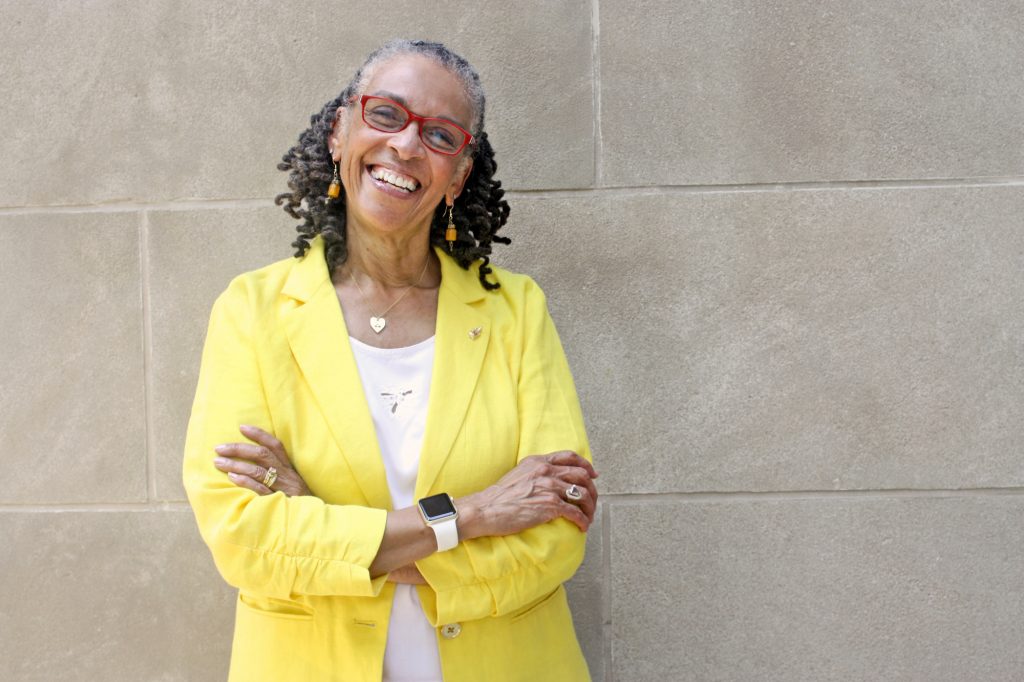
Bonnie Thornton Dill
(Photo courtesy of UMD)
As a recently promoted professor and long-time chair of American studies, Williams-Forson knows the experience of being at the associate professor rank while in mid-level leadership. “Those who advance to administration without research support, mentoring, or networking can find themselves unable to see beyond mid-level leadership positions like chair and director,” she says. “With this project we hope not only to provide greater opportunities for promotion, but also to expose faculty to the myriad senior-level leadership roles across the campus.”
The whole scholar
In addition to developing a network of diverse faculty equipped with the tools and resources to guide and grow universities, Breaking the M.O.L.D will invest in strengthening the links between leadership and scholarship. The intersectionality of the problems that communities face locally, nationally, and globally requires diverse leaders with humanities and arts perspectives who are empowered to create and share knowledge in new, high-impact ways.
 UMBC postdoctoral fellows with Moffitt and Tim Gindling, professor of economics.
Often, women, Black, Hispanic, American Indian, and Alaska Native faculty lack access to the social capital, financial resources, or time needed to advance their scholarly work. This program seeks to remove these barriers by providing funding for research, writing, conferences, and projects, and creating opportunities for partnership, innovation, and career development.
All of these elements are key components of leadership pathways, as is mentorship. In Breaking the M.O.L.D., tenured faculty leaders will provide guidance and resources to ensure participants receive the support they need to move their scholarship forward while growing their leadership skills and opportunities.
Reshaping institutions
Beyond working with faculty as future higher ed leaders, this program also seeks to reshape institutional structures. Ultimately, it aims to disrupt systemic practices that have left women, Black, Hispanic, American Indian, and Alaska Native arts and humanities faculty out of university leadership. The partners plan to combine information gathered over the three years of the program with current research on inclusive excellence to design tools that will help universities rethink their recruitment processes for faculty leaders.
Through a variety of leadership presentations and exercises, the three institutions will design a path to develop truly inclusive leadership by disrupting implicit bias and other forms of exclusion present in job descriptions, search and selection processes, hiring, and professional development. The resources they develop will be made available to other universities across Maryland and the nation, and to academic search firms and those who chair leadership searches, who often initiate the vetting process for arts and humanities faculty. By sharing these resources, the partners hope to enhance equity in academic hiring nationwide.
“Universities and colleges are at a crossroad to reimagine academia by cultivating diverse leaders with important leadership skills, such as imagination, compassion, and understanding,” says Moffitt. “These new leaders will become the next generation of stewards leading innovation in teaching and scholarship, and reshaping university structures to go beyond the status quo.”
For further coverage see Morgan State and College Park‘s news sites.
Banner image: UMBC postdoctoral fellows and Moffitt. (All photos by Marlayna Demond ’11 for UMBC unless otherwise noted.)
]]>
The Andrew W. Mellon Foundation has granted UMBC, Morgan State University, and the University of Maryland, College Park (UMD) $3 million to launch Breaking the M.O.L.D. (Mellon/Maryland...
https://umbc.edu/stories/women-leaders-from-umbc-morgan-state-and-umd-receive-3m-mellon-grant-to-diversify-senior-leadership-in-higher-ed/
https://my3.my.umbc.edu/api/v0/pixel/news/119526/guest@my.umbc.edu/e43f3af76a92fd745b84a93b021ec800/api/pixel
arts-and-culture
cahss
cahssresearch
dreshercenter
economics
education
english
history
llc
majoraward
mlli
page1
philosophy
policy-and-society
politicalscience
publicpolicy
saph
UMBC News & Magazine
https://my3.my.umbc.edu/groups/umbc-news-magazine
https://assets1-my.umbc.edu/system/shared/avatars/groups/000/001/943/24435aa6207c452e7bc15cc74b42c7bb/xsmall.png?1748556657
https://assets1-my.umbc.edu/system/shared/avatars/groups/000/001/943/24435aa6207c452e7bc15cc74b42c7bb/original.png?1748556657
https://assets2-my.umbc.edu/system/shared/avatars/groups/000/001/943/24435aa6207c452e7bc15cc74b42c7bb/xxlarge.png?1748556657
https://assets2-my.umbc.edu/system/shared/avatars/groups/000/001/943/24435aa6207c452e7bc15cc74b42c7bb/xlarge.png?1748556657
https://assets3-my.umbc.edu/system/shared/avatars/groups/000/001/943/24435aa6207c452e7bc15cc74b42c7bb/large.png?1748556657
https://assets1-my.umbc.edu/system/shared/avatars/groups/000/001/943/24435aa6207c452e7bc15cc74b42c7bb/medium.png?1748556657
https://assets2-my.umbc.edu/system/shared/avatars/groups/000/001/943/24435aa6207c452e7bc15cc74b42c7bb/small.png?1748556657
https://assets1-my.umbc.edu/system/shared/avatars/groups/000/001/943/24435aa6207c452e7bc15cc74b42c7bb/xsmall.png?1748556657
https://assets2-my.umbc.edu/system/shared/avatars/groups/000/001/943/24435aa6207c452e7bc15cc74b42c7bb/xxsmall.png?1748556657
UMBC News & Magazine
0
0
false
Thu, 18 Nov 2021 14:00:02 -0500
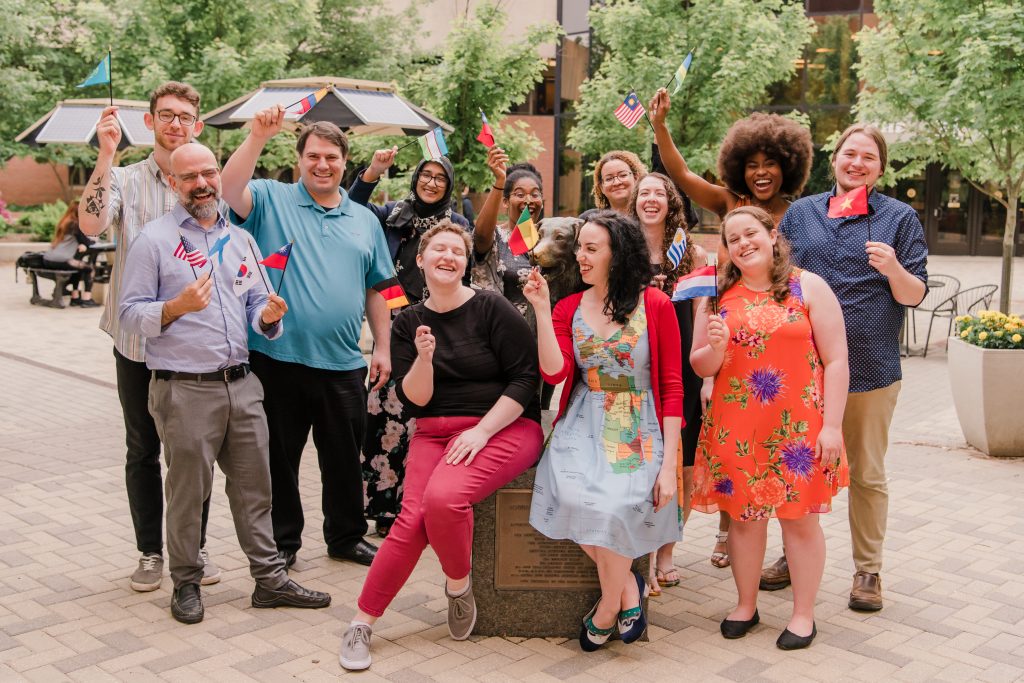 Souders (front left)with UMBC’s