Astronomers observe real-time formation of black hole jets for the first time
 Eileen Meyer (Marlayna Demond ’11/UMBC)
A large international team of scientists has observed a phenomenon that astronomers didn’t ever expect to see happen in real time. A new paper published in Astrophysical Journal Letters led by Eileen Meyer, associate professor of physics at UMBC, describes the findings. It reports remarkable increases in radio emission in a few months and formation of plasma jets extending from a black hole over the course of a year.
A galaxy about 270 million light-years away from Earth in the constellation Draco called 1ES 1927+654 is the focus of the excitement. For many years, scientists had classified 1ES 1927+654 as an “active galactic nucleus,” or AGN, meaning it has an active black hole at its center. This particular black hole was adding material at a slow rate—until it wasn’t.
Back in 2018, the black hole first made news when it suddenly increased its activity exponentially. It dramatically increased the rate at which it was consuming material and became over 100 times brighter in the visible light spectrum over the course of a few months. A shift like that was once thought to take far longer than a human lifetime, on the order of thousands to millions of years. Since then, scientists have been observing it closely for any additional interesting phenomena, and 1ES 1927+654 has delivered.
More drama
After the major increase in activity began in 2018, which included nearly a year of extremely high levels of X-ray emission, the black hole quieted down again by 2020—only to dramatically increase its output again in 2023. At that time, it began emitting radio waves at 60 times the previous intensity over just a few months, behavior which has never been monitored in real time for a supermassive black hole.
Some of the highest-resolution imaging of radio frequency emissions was collected using a technique called Very Long Baseline Interferometry (VLBI). It clearly shows a pair of oppositely directed plasma jets forming near the black hole and expanding outward over the course of 2023 – 2024. Among the other unusual behavior of the black hole, this is the first-ever observation of jet formation in real time.
In recent years, scientists have discovered a handful of supermassive black holes that appear to emit far more intensely at radio frequencies compared to when they were first observed, which they call “changing-look AGN.” However, until now all of them had been observed at two timepoints years or decades apart, and the assumption was that “something happened” in between. This new paper gives the very first look at how this kind of change occurs in detail.
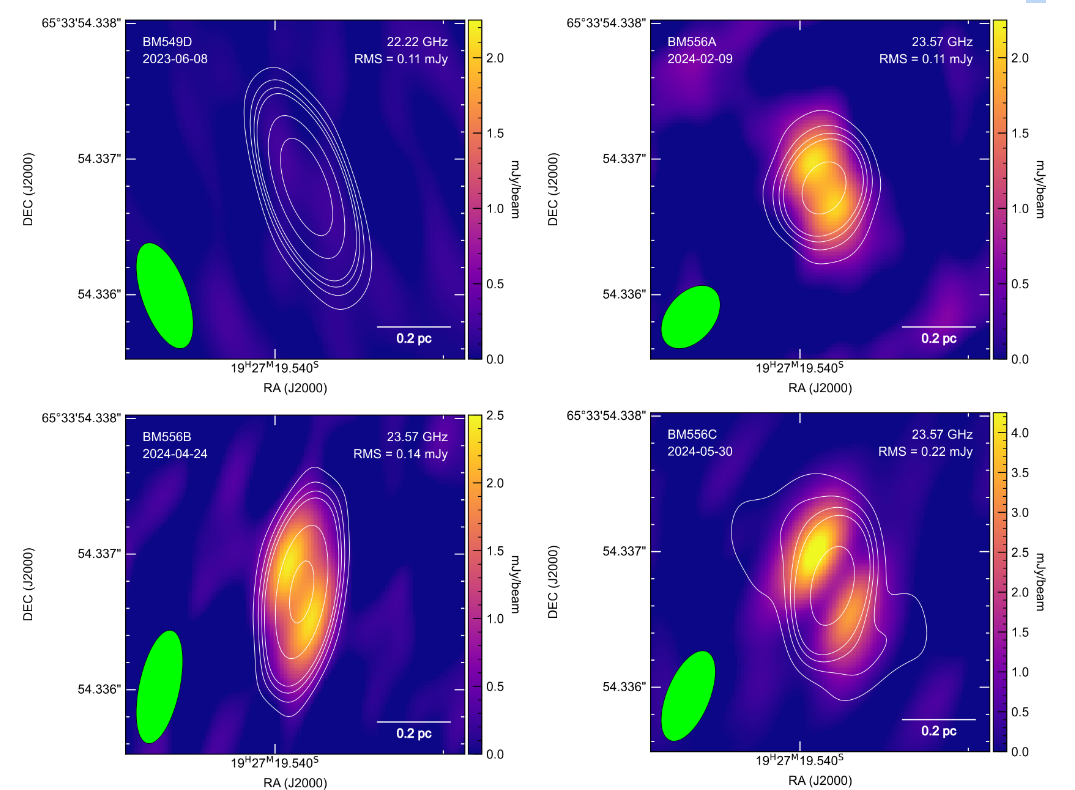 This figure from the new paper shows the plasma jets (yellow blobs) forming. Clockwise from top left, the dates of the images are June 2023, February 2024, April 2024, and May 2024.
Turning on in real time
In some cases, black hole jets “can reach huge scales well outside the host galaxy. They can affect how many stars are forming,” Meyer says. Figuring out how the jets work “is a very important thing, in order to understand the big picture of how the universe is evolving and galaxies evolved.”
 Sibasish Laha (courtesy of Laha)
In the case described in the new paper, “We have very detailed observations of a radio jet ‘turning on’ in real time, and even more exciting are the VLBI observations, which clearly show these plasma blobs moving out from the black hole,” Meyer says. “That shows us that this really is an outflow jet of plasma that’s causing the radio flare. It’s not some other process causing increased radio emission. This is a jet moving at likely 20 to 30 percent of the speed of light originating very near a black hole. That’s the exciting thing.”
Sibasish Laha, an associate research scientist for UMBC with the Center for Space Sciences Technology at Goddard Space Flight Center and second author on the new paper, has long studied changing-look AGN at X-ray wavelengths. On a hunch that 1ES 1927+654’s radio frequency emission might show interesting behavior as well, he reached out to Meyer to form a collaboration to study it and other similar galaxies back in 2020. He is lead author on a companion paper that is currently under review. It includes additional X-ray observations and interpretation of the jet formation event.
“We still do not understand how black holes and their host galaxies interact with each other and co-evolve in cosmic time,” Laha says, “and this study for the first time gives us the rare opportunity to understand how a supermassive black hole ‘talks’ to the host galaxy.”
Not for the faint of heart
In this kind of work, time is of the essence. “Time-domain astronomy,” as it’s called, “is not for the faint of heart,” Meyer says. “You know, there are rapid alerts—something happens and you have to go follow up. You gotta get on it, and it doesn’t matter if it’s midnight, you have to send that email because you know every hour counts. It’s a little stressful.”
 Onic Shuvo (courtesy of Shuvo)
The project became an “all hands on deck” moment for the UMBC collaboration. Once Meyer and Laha saw the huge jump in radio activity in 2023, Meyer says, “We were like, ‘whoa, ok, something is happening.’ This has never been seen before. We got very excited, so this is where we went all in on basically trying to grab every radio telescope and get it to look at this source.”
Because 1ES 1927+654 was changing so rapidly before their eyes, the team was awarded new, unscheduled observations on telescopes around the world during the study period, when typically telescope time must be scheduled months or years in advance.
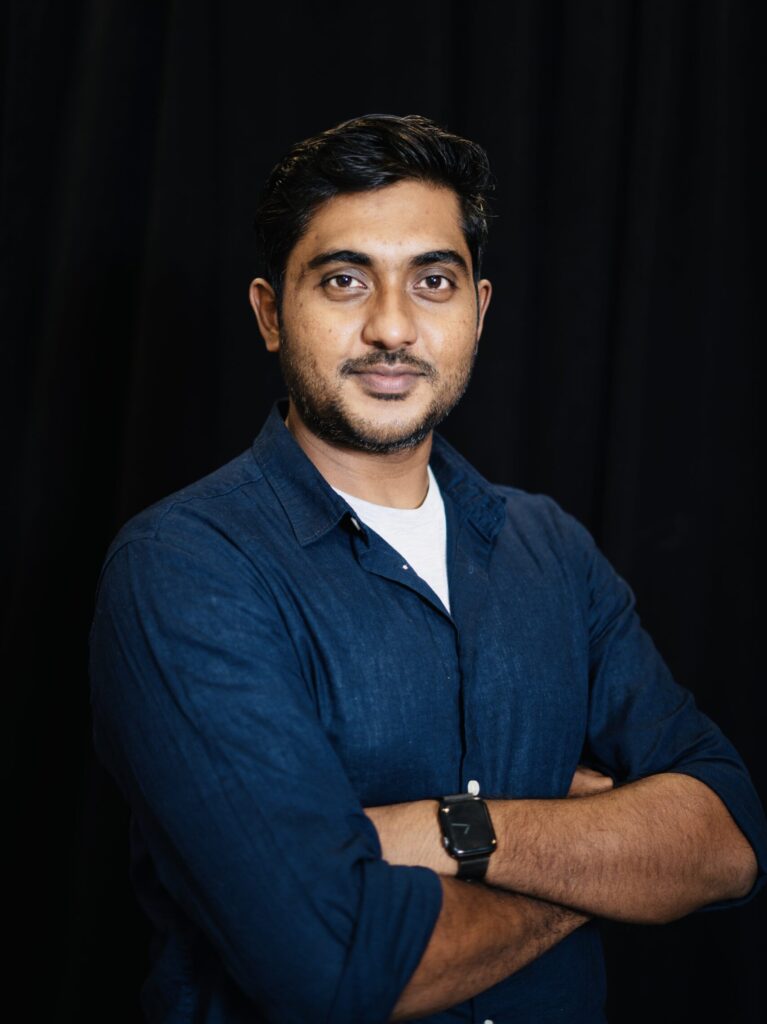
A postdoctoral fellow working with Meyer, Onic Shuvo, who is third author on the paper, took on the lion’s share of the late-night duties, rapidly analyzing incoming data and requesting new observations. He’s thrilled to be part of such an exciting discovery. “This remarkable finding challenges existing models of AGN activity and highlights the unique role that changing-look AGN play in unraveling the mysteries of the central engine of active galaxies in real-time,” Shuvo says.
A new jet is born
The newborn jets coming from 1ES 1927+654 are relatively small compared to the massive jet structures in some of the most powerful AGN, Meyer says. But that doesn’t make them less interesting—in fact, they are probably more common across the universe and therefore very important to understand, she says.
Some data suggested that the 2018 flare, in the visible spectrum, could be due to a “tidal disruption event,” where a large object like a star or cloud of gas gets too close to an inactive black hole and artificially brightens it for just a few years, Meyer says. But observations of tidal disruption events in already-active galaxies are rare and not well understood.
While the largest plasma jets extend well beyond their host galaxies and last millions of years, scientists are gaining understanding of a new class of smaller, shorter-lived jets called “compact symmetric objects,” or CSOs. Meyer believes the data in this case point most strongly to the birth of a new CSO. One recent hypothesis is that jets in CSOs are qualitatively different from the very large and long-lived jets seen elsewhere, Meyer says, perhaps representing “a single ingestion of a star or a gas cloud; basically a single tidal disruption event happens and powers this short-term jet for maybe 1,000 years.”
Perhaps the tidal disruption event occurred several years ago, “and it took a few years for the accreting black hole to organize and start producing the jet,” as the team saw in 2023 – 2024, Meyer says.
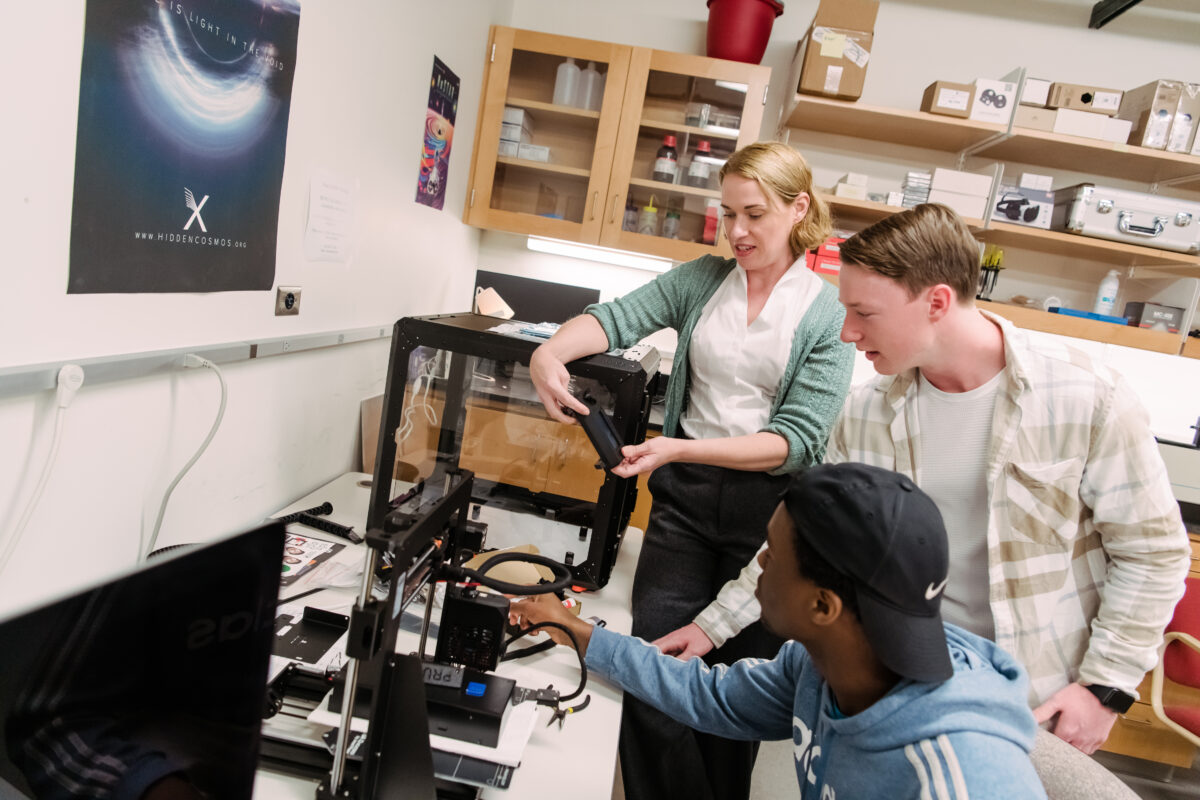 Eileen Meyer works with students in her laboratory. (Marlayna Demond ’11/UMBC)
Open questions
Overall, “We still don’t really understand after all these decades of studying these sources why only a fraction of accreting black holes produce jets and then exactly how they launch them. Until recently we could not literally look into that innermost region to see what’s happening—how the accretion disk surrounding the black hole is interacting with and producing the jet. And so there are still a lot of open questions there,” Meyer says.
Questions remain, but today there are many promising models of how black holes produce jets, Meyer says. Next steps will include working with theorists to understand how the data from this study can help test and refine those models.
“There’s a lot of theoretical work to be done to understand what we’ve seen, but the good thing is that we have a massive amount of data,” Meyer says. “We’re going to keep following this source, and it’s going to continue to be exciting.”
]]>
Eileen Meyer (Marlayna Demond ’11/UMBC) A large international team of scientists has observed a phenomenon that astronomers didn’t ever expect to see happen in real time. A new paper published...
https://umbc.edu/stories/black-hole-jets-observed-forming-in-real-time/
https://my3.my.umbc.edu/api/v0/pixel/news/146533/guest@my.umbc.edu/d48847e8a6d810d41676651bdd9661cc/api/pixel
cnms
csst
news
physics
research
science-and-tech
story
UMBC News & Magazine
https://my3.my.umbc.edu/groups/umbc-news-magazine
https://assets1-my.umbc.edu/system/shared/avatars/groups/000/001/943/24435aa6207c452e7bc15cc74b42c7bb/xsmall.png?1748556657
https://assets1-my.umbc.edu/system/shared/avatars/groups/000/001/943/24435aa6207c452e7bc15cc74b42c7bb/original.png?1748556657
https://assets2-my.umbc.edu/system/shared/avatars/groups/000/001/943/24435aa6207c452e7bc15cc74b42c7bb/xxlarge.png?1748556657
https://assets2-my.umbc.edu/system/shared/avatars/groups/000/001/943/24435aa6207c452e7bc15cc74b42c7bb/xlarge.png?1748556657
https://assets3-my.umbc.edu/system/shared/avatars/groups/000/001/943/24435aa6207c452e7bc15cc74b42c7bb/large.png?1748556657
https://assets1-my.umbc.edu/system/shared/avatars/groups/000/001/943/24435aa6207c452e7bc15cc74b42c7bb/medium.png?1748556657
https://assets2-my.umbc.edu/system/shared/avatars/groups/000/001/943/24435aa6207c452e7bc15cc74b42c7bb/small.png?1748556657
https://assets1-my.umbc.edu/system/shared/avatars/groups/000/001/943/24435aa6207c452e7bc15cc74b42c7bb/xsmall.png?1748556657
https://assets2-my.umbc.edu/system/shared/avatars/groups/000/001/943/24435aa6207c452e7bc15cc74b42c7bb/xxsmall.png?1748556657
UMBC News & Magazine
3
0
false
Mon, 13 Jan 2025 10:18:20 -0500
Mon, 13 Jan 2025 10:18:20 -0500
NASA awards AXIS X-ray telescope co-developed by UMBC faculty $5M for further study
Nearly a year ago, a group of engineers and scientists including UMBC physicists became one of 10 teams to successfully submit a proposal to NASA to develop the Advanced X-ray Imaging Satellite (AXIS). In October, the AXIS team learned that they were one of the final two instrument designs selected for further development. Over the next year, each of the two teams will receive $5 million to flesh out their plans as part of what NASA calls a “Phase A study.” Then NASA will review the proposals and select one of these two instruments for construction and testing, with plans to launch in the early 2030s.
Adi Foord, assistant professor of physics, and Eileen Meyer, associate professor of physics, serve on the AXIS leadership team, and during the proposal development phase, Foord co-led the sub-team focused on supermassive black hole evolution. The AXIS team is led overall by Chris Reynolds at the University of Maryland, College Park and deputy lead Erin Kara at MIT.
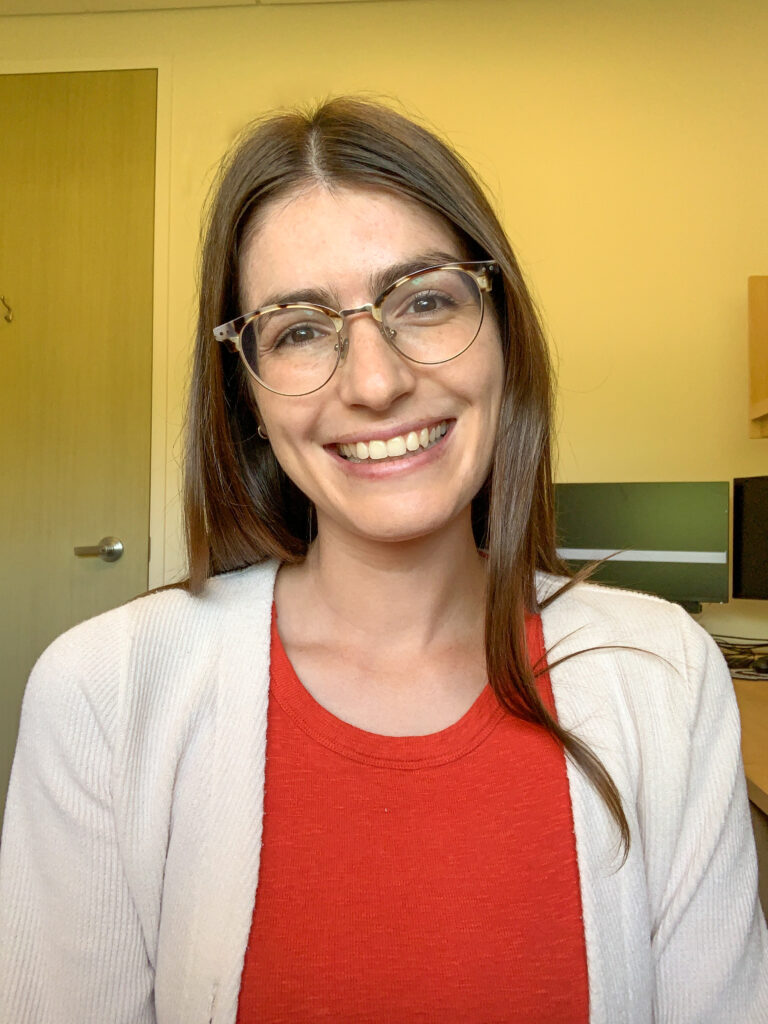 Adi Foord is on the AXIS leadership team. (courtesy of Foord)
X-rays come from extremely hot processes such as exploding stars or the accretion of black holes, so tracing them back to their source can paint a picture of galactic formation. As scientists search for life beyond Earth, X-rays could even offer clues about potentially habitable planets.
“We’re extremely excited that AXIS has been chosen for Phase A study! AXIS represents a huge leap forward in high-resolution and high-sensitivity imaging that will allow us to study the early universe and trace the growth of the earliest supermassive black holes,” Foord says. “It’s a unique opportunity to answer some of the most fundamental questions in astrophysics. With AXIS, we’ll have the sensitivity and resolution to detect faint X-ray signals from galaxies in the early universe, offering unprecedented insight into how supermassive black holes formed and evolved over cosmic time.”
A new kind of explorer
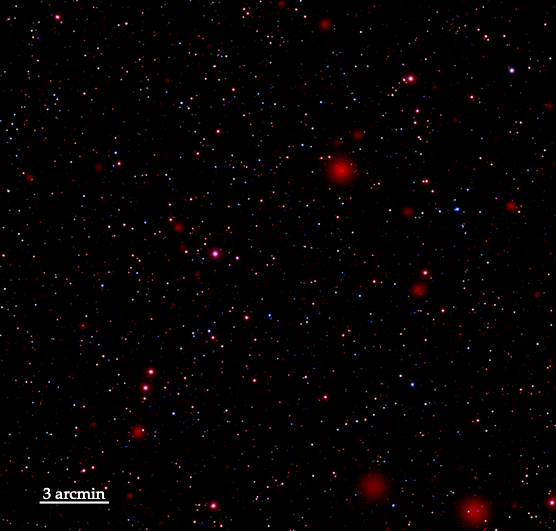 This simulated image shows how AXIS would see the sky. It shows a five million-second stare into space, and some of the earliest-detected supermassive black holes are visible. (Stefano Marchesi)
AXIS and the other satellite design selected for further study, PRIMA—also led by scientists in College Park—are competing to be the first in the new Probe Explorer class of NASA missions, which fit neatly between its flagship missions and smaller missions.
“Both of the selected concepts could enable ground-breaking science responsive to the top astrophysics priorities of the decade, develop key technologies for future flagship missions, and offer opportunities for the entire community to use the new observatory, for the benefit of all,” said Nicola Fox, associate administrator, Science Mission Directorate at NASA Headquarters.
“In observational astronomy we are now in the era of big and sensitive surveys of large portions of the sky,” Meyer adds. “AXIS is not only 10 times more sensitive than its predecessor, the Chandra X-ray Observatory, it also has the ability to make high-resolution images over a much larger sky area, or field of view. This is transformative for deep surveys, and AXIS will synergize with a lot of other missions and observatories operating in the 2030s.”
]]>
Nearly a year ago, a group of engineers and scientists including UMBC physicists became one of 10 teams to successfully submit a proposal to NASA to develop the Advanced X-ray Imaging Satellite...
https://umbc.edu/stories/axis-x-ray-telescope-selected-for-further-study/
https://my3.my.umbc.edu/api/v0/pixel/news/145570/guest@my.umbc.edu/9f2a2e66a5cdabc0db9f62a1b40a6726/api/pixel
cnms
nasa
news
physics
research
science-and-tech
story
UMBC News & Magazine
https://my3.my.umbc.edu/groups/umbc-news-magazine
https://assets1-my.umbc.edu/system/shared/avatars/groups/000/001/943/24435aa6207c452e7bc15cc74b42c7bb/xsmall.png?1748556657
https://assets1-my.umbc.edu/system/shared/avatars/groups/000/001/943/24435aa6207c452e7bc15cc74b42c7bb/original.png?1748556657
https://assets2-my.umbc.edu/system/shared/avatars/groups/000/001/943/24435aa6207c452e7bc15cc74b42c7bb/xxlarge.png?1748556657
https://assets2-my.umbc.edu/system/shared/avatars/groups/000/001/943/24435aa6207c452e7bc15cc74b42c7bb/xlarge.png?1748556657
https://assets3-my.umbc.edu/system/shared/avatars/groups/000/001/943/24435aa6207c452e7bc15cc74b42c7bb/large.png?1748556657
https://assets1-my.umbc.edu/system/shared/avatars/groups/000/001/943/24435aa6207c452e7bc15cc74b42c7bb/medium.png?1748556657
https://assets2-my.umbc.edu/system/shared/avatars/groups/000/001/943/24435aa6207c452e7bc15cc74b42c7bb/small.png?1748556657
https://assets1-my.umbc.edu/system/shared/avatars/groups/000/001/943/24435aa6207c452e7bc15cc74b42c7bb/xsmall.png?1748556657
https://assets2-my.umbc.edu/system/shared/avatars/groups/000/001/943/24435aa6207c452e7bc15cc74b42c7bb/xxsmall.png?1748556657
UMBC News & Magazine
0
0
false
Tue, 12 Nov 2024 13:45:26 -0500
Tue, 12 Nov 2024 13:45:26 -0500
Quantum photonics expertise earns UMBC spot in DOE Frontiers in Energy Research Center
UMBC has been selected to participate in the Quantum Photonics Integrated Design Center (QuPIDC), which is led by Purdue University and also includes Los Alamos National Laboratory, Stanford University, Northwestern University, the University of Chicago, the University of Oklahoma, and Virginia Tech. The collaboration is one of 10 new Frontiers in Energy Research Centers recently funded by the U.S. Department of Energy. The centers support top-tier interdisciplinary teams as they pursue transformative basic research that will advance energy technologies. The quantum optics center will receive $13.9 million overall, and UMBC will receive $570,000.
QuPIDC aims to develop ways to generate states of light and matter with the property of “entanglement,” a unique phenomenon that was the subject of the 2022 Nobel Prize in Physics. The goal is to simultaneously entangle many photons and/or many electrons, which enables technologies like extremely precise measurement, faster-than-ever communication and computing, and much more.
UMBC’s partnership in the center leverages the university’s longstanding strength in quantum photonics and quantum information. In particular, Matthew Pelton, professor of physics and UMBC lead for the center, has expertise in developing quantum light sources and integrating them into photonic structures at the nanometer scale.
In addition, UMBC is well known for including many undergraduates from a wide range of backgrounds in hands-on research. The new center will only increase the number of students who can participate in the groundbreaking field of quantum technology.
“I’m very excited to have this opportunity to work with some of the world-leading researchers in quantum photonics,” Pelton says, “and I’m especially excited about the collaboration and networking opportunities that the center will provide for UMBC students.”
]]>
UMBC has been selected to participate in the Quantum Photonics Integrated Design Center (QuPIDC), which is led by Purdue University and also includes Los Alamos National Laboratory, Stanford...
https://umbc.edu/quick-posts/quantum-photonics-research-center/
https://my3.my.umbc.edu/api/v0/pixel/news/143804/guest@my.umbc.edu/4b8686000aa0668381d72f7f9e2a91cb/api/pixel
cnms
news
physics
quick-post
research
science-and-tech
UMBC News & Magazine
https://my3.my.umbc.edu/groups/umbc-news-magazine
https://assets1-my.umbc.edu/system/shared/avatars/groups/000/001/943/24435aa6207c452e7bc15cc74b42c7bb/xsmall.png?1748556657
https://assets1-my.umbc.edu/system/shared/avatars/groups/000/001/943/24435aa6207c452e7bc15cc74b42c7bb/original.png?1748556657
https://assets2-my.umbc.edu/system/shared/avatars/groups/000/001/943/24435aa6207c452e7bc15cc74b42c7bb/xxlarge.png?1748556657
https://assets2-my.umbc.edu/system/shared/avatars/groups/000/001/943/24435aa6207c452e7bc15cc74b42c7bb/xlarge.png?1748556657
https://assets3-my.umbc.edu/system/shared/avatars/groups/000/001/943/24435aa6207c452e7bc15cc74b42c7bb/large.png?1748556657
https://assets1-my.umbc.edu/system/shared/avatars/groups/000/001/943/24435aa6207c452e7bc15cc74b42c7bb/medium.png?1748556657
https://assets2-my.umbc.edu/system/shared/avatars/groups/000/001/943/24435aa6207c452e7bc15cc74b42c7bb/small.png?1748556657
https://assets1-my.umbc.edu/system/shared/avatars/groups/000/001/943/24435aa6207c452e7bc15cc74b42c7bb/xsmall.png?1748556657
https://assets2-my.umbc.edu/system/shared/avatars/groups/000/001/943/24435aa6207c452e7bc15cc74b42c7bb/xxsmall.png?1748556657
UMBC News & Magazine
0
0
false
Wed, 11 Sep 2024 10:57:41 -0400
Wed, 11 Sep 2024 10:57:41 -0400
Katherine Carver ’26 is helping astronomers analyze James Webb Space Telescope data
Katherine Carver ’26, physics and mathematics, started off her UMBC experience with a big bang—participating in the Johns Hopkins University Applied Physics Laboratory CIRCUIT internship as a first-year student in spring 2023. Carver says she took advantage of every opportunity she could, from on-site guest lectures and panel discussions to informally networking with APL employees down the hall.
One of the panelists particularly caught her attention, so Carver approached her afterward—and in the two-hour conversation that followed, Kathleen Hamilton-Campos, an APL researcher, encouraged Carver to apply to the Space Astronomy Summer Program at the Space Telescope Science Institute (STScI) at Johns Hopkins University, which Hamilton-Campos had completed in 2019. Carver received notification that she’d been selected as an intern while attending a Society of Women Engineers conference this spring.
This summer at STScI, Carver, a Meyerhoff Scholar, has been digging into developing open-source software that allows astronomers anywhere to analyze data arriving from the James Webb Space Telescope (JWST), the most powerful space telescope ever launched.
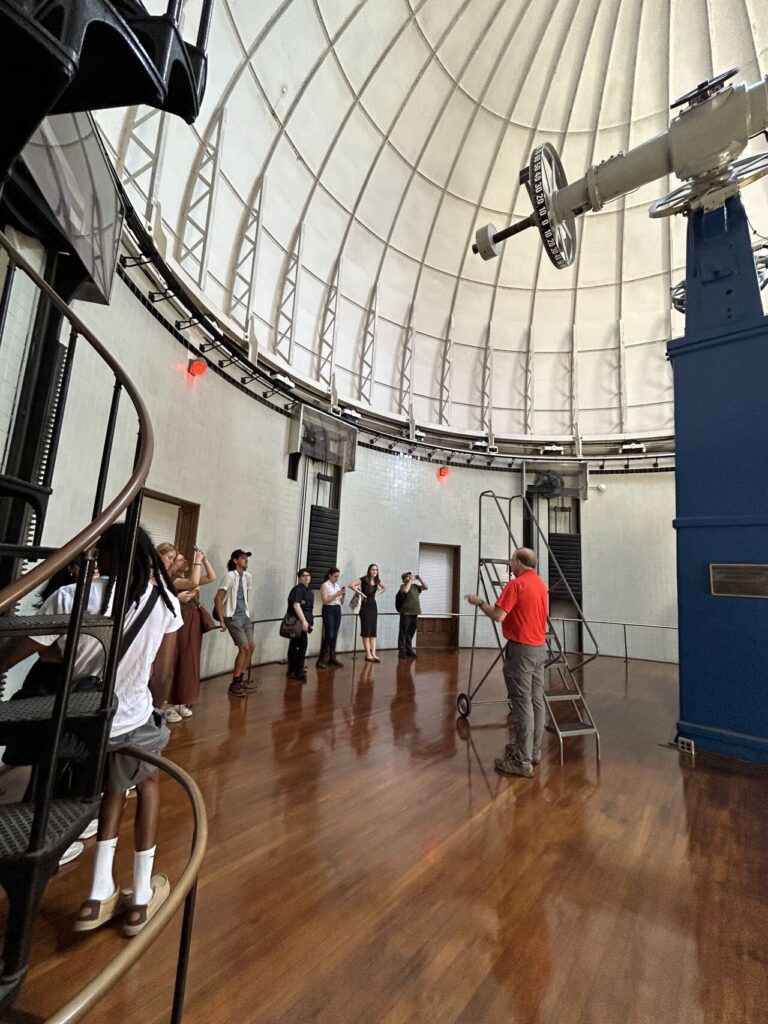
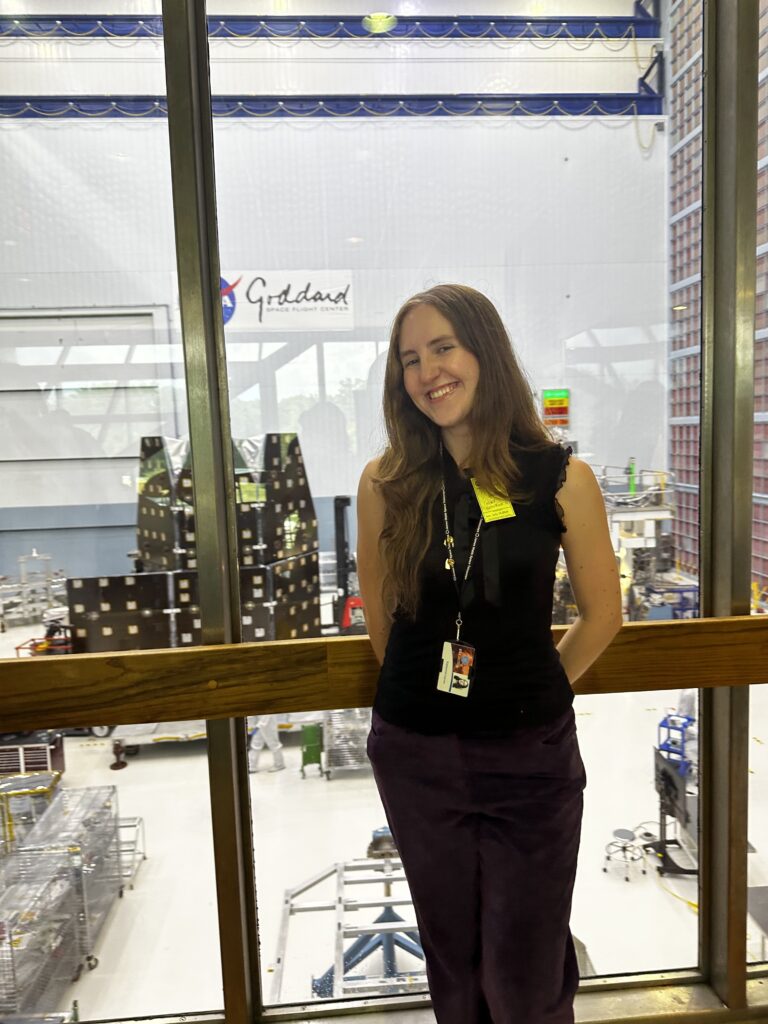 Left: Katherine Carver, third from right, visits the U.S. Naval Observatory with the other SASP interns. Right: Katherine Carver stands outside the clean room where the Nancy Grace Roman Space Telescope is being developed at NASA Goddard Space Flight Center. (Photos courtesy of Carver)
Mission possible with James Webb
“The whole mission objective for JWST was to see further back into the universe than ever before or possible with the Hubble Telescope or any other type of telescope,” Carver explains. “With how light travels, if you’re looking at something four billion light years away,”—which JWST can—“that means you’re looking at it as it appeared four billion years ago. Which could be very useful for scientists trying to understand how our universe has come to evolve to its current state.” Indeed, Carver continues, JWST can observe light so old that it comes from nearly the beginning of the universe, more than 13 billion years ago—billions of years before Earth even existed.
The analysis software Carver is working on is called Jdaviz, and it’s written in python. The data files are massive and complex, Carver explains, “so for a scientist who’s interested in only a brief part of the sky, or a particular source, like a star or a galaxy, it can be hard to navigate,” she says, “especially when some of these images have thousands and thousands of sources in them.”
Carver’s contributions are making the data easier to work with, and as a result facilitating scientific discovery in a wide range of research areas. As part of the internship, she also went on a field trip to NASA Goddard Space Flight Center and saw where the Nancy Grace Roman Space Telescope—a telescope whose capabilities will complement JWST’s observations—is being developed.
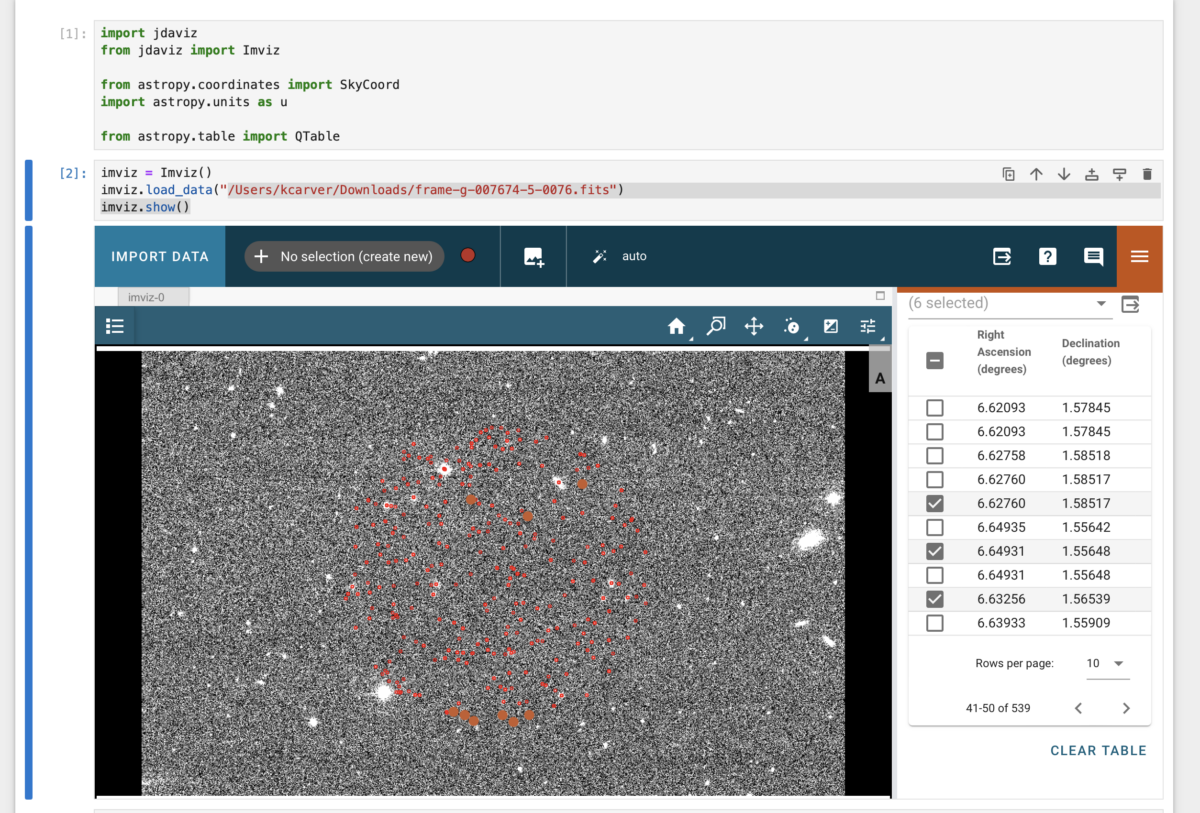 Katherine Carver coded a program that is helping scientists home in on light sources detected by JWST that are of interest for their research. The output, where each colored dot represents a source that meets a researcher’s search criteria, is shown here. (Image courtesy of Carver)
“Be persistent”
Through her CIRCUIT and STScI internships, Carver, a rising junior, has already picked up valuable coding skills, including managing interactions between behind-the-scenes code and the user interface, debugging code with errors, navigating code sets that include hundreds of files that all need to talk to each other, and much more.
The computer science training is likely to come in handy in her future, she says, but she doesn’t expect coding to become her bread and butter. She wants to stay on the science side, using tools like Jdaviz rather than developing them—although her time coding will make her even more grateful for the programmers who do. This fall, Carver is excited to move in that direction by conducting research with UMBC astrophysicist Adi Foord.
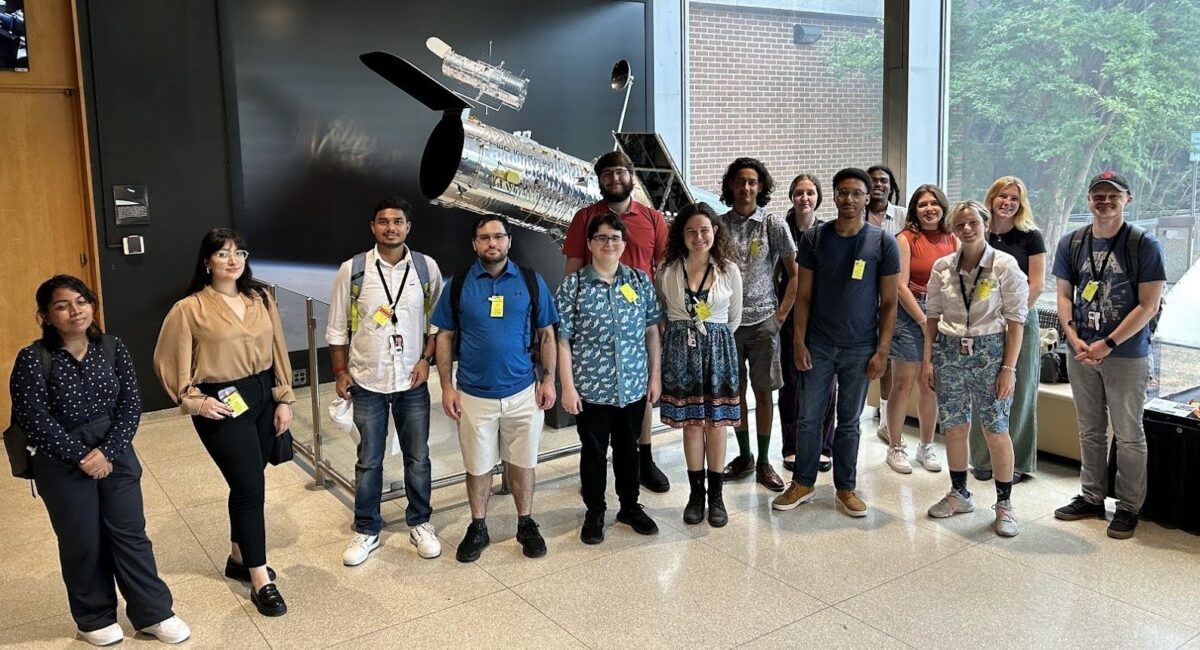 Katherine Carver (seventh from right, in rear) visits NASA Goddard Space Flight Center with the other Space Astronomy Summer Program interns. Here they stand in front of a one-sixth model of the Hubble Space Telescope. (Image courtesy of Carver)
Carver has some words of encouragement for students just getting started on their research journey.
“There’s no hurt in putting your name out there, even if you feel like you will get rejected. Sometimes you might see the final polished picture, like, ‘Oh, she’s done research at APL. She’s done research at STScI. Those are really competitive’—but I also got a lot of rejections,” Carver says. “Shoot for the internships even if you feel like you won’t get them. Be persistent, ask around, talk to your professors. And then once you are there, take maximum advantage of every opportunity.”
]]>
Katherine Carver ’26, physics and mathematics, started off her UMBC experience with a big bang—participating in the Johns Hopkins University Applied Physics Laboratory CIRCUIT internship as a...
https://umbc.edu/stories/katherine-carver-james-webb-internship/
https://my3.my.umbc.edu/api/v0/pixel/news/143025/guest@my.umbc.edu/d700efa8c597bcdd1eb3ac54d17a8aa8/api/pixel
careercenter
cnms
news
physics
science-and-tech
story
undergraduate-research
UMBC News & Magazine
https://my3.my.umbc.edu/groups/umbc-news-magazine
https://assets1-my.umbc.edu/system/shared/avatars/groups/000/001/943/24435aa6207c452e7bc15cc74b42c7bb/xsmall.png?1748556657
https://assets1-my.umbc.edu/system/shared/avatars/groups/000/001/943/24435aa6207c452e7bc15cc74b42c7bb/original.png?1748556657
https://assets2-my.umbc.edu/system/shared/avatars/groups/000/001/943/24435aa6207c452e7bc15cc74b42c7bb/xxlarge.png?1748556657
https://assets2-my.umbc.edu/system/shared/avatars/groups/000/001/943/24435aa6207c452e7bc15cc74b42c7bb/xlarge.png?1748556657
https://assets3-my.umbc.edu/system/shared/avatars/groups/000/001/943/24435aa6207c452e7bc15cc74b42c7bb/large.png?1748556657
https://assets1-my.umbc.edu/system/shared/avatars/groups/000/001/943/24435aa6207c452e7bc15cc74b42c7bb/medium.png?1748556657
https://assets2-my.umbc.edu/system/shared/avatars/groups/000/001/943/24435aa6207c452e7bc15cc74b42c7bb/small.png?1748556657
https://assets1-my.umbc.edu/system/shared/avatars/groups/000/001/943/24435aa6207c452e7bc15cc74b42c7bb/xsmall.png?1748556657
https://assets2-my.umbc.edu/system/shared/avatars/groups/000/001/943/24435aa6207c452e7bc15cc74b42c7bb/xxsmall.png?1748556657
UMBC News & Magazine
4
0
false
Thu, 01 Aug 2024 14:24:02 -0400
Thu, 01 Aug 2024 14:24:02 -0400
Ph.D. candidate Emily Faber improving climate modeling with NOAA fellowship

Over the last two years, Emily Faber, Ph.D. candidate in atmospheric physics, painstakingly replicated part of a NASA climate model on UMBC computing systems. She compared the model’s predictions to on-the-ground data collected at meteorological stations run by the National Oceanic and Atmospheric Administration (NOAA)—and she found significant differences between the two.
Specifically, the NASA model predicted wind speeds in some places above the Arabian Peninsula that differed from the observed measurements by two meters per second, even when Faber looked at the average over 20 years. Wind speed in that region, which is mostly desert, influences the presence of dust in the atmosphere, which, in turn, plays a role in everything from the greenhouse effect to nourishing the Amazon rainforest.
“I was really surprised at the magnitude of the differences,” Faber says. “It’s a model miss. We’re not modeling wind speed as well as we could.”
That’s why she created the replicate model—so she could tinker with the parameters, refining the model so it more accurately reflects reality. A publication on her results is under review, and the findings have significant implications for global climate modeling and forecasting. This will also be Faber’s first, first-author paper, which is an important milestone for any graduate student.
Model mentors
Faber’s latest modeling work would not have been possible without the Weather Program Office Innovation for Next Generation Scientists (WINGS) Dissertation Fellowship, sponsored by NOAA. Faber was one of only three fellows selected for the program’s inaugural year. The fellowship, which began in summer 2023, supplies two years of full funding for her dissertation research and provides Faber with a dedicated NOAA mentor. Her mentor, Barry Baker, Ph.D. ’14, atmospheric physics, has always been supportive and responsive to Faber’s probing questions, she says—“which is great, because I have many.”
“Emily is extremely motivated and shows the characteristics for a long and successful career within the science community. I’m excited to be working with her and help guide her through this stage of her education,” Baker says. “Emily’s work through the WINGS Fellowship will end up having direct impacts on the operational forecasts using the Unified Forecast System that NOAA provides to give advance warning of extreme particulate matter pollution caused by wind-driven processes.”
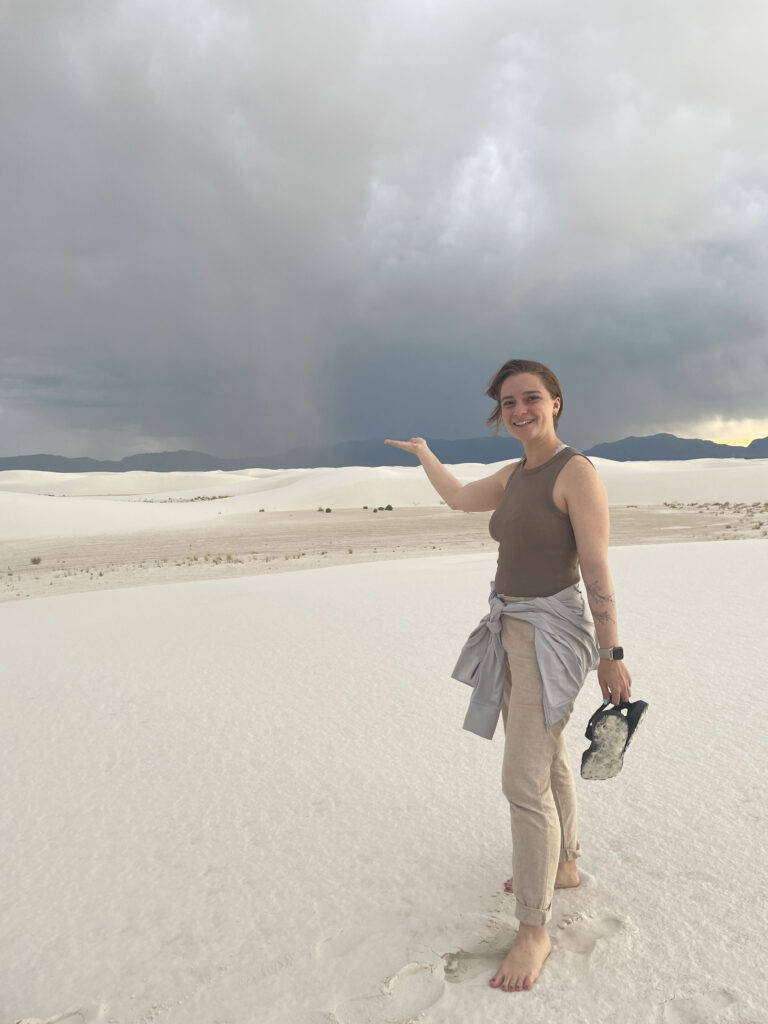 The White Sands National Monument is a great place to observe dust, which is the focus of Emily Faber’s atmospheric research. (Photo courtesy of Faber)
Adriana Rocha Lima, Ph.D. ’15, atmospheric physics, and an assistant professor of physics at UMBC, serves as Faber’s Ph.D. advisor. Faber says she appreciates Rocha Lima’s consistent encouragement and has had many opportunities to mature as a researcher under her mentorship. Faber was full of creative, ambitious research ideas when she approached Rocha Lima about joining her lab—but didn’t yet have a clear understanding of how to implement them, Faber says. “But she didn’t run away from that,” Faber says of Rocha Lima. Instead, Rocha Lima welcomed Faber into the lab and quickly got her started on both modeling and observations-based projects.
Rocha Lima is the rare physicist who has expertise in both modeling and experimental work. “There’s not a challenge I think she couldn’t handle,” Faber says.
Getting up to speed
As Rocha Lima’s first graduate student, Faber found herself in a unique position to help the lab grow from the ground up. That included opportunities to write grants and apply for fellowships, including WINGS, very early in her graduate school career.
With all that practice, “Now I know how to do it,” Faber says. “I know how to get funding and how to write a scientific statement to fit three years of work into two pages or less.”
“It’s actually helpful to have someone advising me who doesn’t have English as a first language, because if I write something and she doesn’t get it the first time, it’s not clearly communicated,” Faber adds. Rocha Lima is originally from Brazil and is a native speaker of Portuguese.
Faber has also enhanced her scientific acumen since she joined Rocha Lima’s lab in 2021. “In the beginning, she was learning how to run the model, repeating prior analyses,” Rocha Lima says. “Now she’s exploring new territory. That’s the contribution that we want to see from a Ph.D. student.”
Faber feels the shift, too. “The real building that I’ve gone through in this program is to be able to talk to other scientists who are in it and be up to speed,” she says. “I’m just now in the last year or so getting to that point where you can fire off questions and add your own ideas.”
The value of connections
As part of the WINGS fellowship, Faber traveled to the National Center for Atmospheric Research (NCAR) in Boulder, Colorado for a workshop on the United Forecast System (UFS), a huge integrated set of analysis systems that look at everything from ice to dust to vegetation in order to model the Earth as a comprehensive system.
At the workshop, Faber met some of the key people working with various systems she is interested in at NOAA. And months later, at the national American Meteorological Society conference, she saw many of them again. “Out of several thousand humans, I was like, ‘I know you, I know you, I know you…’ and I wouldn’t have known them without going out to Boulder,” Faber says.
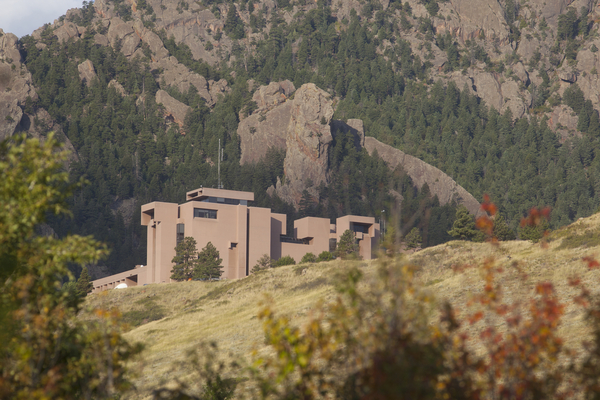 The Mesa Laboratory of the National Center for Atmospheric Research, located outside Boulder, Colorado, complements the scenic backdrop, which features the iconic Flatirons rock formations. (Photo courtesy of NCAR)
The two other WINGS fellows also attended the workshop, and the three of them have stayed in touch since. “It feels like a tiny cohort,” she says. “We do very different things, but we overlap at some point. We’re all working in the UFS system.” Faber is looking forward to meeting the incoming class of WINGS fellows, too.
Everyone wins
The WINGS program is a major stepping stone for Faber toward her long-term goal of working at one of the national laboratories, a network of research institutions across the country associated with various federal agencies.
In particular, “I really vibe with the NOAA mission,” Faber says, and the WINGS program has “turned out to be a really great interface between the national labs and the university.”
The fellowship furthers Faber’s personal career trajectory, and it also supports Rocha Lima’s growing lab by providing funding for Faber’s Ph.D. As a result, Rocha Lima has been able to add an additional graduate student to her group. NOAA and NCAR also benefit from the energy, talent, and fresh ideas coming from the fellows. Although it is new, Faber and her mentors are looking forward to it continuing to support students and the pursuit of atmospheric research.
As Faber says, “It’s a win-win.”
]]>
Over the last two years, Emily Faber, Ph.D. candidate in atmospheric physics, painstakingly replicated part of a NASA climate model on UMBC computing systems. She compared the model’s predictions...
https://umbc.edu/stories/emily-faber-climate-modeling-noaa-fellowship/
https://my3.my.umbc.edu/api/v0/pixel/news/142455/guest@my.umbc.edu/cdd870909f2e591afaee13afff2a18c8/api/pixel
alumni
cnms
gradresearch
impact
news
physics
research
science-and-tech
spring-2024
story
UMBC News & Magazine
https://my3.my.umbc.edu/groups/umbc-news-magazine
https://assets1-my.umbc.edu/system/shared/avatars/groups/000/001/943/24435aa6207c452e7bc15cc74b42c7bb/xsmall.png?1748556657
https://assets1-my.umbc.edu/system/shared/avatars/groups/000/001/943/24435aa6207c452e7bc15cc74b42c7bb/original.png?1748556657
https://assets2-my.umbc.edu/system/shared/avatars/groups/000/001/943/24435aa6207c452e7bc15cc74b42c7bb/xxlarge.png?1748556657
https://assets2-my.umbc.edu/system/shared/avatars/groups/000/001/943/24435aa6207c452e7bc15cc74b42c7bb/xlarge.png?1748556657
https://assets3-my.umbc.edu/system/shared/avatars/groups/000/001/943/24435aa6207c452e7bc15cc74b42c7bb/large.png?1748556657
https://assets1-my.umbc.edu/system/shared/avatars/groups/000/001/943/24435aa6207c452e7bc15cc74b42c7bb/medium.png?1748556657
https://assets2-my.umbc.edu/system/shared/avatars/groups/000/001/943/24435aa6207c452e7bc15cc74b42c7bb/small.png?1748556657
https://assets1-my.umbc.edu/system/shared/avatars/groups/000/001/943/24435aa6207c452e7bc15cc74b42c7bb/xsmall.png?1748556657
https://assets2-my.umbc.edu/system/shared/avatars/groups/000/001/943/24435aa6207c452e7bc15cc74b42c7bb/xxsmall.png?1748556657
UMBC News & Magazine
3
0
false
Fri, 14 Jun 2024 12:00:28 -0400
Fri, 14 Jun 2024 12:00:28 -0400
CNMS Awards and Recognition Day honors students, faculty, and staff

The College of Natural and Mathematical Sciences (CNMS) held its annual CNMS Awards and Recognition Day on May 10. Nearly 270 UMBC community members and friends attended the event in the University Center Ballroom. The department chairs presented 45 awards established by donors in support of students, faculty, and staff, such as the Carl S. Weber Award for Excellence in Teaching, awarded this year to Tamra Mendelson, professor of biological sciences.
“I would like to thank the members of the UMBC community—alumni, parents, faculty, staff, and friends—who have made possible many of the awards we are presenting here today. These are not just names on a page—they are stories of gratitude and giving, honoring loved ones and families,” shared William R. LaCourse, CNMS dean. “You are fueling the academic success of our students, helping us recruit and retain top-notch faculty, ensuring support for programs and people across the university, and inspiring others to give. On behalf of UMBC, thank you!”
The recognition day also honored eight CNMS faculty at all levels with Faculty Excellence Awards for research and teaching designated by the college, awarded college-level Staff Excellence Awards for outstanding service, and distributed departmental awards for undergraduate and graduate students recognizing academic excellence, research, and teaching.
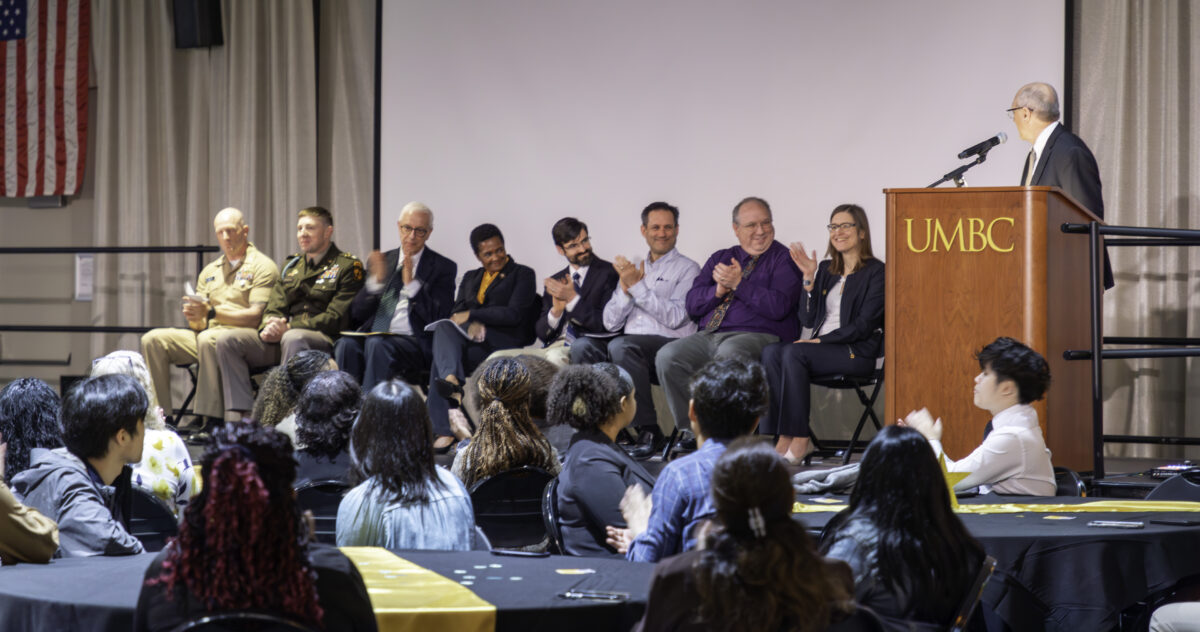 Dean LaCourse, at the podium, introduced the awards ceremony, and individual chairs or their designees presented the awards to members of their departments. From left to right: Commander Christopher Boehm, naval science; Captain John Howrey, naval science; Yonathan Zohar, professor and chair, marine biotechnology; Annica Wayman ’99, mechanical engineering, associate dean for Shady Grove affairs; Jason Kestner, associate professor and associate chair, physics; Bradford Peercy, professor, mathematics; Brian Cullum, professor and chair, chemistry and biochemistry; Michelle Starz-Gaiano, professor and chair, biological sciences. (Melissa Penley Cormier, M.F.A. ’17/UMBC)
CNMS also celebrated students who had been inducted into national honor societies, including Sigma Pi Sigma, the physics and astronomy honor society; Pi Mu Epsilon, the national mathematics honor society; Mu Sigma Rho, the national statistics honorary society; and the Phi Beta Kappa Society, which recognizes overall academic excellence.
LaCourse closed the ceremony by recognizing students in scholars programs within the college. The CNMS Scholars program supports students interested in the advancement of women in STEM fields where they are still underrepresented, and the Beckman Scholars program, funded by the Arnold and Mabel Beckman Foundation, supports students desiring to pursue doctoral study in the biological and chemical sciences.
“Students who have been recognized at this ceremony have met UMBC’s academic requirements and have excelled at high levels in their academics and/or service to their departments, college, and university,” LaCourse shared. “These honorees are poised to become scientists, physicians, mathematicians, teachers, and leaders in their chosen fields. These students are our leaders of the future, and we are fortunate to have the opportunity to help provide the critical foundations for their promising futures.”
The full event program, including additional remarks from Dean LaCourse and a complete list of awardees and award descriptions, is available here.
]]>
The College of Natural and Mathematical Sciences (CNMS) held its annual CNMS Awards and Recognition Day on May 10. Nearly 270 UMBC community members and friends attended the event in the...
https://umbc.edu/quick-posts/cnms-awards-and-recognition-day/
https://my3.my.umbc.edu/api/v0/pixel/news/142067/guest@my.umbc.edu/d470f1cd3c570305367c88562363b92a/api/pixel
biology
chembiochem
cnms
community
marinebiotech
mathstat
naval-science
news
physics
quick-post
science-and-tech
UMBC News & Magazine
https://my3.my.umbc.edu/groups/umbc-news-magazine
https://assets1-my.umbc.edu/system/shared/avatars/groups/000/001/943/24435aa6207c452e7bc15cc74b42c7bb/xsmall.png?1748556657
https://assets1-my.umbc.edu/system/shared/avatars/groups/000/001/943/24435aa6207c452e7bc15cc74b42c7bb/original.png?1748556657
https://assets2-my.umbc.edu/system/shared/avatars/groups/000/001/943/24435aa6207c452e7bc15cc74b42c7bb/xxlarge.png?1748556657
https://assets2-my.umbc.edu/system/shared/avatars/groups/000/001/943/24435aa6207c452e7bc15cc74b42c7bb/xlarge.png?1748556657
https://assets3-my.umbc.edu/system/shared/avatars/groups/000/001/943/24435aa6207c452e7bc15cc74b42c7bb/large.png?1748556657
https://assets1-my.umbc.edu/system/shared/avatars/groups/000/001/943/24435aa6207c452e7bc15cc74b42c7bb/medium.png?1748556657
https://assets2-my.umbc.edu/system/shared/avatars/groups/000/001/943/24435aa6207c452e7bc15cc74b42c7bb/small.png?1748556657
https://assets1-my.umbc.edu/system/shared/avatars/groups/000/001/943/24435aa6207c452e7bc15cc74b42c7bb/xsmall.png?1748556657
https://assets2-my.umbc.edu/system/shared/avatars/groups/000/001/943/24435aa6207c452e7bc15cc74b42c7bb/xxsmall.png?1748556657
UMBC News & Magazine
0
0
false
Fri, 17 May 2024 15:55:57 -0400
Fri, 17 May 2024 15:55:57 -0400
Month of Earth Day events culminates with 8th Annual Earth Day Symposium
UMBC’s strength in environmental research spans all three colleges and the university’s NASA-partnered centers, and Earth Day is always a special time on campus. This year, UMBC partnered with the Environmental Protection Agency (EPA) to host more events than ever before. A committee led at UMBC by Rhonda Plofkin, a Ph.D. student in geography and environmental systems (GES), organized 18 events throughout the month of April.
Volunteers led by enthusiastic students and Office of Sustainability staff removed invasive plants on campus; a panel at the AOK Library & Gallery discussed how various disciplines, including the arts, can engage with environmental conservation; the UMBC community watched a partial solar eclipse on campus; and much more.
The month of festivities culminated with the 8th Annual Earth Day Symposium on April 29, organized by graduate students in atmospheric physics and geography and environmental systems (GES). Nearly 150 attendees from at least six universities and five federal agencies gave talks, participated in panel discussions, presented 26 research posters, and even went on a hike through UMBC’s Conservation and Environmental Research Area on an unseasonably warm day.
“A tradition we are really proud of is that this event is 100 percent planned and implemented by our graduate students,” shared Zhibo Zhang, professor of physics at UMBC. He noted the event not only benefits the attendees, but also the planning team. “I’ve seen their confidence grow every day as the event came together,” Zhang says.
“It has been a great experience for us to invite such a wide range of people with shared enthusiasm for Earth science to UMBC,” shares Kamal Aryal, Ph.D. student in atmospheric physics and the lead organizer for the Earth Day Symposium. “Having students, early career scientists, and university professors from many universities and from NASA’s PACE mission, including the lead project scientist for PACE, attend our symposium creates great opportunities for networking and professional development.”
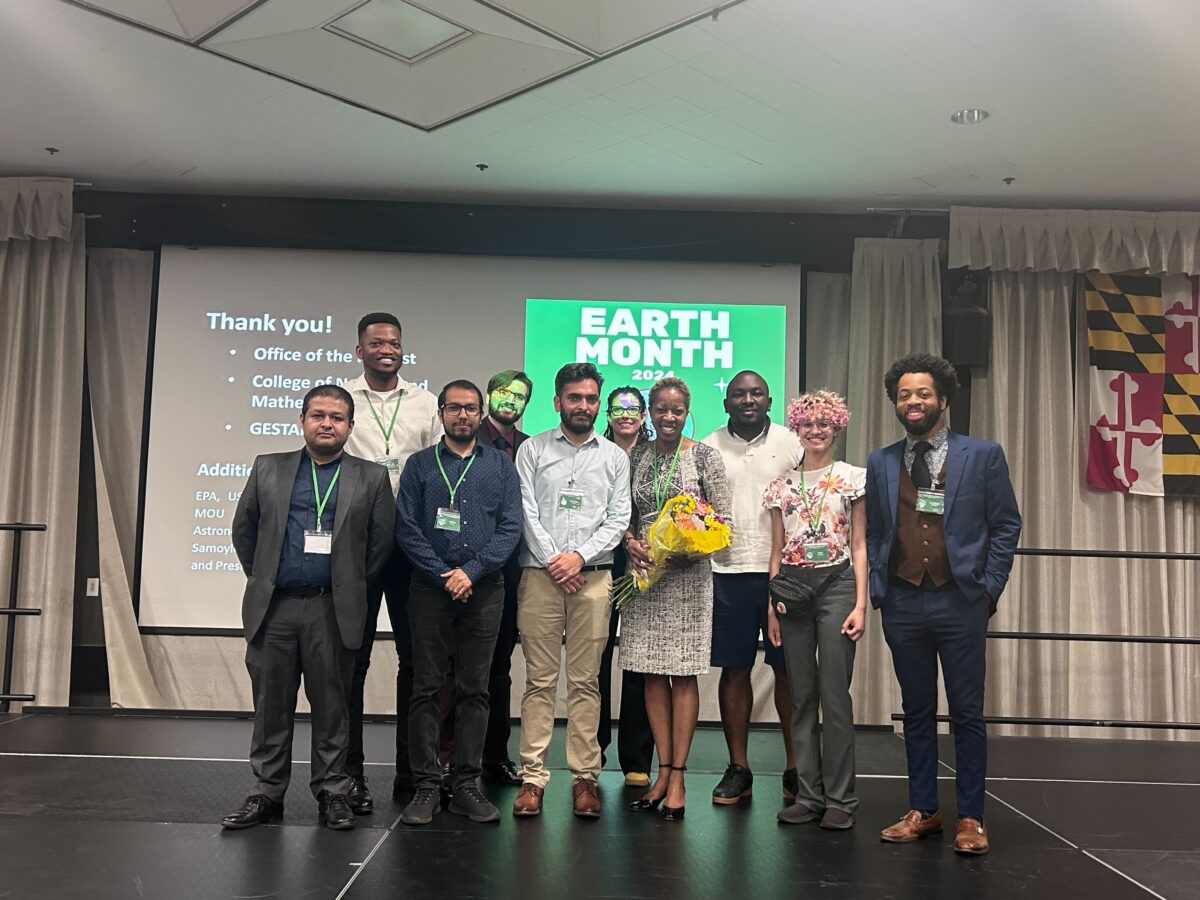 Planning committee members for the Earth Day Symposium and other Earth Day events with President Valerie Sheares Ashby. Left to right: Sharad Pandey, Adeleke Segun Ademakinwa, Kamal Aryal, Tony La Luna, Roshan Mishra, Rhonda Plofkin, Valerie Sheares Ashby, Tolulope Ale, Erin Hamner, and Maurice Roots. (Image by Zhibo Zhang)
Monitoring the environment—from above Earth’s atmosphere to underwater
First organized in 2017, the Earth Day Symposium has grown in stature, size, and scope every year. This year’s theme was “monitoring planetary health,” a nod to the recently-launched NASA PACE mission carrying HARP2, a polarimeter designed and built at UMBC. HARP2 will improve our understanding of the roles various particles in the atmosphere—like dust, water vapor, and pollutants—play in climate and health. Previous symposium themes have included the environmental impacts of COVID-19, the synergy of scientific disciplines, and equity and environmental justice.
Vanderlei Martins, professor of physics at UMBC and the HARP2 team lead, gave the first presentation, which was followed later in the morning by a panel discussion including PACE scientists from UMBC, NASA, and Morgan State University.
The three main instruments on PACE have complementary roles. Each sees Earth a little differently, and will provide important data on plankton populations in the ocean, the role of clouds in Earth’s energy balance, and much more. “Each of these instruments is unique, and together, they are amazing,” Martins says. HARP2 “has capabilities we’ve never had before,” he adds. “I cannot even imagine everything we are going to learn.”
Between Martins’ talk and the panel, Vanessa Vargas-Nguyen, a researcher with the University of Maryland Center for Environmental Science (UMCES), discussed her work on monitoring the health of the Chesapeake Bay watershed. UMCES produces one of several report cards for the Chesapeake Bay, collecting data on everything from populations of bottom-dwelling critters to concentrations of elements like phosphorus and nitrogen, which are commonly found in fertilizers. Now Vargas-Nguyen is expanding her group’s work to look at the entire watershed more holistically, including adding social factors like economic activity, governance structures, and population density.
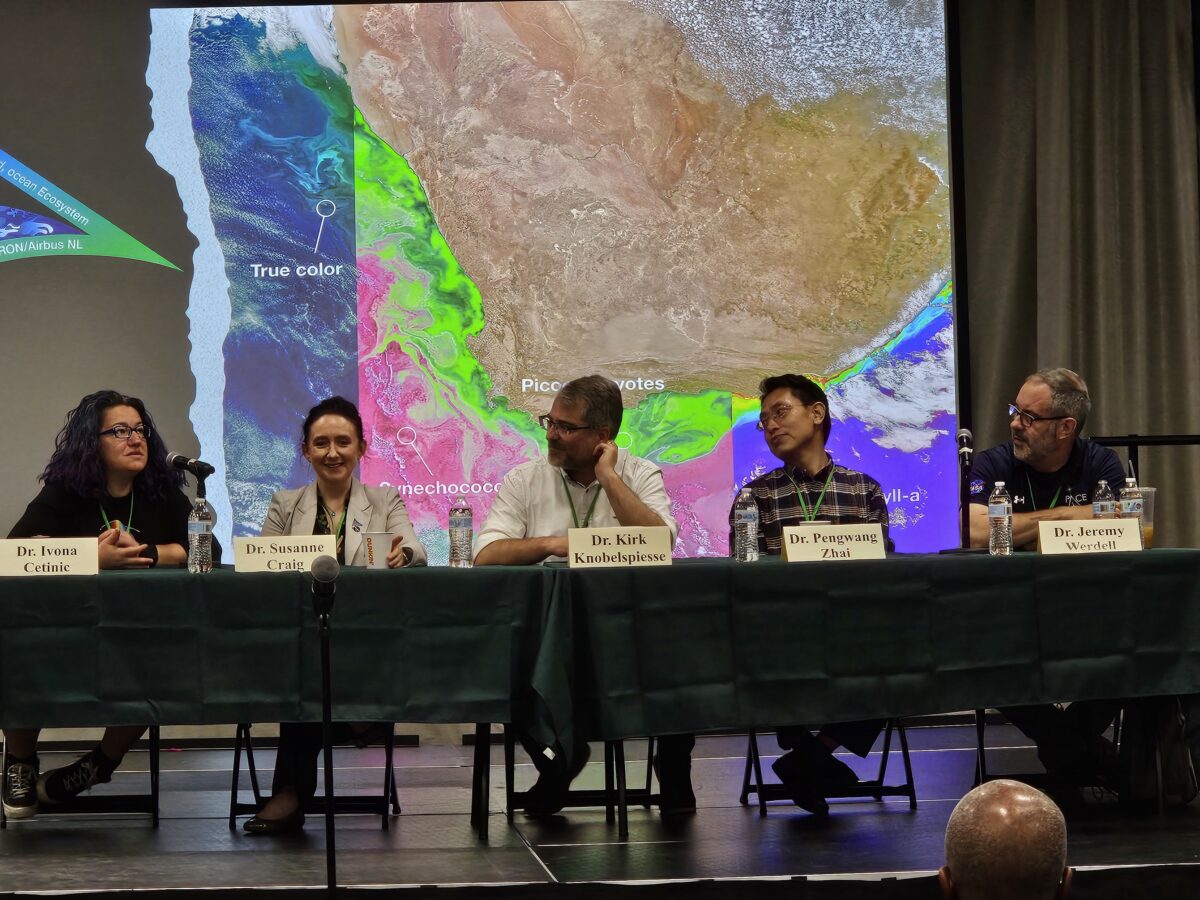 Panelists discussed the PACE mission. From left to right: Ivona Cetinic, senior research scientist with Morgan State University through the Goddard Earth Science and Technology Research Center (GESTAR) II; Susanne Craig, scientist with UMBC through GESTAR II; Kirk Knobelspiesse, researcher at NASA Goddard Space Flight Center; Pengwang Zhai, professor of physics at UMBC; and Jeremy Werdell, project scientist for the PACE mission at NASA. (Photo by Kamal Aryal)
A hub for environmental action
After the post-lunch hike, a poster session featured student and faculty research from UMBC, NASA, and the National Oceanic and Atmospheric Administration. Jing Wei, from the University of Maryland, College Park, discussed remote sensing methods for monitoring air pollution, and Robert Foster, from the U.S. Naval Research Laboratory, explained his work on monitoring microplastics in the ocean. Kandis Boyd, from the EPA, emphasized the importance of interdisciplinary and cross-sector partnerships.
Throughout the day, the ballroom buzzed with energy as students, UMBC faculty, and researchers from around the region shared their science and connected with each other. A shared sense of purpose guided the event, grounded in UMBC’s commitment to promoting a sustainable future.
As Charles Ichoku, director of the Goddard Earth Science and Technology Research Center II, one of UMBC’s NASA partnerships, and a professor of GES, put it, “UMBC is a young university that does great things.”
Whether taking immediate action to improve the campus landscape, conducting research on global climate, or training the next generation of Earth scientists, the month of Earth Day events demonstrates how UMBC has positioned itself as a hub for environmental action.
]]>
UMBC’s strength in environmental research spans all three colleges and the university’s NASA-partnered centers, and Earth Day is always a special time on campus. This year, UMBC partnered with the...
https://umbc.edu/stories/8th-annual-earth-day-symposium/
https://my3.my.umbc.edu/api/v0/pixel/news/141690/guest@my.umbc.edu/e8eaf936eeb0a780690163c7f947b912/api/pixel
cahss
cnms
coeit
ges
gestar2
information-systems
news
physics
science-and-tech
story
UMBC News & Magazine
https://my3.my.umbc.edu/groups/umbc-news-magazine
https://assets1-my.umbc.edu/system/shared/avatars/groups/000/001/943/24435aa6207c452e7bc15cc74b42c7bb/xsmall.png?1748556657
https://assets1-my.umbc.edu/system/shared/avatars/groups/000/001/943/24435aa6207c452e7bc15cc74b42c7bb/original.png?1748556657
https://assets2-my.umbc.edu/system/shared/avatars/groups/000/001/943/24435aa6207c452e7bc15cc74b42c7bb/xxlarge.png?1748556657
https://assets2-my.umbc.edu/system/shared/avatars/groups/000/001/943/24435aa6207c452e7bc15cc74b42c7bb/xlarge.png?1748556657
https://assets3-my.umbc.edu/system/shared/avatars/groups/000/001/943/24435aa6207c452e7bc15cc74b42c7bb/large.png?1748556657
https://assets1-my.umbc.edu/system/shared/avatars/groups/000/001/943/24435aa6207c452e7bc15cc74b42c7bb/medium.png?1748556657
https://assets2-my.umbc.edu/system/shared/avatars/groups/000/001/943/24435aa6207c452e7bc15cc74b42c7bb/small.png?1748556657
https://assets1-my.umbc.edu/system/shared/avatars/groups/000/001/943/24435aa6207c452e7bc15cc74b42c7bb/xsmall.png?1748556657
https://assets2-my.umbc.edu/system/shared/avatars/groups/000/001/943/24435aa6207c452e7bc15cc74b42c7bb/xxsmall.png?1748556657
UMBC News & Magazine
1
0
false
Fri, 03 May 2024 15:58:22 -0400
Fri, 03 May 2024 15:58:22 -0400
First CNMS GradFest fosters interdepartmental interaction among grads, postdocs
On April 12, more than 150 students, staff, and faculty attended the first College of Natural and Mathematical Sciences (CNMS) GradFest in the University Center Ballroom. The event was the result of listening sessions held with CNMS graduate students last summer, and it addressed their desire for more opportunities to forge interdepartmental connections and present their research.
“Every day, I hear about the great work being done by graduate students and postdocs in CNMS departments,” William R. LaCourse, CNMS dean, shared in his opening remarks. “Today is my chance to meet all of the graduate students the faculty are always bragging about.”
The event began with six “lightning talks,” where Ph.D. students were challenged to present the big idea of their thesis projects in only five minutes. Naghmeh Akhavan, mathematics, led off, presenting her project on cell migration in fruit fly development. She is co-mentored by Brad Peercy in mathematics and Michelle Starz-Gaiano in biological sciences. Misti Cartwright, chemistry and biochemistry, discussed her work with Aaron Smith on a post-translation protein modification called arginylation.
Sandra Cheng, physics, talked about her work with Todd Pittman in quantum computing, and Manju Ojha, chemistry and biochemistry, explained her work on RNA-based plant viruses with Deepak Koirala. Ji Li, statistics, described a protocol he developed under the mentorship of Yi Huang to improve data sets for randomized controlled trials. And Prableen Chowdhary, biological sciences, explained her work with Rachel Brewster on zebrafish development.
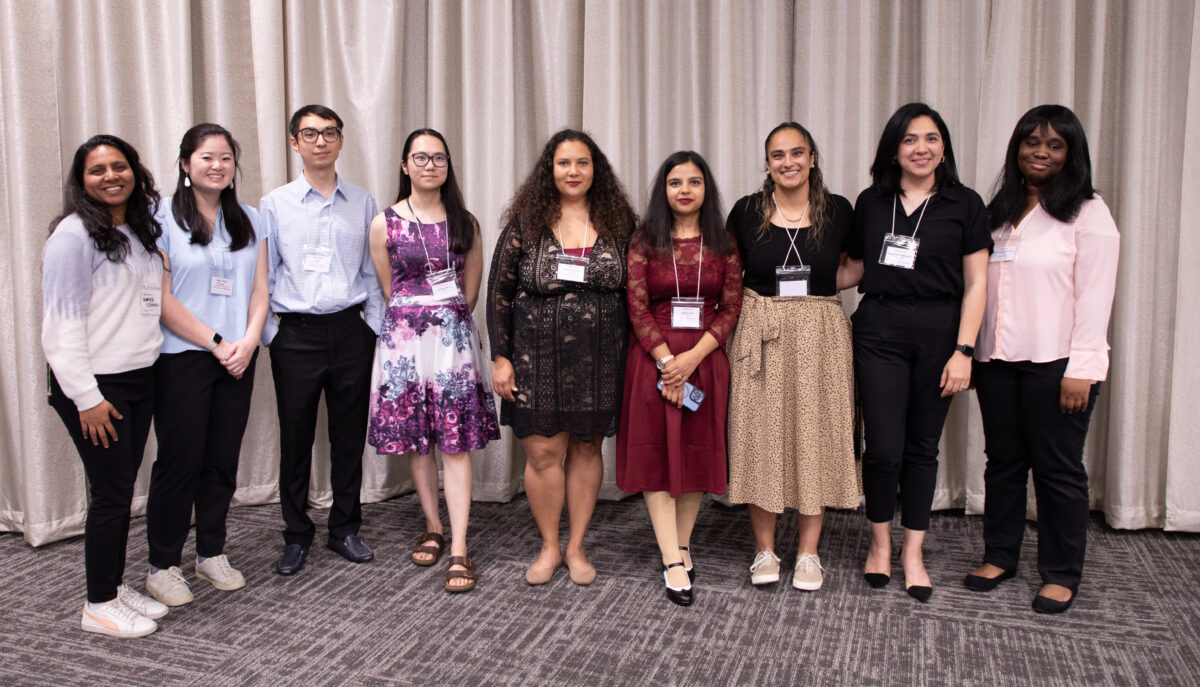 GradFest lightning talk presenters and the planning committee, from left to right: Ronita Sequeira, Ally Kido, Ji Li, Sandra Cheng, Misti Cartwright, Manju Ojha, Prableen Chowdhary, Naghmeh Akhavan, and Ayokunnumi Ogunsanya. (Image by Melissa Penley Cormier, M.F.A. ’17)
After the talks, two sessions featuring 46 posters allowed attendees to learn about the presenters’ research, ask questions, and make suggestions. A novel arrangement of posters in the ballroom facilitated interaction: Placing four posters each on round tables allowed guests to meander among the posters in many directions, unimpeded by long, linear poster displays.
Tasty mocktails, hors d’oeuvres, and desserts rounded out a successful event that brought graduate students and postdocs—collectively, the research engine of UMBC—together to socialize, practice presenting, and learn about each other’s work.
]]>
On April 12, more than 150 students, staff, and faculty attended the first College of Natural and Mathematical Sciences (CNMS) GradFest in the University Center Ballroom. The event was the result...
https://umbc.edu/quick-posts/inaugural-cnms-gradfest/
https://my3.my.umbc.edu/api/v0/pixel/news/141234/guest@my.umbc.edu/03a86a4db175b2e09f7b4c367757a010/api/pixel
biology
chembiochem
cnms
gradresearch
mathstat
physics
quick-post
research
UMBC News & Magazine
https://my3.my.umbc.edu/groups/umbc-news-magazine
https://assets1-my.umbc.edu/system/shared/avatars/groups/000/001/943/24435aa6207c452e7bc15cc74b42c7bb/xsmall.png?1748556657
https://assets1-my.umbc.edu/system/shared/avatars/groups/000/001/943/24435aa6207c452e7bc15cc74b42c7bb/original.png?1748556657
https://assets2-my.umbc.edu/system/shared/avatars/groups/000/001/943/24435aa6207c452e7bc15cc74b42c7bb/xxlarge.png?1748556657
https://assets2-my.umbc.edu/system/shared/avatars/groups/000/001/943/24435aa6207c452e7bc15cc74b42c7bb/xlarge.png?1748556657
https://assets3-my.umbc.edu/system/shared/avatars/groups/000/001/943/24435aa6207c452e7bc15cc74b42c7bb/large.png?1748556657
https://assets1-my.umbc.edu/system/shared/avatars/groups/000/001/943/24435aa6207c452e7bc15cc74b42c7bb/medium.png?1748556657
https://assets2-my.umbc.edu/system/shared/avatars/groups/000/001/943/24435aa6207c452e7bc15cc74b42c7bb/small.png?1748556657
https://assets1-my.umbc.edu/system/shared/avatars/groups/000/001/943/24435aa6207c452e7bc15cc74b42c7bb/xsmall.png?1748556657
https://assets2-my.umbc.edu/system/shared/avatars/groups/000/001/943/24435aa6207c452e7bc15cc74b42c7bb/xxsmall.png?1748556657
UMBC News & Magazine
1
0
false
Tue, 23 Apr 2024 10:09:29 -0400
Tue, 23 Apr 2024 10:09:29 -0400
First data from UMBC’s HARP2 instrument on NASA PACE mission goes public
Data from NASA’s newest Earth-observing satellite, which will provide insight into ocean health, air quality, and the effects of a changing climate, are now available. The Plankton, Aerosol, Cloud, ocean Ecosystem (PACE) satellite launched on February 8, and after several subsequent weeks of testing of the spacecraft and instruments, the mission is gathering data that the public can access.
PACE includes three instruments: The Ocean Color Instrument (OCI), built at NASA Goddard Space Flight Center, observes the ocean, land, and atmosphere across more than 200 unique wavelengths spanning ultraviolet, visible, and near infrared light. It is particularly suited to identifying phytoplankton communities in the ocean.
HARP2, designed and built by UMBC scientists and engineers, and SPEXOne, built at the Netherlands Institute for Space Research (SRON) and Airbus Netherlands B.V., are both polarimeters, which measure light that has reflected off clouds and particles in the atmosphere. These particles, known as aerosols, can range from dust to smoke to sea spray and more.
“First light,” as the first data received from satellites in orbit is known, is a key milestone in the progression of any scientific instrument destined for space.
“When I look at the first light PACE images, I feel like I have put on magical eye glasses and am seeing the true characteristics of aerosol plumes from a satellite for the first time.”
Lorraine Remer
UMBC Climate Scientist
“To me, first light means the conclusion of all the engineering work to develop HARP2 and the beginning of our science quest exploring and understanding the data from PACE,” shares Vanderlei Martins, professor of physics at UMBC and lead of the HARP2 team. “First light means ‘It is working!’ and the question right after first light is, ‘What does it mean?’”
Answering big questions about Earth’s interrelated systems
With data from PACE’s polarimeters, scientists will be able to measure cloud properties and monitor, analyze, and identify atmospheric aerosols to better inform the public about air quality. Scientists will also be able to learn how aerosols interact with clouds and impact cloud formation, which is essential to creating accurate climate models.
The HARP2 team will focus on air pollution, the effect of aerosols produced by humans on cloud formation, and the energy balance of the planet, Martins says. “We will learn about the type of aerosols in Earth’s atmosphere: What they look like in terms of size and shape matters in terms of their health effects,” he says. “The way they absorb and scatter light affects how they interact with solar radiation and influence the energy balance of the planet: Do they produce heating or cooling of the planet, and in which circumstances?”
“I have plans to use PACE aerosol and ocean products to better understand how nutrient-rich aerosols are deposited into the global ocean and how ocean plankton communities respond to this nutrient source,” adds Lorraine Remer, a UMBC climate researcher affiliated with the Goddard Earth Science Technology and Research Center II, one of UMBC’s NASA-partnered research centers.
First, though, “We will spend the next weeks and months tuning our parameters to coax out the most and best possible information on aerosols and clouds,” Remer says. “Then, the next step is to compare PACE’s output with established sensors on the ground.” A validation experiment in September 2024 called PACE-PAX will enable and encourage those comparisons.
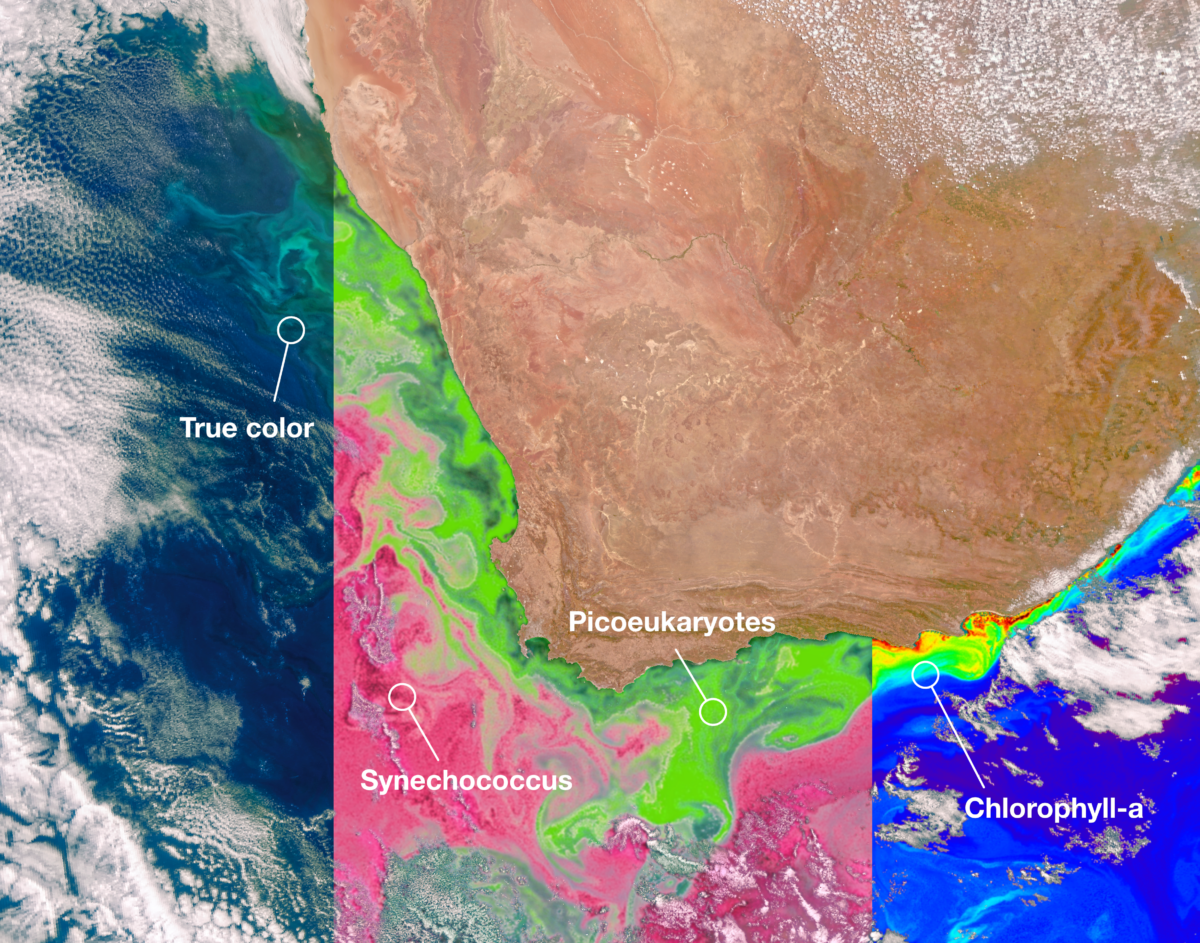 The Ocean Color Instrument (OCI) has the unique ability to detect light that allows scientists to differentiate among communities of phytoplankton. This first image released from OCI identifies two different communities of these microscopic marine organisms in the ocean off the coast of South Africa on February 28, 2024. The central panel shows Synechococcus in pink and picoeukaryotes in green. The left panel shows a natural color view of the ocean, and the right panel displays the concentration of chlorophyll-a, a photosynthetic pigment used to identify the presence of phytoplankton. (Image by NASA)
PACE lets scientists put on “magical eye glasses”
Because of the power and unique capabilities of the instruments on PACE, “We see confident atmospheric parameters that have never been seen from any previous NASA mission,” Remer says. And because the data will be completely public, the benefits will go far beyond work that current PACE scientists will do.
“PACE data will be free for everyone around the globe and will be useful for decades to come,” Martins says. “Events on Earth will come and go, and they will be recorded forever by the PACE sensors. Beyond our own science studying aerosols, clouds, and the energy balance of the planet, this data will be explored by students and scientists for all sorts of applications that I can’t even imagine.”
Martins expects UMBC scientists to write proposals to analyze PACE data for many years, and many of these projects will involve opportunities for students at all levels to gain experience with research. For now, PACE scientists are still relishing the successful launch and return of first light from the PACE instruments.
“When I look at the first light PACE images,” Remer says, “I feel like I have put on magical eye glasses and am seeing the true characteristics of aerosol plumes from a satellite for the first time.”
Jeremy Werdell, PACE project scientist, shepherded the project from start to finish, beginning when Martins pitched him the idea of including a HARP2-like instrument on board. “We’ve been dreaming of PACE-like imagery for over two decades. It’s surreal to finally see the real thing,” he says. “The data from all three instruments is of such high quality that we can start distributing it publicly less than two months from launch, and I’m proud of our team for making that happen.”
]]>
Data from NASA’s newest Earth-observing satellite, which will provide insight into ocean health, air quality, and the effects of a changing climate, are now available. The Plankton, Aerosol,...
https://umbc.edu/stories/first-light-from-harp2-on-pace/
https://my3.my.umbc.edu/api/v0/pixel/news/140823/guest@my.umbc.edu/f6e83a436b1feb9f205418cba2f162e3/api/pixel
cnms
esi
gestar2
news
physics
research
science-and-tech
story
UMBC News & Magazine
https://my3.my.umbc.edu/groups/umbc-news-magazine
https://assets1-my.umbc.edu/system/shared/avatars/groups/000/001/943/24435aa6207c452e7bc15cc74b42c7bb/xsmall.png?1748556657
https://assets1-my.umbc.edu/system/shared/avatars/groups/000/001/943/24435aa6207c452e7bc15cc74b42c7bb/original.png?1748556657
https://assets2-my.umbc.edu/system/shared/avatars/groups/000/001/943/24435aa6207c452e7bc15cc74b42c7bb/xxlarge.png?1748556657
https://assets2-my.umbc.edu/system/shared/avatars/groups/000/001/943/24435aa6207c452e7bc15cc74b42c7bb/xlarge.png?1748556657
https://assets3-my.umbc.edu/system/shared/avatars/groups/000/001/943/24435aa6207c452e7bc15cc74b42c7bb/large.png?1748556657
https://assets1-my.umbc.edu/system/shared/avatars/groups/000/001/943/24435aa6207c452e7bc15cc74b42c7bb/medium.png?1748556657
https://assets2-my.umbc.edu/system/shared/avatars/groups/000/001/943/24435aa6207c452e7bc15cc74b42c7bb/small.png?1748556657
https://assets1-my.umbc.edu/system/shared/avatars/groups/000/001/943/24435aa6207c452e7bc15cc74b42c7bb/xsmall.png?1748556657
https://assets2-my.umbc.edu/system/shared/avatars/groups/000/001/943/24435aa6207c452e7bc15cc74b42c7bb/xxsmall.png?1748556657
UMBC News & Magazine
2
0
false
Thu, 11 Apr 2024 15:05:00 -0400
Thu, 11 Apr 2024 15:05:00 -0400
Could a telescope ever see the beginning of time? An astronomer explains

By Adi Foord, Assistant Professor of Astronomy and Astrophysics, UMBC
Curious Kids is a series for children of all ages. If you have a question you’d like an expert to answer, send it to curiouskidsus@theconversation.com.
If the James Webb telescope was 10 times more powerful, could we see the beginning of time? – Sam H., age 12, Prosper, Texas
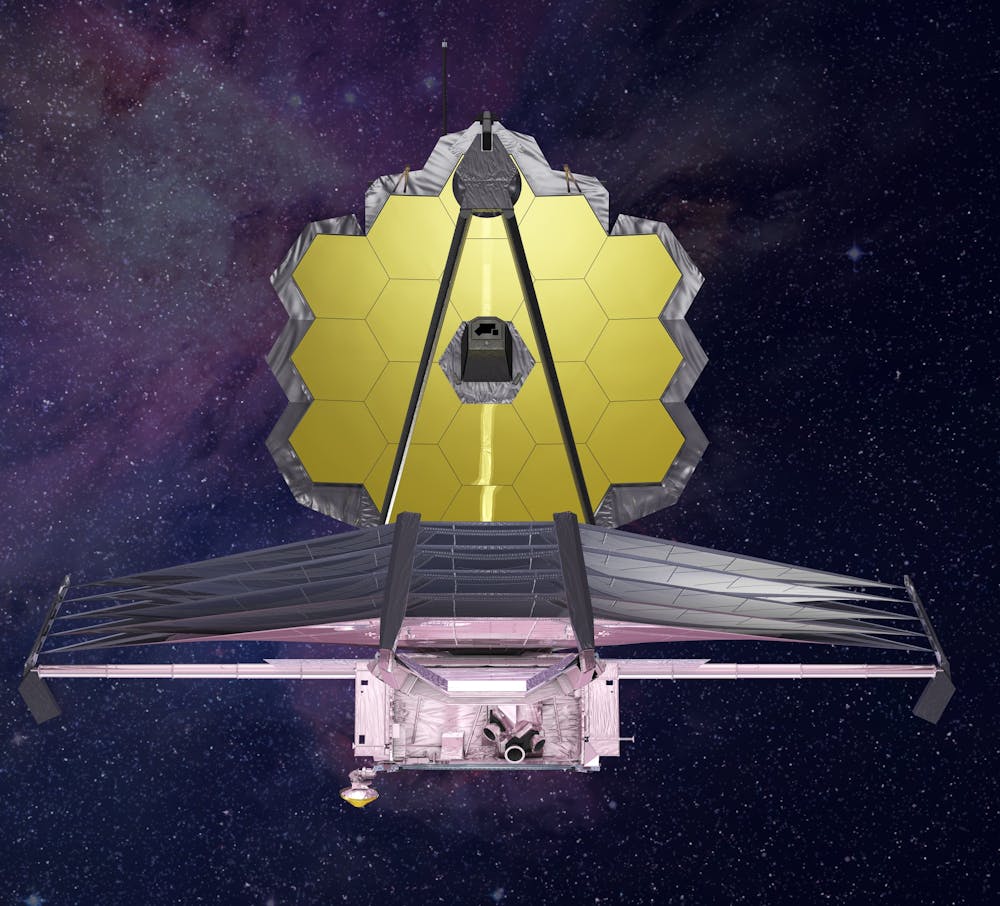
The James Webb Space Telescope, or JWST for short, is one of the most advanced telescopes ever built. Planning for JWST began over 25 years ago, and construction efforts spanned over a decade. It was launched into space on Dec. 25, 2021, and within a month arrived at its final destination: 930,000 miles away from Earth. Its location in space allows it a relatively unobstructed view of the universe.
The telescope design was a global effort, led by NASA and intended to push the boundaries of astronomical observation with revolutionary engineering. Its mirror is massive – about 21 feet (6.5 meters) in diameter. That’s nearly three times the size of the Hubble Space Telescope, which launched in 1990 and is still working today.
It’s a telescope’s mirror that allows it to collect light. JWST’s is so big that it can “see” the faintest and farthest galaxies and stars in the universe. Its state-of-the-art instruments can reveal information about the composition, temperature and motion of these distant cosmic objects.
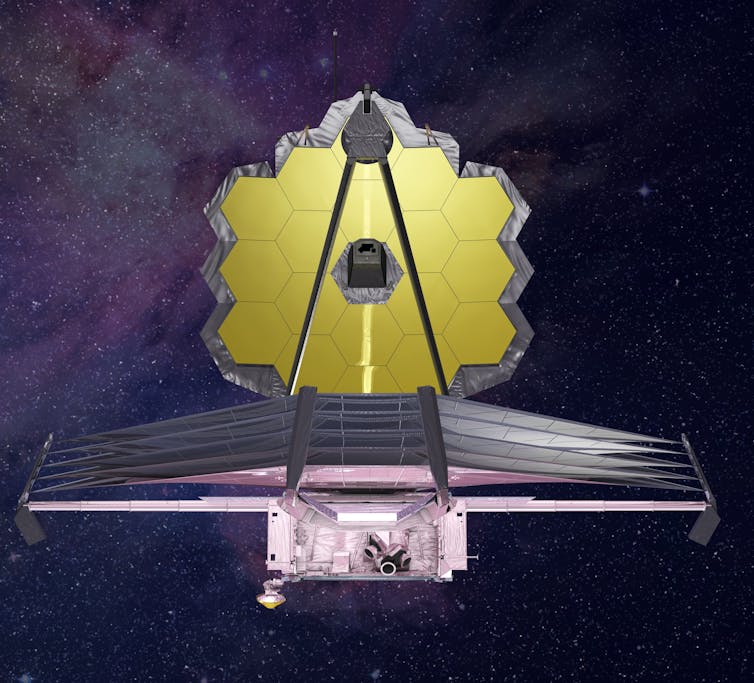 This illustration of the front view of the James Webb Space Telescope shows its sun shield and golden mirrors. NASA/ESA/CSA/Northrop Grumman
As an astrophysicist, I’m continually looking back in time to see what stars, galaxies and supermassive black holes looked like when their light began its journey toward Earth, and I’m using that information to better understand their growth and evolution. For me, and for thousands of space scientists, the James Webb Space Telescope is a window to that unknown universe.
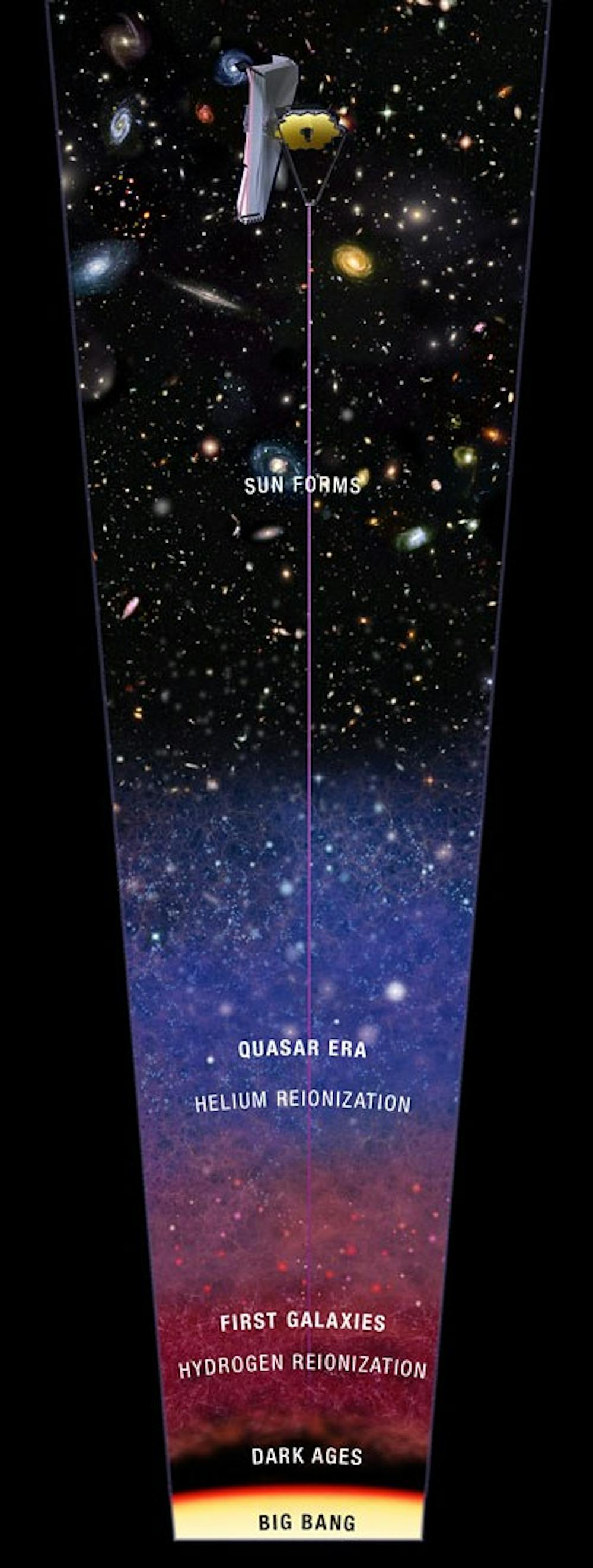
Just how far back can JWST peer into the cosmos and into the past? About 13.5 billion years.
Time travel
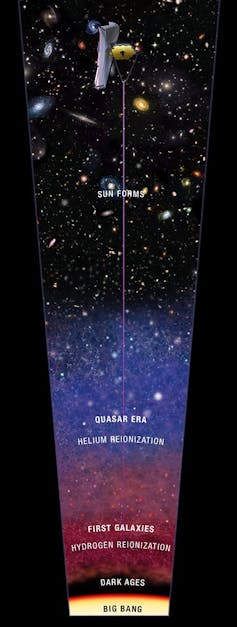 The James Webb Space Telescope can see back 13.5 billion years – back to when the first stars and galaxies began to form. STScI
A telescope does not show stars, galaxies and exoplanets as they are right now. Instead, astronomers are catching a glimpse of how they were in the past. It takes time for light to travel across space and reach our telescopes. In essence, that means a look into space is also a trip back in time.
This is even true for objects that are quite close to us. The light you see from the Sun left it about 8 minutes, 20 seconds earlier. That’s how long it takes for the Sun’s light to travel to Earth.
You can easily do the math on this. All light – whether sunlight, a flashlight or a light bulb in your house – travels at 186,000 miles (almost 300,000 kilometers) per second. That’s just over 11 million miles (about 18 million kilometers) per minute. The Sun is about 93 million miles (150 million kilometers) from Earth. That comes out to about 8 minutes, 20 seconds.
But the farther away something is, the longer its light takes to reach us. That’s why the light we see from Proxima Centauri, the closest star to us aside from our Sun, is 4 years old; that is, it’s about 25 trillion miles (approximately 40 trillion kilometers) away from Earth, so that light takes just over four years to reach us. Or, as scientists like to say, four light years.
Most recently, JWST observed Earendel, one of the farthest stars ever detected. The light that JWST sees from Earendel is about 12.9 billion years old.
The James Webb Space Telescope is looking much farther back in time than previously possible with other telescopes, such as the Hubble Space Telescope. For example, although Hubble can see objects 60,000 times fainter than the human eye is able, the JWST can see objects almost nine times fainter than even Hubble can.
The Big Bang
But is it possible to see back to the beginning of time?
The Big Bang is a term used to define the beginning of our universe as we know it. Scientists believe it occurred about 13.8 billion years ago. It is the most widely accepted theory among physicists to explain the history of our universe.
The name is a bit misleading, however, because it suggests that some sort of explosion, like fireworks, created the universe. The Big Bang more closely represents the appearance of rapidly expanding space everywhere in the universe. The environment immediately after the Big Bang was similar to a cosmic fog that covered the universe, making it hard for light to travel beyond it. Eventually, galaxies, stars and planets started to grow.
That’s why this era in the universe is called the “cosmic dark ages.” As the universe continued to expand, the cosmic fog began to rise, and light was eventually able to travel freely through space. In fact, a few satellites have observed the light left by the Big Bang, about 380,000 years after it occurred. These telescopes were built to detect the splotchy leftover glow from the Big Bang, whose light can be tracked in the microwave band.
However, even 380,000 years after the Big Bang, there were no stars and galaxies. The universe was still a very dark place. The cosmic dark ages wouldn’t end until a few hundred million years later, when the first stars and galaxies began to form.
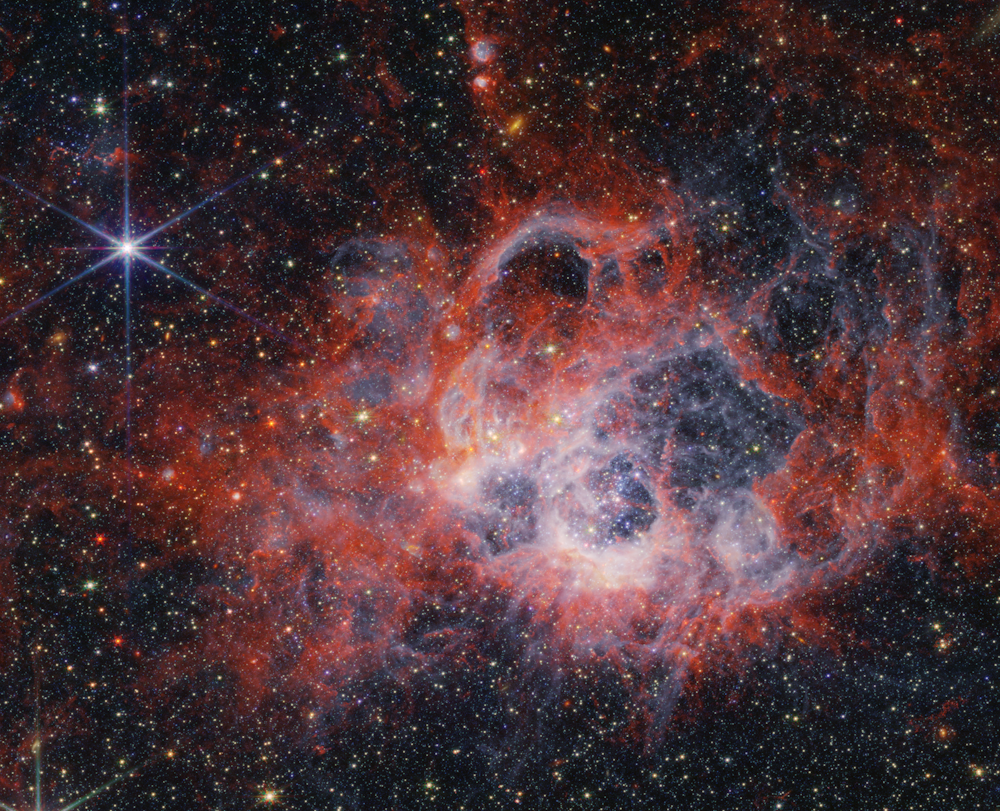
 This is a JWST image of NGC 604, a star-forming region about 2.7 million light years from Earth. NASA/ESA/CSA/STScI
The James Webb Space Telescope was not designed to observe as far back as the Big Bang, but instead to see the period when the first objects in the universe began to form and emit light. Before this time period, there is little light for the James Webb Space Telescope to observe, given the conditions of the early universe and the lack of galaxies and stars.
Peering back to the time period close to the Big Bang is not simply a matter of having a larger mirror – astronomers have already done it using other satellites that observe microwave emission from very soon after the Big Bang. So, the James Webb Space Telescope observing the universe a few hundred million years after the Big Bang isn’t a limitation of the telescope. Rather, that’s actually the telescope’s mission. It’s a reflection of where in the universe we expect the first light from stars and galaxies to emerge.
By studying ancient galaxies, scientists hope to understand the unique conditions of the early universe and gain insight into the processes that helped them flourish. That includes the evolution of supermassive black holes, the life cycle of stars, and what exoplanets – worlds beyond our solar system – are made of.
Adi Foord, Assistant Professor of Astronomy and Astrophysics, UMBC
This article is republished from The Conversation under a Creative Commons license. Read the original article.
]]>
By Adi Foord, Assistant Professor of Astronomy and Astrophysics, UMBC Curious Kids is a series for children of all ages. If you have a question you’d like an expert to answer, send it to...
https://umbc.edu/stories/could-a-telescope-ever-see-the-beginning-of-time/
https://my3.my.umbc.edu/api/v0/pixel/news/140684/guest@my.umbc.edu/86ab35c9379b6d4c0cbbb353b271286f/api/pixel
cnms
discovery
magazine
perspectives
physics
story
the-conversation
UMBC News & Magazine
https://my3.my.umbc.edu/groups/umbc-news-magazine
https://assets1-my.umbc.edu/system/shared/avatars/groups/000/001/943/24435aa6207c452e7bc15cc74b42c7bb/xsmall.png?1748556657
https://assets1-my.umbc.edu/system/shared/avatars/groups/000/001/943/24435aa6207c452e7bc15cc74b42c7bb/original.png?1748556657
https://assets2-my.umbc.edu/system/shared/avatars/groups/000/001/943/24435aa6207c452e7bc15cc74b42c7bb/xxlarge.png?1748556657
https://assets2-my.umbc.edu/system/shared/avatars/groups/000/001/943/24435aa6207c452e7bc15cc74b42c7bb/xlarge.png?1748556657
https://assets3-my.umbc.edu/system/shared/avatars/groups/000/001/943/24435aa6207c452e7bc15cc74b42c7bb/large.png?1748556657
https://assets1-my.umbc.edu/system/shared/avatars/groups/000/001/943/24435aa6207c452e7bc15cc74b42c7bb/medium.png?1748556657
https://assets2-my.umbc.edu/system/shared/avatars/groups/000/001/943/24435aa6207c452e7bc15cc74b42c7bb/small.png?1748556657
https://assets1-my.umbc.edu/system/shared/avatars/groups/000/001/943/24435aa6207c452e7bc15cc74b42c7bb/xsmall.png?1748556657
https://assets2-my.umbc.edu/system/shared/avatars/groups/000/001/943/24435aa6207c452e7bc15cc74b42c7bb/xxsmall.png?1748556657
UMBC News & Magazine
0
0
false
Mon, 08 Apr 2024 16:09:52 -0400