Graduating with gratitude: UMBC welcomes a new class of alumni
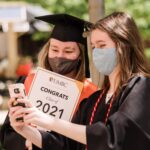
Persistent. Innovative. Determined. These are the words UMBC’s commencement speakers returned to again and again to describe the Class of 2021. And despite a year of challenges—missing family and friends, technological frustrations, life lived through the computer screen—one of the resounding themes of this year’s Commencement ceremonies was gratitude.
Addressing this year’s graduates, President Freeman Hrabowski reflected on his life and shared some wisdom learned throughout the years.
 Screenshot from UMBC’s 2021 Undergraduate Commencement Ceremony
“The longer I live, the more I realize there’s nothing more important than our family and our friends. We have to take the time to say ‘thank you’ because we never make it to any point of achievement alone,” he says. “There are always people helping us out.”
#umbcgrad#USGsuccess@UatShadyGrove @UMBC
1st stop 1991 – BA Poli Sci – no gray hair
2nd stop 2021 – MPS in Data Science – lots of gray hair
Retriever for life pic.twitter.com/iy7LT3yUVF
— Michael Schlitzer (@campagfan) May 11, 2021
Virtual ceremony, tangible spirit
This spring’s ceremonies were held online in deference to the health and safety of the campus community. While the festivities were virtual, the spirit was very tangible. Students had the opportunity to come to campus for professional on-site graduation photos. Some even ran into local celebrity, Officer Chip, the campus comfort dog.
 Jessica Ma ‘21, mechanical engineering, poses with Chip during on-campus photos.
Graduate Student Association president Samantha Fries ‘18, psychology, and M.A. ‘21, applied sociology, shared in her commencement remarks that despite the challenges of the past year, there have been remarkable acts of kindness.
“This magnificent outpouring of love and empathy has been demonstrated all across all the world but I’m most proud to say that I’ve seen it shown exceptionally and persistently by the students, staff, and faculty here at UMBC,” said Fries. “Faculty restructured their courses to provide maximum flexibility. Staff worked long hours developing new ways to serve students and help them succeed online. Students created virtual networks to stay connected with one other and to provide much-needed support during a time where we all felt more isolated than ever before.”
Inspired by each other
Students relied on video chats, Discord channels, and the tried and true telephone to stay connected this past year. Even if they couldn’t see each other in person, Retrievers are still grateful for the friendships that persevered and the memories they made.
“A lot of people helped me feel comfortable and enjoy my moments at UMBC,” says Billy Harold Kayim Tchuem ‘21, biochemistry. “The list is very long, but I just want to tell them ‘thank you’ for making this a very exciting journey and I hope we can all look back at these years and be able to appreciate how amazing they were.”
As part of her valedictorian speech, Katie Poteet‘21, global studies and political science, described how UMBC’s inclusive nature and diverse culture shape the environment and help students build relationships.
“UMBC is unique, creative, and diverse. There’s something in each of us that others can learn from and be inspired by,” says Poteet, who is a first-generation college graduate.
 Poteet on campus in fall 2020.
Coming to UMBC as part of a fifth-generation farming family from rural Maryland, Poteet embraced the international opportunities afforded to her, such as a trip to Ghana as part of UMBC’s Global Brigades program. After graduation, she will attend the University of Cambridge, in England, to pursue a master of philosophy focusing on educational equity for women and girls in the Arab world.
“Because we are all so diverse, this graduation means something different to each of us,” she shared, “but it also marks the collective success and excellence of our community.”
Building the world they want to see
Addressing his fellow graduates as co-valedictorian, Jordan Troutman ’21, M29, computer science and mathematics, emphasized the power of students recognizing themselves as agents of change.
“I believe in a world where the leaders in communities and organizations fully represent the populations they serve. We must see things for what they are, but even more, for what they can be,” says Troutman. “We have the ability to mobilize, find solutions, and challenge expectations. It doesn’t always take a massive crowd of people to do so, sometimes it only takes one person. Sometimes that person will be you.”
 Troutman on campus this spring.
Troutman also received a prestigious Knight-Hennesy Scholarship, the first in UMBC’s history. He’ll begin a computer science Ph.D. at Stanford University in the fall, continuing his algorithmic fairness research.
One of this year’s honorary degree recipients, Sarah Rosen Wartell, president of the Urban Institute, also spoke of taking action to make a better world. She emboldened the Class of 2021 to lead the charge, no matter how uncomfortable the journey might be.
“So, maybe a bit more discomfort is what the world needs from you because we’re relying on you to show us the path forward,” said Wartell.
Cogratulations to STEM BUILD graduate Demi Trimino (Biological Sciences’21, Philosophy ’21)
We are so proud of you!#UMBCgrad pic.twitter.com/cHf1X5tDgw
— STEM BUILD at UMBC (@STEMBUILDUMBC) May 21, 2021
Looking ahead
Commencement is a transition point—the end of one journey and the start of another. Victoria D’Souza, Ph.D. ‘02, biochemistry, knows it may not always be easy, but this class is uniquely qualified to face the challenges that come before them.
As the graduate honorary degree recipient, D’Souza expressed her confidence in these students, asserting that “if there’s anything this class of 2021 can teach us, it’s that you’re resilient. And if you put your mind to it, no challenge is insurmountable.”
 A student takes graduation photos on campus.
Christopher P. Austin, CEO-Partner at Flagship Pioneering, undergraduate ceremony honorary degree recipient, echoed these sentiments.
“The world needs you not only to seek change, but to drive it,” said Austin. “Life is not a dress rehearsal, as one of my musical colleagues once put it. Live by these truths.”
But no matter how far Retrievers may go on their journeys, UMBC will always be home, says Fries. She shared, “Let us not think of this as the ending of a chapter, but rather the beginning of the next book in the series of our lives.”
Read more stories about the Class of 2021 on UMBC News. Full recordings of this year’s virtual ceremonies can be found on the Commencement site, along with social shareables, a virtual True Grit, and a photo booth. Help us celebrate our graduates by using #UMBCgrad on social media.
Banner image: Two of this year’s graduates stop for a selfie during on-campus photos. Photos by Marlayna Demond ‘11 unless otherwise noted.
]]>
Persistent. Innovative. Determined. These are the words UMBC’s commencement speakers returned to again and again to describe the Class of 2021. And despite a year of challenges—missing family and...
https://umbc.edu/stories/graduating-with-gratitude-umbc-welcomes-a-new-class-of-alumni/
https://my3.my.umbc.edu/api/v0/pixel/news/119618/guest@my.umbc.edu/0bdac41ca69ed298502599ed53235598/api/pixel
cahss
chemistry
classof2021
cnms
coeit
community
csee
globalstudies
mathstat
page1
politicalscience
psychology
saph
UMBC News & Magazine
https://my3.my.umbc.edu/groups/umbc-news-magazine
https://assets1-my.umbc.edu/system/shared/avatars/groups/000/001/943/24435aa6207c452e7bc15cc74b42c7bb/xsmall.png?1748556657
https://assets1-my.umbc.edu/system/shared/avatars/groups/000/001/943/24435aa6207c452e7bc15cc74b42c7bb/original.png?1748556657
https://assets2-my.umbc.edu/system/shared/avatars/groups/000/001/943/24435aa6207c452e7bc15cc74b42c7bb/xxlarge.png?1748556657
https://assets2-my.umbc.edu/system/shared/avatars/groups/000/001/943/24435aa6207c452e7bc15cc74b42c7bb/xlarge.png?1748556657
https://assets3-my.umbc.edu/system/shared/avatars/groups/000/001/943/24435aa6207c452e7bc15cc74b42c7bb/large.png?1748556657
https://assets1-my.umbc.edu/system/shared/avatars/groups/000/001/943/24435aa6207c452e7bc15cc74b42c7bb/medium.png?1748556657
https://assets2-my.umbc.edu/system/shared/avatars/groups/000/001/943/24435aa6207c452e7bc15cc74b42c7bb/small.png?1748556657
https://assets1-my.umbc.edu/system/shared/avatars/groups/000/001/943/24435aa6207c452e7bc15cc74b42c7bb/xsmall.png?1748556657
https://assets2-my.umbc.edu/system/shared/avatars/groups/000/001/943/24435aa6207c452e7bc15cc74b42c7bb/xxsmall.png?1748556657
UMBC News & Magazine
0
0
false
Mon, 24 May 2021 16:54:44 -0400
UMBC celebrates 25th Undergraduate Research and Creative Achievement Day with an expanded global audience

UMBC’s 25th Undergraduate Research and Creative Achievement Day (URCAD) reached more viewers than ever before, with visitors connecting online from as far away as Spain, Indonesia, Nigeria, Brazil, Bhutan, Germany, and the U.K.. Audiences logged more than 11,000 visits (compared with 8,000 in 2020) and posted more than 3,500 comments over the course of the week-long event.

Winner of URCADs “Best Selfie With The Number “25”
Angelika Albertorio ’21, English and dance.
“While we are eager to get back to the live event, there are definitely aspects of the online event that have widened the scope of URCAD,” says April Householder, director of undergraduate research and prestigious scholarships. “Presenters were able to invite friends and family members from other countries to view their presentations, and invite international scholars as potential future collaborators.”
Over 350 students presented projects, from novel artistic work to lab research to analysis of historical archives. The questions they asked reflected engagement with significant challenges and opportunities of today.
Anti-Asian racism
Zoe Hwang, English, was inspired to study the history of Koreans in Baltimore after reading a chapter about Korean immigrant communities in the city written by Aletheia Hyun-Jin Shin in the book Baltimore Revisited. Then COVID-19 happened and with it came a rise in hate crimes toward members of Asian communities in the United States. “I’m scared to go outside,” shares Hwang, who is Korean and lives in Maryland. “I was surprised that so many people thought this was new and were unaware of the history of racism toward the Asian community.”
She decided to widen the scope of her research for URCAD. In “We Were Never Welcome Here: How American History Predicted the Rise of Racism and Xenophobia During COVID-19,” Hwang uses archival posters and newspapers to contextualize racism toward Chinese and Japanese communities in the U.S. from 1850 to the present, while demonstrating how negative sentiments about one Asian community have often translated into violence for other Asian communities. “I want to continue to educate others about the diversity of the Asian community and the dangers of lumping the people and cultures under a single term,” says Hwang.
Connecting Baltimore
When COVID struck, many Baltimore families without internet access were completely disconnected from much-needed services that had moved online, and were disconnected from their communities. In fall 2020, Foad Hamidi, assistant professor of information systems, received NSF funding to research this problem in collaboration with the Digital Harbor Foundation and Project Waves, providing affordable internet service in Baltimore. Hamidi and Nora McDonald, research assistant professor of information systems, led a study to understand the experiences of low-income Baltimore families without broadband access, and student researchers played a major role in the work.

The Project Waves team installing a sector antenna in downtown Baltimore City.
Photo courtesy of Project Waves.
Hamidi says a lot has changed from when they started the project. “The preliminary findings have found that participants and partners value connectivity that is affordable, that can be used with social distancing, is offered by grassroots community organizations, and is private,” he shares.
Working on project Waves has been a humbling and a very rewarding experience for Karina Lopez-Brown ‘21, information systems. “Our research in Project Waves demonstrated to me that it doesn’t matter the level of knowledge or expertise that we have,” says Lopez-Brown, “we just need to be willing to share our knowledge to help our community.”
In addition to Lopez-Brown, the student team included seniors Rushaad Wright, business technology administration, and Daniel Laguna, information systems, as well as Lydia Stamato, a doctoral student in human-centered computing.
For Laguna, the project has been an opportunity to strengthen relationships with his peers and mentors and to collaborate with the Baltimore City community. “In these times where we have had to remain physically distant from one another it’s been easy to feel isolated from the world,” says Laguna. “But all of these connections have really helped me feel closer to the rest of the world.”
Conversation with squeegee kids
Growing up in Baltimore City, Sydney Fryer ’22, psychology, was accustomed to seeing young Black boys and men standing on downtown street corners ready with squeegees, trying to earn money by cleaning car windshields. Fryer saw the “Squeegee Kids” as a positive part of Baltimore City’s culture and economy but knew some residents and visitors didn’t share this sentiment.

Sydney Fryer.
Photo by Marlayna Demond ’11 for UMBC.
In “Decriminalizing (and Re-Humanizing) the ‘Squeegee Kid,” Fryer used Baltimore Sun archives, social media data, and interviews with the youth to examine the criminalization of these young men over forty years of city history. “Sydney’s methodology was designed to recognize the crucial role that discourse and policy play in shaping young people’s daily experiences,” says Dena Aufseeser, assistant professor of geography and environmental systems.
Fryer found that White boys and men doing similar work were seen as entrepreneurial while “Squeegee Kids” were often described through unsubstantiated narratives about crime and violence. She says her interviews revealed that, “many of them are working to buy clothes, food, books, and to help their families,” so what they earn often goes right back into the city’s economy.
Understanding the structure of HIV
As COVID-19 vaccine research moved forward at light speed this past year, research on other pandemics continued to make steady progress. Three groups of students presented their research on HIV-1, the retrovirus that causes AIDS.
Michael Summers, Distinguished University Professor of chemistry and biochemistry and Howard Hughes Medical Institute investigator, mentored over a dozen students that contributed to two of the major collaborative projects presented at URCAD, focused on the structures of HIV-1 MAL junction conformers and the HIV-1 5′ leader. Faith Davis ‘22, sociology and biological sciences, is part of the second project and a 2021 Newman Civic Fellow.

Davis (left) with her co-researchers tied for URCAD’s 2021 “Best Overall Selfie” award.
Photo courtesy of April Householder, director of undergraduate research and prestigious scholarships.
“The work is focused on determining an unsolved piece of the structure of the 5` leader of HIV-1’s genome, which is what makes HIV so infectious,” she explains. “If the structure of this area can be determined, it could possibly inform cures or better treatments for HIV.”
Collaborative process
For UMBC’s video game designers, going virtual was not new. Marc Olano, associate professor of computer science and electrical engineering, mentored four projects presented at URCAD, each led by a group of about four students. They include Sword Shibe; Recurring Moment – A Time Travel Puzzle Platformer; Jump Starters, and the two-player Android and PC strategy game Hamster Toaster Checker. Students in UMBC’s computer science game development track collaborated with students in animation and interactive media to envision and begin developing the new games.
“The beauty of the CMSC 493 class is that it brings artists and programmers together and the management of the project is completely led by us,” says Kristian Mischke ‘21, computer science, the game designer for the Recurring Moment project.

A scene from Recurring Moment.
Image courtesy of Mischke.
In Sword Shibe, players take a dog with a sword through different paths. The student team that created it drew inspiration for its concept designs from Japanese culture, folklore, and legends. The dog in the game is also inspired by a Shiba Inu, which is a breed of hunting dog from Japan.
Olano worked to model the students’ project experience on the structure of the game design and development industry. “Students began working through ideas in small teams and worked their way through prototypes and onto a bigger team,” he explains. “In the game industry, you have to work collaboratively or you fail.”
Mischke explains how he would bounce ideas off the artists for visual appeal or about the game’s narrative arc. With the other programmers, he talked through implementation feasibility. “We all would give feedback and discuss adaptations together,” says Mischke. “Everyone on the team was able to be part of the process and apply their unique skill set.”
Thought-provoking animation
UMBC artists also shared short animated films through URCAD. These include projects like “Finding the Sun” and “Familiarity in Change,” which resonated with audiences.

Young’s avatar.
Courtesy of Young.
“Finding the Sun” was created by Michelle Young ‘21, visual arts, who directed, animated, and composed the music for the film. She took an interdisciplinary approach by combining her illustration, design, 2D animation, and sound design skills to explore the themes of self-worth and self-acceptance.
The girl in the movie wakes up to a dark world and goes in search of the sun, says Young, only to find out she is the light in the world—that she is enough. “I was hoping that the simplicity of the character would allow the viewer to put themselves in their shoes,” she explains. “I wanted to create something that was meaningful and encouraging to people wherever they are in this difficult time in our lives.”
“Familiarity in Change” shows viewers imagery of various locations, such as an empty beach and snowy park, that express a desolate feeling. However, by pairing those images with peaceful music, creator Angela Endres ‘22, visual arts, transforms the mood to serenity and comfort.
Endresfinds meaning in showing the emptiness of these places, which prior to COVID would have been enjoyed by family and friends coming together. “Isolation has made me see the beauty in everyday life,” she shared in her URCAD talk. “The world has changed and that’s OK.”
Banner image: A scene from Michelle Young’s short film “Finding the Sun.” Image courtesy of Young.
]]>
UMBC’s 25th Undergraduate Research and Creative Achievement Day (URCAD) reached more viewers than ever before, with visitors connecting online from as far away as Spain, Indonesia, Nigeria,...
https://umbc.edu/stories/umbc-celebrates-the-25th-undergraduate-research-and-creative-achievement-day-with-an-expanded-global-audience/
https://my3.my.umbc.edu/api/v0/pixel/news/119637/guest@my.umbc.edu/65dfaf8d60c48038f5cd90721ba37421/api/pixel
arts-and-culture
biology
cahss
cnms
coeit
csee
diversityandinclusion
english
ges
interdisciplinary
international
policy-and-society
psychology
saph
science-and-technology
undergradresearch
urcad
visualarts
UMBC News & Magazine
https://my3.my.umbc.edu/groups/umbc-news-magazine
https://assets1-my.umbc.edu/system/shared/avatars/groups/000/001/943/24435aa6207c452e7bc15cc74b42c7bb/xsmall.png?1748556657
https://assets1-my.umbc.edu/system/shared/avatars/groups/000/001/943/24435aa6207c452e7bc15cc74b42c7bb/original.png?1748556657
https://assets2-my.umbc.edu/system/shared/avatars/groups/000/001/943/24435aa6207c452e7bc15cc74b42c7bb/xxlarge.png?1748556657
https://assets2-my.umbc.edu/system/shared/avatars/groups/000/001/943/24435aa6207c452e7bc15cc74b42c7bb/xlarge.png?1748556657
https://assets3-my.umbc.edu/system/shared/avatars/groups/000/001/943/24435aa6207c452e7bc15cc74b42c7bb/large.png?1748556657
https://assets1-my.umbc.edu/system/shared/avatars/groups/000/001/943/24435aa6207c452e7bc15cc74b42c7bb/medium.png?1748556657
https://assets2-my.umbc.edu/system/shared/avatars/groups/000/001/943/24435aa6207c452e7bc15cc74b42c7bb/small.png?1748556657
https://assets1-my.umbc.edu/system/shared/avatars/groups/000/001/943/24435aa6207c452e7bc15cc74b42c7bb/xsmall.png?1748556657
https://assets2-my.umbc.edu/system/shared/avatars/groups/000/001/943/24435aa6207c452e7bc15cc74b42c7bb/xxsmall.png?1748556657
UMBC News & Magazine
0
0
false
Wed, 12 May 2021 19:04:27 -0400
UMBC’s Faith Davis is named a 2021 Newman Civic Fellow for work on healthcare, food, and housing insecurity
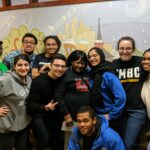
Faith Davis ‘22, M30, sociology and biological sciences, grew up in Mechanicsville, a small town in Maryland. Her family regularly welcomed people in need of temporary housing into their home. This shaped her sense of how housing and income insecurity affect people, but did not prepare her for the shock she felt at seeing the scale of people living without housing in Washington D.C. while visiting the capital as a teenager.
That was a deciding moment for Davis. She wanted to understand the underlying factors of why homelessness persists widely and at such high rates, and she was determined to find sustainable interventions. She has invested the last three years researching food and housing insecurity both on campus and in Baltimore City, as well as working with community organizations to implement interventions. In recognition of her engaged leadership and long-term commitment to this work, Campus Compact Mid-Atlantic (CCMA) has named Faith Davis a 2021 Newman Civic Fellow.

Faith Davis.
Photo courtesy of Davis.
“While I have spent a great deal of my time at UMBC conducting scientific research and taking advanced chemistry and biology coursework, I have also tried to engage with the campus community and the surrounding community,” shares Davis, who is a Meyerhoff Scholar. “Being selected as this year’s Newman Civic Fellow means UMBC recognizes my efforts to change the world in a positive way.”

Davis (first row on the right) volunteering at the Meyerhoff Scholars Program 30th Anniversary Celebration.
Photo courtesy of Davis.
Davis is the most recent in a long line of UMBC students who have earned Newman Civic Fellowships in recognition of their dedication to public service. They include Nihira Mugamba ‘21, political science and Africana studies; Maheen Haq ‘20, global studies and economics; Stephanie Milani ‘19, computer science and psychology; Sophia Lopresti ‘17, global studies; Maxwell Poole ‘18, computer science; economics; and Kelly Cyr ‘12, biological sciences, and M.S. ’13, applied molecular biology.
Civic action
Davis joined UMBC’s Center for Democracy and Civic Life’s (CDCL) Alternative Spring Break (ASB) program as a participant in her first year on campus and as a leader every year after. ASB is an immersive learning experience in which participants explore the systemic and human dimensions of complex social issues in Baltimore. Through UMBC’s Shriver Center, ASB students participate in a service-learning course to learn how to best foster sustainable, long-term connections with local communities.

Faith Davis (back row, first on the left) at a community organization in Baltimore City
during ASB 2019.
Photo courtesy of Davis.
Her first ASB project focused on housing insecurity in Baltimore. “I learned that the most common causes of death for people experiencing homelessness are conditions that could have been easily treatable,” explains Davis.
As an ASB leader her sophomore and junior years, she helped design projects focused on how structural barriers to the availability of nutritious food impact residents’ overall health, education, and well-being in Baltimore, as well as approaches to achieving nutritional equity. Davis has also facilitated several of CDCL’s programs such as the Change Makers Dinners, where she leads discussions addressing nutrition and food access and on women’s political empowerment.

ASB 2019 symposium (Davis is first on the right).
Photo courtesy of David Hoffman.
Research to address healthcare access
Davis’s work in ASB increased her awareness of the challenges that people experiencing homelessnes face in accessing preventative healthcare and basic information about chronic health issues. “I had the opportunity to survey the health resources available in Baltimore City,” shares Davis. “There was a noticeable gap when it came to providing basic health information.”
Davis designed a research project to develop a model that could both assess individuals’ current state of health and connect them with groups who could follow up with free medical services. She received an Undergraduate Research Award in 2019 to gather and analyze health information from shelter residents at two homeless shelters in Baltimore City who volunteered to participate.
The data revealed that the population she surveyed frequently lacked access to consistent primary medical care and regular health screenings, where preventative medicine could reduce the risk of life-threatening emergencies. She was able to present the initial phase of the project at UMBC’s 2019 Undergraduate Research and Creative Achievement Day. Unfortunately, the project could not continue to its next phase due to COVID-19.
Examining food insecurity
In the fall of 2020, Davis was invited to join the Retriever Essentials on a research project analyzing food and housing insecurity at UMBC. Retriever Essentials is an organization led by faculty, staff, and students that tackles food insecurity in the UMBC community. Davis worked alongside Fariha Khalidshe, a CCMA AmeriCorps VISTA member serving with UMBC Retriever Essentials.
Together they compiled and analyzed data from surveys of faculty, staff, and students to determine the prevalence of food and housing insecurity at UMBC, the effectiveness of UMBC’s efforts to address these issues, and the impact of the pandemic on people’s housing and food access.

Davis (left) with her mentor from the Meyerhoff Scholars Summer Bridge program,
Rebekah Rashford ’18, M26, biological sciences, (center), and Davis’s former roommate,
Ridhi Chaudhary ’21, M30, biological sciences (right).
Photo courtesy of Davis.
“Faith is an outstanding member of our research team,” says Khalidshe. “She is an avid advocate for understanding food and housing justice by looking at the statistics and hearing people’s stories about their lived experiences.”
The research team found that a decrease in access to public transportation due to COVID-19 restrictions has been a significant barrier to people’s ability to access food. Additionally, Davis notes that limited income due to unemployment has also affected food and housing security, especially “because government support is decreasing while many people are still unemployed.”
Many organizations that support local communities’ food and housing needs rely heavily on volunteers to function, and have been impacted significantly by COVID-related shutdowns. “As these organizations suffered, more mutual aid networks have taken hold or grown,” explains Davis. “The pandemic has also led to people growing in community and supporting their neighbors, both through formal mutual aid networks and informally.”
HIV research
In addition to her research in housing and health insecurity, Davis also has interests in biomedical research. She is both a U-RISE Scholar and a Howard Hughes Medical Institute Scholar. She has worked with Distinguished University Professor and HHMI Investigator Michael Summers, chemistry and biochemistry, for three years, helping to examine the structure of the HIV-1 5` leader.
“The lab work is focused on determining an unsolved piece of the structure of the 5` leader of HIV-1’s genome, which is important because this area is what makes HIV so infectious,” explains Davis. “If we can determine the structure of this area, it could possibly inform cures or better treatments for HIV.”

Davis (second from the right) at a ABRCMS workshop she helped to facilitate.
Photo courtesy of Davis.
She presented her research on the structure of the HIV-1 5` leader at the American Society of Microbiology Annual Biomedical Research Conference for Minority Students. She also won a poster presentation award at UMBC’s Undergraduate Research Symposium in the Chemical and Biological Sciences and came in 2nd place in the poster presentation at UMBC’s Summer Undergraduate Research Fest. Davis presented her latest research at this year’s 25th UMBC Undergraduate Research and Creative Achievement Day.

Davis (left) with her co-researchers tied for URCAD’s 2021 “Best Overall Selfie” award.
Photo courtesy of April Householder, director of undergraduate research and prestigious scholarships .
Above and beyond
Davis’s passion for being an agent of change in her community extends well beyond her campus work. Through UMBC’s Shriver Center service learning community partnerships, she was placed as a volunteer at the St. Agnes Hospital Stroke Center in Baltimore County, collecting and recording patients’ vital signs and helping with administrative tasks. She is active as a tutor for Arbutus Achievers, a mentoring and college readiness program for middle school students at Arbutus Middle School in Baltimore County.
Among her leadership roles, Davis is the president of UMBC’s Phi Delta Epsilon Medical Fraternity, the secretary of the Ethics Bowl and the Catholic Retrievers, and is a member of the Physical Chemistry Club. While at UMBC, Davis also served on the Volunteer Rescue Squad In her hometown of Mechanicsville.
“Faith is someone who truly walks her talk. She is committed to making a difference through collaboration and engagement over the long haul,” say CDCL’s director, David Hoffman, Ph.D. ‘13, language, literacy and culture (LLC), and assistant director, Romy Hübler ‘09, modern languages and linguistics, M.A. ‘11, intercultural communication, and Ph.D. ‘15, LLC. “We are proud to work with her.”
Social change network
This type of long-term commitment to social change is precisely what the Newman Civic Fellowship honors. The year-long fellowship supports each recipient in further developing their social change and leadership skills through regional and state gatherings. Fellows are paired with mentors and become part of a national network of peers. They support each other in finding solutions for challenges facing communities locally, nationally, and internationally.
Davis has already met other Newman Fellows through online events. She has begun to volunteer in some of the new social justice organizations they introduced her to. She is grateful to be able to learn from previous Newman Fellows and join peers who, like her, are ready to lend their energy and expertise to move social justice work forward. Davis plans to pursue an M.D.-Ph.D. after graduating next year. She hopes these experiences will help inform her future work developing community programs to improve health outcomes for people experiencing poverty.
“My greatest hope for this fellowship is to connect with a large network of change-makers who I can learn from and be inspired by throughout my life,” says Davis. “I hope to eventually work together to create a better world.”
Banner image: Faith Davis (second from the right) with fellow 2019 ASB participants. Photo courtesy of Davis.
]]>
Faith Davis ‘22, M30, sociology and biological sciences, grew up in Mechanicsville, a small town in Maryland. Her family regularly welcomed people in need of temporary housing into their home....
https://umbc.edu/stories/umbcs-faith-davis-is-named-a-2021-newman-civic-fellow-for-work-on-healthcare-food-and-housing-insecurity/
https://my3.my.umbc.edu/api/v0/pixel/news/119638/guest@my.umbc.edu/016c6d52d22f398664ced14812e3ce62/api/pixel
biology
cahss
chembiochem
civic
cnms
community
cs3
meyerhoffscholars
policy-and-society
saph
shrivercenter
undergradresearch
UMBC News & Magazine
https://my3.my.umbc.edu/groups/umbc-news-magazine
https://assets1-my.umbc.edu/system/shared/avatars/groups/000/001/943/24435aa6207c452e7bc15cc74b42c7bb/xsmall.png?1748556657
https://assets1-my.umbc.edu/system/shared/avatars/groups/000/001/943/24435aa6207c452e7bc15cc74b42c7bb/original.png?1748556657
https://assets2-my.umbc.edu/system/shared/avatars/groups/000/001/943/24435aa6207c452e7bc15cc74b42c7bb/xxlarge.png?1748556657
https://assets2-my.umbc.edu/system/shared/avatars/groups/000/001/943/24435aa6207c452e7bc15cc74b42c7bb/xlarge.png?1748556657
https://assets3-my.umbc.edu/system/shared/avatars/groups/000/001/943/24435aa6207c452e7bc15cc74b42c7bb/large.png?1748556657
https://assets1-my.umbc.edu/system/shared/avatars/groups/000/001/943/24435aa6207c452e7bc15cc74b42c7bb/medium.png?1748556657
https://assets2-my.umbc.edu/system/shared/avatars/groups/000/001/943/24435aa6207c452e7bc15cc74b42c7bb/small.png?1748556657
https://assets1-my.umbc.edu/system/shared/avatars/groups/000/001/943/24435aa6207c452e7bc15cc74b42c7bb/xsmall.png?1748556657
https://assets2-my.umbc.edu/system/shared/avatars/groups/000/001/943/24435aa6207c452e7bc15cc74b42c7bb/xxsmall.png?1748556657
UMBC News & Magazine
0
0
false
Tue, 11 May 2021 21:52:04 -0400
URCAD 2021 showcases creativity, resilience of UMBC student researchers
UMBC’s Undergraduate Research and Creative Achievement Day (URCAD) has burst out of the ballroom and onto computer screens around the world. For the second year in a row, the popular undergraduate research forum will be entirely online due to the pandemic, using a video presentation and online discussion tool called VoiceThread. But unlike 2020, no rapid shift is needed. After over a year of largely online learning and research, everyone involved is ready to take full advantage of the virtual medium.
“This event has gone global,” says April Householder ’95, director of undergraduate research and prestigious scholarships. Being online means URCAD leapt from about 2,500 people attending in person in 2019 to 8,000 virtual visits in 2020. “Viewers were coming in from as far away as the U.K., Korea, and South America,” says Householder. She expects that trend will continue this year.
 April Householder, 2018. Photo by Michael Mower.
Having a full week to explore URCAD this year also means viewers will have ample time to browse the available sessions, rather than “rushing from one thing to another,” says Householder, as they used to do at the in-person event. They’ll be able to explore, at their own pace, research on a vast array of topics, from the effects of anti-Asian discrimination during the COVID-19 pandemic to the Black Lives Matter movement, to cancer treatment, skateboarding culture, and online sneaker sales.
Connecting beyond boundaries
In lieu of face-to-face chats, visitors will be able to participate in online discussions with student presenters. Last year a research group in UMBC’s Asian studies department received feedback from researchers in Korea, says Householder. She hopes that this year, opportunities for these kinds of connections will increase with a new feature that enables users who aren’t from UMBC to comment through URCAD’s VoiceThread interface.
Within the UMBC community itself, Householder hopes students, faculty, and staff will take advantage of the opportunity to explore “things outside their disciplinary box.” Artists, scientists, humanists, social scientists, and engineers can all benefit from each others’ feedback, she explains.
Constraints generate creativity
Last year, when students had to quickly pivot from in-person presentations to using VoiceThread, “they had to learn an additional skill on the fly,” says Householder. This year, students are more prepared to take full advantage of all that the online format offers.
Further, due to the constraints of COVID, student researchers have become even more creative in using technology not just to display their research, but to pursue their research at a time when in-person interviews, fieldwork, and traditional performances aren’t possible. Students learned to do interviews online, adjusted their sample sizes, and navigated lab research within physical distancing guidelines. They also responded to the pandemic by examining the changes in society and in themselves.
One advantage of the online format is that the presentations are available to view in perpetuity. “We now have an archive of the event so we can use it as a teaching tool for future generations of URCAD presenters and mentors,” Householder says.
She finds this addition of an expanded archive and URCAD’s global reach to be fitting developments as the event marks its 25th anniversary. To celebrate the milestone, URCAD will feature a special video “fireside chat” with founders Diane Lee, Kathy Sutphin, Elizabeth Pennington, and Janet McGlynn.

Klaudine Wakasa. Image courtesy of Wakasa.
Viewers will also hear a keynote by Klaudine Wakasa ‘08, financial economics, who serves as a strategy advisor for clean technology ecosystems, consulting with international governments.
UMBC students, faculty, staff, and alumni, and the general public, are invited to view these special sessions, and hundreds of available students presentations at urcad.umbc.edu, April 19-25, 2021. Featured below are a few student presentations that give a glimpse into the range of what will be available. Each has been shaped in some way by the COVID-19 pandemic—in topic, approach, or format.
“COVID-19 telehealth and telerehabilation reflections: Understanding the stroke survivor and caregiver perspectives”
Frances Watson ‘21, computer science, conducted research on telehealth and telerehabilitation services during COVID-19 through UMBC’s Bodies in Motion Lab. “I am investigating the stroke survivor and caregiver perspectives to understand how socioeconomic disparities affect this population,” Watson explains.

Frances Watson. Photo courtesy of Watson.
Watson has so far conducted 20 interviews with rehabilitation specialists about their experience with telehealth appointments, alongside her graduate mentor, human-centered computing Ph.D. student Adegboyega Akinsiku. She is also currently interviewing stroke survivors and caregivers.
“The COVID-19 pandemic not only changed how we conduct these interviews, but also the analysis of them,” says Watson. “We conducted and continue to conduct these interviews on teleconferencing platforms such as Cisco Webex and Zoom, allowing us to video-record them. In comparison, when we were in person we would have an audio recording device present. Now we can rewatch the video recordings for our data analysis.”
The fact that her research technique adjusted to match the format of the telehealth appointments themselves “has proven very useful” in surfacing insights, she says.
Watson was previously able to gain research experience through the Stanford SURF program. As a Center for Women in Technology Scholar and Undergraduate Research Award (URA) Scholar, she also knows the power of research opportunities in developing an identity and career pathway as a STEM researcher, as well as the value of peer support. This has motivated her leadership on campus, including as Student Government Association president in spring 2020.
“this is it: A poetic response to the anti-Asian racism during the COVID-19 pandemic”
Just after the pandemic started last March, Calista Ogburn ’21, health administration and policy, felt hurt and angry as she heard about rising anti-Asian hate crimes and racism. Then she herself had an upsetting encounter at a Home Depot. “In that moment, standing in the Home Depot aisle next to the grills, I knew I had to write a poetry collection,” she says.
It was a process that involved many nights of tears, processing heavy emotions. “Reliving past experiences of racism and microaggressions in addition to writing responses to news headlines of anti-Asian racism was utterly exhausting,” she says. She wrote around the clock, and after publication she was gratified to learn “how my poetry has supported others during this turbulent time.”
 Poetry collection “this is it.” Image courtesy of Ogburn.
Ogburn does not intend to pursue a career in poetry, but she says, “I hope it remains my best friend.” Ogburn will present poetry from her collection “this is it” at URCAD. “My hope,” she previously shared with UMBC Magazine, “is that these poems can touch those who are feeling loss, loneliness, or the combined grief and rage of experiencing racism.”
 Calista Ogburn poses with her books of poetry. Photo from calista-ogburn.com.
“Modeling radio emission from tidal disruption events”
Omar French ’21, physics and mathematics, came to UMBC to become a theoretical physicist and he will be leaving soon to do just that. He found COVID-19 increased demands on his faculty mentors’ time, requiring him to move forward with his work more independently than before.
“I’m sure most people can agree that controlling one’s work is much more gratifying than the contrary, but of course, it’s a bit like being in the wilderness,” says French. “It forces you to think for yourself and to be confident in what you’re doing.”
 Omar French. Photo courtesy of French
French’s research on supermassive black holes has yielded insights. “Perhaps the most remarkable technical thing I’ve learned is that the mass of supermassive black holes central to inactive galaxies can be estimated reasonably from measuring only a few factors,” he explains.
After graduating, French will begin a physics Ph.D. program at University of Colorado Boulder. He describes the past year challenging, but also as a period that helped him grow as a scientist more than any other time of his life. As a result, he is heading off to graduate skill with new skills and a critical eye.
“The obedient body: Researching trained and culturally informed movement biases”
It was during a gender and women’s studies course that URA Scholar Gretta Zinski ’22, dance, read something that rocked her world. She says it was fascinating to learn about how the different social conditioning that men and women experience is reflected in how each gender moves. “The excerpt inspired me to assess my own habits, interests, and biases in an attempt to figure out what were my own thoughts and what I had been taught about my own femininity and beliefs,” she says.
Unfortunately, COVID kept the scope of Zinski’s project smaller than she would have liked, but she was still able to access fascinating findings. “Biases do affect our behavior, which translates into movement,” she says. “The physiological connections between the body and the mind were so interesting to me.”
 Still image from Zinski’s dance film project, courtesy of Zinski.
Zinski plans to continue her research and use it to plan bias deconstruction workshops. Of her pandemic research experience, she says, “I learned so much about myself and how to work on my own. This is going to be a very important skill for me and my future career as a self-employed artist.”
“Performing traditional Chinese folk songs”
International travel may have been largely shut down this year, but that didn’t stop URA Scholar Mark Beachy ’21, Asian studies, from exploring China. “When I sing traditional Chinese folk songs I am transported to China and I am experiencing the stories from long ago that are told through the lyrics and music. And it brings me great joy to do that and to share it with others,” he says.
 Mark Beachy. Photo courtesy of Beachy.
Beachy’s URCAD presentation features a video performance of the folk song “Jasmine.” He painstakingly edited together his vocal performance with accompaniment from a pianist in Illinois and a guzheng player in China. Beachy found both musicians online. “When singing traditional Chinese folk songs or any song it is important to connect with the other musicians in order to give the audiences an authentic performance of music that deserves respect,” he says.
Beachy returned to college in his 40s after a career as a professional actor and a writer of musicals, wanting to learn something new. Though not of Chinese descent, he has a passion for Chinese culture, language, and history.
His eventual goal is to teach English to Chinese speakers, and he hopes music can be a helpful teaching tool. “Music is a great way to learn a language,” he says. After graduating, he plans to earn a master’s degree at UMBC in Teaching English as a Second Language.
“Interpretation of models of care in residential communities for older adults”
“I am passionate about working with an underserved population and providing elders with quality care,” says Sydney Siegel ‘20, management of aging services. Siegel graduated in Fall 2020 from UMBC’s Erickson School and now works in an assisted living community. Her URCAD project is an analysis of models of care that older adults can experience. “The models of care I studied are about enhancing quality of life and quality of care, something I hope all aging services strive for,” she says.
Interviewing older people proved to be a challenge during the COVID-19 pandemic. In addition to many care facilities being inaccessible, staff members caring for older adults were incredibly busy. However, Siegel found ways to complete interviews online. “I made great connections and heard wonderful stories from participants,” she shares.
Siegel, a URA scholar, credits Erickson School faculty mentor Louise M. Murray with helping her grow in the field. “I definitely felt imposter syndrome when I started the research, but I learned to see my inexperience as a good thing, Siegel says. “Learning is so powerful and I feel grateful to have learned so much.” She looks forward to continuing to use research to inform care she provides for older adults.
“Optimizing in-situ longevity of silver nanoplates”
As a first-year student who started college in the midst of a pandemic, Dariush Aligholizadeh ‘24, biochemistry and computer science, did not have a typical introduction to UMBC. He didn’t want that to affect his ability to get started with research right away, but it was a lot to manage. “I was trying to adjust to college life while also trying to conduct research safely and securely within COVID-19 restrictions,” he says.

Dariush Aligholizadeh. Image courtesy of Aligholizadeh.
Aligholizadeh was able to find a compelling in-person research opportunity in a lab that employed strict physical distancing. His project involved synthesizing silver nanoplates “for their ability to reflect radiation and light to very high degrees.” He explains, “Basically, I make tiny triangles that kill cancer.” And his research experience proved highly gratifying.
“Every aspect of chemistry is in its own way beautiful, and watching these textbook principles come to life in my project is like watching magic happen. I take simple grains of silver salts and they come together in these beautiful sharp triangular structures, almost as if they were put together by hand,” he explains.
 Electron microscope image of nanoplates. Courtesy of the Devadas Lab.
Aligholizadeh believes his research experience has already improved his skills in calculus, biology, and organic chemistry, and helped solidify his plans to eventually become a medical doctor. He has also found that the challenges of COVID have required him to improve his time-management and online communication skills. Still, he looks forward to learning in-person again when it’s safe to do so.
The UMBC community and general public can see these presentations and many more at urcad.umbc.edu, April 19-25, 2021.
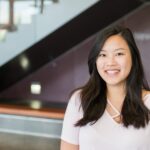
Featured image: Calista Ogburn, 2018. Photo by Marlayna Demond ’11 for UMBC.
Article written by Karen Stysley for UMBC News.
]]>
UMBC’s Undergraduate Research and Creative Achievement Day (URCAD) has burst out of the ballroom and onto computer screens around the world. For the second year in a row, the popular undergraduate...
https://umbc.edu/stories/urcad-2021-showcases-creativity-resilience-of-umbc-student-researchers/
https://my3.my.umbc.edu/api/v0/pixel/news/119658/guest@my.umbc.edu/b0fdbef5295bf80807456fdcff41891f/api/pixel
arts-and-culture
asianstudies
cahss
chembiochem
cnms
coeit
community
csee
dance
ericksonschool
mathstat
page1
physics
policy-and-society
saph
science-and-technology
undergradresearch
UMBC News & Magazine
https://my3.my.umbc.edu/groups/umbc-news-magazine
https://assets1-my.umbc.edu/system/shared/avatars/groups/000/001/943/24435aa6207c452e7bc15cc74b42c7bb/xsmall.png?1748556657
https://assets1-my.umbc.edu/system/shared/avatars/groups/000/001/943/24435aa6207c452e7bc15cc74b42c7bb/original.png?1748556657
https://assets2-my.umbc.edu/system/shared/avatars/groups/000/001/943/24435aa6207c452e7bc15cc74b42c7bb/xxlarge.png?1748556657
https://assets2-my.umbc.edu/system/shared/avatars/groups/000/001/943/24435aa6207c452e7bc15cc74b42c7bb/xlarge.png?1748556657
https://assets3-my.umbc.edu/system/shared/avatars/groups/000/001/943/24435aa6207c452e7bc15cc74b42c7bb/large.png?1748556657
https://assets1-my.umbc.edu/system/shared/avatars/groups/000/001/943/24435aa6207c452e7bc15cc74b42c7bb/medium.png?1748556657
https://assets2-my.umbc.edu/system/shared/avatars/groups/000/001/943/24435aa6207c452e7bc15cc74b42c7bb/small.png?1748556657
https://assets1-my.umbc.edu/system/shared/avatars/groups/000/001/943/24435aa6207c452e7bc15cc74b42c7bb/xsmall.png?1748556657
https://assets2-my.umbc.edu/system/shared/avatars/groups/000/001/943/24435aa6207c452e7bc15cc74b42c7bb/xxsmall.png?1748556657
UMBC News & Magazine
0
0
false
Mon, 12 Apr 2021 03:46:42 -0400
UMBC ranks in the top 100 public universities to receive federal research funding
In the latest Higher Education Research and Development (HERD) survey, UMBC has ranked among the United States’ top 100 public institutions in federal research support.
The annual survey aggregated federal research and development expenditures for fiscal year 2019. UMBC reported more than $80 million in research and development expenditures in 2019, the highest reported amount since 2012.
“It is an area of pride for us to make it into the top 100,” says Karl V. Steiner, vice president for research at UMBC. “We’ve now had year-over-year growth in the last six years. We grew our expenditures by 24 percent during that time—a very significant increase.”
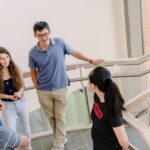
 Karl Steiner (left) and Aryya Gangopadhyay at the Pi Squared opening in 2018.
Within the HERD rankings, UMBC is now #122 in overall research and development expenditures among public institutions, #145 in federal research and development expenditures among all institutions, and #169 overall in expenditures among all institutions. UMBC’s funding sources include NASA, the National Science Foundation (NSF), the Department of Health and Human Services, and many others.
“The expenditures are one key method to get a sense of our faculty and students’ research productivity,” Steiner notes. “These rankings also help us see how UMBC is progressing in meeting our public impact research goals.”
NASA-UMBC connection
UMBC continues to fortify its relationship with NASA, ranking #15 overall in NASA funding (#11 amongst public universities). Currently, more than 170 researchers who are UMBC faculty members and research scientists collaborate with NASA Goddard.

Zhibo Zhang discusses an image collected via satellite with his lab group.
Funding from NASA has contributed to many UMBC-led scientific ventures, including the work of Zhibo Zhang, associate professor of physics.His Aerosol, Cloud, Radiation, Observation, and Simulation (ACROS) research group analyzed data collected from instruments on aircrafts and NASA’s orbiting satellites such as CALIPSO, CloudSat, and MODIS.
They sought to better understand how tiny particles in the atmosphere, such as aerosols and cloud droplets, interact with each other and the radiations from the Sun and Earth, and how these interactions influence our weather and climate systems.
 Zhibo Zhang (at right) with students (clockwise from lower left) Qianqian Song, Chamara Raja, Kevin Zheng, and Olivia Norman in 2019.
Explorations in the urban environment
In geosciences, atmospheric, and ocean sciences, UMBC ranked #39 in federal funding. Amongst UMBC’s federally-funded projects is Claire Welty’s study exploring Earth’s “critical zone”—from treetops to weathered bedrock—in urban centers along the Eastern Seaboard. NSF awarded Welty and her team a $4.8 million Critical Zone Collaborative Network grant to execute this project over five years.
Welty is director of UMBC’s Center for Urban Environment Research and Education (CUERE) and a professor of chemical, biochemical, and environmental engineering (CBEE). She is collaborating with Andrew Miller, professor of geography and environmental systems, and researchers in four other East Coast cities.
 Claire Welty (left) and Andy Miller (right) at a field site in Catonsville. Photo by Victor Fulda.
Human influence on groundwater is one of the many issues they are exploring. “Groundwater is a hidden resource that feeds streams and rivers. In cities, people are typically not using wells for water consumption but groundwater is part of the hydrologic cycle that affects ecosystems,” Welty explains. “Streams lead to rivers and rivers go to potable water intakes for cities, so it’s all connected.”
Despite the COVID-19 pandemic slowing down many research initiatives, Welty and Miller have continued to move their work forward. The team has begun conducting field research that has included subsurface imaging of project field sites, collecting water samples from each of the targeted sites, and deploying water quality sensors. Welty is expecting to bring her first Ph.D. student onto the research team by this fall.
Interdisciplinary approach to environmental problem-solving
Tamra Mendelson, professor of biological sciences, received a $2.8 million NSF Research Traineeship (NRT) grant in 2019 as principal investigator for the Interdisciplinary Consortium for Applied Research in the Environment (ICARE). The training program is designed to broaden participation in the environmental workforce and empower the next generation of scientists to apply research to environmental problem-solving.
 Tamra Mendelson at a research field site. Photo courtesy Mendelson.
ICARE will focus on the socio-ecological challenges facing the Baltimore Harbor. “The health of the Baltimore Harbor is improving, and I am hopeful that the work of ICARE will bolster ongoing efforts to make the Baltimore Harbor a model for the whole country,” says project partner Lee Blaney, associate professor of CBEE.
“It is my hope that the research focus on the Baltimore Harbor will set up ICARE and UMBC to make lasting, sustainable, and positive impacts in our city,” he notes.
 Lee Blaney (left) with two students in his lab, 2019.
“ICARE was originally conceived as a way for ecologists and evolutionary biologists on campus to get together. The NRT added this component of engaging the community in our research,” Mendelson explains.
“At UMBC we are all so invested in this mission of inclusive excellence,” she says. “The racial and ethnic diversity is really low in the environmental sciences, so we wanted to make a difference there as well.”
UMBC partners across five disciplines and three colleges used the time amid the pandemic to organize the program, which will be funded until 2024. Over the next few years, they expect that 30 students will participate. Each student will receive full funding toward a master’s degree. They will also have a chance to collaborate with UMBC faculty, community stakeholders, and scientists and engineers in government, non-profit organizations, and industry careers.
Social science research in action
In the social sciences, UMBC ranks #60 in overall funding sources and #30 in federal funding. Among public universities specifically, UMBC is #37 in overall funding and #20 in federal funding for the social sciences.
Since 2019, the NIH’s National Institute of Aging (NIA) has awarded Laura Girling, director of UMBC’s Center for Aging Studies, more than $750,000 to examine the experiences of people with dementia who live alone in community settings. Recently, Girling has used this funding to research how COVID-19 social distancing guidelines impact people with dementia. She also examines the ethics of including people living with dementia as research participants.
 Laura Girling, director of UMBCs Center for Aging Studies. Photo courtesy of Girling.
“The social sciences are a hallmark of the UMBC experience, and this is reflected in the funding,” says Steiner. “The excellence and national competitiveness of all of our research programs allows us to grow our research portfolio and pursue more funding for it.”
Photos by Marlayna Demond ’11 for UMBC, unless otherwise noted.
Article written by Adriana Fraser for UMBC.
]]>
In the latest Higher Education Research and Development (HERD) survey, UMBC has ranked among the United States’ top 100 public institutions in federal research support. The annual survey...
https://umbc.edu/stories/umbc-ranks-in-the-top-100-public-universities-to-receive-federal-research-funding/
https://my3.my.umbc.edu/api/v0/pixel/news/119665/guest@my.umbc.edu/233707aa30a28f694e706b7770facb97/api/pixel
biology
cahss
cbee
cnms
coeit
ges
physics
policy-and-society
research
saph
science-and-technology
UMBC News & Magazine
https://my3.my.umbc.edu/groups/umbc-news-magazine
https://assets1-my.umbc.edu/system/shared/avatars/groups/000/001/943/24435aa6207c452e7bc15cc74b42c7bb/xsmall.png?1748556657
https://assets1-my.umbc.edu/system/shared/avatars/groups/000/001/943/24435aa6207c452e7bc15cc74b42c7bb/original.png?1748556657
https://assets2-my.umbc.edu/system/shared/avatars/groups/000/001/943/24435aa6207c452e7bc15cc74b42c7bb/xxlarge.png?1748556657
https://assets2-my.umbc.edu/system/shared/avatars/groups/000/001/943/24435aa6207c452e7bc15cc74b42c7bb/xlarge.png?1748556657
https://assets3-my.umbc.edu/system/shared/avatars/groups/000/001/943/24435aa6207c452e7bc15cc74b42c7bb/large.png?1748556657
https://assets1-my.umbc.edu/system/shared/avatars/groups/000/001/943/24435aa6207c452e7bc15cc74b42c7bb/medium.png?1748556657
https://assets2-my.umbc.edu/system/shared/avatars/groups/000/001/943/24435aa6207c452e7bc15cc74b42c7bb/small.png?1748556657
https://assets1-my.umbc.edu/system/shared/avatars/groups/000/001/943/24435aa6207c452e7bc15cc74b42c7bb/xsmall.png?1748556657
https://assets2-my.umbc.edu/system/shared/avatars/groups/000/001/943/24435aa6207c452e7bc15cc74b42c7bb/xxsmall.png?1748556657
UMBC News & Magazine
0
0
false
Mon, 29 Mar 2021 21:40:05 -0400
UMBC-Montgomery College collaboration expands with digital storytelling humanities internship for transfer students
In September of 2020, UMBC’s Camee Maddox-Wingfield, assistant professor of anthropology, wanted to introduce her Anthropology 211 students to the process of digital storytelling and the tools of the Smithsonian Learning Lab. She reached out to Sarah Jewett who had just launched a new digital storytelling collaboration with the Montgomery College (MC) Digital Storytelling Internship program at the Paul Peck Humanities Institute. The internship places MC students with UMBC faculty who need help with their digital story projects.
Jewett, director of innovations in transfer research and practice at UMBC, knew about MC’s long-standing partnership with the Smithsonian Center for Learning and Digital Access, of which the lab is part. She collaborated with MC’s Digital Storytelling Internship to place Mark Siegrist, who was an intern in the lab, with Maddox-Wingfield.

Camee Maddox-Wingfield.
Siegrist was the perfect fit. He produced the digital story Maddox-Wingfield needed and had the opportunity to learn about the resources UMBC offers for transfer students.
“I’ve had a really good experience working with Mark Siegrist,” shares Maddox-Wingfield. “He was so helpful. I am so grateful that this sort of collaboration was made possible between the two institutions by Sarah Jewett.”
Building relationships
This growing, humanities-centered digital stories internship is a collaboration nourished by Jewett and MC’s Jamie Gillan and Mathew Decker. The two English faculty serve as co-coordinators of MC’s Digital Stories Internship, and Gillan is also a Ph.D. student in UMBC’s language, literacy, and culture (LLC) program. Jewett and Gillan initially connected through Gillan’s doctoral research at UMBC, on story work as a way to build empathy. This storytelling project was a natural extension of that work.
Together they built the structures necessary for MC students to work alongside UMBC faculty on digital storytelling projects. MC considers these UMBC collaborations to be Level 2 internships, completed after MC students gain initial experience with digital storytelling.
Participants enroll as non-degree students at UMBC during their internships to complete a service-learning course through UMBC’s Shriver Center. This provides them with additional support and guidance in completing their collaborative projects and reflecting on their internship experiences.
“Level 2 interns are expected to bring their own ideas to the table, to be leaders as well as collaborators,” explains Gillan. These learning and teaching partnerships between students and faculty are at the core of how UMBC fosters a culture of intellectual curiosity and relationship-building.
The faculty team for the digital stories partnership in fall 2020 included: Bill Shewbridge, professor of the practice in media and communications studies; Tania Lizarazo, assistant professor in modern languages, linguistics, and intercultural communication (MLLI) and the global studies program; and Beverly Bickel, M.A. ’94, instructional development systems, Ph.D. ’05, LLC, clinical assistant professor of LLC.
Great chemistry
UMBC and MC’s strong working relationship has deep roots. Ten years ago UMBC partnered with three other community colleges in Maryland to develop and implement the STEM Transfer Student Success Initiative (t-STEM). Jewett, the executive director of this initiative, worked with community college counterparts to develop the systems necessary to better support transfer students in STEM as they transitioned to UMBC.
The seven-year initiative was a great success and inspired Jewett to extend this same model to other fields. She began with a summer environmental science research experience organized in collaboration with Howard Community College and UMBC’s departments of geography and environmental science and biological sciences.

UMBCs Kevin Omland (center), professor of biological sciences, birdwatching
with students in 2019.
Rather than focus on expanding a single program, or even an array of STEM-focused programs, “We are working to scale horizontally to different disciplines,” Jewett explains. This includes the social sciences and humanities.
Finding a path
Like Mark Siegrist, MC student Ahmad Al-Olabi was also a Level 2 digital stories intern. The experience had a significant impact on his college experience.
In his Level 1 internship, Al-Olabi produced “The Journey: Swim or Die,” about his journey as a Syrian refugee fleeing to Greece. His powerful work was one of eight digital stories MC featured during UMBC’s first Digital Decameron.
“I was hesitant to share my experience,” explains Al-Olabi. But the feedback he received encouraged him to continue forward. “In the second internship,” he says, “I realized everyone empathized with my journey and valued my skills.”
As a Level 2 intern, Al-Olabi worked with Shewbridge’s digital stories class in collaboration with 20 students at Hong Kong University. He provided his fellow students with script feedback and technical support for the “Global Voices in a Time of Pandemic” project. The project fosters intercultural dialog about COVID-19.

Ahmad Al-Olabi in the atrium of UMBC’s Performing Arts and Humanities Building.
Photo by Azigza Hussen, 2019
Al-Olabi appreciated working with Shewbridge, whose filmmaking career and expertise have opened a new career option for him to explore. This experience has made him feel more prepared for the next step of his academic career. “Before this program, I wasn’t sure I was ready for an American university,” explains Al-Olabi. “Now that I know Professor Shewbridge and Ms. Jewett, and having been on campus, I feel I can be successful.”
Reflection through storytelling
A third Montgomery College student, Stephanie Palencia, produced the personal story “Stand Up.” She addresses the importance of self-care while grappling with the pressures of cultural expectations and responsibilities.
Palencia worked with Lizarazo and Charlotte Keniston, an LLC doctoral student and associate director of UMBC’s Peaceworker Program, on Lizarazo’s Migration Stories project. They organized audio, text, and images to create a story map that reflects the migration stories of some of the members of Maryland’s Latinx community. Palencia also assisted Lizarazo in a digital stories workshop she facilitated at The Universities at Shady Grove.
“I’ve been grateful to have been invited to work on digital stories with Montgomery College students since 2019,” shares Lizarazo. She continued to work with these students on digital story projects through the pandemic. Of the partnership, she says, “This is truly an initiative in community-building beyond institutions.”
Building bridges to the future
Jewett notes that the internship engages students in critical thinking to refine their technical, communication, and storytelling skills. However, she explains, “The heart is about building meaningful relationships between MC students and UMBC faculty and staff as a bridge to university life.” It’s a mentoring process that reveals all that is possible at UMBC and beyond.

Mark Siegrist.
Photo courtesy of Siegrist.
“These relationships are invaluable,” shares Siegrist. He notes that the UMBC internship gave him access to a network of professors. Should he transfer, he will understand and know the community, where to access resources, and whom to ask for help.
“This internship will have a big impact on my academic journey,” Siegrist says. “It showed me how I could leverage my skills to design new opportunities.”
Jewett hopes to bring more support and new opportunities to even more students. The spring internship is already underway with three new MC students.
She and Amy Froide, a professor of history, also just received matching funding from Bringing Theory to Practice. It’s an organization that works to link the engaged learning, well-being, and civic development of students. This grant will help fund a new summer experience in public history with Howard Community College.
“The impact increases for all involved,” Jewett says, “when students have learning opportunities to explore the different disciplines, networks, and resources UMBC offers, and to connect with mentors.”
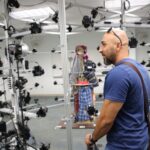
Banner image: Al-Olabi visiting UMBCs Imaging Resource Center photogrammetry 3D and motion capture scanning rig in December 2019. Photo by Azigza Hussen, a Montgomery College digital student intern visiting UMBC with Al-Olabi. All photos by Marlayna Demond unless otherwise noted.
]]>
In September of 2020, UMBC’s Camee Maddox-Wingfield, assistant professor of anthropology, wanted to introduce her Anthropology 211 students to the process of digital storytelling and the tools of...
https://umbc.edu/stories/umbc-montgomery-college-collaboration-expands-with-digital-storytelling-humanities-internship-for-transfer-students/
https://my3.my.umbc.edu/api/v0/pixel/news/119666/guest@my.umbc.edu/e0e4b833713f70748335c22edb63c527/api/pixel
arts-and-culture
cahss
ges
history
llc
mcs
mlli
page1
policy-and-society
saph
shrivercenter
UMBC News & Magazine
https://my3.my.umbc.edu/groups/umbc-news-magazine
https://assets1-my.umbc.edu/system/shared/avatars/groups/000/001/943/24435aa6207c452e7bc15cc74b42c7bb/xsmall.png?1748556657
https://assets1-my.umbc.edu/system/shared/avatars/groups/000/001/943/24435aa6207c452e7bc15cc74b42c7bb/original.png?1748556657
https://assets2-my.umbc.edu/system/shared/avatars/groups/000/001/943/24435aa6207c452e7bc15cc74b42c7bb/xxlarge.png?1748556657
https://assets2-my.umbc.edu/system/shared/avatars/groups/000/001/943/24435aa6207c452e7bc15cc74b42c7bb/xlarge.png?1748556657
https://assets3-my.umbc.edu/system/shared/avatars/groups/000/001/943/24435aa6207c452e7bc15cc74b42c7bb/large.png?1748556657
https://assets1-my.umbc.edu/system/shared/avatars/groups/000/001/943/24435aa6207c452e7bc15cc74b42c7bb/medium.png?1748556657
https://assets2-my.umbc.edu/system/shared/avatars/groups/000/001/943/24435aa6207c452e7bc15cc74b42c7bb/small.png?1748556657
https://assets1-my.umbc.edu/system/shared/avatars/groups/000/001/943/24435aa6207c452e7bc15cc74b42c7bb/xsmall.png?1748556657
https://assets2-my.umbc.edu/system/shared/avatars/groups/000/001/943/24435aa6207c452e7bc15cc74b42c7bb/xxsmall.png?1748556657
UMBC News & Magazine
0
0
false
Mon, 29 Mar 2021 05:25:20 -0400
Academy for Gerontology in Higher Education honors UMBC’s innovative leadership in the field of aging
Dana Bradley, dean of UMBC’s Erickson School of Aging Studies, recently recognized President Freeman Hrabowski with a prominent honor from the nation’s preeminent organization devoted to research, education, and practice in the field of aging.
Bradley is incoming chair of the Academy for Gerontology in Higher Education (AGHE), the educational unit of the Gerontological Society of America (GSA). The AGHE’s Administrative Leadership Honor recognizes twenty international leaders in the field of gerontology. This year there were representatives from countries like the United States, Canada, and Japan.
“The award is about helping an international audience understand the impact that our scientific researchers and educators have in the field of aging,” shares Bradley. Honorees’ outstanding work represents milestones in the history and development of gerontology.
Bradley nominated Hrabowski for the award in collaboration with John Schumacher, associate professor of sociology, anthropology, and public health (SAPH), and Leslie Morgan, professor emerita of SAPH. Schumacher is the graduate program director of the gerontology Ph.D. program. This doctoral program is jointly offered by UMBC and the University of Maryland, Baltimore (UMB). These are complementary to the Erickson School’s bachelor’s and master’s degrees and certificate programs.
 L-to-R: Bradley; Amy Berman, RN, LHD, FAAN; Schumacher; and Nicole Brandt (UMB).
National leadership in aging studies
Bradley’s work in aging research has created avenues and networks for scientists, educators, and students to investigate, advocate, research, and innovate in the fields of aging and longevity. This, in turn, has had a positive impact on housing, health services, community wellbeing, and lifelong learning for older adults.
Bradley is a GSA and AGHE fellow. She has long served as an elected leader within the GSA and Southern Gerontological Society. She was drawn to become dean of UMBC’s Erickson School in 2018 because of its focus “on leading and being on the edge through engaged scholarship with endless possibilities.” Hrabowski, she says, has cultivated and supported the Erickson School’s leadership in the field.
Over the last three years, Bradley has collaborated with Hrabowski, faculty, campus, other universities within the University System of Maryland, and community partners on interdisciplinary initiatives to broaden and diversify UMBC’s research in the field of aging services. Last year she and Hrabowski served on a steering committee to support UMBC joining the Age-Friendly University Global Network.
The “age-friendly” designation is a commitment to innovate advances in gerontology, health research, and community initiatives to support older adults in higher education. The group, led by Dublin City University in Ireland, includes fifty-eight institutions worldwide.
A model for teaching, learning, and research
“Dr. Hrabowski has been at the forefront of creating and promoting a vision of how we think and talk about aging and longevity,” shares Bradley. And the inclusive, forward-looking vision that he and the Erickson School emphasize has had notable impacts, including on the student experience.
At the same time, Hrabowski shares that he sees his AGHE honor as “a reflection of the Erickson School’s innovative approach to teaching, learning, and research.” He shares, “I’m so proud of the work being done at the school. It has had great success preparing alumni who are now leaders in the field of aging.”
Erickson School alumni likeLauren Mortimer ‘19, and Malgorzata Bondyra ‘20, management of aging services, exemplify the type of innovation that UMBC fosters, in their work to reach older adults in creative ways. Mortimer designed a comfort book that provides tools for people with dementia to soothe themselves during periods of confusion and irritability. Bondyra’s internship in senior housing inspired her to create a virtual cooking class for the older members of her Polish community senior center.

Bondyra cooking pierogi for Seven Oaks Senior Center’s online cooking class.
Photo courtesy of Bondyra.
The Erickson School has become a place where students equip themselves with the skills and knowledge to address issues in longevity care. Students are then able to enter the workforce with skills that are inclusive and holistic.
The school is now developing a certificate in inclusion and diversity in aging services. Says Bradley, “Dr. Hrabowski inspires me to continue to envision possibilities for what the future of aging services can look like.”
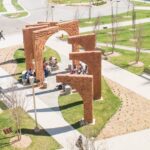
Banner image: UMBC students gather at the sculpture “Forum” by Thomas Sayre in 2016. Photo by Marlayna Demond ’11 for UMBC.
]]>
Dana Bradley, dean of UMBC’s Erickson School of Aging Studies, recently recognized President Freeman Hrabowski with a prominent honor from the nation’s preeminent organization devoted to research,...
https://umbc.edu/stories/academy-for-gerontology-in-higher-education-honors-umbcs-innovative-leadership-in-the-field-of-aging-2/
https://my3.my.umbc.edu/api/v0/pixel/news/119688/guest@my.umbc.edu/13ffda400314ca9ab1048279e1ec9045/api/pixel
cahss
ericksonschool
gerontology
policy-and-society
saph
UMBC News & Magazine
https://my3.my.umbc.edu/groups/umbc-news-magazine
https://assets1-my.umbc.edu/system/shared/avatars/groups/000/001/943/24435aa6207c452e7bc15cc74b42c7bb/xsmall.png?1748556657
https://assets1-my.umbc.edu/system/shared/avatars/groups/000/001/943/24435aa6207c452e7bc15cc74b42c7bb/original.png?1748556657
https://assets2-my.umbc.edu/system/shared/avatars/groups/000/001/943/24435aa6207c452e7bc15cc74b42c7bb/xxlarge.png?1748556657
https://assets2-my.umbc.edu/system/shared/avatars/groups/000/001/943/24435aa6207c452e7bc15cc74b42c7bb/xlarge.png?1748556657
https://assets3-my.umbc.edu/system/shared/avatars/groups/000/001/943/24435aa6207c452e7bc15cc74b42c7bb/large.png?1748556657
https://assets1-my.umbc.edu/system/shared/avatars/groups/000/001/943/24435aa6207c452e7bc15cc74b42c7bb/medium.png?1748556657
https://assets2-my.umbc.edu/system/shared/avatars/groups/000/001/943/24435aa6207c452e7bc15cc74b42c7bb/small.png?1748556657
https://assets1-my.umbc.edu/system/shared/avatars/groups/000/001/943/24435aa6207c452e7bc15cc74b42c7bb/xsmall.png?1748556657
https://assets2-my.umbc.edu/system/shared/avatars/groups/000/001/943/24435aa6207c452e7bc15cc74b42c7bb/xxsmall.png?1748556657
UMBC News & Magazine
0
0
false
Wed, 03 Feb 2021 17:09:12 -0500
NIA grants UMBC’s Laura Girling $750K for research on living with dementia, including the impacts of COVID-19

Laura Girling, director of UMBC’s Center for Aging Studies, breaks down stereotypes of people living with dementia through innovative research. Since 2019, the NIH’s National Institute of Aging (NIA) has awarded her more than $750,000. The funding helped her examine how people with dementia live alone in community settings. This includes research focused on how COVID-19 social distancing guidelines impact this vulnerable population and how to ethically include people living with dementia as research participants.
“Persons with dementia are often portrayed as bedridden,” shares Girling, Ph.D. ’15, gerontology. “When I show clips of people living with dementia leading active lives, there is a realization that people with dementia can do many of the same activities others can.”
In-home assessment
Girling began studying people living alone with dementia two years ago. The project launched under the title Aging at Home Alone with Alzheimer’s and Related Dementias. She began to assess how people experiencing dementia manage their day to day living. Girling noted their interactions with their caregivers and community, and how they navigate and negotiate their physical and social environments.
To gather such detailed information Girling completes in-home neuropsychometric assessments and in-depth in-person interviews. These in-person interviews have helped her observe the cognition and behavior of people with dementia who live alone in community settings in Maryland.
As COVID-19 spread and in-home visits became impossible, the project had to pause. Virtual visits didn’t allow for the same kind of assessment, Girling explains. But the situation did draw her attention to important new research questions.
Living with dementia during a crisis
As social distancing guidelines were implemented, Girling wanted to know how community-dwelling persons with dementia and their informal and formal supports were managing during a pandemic.
She began a new research project, Exploring COVID-19’s Impact on the Care and Well-being of Community Dwelling Persons with Dementia, with supplemental funding from her main NIA grant. This research evaluates the impact of social distancing guidelines on the health and wellbeing of community-dwelling persons with dementia.

Mary Nemec. Photo courtesy of Nemec.
Girling’s local COVID-19 research team includes research assistant Amber Zurn ‘21, sociology; Michael Allison, assistant director of the Adult Intensive Care Unit at Saint Agnes Hospital; and Mary Nemec, geriatric social worker and senior ethnographer. Nemec worked at UMBC’s Center for Aging Studies for more than 20 years and came out of retirement to lend her expertise to this project.
“Working with Dr. Girling I have learned how to code and systematically sort through research narratives,” shares Zurn. She is enrolled in UMBC’s health and public policy program and holds a certificate in social dimensions of health. “This has been an insightful process. It shows the nuances of qualitative data collection, a skillset I will be able to use in future career fields.”
Preliminary findings, from virtual and phone interviews, indicate that community-dwelling persons with dementia are experiencing more periods of isolation. This is due to the disruption in the supports and structures that allow them to successfully engage in daily living activities. And it puts their health and ongoing independence at risk.
Creating inclusive research
Girling notes that there is still so much that is unknown about improving the health and wellbeing of people with dementia in times of crisis and daily living. Expanding who is included in dementia research will help improve our understanding of the early stages of dementia. It will also give us insight on how to support people experiencing it.
One obstacle in pursuing dementia research, she explains, is the frequent exclusion of people with dementia in human subject research broadly. She is working with Nancy Berlinger, a bioethics research scholar at the Hastings Center, as well as Kate de Medeiros from Miami University, to address this issue.
Berlinger researches health care ethics and social ethics in aging societies. Girling has received supplemental NIA funding to research the bioethical implications of including people with dementia as participants in dementia research. Together, they will develop best practices relating to logistical and other challenges of working with this vulnerable population.
“These guidelines will help the research community support inclusion of people with dementia in future social research,” says Girling.
Banner image: Laura Girling. Photo courtesy of Girling.
]]>
Laura Girling, director of UMBC’s Center for Aging Studies, breaks down stereotypes of people living with dementia through innovative research. Since 2019, the NIH’s National Institute of Aging...
https://umbc.edu/stories/nia-grants-umbcs-laura-girling-750k-for-research-on-living-with-dementia-including-the-impacts-of-covid-19/
https://my3.my.umbc.edu/api/v0/pixel/news/119690/guest@my.umbc.edu/82ffd2b3bdf677f72493dedf955a3430/api/pixel
cahss
cahssresearch
covidresearch
page1
policy-and-society
saph
undergradresearch
UMBC News & Magazine
https://my3.my.umbc.edu/groups/umbc-news-magazine
https://assets1-my.umbc.edu/system/shared/avatars/groups/000/001/943/24435aa6207c452e7bc15cc74b42c7bb/xsmall.png?1748556657
https://assets1-my.umbc.edu/system/shared/avatars/groups/000/001/943/24435aa6207c452e7bc15cc74b42c7bb/original.png?1748556657
https://assets2-my.umbc.edu/system/shared/avatars/groups/000/001/943/24435aa6207c452e7bc15cc74b42c7bb/xxlarge.png?1748556657
https://assets2-my.umbc.edu/system/shared/avatars/groups/000/001/943/24435aa6207c452e7bc15cc74b42c7bb/xlarge.png?1748556657
https://assets3-my.umbc.edu/system/shared/avatars/groups/000/001/943/24435aa6207c452e7bc15cc74b42c7bb/large.png?1748556657
https://assets1-my.umbc.edu/system/shared/avatars/groups/000/001/943/24435aa6207c452e7bc15cc74b42c7bb/medium.png?1748556657
https://assets2-my.umbc.edu/system/shared/avatars/groups/000/001/943/24435aa6207c452e7bc15cc74b42c7bb/small.png?1748556657
https://assets1-my.umbc.edu/system/shared/avatars/groups/000/001/943/24435aa6207c452e7bc15cc74b42c7bb/xsmall.png?1748556657
https://assets2-my.umbc.edu/system/shared/avatars/groups/000/001/943/24435aa6207c452e7bc15cc74b42c7bb/xxsmall.png?1748556657
UMBC News & Magazine
0
0
false
Mon, 01 Feb 2021 21:15:21 -0500
Each journey unique: UMBC students complete their degrees after returning mid-pandemic

For some fall 2020 graduates, the day they finish their final class won’t look much different from any other day of working and studying from home—they’re saving their celebration for when they snag their dream job or when it’s safe to throw a party. For others, the occasion will mark the end of a very long road, so some proper pomp is necessary.
Shelissa Kearney ’20, sociology, is one of the latter students. “I can’t go anywhere right now, but I’m going to celebrate,” says Kearney, who last took classes at UMBC in 2014. “I’ll have a nice dinner with my husband and my son. It’s nice to see all of this come to fruition, and I need to acknowledge that.”
To understand Kearney’s commitment to celebration is to know that her first semester at UMBC was in spring 1997. Kearney graduated from high school two years early to jump-start her modeling career, but didn’t want to forgo an education—two of her parents have Ph.D.s, so she knew the value of a degree.

Shelissa Kearney first attended UMBC in 1997. After some educational starts and stops, she graduates in December 2020.
Photo courtesy of Kearney.
“If I was traveling for work, I would schedule my classes to try to make it work with some juggling here and there, because I really wanted to go to school,” Kearney says. But completing her degree with a heavy work and travel schedule took longer than she’d hoped.
Early on in her studies, Kearney says one of her biology professors—in an attempt to encourage her to double down academically—said, “Shelissa, at this pace, you’re going to be 34 before you graduate.” Kearney laughs, “I’ve clearly passed that mark, but I finally did it.”
Creating a path to return
It’s standard practice for UMBC to reach out to Retrievers who have earned at least 60 credits and are in good standing academically, but not currently enrolled in classes, says Yvette Mozie-Ross ’88, vice provost for enrollment management and planning. The goal is to encourage them to return to finish the degrees they are so close to completing. This year, with the rapid move to online learning, students who paused their education have been able to return in larger numbers than ever before.
 The winter 2020 graduation ceremony will be held virtually, but some graduates look forward an eventual in-person option. Photo of 2018 Commencement by Marlayna Demond ’11.
Of the approximately 120 students who returned to complete their degree (through a program termed Finish Line), roughly a fourth of them only needed one more semester to do so, and will graduate in December 2020.
“Our staff have been energized by our engagement in the Finish Line program,” says Ken Baron, assistant vice provost for academic advising and student success. “We love to help students overcome barriers to complete degrees. Many of these students were close to graduating in the past, so enabling them to return now, especially during COVID, is particularly meaningful.”
Substantial online class offerings have been the key to students’ return, says Baron. With remote working arrangements becoming more mainstream in late spring and summer, “many of these students found themselves in the best possible time to return to college since leaving UMBC.”
Finding closure in the last class
Some students, like Kearney, needed nearly a full course load to finalize their degree; others only needed one specific course to get their diploma. Sam Oh ’20, business technology administration, was actually able to participate in the spring 2017 graduation ceremony, but needed to retake one requirement to receive his degree.
After his father had a stroke, Oh wasn’t able to immediately return to UMBC. In his time away, he began pursuing certifications in Excel and as a data analyst, becoming familiar with SQL coding. After he graduates, he’ll apply for jobs as a business or data analyst.
For Oh, retaking Introduction to Management Science online this fall, has been a “do-it-yourself experience, which I love.”
His advice for other students, who might be going through something similar to him in 2017: “Be honest and inform your current professors in advance. Based on my personal experience, most of them will be willing to give you extensions on your assignments or may even exempt whatever is due at the time based on the circumstances.”
And even though Oh has already had the Commencement experience, he says, “I will without doubt have a sense of closure after I finish my final exam next week.”
Overcoming the final obstacle
Steven Heckman is another student only one class shy of graduation. A computer science major, Heckman was held up by the final language credit he was completing abroad in summer 2019. “Unfortunately, I got sick and other things happened that didn’t allow me to earn a grade I could transfer back to UMBC,” says Heckman.
Stymied by this language requirement, Heckman says he wasn’t initially eager to return to finish his degree, but his parents encouraged him to think about how much work he had already completed to get this far in his studies.

Heckman, left, with the UMBC Game Development Club in spring 2019.
Photo courtesy of Heckman.
The process was more straightforward than he expected.“Coming back to school now has let me take the class online, and not have to commute,” says Heckman. Plus, he says, the asynchronous format of Japanese 201—his final class—is better suited for him as someone with ADD to be able to review the material at his own pace.
Heckman sees the increased online offerings, along with the detailed Blackboard calendars and other tools instructors are making use of now, as essential for reaching students who might not excel in the traditional lecture hall environment.
Looking back at his years at UMBC, he cites lecturer Kalman Nanes as particularly forward-thinking in making course resources available online. Nanes, who taught him linear algebra, took the time to record and post his lectures for students. “As someone who loses attention easily, the extra effort Professor Nunes put into his class not only made it easier for me to learn, but he also made me care about a new subject.”
Expanding access
Ken Baron agrees with Heckman’s assessment that online accessibility will benefit the entire campus community. “I believe we have learned considerably, during a remarkably short period,” says Baron, “how powerful online courses are regarding the needs of our student population.”
Whatever life looks like on campus after a vaccine is widely available, he continues, “we believe our Finish Line students are a successful case study, clearly demonstrating the need for a mix of instructional options as we move into the post-COVID era.”
An achievement at any stage
Christopher Lee, a UX content strategist for Facebook, and a Finish Line student completing his final class at UMBC, says the chance to participate in class while still engaged in his professional life has been rewarding.

The perceived stigma of returning to college to finish his degree kept Lee away longer than he planned.
Headshot courtesy of Lee.
“Having been a working professional for seven years at this point, I’ve spent more time in the ‘real world’ than in undergrad,” he says. “I understand how the world works in a deeper, more nuanced way. My experiences inform my perspectives on the topics we discussed in class, and I’m better equipped to articulate them now.”
As someone who began his academic experience more than a decade ago, Lee, a psychology major, says it took him too long to return to finish his degree.
“At first, I believed I would feel like it was a stigma, since it felt like an achievement I should’ve completed years ago,” he shares. “Thankfully, I got over that, and focused on the fact that my journey is uniquely my own, and it likely wouldn’t matter to my professor and classmates. Turns out, it didn’t.”
“A necessary step”
Shelissa Kearney is now a children’s book author. Her book I Wish, published in January 2020, focuses on not comparing yourself to others. As someone who is finishing up a 20-year journey to receive her degree, Kearney wants to celebrate the value of each person’s unique experience.

Kearney poses with a copy of her book
I Wish, published in 2020.
Photo courtesy of Kearney.
“For me, this last semester has been a shining star in the dark sky of this year,” says Kearney. “This has been a really long process, and it’s my personal goal to finish. I’ve done a lot of things in my life, but for me, this was a necessary step to complete.”
In addition to her end-of-school celebration, Kearney whole-heartedly looks forward to attending an in-person graduation ceremony, when it’s safe to hold one. Since she graduated high school early, she has never experienced walking across the stage, shaking hands with professors, and sharing those celebratory moments with family.
“This will be my first one,” says Kearney, “and I definitely plan to be there.”
Banner image: Balloons outside of the UMBC Event Center after the spring 2019 Commencement. Photo by Marlayna Demond ’11.
]]>
For some fall 2020 graduates, the day they finish their final class won’t look much different from any other day of working and studying from home—they’re saving their celebration for when they...
https://umbc.edu/stories/each-journey-unique-umbc-students-complete-their-degrees-after-returning-mid-pandemic/
https://my3.my.umbc.edu/api/v0/pixel/news/119719/guest@my.umbc.edu/8bf14553fcce2b5c5f8304a4836e720a/api/pixel
alumni
businesstech
cahss
classof2020
coeit
community
csee
finish-line
page1
psychology
resilience
saph
UMBC News & Magazine
https://my3.my.umbc.edu/groups/umbc-news-magazine
https://assets1-my.umbc.edu/system/shared/avatars/groups/000/001/943/24435aa6207c452e7bc15cc74b42c7bb/xsmall.png?1748556657
https://assets1-my.umbc.edu/system/shared/avatars/groups/000/001/943/24435aa6207c452e7bc15cc74b42c7bb/original.png?1748556657
https://assets2-my.umbc.edu/system/shared/avatars/groups/000/001/943/24435aa6207c452e7bc15cc74b42c7bb/xxlarge.png?1748556657
https://assets2-my.umbc.edu/system/shared/avatars/groups/000/001/943/24435aa6207c452e7bc15cc74b42c7bb/xlarge.png?1748556657
https://assets3-my.umbc.edu/system/shared/avatars/groups/000/001/943/24435aa6207c452e7bc15cc74b42c7bb/large.png?1748556657
https://assets1-my.umbc.edu/system/shared/avatars/groups/000/001/943/24435aa6207c452e7bc15cc74b42c7bb/medium.png?1748556657
https://assets2-my.umbc.edu/system/shared/avatars/groups/000/001/943/24435aa6207c452e7bc15cc74b42c7bb/small.png?1748556657
https://assets1-my.umbc.edu/system/shared/avatars/groups/000/001/943/24435aa6207c452e7bc15cc74b42c7bb/xsmall.png?1748556657
https://assets2-my.umbc.edu/system/shared/avatars/groups/000/001/943/24435aa6207c452e7bc15cc74b42c7bb/xxsmall.png?1748556657
UMBC News & Magazine
0
0
false
Tue, 15 Dec 2020 21:10:13 -0500
TEDxUMBC brings community together through “Unmasking Uncertainty”
This fall, the student-organized TEDxUMBC gave ten speakers the opportunity to share their stories, experiences, and expertise with the world. Surprisingly, the theme, “Unmasking Uncertainty,” was actually conceived far before COVID-19 surged globally.
Tirzah Khan ‘20, information systems, led the TEDxUMBC team in organizing the event. When the planning committee chose their theme, she says, they did not anticipate the global pandemic, the resurgence in demands for racial justice, and a divisive election. “In these unprecedented circumstances, TEDxUMBC seeks to provide answers and build community,” Khan reflects.
A bumpy road to study in the U.S.
One of the speakers was Sahara Ali, Ph.D.‘26, information systems. She shared her path from Pakistan to the United States for graduate study and explained how it changed the way she approaches challenges.

Sahara Ali. Photo courtesy of Ali.
At age 21, Ali had graduated with her bachelor’s degree in computer science in Pakistan. She was eager to begin pursuing her Ph.D. at UMBC and to marry her U.S.-based fiancé. But it took over a year for Ali to obtain her visa from the U.S. Embassy. The delay changed her marriage plans and she feared it would make international graduate study impossible as well.
Facing a long and uncertain wait, Ali dedicated herself to her work in Pakistan. But just days after deciding to move on, she received her visa. She had to start over with her U.S. plans, rethinking how she would get to Maryland, where she would live, and what the experience would be like.
Ali says this situation taught her about her resilience and using creativity to work through unexpected obstacles. “Uncertainty can lead to something exciting, something innovative,” she shared, even if it means learning something “in an unconventional way.”
Today, Ali is pursuing her Ph.D. in information systems full-time at UMBC. She is working alongside Jianwu Wang, assistant professor of information systems, and collaborating with NASA scientists to study the causal effects of climate change.
Moving theater to a virtual space
Asif Majid ‘13, interdisciplinary studies, shared his passion for community theater and how he has adjusted his work (which previously depended on live, in-person audiences) to fit online formats.

Asif Majid. Photo courtesy of Majid.
Majid works at the intersection of Islam, media, marginality, and politics, and develops plays that focus on stories of racially and religiously marginalized communities. His TEDxUMBC talk took the audience back to the second week of March, when the COVID-19 pandemic first began impacting nearly every aspect of life.
At the time, Majid was in the final stages of producing a new play with a theater in Washington, D.C. Work had been underway since July 2019, and the show was scheduled to debut in front of an audience for the first time at the end of March 2020.
Majid was living with his older family members and became quite concerned that continuing to work in face-to-face settings could put his family members at risk. He decided that while the show needed to go on, it had to move to an online space.
In collaboration with the creative team, Majid figured out how the actors could perform from their own homes, and how attendees could watch the play remotely from around the world. “Over the course of two weeks, we learned about new technologies, rehearsed the tech to performance, and developed a new approach to making theater,” he said.
Ultimately, the performance attracted nearly eight times the number of people who would typically see a show in one night, and people tuned in from 18 countries.
Moving forward in uncertain times
Also featured in the event was Evangeline Kirigua ‘21, political science, who discussed the importance of empowering foreign-born nationals to engage in their communities without being able to vote. Haleemat Adekoya ‘23, political science, talked about being present in the moment, and how to face “what ifs” that can cause fear and uncertainty. Karis Barnett ‘21, chemistry, shared how to identify and address your internal critic to discover self-worth.
Other speakers gave a window into different fields. John Hebeler, a part-time lecturer in information systems, spoke about machine learning, including the impact that it is having on people now and will continue to have in the future. Maryam Elhabashy ‘21, anthropology, discussed the challenges around integrating ethnic studies into school curricula, and how attempts to celebrate diversity may inadvertently lead to otherization. Mike Spano ‘21, psychology, talked about theories related to sleep and dreams, and how to mold your dreams into reality.
Like Ali and Majid, speakers reflected on personal experiences. Rojin Najmabadi ‘21, biological sciences, discussed the decision to invest in herself on her path to success, even when that decision went against how she was raised by her family. Zareen Taj, Ph.D. ‘26, language, literacy, and culture, shared her personal story of empowerment and achievement as an Afghani woman who grew up in refugee camps.
Tess McRae ‘21, individualized studies, concluded the event by encouraging attendees to use the lessons and insights shared by the presenters in their own lives. The event coordinators plan to share the event recording on the TEDx YouTube channel so that the presenters’ messages can continue to be shared.
Banner image: UMBC’s campus in the fall. Photo by Marlayna Demond ’11 for UMBC.
]]>
This fall, the student-organized TEDxUMBC gave ten speakers the opportunity to share their stories, experiences, and expertise with the world. Surprisingly, the theme, “Unmasking Uncertainty,” was...
https://umbc.edu/stories/tedxumbc-brings-community-together-through-unmasking-uncertainty/
https://my3.my.umbc.edu/api/v0/pixel/news/119727/guest@my.umbc.edu/e96771e621322c78b83bb6b40076ca20/api/pixel
cahss
chemistry
coeit
community
inds
is
llc
politicalscience
psychology
saph
UMBC News & Magazine
https://my3.my.umbc.edu/groups/umbc-news-magazine
https://assets1-my.umbc.edu/system/shared/avatars/groups/000/001/943/24435aa6207c452e7bc15cc74b42c7bb/xsmall.png?1748556657
https://assets1-my.umbc.edu/system/shared/avatars/groups/000/001/943/24435aa6207c452e7bc15cc74b42c7bb/original.png?1748556657
https://assets2-my.umbc.edu/system/shared/avatars/groups/000/001/943/24435aa6207c452e7bc15cc74b42c7bb/xxlarge.png?1748556657
https://assets2-my.umbc.edu/system/shared/avatars/groups/000/001/943/24435aa6207c452e7bc15cc74b42c7bb/xlarge.png?1748556657
https://assets3-my.umbc.edu/system/shared/avatars/groups/000/001/943/24435aa6207c452e7bc15cc74b42c7bb/large.png?1748556657
https://assets1-my.umbc.edu/system/shared/avatars/groups/000/001/943/24435aa6207c452e7bc15cc74b42c7bb/medium.png?1748556657
https://assets2-my.umbc.edu/system/shared/avatars/groups/000/001/943/24435aa6207c452e7bc15cc74b42c7bb/small.png?1748556657
https://assets1-my.umbc.edu/system/shared/avatars/groups/000/001/943/24435aa6207c452e7bc15cc74b42c7bb/xsmall.png?1748556657
https://assets2-my.umbc.edu/system/shared/avatars/groups/000/001/943/24435aa6207c452e7bc15cc74b42c7bb/xxsmall.png?1748556657
UMBC News & Magazine
0
0
false
Wed, 09 Dec 2020 16:47:26 -0500


 Poteet on campus in fall 2020.


 Troutman on campus this spring.
 A student takes graduation photos on campus.


