Connecting the Dots

Students come to UMBC for many reasons—to find community, to explore a passion, to make change in the world. Once they figure out the “why” that truly drives their interests, the Retriever community is ready to kick in with the “how” to help make those plans a reality. Part of that looks like the traditional classroom experience with a professor, of course—but just as important are the experiential-learning moments that help many students actively connect the knowledge to careers they hope to pursue after graduation.
UMBC students pursue applied learning in huge numbers. Despite the pandemic, nearly 80 percent of our recent graduates engaged in applied learning, including internships, research, co-ops, and service learning during their time at UMBC. An impressive 91 percent of new grads head directly to a job, advanced degree, or both within six months of graduating—and of those, more than half interned or worked for their employer as a student.
“When it comes to impact, there is nothing more valuable than engaging in applied-learning opportunities to help clarify one’s career direction, build professional skills, and increase one’s professional network,” shares Susan Hindle, the Career Center’s assistant director of internships and employment.
For students pursuing experiential learning through internships, campus jobs, research, and community engagement, it’s not just about learning how to do the thing they want to do. It’s about connecting the work to the passions that brought them to UMBC in the first place. These students and alumni working in their chosen fields tell the whole picture—what hands-on learning looks like when it comes full circle.
Essential Connections
The desire to help people comes from deep within. But knowing how to do it successfully on a large scale—and understanding the systems and politics that can make the job more or less challenging—takes more than just compassion.
On the morning of the monthly food delivery from the Maryland Food Bank, the brigade of students who keep the Retriever Essentials food pantry running see all sides of the work. Together, they unload and shelve staples like rice, pasta, and huge crates of broccoli for the more than 2,100 visits to the pantry so far this year. At the same time, they work with community members to understand what might make life better—halal meats, for one; more campus job opportunities, another biggie—and then put their heads together to try to make those changes happen.
 Nyla Howell (left) and Lydia Sannella and Ariel Barbosa (L-R) sort canned goods for Retriever Essentials. Photos by Marlayna Demond ’11/UMBC, design by Jim Lord ’99.
For Ariel Barbosa, a grad student in UMBC’s community leadership program, working in this space is part of a journey that started with her trying to understand her Brazilian father’s immigrant experience better. As she works with Retriever Essentials, she’s learning about the complexities of these experiences in a way that will help her as she carves out a career in service. “There are so many signs showing me that I’m supposed to be right here, right now. I feel like I’m preparing,” she says. “Right now, I feel like I’m in a confidence-building, skill-building phase where I’m just trying to pick up as many skills as I can to be able to create what I feel I need to create at the right time.”
As a student, Matthew Dolamore ’08, modern languages and linguistics, caught a first glimpse of what would later become a service-based career when he tutored Spanish-speaking clients for an immigration services office in Baltimore. After graduating, he went on to serve with AmeriCorps and the Peace Corps and earned a master’s degree in community planning before pulling all of those skills together into a full-circle career in Baltimore.
Today, Dolamore is program director for the Esperanza Center, a project of Catholic Charities that assists more than 3,000 individuals each year with walk-in immigration services, including healthcare, legal assistance, and education tools. Dolamore serves as a connector between people and solutions, helping people get what they need when they need it and looking for ways to help improve the system.
 Matthew Dolamore ’08 at the Esperanza Center. Photos by Marlayna Demond ’11/UMBC, design by Jim Lord ’99.
“Among our managers we have a nurse practitioner, a managing attorney, a licensed social worker, an individual who got their master’s in teaching English from UMBC, and a woman who oversees our one-touch client services desk who’s a former immigrant and just has a really dynamic background. And just those five people alone is symbolic of what I love about my job,” says Dolamore.
“I’m not a medical professional. I’m not a legal professional. I’m not a social worker. I’m something myself of a generalist nonprofit manager at this stage in my career, but I get the opportunity every day to come in and out of these really focused professional engagements and try to help all five of them think of each other as teammates, and that’s the part of my job I really enjoy.”
Lydia Sannella, a Peaceworker and grad student in applied sociology at UMBC, also enjoys the organizational aspect of her job with Retriever Essentials. As she looks ahead to her post-academic career, she’s already thinking about how she can continue to marry her values with her career—knowing that it won’t likely be quite the same as what she’s experiencing at UMBC.
“I find that, whenever we want to do something, there are supportive, knowledgeable experts who want to help,” she says. “There’s just hoards of students who want to be involved and engaged and do any variety of work, from physical lifting to technical projects. And it’s just this canvas for creativity and possibility. It’s very reciprocal. What I’m able to contribute ends up being more significant and then what I get ends up being more significant.”
— Jenny O’Grady
Becoming part of the solution
Students come to higher education for a variety of reasons, and among them, many have the goal of learning to create new things—from innovative water-quality solutions to entire companies. For many students, in fact, learning while doing is an integral part of going to college.
If you ask Premal S. Shah ’98, biochemistry and molecular biology, however, he’ll tell you that there’s a world of difference between learning while doing and learning from doing.
That’s not to say that Shah, who earned a Ph.D. from the California Institute of Technology on his way to founding and leading a string of successful healthcare-related companies, doesn’t believe in academics. But from his vantage point as CEO at MyOme, a genomics firm based in northern California, classroom-based learning is only a part of the puzzle.
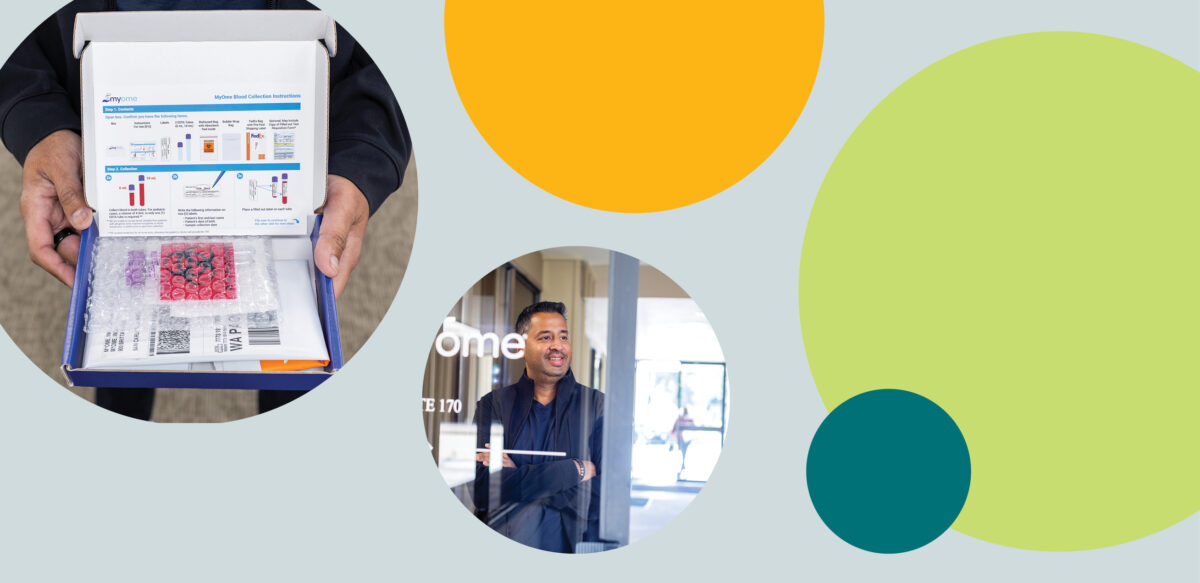 Premel S. Shah ’98 interned at National Institutes of Health before founding a genomics firm. Photos by Barack Shrama, design by Jim Lord ’99.
Shah said he’s always had a practical streak, but he found out how much experiential learning can boost classroom learning thanks to a hands-on internship and fellowship at the National Institutes of Health, beginning while he was a student at UMBC.
“When I got to grad school, there were a lot of people who hadn’t really worked in a lab or done stuff,” he said. “I had a huge head start, just because I was able to pick up a pipette and actually use it. I knew what a DNA extraction protocol was. I knew how to use certain machinery.”
It was a vivid object lesson—one Shah has carried forward into his career. “When you start building companies, there’s always that challenge…of analysis paralysis, right?” he said. “There’s a notion of, ‘We could do this or that. Let’s read and learn more or get additional inputs in search of the perfect answer.’ Or we can actually go build something that will benefit people and iterate even faster as we learn more to make it much better.”
That’s the big difference between studying science and, for example, running science-based companies, Shah says: “The hypotheticals are great. The theories are great. But you’ve got to get [things] done.”
Getting things done is Matt Stromberg’s perennial modus operandi. Being a Ph.D. student studying environmental engineering means he is very much both an environmental scientist—someone who studies environmental problems—and an engineer: someone who works to solve those problems. “I always knew I was a passionate environmentalist, but I also knew I liked to build things,” he said.
In fact, Stromberg, who graduated in 2019 from the University of Virginia with bachelor’s degrees in both environmental engineering and environmental science, is a literal embodiment of learning while doing. Working as both a graduate research assistant and a researcher in the jointly run University System of Maryland Institute for Marine and Environmental Technology (IMET), he sometimes finds himself simultaneously running experiments and keeping the experiments running.
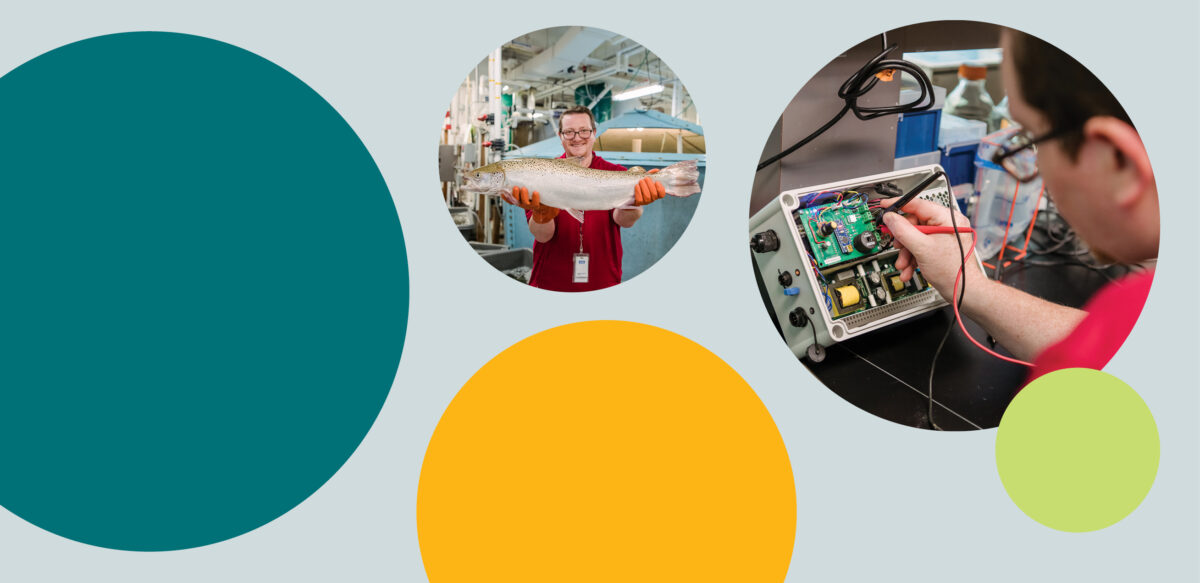 Matt Stromberg is studying aquaculture at the University System of Maryland Institute for Marine and Environmental Technology. Photos by Marlayna Demond ’11/UMBC, design by Jim Lord ’99.
A few months ago, Stromberg said, the night before an experiment was scheduled to start, a pump failed in IMET’s Aquaculture Research Center, a 1,800-square-meter facility with hundreds of fish tanks.
“It was a large pump, and it needed to be replaced—and it was eight o’clock at night,” Stromberg said. “I had already worked 12 hours that day, [but] I realized that there’s no way this experiment is going to run if I don’t have a pump tomorrow. So…I got the wrenches and I got all the fittings I needed,” and found a way to fix it.
Stromberg’s ability to save that experiment is part and parcel of his approach. One of his main research projects is unclogging a major bottleneck that prevents more farm-raised fish from getting to market: purging them of an unsavory flavor that’s sometimes characteristic of fish that aren’t caught in the wild. As Stromberg put it, “You’re not going to sell the fish if it tastes like dirt.”
That’s a problem not only for aquaculture companies—which have to use lots of water, time, money, and energy to purge the fish of this taste—but also for the planet. That’s because the only alternative to aquaculture is fishing in the wild, which can destroy ecosystems but is still cheaper than aquaculture, due to the expensive purging process.
He’s working with advanced oxidative processes and a technology of his own that would effectively create a shortcut, making it more cost-effective to farm fish and thus helping to protect wild habitat in the process. And Stromberg aims to eventually put his Ph.D. to work in a similarly practical way: His goal is to create a company that performs chemical analysis and remediation of water contaminants.
“I’ve learned a lot from my time here,” he says. “Especially not to over-engineer things!”
— Scott Cech
Community-centered art
Visual art is all around us—in flyers, television commercials, and even clothes. And while many of us may never know the artists creating work behind the scenes, their lives and experiences certainly do shape their work.
For instance, earlier this year, Jennifer White-Johnson ’08, visual arts, designed a collection for Target’s national Latino Heritage Month campaign, including a tumbler with stacked text reading sonando vivamente vividly dreaming and a T-shirt proudly proclaiming piel canela pelo rizado (brown/cinnamon skin curly hair). As a disabled, neurodiverse, Afro-Latina designer from Baltimore, White-Johnson sees her inclusion as an opportunity to highlight and provide a voice to communities that often aren’t heard or represented.
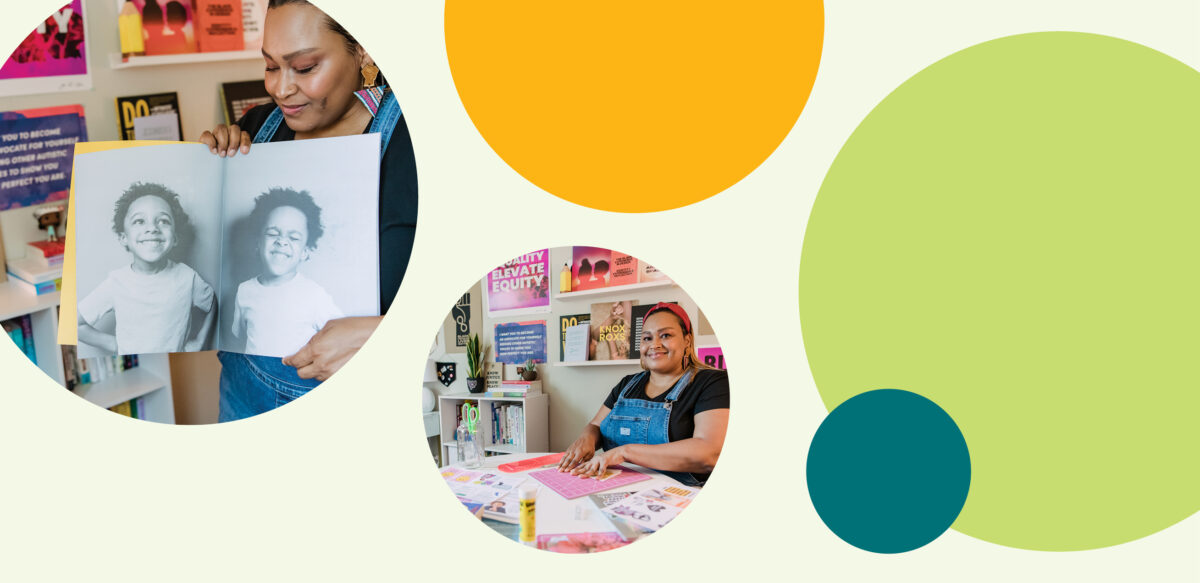 Former Student Events Board member Jennifer White-Johnson ’08 now has designs at Target. Photos by Marlayna Demond ’11/UMBC, design by Jim Lord ’99.
“I am really honored to have been chosen and included in this year’s Target Latino Heritage Month collection and campaign,” says White-Johnson. “Using art and design to celebrate and elevate my cultural stories, the strength, and legacy of my ancestors, felt like something that was meant to be!”
Living with undiagnosed ADHD as a student, White-Johnson often felt like her intensity, excitement, and point of view were unwelcome or just too much. That changed when she transferred to UMBC, where she immediately felt at home. In particular, her time as director of promotions for the Student Events Board [(seb)] gave her her first taste of how graphic design could marry with communit-ycentric work.
Working closely with the Office of Student Life, White-Johnson and other members of (seb) volunteered during an alternative spring-break trip to post-Hurricane Katrina New Orleans. White-Johnson also designed the T-shirts.
“This was in 2007, so we could help offer some sort of relief from Hurricane Katrina,” says White-Johnson. “It was life-changing because I was able to surround myself with other like-minded scholars that were serious about academic life but who also understood that school is about self-discovery.”
Enter Patch Hatley, a sophomore visual arts major with a concentration in animation. Fresh from a session learning how to create stop-motion animation puppets from paper, she is excited to test out some of what she’s learned on the job at commonvision, the student-driven print and design center in The Commons. On any given day, one might find her working on anything from animating cute countdowns for student activities to designing stickers.
“I’m always constantly learning in an environment like commonvision,” she says. “Each new skill helps transition to the next project, and each project creates new and exciting opportunities. You’re always surrounded by a team who are all community-driven, so I always feel like I can ask for help or constructive criticism. commonvision supports, drives, and motivates me to keep reaching for the stars and will always be an important part of how I’ve grown—not just as an artist but as a team player.”
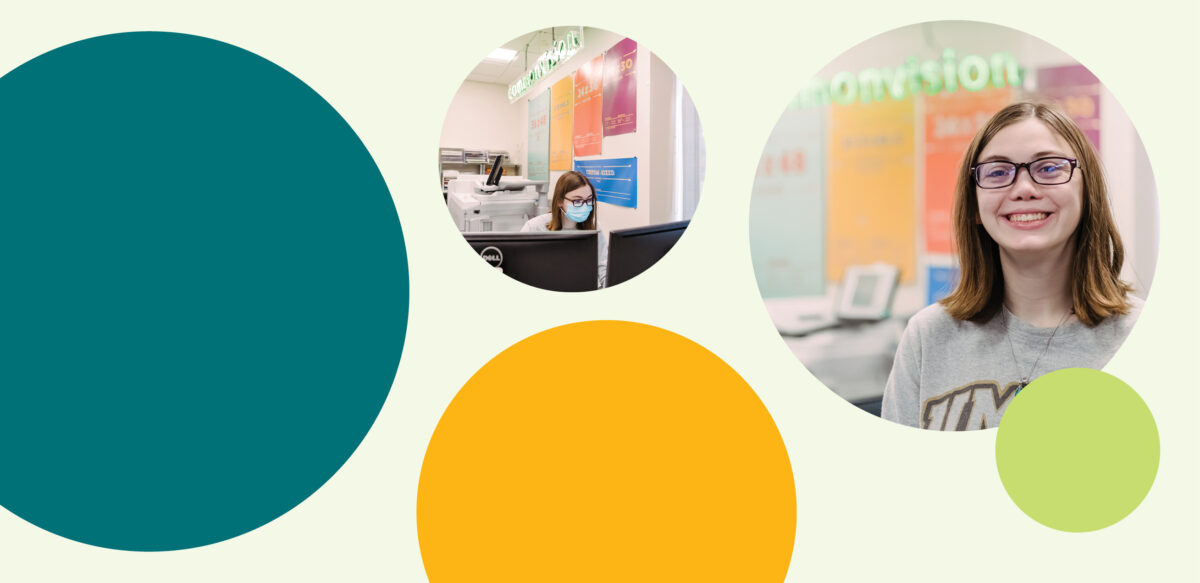 Patch Hatley learns while working on animations at commonvision. Photos by Marlayna Demond ’11/UMBC, design by Jim Lord ’99.
Hatley finds work at commonvision particularly helpful because it stretches her creative muscles and opens up her craft to new programs, tools, and mediums, and also because other creators surround her. After spending a decade in animation and illustration before becoming a Retriever, Hatley loves the opportunity to expand her craft in a place that has fostered the foundation for budding designers for years—and getting to bring her personal perspective into work for clients.
“At the end of the day, you’re drawing for yourself and for the people around you whether you realize it implicitly or not,” says Hatley. At the core of both artists’ practices is community. Both White-Johnson and Hatley recognize that their art doesn’t live in a vacuum but exists as a letter of inspiration, solidarity, and encouragement to their respective communities. Both artists, years apart in their practice, found similar communities to nurture and invest in them.
“Being given the space to bring visibility to themes of cultural intersectionality, specifically the parts of our natural beauty that aren’t always celebrated, our caramel brown, cinnamon skin, and our natural curls,” says White-Johnson. “I hope my work can culturally inspire others to center what they want to see more of.”
— Sharéa Harris
Taking experiential learning to the next level
Developing high-level skills in a highly technical field like computer science is difficult enough. But the ability to both master and successfully teach those skills to others takes the challenge to a whole new level.
Fortunately, Amina Mahmood and Zach Margulies thrive at that level. With their dedication to passing along computer-science knowledge, these Retrievers amply demonstrate that doing while teaching and learning while doing are just different parts of the same equation.
As Mahmood ’21, computer science, tells it, she started learning while doing quite literally. Just weeks into her first year at UMBC, Mahmood found herself working 20 hours a week as a junior malware analyst at Huntress, a cybersecurity firm that was then still in the startup phase at the bwtech@UMBC Research and Technology Park.
“I didn’t really have any experience, but I was pretty ambitious, so I learned everything on the job,” she said.
Mahmood, part of UMBC’s Cyber Scholars Program, quickly learned how to run different types of malware on a virtual machine, dissect the particulars of each, and create mitigation reports. The nascent company’s culture also helped boost her confidence. If she ran into a problem, she said, the people she worked with were glad to bring her up to speed.
 Amina Mahmood ’21 at the Johns Hopkins University Applied Physics Lab. Photos courtesy of Johns Hopkins Applied Physics Laboratory, design by Jim Lord ’99.
“It was just like, ‘Oh, you don’t know this—let me teach it to you.’ And then I picked up on it and then I was like, ‘OK—I can do this,’” Mahmood said. Mahmood was quick to apply such on-the-job learning to her academics, even persuading an academic advisor to allow her to add her to his overenrolled, graduate-level software reverse-engineering course at the same time she was enrolled in an undergraduate prerequisite class.
Mahmood not only aced the graduate-level class, she also started using what she had learned to complete the experiential-learning cycle at her new part-time job at Parsons Corp., a technology-focused defense, intelligence, security, and infrastructure engineering firm.
“One of my mentors at Parsons—he really supported me, and he said, ‘You know a lot about reverse engineering. Why don’t you just make a course and teach coworkers?’” That’s exactly what Mahmood did— and now does for new summer interns as a full-time reverse engineer at the Johns Hopkins University Applied Physics Lab.
Recently she found herself completing the circle, coming back to UMBC for the same kind of career fair where she’d found her first job as a first-year student. “But [this time] I didn’t go as a student,” she noted. “I went as an employer.”
Margulies ’14, biological sciences, is completing his own trajectory: Nearly a decade after earning his first bachelor’s degree, he has returned to UMBC to earn a bachelor’s in computer science and a master’s in education, with the goal of teaching computer science to Baltimore high school students when he graduates in 2024.
Margulies started his career pivot before diving back into academics immersing himself in on-the-job data science and programming—including a Maryland Institute for Innovative Computing internship at the Maryland Department of Health after starting in the computer science program. Because of this, he’s able to pursue his studies with a greater sense of perspective.
“I feel like it inspires confidence and it builds your self-esteem, taking what you’ve learned in the class and not even a semester later applying it in a real-world setting,” he said.
Margulies noted that, as a teacher, he’ll also be able to fully address high schoolers’ perennial classroom question: ‘When am I ever going to use this in real life?’
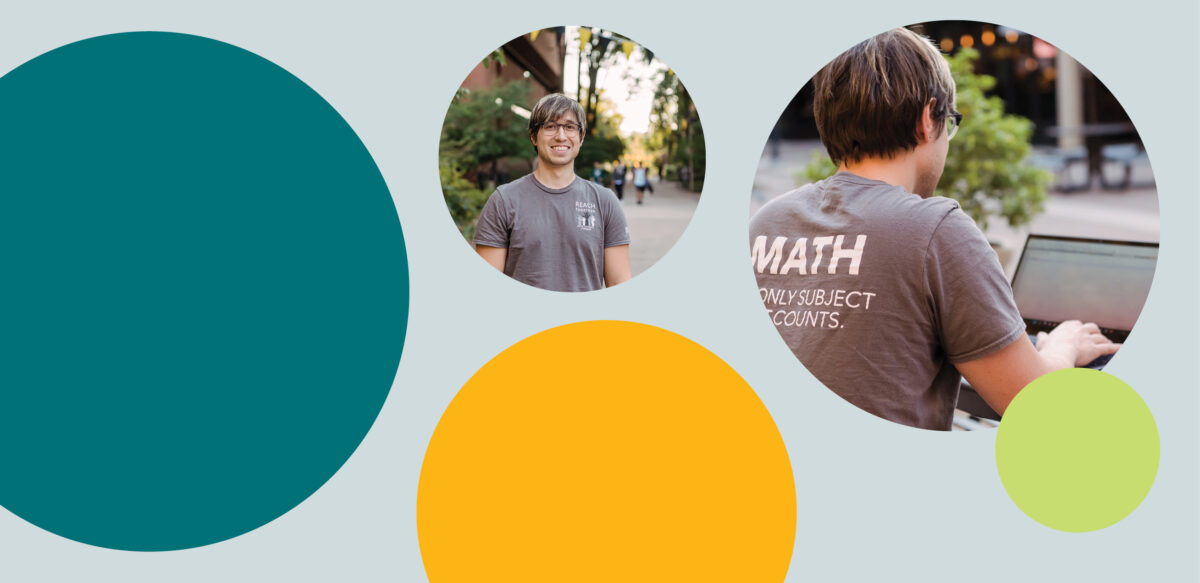 Zach Margulies took part in a Maryland Institute for Innovative Computing internship with the Maryland Department of Health. Photos by Marlayna Demond ’11/UMBC, design by Jim Lord ’99.
“It’s really important for teachers to know what the practical application of [schoolwork] is going to be and what working in a computer science job will look like,” he said.
A case in point, Margulies said, was the work he did as part of a Maryland Department of Health internship last summer, reviewing and finding improvements for data collection, including the creation of a data dashboard.
“Last semester, I took Computer Science 201, and we learned the programming language Python, and I really wanted to start applying that language at the internship,” he said. Because he’d had both practical experience and formal training, Margulies said, he was able to see that he’d have to adapt what he’d learned to suit the task at hand.
“[I had] to figure out a way that I could take Python and apply it to developing the database because that’s not something we necessarily learned in the class,” he said. “I had a lot of fun taking the thing that I learned academically and not just applying it, but also taking it to the next level.”
— Scott Cech
]]>
Students come to UMBC for many reasons—to find community, to explore a passion, to make change in the world. Once they figure out the “why” that truly drives their interests, the Retriever...
https://umbc.edu/stories/connecting-the-dots/
https://my3.my.umbc.edu/api/v0/pixel/news/129482/guest@my.umbc.edu/38f4c1bff401ad3aed0a5d74a732610b/api/pixel
applied-sociology
biochemistry-and-molecular-biology
biological-sciences
career-center
commonvision
community-leadership
computer-science
discovery
environmental-engineering
fall-2022
feature
magazine
mll
peaceworker
retriever-essentials
visual-arts
UMBC News & Magazine
https://my3.my.umbc.edu/groups/umbc-news-magazine
https://assets1-my.umbc.edu/system/shared/avatars/groups/000/001/943/24435aa6207c452e7bc15cc74b42c7bb/xsmall.png?1748556657
https://assets1-my.umbc.edu/system/shared/avatars/groups/000/001/943/24435aa6207c452e7bc15cc74b42c7bb/original.png?1748556657
https://assets2-my.umbc.edu/system/shared/avatars/groups/000/001/943/24435aa6207c452e7bc15cc74b42c7bb/xxlarge.png?1748556657
https://assets2-my.umbc.edu/system/shared/avatars/groups/000/001/943/24435aa6207c452e7bc15cc74b42c7bb/xlarge.png?1748556657
https://assets3-my.umbc.edu/system/shared/avatars/groups/000/001/943/24435aa6207c452e7bc15cc74b42c7bb/large.png?1748556657
https://assets1-my.umbc.edu/system/shared/avatars/groups/000/001/943/24435aa6207c452e7bc15cc74b42c7bb/medium.png?1748556657
https://assets2-my.umbc.edu/system/shared/avatars/groups/000/001/943/24435aa6207c452e7bc15cc74b42c7bb/small.png?1748556657
https://assets1-my.umbc.edu/system/shared/avatars/groups/000/001/943/24435aa6207c452e7bc15cc74b42c7bb/xsmall.png?1748556657
https://assets2-my.umbc.edu/system/shared/avatars/groups/000/001/943/24435aa6207c452e7bc15cc74b42c7bb/xxsmall.png?1748556657
UMBC News & Magazine
0
0
false
Wed, 30 Nov 2022 15:17:19 -0500
Beyond Midlife: Kathy Marmor’s new artwork explores memory and embodiment for women in midlife
Western culture remains terrified of aging, particularly for women, but that fear doesn’t stop any of us from actually aging. Kathy Marmor, associate professor of visual arts at UMBC, delves into the heart of these anxieties with a pair of innovative collaborative works, collectively titled Beyond Midlife: What’s Lost, What’s Gained, on view at the Center for Art, Design and Visual Culture (CADVC) on the UMBC campus through March 12.
Marmor’s new work appears as part of the CADVC’s Spectrum: 2022 Visual Arts Faculty exhibition, which also features works by UMBC visual arts faculty Lisa Moren and Lynn Cazabon.
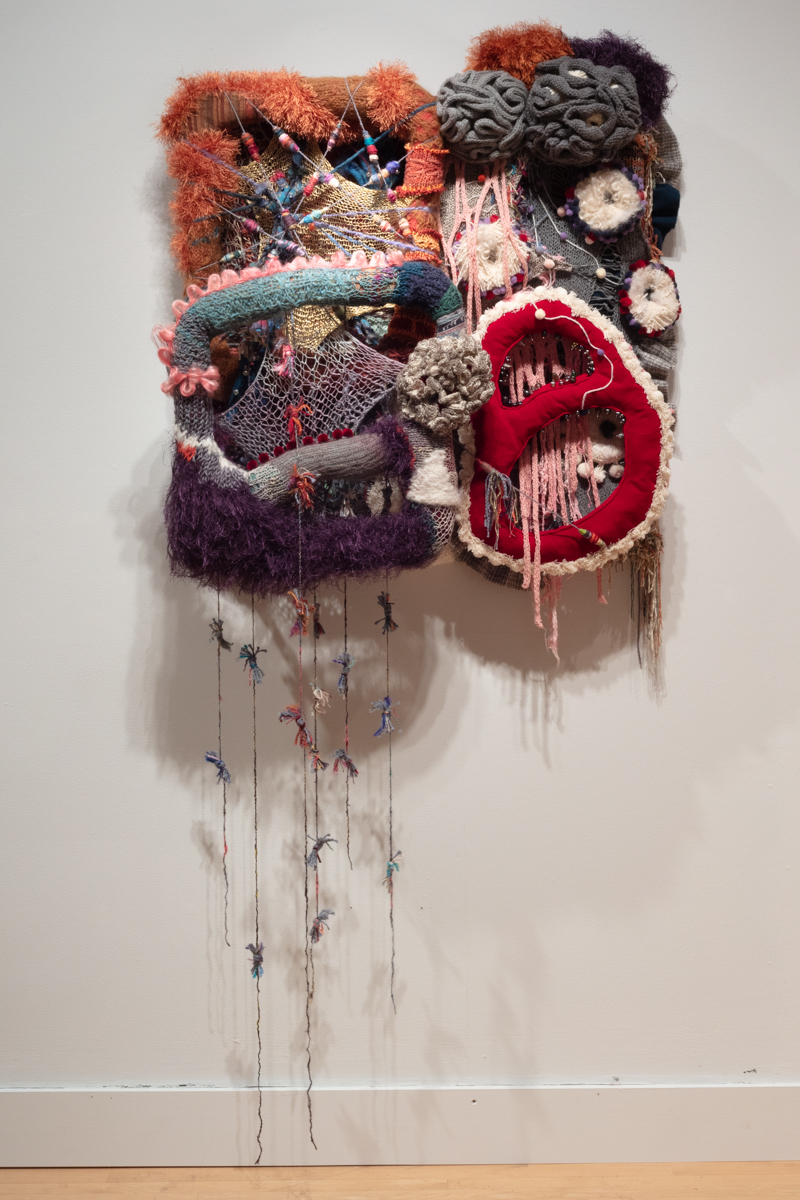
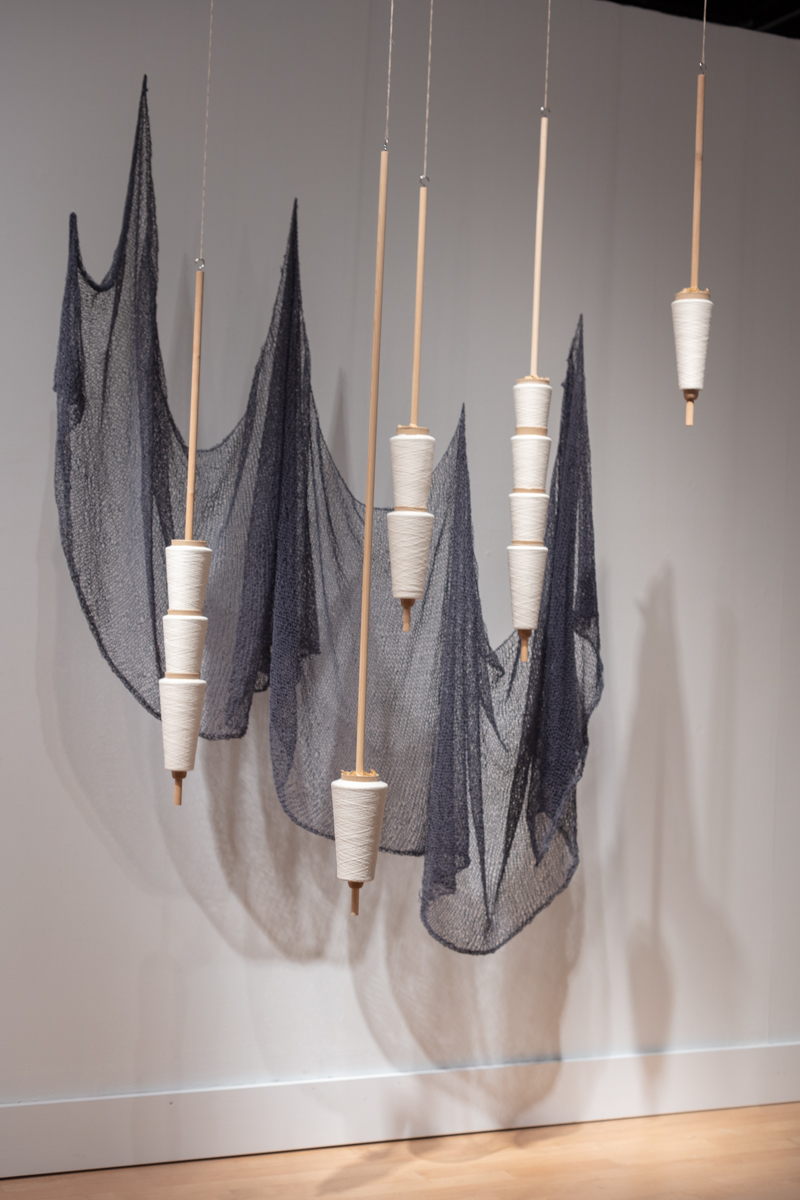
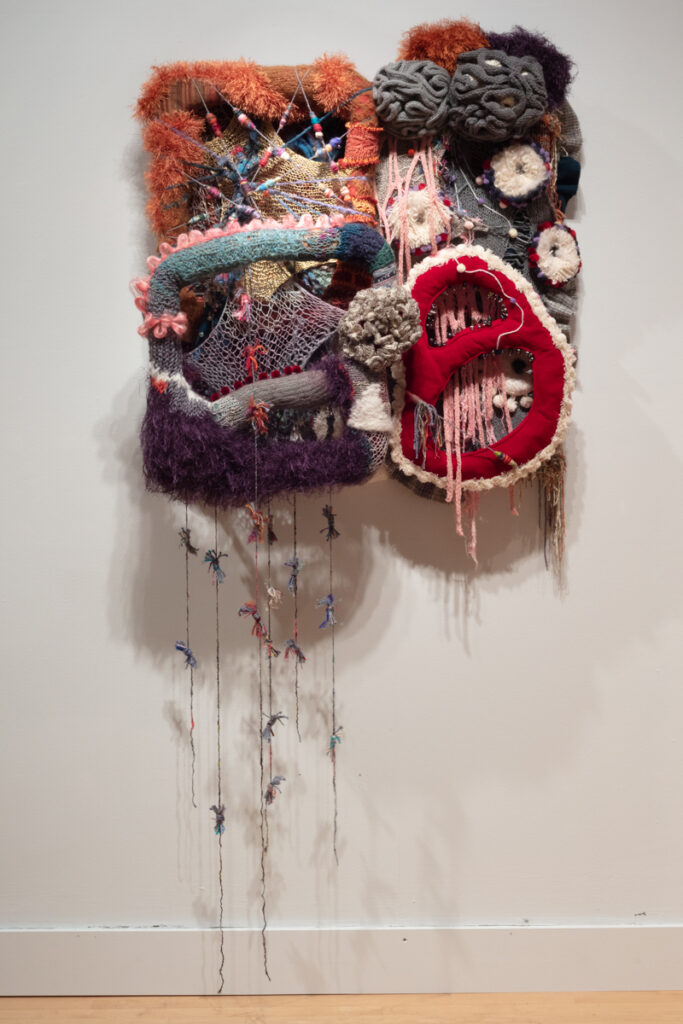 Unspooling Cognition. Photo by Heather Braxton.
While Marmor typically works alone, in recent years she’s begun a series of collaborations. “I thought it would be interesting to work with women from UMBC. [Penny Rheingans] and I had talked about working together when I first came to UMBC, but timelines didn’t work out.” Marmor said. “I knew Robin [Farabaugh] as a writer and I really wanted to work with a writer because I often use text in my work. The timing was good for them both.”
Unspooling is a textile-based installation created with Rheingans—a former professor of computer science and director of the Center for Women in Technology at UMBC who is now on the faculty at the University of Maine.
“I’ve worked for a long time with technology, using computers to mediate the environment, using sensors and interaction with people’s presence,” said Marmor. “This new work is a pause or break from technology. We wanted people to come in and get a different sense of the body. We see that there’s a decay, or a sense of unspooling, and unwrapping of daily life.”
Rheingans, an accomplished knitter, added new dimensions to the work.
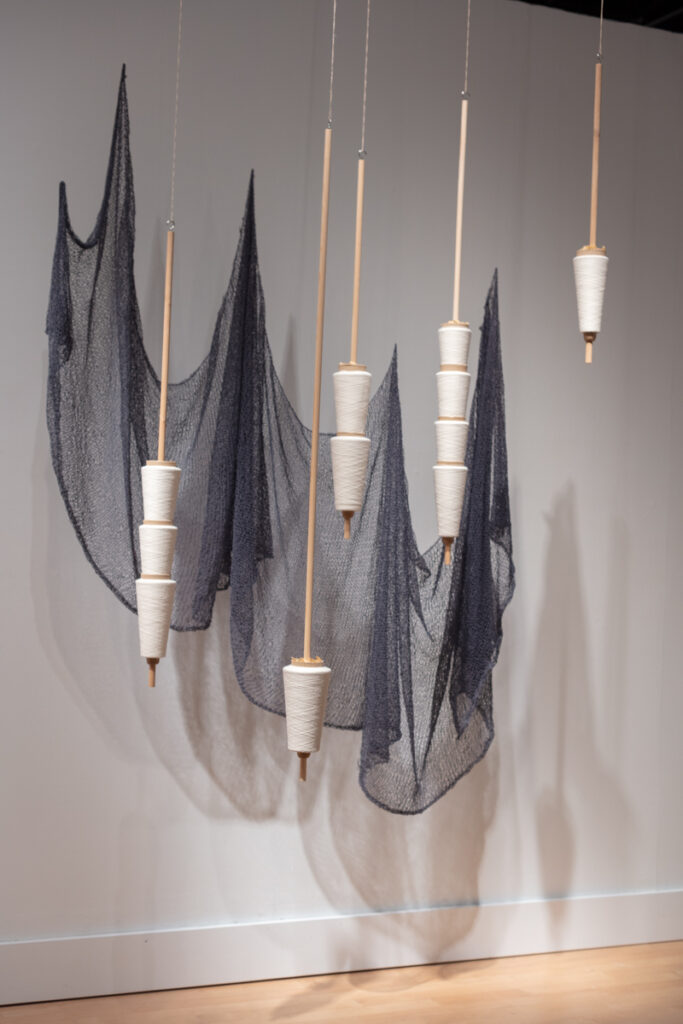 Unspooling Self. Photo by Heather Braxton.
“She’s a fabulous knitter, and a dedicated collector,” said Marmor. “She gave me all these materials to work with. I fell in love with yarn. It’s a really accessible material, fun to work with and it hinged on craft. My work has always been tactile and sculptural, but this was change for me.”
Comprising four vivid mixed-media sculptures, the piece charts vulnerabilities of aging women, including cognition, reproduction, appearance, self and autonomy. Echoing Suzanne Valadon’s “The Blue Room,” which depicts a middle-aged woman reclining on a day bed, together the pieces form an abstract portrait of a complete body.
“The Blue Room’ is one of my favorite paintings by a woman about being a woman, present and in her body,” Marmor says.
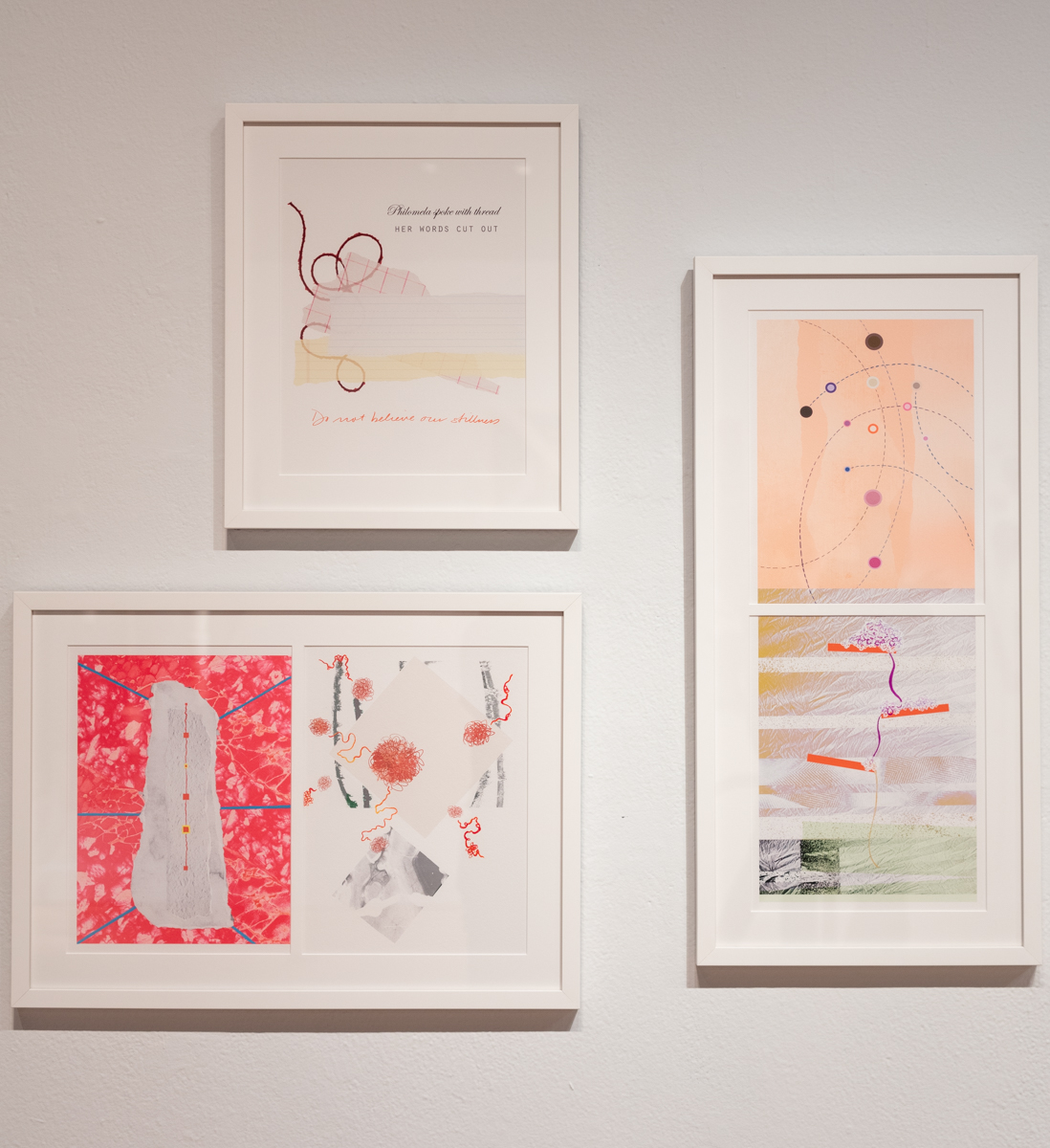
The second piece, Philomela’s Thread: a Commonplace book, was created with Robin Farabaugh, an essayist and former senior lecturer in UMBC’s English department. Consisting of ten prints and a single channel video, the pieces draw on the classic Greek tragedy of Philomela, a princess who was violently silenced.
“I really wanted to work with a writer because I often use text in my work,” said Marmor. “[Farabaugh] had never worked with a visual artist before, so it was an adventure.”
Historically, commonplace books were kept by men as personal compendiums of knowledge. Notable men like John Locke and Thomas Jefferson were famous for their commonplace books as reference works and historical documents. Women, Marmor notes, also kept commonplace books, but they tended to serve a different purpose.
“Women were taught to read, but not allowed to go on with education, so one way in which women taught themselves and had a sense of themselves is by keeping commonplace books,” said Marmor. “They’d put many things in them, recipes, letters, scriptures, writings and poems they would come across, these miscellanies of their lives. That’s how women understood themselves.”
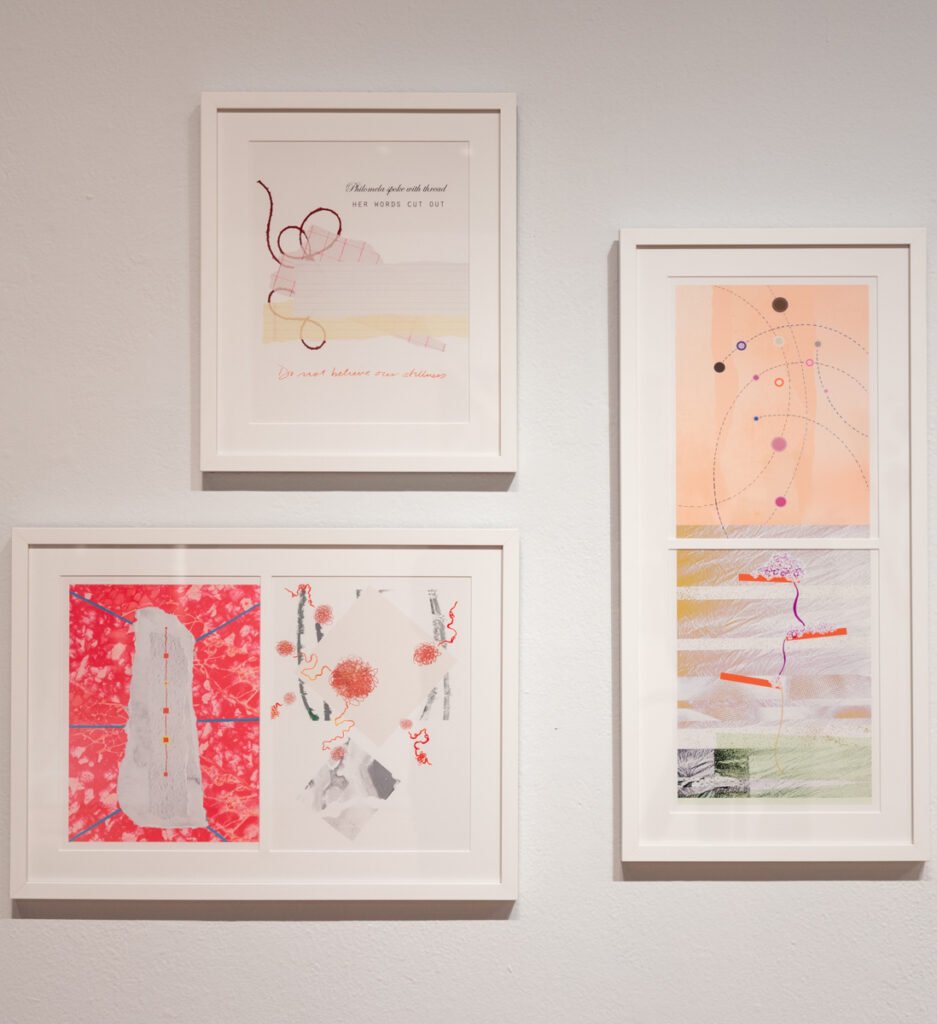 A close up of three prints from Philomela’s Thread: a Commonplace Book. Photo by Heather Braxton.
The ten prints in Philomela’s Thread combine abstract images that simultaneously recall Hilma af Klint and Alexander Calder, peppered with Farabaugh’s text.
“Robin wrote these beautiful words which we distilled so that each one is about paper, thread and voice through the centuries,” said Marmor. “I really wanted to make it clear that the way in which women have recorded the stories of their lives has changed over time. We depicted the digital stylus to ask how will the life experiences of women be preserved now in this contemporary digital age?”
The four-minute video loop that stands as the centerpiece of Philomela’s Thread takes a more linear narrative form, centering on a story of love and loss.
“It’s moving through the story of a woman’s desire for her sexuality, getting older, and then the loss of her family. I think it really captures our understanding of the world, like a memory, or an inner space,” said Marmor.
Marmor’s work remains on display through March 12, with a closing reception 5 p.m. to 7 p.m. March 10. For those who are unable to visit the gallery in person, the entire Spectrum 2022 exhibition can be viewed via the CADVC website.
Header image: Philomela’s Thread: a Commonplace Book — 10 gouache and giclee prints that depict a multiplicity of threads that make up a woman’s life and a single channel video that voices to her inner thoughts. Photo by Heather Braxton.
]]>
Western culture remains terrified of aging, particularly for women, but that fear doesn’t stop any of us from actually aging. Kathy Marmor, associate professor of visual arts at UMBC, delves into...
https://umbc.edu/stories/beyond-midlife-kathy-marmors-new-artwork-explores-memory-and-embodiment-for-women-in-midlife/
https://my3.my.umbc.edu/api/v0/pixel/news/119470/guest@my.umbc.edu/dd62d63a45edc29766ac6dc6e90c975f/api/pixel
cadvc
computer-science
discovery
english
magazine
visual-arts
UMBC News & Magazine
https://my3.my.umbc.edu/groups/umbc-news-magazine
https://assets1-my.umbc.edu/system/shared/avatars/groups/000/001/943/24435aa6207c452e7bc15cc74b42c7bb/xsmall.png?1748556657
https://assets1-my.umbc.edu/system/shared/avatars/groups/000/001/943/24435aa6207c452e7bc15cc74b42c7bb/original.png?1748556657
https://assets2-my.umbc.edu/system/shared/avatars/groups/000/001/943/24435aa6207c452e7bc15cc74b42c7bb/xxlarge.png?1748556657
https://assets2-my.umbc.edu/system/shared/avatars/groups/000/001/943/24435aa6207c452e7bc15cc74b42c7bb/xlarge.png?1748556657
https://assets3-my.umbc.edu/system/shared/avatars/groups/000/001/943/24435aa6207c452e7bc15cc74b42c7bb/large.png?1748556657
https://assets1-my.umbc.edu/system/shared/avatars/groups/000/001/943/24435aa6207c452e7bc15cc74b42c7bb/medium.png?1748556657
https://assets2-my.umbc.edu/system/shared/avatars/groups/000/001/943/24435aa6207c452e7bc15cc74b42c7bb/small.png?1748556657
https://assets1-my.umbc.edu/system/shared/avatars/groups/000/001/943/24435aa6207c452e7bc15cc74b42c7bb/xsmall.png?1748556657
https://assets2-my.umbc.edu/system/shared/avatars/groups/000/001/943/24435aa6207c452e7bc15cc74b42c7bb/xxsmall.png?1748556657
UMBC News & Magazine
0
0
false
Thu, 03 Mar 2022 18:01:17 -0500
Jules Rosskam’s Desire Lines awarded a 2021 Creative Capital prize

Filmmaker Jules Rosskam, assistant professor in the Department of Visual Arts at UMBC, was awarded a prestigious Creative Capital Award in 2021 to support production of his new feature film, Desire Lines.
One of the most sought-after prizes in the art world, each year Creative Capital distributes awards to artists to fuel significant projects. Creative Capital recipients are a who’s-who of the art world, including artists like Wu Tsang, Cassils, Barbara Hammer, and Meredith Monk receiving up to $50,000 to fund new works. In 2021, 42 artists and 35 projects spanning all disciplines were awarded Creative Capital awards.
Building on Rosskam’s body of work devoted to examining liminal spaces—the margins inhabited by trans people and artists blurring boundaries in genre and method—Desire Lines explores the ways that trans men emerge into gay sexual attractions during transition, and the ways that these narratives have historically been suppressed.
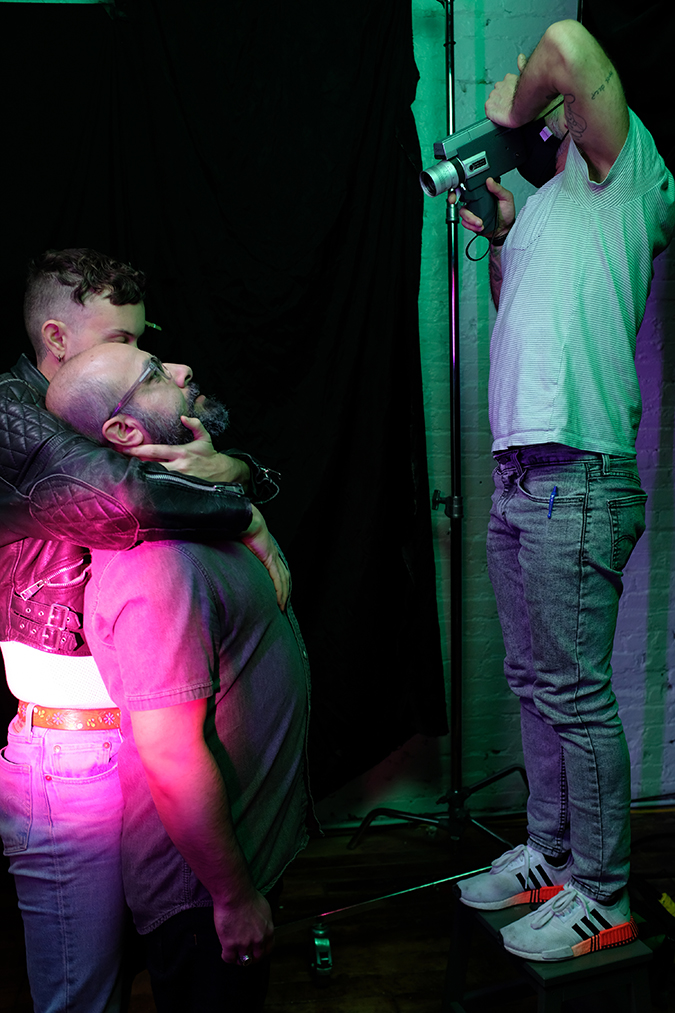 Behind the scenes, filming Desire Lines, Jules Rosskam (top right), Aden Hakimi, and Cyd Nova; photographer Emilia Aghamirzai.
Examining the Margins
“Trans people, people of color, queer people, we are so often written out of history, and [struggle] through those silences, and institutions not feeling like our lives are worth documenting,” Rosskam says.
According to the 2015 U.S. Transgender Survey, 23 percent of trans people identify as exclusively gay/lesbian, with 48 percent identifying as queer or bisexual. Only 23 percent of trans people define themselves as heterosexual—meaning that trans men attracted to other men is a common experience, even though the histories of this phenomenon have been hidden.
“The impetus is that for the last 20 years I’ve been watching the trans community, and seeing when folks come out as trans men and develop an attraction for other men. It’s felt like no one was having, like, a meaningful dialogue about it, and I, honestly, for the last 10 years have been waiting for someone else to make the film about this,” says Rosskam. “Finally, I said, okay, I’ve been thinking about this for 20 years, I think I have to make a film about it.”
Desire Lines centers its narrative on a gay-identified trans man seeking information on these hidden histories and begins the search by delving into researching archives.
“I think many trans and queer people can relate to searching for evidence of their own existence,” says Rosskam. “We go with him into this archive, and engage a lot of different material about trans masculinity and queer culture and bathhouses—and find people like Lou Sullivan, who, to the best of our knowledge, was the first gay-identified trans man in North America.”
Indeed, Lou Sullivan looms as a significant historical transgender figure. Sullivan, who died in 1991 from AIDS-related complications, left behind 30 years of diaries detailing his transitional journey, and these diaries were published to great fanfare in 2019. A pair of recent short films have helped elevate greater awareness of Sullivan’s life.
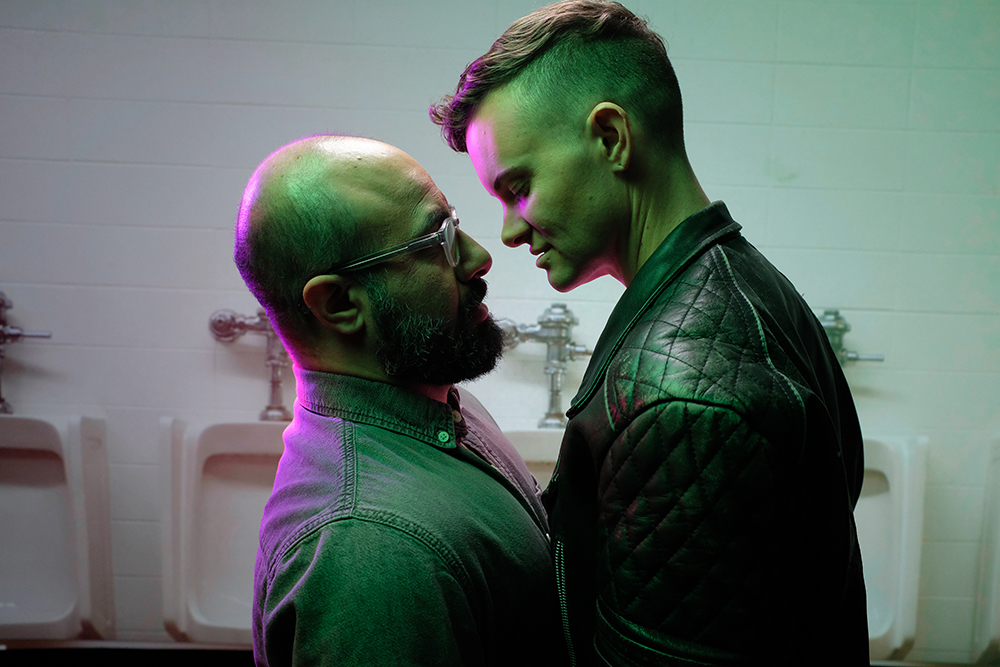 Aden Hakimi (as Ahmad) and Cyd Nova (as Stranger) in Desire Lines, photographer Emilia Aghamirzai
Hybrid storytelling
While Rosskam brings Sullivan into the picture, Desire Lines resists the urge to become a traditional documentary.
“I typically describe my work as experimental nonfiction. I am almost always working in a hybrid space between fiction and nonfiction, because that to me feels very trans, and I think it’s important in the work to unsettle that line. People think the line between fiction and reality is so clear—when in fact, it’s not,” Rosskam says, indicating that speculative fiction methods play into the film’s narrative.
“In the process of our character researching his own existence, he writes himself into history. Throughout the film, he actually creates evidence of his own existence by simply engaging with the past. And so it begs this question about the ways I think trans people experience time in a nonlinear fashion, where the past is always influencing the present. We have to be able to imagine ourselves into existence in order to exist. It’s about the power of fantasy and desire to make real,” says Rosskam. “The space that the film exists in is both a kind of hybrid space of an archive, and a bath house.”
While bath houses may seem like a distant memory for some, they remain a significant site of community building for many gay-identified people, including trans men.
“In those early conversations I was having with people, I was rather surprised to find out how many of them talked about going to gay bath houses, and how big of a role going to the bath house had played, like coming to accept their bodies as trans men. It’s a place where many men go to have sex with other men, trans or cis, but it’s also a community space where people would connect.”
The bath house also looms as a sort of archive in Rosskam’s perspective, providing communication of intergenerational experience.
“As queer and trans people, our histories are generally passed from person to person, and there’s a lot of emphasis on intergenerational relationships, and so younger people really are learning how to be themselves through close contact with people who are older than them. As a trans masculine person. I know a lot of young trans people, but I personally know [only] two transmasculine people who are over the age of 60. I don’t feel like I ever got that mentorship from older trans people.”
Desire Lines is currently in production, with documentary footage being shot in Chicago this winter and an expected release date of early 2024.
******
Header Image: Omi Ford (as Keiran) in Desire Lines, photographer Emilia Aghamirzai.
]]>
Filmmaker Jules Rosskam, assistant professor in the Department of Visual Arts at UMBC, was awarded a prestigious Creative Capital Award in 2021 to support production of his new feature film,...
https://umbc.edu/stories/jules-rosskams-desire-lines-awarded-a-2021-creative-capital-prize-3/
https://my3.my.umbc.edu/api/v0/pixel/news/119491/guest@my.umbc.edu/50f05364899438e2d0004154671c7532/api/pixel
cahss
discovery
visual-arts
webfeature
UMBC News & Magazine
https://my3.my.umbc.edu/groups/umbc-news-magazine
https://assets1-my.umbc.edu/system/shared/avatars/groups/000/001/943/24435aa6207c452e7bc15cc74b42c7bb/xsmall.png?1748556657
https://assets1-my.umbc.edu/system/shared/avatars/groups/000/001/943/24435aa6207c452e7bc15cc74b42c7bb/original.png?1748556657
https://assets2-my.umbc.edu/system/shared/avatars/groups/000/001/943/24435aa6207c452e7bc15cc74b42c7bb/xxlarge.png?1748556657
https://assets2-my.umbc.edu/system/shared/avatars/groups/000/001/943/24435aa6207c452e7bc15cc74b42c7bb/xlarge.png?1748556657
https://assets3-my.umbc.edu/system/shared/avatars/groups/000/001/943/24435aa6207c452e7bc15cc74b42c7bb/large.png?1748556657
https://assets1-my.umbc.edu/system/shared/avatars/groups/000/001/943/24435aa6207c452e7bc15cc74b42c7bb/medium.png?1748556657
https://assets2-my.umbc.edu/system/shared/avatars/groups/000/001/943/24435aa6207c452e7bc15cc74b42c7bb/small.png?1748556657
https://assets1-my.umbc.edu/system/shared/avatars/groups/000/001/943/24435aa6207c452e7bc15cc74b42c7bb/xsmall.png?1748556657
https://assets2-my.umbc.edu/system/shared/avatars/groups/000/001/943/24435aa6207c452e7bc15cc74b42c7bb/xxsmall.png?1748556657
UMBC News & Magazine
0
0
false
Mon, 10 Jan 2022 17:15:38 -0500
Then & Now—Cicada Invasion
The world has changed a lot over the past 17 years; smartphones have found their way into everyone’s pockets, social media has taken over traditional media, video rental stores like Blockbuster have made way for streaming services like Netflix.
Things at UMBC have changed, too. The Chesapeake Employers Insurance Arena is now home to UMBC Athletics and world renowned musical acts. The Performing Arts and Humanities Building has a gorgeous presence on campus. And our men’s basketball team shocked the nation, becoming a household name. The list goes on.
Now imagine, while all of those things have happened, the cicadas have only changed guard twice.
The 2004 appearance of the screeching locusts only warranted one story in the-then Retriever Weekly. But this year’s cicadas got a celebrity welcome—it’s possible that the doldrums of the pandemic particularly set the stage for this year’s cicada pandemonium.
When they first arrived, it was as if aliens made their first landing on earth. Their mammoth physique and prehistoric appearance took some getting used to. Soon, they were everywhere, both wreaking havoc and making friends.
Rachel Wesley ’22, visual arts, describes her first interaction with a cicada this summer as nothing less than alarming. “I looked over my shoulder and it was there staring at me with those outward pointing eyes. I didn’t freak out but it was a deep breath and I was like ‘okaaay’. They’re so big,” she says.
But before long, the intimidation factor dwindled. “By the end of summer, I was actually picking them up with my hand,” says Wesley, the painter behind UMBC’s new Retriever-themed cicada sculpture, a part of the Formstone Castle Collective’s Cicada Parade-a, a Baltimore-based public art installation of plaster insects. “If they were on the sidewalk, I put them into a bush to get them away from the sidewalk,” says Wesley.
When the next swarm visits UMBC in 2038, this brood will have faded in our memories, and their comeback will surely feel like aliens have first landed on earth yet again.
Special thanks to Creative Services senior designer Jill Blum who purchased “Harold” the cicada to be painted and donated to UMBC for posterity.
*****
Photos of Rachel Wesley and the cicada courtesy of Marlayna Demond ’11.
]]>
The world has changed a lot over the past 17 years; smartphones have found their way into everyone’s pockets, social media has taken over traditional media, video rental stores like Blockbuster...
https://umbc.edu/stories/then-now-cicada-invasion/
https://my3.my.umbc.edu/api/v0/pixel/news/119500/guest@my.umbc.edu/1faaf8e16d8a35b140cf1f8a1c800338/api/pixel
campus-life
cicadas
commonvision
fall-2021
then-and-now
visual-arts
UMBC News & Magazine
https://my3.my.umbc.edu/groups/umbc-news-magazine
https://assets1-my.umbc.edu/system/shared/avatars/groups/000/001/943/24435aa6207c452e7bc15cc74b42c7bb/xsmall.png?1748556657
https://assets1-my.umbc.edu/system/shared/avatars/groups/000/001/943/24435aa6207c452e7bc15cc74b42c7bb/original.png?1748556657
https://assets2-my.umbc.edu/system/shared/avatars/groups/000/001/943/24435aa6207c452e7bc15cc74b42c7bb/xxlarge.png?1748556657
https://assets2-my.umbc.edu/system/shared/avatars/groups/000/001/943/24435aa6207c452e7bc15cc74b42c7bb/xlarge.png?1748556657
https://assets3-my.umbc.edu/system/shared/avatars/groups/000/001/943/24435aa6207c452e7bc15cc74b42c7bb/large.png?1748556657
https://assets1-my.umbc.edu/system/shared/avatars/groups/000/001/943/24435aa6207c452e7bc15cc74b42c7bb/medium.png?1748556657
https://assets2-my.umbc.edu/system/shared/avatars/groups/000/001/943/24435aa6207c452e7bc15cc74b42c7bb/small.png?1748556657
https://assets1-my.umbc.edu/system/shared/avatars/groups/000/001/943/24435aa6207c452e7bc15cc74b42c7bb/xsmall.png?1748556657
https://assets2-my.umbc.edu/system/shared/avatars/groups/000/001/943/24435aa6207c452e7bc15cc74b42c7bb/xxsmall.png?1748556657
UMBC News & Magazine
0
0
false
Tue, 14 Dec 2021 16:18:24 -0500
Game Changers
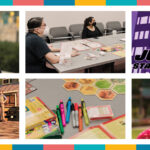
At their most basic levels, learning and play can look a lot alike. Both call for creativity and resourcefulness; inspire curiosity; and require failure, reflection, and practice. For some students, learning isn’t all fun and games. But members of the UMBC community are looking to change that.
Kerri Evans always strives to make her curriculum engaging, but knew she needed a new way to connect her students to the material. As a social work professor at UMBC, Evans teaches and studies the experiences of recent immigrants and refugees to the U.S. and wanted a new way to expose her students to the trials and triumphs of immigrant children navigating the U.S. education system.
“Social work curriculums largely rely on analyzing and reflecting upon case studies,” Evans says. “But immigrant stories are so diverse—it’s hard to understand the breadth of their experiences just by reading and responding to a case study.”
While working as a program manager at Lutheran Immigration and Refugee Service in downtown Baltimore, Evans saw how an engaging training activity helped foster parents, educators, and staff to better understand the experiences of immigrant and refugee children. For the activity, participants read cards containing stories of immigrants as they navigated various stages of their journey, like falling off the train in Guatemala, or losing your relatives at the U.S. and Mexico border, for example. A group discussion followed of how these experiences, some horrific, influenced the lives of unaccompanied children in the U.S.
“It wasn’t a game in the traditional sense, but it was inspiring and engaging,” she says.
And thus, Evans’ idea for the board game “Emerging: The Educational Journey of Immigrant Students” was born.
The gamification of learning is an approach more instructors are adopting to motivate their students to think outside of the box. Professors like Evans and others are maximizing enjoyment and engagement in their classes by capturing the interests of students and inspiring them to keep learning. Students across disciplines at UMBC are getting hands-on experience building games—tangible ones like “Emerging” as well as a host of video games that also foster a collaborative learning environment. Both the students and teachers agree: Learning is a lot easier when you’re having fun.
Understanding the “Rules of the Game”

“Emerging” is still in its infancy, but it is attracting the help of people across the UMBC community. In fall 2021, Evans paired up with UMBC’s assistant professors of education, Jiyoon Lee and Keisha Allen, and five UMBC undergraduate and graduate students to help bring the game to fruition.
Both the game and a future interdisciplinary course will focus on the immigrant experience in the U.S. from pre-kindergarten to college, with the goal of teaching UMBC students who will become service providers and teachers to understand the experiences faced, to advocate for inclusion, and to dismantle racism in schools.
 Kerri Evans headshot courtesy of Melissa Penley Cormier.
Funded by a UMBC Hrabowski Innovation Fund Grant: Implementation and Research Award, “Emerging” will be a multiplayer, cooperative game where participants assume the role of an immigrant child and work together to gain the resources necessary for “success” such as educational attainment, language skills, and social networks. Along the way, players will face challenges, get helpful boosts, and be forced to mitigate stress before it brings the game to a close. Picture Forbidden Island- meets-Catan-meets-Monopoly-meets immigrant experiences.
Participants will need to achieve both happiness and self-sufficiency to win, and players will lose if their stress levels get too high or if they are unable to access help and resources they need.
Advancing on the board will require strategy, resourcefulness, collaboration, and a little bit of luck. Players could land on spaces that require them to pick a card that describes a “win” or a “setback.” Wins may include getting an A on a test, making a new friend, or having a teacher stick up for you. Setbacks may look like getting bullied, forgetting to turn in your homework, or having troubles with immigration status.
Players can also gather “resources” along the way, which could come in the form of joining a sports team, partaking in an after-school program, or going to a tutoring session. These resources play an integral role in managing your players’ mental health, an essential part of winning the game.
All of the “wins” and “setbacks” will be based on real-life stories collected by a research process the students are currently undertaking, something Evans says is important to the integrity of the game.
“We don’t want these stories to be hearsay or things that could theoretically happen, we’re doing our research to create an accurate game of experiences that have truly happened,” Evans says.
“I think we are creating something really special,” says social work and psychology undergrad Ashley Pereira ’22, who is part of the team currently analyzing hundreds of peer-reviewed journals and case studies to find stories of success and heartbreak to include. “And to know we are creating it in a way where it’s based on research just makes you feel so confident about the decisions you make.”
The game also aims to highlight the cultural differences within the education systems of various countries. For example, Evans says, it’s important to be mindful that immigrant students may not understand how to open up a locker, or the need to raise your hand to ask for permission to speak. The team is working on ways to include these discrepancies into the game.
“We take for granted that we know the ‘rules of the game,’ in our education systems,” says TESOL graduate student and team member Eric Chen ’22. “If educators assume children from other countries come in with this knowledge, it can put the kids at a disadvantage.”
Like all great games, “Emerging” plays on participants’ emotions. The stakes are high, and tragedy or triumph may be just around the corner.
Game Developer Galore
Over in the Engineering building, a different type of game development is taking place. Over 46 game developers are congregating to create the next great video game. Founded in 2005, the Game Developers Club is dedicated to bringing students of all majors and skill levels together to learn about game development, work as a team, and of course, create video games.
Emotions are high around this time of year, as club members pitch their ideas to the group in hopes their game will garner interest from other club members. Vice president of the club, Seth Davis ’22, computer science, is well acquainted with the process. He’s been a part of the club for three years and has created three games. Pitch time is his favorite time of the year.
“It’s always so exciting to see a person get up in front of the club and talk about an idea they’re passionate about,” Davis says. “Some people are so nervous that others won’t like their idea, but then after they pitch it, five people come running up to them saying they love the idea and want to support them.”
In 2020, Davis pitched the idea for a game called Binary Bubbles, a side-scroller (think Super Marios Bros.) puzzle game. The goal is simple: Get to the yellow flag as quickly as you can. The catch? There are malfunctioning robots in the way. Using strategy and logic, players must hack into the robots, steal their code bubbles, and move the code bubbles to other robots.
Davis and his team created 20 levels that span over two worlds, something he says would only be possible by working with an interdisciplinary team. Davis enlisted the help of art students, music students, and English students to make his games a reality.
“There are so many majors represented in the club, it’s not just computer science people,” he says. “This club teaches you how to work as a team to create an amazing product.”
Turning games into jobs
If Davis had to pick a second-favorite time of year, it would be the unveiling of the games. It’s when club members take their projects to the school and community and let others play the video games they’ve worked so hard to create.
Binary Bubbles was featured at 2020’s Undergraduate Research and Creative Achievement Day (URCAD) along with 13 other video games created by members of the Game Developers Club. Previous games have also been featured at Artscape, Baltimore’s largest annual art festival.
Members of the Game Developers Club receive more than just thunderous applause at URCAD and Artscape, they also get job offers from blue-chip employers. They’ve gone on to find positions at Facebook, Unity Game Engine, and Firaxis games, to name a few.
“Our club is actually very career-focused,” Davis says. “Employers love it when they see our portfolios and see we completed a game. Lots of former members got jobs because of this club.”
As a member of the club’s executive board, Davis works hard to ensure the games are seen by as many people as possible, including professional game developers. Some of those professionals are former club members themselves. Davis says alumni like Eric Jordan ’08, computer science, currently at Facebook, are eager to help current club members achieve their dreams.
“This club is such a great way to network and build real relationships,” Davis says. “It’s the perfect way to get that gaming job you’ve always dreamed of.”
The Go-To Gamer Guy
Marc Olano knows a thing or two about video games—he’s commonly referred to as UMBC’s “go-to gamer guy.” Ironically, Olano isn’t much of a gamer himself, but he certainly knows the recipe for creating a great game.
 Marc Olano headshot courtesy of Ryan Zuber ’04, Imaging Research Center.
Olano has been doing research on video game graphics hardware for over 25 years. He pioneered procedural shading on graphics hardware, a technique that is used to add details to a surface of an object. The model is now the standard on every PC and game platform. Olano also pioneered UMBC’s Game Development track and helped usher in UMBC’s 3D photogrammetry scanning facility in 2015, now serving as the director for both.
The Game Development track and the Visual Arts Department’s Animation and Interactive Media concentration make up “GAIM:” UMBC’s Games, Animation and Interactive Media program. GAIM prepares students for careers in the video game industry, and exposes them to internship opportunities at local game development companies such as Firaxis, Big Huge Games, Epic Games, Mythic Entertainment and Zynga.
In the GAIM capstone course, visual arts and computer science students join forces for a semester to design an original game. The course mimics the setup of teams in the industry where 500 artists and programmers must work together for several years to develop a single game.
“My role is teaching the students how to do the work, then letting the students figure out for themselves how to actually do it,” Olano says. “I’ve found it brings students a lot of joy to know they created something very independently.”
“Bandit”
Olano’s first taste of an educational game development project was with UMBC history professor Anne Rubin. In spring 2015, Rubin and Olano united their classes to create a computer game called “Bandit” which detailed the 1861 Pratt Street Riots, an event many scholars believe was the site of first blood shed in the American Civil War. Undergraduates in the Game Development track built the game and Rubin’s history students served as historical researchers and consultants.
 A still from “Bandit.”
In the game, players control a fox who is on the loose on the streets of Baltimore during the Pratt Street Riots, when Massachusetts militiamen came in contact with anti-war protestors in Baltimore. The fox is on the hunt for documents from the riots which can be examined and recorded all while trying to avoid guards patrolling Pratt Street.
“MeetingMayhem”
Olano is currently working with professor of computer science Alan Sherman and students from the UMBC Cyber Defense Lab to create a video game called “MeetingMayhem.” The web-based game aims to help students learn about adversarial thinking, or the ability to embody the technological capabilities and strategic reasoning of hackers. The goal of the game is to arrange a meeting time and place by sending and receiving messages through an unsecure network that is under the control of a malicious adversary. Players can choose to be the hero or the villain, or in this case, the benevolent meeting-maker or the hacker. The hacker can disrupt the efforts of the meeting-maker by intercepting, modifying, blocking, and injecting messages into the unsecure network.
In this engaging challenge, computer science students learn the basics of the Dolev-Yao intruder network model, a framework used to analyze safety protocols within a communications network. Students also learn the value of using cryptography to mitigate these dangers.
What Does it Mean to Win?
Across UMBC, professors and students are harnessing the power of play to enrich their learning experiences. Be it video games, board games, or anything in between, Retrievers are rich with ideas of how to make learning a little more interactive and a lot more fun.
Olano, who was recently appointed associate dean for Academic Programs, is adjusting to his new responsibilities, but for him, it’s still all about the students and the games.
“It never gets old seeing students when they realize they can actually build a game for themselves and they are excited doing it,” Olano says. “Honestly, it brings me a lot of joy, too.”
For Evans, winning means the participants of “Emerging” leave the game with more insight than before—even insight into what different types of “success” could look like. In the meantime, her students will experience joy as they learn research skills, build the game, and begin to introduce the game to more students in the coming semesters. The team plans to gain knowledge from other UMBC students who are immigrants themselves and discover how this subset of students found success in college. After that, the team will enlist the help of UMBC art students to help design a prototype. In the future, the team hopes to premiere the game to educators outside of the UMBC community
“People have sympathy reading case studies, but it’s not nearly as visceral as if you’re playing a game and your character experiences something tragic and now you’ve lost three turns,” Evans says. “Players will feel the anger of feeling left behind and the joy of successes.”
For Davis and the Game Developers Club, winning means making friends, networking, and having fun. “At the end of the day, we’re really just having a great time making games,” he says.
— Kennedy Lamb ’20 and Illustration by Marissa Clayton ’21.
]]>
At their most basic levels, learning and play can look a lot alike. Both call for creativity and resourcefulness; inspire curiosity; and require failure, reflection, and practice. For some...
https://umbc.edu/stories/game-changers/
https://my3.my.umbc.edu/api/v0/pixel/news/119511/guest@my.umbc.edu/51b1aa91d1683e4c7643d7fd56245749/api/pixel
cahss
campus-life
coeit
computer-science
education
fall-2021
feature
game-development
history
social-work
video-games
visual-arts
UMBC News & Magazine
https://my3.my.umbc.edu/groups/umbc-news-magazine
https://assets1-my.umbc.edu/system/shared/avatars/groups/000/001/943/24435aa6207c452e7bc15cc74b42c7bb/xsmall.png?1748556657
https://assets1-my.umbc.edu/system/shared/avatars/groups/000/001/943/24435aa6207c452e7bc15cc74b42c7bb/original.png?1748556657
https://assets2-my.umbc.edu/system/shared/avatars/groups/000/001/943/24435aa6207c452e7bc15cc74b42c7bb/xxlarge.png?1748556657
https://assets2-my.umbc.edu/system/shared/avatars/groups/000/001/943/24435aa6207c452e7bc15cc74b42c7bb/xlarge.png?1748556657
https://assets3-my.umbc.edu/system/shared/avatars/groups/000/001/943/24435aa6207c452e7bc15cc74b42c7bb/large.png?1748556657
https://assets1-my.umbc.edu/system/shared/avatars/groups/000/001/943/24435aa6207c452e7bc15cc74b42c7bb/medium.png?1748556657
https://assets2-my.umbc.edu/system/shared/avatars/groups/000/001/943/24435aa6207c452e7bc15cc74b42c7bb/small.png?1748556657
https://assets1-my.umbc.edu/system/shared/avatars/groups/000/001/943/24435aa6207c452e7bc15cc74b42c7bb/xsmall.png?1748556657
https://assets2-my.umbc.edu/system/shared/avatars/groups/000/001/943/24435aa6207c452e7bc15cc74b42c7bb/xxsmall.png?1748556657
UMBC News & Magazine
0
0
false
Wed, 08 Dec 2021 22:01:17 -0500
For the Love of Dirty Jobs

First Mate Alex Barnard ’09, American Studies spends many mornings high atop the mast on the 150-foot sailing ship Kwai, watching the bright horizon of the Pacific Ocean through binoculars for the shimmer of an abandoned fishing net. When she spots a clump of plastic waste, she guides the captain toward the tangle of fishing nets and the garbage they accumulate.
Then sailors on deck throw grappling hooks into the floating trash. A hydraulic crane hauls onto the deck the dripping hunks of degrading plastic nets—sometimes the size of Volkswagen Bug, sometimes 100 feet long. Barnard and the crew stumble through tangles slick with algae and seaweed, throwing the trash’s resident crabs and fish back overboard. Those moments are cathartic, Barnard says, as if they’ve just pulled a rotten tooth from the mouth of the ocean.
“I just think about that moment as beautiful. I love seeing that net up on deck,” Barnard says. “It’s so toxic and then to watch it come out. Just to be able to do that all day every day. It’s pretty amazing.”
Walking down a steep hill on her family’s farm, Roxann Brooks Motroni ’06, M14, biological sciences is searching for her cattle.
“Hey mamas! Hey cows!” the veterinarian calls. A fuzzy black head pops up over the next hill and bellows. The cattle gallop toward Motroni and her bucket, which rattles with hay cookies.
She steps into the pasture and is mobbed by her family’s cattle, the flies clustered on their backs in the late autumn heat. Cookie, the black Lowline Angus most fond of the treats, pushes to the front of the herd. The cow’s foot-long tongue curls around Motroni’s forearm, leaving bubbly trails of slobber and grass bits.
Ignoring the fresh cow patty her black boot has just stepped in, Motroni hands out cookies, then tosses the rest of the nuggets into the scrum. She swipes off her freshly slimed arm and continues naming the cattle—The Hereford, Valentino the bull, and her favorite, Nellie, named for a great-grandmother because they’re a bit alike.
“Sweet, but a little suspicious of new people,” Motroni says and wades out of the herd distributing scratches all around, oblivious to the flies and slobber and excrement.
Stephen Bradley, associate professor in the Department of Visual Arts, hauls on a braided cord connected to a white lifesaving ring that bobs on the water of the Jones Falls in Baltimore. A Doritos package, two latex gloves, a slick of oil, and some liquor bottles float nearby. And that’s just what’s visible. Other ingredients in the toxic stew flowing toward the Inner Harbor are heavy metals, fertilizer, microbes, pesticides, and sewage, as well as industrial sound pollution.
Bradley, an artist who adds video and audio sensory layers to his sculptures, pulls out his dripping hydrophones and fiddles with their connections. Then he lowers the receivers back in, to record the underwater sounds of mussels, gizzard shad, and blue crabs, along with the urban noise of HVAC systems and traffic.
Chatting away, Bradley pulls out his sketch pad to show some drawings, then licks his thumb to turn the page. He stops to grimace at his thumb, which was just mucking about in the murky water.
“Guess I shouldn’t have done that,” he says.
Making a difference in the world isn’t always a neat endeavor. Hard to keep your hands clean when you’re raising cattle humanely and safely, pulling communities together to pick up trash and make art, or hauling tons of plastic waste from the Pacific Ocean. These three Retrievers all find immense joy in work that is sometimes smelly, usually dirty, and always requires an intrepid spirit.
Sustainability sparked Barnard’s quest
Alex Barnard wrote her UMBC honors thesis on her attempts to live sustainably in Baltimore. “Extremely challenging,” Barnard summarizes, with a wry chuckle. “It completely changed my life. I see everything through this lens now.”
For nearly 10 years, she traveled, trying to live lightly on the planet. She worked in an eco-cafe in Fiji, labored on an organic farm in Hawaii, sailed on eco-tourism voyages in the South Pacific, and biked New Zealand.
Now, she has her captain’s license and sails as a chief mate on National Geographic voyages to Costa Rica, Alaska, and Baja with Lindblad Expeditions, a company known for its green approach to travel.
 Alex Barnard (top, center) poses with her team. All photos of Barnard, courtesy of Ocean Voyages Institute.
Barnard’s schedule of two months on, two months off gives her time to volunteer on the Kwai for the Ocean Voyages Institute. The institute partners with companies that turn the trash into fuel, shoes, clothing, and building blocks for construction.
Through overconsumption and improper trash disposal, humans have created five garbage patches in the Pacific, Atlantic, and Indian oceans, where trash is concentrated by currents.
 Courtesy of Alex Barnard and Ocean Voyages Institute.
Discarded nets and lines from fishing boats now make up 46% of the waste in the Great Pacific Garbage Patch, according to the World Wildlife Fund. Dubbed “ghostnets” or “ghost gear,” the fishing waste kills marine life by the thousands—turtles and whales and dolphins tangle themselves in the nets that are tossed off fishing boats. But because oceans are vast, and the nets sink and bob in the waves, they’re difficult to find.
“It’s not like wading through trash,” Barnard explains. “There are big spaces in between. If you were at sea level, the nets are hard to see. We could be sailing right by one and not see it until we’re past it. The plastic breaks down in UV light. A lot of it is microplastic, which is deadly to the ocean.”
Last summer, Barnard and the Kwai crew hauled 170 tons of plastic from the ocean, a fraction of the 17 billion tons dumped into the world’s waters every year. Other organizations, like Sea Shepherd Conservation Society, Greenpeace, The Ocean Cleanup, and the 5 Gyres Institute, are also focusing on ghostnet removal. Many environmental groups are pushing the Global Ghost Gear Initiative, a collaborative effort by the fishing industry, NGOs, governments, and researchers to regulate plastic dumping.
“This work is possible and successful,” Barnard says. “The idea is to show that we need more boats, a fleet of vessels doing the same thing. It feels like a starting point more than anything.”
Temporarily on land, in a remote cabin in Michigan where she’s doing some writing for Lindblad, Barnard hikes often, always with a trash bag.
“It’s my dream to go somewhere and not have to pick up trash,” Barnard says. “I could spend my whole life picking up trash everywhere I go. That’s not very efficient. It has to be bigger than just one person. But it’s better than not picking it up.”
A family farm affair
Every morning and evening, Roxann Brooks Motroni visits her cattle, not just to offer treats but to check the herd for a limp, some pinkeye, a calf that’s not thriving.
Her family started 804 Cattle Company in Upper Marlboro in 2016 with three cows. They now raise 25 cattle on 33 acres. A vet married to an agricultural business expert, Motroni works the farm with her parents, John and Chantal Brooks, both retired doctors. And while Motroni has a day job as a National Program Leader for Animal Health for the USDA’s Agricultural Research Service, focusing on research solutions for livestock diseases, she begins and ends her days on the farm.
“This is a family affair. My mom is the chief cow operator. I do the vet work, my husband does the finances and handyman work,” Motroni explains, plus he’s the beekeeper.


The farm is also devoted to teaching the next generation of farmers and veterinarians. Today, two interns hoping to be veterinarians are chasing Nutmeg the goat and grooming horses. The family brings in veterans seeking help getting started in agriculture, through the Arcadia Center for Sustainable Food and Agriculture. The farm also sells at the Capital Market, whose mission is to provide quality food, produced by businesses and farms run by people of color, to residents of Prince George’s County’s food deserts.
A Meyerhoff Scholar, Motroni quotes its motto, “To Whom Much Is Given, Much Is Expected” and says she lives by it.
Their farm prides itself on their humane and safe practices with their cattle. The animals and their health comes first. No hormones or steroids go into their cattle and they limit antibiotic use to only sick cows. Their chutes and corrals are designed to reduce their cattle’s stress. All animals spend all their lives on grass pastures.
The family also uses regenerative agriculture practices to improve soil health and combat climate change through carbon sequestration while limiting fertilizer and pesticide usage. Motroni crouches in the pasture to show off the shoots of radishes, hairy vetch, turnips, oats, and rye that she interplants with grass, to aerate and fix nitrogen and carbon in the soil. Plus they offer her herd fine dining.
“I didn’t know when I became a cattle farmer that I would also become a grass farmer. I’ve come to realize how magical cow poop is. Every year our pastures get better and better,” she says, laughing. “All those plant physiology classes at UMBC really served me well.”
She hikes up the hill again, squelching through the mud around a water pump.
“Wow, now you can really smell the cow,” she says and smiles at the odor and the view.
Traces of life fuel his art
As an artist, Stephen Bradley sees and hears things a little differently. From the pop of color of a blue plastic container handle to the squelching clicks of the mussels underwater, the evidence of life is fascinating to him.
For more than 12 years, he has labored in the Brooklyn and Curtis Bay area of Baltimore, partnering with the Enoch Pratt Free Library, the National Aquarium, the local Boys and Girls Club, and the Masonville Cove Environmental Education Center to clean up the alleys and streets and to make art, from sidewalk paintings and murals to trash sculptures.
Right now, he’s bent closely over a pier in the Inner Harbor, lowering a round lifesaver strung with microphones and chum to attract fish into the water. He occasionally catches the attention of passersby and eagerly explains his artistic vision to them.
The project that inspired his recording in the Jones Falls waterway is a collaborative biodiversity study with the National Aquarium and the Institute of Marine and Environmental Technology (IMET). IMET has sunk a biodisk in the same areas Bradley is recording, to track biodiversity in the waters by collecting DNA samples. Those findings will be paired with Bradley’s recordings to provide a fuller picture of what’s living in Baltimore’s waterways. Bradley’s Inner Harbor’s soundtrack is run through a spectrograph to determine what species made the sounds, most of which can’t be heard by human ears, such as the mating songs of water bugs.
“With these recordings, it’s almost as if I have my ear to the water,” he says. “The gift is going home and listening.”
Bradley’s portion of the IMET project, called Bio-Buggy: Ear to the Harbor, will draw attention to the harm that human-generated noise pollution inflicts on aquatic species, including disrupting mating and growth.
In the fall, Bradley was recording at Marshy Point Nature Center and heard explosions coming from his underwater recorders, from the direction of Aberdeen Proving Ground, nearly 30 miles away.
“Hundreds of small minnows leaped out of the water each time there was an explosion, and there were nine huge discharges,” Bradley says. But in between, he heard the complex harmonies of bubbles and critter sounds, something he calls “musical marshlands.”
He has also built an exhibit, called the “Oh, Murky Waters Chorus,” with trash compositions, an aquarium with teeny water critters still living on one of those IMET DNA sampling biodisks, and an interactive video of microscopic creatures paired with their noises. The art installation showed at UMBC’s Center for Art, Design, and Visual Culture in 2019, and Bradley hopes to exhibit it again, as a work-in-progress later in 2022.


“The trash-filled sculptural elements in the art installation…are there to represent the stress and urgency for us as a society to gain control of our waste before we drown from it,” Bradley explains. Baltimore has taken recent steps, including banning polystyrene and taxing plastic bags, to reduce the trash in the Inner Harbor enough that if it hasn’t rained in 48 hours, according to Blue Water Baltimore, some areas are swimmable.
At the IMET open house next spring, Bradley hopes to show a prototype of the Bio-Buggy, a mobile science and sound collection lab, which engineering students at UMBC will work to design with him as their capstone project. The Bio-Buggy exhibit will also feature Bradley’s sound compositions based on the Inner Harbor and other Chesapeake Bay recordings.
“I have no aspiration to be a scientist, but I am inspired by science, the tools, the rigor, the process,” he says and tucks his headphones back on, listening for evidence of life in the waters. Perhaps, Bradley hopes, if people hear and see the life below the surface, they’ll pocket their Doritos packages and recycle their water bottles, instead of tossing them in the gutter for him to find later.
People who care about change must be willing to plunge their hands deep into the mess of this world. It’s a dirty job, but someone’s gotta do it.
— By Susan Thornton Hobby
*****
All photos courtesy of Marlayna Demond ’11 unless otherwise noted.
]]>
First Mate Alex Barnard ’09, American Studies spends many mornings high atop the mast on the 150-foot sailing ship Kwai, watching the bright horizon of the Pacific Ocean through binoculars for the...
https://umbc.edu/stories/for-the-love-of-dirty-jobs/
https://my3.my.umbc.edu/api/v0/pixel/news/119512/guest@my.umbc.edu/4697d91b126c234476387a30740851b2/api/pixel
american-studies
biological-sciences
discovery
fall-2021
feature
meyerhoff-alumni
umbc-magazine
visual-arts
UMBC News & Magazine
https://my3.my.umbc.edu/groups/umbc-news-magazine
https://assets1-my.umbc.edu/system/shared/avatars/groups/000/001/943/24435aa6207c452e7bc15cc74b42c7bb/xsmall.png?1748556657
https://assets1-my.umbc.edu/system/shared/avatars/groups/000/001/943/24435aa6207c452e7bc15cc74b42c7bb/original.png?1748556657
https://assets2-my.umbc.edu/system/shared/avatars/groups/000/001/943/24435aa6207c452e7bc15cc74b42c7bb/xxlarge.png?1748556657
https://assets2-my.umbc.edu/system/shared/avatars/groups/000/001/943/24435aa6207c452e7bc15cc74b42c7bb/xlarge.png?1748556657
https://assets3-my.umbc.edu/system/shared/avatars/groups/000/001/943/24435aa6207c452e7bc15cc74b42c7bb/large.png?1748556657
https://assets1-my.umbc.edu/system/shared/avatars/groups/000/001/943/24435aa6207c452e7bc15cc74b42c7bb/medium.png?1748556657
https://assets2-my.umbc.edu/system/shared/avatars/groups/000/001/943/24435aa6207c452e7bc15cc74b42c7bb/small.png?1748556657
https://assets1-my.umbc.edu/system/shared/avatars/groups/000/001/943/24435aa6207c452e7bc15cc74b42c7bb/xsmall.png?1748556657
https://assets2-my.umbc.edu/system/shared/avatars/groups/000/001/943/24435aa6207c452e7bc15cc74b42c7bb/xxsmall.png?1748556657
UMBC News & Magazine
0
0
false
Wed, 08 Dec 2021 18:02:57 -0500
Corrie Francis Parks: Artist, Community Builder, and Advocate for Students

Compared to the tropical midsummer heat outside the Montpelier Arts Center in Laurel, Maryland, UMBC visual arts professor Corrie Francis Parks’ latest show “Uncanny Bodies” provides cool respite.
The exhibit’s home is in a dark room, where multiple projectors coat the walls in Parks’ unique animation style through which tiny sand particles are enlarged, diminishing your own size as they dance across your vision. The exhibit is multidimensionally entrancing, meanwhile, the sound design created by visual arts instructor Jason Charney, M.F.A. ’20, imaging and digital arts, is body-encompassing.
 View from inside artist Corrie Francis Parks’ exhibit “Uncanny Bodies” displayed at the Montpelier Arts Center. Photo courtesy of Thom Parks.
Even before her career began as an animator, and now as a professor, Parks has always made a point of creating her artwork through uncharted channels. Parks attributes her animation origins to her mentor and professor David Ehrlich at Dartmouth College. “He became very influential in challenging me to try things differently, like painting on glass which was really interesting to me because it looked different from anything else that was being made,” says Parks, “and I liked having my work stand out.”
Eventually, this path of striving for the unique led to Parks’ remarkable sand animation technique which has been displayed on walls from Disney to Serbia, and currently, at Montpelier Arts Center. And now Parks hopes to play a similar role promoting her own students’ work as her mentor did for her.
Giving students space to develop ideas
“People are interesting, and I see my students as people with really unique ideas that sometimes just need a little push,” says Parks. “As a professor, you’re supposed to do that. You have that authority and experience.” Throughout her past seven years as a professor at UMBC, Parks’ posture has allowed her to develop a reputation as an “above and beyond” professor. Her pride in promoting and developing her students’ talents is evident, her Instagram account @corrieeeee features a collection of her students’ animations, but goes beyond social media, too. “Some of the most influential professors I’ve had,” says Parks, “are the kind of professors who don’t necessarily develop that student-teacher relationship but rather a colleague relationship with their students.”
Camille Ollivierre, a senior visual arts student with a concentration in animation, describes Parks as someone who talks “to us with the same level of respect she would other professors, while still acknowledging we are young adults with much room for growth.”
Where that growth can come from is something that Parks helps her students find.
“She encouraged me to apply for an Undergraduate Research Award grant (URA),” says Ollivierre, “to explore my idea to create paint on glass animation by creating my own multiplane animation camera.” Receiving the URA allowed Ollivierre to work closely with Parks as her mentor. “She encouraged me to push myself further than I thought I was capable of,” says Ollivierre. “Also, since I’m interested in professionally pursuing stop motion animation, I’ve really enjoyed working with someone who has extensive experience using unconventional materials like sand and paint.”
Visual arts major senior Chase Nickoles expands upon Parks’ ability to connect students with new professional experiences. Nickoles found an opportunity to submit the class’s rotoscoping project to be displayed at the Carroll Arts Center in Westminster, Maryland. “Corrie was quick to help as much as possible with the logistics and providing necessary information,” says Nickoles. “Thanks to her help, our project was successfully displayed, pushing me into the Westminster art world as a representative of the piece, and pushing all the students to be seen by a wider circle.”
Constructive classroom communities
Meanwhile, within the classroom, Parks has found ways to connect with students on a level that is accessible and relatable to them—including creating a Discord server for her students to continue building community.
Visual arts senior Aaron Wescott says that “the space Corrie created online for the whole class was amazing, and it really let us bounce ideas off of each other and her. Being able to talk to someone who had genuine experience and talent in the field made me feel comfortable enough to start branching out and grow as an artist, and I even looked forward to talking with her. She is an amazing teacher and colleague.”
For Parks, creating a community that cultivates her students’ abilities is something that comes naturally.
 Angle of Repose. Photo courtesy of Thom Parks.
“The thing that I love about teaching college is we’re all adults, my students are just a few steps behind me in their development as an artist… I’m really happy to share my experience as to what it means to be an artist, I love sharing information,” she says.
Her exhibit, “Uncanny Bodies” is available from now until August 1, 2021. In Parks’ own words “It’s a really enveloping and calming space that is good to go to on a hot day, it’s cool in there. It takes you into a different perspective and it allows you to take a little break from whatever you’re dealing with right now”.
Visit it now and see what it means to be a grain of sand.
]]>
Compared to the tropical midsummer heat outside the Montpelier Arts Center in Laurel, Maryland, UMBC visual arts professor Corrie Francis Parks’ latest show “Uncanny Bodies” provides cool respite....
https://umbc.edu/stories/corrie-parks-artist-community-builder-and-advocate-for-students/
https://my3.my.umbc.edu/api/v0/pixel/news/119581/guest@my.umbc.edu/67f3e4901b2cdb67ad79427879e2f39f/api/pixel
cahss
campus-life
imda
professorsnottomiss
visual-arts
UMBC News & Magazine
https://my3.my.umbc.edu/groups/umbc-news-magazine
https://assets1-my.umbc.edu/system/shared/avatars/groups/000/001/943/24435aa6207c452e7bc15cc74b42c7bb/xsmall.png?1748556657
https://assets1-my.umbc.edu/system/shared/avatars/groups/000/001/943/24435aa6207c452e7bc15cc74b42c7bb/original.png?1748556657
https://assets2-my.umbc.edu/system/shared/avatars/groups/000/001/943/24435aa6207c452e7bc15cc74b42c7bb/xxlarge.png?1748556657
https://assets2-my.umbc.edu/system/shared/avatars/groups/000/001/943/24435aa6207c452e7bc15cc74b42c7bb/xlarge.png?1748556657
https://assets3-my.umbc.edu/system/shared/avatars/groups/000/001/943/24435aa6207c452e7bc15cc74b42c7bb/large.png?1748556657
https://assets1-my.umbc.edu/system/shared/avatars/groups/000/001/943/24435aa6207c452e7bc15cc74b42c7bb/medium.png?1748556657
https://assets2-my.umbc.edu/system/shared/avatars/groups/000/001/943/24435aa6207c452e7bc15cc74b42c7bb/small.png?1748556657
https://assets1-my.umbc.edu/system/shared/avatars/groups/000/001/943/24435aa6207c452e7bc15cc74b42c7bb/xsmall.png?1748556657
https://assets2-my.umbc.edu/system/shared/avatars/groups/000/001/943/24435aa6207c452e7bc15cc74b42c7bb/xxsmall.png?1748556657
UMBC News & Magazine
0
0
false
Fri, 16 Jul 2021 19:43:05 -0400
The Show Must Go On

Dimmed lights, Twizzlers, and a big bowl of popcorn. Most of us may not have had the traditional movie theatre experience this year, but in living rooms across the country this year, many have found much-needed solace and escape through television and movies. Behind the scenes, Retrievers working in Hollywood as writers, producers, and directors have embraced the challenges of the moment—and remained ever-thankful for their audiences and creative roots. UMBC Magazine editor Jenny O’Grady sat down with five alumni working in entertainment to hear more about how they got their start, and what has kept them going creatively during this unusual time.
UMBC Magazine: What has it been like to continue working during the pandemic in order to keep up with demand for entertainment? What does that look like?
 Name: Kara Corthron ’99, theatreJob: Author, playwright, and TV writerAbout:
 Author of
The Truth of Right Now and
Daughters of Jubilation. Plays include
What Are You Worth?,
Welcome to Fear City,
AliceGraceAnon, and
Holly Down in Heaven. Writes for the TV drama-thrillers
You (Netflix),
The Flight Attendant (HBO-Max), and M. Night Shyamalan’s
Servant (Apple TV+). A multiyear MacDowell Fellow and resident playwright at New Dramatists.
Where do you turn for inspiration? Toni Morrison, Shirley Jackson, and Octavia Butler. Korean horror films.
Your favorite creative spot at UMBC? AOK Library’s “colorful Alice in Wonderland chairs”
Fave pandemic entertainment? Search Party, Schitt’s Creek, Gilmore Girls
Kara Corthron: Well, I’ll just say, I feel really fortunate that I’ve been able to work, because 40 percent of our country is experiencing food insecurity. But, the biggest shift for me in TV writing was that everything became Zoom meetings…and I still am not in love with it. We’ve found a way to make it work and be productive, but I still would much rather be with humans, and I miss that a lot.
Brandon Spells: On the network side, making that transition from our office on Sunset Boulevard, to taking pitches on Zoom, it’s just a different energy when you’re in the room with talent, and taking pitches and getting excited about things…it’s just different. Initially we stopped all productions, so that was tough. Once we got the green light, we first started productions in countries overseas, and then slowly, during the summer, we started picking up back in America. Last fall we were going nonstop, trying to catch up, because there was a gap from when we stopped. This year, you’re probably going to see that things kind of slow down, as far as the launch cadence. But maybe that’s not a bad thing, because we come out with something every week, and maybe we don’t need to launch a million things in one weekend.
Brian Dannelly: For me, when the virus came on, we were writing all the scripts, prepping everything, trying to figure out the COVID situation and trying to be ahead of it, so that when we were able to get back on set we’d be ready to go. We had no idea when we were going back, and so during that time period I had a physical, and my doctor didn’t want me flying, so I had to give up the show (In the Dark), which was terrible and sad…and really scary, too. I went into the pandemic with the hopes of coming out a better person, a better creator. We’re so lucky because there are so many people who are really struggling, so you’re trying to balance that with how you can use this time for good. And so I helped In the Dark transition to the third season, and then I just started writing like a crazy person. I became a whole food plant-based vegan, I learned how to cook. I’m adopted, so I found all my brothers and sisters—there’s nine of them. And I just really tried to kind of reconnect with who I was when I started the business, who I was when I was at UMBC, and what got me into the business, and I feel like so far I’ve come out in a place that’s really good.
Cat Mihos: For me, it’s been fascinating watching the budgets balloon for COVID compliance. We have two shows in pre-production for Amazon right now that are going to be filmed in Scotland, so we were trying to share things, like catering, so we have one bubble, also trying to make new workarounds so we use the same COVID compliance officers—we’re trying to work smarter. It’s been a year. Brandon, I get it, Netflix has definitely been our biggest supporter, and we love working with them. It comes down to Zoom meetings, our writer rooms are all remote, so if there’s any technical glitch…where you’re just frozen on a screen, ugh. It’s learning to cope, that’s the best skill on any set that you can have. I did work on Brian’s first couple films when he was in AFI (American Film Institute), so we have quite an old friendship. We’re old. But it’s lovely to have that support just right down the street.
UMBC Magazine: Is there anyone who particularly influenced you, or some other takeaway from your time at UMBC, that you still look to now in your careers?
 Name: Brian Dannelly ’97, visual arts
Job: Writer, director, and producerAbout: Executive producer and the producing director on The CW’s sleeper hit,
In the Dark. Directed shows for Netflix, Hulu, Showtime, MTV, ABC, and CBS, including
Scream, Sweet Vicious, Haters Back Off, Pushing Daisies, United States of Tara, and
Weeds. Co-wrote and directed the cult teen film,
Saved, and directed
Struck by Lightning. Currently co-creating an animated series called
Humperdinck.
Where do you turn for inspiration? Whatever personal crisis I’m going through at the moment.
Your favorite creative spot at UMBC? Kathy O’Dell’s office.
Fave pandemic entertainment? GENERA+ION on HBO Max
Dannelly: You know, I was a little broken when I got there, which is interesting because UMBC really put me back together again. My first college was Morgan State University, so it was there I made my first film at a satellite program that they had in Towson. I went from being vice president of my class to failing out because I was so freaked out about making this film. And so I struggled for like two years. It didn’t make sense that I could do this, because at the time we didn’t have internet, and we weren’t connected all over the world. It was like, I’m in this small town, how do I go from here to Hollywood?
I knew that John Waters edited his early films at UMBC, and I knew they had a lot of film equipment. I went to a meeting there, I was so scared. And so UMBC said come on in, come do this. And I had teachers like Kathy O’Dell, Holly Rubenstein, Jill Johnson—these women carried me. In fact, I was so broken when I went there, when it came to applying for a master’s degree, I applied to all of the film schools that I thought I could get into, and Kathy O’Dell sat me down and said, “You apply to the best schools.” And I applied to AFI (the American Film Institute) literally running to the train station in Washington, D.C., to put my application in the mail, because I was late and it had to be in by that night. And I never thought in a million years that I would get into that school. So, not only did they help me tap into my creativity and be who I am, but they helped put me back together again.
McKenzie Chinn: For me, part of my identity as a creative person is working in multiple spaces, in multiple disciplines. I’m still an actor, but I’ve forged more space for my own projects, my own writing. I have a poetry collective. And all of these things I do in equal measure. When I was at UMBC, I was an actor, in a very conservatory-like program. And I think the thing that I learned the most, was a level of discipline that allowed me to succeed as much as I have thus far, and that work ethic was reinforced by all my instructors in the Theatre Department. But I think it has been applying that discipline to carving out space for my own ideas and my own stories, and taking my own agency as an artist, especially as a Black person and a woman in this world, that have really benefited me as an artist and advanced my career beyond what I imagined it could be. And it has been that rebellion, frankly, that I think has allowed me to be able to pivot in the ways that I have during the pandemic. Theater is on pause right now, and so we’re all finding ways to do what we do in a different space.
Corthron: In my senior year, I was part of a group that just started writing, and were kind of performing our own works and listening. And we’re like it would be really cool to have a playwriting class, but we don’t have one. So we went to the department head who was Wendy Salkind at that time, who is lovely. We told her we were really interested in writing, and she created a class for us. She found a teacher, and they added it to the curriculum. It was really cool. I feel like she saw that what we were getting wasn’t quite enough, so she thought let’s try and figure out a way to make it enough.
I’ve never thought of myself as one thing, either, which is hard, because people really want you to do your one thing, stay in your lane. And eventually I realized I’m a writer, so I write. But whether that’s playwriting, whether that’s novels—I write young adult fiction—or it’s TV or film, I finally got to a place that’s taken a long time, to realize I can do all of it, it’s my choice if I want to be exhausted. It’s really up to me. So I think that some of that was instilled in me at UMBC.
 Name: Brandon Spells ’14, media and communication studies
Job: Creative assistant at Netflix, unscripted content
About: Worked on BET’s “106 & Park” in New York City and on productions with Nat Geo, Sirens Media, and E! In L.A., produced shows like
The Doctors,
Who Wants to Be a Millionaire?, and
The Bachelor. Today, develops and produces impactful global content for Netflix.
Where do you turn for inspiration? My mom! She is the reason I never gave up on my goals.
Your favorite creative spot at UMBC? Professor Kimberly Moffitt’s “Baltimore in Film” classroom
Fave pandemic entertainment? My favorite reality show
The Real World
Spells:So my freshman year, I was a graphic design major, and I was supposed to do this portfolio, but of course being a freshman, I procrastinated and I threw something together and submitted it to the program. And I didn’t get in. I wanted to be a cartoonist, graphic design—that was always what I was going to do. And so when I didn’t get into the program, it was a crossroads moment.What other things do I like to do? What are my other passions?
And I remembered me and my friends would shoot and edit YouTube videos and stuff, and so I was like I kind of like entertainment, but I don’t know anyone who is in the entertainment industry. I don’t even know how you get into making films, or any of that stuff. Nobody in my family ever did that. And so I started going into media communications. And the first class that I took was Baltimore Film with Kimberly Moffitt. I enjoyed it, but I just wasn’t looking at film or television in a very analytical way. Professor Moffitt, she broke things down in such a creative way, it really helped me see things I hadn’t thought of before. And I literally use those techniques today. Giving notes on a cut, and kind of using the analytical eye to look at things creatively, I use that everyday. And I honestly think it started with that class, because watching The Wire, watching Crybaby, she was breaking each scene down and why this led to this, and I’m like how? I would never have thought of something like that. And so it was really a full circle moment for me.
Mihos: I was a photography major. I worked in the darkroom at UMBC, and Alan Rutberg was one of my teachers, and I was very sad to hear we lost him two years ago. When I was 12; I built a darkroom with my dad. So it was always about analog film, and poor Alan, really I put him through the paces. I was adamant, why do I have to learn digital, there’s still going to be film. He said nope, and he pulled me into the digital age. He was great, he was challenging. Chris Peregoy, as well, was excellent. Very different teachers, but they both contributed important parts of my photographic life, which I do still use. I’ve done photo shows, I need to return to that. Digital is still not my true love. I had sort of two dads telling me digital is the future, get with it, forget complaining about it, just go. And Peregoy was like no, keep your analog film love, because it is still there, it’s just almost gone.
UMBC Magazine: Why do you think entertainment has been such a unifying force during the pandemic, and what are you hearing from people that keeps you going creatively?
Spells:I feel like some of our stuff has definitely provided people with escapism, because everyone’s cooped up in their house, they’re not traveling, not experiencing things. And so being able to just get out of your little box and put yourself somewhere else for a little bit is always helpful. Love is Blind, for instance, people loved that show. And I feel like people were unified in people’s misery, craziness, misfortune. They’re like this is so crazy, this is so wild. But having that connectivity with people, especially when you feel so far away from them, is always nice.
Corthron: Yeah, I totally agree, I think we’d all love a little bit of a vacation from what’s going on. These shows have helped a lot. I also think not only is it giving us something to connect about, because of the past year, it was giving people a reason to connect over something that wasn’t politics. I feel like there was so much going on that was painful, that it was a way not to have to, at least for like a moment, to have a conversation that wasn’t about how stressed we should be. It was a stressful year.
 Name: McKenzie Chinn ’06, theatreJob: Filmmaker, actor, and poetAbout:
 Writer, producer, and lead actor of
Olympia. Acted in the FOX pilot
The Big Leap, Empire, CBS’s
The Red Line, and onstage with Goodman and Steppenwolf Theatres, The Second City, and others. Part of Growing Concerns Poetry Collective whose releases include two albums—
Big Dark Bright Futures and
We Here: Thank You For Noticing.
Where do you turn for inspiration? Currently, ideas around Afrofuturism.
Your favorite creative spot while at UMBC? Room 318 of the theatre building, which acting students shared with the Registrar.
Fave pandemic entertainment? I’ve been very drawn to cult documentaries.
Chinn: I agree with both of you, Brandon and Kara, the world is a lot right now. Even now, if I just think too hard about it, I get really overwhelmed. And I think as creative people we have sensitivity, where we are deeply impacted by things going on around us, and the suffering of others. But in order to be able to show up for ourselves and our families, we need to be able to dispel some of that anxiety, some of that sorrow, some of that tension, because it is so strong.
And so having these various forms of entertainment from prestige television to the trashiest of the trash, has been, I think, for me, been a lifesaver…. I’ve had this really amazing experience over the last year, where my movie, Olympia, got distributed and hit streaming platforms in 2019. And then everything stopped, and so people were watching more media than they ever had. And so I think smaller indie films that maybe would not have gotten as much attention were suddenly being watched by a lot of people, mine included. And my movie is mostly Black people and people of color, and it’s a comedy. It’s got some heavier moments, some heartfelt moments, but it is a lighter movie….I remember thinking, does anybody need this movie right now? Little did I know, that was exactly what people would need during this time. And I got an experience I’m so grateful for, where I’ve had just so many Black people, specifically Black women sliding in my DMs just to thank me for the movie, from all over. And every time it happens, I’m just beside myself with gratitude.
Dannelly: One thing I don’t think people realize is that people making film and TV, they work 16 hours a day. Everyone works so hard, they’re away from their families….The other thing I always say to people, is that Hollywood is just a bunch of people from small towns and cities. It’s not like a bunch of people from L.A. Cat and I came from a little small town, and we didn’t go there as Hollywood people, and I’m sure you guys have the same experience—you go there because that’s where you go to make films and TV.
Mihos:Well, I wanted to add on that note, my dad came from Greece, he came over when he was 16. I went home to see him recently with great concern, because I thought I don’t want to get him sick, he’s 90, and he’s like, please come home. I asked him, “Dad, should I be doing this? Should I be doing this with my life?” He said, “You know what, we need to laugh, we need entertainment!” His 90-year-old wisdom just kind of turned my brain around, because I was thinking, what really is this? Is this going to matter in the big picture? Shouldn’t I be out there fighting for people, healing people, doing something more important? I really appreciated that from my dad, because you never know what you’re giving back to the world.
Dannelly: This is what I love about our business. Yes, we entertain people, that’s part of our job. I think hopefully we’re doing it for good, even if it’s a laugh. But also, we have the ability to affect every single person we work with. We have the ability to change culture by inclusiveness, by who we choose to hire. So it’s like this sort of weird external thing, where we entertain people on many different levels, and it’s also this very active, internal mechanism for change, which I love. I’m always going into a project with an agenda, always, always.
UMBC Magazine: So, what advice would you give a student or recent grad who’s trying to get into this business?
 Name: Cat Mihos ’00, visual and performing arts (photography)Job: Producer/writer, photographer, former roadieAbout:
 Met author Neil Gaiman while on tour with Tori Amos in 2002. Toured full time with bands like Tool, Mötley Crüe, Soundgarden, and Gaga until 2016 when she set up Gaiman’s production company, which she currently manages on the Jim Henson Studio lot. Worked on
American Gods,
Good Omens, and managed several book tours. Authored
Comic Book Tattoo Tales Inspired by Tori Amos. Writing a graphic novel for Z2 Comics about Vikings titled
Lore of the Havamal.
Where do you turn for inspiration? I flip through old comics.
Your favorite creative spot while at UMBC? Fells Point, where I opened my little shop 9th Life.
Fave pandemic entertainment? The Wire, X Files,
30 Rock
Mihos: I think what’s really important in life is you come up with your people. The other assistants, the people working with you on the ground. It’s important to keep checking in with people, even if you have nothing to say, no news, just be like, “how are you doing?” I do so many little mentorships, because I didn’t have much of that, and I didn’t know how to find it. There’s no rule book, and I think the younger kids, they do seem to be fine with asking. I just never thought you were supposed to ask. So please, be generous with your time.
Dannelly: While you’re there at school, understand who you are and what kind of stories you want to tell. Really connect with why you’re at UMBC. Take a lot of different classes outside of the arts department, because no one wants to make projects with people who only have a theater degree. Whatever other interests you have, spend time doing that. Create as much content as you can. Short films, Tik Toks, YouTube. I can’t tell you how many people I discover on Tik Tok and I’m like, that person is interesting, I wonder what they would be like in a film or show.
And then the other thing that’s hugely important, and I think McKenzie and Kara, you touched on this so well, is write. The fastest way to have a career is to have something that you’ve written that somebody wants. You don’t have to do anything but have this thing that you’ve written that you want to direct. And I guess the final thing I would say is don’t sell yourself short, like I did.
Chinn: This year, what I come back to is what a wonderful opportunity this was to enrich yourself as an artist, as a creative person. Before things got surprisingly busy again, I was just like, oh my gosh, I’m going to read so many books. I’m going to watch so many movies that have been on my list. I’m going to grow things in my apartment. I was actually quite excited for the opportunity to connect with the other parts of myself that feed my artistry, that give me something to even talk about, that give me a perspective to have in the world that I bring with me when I sit down at my laptop, or when I walk onto a set. I feel like I need space. I need literal time and space in the world, and also in my head and my heart, to realize what it is that I have to say. And I think if there’s an opportunity like one the pandemic has presented for some people to have that time and space. Or, rest, right? We don’t always have to be productive. We don’t always have to be in making mode. We can also just take a nap, that’s also important work.
Corthron: I’m just going to go with what everybody said, particularly Brian. Write, and write scripts that cannot be ignored.
Mihos: And a P.S. on that, hold onto your intellectual property. Don’t give it away, be careful with that. Starting out, especially. I see it happen so often.
Spells:And like Cat said, relationships are just so important, not only in this industry, but obviously in every industry. A lot of it is about what you can do, but it’s also about who you are and how you connect with the people around you and work with the people around you. And then networking, it’s also not bad to ask for help. When I was just graduating, I quickly found out that no one has made it on their own. And the moment I started connecting with other people, and asking for help, is the moment that they saw how genuine I was, and I saw how genuine they were, and we made those connections. And I was able to help them along the way, and they helped me. And so it’s all a collaborative effort.
]]>
Dimmed lights, Twizzlers, and a big bowl of popcorn. Most of us may not have had the traditional movie theatre experience this year, but in living rooms across the country this year, many have...
https://umbc.edu/stories/the-show-must-go-on/
https://my3.my.umbc.edu/api/v0/pixel/news/119598/guest@my.umbc.edu/85c1dc582c50d7de29602531cf1a7daa/api/pixel
alumni
feature
mcs
spring-2021
theatre
visual-arts
UMBC News & Magazine
https://my3.my.umbc.edu/groups/umbc-news-magazine
https://assets1-my.umbc.edu/system/shared/avatars/groups/000/001/943/24435aa6207c452e7bc15cc74b42c7bb/xsmall.png?1748556657
https://assets1-my.umbc.edu/system/shared/avatars/groups/000/001/943/24435aa6207c452e7bc15cc74b42c7bb/original.png?1748556657
https://assets2-my.umbc.edu/system/shared/avatars/groups/000/001/943/24435aa6207c452e7bc15cc74b42c7bb/xxlarge.png?1748556657
https://assets2-my.umbc.edu/system/shared/avatars/groups/000/001/943/24435aa6207c452e7bc15cc74b42c7bb/xlarge.png?1748556657
https://assets3-my.umbc.edu/system/shared/avatars/groups/000/001/943/24435aa6207c452e7bc15cc74b42c7bb/large.png?1748556657
https://assets1-my.umbc.edu/system/shared/avatars/groups/000/001/943/24435aa6207c452e7bc15cc74b42c7bb/medium.png?1748556657
https://assets2-my.umbc.edu/system/shared/avatars/groups/000/001/943/24435aa6207c452e7bc15cc74b42c7bb/small.png?1748556657
https://assets1-my.umbc.edu/system/shared/avatars/groups/000/001/943/24435aa6207c452e7bc15cc74b42c7bb/xsmall.png?1748556657
https://assets2-my.umbc.edu/system/shared/avatars/groups/000/001/943/24435aa6207c452e7bc15cc74b42c7bb/xxsmall.png?1748556657
UMBC News & Magazine
0
0
false
Thu, 10 Jun 2021 14:59:49 -0400
Building Back Baltimore

“Baltimore has so much amazing energy and people in it, doing good for it,” says Robbin Lee ’13, visual arts and media and communication studies. “It’s a shame that people don’t know more about that side of it.”
As executive director of Baltimore Homecoming, Lee gives back to the city that shaped her college years and has come to be her community. Launched in 2017 as an “alumni network” for Baltimore City, the organization brings back former Baltimoreans to spark connections with people currently doing work to better the city. The nonprofit has connected alumni like Food Network chef (and Retriever) Duff Goldman ’97, history, and WNBA All-star Angel McCoughtry with community leaders like Pastor Heber Brown of the Black Church Food Security Network and Founder and Executive Director of ¡Adelante Latina! Leonor Blum.
Keep moving forward
 Lee working an event in Baltimore. Photo courtesy of Lee.
As a student at UMBC, Lee didn’t foresee herself helping direct a non-profit organization. Focusing on her passion for graphic design and art history, Lee expected to work in galleries and museums. So she began her career as the executive assistant for Maryland Art Place (MAP) after graduating.
However, after a cut to city arts funding forced MAP to let her go and she was struck by a car while riding her bike to her second job, Lee says she hit rock bottom. She turned to UMBC Associate Dean of the College of Arts, Humanities, and Social Sciences Preminda Jacob for guidance on how to pick herself back up. Jacob gave Lee advice she still lives by today: keep moving forward, whatever moving forward means to you at that moment.
“I vividly recall Robbin’s keen focus, her bright mind and her unswerving determination to work hard and succeed,” says Jacob, associate professor of art history and museum studies.
Jacob and Jason Loviglio, founding chair and associate professor of media and communication studies, emphasized Lee’s work ethic and success at UMBC in a 2019 recommendation letter. The pair called Lee “one of the most impressive and tireless advocates for the city of Baltimore and for UMBC that we have had the honor to know” and that she “epitomizes the very best of what a UMBC education means.”
Strengthening her identity
It was Lee’s UMBC experience that led her to her community-centered work at Baltimore Homecoming. After her experience at a small town high school in Montgomery County, Maryland, UMBC was the first time Lee experienced a diverse community with different perspectives
“That’s when I actually started to care about my own Asian identity,” says Lee, a board member of UMBC’s Alumni Association. “So, I took that into how I build community around myself now.”
 Lee with Academy Award-winning director Barry Levinson at the 2019 Baltimore Homecoming. Photo by Brian O’Doherty.
Lee further strengthened her ties to her identity through her senior capstone project on contemporary Chinese art produced by Millennial Chinese artists. This research won Lee the Undergraduate Research Award and allowed her to further her research studying abroad in Nanjing, China.
Besides strengthening her own identity, Lee’s time at UMBC fostered her connection with Baltimore City. While captaining and playing on the UMBC women’s volleyball team, Lee picked up shifts at the Inner Harbor’s Cheesecake Factory, where her relationship with Baltimore started.
Baltimore bound
 Headshot by Perri Brierley-Bowers.
Following Jacob’s advice to keep moving forward, in 2014 Lee took on the position of event director for Emporiyum, a food market that features local chefs, artisans, and more in D.C. and Baltimore. Then, she joined Capitol Riverfront Business Improvement District (BID), one of only two BIDs in D.C. to manage festival grounds within its jurisdiction.
Lee enjoyed her work but felt like it was becoming unsustainable—in 2017 alone, she planned and ran around 300 events. During this time, the co-founders of Baltimore Homecoming launched the nonprofit and asked Lee to join as deputy director. Lee jumped at the opportunity to return to Baltimore full time.
“I took it as a homecoming for myself,” says Lee. “I wanted to give back to the city that shaped me.”
Returning to Baltimore in 2017, Lee searched for a community of her peers like the ones she fostered at UMBC, both in the Asian American and Pacific Islander (AAPI) community and Black and brown communities. This search led her to become an advisor to the Baltimore Legacy Builders Collective, a Thread volunteer, and an organizing member of the Chinatown Collective. The collective holds events like the Charm City Night Market that highlight Baltimore’s AAPI’s voices through art, food, and education programs. Lee also became a founding member of the Baltimore Chapter of the National Association of Asian American Professionals, a nonprofit that uplifts and empowers Baltimore’s AAPI communities.
She sees this work as only increasing in importance with the rise in hate speech and hate crimes directed towards the AAPI community in the United States.
“It’s really strengthened my resolve to do the things I do both in work and outside of work,” says Lee. “People constantly tell me to take a break or to take a nap and I say ‘No!’ because I’m busy doing the things I want to be doing.”
*****
Header image: Lee (center) with the other founders of the Chinatown Collective / Charm City Night Market. Photo by Perri Brierley-Bowers.
]]>
“Baltimore has so much amazing energy and people in it, doing good for it,” says Robbin Lee ’13, visual arts and media and communication studies. “It’s a shame that people don’t know more about...
https://umbc.edu/stories/building-back-baltimore/
https://my3.my.umbc.edu/api/v0/pixel/news/119617/guest@my.umbc.edu/99b50f49a0d09f66557d358e12472aa6/api/pixel
alumni
alumni-profile
communityimpact
mcs
spring-2021
visual-arts
UMBC News & Magazine
https://my3.my.umbc.edu/groups/umbc-news-magazine
https://assets1-my.umbc.edu/system/shared/avatars/groups/000/001/943/24435aa6207c452e7bc15cc74b42c7bb/xsmall.png?1748556657
https://assets1-my.umbc.edu/system/shared/avatars/groups/000/001/943/24435aa6207c452e7bc15cc74b42c7bb/original.png?1748556657
https://assets2-my.umbc.edu/system/shared/avatars/groups/000/001/943/24435aa6207c452e7bc15cc74b42c7bb/xxlarge.png?1748556657
https://assets2-my.umbc.edu/system/shared/avatars/groups/000/001/943/24435aa6207c452e7bc15cc74b42c7bb/xlarge.png?1748556657
https://assets3-my.umbc.edu/system/shared/avatars/groups/000/001/943/24435aa6207c452e7bc15cc74b42c7bb/large.png?1748556657
https://assets1-my.umbc.edu/system/shared/avatars/groups/000/001/943/24435aa6207c452e7bc15cc74b42c7bb/medium.png?1748556657
https://assets2-my.umbc.edu/system/shared/avatars/groups/000/001/943/24435aa6207c452e7bc15cc74b42c7bb/small.png?1748556657
https://assets1-my.umbc.edu/system/shared/avatars/groups/000/001/943/24435aa6207c452e7bc15cc74b42c7bb/xsmall.png?1748556657
https://assets2-my.umbc.edu/system/shared/avatars/groups/000/001/943/24435aa6207c452e7bc15cc74b42c7bb/xxsmall.png?1748556657
UMBC News & Magazine
0
0
false
Mon, 24 May 2021 19:27:08 -0400
SPARK IV: A New World?

With galleries and exhibition spaces off limits because of the pandemic, it’s been a tough year for artists and art lovers alike. But now, UMBC artists are once again in the limelight at the annual SPARK pop-up gallery, a joint project with Towson University that can be enjoyed in person through June 26 at Maryland Art Place in downtown Baltimore. The exhibition, entitled SPARK IV: A New World?, is made possible through the sponsorship of PNC Bank, and expands on the light-based themes of past SPARK exhibitions to embrace the power of art to illuminate and inspire reflection and dialogue.
Information on visiting the gallery is available on UMBC’s Arts & Culture Calendar. A virtual opening reception for SPARK IV: A New World? will be held on Thursday, May 6 at 6 p.m., and will include a tour of the gallery. To attend this free event, please register in advance here.
-
 I’m Sorry by Monique Crabb, which the artist describes as “a soft and unstable monument to the unavoidable nature of loss and turmoil.”
-
 Occam’s Frame by Evan Tedlock.
SPARK IV presents the work of 24 UMBC and Towson University faculty and student artists or collaborative pairs. Through their artistic creations, the past year of the pandemic and longer timelines impacting our future are considered. After experiencing the chaos, upheaval, and uncertainty that dominated this past year, these artists help us see the world and consider how to cope, adapt, and persevere through whatever lies ahead.
“The act of discovery—delving into the idea, reflection, or space an artist creates with their work—is always the most inspiring aspect of curating,” remarks gallery curator Catherine Borg. ”That has been the case with the exhibition of SPARK, and the challenge as I considered more than 80 works from faculty and students from both UMBC and Towson.” As she selected the work to be displayed, five themes emerged that provided a structure to the exhibition: altered time, imagined places, future focus, climate horizon and equitable future.
Participating faculty and staff from UMBC include Evan Tedlock, Irene Chan, Kelley Bell, M.F.A. ’06, intermedia and digital arts (IMDA), and Melissa Penley Cormier, M.F.A. ’17, (IMDA), Lynn Cazabon, Samantha Sethi, Sarah G. Sharp, and Stephen Bradley. UMBC IMDA graduate students whose work is represented in the exhibition include Foster Reynolds-Santiago, Monique Crabb, Rahne Alexander, and Safiyah Cheatam. The art project of Kelley Bell and Melissa Penley Cormier, The Yonder Cabinet, in turn features artwork by UMBC’s Beth Yashnyk, Jim Doran, and Jenny O’Grady.
-
 I Am The End Of The Patriarchy And So Can You (center panel) by Rahne Alexander.
Of her work I Am The End Of The Patriarchy And So Can You, Rahne Alexander M.F.A. ’21, IMDA, remarks, “It’s a manifesto of sorts, comprised of catalyzing concepts and conclusions that have driven me as an artist, citizen, and woman. In most cases, a manifesto is written for the author first, and this is no exception. It’s an early 21st-century transfeminist statement of purpose, a letter of encouragement for my past self, and a travelogue of how I have arrived where I am today.”
-
 Women Looking/Camerawoman by Sarah G. Sharp.
Women Looking/Camerawoman by Sarah G. Sharp, assistant professor of visual arts, is part of a series of custom wallpaper designs based on images found in early underground feminist publications. “Among the discourse I expected to encounter when researching this material (abortion rights, the passage of the Equal Rights Amendment, etc.), I found many conversations about the revolutionary potential of the newly created component of cable television: public access television channels,” she shares. “Public access TV represents the first TV-based examples of what media theorists call ‘the many speaking to the many,’ and, in some ways, it was a precursor to today’s social media.”
-
 \I-Ching Cards/ by Irene Chan.
Irene Chan, associate professor of visual arts, created \I-Ching Cards/, an artist book—a set of interactive cards inspired by the I Ching or Book of Changes. As she describes her work, “The I-Ching, the Book of Changes is a 3000-year-old oracle Chinese divination tool that does not tell you what to do, but inspires you to answer your own questions—the activity is interactive. One is able to ‘read’ in infinite directions as it guides one through life.”
On May 14, May 28, and June 25 at 7 p.m., SPARK will present performances by Anna Kroll, M.F.A. ’23, IMDA, and Chloe Engel. Their work, entitled I Want To Be, takes place by telephone. In each performance, Kroll and Engel navigate a score in which they co-imagine events in a room. These are improvisational, spoken performances that have developed out of their collaborative practice of negotiating and refining scores to create imaginary realities. To attend the performance, audience members will call a phone number at a specific time, hear a welcome message, and then enter the “space.” A live captioned version will also be simultaneously available. Information on additional performances and events, including a video gallery, is forthcoming.
-
 Sueños de Iguana, by Foster Reynolds-Santiago, is a multimedia installation “where a family’s shared iguana dreams go to converse and create form. It is a place where I go to speak with my mother on the things that go unsaid about my transition, in a language I hope to create through texture and color.”
-
 The Yonder Cabinet by Kelley Bell and Melissa Penley Cormier, featuring artworks (L-R) by Beth Yashnyk, Bell, Penley Cormier, Jim Doran, and Jenny O’Grady.
Presenting an exhibition like SPARK IV: A New World? is an expensive undertaking, and for the fourth consecutive year PNC Bank has generously invested in the collaborative UMBC-TU project. “PNC has a legacy of investing in the arts, as we understand the economic, social, and civic impacts that a thriving arts and culture community have on our city,” says Laura Gamble, PNC regional president for Greater Maryland. “There are few better ways to support our community, at a time when it’s never been more necessary, than by supporting the arts, and specifically, Maryland Arts Place’s SPARK exhibition, which features the thought-provoking works of local students and faculty.”
The SPARK gallery at Maryland Art Place may be visited in person from 12 p.m. through 4 p.m., Tuesday through Saturday, through June 26. MAP is located at 218 West Saratoga Street between Park and Howard Streets in downtown Baltimore, with nearby on-street and garage parking. The exhibition can also be experienced virtually at sparkbaltimore.org.
Header image by Joseph Hyde.
]]>
With galleries and exhibition spaces off limits because of the pandemic, it’s been a tough year for artists and art lovers alike. But now, UMBC artists are once again in the limelight at the...
https://umbc.edu/stories/spark-iv-a-new-world/
https://my3.my.umbc.edu/api/v0/pixel/news/119643/guest@my.umbc.edu/06768ab94d6ce4a56c9b19efb0ecf77b/api/pixel
discovery
graduateschool
imda
visual-arts
UMBC News & Magazine
https://my3.my.umbc.edu/groups/umbc-news-magazine
https://assets1-my.umbc.edu/system/shared/avatars/groups/000/001/943/24435aa6207c452e7bc15cc74b42c7bb/xsmall.png?1748556657
https://assets1-my.umbc.edu/system/shared/avatars/groups/000/001/943/24435aa6207c452e7bc15cc74b42c7bb/original.png?1748556657
https://assets2-my.umbc.edu/system/shared/avatars/groups/000/001/943/24435aa6207c452e7bc15cc74b42c7bb/xxlarge.png?1748556657
https://assets2-my.umbc.edu/system/shared/avatars/groups/000/001/943/24435aa6207c452e7bc15cc74b42c7bb/xlarge.png?1748556657
https://assets3-my.umbc.edu/system/shared/avatars/groups/000/001/943/24435aa6207c452e7bc15cc74b42c7bb/large.png?1748556657
https://assets1-my.umbc.edu/system/shared/avatars/groups/000/001/943/24435aa6207c452e7bc15cc74b42c7bb/medium.png?1748556657
https://assets2-my.umbc.edu/system/shared/avatars/groups/000/001/943/24435aa6207c452e7bc15cc74b42c7bb/small.png?1748556657
https://assets1-my.umbc.edu/system/shared/avatars/groups/000/001/943/24435aa6207c452e7bc15cc74b42c7bb/xsmall.png?1748556657
https://assets2-my.umbc.edu/system/shared/avatars/groups/000/001/943/24435aa6207c452e7bc15cc74b42c7bb/xxsmall.png?1748556657
UMBC News & Magazine
0
0
false
Tue, 04 May 2021 23:37:35 -0400