As global travel expands, UMBC faculty and staff earn Fulbright awards for research, collaboration abroad
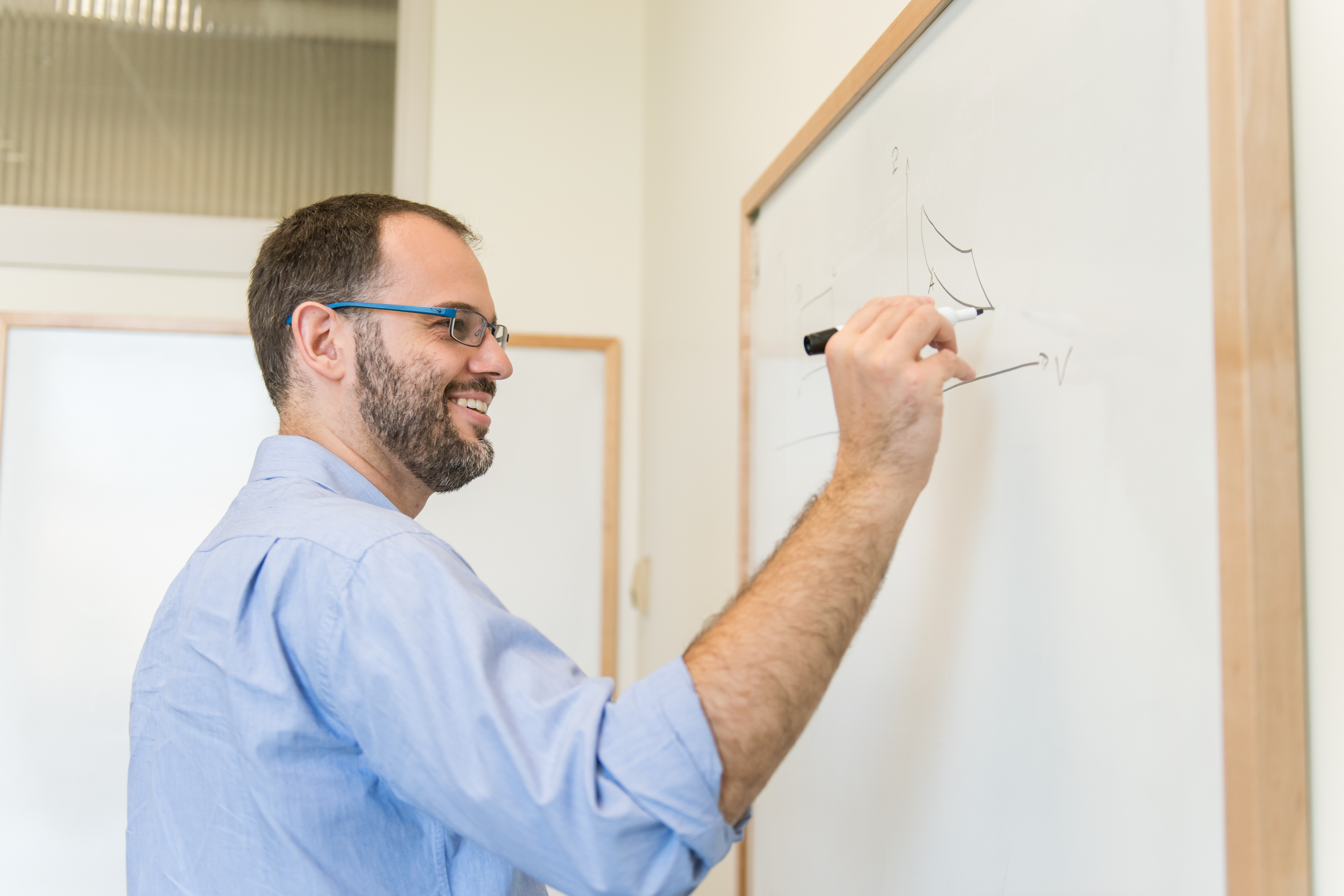
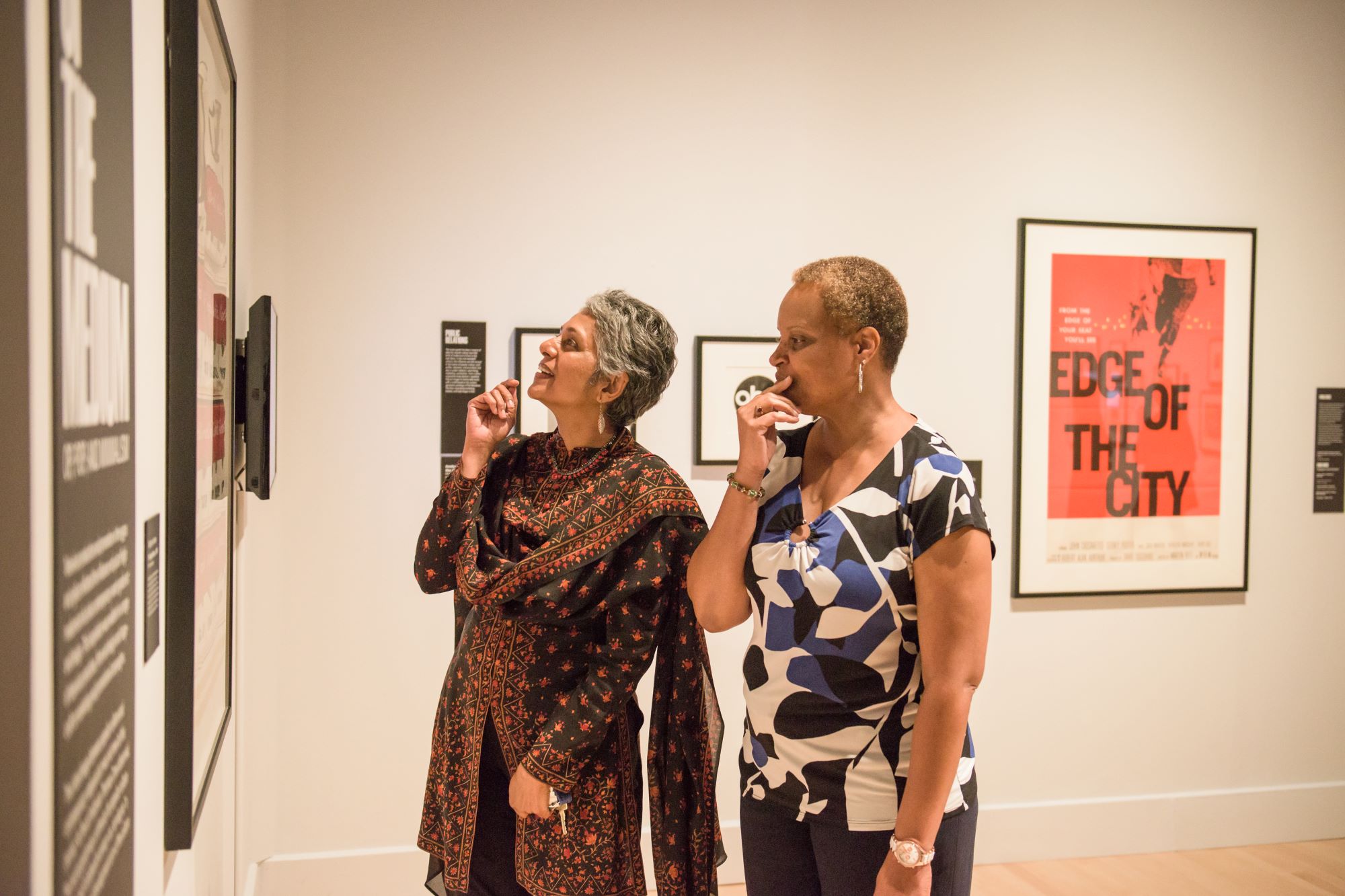
Four UMBC faculty and staff members have received highly competitive Fulbright awards to conduct research and establish important connections around the world over the next year. UMBC’s new recipients of Fulbright U.S. Scholar awards are Shimei Pan, associate professor of information systems, and Corrie Parks, assistant professor of visual arts, and Tiffany Thames Copeland, adjunct faculty in Africana studies. Nancy Young, vice president for student affairs, has received a Fulbright International Education Administrators Award. They will travel to Germany, Austria, Ghana, and France, respectively.
They follow on the heels of Helena Mentis, professor of information systems, who will soon return from a Fulbright experience in Denmark, working with the University of Copenhagen’s Human-Centered Computing research group.
“The Fulbright U.S. Scholar Program sends up to 900 U.S. faculty members throughout the world to conduct research or teach their subject, as well as participate in cultural exchange during their time in their host countries,” explains Brian Souders, associate director of global engagement opportunities in UMBC’s Center for Global Engagement.
“UMBC has a long tradition of faculty receiving this prestigious award, with 14 UMBC scholars earning this award over the past decade,” he notes. “Receiving three of these awards and an administrators award in a single year is quite exciting.”
Eliminating bias, increasing fairness
Pan will spend six months at the Heidelberg Institute for Theoretical Studies and Heidelberg University in Germany. There she will conduct research related to natural language processing, which is a subfield of artificial intelligence (AI). Her research at UMBC focuses on developing natural language processing models trained on large amounts of text, including content from social media, and she is eager to collaborate with fellow researchers in Germany.
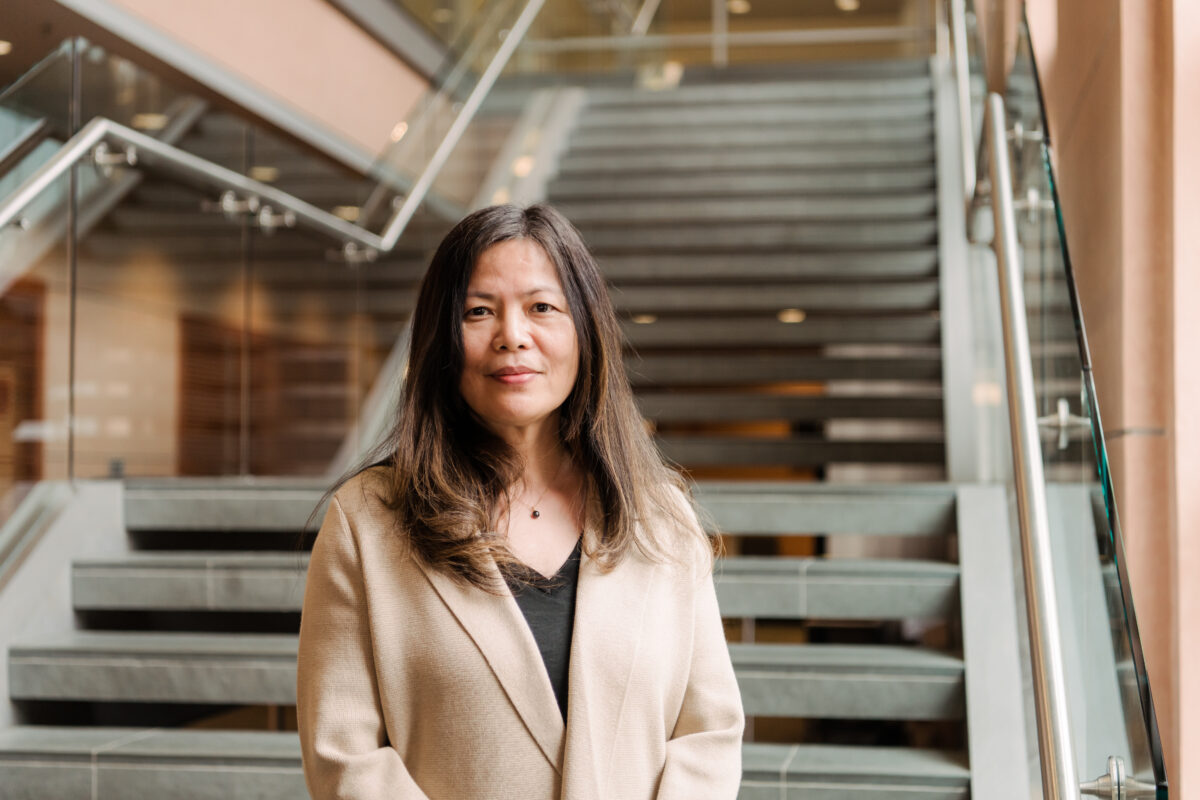 Shimei Pan. (Marlayna Demond ’11/UMBC)
“I’m excited about the project because it’s a continuation of my recent interests on responsible AI,” she says. “In the past we focused on making the technology more powerful and efficient, but for the last five years or so I’ve been working to address bias and increase fairness.”
“AI algorithms impact people’s daily lives,” says Pan, in explaining the importance of making these algorithms as equitable as possible. Because artificial intelligence technology is created by people and trained on human-produced data, it will inherit people’s biases. Pan is working to identify, assess, and mitigate various social biases encoded in large natural language processing models trained on massive text collections.
Focusing on the details
Parks will spend two months as an artist in residence at the Q21/MuseumsQuartier in Vienna. She will partner with ASIFA Austria, the International Animated Film Association in Vienna, to create an installation. She uses sand animation and other specialized animation techniques to explore broader themes. “My work examines small details and asks questions about the role of the individual in the collective or big picture,” addressing climate change and social issues, Parks explains.
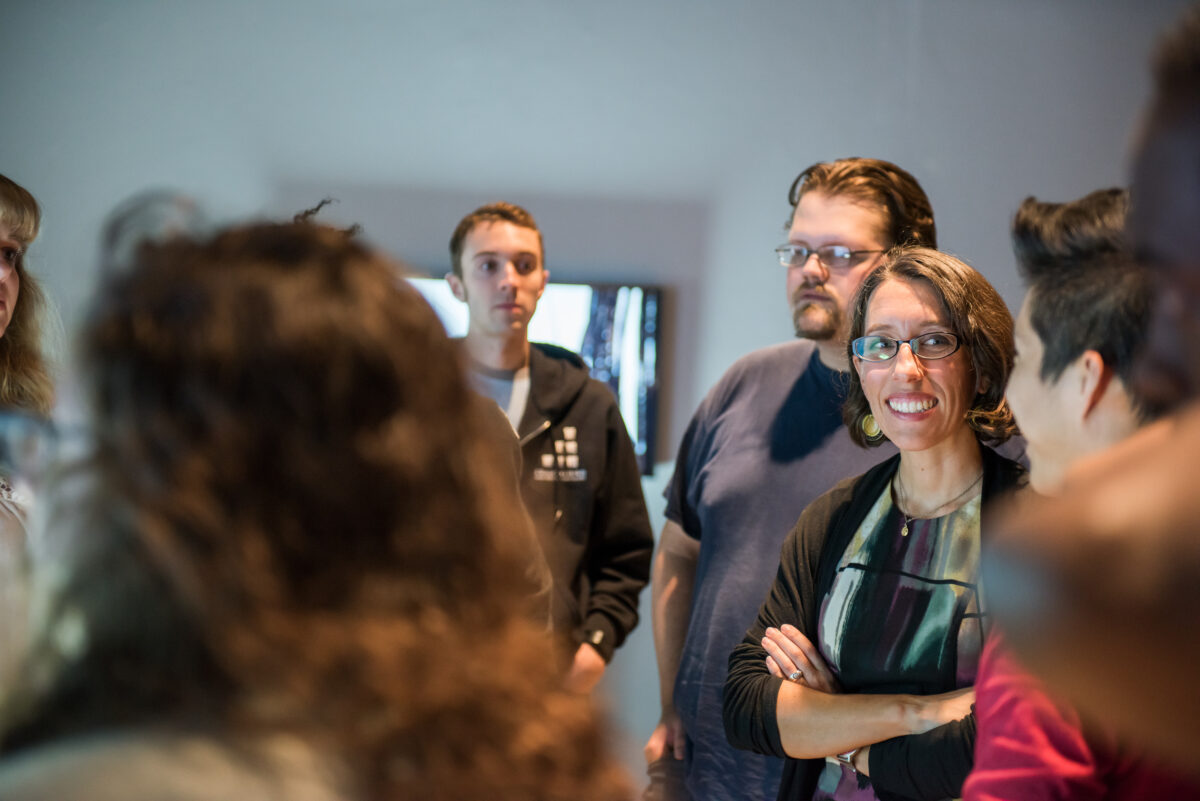 Corrie Parks, right, at a CADVC event. (Marlayna Demond ’11/UMBC)
This is not the first time that Parks has received a Fulbright award. She spent time in New Zealand when she was a student pursuing her master in fine arts degree. She sees these immersive artist residencies as unique opportunities to make significant “creative leaps,” focusing exclusively on her art.
During her time in Austria, Parks will create a work for a public installation space in the center of a building that is both old and contemporary. While she will create her installation independently, she will work with collaborators on coding interactive and visualization elements of the work.
Cultural exchange, diaspora research
Thames Copeland will complete her Fulbright award in Ghana where she will study the experiences and impacts of people in the African Diaspora “returning” to Ghana in the last century. “I am humbled to receive this Fulbright U.S. Scholars award to Ghana for the 2022-2023 academic year,” she says. “I am looking forward to the cultural exchange experience and investigating the Back to Africa Movement of the 21st century, as I research how the African Diaspora ‘returnees’ to Ghana continue in the fight for liberation.”
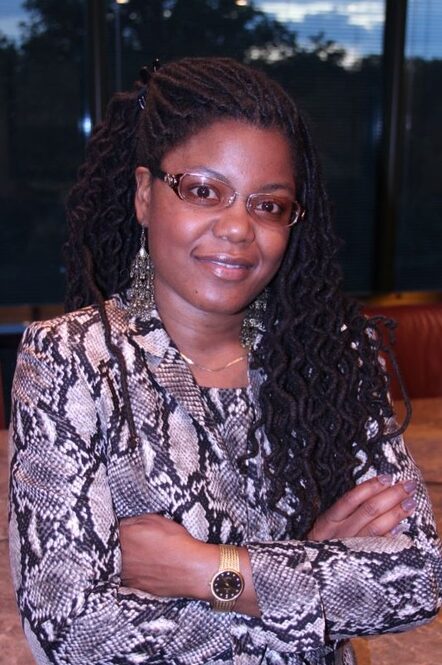 Tiffany Thames Copeland. (Image courtesy of Thames Copeland)
She has been an adjunct faculty member in the Africana studies department at UMBC since January 2021.
Seeing the world differently
Young is part of the first group selected for the Fulbright International Education Administrators program since the COVID-19 pandemic began. She was named a finalist before the pandemic and, now that the program has resumed, she will be one of twelve U.S. administrators from across the country to spend two weeks in France, connecting with contacts in French higher education, government, and administration.
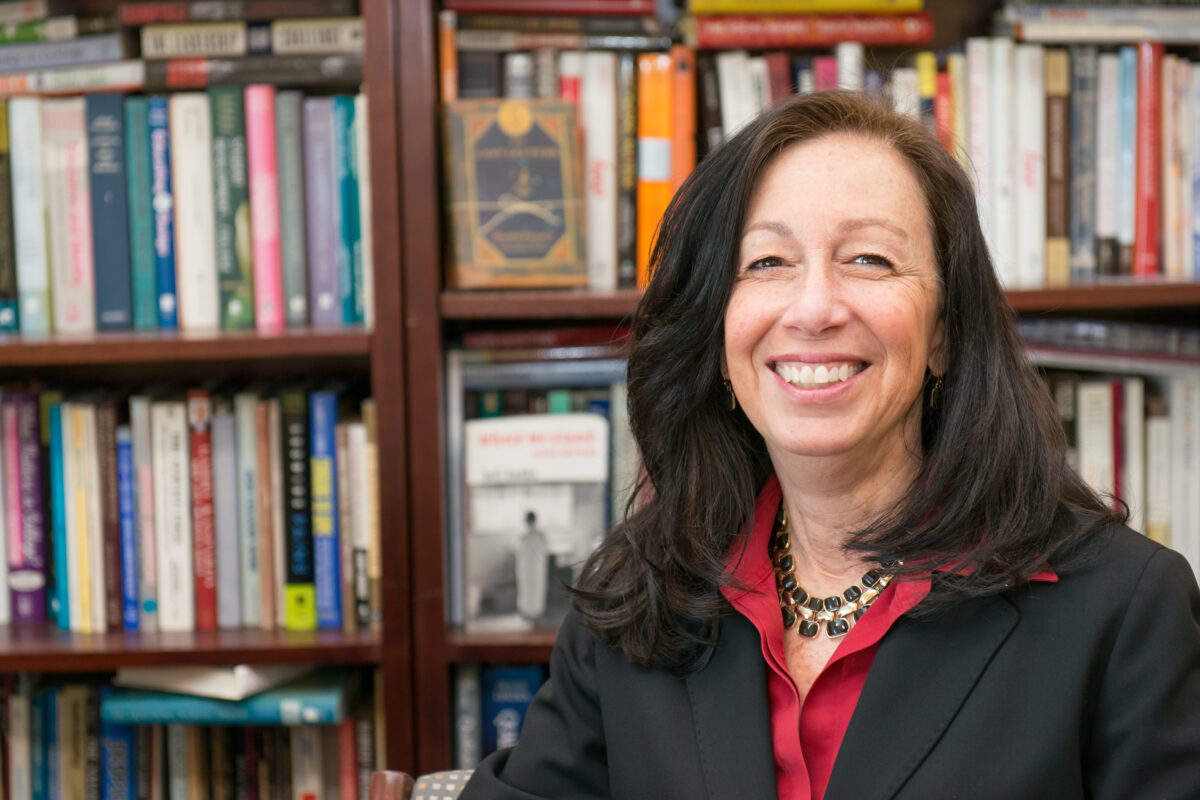 Nancy Young. (Marlayna Demond ’11/UMBC)
“I am excited to engage in an experience that I think will challenge me to grow and see the world differently,” Young says. She looks forward to establishing relationships with new colleagues and developing a deeper understanding of other education systems, and she is eager to apply what she learns from the Fulbright experience to her work at UMBC.
Young has been interested in the Fulbright program since early in her career. She shares that support from colleagues at UMBC, including Souders and David Di Maria, associate vice provost for international education, was instrumental in making her goal a reality.
In addition to this honor, Young was also recently recognized as one of the Maryland Daily Record’s Top 100 Women. She has also been featured by the Chronicle of Higher Education as a leading voice on the future of Student Affairs.
]]>
Four UMBC faculty and staff members have received highly competitive Fulbright awards to conduct research and establish important connections around the world over the next year. UMBC’s new...
https://umbc.edu/stories/umbc-faculty-staff-earn-fulbright-awards/
https://my3.my.umbc.edu/api/v0/pixel/news/125770/guest@my.umbc.edu/0edc5c42e9a1c4cb77e1c63ef3a41510/api/pixel
arts-and-culture
cahss
coeit
community
international-stories
is
majoraward
news
research
science-and-tech
studentaffairs
visualarts
UMBC News & Magazine
https://my3.my.umbc.edu/groups/umbc-news-magazine
https://assets1-my.umbc.edu/system/shared/avatars/groups/000/001/943/24435aa6207c452e7bc15cc74b42c7bb/xsmall.png?1748556657
https://assets1-my.umbc.edu/system/shared/avatars/groups/000/001/943/24435aa6207c452e7bc15cc74b42c7bb/original.png?1748556657
https://assets2-my.umbc.edu/system/shared/avatars/groups/000/001/943/24435aa6207c452e7bc15cc74b42c7bb/xxlarge.png?1748556657
https://assets2-my.umbc.edu/system/shared/avatars/groups/000/001/943/24435aa6207c452e7bc15cc74b42c7bb/xlarge.png?1748556657
https://assets3-my.umbc.edu/system/shared/avatars/groups/000/001/943/24435aa6207c452e7bc15cc74b42c7bb/large.png?1748556657
https://assets1-my.umbc.edu/system/shared/avatars/groups/000/001/943/24435aa6207c452e7bc15cc74b42c7bb/medium.png?1748556657
https://assets2-my.umbc.edu/system/shared/avatars/groups/000/001/943/24435aa6207c452e7bc15cc74b42c7bb/small.png?1748556657
https://assets1-my.umbc.edu/system/shared/avatars/groups/000/001/943/24435aa6207c452e7bc15cc74b42c7bb/xsmall.png?1748556657
https://assets2-my.umbc.edu/system/shared/avatars/groups/000/001/943/24435aa6207c452e7bc15cc74b42c7bb/xxsmall.png?1748556657
UMBC News & Magazine
0
0
false
Mon, 06 Jun 2022 15:35:38 -0400
Mon, 06 Jun 2022 15:34:06 -0400
UMBC’s Timothy Nohe brings an artist’s perspective to prestigious ACE Fellowship

For the past year, UMBC’s Timothy Nohe, professor of visual arts, has served as a Fellow of the American Council on Education (ACE), the preeminent national program for cultivating leaders in higher education.
Since its inception in 1965, the ACE Fellows Program has strengthened institutions in American higher education by identifying and preparing more than 2,000 faculty, staff, and administrators for senior positions in college and university leadership through its distinctive and intensive nominator-driven, cohort-based mentorship model. More than 80 percent of past Fellows have gone on to serve as chief executive officers, chief academic officers, other cabinet-level positions, or deans following their fellowship.
The program combines leadership retreats, interactive learning opportunities, visits to campuses and other higher education-related organizations, and an extended placement at another higher education institution. This combination of elements works to condense what would otherwise be years of on-the-job experience and skills development into a single year.
Already a campus leader
Nohe was recognized as a campus leader even before his ACE Fellowship, having served as president of the faculty senate and as founding director of the Center for Innovation, Research and Creativity in the Arts (CIRCA).
“Long a leader in shared governance and arts research, Tim Nohe is admired across UMBC for his accomplishments and particularly for his values,” says Provost Philip Rous. “He has extended UMBC’s tradition of strong faculty leaders participating in this prestigious national program. And as a practicing artist, he has brought an important, distinctive perspective to his ACE fellowship cohort.”
Residency at Franklin & Marshall
Nohe was one of only thirty-eight ACE Fellows selected from across the nation in 2020, through a rigorous nomination and review process.
Because of the pandemic, his entire fellowship cohort was delayed by one year, but he used that time to expand his understanding of issues in higher education. When the program relaunched for 2021–22, ACE matched Nohe with Franklin & Marshall College in Lancaster, Pennsylvania as the site for his fellowship experience.
During the placement, Fellows observe and work with the host institution’s president and other senior officers, attend decision-making meetings, and focus on issues of interest. Fellows also conduct projects of pressing concern for their home institution, with the goal of implementing their findings when they return after their fellowship year.
Nohe explored issues around faculty governance, internationalization, diversity, equity and inclusion, and leadership while at Franklin & Marshall. He appreciates the combination of autonomy and open door access to senior leaders and faculty that he experienced there.
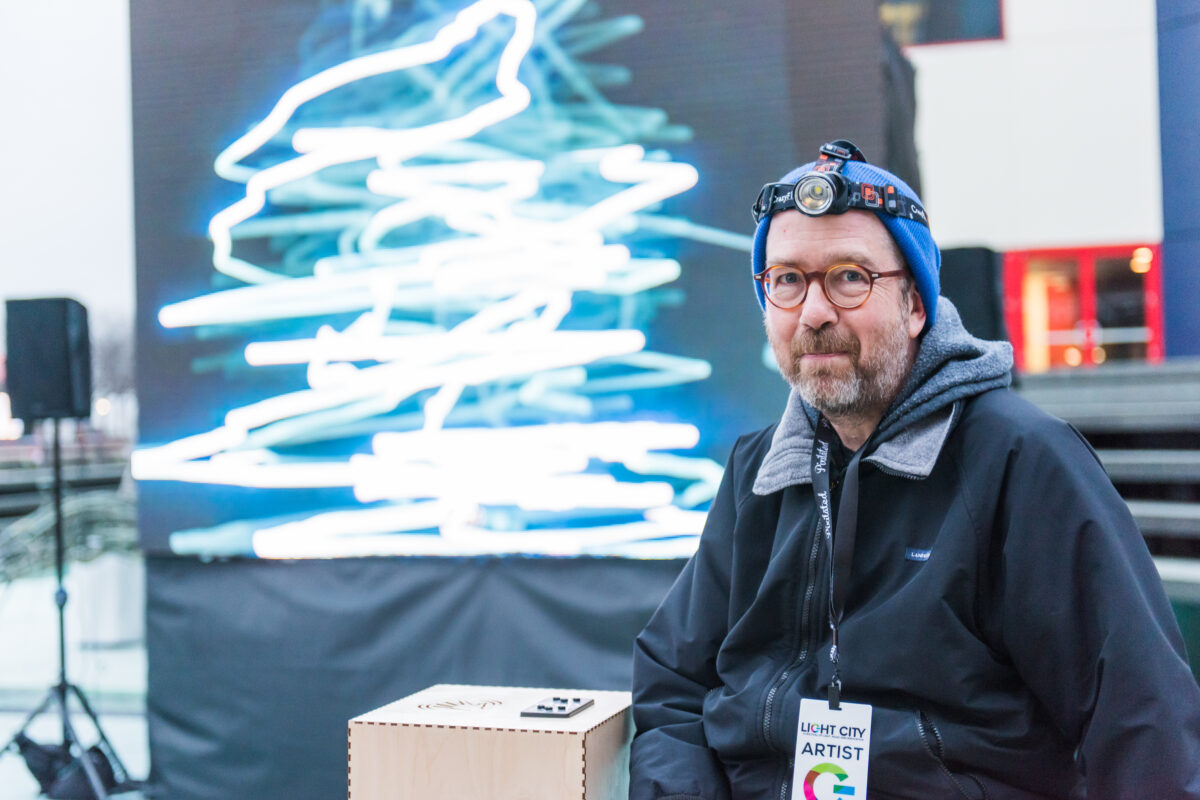 Timothy Nohe poses with interactive artwork he developed for the 2017 Light City festival. (Marlayna Demond ’11/UMBC)
“At Franklin & Marshall, I’ve gained perspectives on enabling students to secure their futures, exploring topics from wellness to maintaining college access and affordability,” he notes. “As Fellows, we learn to see the broad national landscape.”
At the same time, Nohe was able to share experiences and insight, developed over years at UMBC, with campus leaders and Franklin & Marshall.
Returning to UMBC with new-found insight
At the conclusion of the fellowship year, ACE Fellows return to their home institutions with new knowledge and skills. They also join a robust network of peers across the country and abroad—current and emerging higher ed leaders who are committed to tackling challenges in the field.
In pursuing this fellowship, Nohe says, “It was important to me to obtain a broader overview that would make me a stronger leader on campus.” He had already begun to see “a broader picture of higher ed” through founding and leading CIRCA at UMBC. But, he says, “I wanted to position myself to foster higher education in a very challenging time.” The ACE Fellowship gave him the broader perspective he was seeking.
Nohe cites his background in the arts as an important facet of his ACE Fellowship experience. “Artists have superpowers to reach across disciplines, and I’ve been really grateful as a past director of CIRCA to see that happen—how much synergy is developed,” he says. “In my work as an ACE Fellow, I’ve seen higher education leaders taking an interest in breaking down academic silos.”
“UMBC cares about the broader good of higher education,” Nohe shares, “and clearly Franklin & Marshall believes in it as well.” Now, he looks forward to returning to the UMBC community with new skills that can help lead the university on its path forward.
]]>
For the past year, UMBC’s Timothy Nohe, professor of visual arts, has served as a Fellow of the American Council on Education (ACE), the preeminent national program for cultivating leaders in...
https://umbc.edu/stories/umbcs-timothy-nohe-brings-an-artists-perspective-to-prestigious-ace-fellowship/
https://my3.my.umbc.edu/api/v0/pixel/news/119429/guest@my.umbc.edu/e17058ef1a96efa3118aa7cad37744e4/api/pixel
arts-and-culture
cahss
community
news
visualarts
UMBC News & Magazine
https://my3.my.umbc.edu/groups/umbc-news-magazine
https://assets1-my.umbc.edu/system/shared/avatars/groups/000/001/943/24435aa6207c452e7bc15cc74b42c7bb/xsmall.png?1748556657
https://assets1-my.umbc.edu/system/shared/avatars/groups/000/001/943/24435aa6207c452e7bc15cc74b42c7bb/original.png?1748556657
https://assets2-my.umbc.edu/system/shared/avatars/groups/000/001/943/24435aa6207c452e7bc15cc74b42c7bb/xxlarge.png?1748556657
https://assets2-my.umbc.edu/system/shared/avatars/groups/000/001/943/24435aa6207c452e7bc15cc74b42c7bb/xlarge.png?1748556657
https://assets3-my.umbc.edu/system/shared/avatars/groups/000/001/943/24435aa6207c452e7bc15cc74b42c7bb/large.png?1748556657
https://assets1-my.umbc.edu/system/shared/avatars/groups/000/001/943/24435aa6207c452e7bc15cc74b42c7bb/medium.png?1748556657
https://assets2-my.umbc.edu/system/shared/avatars/groups/000/001/943/24435aa6207c452e7bc15cc74b42c7bb/small.png?1748556657
https://assets1-my.umbc.edu/system/shared/avatars/groups/000/001/943/24435aa6207c452e7bc15cc74b42c7bb/xsmall.png?1748556657
https://assets2-my.umbc.edu/system/shared/avatars/groups/000/001/943/24435aa6207c452e7bc15cc74b42c7bb/xxsmall.png?1748556657
UMBC News & Magazine
0
0
false
Mon, 09 May 2022 09:42:03 -0400
Mon, 09 May 2022 09:42:03 -0400
Ten million reads: UMBC researchers hit milestone in sharing knowledge through The Conversation
UMBC researchers regularly share their work and expertise with the public through The Conversation—a nonprofit news outlet that provides current, informative content to news publications worldwide, free of charge. This week, these authors have hit a milestone: 224 Conversation articles written by 125 different UMBC researchers have earned a cumulative 10 million reads.
The stories offer context to current events, explain natural phenomena, introduce new research in an accessible way, and more. There’s even a Curious Kids section to answer the youngest readers’ questions.
The 10 million reads milestone demonstrates the commitment of UMBC researchers to sharing their expertise with the broader community. It also shows that UMBC researchers are helping meet public demand for high-quality content on timely topics.
“The Conversation helps us contribute to our public service mission as a public university,” says Karl V. Steiner, vice president for research. “This milestone underscores the importance of academic researchers actively participating in the public discourse of complex issues.”
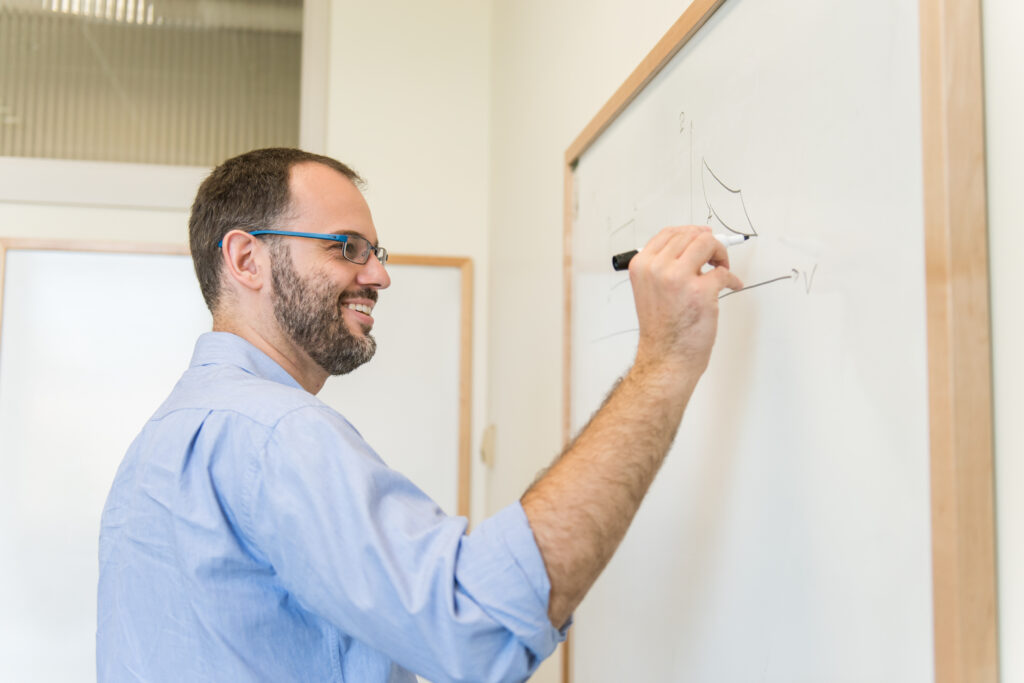
Sebastian Deffner, physics, wrote a piece for The Conversation in 2017 explaining static electricity. Every winter, when dry air and static increase, the article gets a fresh boost of views. Photo by Marlayna Demond ’11 for UMBC.
Career impact
Many readers have likely seen articles from The Conversation without realizing it, due to the free-to-republish model. Top republishers of UMBC’s Conversation content include Quartz, Smithsonian Magazine, Fast Company, Scientific American, Business Insider, andCNN, along with countless local newspapers around the nation. And these articles often inspire additional original news coverage on faculty research as well.

Charissa Cheah’s April 2021 Conversation article on anti-Asian violence and school safety was followed by related coverage on NBC News and WYPR. Photo by Crystal Tseng, courtesy Charissa Cheah.
The Conversation has a global impact. Forty-two percent of readers of UMBC-authored Conversation articles are based outside the U.S. Many of these readers are based in Canada, India, Australia, the United Kingdom, France, the Philippines, and Singapore, among other nations. They access both English-language content and UMBC articles that have been translated into other languages, such as Spanish and French.
The authors benefit, too. “Working with The Conversation taught me the ropes of writing for the general public,” says Zoë McLaren, associate professor of public policy. “It helped me develop a reputation as a respected COVID-19 expert. And it helped develop the skills I needed to be able to write for FiveThirtyEight, WIRED and The New York Times. The editors at The Conversation are knowledgeable and helpful and a real pleasure to work with.”
McLaren has written nine Conversation articles on topics like the role of rapid tests for COVID-19 and how the clinical trials process works.
Katherine Seley-Radtke, professor of chemistry and biochemistry, has also had success with The Conversation. “The experience of writing several pieces for The Conversation has had a significant impact on my career,” she says. “Since publishing my first piece at the beginning of the pandemic, I have given more than 60 interviews for print, radio, and television.”
As a medicinal chemist whose research group focuses on antiviral drug development, Seley-Radtke says, “it is important to have these types of platforms to help educate and inform the public.”
From technical to accessible
Even research areas that aren’t frequently in the news can find an enthusiastic audience on The Conversation. Preminda Jacob, associate professor of visual arts and associate dean of the College of Arts, Humanities, and Social Sciences, has discovered this first-hand. With her expertise in the history of modern and contemporary art, Jacob’s articles in The Conversation have helped the public better understand artists’ social and political impacts.
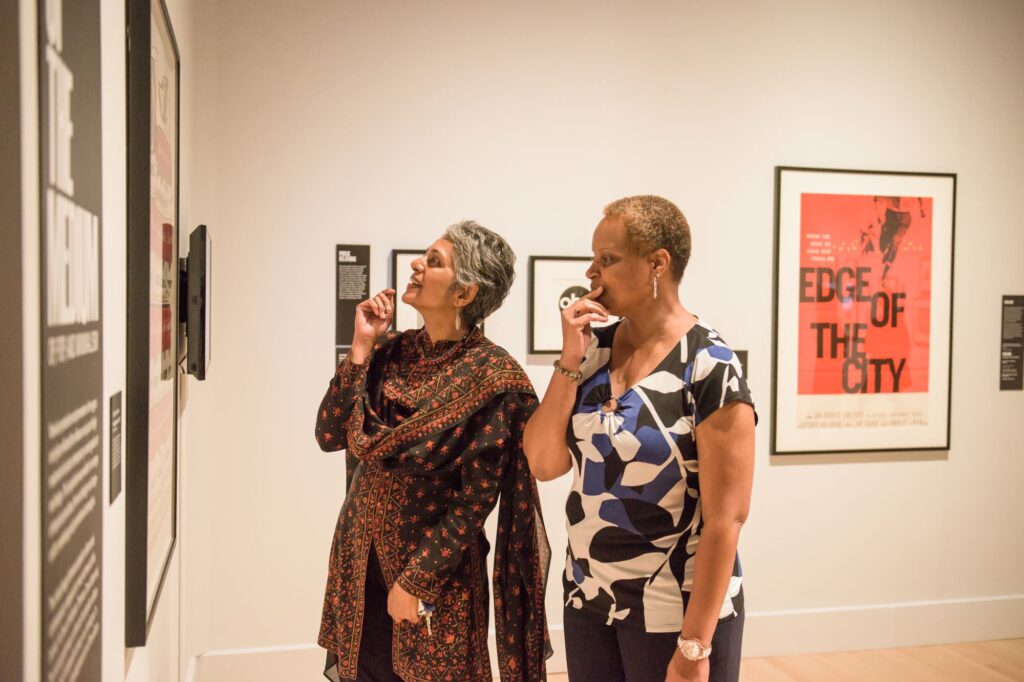
Preminda Jacob (l) and Andrea Lorick (r) at at exhibition at UMBC’s Center for Art, Design, and Visual Culture. Photo by Marlayna Demond ’11 for UMBC.
Mercedes Burns, assistant professor of biological sciences, studies the evolution of reproductive systems in arachnids commonly referred to as daddy longlegs. She published an article about the ability of some animal species to reproduce with just one parent’s genetic material. Published just before Christmas with the title “Virgin births from parthenogenesis,” the story garnered a huge readership. It subsequently appeared on CNN, Gizmodo, IFLScience, and more.
“I enjoy the challenge of taking technical writing and making it accessible for a wider audience,” says Burns, who is also very active within the science community on Twitter. She in part credits that public engagement for additional opportunities to comment on stories for The New York Times, The Atlantic, Science News, and Smithsonian Magazine.
Burns’s Conversation editor “gave me clear feedback over just two sessions, so I could easily make the changes she suggested,” she says. “All in all, I was glad to have a broader venue for my research, and the process wasn’t too complicated or time-consuming. I would certainly write a Conversation article again.”
Fostering public understanding
Richard Forno, principal lecturer and director of the cybersecurity graduate program, is one of UMBC’s most frequent contributors to The Conversation, writing on topics from election security to ransomware attacks. Forno views sharing his expertise as a civic duty, given cybersecurity threats facing the public. He sees The Conversation as an excellent way to connect with a broad range of readers.
“To me, what’s refreshing about The Conversation‘s role in the world—and why I appreciate contributing to it—is their commitment to providing easily accessible and jargon-free exploration and objective analysis of often-complex issues, technology, and events,” Forno says.
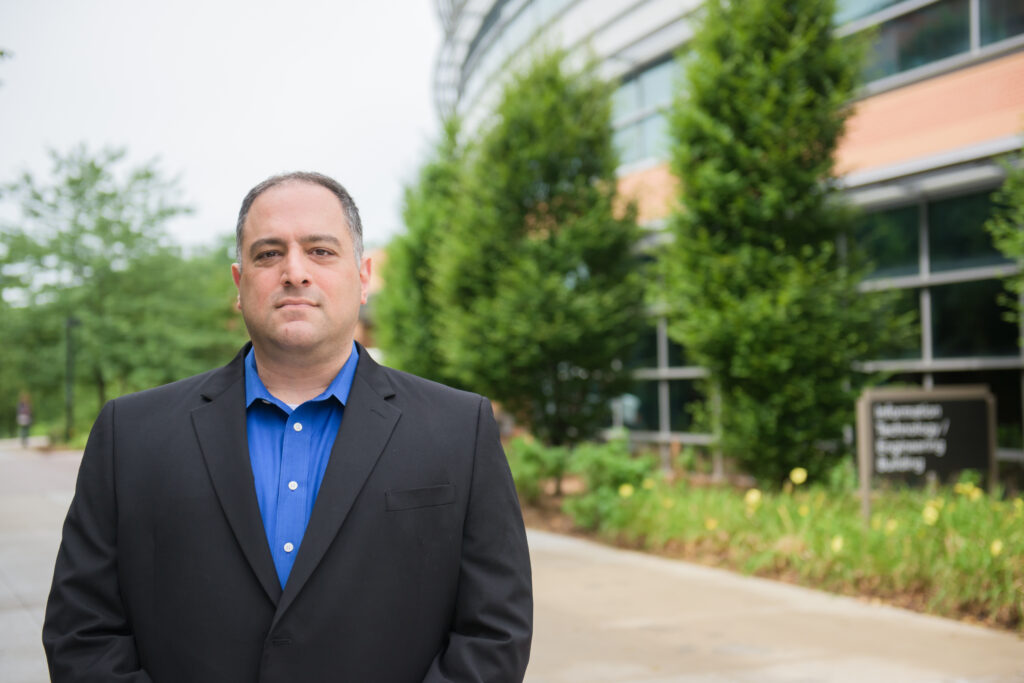
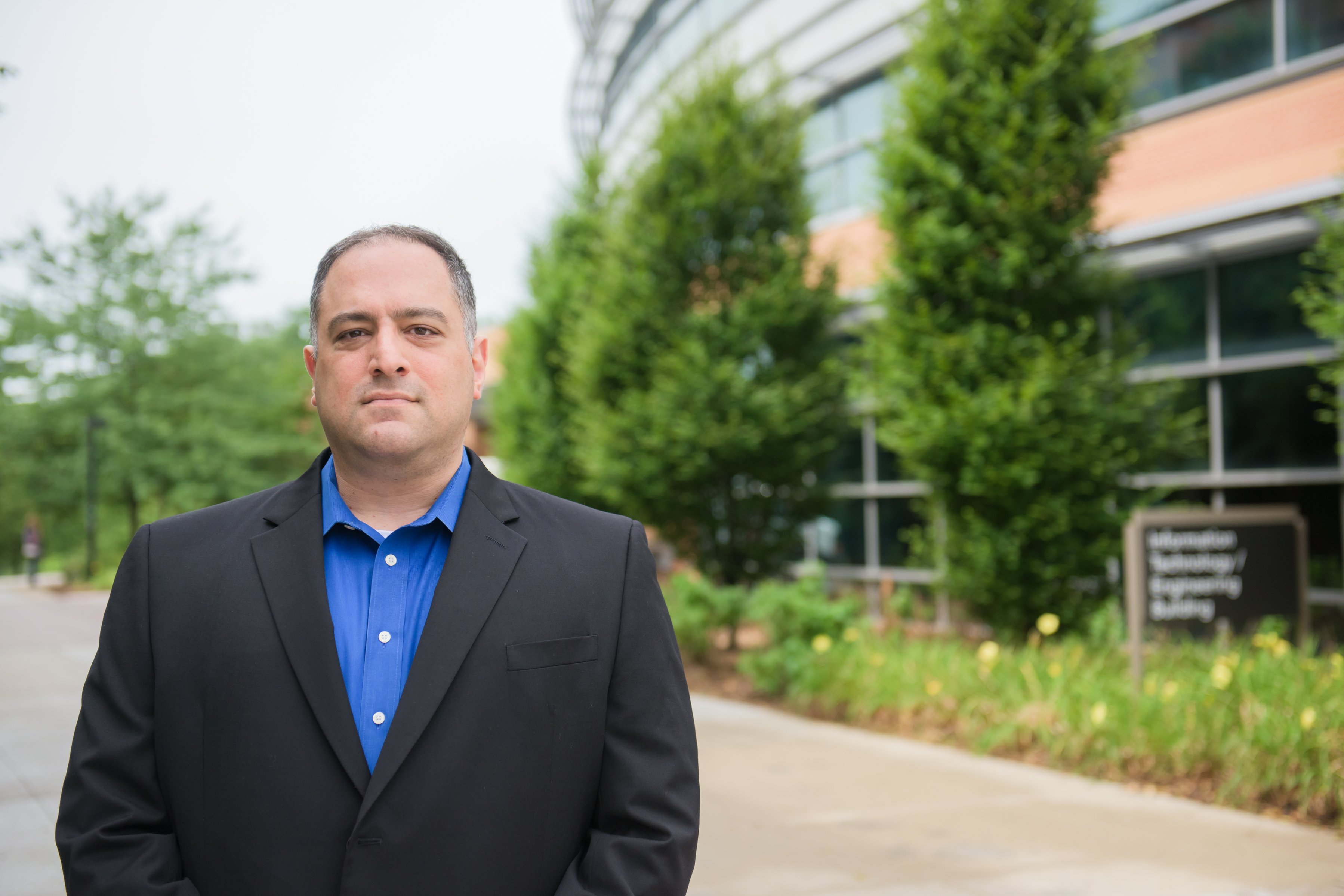
Richard Forno outside the Information Technology and Engineering Building. Photo by Marlayna Demond ’11 for UMBC.
For example, an article by Priyanka Ranade ’18, M.S. ’19, information systems, a Ph.D. student in computer science, and Anupam Joshi and Tim Finin, professors of computer science and electrical engineering, discusses how artificial intelligence can generate fake reports about medical research, cyberattacks, and more, that fool even cybersecurity experts. Public understanding and vigilance around cybersecurity is critical in today’s world, but the issues can seem opaque to those outside the field unless communicated clearly.
“The Conversation reminds academics, researchers, and other experts that knowledge discovery is just as important as how it’s conveyed to others,” Forno says. “This work is so important to fostering public understanding and supporting a more informed global citizenry.”
Banner image: Mercedes Burns (right) and Sarah Stellwagen at work in Burns’s laboratory. Photo by Marlayna Demond ’11 for UMBC.
]]>
UMBC researchers regularly share their work and expertise with the public through The Conversation—a nonprofit news outlet that provides current, informative content to news publications...
https://umbc.edu/stories/ten-million-reads-umbc-researchers-hit-milestone-in-sharing-knowledge-through-the-conversation/
https://my3.my.umbc.edu/api/v0/pixel/news/119466/guest@my.umbc.edu/0e228e0d31c7ce4ea3b40f5577e24360/api/pixel
biology
cahss
chembiochem
cnms
coeit
community
csee
cybersecurity
is
news
page1
physics
psychology
publicpolicy
research
visualarts
UMBC News & Magazine
https://my3.my.umbc.edu/groups/umbc-news-magazine
https://assets1-my.umbc.edu/system/shared/avatars/groups/000/001/943/24435aa6207c452e7bc15cc74b42c7bb/xsmall.png?1748556657
https://assets1-my.umbc.edu/system/shared/avatars/groups/000/001/943/24435aa6207c452e7bc15cc74b42c7bb/original.png?1748556657
https://assets2-my.umbc.edu/system/shared/avatars/groups/000/001/943/24435aa6207c452e7bc15cc74b42c7bb/xxlarge.png?1748556657
https://assets2-my.umbc.edu/system/shared/avatars/groups/000/001/943/24435aa6207c452e7bc15cc74b42c7bb/xlarge.png?1748556657
https://assets3-my.umbc.edu/system/shared/avatars/groups/000/001/943/24435aa6207c452e7bc15cc74b42c7bb/large.png?1748556657
https://assets1-my.umbc.edu/system/shared/avatars/groups/000/001/943/24435aa6207c452e7bc15cc74b42c7bb/medium.png?1748556657
https://assets2-my.umbc.edu/system/shared/avatars/groups/000/001/943/24435aa6207c452e7bc15cc74b42c7bb/small.png?1748556657
https://assets1-my.umbc.edu/system/shared/avatars/groups/000/001/943/24435aa6207c452e7bc15cc74b42c7bb/xsmall.png?1748556657
https://assets2-my.umbc.edu/system/shared/avatars/groups/000/001/943/24435aa6207c452e7bc15cc74b42c7bb/xxsmall.png?1748556657
UMBC News & Magazine
0
0
false
Mon, 07 Mar 2022 21:35:09 -0500
Mon, 07 Mar 2022 21:35:09 -0500
Meet the UMBC alumni who built the Smithsonian’s Searchable Museum, expanding online access to African American history and culture
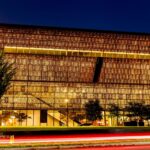
The National Museum of African American History and Culture (NMAAHC) is known for its stunning architecture and powerful, immersive exhibits. More than 600,000 visitors experienced the NMAAHC – the newest Smithsonian museum – in the first three months of its opening in Washington, D.C. During the COVID pandemic, the museum wondered how it could best reach audiences unable to visit in person. Enter Baltimore-based tech company Fearless and a team of UMBC alumni bridging computing and the arts.
Fearless, founded by Delali Dzirasa ‘04, computer engineering, led the development of the Searchable Museum to complement the NMAAHC’s “Slavery and Freedom” exhibition. The Fearless and NMAAHC teams worked together to reimagine this exhibit specifically for online audiences.
The Smithsonian’s announcement of the new platform notes, “Over a year in the making, the Searchable Museum initiative is one of the museum’s largest digital undertakings, bringing the museum’s evocative content and immersive in-person visitor experience into homes around the world.”
Reaching students where they are
The Searchable Museum has notably increased access to the NMAAHC exhibit materials, enabling people from around the world to immerse themselves in African American history and navigate critical conversations. A particularly important audience for the museum is K-12 students, whose class field trips to Washington, D.C. have been sharply curtailed by COVID.
 Delali Dzirasa in the Fearless office space. Photo by Marlayna Demond ’11 for UMBC.
The Fearless team designed the Searchable Museum with this audience in mind, and website data reveals they have succeeded in reaching that audience. Google Classrooms is one of the top ways that visitors have accessed the Searchable Museum.
“This is a dream project for us, and we knew we had to put together a world-class team,” says Dzirasa. “It was very important to us and the museum team that this be an experience for everyone. The types of interactive features we included are meant to be inclusive of as many people and devices as possible.”
Collaboration and innovation
Dzirasa and UMBC alumni and Fearless COO John Foster ‘04, computer engineering, convened a team of 16 Fearless employees who have worked on the two year project, including UMBC alumni Avery Smith ‘03, visual arts; Bill Streckfus ‘06, computer science; and Evan Rittenhouse ‘17, computer science.
“Fearless helped extend the museum’s reach to the online world, which required sensitivity. It was both a responsibility and a pleasure to make sure the museum’s stories of perseverance, tragedy, and triumph were carefully transmitted through an online medium, directly to the hearts of each visitor of the site,” explains Smith, a software engineer at Fearless.
 Avery Smith. Photo courtesy of Smith.
“Personally speaking, the NMAAHC is a landmark institution that provides a national record of activity of my ancestors and contemporaries,” says Smith. “It is extremely important that many of our artifacts and accomplishments are adequately surfaced to a global audience.”
Smith shares, “Fearless believes that the internet is a major tool for innovation, collaboration and critical thought. Helping to chronicle this extremely important segment of American history is our way of contributing to a fairer, healthier world, with an internet that is even more useful for even more people.”
Expanding access to African American stories
Dzirasa, Smith, and the rest of the Fearless team look forward to collaborating with the NMAAHC to translate more exhibits to the Searchable Museum platform.
 A photo of the Searchable Museum interface. Courtesy of the National Museum of African American History and Culture.
“Visiting NMAAHC is a life-changing experience, but I know not everyone will be able to go to Washington, D.C. to see the exhibitions in person. It was very important to us that we preserve and enhance the emotional storytelling people experience when they visit the museum and bring it online,” says Dzirasa.
“What you see today is version one, and we’re already making plans for what comes next,” he notes. “We are learning and taking feedback to make the next versions even better. As more exhibitions are added to the Searchable Museum, you’ll be able to access and experience hundreds of years of the African American story from anywhere in the world.”
Kevin Young, Andrew W. Mellon Director of the museum, shares, “Allowing the public to virtually revisit the originating struggle for American freedom in the ‘Slavery and Freedom’ exhibition reminds us of the centrality of the African American journey to the American experience—a story of triumph, resilience and joy over the centuries.”
Banner image: The National Museum of African American History and Culture. Photo by Angela N., Flickr CC by 2.0.
]]>
The National Museum of African American History and Culture (NMAAHC) is known for its stunning architecture and powerful, immersive exhibits. More than 600,000 visitors experienced the NMAAHC –...
https://umbc.edu/stories/meet-the-umbc-alumni-who-built-the-smithsonians-searchable-museum-expanding-online-access-to-african-american-history-and-culture/
https://my3.my.umbc.edu/api/v0/pixel/news/119477/guest@my.umbc.edu/aa7e60aaa1297e5add5c626cc05ab663/api/pixel
alumni
cahss
coeit
csee
news
page1
science-and-tech
visualarts
UMBC News & Magazine
https://my3.my.umbc.edu/groups/umbc-news-magazine
https://assets1-my.umbc.edu/system/shared/avatars/groups/000/001/943/24435aa6207c452e7bc15cc74b42c7bb/xsmall.png?1748556657
https://assets1-my.umbc.edu/system/shared/avatars/groups/000/001/943/24435aa6207c452e7bc15cc74b42c7bb/original.png?1748556657
https://assets2-my.umbc.edu/system/shared/avatars/groups/000/001/943/24435aa6207c452e7bc15cc74b42c7bb/xxlarge.png?1748556657
https://assets2-my.umbc.edu/system/shared/avatars/groups/000/001/943/24435aa6207c452e7bc15cc74b42c7bb/xlarge.png?1748556657
https://assets3-my.umbc.edu/system/shared/avatars/groups/000/001/943/24435aa6207c452e7bc15cc74b42c7bb/large.png?1748556657
https://assets1-my.umbc.edu/system/shared/avatars/groups/000/001/943/24435aa6207c452e7bc15cc74b42c7bb/medium.png?1748556657
https://assets2-my.umbc.edu/system/shared/avatars/groups/000/001/943/24435aa6207c452e7bc15cc74b42c7bb/small.png?1748556657
https://assets1-my.umbc.edu/system/shared/avatars/groups/000/001/943/24435aa6207c452e7bc15cc74b42c7bb/xsmall.png?1748556657
https://assets2-my.umbc.edu/system/shared/avatars/groups/000/001/943/24435aa6207c452e7bc15cc74b42c7bb/xxsmall.png?1748556657
UMBC News & Magazine
0
0
false
Mon, 07 Feb 2022 16:59:52 -0500
Tahir Hemphill merges hip-hop, computing, and cultural analysis as UMBC’s first postdoctoral fellow in the visual arts

UMBC’s Postdoctoral Fellowship for Faculty Diversity received over 500 applications this year, despite a pandemic that moved the entire process online for the first time. Emerging from that incredibly talented applicant pool was Tahir Hemphill, visual arts, who came to UMBC this fall as the inaugural Fellow for Faculty Diversity in the Visual Arts. This new track is specifically designed to support creative and artistic practitioners.
Hemphill is one of two Postdoctoral Fellows for Faculty Diversity to join UMBC’s College of Arts, Humanities, and Social Sciences this fall. He has developed a multifaceted practice as a creative technologist, multimedia artist, and design researcher. He uses his varied backgrounds in engineering and the arts to create graphic designs and projects that inform audiences about the world in which they live.

Tahir Hemphill, inaugural Fellow for Faculty Diversity in the Visual Arts. Photo courtesy of Tahir Hemphill.
“I was groomed to be an electrical engineer,” Hemphill says. “So the physical sciences—chemistry, math, physics—play an important role in how I see, view, and understand the world.” Much of his current work utilizes computational analysis to explore what is usually unseeable in the semantic structures within large bodies of archival text, working especially within the world of hip-hop.
Developing his focus
Coming of age in the 1980s, Hemphill divided his time between practicing various elements of hip-hop culture and exploring cyberspace via a dial-up modem. A fundamental affinity between hip-hop culture and hacking would define the trajectory of his professional and creative life.
Starting in middle school, he accessed engineering-oriented opportunities to build and create, acquiring tech knowledge and skills. At the same time, hip-hop’s “golden era” informed his perspectives on popular culture and politics. He has synthesized the theoretical frameworks behind these two educational influences into his current creative endeavors.
Over the past 20 years, as an artist who works with technology, Hemphill has found inspiration in scientific work that pushes investigation to artistic limits and artistic work that pushes repetition towards scientific method. His reverence for the scientific method as well as his irreverent tinkering with it fuel this productive tension between art and technology.
A distinctive career path
Hemphill arrived at UMBC with broad experience in higher education, commercial design, and the non-profit sector. After earning a B.A. in Spanish language from Morehouse College, a strategic planning certificate from Miami Ad School, and a M.S. in communications design from the Pratt Institute, he went on to receive a Creative Research Fellowship at Carnegie Mellon University and a Hiphop Archive Fellowship at the W.E.B. Du Bois Institute for African and African American Research at Harvard University.
He has served as the Harissios Papamarkou Chair in Education at the John W. Kluge Center at the Library of Congress, and as Behavioral Science Resident at the Rockefeller Foundation Bellagio Center.
In the commercial sector, artist residencies at Spotify and Autodesk Pier 9 have recognized his creative work. He’s also received grants from the National Endowment for the Arts and the Saul Zaentz Innovation Fund. Additionally, the Talk to Me exhibition at the Museum of Modern Art in New York features his work.
Hip-hop as a lens on culture
In recent years, Hemphill’s work has concentrated on the intersection of hip-hop and data, manifested especially by the Rap Research Lab, a creative technology studio he founded to explore rap as a cultural indicator. The lab uses a hip-hop framework to develop new ways for people to engage with data and culture.
“Hip-hop is the most influential art form in the world today,” asserts Hemphill. “Whenever there’s an uprising in a country, there’s been a hip-hop song that goes along with it. People around the world tend to tap into the part that was for expressing opinions, revolution, going against the status quo.”
A Mapper’s Delight
In a recent presentation through UMBC’s Center for Innovation, Research, and Creativity in the Arts (CIRCA), Hemphill shared details on A Mapper’s Delight, an interactive virtual and augmented reality tool.
“It’s a sculptural data visualization,” Hemphill says, “and it’s built on a semantic relationship of hundreds of thousands of rap lyrics. It shows how…rappers cover the globe with their lyrics with references to cities, neighborhoods, regions.” He shares that “it looks at the geography of language and hip-hop, and creating language as political exercise.”
“All the projects, all the products that we build, sit on top of the rap almanac, and that’s a database of transcription and linguistic analysis—lyrics from about a million rap songs from 1979 to current day,” says Hemphill. A Mapper’s Delight analyzes those songs through algorithms. Once source material is in the database, “you can do a search for ‘power,’ and find every rapper that raps about power, where in the world they rap about power, when they rapped about power, the context,” he explains.
A Mapper’s Delight has added content in around 30 languages in the past year, says Hemphill, “so it’s truly a big data hip-hop cultural project.”
Mercedez Dunn, sociology, anthropology, and public health, is also a 2021-22 Postdoctoral Fellow for Faculty Diversity at UMBC. Learn about her work in this profile.
Header image: Tahir Hemphill speaks at TEDYouth in November 2014, Brooklyn Museum, Brooklyn, New York. Photo: Ryan Lash/TED. Attribution-NonCommercial 2.0 Generic license.
]]>
UMBC’s Postdoctoral Fellowship for Faculty Diversity received over 500 applications this year, despite a pandemic that moved the entire process online for the first time. Emerging from that...
https://umbc.edu/stories/tahir-hemphill-merges-hip-hop-computing-and-cultural-analysis-as-umbcs-first-postdoctoral-fellow-in-the-visual-arts/
https://my3.my.umbc.edu/api/v0/pixel/news/119497/guest@my.umbc.edu/ee6ceacc74328fdf40e987de006d4236/api/pixel
arts-and-culture
cahss
cahssresearch
visualarts
UMBC News & Magazine
https://my3.my.umbc.edu/groups/umbc-news-magazine
https://assets1-my.umbc.edu/system/shared/avatars/groups/000/001/943/24435aa6207c452e7bc15cc74b42c7bb/xsmall.png?1748556657
https://assets1-my.umbc.edu/system/shared/avatars/groups/000/001/943/24435aa6207c452e7bc15cc74b42c7bb/original.png?1748556657
https://assets2-my.umbc.edu/system/shared/avatars/groups/000/001/943/24435aa6207c452e7bc15cc74b42c7bb/xxlarge.png?1748556657
https://assets2-my.umbc.edu/system/shared/avatars/groups/000/001/943/24435aa6207c452e7bc15cc74b42c7bb/xlarge.png?1748556657
https://assets3-my.umbc.edu/system/shared/avatars/groups/000/001/943/24435aa6207c452e7bc15cc74b42c7bb/large.png?1748556657
https://assets1-my.umbc.edu/system/shared/avatars/groups/000/001/943/24435aa6207c452e7bc15cc74b42c7bb/medium.png?1748556657
https://assets2-my.umbc.edu/system/shared/avatars/groups/000/001/943/24435aa6207c452e7bc15cc74b42c7bb/small.png?1748556657
https://assets1-my.umbc.edu/system/shared/avatars/groups/000/001/943/24435aa6207c452e7bc15cc74b42c7bb/xsmall.png?1748556657
https://assets2-my.umbc.edu/system/shared/avatars/groups/000/001/943/24435aa6207c452e7bc15cc74b42c7bb/xxsmall.png?1748556657
UMBC News & Magazine
0
0
false
Fri, 17 Dec 2021 02:59:03 -0500
UMBC and IMET faculty reveal a hidden world in the Chesapeake Bay
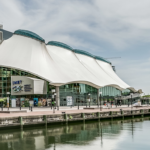
The waters of the Chesapeake Bay teem with microscopic organisms—swimming single-celled plankton known as dinoflagellates. But how can we peer into the depths to see them?
That’s the question driving a new creative project led by Lisa Moren, professor of visual arts at UMBC and artist-in-residence at the University of Maryland Center for Environmental Science’s Institute of Marine and Environmental Technology (IMET), and IMET associate research professor Tsvetan Bachvaroff.

Dinoflagellate image from Under the Bay courtesy of Lisa Moren.
Moren and Bachvaroff have developed “Under the Bay,” an augmented reality app that allows users a glimpse into the lives of the dinoflagellates. Bringing the project to life are close collaborators Marc Olano, associate professor of computer science and director UMBC’s game development track, and Baltimore-based composer Dan Deacon.

Screen shot from Under the Bay courtesy of Lisa Moren.
This project brings together experts from divergent fields, whose work generally takes very different forms, to create something fully unique. Moren, a multi-disciplinary artist, works with emerging media, public space and works-on-paper. Bachvaroff’s research focuses on the evolution and biology of dinoflagellates, which are often associated with “red tides” or harmful algal blooms. Olano is known for innovations in game design, while Deacon is known globally for electronic music involving large-scale audience interaction.
Public demonstration
In a first public demonstration of Under the Bay on October 9, from 1 to 4 p.m., participants will download the project app and hold their phones over water in the Inner Harbor near IMET (701 East Pratt Street). Dozens of animated microorganisms, typically too small for the human eye to see, will appear on their screens—beautiful, large, and vibrantly changing in color.

Dinoflagellate image from Under the Bay courtesy of Lisa Moren.
Moren has produced a teaser trailer for the event, viewable here on Vimeo.
A unique experience for each user
Under the Bay’s screen animations will change color when conditions in the Bay change, while stories and music will connect memory, science, and anecdotal observation. When the Bay water is healthy, the organisms appear swimming and billowing over their field of view like happy jellyfish. When the water is unhealthy, the organisms become shriveled like discarded plastic bags in the water.

Under the Bay co-creator Lisa Moren. Image courtesy of Lisa Moren.
“Under the Bay will tell a unique story for every user, changing over time, over seasons, but always from the viewpoint of the water itself,” says Moren. “The microscopic dinoflagellate species represented in augmented reality are hundreds of millions of years old, and because they are at the very bottom of the food chain, they are important to all marine life.”
Live sensors in the Chesapeake Bay direct how the organisms appear and how their stories are told. In addition to undulating forms and color, originally composed music by Deacon will change in pitch and tempo based on the water conditions. Stories will describe the amazing survival strategies of these unicellular creatures that make their own light, food and energy when water conditions are favorable. When severe oxygen deprivation occurs in the water, voiceover stories of survival become choppy, fragmented, even choking.
The app will also provide users with basic information about Chesapeake Bay health, including oxygen levels, salinity, and temperatures. Users will be able to select past dates to compare the health of the Bay at various times.
 Dinoflagellate image from Under the Bay courtesy of Lisa Moren.
The eight audio stories created for Under the Bay, including music by Dan Deacon, are also available as separate podcasts. The podcasts present the original stories, which will be heard in the app in modified versions based on the changing conditions of the Bay.
The narrators of the stories describe the Chesapeake Bay from multiple perspectives, sharing personal observation intertwined with scientific knowledge, unpacking recent political events, and advocating for diversity. Some episodes invoke evocative imagery of microbes as faeries and the planet as a living organism that inhales and exhales. Other occasional topics include cryonics, meditation, the origins of the Internet, monuments, protests, U.S. elections, and algae blooms, all conveying a world out of balance.
Worldwide launch
Following the public demonstration and alpha test on October 9, Moren anticipates exhibiting a beta version of Under the Bay at UMBC’s Center for Art, Design and Visual Culture in January and February 2022, and then the final version at an additional art exhibition in downtown Baltimore in March and April 2022. With the launch of Under the Bay for iOS and Android devices in March 2022, the app will be freely available worldwide.
Development of Under the Bay has been supported by the Saul Zaentz Innovation Fund at The Johns Hopkins University and by the Robert W. Deutsch Foundation.
Header image: Institute of Marine and Environmental Technology. Image courtesy of IMET.
]]>
The waters of the Chesapeake Bay teem with microscopic organisms—swimming single-celled plankton known as dinoflagellates. But how can we peer into the depths to see them? That’s the question...
https://umbc.edu/stories/umbc-and-imet-faculty-reveal-a-hidden-world-in-the-chesapeake-bay/
https://my3.my.umbc.edu/api/v0/pixel/news/119550/guest@my.umbc.edu/e622991cb4a62ff4325212ddec9c4980/api/pixel
arts-and-culture
cahss
coeit
csee
imet
visualarts
UMBC News & Magazine
https://my3.my.umbc.edu/groups/umbc-news-magazine
https://assets1-my.umbc.edu/system/shared/avatars/groups/000/001/943/24435aa6207c452e7bc15cc74b42c7bb/xsmall.png?1748556657
https://assets1-my.umbc.edu/system/shared/avatars/groups/000/001/943/24435aa6207c452e7bc15cc74b42c7bb/original.png?1748556657
https://assets2-my.umbc.edu/system/shared/avatars/groups/000/001/943/24435aa6207c452e7bc15cc74b42c7bb/xxlarge.png?1748556657
https://assets2-my.umbc.edu/system/shared/avatars/groups/000/001/943/24435aa6207c452e7bc15cc74b42c7bb/xlarge.png?1748556657
https://assets3-my.umbc.edu/system/shared/avatars/groups/000/001/943/24435aa6207c452e7bc15cc74b42c7bb/large.png?1748556657
https://assets1-my.umbc.edu/system/shared/avatars/groups/000/001/943/24435aa6207c452e7bc15cc74b42c7bb/medium.png?1748556657
https://assets2-my.umbc.edu/system/shared/avatars/groups/000/001/943/24435aa6207c452e7bc15cc74b42c7bb/small.png?1748556657
https://assets1-my.umbc.edu/system/shared/avatars/groups/000/001/943/24435aa6207c452e7bc15cc74b42c7bb/xsmall.png?1748556657
https://assets2-my.umbc.edu/system/shared/avatars/groups/000/001/943/24435aa6207c452e7bc15cc74b42c7bb/xxsmall.png?1748556657
UMBC News & Magazine
0
0
false
Tue, 28 Sep 2021 18:25:23 -0400
UMBC’s latest graduates in the arts forge new creative paths despite a challenging year

The past pandemic year saw arts communities unable to connect with audiences in traditional ways. Usually reliant on people gathering together to experience their work, creators and performers were thrust online. Some artistic experiences were rendered impossible, but the challenging situation didn’t slow the creative efforts of visual and performing artists of UMBC’s Class of 2021.
Lighting up the stage
“The pandemic took a toll on my ability to create and share my artwork,” shares Seth Kolbe ’21, theatre, who will graduate with a focus on design and production. “As a theatre technician, there are very few opportunities to showcase my talents outside of shows or projects.”
During the pandemic, Kolbe honed his leadership skills, serving as vice president of both the Theatre Council of Majors (TheatreCOM) and the department’s United States Institute for Theatre Technology chapter. Through the work of these two student organizations, he helped facilitate a closer bond between members of the department and helped support the creation of new policies to assist future students. In recognition of his efforts, the department awarded him the Theatre Student Honors Award.
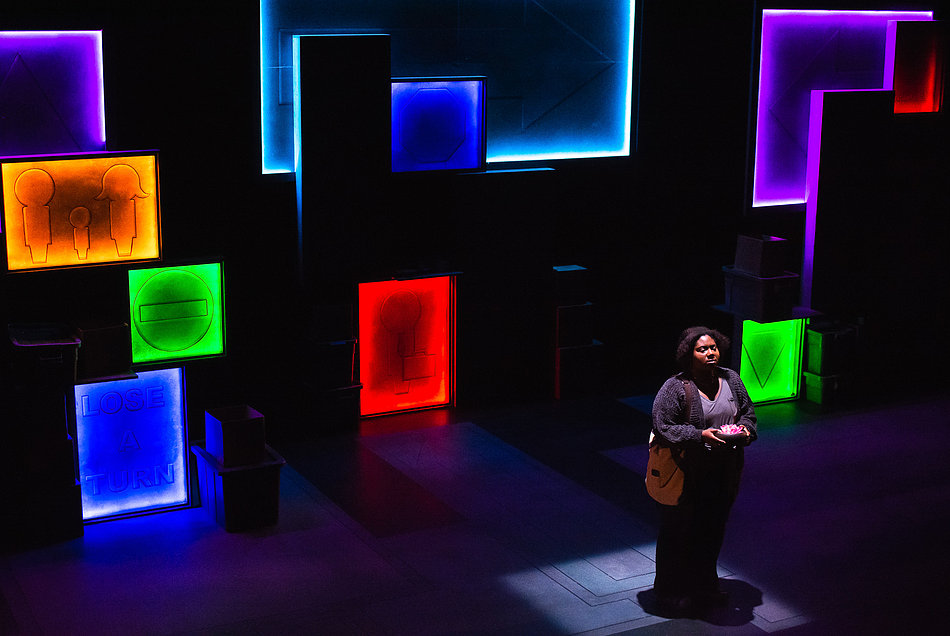 The set for the Department of Theatre production Hunting and Gathering, on which Seth Kolbe worked as head electrician. (Photo by Arionna Gonsalves ’19 for UMBC.)
Among Kolbe’s favorite classes were stage management, projection design, sound design, lighting design, rigging and welding, and scene design. During his four years at UMBC, he contributed to numerous theatrical productions, including Twelfth Night, The Turn of the Screw, Machinal, She Like Girls, Dead Man’s Cell Phone, Anon(ymous), Hunting and Gathering, Girls on a Dirt Pile, and Everybody.
Kolbe also gained skills working with the Annapolis Shakespeare Company and as a member of UMBC Retriever Robotics.
Like many UMBC students in the arts, Kolbe feels strongly about social justice, a particular focus of his leadership work over the past year. “I would like my art to make a difference in the world and in small ways it is already doing so,” he says. “I will continue to support underrepresented groups and use my privilege as white male to act against the inequality present in both this art form and our society.”
Kolbe shares, “My immediate future plans are to continue freelance stagehand and design work in the region before attending graduate school for my MFA.” Eventually, he hopes to teach theatre design and production.
Promoting empathy and connectivity
Kolbe’s theatre colleague Caitlyn Hooper ’21 will graduate with a BFA in acting. She notes that the pandemic “completely changed” how acting students were learning. “We were acting to our laptop cameras, a tough loss. But everyone found new ways to be creative, and I was so inspired by that creativity. I found a deeper connection to the research side of theatre, including the history of theatre and theatrical intimacy studies.”
Hooper joined UMBC as a freshman in 2017, and was cast in numerous productions on stage, including Everybody, Hunting and Gathering, Gwyneth, Dead Man’s Cell Phone, and Far Away. In addition to her acting studies, she worked in the scene shop beginning in her sophomore year and gained knowledge about technical production and carpentry.
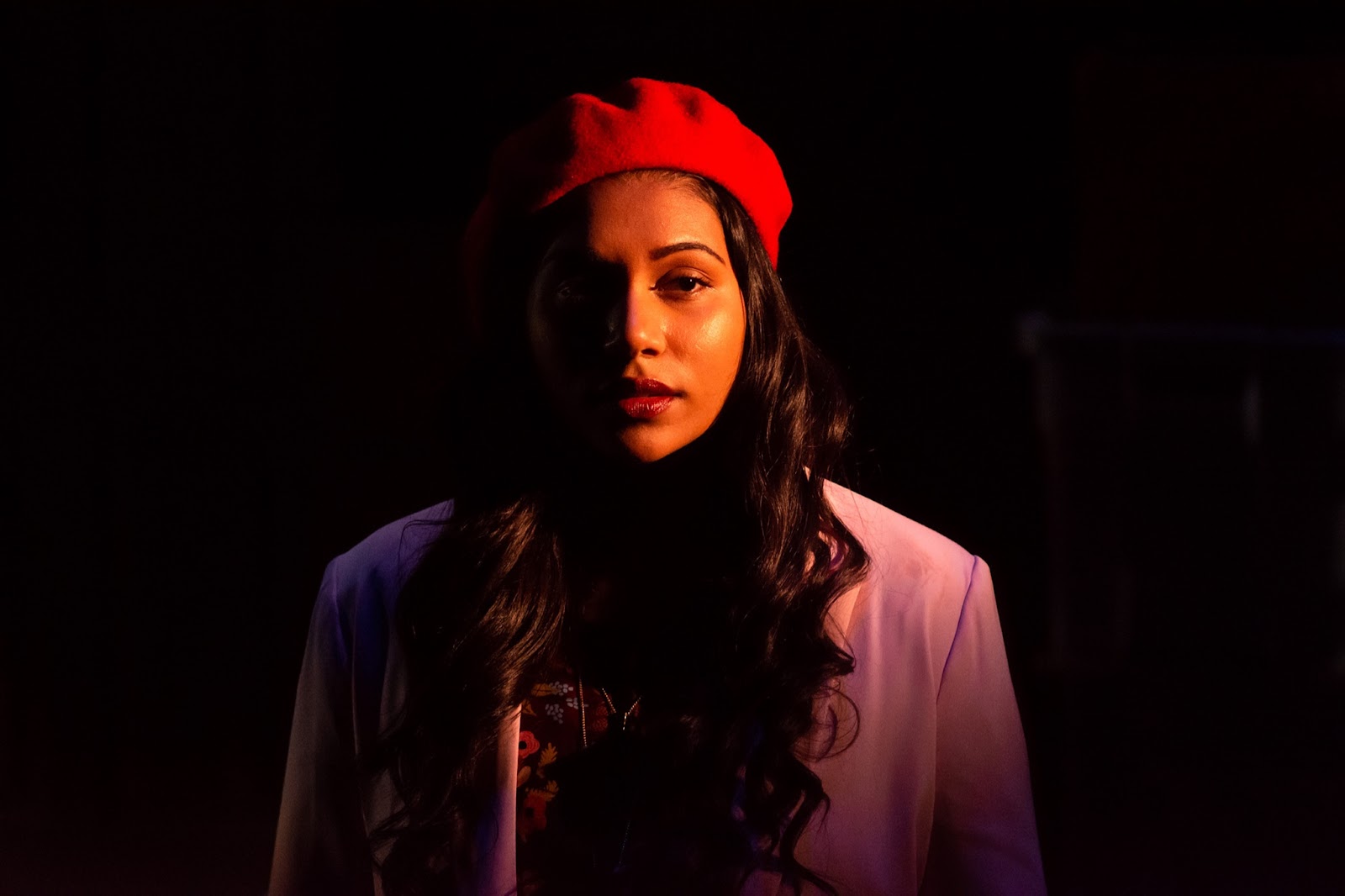 Caitlyn Hooper acting in the 2019 UMBC Theatre production of Hunting and Gathering by Brooke Berman, directed by Susan Stroupe. (Photo by Arionna Gonsalves ’19 for UMBC.)
The concern for equity and social justice factors significantly in Hooper’s work. “As a theatre artist, I’m passionate about creating work that promotes empathy and connectivity,” she says. “I’m inspired by Black theatre activists’ anti-racist work currently restructuring how we do theatre, and I’m committed to equality and justice of marginalized people.”
As president of TheatreCOM during her senior year, she advocated for equitable theatre practices within the department, and, like Kolbe, was a recipient of the Theatre Student Honors Award.
Hooper completed research focused on theatrical intimacy, mentored by Susan Stroupe. She presented her work at UMBC’s popular Undergraduate Research and Creative Achievement Day (URCAD) in 2021 and also published it in UMBC Review. She’s passionate about pursuing a career focused on theatrical intimacy and she plans to apply for a Fulbright award to gain a cross-cultural perspective on theatrical intimacy in another county.
For the immediate future, Hooper plans to return to the stage in local and regional productions. Longer-term, she plans to earn an MFA in acting or performance studies and pursue a career in higher education. She hopes to focus on consent-based practices and anti-racist action in theatrical education in order to make theatre more equitable and ethical.
One student, many interests
Meyerhoff Scholar and U-RISE Trainee Peter Bailer ’21 has equally pursued his interests in the arts and sciences at UMBC, and this week will graduate with a degree in biochemistry and molecular biology and a degree in music composition.
“Music is an essential part of my life; it is both my creative outlet and a powerful medium through which I can express myself,” he shares. “I feel that my experiences with music at UMBC have helped make me a holistic and well-rounded student. From analysis to creative problem solving, my music major has sharpened many skills relevant towards any career, but especially a career in research.”
On the science side of his interests, Bailer has worked in Erin Green’s lab, focused on examining a yeast protein through sequencing data and published structures of related organisms.
He participated in several summer research internships as an undergraduate. At the University of Virginia, he studied the toxicity and structure of peptides that have the potential to become new antimicrobial therapeutics. At the University of Pennsylvania he studied the nature of how a human mutator enzyme discriminates between DNA and RNA for potential gene editing applications. Bailer won a Chemistry and Biochemistry Faculty Award for Excellence for both academic and research performance.
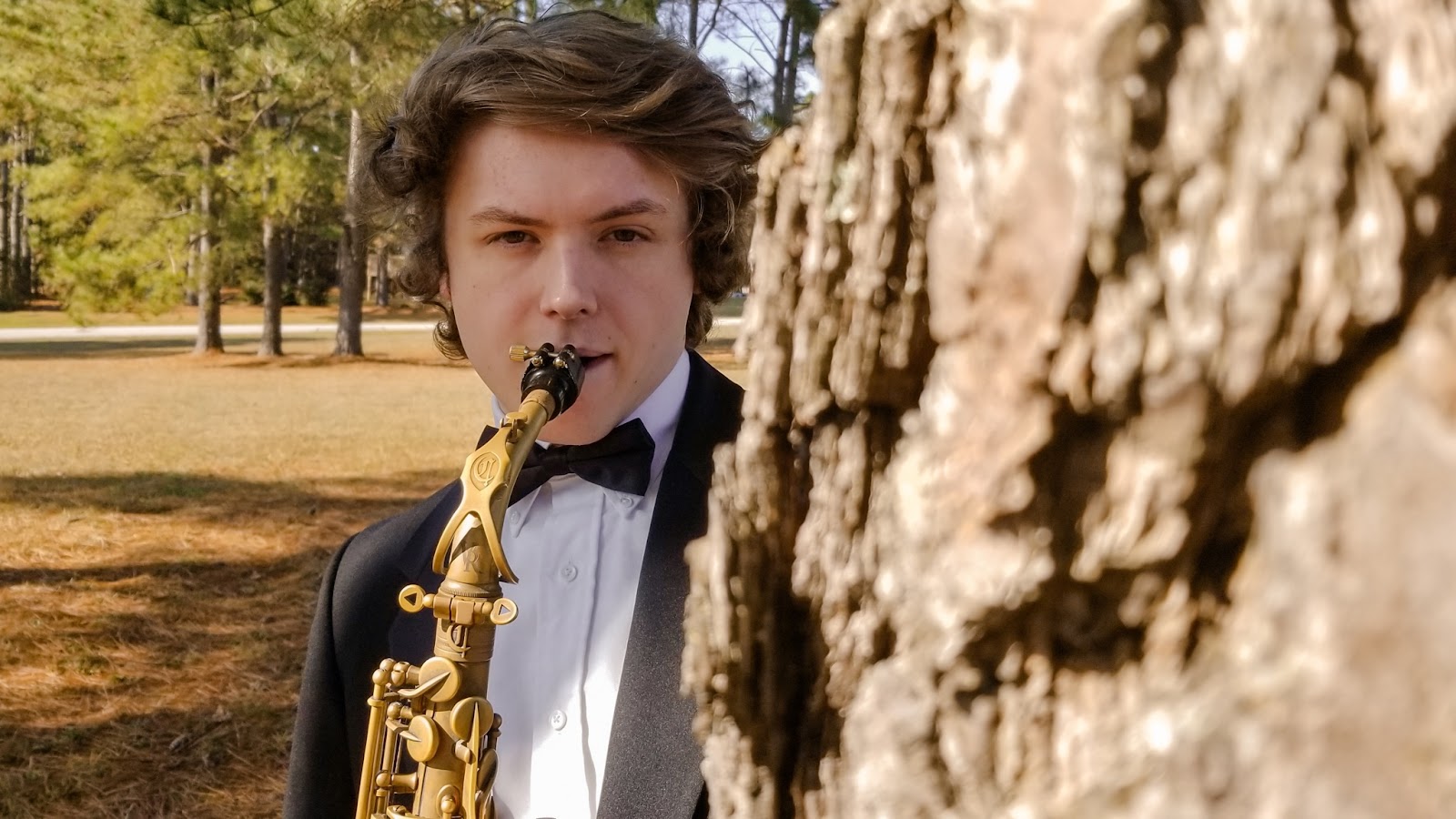 Photo of Peter Bailer by CJ Escobar ’21, music.
In music, Bailer has studied composition with Linda Dusman and Greg Kalember. His music reflects influences from the Romantic era, jazz, late impressionism, and contemporary classical music. He was commissioned by Jonathan Sotelo ’20 to write the percussion trio An Evolution of Congruence, and a marimba work entitled Pebbles. His recent saxophone sextet, The Lost Woods, was premiered by saxophonist and UMBC faculty member Matt Belzer in 2021, and Cognitive Dissonance was premiered by the Washington, D.C. new music ensemble Balance Campaign, also in 2021.
Bailer has performed with the UMBC Saxophone Ensemble, the UMBC New Music Ensemble, and was lead alto in the UMBC Jazz Ensemble. As a senior he received the Academic Achievement Award in Music.
Getting creative with creativity
“The pandemic had major impacts on my ability to create as a composer and musician,” says Bailer. “As a musician, I was no longer able to perform or create with others, and that really reduced my creativity throughout this pandemic.”
Bailer explains, “I was supposed to have my senior composition recital last spring. This ultimately had to be pushed back to this semester, resulting in a combination of some live performances and a lot of pre-recorded versions of pieces.” On the positive side, he notes that extra time at home provided an opportunity for him to study more techniques in music technology that will help his career in the long term.
“Following graduation, I will attend the University of Pennsylvania to pursue a Ph.D. in biochemistry and molecular biophysics,” says Bailer. “While pursuing this, I hope to continue practicing and growing as a composer, and I aspire to be performing ground-breaking research while continuing to compose for years to come.”
Finding a new voice
“As a musician, the pandemic forced me to make a big shift in my creative process,” says Kathryn “Katie” Blake ’21, a Linehan Artist Scholar who will graduate with a bachelor’s in music composition. “As a composer, I had to find quirky ways to inspire myself in my writings, because the isolation and being in the same environment for months on end is mentally taxing.”
“The dramatic change of being surrounded by creative musicians to being alone changed the way I approached composing,” says Blake. “Before, I’d constantly be asking my friends to try a little passage, or show me a technique—we would bounce ideas off each other. The isolation really made me focus and find the exact sounds I wanted in my pieces, and the exact sounds that my pieces needed.”
But Blake found strength in unexpected ways, adding, “I also transitioned to composing for the digital medium, as it is an easy form of artistic communication at the moment. I really honed in on my skills with electroacoustic works, and I found a voice in that sound realm that can only be accomplished by electroacoustic composition.”
Performances past and future
During Blake’s undergraduate studies, her compositions have been premiered by the Bergamot String Quartet, percussionist Jonathan Sotelo ’20, the Balance Campaign ensemble, and the Strata Trio. The 2019 Fresh Inc. Festival, District New Music Coalition’s 2020 fall conference, and T1International’s “Change Through Creativity” Project in 2020 all featured her work.
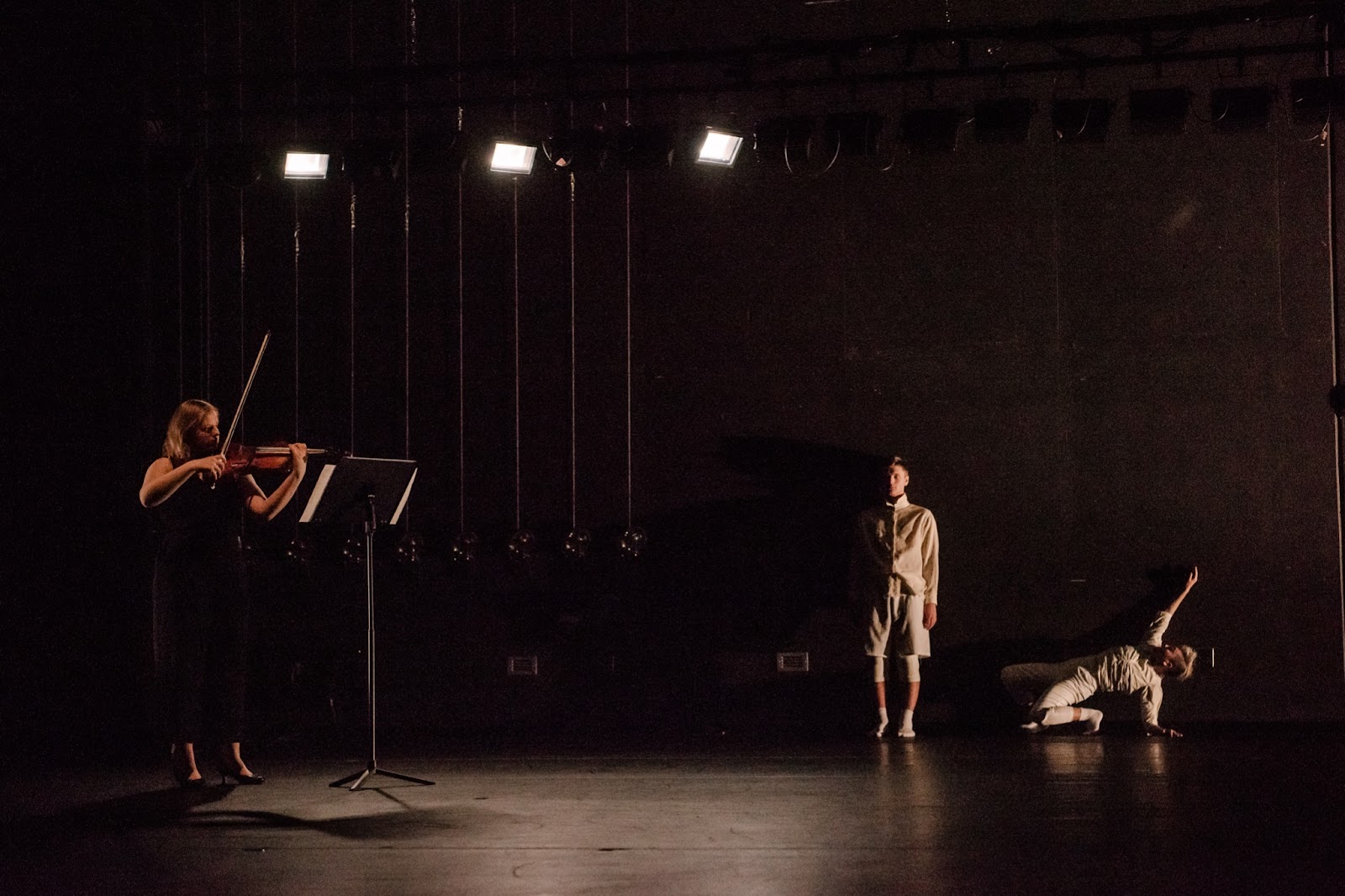 Katie Blake ’21, left, performs with Deven Fuller ’22, dance, and Emily Godfrey ’20, dance, in In To And Out Of by Ann Sofie Clemmensen. (Photo by Marlayna Demond ’11 for UMBC.)
Also active as a violist, Blake has performed with the UMBC Symphony Orchestra and in the UMBC Chamber Players. She premiered string quartets by Donte Speaks, Jr. and Eliza Triolo ’19, music. Featuring a role as both violist and composer, she was honored in fall 2019 to work with UMBC choreographer Ann Sofie Clemmensen, whose dance In To And Out Of was featured at the Kennedy Center. She has composed music for animator William Kraft ’21, visual arts, filmmaker Kelvin Thompson ’20, visual arts, and choreographers Teresa Whittemore ’20, dance and Kayla Massey ’22, dance. Like Bailer, she received the Academic Achievement Award in Music.
Outside of composing, Blake has interests in health advocacy, social justice, psychology, and mental health, and has found ways to connect her interests. “I do feel a large part of myself as an artist is to make a change,” she states. “Currently, I’ve had a focus on diabetes and insulin advocacy, tying my experience as a diabetic into my work. I have already delved into the insulin crisis with my work, but I plan to do so much more.”
Blake plans to pursue a master’s and then a D.M.A. in music composition, and looks forward to a career in higher education. “Composing and creating is what gave me the spark to keep going when I was younger,” she says, “and I want to help others find that spark as well.”
Transformation in quarantine
“My thesis show was totally transformed by quarantine,” shares Rahne Alexander M.F.A. ’21, intermedia and digital arts, of her recent participation in the spring M.F.A. visual arts thesis exhibition, Home Bodies. “What was intended to be a live performance transformed into an online experience, which set off a kind of domino effect on the various aspects of the project.” For instance, Alexander explains, “instead of creating a talk show set in the gallery, I recreated my home studio in which I produced the show, and ultimately I think that overall, my work was better as a result.”
The content of the show was also impacted by its shifting context, Alexander reflects. “A significant part of this piece was a meditation on the way that multiple sclerosis caused my mother to transform her own art practices, and the parallels I have experienced in my own career,” she says. “Quarantine really brought those parallel conditions into excruciatingly clear focus, in ways I’ll be considering for a long while.”
Alexander is already an accomplished essayist, contributing to anthologies such as the Lambda Literary Award-winning Take Me There: Trans and Genderqueer Erotica and the Lambda-nominated Resilience Anthology. Her first book of collected essays, Heretic to Housewife, was published by Neon Hemlock in 2019.
While at UMBC, Rahne has exhibited artworks both regionally and internationally. Her video art screened as part of the International Conference of Chinese Computer Human Interaction at Xiamen University, and at the Baltimore Museum of Art’s Necessity of Tomorrow(s) Screening Room. In 2020, her painted scroll triptych “I Am the End of the Patriarchy and So Can You” was commissioned by ‘sindikit and Tephra Institute of Contemporary Art for the Mary B. Howard Invitational: An Excellent Thought About a Quality Idea. These scrolls have subsequently shown at The Shed Space and as part of Spark IV: A New World? at Maryland Art Place.
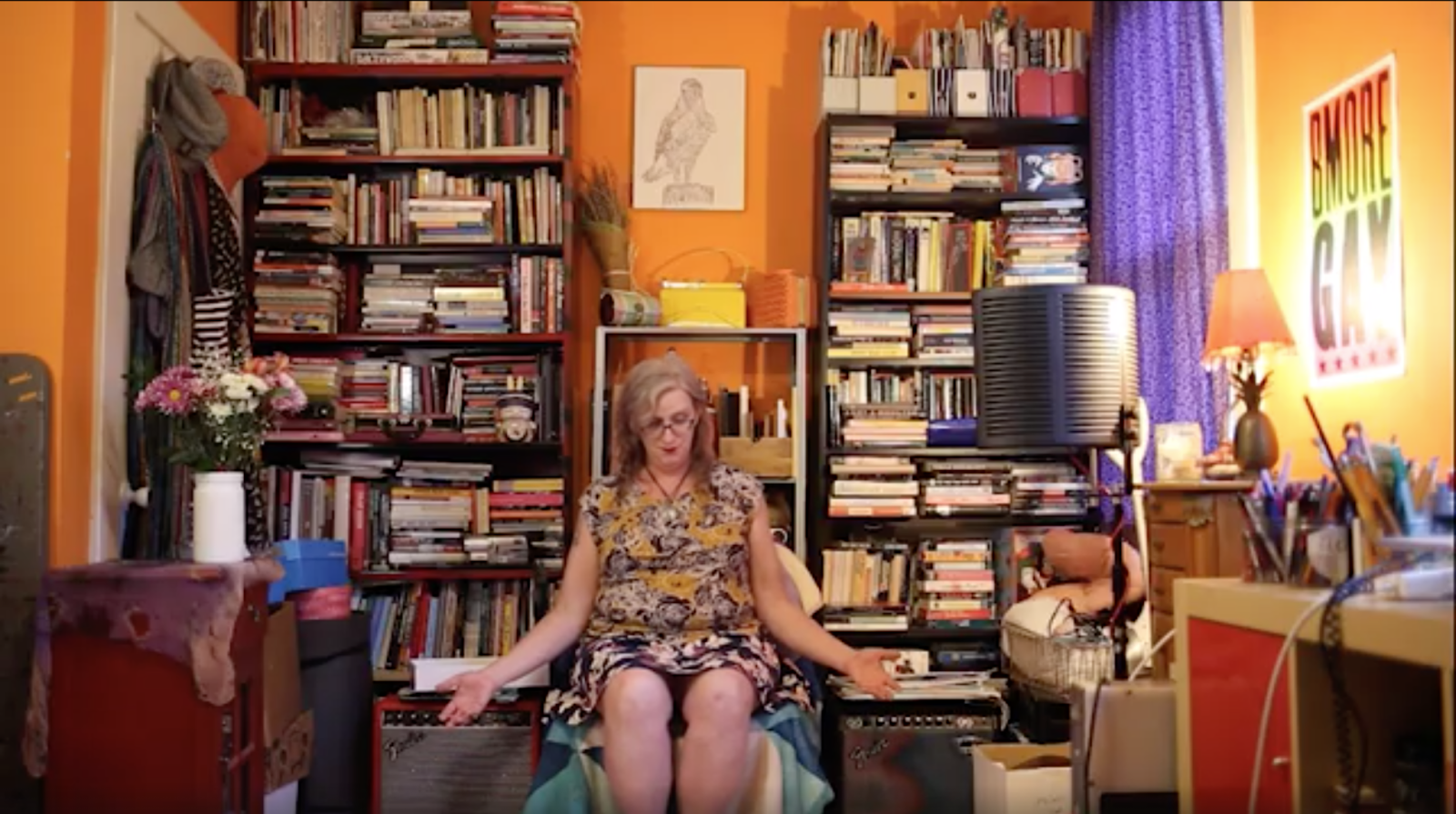 Rahne Alexander in her work Sick Transit, an exemplativist femmage, comprising a series of autobiographical monologic performances meditating on mobility, maternity, gender, feminism, and systems of healthcare in the relationship between two artists: the transsexual daughter of a devout Mormon who lived with multiple sclerosis for more than 30 years. (Image courtesy of Rahne Alexander.)
A leader and community connector
Also active in arts administration and advocacy, Alexander has been a leader at the Transmodern Festival and the Maryland Film Festival, where she served five years in charge of operations and development. She has since lent her organizational and development assistance to several groups, including the Baltimore Office of Promotion and the Arts, FORCE: Upsetting Rape Culture, Venus Theater, Wide Angle Youth Media, and Single Carrot Theatre.
“My work has always been about making connections between people, often with the specific political goal of destigmatizing trans and queer identities. I work to get audiences to reconsider their assumptions and epistemologies,” says Alexander.
“Trans people make up such a small minority of the population, yet there is this continued push to diminish and deny our civil rights. We can’t really secure those rights without the support of the majority, so a large part of my mission as an artist has been to make connections and open dialogue,” she notes. “And the same holds true for all marginalized people—disability rights, Indigenous rights, the rights of queer people and Black people and Brown people. As the saying goes, none of us are free until we are all free, and I see my work as a part of that larger project.”
Alexander will continue working as an artist. She currently has work on display at Spark IV: A New World? and she will be on the faculty at this summer’s Tulsa Glitterary Writer’s Conference.
Banner Image: Cailtlyn Hooper and other theatre students in the 2018 production of Dead Man’s Cell Phone by Sarah Ruhl, directed by Nyalls Hartman, for which Seth Kolbe served as assistant head electrician. Photo by Raquel Hammer ’20 for UMBC.
]]>
The past pandemic year saw arts communities unable to connect with audiences in traditional ways. Usually reliant on people gathering together to experience their work, creators and performers...
https://umbc.edu/stories/umbcs-latest-graduates-in-the-arts-forge-new-creative-paths-despite-a-challenging-year/
https://my3.my.umbc.edu/api/v0/pixel/news/119625/guest@my.umbc.edu/c15b5a1d7425b953927edeb280b175b6/api/pixel
arts-and-culture
cahss
chembiochem
classof2021
cnms
community
imda
linehanscholars
meyerhoffscholars
music
theatre
visualarts
UMBC News & Magazine
https://my3.my.umbc.edu/groups/umbc-news-magazine
https://assets1-my.umbc.edu/system/shared/avatars/groups/000/001/943/24435aa6207c452e7bc15cc74b42c7bb/xsmall.png?1748556657
https://assets1-my.umbc.edu/system/shared/avatars/groups/000/001/943/24435aa6207c452e7bc15cc74b42c7bb/original.png?1748556657
https://assets2-my.umbc.edu/system/shared/avatars/groups/000/001/943/24435aa6207c452e7bc15cc74b42c7bb/xxlarge.png?1748556657
https://assets2-my.umbc.edu/system/shared/avatars/groups/000/001/943/24435aa6207c452e7bc15cc74b42c7bb/xlarge.png?1748556657
https://assets3-my.umbc.edu/system/shared/avatars/groups/000/001/943/24435aa6207c452e7bc15cc74b42c7bb/large.png?1748556657
https://assets1-my.umbc.edu/system/shared/avatars/groups/000/001/943/24435aa6207c452e7bc15cc74b42c7bb/medium.png?1748556657
https://assets2-my.umbc.edu/system/shared/avatars/groups/000/001/943/24435aa6207c452e7bc15cc74b42c7bb/small.png?1748556657
https://assets1-my.umbc.edu/system/shared/avatars/groups/000/001/943/24435aa6207c452e7bc15cc74b42c7bb/xsmall.png?1748556657
https://assets2-my.umbc.edu/system/shared/avatars/groups/000/001/943/24435aa6207c452e7bc15cc74b42c7bb/xxsmall.png?1748556657
UMBC News & Magazine
0
0
false
Thu, 20 May 2021 01:04:03 -0400
UMBC together: Graduating Retrievers reflect on building community through conversations
When listeners tune in to the Retriever Tales podcast hosted by Tirzah Khan ‘21, information systems, who is graduating this week, they’ll hear UMBC voices sharing their journeys of finding and creating community. Moving, inspiring, funny, and thought-provoking, the show is a testament to Khan’s own UMBC experience and a broader culture of co-creating community at UMBC.
One key experience kick-started Khan’s growth as a student leader: STRiVE, a leadership for social impact retreat led by the Center for Democracy and Civic Life (CDCL). “Everything began for me when I went to STRiVE during my sophomore year,” she shares. “Before STRiVE, I stuck to myself and didn’t venture outside my comfort zone often. I gained so many insights about myself during the retreat, and I learned to reimagine the world as it could be.”

Tirzah Khan. Photo courtesy of Khan.
After returning from the retreat, Khan says, “I developed the confidence to get involved in other organizations,” like hackUMBC (becoming a design team lead) and the Student Events Board (as vice president for design). Along with STRiVE 2019 members Shrijana Khanal ’21, economics; Sofía Encarnación ’22, economics and mathematics; and Juhi Naik ’21, history and political science, she also founded the TEDxUMBC student organization, launching her work as a community storyteller.
Reimagining the world through stories
When Khan dives into something, she does it in a big way. She committed to UMBC community work through CDCL, serving as a ConnectionCorps intern to create Retriever Tales; helping to coordinate Election Night Extravaganza, an election night returns watch program; and joining other community members in facilitating and organizing “Together Beyond November” post-election discussions. She also participated in initiatives like the fall 2020 Cast Your Whole Vote campaign, featuring events to encourage the UMBC community to recognize voting as just one of many ways to make a difference.

Tirzah Khan. Photo courtesy of Khan.
Khan is passionate about the intersection of graphic design and social impact. She worked as a social media engagement and design intern with the Mosaic: Center for Culture and Diversity, and she has also been active with Retriever Immigrants United and the Women of Color Coalition.
In her final semester, Khan wanted to focus on bringing the UMBC experience to community members who had largely been away from campus for a year due to COVID-19. She brought the Retriever Tales podcast to life, featuring authentic conversations with Retrievers about what brought them to UMBC, what it means to them to be here, and what hopes they have for the UMBC community. Khan shares,“These conversations have truly reshaped my understanding of what it means to be part of a community, and what it means to be part of UMBC’s community.”
“As students we have the opportunity to try and mold UMBC’s future and its impact,” says Khan. “There’s this idea that I think describes UMBC’s culture really well: that we’re all co-creating UMBC. What that means is everyone here has the ability to help shape this institution in some way. We all have both the opportunity and the responsibility to create the UMBC that we want to see together.”
Visible, actionable change
Like Khan, graduating senior and Honors College member Brandon Liu ‘21, biological sciences and visual arts, says STRiVE and CDCL transformed his time at UMBC.
As a first-year student, Liu and friends Ella Hawkins ‘20, biochemistry and molecular biology, and Manny Ali, ‘20, computer engineering, who is hard of hearing, learned UMBC didn’t offer American Sign Language (ASL) classes or clubs, so they co-founded Sign of Life. The club teaches ASL and educates students interested in being more involved in the Deaf community. “This was my first experience collaborating with friends, reaching out to stakeholders, and making a visible, actionable change on something as large as a university campus community,” says Liu.
 Brandon Liu. Photo by Alexis Harris ‘19.
Building on that experience, Liu attended the STRiVE retreat in his second year at UMBC. Over the next three years he returned to STRiVE as the campus civic engagement intern, supporting faculty, staff, and student coaches who guided groups of undergraduate student participants.
“The Center’s Alternative Spring Break and STRiVE are the most important experiences I can recommend, especially for those who don’t feel like they have what it takes to make change or think that change doesn’t happen,” says Liu. “STRiVE transformed me from a student that kept my head down and didn’t think I was powerful enough, smart enough, connected enough to make change into someone who knew that coming as I am, I am already valuable and capable of affecting my communities.”
Strength in community
Those around Liu quickly began to see his impact and his potential as a leader. In 2018, he received the Lavender Award for Emerging LGBTQ+ Leader from the Initiatives for Identity, Inclusion, and Belonging. He kept his focus on community leadership and, today, says the agency students have at UMBC is what makes a UMBC education so valuable.
“As assistant speaker of the senate for our Student Government Association (SGA), one of my biggest responsibilities was coordinating undergraduate participation in UMBC’s shared governance committees,” says Liu. “I connected the undergraduate senators with chairs of key university committees, to make sure undergraduate voices were heard in campus decision-making.”
 Brandon Liu and other members of UMBC’s delegation at the 2018 Civic Learning and Democratic Engagement Meeting. Photo courtesy of Hoffman.
Seeing fellow students grow in their ownership of the UMBC community and learn to increase student agency on campus was both gratifying and motivating to continue the work, he shares.
“The real strength of UMBC is within the community,” says Liu. “I’ve been able to learn so much more about myself and surround myself with many other genuine, compassionate, caring, and active people. The academic rigor allows students to receive a valuable degree, but the community is what makes UMBC a home.”
 Front row (l-r): Tess McRae, Romy Hübler, Brandon Liu, and David Hoffman. Back row (l-r): Pat Michael and Timothy Farrell. Photo courtesy of Hoffman, 2019.
Liu is graduating as a Sherman STEM Teacher Scholar and will soon begin his master of arts in teaching for secondary biology at UMBC. He shares, “I know that UMBC values the same things I do. And with a master’s in teaching from UMBC I know I’ll be able to take on the responsibility of building and supporting communities in the schools and classrooms where I’ll teach in the future.”
Creating shared spaces
Meghan Lynch ‘18, political science, and M.P.P. ‘21, will soon become a double alumna of UMBC, after earning her master’s in public policy. She says she still thinks about one particular class on civic agency during her undergraduate years, which shaped her UMBC experience, her career path, and her perspective on the world. Her a-ha moment: “I realized that the idea of creating shared spaces and bringing democracy into the classroom was a very concrete way to realize the power we all have in every space,” she says.
Lynch describes UMBC as a place that supports, nurtures, and encourages political engagement in all forms. Creating spaces for community dialogue and mutual support was especially important during COVID-19 and the intense election cycle. As vice president of UMBC’s Graduate Student Association (GSA), Lynch is proud of how the group helped to offer space for dialogue and build community as a co-host for the CDCL’s “Together Beyond November” post-election discussions.
 Meghan Lynch. Photo by Poulomi Banerjee ‘16.
“Amidst all the fatigue and difficult news in the world, the Center, SGA, and GSA were able to coordinate very meaningful and well-attended events leading up to and after the election,” says Lynch. “It was clear that the UMBC community wanted to spend time coming together to think about our role in bringing about change and hearing about the issues. I left every one of these events feeling refreshed in a humble and grateful way.”
Resources for success
During the COVID-19 pandemic, Lynch and other GSA officers created a well-being committee, recognizing the importance of students’ mental, physical, and spiritual well-being. “We’ve had an excellent turnout to committee meetings in part because people are looking for a place to reflect on how to help each other,” she says.
“Amidst all the chaos and uncertainty, I’m so proud that GSA has found ways to connect students to the resources they need and serve as a gathering space–even virtually,” Lynch says. “I’m also proud of the strides we are making to ensure that graduate students are intentionally included in programming and other opportunities across campus.”
Creating community, Lynch reflects, “is a way for people from different departments across campus to collectively work towards solutions that benefit all of us.” And every new relationship or new project “starts from just one conversation,” she shares, so “there’s beauty in just talking with people.”
 Meghan Lynch and True Grit. Photo by Poulomi Banerjee ‘16.
After graduation, Lynch will teach an introductory political science class at UMBC and serve as the new director for the Catonsville Chamber of Commerce. She says, “I hope to take all of the transformative experiences I’ve had at UMBC beyond Hilltop Circle to help others realize their ability to make their communities better for everyone.”
One person who looks forward to seeing the impact of her work is CDCL Director David Hoffman Ph.D. ‘13, language, literacy, and culture. Hoffman shares that Lynch, Liu, and Khan all “embody the idea that we can bring our whole, unique selves to the work of shaping our communities.” He says, “Their contributions have helped make UMBC even more deeply and visibly what it has been all along: caring, inclusive, and engaged.”
Featured image (l-r): Mariam Abalo-Toga, Roy Prouty, Anjali Dassarma, Brandon Liu, President Freeman Hrabowski, and Lilly Keplinger stand by True Grit, 2018. Photo by Marlayna Demond ’11 for UMBC.
Article written by Eleanor Lewis, communication specialist in the Division of Student Affairs.
]]>
When listeners tune in to the Retriever Tales podcast hosted by Tirzah Khan ‘21, information systems, who is graduating this week, they’ll hear UMBC voices sharing their journeys of finding and...
https://umbc.edu/stories/umbc-together-graduating-retrievers-reflect-on-building-community-through-conversations/
https://my3.my.umbc.edu/api/v0/pixel/news/119630/guest@my.umbc.edu/a9c7cde047268802ca3299e83938e6cb/api/pixel
biology
cahss
classof2021
cnms
coeit
community
honorscollege
is
page1
publicpolicy
visualarts
UMBC News & Magazine
https://my3.my.umbc.edu/groups/umbc-news-magazine
https://assets1-my.umbc.edu/system/shared/avatars/groups/000/001/943/24435aa6207c452e7bc15cc74b42c7bb/xsmall.png?1748556657
https://assets1-my.umbc.edu/system/shared/avatars/groups/000/001/943/24435aa6207c452e7bc15cc74b42c7bb/original.png?1748556657
https://assets2-my.umbc.edu/system/shared/avatars/groups/000/001/943/24435aa6207c452e7bc15cc74b42c7bb/xxlarge.png?1748556657
https://assets2-my.umbc.edu/system/shared/avatars/groups/000/001/943/24435aa6207c452e7bc15cc74b42c7bb/xlarge.png?1748556657
https://assets3-my.umbc.edu/system/shared/avatars/groups/000/001/943/24435aa6207c452e7bc15cc74b42c7bb/large.png?1748556657
https://assets1-my.umbc.edu/system/shared/avatars/groups/000/001/943/24435aa6207c452e7bc15cc74b42c7bb/medium.png?1748556657
https://assets2-my.umbc.edu/system/shared/avatars/groups/000/001/943/24435aa6207c452e7bc15cc74b42c7bb/small.png?1748556657
https://assets1-my.umbc.edu/system/shared/avatars/groups/000/001/943/24435aa6207c452e7bc15cc74b42c7bb/xsmall.png?1748556657
https://assets2-my.umbc.edu/system/shared/avatars/groups/000/001/943/24435aa6207c452e7bc15cc74b42c7bb/xxsmall.png?1748556657
UMBC News & Magazine
0
0
false
Tue, 18 May 2021 02:48:57 -0400
UMBC expands arts opportunities for K-8 students in Baltimore through Charlesmead partnership
Two UMBC projects have taken flight this spring, designed to support the academic, creative, and social success of Baltimore City students through arts opportunities. Both projects are funded through the UMBC-Charlesmead Initiative for Arts Education, which was established in 2018 with a $500,000, five-year gift from the Charlesmead Foundation.
The partnership is designed to introduce or strengthen arts opportunities for K-8 students in Baltimore City Public Schools , especially those in Title I schools. The Charlesmead Foundation, which was established in 1987 and is based in Baltimore, primarily supports the arts, cultural programs, and education.
Music in Sandtown-Winchester
Daniel Pesca and Janice Jackson in the department of music have joined forces with the Carter School of Music at New Shiloh Baptist Church and the William Knabe Piano Institute to offer after-school and summer music classes to youth in the Sandtown-Winchester community. The New Shiloh Baptist Church is recognized as a key community and spiritual hub in its neighborhood. The non-profit Knabe Institute raises awareness of the cultural significance of the piano, and produces a major young artist piano competition that is held annually at UMBC.

Pesca (left). Photo by
Rosen-Jones Photography. Jackson (right).
Photo courtesy of Jackson.
The Charlesmead grant to Pesca and Jackson fully funds the musical education of ten students between the ages of 8 and 14 who face obstacles to music study. The participating students receive instruction in piano and choral music for two academic years and two summers, taught by Chinny Ohia, a member of the Carter School faculty for over twenty years and chair of music at Howard University, and UMBC alumnus and pianist Riccardo Jefferson ’20, music. The summer instruction will be hosted in part by UMBC’s Summer Enrichment Academy.
The Carter School hired Jefferson specifically to teach students in this cohort. This strengthens the connection between the school and UMBC, while providing Jefferson with an exceptional opportunity to launch his career as a professional musician and music educator. “These young musicians were brave enough to start their musical journey during a pandemic,” says Jefferson. “Somehow, someway, they’re moving through it, and it inspires me to match their determination in the classroom and in my own life.”
 Riccardo Jefferson. Photo by Willie Santiago, concert coordinator for UMBC.
Success despite challenges
The project faced and overcame significant challenges during the current academic year. A major initial expense was the purchase of ten high-quality keyboards for use at home by students. Members of the faculty and staff of the Carter School spent two days delivering the large keyboards and assembling them in the students’ homes.
Once instruction began, some students faced challenges accessing reliable internet connections, which required that they and their instructors be flexible and adjust their lesson schedules when necessary.
Plus, “each student started as an absolute beginner who had no previous experience with the piano or with reading music,” explains Pesca. “Learning to make music brings the students joy and uplift during these times of isolation, and some have shared that the one-on-one contact with their instructors is a high point in their week. Eight out of ten students stayed fully engaged in the program and achieved significant musical growth over the semester, an outstanding outcome under such trying circumstances.”
The pandemic continues to make it challenging for the organizers to fully implement the program as they initially envisioned. Pesca had hoped to bring the students to campus for UMBC’s 2021 Summer Enrichment Academy, but that program will be online due to health and safety guidelines. Similarly, the Knabe Institute’s activities are likely to take place remotely as well.
However, the organizers hope to incorporate in-person learning at both UMBC and the Knabe Institute for the program’s 2021-2022 academic year, providing students with an even more enriching experience.
Kultur Stories
Shriver Center Director Michele Wolff is working with Gail Prensky, founder of the Jüdische Kulturbund Project (Jewish Kulturbund), to bring its Kultur Stories Program to UMBC. Wolff and Prensky are collaborating with local and international theatre, visual arts, and digital storytelling educators, artists, and community leaders. Together, they are gathering girls from City Springs Elementary/Middle School in Baltimore City, Aktörerna school in Sweden, and Promised Land Secondary School in South Sudan to participate in a virtual digital storytelling experience.
Kultur Stories explores issues of oppression and response through music and art. The Project’s mission is to connect people through shared experiences, inspire a response to persecution through cultural expression, and encourage freedom of expression and culture. This mission spoke to the work Wolff carries out through the Shriver Center.
“Kulture Stories aligns seamlessly with our commitment to racial equity, inclusion, and social justice,” shares Wolff. “This collaboration gives us the opportunity to extend beyond our current network of partners to engage and give voice to more young people in schools in Baltimore City and in countries around the world.”
Grappling with oppression through art
Jewish Kulturbund works with artists and communities around the world to explore the themes of oppression, the arts, and human rights through a variety of media. These initiatives honor the story and legacy of Jüdische Kulturbund artists who performed across Germany between 1933 and 1941, before being forced into Nazi concentration camps. The organization recalls their performances as a reminder of the complex questions and danger artists must grapple with under oppressive situations.

Margot Neuhaus working on an art piece.
Photo courtesy of Michele Wolff.
With this purpose in mind, the design team developed an 8-week collaborative Kultur Stories Program among young girls in the United States, Sweden, and South Sudan. Pods of around 10 girls from each country are connecting virtually to learn about each other. They are reflecting on the impact of the pandemic on themselves and their communities and the oppression it has caused. They are also creating art and joining in discussions about human rights, and participating in mentoring sessions.
The students began meeting this spring. In one session, Margot Neuhaus, a visual artist based in Washington D.C., was invited to give a virtual presentation. She discussed how her art process has provided a way for her to express her pain and healing in relation to her family surviving the Holocaust in Poland and their fleeing to Mexico, where Neuhaus was born.
The presentation initiated a profound conversation about oppression across borders and time. The students from South Sudan related to the persecution and displacement that Neuhaus described. And the Swedish students found it impactful as well. “That session was so powerful for my group of students,” shares Jok Abraham Thon, founder and director of the Aktörerna School. “They spoke about differences in language, skin color, and religion being issues that separate and cause issues of hatred.”
Connecting through digital stories
Shekinah Davis, co-facilitator of the Charlesmead Initiative for Arts Education at UMBC, serves as a teacher’s assistant in the project. Davis, M.A. ‘21, intercultural communication, supports lead teachers in communication strategies and helps manage the flow of the virtual pods. As a Shriver Center Peaceworker Fellow, she brings experience working with international and local communities.

Shekinah Davis.
Photo courtesy of Davis.
“I was drawn to participate in the project to gain a perspective of how to guide young people through a virtual creative process,” explains Davis. “I hope to gain a deeper understanding of virtual collaborative art-making, especially to help express experiences about the impact of the pandemic and oppression.”
The K-8 students are also connecting with interns from UMBC, Montgomery College, and Baltimore Polytechnic Institute, a high school in Baltimore City. These interns are guiding the girls in using storytelling and digital art production to express their personal reactions to oppression and how to embrace freedom.
The digital storytelling tools are bringing together students who would otherwise not be able to meet. They are also expanding the students’ opportunities to make digital art, beyond what is available in their everyday school experiences.
Design intern Joyce Koo ‘24, graphic design, is inspired by the Judische Kulturbund Project. She sees it as an important step in her education and career. In addition to assisting with a teaching pod, she is creating graphics and other visuals for the project’s social media outreach. “I hope to connect to and grow in a global community of both experienced and rising artists,” shares Koo.
Banner image: “In Memoriam” and “Light Motives” by Margot Neuhaus. Photo courtesy of Michele Wolff.
This article was co-authored with UMBC’s Thomas Moore, director of arts and culture.
]]>
Two UMBC projects have taken flight this spring, designed to support the academic, creative, and social success of Baltimore City students through arts opportunities. Both projects are funded...
https://umbc.edu/stories/umbc-expands-arts-opportunities-for-k-8-students-in-baltimore-through-charlesmead-partnership/
https://my3.my.umbc.edu/api/v0/pixel/news/119632/guest@my.umbc.edu/4ed70c8e9fd70fb19ee1bd5640788f7c/api/pixel
arts-and-culture
cahss
diversityandinclusion
graduateschool
international
mlli
music
policy-and-society
shrivercenter
visualarts
UMBC News & Magazine
https://my3.my.umbc.edu/groups/umbc-news-magazine
https://assets1-my.umbc.edu/system/shared/avatars/groups/000/001/943/24435aa6207c452e7bc15cc74b42c7bb/xsmall.png?1748556657
https://assets1-my.umbc.edu/system/shared/avatars/groups/000/001/943/24435aa6207c452e7bc15cc74b42c7bb/original.png?1748556657
https://assets2-my.umbc.edu/system/shared/avatars/groups/000/001/943/24435aa6207c452e7bc15cc74b42c7bb/xxlarge.png?1748556657
https://assets2-my.umbc.edu/system/shared/avatars/groups/000/001/943/24435aa6207c452e7bc15cc74b42c7bb/xlarge.png?1748556657
https://assets3-my.umbc.edu/system/shared/avatars/groups/000/001/943/24435aa6207c452e7bc15cc74b42c7bb/large.png?1748556657
https://assets1-my.umbc.edu/system/shared/avatars/groups/000/001/943/24435aa6207c452e7bc15cc74b42c7bb/medium.png?1748556657
https://assets2-my.umbc.edu/system/shared/avatars/groups/000/001/943/24435aa6207c452e7bc15cc74b42c7bb/small.png?1748556657
https://assets1-my.umbc.edu/system/shared/avatars/groups/000/001/943/24435aa6207c452e7bc15cc74b42c7bb/xsmall.png?1748556657
https://assets2-my.umbc.edu/system/shared/avatars/groups/000/001/943/24435aa6207c452e7bc15cc74b42c7bb/xxsmall.png?1748556657
UMBC News & Magazine
0
0
false
Fri, 14 May 2021 21:48:46 -0400
UMBC celebrates 25th Undergraduate Research and Creative Achievement Day with an expanded global audience

UMBC’s 25th Undergraduate Research and Creative Achievement Day (URCAD) reached more viewers than ever before, with visitors connecting online from as far away as Spain, Indonesia, Nigeria, Brazil, Bhutan, Germany, and the U.K.. Audiences logged more than 11,000 visits (compared with 8,000 in 2020) and posted more than 3,500 comments over the course of the week-long event.

Winner of URCADs “Best Selfie With The Number “25”
Angelika Albertorio ’21, English and dance.
“While we are eager to get back to the live event, there are definitely aspects of the online event that have widened the scope of URCAD,” says April Householder, director of undergraduate research and prestigious scholarships. “Presenters were able to invite friends and family members from other countries to view their presentations, and invite international scholars as potential future collaborators.”
Over 350 students presented projects, from novel artistic work to lab research to analysis of historical archives. The questions they asked reflected engagement with significant challenges and opportunities of today.
Anti-Asian racism
Zoe Hwang, English, was inspired to study the history of Koreans in Baltimore after reading a chapter about Korean immigrant communities in the city written by Aletheia Hyun-Jin Shin in the book Baltimore Revisited. Then COVID-19 happened and with it came a rise in hate crimes toward members of Asian communities in the United States. “I’m scared to go outside,” shares Hwang, who is Korean and lives in Maryland. “I was surprised that so many people thought this was new and were unaware of the history of racism toward the Asian community.”
She decided to widen the scope of her research for URCAD. In “We Were Never Welcome Here: How American History Predicted the Rise of Racism and Xenophobia During COVID-19,” Hwang uses archival posters and newspapers to contextualize racism toward Chinese and Japanese communities in the U.S. from 1850 to the present, while demonstrating how negative sentiments about one Asian community have often translated into violence for other Asian communities. “I want to continue to educate others about the diversity of the Asian community and the dangers of lumping the people and cultures under a single term,” says Hwang.
Connecting Baltimore
When COVID struck, many Baltimore families without internet access were completely disconnected from much-needed services that had moved online, and were disconnected from their communities. In fall 2020, Foad Hamidi, assistant professor of information systems, received NSF funding to research this problem in collaboration with the Digital Harbor Foundation and Project Waves, providing affordable internet service in Baltimore. Hamidi and Nora McDonald, research assistant professor of information systems, led a study to understand the experiences of low-income Baltimore families without broadband access, and student researchers played a major role in the work.

The Project Waves team installing a sector antenna in downtown Baltimore City.
Photo courtesy of Project Waves.
Hamidi says a lot has changed from when they started the project. “The preliminary findings have found that participants and partners value connectivity that is affordable, that can be used with social distancing, is offered by grassroots community organizations, and is private,” he shares.
Working on project Waves has been a humbling and a very rewarding experience for Karina Lopez-Brown ‘21, information systems. “Our research in Project Waves demonstrated to me that it doesn’t matter the level of knowledge or expertise that we have,” says Lopez-Brown, “we just need to be willing to share our knowledge to help our community.”
In addition to Lopez-Brown, the student team included seniors Rushaad Wright, business technology administration, and Daniel Laguna, information systems, as well as Lydia Stamato, a doctoral student in human-centered computing.
For Laguna, the project has been an opportunity to strengthen relationships with his peers and mentors and to collaborate with the Baltimore City community. “In these times where we have had to remain physically distant from one another it’s been easy to feel isolated from the world,” says Laguna. “But all of these connections have really helped me feel closer to the rest of the world.”
Conversation with squeegee kids
Growing up in Baltimore City, Sydney Fryer ’22, psychology, was accustomed to seeing young Black boys and men standing on downtown street corners ready with squeegees, trying to earn money by cleaning car windshields. Fryer saw the “Squeegee Kids” as a positive part of Baltimore City’s culture and economy but knew some residents and visitors didn’t share this sentiment.

Sydney Fryer.
Photo by Marlayna Demond ’11 for UMBC.
In “Decriminalizing (and Re-Humanizing) the ‘Squeegee Kid,” Fryer used Baltimore Sun archives, social media data, and interviews with the youth to examine the criminalization of these young men over forty years of city history. “Sydney’s methodology was designed to recognize the crucial role that discourse and policy play in shaping young people’s daily experiences,” says Dena Aufseeser, assistant professor of geography and environmental systems.
Fryer found that White boys and men doing similar work were seen as entrepreneurial while “Squeegee Kids” were often described through unsubstantiated narratives about crime and violence. She says her interviews revealed that, “many of them are working to buy clothes, food, books, and to help their families,” so what they earn often goes right back into the city’s economy.
Understanding the structure of HIV
As COVID-19 vaccine research moved forward at light speed this past year, research on other pandemics continued to make steady progress. Three groups of students presented their research on HIV-1, the retrovirus that causes AIDS.
Michael Summers, Distinguished University Professor of chemistry and biochemistry and Howard Hughes Medical Institute investigator, mentored over a dozen students that contributed to two of the major collaborative projects presented at URCAD, focused on the structures of HIV-1 MAL junction conformers and the HIV-1 5′ leader. Faith Davis ‘22, sociology and biological sciences, is part of the second project and a 2021 Newman Civic Fellow.

Davis (left) with her co-researchers tied for URCAD’s 2021 “Best Overall Selfie” award.
Photo courtesy of April Householder, director of undergraduate research and prestigious scholarships.
“The work is focused on determining an unsolved piece of the structure of the 5` leader of HIV-1’s genome, which is what makes HIV so infectious,” she explains. “If the structure of this area can be determined, it could possibly inform cures or better treatments for HIV.”
Collaborative process
For UMBC’s video game designers, going virtual was not new. Marc Olano, associate professor of computer science and electrical engineering, mentored four projects presented at URCAD, each led by a group of about four students. They include Sword Shibe; Recurring Moment – A Time Travel Puzzle Platformer; Jump Starters, and the two-player Android and PC strategy game Hamster Toaster Checker. Students in UMBC’s computer science game development track collaborated with students in animation and interactive media to envision and begin developing the new games.
“The beauty of the CMSC 493 class is that it brings artists and programmers together and the management of the project is completely led by us,” says Kristian Mischke ‘21, computer science, the game designer for the Recurring Moment project.

A scene from Recurring Moment.
Image courtesy of Mischke.
In Sword Shibe, players take a dog with a sword through different paths. The student team that created it drew inspiration for its concept designs from Japanese culture, folklore, and legends. The dog in the game is also inspired by a Shiba Inu, which is a breed of hunting dog from Japan.
Olano worked to model the students’ project experience on the structure of the game design and development industry. “Students began working through ideas in small teams and worked their way through prototypes and onto a bigger team,” he explains. “In the game industry, you have to work collaboratively or you fail.”
Mischke explains how he would bounce ideas off the artists for visual appeal or about the game’s narrative arc. With the other programmers, he talked through implementation feasibility. “We all would give feedback and discuss adaptations together,” says Mischke. “Everyone on the team was able to be part of the process and apply their unique skill set.”
Thought-provoking animation
UMBC artists also shared short animated films through URCAD. These include projects like “Finding the Sun” and “Familiarity in Change,” which resonated with audiences.

Young’s avatar.
Courtesy of Young.
“Finding the Sun” was created by Michelle Young ‘21, visual arts, who directed, animated, and composed the music for the film. She took an interdisciplinary approach by combining her illustration, design, 2D animation, and sound design skills to explore the themes of self-worth and self-acceptance.
The girl in the movie wakes up to a dark world and goes in search of the sun, says Young, only to find out she is the light in the world—that she is enough. “I was hoping that the simplicity of the character would allow the viewer to put themselves in their shoes,” she explains. “I wanted to create something that was meaningful and encouraging to people wherever they are in this difficult time in our lives.”
“Familiarity in Change” shows viewers imagery of various locations, such as an empty beach and snowy park, that express a desolate feeling. However, by pairing those images with peaceful music, creator Angela Endres ‘22, visual arts, transforms the mood to serenity and comfort.
Endresfinds meaning in showing the emptiness of these places, which prior to COVID would have been enjoyed by family and friends coming together. “Isolation has made me see the beauty in everyday life,” she shared in her URCAD talk. “The world has changed and that’s OK.”
Banner image: A scene from Michelle Young’s short film “Finding the Sun.” Image courtesy of Young.
]]>
UMBC’s 25th Undergraduate Research and Creative Achievement Day (URCAD) reached more viewers than ever before, with visitors connecting online from as far away as Spain, Indonesia, Nigeria,...
https://umbc.edu/stories/umbc-celebrates-the-25th-undergraduate-research-and-creative-achievement-day-with-an-expanded-global-audience/
https://my3.my.umbc.edu/api/v0/pixel/news/119637/guest@my.umbc.edu/65dfaf8d60c48038f5cd90721ba37421/api/pixel
arts-and-culture
biology
cahss
cnms
coeit
csee
diversityandinclusion
english
ges
interdisciplinary
international
policy-and-society
psychology
saph
science-and-technology
undergradresearch
urcad
visualarts
UMBC News & Magazine
https://my3.my.umbc.edu/groups/umbc-news-magazine
https://assets1-my.umbc.edu/system/shared/avatars/groups/000/001/943/24435aa6207c452e7bc15cc74b42c7bb/xsmall.png?1748556657
https://assets1-my.umbc.edu/system/shared/avatars/groups/000/001/943/24435aa6207c452e7bc15cc74b42c7bb/original.png?1748556657
https://assets2-my.umbc.edu/system/shared/avatars/groups/000/001/943/24435aa6207c452e7bc15cc74b42c7bb/xxlarge.png?1748556657
https://assets2-my.umbc.edu/system/shared/avatars/groups/000/001/943/24435aa6207c452e7bc15cc74b42c7bb/xlarge.png?1748556657
https://assets3-my.umbc.edu/system/shared/avatars/groups/000/001/943/24435aa6207c452e7bc15cc74b42c7bb/large.png?1748556657
https://assets1-my.umbc.edu/system/shared/avatars/groups/000/001/943/24435aa6207c452e7bc15cc74b42c7bb/medium.png?1748556657
https://assets2-my.umbc.edu/system/shared/avatars/groups/000/001/943/24435aa6207c452e7bc15cc74b42c7bb/small.png?1748556657
https://assets1-my.umbc.edu/system/shared/avatars/groups/000/001/943/24435aa6207c452e7bc15cc74b42c7bb/xsmall.png?1748556657
https://assets2-my.umbc.edu/system/shared/avatars/groups/000/001/943/24435aa6207c452e7bc15cc74b42c7bb/xxsmall.png?1748556657
UMBC News & Magazine
0
0
false
Wed, 12 May 2021 19:04:27 -0400