Detangling Quantum
In the quantum kingdom, particles flirt with the impossible, defying the tidy laws of Newton’s world. Today’s booming quantum industry, built on understanding this realm, hums with the energy of vibrating atoms. UMBC alumni are riding the quantum wave as they harness the field’s mysteries to unlock a revolution too strange to imagine—and too big to ignore.
Cory Nunn, Ph.D. ’23, physics, conducted astronomy research as an undergraduate, studying enormous objects scattered across the galaxy. But in the end, he fell in love with the physics of a much tinier universe, where you can never quite be sure where the electrons are, and the simple act of observing a system can shift its properties.
That kingdom is quantum, a field that, as it matures, is likely to lead to a revolution in communications, cybersecurity, scientific observations, and more. In Maryland today, political and business leaders are committed to investing in these new technologies and building a hub for quantum research.
Quantum theory emerged in the early 20th century when scientists like Albert Einstein and Erwin Schrödinger cracked open a subatomic universe where particles could sometimes behave like waves—common knowledge today, but revolutionary at the time. Their research left Sir Isaac Newton’s straightforward rules behind, replacing them with probabilities and uncertainty.

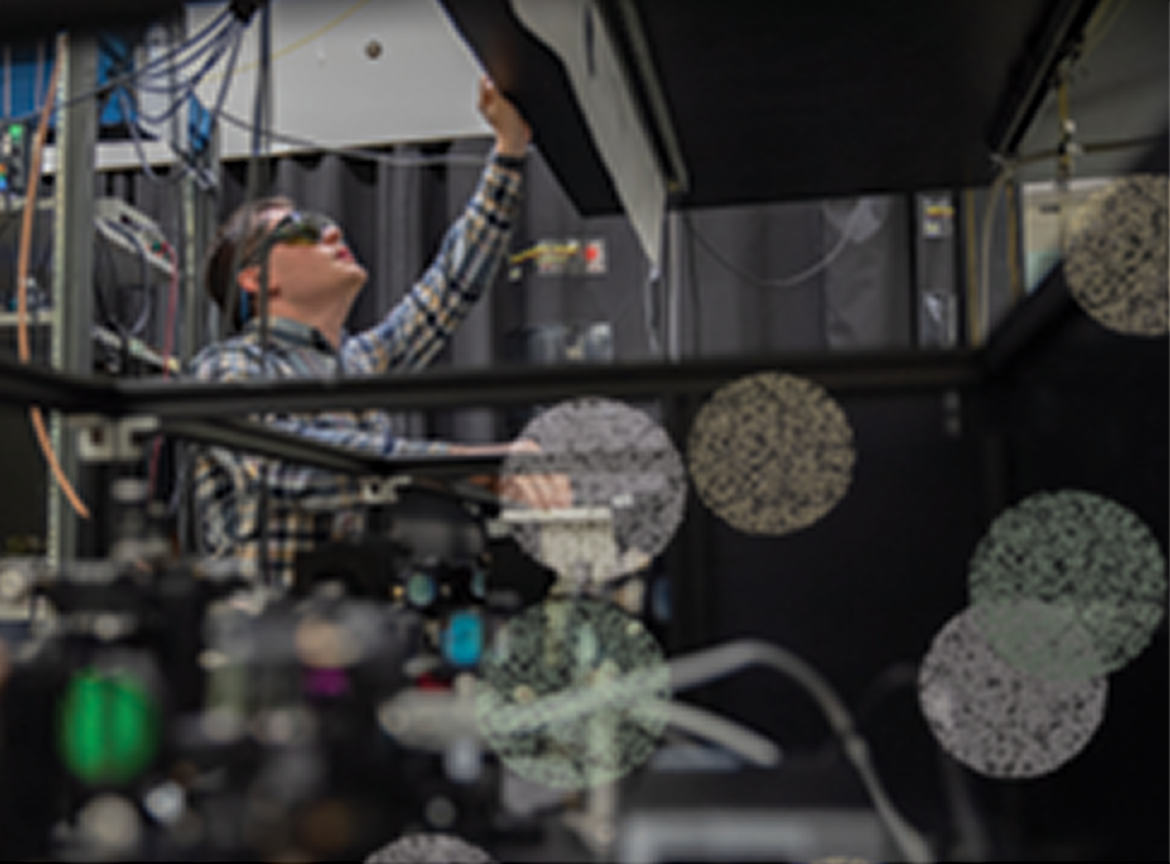
Cory Nunn, Ph.D. ’23, adjusts an experimental setup at the National Institute of Standards and Technology (NIST). He says his advisor, Todd Pittman, prepared him well. “There’ a lot of ambition in Todd’s group; I feel like we were encouraged organically to push ourselves, because we were convinced what we were doing was really cool and worth exploring,” Nunn says. (Photo courtesy of NIST)
By the 1950s, what we would now call “quantum 1.0” hit its stride, turning theory into world-changing tech. Transistors—tiny devices found in everything from PCs to cars to smartphones—are the most ubiquitous example; they power all computer chips. Driven by what are called “quantum effects,” or the perks of quantum over classical systems, transistors shrunk room-sized computers into pocket calculators and sparked the digital age. Then came lasers, which used the quantum effects of excited atoms to beam data across continents, and atomic clocks, which keep time with extreme accuracy based on the vibrations of single atoms. These breakthroughs rewired society, powering the gadgets and networks of today.
Quantum research has come a long way since quantum 1.0, which lasted through the 1970s, says Tom Smith, Ph.D. ’21, physics. “Now we’re in quantum 2.0,” Smith says. “There’s another wave of interesting quantum effects that we can take advantage of, like quantum superposition,” when a particle can temporarily be in two states at the same time, until the particle’s state is measured.
Huge improvements in laser technology and optical components have advanced the field and “opened the door for other quantum phenomena to be implemented experimentally. It’s been a gradual development—baby steps over the years,” Smith says.

While quantum 1.0 generated foundational technologies, quantum 2.0 is about harnessing quantum phenomena to build next-level systems. Multiple companies and researchers have made strides in building “qubits,” or “quantum bits,” that can be coaxed to exist long enough to perform useful computations. The first qubits only lasted a few microseconds, but today’s qubits can exist for milliseconds—1,000 times longer—making it possible to scale up quantum computers.
A key quantum effect called “entanglement” has also shifted from being a quirky laboratory phenomenon in quantum 1.0 to a workhorse in newer quantum systems. Researchers who showed that entanglement is real and exploitable received the 2022 Nobel Prize in physics. Their work paved the way for huge advances in quantum communication across long distances and quantum-based encryption methods.
“As our control of very small, isolated systems gets better and better over time, what we’re realizing is that there are new capabilities that come with working with single atom systems or single ions,” Nunn says. “And they have new properties—quantum properties—that let us leverage different kinds of processing power than what we had with classical computers.”
Today, Nunn is a postdoctoral fellow in the Quantum Optics Group within the Quantum Measurement Division at the National Institute of Standards and Technology (NIST). His research on quantum networking seeks to harness the power of quantum entanglement at a distance.
“It’s really hard to send these fragile quantum bits of information over a long link. So the solution most of us are pursuing is a quantum repeater, which is basically just a node in the middle that breaks up this longer link into two smaller links that are easier to manage,” Nunn says—or, if the link is long enough, many smaller links. He refers to one end of the link as “Alice” and the other as “Bob,” to talk about how information travels from point A to B.
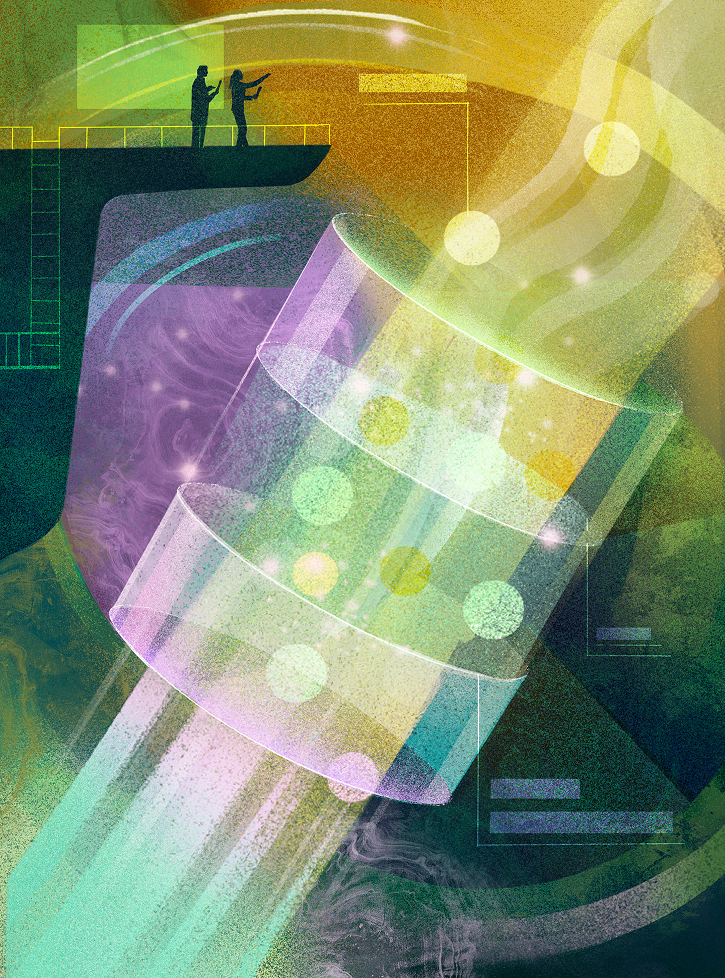
“So that repeater in the middle is going to have to take a signal from Alice and a signal from Bob, and if they don’t meet at exactly the same time, so the repeater can perform an operation and link the two together, then one or both of the signals is going to have to be stored in a quantum memory.”
That “operation” at the node (which Nunn calls “Charlie”) entangles the photons coming from Alice and Bob, which Nunn says is the “most interesting weird property that quantum particles can have.” In entanglement, the signals become “inherently linked, so that these quantum systems are correlated in a way that’s just stronger than classical physics could explain.”
After the operation at Charlie, Nunn says, “Alice and Bob’s systems, which are at separate labs, that never directly interacted with each other, now share entanglement.”
Nunn’s team at NIST is working to develop a range of technologies to make this long-distance entanglement possible, including sources of entangled photons, quantum memories, and methods of stabilizing links. Nunn is focused on developing specialized sources of single photons that can send synchronized quantum signals across the network.
Quantum systems don’t have to use photons, but they are “the best carriers of quantum information,” according to Nunn. “They can travel at the speed of light, don’t have to be cooled to an extremely low temperature to work (like some other quantum systems), and they can make it out of your lab and travel over fiber, or from satellite to satellite through space and the atmosphere. So these are inherently mobile ‘flying qubits’ that can actually take quantum information and fly from one place to another.”

 Tom Smith, left, and Binod Joshi, Ph.D. ’25, physics, at work in Yauhua Shih’s lab at UMBC. Photo by Melissa Penley Cormier, M.F.A. ’17.
In the current wave of quantum 2.0, new materials and fabrication techniques have enhanced researchers’ ability to produce tiny, precise quantum systems, opening the doors for creating quantum networks. Finally, software is starting to catch up to mathematical theories proposed decades ago—but there’s still much work to do.
Although fully capable quantum computers are still years away, researchers, businesses, and governments are already preparing for how they might disrupt current practices. For example, powerful new tools like Shor’s algorithm would leave most modern encryption methods vulnerable to attack. In addition to quantum measurement science, NIST is playing a leading role in standardizing new cryptography techniques, called post-quantum cryptography, that better prepare us for a world with advanced quantum computers.
Quantum 2.0 is about control—taking the weirdness of quantum mechanics and engineering it into tools that outperform classical limits. Unlike quantum 1.0, it’s less about discovering quantum rules and more about exploiting them for computing, secure communications, and ultra-precise sensing. The field is growing rapidly, and governments and tech giants alike are spending billions on developing the next big breakthroughs.
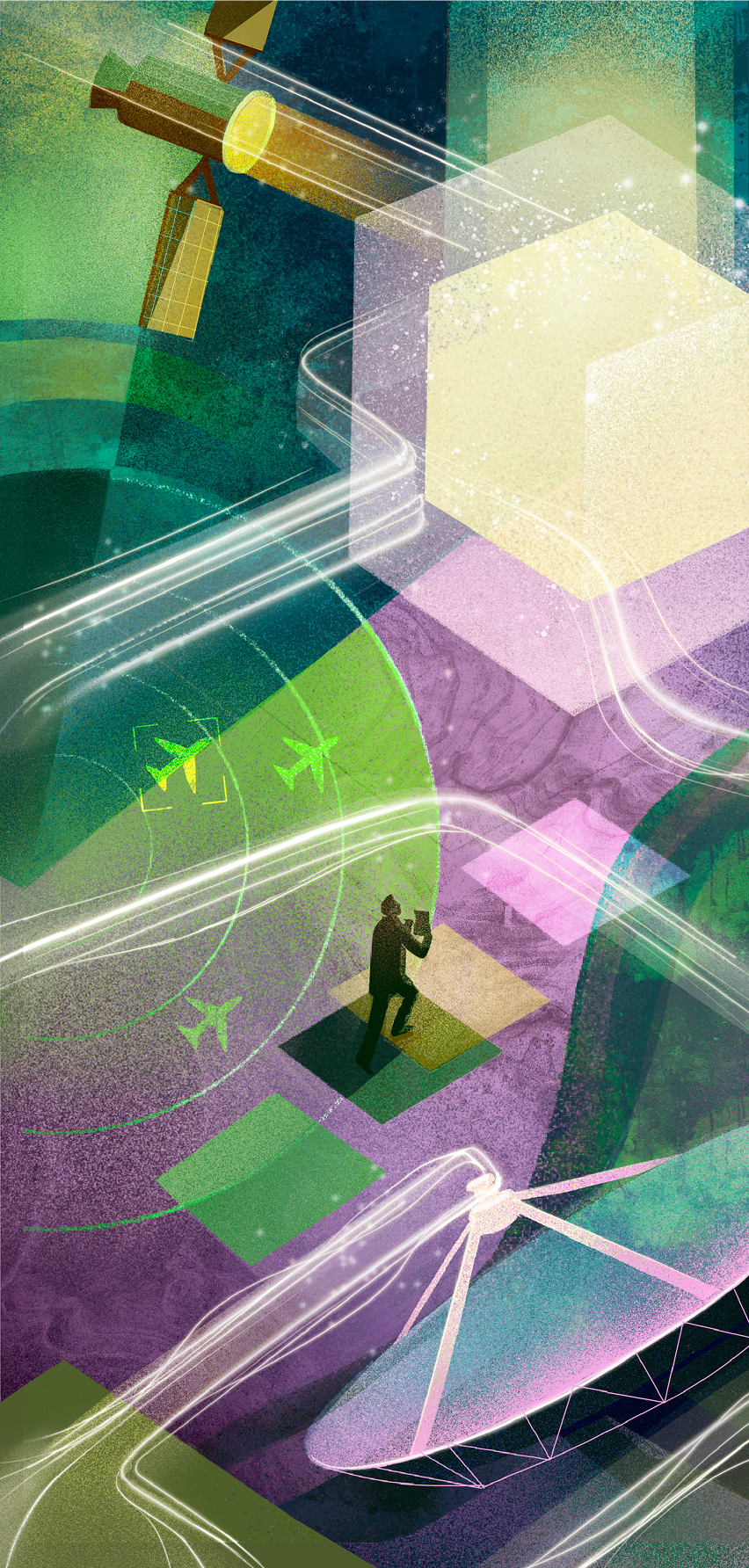
Smith, who is a physicist at the Naval Air Warfare Center, Aircraft Division (NAWCAD), believes quantum sensing is one of the most exciting areas in quantum. It refers to the use of quantum systems, such as atoms or photons, to measure physical parameters with unprecedented precision and sensitivity. While quantum computing deservedly gets a lot of airtime, “I believe quantum sensing is equally far along in its R&D but doesn’t get as much attention, because it’s not the darling of private industry currently,” Smith says.
For example, he says, the Laser Interferometer Gravitational-Wave Observatory (LIGO) is designed to detect gravitational waves, which Einstein’s general theory of relativity predicts. The LIGO team updated the observatory’s systems to take advantage of quantum effects, specifically squeezed light. Squeezed light helps make the timing or detection rate of photons more predictable, like steadying the flow of raindrops into a cup to produce consistent readings from measurement to measurement, Smith says. After LIGO made the switch, it started detecting a lot more gravitational waves.
Other companies have built quantum sensors that detect exceedingly minute shifts in gravity or magnetic fields, which can be used for anything from detecting underground tunnels to measuring brain activity to improving GPS systems. These advances come from better control of quantum states and miniaturization, which has moved tech from lab benches to the field.
“At the Navy, we’re going to keep an eye on, and in some cases have a hand in, making improvements to various types of sensing. We’re getting to the point now that maybe we can actually make a product out of this and utilize it in the field,” Smith says.
While systems like LIGO are already active, there are only a few instances of the technology around the world. For a technology to truly be “in the field” from Smith’s perspective, it must be produced at scale and put to work on, for example, a large number of aircraft carriers or military planes.
“I would like to think that certain quantum sensors could be used in the field within the next decade,” Smith says.

Nunn was a junior at the University of Delaware when LIGO upgraded. During his astronomy research, he attended conferences for quantum optics, because the first quantum optics experiments were designed to observe starlight. “All the signals that LIGO uses rely on the same type of physics that I’m studying now,” he says.
Today at NIST, his work builds directly on his Ph.D. research with Todd Pittman, Ph.D. ’96, professor of physics and director of UMBC’s Quantum Science Institute.
“There was a lot going on in Todd’s lab that I was able to directly transfer to my research at NIST,” Nunn says. “Now I am directly applying the same skills, the same systems, that I was used to working with as a member of the quantum information group at UMBC.”
Some of Nunn’s current quantum networking projects involve work with the Washington Metropolitan Quantum Network, or DC-QNet. Quantum networking involves connecting quantum devices to increase their capabilities, just as classical devices are connected today to create systems like the world wide web. The DC-QNet “is a bonafide networking application,” that relies on the research he did with Pittman, Nunn says.
The DC-QNet links four federal agencies plus the University of Maryland via fiber optic cables that travel belowground and high in the air.
“As a photon travels along the link, it might get lost along the way, because it’s just one itty bitty photon against the whole world, traveling across kilometers of fiber,” Nunn says. The fiber “is basically a kilometer of glass that it has to see through.”
Today, researchers are still investigating what’s possible and building prototype quantum networks. Once full-fledged quantum computers exist, we’ll connect them and enhance their capabilities with networking, Nunn explains. Eventually, he hopes, “we’ll have the next, futuristic, Star-Trek-level internet that relies on quantum physics.”

One big goal of quantum 2.0 is to minimize the amount of light required to send a usable signal—even down to single photons, Smith says. In the context of quantum communication, “You send this train of individual photons with independent polarizations, and if you can control those polarizations—the direction the lightwaves are vibrating—you can transmit information that way,” he explains.
Both Nunn and Smith emphasized that information sent via quantum versus classical communication signals is more secure. When information travels via a classical laser pulse from Alice to Bob, an eavesdropper, typically referred to as Eve, could take away or analyze some of the light, and the recipient would still receive a pulse, not realizing their signal had been tapped.
“But at the single photon level, if an eavesdropper takes away one photon, or even obtains information about the photon, the intended receiver registers an error, so it’s easier to detect eavesdroppers,” Smith explains. That’s a huge advantage for sending confidential information—whether it’s an everyday banking transaction or a matter of global diplomacy.

Today, Smith still does work in the lab at the NAWCAD, but spends much of his time keeping tabs on what’s happening in quantum technology across academia, industry, and government, so he can recommend research NAWCAD ought to support elsewhere or pursue in-house.
“We have a lot of support right now from our chain of command to do the research that we think is best, that we think will be the most impactful, which is always a great place to be in, to have that type of freedom,” Smith says.
Smith has also continued to collaborate with his Ph.D. advisor, UMBC physics professor Yanhua Shih. Shih is a first-generation quantum optics researcher, having done pioneering work in interferometry, one of the technologies LIGO relies on. His current work on quantum sensing is complementary to active NAWCAD research.
“By collaborating directly with academia, it feels like we’re having a bit more of an impact,” Smith says. In fact, the UMBC physics department partnered with NAWCAD through a program that supports NAWCAD staff to complete their doctoral degrees. A new Ph.D. candidate is joining UMBC through the program in fall 2025.
Nunn, too, is thriving. He loves what he does at NIST and would like to stay on after his fellowship concludes.
“There’s just a lot of good research that goes on at NIST, and the people I’m working with are amazing sources of information. I’ve grown a lot as a postdoc here,” Nunn says. “It’s really inspiring to work with hard-working and clever people on new solutions for quantum networking.”
Pittman isn’t surprised by Nunn’s success.
“Cory had a knack for experimental work and really took advantage of every opportunity to become a top-notch independent researcher at UMBC,” Pittman says. “By the end of his time in my lab, working with Cory was more like collaborating with a senior colleague than mentoring a student. In his final year, our one-on-one meetings usually started with me asking, ‘OK, Cory—what are you going to teach me today?’”
“Todd was supportive and eager to give guidance early on, and then also eager to step back when he felt I was able to tackle a problem on my own,” Nunn says. “Getting to a point where he could tell me, ‘Oh, I’m learning something from you,’ was really encouraging, and the fact that he was so open to that really helped me to grow.”
Smith connected with Shih via a research rotation, and “it was a perfect match,” he says. “I learned a lot from him, but he was also hands-off in a way that allowed me to learn on my own.”
All new graduate students in the UMBC physics department share office space, an arrangement that Nunn and Smith praised for the way it organically built community among the students.
“We had a great camaraderie. That was a key aspect that allowed me to achieve as much as I did in grad school,” Smith says. But at bedrock, the thing that excites them both is the science itself and the autonomy to pursue it.
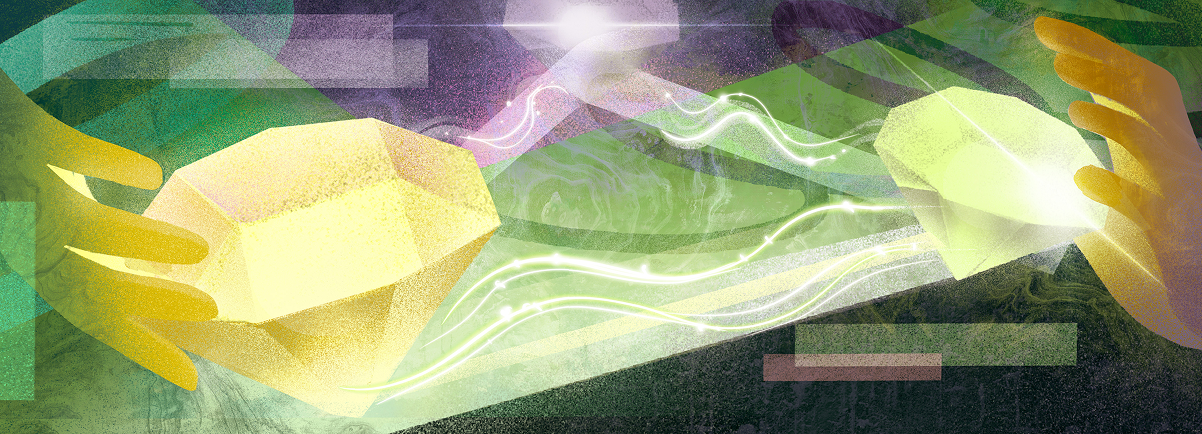

Nunn has always been intrigued by questions like, “How does light really work?”—even discussing them at high school sleepovers. It wasn’t until he arrived at UMBC that he learned that “this is an active field of research, where we’re trying to understand what quantum mechanics tells us about the way nature really works.”
Part of the excitement, he says about working in Pittman’s lab, was research into quantum memories and quantum sources that have exciting, real-world applications. “But at the core, our excitement is really investigating the way the world works on different scales that we’re not used to thinking about in our day-to-day life.”
And even as Nunn learns more and more, the mysteries of how the quantum scale operates feel limitless. He takes the attitude of a true scientist, recognizing that while “I understand more, I also understand that there’s more than ever that I don’t understand.”


The original “UMBC” ghost image from 1995 is taped inside Pittman’s journal from the time. Photo courtesy of Pittman.
In 1995, a UMBC research team led by Yanhua Shih, professor of physics, pioneered a quantum technology called “ghost imaging,” which leverages quantum entanglement to reconstruct an image of an object without actually shining any light on it. The 30th anniversary of this quantum feat was marked in a Nature Communications Physics article this spring. The UMBC team originally demonstrated the technology by rendering the letters “UMBC” in a first-of-its-kind experiment. Since then, ghost imaging has enabled revolutionary applications in secure communication, medical imaging, and remote sensing.
Todd Pittman recalls the excitement of the original breakthrough, telling Nature: “Seeing the ‘UMBC’ image emerge from the data for the first time was super exciting and very rewarding; I remember it like it was yesterday!”
Thirty years ago, UMBC was already making a name for itself in the quantum research space, including early work by Shih. His experiments showed that photons can instantly affect each other regardless of distance, laying the groundwork for the 2022 Nobel Prize in Physics, awarded for proving quantum entanglement. That research and other early advances like ghost imaging have led to more recent contributions in quantum optics, computing, and thermodynamics that are shaping the quantum research landscape.
By now, Shih has trained a second, and now a third, generation of quantum researchers, including people like Pittman, Cory Nunn, and Tom Smith, who will lead UMBC quantum research into its next era.
Written by Tania Lizarazo, associate professor of Latin American studies and global studies, UMBC
It’s been almost nine years since Colombia celebrated a landmark peace agreement between one guerrilla group and the government, and three years since President Gustavo Petro vowed “total peace.” But in reality, the country’s decades-long internal conflict continues – making it one of the oldest in the world.
Violence surged in early 2025, the most intense uptick in years. Fighting between two armed guerrilla groups in the northeastern Catatumbo region killed dozens of people and displaced tens of thousands more. Since the largest armed group – the Revolutionary Armed Forces of Colombia, known as FARC – signed the 2016 peace accord, more than 400 signatories have been killed. Meanwhile, more than 1,200 social leaders and human rights defenders have been assassinated.
We often define peace as the absence of war. The problem with thinking about peace and war as an all-or-nothing binary, however, is that it obscures the violence that takes place in “peaceful times.” For Colombians, that paradox is nothing new. In many communities most affected by the violence, thinking about a “post-conflict era” feels utopian.
As a Colombian researcher who has collaborated with Afro-Colombian leaders for over a decade, I have noticed that emphasizing peace talks and accords erases the historical violence that is still present, especially for racial minorities. Colombia has the largest Black population in Spanish-speaking Latin America. In Chocó – a region on the Pacific coast where I conducted my research – Afro-Colombians form a majority.
Communities there are contending not only with the contemporary conflict, but also ongoing challenges from the legacies of slavery, colonialism and extractive industries. Many residents, particularly women, work together every day to try to bring peace and justice within reach.
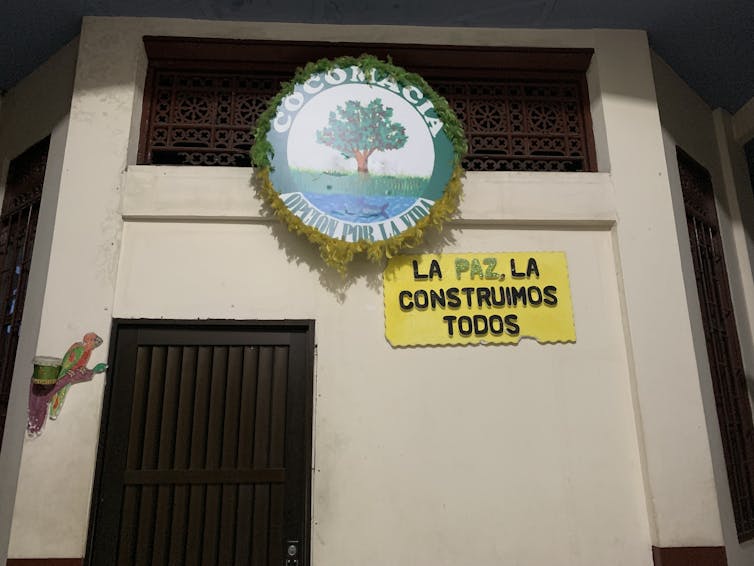 Signs in the office of COCOMACIA say ‘option for life’ and ‘peace, we all build it.’ Tania Lizarazo
Rights vs. reality
Colombia has been mired in war for over six decades, as legal and illegal armed groups across the political spectrum fight for territories and resources. The conflict is estimated to have killed around 450,000 people and displaced around 7 million.
Black and Indigenous communities have disproportionately suffered the brunt of the war – especially in rural areas, where their lives and territories have been threatened by armed groups and companies alike. In Chocó Department, the site of my research, the region’s remoteness and biodiversity have attracted illegal groups and practices like drug trafficking, as well as mining and other types of resource extraction that threaten traditional livelihoods. Mercury from industrial mining poses an additional danger to people’s health and the environment.
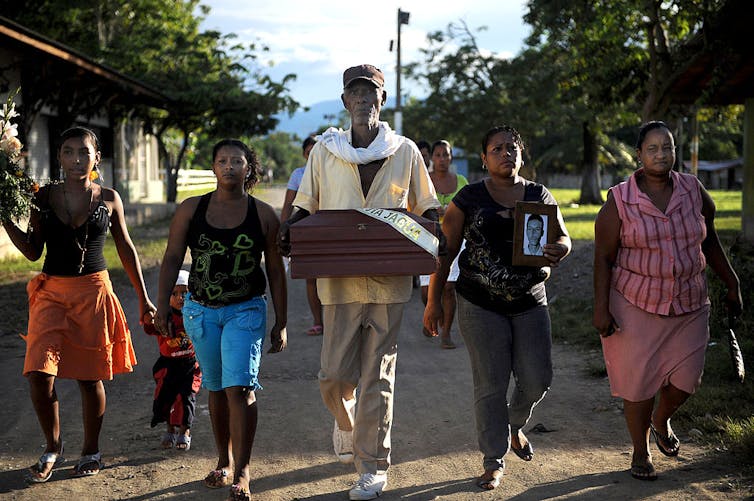 Andres Magallan carries an urn with the remains of Ivan Mejia, who was murdered by right-wing paramilitary guerrillas years before, in Santa Maria, Chocó, Colombia, in 2010. Raul Arboleda/AFP via Getty Images
Black rural communities in the Pacific lowlands, where most of Chocó is located, have a legal right to collective ownership of their territories and to be consulted about development plans. In reality, land grabs and targeted killings over illegal crops, mining and other extractive practices have become the norm here, as is true throughout rural Colombia.
The conflict has intensified racism and gender hierarchies, with Black women, particularly activists, especially vulnerable. Vice President Francia Márquez Mina, for example – who has won awards for her activism against illegal mining – survived an attack near her home in the nearby department of Cauca in 2019. She and her family have received other threats on their lives since then.
Building solidarity
Even in “postconflict” times, peace is a challenging task. It requires social change that does not happen overnight. Rather, it is the accumulation of tiny sparks in people’s daily commitments.
In my book “Postconflict Utopias: Everyday Survival in Chocó, Colombia,” I write about how Black women’s organizations care for their territories and communities. The “comisionadas,” for example, belong to one of the largest associations of community councils in rural Colombia, called COCOMACIA. These women travel the Atrato River and its tributaries to lead workshops about the organization, as well as territorial rights and women’s rights.
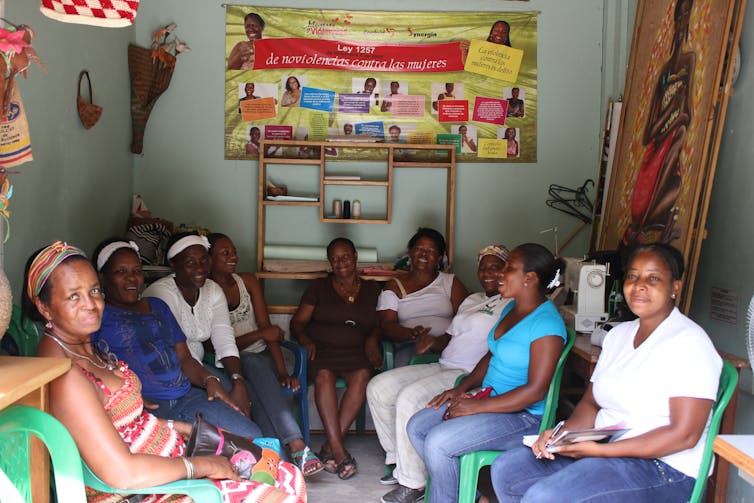 Comisionadas next to a poster with information about a landmark law against domestic violence, on July 7, 2012. María del Socorro Mosquera Pérez sits on the left. Tania Lizarazo
Everyone in the community is welcome to participate in dialogues about issues such as women’s political participation, land ownership and related legislation. Comisionada María del Socorro Mosquera Pérez, for example, wrote a song to share the importance of Law 1257, a landmark 2008 law against violence and discrimination against women.
In her story for the research project that I discuss in my book, “Mujeres Pacíficas,” comisionada Rubiela Cuesta Córdoba says it best: “The best legacy that one leaves to family and friends is resistance.”
One focus of these women’s groups’ work is the Atrato River itself. Since 2016, the same year of the peace accords, Colombian courts have recognized the river as a legal person, with rights to protection, conservation, maintenance and restoration.
 Students paint a mural in Quibdó, Chocó, Colombia, which says ‘Somos Atrato’: We are the Atrato River. Jan Sochor/Getty Images
The river is a source of food and transportation between many basin communities where potable water, electricity and other amenities are scarce. But it is also intertwined with politics and spirituality. Pilgrimages like “Atratiando,” a trip along the river and its tributaries that has taken place multiple times since 1999, highlight that there is no life without the river. Participants travel through areas where paramilitaries and guerrillas are active, showing solidarity with vulnerable communities.
COCOMACIA’s comisionadas are part of many other organizations – highlighting how survival is not only intertwined with lands and rivers, but other regions and countries. The struggle for women’s rights has led the comisionadas to collaborate with other organizations, creating wider networks of care. These include La Red Departamental de Mujeres Chocoanas, a feminist coalition of women’s organizations in Chocó; La Ruta Pacífica de las Mujeres, a feminist movement of 300 organizations from across Colombia; and Women in Black, an anti-militarism network with members in over 150 countries.
Their solidarity is a reminder that peace and justice are a collaborative, everyday effort. As Justa Germania Mena Córdoba, leader of the comisionadas at the time, told me in 2012: “One cannot change the world by herself.”
This article has been updated to correct the description of COCOMACIA.
This article is republished from The Conversation under a Creative Commons license. Read the original and see more than 250 UMBC articles available in The Conversation.
]]>
Written by Tania Lizarazo, associate professor of Latin American studies and global studies, UMBC It’s been almost nine years since Colombia celebrated a landmark peace agreement between one...
https://umbc.edu/stories/peace-has-long-been-elusive-in-rural-colombia-black-womens-community-groups-try-to-bring-it-closer-each-day/
https://my3.my.umbc.edu/api/v0/pixel/news/150570/guest@my.umbc.edu/8b74b892031103b9cca9adbc50966b27/api/pixel
cahss
cahss-research
discovery
global-studies
magazine
mlli
research
story
the-conversation
UMBC News & Magazine
https://my3.my.umbc.edu/groups/umbc-news-magazine
https://assets1-my.umbc.edu/system/shared/avatars/groups/000/001/943/24435aa6207c452e7bc15cc74b42c7bb/xsmall.png?1748556657
https://assets1-my.umbc.edu/system/shared/avatars/groups/000/001/943/24435aa6207c452e7bc15cc74b42c7bb/original.png?1748556657
https://assets2-my.umbc.edu/system/shared/avatars/groups/000/001/943/24435aa6207c452e7bc15cc74b42c7bb/xxlarge.png?1748556657
https://assets2-my.umbc.edu/system/shared/avatars/groups/000/001/943/24435aa6207c452e7bc15cc74b42c7bb/xlarge.png?1748556657
https://assets3-my.umbc.edu/system/shared/avatars/groups/000/001/943/24435aa6207c452e7bc15cc74b42c7bb/large.png?1748556657
https://assets1-my.umbc.edu/system/shared/avatars/groups/000/001/943/24435aa6207c452e7bc15cc74b42c7bb/medium.png?1748556657
https://assets2-my.umbc.edu/system/shared/avatars/groups/000/001/943/24435aa6207c452e7bc15cc74b42c7bb/small.png?1748556657
https://assets1-my.umbc.edu/system/shared/avatars/groups/000/001/943/24435aa6207c452e7bc15cc74b42c7bb/xsmall.png?1748556657
https://assets2-my.umbc.edu/system/shared/avatars/groups/000/001/943/24435aa6207c452e7bc15cc74b42c7bb/xxsmall.png?1748556657
UMBC News & Magazine
1
0
false
Fri, 06 Jun 2025 11:30:37 -0400
Fri, 06 Jun 2025 11:30:37 -0400
On track to lead—Retriever athlete wins national Arthur Ashe award
UMBC senior track and field student-athlete Anjayooluwa “Jayo” Adegboyo, biochemistry and molecular biology, was named the 2025 Arthur Ashe Jr. Male Sports Scholar of the Year by Diverse: Issues in Higher Education magazine. The publication sponsors the Arthur Ashe Jr. Sports Scholar Awards to honor students of color who have excelled in the classroom and on the athletic field and demonstrate a commitment to community service and student leadership. Adegboyo was chosen from among 700 nominated student-athletes in the country for best exemplifying the standards of scholarship, athleticism, and humanitarianism.
Adegboyo is a sprinter in track and field. He is a member of the bronze-winning 4x400m team that set a new school record during the 2023-2024 season. He also posted the second fastest time in school history in the 400 meters at the America East Conference Championships.
 Adegboyo, center, runs at a track meet at the Naval Academy this spring. Photo courtesy of UMBC Athletics.
Off track, he volunteers at the University of Maryland Medical Center’s Trauma Resuscitation Unit and the Howard County Food Bank. He also serves as a mentor to younger peers in the chemistry, biology, and physics departments and conducts research to investigate how metabolic nutrients arrange inside cells to discover markers for cancer cells versus normal cells.
“Since his arrival to UMBC, Jayo has brought his dynamic approach to his athletic and academic experiences,” said UMBC head track and field coach David Bobb ’02. “Jayo’s fun-loving personality disguises his relentless pursuit of excellence, and that combination makes him an obvious asset.”
]]>
UMBC senior track and field student-athlete Anjayooluwa “Jayo” Adegboyo, biochemistry and molecular biology, was named the 2025 Arthur Ashe Jr. Male Sports Scholar of the Year by Diverse: Issues...
https://umbc.edu/quick-posts/on-track-to-lead-arthur-ashe-award/
https://my3.my.umbc.edu/api/v0/pixel/news/150567/guest@my.umbc.edu/67d09256e1cdce0b22f65927d1d44e47/api/pixel
athletics
biochemistry-and-molecular-biology
class-of-2025
cnms
community
news
quick-post
spring-2025
UMBC News & Magazine
https://my3.my.umbc.edu/groups/umbc-news-magazine
https://assets1-my.umbc.edu/system/shared/avatars/groups/000/001/943/24435aa6207c452e7bc15cc74b42c7bb/xsmall.png?1748556657
https://assets1-my.umbc.edu/system/shared/avatars/groups/000/001/943/24435aa6207c452e7bc15cc74b42c7bb/original.png?1748556657
https://assets2-my.umbc.edu/system/shared/avatars/groups/000/001/943/24435aa6207c452e7bc15cc74b42c7bb/xxlarge.png?1748556657
https://assets2-my.umbc.edu/system/shared/avatars/groups/000/001/943/24435aa6207c452e7bc15cc74b42c7bb/xlarge.png?1748556657
https://assets3-my.umbc.edu/system/shared/avatars/groups/000/001/943/24435aa6207c452e7bc15cc74b42c7bb/large.png?1748556657
https://assets1-my.umbc.edu/system/shared/avatars/groups/000/001/943/24435aa6207c452e7bc15cc74b42c7bb/medium.png?1748556657
https://assets2-my.umbc.edu/system/shared/avatars/groups/000/001/943/24435aa6207c452e7bc15cc74b42c7bb/small.png?1748556657
https://assets1-my.umbc.edu/system/shared/avatars/groups/000/001/943/24435aa6207c452e7bc15cc74b42c7bb/xsmall.png?1748556657
https://assets2-my.umbc.edu/system/shared/avatars/groups/000/001/943/24435aa6207c452e7bc15cc74b42c7bb/xxsmall.png?1748556657
UMBC News & Magazine
3
0
false
Fri, 06 Jun 2025 09:23:21 -0400
Fri, 06 Jun 2025 09:23:21 -0400
Recent Updates to Immigration and Visa Policies
Dear Campus Community,
I am writing to update you regarding recent changes to federal immigration and visa policies.
Please remember that each individual’s circumstances are different, and this communication is provided for informational purposes only. It should not be construed as legal advice on any subject matter. If you have specific questions and hold F, H, or J immigration status, please
contact the Center for Global Engagement. If you have specific questions and hold another immigration status, please consult with a
private immigration attorney.
1. State Department pause on new student and exchange visitor visa interviews
On May 27, 2025,
Politico reported that the U.S. Department of State directed U.S. embassies and consulates worldwide to immediately pause adding additional student and exchange visitor visa (F, J, and M categories) interview appointments.
It is not known how long this pause will last. However, a State Department press briefing
transcript quoted the department’s spokesperson, Tammy Bruce, as saying the interruption would be “rather quick” and not a matter of weeks or months. The spokesperson also recommended that visa applicants continue to regularly check online for open appointment slots.
Guidance:
- Individuals who already have a visa appointment date confirmed should proceed with their scheduled interview.
- Individuals who do not yet have a visa appointment date confirmed should continue to check online for available appointment slots at their nearest U.S. embassy or consulate. If an appointment slot is available, then it should be booked immediately.
- If it seems a student or scholar will be unable to secure an appointment in time to begin their program at UMBC, then they or their hosting department should contact the Center for Global Engagement.
2. Enhanced screening and vetting of visa applicants’ social media activities
Related to the pause on new student and exchange visitor visa interviews, the State Department is expanding social media screening and vetting.
Guidance:
- All visa applicants should be prepared for additional questions and delays related to the enhanced screening and vetting of social media accounts.
- Individuals issued a visa must understand that additional searches of social media and electronic devices may occur upon arriving at a U.S. port of entry.
- Review the Campus Message on International Travel for additional information on new, enhanced vetting procedures, including social media screening and searches of electronic devices.
3. Secretary Rubio announces plan to revoke visas of certain Chinese students
On May 28, 2025, Secretary of State, Marco Rubio,
announced: “the U.S. State Department will work with the Department of Homeland Security to aggressively revoke visas for Chinese students, including those with connections to the Chinese Communist Party or studying in critical fields. We will also revise visa criteria to enhance scrutiny of all future visa applications from the People’s Republic of China and Hong Kong.”
At this time, it is still not clear when or how these visa revocations will occur. Moreover, Secretary Rubio did not specify which fields are deemed critical.
During the spring 2025 semester, a total of 53 Chinese students enrolled at UMBC. Chinese students and scholars are valued members of our campus community and contribute to our academic endeavors and the cultural vitality of our campus.
The Center for Global Engagement will continue to monitor State Department communications for any updates on this initiative. Additionally, we will continue to review SEVIS records for unusual terminations that may relate to visa revocations and notify impacted students immediately.
Guidance:
- Chinese students and scholars should consult with the Center for Global Engagement before planning travel outside of the United States.
- Any student or scholar who receives a notice from the U.S. Department of Homeland Security or U.S. Department of State announcing revocation of their visa or SEVIS record should immediately notify the Center for Global Engagement.
- Individuals concerned about how visa revocations may impact their ability to study in the United States are encouraged to review a recent resource published by the President’s Alliance on Higher Education and Immigration, which explains the significance of visa revocations and SEVIS terminations. As they note, “visa revocation does not automatically terminate a student’s nonimmigrant status if the student is already present in the United States at the time of revocation. It also does not constitute an order of removal or a requirement to immediately depart.” However, once a student’s visa has been revoked, the student will no longer be able to reenter the United States on the revoked visa.
4. New institutional reporting requirements mandated for exchange visitor program
Institutions approved to sponsor a J-1 exchange visitor program have always been required to report certain incidents involving J-1/J-2 exchange visitors to the Department of State. Such incidents include those that “have or could endanger the health, safety, or welfare of an exchange visitor or otherwise could be expected to bring the Department of State, the Exchange Visitor Program, or the sponsor’s exchange visitor program into notoriety or disrepute.”
Examples include serious illness, natural disasters, lost immigration documents, etc. When the Center for Global Engagement becomes aware of a “reportable incident,” we must report it within one business day.
The Department of State recently added three additional categories of incidents that must be reported:
-
Proscribed Antisemitic Actions: (e.g., physical actions directed towards Jewish individuals and/or their property, community institutions, or religious facilities that violates the law or university rules)
-
Serious Violations of University Conduct Rules: (e.g., participation in a building occupation, participation in an unauthorized encampment, disrupting classes, intimidation, harassment, assault)
-
Terrorist Activity, Endorsing or Espousing Terrorism: (e.g., engaging in terrorist activity, membership in a terrorist organization, endorsing or espousing terrorist activity)
These incident reporting requirements only apply to the J Exchange Visitor Program. UMBC exchange visitors are students and scholars whose forms DS-2019 are issued by the university. These expanded categories and reporting requirements do not apply to UMBC international community members in other immigration statuses, such as F-1 and H-1B.
5. USCIS requests biometrics for certain international employees
U.S. Citizenship and Immigration Services (USCIS) recently began issuing Requests for Evidence (RFE) for certain employment-based immigration petitions, including H-1B specialty worker visas for international faculty and staff, when the agency has “adverse information” regarding the beneficiary. These RFEs do not disclose the details of such information, but require the beneficiary to submit biometric data.
Guidance:
- International employees should be aware that certain social media activity and legal records, including minor traffic violations, may be considered “adverse information” and result in a request for biometric information. Individuals who fail to respond to an RFE by the stated deadline risk having their petition denied by USCIS.
6. Scams targeting international students
Recently, the Federal Bureau of Investigation issued a
public service announcement warning that scammers are contacting international students claiming there is a problem with their immigration status and demanding a fee to resolve the issue. The announcement provides several tips included in the guidance below.
Guidance:
- Beware of unsolicited communication from someone purporting to be from the government, especially by phone. Verify you are speaking with a government official by hanging up and contacting the office through a third-party obtained number (e.g., web search for legitimate contact information), then asking for the agent or department with whom you were speaking.
- Verify that the website visited is a secure or encrypted site, as government websites are.
- Repeating top-level domains in a URL is a common scam to make a website appear legitimate (e.g. “gov.org” in a URL is a spoof of the .gov top-level domain).
- Do not provide information on the phone until you verify the identity of the caller.
- If you believe you are the target of a government impersonation scam targeting international students, gather all relevant documentation and contact diplomatic security at your home country’s embassy, the FBI, or Bureau of Diplomatic Security at the Department of State.
- Do not give anyone a two-factor authentication code used to log-in to an account or device.
- Do not download files to your phone or computer unless you have verified the source.
Sincerely,
David L. Di Maria
Vice Provost for Global Engagement
]]>
Dear Campus Community, I am writing to update you regarding recent changes to federal immigration and visa policies. Please remember that each individual’s circumstances are different, and...
https://my3.my.umbc.edu/groups/announcements/posts/150536
https://my3.my.umbc.edu/api/v0/pixel/news/150614/guest@my.umbc.edu/489ccb52711f6247667076b21867506d/api/pixel
federal-orders
rss
story
UMBC News & Magazine
https://my3.my.umbc.edu/groups/umbc-news-magazine
https://assets1-my.umbc.edu/system/shared/avatars/groups/000/001/943/24435aa6207c452e7bc15cc74b42c7bb/xsmall.png?1748556657
https://assets1-my.umbc.edu/system/shared/avatars/groups/000/001/943/24435aa6207c452e7bc15cc74b42c7bb/original.png?1748556657
https://assets2-my.umbc.edu/system/shared/avatars/groups/000/001/943/24435aa6207c452e7bc15cc74b42c7bb/xxlarge.png?1748556657
https://assets2-my.umbc.edu/system/shared/avatars/groups/000/001/943/24435aa6207c452e7bc15cc74b42c7bb/xlarge.png?1748556657
https://assets3-my.umbc.edu/system/shared/avatars/groups/000/001/943/24435aa6207c452e7bc15cc74b42c7bb/large.png?1748556657
https://assets1-my.umbc.edu/system/shared/avatars/groups/000/001/943/24435aa6207c452e7bc15cc74b42c7bb/medium.png?1748556657
https://assets2-my.umbc.edu/system/shared/avatars/groups/000/001/943/24435aa6207c452e7bc15cc74b42c7bb/small.png?1748556657
https://assets1-my.umbc.edu/system/shared/avatars/groups/000/001/943/24435aa6207c452e7bc15cc74b42c7bb/xsmall.png?1748556657
https://assets2-my.umbc.edu/system/shared/avatars/groups/000/001/943/24435aa6207c452e7bc15cc74b42c7bb/xxsmall.png?1748556657
UMBC News & Magazine
0
0
false
Tue, 03 Jun 2025 14:57:49 -0400
A beautiful day to be a Retriever
Ramping up to the end of the Retriever 2024 – 2025 academic year, UMBC’s Office of Student Engagement and Belonging gathered students, faculty, and staff to celebrate their accomplishments and invaluable contributions with the communities closest to them. Angelina Jenkins, assistant director of UMBC’s Mosaic Center, which provides the campus community with resources and community building, was at the helm of the three Cultural and Affinity Celebrations and Awards, with a cadre of co-chairs making the Asian, Lavender, and Black/Latine/x events a reality.
Thania Muñoz, associate professor of modern languages, linguistics, and intercultural communication, served as the co-chair for the 5th Black and Latine/x celebration. Priya Bhayana, project manager for UMBC’s Global Asias Initiative, served as the co-chair for the inaugural Asian Cultural Celebration and Awards gathering. Zoe Brown, program coordinator for the Women’s Center and current M.P.P. student, co-chaired the Lavender event with Darcie Adams, graduate assistant for UMBC’s Gathering Space for Spiritual Well-Being, who supported all three events.
“The Office of Student Engagement and Belonging strives to collaborate with a team of interdisciplinary partners across campus to create a true emphasis on our narrative that inclusive excellence and belonging are a reality for everyone at UMBC,” said Jenkins. “Your stories belong here. Our collective UMBC story and community are made better by them.”

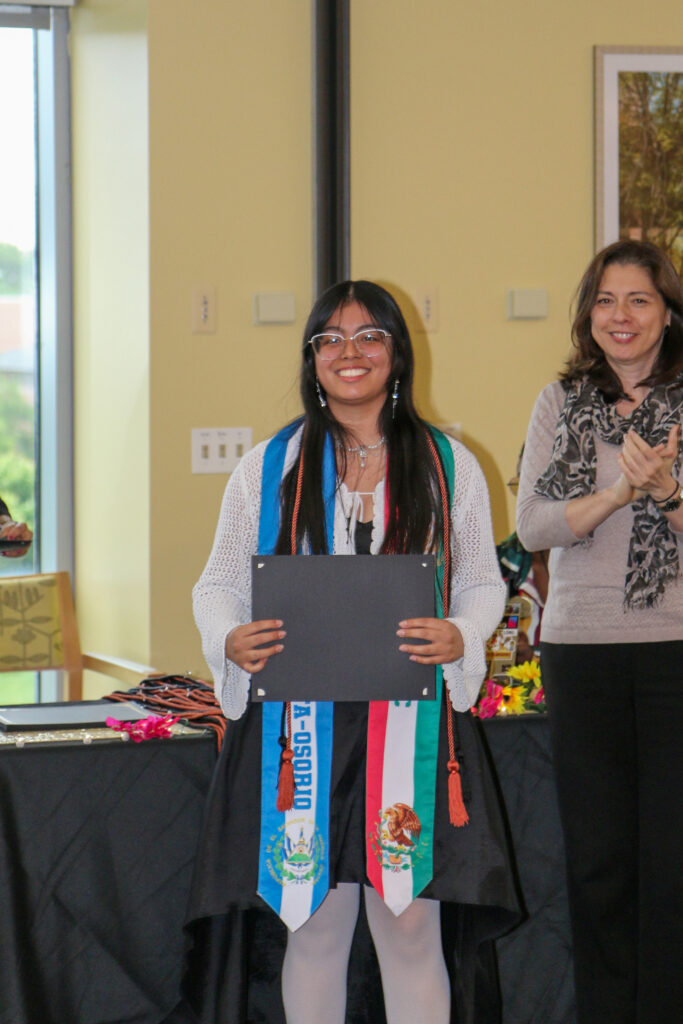

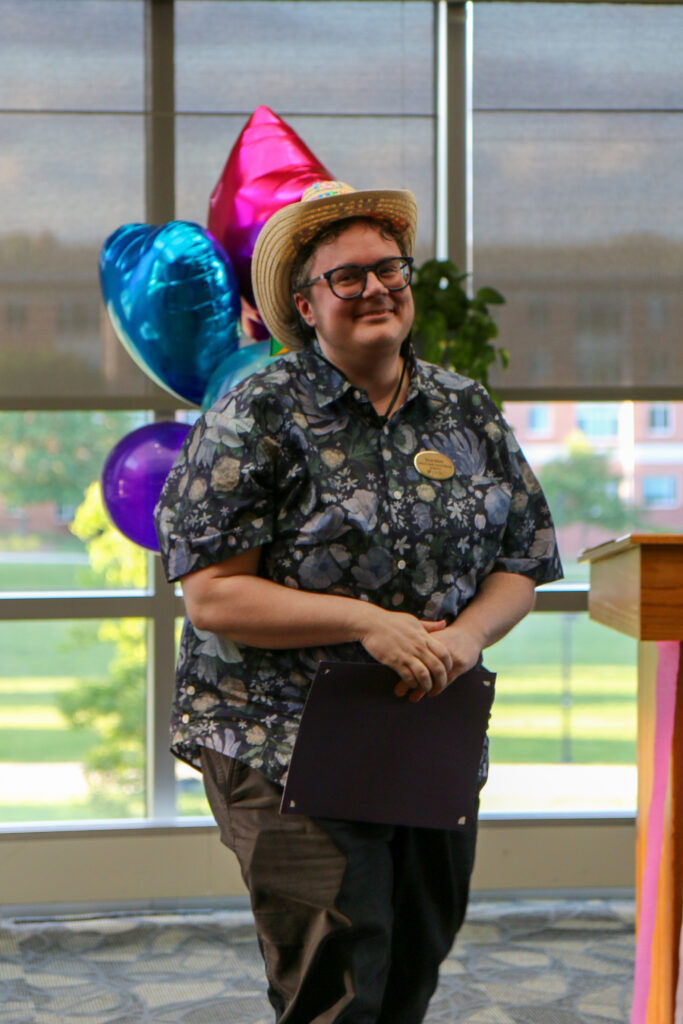 (l-r): Jenkins (first on left)with Mary Rose Khamfong ’25, psychology, a McNair Scholars Program Teaching Fellow, and recipient of the Love Today and Tomorrow Award at the Asian Cultural Celebration and Awards. Marilin Argueta-Osorio ’25, media and communication studies, receives black and brown honor cords and a certificate of recognition at the Black and Latine/x Celebration and Awards. Director of the McNair Scholars Program, Reverand Michael Hunt ’06, computer science, and Ph.D. ’25, language, literacy, and culture (LLC), with his family. Darcie Adams ’23, gender, women’s, and sexuality studies (GWST), political science, and M.P.S. ‘25, receives the Legacy Award, which honors those who have made an unforgettable, lasting impact on the UMBC queer community.
(All images by Tanzila Malik ’26, GWST, except the Hunt family by Bradley Ziegler/UMBC)
Inaugural Asian Cultural Celebration and Awards
Gathering Retrievers from all corners of the world is something that Meghna Chandrasekaran ’25, political science and biological sciences, is skilled at as the president of the Student Government Association and vice president of undergraduate affairs on the University System Student Council. She hosts “Chai Chats with Meghna!” where she serves piping hot tea and fosters camaraderie throughout the year. “Because of my role as the associate director of the Center for Democracy and Civic Life, as well as my lived experience as both Chinese and Jamaican, I’m honored to have been asked to participate in this inaugural event to present the Another World Is Possible Award to Meghna Chandrasekaran,” said Ricky Blissett ’11, bioinformatics and computational biology. He was proud to add to Chandrasekaran’s long list of accomplishments include her workshops on intersectional leadership and Tamil-language teaching. “She doesn’t just imagine a better world—she builds it, step by step, with humility and resolve.”

 (l-r): Meghna Chandrasekaran with Ricky Blissett. (Bradley Ziegler/UMBC). Chandrasekaran receives her red honor cord. (Tanzila Malik)
In our Tamil literature, we have a book of universal truths, called the Tirukkuṟaḷ, and I am beyond proud to share this one with you in Tamil.
உள்ளத்தாற் பொய்யா தொழுகின் உலகத்தார் உள்ளத்து எல்லாம் உளன்
It says, “What is truth? It is speaking words that do not betray one's inner self.” To me, this is the heart of authenticity. It’s not just about being honest with others; it’s about refusing to forget who you are, even when the world tries to define you otherwise.
Meghna Chandrasekaran ’25
political science and biological sciences

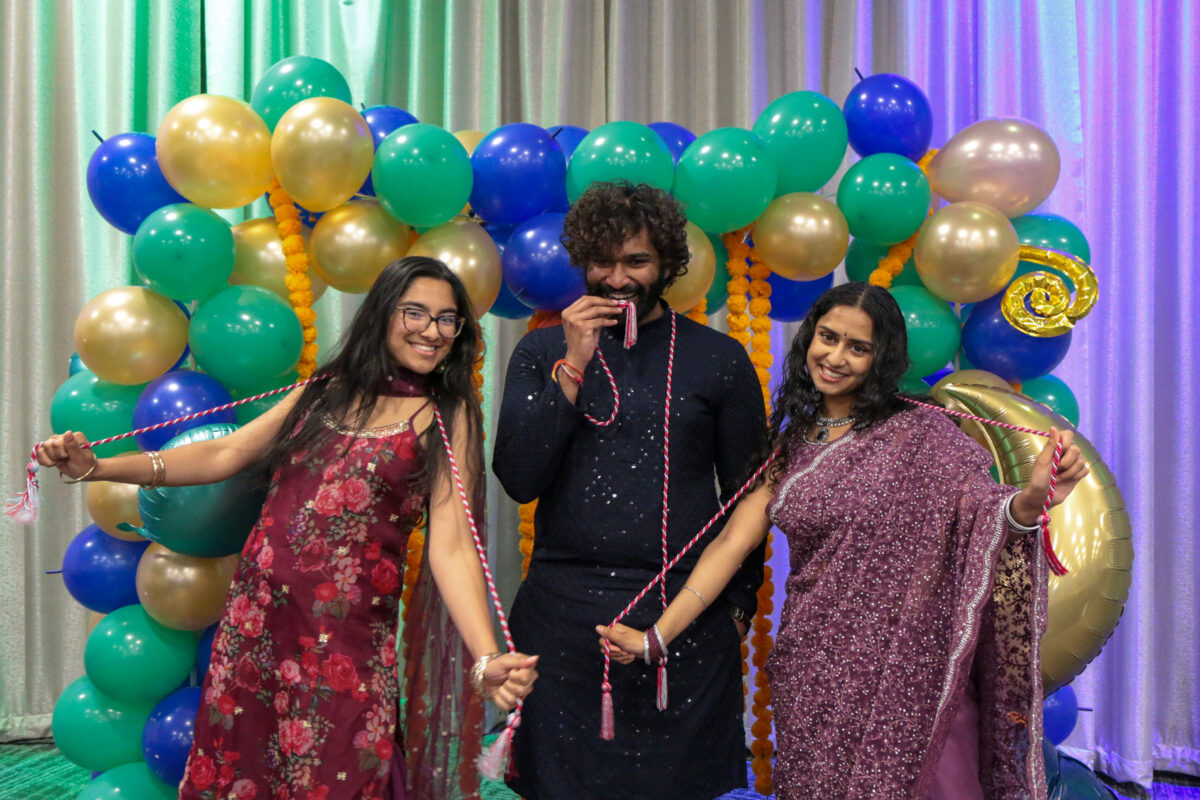
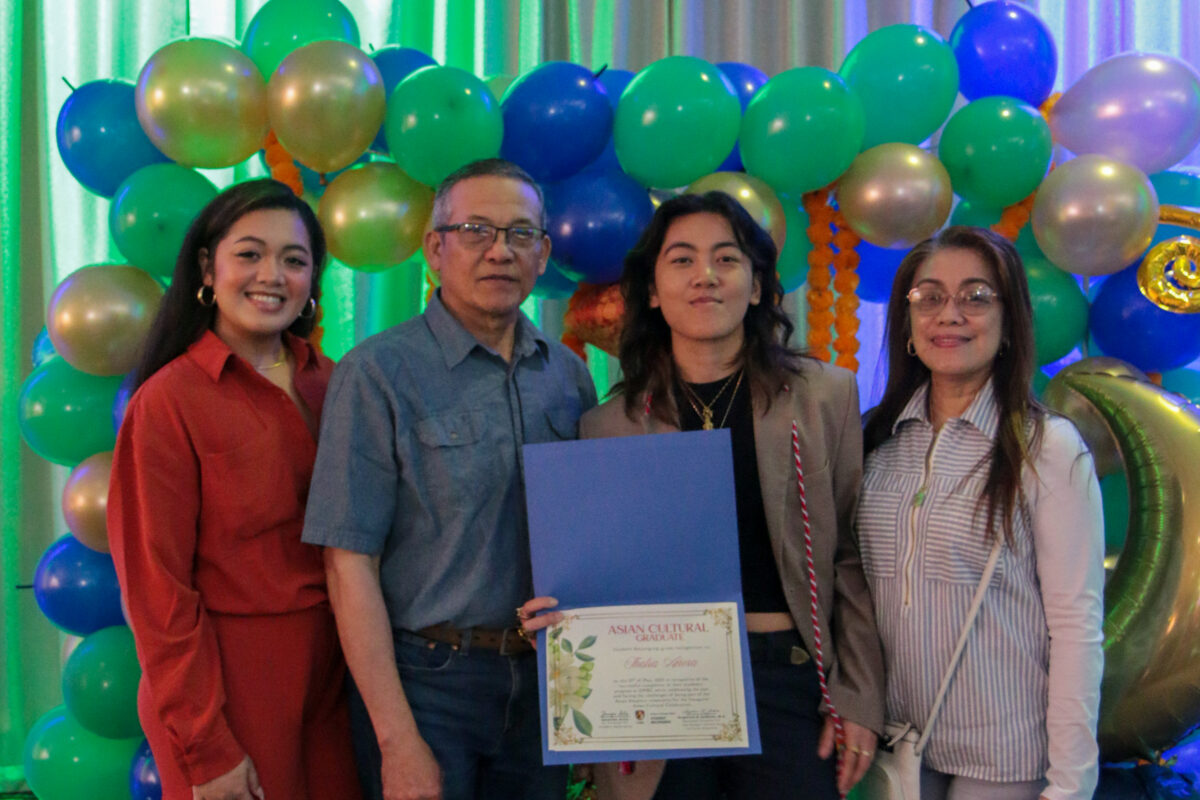
 Students and their families celebrate their accolades. Party time! (Top row by Bradley Ziegler/UMBC. Bottom row by Tanzila Malik)

“UMBC was my first experience stepping out of India without anyone to look after me,” said graduate keynote speaker, Sairam Bokka, M.A. ’25, cybersecurity, a leader in UMBC’s Retriever Essentials addressing food insecurity on campus. “I arrived here unsure, quiet, and content with staying in the background. But thanks to the people I met, the support I received, and the opportunities I embraced, I’m walking away from UMBC more open, confident, and purpose-driven. May we all continue to grow, serve, and seek out new paths, even when we feel uncertain. That’s where the real magic happens.” (Bradley Ziegler/UMBC)
12th Annual Lavender Celebration and Awards
 (l-r): Master of ceremonies, Jacob Leizear ’16, geography and environmental systems; Lorae Bonamy-Lohve, the new assistant director of UMBC’s Pride Center; Darcie Adams; Joseph Vann-Jones, program coordinator for UMBC’s Gathering Space; and Maya Jones ’25, psychology. (Bradley Ziegler/UMBC)
As Lorae Bonamy-Lohve, the new assistant director of UMBC’s Pride Center, made the opening remarks for the Lavender Celebration and Awards, she had a clear message for her new Retriever community. “Lavender is a color long tied to liberation, strength, and the beauty of our community,” said Bonamy-Lohve. “Today’s ceremony is about how you made it easier for the next generation of students like you to imagine themselves here, thriving, loved, and affirmed. Let this celebration not only be a moment of joy, but also one of remembrance and responsibility, a reminder that liberation is collective, and that we carry many histories as we move forward.”
Love and history are two intrinsically intertwined concepts for Sanai Eaton-Martinez ’25, a political science pre-law track transfer student and Grit Guide. “My first words were ‘Te quiero mucho.’ [I love you] Love is what we give, but respect is what we’re owed. UMBC allowed me to keep my path forward, and it soon became my home,” said Eaton-Martinez, the Lavender Celebration and Awards undergraduate keynote speaker and founder of UMBC’s Sisterhood: A Women of Color Coalition. “We have raised thousands of dollars to better our community and now have 200 members. Sisterhood is a labor of love. It has taught me so much more than I could have imagined. Not only did I gain a community, but I gained a family.”
 (l-r): Amariana Crawley, a psychology sophomore, and award presenter; Dasani Mia-Sheree Mann, a media and communication studies sophomore; Carrington Cline ’25, media and communication studies; and Eaton-Martinez. (Tanzila Malik)
When Adams was designing the student art gallery for the Lavender Celebration and Awards, he reached out to Key Gallagher, an English junior, sophomores Jamar James, a computer engineering major, and Qaiyah Dawson, a biological sciences major with a photography minor, to display their crocheting, robotics, and photography skills, respectively. This is Dawson’s first photography exhibit, but James is an avid robotics competitor, and Gallagher’s whimsically crocheted stuffed and wearables sell quickly at campus events.


 (l-r): Gallagher with his latest designs, James with the Retriever Robotics Team VEX Robot, and Qaiyah Dawson explains her first series of photographs exploring different phases of mental health. (Bradley Ziegler/UMBC)
“I’ve been crocheting for two years now. I have ADHD and need to work with my hands, or else I can’t focus. I finished this piece today. It is a piece of advice that my therapist gave me about not letting fear stop me from experiencing life. It’s a way to express myself,” said Gallagher, a critical disabilities minor, of his ‘Do It Scared’ banner, which took 16 hours and 7,500 stitches to make. “It is amazing when someone comes to my table and sees their flag. Their eyes light up. It’s a great way to connect with people and say, ‘I see you. You are safe here.’”
 (l-r): Graduate student keynote speaker, Riley Donahue ’24, political science and current M.P.P. student, receiving the Lavender Activism and Inclusive Excellence Award. She serves on the America East Conference Student-Athlete Advisory Committee (SACC), as co-president of UMBC SAAC and Division I NCAA SAAC, and is a representative for the America East and the NCAA Mental Health Advisory Group. Candace Hill, head coach for the UMBC women’s basketball team. (Bradley Ziegler/UMBC)
Before coming to UMBC, there were times when I didn’t quite fit in. Being a Division I women's basketball athlete was also another world where fitting into a certain mold often appears to be the only way to stay in the game. When I transferred to UMBC, I brought all of it with me. Here, I found something I never knew was missing. The ability to just be. Not just in class or on the court, but in ordinary moments, walking around campus, sitting in meetings, smiling at friends, all of me without apology. Let’s keep the door open for others. Let’s keep showing up, imperfectly, authentically, and powerfully.”
Riley Donahue ’24
political science, current M.P.P. student
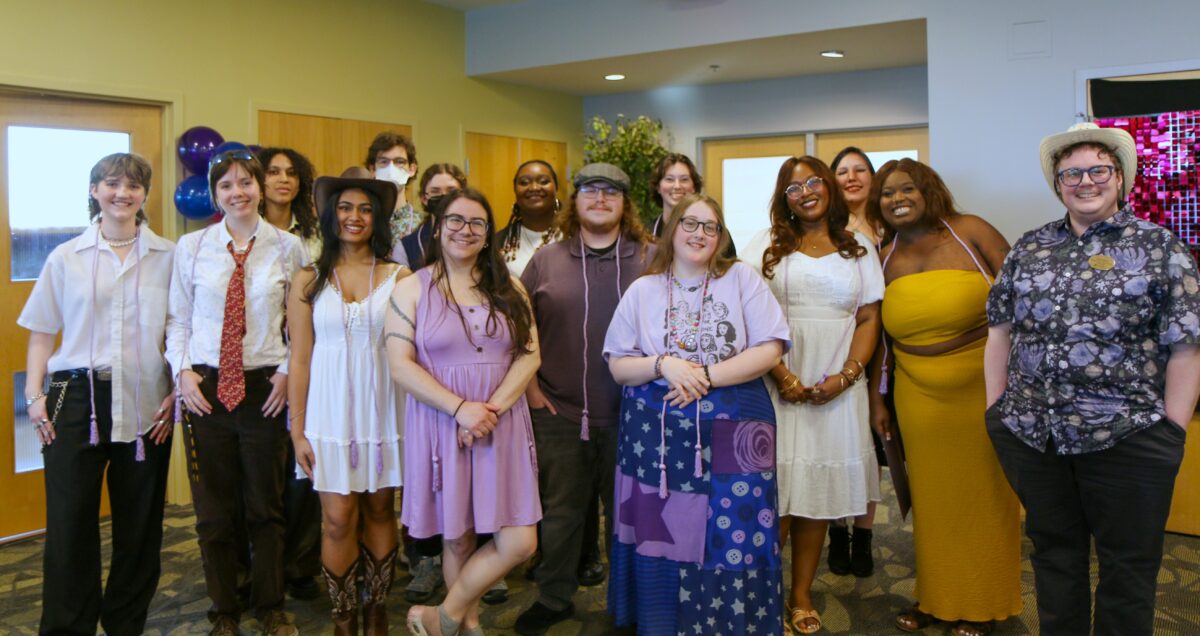 Sealed with Lavender honor cords and ready for the next adventure. (Tanzila Malik)
 Jacob Leizear. (Tanzila Malik)
“I was here for the first Lavender Celebration back in 2014. I received the 2016 Student Leader of the Year Award,” said Leizear, a geography and information systems specialist for The Nature Conservancy. “I think it’s amazing that this is still happening. The people I met here became my friends and are now friends for life. It’s great to be back and see everything happening—bigger and better than ever.”
5th Annual Black and Latine/x Celebration and Awards
“This moment is a combination of dreams, both spoken and unspoken,” said Marian Saunder White ’87, information systems, a member of UMBC’s Alumni Association Awards Committee, at the 5th Annual Black & Latine/x Celebration and Awards. “It is the legacy of your ancestors who survived the unimaginable so that you can imagine freely.”
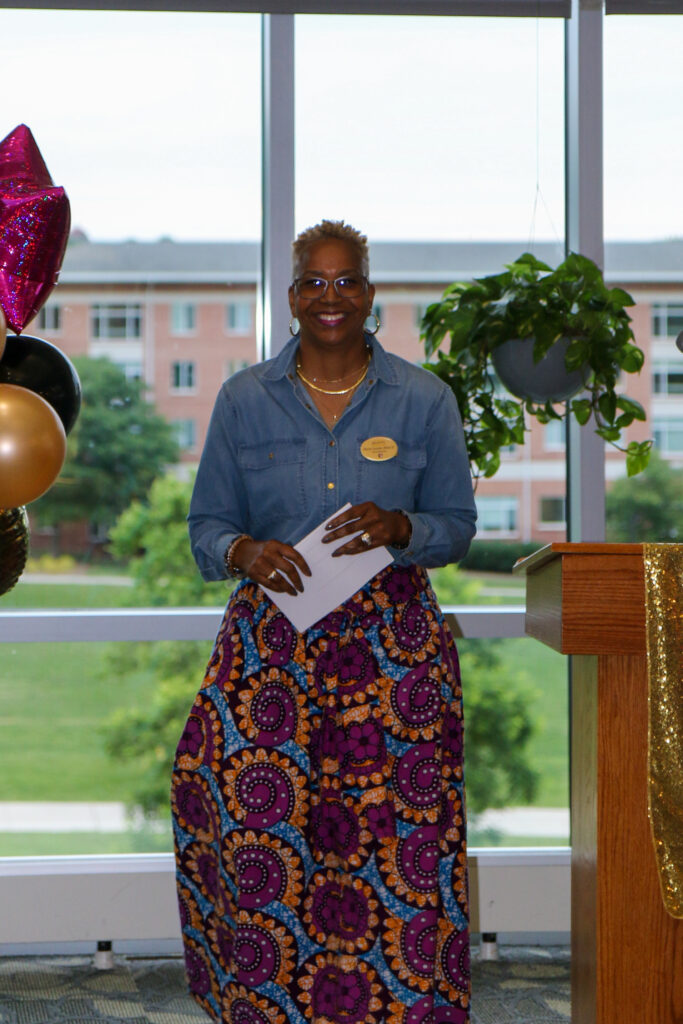
 (l-r): Saunders. Michael Hunt with his child receiving the black and brown honor cords from Maria Sanchez, director of the Engineering and Computing Education Program, interim director and director of education and outreach of the Individualized Study Program, and committee member for all three cultural and identity celebrations.
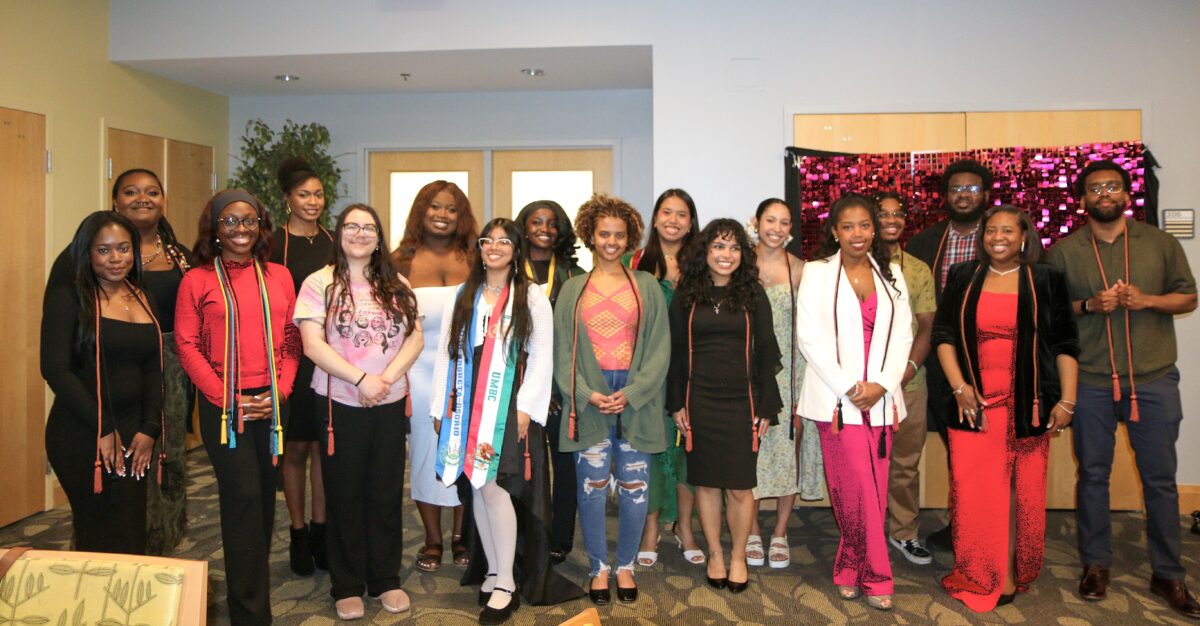 Black and Latine/x students stand tall and proud wearing their black and brown honor cords. (Tanzila Malik)
Legacy is something Janerra Allen, Ph.D. ’25, electrical engineering, (above second from the right), has had on her mind, as a first-generation college student, more so now that she will begin her postdoctoral research at the Johns Hopkins University Applied Physics Laboratory this summer. “When I told my grandmother, she cried. She didn’t know what a postdoc was, but she knew her granddaughter had made it,” said Allen, the Graduate School keynote speaker. During her time at UMBC, she served as a graduate senator for the College of Engineering and Information Technology, secretary of the Graduate Student Association, and president of the Black Graduate Student Organization. “Wherever you go next, know this: You carry the power of every obstacle you’ve overcome and every hand that helped lift you. You are not alone. You are part of a legacy that is unshakable. So take pride. Take your rest. And take up space—because you deserve it.”


 (l-r): Camila Chombo Sam ’25, computer science, receives her black and brown honor cord from Sanchez; Black/Latine/x Student Leader of the Year, T’ana Joseph ’25, mechanical engineering; and Scholar of the Year, Gabrielle Ware ’25, individualized study, with a friend. (Bradley Ziegler/UMBC)

Hunt, the 2024 Black/Latine/x Excellence Award, was excited to surprise this year’s recipient. Bosola Jerry-Asooto ’25, biological sciences, (left) was shocked when he announced she is the recipient of the 2025 Black/Latine/x Excellence Award.”From student government to residence life, health advocacy to academic mentorship, they’ve consistently stepped up—not for recognition, but to ensure others are seen, heard, and supported,” said Hunt. (Bradley Ziegler/UMBC)
 Lesley Hernandez ’25, biochemistry and molecular biology, the undergraduate keynote speaker. (Brad Ziegler/UMBC)
When I was in fourth grade, I invited my mom to school for career day. My classmates asked her who her role model was, and she said herself. I was so embarrassed. Other parents were saying Nelson Mandela or Einstein. Now, I get it. I can also say my role model is myself. I know how hard I work. I know how much I’ve grown. I push myself to do the uncomfortable things because I believe growth lies on the other side of discomfort. Do not lose sight of your visions. Believe in yourself. Be your greatest motivator and be your own role model.
Lesley Hernandez ’25
biochemistry and molecular biology
As the curtains close on another year, the Office of Student Engagement and Belonging is already thinking ahead on how to top these years’ ceremonies. The Cultural and Affinity Celebrations and Awards ceremonies aren’t just about recognizing achievements. They are about praising the journey, the effort, the laughs, and speed bumps along the way, and the promise of what’s still to come.
Learn more about student engagement and belonging at UMBC.
]]>
Ramping up to the end of the Retriever 2024 – 2025 academic year, UMBC’s Office of Student Engagement and Belonging gathered students, faculty, and staff to celebrate their accomplishments and...
https://umbc.edu/stories/a-beautiful-day-to-be-a-retriever/
https://my3.my.umbc.edu/api/v0/pixel/news/150528/guest@my.umbc.edu/e2c0f3978cf2980e9a7352770cf58e80/api/pixel
arts-and-culture
cahss
class-of-2025
cnms
coeit
community
mcnair-scholars
news
story
the-mosaic
UMBC News & Magazine
https://my3.my.umbc.edu/groups/umbc-news-magazine
https://assets1-my.umbc.edu/system/shared/avatars/groups/000/001/943/24435aa6207c452e7bc15cc74b42c7bb/xsmall.png?1748556657
https://assets1-my.umbc.edu/system/shared/avatars/groups/000/001/943/24435aa6207c452e7bc15cc74b42c7bb/original.png?1748556657
https://assets2-my.umbc.edu/system/shared/avatars/groups/000/001/943/24435aa6207c452e7bc15cc74b42c7bb/xxlarge.png?1748556657
https://assets2-my.umbc.edu/system/shared/avatars/groups/000/001/943/24435aa6207c452e7bc15cc74b42c7bb/xlarge.png?1748556657
https://assets3-my.umbc.edu/system/shared/avatars/groups/000/001/943/24435aa6207c452e7bc15cc74b42c7bb/large.png?1748556657
https://assets1-my.umbc.edu/system/shared/avatars/groups/000/001/943/24435aa6207c452e7bc15cc74b42c7bb/medium.png?1748556657
https://assets2-my.umbc.edu/system/shared/avatars/groups/000/001/943/24435aa6207c452e7bc15cc74b42c7bb/small.png?1748556657
https://assets1-my.umbc.edu/system/shared/avatars/groups/000/001/943/24435aa6207c452e7bc15cc74b42c7bb/xsmall.png?1748556657
https://assets2-my.umbc.edu/system/shared/avatars/groups/000/001/943/24435aa6207c452e7bc15cc74b42c7bb/xxsmall.png?1748556657
UMBC News & Magazine
3
0
false
Tue, 03 Jun 2025 09:43:22 -0400
Tue, 03 Jun 2025 09:43:22 -0400
My life between the yellow borders
At UMBC, students get a versatile education that Retrievers can draw on to succeed no matter where their career lands them. But sometimes, you hit the home run and end up with your dream job. For Kennedy Lamb ’20, English—who also played softball for UMBC—that meant a role in the storied legacy of National Geographic. But dream jobs don’t land because of random luck or chance. Lamb knew early on that she wanted to lean on her love of science in her English degree and topped off her UMBC education with a graduate degree from Johns Hopkins University’s program in science writing. Ultimately, when she applied for the gig at Nat Geo, she’d loaded her bases and was ready to knock it out of the park.
Seven years ago, I sat in my academic advisor’s office in the Performing Art and Humanities Building mulling over which classes to take next semester. The meeting, like all meetings with English professor Christopher Corbett, mostly consisted of discussing select passages from Phillip Lopate’s Art of the Personal Essay, the Baltimore Orioles’ record, and Babe Ruth. I always looked forward to them.
“What do you want to do after college?” he asked, chuckling good-naturedly. I smiled politely and fiddled with my earrings. At 19, the prospect of securing a full-time job was daunting. I knew I loved to write. I knew I loved science. I did not know how to combine the two. “I’m not sure,” I said. “Write, I guess.”
Corbett took a sip out of his coffee mug and sat back in his chair. “Well, I can tell you where others have gone on after college, if that would help.” I nodded. In his Maine drawl, he rattled off a few media outlets, some of which I was familiar with. Nothing piqued my interest.
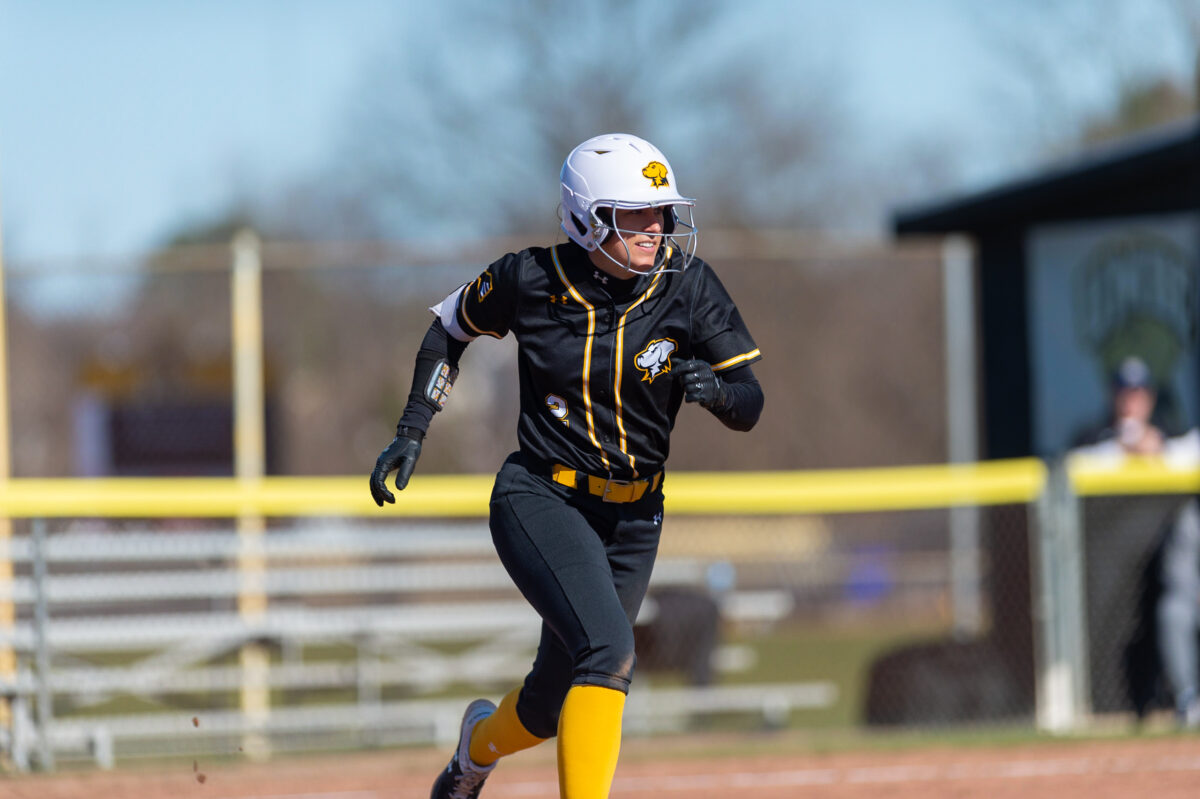 Lamb runs to first base her last collegiate game before the COVID-19 pandemic canceled the 2020 season. Photo by Ian Feldmann ’21.
“And one alumna went to write for National Geographic,” he said, almost as an afterthought. I looked up at him. “Really?” I replied.
Corbett hadn’t heard me and continued recounting the various places alumni from the English Department went on to work. But my mind was stuck: National Geographic. Now that would be something special. I pictured the iconic yellow borders in my head and pondered the pathway from college sophomore to Nat Geo writer.
At the end of the meeting, I had signed up for a handful of writing seminars, an introductory biology class, and Deborah Rudacille’s science writing class. As semesters turned into years and my time at UMBC came to a close in 2020, the dreams of National Geographic lingered in the back of my mind. What if? I would wonder. And how?
Fast forward to 2025, and that dream has become a reality. I am a communications specialist at the National Geographic Society, the centuries-old nonprofit dedicated to illuminating and protecting the wonders of our world. As a public relations professional, I’m tasked with translating stories of scientific discovery into well-packaged pitches to writers around the world.


Left: Lamb poses with a copy of The Wall Street Journal featuring the “mega coral.” Photo courtesy of Lamb. Right: A diver measures the world’s largest coral in the Solomon Islands. October 2024. Photograph by Manu San Félix, National Geographic Pristine Seas.
No two days are alike. Some days are spent decoding technical science papers about extinct human ancestors or writing a press release about cutting-edge conservation tactics that aim to save a slimy snail. Other days are spent digging through National Geographic’s colossal photo archive to find just the right picture for a reporter or presenting to leaders from Pacific Island countries about how to communicate the benefits of marine protected areas.
Perhaps my proudest moment came when a team of scientists and filmmakers from National Geographic Pristine Seas uncovered the world’s largest piece of coral (dubbed the “mega coral”) while on expedition in the Solomon Islands. After being briefed on the discovery by the expedition team and Solomon Islands scientists, our communications crew began a two-week sprint to craft a press release and press kit, organize a press conference, and pitch the story to reporters across the globe.
And that work paid off: The story went viral. In three weeks, the story was picked up by over 3,000 outlets in 50 countries. The mega coral graced the front page of The Wall Street Journal, was featured on Germany’s largest television show Tagesschau and even became the butt of a joke on The Late Show with Stephen Colbert. (All press is good press, right?)
In moments like this, I’m reminded of the privilege of working for such an iconic brand. It’s easy to trudge to the next assignment and never truly celebrate the amount of work that went into making a piece of coral in the Pacific Ocean a viral sensation. But after the story had run its course, I reflected on what got me to this moment.
What I realized is that there is no secret to landing a dream job. It is hard work with a healthy serving of serendipity. I took nearly every internship offered to me (including one at UMBC Magazine!) and tried to view even the most mundane task as a chance to learn something new. When it came time to apply to the National Geographic Society, I trusted my skills.
All writers know there is no such thing as perfection. Instead, I try to strive for the asymptote of perfection. It is demanding and, at times, downright exhausting. But because I know the impact of conservancy in action—from coral reefs to slimy snails—I wouldn’t have it any other way.
— Kennedy Lamb ’20
]]>
At UMBC, students get a versatile education that Retrievers can draw on to succeed no matter where their career lands them. But sometimes, you hit the home run and end up with your dream job. For...
https://umbc.edu/stories/my-life-in-the-yellow-borders-national-geographic/
https://my3.my.umbc.edu/api/v0/pixel/news/150518/guest@my.umbc.edu/03ecfb76eae4b5f3bbaa8df5841ce8be/api/pixel
alumni
alumni-essay
cahss
english
magazine
softball
spring-2025
story
UMBC News & Magazine
https://my3.my.umbc.edu/groups/umbc-news-magazine
https://assets1-my.umbc.edu/system/shared/avatars/groups/000/001/943/24435aa6207c452e7bc15cc74b42c7bb/xsmall.png?1748556657
https://assets1-my.umbc.edu/system/shared/avatars/groups/000/001/943/24435aa6207c452e7bc15cc74b42c7bb/original.png?1748556657
https://assets2-my.umbc.edu/system/shared/avatars/groups/000/001/943/24435aa6207c452e7bc15cc74b42c7bb/xxlarge.png?1748556657
https://assets2-my.umbc.edu/system/shared/avatars/groups/000/001/943/24435aa6207c452e7bc15cc74b42c7bb/xlarge.png?1748556657
https://assets3-my.umbc.edu/system/shared/avatars/groups/000/001/943/24435aa6207c452e7bc15cc74b42c7bb/large.png?1748556657
https://assets1-my.umbc.edu/system/shared/avatars/groups/000/001/943/24435aa6207c452e7bc15cc74b42c7bb/medium.png?1748556657
https://assets2-my.umbc.edu/system/shared/avatars/groups/000/001/943/24435aa6207c452e7bc15cc74b42c7bb/small.png?1748556657
https://assets1-my.umbc.edu/system/shared/avatars/groups/000/001/943/24435aa6207c452e7bc15cc74b42c7bb/xsmall.png?1748556657
https://assets2-my.umbc.edu/system/shared/avatars/groups/000/001/943/24435aa6207c452e7bc15cc74b42c7bb/xxsmall.png?1748556657
UMBC News & Magazine
5
0
false
Mon, 02 Jun 2025 16:22:47 -0400
Mon, 02 Jun 2025 16:22:47 -0400
Meet a Retriever—Alan Aymie ’94, Hollywood actor, autism advocate, and author
Meet Alan Aymie’94, theatre. After graduating from UMBC, Alan went on to work professionally in D.C., New York City, and Los Angeles. As a playwright, he has been produced across the country and has optioned several screenplays. In 2021, the actor published his first book, Turning Points: Tips, Tales, and Tactics of a Revolutionary Teacher, a memoir of his years teaching in South LA. He currently lives in LA with his wife and family. Take it away, Alan!
Q: What initially brought you to UMBC?
A: I originally moved to Baltimore from Boston following a promotion in my career. Uninspired and unfulfilled in that career, I made the choice to pursue a second degree after seeing a production of the UMBC Theatre Department’s Shakespeare on Wheels (S.O.W.). I had never acted before, but was inspired by what I saw. I applied to the department, met the department chair and some of the professors, and was accepted into the department, where I met so many creative and passionate people. I performed in S.O.W. the following year.
 Alan Aymie ’94 getting ready to go onstage with Shakespeare on Wheels
Q: Can you talk more about the impact of the Theatre Department?
A: Being a part of the UMBC Theatre Department was my first real experience of community. It greatly influenced my life as an artist and as a person. Currently, I am a producer for Rogue Machine Theater’s RANT & RAVE here in LA, and I get to bring those same lessons to this community.
UMBC is full of passionate educators who care about you, your path, and will do what is needed to help you reach your academic and personal goals.
Alan Aymie ’94
theatre
Q: Where did you find support while at UMBC?
A: I was blessed to have many amazing professors who inspired me in various ways, including Sam McCready, Xerxes Mehta, Wendy Salkind, and Alan Kreizenbeck. I was also fortunate to make many great friends during my time at UMBC, who provided support, direction, and guidance, including James Brown-Orleans ’05, theatre. James has directed me in some of my work, acted in others, and has been a constant supportive voice.
Photo right: Alan Aymie ’94 with James Brown-Orleans ’05 before the latter goes onstage with Broadway’s The Lion King.
Q: Can you tell us about your current job and your book?
A: I am an actor (SAG/AFTRA), playwright (Dramatist’s Guild), and author. After graduating from UMBC, I landed a national commercial and a few films, Guarding Tess and Foreign Student, which earned me enough money to move to LA to study with Sanford Meisner. Once in LA, I booked roles on stage and in commercials, film, and TV before being an official selection of the HBO Aspen Comedy Festival, a teacher, and, more importantly, a father.

When my second child was diagnosed with autism, I wrote about it in the now critically acclaimed solo play, A Child Left Behind, which was seen across the country. For the next 10 years, I performed solo work, did stand-up, starred in a short film that featured Kyle Bornheimer, Wolfgang Bodison, and Scoot McNairy, and wrote the award-winning Best New Play, RAP. In 2021, I published my first book, Turning Points: Tips, Tales, and Tactics of a Revolutionary Teacher, which details my journey from struggling Hollywood actor to a heralded school teacher and the lessons I learned along the way.
* * * * *
UMBC’s greatest strength is its people. When people meet Retrievers and hear about the passion they bring, the relationships they create, the ways they support each other, and the commitment they have to inclusive excellence, they truly get a sense of our community. That’s what “Meet a Retriever” is all about.
Learn more about how UMBC can help you achieve your goals.
]]>
Meet Alan Aymie’94, theatre. After graduating from UMBC, Alan went on to work professionally in D.C., New York City, and Los Angeles. As a playwright, he has been produced across the country and...
https://umbc.edu/stories/meet-a-retriever-alan-aymie-actor-author/
https://my3.my.umbc.edu/api/v0/pixel/news/150496/guest@my.umbc.edu/0b6a4730893b44e1c38f28fa26fb6162/api/pixel
actor
alumni
magazine
meet-a-retriever
retriever-authors
story
theatre
UMBC News & Magazine
https://my3.my.umbc.edu/groups/umbc-news-magazine
https://assets1-my.umbc.edu/system/shared/avatars/groups/000/001/943/24435aa6207c452e7bc15cc74b42c7bb/xsmall.png?1748556657
https://assets1-my.umbc.edu/system/shared/avatars/groups/000/001/943/24435aa6207c452e7bc15cc74b42c7bb/original.png?1748556657
https://assets2-my.umbc.edu/system/shared/avatars/groups/000/001/943/24435aa6207c452e7bc15cc74b42c7bb/xxlarge.png?1748556657
https://assets2-my.umbc.edu/system/shared/avatars/groups/000/001/943/24435aa6207c452e7bc15cc74b42c7bb/xlarge.png?1748556657
https://assets3-my.umbc.edu/system/shared/avatars/groups/000/001/943/24435aa6207c452e7bc15cc74b42c7bb/large.png?1748556657
https://assets1-my.umbc.edu/system/shared/avatars/groups/000/001/943/24435aa6207c452e7bc15cc74b42c7bb/medium.png?1748556657
https://assets2-my.umbc.edu/system/shared/avatars/groups/000/001/943/24435aa6207c452e7bc15cc74b42c7bb/small.png?1748556657
https://assets1-my.umbc.edu/system/shared/avatars/groups/000/001/943/24435aa6207c452e7bc15cc74b42c7bb/xsmall.png?1748556657
https://assets2-my.umbc.edu/system/shared/avatars/groups/000/001/943/24435aa6207c452e7bc15cc74b42c7bb/xxsmall.png?1748556657
UMBC News & Magazine
1
0
false
Mon, 02 Jun 2025 07:50:47 -0400
Mon, 02 Jun 2025 07:50:47 -0400
How to create a new world
In her day job as a vice president at the advanced technology company Booz Allen Hamilton, Catherine Ordun, Ph.D. ’23, information systems, leads teams of engineers working on far-out AI tech. In the evenings, she crafts a different type of futuristic world, putting the finishing touches on a sci-fi trilogy featuring two alien brothers at odds with each other over a plan to invade Earth, which she hopes to publish in early 2026.
Ordun started writing the books in 2022, as a break from her intense computer science Ph.D. research work, which she completed in 2023 under the direction of UMBC assistant professor Sanjay Purushotham. Although fiction writing and coding seem to call for different skill sets, the two pursuits share some defining features, from the mental challenge of connecting ideas to the satisfaction that comes from completing a herculean task. In both, Ordun embraces the thrill of creating—whether an imaginary world where characters grapple with technologically infused questions of identity and purpose, to the seemingly sci-fi, yet very real, AI tools that will shape our own tomorrows.
Tools of the trade
- A thirst for knowledge
- A pen and paper (when you need old fashioned tools)
- Computer (when you need digital assistance)
- Vision and discipline
- Lots of coffee
Step 1: Hit the books
Ordun voraciously consumes knowledge and ideas. Although she earned her bachelor’s degree in biology, not computer science, she became deeply interested in machine learning around 2015, while working as a data scientist for Booz Allen Hamilton. “I became fascinated by the idea, just like really, really obsessed,” she says. “And for five years, I taught myself.”
Ordun’s favorite book from this time was Deep Learning, by Google AI researcher François Chollet. “It is like dogeared to the max. I went through every page and I typed out every line. I learned so much, from natural language processing to computer vision.”
When Ordun decided she needed a brief break from technical research, she kept right on reading—though she turned to sci-fi books, from the cyberpunk novels of William Gibson to the technically elaborate works of Neal Stephenson. “At the time, I was also very interested in simulation theory, this kind of Matrix-like idea that we could be living in a computer simulation.
And I thought, ‘You know what, I’m going to write my own sci-fi book, so I can explore this idea.’”
Step 2: Get your hands dirty
 Ordun works in her home office. (Image courtesy of Ordun)
Once you have some background knowledge, it’s time to dive in. Ordun wrote the first draft of her novel (which she eventually split into three parts and named the Morfyk Trilogy) in under three months. “It was a horrible, horrible first draft. And it was huge, like 600 pages long,” she says. She revised it multiple times herself, and then hired a professional editor.
Ordun says working on the books has become a nightly ritual. “Every night, even if I’m dead tired, I tell myself to just put five words down, it’s better than zero.”
In her AI-work, Ordun tackles problems on a similarly compressed timeline. “One team I lead is called AI rapid prototyping, and we basically crank out prototypes for exquisitely hard AI problems in about four weeks.”
Ordun isn’t committed to any one way of transforming ideas from her brain into a tangible object. Sometimes she reaches for pen and paper, other times she is coding and typing on a digital screen. What unites the efforts is the desire to build, be it novel AI-tools for a client or a different universe she can escape to when the work day is over.
Step 3: Tackle the hard problems
Book authors and scientific researchers share the challenge of birthing something entirely new. When searching for the fertile ground that could yield unique knowledge, tools, or stories, it helps to lean into profound, hard problems.
Ordun says the most rewarding part of her Ph.D. work was tackling a long-standing challenge in computer science—how to match up differently sized images of the same object, and finding a new way for computers to train themselves to do it.
She says her book writing also took a more fulfilling turn when she started to reflect on her own traumas and anxieties and the big themes of purpose and identity. She explored morality, the nature of reality, and her characters’ fluctuating sense of themselves. “I found I was pouring a lot of my own self into this book, so it became much more than “What if we live in a simulation?”
 Ordun discusses machine learning with her Ph.D. advisor Sanjay Purushotham (seated center) and other members of his research group at UMBC. (Marlayna Demond ’11/UMBC)
Step 4: Assemble your team
The work of creating new worlds is monumental, so it helps to have a solid cast of characters supporting you. Ordun praises the engineers she leads at Booz Allen, who she says are tackling some of the toughest technology challenges out there and pioneering innovative solutions.
In the writing sphere, she credits editors and volunteer readers for helping her hone her “horrible first draft” into polished prose.
More recently, Ordun has turned to teaching, in a sense educating future collaborators. She joined UMBC as an adjunct assistant professor in summer of 2024, and she regularly engages with aspiring young computer scientists on TikTok, answering questions and commiserating about coding problems.
“I learn by imagining having to teach a concept to someone else,” says Ordun. “So now I’m actually teaching and it’s something I really enjoy doing.”
Step 5: Celebrate your successes
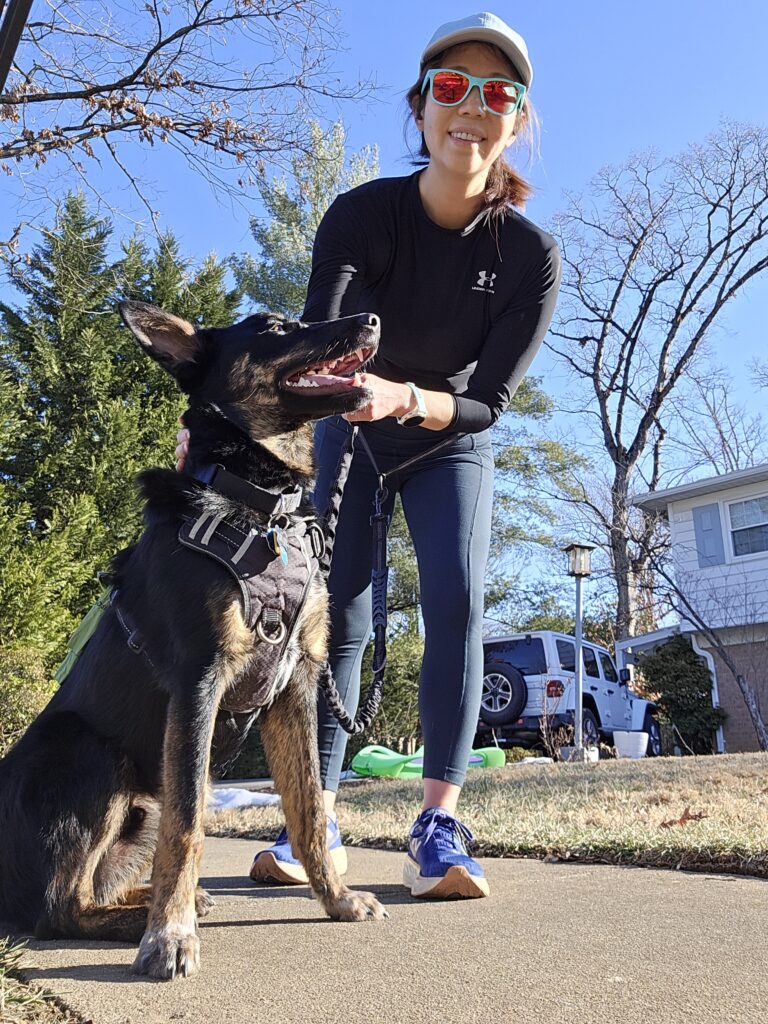 Ordun with the family dog. (Image courtesy of Ordun)
Ordun isn’t shy about admitting setbacks. She talks about her strings of rejected papers, the coffee-fueled problem solving sessions that turned into pure error finding missions, and the red ink-filled drafts that her book editors send her. Sometimes to release stress, she needed to lace up her shoes, grab the dog, and just go for a run.
Obstacles are a natural part of any pursuit where you push into the unknown. And so, when you do have success, it’s important to take a moment and take it in. “The moment I finished my book, I was out on my deck, it was 10 p.m. at night. I don’t want to sound melodramatic, but I almost cried,” Ordun says. “I felt I had created something totally new, a new universe. It was a similar feeling of pride to passing my Ph.D. dissertation defense.”
]]>
In her day job as a vice president at the advanced technology company Booz Allen Hamilton, Catherine Ordun, Ph.D. ’23, information systems, leads teams of engineers working on far-out AI tech. In...
https://umbc.edu/stories/how-to-create-a-new-world/
https://my3.my.umbc.edu/api/v0/pixel/news/150482/guest@my.umbc.edu/0734b91fdb7b16da5b6034ebf12926df/api/pixel
alumni
coeit
how-to
is
magazine
spring-2025
story
UMBC News & Magazine
https://my3.my.umbc.edu/groups/umbc-news-magazine
https://assets1-my.umbc.edu/system/shared/avatars/groups/000/001/943/24435aa6207c452e7bc15cc74b42c7bb/xsmall.png?1748556657
https://assets1-my.umbc.edu/system/shared/avatars/groups/000/001/943/24435aa6207c452e7bc15cc74b42c7bb/original.png?1748556657
https://assets2-my.umbc.edu/system/shared/avatars/groups/000/001/943/24435aa6207c452e7bc15cc74b42c7bb/xxlarge.png?1748556657
https://assets2-my.umbc.edu/system/shared/avatars/groups/000/001/943/24435aa6207c452e7bc15cc74b42c7bb/xlarge.png?1748556657
https://assets3-my.umbc.edu/system/shared/avatars/groups/000/001/943/24435aa6207c452e7bc15cc74b42c7bb/large.png?1748556657
https://assets1-my.umbc.edu/system/shared/avatars/groups/000/001/943/24435aa6207c452e7bc15cc74b42c7bb/medium.png?1748556657
https://assets2-my.umbc.edu/system/shared/avatars/groups/000/001/943/24435aa6207c452e7bc15cc74b42c7bb/small.png?1748556657
https://assets1-my.umbc.edu/system/shared/avatars/groups/000/001/943/24435aa6207c452e7bc15cc74b42c7bb/xsmall.png?1748556657
https://assets2-my.umbc.edu/system/shared/avatars/groups/000/001/943/24435aa6207c452e7bc15cc74b42c7bb/xxsmall.png?1748556657
UMBC News & Magazine
2
0
false
Fri, 30 May 2025 15:01:36 -0400
Fri, 30 May 2025 15:01:36 -0400
Meet a Retriever—Brandon Dudley ’04, teacher and author, who honed his passion for English at UMBC
Meet Brandon Dudley ’04, English. Since graduation, Brandon has pursued his passion for writing and teaching—skills he honed while at UMBC. For almost 20 years, Brandon has been teaching English, the last six years at Brunswick High School in Brunswick, Maine. Within the last 10 years, Brandon has also been writing and publishing. In 2021, he published his first book, Hazards of Nature: Stories, a 2020 Maine Chapbook Series winner. Take it away, Brandon!
Q: What initially brought you to UMBC?
A: I came to UMBC because I was looking for a place where I could explore my love for literature and journalism. UMBC was a place that immediately felt comfortable to me when I went on an admissions tour, but I was still slightly hesitant. Although UMBC had a great campus newspaper, the school only offered a journalism minor, and journalism was my intended career. Despite that hitch, I really liked my initial experience at UMBC and felt like it would be a solid fit.
My first extensive exposure to the school was when I came for interviews for the Humanities Scholars Program, where I met Tom Field, a professor in modern language and linguistics, who was running the program at the time, as well as other humanities faculty and current scholars. It was a great deal of pressure, these meetings and interviews, but after that day, I knew UMBC was absolutely where I wanted to be, that this was the group of students that I wanted to be a part of, and these were the type of teachers I wanted to learn from. The day that I got the letter accepting me into the Humanities Scholars Program is still one of my best memories.
I love seeing how the school has grown since my time there. It felt like a special place back then, and it seems like more and more people are recognizing that.
Brandon Dudley ’04
English
Between the English program, the Humanities Scholars Program, and The Retriever Weekly, I was able to spend four years immersed in all of those elements that I was looking for.
Q: Can you talk more about the impact of the Humanities Scholars Program?
A: That program was life-changing for me. It exposed me to some of the most intelligent students and teachers I’ve had the pleasure to ever work with, and allowed me the opportunity to study abroad, kindling a life-long love of travel and a motivation to urge my own students now to spend time studying abroad. It’s a program that I’m still incredibly proud that I was able to be a part of.
 One of Bradon’s first days studying abroad in Wollongong, Australia, in 2003, his junior year at UMBC. That study abroad opportunity was funded by the Humanities Scholars Program.
I’ll also fully admit that the gift of full financial support for college wasn’t something an 18-year-old me truly understood the long-term benefits of. I don’t think anyone at that age fully appreciates the value of a gift like that, but since then, I’ve experienced again and again the financial freedom and flexibility that it has helped me and my family attain.
Q: What did you love most about your time with UMBC’s student newspaper?
A: I found a second home at the offices of The Retriever Weekly. I spent four years there meeting new people who have become lifelong friends, learning how to be (and how not to be) an effective leader, and getting to know the ins and outs of campus life.
There were so many avenues to finding support, both academically and socially, at UMBC. Between academic programs and student groups, there were many, many paths to connection available for anyone.
Brandon Dudley ’04
English
Q: Can you tell us about your current job and your book?
A: For almost 20 years, I have been an English teacher, the last six years at Brunswick High School in Brunswick, Maine. I love connecting with students and helping them hone their voices and their thinking as writers. In 2021, I published my first book, Hazards of Nature: Stories, which won the 2020 Maine Chapbook Series. Hazards of Nature is a collection of short stories about everyday people dealing with difficult situations. A young boy is teased by his father and brothers. A man raises chickens to help himself cope with his wife’s decision not to have children. An elderly widower struggles to connect with other people, but finds solace in his attachment to a peach tree he planted. The first story in the collection, “Coyotes,” won a Maine Literary Award in 2017.
Praise that means a lot to me (and is in the introduction to my book) comes from National Book Award-winner Sigrid Nunez: “What makes the stories in Hazards of Nature so compelling for me is not just the writer’s insightful portraits of his characters’ struggles but his sensitivity in regard to their pain.”
Photo right: Brandon Dudley ’04, English, at his local bookstore, Gulf of Maine Books, seeing his collection of short stories on sale for the first time in 2021.
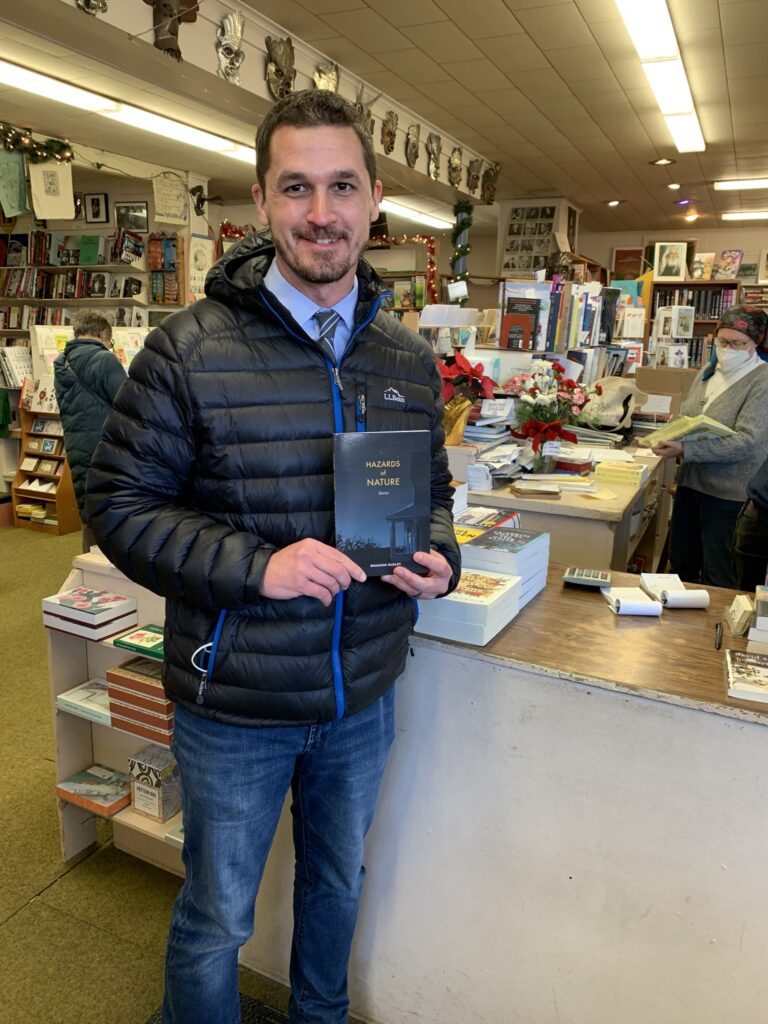
Q: Who in the UMBC community has inspired you or supported you?
A: English Professor Chris Corbett was a constant supporter during my time at UMBC, and I’m lucky to still be in touch with him over 20 years later. Professor Corbett was instrumental in my growth as a student, a leader, and a writer. He was the advisor of The Retriever Weekly, and I devoured his journalism classes during my time at UMBC, and it wasn’t uncommon for me to show up to his office well before classes started just to hang out and talk.
During my time at The Retriever, he was always a sounding board and a resource, helping me figure out how, as editor-in-chief, to effectively lead the newspaper and how to implement my vision for it. He helped connect me with internships at The Baltimore Sun, helped me get my first job at Patuxent Publishing as an editorial assistant right out of college, and eventually even helped me get into my M.F.A. program for creative writing. It was through basically copying his journalism lessons to teach new staff at The Retriever how to effectively shape their stories that I first found my love of teaching, which eventually became my career.
* * * * *
UMBC’s greatest strength is its people. When people meet Retrievers and hear about the passion they bring, the relationships they create, the ways they support each other, and the commitment they have to inclusive excellence, they truly get a sense of our community. That’s what “Meet a Retriever” is all about.
Learn more about how UMBC can help you achieve your goals.
]]>
Meet Brandon Dudley ’04, English. Since graduation, Brandon has pursued his passion for writing and teaching—skills he honed while at UMBC. For almost 20 years, Brandon has been teaching English,...
https://umbc.edu/stories/meet-a-retriever-brandon-dudley-04-english/
https://my3.my.umbc.edu/api/v0/pixel/news/150483/guest@my.umbc.edu/170523756d251b1b810fd07b3cae4992/api/pixel
alumni
english
humanities-scholars-program
magazine
meet-a-retriever
retriever-authors
story
UMBC News & Magazine
https://my3.my.umbc.edu/groups/umbc-news-magazine
https://assets1-my.umbc.edu/system/shared/avatars/groups/000/001/943/24435aa6207c452e7bc15cc74b42c7bb/xsmall.png?1748556657
https://assets1-my.umbc.edu/system/shared/avatars/groups/000/001/943/24435aa6207c452e7bc15cc74b42c7bb/original.png?1748556657
https://assets2-my.umbc.edu/system/shared/avatars/groups/000/001/943/24435aa6207c452e7bc15cc74b42c7bb/xxlarge.png?1748556657
https://assets2-my.umbc.edu/system/shared/avatars/groups/000/001/943/24435aa6207c452e7bc15cc74b42c7bb/xlarge.png?1748556657
https://assets3-my.umbc.edu/system/shared/avatars/groups/000/001/943/24435aa6207c452e7bc15cc74b42c7bb/large.png?1748556657
https://assets1-my.umbc.edu/system/shared/avatars/groups/000/001/943/24435aa6207c452e7bc15cc74b42c7bb/medium.png?1748556657
https://assets2-my.umbc.edu/system/shared/avatars/groups/000/001/943/24435aa6207c452e7bc15cc74b42c7bb/small.png?1748556657
https://assets1-my.umbc.edu/system/shared/avatars/groups/000/001/943/24435aa6207c452e7bc15cc74b42c7bb/xsmall.png?1748556657
https://assets2-my.umbc.edu/system/shared/avatars/groups/000/001/943/24435aa6207c452e7bc15cc74b42c7bb/xxsmall.png?1748556657
UMBC News & Magazine
1
0
false
Fri, 30 May 2025 15:00:37 -0400
Meet a Retriever—Margaret Chisolm ’80, film student turned doctor turned author
Meet Margaret Chisolm ’80, visual arts with a concentration in film. After graduating from UMBC, Margaret was accepted into graduate school at NYU in cinema studies, but decided to go to medical school instead. She earned her M.D. from the University of Maryland School of Medicine in 1988 and is currently a professor of psychiatry and behavioral sciences at the Johns Hopkins University School of Medicine. In 2021, the film student turned doctor added another feather in her cap, author. She published her book, From Survive to Thrive: Living Your Best Life with Mental Illness, which won the Nautilus Book Award in the psychology category. Take it away, Margaret!
Q: What initially brought you to UMBC?
A: I came to UMBC to study film. I initially went to the University of Colorado Boulder for my freshman year. After taking every film class they offered, I decided to come back east, thinking I’d go to NYU. Instead, I found that UMBC had a great program and the experimental filmmaking great, Stan Vanderbeek, was a faculty member. So, I decided to enroll at UMBC.
I loved being at UMBC in the late 1970s and early 1980s. It is a creative place that allowed me to explore my interests and grow as a person.
Margaret Chisolm ’80
visual arts
I loved the students, faculty, and staff in the film program—and the program as a whole. My time at UMBC prepared me to do whatever I wanted to do—whether it was to go to the best grad school in the country for cinema studies or to medical school. It was a great education and prepared me for a life of learning.
Q: Who in the UMBC community has inspired you or supported you?
A: From my time at UMBC, I now count some of the students, faculty, and staff as lifelong friends. One of them – Richard Chisolm ’82, interdisciplinary studies – is my husband of nearly 44 years. We met while I was a work-study student. I was in a relationship with someone else at the time, but after a year or so, that relationship ended. In June 1980, Richard and I started dating. I graduated in December 1980, and we were married in June 1981. Another, is Leroy Morais. He was the head of the Visual Arts department at UMBC when I was there. He continues to work as a visual artist today and remains a source of inspiration. He has also become a close friend.
Photo right: Margaret Chisolm ’80 and Richard Chisolm ’82 while students at UMBC.

Q: What is your current job?
A: I’m a professor of psychiatry and behavioral sciences at the Johns Hopkins School of Medicine. I love to learn, and medicine is unparalleled for lifelong learning. I love the combination of scholarship and research, education and teaching, and clinical care that I’ve been able to enjoy. I am able to be creative in designing courses that use the art museum as a teaching space.
In 2015, I was part of the launch of a new initiative in the department: the Paul McHugh Program for Human Flourishing, which I now direct. We use the arts and humanities to explore the big questions with medical learners: what it means to be human, to be a physician, and to lead a good life (for ourselves and our patients). Our goal is to humanize medicine for the good of everyone.
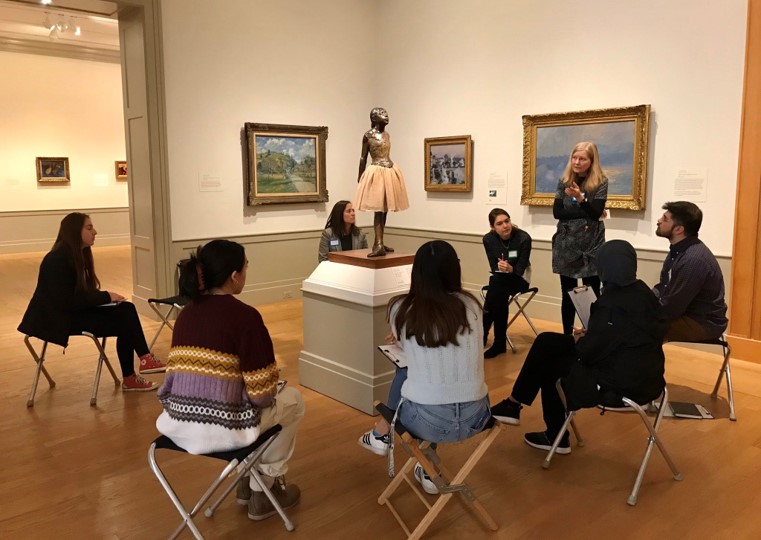

Photos above: Chisolm leading Visual Thinking Strategies discussions with Johns Hopkins med and pre-students, and health professions education leaders from around the country.
Q: Can you tell us about your journey as an author?
A: During the pandemic, I wrote a book for patients with mental illness and their families and loved ones, From Survive to Thrive: Living Your Best Life with Mental Illness. The book describes a tried-and-true plan to help anyone grappling with life’s challenges so they can learn how to flourish. In the book, I use my own story of depression (first while I was a student and later as a new mother) to illustrate my points. The aim of the book is to demystify and destigmatize psychiatric problems and to give hope for a full, flourishing life to those who experience mental illness.
In 2022, From Survive to Thrive won the Nautilus Book Award in the psychology category, was a finalist for the American Book Fest Best Book Award in the Health – Psychology/Mental Health category, and has been the topic of numerous podcast interviews.
I also co-authored a textbook on the Perspectives of Psychiatry, a holistic approach to the diagnosis and treatment of patients with psychiatric problems in 2012.
* * * * *
UMBC’s greatest strength is its people. When people meet Retrievers and hear about the passion they bring, the relationships they create, the ways they support each other, and the commitment they have to inclusive excellence, they truly get a sense of our community. That’s what “Meet a Retriever” is all about.
Learn more about how UMBC can help you achieve your goals.
]]>
Meet Margaret Chisolm ’80, visual arts with a concentration in film. After graduating from UMBC, Margaret was accepted into graduate school at NYU in cinema studies, but decided to go to medical...
https://umbc.edu/stories/meet-a-retriever-margaret-chisolm-author/
https://my3.my.umbc.edu/api/v0/pixel/news/150484/guest@my.umbc.edu/861d90864ab982a406c58d135e6b3a55/api/pixel
alumni
magazine
meet-a-retriever
psychiatry
retriever-authors
story
visual-arts
UMBC News & Magazine
https://my3.my.umbc.edu/groups/umbc-news-magazine
https://assets1-my.umbc.edu/system/shared/avatars/groups/000/001/943/24435aa6207c452e7bc15cc74b42c7bb/xsmall.png?1748556657
https://assets1-my.umbc.edu/system/shared/avatars/groups/000/001/943/24435aa6207c452e7bc15cc74b42c7bb/original.png?1748556657
https://assets2-my.umbc.edu/system/shared/avatars/groups/000/001/943/24435aa6207c452e7bc15cc74b42c7bb/xxlarge.png?1748556657
https://assets2-my.umbc.edu/system/shared/avatars/groups/000/001/943/24435aa6207c452e7bc15cc74b42c7bb/xlarge.png?1748556657
https://assets3-my.umbc.edu/system/shared/avatars/groups/000/001/943/24435aa6207c452e7bc15cc74b42c7bb/large.png?1748556657
https://assets1-my.umbc.edu/system/shared/avatars/groups/000/001/943/24435aa6207c452e7bc15cc74b42c7bb/medium.png?1748556657
https://assets2-my.umbc.edu/system/shared/avatars/groups/000/001/943/24435aa6207c452e7bc15cc74b42c7bb/small.png?1748556657
https://assets1-my.umbc.edu/system/shared/avatars/groups/000/001/943/24435aa6207c452e7bc15cc74b42c7bb/xsmall.png?1748556657
https://assets2-my.umbc.edu/system/shared/avatars/groups/000/001/943/24435aa6207c452e7bc15cc74b42c7bb/xxsmall.png?1748556657
UMBC News & Magazine
2
0
false
Fri, 30 May 2025 15:00:06 -0400
Fri, 30 May 2025 15:00:06 -0400


