Viruses are both the villains and heroes of life as we know it
By Ivan Erill, associate professor of biological sciences, UMBC
Viruses have a bad reputation. They are responsible for the COVID-19 pandemic and a long list of maladies that have plagued humanity since time immemorial. Is there anything to celebrate about them?
Many biologists like me believe there is, at least for one specific type of virus – namely, bacteriophages, or viruses that infect bacteria. When the DNA of these viruses is captured by a cell, it may contain instructions that enable that cell to perform new tricks.
Recent research points to another important function of phages: They may be nature’s ultimate genetic tinkerers, crafting novel genes that cells can retool to gain new functions.
Most phages have a rigid shell called a capsid that is filled with their genetic material. In many cases, the shell has more space than the phage needs to store the DNA essential for its replication. This means that phages have room to carry extra genetic baggage: genes that are not actually necessary for the phage’s survival that it can modify at will.
How bacteria retooled a viral switch
To see how this plays out, let’s take a deeper look at the phage life cycle.
Phages come in two main flavors: temperate and virulent. Virulent phages, like many other viruses, operate on an invade-replicate-kill program. They enter the cell, hijack its components, make copies of themselves and burst out.
Temperate phages, on the other hand, play the long game. They fuse their DNA with the cell’s and may lay dormant for years until something triggers their activation. Then they revert to virulent behavior: replicate and burst out.
Many temperate phages use DNA damage as their trigger. It’s sort of a “Houston, we have a problem” signal. If the cell’s DNA is being damaged, that means the DNA of the resident phage is likely to go next, so the phage wisely decides to jump ship. The genes that direct phages to replicate and burst out are turned off unless DNA damage is detected.
Virulent phages follow the lytic cycle of viral reproduction, destroying their hosts as soon as they complete replication. Temperate phages, on the other hand, follow the lysogenic cycle and stay dormant inside their host’s DNA until they’re triggered to burst out. CNX OpenStax/Wikimedia Commons, CC BY
Bacteria have retooled the mechanisms controlling that life cycle to generate a complex genetic system that my collaborators and I have been studying for over two decades.
Bacterial cells are also interested in knowing if their DNA is getting busted. If it is, they activate a set of genes that attempt to repair the DNA. This is known as the bacterial SOS response because, if it fails, the cell is toast. Bacteria orchestrate the SOS response using a switch-like protein that responds to DNA damage: It turns on if there is damage and stays off if there isn’t.
Perhaps not surprisingly, bacterial and phage switches are evolutionarily related. This prompts the question: Who invented the switch, bacteria or viruses?
Our previous research and work by other researchers indicates that phages got there first. In our recent report, we discovered that the SOS response of Bacteroidetes, a group of bacteria that comprise up to a half of the bacteria living in your gut, is under control of a phage switch that was retooled to implement the bacteria’s own complex genetic programs. This suggests that bacterial SOS switches are in fact phage switches that got retooled eons ago.
When a temperate phage infects a bacterial cell and integrates its genome with the cell’s DNA, it typically lays dormant until it’s triggered to burst out of the cell. But once the phage’s DNA is part of the bacterium’s, mutations can disrupt the phage’s genetic material and render it inactive. This means that when DNA damage occurs, the phage won’t be able to reform itself and burst out. Over time, the bacterium may adapt the phage’s switch to control its own SOS response genes. Miquel Sánchez-Osuna/Created with BioRender.com, CC BY-NC-ND
It’s not just bacterial switches that appear to be phage inventions. Beautiful detective work has shown that a bacterial gene needed for cell division also arose through “domestication” of a phage toxin gene. And many bacterial attack systems, such as toxins and the genetic guns used to inject them into cells, as well as the camouflage they use to evade the immune system, are known or suspected to have phage origins.
The upside of viruses
OK, you may think, phages are great, but the viruses that infect us are certainly not cool. Yet there is mounting evidence that the viruses that infect plants and animals are also a major source of genetic innovation in these organisms. Domesticated viral genes have been shown, for instance, to play a key role in the evolution of mammalian placentas and in keeping human skin moist.
So while you may be used to thinking of viruses as the quintessential villains, they are arguably nature’s powerhouses for genetic innovation. Humans are likely here today because of them.
]]>
By Ivan Erill, associate professor of biological sciences, UMBC Viruses have a bad reputation. They are responsible for the COVID-19 pandemic and a long list of maladies that have plagued...https://umbc.edu/stories/viruses-are-both-the-villains-and-heroes-of-life-as-we-know-it/https://my3.my.umbc.edu/api/v0/pixel/news/119540/guest@my.umbc.edu/29bb77829a9169862afe25cac4be84a0/api/pixelbiological-sciencescnmsdiscoveryprofessorsnottomissthe-conversationUMBC News & Magazinehttps://my3.my.umbc.edu/groups/umbc-news-magazinehttps://assets1-my.umbc.edu/system/shared/avatars/groups/000/001/943/24435aa6207c452e7bc15cc74b42c7bb/xsmall.png?1748556657https://assets1-my.umbc.edu/system/shared/avatars/groups/000/001/943/24435aa6207c452e7bc15cc74b42c7bb/original.png?1748556657https://assets2-my.umbc.edu/system/shared/avatars/groups/000/001/943/24435aa6207c452e7bc15cc74b42c7bb/xxlarge.png?1748556657https://assets2-my.umbc.edu/system/shared/avatars/groups/000/001/943/24435aa6207c452e7bc15cc74b42c7bb/xlarge.png?1748556657https://assets3-my.umbc.edu/system/shared/avatars/groups/000/001/943/24435aa6207c452e7bc15cc74b42c7bb/large.png?1748556657https://assets1-my.umbc.edu/system/shared/avatars/groups/000/001/943/24435aa6207c452e7bc15cc74b42c7bb/medium.png?1748556657https://assets2-my.umbc.edu/system/shared/avatars/groups/000/001/943/24435aa6207c452e7bc15cc74b42c7bb/small.png?1748556657https://assets1-my.umbc.edu/system/shared/avatars/groups/000/001/943/24435aa6207c452e7bc15cc74b42c7bb/xsmall.png?1748556657https://assets2-my.umbc.edu/system/shared/avatars/groups/000/001/943/24435aa6207c452e7bc15cc74b42c7bb/xxsmall.png?1748556657UMBC News & Magazine00falseWed, 20 Oct 2021 19:10:54 -0400The Hospitality of UMBC’s Student Clubs
¿No hablas español? Not a problem. The Spanish Conversation Club is happy to have you! Don’t identify as a woman or engineering major? The Society of Women Engineers (SWE) still welcomes you. Interested in philosophy but not a philosophy major? Didn’t deter the past president of Philosophers Anonymous from taking office.
As a new semester gets underway (make sure to visit Involvement Fest, September 9), these and dozens of other student organizations readily welcome Retrievers who may not assume that the club is for them. Not surprisingly, UMBC clubs and orgs thrive when new perspectives show up.
Join the forum
Headshot provided by Quinlan Murphy.
When Quinlan Murphy ’21, political science, served as president of Philosophers Anonymous, the council of majors for philosophy students, he was determined to make the club feel like home to any interested student. This includes inviting discussions about Hannah Arendt’s warning against the preconditions for totalitarianism to attending online art tours as museums opened their doors virtually during the pandemic. Another of the club’s goals, he says, was to make the department’s physical space in the Performing Arts & Humanities Building a welcoming place for students in between classes. “We wanted to create a little bit of a domestic vibe, so students felt invited into the building—we wanted a tangible space for them to feel at home,” says Murphy, who also obtained a certificate in philosophy.
Known better as PhilAnon, the group traditionally meets at noon on Tuesdays to allow students to present ideas—their own or others—and then follow a group discussion. “We want people to discuss these ideas outside of class with a little bit less formality, without assignments, without quizzes or tests,” says Murphy. The group also invites other majors and departments to participate, giving talks on bioethics or the hard sciences to discuss the ethical and philosophical corollaries of their academic expertise.
“Philosophy majors and other members are people who are going to go on to work in the humanities or academics,” says Murphy, “and a critical part of performing that job is being able to present ideas effectively and quickly, and then also having those ideas be criticized and poked by others.”
Student groups make use of The Forum sculpture outside of the Performing Arts & Humanities Building in 2019. Photo by Marlayna Demond ’11.
Murphy, as a non-traditionally aged student and a commuter, has high hopes for PhilAnon and other clubs on campus. “I certainly think that the more involvement people have in school, the better college will be—it’s not just about grades and tests and essays. It’s also about growing as a person. And I think that requires interacting with your classmates outside of the classroom.”
Headshot courtesy of Sheila Yeboah.
Pull up a silla (chair)
One of Sheila Yeboah ’23, biological sciences, favorite memories of the last semester is playing online pictionary on Webex with the Spanish Conversation Club. “The combination of the members’ poor drawing skills and the wealth of Spanish synonyms made the game extra difficult,” laughs Yeboah, but she adds that the easy-going nature of the club’s president James Angle and the other executive officers makes the student org a relaxed place to learn and have fun.
Yeboah says that previously her struggle with Spanish was having opportunities to speak it, and the low pressure of the conversation club was exactly what she needed. Yeboah, who is minoring in Spanish, joined the Spanish Conversation Club last semester when they were meeting virtually. “This club is primarily focused on forming friendships and practicing communication,” says Yeboah. “If you are a person that is a little more reserved, like me, it’s a very welcoming environment and you’re not going to feel like you can’t fit in.”
Angle ’22, modern languages and linguistics, became club president his sophomore year when the club had a vacuum of leadership. He and his friend Kyndall Hardwick ’22, English, the vice president, aim to make everyone feel welcome. “So many people get scared away because they think ‘I don’t know enough Spanish at that high level,’” says Angle, “but it could literally be your first day of Spanish class and we’d say ‘Come in.’”
Angle, who recently started taking Russian classes, knows that the hardest part of language learning can be getting comfortable speaking. “That’s the biggest battle,” he says, “but come play some fun games with us and get comfortable speaking Spanish while enjoying yourself.”
Building connections
Lilly, left, and other SWE members at the National Conference in Anaheim, California in 2019. Photo courtesy of Kaitlynn Lilly.
At previous Involvement Fests, some students have balked at joining the Society of Women Engineers (SWE), says current president Kaitlynn Lilly, who is not an engineering major. Lilly, who is studying mathematics and physics, says that she and other club leaders emphasize that the space is accessible for anyone who “wants to empower women and move society forward,” says Lilly. “It’s a mix between creating a community of people who support women in STEM and also providing opportunities to meet with companies, practice professional development, and also be social.”
This three-fold goal is the intentional result of Lilly and others on the executive board asking themselves what the purpose of their community was. “We didn’t always have a third of our meetings mixed between social, professional development, and career,” says Lilly, a 2021 Goldwater Scholar. “We made a very conscious decision last year to do that because we used to have a company present to us at every single meeting. And it was really hard for club members to really form that community.”
Before the pandemic, says Lilly, the group was already hosting hybrid meetings to broaden the horizons of what companies they could invite to present. SWE will keep the hybrid format going forward for the convenience of people who commute or people who can’t make the meeting time.
Jessica Adams ’22, mechanical engineering, is starting her fourth year as a SWE member and her first as a leader. As the public relations chair, she’s eager to see the group grow its membership. “As we get a wider range of perspectives in our club, it allows us to learn about other people’s backgrounds so that we can understand where other people are coming from,” says Adams. “These interactions will make each of us a better candidate for any sort of jobs or internships we apply for in the future.”
Find your space
Murphy, who graduated last spring but hopes to stay connected to PhilAnon virtually, unsurprisingly sees students’ extracurricular involvement through the lens of what is morally and ethically good.
“I think students should see their time at UMBC as an opportunity for social and personal growth and not just like a job training program,” he says. “They should be able to ask hard questions and explore ideas informally. I think it’s really critical that there’s these spaces for people to have these conversations away from professors and with their peers.”
Whether that conversation is in Spanish or takes place online or in person, there’s a student club waiting to welcome all newcomers with open arms. Find out more at Involvement Fest, September 9 or online all year.
***** Header image: SWE at Involvement Fest in 2019. Photo courtesy of Kaitlynn Lilly.
]]>
¿No hablas español? Not a problem. The Spanish Conversation Club is happy to have you! Don’t identify as a woman or engineering major? The Society of Women Engineers (SWE) still welcomes you....https://umbc.edu/stories/the-hospitality-of-umbcs-student-clubs/https://my3.my.umbc.edu/api/v0/pixel/news/119563/guest@my.umbc.edu/526653cd933bbc885f2d14ae66fba8b9/api/pixelbiological-sciencescampus-lifeinvolvement-festmathematicsmechanical-engineeringmlliphilosophyphysicsUMBC News & Magazinehttps://my3.my.umbc.edu/groups/umbc-news-magazinehttps://assets1-my.umbc.edu/system/shared/avatars/groups/000/001/943/24435aa6207c452e7bc15cc74b42c7bb/xsmall.png?1748556657https://assets1-my.umbc.edu/system/shared/avatars/groups/000/001/943/24435aa6207c452e7bc15cc74b42c7bb/original.png?1748556657https://assets2-my.umbc.edu/system/shared/avatars/groups/000/001/943/24435aa6207c452e7bc15cc74b42c7bb/xxlarge.png?1748556657https://assets2-my.umbc.edu/system/shared/avatars/groups/000/001/943/24435aa6207c452e7bc15cc74b42c7bb/xlarge.png?1748556657https://assets3-my.umbc.edu/system/shared/avatars/groups/000/001/943/24435aa6207c452e7bc15cc74b42c7bb/large.png?1748556657https://assets1-my.umbc.edu/system/shared/avatars/groups/000/001/943/24435aa6207c452e7bc15cc74b42c7bb/medium.png?1748556657https://assets2-my.umbc.edu/system/shared/avatars/groups/000/001/943/24435aa6207c452e7bc15cc74b42c7bb/small.png?1748556657https://assets1-my.umbc.edu/system/shared/avatars/groups/000/001/943/24435aa6207c452e7bc15cc74b42c7bb/xsmall.png?1748556657https://assets2-my.umbc.edu/system/shared/avatars/groups/000/001/943/24435aa6207c452e7bc15cc74b42c7bb/xxsmall.png?1748556657UMBC News & Magazine00falseThu, 09 Sep 2021 15:27:02 -0400Her Science Is the World’s
Corbett in the Interdisciplinary Life Sciences Building on campus in April 2021. Photo by Marlayna Demond ’11.
Everyone who’s ever met Kizzmekia Corbett ’08, M16, biological sciences and sociology, gets it.
Sue Florence, one of the few Black teachers in the Hillsborough, North Carolina, school district where Corbett went to elementary and middle school, got it. Rhonda Brooks, Corbett’s mother, remembers Florence saying, when Corbett was in third grade, “She’s got a gift. You’d better seek into it.”
Florence’s comments pushed Brooks to make sure expectations were high for Corbett in school, and to encourage—no, require—15-year-old “Kizzy” to find a scholarly internship rather than a position in retail when she wanted a summer job in high school.
So, at her mother’s behest, Corbett got involved in Project SEED, a program that offers research experiences to talented high school students from underrepresented groups in STEM. Her first program mentor was James Morken, who was on the chemistry faculty at University of North Carolina at Chapel Hill at the time.
He got it, too.
“When Kizzy started in my laboratory, she didn’t have much hands-on research experience, but she had loads of curiosity, a drive to learn what she didn’t know, and a very strong work ethic,” Morken says. “It was abundantly clear she would be successful in whatever she chose to do.”
Today, Corbett is an assistant professor of immunology and infectious diseases at the Harvard T.H. Chan School of Public Health, after leading the team behind the successful effort to create a vaccine for COVID-19 at the National Institutes of Health (NIH). Working with the pharmaceutical company Moderna, Corbett’s achievements on the global stage benefit all of us. Now, we get it, too.
“She can do anything”
As a Meyerhoff Scholar and NIH Scholar at UMBC, Corbett worked in Barney Graham’s lab at the Vaccine Research Center at the NIH. He’s also her boss today.
“Kizzmekia’s spirit was noticeable even from a young age,” Graham says. “New people who come into the lab have always quickly realized that she was a person who had bigger things in her future.”
Corbett met Jessica Kelley, a UMBC assistant professor of sociology at the time, when Corbett took her Introduction to Sociology course. “She was a standout in that large lecture class from the beginning,” Kelley recalls. Later, Corbett took Kelley’s course on applied community research, and conducted research with Kelley as part of a National Institute on Aging study on healthy aging in diverse neighborhoods.
Photos kindly provided by Kizzmekia Corbett, unless otherwise noted.
The work with Kelley inspired Corbett’s double major and her approach to all of her future work. Corbett even became the only undergraduate enrolled in one of Kelley’s graduate-level courses. “She kept the graduate students on their toes,” Kelley says.
“When she’s got her mind set on something, it’s set,” Brooks says. “She can do anything.”
A leading role
Today, Corbett has proven them all right. As the scientific lead of the Vaccine Research Center’s coronavirus team at the NIH, she developed a new technology for the Moderna COVID-19 vaccine and others, and as a result, she has played a leading role in one of the most important measures to end the pandemic. She has also become the first Black woman in the world to create a vaccine.
Anthony Fauci, head of the National Institute of Allergy and Infectious Diseases (NIAID) and one of the most trusted voices about the pandemic around the world, described Corbett as “widely recognized in the immunology community as a rising star,” when he nominated her for TIME magazine’s TIME100 Next list. Based on her leadership of COVID-19 vaccine development at NIAID, he added, “Her work will have a substantial impact on ending the worst respiratory-disease pandemic in more than 100 years.”
People drive the research
Perhaps just as important as her scientific accomplishments, Corbett has burst onto the public stage as the face of a diverse and rising generation of talented scientists who will transform the world. She is a stellar science communicator, explaining the vaccine and the virus in highly accessible ways to media outlets, her family, two U.S. presidents, and more. She is an inspiration to children who may now imagine becoming scientists.
Corbett visits a lab on campus in April 2021. Photo by Marlayna Demond ’11.
“Dr. Corbett’s voice has been particularly important this year,” Graham says, “and going forward, her ability to inspire and to educate and motivate young people to see science as something feasible and even to see science as something fun will be part of her legacy.”
And yet, amid her newfound celebrity status and her vast scientific acumen, somehow she has managed to remain unabashedly human.
“I am still Kizzy. I’m still the little girl you met when I was 17 and being recruited into the Meyerhoff program,” she told UMBC President Freeman Hrabowski during a conversation in February 2021, when they were both being recognized at the Kaiser Permanente and Reginald F. Lewis Museum 2nd Annual African American Health Care Awards.
“Actually, before a scientist, I’m a Christian, and I’m sassy, and I’m bright, and I’m fashionable…” she says, “and I’m Southern, and I’m empathetic, and I’m all of these things that make me into this person, that make me a better scientist. I think that is the most important part of the story—that people drive the research.”
The genuine thing
First there was Sue Florence. Then there was James Morken and others with the SEED Project. All through her childhood, there was her mother, Rhonda Brooks, cheering her on. Combine that support structure with Corbett’s own deep-seated determination to succeed, and by the time she was looking at colleges, Corbett had lots of options. But when she, her parents, and her grandmother visited UMBC, it felt like home. The first reason? The grain silo along UMBC Boulevard.
“It reminded me of being back at home in the country,” Brooks remembers. When they began touring campus, Brooks thought, “Oh man, this is really her,” but, “I needed her to see it was her. So I didn’t even say anything.” There was no need. By the end of Meyerhoff Selection Weekend in 2004, Kizzy was glowing.
Beyond the welcoming silo were all the welcoming faces. “Everybody was so friendly,” Brooks says. “You think when you go visit campuses that people have to be this way because they’re trying to get students to come, but as a person who’s been in the education field for so long, I can weed out who’s genuine and who isn’t.” And, Brooks says, despite the emphasis on Meyerhoff cohort numbers, of which Kizzy belonged to M16, “it just felt like she would be not just a number.”
Equaling the playing field
In the February conversation with Hrabowski, Corbett recalls her father telling her that she should “go where she would be loved.” UMBC became that place.
Asked to describe the value of the Meyerhoff Scholars Program, she said, “It is simply one word: resources. It is equaling the playing field for people who have generally been under-resourced, and those are communities of color and people from underrepresented minority groups. And the Meyerhoff Program does that.”
Corbett with fellow Meyerhoff alumni at a 2017 on-campus event. Photo courtesy of Keith Harmon, director, Meyerhoff Scholars Program.
The Meyerhoff Scholars Program, founded in 1989, is considered the gold standard of programs designed to support students from underrepresented groups in STEM. Hundreds of alumni have gone on to standout careers, including U.S. Surgeon General, Baltimore City health commissioner, and professorships at the nation’s top-tier universities.
The Meyerhoff Scholars Program “is a place where every single person was special and would be loved. The goal is not to fail you out, but to lift you up,” Corbett says. And for underrepresented students in STEM, living in a world that too often still doesn’t expect people who look like them to excel as researchers, the Meyerhoff Program “provided a niche for us to just be, to be comfortable, and to just thrive.”
A mother’s touch
It wasn’t always easy, though. Brooks remembers when Kizzy received her first C. “Being on the phone with her just didn’t help,” Brooks remembers. “So I got in my car, and I drove all the way to Maryland. I was trying to tell her it was going to be alright, but it was just heartbreaking, because she never had that C. I told her, it’s gonna be tough—you might get more than one C.”
Even world-class, world-saving scientists sometimes get Cs and need their moms.
And even now, Brooks is ready to support Corbett as she navigates this new chapter in her life. “If she needs me now, if she’s feeling stressed,” Brooks says, “if she picks up the phone, I don’t care what time of night it is, I pick it up.”
On Corbett’s college bedside also sat a Bible—another lasting connection to her family and her faith, which Corbett brings up often in her interviews. Brooks gave each of her children a Bible as they left for college. “I say take this Bible with you. Even if you don’t look at it, keep it next to your bed. I don’t care if you don’t open it. But if you touch it, it will make you feel a whole lot better.”
Corbett and her mother, though apart during the pandemic, have stayed connected by attending online services from the same church in Texas. Their first travel plans post-pandemic? A trip to attend the service in person.
Lifting others up
Whether it’s her faith, an innate empathy, 35 years of experience as a Black woman in the U.S., or other factors, Corbett’s dedication to lifting people up goes far beyond her work in the laboratory. Her commitment to equity has demanded that she speak out to address vaccine hesitancy, especially in communities hit hardest by the virus, and champion the participation of minorities in science and research, both as scientists and as participants in clinical trials.
“She has always, even as a young student, brought an energy and curiosity and love of science that made our lab a better place,” Graham says. “She has also always been very devoted to making things better for people around her, particularly younger people coming behind her.”
Brooks says that Corbett has always had a selfless nature. One day she brought home a classmate who had no place to go after school and asked if she could stay with the family. Brooks was uncertain at first, “but we did it,” she says. “And we’ve been taking kids in ever since.”
Fighting for the public good
Corbett’s study of sociology at UMBC enhanced and sharpened her innate desires to help people and promote fairness into a commitment to consider social factors throughout her scientific career. For example, when the Moderna vaccine was in clinical trials, Corbett pushed hard to make sure that there were more people of color among the study population.
Corbett at a Rally for Medical Research event in Washington, D.C.
“You have to start things equitably to finish them that way,” she told Hrabowski at the February event. “We slowed down the phase three clinical trial until we got to a point where we felt the numbers were respectable. We wanted 13 percent, to represent the proportion of Black people in the country,” she said, but they didn’t quite make it. Still, she says, “I have other vaccines heading into trials, so we will take care of it then.”
Kelley, her sociology instructor and research mentor at UMBC, reflects on how Corbett has developed over time. “Kizzmekia’s training in both biology and sociology has helped her become both a scientist working at the cutting-edge of vaccine development to provide a universal public good and a humanist who understands that historically and structurally not all groups have had access to these public goods,” she says.
Corbett has faced her own challenges throughout her career, some of which have predictably intensified since she became more of a public figure.
Kizzmekia, whose name is a combination of “Kizzy” from the character in Alex Haley’s Roots and “-mekia” from Brooks’s own imagination, has been teased since childhood and continues to be harassed about her name. When Kizzy showed her mother a particularly hurtful social media post, “I told her, tell them to call your mama,” Brooks recalls, “because your mama chose your name for a reason, because you’re a gift from God to me.”
As a child, even Kizzy’s strong interest in academic success was sometimes looked down upon by her peers, but “she just went beyond,” Brooks says.
Corbett (center, front) with her NIAID research team, including Olubukola Abiona ’17, M25, biochemistry and molecular biology (center, back).
Corbett has also experienced sexism and racism as a scientist. Brooks says sometimes men have skipped over Corbett and instead approached her boss, but “that’s why I like her boss, [Barney Graham] so much, because he’s always been behind her back,” she says—pointing people right back to Corbett.
Finding your champions
Corbett has taken her mother’s message to heart. “You just have to believe in yourself and believe in your work,” she says. Important, too, is having your own champions. “I always had someone in the space who was looking out for me,” she said—people like Sue Florence, Freeman Hrabowski, and Barney Graham. “Find those people and seek them out. You want someone to be as invested in you, as you are in you.”
High expectations and support from all those people who “got it,” cheering for her and setting the bar high from elementary school onward, combined with Corbett’s inner determination—and a dash of spunk—have fueled her success. If you had met a childhood Kizzy, she would have said, “Hi, I’m Kizzmekia Corbett, and I’m going to be the first Black woman to win the Nobel Prize in Medicine.”
Verbalizing one’s goals is a risk, because people will know if you fail. But it’s also a critical step toward turning them into reality. Little Kizzy knew it as a kid. “It speaks to putting yourself where you want to be, and really speaking the words to the universe,” she told Hrabowski. Even if she hasn’t reached her childhood goal yet, she’s happy with what she’s been able to accomplish so far.
“I haven’t won a Nobel prize, and I don’t know if I will,” she says, “but I think helping to ‘save the world,’ so to speak, is good enough.”
For now.
Read more about other ways Retrievers are giving their time and efforts to help others access the vaccine.
*****
Header image of Corbett on campus in April 2021 by Marlayna Demond ’11.
]]>
Corbett in the Interdisciplinary Life Sciences Building on campus in April 2021. Photo by Marlayna Demond ’11. Everyone who’s ever met Kizzmekia Corbett ’08, M16, biological sciences and...https://umbc.edu/stories/her-science-is-the-worlds/https://my3.my.umbc.edu/api/v0/pixel/news/119599/guest@my.umbc.edu/7ce5d4efc33fbc01db43592b40e066b3/api/pixelbiological-sciencescommunityimpactcovidresearchdiscoveryfeaturemeyerhoffscholarsmhoffsociologyspring-2021UMBC News & Magazinehttps://my3.my.umbc.edu/groups/umbc-news-magazinehttps://assets1-my.umbc.edu/system/shared/avatars/groups/000/001/943/24435aa6207c452e7bc15cc74b42c7bb/xsmall.png?1748556657https://assets1-my.umbc.edu/system/shared/avatars/groups/000/001/943/24435aa6207c452e7bc15cc74b42c7bb/original.png?1748556657https://assets2-my.umbc.edu/system/shared/avatars/groups/000/001/943/24435aa6207c452e7bc15cc74b42c7bb/xxlarge.png?1748556657https://assets2-my.umbc.edu/system/shared/avatars/groups/000/001/943/24435aa6207c452e7bc15cc74b42c7bb/xlarge.png?1748556657https://assets3-my.umbc.edu/system/shared/avatars/groups/000/001/943/24435aa6207c452e7bc15cc74b42c7bb/large.png?1748556657https://assets1-my.umbc.edu/system/shared/avatars/groups/000/001/943/24435aa6207c452e7bc15cc74b42c7bb/medium.png?1748556657https://assets2-my.umbc.edu/system/shared/avatars/groups/000/001/943/24435aa6207c452e7bc15cc74b42c7bb/small.png?1748556657https://assets1-my.umbc.edu/system/shared/avatars/groups/000/001/943/24435aa6207c452e7bc15cc74b42c7bb/xsmall.png?1748556657https://assets2-my.umbc.edu/system/shared/avatars/groups/000/001/943/24435aa6207c452e7bc15cc74b42c7bb/xxsmall.png?1748556657UMBC News & Magazine00falseThu, 10 Jun 2021 14:54:22 -0400Creating Technology that Protects Us—Rising Together
Since 2009, as part of its Alumni Awards celebration, the UMBC Alumni Association names one “Rising Star” recipient each year who exemplifies early career and professional achievement. In the coming weeks, we will spend some time with awardees from the past decade to see where they are now—and how they’ve grown in their fields while maintaining ties to UMBC. In this installment, UMBC Rising Stars Isaac Kinde’05, M13, biological sciences, and Christopher Valentino ’02, M.S. ’06, information systems,discuss their roles in the healthcare and defense industries, respectively. Both alumni discovered their passion for their work while at UMBC and aim to harness technology to protect us from disease and cyber warfare.
As we embrace life in a technologically immersive world—scrolling out of habit or relying on a life-saving medical device—there’s a common question many of us have about the tech we’ve come to depend on: How can we best harness it to protect us? From malware and scams, but also from disease and unnecessary pain?
Two UMBC graduates, who previously received Rising Star alumni awards, are diligently working to create and influence technology that innovates and protects us.
Protecting lives with early detection technology
Isaac Kinde ’05, M13, biological sciences, is advancing healthcare technologies that work to protect people from possibly fatal diseases. Kinde is co-founder and vice president for technology assessment at Thrive, an Exact Sciences Company. Thrive was recently acquired by Exact Sciences for up to $2.15 billion assuming successful completion of certain milestones, says Kinde. He and his team work to save lives threatened by cancer by creating early detection technologies.
Kinde at work in his lab at Thrive Early Detection in Baltimore, Maryland. Photo courtesy of Kinde.
“There’s two million cancer cases in the U.S. annually and 70 percent of those cases don’t have a screening test available,” says Kinde. “If you can find cancers earlier, particularly in the earliest stages, survival can be as high as 90 percent or greater. The technology that my company is developing really leverages decades of research into how cancers work, their biology, as well as method developments in order to exploit that biology.”
Getting an early start
Since being named a Rising Star alum in 2014, Kinde received his M.D.-Ph.D. from the Johns Hopkins University School of Medicine. He was named one of Forbes magazine’s 30 under 30 “Rising Stars Transforming Science and Health.” Kinde also received The Daily Record’sInnovator of the Year award in 2015.
While at UMBC as a Meyerhoff Scholar, Kinde’s appreciation for research blossomed. He said that his first research mentor, Michael Summers, a professor in the Chemistry and Biochemistry department, influenced his love of research after spending a summer in his lab. “I just got hooked and I just didn’t stop doing research. It was a continuous effort until I graduated,” Kinde recalls.
Kinde speaking at the 2014 Alumni Award ceremony, and pictured with President Hrabowski, Mike Summers, and Kenneth Pittman ’80. All photos courtesy of the Alumni Association, unless otherwise noted.
It was his doctoral work at the Vogelstein Lab at Hopkins that helped to propel the technological initiatives at Thrive. “We set out to apply the latest and greatest technologies to identify cancers in their earliest stages. It took new method creation. We had to develop new technologies in order to find the earliest signs of cancer in routine clinical specimens,” Kinde says.
The future of cancer detection technology
Thus, came about the creation of CancerSEEK, a blood test that has shown the ability to detect 65 percent of cancers prior to clinically evident metastasis in individuals without any history of the disease. Kinde noted that a test like CancerSEEK can detect multiple cancers from a single test and do so in real time.
“There was the prototype version [of CancerSEEK] that our academic lab published. Then there was another prototype version that our company collaborated with Hopkins in order to demonstrate how we could work in a real-world setting,” says Kinde. “It’s the first of its kind to demonstrate real world detection and intervention of cancers. We’re preparing to get FDA approval, to do the full clinical validation of the CancerSEEK test.”
Kinde, second from left, with his roommates Andy Windsor, Seth Miller, and Kenneth Gibbs, all fellow Meyerhoff Scholars, at a graduation celebration in 2005. Photo courtesy of Kinde.
Kinde recalls the moment he saw successful Black Americans who were in the top M.D.-Ph.D. programs and top graduate programs while he studied at UMBC as an influential factor in his career progression. In fact, UMBC undergraduate alumni who identify as African American have gone on to pursue and earn more M.D.-Ph.D.s than alumni from any other institution across the country, largely in thanks to the support from the Meyerhoff Scholars Program.
“To me, that said, ‘well, why can’t I do that too?’ As I’ve progressed in my career, it’s the lesson that I remember. It’s something that I want to help future generations of people by being that example that they can look to.”
Valentino with his family at the 2012 Alumni Award ceremony.
Cybersecurity at the highest levels
Christopher Valentino ’02, M.S. ’06, information systems management, has more than two decades of expertise in domestic and global cybersecurity, which began during his undergraduate tenure at UMBC. Valentino spent 24 years working with Northrop Grumman Corp., a global aerospace and defense technology company, and its predecessor companies.
He started working at Northrop as an intern—working in what he called the “cyber mailroom”—and worked his way up. When he received the UMBC Alumni Association’s Rising Star award in 2012, Valentino was the then-director of contract research and development at Northrop.
“I had a parallel experience of working and going to school at the same time,” says Valentino, “while I was also starting a family. There are things I learned at UMBC as a student that I would not have learned anywhere else. The bottom line is UMBC is a really hard school. And it’s very underappreciated until you actually show up and become part of the institution, and go through the rigor that’s there.”
A leader in influencing cyberspace infrastructures
Nearly 10 years since being named a UMBC rising star, Valentino now serves as the chief strategy officer at Peraton, a next-generation national security company that provides technology solutions to space and intelligence, cyber mission, defense and security, and civil and health customers. Peraton acquired Northrop’s IT services business in February 2021 when Valentino transitioned into being the point person for shaping the future of the company.
“Peraton is a national security company focused on providing capabilities and solutions across the Department of Defense intelligence community—federal, civilian, and Homeland Security. I am responsible for operationalizing our strategy across those businesses,” Valentino says.
Valentino’s work emphasizes the importance of cybersecurity protection at the highest levels. While in his role as vice president of information warfare and cyber survivability at Northrop, Valentino shared insight on how some of the most powerful warfare structures in our country, such as the military and aerospace defenses, work to approach information warfare and how they keep our protections secure in the face of international threats on the Defense & Aerospace Report Podcast last June.
Valentino speaks at the 2012 Alumni Award ceremony.
“You train as you fight. In this domain, things move fast and things can change. You have to know the right environments to be able to train your mission operators,” Valentino told podcast host Vago Muradian. “From an exercise perspective, you would always go out and train, train, train and then execute. It’s the same thing in information warfare.”
The past, present, and future of tech
In his long tenure in the cyber security field, Valentino is able to appreciate innovative technological protections while understanding that these advancements are interconnected with all the efforts of past researchers.
“The one thing that I can appreciate from being in the industry now for over two decades is that there’s repetition and then there’s innovation in the seams between the repetition,” says Valentino. “There’s a lot of concepts that were new 20-plus years ago that will still be new 20 years from now. Artificial intelligence is probably one that I would point to and say, 20 years ago, we were doing research and trying to apply technologies, and two decades later, we’re still working to operationalize that technology.”
Valentino with Provost Philip Rous, Aryya Gangopadhyay, information systems chair, and Bennett Moe ’88 at the 2012 Alumni Award Ceremony.
Threat protection
Valentino and Kinde’s efforts have created an impactful ripple effect in our understanding of how technology can protect us from threats. Kinde’s work in early detection technology is on track to save more lives ahead of a cancer diagnosis that can be fatal. One blood test may have the potential to accurately detect a variety of different cancers. Valentino, on the other hand, is continuing to fortify the infrastructure and systems that protects our land, air, space, and digital domains from threats.
Whether it be a threat against our immune systems or a threat to our cyber safety, these former UMBC rising stars are raising the bar and redefining what protections in technology look like.
— Adriana Fraser
Read more about other Retrievers rising together and stay tuned for more information about UMBC’s 32nd annual Alumni Awards in October.
]]>
Since 2009, as part of its Alumni Awards celebration, the UMBC Alumni Association names one “Rising Star” recipient each year who exemplifies early career and professional achievement. In the...https://umbc.edu/stories/creating-technology-that-protects-us/https://my3.my.umbc.edu/api/v0/pixel/news/119607/guest@my.umbc.edu/52cf200d1a5dba3b9f7d80322938fc88/api/pixelalumnialumni-awardsbiological-sciencesinformation-systemsmeyerhoffmhoffrising-togetherUMBC News & Magazinehttps://my3.my.umbc.edu/groups/umbc-news-magazinehttps://assets1-my.umbc.edu/system/shared/avatars/groups/000/001/943/24435aa6207c452e7bc15cc74b42c7bb/xsmall.png?1748556657https://assets1-my.umbc.edu/system/shared/avatars/groups/000/001/943/24435aa6207c452e7bc15cc74b42c7bb/original.png?1748556657https://assets2-my.umbc.edu/system/shared/avatars/groups/000/001/943/24435aa6207c452e7bc15cc74b42c7bb/xxlarge.png?1748556657https://assets2-my.umbc.edu/system/shared/avatars/groups/000/001/943/24435aa6207c452e7bc15cc74b42c7bb/xlarge.png?1748556657https://assets3-my.umbc.edu/system/shared/avatars/groups/000/001/943/24435aa6207c452e7bc15cc74b42c7bb/large.png?1748556657https://assets1-my.umbc.edu/system/shared/avatars/groups/000/001/943/24435aa6207c452e7bc15cc74b42c7bb/medium.png?1748556657https://assets2-my.umbc.edu/system/shared/avatars/groups/000/001/943/24435aa6207c452e7bc15cc74b42c7bb/small.png?1748556657https://assets1-my.umbc.edu/system/shared/avatars/groups/000/001/943/24435aa6207c452e7bc15cc74b42c7bb/xsmall.png?1748556657https://assets2-my.umbc.edu/system/shared/avatars/groups/000/001/943/24435aa6207c452e7bc15cc74b42c7bb/xxsmall.png?1748556657UMBC News & Magazine00falseTue, 08 Jun 2021 16:12:58 -0400Virgin births from parthenogenesis: How females from some species can reproduce without males
An Asian water dragon hatched from an egg at the Smithsonian National Zoo, and her keepers were shocked. Why? Her mother had never been with a male water dragon. Through genetic testing, zoo scientists discovered the newly hatched female, born on Aug. 24, 2016, had been produced through a reproductive mode called parthenogenesis.
Parthenogenesis is a Greek word meaning “virgin creation,” but specifically refers to female asexual reproduction. While many people may assume this behavior is the domain of science fiction or religious texts, parthenogenesis is surprisingly common throughout the tree of life and is found in a variety of organisms, including plants, insects, fish, reptiles and even birds. Because mammals, including human beings, require certain genes to come from sperm, mammals are incapable of parthenogenesis.
Creating offspring without sperm
Sexual reproduction involves a female and a male, each contributing genetic material in the form of eggs or sperm, to create a unique offspring. The vast majority of animal species reproduce sexually, but females of some species are able to produce eggs containing all the genetic material required for reproduction.
Females of these species, which include some wasps, crustaceans and lizards, reproduce only through parthenogenesis and are called obligate parthenogens.
A larger number of species experience spontaneous parthenogenesis, best documented in animals kept in zoo settings, like the Asian water dragon at the National Zoo or a blacktip shark at the Virginia Aquarium. Spontaneous parthenogens typically reproduce sexually, but may have occasional cycles that produce developmentally ready eggs.
For parthenogenesis to happen, a chain of cellular events must successfully unfold. First, females must be able to create egg cells (oogenesis) without stimulation from sperm or mating. Second, the eggs produced by females need to begin to develop on their own, forming an early stage embryo. Finally, the eggs must successfully hatch.
Each step of this process can easily fail, particularly step two, which requires the chromosomes of DNA inside the egg to double, ensuring a full complement of genes for the developing offspring. Alternatively, the egg can be “faux fertilized” by leftover cells from the egg production process known as polar bodies. Whichever method kicks off the development of the embryo will ultimately determine the level of genetic similarity between the mother and her offspring.
The events that trigger parthenogenesis are not fully understood, but appear to include environmental change. In species that are capable of both sexual reproduction and parthenogenesis, such as aphids, stressors like crowding and predation may cause females to switch from parthenogenesis to sexual reproduction, but not the other way around. In at least one type of freshwater plankton, high salinity appears to cause the switch.
Advantages of self-reproduction
Though spontaneous parthenogenesis appears to be rare, it does provide some benefits to the female who can achieve it. In some cases, it can allow females to generate their own mating partners.
The sex of parthenogenetic offspring is determined by the same method sex is determined in the species itself. For organisms where sex is determined by chromosomes, like the XX female and XY male chromosomes in some insects, fish and reptiles, a parthenogenetic female can produce offspring only with the sex chromosomes she has at hand – which means she will always produce XX female offspring. But for organisms where females have ZW sex chromosomes (such as in snakes and birds), all living offspring produced will either be ZZ, and therefore male, or much more rarely, WW, and female.
Between 1997 and 1999, a checkered gartersnake kept at the Phoenix Zoo gave birth to two male offspring that ultimately survived to adulthood. If a female mated with her parthenogenetically produced son, it would constitute inbreeding. While inbreeding can result in a host of genetic problems, from an evolutionary perspective it’s better than having no offspring at all. The ability of females to produce male offspring through parthenogenesis also suggests that asexual reproduction in nature may be more common than scientists ever realized before.
Current research on parthenogenesis seeks to understand why some species are capable of both sex and parthenogenesis, and whether occasional sexual reproduction might be enough for a species to survive.
Header image: Getting the job done. A female Asian water dragon (Physignathus cocincinus) produced a daughter (left) without the assistance of a male. Skip Brown/Smithsonian’s National Zoo
]]>
By Mercedes Burns, assistant professor, Biological Sciences, UMBC An Asian water dragon hatched from an egg at the Smithsonian National Zoo, and her keepers were shocked. Why? Her mother had...https://umbc.edu/stories/virgin-births-from-parthenogenesis-how-females-from-some-species-can-reproduce-without-males/https://my3.my.umbc.edu/api/v0/pixel/news/119721/guest@my.umbc.edu/ca055a82e53f659c8c98bbe9286b8899/api/pixelbiological-sciencescnmsdiscoverythe-conversationUMBC News & Magazinehttps://my3.my.umbc.edu/groups/umbc-news-magazinehttps://assets1-my.umbc.edu/system/shared/avatars/groups/000/001/943/24435aa6207c452e7bc15cc74b42c7bb/xsmall.png?1748556657https://assets1-my.umbc.edu/system/shared/avatars/groups/000/001/943/24435aa6207c452e7bc15cc74b42c7bb/original.png?1748556657https://assets2-my.umbc.edu/system/shared/avatars/groups/000/001/943/24435aa6207c452e7bc15cc74b42c7bb/xxlarge.png?1748556657https://assets2-my.umbc.edu/system/shared/avatars/groups/000/001/943/24435aa6207c452e7bc15cc74b42c7bb/xlarge.png?1748556657https://assets3-my.umbc.edu/system/shared/avatars/groups/000/001/943/24435aa6207c452e7bc15cc74b42c7bb/large.png?1748556657https://assets1-my.umbc.edu/system/shared/avatars/groups/000/001/943/24435aa6207c452e7bc15cc74b42c7bb/medium.png?1748556657https://assets2-my.umbc.edu/system/shared/avatars/groups/000/001/943/24435aa6207c452e7bc15cc74b42c7bb/small.png?1748556657https://assets1-my.umbc.edu/system/shared/avatars/groups/000/001/943/24435aa6207c452e7bc15cc74b42c7bb/xsmall.png?1748556657https://assets2-my.umbc.edu/system/shared/avatars/groups/000/001/943/24435aa6207c452e7bc15cc74b42c7bb/xxsmall.png?1748556657UMBC News & Magazine00falseTue, 15 Dec 2020 14:18:08 -0500Women Have Disrupted Research on Bird Song, and Their Findings Show How Diversity Can Improve All Fields of Science
Americans often idealize scientists as unbiased, objective observers. But scientists are affected by conscious and unconscious biases, just as people in other fields are. Studies of birds’ vocal behavior clearly show how research approaches can be affected by the people who do the work.
Recent findings have shown that female song is widespread, and it is likely that the ancestor of all songbirds had female song. Now, rather than asking why males originally evolved song, the question has become why both sexes originally evolved song, and why females have lost song in some species.
In a recently published study, we reviewed 20 years of research on female bird song and found that the key people driving this recent paradigm shift were women. If fewer women had entered this field, we believe that it likely would have taken much longer to reach this new understanding of how bird song originally evolved. We see this example as a powerful demonstration of why it’s important to increase diversity in all fields of science.
Male and female troupials duetting in Puerto Rico. Karan Odom, CC BY-ND
New voices lead to new perspectives
Traditionally, white men working in countries of the Northern Hemisphere have conducted much of the research on bird song. Researchers in countries such as the U.S., Canada, England and Germany have focused much of their work on migratory birds that breed in the north temperate zone.
We noticed that women had written many of the key papers on female song published in recent years and wondered whether this was a general trend. To see whether women were significantly more likely to publish about female bird song than men, we identified all papers with “female song” in the title or abstract that had been published in the last 20 years. Next we assembled a set of papers generally published in the same journals in the same years, but focused on “bird song” more broadly.
Male and female troupials. Both sexes are elaborately colored, and both sexes sing. Karan Odom, CC BY-ND
For each of these papers we determined the genders of all authors, including the first author, middle authors and final author. Final authors frequently are the senior authors – for example, research group leaders.
Focusing on first authors, we found that 68% of female song papers were written by women, whereas only 44% of the bird song papers were written by women. Therefore, men were 24% less likely to study female song than bird song. Conversely, women were 24% more likely to study female song.
Middle authors on female song papers were also slightly skewed toward women. However, last authors were much more commonly men for both female song and bird song papers. In other words, the team leaders on these projects were still more likely to be men.
For female song studies, 58% of last authors were men. In our view, although ornithology is now a relatively gender-balanced field, more women need to be promoted into senior leadership positions, so that they can lead key decisions on research directions, funding and student projects.
Female northern cardinals sing along with males and have many different calls.
Diverse perspectives help drive scientific progress
A major goal of our study was to recognize and promote the diverse perspectives of researchers with different backgrounds and identities. However, we felt it was crucial for our study to look back at least 20 years, since that was the time frame over which this key paradigm shift occurred. Many authors from that far back would be difficult to contact directly for a variety of reasons.
In the future, allowing authors to self-identify for studies of gender and authorship in a range of fields would likely produce more correct gender data and allow researchers to identify as nonbinary or non-gender-conforming.
Our case study on bird song provides dramatic evidence that who researchers are, where they are from and what experiences they have had influence the science that they do. More diverse groups of researchers may ask a broader range of questions, utilize more varied methods and tackle problems from a wider range of perspectives.
Gender is just one aspect of identity that could influence topics, conceptual approaches and specific methodologies used in a wide range of scientific disciplines. Many other factors, such as race, ethnicity, geographic location and socioeconomic standing, could also have important impacts on scientific research.
Recent events have vividly illustrated the effects of racial biases in areas ranging from criminal justice to outdoor recreation. Our study shows why it is important to address racial, gender and other biases to improve the outcomes of research, teaching and outreach at colleges and universities around the world.
*****
Casey Haines’19, biological sciences, a recent undergraduate student at the UMBC, was lead author of the study on which this article is based. Michelle Moyer, a PhD student at UMBC, helped with this work.
]]>
By Kevin Omland, professor, Biological Sciences, UMBC; Evangeline Rose, Ph.D. ’20, biological sciences, UMBC, and Karan Odom, Ph.D. ’16, biological sciences, Cornell University Americans...https://umbc.edu/stories/women-have-disrupted-research-on-bird-song-and-their-findings-show-how-diversity-can-improve-all-fields-of-science/https://my3.my.umbc.edu/api/v0/pixel/news/119794/guest@my.umbc.edu/cebc259f363cbc3148fa8e81e5fe70c6/api/pixelbiological-sciencesdiscoveryomlandthe-conversationUMBC News & Magazinehttps://my3.my.umbc.edu/groups/umbc-news-magazinehttps://assets1-my.umbc.edu/system/shared/avatars/groups/000/001/943/24435aa6207c452e7bc15cc74b42c7bb/xsmall.png?1748556657https://assets1-my.umbc.edu/system/shared/avatars/groups/000/001/943/24435aa6207c452e7bc15cc74b42c7bb/original.png?1748556657https://assets2-my.umbc.edu/system/shared/avatars/groups/000/001/943/24435aa6207c452e7bc15cc74b42c7bb/xxlarge.png?1748556657https://assets2-my.umbc.edu/system/shared/avatars/groups/000/001/943/24435aa6207c452e7bc15cc74b42c7bb/xlarge.png?1748556657https://assets3-my.umbc.edu/system/shared/avatars/groups/000/001/943/24435aa6207c452e7bc15cc74b42c7bb/large.png?1748556657https://assets1-my.umbc.edu/system/shared/avatars/groups/000/001/943/24435aa6207c452e7bc15cc74b42c7bb/medium.png?1748556657https://assets2-my.umbc.edu/system/shared/avatars/groups/000/001/943/24435aa6207c452e7bc15cc74b42c7bb/small.png?1748556657https://assets1-my.umbc.edu/system/shared/avatars/groups/000/001/943/24435aa6207c452e7bc15cc74b42c7bb/xsmall.png?1748556657https://assets2-my.umbc.edu/system/shared/avatars/groups/000/001/943/24435aa6207c452e7bc15cc74b42c7bb/xxsmall.png?1748556657UMBC News & Magazine00falseFri, 11 Sep 2020 16:42:25 -0400What makes something smell good or bad?
Maybe you’ve learned to dislike the smell. Maybe your socks are full of gross bacteria. Or maybe, it’s both. Our team studies the brain and sense of smell – it’s one of our favorite topics. But first, how do you smell?
What is that smell?
The air is filled with many small odor molecules which are released from “smelly” things like perfume or food. Your nose has the astonishing ability to smell thousands of different scents because in your nose are millions of smell receptors – cells that can recognize odor molecules. When you sniff the air, these special cells are alerted.
These receptor cells then send a signal to your brain. Your brain recognizes many scents when different types of odors enter your nose. The smell of baking cookies, for instance, is composed of many odor molecules. Your brain can piece together all this information and let you know there are cookies baking in the oven.
Smells that make memories
Your brain is very good at memorizing good and bad experiences and associating particular smells with them. Scientists call these “olfaction-associated memories.”
One example of this is when you smell a favorite meal. It might remind you of someone who makes it for you, which triggers your brain to release chemicals that make you feel good and comforted.
Of course, smell can also be associated with unpleasant experiences. You have probably eaten some food that went bad, and you might find that you hate that food now. This is your brain associating getting sick with a certain smell, which stops you from eating something that could be bad for you. Memories linked to smells can form because of good and bad feelings.
Smells to warn you
But what about things that you know smell good or bad even if you’ve never experienced them? Scientists have found that although a lot of the smells people like come from past experiences, instincts play a big role.
Scent tells you a lot about your environment, and your instincts help to decide what is safe or dangerous. For example, blood has been shown to repel humans and many prey species, like deer, but attract predators, like wolves. This guides people away from predators that might want to eat us, but lets the predator get its meal.
Smell can warn you when something could make you sick. When eggs rot, bacteria multiply like crazy inside them, breaking down proteins that release a toxic chemical called hydrogen sulfide. This produces a stench that makes you want to stay far away, stopping you from eating the egg and becoming ill.
As for your socks… if they smell bad now, don’t wait. Wash them with soap and water! The bacteria growing on your socks will be killed, which will stop that nasty smell.
Hello, curious kids! Do you have a question you’d like an expert to answer? Ask an adult to send your question to CuriousKidsUS@theconversation.com. Please tell us your name, age and the city where you live.
And since curiosity has no age limit – adults, let us know what you’re wondering, too. We won’t be able to answer every question, but we will do our best.
]]>
By Rakaia Kenney ’21, research assistant, UMBC; Kayla Lemons ’20, research assistant UMBC, and Weihong Lin, professor, Biological Sciences, UMBC Curious Kids is a series for children...https://umbc.edu/stories/what-makes-something-smell-good-or-bad/https://my3.my.umbc.edu/api/v0/pixel/news/119869/guest@my.umbc.edu/46bff42891078499dd7fa5b3d7897269/api/pixelbiological-sciencescnmsdiscoverythe-conversationUMBC News & Magazinehttps://my3.my.umbc.edu/groups/umbc-news-magazinehttps://assets1-my.umbc.edu/system/shared/avatars/groups/000/001/943/24435aa6207c452e7bc15cc74b42c7bb/xsmall.png?1748556657https://assets1-my.umbc.edu/system/shared/avatars/groups/000/001/943/24435aa6207c452e7bc15cc74b42c7bb/original.png?1748556657https://assets2-my.umbc.edu/system/shared/avatars/groups/000/001/943/24435aa6207c452e7bc15cc74b42c7bb/xxlarge.png?1748556657https://assets2-my.umbc.edu/system/shared/avatars/groups/000/001/943/24435aa6207c452e7bc15cc74b42c7bb/xlarge.png?1748556657https://assets3-my.umbc.edu/system/shared/avatars/groups/000/001/943/24435aa6207c452e7bc15cc74b42c7bb/large.png?1748556657https://assets1-my.umbc.edu/system/shared/avatars/groups/000/001/943/24435aa6207c452e7bc15cc74b42c7bb/medium.png?1748556657https://assets2-my.umbc.edu/system/shared/avatars/groups/000/001/943/24435aa6207c452e7bc15cc74b42c7bb/small.png?1748556657https://assets1-my.umbc.edu/system/shared/avatars/groups/000/001/943/24435aa6207c452e7bc15cc74b42c7bb/xsmall.png?1748556657https://assets2-my.umbc.edu/system/shared/avatars/groups/000/001/943/24435aa6207c452e7bc15cc74b42c7bb/xxsmall.png?1748556657UMBC News & Magazine00falseMon, 01 Jun 2020 15:39:13 -0400Antibiotic resistance is not new – it existed long before people used drugs to kill bacteria
Imagine a world where your odds of surviving minor surgery were one to three. A world in which a visit to the dentist could spell disaster. This is the world into which your great-grandmother was born. And if humanity loses the fight against antibiotic resistance, this is a world your grandchildren may well end up revisiting.
Antibiotics changed the world in more ways than one. They made surgery routine and childbirth safer. Intensive farming was born. For decades, antibiotics have effectively killed or stopped the growth of disease-causing bacteria. Yet it was always clear that this would be a rough fight. Bacteria breed fast, and that means that they adapt rapidly. The emergence of antibiotic resistance was predicted by none other than Sir Alexander Fleming, the discoverer of penicillin, less than a year after the first batch of penicillin was mass produced.
Yet, contrary to popular belief, antibiotic resistance did not evolve recently, or in response to our use and misuse of antibiotics in humans and animals. Antibiotic resistance first evolved millions of years ago, and in the most mundane of places.
I am a bioinformatician, and my lab studies the evolution of bacterial genomes. With antibiotic resistance becoming a major threat, I’m trying to figure out how resistance to antibiotics emerges and spreads among bacterial populations.
A billion-years-old arms race
Most antibiotics are naturally produced by bacteria living in soil. They produce these deadly chemical compounds to fend off competing species. Yet, in the long game that is evolution, competing species are unlikely to sit idly by. Any mutant capable of tolerating a minimal quantity of the antibiotic will have a survival advantage and will be selected for – over generations this will produce organisms that are highly resistant.
So it’s a foregone conclusion that antibiotic resistance, for any antibiotic researchers might ever discover, is likely already out there. Yet people keep talking about the evolution of antibiotic resistance as a recent phenomenon. Why?
Resistance can and does evolve when bacteria are persistently exposed to a new antibiotic they have never encountered. Let’s call this the old-fashioned evolutionary road. Second, when bacteria are exposed to a novel antibiotic and are in contact with bacteria already resistant to this antibiotic, it is just a matter of time before they get cozy and trade genes. And, importantly, once genes have been packaged for trading, they become easier and easier to share. Bacteria then meet other bacteria, which meet more bacteria, until one of them eventually meets you.
Bacteria can evolve resistance to high levels of antibiotics in just days.
The rise and fall of sulfa drugs
For all their might, antibiotics are not the only substances capable of effectively killing bacteria (without killing us). A decade before the mass production of penicillin, sulfonamide drugs became the first commercial antibacterial agent. Sulfa drugs act by blocking an enzyme – called DHPS – that is essential for bacteria to grow and multiply.
Sulfa drugs are not antibiotics. No known organism produces them. They are chemotherapeutic agents synthesized by humans. No natural producer means no billion-year-old arms race and no pool of ancient resistance genes. We would expect bacteria to evolve resistance to sulfa drugs via the good old-fashioned way. And they did.
Just a few years after their commercial introduction, the first cases of resistance to sulfa drugs were reported. Mutations to the bacterial DHPS enzyme made sulfa drugs ineffective. Then penicillin and the antibiotic era came about. Sulfa drugs were relegated to a secondary role in medicine, but they gained popularity as cheap antimicrobials in animal husbandry. By the 1980s resistance to sulfa drugs was rampant and worldwide. What had happened?
At odds with resistance
To answer this question our research team took sequences of sulfa drug resistance genes from disease-causing bacteria and compared them to millions of “normal” versions of the DHPS enzyme in nonpathogenic bacteria.
The team identified two large groups of bacteria that had DHPS enzymes resistant to sulfa drugs. By studying their DNA sequences, we were able to show that these resistant DHPS enzymes had been present in these two groups of bacteria for at least 500 million years. Yet sulfa drugs were first synthesized in the 1910s. How could resistance be around 500 million years ago? And how did these resistance genes find their way into the disease-causing bacteria plaguing hospitals worldwide?
The clues left in gene sequences are too fuzzy to conclusively answer the latter, but we can certainly speculate. The bacteria we identified as harboring these ancient sulfa drug resistance genes are all soil and freshwater bacteria that thrive under the well-irrigated subsoil of farms. And farmers have been adding huge amounts of sulfa drugs to animal feed for the past 50 years.
The sublethal concentrations of sulfa drugs in the soil are the perfect setting for resistance genes to be transferred from these ancient resistant bacterial populations to other bacteria. All it takes is for one lucky bacterium to meet one of these ancient resistant ones in the subsoil. They trade some genes, one bacterium to the next, and resistance spreads until a newly minted resistant bacterium eventually makes it to the groundwater supply you drink from. You do the math.
Nothing new under the sun
As for why sulfa drug resistance genes would be around 500 million years ago, there are two plausible explanations. On the one hand, it could be that 500 million years ago there was a bacterium that synthesized sulfa drugs, which would explain the evolution of resistance. However, the lack of remnants from such a biosynthetic pathway makes this unlikely.
On the other hand, resistant bacteria may have been around just by chance. The argument here is that there are so many bacteria, and such diversity, that chances are that some of them are going to be resistant to anything scientists come up with. This is a sobering thought.
Then again, this is already the baseline for antibiotics. Like climate change, antibiotic resistance is one of those problems that always seem to be a couple decades away. And it may well be. A turning point for me in the climate change debate was a decade-old opinion piece in New Scientist. It stated that we should make every possible effort to prevent climate change, especially in the unlikely case that it was not caused by man, because that would mean that all we can do is palliate a natural phenomenon.
Our research points in the same direction. If resistance is already out there, drug development can offer only temporary relief. The challenge then is not to quell resistance, but to avoid its spread. It is a big challenge, but not an insurmountable one. Not feeding wonder drugs to pigs would do nicely, for starters.
]]>
Ivan Erill, Associate Professor, Biological Sciences, UMBC Imagine a world where your odds of surviving minor surgery were one to three. A world in which a visit to the dentist could spell...https://umbc.edu/stories/antibiotic-resistance-is-not-new-it-existed-long-before-people-used-drugs-to-kill-bacteria/https://my3.my.umbc.edu/api/v0/pixel/news/120119/guest@my.umbc.edu/b17980c52040455ddb9b8a3c9217435e/api/pixelbiological-sciencesdiscoverythe-conversationUMBC News & Magazinehttps://my3.my.umbc.edu/groups/umbc-news-magazinehttps://assets1-my.umbc.edu/system/shared/avatars/groups/000/001/943/24435aa6207c452e7bc15cc74b42c7bb/xsmall.png?1748556657https://assets1-my.umbc.edu/system/shared/avatars/groups/000/001/943/24435aa6207c452e7bc15cc74b42c7bb/original.png?1748556657https://assets2-my.umbc.edu/system/shared/avatars/groups/000/001/943/24435aa6207c452e7bc15cc74b42c7bb/xxlarge.png?1748556657https://assets2-my.umbc.edu/system/shared/avatars/groups/000/001/943/24435aa6207c452e7bc15cc74b42c7bb/xlarge.png?1748556657https://assets3-my.umbc.edu/system/shared/avatars/groups/000/001/943/24435aa6207c452e7bc15cc74b42c7bb/large.png?1748556657https://assets1-my.umbc.edu/system/shared/avatars/groups/000/001/943/24435aa6207c452e7bc15cc74b42c7bb/medium.png?1748556657https://assets2-my.umbc.edu/system/shared/avatars/groups/000/001/943/24435aa6207c452e7bc15cc74b42c7bb/small.png?1748556657https://assets1-my.umbc.edu/system/shared/avatars/groups/000/001/943/24435aa6207c452e7bc15cc74b42c7bb/xsmall.png?1748556657https://assets2-my.umbc.edu/system/shared/avatars/groups/000/001/943/24435aa6207c452e7bc15cc74b42c7bb/xxsmall.png?1748556657UMBC News & Magazine00falseWed, 05 Jun 2019 15:27:30 -0400Seeing Without Eyes – The Unexpected World of Nonvisual Photoreception
Color-changing cells in an Atlantic squid’s skin contain light-sensitive pigments. Alexandra Kingston, CC BY-ND
We humans are uncommonly visual creatures. And those of us endowed with normal sight are used to thinking of our eyes as vital to how we experience the world.
Vision is an advanced form of photoreception – that is, light sensing. But we also experience other more rudimentary forms of photoreception in our daily lives. We all know, for instance, the delight of perceiving the warm sun on our skin, in this case using heat as a substitute for light. No eyes or even special photoreceptor cells are necessary.
But scientists have discovered in recent decades that many animals – including human beings – do have specialized light-detecting molecules in unexpected places, outside of the eyes. These “extraocular photoreceptors” are usually found in the central nervous system or in the skin, but also frequently in internal organs. What are light-sensing molecules doing in places beyond the eyes?
Vision depends on detecting light
All the visual cells identified in animals detect light using a single family of proteins, called the opsins. These proteins grab a light-sensitive molecule – derived from vitamin A – that changes its structure when exposed to light. The opsin in turn changes its own shape and turns on signaling pathways in photoreceptor cells that ultimately send a message to the brain that light has been detected.
Most of our conscious vision stems from photoreceptors in the retina, the light-sensitive layer at the back of our eyeball. In animals with backbones (vertebrates), cells that detect light for vision are vaguely shaped like rods or cones, giving them their familiar names.
We’ve known for a while that other vertebrates have additional photoreceptors in their brains. But scientists had long thought that rods and cones were pretty much the whole story of mammalian vision. Thus, the discovery in the early 2000s by David Berson’s group at Brown University of other cells in a mouse retina that respond to light came as a shock.
Even stranger were associated discoveries in many laboratories demonstrating that these cells contained a new class of opsin proteins called the melanopsins, never before seen in vertebrates (but similar to those of many invertebrates). They seem not to be involved in conscious vision.
We can hardly call them extraocular since they’re right there in the eye. Instead they’re often referred to as “nonvisual” photoreceptors. That’s the term researchers use for all animal photoreceptors that aren’t associated with imaging pathways in nervous systems.
So now we know there are nonvisual photoreceptors in the eyes themselves in many – perhaps most – animals. Where else can we find them throughout body?
The hunt for photoreceptors not in the eyes
In general, identifying a potential extraocular photoreceptor means searching for the proteins that can detect light, the opsins. The advent of inexpensive and efficient molecular genetic technologies has made the search for opsins a cottage industry in laboratories worldwide.
Cells that contain opsins are probably active photoreceptors, but researchers use physiological or behavioral tests to confirm this. For example, they can search for electrical changes or look for a change in an animal’s activity when they expose the cell to light.
A photoreceptor cell in the brain of a horseshoe crab. Green indicates the presence of the photosensitive molecule peropsin. Membranes in the cell known to respond to light are red. Barbara Battelle, CC BY-ND
The photoreceptors scientists have found beyond the eyes are most commonly located in the central nervous system. Almost all animals have several types in the brain and often in the nerves as well.
The skin is where we see most other light receptors, particularly in active color-changing cells or skin organs called chromatophores. These are the black, brown or brightly colored spots sported by many fish, crabs or frogs. They reach their highest development in the cephalopods: octopus, squid and cuttlefish. Animals actively control their color or pattern for several reasons, most often for camouflage (to match the color and pattern of the background) or to produce bright, prominent signals for aggression or attracting a mate.
Surprisingly, there is a second class of light-sensitive molecules besides the opsins, never used for vision (as far as we know). They show up in some nervous structures, such as the brains or antennae of some insects and even in bird retinas. These are the cryptochromes, well-named because their functions and methods of action are still poorly understood. Cryptochromes were originally discovered in plants, where they control growth and annual reproductive changes.
A squid chromatophore in the skin detects light. Alexandra Kingston, CC BY-ND
Why detect light outside the eyes?
Now that we know that these photoreceptors can be found throughout animals’ bodies, what in the world are they actually doing? Obviously, their function depends in part on their location.
Generally, they regulate light-mediated behavior that exists below the level of consciousness and that doesn’t require having an extremely precise knowledge of a light source’s location in space or time. Typical functions include the timing of daily cycles of alertness, sleep and wake, mood, body temperature and numerous other internal cycles that are synchronized to the changes of day and night.
Biological clocks that maintain regular physiological cycles – and cause the discomforts of jet lag – nearly always are controlled by these photoreceptors. These detectors are also important for the opening and closing of the eye’s pupil to help adjust to varying light levels. Skin photoreceptors like those in fish or octopus often control color and pattern variations.
In some animals, they have a quite different, and rather amazing, task – providing magnetoreception, the ability to detect the Earth’s magnetic field. This capacity is based on the cryptochromes, which apparently underlie mechanisms for magnetic orientation in animals as different as birds and cockroaches.
People have nonvisual photoreceptor abilities, too
With the discovery of light-sensitive retinal cells in addition to rods and cones in mammalian retinas, it became obvious that humans, too, must use nonvisual pathways for control of behavior and function.
Pupil size varies with changing light, even in functionally blind humans. A joint British-American study, published in 2007, found that patients who have lost all rods and cones due to genetic disorders can still have light-responsive daily rhythms and pupils. One patient could even report the sensation of “brightness” when shown a blue light, which should stimulate the retinal non-rod, non-cone photoreceptors.
Recent research with rodents at Johns Hopkins University by Samer Hattar’s group suggests that nonvisual pathways can regulate mood, learning ability and even the sensitivity of conscious vision.
A photosensitive nerve cell in the retina of a mouse. The green color shows the location of the photosensitive pigment melanopsin, which is responsible for most nonvisual photoreception in mammals. Maureen E. Stabio, CC BY-ND
Finally, an unexpected recent finding in research led by Solomon Snyder and Dan Berkowitz, also at Johns Hopkins University, found that blood vessels in mice contain melanopsin, the opsin used in retinal nonvisual photoreception. They found that this light-sensitive protein can regulate blood vessels’ contraction and relaxation. Since humans are likely to have the same system, this could partially explain the increase in heart attacks in the morning, which are perhaps associated with blood pressure changes occurring at that time.
We know nonvisual light detection is ubiquitous and significant in the lives of animals. Future research will continue to untangle its effects on human health and well-being.
]]>
Thomas Cronin, University of Maryland, Baltimore County Color-changing cells in an Atlantic squid’s skin contain light-sensitive pigments. Alexandra Kingston, CC BY-ND We humans are uncommonly...https://umbc.edu/stories/seeingwithouteyes/https://my3.my.umbc.edu/api/v0/pixel/news/120660/guest@my.umbc.edu/d04df085556585dc9512856360aac063/api/pixelbiological-sciencescronindiscoverythe-conversationUMBC News & Magazinehttps://my3.my.umbc.edu/groups/umbc-news-magazinehttps://assets1-my.umbc.edu/system/shared/avatars/groups/000/001/943/24435aa6207c452e7bc15cc74b42c7bb/xsmall.png?1748556657https://assets1-my.umbc.edu/system/shared/avatars/groups/000/001/943/24435aa6207c452e7bc15cc74b42c7bb/original.png?1748556657https://assets2-my.umbc.edu/system/shared/avatars/groups/000/001/943/24435aa6207c452e7bc15cc74b42c7bb/xxlarge.png?1748556657https://assets2-my.umbc.edu/system/shared/avatars/groups/000/001/943/24435aa6207c452e7bc15cc74b42c7bb/xlarge.png?1748556657https://assets3-my.umbc.edu/system/shared/avatars/groups/000/001/943/24435aa6207c452e7bc15cc74b42c7bb/large.png?1748556657https://assets1-my.umbc.edu/system/shared/avatars/groups/000/001/943/24435aa6207c452e7bc15cc74b42c7bb/medium.png?1748556657https://assets2-my.umbc.edu/system/shared/avatars/groups/000/001/943/24435aa6207c452e7bc15cc74b42c7bb/small.png?1748556657https://assets1-my.umbc.edu/system/shared/avatars/groups/000/001/943/24435aa6207c452e7bc15cc74b42c7bb/xsmall.png?1748556657https://assets2-my.umbc.edu/system/shared/avatars/groups/000/001/943/24435aa6207c452e7bc15cc74b42c7bb/xxsmall.png?1748556657UMBC News & Magazine00falseWed, 27 Sep 2017 15:20:57 -0400Alumni Awards 2017: Kate Laskowski ’06, Biological Sciences and Chemistry
In the weeks leading up to the Alumni Awards Ceremony, we’ll be profiling each honoree in more detail here on our blog. Today, meet Kate Laskowski ’06, biological sciences and chemistry, scientist at the Leibniz-Institute of Freshwater Ecology and Inland Fisheries, and this year’s Outstanding Alumna in the Natural and Mathematical Sciences.
Kate Laskowski ’06, biological sciences and chemistry, had plans for veterinary school when she enrolled at UMBC, and figured that experience as an undergraduate researcher could only help with the application process. When she got to the lab, however, she realized what she “really wanted to keep doing — which was more research!” As an undergraduate research assistant in Dr. Jeff Leips’ lab, Laskowski helped research genetic aging patterns in the Drosophila species of fruit fly, and kicked off the lab’s work with parasitoid wasps, picking up an Undergraduate Research Award and presenting at an international conference in Wales along the way. In her doctoral program at the University of Illinois at Urbana-Champaign, she studied the evolutionary origins of animal personality traits in the threespine stickleback. Now, as a scientist at the Leibniz-Institute of Freshwater Ecology and Inland Fisheries in Germany, she’s continuing her research into behavior and social interactions among fish species. “It turns out competition and cooperation among group members is a key driver for animal personalities,” she writes, “which I think resonates quite nicely with our own human experience.” In her own human experience, Laskowski, who has been living in Germany for four years with the help of a grant from the German Science Foundation, credits adjusting to life in another country and learning a new language as some of her biggest personal accomplishments.
]]>
In the weeks leading up to the Alumni Awards Ceremony, we’ll be profiling each honoree in more detail here on our blog. Today, meet Kate Laskowski ’06, biological sciences and chemistry, scientist...https://umbc.edu/stories/alumni-awards-2017-kate-laskowski-06-biological-sciences-and-chemistry/https://my3.my.umbc.edu/api/v0/pixel/news/120682/guest@my.umbc.edu/f0b8e838b5963a9b1d83328e4e8d50fa/api/pixelalumnialumni-awards-2017biological-scienceschemistrykate-laskowskiUMBC News & Magazinehttps://my3.my.umbc.edu/groups/umbc-news-magazinehttps://assets1-my.umbc.edu/system/shared/avatars/groups/000/001/943/24435aa6207c452e7bc15cc74b42c7bb/xsmall.png?1748556657https://assets1-my.umbc.edu/system/shared/avatars/groups/000/001/943/24435aa6207c452e7bc15cc74b42c7bb/original.png?1748556657https://assets2-my.umbc.edu/system/shared/avatars/groups/000/001/943/24435aa6207c452e7bc15cc74b42c7bb/xxlarge.png?1748556657https://assets2-my.umbc.edu/system/shared/avatars/groups/000/001/943/24435aa6207c452e7bc15cc74b42c7bb/xlarge.png?1748556657https://assets3-my.umbc.edu/system/shared/avatars/groups/000/001/943/24435aa6207c452e7bc15cc74b42c7bb/large.png?1748556657https://assets1-my.umbc.edu/system/shared/avatars/groups/000/001/943/24435aa6207c452e7bc15cc74b42c7bb/medium.png?1748556657https://assets2-my.umbc.edu/system/shared/avatars/groups/000/001/943/24435aa6207c452e7bc15cc74b42c7bb/small.png?1748556657https://assets1-my.umbc.edu/system/shared/avatars/groups/000/001/943/24435aa6207c452e7bc15cc74b42c7bb/xsmall.png?1748556657https://assets2-my.umbc.edu/system/shared/avatars/groups/000/001/943/24435aa6207c452e7bc15cc74b42c7bb/xxsmall.png?1748556657UMBC News & Magazine00falseMon, 11 Sep 2017 13:30:04 -0400

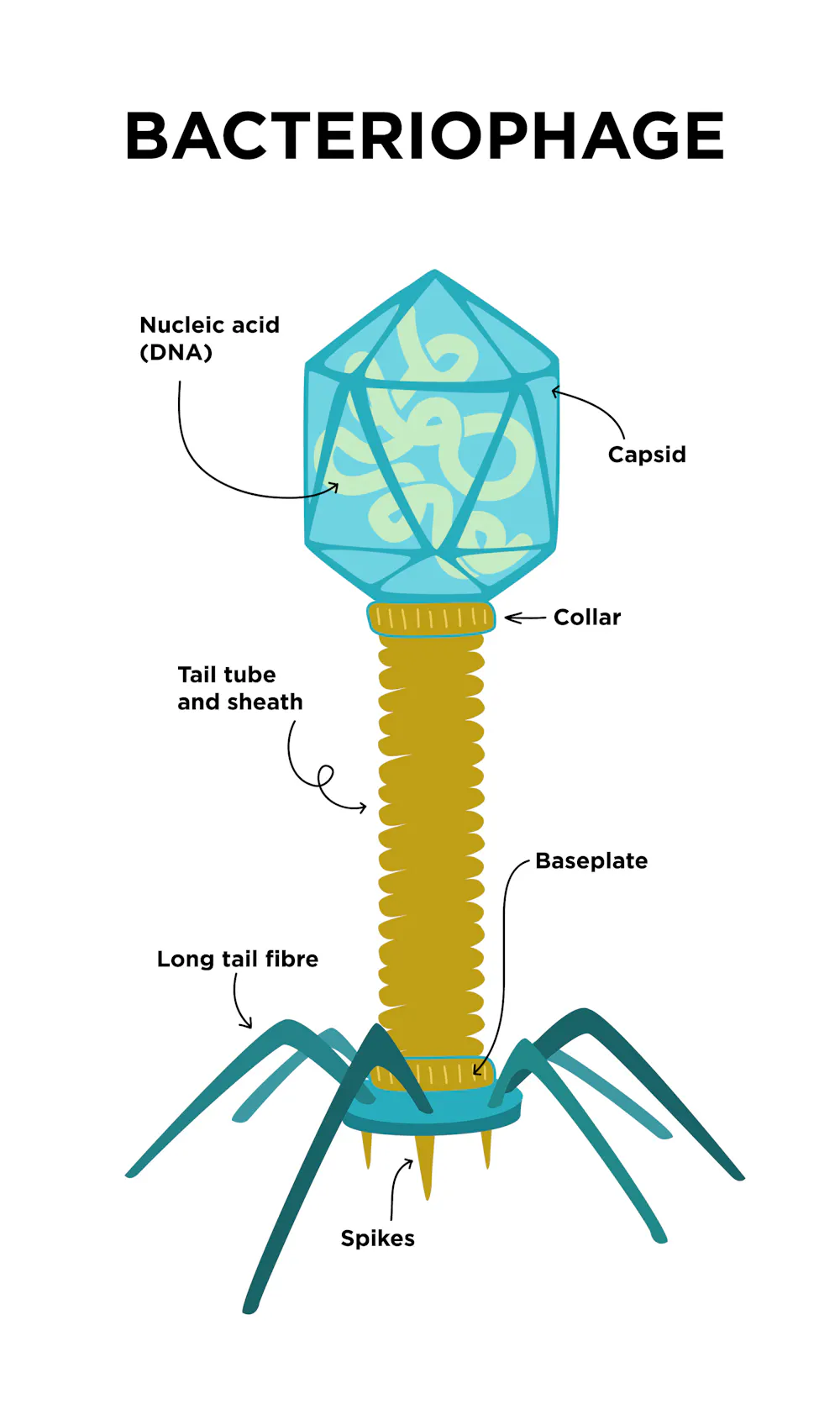 Bacteriophage caspids can carry extra DNA that the virus can tinker with. Kristina Dukart/iStock via Getty Images Plus
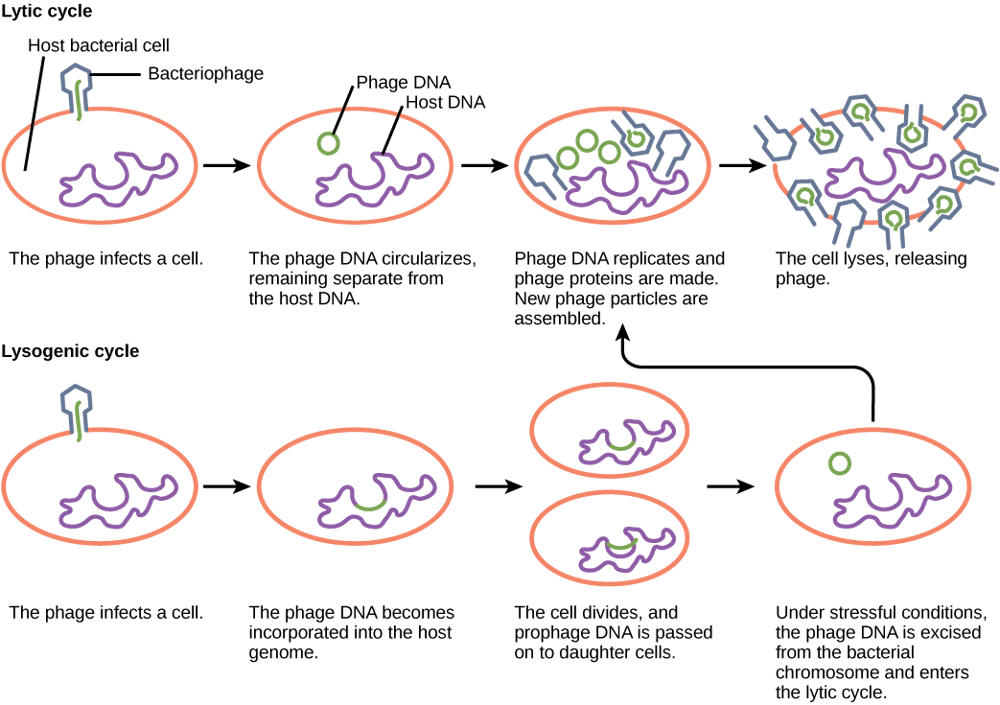 Virulent phages follow the lytic cycle of viral reproduction, destroying their hosts as soon as they complete replication. Temperate phages, on the other hand, follow the lysogenic cycle and stay dormant inside their host’s DNA until they’re triggered to burst out. CNX OpenStax/Wikimedia Commons, CC BY
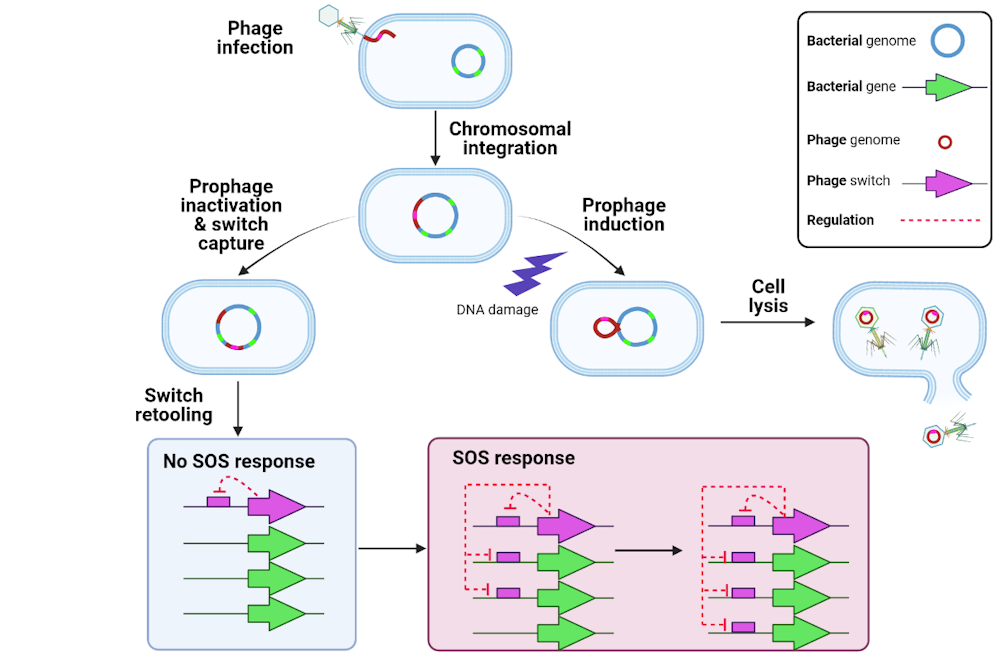 When a temperate phage infects a bacterial cell and integrates its genome with the cell’s DNA, it typically lays dormant until it’s triggered to burst out of the cell. But once the phage’s DNA is part of the bacterium’s, mutations can disrupt the phage’s genetic material and render it inactive. This means that when DNA damage occurs, the phage won’t be able to reform itself and burst out. Over time, the bacterium may adapt the phage’s switch to control its own SOS response genes. Miquel Sánchez-Osuna/Created with BioRender.com, CC BY-NC-ND









 Valentino speaks at the 2012 Alumni Award ceremony.

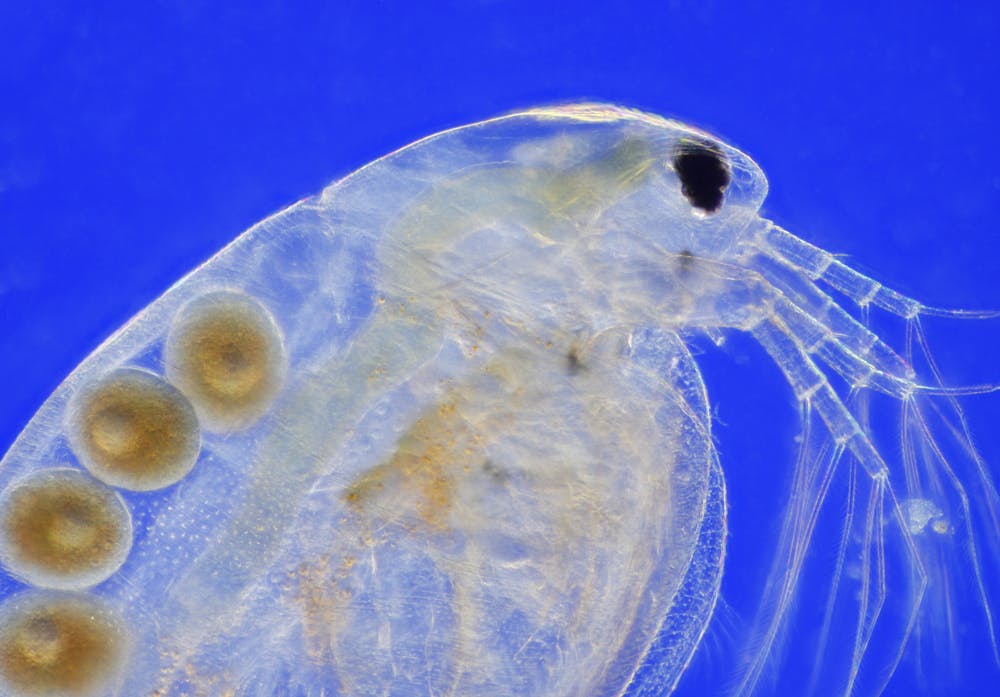





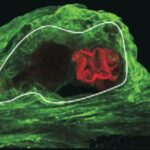
 Color-changing cells in an Atlantic squid’s skin contain light-sensitive pigments. Alexandra Kingston, CC BY-ND