‘Your work is so important,’ White House environmental justice leader tells UMBC ICARE trainees
UMBC’s Interdisciplinary Consortium for Applied Research in the Environment (ICARE) program, a cohort-based master’s program focused on local environmental research, held its first annual ICARE CoNavigator Day on Friday, February 23, in the University Center Ballroom. The all-day event consisted of research planning activities for ICARE trainees, poster sessions highlighting the trainees’ research, and a keynote address given by Jalonne White-Newsome, senior director for environmental justice in the White House Council for Environmental Quality. The Maryland deputy and assistant secretaries of the environment and representatives from the League of Conservation Voters also attended.
“ICARE is a unique training model in which master’s students in the environmental sciences and engineering are co-mentored by UMBC faculty mentors, professional scientists or engineers, and community leaders. This day brought together all the trainees and their mentors to conceptualize their research through CoNavigator and present their research in well-attended poster sessions,” shares Tamra Mendelson, ICARE director and professor of biological sciences.
CoNavigator is a unique three-dimensional concept mapping protocol the ICARE trainees and their thesis committees used to brainstorm. The structured format encouraged creative thinking about their projects’ goals and implementation.
Danish researchers created CoNavigator in 2015, and “UMBC was a big part of the genesis of this,” shared Katrine Lindvig, one of CoNavigator’s founders who facilitated the ICARE session. UMBC was one of the first institutions to apply the unique protocol, Lindvig said.
White-Newsome said in her keynote that addressing environmental problems “takes multiple perspectives; it takes creativity; it takes ensuring that those folks who are most impacted are part of and given the space to implement and co-solve and create solutions that will benefit us all.”
She also encouraged the ICARE trainees: “To read about the questions you’re asking, and the way you’re going about answering them— your work is so important.”
Learn more about ICARE.
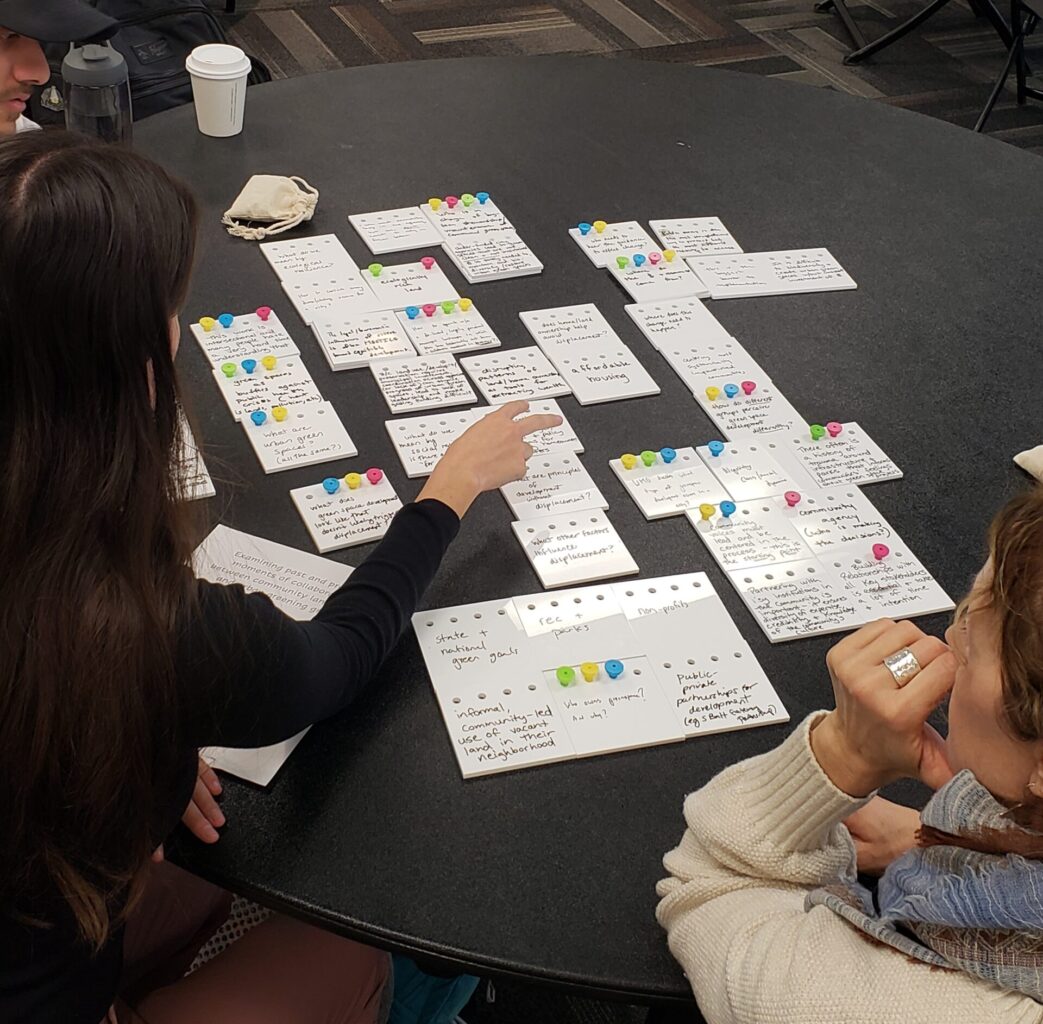 CoNavigator concept mapping in action (Image by Sarah Hansen, M.S. ’15/UMBC)
]]>
UMBC’s Interdisciplinary Consortium for Applied Research in the Environment (ICARE) program, a cohort-based master’s program focused on local environmental research, held its first annual ICARE...
https://umbc.edu/quick-posts/icare-conavigator-day-environmental-research/
https://my3.my.umbc.edu/api/v0/pixel/news/139979/guest@my.umbc.edu/9078b50809713f0ce406fb21d1e13170/api/pixel
biology
cahss
cbee
cnms
coeit
ges
icare
public-policy
quick-post
UMBC News & Magazine
https://my3.my.umbc.edu/groups/umbc-news-magazine
https://assets1-my.umbc.edu/system/shared/avatars/groups/000/001/943/24435aa6207c452e7bc15cc74b42c7bb/xsmall.png?1748556657
https://assets1-my.umbc.edu/system/shared/avatars/groups/000/001/943/24435aa6207c452e7bc15cc74b42c7bb/original.png?1748556657
https://assets2-my.umbc.edu/system/shared/avatars/groups/000/001/943/24435aa6207c452e7bc15cc74b42c7bb/xxlarge.png?1748556657
https://assets2-my.umbc.edu/system/shared/avatars/groups/000/001/943/24435aa6207c452e7bc15cc74b42c7bb/xlarge.png?1748556657
https://assets3-my.umbc.edu/system/shared/avatars/groups/000/001/943/24435aa6207c452e7bc15cc74b42c7bb/large.png?1748556657
https://assets1-my.umbc.edu/system/shared/avatars/groups/000/001/943/24435aa6207c452e7bc15cc74b42c7bb/medium.png?1748556657
https://assets2-my.umbc.edu/system/shared/avatars/groups/000/001/943/24435aa6207c452e7bc15cc74b42c7bb/small.png?1748556657
https://assets1-my.umbc.edu/system/shared/avatars/groups/000/001/943/24435aa6207c452e7bc15cc74b42c7bb/xsmall.png?1748556657
https://assets2-my.umbc.edu/system/shared/avatars/groups/000/001/943/24435aa6207c452e7bc15cc74b42c7bb/xxsmall.png?1748556657
UMBC News & Magazine
1
0
false
Thu, 14 Mar 2024 16:18:46 -0400
Thu, 14 Mar 2024 16:18:46 -0400
National Institutes of Environmental Health Sciences highlight Professor Upal Ghosh’s work cleaning contaminated waterways
CoNavigator concept mapping in action (Image by Sarah Hansen, M.S. ’15/UMBC)
]]>
UMBC’s Interdisciplinary Consortium for Applied Research in the Environment (ICARE) program, a cohort-based master’s program focused on local environmental research, held its first annual ICARE...
https://umbc.edu/quick-posts/icare-conavigator-day-environmental-research/
https://my3.my.umbc.edu/api/v0/pixel/news/139979/guest@my.umbc.edu/9078b50809713f0ce406fb21d1e13170/api/pixel
biology
cahss
cbee
cnms
coeit
ges
icare
public-policy
quick-post
UMBC News & Magazine
https://my3.my.umbc.edu/groups/umbc-news-magazine
https://assets1-my.umbc.edu/system/shared/avatars/groups/000/001/943/24435aa6207c452e7bc15cc74b42c7bb/xsmall.png?1748556657
https://assets1-my.umbc.edu/system/shared/avatars/groups/000/001/943/24435aa6207c452e7bc15cc74b42c7bb/original.png?1748556657
https://assets2-my.umbc.edu/system/shared/avatars/groups/000/001/943/24435aa6207c452e7bc15cc74b42c7bb/xxlarge.png?1748556657
https://assets2-my.umbc.edu/system/shared/avatars/groups/000/001/943/24435aa6207c452e7bc15cc74b42c7bb/xlarge.png?1748556657
https://assets3-my.umbc.edu/system/shared/avatars/groups/000/001/943/24435aa6207c452e7bc15cc74b42c7bb/large.png?1748556657
https://assets1-my.umbc.edu/system/shared/avatars/groups/000/001/943/24435aa6207c452e7bc15cc74b42c7bb/medium.png?1748556657
https://assets2-my.umbc.edu/system/shared/avatars/groups/000/001/943/24435aa6207c452e7bc15cc74b42c7bb/small.png?1748556657
https://assets1-my.umbc.edu/system/shared/avatars/groups/000/001/943/24435aa6207c452e7bc15cc74b42c7bb/xsmall.png?1748556657
https://assets2-my.umbc.edu/system/shared/avatars/groups/000/001/943/24435aa6207c452e7bc15cc74b42c7bb/xxsmall.png?1748556657
UMBC News & Magazine
1
0
false
Thu, 14 Mar 2024 16:18:46 -0400
Thu, 14 Mar 2024 16:18:46 -0400
National Institutes of Environmental Health Sciences highlight Professor Upal Ghosh’s work cleaning contaminated waterways
The positive environmental and health impacts of work led by Upal Ghosh, professor of chemical, biochemical, and environmental engineering at UMBC, was recently highlighted by the National Institutes of Environmental Health Sciences (NIEHS). The agency showcased a low-cost technology that Ghosh and his colleagues developed to clean waterways contaminated with polychlorinated biphenyls (PCBs), a group of likely carcinogenic chemicals that were used in insulation, coolants, and electrical equipment for decades before being banned in the U.S. in 1979.
The chemicals are stable and persist in the environment, often accumulating in fish that live in contaminated waterways and posing a risk to humans who consume those fish. NIEHS funded Ghosh’s research into using activated carbon pellets to bind the chemicals in place at the bottom of the waterways. This prevents the PCBs from circulating through the aquatic food chain. In projects carried out in contaminated lakes, rivers, and harbors in Delaware, Maryland, and elsewhere, Ghosh’s team demonstrated that the technique could significantly reduce the concentration of PCBs in the water and in aquatic lifeforms. Importantly, the technique is also significantly cheaper than standard clean-up approaches, such as dredging and disposing of contaminated sediment.
In related work performed with Kevin Sowers, from the Institute of Marine and Environmental Technology, Ghosh’s team also developed a way to combine the activated carbon with microbes that break down PCBs, reducing their toxicity.
With NIEHS support, Ghosh has co-founded two companies—Sediment Solutions and RemBac—to commercialize the technology and deploy it at full-scale to clean up contaminated sites across the country, such as at Mirror Lake in Delaware.
“The technology brings together innovations in material science and biology,” says Ghosh. It’s an honor, he says, that the NIEHS, the leading agency in the country that funds research on public health and the environment, recognized “the real impact our research is having on improving public health.”
]]>
The positive environmental and health impacts of work led by Upal Ghosh, professor of chemical, biochemical, and environmental engineering at UMBC, was recently highlighted by the National...
https://umbc.edu/quick-posts/niehs-highlights-upal-ghoshs-work-cleaning-contaminated-waterways/
https://my3.my.umbc.edu/api/v0/pixel/news/139274/guest@my.umbc.edu/cd3baad4df895ca15888f8fccb6f77c3/api/pixel
cbee
cnms
coeit
imet
news
quick-post
quick-posts
research
science-and-tech
UMBC News & Magazine
https://my3.my.umbc.edu/groups/umbc-news-magazine
https://assets1-my.umbc.edu/system/shared/avatars/groups/000/001/943/24435aa6207c452e7bc15cc74b42c7bb/xsmall.png?1748556657
https://assets1-my.umbc.edu/system/shared/avatars/groups/000/001/943/24435aa6207c452e7bc15cc74b42c7bb/original.png?1748556657
https://assets2-my.umbc.edu/system/shared/avatars/groups/000/001/943/24435aa6207c452e7bc15cc74b42c7bb/xxlarge.png?1748556657
https://assets2-my.umbc.edu/system/shared/avatars/groups/000/001/943/24435aa6207c452e7bc15cc74b42c7bb/xlarge.png?1748556657
https://assets3-my.umbc.edu/system/shared/avatars/groups/000/001/943/24435aa6207c452e7bc15cc74b42c7bb/large.png?1748556657
https://assets1-my.umbc.edu/system/shared/avatars/groups/000/001/943/24435aa6207c452e7bc15cc74b42c7bb/medium.png?1748556657
https://assets2-my.umbc.edu/system/shared/avatars/groups/000/001/943/24435aa6207c452e7bc15cc74b42c7bb/small.png?1748556657
https://assets1-my.umbc.edu/system/shared/avatars/groups/000/001/943/24435aa6207c452e7bc15cc74b42c7bb/xsmall.png?1748556657
https://assets2-my.umbc.edu/system/shared/avatars/groups/000/001/943/24435aa6207c452e7bc15cc74b42c7bb/xxsmall.png?1748556657
UMBC News & Magazine
1
0
false
Fri, 23 Feb 2024 15:53:29 -0500
As summer wildfire smoke choked Baltimore, UMBC air pollution researchers leapt into action

Starting this May, a series of wildfires in Eastern Canada sent enormous smoke clouds wafting into the U.S., triggering air quality warnings in cities from the Midwest to the Northeast. For days, orange skies backdropped landscapes clouded by acrid air. People who could hunkered inside with the doors and windows shut. Those who had to go out faced itchy eyes, burning throats, and worse.
As a resident of the Baltimore area—which was blanketed with particularly bad smoke in both early and late June—UMBC Professor Chris Hennigan looked at the haze with dismay. But as an environmental engineer who studies air pollution, he had an additional thought: “We were looking at the air quality forecasts, and we thought ‘We have to gather data,’” he says.
The public found many colorful words to describe the summer’s unwanted smoke: brutal, eerie, dystopian.
Hennigan and his team have been working to put numbers to the adjectives. On the roof of the engineering building, the researchers installed a squat, white sensor that monitors the levels of tiny particles in the air, particularly those measuring 2.5 micrometers in diameter or less—smaller than most bacteria. Called PM2.5, these particles are released in large numbers during fires. They are dangerous to human health because they can work their way into the deepest parts of the lungs and even enter the bloodstream.
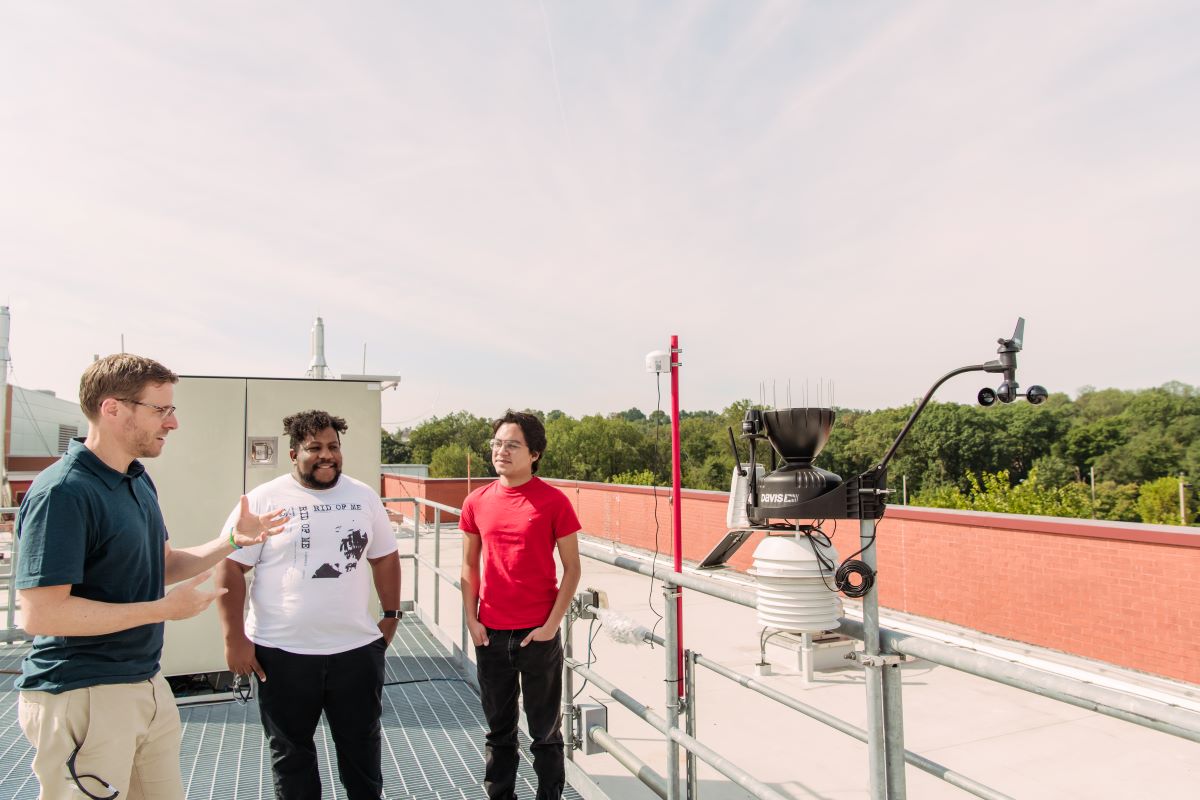 Chris Hennigan, Joel Tyson, Ph.D. ’23, and Luis Rodriguez ’25 (left to right) on the roof of the engineering building next to an air quality sensor. (Marlayna Demond ’11/UMBC)
The sensor showed huge spikes in PM2.5 when the smoke blew through, on some days reaching levels considered unhealthy for anyone to breathe.
The researchers also set up equipment to filter particles out of the air. After 24 hours, they collected the filters, which they are storing, neatly labeled, in a refrigerator in Hennigan’s lab.
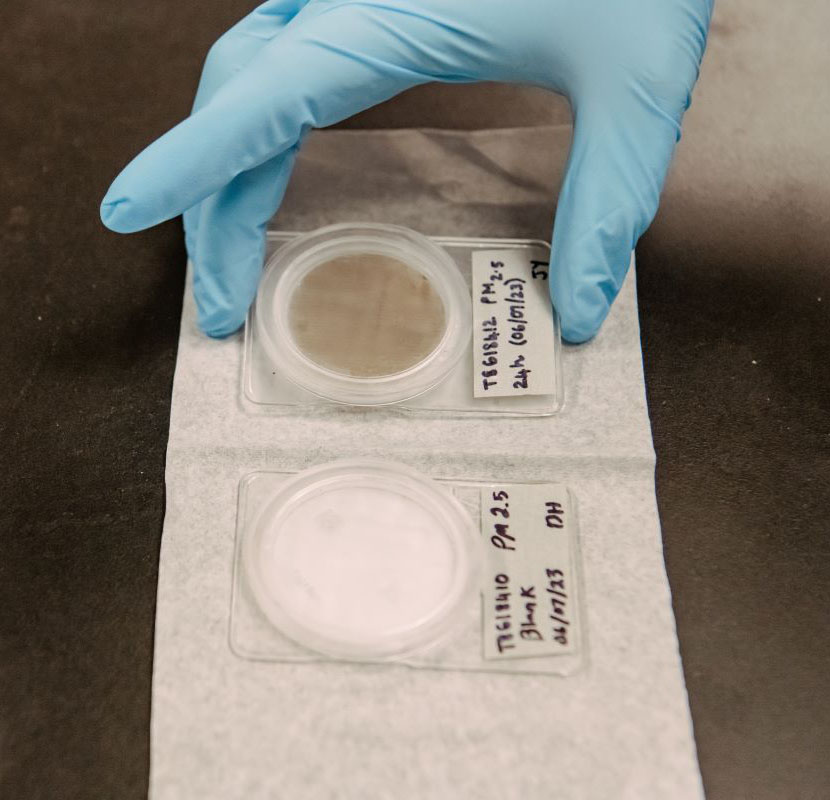 Hennigan shows samples of smoke particles collected this summer. (Marlayna Demond ’11/UMBC)
The filtered samples will advance at least two ongoing investigations, Hennigan says. In one avenue of inquiry, Joel Tyson, Ph.D. ’23, biochemical engineering, is studying how tiny particles can harm human lung cells. Before this year’s smoky summer, Tyson had been studying the toxic effects of particulate matter normally found in the Baltimore air. With the new smoke samples, he will start to investigate whether wildfire smoke particles, per unit, are more toxic than regular urban particulate matter, which comes from sources such as cars and power plants. Some studies have indicated that wildfire particulate matter is indeed more toxic, but more research is needed before any definitive conclusions can be reached.
In another line of research, Hennigan is also studying how particles in the air, including from smoke, may affect the climate. Undergraduate chemical engineering students Danielle Larios ’25 and Luis Rodriguez ’25 are assisting in the investigations.
The researchers study how particles of brown-colored carbon-containing material absorb light. Burning vegetation sends large amounts of this brown carbon into the atmosphere. It’s possible that the particles are trapping significant heat from the sun, accelerating the pace of planetary warming. Such effects are not normally included in global climate models, and better understanding of the process could improve humanity’s ability to predict, and manage, the coming years of climate upheaval.
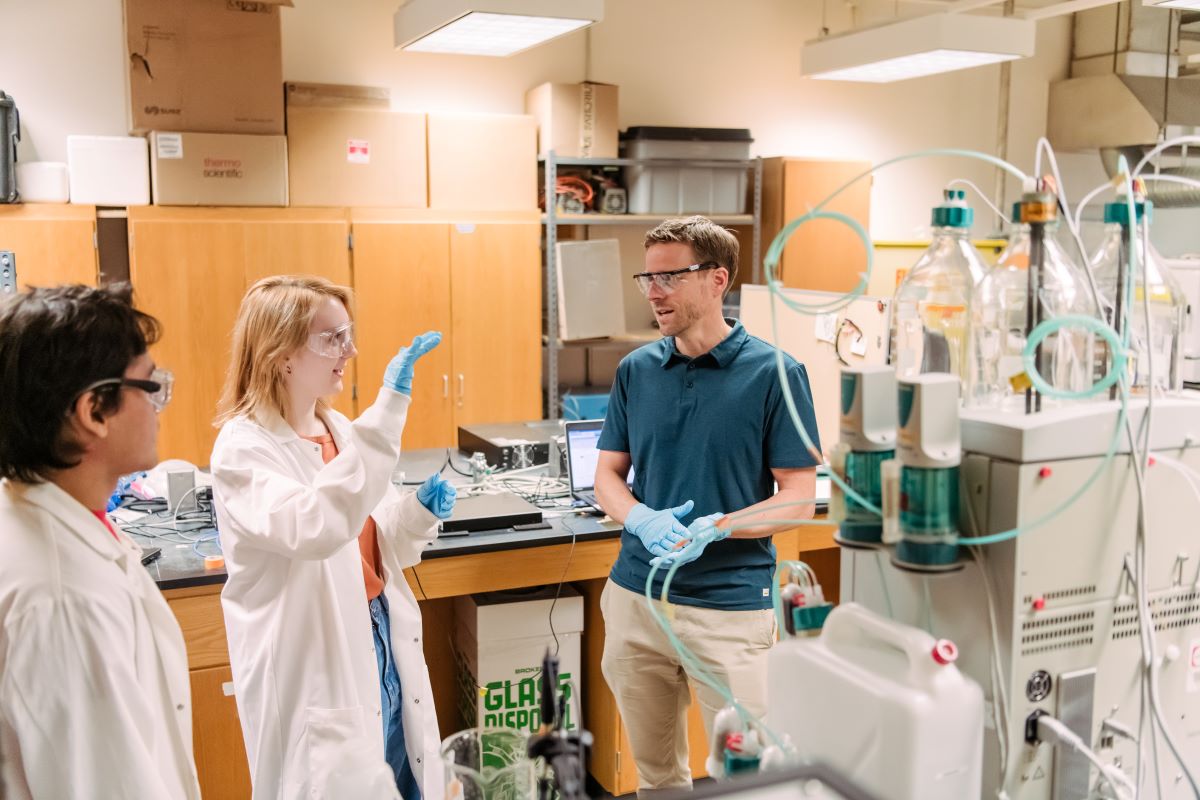 Rodriguez, Danielle Larios ’25 and Hennigan (left to right) discuss research in the lab. (Marlayna Demond ’11/UMBC)
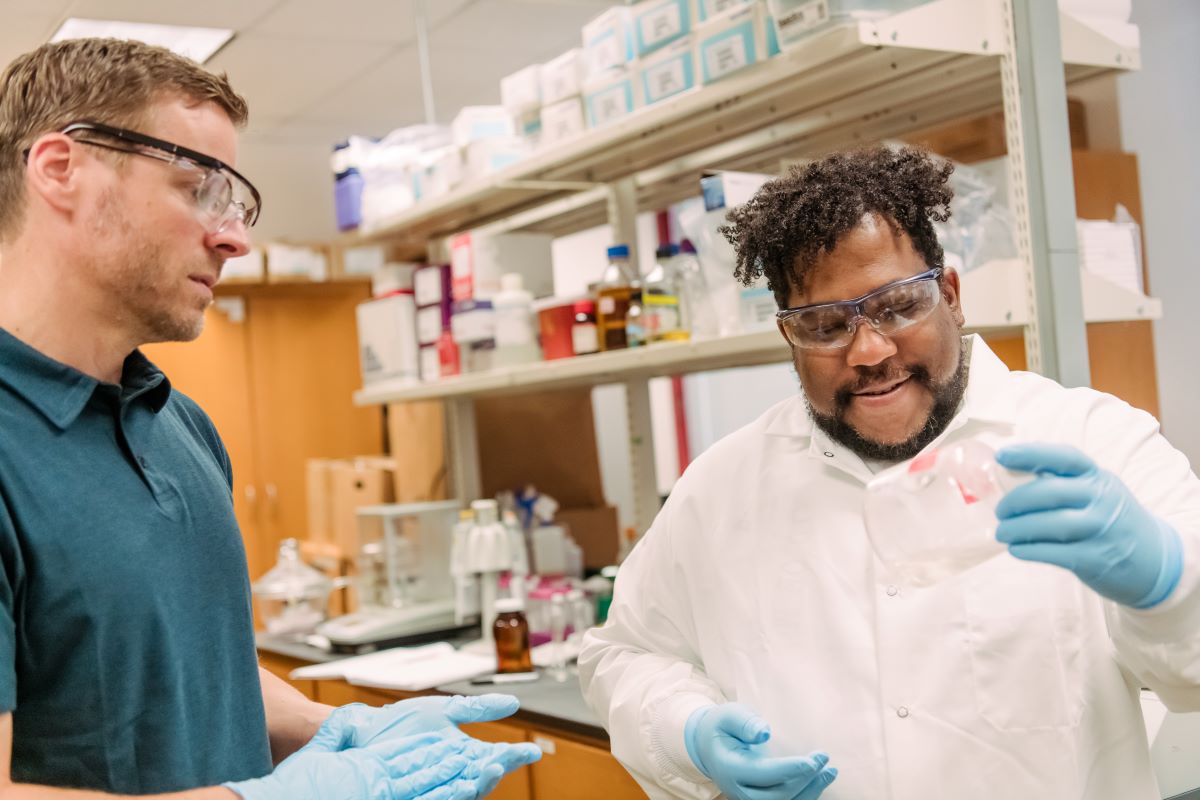 Hennigan and Tyson in the lab. (Marlayna Demond ’11/UMBC)
Climate change and wildfires are intimately linked. This summer was not only smoky, but also scorching. July marked the hottest month ever recorded, and scientists predict that as the world continues to warm, wildfires will continue to increase in quantity and intensity. “Smokeageddon,” as headlines put it, may become the new normal.
Hennigan says recent research illuminates how much wildfire smoke has contributed to air pollution trends. He points to a paper published in September in the scientific journal Nature that estimated that since 2016, wildfire smoke in the contiguous United States has undone around 25% of the progress in air quality made between 2000 and 2016.
For the researchers in Hennigan’s lab, those effects have been felt personally.
Rodriguez recalled how in June he had to go out to buy a fresh pack of N95 masks. “The smoke was just awful,” he says. Larios says she felt a burning at the back of her throat in just 15 minutes walking to her car.
For Tyson, the effects of the smoke were so bad that at one point he struggled to breathe and had to visit the doctor. The episode, he says, drove home the importance of his toxicology research.
All three note both the complexity of the systems they are studying and the importance of discovering new knowledge that might help society handle the environmental challenges it faces.
“Our work can have real-world impact, and that’s exciting,” says Larios.
]]>
Starting this May, a series of wildfires in Eastern Canada sent enormous smoke clouds wafting into the U.S., triggering air quality warnings in cities from the Midwest to the Northeast. For days,...
https://umbc.edu/stories/wildfire-smoke-research/
https://my3.my.umbc.edu/api/v0/pixel/news/137596/guest@my.umbc.edu/c05ae348755b0ec976c77402d2616d21/api/pixel
cbee
coeit
discovery
fall-2023
magazine
research
UMBC News & Magazine
https://my3.my.umbc.edu/groups/umbc-news-magazine
https://assets1-my.umbc.edu/system/shared/avatars/groups/000/001/943/24435aa6207c452e7bc15cc74b42c7bb/xsmall.png?1748556657
https://assets1-my.umbc.edu/system/shared/avatars/groups/000/001/943/24435aa6207c452e7bc15cc74b42c7bb/original.png?1748556657
https://assets2-my.umbc.edu/system/shared/avatars/groups/000/001/943/24435aa6207c452e7bc15cc74b42c7bb/xxlarge.png?1748556657
https://assets2-my.umbc.edu/system/shared/avatars/groups/000/001/943/24435aa6207c452e7bc15cc74b42c7bb/xlarge.png?1748556657
https://assets3-my.umbc.edu/system/shared/avatars/groups/000/001/943/24435aa6207c452e7bc15cc74b42c7bb/large.png?1748556657
https://assets1-my.umbc.edu/system/shared/avatars/groups/000/001/943/24435aa6207c452e7bc15cc74b42c7bb/medium.png?1748556657
https://assets2-my.umbc.edu/system/shared/avatars/groups/000/001/943/24435aa6207c452e7bc15cc74b42c7bb/small.png?1748556657
https://assets1-my.umbc.edu/system/shared/avatars/groups/000/001/943/24435aa6207c452e7bc15cc74b42c7bb/xsmall.png?1748556657
https://assets2-my.umbc.edu/system/shared/avatars/groups/000/001/943/24435aa6207c452e7bc15cc74b42c7bb/xxsmall.png?1748556657
UMBC News & Magazine
2
0
false
Thu, 07 Dec 2023 08:43:35 -0500
Thu, 07 Dec 2023 08:43:35 -0500
UMBC chapter of National Society of Black Engineers (NSBE) shines at regional conference
Members of UMBC’s chapter of the National Society of Black Engineers (NSBE) traveled to Norfolk, Virginia for their annual regional conference in November and came home with numerous awards.
The UMBC team defeated Carnegie Mellon University and North Carolina State University to win the Tech Bowl competition, a Jeopardy-style game that tests teams’ knowledge of fundamental engineering principles. UMBC also claimed first through third place in the research poster presentation contest, which involved a 10-minute technical research talk followed by questions from the judges and audience.
The team relied on prior knowledge to excel in the Tech Bowl, only having decided to participate upon arriving at the conference. “It was really exciting getting so many questions right with our only practice being from our coursework,” shares UMBC NSBE chapter president Nelanne Bolima ’24, chemical engineering. “That just goes to show how well UMBC’s College of Engineering and IT prepares students to succeed.”
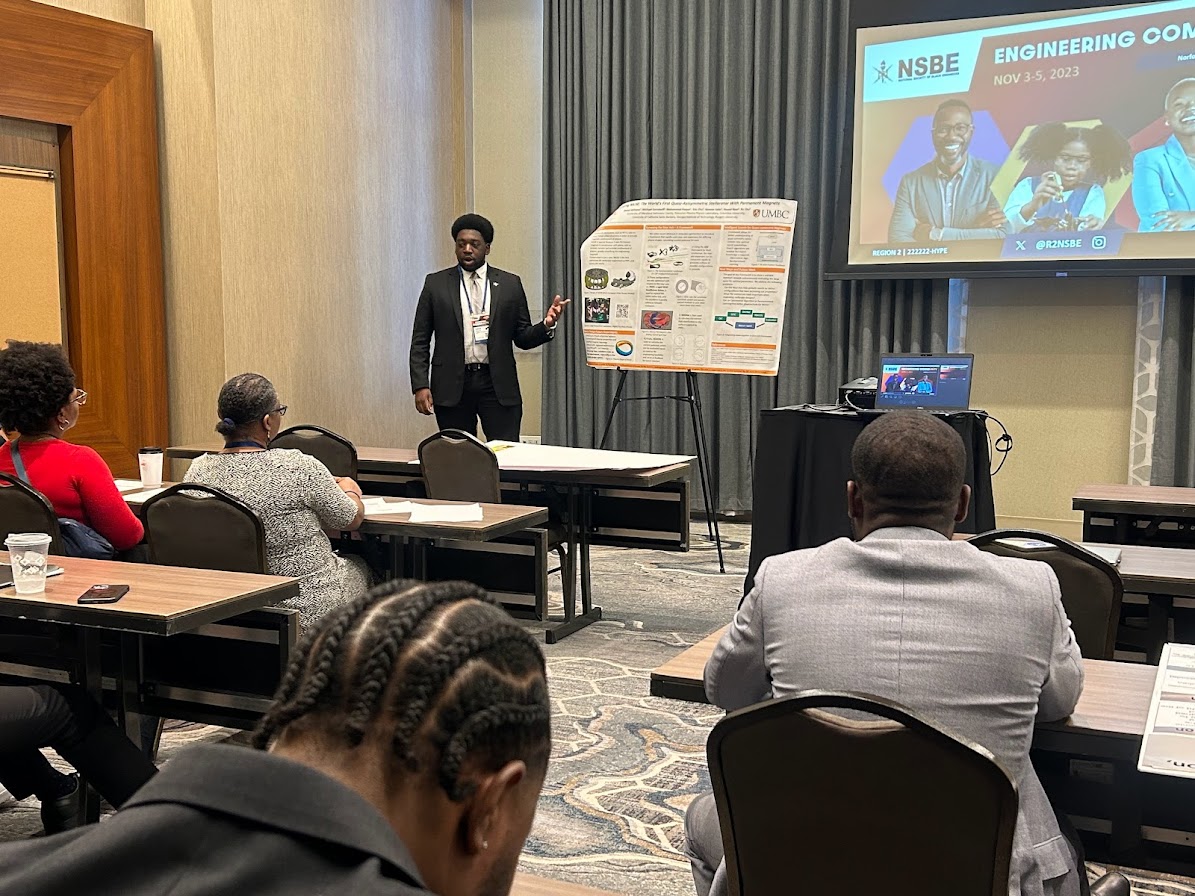 Daniel Williams gives his research presentation at the NSBE conference. (Image by Nelanne Bolima)
In addition to Bolima, the Tech Bowl team members included Kayla Magruder ’26, chemical engineering; Saleem Lawal ’25, computer science; and Daniel Williams ’24, computer science. Presentation winners were Williams (first), Bolima (second), and Christopher Appiah ’24, mechanical engineering (third). Keith Harmon, director of the UMBC Meyerhoff Scholars Program, serves as the chapter advisor.
“We are so proud of the UMBC NSBE Chapter,” Harmon shares. “They do tremendous work supporting UMBC STEM majors and offering service impacting youth in the Baltimore-Washington corridor.”
Students supporting students
NSBE is a completely student-run organization, creating leadership opportunities for hundreds of students across the country. UMBC’s NSBE chapter supports members through activities such as mentoring initiatives, conference preparation, networking opportunities, and leadership development programming. The chapter also focuses on community outreach, such as visiting high schools, collaborating with non-profits, and welcoming younger students to shadow the chapter’s board meetings.
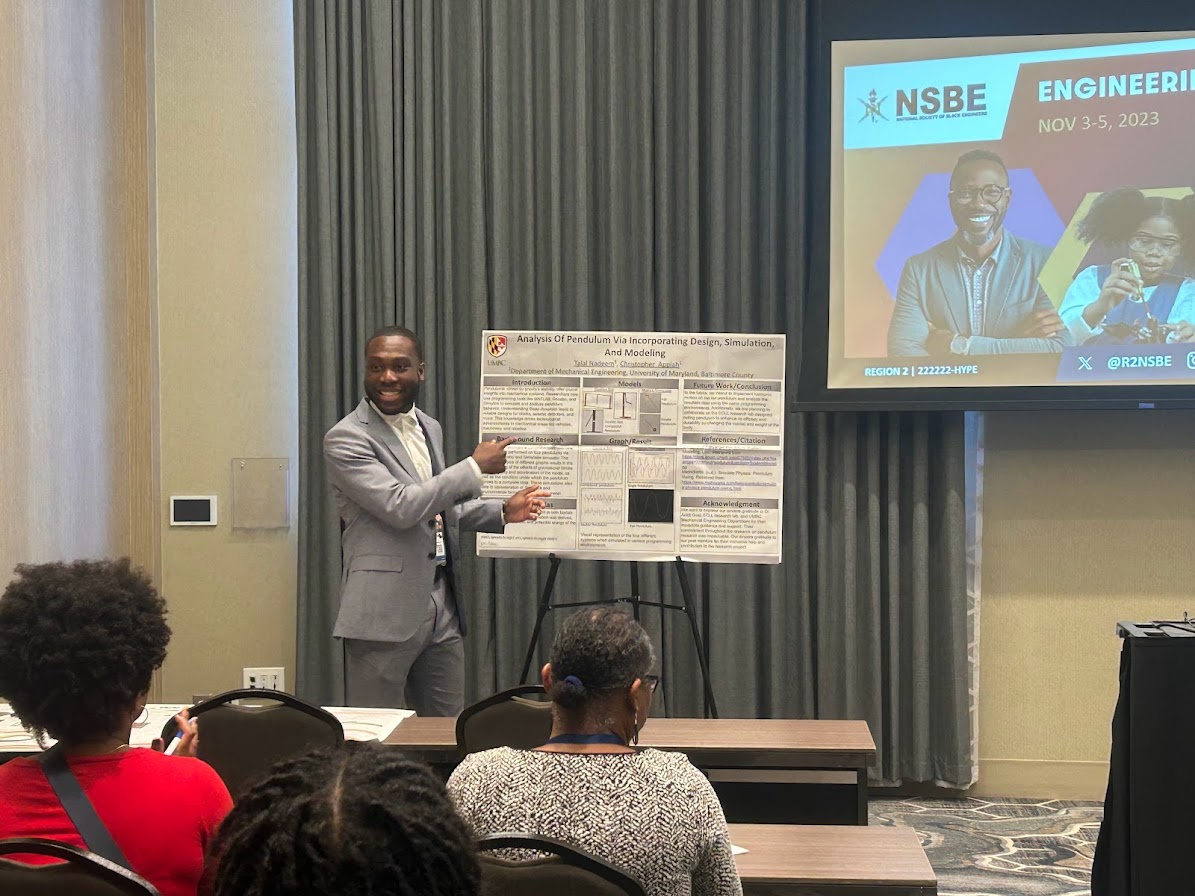 Christopher Appiah gives his research presentation at the NSBE conference. (Image by Nelanne Bolima)
“I have benefitted from being a member of this team by gaining invaluable public speaking and collaboration skills,” Appiah shares. “I learned how to effectively present, detailing the broader impact of research I have done.” Appiah conducts research with Ankit Goel, assistant professor of mechanical engineering. Goel’s group works on complex applications of control theory in robotics and autonomous systems.
For Jaden Somerville ’25, mechanical engineering, “the competition not only improved my technical skills, but also taught me teamwork, problem-solving, and effective time management.”
In March 2024, the chapter will take its talents to the 50th annual NSBE convention in Atlanta, Georgia.
]]>
Members of UMBC’s chapter of the National Society of Black Engineers (NSBE) traveled to Norfolk, Virginia for their annual regional conference in November and came home with numerous awards. ...
https://umbc.edu/stories/nsbe-shines-at-regional-conference/
https://my3.my.umbc.edu/api/v0/pixel/news/137559/guest@my.umbc.edu/101e4ba6879ab3f49b2abd337b9db36c/api/pixel
cbee
coeit
csee
meche
news
rca-2
science-and-tech
UMBC News & Magazine
https://my3.my.umbc.edu/groups/umbc-news-magazine
https://assets1-my.umbc.edu/system/shared/avatars/groups/000/001/943/24435aa6207c452e7bc15cc74b42c7bb/xsmall.png?1748556657
https://assets1-my.umbc.edu/system/shared/avatars/groups/000/001/943/24435aa6207c452e7bc15cc74b42c7bb/original.png?1748556657
https://assets2-my.umbc.edu/system/shared/avatars/groups/000/001/943/24435aa6207c452e7bc15cc74b42c7bb/xxlarge.png?1748556657
https://assets2-my.umbc.edu/system/shared/avatars/groups/000/001/943/24435aa6207c452e7bc15cc74b42c7bb/xlarge.png?1748556657
https://assets3-my.umbc.edu/system/shared/avatars/groups/000/001/943/24435aa6207c452e7bc15cc74b42c7bb/large.png?1748556657
https://assets1-my.umbc.edu/system/shared/avatars/groups/000/001/943/24435aa6207c452e7bc15cc74b42c7bb/medium.png?1748556657
https://assets2-my.umbc.edu/system/shared/avatars/groups/000/001/943/24435aa6207c452e7bc15cc74b42c7bb/small.png?1748556657
https://assets1-my.umbc.edu/system/shared/avatars/groups/000/001/943/24435aa6207c452e7bc15cc74b42c7bb/xsmall.png?1748556657
https://assets2-my.umbc.edu/system/shared/avatars/groups/000/001/943/24435aa6207c452e7bc15cc74b42c7bb/xxsmall.png?1748556657
UMBC News & Magazine
1
0
false
Tue, 05 Dec 2023 17:40:28 -0500
Tue, 05 Dec 2023 17:40:28 -0500
Students discover the beauty of mold and mentorship in Mark Marten’s UMBC lab
Mold on your bread or bathroom tiles can be a nuisance. Mold in a scientific lab can be a marvel.
Up close, the growth of mold becomes living artwork—white, feathery shoots morphing into undulating waves of color. And molds can be amazingly useful.
“They are used to ferment food, make laundry detergent enzymes, and help produce pharmaceuticals,” explains Garrett Hill ’24, biochemistry and molecular biology, who has been working with molds in the research lab of UMBC chemical engineering professor Mark Marten for more than four years. “It’s surprising how ubiquitous they are in industry.”
Molds (along with mushrooms) belong to a group of organisms more technically known as filamentous fungi. One of the oldest and largest living organisms in the world is a filamentous fungus, nicknamed the “Humongous Fungus,” that has likely been spreading across the Blue Mountains in eastern Oregon for more than 2,000 years, and has come to occupy an area of more than 2,000 acres.
The Humongous Fungus grew (and grew) through an enormous network of interconnected thread-like structures called hyphae that gather and share vital nutrients.
Networks—of a different sort—are also vitally important to the students studying fungi in Marten’s lab. Lab members, from high schoolers to Ph.D. students, work together on projects. Marten offers advice not only on research questions, but also on skills such as communication. Support flows in from the university, in the form of research awards, scholar programs, and more. It’s tied together with a simple philosophy that helps everyone flourish: “Mentorship is the magic ingredient,” Marten says.
High school research leads to UMBC
Hill found his way to Marten’s lab through a program in nearby Howard County Public Schools called the Biotechnology Career Academy. As part of the program, he earned credit for conducting research in the lab. After high school graduation, he enrolled at UMBC and has continued his work in Marten’s lab every year since.
“UMBC has a culture that emphasizes supporting students,” says Hill. “This was something that initially attracted me to the school, and something that I’ve absolutely experienced during my time here.”
In Marten’s lab, Hill has been working on research that investigates how a fungus called Aspergillus nidulans repairs damaged cell walls. Armed with a better understanding of the complicated cascade of biochemical reactions triggered when the fungal cell wall is damaged, scientists could possibly manipulate the process to use molds more effectively (or in the case of harmful molds, eradicate them more effectively.)
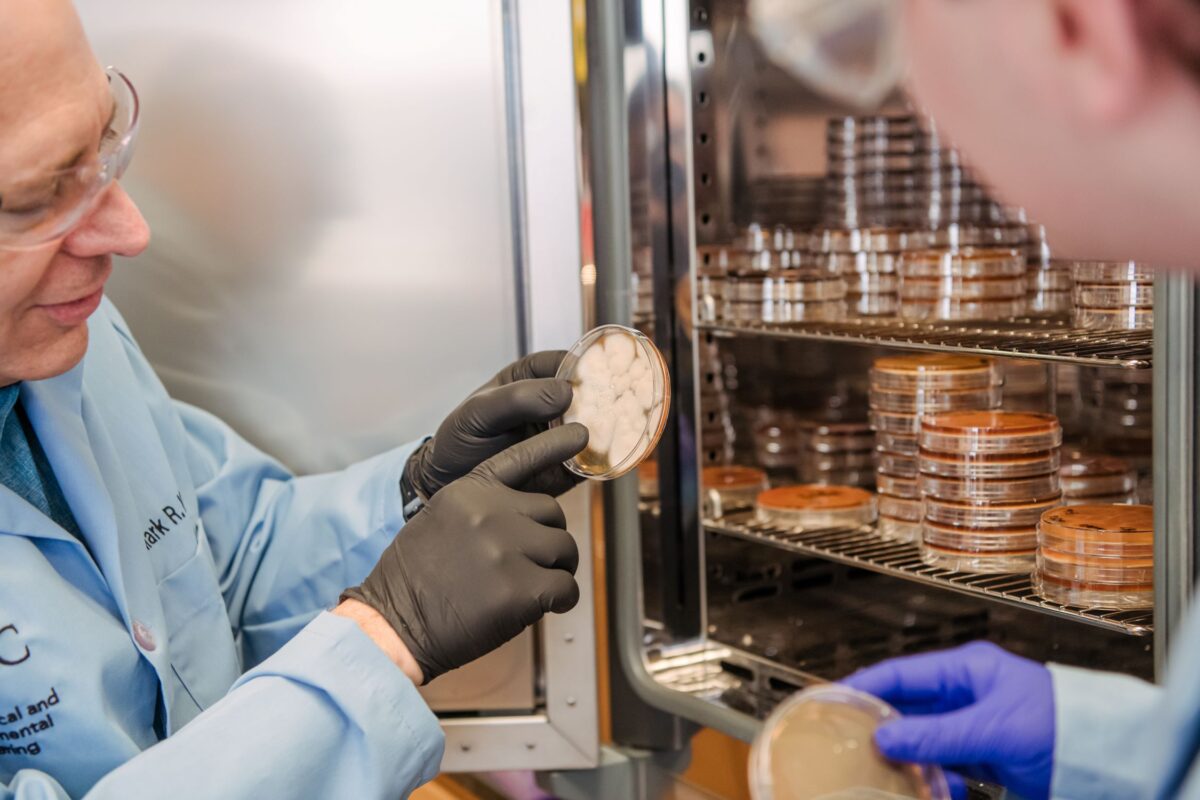
Mark Marten (left) and Garrett Hill examine mold cultures. (Marlayna Demond ’11/UMBC)
To untangle the hidden and complicated inner workings of the fungus, the researchers deploy an arsenal of analytical tools and methods.
“When I started in the lab, I spent a lot of time learning the background and standard lab techniques,” Hill says. “But now that I’ve had a few years to acclimate, I have the foundation to support my own project.”
As part of that project, Hill has been investigating how to use the Nobel Prize-winning gene editing tool called CRISPR to create fungal cells with inner elements that light up. The light provides a beacon for researchers to track how those elements move as the cell experiences stress or initiates repairs.
“The sense of project ownership has been one of the most rewarding parts of my research experience,” Hill says. “When my graduate mentor and I first discussed the possibility of leading my own project, I had a brief moment of doubt. But I chose to not listen to that voice.”
Networks nourish growth
Hill says he was attracted to the beauty and power of science from a young age, even though no one in his family had a scientific career. UMBC has provided the resources and counsel to help him chart his path.
Within Marten’s lab, Hill says more experienced researchers were always willing to help. When Hill first joined as a high schooler, fellow lab member Ryland Spence ’19, biological sciences, who is now a medical student at Brown University, trained him on techniques.
“Mentorship has been so important for me, so I am always happy to provide mentorship to others whenever I get the chance,” Spence says. “A supportive environment that values diversity is very much a part of UMBC.”
Marten himself also provided enormous guidance and support. “Dr. Marten has been the strongest mentor I’ve had, helping me even before I came to UMBC,” Hill says. “He’s taught me not only about fungus, but also about how to think like a researcher, how to present research, and how to be a good student.”
University-wide programs provided Hill with additional research support. He was awarded multiple Undergraduate Research Awards (URAs), which provide financial assistance for research projects and opportunities to practice skills such as presenting research.
Hill is also part of the nationally renowned Meyerhoff Scholar Program, which seeks to increase diversity among future leaders in science, technology, engineering, and mathematics by supporting students who intend to pursue a Ph.D. or combined M.D./Ph.D. in STEM and are interested in the advancement of minorities in those fields.
“A lot of my best friends are from the program,” says Hill. “It’s been great to have that community.”
Now that he is applying to graduate schools, Hill says the Meyerhoff program provides detailed guidance through the process. “They have been an invaluable resource, and a rock really. They make sure I know what I need to do now to ensure I have opportunities in the future.”
A closing chapter and a new beginning
As the fall semester of his senior year kicks off, Hill says that he’s feeling confident and excited.
“I find myself frequently looking back on how I felt on my first day in the lab, during my first lab meeting presentation, or during my first day of classes, and realizing how much I’ve grown these past few years,” he says. “What once used to really shake me, I am now able to do with confidence—that tells me a lot about what I’ve gained from my research experience.”
As Hill gears up for grad school, he is passing the baton to other UMBC students like Matthew Quintanilla ’27, chemical engineering, a first-year student whose journey shares many similarities with Hill’s. The first in his family to pursue a scientific career, Quintanilla also started work in Marten’s lab as a high-schooler and decided to enroll at UMBC. In Marten’s lab, Quintanilla is working with Ph.D. student Alex Doan, who attended the same high school and embraced the opportunity to mentor fellow students.
“It’s been great catching up on high school news, but more importantly helping students grow,” says Doan.
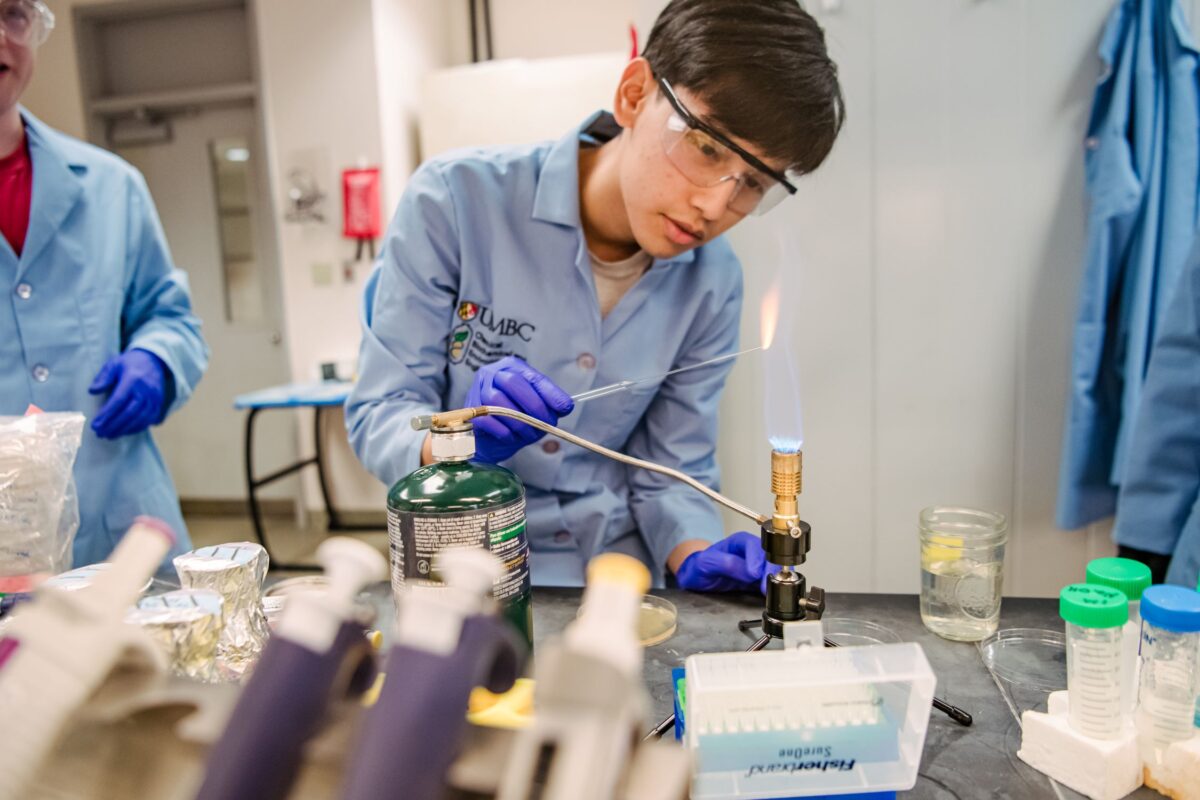
Matthew Quintanilla works in the lab. (Marlayna Demond ’11/UMBC)
Quintanilla is also a URA-recipient and Meyerhoff Scholar, and says he is excited for the new school year.
“I am eager to start my academic career at UMBC, meet many others, and integrate my knowledge from courses into my lab work,” he says.
“Matthew and Garrett are both really talented individuals,” says Marten. “Having them in the lab has been a win-win situation.”
April Householder ’95, the director of undergraduate research and prestigious scholarships at UMBC, looks at Marten’s lab as a microcosm of the vibrant UMBC research environment. “These two students—Garrett and Matthew—represent two ends of the research spectrum. One is just getting started, and the other is a four-time URA Scholar,” she says.
“The support these students receive from the mentorship in their lab is invaluable, but also as important is the peer-to-peer support they will get from one another. It’s this type of academic community building that gets student researchers excited about being a part of UMBC.”
]]>
Mold on your bread or bathroom tiles can be a nuisance. Mold in a scientific lab can be a marvel. Up close, the growth of mold becomes living artwork—white, feathery shoots morphing into...
https://umbc.edu/stories/mold-and-mentorship/
https://my3.my.umbc.edu/api/v0/pixel/news/135693/guest@my.umbc.edu/077eee83e352dadb5ee8ed6525da47e5/api/pixel
cbee
cnms
coeit
discovery
magazine
UMBC News & Magazine
https://my3.my.umbc.edu/groups/umbc-news-magazine
https://assets1-my.umbc.edu/system/shared/avatars/groups/000/001/943/24435aa6207c452e7bc15cc74b42c7bb/xsmall.png?1748556657
https://assets1-my.umbc.edu/system/shared/avatars/groups/000/001/943/24435aa6207c452e7bc15cc74b42c7bb/original.png?1748556657
https://assets2-my.umbc.edu/system/shared/avatars/groups/000/001/943/24435aa6207c452e7bc15cc74b42c7bb/xxlarge.png?1748556657
https://assets2-my.umbc.edu/system/shared/avatars/groups/000/001/943/24435aa6207c452e7bc15cc74b42c7bb/xlarge.png?1748556657
https://assets3-my.umbc.edu/system/shared/avatars/groups/000/001/943/24435aa6207c452e7bc15cc74b42c7bb/large.png?1748556657
https://assets1-my.umbc.edu/system/shared/avatars/groups/000/001/943/24435aa6207c452e7bc15cc74b42c7bb/medium.png?1748556657
https://assets2-my.umbc.edu/system/shared/avatars/groups/000/001/943/24435aa6207c452e7bc15cc74b42c7bb/small.png?1748556657
https://assets1-my.umbc.edu/system/shared/avatars/groups/000/001/943/24435aa6207c452e7bc15cc74b42c7bb/xsmall.png?1748556657
https://assets2-my.umbc.edu/system/shared/avatars/groups/000/001/943/24435aa6207c452e7bc15cc74b42c7bb/xxsmall.png?1748556657
UMBC News & Magazine
0
0
false
Fri, 22 Sep 2023 15:38:24 -0400
Fri, 22 Sep 2023 15:38:24 -0400
Faculty Unleash Their Inner Coach

In spring 2022, UMBC softball swept all three tournament games to win their third America East championship. The Retrievers held their opponents scoreless, becoming the first team in conference history to achieve this milestone. And no one cheered louder for their success than Jamie Gurganus, faculty in engineering and computing education and mechanical engineering. Decked out in softball gear (and now with a championship ring necklace gifted from the team engraved with “Prof. G”), Gurganus ’04, M.S. ’11, Ph.D. ’20, mechanical engineering, ended her inaugural semester as honorary faculty coach to the record-breaking team on a high note. (UMBC Softball would go on to nab a fourth consecutive America East championship in 2023.)
But beyond cheering on their successful teams, how do honorary faculty coaches “coach” their teams? Enter Adriana Mason, associate athletic director for academics, who originally envisioned the role of “faculty liaison honorary coaches” lending their expertise to UMBC’s 17 Division 1 teams—maybe not moving magnets around a tactics board and giving game instructions but providing another listening ear and being a loud member of the cheering section.
“The goal is to foster and strengthen the relationships between athletics and academics. Sometimes there can be a disconnect, so we really wanted to try to build that bridge,” explains Mason, who initiated this program alongside Athletic Director Brian Barrio.
Since spring 2022, each UMBC athletic program has had its very own faculty coach. While “coach” may be in the title, squad selection, tactics, and practice plans are still in the hands of professionals.
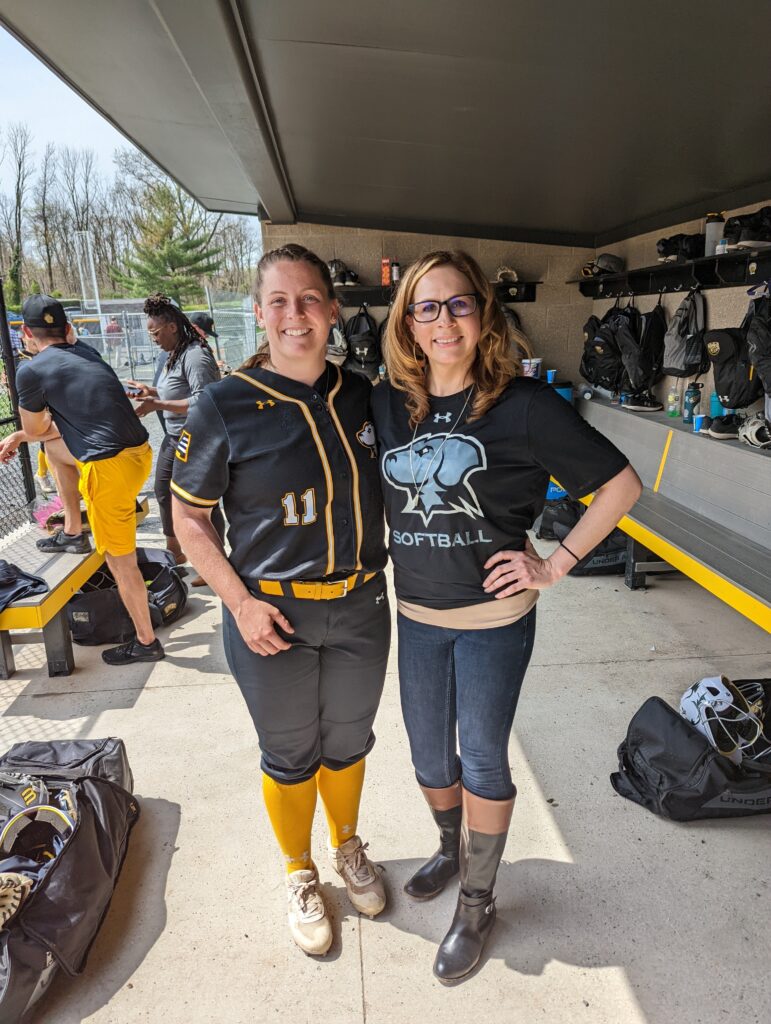 Gurganus with Logan Hawker ’22, catcher on the UMBC Softball team.
When she met the softball team, Gurganus (known as “Prof. G” to many) made it a point to ask each team member. “‘Who are you? Tell me about your major.’ I blocked out time to figure out who every single person was.”
“You have to be the initiator because sometimes they don’t know how to approach you,” says Gurganus. “I came down wearing a softball shirt, and I’m like ‘I’m one of you.’”
“When we were assigned her, I thought it’d be like the university saying, ‘Hey, professor, you have to be the honorary coach.’ But when she’s coming in so often and actually talking to us, and complimenting us, we can tell she actually wants to be here,” says first-year softball player Mikayla Bryant, chemical engineering.
It’s not only about the winning moments—Gurganus is no fair weather fan. During a recent tough moment for the team, “she showed up,” shares Bryant. “It wasn’t like she was forced to be there, but she had some words of advice for us and that was really nice. At that moment everyone was like, ‘Wow, she’s really here for us.’”
Coaches have also witnessed the benefits of the initiative. “We have several students who have a close relationship with her and, more as a mentor or a sounding board for different things going on in their own lives,” says UMBC softball Head Coach Chris Kuhlmeyer, who has led the team to four consecutive championships.
Honorary faculty coaches have their own reasons for wanting to participate in the initiative.
“Honestly, there are research centers that if I wanted to do pure research, I could go do that,” explains Jeff Leips, honorary coach of the UMBC swim and dive team and biological sciences professor. “But when I’m sitting here alone in my office thinking about science, and then I go talk to the team, that’s a great break.”
For Leips, the chance to get out of his office and “doing what I can to promote learning in whatever environment that I can,” is what taking on this role has been all about.
“It definitely changed my thinking about how to facilitate the learning environment for athletic students,” says Gurganus.
Even though the faculty coach initiative is still in its infancy, Leips and Gurganus see the potential for UMBC to continue leading the way in student support. “We can come together to help support these students in a bigger way, and a very non-traditional way, unlike any other university, I think,” says Gurganus.
— Eric Widemann ’21
]]>
In spring 2022, UMBC softball swept all three tournament games to win their third America East championship. The Retrievers held their opponents scoreless, becoming the first team in conference...
https://umbc.edu/stories/faculty-unleashing-their-inner-coach/
https://my3.my.umbc.edu/api/v0/pixel/news/133995/guest@my.umbc.edu/255091d990c0964e3d0277ee132c8125/api/pixel
athletics
cbee
coeit
impact
magazine
meche
softball
spring-2023
UMBC News & Magazine
https://my3.my.umbc.edu/groups/umbc-news-magazine
https://assets1-my.umbc.edu/system/shared/avatars/groups/000/001/943/24435aa6207c452e7bc15cc74b42c7bb/xsmall.png?1748556657
https://assets1-my.umbc.edu/system/shared/avatars/groups/000/001/943/24435aa6207c452e7bc15cc74b42c7bb/original.png?1748556657
https://assets2-my.umbc.edu/system/shared/avatars/groups/000/001/943/24435aa6207c452e7bc15cc74b42c7bb/xxlarge.png?1748556657
https://assets2-my.umbc.edu/system/shared/avatars/groups/000/001/943/24435aa6207c452e7bc15cc74b42c7bb/xlarge.png?1748556657
https://assets3-my.umbc.edu/system/shared/avatars/groups/000/001/943/24435aa6207c452e7bc15cc74b42c7bb/large.png?1748556657
https://assets1-my.umbc.edu/system/shared/avatars/groups/000/001/943/24435aa6207c452e7bc15cc74b42c7bb/medium.png?1748556657
https://assets2-my.umbc.edu/system/shared/avatars/groups/000/001/943/24435aa6207c452e7bc15cc74b42c7bb/small.png?1748556657
https://assets1-my.umbc.edu/system/shared/avatars/groups/000/001/943/24435aa6207c452e7bc15cc74b42c7bb/xsmall.png?1748556657
https://assets2-my.umbc.edu/system/shared/avatars/groups/000/001/943/24435aa6207c452e7bc15cc74b42c7bb/xxsmall.png?1748556657
UMBC News & Magazine
2
0
false
Wed, 14 Jun 2023 10:22:14 -0400
Wed, 14 Jun 2023 10:22:14 -0400
Building AI We Can Trust

The AI apocalypse is coming. Or it isn’t. Depending on what you read, you might get confused.
One thing is certain: Humans are fired up about smart machines. Much of the attention has focused on ChatGPT, an “artificial intelligence language model designed to generate human-like responses to natural language prompts” (in its own words).
ChatGPT gets coy if you ask whether its existence should be cause for human concern. “It’s important to recognize that I am a tool and not inherently good or bad. It’s how people choose to use me that can have positive or negative consequences,” it says.
Many researchers, however, are not so noncommittal. They see inherent flaws in the machine learning technology that forms the foundation of tools such as ChatGPT, and they would like to make it better.
While ChatGPT advises that “it’s always a good idea to double-check any important information I provide,” some UMBC researchers are working to build better safeguards into the AI systems themselves—AI the public can trust.

On March 22 of this year, a group including prominent artificial intelligence researchers and tech entrepreneurs released an open letter calling for a six-month pause on the training of powerful AI systems.
“AI systems with human-competitive intelligence can pose profound risks to society and humanity,” the letter argued. “Powerful AI systems should be developed only once we are confident that their effects will be positive and their risks will be manageable.”
The letter signers, including two UMBC faculty, expressed alarm at an AI arms race unleashed with the November 2022 public debut of ChatGPT, a celebrity chatbot that answers almost any question or prompt with humanlike ease. In a mere two months, the bot attracted 100 million users, and big tech companies began sprinting to deploy similar technology in their products.
Yet a general unease is accompanying this latest rush for AI gold.
ChatGPT can dazzle users with its eloquent prose (and poetry!), but it sometimes delivers complete falsehoods. People fret that such technology will eliminate jobs and empower scammers and dictators. And beneath it all, many researchers worry that we do not fully understand—nor can we reliably control—how creations such as ChatGPT work.
“At the core of many powerful AI systems today are what are called ‘blackbox’ models,” says Manas Gaur, an assistant professor in the Department of Computer Science and Electrical Engineering (CSEE) at UMBC. The models percolate data through layers of calculations so dense and complex that researchers struggle to track what’s happening inside. The models may excel at certain tasks—like writing sentences in ChatGPT’s case—but they cannot explain why they make the decisions they do. Sometimes they do perplexing, and erratic, things.
“Some people see ChatGPT and similar technology as a progressive tool while others fear it is dangerous,” says Nancy Tyagi, a master’s student in computer science at UMBC who is also working as a researcher in Gaur’s lab. “In my opinion, such tools are inherently risky and need further analysis. If these models are to be used in sensitive areas such as mental health or defense systems, then more work is required to make them safe, controllable, and trustworthy.”
Tyagi is working on a project to build an AI mental health assistant capable of initiating safe and appropriate conversations based on clinical guidelines in mental health. Her project is one of many that Gaur and other AI researchers at UMBC are launching with the aim of ensuring AI tools are accurate, transparent, and safe.
To better understand these researchers’ quest for trustworthy AI, it helps to take a step back and consider how the latest AI trend fits into the big picture.

A Brief History of
Thinking Machines
When the field of artificial intelligence launched in the 1950s, computers were feeble compared to the muscular monsters that power systems such as ChatGPT today. Yet researchers were intrigued by the possibility of teaching them to think like humans. What followed was a roller coaster of booms and busts.
“The history of AI has been marked by periods of hype, followed by some level of disillusionment,” says Tim Finin, CSEE professor and a researcher at UMBC who has been studying AI problems for more than 50 years.
Driving the ups and downs were three interrelated factors: the power (and limits) of the hardware that formed computers’ brains, the data available to train those brains, and the “thinking strategies” AI researchers devised.
In the beginning, researchers taught machines to play games, learn language, and solve mathematical puzzles using a variety of “thinking” approaches. Yet the field hit a wall in the 1970s: Computers couldn’t store enough information or process it fast enough to tackle real-world problems. This was the first “AI winter,” when funding dried up and the topic faded from public view.
The birth of the microprocessor at the end of the decade revitalized AI research. Riding the shoots of this new life, a certain approach to machine thinking rose to prominence—that of the expert system. These AI programs were based on pre-programmed knowledge and logic meant to mirror the reasoning of human experts. Perhaps the most famous expert system was IBM’s Deep Blue, which beat the Russian chess champion Garry Kasparov in a chess match in 1997.
Expert systems could shine when solving narrowly defined problems (such as winning a game of chess), but they were brittle, says Finin. The systems struggled to adapt to fuzzy and fluid real-world situations, and it was cumbersome to program all the rules that an expert might use to evaluate a problem.
As the limits of expert systems became clear in the 1990s, AI felt the chill of a second winter.
It was another advance in computing hardware that thawed the field again after the turn of the 21st century. The graphic processing units developed to enhance video games supercharged computers’ speed and power at low cost. This, coupled with a flood of free data from the internet, propelled a new type of AI to the forefront: machine learning.
With loads of computing power and heaps of examples to learn from, researchers found surprising success getting computers to teach themselves how to think. The computers start with a question, perform some calculations, and guess the answer. They then compare it to the actual answer. If they are wrong, (which they usually are at first), they fiddle with the calculations and try again. After running billions of calculations, such systems can become quite proficient at tasks such as identifying images of cats and predicting the next word in a sentence.
THE SEASONS OF AI
The growth of the modern field of AI has been marked by a series of rapid spurts, followed by more dormant periods. People often liken these ups and downs to the seasons. During AI summers, public attention shines hot on the field. Yet the bountiful fruit of the season has often grown from seeds of ideas planted during quiet AI winters.
Summer 1: Expert systems
AI programs based on knowledge and logic flourished in the 1980s. Examples include systems that can identify unknown chemicals, diagnose diseases, and play chess. The systems are safe and explainable, but fail to adapt to fluid and complex situations.
Summer 2: Machine learning
Starting in the early 2010s, the potent combination of supercharged computing and heaps of free internet data powered AI’s second summer: the golden era of machine learning—an era that we are arguably still in.
AI systems started to recognize images, transcribe and translate language, and create text and art almost like humans do. These systems have surprised even their own creators with their range of abilities, but they are hard to understand, reason with, and control.
Into the future: Hybrid AI
It’s not yet clear when or if the second AI summer will turn to fall. But researchers are already planting the seeds for future advances. Combining the fruits of past summers, researchers hope to make future AI systems that are adaptable and safe, self-taught and able to explain their decisions.

FUN FACT:
UMBC’s first Ph.D. graduate in computer science, Sanjeev Bhushan Ahuja, earned his degree when expert systems dominated AI. His dissertation, published in 1985 and titled “An Artificial Intelligence Environment for the Analysis and Classification of Errors in Discrete Sequential Processes,” advances techniques popular during this time.
This approach to machine learning is called a neural network, so named because it was originally inspired by the way neurons in the brain work. Neural networks lie at the heart of most famous AI applications today, including image classification tools, voice recognition, and text and image generators.

The power (and limits) of
machine learning
When many of the new machine learning systems debuted, their powers seemed almost miraculous. But soon enough, drawbacks emerged. The machines require enormous data sets (and enormous amounts of energy) to learn. They will adopt biases from their training data and sometimes from their interactions with humans. A chatbot named Tay was quickly scuppered after its 2016 release, when users pushed it into spewing racist and sexist ideas.
Machine learning systems can also fail spectacularly in individual instances (even if they get answers correct most of the time). For example, a driver was killed in 2016 when the autopilot in a Tesla car failed to recognize the side of a white trailer truck against a bright sky.
The blackbox nature of state-of-the-art machine learning means the systems are unable to explain or justify their conclusions, giving users—and even their own creators—little insight into their thinking. For the most part, the systems struggle to build consistent worldviews or reason logically.
The weaknesses of learning models also leave them susceptible to malicious manipulation. Adversaries might “poison” the data used to train the models or exploit the model’s opaqueness to hide an attack.
“It is time we fall back from trusting these models,” says Gaur, whose personal push to make AI systems more explainable, robust, and safe is part of a growing international movement.
Another UMBC researcher joining the push is Houbing Song, a professor in the Department of Information Systems at UMBC. Song says that transportation, defense, medicine, and the law are some areas where explainable and safe AI systems are needed the most.
As researchers tackle the challenge of making current AI systems better, they are often returning to ideas from an earlier era of AI.

Hybrid systems to merge logic and learning
If the AI systems of the 1980s married the AI systems of the 2010s, their baby might be the type of system Gaur, Song, and others are working to develop.
These systems look to deliver the learning capabilities of neural networks alongside the safeguards of knowledge and rule-based systems.
In the field of mental health, Gaur points out that current chatbot systems are not well suited to answering patients’ questions since they can give unsafe or off-the-wall responses.
“Guaranteeing these systems’ safety calls for more than just improving their overall performance” he says. “We must also make sure the systems are prevented from giving risky answers.”
Working with Karen Chen, an assistant professor from the Department of Information Systems, Gaur has written a paper highlighting the properties that AI-powered virtual mental health assistants should exhibit to be considered safe and effective.
Creating “AI Scientists” at UMBC
New scientific discoveries often lay the groundwork for significant advances in human well being. Think of medical treatments that spring from a better understanding of the human body or labor-saving devices we fashion using our knowledge of material properties.
Tyler Josephson, an assistant professor in the Department of Chemical, Biochemical, and Environmental Engineering, hopes to turbocharge science’s discovery engine, with a little help from AI.
Josephson has started a new project to translate chemical theories into a machine-readable mathematical language. Once the computers have access to the foundations of science, Josephson believes they could be tasked with logically manipulating that information to reveal new discoveries.
You might wonder if Josephson has any worries about creating his own AI-powered replacement. But he doesn’t think AI scientists will displace the human kind.
“I think scientists have so many different problems to solve. And if we solve them faster with AI, they just open up brand new questions for us to go after next,” Josephson said in an interview about his work with the Canadian radio program Quirks & Quarks.

Together with his students, he is also working to create such systems. Using an approach called knowledge-infused learning, the researchers are looking to anchor their AI systems in clinically approved guidelines. They are also pushing their systems to reveal their thinking so that the approaches can be checked by mental health experts. Sometimes the results reveal that even when a system arrives at a correct conclusion, the information it used to reach that conclusion may be irrelevant to a human doctor’s thinking.
Song has also been coaxing AI learning models to open up. In a recent paper, he and his co-authors developed a tool to identify attacks on an image-recognition program by figuring out which parts of its neural network are most susceptible to manipulation.
In the fall of 2023, he will be teaching a new graduate-level course on a broad category of hybrid AI called neurosymbolic AI. UMBC will be only the second university in the world to offer such a course, he says.
Song arrived at UMBC in January on the heels of winning major honors for his research in computing and engineering and is looking forward to turning more of his attention to this emerging frontier in AI research. He says he eventually hopes to build a world-class AI research institute at his new academic home, focused on delivering learning machines that can be confidently used when safety is a top priority.
“I recognize the need for trustworthy AI,” Song says. “I believe that this field of research is where I can make unique contributions and take on responsibilities for my professional communities and my home institution.”


Technology to benefit society
The initial goal of AI, as defined by a group of researchers credited with launching the field at a 1956 workshop, was to “make machines use language, form abstractions and concepts, solve [the] kinds of problems now reserved for humans, and improve themselves.” But if the aim is human-like thinking, it naturally raises the question: How do humans think?
In a bestselling book titled “Thinking, Fast and Slow,” world-renowned psychologist Daniel Kahneman posits that humans have two thinking systems: a fast one and a slow one. The fast one is the thinking that comes to mind almost without effort, and we use this thinking most of the time. Yet it is prone to errors. The deliberative slow thinking system catches mistakes and enables breakthroughs in understanding.
Finin compares machine learning models to the fast-thinking system while knowledge and logic-based systems are more like the slow-thinking system. To make today’s faddish, fast-thinking models more competent, researchers such as Gaur, Song, and their students are extending them with slow-thinking capabilities.
We may still be decades away from AI systems approaching the full range of human intelligence. There are many ethical questions to grapple with before we reach a Hollywood-esque future of self-flying cars and android coworkers. Yet the decades of AI research up to this point have already transformed the world. AI concepts underpin the ways we search the web, shop online, and otherwise interact with the digital world.
AI has enormous potential to improve human lives, but we must proceed wisely. UMBC researchers are at the frontiers of AI research, pushing the limits of knowledge and theory, and striving to make the technology better for the benefit of society.

Training Your Robot Assistants
If you hope the AI revolution will bestow humanity with machine “Jeeves” capable of meeting your every need, Cynthia Matuszek has some bad news. “I’m always being asked: ‘When will we have robot butlers?’ I have to say—not any time soon,” says Matuszek, an associate professor in the Department of Computer Science and Electrical Engineering.
Matuszek researches how to build robots that understand human commands in complex and chaotic natural environments. She has successfully trained a robot hand that can respond to written prompts such as “Grab the apple.” She is also exploring how to teach robots to understand spoken language and to learn new concepts, such as how to dice a vegetable, if a human shows them how.
Part of what motivates Matuszek’s work is the huge unmet demand for caregivers to assist people as they age. Robots might fill the gap. Matuszek says we likely won’t have “Jack of all trades” helpers, but robots could specialize in certain tasks, such as preparing food or folding laundry.
Another part of what motivates Matuszek is the thrill of being the first person to discover how to do something new. “It’s really just so much fun,” she says.

Tyler Josephson’s lab sits off a main corridor in the department of chemical, biochemical and environmental engineering at UMBC. Open the door, though, and you’ll see nary a beaker, chemical closet, or lab coat. Inside, a few computers sit on tables. You might see equations scrawled on the white board or a few students poring over lines of code.
Using this modest setup, Josephson has launched an ambitious project to equip computers to make scientific discoveries—starting in the realm of chemistry. This March he won a prestigious NSF CAREER award to advance the project.
The goal of the work is ultimately to speed up the process of science, which should in turn give humanity new knowledge and tools to face down big challenges such as climate change and environmental degradation.
As Josephson and his students dive into the work, they are bringing together techniques from across mathematics, computer science, and chemical engineering. Their first step is to translate chemical theories into a rigorous mathematical language that a computer can understand.
Math as the language of science
In 1623, the Italian natural philosopher Galileo Galilei wrote an essay in which he described nature as a book written in “the language of mathematics.” Many scientists since have puzzled over the mysterious power of math to describe physical phenomena.
Josephson and his students are tapping into this power. They are using a tool developed by researchers at Microsoft called the Lean theorem prover. Lean is both a computer language and a program for checking each step of a rigorous mathematical proof.
“Formal proofs, which are verified by a computer, differ from the informal, handwritten versions often used by scientists,” says Josephson. Informal proofs are easier to write, but they usually skip logical steps, assuming a human reader will have the knowledge and skill to follow along. This means that errors can creep in undetected.
On the other hand, if a proof has been written and checked in Lean, it is guaranteed to be correct as long as the stated assumptions are true.
A community of Lean programmers
Lean has a dedicated community of volunteer developers who have built a large library of mathematical proofs, each of which can then serve as a building block for more complicated proofs. They aim to digitize mathematics, starting with the entirety of the undergraduate math curriculum, which will lay the foundation for formal proofs in advanced modern mathematics.
Josephson plans to build a similar library with formally correct derivations in science and engineering, starting with chemical concepts such as the thermodynamic behavior of gases and of molecules sticking and unsticking from surfaces.
He and his students describe their approach in a first paper on the subject, and are in the process of submitting it to journals.
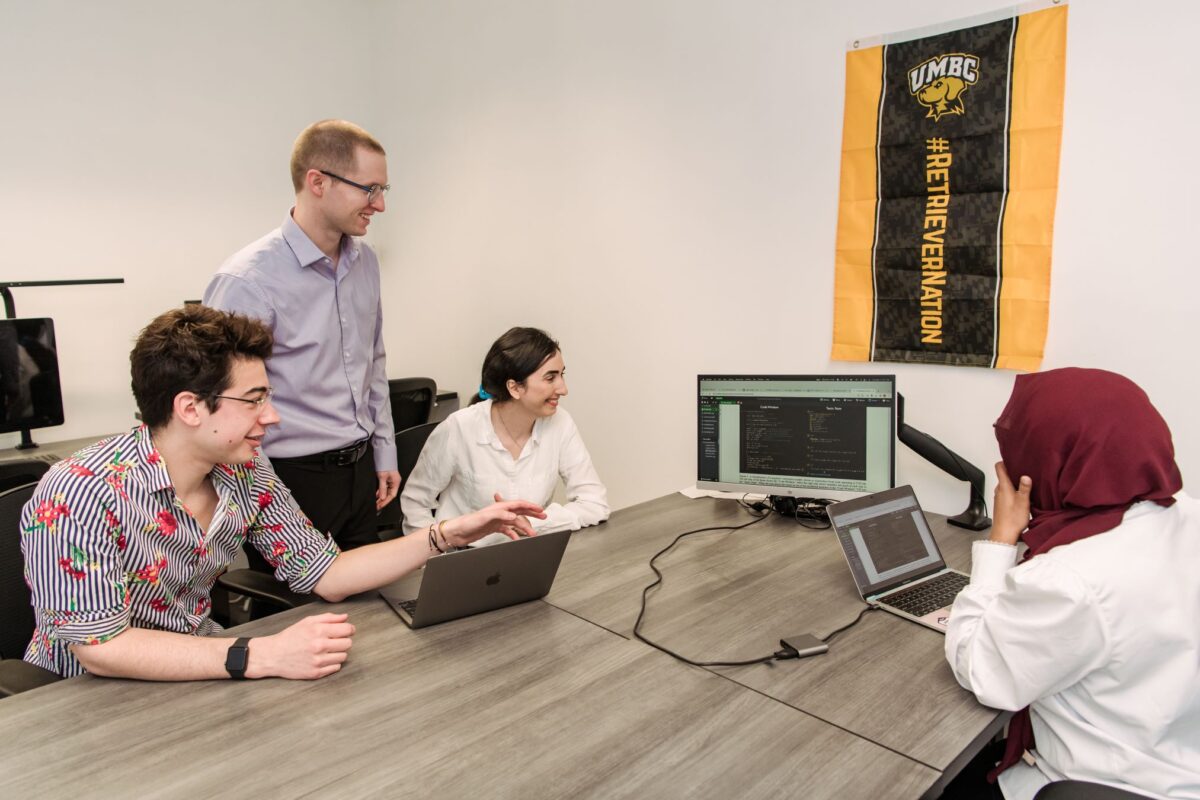 Tyler Josephson (standing) and students Max Bobbin (left), Parivash Feyzishendi (center), and Samiha Sharlin (right) in the lab. (Marlayna Demond ’11/UMBC)
The power of the work will multiply as more of the foundations of science are translated into Lean, so a large part of the team’s work will also be to recruit, inspire, and train fellow proof creators. They will hold workshops to showcase Lean for scientists and engineers, and they plan to create fun and educational games that will teach Lean-programming skills to newcomers.
“I’m really excited to share this tool with students and the scientific community,” Josephson says.
Building better scientific computing tools
Josephson’s goal to formally verify scientific theories isn’t just an intellectual exercise—it’s a means of building better tools for better science. One such tool he plans to create with NSF CAREER award support is Lean-based computer software that can simulate the behavior of molecules under a range of conditions.
Scientists often use such software to test theories as an alternative to physical experiments. It can be easier to run simulations of reactions on a computer, for example, than to mix real chemicals again and again, and some molecular phenomena may happen so fast, or under such extreme conditions, that current experimental tools cannot capture them.
However, bugs can mar the performance of the software. For example, starting in 2011, a hidden coding error fueled a seven-year “war over supercooled water,” in which two scientific groups disagreed about what happens to ultrapure water when it is cooled significantly below the freezing point of normal water, and then suddenly crystallizes.
Code written in Lean is unique from that written in the programming languages commonly used in scientific computing, since it can be provably free of such math errors, Josephson says.
As more scientists and engineers learn to write code and proofs in Lean, others will be able to write bug-free software for applications as diverse as weather forecasting, drug discovery, and predicting material performance.
“AI scientists” who reason on their own
Ultimately, Josephson hopes to use a Lean-based library of scientific knowledge to train computers as fellow scientists. For example, large language models, such as the recently popularized ChatGPT, might be trained on a library of scientific proofs and gain the ability to “autocomplete” proofs on their own, translate informal proofs from the literature into formal ones, and even discover entirely new scientific theories, which could then be checked for correctness by Lean.
A tool like this might revolutionize science. In Galileo’s time, a single person could master large portions of human scientific knowledge, but now scientists usually go to school for decades to become experts in a tiny subfield, Josephson says.
AI scientists capable of digesting a database of thousands of scientific proofs in multiple disciplines might draw connections across them to reveal new discoveries. “Such a tool could lead to an AI-powered Renaissance in interdisciplinary scientific discovery,” says Josephson.
While such lofty goals remain in the future, Josephson and his students are energized by the possibilities. As they embark on an exciting scientific journey, they are thrilled to bring as many people as possible along on the ride.
]]>
Tyler Josephson’s lab sits off a main corridor in the department of chemical, biochemical and environmental engineering at UMBC. Open the door, though, and you’ll see nary a beaker, chemical...
https://umbc.edu/stories/tyler-josephson-wins-nsf-career-award-ai/
https://my3.my.umbc.edu/api/v0/pixel/news/133477/guest@my.umbc.edu/c70af643c276bb3ced915bbf8168e0ac/api/pixel
cbee
coeit
news
research
science-and-tech
UMBC News & Magazine
https://my3.my.umbc.edu/groups/umbc-news-magazine
https://assets1-my.umbc.edu/system/shared/avatars/groups/000/001/943/24435aa6207c452e7bc15cc74b42c7bb/xsmall.png?1748556657
https://assets1-my.umbc.edu/system/shared/avatars/groups/000/001/943/24435aa6207c452e7bc15cc74b42c7bb/original.png?1748556657
https://assets2-my.umbc.edu/system/shared/avatars/groups/000/001/943/24435aa6207c452e7bc15cc74b42c7bb/xxlarge.png?1748556657
https://assets2-my.umbc.edu/system/shared/avatars/groups/000/001/943/24435aa6207c452e7bc15cc74b42c7bb/xlarge.png?1748556657
https://assets3-my.umbc.edu/system/shared/avatars/groups/000/001/943/24435aa6207c452e7bc15cc74b42c7bb/large.png?1748556657
https://assets1-my.umbc.edu/system/shared/avatars/groups/000/001/943/24435aa6207c452e7bc15cc74b42c7bb/medium.png?1748556657
https://assets2-my.umbc.edu/system/shared/avatars/groups/000/001/943/24435aa6207c452e7bc15cc74b42c7bb/small.png?1748556657
https://assets1-my.umbc.edu/system/shared/avatars/groups/000/001/943/24435aa6207c452e7bc15cc74b42c7bb/xsmall.png?1748556657
https://assets2-my.umbc.edu/system/shared/avatars/groups/000/001/943/24435aa6207c452e7bc15cc74b42c7bb/xxsmall.png?1748556657
UMBC News & Magazine
0
0
false
Fri, 12 May 2023 14:51:34 -0400
Fri, 12 May 2023 14:51:34 -0400
Applying philosophy to excel in chemical engineering

Max Bobbin
Degree: B.S., Chemical Engineering; B.A., Philosophy
Hometown: Joppa, MD
Post-grad plans: Ph.D. in chemical engineering, University of Delaware
Max Bobbin may still be an undergraduate, but he’s already made significant research contributions in the Artificial Intelligence and Theory-Oriented Molecular Science (ATOMS) lab, led byTyler Josephson, assistant professor of chemical, biochemical, and environmental engineering. Bobbin was the first in the research group to develop expertise in the programming language Lean. He took on a leadership role, teaching other lab members, including Josephson, about new ways to use Lean. He also selected appropriate projects for new team members, helped the group prepare for Josephson’s parental leave, and initiated new directions for the lab’s work.
Bobbin believes his additional philosophy major supported his engineering work in important ways. “For an engineer, the most important skills are problem-solving, critical thinking, and communication,” he says, “and philosophy is a major built around those three ideas.”
Bobbin also served as vice president of the UMBC American Institute of Chemical Engineers (AIChE) student chapter and led UMBC to the AIChE Jeopardy national championship in 2022.
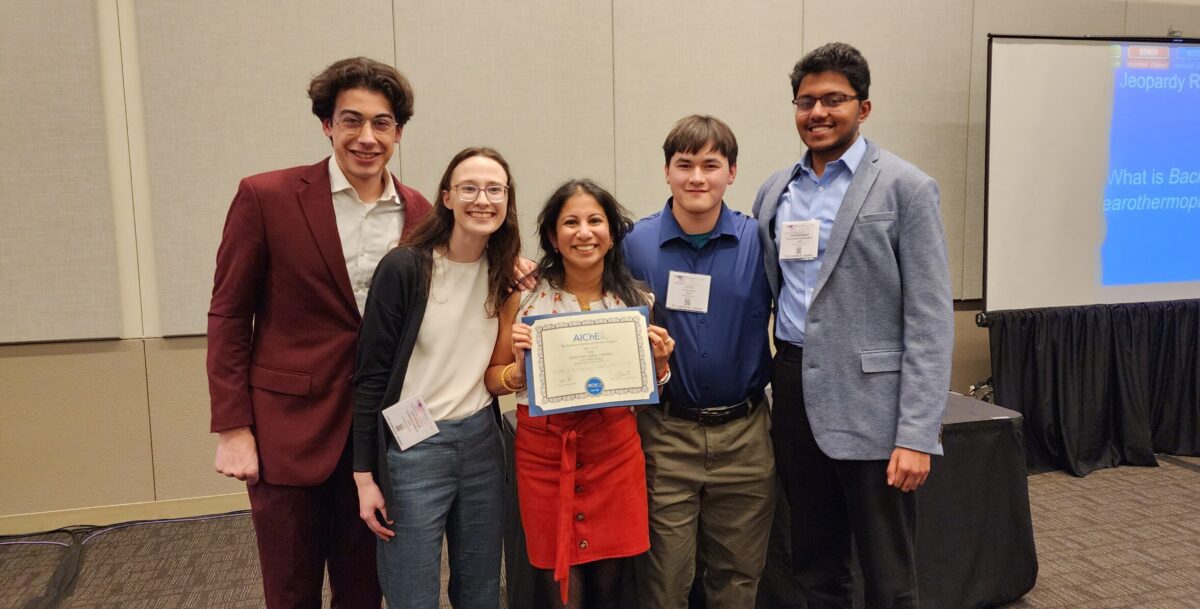 UMBC’s Chemical Engineering Jeopardy National Championship team and their advisor (l-r): Max Bobbin, Catherine Wraback, Neha Raikar (advisor), Colin Jones, and Pavan Umashankar. (Image courtesy of CBEE)
What has been the best part of your UMBC experience?
“My first American Institute of Chemical Engineers Jeopardy competition was nationals in 2021, where we placed second. I worked very hard to make sure we were ready when we went back to nationals in 2022, because I wanted to bring back first place for UMBC. Our practice paid off, and after a tough final round, we won first place at nationals. I enjoyed attending the conferences and the opportunities to network, but competing is my favorite memory because it was the best representation of how well UMBC students work together to achieve their goals.”
Is there a particular academic achievement you’re most proud of?
“In the first couple of months after I joined the Josephson lab, I spent a considerable amount of time learning more about higher level math and coming to our weekly meetings with new information to teach the rest of the group. In the summer, I made my first breakthrough and moved into a leadership role in the group. This project helped me hone my skills relating to learning new subjects, leading a project, and leading a group of people in a new field of study. Plus, it gave me confidence as I continue doing research for my Ph.D.”
]]>
Max Bobbin Degree: B.S., Chemical Engineering; B.A., Philosophy Hometown: Joppa, MD Post-grad plans: Ph.D. in chemical engineering, University of Delaware Max Bobbin may still be an...
https://umbc.edu/stories/applying-philosophy-to-chemical-engineering/
https://my3.my.umbc.edu/api/v0/pixel/news/133095/guest@my.umbc.edu/a8f14c32c10eebbbcbe919efc9db7b6e/api/pixel
cahss
cbee
class-of-2023
coeit
news
philosophy
undergraduate-research
UMBC News & Magazine
https://my3.my.umbc.edu/groups/umbc-news-magazine
https://assets1-my.umbc.edu/system/shared/avatars/groups/000/001/943/24435aa6207c452e7bc15cc74b42c7bb/xsmall.png?1748556657
https://assets1-my.umbc.edu/system/shared/avatars/groups/000/001/943/24435aa6207c452e7bc15cc74b42c7bb/original.png?1748556657
https://assets2-my.umbc.edu/system/shared/avatars/groups/000/001/943/24435aa6207c452e7bc15cc74b42c7bb/xxlarge.png?1748556657
https://assets2-my.umbc.edu/system/shared/avatars/groups/000/001/943/24435aa6207c452e7bc15cc74b42c7bb/xlarge.png?1748556657
https://assets3-my.umbc.edu/system/shared/avatars/groups/000/001/943/24435aa6207c452e7bc15cc74b42c7bb/large.png?1748556657
https://assets1-my.umbc.edu/system/shared/avatars/groups/000/001/943/24435aa6207c452e7bc15cc74b42c7bb/medium.png?1748556657
https://assets2-my.umbc.edu/system/shared/avatars/groups/000/001/943/24435aa6207c452e7bc15cc74b42c7bb/small.png?1748556657
https://assets1-my.umbc.edu/system/shared/avatars/groups/000/001/943/24435aa6207c452e7bc15cc74b42c7bb/xsmall.png?1748556657
https://assets2-my.umbc.edu/system/shared/avatars/groups/000/001/943/24435aa6207c452e7bc15cc74b42c7bb/xxsmall.png?1748556657
UMBC News & Magazine
3
0
false
Mon, 01 May 2023 10:00:38 -0400
UMBC’s Christopher Slaughter, engineering student with health equity focus, wins prestigious Gates Cambridge Scholarship

Christopher Slaughter ’23, M31 computer engineering, has won a Gates Cambridge Scholarship to pursue graduate work at the University of Cambridge in the United Kingdom next fall. Slaughter is the fifth student from UMBC to be recognized with the prestigious award, established by the University of Cambridge in 2000 with a donation from the Bill and Melinda Gates Foundation.
Gates Cambridge Scholars are selected from around the world for their academic talents and commitment to improving the lives of others. Each year around 25 of the 80 total awards are offered to students from the United States.
Slaughter will pursue a Ph.D. in electrical engineering at the University of Cambridge, which is the world’s third oldest surviving university, founded in 1209. His career goals are to develop novel biomedical technologies that meet the healthcare needs of under-resourced communities.
“We are so proud of Chris,” says UMBC President Valerie Sheares Ashby. “He exemplifies UMBC’s values and the Gates Cambridge vision of preparing leaders who demonstrate not only academic excellence, but also a deep commitment to improving the lives of others. Congratulations to Chris, and my thanks and appreciation to those among the UMBC community who have served as influential teachers, mentors, and supporters for Chris throughout his educational journey.”
Research as a way to change the world
Slaughter grew up in a “STEM family,” but he didn’t initially envision a future in research. His perspective changed, however, after he traveled to Germany and Ghana to visit family during his high school years.
While traveling, Slaughter noticed how different communities had inequitable access to healthcare, and he started to think about the disparities that also existed back home in the United States. New biomedical technologies, he realized, might help underserved communities get better care.
Guided by a passion for improving people’s lives, Slaughter began his first of many biomedical research projects. At UMBC’s Bioelectronics Laboratory, he worked on technology to help patients who are insensitive to pain avoid burns. Most recently, he has been working at UMBC’s Center for Advanced Sensor Technology (CAST) in the lab of Govind Rao, professor of chemical and biochemical engineering.
Slaughter is helping develop technology that can sense glucose levels through the skin. This could lead to a device that continuously monitors glucose for people with diseases such as diabetes without painful finger pricks or repeated blood draws. He has presented the work at leading scientific conferences, including the IEEE/EMB Healthcare Innovations Point of Care Technologies conference as the sole undergraduate oral presenter.
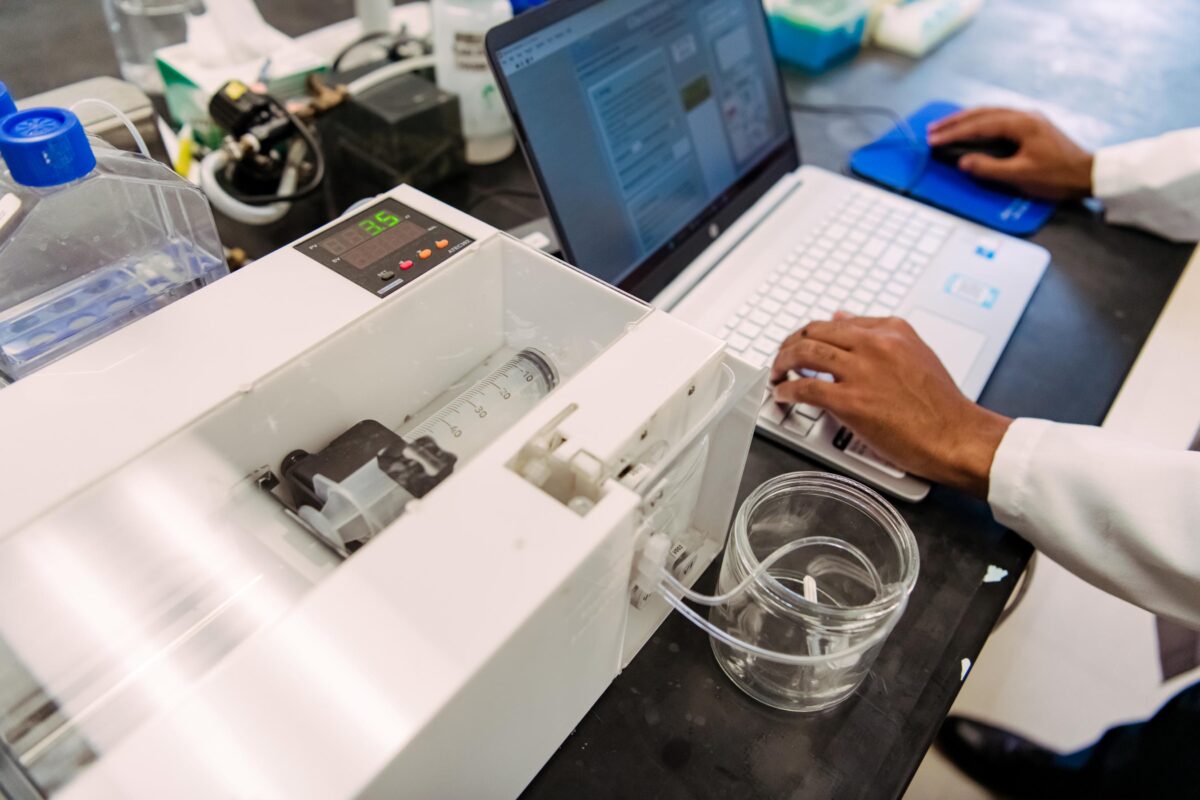
The glucose monitor that Chris Slaughter is helping develop. (Marlayna Demond ’11/UMBC)
“What strikes you immediately about Chris is his sheer enthusiasm, curiosity, and positivity,” Rao says. “He is always eager to be in the lab.”
“Chris’ intense energy and his genuine interest in the topic made him the best mentee you can ask for,” says Hasib Hasan, an electrical engineering Ph.D. student in the department of computer science and electrical engineering who is mentoring Slaughter on the glucose monitor project. “I have no doubt about his ability to become a successful researcher. The Gates Cambridge Scholarship will support him as he pursues work that will improve lives.”
The value of mentorship
Throughout his time at UMBC, Slaughter found mentors to help him grow and learn. He was part of the Meyerhoff Scholars Program, a nationally recognized effort to foster diversity in science, technology, engineering, and mathematics by supporting students who intend to pursue advanced degrees in these fields. He has also been inspired and supported by scholars throughout the UMBC community, such as Rao; Freeman Hrabowski, president emeritus; and Charles LaBerge, professor of the practice in computer science and electrical engineering.
“Mentorship has been so important for me,” Slaughter says. “I knew that in order to succeed, I needed to be in a community that could push me to be my best, hold me accountable, and support me at the same time. To accomplish what I wanted to accomplish—getting a Ph.D. in a scientific field—there was no place better for me to start than UMBC.”
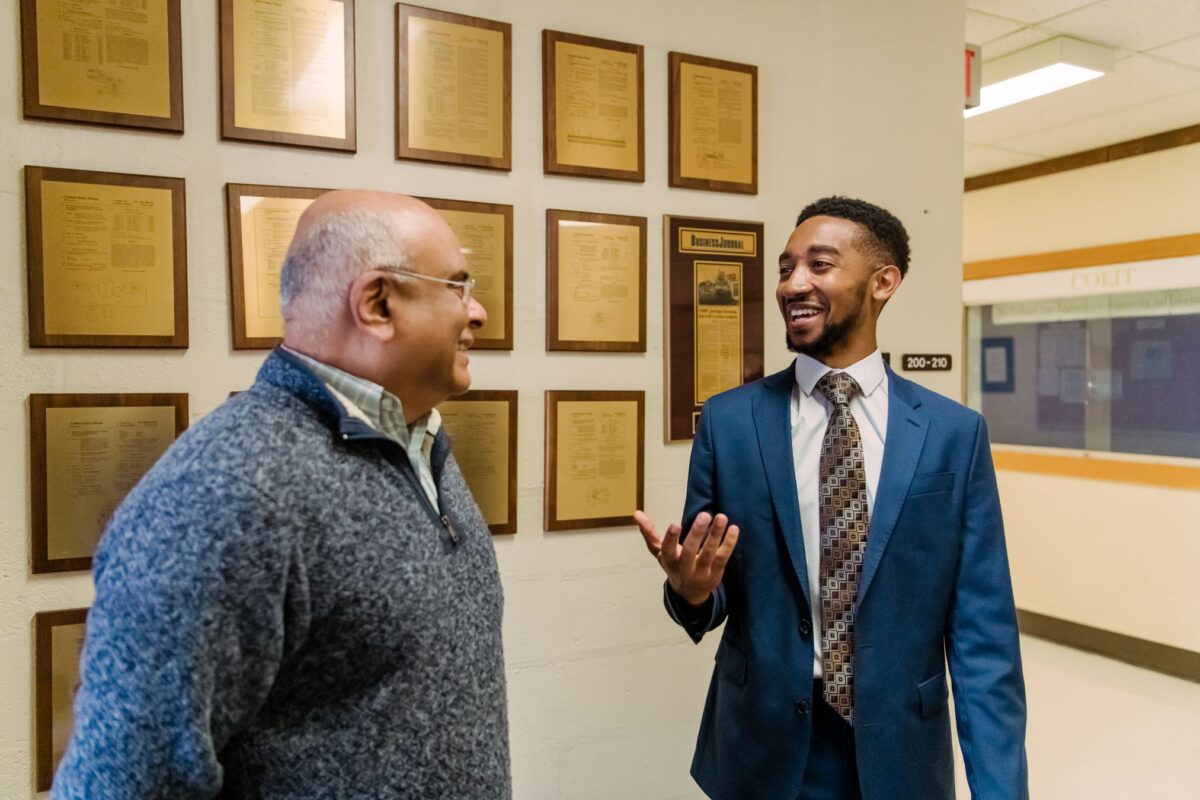
Chris Slaughter (right) is working in the lab of Govind Rao (left). (Marlayna Demond ’11/UMBC)
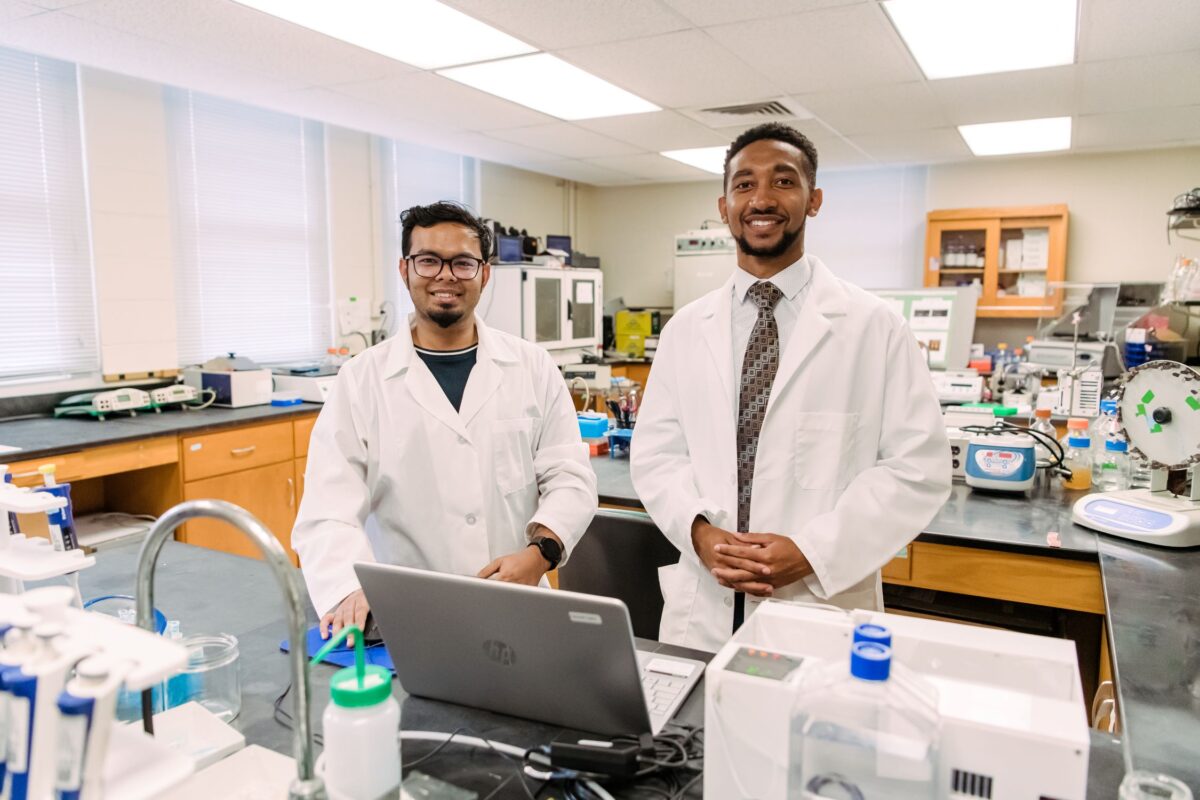
Hasib Hasan (left) and Chris Slaughter (right) in the lab where they are working on a glucose monitoring device. (Marlayna Demond ’11/UMBC)
Slaughter’s application for the Gates Cambridge Scholarship was supported by UMBC’s Office of Prestigious Scholarships, which was established six years ago with the ambition to focus on three major international scholarships as well as others in the U.S., says April Householder, director of undergraduate research and prestigious scholarships at UMBC.
“With Chris’s win, I am happy to say that we have now achieved the trifecta—UMBC alumni simultaneously supported by all three major U.K. scholarships,” she says. The alumni are Rhodes Scholars Naomi Mburu and Sam Patterson at the University of Oxford, Marshall Scholar Joshua Slaughter at the University of Edinburgh, and now Gates Scholar Christopher Slaughter, heading tothe University of Cambridge.
Paying it forward
Having benefited from a culture of mentoring and support at UMBC, Slaughter embraces opportunities to become a mentor and leader himself.
Slaughter was named a Goldwater Scholar in 2022, recognizing him among the top engineering students in the nation. He is president of the UMBC chapter of the National Society of Black Engineers and, through volunteering at local schools, encourages middle and high school students to develop technical skills and aspire to careers in science and technology. In addition, he serves as the vice president of the UMBC chapter of the Institute of Electrical and Electronics Engineers and the UMBC Club Taekwondo team. He also serves as the lead peer advisor in the Meyerhoff Scholars Program, responsible for organizing events and managing peer advisor relationships across the program.
“I think the way we honor the people who invest so much in us is by turning around and doing the same thing for somebody else,” Slaughter says. “Regardless of what I do, I want to make sure I am giving back.”
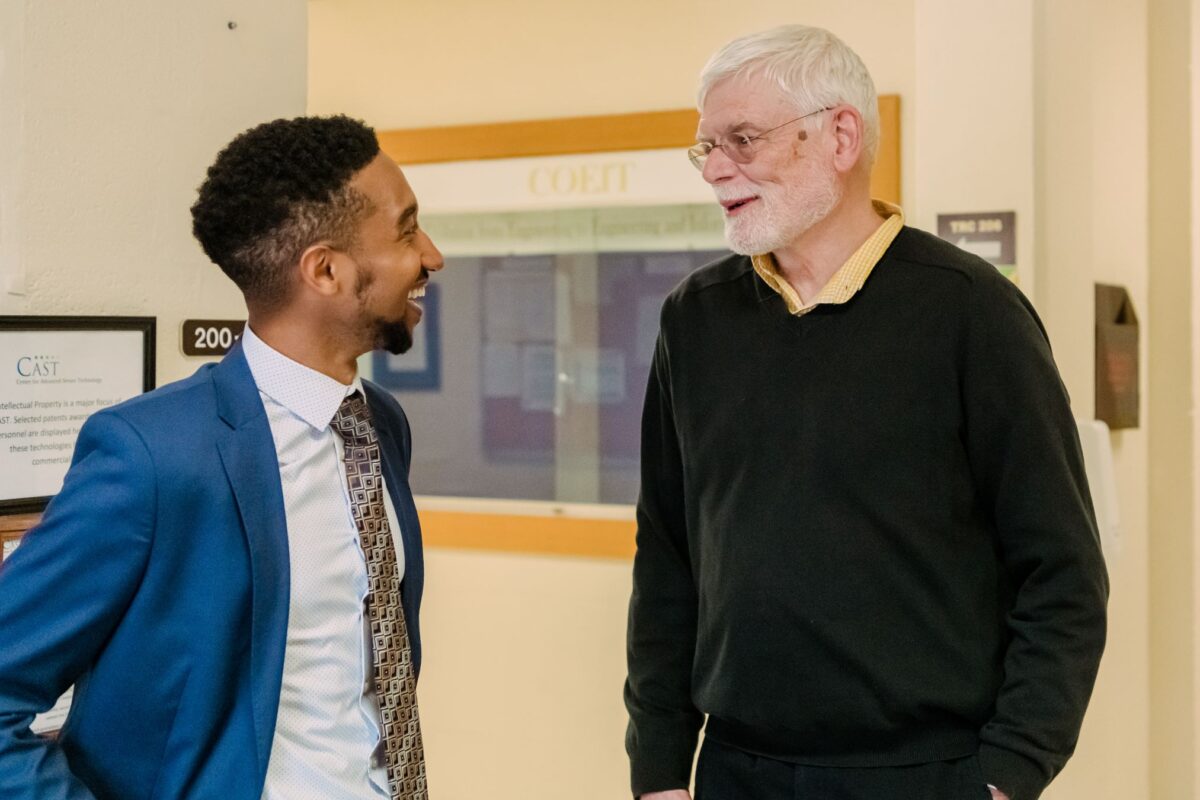 Chris Slaughter (left) talks with mentor Charles LaBerge (right). (Marlayna Demond ’11/UMBC)
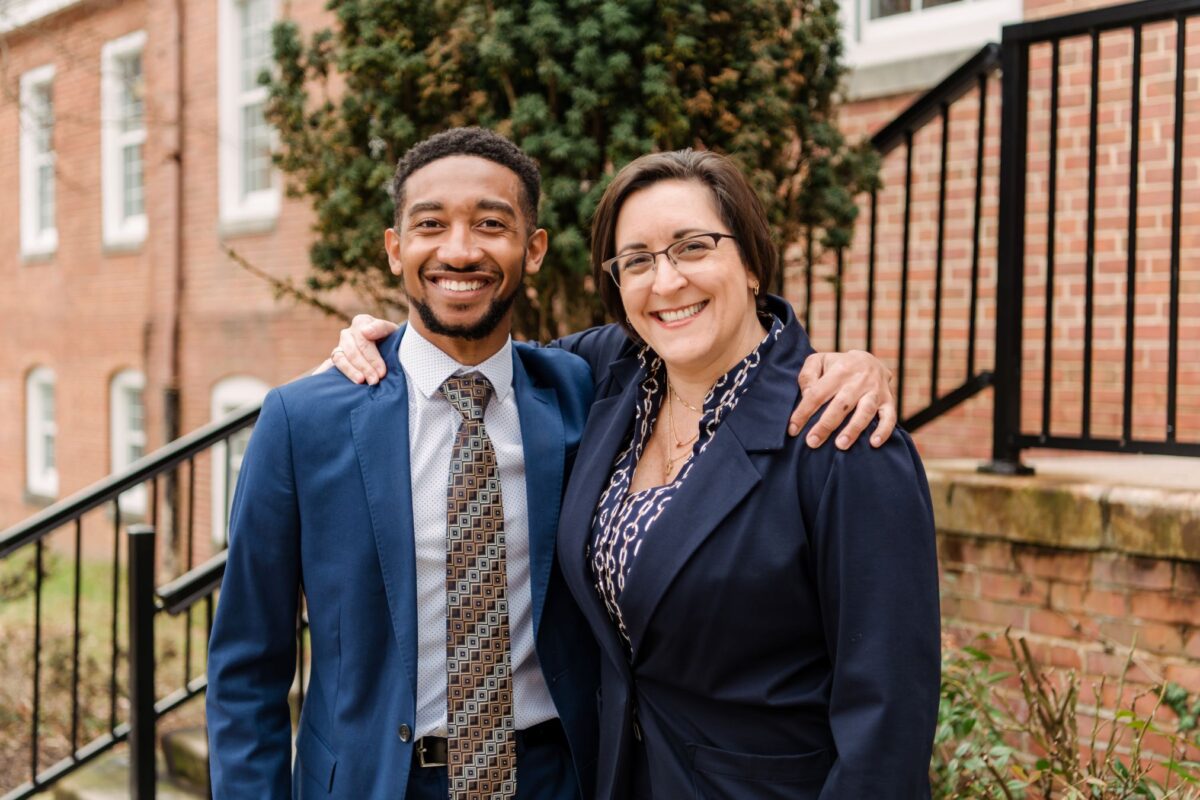 April Householder (right) helped guide Slaughter (left) through the Gates Cambridge process. (Marlayna Demond ’11/UMBC)
Reflecting on his time as a Retriever, Slaughter says he wants to spread the culture of support he encountered at UMBC wherever he goes next. “I think that the great thing about UMBC is we all work together,” he reflects. “I hope throughout my career to make more communities like that because ultimately, I think that’s how we solve the problems that we face today.”
Householder echoes that sentiment. “Chris’s experiences in the Meyerhoff Scholars Program, a national model for STEM student success, have prepared him to be a leader and to lift up others. UMBC has provided a culture of support and mentoring similar to what he will experience as part of a Gates cohort,” she says. “I can’t wait to see how being a Gates Cambridge Scholar will not only help him grow, but how he will transform Cambridge as an institution.”
]]>
Christopher Slaughter ’23, M31 computer engineering, has won a Gates Cambridge Scholarship to pursue graduate work at the University of Cambridge in the United Kingdom next fall. Slaughter is the...
https://umbc.edu/stories/gates-cambridge-scholarship/
https://my3.my.umbc.edu/api/v0/pixel/news/130944/guest@my.umbc.edu/2d4ebfe00a62eac215d0f7a276afe45f/api/pixel
cast
cbee
class-of-2023
coeit
community
csee
news
scholarships
UMBC News & Magazine
https://my3.my.umbc.edu/groups/umbc-news-magazine
https://assets1-my.umbc.edu/system/shared/avatars/groups/000/001/943/24435aa6207c452e7bc15cc74b42c7bb/xsmall.png?1748556657
https://assets1-my.umbc.edu/system/shared/avatars/groups/000/001/943/24435aa6207c452e7bc15cc74b42c7bb/original.png?1748556657
https://assets2-my.umbc.edu/system/shared/avatars/groups/000/001/943/24435aa6207c452e7bc15cc74b42c7bb/xxlarge.png?1748556657
https://assets2-my.umbc.edu/system/shared/avatars/groups/000/001/943/24435aa6207c452e7bc15cc74b42c7bb/xlarge.png?1748556657
https://assets3-my.umbc.edu/system/shared/avatars/groups/000/001/943/24435aa6207c452e7bc15cc74b42c7bb/large.png?1748556657
https://assets1-my.umbc.edu/system/shared/avatars/groups/000/001/943/24435aa6207c452e7bc15cc74b42c7bb/medium.png?1748556657
https://assets2-my.umbc.edu/system/shared/avatars/groups/000/001/943/24435aa6207c452e7bc15cc74b42c7bb/small.png?1748556657
https://assets1-my.umbc.edu/system/shared/avatars/groups/000/001/943/24435aa6207c452e7bc15cc74b42c7bb/xsmall.png?1748556657
https://assets2-my.umbc.edu/system/shared/avatars/groups/000/001/943/24435aa6207c452e7bc15cc74b42c7bb/xxsmall.png?1748556657
UMBC News & Magazine
2
0
false
Wed, 15 Feb 2023 09:20:00 -0500
Wed, 15 Feb 2023 09:20:00 -0500
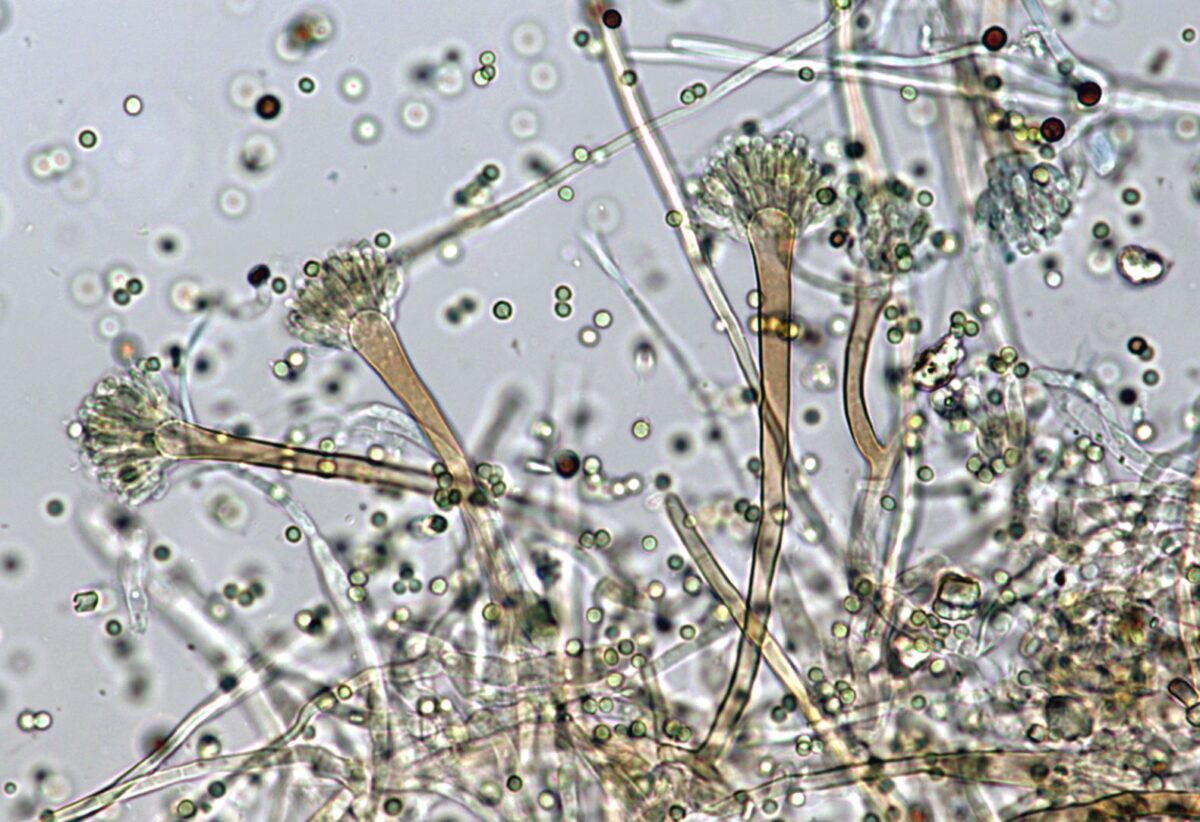 Mold under the microscope. (Image by Kathie Hodge