Manav Narendra ’26—Applied mathematician and cancer survivor fueled by support at UMBC and at home
Through a rigorous academic curriculum, service as a tutor, internships, tennis pick-up games, close friendships, and more, Manav Narendra ’26, mathematics and computer science, has made the most of his time at UMBC and built a strong foundation for future success in applied math and related fields. A leukemia survivor, Narendra has adopted a posture of gratitude and resilience, crediting in part his mother’s unwavering support and UMBC’s close-knit community for helping him thrive academically and personally. Here, Narendra reflects on his path to date, the people who shaped it, and the lessons he’s carrying forward.
Q: Why did you choose UMBC and your two degrees?
A: As a QuestBridge Scholar in high school, I was able to apply to select colleges with no application fee and the potential for a full-ride scholarship. In the end, UMBC just felt right—it was the closest to home, and I appreciated the smaller, more intimate community feel. I felt like at a bigger school I could’ve gotten lost in the crowd, but here I could actually stand out. Plus, UMBC gave me a merit scholarship, which mattered a lot coming from a single-parent household.
I’ve always loved math—calculus was my favorite class in high school. I originally planned to double major in math and physics, because I wanted to go into astronomy or astrophysics. But the job outlook seemed stronger for computer science, and I’d enjoyed coding since middle school, so I switched to that. Now I’m leaning toward applied math fields like actuarial science, because I enjoy stochastic (chaotic) process modeling and probability analysis more than pure software development.
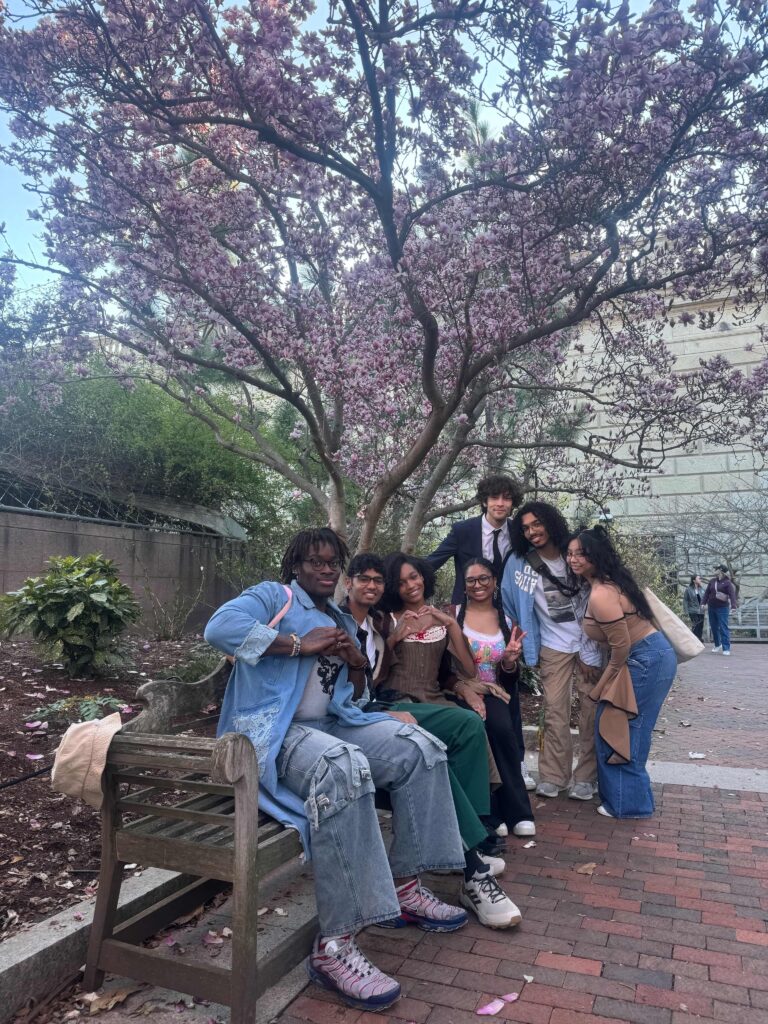
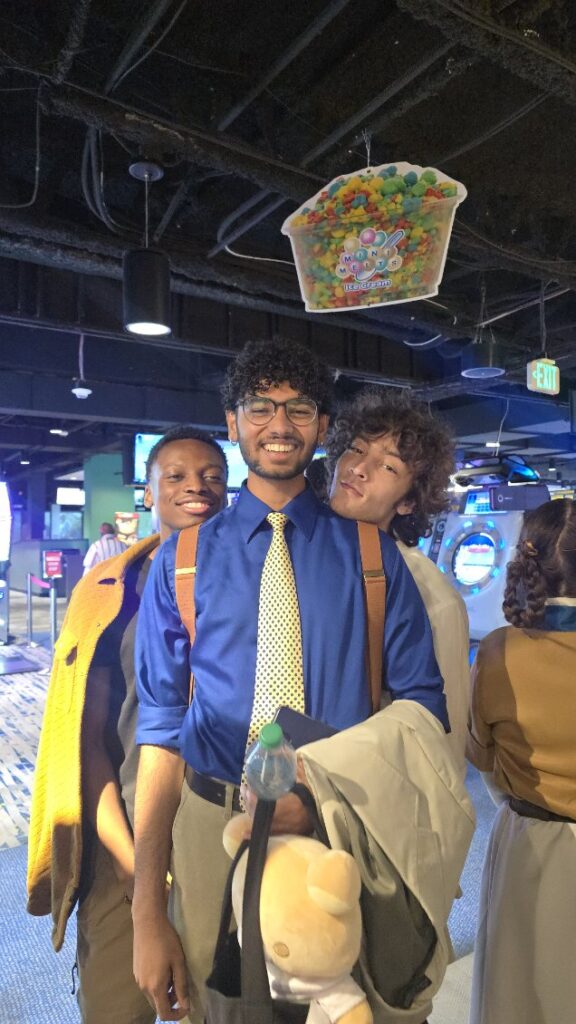 Manav Narendra made friends at UMBC through the discussion and connection possible in smaller classes. (Courtesy of Narendra)
Q: How did your internships enhance your education and influence your career trajectory?
A: I did the same business operations internship at the investor services division of Mitsubishi UFJ Financial Group, where I supported third-party mutual fund administration, twice—after my sophomore and junior years. I’m convinced that talking to company reps in person at the UMBC Career Fair really helped me get the offer. I spent a ton of time in Excel and learned Visual Basic for Applications (VBA), writing programs to automate procedures for other teams at the company. The internship taught me what a corporate environment feels like—being accountable, professional, and how one mistake could have a real effect on production.
The experience was incredibly valuable, even though I don’t think it’s the exact kind of work I want to do long term. I had zero Excel or VBA experience before, and those skills are huge in actuarial work. So even though I realized I want something more independent and creative, the internships gave me practical skills I can take straight into data analysis or actuarial roles. The internships also showed me it’s okay to explore—every experience teaches you something you can carry forward.
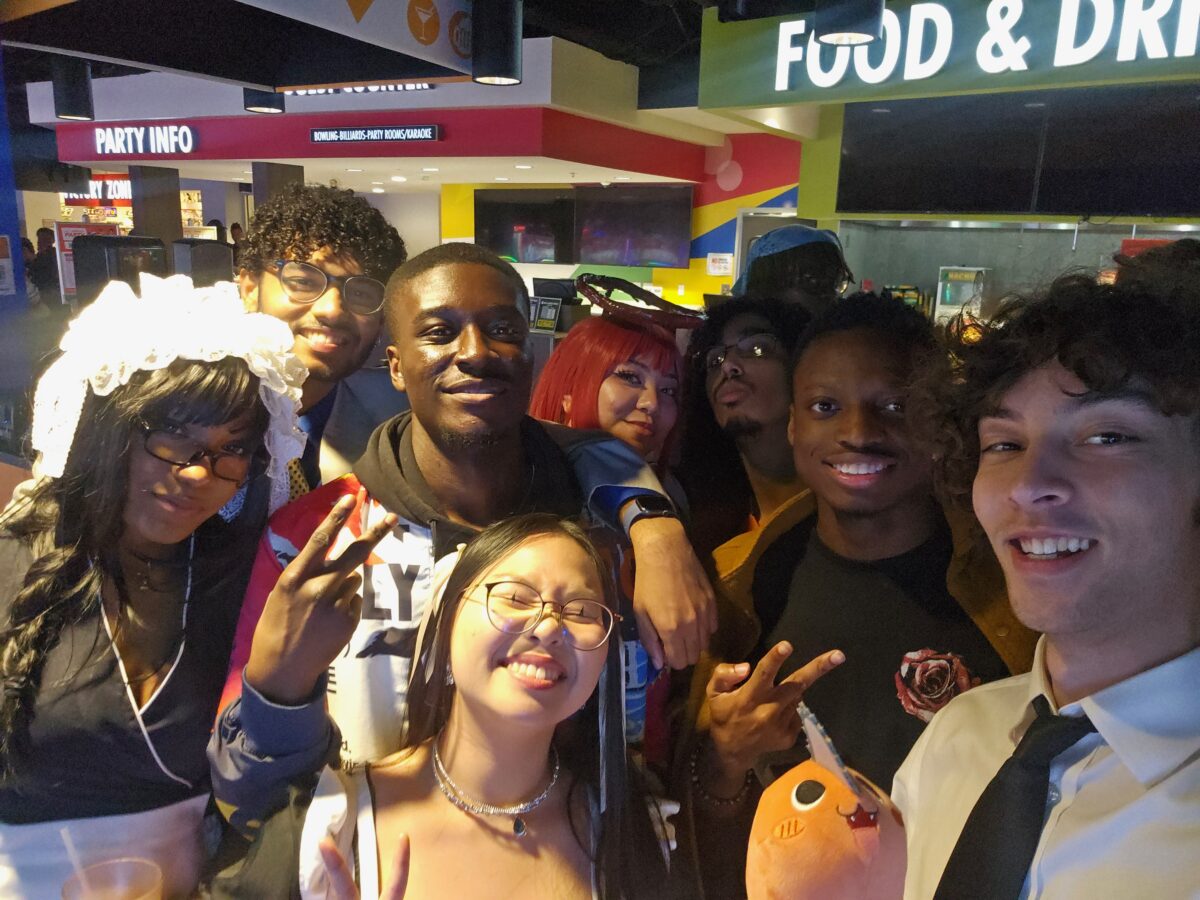 Manav Narendra (back row, left) found plenty of opportunities to spend time with friends despite his demanding academic curriculum. (Courtesy of Narendra)
Q: What’s next for you after graduation?
A: The job market is tough right now, so I’m keeping my options open. I’m considering actuarial positions, data science and analysis, underwriting, even some IT and software roles. I’m open to moving anywhere—I’ve moved a lot in my life, and after five years in Maryland I’m actually getting a little restless!
Certification exams are really important in the fields I want to go into, and I took my first actuarial exam in January. Right now I’m in the Financial Math for Actuaries class at UMBC, which lines up perfectly with the next exam in June. I just want to get my foot in the door somewhere and keep learning.
Q: How have you gotten involved on campus, and how have those experiences supported your well-being and growth?
A: The smaller class sizes at UMBC—especially the 20- to 30-person ones—made everything feel more personal. That’s where I made most of my friends, through connections sparked by real discussion. I also tutored math and Japanese at the Academic Success Center for three years. That was rewarding and kept me grounded.
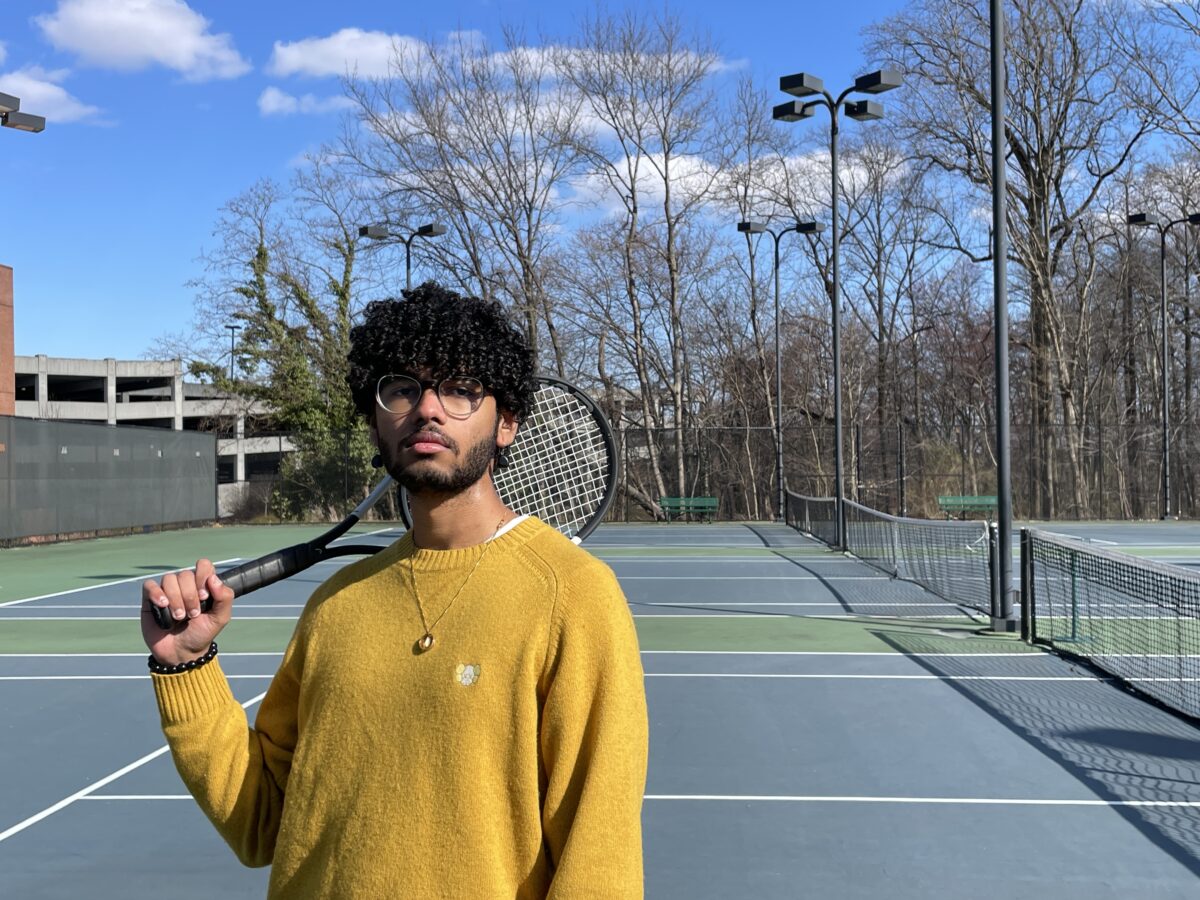 Manav Narendra enjoyed pick-up tennis matches during his time at UMBC. (Courtesy of Narendra)
I’m in the Honors College and the national mathematics honor society, Pi Mu Epsilon, and I just applied to Mu Sigma Rho, the honor society for statistics. My friend is an officer of the Bonsai Club, and I’ve gone to some of their origami and painting events. And I play a lot of pickup tennis—UMBC’s courts are great, and that’s been huge for my physical and mental health and making friends. All of it kept me balanced, especially with a heavy course load to complete both of my degrees in four years.
Q: Who has supported you in your academic and life journey, and what difference has that made?
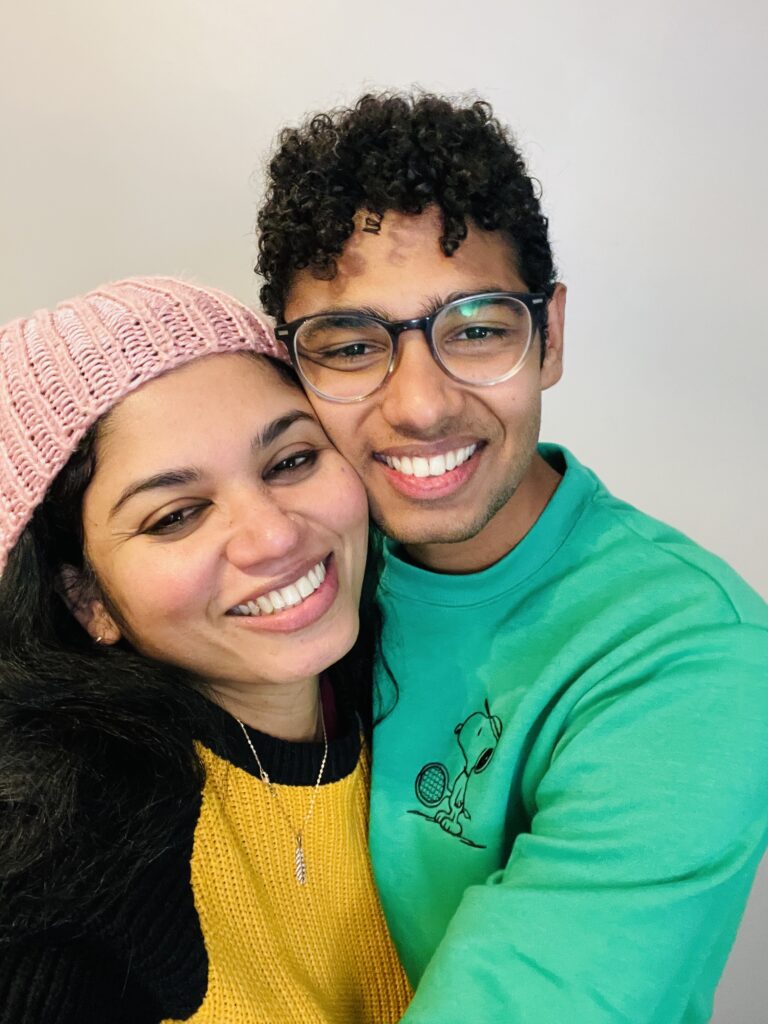 Manav Narendra with his mom, who has provided critical support for him as he underwent cancer treatment and now pursues his professional goals.
A: My mom has been everything. She’s my biggest supporter and my lifelong inspiration, both personally and academically. She stopped working for years to take care of me when I had cancer, getting me to every appointment and advocating for my treatment. I tell people it was much harder for her than for me—I just had to deal with the physical pain, but she handled so much, mentally, emotionally…I wasn’t the brave one during treatment; she was. She’s overcome so much adversity to get me to where I am today, and for that I’m eternally humbled and grateful. Also, at a time in India when women were discouraged from pursuing their dreams and there were large gender disparities in higher education, she embraced her passion for public health and became the first person from her village to earn a doctorate. She later completed a postdoc at Duke—that’s why we first came to the U.S. Her story inspires me every single day to chase after my dreams and always stay true to myself.
At UMBC, Dr. Simon Stacey andDr. Julie Oakes in the Honors College; Dr. Hye-Won Kang and Dr. Kal Nanes in the math department; and pretty much every professor I’ve had have been incredible. They’ve advised me on careers, written recommendation letters, and helped me explore actuarial science. That support made me feel seen and capable.
Q: How did having cancer affect your outlook?
A: When I was 13, I was diagnosed with acute lymphoblastic leukemia (ALL) while we were living in India. The first year of intense chemo was brutal—my brain has blocked out memory of the worst of the agonies. In my debilitated state, I was forced to miss the bulk of 8th grade. Later on, I had GI complications that left me bedridden and using a nasal feeding tube for months, but one silver lining of that time overlapping with the pandemic was that I could join online school right from my bed. Thankfully, I’ve been off treatment since summer 2020, and I’m doing well now. I still have some minor residual issues from treatment—but I’m here!
Cancer gave me resilience. It’s my second chance at life. Challenges that used to feel huge just don’t faze me the same way anymore. That experience put everything in perspective: If I could get through that, I can get through anything. I try to live life to the fullest because of it.
Q: What advice do you have for incoming UMBC students?
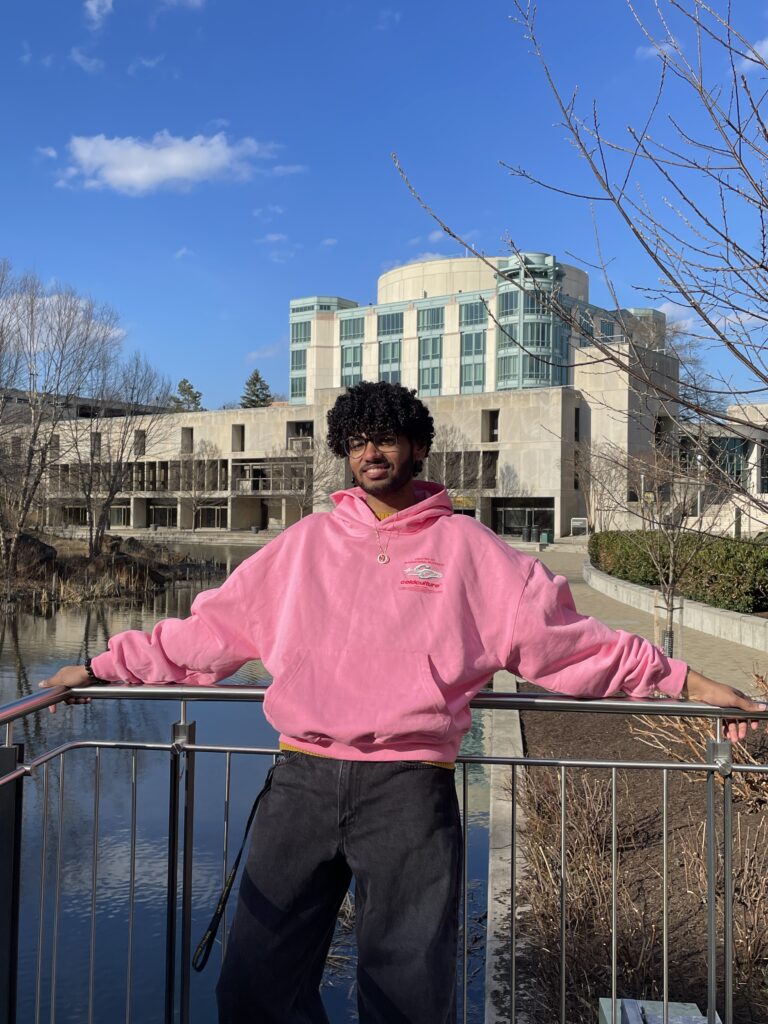 Manav Narendra has come into his own at UMBC, and now he is ready to take on his next chapter. (Courtesy of Narendra)
A: Keep going. Even when things get hard—personal stuff, academics, whatever—just keep moving forward. Break everything into small steps. I’m a serial procrastinator, but I still get everything done by staying consistent with a simple to-do list. Whatever your goal is—an internship, a recital, a competition—just take one small step at a time. Nothing is impossible.
And above all, try to be a good person. I love this Einstein quote: “Try not to become a man of success, but rather try to become a man of value. He is considered successful in our day who gets more out of life than he puts in. But a man of value will give more than he receives.” Be kind. Be empathetic. That matters more than straight As. And UMBC’s community will meet you where you are, and then help you grow, as long as you show up.
]]>
Through a rigorous academic curriculum, service as a tutor, internships, tennis pick-up games, close friendships, and more, Manav Narendra ’26, mathematics and computer science, has made the most...
https://umbc.edu/stories/manav-narendra-mathematician-and-cancer-survivor/
https://my3.my.umbc.edu/api/v0/pixel/news/158897/guest@my.umbc.edu/4e584111e90d8a3ae6e3c320e09c669f/api/pixel
class-of-2026
cnms
coeit
community
csee
mathstat
news
science-and-tech
story
UMBC News & Magazine
https://my3.my.umbc.edu/groups/umbc-news-magazine
https://assets1-my.umbc.edu/system/shared/avatars/groups/000/001/943/24435aa6207c452e7bc15cc74b42c7bb/xsmall.png?1748556657
https://assets1-my.umbc.edu/system/shared/avatars/groups/000/001/943/24435aa6207c452e7bc15cc74b42c7bb/original.png?1748556657
https://assets2-my.umbc.edu/system/shared/avatars/groups/000/001/943/24435aa6207c452e7bc15cc74b42c7bb/xxlarge.png?1748556657
https://assets2-my.umbc.edu/system/shared/avatars/groups/000/001/943/24435aa6207c452e7bc15cc74b42c7bb/xlarge.png?1748556657
https://assets3-my.umbc.edu/system/shared/avatars/groups/000/001/943/24435aa6207c452e7bc15cc74b42c7bb/large.png?1748556657
https://assets1-my.umbc.edu/system/shared/avatars/groups/000/001/943/24435aa6207c452e7bc15cc74b42c7bb/medium.png?1748556657
https://assets2-my.umbc.edu/system/shared/avatars/groups/000/001/943/24435aa6207c452e7bc15cc74b42c7bb/small.png?1748556657
https://assets1-my.umbc.edu/system/shared/avatars/groups/000/001/943/24435aa6207c452e7bc15cc74b42c7bb/xsmall.png?1748556657
https://assets2-my.umbc.edu/system/shared/avatars/groups/000/001/943/24435aa6207c452e7bc15cc74b42c7bb/xxsmall.png?1748556657
UMBC News & Magazine
2
0
false
Fri, 17 Apr 2026 10:19:24 -0400
Fri, 17 Apr 2026 10:19:24 -0400
Four UMBC student researchers receive prestigious Goldwater Scholarships
Four UMBC students have been named Barry Goldwater Scholars this year. The Barry Goldwater Scholarship and Excellence in Education Foundation supports talented college sophomores and juniors who aspire to become leading researchers in science, engineering, and mathematics in the U.S. The award is one of the most prestigious for undergraduates in STEM.
UMBC juniors Deeya Mistry, biological sciences, Jessica Slaughter, computer engineering, Phoenix Bryant, biological sciences, and sophomore Amir Walton-Irvin, computer engineering, are among the 454 scholars selected nationwide in 2026. They competed with nearly 1,500 students majoring in science, engineering, and mathematics who were nominated by their academic institutions for the award.
This is the third time that a record four UMBC students have received Goldwater Scholarships in the same year.
“I’m always so impressed by the caliber of students at UMBC,” says April Householder ’95, director of undergraduate research and prestigious scholarships, who works with students each year to prepare their Goldwater application materials. “And I’m excited to see what they do next, because this is also a springboard to even bigger and better opportunities.”
Personal stories propel curiosity
The road to a successful scientific career can be arduous, and each of this year’s UMBC Goldwater Scholars have tapped deep curiosity, a drive to make a difference, as well as nurturing family and school support, to take them to this prestigious milestone on their journeys.
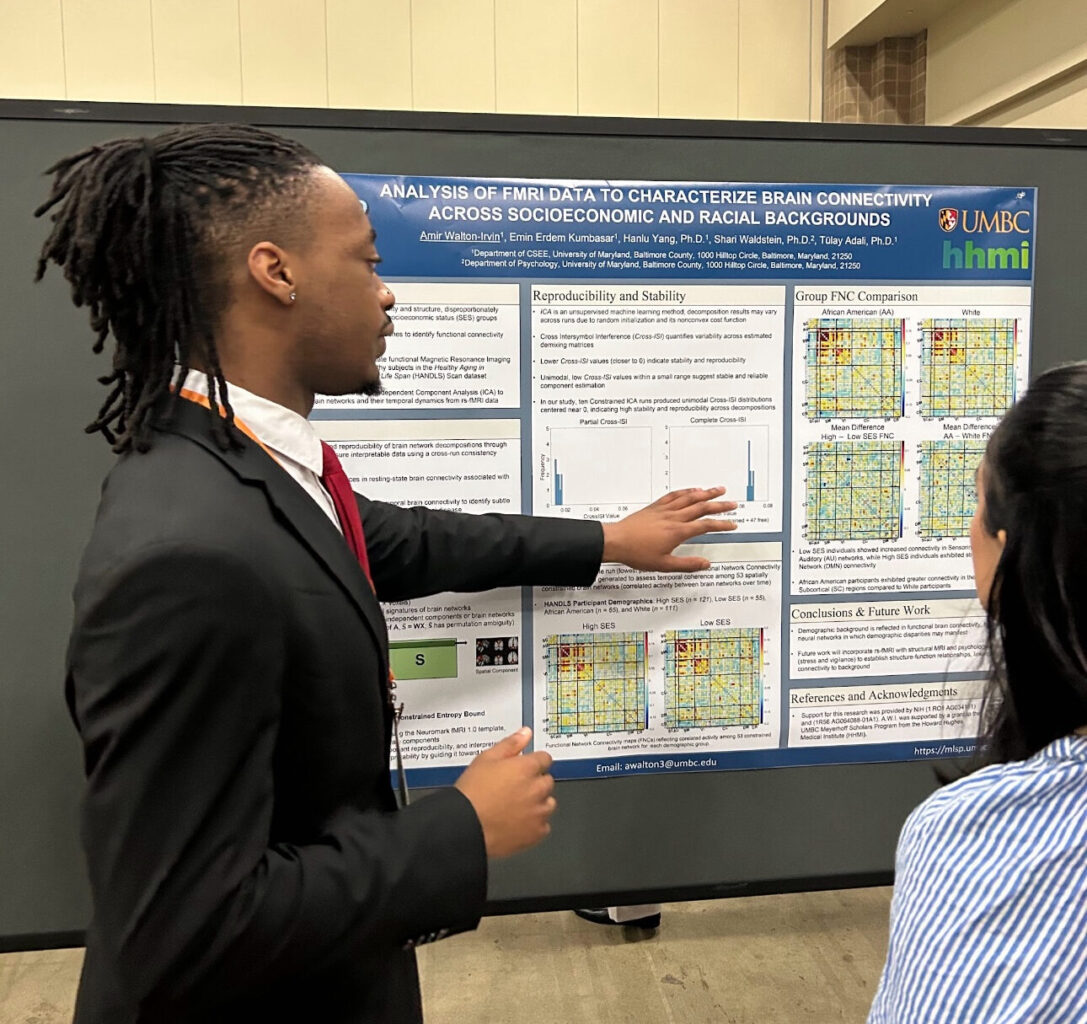 Amir Walton-Irvin presents his research at the 2025 Biomedical Research Conference for Minoritized Scientists. (Photo courtesy of Amir Walton-Irvin)
“I grew up in a household with my mom and my grandmother, who were both mathematics teachers,” Walton-Irvin says. “They both helped nurture my interest in STEM from an early age. My grandmother taught me how to solve math problems, code, and take things apart and put them back together, while my mom encouraged that curiosity by exposing me to engineering camps and science museums.”
Later, when his grandmother started showing signs of dementia, Walton-Irvin found himself facing a host of hard-to-answer questions. “She went from someone who had an answer to every question to not knowing who I was anymore. It was heartbreaking, but it also made me start asking bigger questions: Why did this happen to her, like it has to so many others before her? How does disease change brain function?” He plans to pursue a career at the intersection of machine learning and neuroscience, developing novel neuroimaging analysis methods to investigate neurological disease and health disparities.
 Jessica Slaughter working in Polina Anikeeva’s lab at MIT during a summer internship. (Photo courtesy of Jessica Slaughter)
Bryant experienced a similar personal connection to unanswered scientific questions when her dad was diagnosed with schizoaffective disorder. “I remember asking my mom: ‘Why is he like this?’ And sometimes she’d say: ‘We don’t know that yet.’ And I really wanted to know the answer,” Bryant says. She plans to enter an M.D.-Ph.D. program, and would like to study how environmental factors influence how genes are expressed and may contribute to the development of psychiatric diseases.
Mistry found herself drawn to science since grade school, working to get ever closer to that scientific frontier where new knowledge is created. “Since not everything is known yet, there’s the possibility to uncover more,” she says. “Doing scientific research is an amazing way to pursue my curiosity.” She plans to pursue an M.D.-Ph.D. with a clinical focus in emergency medicine and a Ph.D. studying the molecular makeup of individualized stroke recovery.
“While my clinical and research focuses are different from one another, I was really inspired to study this when I shadowed in the Emergency Department in downtown Baltimore,” she says. “Stroke patients usually come to the Emergency Department first, and everyone’s experience truly is different, because timing is crucial for strokes.”
Slaughter says the possibility of combining new knowledge with helping people drew her to the field of engineering, where she hopes to make a difference by improving global health, especially in disadvantaged areas where resources are limited.
Coming from a family of immigrants, Slaughter watched her grandmother travel over 5,000 miles to the U.S. for surgery, even as her health made the journey difficult. “That experience gave me a window into global healthcare disparities, especially in access to diagnostics and effective treatment, and showed me how engineering can be part of the solution,” she says. It is what drives her to develop low-cost, accessible medical devices and incorporate machine learning.
A supportive family—at home and at school
All the new scholars emphasize how much mentorship, connections, and support have helped them as they worked toward their dreams.
“One of the reasons winning this scholarship is so meaningful to me is because it was only two generations ago when women in my family did not get past a high school education,” says Mistry. She credits her parents with instilling in her a strong work ethic and the confidence to overcome challenges. “My dreams were built on the sacrifice and hard work of my parents and grandparents,” she says.
She also credits the many mentors she met at UMBC. Mistry, Slaughter, Bryant and Walton-Irvin are all part of the Meyerhoff Scholarship Program, which aims to increase diversity among future leaders in science, technology, engineering, and related fields.
“The Meyerhoff program and the COEIT community, particularly Dr. LaBerge and Dr. Marten, have been instrumental to my career,” Slaughter says.
“The advisors in the Meyerhoff program really helped me, and they’re always so supportive,” Bryant echoed.


On left, Deeya Mistry (right) with Mitsue Wiggs, associate director of the Meyerhoff program. (Photo courtesy of Deeya Mistry). On right, Jessica Slaughter (with braids) celebrates winning the limbo contest at the annual Meyerhoff Family Retreat at Centennial Park. “The Meyerhoff program isn’t just a scholarship, but also a family that celebrates every win, big or small,” she says. (Photo courtesy of Jessica Slaughter)
The students also credit their mentors in the labs where they do research on campus. Mistry is investigating the molecular mechanisms that underlie the sex differences in chronic stress susceptibility to understand why females have a higher susceptibility to chronic stress-induced psychiatric disorders such as depression and anxiety in the lab of Tara LeGates. Bryant is studying the biomechanical properties of a protein involved in chromatin regulation in the lab of Erin Green. Slaughter is applying statistical principles to develop bioinformatics applications to facilitate the analysis of dynamic, system-scale “-omics” data in the lab of Mark Marten. And Walton-Irvin is applying machine learning and signal processing methods to investigate functional brain connectivity and health disparities in the lab of Tülay Adali.
On the right path
For the four UMBC students, winning a Goldwater Scholarship is both a validation of the work they have put in so far, and a stepping stone to their next achievement.
“When I saw the email letting me know I’d been selected, I literally screamed, I was so excited,” Slaughter says. “I FaceTimed my family. I FaceTimed all my friends who helped me through this journey. I immediately sent thank you emails to all my mentors.”
Mistry messaged LeGates, her research advisor, and sprinted to her office to celebrate.
Walton-Irvin’s first response was to call his mom, as the news felt both emotional and affirming. “It meant a lot to know that the path I’m trying to build, one rooted in both personal experience and a desire to empower others, was being recognized,” he says. “Awards like this are meaningful, but I see them as part of a much larger journey of doing impactful work.”
 The Goldwater Scholars and some of their mentors strike a fun pose. Back row, from left to right, Ph.D. student Emin Erdem Kumbasar, Amir Walton-Irvin, and Professor Charles Laberge. Middle row, from left to right, Assistant Professor Tara LeGates, Deeya Mistry, Jessica Slaughter, Phoenix Bryant, and Associate Professor Erin Green; front row, April Householder. (Brad Ziegler/UMBC)
Come meet all four Goldwater Scholars at the Undergraduate Research and Creative Achievement Day on April 22 in the RAC, where they will be presenting their research alongside more than 400 other student presenters:
Deeya Mistry: “Investigation of the Circadian Rhythm on Blood Brain Barrier Permeability,” RAC 050, 9:20 – 9:35 a.m.
Phoenix Bryant: “Investigating the Function of the PHD Finger in Chromatin Regulator Set4,” RAC Arena, 10 – 11 a.m., Poster #20
Amir Walton-Irvin: “Analysis of FMRI Data to Characterize Brain Connectivity Across Socioeconomic and Racial Backgrounds,” RAC 230, 11:20 – 11:35 a.m.
Jessica Slaughter: “Open-Source Software Suite of Bioinformatic Tools for Dynamic Omics Data,” RAC Arena, 2 – 3 p.m., Poster #65
]]>
Four UMBC students have been named Barry Goldwater Scholars this year. The Barry Goldwater Scholarship and Excellence in Education Foundation supports talented college sophomores and juniors who...
https://umbc.edu/stories/umbc-goldwater-2026/
https://my3.my.umbc.edu/api/v0/pixel/news/158732/guest@my.umbc.edu/3c3d3b8609cf3cedec6939ce5b5a34a2/api/pixel
biology
cnms
coeit
community
csee
meyerhoff-scholars
news
science-and-tech
story
undergraduate-research
UMBC News & Magazine
https://my3.my.umbc.edu/groups/umbc-news-magazine
https://assets1-my.umbc.edu/system/shared/avatars/groups/000/001/943/24435aa6207c452e7bc15cc74b42c7bb/xsmall.png?1748556657
https://assets1-my.umbc.edu/system/shared/avatars/groups/000/001/943/24435aa6207c452e7bc15cc74b42c7bb/original.png?1748556657
https://assets2-my.umbc.edu/system/shared/avatars/groups/000/001/943/24435aa6207c452e7bc15cc74b42c7bb/xxlarge.png?1748556657
https://assets2-my.umbc.edu/system/shared/avatars/groups/000/001/943/24435aa6207c452e7bc15cc74b42c7bb/xlarge.png?1748556657
https://assets3-my.umbc.edu/system/shared/avatars/groups/000/001/943/24435aa6207c452e7bc15cc74b42c7bb/large.png?1748556657
https://assets1-my.umbc.edu/system/shared/avatars/groups/000/001/943/24435aa6207c452e7bc15cc74b42c7bb/medium.png?1748556657
https://assets2-my.umbc.edu/system/shared/avatars/groups/000/001/943/24435aa6207c452e7bc15cc74b42c7bb/small.png?1748556657
https://assets1-my.umbc.edu/system/shared/avatars/groups/000/001/943/24435aa6207c452e7bc15cc74b42c7bb/xsmall.png?1748556657
https://assets2-my.umbc.edu/system/shared/avatars/groups/000/001/943/24435aa6207c452e7bc15cc74b42c7bb/xxsmall.png?1748556657
UMBC News & Magazine
1
0
false
Tue, 14 Apr 2026 16:29:33 -0400
Tue, 14 Apr 2026 16:29:33 -0400
Unlocking motivation: Grad student leads discovery of how two hippocampus regions team up to fuel goal-driven behavior
New UMBC research reveals how two different parts of the hippocampus—the brain’s memory center—team up in a key reward region to help mice, and likely humans, combine memories of places and contexts with the drive to pursue rewards.
 Tara LeGates’ research group works at the intersection of neuroscience and behavior. (Brad Ziegler)
The findings offer fresh insight into how the brain integrates information about “where” and “what feels good” to guide everyday decisions, such as heading to a favorite restaurant to meet friends or seeking out rewarding experiences. Specifically, this discovery, published in the Journal of Neuroscience, shows that inputs from the dorsal and ventral hippocampus converge on the same individual neurons in another brain region, the nucleus accumbens, where they interact in ways that amplify each other’s effects.
“The connection between the hippocampus and nucleus accumbens is where the brain’s map of where to go meets a sense of why it’s worth going,” explains senior author Tara LeGates,assistant professor in UMBC’s Department of Biological Sciences.
For years, scientists viewed the connections from the dorsal hippocampus, which is more closely tied to spatial memory and navigation, and the ventral hippocampus, which is linked more strongly to emotions and motivation, as mostly separate. This paper challenges that understanding.
“A single neuron can receive inputs from different brain regions, and figuring out how it integrates them is crucial for understanding what drives goal-directed actions,” LeGates says.
While the current study focuses on individual cells, the implications reach further. Better knowledge of how these reward-related circuits process and combine information could shed light on conditions where motivation is disrupted, such as depression, addiction, or anxiety disorders.
A close-up on convergence
The research team used advanced methods including using light to stimulate specific pathways (a technique called optogenetics), precise recordings of electrical activity in neurons, and detailed microscope imaging to identify a group of neurons in a specific part of the accumbens that receives direct input from both the dorsal and ventral hippocampus.
Importantly, the synapses involved in these two pathways sit very close together—often within a couple of microns (thousandths of a millimeter)—on the same branches of the neurons’ dendrites, which look like tree roots on nerve cells. That proximity allows them to influence each other quickly. The team found that when both inputs are active at the same time, they produce a stronger combined response than either one alone.
 Tara LeGates (right) discusses hippocampus cell images with Ph.D. student Nick Anderson (left) and undergraduate Branwen She. (Brad Ziegler)
The researchers collaborated with Tagide deCarvalho, director of UMBC’s Keith Porter Imaging Facility, to obtain the high-resolution imaging that confirmed these close partnerships. Upgraded software at the facility allowed the team to capture ultra-thin digital slices (0.2 microns thick) and create 3D reconstructions of neuron branches, clearly demonstrating the close proximity of the synapses that would allow them to interact.
The study’s first author, Ashley Copenhaver ’20, mathematics and biological sciences, Ph.D. ’25, neuroscience and cognitive sciences, led much of the hands-on work in recordings and imaging while mentoring undergraduate team members.
 Tara LeGates’ research group includes a number of graduate and undergraduate students who are gaining experience in techniques like electrophysiology and dissection. (Brad Ziegler)
“One of the most exciting parts of this technically challenging project was performing dual-color optogenetics during electrophysiology—I was literally shining tiny beams of red and blue light onto brain tissue, which was activating the dorsal or ventral hippocampus neurons, so that I could record the electrical responses in the nucleus accumbens neurons. It was magical,” Copenhaver says. “Beyond loving the technique, in my opinion, we identified some really critical and fundamental mechanisms of signal integration within the brain. I’m super excited to see where this work heads next.”
From cells to behavior
Understanding how a single neuron handles signals from different brain areas is key to grasping complex behaviors, says LeGates, who has a secondary appointment in the Department of Pharmacology and Physiology at the University of Maryland School of Medicine. Signals from the dorsal and ventral hippocampus are “probably converging more than we’ve previously appreciated, which could change how people approach questions about motivation and learning,” she adds.
That kind of convergence likely helps animals form associations between rewarding outcomes and the environments where they occur—an essential capability for survival. Similar convergence has been seen in other brain areas involved in emotional learning, LeGates says, suggesting the brain may use this strategy widely to link a particular context with feeling and action.
 Kaela Befano ’24, biological sciences (left), is now a staff researcher in the LeGates laboratory. (Brad Ziegler)
LeGates’ lab is already building on this paper’s foundation by exploring how stress and substances like food, medications, and illicit drugs affect these same connections, with the long-term aim of informing more targeted treatments for various mental health conditions. In the immediate future, the team hopes to record activity from these specially connected neurons during real behaviors to directly link the newly discovered crosstalk between the ventral and dorsal hippocampus to actions.
By uncovering this hidden layer of cooperation between hippocampal pathways, the LeGates lab has advanced our understanding of how the brain weaves together memory and motivation—a fundamental process that shapes the decisions driving daily life.
]]>
New UMBC research reveals how two different parts of the hippocampus—the brain’s memory center—team up in a key reward region to help mice, and likely humans, combine memories of places and...
https://umbc.edu/stories/unlocking-motivation-hippocampus-regions-team-up/
https://my3.my.umbc.edu/api/v0/pixel/news/158537/guest@my.umbc.edu/b6550c10304ec0473895a6317fad8e18/api/pixel
biology
cnms
graduate-research
news
research
science-and-tech
story
UMBC News & Magazine
https://my3.my.umbc.edu/groups/umbc-news-magazine
https://assets1-my.umbc.edu/system/shared/avatars/groups/000/001/943/24435aa6207c452e7bc15cc74b42c7bb/xsmall.png?1748556657
https://assets1-my.umbc.edu/system/shared/avatars/groups/000/001/943/24435aa6207c452e7bc15cc74b42c7bb/original.png?1748556657
https://assets2-my.umbc.edu/system/shared/avatars/groups/000/001/943/24435aa6207c452e7bc15cc74b42c7bb/xxlarge.png?1748556657
https://assets2-my.umbc.edu/system/shared/avatars/groups/000/001/943/24435aa6207c452e7bc15cc74b42c7bb/xlarge.png?1748556657
https://assets3-my.umbc.edu/system/shared/avatars/groups/000/001/943/24435aa6207c452e7bc15cc74b42c7bb/large.png?1748556657
https://assets1-my.umbc.edu/system/shared/avatars/groups/000/001/943/24435aa6207c452e7bc15cc74b42c7bb/medium.png?1748556657
https://assets2-my.umbc.edu/system/shared/avatars/groups/000/001/943/24435aa6207c452e7bc15cc74b42c7bb/small.png?1748556657
https://assets1-my.umbc.edu/system/shared/avatars/groups/000/001/943/24435aa6207c452e7bc15cc74b42c7bb/xsmall.png?1748556657
https://assets2-my.umbc.edu/system/shared/avatars/groups/000/001/943/24435aa6207c452e7bc15cc74b42c7bb/xxsmall.png?1748556657
UMBC News & Magazine
0
0
false
Thu, 09 Apr 2026 15:18:29 -0400
Thu, 09 Apr 2026 15:18:29 -0400
Celebrating the misunderstood: Mercedes Burns featured in new book on North America’s overlooked critters
GRIZZLED: Love Letters to 50 of North America’s Least Understood Animals spotlights the quirky, often-misunderstood inhabitants of our backyards and beyond. It hits bookstores this week, and Mercedes Burns, associate professor of biological sciences, is featured in an essay that dives into the world of harvesters—better known as daddy longlegs.
The essay debunks the common myth that harvesters are the most venomous spiders in the world, but only harmless because their mouthparts are too small to bite a human. In fact, rather than being spiders at all, Burns shares that they are intriguing arachnid relatives. She unpacks their survival tactics, like shedding legs to escape predators, and other eccentric behaviors that make these gangly denizens more endearing than eerie.
“I’ve studied arachnids for over a decade, and learning about them has opened my eyes to the diversity of less-appreciated and absolutely fascinating species that occur in North America,” Burns shares. “I am excited to join the league of researchers who contributed to this book, and I hope that readers find a new local species to love.”
Burns’ passion for arachnids isn’t new—and it’s been weaving its way into public consciousness for years. In a 2020 New York Times piece, she demystified the fuzzy clusters of daddy longlegs that sometimes “grow” on buildings, turning a gross-out moment into a lesson on their harmless, communal nature. She’s also weighed in on arachnid feats, such as spiders devouring snakes up to 30 times their size, as featured in a 2021 Smithsonian article.
 Mercedes Burns handles one of her study organisms in the lab. (Marlayna Demond ’11/UMBC)
At UMBC, Burns’ impact extends beyond the page. Her 2023 NSF CAREER Award funds research on arachnid evolution in Japan, blending fieldwork with student mentorship to nurture the next generation of scientists and champion arachnid appreciation. There is even a trapdoor spider species named Ummidia mercedesburnsae in her honor.
Burns’ work reminds us that even tiny creatures deserve our attention and care. Dive into science journalist Jason Bittel’s GRIZZLED to discover your own “local species to love.”
]]>
GRIZZLED: Love Letters to 50 of North America’s Least Understood Animals spotlights the quirky, often-misunderstood inhabitants of our backyards and beyond. It hits bookstores this week, and...
https://umbc.edu/quick-posts/celebrating-misunderstood-critters/
https://my3.my.umbc.edu/api/v0/pixel/news/157157/guest@my.umbc.edu/d791c07bbc9e763ecff1fb84e8dc9937/api/pixel
biology
cnms
quick-post
science-and-tech
UMBC News & Magazine
https://my3.my.umbc.edu/groups/umbc-news-magazine
https://assets1-my.umbc.edu/system/shared/avatars/groups/000/001/943/24435aa6207c452e7bc15cc74b42c7bb/xsmall.png?1748556657
https://assets1-my.umbc.edu/system/shared/avatars/groups/000/001/943/24435aa6207c452e7bc15cc74b42c7bb/original.png?1748556657
https://assets2-my.umbc.edu/system/shared/avatars/groups/000/001/943/24435aa6207c452e7bc15cc74b42c7bb/xxlarge.png?1748556657
https://assets2-my.umbc.edu/system/shared/avatars/groups/000/001/943/24435aa6207c452e7bc15cc74b42c7bb/xlarge.png?1748556657
https://assets3-my.umbc.edu/system/shared/avatars/groups/000/001/943/24435aa6207c452e7bc15cc74b42c7bb/large.png?1748556657
https://assets1-my.umbc.edu/system/shared/avatars/groups/000/001/943/24435aa6207c452e7bc15cc74b42c7bb/medium.png?1748556657
https://assets2-my.umbc.edu/system/shared/avatars/groups/000/001/943/24435aa6207c452e7bc15cc74b42c7bb/small.png?1748556657
https://assets1-my.umbc.edu/system/shared/avatars/groups/000/001/943/24435aa6207c452e7bc15cc74b42c7bb/xsmall.png?1748556657
https://assets2-my.umbc.edu/system/shared/avatars/groups/000/001/943/24435aa6207c452e7bc15cc74b42c7bb/xxsmall.png?1748556657
UMBC News & Magazine
0
0
false
Wed, 04 Mar 2026 12:07:19 -0500
Wed, 04 Mar 2026 12:07:19 -0500
Connecting NASA to the classroom: UMBC physicist Zhibo Zhang to lead Goddard Planetary Heliophysics Institute
Zhibo Zhang, professor of physics, has been named director of the Goddard Planetary Heliophysics Institute (GPHI), UMBC’s arm of the Partnership for Heliophysics and Space Environment Research (PHaSER). PHaSER, a multi-institution consortium led by Catholic University of America, contributes to NASA’s Heliophysics Science Division at Goddard Space Flight Center (GSFC) through research on the Sun, its processes, and space weather, which can affect planet Earth and human technologies.
NASA allocated $10 million to UMBC in 2021 under its $64.1 million PHaSER award, underscoring the university’s contributions to heliophysics research and building on more than thirty years of successful collaboration between UMBC and GSFC, located in Greenbelt, Maryland.
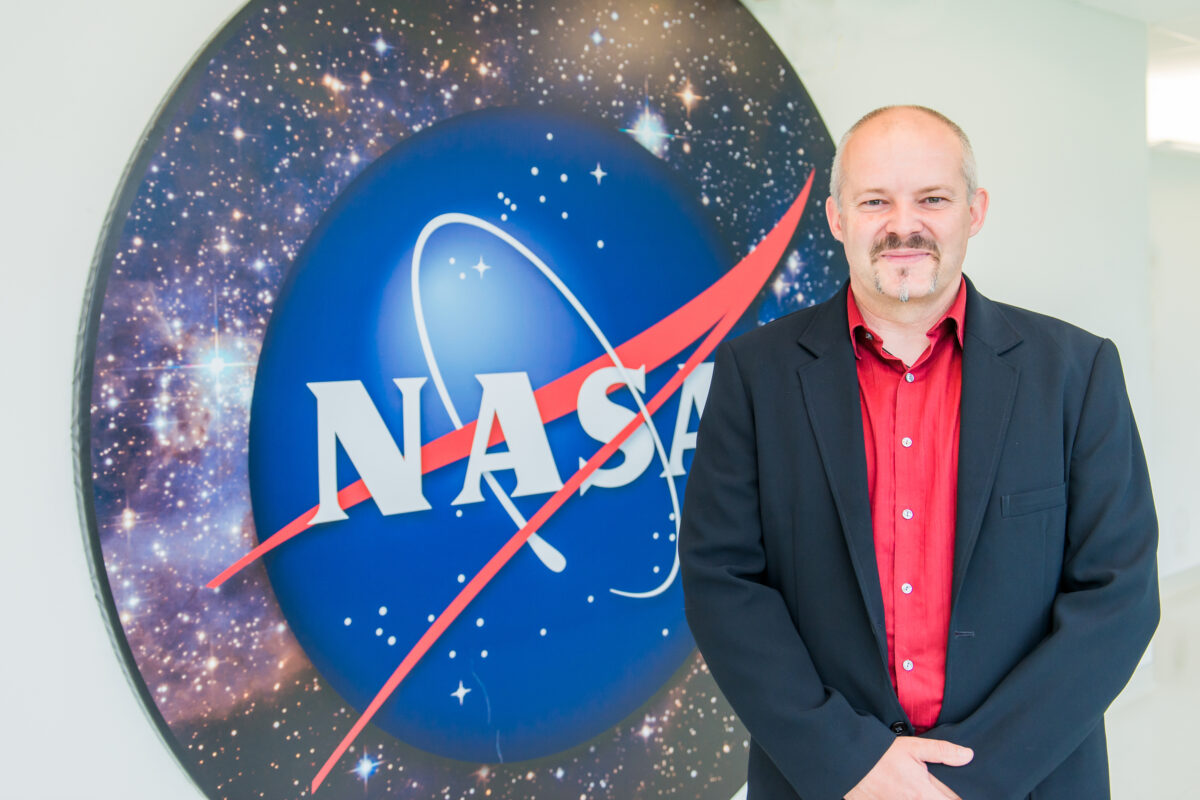 Jan Merka led GPHI from from its inception in 2011 and will hand the reins to Zhibo Zhang this month. (Marlayna Demond ’11/UMBC)
“My first priority is to support GPHI faculty and help enable the outstanding science and engineering they carry out at NASA Goddard Space Flight Center,” Zhang says. “At the same time, I hope GPHI can serve as a stronger bridge between NASA and UMBC by connecting GPHI faculty with UMBC research resources, collaboration and funding opportunities, and with students and faculty who can expand our collective capacity and open doors to bigger, cross-cutting ideas.”
Zhang follows Jan Merka, who has served as the inaugural GPHI director since 2011. As director, Zhang will continue in his faculty role at UMBC, advancing his team’s research on atmospheric dust’s influence on climate and remaining deeply committed to teaching and mentoring. His guidance of undergraduate and graduate students has helped multiple students secure the prestigious NASA Future Investigators in NASA Earth and Space Science and Technology (FINESST) Fellowship and other awards, including the 2025 Elsevier/JQSRT Richard M. Goody Award, fostering the next generation of scientists.
“We are very proud of the fact that UMBC is currently ranked as the #11 institution in the nation in NASA expenditures,” say Karl V. Steiner, vice president for research and creative achievement. “Zhibo Zhang is an outstanding colleague with a broad set of relevant expertise and experiences who will provide important leadership to GPHI and to our partnership with Catholic University under PHaSER. I know that he is the right leader to strengthen our relationship with NASA, building on over three decades of successful cooperative partnership between UMBC and NASA Goddard.”
 Zhibo Zhang (second from right) thoughtfully mentors undergraduate and graduate students, including Qianqian Song (right), Ph.D. ’22, who received the FINESST fellowship, and Jianyu Zheng (far left, rear), Ph.D. ’23, who received the 2025 Elsevier/JQSRT Goody Award. (Marlayna Demond ’11/UMBC)
]]>
Zhibo Zhang, professor of physics, has been named director of the Goddard Planetary Heliophysics Institute (GPHI), UMBC’s arm of the Partnership for Heliophysics and Space Environment Research...
https://umbc.edu/stories/zhang-to-lead-goddard-planetary-heliophysics-institute/
https://my3.my.umbc.edu/api/v0/pixel/news/157136/guest@my.umbc.edu/7aba311f3831e3c2c778aff9a9535436/api/pixel
cnms
gphi
nasa
news
phaser
physics
research
science-and-tech
story
UMBC News & Magazine
https://my3.my.umbc.edu/groups/umbc-news-magazine
https://assets1-my.umbc.edu/system/shared/avatars/groups/000/001/943/24435aa6207c452e7bc15cc74b42c7bb/xsmall.png?1748556657
https://assets1-my.umbc.edu/system/shared/avatars/groups/000/001/943/24435aa6207c452e7bc15cc74b42c7bb/original.png?1748556657
https://assets2-my.umbc.edu/system/shared/avatars/groups/000/001/943/24435aa6207c452e7bc15cc74b42c7bb/xxlarge.png?1748556657
https://assets2-my.umbc.edu/system/shared/avatars/groups/000/001/943/24435aa6207c452e7bc15cc74b42c7bb/xlarge.png?1748556657
https://assets3-my.umbc.edu/system/shared/avatars/groups/000/001/943/24435aa6207c452e7bc15cc74b42c7bb/large.png?1748556657
https://assets1-my.umbc.edu/system/shared/avatars/groups/000/001/943/24435aa6207c452e7bc15cc74b42c7bb/medium.png?1748556657
https://assets2-my.umbc.edu/system/shared/avatars/groups/000/001/943/24435aa6207c452e7bc15cc74b42c7bb/small.png?1748556657
https://assets1-my.umbc.edu/system/shared/avatars/groups/000/001/943/24435aa6207c452e7bc15cc74b42c7bb/xsmall.png?1748556657
https://assets2-my.umbc.edu/system/shared/avatars/groups/000/001/943/24435aa6207c452e7bc15cc74b42c7bb/xxsmall.png?1748556657
UMBC News & Magazine
1
0
false
Wed, 04 Mar 2026 09:28:26 -0500
Wed, 04 Mar 2026 09:28:26 -0500
On the track and in the pool, UMBC nabs America East titles
Zhibo Zhang (second from right) thoughtfully mentors undergraduate and graduate students, including Qianqian Song (right), Ph.D. ’22, who received the FINESST fellowship, and Jianyu Zheng (far left, rear), Ph.D. ’23, who received the 2025 Elsevier/JQSRT Goody Award. (Marlayna Demond ’11/UMBC)
]]>
Zhibo Zhang, professor of physics, has been named director of the Goddard Planetary Heliophysics Institute (GPHI), UMBC’s arm of the Partnership for Heliophysics and Space Environment Research...
https://umbc.edu/stories/zhang-to-lead-goddard-planetary-heliophysics-institute/
https://my3.my.umbc.edu/api/v0/pixel/news/157136/guest@my.umbc.edu/7aba311f3831e3c2c778aff9a9535436/api/pixel
cnms
gphi
nasa
news
phaser
physics
research
science-and-tech
story
UMBC News & Magazine
https://my3.my.umbc.edu/groups/umbc-news-magazine
https://assets1-my.umbc.edu/system/shared/avatars/groups/000/001/943/24435aa6207c452e7bc15cc74b42c7bb/xsmall.png?1748556657
https://assets1-my.umbc.edu/system/shared/avatars/groups/000/001/943/24435aa6207c452e7bc15cc74b42c7bb/original.png?1748556657
https://assets2-my.umbc.edu/system/shared/avatars/groups/000/001/943/24435aa6207c452e7bc15cc74b42c7bb/xxlarge.png?1748556657
https://assets2-my.umbc.edu/system/shared/avatars/groups/000/001/943/24435aa6207c452e7bc15cc74b42c7bb/xlarge.png?1748556657
https://assets3-my.umbc.edu/system/shared/avatars/groups/000/001/943/24435aa6207c452e7bc15cc74b42c7bb/large.png?1748556657
https://assets1-my.umbc.edu/system/shared/avatars/groups/000/001/943/24435aa6207c452e7bc15cc74b42c7bb/medium.png?1748556657
https://assets2-my.umbc.edu/system/shared/avatars/groups/000/001/943/24435aa6207c452e7bc15cc74b42c7bb/small.png?1748556657
https://assets1-my.umbc.edu/system/shared/avatars/groups/000/001/943/24435aa6207c452e7bc15cc74b42c7bb/xsmall.png?1748556657
https://assets2-my.umbc.edu/system/shared/avatars/groups/000/001/943/24435aa6207c452e7bc15cc74b42c7bb/xxsmall.png?1748556657
UMBC News & Magazine
1
0
false
Wed, 04 Mar 2026 09:28:26 -0500
Wed, 04 Mar 2026 09:28:26 -0500
On the track and in the pool, UMBC nabs America East titles
This past weekend, the Retrievers cracked open the record books to ink two more milestones in the history of UMBC Athletics. For the first time in university history, the women’s track and field team captured the America East Indoor Championship title. In addition, the men’s swimming and diving team reclaimed their America East title for the first time since 2023. This marks their 15th win in 20 seasons.
First of many
Despite the looming chilly weather, the women’s track and field team proved to be on a heater at Boston University on Saturday, February 21. With 163 total points, the Retrievers overtook defending champion UAlbany (143 points) and Bryant (116.83 points).
 UMBC women’s track and field catch their breath while they celebrate their America East win. (UMBC Athletics)
There was no shortage of team and individual honors for the newly-crowned champs. UMBC was named America East Coaching Staff of the Year, led by David Bobb.
With a time of 3:44.12, a 4×400 relay team of current student-athletes Lily Bandy, Dalyce Schmidt, political science; Leanne McDonald, psychology; and Anna Creel, computer science, nabbed not only a gold medal, but also set a new meet record time, beating their own record set in 2022.
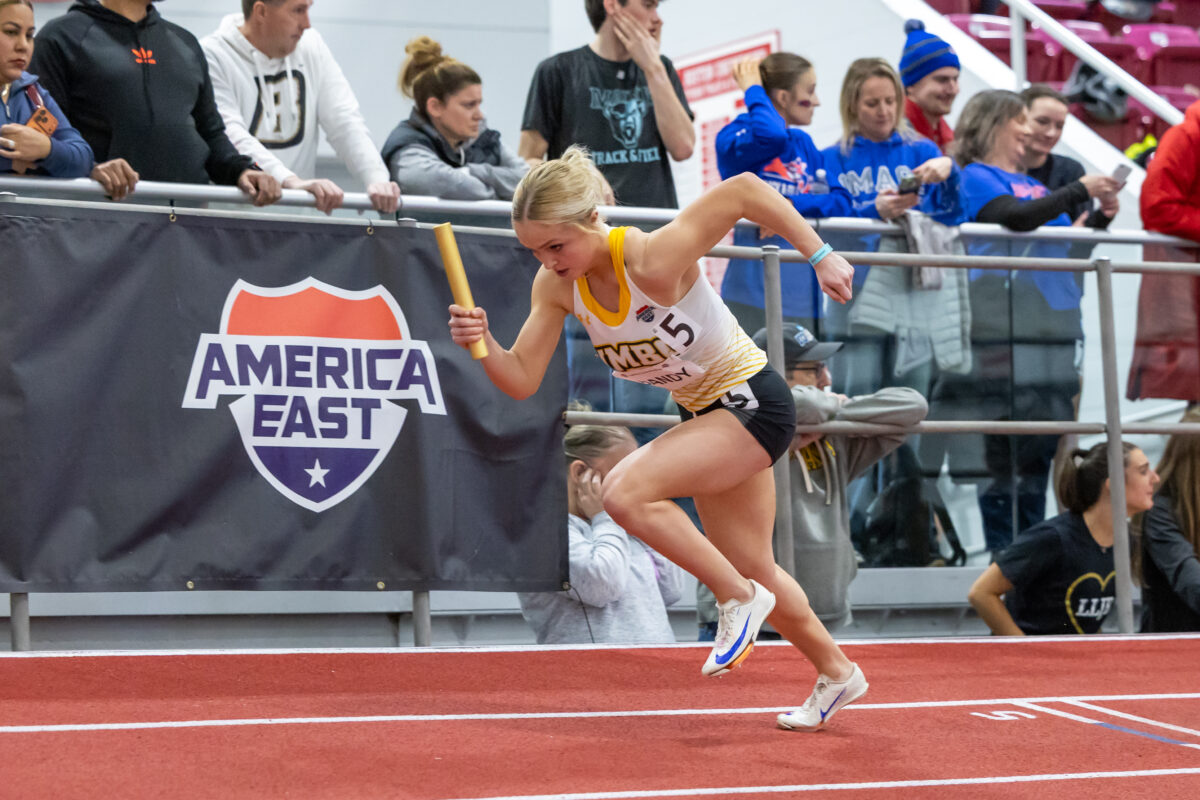 Bandy explodes for her leg of the relay. (UMBC Athletics)
Sophomore Katie Schwaner, history, earned both Outstanding Track Performer of the Meet and the America East Coaches Award. First-year student Enazajah Young, political science, continued to add to her remarkable first season, receiving Most Outstanding Rookie and setting a new school record in the 60-meter hurdles to bring home a gold.
Return to glory
Despite a remarkable legacy of excellence, the America East title has eluded UMBC men’s swimming and diving for the past two years, the longest break in their winning streak since joining the America East Conference in 2004. This year, the Retrievers broke the spell and came out on top to defeat two-time defending champion Binghamton.
With a final total of 805.5 points, the Retrievers finished 50+ points ahead of Binghamton in second (748 points) and Bryant in third with 572.5 points. Despite the two-year hiatus, the Retrievers proved to still be a force to be reckoned with, racking up individual and team accolades.
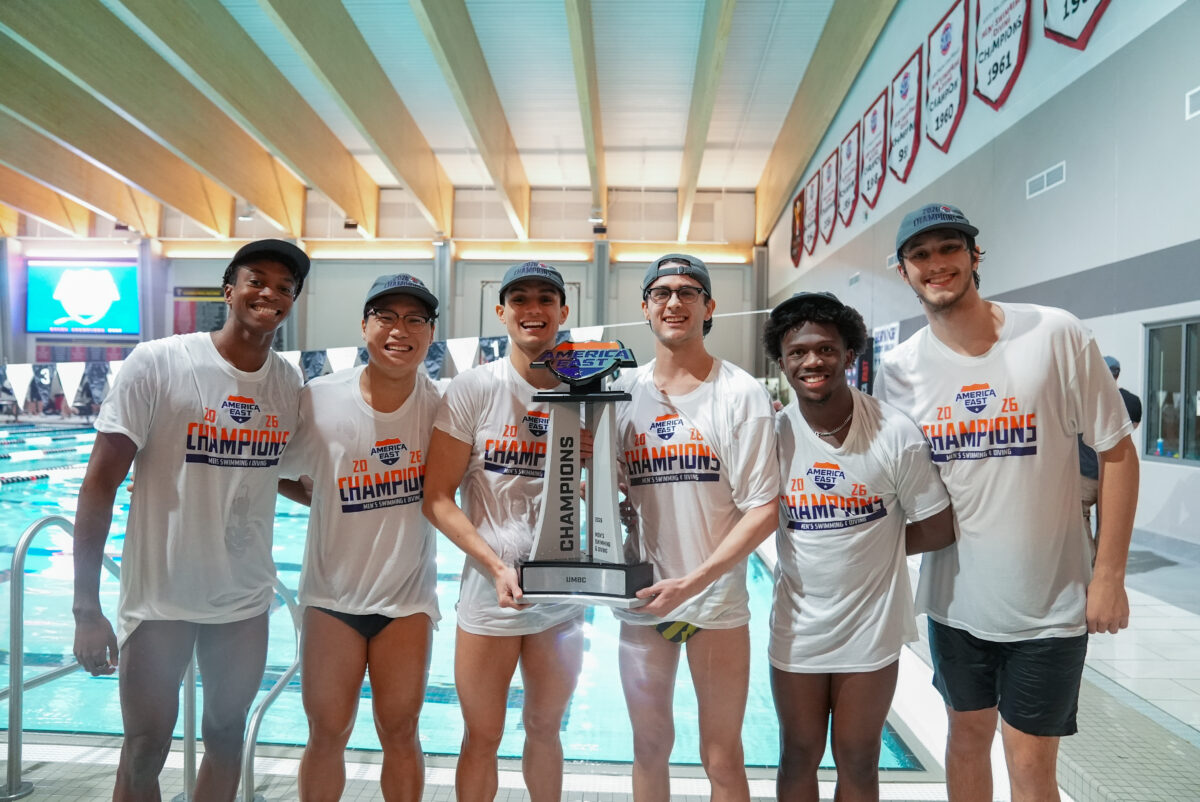 The men’s swimming and diving team moved to dry land to celebrate their America East win. (UMBC Athletics)
Led by Matt Donovan, UMBC again received Most Outstanding Coaching Staff honors.
“This was an entire team win in every aspect for our third men’s team championship in five years,” said Donovan. “From the athletes in the water, to all of our supporters back at UMBC, and of course to our women’s team and what they bring to our program every day.”
Senior Sean Neils, financial economics, earned athletic and academic honors, collecting individual medals and earning the America East Elite 18 Award for being the student-athlete with the highest GPA—a 4.0 in his case.
First-year student Braden Weise set a meet record time of 43.58 in the 100 free, earning a gold, and was named Most Outstanding Rookie. The rest of his teammates followed suit with Neils grabbing silver, junior Matthew So, computer science, taking home bronze, and sophomore Axel Mori, economics, finishing in fourth, sweeping the 100 free and solidifying the title win for the Retrievers.
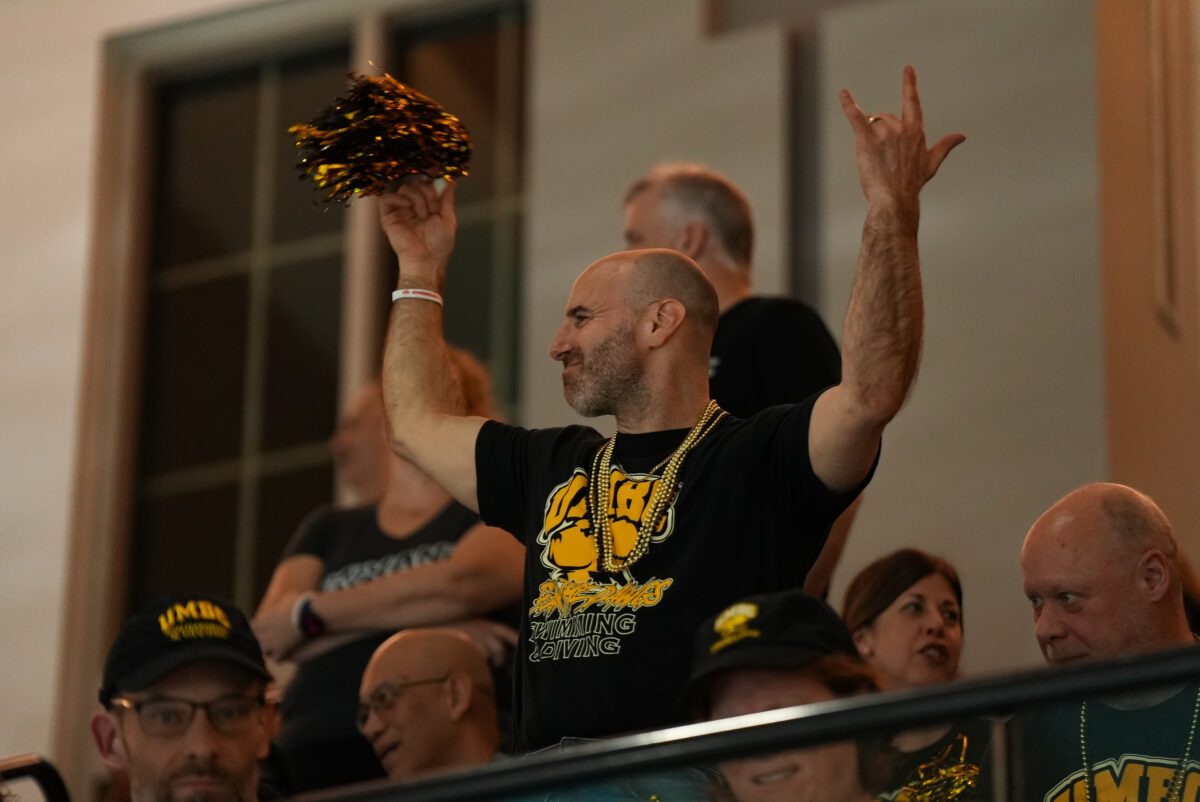 There was no shortage of Retriever Fever at the America East Championships last weekend. (UMBC Athletics)
Although women’s swimming and diving fell short of team title, junior Ashley Gutshall, history, set a record across UMBC and the America East with a time of 22.25 in the 50 meter. Gutshall took home a gold and qualified in the event for the NCAA Championship on March 20 in Atlanta.
“Shortly after the meet was completed, I was asked on deck what my thoughts were and what I said then still rings true now—UMBC is a very special place and we are so proud to represent Retriever Nation,” said Donovan.
Courting a win
While the Retrievers secured their spots in the pool and on the track, UMBC men’s basketball is still in the throes of chasing another America East title. After a hard-fought win against UAlbany (66-62) this past Saturday, the Retrievers clinched a top four seed in America East Conference Tournament play. This was the sixth straight win for UMBC and it cemented hosting rights for a quarterfinal game on March 7.
The Retrievers are 11-2 in conference play this season and 18-8 overall. They currently sit in first place in the conference. The last game of the regular season is this Thursday, February 26, at Chesapeake Employers Insurance Arena at 6 p.m. against Bryant. All faculty, staff, and their families are eligible for free tickets to cheer on UMBC.
]]>
This past weekend, the Retrievers cracked open the record books to ink two more milestones in the history of UMBC Athletics. For the first time in university history, the women’s track and field...
https://umbc.edu/stories/umbc-nabs-america-east-titles/
https://my3.my.umbc.edu/api/v0/pixel/news/156937/guest@my.umbc.edu/525b62a242f70c9a0e528844660ff9f7/api/pixel
athletics
cahss
cnms
coeit
community
feature
news
story
UMBC News & Magazine
https://my3.my.umbc.edu/groups/umbc-news-magazine
https://assets1-my.umbc.edu/system/shared/avatars/groups/000/001/943/24435aa6207c452e7bc15cc74b42c7bb/xsmall.png?1748556657
https://assets1-my.umbc.edu/system/shared/avatars/groups/000/001/943/24435aa6207c452e7bc15cc74b42c7bb/original.png?1748556657
https://assets2-my.umbc.edu/system/shared/avatars/groups/000/001/943/24435aa6207c452e7bc15cc74b42c7bb/xxlarge.png?1748556657
https://assets2-my.umbc.edu/system/shared/avatars/groups/000/001/943/24435aa6207c452e7bc15cc74b42c7bb/xlarge.png?1748556657
https://assets3-my.umbc.edu/system/shared/avatars/groups/000/001/943/24435aa6207c452e7bc15cc74b42c7bb/large.png?1748556657
https://assets1-my.umbc.edu/system/shared/avatars/groups/000/001/943/24435aa6207c452e7bc15cc74b42c7bb/medium.png?1748556657
https://assets2-my.umbc.edu/system/shared/avatars/groups/000/001/943/24435aa6207c452e7bc15cc74b42c7bb/small.png?1748556657
https://assets1-my.umbc.edu/system/shared/avatars/groups/000/001/943/24435aa6207c452e7bc15cc74b42c7bb/xsmall.png?1748556657
https://assets2-my.umbc.edu/system/shared/avatars/groups/000/001/943/24435aa6207c452e7bc15cc74b42c7bb/xxsmall.png?1748556657
UMBC News & Magazine
1
0
false
Wed, 25 Feb 2026 16:01:14 -0500
Wed, 25 Feb 2026 16:01:14 -0500
No animal alive today is ‘primitive’— why are so many still labeled that way?
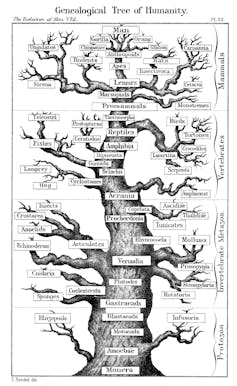 ‘Man’ is at the very top looking down at all other forms of life in Ernst Haeckel’s drawing. Ernst Haeckel/Photos.com via Getty Images Plus
Written by Kevin Omland, professor of biological sciences, UMBC
We humans have long viewed ourselves as the pinnacle of evolution. People label other species as “primitive” or “ancient” and use terms like “higher” and “lower” animals.
This anthropocentric perspective was entrenched in 1866, when German scientist Ernst Haeckel drew one of the first trees of life. He placed “Man,” clearly labeled, at the top. This illustration helped establish the popular view that we are the ultimate goal of evolution.
Modern evolutionary biology and genomics debunk that flawed perspective, showing there is no hierarchy in evolution. All species alive today, from chimpanzees to bacteria, are cousins that each have equally long lineages, rather than ancestors or descendants.
Unfortunately, these outdated notions remain prevalent in scientific journals and science journalism. In my new book, “Understanding the Tree of Life,” I explore why it is fundamentally misleading to view any current species as primitive, ancient or simple. As an evolutionary biologist, I offer an alternative view that emphasizes evolution’s complex, nonhierarchical, interconnected history.
Not primitive, just different
Egg-laying mammals, the monotremes, are frequently labeled the most “primitive” living mammals. This category includes the platypus and four species of echidnas. Indeed, their egg-laying is an ancient characteristic shared with reptiles.
But platypuses also have many unique recent adaptations that make them well suited to their lifestyle: They have webbed feet for swimming and a bill with specialized electroreceptors that detect prey in the mud. Males have spurs with venom that they can use to defend themselves against rivals. If you take a platypus’s view, they’re the pinnacle of evolution for their specific ecological niche.
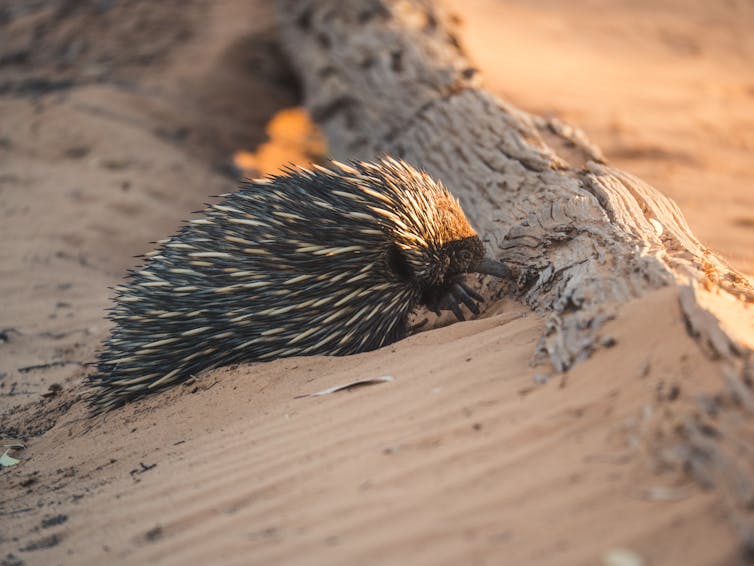 Echidnas have just what it takes to flourish in their unique niche. Chris Beavon/Moment via Getty Images
Echidnas may seem primitive, especially because they lack a capability that humans have—giving birth to live young. Yet they possess many extraordinary traits that humans lack. Echidnas are known for their outer covering of protective spines. They also have powerful claws for digging, a sensitive beak and a long sticky tongue, all of which they use foraging for ants and termites. In a head-to-head competition foraging for prey in a termite mound, an echidna would easily outperform any human.
Other mammals native to Australia also turn up on lists of primitive mammals, such as many species of marsupials – pouched mammals, including kangaroos, koalas and wombats. These species generally give birth to small, minimally developed young that move to the mother’s pouch where they complete development. Pouch development may seem inferior to the human way, but it does have advantages. For example, kangaroos can simultaneously nurture young at three stages of development.
Evolutionary tree appearance depends on focus
Marsupials such as opossums, or monotremes such as the platypus, are often shown at the bottom or left side of an evolutionary tree. However, that does not mean that they are older, more primitive or less evolved.
Evolutionary trees—what scientists call phylogenies—show cousin relationships. Just as your second or third cousin is no more primitive than you are, it is misleading to think of a koala or echidna as primitive because of where they are depicted on these trees.
When scientists and journalists choose which species to include in the evolutionary trees in their publications, it can influence how the public perceives these species. But species shown lower on the page are not “lower” on some evolutionary scale.
Rather, they are placed there because the focus of many of those trees is on placental mammals, such as humans, other primates, carnivores, rodents and so on. When the focus is on placental mammals, it makes sense to include one or two species of marsupials as comparisons for reference.
 A phylogenetic tree focused on marsupials shows humans as one of the species included for comparison. Spiekman, S., Werneburg, I. Sci Rep 7, 43197 (2017), CC BY
In contrast, in a tree focused on marsupials, one or two placental mammals could be included at the bottom of the page for comparison.
Why understanding the tree of life matters
Viewing humans as the goal of evolution leads to a misunderstanding of the entire evolutionary process. Since evolution is the conceptual foundation for all biology, this flawed perspective can hinder all biological and biomedical science.
Mastering a modern understanding of evolutionary trees is crucial to advances in fields ranging from animal behavior and physiology to conservation and biomedicine. For example, because rhesus monkeys are much more closely related to us than are capuchins, rhesus monkeys are generally better subjects for preliminary tests of human vaccines. Opossums, incorrectly considered to be primitive, are a great species for providing a broader framework for studies of neurobiology and aging because they are distantly related to us, not because they are lower or more ancestral.
Grasping the profound reality that humans are not the pinnacle of evolution, but one branch among many, is foundational for all modern biology. Understanding the tree of life is central to fully embracing the shared modern status of all animals, from platypuses to people.
This article is republished from The Conversation under a Creative Commons license. Read the original article and see more than 300 UMBC articles available in The Conversation.
]]>
‘Man’ is at the very top looking down at all other forms of life in Ernst Haeckel’s drawing. Ernst Haeckel/Photos.com via Getty Images Plus Written by Kevin Omland, professor of biological...
https://umbc.edu/stories/no-animal-alive-today-is-primitive-why-are-so-many-still-labeled-that-way/
https://my3.my.umbc.edu/api/v0/pixel/news/156361/guest@my.umbc.edu/579b4c20ffcd65ab5def01337ebca42f/api/pixel
biology
cnms
discovery
magazine
story
the-conversation
UMBC News & Magazine
https://my3.my.umbc.edu/groups/umbc-news-magazine
https://assets1-my.umbc.edu/system/shared/avatars/groups/000/001/943/24435aa6207c452e7bc15cc74b42c7bb/xsmall.png?1748556657
https://assets1-my.umbc.edu/system/shared/avatars/groups/000/001/943/24435aa6207c452e7bc15cc74b42c7bb/original.png?1748556657
https://assets2-my.umbc.edu/system/shared/avatars/groups/000/001/943/24435aa6207c452e7bc15cc74b42c7bb/xxlarge.png?1748556657
https://assets2-my.umbc.edu/system/shared/avatars/groups/000/001/943/24435aa6207c452e7bc15cc74b42c7bb/xlarge.png?1748556657
https://assets3-my.umbc.edu/system/shared/avatars/groups/000/001/943/24435aa6207c452e7bc15cc74b42c7bb/large.png?1748556657
https://assets1-my.umbc.edu/system/shared/avatars/groups/000/001/943/24435aa6207c452e7bc15cc74b42c7bb/medium.png?1748556657
https://assets2-my.umbc.edu/system/shared/avatars/groups/000/001/943/24435aa6207c452e7bc15cc74b42c7bb/small.png?1748556657
https://assets1-my.umbc.edu/system/shared/avatars/groups/000/001/943/24435aa6207c452e7bc15cc74b42c7bb/xsmall.png?1748556657
https://assets2-my.umbc.edu/system/shared/avatars/groups/000/001/943/24435aa6207c452e7bc15cc74b42c7bb/xxsmall.png?1748556657
UMBC News & Magazine
0
0
false
Mon, 09 Feb 2026 13:40:33 -0500
Mon, 09 Feb 2026 13:40:33 -0500
Chronic illness redirected Jaime Miller’s medical career—today she advocates for people with lupus, including herself
When Jaime Miller ’06, biochemistry, was in the final stages of her M.D/Ph.D., she did not expect her 15-year educational journey to be derailed by her own medical mystery. She certainly didn’t foresee finding peace and purpose through turning her chronic illness into a life of advocacy—but that’s exactly what’s happened.
Before coming to UMBC, Miller seized early opportunities: Her teachers encouraged her interests in STEM, leading her to attend the Baltimore Polytechnic Institute (Poly), a STEM magnet high school requiring a combined bus and light rail commute from her home in Baltimore’s Morrell Park neighborhood. After her junior year, a summer neuroscience program for high schoolers at the University of Maryland further ignited her love for life science. As a first-generation college student, she entered these unfamiliar spaces with an uncommon boldness.
“I didn’t wear a plain Jane suit to the interview for the University of Maryland program. It was mint green, which is hilarious, looking back,” she says. “I didn’t know what I was doing. But I’ve just always been somebody that hasn’t feared failure. You just learn and keep on going. It’s like a building step.”
The summer program, where Miller thrived in a lab studying Alzheimer’s disease under mentor Mervin Monteiro, extended into her senior year through Poly’s research practicum, where she continued lab work, wrote a thesis, and won first prize at the Intel Science Talent Search (now the Regeneron STS). When Miller learned from a lab colleague that most M.D./Ph.D. programs pay for medical school, it was “like fireworks going off in my head,” she says, knowing medical school would be beyond her family’s budget. Aware of UMBC’s reputation for preparing STEM majors to excel in graduate study, Miller decided to use the local institution as a launchpad for a funded graduate program.
Right on track
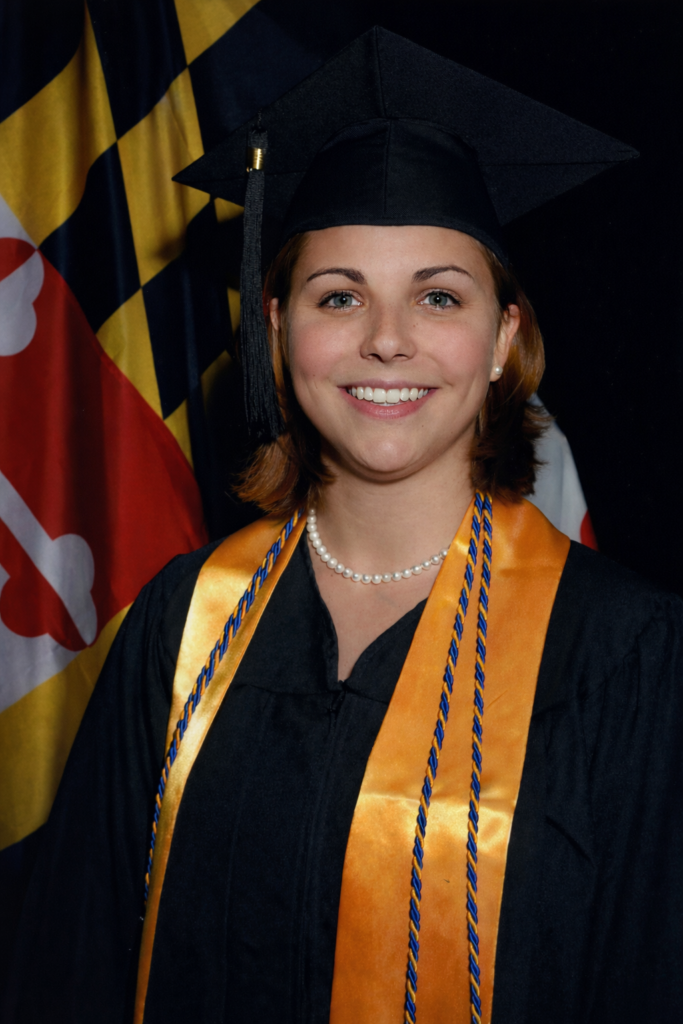 Jaime Miller graduated magna cum laude from UMBC and was inducted into the prestigious Phi Beta Kappa National Honor Society. (Courtesy of Miller)
Drawn to UMBC’s supportive environment, strong science programs, and proximity to home, Miller accepted a College Bound scholarship and a small award from a pharmaceutical company. Miller found a minor in philosophy complemented her scientific pursuits by honing her critical thinking and providing diverse insights. She particularly enjoyed courses in moral theory, she says, exploring challenging topics like euthanasia, abortion, and pornography in a safe environment for discussion.
The emphasis on clarity, precision, and organization in philosophical arguments directly enhanced her scientific communication and planning skills, too: “You want to make sure any experimental design is clean and succinct, so that when you present it, everybody understands what you’re doing and what your goal is.”
Again seizing opportunities, Miller emailed Michael Summers, distinguished professor of chemistry and biochemistry, about joining his lab, even negotiating her pay. “It was my first foray in advocating for myself,” she reflects. Summers remembers Miller as “a wonderful, caring person” with standout “resilience, professionalism, and commitment to others in need.” Her work with his research group led to a publication in Proceedings of the National Academy of Sciences.
After UMBC, Miller pursued an M.D./Ph.D. at the University of Virginia, focusing on epigenetics and blood disorders. “There was something about blood and blood cancers that I was just really drawn toward,” she says. After being selected for a fellowship in hematology-oncology at the University of Pittsburgh Medical Center (UPMC) in 2015, Miller seemed poised for a thriving clinical and research career.
Redirected by chronic illness
In 2018, however, a constellation of nagging symptoms escalated: extreme fatigue, joint pain, swollen lymph nodes, and, finally, pneumonia. After seemingly endless testing and specialist visits, she was diagnosed with systemic lupus erythematosus, an autoimmune disease. Lupus, she explains, “can affect literally any organ in the body” and manifests in every patient differently. Unfortunately, “I ran into a lot of obstacles” when requesting accommodations like no overnight shifts, she says, including dismissive comments about her “mystery illness.” Ultimately, UPMC terminated her, refusing a part-time option.
 Jaime Miller (Courtesy of Miller)
This setback could have been devastating after 15 years of rigorous training, but Miller channeled it into purpose. “Despite how negative it sounds, it’s not tragic. My husband could see I was mentally breaking from sacrificing so much of my quality of life for my career. Leaving medicine was a brutal reality check, but it also showed me how much else I could explore and enjoy,” Miller says. For example, “When I was too sick to do much, I started small things I’d always wanted: I bought a guitar to learn music, a sewing machine to make clothes—simple activities I could do sitting in a chair. It was an eye-opener. I’m happier now—100 percent.”
As an ambassador for the Lupus Foundation of America, she co-facilitates a Pittsburgh support group and organized the city’s first officially sponsored Walk to End Lupus Now in 2025, raising $60,000. She has also found a way to continue her medical career on a part-time basis by voluntarily consulting for All4Cure, an online platform where specialists like her provide guidance for multiple myeloma patients, ensuring equitable care for those in rural areas treated by general oncologists.
From adversity to purpose
Miller spent years practicing self-advocacy on her academic journey, and now she’s using those skills to benefit others, as well. This resilience shines in her advice for the chronic illness community: “You have to take care of yourself. You can’t take care of anything else unless you take care of yourself, both physically and mentally.” She emphasizes seeking counseling early and advocating fiercely for one’s needs, even when it feels isolating.
Miller was raised in the Catholic church but drifted toward atheism during her medical training. After her diagnosis, however, she found herself sensing the voice of her grandmother, a committed Christian who also had lupus: “Maybe this is happening for a reason. You’re a physician and you’ll be able to educate and advocate a lot better for those that can’t advocate for themselves.” Today she is still navigating her spiritual life, but for now she believes in “something out there in the universe that makes things the way that they are”—an energy or presence that gives meaning to hardship and opens new paths.
UMBC played a foundational role in where Miller finds herself today, fostering her confidence and research skills in a nurturing setting. Today, at 41, Miller embraces a fuller life than a traditional physician path would have allowed. Her mantra extends to younger generations, who she hopes will try new things, take risks, and forge their own paths. “Failure is okay,” Miller reiterates. “It’s nothing more than a learning step to success.”
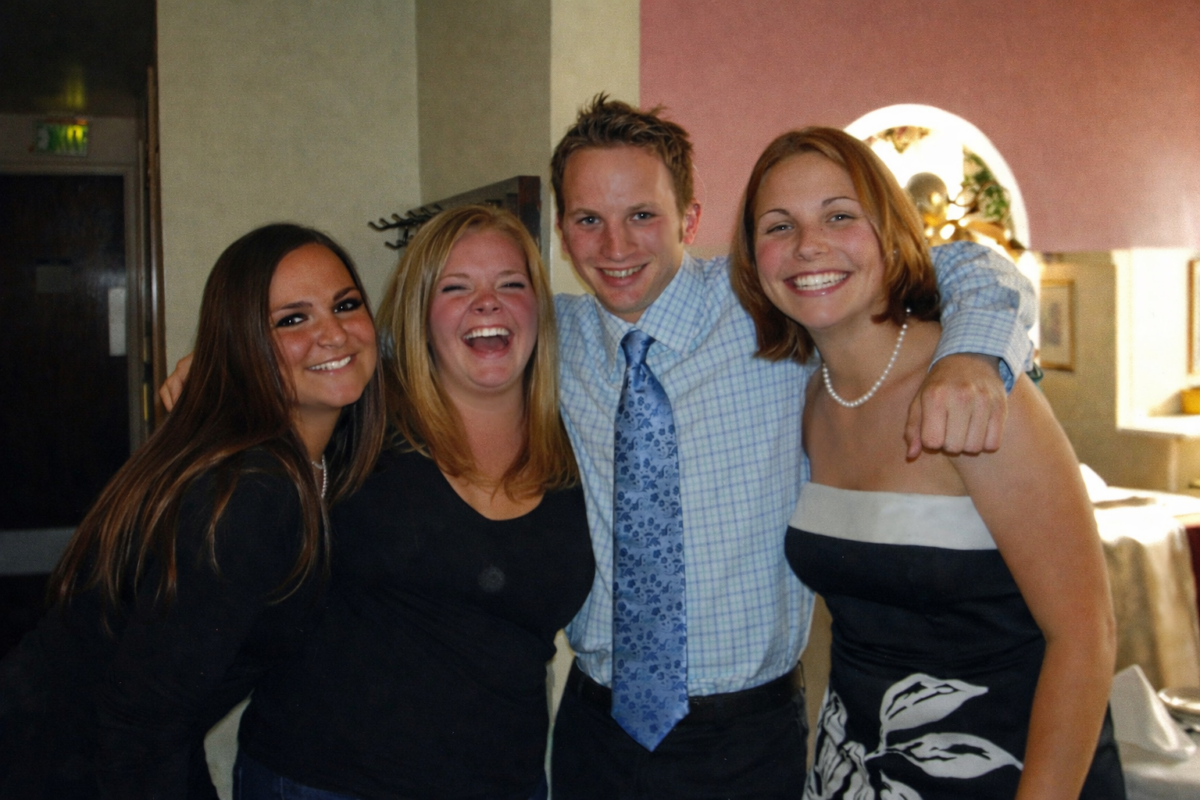 Jaime Miller, right, celebrates with close friends in Baltimore’s Little Italy after her UMBC graduation. (Courtesy of Miller)
]]>
When Jaime Miller ’06, biochemistry, was in the final stages of her M.D/Ph.D., she did not expect her 15-year educational journey to be derailed by her own medical mystery. She certainly didn’t...
https://umbc.edu/stories/jaime-miller-chronic-illness-advocacy/
https://my3.my.umbc.edu/api/v0/pixel/news/156309/guest@my.umbc.edu/2a56dc826183bc717c791a68645ab6e4/api/pixel
alumni
chemistry-and-biochemistry
cnms
community
news
story
UMBC News & Magazine
https://my3.my.umbc.edu/groups/umbc-news-magazine
https://assets1-my.umbc.edu/system/shared/avatars/groups/000/001/943/24435aa6207c452e7bc15cc74b42c7bb/xsmall.png?1748556657
https://assets1-my.umbc.edu/system/shared/avatars/groups/000/001/943/24435aa6207c452e7bc15cc74b42c7bb/original.png?1748556657
https://assets2-my.umbc.edu/system/shared/avatars/groups/000/001/943/24435aa6207c452e7bc15cc74b42c7bb/xxlarge.png?1748556657
https://assets2-my.umbc.edu/system/shared/avatars/groups/000/001/943/24435aa6207c452e7bc15cc74b42c7bb/xlarge.png?1748556657
https://assets3-my.umbc.edu/system/shared/avatars/groups/000/001/943/24435aa6207c452e7bc15cc74b42c7bb/large.png?1748556657
https://assets1-my.umbc.edu/system/shared/avatars/groups/000/001/943/24435aa6207c452e7bc15cc74b42c7bb/medium.png?1748556657
https://assets2-my.umbc.edu/system/shared/avatars/groups/000/001/943/24435aa6207c452e7bc15cc74b42c7bb/small.png?1748556657
https://assets1-my.umbc.edu/system/shared/avatars/groups/000/001/943/24435aa6207c452e7bc15cc74b42c7bb/xsmall.png?1748556657
https://assets2-my.umbc.edu/system/shared/avatars/groups/000/001/943/24435aa6207c452e7bc15cc74b42c7bb/xxsmall.png?1748556657
UMBC News & Magazine
0
0
false
Fri, 06 Feb 2026 14:26:37 -0500
Fri, 06 Feb 2026 14:26:37 -0500
Sisters in science: How one UMBC lab kindled a family tradition of discovery
Jaime Miller, right, celebrates with close friends in Baltimore’s Little Italy after her UMBC graduation. (Courtesy of Miller)
]]>
When Jaime Miller ’06, biochemistry, was in the final stages of her M.D/Ph.D., she did not expect her 15-year educational journey to be derailed by her own medical mystery. She certainly didn’t...
https://umbc.edu/stories/jaime-miller-chronic-illness-advocacy/
https://my3.my.umbc.edu/api/v0/pixel/news/156309/guest@my.umbc.edu/2a56dc826183bc717c791a68645ab6e4/api/pixel
alumni
chemistry-and-biochemistry
cnms
community
news
story
UMBC News & Magazine
https://my3.my.umbc.edu/groups/umbc-news-magazine
https://assets1-my.umbc.edu/system/shared/avatars/groups/000/001/943/24435aa6207c452e7bc15cc74b42c7bb/xsmall.png?1748556657
https://assets1-my.umbc.edu/system/shared/avatars/groups/000/001/943/24435aa6207c452e7bc15cc74b42c7bb/original.png?1748556657
https://assets2-my.umbc.edu/system/shared/avatars/groups/000/001/943/24435aa6207c452e7bc15cc74b42c7bb/xxlarge.png?1748556657
https://assets2-my.umbc.edu/system/shared/avatars/groups/000/001/943/24435aa6207c452e7bc15cc74b42c7bb/xlarge.png?1748556657
https://assets3-my.umbc.edu/system/shared/avatars/groups/000/001/943/24435aa6207c452e7bc15cc74b42c7bb/large.png?1748556657
https://assets1-my.umbc.edu/system/shared/avatars/groups/000/001/943/24435aa6207c452e7bc15cc74b42c7bb/medium.png?1748556657
https://assets2-my.umbc.edu/system/shared/avatars/groups/000/001/943/24435aa6207c452e7bc15cc74b42c7bb/small.png?1748556657
https://assets1-my.umbc.edu/system/shared/avatars/groups/000/001/943/24435aa6207c452e7bc15cc74b42c7bb/xsmall.png?1748556657
https://assets2-my.umbc.edu/system/shared/avatars/groups/000/001/943/24435aa6207c452e7bc15cc74b42c7bb/xxsmall.png?1748556657
UMBC News & Magazine
0
0
false
Fri, 06 Feb 2026 14:26:37 -0500
Fri, 06 Feb 2026 14:26:37 -0500
Sisters in science: How one UMBC lab kindled a family tradition of discovery
On the fourth floor of UMBC’s Meyerhoff Chemistry Building, where students are hard at work exploring the intricacies of RNA molecules that may hold the key to combating viral diseases, a unique family tradition has taken root. Three sisters—Huda, Reem, and Rowah Abdelghani—have each stepped into the same research space and found the thrill of discovery, the warmth of community, and a mentor who welcomes eager learners at all levels.
It began with Huda, the trailblazing eldest of the three sisters. As a high school junior in Howard County’s Applications and Research Laboratory (ARL) biotechnology program, she dove into the program’s intensive training—mastering lab basics like micropipetting, PCR, and gel electrophoresis alongside students from across the county. ARL encourages seniors to pursue off-site internships, so Huda cold-emailed labs at nearby universities. “It was tough,” she recalls. “Some of my friends emailed over 30 people before finding a spot. I got lucky with Dr. Koirala.”

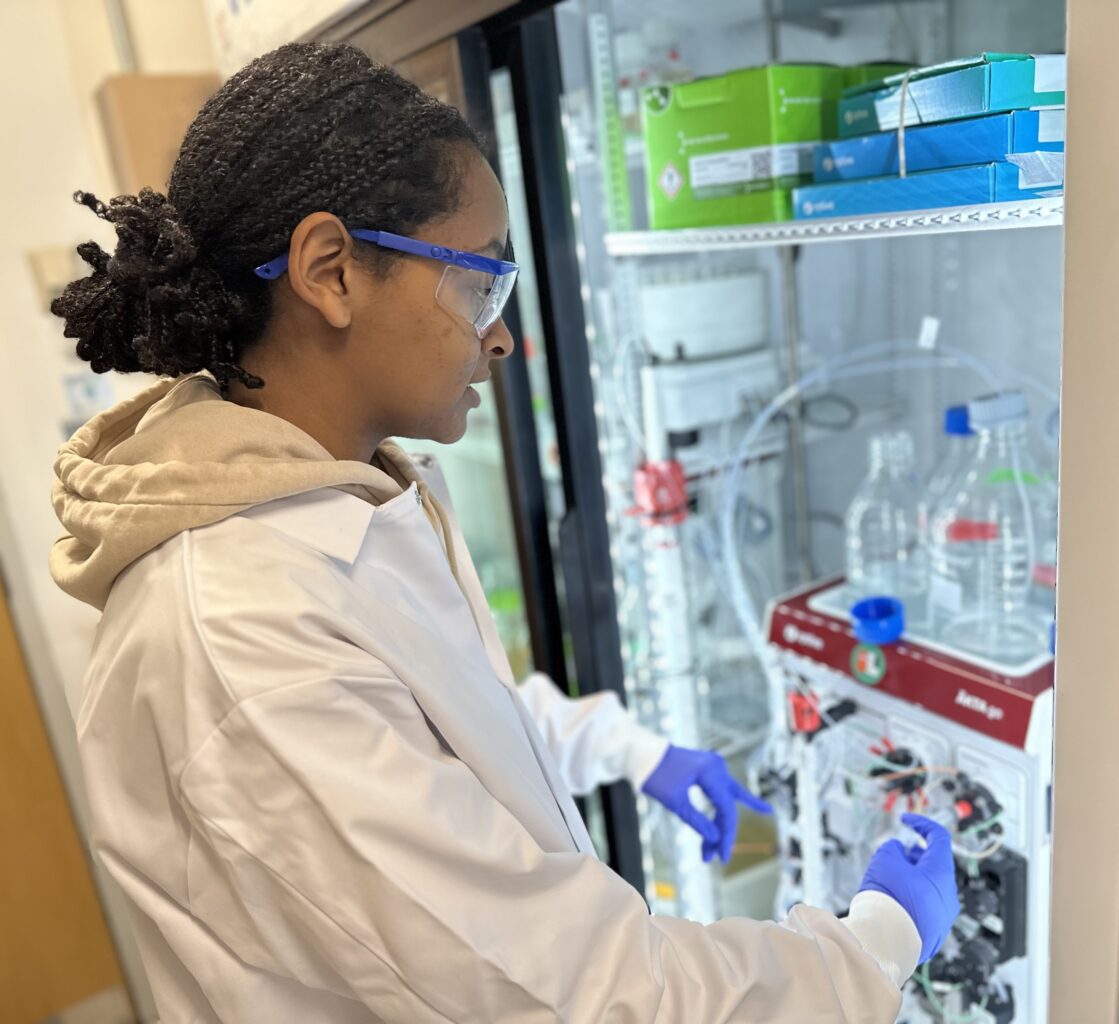
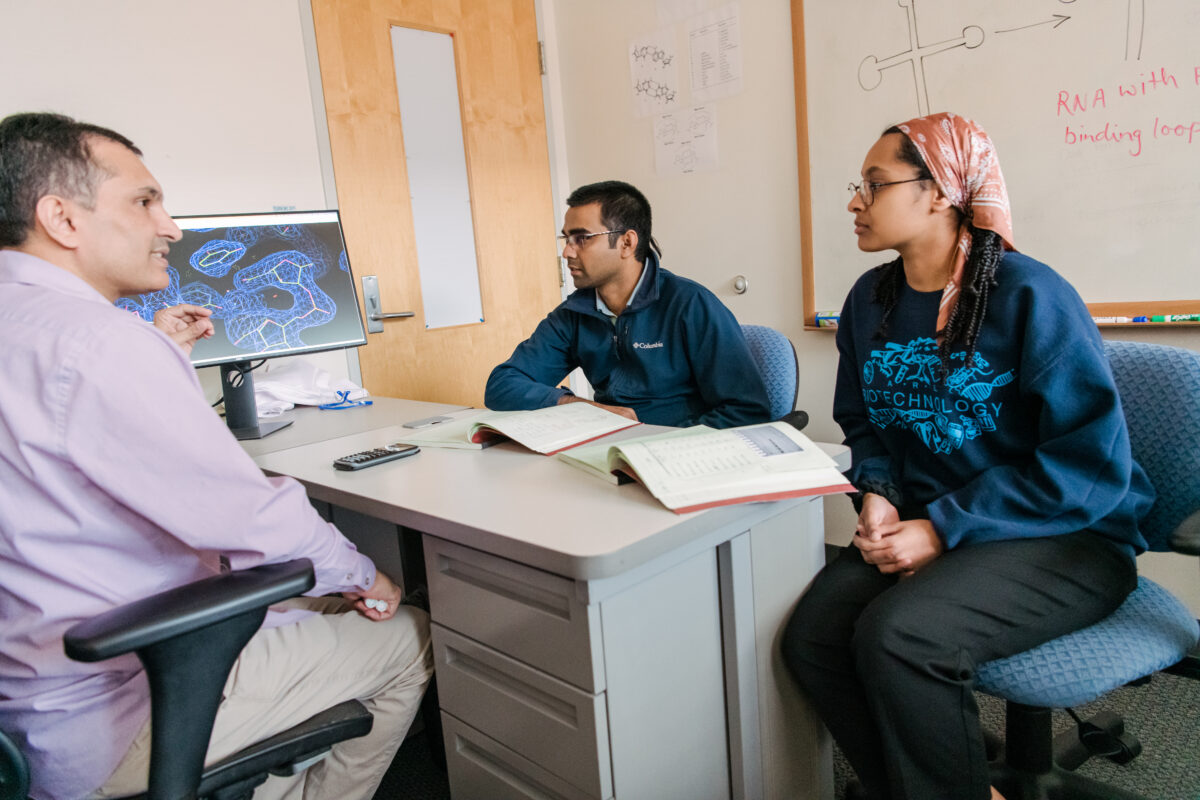 Huda Abdelghani (left) was the first of her three sisters to work in Deepak Koirala’s lab through Howard County’s Applications and Research Laboratory program. At right: Deepak Koirala (left), Naba Krishna Das (center), and Huda Abdelghani discuss their research in Koirala’s office. (Photos by Marlayna Demond ’11/UMBC)
Skills that apply everywhere
Deepak Koirala, associate professor of chemistry and biochemistry, leads a UMBC research group that studies the structures of RNA in enteroviruses—a family of pathogens behind illnesses like hand-foot-and-mouth disease, polio, and myocarditis. Huda joined in the summer of 2022 and stayed through spring 2023. Mentored by a Ph.D. student in the lab, Hasan Al Banna, she quickly learned that scientific research frequently involves failure—but that’s no reason to give up.
“You can do everything right and still not get results,” she says. “It’s not personal—that’s just science.” This lesson in perseverance stuck with her, as did Koirala’s individualized attention. When her graduate student mentor was away, he spent hours helping her set up trays of crystallization plates for her experiments.
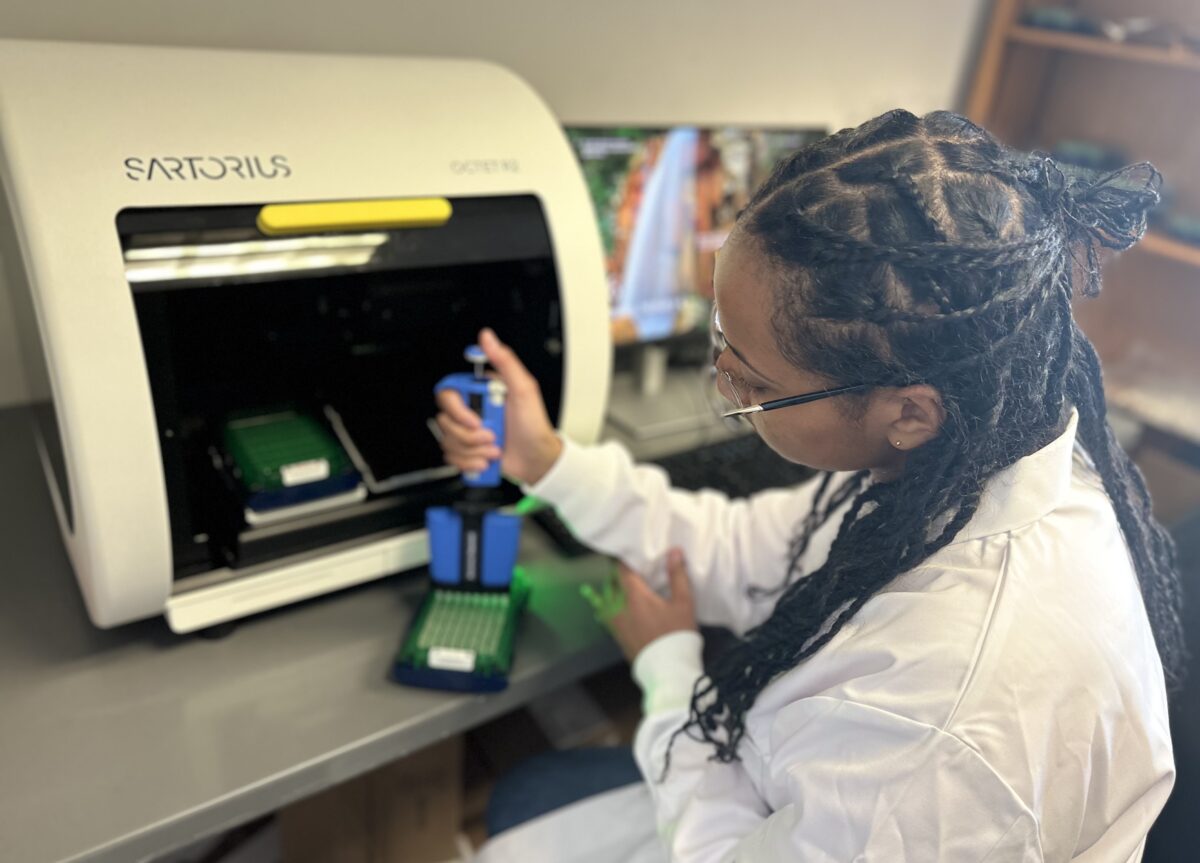
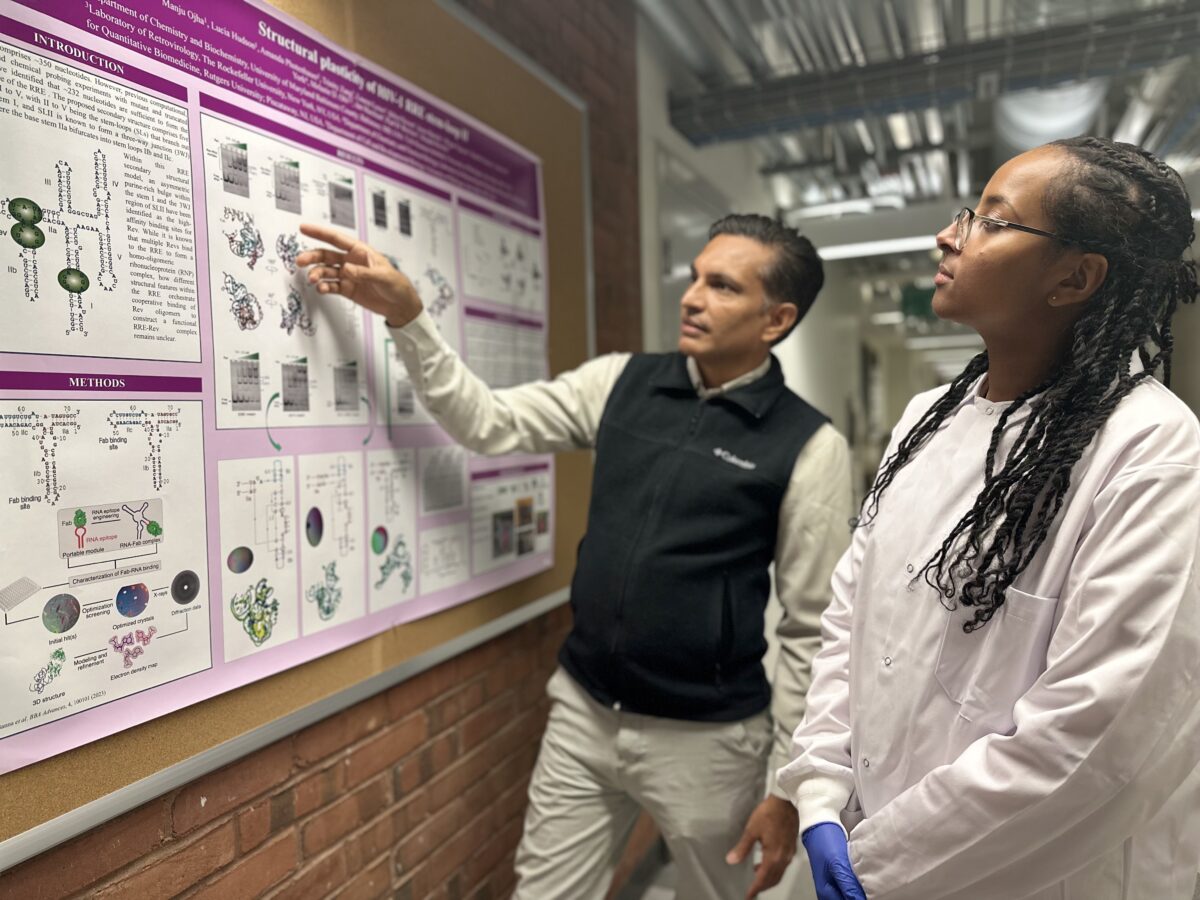 Left: Reem Abdelghani works with a multi-channel micropipet in the lab. Right: Reem and Deepak Koirala discuss research at a poster in the hallway outside Koirala’s lab. (Photos courtesy of Deepak Koirala)
Huda is now a junior mechanical engineering major at MIT, spending this semester on co-op with Apple’s Mac product design team in Austin, Texas—but the lab’s influence lingers. It sparked her interest in tools that help accelerate biochemistry research, like imaging platforms. “The technical and soft skills I gained at UMBC can apply anywhere,” she reflects. Even her first MIT lab connection came from a conversation overheard down the hall from her bench in Koirala’s lab. “It showed me the interconnectedness of academia,” she says.
Shattering preconceptions
Huda’s enthusiasm inspired Reem, the middle sister, to reach out to Koirala for her own ARL biotech internship. She started in Koirala’s lab in the summer of 2024, before her senior year of high school. “I saw how happy Huda was—and it looked like something I’d enjoy, too,” Reem says.
Mentored by Ph.D. student Naba Krishna Das, who isnow a postdoctoral fellow at the National Cancer Institute in Frederick, Maryland, Reem immersed herself in the lab’s operations, from presenting at lab meetings to executing tasks like sterilizing equipment and generating crystal structures of RNA and protein complexes. The lab’s collaborative vibe shattered her preconceptions. “I was worried grad school could be isolating, but it’s so interactive, with people at every stage of their scientific careers,” she explains.
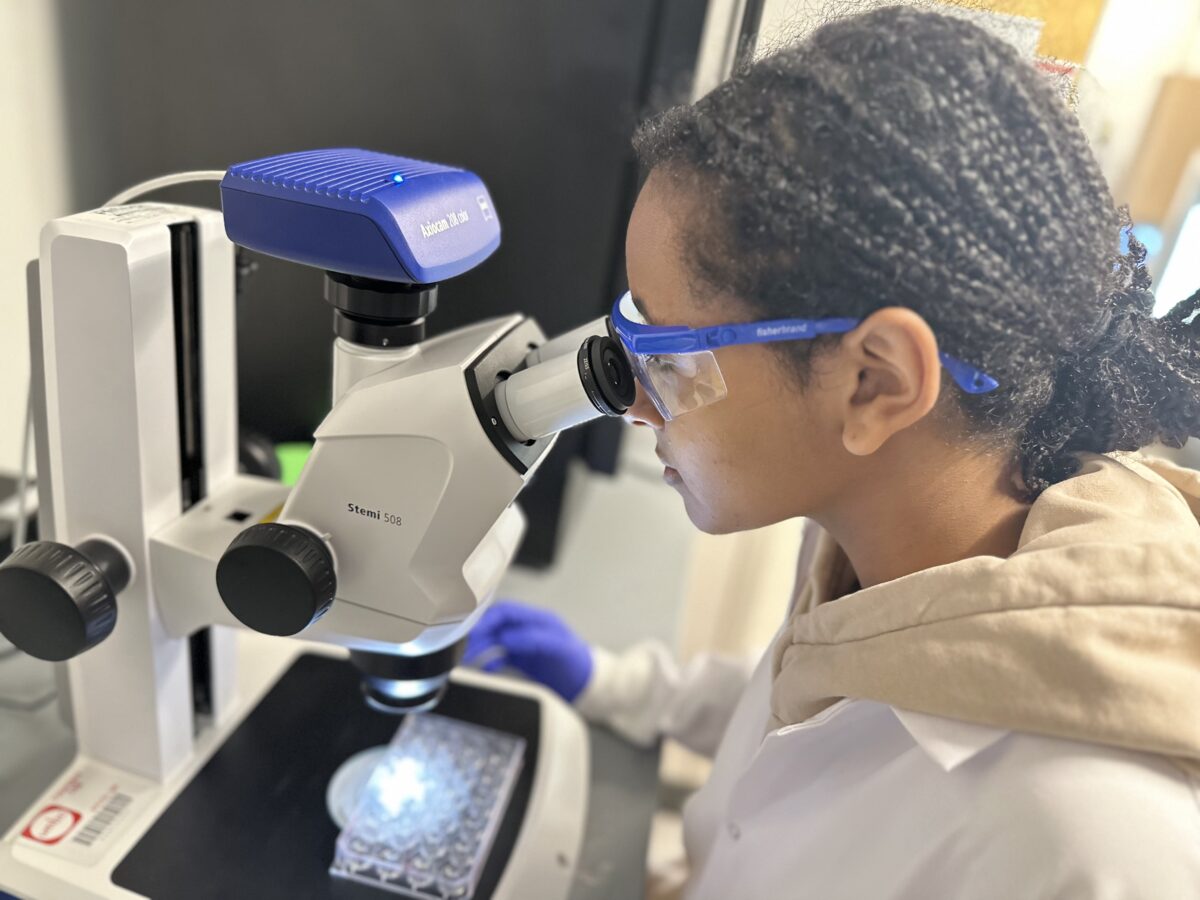
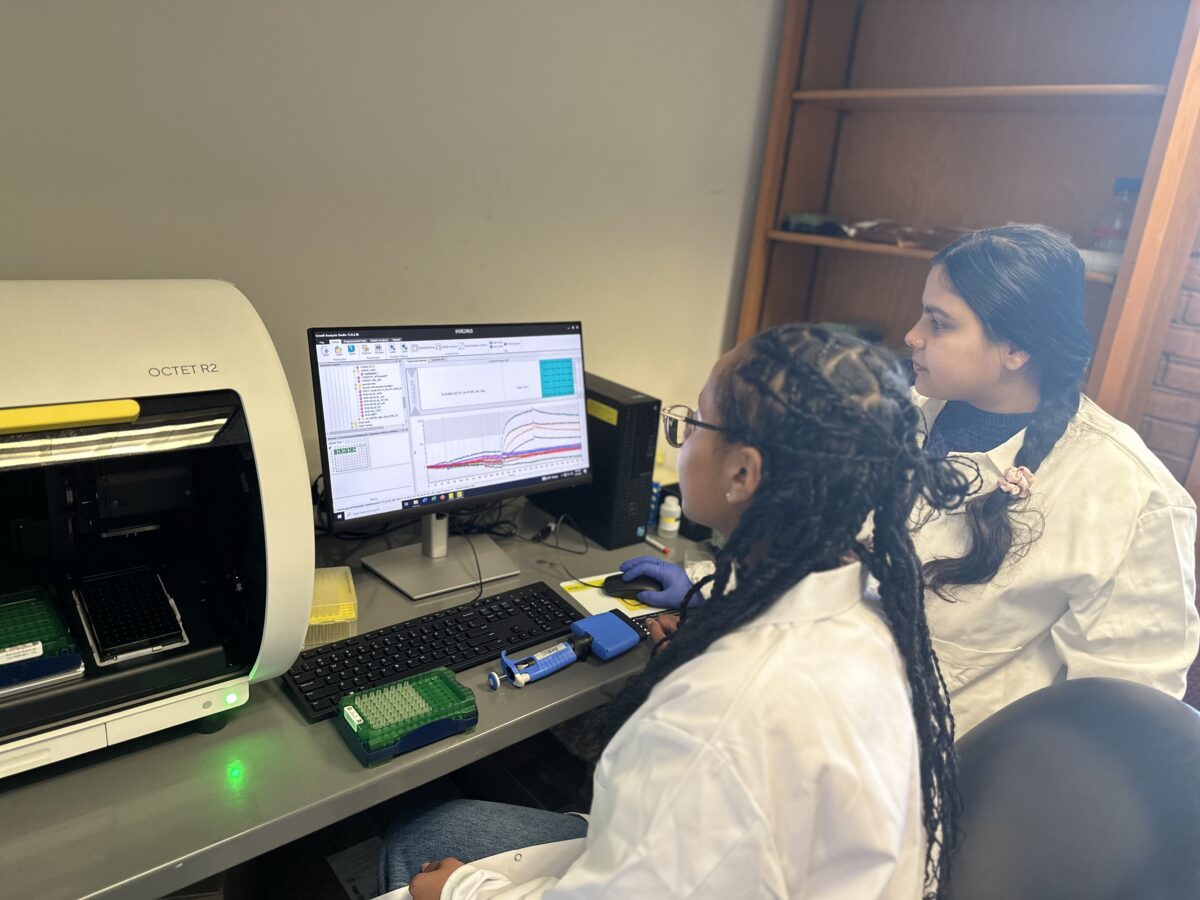 All three sisters gained valuable experience and skills working with Koirala. Left: Rowah looks at experimental wells under a microscope. Right: Reem (left) and Manju Ojha analyze data. (Photos courtesy of Deepak Koirala)
Reem conducted experiments for a project on viral replication, earning co-authorship on a 2025 Nature Communications paper as a high schooler. “I never expected to be so involved—I feel privileged,” she says. The process taught her the value of replication and troubleshooting. “Sometimes it’s trial and error as you’re exploring something new,” she says.
Now a first-year student at UMBC majoring in biochemistry, Reem plans to return to the Koirala lab as soon as space becomes available. “I didn’t consider grad school before, but now it’s definitely on the table,” she says—a perspective born of early research experiences that revealed what the scientific process is really like.
A real community
Rowah, a high school senior, joined the lab last fall. Her expectations of a “scary, strict PI” melted away. “Dr. Koirala is one of the kindest people I’ve met,” Rowah says. The lab’s supportive dynamic impressed her, too. Members shared resources, brainstormed next steps, and lifted each other up. “They push each other to do better—it’s a real community.”
Building on her ARL skills, Rowah felt like a valued member of the team. Her mentor in the lab, Ph.D. student Bethel G. Beyene, provided scientific papers for context, ensuring she grasped the concepts behind the team’s research, not just individual lab techniques. She, too, came face to face with failure and learned from it.
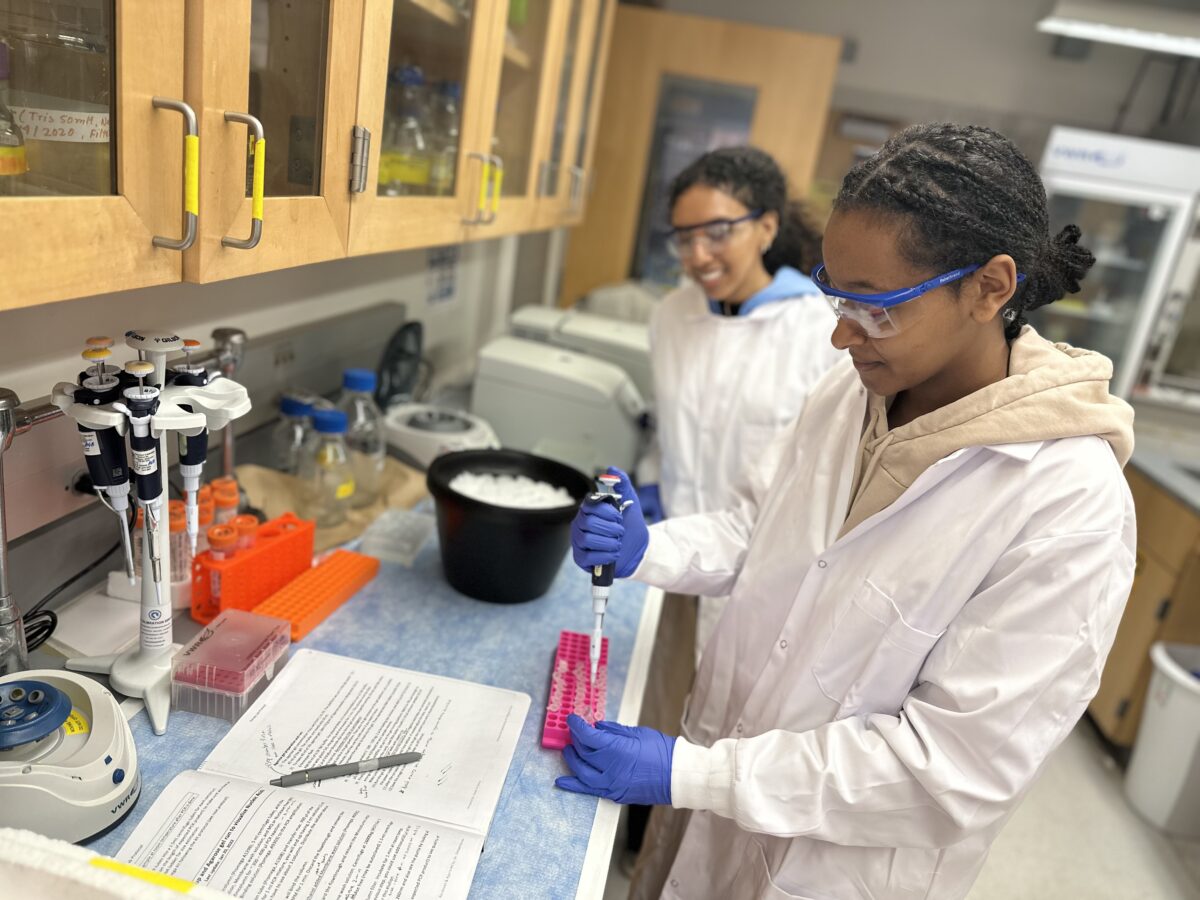 Rowah (at left and pipetting on right) received supportive mentorship from Ph.D. student Bethel Beyene (right photo, background). (Photos courtesy of Deepak Koirala)
“When things go wrong, we sit down and figure it out. It’s not that failure means you’re wrong; overcoming it is how you succeed.” That creative problem-solving carried over into her high school robotics competitions. “I applied lab thinking by evaluating all the possible sources of error to debug our robot—it felt great,” Rowah says. With her interests across biology and engineering, Rowah is considering a biomedical engineering major in the future. “The Koirala lab showed me that I don’t have to choose between my interests,” she says.
Making science better
The sisters’ bond fueled their experiences. “We talk openly—about lab life, plans, even arguments,” Reem laughs. Rowah says her admiration for Huda encouraged her to pursue working in Koirala’s lab. Though they never overlapped in the lab, Huda’s path reassured the others. “If I hadn’t had that chance, I couldn’t have shared it with my family,” Huda says.
Koirala credits the ARL program for bringing talented high schoolers like the Abdelghanis into his group. “They’re not just mentioned in the acknowledgments for completing experiments, but contributing intellectually at the level of authorship,” he says, noting the paper Reem co-authored.
His inclusive approach welcomes students with diverse backgrounds, training the next generation of scientists. “High schoolers, undergrads, women and men from varied backgrounds—they’re all making science better,” Koirala says. Clearly, including less experienced scientists isn’t hurting the lab’s output. Koirala has received multiple major grants and published high-profile papers since he arrived at UMBC in 2020.
In Koirala’s welcoming space, beginners become contributors, failures forge innovators, and family ties amplify ambition. As Rowah troubleshoots gels, Reem eyes graduate school, and Huda designs bioimaging tech at MIT, their paths affirm that science thrives on curiosity, community, and the courage to explore.
]]>
On the fourth floor of UMBC’s Meyerhoff Chemistry Building, where students are hard at work exploring the intricacies of RNA molecules that may hold the key to combating viral diseases, a unique...
https://umbc.edu/stories/sisters-in-science/
https://my3.my.umbc.edu/api/v0/pixel/news/156260/guest@my.umbc.edu/87ca52c1e4d306e0d8b68899f861ab8c/api/pixel
chembiochem
cnms
community
news
research
science-and-tech
story
undergradresearch
UMBC News & Magazine
https://my3.my.umbc.edu/groups/umbc-news-magazine
https://assets1-my.umbc.edu/system/shared/avatars/groups/000/001/943/24435aa6207c452e7bc15cc74b42c7bb/xsmall.png?1748556657
https://assets1-my.umbc.edu/system/shared/avatars/groups/000/001/943/24435aa6207c452e7bc15cc74b42c7bb/original.png?1748556657
https://assets2-my.umbc.edu/system/shared/avatars/groups/000/001/943/24435aa6207c452e7bc15cc74b42c7bb/xxlarge.png?1748556657
https://assets2-my.umbc.edu/system/shared/avatars/groups/000/001/943/24435aa6207c452e7bc15cc74b42c7bb/xlarge.png?1748556657
https://assets3-my.umbc.edu/system/shared/avatars/groups/000/001/943/24435aa6207c452e7bc15cc74b42c7bb/large.png?1748556657
https://assets1-my.umbc.edu/system/shared/avatars/groups/000/001/943/24435aa6207c452e7bc15cc74b42c7bb/medium.png?1748556657
https://assets2-my.umbc.edu/system/shared/avatars/groups/000/001/943/24435aa6207c452e7bc15cc74b42c7bb/small.png?1748556657
https://assets1-my.umbc.edu/system/shared/avatars/groups/000/001/943/24435aa6207c452e7bc15cc74b42c7bb/xsmall.png?1748556657
https://assets2-my.umbc.edu/system/shared/avatars/groups/000/001/943/24435aa6207c452e7bc15cc74b42c7bb/xxsmall.png?1748556657
UMBC News & Magazine
0
0
false
Thu, 05 Feb 2026 13:43:47 -0500
Thu, 05 Feb 2026 13:43:47 -0500
A place to spark scientific curiosity—UMBC hosts 1,200 high schoolers at Science Olympiad invitational
On a cloudy Saturday in January, UMBC buzzed with the energy of over 1,200 high school students from across the Mid-Atlantic region. For the third consecutive year, UMBC’s College of Natural and Mathematical Sciences (CNMS) hosted its Science Olympiad Invitational Tournament, transforming the campus into a vibrant hub of hands-on scientific discovery for the high school competitors.
From building hovercrafts and bridges to tackling exams in anatomy, astronomy, and beyond, the event showcased 23 competitive challenges across an array of STEM disciplines. What started as a modest gathering of 40 teams three years ago has ballooned into Maryland’s largest invitational, drawing participants from Virginia, Delaware, New Jersey, Pennsylvania, and D.C.
The tournament exemplifies UMBC’s commitment to nurturing young talent and building community connections. “A couple of years ago, I suggested a Science Olympiad tournament as a way to invite more high school students onto the campus and get them excited about science—and UMBC,” shared event co-organizer Bindu Abraham, Ph.D. ’06, chemistry, assistant teaching professor of chemistry and biochemistry, and executive director of Maryland Science Olympiad.
Abraham first encountered Science Olympiad as a homeschool parent watching a passion for science emerge in her son. Now, she is happy to be involved in encouraging a similar enthusiasm for science in students across the region. This year’s event also spotlighted partnerships with organizations like STEM Champions of Baltimore, ensuring under-resourced Baltimore City schools could participate in a dedicated league and envision futures at UMBC.
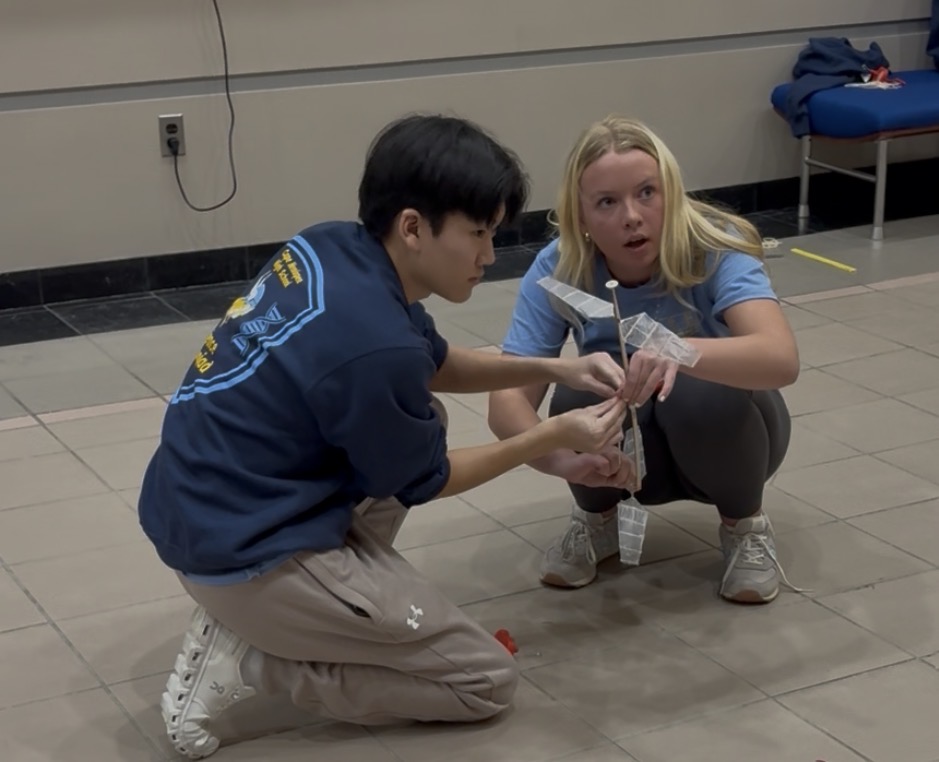
 Cape Henlopen High School in Delaware brought three complete teams to the Science Olympiad at UMBC. Left: Nathaniel Hoang and Ellie Sprague compete in the helicopter event. Right: Quinton Eisenmann and Ava Lewis prepare for the hovercraft event. (Photos courtesy of Priscilla Coolbaugh)
Inspiring students’ interest in science
Volunteers—including UMBC faculty, alumni, current students—made the day possible, each driven by motivations rooted in their own journeys. Mark Grzanna, M.S. ’15, biological sciences, today a Science Olympiad coach at John Carroll High School in Bel Air, Maryland, brought two teams of eager students for his third year at the UMBC tournament. Grzanna teaches biology, anatomy and physiology, and a biotech course he designed at John Carroll, and he views the Olympiad as a gateway to scientific curiosity.
“Education is so important. I became a teacher to get kids interested in science—or at least to help them understand enough science to navigate their world,” he said. His co-coach, John Carroll teacher Andrew Ketchum, echoed the sentiment: “It’s a great experience for our kids to see other students excited about science.”
Frank Tagaytay, a senior physics and math major, supervised the “boomilever” event, where teams tested structures’ strength and integrity. Based on experience as president of his high school Science Olympiad club, Tagaytay patiently guided participants through event regulations, offering encouragement amid the occasional structural mishap.

 Left: Frank Tagaytay (left), a senior UMBC physics and math major, encourages Aalyna Johnson (center) and Cassidy Mehegan from Cape Henlopen High School as they set up their “boomilever” for competition. (Photo by Sarah Hansen, M.S. ’15/UMBC) Right: Cape Henlopen students Theodore Noe Fellows, Shouta Sano, Quinton Eisenmann, and Ava Lewis (left to right) carry their equipment to the competition site in the UMBC Physics Building. (Photo courtesy of Priscilla Coolbaugh)
“It’s an early season event for teams to work out the kinks,” he explained, highlighting how the low-stakes environment builds confidence and resilience. For Tagaytay, volunteering bridges his past and present, reinforcing UMBC’s supportive community.
Fareedah Owolabi, a junior chemical engineering major who recently transferred from the Community College of Baltimore County, found the event particularly meaningful. “I have a soft spot for STEM outreach, because it’s how I was introduced to UMBC,” she shared. Through the Upward Bound Math and Science program, Owolabi connected with UMBC tutors as a high schooler. Now, as a volunteer, she fielded questions from participants about campus life. “I want to inspire younger students,” she said, embodying the cycle of mentorship that defines the tournament.
Broadening their horizons
Priscilla Coolbaugh, Science Olympiad coach at Cape Henlopen High School in Delaware, started her team three years ago after loving Science Olympiad as a student herself. “I want to share that love,” she said. Her three full teams traveled far to compete. “They get to see themselves at these universities. They might have planned to stay close to home, but this way they get exposure to out-of-state schools,” Coolbaugh said. “It broadens their horizons to different schools as well as different STEM fields.”

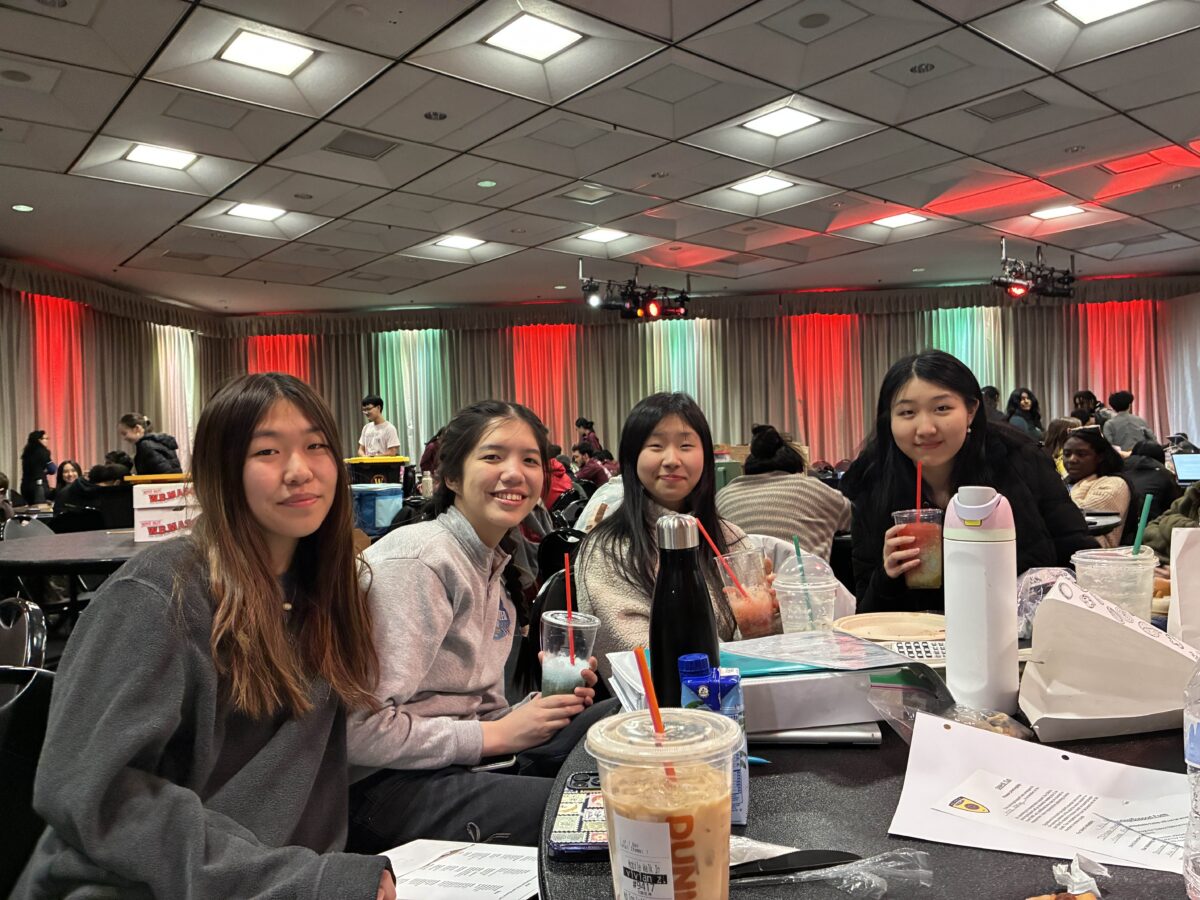 Students and a coach from Winston Churchill High School in Potomac, Maryland, relax in the UMBC Ballroom between events. (Photos courtesy of Jonathan Lee)
Students expressed their sense of community and excitement about their experiences at the UMBC event. Cape Henlopen freshman Aalya Desai noted how the event helped her make friends despite starting as a newcomer, and sophomore Grace Eanes appreciated the chance to bond with peers across grades while exploring the beautiful campus. Michael Song, a junior from Winston Churchill High School in Potomac, Maryland, who with his teammate, Leo Jiang, earned the top score in the hovercraft event, commented, “UMBC is much bigger than I expected. It’s a lot of fun to travel to Olympiad events.”
In good hands
Faculty and staff volunteers underscored the event’s broader impact. CNMS dean William R. LaCourse, surveying the awards ceremony, reflected on the promise of the participants. “As I stood on the stage looking over the ballroom filled with excited and creative students, I couldn’t help feeling as if I was looking into the future and thinking, ‘We (all of us) are in good hands,’” he said.
Zeev Rosenzweig, professor of chemistry and biochemistry, supervised the rocks and minerals test with three undergraduates and three of his graduate students. “Being here is just an important thing to do,” he said. “It’s a great outlet to show them that their interests matter,” he noted. “The kids who come to the Olympiad—they’re our people.” Ph.D. student Kushani Mendis, a Ph.D. student in Rosenzweig’s lab, added, “The best way to support the next generation in STEM is to organize events like this and spend time with them.”
In April, UMBC will host the Maryland State Science Olympiad for the first time, building on this invitational’s momentum. “It’s fun to see young people so excited about different areas of STEM,” shared Michelle Starz-Gaiano, professor and chair of biological sciences, adding, “It’s critical to foster the growth of young scientists. We love the energy and enthusiasm that they bring.”
]]>
On a cloudy Saturday in January, UMBC buzzed with the energy of over 1,200 high school students from across the Mid-Atlantic region. For the third consecutive year, UMBC’s College of Natural and...
https://umbc.edu/stories/1200-high-schoolers-at-science-olympiad/
https://my3.my.umbc.edu/api/v0/pixel/news/156251/guest@my.umbc.edu/8fcd1fc51406ee5d71336ef39bd47917/api/pixel
biology
cbee
chembiochem
cnms
coeit
community
news
physics
science-and-tech
story
trio
UMBC News & Magazine
https://my3.my.umbc.edu/groups/umbc-news-magazine
https://assets1-my.umbc.edu/system/shared/avatars/groups/000/001/943/24435aa6207c452e7bc15cc74b42c7bb/xsmall.png?1748556657
https://assets1-my.umbc.edu/system/shared/avatars/groups/000/001/943/24435aa6207c452e7bc15cc74b42c7bb/original.png?1748556657
https://assets2-my.umbc.edu/system/shared/avatars/groups/000/001/943/24435aa6207c452e7bc15cc74b42c7bb/xxlarge.png?1748556657
https://assets2-my.umbc.edu/system/shared/avatars/groups/000/001/943/24435aa6207c452e7bc15cc74b42c7bb/xlarge.png?1748556657
https://assets3-my.umbc.edu/system/shared/avatars/groups/000/001/943/24435aa6207c452e7bc15cc74b42c7bb/large.png?1748556657
https://assets1-my.umbc.edu/system/shared/avatars/groups/000/001/943/24435aa6207c452e7bc15cc74b42c7bb/medium.png?1748556657
https://assets2-my.umbc.edu/system/shared/avatars/groups/000/001/943/24435aa6207c452e7bc15cc74b42c7bb/small.png?1748556657
https://assets1-my.umbc.edu/system/shared/avatars/groups/000/001/943/24435aa6207c452e7bc15cc74b42c7bb/xsmall.png?1748556657
https://assets2-my.umbc.edu/system/shared/avatars/groups/000/001/943/24435aa6207c452e7bc15cc74b42c7bb/xxsmall.png?1748556657
UMBC News & Magazine
1
0
false
Thu, 05 Feb 2026 11:30:12 -0500
Thu, 05 Feb 2026 11:30:12 -0500


