Game Changers

At their most basic levels, learning and play can look a lot alike. Both call for creativity and resourcefulness; inspire curiosity; and require failure, reflection, and practice. For some students, learning isn’t all fun and games. But members of the UMBC community are looking to change that.
Kerri Evans always strives to make her curriculum engaging, but knew she needed a new way to connect her students to the material. As a social work professor at UMBC, Evans teaches and studies the experiences of recent immigrants and refugees to the U.S. and wanted a new way to expose her students to the trials and triumphs of immigrant children navigating the U.S. education system.
“Social work curriculums largely rely on analyzing and reflecting upon case studies,” Evans says. “But immigrant stories are so diverse—it’s hard to understand the breadth of their experiences just by reading and responding to a case study.”
While working as a program manager at Lutheran Immigration and Refugee Service in downtown Baltimore, Evans saw how an engaging training activity helped foster parents, educators, and staff to better understand the experiences of immigrant and refugee children. For the activity, participants read cards containing stories of immigrants as they navigated various stages of their journey, like falling off the train in Guatemala, or losing your relatives at the U.S. and Mexico border, for example. A group discussion followed of how these experiences, some horrific, influenced the lives of unaccompanied children in the U.S.
“It wasn’t a game in the traditional sense, but it was inspiring and engaging,” she says.
And thus, Evans’ idea for the board game “Emerging: The Educational Journey of Immigrant Students” was born.
The gamification of learning is an approach more instructors are adopting to motivate their students to think outside of the box. Professors like Evans and others are maximizing enjoyment and engagement in their classes by capturing the interests of students and inspiring them to keep learning. Students across disciplines at UMBC are getting hands-on experience building games—tangible ones like “Emerging” as well as a host of video games that also foster a collaborative learning environment. Both the students and teachers agree: Learning is a lot easier when you’re having fun.
Understanding the “Rules of the Game”

“Emerging” is still in its infancy, but it is attracting the help of people across the UMBC community. In fall 2021, Evans paired up with UMBC’s assistant professors of education, Jiyoon Lee and Keisha Allen, and five UMBC undergraduate and graduate students to help bring the game to fruition.
Both the game and a future interdisciplinary course will focus on the immigrant experience in the U.S. from pre-kindergarten to college, with the goal of teaching UMBC students who will become service providers and teachers to understand the experiences faced, to advocate for inclusion, and to dismantle racism in schools.
 Kerri Evans headshot courtesy of Melissa Penley Cormier.
Funded by a UMBC Hrabowski Innovation Fund Grant: Implementation and Research Award, “Emerging” will be a multiplayer, cooperative game where participants assume the role of an immigrant child and work together to gain the resources necessary for “success” such as educational attainment, language skills, and social networks. Along the way, players will face challenges, get helpful boosts, and be forced to mitigate stress before it brings the game to a close. Picture Forbidden Island- meets-Catan-meets-Monopoly-meets immigrant experiences.
Participants will need to achieve both happiness and self-sufficiency to win, and players will lose if their stress levels get too high or if they are unable to access help and resources they need.
Advancing on the board will require strategy, resourcefulness, collaboration, and a little bit of luck. Players could land on spaces that require them to pick a card that describes a “win” or a “setback.” Wins may include getting an A on a test, making a new friend, or having a teacher stick up for you. Setbacks may look like getting bullied, forgetting to turn in your homework, or having troubles with immigration status.
Players can also gather “resources” along the way, which could come in the form of joining a sports team, partaking in an after-school program, or going to a tutoring session. These resources play an integral role in managing your players’ mental health, an essential part of winning the game.
All of the “wins” and “setbacks” will be based on real-life stories collected by a research process the students are currently undertaking, something Evans says is important to the integrity of the game.
“We don’t want these stories to be hearsay or things that could theoretically happen, we’re doing our research to create an accurate game of experiences that have truly happened,” Evans says.
“I think we are creating something really special,” says social work and psychology undergrad Ashley Pereira ’22, who is part of the team currently analyzing hundreds of peer-reviewed journals and case studies to find stories of success and heartbreak to include. “And to know we are creating it in a way where it’s based on research just makes you feel so confident about the decisions you make.”
The game also aims to highlight the cultural differences within the education systems of various countries. For example, Evans says, it’s important to be mindful that immigrant students may not understand how to open up a locker, or the need to raise your hand to ask for permission to speak. The team is working on ways to include these discrepancies into the game.
“We take for granted that we know the ‘rules of the game,’ in our education systems,” says TESOL graduate student and team member Eric Chen ’22. “If educators assume children from other countries come in with this knowledge, it can put the kids at a disadvantage.”
Like all great games, “Emerging” plays on participants’ emotions. The stakes are high, and tragedy or triumph may be just around the corner.
Game Developer Galore
Over in the Engineering building, a different type of game development is taking place. Over 46 game developers are congregating to create the next great video game. Founded in 2005, the Game Developers Club is dedicated to bringing students of all majors and skill levels together to learn about game development, work as a team, and of course, create video games.
Emotions are high around this time of year, as club members pitch their ideas to the group in hopes their game will garner interest from other club members. Vice president of the club, Seth Davis ’22, computer science, is well acquainted with the process. He’s been a part of the club for three years and has created three games. Pitch time is his favorite time of the year.
“It’s always so exciting to see a person get up in front of the club and talk about an idea they’re passionate about,” Davis says. “Some people are so nervous that others won’t like their idea, but then after they pitch it, five people come running up to them saying they love the idea and want to support them.”
In 2020, Davis pitched the idea for a game called Binary Bubbles, a side-scroller (think Super Marios Bros.) puzzle game. The goal is simple: Get to the yellow flag as quickly as you can. The catch? There are malfunctioning robots in the way. Using strategy and logic, players must hack into the robots, steal their code bubbles, and move the code bubbles to other robots.
Davis and his team created 20 levels that span over two worlds, something he says would only be possible by working with an interdisciplinary team. Davis enlisted the help of art students, music students, and English students to make his games a reality.
“There are so many majors represented in the club, it’s not just computer science people,” he says. “This club teaches you how to work as a team to create an amazing product.”
Turning games into jobs
If Davis had to pick a second-favorite time of year, it would be the unveiling of the games. It’s when club members take their projects to the school and community and let others play the video games they’ve worked so hard to create.
Binary Bubbles was featured at 2020’s Undergraduate Research and Creative Achievement Day (URCAD) along with 13 other video games created by members of the Game Developers Club. Previous games have also been featured at Artscape, Baltimore’s largest annual art festival.
Members of the Game Developers Club receive more than just thunderous applause at URCAD and Artscape, they also get job offers from blue-chip employers. They’ve gone on to find positions at Facebook, Unity Game Engine, and Firaxis games, to name a few.
“Our club is actually very career-focused,” Davis says. “Employers love it when they see our portfolios and see we completed a game. Lots of former members got jobs because of this club.”
As a member of the club’s executive board, Davis works hard to ensure the games are seen by as many people as possible, including professional game developers. Some of those professionals are former club members themselves. Davis says alumni like Eric Jordan ’08, computer science, currently at Facebook, are eager to help current club members achieve their dreams.
“This club is such a great way to network and build real relationships,” Davis says. “It’s the perfect way to get that gaming job you’ve always dreamed of.”
The Go-To Gamer Guy
Marc Olano knows a thing or two about video games—he’s commonly referred to as UMBC’s “go-to gamer guy.” Ironically, Olano isn’t much of a gamer himself, but he certainly knows the recipe for creating a great game.
 Marc Olano headshot courtesy of Ryan Zuber ’04, Imaging Research Center.
Olano has been doing research on video game graphics hardware for over 25 years. He pioneered procedural shading on graphics hardware, a technique that is used to add details to a surface of an object. The model is now the standard on every PC and game platform. Olano also pioneered UMBC’s Game Development track and helped usher in UMBC’s 3D photogrammetry scanning facility in 2015, now serving as the director for both.
The Game Development track and the Visual Arts Department’s Animation and Interactive Media concentration make up “GAIM:” UMBC’s Games, Animation and Interactive Media program. GAIM prepares students for careers in the video game industry, and exposes them to internship opportunities at local game development companies such as Firaxis, Big Huge Games, Epic Games, Mythic Entertainment and Zynga.
In the GAIM capstone course, visual arts and computer science students join forces for a semester to design an original game. The course mimics the setup of teams in the industry where 500 artists and programmers must work together for several years to develop a single game.
“My role is teaching the students how to do the work, then letting the students figure out for themselves how to actually do it,” Olano says. “I’ve found it brings students a lot of joy to know they created something very independently.”
“Bandit”
Olano’s first taste of an educational game development project was with UMBC history professor Anne Rubin. In spring 2015, Rubin and Olano united their classes to create a computer game called “Bandit” which detailed the 1861 Pratt Street Riots, an event many scholars believe was the site of first blood shed in the American Civil War. Undergraduates in the Game Development track built the game and Rubin’s history students served as historical researchers and consultants.
 A still from “Bandit.”
In the game, players control a fox who is on the loose on the streets of Baltimore during the Pratt Street Riots, when Massachusetts militiamen came in contact with anti-war protestors in Baltimore. The fox is on the hunt for documents from the riots which can be examined and recorded all while trying to avoid guards patrolling Pratt Street.
“MeetingMayhem”
Olano is currently working with professor of computer science Alan Sherman and students from the UMBC Cyber Defense Lab to create a video game called “MeetingMayhem.” The web-based game aims to help students learn about adversarial thinking, or the ability to embody the technological capabilities and strategic reasoning of hackers. The goal of the game is to arrange a meeting time and place by sending and receiving messages through an unsecure network that is under the control of a malicious adversary. Players can choose to be the hero or the villain, or in this case, the benevolent meeting-maker or the hacker. The hacker can disrupt the efforts of the meeting-maker by intercepting, modifying, blocking, and injecting messages into the unsecure network.
In this engaging challenge, computer science students learn the basics of the Dolev-Yao intruder network model, a framework used to analyze safety protocols within a communications network. Students also learn the value of using cryptography to mitigate these dangers.
What Does it Mean to Win?
Across UMBC, professors and students are harnessing the power of play to enrich their learning experiences. Be it video games, board games, or anything in between, Retrievers are rich with ideas of how to make learning a little more interactive and a lot more fun.
Olano, who was recently appointed associate dean for Academic Programs, is adjusting to his new responsibilities, but for him, it’s still all about the students and the games.
“It never gets old seeing students when they realize they can actually build a game for themselves and they are excited doing it,” Olano says. “Honestly, it brings me a lot of joy, too.”
For Evans, winning means the participants of “Emerging” leave the game with more insight than before—even insight into what different types of “success” could look like. In the meantime, her students will experience joy as they learn research skills, build the game, and begin to introduce the game to more students in the coming semesters. The team plans to gain knowledge from other UMBC students who are immigrants themselves and discover how this subset of students found success in college. After that, the team will enlist the help of UMBC art students to help design a prototype. In the future, the team hopes to premiere the game to educators outside of the UMBC community
“People have sympathy reading case studies, but it’s not nearly as visceral as if you’re playing a game and your character experiences something tragic and now you’ve lost three turns,” Evans says. “Players will feel the anger of feeling left behind and the joy of successes.”
For Davis and the Game Developers Club, winning means making friends, networking, and having fun. “At the end of the day, we’re really just having a great time making games,” he says.
— Kennedy Lamb ’20 and Illustration by Marissa Clayton ’21.
]]>
At their most basic levels, learning and play can look a lot alike. Both call for creativity and resourcefulness; inspire curiosity; and require failure, reflection, and practice. For some...
https://umbc.edu/stories/game-changers/
https://my3.my.umbc.edu/api/v0/pixel/news/119511/guest@my.umbc.edu/51b1aa91d1683e4c7643d7fd56245749/api/pixel
cahss
campus-life
coeit
computer-science
education
fall-2021
feature
game-development
history
social-work
video-games
visual-arts
UMBC News & Magazine
https://my3.my.umbc.edu/groups/umbc-news-magazine
https://assets1-my.umbc.edu/system/shared/avatars/groups/000/001/943/24435aa6207c452e7bc15cc74b42c7bb/xsmall.png?1748556657
https://assets1-my.umbc.edu/system/shared/avatars/groups/000/001/943/24435aa6207c452e7bc15cc74b42c7bb/original.png?1748556657
https://assets2-my.umbc.edu/system/shared/avatars/groups/000/001/943/24435aa6207c452e7bc15cc74b42c7bb/xxlarge.png?1748556657
https://assets2-my.umbc.edu/system/shared/avatars/groups/000/001/943/24435aa6207c452e7bc15cc74b42c7bb/xlarge.png?1748556657
https://assets3-my.umbc.edu/system/shared/avatars/groups/000/001/943/24435aa6207c452e7bc15cc74b42c7bb/large.png?1748556657
https://assets1-my.umbc.edu/system/shared/avatars/groups/000/001/943/24435aa6207c452e7bc15cc74b42c7bb/medium.png?1748556657
https://assets2-my.umbc.edu/system/shared/avatars/groups/000/001/943/24435aa6207c452e7bc15cc74b42c7bb/small.png?1748556657
https://assets1-my.umbc.edu/system/shared/avatars/groups/000/001/943/24435aa6207c452e7bc15cc74b42c7bb/xsmall.png?1748556657
https://assets2-my.umbc.edu/system/shared/avatars/groups/000/001/943/24435aa6207c452e7bc15cc74b42c7bb/xxsmall.png?1748556657
UMBC News & Magazine
0
0
false
Wed, 08 Dec 2021 22:01:17 -0500
Building an Inclusive Workforce—Rising Together

Since 2009, as part of its Alumni Awards celebration, the UMBC Alumni Association names one “Rising Star” recipient each year who exemplifies early career and professional achievement. Prior to our October 2021 award ceremony, we’re spending some time with awardees from the past decade to see where they are now—and how they’ve grown in their fields while maintaining ties to UMBC. In this installment, UMBC Rising Stars Alicia Wilson ’04, political science, Nicole DeBlase ’06, financial economics, and Lauren Mazzoli Zavala ’15, computer science and mathematics, M.S. ’17, computer science, discuss their leadership roles in economic development, finance, and engineering and their concerted efforts to make these career paths more available to women and other underrepresented communities.
“If a woman sets the table, everyone wants to pull up a seat,” says Alicia Wilson ’04, political science. “It’s important for women to set the table—to be in positions of leadership—so they can build a strong team.”
Indeed, the following Rising Star Alumni Award recipients have not just set the table, they’ve helped build it.
UMBC Magazine sat down virtually with three powerhouse women to discuss how their time as UMBC students and scholars impacted their professional trajectories, and how they’re paving the way for the next generation of leaders.
Training up leaders
Economic development, finance, and engineering aren’t career paths traditionally associated with women (yes, even in 2021), however with concerted efforts to recruit, train, and retain young, female graduates—especially those coming out of smaller or lesser-known schools—the tides have been turning. UMBC’s constellation of programs that lift up underrepresented populations in tech or community development have well-situated Retrievers who want to make an impact on the world as well as closer to home.
Left: Wilson (far right) hosted a basketball tournament for South Baltimore youth who had perfect or improved attendance. Right: A visit to Harvard and the Massachusetts Conference for Women with Brown Girl Village (Wilson, center, in gray). Photos courtesy of Wilson.
It’s no accident that a determining factor in who receives the Rising Star Award is someone who demonstrates ongoing involvement and support of UMBC, its students, and alumni.
Wilson, DeBlase, and Zavala are just three of the many success stories coming out of Hilltop Circle and their professional expertise, personal commitment to being viewed as leaders, and overall drive are more than evident, even over a Zoom call.
Opening doors
While their professional successes are evident, the personal successes of these Rising Stars are, in part, intertwined. Seeing firsthand the importance of strong leadership and being a part of a student body where academics are celebrated (“At UMBC, it’s cool to be smart,” says Wilson with a laugh), all three women have made it a point to open doors for other students who may not have taken the traditional route to careers in economics or engineering.
“I feel like I had to work a little harder to make it happen for myself on Wall Street,” says Nicole DeBlase ’06, financial economics, a managing director and lead analyst for Deutsche Bank, focusing specifically on U.S. multi-industry and electrical equipment. “Coming from a non-Ivy League school, I had to exercise my muscles to get my foot in the door. Because of that, I make it a point to help recruit people from state schools, knowing that talent and skill can come from anywhere. I feel like I’ve had a bit of an impact in that way.”
 DeBlase visiting Oshkosh, a company she covers that makes defense vehicles, among other things. Photo courtesy of DeBlase.
The act of paying it forward is not a new concept for UMBC alumni, and each of these Retrievers emphasizes that “community” isn’t just a word splashed across the university’s homepage, but rather a way of life for students and alumni, and something university President Freeman Hrabowski actively nurtures.
“I had never eaten lunch with a university president before Dr. Hrabowski,” remembers Wilson, who was a Sondheim Public Affairs scholar and is now the vice president of economic development at the Johns Hopkins University and Health Systems. “I thought to myself how this must be a special place, because that’s far beyond what I would imagine someone in that position caring about—what some 17-year-old kid from the city thinks.”

In
2018, Wilson was the keynote speaker at the Steve and Marjorie Harvey Foundation’s Girls Who Rule the World summit. Photo courtesy of Wilson.
Wilson’s Baltimore roots are serving her well. In her current role, she leads the development and implementation of Hopkins’ institution-wide strategies and initiatives both within the United States and abroad through investments in real estate, economic and neighborhood development, healthcare, and education.
A school that invests in its students to ensure their personal successes is something worth celebrating, says Wilson, 2009 Rising Star recipient—and it’s perhaps what UMBC most prides itself on.
Lauren Mazzoli Zavala agrees.
 Zavala, right, with her mentee Priyanka Ranade ’18, M.S. ’19, information systems, at Northrop Grumman. Photo by Marlayna Demond ’11.
“The time I spent in UMBC’s Cyber Scholars Program prepped me for the reality that teamwork and collaboration are essential in this industry,” says Zavala,’15, computer science and mathematics, M.A. ’17, computer science. “You can never go into a room with an ego because you can always expect to learn from other people around you. That’s something I quickly picked up as a UMBC scholar and it’s been critical to how I approach my work at Northrop.”
Zavala, who received the Rising Star award in 2017, is now a software engineering manager at Northrop Grumman where she and her team oversee cyber missions as they relate to American troops in different parts of the world.
Showing up
 Zavala, far left, at Northrop’s Cyber Security Raspberry Pi Competition hosted by Northrop Grumman for UMBC Students
.
Photo courtesy of Zavala.
The Center for Women in Technology (CWIT) is a primary example of the investment made in UMBC’s students’ future, in this case, the future of women in technological careers. Established in July 1998 to catapult women’s full participation in all aspects of information technology, CWIT expanded its scope in 2006 to include engineering majors as well. Zavala knows firsthand the importance a scholarship program like CWIT has on an entire student body.
“The Cyber Scholars Program was invaluable to me as a junior,” she adds. “Its partnership with CWIT, as well as Northrop Grumman and other leading companies in cybersecurity, provided students with the network and resources needed to build important connections.”
In a space typically dominated by white men, Zavala remembers joining a group of women to participate in a cyber competition. Though they didn’t end up winning, the lasting memory of being present and bringing some much-needed diversity to the space stayed with her.
“The worst we can do is fail,” she says, emphasizing the importance of showing up and trying. “In my career today, I’m constantly learning from other people, and that includes interns. We’ll lean on them for their creative solutions to very real deadlines and challenges we have to meet at Northrop every day.”
Talented trailblazing
Modeling good leadership results in good leadership, and ultimately, it’s what drives DeBlase, Zavala, and Wilson within their respective jobs—excellence recognizing excellence.
 DeBlase on her first CNBC appearance. Photo courtesy of DeBlase.
“I run a team of four associates, and we have a 50/50 ratio of women versus men,” says DeBlase, who is heavily involved with Deutsche Bank’s recruitment process and is keen on creating opportunities for individuals who have taken a less traditional approach to reaching Wall Street. “Looking for the most talented person to fill a seat is critical, which is why it’s important to seek out those women applicants.”
Programs like Women on Wall Street—perhaps not coincidentally run by Deutsche Bank—allows DeBlase, the 2015 Rising Star awardee, to be up front and center in the recruiting process, ensuring that equal opportunity is given across the board.
In her previous position, recruitment of talented women started early. “When I was at Morgan Stanley, there was a whole initiative around recruiting women,” DeBlase adds. We’d start at the sophomore level and actually do campus outreach.”
Despite the personal successes each woman has experienced in the workforce, there is still larger work to be done, particularly in light of the numerous challenges women have faced during the COVID-19 pandemic.
“There needs to be an evolution with work-life balance and work flexibility to allow women to feel like a career on Wall Street is more sustainable,” says DeBlase. “It’s still challenging for women who enter more senior roles. In a way, COVID has helped my workplace realize that there are opportunities for employees to work from home and strike a healthier work-life balance.”
In a perfect world, a trailblazer won’t be categorized by their gender, but rather by their innovation, talent, and dedication to creating a more inclusive society. Until then, however, it’s programs like CWIT, the Sondheim Program, and Women on Wall Street that will drive change that is both tangible and significant, as seen through the work of these three Rising Stars
With women like Zavala, Wilson, and DeBlase at the helm, change might come sooner than anticipated.
— Nikoletta Gjoni ’09
Read more about other Retrievers rising together and stay tuned for more information about UMBC’s 32nd annual Alumni Awards in October.
]]>
Since 2009, as part of its Alumni Awards celebration, the UMBC Alumni Association names one “Rising Star” recipient each year who exemplifies early career and professional achievement. Prior to...
https://umbc.edu/stories/building-an-inclusive-workforce-rising-together/
https://my3.my.umbc.edu/api/v0/pixel/news/119584/guest@my.umbc.edu/6b2d4c053e354944d978a9415528a3f5/api/pixel
alumni
alumni-awards
cahss
cnms
coeit
computer-science
financial-economics
mathematics
political-science
rising-together
UMBC News & Magazine
https://my3.my.umbc.edu/groups/umbc-news-magazine
https://assets1-my.umbc.edu/system/shared/avatars/groups/000/001/943/24435aa6207c452e7bc15cc74b42c7bb/xsmall.png?1748556657
https://assets1-my.umbc.edu/system/shared/avatars/groups/000/001/943/24435aa6207c452e7bc15cc74b42c7bb/original.png?1748556657
https://assets2-my.umbc.edu/system/shared/avatars/groups/000/001/943/24435aa6207c452e7bc15cc74b42c7bb/xxlarge.png?1748556657
https://assets2-my.umbc.edu/system/shared/avatars/groups/000/001/943/24435aa6207c452e7bc15cc74b42c7bb/xlarge.png?1748556657
https://assets3-my.umbc.edu/system/shared/avatars/groups/000/001/943/24435aa6207c452e7bc15cc74b42c7bb/large.png?1748556657
https://assets1-my.umbc.edu/system/shared/avatars/groups/000/001/943/24435aa6207c452e7bc15cc74b42c7bb/medium.png?1748556657
https://assets2-my.umbc.edu/system/shared/avatars/groups/000/001/943/24435aa6207c452e7bc15cc74b42c7bb/small.png?1748556657
https://assets1-my.umbc.edu/system/shared/avatars/groups/000/001/943/24435aa6207c452e7bc15cc74b42c7bb/xsmall.png?1748556657
https://assets2-my.umbc.edu/system/shared/avatars/groups/000/001/943/24435aa6207c452e7bc15cc74b42c7bb/xxsmall.png?1748556657
UMBC News & Magazine
0
0
false
Fri, 09 Jul 2021 20:53:57 -0400
A Path Forward to Research
Ramin Ayanzadeh, Ph.D. ’20, was awarded a spot in the selective Computing Innovation Fellows program, designed to help recent Ph.D. graduates continue research despite COVID-19.
 Ayanzadeh received second place at the 2019 ACM Student Research Competition. Photo courtesy of Ayanzadeh.
When he began his Ph.D. studies in computer science in Iran, Ramin Ayanzadeh, Ph.D. ’20, computer science, never imagined that he’d travel more than 6,000 miles away from home to restart his doctoral program—losing his eyesight along the way—but never losing track of his ultimate goal to continue his research in quantum computing, which in Ayanzadeh’s words, helps solve problems that ordinary computers cannot solve.
Quantum computing has applications in cybersecurity, quantum chemistry, machine learning, weather forecasting, and in the development of pharmaceuticals as it supports exponentially faster problem-solving. Ayanzadeh notes that quantum computers do not replace current computers, but rather complete more complex or time-consuming tasks.
Ayanzadeh—who was recently awarded a position in the selective 2020 National Science Foundation Computing Innovation Fellows postdoc program—began his UMBC degree as quantum computing was becoming increasingly popular. Two UMBC faculty researchers who are leaders in AI and high-performance computing took the new doctoral student under their wing.
Tim Finin, professor of computer science and electrical engineering (CSEE), and Milton Halem, research professor of CSEE, encouraged Ayanzadeh to combine research in artificial intelligence (AI) with quantum computing. His Ph.D research and dissertation focused on using AI to advance quantum computing and teach computers how to solve problems that supercomputers are not able to complete.
Determined to adjust
When Ayanzadeh was diagnosed with retinitis pigmentosa, a genetic condition that causes eyesight to deteriorate overtime, he left Iran to live with an uncle in Maryland. He was determined to continue his studies, so he began researching programs that would allow him to continue his Ph.D. in cognitive science. After meeting with Finin and learning about his research, Ayanzadeh decided to completely change his dissertation topic from machine intelligence to AI and quantum computing, which meant that he would have to restart his PhD.
In fall 2013, Ayanzadeh was adjusting to new living arrangements and a new research topic, while facing a health challenge that required him to create adaptive tools and advocate for himself.
Ayanzadeh, who is now legally blind, says that his advisors and the CSEE department were supportive and helpful as he navigated the situation. He says that everyone wanted to help but they were not sure the best way to assist. As Ayanzadeh faced these challenges, he was very resourceful, says Finin, adding that he spent time finding solutions to meet his needs.
Building a support network
“He worked diligently to continue his graduate education and made steady progress,” says Finin. “Ayanzadeh has been very resourceful in acquiring assistive technologies that help and in building up a support network within the university community and beyond. His optimism, drive, and resourcefulness are inspirational, both to his fellow students and our faculty.”
During his final semester at UMBC, Ayanzadeh developed and instructed a seminar on programming quantum computers. Finin says that he was impressed by Ayanzadeh’s ability to spearhead the course, adding that he will be well-prepared for a career in academia.
 Ayanzadeh accepts his award at the 2019 ACM Student Research Competition, sponsored by Microsoft. Photo courtesy of Ayanzadeh.
“Academia is the place for me, even though industry is [better] equipped to accommodate me,” Ayanzadeh explains. “I always swim against the water.”
Nipun Ramagiri, M.S. ’22, computer science—one of the 23 students that Ayanzadeh taught—says that Ayanzadeh encouraged students to be engaged with the discussions and ask questions. Ayanzadeh was always willing to meet with students individually outside of class time, says Ramagiri, to answer additional questions or review material.
Ramgiri appreciated that Ayanzadeh took the extra step of inviting industry experts to talk to the class about how the course’s topics were connected to work being done by companies. “This made me get more involved in the open-source contributions being done in the field, which ended up getting me an internship at IBM Quantum,” says Ramagiri.
Computing Innovation Fellows program
As Ayanzadeh was finishing his Ph.D., the COVID-19 pandemic was impacting institutions across the country, and many companies and institutions were delaying hiring. Ayanzadeh knew that he wanted to pursue a career in academia, and with the ripple effects of the pandemic, he was not sure what his next steps would be. While he considered pursuing a career in industry, Ayanzadeh says that he decided that academia was a better fit because of the resources available to people with disabilities. He found out about the highly selective National Science Foundation’s Computing Innovation Fellows (CIFellows) program from Finin. About 550 people applied to the CIFellows program, and 59 were accepted into the 2020 class.
 Ayanzadeh with philanthropist Robert Meyerhoff, who founded the Meyerhoff Scholars Program. Photo courtesy of Ayanzadeh.
With less than two months until the CIFellow program application was due, Ayanzadeh still needed to find a mentor who was accepting post-docs in their lab. Eventually, his application to work with Moinuddin Qureshi, professor of computer science at Georgia Tech, was accepted by the CIFellows program—ensuring Ayanzadeh a position for the next few years.
During his postdoc, Ayanzadeh plans to improve the accuracy and precision of near-term quantum computers. He will apply artificial intelligence to mitigate errors and enhance the performance of noisy quantum computers.
The CIFellows program, which is funded by the Computing Research Association and the Computing Community Consortium, was created in response to the COVID-19 pandemic, to assist recent Ph.D. graduates facing unexpected challenges in securing research positions. Previously, the CIFellows program was open for applications between 2009 and 2011 when the economy was in a recession.
Like UMBC, most work at Georgia Tech is being conducted remotely, which impacts when Ayanzadeh will be able to begin conducting his research on campus. For now, he shares, he will be working remotely. When he is able to relocate to Georgia, Ayanzadeh says that he will likely face challenges navigating a new location, especially if he doesn’t have a strong support system like he has in Maryland. However, he says that he is eager to meet new people, and mentor undergraduate and graduate students when he is physically on campus.
Ayanzadeh received a Google Lime Scholarship in 2018, and participated in the Meyerhoff Graduate Fellows Program in 2019, which supported his research at UMBC for one year.
“The CIFellows program is an excellent opportunity for me to network with experts in computer science, who are leading the program, and rising leaders who will define the future of computer science,” says Ayanzadeh. “I also think that by participating I will be well-prepared for an academic position.”
*****
Header image: Ramin Ayanzadeh, seated left, in 2018 with other members of the Center for Accelerated Real Time Analytics (CARTA), a National Science Foundation-funded partnership to develop next-generation computing hardware to solve major infrastructure challenges. Photo by Marlayna Demond ’11.
]]>
Ramin Ayanzadeh, Ph.D. ’20, was awarded a spot in the selective Computing Innovation Fellows program, designed to help recent Ph.D. graduates continue research despite COVID-19. Ayanzadeh...
https://umbc.edu/stories/a-path-forward-to-research/
https://my3.my.umbc.edu/api/v0/pixel/news/119616/guest@my.umbc.edu/2a5f30c07a8a86103820d8403eb42e0c/api/pixel
alumni
coeit
computer-science
csee
UMBC News & Magazine
https://my3.my.umbc.edu/groups/umbc-news-magazine
https://assets1-my.umbc.edu/system/shared/avatars/groups/000/001/943/24435aa6207c452e7bc15cc74b42c7bb/xsmall.png?1748556657
https://assets1-my.umbc.edu/system/shared/avatars/groups/000/001/943/24435aa6207c452e7bc15cc74b42c7bb/original.png?1748556657
https://assets2-my.umbc.edu/system/shared/avatars/groups/000/001/943/24435aa6207c452e7bc15cc74b42c7bb/xxlarge.png?1748556657
https://assets2-my.umbc.edu/system/shared/avatars/groups/000/001/943/24435aa6207c452e7bc15cc74b42c7bb/xlarge.png?1748556657
https://assets3-my.umbc.edu/system/shared/avatars/groups/000/001/943/24435aa6207c452e7bc15cc74b42c7bb/large.png?1748556657
https://assets1-my.umbc.edu/system/shared/avatars/groups/000/001/943/24435aa6207c452e7bc15cc74b42c7bb/medium.png?1748556657
https://assets2-my.umbc.edu/system/shared/avatars/groups/000/001/943/24435aa6207c452e7bc15cc74b42c7bb/small.png?1748556657
https://assets1-my.umbc.edu/system/shared/avatars/groups/000/001/943/24435aa6207c452e7bc15cc74b42c7bb/xsmall.png?1748556657
https://assets2-my.umbc.edu/system/shared/avatars/groups/000/001/943/24435aa6207c452e7bc15cc74b42c7bb/xxsmall.png?1748556657
UMBC News & Magazine
0
0
false
Tue, 25 May 2021 17:45:18 -0400
Career Q&A: Robert Deloatch ’11, M19

Every so often, we chat with an alum about what they do and how they got there. Robert Deloatch ’11, M19, computer science, has followed his research interests to an exciting job at Apple. We asked Robert about what his experience as a Meyerhoff Scholar means in his life today, and what he would say to a future scholar.
Q: What is your current job title and employer?
A: I am a Human Factors Engineer at Apple Inc.
Q: Tell us about your current job and what you enjoy most about it.
A: I manage a team of researchers who focus on applying user-centered design principles to design and develop Apple products. I collaborate with teams at Apple to come up with new ways to continue to enhance the customer experience. I enjoy the fast paced environment of Apple which allows for conducting research that leads to immediate customer impact.
Q: When you think about the “ripple effect” of the Meyerhoff Scholars Program, how do you see that playing out in your field and in your life?
A: I’ve been amazed at how the Meyerhoff Scholars Program has continued to affect my field and life. I’ve encountered researchers and faculty of color that were part of the Meyerhoff Scholars Program or programs that were modeled after Meyerhoff at conferences and internships. It’s been a reminder to me of the staying power of such a program and how it’s focus on leadership, diversity, and scholarship has been ingrained into my beliefs and relationships.
Q: Why is the Meyerhoff mission so important, not only to you, but to society?
A: The Meyerhoff mission is important because diversity in STEM is important. To generate the best ideas and solve complex problems requires discussion and being challenged. Having groups from various backgrounds and perspectives is foundational to promote useful discussion.
Q: What advice would you give to a student considering the program?
A: I would tell a student to follow the advice of your Meyerhoff staff. They have been instrumental in helping produce thousands of amazing scholars and have your best interest at heart. Listen to them.
Learn more about the Meyerhoff Scholars Program here.
]]>
Every so often, we chat with an alum about what they do and how they got there. Robert Deloatch ’11, M19, computer science, has followed his research interests to an exciting job at Apple. We...
https://umbc.edu/stories/career-qa-robert-deloatch-11-m9/
https://my3.my.umbc.edu/api/v0/pixel/news/119633/guest@my.umbc.edu/4cd30822664f76375c603032d56853ee/api/pixel
alumni
career-q-and-a
computer-science
meyerhoff
mhoff
UMBC News & Magazine
https://my3.my.umbc.edu/groups/umbc-news-magazine
https://assets1-my.umbc.edu/system/shared/avatars/groups/000/001/943/24435aa6207c452e7bc15cc74b42c7bb/xsmall.png?1748556657
https://assets1-my.umbc.edu/system/shared/avatars/groups/000/001/943/24435aa6207c452e7bc15cc74b42c7bb/original.png?1748556657
https://assets2-my.umbc.edu/system/shared/avatars/groups/000/001/943/24435aa6207c452e7bc15cc74b42c7bb/xxlarge.png?1748556657
https://assets2-my.umbc.edu/system/shared/avatars/groups/000/001/943/24435aa6207c452e7bc15cc74b42c7bb/xlarge.png?1748556657
https://assets3-my.umbc.edu/system/shared/avatars/groups/000/001/943/24435aa6207c452e7bc15cc74b42c7bb/large.png?1748556657
https://assets1-my.umbc.edu/system/shared/avatars/groups/000/001/943/24435aa6207c452e7bc15cc74b42c7bb/medium.png?1748556657
https://assets2-my.umbc.edu/system/shared/avatars/groups/000/001/943/24435aa6207c452e7bc15cc74b42c7bb/small.png?1748556657
https://assets1-my.umbc.edu/system/shared/avatars/groups/000/001/943/24435aa6207c452e7bc15cc74b42c7bb/xsmall.png?1748556657
https://assets2-my.umbc.edu/system/shared/avatars/groups/000/001/943/24435aa6207c452e7bc15cc74b42c7bb/xxsmall.png?1748556657
UMBC News & Magazine
0
0
false
Fri, 14 May 2021 17:03:53 -0400
Making a Path to Mentorship

When Ashwag Alasmari, M.S. ’15, Ph.D. ’21, information systems, was pursuing her undergraduate degree in Saudi Arabia, she was breaking new ground in many ways. The computer science department at King Khalid University had just opened to women. Alasmari herself was one of the first women in her family to seek a degree.
Two things stuck out to Alasmari as she blazed this path: she noticed how few opportunities existed for her to connect with her peers outside of the classroom and she realized that as “the first” in so many of her endeavours, she would have a hard time finding like-minded mentors.
 Alasmari attended a Google student retreat where she was part of the “Women Techmakers Scholars” group.
At her university, Alasmari wanted to find a supportive community of women with similar interests and goals, but programming to encourage this among students did not exist. Alasmari says there wasn’t really a reason to spend time on campus except to go to classes—which were separated by gender. “I think at that time the most significant obstacle I encountered was a lack of role models and mentors who could inspire me,” she says, looking back on her time as an undergraduate student.
Now only a few months away from finishing her Ph.D. at UMBC, Alasmari says her experience as a student in Saudi Arabia inspired her to build an online community for women pursuing computer science degrees as a way to facilitate connections and hopefully build paths to mentorship.
In October 2020, the American Association of University Women—one of the world’s oldest leading supporters of graduate women’s education—awarded Alasmari an international fellowship for her work in leading innovative community projects to empower women and girls.
Connections and community
As a master’s student at UMBC, Alasmari found that an important element of the academic experience was being a part of the community and making connections with her peers and instructors.
Alasmari was drawn to UMBC not only for its geographic location near Baltimore and Washington D.C., but also because of the range of courses in computer science, health informatics, and human-centered computing that she could take as a student. UMBC’s proximity to many regional hospitals, federal agencies, and prominent research organizations was also appealing to Alasmari, who was eager to conduct research related to patient care and use of technology.
In 2013 and 2016, Alasmari attended the Grace Hopper Celebration, an annual conference that brings women in tech together for presentations, panels, and professional development events that highlight the contributions of women to computing. She was struck by how valuable the networking opportunities were at these events. Most importantly, it was there that Alasmari learned the organization was looking to expand and establish chapters around the world, including in the Middle East. With her interest piqued, she was inspired to get involved and make a difference where she grew up.
 ArabWIC leaders at the 6th ArabWIC conference in Morocco.
Today, Alasmari manages the online Women in Computing in Saudi Arabia community, which is now 3,000 members strong. “I appreciate that I am part of this work,” she says, adding, “I’ve been growing with the community.”
The Women in Computing in Saudi Arabia chapter officially launched in December 2015 with a one-day event at Badir Technology Incubators at King Abdulaziz City for Science and Technology in Riyadh, Saudi Arabia. The event, which Alasmari organized, featured women from academia and industries who shared their experiences and knowledge with attendees.
“Our organization helped to bridge the gap between local context and the international community,” she says, noting that the community provides support to members through funding to attend conferences, and annual meetings highlight the important work being done by women in computing in Saudi Arabia.
Passion for human computer interaction
While Alasmari continues to brainstorm ways to connect women in tech, her dissertation focuses on how people with multiple chronic conditions share information in online health information portals, combining her interest in human computer interaction and information retrieval. “I seek to understand how patients formulate their health-related information needs on online questioning and answering communities such as WebMD and PatientsLikeMe, and what factors significantly contribute to the quality of the information needs,” Alasmari explains, adding that she focuses primarily on kidney disease and COVID-19.
At UMBC, Alasmari is advised by Anita Komlodi, associate professor of information systems (IS) at UMBC, and Lina Zhou, a former IS faculty member who is now at the University of North Carolina at Charlotte. She says that they both provide mentorship to her and give her room to grow as a student. It was under their guidance—the very thing Alasmari was seeking in Saudi Arabia—that she began to understand how leadership and community involvement were integral to the academic experience.
Representation in computing
As a female computer science student at King Khalid University, Alasmari had access to few scholastic resources outside of the classroom. Her only opportunity to access the internet was through one-hour increments she signed up for in advance. But things will be different for the current generation of students—Alasmari has paved the way for change. Her program Women in Computing continues to grow a larger audience, providing mentors and support to women across Saudi Arabia interested in technology.
Alasmari explains that her specific background has helped shape her character, and impacted her path. “Those unique experiences always inspire me and spark my motivation to elevate the status of women in my own country and the entire world,” says Alasmari.
“I hope the community will grow into more collaboration with international and regional tech organizations. I hope for a more inclusive and diverse environment within the field of computing that especially supports the participation of women and underrepresented minorities.”
*****
All images, including header, provided by Ashwag Alasmari.
]]>
When Ashwag Alasmari, M.S. ’15, Ph.D. ’21, information systems, was pursuing her undergraduate degree in Saudi Arabia, she was breaking new ground in many ways. The computer science department at...
https://umbc.edu/stories/making-a-path-to-mentorship/
https://my3.my.umbc.edu/api/v0/pixel/news/119711/guest@my.umbc.edu/9dc23735d296dae2c54e5ce0acd63b56/api/pixel
alumni
alumni-profile
coeit
computer-science
fall-2020
women-in-stem
UMBC News & Magazine
https://my3.my.umbc.edu/groups/umbc-news-magazine
https://assets1-my.umbc.edu/system/shared/avatars/groups/000/001/943/24435aa6207c452e7bc15cc74b42c7bb/xsmall.png?1748556657
https://assets1-my.umbc.edu/system/shared/avatars/groups/000/001/943/24435aa6207c452e7bc15cc74b42c7bb/original.png?1748556657
https://assets2-my.umbc.edu/system/shared/avatars/groups/000/001/943/24435aa6207c452e7bc15cc74b42c7bb/xxlarge.png?1748556657
https://assets2-my.umbc.edu/system/shared/avatars/groups/000/001/943/24435aa6207c452e7bc15cc74b42c7bb/xlarge.png?1748556657
https://assets3-my.umbc.edu/system/shared/avatars/groups/000/001/943/24435aa6207c452e7bc15cc74b42c7bb/large.png?1748556657
https://assets1-my.umbc.edu/system/shared/avatars/groups/000/001/943/24435aa6207c452e7bc15cc74b42c7bb/medium.png?1748556657
https://assets2-my.umbc.edu/system/shared/avatars/groups/000/001/943/24435aa6207c452e7bc15cc74b42c7bb/small.png?1748556657
https://assets1-my.umbc.edu/system/shared/avatars/groups/000/001/943/24435aa6207c452e7bc15cc74b42c7bb/xsmall.png?1748556657
https://assets2-my.umbc.edu/system/shared/avatars/groups/000/001/943/24435aa6207c452e7bc15cc74b42c7bb/xxsmall.png?1748556657
UMBC News & Magazine
0
0
false
Fri, 18 Dec 2020 17:10:14 -0500
Ransomware can interfere with elections and fuel disinformation – basic cybersecurity precautions are key to minimizing the damage

by Richard Forno, UMBC
Government computer systems in Hall County, Georgia, including a voter signature database, were hit by a ransomware attack earlier this fall in the first known ransomware attack on election infrastructure during the 2020 presidential election. Thankfully, county officials reported that the voting process for its citizens was not disrupted.
The attack follows on the heels of a ransomware attack last month on eResearchTechnology, a company that provides software used in clinical trials, including trials for COVID-19 tests, treatments and vaccines. Less than a week after the attack in Georgia was revealed, the FBI warned that cyber criminals have unleashed a wave of ransomware attacks targeting hospital information systems.
Attacks like these underscore the challenges that cybersecurity experts face daily – and which loom over the upcoming election. As a cybersecurity professional and researcher, I can attest that there is no silver bullet for defeating cyber threats like ransomware. Rather, defending against them comes down to the actions of thousands of IT staff and millions of computer users in organizations large and small across the country by embracing and applying the basic good computing practices and IT procedures that have been promoted for years.
What is ransomware?
Ransomware is a form of malicious software, or malware, that typically encrypts a victim’s computer files, holds the files hostage and then demands a payment to send the decryption key that unlocks the files. Individual ransomware payments usually range from a few hundred to a few thousand dollars, with the expectation that a relatively low dollar amount will motivate the victim to quickly pay the attacker to end the incident.
Ransomware attacks frequently begin through email as a typical phishing message purporting to be from someone the potential victim trusts, such as a co-worker or friend. However, emerging types of ransomware exploit existing or recently discovered security vulnerabilities – in other words, they hack in – to gain system access without requiring any user interaction at all.
Once a computer system is compromised, there are many things a ransomware attack can do. But the most common outcome is encrypting a user’s data to hold it for a ransom payment. In other cases, ransomware encrypts a victim’s data and the ransomware’s creator threatens to release personal or sensitive information onto the internet unless the ransom is paid.
 A typical ransomware attack seizes control of a victim’s computer files and holds them for ransom. So5146/Wikimedia, CC BY-SA
While ransomware attacks can affect any internet user or organization, attackers tend to target entities known for having less-robust cybersecurity defenses, including hospitals, health systems and state or local government computers. But health care remains an enticing ransomware target: In 2019, 759 health care providers in the U.S. were hit. Overall, ransomware attacks cost users and companies over US$7 billion in 2019 as a result of either ransoms paid or through costs incurred in recovering from attacks.
Ransomware’s toll
The first high-profile ransomware incident was launched by North Korea in 2017. Using malware called “Wannacry,” the attackers brought the British National Health Service to a paralyzing halt. Hospitals lost access to their computer systems and routine and emergency care was disrupted. But that was a preview of things to come: In 2020, a patient in Germany died after being diverted to another hospital due to a ransomware incident.
In 2020, during the COVID-19 pandemic, a ransomware attack crippled over 250 medical facilities run by American-based Universal Health Services. At eResearchTechnology, staff conducting COVID-19 clinical trials were locked out of their data and unable to conduct business for nearly two weeks.
And it’s not just health care organizations. The city of Atlanta was crippled by ransomware in 2018. Baltimore was similarly paralyzed in 2019. In both cases, city services – from tax collection and business licensing to real estate transactions – were unavailable to citizens. Numerous smaller cities around the world also have been affected by ransomware attacks.
However, even organizations with good IT policies and procedures find it extremely costly to investigate and recover from ransomware attacks, whether or not they pay the ransom. For example, an organization’s routine data backup can also inadvertently include ransomware code. This means victims need to ensure they are not restoring the ransomware infection when they reconstruct their systems after an attack. Depending on the victim’s backup procedures, locating a ransomware-free backup can be a very time-consuming process.
Ransomware and election 2020
The 2016 elections underscored the importance of ensuring the security and integrity of information related to government operations, including elections. Unfortunately, for many state and local governments, ransomware concerns are just another in a long line of issues that cybersecurity teams must contend with during periods of limited budgets and staffing.
Much has already been written about the vulnerable and fragile state of America’s election systems, ranging from obsolete operating systems installed on voting machines to insecure networks and systems that exchange and store vote tabulations, to ensuring the protection of voter registration databases.
Making this situation more challenging is that many local governments don’t know what’s happening on their networks. A nationwide survey conducted by University of Maryland, Baltimore County researchers in 2016 reported that nearly 30% of local government officials would not know if a cyberattack was affecting them. This lack of awareness means an attack could be well underway and causing havoc before security teams realize it – let alone respond.
 Voting is vulnerable to cyberattacks at several points, from voter registration rolls to voter signature databases and computers that tabulate votes. AP Photo/Tony Dejak
Despite a growing awareness of the threat, ransomware has the potential to adversely affect the 2020 election. Unfortunately, if state and local election offices haven’t implemented strong cybersecurity protections by now, it’s probably too late to do anything meaningful given that voting is well underway. So it’s no surprise that election offices across America are considering potential nightmare scenarios that include cyberattacks that might disrupt election activities.
Fuel for disinformation
Elections are based on trust – trust in the voting mechanisms and procedures, trust in the voting data and trust in the overall electoral process. But trust in all these items is under active attack by adversaries both at home and from abroad using a variety of influence and disinformation techniques that have become more refined since 2016.
Thankfully, ransomware attacks are unlikely to cripple the entire U.S. election given the decentralized nature of voting jurisdictions and systems. However, even a few successful attacks could contribute to disinformation campaigns that erode confidence in the outcome of the election.
[Expertise in your inbox. Sign up for The Conversation’s newsletter and get expert takes on today’s news, every day.]
How to lower the risk
At this point, since the election is already happening, state and local governments should increase the monitoring of their computer systems and implement even more stringent security controls on any devices or computers that might touch election-related networks in any way. Sharing real-time information about threats and working with the DHS, FBI and Office of the Director of National Intelligence election security teams, along with other states’ election offices, also will help keep election officials informed. Additionally, major technology vendors and the U.S. military are taking active steps to disrupt cybersecurity threats, including ransomware, that may target the electoral process.
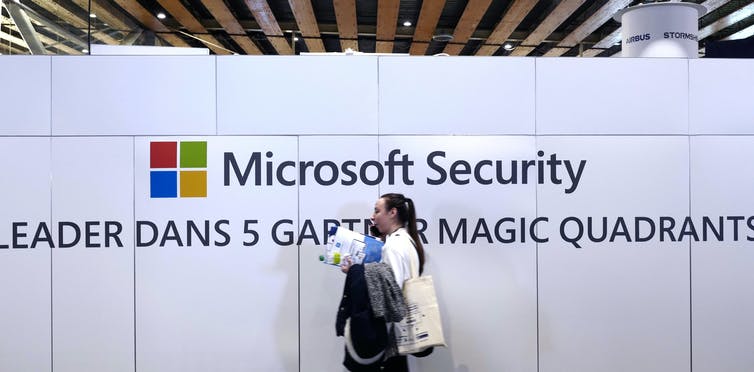 Microsoft took legal action this month to disrupt a major botnet, a cybercrime digital network that used more than 1 million zombie computers to spread ransomware. AP Photo/Michel Spingler
As with most cybersecurity problems, the ransomware threat can be minimized by implementing common-sense best practices – many of which have been recommended for decades but often are not followed. These include keeping systems up to date, ensuring security software is installed and current, monitoring network activities and implementing appropriate IT policies and procedures to include resilient backup practices. For individual users, thinking before clicking an email link – even from people you know – is excellent self-defense to make many ransomware or phishing attacks less likely to succeed.
None of these practices is specific to the ransomware threat or election security. But for this and other cyber threats, the best thing to do is continuing to implement and enforce those common-sense, decades-old best practices of information protection that can help guard against the ever-widening range of cyberthreats – including ransomware.
Header Image: Ransomware attacks often strike local government computer systems, which poses a challenge for protecting elections. PRImageFactory/iStock via Getty Images
Richard Forno, Senior Lecturer, Cybersecurity & internet researcher, University of Maryland, Baltimore County
This article is republished from The Conversation under a Creative Commons license. Read the original article.
]]>
by Richard Forno, UMBC Government computer systems in Hall County, Georgia, including a voter signature database, were hit by a ransomware attack earlier this fall in the first known...
https://umbc.edu/stories/ransomware-can-interfere-with-elections-and-fuel-disinformation-basic-cybersecurity-precautions-are-key-to-minimizing-the-damage/
https://my3.my.umbc.edu/api/v0/pixel/news/119762/guest@my.umbc.edu/f96878219b018d2f442a39393f8371d8/api/pixel
computer-science
cybersecurity
discovery
the-conversation
UMBC News & Magazine
https://my3.my.umbc.edu/groups/umbc-news-magazine
https://assets1-my.umbc.edu/system/shared/avatars/groups/000/001/943/24435aa6207c452e7bc15cc74b42c7bb/xsmall.png?1748556657
https://assets1-my.umbc.edu/system/shared/avatars/groups/000/001/943/24435aa6207c452e7bc15cc74b42c7bb/original.png?1748556657
https://assets2-my.umbc.edu/system/shared/avatars/groups/000/001/943/24435aa6207c452e7bc15cc74b42c7bb/xxlarge.png?1748556657
https://assets2-my.umbc.edu/system/shared/avatars/groups/000/001/943/24435aa6207c452e7bc15cc74b42c7bb/xlarge.png?1748556657
https://assets3-my.umbc.edu/system/shared/avatars/groups/000/001/943/24435aa6207c452e7bc15cc74b42c7bb/large.png?1748556657
https://assets1-my.umbc.edu/system/shared/avatars/groups/000/001/943/24435aa6207c452e7bc15cc74b42c7bb/medium.png?1748556657
https://assets2-my.umbc.edu/system/shared/avatars/groups/000/001/943/24435aa6207c452e7bc15cc74b42c7bb/small.png?1748556657
https://assets1-my.umbc.edu/system/shared/avatars/groups/000/001/943/24435aa6207c452e7bc15cc74b42c7bb/xsmall.png?1748556657
https://assets2-my.umbc.edu/system/shared/avatars/groups/000/001/943/24435aa6207c452e7bc15cc74b42c7bb/xxsmall.png?1748556657
UMBC News & Magazine
0
0
false
Thu, 29 Oct 2020 20:10:02 -0400
Alumni Awards 2017: Lauren Mazzoli ’15, Mathematics and Computer Science, and M.S. ’17, Computer Science

In the weeks leading up to the Alumni Awards Ceremony, we’ll be profiling each honoree in more detail here on our blog. Today, meet Lauren Mazzoli ’15, mathematics and computer science, and M.S. ’17, computer science, systems engineer at Northrop Grumman and this year’s recipient of the Rising Star award for outstanding graduates of the last decade.
As a young woman studying in a traditionally male-dominated field, Lauren Mazzoli ’15, mathematics and computer science, and M.S. ’17, computer science, has faced her share of challenges. “There were numerous times where I could have felt overwhelmed or defeated” by the gender ratio in STEM, she writes, “but instead, I was driven to change it.” That drive has led her into a promising career as a cyber software engineer at Northrop Grumman, as well as an advocate and mentor to female engineers at both her workplace and her alma mater. A former Cyber Scholar, Mazzoli has remained involved with both that program and the Center for Women in Technology (CWIT), helping to organize career development and educational opportunities for students interested in cybersecurity. At Northrop Grumman, Mazzoli earned early accolades for her support of a time-sensitive, mission-critical project. She was recently accepted into the company’s 3-year Future Technical Leaders rotational program, and is also Vice Chair of the Women’s Employee Resource Group. Mazzoli was inspired to attend UMBC by its “friendly campus, diversity of thought, and students hungry to learn,” and she credits Dr. Marie desJardins, Dr. Penny Rheingans, and Dr. Anupam Joshi for their inspiration and support on her path through the cybersecurity field.
Join us for the Alumni Awards Ceremony on Thursday, October 5!
]]>
In the weeks leading up to the Alumni Awards Ceremony, we’ll be profiling each honoree in more detail here on our blog. Today, meet Lauren Mazzoli ’15, mathematics and computer science, and M.S....
https://umbc.edu/stories/alumni-awards-2017-lauren-mazzoli-15-mathematics-and-computer-science-and-m-s-17-computer-science/
https://my3.my.umbc.edu/api/v0/pixel/news/120676/guest@my.umbc.edu/2fe726b34fa910c961c80697d83ab158/api/pixel
alumni
alumni-awards-2017
computer-science
graduateschool
lauren-mazzoli
mathematics
UMBC News & Magazine
https://my3.my.umbc.edu/groups/umbc-news-magazine
https://assets1-my.umbc.edu/system/shared/avatars/groups/000/001/943/24435aa6207c452e7bc15cc74b42c7bb/xsmall.png?1748556657
https://assets1-my.umbc.edu/system/shared/avatars/groups/000/001/943/24435aa6207c452e7bc15cc74b42c7bb/original.png?1748556657
https://assets2-my.umbc.edu/system/shared/avatars/groups/000/001/943/24435aa6207c452e7bc15cc74b42c7bb/xxlarge.png?1748556657
https://assets2-my.umbc.edu/system/shared/avatars/groups/000/001/943/24435aa6207c452e7bc15cc74b42c7bb/xlarge.png?1748556657
https://assets3-my.umbc.edu/system/shared/avatars/groups/000/001/943/24435aa6207c452e7bc15cc74b42c7bb/large.png?1748556657
https://assets1-my.umbc.edu/system/shared/avatars/groups/000/001/943/24435aa6207c452e7bc15cc74b42c7bb/medium.png?1748556657
https://assets2-my.umbc.edu/system/shared/avatars/groups/000/001/943/24435aa6207c452e7bc15cc74b42c7bb/small.png?1748556657
https://assets1-my.umbc.edu/system/shared/avatars/groups/000/001/943/24435aa6207c452e7bc15cc74b42c7bb/xsmall.png?1748556657
https://assets2-my.umbc.edu/system/shared/avatars/groups/000/001/943/24435aa6207c452e7bc15cc74b42c7bb/xxsmall.png?1748556657
UMBC News & Magazine
0
0
false
Fri, 15 Sep 2017 09:30:55 -0400
Alums in the News: Eye on CompSci

Our alumni have gone on to excel in many arenas, and we couldn’t be prouder of them. Today, take a look at a couple of computer science alumni who are helping to advance the increasingly vital field of cybersecurity.
 As team technical director for the NSA’s Laboratory for Telecommunication Sciences, Josiah Dykstra ’13, Ph.D. computer science, is always coming up with new ways to combat cyber threats,
including a Google Glass-like device that alerts analysts to new threats in real time. Read more about Dykstra and his work with NSA at Fedscoop.
 Jamie Butler ’02, M.S. computer science, is now the chief technology officer of the Arlington, Va.-based cybersecurity firm Endgame. Butler’s cybersecurity career began at NSA, and he’s also worked for Mandiant and FireEye. Read more about Butler here.
Have your own news to share? Send in a class note!
]]>
Our alumni have gone on to excel in many arenas, and we couldn’t be prouder of them. Today, take a look at a couple of computer science alumni who are helping to advance the increasingly vital...
https://umbc.edu/stories/alums-in-the-news-eye-on-compsci/
https://my3.my.umbc.edu/api/v0/pixel/news/121412/guest@my.umbc.edu/b3db1a61d0f9bafad3db05a3110c6adc/api/pixel
alumni
computer-science
cybersecurity
jamie-butler
josiah-dykstra
nsa
UMBC News & Magazine
https://my3.my.umbc.edu/groups/umbc-news-magazine
https://assets1-my.umbc.edu/system/shared/avatars/groups/000/001/943/24435aa6207c452e7bc15cc74b42c7bb/xsmall.png?1748556657
https://assets1-my.umbc.edu/system/shared/avatars/groups/000/001/943/24435aa6207c452e7bc15cc74b42c7bb/original.png?1748556657
https://assets2-my.umbc.edu/system/shared/avatars/groups/000/001/943/24435aa6207c452e7bc15cc74b42c7bb/xxlarge.png?1748556657
https://assets2-my.umbc.edu/system/shared/avatars/groups/000/001/943/24435aa6207c452e7bc15cc74b42c7bb/xlarge.png?1748556657
https://assets3-my.umbc.edu/system/shared/avatars/groups/000/001/943/24435aa6207c452e7bc15cc74b42c7bb/large.png?1748556657
https://assets1-my.umbc.edu/system/shared/avatars/groups/000/001/943/24435aa6207c452e7bc15cc74b42c7bb/medium.png?1748556657
https://assets2-my.umbc.edu/system/shared/avatars/groups/000/001/943/24435aa6207c452e7bc15cc74b42c7bb/small.png?1748556657
https://assets1-my.umbc.edu/system/shared/avatars/groups/000/001/943/24435aa6207c452e7bc15cc74b42c7bb/xsmall.png?1748556657
https://assets2-my.umbc.edu/system/shared/avatars/groups/000/001/943/24435aa6207c452e7bc15cc74b42c7bb/xxsmall.png?1748556657
UMBC News & Magazine
0
0
false
Tue, 22 Dec 2015 16:41:14 -0500
Roundup: UMBC in the News
One of the things that makes UMBC great is how wonderful our alumni, students, faculty, and staff are. Because of these amazing people, UMBC often finds itself “in the news,” so each week, we’ll be sharing with you a round-up of the most newsworthy achievements from our community.
-
Dr. Hrabowski spoke at this week’s American Public Health Association Conference in Chicago, as well as the CyberMaryland Conference and the Southwest Baltimore Economic Forum’s monthly meeting.
- Hrabowski also co-authored an editorial in the Seattle Times with Yolanda Watson Spiva, president and CEO of the College Success Foundation, on preparing low-income students for college success.
- Marie desJardins, computer science, spoke to Quartz about physicist Steven Hawking’s recent remark that “women should remain a mystery,” and how attitudes like this hinder women from pursuing careers in artificial intelligence research.
- Govind Rao, chemical and biochemical engineering, has headed a project that will allow soldiers in combat to manufacture life-saving medications in a matter of hours using a “portable briefcase-sized kit.”
- Dennis Coates, economics, warns us about overestimating the economic growth a professional football franchise might bring to Los Angeles.
- Lisa Gray, Assistant Director of Student Life for Cultural and Spiritual Diversity, was on The Marc Steiner Show to talk about empowering young girls through social justice education.
- Rennetta Tull, Associate Vice Provost for Graduate Student Professional Development and Postdoctoral Affairs, is one of three finalists for the 2015 GEDC Airbus Diversity Award.
- Ellen Hemmerly, bwtech@UMBC, talks about why cyber companies are prime targets for mergers and acquisitions.
- Maurice Berger, visual arts, talks about the “Modern Art and the Birth of American Television” exhibit at the NSU Art Museum Fort Lauderdale.
- Women’s soccer has made it to their third straight America East Championship season after defeating Stony Book 1-0 on Sunday.
-
Women’s swimming and diving bested George Washington University 138.5-120.5 at the Aquatic Complex last Saturday, while the men’s team beat GW 132-115.
- The swimming and diving teams also released their 2015-16 hype video this week, and you can watch it here.
- Men’s soccer edged Drexel 1-0 Tuesday.
Read more at UMBC Insights!
]]>
One of the things that makes UMBC great is how wonderful our alumni, students, faculty, and staff are. Because of these amazing people, UMBC often finds itself “in the news,” so each week, we’ll...
https://umbc.edu/stories/roundup-umbc-in-the-news-8/
https://my3.my.umbc.edu/api/v0/pixel/news/121492/guest@my.umbc.edu/1deafb03d7e3abdd2a5649b63b70dbe3/api/pixel
alumni
chemical-engineering
computer-science
dennis-coates
economics
ellen-hemmerly
freeman-hrabowski
govind-rao
lisa-gray
marie-desjardins
maurice-berger
mens-swimming-and-diving
rennetta-tull
visual-arts
womens-soccer
womens-swimming-and-diving
UMBC News & Magazine
https://my3.my.umbc.edu/groups/umbc-news-magazine
https://assets1-my.umbc.edu/system/shared/avatars/groups/000/001/943/24435aa6207c452e7bc15cc74b42c7bb/xsmall.png?1748556657
https://assets1-my.umbc.edu/system/shared/avatars/groups/000/001/943/24435aa6207c452e7bc15cc74b42c7bb/original.png?1748556657
https://assets2-my.umbc.edu/system/shared/avatars/groups/000/001/943/24435aa6207c452e7bc15cc74b42c7bb/xxlarge.png?1748556657
https://assets2-my.umbc.edu/system/shared/avatars/groups/000/001/943/24435aa6207c452e7bc15cc74b42c7bb/xlarge.png?1748556657
https://assets3-my.umbc.edu/system/shared/avatars/groups/000/001/943/24435aa6207c452e7bc15cc74b42c7bb/large.png?1748556657
https://assets1-my.umbc.edu/system/shared/avatars/groups/000/001/943/24435aa6207c452e7bc15cc74b42c7bb/medium.png?1748556657
https://assets2-my.umbc.edu/system/shared/avatars/groups/000/001/943/24435aa6207c452e7bc15cc74b42c7bb/small.png?1748556657
https://assets1-my.umbc.edu/system/shared/avatars/groups/000/001/943/24435aa6207c452e7bc15cc74b42c7bb/xsmall.png?1748556657
https://assets2-my.umbc.edu/system/shared/avatars/groups/000/001/943/24435aa6207c452e7bc15cc74b42c7bb/xxsmall.png?1748556657
UMBC News & Magazine
0
0
false
Fri, 30 Oct 2015 18:51:36 -0400
Roundup: UMBC in the News
One of the things that makes UMBC great is how wonderful our alumni, students, faculty, and staff are. Because of these amazing people, UMBC often finds itself “in the news,” so each week, we’ll be sharing with you a round-up of the most newsworthy achievements from our community.
- Dr. Hrabowski appeared on Comcast Newsmakers to stress the importance of inclusiveness in STEM fields.
- Erle Ellis, geography and environmental systems, told The Guardian that all human activity, even our conservation efforts, has an impact on how species evolve.
- Thomas Schaller, political science, discussed the Republican party’s shift towards the right in The Week.
- Marie DesJardins, computer science, tells us how we can integrate computer science education into the nationwide K-12 curriculum, providing more opportunities for female and minority students in the process.
- Patricia Joseph, former special assistant to the Provost, along with her husband Mark, have promised a $3 million gift to the Baltimore Museum of Art to help pay some of the costs of the museum’s new center for education and creativity.
- Light Point Security, a cybersecurity company founded by former NSA employees and based at bwtech@UMBC, is profiled in the Baltimore Sun.
-
Women’s volleyball beat Hartford 3-0 on Sunday, while women’s soccer scored a 2-0 victory over New Hampshire for their Senior Day game.
For more newsmaking moments and campus updates, check out UMBC Insights!
]]>
One of the things that makes UMBC great is how wonderful our alumni, students, faculty, and staff are. Because of these amazing people, UMBC often finds itself “in the news,” so each week, we’ll...
https://umbc.edu/stories/roundup-umbc-in-the-news-7/
https://my3.my.umbc.edu/api/v0/pixel/news/121511/guest@my.umbc.edu/7d311214122d851db129bbfea67bb79c/api/pixel
alumni
baltimore-museum-of-art
bwtech-at-umbc
computer-science
environmental-systems
erle-ellis
freeman-hrabowski
geography
light-point-security
marie-desjardins
patricia-joseph
political-science
thomas-schaller
volleyball
womens-soccer
UMBC News & Magazine
https://my3.my.umbc.edu/groups/umbc-news-magazine
https://assets1-my.umbc.edu/system/shared/avatars/groups/000/001/943/24435aa6207c452e7bc15cc74b42c7bb/xsmall.png?1748556657
https://assets1-my.umbc.edu/system/shared/avatars/groups/000/001/943/24435aa6207c452e7bc15cc74b42c7bb/original.png?1748556657
https://assets2-my.umbc.edu/system/shared/avatars/groups/000/001/943/24435aa6207c452e7bc15cc74b42c7bb/xxlarge.png?1748556657
https://assets2-my.umbc.edu/system/shared/avatars/groups/000/001/943/24435aa6207c452e7bc15cc74b42c7bb/xlarge.png?1748556657
https://assets3-my.umbc.edu/system/shared/avatars/groups/000/001/943/24435aa6207c452e7bc15cc74b42c7bb/large.png?1748556657
https://assets1-my.umbc.edu/system/shared/avatars/groups/000/001/943/24435aa6207c452e7bc15cc74b42c7bb/medium.png?1748556657
https://assets2-my.umbc.edu/system/shared/avatars/groups/000/001/943/24435aa6207c452e7bc15cc74b42c7bb/small.png?1748556657
https://assets1-my.umbc.edu/system/shared/avatars/groups/000/001/943/24435aa6207c452e7bc15cc74b42c7bb/xsmall.png?1748556657
https://assets2-my.umbc.edu/system/shared/avatars/groups/000/001/943/24435aa6207c452e7bc15cc74b42c7bb/xxsmall.png?1748556657
UMBC News & Magazine
0
0
false
Fri, 23 Oct 2015 14:16:21 -0400


 Kerri Evans headshot courtesy of Melissa Penley Cormier.
 Marc Olano headshot courtesy of Ryan Zuber ’04, Imaging Research Center.
 A still from “Bandit.”