UMBC collaborates with MxD to develop cybersecurity curriculum for workers in manufacturing
UMBC researchers will collaborate with the Chicago-based MxD to develop a curriculum and online platform for manufacturing professionals to increase their cybersecurity skills and to protect manufacturing plants from cyber breaches. The work is funded by a $650,000 grant from the Office of Economic Adjustment, under the U.S. Department of Defense.
MxD is one of 14 federally-supported institutes known collectively as Manufacturing USA. It has awarded millions of dollars to research and development projects across 35 states to advance U.S. manufacturing practices and increase global competitiveness. This UMBC collaboration will be the first initiative focused on increasing manufacturing workers’ knowledge of cybersecurity.
The content of this program is completely new, as there are no existing platforms that focus on the intersection of cybersecurity and manufacturing, says Nilanjan Banerjee, principal investigator on the grant.
Banerjee, professor of computer science and electrical engineering (CSEE) at UMBC, shares, “The program will accelerate training of practitioners in the manufacturing industry in cybersecurity. It will also expand UMBC’s impact on cybersecurity education in the manufacturing sector.”
Intersection of cyber and manufacturing
Banerjee will collaborate with a number of colleagues at UMBC to develop a curriculum tailored for people who already work in the manufacturing industry. Project co-PIs include Donna Ruginski, executive director of cybersecurity initiatives at UMBC, and Keith J Bowman, dean of UMBC’s College of Engineering and Information Technology. Alan Sherman, professor of CSEE; Linda Olivia, assistant professor of education; and Megean Garvin, director of research and assessment for the Maryland Center for Computing Education, will assess the curriculum developed to ensure it meets program goals.
Donna Ruginski. Photo by Marlayna Demond ’11 for UMBC.
Bowman helped establish the connections between UMBC and MxD, and is eager to watch the work develop. “This project fully leverages MxD, UMBC Training Centers, and UMBC assets in cybersecurity, manufacturing, and training,” says Bowman. “I have known MxD team members, including Federico Sciammarella, president and chief technology officer of MxD, ever since its origins, and I look forward to building on this collaboration.”
The first step of the multi-phased project will identify the skills most needed to protect manufacturing facilities from cyberattacks on their computer systems and machinery. UMBC and MxD will create a short-term training program for manufacturing professionals to develop these skills.
“People will come out of this program with a certification that shows they have the tools to be successful in a cybersecurity role in manufacturing,” said Lizabeth Stuck, senior director of MxD Learn, the institute’s workforce development arm. “This has the dual benefit of upskilling workers who may be sidelined during the COVID-19 crisis and increasing the security of U.S. manufacturers from cyber-attacks.”
Addressing current needs
Banerjee explains that the recent COVID-19 pandemic has led to increased unemployment and a need for more opportunities for workers to quickly expand their skill sets. With this in mind, the program will be designed for workers to complete in less than a year and through a web-based format.
For maximum flexibility, the platform will offer both synchronous and asynchronous material. It will be launched and led by UMBC Training Centers, a not-for-profit owned by UMBC that offers professional and technical training in areas such as cybersecurity, project management, and leadership and innovation. The platform will likely launch in late January 2021.
“This program will have a direct impact on the Defense Industrial Base Supply Chain,” says Ruginski. “It will create a robust workforce that has the cybersecurity skills required to assist companies in staying secure in the fast-paced cybersecurity manufacturing industry.”
Banner image: Nilanjan Banerjee. Photo by Marlayna Demond ’11 for UMBC.
]]>
UMBC researchers will collaborate with the Chicago-based MxD to develop a curriculum and online platform for manufacturing professionals to increase their cybersecurity skills and to protect...https://umbc.edu/stories/umbc-collaborates-with-mxd-to-develop-cybersecurity-curriculum-for-workers-in-manufacturing/https://my3.my.umbc.edu/api/v0/pixel/news/119839/guest@my.umbc.edu/441276ed052f97cdc4cd5c573b9bc2b2/api/pixelcoeitcseecybersecuritypage1science-and-technologyUMBC News & Magazinehttps://my3.my.umbc.edu/groups/umbc-news-magazinehttps://assets1-my.umbc.edu/system/shared/avatars/groups/000/001/943/24435aa6207c452e7bc15cc74b42c7bb/xsmall.png?1748556657https://assets1-my.umbc.edu/system/shared/avatars/groups/000/001/943/24435aa6207c452e7bc15cc74b42c7bb/original.png?1748556657https://assets2-my.umbc.edu/system/shared/avatars/groups/000/001/943/24435aa6207c452e7bc15cc74b42c7bb/xxlarge.png?1748556657https://assets2-my.umbc.edu/system/shared/avatars/groups/000/001/943/24435aa6207c452e7bc15cc74b42c7bb/xlarge.png?1748556657https://assets3-my.umbc.edu/system/shared/avatars/groups/000/001/943/24435aa6207c452e7bc15cc74b42c7bb/large.png?1748556657https://assets1-my.umbc.edu/system/shared/avatars/groups/000/001/943/24435aa6207c452e7bc15cc74b42c7bb/medium.png?1748556657https://assets2-my.umbc.edu/system/shared/avatars/groups/000/001/943/24435aa6207c452e7bc15cc74b42c7bb/small.png?1748556657https://assets1-my.umbc.edu/system/shared/avatars/groups/000/001/943/24435aa6207c452e7bc15cc74b42c7bb/xsmall.png?1748556657https://assets2-my.umbc.edu/system/shared/avatars/groups/000/001/943/24435aa6207c452e7bc15cc74b42c7bb/xxsmall.png?1748556657UMBC News & Magazine00falseTue, 14 Jul 2020 18:26:26 -0400U.S. Army Cyber Center of Excellence selects UMBC Training Centers to design a cyber curriculum for soldiers
The U.S. Army recently selected UMBC Training Centers as the sole recipient of an award to develop a novel cybersecurity curriculum for soldiers. The 70-week-long program will train soldiers for a new military role, as cyberspace capabilities developer technicians.
Several companies and institutions were invited to apply for the award, but UMBC was the only recipient selected, explains Kent Malwitz, president of UMBC Training Centers. This relatively rare move by the Army affirms the quality of UMBC Training Centers’ proposal and existing programs.
Kent Malwitz. Photo courtesy of Kent Malwitz.
This new project builds on UMBC Training Centers’ long history of providing world-class technical training to the military and intelligence community. It follows recent work in delivering similar programs to support cybersecurity operations at Fort Meade in Maryland, and Fort Gordon in Georgia.
Expanding programs to meet demand for cyber experts
The new course of study will expand upon existing programs that UMBC Training Centers has presented to soldiers in shorter time frames. In 2013, the Training Centers piloted an intensive 11-week program, says Homer Minnick, director of the Department of Defense programs at UMBC Training Centers. In order to excel in that course, Minnick explains, students need to have a deep understanding of programming languages. There was interest in longer courses that could give students more hands-on lab experience with programming and fulfill the Army’s skill requirements.
Homer Minnick. Photo courtesy of Homer Minnick.
Two years later, UMBC Training Centers launched the Tool Developer Qualification Course (TDQC), a 32-week version of the prior pilot program. In addition to a full 22 weeks of classroom instruction, the expanded program provides 10 weeks of project work, including a robust capstone component.
The 32-week long program has produced 90 graduates, and there are currently 20 students enrolled in the seventh cohort from the Army and Marine Corps. Minnick notes that students have the opportunity to develop a cybersecurity foundation and also to apply the skills they learn in the classroom to situations they may encounter in the world. The new 70-week program will yield graduates with even more highly advanced skills and extensive experience.
Serving active-duty military and beyond
An increased demand for skilled cybersecurity professionals within the military means that training opportunities for service members in these areas are more important than ever, says Minnick. He explains, “The Army has recognized the need for this program, and the importance of making it an institutional program.”
UMBC Training Centers is a not-for-profit owned by UMBC that offers professional and technical training in areas such as data science, cybersecurity, cloud computing, software development, project management and leadership and innovation. Training Centers has long served the United States military, including active duty and transitioning soldiers, veterans, and their family members seeking to begin or advance their careers in technology.
A classroom at the UMBC Training Centers. Photo by Marlayna Demond ’11 for UMBC.
In addition to scaling the 32-week program up to 70 weeks, Minnick looks forward to modifying existing intensive programs to meet the changing needs of the Army and to support the learning of enlisted soldiers and others.
Training Centers’ Certified Cyber Analyst Operator program was initially developed to help the military build its cybersecurity capabilities, and is now being offered to soldiers who are preparing to exit the military and begin the next phase of their careers, as well as to civilians changing careers.
Coming soon this year, UMBC Training Centers will launch a certificate in software development to provide people careers or changing careers with “an accelerated way to enter the field of software development,” says Malwitz. In addition to working with enlisted soldiers, he looks forward to helping retired military personnel and others access “the opportunity to begin a career in this high demand, financially lucrative field.”
Banner image: The UMBC Training Centers. Photo courtesy of UMBC Training Centers.
]]>
The U.S. Army recently selected UMBC Training Centers as the sole recipient of an award to develop a novel cybersecurity curriculum for soldiers. The 70-week-long program will train soldiers for a...https://umbc.edu/stories/u-s-army-cyber-center-of-excellence-selects-umbc-training-centers-to-design-a-cyber-curriculum-for-soldiers/https://my3.my.umbc.edu/api/v0/pixel/news/119963/guest@my.umbc.edu/f261b4986df120cef396f28b29560249/api/pixelcampuscybersecurityscience-and-technologytrainingcentersUMBC News & Magazinehttps://my3.my.umbc.edu/groups/umbc-news-magazinehttps://assets1-my.umbc.edu/system/shared/avatars/groups/000/001/943/24435aa6207c452e7bc15cc74b42c7bb/xsmall.png?1748556657https://assets1-my.umbc.edu/system/shared/avatars/groups/000/001/943/24435aa6207c452e7bc15cc74b42c7bb/original.png?1748556657https://assets2-my.umbc.edu/system/shared/avatars/groups/000/001/943/24435aa6207c452e7bc15cc74b42c7bb/xxlarge.png?1748556657https://assets2-my.umbc.edu/system/shared/avatars/groups/000/001/943/24435aa6207c452e7bc15cc74b42c7bb/xlarge.png?1748556657https://assets3-my.umbc.edu/system/shared/avatars/groups/000/001/943/24435aa6207c452e7bc15cc74b42c7bb/large.png?1748556657https://assets1-my.umbc.edu/system/shared/avatars/groups/000/001/943/24435aa6207c452e7bc15cc74b42c7bb/medium.png?1748556657https://assets2-my.umbc.edu/system/shared/avatars/groups/000/001/943/24435aa6207c452e7bc15cc74b42c7bb/small.png?1748556657https://assets1-my.umbc.edu/system/shared/avatars/groups/000/001/943/24435aa6207c452e7bc15cc74b42c7bb/xsmall.png?1748556657https://assets2-my.umbc.edu/system/shared/avatars/groups/000/001/943/24435aa6207c452e7bc15cc74b42c7bb/xxsmall.png?1748556657UMBC News & Magazine00falseTue, 28 Jan 2020 18:17:15 -0500UMBC Cyber Dawgs are named CyberForce national champions
UMBC’s Cyber Defense Team, known as the Cyber Dawgs, emerged the national champion team in the U.S. Department of Energy’s fifth annual CyberForce Competition. The Cyber Dawgs earned first place overall out of more than 100 teams from universities across the country.
Ten national laboratories hosted competing teams this year, November 15 – 16. UMBC competed at the Argonne National Laboratory near Chicago, Illinois, while other teams traveled to sites like the Pacific Northwest National Laboratory in Washington state and Oak Ridge National Laboratory in Tennessee. Competing teams hailed from a broad range of institutions, including Virginia Tech, Carnegie Mellon, Georgia Tech, Texas A&M and the U.S. Air Force Academy.
The competition tasks students with defending critical energy infrastructure during simulated cyberattacks. The scenarios are designed to be realistic, focused on water and power systems and including real-world constraints, such as insufficient budget for system upkeep and limited information on system needs. During the competition, “red teams,” including industry professionals, attack the system, while the students work to ensure that the infrastructure is available to their customers, or “green teams,” who test system usability.
The teams receive points based on how successfully they address attacks, while still allowing users to access the infrastructure they need. The teams are also awarded points for innovative defense tactics and ideas. This year’s competition saw several leading teams with neck-and-neck scores until the final round, when UMBC’s Cyber Dawgs pulled ahead for the victory.
The competition offers students a unique opportunity to develop their cybersecurity skills in relation to critical infrastructure, and have hands-on experience in a realistic cyberattack situation.
“The CyberForce competition is the most unique of our annual events, allowing us to experiment with network configurations to defend an industrial control system against adversaries while playing the roles of an IT organization,” explains RJ Joyce ’18, M.S. ’20, computer science, a member of the winning team. “The hard work, dedication, and creativity that each member brought to the team lifted us from a regional win last year to a national win this year.”
In addition to Joyce, last weekend’s winning team included Anna Staats ’20, computer science; Drew Barrett ’20, computer science; Grant Spencer ’20, computer science; Cyrus Bonyadi, Ph.D. ’23, computer science; and Seamus Burke ’20, computer science.
“The team’s second national championship in three years shows the enthusiasm, grit, and tenacity of our students in demonstrating their technical cyber expertise in a competitive arena,” says Rick Forno, senior lecturer of computer science and assistant director of UMBC’s Center for Cybersecurity.
Forno advises the Cyber Dawgs with Charles Nicholas, professor of computer science and electrical engineering. “It’s an awesome thing not just for the team and university,” he says, “but for each competitor individually, as they prepare to enter the cybersecurity workforce after graduation.”
Update: In early December 2019, the Cyber Dawgs won the 2019 Maryland Cyber Challenge, with a team comprised of Staats, Spencer, and Burke. They competed against several skilled challengers, including a team from the U.S. Air Force Academy.
Banner image: The Cyber Dawgs at the CyberForce competition. From left, Charles Nicholas, Anna Staats, Drew Barrett, Grant Spencer, Cyrus Bonyadi, and Seamus Burke. Photo courtesy of Argonne National Lab.
]]>
UMBC’s Cyber Defense Team, known as the Cyber Dawgs, emerged the national champion team in the U.S. Department of Energy’s fifth annual CyberForce Competition. The Cyber Dawgs earned first place...https://umbc.edu/stories/umbc-cyber-dawgs-are-named-cyberforce-national-champions/https://my3.my.umbc.edu/api/v0/pixel/news/120009/guest@my.umbc.edu/19af7e2723e3f8ee0a2cd9f9a5b6de7b/api/pixelcoeitcseecybersecuritymajorawardscience-and-technologyUMBC News & Magazinehttps://my3.my.umbc.edu/groups/umbc-news-magazinehttps://assets1-my.umbc.edu/system/shared/avatars/groups/000/001/943/24435aa6207c452e7bc15cc74b42c7bb/xsmall.png?1748556657https://assets1-my.umbc.edu/system/shared/avatars/groups/000/001/943/24435aa6207c452e7bc15cc74b42c7bb/original.png?1748556657https://assets2-my.umbc.edu/system/shared/avatars/groups/000/001/943/24435aa6207c452e7bc15cc74b42c7bb/xxlarge.png?1748556657https://assets2-my.umbc.edu/system/shared/avatars/groups/000/001/943/24435aa6207c452e7bc15cc74b42c7bb/xlarge.png?1748556657https://assets3-my.umbc.edu/system/shared/avatars/groups/000/001/943/24435aa6207c452e7bc15cc74b42c7bb/large.png?1748556657https://assets1-my.umbc.edu/system/shared/avatars/groups/000/001/943/24435aa6207c452e7bc15cc74b42c7bb/medium.png?1748556657https://assets2-my.umbc.edu/system/shared/avatars/groups/000/001/943/24435aa6207c452e7bc15cc74b42c7bb/small.png?1748556657https://assets1-my.umbc.edu/system/shared/avatars/groups/000/001/943/24435aa6207c452e7bc15cc74b42c7bb/xsmall.png?1748556657https://assets2-my.umbc.edu/system/shared/avatars/groups/000/001/943/24435aa6207c452e7bc15cc74b42c7bb/xxsmall.png?1748556657UMBC News & Magazine00falseMon, 18 Nov 2019 16:16:29 -0500Meet six Retrievers who went from internship to career success with UMBC Career Center support
Decades after the start of the internship boom, internships continue to be invaluable for both undergraduate and graduate students. As UMBC students demonstrate, gaining real-world experience and networking within an area of interest can have a lasting impact when it comes time to search for a full-time position.
“Most employers use internships as a recruiting tool to find their future full-time employees,” says Christine Routzahn, director of the Career Center. “Nearly 60 percent of our recent graduates who were employed at graduation indicated that they accepted full-time offers with an organization that they interned or worked for while at UMBC.”
These students were able to use the skills and tools they acquired as interns to transition to full-time positions after their UMBC graduation. Many took advantage of the opportunities afforded by UMBC’s Career Center to secure their positions. According to Susan Plitt, associate director of the UMBC Career Center, “Nearly 800 employers visited the UMBC campus last year to connect with our students. Each semester, we coordinate career and internship fairs to aid in making these connections.”
This year’s Fall Career and Internship Fair on September 25 will host 160 organizations, many of whom are seeking summer 2020 interns, from first-year undergraduates to advanced graduate students.
Here, six recent UMBC alumni share how they used campus resources and connections to secure full-time positions and move forward in their career, with advice for today’s UMBC students.
#1 Don’t worry if it doesn’t go according to plan
Jordyn McKenzie ‘19 thought she was coming to UMBC with it all figured out. She’d earn a degree in biology, then pursue a career in the field. A graduate of North Hagerstown High School in Maryland, McKenzie focused on taking STEM courses at UMBC, but over time she found her passion shifting.
After switching to a major in media and communication studies at the end of her first year, McKenzie wasted no time in working towards her new career goals. She completed three internships by the start of her senior year, including one with a local news station in her hometown.
Jordyn McKenzie ‘19, media and communication studies, poses behind the news desk at Fox45.
“That experience provided me the knowledge and courage I needed to continue pursuing television,” says McKenzie. Then, when it came time to establish connections for her post-graduation career, she says,“I did what most UMBC students do in times of career-related problems—I turned to the Career Center.”
After polishing her resume and getting advice from the Career Center, McKenzie attended UMBC’s Fall Internship and Career Fair in 2018 and sought out WBFF Fox45. This meeting led to an internship with BMORE Lifestyle, a lifestyle show that’s part of the WBFF corporation. As McKenzie geared up to graduate in spring 2019, a production assistant position opened at Fox45—perfect timing for her next move.
McKenzie’s current position requires a cool head, strong communication skills, and the ability to wake up before sunrise without hitting the snooze button. The morning news show she works on runs from 4:30 to 10 a.m. throughout the week. McKenzie is charged with keeping anchors aware of upcoming camera shots, running the teleprompter, and communicating with the control room.
The Career Center was an enormous help to McKenzie as she prepared to make the transition from intern to employee. “The support I was given throughout the entire process was incredible, and I am so lucky to have had such a smooth transition,” she says.
McKenzie walking the red carpet at the Chesapeake Bay Emmy Awards before Fox45 took home 22 Emmy awards.
In addition to receiving professional guidance from the Career Center, McKenzie also served as their social media intern, where she connected closely with her mentor Caroline Bodnar, assistant director for career development in the UMBC Career Center.
“Mentor, to me, doesn’t necessarily mean someone you work alongside or shadow. I think it’s someone you go to in times of need,” reflects McKenzie. “Caroline is someone that I leaned on throughout my time at UMBC. She helped me navigate my way through career and intern ups and downs and provided meaningful advice.”
Baltimore County Executive Johnny Olszewski, Jr., Ph.D. ’17, public policy, snapped a photo with McKenzie before his morning segment.
“I’ve spent some time reflecting on my experiences as a Retriever. When I’m asked, ‘If you could do it all again, would you?,’ my answer is ‘yes’ every time,” McKenzie shares. “UMBC truly became a home to me.”
#2 Distinguish yourself by getting involved
Mamadou Diallo ‘19, mechanical engineering, took advantage of numerous professional organizations while at UMBC to help prepare himself for his future career. He was an active member of the National Society of Black Engineers, the American Society of Mechanical Engineers, and was a Mechanical Engineering S-STEM Scholar. When he began connecting with employers, this high level of involvement helped distinguish him among other candidates.
“My advice to other students is to be involved in extracurricular activities. After being hired [for my internship], I spoke with one of the recruiters as to why I was selected out of the many applicants. She replied that my involvement outside of the classroom were what stood out the most,” says Diallo.
To find this dream internship, Diallo didn’t have to go any farther than the Retriever Activity Center (RAC). At the annual Career Fair, he met with representatives from Regal Beloit and followed up through UMBCworks to secure his internship, which later led to a full-time engineering position.
Mamadou Diallo ‘19, mechanical engineering, poses for a headshot.
As an engineering design and applications intern for a manufacturer of electric motors, Diallo worked to best meet the needs of customers. This included making recommendations to ensure pricing was fair and accurate, and tools continued to meet industry standards.
Diallo was able to boost workflow efficiencies at the company. Thanks to his strong track record as an intern, he was hired as a full-time application engineer prior to graduating from UMBC this past spring.
“UMBC was invaluable in helping me to secure my internship and career,” says Diallo. “The Career Center helped me work on my resume and practice my interviewing skills, and reverse interviews allowed me to interview alumni and learn so many valuable lessons from them.”
#3 Pursue your passions
A long way from her hometown of Albuquerque, New Mexico, Shannon Cole ‘18, biological sciences, works at the U.S. Food and Drug Administration (FDA) in Silver Spring, Maryland. As an Oak Ridge Institute for Science and Education (ORISE) fellow for the Center for Drug Evaluation and Research (CDER) Patient-Focused Drug Development (PFDD) program, she works to ensure that patients’ voices are heard throughout the processes of developing and evaluating medical products.
As a UMBC student, Cole had a strong interest in public health, which led to internships with the Red Cross, the Institute of Fluorescence, and the ORISE program at the FDA.
Shannon Cole walks the halls of the FDA amidst historical advertisements through the years. Photo by Marlayna Demond ‘11.
While she was working to advance her career with multiple internships, Cole was also greatly involved at UMBC. She was a Sondheim Public Affairs Scholar, a member of the Honors College, a Global Brigades participant, and a mentor with the Refugee Youth Project’s College JUMP program, among others activities.
Cole took advantage of UMBCworks and the Career Fair to make connections and find internship and job opportunities. She also sought help from her professors and mentors.
“Jodi Kelber-Kaye, associate director of the UMBC Honors College, put me in touch with a contact from the FDA before I even knew about the ORISE internship,” explains Cole.
Cole taking a break from her work at the FDA. Photo by Marlayna Demond ‘11.
This contact would later help Cole transition to her current position. Utilizing UMBC’s Career Center, she was able to confirm that her resume was polished and professional, and she was presenting the best version of herself in interviews.
“The people I was fortunate enough to interact with regularly gave me helpful advice and access to resources that ultimately allowed me to tie all of these experiences together,” says Cole.
#4 Take advantage of the Career Fair
When Erin Patrice ‘19 was deciding where to go to college, she chose to follow in her older brother’s footsteps. Well, more accurately, she decided to run in them.
Older brother Randolph graduated from UMBC in 2015 as a financial economics major and an accomplished sprinter. Patrice followed the same path with the same major and the same love of running. Patrice’s twin sister Kara also continued the family tradition, attending UMBC and pursuing biology while running.
Patrice feels her decision was an easy one, saying, “I chose UMBC because I wanted to attend a school that could create a strong base for me, academically and athletically, to build from.”
Just like Patrice knew what she wanted out of her college experience, she also knew what she was looking for in an internship. “When I started my internship search, I was looking for an experience that would allow me to collaborate with individuals my age, and provide me with an environment where I could constantly be tested,” she says.
Erin Patrice ‘19, financial economics, at her Morgan Stanley job.
After networking at the Career and Internship Fair and uploading her resume through UMBCworks, Patrice secured a summer internship in fixed income derivative confirmation operations with Morgan Stanley. After completing the internship, Patrice was offered a full-time position as a trading operations analyst upon graduation.
Patrice credits the lessons she learned from both athletics and academics for her career success. “The skills I acquired while learning to handle athletics and the rigorous course load made my transition into working full-time very smooth,” says Patrice. “I was able to prioritize my duties easily and allocate my time efficiently.”
#5 Continue your work outside the classroom
As a computer science major, Chris Mills ‘19 figured out how to stand out from the crowd when vying for a position with one of the biggest names in technology: Google.
“I think what set me apart from other students (especially ones applying from big name schools such as MIT) was the amount of programming outside of class I did,” he explains. “HackUMBC played a large part in my practical proficiency, allowing me to create a product from scratch, to utilize other people’s libraries, and to work with other teammates on a singular project.”
Mills attended on-campus career fairs and spoke with recruiters on-site to find an internship that best suited his interests. His goal was to work in a well-established business in the technology industry with a strong work/life balance and positive workplace culture. He was offered a position as a software engineer intern at Google for summer 2017 and returned the following summer to continue his work.
Chris Mills ‘19 working on his research for Google.
The coursework Mills completed while at UMBC benefited him greatly in his position at Google, he says. “In many of my required courses, the class lectures gave a good foundation of the theoretical knowledge, while the projects/homework showed practical applications that can and will be used in a software engineer’s career,” he explains.
Since Mills completed two Google internships, he was able to bypass the traditional interview process and start full-time at Google this past summer, immediately after graduation. Mills now works with the Google shopping team as a software engineer building solutions to reduce both latency and space of shopping data that is served to users.
#6 Build relationships with those around you
It was love at first sight when Priyanka Ranade ’18, M.S. ’19, information systems, joined the UMBC community.
“As soon as I stepped foot onto UMBC’s campus, I could see that it replicated the world I wished to see around me,” says Ranade. “The level of diversity, sense of community, as well as UMBC’s clear repertoire of grit and support showed me right away that this was the community I wanted to learn in.”
Priyanka Rande ’18, M.S. ’19, information systems at Northrop Grumman.
Ranade found an incredibly strong support system in her campus mentors: Anupam Joshi, chair and professor of computer science and electrical engineering; Karuna Joshi, information systems; and Cindy Greenwood, assistant director of the Cyber Scholars program. Ranade actually discovered her internship through an on-campus event through the Center for Women in Technology, a partnership with the Cyber Scholars Program.
“I knew I wanted to learn about cybersecurity issues beyond the undergraduate classroom level,” she says. She actively sought out opportunities through networking, which led to an internship at Northrop Grumman. “Northrop Grumman gave me a big picture idea of cyber and allowed me to spend time in different parts of the company, as well as hear the experiences and journeys of other employees,” Ranade explains.
To prepare for her interview, Ranade had her resume reviewed by UMBC’s Career Center and took advantage of mock interview opportunities to be fully prepared. After a successful summer as a cyber strategy intern, Ranade’s manager recommended her to the Pathways Program, one of three rotational programs at Northrop Grumman.
Ranade with mentor Lauren Mazzoli Zavala ‘15, computer science, M.S. ‘17, computer science. Photo by Marlayna Demond ‘11.
Ranade currently works in research and development doing machine learning work for military systems at Northrop Grumman. She credits the relationship-building skills she developed at UMBC for her success.
“Out of the many lessons UMBC has taught me, the most prominent one is the strong combination of sincerity in your work as well as fruitful relationships. Relationships are key in building your career,” says Ranade. “Sharpening your skills is one thing, but having mentors who see your potential and guide you to greater heights than you could imagine is key.”
Banner image: Shannon Cole at the U.S. Food and Drug Administration. Photo by Marlayna Demond ’11 for UMBC. All other photos supplied by alumni unless otherwise noted.
]]>
Decades after the start of the internship boom, internships continue to be invaluable for both undergraduate and graduate students. As UMBC students demonstrate, gaining real-world experience and...https://umbc.edu/stories/meet-six-retrievers-who-went-from-internship-to-career-success-with-umbc-career-center-support/https://my3.my.umbc.edu/api/v0/pixel/news/120046/guest@my.umbc.edu/272f7bbf263d027250a1c367374b8964/api/pixelalumnibiologycahsscareercentercnmscoeitcommunitycseecyberscholarscybersecurityeconomicshonorscollegemechepage1sondheimscholarsundergradresearchUMBC News & Magazinehttps://my3.my.umbc.edu/groups/umbc-news-magazinehttps://assets1-my.umbc.edu/system/shared/avatars/groups/000/001/943/24435aa6207c452e7bc15cc74b42c7bb/xsmall.png?1748556657https://assets1-my.umbc.edu/system/shared/avatars/groups/000/001/943/24435aa6207c452e7bc15cc74b42c7bb/original.png?1748556657https://assets2-my.umbc.edu/system/shared/avatars/groups/000/001/943/24435aa6207c452e7bc15cc74b42c7bb/xxlarge.png?1748556657https://assets2-my.umbc.edu/system/shared/avatars/groups/000/001/943/24435aa6207c452e7bc15cc74b42c7bb/xlarge.png?1748556657https://assets3-my.umbc.edu/system/shared/avatars/groups/000/001/943/24435aa6207c452e7bc15cc74b42c7bb/large.png?1748556657https://assets1-my.umbc.edu/system/shared/avatars/groups/000/001/943/24435aa6207c452e7bc15cc74b42c7bb/medium.png?1748556657https://assets2-my.umbc.edu/system/shared/avatars/groups/000/001/943/24435aa6207c452e7bc15cc74b42c7bb/small.png?1748556657https://assets1-my.umbc.edu/system/shared/avatars/groups/000/001/943/24435aa6207c452e7bc15cc74b42c7bb/xsmall.png?1748556657https://assets2-my.umbc.edu/system/shared/avatars/groups/000/001/943/24435aa6207c452e7bc15cc74b42c7bb/xxsmall.png?1748556657UMBC News & Magazine00falseFri, 13 Sep 2019 15:16:33 -0400Don’t ignore serious nonmilitary threats to US national security
By Richard Forno, assistant director, UMBC Center for Cybersecurity, director, Cybersecurity Graduate Program, UMBC
Almost two decades after thousands died in the attacks of 9/11, there remain many active efforts underway to protect America from international terrorism.
Since 9/11, American domestic and international security policy has been focused on individual terrorists, terrorist groups and rogue countries as the primary threats. The country’s defensive response has been focused on the military and law enforcement capabilities. That’s natural, because the military knows how to shoot, drop and launch things at threats like that. And those dangers still exist.
However, as someone who routinely analyzes threats, vulnerabilities and risks, I see the U.S. again falling prey to a decades-old problem, which the 9/11 Commission termed a “failure of imagination.” That’s when leaders miss important, relevant connections or alternatives to what they’re focused on.
Specifically, there are other, equally, if not more, dangerous risks to American national sovereignty and security, not to mention citizens’ peace of mind that they are able to live and work in a safe and secure society. The economy, climate, transportation and public utilities are all vulnerable to nonmilitary threats. Unfortunately, those weaknesses tend to receive little attention from elected officials – much less any meaningful efforts to solve them. I believe this is because dealing with such concerns isn’t immediately evident, easily profitable, politically expedient or exciting to show on TV.
Borrowing weakness
I see America’s growing indebtedness as a huge economic vulnerability.
The United States government is US$22 trillion in debt, its highest level ever, and $2 trillion more than in 2017. The national debt is expected to rise to just below the amount the entire nation’s economy produces in a single year by 2029.
If an external adversary intentionally caused or worsened U.S. economic problems, the effects in the U.S. and on the global economy could present extremely significant risks to American security, domestic stability and peace of mind.
Many countries invest some of their national treasuries in U.S. debt, such as Treasury bonds or government-backed mortgage securities, because they are viewed as low-risk. However, a country holding large amounts of American national debt might decide to suddenly sell some or all of its bonds, as Russia threatened to do in 2008. Certainly, nations like Japan hold significant amounts of debt, but presumably these countries are not likely to sell it for political leverage. By contrast, Russia or China, who also hold large quantities, may be more inclined to do so, especially during a prolonged trade war.
A bulk sale of American debt would roil U.S. and global financial markets, slow economy grown by raising the costs of borrowing and rattle global investors’ confidence in the stable value of the U.S. dollar.
Can the U.S. dollar keep its value? Photo by Burst from Pexels.
Admittedly, if China or Russia sold significant amounts of their American debt, it would hurt them too. For example, the U.S. dollar likely would weaken, making multinational companies more competitive, and American bond prices would fall, reducing the value of those countries’ remaining holdings.
To put this in perspective, the 2008 financial crisis gave Americans a taste of economic unrest, with job losses, evictions, billions lost in retirement accounts and citizens of all ages forced to reassess their personal financial, career, family or life plans.
As climate effects worsen, both in the United States and around the world, flooding and storm damage may drive some people from their homes. Many others may suffer from poor air quality, higher commodity prices, grocery prices or even outright food shortages. Moreover, the consequences of climate incidents, such as flooding, can threaten public health with poor sanitation, diseases and epidemics, and disrupt global supply chains.
Climate change has many marching to have their voice heard. Photo by Bob Blob on Unsplash.
Climate change also affects the U.S. armed forces. Drought, heat, flooding and wildfires are all increasing global worries for the Pentagon. A 2019 Pentagon report found that climate change is affecting military operations, including threatening two-thirds of the 79 critical military bases the report’s authors surveyed.
Beyond creating problems for U.S. military operations, parts of coastal Florida are looking at multi-billion-dollar costs just to build sea walls to protect against rising ocean levels. The city of Honolulu is planning to reduce development near its coastline, in an organized retreat from rising seas. And it’s not just the United States that’s affected by climate change, either.
None of this damage has been caused by an outside enemy, but rather by neglect on the home front.
Photo by Ricardo Gomez Angel on Unsplash,2
It could cost trillions of dollars to fix everything that needs fixing – but money to fix these problems always is in short supply and often diverted to other priorities. Politicians can’t even agree to commit the dollars needed to fix roads and bridges – which means the repairs won’t come anytime soon, and the risks to everyday life and business will worsen.
Looking more broadly at all threats
The United States remains vulnerable not only to foreign terrorist attacks and mass shootings by domestic terrorists, but to many other problems that people may not think of as seriously as they do terrorism. Unfortunately, the “military-industrial complex” that former President Dwight Eisenhower warned about in 1961 continues to dominate U.S. security thinking.
If the United States is to remain a leading world power into the future, it must continue to be economically productive and competitive on the world stage in ways beyond military firepower. Its planning to meet the contingencies described above must embrace a wider perspective that provides citizens and companies alike peace of mind – namely, assuring them a safe, secure and stable future society.
At some crisis point, Americans will be forced to confront the effects of these other vulnerabilities within their lives, families, communities and companies. The solutions to these problems won’t come from more aircraft carriers, fighter jets, airport body scanners and upgraded nuclear weapons. Rather, they will come from objective research, evidence-based planning and investment in long-term projects at home to address these critical problems and ultimately provide lasting security in return.
*****
Header image: Ominous clouds gathering. Photo by Andree Brennan from Pexels.
]]>
By Richard Forno, assistant director, UMBC Center for Cybersecurity, director, Cybersecurity Graduate Program, UMBC Almost two decades after thousands died in the attacks of 9/11, there remain...https://umbc.edu/stories/dont-ignore-serious-nonmilitary-threats-to-us-national-security/https://my3.my.umbc.edu/api/v0/pixel/news/120051/guest@my.umbc.edu/abacb3611659becf3ba09f6e2c58c1d3/api/pixelcybersecurityperspectivesthe-conversationUMBC News & Magazinehttps://my3.my.umbc.edu/groups/umbc-news-magazinehttps://assets1-my.umbc.edu/system/shared/avatars/groups/000/001/943/24435aa6207c452e7bc15cc74b42c7bb/xsmall.png?1748556657https://assets1-my.umbc.edu/system/shared/avatars/groups/000/001/943/24435aa6207c452e7bc15cc74b42c7bb/original.png?1748556657https://assets2-my.umbc.edu/system/shared/avatars/groups/000/001/943/24435aa6207c452e7bc15cc74b42c7bb/xxlarge.png?1748556657https://assets2-my.umbc.edu/system/shared/avatars/groups/000/001/943/24435aa6207c452e7bc15cc74b42c7bb/xlarge.png?1748556657https://assets3-my.umbc.edu/system/shared/avatars/groups/000/001/943/24435aa6207c452e7bc15cc74b42c7bb/large.png?1748556657https://assets1-my.umbc.edu/system/shared/avatars/groups/000/001/943/24435aa6207c452e7bc15cc74b42c7bb/medium.png?1748556657https://assets2-my.umbc.edu/system/shared/avatars/groups/000/001/943/24435aa6207c452e7bc15cc74b42c7bb/small.png?1748556657https://assets1-my.umbc.edu/system/shared/avatars/groups/000/001/943/24435aa6207c452e7bc15cc74b42c7bb/xsmall.png?1748556657https://assets2-my.umbc.edu/system/shared/avatars/groups/000/001/943/24435aa6207c452e7bc15cc74b42c7bb/xxsmall.png?1748556657UMBC News & Magazine00falseTue, 10 Sep 2019 19:30:19 -0400UMBC partners with five universities in the US, UK, and Japan to launch International Cybersecurity Center of Excellence
UMBC has partnered to create a global university network dedicated to securing critical systems against cyber threats: the International Cybersecurity Center of Excellence (INCS-CoE).
The INCS-CoE has its foundations in a 2018 cybersecurity collaboration that included UMBC, Keio University in Japan, and Royal Holloway University of London. That initial group has now formally expanded to include Northeastern University, Kyushu University in Japan, and Imperial College London.
The INCS-CoE will support the efforts of the participating universities as they work together to address cybersecurity challenges facing society. The collaboration focuses on cybersecurity for critical national infrastructures including information technology, public transit, and financial services. Additionally, the Center of Excellence will include research, advocacy, and education components.
“Trust is one of the key pillars for a free and interconnected world, for commerce and for exchange of information, be it in the real world or in the digital world,” says Karl V. Steiner, UMBC’s vice president for research. “In order for machines to communicate well with each other, we need to put in place policies and technologies that establish a trust basis.”
He explains, “The INCS-CoE is built on a similar strong layer of trust among six institutions from three different continents. This first-of-its-kind global Center of Excellence will enable us to rapidly exchange ideas and find solutions to developing issues in an increasingly networked world.”
In the future, INCS-CoE may expand to include government and corporate partners, says Steiner.
“The challenges this first-of-its-kind partnership aims to solve span a complex set of cybersecurity issues,” said David Luzzi, senior vice provost for research at Northeastern.
Each academic institution has specific strengths and areas of expertise that they bring to the partnership. UMBC’s Center for Cybersecurity and Center for Accelerated Real Time Analytics will be instrumental in contributing to INCS-CoE’s goals for UMBC.
Banner image: Representatives from the partnering institutions at UMBC. Photo by Marlayna Demond ’11 for UMBC.
]]>
UMBC has partnered to create a global university network dedicated to securing critical systems against cyber threats: the International Cybersecurity Center of Excellence (INCS-CoE). The...https://umbc.edu/stories/umbc-partners-with-five-universities-in-the-us-uk-and-japan-to-launch-international-cybersecurity-center-of-excellence/https://my3.my.umbc.edu/api/v0/pixel/news/120085/guest@my.umbc.edu/6779a2f53c971a27452456b6fa418c51/api/pixelcybersecurityinternationalresearchscience-and-technologyUMBC News & Magazinehttps://my3.my.umbc.edu/groups/umbc-news-magazinehttps://assets1-my.umbc.edu/system/shared/avatars/groups/000/001/943/24435aa6207c452e7bc15cc74b42c7bb/xsmall.png?1748556657https://assets1-my.umbc.edu/system/shared/avatars/groups/000/001/943/24435aa6207c452e7bc15cc74b42c7bb/original.png?1748556657https://assets2-my.umbc.edu/system/shared/avatars/groups/000/001/943/24435aa6207c452e7bc15cc74b42c7bb/xxlarge.png?1748556657https://assets2-my.umbc.edu/system/shared/avatars/groups/000/001/943/24435aa6207c452e7bc15cc74b42c7bb/xlarge.png?1748556657https://assets3-my.umbc.edu/system/shared/avatars/groups/000/001/943/24435aa6207c452e7bc15cc74b42c7bb/large.png?1748556657https://assets1-my.umbc.edu/system/shared/avatars/groups/000/001/943/24435aa6207c452e7bc15cc74b42c7bb/medium.png?1748556657https://assets2-my.umbc.edu/system/shared/avatars/groups/000/001/943/24435aa6207c452e7bc15cc74b42c7bb/small.png?1748556657https://assets1-my.umbc.edu/system/shared/avatars/groups/000/001/943/24435aa6207c452e7bc15cc74b42c7bb/xsmall.png?1748556657https://assets2-my.umbc.edu/system/shared/avatars/groups/000/001/943/24435aa6207c452e7bc15cc74b42c7bb/xxsmall.png?1748556657UMBC News & Magazine00falseFri, 12 Jul 2019 13:37:59 -0400Hackers Seek Ransoms from Baltimore and Communities Across the US
By Richard Forno, assistant director, UMBC Center for Cybersecurity, director, cybersecurity graduate program
The people of Baltimore are beginning their fifth week under an electronic siege that has prevented residents from obtaining building permits and business licenses – and even buying or selling homes. A year after hackers disrupted the city’s emergency services dispatch system, city workers throughout the city are unable to, among other things, use their government email accounts or conduct routine city business.
In this attack, a type of malicious software called ransomware has encrypted key files, rendering them unusable until the city pays the unknown attackers 13 bitcoin, or about US$76,280. But even if the city were to pay up, there is no guarantee that its files would all be recovered; many ransomware attacks end with the data lost, whether the ransom is paid or not.
These types of attacks are becoming more frequent and gaining more media attention. Speaking as a career cybersecurity professional, the technical aspects of incidents like this are but one part of a much bigger picture. Every user of technology must consider not only threats and vulnerabilities, but also operational processes, potential points of failure and how they use technology on a daily basis. Thinking ahead, and taking protective steps, can help reduce the effects of cybersecurity incidents on both individuals and organizations.
Understanding cyberattack tools
Software designed to attack other computers is nothing new. Nations, private companies, individual researchers and criminals continue developing these types of programs, for a wide range of purposes, including digital warfare and intelligence gathering, as well as extortion by ransomware.
Many malware efforts begin as a normal and crucial function of cybersecurity: identifying software and hardware vulnerabilities that could be exploited by an attacker. Security researchers then work to close that vulnerability. By contrast, malware developers, criminal or otherwise, will figure out how to get through that opening undetected, to explore and potentially wreak havoc in a target’s systems.
Sometimes a single weakness is enough to give an intruder the access they want. But other times attackers will use multiple vulnerabilities in combination to infiltrate a system, take control, steal data and modify or delete information – while trying to hide any evidence of their activity from security programs and personnel. The challenge is so great that artificial intelligence and machine learning systems are now also being incorporated to help with cybersecurity activities.
There’s some question about the role the federal government may have played in this situation, because one of the hacking tools the attackers reportedly used in Baltimore was developed by the U.S. National Security Agency, which the NSA has denied. However, hacking tools stolen from the NSA in 2017 by the hacker group Shadow Brokers were used to launch similar attacks within months of those tools being posted on the internet. Certainly, those tools should never have been stolen from the NSA – and should have been better protected.
But my views are more complicated than that: As a citizen, I recognize the NSA’s mandate to research and develop advanced tools to protect the country and fulfill its national security mission. However, like many cybersecurity professionals, I remain conflicted: When the government discovers a new technology vulnerability but doesn’t tell the maker of the affected hardware or software until after it’s used to cause havoc or disclosed by a leak, everyone is at risk.
The estimated $18 million cost of recovery in Baltimore is money the city likely doesn’t have readily available. Recent research by some of my colleagues at the University of Maryland, Baltimore County, shows that many state and local governments remain woefully underprepared and underfunded to adequately, let alone proactively, deal with cybersecurity’s many challenges.
It is concerning that the ransomware attack in Baltimore exploited a vulnerability that has been publicly known about – with an available fix – for over two years. NSA had developed an exploit (code-named EternalBlue) for this discovered security weakness but didn’t alert Microsoft about this critical security vulnerability until early 2017 – and only after the Shadow Brokers had stolen the NSA’s tool to attack it. Soon after, Microsoft issued a software security update to fix this key flaw in its Windows operating system.
Admittedly, it can be very complex to manage software updates for a large organization. But given the media coverage at the time about the unauthorized disclosure of many NSA hacking tools and the vulnerabilities they targeted, it’s unclear why Baltimore’s information technology staff didn’t ensure the city’s computers received that particular security update immediately. And while it’s not necessarily fair to blame the NSA for the Baltimore incident, it is entirely fair to say that the knowledge and techniques behind the tools of digital warfare are out in the world; we must learn to live with them and adapt accordingly.
In a global society where people, companies and governments are increasingly dependent on computers, digital weaknesses have the power to seriously disrupt or destroy everyday actions and functions.
Even trying to develop workarounds when a crisis hits can be challenging. Baltimore city employees who were blocked from using the city’s email system tried to set up free Gmail accounts to at least get some work done. But they were initially blocked by Google’s automated security systems, which identified them as potentially fraudulent.
Making matters worse, when Baltimore’s online services went down, parts of the city’s municipal phone system couldn’t handle the resulting increase in calls attempting to compensate. This underscores the need to not only focus on technology products themselves but also the policies, procedures and capabilities needed to ensure individuals and/or organizations can remain at least minimally functional when under duress, whether by cyberattack, technology failures or acts of nature.
Protecting yourself, and your livelihood
The first step to fighting a ransomware attack is to regularly back up your data – which also provides protection against hardware failures, theft and other problems. To deal with ransomware, though, it’s particularly important to keep a few versions of your backups over time – don’t just rewrite the same files on a backup drive over and over.
That’s because when you get hit, you’ll want to determine when you were infected and restore files from a backup made before that time. Otherwise, you’ll just be recovering infected data, and not actually fixing your problem. Yes, you might lose some data, but not everything – and presumably only your most recent work, which you’ll probably remember and recreate easily enough.
And of course, following some of cybersecurity’s best practices – even just the basics – can help prevent, or at least minimize, the possibility of ransomware crippling you or your organization. Doing things like running current antivirus software, keeping all software updated, using strong passwords and multifactor authentication, and not blindly trusting random devices or email attachments you encounter are just some of the steps everyone should take to be a good digital citizen.
It’s also worth making plans to work around potential failures that might befall your email provider, internet service provider and power company, not to mention the software we rely on. Whether they’re attacked or simply fail, their absence can disrupt your life.
In this way, ransomware incidents serve as an important reminder that cybersecurity is not just limited to protecting digital bits and bytes in cyberspace. Rather, it should force everyone to think broadly and holistically about their relationship with technology and the processes that govern its role and use in our lives. And, it should make people consider how they might function without parts of it at both work and home, because it’s a matter of when, not if, problems will occur.
]]>
By Richard Forno, assistant director, UMBC Center for Cybersecurity, director, cybersecurity graduate program The people of Baltimore are beginning their fifth week under an electronic siege...https://umbc.edu/stories/hackers-seek-ransoms-from-baltimore-and-communities-across-the-us/https://my3.my.umbc.edu/api/v0/pixel/news/120117/guest@my.umbc.edu/4a372df9e936a9caaef1b45e7a2d6bce/api/pixelbaltimorecybersecuritymalwarensaperspectivesransomwarethe-conversationUMBC News & Magazinehttps://my3.my.umbc.edu/groups/umbc-news-magazinehttps://assets1-my.umbc.edu/system/shared/avatars/groups/000/001/943/24435aa6207c452e7bc15cc74b42c7bb/xsmall.png?1748556657https://assets1-my.umbc.edu/system/shared/avatars/groups/000/001/943/24435aa6207c452e7bc15cc74b42c7bb/original.png?1748556657https://assets2-my.umbc.edu/system/shared/avatars/groups/000/001/943/24435aa6207c452e7bc15cc74b42c7bb/xxlarge.png?1748556657https://assets2-my.umbc.edu/system/shared/avatars/groups/000/001/943/24435aa6207c452e7bc15cc74b42c7bb/xlarge.png?1748556657https://assets3-my.umbc.edu/system/shared/avatars/groups/000/001/943/24435aa6207c452e7bc15cc74b42c7bb/large.png?1748556657https://assets1-my.umbc.edu/system/shared/avatars/groups/000/001/943/24435aa6207c452e7bc15cc74b42c7bb/medium.png?1748556657https://assets2-my.umbc.edu/system/shared/avatars/groups/000/001/943/24435aa6207c452e7bc15cc74b42c7bb/small.png?1748556657https://assets1-my.umbc.edu/system/shared/avatars/groups/000/001/943/24435aa6207c452e7bc15cc74b42c7bb/xsmall.png?1748556657https://assets2-my.umbc.edu/system/shared/avatars/groups/000/001/943/24435aa6207c452e7bc15cc74b42c7bb/xxsmall.png?1748556657UMBC News & Magazine00falseWed, 05 Jun 2019 16:59:06 -0400UMBC international students find connection on campus, from day one to degree
When Angel Badewole ’19, chemical engineering, began as a first-year student at UMBC, it was her first time living apart from her family in Lagos, Nigeria. Early on, she knew her success attending college in another country would depend on finding multiple places to plug in and connect. She would need to find or build a home away from home make it through her four years abroad.
Just looking at Badewole’s résumé tells a story of connection. She lists community-building and academic excellence as her two intentional goals. She built a self-made family through Residential Life—“It pulls together people that are so different”—and with the faith-based Bethel Campus Fellowship—“It’s a great place, it has the best connections.” Badewole also discovered a distant aunt who lives in Frederick, who would quickly become her “Maryland mom.”
Angel Badewole, left, and her chemical engineering capstone group project members at a UMBC men’s lacrosse game. Photo courtesy of Angel Badewole.
Badewole’s story resonates with many international students at UMBC. Maybe they heard about the institution through friends of the family, a lucky Google search, or UMBC’s reputation in their field of study. Then, often without having visited the United States, they arrived on campus, determined to make the most of their time here, both in the classroom and through connecting with people.
For doctoral students, that time is often much longer than four years.
Finding support in a time of transition
Amrita Anam, Ph.D. ’19, information systems, began her seven years at UMBC in a spring semester, meaning she moved from Bangladesh to Baltimore in January. “What is happening? Is this how I die?” laughs Anam, remembering the chilly weather in those first few weeks of adjustment.
She found her welcome in the information systems department, with professor and chair Aryya Gangopadhyay. “When I spoke to Dr. Gangopadhyay, I really liked how warm he was. There was no way I could do this without the support I got from my department.”
Sitting now on the patio in front of the campus Starbucks, Anam explains the research interests that drew her to UMBC. “I use social media data, Twitter particularly, and I use it for disaster response, but the interesting thing is that instead of using text analytics, I use signal processing.”
Anam and her teammates made the finals of the 2017 UMBC Hackathon. Photo courtesy of Amrita Anam.
With her background in electrical engineering, Anam wanted to attend a school on the East Coast to be near her sister in New York. She also knew she’d need funding to see her through a Ph.D. program. She found that through her assistantship at UMBC.
“If you come here directly to a very tough Ph.D. research scenario, it takes some time to even understand what’s happening,” says the cheerful data scientist. She appreciated that her department understood how to support her during her first months at UMBC. “School is not the same in my country, people are not the same, research is not the same, so I feel like those are the things that I needed some time to cope with,” says Anam.
Amrita Anam in a green space on UMBC’s campus. Photo courtesy of Amrita Anam.
While she was finding her feet in the information systems world, Anam connected with the Indian Student Association, as there was no formal group yet for Bangladeshi students. As the number of Bangladeshi students grew, she co-founded the Bangladesh Student Association to celebrate Bengali holidays, serving up delicious street food and showcasing regional dance styles.
Amrita Anam, right, participates in a dance with the Bangladesh Student Association. Photo courtesy of Amrita Anam.
Anam’s time at UMBC has been fruitful academically and socially, but a personal tragedy recently shook her to her core. Both her parents had always encouraged her to continue pursuing her education, pushing her out of her comfort zone when she needed it. But, as she came close to finishing her Ph.D., her father—“a film director, very artsy, very nerdy”—passed away suddenly.
Amrita Anam’s father, mother, and sister joined her on campus to celebrate her M.S. graduation.
Anam says she felt completely supported by her department during this upheaval and, with their encouragement, was able to finish the degree she had been working so hard to earn for so many years. On a warm spring morning, the day after defending her dissertation, Anam shared, “They’ve seen me grow in all these years, so they were also very proud and happy.” She is now looking forward to her upcoming position at Amazon as a business intelligence engineer.
Keep knocking on doors. It works.
Tobi Odunsi, M.S.’19, cybersecurity, first found himself in Maryland in 2017 for the wedding of his godbrother. He wasn’t originally looking at graduate schools in the United States, but decided to visit the UMBC campus since he was in the area.
Interested in cybersecurity, Odunsi met with Toby Gouker, a faculty member in technical management, on a warm summer day. The Tobi-Toby meeting went well. “They didn’t have to do much convincing,” says Odunsi. After digging through the UMBC website, he already knew it would be a good fit. “As soon as I stepped into the school, I knew, ‘I like this.’”
Odunsi, right, troubleshooting a network issue with Tim Boyle, a network engineer in the Division of Information Technology. Photo courtesy of Tobi Odunsi.
Like Badewole, Odunsi is from Lagos, Nigeria, and also found comfort with a faith community near campus, attending Christ Apostolic Church and the International Friends Club. Those connections helped ease his transition, but another key component to his comfort was staying with his godmother until he found a job and a community of friends on campus. “She was my home away from home,” he says.
Odunsi and a group gathered to celebrate Easter with the International Friends Club. Photo courtesy of Tobi Odunsi.
Before coming to UMBC, Odunsi already had a strong interest in The Internet of Things—everyday devices that connect online with users and each other, like the smartphone app that pings your coffee maker to start brewing. Odunsi knew that for his graduate degree, he needed to find an unique niche in the broad field. He eventually decided on software defined networking, an approach to cloud computing.
On campus, Odunsi was ready to hit the ground running, and to knock on a lot of doors to find the right opportunity. “It’s better to be prepared for an opportunity when you don’t have it, than for you to have an opportunity and not be prepared for it,” he says.
Tobi Odunsi setting up a next-generation firewall in one of the main data centers on campus. Photo courtesy of Tobi Odunsi.
Before long, Odunsi knocked on just the right door. When he reached Damian Doyle, assistant vice president of enterprise infrastructure in UMBC’s Division of Information Technology and told him about his research interests, Doyle responded, “Wow, we’ve been looking for someone to actually do something like that,” describes Odunsi. “So it’s like, the stars were aligned. And now UMBC is the first school in the University System of Maryland to implement that type of technology in their data center.”
Odunsi with Damian Doyle, right, and Ray Soellner, left, the associate director of telecommunications. Photo courtesy of Tobi Odunsi.
“Damian is a very great guy—his door is always open. There’s no time I’ve tried to schedule a meeting with him that he turned me down. He’s mentored me not just on work, but also given me guidance on how to proceed with my career, family, and likes of that sort,” says Odunsi, who will begin his position as a technology development program associate at Geico after graduation in May.
When Odunsi’s mother visited campus and met Dr. Hrabowski, he told her that her son had “a good head on his shoulders,” and she began to tear up. “She was so appreciative of how far I’ve come and the support they’ve given me.”
The office that makes it possible
Odunsi attributes the ease of his academic experience to the team in UMBC’s office of International Education Services (IES). “For international students…you need to always make sure you’re in the right standing,” says Odunsi. “I don’t know if it’s just me, but whenever I go there, it feels like home.”
Anam agrees wholeheartedly. “Studies are stressful,” she says, but thanks to IES, “I never have to stress about anything else.” She’s grateful to Michelle Massey, IES associate director, and other IES staff for their dedication to making sure international students can focus on their academic programs rather than spending all of their time worrying about visa paperwork.
Haixu Leng, Ph.D. ’19, physics, remembers that Massey was one of the first people to greet him on campus, and to welcome him to the United States. Whenever he thinks about UMBC, he thinks about the helpful and patient team at IES.
A Google search can change everything
Leng owes his time at UMBC to an internet search for quantum optics programs. He was then drawn to UMBC from China because “the UMBC physics department is a relatively small department, in which you can get the attention that you may not get in a very large department. I really liked it.”
As Leng settled into the physics department, he found a place in associate professor Matthew Pelton’s lab. There, using a home-built single-particle microscope, he studied the interaction between light and materials at the nanometer scale.
Haixu Leng works in the lab with his advisor Matthew Pelton. Photo by Marlayna Demond ’11 for UMBC.
Over his five years on campus, “the physics building became my favorite place,” says Leng. “It almost felt like home to me.” His other favorite place on campus is the library. There, he formed a friendship with Henan Zhao, a current Ph.D. student in computer science, over long study sessions. They have since married.
Haixu Leng at his PhD candidacy event with Henan Zhao. Photo courtesy of Haixu Leng.
Opening UMBC to the world
International students who make their home at UMBC find many ways to continue celebrating their own cultures while taking part in the wealth of communities campus has to offer. It’s a two-way exchange that Badewole appreciates.
“There are so many different people here,” says Badewole, “and that’s good in two ways. One, you will find people who are like you in many different respects: a community in your academic area, a community in whatever you believe in, a community in your interests; and two, you get to find a lot of people who are different than you and who you can then learn from.”
Odunsi sees the campus’s welcoming atmosphere as a trickle-down effect from the values of UMBC leadership. “There’s this community of international students at UMBC—it keeps growing—and Dr. Hrabowski has been monumental in that effort to bring international students here,” says Odunsi. “He’s opening the school to not just a few set of people, but to the world at large.”
Featured imaged: Angel Badewole, right, with friends from Bethel Christian Fellowship. Photo courtesy of Angel Badewole.
This article was written by Randianne Leyshon ’09, assistant editor of UMBC Magazine.
]]>
When Angel Badewole ’19, chemical engineering, began as a first-year student at UMBC, it was her first time living apart from her family in Lagos, Nigeria. Early on, she knew her success attending...https://umbc.edu/stories/umbc-international-students-find-connection-on-campus-from-day-one-to-degree/https://my3.my.umbc.edu/api/v0/pixel/news/120143/guest@my.umbc.edu/6520168b6c4fc1b1a11b020476ef558d/api/pixelchembiochemclass-of-2019cnmscoeitcybersecuritygradresearchgraduateschoolinternationalispage1physicsscience-and-technologyUMBC News & Magazinehttps://my3.my.umbc.edu/groups/umbc-news-magazinehttps://assets1-my.umbc.edu/system/shared/avatars/groups/000/001/943/24435aa6207c452e7bc15cc74b42c7bb/xsmall.png?1748556657https://assets1-my.umbc.edu/system/shared/avatars/groups/000/001/943/24435aa6207c452e7bc15cc74b42c7bb/original.png?1748556657https://assets2-my.umbc.edu/system/shared/avatars/groups/000/001/943/24435aa6207c452e7bc15cc74b42c7bb/xxlarge.png?1748556657https://assets2-my.umbc.edu/system/shared/avatars/groups/000/001/943/24435aa6207c452e7bc15cc74b42c7bb/xlarge.png?1748556657https://assets3-my.umbc.edu/system/shared/avatars/groups/000/001/943/24435aa6207c452e7bc15cc74b42c7bb/large.png?1748556657https://assets1-my.umbc.edu/system/shared/avatars/groups/000/001/943/24435aa6207c452e7bc15cc74b42c7bb/medium.png?1748556657https://assets2-my.umbc.edu/system/shared/avatars/groups/000/001/943/24435aa6207c452e7bc15cc74b42c7bb/small.png?1748556657https://assets1-my.umbc.edu/system/shared/avatars/groups/000/001/943/24435aa6207c452e7bc15cc74b42c7bb/xsmall.png?1748556657https://assets2-my.umbc.edu/system/shared/avatars/groups/000/001/943/24435aa6207c452e7bc15cc74b42c7bb/xxsmall.png?1748556657UMBC News & Magazine00falseThu, 02 May 2019 21:38:26 -0400Countering Russian disinformation the Baltic nations’ way
As the new Congress begins, it will soon discuss the comprehensive reports to the U.S. Senate on the disinformation campaign of half-truths, outright fabrications and misleading posts made by agents of the Russian government on social media in the run-up to the 2016 presidential election.
After years of anemic responses to Russian influence efforts, official U.S. government policy now includes taking action to combat disinformation campaigns sponsored by Russia or other countries. In May 2018, the Senate Intelligence Committee endorsed the concept of treating attacks on the nation’s election infrastructure as hostile acts to which the U.S. “will respond accordingly.” In June, the Pentagon unleashed U.S. Cyber Command to respond to cyberattacks more aggressively, and the National Cyber Strategy published in September 2018 clarified that “all instruments of national power are available to prevent, respond to, and deter malicious cyber activity against the United States.”
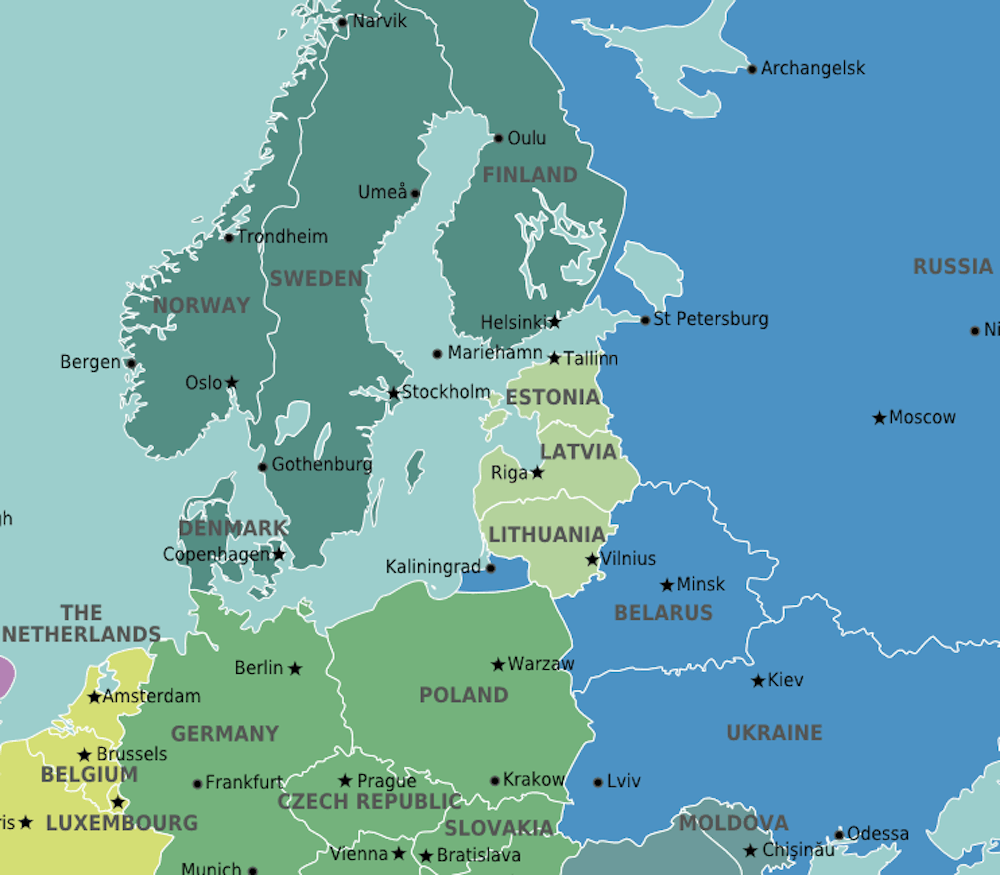
There are already indications that Cyber Command conducted operations against Russian disinformation on social media, including warning specific Russians not to interfere with the 2018 elections. However, low-level cyberwarfare is not necessarily the best way. European countries, especially the Baltic states of Estonia, Latvia and Lithuania, have confronted Russian disinformation campaigns for decades. Their experience may offer useful lessons as the U.S. joins the battle.
The Baltic Sea region of northern Europe. Estonia, Latvia and Lithuania are in light green in the center, west of Russia in blue. Stefan Ertmann/Wikimedia Commons, CC BY-SA
The Baltic experience
Beginning in 1940 and continuing until they declared independence in the early 1990s, the Baltic countries were subjected to systematic Russian gaslighting designed to make people doubt their national history, culture and economic development.
The Soviets rewrote history books to falsely emphasize Russian protection of the Baltic people from invading hordes in the Middle Ages, and to convey the impression that the cultural evolution of the three countries was enabled by their allegiance and close ties to Russia. Even their national anthems were rewritten to pay homage to Soviet influence.
Since the fall of the Soviet Union and the independence of the Baltic countries, the Russian Federation has continued to deliver disinformation to the region, making extensive use of Russian-language social media. Some themes characterize the Baltic people as ungrateful for Soviet investment and aid after World War II. Another common message criticizes Baltic historians for “falsification of history” when really they are describing the real nature of the Soviet occupation.
A massive Russian attack
After independence, and as the internet grew, Estonia led the way in applying technology to accelerate economic development. The country created systems for a wide range of government and commercial services, including voting, banking and filing tax returns electronically. Today, Estonia’s innovative e-residency system is being adopted in many other countries.
These advances made the Baltics a prime target for cyberattacks. In the spring of 2007, the Russians struck. When Estonia moved a monument memorializing Soviet soldiers from downtown Tallinn, the country’s capital, to a military cemetery a couple of miles away, it provoked the ire of ethnic Russians living in Estonia as well as the Russian government.
For three weeks, Estonian government, financial and media computer systems were bombarded with enormous amounts of internet traffic in a “distributed denial of service” attack. In these situations, an attacker sends overwhelming amounts of data to the targeted internet servers, clogging them up with traffic and either slowing them down or knocking them offline entirely. Despite concerns about the first “cyber war,” however, these attacks resulted in little damage. Although Estonia was cut off from the global internet temporarily, the country’s economy suffered no lasting harm.
These attacks could have severely damaged the country’s financial system or power grid. But Estonia was prepared. The country’s history with Russian disinformation had led Estonia to expect Russian attacks on computer and information systems. In anticipation, the government spearheaded partnerships with banks, internet service providers and other organizations to coordinate responses to cyberattacks. In 2006, Estonia was one of the first countries to create a Computer Emergency Response Team to manage security incidents.
The Baltic response
After the 2007 attack, the Baltic countries upped their game even more. For example, Estonia created the Cyber Defense League, an army of volunteer specialists in information technology. These experts focus on sharing threat information, preparing society for responding to cyber incidents and participating in international cyber defense activities.
Internationally, Estonia gained approval in 2008 to establish NATO’s Cooperative Cyber Defense Center of Excellence in Tallinn. Its comprehensive research into global cyber activities helps identify best practices in cyber defense and training for NATO members.
In 2014, Riga, the capital of neighboring Latvia, became home to another NATO organization combating Russian influence, the Strategic Communications Center of Excellence. It publishes reports on Russian disinformation activities, such as the May 2018 study of the “Virtual Russian World in the Baltics.” That report analyzes Russian social media activities targeting Baltic nations with a “toxic mix of disinformation and propaganda.” It also provides insight into identifying and detecting Russian disinformation campaigns.
The Baltic countries also rely on a European Union agency formed in 2015 to combat Russian disinformation campaigns directed against the EU. The agency identifies disinformation efforts and publicizes accurate information that the Russians are seeking to undermine. A new effort will issue rapid alerts to the public when potential disinformation is directed against the 2019 European Parliament elections.
Will the ‘Baltic model’ work in the US?
Because of their political acknowledgment of threats and actions taken by their governments to fight disinformation, a 2018 study rated Estonia, Latvia and Lithuania the three European Union members best at responding to Russian disinformation.
A similar approach may work in the U.S., though it would require far more collaboration than has existed so far. But backed by the new government motivation to strike back when provoked, the methods used in the Baltic states and across Europe could provide a powerful new deterrent against Russian influence in the West.
]]>
by Terry Thompson, Adjunct Instructor in Cybersecurity, UMBC As the new Congress begins, it will soon discuss the comprehensive reports to the U.S. Senate on the disinformation campaign of...https://umbc.edu/stories/countering-russian-disinformation-the-baltic-nations-way/https://my3.my.umbc.edu/api/v0/pixel/news/120232/guest@my.umbc.edu/36ae6ff7b81dc0c3baa8786b3e72ccc8/api/pixelcybersecuritydiscoverythe-conversationUMBC News & Magazinehttps://my3.my.umbc.edu/groups/umbc-news-magazinehttps://assets1-my.umbc.edu/system/shared/avatars/groups/000/001/943/24435aa6207c452e7bc15cc74b42c7bb/xsmall.png?1748556657https://assets1-my.umbc.edu/system/shared/avatars/groups/000/001/943/24435aa6207c452e7bc15cc74b42c7bb/original.png?1748556657https://assets2-my.umbc.edu/system/shared/avatars/groups/000/001/943/24435aa6207c452e7bc15cc74b42c7bb/xxlarge.png?1748556657https://assets2-my.umbc.edu/system/shared/avatars/groups/000/001/943/24435aa6207c452e7bc15cc74b42c7bb/xlarge.png?1748556657https://assets3-my.umbc.edu/system/shared/avatars/groups/000/001/943/24435aa6207c452e7bc15cc74b42c7bb/large.png?1748556657https://assets1-my.umbc.edu/system/shared/avatars/groups/000/001/943/24435aa6207c452e7bc15cc74b42c7bb/medium.png?1748556657https://assets2-my.umbc.edu/system/shared/avatars/groups/000/001/943/24435aa6207c452e7bc15cc74b42c7bb/small.png?1748556657https://assets1-my.umbc.edu/system/shared/avatars/groups/000/001/943/24435aa6207c452e7bc15cc74b42c7bb/xsmall.png?1748556657https://assets2-my.umbc.edu/system/shared/avatars/groups/000/001/943/24435aa6207c452e7bc15cc74b42c7bb/xxsmall.png?1748556657UMBC News & Magazine00falseWed, 09 Jan 2019 19:08:32 -0500UMBC and Morgan Stanley support students and research in data-intensive computing fields
UMBC and Morgan Stanley have established a new partnership to support students and research in data-intensive computing fields. The collaboration is made possible by Morgan Stanley’s contribution of $125,000 toward several UMBC initiatives, renewable annually for up to four additional years.
The financial services firm will support scholarships for students in UMBC’s computer science programs who are doing research focused on data science related topics, to help meet increasing demand for skilled data professionals in Maryland and across the United States. UMBC’s Center of Accelerated Real Time Analytics will also receive funding from Morgan Stanley to support research addressing major data storage and analytics/machine learning challenges by using next-generation hardware. Additionally, Morgan Stanley will continue to work with the UMBC Career Center as an employer partner, and leverage UMBC Training Centers for Morgan Stanley leadership and data science course training.
Reflecting on the new scholarship program in particular, Anupam Joshi, UMBC’s chair of computer science and electrical engineering, says, “We are excited to grow our collaboration with Morgan Stanley to prepare talented students for data-focused careers.”
Scholarships will be awarded through the newly established Data Science Scholarship Fund. UMBC faculty and staff will select student recipients based on academic achievement and a desire to do research in data science related areas.
The initial group of selected scholars has four women and four men. “Morgan Stanley already employs so many UMBC graduates and student interns,” says Joshi. “This scholarship fund further supports our shared commitment to developing a diverse talent pool for the future.”
“Training the next generation of data scientists and investing in data science research are both key to advancing technology innovation,” said Michael Wertheimer, Technology Managing Director at Morgan Stanley. “We are thrilled to support UMBC and look forward to welcoming UMBC graduates interested in joining Morgan Stanley.”
Scholarship recipients will also have the opportunity to meet with Morgan Stanley executives to network and learn about career pathways within the company, while taking courses at UMBC in topics such as computing principles, data analysis, machine learning, high performance computing, data management, and ethical and legal issues.
Banner image: Morgan Stanley scholarship recipients with Dr. Joshi in October 2018. From top left, Caroline Kery ’18, computer science and mathematics, and M.S. ’20, computer science; Kasra Darvish, Ph.D. ’24, computer science; and Nitu Choudhary, M.S. ’20, computer science. From middle left, Sandesh Timilsina, M.S. ’20, computer science; Devajit Asem, M.S. ’20, computer science; and Christian Angel Ph.D. ’24, computer science. From bottom left, Prachi Bhalerao, M.S. ’20, computer science, and Rebecca Brennan, M.S. ’20, computer science. Photo by Raquel Hamner ’21, visual arts.
]]>
UMBC and Morgan Stanley have established a new partnership to support students and research in data-intensive computing fields. The collaboration is made possible by Morgan Stanley’s contribution...https://umbc.edu/stories/umbc-and-morgan-stanley-partner-to-support-students-and-research-in-data-intensive-fields/https://my3.my.umbc.edu/api/v0/pixel/news/120276/guest@my.umbc.edu/6e44a6ddf7341ef1cb2441c2c19fe365/api/pixelcfrcoeitcseecybersecurityscience-and-technologyUMBC News & Magazinehttps://my3.my.umbc.edu/groups/umbc-news-magazinehttps://assets1-my.umbc.edu/system/shared/avatars/groups/000/001/943/24435aa6207c452e7bc15cc74b42c7bb/xsmall.png?1748556657https://assets1-my.umbc.edu/system/shared/avatars/groups/000/001/943/24435aa6207c452e7bc15cc74b42c7bb/original.png?1748556657https://assets2-my.umbc.edu/system/shared/avatars/groups/000/001/943/24435aa6207c452e7bc15cc74b42c7bb/xxlarge.png?1748556657https://assets2-my.umbc.edu/system/shared/avatars/groups/000/001/943/24435aa6207c452e7bc15cc74b42c7bb/xlarge.png?1748556657https://assets3-my.umbc.edu/system/shared/avatars/groups/000/001/943/24435aa6207c452e7bc15cc74b42c7bb/large.png?1748556657https://assets1-my.umbc.edu/system/shared/avatars/groups/000/001/943/24435aa6207c452e7bc15cc74b42c7bb/medium.png?1748556657https://assets2-my.umbc.edu/system/shared/avatars/groups/000/001/943/24435aa6207c452e7bc15cc74b42c7bb/small.png?1748556657https://assets1-my.umbc.edu/system/shared/avatars/groups/000/001/943/24435aa6207c452e7bc15cc74b42c7bb/xsmall.png?1748556657https://assets2-my.umbc.edu/system/shared/avatars/groups/000/001/943/24435aa6207c452e7bc15cc74b42c7bb/xxsmall.png?1748556657UMBC News & Magazine00falseMon, 12 Nov 2018 20:06:21 -0500

 Donna Ruginski. Photo by Marlayna Demond ’11 for UMBC.