The parallel evolution of Milt Halem and the third pillar of science

For almost 70 years, Milt Halem, now a research professor at UMBC after a career at NASA, has deployed the latest computing technology—from vacuum tubes in the ’50s to artificial intelligence today—to tackle some of science’s toughest problems.
Colorful screen prints cover the walls of Milt Halem’s Rockville, Maryland, apartment. One shows a high-altitude view of the Nile River, cutting through desert sands before emptying into a turquoise Mediterranean. In another, the fragile blue marble of the Earth rises above a desolate lunar surface.
One large picture, taking centerplace on the dining room wall, is more enigmatic—filled with alternating red, yellow, and blue patches. “This is what’s known as the quasi-biennial oscillation,” Halem explains.
Tens of thousands of feet up, in Earth’s stratosphere, the winds around the equator regularly shift direction, blowing east for many months, and then west, and then east again. A satellite measured the shifts, and Halem, a former NASA scientist and current UMBC professor, turned six years of that data into art.
Halem’s framed prints, many of which he created himself while taking evening and weekend classes at the Corcoran School of the Arts and Design in Washington, D.C., are a window into his nearly 70-year-long scientific career. For roughly 40 years of that time, he worked for NASA, the famed federal space agency. Halem harnessed NASA’s space-based instrument “eyes” and ever-evolving computer “brains” to advance humanity’s understanding of Earth and our place in the cosmos and, in 1996, was recognized with NASA’s highest award, the Distinguished Service Medal.
In 2003, after retiring from NASA, Halem joined UMBC as a research professor. In his more than two decades at the university, he has nurtured connections with government and industry, brought in research money and equipment, regularly taught a popular graduate course, and mentored more than a dozen Ph.D. students, helping them pursue their passions and propel their careers.
“I think of myself as a computational scientist: I use computers to both discover and explore new territory,” Halem says. “What I love is the computer’s ability to represent, and to explain, the world around us.”
Charting computers’ evolution
Halem began his working life at the dawn of the computing age, and his career trajectory mirrors the steady rise of those digital devices. After earning a bachelor’s degree in mathematics from the City College of New York in 1951, Halem was drafted into the Korean War effort and served on U.S. Army bases for two years, first in New Jersey and then in Arizona. After a stint clearing rocks off the golf course so that the officers could play, Halem’s skills were better put to use on some of the Army’s first attempts to use what at the time were relatively new-fangled devices called computers to improve surveillance of battlefields.
In 1955, Halem received a fellowship to work with an IBM 704 computer installed at New York University. The computer took up significant floor space with its multiple cabinet-sized components, filled with vacuum tubes for logic operations and magnetic tape for memory. It was state-of-the-art in its day, able to execute about 40,000 instructions per second.
“You could say 1955 was my start in high-performance computing,” Halem says. “I’ve been acquiring and managing and programming and doing research on computers ever since.”
In the late 1950s, NASA established the Goddard Space Flight Center (GSFC) and, shortly after, opened a New York campus—the Goddard Institute for Space Studies—focused on theoretical research.

Milt Halem delivers remarks during a conference at NASA Goddard Space Flight Center, 1986. Photo by NASA.
Because of Halem’s experience with computers, he was hired as contract support. In the subsequent years, he worked with some of the most advanced computers of the time, using them to model the Earth’s atmosphere and predict the scientific value of launching new Earth-observing instruments. In 1968, he also earned his Ph.D. in applied mathematics from NYU.

In the late ’70s, Halem moved to Goddard’s main facility, GSFC, in Maryland to continue his computing work. In 1983, he became chief of the Space Data and Computing Division and shifted from using supercomputers to being a force in their development. The division had recently developed the Goodyear Massively Parallel Processor (MPP), a trailblazing computer containing 16,384 processors working simultaneously. This degree of parallelism, which lies at the heart of today’s supercomputers, marked a radical departure from traditional computing.
“The MPP was a relatively simple concept, but it took us more than a decade to develop it,” says Jim Fischer, who managed the MPP’s fabrication contract and applications programs. “Milt found people to help and money to support the machine. And then he offered it to the U.S. science community to try it out, and they recognized its architecture as a solution. Milt pumped us to world class by force of will.”
In the ensuing years, Halem and Fischer pursued making the power of MPPs more accessible and less expensive. In 1994, their staff demonstrated the “Beowulf” computing cluster, composed entirely of mass market personal computers networked with Ethernet and running the Linux open source operating system.
Now 30 years later, the Beowulf approach sits at the core of most of the world’s supercomputers and much of the cloud infrastructure, putting vast amounts of affordable computing resources at the fingertips of scientists, engineers, and even social media users.
After Halem arrived at UMBC in his 70s, he continued to engage with the latest computing technology. He was instrumental in securing the donation of high-performance IBM computing equipment from NASA to the university, and he helped run a new computing research center. With his students, he has explored the frontiers of quantum computing and AI.
“I’ve followed the evolution of high-performance computing my entire career,” Halem says.

Computing for science
Computers can do many things—from recommending videos you might like to rendering life-like graphics—but Halem is most interested in what they can do for science.
“Science is based on the notion of observations and then explaining the observations by some theoretical process,” says Halem. “That was the way science evolved until the mid-20th century. Then computers came along and became the third pillar of science.”
Halem’s passion fit with NASA’s mission. Though the agency was born out of the Cold War and the space race with the Soviets, it has concentrated its efforts on the peaceful use of space to advance science.
NASA launches satellites that observe Earth from space with a suite of scientific instruments (including some designed at UMBC), and a large part of Halem’s research has been using computers to understand how that data can improve our understanding of the Earth’s air, water, and land and the physical processes that link them. Halem has also advanced weather forecasting through, among other techniques, finding new ways to incorporate observations into the weather models.
As an administrator at NASA, Halem always put the science first, according to his colleagues. “I believe that Milt left a legacy of making decisions that are in the best interest of science,” says Dan Duffy, the chief of the Computational and Information Sciences and Technology Office at GSFC, who sits in Halem’s old NASA office and has continued to work with him on special projects since Halem joined UMBC.
“His motivation was always driven by the scientific community’s needs,” Fischer adds. “It was very high-minded.”
Shaping students’ lives
At UMBC, Halem has continued his devotion to computing for science’s sake. In doing so, he has supported the research community and shaped his students’ lives.

Jennifer Sleeman, Ph.D. ’17, computer science, was co-mentored by Halem on her Ph.D. thesis, which involved mapping topics from past climate reports from the Intergovernmental Panel on Climate Change and trying to predict the contents of future reports.
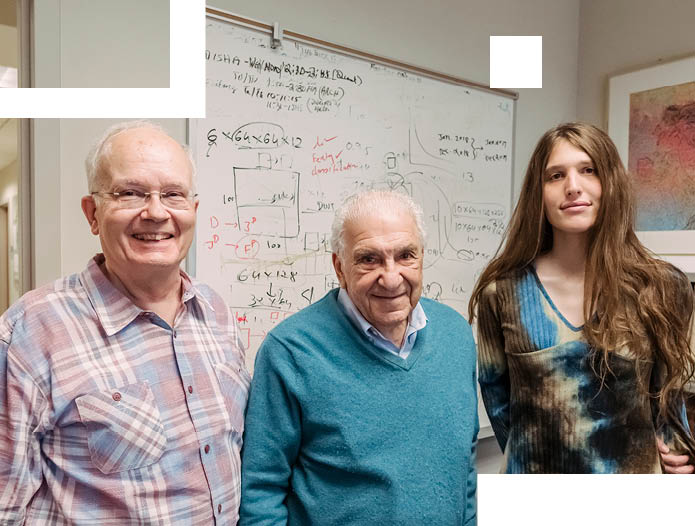
Jim Fischer, Milt Halem, and Sophia Hamer (left to right) in Halem’s UMBC office. One of Halem’s screen prints hangs in the upper right.
“Milt and I would have discussions about my thesis, and I always like to describe it as: Milt decided to adopt me. I was close to the end of my Ph.D., and I changed my focus based on working with him,” she said. “It really changed the trajectory of my career.” After graduating, she became a research assistant professor at UMBC. She currently studies weather and climate-related topics as a senior AI research scientist at Johns Hopkins Applied Physics Laboratory while she continues to work part-time with Halem and his students.
Sophia Hamer ’22, mathematics and computer science, who is currently working with Halem as a master’s student, also credits Halem with helping her find her career footing. She first met him to discuss a research project when she was an undergraduate and just emerging from a time when she struggled with her grades and with choosing a major.
“Dr. Halem took a chance on me,” she says. “I honestly think that was the turning point for me. Before I was thinking, ‘I’m just gonna squeak out of here with a degree and hopefully my GPA isn’t too bad to get a job.’ But now, my entire perspective has shifted: I’m about to graduate with a master’s, and I’m doing impactful research in a field I really like. I never thought that would be possible.”
“Milt is tough—he pushes you—but he also works closely with you,” Sleeman adds. “I really grew from that relationship.”
AI for weather and climate forecasting
Both Sleeman and Hamer are working with Halem on a project to be the first to use AI to make regional weather predictions, one of a couple AI projects Halem is currently pursuing.
In his embrace of AI, Halem is yet again advancing alongside the technology that has defined his career. Gone are the days of mere 40,000 instructions per second. Now advanced computer chips power computationally hungry “neural networks” originally inspired by the workings of the human brain. Neural networks are behind celebrity chatbots such as ChatGPT—and forecasters are increasingly turning to them to predict the weather too.
While traditional weather models simulate the physics of the Earth and its atmosphere to make predictions about the future, AI forecasting models simply examine vast datasets of past weather and learn how to spot patterns.
So far, the main advantage of AI forecasting is speed. What can take days for a physics-based model can be done in only minutes or seconds with AI. AI weather models offer great promise for distributed, real-time weather forecasting, for example as natural disasters unfold. Halem and his students are looking in particular to predict wildfires.
While much AI weather forecasting research is undertaken by leading tech companies such as Google and Microsoft, Halem thinks his students are more than holding their own.
“I’ve got a new generation of computer scientists making breakthroughs,” says Halem. “Two students who are writing up their master’s theses are doing leading AI computations to rival what some big tech companies are doing.”
The work of weather and climate modeling is growing in importance as global warming unfolds and the Earth’s natural patterns shift. “Applying what I know to a real-world problem has been an amazing experience,” Hamer says.
The projects are also yet one more demonstration of Halem’s constant intellectual evolution.
“Milt has an amazing ability to learn new things,” says Anupam Joshi, the acting dean of the College of Engineering and Information Technology. “He was trained as a mathematician who then specialized in high-performance computing and in the last few years has become an expert in using AI systems to model weather and climate phenomena. It speaks to his intellectual capabilities but also his perseverance and his grit.”
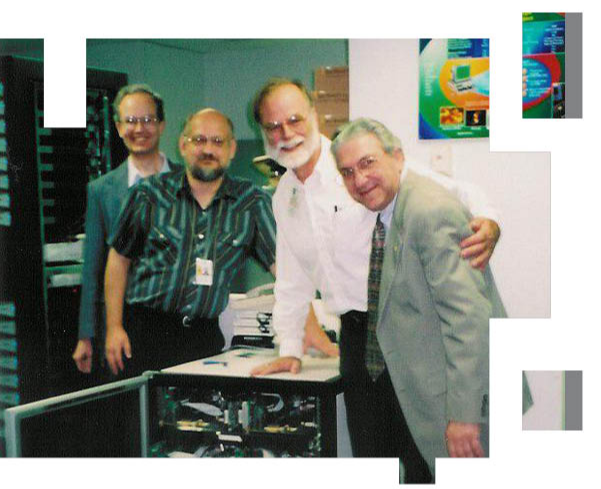
Halem (far right) poses with (from left to right) NASA’s Jim Fischer and John Dorband, and Microsoft Fellow Jim Gray next to the first Beowulf computing cluster. Photo by NASA.
Into the future
Now in his tenth decade of life, Halem shows few signs of slowing down. When not spending time with his large family, he’s still tackling some of science’s thorniest problems, such as how to predict weather patterns months to years in advance.
“He’s like the energizer bunny,” says Fischer, his former NASA colleague.
Duffy agrees. “He has an amazing amount of energy; he never seems to stop. He has a willingness to listen, learn, and ask questions and is an amazing role model for his students.”
Halem says it’s the computation challenges that drive him. “I have to keep moving because the computational instrument continues to evolve,” he says. He continues to be on the lookout for new ideas—the latest he’s come across being an AI research scientist. “The AI agent can use large language models to read the literature; it can write computer code and conduct experiments by itself. It can write the paper on what it discovered. So that’s probably the ultimate research goal that I would like to see if I can make an impact on,” Halem explains.
“Milt is probably one of the most dedicated people I know to the research,” Sleeman says. “He’s so tenacious, and it’s just so impressive. It’s a privilege to continue to work with him.”
“Milt is incredible,” adds Joshi. “If we could replicate him, we would.” And maybe, in some sense, Halem’s AI scientist would do just that.
 ]]>
For almost 70 years, Milt Halem, now a research professor at UMBC after a career at NASA, has deployed the latest computing technology—from vacuum tubes in the ’50s to artificial intelligence...
https://umbc.edu/stories/milt-halem-and-the-third-pillar-of-science/
https://my3.my.umbc.edu/api/v0/pixel/news/146115/guest@my.umbc.edu/e9026a516fe6b98808ffc05f4258bd43/api/pixel
ai
campus-life
cfr
coeit
discovery
fall-2024
feature
gsfc
magazine
mathematics
nasa
story
UMBC News & Magazine
https://my3.my.umbc.edu/groups/umbc-news-magazine
https://assets1-my.umbc.edu/system/shared/avatars/groups/000/001/943/24435aa6207c452e7bc15cc74b42c7bb/xsmall.png?1748556657
https://assets1-my.umbc.edu/system/shared/avatars/groups/000/001/943/24435aa6207c452e7bc15cc74b42c7bb/original.png?1748556657
https://assets2-my.umbc.edu/system/shared/avatars/groups/000/001/943/24435aa6207c452e7bc15cc74b42c7bb/xxlarge.png?1748556657
https://assets2-my.umbc.edu/system/shared/avatars/groups/000/001/943/24435aa6207c452e7bc15cc74b42c7bb/xlarge.png?1748556657
https://assets3-my.umbc.edu/system/shared/avatars/groups/000/001/943/24435aa6207c452e7bc15cc74b42c7bb/large.png?1748556657
https://assets1-my.umbc.edu/system/shared/avatars/groups/000/001/943/24435aa6207c452e7bc15cc74b42c7bb/medium.png?1748556657
https://assets2-my.umbc.edu/system/shared/avatars/groups/000/001/943/24435aa6207c452e7bc15cc74b42c7bb/small.png?1748556657
https://assets1-my.umbc.edu/system/shared/avatars/groups/000/001/943/24435aa6207c452e7bc15cc74b42c7bb/xsmall.png?1748556657
https://assets2-my.umbc.edu/system/shared/avatars/groups/000/001/943/24435aa6207c452e7bc15cc74b42c7bb/xxsmall.png?1748556657
UMBC News & Magazine
1
0
false
Tue, 03 Dec 2024 14:13:49 -0500
Tue, 03 Dec 2024 14:13:49 -0500
Colonialism’s legacy has left Caribbean nations much more vulnerable to hurricanes
]]>
For almost 70 years, Milt Halem, now a research professor at UMBC after a career at NASA, has deployed the latest computing technology—from vacuum tubes in the ’50s to artificial intelligence...
https://umbc.edu/stories/milt-halem-and-the-third-pillar-of-science/
https://my3.my.umbc.edu/api/v0/pixel/news/146115/guest@my.umbc.edu/e9026a516fe6b98808ffc05f4258bd43/api/pixel
ai
campus-life
cfr
coeit
discovery
fall-2024
feature
gsfc
magazine
mathematics
nasa
story
UMBC News & Magazine
https://my3.my.umbc.edu/groups/umbc-news-magazine
https://assets1-my.umbc.edu/system/shared/avatars/groups/000/001/943/24435aa6207c452e7bc15cc74b42c7bb/xsmall.png?1748556657
https://assets1-my.umbc.edu/system/shared/avatars/groups/000/001/943/24435aa6207c452e7bc15cc74b42c7bb/original.png?1748556657
https://assets2-my.umbc.edu/system/shared/avatars/groups/000/001/943/24435aa6207c452e7bc15cc74b42c7bb/xxlarge.png?1748556657
https://assets2-my.umbc.edu/system/shared/avatars/groups/000/001/943/24435aa6207c452e7bc15cc74b42c7bb/xlarge.png?1748556657
https://assets3-my.umbc.edu/system/shared/avatars/groups/000/001/943/24435aa6207c452e7bc15cc74b42c7bb/large.png?1748556657
https://assets1-my.umbc.edu/system/shared/avatars/groups/000/001/943/24435aa6207c452e7bc15cc74b42c7bb/medium.png?1748556657
https://assets2-my.umbc.edu/system/shared/avatars/groups/000/001/943/24435aa6207c452e7bc15cc74b42c7bb/small.png?1748556657
https://assets1-my.umbc.edu/system/shared/avatars/groups/000/001/943/24435aa6207c452e7bc15cc74b42c7bb/xsmall.png?1748556657
https://assets2-my.umbc.edu/system/shared/avatars/groups/000/001/943/24435aa6207c452e7bc15cc74b42c7bb/xxsmall.png?1748556657
UMBC News & Magazine
1
0
false
Tue, 03 Dec 2024 14:13:49 -0500
Tue, 03 Dec 2024 14:13:49 -0500
Colonialism’s legacy has left Caribbean nations much more vulnerable to hurricanes

Written by Farah Nibbs, assistant professor of emergency and disaster health systems at UMBC
Long before colonialism brought slavery to the Caribbean, the native islanders saw hurricanes and storms as part of the normal cycle of life.
The Taino of the Greater Antilles and the Kalinago, or Caribs, of the Lesser Antilles developed systems that enabled them to live with storms and limit their exposure to damage.
On the larger islands, such as Jamaica and Cuba, the Taino practiced crop selection with storms in mind, preferring to plant root crops such as cassava or yucca with high resistance to damage from hurricane and storm winds, as Stuart Schwartz describes in his 2016 book “Sea of Storms.”
The Kalinago avoided building their settlements along the coast to limit storm surges and wind damage. The Calusa of southwest Florida used trees as windbreaks against storm winds.
In fact, it was the Kalinago and Taino who first taught the Europeans – primarily the British, Dutch, French and Spanish – about hurricanes and storms. Even the word ‘hurricane’ comes from Huracán, a Taino and Mayan word denoting the god of wind.
But then colonialism changed everything.
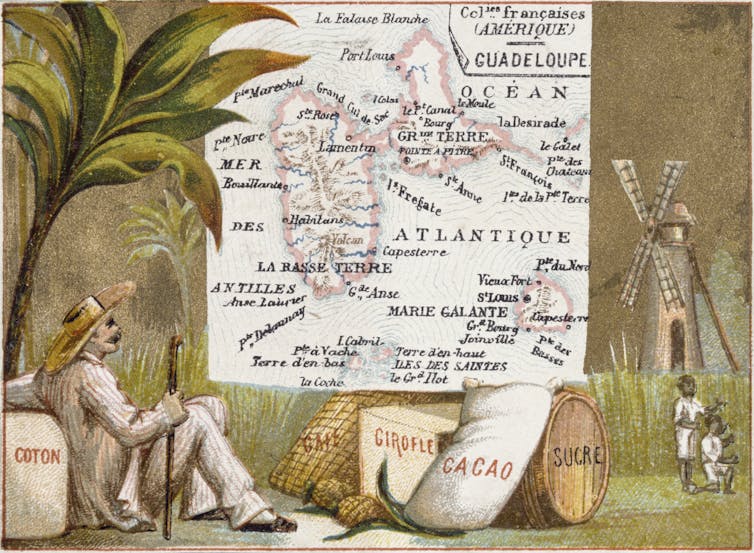 A French advertising card from around 1900 depicts colonial power in Guadeloupe, with a trader sitting comfortably among sacks of cotton, cocoa and coffee while islanders work in the field. Universal History Archive/Universal Images Group via Getty Images
I study natural disasters in the Caribbean, including how history molded responses to disasters today.
The current disaster crisis that the Caribbean’s small islands are experiencing as hurricanes intensify did not start a few decades ago. Rather, the islands’ vulnerability is a direct result of the exploitative systems forced upon the region by colonialism, its legacies of slave-based land policies and ill-suited construction and development practices, and its environmental injustices.
Forcing people into harm’s way
The colonial powers changed how Caribbean people interacted with the land, where they lived and how they recovered from natural hazard events.
Rather than growing crops that could sustain the local food supply, the Europeans who began arriving in the 1600s focused on exploitative extractive economic models and export cash crops through the plantation economy.
They forced Indigenous people off their lands and built settlements along the coast, which made it easier to import enslaved peoples and goods and to export cash crops such as sugar and tobacco to Europe – and also left communities vulnerable to storms. They also developed settlements in low-lying areas, often near rivers and streams, which could provide transportation for agricultural produce but which became flood risks during heavy rains.
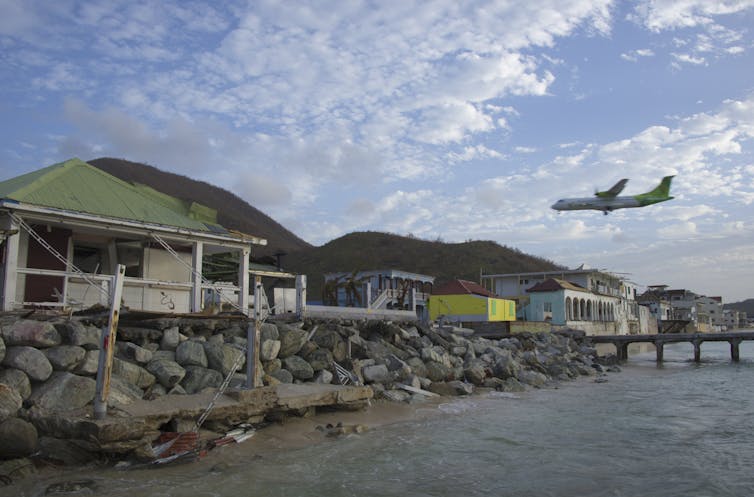 Homes built to the water’s edge in Saint-Martin, an overseas collectivity of France, were devastated when Hurricane Irma hit in 2017. Helene Valenzuela/AFP via Getty Images
Today, more than 70% of the Caribbean’s population lives along the coast, often less than a mile from the shore. These coastlines are not only highly exposed to hurricanes but also to sea-level rise fueled by climate change.
Legacies of slave-based land policies
Colonialism’s legacy of land policies has also made recovery from disasters much harder today.
When colonial powers took over, a few landowners were given control of most of the land, while the majority of the population was forced onto marginal and small areas. The local population had no legal right to the land, as the people did not possess land certificate titles or deeds and were often forced to pay rent to landlords.
After independence, most island governments tried to acquire land from former plantations or estates and to redistribute it to the working class. But these efforts, mainly in the 1960s and ’70s, largely failed to transform land ownership, improve economic development or reduce vulnerability.
One colonial legacy perpetuating vulnerability to this day is known as crown land, or state land. In the English-speaking Caribbean, all land for which there was no land grant was considered property of the British crown. Crown land can be found in every English-speaking island to this day. https://www.youtube.com/embed/YTckM-cNeII?wmode=transparent&start=0 How colonial powers controlled the Caribbean over time.
For example, in Barbuda, all land is vested in the “crown in perpetuity” on behalf of Barbudans. This means that an individual born on the island of Barbuda cannot individually own land.
Instead, land is communally owned, which limits access to the credit and development opportunities that were sorely needed to reconstruct the island after Hurricane Maria in 2017. Most Barbudans were unable to insure their homes because they had no title deeds to their property.
This and other collective land tenure systems created by colonialism places Caribbean residents at greater risk from a variety of natural hazards and limits their ability to seek financial credit for disaster recovery today.
The roots of poor construction
Vulnerability to disasters in the Caribbean also has roots in post-slavery housing construction and subsequent failures to institute proper building codes.
After emancipation from slavery, freed people had no right nor access to land. To build houses, they were forced to lease land from the former enslavers who at a whim could terminate their employment or kick them off the land.
This led to the development of a particular type of housing structure known as chattel houses in countries such as Barbados. These houses are tiny and were constructed in a way in which they could be easily taken apart and loaded onto carts, should the residents be forced out by their former enslavers. Many Bajans still live in these houses today, although quite a few have been converted to restaurants or shops.
 Chattel houses are still used as homes in Barbados. Shardalow via Wikimedia, CC BY
In Aruba, Bonaire and Curaçao, owned by the Dutch, slave huts were built along the coast, on land not suitable for agriculture and easily damaged by storms. These former slave huts are now tourist attractions, but the colonial patterns of settling along the coast has left many coastal communities exposed to hurricane damage and rising seas.
The vulnerability of such houses is not only a result of their exposure to natural hazards but also the underlying social structures.
 Slave huts were built on the coast in Bonaire, where they were vulnerable to storm surge. Leslie Ket via Wikimedia, CC BY-SA
In many islands today, poorer residents can’t afford protective measures, such as installing storm shutters or purchasing solar-powered generators.
They often live in marginal and disaster-prone areas, such as steep hillsides, where housing tends to be cheaper. Houses in these areas are also often poorly constructed with low-grade materials, such as galvanized sheeting for roofs and walls.
This situation is made worse by the informal and unregulated nature of residential housing construction in the region and the poor enforcement of building codes.
Due to the legacy of colonialism, most housing or building standards or codes in the Commonwealth Caribbean are relics from the United Kingdom and in the French Antilles from France. Building standards across the region lack uniformity and are generally subjective and uncontrolled. Financial limitations and staffing constraints mean that codes and standards more often than not remain unenforced.
Progress, but still a lot of work to do
The Caribbean has made progress in developing wind-related building codes to try to increase resilience in recent years. And while damage from torrential rain is still not properly addressed in most Caribbean building standards, scientific guidance is available through the Caribbean Institute for Meteorology and Hydrology in Barbados.
Individual islands, including Dominica and Saint Lucia, have new minimum building standards for recovery after disasters. The island of Grenada is hoping to guide new construction as it recovers from Hurricane Beryl. Trinidad and Tobago has developed a national land use strategy but has struggled to use it.
Construction standards can help the islands build resilience. But work remains to be done to overcome the legacy of colonial-era land policies and development that have left island towns vulnerable to increasing storm risks.
This article is republished from The Conversation under a Creative Commons license. Read the original article and see more than 250 UMBC articles available in The Conversation.
]]>
Written by Farah Nibbs, assistant professor of emergency and disaster health systems at UMBC Long before colonialism brought slavery to the Caribbean, the native islanders saw hurricanes and...
https://umbc.edu/stories/colonialisms-legacy-left-caribbean-vulnerable-to-hurricanes/
https://my3.my.umbc.edu/api/v0/pixel/news/144976/guest@my.umbc.edu/d4e68de413c4a368d4df374422ffcd90/api/pixel
cahss
cahss-research
discovery
edhs
international
magazine
research
story
UMBC News & Magazine
https://my3.my.umbc.edu/groups/umbc-news-magazine
https://assets1-my.umbc.edu/system/shared/avatars/groups/000/001/943/24435aa6207c452e7bc15cc74b42c7bb/xsmall.png?1748556657
https://assets1-my.umbc.edu/system/shared/avatars/groups/000/001/943/24435aa6207c452e7bc15cc74b42c7bb/original.png?1748556657
https://assets2-my.umbc.edu/system/shared/avatars/groups/000/001/943/24435aa6207c452e7bc15cc74b42c7bb/xxlarge.png?1748556657
https://assets2-my.umbc.edu/system/shared/avatars/groups/000/001/943/24435aa6207c452e7bc15cc74b42c7bb/xlarge.png?1748556657
https://assets3-my.umbc.edu/system/shared/avatars/groups/000/001/943/24435aa6207c452e7bc15cc74b42c7bb/large.png?1748556657
https://assets1-my.umbc.edu/system/shared/avatars/groups/000/001/943/24435aa6207c452e7bc15cc74b42c7bb/medium.png?1748556657
https://assets2-my.umbc.edu/system/shared/avatars/groups/000/001/943/24435aa6207c452e7bc15cc74b42c7bb/small.png?1748556657
https://assets1-my.umbc.edu/system/shared/avatars/groups/000/001/943/24435aa6207c452e7bc15cc74b42c7bb/xsmall.png?1748556657
https://assets2-my.umbc.edu/system/shared/avatars/groups/000/001/943/24435aa6207c452e7bc15cc74b42c7bb/xxsmall.png?1748556657
UMBC News & Magazine
0
0
false
Tue, 22 Oct 2024 11:12:41 -0400
Tue, 22 Oct 2024 11:12:41 -0400
Rachel Brewster’s lab advances understanding of how organisms adapt to oxygen deprivation—with an eye toward new medical treatments
Some organisms are better than others at surviving without oxygen. “Humans don’t do very well without oxygen, but even humans have adaptive mechanisms,” says Rachel Brewster, professor of biological sciences. Zebrafish, however—the model organism Brewster studies—are champs at surviving with little or no oxygen. In fact, zebrafish embryos can last up to 50 hours under anoxia—that is, no oxygen at all.
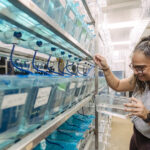
Brewster’s lab includes wall-to-wall freshwater fish tanks, where two-inch zebrafish with blue and gold horizontal stripes swirl. Her team has been working with zebrafish for years, painstakingly figuring out just how they mitigate the effects of reduced oxygen (“hypoxia”) at a molecular level. “What we’re really interested in discovering is what adaptive molecules we might share in common with some of these highly hypoxia-tolerant organisms like zebrafish,” Brewster says. “And if we share those molecules, how can we control or modify their activity to improve outcomes?”
Solving the zebrafish puzzle
Being able to keep human tissues alive and undamaged under hypoxia for longer stretches of time has a range of potential benefits. Notably, it would expand the ability to deliver donated organs to transplant recipients most in need, in less developed geographic areas, or even in war zones—which is the reason the U.S. Department of Defense (DoD) previously funded Brewster’s work.
Over the last several years, her DoD-funded work and subsequent research supported by the National Institutes of Health (NIH) have led Brewster’s group on a swimmingly successful journey of discovery. Twists and turns, creative thinking, and challenging lab work have allowed them to place one puzzle piece after another to reveal the bigger picture of how zebrafish survive so long without oxygen. Brewster hopes other researchers will take her group’s work a step further, translating the fundamental knowledge they’ve brought forth into treatments that save human lives. In recognition of her group’s contributions, Brewster has just secured a five-year, more than $1.9 million grant from the NIH to continue solving the puzzle.
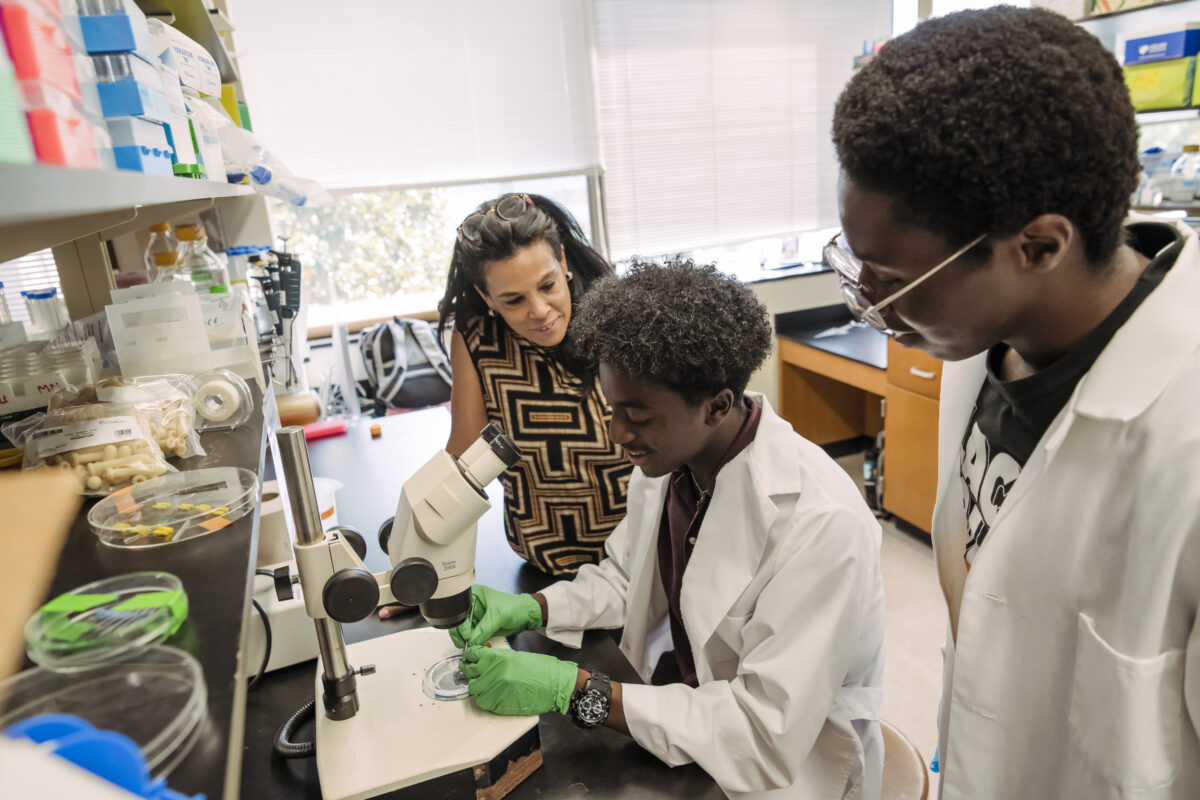 Rachel Brewster makes mentoring students the cornerstone of her work as a UMBC faculty member. Left to right: Rachel Brewster, Gabriel Otubu, and Felix Rene Siewe. Otubu and Siewe are senior biochemistry and molecular biology majors. (Marlayna Demond ’11/UMBC)
Equally important to Brewster, her research program creates opportunities for emerging scientists to learn the practical skills and habits of mind that will enable them to pursue their own scientific questions in the future. Her current team includes graduate students and several undergraduates, all of whom have contributed to creating new knowledge. “Research and training go together for me,” Brewster says.
The journey begins
Some organisms, including animals that fly at high altitudes, dive deep in the ocean, or live underground, excel at adapting to low oxygen. They typically reduce their metabolic activity when oxygen drops, therefore reducing demand as supply dwindles. “They reach a new status quo,” Brewster says.
Brewster initially expected that the molecules inducing that new status quo must be quick-acting metabolites—small molecules already present in cells—rather than large proteins that are energy-intensive to produce. So in 2016 she teamed up with Johns Hopkins scientist Young-Sam Lee, who has expertise in metabolites. She asked Lee, who is now at the Kentucky University School of Medicine, to identify which metabolites were more or less abundant in zebrafish embryos raised without oxygen compared to embryos that developed under normal conditions. Austin Gabel ’17, biological sciences, worked closely with Lee in summer 2016 to uncover the relevant metabolites.
The results showed that embryos raised without oxygen had, among other metabolites, more lactate. Lactate is a byproduct of glycolysis—the energy-producing process cells must rely on when oxygen isn’t available. That was “kind of a ‘duh’ moment,” Brewster says, but there was more to the story: Around the same time, other researchers were showing that high lactate levels in cancer cells triggered cell growth and blood vessel development via a protein called NDRG3. Brewster was surprised to see such energy-intensive processes triggered by low oxygen—but she wondered if members of the NDRG protein family functioned differently in healthy cells.
A surprising connection
Curious, Brewster and Jong Park, Ph.D. ’21, biological sciences, searched a database for NDRG genes in zebrafish, and found six. (There are four in mammals.) NDRG1a caught their attention, because it is involved in a process that requires an enzyme called a sodium potassium ATPase. That enzyme is one of the most energy-intensive enzymes in the cell, and organisms frequently reduce its production when oxygen is low. Interesting, Brewster thought.
Also, the ATPase and NDRG1a were expressed in exactly the same areas of the fish’s body—the kidney and skin cells called ionocytes, which are arrayed in a polka dot pattern on the surface of zebrafish embryos. Could NDRG1a be regulating the ATPase? Sure enough, a database of protein-protein interactions revealed that NDRG1a could interact with the ATPase. Now they were getting somewhere!
 Rachel Brewster’s office is a welcoming space for students to come and ask questions. (Marlayna Demond ’11/UMBC)
A long and winding road
To check whether NDRG1a actually did regulate this ATPase, her team tested how normal zebrafish and zebrafish without functional NDRG1a performed with normal oxygen and no oxygen. Under normal conditions, they both behaved normally. But the zebrafish without NDRG1a died at much higher rates without oxygen, providing compelling evidence that NDRG1a is required for the fish to adapt to low oxygen.
That was exciting, because at that time, “NDRG had no distinctive regions that could help researchers infer its function,” Brewster says—in fact, its molecular function was hardly understood. “But the fact that it can bind to a lot of different proteins suggests that it can function as an “adapter protein.” Just like an adapter that allows you to connect a USB to a wall outlet, adapter proteins connect molecules that otherwise wouldn’t interact. In this case, NDRG1a connects the ATPase with proteins that carry it off either to be stored in the cell for later use or destroyed—both outcomes that stop its activity and eliminate its demand for energy.
Brewster’s lab then showed that NDRG1a can, indeed, bind directly to the ATPase. Plus, the interaction increases when there is more lactate present, independent of how much oxygen is available. “That was really exciting for us,” Brewster says, “because it suggests that the rise in lactate is functioning via NDRG to promote the downregulation of ATPase.”
An important implication of this finding is that lactate or a similarly-shaped molecule could potentially be used to alter NDRG1a’s activity, and therefore artificially induce an energy-conserving state, Brewster explains. That could potentially help retain organs in viable condition for longer between collection and transplant—and that could save lives.
To further demonstrate that point, Brewster’s lab showed that if cells don’t have functional NDRG1a, ATPase activity does not decrease even with high levels of lactate. That means lactate doesn’t regulate ATPase on its own, but requires NDRG1a as an intermediary.
Joy in the process
Based on all the evidence they’ve collected—in their own lab via experiments and through research in the literature and genetic databases—the Brewster lab’s current model of the system is this: When oxygen is low, lactate and NDRG1a increase. Lactate binds to NDRG1a in such a way that allows it to interact with the ATPase, guiding it either to storage or to the cell’s “garbage can,” which improves the organism’s ability to survive low oxygen by reducing demand from the ATPase for energy.
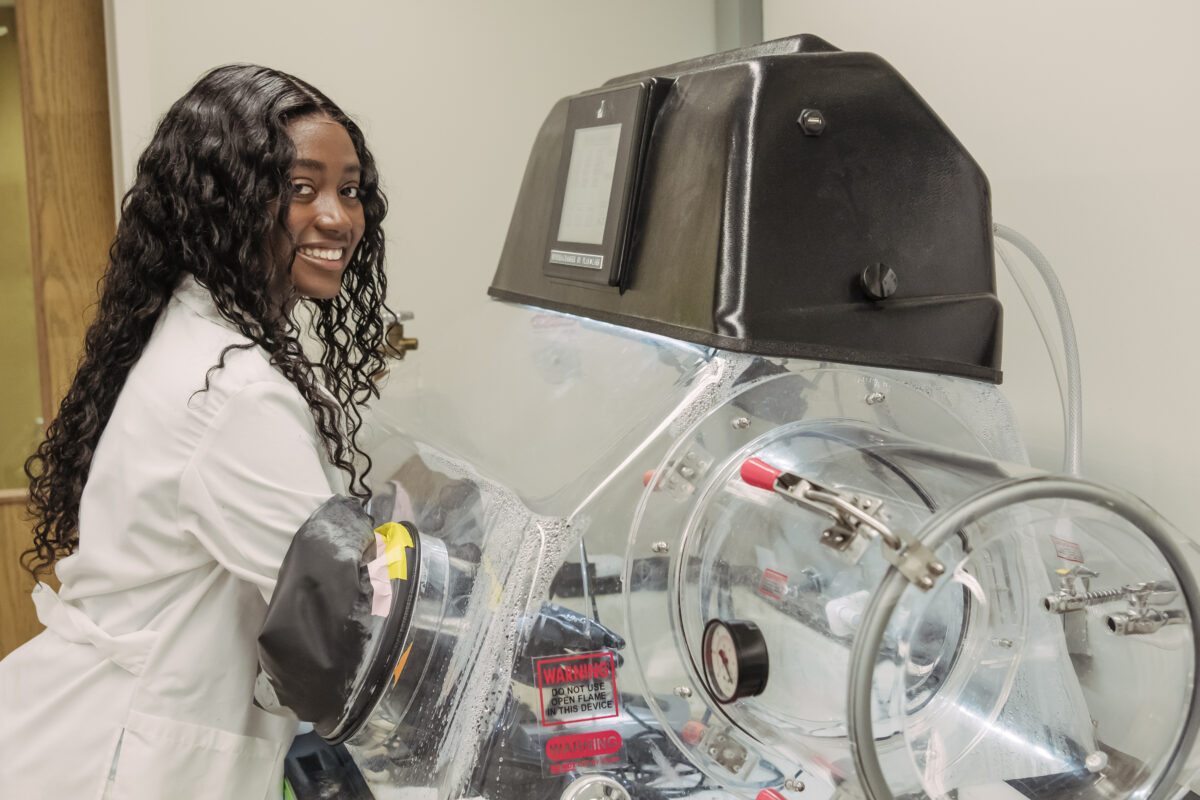 Briana Young, a senior biological sciences major, works in Brewster’s group. Here she stands near a device used to control the oxygen level for experiments. (Marlayna Demond ’11/UMBC)
While it might sound complicated (and sometimes it is!), this process is the joy of a biologist—untangling how molecules interact, using logic to define long chains of reactions, and designing laboratory experiments to fill in knowledge gaps. It’s incremental work like Brewster’s that takes science to new heights step by step. Brewster’s research group has already meaningfully moved the needle on understanding how organisms adapt to oxygen deprivation, but there is still so much more to do—and Brewster is wasting no time.
Filling in the picture
“While hypoxia is damaging, what is even more damaging is the return to normal oxygen,” she says. “You cannot be hypoxia tolerant if you are not also tolerant to reoxygenation. That had us wondering if NDRG is also involved in the reoxygenation phase.”
Brewster’s group has determined that as oxygen returns, NDRG1a continues to interact with the ATPase. That suggests NDRG1a is also important for the transition to reoxygenated conditions. The next experiment the team needs to do to determine whether NDRG1a is indeed critical for reoxygenation is complicated: They need to allow zebrafish to experience hypoxia with normal NDRG1a, and then remove functional NDRG1a just prior to reoxygenation.
“And that is not a trivial experiment,” Brewster says. “So that is one big aim of the new NIH proposal—to try to address the undoing of the hypoxia response.”
Another big goal of Brewster’s upcoming work is to look at other proteins that NDRG1a interacts with and explore their potential roles in hypoxia response. She also wants to investigate other members of the NDRG family. For example, muscle cells produce more NDRG1b under hypoxia, which occurs during intense exercise along with an increase in lactate. Ph.D. candidate Prableen Chowdhary is investigating NDRG1b’s role now. And other NDRG family members are known to be abundant in tissues that require a lot of energy, like the heart.
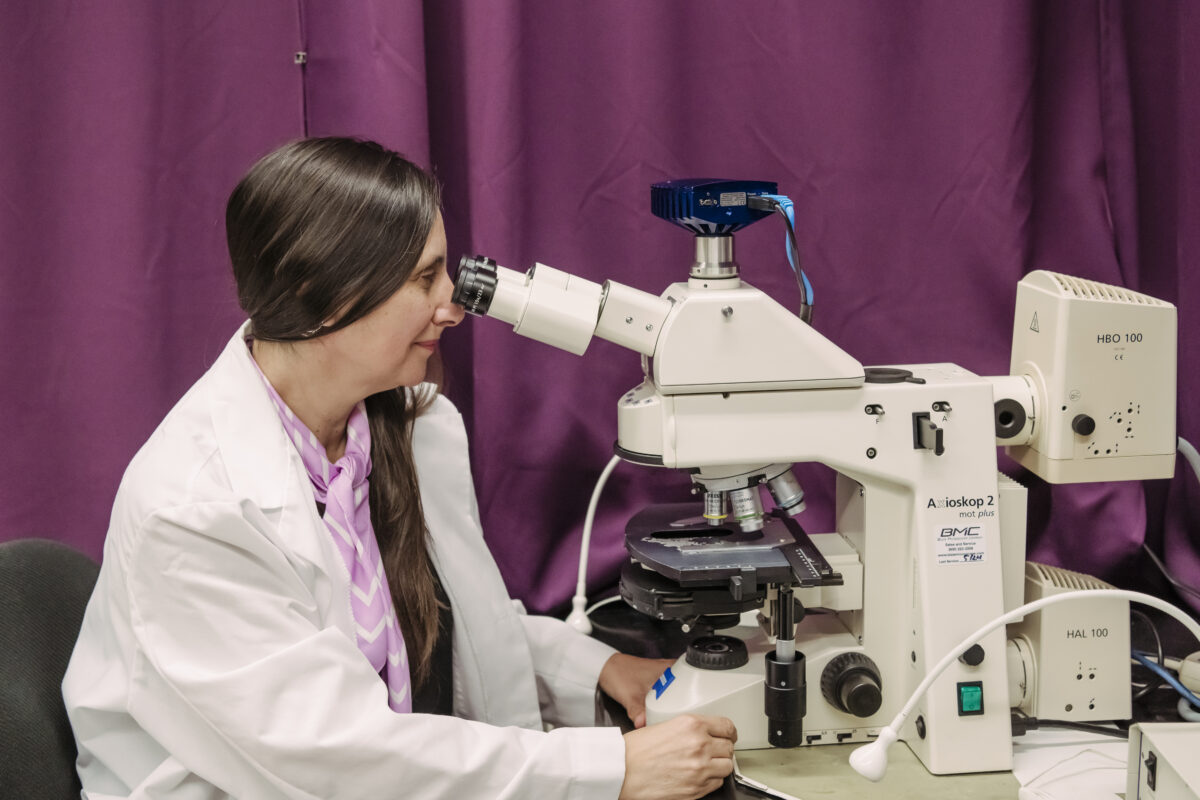 Lilian Gonzalez is studying the role of the protein NDRG1 in organisms’ response to hypoxia. (Marlayna Demond ’11/UMBC)
“It takes energy to save energy”
Curiously, Brewster also noticed that in the research literature, hypoxia is associated with hearing loss: Pilots, people who live at high altitudes, and people with oxygen-depleting diseases like sickle cell anemia or chronic sleep apnea all suffer from hearing loss at higher-than-average rates. Even more intriguingly, NDRG1 is expressed in the inner ear during hypoxia, and Ph.D. candidate Lilian Gonzalez is currently studying its role.
“NDRG seems to be protective, so it may be protective in the inner ear just like it is in the kidney and ionocytes,” Brewster says. “It might be down-regulating ATPase somehow to preserve those cells.”
Beyond NDRG, one of Brewster’s former students, Tim Hufford, Ph.D. ’23, biological sciences, discovered that cells begin producing larger quantities of many different proteins when oxygen drops. That finding officially sunk Brewster’s original hypothesis that metabolites, rather than new proteins, must be the first responders when reduced oxygen strikes. It also demonstrated that “it takes energy to save energy,” she says.
Hufford’s work “opened up a huge area of research, as we now know of hundreds of additional molecules that may play a critical role in hypoxia adaptation in addition to NDRGs,” Brewster says. “It’s more research than my lab could pursue in a lifetime,” she adds, encouraging the next generation to pick up the torch.
Finding purpose in student mentoring
Much fascinating research is in Brewster’s future—but she is far from alone in the endeavor. Brewster’s students are the drivers of the research, she says, and with the new grant, she might add a postdoctoral fellow as well.
“I am deeply committed to the students’ success,” Brewster says. More and more undergraduates in her laboratory are authoring academic papers, which will give them a leg up as they apply to graduate school or seek careers.
As a full professor, Brewster plans to dedicate her time at UMBC to “doing more of what I passionately care about,” she says. “And providing opportunities for people to truly excel in science is completely linked to the research. Because they are the people doing the research. And the students in my lab have done great things.”
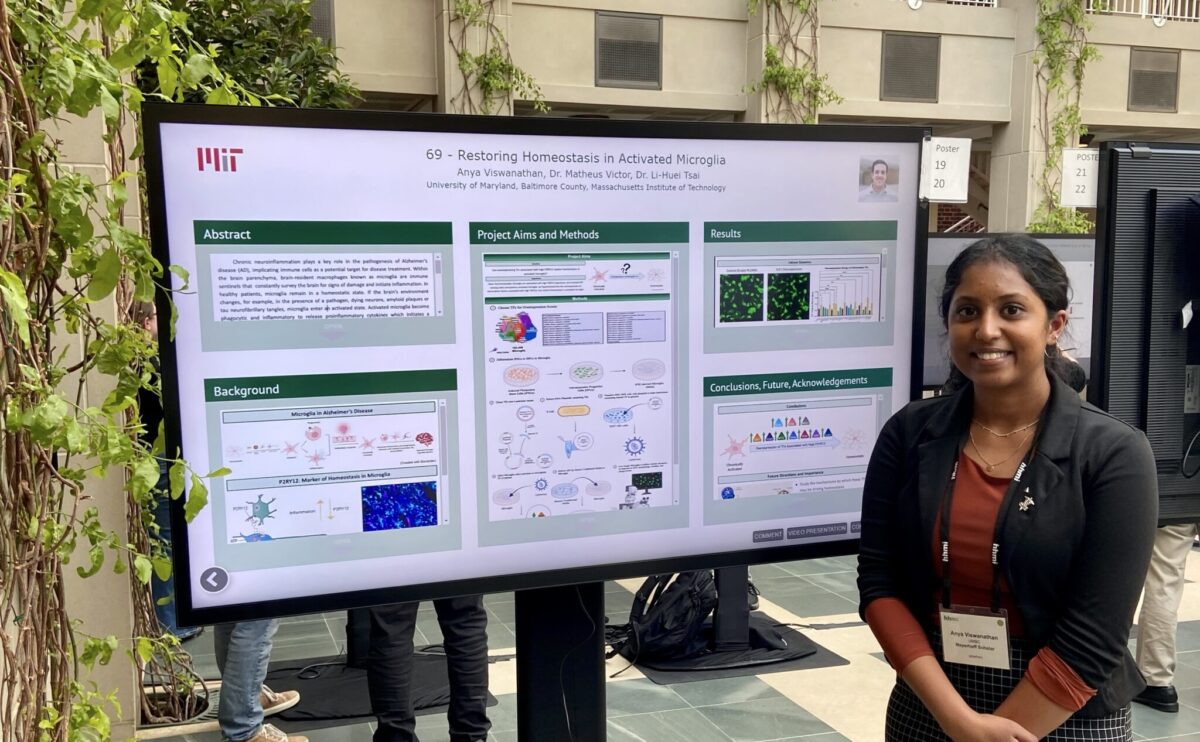 Anya Viswanathan presents her research from a summer internship at MIT. (Courtesy of Viswanathan)
She’s not exaggerating. Gabriel Otubu, a senior biochemistry major in Brewster’s lab, received the prestigious Goldwater Scholarship earlier this year. Last year, Soujanya “Anya” Viswanathan ’24, biological sciences, was also named a Goldwater scholar as was Dominique Brooks ’21, biological sciences, in 2019. Brewster also mentors graduate students as director of the G-RISE Program, an NIH-funded initiative that offers mentorship and training for STEM careers in academia, industry, or government to graduate students from a wide range of backgrounds.
It’s this commitment to mentoring that underpins Brewster’s research success, and she also sees it as one of her fundamental roles as a faculty member. “I want to be very intentional with the time I have left, and student training is something I care deeply about,” she says. “Anyone can be excellent in science. And that is what I strive for in my lab—to support every student to reach their potential, no matter where they’re coming from.”
]]>
Some organisms are better than others at surviving without oxygen. “Humans don’t do very well without oxygen, but even humans have adaptive mechanisms,” says Rachel Brewster, professor of...
https://umbc.edu/stories/brewster-lab-studies-low-oxygen-adaptation/
https://my3.my.umbc.edu/api/v0/pixel/news/144566/guest@my.umbc.edu/5a3b2fe20f14e6911887c637bdb8f80d/api/pixel
biology
cnms
discovery
magazine
research
story
UMBC News & Magazine
https://my3.my.umbc.edu/groups/umbc-news-magazine
https://assets1-my.umbc.edu/system/shared/avatars/groups/000/001/943/24435aa6207c452e7bc15cc74b42c7bb/xsmall.png?1748556657
https://assets1-my.umbc.edu/system/shared/avatars/groups/000/001/943/24435aa6207c452e7bc15cc74b42c7bb/original.png?1748556657
https://assets2-my.umbc.edu/system/shared/avatars/groups/000/001/943/24435aa6207c452e7bc15cc74b42c7bb/xxlarge.png?1748556657
https://assets2-my.umbc.edu/system/shared/avatars/groups/000/001/943/24435aa6207c452e7bc15cc74b42c7bb/xlarge.png?1748556657
https://assets3-my.umbc.edu/system/shared/avatars/groups/000/001/943/24435aa6207c452e7bc15cc74b42c7bb/large.png?1748556657
https://assets1-my.umbc.edu/system/shared/avatars/groups/000/001/943/24435aa6207c452e7bc15cc74b42c7bb/medium.png?1748556657
https://assets2-my.umbc.edu/system/shared/avatars/groups/000/001/943/24435aa6207c452e7bc15cc74b42c7bb/small.png?1748556657
https://assets1-my.umbc.edu/system/shared/avatars/groups/000/001/943/24435aa6207c452e7bc15cc74b42c7bb/xsmall.png?1748556657
https://assets2-my.umbc.edu/system/shared/avatars/groups/000/001/943/24435aa6207c452e7bc15cc74b42c7bb/xxsmall.png?1748556657
UMBC News & Magazine
0
0
false
Mon, 07 Oct 2024 15:30:54 -0400
Mon, 07 Oct 2024 15:30:54 -0400
Pagers and walkie-talkies over cellphones—a security expert explains why Hezbollah went low-tech for communications

Written by Richard Forno, principal lecturer in computer science and electrical engineering, UMBC
Electronic pagers across Lebanon exploded simultaneously on Sept. 17, 2024, killing 12 and wounding more than 2,700. The following day, another wave of explosions in the country came from detonating walkie-talkies. The attacks appeared to target members of the militant group Hezbollah.
The pagers attack involved explosives planted in the communications devices by Israeli operatives, according to U.S. officials cited by The New York Times. Hezbollah had recently ordered a shipment of pagers, according to the report.
Secretly attacking the supply chain is not a new technique in intelligence and military operations. For example, the U.S. National Security Agency intercepted computer hardware bound for overseas customers, inserted malware or other surveillance tools and then repackaged them for delivery to certain foreign buyers, a 2010 NSA internal document showed. This differs from accessing a specific person’s device, such as when Israel’s Shin Bet secretly inserted explosives into a cellphone to remotely kill a Hamas bombmaker in 1996.
Hezbollah, a longtime adversary of Israel, had increased its use of pagers in the wake of the Hamas attack on Israel on Oct. 7, 2023. By shifting to relatively low-tech communication devices, including pagers and walkie-talkies, Hezbollah apparently sought an advantage against Israel’s well-known sophistication in tracking targets through their phones.
 The second wave of explosions in Lebanon involved walkie-talkies. AP Photo
Cellphones: The ultimate tracker
As a former cybersecurity professional and current security researcher, I view cellular devices as the ultimate tracking tool for both government and commercial entities – in addition to users, criminals and the mobile phone provider itself. As a result, mobile phone tracking has contributed to the fight against terrorism, located missing people and helped solve crimes.
Conversely, mobile phone tracking makes it easy for anyone to record a person’s most intimate movements. This can be done for legitimate purposes such as parents tracking children’s movements, helping you find your car in a parking lot, and commercial advertising, or nefarious ends such as remotely spying on a lover suspected of cheating or tracking political activists and journalists. Even the U.S. military remains concerned with how its soldiers might be tracked by their phones.
Mobile device tracking is conducted in several ways. First, there is the network location data generated by the phone as it moves past local cell towers or Stingray devices, which law enforcement agencies use to mimic cell towers. Then there are the features built into the phone’s operating system or enabled by downloaded apps that may lead to highly detailed user tracking, which users unwittingly agree to by ignoring the software’s privacy policy or terms of service.
This collected data is sometimes sold to governments or other companies for additional data mining and user profiling. And modern smartphones also have built-in Bluetooth, Wi-Fi and GPS capabilities that can help with locating and tracking user movements around the world, both from the ground and via satellites.
Your phone contains many sensors that make it useful – and easy to track.
Mobile devices can be tracked in real time or close to it. Common technical methods include traditional radio direction-finding techniques, using intelligence satellites or drones, deploying “man in the middle” tools like Stingrays to impersonate cellular towers to intercept and isolate device traffic, or installing malware such as Pegasus, made by Israeli cyberarms company NSO to report a device’s location.
Nontechnical and slower techniques of user tracking include potentially identifying general user locations from their internet activity. This can be done from website logs or the metadata contained in content posted to social media, or contracting with data brokers to receive any collected location data from the apps that a user might install on their device.
Indeed, because of these vulnerabilities, the leader of Hezbollah earlier this year advised his members to avoid using cellular phones in their activities, noting that Israel’s “surveillance devices are in your pockets. If you are looking for the Israeli agent, look at the phone in your hands and those of your wives and children.”
Researchers have shown how these features, often intended for the user’s convenience, can be used by governments, companies and criminals to track people in their daily lives and even predict movements. Many people still aren’t aware of how much their mobile devices disclose about them.
Pagers, however, unlike mobile phones, can be harder to track depending on whether they support two-way communication.
Why go low-tech
A pager that only receives messages does not provide a signal that can facilitate tracking its owner. Therefore, Hezbollah’s use of pagers likely made it more challenging to track their operatives – thus motivating Israeli intelligence services’ purported attack on the supply chain of Hezbollah’s pagers.
Using low-tech tactics and personal couriers while avoiding the use of mobile phones and digital tools also made it difficult for the technologically superior Western intelligence agencies to locate Osama bin Laden for years after the 9/11 attacks.
In general, I believe the adversary in an asymmetric conflict using low-tech techniques, tactics and technology will almost always be able to operate successfully against a more powerful and well-funded opponent.
A well-documented demonstration of this asymmetry in action was the U.S. military’s Millennium Challenge war game in 2002. Among other things, the insurgent Red forces, led by Marine General Paul van Riper, used low-tech tactics including motorcycle couriers instead of cellphones to evade the Blue forces’ high-tech surveillance. In the initial run of the exercise, the Red team won the contest in 24 hours, forcing exercise planners to controversially reset and update the scenario to ensure a Blue team victory.
Lessons for everyone
The preference for terrorist organizations like Hezbollah and al-Qaida to avoid using smartphones is a reminder for everyone that you can be, and likely are being tracked in various ways and for various purposes.
Israel’s purported response to Hezbollah’s actions also holds a lesson for everyone. From a cybersecurity perspective, it shows that any device in your life can be tampered with by an adversary at points along the supply chain – long before you even receive it.
This article is republished from The Conversation under a Creative Commons license. Read the original article and see more than 300 UMBC articles available in The Conversation.
]]>
Written by Richard Forno, principal lecturer in computer science and electrical engineering, UMBC Electronic pagers across Lebanon exploded simultaneously on Sept. 17, 2024, killing 12 and...
https://umbc.edu/stories/pagers-and-walkie-talkies-over-cellphones-a-security-expert-explains-why-hezbollah-went-low-tech-for-communications/
https://my3.my.umbc.edu/api/v0/pixel/news/144057/guest@my.umbc.edu/632db99a5fa25784e86504f5f6bd2e0f/api/pixel
coeit
csee
discovery
magazine
story
the-conversation
UMBC News & Magazine
https://my3.my.umbc.edu/groups/umbc-news-magazine
https://assets1-my.umbc.edu/system/shared/avatars/groups/000/001/943/24435aa6207c452e7bc15cc74b42c7bb/xsmall.png?1748556657
https://assets1-my.umbc.edu/system/shared/avatars/groups/000/001/943/24435aa6207c452e7bc15cc74b42c7bb/original.png?1748556657
https://assets2-my.umbc.edu/system/shared/avatars/groups/000/001/943/24435aa6207c452e7bc15cc74b42c7bb/xxlarge.png?1748556657
https://assets2-my.umbc.edu/system/shared/avatars/groups/000/001/943/24435aa6207c452e7bc15cc74b42c7bb/xlarge.png?1748556657
https://assets3-my.umbc.edu/system/shared/avatars/groups/000/001/943/24435aa6207c452e7bc15cc74b42c7bb/large.png?1748556657
https://assets1-my.umbc.edu/system/shared/avatars/groups/000/001/943/24435aa6207c452e7bc15cc74b42c7bb/medium.png?1748556657
https://assets2-my.umbc.edu/system/shared/avatars/groups/000/001/943/24435aa6207c452e7bc15cc74b42c7bb/small.png?1748556657
https://assets1-my.umbc.edu/system/shared/avatars/groups/000/001/943/24435aa6207c452e7bc15cc74b42c7bb/xsmall.png?1748556657
https://assets2-my.umbc.edu/system/shared/avatars/groups/000/001/943/24435aa6207c452e7bc15cc74b42c7bb/xxsmall.png?1748556657
UMBC News & Magazine
0
0
false
Thu, 19 Sep 2024 11:58:44 -0400
Thu, 19 Sep 2024 11:58:44 -0400
Putin’s visit to Mongolia defies ICC warrant and tests neutral nation’s ‘third neighbor’ diplomacy

Written by Christopher K. Tong, associate professor of Asian studies at UMBC and Charles Krusekopf, professor of business Royal Roads University
Vladimir Putin arrived in Mongolia on Sept. 2, 2024, the first time the Russian president has visited an International Criminal Court (ICC) member country since the body issued a warrant for his arrest in 2023. While officially commemorating a Soviet-Mongolian military victory in World War II, Putin’s visit will test the small central Asian country’s policy of neutrality and the reach of international institutions.
Mongolia, a country of just 3.3 million people but with huge geographical territory, has long navigated its foreign policy in the shadow of Russia and China, with whom it has extensive historical and economic ties.
The country has attempted to bolster its independence from its more powerful neighbors by developing cordial relations with so-called third neighbor countries that include the United States, Germany, Japan and South Korea.
Through this approach, Mongolia has attempted to carve out a niche on the international stage, presenting itself as a neutral diplomatic meeting ground. Its annual Ulaanbaatar Dialogue, for example, is an opportunity for regional countries and other invited nations, including from the U.S. and EU member states, to discuss issues ranging from climate change to regional security and critical minerals.
As scholars of Mongolia and China, we attended the last such dialogue in June 2024 and witnessed Mongolia’s diplomatic efforts firsthand. It is a strategy that has worked for the country, but as events like Putin’s visit highlight, it can be a tough balancing act.
A closely watched visit
The timing of Putin’s trip is officially linked to history. It marks both the 85th anniversary of the Battle of Khalkhin Gol – in which joint Soviet-Mongolian forces defeated Japanese troops in World War II – and the founding of Mongolia’s national railway operator by the two countries 75 years ago.
Yet it is a third historical marker, the fifth anniversary of a comprehensive Russian-Mongolian strategic partnership, that highlights the visit’s significance from a modern geopolitical perspective.
Alongside its friendly relations with “third neighbors,” Mongolia has maintained a close relationship with Moscow despite Putin’s pariah status in much of the international community. Most recently, in July, Mongolian President Ukhnaagiin Khurelsukh met with Putin at the Shanghai Cooperation Organization summit.
Yet Putin’s visit now – the first he has made to the country since 2019 – poses a challenge for Mongolia as it seeks to balance its obligations and alliances with the Western-led international order, of which the ICC is a part, and its desire to remain friendly with its powerful neighbors.
 US Secretary of State Antony Blinken off to see a Mongolian man about a horse. Byambasuren Byamba-Ochir/Pool Photo via AP
Few things demonstrate this diplomatic tightrope walk like Mongolia’s membership in the ICC, which issued an arrest warrant for Putin over his alleged role in the unlawful deportation and transfer of Ukrainian children to Russia. Ukraine has urged Mongolia to detain Putin, citing the ICC’s founding treaty, the Rome Statute, which instructs member countries to take action if subjects to a court warrant enter their territory.
However, the ICC lacks an effective enforcement mechanism, and member states may also be exempt from carrying out arrests if doing so conflicts with certain treaty obligations or diplomatic immunity offered to another party.
Putin’s visit is expected to demonstrate how little can be done to rein in Moscow. Given the power imbalance between the states, Mongolia will likely show just how far it is willing to go to accommodate its powerful neighbor.
Mongolia’s ‘Third Neighbor’ policy
For almost 70 years, Mongolia was closely allied with the Soviet Union. But the fall of communism and subsequent geopolitical reorientation of the post-Cold War order forced the country to alter its economic and political relations.
In so doing, Mongolia became the only former communist state in Asia to adopt a democratic political system and open economy. It won favor with the U.S. and other Western countries who embraced the country as a role model for the region.
Putin’s expected trip is but the latest in a series of recent high-profile state visits as Mongolia seeks to maintain close relations with its neighbors, while also expanding partnerships with other nations.
So far in 2024, Mongolia has received heads of state or foreign ministers from the U.S., Slovenia, the Philippines, Belarus, the United Kingdom and Germany. In 2023, Mongolian Prime Minister Luvsannamsrain Oyun-Erdene traveled to the U.S. and met with Vice President Kamala Harris, and to China to see President Xi Jinping and Premier Li Qiang.
Both French President Emmanuel Macron and Pope Francis have recently visited Ulaanbaatar.
 Pope Francis meets the faithful gathered outside the Apostolic Prefecture in Ulaanbaatar. AP Photo/Louise Delmotte)
Mongolia can’t escape geography
While soft power efforts have won Ulaanbaatar goodwill and friends around the globe, they do not trump geography. Landlocked between Russia and China, Mongolia remains vulnerable to the whims of its two giant neighbors.
 Map: The Conversation, CC-BY-NDCreated with Datawrapper
Mongolia is dependent on Russia for almost all its gasoline and diesel supplies and a substantial part of its electricity. Further, due to a legacy agreement from the Soviet era, Russia retains 50% ownership in several key infrastructure and mining projects in Mongolia. In particular, Russia is a partner in the Mongolian railway system, which has grown in importance as a trade corridor between China and Russia, and China and Europe.
Mongolia fears that its fuel supplies and transportation network will be disrupted if Russia prioritizes its own energy needs in the midst of war over the interests of its neighbors, however deep those ties may be.
Similarly, Mongolia is dependent on China for the majority of its non-energy imports, including food, consumer and industrial products. And China is the destination for 90% of Mongolia’s exports, primarily coal and copper.
Both Russia and China have used their economic and political muscle as leverage over Mongolia in the past due to perceived slights, such as China’s disruption of trade and a key loan in 2016 in protest of a visit to Mongolia by the Dalai Lama.
Mongolia and the new China-Russia alignment
Mongolia and other states in Central Asia face new challenges as Russia and China grow closer politically and economically.
Mongolia played the role of a buffer state between the Soviet Union and China for much of the 20th century, and counted on the rivalry between the two superpowers to gain and maintain its independent status.
But the growing friendship between China and Russia – highlighted by Putin and Xi’s declaration of a “no limits” partnership in February 2022, just days before Russian troops invaded Ukraine – raises the question whether China and Russia will begin to act in concert to gain even more leverage over Mongolia and other smaller states in region.
It is these geopolitical concerns that Ulaanbaatar may be fixated upon during Putin’s visit. Even as Mongolia has been affected by the sanctions placed on Russia, seeing transportation and business links disrupted, the country has steered clear of confrontations with Moscow in international settings.
Along with China, Mongolia routinely abstains from United Nations resolutions condemning Russia’s invasion of Ukraine. But in a sign that Mongolia remains committed to its third neighbor policy, it has also been careful not to violate the sanctions imposed on Russia by the U.S. and its allies.
While Mongolia recognizes the importance of Putin’s visit to maintain good ties and the flow of fuel to the country, it will also be concerned with how the visit and its anticipated non-enforcement of ICC sanctions will hurt the country’s standing with global institutions and powers outside the region.
In a shifting world order, Mongolia is working hard to maintain independence by emphasizing its role as a neutral state and friend to all. But visits such as Putin’s show how difficult that endeavor can be.
This article is republished from The Conversation under a Creative Commons license. Read the original article and see more than 250 UMBC articles available in The Conversation.
]]>
Written by Christopher K. Tong, associate professor of Asian studies at UMBC and Charles Krusekopf, professor of business Royal Roads University Vladimir Putin arrived in Mongolia on Sept. 2,...
https://umbc.edu/stories/putins-visit-to-mongolia-defies-icc-warrant-and-tests-neutral-nations-third-neighbor-diplomacy/
https://my3.my.umbc.edu/api/v0/pixel/news/143527/guest@my.umbc.edu/427f0514a26e83b4de2c2e6766cf6c0c/api/pixel
asian-studies
cahss
discovery
international
magazine
research
story
UMBC News & Magazine
https://my3.my.umbc.edu/groups/umbc-news-magazine
https://assets1-my.umbc.edu/system/shared/avatars/groups/000/001/943/24435aa6207c452e7bc15cc74b42c7bb/xsmall.png?1748556657
https://assets1-my.umbc.edu/system/shared/avatars/groups/000/001/943/24435aa6207c452e7bc15cc74b42c7bb/original.png?1748556657
https://assets2-my.umbc.edu/system/shared/avatars/groups/000/001/943/24435aa6207c452e7bc15cc74b42c7bb/xxlarge.png?1748556657
https://assets2-my.umbc.edu/system/shared/avatars/groups/000/001/943/24435aa6207c452e7bc15cc74b42c7bb/xlarge.png?1748556657
https://assets3-my.umbc.edu/system/shared/avatars/groups/000/001/943/24435aa6207c452e7bc15cc74b42c7bb/large.png?1748556657
https://assets1-my.umbc.edu/system/shared/avatars/groups/000/001/943/24435aa6207c452e7bc15cc74b42c7bb/medium.png?1748556657
https://assets2-my.umbc.edu/system/shared/avatars/groups/000/001/943/24435aa6207c452e7bc15cc74b42c7bb/small.png?1748556657
https://assets1-my.umbc.edu/system/shared/avatars/groups/000/001/943/24435aa6207c452e7bc15cc74b42c7bb/xsmall.png?1748556657
https://assets2-my.umbc.edu/system/shared/avatars/groups/000/001/943/24435aa6207c452e7bc15cc74b42c7bb/xxsmall.png?1748556657
UMBC News & Magazine
0
0
false
Tue, 03 Sep 2024 11:12:58 -0400
Tue, 03 Sep 2024 11:12:58 -0400
The specter of China has edged into US election rhetoric − for Republicans much more than Democrats

Written by Fan Yang, professor of media and communication studies, UMBC
Speaking at the Republican National Convention in July 2024, Donald Trump invoked China 14 times. In the course of a 92-minute address, the former president recycled his widely criticized term “China virus” for the COVID-19 pandemic, said China was stealing auto jobs, and touted how his administration had China beat on a variety of fronts.
China also made it into the major addresses at the 2024 Democratic National Convention. On the first night, President Joe Biden said that on coming into office, “the conventional wisdom was that China would inevitably surpass the United States.”
“No one is saying that now,” he added.
Democratic presidential nominee Kamala Harris echoed this sentiment on the final night, claiming that if elected she would ensure that “America, not China, wins the competition for the 21st century.”
As an expert on how China is represented in U.S. media culture and politics, I believe the fact that China is edging into the election rhetoric is of little surprise – nor is the imbalance in emphasis given to the country by the Democratic and Republican tickets, respectively.
A tried and tested election ploy
Since Biden’s exit from the presidential race, the Democratic candidates have seemingly limited their references to China on the campaign trail, in contrast with their Republican counterparts.
Trump and his Republican allies have long mobilized the use of China to position themselves as anti-Communist and to burnish their “America first” credentials. For Trump, especially, it is a tried and tested electoral ploy. In the run-up to the 2016 election, Trump invoked China so frequently that The Huffington Post produced a mashup video of the candidate repeating “China” 234 times.
This has continued into the current election cycle.
Aside from the frequent mentions in the speeches by Trump and others, the 2024 GOP platform emphasizes “Secure Strategic Independence from China” as a key commitment, through limiting trade and investment as well as “countering China” to “return Peace through Strength.” In contrast, other perceived adversaries such as Russia and Iran received no mention in the official Republican platform.
Meanwhile, Project 2025 – the conservative Heritage Foundation’s policy plan often associated with Trump, although his campaign denies the connection – mentions China no fewer than 483 times in a 922-page document. The project’s official website even highlights the goal to “take on China” on the “About” page.
Neither ‘dragon slayer’ nor ‘panda hugger’
It was not, therefore, surprising that Trump-supporting elements of the U.S. media pounced on news that Tim Walz, the governor of Minnesota chosen to be Harris’ running mate, has previously taught in China and traveled there an estimated 30 times since 1989, including on his honeymoon.
Although Walz has said he is “neither a ‘dragon slayer’ nor a ‘panda hugger’” when it came to China, conservative commentators painted Walz as a “Marxist” who would make Communist China “very happy.” Fox News host Jesse Watters even called for Walz to undergo an FBI background check due to his China links.
On Aug. 16, the House Oversight and Accountability Committee chair, Republican James Comer, opened an investigation into Walz’s “longstanding connections” to China.
The Great Walz of China? Hardly
The ties that some Republicans find suspicious include Walz’s running Educational Travel Adventures with his wife, Gwen Walz, from 1994 to 2003. The company they founded helped students from small-town America travel to China to learn about the country’s history and culture. Walz also served on the human rights-monitoring Congressional-Executive Commission on China during his time as a House representative.
While consistently critical of the Chinese government, Walz has also recognized that the relationship between the U.S. and China does not have to be an adversarial one, and there can be “many areas of cooperation.”
 Republican vice presidential nominee JD Vance invokes China in campaign speeches. Jeff Swensen/Getty Images
Despite his extensive China-related experiences, the Democratic vice presidential nominee has yet to mention China during major campaign speeches – China didn’t make it into his party convention address, unlike the speeches of Harris, Trump and Walz’s rival for vice president, JD Vance.
Walz’s apparent reluctance to highlight his knowledge about China also contrasts with the action of a previous Republican presidential hopeful, Jon Huntsman, who served as an ambassador to China and is fluent in Chinese. During his campaign in 2011, arguably a different time in U.S.-China relations, Huntsman repeatedly demonstrated his ability to speak Chinese and was often praised for doing so.
Harris’ great leap forward, not back
One reason behind the difference in emphasis on China between the two presidential tickets is, I believe, the different framing of the election. To the Democrats, the upcoming vote is about movement – they are projecting the choice between going backward or going forward. Taglines such as Harris’ “we’re not going back” position the United States and its people as marching toward a future of unity, promise and opportunity that, in their view, leaves behind the chaos, division and repression of the past.
In this framing, the role of China as a threat is anchored primarily in the area of high-tech competition; Harris’ mentions of China in her convention speech were in regards to the future on space and artificial intelligence.
By contrast, the Republican campaign is premised more on protecting an imagined Americanism from foreign forces, which is why you hear more from Trump and Vance on the much dramatized “invasion” of immigrants illegally crossing the borders and “bringing” drugs and crime.
The same logic, I would argue, informs the GOP’s frequent invocation of China as a geopolitical and economic threat.
After all, Trump has long attributed a great number of actions to the Chinese government, from calling it a creator of the “Wuhan virus” to blaming it for producing the “hoax” of climate change. In his convention speech, Vance linked China directly to the illegal cross-border drug trade. At a rally in Michigan on Aug. 27, he also accused Harris of using tax dollars to pay “the Chinese Communist Party to build factories on American soil,” omitting the fact that the Republican-led legislature had developed the program.
This characterization of China fits what I called the “racialization” of the Chinese state in my book “Disorienting Politics.” The rhetoric depicts China as a powerful agent that carries out nefarious acts that can only hurt America.
‘Make it all about China’
Over the past two decades, parts of the American media have conflated China’s Communist Party rule with fascism and totalitarianism.
That rhetoric in the U.S. over the “Chinese virus” during the pandemic triggered a spike in reported anti-Asian racist attacks, showing that manufactured fear of a distant place like China can also sow hatred toward people perceived to have come from that place.
In this sense, Walz’s reluctance to invoke China perhaps corresponds to a refusal to oversimplify the complex society of China. “The best way to study about people is to hear them tell what it is like where they live,” said the former social studies teacher back in 1991, while discussing a U.S.-China pen-pal program with a local newspaper.
As the election season unfolds, the specter of China is likely to return even as more urgent geopolitical conflicts continue to dominate the headlines.
After all, even one of Walz’s former students – a self-described “dormant Republican” attempting to defend Walz against Republican attacks on his character – still advised the Trump campaign to focus on policy and “make it about China.”
This article is republished from The Conversation under a Creative Commons license. Read the original article and see more than 250 UMBC articles available in The Conversation.
]]>
Written by Fan Yang, professor of media and communication studies, UMBC Speaking at the Republican National Convention in July 2024, Donald Trump invoked China 14 times. In the course of a...
https://umbc.edu/stories/the-specter-of-china-has-edged-into-us-election-rhetoric/
https://my3.my.umbc.edu/api/v0/pixel/news/143472/guest@my.umbc.edu/7a3e415e8fd9bd747a6cf8b84115fbef/api/pixel
cahss
cahss-research
discovery
international
magazine
research
story
UMBC News & Magazine
https://my3.my.umbc.edu/groups/umbc-news-magazine
https://assets1-my.umbc.edu/system/shared/avatars/groups/000/001/943/24435aa6207c452e7bc15cc74b42c7bb/xsmall.png?1748556657
https://assets1-my.umbc.edu/system/shared/avatars/groups/000/001/943/24435aa6207c452e7bc15cc74b42c7bb/original.png?1748556657
https://assets2-my.umbc.edu/system/shared/avatars/groups/000/001/943/24435aa6207c452e7bc15cc74b42c7bb/xxlarge.png?1748556657
https://assets2-my.umbc.edu/system/shared/avatars/groups/000/001/943/24435aa6207c452e7bc15cc74b42c7bb/xlarge.png?1748556657
https://assets3-my.umbc.edu/system/shared/avatars/groups/000/001/943/24435aa6207c452e7bc15cc74b42c7bb/large.png?1748556657
https://assets1-my.umbc.edu/system/shared/avatars/groups/000/001/943/24435aa6207c452e7bc15cc74b42c7bb/medium.png?1748556657
https://assets2-my.umbc.edu/system/shared/avatars/groups/000/001/943/24435aa6207c452e7bc15cc74b42c7bb/small.png?1748556657
https://assets1-my.umbc.edu/system/shared/avatars/groups/000/001/943/24435aa6207c452e7bc15cc74b42c7bb/xsmall.png?1748556657
https://assets2-my.umbc.edu/system/shared/avatars/groups/000/001/943/24435aa6207c452e7bc15cc74b42c7bb/xxsmall.png?1748556657
UMBC News & Magazine
0
0
false
Thu, 29 Aug 2024 16:34:52 -0400
Thu, 29 Aug 2024 16:34:52 -0400
Massive IT outage spotlights major vulnerabilities in the global information ecosystem

Written by Richard Forno, principal lecturer in computer science and electrical engineering, UMBC
The global information technology outage on July 19, 2024, that paralyzed organizations ranging from airlines to hospitals and even the delivery of uniforms for the Olympic Games represents a growing concern for cybersecurity professionals, businesses and governments.
The outage is emblematic of the way organizational networks, cloud computing services and the internet are interdependent, and the vulnerabilities this creates. In this case, a faulty automatic update to the widely used Falcon cybersecurity software from CrowdStrike caused PCs running Microsoft’s Windows operating system to crash. Unfortunately, many servers and PCs need to be fixed manually, and many of the affected organizations have thousands of them spread around the world.
For Microsoft, the problem was made worse because the company released an update to its Azure cloud computing platform at roughly the same time as the CrowdStrike update. Microsoft, CrowdStrike and other companies like Amazon have issued technical work-arounds for customers willing to take matters into their own hands. But for the vast majority of global users, especially companies, this isn’t going to be a quick fix.
Modern technology incidents, whether cyberattacks or technical problems, continue to paralyze the world in new and interesting ways. Massive incidents like the CrowdStrike update fault not only create chaos in the business world but disrupt global society itself. The economic losses resulting from such incidents – lost productivity, recovery, disruption to business and individual activities – are likely to be extremely high.
As a former cybersecurity professional and current security researcher, I believe that the world may finally be realizing that modern information-based society is based on a very fragile foundation.
 The outage led to thousands of flight delays on July 19, 2024. AP Photo/Yuki Iwamura
The bigger picture
Interestingly, on June 11, 2024, a post on CrowdStrike’s own blog seemed to predict this very situation – the global computing ecosystem compromised by one vendor’s faulty technology – though they probably didn’t expect that their product would be the cause.
Software supply chains have long been a serious cybersecurity concern and potential single point of failure. Companies like CrowdStrike, Microsoft, Apple and others have direct, trusted access into organizations’ and individuals’ computers. As a result, people have to trust that the companies are not only secure themselves, but that the products and updates they push out are well-tested and robust before they’re applied to customers’ systems. The SolarWinds incident of 2019, which involved hacking the software supply chain, may well be considered a preview of today’s CrowdStrike incident.
CrowdStrike CEO George Kurtz said “this is not a security incident or cyberattack” and that “the issue has been identified, isolated and a fix has been deployed.” While perhaps true from CrowdStrike’s perspective – they were not hacked – it doesn’t mean the effects of this incident won’t create security problems for customers. It’s quite possible that in the short term, organizations may disable some of their internet security devices to try and get ahead of the problem, but in doing so they may have opened themselves up to criminals penetrating their networks.
It’s also likely that people will be targeted by various scams preying on user panic or ignorance regarding the issue. Overwhelmed users might either take offers of faux assistance that lead to identity theft, or throw away money on bogus solutions to this problem.
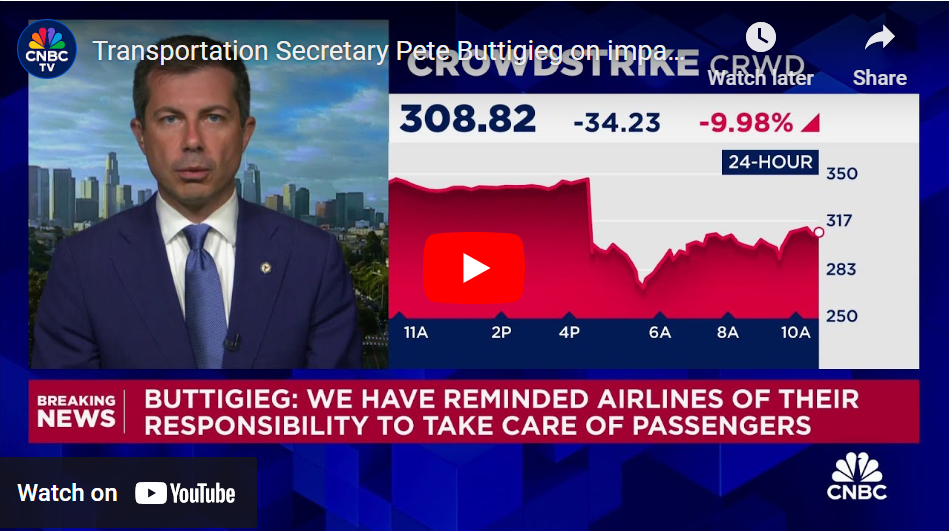 Transportation Secretary Pete Buttigieg explains the effects of the outage on airlines and other transportation systems.
What to do
Organizations and users will need to wait until a fix is available or try to recover on their own if they have the technical ability. After that, I believe there are several things to do and consider as the world recovers from this incident.
Companies will need to ensure that the products and services they use are trustworthy. This means doing due diligence on the vendors of such products for security and resilience. Large organizations typically test any product upgrades and updates before allowing them to be released to their internal users, but for some routine products like security tools, that may not happen.
Governments and companies alike will need to emphasize resilience in designing networks and systems. This means taking steps to avoid creating single points of failure in infrastructure, software and workflows that an adversary could target or a disaster could make worse. It also means knowing whether any of the products organizations depend on are themselves dependent on certain other products or infrastructures to function.
Organizations will need to renew their commitment to best practices in cybersecurity and general IT management. For example, having a robust backup system in place can make recovery from such incidents easier and minimize data loss. Ensuring appropriate policies, procedures, staffing and technical resources is essential.
Problems in the software supply chain like this make it difficult to follow the standard IT recommendation to always keep your systems patched and current. Unfortunately, the costs of not keeping systems regularly updated now have to be weighed against the risks of a situation like this happening again.
This article is republished from The Conversation under a Creative Commons license. Read the original article and see more than 250 UMBC articles available in The Conversation.
]]>
Written by Richard Forno, principal lecturer in computer science and electrical engineering, UMBC The global information technology outage on July 19, 2024, that paralyzed organizations...
https://umbc.edu/stories/massive-it-outage-spotlights-major-vulnerabilities-in-the-global-information-ecosystem/
https://my3.my.umbc.edu/api/v0/pixel/news/142876/guest@my.umbc.edu/6fa07b0e8478a717e68cfaad43f21ee5/api/pixel
coeit
discovery
magazine
story
the-conversation
UMBC News & Magazine
https://my3.my.umbc.edu/groups/umbc-news-magazine
https://assets1-my.umbc.edu/system/shared/avatars/groups/000/001/943/24435aa6207c452e7bc15cc74b42c7bb/xsmall.png?1748556657
https://assets1-my.umbc.edu/system/shared/avatars/groups/000/001/943/24435aa6207c452e7bc15cc74b42c7bb/original.png?1748556657
https://assets2-my.umbc.edu/system/shared/avatars/groups/000/001/943/24435aa6207c452e7bc15cc74b42c7bb/xxlarge.png?1748556657
https://assets2-my.umbc.edu/system/shared/avatars/groups/000/001/943/24435aa6207c452e7bc15cc74b42c7bb/xlarge.png?1748556657
https://assets3-my.umbc.edu/system/shared/avatars/groups/000/001/943/24435aa6207c452e7bc15cc74b42c7bb/large.png?1748556657
https://assets1-my.umbc.edu/system/shared/avatars/groups/000/001/943/24435aa6207c452e7bc15cc74b42c7bb/medium.png?1748556657
https://assets2-my.umbc.edu/system/shared/avatars/groups/000/001/943/24435aa6207c452e7bc15cc74b42c7bb/small.png?1748556657
https://assets1-my.umbc.edu/system/shared/avatars/groups/000/001/943/24435aa6207c452e7bc15cc74b42c7bb/xsmall.png?1748556657
https://assets2-my.umbc.edu/system/shared/avatars/groups/000/001/943/24435aa6207c452e7bc15cc74b42c7bb/xxsmall.png?1748556657
UMBC News & Magazine
1
0
false
Fri, 19 Jul 2024 15:46:13 -0400
Fri, 19 Jul 2024 15:46:13 -0400
Social media and political violence – how to break the cycle

Written by Richard Forno, principal lecturer in computer science and electrical engineering, UMBC
The attempted assassination of Donald Trump on July 13, 2024, added more fuel to an already fiery election season. In this case, political violence was carried out against the party that is most often found espousing it. The incident shows how uncontrollable political violence can be – and how dangerous the current times are for America.
Part of the complication is the contentious and adversarial nature of American politics, of course. But technology makes it more difficult for Americans to understand sudden news developments.
Gone are the days when only a handful of media outlets reported the news to broad swaths of society after rigorous fact-checking by professional journalists.
By contrast, anyone today can “report” news online, provide what they claim is “analysis” of events, and combine fact, fiction, speculation and opinion to fit a desired narrative or political perspective.
Then that perspective is potentially made to seem legitimate by virtue of the poster’s official office, net worth, number of social media followers, or attention from mainstream news organizations seeking to fill news cycles.
And that’s before any mention of convincing deepfake audio and video clips, whose lies and misrepresentations can further sow confusion and distrust online and in society.
Today’s internet-based narratives also often involve personal attacks either directly or through inference and suggestion – what experts call “stochastic terrorism” that can motivate people to violence. Political violence is the inevitable result – and has been for years, including attacks on U.S. Rep. Gabby Giffords, former House Speaker Nancy Pelosi’s husband, Paul, the 2017 congressional baseball practice shooting, the Jan. 6, 2021 insurrection, and now the attempted assassination of a former president running for the White House again.
 While being evacuated by the Secret Service, Donald Trump paused and held up a clenched fist to the crowd. Rebecca Droke/AFP via Getty Images
When bullets and conspiracies fly
As a security and internet researcher it was entirely predictable to me that within minutes of the attack, right-wing social media exploded with instant-reaction narratives that assigned blame to political rivals, the media, or implied that a sinister “inside job” by the federal government was behind the incident.
But it wasn’t just average internet users or prominent business magnates fanning these flames. Several Republicans issued such statements from their official social media accounts. For instance, less than an hour after the attack, Georgia Congressman Mike Collins accused President Joe Biden of “inciting an assassination” and said Biden “sent the orders.” Ohio Senator J.D. Vance, now Trump’s nominee for vice president, also implied that Biden was responsible for the attack.
The bloodied former president stood up and delayed his Secret Service evacuation for a fist-pumping photo before leaving the rally, and his campaign issued a defiant fundraising email later that evening. This led some Trump critics to suggest the incident was a “false flag” attack staged to earn a sympathetic national spotlight. Others claimed the incident fits into Trump’s ongoing messaging to supporters that he’s the victim of persecution.
From a historical perspective, it’s worth noting former Brazil right-wing President Jair Bolsonaro survived an assassination attempt in 2018 to become the country’s next president in 2019.
 Bad information can race around the world faster than the truth can catch up with it. Richard Drury/Digital Vision via Getty Images
It’s long been known that internet narratives, memes and content can spread around the world like wildfire well before the actual truth becomes known. Unfortunately, those narratives, whether factual or fictional, can get picked up – and thus given a degree of perceived legitimacy and further disseminated – by traditional news organizations.
Many who see such messages, amplified by both social media and traditional news services, often believe them – and some may respond with political violence or terrorism.
Can anything help?
Several threads of research show that there are some ways regular people can help break this dangerous cycle.
In the immediate aftermath of breaking news, it’s important to remember that first reports often are wrong, incomplete or inaccurate. Rather than rushing to repost things during rapidly developing news events, it’s best to avoid retweeting, reposting or otherwise amplifying online content right away. When information has been confirmed by multiple credible sources, ideally across the political spectrum, then it’s likely safe enough to believe and share.
 It can be hard to figure out what’s right amid so much competing information. mikkelwilliam/E+ via Getty Images
In the longer term, as a nation and a society, it will be useful to further understand how technology and human tendencies interact. Teaching schoolchildren more about media literacy and critical thinking can help prepare future citizens to separate fact from fiction in a complex world filled with competing information.
Another potential approach is to expand civics and history lessons in school classrooms, to give students the ability to learn from the past and – we can all hope – not repeat its mistakes.
Social media companies are part of the potential solution, too. In recent years, they have disbanded teams meant to monitor content and boost users’ trust in the information available on their platforms. Recent Supreme Court rulings make clear that these companies are free to actively police their platforms for disinformation, misinformation and conspiracy theories if they wish. But companies and purported “free speech absolutists” including X owner Elon Musk, who refuse to remove controversial, though technically legal, internet content from their platforms may well endanger public safety.
Traditional media organizations bear responsibility for objectively informing the public without giving voice to unverified conspiracy theories or misinformation. Ideally, qualified guests invited to news programs will add useful facts and informed opinion to the public discourse instead of speculation. And serious news hosts will avoid the rhetorical technique of “just asking questions” or engaging in “bothsiderism” as ways to move fringe theories – often from the internet – into the news cycle, where they gain traction and amplification.
The public has a role, too.
Responsible citizens could focus on electing officials and supporting political parties that refuse to embrace conspiracy theories and personal attacks as normal strategies. Voters could make clear that they will reward politicians who focus on policy accomplishments, not their media imagery and social media follower counts.
That could, over time, deliver the message that the spectacle of modern internet political narratives generally serve no useful purpose beyond sowing social discord and degrading the ability of government to function – and potentially leading to political violence and terrorism.
Understandably, these are not instant remedies. Many of these efforts will take time – potentially even years – and money and courage to accomplish.
Until then, maybe Americans can revisit the golden rule – doing onto others what we would have them do unto us. Emphasizing facts in the news cycle, integrity in the public square, and media literacy in our schools seem like good places to start as well.
This article is republished from The Conversation under a Creative Commons license. Read the original article and see more than 250 UMBC articles available in The Conversation.
]]>
Written by Richard Forno, principal lecturer in computer science and electrical engineering, UMBC The attempted assassination of Donald Trump on July 13, 2024, added more fuel to an already...
https://umbc.edu/stories/social-media-and-political-violence-how-to-break-the-cycle/
https://my3.my.umbc.edu/api/v0/pixel/news/142803/guest@my.umbc.edu/2a64e5fd5a03961d43aca9453e647c15/api/pixel
coeit
discovery
magazine
story
the-conversation
UMBC News & Magazine
https://my3.my.umbc.edu/groups/umbc-news-magazine
https://assets1-my.umbc.edu/system/shared/avatars/groups/000/001/943/24435aa6207c452e7bc15cc74b42c7bb/xsmall.png?1748556657
https://assets1-my.umbc.edu/system/shared/avatars/groups/000/001/943/24435aa6207c452e7bc15cc74b42c7bb/original.png?1748556657
https://assets2-my.umbc.edu/system/shared/avatars/groups/000/001/943/24435aa6207c452e7bc15cc74b42c7bb/xxlarge.png?1748556657
https://assets2-my.umbc.edu/system/shared/avatars/groups/000/001/943/24435aa6207c452e7bc15cc74b42c7bb/xlarge.png?1748556657
https://assets3-my.umbc.edu/system/shared/avatars/groups/000/001/943/24435aa6207c452e7bc15cc74b42c7bb/large.png?1748556657
https://assets1-my.umbc.edu/system/shared/avatars/groups/000/001/943/24435aa6207c452e7bc15cc74b42c7bb/medium.png?1748556657
https://assets2-my.umbc.edu/system/shared/avatars/groups/000/001/943/24435aa6207c452e7bc15cc74b42c7bb/small.png?1748556657
https://assets1-my.umbc.edu/system/shared/avatars/groups/000/001/943/24435aa6207c452e7bc15cc74b42c7bb/xsmall.png?1748556657
https://assets2-my.umbc.edu/system/shared/avatars/groups/000/001/943/24435aa6207c452e7bc15cc74b42c7bb/xxsmall.png?1748556657
UMBC News & Magazine
3
0
false
Tue, 16 Jul 2024 15:25:05 -0400
Tue, 16 Jul 2024 15:25:05 -0400
Infrastructure of support after Key Bridge collapse

In 1987, Paul Flinton, then a 23-year-old senior studying at UMBC, decided to make a short documentary focused on the tollbooth workers on the Francis Scott Key Bridge.
The six-minute documentary “One Dollar”—named after the toll’s cost for cars at the time—captures a vehicle’s journey across the bridge from the driver’s point of view in one continuous take. As Flinton ’87, visual arts, drives across the bridge, audio of the tollbooth workers interviewed for the project act as the film’s narrators in which they share some of their experiences as toll operators.
Flinton, who is now a location sound manager for NFL Films, went on to win an award for “One Dollar” from the Maryland State Arts Council following its release. Nearly four decades later, Flinton all but forgot about the film’s existence until learning of the bridge’s collapse following a collision with a malfunctioning cargo ship on March 26, sending eight construction workers into the water and taking the lives of six.
“It hit a nerve,” Flinton told local news after the disaster. “[The film is] sort of a treasure…This captures something that in a lot of ways can’t really happen again.”
Paul Flinton’s short documentary entitled “One Dollar” (1987).
Supporting the impacted families
The Key Bridge opened to traffic in 1977, and regularly 30,000 vehicles crossed the 1.6 mile span over the Patapsco River. An integral part of Baltimore’s beltway, commuters, community members, and experts are now struggling to make sense of the literal change of transportation landscape. Now that the wreckage is completely cleared away and as the eventual construction commences, UMBC experts offer up their expertise and resources to confront the tragedy.
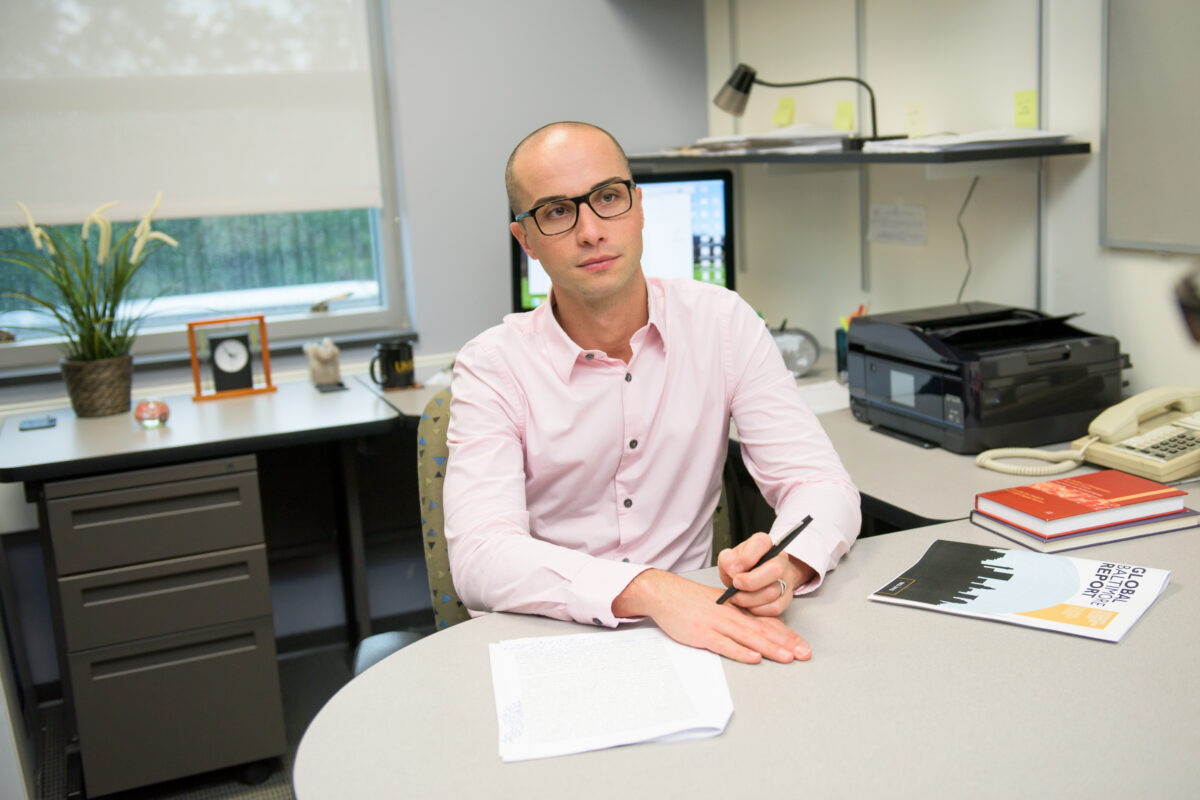 Felipe Filomeno. (Marlayna Demond ’11/UMBC)
After learning that all of the direct victims of the collapse were immigrants from countries throughout Latin America, Felipe Filomeno, associate professor of political science and global studies, immediately sprang into action with fellow members of the grassroots organization Latino Racial Justice Circle (LRJC). Filomeno, who is president of the LRJC, worked with the organization’s leadership team to establish a fundraiser in support of the families of the victims of the bridge collapse.
The crowdfunded campaign initially had a goal of raising about $5,000 for each of the families impacted, Filomeno said. Within hours of going live with the GoFundMe campaign, the organization raised $100,000 from donors located all around the world.
“The fundraiser caught a lot of traction. I have been overwhelmed by the outpouring of solidarity that we got from across the world in that week when the tragedy happened,” says Filomeno.
Following the fundraising success, the group has since directed prospective supporters to the Mayor’s Office of Immigrant Affairs’ Key Bridge Emergency Response Fund. The Mayor’s Office is working with the LRJC and case managers to distribute the funding to the six impacted families.
The tragedy has underlined key issues impacting the Latino immigrant community, challenges that Filomeno amplifies through his community-centered research at UMBC. “[The collapse] has highlighted and publicized to the world issues that we already know exist—the fact that Latino immigrants are over-represented in dangerous occupations,” says Filomeno. “There are higher incidents of work-related accidents among the Latino populations.”
Filomeno’s forthcoming book, Christian Cosmopolitanism: Faith Communities Talk Immigration (Temple University Press, 2024), explores the Honest Conversations on Immigration program he co-developed in 2017 in partnership with the LRJC. The program, Filomeno explains, was designed to build mutual understanding and collaboration between people who are diverse, but share the same religion.
“One of the goals is to build solidarity across differences,” says Filomeno. “The solidarity across differences is a principle that we also see in the Key Bridge fundraiser.”
Through his advocacy and academic scholarship, Filomeno is working to amplify the need for more long lasting efforts to stand in solidarity with Latino immigrant communities beyond moments of tragedy. “Those problems that became evident with the fall of the bridge, those challenges that the Latino immigrant population faces, they are still there,” he says. “To move the needle on those issues, it has to be more than helping those six families at this point in time.”
Examining the environmental impacts of the collapse
The ship that collided into the bridge was carrying 56 containers of hazardous materials, including corrosives, flammables, and lithium-ion batteries. The cargo ship was also carrying more than one million gallons of fuel at the time of the impact. City officials began their investigations into the incident, which included determining the environmental impacts to the Patapsco River and surrounding communities.
Upal Ghosh, professor of chemical, biochemical, and environmental engineering, whose research includes examining the effects of toxic pollutants in soils, sediments, and aquatic environments, was among the experts who weighed in on assessing the potentially hazardous effects of the containers that were resting at the bottom of the river.
 Maryland Comptroller Brooke Lierman and representatives of the Office of the Governor take a tour of the Francis Scott Key Bridge collapse site on a Maryland Department of Natural Resources police boat. (Photo source: Corey Jennings ’10, Maryland Comptroller/Flickr)
Ghosh told the Baltimore Sun days after the collapse that environmental officials’ first priority would likely be making sure none of the intact containers were breached.
“If you have containers that contain oily material, those things will, if they are breached, be releasing over time,” Ghosh said. “I would think if there is a release that goes down into the sediments under the water, it would be a local impact right there.”
Farah Nibbs, assistant professor of emergency and disaster health systems, is also thinking about future ways to contain the effects of similar disasters. Contributing factors to the bridge’s collapse, she says, can be tied to the 2012 expansion and modernization of the Port of Baltimore. Those changes did not happen hand in hand with improvements in safety management needed to accommodate ships of such huge sizes that now were able to port in the city. Risks from collisions, fuel spills, and contamination still lack proper oversight and regulation.
“A novel approach for decision-makers may be to view Maryland’s emergency management and transportation experts and service providers—as well as the physical bridge infrastructure itself—as part of the community’s lifeline systems,” said Nibbs.
More than a disaster
As plans for the bridge’s rebuilding process begins to take shape, Brian Grodsky, professor of political science, shed light on why Maryland Governor Wes Moore likely did not request a presidential disaster declaration in response to the collapse. Presidential disaster declarations, Grodsky said in a local tv news segment, are usually limited to tragedies that involve fires, floods, or explosives.
“Man-made disasters are more likely to be declined [for a presidential disaster declaration] because there is that question of public versus private ownership of the disaster,” he added. “If this ship caught on fire or exploded under the bridge, this would easily be qualified as a major disaster.”
Deborah Rudacille, professor of the practice in English, is well aware of the lives connected to the construction and opening of the Key Bridge. In 2010, she published Roots of Steel: Boom and Bust in an American Mill Town, a book exploring Baltimore’s industrial history of the Sparrows Point steel mill, but also capturing her family’s connection to the mill and Baltimore staples like the Key Bridge.
Rudacille’s mother was one of the original employees—collecting the toll that Flinton documented in his film— when the bridge first opened in 1977, and her brother worked as one of the bridge’s painters.
“They were kind of reminiscing about the fact that everything down there is now gone,” Rudacille told local media about her family. “First the steelworks, now the Key Bridge is gone. It’s like this world that they lived and worked in has vanished completely.”
]]>
In 1987, Paul Flinton, then a 23-year-old senior studying at UMBC, decided to make a short documentary focused on the tollbooth workers on the Francis Scott Key Bridge. The six-minute...
https://umbc.edu/stories/support-after-key-bridge-collapse/
https://my3.my.umbc.edu/api/v0/pixel/news/142431/guest@my.umbc.edu/85f4487fb5eddd76a8baa59270f45a52/api/pixel
cahss
cbee
coeit
discovery
edhs
english
magazine
political-science
spring-2024
story
visual-arts
UMBC News & Magazine
https://my3.my.umbc.edu/groups/umbc-news-magazine
https://assets1-my.umbc.edu/system/shared/avatars/groups/000/001/943/24435aa6207c452e7bc15cc74b42c7bb/xsmall.png?1748556657
https://assets1-my.umbc.edu/system/shared/avatars/groups/000/001/943/24435aa6207c452e7bc15cc74b42c7bb/original.png?1748556657
https://assets2-my.umbc.edu/system/shared/avatars/groups/000/001/943/24435aa6207c452e7bc15cc74b42c7bb/xxlarge.png?1748556657
https://assets2-my.umbc.edu/system/shared/avatars/groups/000/001/943/24435aa6207c452e7bc15cc74b42c7bb/xlarge.png?1748556657
https://assets3-my.umbc.edu/system/shared/avatars/groups/000/001/943/24435aa6207c452e7bc15cc74b42c7bb/large.png?1748556657
https://assets1-my.umbc.edu/system/shared/avatars/groups/000/001/943/24435aa6207c452e7bc15cc74b42c7bb/medium.png?1748556657
https://assets2-my.umbc.edu/system/shared/avatars/groups/000/001/943/24435aa6207c452e7bc15cc74b42c7bb/small.png?1748556657
https://assets1-my.umbc.edu/system/shared/avatars/groups/000/001/943/24435aa6207c452e7bc15cc74b42c7bb/xsmall.png?1748556657
https://assets2-my.umbc.edu/system/shared/avatars/groups/000/001/943/24435aa6207c452e7bc15cc74b42c7bb/xxsmall.png?1748556657
UMBC News & Magazine
2
0
false
Thu, 13 Jun 2024 13:40:41 -0400
Thu, 13 Jun 2024 13:40:41 -0400
China turns to private hackers as it cracks down on online activists on Tiananmen Square anniversary
Written by Christopher K. Tong, associate professor of Asian studies at UMBC
Every year ahead of the June 4 commemoration of the Tiananmen Square massacre, the Chinese government tightens online censorship to suppress domestic discussion of the event.
Critics, dissidents and international groups anticipate an uptick in cyber activity ranging from emails with malicious links to network attacks in the days and weeks leading up to the anniversary.
Much of this cyber activity by Beijing is done covertly. But a recent restructuring of China’s cyberforce and a document leak exposing the activities of Chinese tech firm i-Soon have shed some light on how Beijing goes about the business of hacking.
As a China expert and open-source researcher, I believe the latest revelations draw the curtain back on a contractor ecosystem in which government officials and commercial operators are increasingly working together. In short, Beijing is outsourcing its cyber operations to a patchwork army of private-sector hackers who offer their services out of a mix of nationalism and profit.
From censorship to cyberattacks
Chinese authorities restrict the flow of information online by banning search terms, scanning social media for subversive messages and blocking access to foreign media and applications that may host censored content. Control of online activity is particularly stringent around the anniversary of the protests at Tiananmen Square in 1989 that ended with a bloody crackdown on demonstrators by troops on June 4 of that year.
Since then pro-democracy activists have sought to commemorate the massacre on its anniversary – and Beijing has sought to counter mention of the crackdown. Chinese internet users note more restrictions and censorship in the run-up to the anniversary, with more words being banned and even certain emojis – like candles, denoting vigils – disappearing.
In 2020, Chinese authorities ordered Zoom, an American tech firm with a development team in China, to suspend the accounts of U.S.-based activists commemorating June 4 and to cancel online vigils hosted on the platform. Zoom complied, stating that it was following local laws.
Beyond censorship, cyberattacks on dissident groups and Chinese-language media in the diaspora have also occurred on or around the anniversary.
On June 4, 2022, Media Today, a Chinese-language media group in Australia, experienced an unattributed cyberattack against its user accounts. And earlier this year, the U.S. Department of Justice charged seven China-based hackers with sending malicious tracking emails to members of the Inter-Parliamentary Alliance on China, a group set up in 2020 on the anniversary of the Tiananmen Square massacre.
China’s cyberforce
The increasing sophistication of online attacks on dissident and international groups comes as China has been restructuring the agencies responsible for its cyber operations.
Today, much of China’s malicious cyber activities are carried out by the Ministry of State Security, or MSS, the country’s main intelligence agency and secret police. But prior to the MSS expanding into this role, the People’s Liberation Army, or PLA, was responsible for the earliest cyberattacks attributed to the Chinese government. In 2015, the PLA dedicated a new service to cyberwarfare and network security, the Strategic Support Force.
But in April 2024, the PLA abruptly announced the Strategic Support Force’s disbandment and the creation of three new forces: the Aerospace Force, the Cyberspace Force and the Information Support Force. They, along with the existing Joint Logistics Support Force, report directly to the Chinese Communist Party.
This restructuring comes at a time of political uncertainty for China’s leadership. In 2023, Defense Minister Li Shangfu was removed just months into his new role, along with Foreign Minister Qin Gang and Li Yuchao, commander of the Rocket Force.
While Beijing has yet to offer details on the military reorganization, its timing appears to send a message. President Xi Jinping personally presided over the inauguration of the Information Support Force, telling members of the force that they must “listen to the party’s orders” and be “absolutely loyal, absolutely pure, absolutely reliable.”
Hackers: Patriots, pirates or profiteers?
The restructuring of China’s cyberforces coincides with a trend that has seen the outsourcing of malicious cyber operations to private sector contractors acting with the state’s explicit or tacit approval.
In February 2024, a document leak exposed an underground network of Chinese cyber contractors hacking for profit.
Cyber experts have long suspected that hackers may collaborate with the Chinese government, but the leak shows how operators working for Chinese firm i-Soon sold services and products to Chinese government entities and state-sponsored threat groups. The company was founded in 2010 by Wu Haibo, a former member of the Green Army, often described as China’s earliest hacker community.
The Green Army was formed in 1997 for hackers to learn and exchange hacking techniques. By 1998, patriotic Chinese hackers began organizing cyberattacks. For example, when riots in Indonesia triggered by the Asian financial crisis gave rise to racial violence against Chinese Indonesians, Chinese hackers targeted Indonesian government websites.
In 1999, Chinese hackers vandalized U.S. government websites following NATO’s accidental bombing of the Chinese embassy in Belgrade. The term “honker,” meaning “red hacker” in Chinese, emerged around this time to designate Chinese hackers motivated by ideology and nationalism.
Yet, Chinese hackers have had an uneasy relationship with the authorities. While they offer cyber skills as well as plausible deniability for the Chinese government, they tend to muddle Beijing’s foreign policy when their actions go too far and draw criticism.
They are also prone to commit cybercrimes such as fraud and theft of intellectual property alongside state-sponsored espionage.
The Chinese government and prominent “patriotic” hackers have previously tried to rein in the community and promote legitimate work such as cybersecurity.
The i-Soon leak, however, documents how Chinese state-sponsored contractors engage in bribery and other illicit activities.
Exploiting security flaws
China’s cyber capabilities have grown through the control and exploitation of cyber professionals, state-sponsored or otherwise. But it’s a complicated relationship.
To phase out the criminal behavior of hackers, Beijing has developed a pipeline to train its cyber workforce. And in part to keep them from sharing expertise with foreigners, Chinese cyber professionals are generally banned from international hacking competitions.
While cybersecurity is improved when security professionals share newly discovered security flaws, Chinese regulations limit the flow of such information. By law, software vulnerabilities discovered in China must be immediately reported to the Chinese government. Experts believe the Ministry of State Security subsequently exploits this data to develop cyber offensive capabilities.
Still, the i-Soon leak points to corruption in at least one corner of China’s growing network of commercial hacking. Internal correspondence shows contractors bribing government officials with money, alcohol and other favors. Messages also show contractors failing to generate sales, delivering subpar work and complaining about their working-class salary.
With local governments in China struggling to pay for basic services in a weak economy, companies such as i-Soon that support Beijing’s cyber operations face not only political but also financial headwinds. Despite Beijing’s intention to implement an online crackdown every year on June 4, the cyberforces it employs to do so face their own issues that invite scrutiny and rectification by the Chinese Communist Party.
This article is republished from The Conversation under a Creative Commons license. Read the original article and see more than 250 UMBC articles available in The Conversation.
]]>
Written by Christopher K. Tong, associate professor of Asian studies at UMBC Every year ahead of the June 4 commemoration of the Tiananmen Square massacre, the Chinese government tightens...
https://umbc.edu/stories/china-private-hackers-tiananmen-square-anniversary/
https://my3.my.umbc.edu/api/v0/pixel/news/142369/guest@my.umbc.edu/adec3fc5c60c1be9c9f3b7824baf49e9/api/pixel
asian-studies
cahss
cahss-research
discovery
magazine
research
story
UMBC News & Magazine
https://my3.my.umbc.edu/groups/umbc-news-magazine
https://assets1-my.umbc.edu/system/shared/avatars/groups/000/001/943/24435aa6207c452e7bc15cc74b42c7bb/xsmall.png?1748556657
https://assets1-my.umbc.edu/system/shared/avatars/groups/000/001/943/24435aa6207c452e7bc15cc74b42c7bb/original.png?1748556657
https://assets2-my.umbc.edu/system/shared/avatars/groups/000/001/943/24435aa6207c452e7bc15cc74b42c7bb/xxlarge.png?1748556657
https://assets2-my.umbc.edu/system/shared/avatars/groups/000/001/943/24435aa6207c452e7bc15cc74b42c7bb/xlarge.png?1748556657
https://assets3-my.umbc.edu/system/shared/avatars/groups/000/001/943/24435aa6207c452e7bc15cc74b42c7bb/large.png?1748556657
https://assets1-my.umbc.edu/system/shared/avatars/groups/000/001/943/24435aa6207c452e7bc15cc74b42c7bb/medium.png?1748556657
https://assets2-my.umbc.edu/system/shared/avatars/groups/000/001/943/24435aa6207c452e7bc15cc74b42c7bb/small.png?1748556657
https://assets1-my.umbc.edu/system/shared/avatars/groups/000/001/943/24435aa6207c452e7bc15cc74b42c7bb/xsmall.png?1748556657
https://assets2-my.umbc.edu/system/shared/avatars/groups/000/001/943/24435aa6207c452e7bc15cc74b42c7bb/xxsmall.png?1748556657
UMBC News & Magazine
0
0
false
Fri, 07 Jun 2024 13:05:43 -0400
Fri, 07 Jun 2024 13:05:43 -0400


