Grab a Seat at the Table

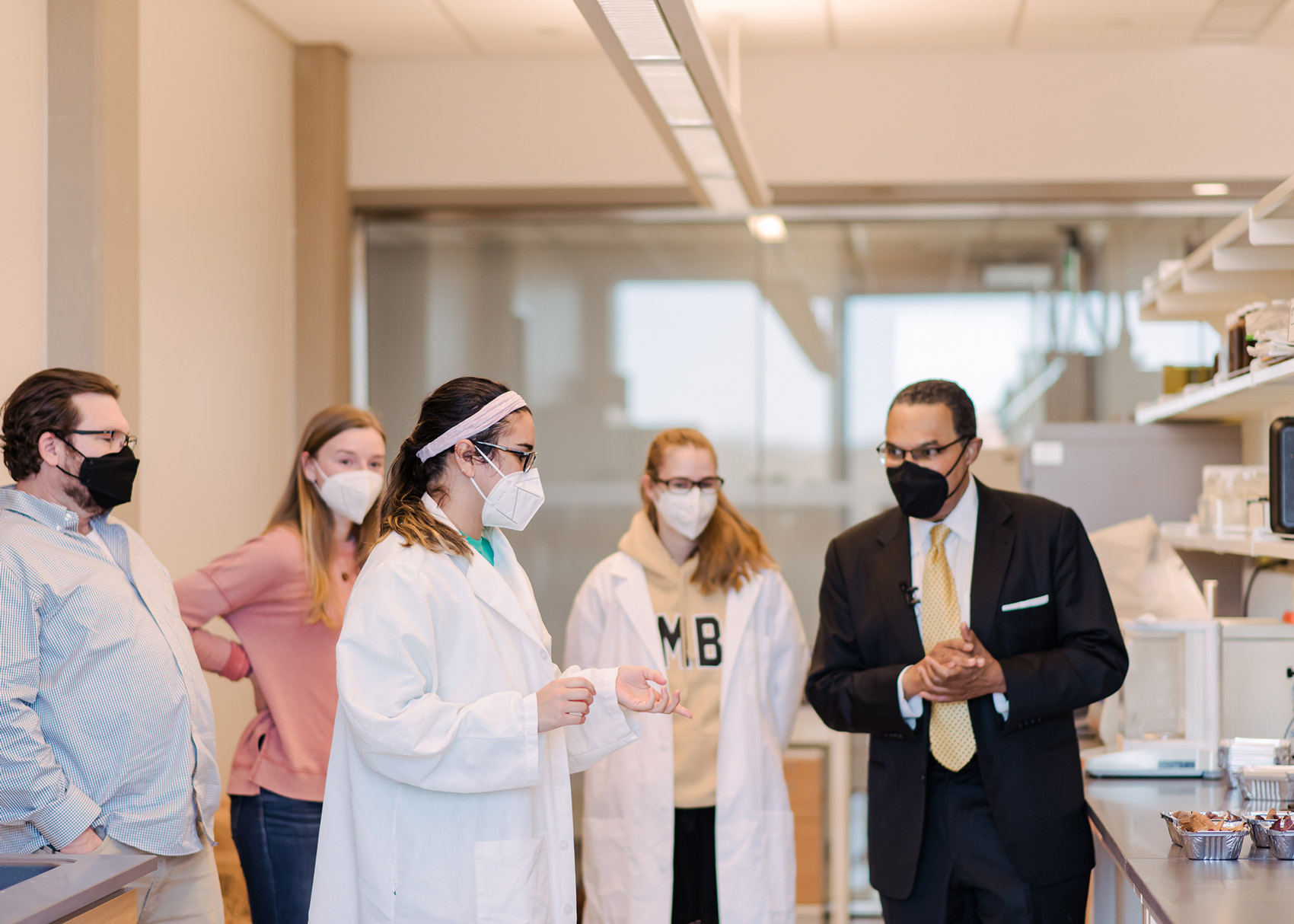
These days, it’s tempting to grow numb to the polarization of society and the breakdown in public discourse and to retreat into our silos of solidarity. But a liberal arts education has the potential to offer an antidote to these seemingly inevitable fates—through modeling and practicing empathy. At UMBC, students are invited to the table to share their stories and listen to their peers. These acts of educational hospitality help Retrievers find their why and pursue the public good.
Want weekly Top Stories sent to your inbox?

It’s the first day of class. You’re looking around, bright-eyed and a little nervous, and then your instructor smiles at the class and says, “One day you are all going to die.” Are you offended? Shocked? Titillated? Horrified? Collectively, the class titters. Already social bonds are forming as Christine Armstrong Mair, associate professor of sociology who specializes in gerontology, continues her spiel. “And if we’re all lucky, that won’t be for a long time.”
As sociologists, says Mair, or more broadly as leaders in an educational setting, “it’s not our task to make somebody think a certain way. Our task is to show them what exists in society and help them feel empathy for the human experience.”
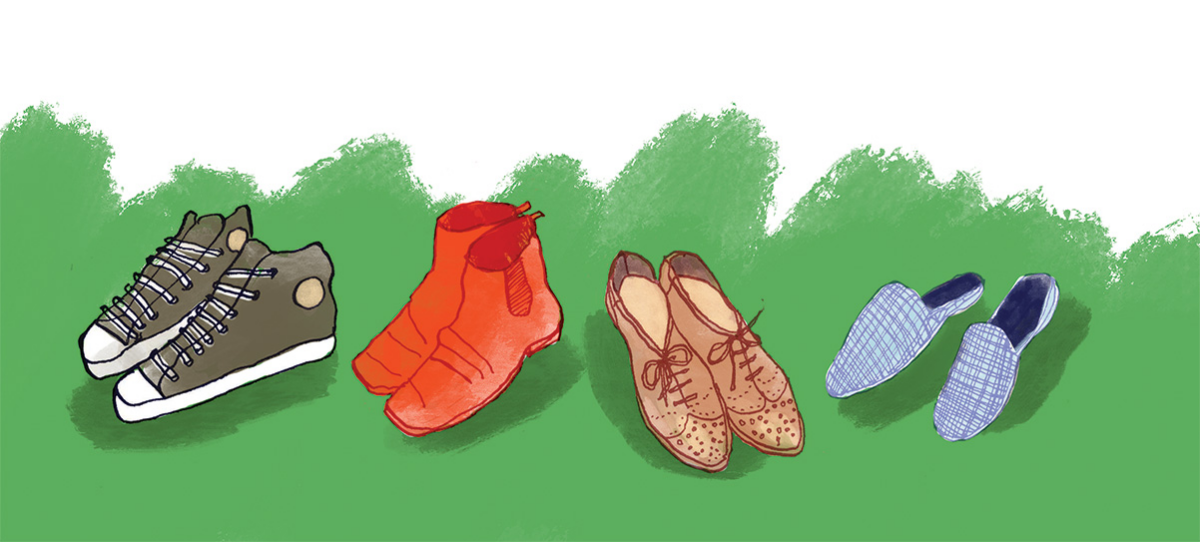
At its most pedestrian roots, empathy is putting yourself in someone else’s shoes. How can someone else’s emotional experience inform your own personal perspective?
In the best-case scenario, a college campus is a microcosm of its society: a crosshatch of races, ages, and socio-economic backgrounds. And UMBC holds true to those measures. But something different happens when you step into the Loop—you sit next to someone who didn’t go to your high school. You eat at the same table with someone outside of your cultural background. You take a test side by side with someone who voted differently than you. And even more than sharing space, you start sharing notes and books and stories—even your own story—with these strangers and then suddenly they’re no longer strangers.
When empathy is on the table, students and colleagues expand their capacity for hard work. You might change your thesis to address human trafficking or leave your home island to work toward healthy aging for all populations. So pull up a chair, step into someone else’s shoes, and partake in this grand educational potluck.
“With my background—what I’ve seen with human trafficking and migrant smuggling—what can I do as a person with my knowledge and responsibility?”
– Saydeh Karabatis, Ph.D. candidate
Building bridges across campus
You’re sitting at a beach-side cafe in Greece with your husband. It’s 2015 and Greece’s financial troubles are in the news, but the waves of migrants washing ashore are not yet as publicized. As you enjoy your coffee, you see a group of 40 to 50 people sitting seemingly aimless and distraught nearby. Based on their clothing, you make a guess that they are Muslims and Arabic speakers. What do you do?
If you’re Saydeh Karabatis, originally from Lebanon—and a survivor of the 17-year Lebanon civil war—and fluent in Arabic, you let that immediate moment of empathy guide you and approach the group.
Karabatis and her husband George, a professor of information systems at UMBC and from Greece, changed the plans for their summer in the Mediterranean to volunteer as translators, food finders, and listeners for the refugees, primarily fleeing the war in Syria and arriving in Greece in dire straits. They did so again in 2017.
As Karabatis interacted with these desperate groups and read more about their plight, she realized familiar patterns were emerging in their stories. They were not just migrants fleeing a war, they were trafficked people, paying dearly for not-safe passage, and many others headed toward labor and a life they did not sign up for. Struck by the limits of her actions—and even her emotional capacity for empathy—when Karabatis returned home to Maryland, she found her next step.
Karabatis, who has a master’s in computer science from UMBC and works for the university’s Division of Information Technology, knew she would need to fill her time when her two sons left for college. Karabatis asked herself, “With my background—what I’ve seen with human trafficking and migrant smuggling—what can I do as a person with my knowledge and responsibility?”

She contacted Vandana Janeja, then chair of information systems, and explained the project she wanted to complete for her Ph.D. During her master’s, Karabatis had tried to conduct a research project on human trafficking for a class with Janeja but couldn’t find a robust data set to use for her project and ended up having to leave the work incomplete. This time, she pitched using the stories of trafficked people. “Instead of dealing with numbers, numbers as data, I am now dealing with stories as data—the stories of people being trafficked,” says Karabatis.
It’s not been easy going. Many trafficked people are not open about their stories, for fear of retribution or simply because of how horrific the experience was. Additionally, it’s hard for Karabatis to take in their trauma. “I’m reading about all these abuses,” says Karabatis. “I’m reading about sex trafficking, labor trafficking, organ trafficking, human smuggling. I can’t imagine—how can a human being do something like that to another human?”
Eventually though, with the end goal of combating the network of smuggling routes, Karabatis says, you need to reach a level where you can try to put your emotions aside: “You need to detach yourself from these emotions if you want to do something to help these people. If your emotions are the only thing driving you, you wouldn’t be able to produce the research. Use these emotions as a spark and then put them on the side.”
Caring starts with listening
You’re a teenager riding the bus for fun in Puerto Rico, killing time by people watching. You’re struck by the number of older adults on the bus, noticing their many bags stuffed with x-rays and other apparent medical paperwork. Unthinkingly, you just assume they’re enjoying the ride like yourself, but this older generation seems eager to talk.
If you’re Jaminette Nazario, a curious if bored high schooler, you strike up a conversation.
What she heard from her fellow travelers shook her: “‘We don’t have people to help….’ ‘My wife just died of cancer….’ ‘I need to use this bus to get to my medical appointments.’” It wasn’t until she was pursuing her bachelor’s degree in social sciences that Nazario was hit by the realization that those conversations might have been the only time those older bus riders had talked to someone that day. “So I started thinking about the many barriers older adults have in order to achieve healthy aging,” she says. “When older adults don’t have resources or people, they miss out on social networks that are vital to healthy aging.”
This aha moment would propel Nazario to a master’s degree in public health with a focus on gerontology, but in order to study further, she’d have to leave her island for the next academic step.
Now in her second year of UMBC’s Ph.D. program in gerontology—a joint program with the University of Maryland, Baltimore—Nazario is beginning to research aging Hispanic immigrants and their increasing challenges accessing medical care.
And unlike her fellow bus riders, she’s not doing this alone. “Even though it’s really hard to be far from family, I feel like I’m home here. And I love how Dr. Mair teaches.” Like most classes, says Nazario, there are readings and discussion, but Mair brings a “specific dynamic” to the setting. Each class starts with questions prepared by the students, which is really empowering, says Nazario. It might end up that the class all resonates with one question and they stay on that topic, guiding the trajectory of the discussion.
In summer 2022, Nazario joined Mair and others from the gerontology program at a conference in Japan. She presented a poster on her research and walked away from her talk with a new level of confidence. “There were professionals from Japan and China and they’re asking me about something in the United States…it was kind of cool. People came up and treated me with so much respect.”
Students in Mair’s gerontology classes are finding their drive to solve crises in aging care not only because they might have loved ones suffering, but because aging (if we’re lucky) and death are unifying elements. “It’s something that really applies to all of us,” says Mair, “to make sure that we’re taking care and setting up a good system so that when we all arrive there, that us and all of our people that we care about are okay.”
Inclusive classrooms by design
You walk to the front of the media and communications class you’re teaching. Students are sitting in traditional desks in rows, facing the whiteboard where you’ll teach. They’re silent, spaced out or on their phones. They seem to breathe a sigh of relief when you walk in, grateful to know where to put their attention. Later, in a different section of that class, you meet in a newly designed lecture hall filled with round tables and no clear lectern space. In this format, the students are already grouped together and chatting.
If you’re Donald Snyder, principal lecturer in media and communication studies, you know there is science behind what forms good class cohesion and participation. He learned it from the experts in UMBC’s Faculty Development Center (FDC).
In addition to learning about and playing around with classroom set-up to facilitate more natural conversations (and to rid the learning experience from a “perceived hierarchy” as FDC Director Linda Hodges calls it), Snyder and others who use the FDC are supported in using inclusive and culturally responsive teaching.
While culturally responsive pedagogy isn’t a new concept—it centers and nurtures students’ unique cultural strengths—Hodges says that recent world events have brought the teaching style more into focus. Citing the death of George Floyd and the nation’s response—especially young people—and the COVID-19 pandemic as two significant flashpoints, Hodges says inclusive pedagogy and empathetic practices have become more imperative than ever. Room design is just one tool in the FDC toolbelt that can work to democratize students’ experience. It can erase the divide between the front row handraiser and the back row hider, giving equal footing to all types of students and their stories.
“Instructors are recognizing that they need to try to connect with and hear their students’ voices,” says Hodges. “This will create a sense of belonging. It’s become quite clear in the research that one of the key factors in whether students succeed and persist in education is the feeling of belonging.”
Snyder has made the most of the FDC’s offerings, including inviting Hodges’ team to observe his teaching and offer feedback. He starts many of his classes with some tools for students to learn about self-regulation, basically how to use available resources to make the most of education. He introduces them to Bloom’s Taxonomy, which places rote memorization at the bottom of the pyramid and evaluating and creating a unique argument at top. “I want the students to know, I’m not asking to memorize anything,” says Snyder, “but we need to learn to be critical when we’re thinking about media and communication texts and how these things operate.”
Giving students tools to succeed in college—go to office hours, block out time for studying, get enough sleep—may seem basic and far afield from teaching and practicing empathy, but in the taxonomy of educational success, says Snyder, this foundation leads to the heavy-lifting tools at the top of the pyramid.
Snyder helps them harness existing interests, in tech or media, and then run with it, academically. He wants them to ask, “‘How can I turn that switch? What is the thing that I can grab onto? What do I really want to know about?’”
He also listens to them, and attempts to model vulnerability in the classroom. “Yes, these are students and they need to understand content, but they’re also humans who are struggling and we’re all struggling and there’s a human condition aspect we can’t ignore as instructors.”

Swapping stories strengthens neighborly bonds
You’re driving your car on tour in Texas when you’re hit by a criminally intoxicated drunk driver. You survive, but a host of physical and psychological repercussions are still taking their toll 10 years later. As a musician, you fuel your art with your resiliency and work through the healing process by creating music. But when the pandemic hits, and live, in-person music disappears, you look for a pivot point—and the community you’re missing.
If you’re Kristin Putchinski, a student in UMBC’s M.F.A. program for intermedia and digital arts, you lean into the concept of “platonic intimacy.”
Putchinski coined the term to sum up her goal of “trying to strengthen neighborly bonds. What I’m looking for is an intimate experience between two people. And when people hear intimacy, they tend to think that it’s about a romantic or sexual component. But how do I frame that intimacy—and how important intimacy is—in terms of friendship and neighborliness?”
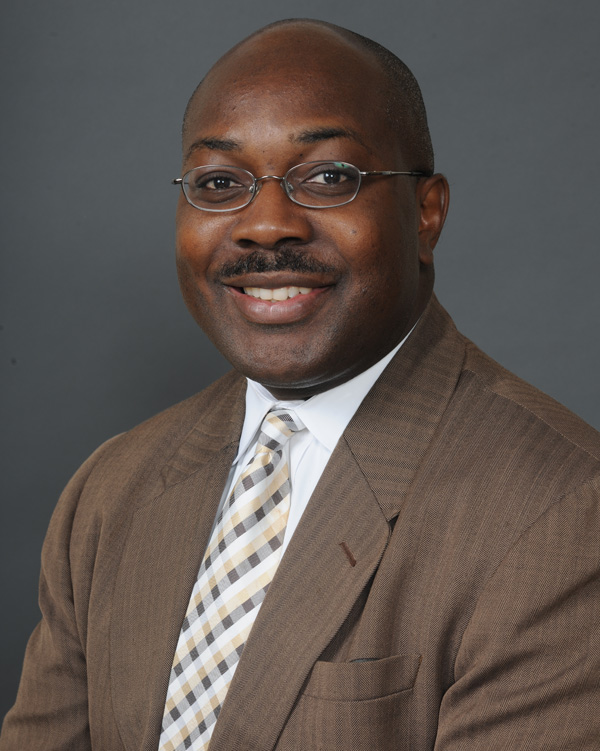
Through a graduate assistantship jointly funded by jointly funded by UMBC and the University of Maryland, Baltimore’s Community Engagement Center (CEC), Putchinski was given the opportunity to shadow CEC’s then-director Tyrone Roper and learn about the center’s mission, which includes strengthening neighborly bonds. Roper told Putchinski they were looking for ways to engage the 18- to 24-year-old demographic. When Putchinski was tasked with creating an art project for CEC the following semester, she kept this age goal in mind.
As a student in UMBC’s intermedia program, Putchinski “explores the textures between mediums,” she says. As a musical artist who performed under the stage name ellen cherry, “I have 25 years of experience as a performing songwriter and storyteller, creating my own and interpreting other people’s stories.” So she began to imagine a strange game of telephone that would give participants the opportunity to swap stories, with the end result of creating instances of platonic intimacy.
This multifaceted project connected post-high-school-aged individuals with older generations through curated, facilitated sessions. The participant-pairs met four different times and talked about a song, a photograph, and a memory—and at the last session, the neighbors “swapped” their stories. A recording of the swap was sent to local artists who interpreted the stories into their own mediums—painting, poetry, and a video soundscape. Then, at an event open to the public in the CEC, the storytellers took the stage, retelling their neighbor’s story. For example, a Latinx college graduate took to the stage to reshare her stranger-turned-partner’s tale of being raised in foster care in 1970s Baltimore.
Putchinski was eager to find out “when you talk to somebody that’s 40 years different from you…did your perceptions change about yourself, about them, and what were those changes and the answers?”
It makes sense she’s asking these questions based on her ongoing empathy toward the man who altered her life in an accident 10 years ago. “It was very conflicting for me to be the victim of a crime that I really feel like was committed not by a criminal but by a person who abuses alcohol. At the base level, he’s a human being. How can we think about his human potential after this experience and mine?”
“Imagine intensely” a better way forward
One of the greatest assertions of the liberal arts comes from Percy Bysshe Shelley’s essay “A Defence of Poetry.” The short-lived husband of Frankenstein’s creator writes, “A man, to be greatly good, must imagine intensely and comprehensively; he must put himself in the place of another and of many others; the pains and pleasures of his species must become his own.”
On college campuses, and at UMBC in particular, through thoughtful classroom instruction and intentional commitment to community, students trade their stories—pains and pleasures alike. Less of a transaction and more of a gift, these stories are invitations to grow in understanding, change your opinion, or shape your research.
But walking in someone else’s shoes doesn’t mean you misplace your own shoes along the way—in fact professors hope it helps you find your footing at UMBC. “That open-mindedness and appreciation and empathy does not necessarily mean that you lose other parts of yourself,” says Anne Brodsky, professor and chair of the psychology department. “It shouldn’t be a zero-sum game.”
You’re walking down Academic Row. You’re a first-generation college student with a lot of questions. You’re a returning student giving college a second (or third) chance. You’re a first-year who misses the familiar halls of high school. You see other Retrievers walking in groups, heading into classrooms, rubbing True Grit’s bronze nose, making conversation with their peers. What do you do?
]]>
These days, it’s tempting to grow numb to the polarization of society and the breakdown in public discourse and to retreat into our silos of solidarity. But a liberal arts education has the...
https://umbc.edu/stories/grab-a-seat-at-the-table-empathy/
https://my3.my.umbc.edu/api/v0/pixel/news/137271/guest@my.umbc.edu/777eb34ff02b7fc72d1664adf771099a/api/pixel
campus-life
coeit
computer-science
fall-2023
feature
imda
information-systems
magazine
mcs
UMBC News & Magazine
https://my3.my.umbc.edu/groups/umbc-news-magazine
https://assets1-my.umbc.edu/system/shared/avatars/groups/000/001/943/24435aa6207c452e7bc15cc74b42c7bb/xsmall.png?1748556657
https://assets1-my.umbc.edu/system/shared/avatars/groups/000/001/943/24435aa6207c452e7bc15cc74b42c7bb/original.png?1748556657
https://assets2-my.umbc.edu/system/shared/avatars/groups/000/001/943/24435aa6207c452e7bc15cc74b42c7bb/xxlarge.png?1748556657
https://assets2-my.umbc.edu/system/shared/avatars/groups/000/001/943/24435aa6207c452e7bc15cc74b42c7bb/xlarge.png?1748556657
https://assets3-my.umbc.edu/system/shared/avatars/groups/000/001/943/24435aa6207c452e7bc15cc74b42c7bb/large.png?1748556657
https://assets1-my.umbc.edu/system/shared/avatars/groups/000/001/943/24435aa6207c452e7bc15cc74b42c7bb/medium.png?1748556657
https://assets2-my.umbc.edu/system/shared/avatars/groups/000/001/943/24435aa6207c452e7bc15cc74b42c7bb/small.png?1748556657
https://assets1-my.umbc.edu/system/shared/avatars/groups/000/001/943/24435aa6207c452e7bc15cc74b42c7bb/xsmall.png?1748556657
https://assets2-my.umbc.edu/system/shared/avatars/groups/000/001/943/24435aa6207c452e7bc15cc74b42c7bb/xxsmall.png?1748556657
UMBC News & Magazine
1
0
false
Wed, 15 Nov 2023 14:07:28 -0500
U.S. News ranks UMBC among the nation’s best colleges in undergraduate research, teaching, innovation, and value
UMBC continues to show its strengths in undergraduate research, innovation, value, teaching programs, and several other areas highlighted in the 2023–24 U.S. News and World Report Best Colleges undergraduate rankings. This year, the university moved up in the national rankings in numerous categories, showcasing UMBC’s growth in several key areas.
The 2023–24 U.S. News college rankings, released today, were calculated using 19 key measures of academic quality, evaluating nearly 1,500 four-year bachelor’s degree-granting institutions in the country. For the second consecutive year, UMBC has moved up several slots on the list of Best National Universities (tied at #133). UMBC also climbed 38 slots in the category of best value schools, coming in at #69 nationally.
The university remains a leader in undergraduate teaching programs, ranking #12 nationally. UMBC also maintains its longstanding position as one of the nation’s most innovative universities, ranking #15 this year.
UMBC students presenting their research and creative projects at the 2023 Undergraduate Research and Creative Achievement Day (URCAD).
Since receiving a Research 1 Carnegie designation in 2022, UMBC has advanced nearly 20 slots in the undergraduate research and creative projects rankings, now nationally ranked at #27. Those research efforts culminated in UMBC students receiving prestigious Goldwater and Gates Cambridge scholarship awards within the last year.
“This impressive jump shows that internal and external stakeholders have really taken notice of the incredible work that our undergraduates are engaged in,” says April Householder ’95, visual and performing arts, UMBC’s director of undergraduate research and prestigious scholarships. “The faculty and staff at UMBC nurture a culture of research across all disciplines, supporting academic excellence from the humanities to the sciences.”
UMBC remains within the nation’s top-100 public universities, ranking #70 overall, and also moving up to #87 in the nation as one of the best colleges for veterans. While the rankings are primarily university-wide, they also include top-100 recognition for several specific undergraduate programs. The university advanced to #82 in computer science programs, sharing the ranking with other universities such as Auburn University, University of Georgia, and the University of Delaware. In engineering programs, UMBC also ascended to #90 nationally, joined by Howard University, Oklahoma State University, and the University of Alabama.
Read more about UMBC’s national rankings recognition here.
]]>
UMBC continues to show its strengths in undergraduate research, innovation, value, teaching programs, and several other areas highlighted in the 2023–24 U.S. News and World Report Best Colleges...
https://umbc.edu/stories/us-news-best-colleges-2023-24/
https://my3.my.umbc.edu/api/v0/pixel/news/135537/guest@my.umbc.edu/90ca15fcde01347e04306267d0cf9e5c/api/pixel
cahss
cnms
coeit
community
feature
news
rankings
UMBC News & Magazine
https://my3.my.umbc.edu/groups/umbc-news-magazine
https://assets1-my.umbc.edu/system/shared/avatars/groups/000/001/943/24435aa6207c452e7bc15cc74b42c7bb/xsmall.png?1748556657
https://assets1-my.umbc.edu/system/shared/avatars/groups/000/001/943/24435aa6207c452e7bc15cc74b42c7bb/original.png?1748556657
https://assets2-my.umbc.edu/system/shared/avatars/groups/000/001/943/24435aa6207c452e7bc15cc74b42c7bb/xxlarge.png?1748556657
https://assets2-my.umbc.edu/system/shared/avatars/groups/000/001/943/24435aa6207c452e7bc15cc74b42c7bb/xlarge.png?1748556657
https://assets3-my.umbc.edu/system/shared/avatars/groups/000/001/943/24435aa6207c452e7bc15cc74b42c7bb/large.png?1748556657
https://assets1-my.umbc.edu/system/shared/avatars/groups/000/001/943/24435aa6207c452e7bc15cc74b42c7bb/medium.png?1748556657
https://assets2-my.umbc.edu/system/shared/avatars/groups/000/001/943/24435aa6207c452e7bc15cc74b42c7bb/small.png?1748556657
https://assets1-my.umbc.edu/system/shared/avatars/groups/000/001/943/24435aa6207c452e7bc15cc74b42c7bb/xsmall.png?1748556657
https://assets2-my.umbc.edu/system/shared/avatars/groups/000/001/943/24435aa6207c452e7bc15cc74b42c7bb/xxsmall.png?1748556657
UMBC News & Magazine
0
0
false
Mon, 18 Sep 2023 16:36:02 -0400
Mon, 18 Sep 2023 16:36:02 -0400
Putting the principles of education to work

There are some people who you meet, and it’s obvious: They’re natural leaders—seemingly born to the role. Derek Anderson ’03, interdisciplinary studies, is one of those people.
He went right from UMBC to the front of the classroom as a teacher in the highly regarded Howard County Public School System, earning a master’s degree in school administration and supervision from Johns Hopkins University at the same time.
But in talking with Anderson, it becomes apparent that he wasn’t born a leader—he became one. And he says UMBC was a big reason why he did.
After nearly a decade of classroom leadership, Anderson became an assistant principal, then principal at Longfellow Elementary School in Columbia, Maryland, winning recognition as Howard County’s 2023 Principal of the Year.
And now he’s been tapped by Maryland’s state superintendent of schools to be the state’s new executive director of community schools, overseeing more than 450 schools with the goal of better connecting schools with the families they serve.
From imposter syndrome to educator
As improbable as it sounds, this rising star in education leadership remembers that as a first-year student, he wasn’t sure at first that he even belonged in college.
“I struggled mightily in my first semester,” he remembers—in large part because his secondary school hadn’t fully prepared him for college-level academics. “There was a point where I said to myself, ‘Am I cut out for this? This is a lot.’”
Anderson says UMBC’s academic advising and his own inner determination to persevere helped, but what set him firmly on the path to his future was The Shriver Center, an organization at UMBC that connects students with applied learning, civic engagement, and community-based service opportunities. He began volunteering weekly at a local elementary school not too far from campus.
“I really realized how excited the kids were when we came to visit,” Anderson says. “And it was mutual—I would start looking forward to that particular day of the week. That was the first time I really started to consider a career in education.”
Building a major to match his passion
That realization, he says, galvanized him: It not only gave him a career goal to help shape his studies, it motivated him to work toward the day when he could help students prepare better than he had been for postsecondary academics.
“I thought about my own experience, and I questioned: Could I have been better prepared?” Anderson says. “What would have better prepared me so that I did not struggle the way I did in college? So that really reinforced the idea of, ‘I want to go into education so that I can help and support [students] so that they don’t have some of those experiences.’”
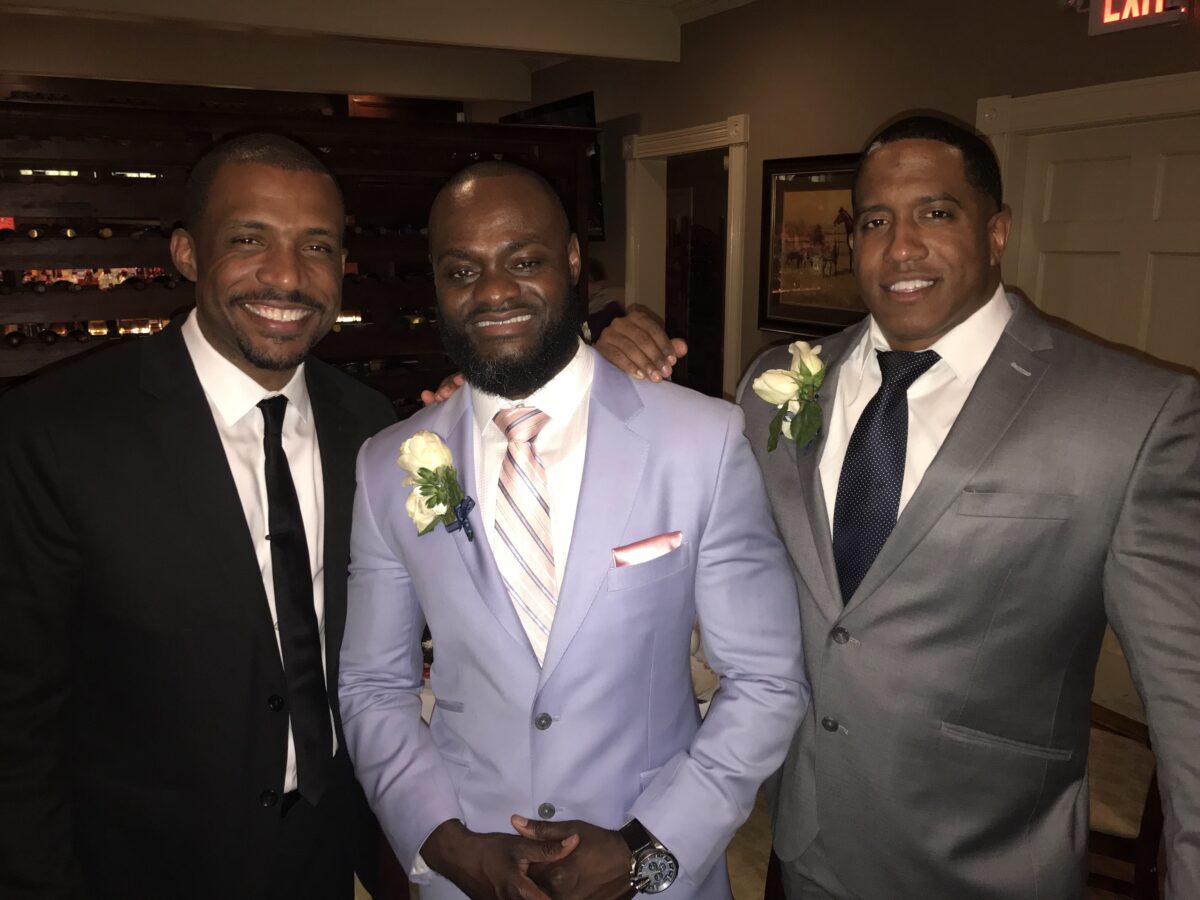
Anderson, on the left, with two of his closest UMBC friends, Eddie Freeman ’03, M.S. ’06, and Marc Haskins ’01 at Freeman’s wedding.
UMBC didn’t offer an education major at the time, but Anderson followed his inspiration, juggling a steady load of challenging coursework with his athletic obligations as captain of the track and field team, responsibilities as a dorm resident advisor, and eventually student teaching in Baltimore City schools as he pursued his teaching certificate.
Along with his teacher-certification track, Anderson’s interdisciplinary studies focused on psychology and Africana studies, and one of his professors in the latter field gave him first-hand insight into the power of effective teaching.
He remembers vividly the classes he took with Christel N. Temple, then an assistant professor of Africana studies at UMBC.
“She’s an African American woman, and I believe at the time she was relatively new to the position, but she was very good—not just in disseminating the content, but in the passion she showed for it. That was a big motivator for me,” Anderson says.
Because of that passion for teaching, he remembers: “I really enjoyed her class. I wanted to learn. I wanted to grow. I wanted to enhance my knowledge for no other reason than to become brighter and better.”
Temple, now a full professor of Africana studies at the University of Pittsburgh, isn’t surprised that her former student’s leadership qualities have attracted attention.
“I am so proud of his career,” she says. “His success is a reminder of the contribution that Africana studies makes—not just our field’s orientation to subjects such as culture, communication and sociology, but also to education studies.”
Understanding the personal dimensions of education
Anderson landed a job in Howard County Public Schools soon after graduation by way of his teaching certification and graduation from UMBC. He taught at an elementary school for seven years, then served as an elementary school instructional team leader before becoming an assistant principal. He served in that role for four years before becoming principal at Longfellow Elementary School in 2017.
Kathy Nuemann ’06, American studies, remembers meeting Anderson the year before he became principal. Neumann, a math specialist at Longfellow, was excited to meet another Retriever at her school and struck by his genuine personality. For the next six years, as they worked together, she says, “Derek was always available. Whether I was seeking advice, sharing an idea, or just needed someone to lend an ear. His sincerity extended to students as well.”
She recounts a recent story where her students wrote a proposal to Anderson as part of a social studies project. After identifying a problem (trash on the recess field), the students brainstormed a solution by requesting a recycling bin out on the playground. Neumann invited Anderson to visit her class and the students read the proposal to him. “Not only did Derek listen to the proposal, but he fulfilled the request within a week. My students were thrilled!”
All told, Anderson served nearly 20 years in Howard County’s elementary schools—long enough to see two of his three his own children pass through Longfellow Elementary while he was principal there. (He met his wife of 16 years, Jonae Anderson ’02, psychology, M.P.P. ’05, at UMBC.)
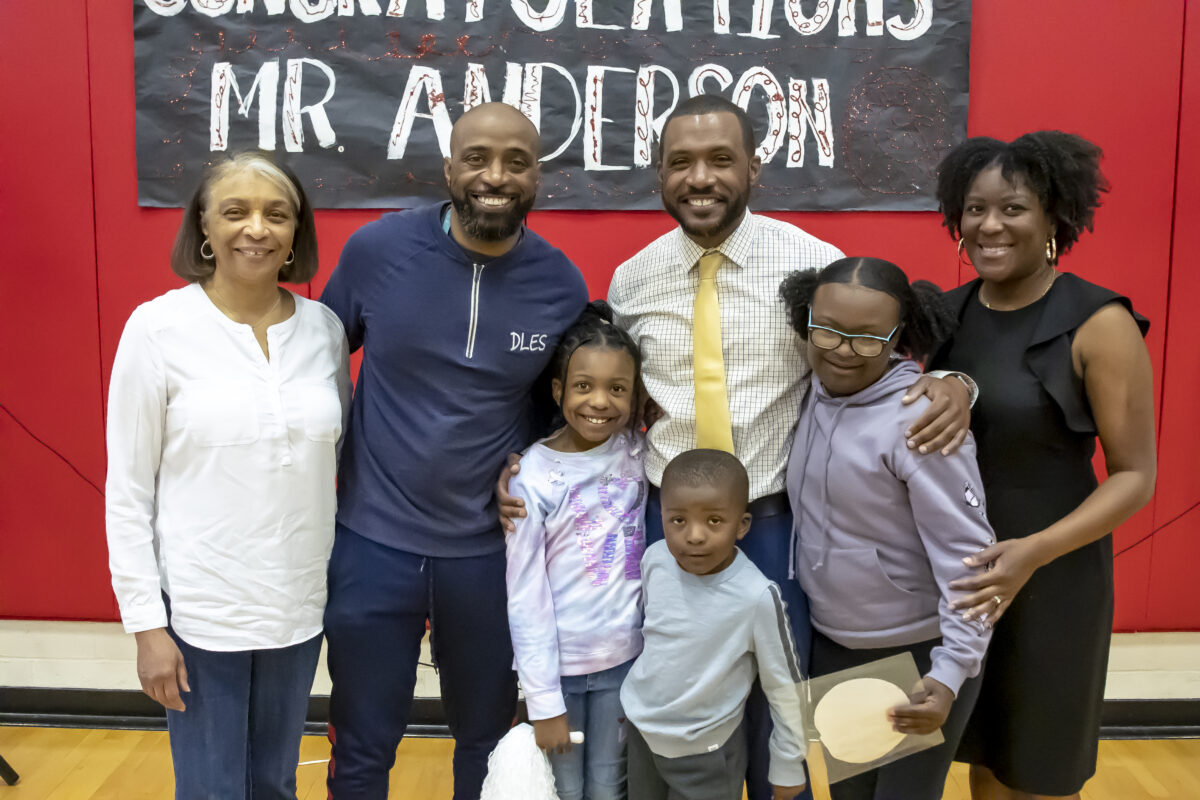
Anderson was named 2023 Principal of the Year for Howard County Public Schools. He’s pictured here with his wife and children, and mother and brother.
Indeed, Anderson says, parenthood helped underline the personal dimension of education, and not just for the obvious reasons.
“It makes me that much more passionate about the work” of education, he says. “Parents send us their kids—they send us the best they have, Monday through Friday, with the expectation that they’re going to come back safely, happy and enjoying that [school] experience. That is a responsibility I carry with me every day.”
Bringing energy to the executive position
In fact, it turned out that that sense of greater responsibility made him the perfect candidate for his new role as executive director of Maryland’s growing portfolio of community schools.
The expansion is part of the state’s 2019 Blueprint for Maryland’s Future legislation, which dedicates almost $4 billion per year in state and local funding over the next decade to a set of reforms aimed at improving public schools in the state.
The intent of community schools is to better connect schools with the families they serve. Particulars of that connection can include addressing daycare deficiencies in schools that educate a disproportionate proportion of teenage mothers, or creating a weekend food pantry with fresh groceries at a school situated in a food desert.
“Leadership has always been something that I’ve aspired to,” Anderson says. “For a long time, I never thought past the principalship,” and he admits that there’s a special energy to being in a school building that he may well miss in his new job as executive director.
But when he weighed the one school he was leaving against the difference he could make in overseeing more than 450 schools, he says he found himself thinking about his own educational journey.
“I went from, ‘I’m not confident about being a student in college’ to ‘This is something I want to pursue,’ because along the way people were providing opportunities, providing guidance, providing insight, and it’s led to a very fulfilling career for me,” Anderson says.
And with his new role’s wider scope, he has the opportunity to be just such a helping hand in the lives and education of many more students.
“I still get up excited about coming to work [in education] because I know it’s meaningful work,” Anderson says. “What better way to serve kids?”
]]>
There are some people who you meet, and it’s obvious: They’re natural leaders—seemingly born to the role. Derek Anderson ’03, interdisciplinary studies, is one of those people. He went right...
https://umbc.edu/stories/putting-the-principles-of-education-to-work/
https://my3.my.umbc.edu/api/v0/pixel/news/134703/guest@my.umbc.edu/14bdc2b3afd109b607e9e561d1091dc2/api/pixel
africana-studies
alumni
american-studies
cahss
feature
inds
magazine
the-shriver-center
UMBC News & Magazine
https://my3.my.umbc.edu/groups/umbc-news-magazine
https://assets1-my.umbc.edu/system/shared/avatars/groups/000/001/943/24435aa6207c452e7bc15cc74b42c7bb/xsmall.png?1748556657
https://assets1-my.umbc.edu/system/shared/avatars/groups/000/001/943/24435aa6207c452e7bc15cc74b42c7bb/original.png?1748556657
https://assets2-my.umbc.edu/system/shared/avatars/groups/000/001/943/24435aa6207c452e7bc15cc74b42c7bb/xxlarge.png?1748556657
https://assets2-my.umbc.edu/system/shared/avatars/groups/000/001/943/24435aa6207c452e7bc15cc74b42c7bb/xlarge.png?1748556657
https://assets3-my.umbc.edu/system/shared/avatars/groups/000/001/943/24435aa6207c452e7bc15cc74b42c7bb/large.png?1748556657
https://assets1-my.umbc.edu/system/shared/avatars/groups/000/001/943/24435aa6207c452e7bc15cc74b42c7bb/medium.png?1748556657
https://assets2-my.umbc.edu/system/shared/avatars/groups/000/001/943/24435aa6207c452e7bc15cc74b42c7bb/small.png?1748556657
https://assets1-my.umbc.edu/system/shared/avatars/groups/000/001/943/24435aa6207c452e7bc15cc74b42c7bb/xsmall.png?1748556657
https://assets2-my.umbc.edu/system/shared/avatars/groups/000/001/943/24435aa6207c452e7bc15cc74b42c7bb/xxsmall.png?1748556657
UMBC News & Magazine
2
0
false
Tue, 15 Aug 2023 13:19:02 -0400
Tue, 15 Aug 2023 13:19:02 -0400
UMBC’s CyMOT receives $1.2M to expand cyber training for manufacturing workers
UMBC researchers designed the Cybersecurity for Manufacturing Operational Technology (CyMOT) program to help manufacturing professionals grow their cybersecurity skills, protecting the sector from cyber threats and increasing their career opportunities. Now, the program has received significant additional funding to expand its impact.
The CyMOT program—launched in 2020 in collaboration with the Chicago-based MxD (Manufacturing x Digital) and UMBC Training Centers—has been renewed with a $1.2 million grant from the U.S. Department of Defense’s Office of Local Defense Community Cooperation (OLDCC). The funding will support the implementation of new training curricula around machine learning and cybersecurity.
“In recent years, there has been a large number of cyber attacks on the manufacturing sector,” says Nilanjan Banerjee, professor of computer science and electrical engineering and the grant’s principal investigator. To address this rising concern, Banerjee explains, CyMOT aims to “make sure that people that are in the manufacturing business can get trained and upskilled in cybersecurity concepts around manufacturing.”
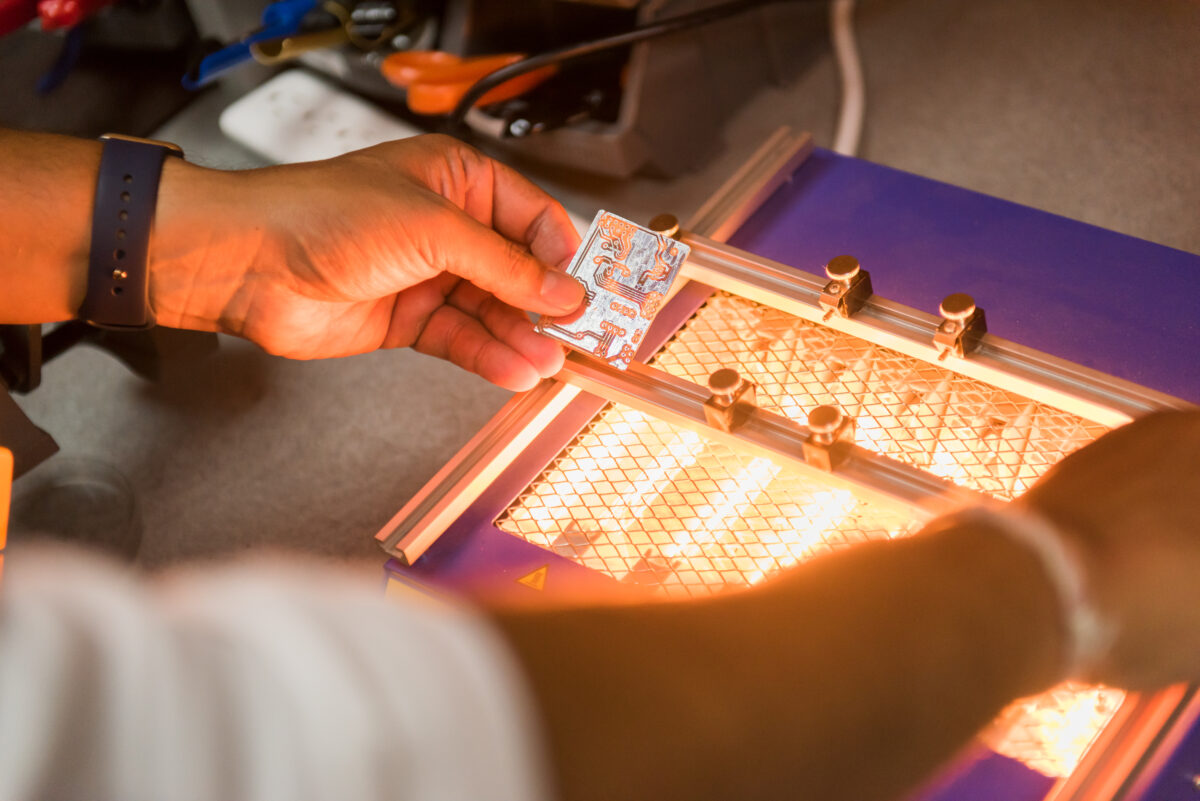 Banerjee working in his lab (Marlayna Dremond ’11/UMBC)
Expanding the curriculum
The first initiative of the multi-phased project included developing a cybersecurity curriculum tailored for people who already worked in the manufacturing industry, building on their existing expertise. It provided training for a manufacturing cyber systems operator role and offered content through an online training platform.
The first cohort included 25 manufacturing professionals. In summer 2022, the program expanded when community college students in Chicago were invited to participate in a modified version of the course.
With this recent 12-month contract renewal, the next phase of the project will include courses for two more senior roles: a manufacturing artificial intelligence/machine learning engineer and an advanced manufacturing cybersecurity operator. This phase is slated to begin in February 2023. The additional funding will cover the cost for up to 150 new students interested in the programs.
Creating an operational technology cyber range at UMBC
As this program continues to grow, Banerjee also has a related objective in mind: building an operational technology (OT) cyber range at UMBC focused on cybersecurity in manufacturing.
“We will have equipment on campus with software to run exercises for small and medium manufacturing businesses in Maryland and students at UMBC,” Banerjee explains. “The cyber range will include red team-blue team exercises, as well as exercises to learn about cyber attacks on a company’s infrastructure. We will also conduct exercises around attacks at the interface between information technology networks and operational technology networks.”
With the cyber range, manufacturing professionals in the state can learn how to detect and mitigate cyberattacks through hands-on exercises using similar equipment found in a manufacturing OT environment.
The cyber range will be a unique resource for training and research in Maryland. It will also tie to several cybersecurity programs offered by UMBC and an apprenticeship program offered through the Maryland Extension Partnership (MEP). With emphasis on digitizing the manufacturing sector in Maryland at a time of continually increasing interconnectivity and automation (known as Industry 4.0), the cyber range will act as the testbed to train manufacturers across the state.
Workforce development in Maryland
Donna Ruginski, UMBC’s executive director of cybersecurity initiatives and a co-PI of CyMOT, shares that the project has the potential to expand Maryland’s workforce development in a significant way, whether through curriculum development and delivery or an OT cyber range.
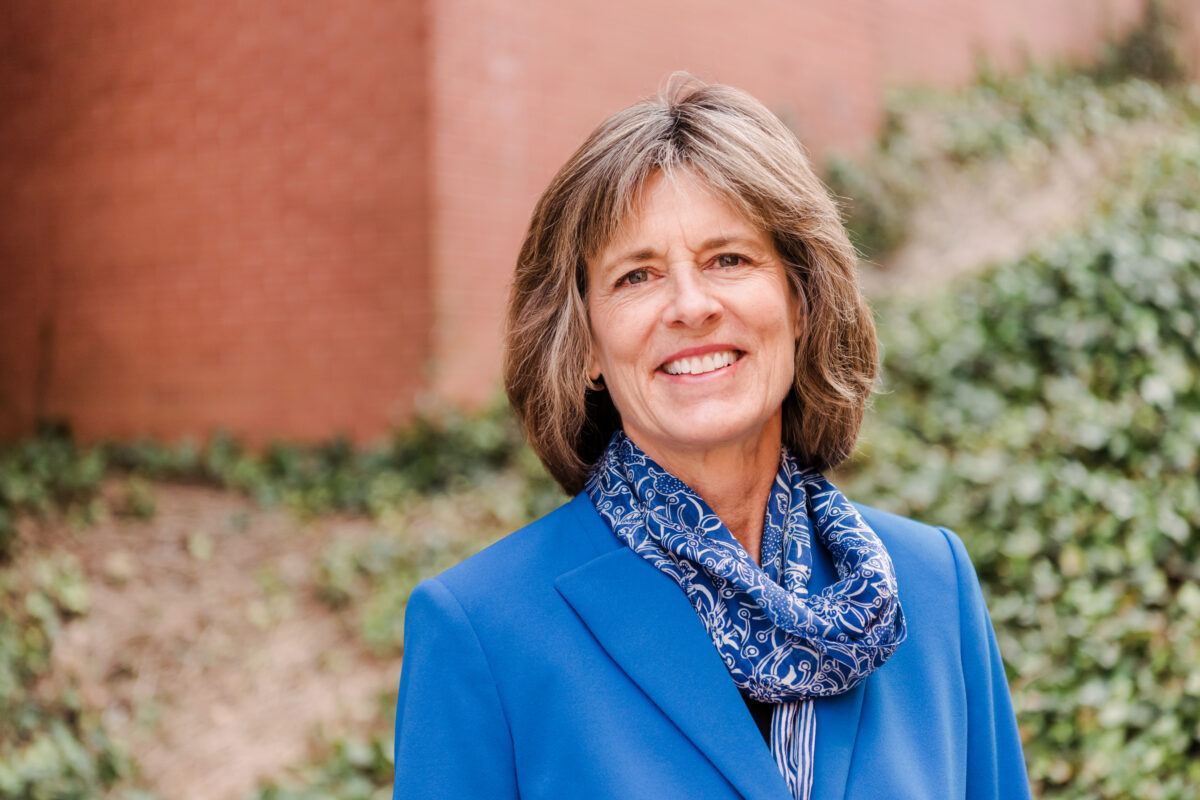 Donna Ruginski (Marlayna Demond ’11/UMBC)
“As the manufacturing industry implements digital transformation to Industry 4.0, cybersecurity training resources have become more important,” says Ruginski. “There is a shortage of people who can do cyber-related jobs. CyMOT is an avenue to up-skill and train a talent base positioned to fill those gaps in the workforce.”
After getting its start with implementation in Chicago, CyMOT has attracted the attention of Maryland state agencies, such as the Department of Commerce, and has been recognized by leaders in manufacturing, such as the Regional Manufacturing Institute of Maryland (RMI). UMBC was named as one of RMI’s Champions of Maryland Manufacturing at its 2022 Maryland Manufacturing Celebration, held earlier this fall.
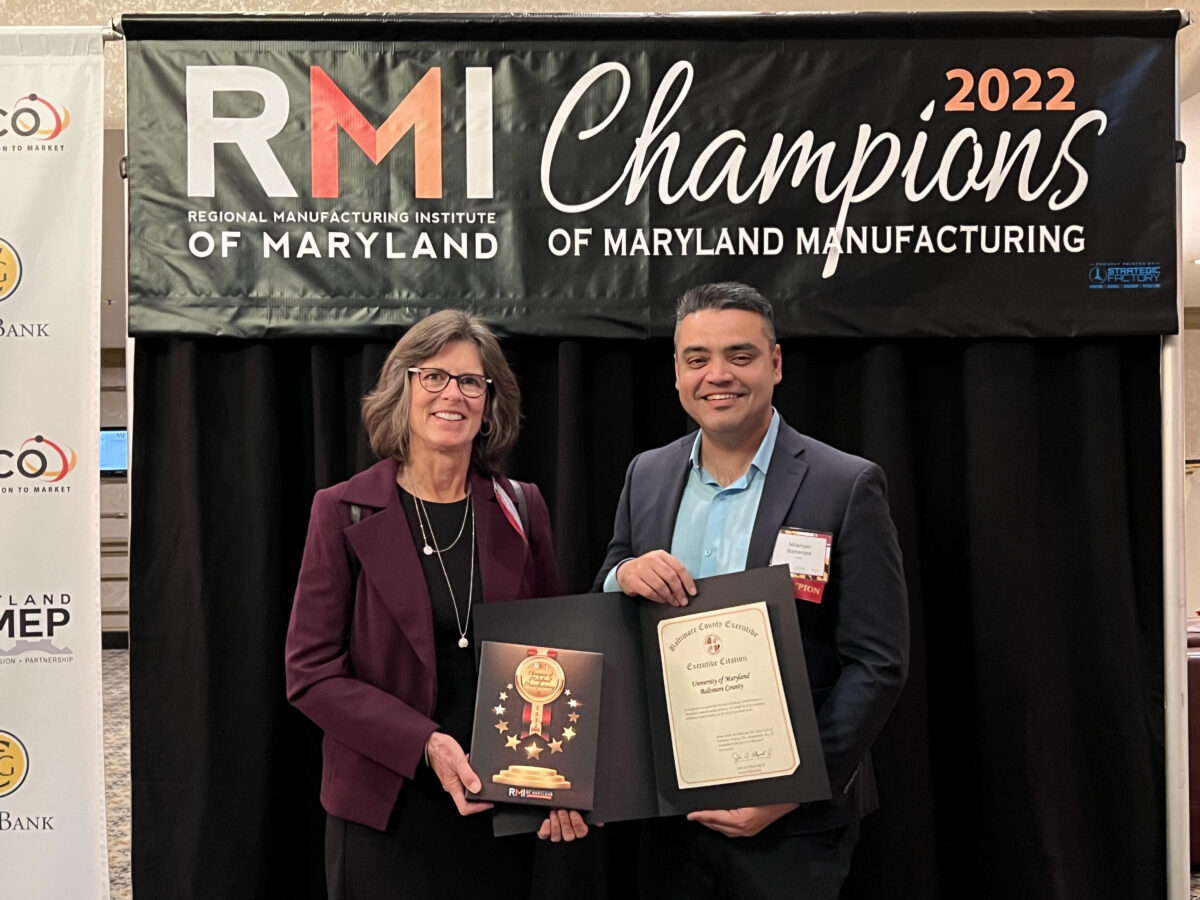 Donna Ruginski and Nilanjan Banerjee accepting an executive citation at RMI’s 2022 Maryland Manufacturing Celebration. (Image courtesy of Donna Ruginski)
On behalf of UMBC, Banerjee and Ruginski accepted an executive citation in recognition of CyMOT’s contributions to Maryland’s manufacturing industry.
“It is a great honor to be awarded an RMI Champions award,” says Banerjee. “The work around cybersecurity training and research performed at UMBC is having a true impact on growing the workforce and digitizing the regional manufacturing ecosystem, and the award is testimony to that fact.”
]]>
UMBC researchers designed the Cybersecurity for Manufacturing Operational Technology (CyMOT) program to help manufacturing professionals grow their cybersecurity skills, protecting the sector from...
https://umbc.edu/stories/cyber-training-for-manufacturing-workers/
https://my3.my.umbc.edu/api/v0/pixel/news/129709/guest@my.umbc.edu/b15444f410a34ca8753b0ffbcc6048b4/api/pixel
coeit
csee
cybersecurity
feature
news
research
science-and-tech
UMBC News & Magazine
https://my3.my.umbc.edu/groups/umbc-news-magazine
https://assets1-my.umbc.edu/system/shared/avatars/groups/000/001/943/24435aa6207c452e7bc15cc74b42c7bb/xsmall.png?1748556657
https://assets1-my.umbc.edu/system/shared/avatars/groups/000/001/943/24435aa6207c452e7bc15cc74b42c7bb/original.png?1748556657
https://assets2-my.umbc.edu/system/shared/avatars/groups/000/001/943/24435aa6207c452e7bc15cc74b42c7bb/xxlarge.png?1748556657
https://assets2-my.umbc.edu/system/shared/avatars/groups/000/001/943/24435aa6207c452e7bc15cc74b42c7bb/xlarge.png?1748556657
https://assets3-my.umbc.edu/system/shared/avatars/groups/000/001/943/24435aa6207c452e7bc15cc74b42c7bb/large.png?1748556657
https://assets1-my.umbc.edu/system/shared/avatars/groups/000/001/943/24435aa6207c452e7bc15cc74b42c7bb/medium.png?1748556657
https://assets2-my.umbc.edu/system/shared/avatars/groups/000/001/943/24435aa6207c452e7bc15cc74b42c7bb/small.png?1748556657
https://assets1-my.umbc.edu/system/shared/avatars/groups/000/001/943/24435aa6207c452e7bc15cc74b42c7bb/xsmall.png?1748556657
https://assets2-my.umbc.edu/system/shared/avatars/groups/000/001/943/24435aa6207c452e7bc15cc74b42c7bb/xxsmall.png?1748556657
UMBC News & Magazine
3
0
false
Fri, 09 Dec 2022 13:44:05 -0500
Fri, 09 Dec 2022 13:44:05 -0500
Connecting the Dots

Students come to UMBC for many reasons—to find community, to explore a passion, to make change in the world. Once they figure out the “why” that truly drives their interests, the Retriever community is ready to kick in with the “how” to help make those plans a reality. Part of that looks like the traditional classroom experience with a professor, of course—but just as important are the experiential-learning moments that help many students actively connect the knowledge to careers they hope to pursue after graduation.
UMBC students pursue applied learning in huge numbers. Despite the pandemic, nearly 80 percent of our recent graduates engaged in applied learning, including internships, research, co-ops, and service learning during their time at UMBC. An impressive 91 percent of new grads head directly to a job, advanced degree, or both within six months of graduating—and of those, more than half interned or worked for their employer as a student.
“When it comes to impact, there is nothing more valuable than engaging in applied-learning opportunities to help clarify one’s career direction, build professional skills, and increase one’s professional network,” shares Susan Hindle, the Career Center’s assistant director of internships and employment.
For students pursuing experiential learning through internships, campus jobs, research, and community engagement, it’s not just about learning how to do the thing they want to do. It’s about connecting the work to the passions that brought them to UMBC in the first place. These students and alumni working in their chosen fields tell the whole picture—what hands-on learning looks like when it comes full circle.
Essential Connections
The desire to help people comes from deep within. But knowing how to do it successfully on a large scale—and understanding the systems and politics that can make the job more or less challenging—takes more than just compassion.
On the morning of the monthly food delivery from the Maryland Food Bank, the brigade of students who keep the Retriever Essentials food pantry running see all sides of the work. Together, they unload and shelve staples like rice, pasta, and huge crates of broccoli for the more than 2,100 visits to the pantry so far this year. At the same time, they work with community members to understand what might make life better—halal meats, for one; more campus job opportunities, another biggie—and then put their heads together to try to make those changes happen.
 Nyla Howell (left) and Lydia Sannella and Ariel Barbosa (L-R) sort canned goods for Retriever Essentials. Photos by Marlayna Demond ’11/UMBC, design by Jim Lord ’99.
For Ariel Barbosa, a grad student in UMBC’s community leadership program, working in this space is part of a journey that started with her trying to understand her Brazilian father’s immigrant experience better. As she works with Retriever Essentials, she’s learning about the complexities of these experiences in a way that will help her as she carves out a career in service. “There are so many signs showing me that I’m supposed to be right here, right now. I feel like I’m preparing,” she says. “Right now, I feel like I’m in a confidence-building, skill-building phase where I’m just trying to pick up as many skills as I can to be able to create what I feel I need to create at the right time.”
As a student, Matthew Dolamore ’08, modern languages and linguistics, caught a first glimpse of what would later become a service-based career when he tutored Spanish-speaking clients for an immigration services office in Baltimore. After graduating, he went on to serve with AmeriCorps and the Peace Corps and earned a master’s degree in community planning before pulling all of those skills together into a full-circle career in Baltimore.
Today, Dolamore is program director for the Esperanza Center, a project of Catholic Charities that assists more than 3,000 individuals each year with walk-in immigration services, including healthcare, legal assistance, and education tools. Dolamore serves as a connector between people and solutions, helping people get what they need when they need it and looking for ways to help improve the system.
 Matthew Dolamore ’08 at the Esperanza Center. Photos by Marlayna Demond ’11/UMBC, design by Jim Lord ’99.
“Among our managers we have a nurse practitioner, a managing attorney, a licensed social worker, an individual who got their master’s in teaching English from UMBC, and a woman who oversees our one-touch client services desk who’s a former immigrant and just has a really dynamic background. And just those five people alone is symbolic of what I love about my job,” says Dolamore.
“I’m not a medical professional. I’m not a legal professional. I’m not a social worker. I’m something myself of a generalist nonprofit manager at this stage in my career, but I get the opportunity every day to come in and out of these really focused professional engagements and try to help all five of them think of each other as teammates, and that’s the part of my job I really enjoy.”
Lydia Sannella, a Peaceworker and grad student in applied sociology at UMBC, also enjoys the organizational aspect of her job with Retriever Essentials. As she looks ahead to her post-academic career, she’s already thinking about how she can continue to marry her values with her career—knowing that it won’t likely be quite the same as what she’s experiencing at UMBC.
“I find that, whenever we want to do something, there are supportive, knowledgeable experts who want to help,” she says. “There’s just hoards of students who want to be involved and engaged and do any variety of work, from physical lifting to technical projects. And it’s just this canvas for creativity and possibility. It’s very reciprocal. What I’m able to contribute ends up being more significant and then what I get ends up being more significant.”
— Jenny O’Grady
Becoming part of the solution
Students come to higher education for a variety of reasons, and among them, many have the goal of learning to create new things—from innovative water-quality solutions to entire companies. For many students, in fact, learning while doing is an integral part of going to college.
If you ask Premal S. Shah ’98, biochemistry and molecular biology, however, he’ll tell you that there’s a world of difference between learning while doing and learning from doing.
That’s not to say that Shah, who earned a Ph.D. from the California Institute of Technology on his way to founding and leading a string of successful healthcare-related companies, doesn’t believe in academics. But from his vantage point as CEO at MyOme, a genomics firm based in northern California, classroom-based learning is only a part of the puzzle.
 Premel S. Shah ’98 interned at National Institutes of Health before founding a genomics firm. Photos by Barack Shrama, design by Jim Lord ’99.
Shah said he’s always had a practical streak, but he found out how much experiential learning can boost classroom learning thanks to a hands-on internship and fellowship at the National Institutes of Health, beginning while he was a student at UMBC.
“When I got to grad school, there were a lot of people who hadn’t really worked in a lab or done stuff,” he said. “I had a huge head start, just because I was able to pick up a pipette and actually use it. I knew what a DNA extraction protocol was. I knew how to use certain machinery.”
It was a vivid object lesson—one Shah has carried forward into his career. “When you start building companies, there’s always that challenge…of analysis paralysis, right?” he said. “There’s a notion of, ‘We could do this or that. Let’s read and learn more or get additional inputs in search of the perfect answer.’ Or we can actually go build something that will benefit people and iterate even faster as we learn more to make it much better.”
That’s the big difference between studying science and, for example, running science-based companies, Shah says: “The hypotheticals are great. The theories are great. But you’ve got to get [things] done.”
Getting things done is Matt Stromberg’s perennial modus operandi. Being a Ph.D. student studying environmental engineering means he is very much both an environmental scientist—someone who studies environmental problems—and an engineer: someone who works to solve those problems. “I always knew I was a passionate environmentalist, but I also knew I liked to build things,” he said.
In fact, Stromberg, who graduated in 2019 from the University of Virginia with bachelor’s degrees in both environmental engineering and environmental science, is a literal embodiment of learning while doing. Working as both a graduate research assistant and a researcher in the jointly run University System of Maryland Institute for Marine and Environmental Technology (IMET), he sometimes finds himself simultaneously running experiments and keeping the experiments running.
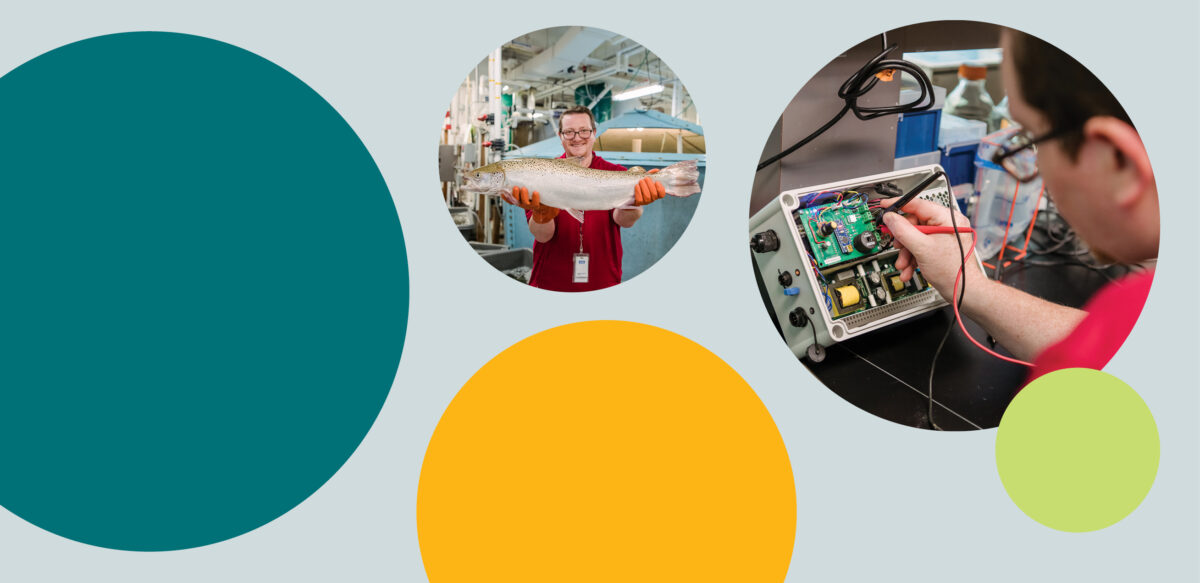 Matt Stromberg is studying aquaculture at the University System of Maryland Institute for Marine and Environmental Technology. Photos by Marlayna Demond ’11/UMBC, design by Jim Lord ’99.
A few months ago, Stromberg said, the night before an experiment was scheduled to start, a pump failed in IMET’s Aquaculture Research Center, a 1,800-square-meter facility with hundreds of fish tanks.
“It was a large pump, and it needed to be replaced—and it was eight o’clock at night,” Stromberg said. “I had already worked 12 hours that day, [but] I realized that there’s no way this experiment is going to run if I don’t have a pump tomorrow. So…I got the wrenches and I got all the fittings I needed,” and found a way to fix it.
Stromberg’s ability to save that experiment is part and parcel of his approach. One of his main research projects is unclogging a major bottleneck that prevents more farm-raised fish from getting to market: purging them of an unsavory flavor that’s sometimes characteristic of fish that aren’t caught in the wild. As Stromberg put it, “You’re not going to sell the fish if it tastes like dirt.”
That’s a problem not only for aquaculture companies—which have to use lots of water, time, money, and energy to purge the fish of this taste—but also for the planet. That’s because the only alternative to aquaculture is fishing in the wild, which can destroy ecosystems but is still cheaper than aquaculture, due to the expensive purging process.
He’s working with advanced oxidative processes and a technology of his own that would effectively create a shortcut, making it more cost-effective to farm fish and thus helping to protect wild habitat in the process. And Stromberg aims to eventually put his Ph.D. to work in a similarly practical way: His goal is to create a company that performs chemical analysis and remediation of water contaminants.
“I’ve learned a lot from my time here,” he says. “Especially not to over-engineer things!”
— Scott Cech
Community-centered art
Visual art is all around us—in flyers, television commercials, and even clothes. And while many of us may never know the artists creating work behind the scenes, their lives and experiences certainly do shape their work.
For instance, earlier this year, Jennifer White-Johnson ’08, visual arts, designed a collection for Target’s national Latino Heritage Month campaign, including a tumbler with stacked text reading sonando vivamente vividly dreaming and a T-shirt proudly proclaiming piel canela pelo rizado (brown/cinnamon skin curly hair). As a disabled, neurodiverse, Afro-Latina designer from Baltimore, White-Johnson sees her inclusion as an opportunity to highlight and provide a voice to communities that often aren’t heard or represented.
 Former Student Events Board member Jennifer White-Johnson ’08 now has designs at Target. Photos by Marlayna Demond ’11/UMBC, design by Jim Lord ’99.
“I am really honored to have been chosen and included in this year’s Target Latino Heritage Month collection and campaign,” says White-Johnson. “Using art and design to celebrate and elevate my cultural stories, the strength, and legacy of my ancestors, felt like something that was meant to be!”
Living with undiagnosed ADHD as a student, White-Johnson often felt like her intensity, excitement, and point of view were unwelcome or just too much. That changed when she transferred to UMBC, where she immediately felt at home. In particular, her time as director of promotions for the Student Events Board [(seb)] gave her her first taste of how graphic design could marry with communit-ycentric work.
Working closely with the Office of Student Life, White-Johnson and other members of (seb) volunteered during an alternative spring-break trip to post-Hurricane Katrina New Orleans. White-Johnson also designed the T-shirts.
“This was in 2007, so we could help offer some sort of relief from Hurricane Katrina,” says White-Johnson. “It was life-changing because I was able to surround myself with other like-minded scholars that were serious about academic life but who also understood that school is about self-discovery.”
Enter Patch Hatley, a sophomore visual arts major with a concentration in animation. Fresh from a session learning how to create stop-motion animation puppets from paper, she is excited to test out some of what she’s learned on the job at commonvision, the student-driven print and design center in The Commons. On any given day, one might find her working on anything from animating cute countdowns for student activities to designing stickers.
“I’m always constantly learning in an environment like commonvision,” she says. “Each new skill helps transition to the next project, and each project creates new and exciting opportunities. You’re always surrounded by a team who are all community-driven, so I always feel like I can ask for help or constructive criticism. commonvision supports, drives, and motivates me to keep reaching for the stars and will always be an important part of how I’ve grown—not just as an artist but as a team player.”
 Patch Hatley learns while working on animations at commonvision. Photos by Marlayna Demond ’11/UMBC, design by Jim Lord ’99.
Hatley finds work at commonvision particularly helpful because it stretches her creative muscles and opens up her craft to new programs, tools, and mediums, and also because other creators surround her. After spending a decade in animation and illustration before becoming a Retriever, Hatley loves the opportunity to expand her craft in a place that has fostered the foundation for budding designers for years—and getting to bring her personal perspective into work for clients.
“At the end of the day, you’re drawing for yourself and for the people around you whether you realize it implicitly or not,” says Hatley. At the core of both artists’ practices is community. Both White-Johnson and Hatley recognize that their art doesn’t live in a vacuum but exists as a letter of inspiration, solidarity, and encouragement to their respective communities. Both artists, years apart in their practice, found similar communities to nurture and invest in them.
“Being given the space to bring visibility to themes of cultural intersectionality, specifically the parts of our natural beauty that aren’t always celebrated, our caramel brown, cinnamon skin, and our natural curls,” says White-Johnson. “I hope my work can culturally inspire others to center what they want to see more of.”
— Sharéa Harris
Taking experiential learning to the next level
Developing high-level skills in a highly technical field like computer science is difficult enough. But the ability to both master and successfully teach those skills to others takes the challenge to a whole new level.
Fortunately, Amina Mahmood and Zach Margulies thrive at that level. With their dedication to passing along computer-science knowledge, these Retrievers amply demonstrate that doing while teaching and learning while doing are just different parts of the same equation.
As Mahmood ’21, computer science, tells it, she started learning while doing quite literally. Just weeks into her first year at UMBC, Mahmood found herself working 20 hours a week as a junior malware analyst at Huntress, a cybersecurity firm that was then still in the startup phase at the bwtech@UMBC Research and Technology Park.
“I didn’t really have any experience, but I was pretty ambitious, so I learned everything on the job,” she said.
Mahmood, part of UMBC’s Cyber Scholars Program, quickly learned how to run different types of malware on a virtual machine, dissect the particulars of each, and create mitigation reports. The nascent company’s culture also helped boost her confidence. If she ran into a problem, she said, the people she worked with were glad to bring her up to speed.
 Amina Mahmood ’21 at the Johns Hopkins University Applied Physics Lab. Photos courtesy of Johns Hopkins Applied Physics Laboratory, design by Jim Lord ’99.
“It was just like, ‘Oh, you don’t know this—let me teach it to you.’ And then I picked up on it and then I was like, ‘OK—I can do this,’” Mahmood said. Mahmood was quick to apply such on-the-job learning to her academics, even persuading an academic advisor to allow her to add her to his overenrolled, graduate-level software reverse-engineering course at the same time she was enrolled in an undergraduate prerequisite class.
Mahmood not only aced the graduate-level class, she also started using what she had learned to complete the experiential-learning cycle at her new part-time job at Parsons Corp., a technology-focused defense, intelligence, security, and infrastructure engineering firm.
“One of my mentors at Parsons—he really supported me, and he said, ‘You know a lot about reverse engineering. Why don’t you just make a course and teach coworkers?’” That’s exactly what Mahmood did— and now does for new summer interns as a full-time reverse engineer at the Johns Hopkins University Applied Physics Lab.
Recently she found herself completing the circle, coming back to UMBC for the same kind of career fair where she’d found her first job as a first-year student. “But [this time] I didn’t go as a student,” she noted. “I went as an employer.”
Margulies ’14, biological sciences, is completing his own trajectory: Nearly a decade after earning his first bachelor’s degree, he has returned to UMBC to earn a bachelor’s in computer science and a master’s in education, with the goal of teaching computer science to Baltimore high school students when he graduates in 2024.
Margulies started his career pivot before diving back into academics immersing himself in on-the-job data science and programming—including a Maryland Institute for Innovative Computing internship at the Maryland Department of Health after starting in the computer science program. Because of this, he’s able to pursue his studies with a greater sense of perspective.
“I feel like it inspires confidence and it builds your self-esteem, taking what you’ve learned in the class and not even a semester later applying it in a real-world setting,” he said.
Margulies noted that, as a teacher, he’ll also be able to fully address high schoolers’ perennial classroom question: ‘When am I ever going to use this in real life?’
 Zach Margulies took part in a Maryland Institute for Innovative Computing internship with the Maryland Department of Health. Photos by Marlayna Demond ’11/UMBC, design by Jim Lord ’99.
“It’s really important for teachers to know what the practical application of [schoolwork] is going to be and what working in a computer science job will look like,” he said.
A case in point, Margulies said, was the work he did as part of a Maryland Department of Health internship last summer, reviewing and finding improvements for data collection, including the creation of a data dashboard.
“Last semester, I took Computer Science 201, and we learned the programming language Python, and I really wanted to start applying that language at the internship,” he said. Because he’d had both practical experience and formal training, Margulies said, he was able to see that he’d have to adapt what he’d learned to suit the task at hand.
“[I had] to figure out a way that I could take Python and apply it to developing the database because that’s not something we necessarily learned in the class,” he said. “I had a lot of fun taking the thing that I learned academically and not just applying it, but also taking it to the next level.”
— Scott Cech
]]>
Students come to UMBC for many reasons—to find community, to explore a passion, to make change in the world. Once they figure out the “why” that truly drives their interests, the Retriever...
https://umbc.edu/stories/connecting-the-dots/
https://my3.my.umbc.edu/api/v0/pixel/news/129482/guest@my.umbc.edu/38f4c1bff401ad3aed0a5d74a732610b/api/pixel
applied-sociology
biochemistry-and-molecular-biology
biological-sciences
career-center
commonvision
community-leadership
computer-science
discovery
environmental-engineering
fall-2022
feature
magazine
mll
peaceworker
retriever-essentials
visual-arts
UMBC News & Magazine
https://my3.my.umbc.edu/groups/umbc-news-magazine
https://assets1-my.umbc.edu/system/shared/avatars/groups/000/001/943/24435aa6207c452e7bc15cc74b42c7bb/xsmall.png?1748556657
https://assets1-my.umbc.edu/system/shared/avatars/groups/000/001/943/24435aa6207c452e7bc15cc74b42c7bb/original.png?1748556657
https://assets2-my.umbc.edu/system/shared/avatars/groups/000/001/943/24435aa6207c452e7bc15cc74b42c7bb/xxlarge.png?1748556657
https://assets2-my.umbc.edu/system/shared/avatars/groups/000/001/943/24435aa6207c452e7bc15cc74b42c7bb/xlarge.png?1748556657
https://assets3-my.umbc.edu/system/shared/avatars/groups/000/001/943/24435aa6207c452e7bc15cc74b42c7bb/large.png?1748556657
https://assets1-my.umbc.edu/system/shared/avatars/groups/000/001/943/24435aa6207c452e7bc15cc74b42c7bb/medium.png?1748556657
https://assets2-my.umbc.edu/system/shared/avatars/groups/000/001/943/24435aa6207c452e7bc15cc74b42c7bb/small.png?1748556657
https://assets1-my.umbc.edu/system/shared/avatars/groups/000/001/943/24435aa6207c452e7bc15cc74b42c7bb/xsmall.png?1748556657
https://assets2-my.umbc.edu/system/shared/avatars/groups/000/001/943/24435aa6207c452e7bc15cc74b42c7bb/xxsmall.png?1748556657
UMBC News & Magazine
0
0
false
Wed, 30 Nov 2022 15:17:19 -0500
UMBC students, educators, and researchers advance Maryland through innovative computing partnership
In early 2022, Nadja Franklin ‘23 was exploring summer opportunities through the UMBC Career Center when she heard about a chance to connect with tech internships at Maryland’s state agencies. As a business technology administration major, her interest was piqued. She arrived at the on-campus internship event with résumé in hand, ready to discuss her skills, and her preparation and enthusiasm paid off.
The hiring event was hosted by the Maryland Institute for Innovative Computing (MIIC) to help state agencies expand their technical talent pipeline through intern recruitment. The MIIC is a collaboration between the University System of Maryland and partners in the public and private sectors, launched in 2021. Administered by UMBC, the MIIC addresses workforce challenges related to computing and analytics in state agencies. Students at colleges and universities across Maryland are eligible to apply for internships through the MIIC, connecting skilled students with state employers seeking fresh tech talent.
“The State of Maryland has realized tremendous value from the partnership with UMBC through the technology internship program. Beyond the contribution of the students during their internship, many have gone on to become permanent members of the team. This program helps to fill the workforce pipeline with qualified and talented workers, lessening the impact caused by the shortage of technology and cybersecurity workers.”
Chip Stewart
Maryland’s State Chief Information Security Officer
Talent meets opportunity
The MIIC is continuously growing the pipeline of tech talent ready to support state agencies in the longer term, helping them run securely and efficiently. So far, in 2022, they’ve connected nearly 40 interns with opportunities at state agencies across Maryland, including the Department of Labor, Department of Information Technology, Department of Health, Department of Transportation and the Chief Data Office within the Governor’s Office.
“The MIIC reflects Maryland’s dedication to ensuring our state agencies have the technical staffing and internal infrastructure they need,” explains Annie Weinschenk, program director of workforce initiatives in the UMBC Career Center.
“With cyber crime on the rise, including attacks on government agencies, MIIC is helping to build a skilled workforce dedicated to service within the state of Maryland,” Weinschenk says. “MIIC internship areas range from data science, cybersecurity, and artificial intelligence, to geographic information systems at seven agencies across Maryland.”
Prepared to succeed
Franklin is a T-SITE Scholar in UMBC’s Center for Women in Technology who transferred to UMBC from the Community College of Baltimore County. At the MIIC event, she connected with the Maryland Department of Transportation (MDOT) about projects that would draw on her interests and experience, and she realized the opportunity could be a great match.
Afterward, she quickly completed her application for a project management internship in MDOT’s information technology department. She also accessed other Career Center resources to help her stand out as a top candidate, including interview prep with Weinschenk and Career Center Director Christine Routzahn.
“Students come to their internship experiences with a variety of backgrounds, levels of experience, and majors,” says Weinschenk. “We work to make sure they put their best foot forward, so they can access these unique hands-on learning opportunities.”
Meaningful connections
Franklin’s primary project with MDOT involves radio frequency identification (RFID), tagging IT and non-IT assets for use in various projects across the agency. But she has particularly enjoyed the chance to meet with MDOT’s chief information officer and deputy chief information officer. She’s also had a chance to learn about the broad range of projects across MDOT, and how project management works, through supporting directors’ meetings.
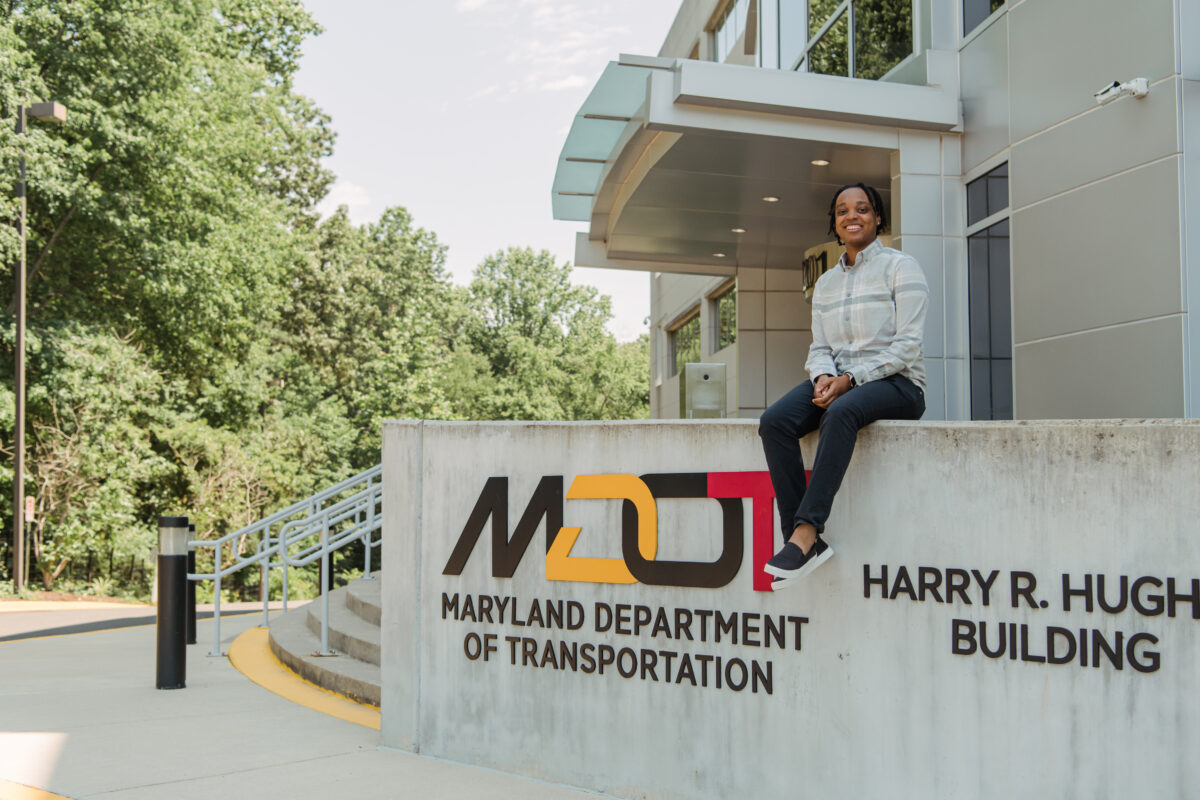 Nadja Franklin. (Marlayna Demond ’11/UMBC)
Franklin also drew on her writing skills and creativity to help develop scripts for MDOT training videos, and she enjoyed a unique chance to participate in the video filming and production process.
Beyond learning new skills, her favorite aspect of the internship has been MDOT’s inclusive, welcoming environment.
K-12 and higher ed partnerships
While Franklin came to UMBC interested in a career in tech, that’s not the case for many students who have the talent and skills to succeed in tech fields. With this in mind, the MIIC has also focused on expanding K-12 initiatives, to help prepare students earlier on for these high-demand careers, particularly in cybersecurity.
Earlier this year, Governor Larry Hogan announced the launch of the Maryland Cyber Range for Elevating Workforce and Education, operated by the MIIC. This $1.2 million initiative will expand cybersecurity education and training through collaboration with the Maryland Center for Computing Education (MCCE), Virginia Tech U.S. Cyber Range, and the nonprofit Teach Cyber.
This partnership will include initiatives at all educational levels, from K-12 through higher education and workforce training. The U.S. Cyber Range will provide access to a high quality simulated environment for teachers and students to learn cybersecurity.
Overall, this collaborative effort will enable Maryland to continue to grow and strengthen the state’s cybersecurity education infrastructure, explains Jack Suess, UMBC’s vice president of information technology and chief technology officer.
Innovating cybersecurity education
A leader in cybersecurity education, UMBC is also advancing the field in other ways, complementing the work of the MIIC. For example, Alan T. Sherman, professor of computer science, recently received more than $260,000 of a $500,000 grant from the National Science Foundation (NSF) to study and improve how cybersecurity is taught at the U.S. Naval Academy and U.S. Military Academy.
The project, Examining Pedagogy in Cybersecurity (EPIC), is collaborative with the University of Illinois Urbana-Champaign and University of Minnesota Duluth, and is funded through NSF’s Secure and Trustworthy Computing (SaTC) program. Because the academies teach cybersecurity to all first-year students, EPIC offers a large-scale opportunity to investigate how simulation-based teaching and learning affects different student populations.
In the first phase of the research, Sherman and his collaborators—including computer science Ph.D. student Andew Slack and Linda Oliva, assistant professor of education—will study how instructors at the academies structure and teach their cybersecurity courses. In the second phase, they will introduce active simulation-based learning exercises and pedagogies and assess their effectiveness.
UMBC’s championship-winning Cyberdawgs cyberdefense team will help adapt and improve learning materials. As one quantitative measure of the new pedagogy’s effectiveness, EPIC will assess students’ conceptual understanding using the Cybersecurity Concept Inventory (CCI), developed by Sherman and his team.
Benefits for Maryland
MIIC initiatives continue to expand in new directions. In research, The Hilltop Institute at UMBC is receiving funding to bring together health data related to opioid addiction from different state sources to more accurately identify patients’ risks for relapse. Like the MIIC’s educational initiatives, this work demonstrates how innovations in computing can benefit Maryland and its residents.
]]>
In early 2022, Nadja Franklin ‘23 was exploring summer opportunities through the UMBC Career Center when she heard about a chance to connect with tech internships at Maryland’s state agencies. As...
https://umbc.edu/stories/umbc-advances-maryland-through-innovative-computing-partnership/
https://my3.my.umbc.edu/api/v0/pixel/news/126686/guest@my.umbc.edu/677bb319e0fccaab53315b06228fb1bc/api/pixel
business-technology-administration
career-center
coeit
csee
cwit
cybersecurity
education
feature
information-systems
news
policy-and-society
rca-2
science-and-tech
tsite
UMBC News & Magazine
https://my3.my.umbc.edu/groups/umbc-news-magazine
https://assets1-my.umbc.edu/system/shared/avatars/groups/000/001/943/24435aa6207c452e7bc15cc74b42c7bb/xsmall.png?1748556657
https://assets1-my.umbc.edu/system/shared/avatars/groups/000/001/943/24435aa6207c452e7bc15cc74b42c7bb/original.png?1748556657
https://assets2-my.umbc.edu/system/shared/avatars/groups/000/001/943/24435aa6207c452e7bc15cc74b42c7bb/xxlarge.png?1748556657
https://assets2-my.umbc.edu/system/shared/avatars/groups/000/001/943/24435aa6207c452e7bc15cc74b42c7bb/xlarge.png?1748556657
https://assets3-my.umbc.edu/system/shared/avatars/groups/000/001/943/24435aa6207c452e7bc15cc74b42c7bb/large.png?1748556657
https://assets1-my.umbc.edu/system/shared/avatars/groups/000/001/943/24435aa6207c452e7bc15cc74b42c7bb/medium.png?1748556657
https://assets2-my.umbc.edu/system/shared/avatars/groups/000/001/943/24435aa6207c452e7bc15cc74b42c7bb/small.png?1748556657
https://assets1-my.umbc.edu/system/shared/avatars/groups/000/001/943/24435aa6207c452e7bc15cc74b42c7bb/xsmall.png?1748556657
https://assets2-my.umbc.edu/system/shared/avatars/groups/000/001/943/24435aa6207c452e7bc15cc74b42c7bb/xxsmall.png?1748556657
UMBC News & Magazine
0
0
false
Wed, 03 Aug 2022 14:43:51 -0400
Wed, 03 Aug 2022 14:43:51 -0400
Leaders Among Us

By Margaret Moffett
For La Jerne Terry Cornish, Ph.D. ’05, language, literacy, and culture, an already remarkable day was about to become unforgettable. There she stood in front of a big crowd at UMBC, accepting the 2019 Outstanding Alumna in the Humanities award. Even better, she was getting the chance to chronicle her journey from high school English teacher to college professor to provost and vice president of Ithaca College in New York.
“I’ve spent the last 21 years trying to be the change I wanted to see,” she told the audience—channeling the wisdom of her role model, who just happened to be sitting behind her on the stage.
Her speech complete, Cornish had returned to her chair when the role model in question leaned toward her. “You’re going to be a college president someday,” he whispered, his eyes no doubt twinkling with delight. “If you say so,” Cornish responded with a nervous laugh, bewildered by his faith in her.
Fast forward three years to March 2022, when Cornish was named Ithaca College’s 10th president. Dr. Freeman Hrabowski was right. Again.
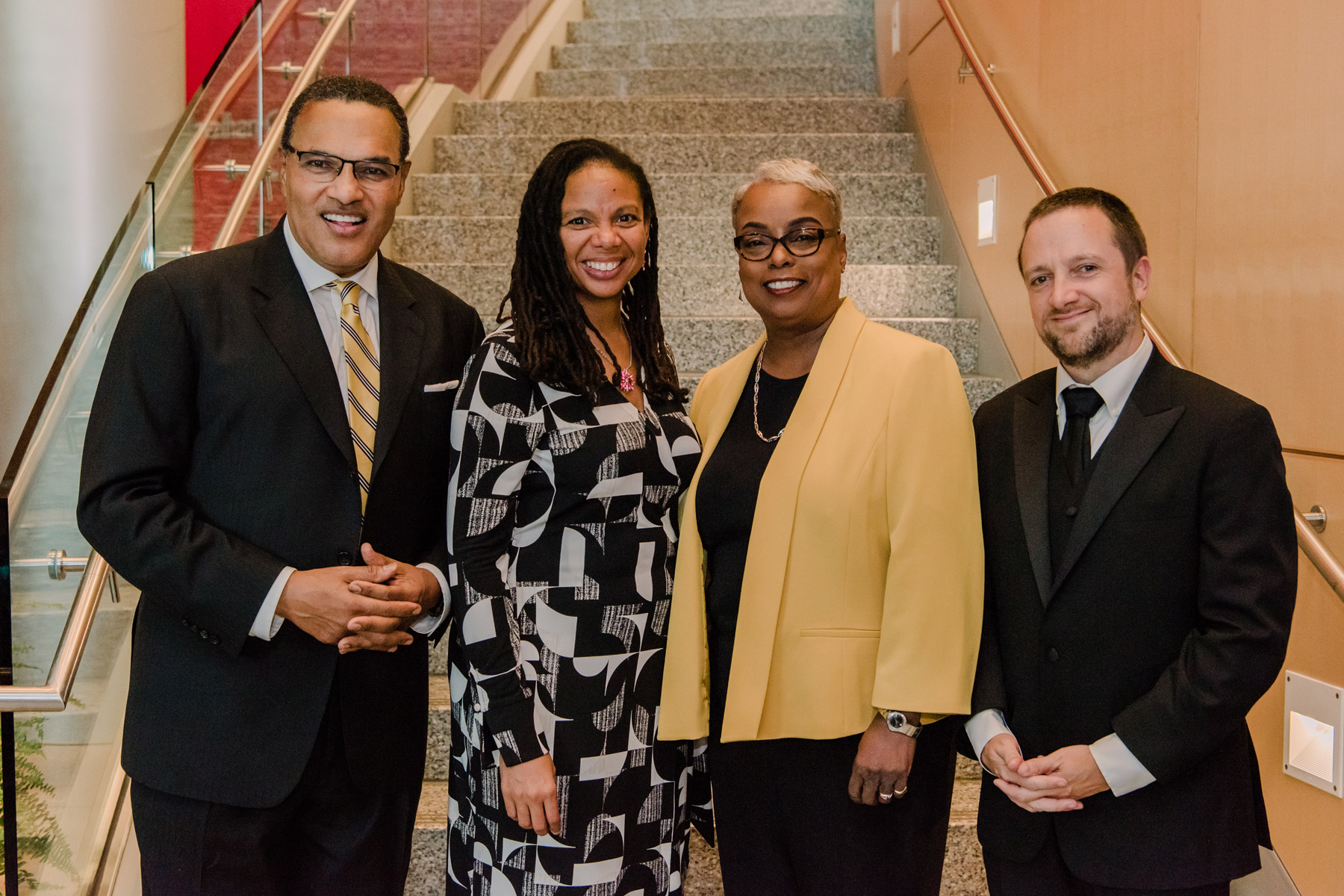
 At the 2019 Alumni Award ceremony, from left to right: Dr. Hrabowski, Dean Kimberly Moffitt, La Jerne Terry Cornish, and former president of the Alumni Association, John Becker ’01. Photo by Marlayna Demond ’11.
As Hrabowski prepares for his retirement as UMBC’s president, mentees like Cornish are reminding the higher education community of one of his legacies. No, not UMBC’s transformation from a young state university to U.S. News & World Report’s No. 1 “Up and Coming University” in the nation. That one’s been well documented. And no, not how he helped UMBC become a powerhouse in STEM education and the alma mater for thousands of engineers and scientists of color. That also has prompted some chatter.
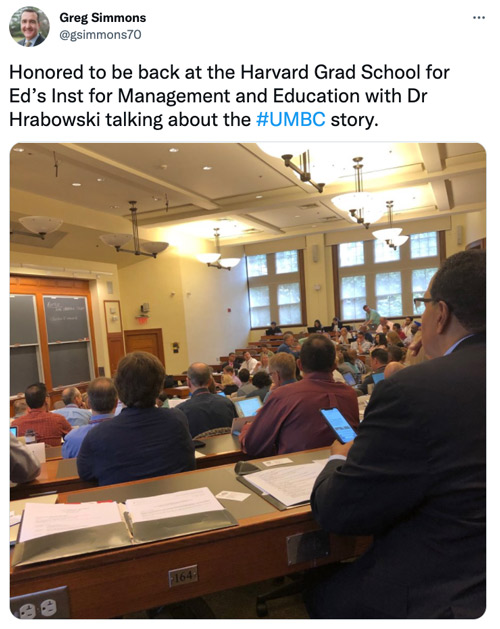
This legacy involves his impact on other chancellors and presidents, along with those who aspire to these roles. In his 30 years as UMBC president, Hrabowski has counseled scores of his peers, including Sylvia Burwell, president of American University; Paula Johnson, president of Wellesley College; and Wendy Raymond, president of Haverford College. He also has taught for 18 years at the week-long Harvard Seminar for New Presidents, which provides a crash course in higher education leadership. And he has mentored countless college and university heads—officially, unofficially, and sometimes without him even knowing it.
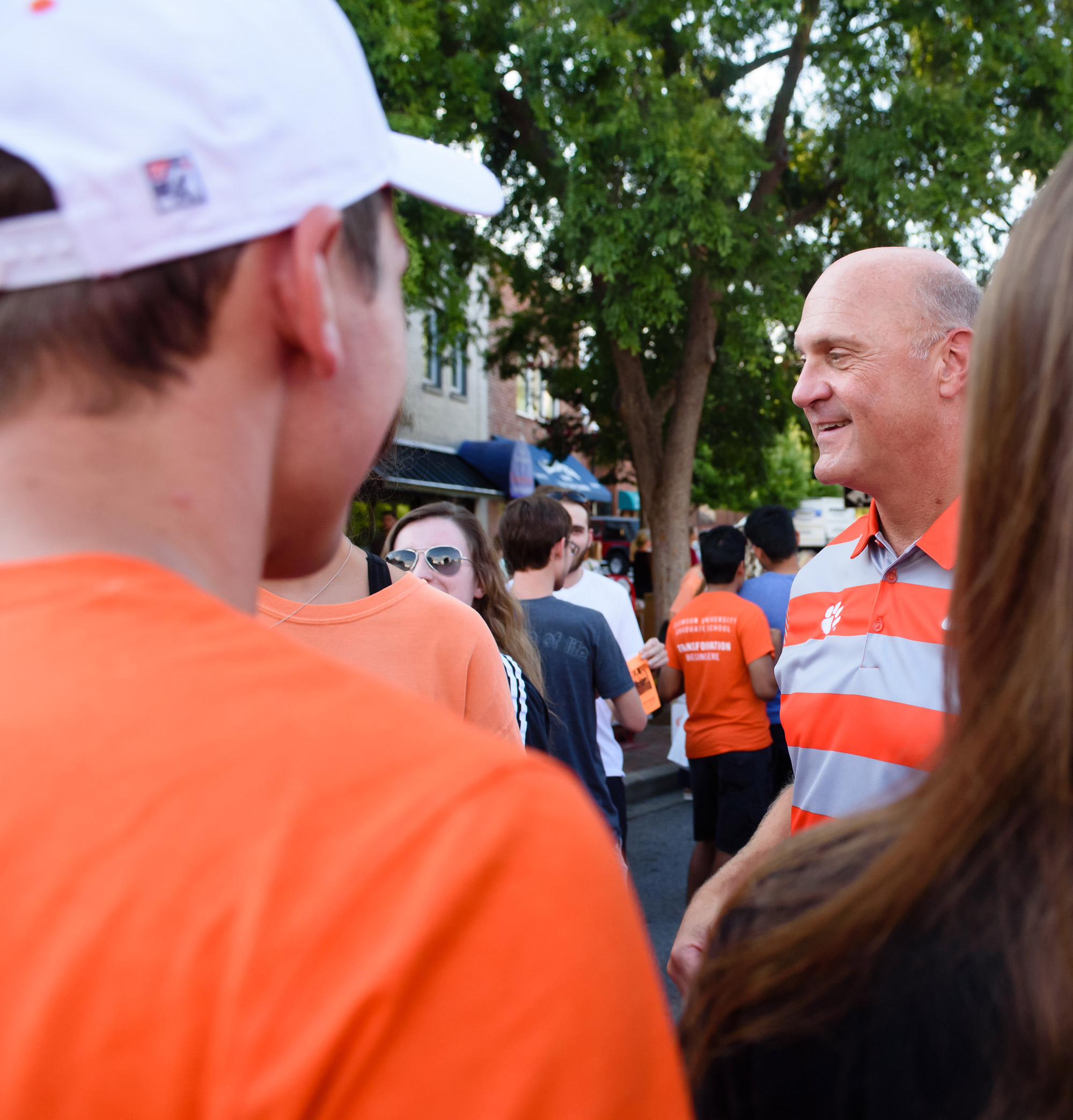
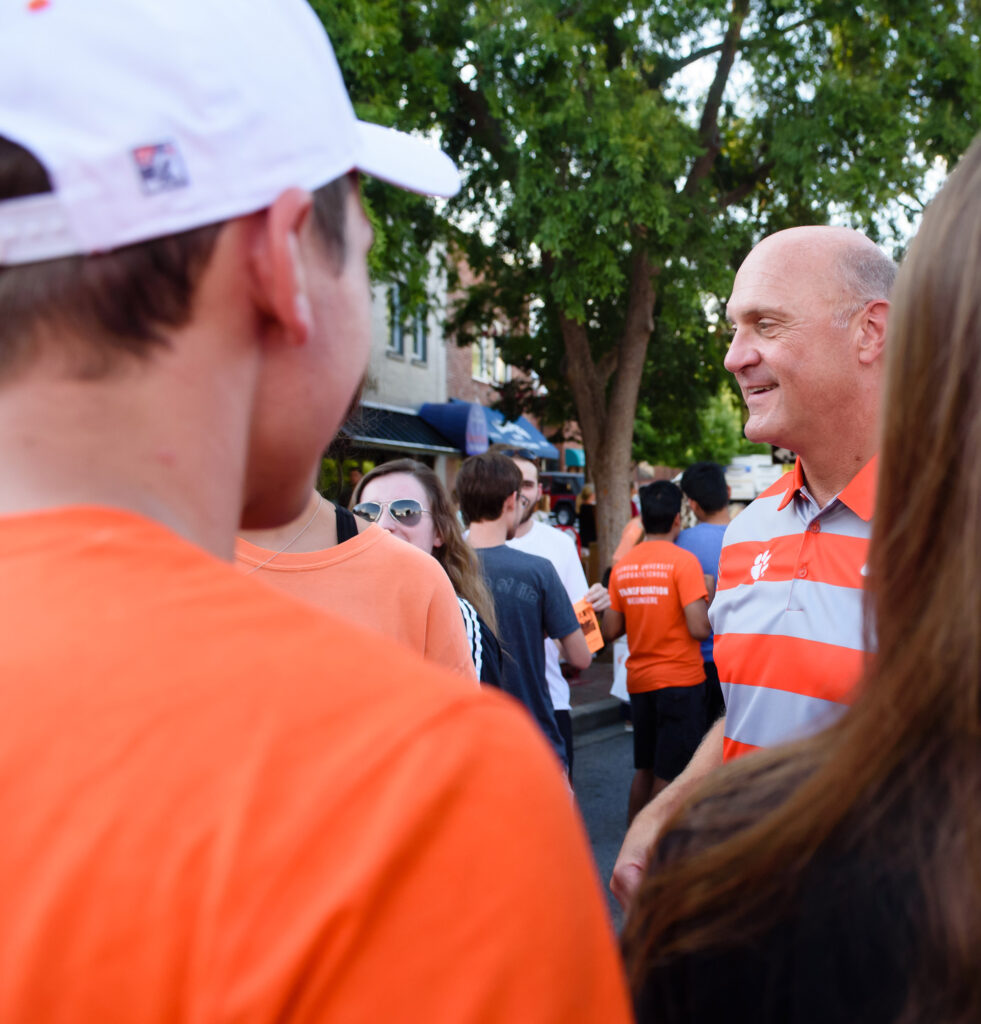 James Clements ’85, M.S. ’91, Ph.D. ’93, serves as president of Clemson University. Photo courtesy of Clemson University.
Hrabowski gave Cornish his cell phone number—along with the promise that she could use it at any time—within weeks of her appointment as interim president at Ithaca in August 2021. She hasn’t needed to use it. But knowing that it’s in her phone gives her a sense of comfort. “He has always been a relational president,” she said. “That’s the one thing about him that stands out for me. I want to be that kind of relational leader—dare I say that kind of servant leader, because that’s what I see in him.”
“I would not be a president if not for him,” said James P. Clements ’85, computer science, M.S. ’91, Ph.D. ’93, operations analysis, who has led Clemson University since 2013. “I have modeled my career after him.”
Had Hrabowski been a fly on the wall during those conversations, he would have brushed aside the accolades, then launched into a speech-slash-sermon about how everyone is capable of greatness, how it’s about the students, not the leader. “He would say that he isn’t that rare,” Cornish said. “He would say that there are other people who, given the opportunity and access, could accomplish just as much as he has and more.”
His imagined protestations notwithstanding, though, it does raise an interesting question: Can a college president learn to lead like Freeman Hrabowski? Are such talents innate or are they teachable?
Said Clements bluntly: “He’s special. Everybody who interacts with him knows it.”
“There is only one Freeman and you can’t be him or become him,” said James Honan, senior lecturer in the Harvard Graduate School of Education. “But when you hear him speak, when he answers your questions, when you watch his role modeling, you can incorporate some practices into your leadership that will help you make your institution better.”
No. 1: Take care of yourself.
No. 2: Be authentic.
No. 3: Own your mistakes.
College and university presidents come to Hrabowski so often for advice that the words come tripping off his tongue when he’s asked to recreate what he tells them. In his mind, they’re just things he has learned over the years—sometimes by watching others, sometimes through trial and error. Part of it, he believes, came from his time as a child leader in the civil rights movement in Birmingham, Alabama. One of his role models then was a preacher renowned for his ability to galvanize support and inspire a revolution: the Rev. Martin Luther King Jr.
“I was very fortunate to have experiences that gave me the chance to lead,” said Hrabowski, who was arrested for his participation in the Children’s Crusade march at age 12. “Each of us is a product of our childhood and young experiences, and those experiences shape who we are, what we like, what we don’t like, how we adjust to change, how we address challenges, how we act in the storm.”
Hrabowski practices what he preaches to the leaders he advises. He follows rule No. 1—taking care of himself—by meditating via the Calm app every day with his wife, Jacqueline Coleman Hrabowski. No. 2, being authentic, just comes naturally to him. And he may take No. 3, owning his mistakes, more seriously than any college president in the world.
Consider, for instance, this story from 2018—26 years into Hrabowski’s tenure as president. At an event honoring several high academic achievers, it seems he spent a little too much time bragging about UMBC’s first Rhodes Scholar, Naomi Mburu ’18, M26, chemical engineering, who is now at Oxford University working on heat transfer applications for nuclear fusion reactors. The others on stage felt slighted by his fawning words for Mburu.
 Mburu with Dr. Gymama Slaughter in her lab at UMBC in 2018. Marlayna Demond ’11.
How does he know this? Because Mburu came to his office and told him so, an act that required her to summon both justice and mercy. Hrabowski was alarmed by her words, which he recognized were true the moment he heard her speak them. He had indeed failed to give enough attention to all the scholars on stage. “I’ve always taken great pride in working to let every person know how much I appreciate them, that they matter,” he said. “And there I was, without even realizing it, not holding up to my own standard.”
So he called each one, apologized, and asked to hear their stories. According to Hrabowski: “It was a lesson for me: Don’t allow my excitement about one person to take away from helping each [honoree] feel her best.”
That may be Hrabowski’s lesson learned. But the larger one for leaders of higher education institutions is the importance of being open to constructive feedback and criticism, especially if it comes from a student. Leaders who reflect on their failures more than their successes are the ones who experience real growth, said Honan.
“Leadership is a practice,” he said. “It doesn’t always work out. One makes mistakes. There are failures. And I think Freeman can help people see that through his own self-reflection in a very powerful way. And when it comes from a distinguished president, that’s even more powerful.”
Perhaps he took Mburu’s feedback more seriously because she was a student. When Clements was a young faculty member at nearby Towson University, he would often find himself at events where Hrabowski was speaking. It was clear that students were his priority, Clements said. “I listened to his words. I watched his heart. And I saw how he cared so much about making a difference in people’s lives,” he said. “He is driven by helping other people succeed by giving them a better life, by giving them a better path.”
Hrabowski has but one non-negotiable tenet for leading a college or university: Students come first. “I don’t think there’s any role we have as educators that’s more important than connecting meaningfully to our students and to each other,” he said. “We prepare them not simply to work on biochemistry but to decide who they are, what’s important to them. What are their habits of mind? How do they think about different issues? How do they approach problems? How do they think about the world? About their place in the world?”
Teachable Moments
Over the years, though, Hrabowski has found himself dealing with the less romantic side of higher education, as college presidents invariably do. Those situations also create teachable moments for his peers—including one that became a case study for Harvard’s Graduate School of Education.
During a state funding crisis in the 1990s, leaders at UMBC and other state-run universities in Maryland had to find creative ways to offset the losses. Hrabowski turned to the then little-known UMBC Board of Visitors, a sleepy advisory committee that met sporadically and whose membership had dwindled to just three. He revitalized the board by appointing 20 prominent leaders in Baltimore, each of whom received a firsthand look at the momentum building at the university. They also got a close-up look at the young, dynamic president who was promising great things for UMBC and its students.
The board—dubbed “Friends of Freeman” by Sheldon Caplis, then the vice president of Institutional Advancement—became a link to millions in private dollars, which helped refill the coffers during brutal times financially. “You’ve got to build relationships, and it’s even more critical when you don’t come from a private school with wealthy trustees or wealthy alumni when you’re really building from the ground up,” said Caplis, who taught alongside Hrabowski at Harvard’s Institute for Management and Leadership in Education for several years. Caplis said that as the pair recounted the “Friends of Freeman” story to the group, much head shaking and laughter would ensue—as though it were some magic trick that only Freeman Hrabowski could pull off.
“These were new presidents, so a lot of them didn’t have any fundraising experience,” Caplis said. “So they really wanted to know, ‘Well, how do you interact?’”
Again, it raises the question of whether you can teach someone to lead like Freeman A. Hrabowski, III. But at the end of the day, it really doesn’t matter whether it’s nature or nurture, this amalgam of personality traits allowed him to reinvent UMBC and go down in history as one of higher education’s best leaders. Forums like the new presidents seminar are simply a way to “peel back the onion a little bit,” said Greg Simmons, M.P.P. ’04, the current vice president of Institutional Advancement and Hrabowski’s most recent teaching partner at the Harvard seminar. The same goes for college presidents like Cornish, Clements, and others who are fortunate enough to receive his mentoring.
“They don’t have to be Freeman,” Simmons said. “They’ve just got to know how to work with other people in a really effective, genuine, human kind of way. That’s Freeman’s real gift.”
Clements said he has met people across the country who consider Hrabowski their mentor. And that, he said, has a multiplying effect that defies calculation.
“We’re trying to make a difference like he did,” Clements said. “It amplifies his impact because of how he’s helped so many other leaders and how he’s shown us how to lead. It allows us to change more lives based on what we saw him do. It goes way beyond UMBC.”
]]>
By Margaret Moffett For La Jerne Terry Cornish, Ph.D. ’05, language, literacy, and culture, an already remarkable day was about to become unforgettable. There she stood in front of a big...
https://umbc.edu/stories/leaders-among-us/
https://my3.my.umbc.edu/api/v0/pixel/news/119434/guest@my.umbc.edu/7596859e673fc636bce6f0a7f4a5ccbc/api/pixel
computer-science
feature
impact
language-literacy-and-culture
magazine
operations-analysis
spring-2022
spring-2022-special-issue
UMBC News & Magazine
https://my3.my.umbc.edu/groups/umbc-news-magazine
https://assets1-my.umbc.edu/system/shared/avatars/groups/000/001/943/24435aa6207c452e7bc15cc74b42c7bb/xsmall.png?1748556657
https://assets1-my.umbc.edu/system/shared/avatars/groups/000/001/943/24435aa6207c452e7bc15cc74b42c7bb/original.png?1748556657
https://assets2-my.umbc.edu/system/shared/avatars/groups/000/001/943/24435aa6207c452e7bc15cc74b42c7bb/xxlarge.png?1748556657
https://assets2-my.umbc.edu/system/shared/avatars/groups/000/001/943/24435aa6207c452e7bc15cc74b42c7bb/xlarge.png?1748556657
https://assets3-my.umbc.edu/system/shared/avatars/groups/000/001/943/24435aa6207c452e7bc15cc74b42c7bb/large.png?1748556657
https://assets1-my.umbc.edu/system/shared/avatars/groups/000/001/943/24435aa6207c452e7bc15cc74b42c7bb/medium.png?1748556657
https://assets2-my.umbc.edu/system/shared/avatars/groups/000/001/943/24435aa6207c452e7bc15cc74b42c7bb/small.png?1748556657
https://assets1-my.umbc.edu/system/shared/avatars/groups/000/001/943/24435aa6207c452e7bc15cc74b42c7bb/xsmall.png?1748556657
https://assets2-my.umbc.edu/system/shared/avatars/groups/000/001/943/24435aa6207c452e7bc15cc74b42c7bb/xxsmall.png?1748556657
UMBC News & Magazine
0
0
false
Fri, 29 Apr 2022 19:20:19 -0400
Fri, 29 Apr 2022 19:20:19 -0400
Get Your Steps in with Dr. Hrabowski

Many of President Freeman Hrabowski’s working hours are spent at his desk on the phone speaking to organizations that can help better the education of his students, but as often as possible, he’ll take a lap around the campus that has shaped him as much as he’s shaped it.
To be a Retriever in any of the last 30-plus years is to have a “Freeman story.” For many people, it’s pretty similar. President Hrabowski saw you on Academic Row and asked your major and where you went to high school. President Hrabowski got on your elevator and asked your major and where you went to high school. President Hrabowski stopped by your lunch table in The Commons and—you guessed it—asked your major and where you went to high school.
You’d think he might get tired of hearing the answers, but instead, they seem to animate him. He has rejoinders for any response and is indefatigable as he strides around the campus he’s watched grow up for more than three decades.


These are the liturgies of life at UMBC under the leadership of President Freeman Hrabowski. He’s always going to say, “Enjoy the food, I was cooking all night.” He’s going to offer you his elbow to bump instead of his hand (he was doing this cold-avoiding precaution well before COVID-19). He’s going to ask if you’ve thought about getting a Ph.D. He’s going to say “focus, focus, focus” and “keep hope alive.” No matter how many times he repeats these things, they never sound trite—and that’s where the magic comes in. He means them each and every time.
Out of Office
On an exceptionally sunny afternoon this February, Hrabowski walks down the packed corridor of Academic Row. Seemingly every student is outside on this summer-gift of a winter’s day. Chatting with folks like he usually does, an eager student yells out from the University Center terrace “I love you, Freeman!” drawing out all the vowels. His reception among students is closer to that of a celebrity—selfies abound. Staff step up shyly to tell him that he’s the reason they’ve stayed at UMBC for 20 years. He asks a table of students the usual questions and along the way discovers it’s someone’s special day. Without skipping a beat, Hrabowski croons “Happy Birthday” to her, entirely at home.
President’s Day
One of the unsung roles of a president is listening to the complaints and suggestions of students and staff. Hrabowski does this task not only ungrudgingly but often and methodically. By a matter of coincidence, a recent student focus group took place on President’s Day. Hrabowski made it clear to the dozen students (all recent transfers) assembled that he had one hour before he needed to head to Annapolis to speak at the Maryland State House about how we learn and talk about our nation’s founding president. For that hour, he made himself fully present and available, taking notes about registration frustrations, organic chemistry woes, study abroad hopes, and a plethora of other topics.
For each student, he had a resource to give them and encouraged them to follow up with him about their progress. “The thing a president does,” he told the students with a laugh, “is point you to other people who can help you.”
Let’s Go on a Walk
Most of Hrabowski’s days do not include hours-long walks, but as often as possible, he’ll show his guests around a campus that has made its mark on him as much as he has on it. You could nearly measure Hrabowski’s tenure by counting the rings on the trees that wrap around the loop, lending their growing shade to the walking path each year—those trunks and branches were part of an early initiative of his to shape the landscape of campus to be more welcoming.
He’ll make sure to bring guests to the meditative spot in front of a statue of his good friend and mentor, the late philanthropist Walter Sondheim. He’ll want to show visitors the new Performing Arts and Humanities Building (PAHB). One story he shares is that when legislators would come to campus early in his presidency, he’d take them to the Fine Arts Building Recital Hall so that they could experience the sound of the flushing toilets next to the auditorium, audible even during productions. The PAHB offers multiple (soundproof) performing venues and is LEED Gold certified, heightening the visibility of the arts and humanities as major components of campus and community life.
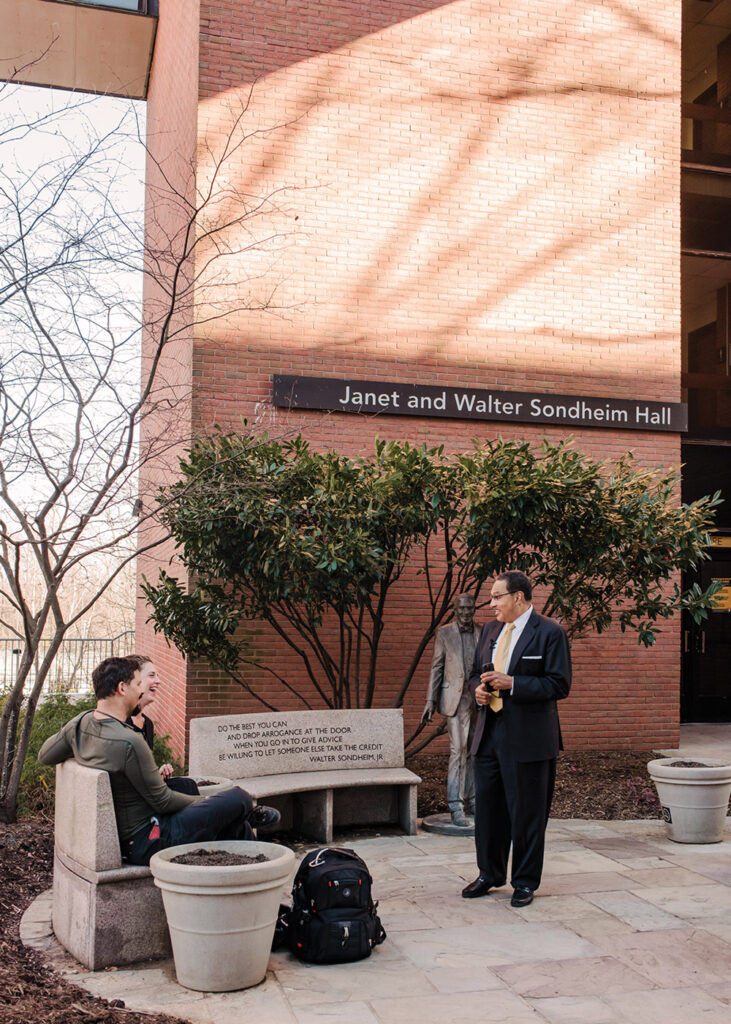
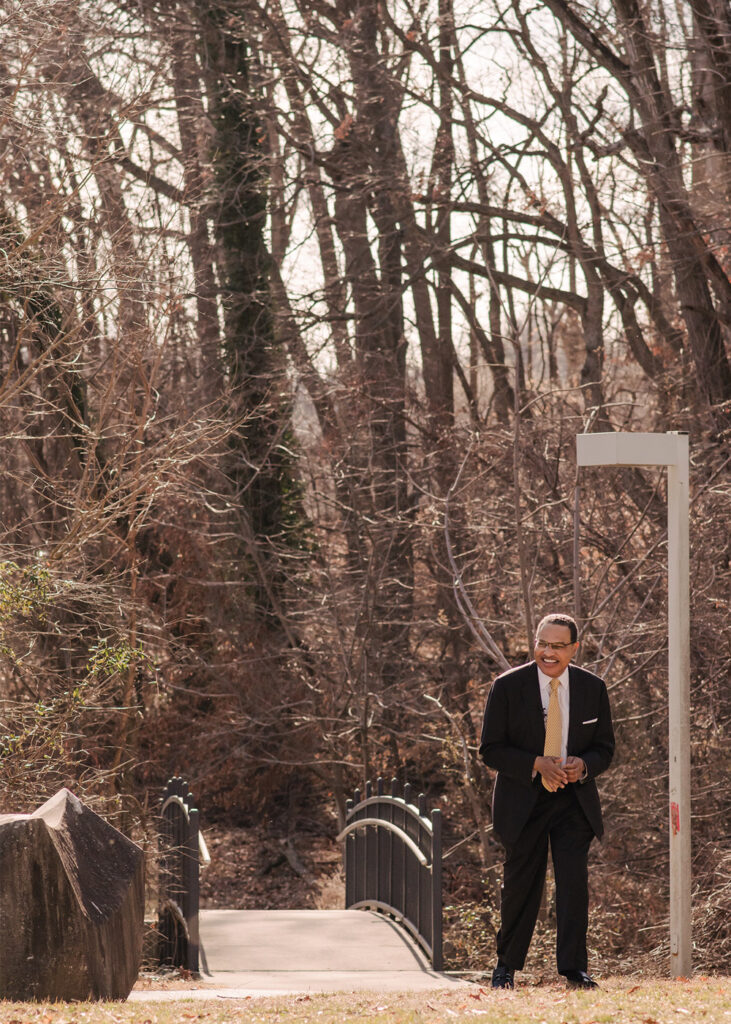
A Break on the Knoll
“Go placidly amid the noise and the haste and remember what peace there may be in silence.” In a virtual Meyerhoff Scholars Program Family Meeting, Hrabowski quotes Max Ehrmann’s “Desiderata,” a poem he memorized 60 years ago. For someone whose role does not offer many moments of silence, Hrabowski does take free seconds throughout the day. When he finds them, he says the shortest prayer, “God help me. God help us.” If he finds a whole minute free, he closes his eyes and meditates. “The hardest thing for any human is not to have a thought,” he says.
In an ideal world, like this perfect day in February, Hrabowski can make the trek down to the Knoll and Joseph Beuys Sculpture Park, across the loop from the UMBC Stadium Complex. The Knoll is a preserved woodland that’s remained undeveloped due to community members continually advocating for campus green space. He pauses here, at peace and temporarily still under the dappled shade.
Interrupting Class
The next stop is the Interdisciplinary Life Sciences Building (ILSB)—a state-of-the-art space for collaborative research and teaching. Hrabowski taps on the door of a class in a large lecture hall to listen in on discussion of math counter examples. His eagerness to be in the classroom is palpable. Hrabowski frequently says, “I have so much more to learn.” Despite the administrative duties he’s called to perform, perhaps the staying power of more than 30 years at a university is an authentic life-long desire for learning. It’s what makes his repeated interactions with students impactful instead of trite—he’s truly curious about the world around him.
Stopping for Research
Walking into Professor Chris Swan’s Geography and Environmental Systems lab on the second floor of the ILSB, Hrabowski quips about the tray of leaves on the counter, “Are you heating that up for food or science?” “For science,” the students reassure him as they explain the leaf litter they’re working with. After collecting the specimens from streams on campus, “we measure the functional diversity and the rate of decomposition.”
“And why is this important?” Hrabowski asks genuinely, the constant wheels of learning turning in his head. Swan’s research group responds that they’re establishing the importance of biodiversity to better understand invasive diseases that have decimated some ash and oak species—questions that ultimately might help keep more of UMBC’s many trees alive and healthy.
Making Campus Inviting
It’s nearly 70 degrees outside, and we’re closing in on our step goal. Hrabowski shows no sign of slowing down. He doesn’t need a drink of water, he doesn’t need a break. He stops only to congratulate a group of women’s lacrosse players throwing a ball around the Quad for their explosive win earlier that week (17-9 against American University).
As he makes his way back to the Admin building and his desk and messages waiting for him, Hrabowski recounts an early walk in his tenure as UMBC president. He was showing then Maryland Governor William Donald Schaefer around campus. He wanted the governor to know how well UMBC functioned with the state support it received but also how it could function so much better with more investment. “And for years,” says Hrabowski, “Schaefer told people, ‘That young president walked the hell outta me all over campus,’” laughing that he just had to say “yes” to all of Hrabowski’s requests because he was too out of breath from the vigorous walk to say anything else.
But the results of that and other fruitful conversations over the past three decades are evident everywhere. Students may take The Commons for granted, or the Knoll or even lounge spaces in the library, but all of those spaces are intentional, says Hrabowski.
The campus changes he’s most proud of are those that encourage community. “There are more spaces where you can sit and commune, talk to people, reflect,” says Hrabowski. “In the early years, people would come to campus and then leave. Not all, but those who were not residential. Now there are so many places where people can just study, laugh, get to know other people, and build community over time.” In his eyes, these places of invitation are the crowning achievement of the physical campus.
Up to the 10th Floor
As he enters the elevator to take him to his office, he waves joyfully. The next part of his day will be very different from his crowd-pleasing walk but no less important. He’ll make the case for increased funding to the National Science Foundation. He’ll moderate a Chronicle of Higher Education virtual panel on the importance of resources for our growing population of first-generation students. He’ll make phone calls to put UMBC on the radar of state legislators and other folks in a position to give his students a better education.
He’ll forget to drink more than several cups of tea provided by his executive assistant as he endlessly and eagerly promotes a university that has shaped him as much as he has shaped it. He will do and say the same things over and over again without them sounding trite, because he believes in the power of words. And most of all, he believes we will keep hope alive.
*****
All photos by Marlayna Demond ’11.
]]>
Many of President Freeman Hrabowski’s working hours are spent at his desk on the phone speaking to organizations that can help better the education of his students, but as often as possible,...
https://umbc.edu/stories/get-your-steps-in-with-dr-hrabowski/
https://my3.my.umbc.edu/api/v0/pixel/news/119444/guest@my.umbc.edu/e6fd5aeb9721e2a0604ba41c4aea6788/api/pixel
campus-life
feature
freeman-hrabowski
magazine
spring-2022
spring-2022-special-issue
UMBC News & Magazine
https://my3.my.umbc.edu/groups/umbc-news-magazine
https://assets1-my.umbc.edu/system/shared/avatars/groups/000/001/943/24435aa6207c452e7bc15cc74b42c7bb/xsmall.png?1748556657
https://assets1-my.umbc.edu/system/shared/avatars/groups/000/001/943/24435aa6207c452e7bc15cc74b42c7bb/original.png?1748556657
https://assets2-my.umbc.edu/system/shared/avatars/groups/000/001/943/24435aa6207c452e7bc15cc74b42c7bb/xxlarge.png?1748556657
https://assets2-my.umbc.edu/system/shared/avatars/groups/000/001/943/24435aa6207c452e7bc15cc74b42c7bb/xlarge.png?1748556657
https://assets3-my.umbc.edu/system/shared/avatars/groups/000/001/943/24435aa6207c452e7bc15cc74b42c7bb/large.png?1748556657
https://assets1-my.umbc.edu/system/shared/avatars/groups/000/001/943/24435aa6207c452e7bc15cc74b42c7bb/medium.png?1748556657
https://assets2-my.umbc.edu/system/shared/avatars/groups/000/001/943/24435aa6207c452e7bc15cc74b42c7bb/small.png?1748556657
https://assets1-my.umbc.edu/system/shared/avatars/groups/000/001/943/24435aa6207c452e7bc15cc74b42c7bb/xsmall.png?1748556657
https://assets2-my.umbc.edu/system/shared/avatars/groups/000/001/943/24435aa6207c452e7bc15cc74b42c7bb/xxsmall.png?1748556657
UMBC News & Magazine
0
0
false
Tue, 19 Apr 2022 14:38:34 -0400
Tue, 19 Apr 2022 14:38:34 -0400
Game Changers

At their most basic levels, learning and play can look a lot alike. Both call for creativity and resourcefulness; inspire curiosity; and require failure, reflection, and practice. For some students, learning isn’t all fun and games. But members of the UMBC community are looking to change that.
Kerri Evans always strives to make her curriculum engaging, but knew she needed a new way to connect her students to the material. As a social work professor at UMBC, Evans teaches and studies the experiences of recent immigrants and refugees to the U.S. and wanted a new way to expose her students to the trials and triumphs of immigrant children navigating the U.S. education system.
“Social work curriculums largely rely on analyzing and reflecting upon case studies,” Evans says. “But immigrant stories are so diverse—it’s hard to understand the breadth of their experiences just by reading and responding to a case study.”
While working as a program manager at Lutheran Immigration and Refugee Service in downtown Baltimore, Evans saw how an engaging training activity helped foster parents, educators, and staff to better understand the experiences of immigrant and refugee children. For the activity, participants read cards containing stories of immigrants as they navigated various stages of their journey, like falling off the train in Guatemala, or losing your relatives at the U.S. and Mexico border, for example. A group discussion followed of how these experiences, some horrific, influenced the lives of unaccompanied children in the U.S.
“It wasn’t a game in the traditional sense, but it was inspiring and engaging,” she says.
And thus, Evans’ idea for the board game “Emerging: The Educational Journey of Immigrant Students” was born.
The gamification of learning is an approach more instructors are adopting to motivate their students to think outside of the box. Professors like Evans and others are maximizing enjoyment and engagement in their classes by capturing the interests of students and inspiring them to keep learning. Students across disciplines at UMBC are getting hands-on experience building games—tangible ones like “Emerging” as well as a host of video games that also foster a collaborative learning environment. Both the students and teachers agree: Learning is a lot easier when you’re having fun.
Understanding the “Rules of the Game”

“Emerging” is still in its infancy, but it is attracting the help of people across the UMBC community. In fall 2021, Evans paired up with UMBC’s assistant professors of education, Jiyoon Lee and Keisha Allen, and five UMBC undergraduate and graduate students to help bring the game to fruition.
Both the game and a future interdisciplinary course will focus on the immigrant experience in the U.S. from pre-kindergarten to college, with the goal of teaching UMBC students who will become service providers and teachers to understand the experiences faced, to advocate for inclusion, and to dismantle racism in schools.
 Kerri Evans headshot courtesy of Melissa Penley Cormier.
Funded by a UMBC Hrabowski Innovation Fund Grant: Implementation and Research Award, “Emerging” will be a multiplayer, cooperative game where participants assume the role of an immigrant child and work together to gain the resources necessary for “success” such as educational attainment, language skills, and social networks. Along the way, players will face challenges, get helpful boosts, and be forced to mitigate stress before it brings the game to a close. Picture Forbidden Island- meets-Catan-meets-Monopoly-meets immigrant experiences.
Participants will need to achieve both happiness and self-sufficiency to win, and players will lose if their stress levels get too high or if they are unable to access help and resources they need.
Advancing on the board will require strategy, resourcefulness, collaboration, and a little bit of luck. Players could land on spaces that require them to pick a card that describes a “win” or a “setback.” Wins may include getting an A on a test, making a new friend, or having a teacher stick up for you. Setbacks may look like getting bullied, forgetting to turn in your homework, or having troubles with immigration status.
Players can also gather “resources” along the way, which could come in the form of joining a sports team, partaking in an after-school program, or going to a tutoring session. These resources play an integral role in managing your players’ mental health, an essential part of winning the game.
All of the “wins” and “setbacks” will be based on real-life stories collected by a research process the students are currently undertaking, something Evans says is important to the integrity of the game.
“We don’t want these stories to be hearsay or things that could theoretically happen, we’re doing our research to create an accurate game of experiences that have truly happened,” Evans says.
“I think we are creating something really special,” says social work and psychology undergrad Ashley Pereira ’22, who is part of the team currently analyzing hundreds of peer-reviewed journals and case studies to find stories of success and heartbreak to include. “And to know we are creating it in a way where it’s based on research just makes you feel so confident about the decisions you make.”
The game also aims to highlight the cultural differences within the education systems of various countries. For example, Evans says, it’s important to be mindful that immigrant students may not understand how to open up a locker, or the need to raise your hand to ask for permission to speak. The team is working on ways to include these discrepancies into the game.
“We take for granted that we know the ‘rules of the game,’ in our education systems,” says TESOL graduate student and team member Eric Chen ’22. “If educators assume children from other countries come in with this knowledge, it can put the kids at a disadvantage.”
Like all great games, “Emerging” plays on participants’ emotions. The stakes are high, and tragedy or triumph may be just around the corner.
Game Developer Galore
Over in the Engineering building, a different type of game development is taking place. Over 46 game developers are congregating to create the next great video game. Founded in 2005, the Game Developers Club is dedicated to bringing students of all majors and skill levels together to learn about game development, work as a team, and of course, create video games.
Emotions are high around this time of year, as club members pitch their ideas to the group in hopes their game will garner interest from other club members. Vice president of the club, Seth Davis ’22, computer science, is well acquainted with the process. He’s been a part of the club for three years and has created three games. Pitch time is his favorite time of the year.
“It’s always so exciting to see a person get up in front of the club and talk about an idea they’re passionate about,” Davis says. “Some people are so nervous that others won’t like their idea, but then after they pitch it, five people come running up to them saying they love the idea and want to support them.”
In 2020, Davis pitched the idea for a game called Binary Bubbles, a side-scroller (think Super Marios Bros.) puzzle game. The goal is simple: Get to the yellow flag as quickly as you can. The catch? There are malfunctioning robots in the way. Using strategy and logic, players must hack into the robots, steal their code bubbles, and move the code bubbles to other robots.
Davis and his team created 20 levels that span over two worlds, something he says would only be possible by working with an interdisciplinary team. Davis enlisted the help of art students, music students, and English students to make his games a reality.
“There are so many majors represented in the club, it’s not just computer science people,” he says. “This club teaches you how to work as a team to create an amazing product.”
Turning games into jobs
If Davis had to pick a second-favorite time of year, it would be the unveiling of the games. It’s when club members take their projects to the school and community and let others play the video games they’ve worked so hard to create.
Binary Bubbles was featured at 2020’s Undergraduate Research and Creative Achievement Day (URCAD) along with 13 other video games created by members of the Game Developers Club. Previous games have also been featured at Artscape, Baltimore’s largest annual art festival.
Members of the Game Developers Club receive more than just thunderous applause at URCAD and Artscape, they also get job offers from blue-chip employers. They’ve gone on to find positions at Facebook, Unity Game Engine, and Firaxis games, to name a few.
“Our club is actually very career-focused,” Davis says. “Employers love it when they see our portfolios and see we completed a game. Lots of former members got jobs because of this club.”
As a member of the club’s executive board, Davis works hard to ensure the games are seen by as many people as possible, including professional game developers. Some of those professionals are former club members themselves. Davis says alumni like Eric Jordan ’08, computer science, currently at Facebook, are eager to help current club members achieve their dreams.
“This club is such a great way to network and build real relationships,” Davis says. “It’s the perfect way to get that gaming job you’ve always dreamed of.”
The Go-To Gamer Guy
Marc Olano knows a thing or two about video games—he’s commonly referred to as UMBC’s “go-to gamer guy.” Ironically, Olano isn’t much of a gamer himself, but he certainly knows the recipe for creating a great game.
 Marc Olano headshot courtesy of Ryan Zuber ’04, Imaging Research Center.
Olano has been doing research on video game graphics hardware for over 25 years. He pioneered procedural shading on graphics hardware, a technique that is used to add details to a surface of an object. The model is now the standard on every PC and game platform. Olano also pioneered UMBC’s Game Development track and helped usher in UMBC’s 3D photogrammetry scanning facility in 2015, now serving as the director for both.
The Game Development track and the Visual Arts Department’s Animation and Interactive Media concentration make up “GAIM:” UMBC’s Games, Animation and Interactive Media program. GAIM prepares students for careers in the video game industry, and exposes them to internship opportunities at local game development companies such as Firaxis, Big Huge Games, Epic Games, Mythic Entertainment and Zynga.
In the GAIM capstone course, visual arts and computer science students join forces for a semester to design an original game. The course mimics the setup of teams in the industry where 500 artists and programmers must work together for several years to develop a single game.
“My role is teaching the students how to do the work, then letting the students figure out for themselves how to actually do it,” Olano says. “I’ve found it brings students a lot of joy to know they created something very independently.”
“Bandit”
Olano’s first taste of an educational game development project was with UMBC history professor Anne Rubin. In spring 2015, Rubin and Olano united their classes to create a computer game called “Bandit” which detailed the 1861 Pratt Street Riots, an event many scholars believe was the site of first blood shed in the American Civil War. Undergraduates in the Game Development track built the game and Rubin’s history students served as historical researchers and consultants.
 A still from “Bandit.”
In the game, players control a fox who is on the loose on the streets of Baltimore during the Pratt Street Riots, when Massachusetts militiamen came in contact with anti-war protestors in Baltimore. The fox is on the hunt for documents from the riots which can be examined and recorded all while trying to avoid guards patrolling Pratt Street.
“MeetingMayhem”
Olano is currently working with professor of computer science Alan Sherman and students from the UMBC Cyber Defense Lab to create a video game called “MeetingMayhem.” The web-based game aims to help students learn about adversarial thinking, or the ability to embody the technological capabilities and strategic reasoning of hackers. The goal of the game is to arrange a meeting time and place by sending and receiving messages through an unsecure network that is under the control of a malicious adversary. Players can choose to be the hero or the villain, or in this case, the benevolent meeting-maker or the hacker. The hacker can disrupt the efforts of the meeting-maker by intercepting, modifying, blocking, and injecting messages into the unsecure network.
In this engaging challenge, computer science students learn the basics of the Dolev-Yao intruder network model, a framework used to analyze safety protocols within a communications network. Students also learn the value of using cryptography to mitigate these dangers.
What Does it Mean to Win?
Across UMBC, professors and students are harnessing the power of play to enrich their learning experiences. Be it video games, board games, or anything in between, Retrievers are rich with ideas of how to make learning a little more interactive and a lot more fun.
Olano, who was recently appointed associate dean for Academic Programs, is adjusting to his new responsibilities, but for him, it’s still all about the students and the games.
“It never gets old seeing students when they realize they can actually build a game for themselves and they are excited doing it,” Olano says. “Honestly, it brings me a lot of joy, too.”
For Evans, winning means the participants of “Emerging” leave the game with more insight than before—even insight into what different types of “success” could look like. In the meantime, her students will experience joy as they learn research skills, build the game, and begin to introduce the game to more students in the coming semesters. The team plans to gain knowledge from other UMBC students who are immigrants themselves and discover how this subset of students found success in college. After that, the team will enlist the help of UMBC art students to help design a prototype. In the future, the team hopes to premiere the game to educators outside of the UMBC community
“People have sympathy reading case studies, but it’s not nearly as visceral as if you’re playing a game and your character experiences something tragic and now you’ve lost three turns,” Evans says. “Players will feel the anger of feeling left behind and the joy of successes.”
For Davis and the Game Developers Club, winning means making friends, networking, and having fun. “At the end of the day, we’re really just having a great time making games,” he says.
— Kennedy Lamb ’20 and Illustration by Marissa Clayton ’21.
]]>
At their most basic levels, learning and play can look a lot alike. Both call for creativity and resourcefulness; inspire curiosity; and require failure, reflection, and practice. For some...
https://umbc.edu/stories/game-changers/
https://my3.my.umbc.edu/api/v0/pixel/news/119511/guest@my.umbc.edu/51b1aa91d1683e4c7643d7fd56245749/api/pixel
cahss
campus-life
coeit
computer-science
education
fall-2021
feature
game-development
history
social-work
video-games
visual-arts
UMBC News & Magazine
https://my3.my.umbc.edu/groups/umbc-news-magazine
https://assets1-my.umbc.edu/system/shared/avatars/groups/000/001/943/24435aa6207c452e7bc15cc74b42c7bb/xsmall.png?1748556657
https://assets1-my.umbc.edu/system/shared/avatars/groups/000/001/943/24435aa6207c452e7bc15cc74b42c7bb/original.png?1748556657
https://assets2-my.umbc.edu/system/shared/avatars/groups/000/001/943/24435aa6207c452e7bc15cc74b42c7bb/xxlarge.png?1748556657
https://assets2-my.umbc.edu/system/shared/avatars/groups/000/001/943/24435aa6207c452e7bc15cc74b42c7bb/xlarge.png?1748556657
https://assets3-my.umbc.edu/system/shared/avatars/groups/000/001/943/24435aa6207c452e7bc15cc74b42c7bb/large.png?1748556657
https://assets1-my.umbc.edu/system/shared/avatars/groups/000/001/943/24435aa6207c452e7bc15cc74b42c7bb/medium.png?1748556657
https://assets2-my.umbc.edu/system/shared/avatars/groups/000/001/943/24435aa6207c452e7bc15cc74b42c7bb/small.png?1748556657
https://assets1-my.umbc.edu/system/shared/avatars/groups/000/001/943/24435aa6207c452e7bc15cc74b42c7bb/xsmall.png?1748556657
https://assets2-my.umbc.edu/system/shared/avatars/groups/000/001/943/24435aa6207c452e7bc15cc74b42c7bb/xxsmall.png?1748556657
UMBC News & Magazine
0
0
false
Wed, 08 Dec 2021 22:01:17 -0500
For the Love of Dirty Jobs

First Mate Alex Barnard ’09, American Studies spends many mornings high atop the mast on the 150-foot sailing ship Kwai, watching the bright horizon of the Pacific Ocean through binoculars for the shimmer of an abandoned fishing net. When she spots a clump of plastic waste, she guides the captain toward the tangle of fishing nets and the garbage they accumulate.
Then sailors on deck throw grappling hooks into the floating trash. A hydraulic crane hauls onto the deck the dripping hunks of degrading plastic nets—sometimes the size of Volkswagen Bug, sometimes 100 feet long. Barnard and the crew stumble through tangles slick with algae and seaweed, throwing the trash’s resident crabs and fish back overboard. Those moments are cathartic, Barnard says, as if they’ve just pulled a rotten tooth from the mouth of the ocean.
“I just think about that moment as beautiful. I love seeing that net up on deck,” Barnard says. “It’s so toxic and then to watch it come out. Just to be able to do that all day every day. It’s pretty amazing.”
Walking down a steep hill on her family’s farm, Roxann Brooks Motroni ’06, M14, biological sciences is searching for her cattle.
“Hey mamas! Hey cows!” the veterinarian calls. A fuzzy black head pops up over the next hill and bellows. The cattle gallop toward Motroni and her bucket, which rattles with hay cookies.
She steps into the pasture and is mobbed by her family’s cattle, the flies clustered on their backs in the late autumn heat. Cookie, the black Lowline Angus most fond of the treats, pushes to the front of the herd. The cow’s foot-long tongue curls around Motroni’s forearm, leaving bubbly trails of slobber and grass bits.
Ignoring the fresh cow patty her black boot has just stepped in, Motroni hands out cookies, then tosses the rest of the nuggets into the scrum. She swipes off her freshly slimed arm and continues naming the cattle—The Hereford, Valentino the bull, and her favorite, Nellie, named for a great-grandmother because they’re a bit alike.
“Sweet, but a little suspicious of new people,” Motroni says and wades out of the herd distributing scratches all around, oblivious to the flies and slobber and excrement.
Stephen Bradley, associate professor in the Department of Visual Arts, hauls on a braided cord connected to a white lifesaving ring that bobs on the water of the Jones Falls in Baltimore. A Doritos package, two latex gloves, a slick of oil, and some liquor bottles float nearby. And that’s just what’s visible. Other ingredients in the toxic stew flowing toward the Inner Harbor are heavy metals, fertilizer, microbes, pesticides, and sewage, as well as industrial sound pollution.
Bradley, an artist who adds video and audio sensory layers to his sculptures, pulls out his dripping hydrophones and fiddles with their connections. Then he lowers the receivers back in, to record the underwater sounds of mussels, gizzard shad, and blue crabs, along with the urban noise of HVAC systems and traffic.
Chatting away, Bradley pulls out his sketch pad to show some drawings, then licks his thumb to turn the page. He stops to grimace at his thumb, which was just mucking about in the murky water.
“Guess I shouldn’t have done that,” he says.
Making a difference in the world isn’t always a neat endeavor. Hard to keep your hands clean when you’re raising cattle humanely and safely, pulling communities together to pick up trash and make art, or hauling tons of plastic waste from the Pacific Ocean. These three Retrievers all find immense joy in work that is sometimes smelly, usually dirty, and always requires an intrepid spirit.
Sustainability sparked Barnard’s quest
Alex Barnard wrote her UMBC honors thesis on her attempts to live sustainably in Baltimore. “Extremely challenging,” Barnard summarizes, with a wry chuckle. “It completely changed my life. I see everything through this lens now.”
For nearly 10 years, she traveled, trying to live lightly on the planet. She worked in an eco-cafe in Fiji, labored on an organic farm in Hawaii, sailed on eco-tourism voyages in the South Pacific, and biked New Zealand.
Now, she has her captain’s license and sails as a chief mate on National Geographic voyages to Costa Rica, Alaska, and Baja with Lindblad Expeditions, a company known for its green approach to travel.
 Alex Barnard (top, center) poses with her team. All photos of Barnard, courtesy of Ocean Voyages Institute.
Barnard’s schedule of two months on, two months off gives her time to volunteer on the Kwai for the Ocean Voyages Institute. The institute partners with companies that turn the trash into fuel, shoes, clothing, and building blocks for construction.
Through overconsumption and improper trash disposal, humans have created five garbage patches in the Pacific, Atlantic, and Indian oceans, where trash is concentrated by currents.
 Courtesy of Alex Barnard and Ocean Voyages Institute.
Discarded nets and lines from fishing boats now make up 46% of the waste in the Great Pacific Garbage Patch, according to the World Wildlife Fund. Dubbed “ghostnets” or “ghost gear,” the fishing waste kills marine life by the thousands—turtles and whales and dolphins tangle themselves in the nets that are tossed off fishing boats. But because oceans are vast, and the nets sink and bob in the waves, they’re difficult to find.
“It’s not like wading through trash,” Barnard explains. “There are big spaces in between. If you were at sea level, the nets are hard to see. We could be sailing right by one and not see it until we’re past it. The plastic breaks down in UV light. A lot of it is microplastic, which is deadly to the ocean.”
Last summer, Barnard and the Kwai crew hauled 170 tons of plastic from the ocean, a fraction of the 17 billion tons dumped into the world’s waters every year. Other organizations, like Sea Shepherd Conservation Society, Greenpeace, The Ocean Cleanup, and the 5 Gyres Institute, are also focusing on ghostnet removal. Many environmental groups are pushing the Global Ghost Gear Initiative, a collaborative effort by the fishing industry, NGOs, governments, and researchers to regulate plastic dumping.
“This work is possible and successful,” Barnard says. “The idea is to show that we need more boats, a fleet of vessels doing the same thing. It feels like a starting point more than anything.”
Temporarily on land, in a remote cabin in Michigan where she’s doing some writing for Lindblad, Barnard hikes often, always with a trash bag.
“It’s my dream to go somewhere and not have to pick up trash,” Barnard says. “I could spend my whole life picking up trash everywhere I go. That’s not very efficient. It has to be bigger than just one person. But it’s better than not picking it up.”
A family farm affair
Every morning and evening, Roxann Brooks Motroni visits her cattle, not just to offer treats but to check the herd for a limp, some pinkeye, a calf that’s not thriving.
Her family started 804 Cattle Company in Upper Marlboro in 2016 with three cows. They now raise 25 cattle on 33 acres. A vet married to an agricultural business expert, Motroni works the farm with her parents, John and Chantal Brooks, both retired doctors. And while Motroni has a day job as a National Program Leader for Animal Health for the USDA’s Agricultural Research Service, focusing on research solutions for livestock diseases, she begins and ends her days on the farm.
“This is a family affair. My mom is the chief cow operator. I do the vet work, my husband does the finances and handyman work,” Motroni explains, plus he’s the beekeeper.


The farm is also devoted to teaching the next generation of farmers and veterinarians. Today, two interns hoping to be veterinarians are chasing Nutmeg the goat and grooming horses. The family brings in veterans seeking help getting started in agriculture, through the Arcadia Center for Sustainable Food and Agriculture. The farm also sells at the Capital Market, whose mission is to provide quality food, produced by businesses and farms run by people of color, to residents of Prince George’s County’s food deserts.
A Meyerhoff Scholar, Motroni quotes its motto, “To Whom Much Is Given, Much Is Expected” and says she lives by it.
Their farm prides itself on their humane and safe practices with their cattle. The animals and their health comes first. No hormones or steroids go into their cattle and they limit antibiotic use to only sick cows. Their chutes and corrals are designed to reduce their cattle’s stress. All animals spend all their lives on grass pastures.
The family also uses regenerative agriculture practices to improve soil health and combat climate change through carbon sequestration while limiting fertilizer and pesticide usage. Motroni crouches in the pasture to show off the shoots of radishes, hairy vetch, turnips, oats, and rye that she interplants with grass, to aerate and fix nitrogen and carbon in the soil. Plus they offer her herd fine dining.
“I didn’t know when I became a cattle farmer that I would also become a grass farmer. I’ve come to realize how magical cow poop is. Every year our pastures get better and better,” she says, laughing. “All those plant physiology classes at UMBC really served me well.”
She hikes up the hill again, squelching through the mud around a water pump.
“Wow, now you can really smell the cow,” she says and smiles at the odor and the view.
Traces of life fuel his art
As an artist, Stephen Bradley sees and hears things a little differently. From the pop of color of a blue plastic container handle to the squelching clicks of the mussels underwater, the evidence of life is fascinating to him.
For more than 12 years, he has labored in the Brooklyn and Curtis Bay area of Baltimore, partnering with the Enoch Pratt Free Library, the National Aquarium, the local Boys and Girls Club, and the Masonville Cove Environmental Education Center to clean up the alleys and streets and to make art, from sidewalk paintings and murals to trash sculptures.
Right now, he’s bent closely over a pier in the Inner Harbor, lowering a round lifesaver strung with microphones and chum to attract fish into the water. He occasionally catches the attention of passersby and eagerly explains his artistic vision to them.
The project that inspired his recording in the Jones Falls waterway is a collaborative biodiversity study with the National Aquarium and the Institute of Marine and Environmental Technology (IMET). IMET has sunk a biodisk in the same areas Bradley is recording, to track biodiversity in the waters by collecting DNA samples. Those findings will be paired with Bradley’s recordings to provide a fuller picture of what’s living in Baltimore’s waterways. Bradley’s Inner Harbor’s soundtrack is run through a spectrograph to determine what species made the sounds, most of which can’t be heard by human ears, such as the mating songs of water bugs.
“With these recordings, it’s almost as if I have my ear to the water,” he says. “The gift is going home and listening.”
Bradley’s portion of the IMET project, called Bio-Buggy: Ear to the Harbor, will draw attention to the harm that human-generated noise pollution inflicts on aquatic species, including disrupting mating and growth.
In the fall, Bradley was recording at Marshy Point Nature Center and heard explosions coming from his underwater recorders, from the direction of Aberdeen Proving Ground, nearly 30 miles away.
“Hundreds of small minnows leaped out of the water each time there was an explosion, and there were nine huge discharges,” Bradley says. But in between, he heard the complex harmonies of bubbles and critter sounds, something he calls “musical marshlands.”
He has also built an exhibit, called the “Oh, Murky Waters Chorus,” with trash compositions, an aquarium with teeny water critters still living on one of those IMET DNA sampling biodisks, and an interactive video of microscopic creatures paired with their noises. The art installation showed at UMBC’s Center for Art, Design, and Visual Culture in 2019, and Bradley hopes to exhibit it again, as a work-in-progress later in 2022.


“The trash-filled sculptural elements in the art installation…are there to represent the stress and urgency for us as a society to gain control of our waste before we drown from it,” Bradley explains. Baltimore has taken recent steps, including banning polystyrene and taxing plastic bags, to reduce the trash in the Inner Harbor enough that if it hasn’t rained in 48 hours, according to Blue Water Baltimore, some areas are swimmable.
At the IMET open house next spring, Bradley hopes to show a prototype of the Bio-Buggy, a mobile science and sound collection lab, which engineering students at UMBC will work to design with him as their capstone project. The Bio-Buggy exhibit will also feature Bradley’s sound compositions based on the Inner Harbor and other Chesapeake Bay recordings.
“I have no aspiration to be a scientist, but I am inspired by science, the tools, the rigor, the process,” he says and tucks his headphones back on, listening for evidence of life in the waters. Perhaps, Bradley hopes, if people hear and see the life below the surface, they’ll pocket their Doritos packages and recycle their water bottles, instead of tossing them in the gutter for him to find later.
People who care about change must be willing to plunge their hands deep into the mess of this world. It’s a dirty job, but someone’s gotta do it.
— By Susan Thornton Hobby
*****
All photos courtesy of Marlayna Demond ’11 unless otherwise noted.
]]>
First Mate Alex Barnard ’09, American Studies spends many mornings high atop the mast on the 150-foot sailing ship Kwai, watching the bright horizon of the Pacific Ocean through binoculars for the...
https://umbc.edu/stories/for-the-love-of-dirty-jobs/
https://my3.my.umbc.edu/api/v0/pixel/news/119512/guest@my.umbc.edu/4697d91b126c234476387a30740851b2/api/pixel
american-studies
biological-sciences
discovery
fall-2021
feature
meyerhoff-alumni
umbc-magazine
visual-arts
UMBC News & Magazine
https://my3.my.umbc.edu/groups/umbc-news-magazine
https://assets1-my.umbc.edu/system/shared/avatars/groups/000/001/943/24435aa6207c452e7bc15cc74b42c7bb/xsmall.png?1748556657
https://assets1-my.umbc.edu/system/shared/avatars/groups/000/001/943/24435aa6207c452e7bc15cc74b42c7bb/original.png?1748556657
https://assets2-my.umbc.edu/system/shared/avatars/groups/000/001/943/24435aa6207c452e7bc15cc74b42c7bb/xxlarge.png?1748556657
https://assets2-my.umbc.edu/system/shared/avatars/groups/000/001/943/24435aa6207c452e7bc15cc74b42c7bb/xlarge.png?1748556657
https://assets3-my.umbc.edu/system/shared/avatars/groups/000/001/943/24435aa6207c452e7bc15cc74b42c7bb/large.png?1748556657
https://assets1-my.umbc.edu/system/shared/avatars/groups/000/001/943/24435aa6207c452e7bc15cc74b42c7bb/medium.png?1748556657
https://assets2-my.umbc.edu/system/shared/avatars/groups/000/001/943/24435aa6207c452e7bc15cc74b42c7bb/small.png?1748556657
https://assets1-my.umbc.edu/system/shared/avatars/groups/000/001/943/24435aa6207c452e7bc15cc74b42c7bb/xsmall.png?1748556657
https://assets2-my.umbc.edu/system/shared/avatars/groups/000/001/943/24435aa6207c452e7bc15cc74b42c7bb/xxsmall.png?1748556657
UMBC News & Magazine
0
0
false
Wed, 08 Dec 2021 18:02:57 -0500