Calls for a ‘green’ Ramadan revive Islam’s long tradition of sustainability and care for the planet

Written by Noorzehra Zaidi, assistant professor of history, UMBC
For many Muslims breaking fast in mosques around the world this Ramadan, something will be missing: plastics.
The communal experience of iftars – the after-sunset meal that brings people of the faith together during the holy month starting on March 22, 2023 – often necessitates the use of utensils designed for mass events, such as plastic knives and forks, along with bottles of water.
But to encourage Muslims to be more mindful of the impact of Ramadan on the environment, mosques are increasingly dispensing of single-use items, with some banning the use of plastics altogether.
As a historian of Islam, I see this “greening” of Ramadan as entirely in keeping with the traditions of the faith, and in particular the observance of Ramadan.
The month – during which observant Muslims must abstain from even a sip of water or food from sun up to sun down – is a time for members of the faith to focus on purifying themselves as individuals against excess and materialism.
But in recent years, Muslim communities around the world have used the period to rally around themes of social awareness. And this includes understanding the perils of wastefulness and embracing the link between Ramadan and environmental consciousness.
The ban on plastics – a move encouraged by the Muslim Council of Britain as a way for Muslims “to be mindful of [God’s] creation and care for the environment” – is just one example.
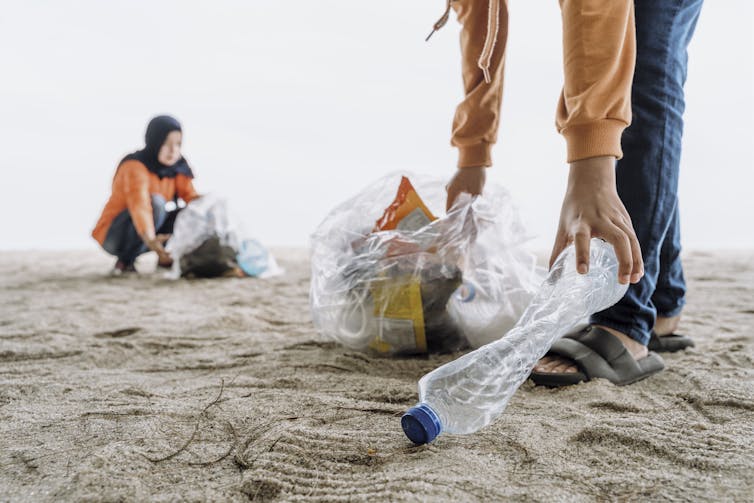 Environmental consciousness has gained traction in Muslim communities over recent years. Yasser Chalid via Getty Images.
Many other mosques and centers are discouraging large or extravagant evening meals altogether. The fear is such communal events generate food waste and overconsumption and often rely on nonbiodegradable materials for cutlery, plates and serving platters.
Quranic environmentalism
While the move toward environmental consciousness has gained traction in Muslim communities in recent years, the links between Islam and sustainability can be found in the faith’s foundational texts.
Scholars have long emphasized principles outlined in the Quran that highlight conservation, reverence for living creatures and the diversity of living things as a reminder of God’s creation.
The Quran repeatedly emphasizes the idea of “mizan,” a kind of cosmic and natural balance, and the role of humans as stewards and khalifa, or “viceregents,” on Earth – terms that also carry an environmental interpretation.
Recently, Islamic environmental activists have highlighted the numerous hadith – sayings of the Prophet Muhammad that provide guidance to followers of the faith – that emphasize that Muslims should avoid excess, respect resources and living things, and consume in moderation.
Although present from the outset of the faith, Islam’s ties to environmentalism received major visibility with the works of Iranian philosopher Seyyed Hossein Nasr, and a series of lectures he delivered at the University of Chicago in 1966. The lectures and a subsequent book, “Man and Nature: The Spiritual Crisis in Modern Man,” warned that humans had broken their relationship with nature and thus placed themselves in grave ecological danger.
Nasr blamed modern and Western science for being materialistic, utilitarian and inhuman, claiming it had destroyed traditional views of nature. Nasr argued that Islamic philosophy, metaphysics, scientific tradition, arts and literature emphasize the spiritual significance of nature. But he noted that numerous contemporary factors, such as mass rural-to-urban migration and poor and autocratic leadership, had prevented the Muslim world from realizing and implementing the Islamic view of the natural environment.
Scholars and activists expanded on Nasr’s work through the 1980s and 1990s, among them Fazlun Khalid, one of the world’s leading voices on Islam and environmentalism. In 1994, Khalid founded the Islamic Foundation for Ecology and Environmental Sciences, an organization dedicated to the maintenance of the planet as a healthy habitat for all living beings. Khalid and other Muslim environmentalists suggest that Islam’s nearly 2 billion adherents can participate in the tasks of environmental sustainability and equity not through Western models and ideologies but from within their own traditions.
Partnering with the United Nations Environment Program, Khalid and other leading scholars crafted Al-Mizan, a worldwide project for Muslim leaders interested in Muslims’ religious commitments to nature. “The ethos of Islam is that it integrates belief with a code of conduct which pays heed to the essence of the natural world,” Khalid wrote in “Signs on the Earth: Islam, Modernity, and the Climate Crisis.”
Going beyond an eco-Ramadan
Environmental crises disproportionately affect the world’s poorest populations, and academics have highlighted the particular vulnerabilities of Muslim communities around the world, such as the victims of devastating floods in Pakistan in 2022.
By highlighting Islamic principles, policies and community approaches, academics have shown how Islam can represent a model for environmental stewardship.
This push for environmental consciousness extends beyond Ramadan. In recent years, Muslims have tried to introduce green practices into the shrine cities in Iraq during pilgrimage seasons in Ashura and Arbaeen.
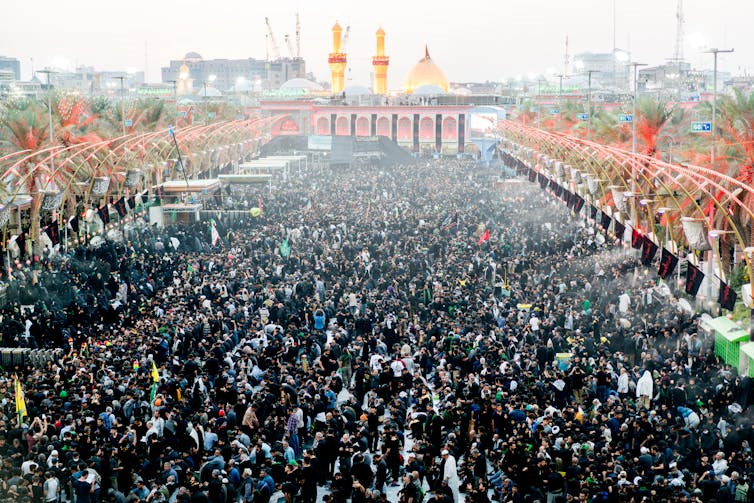 Pilgrims at the Holy Shrine in Karbala, Iraq. Jasmin Merdan via Getty Images.
This has included awareness campaigns encouraging the 20 million pilgrims who visit Arbaeen annually to reduce the tons of trash they leave every year that clog up Iraq’s waterways. Quoting from Shiite scholarship and drawing on testimonials from community leaders, the Green Pilgrim movement suggests carrying cloth bags and reusable water bottles, turning down plastic cutlery, and hosting eco-friendly stalls along the walk.
Muslim-owned businesses and nonprofits are joining these wider efforts. Melanie Elturk, the founder of the successful hijab brand Haute Hijab, regularly ties together faith, fashion, commerce and environmentalism by highlighting the brand’s focus on sustainability and environmental impact. The Washington, D.C., nonprofit Green Muslims pioneered the first “leftar” – a play on the word “iftar” – using leftovers and reusable containers.
These efforts are but a few of the diverse ways that Muslim communities are addressing environmental impact. The greening of Ramadan fits into a broader conversation about how often communities can tackle climate change within their own frameworks.
But Islamic environmentalism is more than just the dispensing of plastic forks and water bottles – it taps into a worldview ingrained in the faith from the outset, and can continue to guide adherents as they navigate environmentalism, a space where they may otherwise be marginalized.
This article is republished from The Conversation under a Creative Commons license. Read the original article and see more than 250 UMBC articles available in The Conversation.
]]>
Written by Noorzehra Zaidi, assistant professor of history, UMBC For many Muslims breaking fast in mosques around the world this Ramadan, something will be missing: plastics. The...
https://umbc.edu/stories/calls-for-a-green-ramadan-revive-islams-long-tradition-of-sustainability/
https://my3.my.umbc.edu/api/v0/pixel/news/131916/guest@my.umbc.edu/123d3fb77b6d8173dd023f293969d815/api/pixel
cahss
cahssresearch
discovery
ges
history
magazine
the-conversation
UMBC News & Magazine
https://my3.my.umbc.edu/groups/umbc-news-magazine
https://assets1-my.umbc.edu/system/shared/avatars/groups/000/001/943/24435aa6207c452e7bc15cc74b42c7bb/xsmall.png?1748556657
https://assets1-my.umbc.edu/system/shared/avatars/groups/000/001/943/24435aa6207c452e7bc15cc74b42c7bb/original.png?1748556657
https://assets2-my.umbc.edu/system/shared/avatars/groups/000/001/943/24435aa6207c452e7bc15cc74b42c7bb/xxlarge.png?1748556657
https://assets2-my.umbc.edu/system/shared/avatars/groups/000/001/943/24435aa6207c452e7bc15cc74b42c7bb/xlarge.png?1748556657
https://assets3-my.umbc.edu/system/shared/avatars/groups/000/001/943/24435aa6207c452e7bc15cc74b42c7bb/large.png?1748556657
https://assets1-my.umbc.edu/system/shared/avatars/groups/000/001/943/24435aa6207c452e7bc15cc74b42c7bb/medium.png?1748556657
https://assets2-my.umbc.edu/system/shared/avatars/groups/000/001/943/24435aa6207c452e7bc15cc74b42c7bb/small.png?1748556657
https://assets1-my.umbc.edu/system/shared/avatars/groups/000/001/943/24435aa6207c452e7bc15cc74b42c7bb/xsmall.png?1748556657
https://assets2-my.umbc.edu/system/shared/avatars/groups/000/001/943/24435aa6207c452e7bc15cc74b42c7bb/xxsmall.png?1748556657
UMBC News & Magazine
3
0
false
Wed, 22 Mar 2023 12:07:31 -0400
Wed, 22 Mar 2023 12:07:31 -0400
Satellite data: The other type of smartphone data you might not know about

Co-written by Alicia Sabatino ’20, M.S. ’24, geography and environmental systems, UMBC.
When you think about location data on your mobile phone, tablet or laptop, what comes to mind? Mailing addresses? Postal codes? These data indicate where you live, where you work, and the places you visit.
When combined with other types of data over time, companies and governments use them to analyze your consumption patterns, occupation, education, health and financial status.
Turning location services off only prevents smartphone apps from receiving location data. Smartphones can still be located by cell towers and wireless networks when location services are switched off.
This was highlighted by German politician Malte Spitz over a decade ago when he sued his cellphone provider, Deutsche Telekom, for any personal data they had about him.
When the case was settled and he eventually received the data, Spitz found 35,000 references to his location. He was able to visually reconstruct his movements over the previous six months, demonstrating the relevance of data protection laws to the public.
But there is more. By using critical code and documentary research methods, we found that raw satellite location measurement data are perpetually created in our devices all the time.
Because satellite data are building blocks used by our phones to determine where we are, they don’t always get turned off — nor are they collected and treated the same way as location data.
Data outputs
Smartphones determine your location in several ways. The first way involves phones triangulating distances between cell towers or Wi-Fi routers.
The second way involves smartphones interacting with navigation satellites. When satellites pass overhead, they transmit signals to smartphones, which allows smartphones to calculate their own location. This process uses a specialized piece of hardware called the Global Navigation Satellite System (GNSS) chipset. Every smartphone has one.
When these GNSS chipsets calculate navigation satellite signals, they output data in two standardized formats (known as protocols or languages): the GNSS raw measurement protocol and the National Marine Electronics Association protocol (NMEA 0183).
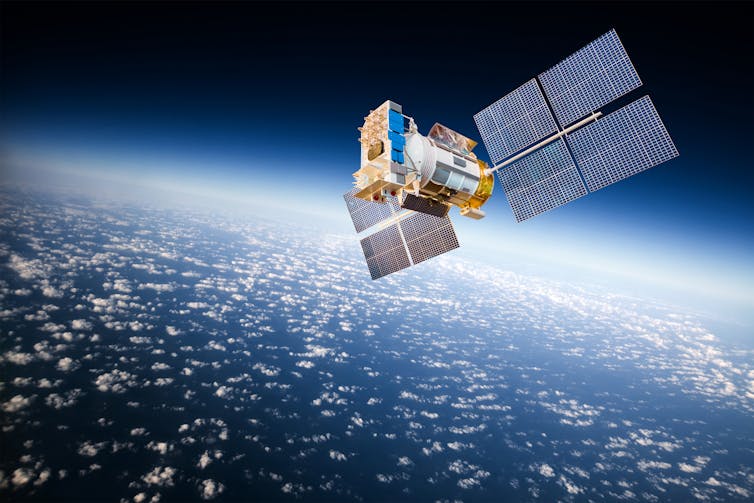 When satellites pass overhead, they transmit signals to smartphones, which enable smartphones to calculate their own location. (Shutterstock)
GNSS raw measurements include data such as the distance between satellites and cellphones and measurements of the signal itself.
NMEA 0183 contains similar information to GNSS raw measurements, but also includes additional information such as satellite identification numbers, the number of satellites in a constellation, what country owns a satellite, and the position of a satellite.
NMEA 0183 was created and is governed by the NMEA, a not-for-profit lobby group that is also a marine electronics trade organization. The NMEA was formed at the 1957 New York Boat Show when boating equipment manufacturers decided to build stronger relationships within the electronic manufacturing industry.
In the decades since, the NMEA 0183 data standard has improved marine electronics communications and is now found on a wide variety of non-marine communications devices today, including smartphones.
Who has access to these data?
It is difficult to know who has access to data produced by these protocols. Access to NMEA protocols is only available under licence to businesses for a fee.
GNSS raw measurements, on the other hand, are a universal standard and can be read by different devices in the same way without a license. In 2016, Google allowed industries to have open access to it to foster innovation around device tracking accuracy, precision, analytics about how we move in real-time, and predictions about our movements in the future.
While automated processes can quietly harvest location data — like when a French-based company extracted location data from Salaat First, a Muslim prayer app — these data don’t need to be taken directly from smartphones to be exploited.
Data can be modelled, experimented with, or emulated in licensed devices in labs for innovation and algorithmic development.
Satellite-driven raw measurements from our devices were used to power global surveillance networks like STRIKE3, a now defunct European-led initiative that monitored and reported perceived threats to navigation satellites.
Data and citizen rights
Our research raises questions about how rights are protected in the midst of these practices. Citizens have little to no access to the data output from NMEA 0183 and GNSS raw measurements. Because of this, people are unable to negotiate the visibility of their data in these datasets.
The data output from NMEA 0183 and GNSS raw measurements flow unrestricted from every smartphone on the planet. Smartphones have unique identifiers — IMEI numbers — that are known to the tech ecosystem. They can be connected to a user’s personal details.
The flow of NMEA 0183 and GNSS data is invisible to the average person, meaning citizens are unsure of how these data are used, or with whom they are shared. Because of this, it’s impossible for people to challenge how their personal data are used.
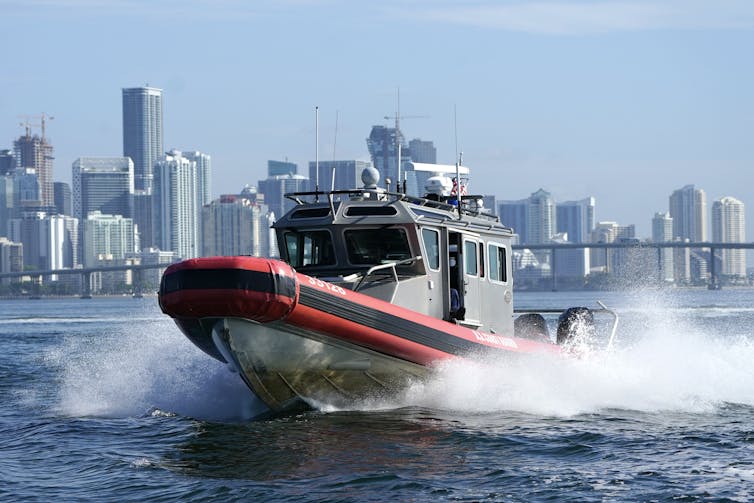 A U.S. Coast Guard boat in Biscayne Bay, Fla., in June 2022. The National Marine Electronics Association is working on improving search-and-rescue operations by ensuring radio distress signals sent by marines contain GPS information. (AP Photo/Lynne Sladky)
As interest in the supposed security, entertainment and surveillance value of these protocols continue to grow, these protocols are increasingly susceptible to misuse by third-party developers.
But there is another layer to this: NMEA 0183 and GNSS raw measurements are standards in industries that offer products and services that many of us benefit from. The NMEA has foundations in safe passage at sea, making their data an important part of emergency services operations. GNSS raw measurements are also utilized for safety purposes.
Could solutions restrict the use of these data for life-critical situations only? Is there an oversight body that could assess what impacts industrial usage of these data might have upon smartphone owner rights and liberties? What about an audit led by civil society, who would be appropriately positioned to objectively inspect these issues to determine whether they might harm the public? For example, consider the way the federal privacy commissioner reviews app data activities.
Location data now flows constantly from GNSS chipsets. There is uncertainty about who is using these data, and for what purposes. Until industry and government reassure citizens that personal data are not being exploited and that rights are protected, these remain open questions.
This article is republished from The Conversation under a Creative Commons license. Read the original article and see more than 250 UMBC articles available in The Conversation.
]]>
Co-written by Alicia Sabatino ’20, M.S. ’24, geography and environmental systems, UMBC. When you think about location data on your mobile phone, tablet or laptop, what comes to mind? Mailing...
https://umbc.edu/stories/satellite-data-the-other-type-of-smartphone-datat/
https://my3.my.umbc.edu/api/v0/pixel/news/131109/guest@my.umbc.edu/452b125ba75b4e308706be8598c56bf3/api/pixel
cahss
cahssresearch
cs3
discovery
ges
magazine
the-conversation
UMBC News & Magazine
https://my3.my.umbc.edu/groups/umbc-news-magazine
https://assets1-my.umbc.edu/system/shared/avatars/groups/000/001/943/24435aa6207c452e7bc15cc74b42c7bb/xsmall.png?1748556657
https://assets1-my.umbc.edu/system/shared/avatars/groups/000/001/943/24435aa6207c452e7bc15cc74b42c7bb/original.png?1748556657
https://assets2-my.umbc.edu/system/shared/avatars/groups/000/001/943/24435aa6207c452e7bc15cc74b42c7bb/xxlarge.png?1748556657
https://assets2-my.umbc.edu/system/shared/avatars/groups/000/001/943/24435aa6207c452e7bc15cc74b42c7bb/xlarge.png?1748556657
https://assets3-my.umbc.edu/system/shared/avatars/groups/000/001/943/24435aa6207c452e7bc15cc74b42c7bb/large.png?1748556657
https://assets1-my.umbc.edu/system/shared/avatars/groups/000/001/943/24435aa6207c452e7bc15cc74b42c7bb/medium.png?1748556657
https://assets2-my.umbc.edu/system/shared/avatars/groups/000/001/943/24435aa6207c452e7bc15cc74b42c7bb/small.png?1748556657
https://assets1-my.umbc.edu/system/shared/avatars/groups/000/001/943/24435aa6207c452e7bc15cc74b42c7bb/xsmall.png?1748556657
https://assets2-my.umbc.edu/system/shared/avatars/groups/000/001/943/24435aa6207c452e7bc15cc74b42c7bb/xxsmall.png?1748556657
UMBC News & Magazine
0
0
false
Tue, 21 Feb 2023 12:04:16 -0500
Tue, 21 Feb 2023 12:04:16 -0500
Getting Your Research Off the Ground—Balloons Give Students New Perspectives
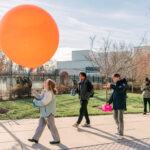
On a brisk but clear day in early December, half a dozen brightly colored weather balloons barely squeeze through the double doors of Sondheim Hall’s lower level one by one.
A group of four or five students handles each balloon, proceeding to the quad in front of the Interdisciplinary Life Sciences Building in a makeshift parade. A red balloon rises aloft as a demonstration, and then the remaining groups fan out across campus to follow suit. By 9:30 a.m., anyone walking across campus can see colorful dots hundreds of feet high, tethered by ropes that each end at a student on the ground.
This is the peak experience of GES 286, “Exploring the Environment: A Geospatial Perspective.” The course is structured around various data gathering projects, explains Charles Kaylor, the instructor and director of GIS (geographic information systems) and cartography labs in the department of geography and environmental systems (GES). “We use the campus as a laboratory,” he says.
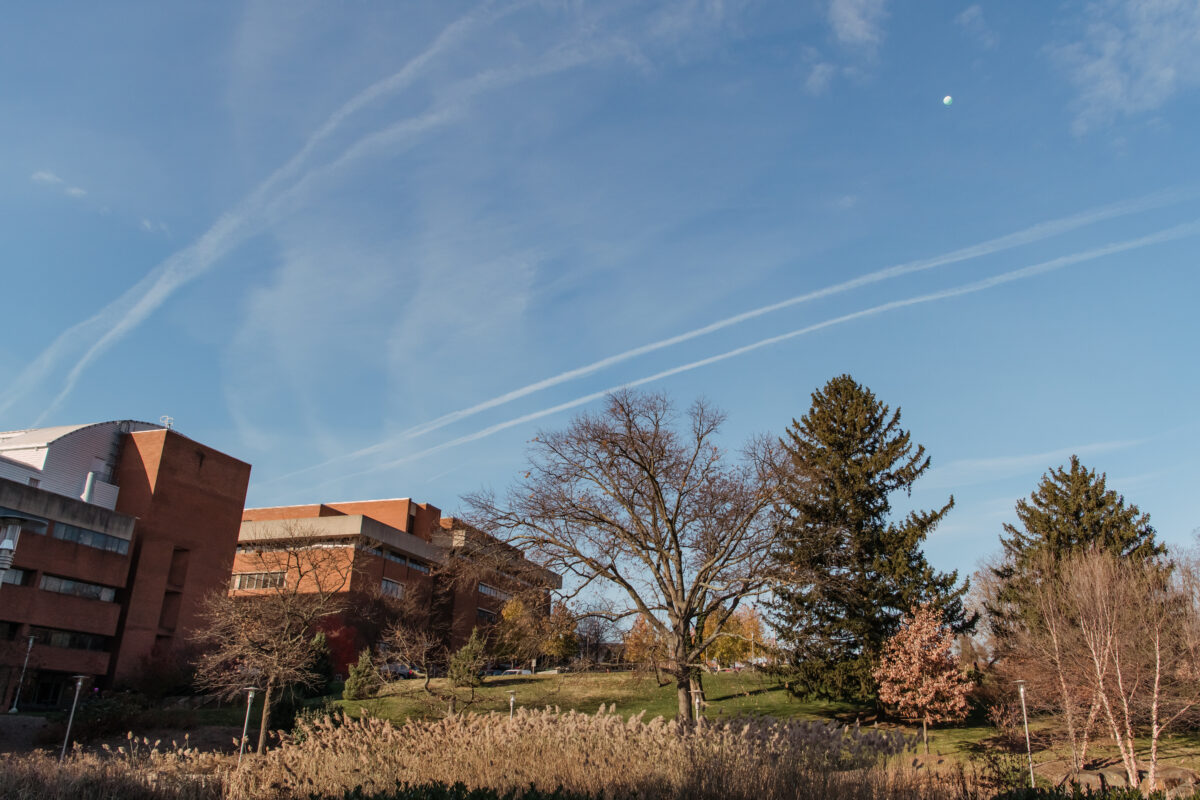
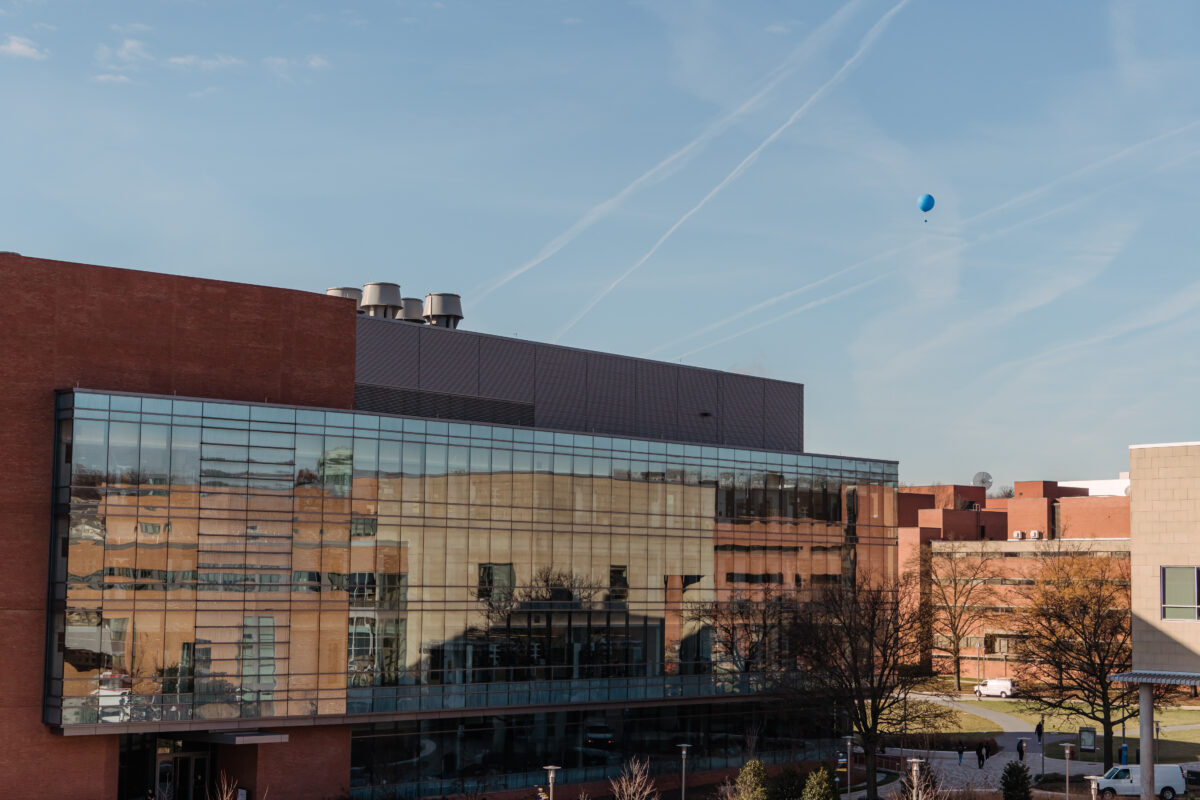
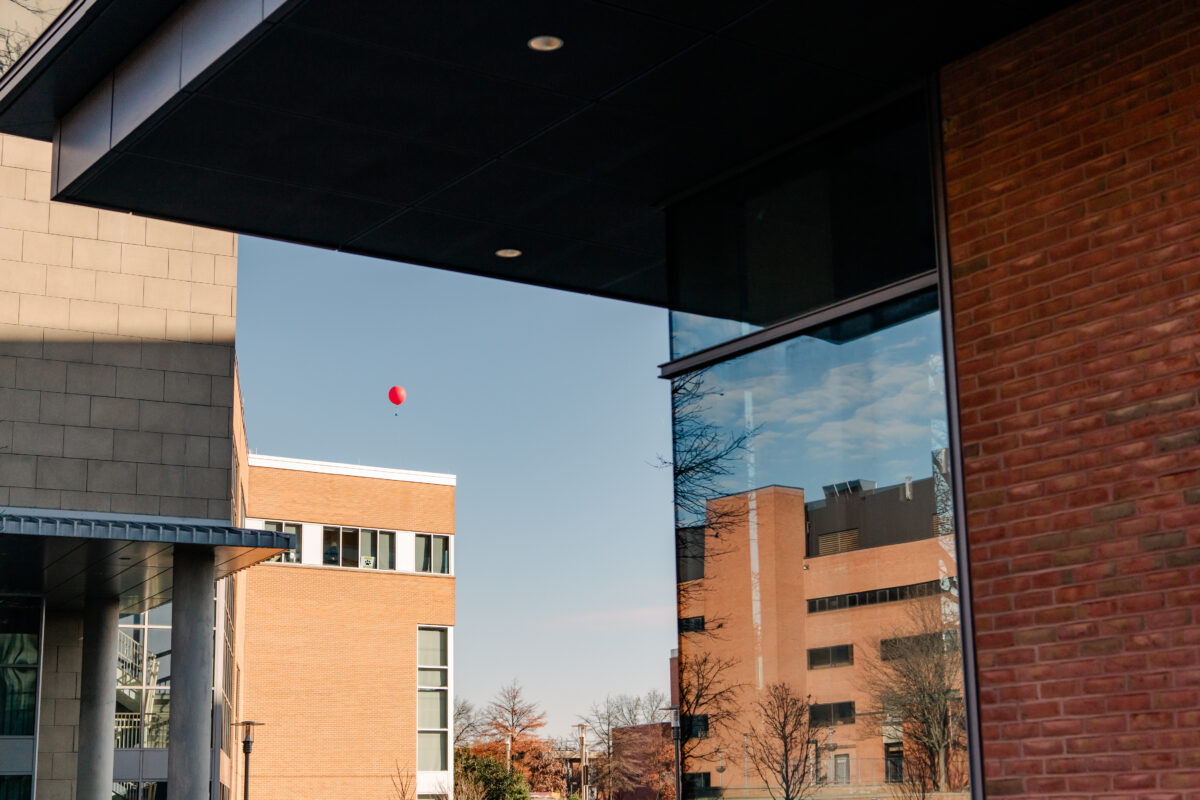
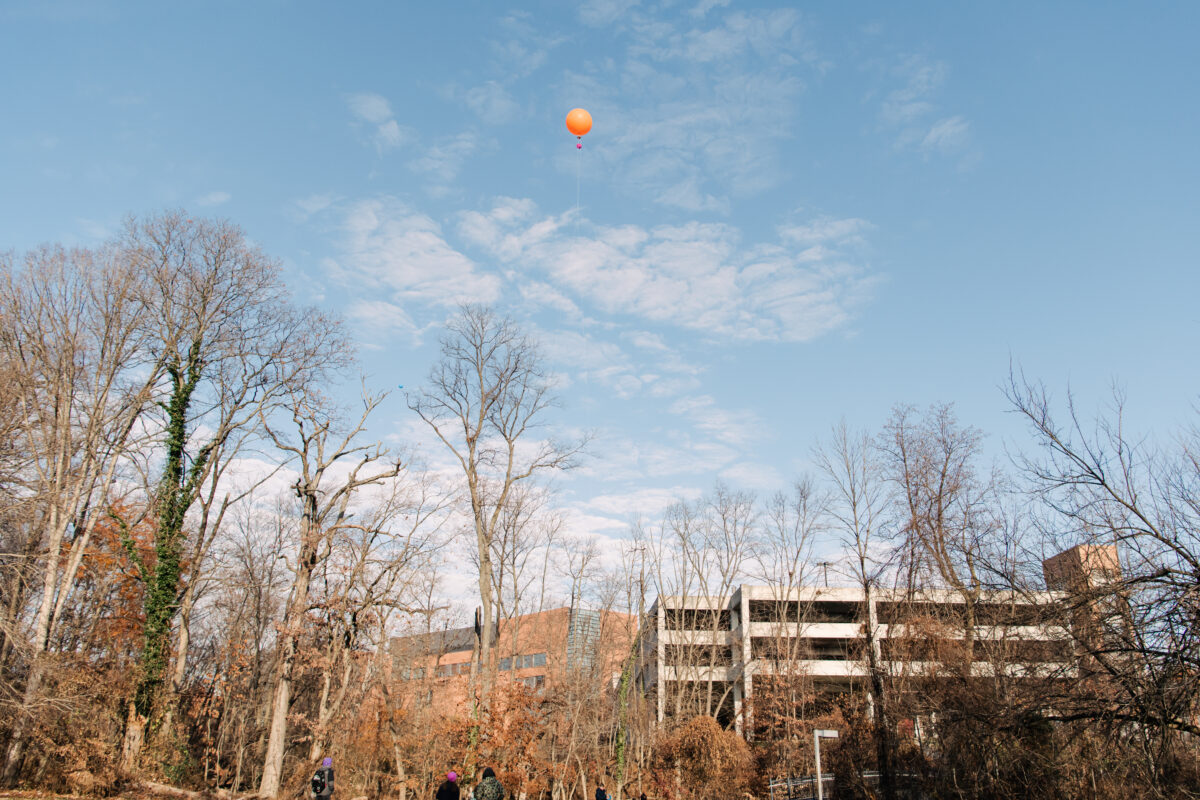
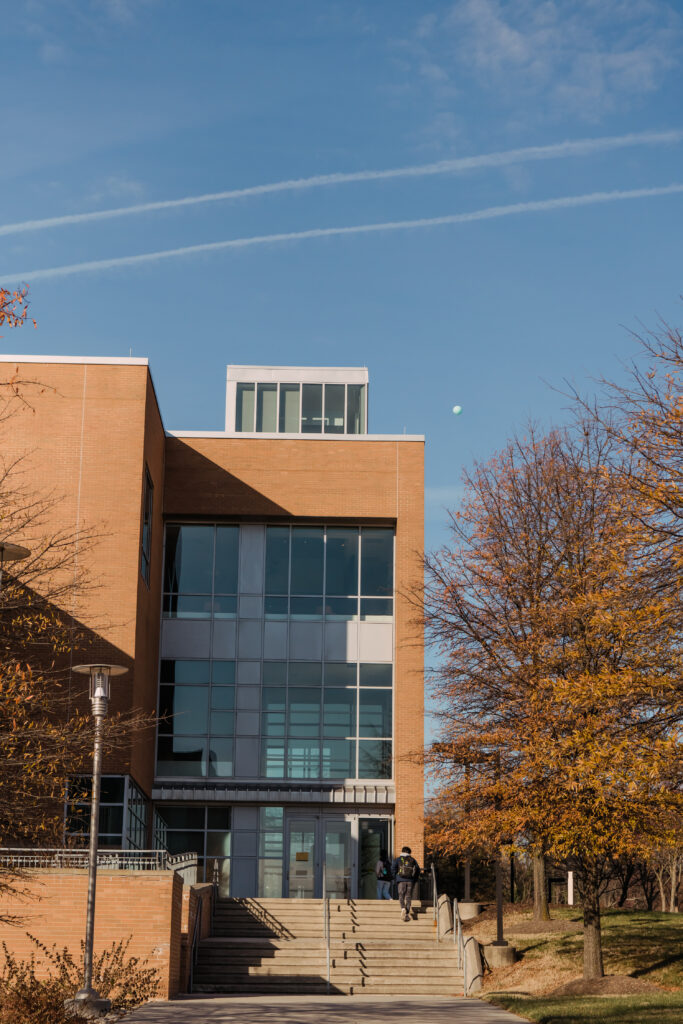
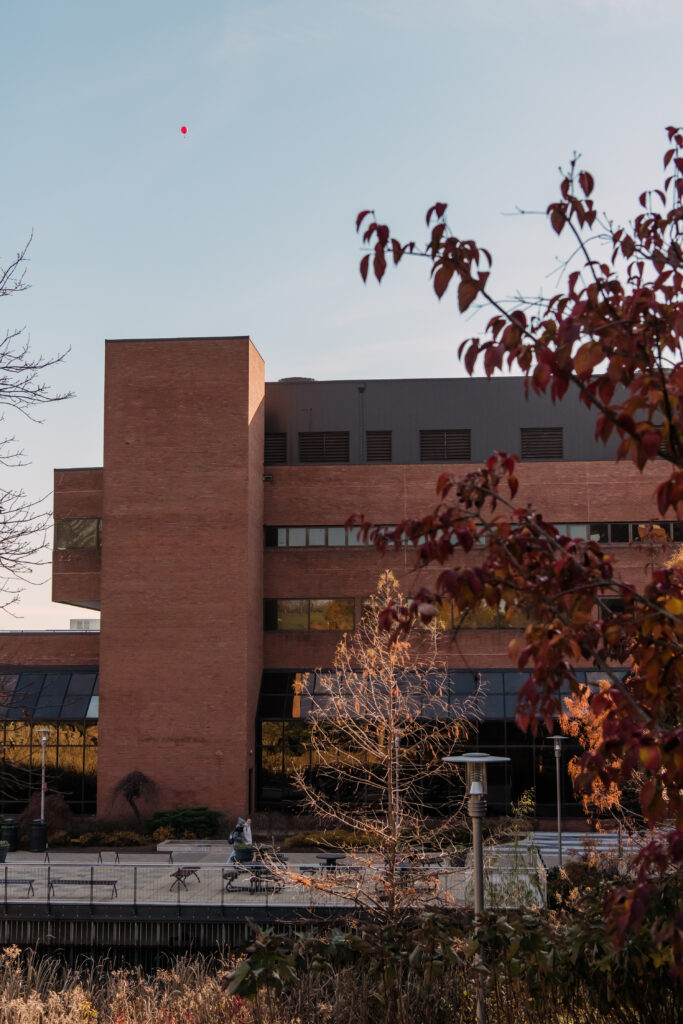 On “balloon day,” the balloons are visible from all over campus. (Marlayna Demond ’11/UMBC)
“Where are we?”
Kaylor opens the first class with a deceptively simple question: “Where are we, and how do we know that?” After beginning with a basic orienteering activity (no smartphones allowed!), the course advances through the surprisingly complex answer to Kaylor’s question, which leads students to develop skills in statistics, data analysis, and various software programs. They also pick up knowledge in disciplines like ecology, sociology, and hydrology.
Given its interdisciplinary bent, the course attracts students from a range of majors, most often those in the GES department (like environmental science) and computer science. With a background in GIS and environmental education, Kaylor is a perfect fit to teach the course to this mixed audience.
At the beginning of the semester, “computer science students will understand that it’s data science-driven. GES students will understand the hands-on sciences,” Kaylor says. By the end, “they’ll meet in the middle. It’s actually a really interesting blend of students to work with, and it’s fun to see how their strengths play off each other.”
Learning in real time
But back to the balloons. Each balloon flies with a digital camera attached, pointed at the ground. Previous students in the course coded a hack into the cameras that commands them to take a picture every 15 seconds as they float above campus.
Far below, students lay what look like paper archery targets flat on the ground and record their precise coordinates using GPS. These targets will show up in the photos taken by the camera on the balloon. Using the targets as reference points, the students will then be able to “geolocate” (tie to a point on the Earth’s surface) other objects—like buildings, trees, even people—in the camera’s photos.
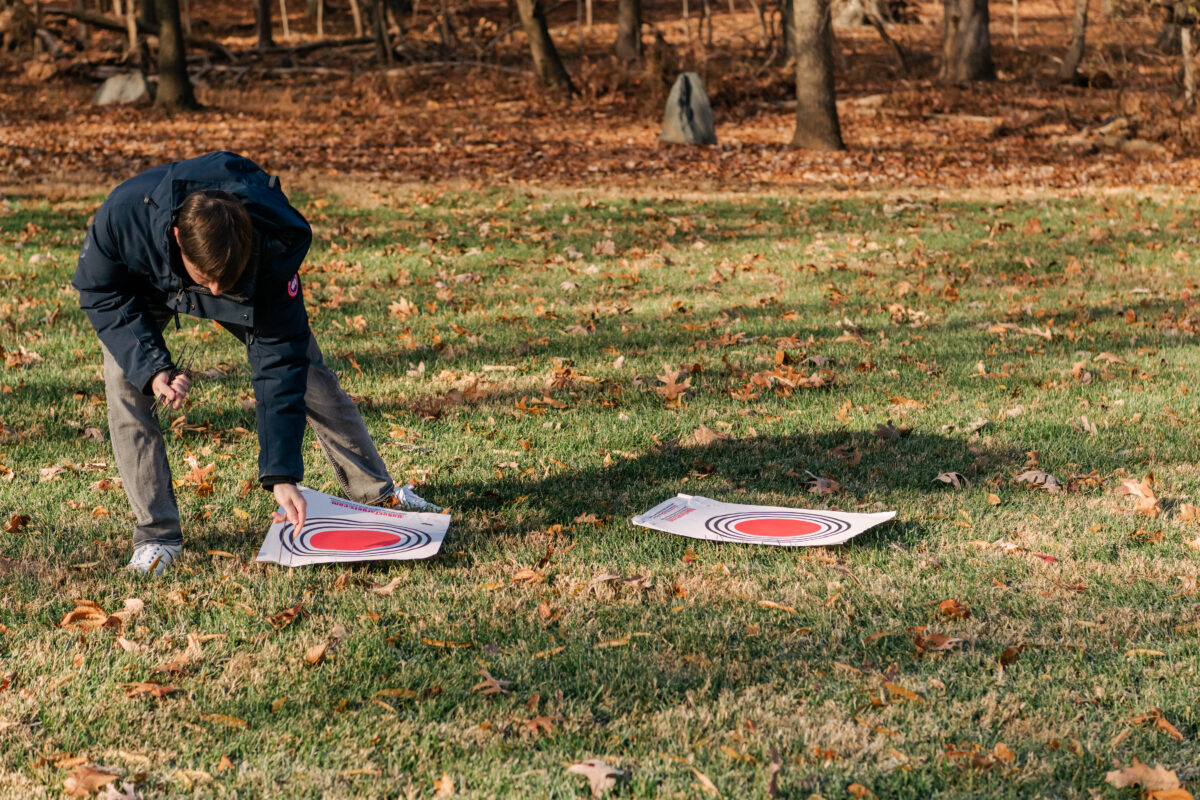 Matthew Parsons, computer science, sets reference targets on the ground. (Marlayna Demond ’11/UMBC)
Kaylor creates a blank digital map at the start of the morning to record the coordinates. “It’s fun to watch in the lab while students are out in the field doing it,” Kaylor says, “because it starts blooming. You see students adding points in real time.”
In what other class…
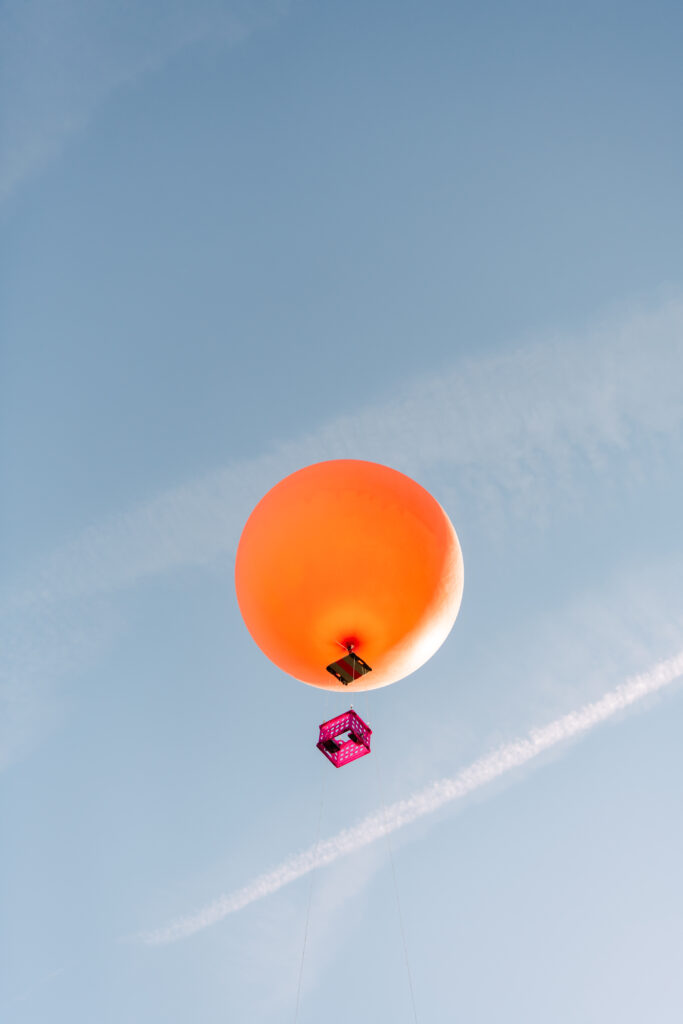 A pink crate dangling from the bottom of a balloon holds a small digital camera horizontal as the balloon flies. (Marlayna Demond ’11/UMBC)
The balloons have been a mystery to much of the campus community for years, with the colorful orbs dotting the campus sky in the tenth week of the semester. But for the students in Kaylor’s class, the balloons represent a culmination of the knowledge and skills they’ve gained.
Each student has their own reasons for taking the course. For some, it’s an opportunity to learn GIS skills—a must in the environmental field today—without spending too much time in front of a computer. As Kamsy Nwaiwau ’23, geography and environmental systems, puts it, “What other class do you get to hold a balloon 450 feet in the air? It’s something different.”
Whereas Alex Flitter ’23, mathematics and computer science, has a different perspective. He’s conducting research with Bedřich Sousedik, associate professor of mathematics, on how to model disease spread using ArcGIS—the same tool the students are using to locate points on the ground. GES 286 is “adding to my ability to visualize my research,” he says.
Learning openness
The course integrates a range of activities to get students thinking about how they could apply GIS to many fields of study. For one assignment, the students explore their own neighborhoods and mark the location of different businesses, like restaurants, pharmacies, and retail shops, and other neighborhood elements, like parks or bus stops. Then they use available data sets to see if they can identify associations with other neighborhood factors, like median income or education level.
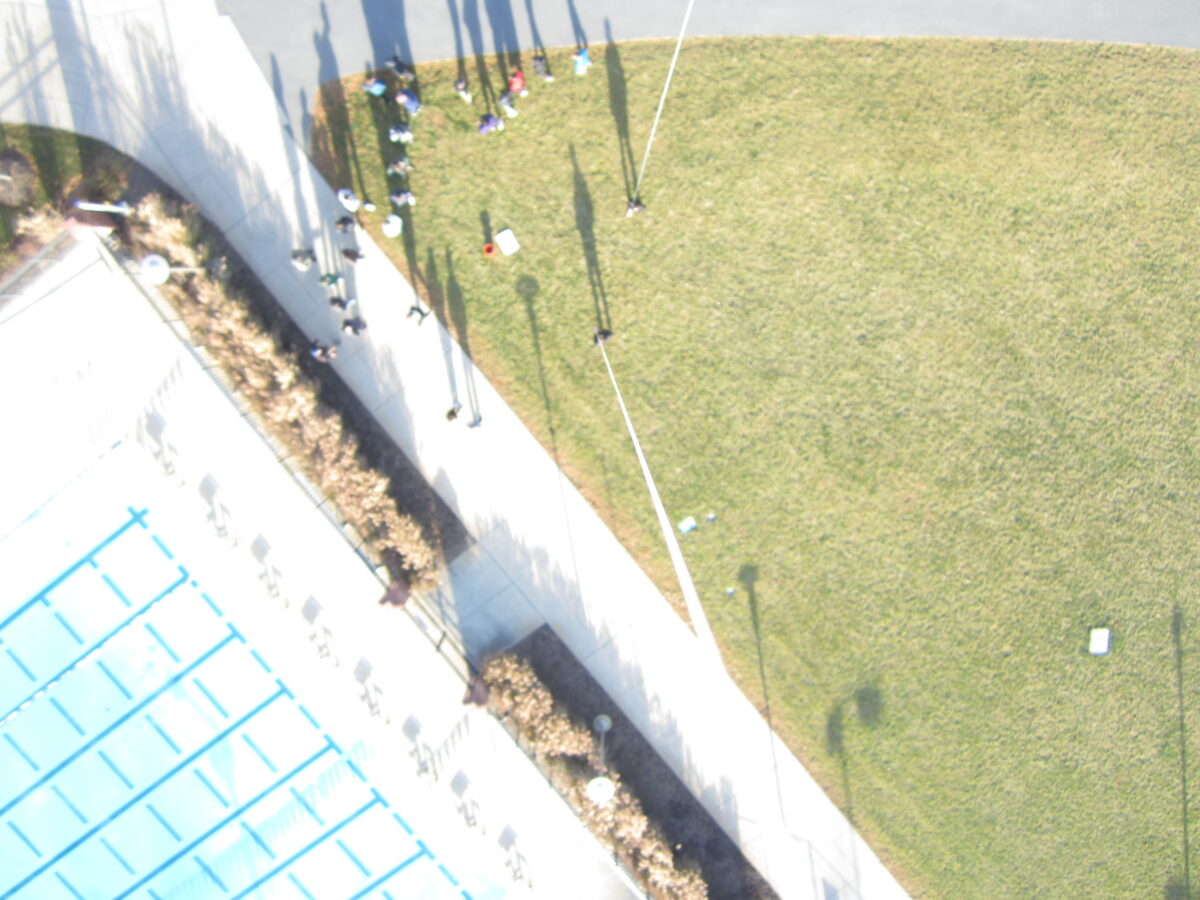
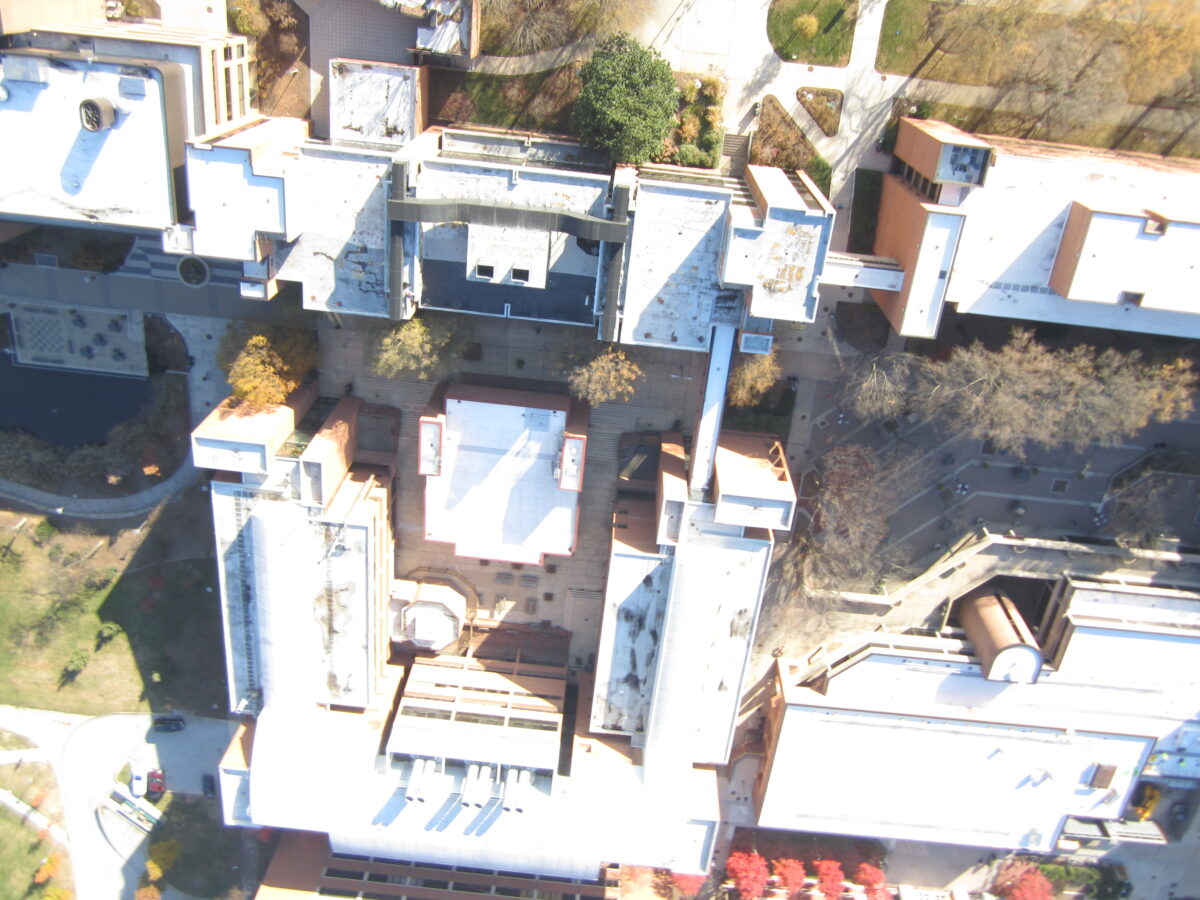
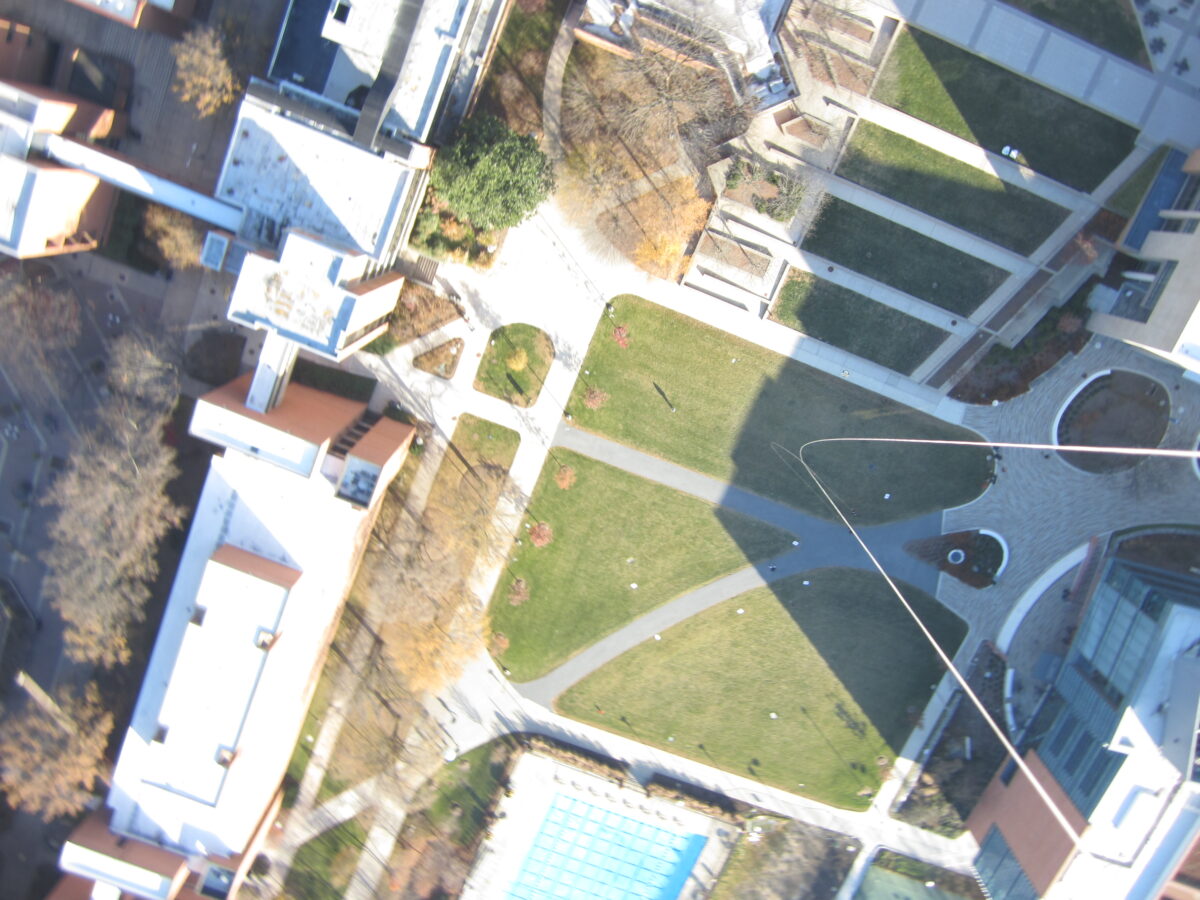 Images captured by one of the balloons. At left, the class gathers to observe the first balloon launch of the morning. (Images courtesy of Charles Kaylor)
This project “gets at the scientific process,” Kaylor says. He tells his students, “Any time a data set floats by, take a look at it and go, ‘What questions could I ask with this data?’ It’s a certain mode of openness.” Each in their own time, students get the idea. “What I love about GIS is—and you can count on it—any student who tries is going to have a GIS epiphany and start figuring things out,” Kaylor says, “and because it’s so applied and so tangible, it’s captivating.”
Making it real
This is Kaylor’s second time teaching the course after coming to UMBC from Temple University. He inherited the course backbone from Joe School, emeritus professor of GES, who still teaches the course in the summer. Kaylor has already made substantial changes, but has more in mind. One major goal is to create more opportunities for the students’ efforts to connect to real research projects.
“What I love about GIS is—and you can count on it—any student who tries is going to have a GIS epiphany and start figuring things out. And because it’s so applied and so tangible, it’s captivating.”
Charles Kaylor
Kaylor has already launched a collaboration with Facilities Management at UMBC to compare the latest data set of campus trees to the reality on the ground. So far, the students have checked about 10 percent of the listed trees, and Kaylor plans to add more each semester.
“I’m hoping to integrate more things like that, that have an obvious practical application or benefit to campus,” Kaylor says. “Since we’re measuring things on campus, we might as well see what we can do with that.” For example, Kaylor has discussed with Matthew Baker, professor of geography and environmental systems, how his students might be able to support Baker’s environmental monitoring work on campus.
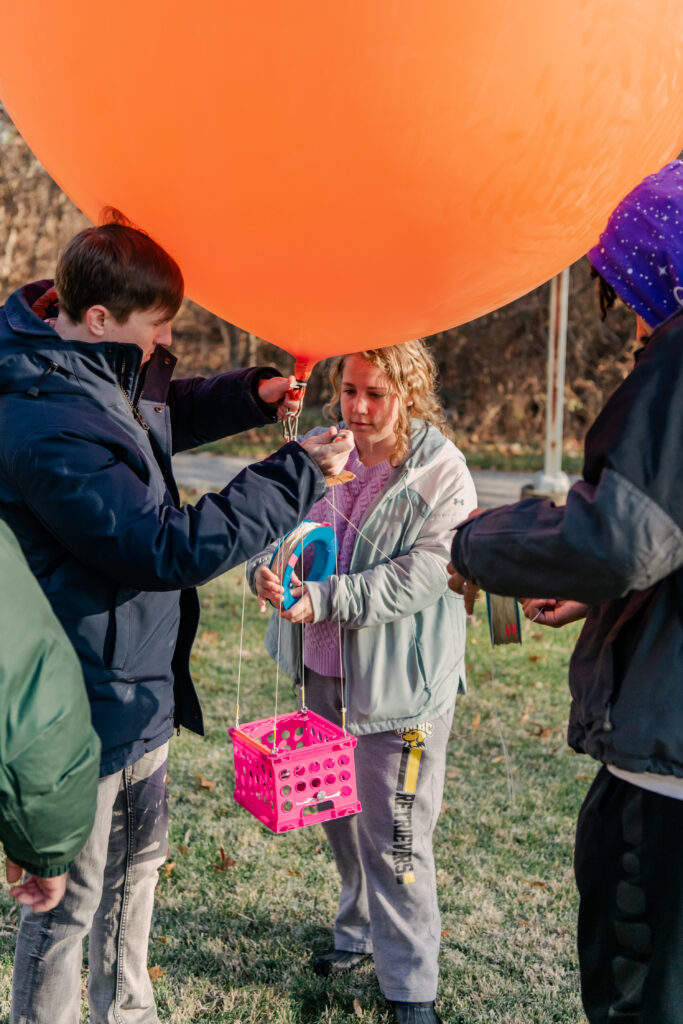 Matthew Parsons, computer science, Olivia Amaral, computer science, and Langston Smith, GES, attach the camera to their balloon and prepare for launch. (Marlayna Demond ’11/UMBC)
No matter what direction they go—whether epidemiology, ecology, or other fields—students who complete GES 286 will be better prepared to ask and answer useful questions about the world around them.
Teaching the class has been a rewarding experience for Kaylor as an instructor, too. The course “reconnected me with something that makes [GIS] live and breathe in a different way—a more exciting way,” he says. “Taking a more applied approach to it is a fun challenge. I’ve been having a great time teaching this class.”
Geography applies to everything
Finally, it’s time for the balloons to come down. As the students are wrangling them down and heading back to Sondheim Hall for a debrief, Joey Laiosa ’23, environmental science, shares that he previously worked in public safety as a dispatcher, then came back to school. He’s interested in conservation ecology, and using remote sensing to measure environmental health has particularly caught his attention.
“GIS is a really sought-after skill to have in a range of industries,” he says. That includes public safety, Laiosa says, where it could involve better pinpointing the location of an emergency in a complex environment like a construction site or an amusement park. “Geography applies to everything.”
Learn more about undergraduate research opportunities at UMBC.
]]>
On a brisk but clear day in early December, half a dozen brightly colored weather balloons barely squeeze through the double doors of Sondheim Hall’s lower level one by one. A group of four...
https://umbc.edu/stories/getting-your-research-off-the-ground-gis-balloons/
https://my3.my.umbc.edu/api/v0/pixel/news/130542/guest@my.umbc.edu/7b6e1b2bd1fb1d7c780b2953ccfd4562/api/pixel
cahss
cnms
coeit
csee
discovery
ges
magazine
mathstat
UMBC News & Magazine
https://my3.my.umbc.edu/groups/umbc-news-magazine
https://assets1-my.umbc.edu/system/shared/avatars/groups/000/001/943/24435aa6207c452e7bc15cc74b42c7bb/xsmall.png?1748556657
https://assets1-my.umbc.edu/system/shared/avatars/groups/000/001/943/24435aa6207c452e7bc15cc74b42c7bb/original.png?1748556657
https://assets2-my.umbc.edu/system/shared/avatars/groups/000/001/943/24435aa6207c452e7bc15cc74b42c7bb/xxlarge.png?1748556657
https://assets2-my.umbc.edu/system/shared/avatars/groups/000/001/943/24435aa6207c452e7bc15cc74b42c7bb/xlarge.png?1748556657
https://assets3-my.umbc.edu/system/shared/avatars/groups/000/001/943/24435aa6207c452e7bc15cc74b42c7bb/large.png?1748556657
https://assets1-my.umbc.edu/system/shared/avatars/groups/000/001/943/24435aa6207c452e7bc15cc74b42c7bb/medium.png?1748556657
https://assets2-my.umbc.edu/system/shared/avatars/groups/000/001/943/24435aa6207c452e7bc15cc74b42c7bb/small.png?1748556657
https://assets1-my.umbc.edu/system/shared/avatars/groups/000/001/943/24435aa6207c452e7bc15cc74b42c7bb/xsmall.png?1748556657
https://assets2-my.umbc.edu/system/shared/avatars/groups/000/001/943/24435aa6207c452e7bc15cc74b42c7bb/xxsmall.png?1748556657
UMBC News & Magazine
2
0
false
Wed, 01 Feb 2023 11:11:15 -0500
Wed, 01 Feb 2023 11:11:15 -0500
New center director to take NASA-supported Earth science research into next era at UMBC
The UMBC-led Goddard Earth Science Technology and Research (GESTAR) Center II includes over 120 researchers advancing Earth and atmospheric sciences and launching the next generation of scientists. GESTAR II scientists and engineers are tracking the effects of shipping regulations on air pollution, predicting fires in India, and much more, often relying on data collected via remote sensing from NASA satellites.
NASA awarded $72 million for UMBC to establish GESTAR II in fall 2021, in collaboration with primary partner Morgan State University and six other institutions. After a national search, a new director is taking the helm of this high-impact collaboration.
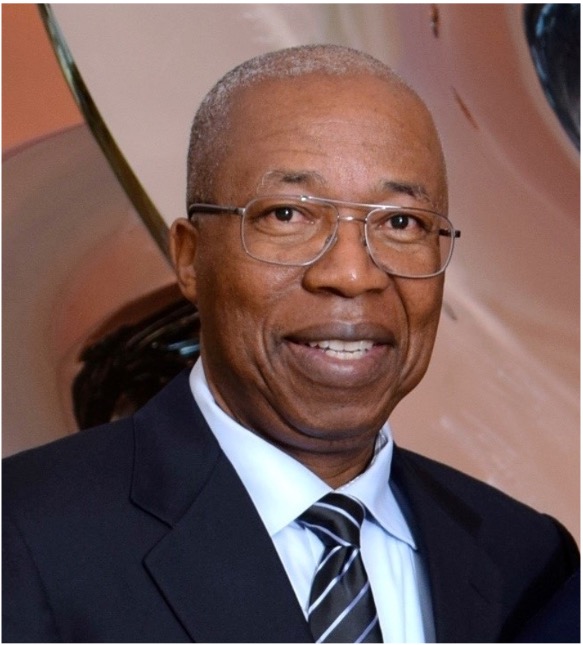 Charles Ichoku (image courtesy of Ichoku)
The new director, Charles Ichoku, brings deep and well-rounded experience in Earth science research, at NASA, and in student development programs—exactly the elements GESTAR II brings together and hopes to expand upon. Ichoku comes to GESTAR II from concurrent roles as professor of Earth and environmental sciences at Howard University and as the Distinguished Scientist of the National Oceanic and Atmospheric Administration (NOAA) Cooperative Science Center in Atmospheric Sciences and Meteorology (NCAS-M). Prior to that, he served at NASA Goddard Space Flight Center in Greenbelt, Maryland for 20 years in various research and management roles.
“Dr. Ichoku brings impressive credentials to this important leadership position at UMBC, not only as a world-class scientist, but also as a long-term NASA-based scientist and program manager,” shares Karl V. Steiner, Vice President for Research and Creative Achievement at UMBC. “He is a perfect fit for both GESTAR II and UMBC.”
Earth science from hundreds of miles up
Ichoku’s research program focuses on applying remote sensing—collecting data from a significant distance, most often from satellites orbiting Earth—and other data to study large-scale processes that affect the environment on land, weather, and air quality. In addition to directing GESTAR II, Ichoku will have an appointment as professor of geography and environmental systems (GES) at UMBC, where he will continue to conduct research, mentor students, and teach courses.
“GES is a good fit,” Ichoku says, “because I’m not just looking at developing the approaches and instrumentation to measure specific parameters, but I’m interested in how you apply the data, knowledge, and science to actually understand phenomena that happen on the ground and in the atmosphere.”
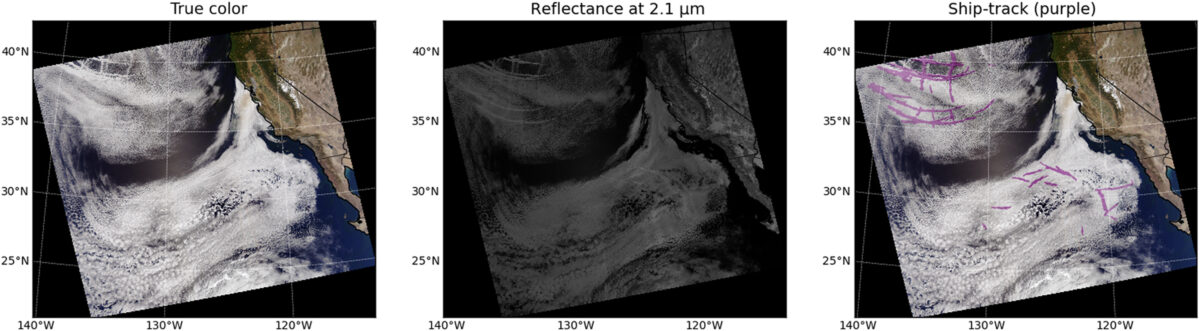 An image collected by NASA’s MODIS satellite of the U.S. West Coast (left) shows tracks of air pollution generated by shipping traffic (purple lines, right), which was detected by a GESTAR II research team’s algorithm.
Elevating African research
Ichoku’s work is influenced by his youth in West Africa, and focuses on phenomena that especially affect that region. For example, frequent agricultural fires send various particles into the atmosphere, which can affect air quality, precipitation, and more. In addition, Lake Chad in Central Africa has nearly dried up over the last few decades in part because of severe drought, resulting in widespread conflict and suffering. Drought also sends dust and other particles into the atmosphere, affecting air quality. These particles and other environmental components (like clouds) interact with radiation from the Sun, driving processes that can adversely impact human life on Earth’s surface, Ichoku explains.
“I’m very interested in seeing research and the application of its results improve in Africa overall, but in particular in Western and Central Africa,” Ichoku says. “So I hope to be able to continue research in that region.”
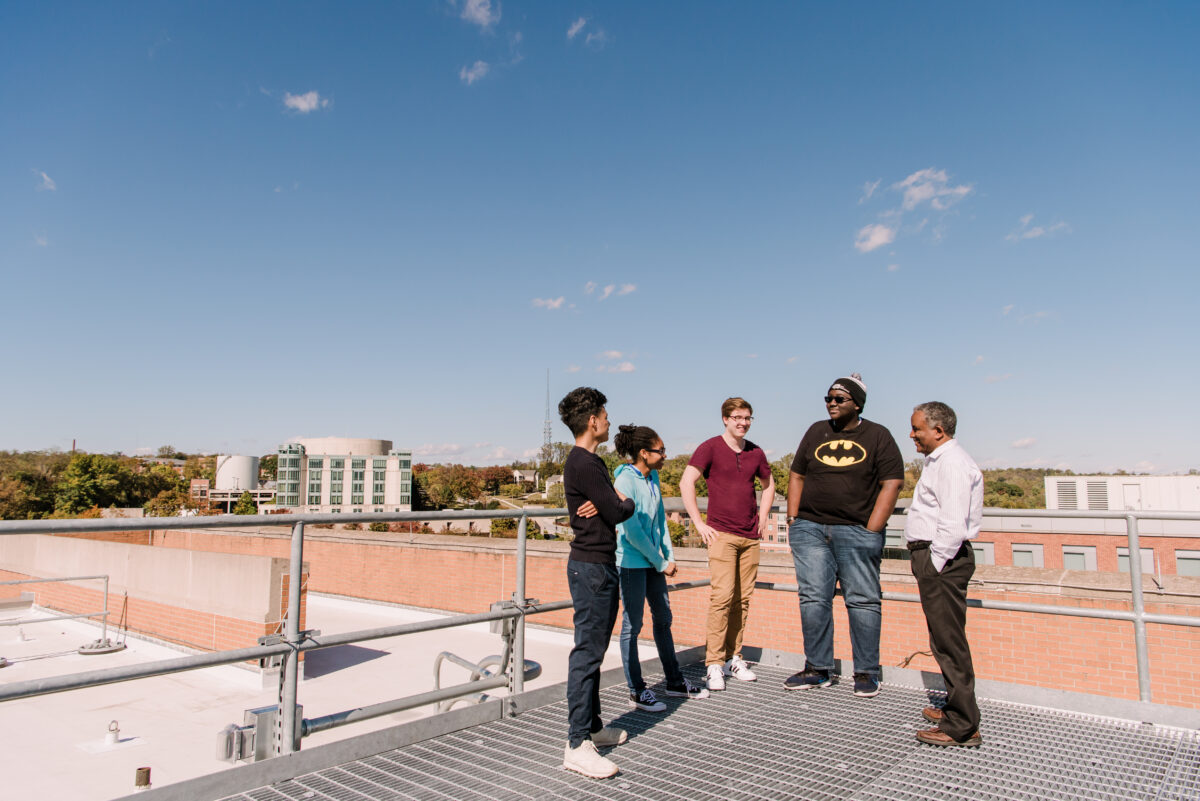 Belay Demoz, right, talks with students on the roof of the UMBC Physics Building. (Marlayna Demond ’11/UMBC)
To that end, a few years ago Ichoku joined with colleagues to initiate the U.S.-West African Coastal Resilience Research Consortium (CRRC). In addition, he recently played an important role in the inauguration of the African Meteorological Society (AfMS), where he serves as chair of the Diaspora and Friends of Africa Committee. The committee involves a significant number of colleagues who are similarly passionate about the advancement of scientific research and applications in Africa.
Those colleagues include GESTAR II’s inaugural director, Belay Demoz, whose research is similarly inspired by experiences with drought, displacement, and resulting conflict during his youth in East Africa—challenges that continue today. Demoz, professor of physics at UMBC, will continue in his departmental role after Ichoku takes up his post.
Demoz notes Ichoku’s extensive experience with Howard University (which is also a partner in UMBC’s Center for Space Sciences Technology) and at NASA as strengths, and shares his interest in expanding UMBC’s research and education efforts in Africa. “I’m looking forward to him leading the next iteration of GESTAR II, and increasing involvement of GES in what we do,” Demoz says.
Clearing the pathway for students
In addition to his own research, Ichoku has demonstrated a deep commitment to student research and success throughout his career. He moved from NASA to Howard and NCAS-M so he could focus more on student training, particularly supporting underrepresented minority students in Earth science.
With NCAS-M, on top of his typical professorial duties, Ichoku was responsible for matching students with appropriate research projects and NOAA mentors across 13 institutions. He also supported students’ success throughout their graduate projects, ensuring they persisted to graduation and were prepared to be competitive for sought-after professional roles, often at NOAA, NASA, or in academia.
With Demoz, Ichoku also served as co-PI for the NASA-funded Student Airborne Science Activation (SaSa) project, involving three NASA centers and six minority-serving Institutions, including UMBC. This past summer, 24 students, including four from UMBC, spent four weeks at UMBC as part of the SaSa program.
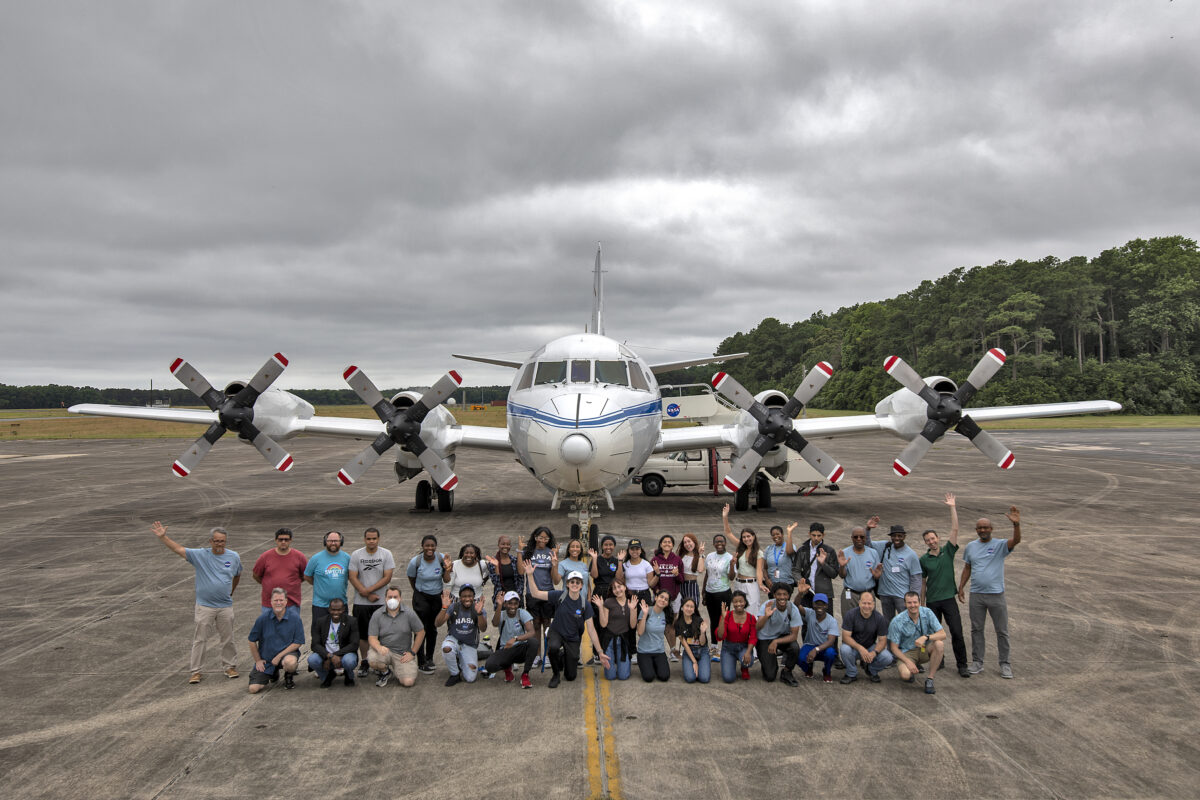 Participants in the 2022 SaSa program at NASA Wallops Flight Facility. (Image courtesy of Belay Demoz)
Now at GESTAR II, Ichoku is interested in continuing to enhance the connection between researchers, who often conduct their work at Goddard Space Flight Center, and members of the larger UMBC community—including students at all levels.
“I think it’s a good thing for a researcher to connect with students. Even if they are not teaching them in a traditional class setting, they can be mentors for interns, which I did myself for many years while I was at NASA as a research scientist,” Ichoku says. “I know that our faculty have a lot to offer to our students, so I will do my best to help facilitate that. My role will be to support the clearing of the pathway and the removal of any obstacles.”
A shining example
Ichoku also brings to GESTAR II and UMBC substantial experience in deepening relationships across institutions. He already has relationships with the scientific leads at other GESTAR II institutions, such as the Pennsylvania State University, Arizona State University, and University of Colorado Boulder, and is excited to continue working with them in a new capacity.
“When we start talking, ideas will flow,” Ichoku says. “We will then synthesize the ideas into strategic initiatives and make them happen.”
Moving forward, Ichoku plans to continue to emphasize top-quality research while enhancing opportunities for students and building bridges between the GESTAR II institutions. And he is especially looking forward to doing all of that at UMBC.
 Students bustle through UMBC’s Academic Row on a winter day. (Marlayna Demond ’11/UMBC)
The opportunity to lead GESTAR II “is both a great pleasure and an honor for me, as I have always admired UMBC for being a shining example in all areas of university performance, including education, scholarship, research, innovation, technology, diversity, sports, environmental sustainability, and community outreach,” Ichoku says. “I am proud of UMBC for attaining the status of Carnegie R1 Doctoral Institution.”
“It is also a great blessing to have this wonderful opportunity to contribute to scientific discoveries and knowledge expansion for human advancement through NASA, and, in particular, Goddard Space Flight Center,” he adds. “I feel highly privileged to be involved in a program that connects two of the organizations that perform at the highest levels in their respective domains of activity, namely academia (UMBC) and space (NASA).”
]]>
The UMBC-led Goddard Earth Science Technology and Research (GESTAR) Center II includes over 120 researchers advancing Earth and atmospheric sciences and launching the next generation of...
https://umbc.edu/stories/new-director-to-take-earth-science-research-into-next-era/
https://my3.my.umbc.edu/api/v0/pixel/news/130456/guest@my.umbc.edu/84327406f7fb19fbcc10b317b3683061/api/pixel
cahss
cnms
ges
gestar
news
physics
science-and-tech
UMBC News & Magazine
https://my3.my.umbc.edu/groups/umbc-news-magazine
https://assets1-my.umbc.edu/system/shared/avatars/groups/000/001/943/24435aa6207c452e7bc15cc74b42c7bb/xsmall.png?1748556657
https://assets1-my.umbc.edu/system/shared/avatars/groups/000/001/943/24435aa6207c452e7bc15cc74b42c7bb/original.png?1748556657
https://assets2-my.umbc.edu/system/shared/avatars/groups/000/001/943/24435aa6207c452e7bc15cc74b42c7bb/xxlarge.png?1748556657
https://assets2-my.umbc.edu/system/shared/avatars/groups/000/001/943/24435aa6207c452e7bc15cc74b42c7bb/xlarge.png?1748556657
https://assets3-my.umbc.edu/system/shared/avatars/groups/000/001/943/24435aa6207c452e7bc15cc74b42c7bb/large.png?1748556657
https://assets1-my.umbc.edu/system/shared/avatars/groups/000/001/943/24435aa6207c452e7bc15cc74b42c7bb/medium.png?1748556657
https://assets2-my.umbc.edu/system/shared/avatars/groups/000/001/943/24435aa6207c452e7bc15cc74b42c7bb/small.png?1748556657
https://assets1-my.umbc.edu/system/shared/avatars/groups/000/001/943/24435aa6207c452e7bc15cc74b42c7bb/xsmall.png?1748556657
https://assets2-my.umbc.edu/system/shared/avatars/groups/000/001/943/24435aa6207c452e7bc15cc74b42c7bb/xxsmall.png?1748556657
UMBC News & Magazine
0
0
false
Fri, 27 Jan 2023 19:40:56 -0500
Fri, 27 Jan 2023 19:40:56 -0500
UMBC researchers listed among the world’s top 2% of most-cited scientists and engineers
More than 40 active UMBC researchers are listed among the top 2% of the world’s most-cited scientists and engineers in an analysis recently published by Elsevier.
These researchers include faculty across all three of UMBC’s academic colleges as well as UMBC’s NASA-funded centers, such as the Goddard Earth Sciences Technology and Research (GESTAR II) Center. Their work covers an incredibly diverse array of topics. Represented academic departments include:
- biological sciences
- chemical, biochemical, and environmental engineering
- chemistry and biochemistry
- computer science and electrical engineering
- geography and environmental systems
- information systems
- mathematics and statistics
- mechanical engineering
- physics
- psychology
“We perform research to further our understanding of how the various aspects of our world function,” says Karl V. Steiner, vice president for research and creative achievement. “One of the highest recognitions in the scientific community is when other members of this community cite our work.”
He notes, “The Elsevier analysis shows that our researchers are truly impacting the scientific community in a significant way.”
History of citation honors
The list includes faculty researchers who have also received other “highly cited” researcher accolades. In 2022, Erle Ellis, professor of geography and environmental systems (GES), was featured on Clarivate’s Highly Cited Researchers list, which includes papers ranked in the top 1% of citations within Clarivate’s Web of Science database. About 0.1% of the world’s researchers have received this distinction. Ellis is known for his transformational work on human-managed ecosystems, with his research described as top discovery of 2021 by the Smithsonian National Museum of Natural History.
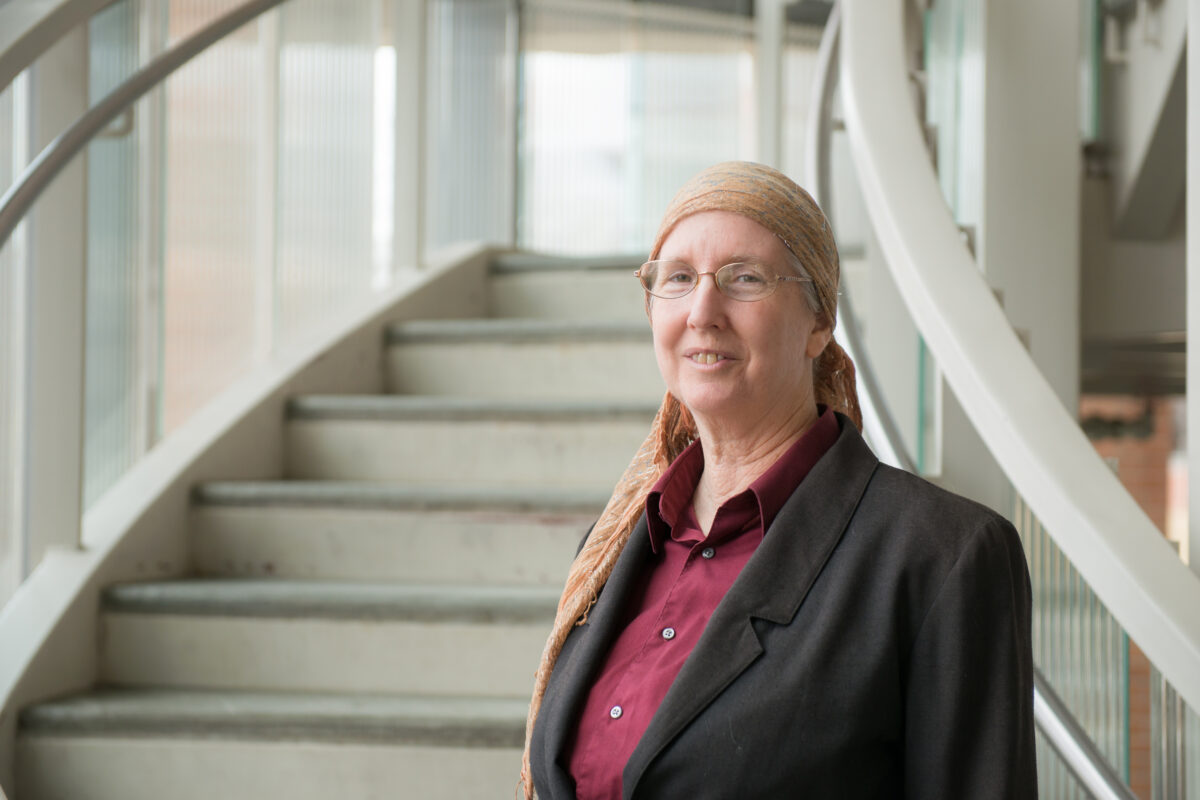 Lorraine Remer (Marlayna Demond ’11/UMBC)
Lorraine Remer, research professor for the Joint Center for Earth Systems Technology, who is affiliated with both GES and physics, is frequently honored for her geophysics publications. She received the 2019 UMBC Research Faculty Excellence Award following her recognition as one of “The Most Influential Scientific Minds” on the Thomson Reuters highly cited researchers list.
Anupam Joshi, director of UMBC’s Center for Cybersecurity and professor and chair of computer science and electrical engineering, was also included on Elsevier’s highly-cited list. His career trajectory demonstrates how UMBC faculty balance high-impact research with other forms of leadership. He has published more than 275 papers, has been granted nine patents, and has obtained research support from a variety of federal and industrial sources. At the same time, he is now serving as a 2022–23 American Council on Education (ACE) Fellow, an intensive program focused on agility and innovative problem solving among higher education leaders.
Measuring impact
This latest most-cited researchers list is based on data annually compiled from author profiles in Elsevier’s abstract and citation database, Scopus.
Elsevier’s 2022 database of standardized citation indicators classifies researchers into 22 fields and 174 subfields. Those with a composite indicator (c-score) within the top 2% of each subfield are included in the most-cited list. The list’s authors indicate that c-score is used because it “focuses on impact (citations) rather than productivity (number of publications)” and because it includes granular information on authorship, including co-authorship and author position (e.g., single, first, or last author).
]]>
More than 40 active UMBC researchers are listed among the top 2% of the world’s most-cited scientists and engineers in an analysis recently published by Elsevier. These researchers include...
https://umbc.edu/stories/most-cited-scientists-2022/
https://my3.my.umbc.edu/api/v0/pixel/news/130830/guest@my.umbc.edu/0a8209cd9947fb4136c6c8893cdbfae1/api/pixel
cahss
cbee
cnms
coeit
csee
cybersecurity
ges
gestar
is
jcet
meche
news
physics
rca-1
research
science-and-tech
UMBC News & Magazine
https://my3.my.umbc.edu/groups/umbc-news-magazine
https://assets1-my.umbc.edu/system/shared/avatars/groups/000/001/943/24435aa6207c452e7bc15cc74b42c7bb/xsmall.png?1748556657
https://assets1-my.umbc.edu/system/shared/avatars/groups/000/001/943/24435aa6207c452e7bc15cc74b42c7bb/original.png?1748556657
https://assets2-my.umbc.edu/system/shared/avatars/groups/000/001/943/24435aa6207c452e7bc15cc74b42c7bb/xxlarge.png?1748556657
https://assets2-my.umbc.edu/system/shared/avatars/groups/000/001/943/24435aa6207c452e7bc15cc74b42c7bb/xlarge.png?1748556657
https://assets3-my.umbc.edu/system/shared/avatars/groups/000/001/943/24435aa6207c452e7bc15cc74b42c7bb/large.png?1748556657
https://assets1-my.umbc.edu/system/shared/avatars/groups/000/001/943/24435aa6207c452e7bc15cc74b42c7bb/medium.png?1748556657
https://assets2-my.umbc.edu/system/shared/avatars/groups/000/001/943/24435aa6207c452e7bc15cc74b42c7bb/small.png?1748556657
https://assets1-my.umbc.edu/system/shared/avatars/groups/000/001/943/24435aa6207c452e7bc15cc74b42c7bb/xsmall.png?1748556657
https://assets2-my.umbc.edu/system/shared/avatars/groups/000/001/943/24435aa6207c452e7bc15cc74b42c7bb/xxsmall.png?1748556657
UMBC News & Magazine
0
0
false
Wed, 25 Jan 2023 11:47:33 -0500
Fri, 10 Feb 2023 17:01:24 -0500
UMBC’s Matthew Baker and team study how urban trees respond to heat stress
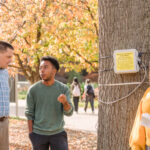
On a sunny fall day in October, a handful of student and faculty researchers are scuttling around outside the Albin O. Kuhn Library and Gallery. High-tech instruments sprawl across folding tables, alongside lower-tech equipment like a hole-punch, glass jars, clippers, and Ziploc bags. A drone about the size of a couch cushion sits on the grass nearby, awaiting instructions.
A student returns from a tree a couple of hundred yards away with a small clipping in a vase-like jar, and the work begins. Different team members examine leaves using the full range of equipment on the tables, collecting different information with each instrument.
Each month from May to October, the researchers complete this process 60 times over two days, collecting data from 60 different trees on UMBC’s main campus representing nine common species of urban trees. Plus, once an hour, the drone flies a pre-programmed route above campus, collecting additional information. Passing UMBC students occasionally stop to ask questions, and the team is happy to share their work.
Michael Alonzo, an assistant professor at American University, leads the project, and Matthew Baker, professor of geography and environmental systems at UMBC, is co-lead. Their students help out on the data collection days. The work also includes faculty and students from Temple University. The goal is to understand how the trees are responding to heat and moisture stress. By looking at trees from different species and in different locations, the research team can learn which trees might be most resilient in a warming world.
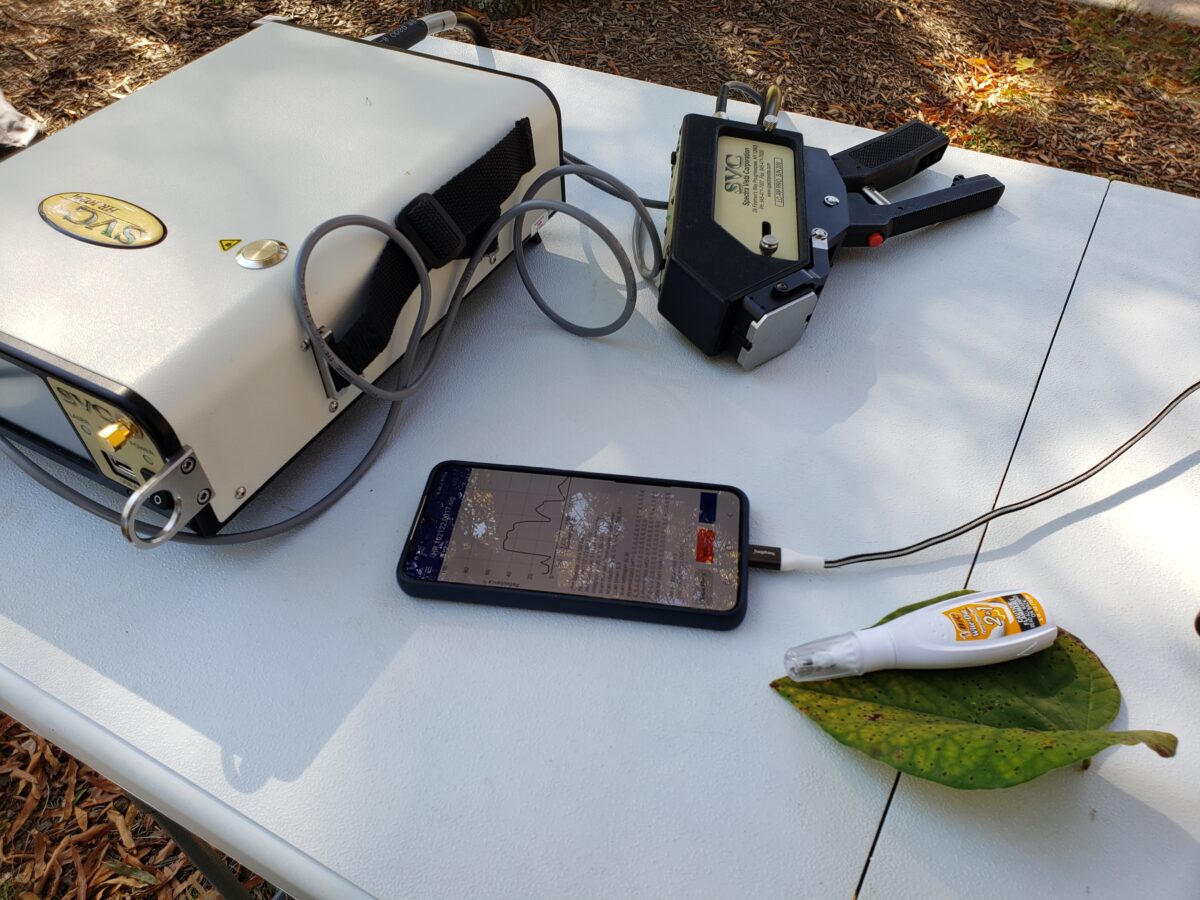 Data collection equipment is ready to go on a folding table outside the library. (Sarah Hansen, M.S. ’15/UMBC)
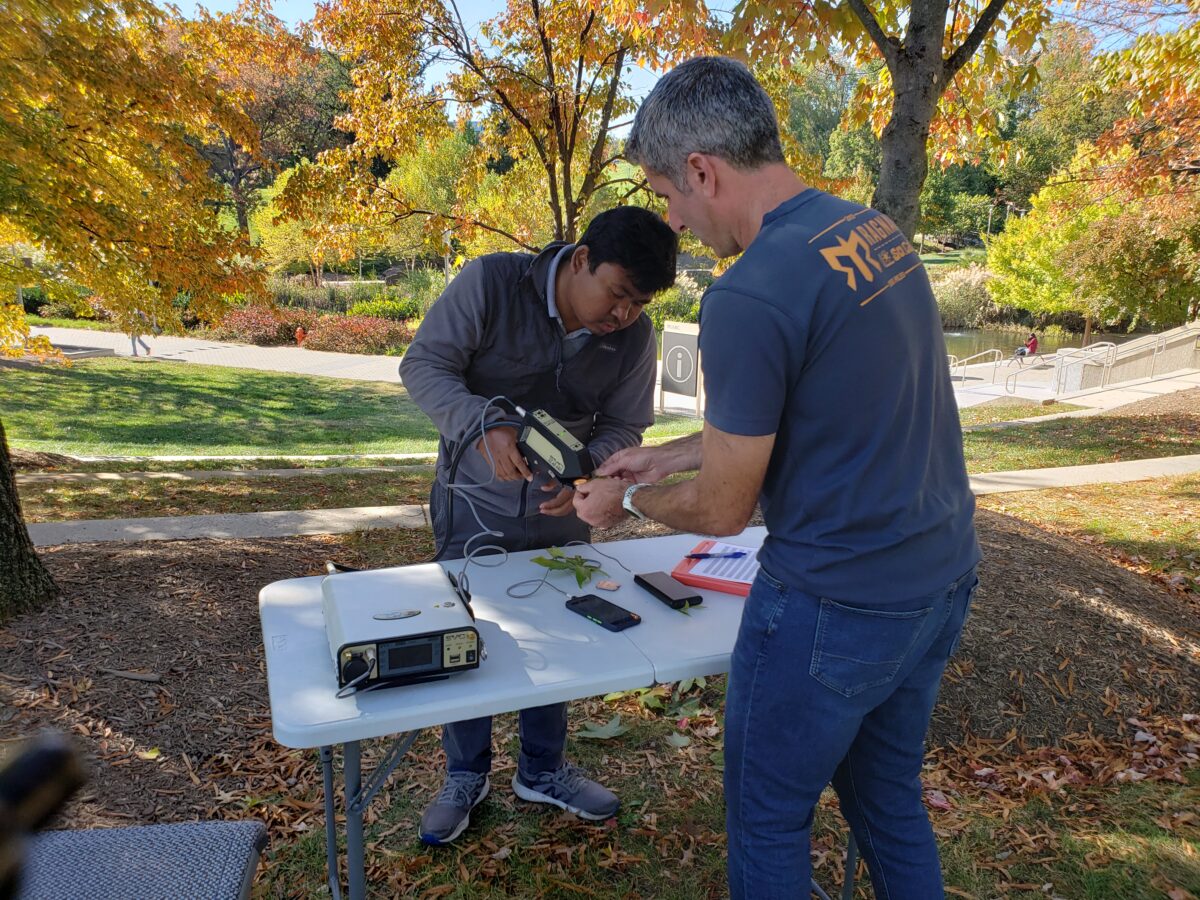 Michael Alonzo and Thu Ya Kyaw, a postdoc at American University, collect data. (Sarah Hansen, M.S. ’15/UMBC)
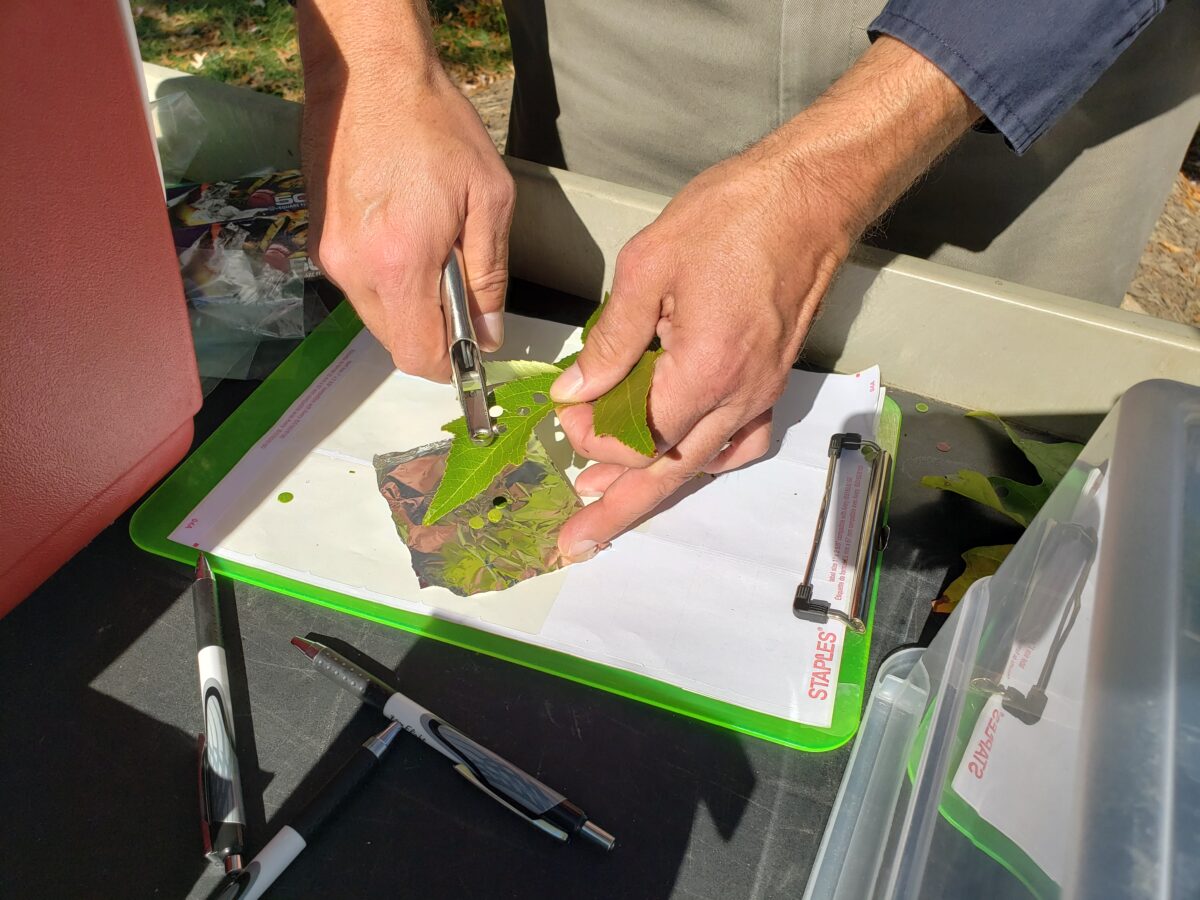 Matthew Baker takes samples from a leaf. (Sarah Hansen, M.S. ’15/UMBC)
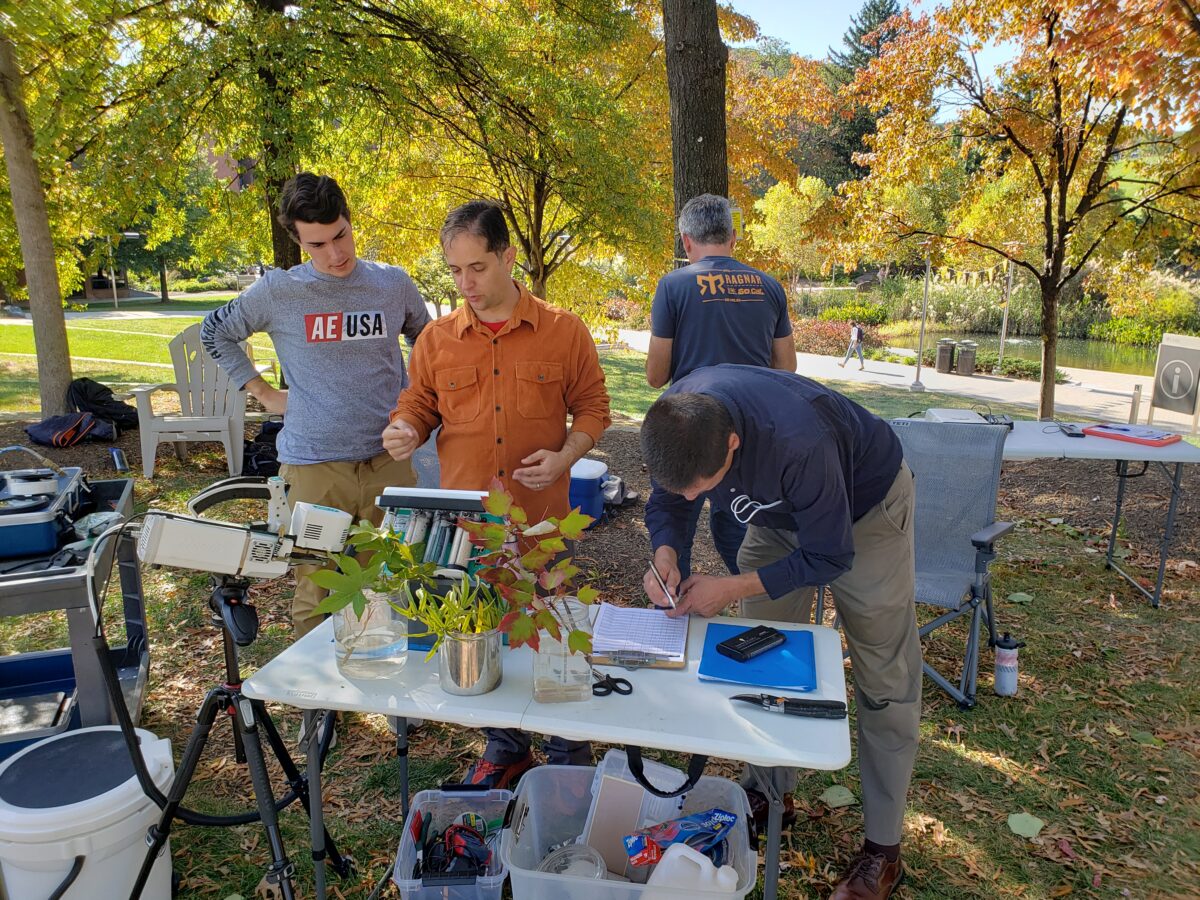 Lucas Martinez (left), a student at American University; Josh Caplan (second from left), a professor at Temple University; Matthew Baker (right) and Michael Alonzo (background, facing away) all work on data collection. (Sarah Hansen, M.S. ’15/UMBC)
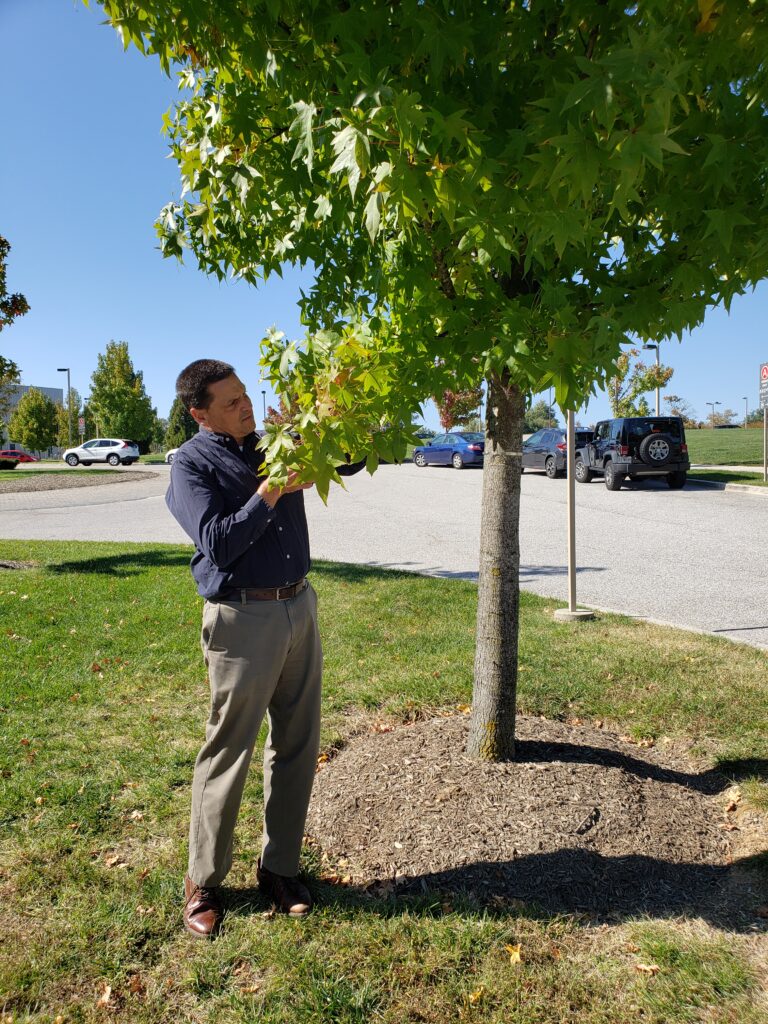 Matthew Baker takes a small clipping from a tree in the study. (Sarah Hansen, M.S. ’15/UMBC)
Innovation and transpiration
The UMBC campus, with its variety of tree habitats—like parking lots, grass fields, and natural areas—provides an excellent site to conduct the study. And because urban areas, which tend to include more pavement, are already experiencing higher temperatures on average than less developed areas, “Trees in these heat islands may provide a glimpse into the future about how they’ll respond elsewhere,” Baker says.
The instruments on the tables can measure things like how much and which wavelengths of light individual leaves are absorbing and their rate of photosynthesis. There are also sensors placed directly on the trees, which collect data in real time. A sensor in a metal box on each tree measures the rate at which water is flowing from its roots to its leaves, a process known as transpiration that is central to the water cycle. An instrument called a Scholander pressure bomb looks at a similar measure, but in the leaves. By gradually applying more pressure to a single leaf, it detects how hard the water is being pulled as it journeys from the roots, to the leaves, to the atmosphere.
By comparing the rates of photosynthesis and transpiration, which are typically closely linked, the researchers can see if the relationship between the two processes is shifting under stress.
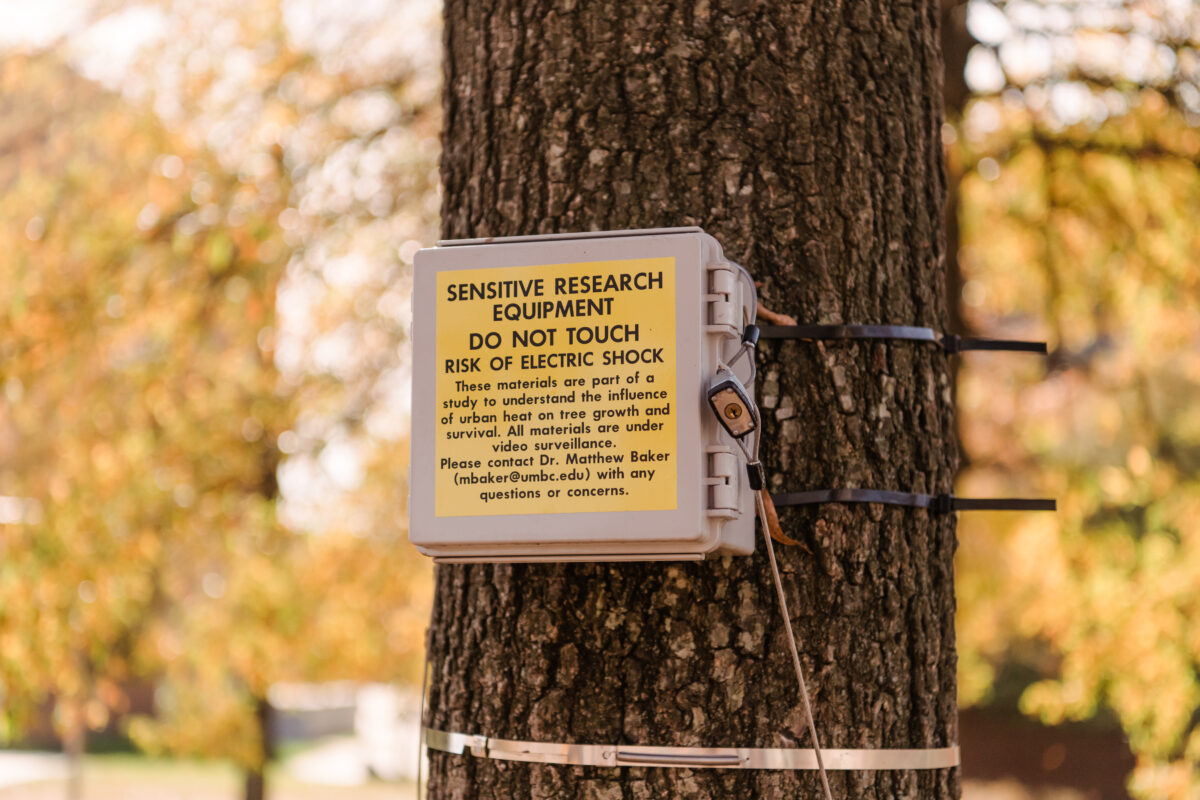 A box containing a sensor on one of the trees in the study. (Marlayna Demond ’11/UMBC)
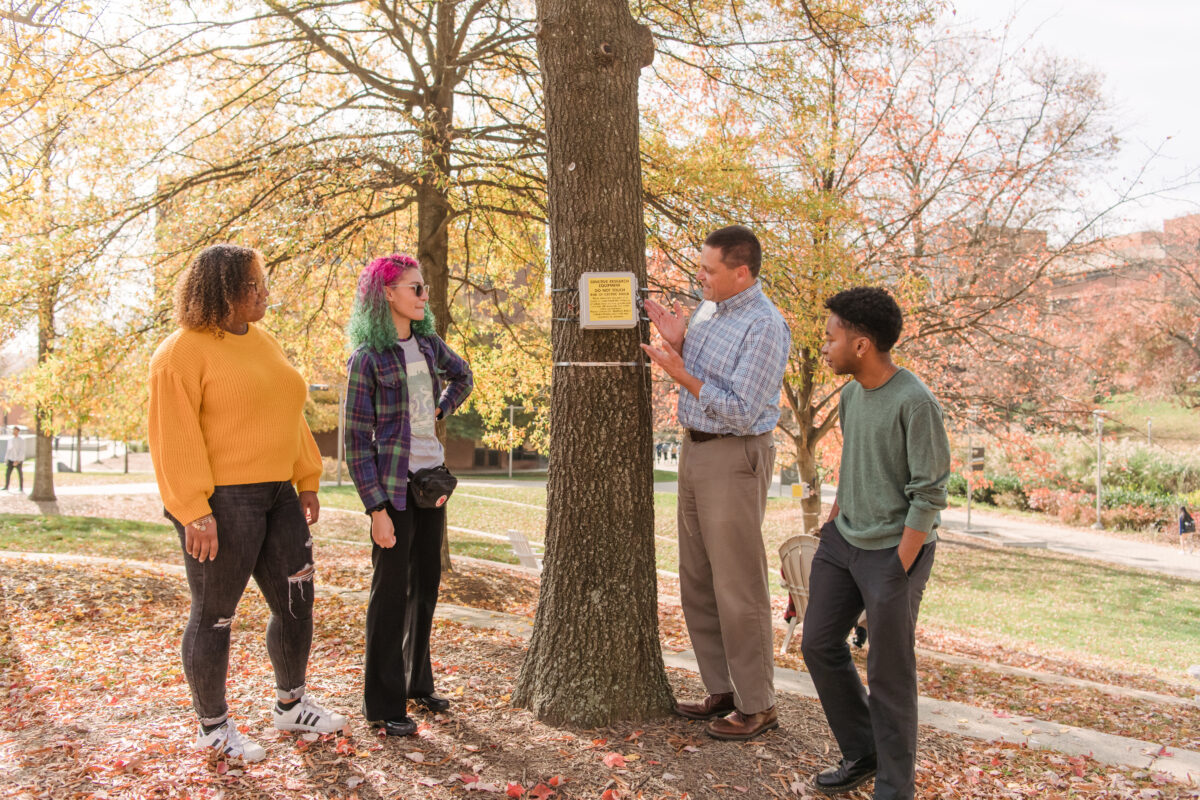 Matthew Baker talks about the research project with UMBC graduate students who have participated in data collection. Left to right: Tyrah Cobb-Davis, Erin Hamner, Matthew Baker, Drew Powell. (Marlayna Demond ’11/UMBC)
It’s a bird, it’s a plane, it’s… a research drone?
The team also uses a drone with a thermal camera to measure the heat signature of the tree canopy compared to the surrounding environment. “As long as the canopy is transpiring, the canopy should appear cooler than nearby pavement in our imagery,” Baker says. That temperature difference between the canopy and the surroundings can help determine how much transpiration is happening.
The researchers compare the findings from the drone’s hourly flights with what they’re seeing on the ground. “We’re in the ‘do we trust you’ phase of the relationship” with the drone and its data, Alonzo says. The hope is that if the drone data matches the ground data well enough, the team can use it to gather the same information in a much less labor-intensive way and over larger geographic areas.
Permission to use the drone also required cooperation and trust-building with several UMBC departments, such as UMBC Police, environmental safety and health, and facilities management, as well as BWI Airport. This project is the first time drones have been allowed on campus for research, following a recent revision of federal aviation and campus safety policies.
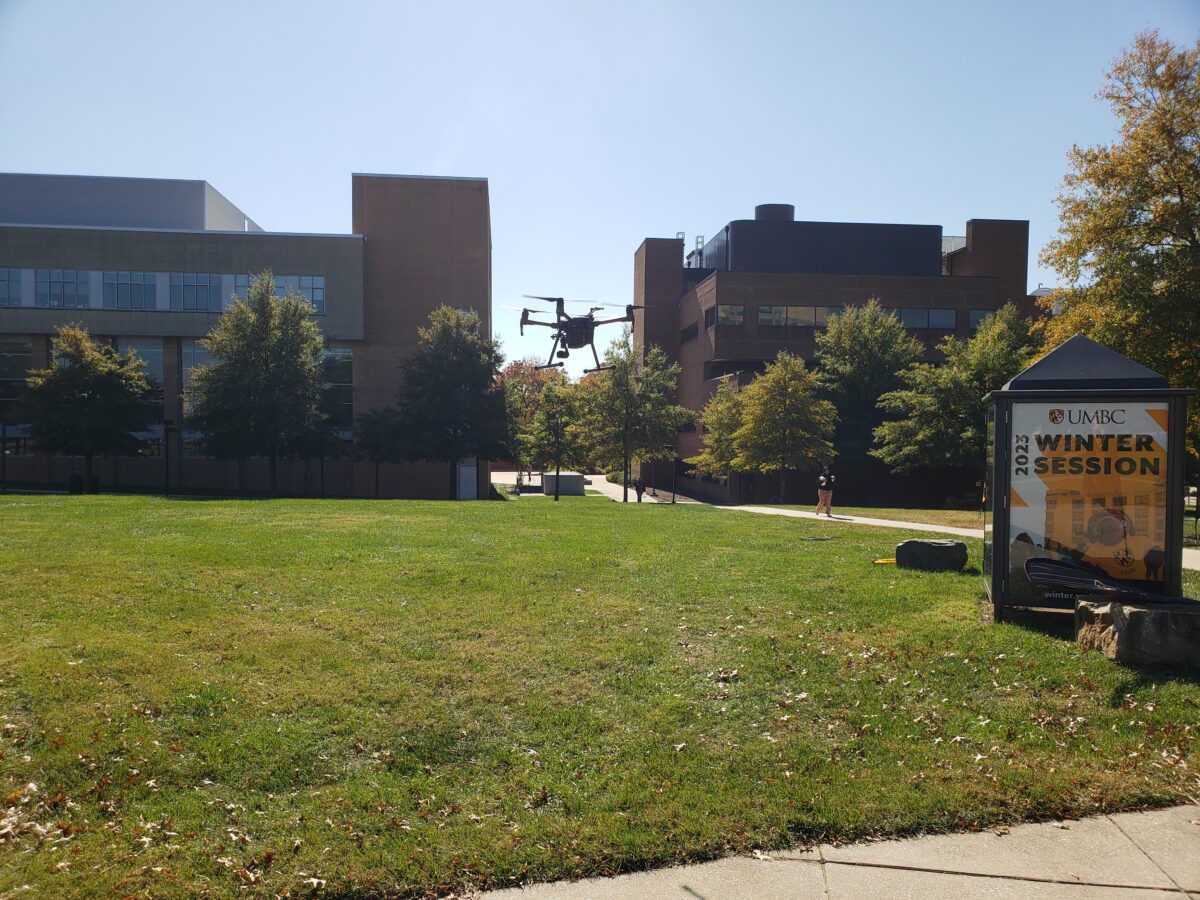 The research drone lands on the grass after its programmed flight. (Sarah Hansen, M.S. ’15/UMBC)
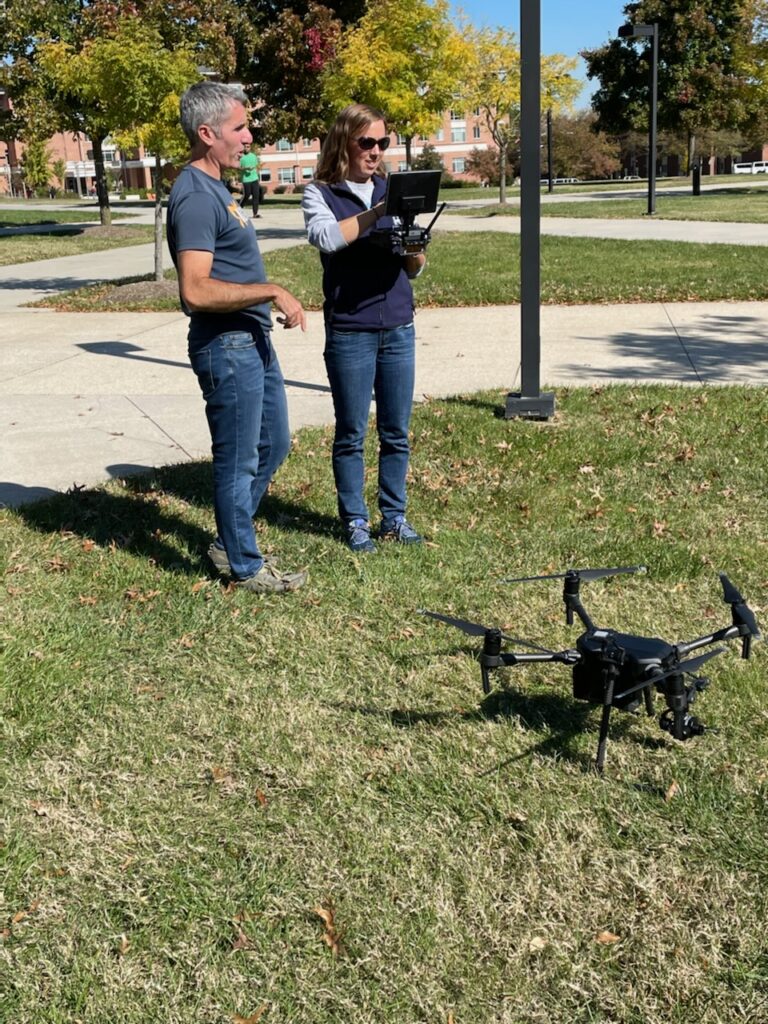 Michael Alonzo (left) and Sarah Hansen send the drone out for its hourly data-collection flight. (Image by Matthew Baker)
Growing the fleet
In addition to the thermal camera on the drone, the team is using a hyperspectral camera (on loan from NASA) to collect imagery from the roofs of both the library and the Physics Building. Hyperspectral imagery provides information about canopy stress, water content, and leaf pigments like chlorophyll, which drive photosynthesis. Next year, they hope to have this camera mounted on a drone, too. Together, these two cameras collecting data from above “are the link to being able to perform similar measurements over much broader areas, like metropolitan Baltimore, with airborne or spaceborne platforms,” Baker says.
In fact, the team has already started related work in 11 other cities in the Eastern U.S., including research on how trees help cool cities using data from Washington, DC.
The study on campus is already turning up differences in how various tree species respond to warming. The team discovered that some species intermittently reduce their transpiration rate, possibly as a stress response. Some trees even stop the process altogether during the hottest part of the day—a phenomenon Alonzo calls a “tree siesta.”
It remains to be seen if photosynthesis slows down along with transpiration. If it does, this could indicate that the trees are prioritizing protective measures to prevent overheating and water loss over growth. A reduced growth rate would also reduce the amount of carbon the trees are taking out of the atmosphere, which is an important factor when estimating how much planting trees could benefit the future climate.
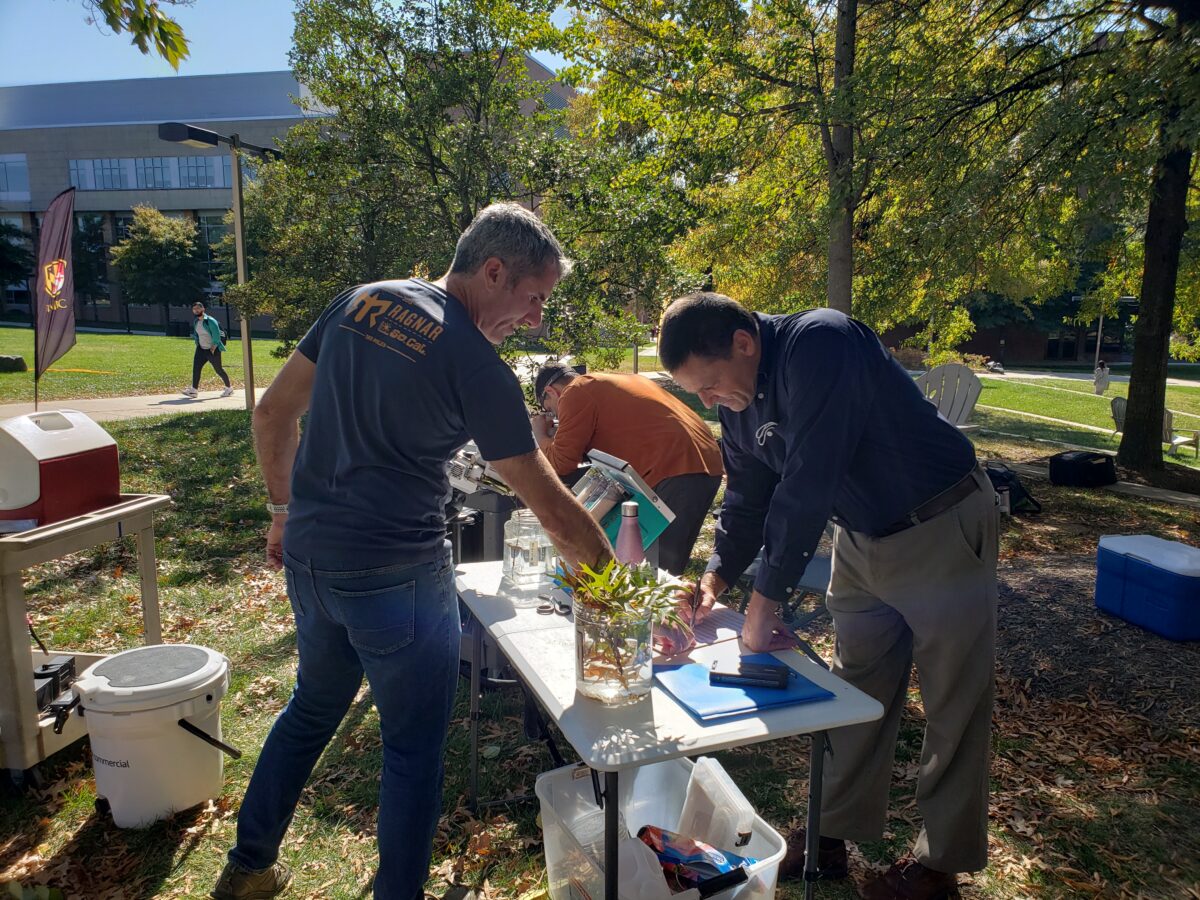 Matthew Baker (right), Michael Alonzo (left), and Josh Caplan (center) collect tree data outside the Albin O. Kuhn Library and Gallery. (Sarah Hansen, M.S. ’15/UMBC)
Informing the future
All aspects of the project have involved undergraduate and graduate students. More than 15 students have contributed, including Caitlin Beckjord ’23, geography and environmental systems, who first got involved in forest research through a summer project while she was a student at Howard Community College. Micah Polsky ’25, geography and environmental systems, has a leading role in a complementary study with the USDA Forest Service. They take precise weekly measurements of the trees’ girth—another way to measure their water status as well as their growth rate.
Faculty teach each student how to use the full range of instruments used in this study, making this project an excellent training opportunity for students in majors from environmental science to physics or information systems. The project brings together important new details about how trees are responding to stress, testing and verification of new technologies, and student engagement and training in a way that is likely to have a significant impact on the participants and the future of this research field.
]]>
On a sunny fall day in October, a handful of student and faculty researchers are scuttling around outside the Albin O. Kuhn Library and Gallery. High-tech instruments sprawl across folding tables,...
https://umbc.edu/stories/urban-trees/
https://my3.my.umbc.edu/api/v0/pixel/news/129931/guest@my.umbc.edu/50b0bacd966a8787a947ae0a0afaa983/api/pixel
cahss
discovery
ges
magazine
research
UMBC News & Magazine
https://my3.my.umbc.edu/groups/umbc-news-magazine
https://assets1-my.umbc.edu/system/shared/avatars/groups/000/001/943/24435aa6207c452e7bc15cc74b42c7bb/xsmall.png?1748556657
https://assets1-my.umbc.edu/system/shared/avatars/groups/000/001/943/24435aa6207c452e7bc15cc74b42c7bb/original.png?1748556657
https://assets2-my.umbc.edu/system/shared/avatars/groups/000/001/943/24435aa6207c452e7bc15cc74b42c7bb/xxlarge.png?1748556657
https://assets2-my.umbc.edu/system/shared/avatars/groups/000/001/943/24435aa6207c452e7bc15cc74b42c7bb/xlarge.png?1748556657
https://assets3-my.umbc.edu/system/shared/avatars/groups/000/001/943/24435aa6207c452e7bc15cc74b42c7bb/large.png?1748556657
https://assets1-my.umbc.edu/system/shared/avatars/groups/000/001/943/24435aa6207c452e7bc15cc74b42c7bb/medium.png?1748556657
https://assets2-my.umbc.edu/system/shared/avatars/groups/000/001/943/24435aa6207c452e7bc15cc74b42c7bb/small.png?1748556657
https://assets1-my.umbc.edu/system/shared/avatars/groups/000/001/943/24435aa6207c452e7bc15cc74b42c7bb/xsmall.png?1748556657
https://assets2-my.umbc.edu/system/shared/avatars/groups/000/001/943/24435aa6207c452e7bc15cc74b42c7bb/xxsmall.png?1748556657
UMBC News & Magazine
6
0
false
Wed, 21 Dec 2022 11:22:25 -0500
Wed, 21 Dec 2022 11:22:25 -0500
Centering Thriving Immigrant Voices in Immigration Research
UMBC faculty are leading interdisciplinary, community-engaged immigration research that is shifting the relationship between higher education institutions and immigrant communities. Their approaches include centering the economic, academic, social, and cultural contributions of immigrants to the well-being of U.S. cities. This scholarship challenges stereotypes and also works to dismantle systemic racism in higher education.
In 2020, New York Times reported that U.S.-born children of immigrants or immigrant students raised in the U.S. accounted for nearly 60 percent of the growth in U.S. university enrollment since 2000. The majority of these students are the children of international students from India who stayed in the U.S. to work, and the children of Latin Americans, and refugees who came to the U.S. in search of better living conditions.
Felipe Filomeno, associate professor of political science and global studies, and associate director of the Center for Social Science Scholarship, and Christopher Brown, a global studies lecturer, explore how immigrant students can be an asset to higher education with their study “Immigrant Students and Global Education.”
Filomeno and Brown designed a collaborative, project-based undergraduate course to study the intercultural experiences of immigrant students at UMBC. Students developed the ability to collect and analyze qualitative data and empathy for immigrants as they learned about diverse peer experiences. The study determined that project-based assignments designed to take advantage of immigrant students’ intercultural experiences could yield significant contributions to the global education of immigrant and non-immigrant students alike.
“It is important that there are such stellar colleagues committed to the vital work of exploring the realities, lived experiences, and challenges of our immigrant communities,” says Kimberly R. Moffitt, dean of the College of Arts, Humanities, and Social Sciences. “We can only thrive as a society by supporting and working together with all members of our community and recognizing their contributions to a global society.”
Digital storytelling for education and advocacy
Several of UMBC’s community-engaged researchers use digital storytelling to shift the focus away from the researcher creating information toward information being created by the community. One such project is “Intercultural Tales: Learning with Maryland’s Immigrant Communities,” developed by Thania Muñoz Davaslıoğlu, assistant professor of modern languages, linguistics, and intercultural communication (MLLI), and Tania Lizarazo, associate professor of MLLI and global studies.
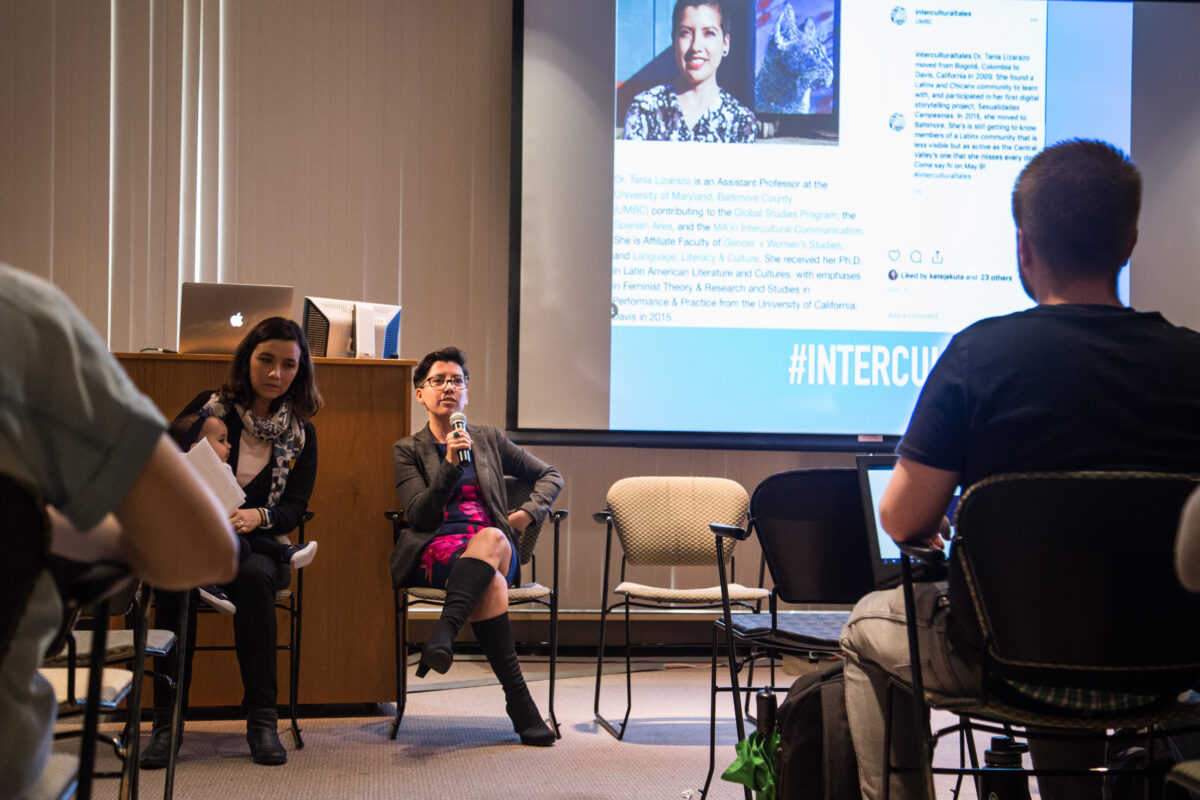 Tania Lizarazo speaking at Intercultural Tales with Thania Muñoz. Photo by Rachel Wallace
This project approaches digital storytelling from a feminist lens where non-academic knowledge such as lived experience is considered equally valuable in teaching and research. “Our project is informed by feminist theory and the field of critical intercultural communication in which power structures and hierarchies are emphasized when thinking about communication,” says Lizarazo, “Intercultural Tales is shaped by all of these fields/practices to facilitate (not guarantee) a more nuanced understanding of immigration as part of UMBC (instead of outside of it).”
This project, now in its third year, brings together students studying Spanish or global studies to produce digital stories of immigrant experiences with the goal of countering stereotypes. In one of the digital stories, “Pack Your Bag,” Heejin Hong ’18, MLLI, speaks of her parents’ transition from Korea to Paraguay, her time living in Brazil, moving to Mexico, and eventually settling in the U.S.
“My parents were first-generation immigrants from South Korea to Paraguay, where I was born. Their life as immigrants was not easy. They worked day and night to support our family,” Hong shared. “They constantly moved to other cities and countries looking for work. When I was little, I moved to Brazil to be with my grandparents because my parents had to work. Brazil was my first experience with immigration and learning a new language, new places, new food, and new cultures.”
She continued, “I have now been living in the U.S. for more than ten years. I used to see all of the changes that made me grow up quickly and think of what I didn’t have. Now, I realize that I gained something greater: courage, independence, patience, a positive outlook, not to lament, and to keep moving forward.”
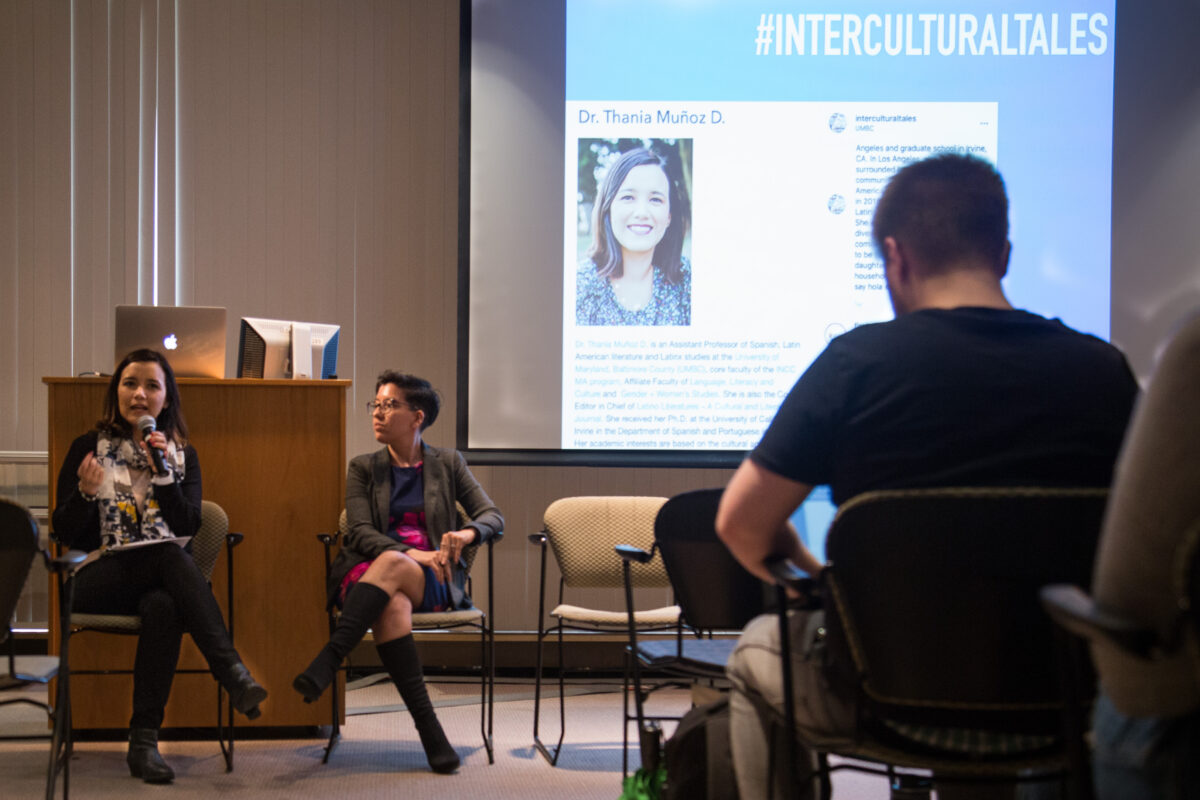 Thania Muñoz speaking about Intercultural Tales with Tania Lizarazo. Photo by Rachel Wallace.
Muñoz notes the findings, which were published in the Journal of Community Engagement and Higher Education, show the process of sharing and valuing knowledge through the project in some cases enabled the students to reframe fear, confusion, and shame through a new lens that revealed feelings of pride, solidarity, and insight.
“Most students had a more nuanced understanding of immigration,” says Lizarazo, “and a renewed appreciation for their classmate’s knowledge, which, in turn, shaped a less hierarchical learning space.”
Community-building through digital storytelling
Lizarazo also collaborated with local immigrant women to create “Moving Stories: Latinas en Baltimore.” The digital storytelling archive visualizes the immigrant experience from the perspective of Latinas in Baltimore. It aims to dispel stereotypes and share the diversity of their experiences.
Camila Daniel shared her experience of being a Black-Brazilian Latina living in Baltimore in her digital story “When Baltimore Became My Home.”
“In 2006 when I came to Baltimore, I lived the experience of what it means to be Black and Latina at the same time in a country that expects people to be only of one race. When people saw me with my accent, my hair, and my Black skin, they assumed I was African American. Many of the Brazilians were white. I didn’t feel I fit in anywhere. I suffered a lot,” says Daniel.
She continues, “Now, I feel it was good for me to come to Baltimore, live in a predominantly Black city, and learn from Black people what it is to have pride in how you look and your history. At the same time, with Spanish and Baltimore, I have created a family that does not have my blood or nationality but one heart.”
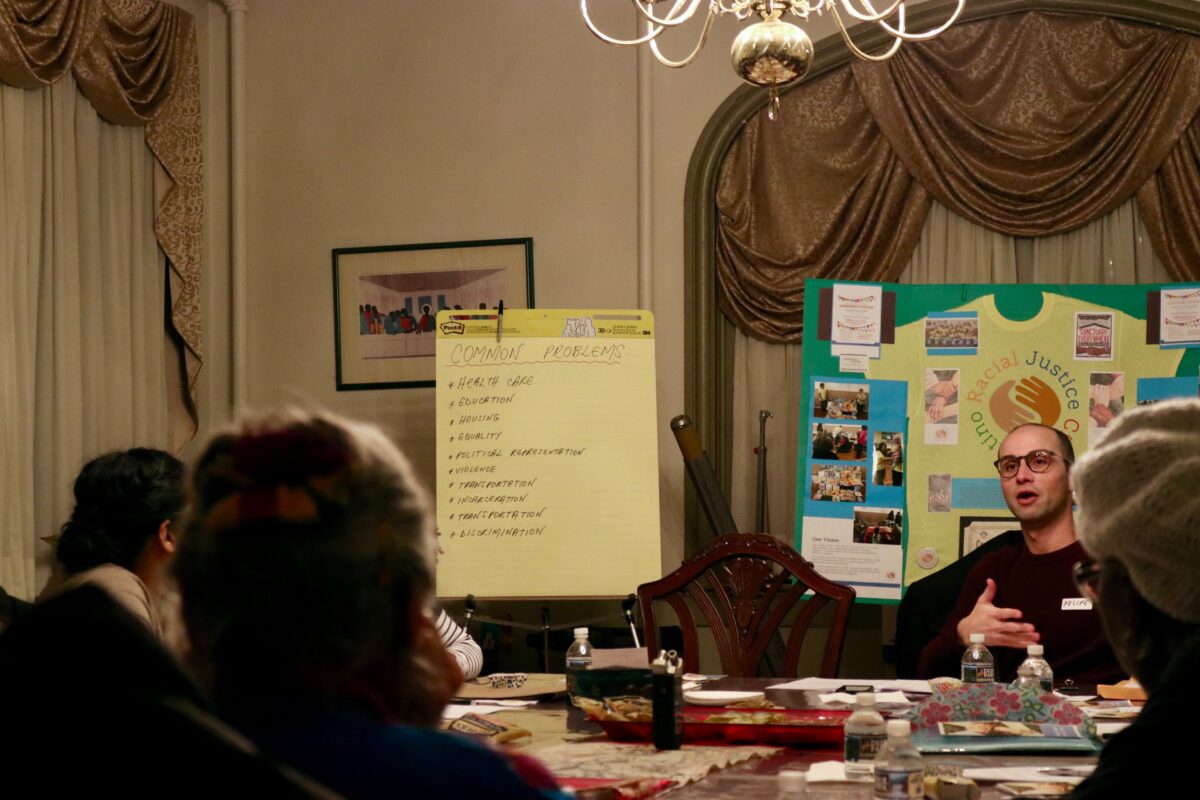 Filomeno leads a discussion with Baltimore’s Latino Racial Justice Circle. Photo courtesy of Filomeno.
Since 2017, Lizarazo and Filomeno have also worked in partnership with Baltimore’s Latino Racial Justice Circle to develop, design, execute, evaluate, and share the “Honest Conversations on Immigration” project. Through dialogue, and digital storytelling, the program fosters conversations between U.S.-born citizens and immigrants that share faith-based spaces but rarely engage in dialogue. Since 2019, about 85 members of 15 congregations have participated.
“Our goal as researchers is to use dialogue and digital stories as ways to bring different communities together around religion, race, and immigration,” explains Filomeno. “Through that process, we hope to create the potential to change the relationships among individuals, and between communities and society for the better.”
Baltimore’s immigration policies
Filomeno last year received the Hispanic Heritage Award from Baltimore Mayor Brandon Scott in recognition of his work facilitating dialogue as well as an earlier comprehensive assessment of Baltimore’s immigration policies. The study “Baltimore’s Policies to Attract and Retain Immigrants: A Community-Engaged Evaluation” was critical in shaping the strategic vision of the Mayor’s Office of Immigrant Affairs. It built on a prior study in which Filomeno reviewed Baltimore’s economic development, multicultural, and law enforcement policies, collaboration with civil society, and policy advocacy.
“In all these studies, I have engaged local groups and organizations in the creation of knowledge about immigration and the application of this knowledge to help solve real-world problems,” says Filomeno. “This research has helped a local government trying to encourage the city’s growth through immigration, a faith community trying to build connections between congregants of different nationalities, and a university trying to leverage student diversity of national origin to promote global learning. As we say at UMBC, it is public research for public good.”
Documenting places of belonging and meaning
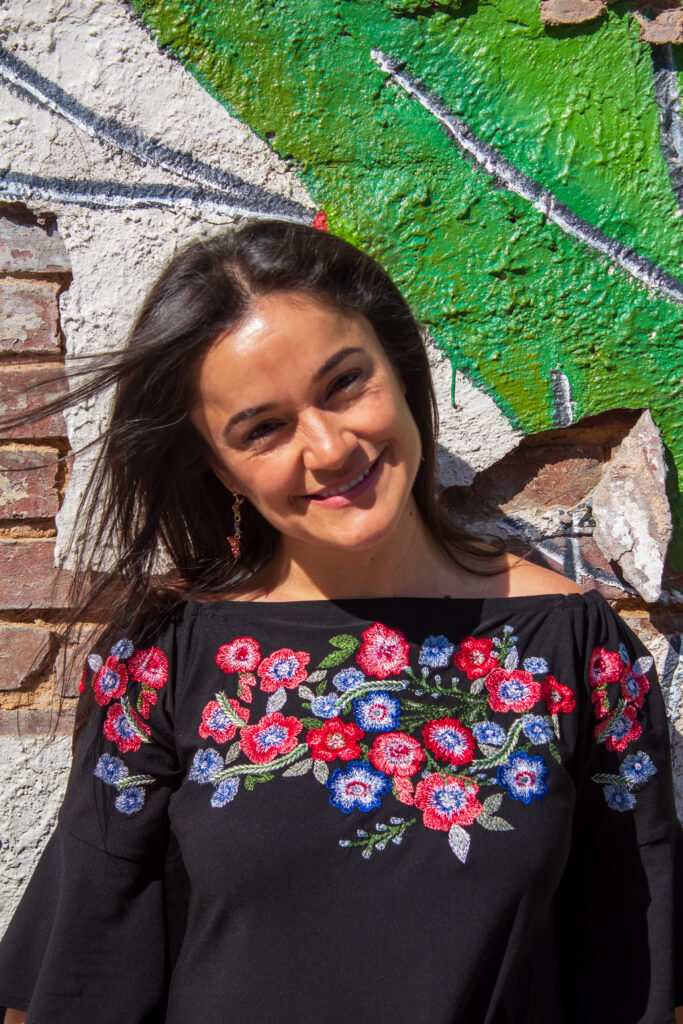 Headshot courtesy of Yolanda Valencia.
Beyond Maryland, Yolanda Valencia, assistant professor of geography and environmental systems, explores the Mexican immigrant community of Pasco, Washington, and how this community creates places of peace, tranquility, and family—places of belonging and meaning—under disadvantaged conditions. In the forthcoming book Relational Life: Legal Death, Valencia draws on years of fieldwork in Pasco, transnational ethnography, archival research, interviews with city leaders, and testimonies from undocumented Mexican immigrants.
“I aim to provide a historical political economy analysis of geographies of oppression overlaid with an analysis of spaces where this community thrives, as they both happen simultaneously across scale, time, and border,” says Valencia.
This year, Valencia received a 12-month Career Enhancement Fellowship, funded by the Mellon Foundation and administered by the Institute for Citizens and Scholars. She was also selected as a 2020 – 2022 Summer Institute on Tenure and Professional Advancement (SITPA) scholar. The mentoring and professional initiative is designed to facilitate junior faculty members’ successful transition to tenured associate professor status.
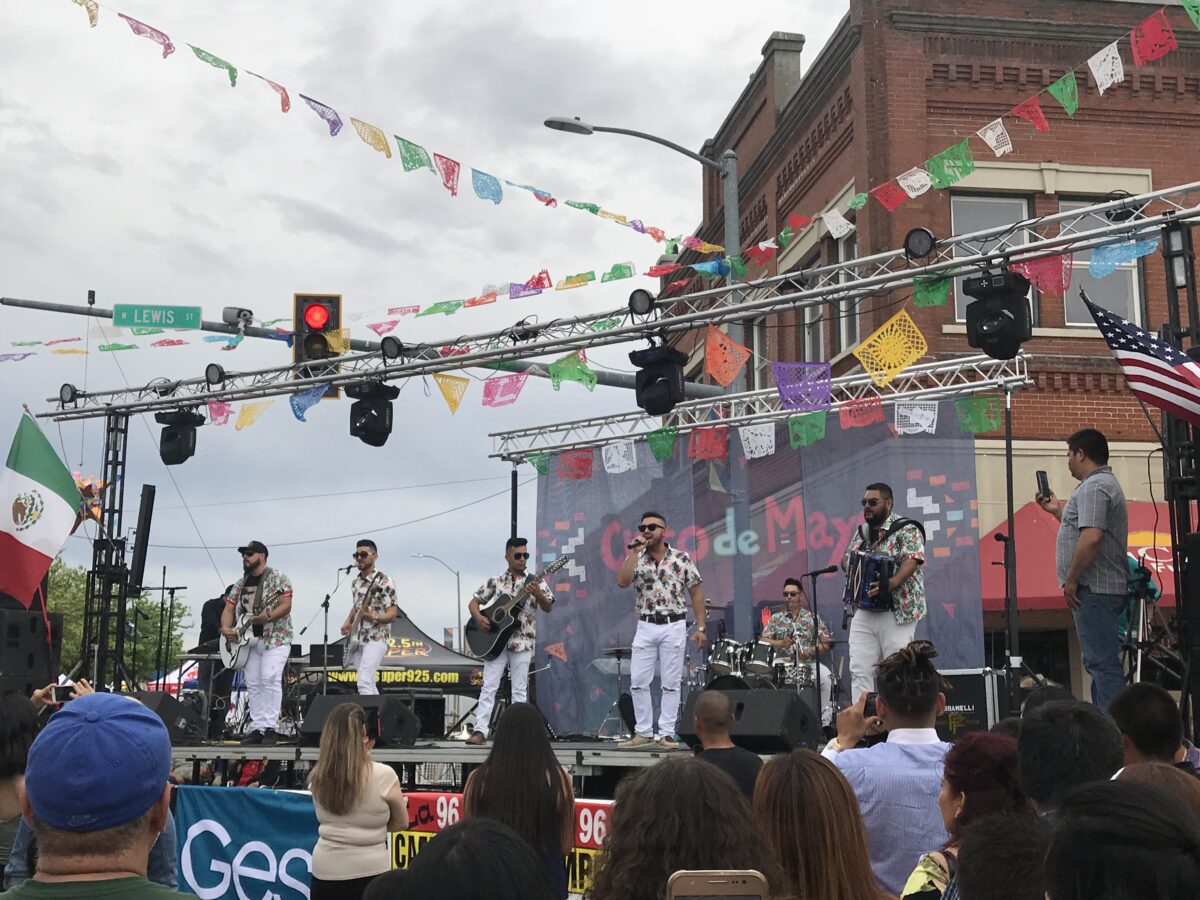 This Cinco de Mayo event in Pasco features second-generation Mexican immigrant musicians who have learned how to play, sing, and love traditional Mexican (and Latinx) music. Photo courtesy of Valencia.
Another faculty member has been highly engaged with immigrant communities in New Orleans. The success of taco trucks and Soul Food pop-ups there have raised complex questions about food truck regulation, worker rights, and immigration. The Whiting Foundation awarded a $50,000 Public Engagement Fellowship to Sarah Fouts, assistant professor of American studies, along with local New Orleans organizers Toya Ex Lewis and Fernando López, to implement “Project Neutral Grounds: At the Intersection of People, Street Food, and the Hustle.”
Lewis is the organizer of Project Hustle, born in New Orleans, and López is a Mexican-born documentarian. The three partners have worked together since 2013. Their latest collaboration will bring together Black, Brown, LGBTQ+, and immigrant food vendors in New Orleans to celebrate, share, and document their experiences and histories.
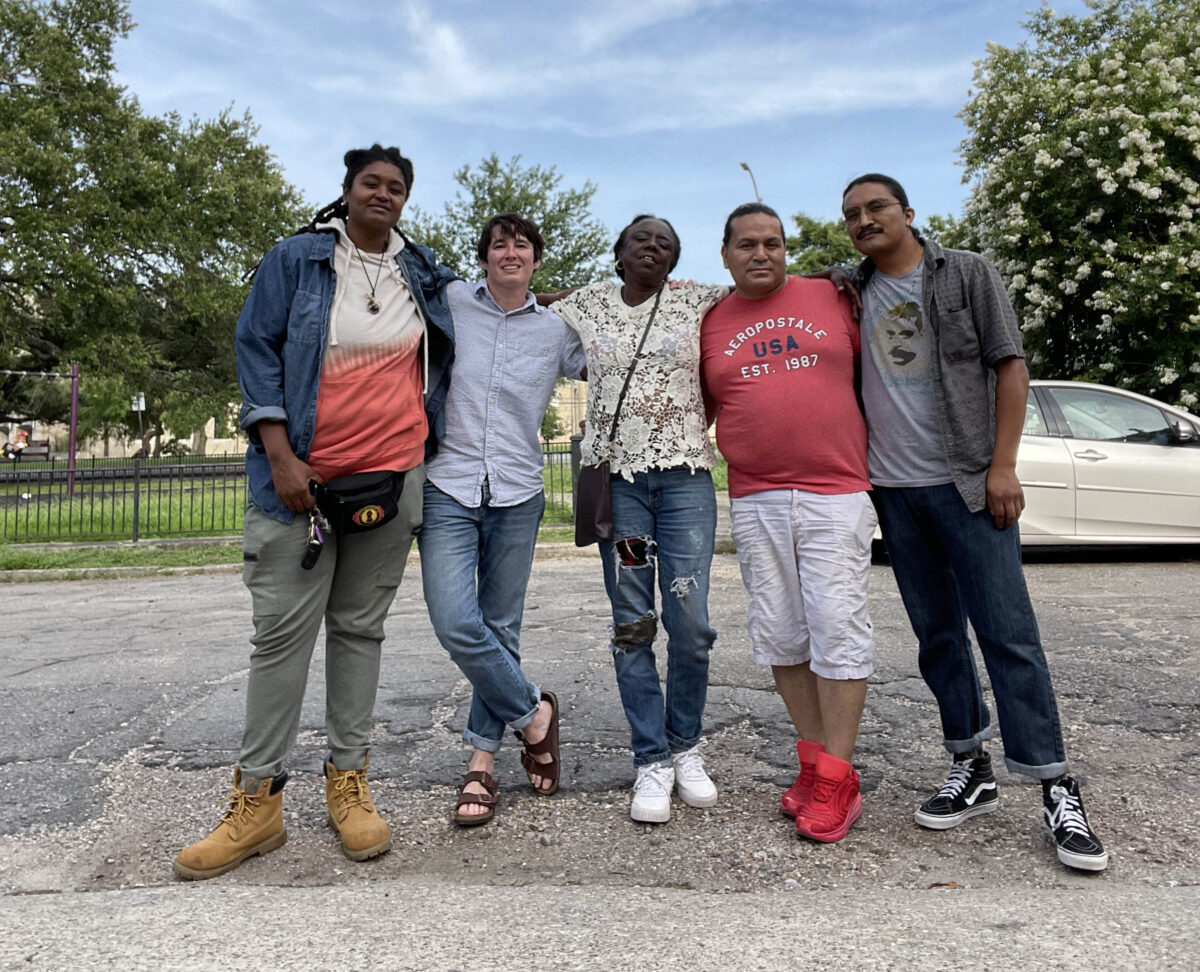 Left to right: Toya Ex Lewis, Sarah Fouts, community members, and Fernando Lopez. Photo courtesy of Fouts.
Challenging extractive research
This innovative research intentionally values the knowledge of immigrants and creates new ways for academics to think about primary sources. It highlights thriving communities and enables communication, personal reflection, and empathy while challenging systemic racism and the role of education and institutions in perpetuating inequalities.
“Recognizing each other’s humanity is not an abstract process. It requires a commitment to questioning pedagogies that reproduce the hierarchies we critique,” Muñoz Davaslıoğlu and Lizarazo explain. “Teaching and learning are inextricable from struggles against the dehumanization of immigrants and minorities.”
]]>
UMBC faculty are leading interdisciplinary, community-engaged immigration research that is shifting the relationship between higher education institutions and immigrant communities. Their...
https://umbc.edu/stories/immigrant-voices-in-immigration-research/
https://my3.my.umbc.edu/api/v0/pixel/news/129593/guest@my.umbc.edu/b0f32c6867d89407d88e1ee16c263f2e/api/pixel
americanstudies
arts-and-culture
cahss
csss
discovery
ges
globalstudies
magazine
mlli
news
politicalscience
rca-2
UMBC News & Magazine
https://my3.my.umbc.edu/groups/umbc-news-magazine
https://assets1-my.umbc.edu/system/shared/avatars/groups/000/001/943/24435aa6207c452e7bc15cc74b42c7bb/xsmall.png?1748556657
https://assets1-my.umbc.edu/system/shared/avatars/groups/000/001/943/24435aa6207c452e7bc15cc74b42c7bb/original.png?1748556657
https://assets2-my.umbc.edu/system/shared/avatars/groups/000/001/943/24435aa6207c452e7bc15cc74b42c7bb/xxlarge.png?1748556657
https://assets2-my.umbc.edu/system/shared/avatars/groups/000/001/943/24435aa6207c452e7bc15cc74b42c7bb/xlarge.png?1748556657
https://assets3-my.umbc.edu/system/shared/avatars/groups/000/001/943/24435aa6207c452e7bc15cc74b42c7bb/large.png?1748556657
https://assets1-my.umbc.edu/system/shared/avatars/groups/000/001/943/24435aa6207c452e7bc15cc74b42c7bb/medium.png?1748556657
https://assets2-my.umbc.edu/system/shared/avatars/groups/000/001/943/24435aa6207c452e7bc15cc74b42c7bb/small.png?1748556657
https://assets1-my.umbc.edu/system/shared/avatars/groups/000/001/943/24435aa6207c452e7bc15cc74b42c7bb/xsmall.png?1748556657
https://assets2-my.umbc.edu/system/shared/avatars/groups/000/001/943/24435aa6207c452e7bc15cc74b42c7bb/xxsmall.png?1748556657
UMBC News & Magazine
0
0
false
Mon, 05 Dec 2022 15:44:58 -0500
Mon, 05 Dec 2022 15:44:58 -0500
GRIT-X 2022 brings to life the “essence” of UMBC research and creative achievement
Amid a bustling day filled with Homecoming excitement, GRIT-X returned to UMBC this month for its sixth year, delivering a wide-ranging lineup of Retriever excellence in action. Held in the Fine Arts Recital Hall, this year’s GRIT-X was the first for new UMBC President Valerie Sheares Ashby. Enjoying one engaging talk after another, she deemed the event “the essence of UMBC.”
“What a beautiful day,” said President Sheares Ashby, in her remarks to the GRIT-X audience. “Not only were [the presenters] brilliant, they were people-centric. They were thinking about things that were real and important to each one of our lives being better, the universe being better, our bodies being better, and our communities being better. I cannot have experienced a better first GRIT-X.”
Watch the GRIT-X 2022 talks
Rethinking digital divides: Creating access, experiential learning, and empathy in the digital world
Delali Dzirasa ‘04, computer engineering, opened this year’s GRIT-X event with a presentation detailing how his company, Fearless, led the development of the Searchable Museum to complement the Smithsonian National Museum of African American History and Culture (NMAAHC) “Slavery and Freedom” exhibition. Dzirasa elaborated on how his team, including several UMBC alumni, was able to reimagine this exhibit specifically for online audiences amid the pandemic. The Fearless CEO was the third in his family to deliver a GRIT-X talk, following his wife, Baltimore City Health Commissioner Letitia Dzirasa ‘03, biological sciences (GRIT-X 2021), and his brother Kafui Dzirasa ‘01, M8, chemical engineering (GRIT-X 2017).
Can we reduce the deluge in sea levels with a data deluge?
Vandana Janeja, professor and chair of information systems, discussed the research she’s leading as the director of the NSF HDR Institute for Harnessing Data and Model Revolution in the Polar Regions, or iHARP. Janeja outlined how she and the iHARP team are utilizing data science, machine learning, artificial intelligence, and polar science to analyze enormous volumes of climate data as well as Arctic and Antarctic observations in ways that could help populations respond to the harmful impacts of climate change.
Sounds of the world through the violin
Airi Yoshioka, professor of music, delivered her presentation on how the cultural background of a composer manifests in the music they create. Yoshioka played excerpts of music from several composers around the world, explaining how they were able to express their cultural identities through their music. The violinist then captured the imagination of the audience with her striking performance of “Sentimental” from “Five Little Milonguitas” by composer Pablo Ortiz from her 2015 album Sueños Misticos.
Community building: How to build with materials that are stronger than brick and mortar
Alicia Lynn Wilson ‘04, political science, serves as vice president for economic development at Johns Hopkins University. She has taken part in some of the largest redevelopment efforts in the country, overseeing more than $10 billion in redevelopment projects in the last decade. Wilson shared her perspective on how every person is involved in construction, being actively engaged in the community-building enterprise. Her presentation outlined five principles that she relies on when forging and maintaining community connections.
Glucosome: 4D Visualization of the secret society of metabolic enzymes
Minjoung Kyoung, associate professor of chemistry and biochemistry, started her presentation on metabolic enzymes in an unexpected way: by showing the audience a picture of donuts. The image helped to entice the audience as they listened to her research on how the food we eat transforms into glucose and the metabolic process that happens as a result. The presentation explored the glucose metabolism and its 4-dimensional network with mitochondria in living cells, and how Kyoung’s team built the Lattice Light Sheet Microscope to better visualize small features inside of living cells.
Green walls or greenwashing? Tree planting dreams meet reality
Matthew Fagan, associate professor of geography and environmental systems, delved into his research related to forest restoration and reforestation showing that sometimes, planting trees can cause more harm than good. He educated the audience on the rise of tree planting initiatives around the world and the reality of what has happened as a result of reforestation efforts.
The many faces of immune cells: Building back tissues after trauma
Kaitlyn Sadtler, ‘11, biological sciences, who earned an honorary doctorate from UMBC in 2022, presented on immunology and how the body works to heal after injuries. Sadtler is an investigator and chief of the section on immunoengineering at the NIH’s National Institute for Biomedical Imaging and Bioengineering. She earned a Ph.D. at Johns Hopkins University School of Medicine and completed a postdoctoral fellowship at MIT. She described her lab’s research into different immune cells and how they respond during injuries. She also shared how her team is working to develop new methods to help modulate the immune response to injury and implantation of medical devices.
The quantum universe is weird, but our world is not: Schrödinger’s cat is dead, right?
Sebastian Deffner, associate professor of physics, focused his presentation on demystifying the world of quantum physics and the quantum universe. He offered the audience an introduction to the components of this growing field of study. He also explained different interpretations of quantum mechanics with his analysis of the “Schrödinger’s cat” thought experiment.
Sometimes systems fail us: Designing alternatives for domestic violence survivors
Nkiru Nnawulezi, associate professor of psychology, has been working with the D.C. Coalition Against Domestic Violence to collect data on the experiences of domestic violence survivors in Washington D.C., particularly related to housing services. She closed the afternoon’s program by detailing her experience of conducting research interviews with the survivors. She explored what can be done to create more inclusive community responses that support domestic violence survivors in more effective and sustainable ways.
Karl V. Steiner, vice president for research and creative achievement, was the master of ceremonies for GRIT-X 2022. Moderators included: Keith J Bowman, dean of the College of Engineering and Information Technology; Kimberly R. Moffitt, dean of the College of Arts, Humanities, and Social Sciences; and William R. LaCourse, dean of the College of Natural and Mathematical Sciences.
]]>
Amid a bustling day filled with Homecoming excitement, GRIT-X returned to UMBC this month for its sixth year, delivering a wide-ranging lineup of Retriever excellence in action. Held in the Fine...
https://umbc.edu/stories/grit-x-2022/
https://my3.my.umbc.edu/api/v0/pixel/news/128765/guest@my.umbc.edu/3a6b060d8327cd311dbd3f355324b5d7/api/pixel
biology
cahss
chembiochem
cnms
coeit
community
csee
ges
grit-x
is
music
physics
politicalscience
psychology
rca-1
research
UMBC News & Magazine
https://my3.my.umbc.edu/groups/umbc-news-magazine
https://assets1-my.umbc.edu/system/shared/avatars/groups/000/001/943/24435aa6207c452e7bc15cc74b42c7bb/xsmall.png?1748556657
https://assets1-my.umbc.edu/system/shared/avatars/groups/000/001/943/24435aa6207c452e7bc15cc74b42c7bb/original.png?1748556657
https://assets2-my.umbc.edu/system/shared/avatars/groups/000/001/943/24435aa6207c452e7bc15cc74b42c7bb/xxlarge.png?1748556657
https://assets2-my.umbc.edu/system/shared/avatars/groups/000/001/943/24435aa6207c452e7bc15cc74b42c7bb/xlarge.png?1748556657
https://assets3-my.umbc.edu/system/shared/avatars/groups/000/001/943/24435aa6207c452e7bc15cc74b42c7bb/large.png?1748556657
https://assets1-my.umbc.edu/system/shared/avatars/groups/000/001/943/24435aa6207c452e7bc15cc74b42c7bb/medium.png?1748556657
https://assets2-my.umbc.edu/system/shared/avatars/groups/000/001/943/24435aa6207c452e7bc15cc74b42c7bb/small.png?1748556657
https://assets1-my.umbc.edu/system/shared/avatars/groups/000/001/943/24435aa6207c452e7bc15cc74b42c7bb/xsmall.png?1748556657
https://assets2-my.umbc.edu/system/shared/avatars/groups/000/001/943/24435aa6207c452e7bc15cc74b42c7bb/xxsmall.png?1748556657
UMBC News & Magazine
0
0
false
Wed, 26 Oct 2022 14:14:14 -0400
Wed, 26 Oct 2022 14:14:14 -0400
UMBC to co-lead new Baltimore Social-Environmental Collaborative with $2.3M grant
American cities face environmental challenges that are exacerbated by climate change, from air and water quality issues to flooding and heat. Low-income neighborhoods and areas that were previously subject to racial redlining often experience these effects more intensely.
A new program supported by the U.S. Department of Energy (DoE) has funded Urban Integrated Field Laboratories in three American cities (including Baltimore) to generate resilience-enhancing solutions to urban climate challenges in collaboration with community organizations. The Baltimore-centered consortium, named the Baltimore Social-Environmental Collaborative (BSEC), will receive $24.5 million through the program. UMBC will receive $2.3 million of this larger grant.
Leading UMBC’s work on the project is Claire Welty, professor of chemical, biochemical, and environmental engineering and director of the Center for Urban Environmental Research and Education (CUERE). Johns Hopkins University leads the overall project, which also includes collaborators at the Pennsylvania State University, Morgan State University, the National Renewable Energy Laboratory, Drexel University, and the University of Virginia.
“This Baltimore Social-Environmental Collaborative is an important program during a critical time for our region, for our state, and for our planet,” says Karl V. Steiner, vice president for research at UMBC. “I am pleased that Baltimore was selected to serve as a representative metropolitan area for the climate challenges faced by many mid-sized industrial cities across the U.S.”
Listening to the community
Welty and UMBC colleagues such as Andrew Miller, professor of geography and environmental systems, bring decades of expertise in environmental monitoring to the project through their individual research and the Baltimore Ecosystem Study (BES). Originally funded as one of only two urban Long-Term Ecological Research (LTER) sites in the U.S., the BES has compiled massive datasets on the Baltimore region’s watershed, ecology, and sociological issues related to the environment for more than 20 years. The new BSEC will bring opportunities to expand this work in fresh directions.
“The exciting thing is leading from the needs of the community. To me, that’s what’s different about this,” Welty says. “What we want to try to do is partner with the communities to come up with solutions to these climate impact problems, and then what we’re bringing to the table are our tools to implement that.”
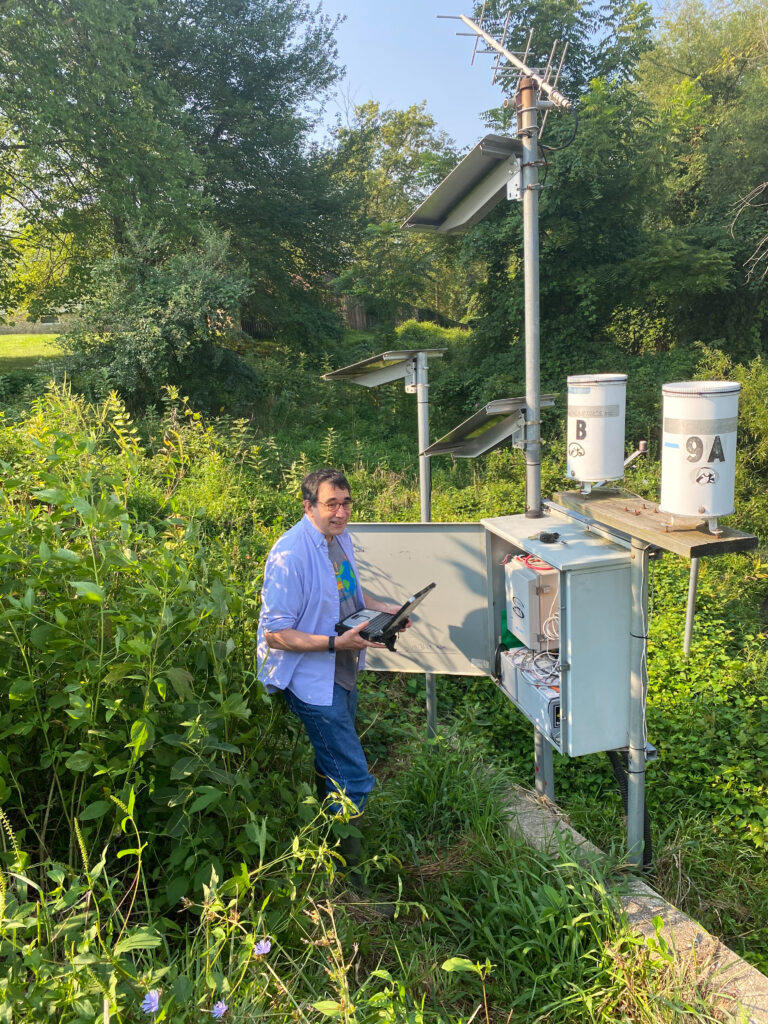 Andrew Miller checks on a water sampling station in Catonsville, MD. (Victor Fulda/UMBC)
Welty and Miller bring expertise in understanding patterns of water quality, flood and groundwater modeling, and rainfall patterns and how they are changing. UMBC also brings experience interacting with local agencies, such as the Baltimore City Department of Public Works and Maryland Department of the Environment. Other institutions in the consortium bring complementary expertise, such as overall climate forecasting, an understanding of how climate impacts intersect with issues of public health, and experience building trust with community groups.
“Among us, we think we have tools that can be applied to solve these problems,” Welty says. “We’re not imposing our tools on community groups, though, or telling them what their problems are. They’re telling us, and we’re responding with support and resources.”
Adding nuance
Welty, Miller, and others have spent decades generating models and collecting on-the-ground (and sometimes underground) observations of water quality, flow, and more in the Baltimore region. They will continue that work with the BSEC, and with input from communities, prioritize certain issues or geographic areas.
The BSEC will also fund deployment of new sensors at existing Baltimore Ecosystem Study stream sampling stations in the Gwynns Falls watershed . These stations have a 22-year record of weekly water quality sampling, and the new sensors will add data on other parameters at 15-minute intervals, 24 hours a day, seven days a week. The data will be accessible in near- real time, on only about a one-hour delay.
The BES data is “the best urban water quality data set in the world. This is not meant to replace that, but to add nuance,” Welty says. For example, Baltimore streams have struggled with inundation from road salt in the winter. “You might miss the peak of a salt event with weekly sampling,” Welty says, but finer scale sampling would easily identify it in the data.
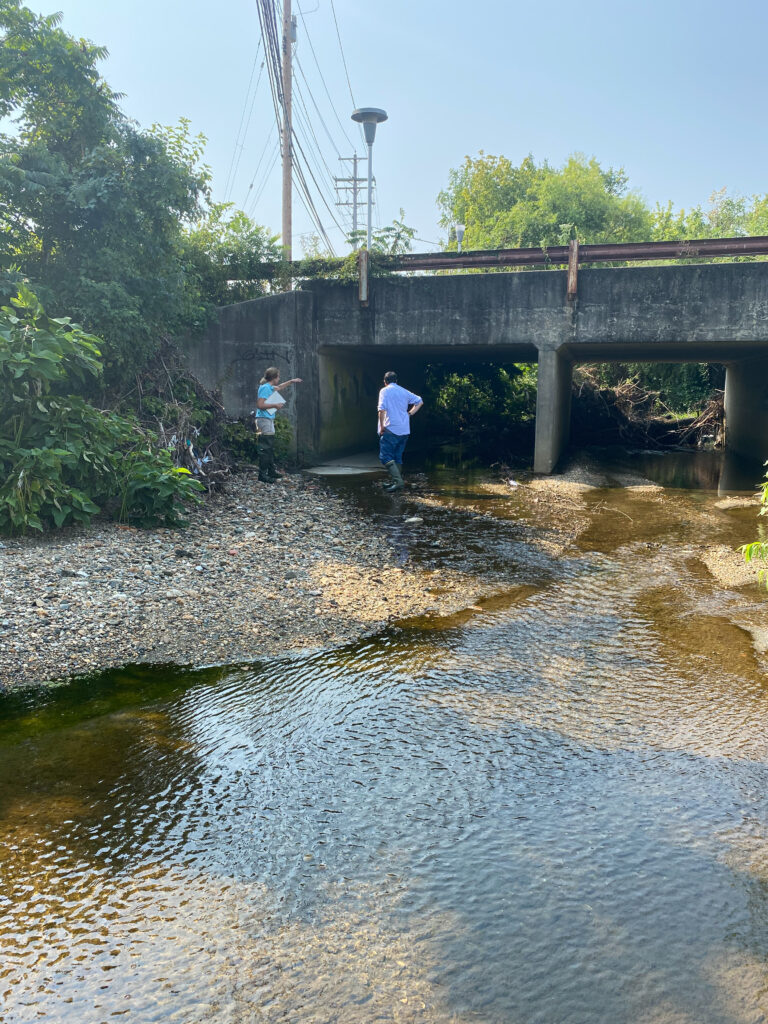 Claire Welty (left) and Andrew Miller check out one of their study sites in Woodlawn, MD. (Victor Fulda/UMBC)
A giant puzzle to put together
The BSEC is a unique project that brings together wide-ranging expertise to address pressing urban needs. “The guiding objective of the BSEC process is to produce the urban climate science needed to inform community-guided, equitable pathways for climate action,” says Ben Zaitchik, professor of Earth and planetary sciences at Johns Hopkins and the overall project lead. “In doing so, we address a number of fundamental urban science questions from across natural science and social science disciplines.”
UMBC’s Steiner adds, “This partnership with John Hopkins University and other research institutions is building upon our strong and long-term record of environmental research and educational initiatives here at UMBC. It will both challenge and enable us to explore equitable climate solutions.”
While the exact priorities and concerns that local communities will bring to the forefront are unknown, the BSEC group plans to bring their tools to bear in a way that best serves the people of Baltimore. Building coalitions with researchers and community members, learning the communities’ needs, and then finding the best ways to address them “is like a giant puzzle to put together,” Welty says. “It’s going to be exciting to see how it all unfolds.”
]]>
American cities face environmental challenges that are exacerbated by climate change, from air and water quality issues to flooding and heat. Low-income neighborhoods and areas that were...
https://umbc.edu/stories/social-environmental-collab-wins-2-3m-grant/
https://my3.my.umbc.edu/api/v0/pixel/news/128185/guest@my.umbc.edu/ff69f44dc2b56dfdfa416165651d0253/api/pixel
cahss
cahssresearch
cbee
cuere
ges
news
policy-and-society
rca-1
research
science-and-tech
UMBC News & Magazine
https://my3.my.umbc.edu/groups/umbc-news-magazine
https://assets1-my.umbc.edu/system/shared/avatars/groups/000/001/943/24435aa6207c452e7bc15cc74b42c7bb/xsmall.png?1748556657
https://assets1-my.umbc.edu/system/shared/avatars/groups/000/001/943/24435aa6207c452e7bc15cc74b42c7bb/original.png?1748556657
https://assets2-my.umbc.edu/system/shared/avatars/groups/000/001/943/24435aa6207c452e7bc15cc74b42c7bb/xxlarge.png?1748556657
https://assets2-my.umbc.edu/system/shared/avatars/groups/000/001/943/24435aa6207c452e7bc15cc74b42c7bb/xlarge.png?1748556657
https://assets3-my.umbc.edu/system/shared/avatars/groups/000/001/943/24435aa6207c452e7bc15cc74b42c7bb/large.png?1748556657
https://assets1-my.umbc.edu/system/shared/avatars/groups/000/001/943/24435aa6207c452e7bc15cc74b42c7bb/medium.png?1748556657
https://assets2-my.umbc.edu/system/shared/avatars/groups/000/001/943/24435aa6207c452e7bc15cc74b42c7bb/small.png?1748556657
https://assets1-my.umbc.edu/system/shared/avatars/groups/000/001/943/24435aa6207c452e7bc15cc74b42c7bb/xsmall.png?1748556657
https://assets2-my.umbc.edu/system/shared/avatars/groups/000/001/943/24435aa6207c452e7bc15cc74b42c7bb/xxsmall.png?1748556657
UMBC News & Magazine
0
0
false
Tue, 04 Oct 2022 16:22:06 -0400
Tue, 04 Oct 2022 16:22:06 -0400
Students in UMBC’s ICARE program connect scientific research with community
Bats as biomonitors, community connections to the zero-waste movement, and oyster aquaculture are just a few of the topics that students in UMBC’s Interdisciplinary Consortium for Applied Research in the Environment (ICARE) master’s program are exploring through Baltimore-centered community-engaged research. As the first cohort in the program heads into their second and final year, they are excited about their work and looking ahead to becoming the next generation of environmental science leaders.
“B” is for bat
Chris Blume, M.S. ’23, geography and environmental systems,has studied bobcats, bees, and birds. So when he came to ICARE, he jokes, “I had to choose another ‘b’ animal.” Jokes aside, in his undergraduate and working experience, Blume found that “the social aspect was missing” in conservation science, which often focused on wildlife. “And that’s what drew me to ICARE, because it seemed like there was a focus on the community.”
In his project, Blume is using bats as biomonitors to detect levels of heavy metals in different neighborhoods across Baltimore. “Because of their biology and their ecology, they make great biomonitors in rural environments,” he says, “but I wanted to see how that works in urban places.”
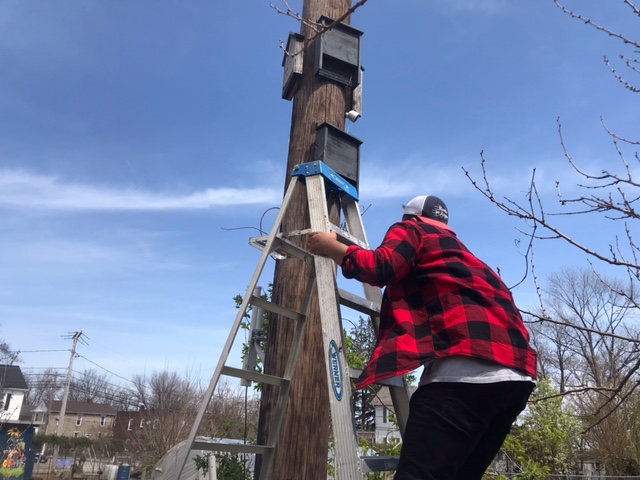 Bat boxes are most successful when they get ample direct sunlight and are about 15 – 20 feet off the ground.
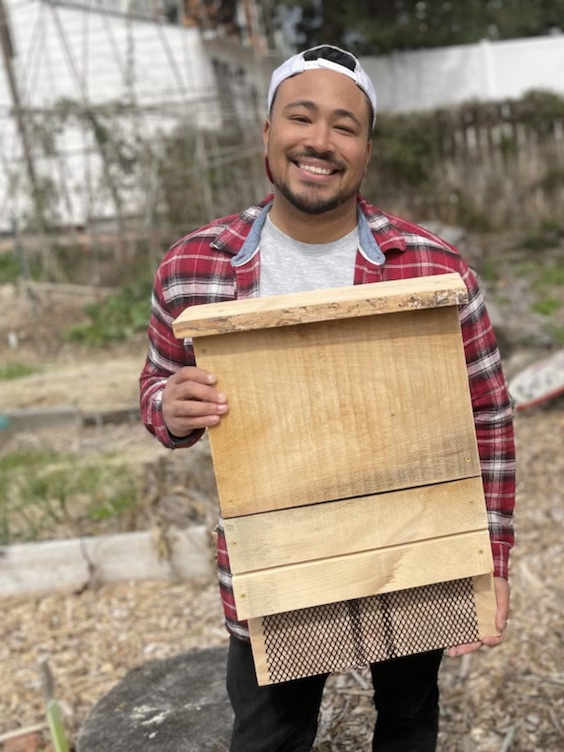 Chris Blume shows off one of his bat boxes before installing it.
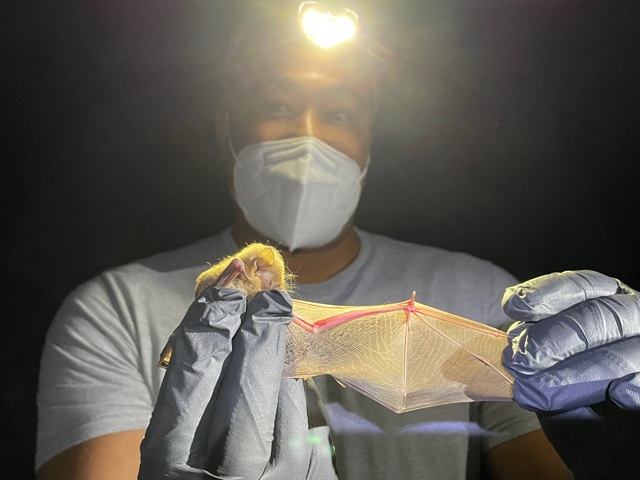 Chris Blume examines a bat from one of his bat boxes.
How can bats provide information about heavy metals? Through their guano (poop). “I have literally a fridge with a bunch of guano,” he says, waiting for analysis later this fall. In addition to the guano analysis, Blume is giving away bat boxes to local residents and offering evening “bat walks” to teach local Baltimoreans about these important native critters. He’s also created citizen science opportunities by posting acoustic recordings of bat calls on a public website, where anyone can listen and help identify which bat species show up where.
In the future, Blume wants to pursue a Ph.D. and continue his bat research, as well as continue to create citizen science and community engagement opportunities.
Building the bridge
Natalia Figueredo, M.S. ’23, geography and environmental systems, has always been community-oriented, influenced by her early childhood in Bolivia and her teenage years in Queens, New York. In New York, she noticed that “there were all these big projects going on in communities, and the community didn’t ask for them,” she says. She wanted to do something different.
After working with the Ironbound Community Corporation in Ironbound, New Jersey, she became passionate about doing inclusive research for mutual benefit, and ICARE was a perfect fit to advance her career. “What interested me about this program,” she says, “is that it was trying to build that bridge between scientific research and community engagement.”
Figueredo’s research project focuses on engaging South Baltimore residents in the zero-waste movement, in the context of recent battles over a nearby trash incinerator. She is also working closely with partners at the Global Alliance for Incinerator Alternatives (GAIA) and the South Baltimore Community Land Trust, in addition to her faculty mentor Maggie Holland, associate professor of geography and environmental systems.
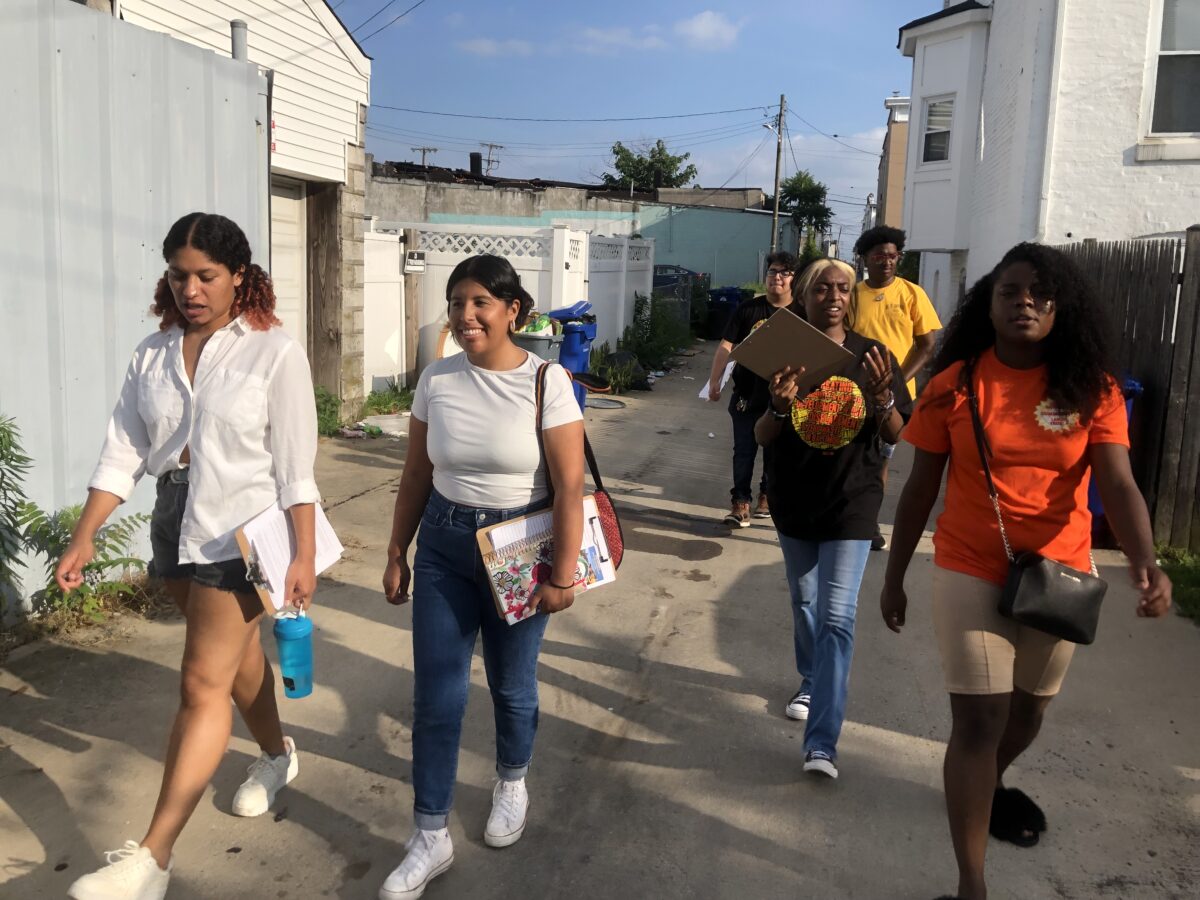 Natalia Figueredo (second from left) meets with members of the South Baltimore Community Land Trust. (Courtesy of Figueredo)
Figueredo is surveying residents from across the city about their waste management practices and access to the zero-waste movement. She’s also interviewing South Baltimore community leaders and conducting focus groups with neighborhood residents. Figueredo hopes to find out whether they feel supported in pursuing zero-waste goals and to learn what local knowledge and practices already exist related to the movement—whether or not the residents identify them as such.
Research always comes with bumps in the road, but overall Figueredo has had a rewarding experience so far. She wanted to choose a graduate program where people would champion and support her, she says—“and that’s definitely how I feel with the ICARE team.”
Putting research into practice
Darryl Acker-Carter, M.S. ’23, marine, estuarine, and environmental science, is studying a new method of oyster aquaculture with partners at the company Solar Oysters. Traditionally, oysters have been cultivated in wire baskets at the water’s surface. A new system, called the Solar Oyster Production System (SOPS), uses a solar-powered ladder structure to rotate the baskets through the entire water column. The goal is to produce healthier, more-uniform oysters in less space. At the end of the growing season this fall, Acker-Carter will compare oyster size, survival rate, and meat-to-shell ratio of oysters in the experimental rotating ladders, non-rotating ladders, and traditional surface-only baskets at a site in Curtis Bay, in south Baltimore.
Acker-Carter has been interested in oysters for several years. “I like social science, but I also like the biological side of things, and I saw that nexus through oysters,” he says. To some, how to best cultivate oysters may seem like a purely scientific question, but “when you actually get down to, ‘Let’s make some change,’ it’s all social science,” Acker-Carter says, “because it’s all managing people and their perspective about how to harvest oysters and their relationships to natural resources.”
The ICARE program has helped Acker-Carter see how research fits into community engagement. “I used to think research was very isolated,” he says, “but in ICARE, you’re putting that research into practice. You can create benefit in the community by doing the research, and giving people access to that data.”
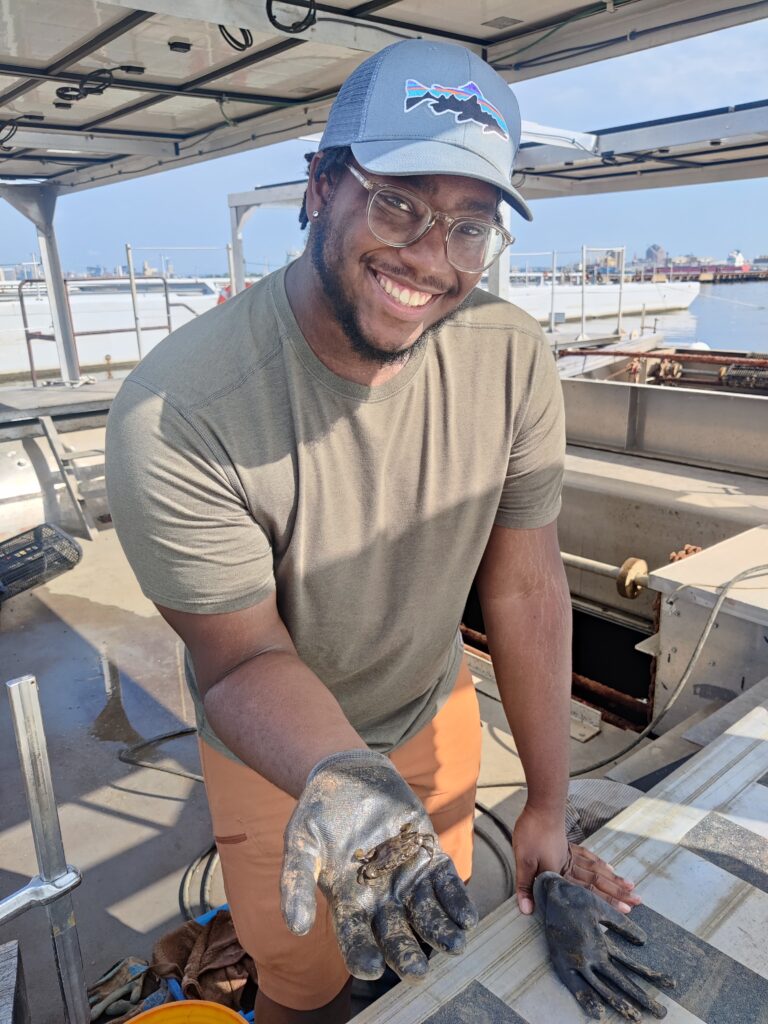 Darryl Acker-Carter holds a very small blue crab on a boat.
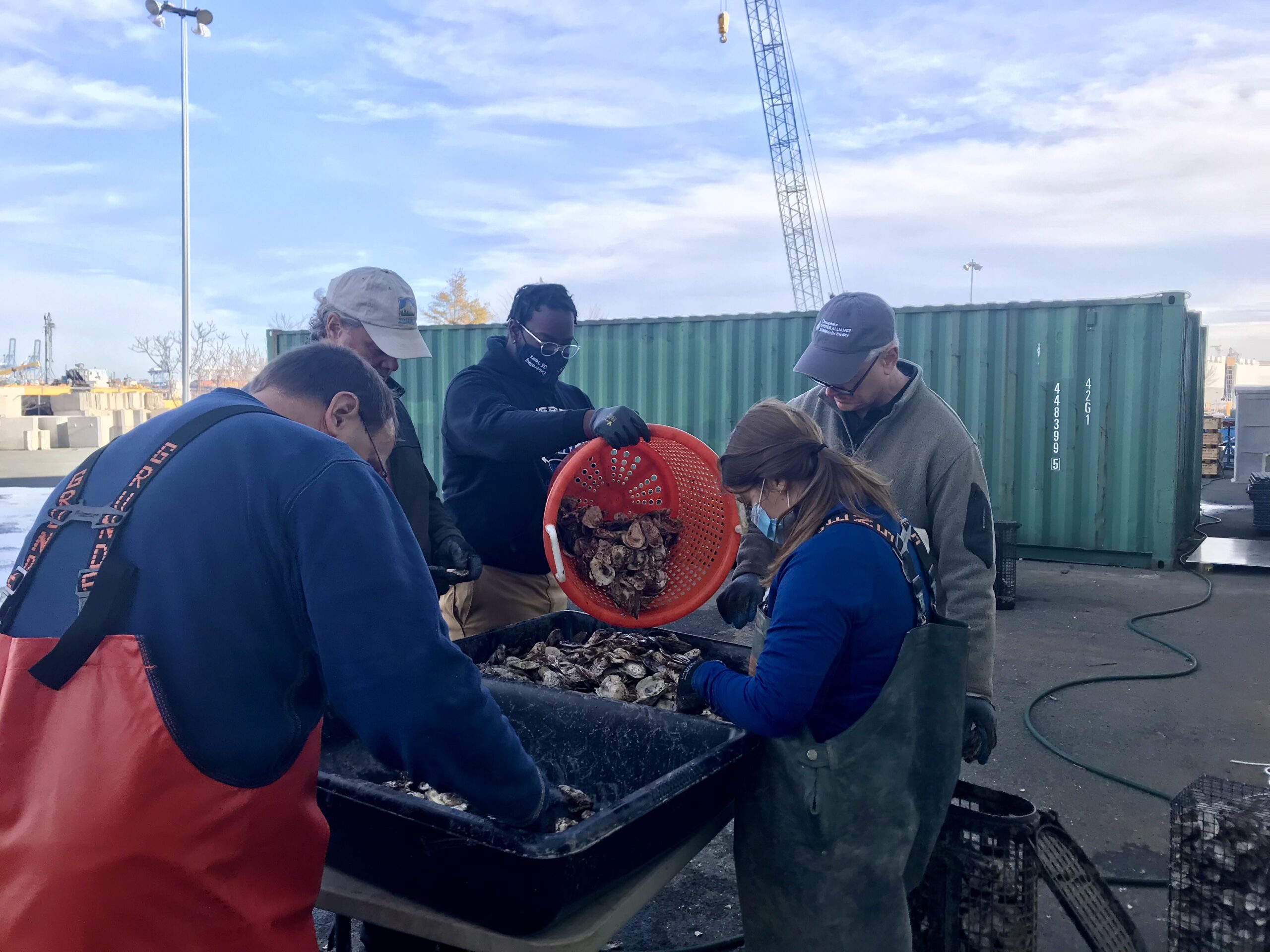 Darryl Acker-Carter (holding orange bucket) helps harvest oysters.
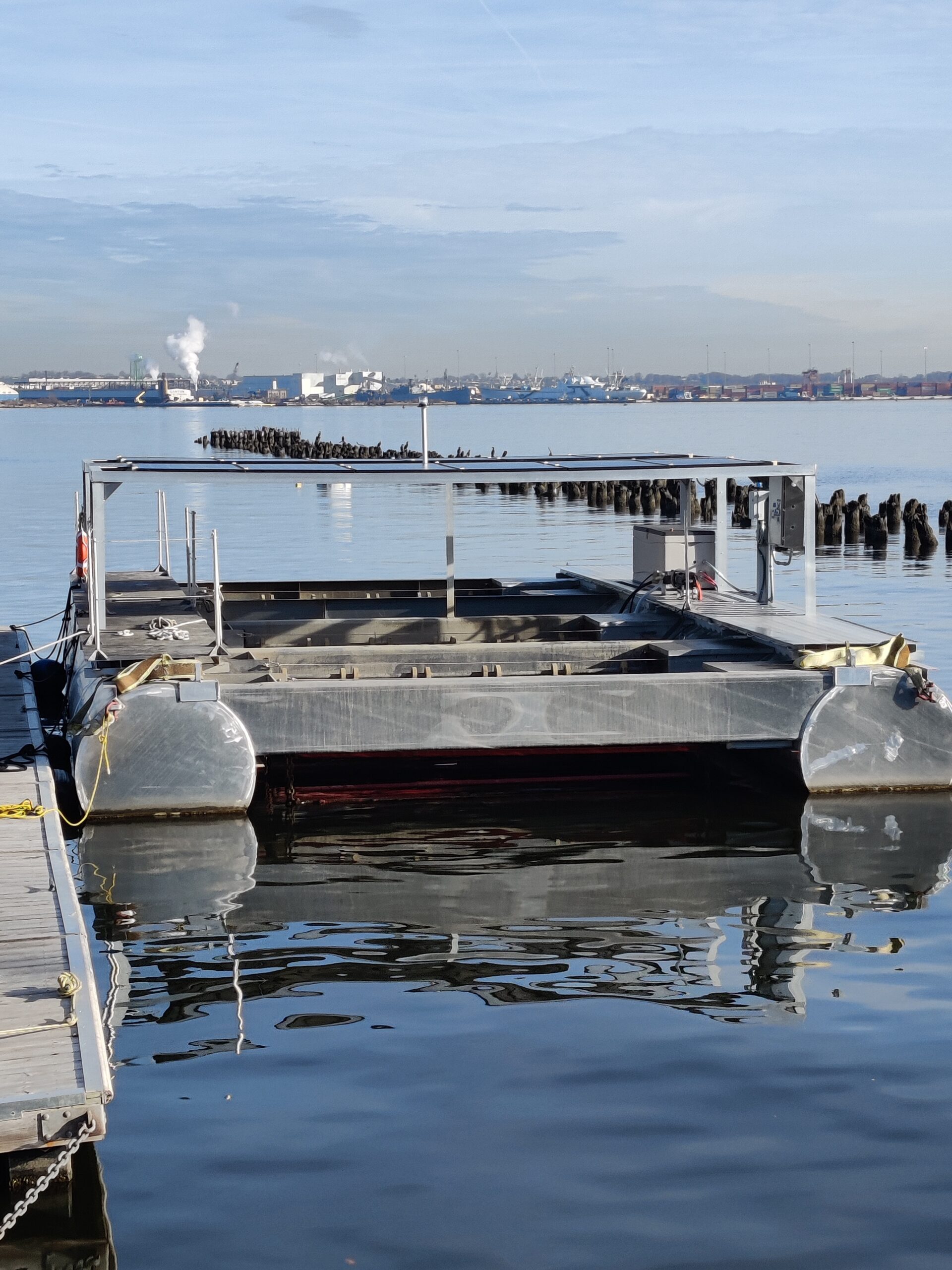 A surface view of the rotating solar-powered aquaculture system used in Darryl Acker-Carter’s research project.
Committed to community
For program leader Tamra Mendelson, professor of biological sciences, ICARE is exceeding expectations. “I am thrilled with how the program is going,” she says. “The students themselves are so strong. They are motivated. They are engaged. They are very sharp, and they’ve bonded as a cohort, which makes us really happy. I do think that’s a huge secret to success—having students feel like they are part of a network of peers supporting each other.”
The community partners have also been critical for the program’s success. One session led by Stephen Freeland, director of the individualized study program at UMBC, brought students and partners together for a brainstorming session across projects and topic areas, embodying the program’s commitment to bridging science and community. “Just bringing everyone to the table, literally, and helping everyone see that their voice is equally important in solving these environmental problems and doing the research was really powerful,” Mendelson says.
Mendelson shares that she and her fellow faculty have also been developing their community-engagement skills in working alongside their students. “I’m amazed at how important relationships are, and trust,” Mendelson says. “Building relationships with members of the community has been much more interesting and complicated than I expected. It’s work. But it’s good work.”
That community engagement piece makes ICARE different from other environmental science programs, explains Kevin Omland, professor of biological sciences. “We’re definitely tackling different issues in different places than lots of environmental science has, even 10 or 20 years ago,” he says, “so it’s really satisfying to see that coming into place.”
“ICARE fulfills so many of the stated missions and goals of UMBC—to connect with community, to address the climate crisis, to increase diversity and inclusion,” Mendelson says. She looks forward to working with the second cohort of ICARE students, who started this fall, preparing them for successful careers in environmental science and leading local change.
]]>
Bats as biomonitors, community connections to the zero-waste movement, and oyster aquaculture are just a few of the topics that students in UMBC’s Interdisciplinary Consortium for Applied Research...
https://umbc.edu/stories/icare-program-connects-science-with-community/
https://my3.my.umbc.edu/api/v0/pixel/news/127733/guest@my.umbc.edu/c00e1e50a2c77d7a36e63fdfcc52f2ae/api/pixel
biology
cahss
cnms
ges
gradresearch
news
policy-and-society
rca-2
science-and-tech
UMBC News & Magazine
https://my3.my.umbc.edu/groups/umbc-news-magazine
https://assets1-my.umbc.edu/system/shared/avatars/groups/000/001/943/24435aa6207c452e7bc15cc74b42c7bb/xsmall.png?1748556657
https://assets1-my.umbc.edu/system/shared/avatars/groups/000/001/943/24435aa6207c452e7bc15cc74b42c7bb/original.png?1748556657
https://assets2-my.umbc.edu/system/shared/avatars/groups/000/001/943/24435aa6207c452e7bc15cc74b42c7bb/xxlarge.png?1748556657
https://assets2-my.umbc.edu/system/shared/avatars/groups/000/001/943/24435aa6207c452e7bc15cc74b42c7bb/xlarge.png?1748556657
https://assets3-my.umbc.edu/system/shared/avatars/groups/000/001/943/24435aa6207c452e7bc15cc74b42c7bb/large.png?1748556657
https://assets1-my.umbc.edu/system/shared/avatars/groups/000/001/943/24435aa6207c452e7bc15cc74b42c7bb/medium.png?1748556657
https://assets2-my.umbc.edu/system/shared/avatars/groups/000/001/943/24435aa6207c452e7bc15cc74b42c7bb/small.png?1748556657
https://assets1-my.umbc.edu/system/shared/avatars/groups/000/001/943/24435aa6207c452e7bc15cc74b42c7bb/xsmall.png?1748556657
https://assets2-my.umbc.edu/system/shared/avatars/groups/000/001/943/24435aa6207c452e7bc15cc74b42c7bb/xxsmall.png?1748556657
UMBC News & Magazine
0
0
false
Mon, 19 Sep 2022 12:58:20 -0400
Mon, 19 Sep 2022 12:58:20 -0400