Meet a Retriever—Emmanuella Osei, public health and sociology junior and fearless leader
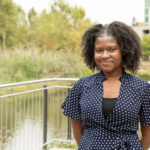
Meet Emmanuella Osei, a junior studying public health and sociology and the president of UMBC’s Public Health Council of Majors. She is passionate about health equity, public service, and mentorship. As a Retriever, Emmanuella is a fearless leader, actively involved in multiple scholar programs, and volunteer initiatives across the globe—from Maryland to South Africa to Costa Rica. Her commitment to high-impact research has led her to tackle critical issues like food insecurity among students at UMBC and access to long-term COVID-19 care. She is a proud recipient of the prestigious Jack Kent Cooke Scholarship. Her dedication to making a difference continues to take her where she is most needed. Take it away, Emmanuella!
Q: Briefly introduce yourself. What’s one essential thing you’d want another Retriever to know about you?
A: I am pursuing a dual degree in public health and sociology and a certificate in the social dimensions of health. Throughout my time at UMBC, I have engaged in many experiential learning opportunities. In the summer following my freshman year, I interned at Columbia Community Care, a non-profit in Howard County that offers hunger relief, youth development, and wellness programs. In summer of 2024, I participated in the Summer Research Opportunity Program at the University of Michigan, where I researched access to long COVID care in the HELPER lab at the School of Public Health. Most recently, I participated in the AIFS study abroad program in Costa Rica where I learned about Costa Rica’s health care and tropical systems.
Q: Tell us about your primary WHY, and how it led you to UMBC.
A: I came to UMBC because of the vibrant and supportive community I felt when I first toured the campus. I knew that as an immigrant and first-generation student from Ghana [in West Africa], UMBC would be a great place to be. Because UMBC is a minority-serving institution and home to students from diverse backgrounds and identities, I felt it would offer the perfect environment for me to also grow academically while providing countless opportunities. So far, UMBC has definitely lived up to my expectations, and I truly believe that everyone can find their place here.
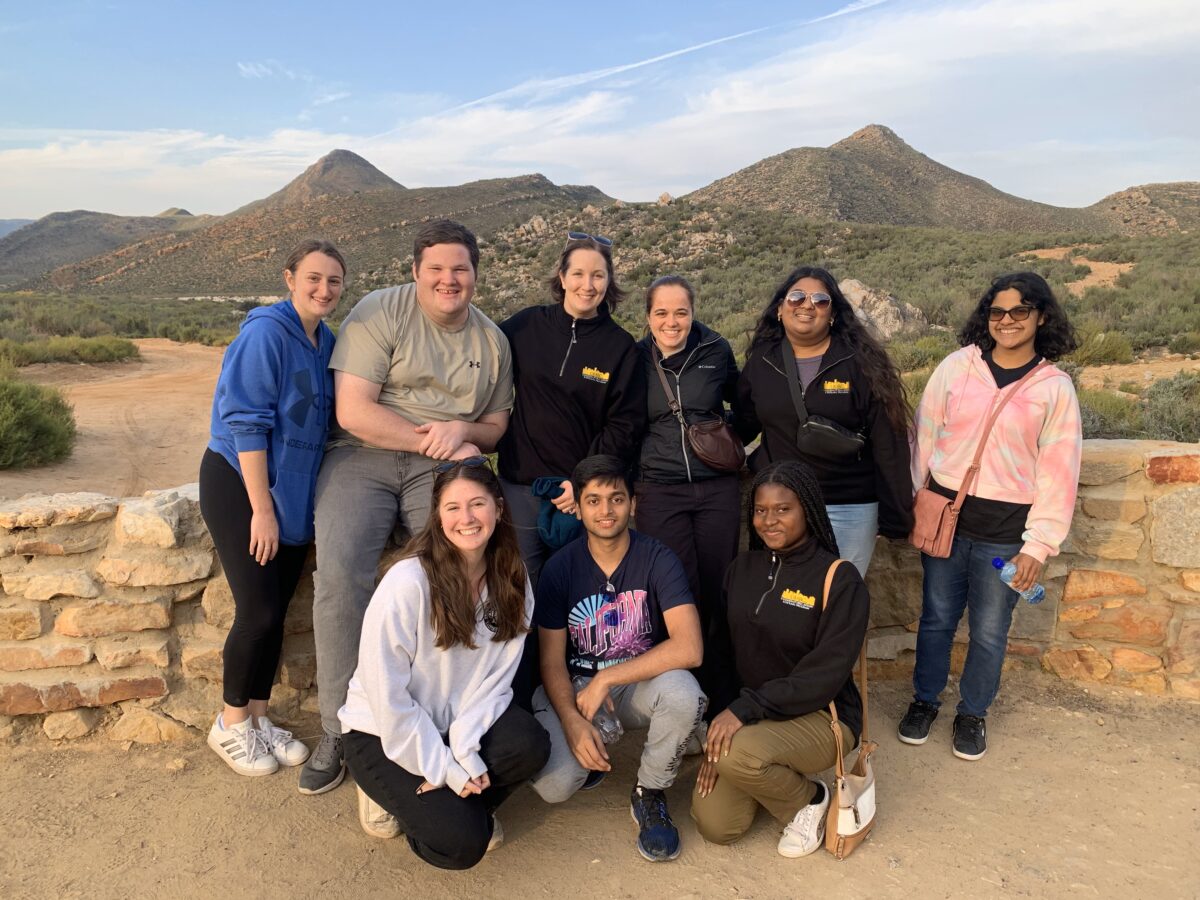 Osei (first on the right kneeling) and other Sondheim Public Affairs Scholars in South Africa. (Image courtesy of Osei)
Q: Tell us about the people who are helping you grow at UMBC, and why their HOW made such a difference to you.
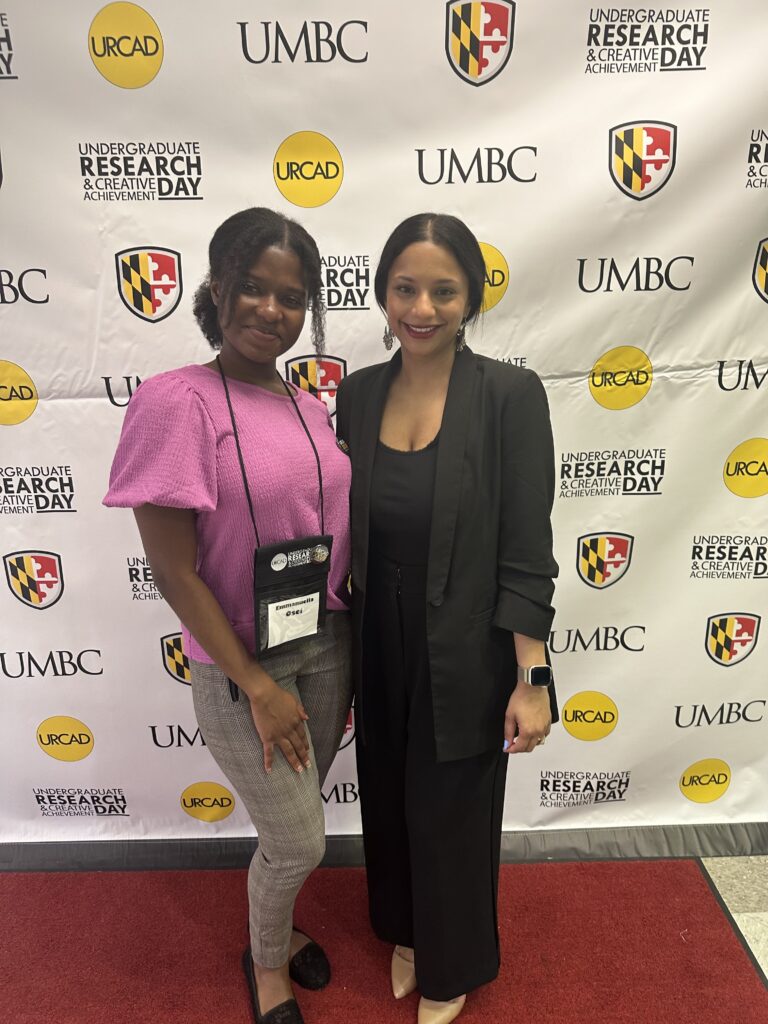 Osei and Nayak at URCAD 2024. (Image courtesy of Osei)
A: My research mentor, Dr. Sameera Nayak, has been extremely supportive of my independent research. She became my mentor during my sophomore year as part of the McNair Scholars Program. Now, as an Undergraduate Research Award Scholar studying food insecurity among students at UMBC, Dr. Nayak continues to guide me and provides feedback on each stage of the research process. After collecting and analyzing over 500 responses, I am now working on disseminating my findings beginning at UMBC’s spring Undergraduate Research and Creative Achievement Day (URCAD).
Q: Are you currently part of a scholars program or Living Learning Community at UMBC?
A: In addition to being a McNair Scholar, I am a member of UMBC’s Honors College and the Sondheim Public Affairs Scholars Program, a four-year scholarship program focused on community engagement and policy. As a Sondheim Scholar, I participated in a faculty-led study abroad summer course in Cape Town, South Africa, to learn about global community engagement and social change. In my first two years at UMBC, I was also a member of the Shriver Living Learning Community (LLC) for students passionate about service, leadership, and advocacy. I served as a peer mentor in my sophomore year, supporting first-year students as they transitioned to college.
Because UMBC is a minority-serving institution and home to students from diverse backgrounds and identities, I felt it would offer the perfect environment for me to also grow academically while providing countless opportunities. So far, UMBC has definitely lived up to my expectations, and I truly believe that everyone can find their place here.
Emmanuella Osei ’26
public health and sociology
Q: What clubs, teams, or organizations are you a part of? What do you love about them?
A: I am the president of UMBC’s Public Health Council of Majors. I love planning professional development and social events to bring public health students together. In the past year, we have hosted events such as graduate school information sessions, internship panels, resume workshops in collaboration with the Career Center, and LinkedIn headshots, among others.
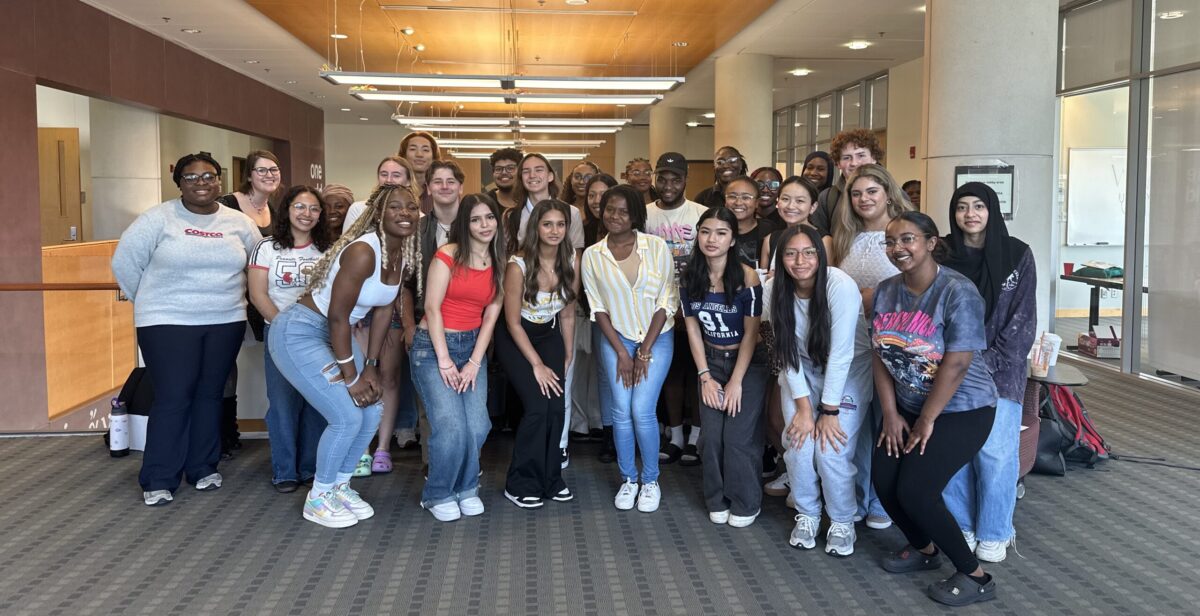 Osei (center striped shirt) with members of UMBC’s Public Health Council of Majors. (Image courtesy of Osei)
Q: How are you making a difference for other Retrievers?
A: Since my sophomore year, I have worked as an Academic Peer Advocate through UMBC’s Academic Success Center. In this role, I support other undergraduate students by connecting them to the great resources UMBC offers. Through the Shriver Center, I volunteered at the Great Kids Farm, a Baltimore City Public Schools farm-to-school program. Currently, I serve as a student ambassador for the Commodore Collegiates Program, a partnership between UMBC and Commodore John Rodgers Elementary/Middle School. I give students an exciting tour of UMBC, lead fun STEM activities, share my college experience, and engage them in discussions about college.
* * * * *
UMBC’s greatest strength is its people. When people meet Retrievers and hear about the passion they bring, the relationships they create, the ways they support each other, and the commitment they have to inclusive excellence, they truly get a sense of our community. That’s what “Meet a Retriever” is all about.
Learn more about Scholars Programs at UMBC.
]]>
Meet Emmanuella Osei, a junior studying public health and sociology and the president of UMBC’s Public Health Council of Majors. She is passionate about health equity, public service, and...
https://umbc.edu/stories/meet-a-retriever-emmanuella-osei-public-health-sociology/
https://my3.my.umbc.edu/api/v0/pixel/news/147034/guest@my.umbc.edu/b973803db9e2edd05cf9c5ed6d9d72d4/api/pixel
cahss
community
creative-achievement-day-urcad
impact
magazine
mcnair-scholars
meet-a-retriever
public-health
saph
sociology
sondheim-public-affairs-scholars-program
story
UMBC News & Magazine
https://my3.my.umbc.edu/groups/umbc-news-magazine
https://assets1-my.umbc.edu/system/shared/avatars/groups/000/001/943/24435aa6207c452e7bc15cc74b42c7bb/xsmall.png?1748556657
https://assets1-my.umbc.edu/system/shared/avatars/groups/000/001/943/24435aa6207c452e7bc15cc74b42c7bb/original.png?1748556657
https://assets2-my.umbc.edu/system/shared/avatars/groups/000/001/943/24435aa6207c452e7bc15cc74b42c7bb/xxlarge.png?1748556657
https://assets2-my.umbc.edu/system/shared/avatars/groups/000/001/943/24435aa6207c452e7bc15cc74b42c7bb/xlarge.png?1748556657
https://assets3-my.umbc.edu/system/shared/avatars/groups/000/001/943/24435aa6207c452e7bc15cc74b42c7bb/large.png?1748556657
https://assets1-my.umbc.edu/system/shared/avatars/groups/000/001/943/24435aa6207c452e7bc15cc74b42c7bb/medium.png?1748556657
https://assets2-my.umbc.edu/system/shared/avatars/groups/000/001/943/24435aa6207c452e7bc15cc74b42c7bb/small.png?1748556657
https://assets1-my.umbc.edu/system/shared/avatars/groups/000/001/943/24435aa6207c452e7bc15cc74b42c7bb/xsmall.png?1748556657
https://assets2-my.umbc.edu/system/shared/avatars/groups/000/001/943/24435aa6207c452e7bc15cc74b42c7bb/xxsmall.png?1748556657
UMBC News & Magazine
6
0
false
Mon, 03 Feb 2025 16:57:41 -0500
Meet a Retriever—Michael Brazda ’06, M.A. ’08, and Ph.D. ’24, an adjunct professor and advocate for virtual lifelong learning

Meet Michael Brazda ’06, anthropology, M.A. ’08, applied sociology, and Ph.D. ’24, gerontology, an adjunct professor who is passionate about both asynchronous and synchronous online learning. Drawing from his experiences as a student and a working professional, he understands the flexibility needed while earning a degree. Now, he focuses on helping students who require that same level of flexibility to balance their education with work, family, and other life responsibilities. For Michael, the ability to access virtual learning is a game-changer for lifelong learning. Thanks for sharing your enthusiasm, Michael!
Q: Briefly introduce yourself.
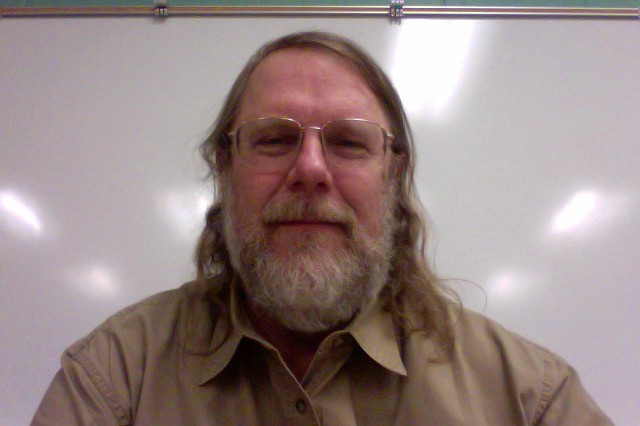
A: I am an adjunct professor in various institutions across Maryland. I teach sociology at Mount St. Mary’s University and Frederick Community College and gerontology, sociology, and women’s studies at the University of Maryland Global Campus.
Q: What was your academic journey?
A: I graduated from UMBC’s doctoral gerontology program in December 2024. I took a long circuitous route to get here. In 1987, I earned my first bachelor’s degree in computer studies and went to work as a telecommunications technician and network administrator. Sixteen years later, I was laid off which led to a lot of soul-searching. I realized I didn’t like certain aspects of the tech industry and decided to explore other fields.
Q: What’s one essential thing you’d want another Retriever to know about you?
A: I started at UMBC, earning a second bachelor’s degree in anthropology followed by a master’s degree in applied sociology. I took a two-year detour in the public policy doctoral program and finally found my home in gerontology. In part, because it provided a capstone to my life up to that point. I was always interested in the social sciences. Gerontology, being multidisciplinary, allowed me to tie together my interests in sociology and anthropology.
Q: What do you love about your job?
A: I don’t like living in the past. I like encountering new things and understanding how and why people behave a certain way. Some of the music that I’ve learned to appreciate is because of the assignments I have given, like songs by Billie Eilish. We analyze their lyrics and relate them to sociological concepts. I have taught online at more than five universities and community colleges in the area because it allows me to work with and learn from a diverse group of students, which is something I really enjoy. Through this experience, I have become an advocate for lifelong learning.
Online learning helps students, who need more than a traditional institution offers, to have a holistic college experience.
Michael Brazda ’06, M.A. ’08, and Ph.D. ’24
Adjunct Professor
Q: Why are you passionate about lifelong learning?
A: Lifelong learning comes more from the desire to learn new things and get involved in different areas that interest me. Online learning plays into this because it expands what’s available academically. With online learning, I’m not limited to what the colleges or universities in my area may offer. I can look at or get involved with academic programs around the country. When I returned to college in 2003, I could only access universities near my home, UMBC being one of those. Otherwise, I would have to drive to D.C., further into Baltimore, or Pennsylvania. Online learning helps students, who need more than a traditional institution offers, to have a holistic college experience.
Online teaching became my modality of choice because it allows me to teach at a wider range of schools. Trying to make a living as an adjunct professor while traveling from campus to campus for classes eats up a lot of time. In contrast, the ability to teach online eliminates that overhead. It allows me to devote more time to teaching, learning, and developing my classes in new ways.
Q: Since you’ve been a part of the UMBC community, how have you found support of your WHY?
A: Although I’ve been teaching for many years, I’m always learning how to become a better educator for my students. While at UMBC, I took advantage of UMBC’s Graduate Students Association PROF-it: Professors in Training seminar. This program helped refine my teaching skills enabling me to better meet my students’ needs.
The UMBC community has supported me in ways that I reflect in my teaching today. The welcoming faculty, both in teaching and research, made me feel like a part of the team. As a student, this was particularly important—working with researchers who encouraged me to develop my ideas and explore topics of interest to me, while still allowing me to call the work my own. At the same time, they involved me in every aspect of the research process, helping me learn, expand, and grow as a researcher. Faculty in sociology, anthropology, and public health like Robert Rubenstein, emeritus professor, Ann Frankowski, senior research scientist in the doctoral gerontology program; and J. Kevin Eckert, emeritus professor, among others, created a comfortable and supportive environment.
* * * * *
UMBC’s greatest strength is its people. When people meet Retrievers and hear about the passion they bring, the relationships they create, the ways they support each other, and the commitment they have to inclusive excellence, they truly get a sense of our community. That’s what “Meet a Retriever” is all about.
Learn more about UMBC’s Ph.D. in gerontology.
]]>
Meet Michael Brazda ’06, anthropology, M.A. ’08, applied sociology, and Ph.D. ’24, gerontology, an adjunct professor who is passionate about both asynchronous and synchronous online learning....
https://umbc.edu/stories/meet-a-retriever-michael-brazda-advocate-virtual-learning/
https://my3.my.umbc.edu/api/v0/pixel/news/146992/guest@my.umbc.edu/57448975b3884b3a96239e53ef3c51ed/api/pixel
cahss
gerontology
graduate-school
impact
magazine
meet-a-retriever
saph
story
UMBC News & Magazine
https://my3.my.umbc.edu/groups/umbc-news-magazine
https://assets1-my.umbc.edu/system/shared/avatars/groups/000/001/943/24435aa6207c452e7bc15cc74b42c7bb/xsmall.png?1748556657
https://assets1-my.umbc.edu/system/shared/avatars/groups/000/001/943/24435aa6207c452e7bc15cc74b42c7bb/original.png?1748556657
https://assets2-my.umbc.edu/system/shared/avatars/groups/000/001/943/24435aa6207c452e7bc15cc74b42c7bb/xxlarge.png?1748556657
https://assets2-my.umbc.edu/system/shared/avatars/groups/000/001/943/24435aa6207c452e7bc15cc74b42c7bb/xlarge.png?1748556657
https://assets3-my.umbc.edu/system/shared/avatars/groups/000/001/943/24435aa6207c452e7bc15cc74b42c7bb/large.png?1748556657
https://assets1-my.umbc.edu/system/shared/avatars/groups/000/001/943/24435aa6207c452e7bc15cc74b42c7bb/medium.png?1748556657
https://assets2-my.umbc.edu/system/shared/avatars/groups/000/001/943/24435aa6207c452e7bc15cc74b42c7bb/small.png?1748556657
https://assets1-my.umbc.edu/system/shared/avatars/groups/000/001/943/24435aa6207c452e7bc15cc74b42c7bb/xsmall.png?1748556657
https://assets2-my.umbc.edu/system/shared/avatars/groups/000/001/943/24435aa6207c452e7bc15cc74b42c7bb/xxsmall.png?1748556657
UMBC News & Magazine
0
0
false
Mon, 03 Feb 2025 12:53:24 -0500
Mon, 03 Feb 2025 12:53:24 -0500
UMBC lab draws developmental psychology students from across the globe

Graduate students rely on internet research and word of mouth to hear about programs that align with their interests. For Hatice Gürsoy, word of mouth led her from the Republic of Türkiye to UMBC’s Culture, Child, and Adolescent Development Lab, when she was looking for developmental psychology doctoral programs that could support her interests in the resiliency of Muslim immigrants. “One of Dr. Charissa Cheah’s doctoral students also happened to be from Türkiye. She connected me with Dr. Cheah, and we bonded from that moment over my research interests,” says Gürsoy.
Gürsoy is not alone in her trajectory to Cheah’s lab. Students worldwide are drawn to lab founder and director Charissa Cheah’s hands-on approach to teaching, mentoring, and research. “I tell students that my lab is a vibrant space where they can build expertise in collaborative public impact research,” says Cheah, a professor of psychology. She studies adolescent social-emotional development and the well-being of families from minoritized backgrounds, emphasizing the experiences of those from Asian, Middle-Eastern, and North African heritage, which are frequently overlooked in psychology research, she says.
To approach this seemingly broad array of topics, Cheah offers graduate students seven ongoing research projects to choose from, including the latest project—Asian Americans’ Resilience, Identity, and Socialization of Engagement (ARISE), which focuses on the impact of racism and discrimination on Chinese, Korean, and Filipino American families parents’ and adolescents’ relationships, multiple identities, racial-ethnic socialization, civic engagement, and development.
Earlier in 2024, Cheah was invited to the White House to present the latest findings on the ARISE project with the Office of Science and Technology Policy. “It is empowering to represent the voices of marginalized groups, especially early career scholars, and to speak with individuals who aim to use this information to shape policies that decrease bias and hate,” she shared there.
Mentoring through unprecedented changes
Thanks to Cheah’s approach to mentorship, Hyun Su Cho, Ph.D. ’24, applied developmental psychology, had the support she needed to navigate unprecedented changes like COVID-19, in-person and virtual classes, and welcoming a new child. “It can all be very overwhelming,” says Cho. “Charissa is very busy, but she always finds time for you.”
Cho found her way to Cheah’s lab after reading her research while completing her master’s in developmental psychology at Seoul National University in South Korea. “I had the same master’s advisor as a former doctoral student in the lab and she introduced me to Dr. Cheah during a conference,” says Cho. “I was interested in parenting and world culture. Her lab offered opportunities to study multiple Asian communities.”
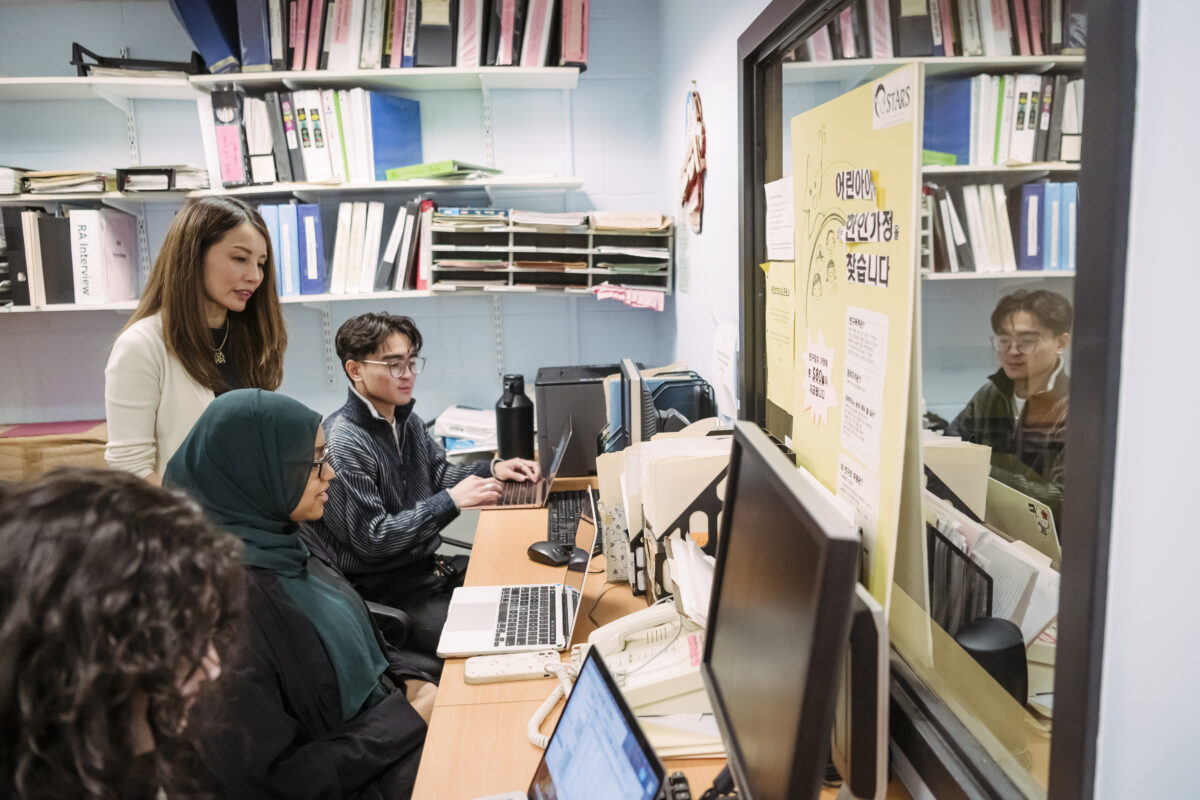 Charissa Cheah and undergraduate students discuss lab work. (Marlayna Demond ’11)
Initially, Cho collaborated with Korean American families on the Immigrant Children’s Successful Transition and Adaptation Research project. Later, she became deeply involved in the ARISE project. This work led to several publications and funding awards to complete her dissertation.
Huiguang Ren, Ph.D. ’24, applied developmental psychology, also found his way to Cheah’s lab through a recommendation. As a master’s student in developmental psychology at East China Normal University, “I wasn’t sure whether to go straight into industry or continue with a Ph.D.,” says Ren. He sought guidance from his mentor, who was researching adolescent development in Shanghai with Cheah. Ren started at UMBC as a visiting scholar before joining the doctoral program. “After working with Dr. Cheah, I decided research is something that intrigues me, and it’s a career that I want to pursue. ”
Passing on the skillset
Ren also worked on several projects in addition to ARISE. He helped set up the Strengthening Asian American Families’ Excellence and Resilience project, one of the first National Science Foundation grants to explore the influences of the COVID-19 outbreak on racial discrimination, identity development, and socialization. Ren and Cho managed classes, guided students through research methods, helped them develop scientific language, and showed them how to analyze the data they collected and disseminate it to families and scholars. He now has a faculty position at his alma mater but initially struggled with imposter syndrome about guiding undergraduates. “And then I realized I have mentored quite a few students during my time in Dr. Cheah’s lab,” Ren says. “And then I realized I have mentored quite a few students during my time in Dr. Cheah’s lab,” Ren says.
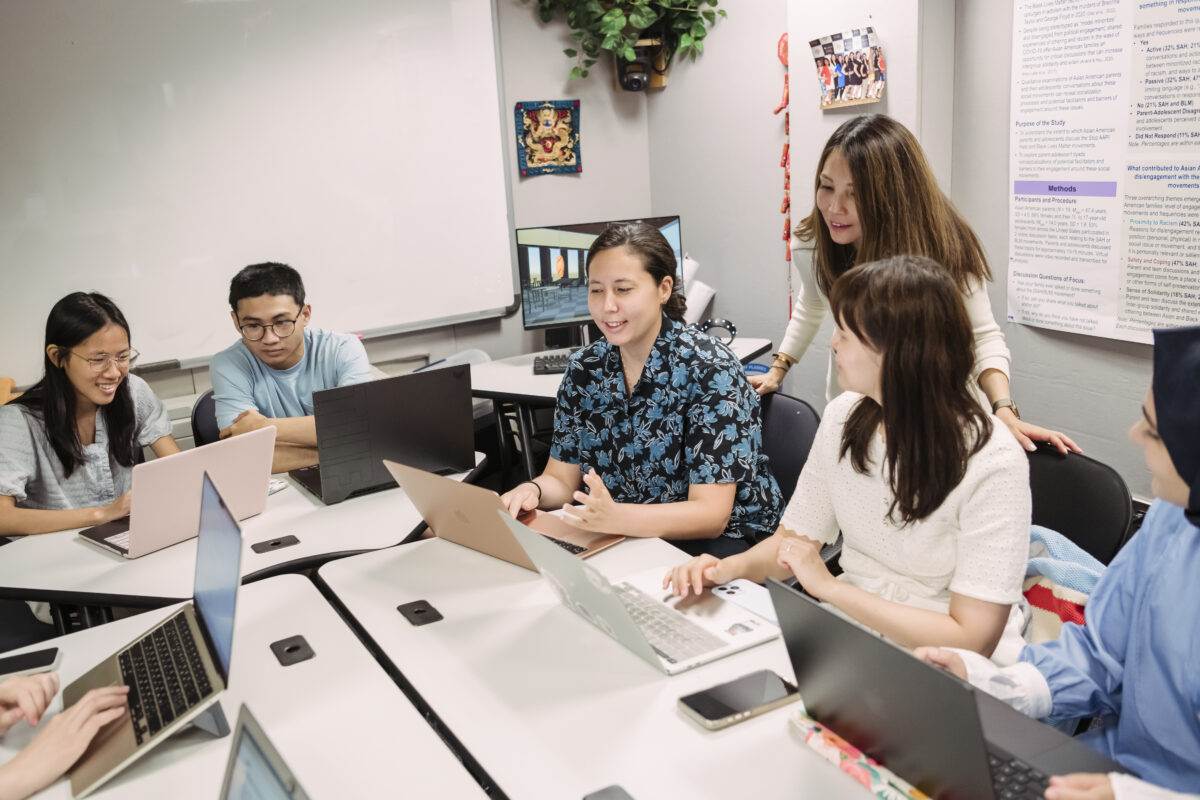 Cheah discusses work with her students. (Marlayna Demond ’11)
Gursoy is now in the fifth year of her doctoral program focused on the Identities of Muslim American Adolescents and their Growth and Excellence research study. This project explores the impact of identity, interpersonal relationships, racism, and cultural socialization factors on Muslim American development and adjustment.
Like Cho and Ren, Gürsoy mentors undergraduates, modeling Cheah’s methods and plans on taking those skills with her. “Working with undergraduates is one of the things I love doing best. They are creative, curious, and are not afraid to tell you something that might not work,” says Gürsoy. “Dr. Cheah has been holding my hand throughout my journey. Helping me learn by giving me constructive feedback. I want to give the same kindness to our undergraduates.”
Learn more about UMBC’s psychology department.
]]>
Graduate students rely on internet research and word of mouth to hear about programs that align with their interests. For Hatice Gürsoy, word of mouth led her from the Republic of Türkiye to...
https://umbc.edu/stories/destination-for-developmental-psychology/
https://my3.my.umbc.edu/api/v0/pixel/news/146071/guest@my.umbc.edu/723979288c2734c6d0dcaabf040e355a/api/pixel
cahss
fall-2024
impact
international
magazine
psychology
research
story
UMBC News & Magazine
https://my3.my.umbc.edu/groups/umbc-news-magazine
https://assets1-my.umbc.edu/system/shared/avatars/groups/000/001/943/24435aa6207c452e7bc15cc74b42c7bb/xsmall.png?1748556657
https://assets1-my.umbc.edu/system/shared/avatars/groups/000/001/943/24435aa6207c452e7bc15cc74b42c7bb/original.png?1748556657
https://assets2-my.umbc.edu/system/shared/avatars/groups/000/001/943/24435aa6207c452e7bc15cc74b42c7bb/xxlarge.png?1748556657
https://assets2-my.umbc.edu/system/shared/avatars/groups/000/001/943/24435aa6207c452e7bc15cc74b42c7bb/xlarge.png?1748556657
https://assets3-my.umbc.edu/system/shared/avatars/groups/000/001/943/24435aa6207c452e7bc15cc74b42c7bb/large.png?1748556657
https://assets1-my.umbc.edu/system/shared/avatars/groups/000/001/943/24435aa6207c452e7bc15cc74b42c7bb/medium.png?1748556657
https://assets2-my.umbc.edu/system/shared/avatars/groups/000/001/943/24435aa6207c452e7bc15cc74b42c7bb/small.png?1748556657
https://assets1-my.umbc.edu/system/shared/avatars/groups/000/001/943/24435aa6207c452e7bc15cc74b42c7bb/xsmall.png?1748556657
https://assets2-my.umbc.edu/system/shared/avatars/groups/000/001/943/24435aa6207c452e7bc15cc74b42c7bb/xxsmall.png?1748556657
UMBC News & Magazine
0
0
false
Wed, 04 Dec 2024 16:11:22 -0500
Wed, 04 Dec 2024 16:11:22 -0500
Meet a Retriever—James Atsaides ‘71, psychology, Founding Four member and planned giving donor
Meet James Atsaides ‘71, psychology. Jim is a Founding Four member, a management psychologist, a former Alumni Association Board of Directors president, a former adjunct faculty member, and a planned giver to the university. In 2023, Jim established the Dr. James P. Atsaides Endowment through his life insurance policy. But, most importantly of all, Jim met his wife Ardell Terry through his philanthropic work with the university. Recently, Jim took some time to reflect on his UMBC story. Take it away, Jim!
Q: What is your WHY? What brought you to UMBC?
A: I graduated from Loyola High School in 1967, and it was already a “done deal” that I would attend the University of Maryland, College Park. My brother, Sam Atsaides, was already there, which made things easier for my parents. So off I went.
Sam was a year ahead of me, and for his first year, he lived on campus. When I went there, the plan was for us to get an apartment with a few other roommates—cheaper than living on campus. When school started, Sam helped me figure out how to enroll in classes and what classes to take. I decided to become a psychology major.
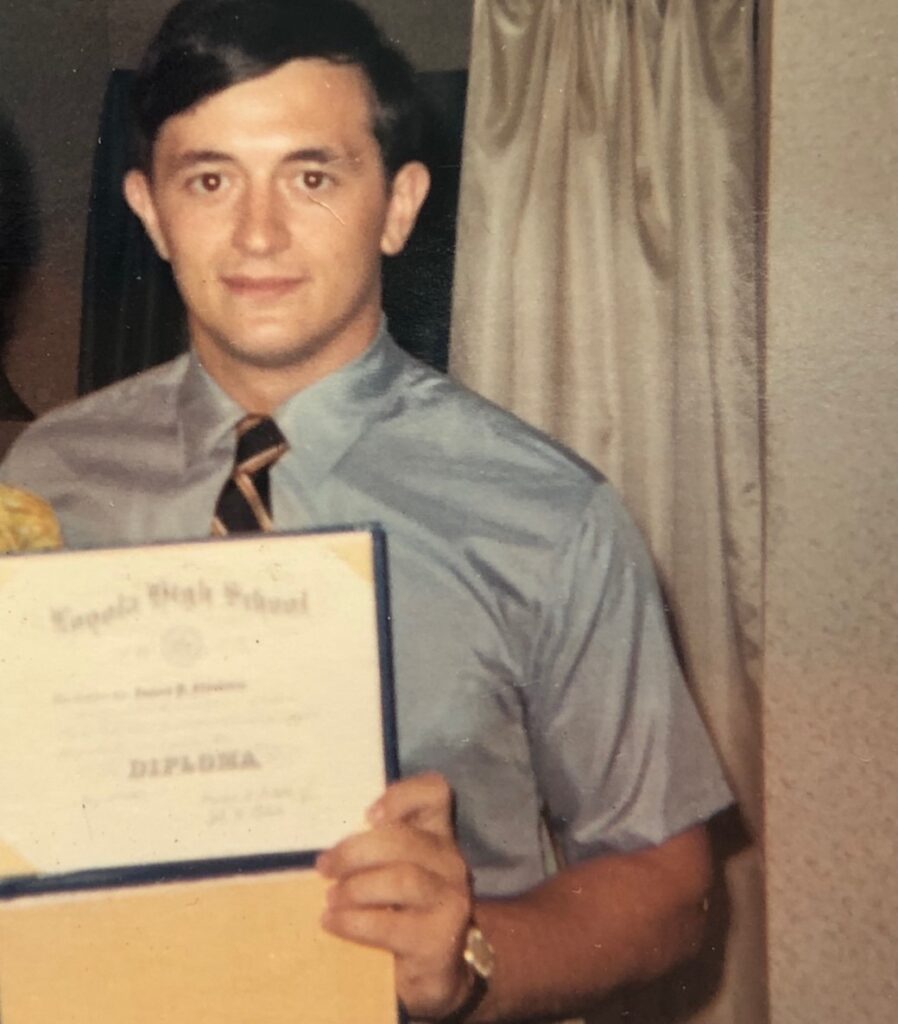 James Atsaides in 1967 holding his diploma from Loyola High School.
College Park was huge. I got lost right away. I wasn’t in high school anymore. It was also a rude awakening to how big the classes were. I was used to having 20 students in a class, but now there were 100 – 300 students in the freshmen classes. It took me weeks to get used to the size of the classes and how impersonal the school was.
Quickly, I realized that I was struggling. Sam was not a model student and always wanted to “wing it.” I couldn’t do that. Also, classes were hard, and I was also finding it difficult to make friends.
Year two at College Park was not much better—the same apartment, the same roommates, and an added twist. It was 1968 and the Vietnam War was getting a lot of attention. Students were staging “sit-ins,” and there were protest banners all over campus. I remember walking around campus wondering, “What am I doing here?” Adding to the chaos, Rev. Dr. Martin Luther King, Jr. was killed in 1968, leading to further unrest in the Washington, D.C., area.
After my second year of college, I decided I needed a change—a bold move. I decided to drop out of school. I mentioned to my parents that I needed some time off, and they understood what I was feeling. After a few jobs, I came back to my parents’ home in Catonsville and helped them at the family restaurant, Kibby’s. That’s where I first heard people talking about the new college just down the street, the University of Maryland, Baltimore County. So, I decided to check it out.
I drove to UMBC and walked around. It had only been built within the last few years and there were only a few buildings. But I liked it. Even though there was lots of dirt and mud all around, it felt just right—I felt safe. It was a small campus, unlike College Park. The students were walking with smiles on their faces, and I felt like I could relate to them. I talked it over with my parents, and the next semester I enrolled at UMBC.
Q: Tell us about what you loved most about your academic program. Was there anyone in the community who helped support you?
A: I decided to remain a psychology major and was impressed with all the courses that I could take at UMBC. I was like a kid in a candy store, just happy taking classes that were meaningful to me. The professors were also more approachable, and I started making friends. UMBC felt like home.
One friend in particular, Stan Sack, was a tremendous help. He was a fellow psychology major and had been at UMBC from the beginning. We studied together and talked about classes and professors, and he helped guide me throughout my time at UMBC. Stan helped make my time at UMBC a happy experience. As a result, my grades improved. I felt excited and energized with what I was doing.
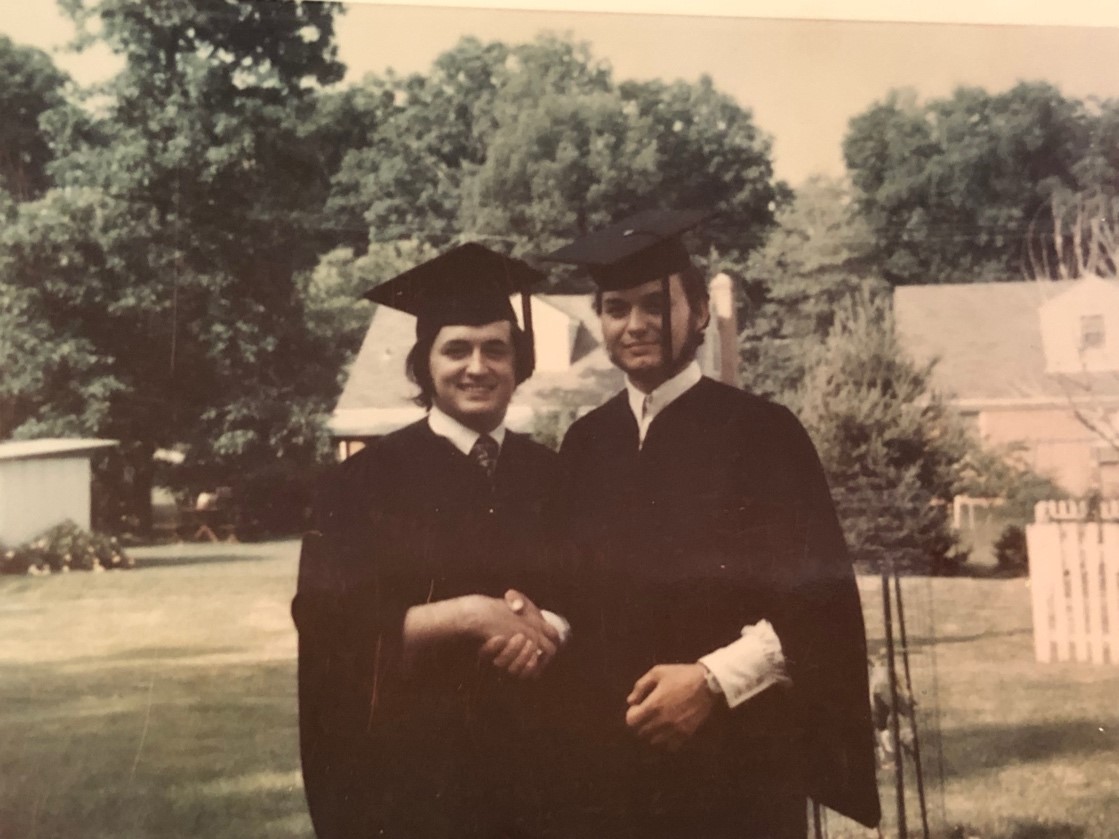 James Atsaides and his older brother Sam in their graduation regalia in 1971.
The classes I was taking also offered lots of different experiences. During an archeology class, we took a trip to the Walters Art Museum. As part of a project in a sociology class, I got to interview a local brewery manager and learn how his business impacted the community. This was a particularly meaningful experience because I always enjoyed business. I think it gave me the drive to focus on industrial psychology years later. I also did an internship at Spring Grove State Hospital, which was very meaningful in a different way as it made me realize that I did not want to become a clinical psychologist!
Q: What’s the one thing you’d want someone to know about the support you find here?
A: My time at UMBC went very quickly, but UMBC was my “savior” in a lot of ways. UMBC and the supportive community gave me the positive university experience I always wanted. UMBC also gave me direction and helped me figure out what I wanted to do with my life. I look back on my time as a UMBC student very fondly. However, it would not be my last go-around with the university.
My time at UMBC made me realize that I enjoyed learning. So I just kept going to school. I completed a master’s program at Springfield College and a Ph.D. program at the University of Kansas.
Q: Can you tell us about your career in psychology?
A: My career took me from Kansas to Oregon to work with an international firm of management psychologists. In the early 1980s, my parents and family decided to build a hotel resort on the Greek island of Rhodes where my mom had a large parcel of land. For this to materialize, however, I had to leave my career and come back to Baltimore to take over Kibby’s, the family restaurant. So in 1983, my family loaded the Hertz rental truck and settled back in Catonsville with two very young girls.
As a management psychologist, I took my own advice and hired a very good general manager to run the restaurant. This allowed me to start my professional practice in Baltimore in 1985. During this time, I met a fellow psychologist who became a very close and dear friend, John Martello. John was in a senior position at UMBC. We hit it off very well, and we spent much time talking about the work we were both doing, as well as our experiences at UMBC. John was instrumental in introducing me to the senior staff at UMBC. He introduced me to not only the head of the psychology department but also to the president of the university, Michael Hooker.
I enjoyed getting back on campus. The campus had grown so much and was still growing!
I am grateful for my time at UMBC and have appreciated the many life-long opportunities it has given me as an individual and as a professional.
James Atsaides ‘71, psychology
Management Psychologist & Business Consultant
Q: What drives you to support this community?
A: In the late 1980s, President Hooker contacted me and asked me to join the UMBC Alumni Association Board of Directors. I happily accepted.
During this time, UMBC was promoting an insurance program that alumni could establish that would create an endowment for UMBC. President Hooker and Nell Savopoulous, director of development at UMBC, asked if I would participate. I felt such a close connection to UMBC, that I said “yes.” This was my alma mater after all. Now, I just had to figure out what and who my endowment would benefit.
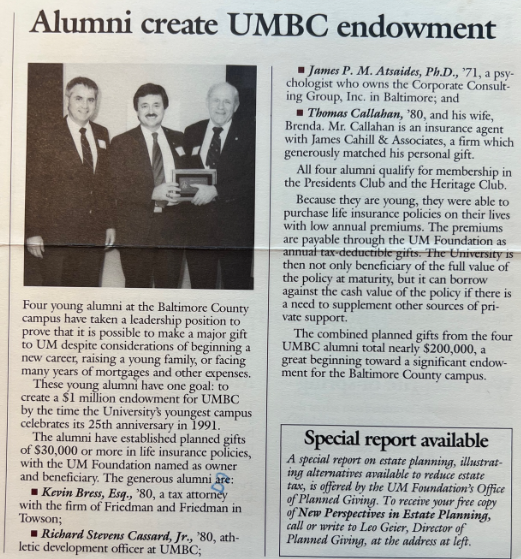 Newspaper clipping from The Retriever Weekly announcing the establishment of several endowments, including the Dr. James P. Atsaides Endowment.
As an industrial psychologist, I’m required to attend regular educational programs for continuous education (CE) credits. Students also regularly attend these conferences to make connections and gain exposure to the industry. However, these conferences are not cheap. My grandson, Dustin, for example, was graduating from Ithaca College and was honored with a request to present his senior research at a conference in Phoenix, Arizona. He was delighted with the opportunity but had to figure out how to cover airfare, lodging, and other expenses not included in his conference registration. Dustin quickly learned that there were no grants or scholarships available from the school to help him. So, he had to ask his parents and grandparents for money.
As my wife and I thought about Dustin’s situation, we both said, “Wouldn’t it be a good thing to have students apply for grants for this type of situation?” As we discussed this, we realized that we could focus the Dr. James P. Atsaides Endowment to help graduate students in need of funding to attend conferences.
I am grateful for my time at UMBC and have appreciated the many life-long opportunities it has given me as an individual and as a professional. Creating an endowment for students has been a wonderful way for me to say “Thank You” to the university and to help future students. And I am excited to share that we will award our first scholarship this academic year!
“Dr. Atsaides’ generosity to give back to both UMBC in general and our I/O Psychology program, in particular, is a testament to his professional values and his commitment to his alma mater,” says Dr. Elliot Lasson, professor of the practice and Director of UMBC’s I/O Psychology graduate program. “We look forward to using his gift to support our graduate students for years to come.”
Q. What has been your most meaningful connection at UMBC?
A: Through my work with the university, I was fortunate to meet Ardell Terry, campaign manager for UMBC. She was a positive addition to the fundraising group. Ardell and I married, and we have been together now for over 20 years. I thank UMBC for the opportunity to meet her as well.
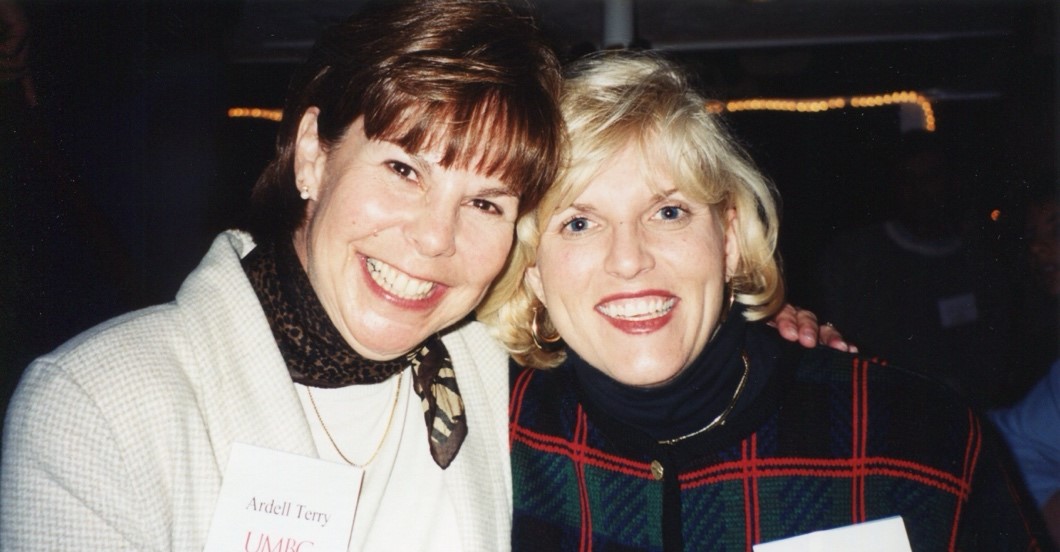 Ardell Terry, campaign manager for UMBC, and Kim Robinson, director of major gifts at UMBC.
Q: How have you stayed connected with UMBC?
A: In 1990, I was asked to teach an upper-level class in organizational psychology and joined the UMBC community in a new capacity—adjunct professor. I greatly enjoyed teaching the class and did so for nine years.
Along with my time on the UMBC Alumni Board, President Hooker asked me to represent the university as a member of the University System of Maryland Chancellor’s Advisory Council. This was truly an honor for me to represent my alma mater and be part of this historic transition to a state-wide education system.
In 1992, I was asked to be part of the selection committee for the next president of UMBC. As many of you probably know, this is the historic search that elevated Freeman A. Hrabowski, III, to the role of president, which he held until he retired in 2022.
In 1995, I was asked to take the position of president of the UMBC Alumni Board. This was a tremendous honor for me and allowed me to work closely with the administration. In my role as board president, I had the opportunity to be on stage while my younger cousin graduated from UMBC, which was really special.
UMBC continues to be close to my heart. It has been a large part of my life, and I am sure it will continue to be. I am honored to give back to the university in any way I can.
* * * * *
UMBC’s greatest strength is its people. When people meet Retrievers and hear about the passion they bring, the relationships they create, the ways they support each other, and the commitment they have to inclusive excellence, they truly get a sense of our community. That’s what “Meet a Retriever” is all about.
Learn more about how UMBC can help you achieve your goals.
]]>
Meet James Atsaides ‘71, psychology. Jim is a Founding Four member, a management psychologist, a former Alumni Association Board of Directors president, a former adjunct faculty member, and a...
https://umbc.edu/stories/meet-james-atsaides-psychology/
https://my3.my.umbc.edu/api/v0/pixel/news/145920/guest@my.umbc.edu/aa6ed5fa3e6fca5625c97b8bf119a57d/api/pixel
alumni
endowments
impact
magazine
meet-a-retriever
psychology
story
UMBC News & Magazine
https://my3.my.umbc.edu/groups/umbc-news-magazine
https://assets1-my.umbc.edu/system/shared/avatars/groups/000/001/943/24435aa6207c452e7bc15cc74b42c7bb/xsmall.png?1748556657
https://assets1-my.umbc.edu/system/shared/avatars/groups/000/001/943/24435aa6207c452e7bc15cc74b42c7bb/original.png?1748556657
https://assets2-my.umbc.edu/system/shared/avatars/groups/000/001/943/24435aa6207c452e7bc15cc74b42c7bb/xxlarge.png?1748556657
https://assets2-my.umbc.edu/system/shared/avatars/groups/000/001/943/24435aa6207c452e7bc15cc74b42c7bb/xlarge.png?1748556657
https://assets3-my.umbc.edu/system/shared/avatars/groups/000/001/943/24435aa6207c452e7bc15cc74b42c7bb/large.png?1748556657
https://assets1-my.umbc.edu/system/shared/avatars/groups/000/001/943/24435aa6207c452e7bc15cc74b42c7bb/medium.png?1748556657
https://assets2-my.umbc.edu/system/shared/avatars/groups/000/001/943/24435aa6207c452e7bc15cc74b42c7bb/small.png?1748556657
https://assets1-my.umbc.edu/system/shared/avatars/groups/000/001/943/24435aa6207c452e7bc15cc74b42c7bb/xsmall.png?1748556657
https://assets2-my.umbc.edu/system/shared/avatars/groups/000/001/943/24435aa6207c452e7bc15cc74b42c7bb/xxsmall.png?1748556657
UMBC News & Magazine
1
0
false
Tue, 26 Nov 2024 10:24:07 -0500
Tue, 26 Nov 2024 10:24:07 -0500
When public service gets personal

When Patricia Mengue Bindjeme, a junior majoring in mechanical engineering, went to classes, her professors would sometimes point out how engineers’ decisions can have life-or-death consequences. But the message really hit home this past summer when Mengue Bindjeme interned at the Maryland Transit Administration (MTA), working on the Baltimore Red Line Project, a recently revived transportation project to create faster and more convenient links between the eastern and western parts of the city.
“I saw people talking about the journeys they had to make coming from West Baltimore to work at someplace like Johns Hopkins,” she says. “That’s a lot of travel.” Mengue Bindjeme realized how engineers working to ensure the safety, availability, and reliability of transportation could make huge differences to people’s everyday lives. “Having another person’s life in my hands is nerve-racking,” she says. “But the change I can make for someone else is really beautiful and impactful.”
Real tasks and real things
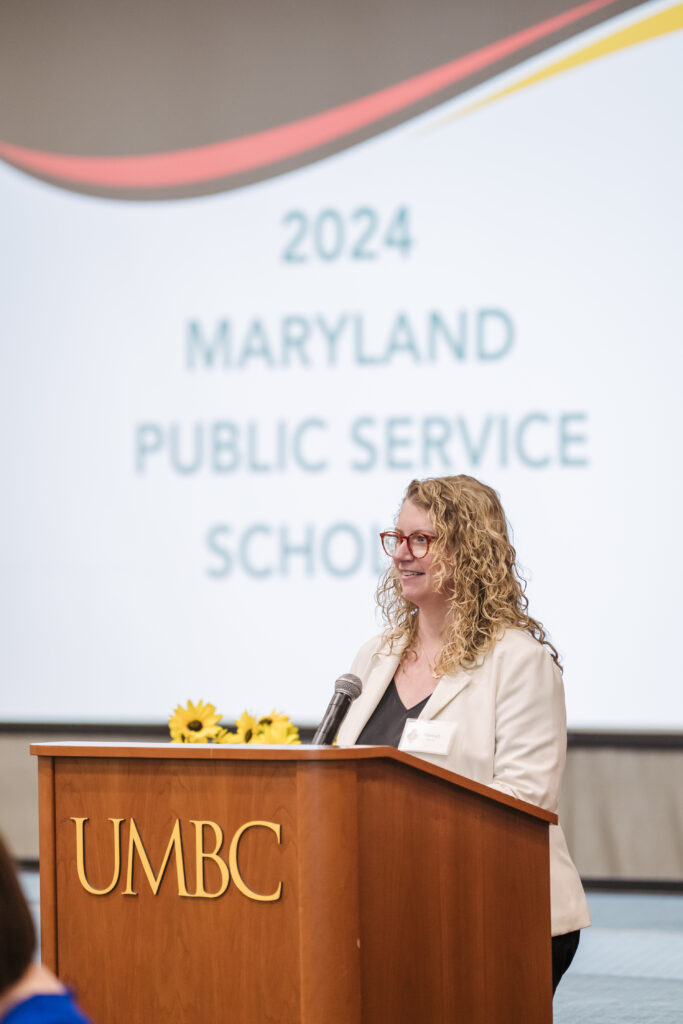 Hannah Schmitz addresses the audience at the opening gathering for the Maryland Public Service Scholars. (Marlayna Demond ’11/UMBC)
Mengue Bindjeme secured her internship at MTA through the Maryland Public Service Scholars (MPSS) program, a 12-week summer fellowship program funded by the state of Maryland and administered by the Shriver Center at UMBC. The goal of the program is to provide students across Maryland the opportunity to develop as future leaders in the state’s public and social sectors.
Mengue Bindjeme was one of five UMBC students who completed the program this past summer. The others were Tasnim Rushdan, a senior global studies major; Aziza Mattaka, a junior global studies major; Dionne Cole, a senior biology and social work major; and Samantha Fu, a junior psychology and public policy major.
The students wrapped up the fellowship with real-world experience on their résumés. “From day one, I was having real tasks and learning real things,” says Rushdan, who worked as an international affairs fellow at the Maryland Office of the Secretary of State. The international division of the office was small—with just two full-time employees—so as an intern Rushdan was immediately involved in important work such as reviewing agreements, organizing meetings, and writing memos for Maryland Secretary of State Susan C. Lee and Governor Wes Moore.
Rushdan helped organize the Pan African City Exposition to facilitate discussions with international delegates around ideas for improving economic development and making housing affordable. She also met with embassy officials, business leaders, and students from around the world.
Mattaka worked in the Governor’s Office of Crime Prevention and Policy, working with victims of crime on their compensation claims. “Sometimes when I’d call people, they would go into their stories,” she says. “It really put into perspective my privilege, but it was also rewarding to be in a place to assist.”
Pursuing the same mission
The students faced challenges throughout their fellowships, from the sometimes heavy nature of the work, to the pressures to balance their schedules, produce deliverables, and present in front of the leaders of Maryland government.
They found support from program staff, the mentors they were matched with in their workplaces, and from each other. Each Friday, all the program participants met together and attended workshops to talk through their experiences and learn new skills for success.
“We realized that, even though we come from diverse backgrounds, we were there for the same mission. We’re facing many of the same challenges, and we’re all in it together,” Rushdan says.
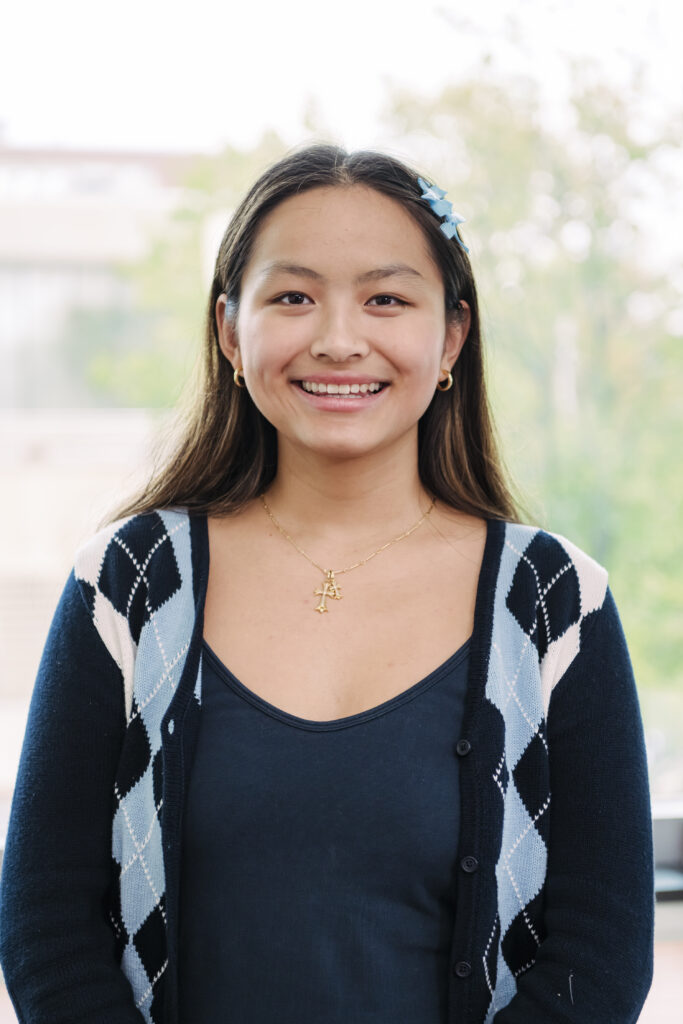
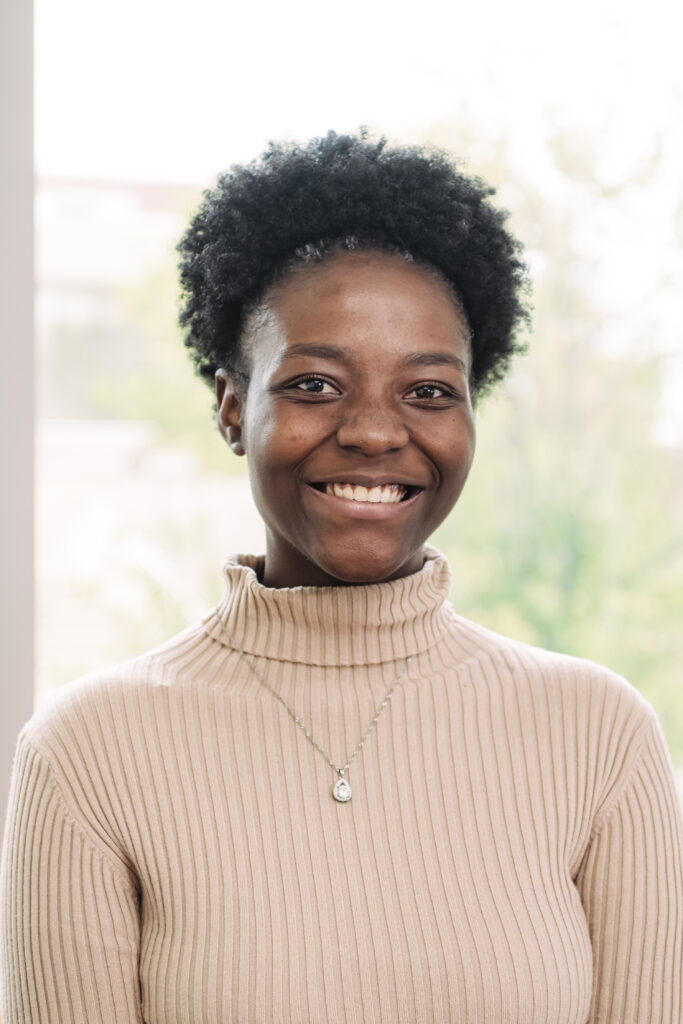
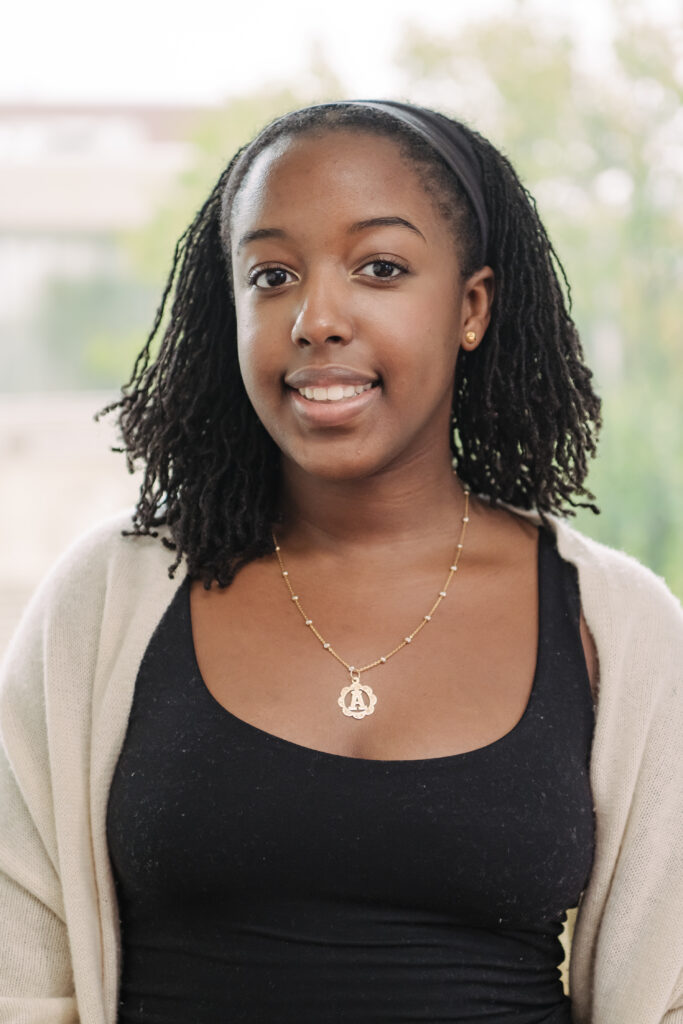
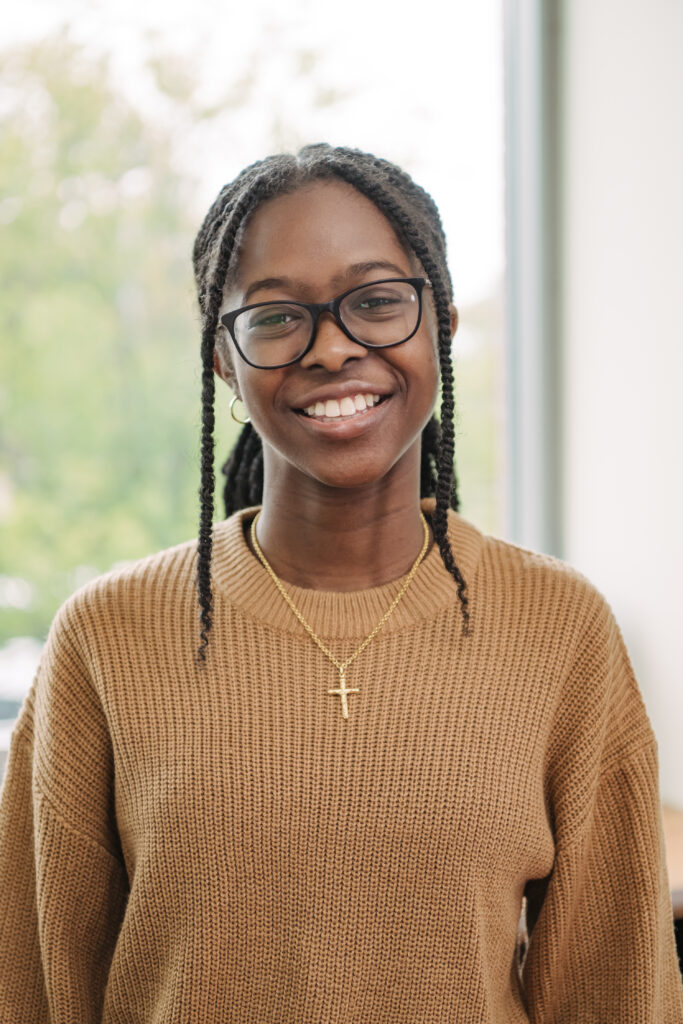
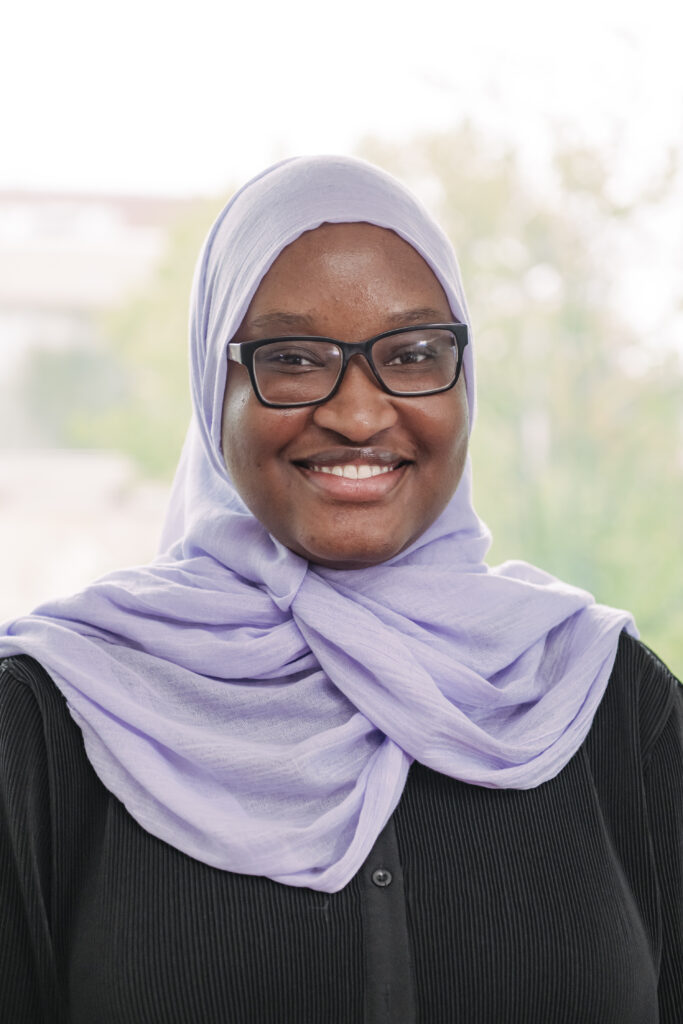
Clockwise from top left: Samantha Fu, Patricia Mengue Bindjeme, Aziza Mattaka, Dionne Cole, and Tasnim Rushdan.
“I made lifelong friends who are supporting me, and really wanting me to succeed,” says Fu, who worked at LET’S GO Boys and Girls, a nonprofit organization dedicated to fostering economic success in underserved communities through STEM education and workforce development.
Throughout the summer, the MPSS scholars pushed themselves out of their comfort zones and discovered how much they had to contribute.
“Before the program, I was afraid of public speaking,” says Fu. “By the end of the program, I was able to confidently present a grant proposal in front of a panel of nonprofit leaders. My group and I even won the grant proposal competition.”
Confident and capable
Cole, who worked at the Maryland Department of Health drafting policy recommendations for behavioral health care access for prison populations and others in the criminal justice system, says she feels much more confident after the summer. “Fear paralyzes us. But it’s like, no, we’re actually capable. You just have to look through the fear and realize, ‘Oh, snap, I could actually do this.’”
The group also ended the summer more confident of their commitment to public service.
“The public service sector truly is limitless and it affords any individual the opportunity to make a difference in their own way,” Cole says.
“Public service calls everyone,” Mattaka adds. “We are a collective, and society works better if we have people willing to develop the skills of leadership and empathy to do these jobs. Those are the skills we cultivated a lot this summer.”
]]>
When Patricia Mengue Bindjeme, a junior majoring in mechanical engineering, went to classes, her professors would sometimes point out how engineers’ decisions can have life-or-death consequences....
https://umbc.edu/stories/maryland-public-service-scholars-impact/
https://my3.my.umbc.edu/api/v0/pixel/news/145904/guest@my.umbc.edu/a98c8dba0cc948f3b35d5e265fbf12fb/api/pixel
cahss
cnms
coeit
fall-2024
impact
magazine
mpss
shriver-center
story
UMBC News & Magazine
https://my3.my.umbc.edu/groups/umbc-news-magazine
https://assets1-my.umbc.edu/system/shared/avatars/groups/000/001/943/24435aa6207c452e7bc15cc74b42c7bb/xsmall.png?1748556657
https://assets1-my.umbc.edu/system/shared/avatars/groups/000/001/943/24435aa6207c452e7bc15cc74b42c7bb/original.png?1748556657
https://assets2-my.umbc.edu/system/shared/avatars/groups/000/001/943/24435aa6207c452e7bc15cc74b42c7bb/xxlarge.png?1748556657
https://assets2-my.umbc.edu/system/shared/avatars/groups/000/001/943/24435aa6207c452e7bc15cc74b42c7bb/xlarge.png?1748556657
https://assets3-my.umbc.edu/system/shared/avatars/groups/000/001/943/24435aa6207c452e7bc15cc74b42c7bb/large.png?1748556657
https://assets1-my.umbc.edu/system/shared/avatars/groups/000/001/943/24435aa6207c452e7bc15cc74b42c7bb/medium.png?1748556657
https://assets2-my.umbc.edu/system/shared/avatars/groups/000/001/943/24435aa6207c452e7bc15cc74b42c7bb/small.png?1748556657
https://assets1-my.umbc.edu/system/shared/avatars/groups/000/001/943/24435aa6207c452e7bc15cc74b42c7bb/xsmall.png?1748556657
https://assets2-my.umbc.edu/system/shared/avatars/groups/000/001/943/24435aa6207c452e7bc15cc74b42c7bb/xxsmall.png?1748556657
UMBC News & Magazine
3
0
false
Mon, 25 Nov 2024 14:42:08 -0500
Mon, 25 Nov 2024 14:42:08 -0500
Meet a Retriever—Matthew Levy ’00, M.S. ’08, emergency response professional

Meet Matthew J. Levy ’00, M.S. ’08, emergency and disaster health services (EDHS), who has dedicated his career to Maryland communities. His expertise, as a physician of emergency medicine and former paramedic, has made him indispensable in the most challenging national, state, and local emergencies. Matthew was part of an emergency response team that spent 10 days in New York City, assisting in the relief efforts following 9/11. In 2015, he received the Silver Medal of Valor from Howard County Fire and Rescue Services for his role as the second tactical medic to arrive on the scene at the Columbia Mall shooting in January 2014 then transitioned to being the on-scene medical director. In 2017, he was named Emergency Medical Services Physician of the Year by the Maryland Chapter of the American College of Emergency Physicians. Take it away, Matt!
Q: Briefly introduce yourself. What’s one essential thing you’d want another Retriever to know about you?
A: I began my studies at UMBC in 1996, enrolling in the Emergency and Disaster Health Services (EDHS) program. I earned my bachelor’s degree in 2000 and my master’s in 2008 while finishing my residency training as an emergency physician at Johns Hopkins University School of Medicine. I now serve as EDHS’s medical director for the paramedic program, the very department that helped me become the clinician and leader I am today. I am also an associate professor in the Department of Emergency Medicine at Johns Hopkins University School of Medicine.
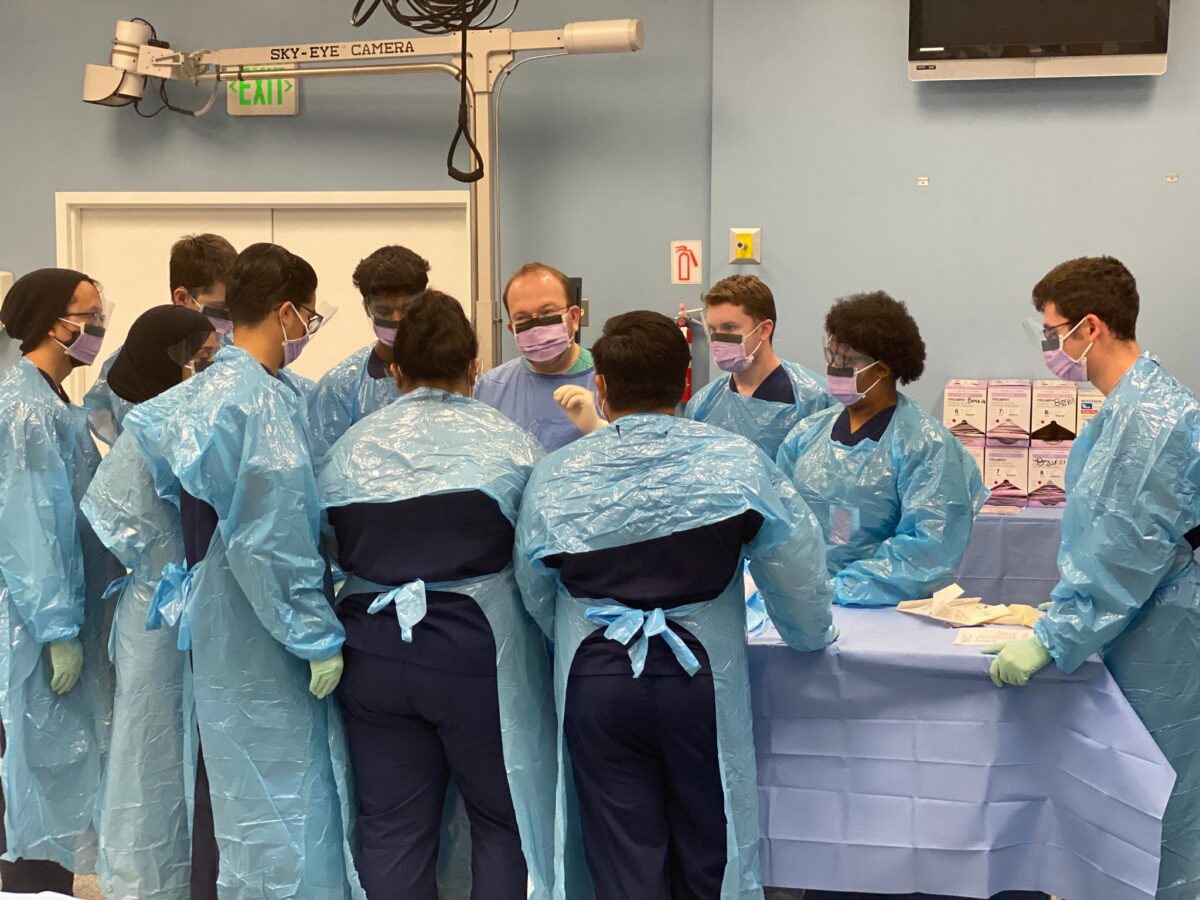 Matthew J. Levy, center, in the lab with students. (Image courtesy of Levy)
Q: What are some of the ways you have brought leading-edge practices to Howard County?
A: In 2016, I was part of the team that launched one of the nation’s first county-wide Stop the Bleed programs in Howard County. This is a national initiative designed to foster resilience and improve patient outcomes by empowering everyday people to recognize and treat life-threatening hemorrhages, which are the leading cause of preventable death in trauma patients. In 2023, I led the implementation of the Whole Blood Program in Howard County, which improves outcomes for critically ill and injured patients suffering from shock by implementing Maryland’s first ground-based EMS blood transfusion program. This program brings life-saving whole blood to the scene of the most critical patients to help give them precious time to get to the hospital for further stabilization.
Q: Tell us about someone in the community who has inspired or supported you, and how they did it.
A: I feel incredibly fortunate to have met so many people at UMBC who have shaped my life and career—from faculty and friends to colleagues and coworkers, specifically, I’d say Dwight Polk, Bill Hathaway, Dr. Rick Bissell, Dr. Jeff Mitchell, Dr. Bruce Walz (all from EDHS), and Dr. Joel Liebman (chemistry). However, the most impactful person has been Dr. J. Lee Jenkins, my wife, whom I met while we were both EDHS undergraduates. We dated through medical school and were married when I was in residency. She is also a physician and a faculty member in the Department of Emergency Medicine at Johns Hopkins University School of Medicine.
I genuinely love taking care of people and helping them. Whether that’s one-on-one as their doctor (or previously as their paramedic) or now as someone responsible for entire EMS systems, the path I’ve chosen…has allowed me to…improve outcomes from emergency medical situations.
Matthew J. Levy ’00, M.S. ’08
EDHS
Q: What is the one thing you’d want a potential student to know about the support you can find at UMBC?
A: At UMBC, we take pride in striving for excellence in everything we do. Being part of the UMBC community means contributing to something greater than oneself. Through leadership, service, teaching, and research, UMBC is making a positive impact on the world. My UMBC education provided an exceptionally strong basis in the sciences, combined with amazing training in leadership, project management, research, and teaching skills. All of these have helped me to achieve success in my career.
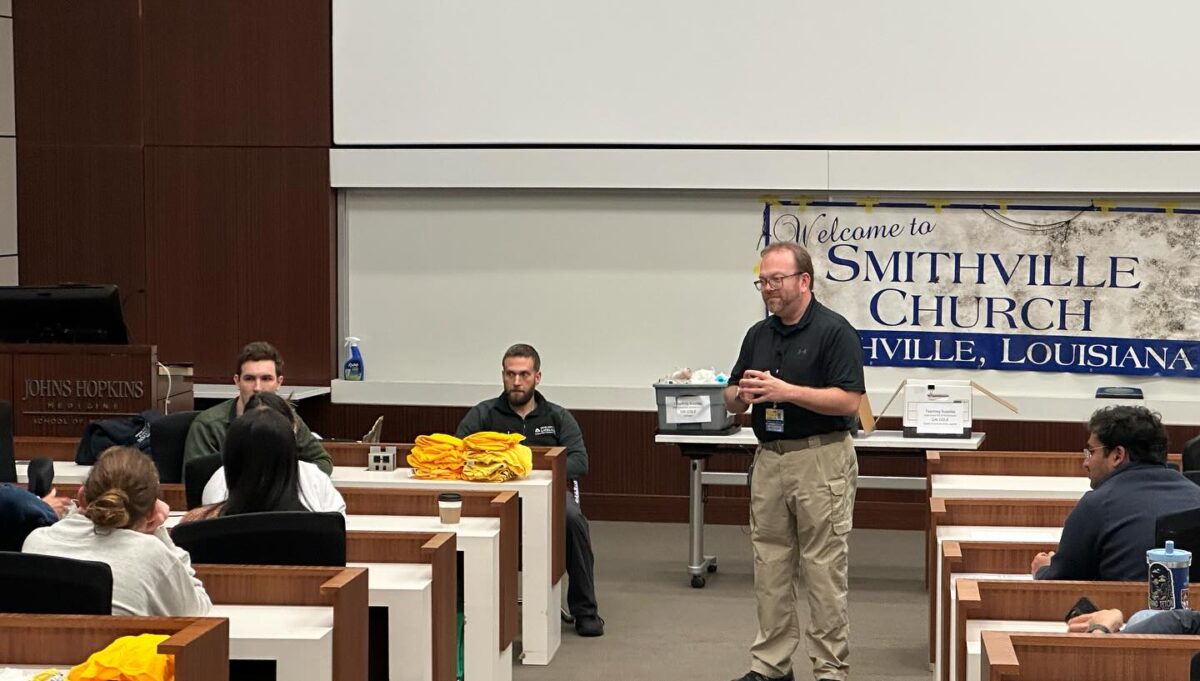 Levy teaching an EMS class. (Image courtesy of Levy)
Q: Tell us about what you love about your academic program.
A: That’s easy… it’s the people of the EDHS department. This department is one of UMBC’s best-kept secrets. It has produced EMS leaders, clinicians, educators, scientists, and practitioners who have played a pivotal role in pioneering, innovating, and redefining the delivery of prehospital care both locally and nationally.
Q: Why did you choose emergency medicine as a career path? What do you enjoy most about it that has kept you working in this field?
A: This passion has led me to many opportunities. In addition to my work at UMBC and Johns Hopkins, I am also the medical director of Howard County Fire and Rescue, the regional medical director for the Maryland Institute for Emergency Medical Services Systems, the tactical physician with the Maryland State Police and Howard County Police, and the founding commander of the Maryland-1 Disaster Medical Assistance Team.
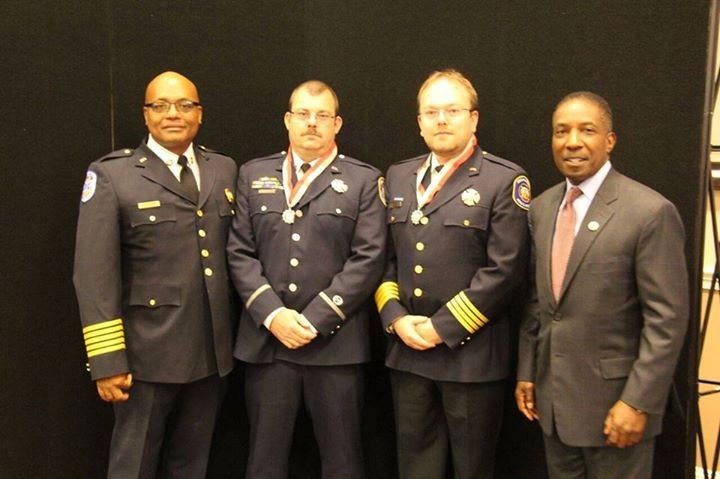 2015 Howard County Medal of Valor recipients. (l-r): John Butler, former fire chief for Howard County, Will Huber, lieutenant at Howard County Government, Levy, and Lonnie Robbins, former chief administrative officer at Howard County Government. (Image by Maryland Institute for Emergency Medical Services Systems)
Q: What advice do you wish you had received as an undergraduate EDHS student, particularly given the rapid changes in healthcare over the past few years?
A: Healthcare isn’t an easy path, but it’s one of the most noble professions and promises a rewarding career. However the journey will be long, so always believe in yourself, and always be your biggest fan and supporter. Surround yourself with the people you aspire to be like and always strive to improve yourself. This is your life to live so be sure to take the time to enjoy the journey along the way. But, don’t enjoy it too much…hard work does pay off! You’ll look back one day, maybe, 10,15, or 20 years or more later, and realize how far you’ve come.
* * * * *
UMBC’s greatest strength is its people. When people meet Retrievers and hear about the passion they bring, the relationships they create, the ways they support each other, and the commitment they have to inclusive excellence, they truly get a sense of our community. That’s what “Meet a Retriever” is all about.
Learn more about how UMBC can help you achieve your goals.
]]>
Meet Matthew J. Levy ’00, M.S. ’08, emergency and disaster health services (EDHS), who has dedicated his career to Maryland communities. His expertise, as a physician of emergency medicine and...
https://umbc.edu/stories/matthew-j-levy-umbc-edhs-outstanding-alum/
https://my3.my.umbc.edu/api/v0/pixel/news/145810/guest@my.umbc.edu/614b684326065eb62af62ef2911659ca/api/pixel
cahss
edhs
impact
magazine
meet-a-retriever
story
UMBC News & Magazine
https://my3.my.umbc.edu/groups/umbc-news-magazine
https://assets1-my.umbc.edu/system/shared/avatars/groups/000/001/943/24435aa6207c452e7bc15cc74b42c7bb/xsmall.png?1748556657
https://assets1-my.umbc.edu/system/shared/avatars/groups/000/001/943/24435aa6207c452e7bc15cc74b42c7bb/original.png?1748556657
https://assets2-my.umbc.edu/system/shared/avatars/groups/000/001/943/24435aa6207c452e7bc15cc74b42c7bb/xxlarge.png?1748556657
https://assets2-my.umbc.edu/system/shared/avatars/groups/000/001/943/24435aa6207c452e7bc15cc74b42c7bb/xlarge.png?1748556657
https://assets3-my.umbc.edu/system/shared/avatars/groups/000/001/943/24435aa6207c452e7bc15cc74b42c7bb/large.png?1748556657
https://assets1-my.umbc.edu/system/shared/avatars/groups/000/001/943/24435aa6207c452e7bc15cc74b42c7bb/medium.png?1748556657
https://assets2-my.umbc.edu/system/shared/avatars/groups/000/001/943/24435aa6207c452e7bc15cc74b42c7bb/small.png?1748556657
https://assets1-my.umbc.edu/system/shared/avatars/groups/000/001/943/24435aa6207c452e7bc15cc74b42c7bb/xsmall.png?1748556657
https://assets2-my.umbc.edu/system/shared/avatars/groups/000/001/943/24435aa6207c452e7bc15cc74b42c7bb/xxsmall.png?1748556657
UMBC News & Magazine
0
0
false
Tue, 19 Nov 2024 11:16:04 -0500
Faisal Quader, Ph.D. ’20: Expanding access to the cyber ecosystem
There’s already a student waiting outside the office of Faisal Quader, Ph.D. ’20, when the adjunct professor arrives at the Information Technology and Engineering building on a Thursday afternoon.
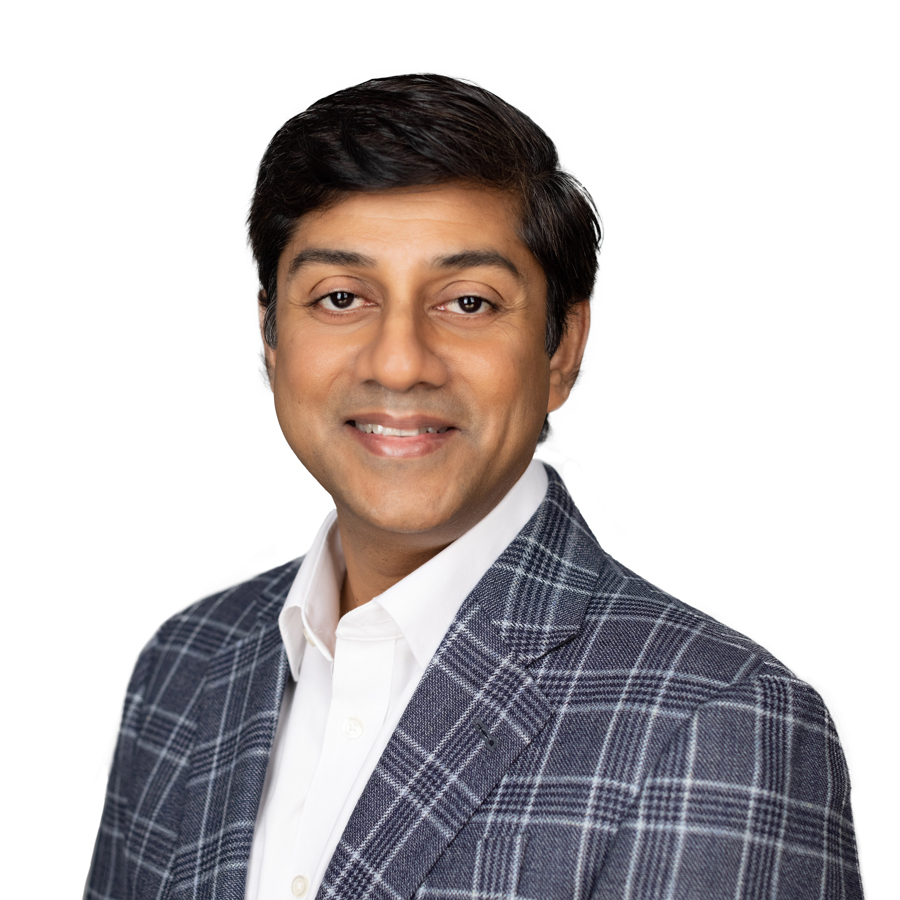 Headshot courtesy of Quader.
The recent graduate, Smriti Khilnani, M.S. ’24, information systems, patiently waits for the information systems instructor—a full-time president of Technuf LLC, philanthropist, and board member of several organizations—to open his office for his limited hours on campus. Quader breezes in, greeting his guest with a smile while asking her how she’s doing.
“I don’t know,” the graduate says, before the pair steps inside the office. After several minutes, the duo exit and Khilnani’s face looks more relaxed and at ease than moments before.
“She’s looking for a job, and she’s a little frustrated,” says Quader of the graduate, who is an international student. “She’s trying to get a cybersecurity job, but it needs security clearance, which she cannot get due to her non-U.S. citizen status. However, we talked about alternative solutions to her problem.”
Moments like these aren’t uncommon for Quader, a former international student himself. He spends a large portion of his time in service to those around him, whether it’s in the classroom, in a meeting room at the high-tech company he runs, or on stage when he’s singing classic Bengali songs.
“The fact that people are so open to come to me for help—that makes my day knowing that I’m able to make a difference,” says Quader.
Bringing industry perspectives into the classroom
Since graduating in 2020, Quader has spent the last four years as a part-time instructor teaching two graduate-level cybersecurity courses at UMBC and an additional course at the University of Maryland, College Park. On top of teaching, Quader works full-time as the president of the company he co-founded, Technuf, which specializes in cybersecurity, artificial intelligence (AI), machine learning (ML), robotic process automation, mobile application development, and software engineering. The Rockville-based company supports agencies, such as the Internal Revenue Service, the National Institutes of Health, and the Department of Homeland Security, and some state governments on high-profile cybersecurity initiatives.
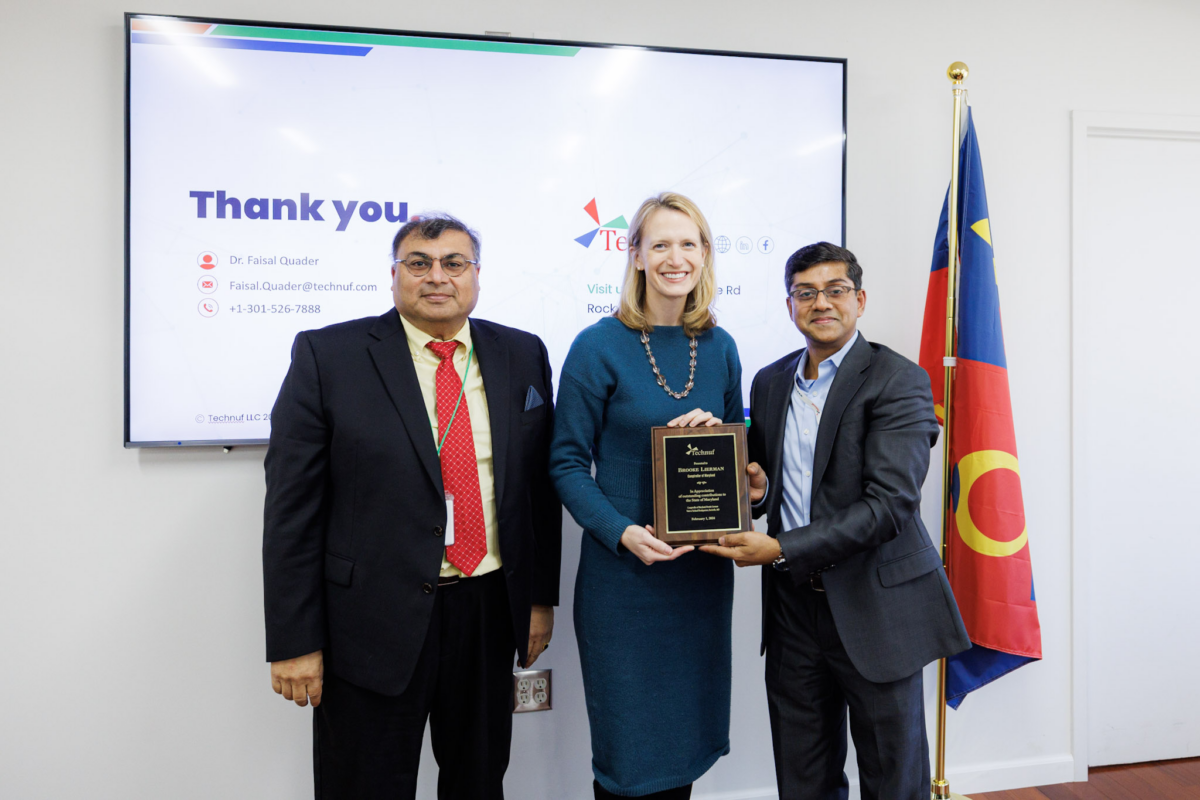 Faisal Quader (right) and Technuf co-founder and CEO Shah Ahmed (left) presenting an award to Maryland Comptroller Brooke E. Lierman in February 2024. (Photo courtesy of Technuf LLC’s X account)
Quader has a B.S. in computer science from the University of Wisconsin and an M.S. in computer science and engineering from Johns Hopkins University. Before going down the path to becoming a faculty member, Quader was initially a non-degree student at UMBC, but after enjoying his class so much, he decided to pursue a doctoral degree in information systems, specializing in cybersecurity.
“It was a difficult path working full-time and being a student, but I got so much from UMBC,” says Quader. “My mentors and professors supported me tremendously. I love this school, and now I feel like it’s time for me to give something back. Nothing is better than being able to share what I’ve learned with students.”
Quader brings his data science industry know-how to the classroom in more practical ways, educating students on how he and his team at Technuf work to address timely cybersecurity challenges, such as securing network infrastructures from cyber attacks and analyzing data to protect from cyber threats. His courses are capped to capacity every semester and has an ever-evolving waitlist of students hoping to learn from his tutelage.
“Cybersecurity is an extremely hot topic, and I like that I can bring in the industry perspective to my theoretical teachings,” explains Quader. “I love teaching—it’s my passion. Even though I work full time, I do this because I love to be able to share what I do everyday.”
A passion for performance
While Quader has spent the last three decades in engineering, computer science, and information science as an industry leader, he’s dedicated much of his life to something he got from his mother: a love of singing.
As a child growing up in Bangladesh, Quader frequently performed on tv shows as a vocalist and continues to feed his passion for performance today. He shares that music is his “weekend work” where he occasionally puts on family performances with his wife and two children. Every few weeks, Quader travels across the DMV singing with various groups. He’s a big fan of Lionel Richie and Bengali polymath Rabindranath Tagore. With his performances, Quader says that he is trying to create a bridge between Eastern and Western music.
 Faisal Quader singing traditional South Asian music during a performance at the Purbachal Resort in Bangladesh. (Photo courtesy of Quader)
The tech-heavy data scientist says that finding time to mesh his creative passions with his analytical and technical skills gives balance to his life—music and technology are more related than one may think, he adds.
“Technology has a lot of mathematical inductions, different kinds of modeling theories and patterns. Music is also something that is kind of like a pattern,” says Quader. “Music refreshes my brain. When the weekend comes, I focus on music and that gives me more energy to do my work. That keeps me sane.”
Supporting the next generation of data scientists and engineers
In 2023, Quader established the Technuf Endowed Fellowship at UMBC, a $100,000 fund that supports master’s or Ph.D. candidates in information systems with entrepreneurial aspirations who are conducting research and/or pursuing a career in AI/ML or cybersecurity. The fellowship, Quader shares, is particularly for students who are unable to receive financial support for their education.
“When I was a student here in the U.S. after emigrating from Bangladesh at age 18, I didn’t have a scholarship or funding because of the fact that I was an international student. I struggled so badly and had to work three jobs to make my tuition,” he says. “I don’t want my students to go through the same process of struggling. I’m not able to help every student, but this is a good start.”
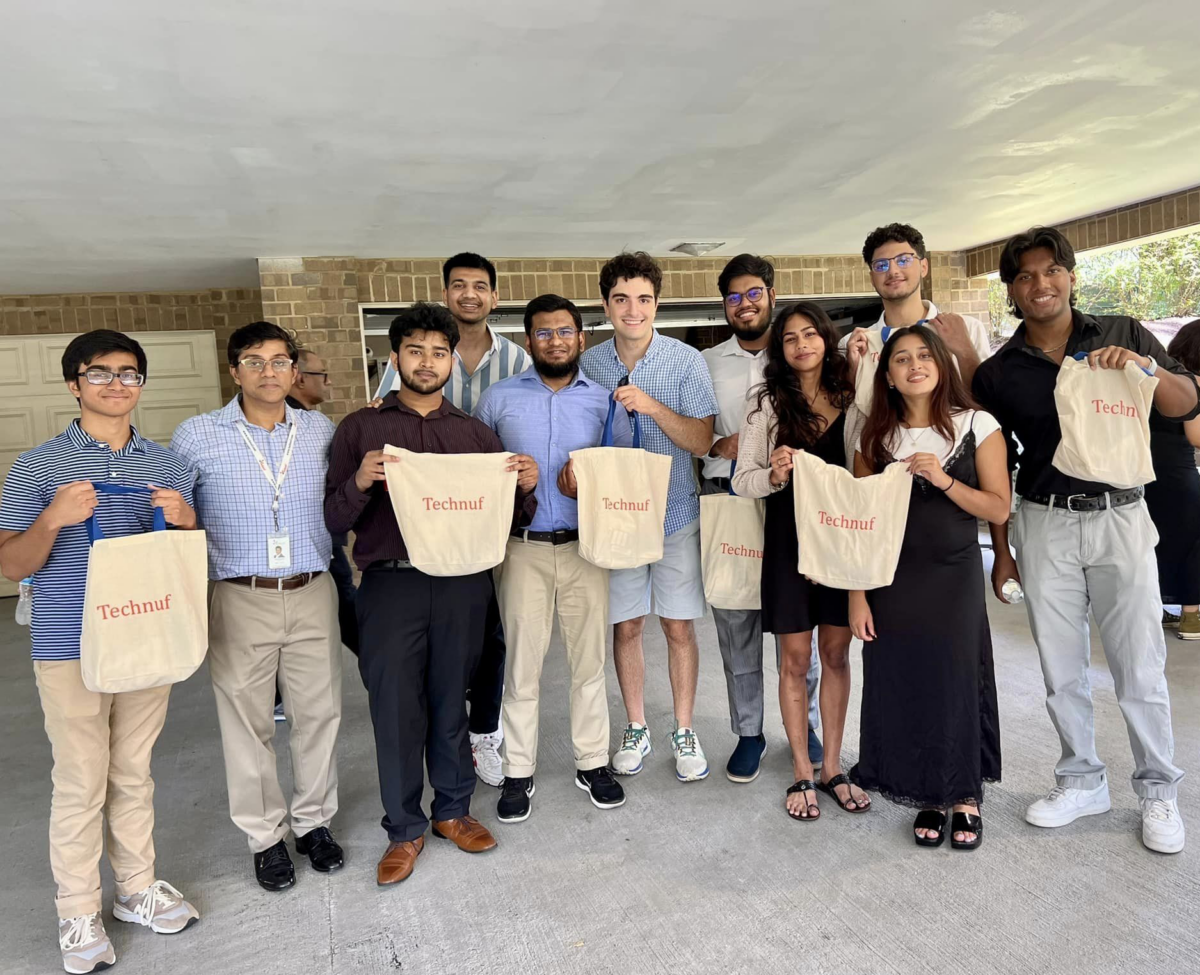 Faisal Quader (second from left) with former Technuf interns. (Photo courtesy of Technuf’s X account)
Quader also created a summer internship program at Technuf where students work hand-in-hand with data scientists and engineers on solving technical problems. Several UMBC students have gone on to work full time at Technuf following their internships, including Isha Shah, M.S. ’23, information systems. In summer 2022, Shah worked at Technuf as a software engineer and data science intern.
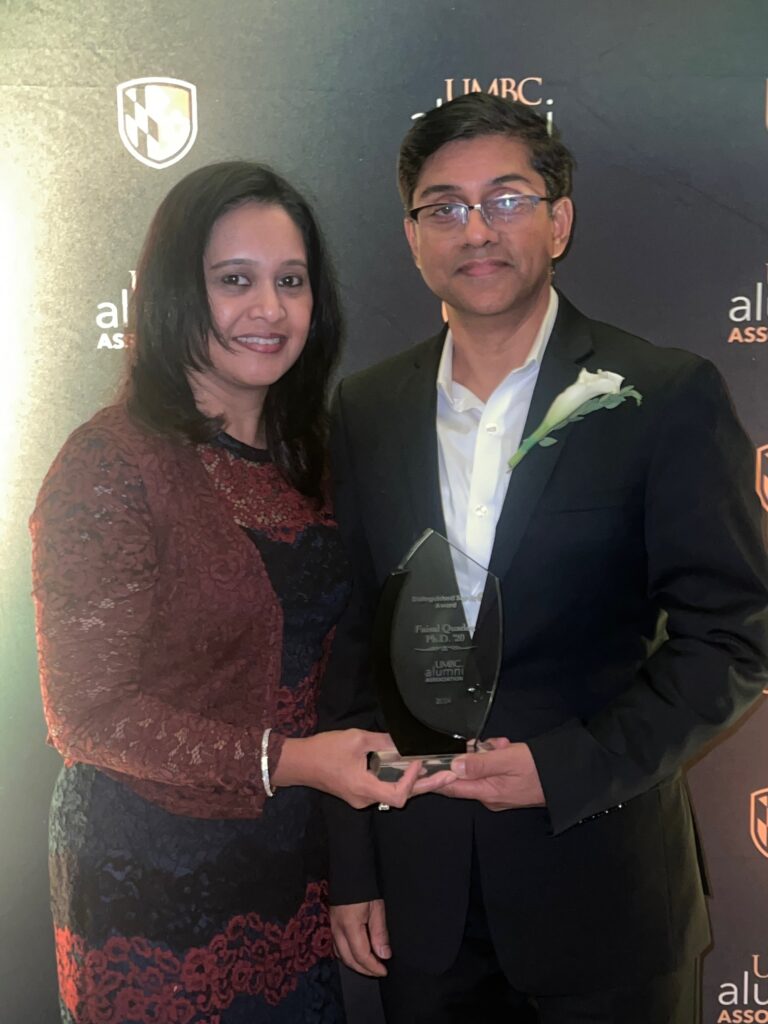 Quader, alongside his wife Fahmida, holding his Distinguished Service Alumni Award. (Photo courtesy of Quader)
“I often found it challenging to secure job or internship opportunities. During one of our initial classes, Dr. Quader mentioned his company, which immediately caught my interest,” says Shah. “I reached out to him to inquire about internship opportunities and to my surprise, he responded with enthusiasm and asked me to send over my resume. That moment felt like a turning point in my career journey.”
After graduating from UMBC, Shah was offered a full-time position at Technuf and currently works at the company as a product development engineer.
“Dr. Quader has had a tremendous impact on both my studies and career. His approach to teaching went far beyond textbooks. He always emphasized the importance of real-world applications and critical thinking, which made a significant difference in my understanding of cybersecurity concepts,” Shah explains. “Dr. Quader believed in my potential and opened doors for me at Technuf, where I’ve been able to gain invaluable hands-on experience in the field.”
In October, Quader was honored for his service as a 2024 recipient of UMBC’s Distinguished Service Alumni Award.
“That was a big encouragement for me,” Quader beamed. “I can see the difference I’m able to make with my students by giving them job opportunities, internships, training, and industry focused-teaching. That’s what keeps me going.”
]]>
There’s already a student waiting outside the office of Faisal Quader, Ph.D. ’20, when the adjunct professor arrives at the Information Technology and Engineering building on a Thursday...
https://umbc.edu/stories/faisal-quader/
https://my3.my.umbc.edu/api/v0/pixel/news/145437/guest@my.umbc.edu/f67ae41ea549926f17a588967aebfbf7/api/pixel
alumni
alumni-awards
coeit
cybersecurity
datascience
fall-2024
impact
information-systems
magazine
story
UMBC News & Magazine
https://my3.my.umbc.edu/groups/umbc-news-magazine
https://assets1-my.umbc.edu/system/shared/avatars/groups/000/001/943/24435aa6207c452e7bc15cc74b42c7bb/xsmall.png?1748556657
https://assets1-my.umbc.edu/system/shared/avatars/groups/000/001/943/24435aa6207c452e7bc15cc74b42c7bb/original.png?1748556657
https://assets2-my.umbc.edu/system/shared/avatars/groups/000/001/943/24435aa6207c452e7bc15cc74b42c7bb/xxlarge.png?1748556657
https://assets2-my.umbc.edu/system/shared/avatars/groups/000/001/943/24435aa6207c452e7bc15cc74b42c7bb/xlarge.png?1748556657
https://assets3-my.umbc.edu/system/shared/avatars/groups/000/001/943/24435aa6207c452e7bc15cc74b42c7bb/large.png?1748556657
https://assets1-my.umbc.edu/system/shared/avatars/groups/000/001/943/24435aa6207c452e7bc15cc74b42c7bb/medium.png?1748556657
https://assets2-my.umbc.edu/system/shared/avatars/groups/000/001/943/24435aa6207c452e7bc15cc74b42c7bb/small.png?1748556657
https://assets1-my.umbc.edu/system/shared/avatars/groups/000/001/943/24435aa6207c452e7bc15cc74b42c7bb/xsmall.png?1748556657
https://assets2-my.umbc.edu/system/shared/avatars/groups/000/001/943/24435aa6207c452e7bc15cc74b42c7bb/xxsmall.png?1748556657
UMBC News & Magazine
0
0
false
Thu, 07 Nov 2024 10:05:35 -0500
Thu, 07 Nov 2024 10:05:35 -0500
Meet a Retriever—Emma Swartling ’10, prenatal and pediatric chiropractor
Meet Emma Swartling ‘10, anthropology, prenatal and pediatric chiropractor and owner of Lumos Chiropractic in Tacoma, Washington. She was drawn to UMBC to experience the East Coast after being raised on the West Coast. Emma combined her interests in cultural and biological anthropology, pre-medicine, and working with children to shape her career as a chiropractor. Take it away, Emma!
Q: What’s one essential thing you’d want another Retriever to know about you?
A: Born and raised in the Pacific Northwest (PNW), I started college with the intent to major in pre-medicine but ended up falling in love with anthropology. I was fortunate to find a career that allowed me to combine many of my multiple interests by following the path to chiropractic. Chiropractic has allowed me to use many of the skills in empathy and understanding that cultural anthropology teaches, and biological anthropology offers insights into human anatomy and function. It was the Chesapeake Bay Retriever that initially sparked my interest into learning more about UMBC. I love dogs and spent my childhood involved with dog training and showing, as well as teaching younger children involved in the same program. This is how I learned I enjoy working with children.
Q: Tell us about your current job. What do you enjoy most about it?
A: I am a prenatal and pediatric chiropractor and own my practice in Washington state. The best part about my work is being part of the village that supports people during the huge transition periods of pregnancy, postpartum, and childhood.

Q: Tell us about your primary WHY, and how it led you to UMBC.
A: What brought me to UMBC was the beginning of my love to travel and explore. After finishing the first two years of college in my home state, I decided to transfer to the East Coast to visit a part of our country that I had never seen. The initial reasons UMBC stood out are superficial: Maryland was a central location to explore north and south along the East Coast; the Maryland State flag is amazing; and most importantly, I wanted to say I went to a school where the mascot is a unique dog breed like the Chesapeake Bay Retriever!
I wanted an adventure and to try something new. I can honestly say, when my airplane landed at BWI in the dead of winter, I started to question my decision. Coming from the lush, always green PNW it looked like I was about to land in a brown and desolate land. I grew to appreciate the seasons while in Maryland and was awed by the abruptness of changes in weather. My first semester was timid—I was finding my footing and trying to discover my place. There were other students and professors who helped me make the most of the next three semesters, who helped me step out of my comfort zone and learn more about myself. I love the small community of UMBC, the ease in moving around a campus that felt both big and compact.
Pictured left: Emma in a treatment room at her chiropractic practice, Lumos Chiropractic
Q: Tell us about the people who helped you grow at UMBC and how they helped shape your next steps.
A: UMBC helped to shape “my why.” I really enjoyed learning from many of the professors in the anthropology department, in particular a former professor, Seth Messinger, who taught many of my favorite courses including a course on Medical Anthropology. Anthropology courses that combined the study of other cultures and their medicinal practices were particularly engaging to me. I began to imagine my future career—what direction would anthropology take me?
My first semester was timid—I was finding my footing and trying to discover my place. There were other students and professors who helped me make the most of the next three semesters, who helped me step out of my comfort zone and learn more about myself.
Emma Swartling ’10
After graduating from UMBC, I took some time to travel and consider my career opportunities. It was when my chiropractor cousin suggested I come listen to a talk hosted by a chiropractic school that I began to consider it as a career. The presenters shared about their unique experience opening a chiropractic clinic abroad, living in a country other than their own, and interacting with and helping a small community that I started to put the pieces together. I could combine my many interests: cultural anthropology and working with different people, cultures, populations, pre-medicine, and biological anthropology by working with bodies, studying the human form and its function, and be able to work with children, support childhood development, and help to grow a healthier community.
Q: What’s your favorite part of being a part of Retriever Nation?
A: I really appreciated UMBC’s focus on academics and on inclusion. Also, I found an amazing group of people at UMBC who were kind, generous, and fun in the fraternity of Phi Mu. Some of those friendships led to future travel and experiences that helped to shape my career choice.
* * * * *
UMBC’s greatest strength is its people. When people meet Retrievers and hear about the passion they bring, the relationships they create, the ways they support each other, and the commitment they have to inclusive excellence, they truly get a sense of our community. That’s what “Meet a Retriever” is all about.
]]>
Meet Emma Swartling ‘10, anthropology, prenatal and pediatric chiropractor and owner of Lumos Chiropractic in Tacoma, Washington. She was drawn to UMBC to experience the East Coast after being...
https://umbc.edu/stories/meet-a-retriever-emma-swartling-chiropractor/
https://my3.my.umbc.edu/api/v0/pixel/news/145291/guest@my.umbc.edu/fef18060bb3c130fef64b2f8be92df5b/api/pixel
alumni
anthropology
cahss
impact
magazine
meet-a-retriever
phi-mu
story
UMBC News & Magazine
https://my3.my.umbc.edu/groups/umbc-news-magazine
https://assets1-my.umbc.edu/system/shared/avatars/groups/000/001/943/24435aa6207c452e7bc15cc74b42c7bb/xsmall.png?1748556657
https://assets1-my.umbc.edu/system/shared/avatars/groups/000/001/943/24435aa6207c452e7bc15cc74b42c7bb/original.png?1748556657
https://assets2-my.umbc.edu/system/shared/avatars/groups/000/001/943/24435aa6207c452e7bc15cc74b42c7bb/xxlarge.png?1748556657
https://assets2-my.umbc.edu/system/shared/avatars/groups/000/001/943/24435aa6207c452e7bc15cc74b42c7bb/xlarge.png?1748556657
https://assets3-my.umbc.edu/system/shared/avatars/groups/000/001/943/24435aa6207c452e7bc15cc74b42c7bb/large.png?1748556657
https://assets1-my.umbc.edu/system/shared/avatars/groups/000/001/943/24435aa6207c452e7bc15cc74b42c7bb/medium.png?1748556657
https://assets2-my.umbc.edu/system/shared/avatars/groups/000/001/943/24435aa6207c452e7bc15cc74b42c7bb/small.png?1748556657
https://assets1-my.umbc.edu/system/shared/avatars/groups/000/001/943/24435aa6207c452e7bc15cc74b42c7bb/xsmall.png?1748556657
https://assets2-my.umbc.edu/system/shared/avatars/groups/000/001/943/24435aa6207c452e7bc15cc74b42c7bb/xxsmall.png?1748556657
UMBC News & Magazine
0
0
false
Thu, 31 Oct 2024 14:12:25 -0400
Thu, 31 Oct 2024 14:12:25 -0400
Meet a Retriever—Lola Akinmade Åkerström ‘98, M.S. ‘02, award-winning visual storyteller

Meet Lola Akinmade Åkerström ‘98, M.S. ‘02, award-winning visual storyteller, international bestselling author, and travel entrepreneur. Originally a geographic information systems professional, she eventually made the shift to rely on her passport and storytelling skills to travel the world. Her work has been featured in National Geographic, The New York Times, The Sunday Times, The Guardian, BBC, CNN, Travel Channel, Travel + Leisure, Lonely Planet, Forbes, and many more. She has collaborated with commercial brands such as Dove, Getty Images, Mercedes Benz, and National Geographic Channel, to name a few. Take it away, Lola!
Q: Tell us about your current job. What do you want Retriever Nation to know about you?
A: As an entrepreneur, I run the Stockholm-based creative storytelling agency Geotraveler Media and online academy, Geotraveler Media Academy, which runs photography experiences around the world and is dedicated to visual storytelling and helping the next generation of travel storytellers put the heart back into the craft.
I am honored to be one of Condé Nast Traveler‘s 2024 “Most Powerful Women in Travel.” I’m also an award-winning visual storyteller recently shortlisted for the Global Peace Photo Award and an international bestselling author.
My book, Due North, received the Lowell Thomas Gold Award for Best Travel Book. I am also the author of the international bestseller LAGOM: The Swedish Secret of Living Well, available in over 15 foreign language editions. My internationally acclaimed novel, In Every Mirror She’s Black, was a Good Morning America Buzz Pick, Apple Editors’ Pick, Amazon Editors’ Pick, Independent UK’s “Best Thought-provoking Story,” and was shortlisted for the Bad Form Review Book of the Year. My latest novel, Everything Is Not Enough, is an NAACP Image Award Nominee for Outstanding Literature, Jennette McCurdy Book Club Pick, and a Washington Post, Sunday Times, and Amazon Editors’ Pick, among others.

Q: What is your WHY? What brought you to UMBC?
A: My WHY really is to fight isolation within my sphere of influence by using my work to make people feel seen, heard, and acknowledged through cultural connection. But I didn’t always start out in the creative industry.
I started at Montgomery College, in Rockville, Maryland, a few days after I turned 16 years old. After a year, I transferred to UMBC to study information systems, while minoring in geography. I got my bachelor’s from UMBC at the age of 19.
Pictured left: Lola holding an issue of UMBC Magazine in the snow, next to a reindeer.
Q: What are some long-term takeaways from your years at UMBC?
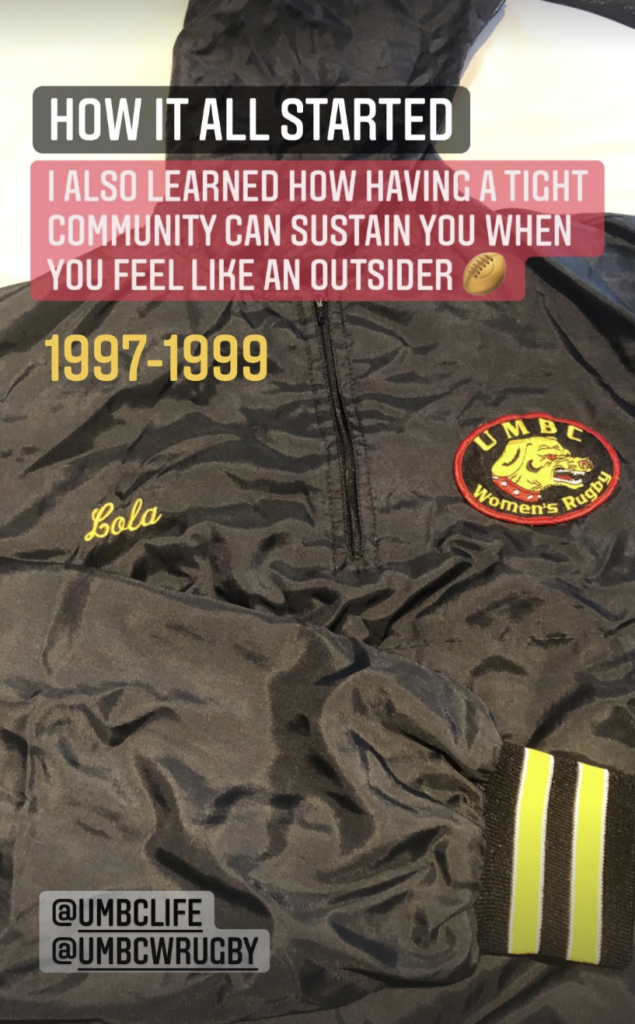
A: My time at UMBC remains one of my most memorable life experiences—from joining the women’s rugby team and African Student Association (ASA) to getting into geographic information systems (GIS) through my minor in geography and meeting my favorite math professor, Manil Suri.
Q: What’s your favorite part of being a part of Retriever Nation?
A: UMBC helped tease out my passions and true career paths. Once I graduated, I went on to specialize in GIS, first as a programmer, and then as a system architect for 12-plus years before switching to my current career as a visual storyteller.
My time at UMBC remains one of my most memorable life experiences.
Lola Akinmade Åkerström ‘98, M.S. ‘02
Many Nigerian parents have a cultural mindset that feels being a doctor, lawyer, or engineer means their children have become successful. Understandably, my parents were worried when I decided to freelance full-time as a writer and photographer. Ultimately, they both wanted me to be happy. Now they are my biggest fans.
As a storyteller, I have been featured on Condé Nast Traveler‘s 2024 Women Who Travel Power List. I was named one of the 2023 Most Influential Women in Travel by Travel Pulse, a 2022 Hasselblad Heroine, and the 2018 Bill Muster Travel Photographer of the Year. I was also honored with a MIPAD 100 (Most Influential People of African Descent) Award within media and culture in 2018, and with a Newsweek 2021 Future of Travel Award – Storytelling.
Q: How have you stayed connected with the UMBC community?
A: Through the lifelong friendships I’ve created in both the rugby team and African Student Association that has seen us through marriages and children too. I am still in contact with some of my former colleagues and fellow students from the geography department as well.
My days with UMBC rugby led me to form the Dayton Women’s Rugby Club, which previously had only a men’s team. I walked onto the field and said, “I’m here to help you start a women’s rugby team.” Their expressions were priceless. It became my international community in Dayton and the team went on to win their division and develop some of the best rugby players in Ohio.
I then went on to play for an elite team in Northern Virginia before relocating to Sweden.
Q: What’s the one thing you’d want someone who hasn’t joined the UMBC community to know about the support you find here?
A: Once a Retriever, always a Retriever. As an example, from taking Professor Manil Suri’s calculus class in 1996 to still connecting with him in 2024 over social media is a testament to the lifelong impact the incredible people I’ve met through my UMBC community have made on me.
Pictured right: Lola’s UMBC women’s rugby jacket.
* * * * *
UMBC’s greatest strength is its people. When people meet Retrievers and hear about the passion they bring, the relationships they create, the ways they support each other, and the commitment they have to inclusive excellence, they truly get a sense of our community. That’s what “Meet a Retriever” is all about.
Learn more about how UMBC can help you achieve your goals.
]]>
Meet Lola Akinmade Åkerström ‘98, M.S. ‘02, award-winning visual storyteller, international bestselling author, and travel entrepreneur. Originally a geographic information systems professional,...
https://umbc.edu/stories/lola-akinmade-akerstrom-visual-storyteller/
https://my3.my.umbc.edu/api/v0/pixel/news/143278/guest@my.umbc.edu/2e517b2f2d51f3b4001e0088c2b0bdc1/api/pixel
alumni
author
impact
magazine
meet-a-retriever
story
umbc-author
visual-storytelling
UMBC News & Magazine
https://my3.my.umbc.edu/groups/umbc-news-magazine
https://assets1-my.umbc.edu/system/shared/avatars/groups/000/001/943/24435aa6207c452e7bc15cc74b42c7bb/xsmall.png?1748556657
https://assets1-my.umbc.edu/system/shared/avatars/groups/000/001/943/24435aa6207c452e7bc15cc74b42c7bb/original.png?1748556657
https://assets2-my.umbc.edu/system/shared/avatars/groups/000/001/943/24435aa6207c452e7bc15cc74b42c7bb/xxlarge.png?1748556657
https://assets2-my.umbc.edu/system/shared/avatars/groups/000/001/943/24435aa6207c452e7bc15cc74b42c7bb/xlarge.png?1748556657
https://assets3-my.umbc.edu/system/shared/avatars/groups/000/001/943/24435aa6207c452e7bc15cc74b42c7bb/large.png?1748556657
https://assets1-my.umbc.edu/system/shared/avatars/groups/000/001/943/24435aa6207c452e7bc15cc74b42c7bb/medium.png?1748556657
https://assets2-my.umbc.edu/system/shared/avatars/groups/000/001/943/24435aa6207c452e7bc15cc74b42c7bb/small.png?1748556657
https://assets1-my.umbc.edu/system/shared/avatars/groups/000/001/943/24435aa6207c452e7bc15cc74b42c7bb/xsmall.png?1748556657
https://assets2-my.umbc.edu/system/shared/avatars/groups/000/001/943/24435aa6207c452e7bc15cc74b42c7bb/xxsmall.png?1748556657
UMBC News & Magazine
1
0
false
Wed, 21 Aug 2024 08:00:00 -0400
Wed, 21 Aug 2024 08:00:00 -0400
Meet a Retriever—Patty Hathaway ’97, M.S. ’03, lifetime Retriever and advocate for veterans
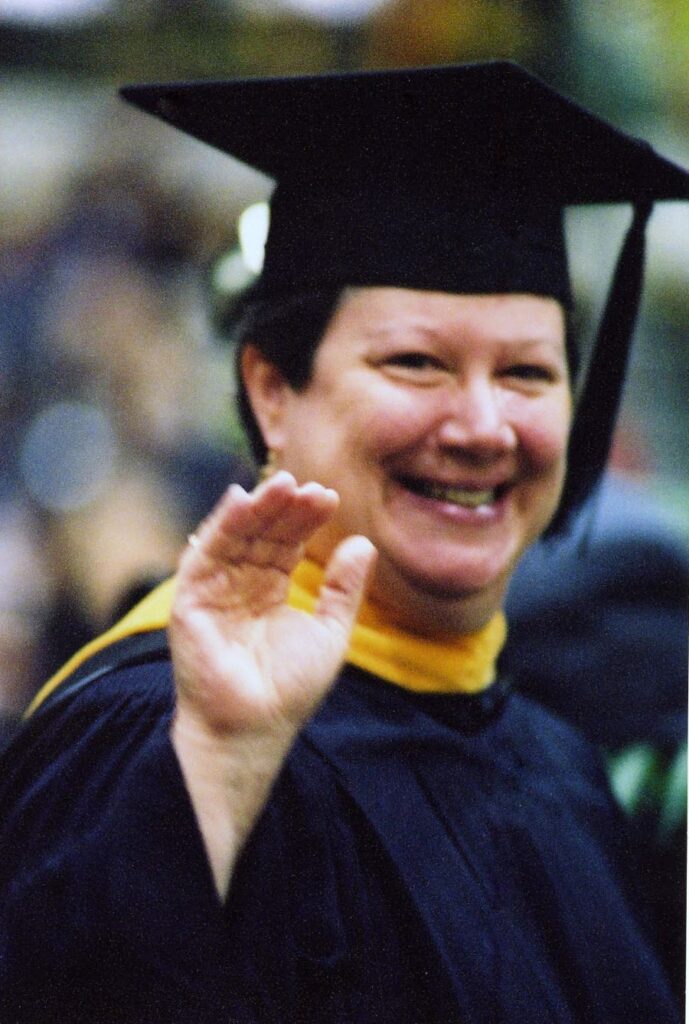
Meet Patty Hathaway ’97, M.S. ’03, who earned her B.A. in economics and M.S. in information systems while working at UMBC. After 23 years of service to UMBC, Patty went on to work at three other universities, including the University of Maryland, College Park, where she retired. Patty now works with U.S. Navy veterans as the secretary/treasurer of the USS Hamner DD-718 Association and is the owner of Hathaway Photography of Bowie. Patty recently authored a book for the Hamner association, An American Destroyer: USS Hamner History in Photographs. Take it away, Patty!
Q: What’s one essential thing you’d want another Retriever to know about you?
A: I am a Retriever in many ways: a double alum, a former employee, a UMBC parent (twice), and a past Hilltop Society Member. I was a staff member for 23 years and earned my B.A. and M.S. while working on campus. I worked for three other universities after UMBC, and I now am loving my work with our Navy veterans. I am certain that I would not be where I am today without UMBC.
Q: What’s the one thing you’d want someone who hasn’t joined the UMBC community to know about the support you find here?
A: I would emphasize the feeling of being a “part of the campus family.” It’s not too big and not too small. You just feel like you “fit.” I felt that way as an employee and as a student, and when I visit, I still feel like I am coming home. UMBC was and continues to be a huge part of my life and the person I am today.
Q: Tell us about someone in the community who has inspired you or supported you, and how they did it.
A: UMBC had an atmosphere that made it feel like you were with family. A lot of that was encouraged by Freeman Hrabowski. Although he was the president of UMBC, he found time for employees and students, and was able to be a mentor, supporter, and leader for many. Although I have been away from the UMBC campus since 2005, I have been able to keep in touch with Freeman.
Left: Hathaway waving to the photographer at her 2003 UMBC graduation.
Q: Tell us what you love about your academic program or an organization you’re involved in.
A: During my time at UMBC, I also made time to help with non-profit veterans’ organizations. I was able to use the skills I learned on campus to help these groups. After retiring from paid employment, I have concentrated on my photography business and the USS Hamner DD-718 Association. The Hamner association is dedicated to preserving the memories of the ship and the crew who served on her.
When I visit, I still feel like I am coming home. UMBC was and continues to be a huge part of my life and the person I am today.
Patty Hathaway ’97, M.S. ’03
My most recent accomplishment for the Hamner association is the book I authored for them: An American Destroyer: USS Hamner History in Photographs. This book is the sequel to a book I edited for the association in 2022. The history of our veterans needs to be told and I am very happy to be a part of that. Without the skills I acquired and the confidence I developed at UMBC, I would never have been able to edit or author a book.
Q: If you’re currently working, what’s your title and where do you work? What do you enjoy most about it?
A: I am the secretary/treasurer of the USS Hamner DD-718 Association (non-paid office). The relationships I have developed with these Navy veterans is like those at UMBC—we are family!
Q: Tell us about your primary WHY, and how it led you to UMBC.
A: I first came to UMBC in the fall of 1976 as a freshman. I have to admit, I was not ready to be a full-time university student so I pursued my associate degree on a part-time schedule instead at Catonsville Community College. There was something about UMBC that drew me back, and in 1981, I was hired to work in the accounting department. Within four years I had completed my A.A. degree and began the pursuit of my B.A. degree in 1989. I loved working on campus and I enjoyed being a student again. I worked with great people and many friendships developed at UMBC that would last for decades.
Right: Hathaway and her granddaughter at a USS Hamner Reunion.
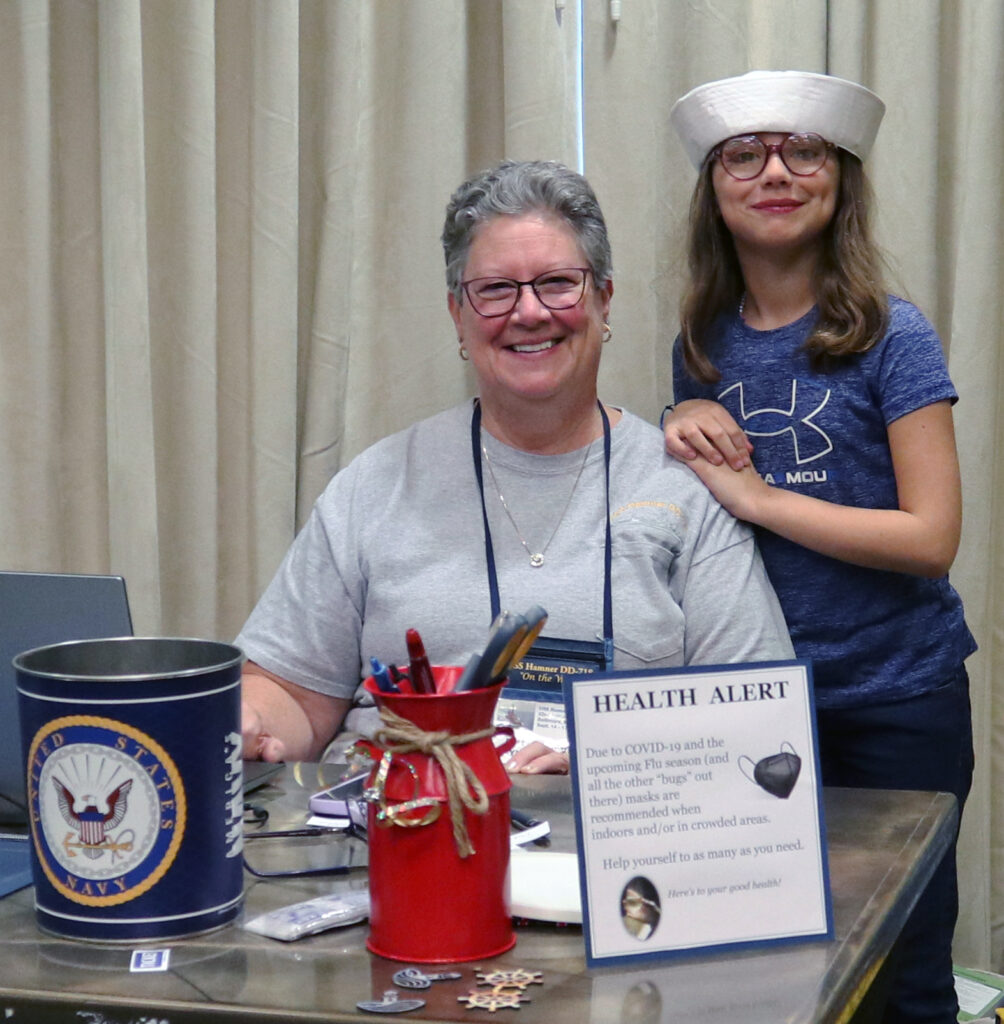
Q: Where have you found support in the UMBC community?
A: I had several people who helped me along the way, sometimes just with encouragement as I tried new positions or pursued a new path in life. Friends who are now gone, Diane Taylor ’76, Jim Milani ’73, and Gary Rupert always had an encouraging word or good advice as I selected courses or applied for the next job opening on campus. Their confidence in me meant more than I can put into words.
In both my work life as well as academic and personal life, David Gleason, M.S. ’04, would always be there to help me find the confidence I needed to move forward. He would always know how to convince me that I could take that next step. His friendship is one I still treasure.
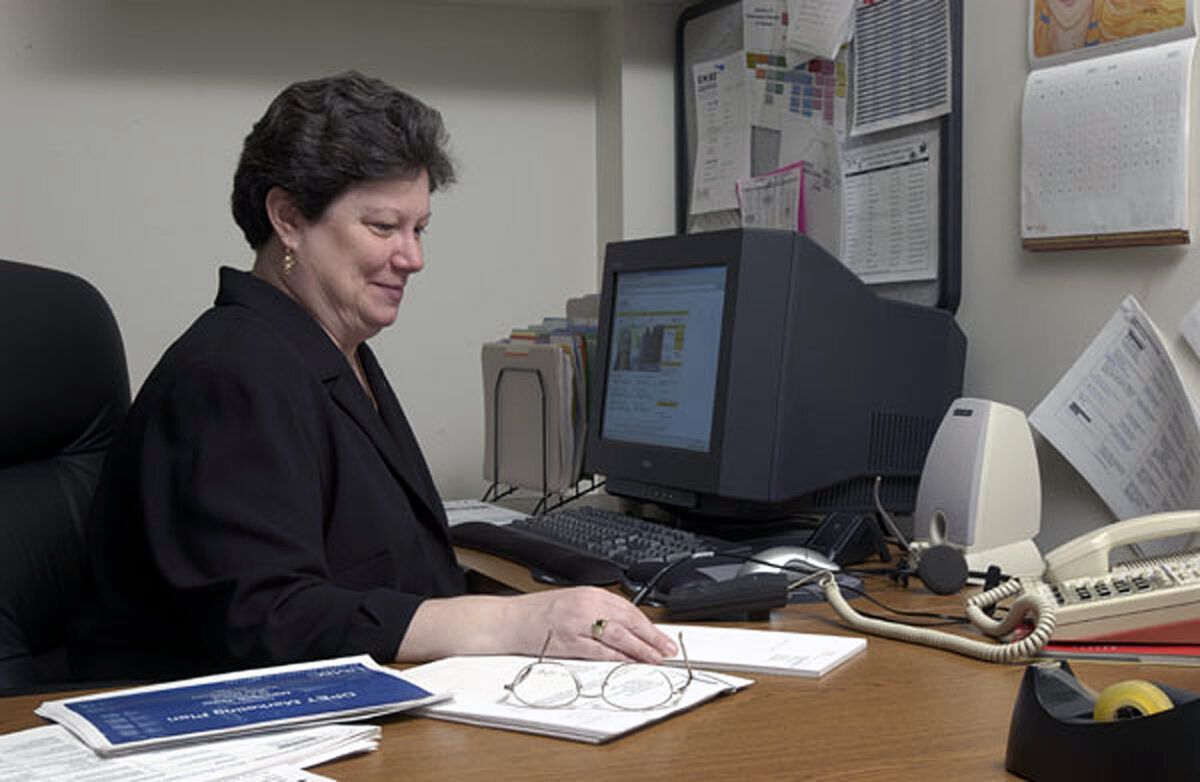 Hathaway was part of a photoshoot to advertise the UMBC’s online Master of Science in Information Systems program. Photo courtesy of Hathaway.
Q: What’s your favorite part of being a part of Retriever Nation?
A: I am proud to be a part of Retriever Nation both as a alum and a former employee/retiree. I enjoy seeing UMBC grow and being able to feel like I was part of that growth.
Q: What drives you to support UMBC?
A: I have tried to support UMBC whenever I can. I hope to be able to continue and do more in the future.
* * * * *
UMBC’s greatest strength is its people. When people meet Retrievers and hear about the passion they bring, the relationships they create, the ways they support each other, and the commitment they have to inclusive excellence, they truly get a sense of our community. That’s what “Meet a Retriever” is all about.
Learn more about how UMBC can help you achieve your goals.
]]>
Meet Patty Hathaway ’97, M.S. ’03, who earned her B.A. in economics and M.S. in information systems while working at UMBC. After 23 years of service to UMBC, Patty went on to work at three other...
https://umbc.edu/stories/meet-a-retriever-patty-hathaway-advocate-veterans/
https://my3.my.umbc.edu/api/v0/pixel/news/143154/guest@my.umbc.edu/1747a812d1f358748ffc8c4fe82ea448/api/pixel
alumni
author
economics
impact
information-systems
magazine
meet-a-retriever
story
umbc-author
veterans
UMBC News & Magazine
https://my3.my.umbc.edu/groups/umbc-news-magazine
https://assets1-my.umbc.edu/system/shared/avatars/groups/000/001/943/24435aa6207c452e7bc15cc74b42c7bb/xsmall.png?1748556657
https://assets1-my.umbc.edu/system/shared/avatars/groups/000/001/943/24435aa6207c452e7bc15cc74b42c7bb/original.png?1748556657
https://assets2-my.umbc.edu/system/shared/avatars/groups/000/001/943/24435aa6207c452e7bc15cc74b42c7bb/xxlarge.png?1748556657
https://assets2-my.umbc.edu/system/shared/avatars/groups/000/001/943/24435aa6207c452e7bc15cc74b42c7bb/xlarge.png?1748556657
https://assets3-my.umbc.edu/system/shared/avatars/groups/000/001/943/24435aa6207c452e7bc15cc74b42c7bb/large.png?1748556657
https://assets1-my.umbc.edu/system/shared/avatars/groups/000/001/943/24435aa6207c452e7bc15cc74b42c7bb/medium.png?1748556657
https://assets2-my.umbc.edu/system/shared/avatars/groups/000/001/943/24435aa6207c452e7bc15cc74b42c7bb/small.png?1748556657
https://assets1-my.umbc.edu/system/shared/avatars/groups/000/001/943/24435aa6207c452e7bc15cc74b42c7bb/xsmall.png?1748556657
https://assets2-my.umbc.edu/system/shared/avatars/groups/000/001/943/24435aa6207c452e7bc15cc74b42c7bb/xxsmall.png?1748556657
UMBC News & Magazine
1
0
false
Fri, 09 Aug 2024 16:18:52 -0400
Fri, 09 Aug 2024 16:18:52 -0400