UMBC’s newest computing grads, from bachelor’s to Ph.D., share stories of connection, support, opportunity
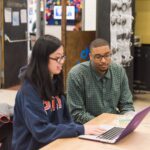
UMBC’s newest graduates in computing and data science fields include students at all stages in their education and careers. Undergraduates, master’s students seeking to access new career opportunities, and Ph.D. students completing high-impact research have thrived at UMBC. Many cite the university’s strong academics, accessible faculty, research opportunities, and connections across disciplines as drawing them to UMBC. Connections with mentors and communities of support have helped carry them over the finish line to earn their degrees.
Impacting communities through service-learning
Fikir Ejigineh ‘20, information systems, remembers feeling intrigued by UMBC in high school, when she first heard about the university’s living learning communities (LLCs). Before long, she moved into UMBC’s Shriver Center LLC, a residential floor for students committed to civic engagement, service, and community-building.

Fikir Ejigineh. Photo courtesy of The Shriver Center.
As an information systems student focused on community-based problem-solving, she was selected for UMBC’s CoLab program in 2018. Ejigineh formed the Race and Social Justice CoLab with two other students. Together, they worked with new mapping software from UMBC’s Imaging Research Center, creating a 3D space to collect and share the multimedia stories of people living in Baltimore. The purpose of the project was to highlight voices that are oftentimes suppressed by the media’s representation of Baltimore City, Ejigineh explains.
As a France-Merrick Scholar through the Shriver Center, Ejigineh helped develop a creative art contest and leadership day for Baltimore youth that posed the question, ‘How do you envision your community?’. The project was another chance for her to work on a team with students from a broad range of majors. Together, they helped launch a display of youth artwork for the grand opening of OCA Mocha, a coffee shop and community gathering space in downtown Arbutus, founded by UMBC alumni.
Ejigineh has also served as vice-president of UMBC’s Ethiopian-Eritrean Student Association. A cultural organization that aims to support philanthropic causes by hosting annual events like the Awareness Banquet.
After graduation, Ejigineh will work as a business administrator at Alakrity, an IT startup company. In the future, she looks forward to combining her technical skills and creativity by furthering her education in user experience design.
 Fikir Ejigineh, third from right, meeting with her CoLabs group and mentors in 2018. Photo by Marlayna Demond ’11 for UMBC.
Her advice to incoming students is to focus not just on excelling in the classroom, but also finding opportunities to connect with students in other fields, and with communities on and off campus. “I’ve had a great UMBC experience because of what I’ve made out of it,” she says. “I would never be where I am now if I hadn’t gotten involved.”
Building connections
As an undergraduate at UMBC, Fabiha Mahmood ‘18, political science, M.P.S. ‘20, cybersecurity, knew that it was important to establish networks right away. “When I was visiting colleges, the one thing that really struck me about UMBC was how close-knit and diverse the community is,” she says. “For me, it’s really important to have interpersonal relationships with my professors.”

Mahmood at the 16 over 1 UMBC Basketball Celebration in the UMBC Event Center in 2018. Photo courtesy of Mahmood.
Mahmood was undecided about what major to pursue, but after meeting with Eric Brown, a lecturer in the individualized studies program, she was eager to begin a first-year seminar in security studies. “He was so invested in my journey here, and from that first interaction, I knew that UMBC was different,” she shares.
That trend of building close connections in the classroom and across campus continued. Mahmood went on to support UMBC students as a resident assistant and president of UMBC’s Panhellenic Association.
After completing her bachelor’s degree, Mahmood found that she was interested in careers that required technical skills that she didn’t yet have. She identified UMBC’s cybersecurity M.P.S. program as a strong complement to her political science degree.
In January 2020, Mahmood joined Residential Life again, this time as a graduate assistant, where she supervised resident assistants, and began a “whirlwind of a semester” in her new program. While she had no idea that the experience would involve a pandemic, she says that her mentors in Residential Life helped her stay motivated and feel connected when many things moved online. “I could tell that they genuinely cared about me, and can confidently say that I wouldn’t have gotten that anywhere else,” she says.
 Fabiha Mahmood, second from right in front row, at the Division of Student Affairs Holiday Party in 2019. Photo courtesy of Mahmood.
Mahmood plans to pursue a career as an intelligence analyst, combining her knowledge of political science and cybersecurity.
Opening doors in a high-demand field
Like Mahmood, Matthew Griff ‘17, mathematics, M.P.S. ‘20, data science, also found a UMBC master’s program to complement his undergraduate degree and open up doors in a high-demand field. After earning his bachelor’s degree, Griff completed a finance internship at the American Psychological Association. A master’s in data science was his “logical next step”—helping him explore impactful ways to apply knowledge from his mathematics courses.
Griff has enjoyed connecting with the data science program’s accessible faculty. He shares that Ergun Simsek, professor of practice and graduate program director for data science, was easy to approach and has served as a mentor for him. Building this one-on-one connection has helped him feel prepared for his next steps.
How tech impacts lives
William Easley took his first course on human-computer interaction as a curious undergraduate at UMBC. Ravi Kuber, associate professor of information systems, piqued his interest in how technology impacts peoples lives, particularly for people with disabilities. Easley, who has a visual impairment, went on to complete an M.S. in human-centered computing in 2015, and is now earning his Ph.D. in the field.
 William Easley talking about his work at event introducing UMBC’s User Studies Lab in January 2020. Photo by Britney Clause ’11.
Easley loves that as a researcher he is now on the cutting edge of “creating knowledge.” “The idea of designing and building technologies to help people with disabilities is super exciting to me. It’s something that’s worthwhile and meaningful,” he explains.
But Easley wasn’t always aware of the opportunities available to him through research. He recalls how much it meant to him as an undergraduate when mentors encouraged him to get involved with research and pursue his master’s degree. They included leaders like UMBC President Freeman Hrabowski and Renetta Tull, former associate vice provost for strategic initiatives at UMBC.
3D print shop creates opportunity
As a master’s student, Easley connected with Amy Hurst, former associate professor of information systems at UMBC, known for her high-impact community-engaged research. Hurst worked with the Digital Harbor Foundation’s 3D print shop in Baltimore City, helping youth develop technical skills that would serve them in future careers.
That experience and the connections he built over the years encouraged Easley to stay at UMBC to pursue his Ph.D. His work with youth at Digital Harbor became three years of dissertation research. Two youth from the first group continued to work in the print shop for all three years and took on more senior roles. Eventually, one of the youth became the shop manager, which Easley was excited about.
 William Easley, bottom center square, with his dissertation committee after he defended his dissertation in September 2020. Photo courtesy of Easley.
Throughout his time at UMBC, Easley says that support from faculty was important to his development as a researcher. Hurst helped him find opportunities to travel to present his research and connected him with fellow researchers in human-centered computing. Easley also worked closely with Helena Mentis, associate professor of information systems, and associate dean in the College of Engineering and Information Technology. Mentis and Foad Hamidi, assistant professor of information systems, were Easley’s co-advisors for his dissertation.
“Everyone that I worked with played a big role in helping me get to the finish line,” he says.
The COVID-19 pandemic shifted Easley’s final months at UMBC. He successfully defended his dissertation virtually in September, and interviewed and accepted a job as a human factors design engineer at Apple, and is currently working remotely.
Banner image: William Easley works with youth in the makerspace at the Digital Harbor Foundation in 2017. Photo by Marlayna Demond ’11 for UMBC.
]]>
UMBC’s newest graduates in computing and data science fields include students at all stages in their education and careers. Undergraduates, master’s students seeking to access new career...
https://umbc.edu/stories/umbcs-newest-computing-grads-from-bachelors-to-ph-d-share-stories-of-connection-support-opportunity/
https://my3.my.umbc.edu/api/v0/pixel/news/119724/guest@my.umbc.edu/c4a03d79eccd747a2b0e2bb8ca24e4cd/api/pixel
classof2020
coeit
community
cybersecurity
gradresearch
inds
is
mathstat
politicalscience
shrivercenter
UMBC News & Magazine
https://my3.my.umbc.edu/groups/umbc-news-magazine
https://assets1-my.umbc.edu/system/shared/avatars/groups/000/001/943/24435aa6207c452e7bc15cc74b42c7bb/xsmall.png?1748556657
https://assets1-my.umbc.edu/system/shared/avatars/groups/000/001/943/24435aa6207c452e7bc15cc74b42c7bb/original.png?1748556657
https://assets2-my.umbc.edu/system/shared/avatars/groups/000/001/943/24435aa6207c452e7bc15cc74b42c7bb/xxlarge.png?1748556657
https://assets2-my.umbc.edu/system/shared/avatars/groups/000/001/943/24435aa6207c452e7bc15cc74b42c7bb/xlarge.png?1748556657
https://assets3-my.umbc.edu/system/shared/avatars/groups/000/001/943/24435aa6207c452e7bc15cc74b42c7bb/large.png?1748556657
https://assets1-my.umbc.edu/system/shared/avatars/groups/000/001/943/24435aa6207c452e7bc15cc74b42c7bb/medium.png?1748556657
https://assets2-my.umbc.edu/system/shared/avatars/groups/000/001/943/24435aa6207c452e7bc15cc74b42c7bb/small.png?1748556657
https://assets1-my.umbc.edu/system/shared/avatars/groups/000/001/943/24435aa6207c452e7bc15cc74b42c7bb/xsmall.png?1748556657
https://assets2-my.umbc.edu/system/shared/avatars/groups/000/001/943/24435aa6207c452e7bc15cc74b42c7bb/xxsmall.png?1748556657
UMBC News & Magazine
0
0
false
Mon, 14 Dec 2020 20:40:43 -0500
TEDxUMBC brings community together through “Unmasking Uncertainty”
This fall, the student-organized TEDxUMBC gave ten speakers the opportunity to share their stories, experiences, and expertise with the world. Surprisingly, the theme, “Unmasking Uncertainty,” was actually conceived far before COVID-19 surged globally.
Tirzah Khan ‘20, information systems, led the TEDxUMBC team in organizing the event. When the planning committee chose their theme, she says, they did not anticipate the global pandemic, the resurgence in demands for racial justice, and a divisive election. “In these unprecedented circumstances, TEDxUMBC seeks to provide answers and build community,” Khan reflects.
A bumpy road to study in the U.S.
One of the speakers was Sahara Ali, Ph.D.‘26, information systems. She shared her path from Pakistan to the United States for graduate study and explained how it changed the way she approaches challenges.

Sahara Ali. Photo courtesy of Ali.
At age 21, Ali had graduated with her bachelor’s degree in computer science in Pakistan. She was eager to begin pursuing her Ph.D. at UMBC and to marry her U.S.-based fiancé. But it took over a year for Ali to obtain her visa from the U.S. Embassy. The delay changed her marriage plans and she feared it would make international graduate study impossible as well.
Facing a long and uncertain wait, Ali dedicated herself to her work in Pakistan. But just days after deciding to move on, she received her visa. She had to start over with her U.S. plans, rethinking how she would get to Maryland, where she would live, and what the experience would be like.
Ali says this situation taught her about her resilience and using creativity to work through unexpected obstacles. “Uncertainty can lead to something exciting, something innovative,” she shared, even if it means learning something “in an unconventional way.”
Today, Ali is pursuing her Ph.D. in information systems full-time at UMBC. She is working alongside Jianwu Wang, assistant professor of information systems, and collaborating with NASA scientists to study the causal effects of climate change.
Moving theater to a virtual space
Asif Majid ‘13, interdisciplinary studies, shared his passion for community theater and how he has adjusted his work (which previously depended on live, in-person audiences) to fit online formats.

Asif Majid. Photo courtesy of Majid.
Majid works at the intersection of Islam, media, marginality, and politics, and develops plays that focus on stories of racially and religiously marginalized communities. His TEDxUMBC talk took the audience back to the second week of March, when the COVID-19 pandemic first began impacting nearly every aspect of life.
At the time, Majid was in the final stages of producing a new play with a theater in Washington, D.C. Work had been underway since July 2019, and the show was scheduled to debut in front of an audience for the first time at the end of March 2020.
Majid was living with his older family members and became quite concerned that continuing to work in face-to-face settings could put his family members at risk. He decided that while the show needed to go on, it had to move to an online space.
In collaboration with the creative team, Majid figured out how the actors could perform from their own homes, and how attendees could watch the play remotely from around the world. “Over the course of two weeks, we learned about new technologies, rehearsed the tech to performance, and developed a new approach to making theater,” he said.
Ultimately, the performance attracted nearly eight times the number of people who would typically see a show in one night, and people tuned in from 18 countries.
Moving forward in uncertain times
Also featured in the event was Evangeline Kirigua ‘21, political science, who discussed the importance of empowering foreign-born nationals to engage in their communities without being able to vote. Haleemat Adekoya ‘23, political science, talked about being present in the moment, and how to face “what ifs” that can cause fear and uncertainty. Karis Barnett ‘21, chemistry, shared how to identify and address your internal critic to discover self-worth.
Other speakers gave a window into different fields. John Hebeler, a part-time lecturer in information systems, spoke about machine learning, including the impact that it is having on people now and will continue to have in the future. Maryam Elhabashy ‘21, anthropology, discussed the challenges around integrating ethnic studies into school curricula, and how attempts to celebrate diversity may inadvertently lead to otherization. Mike Spano ‘21, psychology, talked about theories related to sleep and dreams, and how to mold your dreams into reality.
Like Ali and Majid, speakers reflected on personal experiences. Rojin Najmabadi ‘21, biological sciences, discussed the decision to invest in herself on her path to success, even when that decision went against how she was raised by her family. Zareen Taj, Ph.D. ‘26, language, literacy, and culture, shared her personal story of empowerment and achievement as an Afghani woman who grew up in refugee camps.
Tess McRae ‘21, individualized studies, concluded the event by encouraging attendees to use the lessons and insights shared by the presenters in their own lives. The event coordinators plan to share the event recording on the TEDx YouTube channel so that the presenters’ messages can continue to be shared.
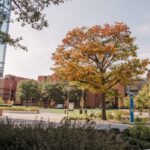
Banner image: UMBC’s campus in the fall. Photo by Marlayna Demond ’11 for UMBC.
]]>
This fall, the student-organized TEDxUMBC gave ten speakers the opportunity to share their stories, experiences, and expertise with the world. Surprisingly, the theme, “Unmasking Uncertainty,” was...
https://umbc.edu/stories/tedxumbc-brings-community-together-through-unmasking-uncertainty/
https://my3.my.umbc.edu/api/v0/pixel/news/119727/guest@my.umbc.edu/e96771e621322c78b83bb6b40076ca20/api/pixel
cahss
chemistry
coeit
community
inds
is
llc
politicalscience
psychology
saph
UMBC News & Magazine
https://my3.my.umbc.edu/groups/umbc-news-magazine
https://assets1-my.umbc.edu/system/shared/avatars/groups/000/001/943/24435aa6207c452e7bc15cc74b42c7bb/xsmall.png?1748556657
https://assets1-my.umbc.edu/system/shared/avatars/groups/000/001/943/24435aa6207c452e7bc15cc74b42c7bb/original.png?1748556657
https://assets2-my.umbc.edu/system/shared/avatars/groups/000/001/943/24435aa6207c452e7bc15cc74b42c7bb/xxlarge.png?1748556657
https://assets2-my.umbc.edu/system/shared/avatars/groups/000/001/943/24435aa6207c452e7bc15cc74b42c7bb/xlarge.png?1748556657
https://assets3-my.umbc.edu/system/shared/avatars/groups/000/001/943/24435aa6207c452e7bc15cc74b42c7bb/large.png?1748556657
https://assets1-my.umbc.edu/system/shared/avatars/groups/000/001/943/24435aa6207c452e7bc15cc74b42c7bb/medium.png?1748556657
https://assets2-my.umbc.edu/system/shared/avatars/groups/000/001/943/24435aa6207c452e7bc15cc74b42c7bb/small.png?1748556657
https://assets1-my.umbc.edu/system/shared/avatars/groups/000/001/943/24435aa6207c452e7bc15cc74b42c7bb/xsmall.png?1748556657
https://assets2-my.umbc.edu/system/shared/avatars/groups/000/001/943/24435aa6207c452e7bc15cc74b42c7bb/xxsmall.png?1748556657
UMBC News & Magazine
0
0
false
Wed, 09 Dec 2020 16:47:26 -0500
Students focus on mental health and the environment in 2020 UMBC Idea Competition
Six student groups recently vied for the top prize in UMBC’s annual Idea Competition, presenting to a panel of alumni judges their innovative solutions to everyday challenges. The competition, hosted by UMBC’s Alex. Brown Center for Entrepreneurship, was held virtually for the first time due to the COVID-19 pandemic. This year’s winning ideas focused on physical and mental health and the environment.
“Even though we had to miss the excitement of an in-person competition this year, it was very important to hold the event to give our students the opportunity to showcase their creative ideas and get feedback from experienced entrepreneurs,” said Vivian Armor ‘73, American studies, director of the Alex. Brown Center for Entrepreneurship.
 Vivian Armor. Photo by Marlayna Demond ’11 for UMBC.
Connection between physical and mental health
Yvann Tientcheu ‘21, information systems, and his collaborators earned first place in the competition for Strive, an app designed to support physical and mental health and wellbeing. The concept for Strive (currently a web-based demo) is that users can enter a simple sentence about their mood. The sentence is run through IBM Watson, a highly robust artificial intelligence system, to assess the person’s current mood. The app then provides the person with a specific workout that aligns with their mood.
Tientcheu explains that the app seeks to move past one-size-fits-all solutions by flexibly responding to how a user feels at a given moment. It will also allow users to connect with each other and build community, he notes, which can be important for sustaining health practices.
Beyond individual users, “Our target market is the medical community,” Tientcheu said in his presentation. “We’re hoping to provide [healthcare providers] with a constant, continuously updated steam of data that shows the connection between [patients’] mental and physical health.”
“Strive was initially planned as a tool to share mental health resources to deal with the mental exhaustion caused by COVID-19,” explains Tientcheu. “As the idea evolved, we realized that there would come a time where the pandemic would be over, that most adults don’t get the recommended amount of exercise, and that physical fitness seems to be linked to mental health. We decided to refocus on offering a brand new service that catered to both physical and mental health.”
Tientcheu describes the project as “something we felt had more long-term viability, and a usefulness that would never be outlived if the idea were properly executed.”
Growth companion
The second place winners, and recipients of the Best Presentation award, were Andrew Park ‘21, interdisciplinary studies, and Tristan King ‘21, interdisciplinary studies, for their idea Sproutful. Park and King are passionate about digital technology, and were inspired to create a unique and whimsical way for people to find healthy coping mechanisms and to prioritize mental health during the COVID-19 pandemic.
The Sproutful System includes a plant container outfitted with sensors that transmit to a phone app, which also features daily guided meditations. The idea is that a person will care for themselves and their plant in a daily meditative practice that is both relaxing and rewarding.
The app guides a user through a meditation and, at the conclusion of the meditation, the app prompts the user to water their plant with the push of a button. Sensors on the plant container monitor water levels in the soil and a water reservoir, and prevent the plant from being overwatered.
“Sproutful is your very own personal meditation and growth companion,” Park explained to the judges. The app “creates a powerful connection between nature and your living space,” said King. “As you grow in your meditation habits, your new plant grows alongside you.”
Looking out for the planet
Robin Paranilam ‘22, computer engineering, presented Terra, which earned third place in the competition. Many people want to protect the environment but don’t know the positive steps they can take, he said. “Terra is an app that acts as a one-stop-shop for eco-friendly living,” he explained. It offers personalized actions that each user can take to protect the world around them.
The Terra app focuses on four aspects of protecting the environment: alternative energy, sustainable living, reducing carbon footprints, and eco-friendly eating. Each category provides tips and resources that people can use to be mindful of how their actions impact the planet. The Terra app will not only tailor resources for individual users, but also will encourage them to connect with other nearby users to make a collective impact.
“The fact that the winning ideas focused on well-being, community, relationships, and the environment shows how much our students care about others and the world around them,” says Armor, “and how much they want to make a difference.”
The winning group received $750 to continue to develop their idea, and the second and third place groups received $500 and $250, respectively. The team that received the Best Presentation award received $250. Each spring, the Alex. Brown Center for Entrepreneurship hosts the Cangialosi Business Innovation Competition.
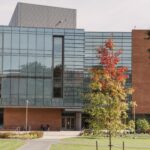
Banner image: UMBC’s campus in the fall. Photo by Marlayna Demond ‘11 for UMBC.
]]>
Six student groups recently vied for the top prize in UMBC’s annual Idea Competition, presenting to a panel of alumni judges their innovative solutions to everyday challenges. The competition,...
https://umbc.edu/stories/students-focus-on-mental-health-and-the-environment-in-2020-umbc-idea-competition/
https://my3.my.umbc.edu/api/v0/pixel/news/119736/guest@my.umbc.edu/8adfa250c885bcec3706d5a28ab7b83a/api/pixel
alexbrowncenter
coeit
community
csee
inds
is
UMBC News & Magazine
https://my3.my.umbc.edu/groups/umbc-news-magazine
https://assets1-my.umbc.edu/system/shared/avatars/groups/000/001/943/24435aa6207c452e7bc15cc74b42c7bb/xsmall.png?1748556657
https://assets1-my.umbc.edu/system/shared/avatars/groups/000/001/943/24435aa6207c452e7bc15cc74b42c7bb/original.png?1748556657
https://assets2-my.umbc.edu/system/shared/avatars/groups/000/001/943/24435aa6207c452e7bc15cc74b42c7bb/xxlarge.png?1748556657
https://assets2-my.umbc.edu/system/shared/avatars/groups/000/001/943/24435aa6207c452e7bc15cc74b42c7bb/xlarge.png?1748556657
https://assets3-my.umbc.edu/system/shared/avatars/groups/000/001/943/24435aa6207c452e7bc15cc74b42c7bb/large.png?1748556657
https://assets1-my.umbc.edu/system/shared/avatars/groups/000/001/943/24435aa6207c452e7bc15cc74b42c7bb/medium.png?1748556657
https://assets2-my.umbc.edu/system/shared/avatars/groups/000/001/943/24435aa6207c452e7bc15cc74b42c7bb/small.png?1748556657
https://assets1-my.umbc.edu/system/shared/avatars/groups/000/001/943/24435aa6207c452e7bc15cc74b42c7bb/xsmall.png?1748556657
https://assets2-my.umbc.edu/system/shared/avatars/groups/000/001/943/24435aa6207c452e7bc15cc74b42c7bb/xxsmall.png?1748556657
UMBC News & Magazine
0
0
false
Tue, 01 Dec 2020 18:26:22 -0500
Pursuing Art and Peace Through Theater of Ideas

By Susan Thornton Hobby
The second week of March 2020, the cast and crew of Asif Majid’s original play were eagerly anticipating their Friday night community reading at a black box theater. Instead of a flood of rehearsals, the play, and the world, shut down due to COVID-19.
Majid ’13, interdisciplinary studies, seized the moment. His play, “Snapshots,” is a series of phone calls between lovers and friends talking about sexuality, Islam, and cultural appropriation. The format of the play easily translated to a pandemic platform: Zoom.
The Convergence Theatre actors learned to switch cameras, mute and unmute, and make “set” changes by changing camera angles. The actors and crew rehearsed for “an insane” two weeks, Majid says, laughing. He cobbled together a livestream with an ethernet cable and a router, then ran the program from his parents’ spare office.
The play debuted March 27 on HowlRound, a theater streaming platform, when few other theater companies were making online theater. More than 400 people in 18 countries watched. After a little tinkering with the production, they streamed the play again in June, and drew nearly as many people. Majid was thrilled by the response, and by the creativity they conjured.
“How do we continue to care, and to tell the stories that really matter?” Majid asks. “This shows the possibility of digital theater, and what it can accomplish.”
On November 8, Majid will talk about the experience at TEDx UMBC.
Taking charge of his education
Majid devised his own education at UMBC, taking courses in history, Africana and global studies, and politics.
Steve McAlpine, assistant director of individualized studies (formerly interdisciplinary studies), says he had weekly conversations with Majid about his program, and watched it expand from a political take to sociological and psychological perspectives on conflict. “But what was extraordinary was his leap to the performing arts—especially theater—as a vehicle for building empathy for others,” McAlpine says.
 Storytelling in Baltimore, 2016. Photo by The Stoop.
Majid played percussion with the school’s orchestra, and McAlpine sat next to him while they were beating drums outside the University Center Friday afternoons and at gigs in Maryland, D.C., and Virginia with Straight Up Tribal. At UMBC, Majid became convinced that performance and theater could bridge divisions and resolve conflicts.
“That is one of the hallmarks of the institution, how it gives the students the capacity to take charge of their education in a real way,” Majid says.
 Majid drumming. Photo courtesy of Straight Up Tribal.
Joby Taylor, Ph.D. ’05, language, literacy, and culture, the director of UMBC’s Shriver Peacemakers Fellows Program, taught Majid in his seminar “Building a Culture of Peace,” later becoming Majid’s capstone co-advisor.
“From the very first classes he showed the qualities of intelligence, curiosity, creativity, and passion that have made him such a wonderful interdisciplinary and engaged scholar and social change agent today,” Taylor says.
“His vision of transforming intercultural conflict through participation in dialogue and creative arts has remained a steady beacon leading him into deeper research and scholarship and leadership experiences of creating spaces of hope—places where theater and musical arts facilitate with reflection and dialogue on new ways of thinking and being that bridge differences and conflicts.”
A Sondheim and Boren scholar at UMBC, Majid studied abroad for two semesters in Morocco, and wrote a play about women’s sexual harassment by young Muslim men and other human rights violations. As part of his undergraduate research project, Majid later staged the play at UMBC.
 Majid performing in Edinburgh, Scotland. Photo by Derek Goldman.
Through his master’s degree in conflict resolution from Georgetown University and a doctorate in anthropology, media, and performance from the University of Manchester, Majid maintained ties to UMBC, even teaching a few classes.
“He brought so much energy to his teaching stint with the global studies program,” says Brigid Starkey, director and senior lecturer of political science. “He is a master storyteller and knows how to involve students in a process of discovery over the course of a semester. Learning is never rote as he looks for global stories in many places that others don’t even think to look.”
Seeking art as a route to equity
During his doctoral studies at University of Manchester, the city’s arena was bombed in May 2017 by a British Muslim man who was killed in the blast along with 22 others. Majid wrote a series of articles interrogating the nation’s response.
Then he jumped into making theater with young British Muslims. He faced suspicion of working with the government’s counterterrorism efforts, the difficulty of making connections in the community, and actors’ hesitancy to perform in public. But with Majid’s guidance, the group developed a radio play, “The Wedding,” about identity, interracial relationships, and sexuality in Muslim communities.
He also played Mowgli as the only person of color in a Liverpool children’s theater December 2017 production of “The Jungle Book” and is writing a book chapter on the experience, tentatively titled “The Manipulation of Mowgli,” for the Routledge Companion to Theater and Young People.
Majid applied for academic positions for a frustrating two years, then became a Mellon/American Council of Learned Societies fellow with the San Francisco Arts Commission. He’s working to ensure grants are awarded racially equitably, and absorbing the complicated dance of public art administration.
“There’s something around the intersection of racial equity plus the arts that gives me a lot of hope,” Majid says. “I have realized…this is public service, something that I’ve been missing. It dates to when I was at UMBC as a Sondheim Scholar. That’s what I got into the university to do, to engage in public service, and here it’s coming full circle.”
*****
Tune in to all the TEDxUMBC speakers on November 8, 2020.
Header image: Headshot of Asif Majid by Marlayna Demond ’11.
]]>
By Susan Thornton Hobby The second week of March 2020, the cast and crew of Asif Majid’s original play were eagerly anticipating their Friday night community reading at a black box theater....
https://umbc.edu/stories/asif/
https://my3.my.umbc.edu/api/v0/pixel/news/119756/guest@my.umbc.edu/394b628ee07c5698bca03a5fcbefe29f/api/pixel
alumni
alumni-profile
cahss
inds
UMBC News & Magazine
https://my3.my.umbc.edu/groups/umbc-news-magazine
https://assets1-my.umbc.edu/system/shared/avatars/groups/000/001/943/24435aa6207c452e7bc15cc74b42c7bb/xsmall.png?1748556657
https://assets1-my.umbc.edu/system/shared/avatars/groups/000/001/943/24435aa6207c452e7bc15cc74b42c7bb/original.png?1748556657
https://assets2-my.umbc.edu/system/shared/avatars/groups/000/001/943/24435aa6207c452e7bc15cc74b42c7bb/xxlarge.png?1748556657
https://assets2-my.umbc.edu/system/shared/avatars/groups/000/001/943/24435aa6207c452e7bc15cc74b42c7bb/xlarge.png?1748556657
https://assets3-my.umbc.edu/system/shared/avatars/groups/000/001/943/24435aa6207c452e7bc15cc74b42c7bb/large.png?1748556657
https://assets1-my.umbc.edu/system/shared/avatars/groups/000/001/943/24435aa6207c452e7bc15cc74b42c7bb/medium.png?1748556657
https://assets2-my.umbc.edu/system/shared/avatars/groups/000/001/943/24435aa6207c452e7bc15cc74b42c7bb/small.png?1748556657
https://assets1-my.umbc.edu/system/shared/avatars/groups/000/001/943/24435aa6207c452e7bc15cc74b42c7bb/xsmall.png?1748556657
https://assets2-my.umbc.edu/system/shared/avatars/groups/000/001/943/24435aa6207c452e7bc15cc74b42c7bb/xxsmall.png?1748556657
UMBC News & Magazine
0
0
false
Thu, 05 Nov 2020 15:14:29 -0500
Alum Helps Budding Soccer Players “Get on the Bus”

When Tim Ryerson ’94, INDS, founded Ellicott City Soccer Club (ECSC) back in 2014, he noticed something: there were pockets of Howard County that weren’t signing up. He did a little digging, and realized that in spite of the fact that Howard County is chockfull of mid- and upper-middle class families, there are also Title 1 schools scattered throughout—13 of them to be exact.
Soccer tends to fall into the “pay to play” category. Travel programs run upwards of $3,000 a year, even more when you add in hotels, meals, and travel to and from far-flung games. Even recreation-level programs don’t come cheap, running at least a couple of hundred dollars.
Ryerson knew what an important factor soccer had been in his own life. He played under coach Pete Caringi, serving as captain his senior year and going on to a 15-3-1 season. “Coach Caringi is the number-one influencer on my life other than my family,” says Ryerson. “He allowed me to build the work ethic to create different verticals in soccer.”
 UMBC soccer teammates gather under the championship banner from the 1992 Big South season 25th reunion picture in 2017. Photo courtesy of Tim Ryerson.
Soccer for Everyone
As his wheels turned on the soccer equity issue in Howard County, Ryerson learned that even more than the cost to play, transportation to and from practices is a huge barrier for lower income families. He was inspired to make a change. “There was a local contest awarding grant money for ideas to help the community,” he says. “I submitted a concept, but didn’t win.”
The notion of a way to somehow make soccer affordable and doable for low-income families stuck with Ryerson, and he decided to turn it into reality. In 2018, he launched a pilot “Get on the Bus,” program with the financial support of families already in the ECSC club.
GOTB works like this: Kids in target schools apply and are selected based on needs and merit. If selected, they receive after-school homework help from certified educators and a healthy snack; bus transportation to and from soccer practice; and all soccer apparel, including cleats and a ball.
After its initial year, where it provided these benefits to 41 elementary school students, Ryerson applied for and received the Maryland State Youth Soccer Association’s “Grassroots Futures Award,” providing GOTB with funding to continue and expand. “U.S. Soccer then got wind, and they have awarded us another grant, so now we’re able to include states beyond Maryland,” Ryerson explains. “We’ve been able to move into four states and now we’ve got people calling from all over to get involved.”
Currently kids in California, Nevada and Connecticut, in addition to Maryland, are involved and benefitting from the program. Nancy Thompson, principal at Talbott Springs Elementary School in Columbia, has been involved since the start. “We offer it to fourth and fifth graders at our school,” she says. “We cap it at 12 students, and ask our recess monitors and para-educators to help us identify potential candidates.”
From there Thompson vets the students on financial need and then encourages them to apply. “We’ve got kids out on our playground who love the sport but can’t afford to play,” she says. “Tim has been very intentional in helping give them an opportunity.”
Pick-Up and Go
Twin 13-year olds Justin and Jordin Lopez have taken full advantage of the program. Originally selected in elementary school, the brothers have since developed enough skill to move onto one of the travel teams. “It makes me so happy to be able to play more,” says Justin. “In the past, I could only play pick-up games at the park or on the playground.”
Ryerson says that part of the U.S. Soccer grant money is for just this purpose—to identify talent and help foster it up the travel program pipeline. “These are kids who would never be identified otherwise,” he says. “From our original 41 kids, we’ve been able to move six onto the travel level.”
If all goes as Ryerson hopes, the GOTB goal is to graduate 10,000 kids by the 2026 World Cup.
Thompson says the kids in her school who participate beam with pride. “They used to see kids wearing their club shirts at school and know they couldn’t be part of that,” she says. “Now they come to school in theirs with big smiles on their faces.”
– Amanda Loudin
* * * * *
Header image: Ryerson and a former soccer teammate’s daughter pose during a rec program.
]]>
When Tim Ryerson ’94, INDS, founded Ellicott City Soccer Club (ECSC) back in 2014, he noticed something: there were pockets of Howard County that weren’t signing up. He did a little digging, and...
https://umbc.edu/stories/alum-helps-budding-soccer-players-get-on-the-bus/
https://my3.my.umbc.edu/api/v0/pixel/news/119920/guest@my.umbc.edu/cfc1b79a74e1394845b2d4dee275dd7c/api/pixel
alumni
athletics
inds
UMBC News & Magazine
https://my3.my.umbc.edu/groups/umbc-news-magazine
https://assets1-my.umbc.edu/system/shared/avatars/groups/000/001/943/24435aa6207c452e7bc15cc74b42c7bb/xsmall.png?1748556657
https://assets1-my.umbc.edu/system/shared/avatars/groups/000/001/943/24435aa6207c452e7bc15cc74b42c7bb/original.png?1748556657
https://assets2-my.umbc.edu/system/shared/avatars/groups/000/001/943/24435aa6207c452e7bc15cc74b42c7bb/xxlarge.png?1748556657
https://assets2-my.umbc.edu/system/shared/avatars/groups/000/001/943/24435aa6207c452e7bc15cc74b42c7bb/xlarge.png?1748556657
https://assets3-my.umbc.edu/system/shared/avatars/groups/000/001/943/24435aa6207c452e7bc15cc74b42c7bb/large.png?1748556657
https://assets1-my.umbc.edu/system/shared/avatars/groups/000/001/943/24435aa6207c452e7bc15cc74b42c7bb/medium.png?1748556657
https://assets2-my.umbc.edu/system/shared/avatars/groups/000/001/943/24435aa6207c452e7bc15cc74b42c7bb/small.png?1748556657
https://assets1-my.umbc.edu/system/shared/avatars/groups/000/001/943/24435aa6207c452e7bc15cc74b42c7bb/xsmall.png?1748556657
https://assets2-my.umbc.edu/system/shared/avatars/groups/000/001/943/24435aa6207c452e7bc15cc74b42c7bb/xxsmall.png?1748556657
UMBC News & Magazine
0
0
false
Mon, 13 Apr 2020 21:27:01 -0400
UMBC’s Stephen Freeland receives Trotter Prize for pioneering origins-of-life research

This spring, Stephen Freeland, director of individualized studies and associate professor of biological sciences, received the Texas A&M Trotter Prize in Information, Complexity, and Inference, an endowed lecture series seeking to reveal connections between science and religion. He traveled to Texas A&M University in April to deliver two talks about his research on the origins of life.
From Freeland’s perspective, the prize creates a space to “honor and debate about where evolution intersects with deeper, multi-dimensional concepts about the purpose of us being here, or what science is telling us about our place in the universe.” While not structured as a formal debate, the prize is given to two winners each year with contrasting views, and they present their talks at the same event.
Freeland’s research has always centered on how and why living things evolved a system of genetic coding, which has taken him from biology to astrobiology and has inevitably led him to grapple with one of the big questions many people ask themselves: “Where do we come from?”
Freeland said he was proud to add UMBC to the list of winners’ institutions, which in the prize’s 17 years has included many renowned bastions of scholarship in the United States and the United Kingdom, including Oxford, Cambridge, MIT, Harvard, Stanford, University of Chicago, UC Berkeley, Princeton, and Cornell.
Specifically, Freeland said he was thrilled to follow in the footsteps of previous winners and scientific giants, such as Francis Collins, former director of the National Institutes of Health and leader in the Human Genome Project, and Francis Crick, co-discoverer of the structure of DNA. “These are people whose names have influenced profoundly my career and thinking,” Freeland says, “and I respect them highly.”
 Steve Freeland presents one of two Trotter Prize Lectures at Texas A&M University in April 2019. Photo credit: Texas A&M University College of Science.
Asking the right question
In his talk, Freeland called on his own research and standard evolutionary theory to argue that information flows from the environment into organisms, resulting in an organism storing information about its environment in its DNA. That makes sense in the context of natural selection: organisms that are more suited to their surroundings (in other words, whose genetic material stores more information about the environment) will be more likely to survive and reproduce, creating more organisms with the same helpful traits.
“That was a very useful point to counter the fundamental claim from intelligent design that evolution requires a degree of complexity that is different from anything science knows how to explain,” Freeland says. “No it doesn’t—organisms absorb information from the environment. That’s what we’ve been saying for 150 years.”
Intelligent design (ID) is a theory outside mainstream science claiming organisms that are strikingly well-tuned to their environment or lifestyle could not have arisen by natural processes alone. Thinking deeply about ID over the last several years has led Freeland to appreciate its usefulness as a foil for evolution.
“Thinking about why my own education and research cause me to disagree with ID’s claims has given me clarity about how that applies to the origin of life,” he says, “and this same deeper thinking has helped advance my own research, and examine how it does or, in some cases, does not, align with current scientific paradigms.”
One of the most popular paradigms in the origin-of-life field, the “RNA World Hypothesis,” posits that RNA, a slightly different form of genetic material that is present alongside DNA in all organisms, arose before the first living things and eventually made life possible. Based on this hypothesis, many researchers are currently struggling to determine how RNA could have come to exist before life.
However, after a great deal of study, including contemplating the claims of ID, Freeland thinks, “We should be looking for what chemicals information from the environment is flowing into, pre-RNA. What is this curious molecule that preceded RNA, that may look nothing like it? Are we asking the wrong question if we’re trying to make RNA’s existence before the first living things plausible?”
 Steve Freeland presents one of two Trotter Prize Lectures at Texas A&M University in April 2019. Photo credit: Texas A&M University College of Science.
Seeing the truth
Freeland took the stage this year as the orthodox scientist of the winning pair, because he espouses the traditional scientific view of evolution and natural selection. So, the fact that he is also a committed Christian may have taken some listeners by surprise. In fact, efforts at the intersection of science and religion have been a core part of Freeland’s work for decades.
In March, he helped organize UMBC’s events sponsored by the American Association for the Advancement of Science focused on the intersection of science and religion. He also serves on the advisory board for Biologos, an organization seeking to show Christians that science, and specifically evolution, need not conflict with their worldview. In addition, he has spoken internationally and taught courses on the topic at UMBC for many years, and is excited this summer for the first time to work directly with a Muslim youth organization on an environmental stewardship project, in collaboration with individualized studies instructor Tabassum Majid ’10, interdisciplinary studies, M.A. ’18, management of aging studies.
As a scientist and a Christian, Freeland explains that in his worldview, truth extends beyond science, to frameworks such as spirituality and religion. Science and religion influence each other over time, and they are not mutually exclusive, he says.
“There are worldviews that shape what we believe, and it’s not clear to me that it’s science that drives those worldviews. Science sometimes catches up to that worldview by saying yes, when we measure by science we do find that truth.” And sometimes, “changing worldviews will revolutionize what truths science is capable of seeing.”
Banner image: Steve Freeland accepts the Trotter Prize. Photo credit: Texas A&M University College of Science.
]]>
This spring, Stephen Freeland, director of individualized studies and associate professor of biological sciences, received the Texas A&M Trotter Prize in Information, Complexity, and...
https://umbc.edu/stories/umbcs-stephen-freeland-receives-trotter-prize-for-pioneering-origins-of-life-research/
https://my3.my.umbc.edu/api/v0/pixel/news/120071/guest@my.umbc.edu/3b1da98d539b6ce7a082a0bb76b40138/api/pixel
biology
inds
science-and-technology
UMBC News & Magazine
https://my3.my.umbc.edu/groups/umbc-news-magazine
https://assets1-my.umbc.edu/system/shared/avatars/groups/000/001/943/24435aa6207c452e7bc15cc74b42c7bb/xsmall.png?1748556657
https://assets1-my.umbc.edu/system/shared/avatars/groups/000/001/943/24435aa6207c452e7bc15cc74b42c7bb/original.png?1748556657
https://assets2-my.umbc.edu/system/shared/avatars/groups/000/001/943/24435aa6207c452e7bc15cc74b42c7bb/xxlarge.png?1748556657
https://assets2-my.umbc.edu/system/shared/avatars/groups/000/001/943/24435aa6207c452e7bc15cc74b42c7bb/xlarge.png?1748556657
https://assets3-my.umbc.edu/system/shared/avatars/groups/000/001/943/24435aa6207c452e7bc15cc74b42c7bb/large.png?1748556657
https://assets1-my.umbc.edu/system/shared/avatars/groups/000/001/943/24435aa6207c452e7bc15cc74b42c7bb/medium.png?1748556657
https://assets2-my.umbc.edu/system/shared/avatars/groups/000/001/943/24435aa6207c452e7bc15cc74b42c7bb/small.png?1748556657
https://assets1-my.umbc.edu/system/shared/avatars/groups/000/001/943/24435aa6207c452e7bc15cc74b42c7bb/xsmall.png?1748556657
https://assets2-my.umbc.edu/system/shared/avatars/groups/000/001/943/24435aa6207c452e7bc15cc74b42c7bb/xxsmall.png?1748556657
UMBC News & Magazine
0
0
false
Tue, 06 Aug 2019 19:59:22 -0400
CoLab Continues to Inspire Collaborative Creativity
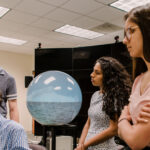
In a dimly lit room in UMBC’s Fine Arts building, two environmental science majors, a biology major, and a theatre-turned-individualized studies major watch weeks worth of coding, compiling videos, and map making come to life on a 4-foot spinning sphere called the Magic Planet.
A captivated audience watches in awe and anguish as videos of global warming glide across the spherical screen. Melting glaciers strand polar bears on thin ice, rising sea levels disrupt the homes of native Greenland tribes, and increased carbon dioxide in the oceans wipes out species of animals.
But not all hope is lost.
“It’s easy to feel hopeless,” says environmental science major Lauren Patel ’20. “There are times when we feel hopeless, too. But we can make all can make a difference.” Images of climate research and activism begin to spin around the sphere as the group explains how the individual actions of environmentally sustainable habits can add up.
The students’ “Stories on a Sphere” project, which focused on raising awareness of climate change in the arctic, was one of three Interdisciplinary CoLab research experiences offered to students over the summer. Throughout the four-week internship, each student brought their own variety of expertise to the table to create maps of temperature changes in the arctic, compile informational videos about melting ice caps, and write a compelling script for their 12-minute video illustrating the devastating effects of a warming northern hemisphere. The students also had to properly format the video onto a spherical structure which required learning new coding and video editing techniques.
 The “Stories on a Sphere” team showcased their project at the National Oceanic and Atmospheric Administration.
“It’s been amazing to watch the students collaborate and learn from each other,” says Ben Daniels, a current UMBC geography and environmental systems Ph.D. student and co-leader of the team. “Creating this product is something that none of them could have done independently. They each had to bring their own diverse sets of skills to the table to complete this task.”
A Unique Teaching Environment
For the second consecutive summer, UMBC’s Interdisciplinary CoLab provided students with an innovative team-based applied learning opportunity through a three-credit paid internship in narrative-based research. The program focuses on giving interdisciplinary student teams a professional research experience while learning how to tell effective stories and ultimately create a final product for a client.
“The CoLab is continuing to provide undergraduates with a unique experience of working across disciplinary lines,” says founding director of the CoLab and chair of gender, women, and sexuality studies, Carole McCann. “This experience gives students a sense of what kind of skills they can bring to a project and what they can learn from others.” In the future, she would love to see more faculty propose projects that connect students with organizations in the Baltimore area so that they can tell stories about the surrounding communities.
Kate Drabinski, a gender, women, and sexuality studies professor took the plunge and co-led “The Neighborhood: A State of Mind” project with media and communications professor, Donald Snyder. Drabinski cherishes her experience with the CoLab as one of the best teaching experiences she’s ever had.
“With the CoLab, faculty have the amazing chance to take an idea and give it to students and see it develop in ways we have never imagined, and we don’t get to do that very often as instructors,” Drabinksi says. “This is the kind of teaching that I want to do, and the CoLab gives me the resources to do it.”
Community Engagement
Have you wondered how Baltimore’s Little Italy, Greektown, and Chinatown came to be? For “Baltimore: The Second Ellis Island” project, three CoLab students uncovered the city’s rich immigration history and shed light on the little known Baltimore Immigration Museum. The team collaborated to design a new brochure and revamp the museum’s outdated website in an effort to bring the hidden gem more publicity.
English major Johanna Alonso ’20 used her story-telling skills to demonstrate how immigrants shaped Baltimore’s past. Alonso played a large role in the creation of the museum’s new brochure, while also composing original music for the interactive audio clips of letters written by immigrants on the website.
“Our group’s project demonstrated that the story of Baltimore is the story of its immigrants. Understanding their stories is imperative to having a complete understanding of the city,” she says. “I wasn’t aware of the museum prior to my internship, and I think the real benefit of the CoLab is that it exposes students to people, places, programs, and projects we may never have encountered otherwise.”
 The “Second Ellis Island” team presented their website and brochure for the Baltimore Immigration Museum.
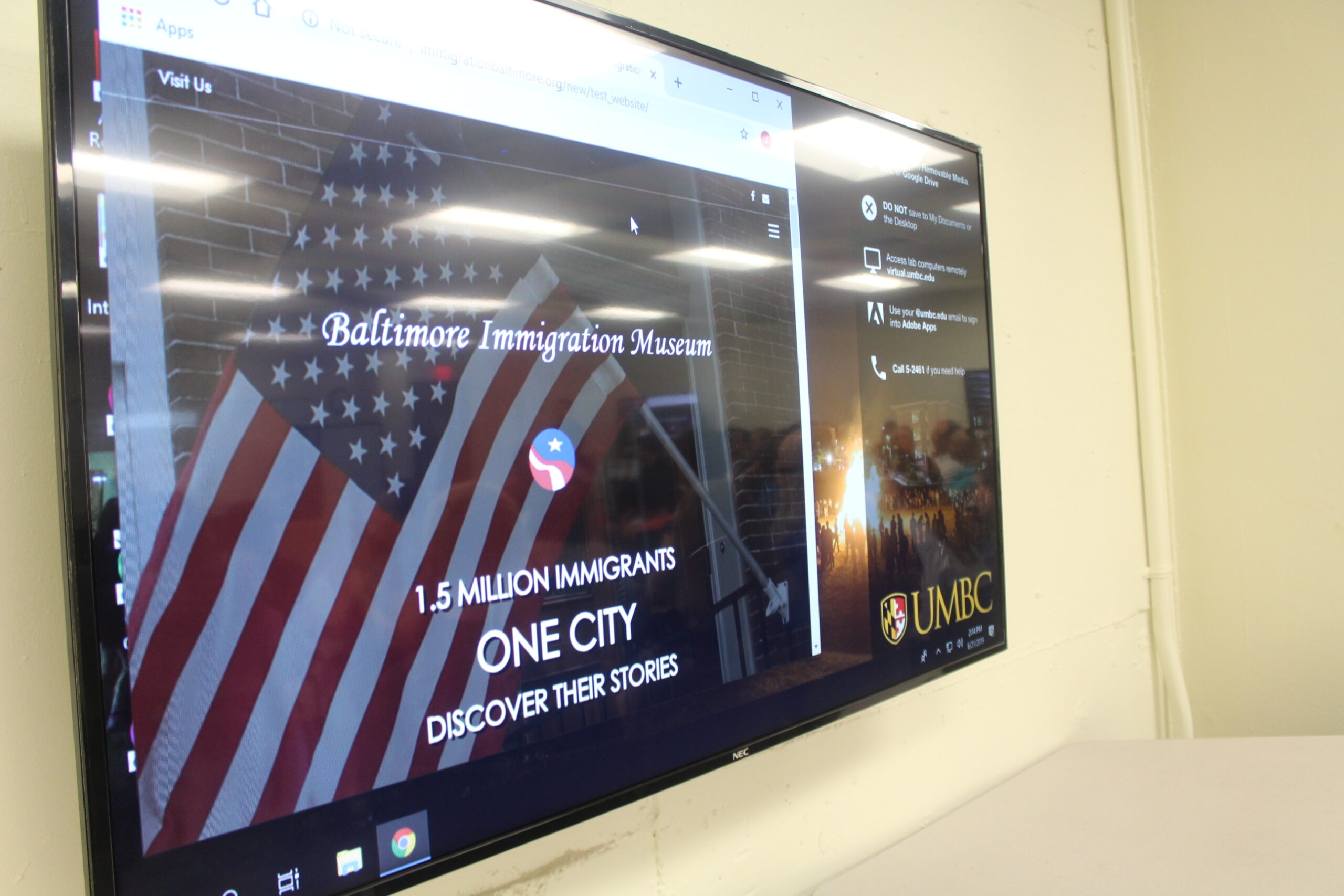
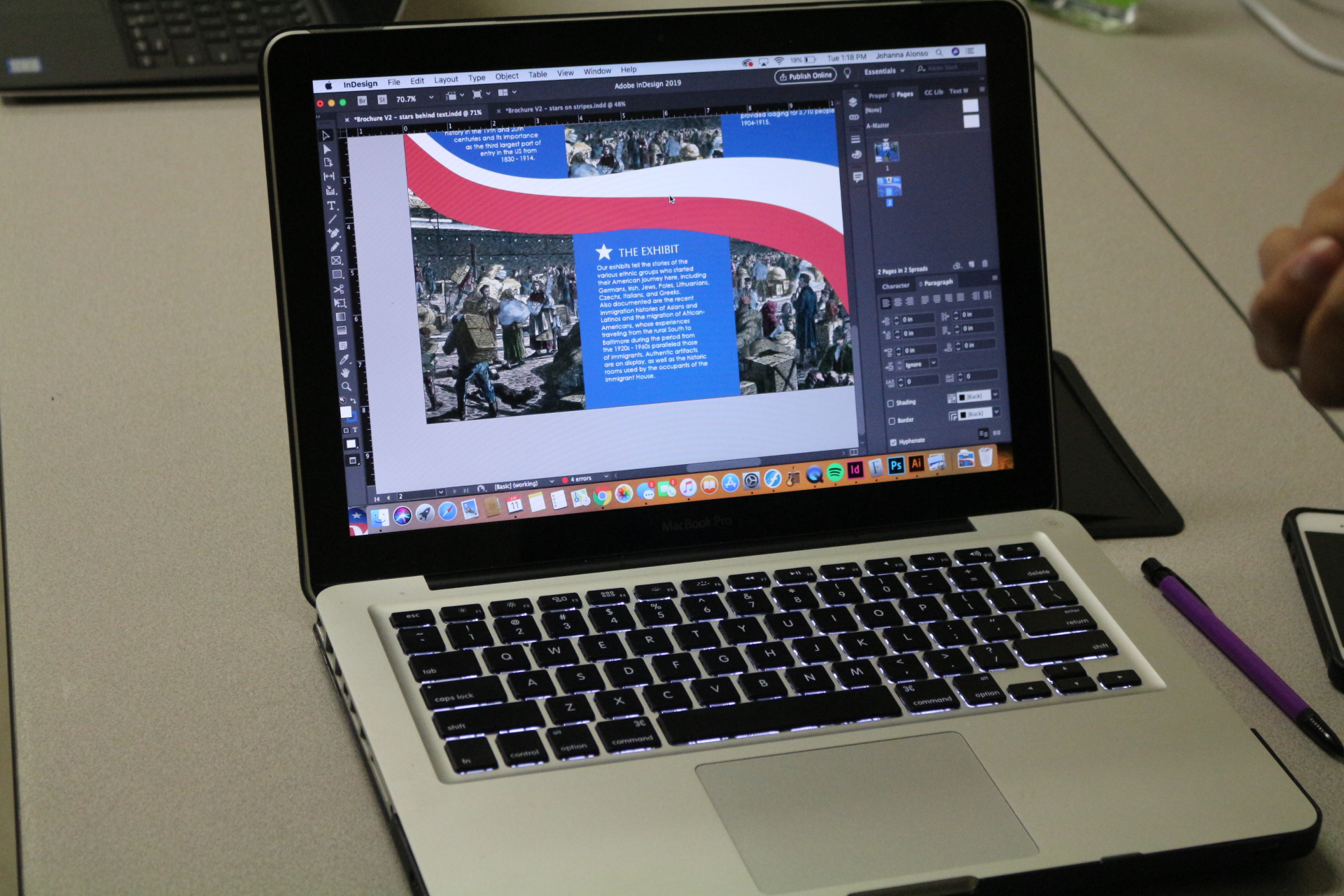
Community engagement has been a key principle since the conception of the CoLab. Co-founder Rachel Carter notes that this is one of the ways that the CoLab adheres to the University’s and the Provost’s mission for interdisciplinary research. She hopes to continue the trend of creating local partnerships and encourages faculty to keep Baltimore communities in mind as they craft new proposals for next summer.
“The Baltimore Immigration Museum project was the first real attempt at community engagement for the CoLab,” says Carter. “We hope that in the years to come we will expand our partnerships and increase our commitment to the areas surrounding UMBC.”
Digging Deep in the Archives
A third project includes a six-person team and over 10,000 photos, hundreds of interview transcripts, and over 50 audio clips documenting various communities in East Baltimore in the 1970s. “The Neighborhood: State of Mind” project required students to sift through the archives of the East Baltimore Documentary Photography Project (EBDPP) housed in UMBC’s Special Collections. Conducted by three photographers at Maryland Institute College of Art from 1976 to 1980 and donated to UMBC in 2019, the sizable archive served as the basis for an online exhibit the students created for the Special Collections website.
Ian Feldmann ’20, a media and communication studies major with minors in entrepreneurship, photography, and information systems, headed up the creation of the website, but stresses that the final product was only possible with the help of every single teammate.
“Working with students from different majors makes you think more creatively,” he says. “The final product came from meshing together two or three different ideas to make it the best that it could be.”
The CoLab is a little nod to the reality we face: real-world problems do not fit neatly into disciplines,” says Lee Boot of UMBC’s Imaging Research Center. “I’m so thankful that UMBC is doing something to prepare students for this.”
The students picked out important themes they discovered while sifting through the EBDPP and dedicated their time to telling those stories in a variety of ways. The ideas for these topics came straight from the EBDPP proposal written in 1976, as well as common themes observed by the students while going through the photos and interviews from the collection.
The online exhibit features three research essays about cleanliness, social life, and family structure in East Baltimore. For another aspect of the project, one student created a six-minute video about the neighborhood’s unique history of decorating window sills. Yet another section of the exhibit examines photographs of important geographic locations and features photos taken by the CoLab students. The students embedded an interactive map on the website so users can click on a popular East Baltimore landmark and see side-by-side pictures by the photographers from the EDBPP and modern day pictures taken by the CoLab students collected on a day-long walking tour of East Baltimore.
 President Hrabowski visits CoLab’s “Neighborhood” project and examines one of the 10,000 photos they worked with.
Real World Applications
The final products for the 2019 CoLab spanned much further than UMBC’s campus. The “Stories on a Sphere” team created the video not only to be presented on the Magic Planet at UMBC, but also for the “Science on a Sphere” screen at the National Oceanic and Atmospheric Administration (NOAA). The video will be archived at NOAA and used during informational sessions for visitors.
“We hope that our spherical presentation is used in classrooms and museums to inspire and engage future students and scientists to learn more about the impacts of climate change,” said biology major Sangita Ramaswamy ’20 at the NOAA presentation in June.
 The “Stories on a Sphere” team’s project will be archived and used for educational tours at NOAA.
Marveling at the final presentations, former CoLab project leader and director of UMBC’s Imaging Research Center, Lee Boot, explains the importance of the skills the students have learned by being a part of this internship.
“This generation of students is coming through universities at a time when more and more institutions are being held accountable for the good they are doing in this world. The CoLab is a little nod to the reality we face: real-world problems do not fit neatly into disciplines,” he says. “I’m so thankful that UMBC is doing something to prepare students for this.”
*****
Header image: Stories on a Sphere project in a research lab. Photo by Marlayna Demond ’11. All other images by Kennedy Lamb ’20.
Kennedy Lamb splits her time as an editorial intern for the UMBC Magazine and a marketing intern for the CoLab.
]]>
In a dimly lit room in UMBC’s Fine Arts building, two environmental science majors, a biology major, and a theatre-turned-individualized studies major watch weeks worth of coding, compiling...
https://umbc.edu/stories/colab-continues-to-inspire-collaborative-creativity/
https://my3.my.umbc.edu/api/v0/pixel/news/120084/guest@my.umbc.edu/5df5db3af56643b26225c814c3292471/api/pixel
campus-life
colab
inds
summer-session
UMBC News & Magazine
https://my3.my.umbc.edu/groups/umbc-news-magazine
https://assets1-my.umbc.edu/system/shared/avatars/groups/000/001/943/24435aa6207c452e7bc15cc74b42c7bb/xsmall.png?1748556657
https://assets1-my.umbc.edu/system/shared/avatars/groups/000/001/943/24435aa6207c452e7bc15cc74b42c7bb/original.png?1748556657
https://assets2-my.umbc.edu/system/shared/avatars/groups/000/001/943/24435aa6207c452e7bc15cc74b42c7bb/xxlarge.png?1748556657
https://assets2-my.umbc.edu/system/shared/avatars/groups/000/001/943/24435aa6207c452e7bc15cc74b42c7bb/xlarge.png?1748556657
https://assets3-my.umbc.edu/system/shared/avatars/groups/000/001/943/24435aa6207c452e7bc15cc74b42c7bb/large.png?1748556657
https://assets1-my.umbc.edu/system/shared/avatars/groups/000/001/943/24435aa6207c452e7bc15cc74b42c7bb/medium.png?1748556657
https://assets2-my.umbc.edu/system/shared/avatars/groups/000/001/943/24435aa6207c452e7bc15cc74b42c7bb/small.png?1748556657
https://assets1-my.umbc.edu/system/shared/avatars/groups/000/001/943/24435aa6207c452e7bc15cc74b42c7bb/xsmall.png?1748556657
https://assets2-my.umbc.edu/system/shared/avatars/groups/000/001/943/24435aa6207c452e7bc15cc74b42c7bb/xxsmall.png?1748556657
UMBC News & Magazine
0
0
false
Fri, 12 Jul 2019 18:09:07 -0400
Fish out of Water

The challenges of building a human-powered amphibious sculpture include working with nary a blueprint in sight, avoiding flying sparks from your professor’s power tools, returning to the theatre department’s dumpster again and again seeking out items to upcycle into an ever-changing design, and—oh yeah—not sinking in Baltimore’s Inner Harbor when all is said and done.
By Randianne Leyshon ’09
Race day photos by Poulomi Banerjee ’16, all other images by Marlayna Demond ’11, unless otherwise noted.
A dismembered hammerhead shark takes up most of the office space.
Professor Steven McAlpine proudly holds up the dorsal fin and other grey body parts to demonstrate the ingenuity of his student team, which plans to work with the specimen in piecemeal. “It’s like a pile of sushi in here,” laughs McAlpine.
Previously on display in the National Aquarium and then donated for this project, the “shark” in question has skin made of plastic bags from Lowes, melted together to form the exterior of this beast of recycled materials. McAlpine and his students are giving the shark a second life by building it a three-tricycle chassis, complete with pontoons and three pilots to careen 14 miles through the streets of Baltimore—including a stint in the harbor—to compete in Baltimore’s 21st annual Kinetic Sculpture race.
This—in all its fishy, gear-filled glory—is what interdisciplinary learning looks like at UMBC.
Creating jaws from scratch
Working outside under the Fine Arts portico this spring, with a portable speaker blasting “Can’t Touch This,” in homage to the class’s name for their project—MC Hammerhead, the students are engaged in a variety of hands-on tasks: creating a skeleton of two-by-fours to hold up the shark’s wire mesh head and sawing jagged teeth from fiberboard from the theatre’s trash to fill its mouth with double rows.
Two of the three teal trikes sit nearby, connected by a homemade metal apparatus, and with pontoons made of old recycling containers welded on. In December, the team tested out the pontoons’ effectiveness in UMBC’s Pig Pen Pond. As the test pilot (in swimming trunks) prepared to sink or float, Cody Thomas ’19, mechanical engineering, described watching his classmate go down into the water with “hopeful pessimism.”
“I was like, ‘okay, we’ve done the math and we definitely have the right volume in these pontoons’ and then he hit the water. The wheels broke through the ice and then the pontoons sat there and I thought, ‘wow, this is working really, really well.’”
 David Thompson breaks through the ice of Pig Pen Pond. In swim trunks. In December. Photo courtesy of Steven McAlpine.
Not all, but many of the students’ ad hoc solutions would turn out to work really well. To demonstrate the biomimicry of the structure, Lucas McCullum ’19, mechanical engineering, and Lorraine Dell’Acqua ’19, psychology, two students in McAlpine’s class, jump on the swivel-combined tricycles and pedal around campus, the second rider’s direction depending on the steering of the first. The effect is successfully serpentine.
McAlpine says the students identified the design challenge and decided to tackle it head on. “They really get fundamentally why it’s important to take time to design. Design means really coming up with a product that’s appropriate for the context…so if it’s a shark, you want it to have that kind of dynamic fish movement, to move differently from anything we’ve built before. So I credit the capstone team for having the courage to see that like a very generally defined engineering problem: ‘We want it to move like a fish.’”
There’s no textbook for this
This spring marks UMBC’s fifth entry into this wacky, very Baltimore race, and UMBC’s second structure (the first was the squid-shaped Kracken Upcycle, which won Grand Mediocre East Coast Championship in 2015). With detailed rules down to the required homemade sock creature that must be displayed on board, the funky race is the perfect platform for art and engineering to meld together, or in this case, literally weld together.
It’s a project, McAlpine says, that fits perfectly into the UMBC ethos.
“I’ve never before encountered this kind of cross-disciplinary problem-solving,” explains McAlpine, “when actually your strengths in another area can help you tackle the problem in a new way.” The interdisciplinary studies seminar guided by McAlpine also includes a consulting team of mechanical engineering students completing their capstone project under the guidance of Neil Rothman in the College of Engineering and Information Technology. The interplay between the two groups has refined the shark into a well-engineered piece of art.

When a steering or hitch issue stumps the engineers, it’s the psychology and political science students in the class who start doodling on the whiteboard, using their non-traditional sets of knowledge to work out the kinks. “UMBC students allow students of other majors to solve problems for them,” adds McAlpine.
There’s no pre-existing manual for how to create such a beast, so McAlpine and his team of students are learning from the successes and failures of their original Kraken sculpture, which survived in various iterations to run four kinetic sculpture races previously and is currently living out its retirement in front of Fine Arts. They’ve also sought guidance from Arbutus Middle School’s long-standing kinetic sculpture team, as well as from the UMBC Baja design lab, a racing club on campus.
“I was really excited that we were working with an interdisciplinary team,” says Alliana Warner ’19, one of the mechanical engineering capstone consultants. “We provided a lot of mentorship, which I don’t think we expected to do at first.”
“Like our mechanical side, we can do that,” says David Thompson ’19, another of the capstone students. “But we have to connect their art to our mechanical side. So we had to have a lot of communication.” And when their vocabularies didn’t overlap, they turned to art to convey their ideas.
“It was just like a no-barriers way of communicating when everybody picked up the markers and started drawing on the board, and it was cool to see the whole class have their own ideas that they were sketching from stick figures to really elaborate art majors just making these beautiful drawings,” Thompson explains.
The end result of their collaboration is a 20-foot, seven-wheeled, 1,000 pound (with three human pilots on board) upcycled kinetic sculpture that would hopefully mimic the undulating sashay of a shark as they pedaled it through the city.

Quality design on a budget
The challenges of building a human-powered amphibious sculpture that is safe to drive but also stands out in a field that includes local favorites like Tick Tock the Croc, Cowsmic Moobeams, and Platypus Lost is textbook Individualized Study course material. (In fact, the textbook they used was Cradle to Cradle. Remaking the Way We Make Things, an interdisciplinary collaboration between a chemist and an architect.)
McAlpine added to the already complicated rules for entry an additional goal of using 80% upcycled materials, raiding the theater department’s trash after productions and going to facilities management to scrounge for pontoon-like barrels.
Using upcycled materials created additional challenges for the capstone consultants. “We would come up with what we thought was the most sound design,” says Thomas. The class would then push back on their prototypes, asking them to find a cheaper or more sustainable solution. “And we’d be thinking to ourselves, oh, like now I have to use not the best materials but still create something that’s just as quality in design.”
One hurdle was the ball-and-socket hitch that the mechanical engineering students proposed to connect the trikes. After looking at the price and weight of the hitches they’d need, the individualized study students balked. As they sat on their swivel chairs thinking, the motions inspired a new idea.
After some prototyping, the capstone students were able to take the swivel from barstool-like chairs and play with the orientation on the sculpture to make it work as a replacement for their original idea. “I think it made us more proud of it at the end,” adds Brianna Scarpulla ’19, the fourth member of the mechanical engineering group, “by doing something different than what we were going to do.”
Race day dawns
On May 4, MC Hammerhead and 23 other creations lined up to compete in the American Visionary Arts Museum’s Kinetic Sculpture Race. The UMBC pilots and their pit crew gathered all their necessary provisions, including water bottles, life vests, and granola bars. And even though the engineers triple-checked their calculations and crowd sourced their prototypes, they still cross their fingers.
Their gear is tested from the very start. After the gun and a Le Mans-style running start, the human-powered sculptures make their way up Battery Avenue in Federal Hill Park. This daunting climb sets the tone of the race as many other obstacles lay in MC Hammerhead’s way—including cobblestones, water entry and exit, a sand pile, and a mud pit—before the team’s anticipated conclusion six hours later.
Early into the race on Key Highway, MC Hammerhead’s tail fell off, but this was nothing a roll of duct tape couldn’t fix as the team waited for their turn to enter the water. Going into the Chesapeake Bay at full speed blasting “Can’t Touch This” really hyped up the onlookers, but McAlpine held his breath. “I was expecting pontoons to break off,” says McAlpine. “But it was so well engineered. It made a big splash and kind of accordioned, but it was designed to be flexible, so it was fine.”

When the shark emerged from the water, the “kinetic kops” tried to slap the team with several time penalties, but the threats were quickly resolved by some lemon-flavored shark cookies made by McAlpine’s 12-year-old daughter, Lily. Graft is not only encouraged at the race, but there’s even a prize for best bribe.
Through “mysterious mathematical means,” as the race rules nebulously explain, MC Hammerhead came away in 14th place, and while the production is not about the medals, McAlpine didn’t see a single sculpture make it through the mud and sand as well as UMBC’s.
“The shark was light and fast, which attests to Neil Rothman’s engineering capstone class—they really engineered a strong and light pontoon system,” says McAlpine. “Because that’s really something that keeps me up at night: Are they going to capsize? And they didn’t do that even at full speed.”
Looking back on the experience, even the hectic last two weeks before the big day, McAlpine only sees the success of his students. “Probably the biggest interdisciplinary challenge is that you have to take a sculpture that’s meant to be static—not moving and bouncing around—and make that sculpture strong enough to have enough integrity to survive constant vibration for 14 miles of potholes and cobblestones. Given that, I thought the sculpture did remarkably well…the combination of engineering and art was a real crowd pleaser.”

*****
Header image by Poulomi Banerjee ’16.
]]>
The challenges of building a human-powered amphibious sculpture include working with nary a blueprint in sight, avoiding flying sparks from your professor’s power tools, returning to the theatre...
https://umbc.edu/stories/fish-out-of-water/
https://my3.my.umbc.edu/api/v0/pixel/news/120099/guest@my.umbc.edu/ff427de978cc28c1f2ac2378c50cc929/api/pixel
baltimore
campus-life
inds
kinetic-sculpture-race
mcalpine
spring-2019
UMBC News & Magazine
https://my3.my.umbc.edu/groups/umbc-news-magazine
https://assets1-my.umbc.edu/system/shared/avatars/groups/000/001/943/24435aa6207c452e7bc15cc74b42c7bb/xsmall.png?1748556657
https://assets1-my.umbc.edu/system/shared/avatars/groups/000/001/943/24435aa6207c452e7bc15cc74b42c7bb/original.png?1748556657
https://assets2-my.umbc.edu/system/shared/avatars/groups/000/001/943/24435aa6207c452e7bc15cc74b42c7bb/xxlarge.png?1748556657
https://assets2-my.umbc.edu/system/shared/avatars/groups/000/001/943/24435aa6207c452e7bc15cc74b42c7bb/xlarge.png?1748556657
https://assets3-my.umbc.edu/system/shared/avatars/groups/000/001/943/24435aa6207c452e7bc15cc74b42c7bb/large.png?1748556657
https://assets1-my.umbc.edu/system/shared/avatars/groups/000/001/943/24435aa6207c452e7bc15cc74b42c7bb/medium.png?1748556657
https://assets2-my.umbc.edu/system/shared/avatars/groups/000/001/943/24435aa6207c452e7bc15cc74b42c7bb/small.png?1748556657
https://assets1-my.umbc.edu/system/shared/avatars/groups/000/001/943/24435aa6207c452e7bc15cc74b42c7bb/xsmall.png?1748556657
https://assets2-my.umbc.edu/system/shared/avatars/groups/000/001/943/24435aa6207c452e7bc15cc74b42c7bb/xxsmall.png?1748556657
UMBC News & Magazine
0
0
false
Wed, 19 Jun 2019 15:00:30 -0400
Five UMBC students see their degrees as a step toward community impact
Many students see graduation as an opportunity to embark on entirely new and different experiences. For others, graduation is one more step forward on an already clear path—a chance to delve wholeheartedly into passions they fostered while at UMBC. These five students fit firmly in that second group, committed to applying their talents to specific community-centered initiatives that have shaped their UMBC journeys and that strengthen their local ties.
Transforming research into activism
Being a valedictorian for me is about honoring South Asian women feminists whose achievements were not as visible when I was growing up. It is also about the need to transform research and community service skills into direct activism.
—Samiksha Manjani
During her two years as a student staff member at the UMBC Women’s Center Samiksha Manjani ‘19 has connected with and provided support for many people who have experienced sexual violence. Inspired by their courageous living, she sought to understand the roots and effects of gender-based violence. Her research, through her political science and sociology majors, has focused on inequitable sentencing of sex offenders.
In addition to research, internships have provided Manjani extensive insights into the legal field. This includes work with the Maryland State Attorney’s Office, Police Integrity and Public Trust Unit in Baltimore City, Montgomery County Police Financial Crimes Section, and Office of the Attorney General for the District of Columbia Family Division.
These experiences prepared Manjani to be active in UMBC’s Retriever Courage initiative, focusing on improving the university’s prevention of and response to sexual violence and other forms of sexual misconduct. Manjani served as a member of the student accountability committee and leader of the police reform subcommittee. Both experiences revealed to her the need to improve integration between the law and social work in working with vulnerable populations, something she plans to pursue through a combined J.D. and M.S.W. degree.
Human trafficking is the byproduct of so many other inequalities. Bringing together artists to create art and community in the name of awareness is one way to help dismantle inequalities at all levels.
—Mia Rickenbach
Mia Rickenbach ‘19, theatre, is the founder of Create Freedom, a new Baltimore City non-profit that combines her love of the arts and commitment to increasing public awareness of human trafficking. Rickenbach became aware of the scale of human trafficking through reading Half the Sky: Turning Oppression into Opportunity for Women Worldwide as part of UMBC’s New Student Book Experience. The book informed her of the many industries that create and sustain a demand for human trafficking around the world.
Rickenbach was able to explore her next steps through an Entrepreneurship Undergraduate Research Award, granted by UMBC’s Alex. Brown Center for Entrepreneurship. It was an opportunity to combine both her passions through a community arts organization. The award helped her research the idea, complete a feasibility study, develop a business plan, and map out a timeline for implementation.
 Rickenbach working on theatre set models.
Create Freedom is now home to artists committed to creating community and awareness. Throughout the year, the organization will host events where local artists and community members can gather to create and sell art to build awareness about human trafficking and build a network of like-minded people.
Mindful education
Today is a moment. I don’t have to judge it. I just accept it. Being open to the present opens you to a world of peaceful possibilities that help to manage great challenges.
—Phillip McKnight
After two years walking through the UMBC campus, Phillip McKnight ‘19 will walk across the stage this May to receive his master’s degree in instructional systems design and then walk along the Appalachian Trail for five months. The trek is part of his lifelong practice to live a mindful life.
 McKnight leading a mindfulness practice for the Department of Public Works in Baltimore City. Photo courtesy of McKnight.
McKnight, a fellow in UMBC’s Shriver Peaceworker Program, strengthened his practice through guided meditation during his time in Jamaica as a Peace Corps volunteer. Meditation helped him overcome challenges that came with being away from home and engage meaningfully with the community he was placed in.
During his graduate studies, McKnight helped connect Baltimore youth to urban green spaces through the Patterson Park Audubon Center. On his return from the Appalachian Trail, he plans to work with children in Baltimore City to further develop their mindfulness skills as an additional strategy for lifelong success.
Science is everywhere and for everyone
Science is everywhere, but it is also personal. The power of science comes from understanding how it applies to the communities we live in.
—Olivia Grimes
Olivia Grimes ‘19 has crafted her own individualized major around improving children’s access to science education using culturally and geographically relevant teaching practices. While sharpening her teaching skills in Baltimore City through the Sherman STEM Scholars Program, she realized science was not covered in the same depth as state-tested subjects. Seizing the opportunity, Grimes began to develop place-based science lessons that students would find fun, engaging, and relevant to their lives.
 Grimes at Lakeland during the Sherman Center for Early Childhood Learning and Families diverse books event.
Grimes adapted environmental science lessons relevant to students’ neighborhoods and lives through an afterschool program at Lakeland. She also brought her passion for place-based science to her student teaching placement at Maree G. Ferring Elementary/Middle School. She plans to continue to adapt more science curriculum to support teachers in implementing lessons into tested subjects through fun experiments as a Baltimore City early childhood educator after earning her UMBC degree this month.
Science has always been my happy place, but as a first-generation college student from Dundalk/Essex, Maryland, I didn’t know how I could afford college. Through a lot of hard work, with the support of my family, and the UMBC community, I was able to find my place as a gay scientist in the geosciences.
—Zachary Hunter-Lee Little
Zachary Hunter-Lee Little’s life as a scientist began while playing on the Ocean City shoreline. As he let the current take him down the shore he became aware of how the sand and water interacted. He began to ask questions about how the natural world worked, and years later, this curiosity led to him to major in geography and environmental science (GES).
To support his UMBC education, Little ’19 worked as a maintenance assistant in Residential Life and as a lab proctor. During the summers, he took advantage of unique research experiences. The National Science Foundation’s Research Experiences in Solid Earth Science for Students (RESESS) program enabled him to work in Boulder with UNAVCO, a university consortium that supports Earth science research. The next summer, the scholars program connected him with a research opportunity at Duke University.
 Zachary Little, a 2018 RESESS intern, discusses his summer research with CU Boulder’s Greg Tucker on August 2, 2018. Photo by Daniel Zietlow, UNAVCO.
Those experiences helped Little sharpen his research skills and develop his identity and confidence as a scientist. Before long, he was presenting his own research at geoscience conferences across the country.
Back at UMBC, he grew his science communication and advocacy skills as an eco-ambassador and Blue Water Baltimore volunteer. And he’s always supporting more students along his journey, encouraging them to apply for research opportunities and internships that can help them reach their goals.
 Little in the field. Photo courtesy of GES department.
Little’s hard work is paying off. He recently learned that he’s been awarded a highly competitive three-year National Science Foundation Graduate Research Fellowship. He’ll soon begin an M.S. at North Carolina State University in biological and agricultural engineering.
As Little looks toward the future, his mind goes back to that moment on the Ocean City shoreline and knows his heart will remain with local waterways and communities.
Banner Image: Photo of Samiksha Manjani at Take Back the Night, courtesy of the UMBC Women’s Center. All photos by Marlayna Demond ’11 unless otherwise noted.
]]>
Many students see graduation as an opportunity to embark on entirely new and different experiences. For others, graduation is one more step forward on an already clear path—a chance to delve...
https://umbc.edu/stories/five-umbc-students-see-their-degrees-as-a-step-toward-community-impact/
https://my3.my.umbc.edu/api/v0/pixel/news/120132/guest@my.umbc.edu/1fb0cc9807f32a026bfdbc62682b9666/api/pixel
cahss
class-of-2019
ges
inds
policy-and-society
politicalscience
saph
science-and-technology
shermanscholars
shrivercenter
theatre
womenscenter
UMBC News & Magazine
https://my3.my.umbc.edu/groups/umbc-news-magazine
https://assets1-my.umbc.edu/system/shared/avatars/groups/000/001/943/24435aa6207c452e7bc15cc74b42c7bb/xsmall.png?1748556657
https://assets1-my.umbc.edu/system/shared/avatars/groups/000/001/943/24435aa6207c452e7bc15cc74b42c7bb/original.png?1748556657
https://assets2-my.umbc.edu/system/shared/avatars/groups/000/001/943/24435aa6207c452e7bc15cc74b42c7bb/xxlarge.png?1748556657
https://assets2-my.umbc.edu/system/shared/avatars/groups/000/001/943/24435aa6207c452e7bc15cc74b42c7bb/xlarge.png?1748556657
https://assets3-my.umbc.edu/system/shared/avatars/groups/000/001/943/24435aa6207c452e7bc15cc74b42c7bb/large.png?1748556657
https://assets1-my.umbc.edu/system/shared/avatars/groups/000/001/943/24435aa6207c452e7bc15cc74b42c7bb/medium.png?1748556657
https://assets2-my.umbc.edu/system/shared/avatars/groups/000/001/943/24435aa6207c452e7bc15cc74b42c7bb/small.png?1748556657
https://assets1-my.umbc.edu/system/shared/avatars/groups/000/001/943/24435aa6207c452e7bc15cc74b42c7bb/xsmall.png?1748556657
https://assets2-my.umbc.edu/system/shared/avatars/groups/000/001/943/24435aa6207c452e7bc15cc74b42c7bb/xxsmall.png?1748556657
UMBC News & Magazine
0
0
false
Fri, 17 May 2019 13:02:45 -0400
Laser focus without limits: UMBC’s newest grads choose their own adventures
He’s a bassoonist and chemical engineer. She’s a dancer and social justice advocate. UMBC students have a lot of focus, but that doesn’t mean they have to focus on one thing. For many, the UMBC experience is about figuring out how to combine their passions, not chose one or the other. Here, four UMBC students graduating this spring share how they have found their own unique balance.
Pitching an idea
Senior Jeff Carr can easily recall one of the most pivotal moments of his first year at UMBC. Jason Schiffman, psychology, was speaking to the new cohort of Retrievers and simply told them “this place will be what you make it.”
“It really resonated with me. This was a place where I could restart and find myself,” remembers Carr. “I get kind of emotional looking back over my four years…I’ve done a lot here and I think part of that is the faculty and the community just motivated me to want to do so.”
For Carr, financial economics, sports were part of life. Growing up in nearby Linthicum, he spent much of his time crouched on a baseball diamond as his high school’s catcher. A shoulder injury ultimately derailed his athletic career, but coming to UMBC allowed him to turn that passion into a future profession.
A chance meeting with a member of the athletics department led to an introduction with Liam Bowen, associate head baseball coach. Carr joined the team as baseball manager, filling in wherever he was most needed, from booking catering to helping with scouting reports.
 Carr (l) with UMBC’s men’s basketball announcers, Gary Stein (c) and John Feinstein (r). Photo courtesy of Carr.
Carr’s biggest contribution came in his sophomore year. “Players would chart pitches during the game using pencil and paper and then I would have to total everything up by hand. One day, I had the realization that the strike zone is basically a graph with X-Y coordinates, so we could just chart pitches using some type of phone app,” explains Carr.
As a result of this epiphany, Carr set out to develop pitchTrax, an app that would track pitches and log the results in a spreadsheet, eliminating the need for hand tabulation.
“Three years ago, I told him that I was interested in tracking our pitchers’ statistics at a granular level and getting the information organized in a way that they could use,” says Bowen. “Jeff took off with the idea and created a system where we could see virtually every aspect of our pitchers’ performance. I have used the information that he has gathered countless times with our players and our program is very much in his debt.”
Carr enlisted the help of economics professor Scott Farrow to turn his ideas into reality. Farrow suggested Carr use heatmap quadrants and helped him refine the visual representation of the pitching data. “Jeff is a great example of becoming outstanding by following a particular interest and then having new opportunities grow from that success,” says Farrow.
 Example of the heatmap developed by Carr and Farrow.
Carr has continued to develop his expertise in sports analytics and will soon begin his master’s degree in sports management at the University of Michigan. But he won’t forget his roots anytime soon.
“I feel like my experience here…I’ve been very lucky, but I’ve also been around the right people,” says Carr. “The community here is so welcoming and that’s the most important part, for me. Everyone has a story like mine and we didn’t do it on our own—it’s all thanks to the people [at UMBC] supporting us.”
 Carr traveled to Charlotte, N.C. to cheer on UMBC men’s basketball during March Madness 2018. Photo by Kait McCaffrey for UMBC.
Justice through performance
The individualized study program at UMBC encourages students to take the road less traveled, or never before traveled, and create their own major. Alexia Petasis jumped at the chance to combine her passion for choreography with her commitment to social justice, a pairing that would define her time at UMBC.
“Dance has always been a big part of my life, but throughout college I became equally interested in social justice activism. When I came to UMBC, I was able to explore the intersections between them,” says Petasis. “I started learning how they could work together to create and inform empathetic dances that grow an individual’s understanding of an issue.”
 Petasis ‘19 at UMBC’s fall Senior Dance Concert. Photo by Marlayna Demond ‘11.
Taking courses in psychology, sociology, dance, and gender and women’s studies helped Petasis to envision how she could use elements from each in developing a cohesive piece.
“She is consistently looking for new ideas and ways to communicate through the body,” says Doug Hamby, associate professor of dance, of Petasis’s work. “Once she sets out on an creative journey she expands and deepens her exploration until the dancers embody every nuance Alexia intends to communicate to her audience.”
 Petasis performing at UMBC’s fall Senior Dance Concert. Photo by Marlayna Demond ‘11.
Petasis’s most ambitious work eventually became her capstone project, an evocative dance piece that “brings to light the experiences of survivors of domestic sex trafficking from the point of view of the victim.”
Petasis explains, “This dance, titled ‘Becoming Survivor,’ calls attention to the various ways a victim can become trapped in the life of human trafficking and offers a deeper understanding of the manipulation into exploitation that occurs.”
“In addition to showing her dance, Alexia saw the importance of using this opportunity to share community resources and have a dialogue about sexual violence in our communities,” says Jess Myers, director of UMBC’s Women’s Center. “Alexia’s dance has brought communities together—We Believe You, the Women’s Center, other on-campus and off-campus partners—to help create space for our UMBC community to have complex conversation about consent and sexual violence.”
Myers lauds Petasis’s keen ability to encourage others to see themselves as people who can have a social impact. She notes, “Alexia uses dance to tell stories that often go unheard. Her interdisciplinary work is grounded in inclusion and inviting others to care about issues they may not have otherwise known mattered to them.”
Taking the skills the she’s learned and the advice from the mentors she’s met along the way, Petasis is pursuing a teacher’s assistant program in France. “My time at UMBC has allowed me to pursue my passion and research interests with guidance, mentorship, and an overwhelmingly supportive network.”
At home in the lab…and on stage
“The world needs more Justins!” exclaims Kim Leisey, associate vice president of Student Affairs, when you ask about senior Justin Hosten. Leisey met Hosten when she taught a class for new Residential Life student staff. “If you want to know him, listen to him play the bassoon—it’s soulful and expressive,” she says. “Justin travels UMBC with gentle humility and care for others” in all that he does.
Hosten has a rare skill set—pursuing majors in both chemical engineering and music performance—and he firmly believes that this combination has improved his problem-solving skills.
“In music, we’re taught to look for patterns and I use this thought process in solving engineering problems. Looking for patterns helps determine what steps need to be taken to reach a solution and that’s integral in the engineering curriculum,” explains Hosten.
At the same time, Hosten notes, “In engineering, we’re taught to use all the tools we have to solve the problem fully. I take this into account when I look at all the ways I can create beautiful sounds.”
 Justin Hosten ‘19 poses with classmate Christina Cruz ‘19, music performance, following a campus studio session. Photo courtesy of Hosten.
After graduating from Bowie High School in Maryland, Hosten hit the ground running at UMBC, with both his music and his passion for engineering, in equal measure. He joined the university orchestra and wind ensemble and is both a Meyerhoff Scholar and a MARC U*STAR Scholar.
Hosten cites his Meyerhoff acceptance as something that makes him particularly proud, and that has had a major impact on his experience. “It’s been a huge part in making sure that I have been successful and helping me to be where I am today,” he shares.
Hosten’s current research explores how nanocapsules could be added to dental resin to revolutionize fillings. Should a person’s filling crack, the nanocapsules would break and the void in the tooth would be filled without a trip back to the dentist. Presently, Hosten is working to coat the particles with a silica shell to keep them uniform and prevent bursting.
 Hosten takes a break from performing to pose with fellow musicians (l to r) Anne Saba ‘19, mathematics, and Shabnam Parsa ‘19, biological sciences. Photo courtesy of Hosten.
One of Hosten’s mentors, Erin Lavik, professor of chemical, biochemical and environmental engineering, appreciates how his lab work is positively influenced by his stage work.
“It is challenging to be a chemical engineer, but to do that while also being a tremendous musician is humbling,” says Lavik, who herself has experience with theatre. “There’s also a critical interplay between the two,” she explains. “It isn’t surprising to me that Justin can approach a challenge from multiple perspectives and come up with elegant, creative solutions.”
This fall, Hosten will pursue his Ph.D. in biomedical engineering as part of a joint program between the Georgia Institute of Technology and Emory University.
Making waves
“I started swimming because my mom told me that my local summer team needed more kids my age…which was a complete lie. The reason she wanted me to swim was so that I wouldn’t drown when I went to the pool.”
It’s not exactly the auspicious beginning you would expect from a Danish national swimming champion, but that’s exactly how Alexander Gliese’s story begins.
 Alexander Gliese ‘19 competing at the 2018-2019 America East championships. Photo courtesy of Colleen Humel.
The Danish-born competitor has a score of swimming accolades attached to his name, but he didn’t develop a true love for the sport until he was a teenager. “I was swimming competitively on a year-round team and it wasn’t until I was about 14 that I began to really like the sport,” says Gliese. “At this point, I started to win events at the Maryland state championships.”
When the time came to look at colleges, UMBC immediately stood out to the young swimmer. And once he committed, he never looked back. “I’m happy that I chose UMBC as the coaching staff and my teammates have helped me grow into the person that I am today,” he reflects.
While his numerous athletic achievements would be impressive alone, Gliese managed to perform just as well in the classroom as he did in the pool. The Meyerhoff Scholar is graduating with a mechanical engineering degree this May and dedicated his time to researching energy harvesting and design optimization. He also credits his academic work for helping him improve his athletic performance.
 Gliese accepting his award for “Best Performance” at the Danish Open. Photo courtesy of Chad Cradock.
Soobum Lee, UMBC assistant professor of mechanical engineering, has served as mentor for Gliese and has been impressed by his research contributions. “Alex has consistently shown promise and commitment” as a researcher, offering “a unique perspective” while applying the research experience to his own learning, says Lee.
“During his involvement of my energy harvesting research for wind turbine monitoring, Alex proactively and voluntarily worked on brainstorming, CAD modeling, and testing,” Lee explains. “His diligence seriously accelerated the project, and his sincerity positively affected my graduate students.”
“I think that my swimming and my academics intersect very well since I have always been interested in how I can maximize my efficiency in the pool,” Gliese says. “I feel that my knowledge from mechanical engineering has helped me to understand what positions and movements in the water will help me to swim faster in the pool.”
 Gliese celebrates his medals during day two of America East competition with coach Chad Cradock. Photo courtesy of Colleen Humel.
His success in research and swimming are also connected by the same underlying work ethic and tenacity. Neil Rothman, professor of practice in mechanical engineering, shares that as busy as Gliese was with U.S. and international swimming competitions, “he would show up to class with a smile on his face. I had him in four different courses over a period of three years and he was consistently an excellent and dedicated student. The busier he got and the harder work became, he seemed to enjoy it even more.”
Gliese’s approach of applying his classroom knowledge to the pool can certainly be deemed a success. He’s a two-time CCSA Champion, two-time America East champion, 2019 America East Most Outstanding Male Swimmer, two-time America East All-Academic Team member, two-time CSCAA Scholar All-American, UMBC record holder in 100 backstroke and 200 medley relay, and the Danish national record holder in 200 backstroke. He even broke Michael Phelps’ 16-year-old NBAC record during the back split of the 400 medley relay in January 2019.
Head swimming and diving coach Chad Cradock ’97, psychology, says Gliese “has always been well-balanced in the classroom and in the pool. They say the price of excellence is discipline. Alex is one of the most disciplined, focused, and hardworking swimmers I have ever worked with and has earned his way to the world stage each and every day.”
After commencement, Gliese will compete in the World University Games. He will then take time to train for the Danish Olympic swimming qualifiers before pursuing a Ph.D. in mechanical engineering.
As much as he’s made a mark on UMBC, Gliese thinks about the mark UMBC has made on him. “UMBC has helped me to not only grow as a student and a swimmer, but as a person.” Sharing that the UMBC community is like family, he says, “it’s allowed me to thrive and create bonds that will last a lifetime.”
Banner image: Alexia Petasis ‘19, left, at UMBC’s fall Senior Dance Concert. Photo by Marlayna Demond ‘11.
]]>
He’s a bassoonist and chemical engineer. She’s a dancer and social justice advocate. UMBC students have a lot of focus, but that doesn’t mean they have to focus on one thing. For many, the UMBC...
https://umbc.edu/stories/laser-focus-without-limits-umbcs-newest-grads-choose-their-own-adventures/
https://my3.my.umbc.edu/api/v0/pixel/news/120133/guest@my.umbc.edu/3114d2e5eba762b448b9bdbc6a88cbaf/api/pixel
athletics
cahss
cbee
class-of-2019
coeit
dance
economics
inds
meche
meyerhoffscholars
page1
womenscenter
UMBC News & Magazine
https://my3.my.umbc.edu/groups/umbc-news-magazine
https://assets1-my.umbc.edu/system/shared/avatars/groups/000/001/943/24435aa6207c452e7bc15cc74b42c7bb/xsmall.png?1748556657
https://assets1-my.umbc.edu/system/shared/avatars/groups/000/001/943/24435aa6207c452e7bc15cc74b42c7bb/original.png?1748556657
https://assets2-my.umbc.edu/system/shared/avatars/groups/000/001/943/24435aa6207c452e7bc15cc74b42c7bb/xxlarge.png?1748556657
https://assets2-my.umbc.edu/system/shared/avatars/groups/000/001/943/24435aa6207c452e7bc15cc74b42c7bb/xlarge.png?1748556657
https://assets3-my.umbc.edu/system/shared/avatars/groups/000/001/943/24435aa6207c452e7bc15cc74b42c7bb/large.png?1748556657
https://assets1-my.umbc.edu/system/shared/avatars/groups/000/001/943/24435aa6207c452e7bc15cc74b42c7bb/medium.png?1748556657
https://assets2-my.umbc.edu/system/shared/avatars/groups/000/001/943/24435aa6207c452e7bc15cc74b42c7bb/small.png?1748556657
https://assets1-my.umbc.edu/system/shared/avatars/groups/000/001/943/24435aa6207c452e7bc15cc74b42c7bb/xsmall.png?1748556657
https://assets2-my.umbc.edu/system/shared/avatars/groups/000/001/943/24435aa6207c452e7bc15cc74b42c7bb/xxsmall.png?1748556657
UMBC News & Magazine
0
0
false
Thu, 16 May 2019 18:14:43 -0400


