UMBC’s Gloria Chuku is named the 2020 – 21 Lipitz Professor for her research on the Igbo people of Nigeria
Gloria Chuku, chair andprofessor of Africana studies, has been named UMBC’s Lipitz Professor of the College of Arts, Humanities, and Social Sciences (CAHSS) for 2020 – 21. This distinguished professorship, funded by Roger C. Lipitz and the Lipitz Family Foundation, recognizes and supports innovative teaching and research. During her professorship, Chuku will carry out research for her new book project, Becoming Igbo in Nigeria and the Diaspora: A History of Ethnic Identity Formation and Negotiation.
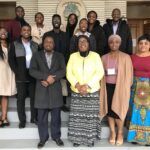
UMBC faculty and staff retreat, summer 2017. Photo by Marlayna Demond ’11.
“I am humbled and grateful for my colleagues’ recognition of my contributions to the Africana studies department, CAHSS, and UMBC; to my profession; and to the fields of Igbo and Nigerian histories, African studies, and gender studies,” shares Chuku. “I feel validated.”
In the span of thirty years, Chuku’s internationally-renowned scholarship and teaching has explored the topics of ethno-nationalism, gender, economics, decolonization, conflict, and African-centered epistemological traditions of the Igbo people, the third largest ethnic group in Nigeria.
Scholarship on Igbo culture
Chuku will spend time studying the Commonwealth and African manuscripts at Oxford University’s Bodleian Libraries in the coming year. She will also do archival research at The National Archives in London. Chuku will then return to the United States to review the unpublished papers on the Igbo people at the Melville J. Herskovits Library of African Studies at Northwestern University.
This research will inform the writing of Chuku’s second book, about the processes of Igbo ethnic identity formation, negotiation, and integration across time. This includes Igbo identity within Nigeria and the global diaspora.
Chuku’s first book, Igbo Women and Economic Transformation in Southeastern Nigeria, 1900 – 1960 (Routledge, 2005), remains the most comprehensive study on Igbo women, covering all Igbo subculture zones. As a result of her work she was the first woman to receive the prestigious Ali Mazrui Award for Scholarship and Research Excellence in 2017.This international award recognizes a pre-eminent scholar of African studies for their research and scholarly achievement.
Chuku’s 2017 Ali Mazrui Award. Photo courtesy of Chuku.
Enriching UMBC
In addition to her research, Chuku has been a vibrant part of the UMBC community. As affiliate professor in gender, women’s, and sexuality studies and language, literacy, and culture, she has served on their undergraduate and doctoral program advisory committees, respectively. She has also served on the Provost’s Advisory Committee on Interdisciplinary Activities.
In 2018 Chuku organized an international conference at UMBC on the history and legacy of women’s roles in the Nigeria-Biafra War. The conference brought renowned scholars and activists from Nigeria, South Africa, Germany, England, Canada, and the United States to UMBC.
UMBC students have also benefited from the intellectual and cultural opportunities Chuku has cultivated at the University. Chuku revived UMBC’s participation in the Model African Union and created the annual Taste of Africa, a celebration of Black History Month and African cultural heritage through unique cuisine and culinary traditions.
Model African Union (2020) in front of the Embassy of Liberia. Photo courtesy of Chuku.
More broadly within the University System of Maryland (USM), Chuku also serves on the executive council of the USM Women’s Forum.
USM Women’s Forum 2019 retreat. Photo courtesy of Natasha Rodriguez.
Liptz Lecture
Similar to previous Lipitz Professorship recipients, Chuku will share her work with the campus community through the Lipitz Lecture. The lecture is the culminating event of the professorship, part of the Humanities Forum lecture series hosted by the Dresher Center for the Humanities.
Chuku follows Jessica Berman, professor of English and director of the Dresher Center for the Humanities, the 2019 – 2020 Lipitz Professor, and Dan Bailey, a professor of visual arts who focuses on animation and interactive media, the 2018 – 2019 recipient.
“Dr. Chuku is recognized worldwide as a leader in her field,” shares CAHSS Dean Scott Casper. “Her service to UMBC and the national and international research community is wide-ranging and deep. I am delighted that she is this year’s recipient of the Lipitz Professorship.”
Banner image: Chuku at UMBC. Photo courtesy of Marlayna Demond ’11 for UMBC.
]]>
Gloria Chuku, chair andprofessor of Africana studies, has been named UMBC’s Lipitz Professor of the College of Arts, Humanities, and Social Sciences (CAHSS) for 2020 – 21. This distinguished...https://umbc.edu/stories/umbcs-gloria-chuku-is-named-the-2020-21-lipitz-professor-for-her-research-on-the-igbo-people-of-nigeria/https://my3.my.umbc.edu/api/v0/pixel/news/119832/guest@my.umbc.edu/b5838e000968f9d14d37e1d040d07400/api/pixelafricanastudiescahsscahssresearchdreshercenterenglishgwstinternationalllcpolicy-and-societyvisualartsUMBC News & Magazinehttps://my3.my.umbc.edu/groups/umbc-news-magazinehttps://assets1-my.umbc.edu/system/shared/avatars/groups/000/001/943/24435aa6207c452e7bc15cc74b42c7bb/xsmall.png?1748556657https://assets1-my.umbc.edu/system/shared/avatars/groups/000/001/943/24435aa6207c452e7bc15cc74b42c7bb/original.png?1748556657https://assets2-my.umbc.edu/system/shared/avatars/groups/000/001/943/24435aa6207c452e7bc15cc74b42c7bb/xxlarge.png?1748556657https://assets2-my.umbc.edu/system/shared/avatars/groups/000/001/943/24435aa6207c452e7bc15cc74b42c7bb/xlarge.png?1748556657https://assets3-my.umbc.edu/system/shared/avatars/groups/000/001/943/24435aa6207c452e7bc15cc74b42c7bb/large.png?1748556657https://assets1-my.umbc.edu/system/shared/avatars/groups/000/001/943/24435aa6207c452e7bc15cc74b42c7bb/medium.png?1748556657https://assets2-my.umbc.edu/system/shared/avatars/groups/000/001/943/24435aa6207c452e7bc15cc74b42c7bb/small.png?1748556657https://assets1-my.umbc.edu/system/shared/avatars/groups/000/001/943/24435aa6207c452e7bc15cc74b42c7bb/xsmall.png?1748556657https://assets2-my.umbc.edu/system/shared/avatars/groups/000/001/943/24435aa6207c452e7bc15cc74b42c7bb/xxsmall.png?1748556657UMBC News & Magazine00falseThu, 23 Jul 2020 18:32:49 -0400Why do Americans say ‘bay-zle’ and the English say ‘baa-zle’?
We develop different accents because of whom we interact with and where we grow up.
An accent is how a person sounds. Kids who grow up in Australia develop Australian accents. Kids who grow up in England develop British accents. And kids who grow up in the United States develop American accents. Everyone has an accent.
When we pick up on another person’s accent, it means we are identifying clues in their pronunciation that tell us something about who they are. These differences can be as small as a single sound, but we often spot them right away.
For example, in the U.S., the word “basil” is pronounced “bay-zle.” But in England, it is pronounced “baa-zle,” like the word “dazzle.” In the U.S., “schedule” is pronounced with a “sk” sound at the beginning, but in England, it’s pronounced with a “sh” sound.
There are also spelling differences, like “theatre” in England versus “theater” in the U.S., and word differences, like “aubergine” in England versus “eggplant” in the U.S.
Everyone has an accent.
Across the country
There are also linguistic differences within countries. Not all people from England sound the same, and the same goes for people from the U.S.
In my own research, I study differences in English spoken in the U.S. In the Great Smoky Mountains, you might hear the word “fire” pronounced like “far,” and “tire” pronounced like “tar.” In the U.S. South, the words “bide” and “ride” tend to sound more like “bad” and “rad.”
And in the city of Baltimore, you might hear some African American residents pronounce “dog” as “dug,” and “frog” as “frug.”
Even in a globally connected world, where it is easier to meet people from other countries than ever before, the way we talk still represents who we are.
So be proud of your vocal fingerprint. A kaleidoscope of languages and accents helps make our world a culturally rich and exciting place.
Hello, curious kids! Do you have a question you’d like an expert to answer? Ask an adult to send your question to CuriousKidsUS@theconversation.com. Please tell us your name, age and the city where you live.
And since curiosity has no age limit – adults, let us know what you’re wondering, too. We won’t be able to answer every question, but we will do our best.
]]>
by Christine Mallinson, Professor of Language, Literacy and Culture and Director of the Center for Social Science Scholarship, UMBC Curious Kids is a series for children of all ages. If you...https://umbc.edu/stories/why-do-americans-say-bay-zle-and-the-english-say-baa-zle/https://my3.my.umbc.edu/api/v0/pixel/news/119944/guest@my.umbc.edu/49030f7f91a585f51adcd8d238ee4ac2/api/pixelcahssdiscoveryllcUMBC News & Magazinehttps://my3.my.umbc.edu/groups/umbc-news-magazinehttps://assets1-my.umbc.edu/system/shared/avatars/groups/000/001/943/24435aa6207c452e7bc15cc74b42c7bb/xsmall.png?1748556657https://assets1-my.umbc.edu/system/shared/avatars/groups/000/001/943/24435aa6207c452e7bc15cc74b42c7bb/original.png?1748556657https://assets2-my.umbc.edu/system/shared/avatars/groups/000/001/943/24435aa6207c452e7bc15cc74b42c7bb/xxlarge.png?1748556657https://assets2-my.umbc.edu/system/shared/avatars/groups/000/001/943/24435aa6207c452e7bc15cc74b42c7bb/xlarge.png?1748556657https://assets3-my.umbc.edu/system/shared/avatars/groups/000/001/943/24435aa6207c452e7bc15cc74b42c7bb/large.png?1748556657https://assets1-my.umbc.edu/system/shared/avatars/groups/000/001/943/24435aa6207c452e7bc15cc74b42c7bb/medium.png?1748556657https://assets2-my.umbc.edu/system/shared/avatars/groups/000/001/943/24435aa6207c452e7bc15cc74b42c7bb/small.png?1748556657https://assets1-my.umbc.edu/system/shared/avatars/groups/000/001/943/24435aa6207c452e7bc15cc74b42c7bb/xsmall.png?1748556657https://assets2-my.umbc.edu/system/shared/avatars/groups/000/001/943/24435aa6207c452e7bc15cc74b42c7bb/xxsmall.png?1748556657UMBC News & Magazine00falseMon, 02 Mar 2020 15:14:08 -0500UMBC is named a Fulbright Top Producing Institution
UMBC is proud to be named a 2019 –2020 Fulbright Top Producing Institution, an honor granted by the U.S. Department of State’s Bureau of Educational and Cultural Affairs. The Fulbright program is the U.S. government’s flagship international exchange program. Over 2,200 U.S. students are awarded Fulbright grants annually, from hundreds of colleges and universities. Only a small portion of these institutions are designated as top producers each year. UMBC is one of 45 doctoral universities nationwide and three in Maryland to receive a Fulbright Top Producing Institution designation for 2019 – 2020. Over 43% of UMBC’s Fulbright U.S. Student Program applicants earned awards. This is the third-highest proportion among all top-producing doctoral institutions, speaking to the quality of UMBC student applications.
The 2018 – 2019 UMBC Fulbright U.S. Student recipients.
“The Fulbright Top Producing Institution designation honors our entire UMBC community,” reflects President Freeman Hrabowski. “It recognizes how UMBC prepares students to get beyond their comfort zones and to tackle global challenges through engagement with communities around the world.”
UMBC global ambassadors
In the last decade, UMBC has received over 60 Fulbright U.S. Student Program awards. In the 2019 – 2020 academic year, fourteen students and alumni earned awards to teach, conduct research, or pursue graduate studies in Africa, Asia and the Pacific, South America, and Europe.
“These Fulbrighters serve as citizen ambassadors for the United States in their host communities, and we will benefit from the skills, knowledge, and global connections they build on their exchanges long after they return home,” shares Marie Royce, assistant secretary of state for educational and cultural affairs.
Morgan Chadderton ’18, modern languages, linguistics, and intercultural communication, shares her experience in Kyrgyzstan where she is teaching English.
This year, 27 UMBC students and recent alumni, a record number, have been selected as Fulbright semifinalists. This selection recognizes their academic merit, leadership potential, and vision to create solutions and serve as leaders around the world.
Support on the Fulbright journey
Each year students must complete a rigorous application process to apply for a Fulbright. They receive support from Brian Souders, M.A.‘19, TESOL, and Ph.D. ’09, language, literacy and culture, UMBC’s Fulbright program advisor, as well as faculty and staff across campus. This process asks applicants in all majors to provide evidence of their academic excellence, commitment to global community partnerships, and a record of leadership through service.
“Dedicated UMBC faculty and staff mentor students and alumni annually from across the campus, from film-making and anthropology to quantum physics to mechatronics,” says Souders. “They support them through the application process, and help them prepare their work to reflect their academic purpose and goals for this globally prestigious and life-changing award.”
Flora Kirk ’18, ancient studies, is conducting research on Roman coins at Babeș-Bolyai University (UBB) in Romania.
Study abroad as a pathway to Fulbright
Many future Fulbright recipients begin their international experience with study abroad through International Education Services. This UMBC office offers students opportunities to study and research internationally as early as the summer before their incoming year. In UMBC’s 2019 – 2020 Fulbright class, ten out of fourteen recipients had already pursued research and education abroad. For the 2018 – 2019 class, that number was six out of eight recipients.
Jessica Linus ’19, health administration policy, at an orphanage during a service trip to Port Harcourt, Nigeria before her Fulbright year. Photo courtesy of Linus.
“Studying abroad gives students that first foundational taste of being in a new global environment,” shares Caylie Middleton, associate director of education abroad. “International academic, social, and cultural experiences help develop the curiosity and skills that prepare students for prestigious international opportunities in the future.”
Fulbrighters have also participated in other international opportunities, including with student organizations like Engineers Without Borders, class-based online international exchanges like Global Engineering, faculty-led study abroad courses, and online language exchanges, which UMBC offers in Spanish and Japanese.
Liam Connor ‘18, information systems, (second from left) with colleagues in Vietnam during a study abroad experience. Photo courtesy of Connor and the Vietnam Medical Assistance Program.
Souders is proud that so many Retrievers are accessing opportunities for international learning experiences, through Fulbright and a broad range of other UMBC international programs. The Top Producer accolade is a milestone that represents an important trend—more UMBC students and recent alumni are researching, learning, and teaching abroad each year.
“Retrievers have a deep understanding of the value of diverse experiences, identities, and cultures,” Souders says. “They know that the world they dream of can only be made possible by reaching together in mutual understanding.”
Feature image: Souders with UMBC’s 2019 – 2020 Fulbright U.S. Student recipients. All photos by Marlayna Demond ’11 unless otherwise noted.
]]>
UMBC is proud to be named a 2019 – 2020 Fulbright Top Producing Institution, an honor granted by the U.S. Department of State’s Bureau of Educational and Cultural Affairs. The Fulbright program is...https://umbc.edu/stories/umbc-is-named-a-fulbright-top-producing-institution/https://my3.my.umbc.edu/api/v0/pixel/news/119957/guest@my.umbc.edu/4a8ce66d0bc8c57780266c242004a62c/api/pixelancientstudiescahsscoeitgraduateschoolisllcmllipage1policy-and-societyrankingssaphscience-and-technologyUMBC News & Magazinehttps://my3.my.umbc.edu/groups/umbc-news-magazinehttps://assets1-my.umbc.edu/system/shared/avatars/groups/000/001/943/24435aa6207c452e7bc15cc74b42c7bb/xsmall.png?1748556657https://assets1-my.umbc.edu/system/shared/avatars/groups/000/001/943/24435aa6207c452e7bc15cc74b42c7bb/original.png?1748556657https://assets2-my.umbc.edu/system/shared/avatars/groups/000/001/943/24435aa6207c452e7bc15cc74b42c7bb/xxlarge.png?1748556657https://assets2-my.umbc.edu/system/shared/avatars/groups/000/001/943/24435aa6207c452e7bc15cc74b42c7bb/xlarge.png?1748556657https://assets3-my.umbc.edu/system/shared/avatars/groups/000/001/943/24435aa6207c452e7bc15cc74b42c7bb/large.png?1748556657https://assets1-my.umbc.edu/system/shared/avatars/groups/000/001/943/24435aa6207c452e7bc15cc74b42c7bb/medium.png?1748556657https://assets2-my.umbc.edu/system/shared/avatars/groups/000/001/943/24435aa6207c452e7bc15cc74b42c7bb/small.png?1748556657https://assets1-my.umbc.edu/system/shared/avatars/groups/000/001/943/24435aa6207c452e7bc15cc74b42c7bb/xsmall.png?1748556657https://assets2-my.umbc.edu/system/shared/avatars/groups/000/001/943/24435aa6207c452e7bc15cc74b42c7bb/xxsmall.png?1748556657UMBC News & Magazine00falseMon, 10 Feb 2020 17:47:17 -0500Leaders in Teaching – Alumni Award Winners Raise the Bar
When La Jerne Terry Cornish first started classes at UMBC, her son was two years old, she was teaching full-time, and she had to drive 45 minutes to get to campus.
The journey was never easy. But in the seven years it took to finish her Ph.D. in language, literacy, and culture, the discussions hit home and the supportive community around her made all the difference, she says.
“The LLC program allowed me to dream a dream I didn’t dream,” says Cornish, Ph.D. ’05, who now serves as provost and senior vice president of Ithaca College, following a long career in teaching and administration at Goucher College.
“I never thought I would end up where I am, but the preparation I received as a result of that program, and the support of the faculty, staff, and students prepared me for my next steps.”
This week, Cornish will receive the UMBC Outstanding Alumni Award for the Humanities. Fellow LLC alumna Beverly Bickel, M.A. ’94, instructional development systems, Ph.D. ’05, LLC, will also be honored with the Outstanding Faculty Award for her work as clinical associate professor, UMBC, language, literacy, and culture; affiliate associate professor, gender and women’s studies. (Learn more about the winners and the October 2 ceremony.)
Teaching our teachers
Like Cornish, Bickel found a community she loved dearly at UMBC. And since she has pretty much always wanted to be a teacher herself—she frequently taught her younger siblings during their playtime “school”—working as a professor within the LLC program and in other departments at UMBC just makes sense.
After starting her career in early childhood education and earning her master’s at UMBC, Bickel was teaching at the Community College of Baltimore County when a new position opening at UMBC—director of the English Language Center—caught her eye.
Bickel celebrates with student Mary Laurents (third from left) following the successful defense of Laurents’ dissertation. Pictured left to right: Amy Froide (HIST), Dan Ritschel (HIST), Laurents, Bickel, Nicole Cousin-Gossett (SOCY) and Scott Casper (HIST and CAHSS Dean)
Her husband, David Truscello, Ph.D. ’04, was a member of the first cohort of LLC doctoral students with Cornish, and between that connection and the gentle, but persistent, encouragement from LLC founding director and professor emerita Joann “Jodi” Crandall, Bickel soon was pulled into the program as a student herself as she took on the ELC director position.
Now, as a professor, Bickel likes to take the time to understand where her students are in their lives. That means creating a comfortable environment where they can be honest about their needs and providing a support system for those who are figuring things out as they navigate their doctoral pathways.
“As my instructor, Bev listened carefully to my interests and ideas, affirmed some of my most adventurous instincts, and shared resources that could help me find my path,” wrote David Hoffman, Ph.D. ’13, LLC, and director of UMBC’s Center for Democracy and Civic Life, in nominating Bickel for this award.
“She was unfailingly patient and creative, and above all, responsive to me: truly hearing my hopes, amplifying my curiosity, and helping me to believe in myself as a researcher.”
At home, Bickel and her husband, now retired, have what they call a “lifelong study group.” Her ongoing desire to connect with her students on a personal basis keeps her energized with every semester, where she often starts her classes with a conversation about their days, their lives. Sometimes they listen to a song or read an essay. Many drink tea while they chat.
“We’ve got to connect as humans before we try to think about whatever texts we’ve read,” she says. “I love that about teaching. It might be four- and five-year-olds, or it might be adults, but everybody is coming in with themselves first before engaging in this work we call teaching and learning.”
A special community
Founded in 1998, UMBC’s language, literacy, and culture Ph.D. program was the first of its kind to bring an interdisciplinary approach to a type of research that crosses the humanities, social sciences, and education. Since then, many universities have copied the model, Crandall says. But, breaking new ground at the time meant the first cohorts of students played an important role in making the program what it is today.
Because the program attracted such a variety of students—many of whom taught, had families, and were well along in their careers—it became a true experiment in balance and community.
Cornish remembers her first class with Crandall. The discussion was so interesting, intense, and fun, she says, it went at least 15 minutes over.
“I was so taken by that first class,” said Cornish, who laughs as she recalls having to remind Crandall that “‘We have to teach in the morning!’ But, the material was so rich. She challenged us, she made us think. It was wonderful.”
Following graduation, Cornish spent nearly 20 years helping to build the education department at Goucher, where she had previously earned her bachelor’s and master’s degrees. Having spent the last few months settling into her new position at Ithaca, she says she looks forward to re-connecting with LLC faculty on her return visit to campus.
Kimberly Moffitt, chair of the LLC Ph.D., said Cornish represents the best of what their alumni have to offer. “In a program designed to enhance critical thinking skills in areas of culture across disciplinary and methodological boundaries, Dr. Cornish was not only a member of the first cohort of graduates, but she also lent her educational expertise to shape and co-facilitate the curriculum,” she writes.
As Crandall recalls the first years of the program, she emphasizes that Bickel and Cornish were both instrumental in building the LCC into the standard bearer it is today.
“These are two wonderful women who had all the right leadership skills and just such a strong sense of themselves…and a strong sense of social justice,” she says. “I am just so thrilled for them both.”
]]>
When La Jerne Terry Cornish first started classes at UMBC, her son was two years old, she was teaching full-time, and she had to drive 45 minutes to get to campus. The journey was never easy....https://umbc.edu/stories/leaders-in-teaching-alumni-award-winners-raise-the-bar/https://my3.my.umbc.edu/api/v0/pixel/news/120037/guest@my.umbc.edu/67fd01e533be6566698190511c1b1726/api/pixelalumnialumni-awards-2019cahssgraduateschoolllcUMBC News & Magazinehttps://my3.my.umbc.edu/groups/umbc-news-magazinehttps://assets1-my.umbc.edu/system/shared/avatars/groups/000/001/943/24435aa6207c452e7bc15cc74b42c7bb/xsmall.png?1748556657https://assets1-my.umbc.edu/system/shared/avatars/groups/000/001/943/24435aa6207c452e7bc15cc74b42c7bb/original.png?1748556657https://assets2-my.umbc.edu/system/shared/avatars/groups/000/001/943/24435aa6207c452e7bc15cc74b42c7bb/xxlarge.png?1748556657https://assets2-my.umbc.edu/system/shared/avatars/groups/000/001/943/24435aa6207c452e7bc15cc74b42c7bb/xlarge.png?1748556657https://assets3-my.umbc.edu/system/shared/avatars/groups/000/001/943/24435aa6207c452e7bc15cc74b42c7bb/large.png?1748556657https://assets1-my.umbc.edu/system/shared/avatars/groups/000/001/943/24435aa6207c452e7bc15cc74b42c7bb/medium.png?1748556657https://assets2-my.umbc.edu/system/shared/avatars/groups/000/001/943/24435aa6207c452e7bc15cc74b42c7bb/small.png?1748556657https://assets1-my.umbc.edu/system/shared/avatars/groups/000/001/943/24435aa6207c452e7bc15cc74b42c7bb/xsmall.png?1748556657https://assets2-my.umbc.edu/system/shared/avatars/groups/000/001/943/24435aa6207c452e7bc15cc74b42c7bb/xxsmall.png?1748556657UMBC News & Magazine00falseTue, 01 Oct 2019 13:53:54 -0400World View — Ryan Monroe, M.A. ’84, Ph.D. ’06
By Caitlin James ’01
When asked how the Peace Corps has changed in the past 35 years, Ryan Monroe, M.A. ’84, Ph.D. ’06, reflects thoughtfully. As the current director of programming and training for the Peace Corps in Kyrgyzstan and a returned Peace Corps volunteer who trained rural literacy volunteers in Honduras in the mid-80s, Monroe brings a unique perspective to the question.
He laughs as he recalls that when he was a volunteer in Honduras, he was told only the name of a town, and it was up to him to find a place to live.
“The training is a lot better now than when I was in it [as a volunteer]. It’s really on target and well thought out,” Monroe begins. “Once we decide which village a volunteer is going to work in, multiple people go to train the community, train the families they’ll live with. Selecting the right family, the right house—a lot of careful thought is put into it.”
In addition, Monroe had a license and rode a motorcycle while he was in Honduras—something the Peace Corps now forbids. The more cautious approach has resulted in fewer tragedies involving volunteers, according to Monroe.
At The Carlos Rosario International Public Charter School in Washington, D.C., with culinary arts students.
Monroe comes to his new post with over 30 years of experience in immigrant education in California and the Washington, D.C., area and three degrees in the field, including two from UMBC: an MA in instructional systems development in bilingual education and a Ph.D. in language, literacy, and culture. His prior administrative posts at the Carlos Rosario International Public Charter School in Washington, D.C.—the first public charter school for adult immigrants in the United States—prepared him particularly well for the job in Kyrgyzstan.
“In Kyrgyzstan, the program is all teaching English, so as a principal at Carlos Rosario, it was all about English instruction, so it’s a very good match,” Monroe says.
When Monroe arrived in Kyrgyzstan last October, one of his first responsibilities was to play a supervisory role in the 11-week pre-service training of about 40 newly-arrived trainees. In addition to managing the logistics of the annual training in Kyrgyz language and culture and English instruction, he also gets to know the trainees, before they officially become “volunteers.” Monroe says he applies what he learned about training design at UMBC when developing training programs in Kyrgyzstan.
As a doctoral student at UMBC, Monroe did qualitative research involving 5th grade Latino students and their families in Prince George’s County, Maryland, focusing on their experiences with standardized testing. He later used his research to create workshops to explain state assessments to parents.
Although Monroe completed his Ph.D. in 2006, Sarah Shin, UMBC associate provost for academic affairs, doesn’t even stop to take a breath when asked to describe Monroe, one of her very first doctoral advisees back when she was an associate professor of education.
“Ryan really approached that whole subject (of testing) very humanistically, looking at it from where the students were,” Shin says. “I learned a lot about the families because his dissertation had to do with really meeting the needs of ESOL students in terms of accommodations and family issues, and I felt like he really brought such richness to the whole topic.”
“As a Peace Corps director you really have to be thinking creatively about a lot of things. Ryan is perfect for that kind of position, and I think Peace Corps lucked out in getting him.” — Sarah Shin
Monroe is one of three Americans working with 30 Kyrgyz Peace Corps staff in the capital, Bishkek. He finds the work enriching but challenging—just what he had hoped for as he prepares to retire in four years. And he’s studying Russian with a tutor so he can get around better in Bishkek.
“I live alone and work in English all day, and I think being 60, I’m more forgetful and have to practice the words a lot more than I did learning Spanish,” he explains. “I love writing in Cyrillic, but it’s a very complicated language.”
Another challenge Monroe faces is being a gay man in a post-Soviet country, where it has been like stepping back to a time in the States when the community was underground. “There’s a strong connection to Russia, and Russia is not accepting of the LGBTQ+ community legally and socially,” Monroe says.
Despite all this, Monroe says he is out to the Peace Corps staff and that they are looking forward to meeting his husband, Victor, when he visits Kyrgyzstan for the first time this fall. He also notes that the Peace Corps as an entity and the U.S. Embassy are very supportive of LGBTQ+ rights.
Shin says it’s no stretch of the imagination to envision Monroe having an impact in Kyrgyzstan.
“As a Peace Corps director you really have to be thinking creatively about a lot of things,” Shin says. “He needs to be able to navigate cross cultural global things very well, and Ryan is perfect for that kind of position, and I think Peace Corps lucked out in getting him.”
Images provided by Ryan Monroe. Header image: Monroe, center right, visits with Peace Corps volunteers at a host family’s home.
]]>
By Caitlin James ’01 When asked how the Peace Corps has changed in the past 35 years, Ryan Monroe, M.A. ’84, Ph.D. ’06, reflects thoughtfully. As the current director of programming and training...https://umbc.edu/stories/world-view-ryan-monroe-m-a-84-ph-d-06/https://my3.my.umbc.edu/api/v0/pixel/news/120041/guest@my.umbc.edu/597e4862e5e222faf586314608512aa5/api/pixelalumnicoeitgraduateschoolisllcUMBC News & Magazinehttps://my3.my.umbc.edu/groups/umbc-news-magazinehttps://assets1-my.umbc.edu/system/shared/avatars/groups/000/001/943/24435aa6207c452e7bc15cc74b42c7bb/xsmall.png?1748556657https://assets1-my.umbc.edu/system/shared/avatars/groups/000/001/943/24435aa6207c452e7bc15cc74b42c7bb/original.png?1748556657https://assets2-my.umbc.edu/system/shared/avatars/groups/000/001/943/24435aa6207c452e7bc15cc74b42c7bb/xxlarge.png?1748556657https://assets2-my.umbc.edu/system/shared/avatars/groups/000/001/943/24435aa6207c452e7bc15cc74b42c7bb/xlarge.png?1748556657https://assets3-my.umbc.edu/system/shared/avatars/groups/000/001/943/24435aa6207c452e7bc15cc74b42c7bb/large.png?1748556657https://assets1-my.umbc.edu/system/shared/avatars/groups/000/001/943/24435aa6207c452e7bc15cc74b42c7bb/medium.png?1748556657https://assets2-my.umbc.edu/system/shared/avatars/groups/000/001/943/24435aa6207c452e7bc15cc74b42c7bb/small.png?1748556657https://assets1-my.umbc.edu/system/shared/avatars/groups/000/001/943/24435aa6207c452e7bc15cc74b42c7bb/xsmall.png?1748556657https://assets2-my.umbc.edu/system/shared/avatars/groups/000/001/943/24435aa6207c452e7bc15cc74b42c7bb/xxsmall.png?1748556657UMBC News & Magazine00falseMon, 23 Sep 2019 16:22:43 -0400Hitting All the Right Notes
In the corner of the Performing Arts building, a haunting melody rises up in goosebump-inducing refrain and is suddenly interrupted by a quick stamping foot and an insistent correction. In a gruff but kind voice, the director of UMBC’s Russian Chorus rectifies the soloist’s rolled “r”s and the group immediately begins singing again, at ease with the complex syllables of the Russian ballad, even though some of them speak no Russian outside of this hour long course twice a week.
The chorus is one of only three like it in the whole country. Yale and the University of Chicago also boast ensembles, making UMBC’s group something of an anomaly. At the heart of the choir is the director: Slava Liberman, a formally trained choral director from Belarus who moved to Maryland with his family in the early 1990s. His passion for the folk traditions in Russian classical music has not faded in the two decades directing at UMBC; and his current group of students and alumni performers are enthralled with the world of Russian music to which Liberman holds the key.
“I love working with Slava,” says junior Felicia Jones, modern languages and linguistics. “He is the first chorus instructor I have ever had that is so passionate about what he does. He gives me a clear idea of how he wants things sung, and he always will make time for me if I feel that I need extra time to work on a certain song.”
Vira Zhdanovych, the Russian Club advisor, instructor of Russian, and herself an accomplished mezzo-soprano, sees the chorus as a compelling aspect of the Russian community on campus. Often, she says, her students need to be encouraged with a little extra credit to begin participating, but once Liberman connects them to these historic songs, they keep coming back—even as alumni.
“The chorus was an amazing way to learn a language through experience,” says Logan Dean ’17, political science and social work, who joined the group in 2017 while in Russian 101. Currently a financial aid counselor at UMBC, Dean says that Liberman is the reason he spends his lunch breaks returning to sing songs like Katyusha, The Long Road, and Moscow Nights.
“There is something about seeing someone so passionate about something, it just really motivates you,” Dean says. “He regularly tells us to stop laughing at him when he’s stomping his feet and shouting in Russian, but all his actions happen because he has a vision for us and for the music and it gives him this intense energy about directing.”
Liberman says he plans on continuing the Russian Chorus until he’s no longer able or allowed. He turns to a poetic Russian phrase to describe its effect on the students and campus alike: “Луч света в тёмном царстве,” which translates as “the brightest light in the darkest kingdom.” Watching his American students overcome linguistic barriers, learn to sing Russian vowels, or fall in love with folk music of the 20th century is a moment of watching that light shine. “For me, it’s a big privilege to work with these American students. Each time when I hear they are doing better, it’s like a victory.”
“I think everyone should find their version of Russian Chorus,” says Dean. “Something weird and maybe unusual that they enjoy. It makes life more interesting and opens doors to new things that you may have never experienced otherwise.”
*****
Header image: Sheets of Russian choral music with student notes. Photo courtesy of Randianne Leyshon ’09.
]]>
In the corner of the Performing Arts building, a haunting melody rises up in goosebump-inducing refrain and is suddenly interrupted by a quick stamping foot and an insistent correction. In a gruff...https://umbc.edu/stories/umbcs-russian-chorus-is-unique-to-any-public-institution/https://my3.my.umbc.edu/api/v0/pixel/news/120145/guest@my.umbc.edu/cc170d66b5fa6e6b74842b880d5ef70d/api/pixelcampus-lifedepartment-of-musicllcmllirussian-chorusrussian-clubspring-2019UMBC News & Magazinehttps://my3.my.umbc.edu/groups/umbc-news-magazinehttps://assets1-my.umbc.edu/system/shared/avatars/groups/000/001/943/24435aa6207c452e7bc15cc74b42c7bb/xsmall.png?1748556657https://assets1-my.umbc.edu/system/shared/avatars/groups/000/001/943/24435aa6207c452e7bc15cc74b42c7bb/original.png?1748556657https://assets2-my.umbc.edu/system/shared/avatars/groups/000/001/943/24435aa6207c452e7bc15cc74b42c7bb/xxlarge.png?1748556657https://assets2-my.umbc.edu/system/shared/avatars/groups/000/001/943/24435aa6207c452e7bc15cc74b42c7bb/xlarge.png?1748556657https://assets3-my.umbc.edu/system/shared/avatars/groups/000/001/943/24435aa6207c452e7bc15cc74b42c7bb/large.png?1748556657https://assets1-my.umbc.edu/system/shared/avatars/groups/000/001/943/24435aa6207c452e7bc15cc74b42c7bb/medium.png?1748556657https://assets2-my.umbc.edu/system/shared/avatars/groups/000/001/943/24435aa6207c452e7bc15cc74b42c7bb/small.png?1748556657https://assets1-my.umbc.edu/system/shared/avatars/groups/000/001/943/24435aa6207c452e7bc15cc74b42c7bb/xsmall.png?1748556657https://assets2-my.umbc.edu/system/shared/avatars/groups/000/001/943/24435aa6207c452e7bc15cc74b42c7bb/xxsmall.png?1748556657UMBC News & Magazine00falseThu, 02 May 2019 14:14:11 -0400UMBC partners with Blackboard, VitalSource on research to support student success
UMBC’s Division of Information Technology has made headlines for innovative research collaborations aimed at boosting student success through analyzing how students utilize digital resources. Recently, UMBC researchers have continued this work with education technology companies Blackboard and VitalSource, the university’s learning management system and e-textbook providers. The goal of this research partnership is to better understand connections between how students use course tools and their class performance, and to use that knowledge to support student learning and success.
Leading this work for UMBC are CIO and Vice President of IT Jack Suess ‘81, mathematics, M.S. ‘95, operations analysis; Associate Vice President of Instructional Technology John Fritz Ph.D. ‘16, language, literacy, and culture; and Robert Carpenter, deputy CIO and associate provost for analytics. An early pilot study focused on anonymized data reflecting the performance of nearly 1,000 undergraduates in seven sections of five UMBC courses across a range of disciplines in Fall 2017. Success was defined as earning a C or higher final grade.
Among other things, the UMBC, Blackboard and VitalSource researchers found that by combining data from a wide range of sources, they were able to develop a model that was 70-98 percent accurate in predicting, by week four in the semester, which students would go on to earn a C or higher final grade. Their findings were shared in a Blackboard blog post and then reported by Campus Technology this past summer.
Providing help in time
“This project is important because it focuses on early intervention—offering help in time for a student to improve their trajectory,” explains Fritz. Ideally, he notes, that extra level of support could kick in by week four of the semester. “We want to reach out to and support students earlier in a term,” he says, “when a change in their awareness and behavior could make a difference in outcomes.”
John Fritz.
Although the study did not test specific interventions, the researchers believe they have found actionable, concrete evidence that could make a difference in student achievement, to help boost grades and decrease the number of students who need to repeat a course. They are now working to replicate the study, refine the model, and explore relevant interventions, which Carpenter has been developing in complementary analytics studies using Blackboard.
Data-driven collaborations
“UMBC has a long history of innovation as a data-driven institution,” says Suess, who is chair of the board for IMS Global, which defines and supports the standards for the Caliper framework that was used in the study. In addition to resulting in interesting findings, this study “was a solid analytics infrastructure proof-of-concept,” he notes.
The research partners also reflect that this project highlights how so many different units across the university play essential roles in supporting student success. The UMBC bookstore’s Course Materials Initiative, for example, has worked to encourage faculty to use e-textbooks, giving students a more affordable, accessible textbook option and making this type of analytics-based research study possible.
“Our progress using analytics to design interventions for student success wouldn’t be possible without the strong partnerships we’ve developed with faculty and departments,” said Carpenter. “It’s a team effort.”
Additional information about how DoIT uses analytics at UMBC can be found on the DoIT Analytics website.
Banner image: John Fritz. Photo by Marlayna Demond ’11 for UMBC.
]]>
UMBC’s Division of Information Technology has made headlines for innovative research collaborations aimed at boosting student success through analyzing how students utilize digital resources....https://umbc.edu/stories/umbc-partners-with-blackboard-vitalsource-on-research-to-support-student-success/https://my3.my.umbc.edu/api/v0/pixel/news/120266/guest@my.umbc.edu/ec48fcfb51d0425b623f5111979a0f82/api/pixelcahsscnmscoeitllcmathstatscience-and-technologystaffUMBC News & Magazinehttps://my3.my.umbc.edu/groups/umbc-news-magazinehttps://assets1-my.umbc.edu/system/shared/avatars/groups/000/001/943/24435aa6207c452e7bc15cc74b42c7bb/xsmall.png?1748556657https://assets1-my.umbc.edu/system/shared/avatars/groups/000/001/943/24435aa6207c452e7bc15cc74b42c7bb/original.png?1748556657https://assets2-my.umbc.edu/system/shared/avatars/groups/000/001/943/24435aa6207c452e7bc15cc74b42c7bb/xxlarge.png?1748556657https://assets2-my.umbc.edu/system/shared/avatars/groups/000/001/943/24435aa6207c452e7bc15cc74b42c7bb/xlarge.png?1748556657https://assets3-my.umbc.edu/system/shared/avatars/groups/000/001/943/24435aa6207c452e7bc15cc74b42c7bb/large.png?1748556657https://assets1-my.umbc.edu/system/shared/avatars/groups/000/001/943/24435aa6207c452e7bc15cc74b42c7bb/medium.png?1748556657https://assets2-my.umbc.edu/system/shared/avatars/groups/000/001/943/24435aa6207c452e7bc15cc74b42c7bb/small.png?1748556657https://assets1-my.umbc.edu/system/shared/avatars/groups/000/001/943/24435aa6207c452e7bc15cc74b42c7bb/xsmall.png?1748556657https://assets2-my.umbc.edu/system/shared/avatars/groups/000/001/943/24435aa6207c452e7bc15cc74b42c7bb/xxsmall.png?1748556657UMBC News & Magazine00falseMon, 26 Nov 2018 22:01:10 -0500Amy Bhatt shines light on gender and immigration policy in new book High-Tech Housewives
“I am interested in the human face of policy,” says UMBC’s Amy Bhatt. “I want to share the personal narratives of immigrants few people hear about—highly skilled workers—and help us understand their experience as they face questions of citizenship, belonging, and community.”
Bhatt, an associate professor of gender and women’s studies, and affiliate associate professor in the language, literacy, and culture, and Asian studies programs, has made headlines nationwide by providing research-based expertise on contemporary U.S. immigration policy. She’s bringing the conversation to UMBC through a Humanities Forum talk on her new book, High-Tech Housewives: Indian IT Workers, Gendered Labor, and Transmigration, on Wednesday, December 5, 2018, 4 – 5:30 p.m., in the Albin O. Kuhn Library Gallery.
“Now more than ever, Professor Bhatt’s research is crucial in helping all of us understand the everyday impact of high-skilled immigration,” shares Jessica Berman, professor of English and director of the Dresher Center for the Humanities, which organizes the Humanities Forum. “Thriving academic research communities are enriched by the knowledge and expertise highly-skilled international faculty, staff, and students bring and share.”
H-1B and H-4 visa programs allow skilled workers from South Asian countries to travel with their families to the U.S. to fill needed temporary positions in corporations, hospitals, and universities. Bhatt explains, “U.S. consumers depend on the global flow of goods and services in the tech, healthcare, and higher education sectors.” She notes, “In a global high-tech economy it is important to acknowledge the value that immigrants bring to our lives and how they are being threatened by immigration policy.”
Bhatt’s work focuses on gender as an important and understudied factor at the intersection of immigration law and global economy. She notes that 85 percent of H-1B visa holders are men. Their spouses can join them in the U.S. under the H-4 visa program, but, even if those spouses are themselves highly skilled, they are unable to apply their expertise in the paid workforce. Instead, they often become “high-tech housewives” due to the constraints of immigration law, rather than choice.
“People tend to think about H-1B visa issues as problems that only affect men,” failing to consider the often highly skilled spouses who come with them to the U.S.,” says Bhatt.
“Women’s abilities to migrate—flexibility in foregoing their own careers at times, and work to manage family demands, cultural transmission, connection to home country, and building local relationships—allow their spouses to take highly skilled jobs in the United States,” explains Bhatt. Her research explores how the current visa system not only limits the employment of highly skilled women, but also impacts their identities and day-to-day experiences in other significant ways.
In addition to her recent book, Amy Bhatt has recently published three widely read articles on U.S. and international policy issues and gender through The Conversation, including “Why Trump’s plan to forbid spouses of H-1B visa holders to work is a bad idea.” In that article, Bhatt writes, “H-4 women face a triple burden if they are able to start working again, particularly in technology: race, gender and long gaps in their resumes.”
Whether sharing her work through academic publications or news media like the Seattle Times, Bhatt’s overall message is the same.
“It is an urgent call for all of to pay attention,” she says, “to changes in immigration trends, globalization, how businesses are thinking about labour pools, and how we think of gender and women in the family in these economic and political processes.”
Banner image: Amy Bhatt. Photo courtesy of Amy Bhatt.
]]>
“I am interested in the human face of policy,” says UMBC’s Amy Bhatt. “I want to share the personal narratives of immigrants few people hear about—highly skilled workers—and help us understand...https://umbc.edu/stories/amy-bhatt-shines-light-on-gender-and-immigration-policy-in-new-book-high-tech-housewives/https://my3.my.umbc.edu/api/v0/pixel/news/120269/guest@my.umbc.edu/36db12c56a07a85238af8ad9ba9981b7/api/pixelasianstudiescahssdreshercentergwstllcpolicy-and-societyUMBC News & Magazinehttps://my3.my.umbc.edu/groups/umbc-news-magazinehttps://assets1-my.umbc.edu/system/shared/avatars/groups/000/001/943/24435aa6207c452e7bc15cc74b42c7bb/xsmall.png?1748556657https://assets1-my.umbc.edu/system/shared/avatars/groups/000/001/943/24435aa6207c452e7bc15cc74b42c7bb/original.png?1748556657https://assets2-my.umbc.edu/system/shared/avatars/groups/000/001/943/24435aa6207c452e7bc15cc74b42c7bb/xxlarge.png?1748556657https://assets2-my.umbc.edu/system/shared/avatars/groups/000/001/943/24435aa6207c452e7bc15cc74b42c7bb/xlarge.png?1748556657https://assets3-my.umbc.edu/system/shared/avatars/groups/000/001/943/24435aa6207c452e7bc15cc74b42c7bb/large.png?1748556657https://assets1-my.umbc.edu/system/shared/avatars/groups/000/001/943/24435aa6207c452e7bc15cc74b42c7bb/medium.png?1748556657https://assets2-my.umbc.edu/system/shared/avatars/groups/000/001/943/24435aa6207c452e7bc15cc74b42c7bb/small.png?1748556657https://assets1-my.umbc.edu/system/shared/avatars/groups/000/001/943/24435aa6207c452e7bc15cc74b42c7bb/xsmall.png?1748556657https://assets2-my.umbc.edu/system/shared/avatars/groups/000/001/943/24435aa6207c452e7bc15cc74b42c7bb/xxsmall.png?1748556657UMBC News & Magazine00falseWed, 21 Nov 2018 15:30:47 -0500UMBC’s Ashe and Berry-McCrea earn national honors for doctoral research addressing inequities
UMBC doctoral student Jason Ashe and new Ph.D. recipient Erin Berry-McCrea have been selected for notable national honors as emerging leaders in work to address inequalities, in health care and in educational and professional spaces.
The Robert Wood Johnson Foundation (RWJF) has selected Ashe, a human services psychology doctoral student, for its prestigious Health Policy Research Scholar leadership development program. The program is designed for second-year doctoral students from underrepresented populations and disadvantaged backgrounds who want to apply their work to policies that advance equity and health. RWJF seeks to build a diverse field of health policy research leaders who reflect our changing national demographics.
Berry-McCrea, who successfully defended her dissertation in language, literacy, and culture this fall, received the 2018 National Council of Teachers of English (NCTE) Early Career Educator of Color (ECOC) Leadership Award. Barry-McCrea’s research focuses on how millennial Black women create and utilize digital spaces and tools in navigating professional and educational experiences. The award she received recognizes educators of color in the first years of their faculty careers, providing two years of mentorship to support research development, and funding to attend the ECOC Institute and the 2018 NCTE Annual Convention.
Intersection of health and faith
Ashe is focused on applying his research on Black religious beliefs, spirituality, and racial and ethnic health disparities to develop more inclusive and responsive medical practices and to reduce health inequities.
As a first-generation American, Ashe witnessed his parents face major challenges in everyday life in The Bronx, New York, during the 1980s. Both came to the United States from Antigua in search of more opportunities. His father gained citizenship through the Navy and his mother worked as a housemaid. Growing up, Ashe recalls his parents dealing with doctors who laughed at their accents and disregarded their ailments and their belief systems.
“When I was studying pre-med chemistry, I had a lot of existential questions of life and death that I could not find answers for. At divinity school I was able to take Christian bioethics, which led me to ask more questions about people who don’t have the choice to die peacefully,” explains Ashe. “I understood then that I wasn’t interested in being a physician and focusing on palliative care, but on answering more systemic-level questions about health and dying, specifically in Black communities.”
Ashe presents his interdisciplinary research.
That is what led Ashe to UMBC’s psychology Ph.D. program. “I wanted to understand the psychology of religion and health identity,” he says. “What does advocacy look like and how do we use our scholarship so that erroneous claims are not made to justify inequities in communities of color?”
Ashe found a mentor in Danielle L. Beatty Moody, psychology. The Human Services Psychology program she leads presented an avenue for him to apply his research, ideas, and innovative perspective. Moving forward, he hopes to create real change in communities of color and the medical community.
“Jason came with little exposure to psychology but came here with such a depth in math and science from MIT and two master’s degrees in theology and divinity from Duke. He wanted to bring those pieces together to create understanding around the health of Black folks,” explains Beatty Moody. “Jason was ready for the challenge of what it takes to move the needle so that we are not just talking to other academics, but applying our research to improve people’s lives.”
Creating supportive digital spaces for and by Black women
Berry-McCrea is applying her research in digital and media literacy to bring awareness to the online linguistic practices of Black women who create brave spaces to manage professional and social issues unique to their experiences.
Berry-McCrea’s graduate mentor, Christine Mallinson, professor of language, literacy and culture, and director of the Center for Social Science Scholarship, describes her work as essential for anyone concerned with educational justice and wanting to help, work with, and engage students of color in developing agency as engaged communicators.
“There’s no question that language shapes, and is shaped by, our social identities—both online and offline,” says Mallinson. “Erin’s work gives us a student-centered and culturally informed understanding of what factors shape Black collegiate women’s linguistic choices, both in terms of how they navigate the complex landscape of higher education, as well as how they find and create spaces—often online—where they can communicate in ways that are authentic to themselves.”
Berry- McCrea (third from the right) with her dissertation committee (L to R): Kimberly Moffitt, Elizabeth Patton, Christine Mallinson, Jason Loviglio, co-chair of committe, and Donald Snyder. Photo courtesy of Berry-McCrea.
Berry-McCrea’s experiences in higher education both as a student and as an educator have given her a window into the many contradicting messages that Black women receive. “As I climbed the ladder of academia I saw less people like me and more people that made negative assumptions about who I was because I was Black,” she says. “I’ve also had my Black female students share their own experiences with professors that placed negative labels and expectations on them. It was very clear that to be a professional academic for Black women meant deleting any trace of themselves in the way they spoke, looked, and carried themselves.”
These experiences have led Black millennial women to create unique digital spaces, Berry-McCrea notes, and these spaces have formed the basis of her research. Berry-McCrea found that Black millennial women often seek refuge, support, and resources through the immediacy and wide geographic net of social media.
Berry-McCrea defending her dissertation at UMBC this fall. Photo courtesy of Berry-McCrea.
“Black collegiate women could post their experiences on social media and immediately receive validation of their experience, support from peers, and resources to move from isolation to finding a place to succeed even within these parameters without having to give up what was authentic to them,” she explains.
Berry-McCrea recently published this research in the journal Meridians, through the article “‘To My Girls in Therapy, See Imma Tell You This for Free …’: Black Millennial Women Speaking Truth to Power in and across the Digital Landscape.” She is now an assistant professor of media and communication studies at St. Augustine University in North Carolina.
Banner image: Ashe at UMBC’s 2017 Fall Opening Meeting. Photo Marlayna Demond ’11 for UMBC.
]]>
UMBC doctoral student Jason Ashe and new Ph.D. recipient Erin Berry-McCrea have been selected for notable national honors as emerging leaders in work to address inequalities, in health care and in...https://umbc.edu/stories/umbcs-ashe-and-berry-mccrea-earn-national-honors-for-doctoral-research-addressing-inequities/https://my3.my.umbc.edu/api/v0/pixel/news/120280/guest@my.umbc.edu/ac5a76b844b2ba12c8e734c11a90cd66/api/pixelcahssgradresearchllcmajorawardmcsmllipolicy-and-societypsychologyUMBC News & Magazinehttps://my3.my.umbc.edu/groups/umbc-news-magazinehttps://assets1-my.umbc.edu/system/shared/avatars/groups/000/001/943/24435aa6207c452e7bc15cc74b42c7bb/xsmall.png?1748556657https://assets1-my.umbc.edu/system/shared/avatars/groups/000/001/943/24435aa6207c452e7bc15cc74b42c7bb/original.png?1748556657https://assets2-my.umbc.edu/system/shared/avatars/groups/000/001/943/24435aa6207c452e7bc15cc74b42c7bb/xxlarge.png?1748556657https://assets2-my.umbc.edu/system/shared/avatars/groups/000/001/943/24435aa6207c452e7bc15cc74b42c7bb/xlarge.png?1748556657https://assets3-my.umbc.edu/system/shared/avatars/groups/000/001/943/24435aa6207c452e7bc15cc74b42c7bb/large.png?1748556657https://assets1-my.umbc.edu/system/shared/avatars/groups/000/001/943/24435aa6207c452e7bc15cc74b42c7bb/medium.png?1748556657https://assets2-my.umbc.edu/system/shared/avatars/groups/000/001/943/24435aa6207c452e7bc15cc74b42c7bb/small.png?1748556657https://assets1-my.umbc.edu/system/shared/avatars/groups/000/001/943/24435aa6207c452e7bc15cc74b42c7bb/xsmall.png?1748556657https://assets2-my.umbc.edu/system/shared/avatars/groups/000/001/943/24435aa6207c452e7bc15cc74b42c7bb/xxsmall.png?1748556657UMBC News & Magazine00falseThu, 08 Nov 2018 19:47:27 -0500Third annual UMBC GRIT-X talks highlight thought-provoking ideas, experiences, and discoveries
Artists, scientists, and social change agents from across UMBC presented the third annual GRIT-X talks on October 13, sharing their ideas and perspectives on stage in UMBC’s Dance Cube. “All our talks gave a different facet, a different beam of light, on what we do at UMBC,” said Vice President for Research Karl Steiner, who spearheaded the event.
The value of stories
Documentary filmmaker Richard Chisolm ’82, interdisciplinary studies, explained how many documentaries and reality television shows today are tightly scripted and controlled, and how, in contrast, he uses an in-the-moment style of filmmaking to produce films that honestly represent a microcosm of the larger story.
Through films like Cafeteria Man, focused on school food reform, and Gun Show, about an artist who makes sculptures of assault weapons out of found objects, Chisolm gives viewers an entry point into thorny issues. Each topic he tackles is a “huge iceberg, the tip of which is an hour documentary,” Chisolm says. “The noblest thing to do is to tell stories in a way that the tip of the iceberg represents the iceberg fairly.”
Manil Suri, mathematics, emphasized in his talk that storytelling can benefit disciplines beyond literature and film. “Stories underlie so much of what we do, including math and other STEM subjects,” he said.
Suri weaves together his passions for storytelling and math on a daily basis: He teaches a course with Michele Osherow, English, about the relationship between math and the humanities, and he’s written a novel, The Godfather of Numbers, that is a sort of creation story for mathematics. He’s using excerpts from it in his math classes this fall.
Suri also urges people who are less keen on mathematics to broaden their perspective of what math is. “Math is about more than calculations,” he says. “It’s about ideas, and ideas, such as infinity, can be enjoyed by everyone.”
Nicole King, American studies, at GRIT-X.
Nicole King, American studies, enjoys listening to and learning from others’ stories, with a focus on residents of Baltimore City. After an accident totaled her Corolla in 2010, King decided to go carless, which, she says, removed a barrier to her truly listening to Baltimore. Through taking the bus and more closely connecting with Baltimore in other ways, King shared, “I started to really see the beauty—that cacophony of voices and sounds—that make a city a city.”
King’s research seeks to understand how Baltimore residents are responding to change across the city, with a particular focus on public markets like Lexington Market, and arts districts like Station North. Through that work, “I found listening, really listening, has been the most important, but also the most difficult, method I have used in my research,” she said. She creates opportunities for her students to “show up and listen” through immersive class projects.
Listening to her students has helped shape her teaching and research, too. “Give students the agency to shape projects,” she recommends. “They have good ideas and should be taken seriously.”
Doing things differently
Deborah Thompson Eisenberg ’91, political science, is a professor of law at the University of Maryland Carey School of Law, where she directs the Center for Dispute Resolution. She was motivated to pursue a law career because, she explained, “When our democracy encounters crisis, lawyers and the judiciary tend to step in to give voice to the powerless, enforce our laws and our Constitutional rights, and protect the most vulnerable.” However, over time, she reflected, “I’ve come to believe that if lawyers and judges truly want to foster a culture of conflict resolution, we need more than the power of the rule of law.”
Eisenberg began to focus on alternatives to traditional litigation: mediation and restorative justice practices, teaching our youth to “talk it out to work it out,” and teaching our politicians “to use consensus-building policies.” Conflict is inevitable and has been intensifying, Eisenberg argued, but “we can transform our culture of conflict to a culture of conflict resolution if we use all of our superpowers,” combining the rule of law, alternative dispute resolution, community connections, and education.
Kimberly Moffitt, language, literacy, and culture and Africana studies, at GRIT-X.
Disney’s Princess Tiana may not be a superhero, but, as the first black Disney princess, she is larger than life in the eyes of many young girls of color. Kimberly Moffitt, associate professor of language, literacy, and culture and Africana studies, discussed how Tiana broke the mold of the traditional Disney princess with her entrepreneurial, ambitious spirit in The Princess and the Frog. “Princess Tiana pushes the bounds of the princess trope and says, ‘No more. We can do this differently,’” Moffitt said.
However, Moffitt explained, Tiana is also an example of the “glass cliff,” a phenomenon in business where companies are more likely to hire women and people of color to leadership roles when those companies are in times of crisis and the risk of failure is highest. When Tiana came out in 2009, Disney hadn’t had a new princess-style protagonist since Mulan in 1998, and the brand was faltering. The Princess and the Frog didn’t achieve box office success itself, but, Moffitt argued, “Tiana created space for the next three princesses,” who all were more independent than their predecessors: Rapunzel in Tangled, Merida in Brave, and Moana in Moana. “Tiana was a catalyst to shift our perception of what a princess could look like—in skin tone as well as her actions.”
Eric Dyer ’95, visual arts, demonstrates his art at GRIT-X.
Eric Dyer ’95, professor of visual arts, shifts our perception of what moving pictures can be by reimagining the zoetrope, one of the original forms of motion picture. Zoetropes use a series of snapshots in a spinning cylinder to trick the mind into seeing a moving scene. “As an artist, I pick up the tactile and interactive zoetrope where it was abandoned 120 years ago,” Dyer said, “and continuously reinvent it to make films, interactive animated sculptures, and immersive installations.”
At GRIT-X, Dyer demonstrated his work for the audience and, for the first time, shared the story behind each piece. Attendees enjoyed frolicking onions and peppers and reflected on Dyer’s exploration of the industrial heydays of the U.S. and China. “Thank you for sharing this performance storytelling experience with me today,” Dyer shared as he closed. “There’s something very human about it that isn’t possible either virtually or remotely.”
Shifting the culture
Diane Bell McKoy ’73, social work and sociology, is the CEO of Associated Black Charities of Maryland. She used her GRIT-X talk as an opportunity to share a powerful personal story of seeking treatment for depression in a broken mental healthcare system. Systems in place in the United States, she argued, perpetuate stigma and fail to support a sense of self-worth for people of color, and she is working to change them.
Diane Bell McKoy ’73, social work and sociology, at GRIT-X.
McKoy’s work has a particular focus on closing the racial wealth gap. If wealth continues to accrue at current rates, it would take a black family 228 years to accrue as much wealth as a white family, McKoy said, and it would take a Latino family 84 years. McKoy encouraged attendees to “look at the world through a new lens” and be willing to question current systems, from employment to education to healthcare.
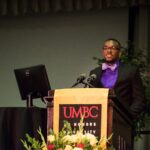
Shawn Bediako, psychology, is also interested in changing perceptions around race, with a focus on health and science. “Ideas about race can become inscribed in our minds if they’re repeated often enough,” he said at GRIT-X, using the example that many people seem to believe, incorrectly, that sickle cell disease is exclusive to black people.
Bediako went on to explain how race is a complex legal, social, and cultural construct that impacts people’s lives in dramatic ways. But he also shared that he has hope this can change, and that UMBC can develop leaders who will impact the way we think about race. “I feel confident that an institution like ours, with a commitment to inclusive excellence at all levels of the arts, humanities, and sciences,” he said, “can help…change this inscription and hopefully shift this paradigm.”
To close the program, Kavita Krishnaswamy ’07, computer science and mathematics, Ph.D. ’19, computer science, shared her work developing solutions to assist people with disabilities and mobility challenges. Krishnaswamy, who has spinal muscular atrophy, gave her presentation via a telepresence device that allows her to navigate the world from her home in Columbia, Maryland.
Krishnaswamy is the recipient of the Google Lime Scholarship, was named a Microsoft Fellow, and was included among the Baltimore Sun’s “25 Women to Watch.” She is currently working on projects including a bed that allows people with mobility challenges to adjust their position along many different axes of movement, and a robot to enable people who previously could not use the bathroom unassisted to do so independently.
Alumna and Ph.D. student Kavita Krishnaswamy presents at GRIT-X via telepresence device.
“We have a lot of problems in the world, and I really feel that robotics can solve many of those problems,” Krishnaswamy said. “So in that way we can really promote social progress and elevate the global living standards. That, in turn, can increase the quality of life for people with disabilities, seniors, and their families.”
One of her closing remarks echoed the sentiments of others at GRIT-X. “Even though our perspectives are many and diverse, our vision is one,” she concluded. Whether dismantling stigma, finding new ways to connect students with intimidating subjects, or changing how we think about conflict, all the speakers emphasized how the UMBC community can reach together to improve the world of tomorrow.
Banner image: Manil Suri, mathematics, at GRIT-X. All photos by Marlayna Demond ’11 for UMBC. Explore video of all GRIT-X talks on the Research at UMBC website.
]]>
Artists, scientists, and social change agents from across UMBC presented the third annual GRIT-X talks on October 13, sharing their ideas and perspectives on stage in UMBC’s Dance Cube. “All our...https://umbc.edu/stories/third-annual-umbc-grit-x-talks-highlight-thought-provoking-ideas-experiences-and-discoveries/https://my3.my.umbc.edu/api/v0/pixel/news/120305/guest@my.umbc.edu/9d191177a3ec74be6f5c96ff2de1b313/api/pixelafricanastudiesamericanstudiescahsscnmscoeitcommunitycseeindsllcmathstatpoliticalsciencepsychologysaphsocialworkvisualartsUMBC News & Magazinehttps://my3.my.umbc.edu/groups/umbc-news-magazinehttps://assets1-my.umbc.edu/system/shared/avatars/groups/000/001/943/24435aa6207c452e7bc15cc74b42c7bb/xsmall.png?1748556657https://assets1-my.umbc.edu/system/shared/avatars/groups/000/001/943/24435aa6207c452e7bc15cc74b42c7bb/original.png?1748556657https://assets2-my.umbc.edu/system/shared/avatars/groups/000/001/943/24435aa6207c452e7bc15cc74b42c7bb/xxlarge.png?1748556657https://assets2-my.umbc.edu/system/shared/avatars/groups/000/001/943/24435aa6207c452e7bc15cc74b42c7bb/xlarge.png?1748556657https://assets3-my.umbc.edu/system/shared/avatars/groups/000/001/943/24435aa6207c452e7bc15cc74b42c7bb/large.png?1748556657https://assets1-my.umbc.edu/system/shared/avatars/groups/000/001/943/24435aa6207c452e7bc15cc74b42c7bb/medium.png?1748556657https://assets2-my.umbc.edu/system/shared/avatars/groups/000/001/943/24435aa6207c452e7bc15cc74b42c7bb/small.png?1748556657https://assets1-my.umbc.edu/system/shared/avatars/groups/000/001/943/24435aa6207c452e7bc15cc74b42c7bb/xsmall.png?1748556657https://assets2-my.umbc.edu/system/shared/avatars/groups/000/001/943/24435aa6207c452e7bc15cc74b42c7bb/xxsmall.png?1748556657UMBC News & Magazine00falseWed, 17 Oct 2018 21:09:38 -0400
 UMBC faculty and staff retreat, summer 2017. Photo by Marlayna Demond ’11.
 Chuku’s 2017 Ali Mazrui Award. Photo courtesy of Chuku.
 Model African Union (2020) in front of the Embassy of Liberia. Photo courtesy of Chuku.
 USM Women’s Forum 2019 retreat. Photo courtesy of Natasha Rodriguez.

















 Eric Dyer ’95, visual arts, demonstrates his art at GRIT-X.
 Diane Bell McKoy ’73, social work and sociology, at GRIT-X.

 Alumna and Ph.D. student Kavita Krishnaswamy presents at GRIT-X via telepresence device.