NIDA EDUCATE program develops the next generation of addiction researchers

In 2021, the National Institute on Drug Abuse (NIDA) awarded UMBC more than $1 million over five years to create a program specifically for undergraduate scholars interested in research on substance abuse and addiction. A year after the program’s launch, it is thriving as students in fields as diverse as economics, computer science, and chemical engineering find ways to connect their interests to this important topic.
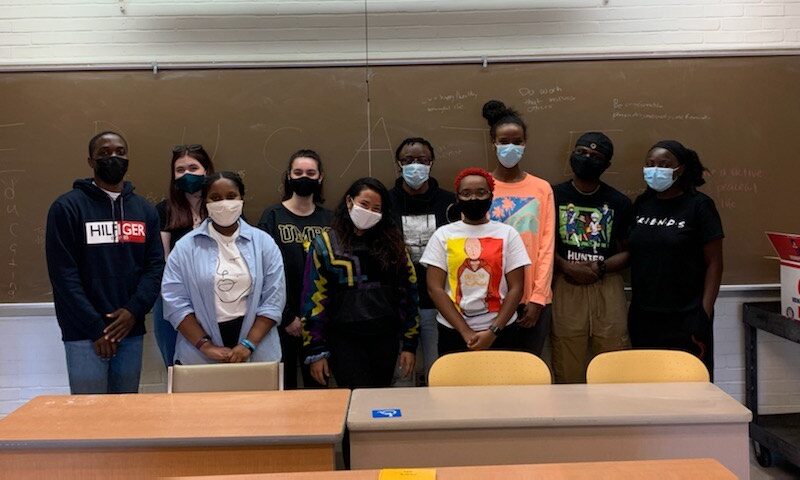
EDUCATE Scholars gathered for an end-of-semester social in spring 2022. (Image courtesy of Yetunde Oshagbemi)
“We need people from all walks of STEM to be able to approach problems to find solutions,” says Patrice Darby. She isprogram coordinator of special projects of the Meyerhoff Scholars Program and a co-lead on the grant, which is called Educating Diverse Undergraduates for Careers in Addiction and substance abuse research via Training Experiences (EDUCATE). The program supports a small, specialized group of Meyerhoff Scholars as EDUCATE Scholars. The grant is administered by UMBC’s College of Natural and Mathematical Sciences and led by the college’s dean, Bill LaCourse.
EDUCATE programming includes talks from researchers whose work touches addiction, as well as workshop series on science communication and on the tools needed to become a successful researcher. EDUCATE Scholars are also expected to participate in a sustained research experience with UMBC faculty mentors and to present their research at a conference. They also take an ethics course and receive intensive academic and career advising from program staff. Funding is available to support summer research experiences for EDUCATE Scholars as well.
“NIDA has really encouraged an interdisciplinary approach,” Darby says. That and the small size of each cohort means “we’re really able to tailor things to the students’ needs.”
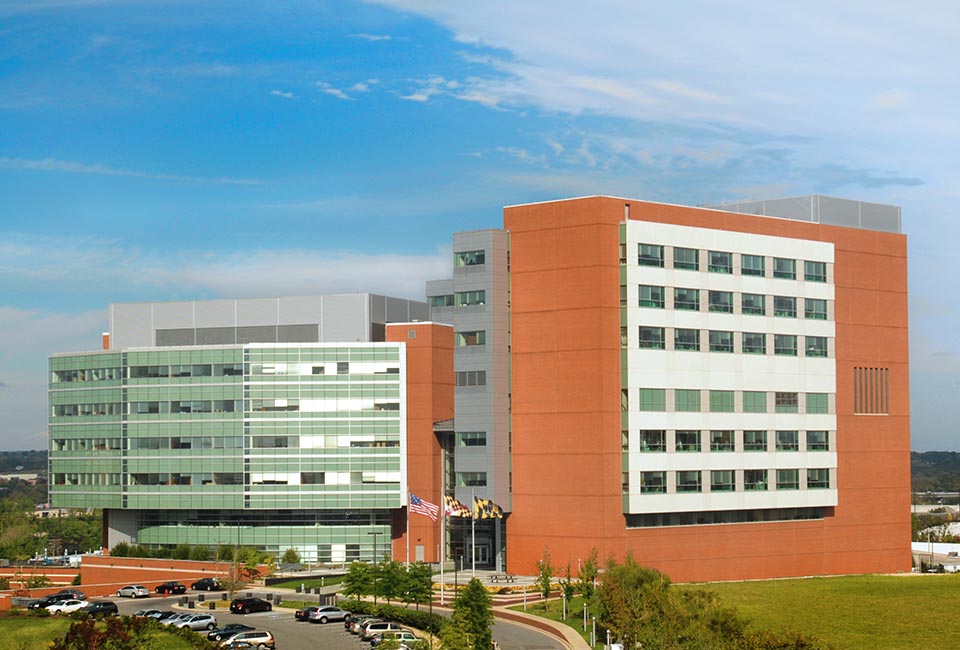 The National Institute on Drug Abuse in Baltimore. (NIDA)
Broader horizons
Yetunde Oshagbemi ’23, economics and mathematics, wants to study economic development in Nigeria, and she is interested in understanding how drug abuse has impacted development. Based on Oshagbemi’s interests, Darby invited an economist with a focus on drug abuse to speak to the scholars. In addition to speaking directly to Oshagbemi’s interest, this offered a fresh perspective for students in other majors.
The talk “reminded me that similar interests can be applied in different ways,” Oshagbemi says. The EDUCATE program as a whole “broadens your horizons and your views on the ways drug abuse is being studied in different disciplines. It’s allowed me to see that there are different ways to answer the questions I have about my interests.”
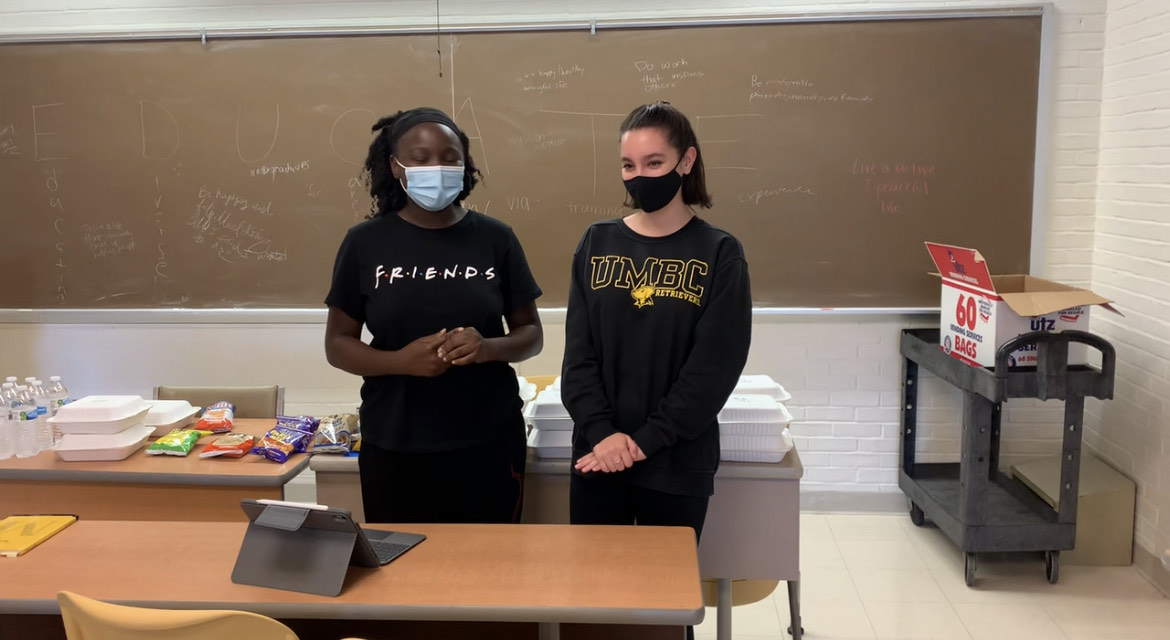 Yetunde Oshagbemi ’23, economics and mathematics (left), relaxes with another EDUCATE Scholar at a social event. (Image courtesy of Oshagbemi)
Oshagbemi conducts research with Zoë McLaren, professor of public policy, whose work includes studying infectious disease in developing countries. Oshagbemi also appreciates Darby’s mentorship. Darby helps “make sure that not only am I progressing academically, but my mental health is also doing well,” she says. “She tries to give you the best advice based on the type of person you are and the path you want to go on.”
Family inspiration
Mike Anoruo ’24, computer science,has also benefited from the mentorship and interdisciplinary nature of the program. Darby recommended he apply for a summer workshop at MIT on quantitative methods, which was eye-opening. “I learned a lot about biology and I was able to bring in my computer science knowledge,” Anoruo says.
Anoruo is inspired by his mother, who works at a crisis stabilization center for people who struggle with addiction and substance abuse. “Seeing her passion for it has made me really want to learn more about it,” he says. “From the MIT workshop, I was able to see that computer science has a lot of applications. So if I can find a way to make a difference the same way my mom is, I think I would really enjoy that.”
Knowing that there are so many ways to apply computer science, Anoruo is still considering his options for the future. “I really like being in the EDUCATE program because I get to look into different topics in drug addiction. I’m just trying to explore and see what I want to go into.”
A real contribution
Students who are not EDUCATE Scholars also benefit from the program.
Each year six students, a mix of Meyerhoff Scholars and STEM BUILD Trainees, have the opportunity to participate in research internships at NIDA through a supplement to the EDUCATE grant. STEM BUILD Trainee Precious Oyinloye ’23, chemical engineering, is completing a virtual internship this school year. Her project involves analyzing data to identify chemical compounds involved in addiction.
After learning how to code in the Python language as part of her NIDA experience, “I’m more curious about computer science,” she says. Plus, “being part of a research project offers a sense of fulfillment—I’m really contributing to science.”
Zoha Faraz ’22, psychology and biological sciences, also a STEM BUILD Trainee, used the opportunity to gain important research skills. “Through the internship, I was able to learn a lot about the research process, and I feel more confident in testing my research skills,” she says. “I think it also improved my scientific communication, because I had to make a presentation about my project.”

Zoha Faraz ’22, psychology and biological sciences (Image courtesy of Faraz)
A personalized experience
The EDUCATE program is small, with a maximum of six scholars per year. That allows the staff “to give our students a highly personalized experience,” Darby says.
Between the workshop-style trainings, faculty-mentored research, and availability of committed staff like Darby to offer guidance and feedback, the program is setting the EDUCATE Scholars up for success in whatever field they choose to pursue.
“You don’t have to research addiction to be able to influence addiction research,” Darby says. Addiction is, however, one of the topics that brings the scholars together. At a social event for EDUCATE students earlier this year, that connection was on full display, helping students deepen relationships they may rely on for support for years to come.
“It’s just different to have a special community,” Darby says, “to talk about the impacts of addiction and why our students care.”
]]>
In 2021, the National Institute on Drug Abuse (NIDA) awarded UMBC more than $1 million over five years to create a program specifically for undergraduate scholars interested in research on...
https://umbc.edu/stories/the-next-generation-of-addiction-researchers/
https://my3.my.umbc.edu/api/v0/pixel/news/125582/guest@my.umbc.edu/b72e18144ef0e3cd9ded5fa07df2ad6c/api/pixel
cahss
chemeng
cnms
coeit
csee
economics
mathstat
meyerhoffscholars
psychology
public-policy
science-and-tech
stembuild
undergradresearch
UMBC News & Magazine
https://my3.my.umbc.edu/groups/umbc-news-magazine
https://assets1-my.umbc.edu/system/shared/avatars/groups/000/001/943/24435aa6207c452e7bc15cc74b42c7bb/xsmall.png?1748556657
https://assets1-my.umbc.edu/system/shared/avatars/groups/000/001/943/24435aa6207c452e7bc15cc74b42c7bb/original.png?1748556657
https://assets2-my.umbc.edu/system/shared/avatars/groups/000/001/943/24435aa6207c452e7bc15cc74b42c7bb/xxlarge.png?1748556657
https://assets2-my.umbc.edu/system/shared/avatars/groups/000/001/943/24435aa6207c452e7bc15cc74b42c7bb/xlarge.png?1748556657
https://assets3-my.umbc.edu/system/shared/avatars/groups/000/001/943/24435aa6207c452e7bc15cc74b42c7bb/large.png?1748556657
https://assets1-my.umbc.edu/system/shared/avatars/groups/000/001/943/24435aa6207c452e7bc15cc74b42c7bb/medium.png?1748556657
https://assets2-my.umbc.edu/system/shared/avatars/groups/000/001/943/24435aa6207c452e7bc15cc74b42c7bb/small.png?1748556657
https://assets1-my.umbc.edu/system/shared/avatars/groups/000/001/943/24435aa6207c452e7bc15cc74b42c7bb/xsmall.png?1748556657
https://assets2-my.umbc.edu/system/shared/avatars/groups/000/001/943/24435aa6207c452e7bc15cc74b42c7bb/xxsmall.png?1748556657
UMBC News & Magazine
0
0
false
Tue, 24 May 2022 16:52:34 -0400
Tue, 24 May 2022 16:52:34 -0400
First-generation grad reflects on the power of seeing potential, giving support

Kaitlynn Lilly
Degree: B.S., Mathematics and Physics
Hometown: Severna Park, MD
Post-grad plans: Ph.D. in applied mathematics, University of Washington
“As a first-generation college student … I didn’t know if going to graduate school would be possible for me, but people believed in me, saw my potential, and gave me the ability to succeed. Being able to give that back to other people has been really powerful for me and has made my UMBC experience very fulfilling.”
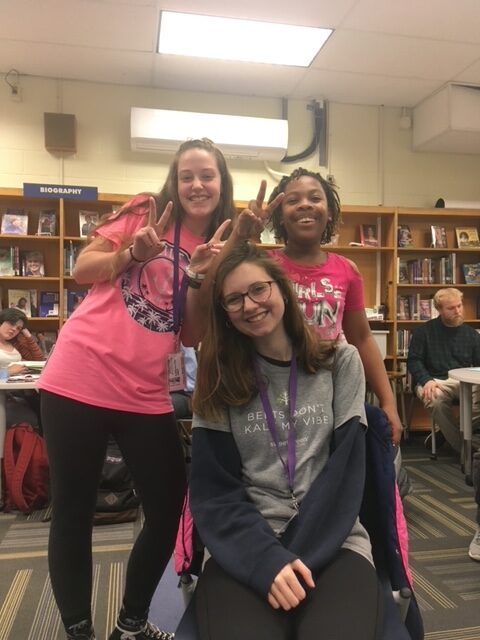
Kaitlynn Lilly (left) supports students at Arbutus Middle School. (Image courtesy of Lilly)
Kaitlynn Lilly ’22, mathematics and physics, is a Meyerhoff Scholar, member of the Honors College, and 2021-2022 Goldwater Scholar. She conducted research with Justin Webster, assistant professor of mathematics, and participated in summer research experiences with faculty at Carnegie Mellon University and University of Hawai’i. But more than thinking about those achievements, she often reflects on the support that helped her get there and how she can pay it forward.
When she started working with Webster in her first year, Lilly did not have substantial high-level math experience. But Webster “took me under his wing and made sure that I was learning the important background material that I needed,” she says. “And eventually, I was able to start my own independent project.”
As her skills and experience grew, she got involved in more and more difficult projects. “I think that’s one of the unique things that UMBC has to offer,” she says. “I feel like I’ve definitely made the most of my education here, and it’s been a really great experience being involved in so many different kinds of research.”
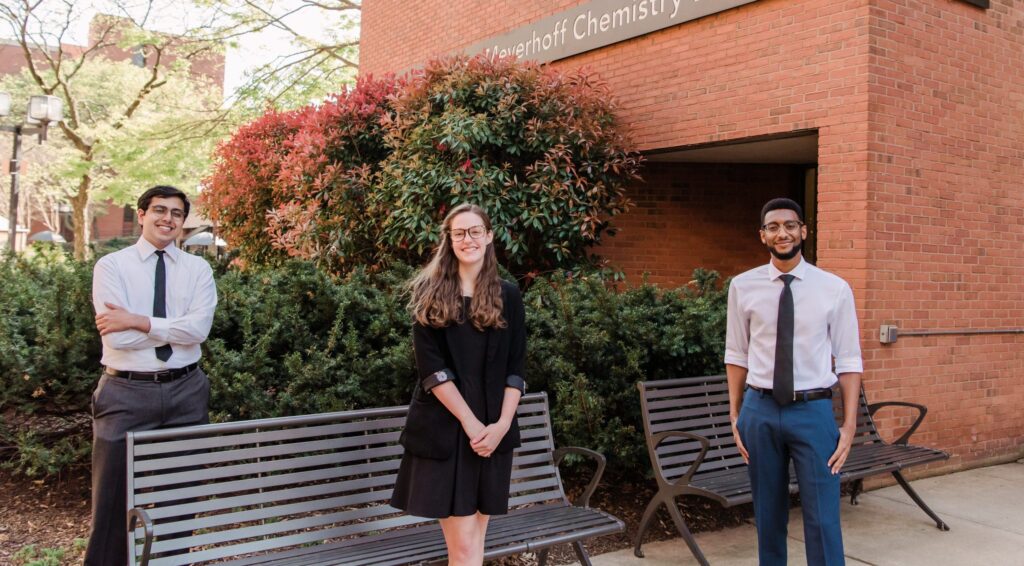
UMBC’s 2021-2022 Goldwater Scholars Karan Luthria (l), Kaitlynn Lilly (c), and Joshua Slaughter (r). (Marlayna Demond ’11/UMBC)
Lilly is a dedicated mentor to middle school, high school, and UMBC students through several different programs, for which she received the Ronald M. Shapiro Excellence in Mentoring Award.
While studying partial differential equations for her Ph.D. at University of Washington, she plans to create a group for women in applied math and contribute to an existing program that supports high school students.
]]>
Kaitlynn Lilly Degree: B.S., Mathematics and Physics Hometown: Severna Park, MD Post-grad plans: Ph.D. in applied mathematics, University of Washington “As a first-generation college...
https://umbc.edu/stories/first-generation-grad-reflects/
https://my3.my.umbc.edu/api/v0/pixel/news/125399/guest@my.umbc.edu/b4e1998d0d465c0fbedb535ec0597144/api/pixel
class-of-2022
cnms
honorscollege
mathstat
meyerhoffscholars
news
physics
supportingyouth
UMBC News & Magazine
https://my3.my.umbc.edu/groups/umbc-news-magazine
https://assets1-my.umbc.edu/system/shared/avatars/groups/000/001/943/24435aa6207c452e7bc15cc74b42c7bb/xsmall.png?1748556657
https://assets1-my.umbc.edu/system/shared/avatars/groups/000/001/943/24435aa6207c452e7bc15cc74b42c7bb/original.png?1748556657
https://assets2-my.umbc.edu/system/shared/avatars/groups/000/001/943/24435aa6207c452e7bc15cc74b42c7bb/xxlarge.png?1748556657
https://assets2-my.umbc.edu/system/shared/avatars/groups/000/001/943/24435aa6207c452e7bc15cc74b42c7bb/xlarge.png?1748556657
https://assets3-my.umbc.edu/system/shared/avatars/groups/000/001/943/24435aa6207c452e7bc15cc74b42c7bb/large.png?1748556657
https://assets1-my.umbc.edu/system/shared/avatars/groups/000/001/943/24435aa6207c452e7bc15cc74b42c7bb/medium.png?1748556657
https://assets2-my.umbc.edu/system/shared/avatars/groups/000/001/943/24435aa6207c452e7bc15cc74b42c7bb/small.png?1748556657
https://assets1-my.umbc.edu/system/shared/avatars/groups/000/001/943/24435aa6207c452e7bc15cc74b42c7bb/xsmall.png?1748556657
https://assets2-my.umbc.edu/system/shared/avatars/groups/000/001/943/24435aa6207c452e7bc15cc74b42c7bb/xxsmall.png?1748556657
UMBC News & Magazine
0
0
false
Tue, 17 May 2022 15:16:02 -0400
Tue, 17 May 2022 15:16:02 -0400
First-gen engineering grad is energized by helping others
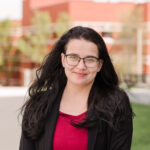
Diane Stonestreet
Degree: B.S., Mechanical Engineering
Minor: Mathematics
Hometown: Mount Airy, MD
Plans: Ph.D. in mechanical engineering at Cornell University
“The mentors I have connected with through the McNair Scholars program have definitely been the most influential. I’ve always felt that they supported and understood me as a human before I was a student or scholar. And overall, my time at UMBC has given me the space to better understand and take ownership of my journey as a first-gen student. I’ve become confident in myself, and aware that I do deserve the opportunities that come my way.”
Diane Stonestreet ’22, mechanical engineering, is a first-generation college student who initially found the prospect of applying to college daunting. As a high school student, she didn’t know where to find all the answers and resources she needed. But after attending Frederick Community College, Stonestreet applied to UMBC and received a scholarship called ME S-STEM to study mechanical engineering. That support had an enormous impact on her educational path. She’ll soon head to Cornell University to start her Ph.D. in mechanical engineering.
While at UMBC, Stonestreet took on multiple leadership roles to support her fellow students. She served as a teaching fellow in the McNair Scholars program, a coach for the Center for Democracy and Civic Life’s immersive STRiVE leadership for social impact program, a leader of a UMBC’s Alternative Spring Break, and an officer in Engineers Without Borders.
 Stonestreet and the K-12 Educational Equity group speaking with Marvin James, senior advisor to Baltimore Mayor Brandon Scott, as part of Alternative Spring Break. Image courtesy of Stonestreet.
“Doing my best to give back to my UMBC community might seem like it would take extra work on my part,” she says, “but helping others helps me renew my own energy. I’m just doing my best to pour back into the communities that have supported me.”
]]>
Diane Stonestreet Degree: B.S., Mechanical Engineering Minor: Mathematics Hometown: Mount Airy, MD Plans: Ph.D. in mechanical engineering at Cornell University “The mentors I have...
https://umbc.edu/stories/first-gen-engineering-grad-is-energized-by-helping-others/
https://my3.my.umbc.edu/api/v0/pixel/news/125315/guest@my.umbc.edu/18703981b7621ba06cd8c22b2b08ebc7/api/pixel
class-of-2022
coeit
mathstat
meche
news
purpose
UMBC News & Magazine
https://my3.my.umbc.edu/groups/umbc-news-magazine
https://assets1-my.umbc.edu/system/shared/avatars/groups/000/001/943/24435aa6207c452e7bc15cc74b42c7bb/xsmall.png?1748556657
https://assets1-my.umbc.edu/system/shared/avatars/groups/000/001/943/24435aa6207c452e7bc15cc74b42c7bb/original.png?1748556657
https://assets2-my.umbc.edu/system/shared/avatars/groups/000/001/943/24435aa6207c452e7bc15cc74b42c7bb/xxlarge.png?1748556657
https://assets2-my.umbc.edu/system/shared/avatars/groups/000/001/943/24435aa6207c452e7bc15cc74b42c7bb/xlarge.png?1748556657
https://assets3-my.umbc.edu/system/shared/avatars/groups/000/001/943/24435aa6207c452e7bc15cc74b42c7bb/large.png?1748556657
https://assets1-my.umbc.edu/system/shared/avatars/groups/000/001/943/24435aa6207c452e7bc15cc74b42c7bb/medium.png?1748556657
https://assets2-my.umbc.edu/system/shared/avatars/groups/000/001/943/24435aa6207c452e7bc15cc74b42c7bb/small.png?1748556657
https://assets1-my.umbc.edu/system/shared/avatars/groups/000/001/943/24435aa6207c452e7bc15cc74b42c7bb/xsmall.png?1748556657
https://assets2-my.umbc.edu/system/shared/avatars/groups/000/001/943/24435aa6207c452e7bc15cc74b42c7bb/xxsmall.png?1748556657
UMBC News & Magazine
0
0
false
Fri, 13 May 2022 16:15:20 -0400
Fri, 13 May 2022 16:15:20 -0400
UMBC’s Jack Suess and instructional tech team earn national awards for leadership, innovation
Jack Suess, vice president for information technology at UMBC, has received a 2021 Capital CEO of the Year ORBIE Award. Suess ‘81, mathematics, M.S. ‘94, information systems, has been part of the UMBC community for more than 40 years. As a university leader, he has spearheaded transformative technology initiatives. His work includes advancing the use of technology in courses, operational systems, and student success initiatives in ways that have fundamentally reshaped the UMBC experience for all community members.
“What makes this award special is that it truly recognizes the work of our entire Division of Information Technology (DoIT),” Suess says. “Our team’s work, particularly in helping the university quickly shift to remote learning last year, due to COVID, reflects a spirit of empathy and collaboration. This spirit has made IT true partners in the university’s success, not just technology experts.”
“I won this award as the leader of the division, but really this is an award that belongs to everyone in DoIT,” he shares.
Innovative solutions advance opportunities
Under Suess’s leadership, UMBC’s Division of Information Technology has developed innovative solutions to a very broad range of technology needs. The COVID-19 pandemic in particular significantly changed how faculty, staff, and students utilized and relied on technology to teach, work, and learn.
 Jack Suess, right, at the 2021 Fall Opening Meeting.
“Our leadership relied on robust data Suess’s team had collected to provide the information and insights needed to safely reopen the campus for research and in-person learning opportunities,” says UMBC President Freeman Hrabowski. “Without his forethought and his team’s commitment and creativity, we could not have provided the level of education, innovation, and critical research for which UMBC is known.”
In 2020, Suess received the EDUCAUSE Leadership Award for his success as a leader in the field and for advancing UMBC’s reputation as leader in higher education.
Honoring a transformative online teaching initiative
DoIT’s instructional technology team recently received an award specifically recognizing this essential, innovative work during the transition to remote learning. The Online Learning Consortium (OLC) is honoring the team with an Effective Practice Award for the UMBC’s Planning Instructional Variety for Online Teaching (PIVOT) program.
 Victor Adebanjo ’23, mechanical engineering, was a student worker in the Division of Information Technology during the pandemic.
The PIVOT program was developed last year in collaboration with faculty across all three colleges and UMBC’s Faculty Development Center to help faculty provide students with engaging online courses. The program guided faculty through the elements of course design for the virtual space, as well as how to teach effectively online. Faculty who participated in PIVOT also connected with peer mentors who provided insight into pedagogy and the technology used.
The OLC is recognizing the DoIT instructional technology team for developing digital educational tools that elevated UMBC’s efforts to continue to offer exceptional courses to students throughout the remote learning period of the pandemic. The Consortium evaluated UMBC’s PIVOT program against its five pillars of quality in digital education, and sought out peer reviews. They found that the PIVOT program was strong in all five areas: learning effectiveness, scale, access, faculty satisfaction, and student satisfaction. More than 70% of UMBC faculty utilized the program, and it received positive feedback from the participants.
Mariann Hawken, acting director of instructional technology, led PIVOT program development and will accept the award at the OLC Accelerate conference in October.
Banner image: Jack Suess, right, and a few of his colleagues. All photos by Marlayna Demond ’11 for UMBC.
]]>
Jack Suess, vice president for information technology at UMBC, has received a 2021 Capital CEO of the Year ORBIE Award. Suess ‘81, mathematics, M.S. ‘94, information systems, has been part of the...
https://umbc.edu/stories/umbcs-jack-suess-and-instructional-tech-team-earn-national-awards-for-leadership-innovation/
https://my3.my.umbc.edu/api/v0/pixel/news/119555/guest@my.umbc.edu/96881aed53d863cc38a456f849bdd7e7/api/pixel
campus
coeit
community
is
mathstat
meche
science-and-technology
staff
UMBC News & Magazine
https://my3.my.umbc.edu/groups/umbc-news-magazine
https://assets1-my.umbc.edu/system/shared/avatars/groups/000/001/943/24435aa6207c452e7bc15cc74b42c7bb/xsmall.png?1748556657
https://assets1-my.umbc.edu/system/shared/avatars/groups/000/001/943/24435aa6207c452e7bc15cc74b42c7bb/original.png?1748556657
https://assets2-my.umbc.edu/system/shared/avatars/groups/000/001/943/24435aa6207c452e7bc15cc74b42c7bb/xxlarge.png?1748556657
https://assets2-my.umbc.edu/system/shared/avatars/groups/000/001/943/24435aa6207c452e7bc15cc74b42c7bb/xlarge.png?1748556657
https://assets3-my.umbc.edu/system/shared/avatars/groups/000/001/943/24435aa6207c452e7bc15cc74b42c7bb/large.png?1748556657
https://assets1-my.umbc.edu/system/shared/avatars/groups/000/001/943/24435aa6207c452e7bc15cc74b42c7bb/medium.png?1748556657
https://assets2-my.umbc.edu/system/shared/avatars/groups/000/001/943/24435aa6207c452e7bc15cc74b42c7bb/small.png?1748556657
https://assets1-my.umbc.edu/system/shared/avatars/groups/000/001/943/24435aa6207c452e7bc15cc74b42c7bb/xsmall.png?1748556657
https://assets2-my.umbc.edu/system/shared/avatars/groups/000/001/943/24435aa6207c452e7bc15cc74b42c7bb/xxsmall.png?1748556657
UMBC News & Magazine
0
0
false
Tue, 21 Sep 2021 15:22:44 -0400
Graduating with gratitude: UMBC welcomes a new class of alumni
Persistent. Innovative. Determined. These are the words UMBC’s commencement speakers returned to again and again to describe the Class of 2021. And despite a year of challenges—missing family and friends, technological frustrations, life lived through the computer screen—one of the resounding themes of this year’s Commencement ceremonies was gratitude.
Addressing this year’s graduates, President Freeman Hrabowski reflected on his life and shared some wisdom learned throughout the years.
 Screenshot from UMBC’s 2021 Undergraduate Commencement Ceremony
“The longer I live, the more I realize there’s nothing more important than our family and our friends. We have to take the time to say ‘thank you’ because we never make it to any point of achievement alone,” he says. “There are always people helping us out.”
#umbcgrad#USGsuccess@UatShadyGrove @UMBC
1st stop 1991 – BA Poli Sci – no gray hair
2nd stop 2021 – MPS in Data Science – lots of gray hair
Retriever for life pic.twitter.com/iy7LT3yUVF
— Michael Schlitzer (@campagfan) May 11, 2021
Virtual ceremony, tangible spirit
This spring’s ceremonies were held online in deference to the health and safety of the campus community. While the festivities were virtual, the spirit was very tangible. Students had the opportunity to come to campus for professional on-site graduation photos. Some even ran into local celebrity, Officer Chip, the campus comfort dog.
 Jessica Ma ‘21, mechanical engineering, poses with Chip during on-campus photos.
Graduate Student Association president Samantha Fries ‘18, psychology, and M.A. ‘21, applied sociology, shared in her commencement remarks that despite the challenges of the past year, there have been remarkable acts of kindness.
“This magnificent outpouring of love and empathy has been demonstrated all across all the world but I’m most proud to say that I’ve seen it shown exceptionally and persistently by the students, staff, and faculty here at UMBC,” said Fries. “Faculty restructured their courses to provide maximum flexibility. Staff worked long hours developing new ways to serve students and help them succeed online. Students created virtual networks to stay connected with one other and to provide much-needed support during a time where we all felt more isolated than ever before.”
Inspired by each other
Students relied on video chats, Discord channels, and the tried and true telephone to stay connected this past year. Even if they couldn’t see each other in person, Retrievers are still grateful for the friendships that persevered and the memories they made.
“A lot of people helped me feel comfortable and enjoy my moments at UMBC,” says Billy Harold Kayim Tchuem ‘21, biochemistry. “The list is very long, but I just want to tell them ‘thank you’ for making this a very exciting journey and I hope we can all look back at these years and be able to appreciate how amazing they were.”
As part of her valedictorian speech, Katie Poteet‘21, global studies and political science, described how UMBC’s inclusive nature and diverse culture shape the environment and help students build relationships.
“UMBC is unique, creative, and diverse. There’s something in each of us that others can learn from and be inspired by,” says Poteet, who is a first-generation college graduate.
 Poteet on campus in fall 2020.
Coming to UMBC as part of a fifth-generation farming family from rural Maryland, Poteet embraced the international opportunities afforded to her, such as a trip to Ghana as part of UMBC’s Global Brigades program. After graduation, she will attend the University of Cambridge, in England, to pursue a master of philosophy focusing on educational equity for women and girls in the Arab world.
“Because we are all so diverse, this graduation means something different to each of us,” she shared, “but it also marks the collective success and excellence of our community.”
Building the world they want to see
Addressing his fellow graduates as co-valedictorian, Jordan Troutman ’21, M29, computer science and mathematics, emphasized the power of students recognizing themselves as agents of change.
“I believe in a world where the leaders in communities and organizations fully represent the populations they serve. We must see things for what they are, but even more, for what they can be,” says Troutman. “We have the ability to mobilize, find solutions, and challenge expectations. It doesn’t always take a massive crowd of people to do so, sometimes it only takes one person. Sometimes that person will be you.”
 Troutman on campus this spring.
Troutman also received a prestigious Knight-Hennesy Scholarship, the first in UMBC’s history. He’ll begin a computer science Ph.D. at Stanford University in the fall, continuing his algorithmic fairness research.
One of this year’s honorary degree recipients, Sarah Rosen Wartell, president of the Urban Institute, also spoke of taking action to make a better world. She emboldened the Class of 2021 to lead the charge, no matter how uncomfortable the journey might be.
“So, maybe a bit more discomfort is what the world needs from you because we’re relying on you to show us the path forward,” said Wartell.
Cogratulations to STEM BUILD graduate Demi Trimino (Biological Sciences’21, Philosophy ’21)
We are so proud of you!#UMBCgrad pic.twitter.com/cHf1X5tDgw
— STEM BUILD at UMBC (@STEMBUILDUMBC) May 21, 2021
Looking ahead
Commencement is a transition point—the end of one journey and the start of another. Victoria D’Souza, Ph.D. ‘02, biochemistry, knows it may not always be easy, but this class is uniquely qualified to face the challenges that come before them.
As the graduate honorary degree recipient, D’Souza expressed her confidence in these students, asserting that “if there’s anything this class of 2021 can teach us, it’s that you’re resilient. And if you put your mind to it, no challenge is insurmountable.”
 A student takes graduation photos on campus.
Christopher P. Austin, CEO-Partner at Flagship Pioneering, undergraduate ceremony honorary degree recipient, echoed these sentiments.
“The world needs you not only to seek change, but to drive it,” said Austin. “Life is not a dress rehearsal, as one of my musical colleagues once put it. Live by these truths.”
But no matter how far Retrievers may go on their journeys, UMBC will always be home, says Fries. She shared, “Let us not think of this as the ending of a chapter, but rather the beginning of the next book in the series of our lives.”
Read more stories about the Class of 2021 on UMBC News. Full recordings of this year’s virtual ceremonies can be found on the Commencement site, along with social shareables, a virtual True Grit, and a photo booth. Help us celebrate our graduates by using #UMBCgrad on social media.
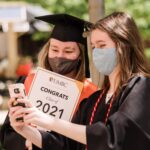
Banner image: Two of this year’s graduates stop for a selfie during on-campus photos. Photos by Marlayna Demond ‘11 unless otherwise noted.
]]>
Persistent. Innovative. Determined. These are the words UMBC’s commencement speakers returned to again and again to describe the Class of 2021. And despite a year of challenges—missing family and...
https://umbc.edu/stories/graduating-with-gratitude-umbc-welcomes-a-new-class-of-alumni/
https://my3.my.umbc.edu/api/v0/pixel/news/119618/guest@my.umbc.edu/0bdac41ca69ed298502599ed53235598/api/pixel
cahss
chemistry
classof2021
cnms
coeit
community
csee
globalstudies
mathstat
page1
politicalscience
psychology
saph
UMBC News & Magazine
https://my3.my.umbc.edu/groups/umbc-news-magazine
https://assets1-my.umbc.edu/system/shared/avatars/groups/000/001/943/24435aa6207c452e7bc15cc74b42c7bb/xsmall.png?1748556657
https://assets1-my.umbc.edu/system/shared/avatars/groups/000/001/943/24435aa6207c452e7bc15cc74b42c7bb/original.png?1748556657
https://assets2-my.umbc.edu/system/shared/avatars/groups/000/001/943/24435aa6207c452e7bc15cc74b42c7bb/xxlarge.png?1748556657
https://assets2-my.umbc.edu/system/shared/avatars/groups/000/001/943/24435aa6207c452e7bc15cc74b42c7bb/xlarge.png?1748556657
https://assets3-my.umbc.edu/system/shared/avatars/groups/000/001/943/24435aa6207c452e7bc15cc74b42c7bb/large.png?1748556657
https://assets1-my.umbc.edu/system/shared/avatars/groups/000/001/943/24435aa6207c452e7bc15cc74b42c7bb/medium.png?1748556657
https://assets2-my.umbc.edu/system/shared/avatars/groups/000/001/943/24435aa6207c452e7bc15cc74b42c7bb/small.png?1748556657
https://assets1-my.umbc.edu/system/shared/avatars/groups/000/001/943/24435aa6207c452e7bc15cc74b42c7bb/xsmall.png?1748556657
https://assets2-my.umbc.edu/system/shared/avatars/groups/000/001/943/24435aa6207c452e7bc15cc74b42c7bb/xxsmall.png?1748556657
UMBC News & Magazine
0
0
false
Mon, 24 May 2021 16:54:44 -0400
UMBC’s 2021 grads advance research with public impact—from disaster response to assistive tech

Students from across all of UMBC’s colleges and schools are graduating this week having taken advantage of the unique undergraduate research opportunities and supportive mentorship UMBC offers. They’re poised to take their research to the next level and move on to new challenges through graduate school and careers.
For example, Davis Cappabianca ’21 is recommending reforms to better coordinate multi-agency disaster relief efforts. Hana Flores ’21is conducting cutting-edge HIV studies. Keren Herrán ’21, M29, is incorporating environmental science to improve public health. Ali Abdolrahmani, Ph.D. ’21, is developing innovative assistive technologies for the blind community, and Briscoe Turner ’21 is reimagining public safety with an eye to community empowerment.
Big breakthroughs
Cappabianca took advantage of UMBC’s individualized study program (INDS) to tailor his degree around his interests. As a U.S. Navy veteran, Cappabianca knows that coordination between the military and civilian relief groups in the aftermath of disasters is often clumsy. He also expects, as an aspiring Navy medical doctor, that he will be involved in these situations in the future. He wanted to find a way to improve outcomes in these situations, because, he says, “The end goal [is] helping the most people possible in the most effective way.”

Davis Cappabianca ’21 in his U.S. Navy uniform. Photo courtesy of Cappabianca.
“I realized that my background in the U.S. Navy provided me with a lot of unique experiences,” he shares, “and what I found in INDS was a way for me to bring those experiences into my education and claim my own degree.” His two degree mentors, Stephen Kosloski, joint director of Naval ROTC at UMBC and University of Maryland, College Park and Joby Taylor, director of the Peaceworker Program at UMBC, brought very different perspectives to his research.
“More often than not, the melding of their ideas was what got me to major breakthroughs in my research,” Cappabianca says. Learning to always consider multiple perspectives was one of the most valuable takeaways from his INDS degree, he adds. “I think it will fundamentally change the way you approach problems, even if it’s subconsciously.” He plans to pursue medical school or a master’s degree in emergency management.
Environmental science meets public health
Herrán also designed her degree around her experiences. Answering a call for more Spanish-speaking participants, she spent spring break of her first year at UMBC in Nicaragua with the UMBC chapter of Global Medical Brigades, a student-run organization committed to implementing sustainable health systems worldwide.
She noticed the relationship between water quality and community health in Nicaragua, and reflected on similar challenges she observed during her childhood summers in Puerto Rico and El Salvador (the birthplaces of her parents). “Coming back to UMBC, I thought, this is what I want to dedicate my life to,” she says.
 Keren Herrán ’21, right, In Honduras while participating in the Honduras Leadership Institute. Photo courtesy of Herrán.
Her degree has included courses in environmental science, sociology, research methods, and writing—even cartography. Why? Herrán sees significant overlap between study of the environment and public health, but, in practice, doesn’t see the fields as very connected in today’s world. She says, “I want to be in that overlap.”
“I think INDS has been crucial to my acceptance to graduate school, because it’s given me the opportunity to be intentional in my choice of classes, and to claim my education,” Herrán notes. “I knew that I wanted to pursue research and partner with communities, not just come in and tell them what to do,” she says. She has had the opportunity to take that approach in her undergraduate work.
This fall, Herrán will begin a Ph.D. at University of South Carolina as a Presidential Fellow in health promotion, education, and behavior.

Keren Herrán in her graduation regalia, spring 2021. Photo courtesy of Herrán.
Asking challenging questions
Turner and Abdolrahmani also focused on issues close to their hearts. As a Sondheim Public Affairs Scholar and psychology major, Turner has studied community building in the context of reimagining public safety and justice.
“I’m really interested in the community aspect, alternatives to policing, and understanding how you build as a community and solve these problems without the use of force—with understanding and restorative practices,” she says. “I’ve grown in that way, and thought about, ‘What does abolition look like? How do we expand our thinking and make sure that we’re tapping into new ideas of how we operate with each other, and how we communicate with each other, and how we treat each other, rather than sticking to historical practices?’”
 Briscoe Turner ’21, rear, second from right, with other members of the UMBC Black Lives Matter Club in 2019. Photo courtesy of Turner.
Her current research with Bronwyn Hunter, assistant professor of psychology, focuses on college students who have had parents incarcerated or struggle with substance use, and understanding the students’ ideas of what justice looks like. In addition to her work with Hunter, a Public Policy and International Affairs Junior Summer Institute at Princeton University “opened my eyes to how public policy works,” Turner says. Now, she’s asking big questions: “I’m trying to understand what the world could look like, and how do we get there?”
This summer, Turner is headed to Brown University to pursue a master’s of public affairs. “I’ve really enjoyed my UMBC experience. That’s why I picked Brown,” she says. “I felt like it had a lot of similar aspects to it as UMBC, so I want to continue that community feel and the support that I got here.”
 Briscoe Turner ’21, left front, with UMBC’s Black Lives Matter Club in the UMBC Commons. Photo courtesy of Turner.
Inclusive design
Abdolrahmani has spent the last seven years investigating and developing assistive technologies for the blind community in the human-centered computing Ph.D. program. He decided to pursue a Ph.D. after being exposed to the field of assistive technology while working in his home country to improve the internet banking experience for blind customers. Intrigued and wanting to make a bigger contribution to the field, Abdolrahmani, who is legally blind, moved to the U.S. with his wife at age 36 to study with UMBC faculty in information systems.
“I wanted to understand how I could develop technologies to improve the independent living of the blind community or other people with disabilities,” Abdolrahmani says. He first worked on a project to develop a wearable indoor navigation assistive device. Later, he worked to enhance the user experience of mainstream voice assistants such as Amazon Alexa and Google assistant for the blind. And, finally, he brought the two together for his thesis project, which focused on the use of mainstream voice assistants for navigating airports.
Along the way, he learned that not only did blind people appreciate the technologies he was developing, but so did sighted people and members of other groups. His research “shows that these technologies have great potential for future use for different groups of users in different contexts,” he explains.
Now, Abdolrahmani is looking for roles where he can have an even more direct impact as a member of a product design team, “so that I can inspire more accessibility and inclusive design in products, to see that products are designed in such a way that people with different abilities can use them right away out of the box.”
Becoming a scientist
A culture of supportive mentorship has helped sustain all of these students on their path to commencement. For Hana Flores, her first mentor on campus was none other than President Freeman Hrabowski.

Hana Flores ’21, center, with Phyllis Robinson, right, and Ernestine Baker, after Floes received an award for her presentation at the Annual Biomedical Research Conference for Minority Students in 2019. Photo courtesy of Flores.
The CEO of Prince George’s County Public Schools connected Flores with Hrabowski after hearing her deliver the valedictorian address at Bowie High School and learning that she would attend UMBC. On the day of their meeting, when Flores heard Hrabowski’s booming voice from the anteroom to his office, she was nervous. “But once he entered the room, any nerves I had went away,” she recalls. “He was so interested, and genuinely wanted to know what my goals and aspirations were.”
Soon thereafter, she joined the lab of Michael Summers, Distinguished University Professor of chemistry and biochemistry and Howard Hughes Medical Institute investigator. And she’s been conducting research with his team on the structure of HIV since.
 Hana Flores ’21, left, Pengfei Ding, center, and Ridhi Chaudry ’22, right, at UMBC’s Summer Undergraduate Research Fest in 2019. Photo courtesy Flores.
Postdoc Pengfei Ding, in particular, spurred her growth by encouraging his mentees to contribute to the intellectual direction of the research, rather than simply teaching them specific laboratory techniques. “Dr. Pengfei Ding essentially was a catalyst for me to grow into a more independent researcher,” Flores says.
Her many professors in chemical engineering also had a role to play. “They are really focused on students being able to achieve. I felt comfortable going to office hours,” she says. “And I feel like they didn’t just care about me accomplishing in my classes, they also cared about how I was as a person.”
Flores has presented at national conferences, conducted summer research at MIT, and joined the UMBC Honors College and U-RISE Program. Shes also a contributing author for one published and two pending research articles. This fall, she’ll begin a Ph.D. at MIT as a Dean of Science Fellow, where she hopes to pursue interests in protein engineering and regeneration.

Hana Flores ’21. Photo courtesy Flores.
The power of mentoring
Herrán had support from research mentor Dawn Biehler, associate professor of geography and environmental systems, as well as her INDS and Meyerhoff Scholar communities. Biehler “is invested in her mentees and their growth and development, and she’s just incredibly kind and supportive,” Herrán says.
On her Meyerhoff experience, Herrán reflects, “I’m a minority in many aspects, and Meyerhoff is so beautiful, because it’s so rare to be in a cohort of more than 50 other students who are also minorities, who are also trailblazers within their families and their cultural communities. You relate to one another, you support one another—it’s a family for life.”
Abdolrahmani also received support from multiple angles. Stacey Branham, formerly of UMBC and now on the faculty at University of California, Irvine, “had a very deep trust in me and my abilities and my creativity for different research projects that we collaborated on together,” he says. Ravi Kuber, associate professor of information systems, was his primary advisor and “the first one who trusted me when I arrived in 2014.”

Keren Herrán ’21, right, at the University of Pennsylvania, where she gave a poster presentation on research completed during the Leadership Alliance Summer Research – Early Identification Program in 2018. Photo courtesy Herrán.
A strong believer in peer mentoring, Abdolrahmani thinks back to the supportive relationships he developed with both graduate and undergraduate students. With the undergrads, in particular, “I trained them academically, but also how to interact with me as a blind person, what kind of support I need,” Abdolrahmani says, “so I had the support that Ph.D. students need through the collaboration of my mentors and colleagues in the team.”
Circle of support
Turner’s research mentor, Hunter, offered valuable insights beyond their specific research project, supporting Turner as a whole person. “I’ve learned a lot from her about criminal justice and research and just about life,” Turner says of Hunter.
That support included walking her through the graduate school application process and providing an emotional anchor point. “I really appreciated her and the graduate students sharing their experiences,” Turner says. “She would also check in with me during our one-on-one meetings to see how I was doing throughout the process, given how difficult this past year has been.”

Briscoe Turner ’21 in graduation regalia. Photo courtesy Turner.
Faculty in the Sondheim Scholars and Honors College programs completed Turner’s circle of support. “All of them have been there for me, which I really appreciate, for personal growth and also my career goals,” she reflects.
Connections and pathways
Other graduating students, too, have benefited from strong mentorship and rich research experiences. Caleb Robelle ’21, M29, mathematics and computer science, had the opportunity to connect with research mentors across UMBC, Rutgers, Texas A&M, and Johns Hopkins, and was accepted into all 17 of the Ph.D. programs he applied to. He will pursue his Ph.D. in theoretical computer science at MIT. Olumide Fagboyegun ’21, M29, biochemistry, will pursue a Ph.D. in neuroscience at Harvard as a Herchel Smith and NSF Graduate Research Fellow after completing neurological research with Erin Green, assistant professor of biological sciences.
Jordan Troutman ’21, M29, computer science and mathematics, is UMBC’s first Knight-Hennessy Scholar. He will pursue a Ph.D. in computer science at Stanford. And Samuel Patterson ’21, economics and mathematics, will attend Oxford as the second Rhodes Scholar in UMBC’s history, with a focus on transportation economics.
Thinking ahead
In UMBC tradition, on the eve of their graduation these students are already thinking about how they can support those coming after them. Flores, for example, benefited from being paired with a graduate student as part of her summer research experience at MIT. She’s planning to become a mentor once she arrives on campus to begin her Ph.D.
They all agree that community connections matter. “It’s powerful to give people the platform to share their stories, their lives, their hopes, their dreams,” Turner says. “There’s a lot of power in community—building with each other and climbing as you go.”
Banner image: Hana Flores, left, and Keren Herrán, right, on campus. Photo by Marlayna Demond ’11 for UMBC.
]]>
Students from across all of UMBC’s colleges and schools are graduating this week having taken advantage of the unique undergraduate research opportunities and supportive mentorship UMBC offers....
https://umbc.edu/stories/umbcs-2021-grads-advance-research-with-public-impact-from-disaster-response-to-assistive-tech/
https://my3.my.umbc.edu/api/v0/pixel/news/119624/guest@my.umbc.edu/6e9d91d1885cc087c2aaa37d2c9da9ee/api/pixel
cahss
cbee
chembiochem
civic
classof2021
cnms
coeit
community
csee
economics
ges
gradresearch
honorscollege
inds
is
marcustar
mathstat
meyerhoffscholars
naval
policy-and-society
psychology
research
science-and-technology
shrivercenter
sondheimscholars
undergradresearch
UMBC News & Magazine
https://my3.my.umbc.edu/groups/umbc-news-magazine
https://assets1-my.umbc.edu/system/shared/avatars/groups/000/001/943/24435aa6207c452e7bc15cc74b42c7bb/xsmall.png?1748556657
https://assets1-my.umbc.edu/system/shared/avatars/groups/000/001/943/24435aa6207c452e7bc15cc74b42c7bb/original.png?1748556657
https://assets2-my.umbc.edu/system/shared/avatars/groups/000/001/943/24435aa6207c452e7bc15cc74b42c7bb/xxlarge.png?1748556657
https://assets2-my.umbc.edu/system/shared/avatars/groups/000/001/943/24435aa6207c452e7bc15cc74b42c7bb/xlarge.png?1748556657
https://assets3-my.umbc.edu/system/shared/avatars/groups/000/001/943/24435aa6207c452e7bc15cc74b42c7bb/large.png?1748556657
https://assets1-my.umbc.edu/system/shared/avatars/groups/000/001/943/24435aa6207c452e7bc15cc74b42c7bb/medium.png?1748556657
https://assets2-my.umbc.edu/system/shared/avatars/groups/000/001/943/24435aa6207c452e7bc15cc74b42c7bb/small.png?1748556657
https://assets1-my.umbc.edu/system/shared/avatars/groups/000/001/943/24435aa6207c452e7bc15cc74b42c7bb/xsmall.png?1748556657
https://assets2-my.umbc.edu/system/shared/avatars/groups/000/001/943/24435aa6207c452e7bc15cc74b42c7bb/xxsmall.png?1748556657
UMBC News & Magazine
0
0
false
Thu, 20 May 2021 15:02:24 -0400
UMBC’s Jordan Troutman to continue algorithmic fairness research as Knight-Hennessy Scholar at Stanford
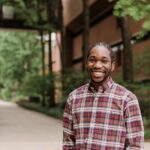
Jordan Troutman ’21, M29, computer science and mathematics, first discovered algorithmic fairness during a summer research program at Rutgers University after his first year at UMBC. The field focuses on how computer algorithms, such as those responsible for facial recognition or the content in our social media feeds, can foster fairness or unfairness. The effects include anything from attempting to identify someone who committed a crime to curating the content we see in ways that influence how we think about others.
“Because these algorithmic systems are being used to make a lot of life-changing decisions,” Troutman says, “now we have to make sure that the tools and technologies we’re developing have some type of guarantees or safeguards to make sure that they don’t have unintended consequences towards minority groups specifically, or just any unintended actions.”
When Troutman returned to UMBC from his summer at Rutgers, he sought out James Foulds, assistant professor of information systems. He’s researched these issues under Foulds’s mentorship for the past three years.
This fall, Troutman will take his research interests to Stanford University, where he’ll pursue a Ph.D. in computer science as UMBC’s first Knight-Hennessy Scholar. The international Knight-Hennessy Scholarship is open to students applying to graduate school at Stanford in any area of study. In addition to funding, it offers robust leadership and community-development training. Troutman was selected as exemplifying the scholarship’s core values: independence of thought, purposeful leadership, and civic mindedness.
Socially-minded scholarship
In the 2019 – 2020 academic year, Troutman represented the student perspective as a voting member of the Maryland Higher Education Commission (MHEC), which establishes policies for every college in the state. At UMBC, Troutman took on leadership roles in the Student Government Association (SGA), the National Society for Black Engineers (NSBE), and as a teaching assistant and tutor supporting fellow students. In 2020, he received another prestigious honor, the Barry Goldwater Scholarship.
 Jordan Troutman, left, and Dan Barnhart, former director of The Commons and student life at UMBC, who recommended Troutman apply for the MHEC position.
Troutman is a Meyerhoff Scholar and a member of the Honors College, and he’s one of two UMBC valedictorians for 2021. In addition to Rutgers, he’s conducted summer research at the University of California, Berkeley and in the Fairness, Accountability, Transparency, and Ethics (FATE) research group at Microsoft. Troutman has also been involved with UMBC’s Center for Democracy and Civic Life (CDCL), and he counts its director, David Hoffman, among his mentors.
“Jordan embodies the kind of creativity that transcends disciplinary boundaries, and has found dazzling ways to weave his social concerns into his scholarship,” Hoffman shares. “I’m confident he will thrive in the Knight-Hennessy program, and that we will have many more occasions to celebrate his civic contributions.”
Participating in leadership has also given Troutman the chance to get to know other leaders. His experience with MHEC demonstrated what true leadership looks like. “It’s really powerful to see how—when you are passionate about something, and you care about the people, and not the power or the position—you can do good work and effect good change.”
From intention to impact
With the Knight-Hennessy Scholarship, as well as a highly competitive Graduate Research Fellowship from the National Science Foundation, Troutman will have the freedom to pursue research of his choice at Stanford. He values the opportunity to be creative in his approach and thinks of his research as “computational social sciences”—interdisciplinary by definition. His computer science and math courses have prepared him for the work; so have courses in the liberal arts and his experiences with campus engagement.
Elective courses in philosophy “helped me understand broadly how to articulate these non-quantitative concepts,” such as fairness, Troutman says. A particular Honors College course about how the media uses faces and how we internalize what the faces represent stuck with him.
Social media algorithms “are everywhere. So if these algorithms are unfair in any way, then the way we’re consuming this media may not necessarily be representative of the world we live in,” Troutman says. “I think that’s a super important problem, and because I’ve taken these other classes, it’s given me a broader context of how important this problem is and has reaffirmed my interest in doing this kind of research.”
 Jordan Troutman, far left, attends a lab meeting in fall 2019 with James Foulds (right rear, green shirt) and his peers.
Troutman is looking forward to collaborating with the other Knight-Hennessy Scholars on some of these big ideas. He also appreciates the leadership training offered through the program, which he sees as being about “trying to figure out how to be a well-intentioned person, and then making really good work out of what your intentions are for the world.”
Supportive community
Troutman shares that several UMBC experiences were instrumental in helping him build his confidence and understand the powerful difference he can make.
Roles in SGA and participating in UMBC’s STRiVE student leadership retreat and Alternative Spring Break “helped me understand my own sense of agency and my ability to make an impact,” Troutman says. He realized that solving massive, intimidating problems often starts with a single person, and says, “Learning that has just made me believe that I literally could do anything.”
The Meyerhoff Scholars Program helped him internalize some of the same ideas. “Meyerhoff gave me this idea that you can really make a change in your life,” Troutman says. “You can be whoever you want to be. You just have to be active about it and to believe in yourself and use the support and community around you to get where you want to be.”
NSBE also played a role in Troutman’s growth. NSBE “helps students feel that they belong in science,” he says. “It’s helped to center me and to help me really understand what it means to build community. Now, I hope to go and help to foster more communities at these other places that I go in my life.”
And Foulds, his research mentor, “has given me really good insight, perspective, and guidance on how to do research, think about problems, and especially how to overcome a lot of different pitfalls that happen in research,” Troutman says.
 Jordan Troutman ’21
An ethical leader
All these programs, communities, and experiences are representative of the culture at UMBC, Troutman says. “You can really be yourself and be engaged and very intentional with people, and you can be as cool or kooky as you want—there’s a space for you at UMBC,” he says.
In the Knight-Hennessy application process, students submit a video addressed to their future Knight-Hennessy cohort. “Jordan’s video demonstrated how to do a gymnastics flip. Not the kind of thing you’d expect from a computer scientist—but it was a way to showcase his other interests and let his personality shine,” April Householder, director of undergraduate research and prestigious scholarships, observes. “Lately, UMBC has been winning very prestigious scholarships, and I think part of the success has to do with encouraging our students to be themselves throughout the process.”
“I think that’s the beauty of this school,” Troutman shares. “You can be whoever you want. And it’s not just something that you say to get people in here. It’s like, no, they’re actually backing it up with the things that they do. It’s really about the students.”
For Troutman, his research, civic engagement, and leadership are all about one thing: making positive social change.
“While Jordan was working in my lab, I was gratified to see his enthusiasm grow as he realized that his technical research could be a part of the efforts he was already making toward creating positive change in our society,” Foulds says. “Jordan is on a path toward becoming an ethical leader and a thought leader who can help steer the course of progress in AI technology in the right direction.”
Ultimately, Troutman says, “What I want to do is just help people see their ideas come true.”
Banner image: Jordan Troutman on UMBC’s Academic Row. All photos by Marlayna Demond ’11 for UMBC.
]]>
Jordan Troutman ’21, M29, computer science and mathematics, first discovered algorithmic fairness during a summer research program at Rutgers University after his first year at UMBC. The field...
https://umbc.edu/stories/umbcs-jordan-troutman-to-continue-algorithmic-fairness-research-as-knight-hennessy-scholar-at-stanford/
https://my3.my.umbc.edu/api/v0/pixel/news/119642/guest@my.umbc.edu/f102ef21857b9362360578f9db57e09b/api/pixel
civic
classof2021
cnms
coeit
community
csee
honorscollege
mathstat
meyerhoffscholars
page1
policy-and-society
science-and-technology
undergradresearch
UMBC News & Magazine
https://my3.my.umbc.edu/groups/umbc-news-magazine
https://assets1-my.umbc.edu/system/shared/avatars/groups/000/001/943/24435aa6207c452e7bc15cc74b42c7bb/xsmall.png?1748556657
https://assets1-my.umbc.edu/system/shared/avatars/groups/000/001/943/24435aa6207c452e7bc15cc74b42c7bb/original.png?1748556657
https://assets2-my.umbc.edu/system/shared/avatars/groups/000/001/943/24435aa6207c452e7bc15cc74b42c7bb/xxlarge.png?1748556657
https://assets2-my.umbc.edu/system/shared/avatars/groups/000/001/943/24435aa6207c452e7bc15cc74b42c7bb/xlarge.png?1748556657
https://assets3-my.umbc.edu/system/shared/avatars/groups/000/001/943/24435aa6207c452e7bc15cc74b42c7bb/large.png?1748556657
https://assets1-my.umbc.edu/system/shared/avatars/groups/000/001/943/24435aa6207c452e7bc15cc74b42c7bb/medium.png?1748556657
https://assets2-my.umbc.edu/system/shared/avatars/groups/000/001/943/24435aa6207c452e7bc15cc74b42c7bb/small.png?1748556657
https://assets1-my.umbc.edu/system/shared/avatars/groups/000/001/943/24435aa6207c452e7bc15cc74b42c7bb/xsmall.png?1748556657
https://assets2-my.umbc.edu/system/shared/avatars/groups/000/001/943/24435aa6207c452e7bc15cc74b42c7bb/xxsmall.png?1748556657
UMBC News & Magazine
0
0
false
Thu, 06 May 2021 15:29:49 -0400
UMBC students set new record in prestigious Goldwater Scholarships for STEM research
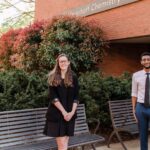
Four UMBC students have been named 2021-2022 Goldwater Scholars, setting a new university record for the most Retrievers to earn this prestigious undergraduate award in a single year. They are Joshua Slaughter ‘22, computer engineering; Kaitlynn Lilly ‘22, physics and mathematics; Gerson Kroiz ‘22, mathematics; and Karan Luthria ‘22, bioinformatics. Their awards make UMBC one of the highest-producing universities for Goldwater Scholars in the nation, directly alongside Harvard, MIT, and Johns Hopkins.
The goal of the Barry Goldwater Scholarship and Excellence in Education Program is to provide the United States with “a continuing source of highly qualified scientists, mathematicians, and engineers” to move the nation forward. UMBC’s prior Goldwater Scholars, including Rhodes Scholar Naomi Mburu ‘18, chemical engineering, have gone on to top graduate programs and promising research careers.
That four UMBC students won awards, from over 1,250 STEM student applicants across the country is remarkable, notes April Householder ’95, director of undergraduate research and prestigious scholarships at UMBC. “Winning the Goldwater means that Slaughter, Lilly, Kroiz, and Luthria join a legacy of scholars who have gone on to become this country’s leading scientists, engineers, and mathematicians,” she says.
“The impact that these students will have in their respective fields is immense,” Householder shares, “and they are ready for the challenge. All four of them had their research internships moved online because of COVID, and they have proved that they are resilient.”
 Joshua Slaughter, left, Kaitlynn Lilly, center, and Karan Luthria on campus.
Slaughter, Lilly, Kroiz, and Luthria are among the 410 winners selected this year from a highly competitive national pool of applicants. They will receive substantial scholarship funding that advances their undergraduate work and supports their educational paths.
The students met each other early in their UMBC careers and are close friends, all involved in the Meyerhoff community—Slaughter, Lilly, and Luthria as scholars, and Kroiz as an affiliate.
The impact of algorithms
Joshua Slaughter actually began doing research at UMBC when he was in high school, starting in environmental science. As he explored his interests, he discovered his fascination with using machine learning to evaluate the replicability and reproducibility of algorithms.
 Joshua Slaughter
Currently, Slaughter works with Distinguished University Professor Tulay Adali, computer science and electrical engineering (CSEE). Their machine learning research has applications in fields like neuroimaging, which uses data-driven algorithms to identify features of neurological disease. Slaughter says that it’s essential to diversify the field of machine learning and that people of all backgrounds need to be involved in the development of algorithms.
“Machine learning algorithms will be crucial in future decision-making. If they are developed without intersectionality being considered, we will have nightmarish outcomes for certain underrepresented populations,” he explains. “That’s a huge reason why I’m pursuing machine learning.”
When Slaughter applied to UMBC, he already had his sights set on the Goldwater. He was researching in the lab when he learned he won the scholarship—working alone due to COVID-19 restrictions. “I screamed,” he said, overjoyed by the news.
In addition to being a Meyerhoff Scholar, Slaughter is in the UMBC Honors College, and a member of the URISE program, which supports undergraduate juniors and seniors who are majoring in the science, engineering and mathematics. He is a member of the National Society of Black Engineers and Tau Beta Pi, the engineering honors society. He has completed research internships at Princeton University and Carnegie Mellon University, has presented his research at conferences, and has published two scientific papers.
Slaughter looks forward to pursuing a Ph.D. after his senior year, and says that receiving the Goldwater Scholarship proves to him that he can succeed in a research career. He’s thankful to UMBC for guiding him, from providing an Undergraduate Research Award to connecting him with internship opportunities.
“UMBC does a great job of putting students first,” says Slaughter. He’s already paying that forward by mentoring high school students in Baltimore and as a CSEE teaching fellow.
STEM role models matter
Kaitlynn Lilly actually applied to the Goldwater program as a sophomore but didn’t receive the award—an experience shared by Slaughter. She says the feedback she received from UMBC faculty and staff throughout the process was instrumental in her resilience and continued growth as a researcher, and earning the scholarship this year was all the more gratifying.
 Kaitlynn Lilly
Lilly’s research focuses on using partial differential equations to understand how large structures, such as bridges, interact with air flow and are impacted by aerodynamics. Lilly currently conducts research with Justin Webster, assistant professor of mathematics. Webster himself received a Goldwater Scholarship in 2007 and knows the impact of receiving the award.
Webster and Lilly are also collaborating with researchers at Carnegie Mellon University. Lilly also has experience working with Carnegie Mellon researchers through an enriching virtual internship last summer, secured after her internship at MIT’s Lincoln Lab was cancelled due to COVID-19.
In addition to conducting research at Carnegie Mellon and UMBC, she has completed internships at the Johns Hopkins Applied Physics Lab and University of Hawaii. This summer, Lilly plans to conduct research at the University of Leiden in the Netherlands.
Beyond the lab, Lilly is committed to volunteering at the local Arbutus Middle School, supporting students one-on-one who need extra help in STEM classes. “I’m a first-generation college student, and having someone that has gone through it tell you that you can do it really matters,” she says. “Being that inspiration for someone else has been very rewarding.”
Lilly, who is also a member of the Honors College, explains that receiving the Goldwater Scholarship confirms to her that “what I’m doing matters.” She plans to pursue her Ph.D. in applied mathematics when she graduates from UMBC next year.
Safer cancer treatment through math
Gerson Kroiz began his UMBC undergraduate experience at 16 years old, passionate to pursue research with public impact. He had his eye on the Goldwater Scholarship early, knowing the doors it could open. Receiving the Goldwater “really validates where I am at, and the hard work that I’ve put into my academic path,” as well as the value of UMBC support for undergraduate researchers, he says.

Gerson Kroiz. Photo courtesy of Kroiz.
Kroiz has refined his research interests through experiences at institutions across the country. This past summer, he completed a virtual internship at UCLA, adding to his resume of internships at the National Institute of Standards and Technology and UMBC.
Today, Kroiz’s research focuses on using machine learning techniques to improve real-time imaging for safer cancer treatments. The technology he studies will help physicians treat people with cancer by “reducing possible side-effects from common cancer treatment methods,” Kroiz explains.
In addition to being an affiliate of the Meyerhoff Scholars program, Kroiz is a member of the Honors College and won an Undergraduate Research Award. He volunteers with UMBC’s Creative Coders program at Arbutus Middle School. There, he helps middle school students learn about computer science through hands-on applications such as game design.
He is also a teaching assistant in mathematics, working with Matthias Gobbert, professor of mathematics and statistics. And Kroiz is vice president of the Korean Student Association, ready to serve as president in the 2021-2022 academic year.
Kroiz plans to pursue his Ph.D. in applied mathematics with a focus in high-performance computing and big data after graduating next year.
Public impact research
As an undergraduate who aspires to become a physician-scientist, Karan Luthria is inspired by the profound impact that lab research can have on patients’ treatment and health outcomes. His research focuses on studying similarities between diseases hoping to identify new avenues for drug repurposing.
 Karan Luthria
Luthria explains that he is looking at “how previously developed drugs can be used to treat different conditions.” Although he has been working on this research since freshman year, and has presented his findings at conferences around the country, he says COVID-19 has brought much attention to the value of drug repurposing.
On the day that the Goldwater Scholarship recipients were announced, Luthria refreshed the award page, awaiting the results. When he finally saw his name appear, “I was humbled,” he says. “Just seeing how I have the potential to make a difference in science and to have my research recognized by the Goldwater Committee is exciting.”
Luthria has held several internships, including at Harvard Medical School, the National Institutes of Health (NIH), and the Johns Hopkins Applied Physics Lab. Maricel Kann, associate professor of biological sciences, is his research mentor at UMBC. He says that Kann and his mentors at Harvard and at the NIH played a particularly important role in supporting him to achieve his career goals and throughout the Goldwater application process.
Outside of the lab, Luthria is a teaching assistant in math and biology, and a tutor in the Chemistry Tutorial Center. He is also the logistics director for HackUMBC, a student organization that plans 24-hour-long hackathons for students to develop technological solutions to problems that matter to them. As a member of HackUMBC, Luthria connects with corporations and campus partners to secure funding that supports the annual event, sharing his passion for collaborative public impact research.
Banner image: Karan Luthria, left; Kaitlynn Lilly, center; and Joshua Slaughter. All photos by Marlayna Demond ’11 for UMBC unless otherwise noted.
]]>
Four UMBC students have been named 2021-2022 Goldwater Scholars, setting a new university record for the most Retrievers to earn this prestigious undergraduate award in a single year. They are...
https://umbc.edu/stories/umbc-students-set-new-record-in-prestigious-goldwater-scholarships-for-stem-research/
https://my3.my.umbc.edu/api/v0/pixel/news/119655/guest@my.umbc.edu/24fe6228731f8b927730cb5c5e7871e6/api/pixel
chembiochem
cnms-csee
coeit
honorscollege
majoraward
mathstat
meyerhoffscholars
page1
physics
science-and-technology
undergradresearch
UMBC News & Magazine
https://my3.my.umbc.edu/groups/umbc-news-magazine
https://assets1-my.umbc.edu/system/shared/avatars/groups/000/001/943/24435aa6207c452e7bc15cc74b42c7bb/xsmall.png?1748556657
https://assets1-my.umbc.edu/system/shared/avatars/groups/000/001/943/24435aa6207c452e7bc15cc74b42c7bb/original.png?1748556657
https://assets2-my.umbc.edu/system/shared/avatars/groups/000/001/943/24435aa6207c452e7bc15cc74b42c7bb/xxlarge.png?1748556657
https://assets2-my.umbc.edu/system/shared/avatars/groups/000/001/943/24435aa6207c452e7bc15cc74b42c7bb/xlarge.png?1748556657
https://assets3-my.umbc.edu/system/shared/avatars/groups/000/001/943/24435aa6207c452e7bc15cc74b42c7bb/large.png?1748556657
https://assets1-my.umbc.edu/system/shared/avatars/groups/000/001/943/24435aa6207c452e7bc15cc74b42c7bb/medium.png?1748556657
https://assets2-my.umbc.edu/system/shared/avatars/groups/000/001/943/24435aa6207c452e7bc15cc74b42c7bb/small.png?1748556657
https://assets1-my.umbc.edu/system/shared/avatars/groups/000/001/943/24435aa6207c452e7bc15cc74b42c7bb/xsmall.png?1748556657
https://assets2-my.umbc.edu/system/shared/avatars/groups/000/001/943/24435aa6207c452e7bc15cc74b42c7bb/xxsmall.png?1748556657
UMBC News & Magazine
0
0
false
Thu, 15 Apr 2021 16:48:32 -0400
URCAD 2021 showcases creativity, resilience of UMBC student researchers
UMBC’s Undergraduate Research and Creative Achievement Day (URCAD) has burst out of the ballroom and onto computer screens around the world. For the second year in a row, the popular undergraduate research forum will be entirely online due to the pandemic, using a video presentation and online discussion tool called VoiceThread. But unlike 2020, no rapid shift is needed. After over a year of largely online learning and research, everyone involved is ready to take full advantage of the virtual medium.
“This event has gone global,” says April Householder ’95, director of undergraduate research and prestigious scholarships. Being online means URCAD leapt from about 2,500 people attending in person in 2019 to 8,000 virtual visits in 2020. “Viewers were coming in from as far away as the U.K., Korea, and South America,” says Householder. She expects that trend will continue this year.
 April Householder, 2018. Photo by Michael Mower.
Having a full week to explore URCAD this year also means viewers will have ample time to browse the available sessions, rather than “rushing from one thing to another,” says Householder, as they used to do at the in-person event. They’ll be able to explore, at their own pace, research on a vast array of topics, from the effects of anti-Asian discrimination during the COVID-19 pandemic to the Black Lives Matter movement, to cancer treatment, skateboarding culture, and online sneaker sales.
Connecting beyond boundaries
In lieu of face-to-face chats, visitors will be able to participate in online discussions with student presenters. Last year a research group in UMBC’s Asian studies department received feedback from researchers in Korea, says Householder. She hopes that this year, opportunities for these kinds of connections will increase with a new feature that enables users who aren’t from UMBC to comment through URCAD’s VoiceThread interface.
Within the UMBC community itself, Householder hopes students, faculty, and staff will take advantage of the opportunity to explore “things outside their disciplinary box.” Artists, scientists, humanists, social scientists, and engineers can all benefit from each others’ feedback, she explains.
Constraints generate creativity
Last year, when students had to quickly pivot from in-person presentations to using VoiceThread, “they had to learn an additional skill on the fly,” says Householder. This year, students are more prepared to take full advantage of all that the online format offers.
Further, due to the constraints of COVID, student researchers have become even more creative in using technology not just to display their research, but to pursue their research at a time when in-person interviews, fieldwork, and traditional performances aren’t possible. Students learned to do interviews online, adjusted their sample sizes, and navigated lab research within physical distancing guidelines. They also responded to the pandemic by examining the changes in society and in themselves.
One advantage of the online format is that the presentations are available to view in perpetuity. “We now have an archive of the event so we can use it as a teaching tool for future generations of URCAD presenters and mentors,” Householder says.
She finds this addition of an expanded archive and URCAD’s global reach to be fitting developments as the event marks its 25th anniversary. To celebrate the milestone, URCAD will feature a special video “fireside chat” with founders Diane Lee, Kathy Sutphin, Elizabeth Pennington, and Janet McGlynn.

Klaudine Wakasa. Image courtesy of Wakasa.
Viewers will also hear a keynote by Klaudine Wakasa ‘08, financial economics, who serves as a strategy advisor for clean technology ecosystems, consulting with international governments.
UMBC students, faculty, staff, and alumni, and the general public, are invited to view these special sessions, and hundreds of available students presentations at urcad.umbc.edu, April 19-25, 2021. Featured below are a few student presentations that give a glimpse into the range of what will be available. Each has been shaped in some way by the COVID-19 pandemic—in topic, approach, or format.
“COVID-19 telehealth and telerehabilation reflections: Understanding the stroke survivor and caregiver perspectives”
Frances Watson ‘21, computer science, conducted research on telehealth and telerehabilitation services during COVID-19 through UMBC’s Bodies in Motion Lab. “I am investigating the stroke survivor and caregiver perspectives to understand how socioeconomic disparities affect this population,” Watson explains.

Frances Watson. Photo courtesy of Watson.
Watson has so far conducted 20 interviews with rehabilitation specialists about their experience with telehealth appointments, alongside her graduate mentor, human-centered computing Ph.D. student Adegboyega Akinsiku. She is also currently interviewing stroke survivors and caregivers.
“The COVID-19 pandemic not only changed how we conduct these interviews, but also the analysis of them,” says Watson. “We conducted and continue to conduct these interviews on teleconferencing platforms such as Cisco Webex and Zoom, allowing us to video-record them. In comparison, when we were in person we would have an audio recording device present. Now we can rewatch the video recordings for our data analysis.”
The fact that her research technique adjusted to match the format of the telehealth appointments themselves “has proven very useful” in surfacing insights, she says.
Watson was previously able to gain research experience through the Stanford SURF program. As a Center for Women in Technology Scholar and Undergraduate Research Award (URA) Scholar, she also knows the power of research opportunities in developing an identity and career pathway as a STEM researcher, as well as the value of peer support. This has motivated her leadership on campus, including as Student Government Association president in spring 2020.
“this is it: A poetic response to the anti-Asian racism during the COVID-19 pandemic”
Just after the pandemic started last March, Calista Ogburn ’21, health administration and policy, felt hurt and angry as she heard about rising anti-Asian hate crimes and racism. Then she herself had an upsetting encounter at a Home Depot. “In that moment, standing in the Home Depot aisle next to the grills, I knew I had to write a poetry collection,” she says.
It was a process that involved many nights of tears, processing heavy emotions. “Reliving past experiences of racism and microaggressions in addition to writing responses to news headlines of anti-Asian racism was utterly exhausting,” she says. She wrote around the clock, and after publication she was gratified to learn “how my poetry has supported others during this turbulent time.”
 Poetry collection “this is it.” Image courtesy of Ogburn.
Ogburn does not intend to pursue a career in poetry, but she says, “I hope it remains my best friend.” Ogburn will present poetry from her collection “this is it” at URCAD. “My hope,” she previously shared with UMBC Magazine, “is that these poems can touch those who are feeling loss, loneliness, or the combined grief and rage of experiencing racism.”
 Calista Ogburn poses with her books of poetry. Photo from calista-ogburn.com.
“Modeling radio emission from tidal disruption events”
Omar French ’21, physics and mathematics, came to UMBC to become a theoretical physicist and he will be leaving soon to do just that. He found COVID-19 increased demands on his faculty mentors’ time, requiring him to move forward with his work more independently than before.
“I’m sure most people can agree that controlling one’s work is much more gratifying than the contrary, but of course, it’s a bit like being in the wilderness,” says French. “It forces you to think for yourself and to be confident in what you’re doing.”
 Omar French. Photo courtesy of French
French’s research on supermassive black holes has yielded insights. “Perhaps the most remarkable technical thing I’ve learned is that the mass of supermassive black holes central to inactive galaxies can be estimated reasonably from measuring only a few factors,” he explains.
After graduating, French will begin a physics Ph.D. program at University of Colorado Boulder. He describes the past year challenging, but also as a period that helped him grow as a scientist more than any other time of his life. As a result, he is heading off to graduate skill with new skills and a critical eye.
“The obedient body: Researching trained and culturally informed movement biases”
It was during a gender and women’s studies course that URA Scholar Gretta Zinski ’22, dance, read something that rocked her world. She says it was fascinating to learn about how the different social conditioning that men and women experience is reflected in how each gender moves. “The excerpt inspired me to assess my own habits, interests, and biases in an attempt to figure out what were my own thoughts and what I had been taught about my own femininity and beliefs,” she says.
Unfortunately, COVID kept the scope of Zinski’s project smaller than she would have liked, but she was still able to access fascinating findings. “Biases do affect our behavior, which translates into movement,” she says. “The physiological connections between the body and the mind were so interesting to me.”
 Still image from Zinski’s dance film project, courtesy of Zinski.
Zinski plans to continue her research and use it to plan bias deconstruction workshops. Of her pandemic research experience, she says, “I learned so much about myself and how to work on my own. This is going to be a very important skill for me and my future career as a self-employed artist.”
“Performing traditional Chinese folk songs”
International travel may have been largely shut down this year, but that didn’t stop URA Scholar Mark Beachy ’21, Asian studies, from exploring China. “When I sing traditional Chinese folk songs I am transported to China and I am experiencing the stories from long ago that are told through the lyrics and music. And it brings me great joy to do that and to share it with others,” he says.
 Mark Beachy. Photo courtesy of Beachy.
Beachy’s URCAD presentation features a video performance of the folk song “Jasmine.” He painstakingly edited together his vocal performance with accompaniment from a pianist in Illinois and a guzheng player in China. Beachy found both musicians online. “When singing traditional Chinese folk songs or any song it is important to connect with the other musicians in order to give the audiences an authentic performance of music that deserves respect,” he says.
Beachy returned to college in his 40s after a career as a professional actor and a writer of musicals, wanting to learn something new. Though not of Chinese descent, he has a passion for Chinese culture, language, and history.
His eventual goal is to teach English to Chinese speakers, and he hopes music can be a helpful teaching tool. “Music is a great way to learn a language,” he says. After graduating, he plans to earn a master’s degree at UMBC in Teaching English as a Second Language.
“Interpretation of models of care in residential communities for older adults”
“I am passionate about working with an underserved population and providing elders with quality care,” says Sydney Siegel ‘20, management of aging services. Siegel graduated in Fall 2020 from UMBC’s Erickson School and now works in an assisted living community. Her URCAD project is an analysis of models of care that older adults can experience. “The models of care I studied are about enhancing quality of life and quality of care, something I hope all aging services strive for,” she says.
Interviewing older people proved to be a challenge during the COVID-19 pandemic. In addition to many care facilities being inaccessible, staff members caring for older adults were incredibly busy. However, Siegel found ways to complete interviews online. “I made great connections and heard wonderful stories from participants,” she shares.
Siegel, a URA scholar, credits Erickson School faculty mentor Louise M. Murray with helping her grow in the field. “I definitely felt imposter syndrome when I started the research, but I learned to see my inexperience as a good thing, Siegel says. “Learning is so powerful and I feel grateful to have learned so much.” She looks forward to continuing to use research to inform care she provides for older adults.
“Optimizing in-situ longevity of silver nanoplates”
As a first-year student who started college in the midst of a pandemic, Dariush Aligholizadeh ‘24, biochemistry and computer science, did not have a typical introduction to UMBC. He didn’t want that to affect his ability to get started with research right away, but it was a lot to manage. “I was trying to adjust to college life while also trying to conduct research safely and securely within COVID-19 restrictions,” he says.

Dariush Aligholizadeh. Image courtesy of Aligholizadeh.
Aligholizadeh was able to find a compelling in-person research opportunity in a lab that employed strict physical distancing. His project involved synthesizing silver nanoplates “for their ability to reflect radiation and light to very high degrees.” He explains, “Basically, I make tiny triangles that kill cancer.” And his research experience proved highly gratifying.
“Every aspect of chemistry is in its own way beautiful, and watching these textbook principles come to life in my project is like watching magic happen. I take simple grains of silver salts and they come together in these beautiful sharp triangular structures, almost as if they were put together by hand,” he explains.
 Electron microscope image of nanoplates. Courtesy of the Devadas Lab.
Aligholizadeh believes his research experience has already improved his skills in calculus, biology, and organic chemistry, and helped solidify his plans to eventually become a medical doctor. He has also found that the challenges of COVID have required him to improve his time-management and online communication skills. Still, he looks forward to learning in-person again when it’s safe to do so.
The UMBC community and general public can see these presentations and many more at urcad.umbc.edu, April 19-25, 2021.
Featured image: Calista Ogburn, 2018. Photo by Marlayna Demond ’11 for UMBC.
Article written by Karen Stysley for UMBC News.
]]>
UMBC’s Undergraduate Research and Creative Achievement Day (URCAD) has burst out of the ballroom and onto computer screens around the world. For the second year in a row, the popular undergraduate...
https://umbc.edu/stories/urcad-2021-showcases-creativity-resilience-of-umbc-student-researchers/
https://my3.my.umbc.edu/api/v0/pixel/news/119658/guest@my.umbc.edu/b0fdbef5295bf80807456fdcff41891f/api/pixel
arts-and-culture
asianstudies
cahss
chembiochem
cnms
coeit
community
csee
dance
ericksonschool
mathstat
page1
physics
policy-and-society
saph
science-and-technology
undergradresearch
UMBC News & Magazine
https://my3.my.umbc.edu/groups/umbc-news-magazine
https://assets1-my.umbc.edu/system/shared/avatars/groups/000/001/943/24435aa6207c452e7bc15cc74b42c7bb/xsmall.png?1748556657
https://assets1-my.umbc.edu/system/shared/avatars/groups/000/001/943/24435aa6207c452e7bc15cc74b42c7bb/original.png?1748556657
https://assets2-my.umbc.edu/system/shared/avatars/groups/000/001/943/24435aa6207c452e7bc15cc74b42c7bb/xxlarge.png?1748556657
https://assets2-my.umbc.edu/system/shared/avatars/groups/000/001/943/24435aa6207c452e7bc15cc74b42c7bb/xlarge.png?1748556657
https://assets3-my.umbc.edu/system/shared/avatars/groups/000/001/943/24435aa6207c452e7bc15cc74b42c7bb/large.png?1748556657
https://assets1-my.umbc.edu/system/shared/avatars/groups/000/001/943/24435aa6207c452e7bc15cc74b42c7bb/medium.png?1748556657
https://assets2-my.umbc.edu/system/shared/avatars/groups/000/001/943/24435aa6207c452e7bc15cc74b42c7bb/small.png?1748556657
https://assets1-my.umbc.edu/system/shared/avatars/groups/000/001/943/24435aa6207c452e7bc15cc74b42c7bb/xsmall.png?1748556657
https://assets2-my.umbc.edu/system/shared/avatars/groups/000/001/943/24435aa6207c452e7bc15cc74b42c7bb/xxsmall.png?1748556657
UMBC News & Magazine
0
0
false
Mon, 12 Apr 2021 03:46:42 -0400
UMBC offers new Research Experiences for Undergraduates in smart computing, big data

Starting out at UMBC, Meyerhoff Scholar Timothy Potteiger wasn’t certain what direction he wanted to take. However, he benefited from UMBC programs that brought the world to his doorstep, inviting universities to pitch him their summer research experiences. One conversation with Washington State University particularly resonated. They spoke about researching smart home sensor technologies to help improve the daily lives of older adults and people with disabilities.
Potteiger ’14, computer engineering, was drawn to that purpose-driven approach. Little did he know that the program manager for that undergraduate research experience in 2013, Nirmalya Roy, would soon join UMBC’s faculty and expand research opportunities for even more undergraduates.
 Nirmalya Roy
Research Experiences for Undergraduates (REUs) are critical for students like Potteiger. Roy, now associate professor of information systems at UMBC, is principal investigator leading a new REU in Smart Computing and Communications funded by the National Science Foundation (NSF). The program is accepting applications through March 31 for this summer from students nationwide.
Potteiger is excited for students to take advantage of this opportunity. “I know Dr. Roy has a good vision on how to actually impact society with research,” he shares.
Transformative experience
The program will bring together ten undergraduate students in a paid 10-week, full-time research experience from June 7 to August 13. While the summer 2021 program will be remote, each student will work closely with a research group and mentor. They will receive guidance from Roy and co-PI Dmitri Perkins, as well as other information systems and computer science and electrical engineering (CSEE) faculty.
In the final week, the students will have a chance to present their research through UMBC’s popular Summer Undergraduate Research Fest. They will also have the opportunity to develop peer-reviewed articles and continue their research throughout the year with faculty.
“The idea of this experience is not only to give them exposure to hands-on research problems, but to also help undergraduates with professional development,” says Roy. “Developing a peer network and encouraging them to build confidence talking with professors and researchers in their field will be important for their careers.”
Real-world applications
One REU project will tackle privacy protection in COVID-19 contact tracing programs, while another will study a chatbox method for studying cryptocurrency. Roy will also give students the chance to optimize smart home sensors for seniors or work on the FloodBot project, a collaboration with nearby Ellicott City to create an early flood warning system after a 2018 flash flood caused catastrophic damage.
 Sensors placed in Ellicott City through the FloodBot project. Photo courtesy of Nirmalya Roy.
Students can also work with Perkins, a CSEE professor, on research into wireless devices capable of “situational awareness,” the ability to switch from one frequency to the next along a limited radio spectrum highway. The interdisciplinary project is crucial to staving off what some experts fear is a looming, massive traffic jam for wireless devices globally.
“The hallmarks of all our projects is that they have community impact,” says Vandana Janeja, chair of information systems.
 Vandana Janeja
Expanding opportunity
Providing undergraduates with real, hands-on research experiences resonates personally with Perkins. He grew up in a no stop-light town in Mississippi and attended Tuskegee University, which had well-regarded academic programs but more limited lab research opportunities at the time. Perkins was able to gain research experience in a broader range of areas by participating in REUs at two other universities.

Dmitri Perkins. Photo courtesy of Perkins.
Recognizing that many students come from similar backgrounds where research opportunities may be rare, the REU specifically encourages applicants from community colleges and groups traditionally underrepresented in the STEM fields.
“With students from traditionally underserved communities, there is often some apprehension or insecurity about pursuing a career in research,” Perkins says. “Once students complete their UMBC summer experience, they will have more information, more understanding of what research looks like, and the knowledge that they can actually do this.”
Unique online experience
Jianwu Wang, information systems, has also joined the wave of faculty from UMBC’s College of Engineering and Information Technology (COEIT) launching new REUs. Wang is assistant professor of data science and director of the Big Data Analytics Lab. With co-PI Matthias Gobbert, professor of mathematics, he’s just received NSF funding to launch an online interdisciplinary Big Data REU.
 Jianwu Wang
They will provide an 8-week summer online research experience to undergraduates from across the country. Students will explore “how to utilize modern data science and high-performance computing techniques to process and analyze big data in many science and engineering disciplines,” Wang explains. This includes fields ranging from atmospheric science to mechanical engineering to medicine.
“We’ve designed the program to be purely online so it is particularly useful for students in remote areas or who might have health concerns or concerns about travel,” says Wang. “We also want to make sure it is accessible to students with family responsibilities and disabilities, who may not be able to leave their home for an extended period of time.”
Big data research
This program will combine formal instruction, team-based research, and experience disseminating that research. The goal is to ignite students’ interest in “how data science and high-performance computing techniques could help the scientific discovery process” while giving them essential hands-on research skills and preparing them for the workforce.
Students will learn how to identify research questions and conduct research using advanced cyberinfrastructure software technologies and hardware resources. Tentative research themes for summer 2021 research projects include big data and machine learning techniques for sea ice prediction and for medical image classification.
The summer 2021 program will run June 7 through July 31. Applications are due by April 15, 2021, and the organizers invite undergraduates in all STEM fields to apply. Students who complete the fully-funded program will also be eligible for additional funds to present their research at conferences around the country.
Roy and Wang credit COEIT for encouraging their efforts to launch new REUs. Erin Lavik, associate dean for research and faculty development and professor of chemical, biochemical, and environmental engineering, describes the new programs as “fantastic.” She shares, “This is an exciting chance to connect undergraduates from across the country with unique UMBC student research experiences and our outstanding, innovative faculty.”
 Graduate student Adam Day (left) works with Erin Lavik (right) in her lab, 2017.
Featured image: Nirmalya Roy with a student in 2018. All photos by Marlayna Demond ’11 for UMBC unless otherwise noted.
Article written by Nick Ford for UMBC News.
]]>
Starting out at UMBC, Meyerhoff Scholar Timothy Potteiger wasn’t certain what direction he wanted to take. However, he benefited from UMBC programs that brought the world to his doorstep, inviting...
https://umbc.edu/stories/umbc-offers-new-research-experiences-for-undergraduates-in-smart-computing-big-data/
https://my3.my.umbc.edu/api/v0/pixel/news/119669/guest@my.umbc.edu/4a22ba23ba6c1bc35a72077da93f5685/api/pixel
cnms
coeit
csee
is
mathstat
science-and-technology
undergradresearch
UMBC News & Magazine
https://my3.my.umbc.edu/groups/umbc-news-magazine
https://assets1-my.umbc.edu/system/shared/avatars/groups/000/001/943/24435aa6207c452e7bc15cc74b42c7bb/xsmall.png?1748556657
https://assets1-my.umbc.edu/system/shared/avatars/groups/000/001/943/24435aa6207c452e7bc15cc74b42c7bb/original.png?1748556657
https://assets2-my.umbc.edu/system/shared/avatars/groups/000/001/943/24435aa6207c452e7bc15cc74b42c7bb/xxlarge.png?1748556657
https://assets2-my.umbc.edu/system/shared/avatars/groups/000/001/943/24435aa6207c452e7bc15cc74b42c7bb/xlarge.png?1748556657
https://assets3-my.umbc.edu/system/shared/avatars/groups/000/001/943/24435aa6207c452e7bc15cc74b42c7bb/large.png?1748556657
https://assets1-my.umbc.edu/system/shared/avatars/groups/000/001/943/24435aa6207c452e7bc15cc74b42c7bb/medium.png?1748556657
https://assets2-my.umbc.edu/system/shared/avatars/groups/000/001/943/24435aa6207c452e7bc15cc74b42c7bb/small.png?1748556657
https://assets1-my.umbc.edu/system/shared/avatars/groups/000/001/943/24435aa6207c452e7bc15cc74b42c7bb/xsmall.png?1748556657
https://assets2-my.umbc.edu/system/shared/avatars/groups/000/001/943/24435aa6207c452e7bc15cc74b42c7bb/xxsmall.png?1748556657
UMBC News & Magazine
0
0
false
Thu, 25 Mar 2021 16:36:10 -0400


