After COVID halted global travel, UMBC’s newest Fulbright Scholars begin their journeys

Senior year ended with a surprising turn of events for Dominique Ross ‘21 and Yianni Karabatis ‘21. Both received prestigious Fulbright U.S. Student Program awards for 2021 – 2022. But, like many Fulbright recipients, their Fulbright experiences were initially stalled due to COVID-19. Now, with immunization and continued mask requirements, international travel is once again possible for Fulbright recipients. Karabatis has safely arrived in Greece and Ross will head to Brazil shortly after graduating in December.
Joining them in UMBC’s Fulbright class of 2021 – 2022 are Elijah Claggett ’21, computer science, Japan, research award; Elliott Eig, M.A. ’21, TESOL, Panama, English teaching assistant; and Bryce Moore ’19, modern languages, linguistics, and intercultural communication, Turkey, English teaching assistant.
The Fulbright Program is the U.S. government’s flagship international exchange program. UMBC was named a Fulbright Top Producing Institution in 2019 – 2020. In the last decade, UMBC has received over 60 Fulbright U.S. Student Program awards for research and teaching placements in Africa, Asia and the Pacific, South America, and Europe.
Answering big questions
Yianni Karabatis loves applying math to answer big questions and saw a natural fit in a computer science major. He found that the most difficult questions needed interdisciplinary answers, leading him to explore the design of neural and sensory systems, which draw from biology, mathematics, and computer science.
As a scholar in UMBC’s Louis Stokes Alliance for Minority Participation program, he learned about computer vision (a field of artificial intelligence) and its potential to help provide faster and more accurate information. In computer vision, computers are trained to recognize and analyze specific objects quickly and precisely.
 Yianni Karabatis in an olive tree grove in Crete, Greece. Photo courtesy of Karabatis.
Karabatis found himself inspired by the intersection of computer vision and robotics due to the fields’ collaborative potential to have a public impact, addressing large-scale, long-standing global problems.
Saving olive groves through AI
These interests came together a year ago when Karabatis heard concerning news from Greece. “I read in the news that there is a tree-killing bacterial outbreak disrupting the vascular system of olive trees, and causing them to become dehydrated—first in Southern Italy, then Spain—and it is expected to spread to Greece,” he says.
Having traveled to Greece many times to visit family, Karabatis knew that olive trees are an important part of Greece’s economy. Working with researchers at the Technical University of Crete in Chania, Greece, Karabatis is conducting a pilot study to test the ability of drone-based cameras to detect diseased olive groves using advanced computer imagery.

An aerial picture of a healthy olive tree grove in Crete, Greece.
Photo courtesy of Karabatis.
“Using computer vision techniques, I will create a set of convolutional neural networks to autonomously predict if certain olive trees from aerial images are healthy or unhealthy,” says Karabatis.
He will compare the accuracy of this information to farmers’ observations. The goal is to create a set of high-accuracy models that farmers all over Greece can use for free to determine the health of their groves from above.
“In some cases, all you can do is cut down the infected tree and the surrounding trees,” explains Karabatis. “Olive trees grow slowly, making it a very expensive solution. We can avoid this with early detection and demystify the use of robotics and computer vision in agriculture, benefiting farmers.”
Expanding access to quality healthcare
Dominique Ross has dreamed of living and working in Brazil most of her life. Before transferring to UMBC, she studied abroad in Rio de Janeiro, Brazil, and Cape Town, South Africa. In Cape Town, she shadowed doctors at a local clinic in a racially segregated township. In Rio, she worked with Brazilidade, a social impact business in the Santa Marta favela that seeks to deconstruct favela stereotypes through promoting favela culture and pride. These informally developed, underserved neighborhoods offer low-cost housing to predominantly Afro-Brazilian communities that do not have adequate access to public municipal services.
 Brazilidade at UMBC visiting an intercultural communication class. Photo courtesy of Ross.
“In both of these cities I noticed the connection between race, health, and power,” says Ross. “I realized how health could be a way to measure and understand the effects of oppression on a community and the body.”
Ross empathized. She shares that, as a Black person, she has also been dismissed by doctors. And she’s seen her grandparents, Haitian refugees who came to the U.S. in the 1960s, face the challenges of navigating the U.S. healthcare system.
 Ross (front) with friends on a ferry in Cape Town, South Africa while studying abroad.
Photo courtesy of Ross.
“I became acutely aware that health was not just a person’s biology, but also psychosocial wellbeing, impacted by the places where people lived, learned, and worked,” says Ross. “I decided not to study biomedicine because I wanted to be able to impact larger groups of people. Instead, UMBC made it possible for me to design a global health degree plan through the Individualized Study Program.”
Connecting with communities
When Felipe Filomeno, associate professor of political science and global studies and associate director of the Center for Social Science Research, met Dominique she was already fluent in Portuguese and had experience working in Rio. Filomeno helped Dominique stay fluent by holding their meetings in Portuguese to prepare her to join a research team he helped coordinate.
“I am a Fulbright alumnus,” says Filomeno, “and supporting Dominique has been a way for me to give back to Brazil, my home country, which will surely benefit from her research and community service.”
Ross will return to work in the favelas later this winter before her Fulbright experience begins in the spring in the northern border state of Roraima, Brazil. There Ross will continue a research project she began at UMBC. Her work will focus on the healthcare access, pre- and post-COVID, of Venezuelan migrants who fled to Brazil due to economic and political crisis.
“I want to do this work for my family, my community, and anyone who has ever been prevented from living the healthy life they deserve,” says Ross.
Faculty Fulbright in human-centered computing
Numerous UMBC faculty have also received Fulbright awards to pursue international research and teaching in recent years. Helena Mentis, professor of information systems and director of the Bodies in Motion Lab, received a 2021 Fulbright U.S. Scholar Award to work in Denmark with the University of Copenhagen’s Human-Centered Computing research group.
 Helena Mentis demonstrates gestural tools. Photo by Marlayna Demond ’11 for UMBC.
Mentis arrived in Denmark earlier this fall. She is examining how the profound differences in the public health systems of Denmark and the U.S. shape people’s privacy expectations in using telehealth, including government use of their personal health data. Mentis is working to understand the factors involved in ethical design of communication technology in healthcare. Research data from a very different healthcare system and culture will make her work more generalizable.
“My time in Denmark has been priceless in being able to think about my research in a new cultural context and forge relationships that will be extended to UMBC students in the future,” says Mentis. “This year is also the 75th anniversary of the Fulbright program and 70th anniversary of the program in Denmark. I feel honored to be here during this celebratory time and to reflect on the impact Fulbrighters can have in an intricately connected world.”
Banner image: An aerial photo of an olive grove in Crete, Greece processed to show olive tree health on a red to green scale. Photo courtesy of Yianni Karabatis.
]]>
Senior year ended with a surprising turn of events for Dominique Ross ‘21 and Yianni Karabatis ‘21. Both received prestigious Fulbright U.S. Student Program awards for 2021 – 2022. But, like many...
https://umbc.edu/stories/after-covid-halted-global-travel-umbcs-newest-fulbright-scholars-begin-their-journeys/
https://my3.my.umbc.edu/api/v0/pixel/news/119541/guest@my.umbc.edu/7a768f9436a67fef06d7ffa6dfab9694/api/pixel
cahss
cahssresearch
coeit
cs3
csee
education
inds
is
mlli
page1
policy-and-society
politicalscience
science-and-technology
UMBC News & Magazine
https://my3.my.umbc.edu/groups/umbc-news-magazine
https://assets1-my.umbc.edu/system/shared/avatars/groups/000/001/943/24435aa6207c452e7bc15cc74b42c7bb/xsmall.png?1748556657
https://assets1-my.umbc.edu/system/shared/avatars/groups/000/001/943/24435aa6207c452e7bc15cc74b42c7bb/original.png?1748556657
https://assets2-my.umbc.edu/system/shared/avatars/groups/000/001/943/24435aa6207c452e7bc15cc74b42c7bb/xxlarge.png?1748556657
https://assets2-my.umbc.edu/system/shared/avatars/groups/000/001/943/24435aa6207c452e7bc15cc74b42c7bb/xlarge.png?1748556657
https://assets3-my.umbc.edu/system/shared/avatars/groups/000/001/943/24435aa6207c452e7bc15cc74b42c7bb/large.png?1748556657
https://assets1-my.umbc.edu/system/shared/avatars/groups/000/001/943/24435aa6207c452e7bc15cc74b42c7bb/medium.png?1748556657
https://assets2-my.umbc.edu/system/shared/avatars/groups/000/001/943/24435aa6207c452e7bc15cc74b42c7bb/small.png?1748556657
https://assets1-my.umbc.edu/system/shared/avatars/groups/000/001/943/24435aa6207c452e7bc15cc74b42c7bb/xsmall.png?1748556657
https://assets2-my.umbc.edu/system/shared/avatars/groups/000/001/943/24435aa6207c452e7bc15cc74b42c7bb/xxsmall.png?1748556657
UMBC News & Magazine
0
0
false
Wed, 20 Oct 2021 16:18:24 -0400
The Hospitality of UMBC’s Student Clubs
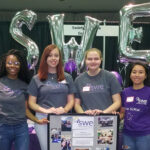
¿No hablas español? Not a problem. The Spanish Conversation Club is happy to have you! Don’t identify as a woman or engineering major? The Society of Women Engineers (SWE) still welcomes you. Interested in philosophy but not a philosophy major? Didn’t deter the past president of Philosophers Anonymous from taking office.
As a new semester gets underway (make sure to visit Involvement Fest, September 9), these and dozens of other student organizations readily welcome Retrievers who may not assume that the club is for them. Not surprisingly, UMBC clubs and orgs thrive when new perspectives show up.
Join the forum
 Headshot provided by Quinlan Murphy.
When Quinlan Murphy ’21, political science, served as president of Philosophers Anonymous, the council of majors for philosophy students, he was determined to make the club feel like home to any interested student. This includes inviting discussions about Hannah Arendt’s warning against the preconditions for totalitarianism to attending online art tours as museums opened their doors virtually during the pandemic. Another of the club’s goals, he says, was to make the department’s physical space in the Performing Arts & Humanities Building a welcoming place for students in between classes. “We wanted to create a little bit of a domestic vibe, so students felt invited into the building—we wanted a tangible space for them to feel at home,” says Murphy, who also obtained a certificate in philosophy.
Known better as PhilAnon, the group traditionally meets at noon on Tuesdays to allow students to present ideas—their own or others—and then follow a group discussion. “We want people to discuss these ideas outside of class with a little bit less formality, without assignments, without quizzes or tests,” says Murphy. The group also invites other majors and departments to participate, giving talks on bioethics or the hard sciences to discuss the ethical and philosophical corollaries of their academic expertise.
“Philosophy majors and other members are people who are going to go on to work in the humanities or academics,” says Murphy, “and a critical part of performing that job is being able to present ideas effectively and quickly, and then also having those ideas be criticized and poked by others.”
 Student groups make use of The Forum sculpture outside of the Performing Arts & Humanities Building in 2019. Photo by Marlayna Demond ’11.
Murphy, as a non-traditionally aged student and a commuter, has high hopes for PhilAnon and other clubs on campus. “I certainly think that the more involvement people have in school, the better college will be—it’s not just about grades and tests and essays. It’s also about growing as a person. And I think that requires interacting with your classmates outside of the classroom.”
 Headshot courtesy of Sheila Yeboah.
Pull up a silla (chair)
One of Sheila Yeboah ’23, biological sciences, favorite memories of the last semester is playing online pictionary on Webex with the Spanish Conversation Club. “The combination of the members’ poor drawing skills and the wealth of Spanish synonyms made the game extra difficult,” laughs Yeboah, but she adds that the easy-going nature of the club’s president James Angle and the other executive officers makes the student org a relaxed place to learn and have fun.
Yeboah says that previously her struggle with Spanish was having opportunities to speak it, and the low pressure of the conversation club was exactly what she needed. Yeboah, who is minoring in Spanish, joined the Spanish Conversation Club last semester when they were meeting virtually. “This club is primarily focused on forming friendships and practicing communication,” says Yeboah. “If you are a person that is a little more reserved, like me, it’s a very welcoming environment and you’re not going to feel like you can’t fit in.”
Angle ’22, modern languages and linguistics, became club president his sophomore year when the club had a vacuum of leadership. He and his friend Kyndall Hardwick ’22, English, the vice president, aim to make everyone feel welcome. “So many people get scared away because they think ‘I don’t know enough Spanish at that high level,’” says Angle, “but it could literally be your first day of Spanish class and we’d say ‘Come in.’”
Angle, who recently started taking Russian classes, knows that the hardest part of language learning can be getting comfortable speaking. “That’s the biggest battle,” he says, “but come play some fun games with us and get comfortable speaking Spanish while enjoying yourself.”
Building connections
 Lilly, left, and other SWE members at the National Conference in Anaheim, California in 2019. Photo courtesy of Kaitlynn Lilly.
At previous Involvement Fests, some students have balked at joining the Society of Women Engineers (SWE), says current president Kaitlynn Lilly, who is not an engineering major. Lilly, who is studying mathematics and physics, says that she and other club leaders emphasize that the space is accessible for anyone who “wants to empower women and move society forward,” says Lilly. “It’s a mix between creating a community of people who support women in STEM and also providing opportunities to meet with companies, practice professional development, and also be social.”
This three-fold goal is the intentional result of Lilly and others on the executive board asking themselves what the purpose of their community was. “We didn’t always have a third of our meetings mixed between social, professional development, and career,” says Lilly, a 2021 Goldwater Scholar. “We made a very conscious decision last year to do that because we used to have a company present to us at every single meeting. And it was really hard for club members to really form that community.”
Before the pandemic, says Lilly, the group was already hosting hybrid meetings to broaden the horizons of what companies they could invite to present. SWE will keep the hybrid format going forward for the convenience of people who commute or people who can’t make the meeting time.
Jessica Adams ’22, mechanical engineering, is starting her fourth year as a SWE member and her first as a leader. As the public relations chair, she’s eager to see the group grow its membership. “As we get a wider range of perspectives in our club, it allows us to learn about other people’s backgrounds so that we can understand where other people are coming from,” says Adams. “These interactions will make each of us a better candidate for any sort of jobs or internships we apply for in the future.”
Find your space
Murphy, who graduated last spring but hopes to stay connected to PhilAnon virtually, unsurprisingly sees students’ extracurricular involvement through the lens of what is morally and ethically good.
“I think students should see their time at UMBC as an opportunity for social and personal growth and not just like a job training program,” he says. “They should be able to ask hard questions and explore ideas informally. I think it’s really critical that there’s these spaces for people to have these conversations away from professors and with their peers.”
Whether that conversation is in Spanish or takes place online or in person, there’s a student club waiting to welcome all newcomers with open arms. Find out more at Involvement Fest, September 9 or online all year.
*****
Header image: SWE at Involvement Fest in 2019. Photo courtesy of Kaitlynn Lilly.
]]>
¿No hablas español? Not a problem. The Spanish Conversation Club is happy to have you! Don’t identify as a woman or engineering major? The Society of Women Engineers (SWE) still welcomes you....
https://umbc.edu/stories/the-hospitality-of-umbcs-student-clubs/
https://my3.my.umbc.edu/api/v0/pixel/news/119563/guest@my.umbc.edu/526653cd933bbc885f2d14ae66fba8b9/api/pixel
biological-sciences
campus-life
involvement-fest
mathematics
mechanical-engineering
mlli
philosophy
physics
UMBC News & Magazine
https://my3.my.umbc.edu/groups/umbc-news-magazine
https://assets1-my.umbc.edu/system/shared/avatars/groups/000/001/943/24435aa6207c452e7bc15cc74b42c7bb/xsmall.png?1748556657
https://assets1-my.umbc.edu/system/shared/avatars/groups/000/001/943/24435aa6207c452e7bc15cc74b42c7bb/original.png?1748556657
https://assets2-my.umbc.edu/system/shared/avatars/groups/000/001/943/24435aa6207c452e7bc15cc74b42c7bb/xxlarge.png?1748556657
https://assets2-my.umbc.edu/system/shared/avatars/groups/000/001/943/24435aa6207c452e7bc15cc74b42c7bb/xlarge.png?1748556657
https://assets3-my.umbc.edu/system/shared/avatars/groups/000/001/943/24435aa6207c452e7bc15cc74b42c7bb/large.png?1748556657
https://assets1-my.umbc.edu/system/shared/avatars/groups/000/001/943/24435aa6207c452e7bc15cc74b42c7bb/medium.png?1748556657
https://assets2-my.umbc.edu/system/shared/avatars/groups/000/001/943/24435aa6207c452e7bc15cc74b42c7bb/small.png?1748556657
https://assets1-my.umbc.edu/system/shared/avatars/groups/000/001/943/24435aa6207c452e7bc15cc74b42c7bb/xsmall.png?1748556657
https://assets2-my.umbc.edu/system/shared/avatars/groups/000/001/943/24435aa6207c452e7bc15cc74b42c7bb/xxsmall.png?1748556657
UMBC News & Magazine
0
0
false
Thu, 09 Sep 2021 15:27:02 -0400
Leaving a Legacy of Support for UMBC’s Hispanic/Latinx Community
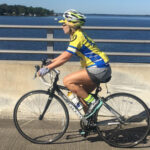
Ana María Schwartz Caballero, associate professor of modern languages, linguistics, and intercultural communication, is retiring from UMBC after more than 25 years of service. “This was a very difficult decision but it was the right time for me to retire,” says Schwartz Caballero. “UMBC has been my home for many years.”
Schwartz Caballero joined UMBC in 1984 as a lecturer for Spanish language classes in the modern languages and linguistics department. She became an assistant professor in 1996, received tenure as associate professor in 2002, and chaired the department from 2006 – 2012. Schwartz Caballero was one of the first faculty members to teach Spanish to heritage Spanish speakers.
The many programs, initiatives, associations, and committees she has led and participated in have helped establish a network of support and guidance for the success of UMBC’s Hispanic/Latinx community. And her legacy will continue to have an impact as faculty and students she has mentored carry on her work.
In a recent farewell event honoring Schwartz Caballero, President Freeman Hrabowski thanked her for being the voice for so many in the Latinx/Hispanic community on campus, in Baltimore City, and the State of Maryland. “Ana María has changed the culture of UMBC,” shares Hrabowski. “She has brought such rich diversity, and she has broadened our thinking about the world.”
 Schwartz Caballero’s headshot by Marlayna Demond ’11.
Language learning research
Schwartz Caballero began her career at UMBC as a graduate assistant in the education department while completing her Ph.D. in second language education at the University of Maryland College Park. Soon after graduation, she became a Spanish and second language pedagogy instructor in what is now UMBC’s modern languages, linguistics, and intercultural communication (MLLI) department.
Her research focused on heritage Spanish speakers, language teaching, learning strategies, and curriculum development. In 2002, Schwartz Caballero’s co-authored textbook, Noticias: An Advanced Intermediate Content-Based Course, presented educators with a new approach to teaching Spanish. Instead of a grammar-centered, isolated approach, Schwartz Caballero found students learned Spanish best by reading current Spanish-language media articles from Spanish-language speaking countries. This way students learn grammar structure in context while at the same time learning about the culture and current events.
Schwartz Caballero has developed local, state, and national level professional development courses and instructional materials for Spanish language teachers. She has also provided research-based strategies for the integration and application of the National Standards for Foreign Language Learning.
Understanding heritage speakers
In addition to her research on teaching Spanish as a foreign language, Schwartz Caballero’s work has helped develop best practices to support the learning needs of heritage Spanish speakers learning Spanish and other subjects. As a Spanish language heritage speaker herself from Cuba, Schwartz Caballero has a personal understanding of the complex needs heritage speakers face in the classroom.
 Schwartz Caballero with Ana Oskoz, the current chair of MLLI, on UMBC’s Immigrant Recognition Day in 2017. Photo courtesy of Schwartz Caballero.
She knows Hispanic/Latinx students who come to the U.S. as refugees, like she did when she left Cuba as a teenager, and those who immigrate or are born in the U.S. must grapple with their own diverse social-cultural identities in a country that often homogenizes their languages, race, cultures, and experiences. Her work has helped prepare student teachers and in-service educators with the skills necessary to support the learning needs of heritage Spanish speakers in a variety of contexts.
Schwartz Caballero also teaches educators how to be advocates. “Being an advocate for students,” she says, “can be the difference between a student graduating or dropping out. It is as important as their academic success.” She notes that teachers need to learn about the challenges Latinx/Hispanic students face beyond the classroom. Schwartz Caballero advocates educators to be understanding of a number of Latinx/Hispanic students who are often balancing work, family responsibilities, and financial hardships that hamper their success and can delay graduation.
Schwartz Caballero has been the faculty advisor to UMBC’s undergraduate Latino/Hispanic Union since 1997 and a founding member of the Latinx/Hispanic Admissions Advisory Group which develops best practices in recruitment and admissions.
Working with doctoral students
In addition to her work with undergraduate students, Schwartz Caballero also worked with many graduate and doctoral students, helping them navigate the field and prepare for the next steps of their careers. For many doctoral students, she was also a compassionate ear, a cheerleader, and like family in the most challenging of times—she helped them find solutions to move forward. Adriana Medina, M.A. ’99, intercultural communication, Ph.D. ’04, language, literacy, and culture, one of many doctoral students Schwartz Caballero has advised, credits Schwartz Caballero for her own success in the classroom. “Ana María has been such a fantastic role model as an educator,” shares Medina. “She is empathetic, compassionate, generous, and also tough at times while also encouraging you. Now, I have been able to be that for my students.”
“Ana María knew who I was, she knew my name, and my department. She made me feel so welcome…we are her legacy.”
María Célleri, assistant professor in gender, women’s, and sexuality studies
Luis Carcamo, M.A. ’95, intercultural communication, remembers how Schwartz Caballero “showed me the ropes of how teaching is done.” Now, in his 25th year of teaching, Carcamo has taken what he learned at UMBC to the southernmost tip of Latin America. “My city is the last city in South America. Ana María’s teachings reached not only the rest of the U.S. but also the rest of our America,” shares Carcamo.
In 2007, UMBC’s Chapter of Black and Latino Alumni awarded Schwartz Caballero with the Legends of Excellence Award: 40 Years of Inspiring African American and Latino Students.
Supporting faculty
Schwartz Caballero has worked tirelessly alongside Hispanic/Latinx faculty and UMBC leadership to recruit and retain Latinx/Hispanic faculty and support UMBC’s diversity initiatives. She was co-chair, with Philip Rous, provost and senior vice president for academic affairs, of UMBC’s Executive Committee on the Recruitment and Retention of Underrepresented Minority Faculty, and has been the president of the Hispanic-Latino Faculty Association for 10 years.
Through the Executive Committee, founded in 2011, UMBC has hosted 20 fellows from diverse backgrounds, including five who identify as Latinx. Two of these fellows are now UMBC faculty members, Fernando Tormos-Aponte, assistant professor of public policy, and Erika Fountain, assistant professor of psychology.
 Schwartz Caballero at a 2019 Humanities Forum with (l-r) Thania Muñoz
,
María Martha Manni,
Mayra Santos-Febres, Tania Lizarazo, and María Célleri. Photo courtesy of Schwartz Caballero.
As the lead organizer for the Hispanic Heritage Month speaker, part of the Dresher Center for the Humanities Forum, Schwartz Caballero has helped bring Latinx/Hispanic scholars to UMBC annually for more than a decade.
“Ana María has raised the issue of diversity and inclusion in relation to Hispanic/Latinx folks in meetings, public forums, and anywhere she could,” says Jessica Berman, director of the Dresher Center for the Humanities. “She worked tirelessly to bring issues facing Hispanic/Latinx people forward, especially through many years of arranging speakers for Hispanic Heritage Month.” Berman notes how Schwartz Caballero’s dedication to fundraise for and organize the speakers elevated the event and led to its inclusion as a permanent part of the fall Humanities Forum.
These efforts have drawn Hispanic/Latinx faculty to UMBC who are leading research across all of UMBC’s academic divisions, including economics, engineering, MLLI, psychology, and more.
Many of the Latinx/Hispanic faculty recall Schwartz Caballero as the first person they met when they came for an interview. She would often pick up faculty at the airport and guide them through their visit. Once they joined UMBC, Schwartz Caballero became a valuable resource, advocate, and supporter. María Célleri, assistant professor in gender, women’s, and sexuality studies, remembers her first week on campus in 2019 during Commencement week. “I didn’t know what was going on but Ana María knew who I was, she knew my name, and my department. She made me feel so welcome,” recalls Célleri. “I love her genuine commitment. We are her legacy.”
“Ana María’s teachings reached not only the rest of the U.S. but also the rest of our America.”
Luis Carcamo, M.A. ’95
Faculty also acknowledge her strong voice on their behalf and her example as a leader in her department, across campus, and beyond. “As a woman, it was very inspiring to hear Ana María, the voice of a strong woman in academia,” shares Renée Lambert-Brétière, associate professor of linguistics and French. “I thank her and I aspire to be like her and be a strong voice.”
In 2020, Schwartz Caballero received the UMBC Marilyn E. Demorest Award for Faculty Advancement.
Building on a legacy
Faculty have also valued her honest feedback and direction through different phases of their career by encouraging them to pursue leadership positions in their field, on campus, and in the community. Within the last year alone, María Cristina Sanchez, professor of the practice in mechanical engineering, has become the inaugural director of the Engineering & Computing Education Program, and Felipe Filomeno, associate professor of political science and global studies, has become the inaugural associate director of the Center for Social Science Research. Tormos-Aponte has recently received over $400,000 from the William T. Grant Foundation to conduct research on the policy impact of the Black Lives Matter Movement on youth.
Headshots of Sanchez, Filomeno, and Tormos-Aponte.
Sanchez has been collaborating with Schwartz Caballero in UMBC’s Hispanic/Latinx Faculty Association and in several committees preparing to further the work along with her colleagues. “A lot of us are in the place that we are because of Ana María,” shares Sanchez. “We will try to continue what she started.”
Service to the community
Schwartz Caballero has also worked closely with the Latinx/Hispanic community beyond campus. For 20 years she has been the UMBC representative in the Maryland State Department of Education for world languages. She is the commissioner of the Baltimore City Mayor’s Hispanic Commission. In 2016, her oral story was part of the Smithsonian’s Anacostia Community Museum “Gateways” bilingual exhibition about the Latinx experience in the U.S.
Her dedication to the Hispanic/Latinx community has received national recognition. In 2014, she was awarded the Hispanic Heritage Leadership Award from the National Football League and the Hispanic Heritage Foundation. The award included a $2,000 donation to UMBC’s Esperanza Fund, a scholarship for UMBC undergraduate and graduate students of Latinx or Hispanic ancestry and/or students committed to the advancement of minorities especially of Latinx or Hispanic descent.
UMBC’s broader outlook
Schwartz Caballero is excited for the future of UMBC and the growth of its Latinx/Hispanic community. She played a large part in creating the pathways that are helping Latinx/Hispanic students and faculty learn and contribute to the campus and regional community. “There are more Latinx/Hispanic faculty, staff, and students than when I started. But there is still so much to do,” says Schwartz Caballero. “I know many will continue the work and will also create new opportunities for UMBC to embrace and uplift the Latinx/Hispanic faculty, staff, and students.”
“Ana María has been, and continues to be, the North Star as we develop and evolve our plans to recruit Hispanic and Latinx students to UMBC,” says Dale Bittinger, assistant vice provost of undergraduate admissions, orientation, and school partnerships, and chair of the Hispanic/Latinx Admissions Advisory Group. “She is an invaluable resource and advocate whose teaching extends beyond the classroom. Her work and commitment to students is another example of why UMBC is such a special place.”
*****
Header image courtesy of Schwartz Caballero, her with students at graduation in 2014.
]]>
Ana María Schwartz Caballero, associate professor of modern languages, linguistics, and intercultural communication, is retiring from UMBC after more than 25 years of service. “This was a very...
https://umbc.edu/stories/leaving-a-legacy-of-support-for-umbcs-hispanic-latinx-community/
https://my3.my.umbc.edu/api/v0/pixel/news/119587/guest@my.umbc.edu/2f918cd0333c2988d38fceabb07d5a49/api/pixel
campus-life
hispanic-heritage-leadership-award
latino-hispanic-faculty-association
mlli
professorsnottomiss
spanish
spanish-language
umbc-hispanic-and-latino-student-admissions-advisory-group
UMBC News & Magazine
https://my3.my.umbc.edu/groups/umbc-news-magazine
https://assets1-my.umbc.edu/system/shared/avatars/groups/000/001/943/24435aa6207c452e7bc15cc74b42c7bb/xsmall.png?1748556657
https://assets1-my.umbc.edu/system/shared/avatars/groups/000/001/943/24435aa6207c452e7bc15cc74b42c7bb/original.png?1748556657
https://assets2-my.umbc.edu/system/shared/avatars/groups/000/001/943/24435aa6207c452e7bc15cc74b42c7bb/xxlarge.png?1748556657
https://assets2-my.umbc.edu/system/shared/avatars/groups/000/001/943/24435aa6207c452e7bc15cc74b42c7bb/xlarge.png?1748556657
https://assets3-my.umbc.edu/system/shared/avatars/groups/000/001/943/24435aa6207c452e7bc15cc74b42c7bb/large.png?1748556657
https://assets1-my.umbc.edu/system/shared/avatars/groups/000/001/943/24435aa6207c452e7bc15cc74b42c7bb/medium.png?1748556657
https://assets2-my.umbc.edu/system/shared/avatars/groups/000/001/943/24435aa6207c452e7bc15cc74b42c7bb/small.png?1748556657
https://assets1-my.umbc.edu/system/shared/avatars/groups/000/001/943/24435aa6207c452e7bc15cc74b42c7bb/xsmall.png?1748556657
https://assets2-my.umbc.edu/system/shared/avatars/groups/000/001/943/24435aa6207c452e7bc15cc74b42c7bb/xxsmall.png?1748556657
UMBC News & Magazine
0
0
false
Fri, 02 Jul 2021 18:53:28 -0400
UMBC expands arts opportunities for K-8 students in Baltimore through Charlesmead partnership
Two UMBC projects have taken flight this spring, designed to support the academic, creative, and social success of Baltimore City students through arts opportunities. Both projects are funded through the UMBC-Charlesmead Initiative for Arts Education, which was established in 2018 with a $500,000, five-year gift from the Charlesmead Foundation.
The partnership is designed to introduce or strengthen arts opportunities for K-8 students in Baltimore City Public Schools , especially those in Title I schools. The Charlesmead Foundation, which was established in 1987 and is based in Baltimore, primarily supports the arts, cultural programs, and education.
Music in Sandtown-Winchester
Daniel Pesca and Janice Jackson in the department of music have joined forces with the Carter School of Music at New Shiloh Baptist Church and the William Knabe Piano Institute to offer after-school and summer music classes to youth in the Sandtown-Winchester community. The New Shiloh Baptist Church is recognized as a key community and spiritual hub in its neighborhood. The non-profit Knabe Institute raises awareness of the cultural significance of the piano, and produces a major young artist piano competition that is held annually at UMBC.

Pesca (left). Photo by
Rosen-Jones Photography. Jackson (right).
Photo courtesy of Jackson.
The Charlesmead grant to Pesca and Jackson fully funds the musical education of ten students between the ages of 8 and 14 who face obstacles to music study. The participating students receive instruction in piano and choral music for two academic years and two summers, taught by Chinny Ohia, a member of the Carter School faculty for over twenty years and chair of music at Howard University, and UMBC alumnus and pianist Riccardo Jefferson ’20, music. The summer instruction will be hosted in part by UMBC’s Summer Enrichment Academy.
The Carter School hired Jefferson specifically to teach students in this cohort. This strengthens the connection between the school and UMBC, while providing Jefferson with an exceptional opportunity to launch his career as a professional musician and music educator. “These young musicians were brave enough to start their musical journey during a pandemic,” says Jefferson. “Somehow, someway, they’re moving through it, and it inspires me to match their determination in the classroom and in my own life.”
 Riccardo Jefferson. Photo by Willie Santiago, concert coordinator for UMBC.
Success despite challenges
The project faced and overcame significant challenges during the current academic year. A major initial expense was the purchase of ten high-quality keyboards for use at home by students. Members of the faculty and staff of the Carter School spent two days delivering the large keyboards and assembling them in the students’ homes.
Once instruction began, some students faced challenges accessing reliable internet connections, which required that they and their instructors be flexible and adjust their lesson schedules when necessary.
Plus, “each student started as an absolute beginner who had no previous experience with the piano or with reading music,” explains Pesca. “Learning to make music brings the students joy and uplift during these times of isolation, and some have shared that the one-on-one contact with their instructors is a high point in their week. Eight out of ten students stayed fully engaged in the program and achieved significant musical growth over the semester, an outstanding outcome under such trying circumstances.”
The pandemic continues to make it challenging for the organizers to fully implement the program as they initially envisioned. Pesca had hoped to bring the students to campus for UMBC’s 2021 Summer Enrichment Academy, but that program will be online due to health and safety guidelines. Similarly, the Knabe Institute’s activities are likely to take place remotely as well.
However, the organizers hope to incorporate in-person learning at both UMBC and the Knabe Institute for the program’s 2021-2022 academic year, providing students with an even more enriching experience.
Kultur Stories
Shriver Center Director Michele Wolff is working with Gail Prensky, founder of the Jüdische Kulturbund Project (Jewish Kulturbund), to bring its Kultur Stories Program to UMBC. Wolff and Prensky are collaborating with local and international theatre, visual arts, and digital storytelling educators, artists, and community leaders. Together, they are gathering girls from City Springs Elementary/Middle School in Baltimore City, Aktörerna school in Sweden, and Promised Land Secondary School in South Sudan to participate in a virtual digital storytelling experience.
Kultur Stories explores issues of oppression and response through music and art. The Project’s mission is to connect people through shared experiences, inspire a response to persecution through cultural expression, and encourage freedom of expression and culture. This mission spoke to the work Wolff carries out through the Shriver Center.
“Kulture Stories aligns seamlessly with our commitment to racial equity, inclusion, and social justice,” shares Wolff. “This collaboration gives us the opportunity to extend beyond our current network of partners to engage and give voice to more young people in schools in Baltimore City and in countries around the world.”
Grappling with oppression through art
Jewish Kulturbund works with artists and communities around the world to explore the themes of oppression, the arts, and human rights through a variety of media. These initiatives honor the story and legacy of Jüdische Kulturbund artists who performed across Germany between 1933 and 1941, before being forced into Nazi concentration camps. The organization recalls their performances as a reminder of the complex questions and danger artists must grapple with under oppressive situations.

Margot Neuhaus working on an art piece.
Photo courtesy of Michele Wolff.
With this purpose in mind, the design team developed an 8-week collaborative Kultur Stories Program among young girls in the United States, Sweden, and South Sudan. Pods of around 10 girls from each country are connecting virtually to learn about each other. They are reflecting on the impact of the pandemic on themselves and their communities and the oppression it has caused. They are also creating art and joining in discussions about human rights, and participating in mentoring sessions.
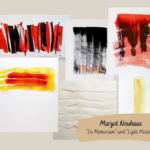
The students began meeting this spring. In one session, Margot Neuhaus, a visual artist based in Washington D.C., was invited to give a virtual presentation. She discussed how her art process has provided a way for her to express her pain and healing in relation to her family surviving the Holocaust in Poland and their fleeing to Mexico, where Neuhaus was born.
The presentation initiated a profound conversation about oppression across borders and time. The students from South Sudan related to the persecution and displacement that Neuhaus described. And the Swedish students found it impactful as well. “That session was so powerful for my group of students,” shares Jok Abraham Thon, founder and director of the Aktörerna School. “They spoke about differences in language, skin color, and religion being issues that separate and cause issues of hatred.”
Connecting through digital stories
Shekinah Davis, co-facilitator of the Charlesmead Initiative for Arts Education at UMBC, serves as a teacher’s assistant in the project. Davis, M.A. ‘21, intercultural communication, supports lead teachers in communication strategies and helps manage the flow of the virtual pods. As a Shriver Center Peaceworker Fellow, she brings experience working with international and local communities.

Shekinah Davis.
Photo courtesy of Davis.
“I was drawn to participate in the project to gain a perspective of how to guide young people through a virtual creative process,” explains Davis. “I hope to gain a deeper understanding of virtual collaborative art-making, especially to help express experiences about the impact of the pandemic and oppression.”
The K-8 students are also connecting with interns from UMBC, Montgomery College, and Baltimore Polytechnic Institute, a high school in Baltimore City. These interns are guiding the girls in using storytelling and digital art production to express their personal reactions to oppression and how to embrace freedom.
The digital storytelling tools are bringing together students who would otherwise not be able to meet. They are also expanding the students’ opportunities to make digital art, beyond what is available in their everyday school experiences.
Design intern Joyce Koo ‘24, graphic design, is inspired by the Judische Kulturbund Project. She sees it as an important step in her education and career. In addition to assisting with a teaching pod, she is creating graphics and other visuals for the project’s social media outreach. “I hope to connect to and grow in a global community of both experienced and rising artists,” shares Koo.
Banner image: “In Memoriam” and “Light Motives” by Margot Neuhaus. Photo courtesy of Michele Wolff.
This article was co-authored with UMBC’s Thomas Moore, director of arts and culture.
]]>
Two UMBC projects have taken flight this spring, designed to support the academic, creative, and social success of Baltimore City students through arts opportunities. Both projects are funded...
https://umbc.edu/stories/umbc-expands-arts-opportunities-for-k-8-students-in-baltimore-through-charlesmead-partnership/
https://my3.my.umbc.edu/api/v0/pixel/news/119632/guest@my.umbc.edu/4ed70c8e9fd70fb19ee1bd5640788f7c/api/pixel
arts-and-culture
cahss
diversityandinclusion
graduateschool
international
mlli
music
policy-and-society
shrivercenter
visualarts
UMBC News & Magazine
https://my3.my.umbc.edu/groups/umbc-news-magazine
https://assets1-my.umbc.edu/system/shared/avatars/groups/000/001/943/24435aa6207c452e7bc15cc74b42c7bb/xsmall.png?1748556657
https://assets1-my.umbc.edu/system/shared/avatars/groups/000/001/943/24435aa6207c452e7bc15cc74b42c7bb/original.png?1748556657
https://assets2-my.umbc.edu/system/shared/avatars/groups/000/001/943/24435aa6207c452e7bc15cc74b42c7bb/xxlarge.png?1748556657
https://assets2-my.umbc.edu/system/shared/avatars/groups/000/001/943/24435aa6207c452e7bc15cc74b42c7bb/xlarge.png?1748556657
https://assets3-my.umbc.edu/system/shared/avatars/groups/000/001/943/24435aa6207c452e7bc15cc74b42c7bb/large.png?1748556657
https://assets1-my.umbc.edu/system/shared/avatars/groups/000/001/943/24435aa6207c452e7bc15cc74b42c7bb/medium.png?1748556657
https://assets2-my.umbc.edu/system/shared/avatars/groups/000/001/943/24435aa6207c452e7bc15cc74b42c7bb/small.png?1748556657
https://assets1-my.umbc.edu/system/shared/avatars/groups/000/001/943/24435aa6207c452e7bc15cc74b42c7bb/xsmall.png?1748556657
https://assets2-my.umbc.edu/system/shared/avatars/groups/000/001/943/24435aa6207c452e7bc15cc74b42c7bb/xxsmall.png?1748556657
UMBC News & Magazine
0
0
false
Fri, 14 May 2021 21:48:46 -0400
Retrievers buck ‘traditional’ timelines and redefine success
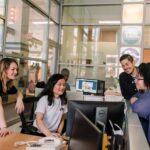
Evangeline Kirigua—mother, grandmother, immigrant, community college transfer student, civic entrepreneur—might have felt like the epitome of a “non-traditional” college student, but as she got closer to other Returning Women Scholars in the Women’s Center at UMBC, she realized that her “different” story might not be so different after all.
Navigating school during the pandemic hasn’t been effortless for anyone, but the wealth of online classes has made it easier for adult learners (ages 25 and up) to think about returning for an unfinished degree, as seen through the success of the UMBC Finish Line program. This unusual time also marks a good period to pause and reevaluate how UMBC approaches the terms “traditional” and “non-traditional” students.
 Kirigua, center in blue dress with white collar, with other Returning Women Scholars and President Freeman Hrabowski. Photo courtesy of The Women’s Center.
As with many public research universities, nearly 50 percent of UMBC’s 11,000 undergraduates are transfer students, “so the notion that transfer students are ‘non-traditional’ is actually far from the truth,” says Chloe Terrell, UMBC’s Transfer Student Success coordinator in Off-Campus Student Services (OCSS). “Transfer students bring a wealth of knowledge and experiences to our campus,” she continues. “Without them, we wouldn’t be the vibrant community we are.”
Understanding your own worth
As a student at Prince George’s Community College (PGCC), Sandra Crespin-Melgar ’21, social work, was really excited about what she heard from Katie Morris, the program director at UMBC at the Universities of Shady Grove and an instructor of social work, about transfering to UMBC. Crespin-Melgar, a first-generation student, immigrant, and adult learner, had been nervous about pursuing her bachelor’s degree, even though she knew that was her goal.
 Headshot of Sandra Crespin-Melgar, courtesy of The Women’s Center.
“When I started to learn more about UMBC,” says Crespin-Melgar, “I liked that they put forth the effort to create a space that provided belonging to all students. And that was something that really attracted me—the different ways of creating community on campus.”
Talking with Morris, Ph.D. ’21, language, literacy, and culture, not only led Crespin-Melgar to apply to UMBC, but also to major in social work. “I’m someone who has gone through different experiences in higher ed,” says Crespin-Melgar. “And I think that people who come from immigrant communities, there’s a lot of things that we have to tackle as far as dealing with imposter syndrome or feeling like we don’t belong. Even that fear of applying, you ask yourself, ‘Am I worthy enough to be in those spaces or am I worthy enough to even succeed?’”
Seek help, give help
Crespin-Melgar, who is also a Returning Women Scholar, suggests that other students with similar doubts find support at the Counseling Center. “Talking with someone who can really listen to what you’re going through and can relate to some of the struggles as a person of color, or as a woman—there’s a lot that goes into owning those spaces and feeling like, ‘yes, I belong here and I’m working to receive my degree because I put so much work into it and there’s no less value in my work than anyone else.’ That’s my biggest take-away from my journey as an undergrad at UMBC.”
 Crespin-Melgar at an event hosted by The Women’s Center. Photo courtesy of The Women’s Center.
While finishing her degree, Crespin-Melgar is also working in recruitment and admissions at PGCC. This fall, she will pursue a master’s of social work at the University of Maryland, Baltimore. She says that her experience at UMBC has made her want to continue to work in higher education, helping guide other first-generation students and Latinx students like herself through the complicated process of college.
“I feel really prepared and confident that I’m walking away from a school that really lives up to their words,” says Crespin-Melgar. “They told me what they were going to do for me, and they did it.”
The backbone of UMBC
At UMBC’s Shady Grove campus, “All the students are transfer students,” explains Katie Morris. “A majority are working and balancing family responsibilities, and they all have a life outside of school,” she says. “Shady Grove provides a place for students who are in this similar situation to see others like them, build a community, connect with faculty, learn in the classroom, and find success if they make the commitment to their learning and attaining their degree.”
 Students mingle at the Shady Grove campus in 2019. Photo by Marlayna Demond ’11.
Across UMBC’s campuses, 80 percent of transfer students come in from community colleges, versus other four-year institutions. This makes the community college transfer experience a common way of joining the UMBC community.
OCSS serves commuter, transfer, veteran, and adult-learner student populations. “Often,” Chloe Terrell says, “we’re referred to as the hub for ‘non-traditional’ students, but my time here has shown me that the students we serve are the backbone of UMBC.”
A break for mental health
In that respect, Ting Huang ’21, psychology, followed a well-worn path to UMBC, even if it felt less straightforward at the time. Despite a full-ride to a four-year college right out of high school, Huang made the decision to attend Montgomery College to better suit the needs of her family. She also knew about the Transfer Student Alliance, which helps smooth the application process to certain Maryland schools after obtaining an associate’s degree.

Headshot provided by Ting Huang.
Huang thought the process was going smoothly, despite the stress she was feeling. But a frequent customer at the restaurant where Huang worked helped gently reframe her perspective when she asked if Huang was feeling OK. She looked much thinner than usual, the customer said.
“I thought, well, if a stranger seemed to care about me, maybe I could care about me,” says Huang. She called her high school mentor to talk through this revelation, then went home and closed her transfer application for a semester.
When Huang did enroll at UMBC, she was drawn to study social psychology because of her own experiences. “I feel that my own psyche is really impacted by my upbringing and by my interactions with my family and the world around me—especially as a first-gen immigrant, like the transition from being a child in China to being a teenager in the U.S.,” says Huang.
 Huang, top middle, at an online family game night with her fellow McNair scholars. Photo courtesy of Huang.
At UMBC, she became a McNair Scholar. The program provides mentorship and community for low-income, first-generation college students, and students from other underrepresented groups, while helping them hone their research tools to potentially pursue doctoral degrees. “The McNair program makes me feel like I can accomplish the graduate process,” says Huang. Next, she will pursue a master’s degree in experimental psychology at Towson University, with the long-term goal of teaching psychology at the university level.
Building confidence
Alicyn Curtis ’21, modern languages and linguistics, originally matriculated to UMBC in 2011, but left her studies after three years. “I liked what I was studying, especially Korean, but I didn’t have the drive or passion at the time,” says Curtis. “I’m one of those people who can’t simply do things because it looks good on a résumé. If I’m going to do anything, I’m going to do it because I like it. So I was very depressed and lost and needed to take some time off.”

Alicyn Curtis in Korea while she was teaching abroad. Photo courtesy of Curtis.
Curtis had the opportunity to move to Korea for three years, and she took it. She taught English there, but realized that in order to progress in that career, she’d need to finish her degree. In fall 2020, Curtis re-enrolled at UMBC having a more clear goal for her studies. With the help of her Korean advisor, Kyung-Eun Yoon, she is graduating after two final semesters.
“Being abroad built my confidence in myself,” says Curtis. “When I first started at UMBC, I was very shy and standoffish. I didn’t really reach out to other people—I just went to school and went home. But this time around, I thought, if I can live in a different country for three years and navigate around in a different language, I can do anything. And I brought that sense of competence with me when I returned to campus.”
 Curtis poses with one of the symbols of Seoul. Photo courtesy of Curtis.
For the past year, Curtis has worked as a peer advisor in the Education Abroad office, encouraging more students to gain life skills and confidence overseas when the pandemic permits. Overall, of her time back at UMBC, Curtis says, “I never felt alienated because I’m technically ‘non-traditional.’ I felt just like a regular student on campus.”
Lifelong learners
Gayle Chapman ’21 also found a home in modern languages and linguistics, but that’s not the only home she has on campus. She’s worked at UMBC since 2002, and is now the assistant controller in Financial Services.
Chapman earned her master’s in public policy in 2011. A decade later, she is earning a second undergraduate degree in Russian. Her sons are also UMBC alumni: Daniel Chapman ’02, mathematics, ’03, physics; and David Chapman ’06, M.S. ’08, Ph.D. ’12, computer science—an assistant professor of computer science and electrical engineering at UMBC.
 Headshot courtesy of Gayle Chapman.
“I am not your traditional student, but a lifelong learner,” shares Chapman, who is also a member of the Russian Club and sings in the UMBC Russian Choir. “It is vitally important, in my opinion, to continue to broaden your knowledge and perspective of this world, and there is no better way than to study a major language and culture in our world.”
Chapman is in good company among other lifelong learners at UMBC. Jim Kruger ’13, political science, M.P.P. ’14, will complete his Ph.D. in public policy this spring at the age of 71. Kruger, spent his career in waste management and after retirement wanted to impact that field as a researcher. That goal, in addition to his love of learning, kept him coming back to the classroom.
 Jim Kruger and his wife Kathy on the bench they donated to UMBC. Photo by Marlayna Demond ’11.
During Kruger’s time on campus, UMBC and the University of Maryland, Baltimore partnered to become Maryland’s first “age-friendly” universities. They join 58 institutions worldwide that make up the Age-Friendly University Global Network, led by Dublin City University in Ireland.
No one “right” way
When Kirigua moved from Kenya to the United States in 2002, she put all her time and effort into finding a job and helping her children adjust to a new country. She told herself she’d attend to her own education after her son Joel graduated from college. True to her own word, before she heard Michelle Obama give the graduation address to her son’s college in 2016, Kirigua had enrolled at Montgomery College.

Kirigua with her son Joel (in pink) and his friends at the Lincoln Memorial in D.C.
“For me, personally, if you have something that you have a purpose to do—if you don’t do it—you owe yourself something,” says Kirigua. Pursuing higher education became her priority. “When you’re making that sacrifice, you don’t feel like someone is making you do it. You know you’re doing it for yourself.”
After transferring to UMBC in 2018, Kirigua has found fellowship through the Returning Women Scholars program—it’s been encouraging to hear the other students’ stories. “I thought that this was just me,” says Kirigua, “but there are others like me and who have had to face even more challenging situations.”
“When an adult learner thinks they’re the only one in the classroom, it can make them feel like maybe they don’t belong,” says Jess Myers, Women’s Center director. “Perhaps it may reinforce that their experience is the ‘wrong way’ to do college. So, when you put 20-25 adult learners in a room and give them the space to center their experiences of being older, being parents, having a full life before coming to UMBC, it feels…magical. I see some students struggle with their journeys and then once they hear from someone who is like them, an automatic sense of solidarity forms.”
 Kirigua with Jess Myers at a USM Women’s Forum Conference. Photo courtesy of Myers.
That sense of connection has spurred Kirigua forward. After graduating this month, she will continue on at UMBC, pursuing a master’s in public policy.
Featured image: Chloe Terrell, left, in the center for Off-Campus Student Services in 2019. Photo by Marlayna Demond ’11.
]]>
Evangeline Kirigua—mother, grandmother, immigrant, community college transfer student, civic entrepreneur—might have felt like the epitome of a “non-traditional” college student, but as she got...
https://umbc.edu/stories/retrievers-buck-traditional-timelines-and-redefine-success/
https://my3.my.umbc.edu/api/v0/pixel/news/119636/guest@my.umbc.edu/2d09e3642b02f5eb61e4b7e410f4fe8a/api/pixel
cahss
classof2021
community
international
mlli
page1
political-science
psychology
publicpolicy
shadygrove
socialwork
womenscenter
UMBC News & Magazine
https://my3.my.umbc.edu/groups/umbc-news-magazine
https://assets1-my.umbc.edu/system/shared/avatars/groups/000/001/943/24435aa6207c452e7bc15cc74b42c7bb/xsmall.png?1748556657
https://assets1-my.umbc.edu/system/shared/avatars/groups/000/001/943/24435aa6207c452e7bc15cc74b42c7bb/original.png?1748556657
https://assets2-my.umbc.edu/system/shared/avatars/groups/000/001/943/24435aa6207c452e7bc15cc74b42c7bb/xxlarge.png?1748556657
https://assets2-my.umbc.edu/system/shared/avatars/groups/000/001/943/24435aa6207c452e7bc15cc74b42c7bb/xlarge.png?1748556657
https://assets3-my.umbc.edu/system/shared/avatars/groups/000/001/943/24435aa6207c452e7bc15cc74b42c7bb/large.png?1748556657
https://assets1-my.umbc.edu/system/shared/avatars/groups/000/001/943/24435aa6207c452e7bc15cc74b42c7bb/medium.png?1748556657
https://assets2-my.umbc.edu/system/shared/avatars/groups/000/001/943/24435aa6207c452e7bc15cc74b42c7bb/small.png?1748556657
https://assets1-my.umbc.edu/system/shared/avatars/groups/000/001/943/24435aa6207c452e7bc15cc74b42c7bb/xsmall.png?1748556657
https://assets2-my.umbc.edu/system/shared/avatars/groups/000/001/943/24435aa6207c452e7bc15cc74b42c7bb/xxsmall.png?1748556657
UMBC News & Magazine
0
0
false
Wed, 12 May 2021 20:39:50 -0400
UMBC-Montgomery College collaboration expands with digital storytelling humanities internship for transfer students
In September of 2020, UMBC’s Camee Maddox-Wingfield, assistant professor of anthropology, wanted to introduce her Anthropology 211 students to the process of digital storytelling and the tools of the Smithsonian Learning Lab. She reached out to Sarah Jewett who had just launched a new digital storytelling collaboration with the Montgomery College (MC) Digital Storytelling Internship program at the Paul Peck Humanities Institute. The internship places MC students with UMBC faculty who need help with their digital story projects.
Jewett, director of innovations in transfer research and practice at UMBC, knew about MC’s long-standing partnership with the Smithsonian Center for Learning and Digital Access, of which the lab is part. She collaborated with MC’s Digital Storytelling Internship to place Mark Siegrist, who was an intern in the lab, with Maddox-Wingfield.

Camee Maddox-Wingfield.
Siegrist was the perfect fit. He produced the digital story Maddox-Wingfield needed and had the opportunity to learn about the resources UMBC offers for transfer students.
“I’ve had a really good experience working with Mark Siegrist,” shares Maddox-Wingfield. “He was so helpful. I am so grateful that this sort of collaboration was made possible between the two institutions by Sarah Jewett.”
Building relationships
This growing, humanities-centered digital stories internship is a collaboration nourished by Jewett and MC’s Jamie Gillan and Mathew Decker. The two English faculty serve as co-coordinators of MC’s Digital Stories Internship, and Gillan is also a Ph.D. student in UMBC’s language, literacy, and culture (LLC) program. Jewett and Gillan initially connected through Gillan’s doctoral research at UMBC, on story work as a way to build empathy. This storytelling project was a natural extension of that work.
Together they built the structures necessary for MC students to work alongside UMBC faculty on digital storytelling projects. MC considers these UMBC collaborations to be Level 2 internships, completed after MC students gain initial experience with digital storytelling.
Participants enroll as non-degree students at UMBC during their internships to complete a service-learning course through UMBC’s Shriver Center. This provides them with additional support and guidance in completing their collaborative projects and reflecting on their internship experiences.
“Level 2 interns are expected to bring their own ideas to the table, to be leaders as well as collaborators,” explains Gillan. These learning and teaching partnerships between students and faculty are at the core of how UMBC fosters a culture of intellectual curiosity and relationship-building.
The faculty team for the digital stories partnership in fall 2020 included: Bill Shewbridge, professor of the practice in media and communications studies; Tania Lizarazo, assistant professor in modern languages, linguistics, and intercultural communication (MLLI) and the global studies program; and Beverly Bickel, M.A. ’94, instructional development systems, Ph.D. ’05, LLC, clinical assistant professor of LLC.
Great chemistry
UMBC and MC’s strong working relationship has deep roots. Ten years ago UMBC partnered with three other community colleges in Maryland to develop and implement the STEM Transfer Student Success Initiative (t-STEM). Jewett, the executive director of this initiative, worked with community college counterparts to develop the systems necessary to better support transfer students in STEM as they transitioned to UMBC.
The seven-year initiative was a great success and inspired Jewett to extend this same model to other fields. She began with a summer environmental science research experience organized in collaboration with Howard Community College and UMBC’s departments of geography and environmental science and biological sciences.

UMBCs Kevin Omland (center), professor of biological sciences, birdwatching
with students in 2019.
Rather than focus on expanding a single program, or even an array of STEM-focused programs, “We are working to scale horizontally to different disciplines,” Jewett explains. This includes the social sciences and humanities.
Finding a path
Like Mark Siegrist, MC student Ahmad Al-Olabi was also a Level 2 digital stories intern. The experience had a significant impact on his college experience.
In his Level 1 internship, Al-Olabi produced “The Journey: Swim or Die,” about his journey as a Syrian refugee fleeing to Greece. His powerful work was one of eight digital stories MC featured during UMBC’s first Digital Decameron.
“I was hesitant to share my experience,” explains Al-Olabi. But the feedback he received encouraged him to continue forward. “In the second internship,” he says, “I realized everyone empathized with my journey and valued my skills.”
As a Level 2 intern, Al-Olabi worked with Shewbridge’s digital stories class in collaboration with 20 students at Hong Kong University. He provided his fellow students with script feedback and technical support for the “Global Voices in a Time of Pandemic” project. The project fosters intercultural dialog about COVID-19.

Ahmad Al-Olabi in the atrium of UMBC’s Performing Arts and Humanities Building.
Photo by Azigza Hussen, 2019
Al-Olabi appreciated working with Shewbridge, whose filmmaking career and expertise have opened a new career option for him to explore. This experience has made him feel more prepared for the next step of his academic career. “Before this program, I wasn’t sure I was ready for an American university,” explains Al-Olabi. “Now that I know Professor Shewbridge and Ms. Jewett, and having been on campus, I feel I can be successful.”
Reflection through storytelling
A third Montgomery College student, Stephanie Palencia, produced the personal story “Stand Up.” She addresses the importance of self-care while grappling with the pressures of cultural expectations and responsibilities.
Palencia worked with Lizarazo and Charlotte Keniston, an LLC doctoral student and associate director of UMBC’s Peaceworker Program, on Lizarazo’s Migration Stories project. They organized audio, text, and images to create a story map that reflects the migration stories of some of the members of Maryland’s Latinx community. Palencia also assisted Lizarazo in a digital stories workshop she facilitated at The Universities at Shady Grove.
“I’ve been grateful to have been invited to work on digital stories with Montgomery College students since 2019,” shares Lizarazo. She continued to work with these students on digital story projects through the pandemic. Of the partnership, she says, “This is truly an initiative in community-building beyond institutions.”
Building bridges to the future
Jewett notes that the internship engages students in critical thinking to refine their technical, communication, and storytelling skills. However, she explains, “The heart is about building meaningful relationships between MC students and UMBC faculty and staff as a bridge to university life.” It’s a mentoring process that reveals all that is possible at UMBC and beyond.

Mark Siegrist.
Photo courtesy of Siegrist.
“These relationships are invaluable,” shares Siegrist. He notes that the UMBC internship gave him access to a network of professors. Should he transfer, he will understand and know the community, where to access resources, and whom to ask for help.
“This internship will have a big impact on my academic journey,” Siegrist says. “It showed me how I could leverage my skills to design new opportunities.”
Jewett hopes to bring more support and new opportunities to even more students. The spring internship is already underway with three new MC students.
She and Amy Froide, a professor of history, also just received matching funding from Bringing Theory to Practice. It’s an organization that works to link the engaged learning, well-being, and civic development of students. This grant will help fund a new summer experience in public history with Howard Community College.
“The impact increases for all involved,” Jewett says, “when students have learning opportunities to explore the different disciplines, networks, and resources UMBC offers, and to connect with mentors.”
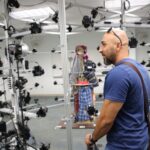
Banner image: Al-Olabi visiting UMBCs Imaging Resource Center photogrammetry 3D and motion capture scanning rig in December 2019. Photo by Azigza Hussen, a Montgomery College digital student intern visiting UMBC with Al-Olabi. All photos by Marlayna Demond unless otherwise noted.
]]>
In September of 2020, UMBC’s Camee Maddox-Wingfield, assistant professor of anthropology, wanted to introduce her Anthropology 211 students to the process of digital storytelling and the tools of...
https://umbc.edu/stories/umbc-montgomery-college-collaboration-expands-with-digital-storytelling-humanities-internship-for-transfer-students/
https://my3.my.umbc.edu/api/v0/pixel/news/119666/guest@my.umbc.edu/e0e4b833713f70748335c22edb63c527/api/pixel
arts-and-culture
cahss
ges
history
llc
mcs
mlli
page1
policy-and-society
saph
shrivercenter
UMBC News & Magazine
https://my3.my.umbc.edu/groups/umbc-news-magazine
https://assets1-my.umbc.edu/system/shared/avatars/groups/000/001/943/24435aa6207c452e7bc15cc74b42c7bb/xsmall.png?1748556657
https://assets1-my.umbc.edu/system/shared/avatars/groups/000/001/943/24435aa6207c452e7bc15cc74b42c7bb/original.png?1748556657
https://assets2-my.umbc.edu/system/shared/avatars/groups/000/001/943/24435aa6207c452e7bc15cc74b42c7bb/xxlarge.png?1748556657
https://assets2-my.umbc.edu/system/shared/avatars/groups/000/001/943/24435aa6207c452e7bc15cc74b42c7bb/xlarge.png?1748556657
https://assets3-my.umbc.edu/system/shared/avatars/groups/000/001/943/24435aa6207c452e7bc15cc74b42c7bb/large.png?1748556657
https://assets1-my.umbc.edu/system/shared/avatars/groups/000/001/943/24435aa6207c452e7bc15cc74b42c7bb/medium.png?1748556657
https://assets2-my.umbc.edu/system/shared/avatars/groups/000/001/943/24435aa6207c452e7bc15cc74b42c7bb/small.png?1748556657
https://assets1-my.umbc.edu/system/shared/avatars/groups/000/001/943/24435aa6207c452e7bc15cc74b42c7bb/xsmall.png?1748556657
https://assets2-my.umbc.edu/system/shared/avatars/groups/000/001/943/24435aa6207c452e7bc15cc74b42c7bb/xxsmall.png?1748556657
UMBC News & Magazine
0
0
false
Mon, 29 Mar 2021 05:25:20 -0400
New UMBC grads honor parents’ immigrant journeys by forging their own paths

Graduating seniors Anthony Cano, Renato Zanelli, and Maya Scheirer came to UMBC with pride and hunger instilled by their immigrant parents’ work ethic. They brought rich cultures, languages, and hearts full of dreams and aspirations with the goal of forging futures of their own.
At UMBC they found faculty and staff who nurtured their curiosity, and a campus committed to learning from and working with local and international communities. Most importantly, they were embraced by a community who welcomed and celebrated them wholeheartedly for who they are and who they wanted to be.
Cano, Zanelli, and Scheirer lean on their friendships and faculty mentors as they end their time at UMBC, under an unprecedented global pandemic, via a virtual commencement ceremony. Together they face a changing world, knowing that their transformative years at UMBC have given them a solid foundation to hope, dream, and achieve.
Global citizen
Anthony Cano fondly recalls walking with his mom to school in the mornings. “We would part ways at the bus stop as she headed to work as a janitor,” a job she had to take after the market crash of 2008. “I would continue walking to my school,” shares Cano.
He watched his family lose everything and then rebuild their lives by working seven days a week. “They learned everything and anything to make ends meet,” explains Cano. “That work ethic—that unbreakable faith—is my moral structure. I connect it to everything I do.”
Cano wants to make sure everyone knows the real story behind his success. “My story does not begin with what I have achieved or my research,” he shares. “When I tell my story I want it to start and end by honoring my struggle as a student and as an immigrant. It is what made and continues to make my success happen.”
Mapping an interdisciplinary future
As a first-generation college student, Cano did not take his opportunities for granted. Instead, he invested time in and out of class to explore his wide interests in journalism, photography, and business. He also found ways to help his community, which he defines as global. “I think everything is connected,” shares Cano. “I identify as a global citizen more than any other identity.”

Cano eating a typical Cartagenian dish.
Photo courtesy of Cano.
Eager to learn, Cano transferred to UMBC immediately after earning an associate’s degree in broadcast and media production from Montgomery Community College. He planned to add a bachelor’s in computer science to facilitate his pathway to entrepreneurship. Cano began his general computer science courses while also enrolling in political science and human geography classes.
After learning about global political systems and internally displaced people (IDP), Cano immediately felt a sense of responsibility. He wanted to bring awareness to the political and social forces that displace people from their homes into dangerous and precarious living conditions.
“In some ways, my life was like a bubble,” explains Cano. These classes introduced him to the complexities of migration. “I have people in my social network that have experienced similar situations, but not to the extent that I learned about,” he shares. He decided to follow his interests and declared a double major in media and communications studies and political science.

Cano in Cartagena.
Photo courtesy of Cano.
Afro-Colombian stories
Felipe Filomeno, associate professor of political science, became his mentor and advisor. With his support, Cano developed strong skills in mixed research methods. He used social science, humanities, and visual research methods to continue to understand IDP.
“Tony is a unique and truly interdisciplinary student,” says Filomeno. “I advised his research on internally displaced people and urban development in Cartagena, Colombia. It combined oral history and visual research methods.”
Cano received a 2019-2020 Undergraduate Research Award to conduct field research in South America. His project focused on the relationship between internally displaced people as a result of violence and urban development in Cartagena.
Cano drew on his background in journalism and his fluent Spanish language skills to better understand the experiences of Afro-Colombians in a neighborhood named after Nelson Mandela. It’s located only a few minutes from a walled-in, tourism-focused urban center.
 Nelson Mandela neighborhood. Photo courtesy of Cano.
“Tony wanted his project to result not only in an academic paper. He also wanted to create a short virtual reality film to document the living conditions in Nelson Mandela,” shares Filomeno. Cano was careful and curious while analyzing data. Filomeno advised him on how to verify different sources of data and how to ensure his work reflected the community respectfully.
 Afro-Colombian women selling fruit in Cartagena. Photo courtesy of Cano.
In March, Cano presented his project, Informal Resettlement of Internally Displaced People (IDPs) in Cartagena, Colombia: A Visual Exploration and Oral History, at UMBC’s 24th annual Undergraduate Research and Creative Achievement Day (URCAD).
Theory to practice
Cano also served as a fellow in the Partnerships for Listening and Action by Communities (PLACE) program, an affiliate of UMBC’s Center for Democracy and Civic Life. There he received additional training in humanities methods and community organizing to support residents of Baltimore City’s Brooklyn neighborhood in building greater community cohesion and providing enriching opportunities for young people.

Cano walking in downtown Baltimore.
Photo courtesy of Cano.
In January, Cano will begin working at Morgan Stanley as an operations analyst. The multinational investment bank and financial services company found his humanities background invaluable to creating a strong finance team.
“I am a learner. My family always said there is nothing wrong with constantly wanting to learn,” shares Cano. “They taught me to set goals, and that through a lot of hard work, sacrifice, deep faith, and positivity, you can achieve your goals and break barriers.”
A home away from home
Renato Zanelli remembers how hard his mother worked and how much she sacrificed when she moved to the United States from Peru. “There are times I feel like giving up because some people assume that if you are Hispanic, you cannot do something,” shares Zanelli. “I want to prove that Hispanics can do anything. I want to make sure everything my mom sacrificed was not in vain.”
Like Cano, family and culture are also the founding blocks of Zanelli’s undergraduate life. He came to the United States from Peru when he was ten. He was raised in Anne Arundel County by his mom and grandparents. While he did well in school, it was at times isolating because of the lack of diversity. After a year in Anne Arundel Community College, he realized that what he was seeking the most was a community that embraced his language, culture, and interests.
Life-long friendships
Zanelli transferred to UMBC and was delighted to find a welcoming community. “One day, I saw a flyer for the Hispanic Latino Student Union. I went,” he remembers. Even though most of the people were not from Peru, he felt at home. “I was finally meeting people with similar immigration journeys and who spoke Spanish. It was amazing,” explains Zanelli. The HLSU members became his best friends.
Although most of the students he met in HSLU were years ahead of him, they guided him in understanding college life and included him in campus events. He had been worried about missing out on these experiences as a commuter, but their generous spirit made him feel like he belonged. “Instead of going straight home, I participated more in student activities,” shares Zanelli.
The HLSU also provided comfort and support when his cousin, who is like a brother, passed away and he could not travel to Peru. Later, Renato became part of the HLSU executive board, supporting the next generation of HLSU members.
Building confianza (trust)

Ana Maria Schwartz Caballerro.
Photo by Marlayna Demond.
Zanelli also found joy and support from UMBC’s faculty. His schedule included STEM and humanities classes, including a Spanish class for heritage Spanish speakers. The class helped him be more comfortable in a predominantly English environment and learn more about his first language. He met Ana Maria Schwartz Caballero, associate professor in modern languages, linguistics, and intercultural communication (MLLI), who teaches the course. Similar to his experience with HSLU, meeting professor Schwartz Caballero became one of the most important moments at UMBC.
“She advocated for me and encouraged me,” says Zanelli. Schwartz Caballero inspired him to take higher-level Spanish courses. They opened up an entirely new way to engage with his language, literature, and culture. He also began working as a Spanish language translator in the local hospitals, revealing a professional opportunity made possible with an MLLI major.
Professor Schwartz Caballero became his advisor and mentor. Regularly meeting with her created the structure and focus he needed. She also provided support on a personal level, checking how he was doing and asking about his mom and grandparents. “I have a huge amount of respect and love for her. We have a lot of confianza (trust),” explains Zanelli. “She understands who I am.”
Soccer love
Grounded in who he was and what he wanted out of his undergraduate experience, Zanelli had confidence to pursue an outside interest. He is a soccer aficionado both on the field and in the world of soccer gaming where he is better known as Renatogz05. In 2019, Zanelli became D.C. United’s first-ever official professional eEports athlete to play Electronic Arts SPORTS FIFA and compete in the 2019 Electronic MLS League Series. He came in second place in the last chance qualifier bracket at the Eastern Conference finals.
Zanelli’s experience at UMBC has been life-changing. “This isn’t just about me,” he explains. “As a first-generation college student, I can now be a role model for my younger cousins. I can help and inspire them. They will not have to do it alone.”
“100% me”
“I grew up in Kensington, Maryland, surrounded by people from all over the world,” says Maya Isabella Peiris Scheirer. “As a first-generation Sri Lankan American and a second-generation German American, I am proud of my immigrant roots.”
Her parents encouraged her to be curious about everything, she says. “They taught me to ask questions and find creative solutions when challenges arose.”
Scheirer first saw UMBC when her cousin Hashani Hettiarachchi ’14, biological sciences, invited her to campus events. When it came time to pick a college, she found UMBC an obvious fit thanks to its diversity, proximity to home, and biology program. She immediately moved onto campus and jumped into her science classes. Like Cano and Zanelli, Scheirer also chose to explore courses outside of her major.
A global state of mind
Scheirer found her global studies classes to be particularly fascinating, but fitting them into her biology-heavy course schedule proved challenging. She decided to explore new possibilities, including majors where she could use her French, Sinhala, and German language skills.
“I researched interdisciplinary majors. I attended the Career Center workshops and filled out career interest questionnaires,” remembers Scheirer. While searching for a different academic path, she gained insight into the skills and interests she had been developing most of her life. She was an avid reader, making her a strong writer, and she loved multilingual and multicultural communities.
“When I found global studies, it seemed 100% me,” shares Scheirer. “The study abroad requirement as well as the writing component and interdisciplinary research were what I had been looking for.”
Opening doors
In the spring of 2020, Scheirer traveled to Germany to study German at Leuphana University of Lüneburg. The language study program also gave her a deeper understanding of her father’s German culture. Unfortunately, like many students studying abroad this spring, Scheirer had to fly back home early due to COVID-19. She hopes to return soon.
 Scheirer in Germany during her study abroad. Photo courtesy of Scheirer.
Scheirer also chose to minor in gender, women’s, and sexuality studies after taking courses that expanded her perspective. “I was a feminist, but I had not viewed feminism through these theories,” she explains. “It opened a door for me.” Scheirer analyzed different feminists’ points of view through her writing while learning about how people occupy spaces differently.
Beyond her coursework, Scheirer put her writing skills to work covering arts and culture for The Retriever. She also found a community of close friends from different backgrounds through UMBC’s Equestrian Club, serving two terms as president. “Being president of the Equestrian Club taught me a lot about responsibility, collaboration, and motivating people,” she says, and it “gave me a sense of community.”
 Scheirer (kneeling from the right) with UMBC’s equestrian club.
Photo courtesy of Scheirer.
Be Your Best Self
Scheirer is waiting to find out what her next global adventure will be. She hopes to be an English teaching assistant in Andorra through the Fulbright U.S. Student Program. If accepted, Scheirer will move to Andorra, where her French skills will come in handy, in the fall of 2021.
As she looks back on her last four years, she is grateful for making UMBC the place where she has not just earned her degree, but also learned more about herself. Scheirer remembers receiving a UMBC t-shirt with the phrase, “Be Your Best Self.” “I know it’s on a t-shirt, but it’s true,” she laughs. She says her peers were all working hard to become their best selves regardless of the field they were studying.
“UMBC allowed me to stop worrying about what I ‘should’ be doing,” says Scheirer. “Being a Retriever gave me the confidence to know that what I ‘should’ be doing is being myself.”
Banner image: Maya Scheirer visiting Barcelona, Spain while studying abroad in Lüneburg, Germany.
]]>
Graduating seniors Anthony Cano, Renato Zanelli, and Maya Scheirer came to UMBC with pride and hunger instilled by their immigrant parents’ work ethic. They brought rich cultures, languages, and...
https://umbc.edu/stories/new-umbc-grads-honor-parents-immigrant-journeys-by-forging-their-own-paths/
https://my3.my.umbc.edu/api/v0/pixel/news/119723/guest@my.umbc.edu/1ff2c6df89886b196e62888f4a4252ec/api/pixel
alumni
cahss
careercenter
civic
classof2020
diversityandinclusion
globalstudies
gwst
interdisciplinary
international
mcs
mlli
policy-and-society
UMBC News & Magazine
https://my3.my.umbc.edu/groups/umbc-news-magazine
https://assets1-my.umbc.edu/system/shared/avatars/groups/000/001/943/24435aa6207c452e7bc15cc74b42c7bb/xsmall.png?1748556657
https://assets1-my.umbc.edu/system/shared/avatars/groups/000/001/943/24435aa6207c452e7bc15cc74b42c7bb/original.png?1748556657
https://assets2-my.umbc.edu/system/shared/avatars/groups/000/001/943/24435aa6207c452e7bc15cc74b42c7bb/xxlarge.png?1748556657
https://assets2-my.umbc.edu/system/shared/avatars/groups/000/001/943/24435aa6207c452e7bc15cc74b42c7bb/xlarge.png?1748556657
https://assets3-my.umbc.edu/system/shared/avatars/groups/000/001/943/24435aa6207c452e7bc15cc74b42c7bb/large.png?1748556657
https://assets1-my.umbc.edu/system/shared/avatars/groups/000/001/943/24435aa6207c452e7bc15cc74b42c7bb/medium.png?1748556657
https://assets2-my.umbc.edu/system/shared/avatars/groups/000/001/943/24435aa6207c452e7bc15cc74b42c7bb/small.png?1748556657
https://assets1-my.umbc.edu/system/shared/avatars/groups/000/001/943/24435aa6207c452e7bc15cc74b42c7bb/xsmall.png?1748556657
https://assets2-my.umbc.edu/system/shared/avatars/groups/000/001/943/24435aa6207c452e7bc15cc74b42c7bb/xxsmall.png?1748556657
UMBC News & Magazine
0
0
false
Mon, 14 Dec 2020 21:29:36 -0500
UMBC celebrates 2020 – 2021 Fulbright recipients

Eleven recent UMBC alumni are recipients of 2020 – 2021 Fulbright U.S. Student Program awards, including seven from UMBC’s Class of 2020. Each year over 11,000 students apply and just over 2,000 are selected from hundreds of colleges and universities across the United States. The award secures funding for U.S. students to pursue international graduate study, research, internships, or teaching.
While COVID-19 has presented a range of challenges and uncertainties for Fulbright recipients, UMBC is proud to celebrate their hard work and achievements.
“This year’s recipients have demonstrated great flexibility and maturity as they navigate the changes that our current global situation requires,” explains Brian Souders, M.A.‘19, TESOL and Ph.D. ’09, language, literacy and culture. He serves as associate director of global engagement opportunities in UMBC’s office of International Education Services.
Souders, who is also UMBC’s Fulbright program advisor and scholar liaison, says that these hurdles have also not deterred UMBC faculty, students, and alumni from applying for the 2021 – 2022 Fulbright award.
UMBC’s 2020 – 2021 Fulbright U.S. Student Program award recipients
Middle East
-
Kiplyn Jones, M.P.P. ’20, public policy, Jordan, English Teaching
East Asia

Osia on campus.
Photo courtesy of Osia.
-
Hannah Jang ’20, global studies, Korea, English Teaching Assistant
-
Phillip McKnight, M.A. ’19, instructional systems design, Laos, English Teaching Assistant
-
Samina Musa ’20, chemical engineering, Malaysia, English Teaching Assistant
-
Uchenna Osia ’19, computer science, Malaysia, English Teaching Assistant
Europe and Eurasia
-
Brandon Ables, M.F.A., ’20, intermedia and digital arts, Romania, English Teaching Assistant
-
Alida Hartwell ’20, bioinformatics/computational biology, Latvia, English Teaching Assistant
-
Matthew Linz ’20, modern languages, linguistics, and intercultural communication, Kazakhstan, English Teaching Assistant
- Idania Ramos ’20, psychology, Spain, English Teaching Assistant
-
Jocelyn Wilkins ’20, mechanical engineering, University of Porto, Portugal, Master’s Program

Kashett in Costa Rica, where he previously studied abroad.
Photo courtesy of Kashett.
Western Hemisphere
-
Daniel Kashkett ’19, global studies, Mexico, Bilateral Internship Program
Top Fulbright producer
The Fulbright U.S. Student program is highly competitive, and recipients are chosen based on academic or professional achievement and demonstrated leadership potential. UMBC’s ten 2020 – 2021 recipients include students from a broad range of majors. And they’ve been selected for a diverse range of experiences, as English teaching assistants, interns, and graduate students in Europe, East Asia, Western Hemisphere, and the Middle East.
This success comes after UMBC was named a Fulbright Top Producing Institution for receiving fourteen Fulbright U.S. Student awards in 2019 – 2020. Only a small portion of institutions participating in the Fulbright program are designated as top producers each year, an honor granted by the U.S. Department of State’s Bureau of Educational and Cultural Affairs.
Both the Fulbright U.S. Student Program and the Fulbright U.S. Scholar Program are designed to help build networks to support cross-cultural understanding. They connect people from the United States with people from around the world to dispel stereotypes and help each other reach common goals.
Faculty Fulbright for research in Southeast Asia
Beyond the student program, faculty are eligible to apply for the Fulbright U.S. Scholar Program to further research on critical world problems in all disciplines. This year, UMBC’s John Rennie Short, professor of public policy, has received a Fulbright award to conduct research in Southeast Asia on the geopolitics of the South China Sea.

Rennie Short with local university students and staff in Nanchang, China.
Photo courtesy of Rennie Short.
The award will support Rennie Short’s research in Malaysia and the Philippines and allow him to visit Cambodia, Indonesia, and Vietnam. He will interview scholars and foreign policy analysts while at the Asian Center at the University of the Philippines Diliman and the Centre for ASEAN Regionalism at the University of Malaya, in Kuala Lumpur, Malaysia. Rennie Short also plans to give public lectures and seminars about U.S. public policy and other topics while in Southeast Asia.

Kuala Lampur, one of the places Rennie Short will visit for research.
Photo courtesy of Rennie Short.
This research will inform Rennie Short’s second book on East Asian maritime issues. “The book will widen our understanding of the complex and troubled geopolitics of the South China Sea,” he explains. “It will provide an Association of Southeast Asian Nations perspective to counter the dominant Chinese and U.S. narratives.”
Rennie Short’s first book on East Asian geopolitical issues, Korea: A Cartographic History (2012, University of Chicago Press), tackled the East Sea versus Sea of Japan naming dispute between South Korea and Japan. He has also written “Troubled Waters: Conflict in the South China Sea Explained,” republished in U.S. News & World Report.
Other recent UMBC faculty recipients of Fulbright U.S. Scholar awards include Charissa Cheah, professor of psychology; Guenet Abraham, associate professor visual arts; Chuck Eggleton, professor and chair of mechanical engineering; and Marc Zupan, associate professor of mechanical engineering.

Abraham in Ethiopia as a Fulbright Scholar in 2018.
Photo courtesy of Abraham.
Banner image: International hanging from the ceiling of UMBC’s Commons. Photo by Marlayna Demond ’11 unless otherwise noted.
]]>
Eleven recent UMBC alumni are recipients of 2020 – 2021 Fulbright U.S. Student Program awards, including seven from UMBC’s Class of 2020. Each year over 11,000 students apply and just over 2,000...
https://umbc.edu/stories/umbc-celebrates-2020-2021-fulbright-recipients/
https://my3.my.umbc.edu/api/v0/pixel/news/119797/guest@my.umbc.edu/c75d875efc6657d3f47d5a3a8f121960/api/pixel
cahss
coeit
community
globalstudies
international
llc
meche
mlli
policy-and-society
psychology
publicpolicy
science-and-technology
visualarts
UMBC News & Magazine
https://my3.my.umbc.edu/groups/umbc-news-magazine
https://assets1-my.umbc.edu/system/shared/avatars/groups/000/001/943/24435aa6207c452e7bc15cc74b42c7bb/xsmall.png?1748556657
https://assets1-my.umbc.edu/system/shared/avatars/groups/000/001/943/24435aa6207c452e7bc15cc74b42c7bb/original.png?1748556657
https://assets2-my.umbc.edu/system/shared/avatars/groups/000/001/943/24435aa6207c452e7bc15cc74b42c7bb/xxlarge.png?1748556657
https://assets2-my.umbc.edu/system/shared/avatars/groups/000/001/943/24435aa6207c452e7bc15cc74b42c7bb/xlarge.png?1748556657
https://assets3-my.umbc.edu/system/shared/avatars/groups/000/001/943/24435aa6207c452e7bc15cc74b42c7bb/large.png?1748556657
https://assets1-my.umbc.edu/system/shared/avatars/groups/000/001/943/24435aa6207c452e7bc15cc74b42c7bb/medium.png?1748556657
https://assets2-my.umbc.edu/system/shared/avatars/groups/000/001/943/24435aa6207c452e7bc15cc74b42c7bb/small.png?1748556657
https://assets1-my.umbc.edu/system/shared/avatars/groups/000/001/943/24435aa6207c452e7bc15cc74b42c7bb/xsmall.png?1748556657
https://assets2-my.umbc.edu/system/shared/avatars/groups/000/001/943/24435aa6207c452e7bc15cc74b42c7bb/xxsmall.png?1748556657
UMBC News & Magazine
0
0
false
Wed, 09 Sep 2020 20:13:25 -0400
Three UMBC student veterans adapt to a new mission: teaching science and math online
Graduating UMBC students Christine Crisostomo, Emily Satterfield, and Benjamin Park had expected that this May they would be finishing their student teacher internships in person. They would be leading classroom instruction in secondary schools across Maryland. COVID-19 changed all that, as they had to pivot quickly to an online teaching environment.
But as military veterans, these student teachers are used to managing stressful and rapidly changing situations. They have drawn on skills and strategies from their years in the military to support their students and their own families during this time.
After first serving their country in the armed forces, “they have chosen to serve again by being teachers,” says Cheryl North, clinical assistant professor of education. “I am proud of them. All of them are going to be an asset to their schools, and their students are going to get outstanding teachers.”
Unique school, special opportunity
Crisostomo ‘20, chemistry and modern languages, linguistics, and intercultural communication,came to UMBC after eight years of service as a language analyst in the U.S. Navy. She chose UMBC because of its strong chemistry teaching program. Plus, “UMBC felt like an environment that supported adult learners and veterans,” says Crisostomo.
For her, the partnership UMBC has with Fort Meade High School has offered a unique opportunity. Fort Meade High School is the only school in the country that is on military property but is managed by a county school system. The school includes a mixture of military and civilian families.
Crisostomo’s military experience helped her understand the challenges that children of military families face. Her passion for chemistry made her an engaging science teacher. In addition, thanks to her background in linguistics, she knows five languages and has been able to support many English Language Learners (ELL) at the school. These strengths provided an opportunity for her to serve as a lead teacher early on, guiding a classroom of students.
Learning to teach during COVID-19 school closures
Soon after COVID-19 began to affect Maryland, the state changed how it would deliver public education. As a student teacher, Crisostomo didn’t have immediate access to the teaching software. Once she could access the system, she had to develop strategies to help her ELL families, who were struggling with online materials posted in English.
Thanks to her experience in the military, though, she was confident that she’d find a way to make it work. She would support her students and successfully complete her internship.
“I knew there would be a solution… I may have some frustration, but I can’t worry about something I don’t have control over,” says Crisostomo. “In the military you develop skills to adapt to a change in plans and unforeseen problems, and how to step up. Teachers have to use the same skills.”
Everything under one roof
Satterfield, M.A.T. ‘20, misses the classroom. She misses interacting with her students in real time. But she’s also found ways to make it work.

Satterfield while serving in the U.S. Marine Corps.
Photo courtesy of Satterfield.
Even before public schools moved online due to the pandemic, Satterfield had a tight schedule. She managed her own course work while also planning and delivering lessons at Chesapeake High School, supporting her third-grader with special needs, and keeping up with her toddler.
At night she would complete her course work, plan her lessons, and manage her family’s needs. It was a juggle, but the skills she brought from her time in the U.S. Marine Corps and the support of the UMBC community helped make it all possible.
“I couldn’t have earned a 4.0 and kept balance in my life without the support of the education faculty,” says Satterfield. “It wasn’t only technicalities of teaching that they helped me with, but they helped me through my own son’s Individualized Education Program process and always truly listened when life became overwhelming.”
Now, her life as a student, teacher, and parent are all under one roof. There are no clear schedules anymore, for her family or the families of students she is teaching.

Satterfield with one of her two children.
Photo courtesy of Satterfield.
As Satterfield sees her own third-grader struggle with how to complete and submit lessons online, she knows her students must also be struggling. She has shifted focus to primarily offering support to students outside of the regular 8 a.m. – 3 p.m. school hours.
Preparing for a new normal
Satterfield is leaning on her military training to persevere by preparing for a new normal. Faced with her husband’s shipping orders to North Carolina this summer and the uncertainty of COVID-19, she prepared her lessons far in advance. By the time public schools officially closed, she was ahead of the curve.
Satterfield also completed online teacher development courses in Google Classrooms and online learning. And she maintains clear communication with her mentor teacher and her professors.
“I was a little stressed at the beginning, but life comes and goes, and it is constantly changing. You never know what you are going to do,” says Satterfield. “I offer my own students the same empathy and support the UMBC education faculty have given me. Any time my mentor needs anything and students need me I am there for them.”
Finding a path to teaching
Park ’19, mathematics, and M.A.T. ‘20, left the U.S. Army after five years of service and began his studies at UMBC soon after. He felt UMBC was a great fit for him because of the diversity he experienced in the Army. “Our differences make our lives richer, so why not celebrate them,” he shares.

Park (right) in the Army.
Photo courtesy of Park.
When Park arrived at UMBC as an undergraduate, he was confident in his love of mathematics, but didn’t yet clearly see his path as a teacher. Still, UMBC’s education department quickly noticed his skill in helping his peers understand complex math problems.
Park remembers his professors encouraging him many times to consider teaching. With the support of Christopher Rakes, associate professor of education, he eventually took the leap, committing fully to pursuing the M.A.T. and becoming a high school math teacher.
“Ben is quite simply one of the finest students with whom I have had the privilege of working. His intellectual curiosity exemplifies the best of scientific inquiry, which he instills into his mathematics classes,” shares Rakes. “He is dedicated to helping his students see mathematics as a way of thinking and a tool for understanding the world, not just a series of algorithms to memorize.”
“You have to pivot and adapt”
Park’s approach to teaching is grounded in his experience as a child struggling with dyslexia in an education system that was not able to identify or address his needs. Determined to not be left behind, Park discovered that he was able to understand concepts if he could break things down by starting at the end and working his way back.
In the Army, he continued to grow and to hone his self-discipline. His mentors share that all of these qualities and experiences combined make him a dedicated, empathetic, and successful aspiring teacher.

Park (center) with fellow student teachers at his baby shower.
Photo courtesy of Park.
Park sees the shift from in-person to online teaching not as a challenge, but as an adaptation needed to fulfill a mission. “No battle plan survives a battle. Going to class, going to a physical building, teaching students, and having the students in that building all day so they can receive a proper education—that was the original battle plan,” he explains. “Things change and you have to pivot and adapt.”
“The first priority is the students,” Park says. “I think that is the main axiom that we need to focus on.”

Park (left) with his family.
Photo courtesy of Park.
Learning how to learn
Working alongside Park at home is his wife, Elpiniki Park, who is also a teacher. They manage their classrooms and two young children, in addition to Park’s course work, which means working day and night.
Park’s chief goal now is to help his students learn how to learn in their new environment. Recalling his own challenges in school, it is a mission that is close to his heart.
“It is more important right now to teach them how to study math individually, than to teach the subject,” shares Park. “Learning how to learn gives a good foundation. Then we can pivot and increase the probability of student success.”
“We are going to make it work,” he emphasizes. “We are going to make sure kids get educated.”
Banner image: True Grit statue on graduation day. Photo by Marlayna Demond ’11.
]]>
Graduating UMBC students Christine Crisostomo, Emily Satterfield, and Benjamin Park had expected that this May they would be finishing their student teacher internships in person. They would be...
https://umbc.edu/stories/three-umbc-student-veterans-adapt-to-a-new-mission-teaching-k-12-science-and-math-online/
https://my3.my.umbc.edu/api/v0/pixel/news/119897/guest@my.umbc.edu/958fbda14a8bda8c3687966105250f0d/api/pixel
cahss
classof2020
education
mlli
policy-and-society
science-and-technology
UMBC News & Magazine
https://my3.my.umbc.edu/groups/umbc-news-magazine
https://assets1-my.umbc.edu/system/shared/avatars/groups/000/001/943/24435aa6207c452e7bc15cc74b42c7bb/xsmall.png?1748556657
https://assets1-my.umbc.edu/system/shared/avatars/groups/000/001/943/24435aa6207c452e7bc15cc74b42c7bb/original.png?1748556657
https://assets2-my.umbc.edu/system/shared/avatars/groups/000/001/943/24435aa6207c452e7bc15cc74b42c7bb/xxlarge.png?1748556657
https://assets2-my.umbc.edu/system/shared/avatars/groups/000/001/943/24435aa6207c452e7bc15cc74b42c7bb/xlarge.png?1748556657
https://assets3-my.umbc.edu/system/shared/avatars/groups/000/001/943/24435aa6207c452e7bc15cc74b42c7bb/large.png?1748556657
https://assets1-my.umbc.edu/system/shared/avatars/groups/000/001/943/24435aa6207c452e7bc15cc74b42c7bb/medium.png?1748556657
https://assets2-my.umbc.edu/system/shared/avatars/groups/000/001/943/24435aa6207c452e7bc15cc74b42c7bb/small.png?1748556657
https://assets1-my.umbc.edu/system/shared/avatars/groups/000/001/943/24435aa6207c452e7bc15cc74b42c7bb/xsmall.png?1748556657
https://assets2-my.umbc.edu/system/shared/avatars/groups/000/001/943/24435aa6207c452e7bc15cc74b42c7bb/xxsmall.png?1748556657
UMBC News & Magazine
0
0
false
Mon, 11 May 2020 18:13:28 -0400
Chronicling history’s unsung heroes – Kristina Gaddy ’09
Venturing into a Gestapo interrogation cell is not the way many people would choose to do research.
Nevertheless, Kristina R. Gaddy ’09, history and modern languages and linguistics, felt it was crucial to the process of writing her first book, Flowers in the Gutter. The book tells the true account of the Edelweiss Pirates, German teenagers who resisted the Nazi regime with acts from playing forbidden music to disseminating anti-Nazi flyers.
The kind of stories we need
 “There’s a lot of dystopian fiction out there of kids living in an awful world and trying to resist and I always imagine this is the real-life story of kids living in dystopia. What would you actually be doing?” says Gaddy.
Sadly, these stories often ended up in interrogation cells like the preserved one Gaddy visited in Cologne, Germany. “It was really important for me to go to those spaces and experience them as they would have experienced them,” says Gaddy. She also used the trip to dive deep into archives from the time, all in German. It was a chilling and often depressing experience, she says, but it was also part of understanding the pirates’ little-known movement.
While “there’s been so much written about World War II,” Gaddy says that “there are still things that are needed to be written.” Many people know about the White Rose resistance movement, she says, but much of Edelweiss Pirates’ story has remained untold. “We think it’s just natural that you do something heroic and people are going to just say that it’s wonderful [but] that’s not the reality,” she says.
In documenting the teens’ rebellious acts, Gaddy also highlights just how relatable they are. They wore strange clothes and played their own kind of music and had an irreverence that Gaddy says she found appealing.
“It just felt like alright, this is so compelling, this is the kind of stories that we need,” says Gaddy.
Honing her skills
 Figuring out how to tell those stories was a process that started at UMBC. Gaddy graduated in 2009 with degrees in history and modern languages and linguistics before going on to an MFA degree from Goucher College in creative nonfiction writing. Her work has been published in a variety of places including The Washington Post, The Baltimore Sun, Bitch Magazine, and for her first paid publication, UMBC Magazine.
“The type of writing I am interested in doing wouldn’t be possible without the background in history at UMBC,” says Gaddy. “All the research, that’s 100% something I learned to do at UMBC, in terms of writing research papers, getting primary sources, and going in the archives.” All her primary sources being in German called for language skills she honed during her undergraduate years both at UMBC and during a semester abroad in Berlin.
To look critically at history, Gaddy found she also needed to recall her lessons in historiography, or the study of why and how historical stories are told. She says that UMBC history professors Denise Meringolo and Kate Brown helped her ask the questions of “how do we remember this? What is it we are looking at and how is it that different people experience that differently or the same? If we’re then presenting what we know about it, how are we changing the perception as we’re doing that?”
Meringolo says Gaddy distinguished herself early on as a student through her talents in writing and her creative thinking.
“I fully expected that Kristina would pursue a career as a public historian after graduation,” says Meringolo. “Arguably, by becoming a writer of creative non-fiction, she is working as a public historian. Her book tells a true story, and she has worked to identify its most provocative and meaningful core. She has also thought carefully about her intended audience, seeking to understand what they care about and how this story might help transform the ‘foreign country’ of the past into a familiar and meaningful landscape. I am proud of her and I am enormously proud to have played a small role in her life.”
“This is real life”
Gaddy’s book is coming at a time when these questions are more relevant than ever. In fact, she started to work on it during the summer of 2016, when “it felt incredibly timely in terms of political climate and what’s going on. As I was working on it, it was almost like it can’t get any timelier, but it kept getting timelier.”
Her target audience of today’s young adults includes everyone from those protesting in the streets to those who are using racial epithets. She hopes that teachers might use her book in their classes.
“I really feel strongly about non-fiction that it’s a really compelling way to tell stories – this is not a fantasy, this is real life, this is what really happened,” she says. “I hope people feel a little bit inspired by what these kids did and what kind of lessons we can take from their actions and put it into our lives.”
by Karen Stysley
* * * * *
Header image: Gaddy places a candle at the memorial to the Edelweiss Pirates, November 2019.
]]>
Venturing into a Gestapo interrogation cell is not the way many people would choose to do research. Nevertheless, Kristina R. Gaddy ’09, history and modern languages and linguistics, felt it...
https://umbc.edu/stories/chronicling-historys-unsung-heroes-kristina-gaddy-09/
https://my3.my.umbc.edu/api/v0/pixel/news/119941/guest@my.umbc.edu/e59659de33ef265a77a787506a166f55/api/pixel
alumni
alumni-profile
cahss
history
mlli
spring-2020
UMBC News & Magazine
https://my3.my.umbc.edu/groups/umbc-news-magazine
https://assets1-my.umbc.edu/system/shared/avatars/groups/000/001/943/24435aa6207c452e7bc15cc74b42c7bb/xsmall.png?1748556657
https://assets1-my.umbc.edu/system/shared/avatars/groups/000/001/943/24435aa6207c452e7bc15cc74b42c7bb/original.png?1748556657
https://assets2-my.umbc.edu/system/shared/avatars/groups/000/001/943/24435aa6207c452e7bc15cc74b42c7bb/xxlarge.png?1748556657
https://assets2-my.umbc.edu/system/shared/avatars/groups/000/001/943/24435aa6207c452e7bc15cc74b42c7bb/xlarge.png?1748556657
https://assets3-my.umbc.edu/system/shared/avatars/groups/000/001/943/24435aa6207c452e7bc15cc74b42c7bb/large.png?1748556657
https://assets1-my.umbc.edu/system/shared/avatars/groups/000/001/943/24435aa6207c452e7bc15cc74b42c7bb/medium.png?1748556657
https://assets2-my.umbc.edu/system/shared/avatars/groups/000/001/943/24435aa6207c452e7bc15cc74b42c7bb/small.png?1748556657
https://assets1-my.umbc.edu/system/shared/avatars/groups/000/001/943/24435aa6207c452e7bc15cc74b42c7bb/xsmall.png?1748556657
https://assets2-my.umbc.edu/system/shared/avatars/groups/000/001/943/24435aa6207c452e7bc15cc74b42c7bb/xxsmall.png?1748556657
UMBC News & Magazine
0
0
false
Thu, 05 Mar 2020 14:00:32 -0500
 Yianni Karabatis in an olive tree grove in Crete, Greece. Photo courtesy of Karabatis.
 An aerial picture of a healthy olive tree grove in Crete, Greece. Photo courtesy of Karabatis.
 Brazilidade at UMBC visiting an intercultural communication class. Photo courtesy of Ross.
 Helena Mentis demonstrates gestural tools. Photo by Marlayna Demond ’11 for UMBC.


 Souders with
