UMBC scientists and engineers celebrate launch of HARP2 instrument on NASA’s PACE mission
By Anne Wainscott-Sargent
The third time’s the charm. Against a calm and crisp dark night sky on Florida’s Cape Canaveral last Thursday, February 8, just after 1:30 a.m., the Plankton, Aerosol, Cloud, Ocean Ecosystem (PACE) spacecraft rocketed to orbit carrying on board Hyper-Angular Rainbow Polarimeter (HARP2)―UMBC’s wide-angle imaging polarimeter. The launch marked the first time NASA deployed a university payload on a large operational Earth science space mission.
Following two scrubbed night launches on Tuesday and Wednesday due to strong winds, Thursday’s successful takeoff was well worth the wait for the core team of UMBC Earth and Space Institute researchers, graduate students, and their family and friends who journeyed from Baltimore to watch the historic launch.
Arriving by bus a little before midnight to the Banana Creek Launch Viewing Area at Kennedy Space Center, just over six miles from Space Launch Complex-40, the close-knit UMBC entourage huddled together waiting for the final countdown.
When it came, they—along with hundreds of other space launch watchers—held their breath and then yelled and clapped as SpaceX’s Falcon 9 rocket blasted off and propelled PACE 400 miles above Earth into sun-synchronous orbit. Minutes later the Falcon 9’s first stage—SpaceX’s reusable rocket booster—successfully landed at Landing Zone 1. The crowd gasped audibly at the sonic boom, caused when the spacecraft broke the sound barrier.
“It still doesn’t quite feel real,” said Noah Christian Sienkiewicz, a calibration scientist who earned his master’s degree in atmospheric physics from UMBC in 2019 and expects to complete his physics doctorate this summer. “I grew up watching Carl Sagan and dreamed of going into astrophysics. I never thought I’d be the person making the instruments that will go up and do the measurements.”
“It’s so exciting—I’m going to cry,” uttered Margo Young from the upper bleacher. “I don’t always see the pieces and parts put together, so this is really historic.”
Young serves as UMBC’s HARP program administrator, where she has overseen procurement and other back-end support for HARP since the program’s inception in 2013. “I get to see students come full circle—working in the lab and then graduating and becoming civil servants where they continue to be involved because it’s such an amazing project,” she explained.
On the path to PACE
The UMBC HARP team’s remarkable journey from idea to mission reality spanned over 15 years, and involved countless hours of design, modeling, testing, and validation. Earlier iterations of HARP flew first on private aircraft over the Maryland countryside and then an award-winning “cubesat” version launched into orbit from the International Space Station (ISS), all stepping stones on the path to PACE.
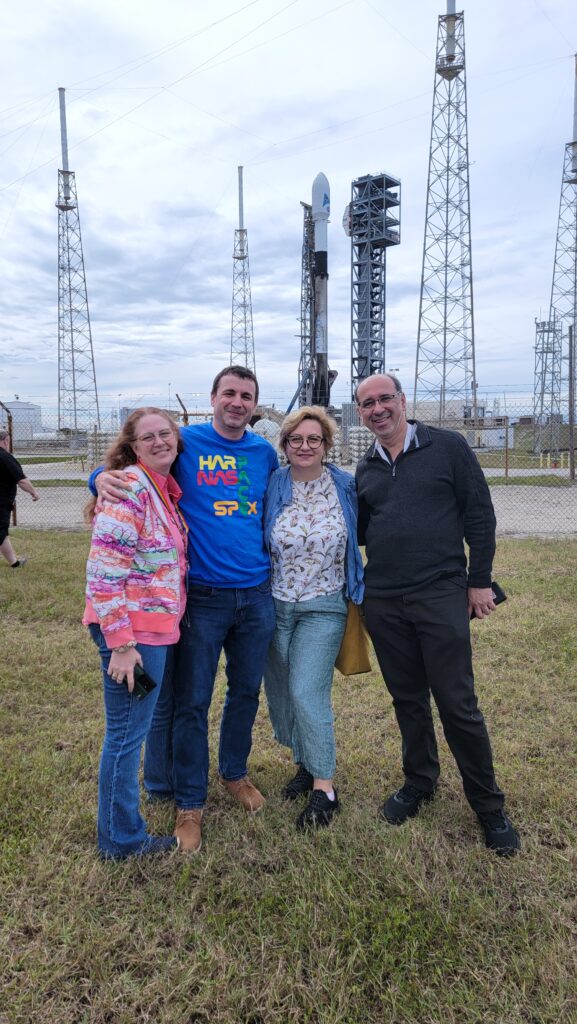 Left to right: Margo Young, Dominik Cieslak, Magdalena Kuzmicz-Cieslak, and Vanderlei Martins stand in front of the PACE spacecraft the day before its launch. (Image courtesy of Margo Young)
For the three multidisciplinary HARP2 physics, optics, and research engineering leads, Vanderlei Martins, Roberto Borda, and Dominik Cieslak, HARP2’s launch represents a career-defining moment that at times seemed against all odds for a mid-size public university. UMBC’s strong partnerships with NASA, such as the Goddard Earth Science Technology and Research (GESTAR) Center II that supports Borda’s and Cieslak’s roles, help enable milestones like this.
“I feel like I’m still dreaming,” said a visibly emotional Cieslak, research engineer, who captured the launch on his long-range camera.
Transfixed by the sight of live satellite footage of the PACE spacecraft heading to orbit, he added, “This is the last time we will physically see it [HARP2],” before hugging his long-time colleague, Borda.
“We’re very proud to have UMBC in space,” added Martins, professor of physics, who watched the big moment from a VIP viewing area three miles from the launch site. “We dreamed big from the beginning. The team persevered and just kept going.”
“I never despaired of having HARP2 on the PACE satellite,” admitted UMBC’s HARP2 manager, Lorraine Remer, research professor in the Joint Center for Earth Systems Technology. Her bigger worry wasn’t HARP2’s viability, but whether PACE would ever launch. “PACE was canceled four times and reinstated four times,” she recalled, noting that the program “survived a lengthy government shutdown and a global pandemic that destroyed our supply chains.”
Immediately after launch, Remer had to return to Maryland and the Goddard Space Flight Center to oversee HARP2 being turned on within 36 hours of launch. “It would be nice to bask in the successful launch, but I haven’t had much time to contemplate the success. There is just more work to do all the time,” she said.
An international effort
NASA’s PACE mission clears the path for revolutionary new measurements of Earth’s oceans and atmosphere. HARP2 measures aerosol particles and clouds, as well as properties of land and water surfaces. By analyzing particles like dust, wildfire smoke, or urban pollution, the science community gains deeper insights into air quality as well as global warming and its impacts. Scientists will be able see through things like sun glint to ascertain patterns never before possible.
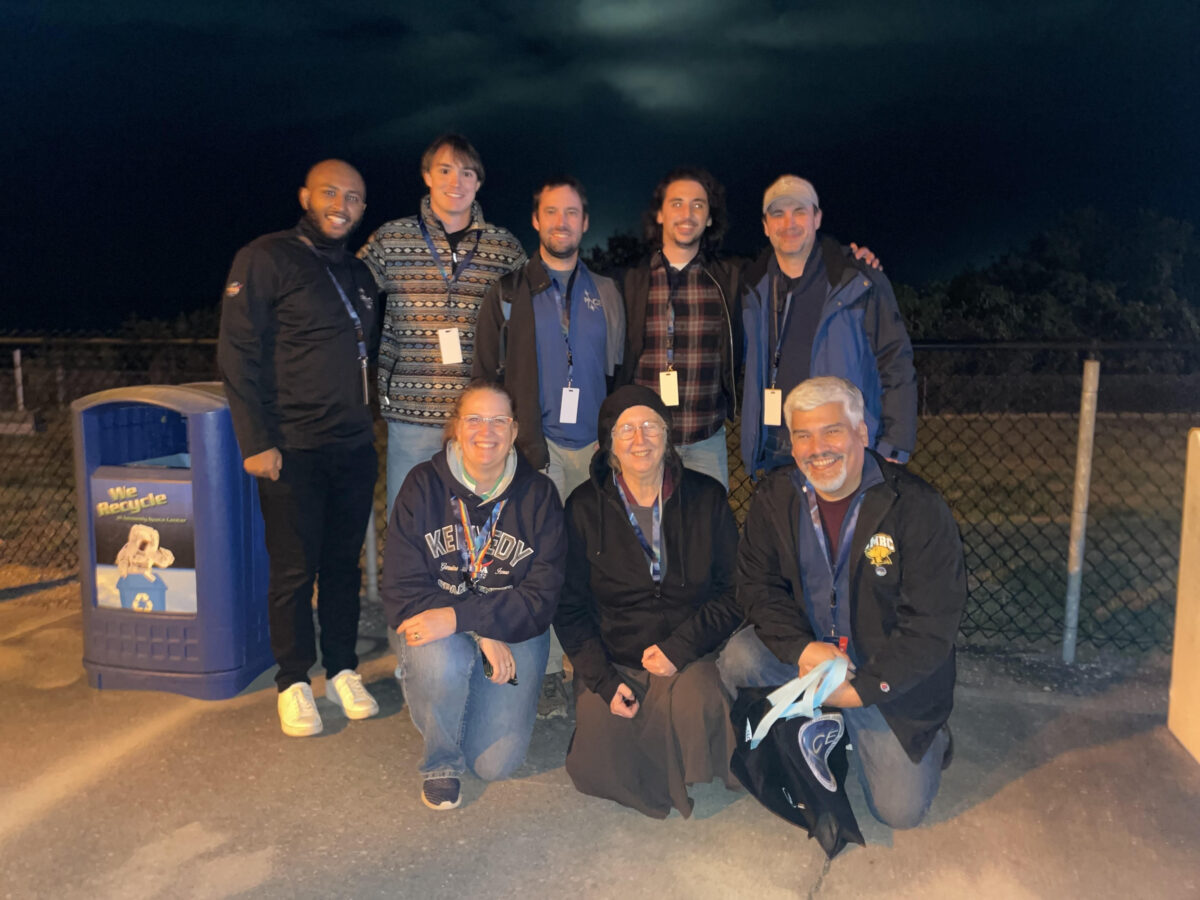 Members of the HARP team eagerly await the PACE launch at Kennedy Space Center’s Banana Creek Launch Viewing Area before the final countdown. Top, left to right: Yomiyu Fekadu, Ian Decker, Ben Cramer, Noah Sienkiewicz, Dominik Cieslak. Bottom, left to right: Margo Young, Lorraine Remer, Roberto Borda. (Image by Anne Wainscott-Sargent)
A second polarimeter on PACE, the Spectro-polarimeter for Planetary Exploration (SPEXone), developed through a Dutch consortium consisting of SRON Netherlands Institute for Space Research and Airbus Defence and Space Netherlands, will measure sunlight reflected from Earth’s atmosphere, land surface and ocean.
These two companion polarimeter instruments are important because the interaction between aerosols and clouds is the biggest unknown factor in atmospheric temperature change, according to reports from the U.N.’s Intergovernmental Panel on Climate Change.
“I have watched Dr. Martins and his team work toward this moment for about a decade, and have been aware of the trials and tribulations along the way. Seeing the smiles on their faces in the control station after the launch made it all worthwhile,” shared UMBC Vice President for Research Karl V. Steiner. “The HARP2 mission as an integral part of PACE is making all of us proud here on the UMBC campus. We cannot wait to see the science that will come from this engineering masterpiece conceptualized and created right here in Maryland.”
Waiting game
In the days leading up to the PACE launch, the HARP2 team knew there might be delays because of the weather so they rented a large Airbnb in neighboring Cocoa Beach for the full week. Earlier in the week, over grilled food at the shared house, the team reflected on their journey.
According to Martins, a key strategy was bringing together engineering and physics students, who typically don’t communicate well across disciplines.
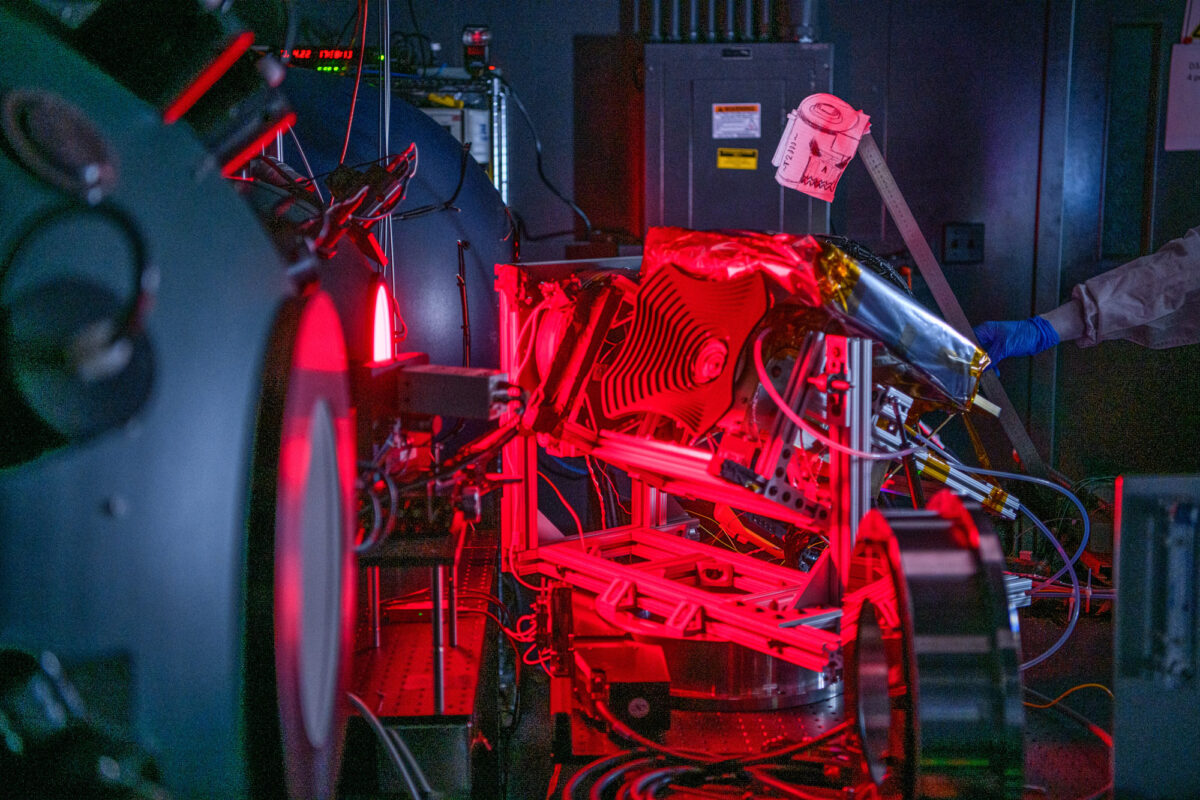 The HARP2 instrument undergoes calibration testing with red light. (Image by NASA)
“We introduced engineering students to the physics students and made them work together very quickly so they spoke the same language,” he said, crediting this multidisciplinary collaboration to the team’s ability to rapidly iterate and problem solve.
Borda, senior research engineer overseeing HARP2’s optical design, said a key technical challenge was determining how to best compensate for the effects of polarized light waves inside the instrument.
“It’s continuous work and you cannot do it alone. We needed a fantastic team with not only the staff but also students working at different levels,” Borda said. “There are undergraduate students and Ph.D.s integrated into the team who put in a lot of effort to make this real. We’re really thankful for the environment at this university—we’re able to work with students who find a career in this industry and field of research.”
Nurturing future career scientists
Martins echoed Borda’s pride in the broad level of participation in the HARP program, from high school students to senior scientists.
“We’ve had people from our team who now work in all levels of industry—at NASA, at NOAA, or in private industry. We’ve even had some students start their own company.”
Young, the program administrator, estimates that the cooperative agreements between UMBC and NASA have resulted in 20 UMBC graduates finding roles with NASA.
“It was everything I could have asked for. No other place would have let me be involved in the entire process, including making parts for HARP2 in the machine shop. Not only did I get to do hands-on stuff, but I also was part of the design and saw it all come together on a NASA mission.”
Yomiyu Fekadu ’20, mechanical engineering, M.S. ’23, engineering management
UMBC alumna Elissa Ogburn is one such graduate. She began working on HARP2 as a computer science major, tasked with creating a database that supported ground communications so researchers could communicate with the instrument when it was in space.
After graduating from UMBC in 2021, Ogburn joined NASA on the PACE project as a test conductor (TC)―responsible for integrating and testing the instruments onto the PACE spacecraft. During launch, she was one of five TCs in the PACE Control Room in Titusville, Florida, who powered up the spacecraft for the last time and configured it for launch.
“I never imagined having a job at NASA or working with people who were this smart, helpful, and kind. Every single person I’ve worked with was so fun. It’s also cool to have seen the whole process beginning as a student at UMBC. PACE is my first mission, so I’m learning everything as I go,” Ogburn said.
Close collaboration
The partnership between NASA and UMBC goes back over two decades. NASA Goddard Space Flight Center and UMBC are located just up the road from one another.
Jeremy Werdell, PACE project scientist at Goddard, recalled how initial calls to industry and academia for a polarimetry instrument for PACE were not promising due to cost and other factors.
However, Martins immediately suggested to Werdell that his lab develop a polarimeter, given his team’s experience with airborne instruments and the HARP cubesat, and the rest is history. In the end, NASA selected two polarimeters—HARP2 and SPEXone.
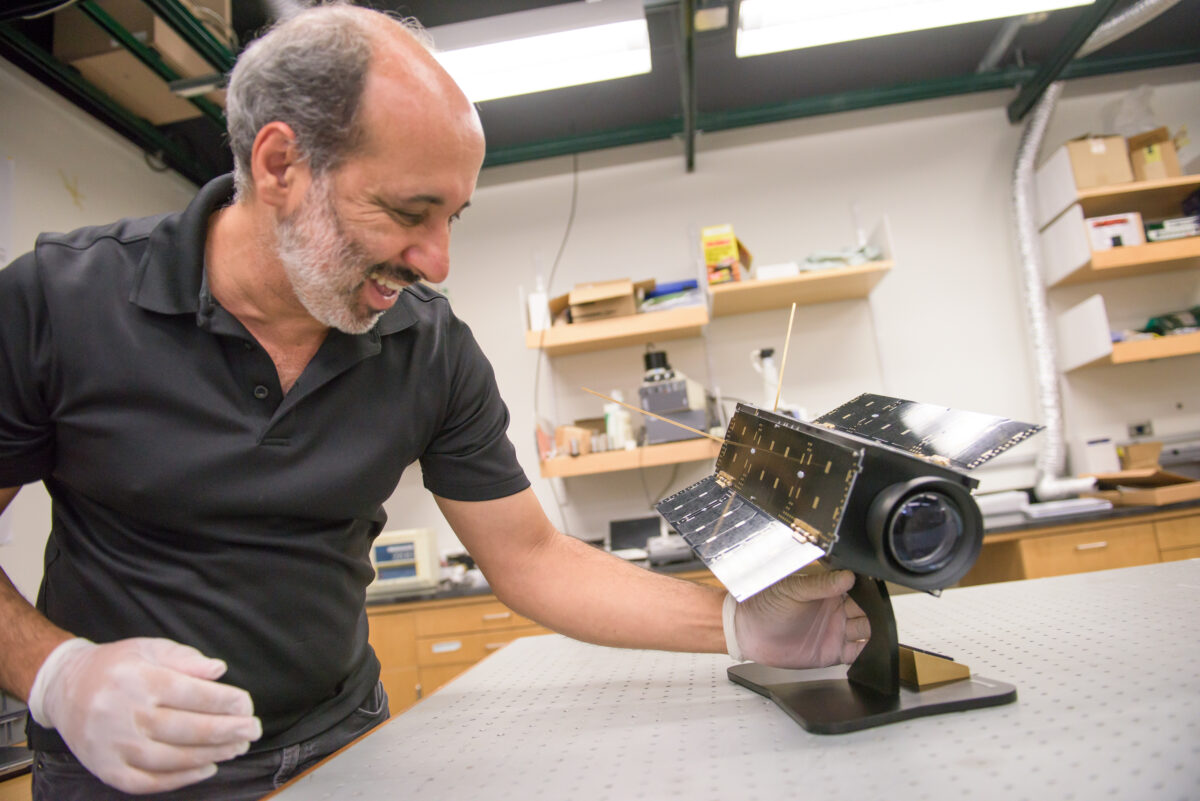 Vanderlei Martins inspects the HARP cubesat, which launched in 2019. (Image by Marlayna Demond ’11/UMBC)
Each instrument measures polarization differently: HARP2 is multispectral (measuring only four wavelengths of light) and hyperangular, so it looks at the same piece of real estate multiple times from dozens of different viewing directions. Its wide swath coverage means HARP2 will cover the globe every two days. SPEXone, on the other hand, is hyperspectral (measuring a continuous spectrum of light from the ultraviolet to near-infrared) but only views Earth at five angles. It has a narrower swath, meaning it will take almost a month to cover the globe.
“They’re small and mighty and miraculously complement each other very, very well,” said Werdell. “Having multi-band, multi-angle polarimetry is going to open up a lot of really interesting opportunities for discovery, because we can see clouds and aerosols in very different ways.”
HARP2 provides daily views that will help scientists understand how aerosols and clouds interact and their role in warming and cooling in the atmosphere.
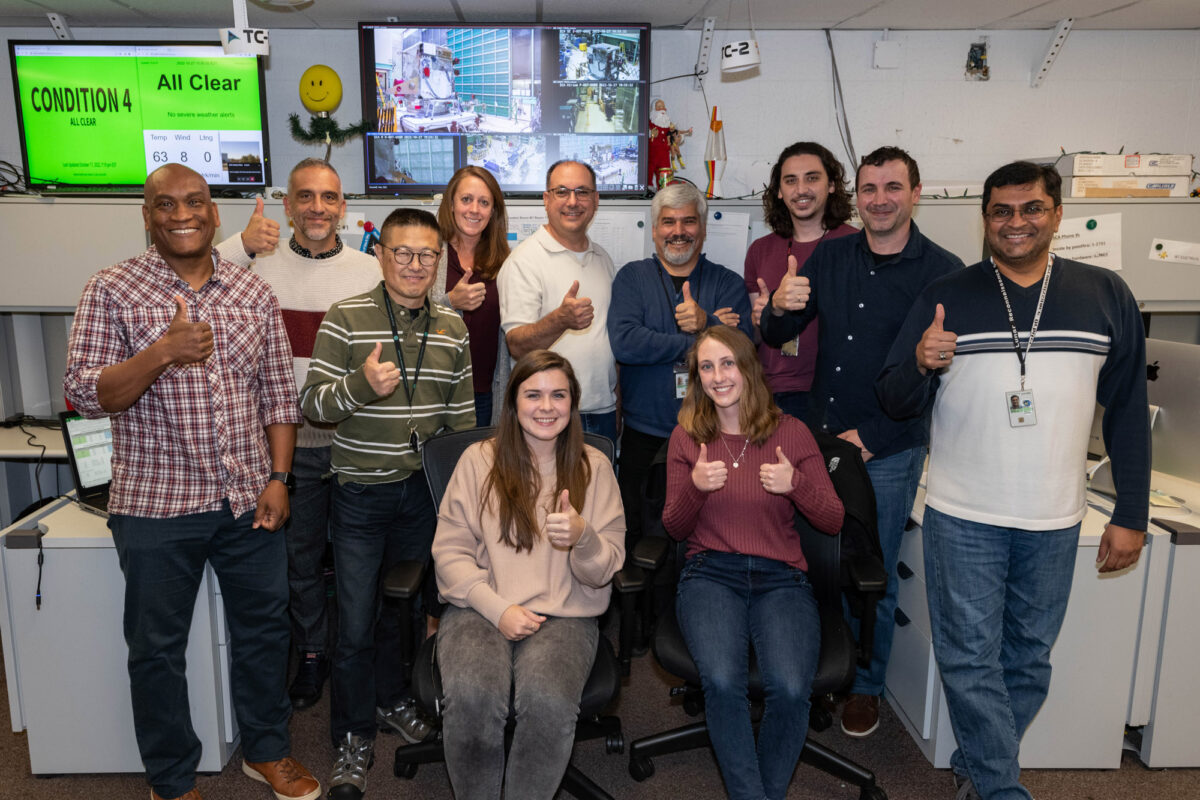 Some members of the HARP2 team successfully test HARP2’s electrical Integration to the Spacecraft. (Image by NASA)
“Understanding where aerosols are, how they’re transported, how they interact with clouds, and whether they absorb or reflect radiation is important to everybody because those characteristics are what drive warming of the atmosphere.” Werdell said.
Better air quality models
Onsite at the Cape for the first launch attempts, Nirandi Jayasinghe and Rachel Smith, both physics graduate research assistants at UMBC, shared their excitement for the PACE mission and HARP2’s potential to help modelers predict air quality, rain, or if the atmosphere is warming or cooling.
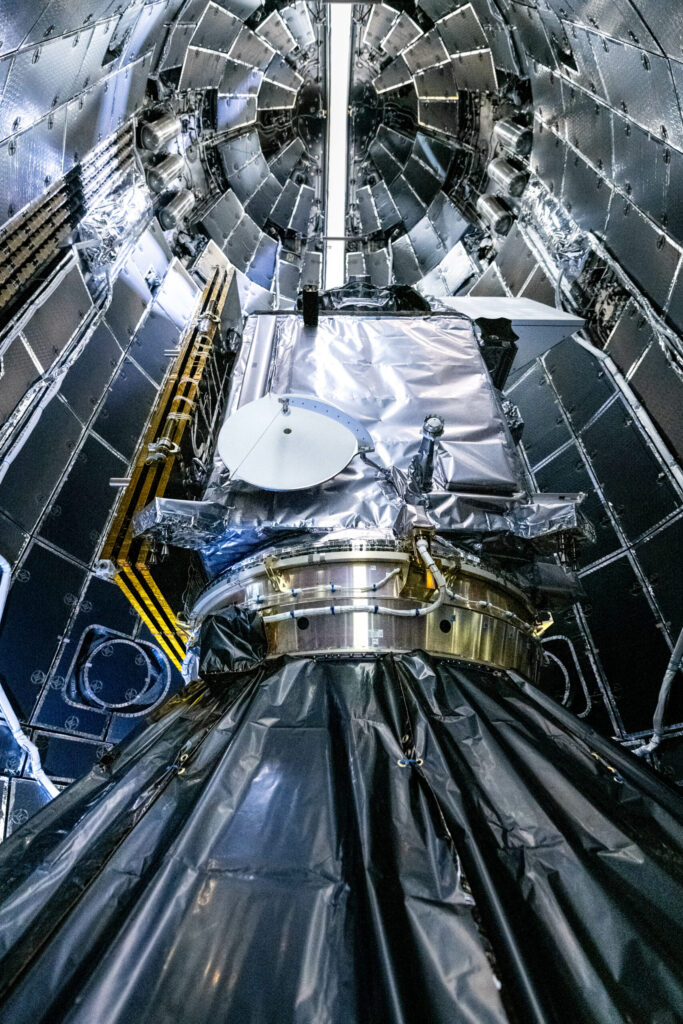 NASA and SpaceX technicians safely encapsulated NASA’s PACE spacecraft in SpaceX’s Falcon 9 payload fairings–a protective shell for the instruments on PACE during launch. (Image by NASA)
Jayasinghe is a data modeler who comes up with different methods to retrieve information from HARP2. Originally from Sri Lanka, Jayasinghe notes that her hometown used to be one of her country’s cleanest cities, and now due to development in Sri Lanka’s dominant neighbor, India, the air quality is extremely bad. She said HARP2 can help close the gap that exists in understanding the twilight zone—where a cloud starts and where it stops—by providing more accurate measurements.
Smith adds that this will go a long way in understanding cloud formation processes, weather patterns, forecasting, and climate modeling—information important for agriculture, transportation, disaster preparedness, and infrastructure planning.
“Even simple things like weather forecasting are impacted by how much dust is in the air,” said Smith, a 2026 doctoral candidate who earned her M.S. in atmospheric physics from UMBC in 2023. HARP2 will help address whether clouds have a net cooling effect or a net warming effect, which will allow for more accurate models of where Earth’s climate is headed. Smith notes that during events like the Canadian wildfires in 2023 no one could accurately predict rainfall, because the forecasting models were not accounting for the number of airborne aerosols.
“I’m really excited to see what new science questions come out of the instruments that we’re putting up in space,” she concluded.
Bouncing back from disaster
The HARP2 team has come a long way from initial concept to PACE. What impresses Werdell the most is the UMBC team’s resilience in the face of setbacks.
The most devastating moment came in February 2022, one month before the team was set to deliver HARP2 to NASA for integration on the spacecraft. As the instrument was in the last few seconds of vibration tests, the bonding on one of the prisms loosened and shattered.
“It tactically put us to point zero,” recalled Cieslak, who was shocked and humbled when so many NASA scientists volunteered their time and expertise to help the HARP2 team get back on track.
“We got an extension, and within two months we had built a new engineering model and were able to prove the new solution worked. By September, we were back to where we were before the incident,” he added.
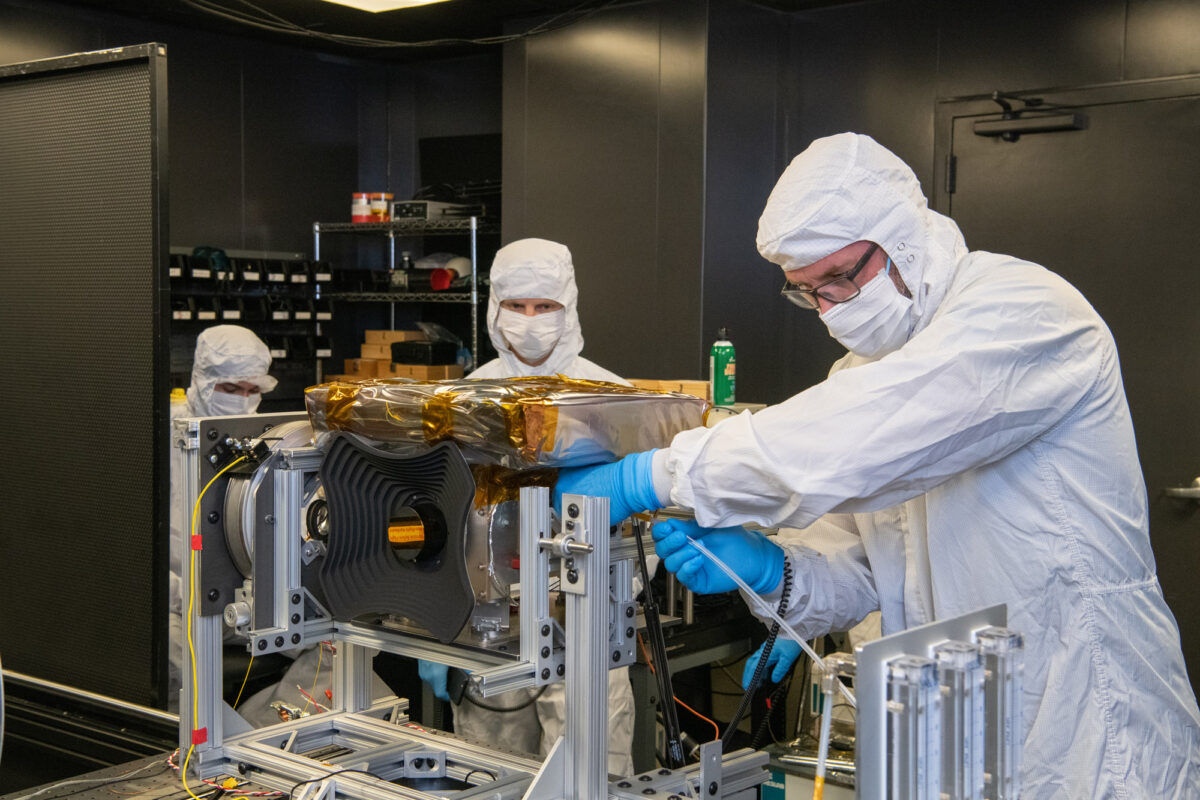 HARP2 calibration testing at Goddard Space Flight Center in Maryland, before the instrument was delivered to NASA. (Image by NASA)
First-time NASA launch attendee Yomiyu Fekadu ’20, mechanical engineering, M.S. ’23, engineering management, recalled that time well, as he helped assemble HARP2 as an intern under Benjamin Cramer ’17, M.S. ’20, mechanical engineer on the program.
“Especially after the failure, and the review board assessment, I helped put everything back together and do the test plans for construction and other documentation so NASA could give us the go-ahead to move on,” Fekadu said.
The experience was pivotal to his career. “It was everything I could have asked for,” said Fekado, now a systems engineer at Northrop Grumman. “No other place would have let me be involved in the entire process, including making parts for HARP2 in the machine shop. Not only did I get to do hands-on stuff, but I also was part of the design and saw it all come together on a NASA mission.”
As the HARP2 group left the viewing platform to line up for bus rides back to the Space Center, the smiles and easy camaraderie conveyed a collective sense of pride, relief, and excitement.
“I‘m now just anxious to see the first bytes of data,” said Cieslak, echoing the feeling of his colleagues.
In addition to the HARP team, several additional GESTAR II scientists and engineers were instrumental in their contributions to the overall PACE mission, including Ivona Cetinić, Andrew Sayer, Violeta Sanjuan Calzado, Bridget Seegers, Susanne Craig, Dirk Aurin, Meng Gao, Inia Soto Ramos, and Ian Carroll.
Update: On February 10, HARP2 successfully connected with instrumentation on the ground and all of its systems appear to be working as intended.
Follow along with what’s learned from the HARP2 project.
]]>
By Anne Wainscott-Sargent The third time’s the charm. Against a calm and crisp dark night sky on Florida’s Cape Canaveral last Thursday, February 8, just after 1:30 a.m., the Plankton,...
https://umbc.edu/stories/harp2-launches-on-nasa-pace-mission/
https://my3.my.umbc.edu/api/v0/pixel/news/139053/guest@my.umbc.edu/e0dbaea402ea1a164a7f168d63631a1e/api/pixel
cnms
coeit
compsci
engineering-management
esi
feature
gestar
gestar2
meche
news
physics
rca
research
science-and-tech
story
UMBC News & Magazine
https://my3.my.umbc.edu/groups/umbc-news-magazine
https://assets1-my.umbc.edu/system/shared/avatars/groups/000/001/943/24435aa6207c452e7bc15cc74b42c7bb/xsmall.png?1748556657
https://assets1-my.umbc.edu/system/shared/avatars/groups/000/001/943/24435aa6207c452e7bc15cc74b42c7bb/original.png?1748556657
https://assets2-my.umbc.edu/system/shared/avatars/groups/000/001/943/24435aa6207c452e7bc15cc74b42c7bb/xxlarge.png?1748556657
https://assets2-my.umbc.edu/system/shared/avatars/groups/000/001/943/24435aa6207c452e7bc15cc74b42c7bb/xlarge.png?1748556657
https://assets3-my.umbc.edu/system/shared/avatars/groups/000/001/943/24435aa6207c452e7bc15cc74b42c7bb/large.png?1748556657
https://assets1-my.umbc.edu/system/shared/avatars/groups/000/001/943/24435aa6207c452e7bc15cc74b42c7bb/medium.png?1748556657
https://assets2-my.umbc.edu/system/shared/avatars/groups/000/001/943/24435aa6207c452e7bc15cc74b42c7bb/small.png?1748556657
https://assets1-my.umbc.edu/system/shared/avatars/groups/000/001/943/24435aa6207c452e7bc15cc74b42c7bb/xsmall.png?1748556657
https://assets2-my.umbc.edu/system/shared/avatars/groups/000/001/943/24435aa6207c452e7bc15cc74b42c7bb/xxsmall.png?1748556657
UMBC News & Magazine
4
0
false
Fri, 16 Feb 2024 10:36:17 -0500
Fri, 16 Feb 2024 10:36:17 -0500
Sebastian Deffner attends selective quantum science conference in Vatican City
Sebastian Deffner, associate professor of physics, attended “Quantum Science and Technology: Recent Advances and New Perspectives,” a workshop hosted by the Pontifical Academy of Sciences in Vatican City from November 30 to December 2. Deffner was among only about 70 global experts invited to the workshop, and the guest list included numerous Nobel laureates.
“The leading experts in quantum science met in a unique place for a unique workshop to discuss the past, present, and future of quantum technologies,” Deffner says of the workshop.
For Deffner, it was an exciting and rare opportunity. The invitation recognizes his leadership role in developing the young field of quantum thermodynamics on an international scale. In 2019, he co-authored the first textbook focused on the subject, and his research group consistently contributes to the research literature.
Recordings of talks from the workshop are available here.
]]>
Sebastian Deffner, associate professor of physics, attended “Quantum Science and Technology: Recent Advances and New Perspectives,” a workshop hosted by the Pontifical Academy of Sciences in...
https://umbc.edu/quick-posts/deffner-attends-vatican-quantum-conference/
https://my3.my.umbc.edu/api/v0/pixel/news/139193/guest@my.umbc.edu/153b57933e0b08770e8ad9b24040f6c2/api/pixel
cnms
news
physics
quick-post
research
science-and-tech
UMBC News & Magazine
https://my3.my.umbc.edu/groups/umbc-news-magazine
https://assets1-my.umbc.edu/system/shared/avatars/groups/000/001/943/24435aa6207c452e7bc15cc74b42c7bb/xsmall.png?1748556657
https://assets1-my.umbc.edu/system/shared/avatars/groups/000/001/943/24435aa6207c452e7bc15cc74b42c7bb/original.png?1748556657
https://assets2-my.umbc.edu/system/shared/avatars/groups/000/001/943/24435aa6207c452e7bc15cc74b42c7bb/xxlarge.png?1748556657
https://assets2-my.umbc.edu/system/shared/avatars/groups/000/001/943/24435aa6207c452e7bc15cc74b42c7bb/xlarge.png?1748556657
https://assets3-my.umbc.edu/system/shared/avatars/groups/000/001/943/24435aa6207c452e7bc15cc74b42c7bb/large.png?1748556657
https://assets1-my.umbc.edu/system/shared/avatars/groups/000/001/943/24435aa6207c452e7bc15cc74b42c7bb/medium.png?1748556657
https://assets2-my.umbc.edu/system/shared/avatars/groups/000/001/943/24435aa6207c452e7bc15cc74b42c7bb/small.png?1748556657
https://assets1-my.umbc.edu/system/shared/avatars/groups/000/001/943/24435aa6207c452e7bc15cc74b42c7bb/xsmall.png?1748556657
https://assets2-my.umbc.edu/system/shared/avatars/groups/000/001/943/24435aa6207c452e7bc15cc74b42c7bb/xxsmall.png?1748556657
UMBC News & Magazine
0
0
false
Wed, 06 Dec 2023 09:47:00 -0500
Advanced X-ray Imaging Satellite science team hits major milestone
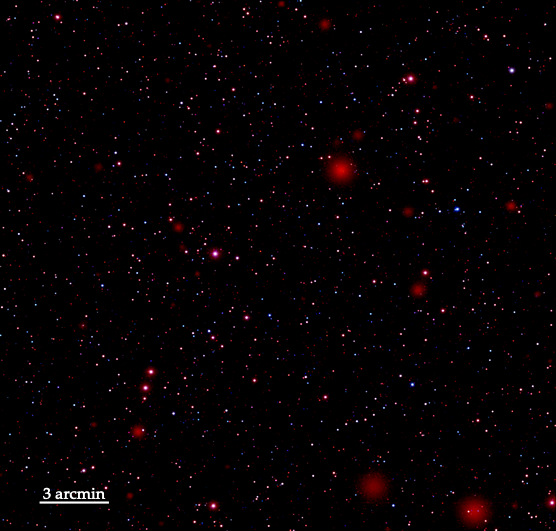 A simulation of the sky as viewed by AXIS in one 5 million-second exposure to deep space. This simulated image shows some of the earliest detected supermassive black holes. (Simulation by Stefano Marchesi)
After 18 months of intensive design work by a team of more than 100 scientists, which followed years of preliminary work and investment, in November the scientists and engineers on the Advanced X-ray Imaging Satellite (AXIS) science team took an important step toward delivering this next-generation space telescope. They became one of 10 teams to submit their formal project proposal to NASA, requesting nearly $1 billion in funding to further develop the design and build the telescope.
Adi Foord, assistant professor of physics, and Eileen Meyer, associate professor of physics, serve on the central AXIS leadership team, and Foord co-leads the sub-team focused on supermassive black hole evolution. If selected for production, AXIS will improve upon the highly successful, but aging, Chandra X-ray Observatory launched in 1999.
As an X-ray telescope, AXIS aligns with one of the established priorities laid out in NASA’s 2020 decadal survey. These surveys initiate a years-long competition to be the one major instrument eventually selected for launch to address one of the priorities.
A revolutionary x-ray telescope
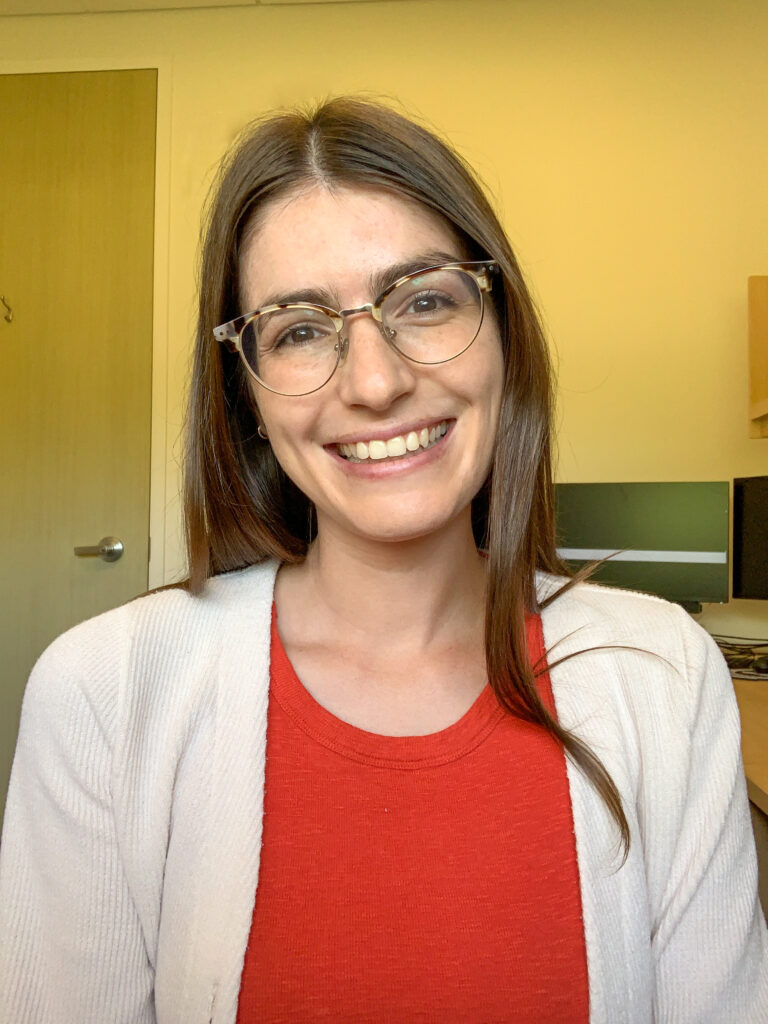 Adi Foord co-leads the AXIS Supermassive Black Hole science working group. She is also the project’s communications and outreach lead. (Image courtesy of Foord)
“AXIS is going to revolutionize our understanding of supermassive black hole growth and evolution by detecting some of the earliest known supermassive black holes to date and tracking them across cosmic time,” Foord says. “AXIS will be the premiere high-angular-resolution X-ray mission of the 2030s, observing deeper into our universe than currently possible with existing X-ray telescopes.”
The lead investigator on the AXIS team is Chris Reynolds at University of Maryland, College Park, and the co-lead is Erin Kara at MIT. The team will know by fall 2024 if its proposal is one of two or three selected to move on to the next phase. After that, one proposal will eventually emerge the winner, and the selected team will build their satellite for launch in the early 2030s.
The team is optimistic about their prospects, given the strength of the proposal and the potential impact of the new satellite’s capabilities. AXIS’ “superb resolution means that it will be able to detect many new systems of interacting supermassive black holes,” Foord explains, such as pairs orbiting each other very closely and expected to merge. “We currently don’t know of too many of these systems, and AXIS is predicted to find hundreds to thousands of them.”
]]>
A simulation of the sky as viewed by AXIS in one 5 million-second exposure to deep space. This simulated image shows some of the earliest detected supermassive black holes. (Simulation by Stefano...
https://umbc.edu/stories/x-ray-satellite-milestone/
https://my3.my.umbc.edu/api/v0/pixel/news/137543/guest@my.umbc.edu/2cad22ac9cc91f4d3c302358a092f294/api/pixel
cnms
news
physics
research
science-and-tech
UMBC News & Magazine
https://my3.my.umbc.edu/groups/umbc-news-magazine
https://assets1-my.umbc.edu/system/shared/avatars/groups/000/001/943/24435aa6207c452e7bc15cc74b42c7bb/xsmall.png?1748556657
https://assets1-my.umbc.edu/system/shared/avatars/groups/000/001/943/24435aa6207c452e7bc15cc74b42c7bb/original.png?1748556657
https://assets2-my.umbc.edu/system/shared/avatars/groups/000/001/943/24435aa6207c452e7bc15cc74b42c7bb/xxlarge.png?1748556657
https://assets2-my.umbc.edu/system/shared/avatars/groups/000/001/943/24435aa6207c452e7bc15cc74b42c7bb/xlarge.png?1748556657
https://assets3-my.umbc.edu/system/shared/avatars/groups/000/001/943/24435aa6207c452e7bc15cc74b42c7bb/large.png?1748556657
https://assets1-my.umbc.edu/system/shared/avatars/groups/000/001/943/24435aa6207c452e7bc15cc74b42c7bb/medium.png?1748556657
https://assets2-my.umbc.edu/system/shared/avatars/groups/000/001/943/24435aa6207c452e7bc15cc74b42c7bb/small.png?1748556657
https://assets1-my.umbc.edu/system/shared/avatars/groups/000/001/943/24435aa6207c452e7bc15cc74b42c7bb/xsmall.png?1748556657
https://assets2-my.umbc.edu/system/shared/avatars/groups/000/001/943/24435aa6207c452e7bc15cc74b42c7bb/xxsmall.png?1748556657
UMBC News & Magazine
0
0
false
Tue, 05 Dec 2023 11:28:07 -0500
Tue, 05 Dec 2023 11:28:07 -0500
Is time travel even possible? An astrophysicist explains the science behind the science fiction


Written by Adi Foord, assistant professor of physics, UMBC
Curious Kids is a series for children of all ages. If you have a question you’d like an expert to answer, send it to CuriousKidsUS@theconversation.com.
Will it ever be possible for time travel to occur? – Alana C., age 12, Queens, New York
Have you ever dreamed of traveling through time, like characters do in science fiction movies? For centuries, the concept of time travel has captivated people’s imaginations. Time travel is the concept of moving between different points in time, just like you move between different places. In movies, you might have seen characters using special machines, magical devices or even hopping into a futuristic car to travel backward or forward in time.
But is this just a fun idea for movies, or could it really happen?
The question of whether time is reversible remains one of the biggest unresolved questions in science. If the universe follows the laws of thermodynamics, it may not be possible. The second law of thermodynamics states that things in the universe can either remain the same or become more disordered over time.
It’s a bit like saying you can’t unscramble eggs once they’ve been cooked. According to this law, the universe can never go back exactly to how it was before. Time can only go forward, like a one-way street.
Time is relative
However, physicist Albert Einstein’s theory of special relativity suggests that time passes at different rates for different people. Someone speeding along on a spaceship moving close to the speed of light – 671 million miles per hour! – will experience time slower than a person on Earth.
People have yet to build spaceships that can move at speeds anywhere near as fast as light, but astronauts who visit the International Space Station orbit around the Earth at speeds close to 17,500 mph. Astronaut Scott Kelly has spent 520 days at the International Space Station, and as a result has aged a little more slowly than his twin brother – and fellow astronaut – Mark Kelly. Scott used to be 6 minutes younger than his twin brother. Now, because Scott was traveling so much faster than Mark and for so many days, he is 6 minutes and 5 milliseconds younger.
Time isn’t the same everywhere.
Some scientists are exploring other ideas that could theoretically allow time travel. One concept involves wormholes, or hypothetical tunnels in space that could create shortcuts for journeys across the universe. If someone could build a wormhole and then figure out a way to move one end at close to the speed of light – like the hypothetical spaceship mentioned above – the moving end would age more slowly than the stationary end. Someone who entered the moving end and exited the wormhole through the stationary end would come out in their past.
However, wormholes remain theoretical: Scientists have yet to spot one. It also looks like it would be incredibly challenging to send humans through a wormhole space tunnel.
Paradoxes and failed dinner parties
There are also paradoxes associated with time travel. The famous “grandfather paradox” is a hypothetical problem that could arise if someone traveled back in time and accidentally prevented their grandparents from meeting. This would create a paradox where you were never born, which raises the question: How could you have traveled back in time in the first place? It’s a mind-boggling puzzle that adds to the mystery of time travel.
Famously, physicist Stephen Hawking tested the possibility of time travel by throwing a dinner party where invitations noting the date, time and coordinates were not sent out until after it had happened. His hope was that his invitation would be read by someone living in the future, who had capabilities to travel back in time. But no one showed up.
As he pointed out: “The best evidence we have that time travel is not possible, and never will be, is that we have not been invaded by hordes of tourists from the future.”
Telescopes are time machines
Interestingly, astrophysicists armed with powerful telescopes possess a unique form of time travel. As they peer into the vast expanse of the cosmos, they gaze into the past universe. Light from all galaxies and stars takes time to travel, and these beams of light carry information from the distant past. When astrophysicists observe a star or a galaxy through a telescope, they are not seeing it as it is in the present, but as it existed when the light began its journey to Earth millions to billions of years ago. https://www.youtube.com/embed/QeRtcJi3V38?wmode=transparent&start=0 Telescopes are a kind of time machine – they let you peer into the past.
NASA’s newest space telescope, the James Webb Space Telescope, is peering at galaxies that were formed at the very beginning of the Big Bang, about 13.7 billion years ago.
While we aren’t likely to have time machines like the ones in movies anytime soon, scientists are actively researching and exploring new ideas. But for now, we’ll have to enjoy the idea of time travel in our favorite books, movies and dreams.
This article is republished from The Conversation under a Creative Commons license. Read the original article and see more than 250 UMBC articles available in The Conversation.
]]>
Written by Adi Foord, assistant professor of physics, UMBC Curious Kids is a series for children of all ages. If you have a question you’d like an expert to answer, send it to...
https://umbc.edu/stories/science-behind-potential-for-time-travel/
https://my3.my.umbc.edu/api/v0/pixel/news/137027/guest@my.umbc.edu/1eecb70bc4d7c05aabbe161ef0946b87/api/pixel
cnms
discovery
magazine
physics
the-conversation
UMBC News & Magazine
https://my3.my.umbc.edu/groups/umbc-news-magazine
https://assets1-my.umbc.edu/system/shared/avatars/groups/000/001/943/24435aa6207c452e7bc15cc74b42c7bb/xsmall.png?1748556657
https://assets1-my.umbc.edu/system/shared/avatars/groups/000/001/943/24435aa6207c452e7bc15cc74b42c7bb/original.png?1748556657
https://assets2-my.umbc.edu/system/shared/avatars/groups/000/001/943/24435aa6207c452e7bc15cc74b42c7bb/xxlarge.png?1748556657
https://assets2-my.umbc.edu/system/shared/avatars/groups/000/001/943/24435aa6207c452e7bc15cc74b42c7bb/xlarge.png?1748556657
https://assets3-my.umbc.edu/system/shared/avatars/groups/000/001/943/24435aa6207c452e7bc15cc74b42c7bb/large.png?1748556657
https://assets1-my.umbc.edu/system/shared/avatars/groups/000/001/943/24435aa6207c452e7bc15cc74b42c7bb/medium.png?1748556657
https://assets2-my.umbc.edu/system/shared/avatars/groups/000/001/943/24435aa6207c452e7bc15cc74b42c7bb/small.png?1748556657
https://assets1-my.umbc.edu/system/shared/avatars/groups/000/001/943/24435aa6207c452e7bc15cc74b42c7bb/xsmall.png?1748556657
https://assets2-my.umbc.edu/system/shared/avatars/groups/000/001/943/24435aa6207c452e7bc15cc74b42c7bb/xxsmall.png?1748556657
UMBC News & Magazine
0
0
false
Mon, 13 Nov 2023 12:22:12 -0500
X-ray emissions from black hole jets vary unexpectedly, challenging leading model of particle acceleration

Researchers discovered only relatively recently that black hole jets emit x-rays, and how the jets accelerate particles to this high-energy state is still a mystery. Surprising new findings in Nature Astronomyappear to rule out one leading theory, opening the door to reimagining how particle acceleration works in the jets—and possibly also elsewhere in the universe.
One leading model of how jets generate x-rays expects the jets’ x-ray emissions to remain stable over long time scales (millions of years). However, the new paperfound that the x-ray emissions of a statistically significant number of jets varied over just a few years.
“One of the reasons we’re excited about the variability is that there are two main models for how x-rays are produced in these jets, and they’re completely different,” explains lead author Eileen Meyer, associate professor of physics. “One model invokes very low-energy electrons and one has very high-energy electrons. And one of those models is completely incompatible with any kind of variability.”
For the study, the authors analyzed archival data from the Chandra X-ray Observatory, the highest-resolution x-ray observatory available. The research team looked at nearly all of the black hole jets for which Chandra had multiple observations, which amounted to 155 unique regions within 53 jets.
Discovering relatively frequent variability on such short time scales “is revolutionary in the context of these jets, because that was not expected at all,” Meyer says.
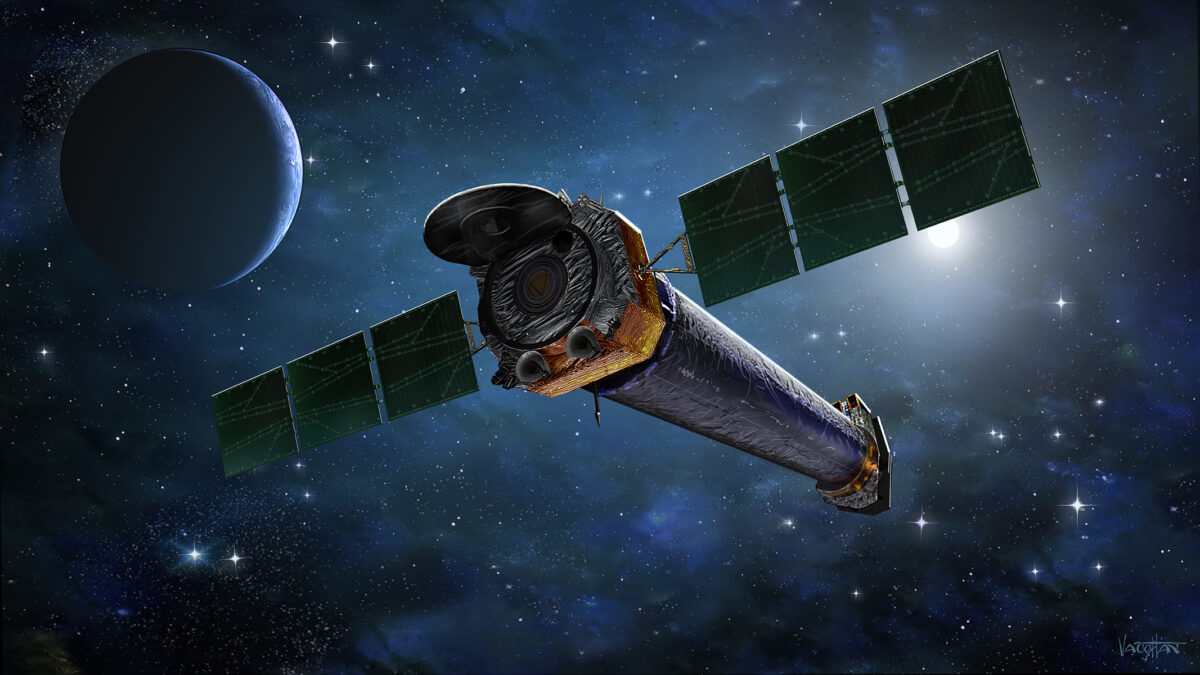 A rendering of the Chandra X-ray Observatory, which is the world’s highest-resolution X-ray telescope. (NASA/CXC and J. Vaughan)
Rethinking particle acceleration
In addition to assuming stability in x-ray emissions over time, the simplest theory for how jets generate x-rays assumes particle acceleration occurs at the center of the galaxy in the black hole “engine” that drives the jet, Meyer explains. However, the new study found rapid changes in x-ray emissions all along the length of the jets. That suggests particle acceleration is occurring all along the jet, at vast distances from the jet’s origin at the black hole.
“There are theories out there for how this could work, but a lot of what we’ve been working with is now clearly incompatible with our observations,” Meyer says.
Interestingly, the results also hinted that jets closer to Earth had more variability than those much farther away. The latter are so far away, that by the time the light coming from them reaches the telescope, it is like looking back in time. It makes sense to Meyer that older jets would have less variability. Earlier in the universe’s history, the universe was smaller and ambient radiation was greater, which researchers believe could lead to greater stability of x-rays in the jets, Meyer says.
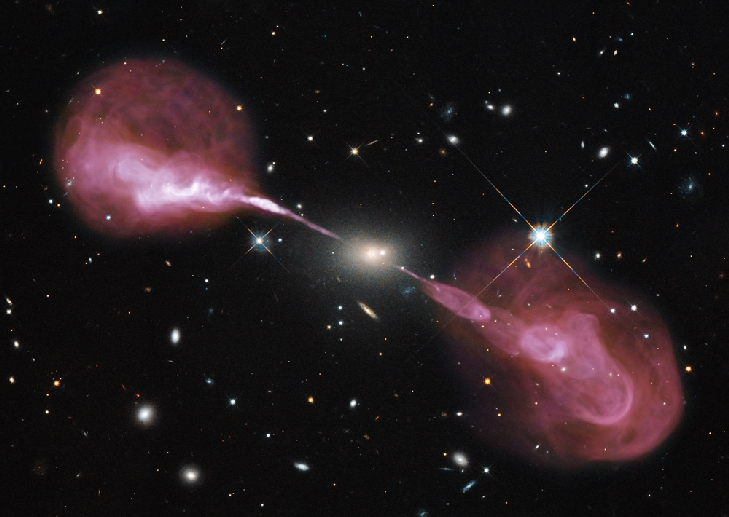 Two jets spreading from the central black hole in the Hercules A galaxy. These jets are about 1.5 million light years long, requiring massive particle acceleration forces and dwarfing the galaxy from which they emanate. (NASA, ESA, S. Baum and C. O’Dea (RIT), R. Perley and W. Cotton (NRAO/AUI/NSF), and the Hubble Heritage Team (STScI/AURA))
Critical collaboration
Despite Chandra’s outstanding imaging resolution, the data set posed significant challenges. Chandra observed some of the pockets of variability with only a handful of x-ray photons. And the variability in x-ray production in a given jet was typically tens of percent or so. To avoid unintentionally counting randomness as real variability, Meyer collaborated with statisticians at the University of Toronto and the Imperial College of London.
“Pulling this result out of the data was almost like a miracle, because the observations were not designed to detect it,” Meyer says. The team’s analysis suggests that between 30 and 100 percent of the jets in the study showed variability over short time scales. “While we would like better constraints,” she says, “the variability is notably not zero.”
A call to action
The research unfolded over nearly a decade. Meyer first submitted a proposal to do the archival study with the Chandra X-ray Observatory in 2014, when she was still a postdoc, and it became one of her first funded projects at UMBC. Several undergraduate and graduate UMBC students, including four who are authors on the new paper, contributed to the work. Plus, Meyer’s group applied several different statistical methods before calling in external colleagues for support.
“We had to start over about three different times,” Meyer says. “But I stuck with it, because I really felt that there was something important here.”
Given the import of the findings, clearly Meyer’s intuition served her well. The new paper pokes significant holes in one of the major theories for x-ray production in black hole jets, and Meyer hopes the paper spurs future work. “Hopefully this will be a real call to the theorists,” she says, “to basically take a look at this result and come up with jet models that are consistent with what we’re finding.”
]]>
Researchers discovered only relatively recently that black hole jets emit x-rays, and how the jets accelerate particles to this high-energy state is still a mystery. Surprising new findings in...
https://umbc.edu/stories/particle-acceleration-in-black-hole-jets/
https://my3.my.umbc.edu/api/v0/pixel/news/133872/guest@my.umbc.edu/8ac013bf1fee92ae5788b9eaf95b4c64/api/pixel
cnms
news
physics
research
science-and-tech
UMBC News & Magazine
https://my3.my.umbc.edu/groups/umbc-news-magazine
https://assets1-my.umbc.edu/system/shared/avatars/groups/000/001/943/24435aa6207c452e7bc15cc74b42c7bb/xsmall.png?1748556657
https://assets1-my.umbc.edu/system/shared/avatars/groups/000/001/943/24435aa6207c452e7bc15cc74b42c7bb/original.png?1748556657
https://assets2-my.umbc.edu/system/shared/avatars/groups/000/001/943/24435aa6207c452e7bc15cc74b42c7bb/xxlarge.png?1748556657
https://assets2-my.umbc.edu/system/shared/avatars/groups/000/001/943/24435aa6207c452e7bc15cc74b42c7bb/xlarge.png?1748556657
https://assets3-my.umbc.edu/system/shared/avatars/groups/000/001/943/24435aa6207c452e7bc15cc74b42c7bb/large.png?1748556657
https://assets1-my.umbc.edu/system/shared/avatars/groups/000/001/943/24435aa6207c452e7bc15cc74b42c7bb/medium.png?1748556657
https://assets2-my.umbc.edu/system/shared/avatars/groups/000/001/943/24435aa6207c452e7bc15cc74b42c7bb/small.png?1748556657
https://assets1-my.umbc.edu/system/shared/avatars/groups/000/001/943/24435aa6207c452e7bc15cc74b42c7bb/xsmall.png?1748556657
https://assets2-my.umbc.edu/system/shared/avatars/groups/000/001/943/24435aa6207c452e7bc15cc74b42c7bb/xxsmall.png?1748556657
UMBC News & Magazine
0
0
false
Mon, 05 Jun 2023 15:52:15 -0400
Mon, 05 Jun 2023 15:52:15 -0400
Class of 2023 reflects on UMBC as a community that values and supports the whole person

Kayla Tomas ‘23, information systems, maintained a challenging schedule during her undergraduate years. There were days she rose early, studied, and attended classes in the morning and afternoon, headed to volleyball practice in the late afternoon, paused a half hour for dinner, and then dashed off to lead a dance class in the evening. “It was the support of my friends, my family, and the mentors here at UMBC that made it easier,” she says.
Despite the challenges of a hectic schedule, she wouldn’t have it any other way, given what she gained from each opportunity. As a student athlete, Tomas says that one of her best undergraduate experiences was being on the Division I women’s volleyball team that won the America East Title three years in a row.
“The friendships I made, the breakthroughs I experienced, and the challenges I faced, made me a stronger individual, and this couldn’t have happened without an amazing group of girls I had the privilege in sharing the court with,” Tomas says.
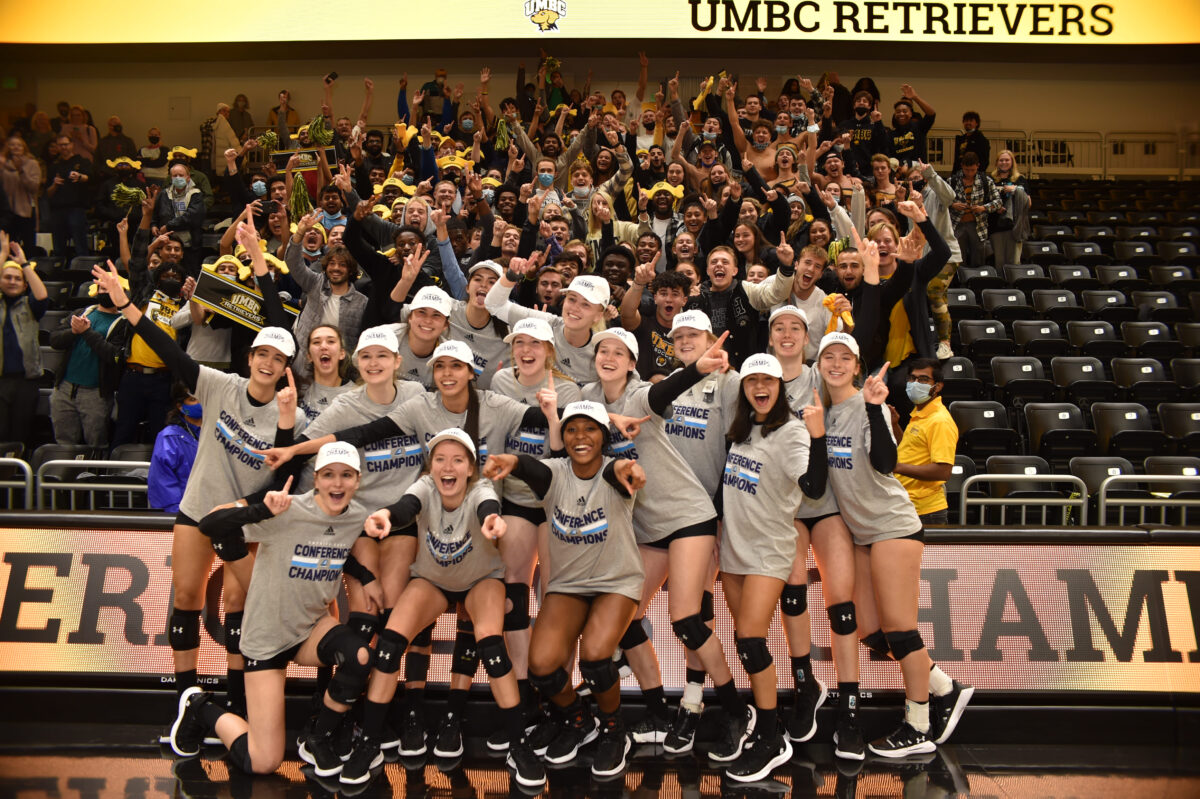 Kayla Tomas and her teammates celebrate a Division I women’s volleyball championship. (Image courtesy of Kayla Tomas)
Valuing the whole person
Tomas was a member of the Center for Women in Information Technology (CWIT) Scholars Program, which anchored her not only financially but also psychologically.
“One person I really have to give credit and thanks to, and someone I will continue to maintain a connection with, is Erica D’Eramo, assistant director at CWIT,” Tomas shares. “She has helped me a lot. We have one-on-one meetings, and if I have a question that I can’t figure out, she always knows who to direct me to. But it doesn’t even have to be about school—it can be about just how I’m doing emotionally, mentally, or physically.”
Tomas has also received support from UMBC alumni through the Alumni Endowed Scholarship. “Receiving that award was such a proud moment, because I knew these scholarships are very competitive.” she shares. “They saw a young woman’s drive to make a difference, to support her community.”
Creating a new student group
Beyond her academic work and competition on the volleyball court, dance has played a major role in Tomas’s UMBC experience. She had enjoyed dancing from a young age, and while at UMBC began to attend dance classes and workshops in the Baltimore-Washington area. She noticed the lack of Latin dancing on campus and she knew of other students who shared the same passion, “and so I did something about it,” she says.
Tomas started to offer evening Latin dance classes in the Public Policy Building. “That was a lot of fun, seeing my friends support me,” she says, “and also support dance genres of different cultures.”
 Kayla Tomas (fourth from right) poses with future colleagues at KPMG, where she will work as a cybersecurity consultant after graduation. (Image courtesy of Kayla Tomas)
“So many students here at UMBC are self-motivated” to try new things, observes Tomas. “They’re go-getters—that’s their mentality. And I love it because it rubs off on me, and I’m sure on other people.”
Emerging as a leader
The experiences of other graduating students mirror those of Tomas. When she began her undergraduate studies at UMBC in 2019, Sianna Serio ’23, computer science, had only one thought in mind: to focus on her academic studies. But within a short period of time, she became involved with the Resident Students Association, began to work for Residential Life, and gave President Valerie Sheares Ashby her first tour of campus.
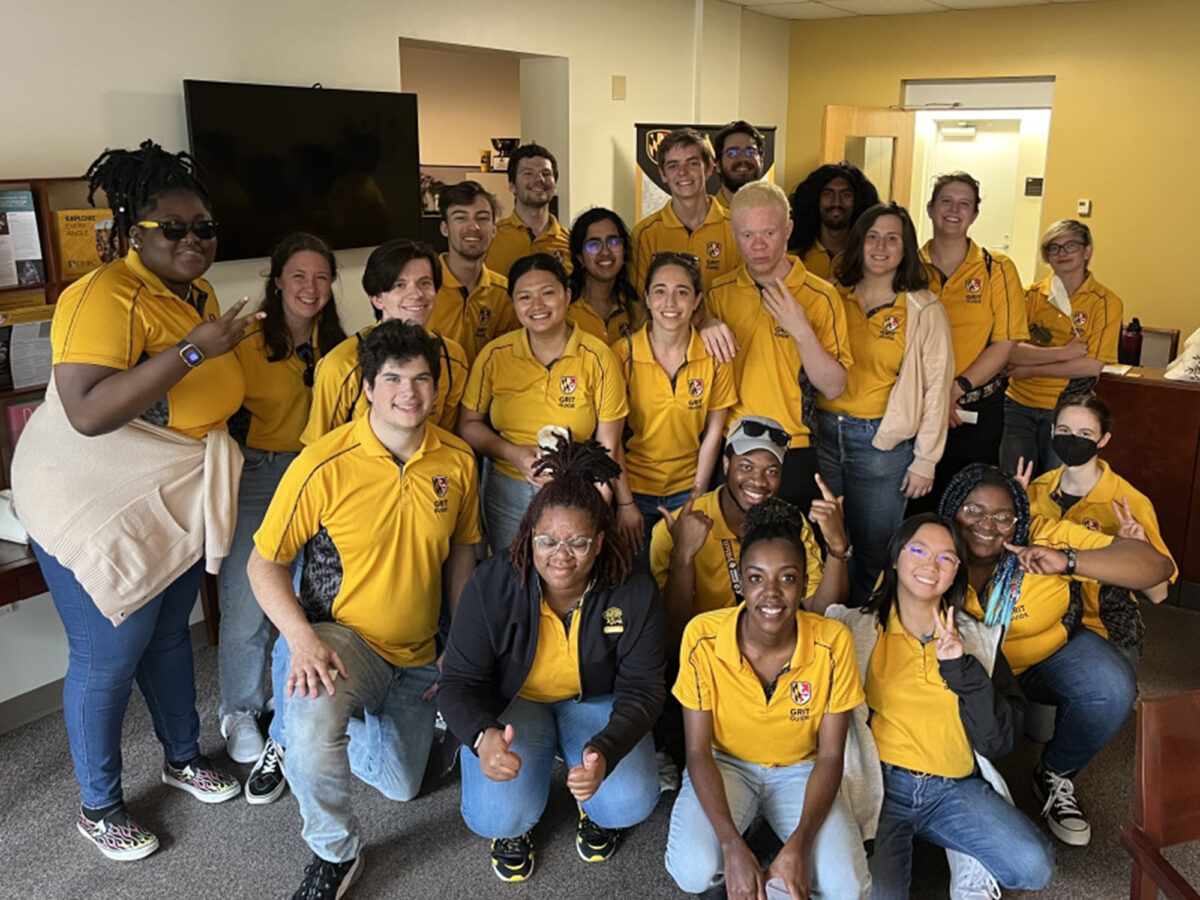 Sianna Serio (lower right corner, in black jacket) celebrates with Grit Guides for UMBC’s Just for Juniors event. (Image courtesy of Sianna Serio)
In her four years on campus, Serio participated in the Society of Women Engineers, Sign of Life, First Generation Network and the UMBC Crafters club. She credits faculty, staff and students alike for keeping her going, saying, “When you’re super focused on doing everything at once, sometimes you don’t get a chance to reflect on how that’s impacting you. My mentors did a really great job of providing support and checking in on me.”
Coaches support a student researcher
Emily Ferketic ’23, physics, enjoyed the remarkable distinction of having a paper published in a peer-reviewed journal under the mentorship of Sebastian Deffner, associate professor of physics. “He saw potential in me that I didn’t see in myself,” she shares.
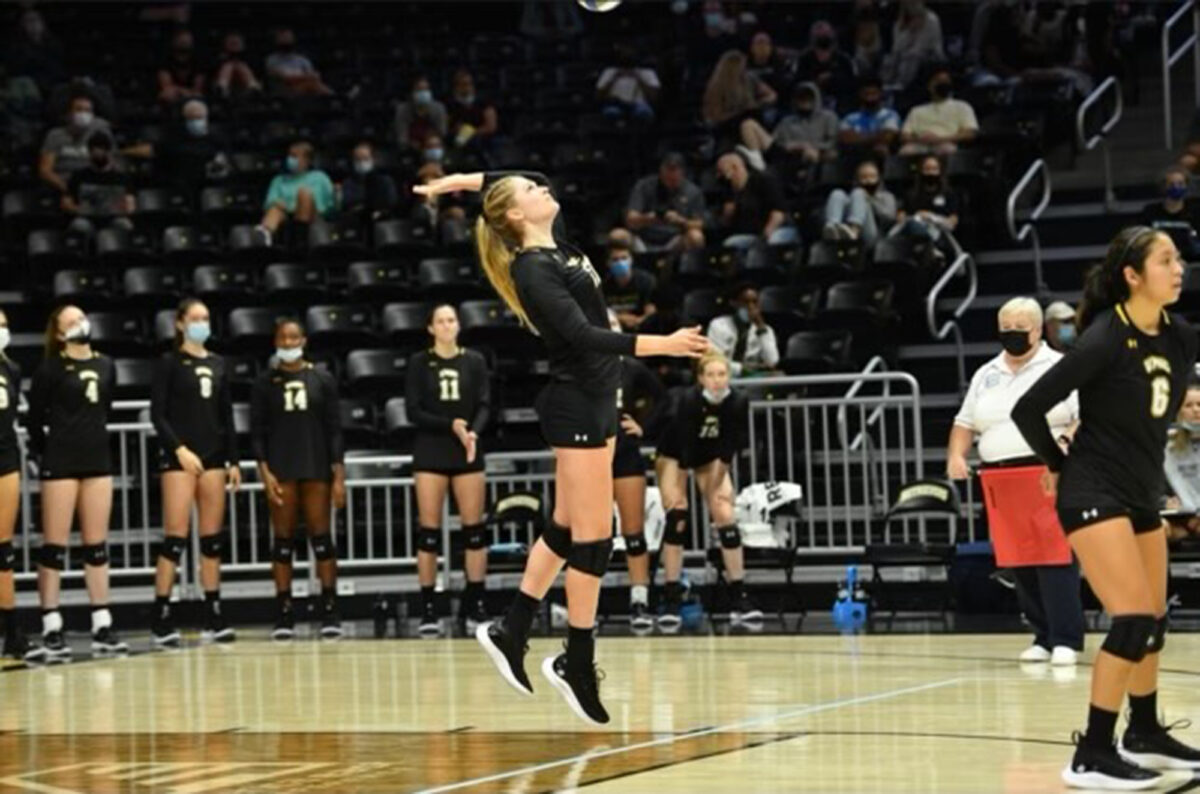 Emily Ferketic on the volleyball court. (Image courtesy of Emily Ferketic)
Despite her rigorous academic schedule, she also excelled on the volleyball court, becoming captain of UMBC’s Division 1 team. In 2021, she won the coveted America East Elite 18 award. Her coaches, too, have been especially engaged. “A few weeks ago, I was presenting my research at Undergraduate Research and Achievement Day. All of my coaches showed up, not only to support me, but also to learn about the work I’ve been doing when I’m not in the gym,” she shares.
A diverse, supportive community
Students who complete double majors face especially challenging demands. Avni Patel ’23, biological sciences and gender, women’s and sexuality studies, achieved academic excellence in both fields of study and also became a community leader at UMBC, revitalizing the Hindu Students Council. “The best part of my UMBC experience was finding a diverse community of peers and mentors where I was appreciated and encouraged to reach my full potential,” she says.
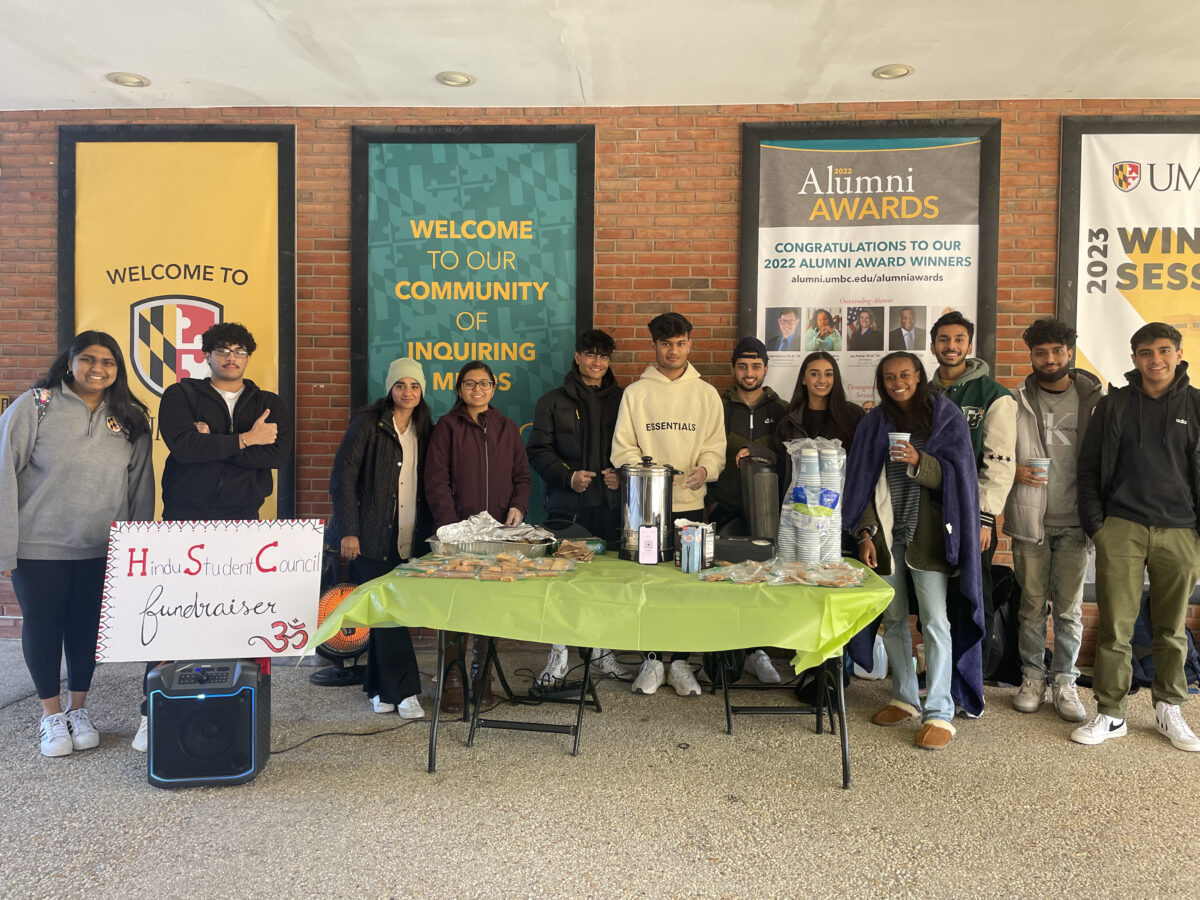 Avni Patel (fifth from right) with members of the Hindu Student Association at a fundraiser. (Image courtesy of Avni Patel)
One theme strongly resonates through the experiences of all these students: the UMBC community values the whole person. Whether a student is focusing on academic work, participating in student organizations, competing as an athlete, or engaging with any number of other activities, the university’s culture of mentoring and support is there to help them succeed.
]]>
Kayla Tomas ‘23, information systems, maintained a challenging schedule during her undergraduate years. There were days she rose early, studied, and attended classes in the morning and afternoon,...
https://umbc.edu/stories/class-of-2023-on-supporting-the-whole-person/
https://my3.my.umbc.edu/api/v0/pixel/news/133673/guest@my.umbc.edu/492e2b0fa6f4beab6c475683a77b9093/api/pixel
athletics
biology
campus-life
class-of-2023
cnms
coeit
computer-science
cwit
information-systems
news
physics
volleyball
UMBC News & Magazine
https://my3.my.umbc.edu/groups/umbc-news-magazine
https://assets1-my.umbc.edu/system/shared/avatars/groups/000/001/943/24435aa6207c452e7bc15cc74b42c7bb/xsmall.png?1748556657
https://assets1-my.umbc.edu/system/shared/avatars/groups/000/001/943/24435aa6207c452e7bc15cc74b42c7bb/original.png?1748556657
https://assets2-my.umbc.edu/system/shared/avatars/groups/000/001/943/24435aa6207c452e7bc15cc74b42c7bb/xxlarge.png?1748556657
https://assets2-my.umbc.edu/system/shared/avatars/groups/000/001/943/24435aa6207c452e7bc15cc74b42c7bb/xlarge.png?1748556657
https://assets3-my.umbc.edu/system/shared/avatars/groups/000/001/943/24435aa6207c452e7bc15cc74b42c7bb/large.png?1748556657
https://assets1-my.umbc.edu/system/shared/avatars/groups/000/001/943/24435aa6207c452e7bc15cc74b42c7bb/medium.png?1748556657
https://assets2-my.umbc.edu/system/shared/avatars/groups/000/001/943/24435aa6207c452e7bc15cc74b42c7bb/small.png?1748556657
https://assets1-my.umbc.edu/system/shared/avatars/groups/000/001/943/24435aa6207c452e7bc15cc74b42c7bb/xsmall.png?1748556657
https://assets2-my.umbc.edu/system/shared/avatars/groups/000/001/943/24435aa6207c452e7bc15cc74b42c7bb/xxsmall.png?1748556657
UMBC News & Magazine
3
0
false
Mon, 22 May 2023 15:30:19 -0400
Volleyball captain advances theoretical physics research on black holes

Emily Ferketic
Degrees: B.S., Physics
Hometown: Pittsburgh, PA
Post-grad plans: Ph.D. in Theoretical Physics from UMBC
As a scholar athlete, Emily Ferketic has excelled in both the research lab and on the volleyball court. Ferketic is a physics major who participated in the quantum thermodynamics research group with Sebastian Deffner, associate professor of physics.
A key mentor, Deffner helped guide Ferketic through the process of writing and submitting the article “Boosting thermodynamic performance by bending space-time,” which examines how to unlock the mysteries of black holes. It was published this January in the journal Europhysics Letters. She plans to continue working with Deffner for her Ph.D., focusing on quantum thermodynamics and shortcuts to adiabaticity.
While completing this intensive academic work, Ferketic also shined as a student athlete on UMBC’s Division 1 women’s volleyball team for four years. In 2021, she was named the America East Elite 18 Award winner, which recognizes the top performing student-athlete in the America East championships, and she later became captain of her team. She credits volleyball for teaching her valuable communication skills and discipline, and she has also developed connections with international teammates from around the world.
Given Ferketic’s extraordinary accomplishments, she was asked to co-host the spring 2023 inauguration dinner for UMBC President Valerie Sheares Ashby.
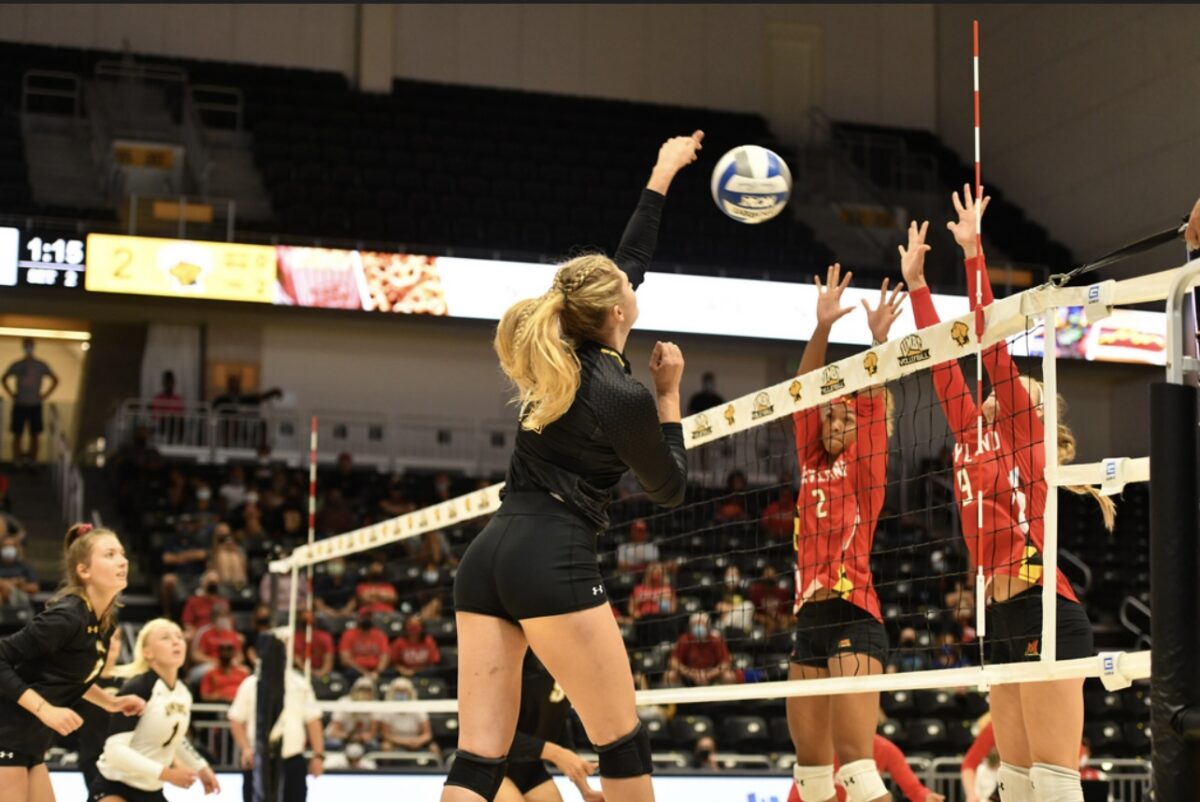 Ferketic on the volleyball court.
Has there been a mentor or fellow student who influenced your time at UMBC?
“Sebastian Deffner has been my mentor for about a year and a half (since the beginning of my junior year). I was taking his PHYS 303 class called Thermodynamics and Statistical Mechanics and I ended up doing well and really liking it. Given that, he invited me to audit some of his research group’s weekly meetings and, shortly after, I joined. We began working on my first research project and had my first professional paper published a little over a year later. He saw potential in me that I didn’t see myself, and I certainly wouldn’t have the success I do today if it weren’t for him. Now I am staying at UMBC for my Ph.D. as his research assistant.”
What has been the best part of your UMBC experience?
“My best UMBC experience was hosting President Sheares Ashby’s inauguration dinner. President Sheares Ashby personally asked Chris Slaughter ’23, M31 computer engineering, and me to host a dinner the night prior to her inauguration. I was exceptionally honored she asked me to represent the student body. In addition to the extraordinary experience, it also connected me to people I never thought I would have the privilege to meet.”
]]>
Emily Ferketic Degrees: B.S., Physics Hometown: Pittsburgh, PA Post-grad plans: Ph.D. in Theoretical Physics from UMBC As a scholar athlete, Emily Ferketic has excelled in both the...
https://umbc.edu/stories/volleyball-captain-advances-theoretical-physics/
https://my3.my.umbc.edu/api/v0/pixel/news/133407/guest@my.umbc.edu/0d7a4594b80902bec0f2db128c36138c/api/pixel
athlete
class-of-2023
cnms
news
physics
research
UMBC News & Magazine
https://my3.my.umbc.edu/groups/umbc-news-magazine
https://assets1-my.umbc.edu/system/shared/avatars/groups/000/001/943/24435aa6207c452e7bc15cc74b42c7bb/xsmall.png?1748556657
https://assets1-my.umbc.edu/system/shared/avatars/groups/000/001/943/24435aa6207c452e7bc15cc74b42c7bb/original.png?1748556657
https://assets2-my.umbc.edu/system/shared/avatars/groups/000/001/943/24435aa6207c452e7bc15cc74b42c7bb/xxlarge.png?1748556657
https://assets2-my.umbc.edu/system/shared/avatars/groups/000/001/943/24435aa6207c452e7bc15cc74b42c7bb/xlarge.png?1748556657
https://assets3-my.umbc.edu/system/shared/avatars/groups/000/001/943/24435aa6207c452e7bc15cc74b42c7bb/large.png?1748556657
https://assets1-my.umbc.edu/system/shared/avatars/groups/000/001/943/24435aa6207c452e7bc15cc74b42c7bb/medium.png?1748556657
https://assets2-my.umbc.edu/system/shared/avatars/groups/000/001/943/24435aa6207c452e7bc15cc74b42c7bb/small.png?1748556657
https://assets1-my.umbc.edu/system/shared/avatars/groups/000/001/943/24435aa6207c452e7bc15cc74b42c7bb/xsmall.png?1748556657
https://assets2-my.umbc.edu/system/shared/avatars/groups/000/001/943/24435aa6207c452e7bc15cc74b42c7bb/xxsmall.png?1748556657
UMBC News & Magazine
0
0
false
Tue, 09 May 2023 16:17:52 -0400
Tue, 09 May 2023 16:17:52 -0400
UMBC researchers co-author new Science study on how atmospheric dust impacts ocean health
New findings in Science co-authored by UMBC researchers reveal details of the complex relationship between atmospheric dust and vast populations of phytoplankton at the ocean’s surface. These tiny photosynthetic organisms form the foundation of the ocean food chain and play a key role in the global carbon cycle, so the new research will be especially useful as dust patterns shift with climate change.
“Phytoplankton photosynthesis is fundamental to Earth’s carbon cycle,” says Lorraine Remer, an atmospheric scientist with UMBC’s Goddard Earth Sciences Technology and Research (GESTAR) Center II and a co-author on the study. “Change dust patterns, and you change phytoplankton health, which will subsequently affect carbon,” she explains.
Desert dust impacts ocean ecosystems
While most nutrition for phytoplankton rises up from the deep ocean, a meaningful portion comes from dust that’s traveled through the atmosphere from the world’s deserts. That dust delivers vital nutrients when it’s deposited in the ocean, but scientists lacked specifics about how dust affects phytoplankton health and abundance.
With their new Science paper, the research team, led by Toby Westberry, an oceanographer at Oregon State University, became the first to find a phytoplankton response to dust deposition across the global oceans.
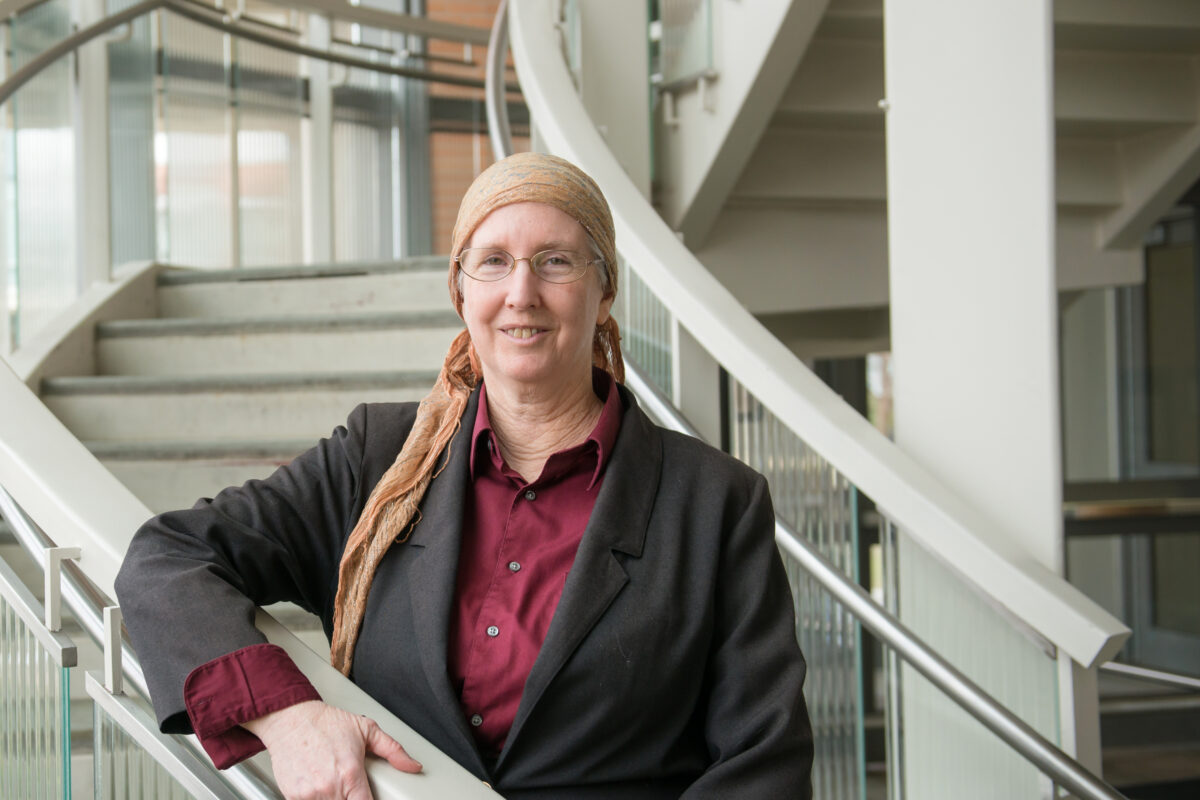 Lorraine Remer in the UMBC Physics Building (Marlayna Demond ’11/UMBC)
“This is really the first time it has been shown, using the modern observational record and at the global scale, that the nutrients carried by dust being deposited on the ocean are creating a response in the surface ocean biology,” Westberry said.
The team analyzed their model’s results in conjunction with satellite observations of phytoplankton around the world, revealing how dust is affecting ocean ecosystems. By developing a baseline understanding, scientists now have a better chance at predicting how phytoplankton will change when patterns of dust deposition change, which will have cascading effects throughout the ocean and beyond.
Models fill the gaps
For the new study, the Oregon State contributors focused on using the satellite data, which measures color changes in the ocean’s surface, to determine phytoplankton health and abundance across time and space.
Remer and UMBC researchers Yingxi Shi and Huisheng Bian focused on the dust model. “Determining how much dust is deposited into the ocean is hard, because much of the deposition occurs during rainstorms when satellites cannot see the dust. That is why we turned to a model,” Remer says. Remer and colleagues used observations to verify an existing NASA model before incorporating the model’s results into the study.
Combining their efforts, the research team found that dust’s effects on phytoplankton vary by region. Nearer the poles, more dust contributed to greater overall abundance of phytoplankton and improved health. Nearer the equator, dust primarily affected phytoplankton health and physiology, but not abundance.
 Atmospheric dust (upper right) from China sweeps across the Korean peninsula and onward. (Image courtesy of NASA Earth Observatory)
Joining forces across scientific fields
The research team plans to continue to work together to better understand the relationship between dust and phytoplankton—and how it may change over time. They are particularly anticipating more advanced satellite data from NASA’s Plankton, Aerosol, Cloud, ocean Ecosystem (PACE) satellite mission, some of which will be collected by the HARP2 instrument designed and built by UMBC.
There are many questions still to answer. “We still don’t understand how the specific nutrients in the dust become available to the phytoplankton in the water,” Remer says, “nor do we understand the role of individual dust sources providing specific nutrients to different regions of the ocean.”
Part of what made this work possible was collaboration between researchers in different fields. “One exciting aspect of this study was working with the oceanographers, who brought an entirely different perspective,” Remer says. “The scientific advances became possible only after the atmospheric scientists and oceanographers joined forces.”
It’s that interdisciplinary collaboration that will enable the team to continue asking and answering important questions about our global ecosystems.
]]>
New findings in Science co-authored by UMBC researchers reveal details of the complex relationship between atmospheric dust and vast populations of phytoplankton at the ocean’s surface. These tiny...
https://umbc.edu/stories/atmospheric-dust-and-ocean-health/
https://my3.my.umbc.edu/api/v0/pixel/news/133334/guest@my.umbc.edu/a3831c0912e50afa6ab21ce3b6872270/api/pixel
cnms
gestar
news
physics
research
science-and-tech
UMBC News & Magazine
https://my3.my.umbc.edu/groups/umbc-news-magazine
https://assets1-my.umbc.edu/system/shared/avatars/groups/000/001/943/24435aa6207c452e7bc15cc74b42c7bb/xsmall.png?1748556657
https://assets1-my.umbc.edu/system/shared/avatars/groups/000/001/943/24435aa6207c452e7bc15cc74b42c7bb/original.png?1748556657
https://assets2-my.umbc.edu/system/shared/avatars/groups/000/001/943/24435aa6207c452e7bc15cc74b42c7bb/xxlarge.png?1748556657
https://assets2-my.umbc.edu/system/shared/avatars/groups/000/001/943/24435aa6207c452e7bc15cc74b42c7bb/xlarge.png?1748556657
https://assets3-my.umbc.edu/system/shared/avatars/groups/000/001/943/24435aa6207c452e7bc15cc74b42c7bb/large.png?1748556657
https://assets1-my.umbc.edu/system/shared/avatars/groups/000/001/943/24435aa6207c452e7bc15cc74b42c7bb/medium.png?1748556657
https://assets2-my.umbc.edu/system/shared/avatars/groups/000/001/943/24435aa6207c452e7bc15cc74b42c7bb/small.png?1748556657
https://assets1-my.umbc.edu/system/shared/avatars/groups/000/001/943/24435aa6207c452e7bc15cc74b42c7bb/xsmall.png?1748556657
https://assets2-my.umbc.edu/system/shared/avatars/groups/000/001/943/24435aa6207c452e7bc15cc74b42c7bb/xxsmall.png?1748556657
UMBC News & Magazine
2
0
false
Mon, 08 May 2023 16:56:17 -0400
New UMBC/Los Alamos research on megafire smoke plumes clarifies what they contain, how they move, and their potential impacts
In recent years, large, intense wildfires, known as megafires, have increasingly caused severe damage to forests, homes, and crops. In addition to megafires fatally impacting humans and wildlife alike, they may also be impacting climate change. New research led by UMBC’s Stephen Guimond provides insight into how the large smoke plumes produced by megafires can be more accurately modeled and characterized to improve our understanding of how they might impact the earth.
Guimond, an associate research professor of physics, collaborated with scientists at the Los Alamos National Laboratory to determine the long-term effects of smoke plumes from megafires. Their findings, recently published in the Journal of Advances in Modeling Earth Systems, demonstrates how previous research utilized a model grid spacing that does not sample smoke plumes accurately. These inaccuracies in defining the dynamics of the problem lead to errors in interpretation of the smoke’s properties, vertical and horizontal movement of the plume, and potential climatic effects.
Tracking how smoke rises
The smoke plumes from megafires are voluminous and can rise very high into the upper atmosphere. Initially, the plumes get transported upwards by convective cells and travel into the stratosphere, explains Guimond, who is also a scientist at UMBC’s Goddard Earth Sciences Technology and Research (GESTAR) II (previously known as the Joint Center for Earth Systems Technology).
 Stephen Guimond. (Photo courtesy of Stephen Guimond)
“Once it gets up into the stratosphere, the smoke can stay around for many months, even up to a year or more. The fact that it can stay up there so long means that you can get effects on the solar radiation reaching the surface,” says Guimond. “If you have a big, dark-colored blanket of smoke up there, it’s going to absorb most of the sunlight, which will lead to less sunlight reaching the surface of the earth. Because of this, you could get, over a long period of time, a cooling that happens on the surface of the earth,” among other impacts.
For three years, scientists at Los Alamos studied the chemical properties of smoke plumes by burning objects like trees in a controlled setting to determine the percentages of carbon that the smoke emitted. The scientists evaluated atmospheric particulates, or aerosols, which have a major effect on climate. Guimond used a NASA climate model to determine the carbon characteristics of the smoke plumes, how they rise into the atmosphere, and the underlying causes of rotation within the plumes.
“The measurements we looked at included particle types, the spectrum of the particles, and their sizes,” says Guimond. “We also looked at the contributions of different chemical species such as black carbon, organic carbon, and other chemical compounds that come off of burning materials.”
Assessing previous smoke plume research
The color of the smoke is an important factor, Guimond notes, as different types of smoke have different radiative properties. White smoke is composed mostly of organic carbon: brightly-colored aerosol particles that in large part reflect radiation back into the atmosphere. Black smoke is composed mostly of black carbon: dark-colored aerosol particles that absorb radiation.
The researchers determined that previous models didn’t accurately sample the types of carbon within smoke plumes, leading to miscalculations or incorrect assumptions about the percentage of black carbon the plumes contained.
As the black smoke absorbs solar radiation, the smoke heats up, which can create a lofting effect that pushes the smoke higher into the atmosphere. The higher the smoke rises, the longer it stays in the stratosphere. The longer it stays, the more time it has to impact the surface of the earth. This means that inaccurate characterization of the percentage of black carbon in wildfire smoke can lead to inaccurate calculations of the lofting effect, height of the plume and stratospheric lifetime, as well as climatic effects.
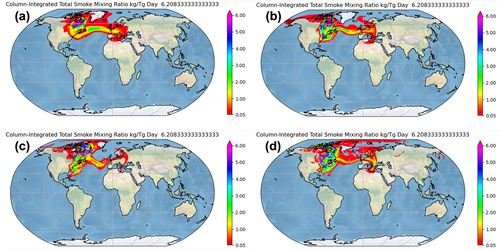 Figure 1
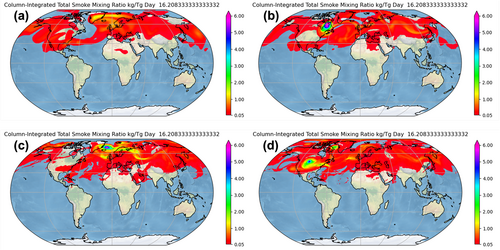 Figure 2
Figure 1 (left): The horizontal structure of the smoke plume at 6.2 days by vertically integrating the total smoke mixing ratio over the entire model atmosphere into the simulations for varying resolutions: (a) 2.0° (b) 1.0° (c) 0.25° and (d) 7 km.

    Figure 2 (right): The same as figure 1, except at 16.2 days. The horizontal structure of the smoke plume is significantly different between the various resolution simulations. (Images courtesy of Stephen Guimond and the Journal of Advances in Modeling Earth Systems)
Limits in how previous research represented the atmosphere also made for less accurate smoke plume simulations, Guimond said. He notes that prior smoke plume research used “coarse representation of the smoke plume in the model calculations, which has significant downstream effects on all other components of this problem, including the conclusions drawn from the research.”
Guimond hopes that his research can improve understanding of the dynamics of this problem: tracking of atmospheric motion and forces in three-dimensions, and how phenomena like rotating smoke plumes form and decay.
“Scientists need to accurately simulate the dynamics in order to get more accurate answers about aerosol properties inside the smoke plumes,” Guimond says, “such as how much of the smoke is black carbon, how long it is going to last in the stratosphere, how high it rises, and its effects on the radiation of the earth.”
With more accurate models and simulations, future research will be able to better inform climate policy and megafire response.
]]>
In recent years, large, intense wildfires, known as megafires, have increasingly caused severe damage to forests, homes, and crops. In addition to megafires fatally impacting humans and wildlife...
https://umbc.edu/stories/research-megafire-smoke-plumes/
https://my3.my.umbc.edu/api/v0/pixel/news/132851/guest@my.umbc.edu/1e34f79fff48056e08945b2093816fad/api/pixel
cnms
gestar
jcet
news
physics
rca-2
research
science-and-tech
UMBC News & Magazine
https://my3.my.umbc.edu/groups/umbc-news-magazine
https://assets1-my.umbc.edu/system/shared/avatars/groups/000/001/943/24435aa6207c452e7bc15cc74b42c7bb/xsmall.png?1748556657
https://assets1-my.umbc.edu/system/shared/avatars/groups/000/001/943/24435aa6207c452e7bc15cc74b42c7bb/original.png?1748556657
https://assets2-my.umbc.edu/system/shared/avatars/groups/000/001/943/24435aa6207c452e7bc15cc74b42c7bb/xxlarge.png?1748556657
https://assets2-my.umbc.edu/system/shared/avatars/groups/000/001/943/24435aa6207c452e7bc15cc74b42c7bb/xlarge.png?1748556657
https://assets3-my.umbc.edu/system/shared/avatars/groups/000/001/943/24435aa6207c452e7bc15cc74b42c7bb/large.png?1748556657
https://assets1-my.umbc.edu/system/shared/avatars/groups/000/001/943/24435aa6207c452e7bc15cc74b42c7bb/medium.png?1748556657
https://assets2-my.umbc.edu/system/shared/avatars/groups/000/001/943/24435aa6207c452e7bc15cc74b42c7bb/small.png?1748556657
https://assets1-my.umbc.edu/system/shared/avatars/groups/000/001/943/24435aa6207c452e7bc15cc74b42c7bb/xsmall.png?1748556657
https://assets2-my.umbc.edu/system/shared/avatars/groups/000/001/943/24435aa6207c452e7bc15cc74b42c7bb/xxsmall.png?1748556657
UMBC News & Magazine
0
0
false
Fri, 21 Apr 2023 08:02:38 -0400
Fri, 21 Apr 2023 08:02:38 -0400
New center director to take NASA-supported Earth science research into next era at UMBC
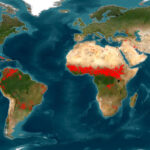
The UMBC-led Goddard Earth Science Technology and Research (GESTAR) Center II includes over 120 researchers advancing Earth and atmospheric sciences and launching the next generation of scientists. GESTAR II scientists and engineers are tracking the effects of shipping regulations on air pollution, predicting fires in India, and much more, often relying on data collected via remote sensing from NASA satellites.
NASA awarded $72 million for UMBC to establish GESTAR II in fall 2021, in collaboration with primary partner Morgan State University and six other institutions. After a national search, a new director is taking the helm of this high-impact collaboration.
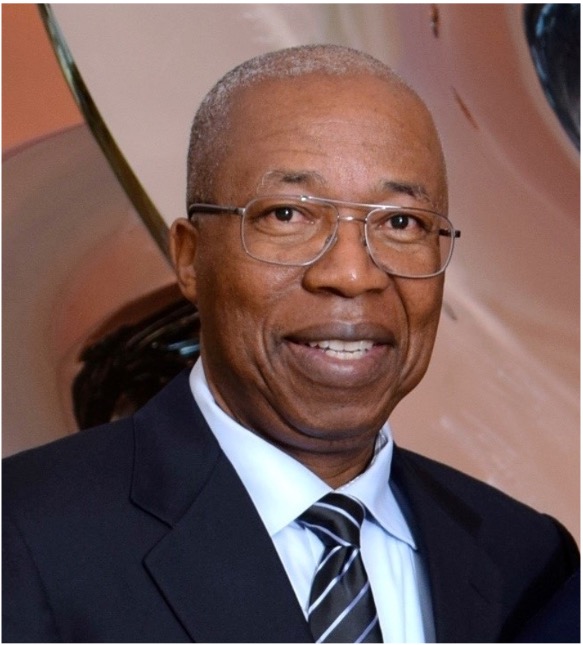 Charles Ichoku (image courtesy of Ichoku)
The new director, Charles Ichoku, brings deep and well-rounded experience in Earth science research, at NASA, and in student development programs—exactly the elements GESTAR II brings together and hopes to expand upon. Ichoku comes to GESTAR II from concurrent roles as professor of Earth and environmental sciences at Howard University and as the Distinguished Scientist of the National Oceanic and Atmospheric Administration (NOAA) Cooperative Science Center in Atmospheric Sciences and Meteorology (NCAS-M). Prior to that, he served at NASA Goddard Space Flight Center in Greenbelt, Maryland for 20 years in various research and management roles.
“Dr. Ichoku brings impressive credentials to this important leadership position at UMBC, not only as a world-class scientist, but also as a long-term NASA-based scientist and program manager,” shares Karl V. Steiner, Vice President for Research and Creative Achievement at UMBC. “He is a perfect fit for both GESTAR II and UMBC.”
Earth science from hundreds of miles up
Ichoku’s research program focuses on applying remote sensing—collecting data from a significant distance, most often from satellites orbiting Earth—and other data to study large-scale processes that affect the environment on land, weather, and air quality. In addition to directing GESTAR II, Ichoku will have an appointment as professor of geography and environmental systems (GES) at UMBC, where he will continue to conduct research, mentor students, and teach courses.
“GES is a good fit,” Ichoku says, “because I’m not just looking at developing the approaches and instrumentation to measure specific parameters, but I’m interested in how you apply the data, knowledge, and science to actually understand phenomena that happen on the ground and in the atmosphere.”
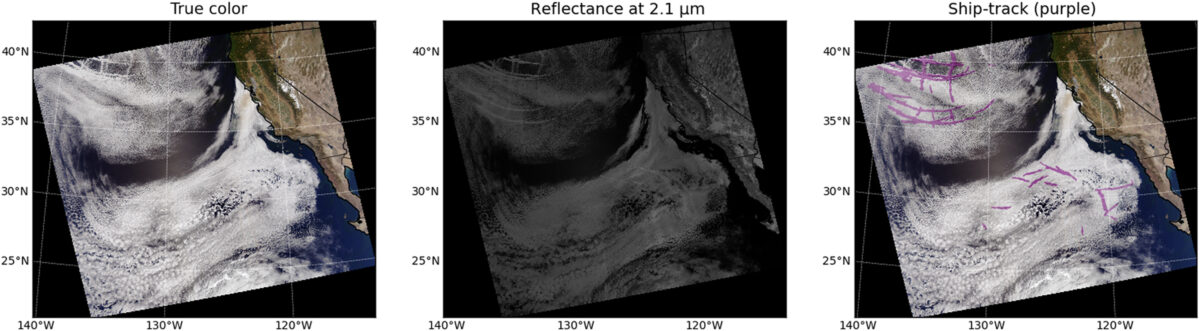 An image collected by NASA’s MODIS satellite of the U.S. West Coast (left) shows tracks of air pollution generated by shipping traffic (purple lines, right), which was detected by a GESTAR II research team’s algorithm.
Elevating African research
Ichoku’s work is influenced by his youth in West Africa, and focuses on phenomena that especially affect that region. For example, frequent agricultural fires send various particles into the atmosphere, which can affect air quality, precipitation, and more. In addition, Lake Chad in Central Africa has nearly dried up over the last few decades in part because of severe drought, resulting in widespread conflict and suffering. Drought also sends dust and other particles into the atmosphere, affecting air quality. These particles and other environmental components (like clouds) interact with radiation from the Sun, driving processes that can adversely impact human life on Earth’s surface, Ichoku explains.
“I’m very interested in seeing research and the application of its results improve in Africa overall, but in particular in Western and Central Africa,” Ichoku says. “So I hope to be able to continue research in that region.”
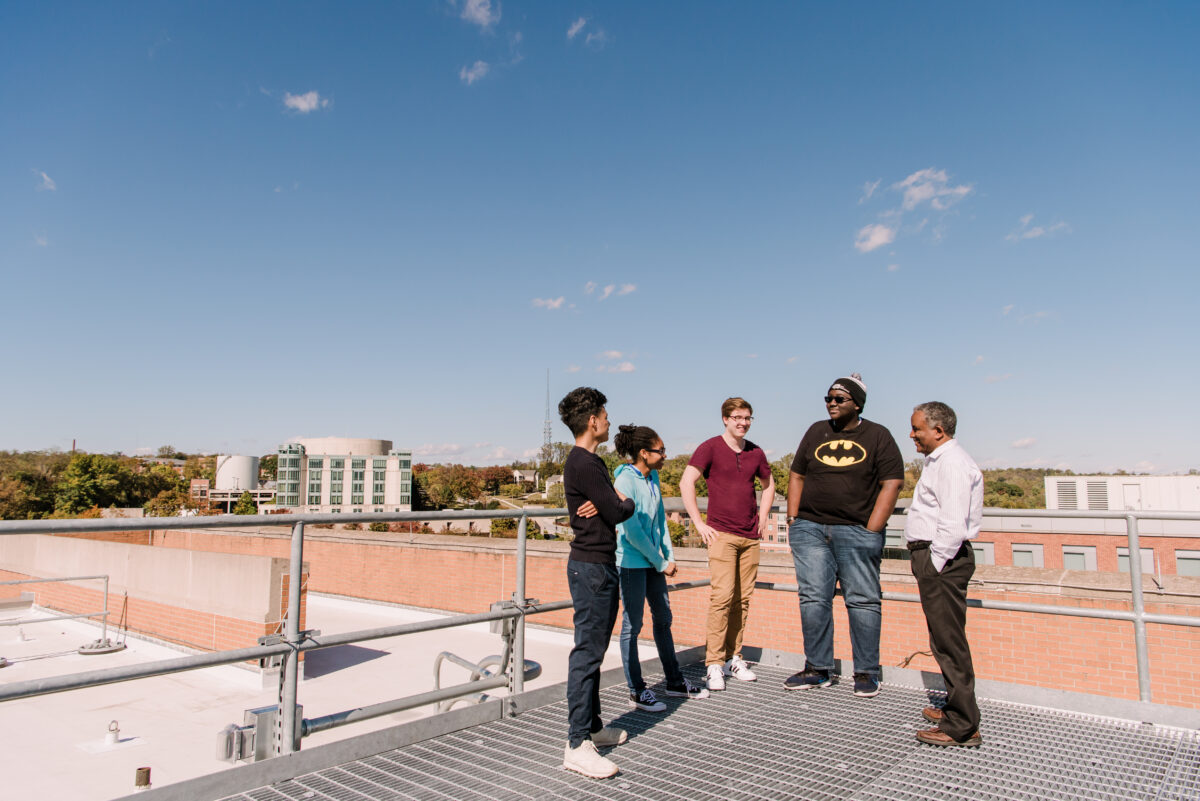 Belay Demoz, right, talks with students on the roof of the UMBC Physics Building. (Marlayna Demond ’11/UMBC)
To that end, a few years ago Ichoku joined with colleagues to initiate the U.S.-West African Coastal Resilience Research Consortium (CRRC). In addition, he recently played an important role in the inauguration of the African Meteorological Society (AfMS), where he serves as chair of the Diaspora and Friends of Africa Committee. The committee involves a significant number of colleagues who are similarly passionate about the advancement of scientific research and applications in Africa.
Those colleagues include GESTAR II’s inaugural director, Belay Demoz, whose research is similarly inspired by experiences with drought, displacement, and resulting conflict during his youth in East Africa—challenges that continue today. Demoz, professor of physics at UMBC, will continue in his departmental role after Ichoku takes up his post.
Demoz notes Ichoku’s extensive experience with Howard University (which is also a partner in UMBC’s Center for Space Sciences Technology) and at NASA as strengths, and shares his interest in expanding UMBC’s research and education efforts in Africa. “I’m looking forward to him leading the next iteration of GESTAR II, and increasing involvement of GES in what we do,” Demoz says.
Clearing the pathway for students
In addition to his own research, Ichoku has demonstrated a deep commitment to student research and success throughout his career. He moved from NASA to Howard and NCAS-M so he could focus more on student training, particularly supporting underrepresented minority students in Earth science.
With NCAS-M, on top of his typical professorial duties, Ichoku was responsible for matching students with appropriate research projects and NOAA mentors across 13 institutions. He also supported students’ success throughout their graduate projects, ensuring they persisted to graduation and were prepared to be competitive for sought-after professional roles, often at NOAA, NASA, or in academia.
With Demoz, Ichoku also served as co-PI for the NASA-funded Student Airborne Science Activation (SaSa) project, involving three NASA centers and six minority-serving Institutions, including UMBC. This past summer, 24 students, including four from UMBC, spent four weeks at UMBC as part of the SaSa program.
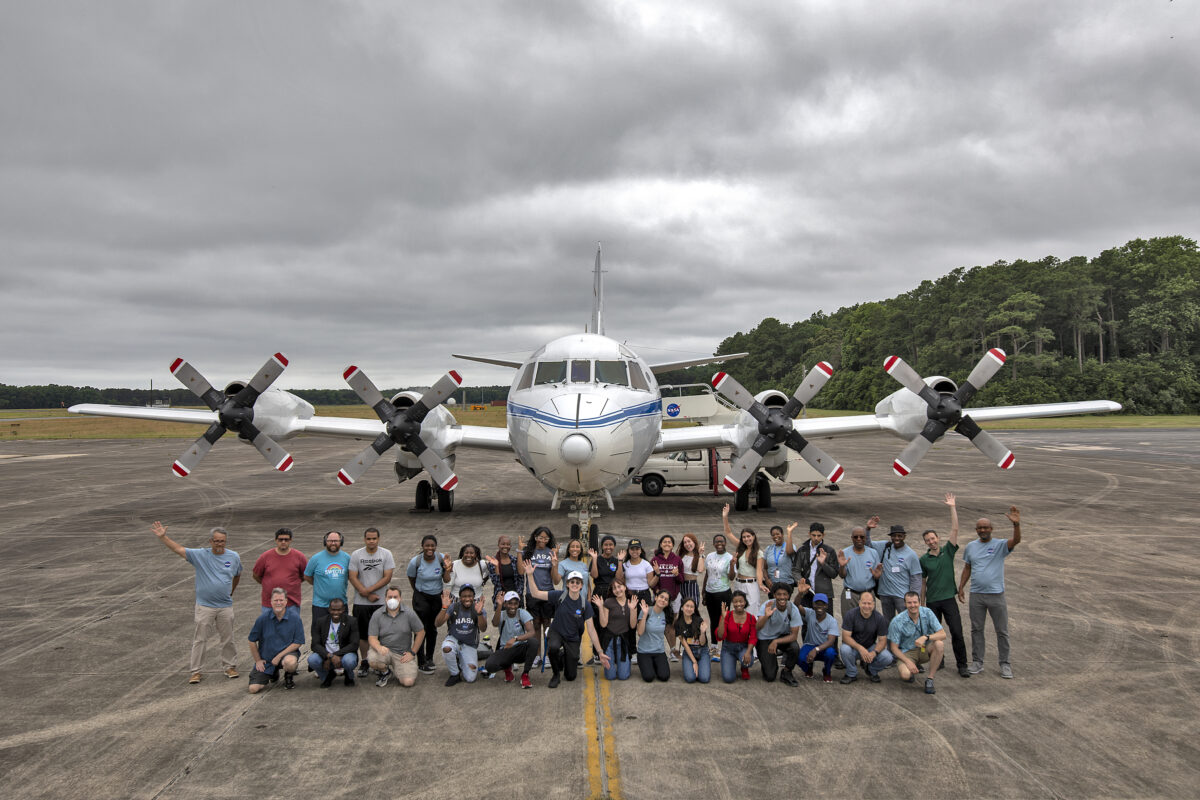 Participants in the 2022 SaSa program at NASA Wallops Flight Facility. (Image courtesy of Belay Demoz)
Now at GESTAR II, Ichoku is interested in continuing to enhance the connection between researchers, who often conduct their work at Goddard Space Flight Center, and members of the larger UMBC community—including students at all levels.
“I think it’s a good thing for a researcher to connect with students. Even if they are not teaching them in a traditional class setting, they can be mentors for interns, which I did myself for many years while I was at NASA as a research scientist,” Ichoku says. “I know that our faculty have a lot to offer to our students, so I will do my best to help facilitate that. My role will be to support the clearing of the pathway and the removal of any obstacles.”
A shining example
Ichoku also brings to GESTAR II and UMBC substantial experience in deepening relationships across institutions. He already has relationships with the scientific leads at other GESTAR II institutions, such as the Pennsylvania State University, Arizona State University, and University of Colorado Boulder, and is excited to continue working with them in a new capacity.
“When we start talking, ideas will flow,” Ichoku says. “We will then synthesize the ideas into strategic initiatives and make them happen.”
Moving forward, Ichoku plans to continue to emphasize top-quality research while enhancing opportunities for students and building bridges between the GESTAR II institutions. And he is especially looking forward to doing all of that at UMBC.
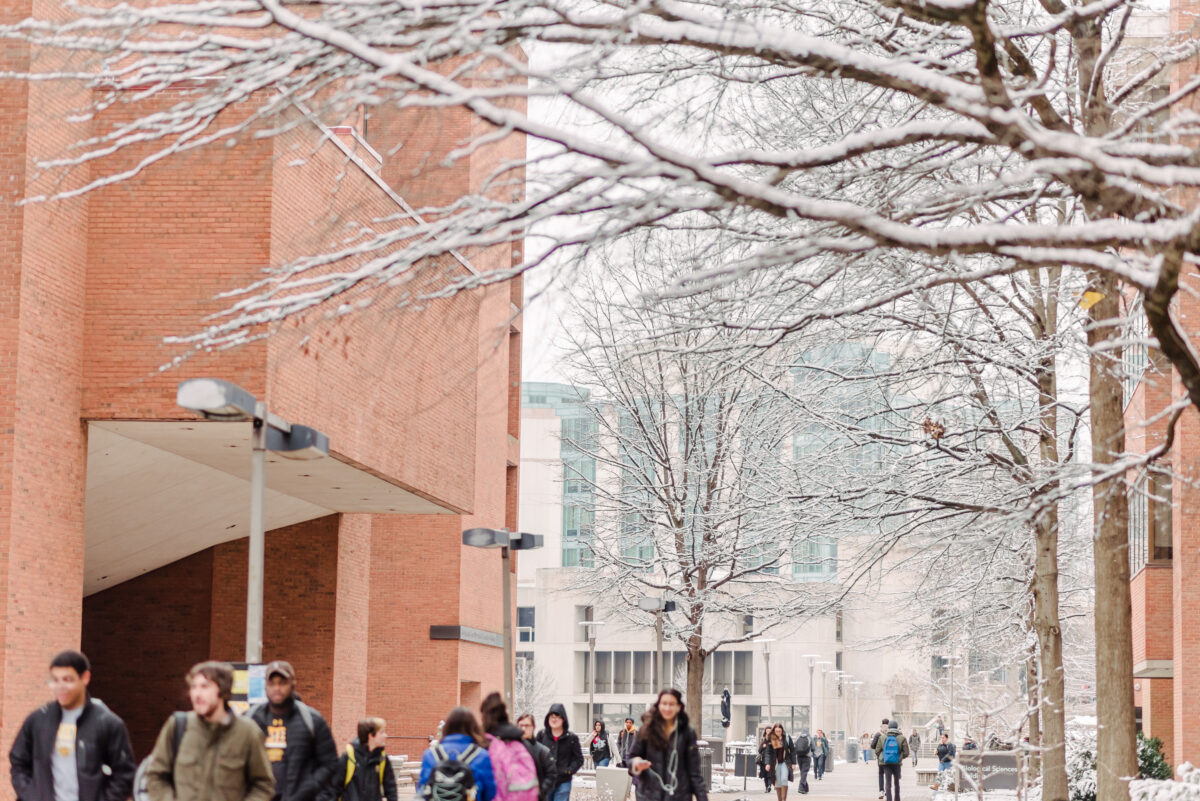 Students bustle through UMBC’s Academic Row on a winter day. (Marlayna Demond ’11/UMBC)
The opportunity to lead GESTAR II “is both a great pleasure and an honor for me, as I have always admired UMBC for being a shining example in all areas of university performance, including education, scholarship, research, innovation, technology, diversity, sports, environmental sustainability, and community outreach,” Ichoku says. “I am proud of UMBC for attaining the status of Carnegie R1 Doctoral Institution.”
“It is also a great blessing to have this wonderful opportunity to contribute to scientific discoveries and knowledge expansion for human advancement through NASA, and, in particular, Goddard Space Flight Center,” he adds. “I feel highly privileged to be involved in a program that connects two of the organizations that perform at the highest levels in their respective domains of activity, namely academia (UMBC) and space (NASA).”
]]>
The UMBC-led Goddard Earth Science Technology and Research (GESTAR) Center II includes over 120 researchers advancing Earth and atmospheric sciences and launching the next generation of...
https://umbc.edu/stories/new-director-to-take-earth-science-research-into-next-era/
https://my3.my.umbc.edu/api/v0/pixel/news/130456/guest@my.umbc.edu/84327406f7fb19fbcc10b317b3683061/api/pixel
cahss
cnms
ges
gestar
news
physics
science-and-tech
UMBC News & Magazine
https://my3.my.umbc.edu/groups/umbc-news-magazine
https://assets1-my.umbc.edu/system/shared/avatars/groups/000/001/943/24435aa6207c452e7bc15cc74b42c7bb/xsmall.png?1748556657
https://assets1-my.umbc.edu/system/shared/avatars/groups/000/001/943/24435aa6207c452e7bc15cc74b42c7bb/original.png?1748556657
https://assets2-my.umbc.edu/system/shared/avatars/groups/000/001/943/24435aa6207c452e7bc15cc74b42c7bb/xxlarge.png?1748556657
https://assets2-my.umbc.edu/system/shared/avatars/groups/000/001/943/24435aa6207c452e7bc15cc74b42c7bb/xlarge.png?1748556657
https://assets3-my.umbc.edu/system/shared/avatars/groups/000/001/943/24435aa6207c452e7bc15cc74b42c7bb/large.png?1748556657
https://assets1-my.umbc.edu/system/shared/avatars/groups/000/001/943/24435aa6207c452e7bc15cc74b42c7bb/medium.png?1748556657
https://assets2-my.umbc.edu/system/shared/avatars/groups/000/001/943/24435aa6207c452e7bc15cc74b42c7bb/small.png?1748556657
https://assets1-my.umbc.edu/system/shared/avatars/groups/000/001/943/24435aa6207c452e7bc15cc74b42c7bb/xsmall.png?1748556657
https://assets2-my.umbc.edu/system/shared/avatars/groups/000/001/943/24435aa6207c452e7bc15cc74b42c7bb/xxsmall.png?1748556657
UMBC News & Magazine
0
0
false
Fri, 27 Jan 2023 19:40:56 -0500
Fri, 27 Jan 2023 19:40:56 -0500