Responding to Recent Executive Orders and Actions
Dear UMBC Community,
I want to express my thanks to the many of you who have reached out to me in recent days to voice their concerns and ask about the current and future state of the work of the Division of Institutional Equity in light of recent federal orders and actions. Your support is an inspiring demonstration of our shared values, most especially, inclusive excellence.
As you may know, late on Friday evening, the Department of Education’s Office for Civil Rights (OCR) issued a
Dear Colleague letter that put forth a very broad interpretation of the Supreme Court’s 2023 ruling in Students for Fair Admissions v. Harvard, which ended race-conscious admissions. The Dear Colleague letter interprets that ruling to prohibit all race-conscious activities at educational institutions that receive federal funding—“hiring, promotion, compensation, financial aid, scholarships, prizes, administrative support, discipline, housing, graduation ceremonies, and all other aspects of student, academic, and campus life.”
A Dear Colleague letter does not carry the force of law, nor can it change existing law. We have and will continue to abide by existing laws, including through the university’s
nondiscrimination policy. Higher education associations
responded swiftly to the Dear Colleague letter this week, urging institutions not to overreact or try to comply preemptively with the guidance.
OCR’s Dear Colleague letter followed several recent federal executive orders and other actions targeting diversity, equity, inclusion, and accessibility efforts broadly. Some of these are being challenged in the courts. Additionally, Maryland State Attorney General Anthony G. Brown, together with 15 other state attorneys general, have issued this multistate
guidance on diversity, equity, inclusion, and accessibility employment initiatives.
We take seriously the direct targeting of this work, which is so central to our identity and core values. We are monitoring closely the orders and actions related to these issues and assessing as best we can the risk and potential impacts for UMBC. We also are continuing to hold UMBC to the highest standards in adhering to university policies and applicable state and federal laws.
To that end, I want to reiterate that all of the university’s programs and activities are open for full participation by all individuals, regardless of race, color, religion, sex, national origin, or any other protected category under applicable federal law, state law, and the university’s nondiscrimination policy.
Who we are as an institution demands that we continue to:
- Create a community culture that values each individual
- Protect the civil rights of all faculty, staff, and students
- Come together across differences
- Uphold free speech and academic freedom
This is not the work of a single office or division, but rather the collective responsibility of our entire campus community. Thank you again for your support, your dedication, and your partnership.
Sincerely,
Tanyka M. Barber
Vice President for Institutional Equity and Chief Diversity Officer
]]>
Dear UMBC Community, I want to express my thanks to the many of you who have reached out to me in recent days to voice their concerns and ask about the current and future state of the work...
https://my3.my.umbc.edu/groups/announcements/posts/147521
https://my3.my.umbc.edu/api/v0/pixel/news/147523/guest@my.umbc.edu/2632442b1ed8ecabd1e2f85c1f3d5e7d/api/pixel
federal-orders
story
UMBC News & Magazine
https://my3.my.umbc.edu/groups/umbc-news-magazine
https://assets1-my.umbc.edu/system/shared/avatars/groups/000/001/943/24435aa6207c452e7bc15cc74b42c7bb/xsmall.png?1748556657
https://assets1-my.umbc.edu/system/shared/avatars/groups/000/001/943/24435aa6207c452e7bc15cc74b42c7bb/original.png?1748556657
https://assets2-my.umbc.edu/system/shared/avatars/groups/000/001/943/24435aa6207c452e7bc15cc74b42c7bb/xxlarge.png?1748556657
https://assets2-my.umbc.edu/system/shared/avatars/groups/000/001/943/24435aa6207c452e7bc15cc74b42c7bb/xlarge.png?1748556657
https://assets3-my.umbc.edu/system/shared/avatars/groups/000/001/943/24435aa6207c452e7bc15cc74b42c7bb/large.png?1748556657
https://assets1-my.umbc.edu/system/shared/avatars/groups/000/001/943/24435aa6207c452e7bc15cc74b42c7bb/medium.png?1748556657
https://assets2-my.umbc.edu/system/shared/avatars/groups/000/001/943/24435aa6207c452e7bc15cc74b42c7bb/small.png?1748556657
https://assets1-my.umbc.edu/system/shared/avatars/groups/000/001/943/24435aa6207c452e7bc15cc74b42c7bb/xsmall.png?1748556657
https://assets2-my.umbc.edu/system/shared/avatars/groups/000/001/943/24435aa6207c452e7bc15cc74b42c7bb/xxsmall.png?1748556657
UMBC News & Magazine
0
0
false
Thu, 20 Feb 2025 16:16:45 -0500
Bio-inspired ‘batteries’ will use phytoplankton to power underwater sensors
A new $7.8 million award from the Defense Advanced Research Projects Agency (DARPA) will support the development of biologically-powered underwater sensors. Right now, a vast network of underwater sensing devices in oceans around the world conducts environmental monitoring and supports national security—and most of these devices rely on batteries and underwater cables for power.
“The motivation of the project is to eliminate the requirement for periodic battery replacement or recharging, which is expensive and logistically demanding,” says Kevin Sowers, professor of marine biotechnology and a co-PI on the award, which is led by Stephanie Lansing, a professor in the Department of Environmental Science and Technology at the University of Maryland, College Park. The project is supported by DARPA’s BioLogical Undersea Energy (BLUE) program and includes researchers from nine universities and companies.
A new fuel source for underwater sensors
The proposed devices, called the Persistent Oceanographic Device Power (PODPower) system, will autonomously draw phytoplankton from the surrounding water into a fermentation chamber. There, microorganisms will break down the phytoplankton into simpler chemical compounds. Finally, other microorganisms in a microbial fuel cell will use those compounds to generate electricity, Sowers explains. Sowers, a microbiologist, will work on engineering bacteria that can break down the phytoplankton into chemicals such as acetic acid that the microbes in the fuel cell can use.
Sowers will also lead efforts to develop a testing environment in the Aquaculture Research Center (ARC) at the Institute of Marine and Environmental Technology (IMET) in downtown Baltimore to evaluate components and a complete prototype of the new devices. The current award will support development of a functioning prototype, and there is the potential for $3.4 million more for testing in the open ocean.
“This unique collaboration of interdisciplinary experts will produce a bio-inspired system that has game-changing potential to provide direct electric power to improve sensing capabilities while protecting and limiting the impact to the environment through use of this unique bioenergy system,” Lansing said.
]]>
A new $7.8 million award from the Defense Advanced Research Projects Agency (DARPA) will support the development of biologically-powered underwater sensors. Right now, a vast network of underwater...
https://umbc.edu/quick-posts/bio-inspired-underwater-sensors/
https://my3.my.umbc.edu/api/v0/pixel/news/147517/guest@my.umbc.edu/78caaf78f68e3a8f70df4fcfaf7a6394/api/pixel
cnms
marinebiotech
news
quick-post
research
science-and-tech
UMBC News & Magazine
https://my3.my.umbc.edu/groups/umbc-news-magazine
https://assets1-my.umbc.edu/system/shared/avatars/groups/000/001/943/24435aa6207c452e7bc15cc74b42c7bb/xsmall.png?1748556657
https://assets1-my.umbc.edu/system/shared/avatars/groups/000/001/943/24435aa6207c452e7bc15cc74b42c7bb/original.png?1748556657
https://assets2-my.umbc.edu/system/shared/avatars/groups/000/001/943/24435aa6207c452e7bc15cc74b42c7bb/xxlarge.png?1748556657
https://assets2-my.umbc.edu/system/shared/avatars/groups/000/001/943/24435aa6207c452e7bc15cc74b42c7bb/xlarge.png?1748556657
https://assets3-my.umbc.edu/system/shared/avatars/groups/000/001/943/24435aa6207c452e7bc15cc74b42c7bb/large.png?1748556657
https://assets1-my.umbc.edu/system/shared/avatars/groups/000/001/943/24435aa6207c452e7bc15cc74b42c7bb/medium.png?1748556657
https://assets2-my.umbc.edu/system/shared/avatars/groups/000/001/943/24435aa6207c452e7bc15cc74b42c7bb/small.png?1748556657
https://assets1-my.umbc.edu/system/shared/avatars/groups/000/001/943/24435aa6207c452e7bc15cc74b42c7bb/xsmall.png?1748556657
https://assets2-my.umbc.edu/system/shared/avatars/groups/000/001/943/24435aa6207c452e7bc15cc74b42c7bb/xxsmall.png?1748556657
UMBC News & Magazine
2
0
false
Thu, 20 Feb 2025 12:38:03 -0500
Thu, 20 Feb 2025 12:38:03 -0500
Physicist Adi Foord sheds light on a new research project, UMBC’s supportive environment, and her favorite black hole

Adi Foord, assistant professor of physics, loves studying black holes. She also loves sharing her enthusiasm for the sky with others, including writing popular articles about time travel and the James Webb Space Telescope for The Conversation. Last fall, Foord was named a Scialog Early Science with LSST Fellow.
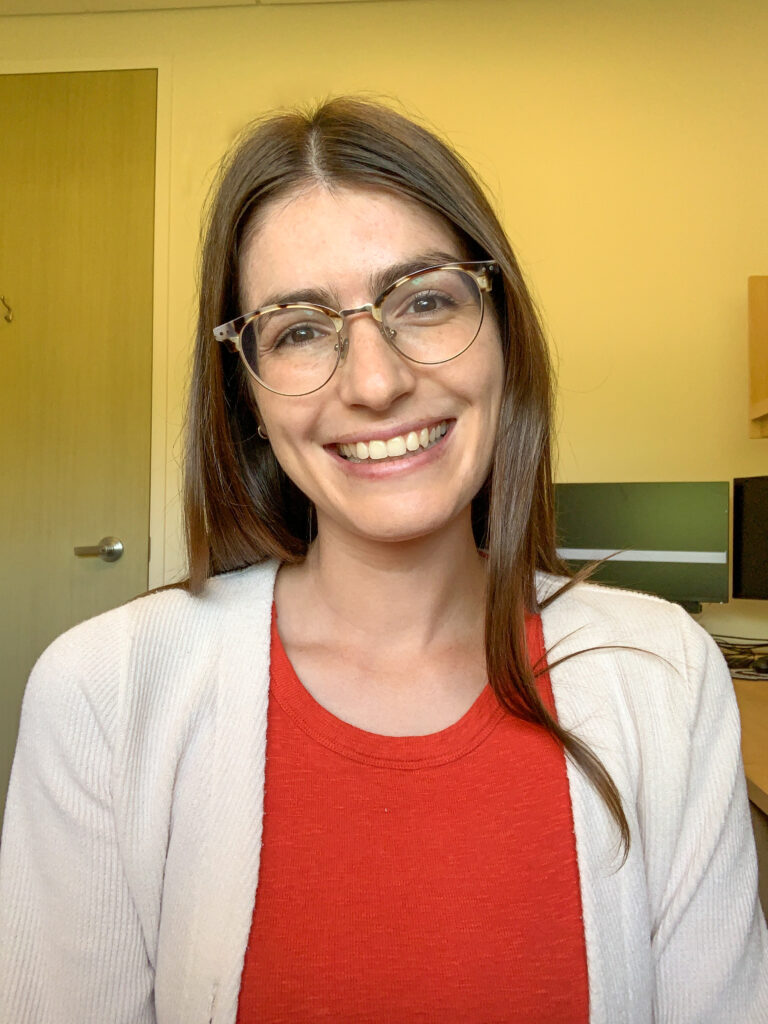 Adi Foord is a Scialog Early Science with LSST Fellow. (courtesy of Foord)
In this role, Foord has the opportunity to propose research analyzing data coming from the Vera C. Rubin Observatory, the largest ground-based telescope in the world. Over the next 10 years, it will carry out the Legacy Survey of Space and Time (LSST), scanning the entire sky every three days. Construction of the observatory, in Chile, is nearly complete, and its first images of the sky are expected later this year. LSST will collect an unprecedented amount of astronomical data ripe for analysis—and full of discoveries just waiting to be uncovered.
The Scialog fellowship is designed to hasten those discoveries. A cohort of 50 fellows includes early-career researchers in a wide range of fields: astrophysicists like Foord, theoretical physicists, data scientists, software engineers, and more. Each year of the three-year fellowship, the fellows gather for a multi-day workshop designed to facilitate development of innovative research proposals that would use LSST data.
Foord’s first proposal, in collaboration with Krista Lynne Smith at Texas A&M University, is one of eight proposals selected for funding out of the 33 submitted after the first Scialog workshop.
Below, Foord answers questions about the fellowship, her research at UMBC, and her passion for physics, and shares advice for aspiring astronomers.
Q: How is this fellowship unique?
A: LSST’s open-access dataset will be higher in volume and complexity than any previous astrophysics survey and will contain unexpected data that will provide insights into fundamental questions about the universe.
This fellowship addresses two key challenges to unlocking the discoveries in LSST data: 1) the lack of seed funding to support early LSST discoveries, and 2) the need to create cross-disciplinary connections to address the ambitious questions LSST is poised to answer. By facilitating creative proposals from interdisciplinary teams and then funding those proposals, the fellowship program addresses both of these challenges.
On top of this, I was really excited by the interdisciplinary nature of the program. The most creative and innovative ideas often emerge when scientists from diverse fields come together. By fostering collaboration—over food, coffee, and discussions—the fellowship provides an ideal environment for sparking ideas.
Q: What are the goals of your funded proposal?
A: My proposal is focused on building and using a “Dual Active Galactic Nuclei (AGN) Finder” on LSST data. Dual AGN are pairs of actively accreting supermassive black holes whose galaxies are merging. They are very difficult to find, because they generally just look like one source, instead of two.
Thankfully, the brightness of different kinds of objects in the sky varies predictably over time, so a graph called a “lightcurve” that represents an object’s varying brightness can be used to identify an unknown object. Our tool will use the unique lightcurve expected from dual AGN systems to search for pairs of merging AGN. As of right now, there are less than 100 confirmed pairs of merging AGN, so we hope to dramatically expand this sample size using our tool. LSST scans the full sky every three days, so it will have millions of lightcurves of AGN. It’s the perfect observatory to carry out such an analysis.
This new project with LSST nicely bridges my Ph.D. work on dual AGN with my current interests in how galaxy mergers influence supermassive black hole growth. It also opens the door to utilizing a completely different type of data.
 Snowfall blanketed the mountains of northern Chile on August 4, 2024, including Cerro Pachón, where Rubin Observatory is located. (NOIRLab/NSF/AURA/F. Bruno)
Q: Why are you passionate about this field, and how did you find your way to it?
A: I wasn’t sure what I wanted to pursue in college until my senior year in high school, when I had the opportunity to take an observational astronomy class. Prior to that, I enjoyed physics and math, but I hadn’t found the applications particularly exciting. That all changed the first time I looked through a telescope and held a meteorite that had originated from a collision on Earth about 50,000 years ago. The sheer excitement I felt in those moments made me realize that astrophysics was the perfect intersection of math, physics, and an interesting environment. The support I received from my high school physics (Mr. Woosnam) and astronomy (Mr. P) teachers gave me the confidence to pursue this path.
I still experience that thrill every time I open new data, not knowing what discoveries await, but eagerly anticipating what the data will reveal. The unwavering support of my mentors and friends has enabled me to stay the course and be successful in this field. Now, as a professor, I strive to inspire that same excitement in my students and help them discover their own passions.
Q: What do you enjoy about being a member of the physics department and the UMBC community more broadly?
A: Since joining UMBC in fall 2023, I have been truly impressed by the students. The undergraduates are incredibly passionate about joining research teams and learning about astrophysics. It has been a rewarding experience to start building my own research group of graduate students and mentor them through their first graduate research projects.
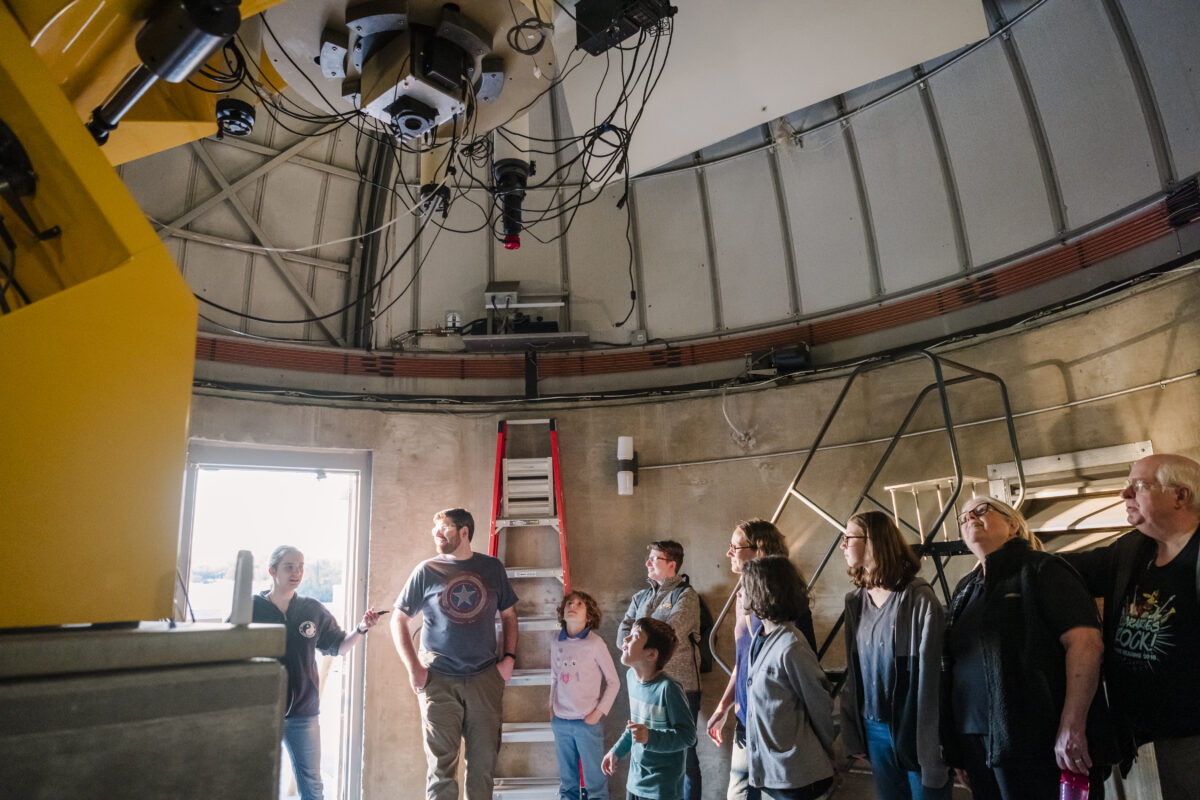 A UMBC physics student gives a tour of the observatory on top of the Physics Building to members of the local community. (Marlayna Demond ’11/UMBC)
I also particularly appreciate the amount of resources available for new faculty. In my first year, I participated in three different programs that introduced me to faculty across various departments, which I found invaluable. The Eminent Scholar Mentoring Program is especially unique—it has allowed me to professionally and personally connect with a seminal scientist in the field, someone I may not have had the opportunity to easily meet otherwise. These resources truly set you up for success and make you feel incredibly supported.
Q: What advice do you have for aspiring astronomers?
A: At the undergraduate level, actively seek out research opportunities wherever you can. Look for options at your own institution, nearby universities, and through programs offered by various agencies. Even if the research isn’t in an area you originally wanted to pursue, these experiences will help you develop critical thinking, problem-solving skills, and the ability to ask important questions.
I also encourage you to surround yourself with supportive mentors and colleagues. Every successful scientist got to where they are because they had people backing them along the way—the “lone genius” is rarely the full story. Being part of a supportive community not only helps you move forward but also fosters creativity and passion in your research, which is ultimately what drives us.
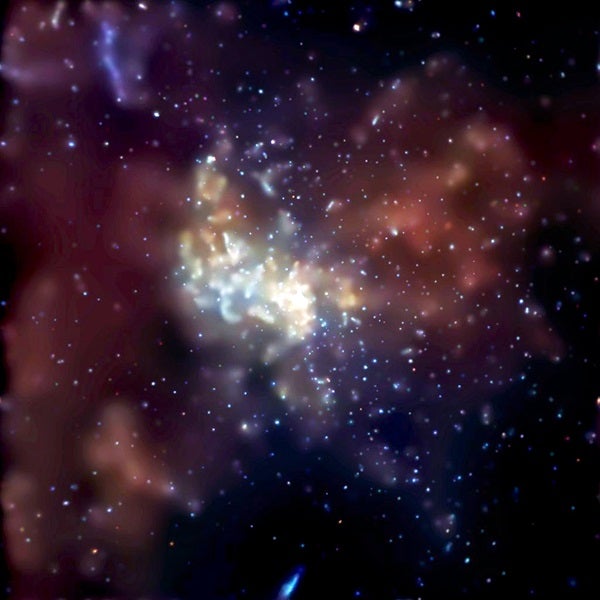 Sagittarius A*, the black hole at the center of our Milky Way galaxy, is located at the brightest, central point in this image. (NASA/CXC/MIT/Frederick K. Baganoff, et al.)
Q: Anything else you are burning to share?
A: My favorite supermassive black hole, of course! It’s Sagittarius A*, the supermassive black hole at the center of our Milky Way galaxy. While it’s puny (only about four million times the mass of our Sun, which is relatively small for a supermassive black hole) and not particularly active, its proximity to us makes it an incredibly intriguing object. Despite being so close, there are still many unanswered questions about its growth and activity. Most of my research focuses on supermassive black holes in other galaxies, but if I had unlimited time, I would love to dedicate more of my work to studying Sagittarius A*.
]]>
Adi Foord, assistant professor of physics, loves studying black holes. She also loves sharing her enthusiasm for the sky with others, including writing popular articles about time travel and the...
https://umbc.edu/stories/adi-foord-qa-favorite-black-hole/
https://my3.my.umbc.edu/api/v0/pixel/news/147508/guest@my.umbc.edu/39bbc6617aae9fefbdb931eddc8791e7/api/pixel
cnms
news
physics
research
science-and-tech
story
UMBC News & Magazine
https://my3.my.umbc.edu/groups/umbc-news-magazine
https://assets1-my.umbc.edu/system/shared/avatars/groups/000/001/943/24435aa6207c452e7bc15cc74b42c7bb/xsmall.png?1748556657
https://assets1-my.umbc.edu/system/shared/avatars/groups/000/001/943/24435aa6207c452e7bc15cc74b42c7bb/original.png?1748556657
https://assets2-my.umbc.edu/system/shared/avatars/groups/000/001/943/24435aa6207c452e7bc15cc74b42c7bb/xxlarge.png?1748556657
https://assets2-my.umbc.edu/system/shared/avatars/groups/000/001/943/24435aa6207c452e7bc15cc74b42c7bb/xlarge.png?1748556657
https://assets3-my.umbc.edu/system/shared/avatars/groups/000/001/943/24435aa6207c452e7bc15cc74b42c7bb/large.png?1748556657
https://assets1-my.umbc.edu/system/shared/avatars/groups/000/001/943/24435aa6207c452e7bc15cc74b42c7bb/medium.png?1748556657
https://assets2-my.umbc.edu/system/shared/avatars/groups/000/001/943/24435aa6207c452e7bc15cc74b42c7bb/small.png?1748556657
https://assets1-my.umbc.edu/system/shared/avatars/groups/000/001/943/24435aa6207c452e7bc15cc74b42c7bb/xsmall.png?1748556657
https://assets2-my.umbc.edu/system/shared/avatars/groups/000/001/943/24435aa6207c452e7bc15cc74b42c7bb/xxsmall.png?1748556657
UMBC News & Magazine
3
0
false
Thu, 20 Feb 2025 11:50:14 -0500
Thu, 20 Feb 2025 11:50:14 -0500
A fiscal crisis is looming for many US cities

Written by John Rennie Short, professor emeritus of public policy, UMBC
Five years after the start of the COVID-19 pandemic, many U.S. cities are still adjusting to a new normal, with more people working remotely and less economic activity in city centers. Other factors, such as underfunded pension plans for municipal employees, are pushing many city budgets into the red.
Urban fiscal struggles are not new, but historically they have mainly affected U.S. cities that are small, poor or saddled with incompetent managers. Today, however, even large cities, including Chicago, Houston and San Francisco, are under serious financial stress.
This is a looming nationwide threat, driven by factors that include climate change, declining downtown activity, loss of federal funds and large pension and retirement commitments.
Why cities struggle
Many U.S. cities have faced fiscal crises over the past century, for diverse reasons. Most commonly, stress occurs after an economic downturn or sharp fall in tax revenues.
Florida municipalities began to default in 1926 after the collapse of a land boom. Municipal defaults were common across the nation in the 1930s during the Great Depression: As unemployment rose, relief burdens swelled and tax collections dwindled.
 The New York Daily News, Oct. 30, 1975, after U.S. President Gerald Ford ruled out providing federal aid to save the city from bankruptcy. Several months later, Ford signed legislation authorizing federal loans. Edward Stojakovic/Flickr, CC BY
In 1934 Congress amended the U.S. bankruptcy code to allow municipalities to file formally for bankruptcy. Subsequently, 27 states enacted laws that authorized cities to become debtors and seek bankruptcy protection.
Declaring bankruptcy was not a cure-all. It allowed cities to refinance debt or stretch out payment schedules, but it also could lead to higher taxes and fees for residents, and lower pay and benefits for city employees. And it could stigmatize a city for many years afterward.
In the 1960s and 1970s, many urban residents and businesses left cities for adjoining suburbs. Many cities, including New York, Cleveland and Philadelphia, found it difficult to repay debts as their tax bases shrank.
In the wake of the 2008-2009 housing market collapse, cities including Detroit, San Bernardino, California, and Stockton, California, filed for bankruptcy. Other cities faced similar difficulties but were located in states that did not allow municipalities to declare bankruptcy.
Even large, affluent jurisdictions could go off the financial rails. For example, Orange County, California, went bankrupt in 2002 after its treasurer, Robert Citron, pursued a risky investment strategy of complex leveraging deals, losing some $1.65 billion in taxpayer funds.
Today, cities face a convergence of rising costs and decreasing revenues in many places. As I see it, the urban fiscal crisis is now a pervasive national challenge.
Climate-driven disasters
Climate change and its attendant increase in major disasters are putting financial pressure on municipalities across the country.
Events like wildfires and flooding have twofold effects on city finances. First, money has to be spent on rebuilding damaged infrastructure, such as roads, water lines and public buildings. Second, after the disaster, cities may either act on their own or be required under state or federal law to make expensive investments in preparation for the next storm or wildfire.
 Los Angeles Mayor Karen Bass (center) discusses wildfire recovery in Pacific Palisades, Calif., Jan. 27, 2025. Cleaning up after the wildfires, which destroyed more than 16,000 structures, will include disposing of several million tons of toxic ash and debris. Drew A. Kelley/MediaNews Group/Long Beach Press-Telegram via Getty Images
In Houston, for example, court rulings after multiple years of severe flooding are forcing the city to spend $100 million on street repairs and drainage by mid-2025. This requirement will expand the deficit in Houston’s annual budget to $330 million.
In Massachusetts, towns on Cape Cod are spending millions of dollars to switch from septic systems to public sewer lines and upgrade wastewater treatment plants. Population growth has sharply increased water pollution on the Cape, and climate change is promoting blooms of toxic algae that feed on nutrients in wastewater.
Increasing uncertainty about the total costs of mitigating and adapting to climate change will inevitably lead rating agencies to downgrade municipal credit ratings. This raises cities’ costs to borrow money for climate-related projects like protecting shorelines and improving wastewater treatment.
Underfunded pensions
Cities also spend a lot of money on employees, and many large cities are struggling to fund pensions and health benefits for their workforces. As municipal retirees live longer and require more health care, the costs are mounting.
For example, Chicago currently faces a budget deficit of nearly $1 billion, which stems partly from underfunded retirement benefits for nearly 30,000 public employees. The city has $35 billion in unfunded pension liabilities and almost $2 billion in unfunded retiree health benefits. Chicago’s teachers are owed $14 billion in unfunded benefits.
Policy studies have shown for years that politicians tend to underfund retirement and pension benefits for public employees. This approach offloads the real cost of providing police, fire protection and education onto future taxpayers.
Struggling downtowns and less federal support
Cities aren’t just facing rising costs – they’re also losing revenues. In many U.S. cities, retail and commercial office economies are declining. Developers have overbuilt commercial properties, creating an excess supply. More unleased properties will mean lower tax revenues.
At the same time, pandemic-related federal aid that cushioned municipal finances from 2020 through 2024 is dwindling.
State and local governments received $150 billion through the 2020 Coronavirus Aid, Relief, and Economic Security (CARES) Act and an additional $130 billion through the 2021 American Rescue Plan Act. Now, however, this federal largesse – which some cities used to fill mounting fiscal cracks – is at an end.
In my view, President Donald Trump’s administration is highly unlikely to bail out urban areas – especially more liberal cities like Detroit, Philadelphia and San Francisco. Trump has portrayed large cities governed by Democrats in the darkest terms – for example, calling Baltimore a “rodent-infested mess” and Washington, D.C., a “dirty, crime-ridden death trap.” I expect that Trump’s animus against big cities, which was a staple of his 2024 campaign, could become a hallmark of his second term.
Resistance to new taxes
Cities can generate revenue from taxes on sales, businesses, property and utilities. However, increasing municipal taxes – particularly property taxes – can be very difficult.
In 1978, California adopted Proposition 13 – a ballot measure that limited property tax increases to the rate of inflation or 2% per year, whichever is lower. This high-profile campaign created a widespread narrative that property taxes were out of control and made it very hard for local officials to support property tax increases.
Thanks to caps like Prop 13, a persistent public view that taxes are too high and political resistance, property taxes have tended to lag behind inflation in many parts of the country.
The crunch
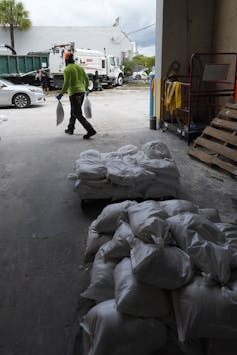 Workers in North Miami Beach, Fla., distribute sandbags to residents to help prevent flooding as Hurricane Milton approaches the state on Oct. 8, 2024. AP Photo/Wilfredo Lee
Taking these factors together, I see a fiscal crunch coming for U.S. cities. Small cities with low budgets are particularly vulnerable. But so are larger, more affluent cities, such as San Francisco with its collapsing downtown office market, or Houston, New York and Miami, which face growing costs from climate change.
One city manager who runs an affluent municipality in the Pacific Northwest told me that in these difficult circumstances, politicians need to be more frank and open with their constituents and explain convincingly and compellingly how and why taxpayer money is being spent.
Efforts to balance city budgets are opportunities to build consensus with the public about what municipalities can do, and at what cost. The coming months will show whether politicians and city residents are ready for these hard conversations.
This article is republished from The Conversation under a Creative Commons license. Read the original article and see more than 250 UMBC articles available in The Conversation.
]]>
Written by John Rennie Short, professor emeritus of public policy, UMBC Five years after the start of the COVID-19 pandemic, many U.S. cities are still adjusting to a new normal, with more...
https://umbc.edu/stories/a-fiscal-crisis-is-looming-for-many-us-cities/
https://my3.my.umbc.edu/api/v0/pixel/news/147507/guest@my.umbc.edu/fc65968ee4ebe77a7381c45111887c53/api/pixel
cahss
cahss-research
discovery
magazine
publicpolicy
research
story
UMBC News & Magazine
https://my3.my.umbc.edu/groups/umbc-news-magazine
https://assets1-my.umbc.edu/system/shared/avatars/groups/000/001/943/24435aa6207c452e7bc15cc74b42c7bb/xsmall.png?1748556657
https://assets1-my.umbc.edu/system/shared/avatars/groups/000/001/943/24435aa6207c452e7bc15cc74b42c7bb/original.png?1748556657
https://assets2-my.umbc.edu/system/shared/avatars/groups/000/001/943/24435aa6207c452e7bc15cc74b42c7bb/xxlarge.png?1748556657
https://assets2-my.umbc.edu/system/shared/avatars/groups/000/001/943/24435aa6207c452e7bc15cc74b42c7bb/xlarge.png?1748556657
https://assets3-my.umbc.edu/system/shared/avatars/groups/000/001/943/24435aa6207c452e7bc15cc74b42c7bb/large.png?1748556657
https://assets1-my.umbc.edu/system/shared/avatars/groups/000/001/943/24435aa6207c452e7bc15cc74b42c7bb/medium.png?1748556657
https://assets2-my.umbc.edu/system/shared/avatars/groups/000/001/943/24435aa6207c452e7bc15cc74b42c7bb/small.png?1748556657
https://assets1-my.umbc.edu/system/shared/avatars/groups/000/001/943/24435aa6207c452e7bc15cc74b42c7bb/xsmall.png?1748556657
https://assets2-my.umbc.edu/system/shared/avatars/groups/000/001/943/24435aa6207c452e7bc15cc74b42c7bb/xxsmall.png?1748556657
UMBC News & Magazine
0
0
false
Thu, 20 Feb 2025 11:02:22 -0500
Thu, 20 Feb 2025 11:02:22 -0500
UMBC delegates build international connections at prestigious science and technology conference in India
A six-person UMBC team built international connections at the “PIWOT – World of Technology” conference, held in late January in Mumbai, India. The conference is organized by the alumni association for graduates of the prestigious Indian Institutes of Technology (IITs), and attracts many of the leaders in science and technology in India and around the world. The CEO of Alphabet, Inc. (Google’s parent company), the co-founder of Sun Microsystems, and the CEO of IBM are all graduates of IITs.
UMBC was represented at the conference by Anupam Joshi, acting dean of the College of Engineering and Information Technology; Upal Ghosh, professor in the Department of Chemical, Biochemical and Environmental Engineering; Ramana Vinjamuri, associate professor in the Department of Computer Science and Electrical Engineering and director of the NSF IUCRC BRAIN Center; Govind Rao, director of the Center for Advanced Sensor Technology and professor in the Department of Chemical, Biochemical and Environmental Engineering; Karuna Pande Joshi, professor in the Department of Information Systems and director of the NSF IUCRC Center for Accelerated Real Time Analytics; and David Di Maria, senior international officer and associate vice provost for international education at UMBC.
 Dean Joshi spoke at the conference about the impact of technology on education. (Photo courtesy of Govind Rao)
The UMBC team staffed a well-trafficked booth in the Expo Hall. As an extension of the meeting, they also visited IITs at Mumbai, Hyderabad, and Tirupati, and met with the directors of these institutions to discuss institutional agreements and lay the groundwork for international faculty and student exchanges.
This year’s PIWOT conference focused on the impact of technology across multiple dimensions of life, from the professional to the personal. Dean Joshi took part as a speaker on a panel about the impact of technology on education. The UMBC booth also displayed the low-cost infant incubator developed by Professor Govind Rao.
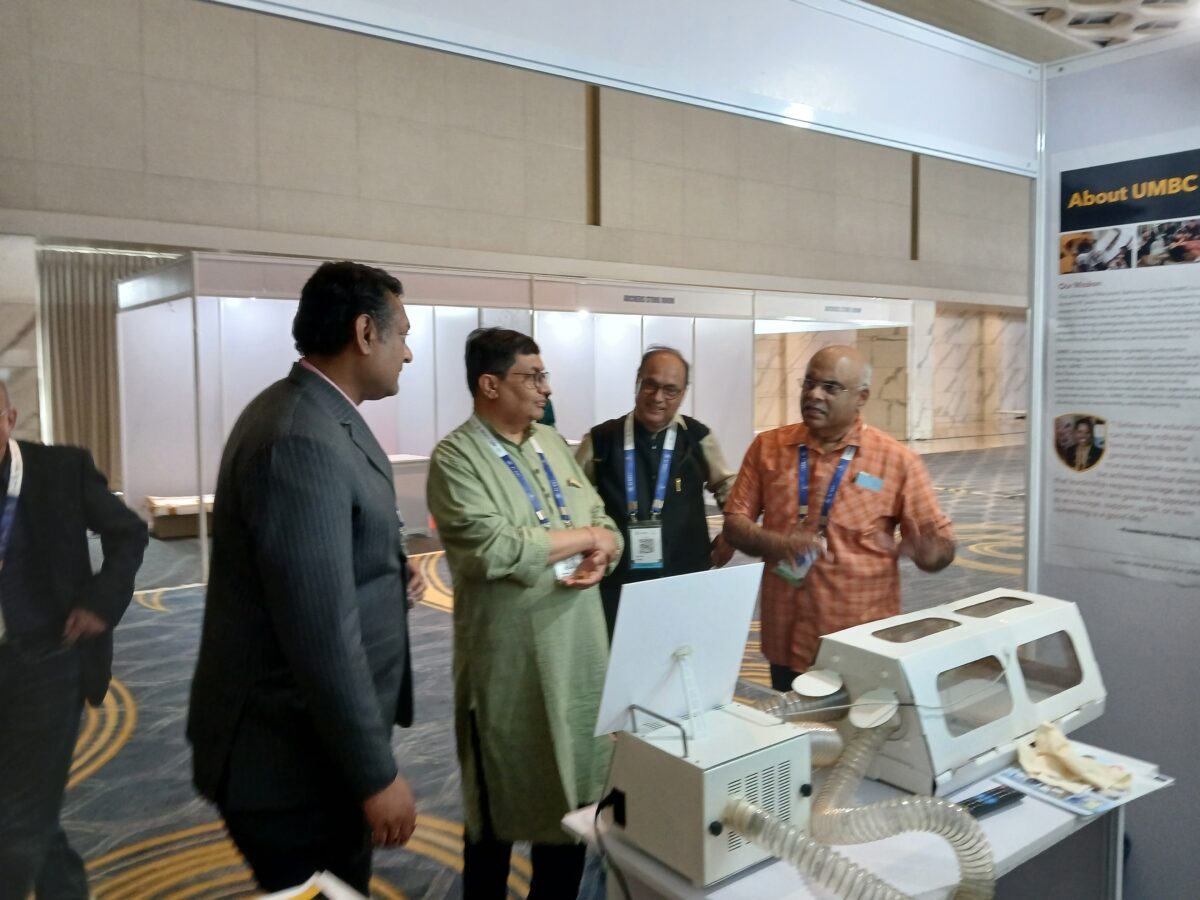 The UMBC booth displayed the low-cost infant incubator developed by Professor Govind Rao. (Photo courtesy of Karuna Joshi)
]]>
A six-person UMBC team built international connections at the “PIWOT – World of Technology” conference, held in late January in Mumbai, India. The conference is organized by the alumni association...
https://umbc.edu/quick-posts/umbc-delegates-conference-in-india/
https://my3.my.umbc.edu/api/v0/pixel/news/147504/guest@my.umbc.edu/2ca42895565c719a71f1ff4ad75d0dfb/api/pixel
cbee
coeit
csee
international
is
news
quick-post
science-and-tech
UMBC News & Magazine
https://my3.my.umbc.edu/groups/umbc-news-magazine
https://assets1-my.umbc.edu/system/shared/avatars/groups/000/001/943/24435aa6207c452e7bc15cc74b42c7bb/xsmall.png?1748556657
https://assets1-my.umbc.edu/system/shared/avatars/groups/000/001/943/24435aa6207c452e7bc15cc74b42c7bb/original.png?1748556657
https://assets2-my.umbc.edu/system/shared/avatars/groups/000/001/943/24435aa6207c452e7bc15cc74b42c7bb/xxlarge.png?1748556657
https://assets2-my.umbc.edu/system/shared/avatars/groups/000/001/943/24435aa6207c452e7bc15cc74b42c7bb/xlarge.png?1748556657
https://assets3-my.umbc.edu/system/shared/avatars/groups/000/001/943/24435aa6207c452e7bc15cc74b42c7bb/large.png?1748556657
https://assets1-my.umbc.edu/system/shared/avatars/groups/000/001/943/24435aa6207c452e7bc15cc74b42c7bb/medium.png?1748556657
https://assets2-my.umbc.edu/system/shared/avatars/groups/000/001/943/24435aa6207c452e7bc15cc74b42c7bb/small.png?1748556657
https://assets1-my.umbc.edu/system/shared/avatars/groups/000/001/943/24435aa6207c452e7bc15cc74b42c7bb/xsmall.png?1748556657
https://assets2-my.umbc.edu/system/shared/avatars/groups/000/001/943/24435aa6207c452e7bc15cc74b42c7bb/xxsmall.png?1748556657
UMBC News & Magazine
3
0
false
Thu, 20 Feb 2025 10:37:23 -0500
Thu, 20 Feb 2025 10:37:23 -0500
International exchange brings opportunities to question assumptions—in science and life
The UMBC booth displayed the low-cost infant incubator developed by Professor Govind Rao. (Photo courtesy of Karuna Joshi)
]]>
A six-person UMBC team built international connections at the “PIWOT – World of Technology” conference, held in late January in Mumbai, India. The conference is organized by the alumni association...
https://umbc.edu/quick-posts/umbc-delegates-conference-in-india/
https://my3.my.umbc.edu/api/v0/pixel/news/147504/guest@my.umbc.edu/2ca42895565c719a71f1ff4ad75d0dfb/api/pixel
cbee
coeit
csee
international
is
news
quick-post
science-and-tech
UMBC News & Magazine
https://my3.my.umbc.edu/groups/umbc-news-magazine
https://assets1-my.umbc.edu/system/shared/avatars/groups/000/001/943/24435aa6207c452e7bc15cc74b42c7bb/xsmall.png?1748556657
https://assets1-my.umbc.edu/system/shared/avatars/groups/000/001/943/24435aa6207c452e7bc15cc74b42c7bb/original.png?1748556657
https://assets2-my.umbc.edu/system/shared/avatars/groups/000/001/943/24435aa6207c452e7bc15cc74b42c7bb/xxlarge.png?1748556657
https://assets2-my.umbc.edu/system/shared/avatars/groups/000/001/943/24435aa6207c452e7bc15cc74b42c7bb/xlarge.png?1748556657
https://assets3-my.umbc.edu/system/shared/avatars/groups/000/001/943/24435aa6207c452e7bc15cc74b42c7bb/large.png?1748556657
https://assets1-my.umbc.edu/system/shared/avatars/groups/000/001/943/24435aa6207c452e7bc15cc74b42c7bb/medium.png?1748556657
https://assets2-my.umbc.edu/system/shared/avatars/groups/000/001/943/24435aa6207c452e7bc15cc74b42c7bb/small.png?1748556657
https://assets1-my.umbc.edu/system/shared/avatars/groups/000/001/943/24435aa6207c452e7bc15cc74b42c7bb/xsmall.png?1748556657
https://assets2-my.umbc.edu/system/shared/avatars/groups/000/001/943/24435aa6207c452e7bc15cc74b42c7bb/xxsmall.png?1748556657
UMBC News & Magazine
3
0
false
Thu, 20 Feb 2025 10:37:23 -0500
Thu, 20 Feb 2025 10:37:23 -0500
International exchange brings opportunities to question assumptions—in science and life

Making assumptions is a habit of life, a way to speed up decisions. Sometimes these mental short-cuts, however, lead us astray.
Such was the situation when Lorenz Kopp, an engineering master’s student at Germany’s Regensburg University of Applied Sciences who was visiting UMBC this fall for a 50-day exchange project, assumed the ovens in the U.S. lab he was working in would use the Fahrenheit temperature scale. He filled a mold with a plastic-like gel the group was using to make flexible accordion-shaped structures, put it in the oven to set, and sat back.
“And then I started to smell burning,” he says, with a smile. The ovens were in fact operating in Celsius, and he had set the temperature too high.
Kopp came to the U.S. with fellow Regensburg student Björn Michelmann to work with mechanical engineering professor Paris von Lockette. Their project was part of a bigger assumption-questioning enterprise—in particular probing the behavior of materials called soft magnets.
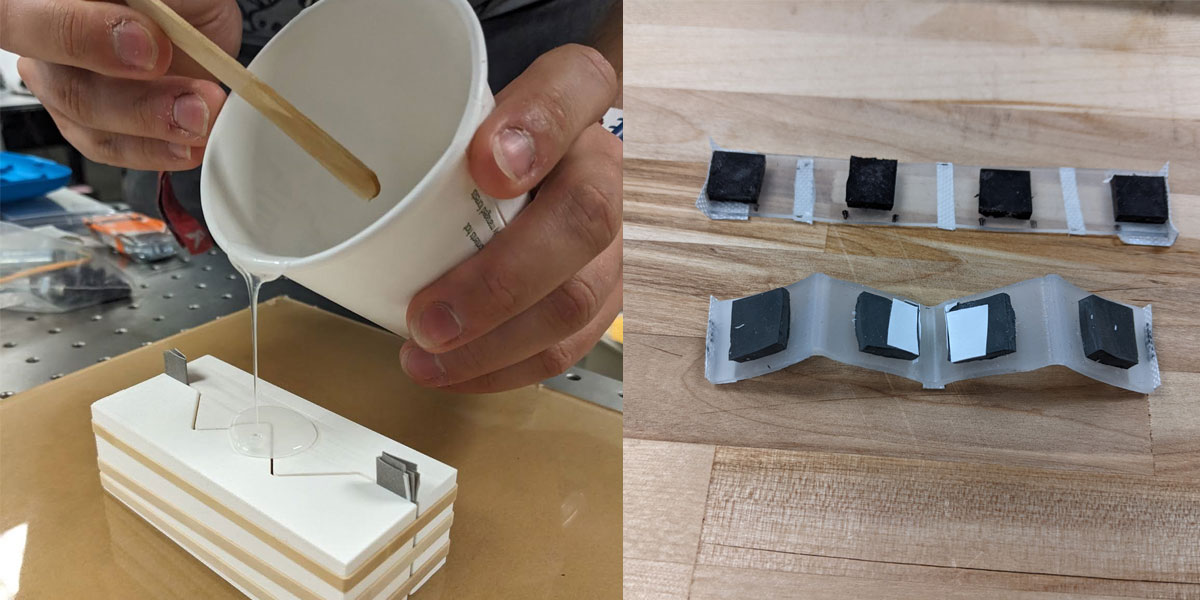 Kopp and Michelmann designed and made magnetically active accordion structures from a flexible, plastic-like material. (Images courtesy of Lorenz Kopp)
Soft magnetic materials tend to be metals that easily respond to (become magnetized in) the presence of a magnetic field, but go back to “normal” when the field is removed. This is in contrast to hard magnetic materials, which can be permanently magnetized. A typical fridge magnet is an example of a hard magnetic material, while a piece of iron is an example of a soft magnetic material.
Engineers are interested in magnets as a way to wirelessly control robots, but soft magnets are often assumed to offer a less versatile range of movements for these applications than hard magnets.
For about seven weeks during the fall semester, Kopp and Michelmann set up and ran a series of experiments putting some of these assumptions to the test. They designed accordion structures made from a flexible plastic-like material and embedded either soft or hard magnets in the accordions’ pleats. They then recorded how the structures folded or unfolded when exposed to magnetic fields. Early analysis of the results hints that the soft magnets may offer more versatility than initially assumed.
“It was great working with Lorenz and Björn. They were exceptionally productive,” von Lockette says. “We got interesting results and we’re working to write them up in a paper.”
Soft magnetic materials are appealing to engineers because they are cheaper and more biocompatible than hard magnetic materials, and also require less energy to be magnetized and demagnetized. If the group can demonstrate novel ways to get extra degrees of control over their movement, it could open a host of new applications, including in robots that assist in surgery or devices that are implanted in the human body to deliver drugs, monitor diseases, or substitute for the function of lost or damaged organs.
An international collaboration
 Kopp near the truck he and Michelmann drove to Shenandoah National Park. (Image courtesy of Lorenz Kopp)
Kopp and Michelmann got the opportunity to visit UMBC through funding by the German Academic Exchange Service. Their advisor at Regensburg University of Applied Sciences—Mikhail Chamonine—knew von Lockette through the American Society of Mechanical Engineers, and together they arranged the details of the visit with the help of the Office of International Students and Scholars at UMBC. Chamonine specializes in the physics of electromagnetic fields, and his lab in Germany performs many experiments with rubber-based soft magnetic materials. Von Lockette has developed his career around turning science insights about magnetically active soft materials into new applications and devices. The area of magnetic control of robots was a natural overlap.
While Kopp and Michelmann spent plenty of time in the lab during their visit, they also had chances to explore the areas surrounding UMBC on weekends. They visited the National Aquarium in Baltimore, took in a Raven’s football game, and drove to Shenandoah National Park in Virginia. They also enjoyed campus life, attending Homecoming weekend in October and regularly visiting the Retriever Activity Center to work out.
Michelmann says it was eye-opening to experience life on a U.S. university campus. “In a lot of U.S. films, there are fraternities and sororities with houses where they party every night. But I learned that stereotype doesn’t apply to UMBC.” He says he was pleasantly surprised by the variety of activities on campus, from sporting events, to tabletop games, to events such as bingo and craft nights organized by the Student Events Board.
Advancing science and technology
Von Lockette says he hopes to continue the collaboration with Regensburg University of Applied Sciences, and to arrange trips for UMBC students to visit Germany in the future.
Kopp, Michelmann, von Lockette, and Chamonine remain in touch as they write up the results of their experiments. When they noticed some unexpected behavior of the soft magnet accordions, von Lockette says he found himself thinking back to discussions he had with Chamonine about the importance of what are called demagnetizing terms in equations describing the magnetization of materials. The terms are affected by the geometry of the material and explain, for example, why when you put an iron nail in a magnetic field, it is easier for the nail to magnetize along its length, rather than perpendicular to it.
The researchers are testing whether they can explain the behavior of the soft magnets they tested—and the difference from the hard magnets—using demagnetizing field calculations. A better understanding of the behavior could guide future experiments trying to demonstrate greater versatility of movements and finer control.
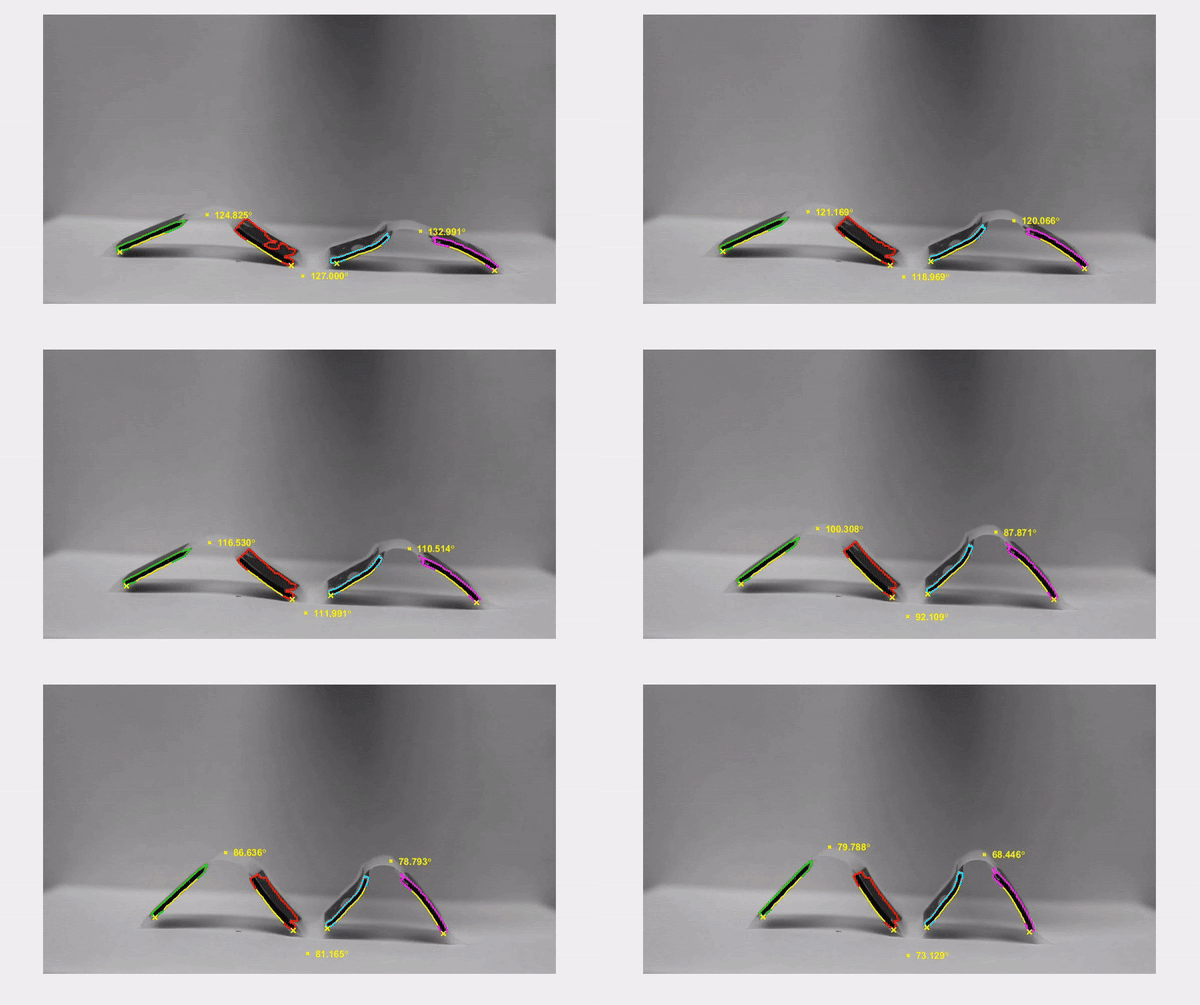 The researchers recorded and analyzed how the accordion structures folded or unfolded when exposed to magnetic fields. (Video courtesy of Lorenz Kopp)
“We’ll experiment with different materials and different geometries. We’re wondering: If we apply this field, what can we make it do that we didn’t think it could do?” von Lockette says.
Von Lockette has a history of getting fellow researchers to consider the usefulness of materials they may have overlooked. Earlier in his career, he published a paper demonstrating the potential of a new type of magnetically active material—in that case made with hard magnets.
“That was my first big splash,” he says. Now he’s happy to give soft magnets their due too, while also encouraging a new generation of researchers, including Kopp and Michelmann.
Chamonine is also pleased with the work of his students. “They are working to get the results published, which is not typical for a short project,” he says.
Beyond pushing the assumptions of what could get done in the lab in seven weeks, Kopp and Michelmann also enjoyed the typical world-expanding experience of international travel. “It was not only the science,” Chamonine says, “but they also had a chance to stay in the United States. I think for them it was absolutely an exciting moment in life.”
 Kopp and Michelmann visited New York at the end of their U.S. trip. (Image courtesy of Lorenz Kopp)
]]>
Making assumptions is a habit of life, a way to speed up decisions. Sometimes these mental short-cuts, however, lead us astray. Such was the situation when Lorenz Kopp, an engineering...
https://umbc.edu/stories/international-exchange-questioning-assumptions/
https://my3.my.umbc.edu/api/v0/pixel/news/147447/guest@my.umbc.edu/b3e4c78b14007557bb86daaa0944ad41/api/pixel
coeit
discovery
international
magazine
meche
story
UMBC News & Magazine
https://my3.my.umbc.edu/groups/umbc-news-magazine
https://assets1-my.umbc.edu/system/shared/avatars/groups/000/001/943/24435aa6207c452e7bc15cc74b42c7bb/xsmall.png?1748556657
https://assets1-my.umbc.edu/system/shared/avatars/groups/000/001/943/24435aa6207c452e7bc15cc74b42c7bb/original.png?1748556657
https://assets2-my.umbc.edu/system/shared/avatars/groups/000/001/943/24435aa6207c452e7bc15cc74b42c7bb/xxlarge.png?1748556657
https://assets2-my.umbc.edu/system/shared/avatars/groups/000/001/943/24435aa6207c452e7bc15cc74b42c7bb/xlarge.png?1748556657
https://assets3-my.umbc.edu/system/shared/avatars/groups/000/001/943/24435aa6207c452e7bc15cc74b42c7bb/large.png?1748556657
https://assets1-my.umbc.edu/system/shared/avatars/groups/000/001/943/24435aa6207c452e7bc15cc74b42c7bb/medium.png?1748556657
https://assets2-my.umbc.edu/system/shared/avatars/groups/000/001/943/24435aa6207c452e7bc15cc74b42c7bb/small.png?1748556657
https://assets1-my.umbc.edu/system/shared/avatars/groups/000/001/943/24435aa6207c452e7bc15cc74b42c7bb/xsmall.png?1748556657
https://assets2-my.umbc.edu/system/shared/avatars/groups/000/001/943/24435aa6207c452e7bc15cc74b42c7bb/xxsmall.png?1748556657
UMBC News & Magazine
11
0
false
Tue, 18 Feb 2025 16:07:11 -0500
Tue, 18 Feb 2025 16:07:11 -0500
“Teaching them to think”: New course prepares students for success in proof-based mathematics
Kopp and Michelmann visited New York at the end of their U.S. trip. (Image courtesy of Lorenz Kopp)
]]>
Making assumptions is a habit of life, a way to speed up decisions. Sometimes these mental short-cuts, however, lead us astray. Such was the situation when Lorenz Kopp, an engineering...
https://umbc.edu/stories/international-exchange-questioning-assumptions/
https://my3.my.umbc.edu/api/v0/pixel/news/147447/guest@my.umbc.edu/b3e4c78b14007557bb86daaa0944ad41/api/pixel
coeit
discovery
international
magazine
meche
story
UMBC News & Magazine
https://my3.my.umbc.edu/groups/umbc-news-magazine
https://assets1-my.umbc.edu/system/shared/avatars/groups/000/001/943/24435aa6207c452e7bc15cc74b42c7bb/xsmall.png?1748556657
https://assets1-my.umbc.edu/system/shared/avatars/groups/000/001/943/24435aa6207c452e7bc15cc74b42c7bb/original.png?1748556657
https://assets2-my.umbc.edu/system/shared/avatars/groups/000/001/943/24435aa6207c452e7bc15cc74b42c7bb/xxlarge.png?1748556657
https://assets2-my.umbc.edu/system/shared/avatars/groups/000/001/943/24435aa6207c452e7bc15cc74b42c7bb/xlarge.png?1748556657
https://assets3-my.umbc.edu/system/shared/avatars/groups/000/001/943/24435aa6207c452e7bc15cc74b42c7bb/large.png?1748556657
https://assets1-my.umbc.edu/system/shared/avatars/groups/000/001/943/24435aa6207c452e7bc15cc74b42c7bb/medium.png?1748556657
https://assets2-my.umbc.edu/system/shared/avatars/groups/000/001/943/24435aa6207c452e7bc15cc74b42c7bb/small.png?1748556657
https://assets1-my.umbc.edu/system/shared/avatars/groups/000/001/943/24435aa6207c452e7bc15cc74b42c7bb/xsmall.png?1748556657
https://assets2-my.umbc.edu/system/shared/avatars/groups/000/001/943/24435aa6207c452e7bc15cc74b42c7bb/xxsmall.png?1748556657
UMBC News & Magazine
11
0
false
Tue, 18 Feb 2025 16:07:11 -0500
Tue, 18 Feb 2025 16:07:11 -0500
“Teaching them to think”: New course prepares students for success in proof-based mathematics

A new course in UMBC’s Department of Mathematics and Statistics is having a positive impact on student success in a notoriously difficult course for math majors everywhere. Two new papers by UMBC mathematicians and members of UMBC’s Faculty Development Center strongly suggest that MATH 300: Introduction to Mathematical Reasoning(IMR) is helping students succeed in MATH 301: Real Analysis, the first course math majors take that relies on one’s ability to construct and analyze proofs, rather than just do calculations.
In Real Analysis, “We’re switching gears of how students think. They go from calculational things to proof-based work,” says Kathleen Hoffman, professor of mathematics and lead author on the new papers. “Now your solution is a paragraph that you have to write in full sentences. It has to have logical structure. It has to start with a hypothesis and end with a conclusion. It’s a big hump for students to get over.”
Real Analysis is easily one of the most challenging courses for math majors nationwide, Hoffman says. Over the years, many institutions have introduced a preparatory course that teaches students how to develop proofs without requiring them to learn new math content at the same time. The conventional wisdom is that these courses help, but almost no one had conducted a rigorous study to find out.
“There was a huge gap in the literature,” Hoffman says.
Forming the team
UMBC math faculty had seen the need and been talking about adding a dedicated proof-writing course for years, but it hadn’t quite come together. Hoffman jump-started the process by applying for a Hrabowski Innovation Fund Grant in the Scholarship of Teaching and Learning category. These awards support faculty who want to do ambitious projects that they might not otherwise have bandwidth for.
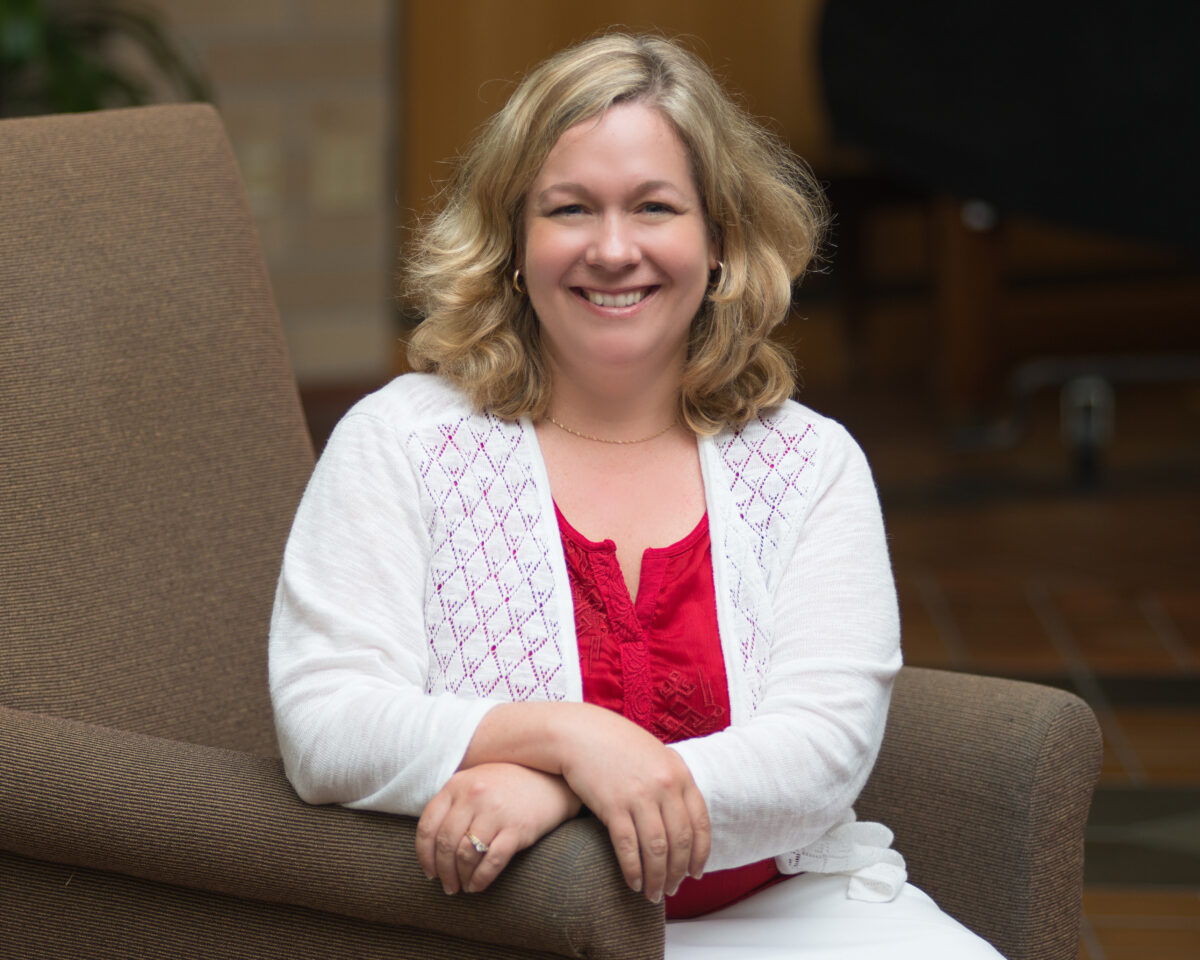 Kathleen Hoffman wrote the Hrabowski Fund for Innovation proposal that supported the team’s efforts to rigorously evaluate the effectiveness of their new course. (Courtesy of Hoffman)
When the award was funded, Hoffman formed a team with Justin Webster, associate professor of mathematics, and Kal Nanes, associate teaching professor of mathematics, to design the course for UMBC. Webster had re-designed and updated one of these proof-writing courses at his previous institution, the College of Charleston. The math team also worked with staff in UMBC’s Faculty Development Center to design a rigorous study to evaluate the course’s effectiveness over time. The team knows of only one other such study, from the 1980s, despite the rising incidence of proof-writing courses at universities nationwide.
Hoffman, Webster, and others believed that IMR would help UMBC math students, and informal observations supported their hunch once the course launched. These publications provide statistical analyses to back their intuition, and now Retrievers and students from other institutions can benefit from their successful formula.
Thinking about thinking
The first paper, published in a special issue of Educational Sciences, focused on written reflections the students completed every week along with their proofs. Prior research suggests that students tend to struggle in specific skills related to proof-writing, so the students were required to address how well they thought they did on each of four skills in their reflections.
“Students who did very thoughtful responses did much better in this course, but they also did much better in Real Analysis, where they didn’t do any reflections,” Hoffman says. The reflections “give the students a framework for understanding what they know and what they don’t know. It gives them the words to use.”
The study analyzed the quality of the reflections, but not necessarily the content. It didn’t seem to matter exactly what aspects of proof-writing the students addressed in their writing—simply the act of metacognition, or “thinking about thinking,” seemed beneficial.
The correlation was strong, but Hoffman admits the study does not prove causation. Strengthening the evidence, though, is that thoughtful reflections in IMR were not correlated with success in its prerequisite course, MATH 221: Introduction to Linear Algebra. That suggests the reflections, and potentially other elements of IMR, were the difference-maker for students moving forward.
A solid foundation
A second paper, published in the International Journal of Mathematical Education in Science and Technology, compared students’ grades in Real Analysis depending on whether or not they had taken the proof-writing course. The findings showed that IMR did not much affect the outcomes for students who earned As in the prerequisite linear algebra course—they were also likely to do well in Real Analysis whether they took IMR or not. However, students who earned a B or C in the prerequisite course were much more likely to successfully complete Real Analysis if they had taken IMR.
The researchers also received overwhelmingly positive feedback from students who had taken IMR about its benefits. One student said,
“I feel like [IMR] gave me a solid foundation in understanding how to write proofs, which allowed me to come into [Real Analysis] with a bit more confidence. Without it, I probably would have struggled through [Real Analysis] since I would have been learning how to write proofs and the [Real Analysis] material at the same time.”
Based on the results of these studies, the UMBC mathematics and statistics department has decided to make IMR a required part of the curriculum for math majors and minors. Minors used to take Real Analysis as their terminal course, but now they take IMR. For majors, IMR provides the foundation needed to support success in Real Analysis.
More than pushing symbols around
When he took it as an undergraduate, an IMR-type course “was the thing that made me want to be a math major,” Webster says, so designing this course for UMBC was an exciting prospect. Becoming proficient in writing and analyzing proofs, rather than doing calculations, is like “writing versus writing literature,” he says—you have to spend a lot of time thinking about what you’re trying to accomplish and how to structure your arguments. You can’t just “plug-and-chug,” applying various theorems and techniques to instances of a given type of problem. “Math isn’t just the act of pushing symbols around,” Webster says.
 Justin Webster often meets with students to support their progress in math courses. (Marlayna Demond ’11/UMBC)
To prepare students to write mathematical literature, Hoffman says that in IMR, “In one sense I’m teaching math, but in another sense I’m not. I’m teaching them how to think—how to structure their argument and express it clearly.” Almost never can a student simply sit down and write a proof in one sitting, like completing a problem set in prior math courses. It’s more like writing a paper.
When you work on a proof, “You think, you don’t get it, you go do something else, you think, ‘Oh, I think I know what to do,’ you come back, and that is normal,” Hoffman says. “They have to understand, this is not instant gratification—you will struggle with this and I’m expecting you to. It’s inevitable that they will struggle—I’m teaching them to persist through the struggle.”
A collective commitment
The studies would not have been possible without support from the Faculty Development Center. While many faculty might like to conduct more rigorous analysis of their teaching methods, it’s not their area of expertise. “If you want people like me who do disciplinary research to engage in pedagogical research, you have to give me some help,” as Hoffman put it.
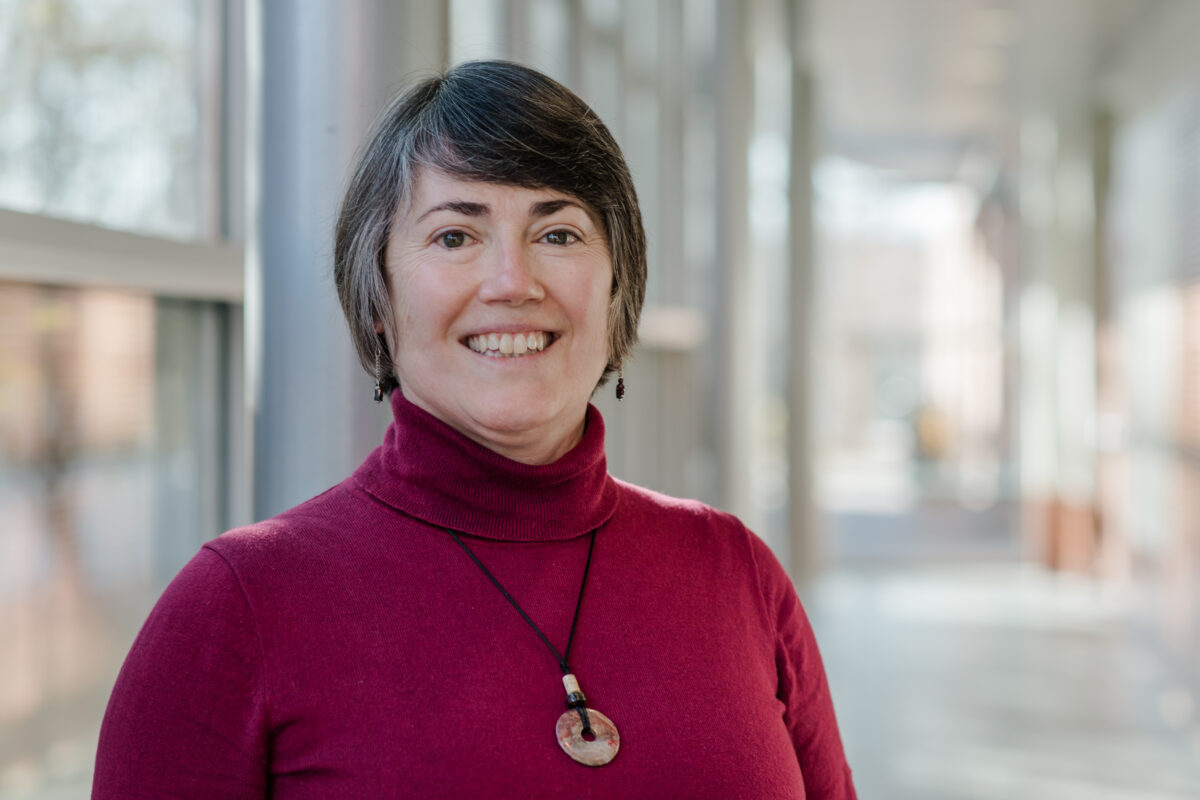 Kerrie Kephart was one of several members of the Faculty Development Center who contributed to the study of the new course’s impact. (Marlayna Demond ’11/UMBC)
That’s where the FDC came in. Several staff members became involved in the project, including Tory Williams, Jennifer Harrison, Kerrie Kephart, and Linda Hodges, adding their individual areas of expertise.
“The math faculty have deep expertise in math pedagogy, but needed our support to help plan the intervention, design the research study, and analyze the data. The project required all hands on deck.” shares Kephart, co-author on the written reflections study and interim FDC director. “As a qualitative researcher with expertise in the teaching of academic writing, I enjoyed the challenge of figuring out how to study the effects of incorporating reflective writing into a math class.”
The project is also a demonstration of the math department’s commitment to supporting student success, even if that required some culture change. Since IMR’s initial offering in 2019, several additional math faculty have taken on teaching the course. Each time someone new takes it on, they work closely with experienced instructors, and all sections of the course are closely coordinated to ensure quality and consistency for students.
The project is a masterclass in recognizing a challenge (a high failure rate in Real Analysis) and taking creative, concerted, and collective action to address it, with very positive results. “After realizing there was a gap in students’ preparation, a group worked together to fill it, and in the process learned a lot about how to measure progress in math education and pedagogy,” Webster says. “We leaped at this opportunity to effect change and measure outcomes in a novel and modern way.”
And because they carefully evaluated the project’s effects and published the results, now other math departments can benefit from their findings. That possibility was a highlight for Kephart. “Since our work in the FDC generally supports faculty, teaching, and learning here at UMBC,” she says, “it’s exciting to make a contribution toward the development of math pedagogy beyond our campus.”
]]>
A new course in UMBC’s Department of Mathematics and Statistics is having a positive impact on student success in a notoriously difficult course for math majors everywhere. Two new papers by UMBC...
https://umbc.edu/stories/new-course-for-success-in-proof-based-mathematics/
https://my3.my.umbc.edu/api/v0/pixel/news/147392/guest@my.umbc.edu/f1881142676dd57b1445f1260dc9b9c5/api/pixel
cnms
mathstat
news
research
science-and-tech
story
UMBC News & Magazine
https://my3.my.umbc.edu/groups/umbc-news-magazine
https://assets1-my.umbc.edu/system/shared/avatars/groups/000/001/943/24435aa6207c452e7bc15cc74b42c7bb/xsmall.png?1748556657
https://assets1-my.umbc.edu/system/shared/avatars/groups/000/001/943/24435aa6207c452e7bc15cc74b42c7bb/original.png?1748556657
https://assets2-my.umbc.edu/system/shared/avatars/groups/000/001/943/24435aa6207c452e7bc15cc74b42c7bb/xxlarge.png?1748556657
https://assets2-my.umbc.edu/system/shared/avatars/groups/000/001/943/24435aa6207c452e7bc15cc74b42c7bb/xlarge.png?1748556657
https://assets3-my.umbc.edu/system/shared/avatars/groups/000/001/943/24435aa6207c452e7bc15cc74b42c7bb/large.png?1748556657
https://assets1-my.umbc.edu/system/shared/avatars/groups/000/001/943/24435aa6207c452e7bc15cc74b42c7bb/medium.png?1748556657
https://assets2-my.umbc.edu/system/shared/avatars/groups/000/001/943/24435aa6207c452e7bc15cc74b42c7bb/small.png?1748556657
https://assets1-my.umbc.edu/system/shared/avatars/groups/000/001/943/24435aa6207c452e7bc15cc74b42c7bb/xsmall.png?1748556657
https://assets2-my.umbc.edu/system/shared/avatars/groups/000/001/943/24435aa6207c452e7bc15cc74b42c7bb/xxsmall.png?1748556657
UMBC News & Magazine
3
0
false
Mon, 17 Feb 2025 11:27:34 -0500
Mon, 17 Feb 2025 11:27:34 -0500
Meet a Retriever—Rylee Kennedy ’21, Philadelphia Eagles Cheerleader

Meet Rylee Kennedy ’21, geography and environmental studies. By day, Rylee works as a marketing coordinator at Vanguard Building Solutions. However, it’s when she clocks out that the real fun begins. You see, Rylee is also an NFL Cheerleader for the Super Bowl champion Philadelphia Eagles. Take it away, Rylee!
Q: What’s one essential thing you’d want another Retriever to know about you?
A: My name is Rylee, and I graduated in 2021 with a B.A. in geography and environmental studies. I transferred to UMBC my sophomore year and decided to try out for the UMBC Dance Team. I remember practicing in the RAC every day and asking dancers on the team for help leading up to the auditions—I was so nervous! Making the team was one of the best things to have ever happened to me. I met some of my best friends on that team and was able to grow a lot as a person and a dancer. During COVID, having virtual practices kept my sense of community during uncertain times.
My favorite part of being a part of Retriever Nation is the lasting bond that forms when you join the community.
Rylee Kennedy '21
geography and environmental studies
After college, I knew I wanted to continue dancing, and decided to aim for the National Football League. This is my second season as a Philadelphia Eagles Cheerleader, and having the opportunity to follow the Eagles during a historic season has been the best experience a cheerleader could ask for.
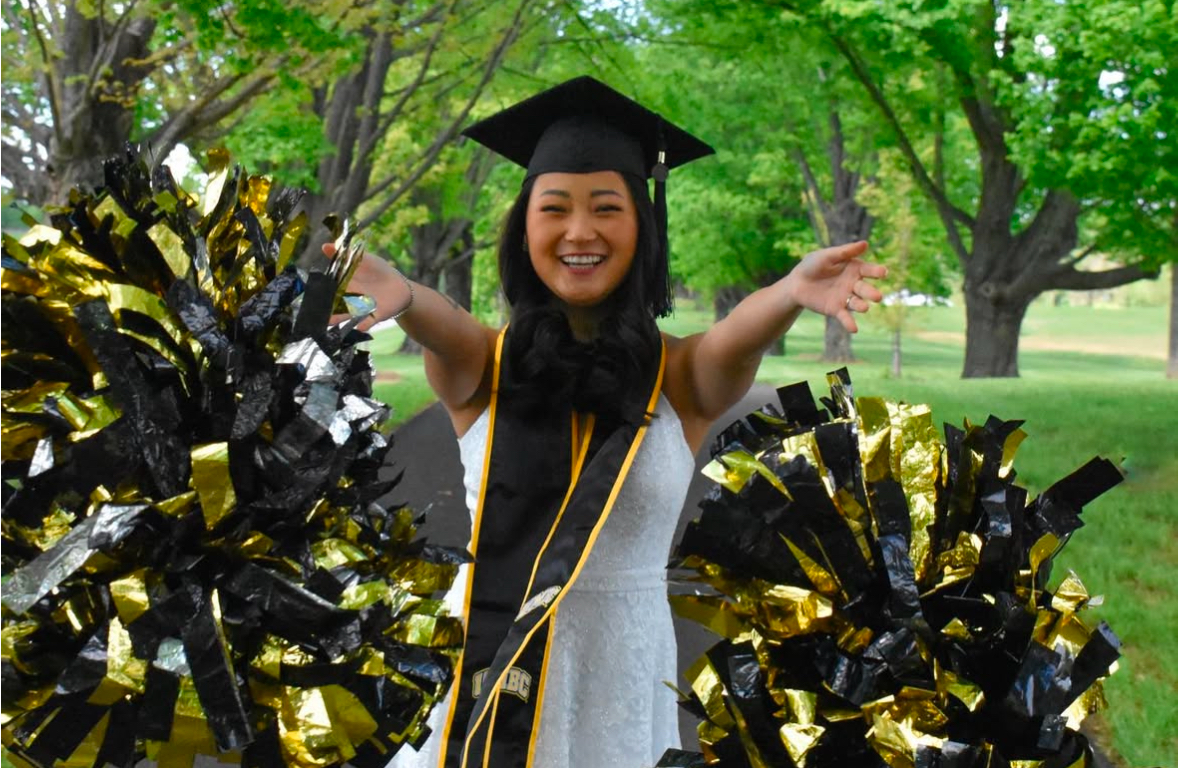 Rylee Kennedy on her UMBC graduation day in 2021.
Q: Tell us about someone in the community who has inspired you or supported you, and how they did it.
A: I would not be living my dreams if it weren’t for the amazing coaches and teammates I have had who have pushed me to be a better dancer and professional. By surrounding yourself with those of strong character, you can be inspired to push yourself beyond what you ever thought was imaginable. My teammates encouraged me to try out to be an NFL cheerleader, and my coaches honed my abilities and gave me space to grow. They inspired me then, and they continue to inspire me now as they pursue their careers and continue to express themselves through dance.
 Rylee Kennedy and some of her teammates on the UMBC Dance Team.
Q: What do you like most about being a Philadelphia Eagles cheerleader?
A: This season, I was able to go on a ProTour Military Tour. On tour, I, along with 11 other cheerleaders from five different teams, visited our servicemen and women on base and brought a piece of home to them. When the Eagles flew to New Orleans, I flew to O’ahu, Hawai’i, and spent the big game watching with our military! During my 12 days there, we held cheer clinics for the children of our servicemembers, read to children at school, experienced life as an airman/sailor by testing simulators and touring a C-17, and paid our respects to those tragically lost on December 7 at the Pearl Harbor Memorial.


Left, Rylee Kennedy and other NFL cheerleaders posing with members of the U.S. Armed Forces. Right, Rylee Kennedy and other NFL cheerleaders reading to school students.
We wrapped our trip up with a Super Bowl watch party on base, and so many people were surprised to see an Eagles cheerleader in Hawai’i instead of in the Superdome. I am so thankful for the amazing people I met, the stories I have heard, and the experiences I had during my tour. To me, there was no better way to spend the Super Bowl than with those who are giving the ultimate sacrifice. UMBC instilled a sense of community, empathy, and selflessness that I continue to pay forward to this day.
* * * * *
UMBC’s greatest strength is its people. When people meet Retrievers and hear about the passion they bring, the relationships they create, the ways they support each other, and the commitment they have to inclusive excellence, they truly get a sense of our community. That’s what “Meet a Retriever” is all about.
Learn more about how UMBC can help you achieve your goals.
]]>
Meet Rylee Kennedy ’21, geography and environmental studies. By day, Rylee works as a marketing coordinator at Vanguard Building Solutions. However, it’s when she clocks out that the real fun...
https://umbc.edu/stories/rylee-kennedy-eagles-cheerleader/
https://my3.my.umbc.edu/api/v0/pixel/news/147306/guest@my.umbc.edu/287a3f16b4a3984b4dd080027ef27d98/api/pixel
alumni
cheerleader
magazine
meet-a-retriever
philadelphia-eagles
story
UMBC News & Magazine
https://my3.my.umbc.edu/groups/umbc-news-magazine
https://assets1-my.umbc.edu/system/shared/avatars/groups/000/001/943/24435aa6207c452e7bc15cc74b42c7bb/xsmall.png?1748556657
https://assets1-my.umbc.edu/system/shared/avatars/groups/000/001/943/24435aa6207c452e7bc15cc74b42c7bb/original.png?1748556657
https://assets2-my.umbc.edu/system/shared/avatars/groups/000/001/943/24435aa6207c452e7bc15cc74b42c7bb/xxlarge.png?1748556657
https://assets2-my.umbc.edu/system/shared/avatars/groups/000/001/943/24435aa6207c452e7bc15cc74b42c7bb/xlarge.png?1748556657
https://assets3-my.umbc.edu/system/shared/avatars/groups/000/001/943/24435aa6207c452e7bc15cc74b42c7bb/large.png?1748556657
https://assets1-my.umbc.edu/system/shared/avatars/groups/000/001/943/24435aa6207c452e7bc15cc74b42c7bb/medium.png?1748556657
https://assets2-my.umbc.edu/system/shared/avatars/groups/000/001/943/24435aa6207c452e7bc15cc74b42c7bb/small.png?1748556657
https://assets1-my.umbc.edu/system/shared/avatars/groups/000/001/943/24435aa6207c452e7bc15cc74b42c7bb/xsmall.png?1748556657
https://assets2-my.umbc.edu/system/shared/avatars/groups/000/001/943/24435aa6207c452e7bc15cc74b42c7bb/xxsmall.png?1748556657
UMBC News & Magazine
3
0
false
Thu, 13 Feb 2025 10:45:30 -0500
Thu, 13 Feb 2025 10:45:30 -0500
UMBC leverages interdisciplinary expertise to launch Quantum Science Institute

UMBC has received $1.5 million from the National Institute of Standards and Technology to organize a new UMBC Quantum Science Institute. The funding will support graduate fellowships for students pursuing quantum technology research, the development of new courses and academic programs focused on quantum, and equipment to enhance existing quantum labs and start new ones.
“This institute is the crowning jewel of several decades of pioneering quantum research here at UMBC,” says QSI director and professor of physics Todd Pittman, Ph.D. ’96, physics. “We have some heavy hitters here who are founders in the field, and the QSI is building on that foundation with a new generation of outstanding quantum-focused faculty.”
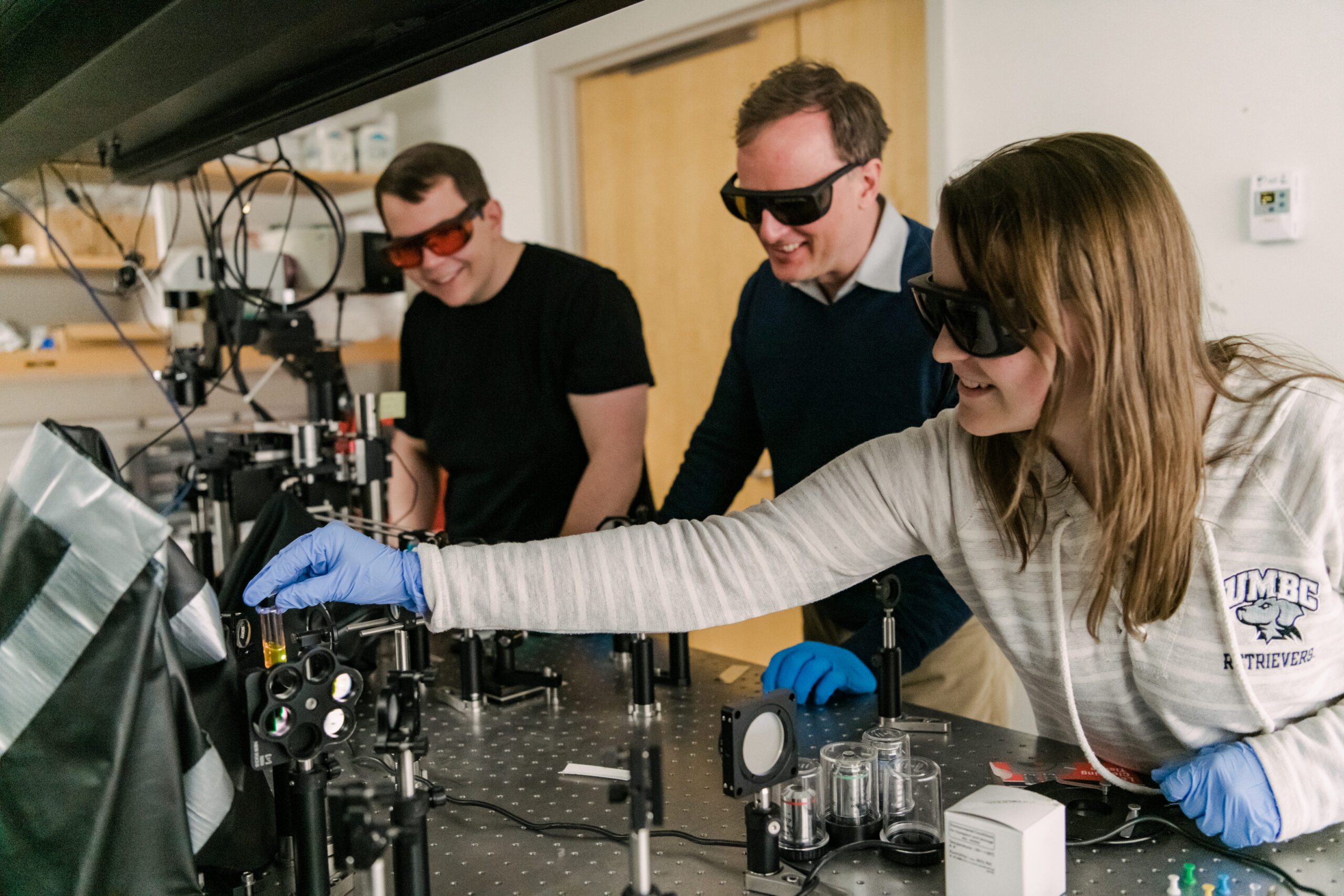 Matthew Pelton, center, leads a quantum optics laboratory at UMBC. (Marlayna Demond ’11/UMBC)
Quantum technologies harness the odd behaviors of particles at the atomic level to generate new functions, and are typically much more powerful than their conventional technology counterparts. To approach quantum research from every angle, the institute includes faculty across the College of Natural and Mathematical Sciences and the College of Engineering and IT in physics, mathematics and statistics, computer science, and information systems. They are pursuing quantum research in areas including computing, communications, sensing, information theory, algorithms, and more. “You just can’t do comprehensive quantum research without bringing together engineers, data analysts, computer scientists, mathematicians, and physicists,” Pittman says.
“I am thankful for the support provided by NIST to develop the UMBC Quantum Science Institute under the leadership of Dr. Pittman,” shares Karl V. Steiner, vice president for research and creative achievement. “QSI will catalyze a new quantum research effort, in support of Governor Moore’s ‘Capital of Quantum’ Initiative to position Maryland as a global leader in this rapidly growing field.”
Training quantum-ready workers
In addition to contributing to research innovation and discovery, the institute will train students from a range of backgrounds to take on skilled roles in the booming quantum industry.
“The quantum industry has exploded,” Pittman says. The quantum technology market was valued at $10 billion in 2021 and is projected to rise to $44 billion by 2028, with potential for much more growth beyond that. In addition to tech giants like Google and IBM, hundreds of start-ups are working in the quantum space. “The market is hungry for quantum-ready workers,” Pittman says, and UMBC is ready to train them.
UMBC marked World Quantum Day in 2022 with a short video highlighting the quantum technology research happening in the physics department.
Sandra Cheng, a fourth-year Ph.D. candidate in physics, is a member of the first cohort of quantum graduate fellows. “Quantum science research, particularly in computing and networking, is quite interdisciplinary by nature,” she says, “and I’m hopeful the QSI will bring together like minds from all the departments involved, so that we’ll be able to contribute towards a greater understanding of quantum science together.”
The QSI leadership team plans to offer social and professional development programming for the fellows. In addition to preparing them for the workforce, the connections they make will help generate a personal network of support, encouraging persistence in a demanding field. Organizing interdisciplinary offerings for the student cohort will also promote collaboration among faculty, Pittman says, adding, “Students are the glue that holds the center together.”
“This new institute is a celebration of our strength and history in quantum research,” Pittman says. “I’m looking forward to seeing QSI unify the quantum researchers on campus in a way that promotes and facilitates interdisciplinary collaboration.”
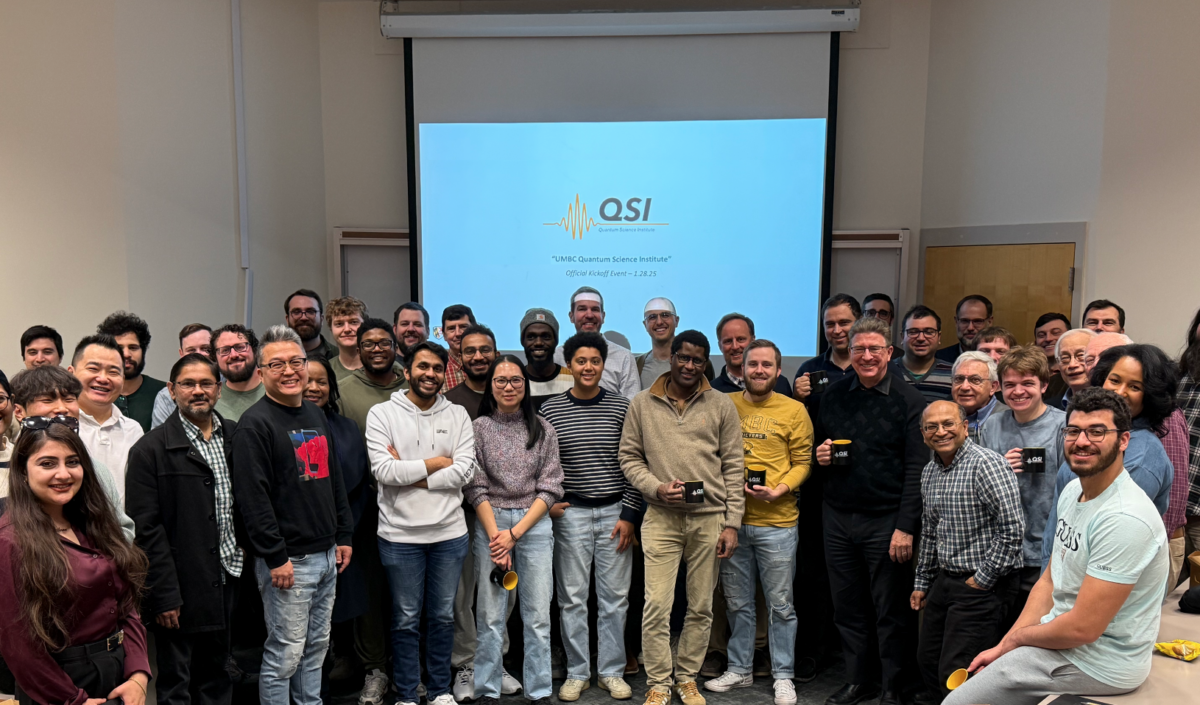 Representatives from all of the departments involved in the new QSI recently attended a launch event.
]]>
UMBC has received $1.5 million from the National Institute of Standards and Technology to organize a new UMBC Quantum Science Institute. The funding will support graduate fellowships for students...
https://umbc.edu/stories/quantum-science-institute-launch/
https://my3.my.umbc.edu/api/v0/pixel/news/147296/guest@my.umbc.edu/cb09589c98c92dd469d956539b185529/api/pixel
cnms
coeit
csee
information-systems
is
mathstat
news
physics
research
science-and-tech
story
UMBC News & Magazine
https://my3.my.umbc.edu/groups/umbc-news-magazine
https://assets1-my.umbc.edu/system/shared/avatars/groups/000/001/943/24435aa6207c452e7bc15cc74b42c7bb/xsmall.png?1748556657
https://assets1-my.umbc.edu/system/shared/avatars/groups/000/001/943/24435aa6207c452e7bc15cc74b42c7bb/original.png?1748556657
https://assets2-my.umbc.edu/system/shared/avatars/groups/000/001/943/24435aa6207c452e7bc15cc74b42c7bb/xxlarge.png?1748556657
https://assets2-my.umbc.edu/system/shared/avatars/groups/000/001/943/24435aa6207c452e7bc15cc74b42c7bb/xlarge.png?1748556657
https://assets3-my.umbc.edu/system/shared/avatars/groups/000/001/943/24435aa6207c452e7bc15cc74b42c7bb/large.png?1748556657
https://assets1-my.umbc.edu/system/shared/avatars/groups/000/001/943/24435aa6207c452e7bc15cc74b42c7bb/medium.png?1748556657
https://assets2-my.umbc.edu/system/shared/avatars/groups/000/001/943/24435aa6207c452e7bc15cc74b42c7bb/small.png?1748556657
https://assets1-my.umbc.edu/system/shared/avatars/groups/000/001/943/24435aa6207c452e7bc15cc74b42c7bb/xsmall.png?1748556657
https://assets2-my.umbc.edu/system/shared/avatars/groups/000/001/943/24435aa6207c452e7bc15cc74b42c7bb/xxsmall.png?1748556657
UMBC News & Magazine
0
0
false
Wed, 12 Feb 2025 15:54:40 -0500
Wed, 12 Feb 2025 15:54:40 -0500
Care and Resources for UMBC Students
Representatives from all of the departments involved in the new QSI recently attended a launch event.
]]>
UMBC has received $1.5 million from the National Institute of Standards and Technology to organize a new UMBC Quantum Science Institute. The funding will support graduate fellowships for students...
https://umbc.edu/stories/quantum-science-institute-launch/
https://my3.my.umbc.edu/api/v0/pixel/news/147296/guest@my.umbc.edu/cb09589c98c92dd469d956539b185529/api/pixel
cnms
coeit
csee
information-systems
is
mathstat
news
physics
research
science-and-tech
story
UMBC News & Magazine
https://my3.my.umbc.edu/groups/umbc-news-magazine
https://assets1-my.umbc.edu/system/shared/avatars/groups/000/001/943/24435aa6207c452e7bc15cc74b42c7bb/xsmall.png?1748556657
https://assets1-my.umbc.edu/system/shared/avatars/groups/000/001/943/24435aa6207c452e7bc15cc74b42c7bb/original.png?1748556657
https://assets2-my.umbc.edu/system/shared/avatars/groups/000/001/943/24435aa6207c452e7bc15cc74b42c7bb/xxlarge.png?1748556657
https://assets2-my.umbc.edu/system/shared/avatars/groups/000/001/943/24435aa6207c452e7bc15cc74b42c7bb/xlarge.png?1748556657
https://assets3-my.umbc.edu/system/shared/avatars/groups/000/001/943/24435aa6207c452e7bc15cc74b42c7bb/large.png?1748556657
https://assets1-my.umbc.edu/system/shared/avatars/groups/000/001/943/24435aa6207c452e7bc15cc74b42c7bb/medium.png?1748556657
https://assets2-my.umbc.edu/system/shared/avatars/groups/000/001/943/24435aa6207c452e7bc15cc74b42c7bb/small.png?1748556657
https://assets1-my.umbc.edu/system/shared/avatars/groups/000/001/943/24435aa6207c452e7bc15cc74b42c7bb/xsmall.png?1748556657
https://assets2-my.umbc.edu/system/shared/avatars/groups/000/001/943/24435aa6207c452e7bc15cc74b42c7bb/xxsmall.png?1748556657
UMBC News & Magazine
0
0
false
Wed, 12 Feb 2025 15:54:40 -0500
Wed, 12 Feb 2025 15:54:40 -0500
Care and Resources for UMBC Students
Dear UMBC Students,
Over the last few weeks, multiple presidential executive orders have been announced that impact our campus community. I assure all of you that your education, safety, and well-being are UMBC’s highest priority.
Our community is enriched by the differences in our stories and perspectives, and we continue to be guided by our value of inclusive excellence that recognizes our common humanity.
If you have questions or concerns, there are campuswide resources and student events and resources to support you. Student Affairs, along with our student leaders, campus leaders, and offices and departments across campus, are working together to develop additional informational programming. We will continue to share updates on the resources weblinks.
Last week you received several important email messages. President Sheares Ashby shared An Update on Our Work Related to Federal Executive Orders and Actions, and you also received messages regarding the Potential for Federal Immigration Enforcement at UMBC and Implications of an Executive Order on Research and Creative Achievement (for graduate students). International students received Information and Resources. If you have not read these messages, I encourage you to do so, as they contain information about the university’s responses as well as guidance for our community.
Together we can work to ensure that UMBC continues to be a place that is welcoming, inclusive, and safe for all.
Best,
Renique Kersh, Ph.D.
Vice President for Student Affairs
]]>
Dear UMBC Students, Over the last few weeks, multiple presidential executive orders have been announced that impact our campus community. I assure all of you that your education, safety, and...
https://my3.my.umbc.edu/groups/announcements-students/posts/147199
https://my3.my.umbc.edu/api/v0/pixel/news/147205/guest@my.umbc.edu/60e0d63f262a71d1f1190bd171dfffab/api/pixel
federal-orders
story
UMBC News & Magazine
https://my3.my.umbc.edu/groups/umbc-news-magazine
https://assets1-my.umbc.edu/system/shared/avatars/groups/000/001/943/24435aa6207c452e7bc15cc74b42c7bb/xsmall.png?1748556657
https://assets1-my.umbc.edu/system/shared/avatars/groups/000/001/943/24435aa6207c452e7bc15cc74b42c7bb/original.png?1748556657
https://assets2-my.umbc.edu/system/shared/avatars/groups/000/001/943/24435aa6207c452e7bc15cc74b42c7bb/xxlarge.png?1748556657
https://assets2-my.umbc.edu/system/shared/avatars/groups/000/001/943/24435aa6207c452e7bc15cc74b42c7bb/xlarge.png?1748556657
https://assets3-my.umbc.edu/system/shared/avatars/groups/000/001/943/24435aa6207c452e7bc15cc74b42c7bb/large.png?1748556657
https://assets1-my.umbc.edu/system/shared/avatars/groups/000/001/943/24435aa6207c452e7bc15cc74b42c7bb/medium.png?1748556657
https://assets2-my.umbc.edu/system/shared/avatars/groups/000/001/943/24435aa6207c452e7bc15cc74b42c7bb/small.png?1748556657
https://assets1-my.umbc.edu/system/shared/avatars/groups/000/001/943/24435aa6207c452e7bc15cc74b42c7bb/xsmall.png?1748556657
https://assets2-my.umbc.edu/system/shared/avatars/groups/000/001/943/24435aa6207c452e7bc15cc74b42c7bb/xxsmall.png?1748556657
UMBC News & Magazine
2
0
false
Mon, 10 Feb 2025 13:19:38 -0500


