Biologist Tom Cronin co-authors ‘Color in Nature,’ a beautiful and accessible tour of color’s role in our world

Color in Nature, co-authored byThomas W. Cronin, professor of biological sciences, covers the world of color from the first principles of physics to the use of color in art and design. An even mix of text and beautiful images, Color in Nature (Princeton University Press, November 2024)is written in an accessible style for any reader who harbors curiosity about color in our world, without sacrificing technical accuracy.
“The book is a comprehensive look at the roles of color in the biology of plants and animals, but also its role in human society and art,” Cronin says. The authors consider the roles of color in mating, hunting, fighting, deceiving, and hiding, and call upon disciplines such as physics, genetics, chemistry, physiology, and psychology. The book’s images support concepts in the text, but they “are also intended to be beautiful and to show off the diversity of colors and patterns in the natural world,” Cronin says.
Cronin contributed to the new book alongside six other authors from England, New Zealand, and the U.S. Contributors include experts in evolution, optical sciences, neuroscience, marine science, and the creative use of color.
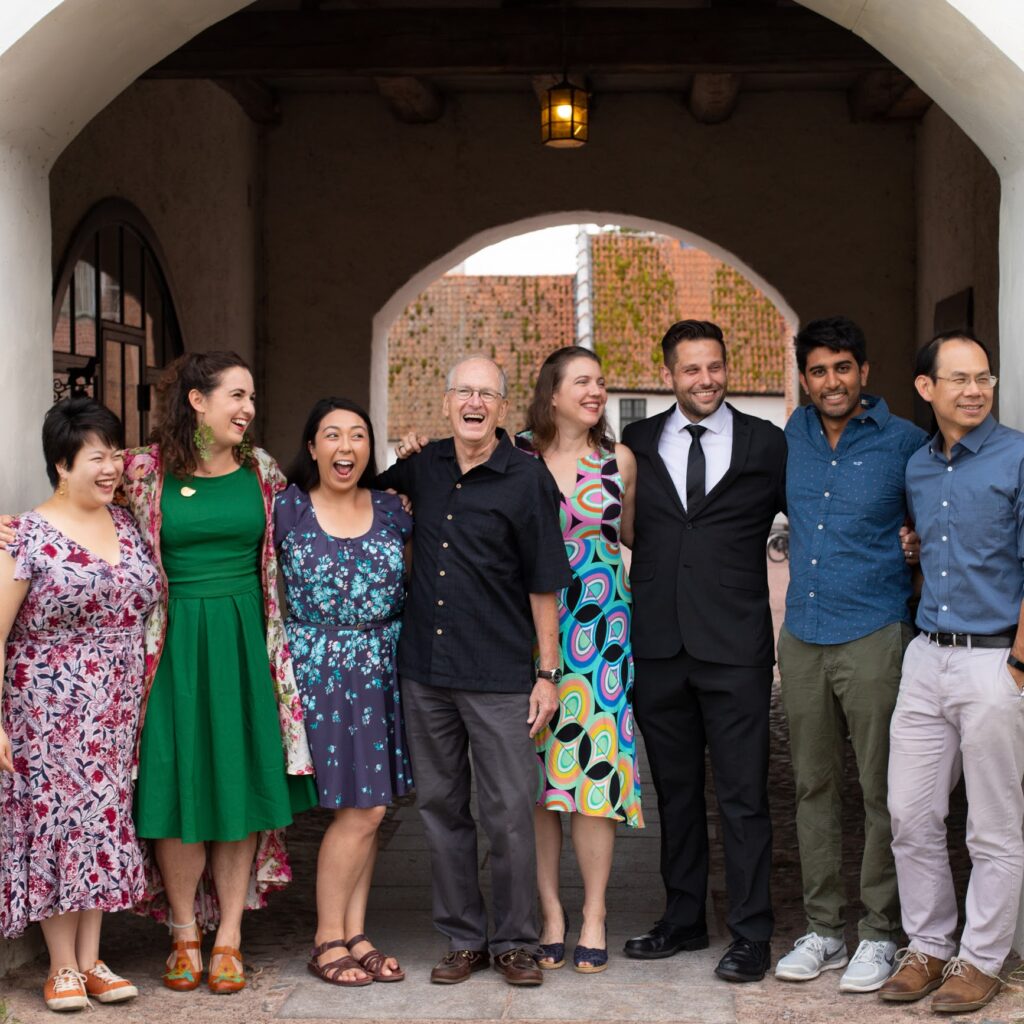 Tom Cronin, fourth from left, with current and former members of his research group at the International Conference on Invertebrate Vision in 2019. (Courtesy of Cronin)
Cronin’s four-decade career at UMBC has been primarily spent studying the unique visual system of mantis shrimp—unusual, wildly colored crustaceans with astoundingly capable eyes and a nasty punch. Cronin’s research group has also studied the chromatophores—light-sensing and color-changing cells—on the skin of cephalopods like squid, octopuses and cuttlefish.
According to the The Wall Street Journal, “Color in Nature provides an accessible scientific entrée into the colors of our world, with bold, glossy images and detailed diagrams.”
David Gascoigne, an expert birder and nature blogger at Travels with Birds, found Color in Nature to be “an eminently fascinating book covering an eminently fascinating topic which has relevance to every aspect of life on Earth. I will be referring to it often, and I will cherish its wisdom. I suspect you will, too.”
]]>
Color in Nature, co-authored byThomas W. Cronin, professor of biological sciences, covers the world of color from the first principles of physics to the use of color in art and design. An even mix...
https://umbc.edu/quick-posts/color-in-nature-book/
https://my3.my.umbc.edu/api/v0/pixel/news/145822/guest@my.umbc.edu/1164661ebd3c8811a6cb777f95489dff/api/pixel
biology
cnms
news
quick-post
science-and-tech
UMBC News & Magazine
https://my3.my.umbc.edu/groups/umbc-news-magazine
https://assets1-my.umbc.edu/system/shared/avatars/groups/000/001/943/24435aa6207c452e7bc15cc74b42c7bb/xsmall.png?1748556657
https://assets1-my.umbc.edu/system/shared/avatars/groups/000/001/943/24435aa6207c452e7bc15cc74b42c7bb/original.png?1748556657
https://assets2-my.umbc.edu/system/shared/avatars/groups/000/001/943/24435aa6207c452e7bc15cc74b42c7bb/xxlarge.png?1748556657
https://assets2-my.umbc.edu/system/shared/avatars/groups/000/001/943/24435aa6207c452e7bc15cc74b42c7bb/xlarge.png?1748556657
https://assets3-my.umbc.edu/system/shared/avatars/groups/000/001/943/24435aa6207c452e7bc15cc74b42c7bb/large.png?1748556657
https://assets1-my.umbc.edu/system/shared/avatars/groups/000/001/943/24435aa6207c452e7bc15cc74b42c7bb/medium.png?1748556657
https://assets2-my.umbc.edu/system/shared/avatars/groups/000/001/943/24435aa6207c452e7bc15cc74b42c7bb/small.png?1748556657
https://assets1-my.umbc.edu/system/shared/avatars/groups/000/001/943/24435aa6207c452e7bc15cc74b42c7bb/xsmall.png?1748556657
https://assets2-my.umbc.edu/system/shared/avatars/groups/000/001/943/24435aa6207c452e7bc15cc74b42c7bb/xxsmall.png?1748556657
UMBC News & Magazine
1
0
false
Thu, 21 Nov 2024 15:05:53 -0500
Thu, 21 Nov 2024 15:05:53 -0500
Tasneem Khambaty mentors a new generation of doctoral students on novel research for the prevention of type 2 diabetes
On the fourth floor of UMBC’s math/psychology building, Tasneem Khambaty, associate professor of clinical psychology and behavioral medicine, meets with doctoral students Ashley Splain and Sumaiya DeLane to plan the day’s work at the Cognition, Affect, and Cardiometabolic HEalth (CACHE) lab. The task at hand is analyzing novel data collected by continuous glucose monitoring (CGM) systems. Every detail matters. Splain and DeLane are study coordinators for one of the first research studies to use CGM technology to investigate the precise associations between low and high glucose levels, cognitive function, and key Alzheimer’s disease biomarkers in middle-age and older adults at risk for type 2 diabetes.
Now in their sixth and fifth years of the clinical psychology and behavioral medicine doctoral program, Splain and DeLane came to UMBC with years of clinical experience working with older adults. As future clinical psychologists, they were looking for a doctoral program that offered strong mentorship enabling them to build their scientific research skills and obtain hands-on experience in a variety of settings to enrich their clinical practice. The CACHE lab allowed all those things to come together. “I was looking for someone who recognized I had a unique set of experiences and skills to bring and was willing to take a chance and be open to teaching me a lot of these basics,” says Splain. “That was something I appreciated about Dr. Khambaty. She recognized what I could bring to the lab.”
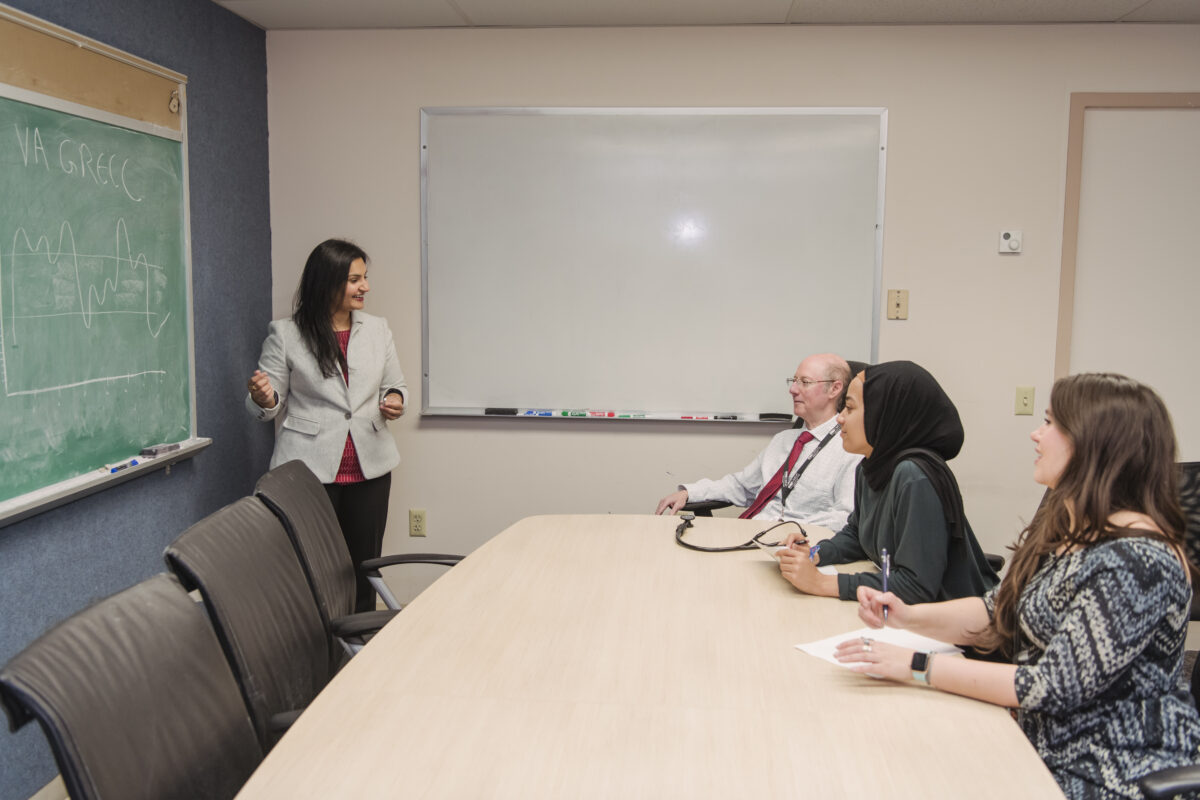 (l-r): Khambaty, Les Katzel, Sumaiya DeLane, and Ashley Splain. (Marlayna Demond ’11/UMBC)
Khambaty, the principal investigator in the CGM study funded by a National Institute of Aging grant, researches the psychosocial and neurocognitive factors that influence the diabetes process across the lifespan of middle-aged and older adults. “This research introduces a cost-effective, user-friendly CGM technology as a novel, sensitive, digital biomarker for the early detection of cognitive dysfunction and stratification of Alzheimer’s disease risk, ultimately, helping older adults preserve cognitive function into later life,” says Khambaty.
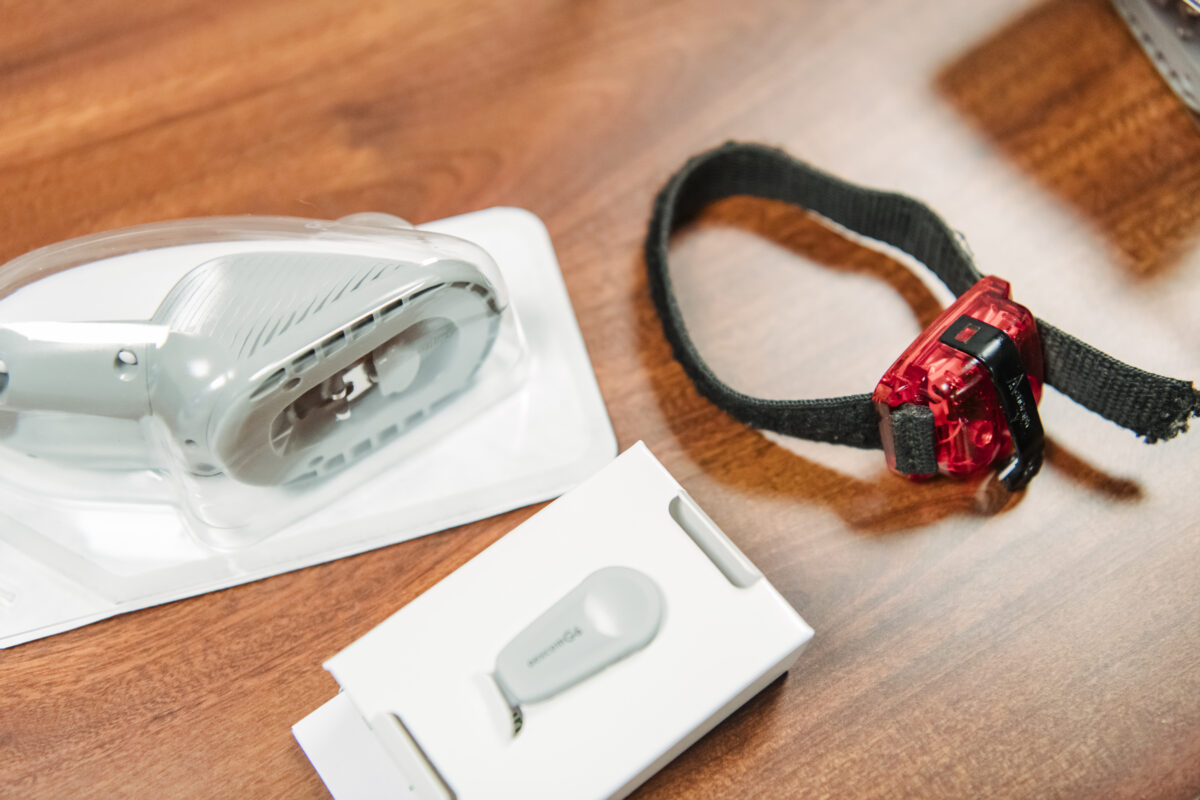 Dexcom glucose monitoring system. (Marlayna Demond ’11/UMBC)
Preventing type 2 diabetes
People with Type 1 diabetes cannot produce insulin at all. Type 2 diabetes happens when the body cannot utilize insulin efficiently, and this is the most prevalent type of diabetes, notes Khambaty. “It is linked to cognitive dysfunction in episodic memory and executive functions, and an increased risk for Alzheimer’s disease. “Type 2 diabetes is curable,” she says. “If we focus on prevention, we won’t need a cure.”
A barrier to prevention is reliable, diagnostic, digital CGM tools for the early detection of cognitive dysfunction and Alzheimer’s disease for people at risk of type 2 diabetes. CGM, which gives a precise assessment of fluctuating blood sugar levels, has historically been limited to people who already have diabetes. “Further research is needed to determine the role of glucose fluctuations in the prediabetic stage,” says Khambaty. This requires collaborators.
Splain and DeLane have been involved in the study from the start, gaining valuable experience alongside an interdisciplinary team of experts in behavioral medicine, endocrinology, geriatrics, and neuropsychology. This includes UMBC’s Shari Waldstein, a professor of psychology who focuses on cardiovascular behavioral medicine and medical neuropsychology, and various physicians and nurses, including Les Katzel a physician of geriatric medicine at the University of Maryland Claude D. Pepper Older Americans Independence Center (UM-OAIC) and the Geriatric Research Education and Clinical Center (GRECC) within the Baltimore Veterans Affairs Medical Center (VAMC).
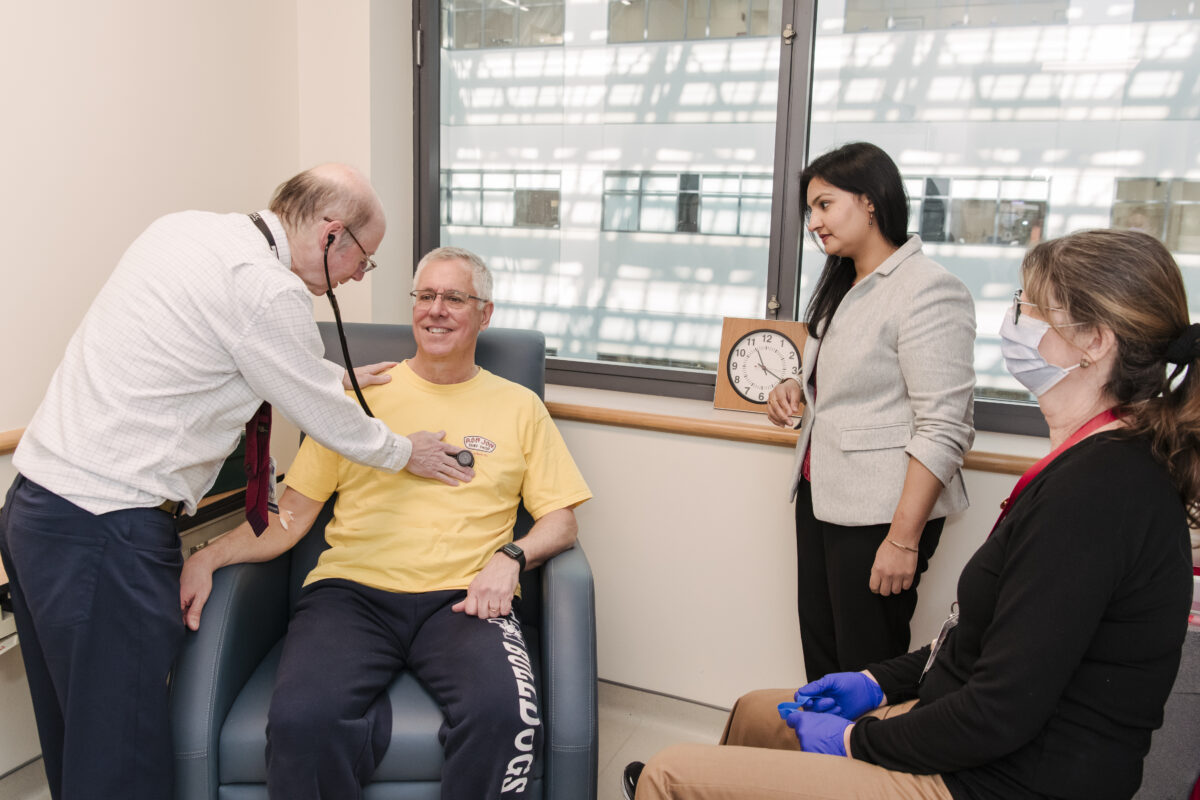 (l-r): The research team models patient care for the students at the GRECC. (Marlayna Demond ’11/UMBC)
A key benefit of being part of an interdisciplinary team is gaining firsthand experience with the infrastructure and technology essential for this level of research. UM-OAIC and the Baltimore VAMC GRECC provide the infrastructure for the research—human subjects oversight, the study’s safety monitoring, study location, nursing support, blood management, and sample storage. The technology partner, Dexcom, develops, manufactures, produces, and distributes CGM systems for diabetes management. Doctoral students witness in real-time the relationships necessary for driving innovation in this field.
Doctoral research with a global impact
Before participants visit the study nurse at the Baltimore VAMC GRECC to have the Dexcom monitor inserted, they first meet with Splain and DeLane. The pair oversees the entire process, from initial contact to final payment for participation. This includes confirming eligibility, liaising with the nurse practitioners who conduct a physical exam and blood draw, explaining how to use the Dexcom glucose monitoring device and actigraphy band, and conducting neurocognitive assessments to evaluate the participants’ learning, memory, and attention.
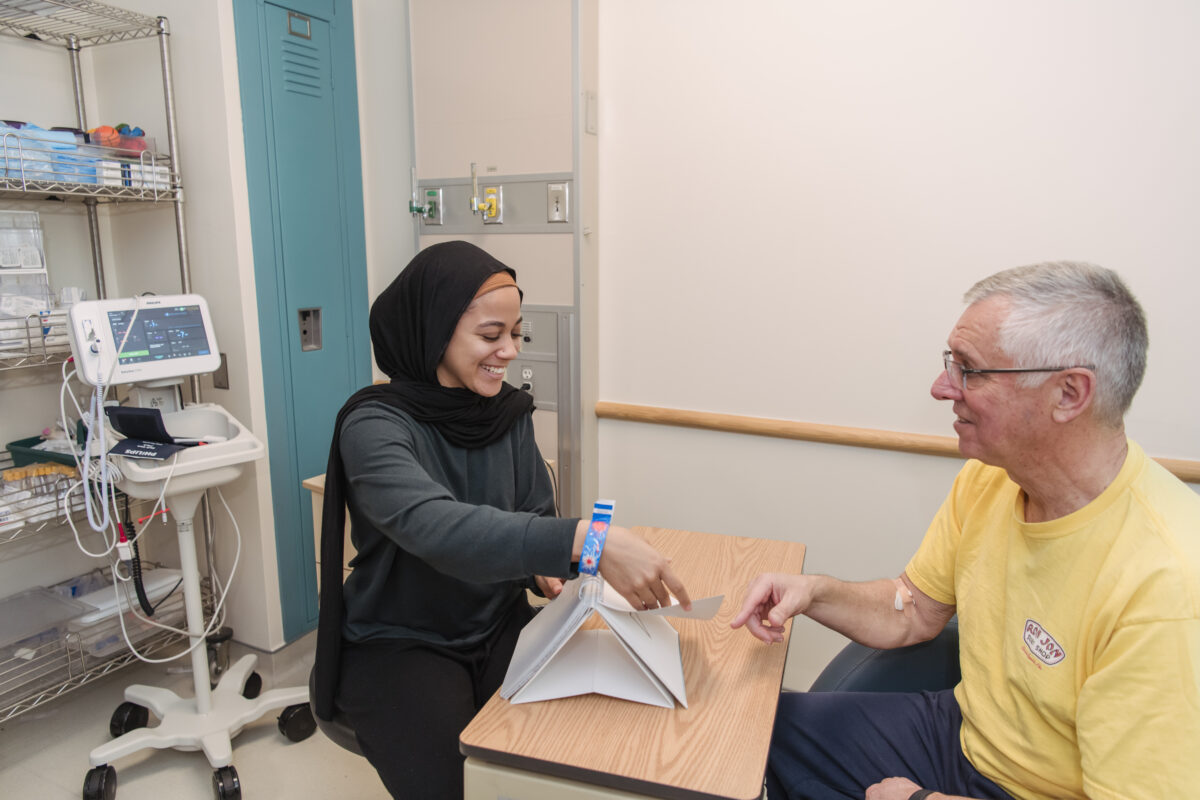
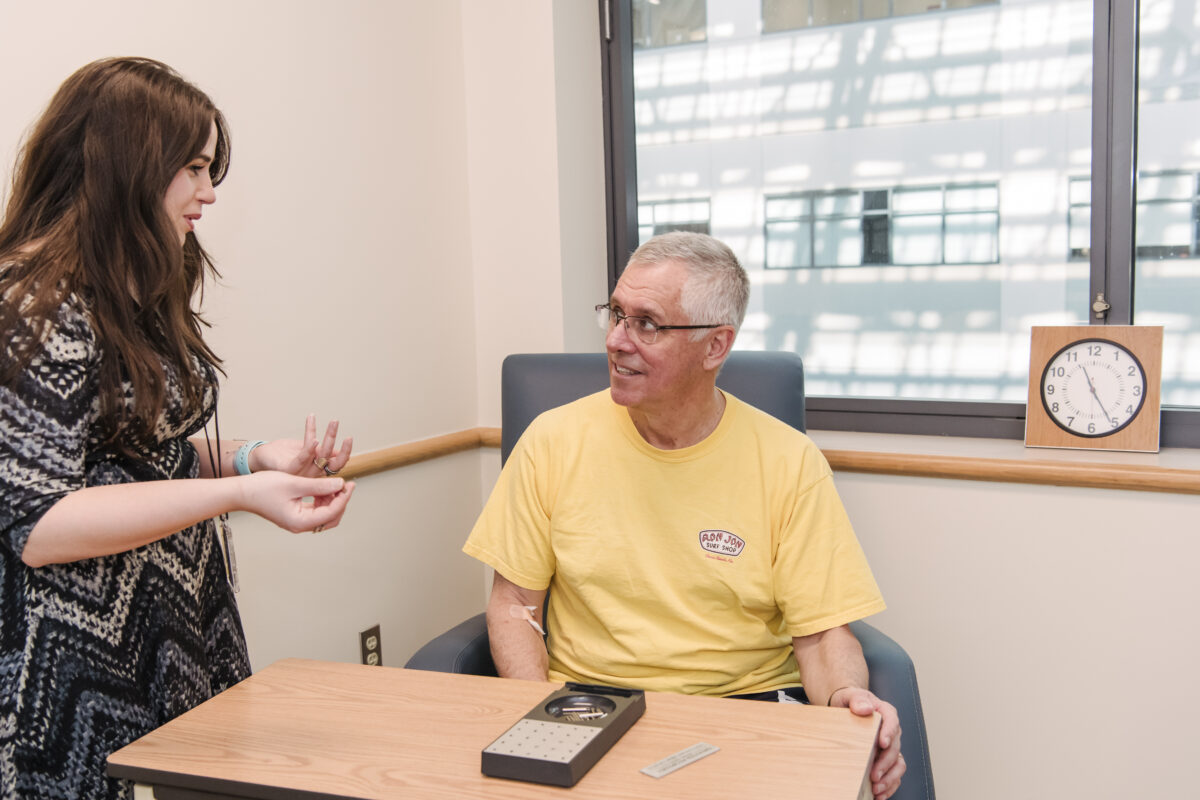 (l-r): DeLane and Splain practice administering cognitive assessments. (Marlayna Demond ’11/UMBC)
“A lot of our participants have been interested in the study because they have a family history of diabetes and have seen how devastating it can be if left untreated,” says Splain. Her interests in the intersection of cardiometabolic diseases—such as diabetes, heart disease, and hypertension—and the impact of psychological factors like depression and anxiety on their development made her an excellent fit for Khambaty’s lab. “Because of that history, they are willing to give their time so that we can advance how we treat this debilitating condition,” Splain continues.
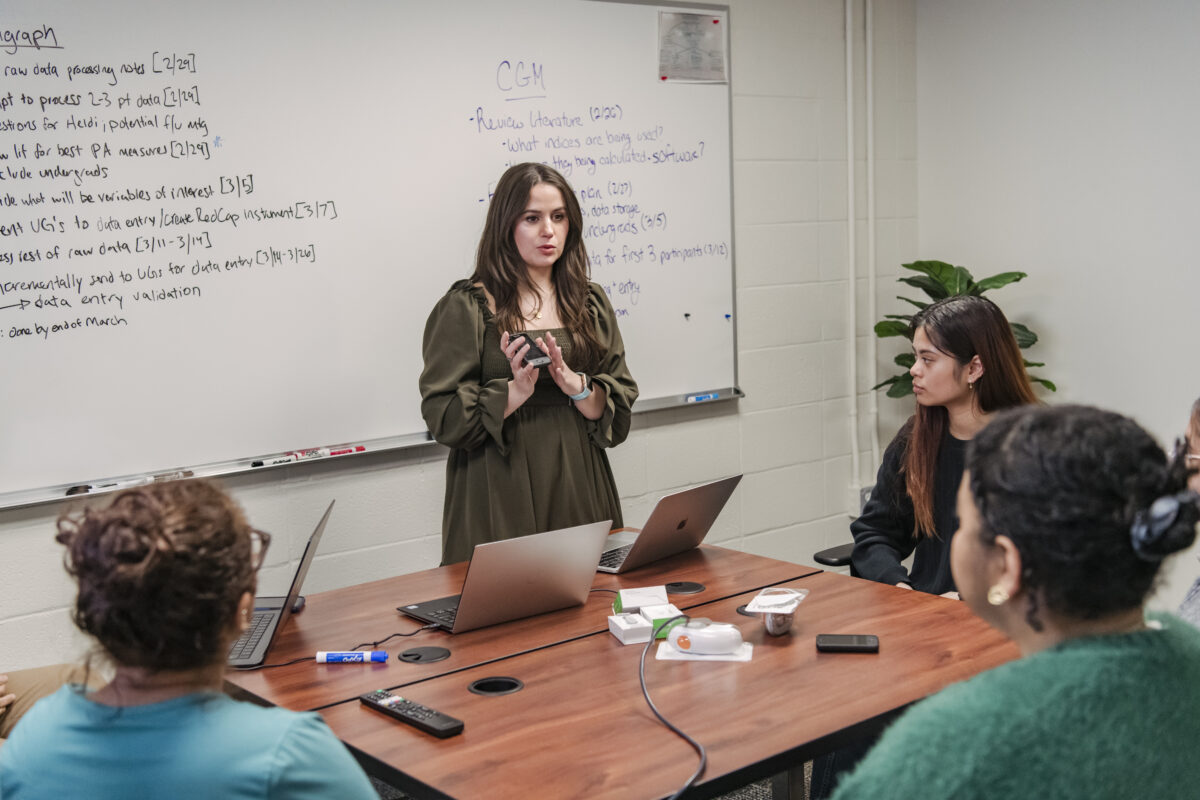 Splain explains how the monitor gathers information for undergraduate psychology students. (Marlayna Demond ’11/UMBC)
Eight days later, when the monitor is removed, the study coordinators conduct a final review with participants asking about their social networks, mood, and symptoms of depression as well as their sleep and physical activity levels. Meanwhile, back at the UMBC lab, Khambaty, Splain, and DeLane lead undergraduate students in entering, processing, and analyzing the data. The doctoral students dive deeply into the data sets and participant feedback and plan the next phase of their research.
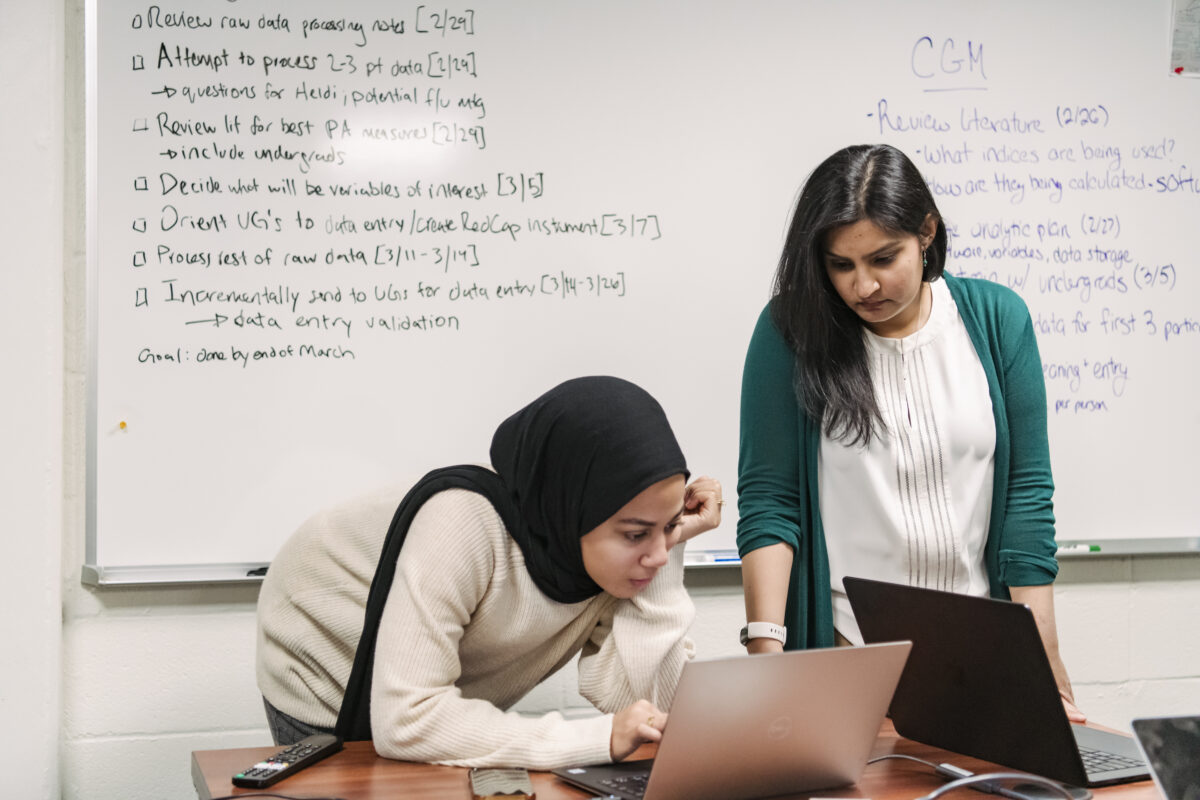 DeLane and Khambaty review the latest CGM data. (Marlayna Demond ’11/UMBC)
“Clinic psychology programs require a lot of mental shifting because we’re doing not only research but we’re also doing the clinical piece,” says Splain. “Connecting with participants, hearing their stories, and knowing that our research can hopefully move the field forward keeps us going.”
Welcoming more student researchers
Khambaty is determined to inspire more students in this field. Currently, there are six undergraduates and three graduate students in the lab. Khambaty also shares her research with undergraduate students in her upper-level seminar, Health Promotion and Disease Prevention. “Students are excited to learn about how multidisciplinary perspectives from medicine, public health, epidemiology, and psychology are needed to understand the challenges and opportunities for chronic disease prevention in the U.S.,” says Khambaty.
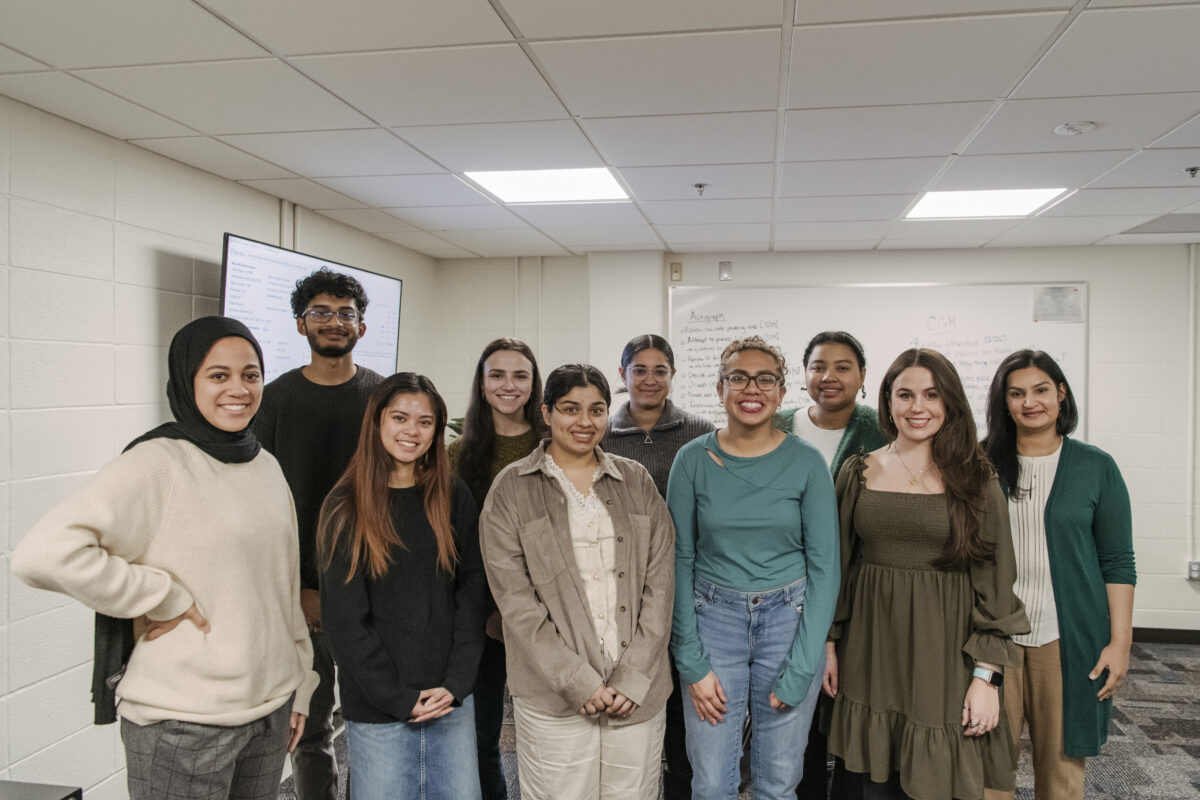 The CACHE Lab graduate and undergraduate team. (Marlayna Demond ’11/UMBC)
Now working on her dissertation, DeLane reflects on the impact of the research she’s contributed to. The study is in its second year of funding.“I find it very exciting. I’ve been amazed at how when participants first join our study, they begin to connect the dots between their blood sugar levels and their brain health later in life. It empowers them with a sense of ‘I can do something. I can take control,’” she says. Currently, her research focuses on how psychophysiological factors, such as heart rate variability, can enhance our understanding of the link between anxiety symptoms and glucose regulation, particularly in relation to social support and resilience. Over the next year, she plans to apply for internships in pediatric neuropsychology where she can further investigate how early life experiences interact with these factors to shape cognitive health in children.
The World Health Organization reports that there is a globally agreed target to halt the rise in diabetes and obesity by 2025. Its latest reports show that about 422 million people worldwide have diabetes, the majority living in low-middle-income countries, and 1.5 million deaths are directly attributed to diabetes each year. “The fact that we are looking at people with prediabetes rather than a confirmed diagnosis empowers people to make small changes in their lifestyle,” says DeLane. “To be able to share that, and from existing research I’m familiar with, to give them a little bit of advice, it makes me feel like I’m making a bit of a difference.”
Learn more about UMBC’s psychology programs, including the behavioral medicine track.
Register for PSYC 475 – Health Promotion and Disease Prevention.
]]>
On the fourth floor of UMBC’s math/psychology building, Tasneem Khambaty, associate professor of clinical psychology and behavioral medicine, meets with doctoral students Ashley Splain and Sumaiya...
https://umbc.edu/stories/tasneem-khambaty-mentors-doctoral-students-on-the-prevention-of-type-2-diabetes/
https://my3.my.umbc.edu/api/v0/pixel/news/145775/guest@my.umbc.edu/1773bb4ff360fbb72f4ac3f4df9dbc36/api/pixel
cahss
cahss-research
news
psychology
research
science-and-tech
story
UMBC News & Magazine
https://my3.my.umbc.edu/groups/umbc-news-magazine
https://assets1-my.umbc.edu/system/shared/avatars/groups/000/001/943/24435aa6207c452e7bc15cc74b42c7bb/xsmall.png?1748556657
https://assets1-my.umbc.edu/system/shared/avatars/groups/000/001/943/24435aa6207c452e7bc15cc74b42c7bb/original.png?1748556657
https://assets2-my.umbc.edu/system/shared/avatars/groups/000/001/943/24435aa6207c452e7bc15cc74b42c7bb/xxlarge.png?1748556657
https://assets2-my.umbc.edu/system/shared/avatars/groups/000/001/943/24435aa6207c452e7bc15cc74b42c7bb/xlarge.png?1748556657
https://assets3-my.umbc.edu/system/shared/avatars/groups/000/001/943/24435aa6207c452e7bc15cc74b42c7bb/large.png?1748556657
https://assets1-my.umbc.edu/system/shared/avatars/groups/000/001/943/24435aa6207c452e7bc15cc74b42c7bb/medium.png?1748556657
https://assets2-my.umbc.edu/system/shared/avatars/groups/000/001/943/24435aa6207c452e7bc15cc74b42c7bb/small.png?1748556657
https://assets1-my.umbc.edu/system/shared/avatars/groups/000/001/943/24435aa6207c452e7bc15cc74b42c7bb/xsmall.png?1748556657
https://assets2-my.umbc.edu/system/shared/avatars/groups/000/001/943/24435aa6207c452e7bc15cc74b42c7bb/xxsmall.png?1748556657
UMBC News & Magazine
0
0
false
Wed, 20 Nov 2024 12:08:44 -0500
Wed, 20 Nov 2024 12:08:44 -0500
Meet a Retriever—Matthew Levy ’00, M.S. ’08, emergency response professional

Meet Matthew J. Levy ’00, M.S. ’08, emergency and disaster health services (EDHS), who has dedicated his career to Maryland communities. His expertise, as a physician of emergency medicine and former paramedic, has made him indispensable in the most challenging national, state, and local emergencies. Matthew was part of an emergency response team that spent 10 days in New York City, assisting in the relief efforts following 9/11. In 2015, he received the Silver Medal of Valor from Howard County Fire and Rescue Services for his role as the second tactical medic to arrive on the scene at the Columbia Mall shooting in January 2014 then transitioned to being the on-scene medical director. In 2017, he was named Emergency Medical Services Physician of the Year by the Maryland Chapter of the American College of Emergency Physicians. Take it away, Matt!
Q: Briefly introduce yourself. What’s one essential thing you’d want another Retriever to know about you?
A: I began my studies at UMBC in 1996, enrolling in the Emergency and Disaster Health Services (EDHS) program. I earned my bachelor’s degree in 2000 and my master’s in 2008 while finishing my residency training as an emergency physician at Johns Hopkins University School of Medicine. I now serve as EDHS’s medical director for the paramedic program, the very department that helped me become the clinician and leader I am today. I am also an associate professor in the Department of Emergency Medicine at Johns Hopkins University School of Medicine.
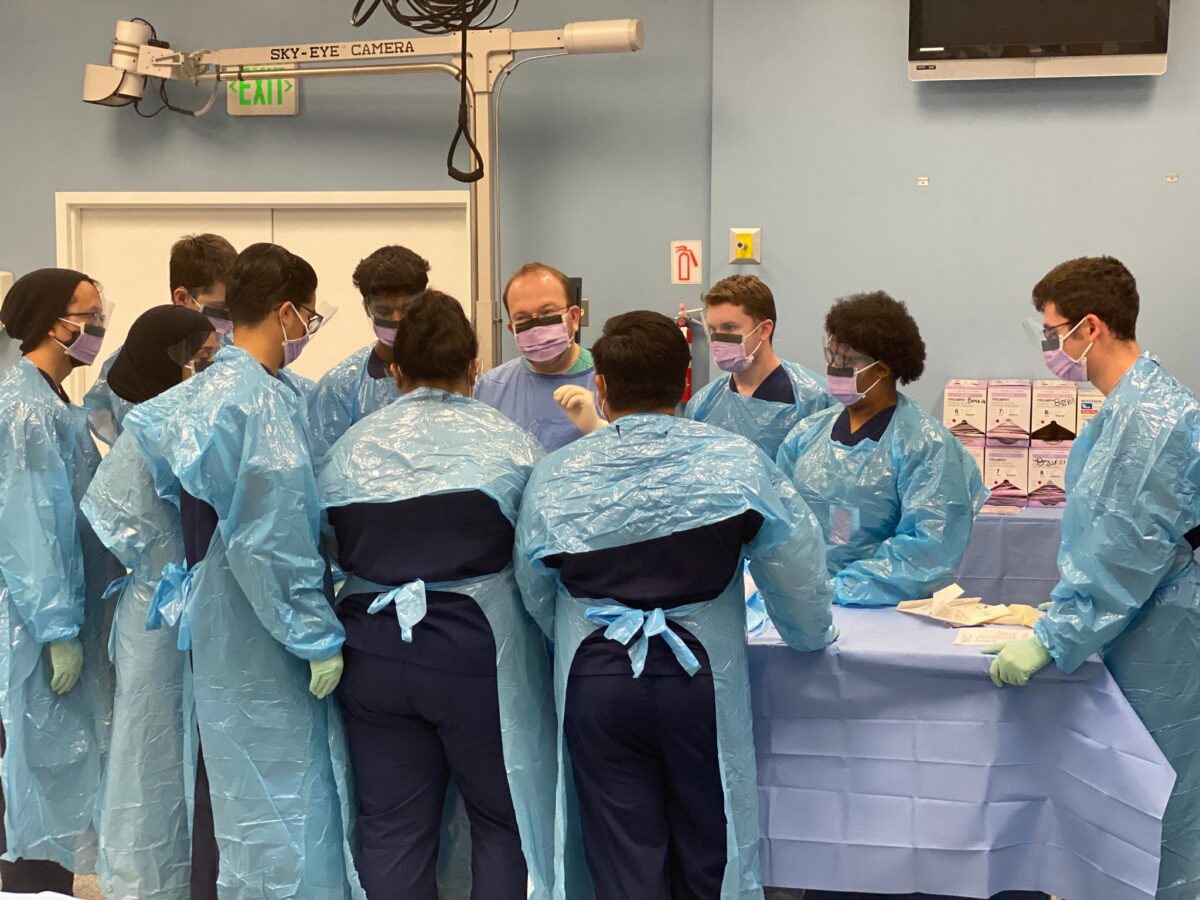 Matthew J. Levy, center, in the lab with students. (Image courtesy of Levy)
Q: What are some of the ways you have brought leading-edge practices to Howard County?
A: In 2016, I was part of the team that launched one of the nation’s first county-wide Stop the Bleed programs in Howard County. This is a national initiative designed to foster resilience and improve patient outcomes by empowering everyday people to recognize and treat life-threatening hemorrhages, which are the leading cause of preventable death in trauma patients. In 2023, I led the implementation of the Whole Blood Program in Howard County, which improves outcomes for critically ill and injured patients suffering from shock by implementing Maryland’s first ground-based EMS blood transfusion program. This program brings life-saving whole blood to the scene of the most critical patients to help give them precious time to get to the hospital for further stabilization.
Q: Tell us about someone in the community who has inspired or supported you, and how they did it.
A: I feel incredibly fortunate to have met so many people at UMBC who have shaped my life and career—from faculty and friends to colleagues and coworkers, specifically, I’d say Dwight Polk, Bill Hathaway, Dr. Rick Bissell, Dr. Jeff Mitchell, Dr. Bruce Walz (all from EDHS), and Dr. Joel Liebman (chemistry). However, the most impactful person has been Dr. J. Lee Jenkins, my wife, whom I met while we were both EDHS undergraduates. We dated through medical school and were married when I was in residency. She is also a physician and a faculty member in the Department of Emergency Medicine at Johns Hopkins University School of Medicine.
I genuinely love taking care of people and helping them. Whether that’s one-on-one as their doctor (or previously as their paramedic) or now as someone responsible for entire EMS systems, the path I’ve chosen…has allowed me to…improve outcomes from emergency medical situations.
Matthew J. Levy ’00, M.S. ’08
EDHS
Q: What is the one thing you’d want a potential student to know about the support you can find at UMBC?
A: At UMBC, we take pride in striving for excellence in everything we do. Being part of the UMBC community means contributing to something greater than oneself. Through leadership, service, teaching, and research, UMBC is making a positive impact on the world. My UMBC education provided an exceptionally strong basis in the sciences, combined with amazing training in leadership, project management, research, and teaching skills. All of these have helped me to achieve success in my career.
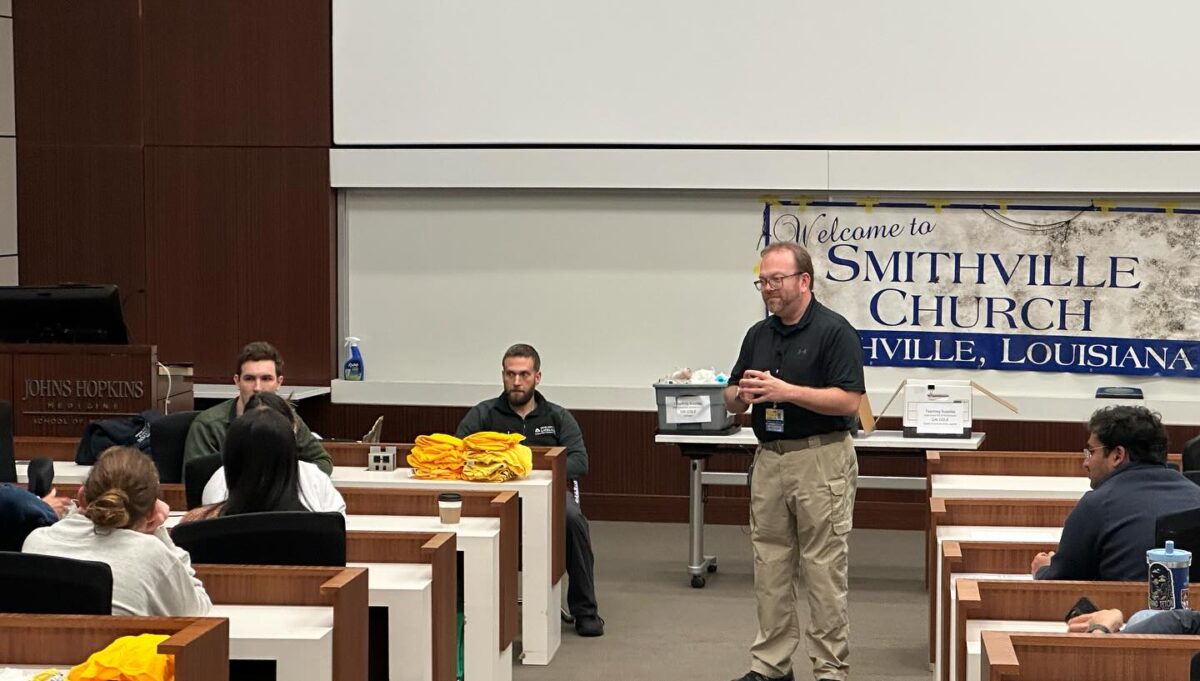 Levy teaching an EMS class. (Image courtesy of Levy)
Q: Tell us about what you love about your academic program.
A: That’s easy… it’s the people of the EDHS department. This department is one of UMBC’s best-kept secrets. It has produced EMS leaders, clinicians, educators, scientists, and practitioners who have played a pivotal role in pioneering, innovating, and redefining the delivery of prehospital care both locally and nationally.
Q: Why did you choose emergency medicine as a career path? What do you enjoy most about it that has kept you working in this field?
A: This passion has led me to many opportunities. In addition to my work at UMBC and Johns Hopkins, I am also the medical director of Howard County Fire and Rescue, the regional medical director for the Maryland Institute for Emergency Medical Services Systems, the tactical physician with the Maryland State Police and Howard County Police, and the founding commander of the Maryland-1 Disaster Medical Assistance Team.
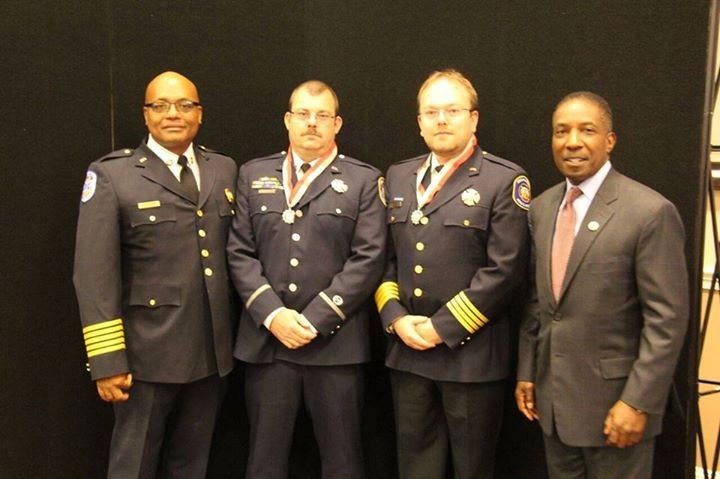 2015 Howard County Medal of Valor recipients. (l-r): John Butler, former fire chief for Howard County, Will Huber, lieutenant at Howard County Government, Levy, and Lonnie Robbins, former chief administrative officer at Howard County Government. (Image by Maryland Institute for Emergency Medical Services Systems)
Q: What advice do you wish you had received as an undergraduate EDHS student, particularly given the rapid changes in healthcare over the past few years?
A: Healthcare isn’t an easy path, but it’s one of the most noble professions and promises a rewarding career. However the journey will be long, so always believe in yourself, and always be your biggest fan and supporter. Surround yourself with the people you aspire to be like and always strive to improve yourself. This is your life to live so be sure to take the time to enjoy the journey along the way. But, don’t enjoy it too much…hard work does pay off! You’ll look back one day, maybe, 10,15, or 20 years or more later, and realize how far you’ve come.
* * * * *
UMBC’s greatest strength is its people. When people meet Retrievers and hear about the passion they bring, the relationships they create, the ways they support each other, and the commitment they have to inclusive excellence, they truly get a sense of our community. That’s what “Meet a Retriever” is all about.
Learn more about how UMBC can help you achieve your goals.
]]>
Meet Matthew J. Levy ’00, M.S. ’08, emergency and disaster health services (EDHS), who has dedicated his career to Maryland communities. His expertise, as a physician of emergency medicine and...
https://umbc.edu/stories/matthew-j-levy-umbc-edhs-outstanding-alum/
https://my3.my.umbc.edu/api/v0/pixel/news/145810/guest@my.umbc.edu/614b684326065eb62af62ef2911659ca/api/pixel
cahss
edhs
impact
magazine
meet-a-retriever
story
UMBC News & Magazine
https://my3.my.umbc.edu/groups/umbc-news-magazine
https://assets1-my.umbc.edu/system/shared/avatars/groups/000/001/943/24435aa6207c452e7bc15cc74b42c7bb/xsmall.png?1748556657
https://assets1-my.umbc.edu/system/shared/avatars/groups/000/001/943/24435aa6207c452e7bc15cc74b42c7bb/original.png?1748556657
https://assets2-my.umbc.edu/system/shared/avatars/groups/000/001/943/24435aa6207c452e7bc15cc74b42c7bb/xxlarge.png?1748556657
https://assets2-my.umbc.edu/system/shared/avatars/groups/000/001/943/24435aa6207c452e7bc15cc74b42c7bb/xlarge.png?1748556657
https://assets3-my.umbc.edu/system/shared/avatars/groups/000/001/943/24435aa6207c452e7bc15cc74b42c7bb/large.png?1748556657
https://assets1-my.umbc.edu/system/shared/avatars/groups/000/001/943/24435aa6207c452e7bc15cc74b42c7bb/medium.png?1748556657
https://assets2-my.umbc.edu/system/shared/avatars/groups/000/001/943/24435aa6207c452e7bc15cc74b42c7bb/small.png?1748556657
https://assets1-my.umbc.edu/system/shared/avatars/groups/000/001/943/24435aa6207c452e7bc15cc74b42c7bb/xsmall.png?1748556657
https://assets2-my.umbc.edu/system/shared/avatars/groups/000/001/943/24435aa6207c452e7bc15cc74b42c7bb/xxsmall.png?1748556657
UMBC News & Magazine
0
0
false
Tue, 19 Nov 2024 11:16:04 -0500
Meet a Retriever—David M. Williams, M.S. ’02, author and scholar-practitioner of the “Science of Improvement”

Meet David M. Williams, M.S. ’02, emergency health services (EHS) management, a scholar-practitioner of the “Science of Improvement,” and a co-author of Quality as an Organizational Strategy: Building a System of Improvement. With 25 years of experience in quality improvement, he has worked with leaders and teams worldwide to develop people’s abilities to make rigorous, results-driven improvements and adopt quality as an organizational strategy. Take it away, David!
Q: What’s one essential thing you’d want another Retriever to know about you?
A: I advise leaders worldwide to use the science of improvement to improve processes, products, and services. My experience in organizational systems began when I was a paramedic and got my master’s in EHS management at UMBC. My education led to me becoming an ambulance system expert and an internationally respected improvement advisor. I have a Ph.D. in organizational systems from Saybrook University.
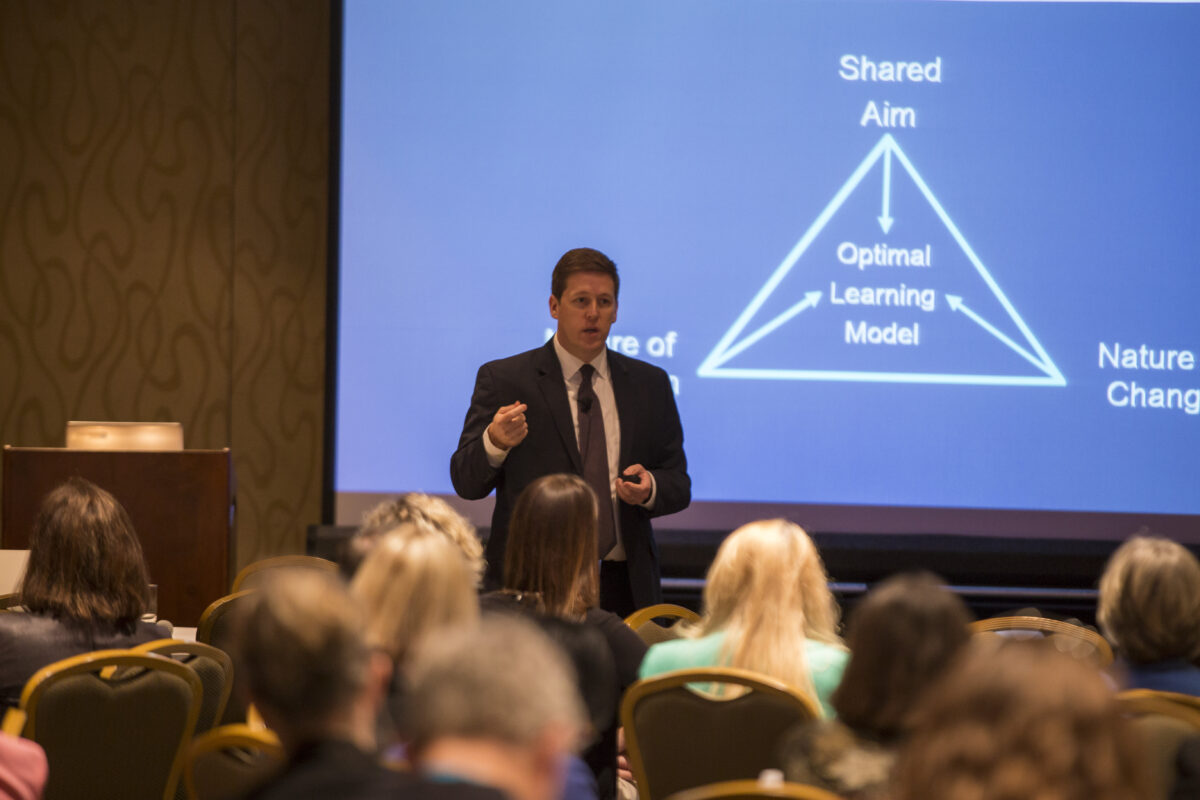 David M. Williams speaking at the Institute for Healthcare Improvement’s National Forum on Quality Improvement in Health Care.
Q: What brought you to UMBC?
A: After I earned a B.S. in emergency medical services management from Springfield College, I was looking for a graduate program that would allow me to study from my home in Austin, Texas, while I worked full-time as a paramedic. I decided on UMBC because it had a unique virtual graduate program in EHS management that met all my criteria.
Q: What do you love about your academic program?
A: As a student in the UMBC EHS program, I was introduced to literature and best practices that helped my professional development early in my career. The faculty comprised industry leaders, and their support and networks in the field helped me build my knowledge and skills. I credit my graduate work at UMBC as positioning me for career success.
I like seeing how UMBC has evolved. I first visited the campus in 1992, and it's amazing to see how it has grown.
David M. Williams, M.S. ’02, EHS management
Scholar-practitioner of the Science of Improvement
Q: What’s the one thing you’d want someone to know about the support you find at UMBC?
A: I was a remote student in the early days of online degree programs. UMBC worked hard to create a robust academic learning experience. The faculty have served as lifelong mentors, and my peers made a community of learners nationwide and internationally.
Q: Who in the UMBC community has inspired you or supported you?
A: EHS adjunct faculty Mike Taigman has been a mentor and supporter since we first met in his class in the late ’90s. He was an expert paramedic and consultant. He encouraged me to publish my first paper and introduced me to the editor of an industry publication. He sponsored me to speak at my first national conference. He wrote a recommendation in support of my first leadership role as the chief quality officer of Austin EMS. He introduced me to healthcare improvement, which has been my career for more than 15 years. His mentorship and support have been a constant contribution to my career success. We still talk each week.
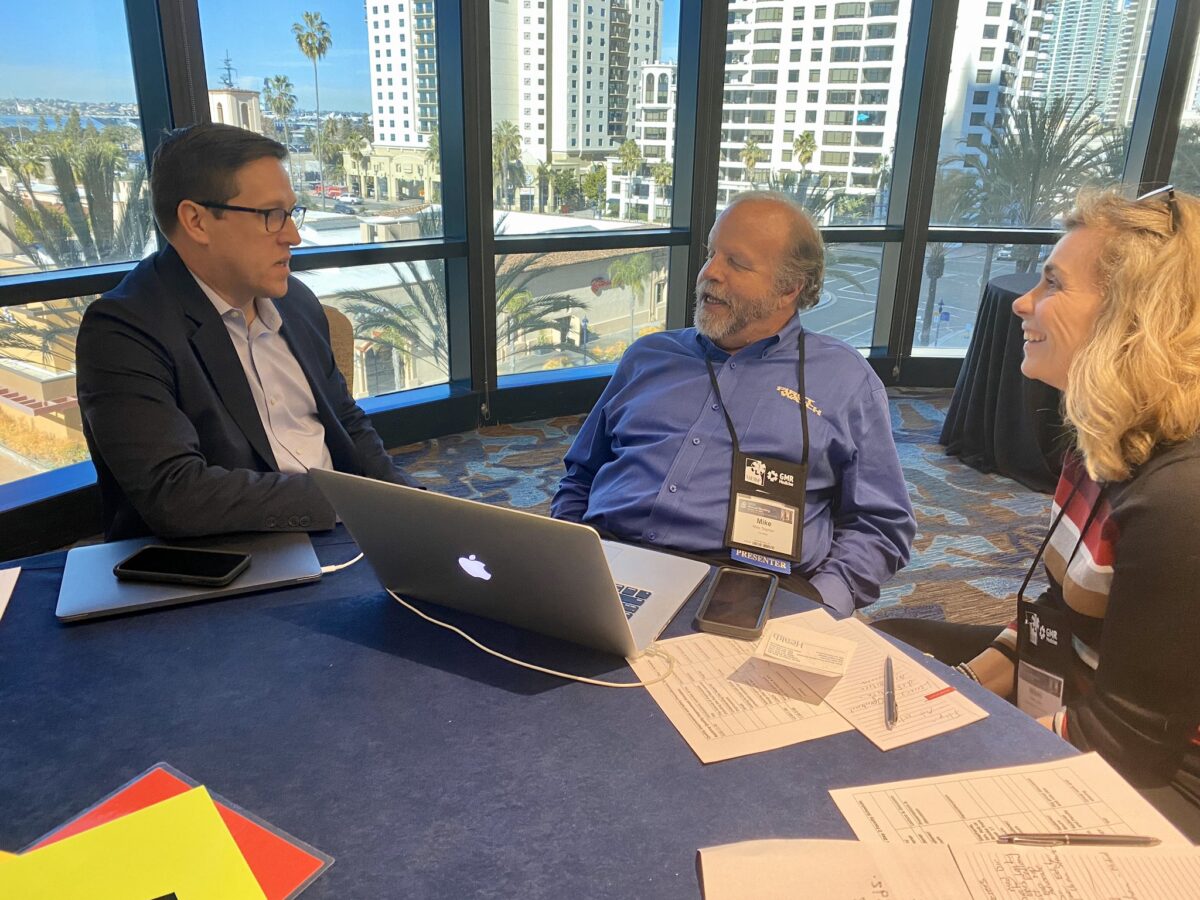
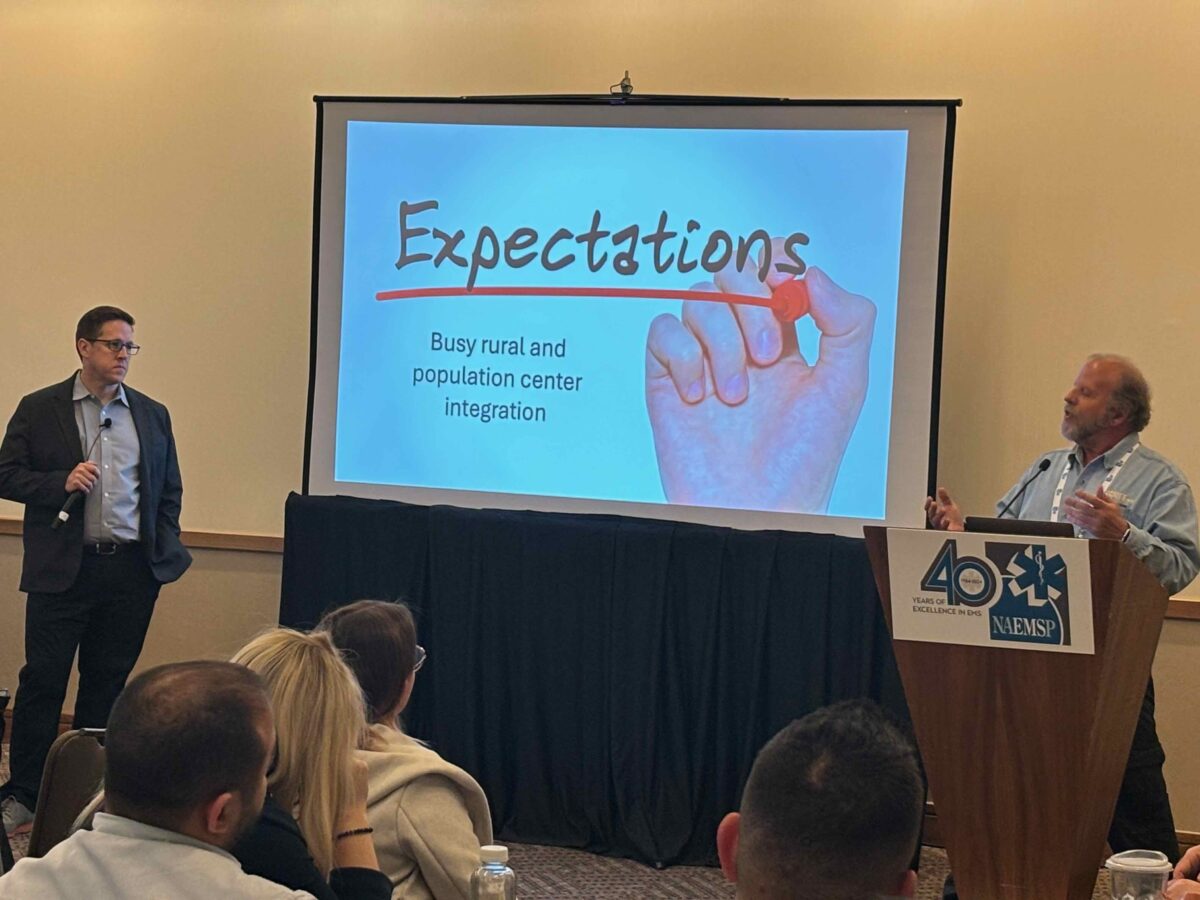
Images above: David Williams and Mike Taigman, UMBC EHS faculty, at the National Association of EMS Physicians (NAEMSP) Annual Meeting.
Q: Tell us about your current job. What do you like most about it?
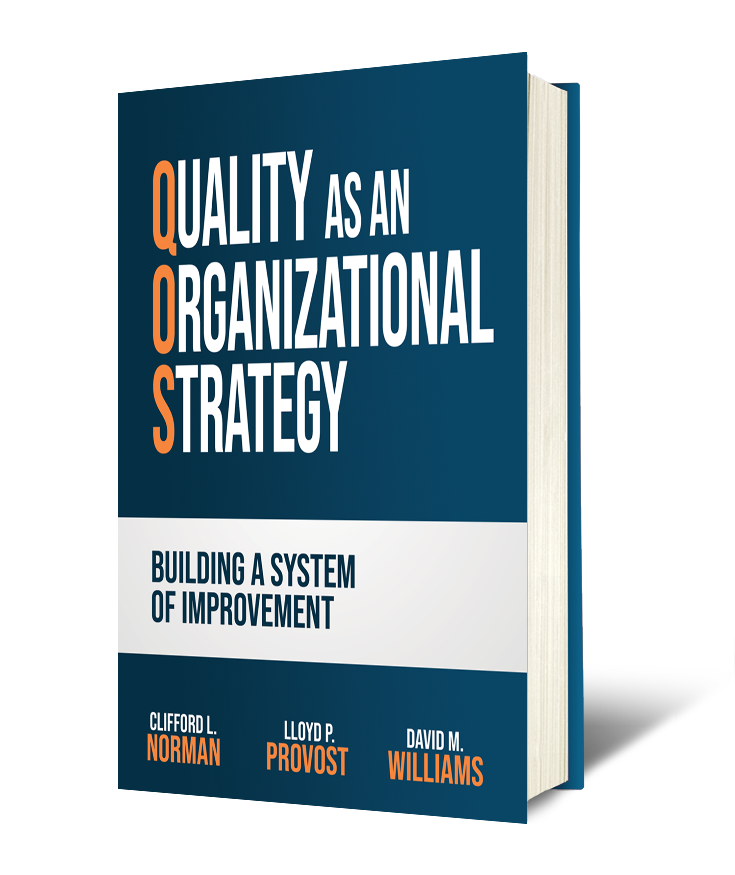
A: I am a self-employed advisor, teacher, and author—an internationally respected scholar-practitioner of the Science of Improvement. With 25 years of experience in quality improvement, I have worked with leaders and teams worldwide to develop people’s abilities to make rigorous, results-driven improvements and adopt quality as an organizational strategy. I also recently co-authored Quality as an Organizational Strategy: Building a System of Improvement. The book describes an approach to leading organizations based on W. Edwards Deming’s charge that leaders need a new theory of leadership and a strategy built on quality. The book defines quality as a strategy and describes a framework of five activities for leaders that can lead to both immediate results and long-term performance.
Image right: Quality as an Organizational Strategy: Building a System of Improvement
* * * * *
UMBC’s greatest strength is its people. When people meet Retrievers and hear about the passion they bring, the relationships they create, the ways they support each other, and the commitment they have to inclusive excellence, they truly get a sense of our community. That’s what “Meet a Retriever” is all about.
Learn more about how UMBC can help you achieve your goals.
]]>
Meet David M. Williams, M.S. ’02, emergency health services (EHS) management, a scholar-practitioner of the “Science of Improvement,” and a co-author of Quality as an Organizational Strategy:...
https://umbc.edu/stories/meet-david-williams-science-of-improvement/
https://my3.my.umbc.edu/api/v0/pixel/news/145619/guest@my.umbc.edu/2583d2071a9f433b3d97acaeed040344/api/pixel
alumni
ehs
emergency-health-services
magazine
meet-a-retriever
story
umbc-author
UMBC News & Magazine
https://my3.my.umbc.edu/groups/umbc-news-magazine
https://assets1-my.umbc.edu/system/shared/avatars/groups/000/001/943/24435aa6207c452e7bc15cc74b42c7bb/xsmall.png?1748556657
https://assets1-my.umbc.edu/system/shared/avatars/groups/000/001/943/24435aa6207c452e7bc15cc74b42c7bb/original.png?1748556657
https://assets2-my.umbc.edu/system/shared/avatars/groups/000/001/943/24435aa6207c452e7bc15cc74b42c7bb/xxlarge.png?1748556657
https://assets2-my.umbc.edu/system/shared/avatars/groups/000/001/943/24435aa6207c452e7bc15cc74b42c7bb/xlarge.png?1748556657
https://assets3-my.umbc.edu/system/shared/avatars/groups/000/001/943/24435aa6207c452e7bc15cc74b42c7bb/large.png?1748556657
https://assets1-my.umbc.edu/system/shared/avatars/groups/000/001/943/24435aa6207c452e7bc15cc74b42c7bb/medium.png?1748556657
https://assets2-my.umbc.edu/system/shared/avatars/groups/000/001/943/24435aa6207c452e7bc15cc74b42c7bb/small.png?1748556657
https://assets1-my.umbc.edu/system/shared/avatars/groups/000/001/943/24435aa6207c452e7bc15cc74b42c7bb/xsmall.png?1748556657
https://assets2-my.umbc.edu/system/shared/avatars/groups/000/001/943/24435aa6207c452e7bc15cc74b42c7bb/xxsmall.png?1748556657
UMBC News & Magazine
0
0
false
Wed, 13 Nov 2024 16:43:50 -0500
Wed, 13 Nov 2024 16:43:50 -0500
NASA awards AXIS X-ray telescope co-developed by UMBC faculty $5M for further study
Nearly a year ago, a group of engineers and scientists including UMBC physicists became one of 10 teams to successfully submit a proposal to NASA to develop the Advanced X-ray Imaging Satellite (AXIS). In October, the AXIS team learned that they were one of the final two instrument designs selected for further development. Over the next year, each of the two teams will receive $5 million to flesh out their plans as part of what NASA calls a “Phase A study.” Then NASA will review the proposals and select one of these two instruments for construction and testing, with plans to launch in the early 2030s.
Adi Foord, assistant professor of physics, and Eileen Meyer, associate professor of physics, serve on the AXIS leadership team, and during the proposal development phase, Foord co-led the sub-team focused on supermassive black hole evolution. The AXIS team is led overall by Chris Reynolds at the University of Maryland, College Park and deputy lead Erin Kara at MIT.
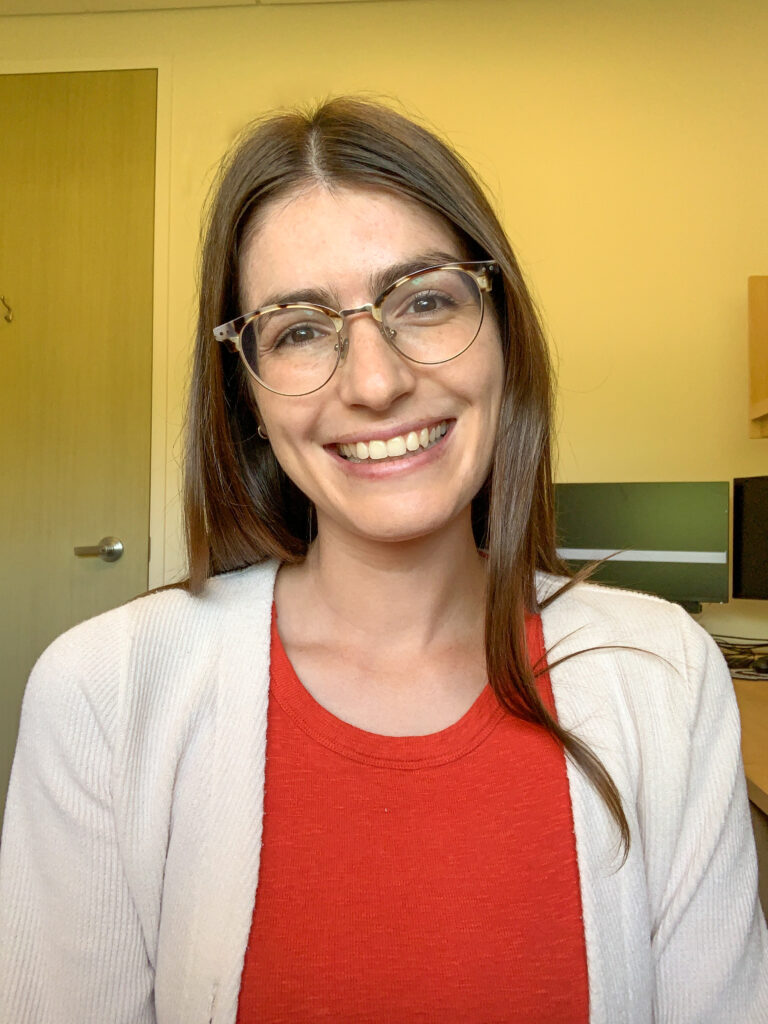 Adi Foord is on the AXIS leadership team. (courtesy of Foord)
X-rays come from extremely hot processes such as exploding stars or the accretion of black holes, so tracing them back to their source can paint a picture of galactic formation. As scientists search for life beyond Earth, X-rays could even offer clues about potentially habitable planets.
“We’re extremely excited that AXIS has been chosen for Phase A study! AXIS represents a huge leap forward in high-resolution and high-sensitivity imaging that will allow us to study the early universe and trace the growth of the earliest supermassive black holes,” Foord says. “It’s a unique opportunity to answer some of the most fundamental questions in astrophysics. With AXIS, we’ll have the sensitivity and resolution to detect faint X-ray signals from galaxies in the early universe, offering unprecedented insight into how supermassive black holes formed and evolved over cosmic time.”
A new kind of explorer
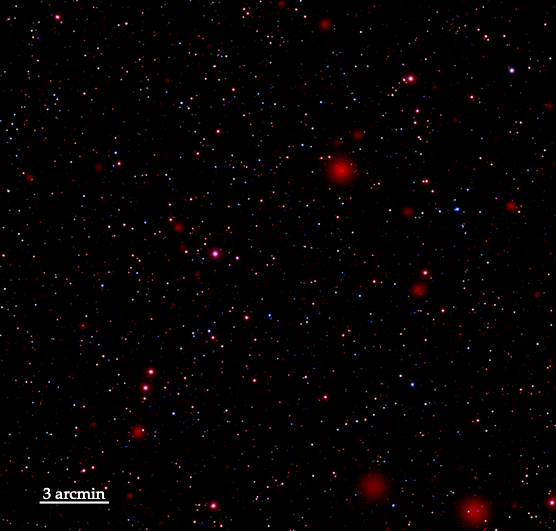 This simulated image shows how AXIS would see the sky. It shows a five million-second stare into space, and some of the earliest-detected supermassive black holes are visible. (Stefano Marchesi)
AXIS and the other satellite design selected for further study, PRIMA—also led by scientists in College Park—are competing to be the first in the new Probe Explorer class of NASA missions, which fit neatly between its flagship missions and smaller missions.
“Both of the selected concepts could enable ground-breaking science responsive to the top astrophysics priorities of the decade, develop key technologies for future flagship missions, and offer opportunities for the entire community to use the new observatory, for the benefit of all,” said Nicola Fox, associate administrator, Science Mission Directorate at NASA Headquarters.
“In observational astronomy we are now in the era of big and sensitive surveys of large portions of the sky,” Meyer adds. “AXIS is not only 10 times more sensitive than its predecessor, the Chandra X-ray Observatory, it also has the ability to make high-resolution images over a much larger sky area, or field of view. This is transformative for deep surveys, and AXIS will synergize with a lot of other missions and observatories operating in the 2030s.”
]]>
Nearly a year ago, a group of engineers and scientists including UMBC physicists became one of 10 teams to successfully submit a proposal to NASA to develop the Advanced X-ray Imaging Satellite...
https://umbc.edu/stories/axis-x-ray-telescope-selected-for-further-study/
https://my3.my.umbc.edu/api/v0/pixel/news/145570/guest@my.umbc.edu/9f2a2e66a5cdabc0db9f62a1b40a6726/api/pixel
cnms
nasa
news
physics
research
science-and-tech
story
UMBC News & Magazine
https://my3.my.umbc.edu/groups/umbc-news-magazine
https://assets1-my.umbc.edu/system/shared/avatars/groups/000/001/943/24435aa6207c452e7bc15cc74b42c7bb/xsmall.png?1748556657
https://assets1-my.umbc.edu/system/shared/avatars/groups/000/001/943/24435aa6207c452e7bc15cc74b42c7bb/original.png?1748556657
https://assets2-my.umbc.edu/system/shared/avatars/groups/000/001/943/24435aa6207c452e7bc15cc74b42c7bb/xxlarge.png?1748556657
https://assets2-my.umbc.edu/system/shared/avatars/groups/000/001/943/24435aa6207c452e7bc15cc74b42c7bb/xlarge.png?1748556657
https://assets3-my.umbc.edu/system/shared/avatars/groups/000/001/943/24435aa6207c452e7bc15cc74b42c7bb/large.png?1748556657
https://assets1-my.umbc.edu/system/shared/avatars/groups/000/001/943/24435aa6207c452e7bc15cc74b42c7bb/medium.png?1748556657
https://assets2-my.umbc.edu/system/shared/avatars/groups/000/001/943/24435aa6207c452e7bc15cc74b42c7bb/small.png?1748556657
https://assets1-my.umbc.edu/system/shared/avatars/groups/000/001/943/24435aa6207c452e7bc15cc74b42c7bb/xsmall.png?1748556657
https://assets2-my.umbc.edu/system/shared/avatars/groups/000/001/943/24435aa6207c452e7bc15cc74b42c7bb/xxsmall.png?1748556657
UMBC News & Magazine
0
0
false
Tue, 12 Nov 2024 13:45:26 -0500
Tue, 12 Nov 2024 13:45:26 -0500
Striving for more efficient and equitable healthcare: Ian Stockwell wins major NIH grant

Ian Stockwell ’03, information systems and financial economics, M.A. ’06, economic policy analysis, and Ph.D. ’14, public policy, has spent his 20-plus-year career analyzing healthcare operations. One major inefficiency he sees in the U.S. healthcare system is an overreliance on clinical medicine when other interventions, such as support accessing healthy food and safe housing, are also needed.
“We have a health system that under-invests on social needs,” Stockwell says. “It is failing a lot of people.”
Now an associate professor in information systems at UMBC, Stockwell recently launched a new project, supported by a five-year, $3.4 million grant from the National Institutes of Health, to address this shortcoming. He is partnering with a major Medicaid health plan to build a machine-learning-powered system to help identify patients with social needs—factors, such as food insecurity or financial stress—that impact an individual’s ability to maintain their health. The system will also help determine how best to connect these patients with social support systems on a long-term basis.
The system will use multiple individual- and community-level data sources to predict which members use the emergency department to fulfill social or non-urgent needs. It will also identify the hurdles that frequently prevent individuals from engaging with a community-based social needs organization.
The dream outcome, Stockwell says, is that the system provides robust support to healthcare providers for effectively engaging with people with social needs. “We could then take the infrastructure that we build and work to propagate it through the healthcare system. Ultimately, we want to use what we create to help people by shrinking disparities in health outcomes in this country.”
The study team brings together researchers from multiple departments and colleges at UMBC, including Tera Reynolds, James Foulds, and Osman Gani from the Department of Information Systems; Sameera Nayak from the Department of Sociology, Anthropology, and Public Health; Lucy Wilson from the Department of Emergency and Disaster Health Systems, and Joby Taylor, Ph.D. ’05, language, literacy, and culture, from the Shriver Center.
“As a career-long UMBCer, I’m excited that this project helps broaden the footprint of NIH funding at the university. It also pushes the boundaries of what an interdisciplinary collaboration can mean,” Stockwell says.
]]>
Ian Stockwell ’03, information systems and financial economics, M.A. ’06, economic policy analysis, and Ph.D. ’14, public policy, has spent his 20-plus-year career analyzing healthcare operations....
https://umbc.edu/stories/ian-stockwell-wins-major-nih-healthcare-grant/
https://my3.my.umbc.edu/api/v0/pixel/news/145567/guest@my.umbc.edu/e1ee130b6250f9959e2fa4444526d812/api/pixel
cahss
coeit
is
news
policy-and-society
research
science-and-tech
shriver-center
story
UMBC News & Magazine
https://my3.my.umbc.edu/groups/umbc-news-magazine
https://assets1-my.umbc.edu/system/shared/avatars/groups/000/001/943/24435aa6207c452e7bc15cc74b42c7bb/xsmall.png?1748556657
https://assets1-my.umbc.edu/system/shared/avatars/groups/000/001/943/24435aa6207c452e7bc15cc74b42c7bb/original.png?1748556657
https://assets2-my.umbc.edu/system/shared/avatars/groups/000/001/943/24435aa6207c452e7bc15cc74b42c7bb/xxlarge.png?1748556657
https://assets2-my.umbc.edu/system/shared/avatars/groups/000/001/943/24435aa6207c452e7bc15cc74b42c7bb/xlarge.png?1748556657
https://assets3-my.umbc.edu/system/shared/avatars/groups/000/001/943/24435aa6207c452e7bc15cc74b42c7bb/large.png?1748556657
https://assets1-my.umbc.edu/system/shared/avatars/groups/000/001/943/24435aa6207c452e7bc15cc74b42c7bb/medium.png?1748556657
https://assets2-my.umbc.edu/system/shared/avatars/groups/000/001/943/24435aa6207c452e7bc15cc74b42c7bb/small.png?1748556657
https://assets1-my.umbc.edu/system/shared/avatars/groups/000/001/943/24435aa6207c452e7bc15cc74b42c7bb/xsmall.png?1748556657
https://assets2-my.umbc.edu/system/shared/avatars/groups/000/001/943/24435aa6207c452e7bc15cc74b42c7bb/xxsmall.png?1748556657
UMBC News & Magazine
1
0
false
Tue, 12 Nov 2024 13:03:10 -0500
Tue, 12 Nov 2024 13:03:10 -0500
UMBC leads new program to build research security compliance support for mid-sized universities
UMBC is leading a new initiative, in partnership with several Historically Black Colleges and Universities (HBCUs) and minority-serving institutions (MSIs) in the region, that’s aiming to expand the research compliance capacity of mid-size (universities with 15,000 or less students) and smaller universities to better adhere to emerging federal research security policies.
To address the challenges associated with expanding research compliance capacity at institutions at these sizes, UMBC is partnering with the University of Maryland, Eastern Shore, Morgan State University, and Delaware State University to develop the Research Integrity, Security, and Compliance (RISC) program. RISC is supported through a five-year, $3.9 million grant from the National Science Foundation’s Growing Research Access for Nationally Transformative Equity and Diversity (GRANTED) program. The program’s goal is to address systemic barriers within the nation’s research enterprise by improving research support and service capacity.
Principal investigator (PI) Karl V. Steiner, vice president for research and creative achievement, and co-PI Christine Mallinson, assistant vice president for research and scholarly impact, will lead the multi-institutional RISC program.
“Mid-size institutions, along with MSIs and HCBUs, are expected to keep pace as new policies and guidance emerge, but they may not have the same ability or capacity to do so, compared to larger and more highly resourced research institutions,” explains Mallinson. “RISC will help us develop and then implement these evolving compliance structures and processes for smaller universities.”
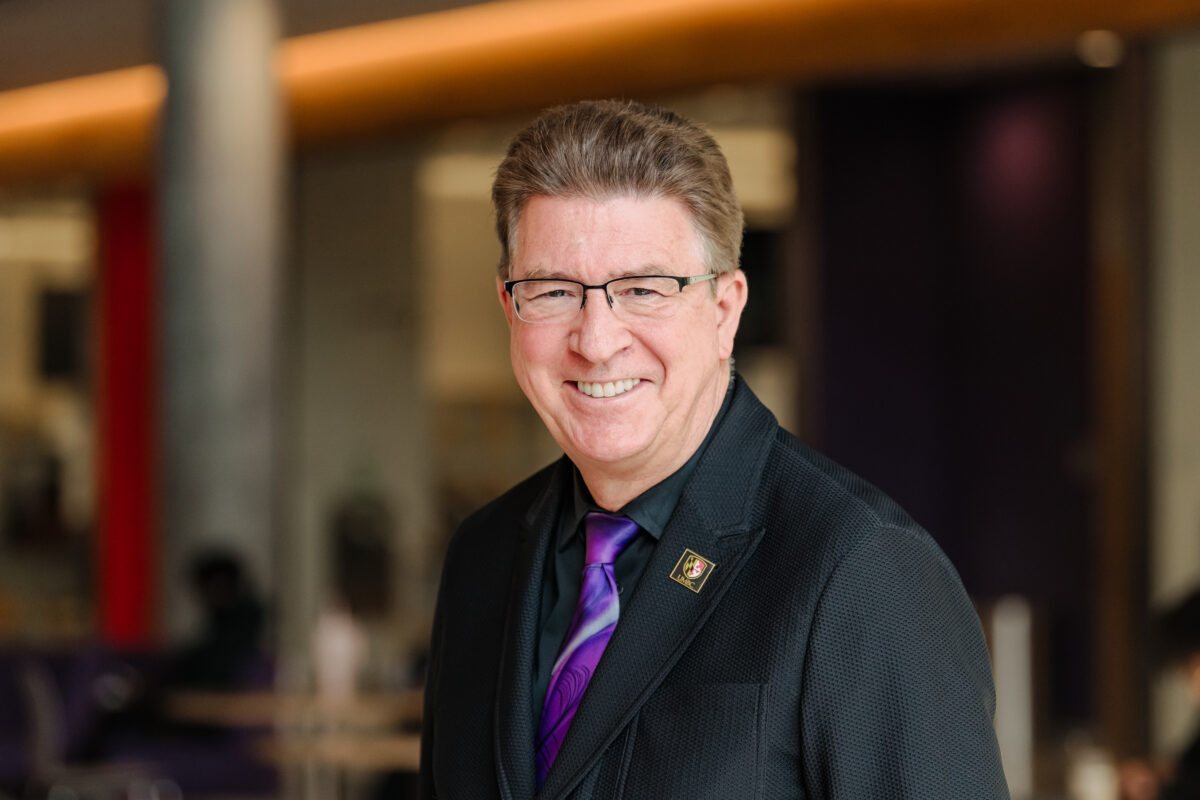
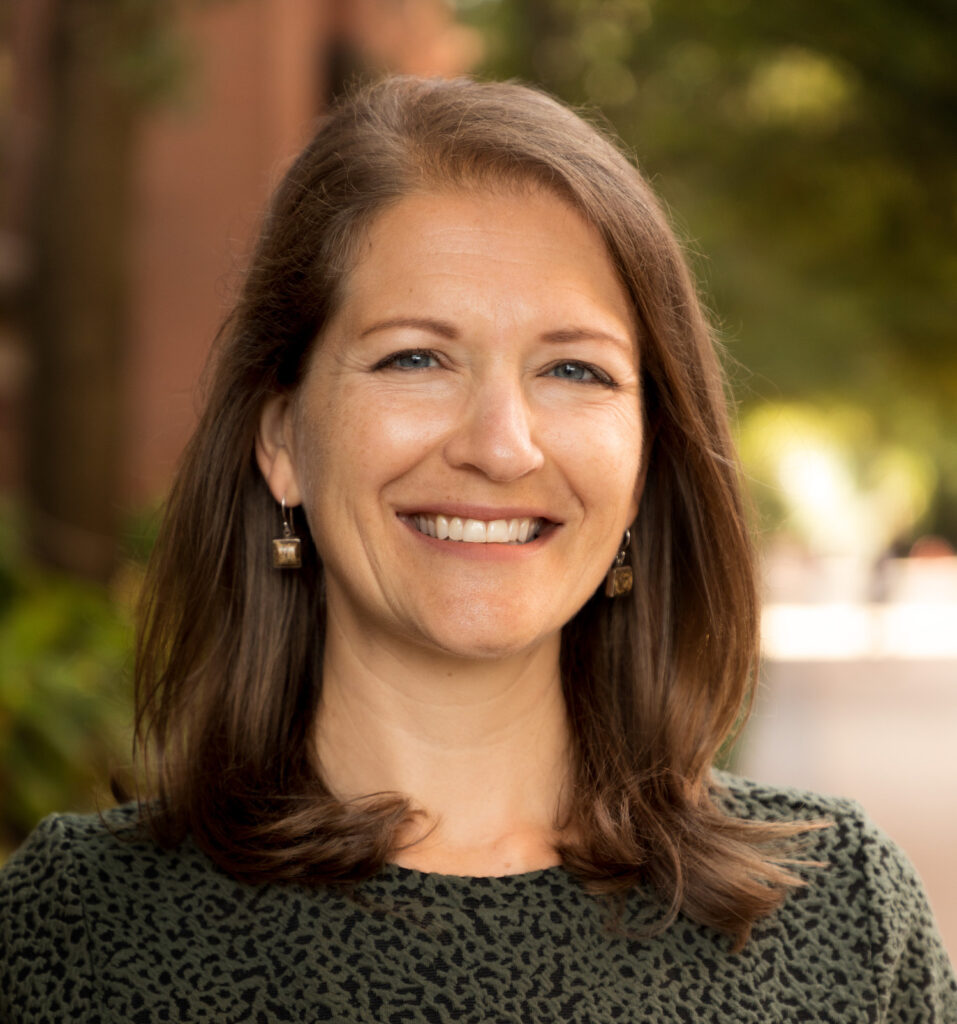 Karl V. Steiner and Christine Mallinson, UMBC’s co-investigators who are leading the Research Integrity, Security, and Compliance (RISC) program. (Marlayna Demond ’11/UMBC)
Research security, according to the nation’s federal guidelines on government-supported research, is defined as “safeguarding the research enterprise against the misappropriation of research and development to the detriment of national or economic security, related violations of research integrity, and foreign government interference.” As part of the RISC program, UMBC will create, test, and implement a model for how mid-sized and smaller research universities can adhere to new and emerging research security policies.
That process, Mallinson explains, includes developing training modules on research security and compliance for researchers and research administration staff. The model will be further developed and evaluated among the partnering RISC institutions.
The program will also support expanding the team in UMBC’s Office of Research Protections and Compliance (ORPC) and an additional cybersecurity specialist role in the Division of Information Technology, as well as supporting an increase in compliance staffing at the partnering institutions. Mallinson shares the “RISC Roadmap” will be publicly available for other institutions to assist them in responding to research integrity, security, and compliance guidance and meeting institutional needs.
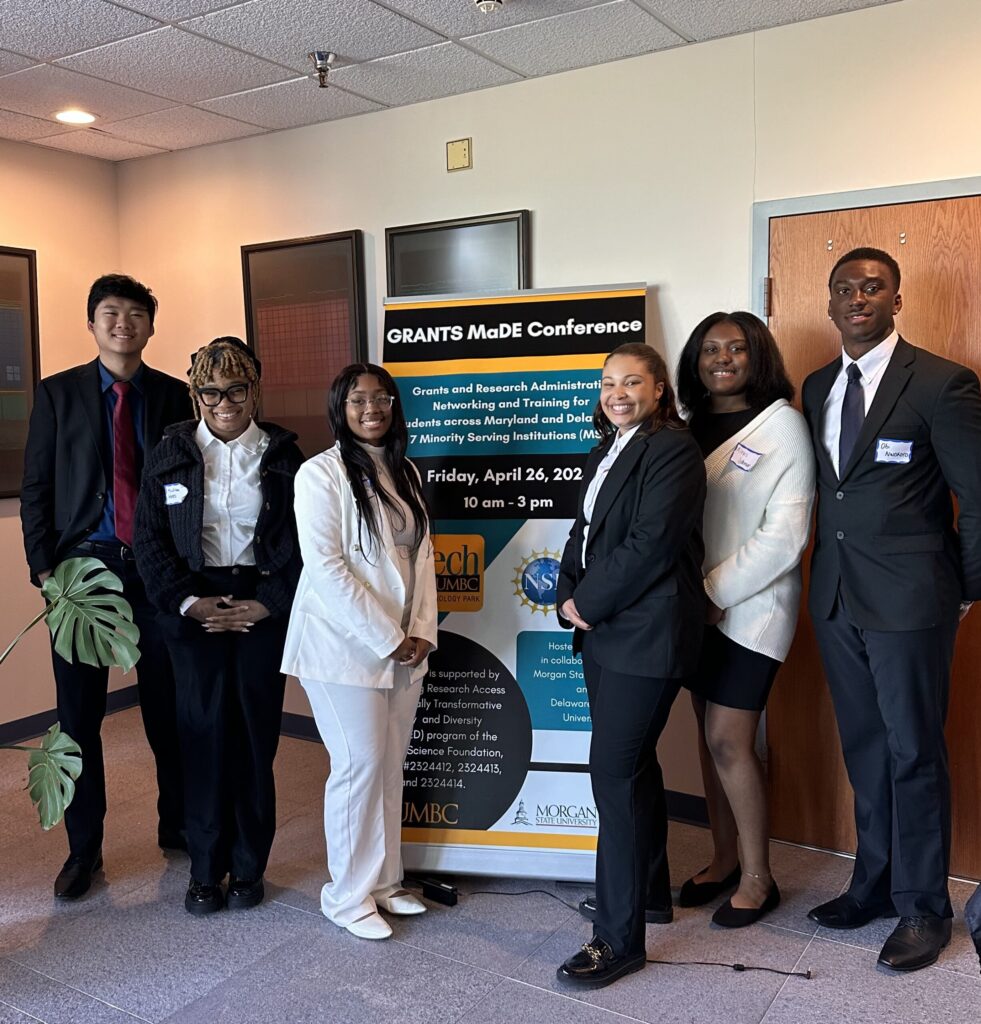 Andy Quach (far left) alongside fellow GRANTS MADE Research Administration interns from Morgan State University, and Delaware State University at the GRANTS MADE conference in April 2024. (Photo courtesy of Christine Mallinson)
“UMBC is at the forefront of this conversation of what it looks like for mid-sized institutions and smaller, emerging research institutions to build their research infrastructure in this area,” says Mallinson.
“I am very pleased about our multi-institutional, regional partnership and the significant support by the NSF that will allow us to address these pressing issues of research compliance and to create a blueprint for other smaller and mid-size research institutions,” adds Karl Steiner. “We have already benefited from the input provided by our partners during the proposal process.”
In addition to the RISC program, Mallinson has also been working to educate undergraduate students on careers in research administration with the GRANTS MADE Research Administration Internship. The internship, also funded by NSF’s GRANTED program, was created to expand and diversify the research administration workforce. UMBC’s Alexis Johnson ’24 and current senior Andy Quach, both financial economics majors, were a part of the internship program’s inaugural cohort. This summer, Quach continued his potential career interests in research administration with an internship with the ORPC. Quach helped to review and audit active research protocols and drafted various compliance documents.
Mallinson adds that prospective interns may also have the option to work with the ORPC team, allowing for a synergistic opportunity to train the next generation in this critical area of research security and compliance.
]]>
UMBC is leading a new initiative, in partnership with several Historically Black Colleges and Universities (HBCUs) and minority-serving institutions (MSIs) in the region, that’s aiming to expand...
https://umbc.edu/stories/research-integrity-security-compliance-program/
https://my3.my.umbc.edu/api/v0/pixel/news/145539/guest@my.umbc.edu/e6a868827d3e634fb7df8103fb2b0d7d/api/pixel
national-science-foundation
news
research
science-and-tech
security
story
UMBC News & Magazine
https://my3.my.umbc.edu/groups/umbc-news-magazine
https://assets1-my.umbc.edu/system/shared/avatars/groups/000/001/943/24435aa6207c452e7bc15cc74b42c7bb/xsmall.png?1748556657
https://assets1-my.umbc.edu/system/shared/avatars/groups/000/001/943/24435aa6207c452e7bc15cc74b42c7bb/original.png?1748556657
https://assets2-my.umbc.edu/system/shared/avatars/groups/000/001/943/24435aa6207c452e7bc15cc74b42c7bb/xxlarge.png?1748556657
https://assets2-my.umbc.edu/system/shared/avatars/groups/000/001/943/24435aa6207c452e7bc15cc74b42c7bb/xlarge.png?1748556657
https://assets3-my.umbc.edu/system/shared/avatars/groups/000/001/943/24435aa6207c452e7bc15cc74b42c7bb/large.png?1748556657
https://assets1-my.umbc.edu/system/shared/avatars/groups/000/001/943/24435aa6207c452e7bc15cc74b42c7bb/medium.png?1748556657
https://assets2-my.umbc.edu/system/shared/avatars/groups/000/001/943/24435aa6207c452e7bc15cc74b42c7bb/small.png?1748556657
https://assets1-my.umbc.edu/system/shared/avatars/groups/000/001/943/24435aa6207c452e7bc15cc74b42c7bb/xsmall.png?1748556657
https://assets2-my.umbc.edu/system/shared/avatars/groups/000/001/943/24435aa6207c452e7bc15cc74b42c7bb/xxsmall.png?1748556657
UMBC News & Magazine
3
0
false
Mon, 11 Nov 2024 14:06:41 -0500
Mon, 11 Nov 2024 14:06:41 -0500
UMBC and MSDE launch admissions pathway for high school students aspiring to become teachers

Thanks to award-winning education faculty and UMBC’s research-based teacher preparation programs, hundreds of Retriever alumni lead pre-k through 12-grade classrooms across the state, meeting the need for highly qualified teachers. Maryland’s high school students now have a unique opportunity to join their ranks by beginning their teacher training early in preparation for applying to UMBC’s teaching programs. This fall, UMBC joined an existing network of higher education institutions across Maryland that partner with the Maryland State Department of Education (MSDE) and the Teacher Academy of Maryland (TAM) to offer Maryland-high-school students interested in teaching a direct admissions pathway to UMBC’s undergraduate teacher education programs.
 Sherman Teacher Scholars Program alumna, Vanessa Gonzalez ’19, American studies, during her first year teaching at Lakeland Elementary/Middle School in 2019. (Marlayna Demond ’11/UMBC)
UMBC awarded its first TAM scholarship and academic credit this fall to three first-year students, Layla Bugarini, Alna Thekkiniath, and Sofia Driver.“Once the word gets out that UMBC is a TAM-participating institution offering not only great benefits for TAM students but also a high quality and unique teacher education program, we anticipate many more aspiring educators will see UMBC as a destination institution for teacher education,” says Vickie Williams, director of student services and certification officer for UMBC’s Department of Education and a member of the organizing committee
TAM’s mission is to grow and diversify the teaching field by igniting high school students’ passion for teaching. The program provides them with foundational knowledge and skills essential for success as educators, learners, and leaders. Through a partnership with a higher education institution, participants gain valuable experience in a university setting which helps them prepare for their transition to education majors.
 (l-r): Sherman Teacher Scholars Program alumni, Olivia Grimes ’19, individualized study, and Lydia Coley ’20, American studies, in 2020 during Grimes’s first year of teaching and Coley’s first semester as a student-teacher at Maree G. Farring Elementary/Middle School. (Marlayna Demond ’11/UMBC)
Participating high schoolers develop a portfolio that includes three high school courses: Human Growth and Development through Adolescence, Teaching as a Profession, and Foundations of Curriculum and Instruction. Students are also required to complete an internship in a classroom setting under the supervision of a TAM mentor. After fulfilling all the TAM requirements, students submit their portfolio for review and feedback to the university they plan to attend. Each university offers students different benefits.
UMBC is providing students who successfully complete the TAM program, with several incentives:
- a $75 application fee waiver
- three lower-level education elective credits that can be applied towards the 120-minimum credit graduation requirement
- for those who matriculate directly from high school, a $1,000 merit scholarship from the Homer and Martha Gudelsky and the Maggie Geeter Hrabowski Scholarship, to be applied directly to their UMBC account to assist with tuition, fees, and other educational expenses
- an opportunity to interview for UMBC’s Sherman Teacher Scholars Program.
“Our undergraduate students enter classrooms equipped with pedagogical knowledge, field experience, and expertise from their academic major. This prepares them for their teacher certification exams in their chosen grade level and subject area,” says Williams. “Collaborating with TAM provides high school students with exposure to rigorous education research and practice, along with guidance, financial support, and mentorship.”
“My journey with TAM began back in my freshman year at Eastern Technical High School [Baltimore County], where I had the opportunity to intern in a third-grade classroom at Rossville Elementary in Baltimore County Public Schools,” says Bugarini. She notes that the experience led her to enroll in UMBC’s education program and major in psychology. “TAM didn’t just introduce me to teaching in a classroom, it also gave me a glimpse of what education courses at college would be like. This head start has been invaluable as I pursue my education certification and the required classes to complete it.”
To learn more about UMBC’s teacher preparation programs, contact Vickie Williams, director of student services and certification officer.
]]>
Thanks to award-winning education faculty and UMBC’s research-based teacher preparation programs, hundreds of Retriever alumni lead pre-k through 12-grade classrooms across the state, meeting the...
https://umbc.edu/stories/umbc-msde-launched-pathway-for-aspiring-teachers/
https://my3.my.umbc.edu/api/v0/pixel/news/145533/guest@my.umbc.edu/5972d9f2def66dbf0d41a81aabf214bb/api/pixel
american-studies
cahss
community
education
inds
news
sherman-scholars
story
UMBC News & Magazine
https://my3.my.umbc.edu/groups/umbc-news-magazine
https://assets1-my.umbc.edu/system/shared/avatars/groups/000/001/943/24435aa6207c452e7bc15cc74b42c7bb/xsmall.png?1748556657
https://assets1-my.umbc.edu/system/shared/avatars/groups/000/001/943/24435aa6207c452e7bc15cc74b42c7bb/original.png?1748556657
https://assets2-my.umbc.edu/system/shared/avatars/groups/000/001/943/24435aa6207c452e7bc15cc74b42c7bb/xxlarge.png?1748556657
https://assets2-my.umbc.edu/system/shared/avatars/groups/000/001/943/24435aa6207c452e7bc15cc74b42c7bb/xlarge.png?1748556657
https://assets3-my.umbc.edu/system/shared/avatars/groups/000/001/943/24435aa6207c452e7bc15cc74b42c7bb/large.png?1748556657
https://assets1-my.umbc.edu/system/shared/avatars/groups/000/001/943/24435aa6207c452e7bc15cc74b42c7bb/medium.png?1748556657
https://assets2-my.umbc.edu/system/shared/avatars/groups/000/001/943/24435aa6207c452e7bc15cc74b42c7bb/small.png?1748556657
https://assets1-my.umbc.edu/system/shared/avatars/groups/000/001/943/24435aa6207c452e7bc15cc74b42c7bb/xsmall.png?1748556657
https://assets2-my.umbc.edu/system/shared/avatars/groups/000/001/943/24435aa6207c452e7bc15cc74b42c7bb/xxsmall.png?1748556657
UMBC News & Magazine
0
0
false
Mon, 11 Nov 2024 11:50:17 -0500
Mon, 11 Nov 2024 11:50:17 -0500
Faisal Quader, Ph.D. ’20: Expanding access to the cyber ecosystem
There’s already a student waiting outside the office of Faisal Quader, Ph.D. ’20, when the adjunct professor arrives at the Information Technology and Engineering building on a Thursday afternoon.
 Headshot courtesy of Quader.
The recent graduate, Smriti Khilnani, M.S. ’24, information systems, patiently waits for the information systems instructor—a full-time president of Technuf LLC, philanthropist, and board member of several organizations—to open his office for his limited hours on campus. Quader breezes in, greeting his guest with a smile while asking her how she’s doing.
“I don’t know,” the graduate says, before the pair steps inside the office. After several minutes, the duo exit and Khilnani’s face looks more relaxed and at ease than moments before.
“She’s looking for a job, and she’s a little frustrated,” says Quader of the graduate, who is an international student. “She’s trying to get a cybersecurity job, but it needs security clearance, which she cannot get due to her non-U.S. citizen status. However, we talked about alternative solutions to her problem.”
Moments like these aren’t uncommon for Quader, a former international student himself. He spends a large portion of his time in service to those around him, whether it’s in the classroom, in a meeting room at the high-tech company he runs, or on stage when he’s singing classic Bengali songs.
“The fact that people are so open to come to me for help—that makes my day knowing that I’m able to make a difference,” says Quader.
Bringing industry perspectives into the classroom
Since graduating in 2020, Quader has spent the last four years as a part-time instructor teaching two graduate-level cybersecurity courses at UMBC and an additional course at the University of Maryland, College Park. On top of teaching, Quader works full-time as the president of the company he co-founded, Technuf, which specializes in cybersecurity, artificial intelligence (AI), machine learning (ML), robotic process automation, mobile application development, and software engineering. The Rockville-based company supports agencies, such as the Internal Revenue Service, the National Institutes of Health, and the Department of Homeland Security, and some state governments on high-profile cybersecurity initiatives.
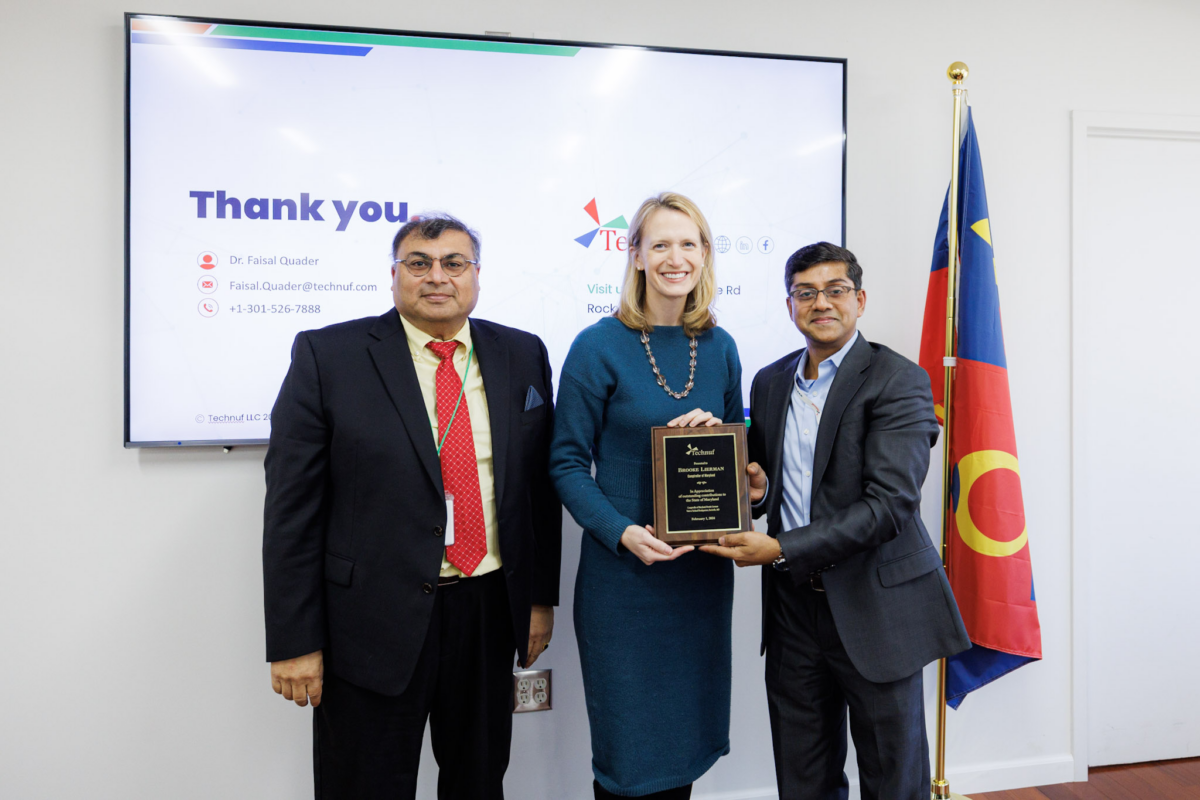 Faisal Quader (right) and Technuf co-founder and CEO Shah Ahmed (left) presenting an award to Maryland Comptroller Brooke E. Lierman in February 2024. (Photo courtesy of Technuf LLC’s X account)
Quader has a B.S. in computer science from the University of Wisconsin and an M.S. in computer science and engineering from Johns Hopkins University. Before going down the path to becoming a faculty member, Quader was initially a non-degree student at UMBC, but after enjoying his class so much, he decided to pursue a doctoral degree in information systems, specializing in cybersecurity.
“It was a difficult path working full-time and being a student, but I got so much from UMBC,” says Quader. “My mentors and professors supported me tremendously. I love this school, and now I feel like it’s time for me to give something back. Nothing is better than being able to share what I’ve learned with students.”
Quader brings his data science industry know-how to the classroom in more practical ways, educating students on how he and his team at Technuf work to address timely cybersecurity challenges, such as securing network infrastructures from cyber attacks and analyzing data to protect from cyber threats. His courses are capped to capacity every semester and has an ever-evolving waitlist of students hoping to learn from his tutelage.
“Cybersecurity is an extremely hot topic, and I like that I can bring in the industry perspective to my theoretical teachings,” explains Quader. “I love teaching—it’s my passion. Even though I work full time, I do this because I love to be able to share what I do everyday.”
A passion for performance
While Quader has spent the last three decades in engineering, computer science, and information science as an industry leader, he’s dedicated much of his life to something he got from his mother: a love of singing.
As a child growing up in Bangladesh, Quader frequently performed on tv shows as a vocalist and continues to feed his passion for performance today. He shares that music is his “weekend work” where he occasionally puts on family performances with his wife and two children. Every few weeks, Quader travels across the DMV singing with various groups. He’s a big fan of Lionel Richie and Bengali polymath Rabindranath Tagore. With his performances, Quader says that he is trying to create a bridge between Eastern and Western music.
 Faisal Quader singing traditional South Asian music during a performance at the Purbachal Resort in Bangladesh. (Photo courtesy of Quader)
The tech-heavy data scientist says that finding time to mesh his creative passions with his analytical and technical skills gives balance to his life—music and technology are more related than one may think, he adds.
“Technology has a lot of mathematical inductions, different kinds of modeling theories and patterns. Music is also something that is kind of like a pattern,” says Quader. “Music refreshes my brain. When the weekend comes, I focus on music and that gives me more energy to do my work. That keeps me sane.”
Supporting the next generation of data scientists and engineers
In 2023, Quader established the Technuf Endowed Fellowship at UMBC, a $100,000 fund that supports master’s or Ph.D. candidates in information systems with entrepreneurial aspirations who are conducting research and/or pursuing a career in AI/ML or cybersecurity. The fellowship, Quader shares, is particularly for students who are unable to receive financial support for their education.
“When I was a student here in the U.S. after emigrating from Bangladesh at age 18, I didn’t have a scholarship or funding because of the fact that I was an international student. I struggled so badly and had to work three jobs to make my tuition,” he says. “I don’t want my students to go through the same process of struggling. I’m not able to help every student, but this is a good start.”
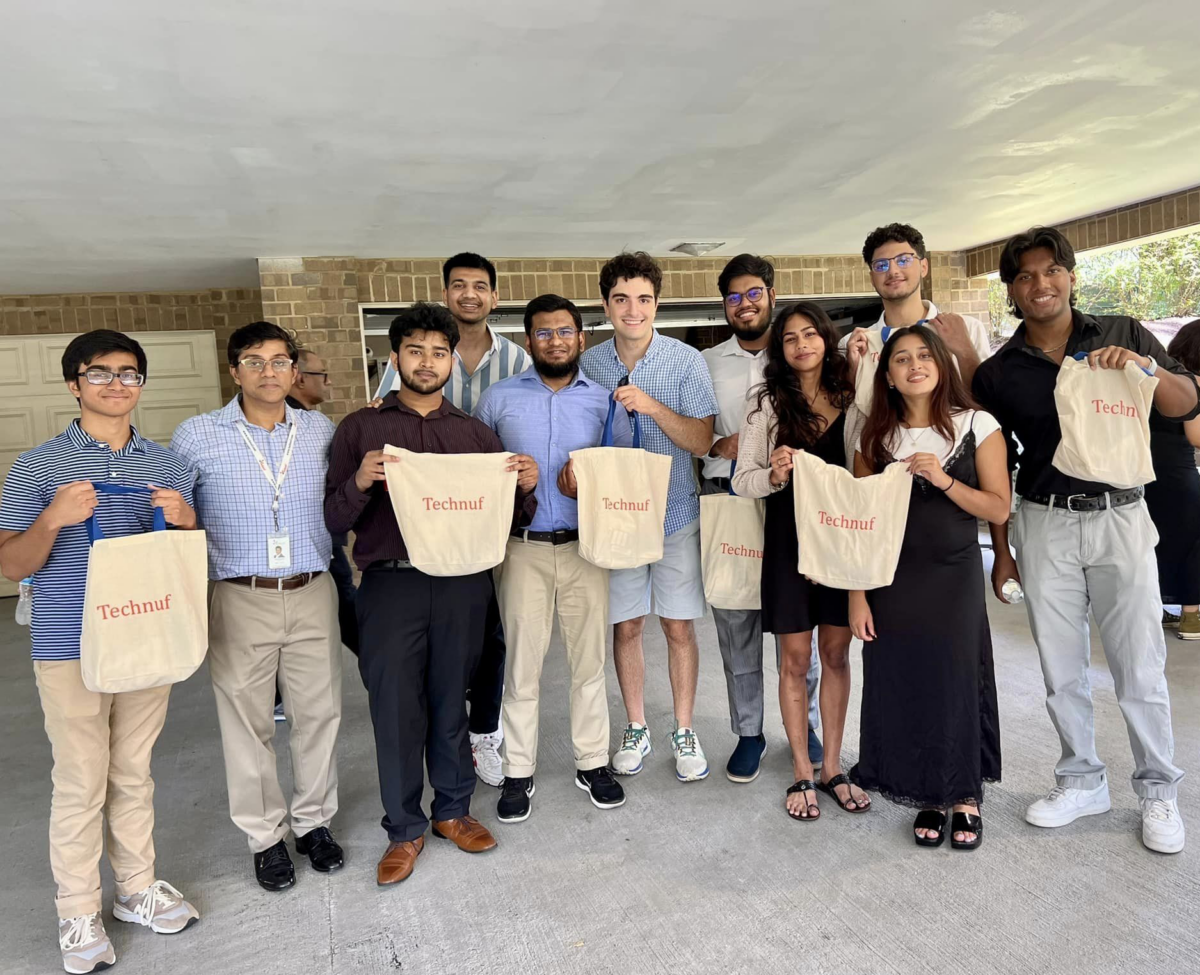 Faisal Quader (second from left) with former Technuf interns. (Photo courtesy of Technuf’s X account)
Quader also created a summer internship program at Technuf where students work hand-in-hand with data scientists and engineers on solving technical problems. Several UMBC students have gone on to work full time at Technuf following their internships, including Isha Shah, M.S. ’23, information systems. In summer 2022, Shah worked at Technuf as a software engineer and data science intern.
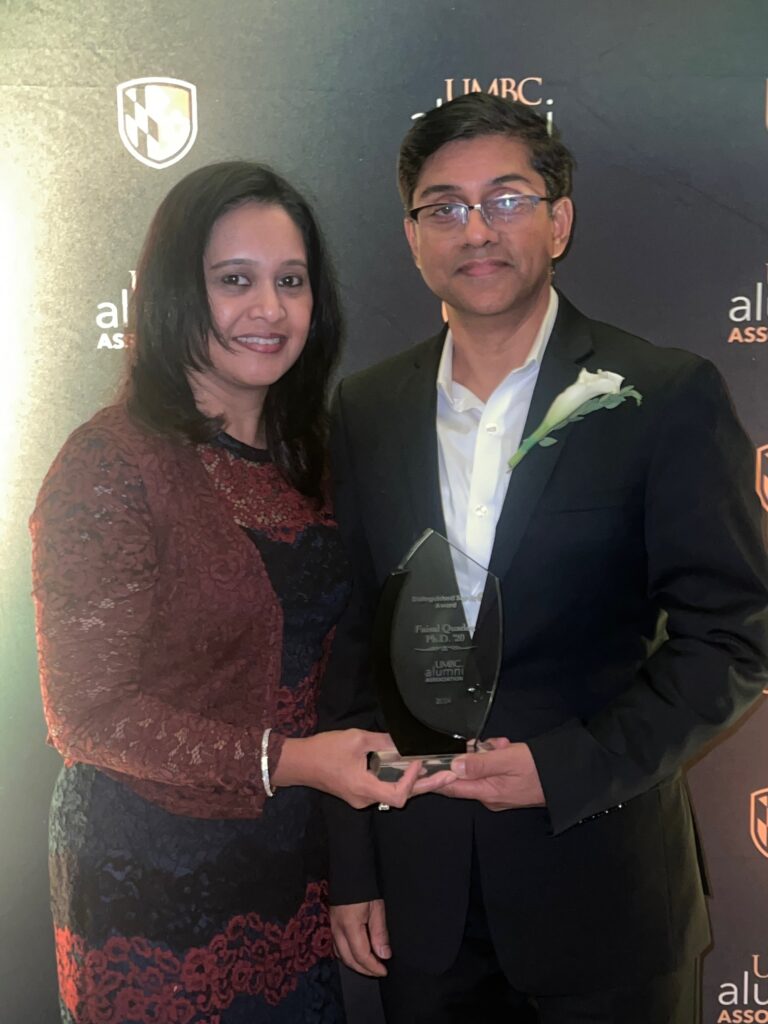 Quader, alongside his wife Fahmida, holding his Distinguished Service Alumni Award. (Photo courtesy of Quader)
“I often found it challenging to secure job or internship opportunities. During one of our initial classes, Dr. Quader mentioned his company, which immediately caught my interest,” says Shah. “I reached out to him to inquire about internship opportunities and to my surprise, he responded with enthusiasm and asked me to send over my resume. That moment felt like a turning point in my career journey.”
After graduating from UMBC, Shah was offered a full-time position at Technuf and currently works at the company as a product development engineer.
“Dr. Quader has had a tremendous impact on both my studies and career. His approach to teaching went far beyond textbooks. He always emphasized the importance of real-world applications and critical thinking, which made a significant difference in my understanding of cybersecurity concepts,” Shah explains. “Dr. Quader believed in my potential and opened doors for me at Technuf, where I’ve been able to gain invaluable hands-on experience in the field.”
In October, Quader was honored for his service as a 2024 recipient of UMBC’s Distinguished Service Alumni Award.
“That was a big encouragement for me,” Quader beamed. “I can see the difference I’m able to make with my students by giving them job opportunities, internships, training, and industry focused-teaching. That’s what keeps me going.”
]]>
There’s already a student waiting outside the office of Faisal Quader, Ph.D. ’20, when the adjunct professor arrives at the Information Technology and Engineering building on a Thursday...
https://umbc.edu/stories/faisal-quader/
https://my3.my.umbc.edu/api/v0/pixel/news/145437/guest@my.umbc.edu/f67ae41ea549926f17a588967aebfbf7/api/pixel
alumni
alumni-awards
coeit
cybersecurity
datascience
fall-2024
impact
information-systems
magazine
story
UMBC News & Magazine
https://my3.my.umbc.edu/groups/umbc-news-magazine
https://assets1-my.umbc.edu/system/shared/avatars/groups/000/001/943/24435aa6207c452e7bc15cc74b42c7bb/xsmall.png?1748556657
https://assets1-my.umbc.edu/system/shared/avatars/groups/000/001/943/24435aa6207c452e7bc15cc74b42c7bb/original.png?1748556657
https://assets2-my.umbc.edu/system/shared/avatars/groups/000/001/943/24435aa6207c452e7bc15cc74b42c7bb/xxlarge.png?1748556657
https://assets2-my.umbc.edu/system/shared/avatars/groups/000/001/943/24435aa6207c452e7bc15cc74b42c7bb/xlarge.png?1748556657
https://assets3-my.umbc.edu/system/shared/avatars/groups/000/001/943/24435aa6207c452e7bc15cc74b42c7bb/large.png?1748556657
https://assets1-my.umbc.edu/system/shared/avatars/groups/000/001/943/24435aa6207c452e7bc15cc74b42c7bb/medium.png?1748556657
https://assets2-my.umbc.edu/system/shared/avatars/groups/000/001/943/24435aa6207c452e7bc15cc74b42c7bb/small.png?1748556657
https://assets1-my.umbc.edu/system/shared/avatars/groups/000/001/943/24435aa6207c452e7bc15cc74b42c7bb/xsmall.png?1748556657
https://assets2-my.umbc.edu/system/shared/avatars/groups/000/001/943/24435aa6207c452e7bc15cc74b42c7bb/xxsmall.png?1748556657
UMBC News & Magazine
0
0
false
Thu, 07 Nov 2024 10:05:35 -0500
Thu, 07 Nov 2024 10:05:35 -0500
Retrievers learn the art and heart of cooking Salvadoran food at True Grit’s Test Kitchen

“Recipes are like an address to a homeland, but they’re also very personal to your own story,” said Karla T. Vasquez, author of The SalviSoul Cookbook, in True Grit’s Test Kitchen. Celia Bonilla, a business technology administration sophomore, grinned and nodded—the addresses for her own recipes come from El Salvador and Maryland. Bonilla joined other UMBC students earlier this fall for the “More than Pupusas” cooking demonstration, sponsored by the Dresher Center for the Humanities, to learn how to cook Salvadoran street food.
Bonilla sat at one of two tables set with brown butcher paper with her classmates, Stephania Fonseca, a social work sophomore, and Jeffrey Molina Soriano, a computer science junior. They also have roots in Maryland and El Salvador. “Pastelitos [pah-steh-lee-tos] means little pie and it’s the Salvadoran version of empanadas [em-pah-nah-dahs],” said Vasquez. “Empanadas are well known all over Latin America. Greeks, Italians, and other Europeans make meat pies, too.”
 Celia Bonilla and Jeffrey Molina Soriano learn how to mold pastelito dough. (Marlayna Demond ’11/UMBC)
Like many Salvadoran students at UMBC, their journeys to UMBC are as complex as the ingredients they use for this meal. “Sometimes Hispanic Heritage Month events portray Latinx culture as a monolith, often focusing on the Caribbean or Mexican American experience,” said Courtney C. Hobson ’10, M.A. ’14, history, program manager at the James T. and Virginia M. Dresher Center for the Humanities. “I grew up in Prince George’s County, Maryland, where a significant part of the Latinx immigrant community comes from Central America, specifically El Salvador. Many of our Latinx students have roots in Central America—I wanted to organize an event that celebrated the rich culture they represent.”
 (l-r): Courtney C. Hobson and Amy Froide, professor of history and director of the Dresher Center for the Humanities. (Marlayna Demond ’11/UMBC)
“I came here when I was six years old from El Salvador,” said Bonilla, who attended the event as part of an assignment for the Spanish for Heritage Spanish Speakers class. Students must participate in two on-campus and two off-campus cultural events that celebrate Hispanic/Latinx culture. While Bonilla is familiar with campus events as the parent of a UMBC alum Jasmine Esmeralda Bonilla ’21, chemical engineering, this event felt different. “This class gives me a chance to learn more about my culture and language by engaging with people from various countries and age groups.”
Culinary traditions
Most students at the event said they had eaten pupusas (puh-poo-suhz) at home or at a restaurant. This flat corn flour cake, stuffed with cheese, beans, and sometimes meat is the national dish of El Salvador. “I have an aunt who is from El Salvador. She taught my mom, and then my mom taught me how to make pupusas with my sister,” said Fonseca. “My dad is from El Salvador, and my mom is from Mexico. We learned to make pupusas together as a family. So it became a typical food from my home.”
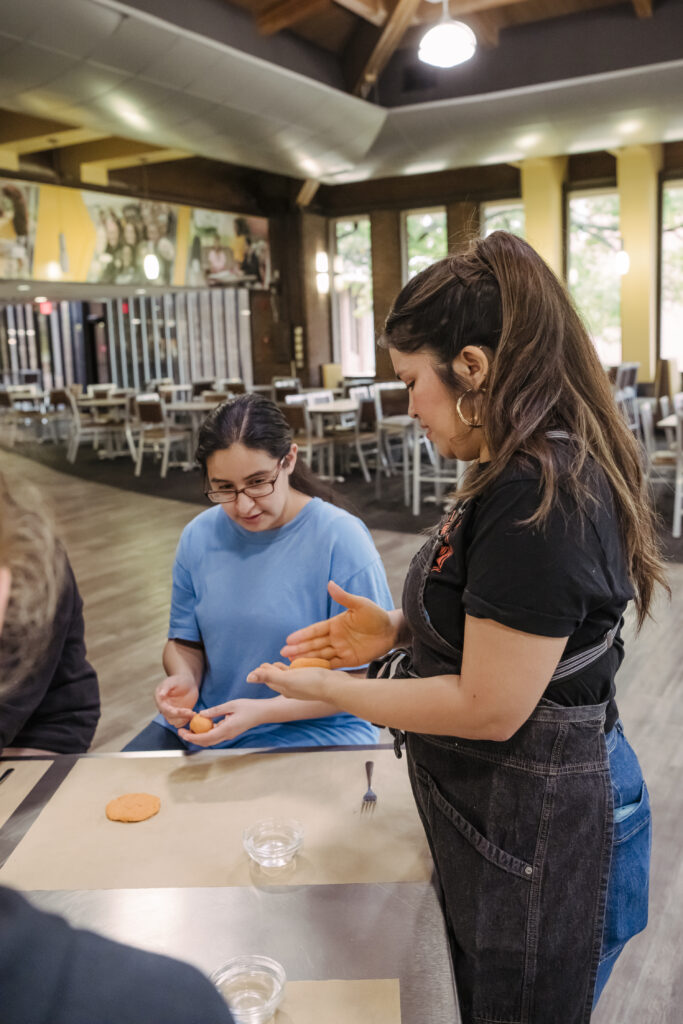

 (l-r): Stephania Fonseca watches Vasquez fold the dough to make a pocket. Students fill the pastelitos with a mushroom filling. (Marlayna Demond ’11/UMBC)
As students kneaded the dough into a palm-sized disc, filled it with sautéed mushrooms, and pinched the edges to seal the pastelitos, they also shared what food meant to them in the context of their family and student life. A clear theme emerged, culinary traditions can extend beyond the kitchen. “We have the Philly pretzel factory. I’ve never been able to find a soft pretzel as good as the Philly Pretzel Factory,” said Ashley Gutshall about her hometown of Royersford, Pennsylvania. Gutshall, a history and Spanish sophomore, shares, “It’s our family tradition to get Philly soft pretzels after doctor’s appointments.”
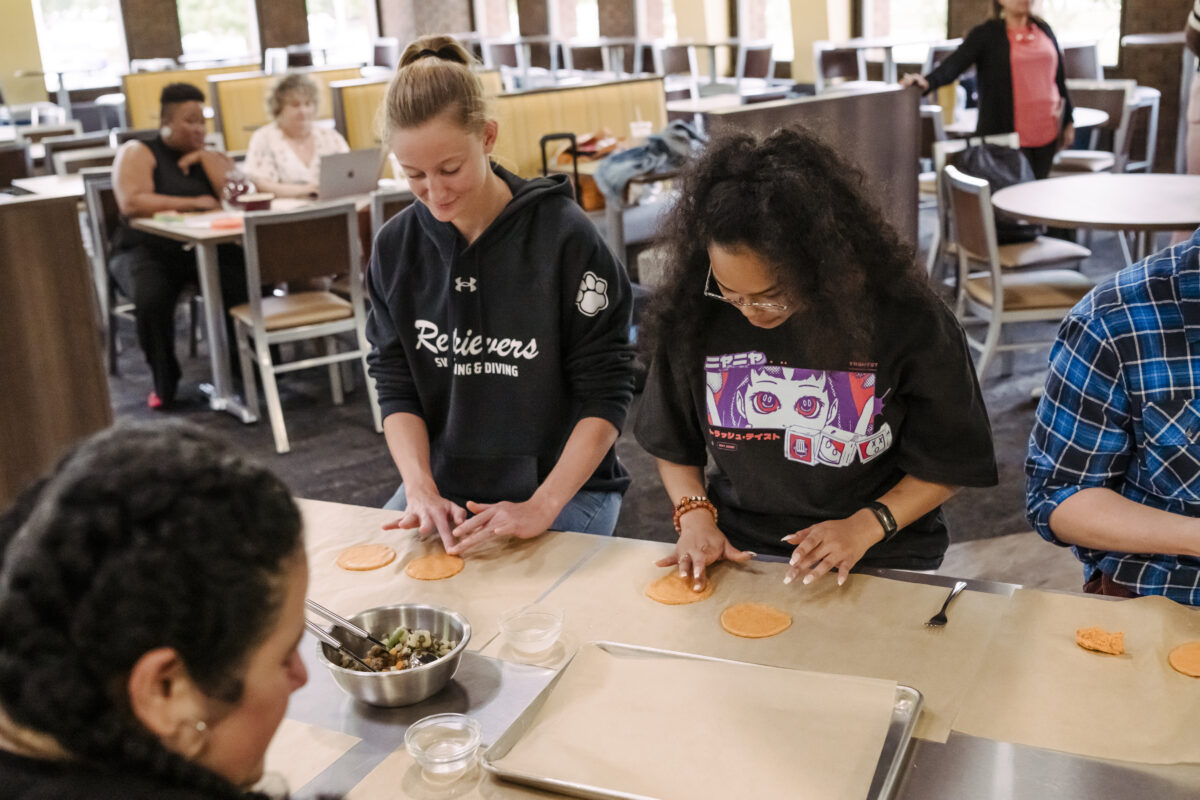 (l): Ashley Gutshall presses dough into a circular shape to make a pastelito. (Marlayna Demond ’11/UMBC)
Snack routines also create taste memories. “I was born in El Salvador during the Civil War [1980-1992] but was raised in Los Angeles. I would often fantasize about the routines my family would have had if they had been able to stay in their homeland,” said Vasquez, as she cooked down strawberries that she used to sweeten a large container of water filled with chan seeds—similar to chia seeds in texture and nutrition. “Fresco de chan satisfied that question for me because it’s a drink students have after school,” said Vasquez.
Food as a cultural bridge
Dishes are a fingerprint of a family’s traditions and tastes that can also serve as a timeline marking the evolution of ingredients locally and globally. “When my mom hears of these new trending food ingredients like chia seeds or quinoa,” says Vasquez, “she argues that they have been used in El Salvador and Central American communities for a long time.”


 (l-r): Fresco de chan. Karla T. Vasques presents a Salvadoran mushroom pastelito with salsa and slaw. (Marlayna Demond ’11/UMBC)
Whether savory or sweet, the names of foods and spices across Latin America, and the dishes they inspire, are rooted in indigenous, African, and European languages and culinary traditions often fused to create unique dishes with local variations. Vasquez noted that achiote [ah-chee-oh-teh], the spice used to season and enhance the yellow color of the corn flour dough for the pastelitos, is a Nahuat word. Nahuat is a widely spoken indigenous language in Mexico and Central America. The rich legacy of Salvadoran food is seldom recognized alongside Western cuisine, even though many of its ingredients are sourced from the Global South—reinforcing cultural divisions. The Dresher Center’s “More than Pupusas” cooking event aimed to bridge this gap and celebrate the cultural footprint of Salvadoran cuisine.
“I interviewed more than 100 women while I’ve been working on this project. It’s taken me nine years,” says Vasquez about her recent release, The SalviSoul Cookbook. “I wanted to make sure that we’re giving credit where credit is due.”


(r): Bonilla and Molina Soriano taste the fried pastelitos. (Marlayna Demond ’11/UMBC)
The tasters and aspiring chefs were grateful to be part of the long tradition of communities brought together across borders and time to learn, cook, and share a meal with new and old friends. They stamped their seal of approval with dough—a squiggly line, a star, a smile—sealing each pastelito with personal flair.
]]>
“Recipes are like an address to a homeland, but they’re also very personal to your own story,” said Karla T. Vasquez, author of The SalviSoul Cookbook, in True Grit’s Test Kitchen. Celia Bonilla,...
https://umbc.edu/stories/retrievers-learn-to-cook-salvadoran-food/
https://my3.my.umbc.edu/api/v0/pixel/news/145379/guest@my.umbc.edu/0e0931c682bcda13e479d7afdd5d4a25/api/pixel
business-technology-administration
cahss
campus-life
chemical-engineering
computer-science
dresher-center
history
magazine
mlli
spanish
story
UMBC News & Magazine
https://my3.my.umbc.edu/groups/umbc-news-magazine
https://assets1-my.umbc.edu/system/shared/avatars/groups/000/001/943/24435aa6207c452e7bc15cc74b42c7bb/xsmall.png?1748556657
https://assets1-my.umbc.edu/system/shared/avatars/groups/000/001/943/24435aa6207c452e7bc15cc74b42c7bb/original.png?1748556657
https://assets2-my.umbc.edu/system/shared/avatars/groups/000/001/943/24435aa6207c452e7bc15cc74b42c7bb/xxlarge.png?1748556657
https://assets2-my.umbc.edu/system/shared/avatars/groups/000/001/943/24435aa6207c452e7bc15cc74b42c7bb/xlarge.png?1748556657
https://assets3-my.umbc.edu/system/shared/avatars/groups/000/001/943/24435aa6207c452e7bc15cc74b42c7bb/large.png?1748556657
https://assets1-my.umbc.edu/system/shared/avatars/groups/000/001/943/24435aa6207c452e7bc15cc74b42c7bb/medium.png?1748556657
https://assets2-my.umbc.edu/system/shared/avatars/groups/000/001/943/24435aa6207c452e7bc15cc74b42c7bb/small.png?1748556657
https://assets1-my.umbc.edu/system/shared/avatars/groups/000/001/943/24435aa6207c452e7bc15cc74b42c7bb/xsmall.png?1748556657
https://assets2-my.umbc.edu/system/shared/avatars/groups/000/001/943/24435aa6207c452e7bc15cc74b42c7bb/xxsmall.png?1748556657
UMBC News & Magazine
1
0
false
Tue, 05 Nov 2024 16:30:49 -0500