Is fusion the future? Carlos Romero Talamás’ lab gets congressional attention
Piles of snow and bitter cold didn’t deter U.S. congressional representative Don Beyer from meeting with UMBC’s Carlos Romero Talamás in late January to discuss the hot topic of fusion energy. Fusion reactions, which release massive amounts of energy when multiple light atomic nuclei merge to form a single heavier nucleus, power the Sun, and it is hoped they will soon deliver clean, reliable, and abundant energy generation on Earth, too.
Rep. Beyer, of the 8th District of Virginia, founded and co-chairs the bipartisan Congressional Fusion Energy Caucus, dedicated to advancing fusion energy technology, while Romero Talamás, an associate professor of mechanical engineering, leads a laboratory exploring a novel fusion energy concept that may offer an easier path to a commercially viable reactor. During the visit on January 29, Romero Talamás gave Beyer a tour of the lab, which is located on the University of Maryland, College Park campus and brings together faculty and students from both UMBC and UMD.
A simpler fusion machine
 Images captured by NASA’s Solar Dynamics Observatory show loops of hot plasma trapped by the Sun’s magnetic field. A solar flare flashes on the left side. (Credit: NASA/GSFC/SDO)
The centerpiece of the lab is a large machine where the researchers have been testing a relatively new approach to confining plasma—the unruly soup of particles that forms when gas gets super hot. At high enough temperatures (typically more than 100 million degrees Celsius on Earth) and densities, particles in a plasma can slam into each other with enough energy to fuse together.
The Maryland group’s confinement approach, called a centrifugal mirror, traps the blazing hot plasma in a linear tube with strong magnetic fields at the ends that push charged particles toward the center (the magnetic mirror), while also whipping them at supersonic speeds around a central conducting rod (the centrifugal part). The rotation creates stabilizing forces that can pull a plasma back together in the face of inherent instabilities that threaten to rip it apart.
Recent experiments confirm that the physics used to model the confinement approach accurately predicts its real-world behavior, giving the researchers confidence that they could take the approach all the way to a working fusion reactor.
In fact, Romero Talamás has founded a company, called Terra Fusion, to do just that. The company has offices in College Park and is currently looking for laboratory space in Baltimore where it can build a next-generation machine.
The start-up joins a host of other fusion companies, primarily in the U.S. The entire field has attracted billions of dollars in private investments, including from such big players as Microsoft co-founder Bill Gates and OpenAI CEO Sam Altman. While Romero Talamás’ company is just getting started, he’s confident Terra Fusion can catch up and overcome competitors because of its relatively compact, inexpensive, and simple machine design.
 Many approaches to building a fusion reactor rely on strong magnetic fields to contain the hot plasma. (Marlayna Demond ’11/UMBC)
All the companies still face big engineering hurdles, such as finding materials that can withstand the punishing onslaught of particles and radiation within the reactor. A simpler machine should make the path to overcoming these challenges much easier.
Public-private partnerships fuel innovation
Fusion research in the U.S. in recent years offers an example of how the public and private sectors can work in tandem to address daunting challenges. The initial experiments on the current centrifugal mirror machine were funded by the U.S. Department of Energy. Once those experiments confirmed the promise of the approach, private sector investment jumped in. Romero Talamás says the U.S. government also supports private sector research by offering companies access to the specialized expertise, experimental facilities, and advanced modeling capabilities at the national laboratories.
U.S. fusion experts hope the jostle of competing commercial ideas will shorten the time it takes to demonstrate a fusion reactor design that could meet a significant portion of humanity’s ever-growing energy demands more cleanly, cheaply, and reliably than alternative energy approaches. Despite the proliferation of groups vying to make the next big fusion breakthrough, a mostly collaborative spirit still prevails within the research community, Romero Talamás says. “If any one of these technologies succeed,” he points out, “it will benefit us all.”
]]>
Piles of snow and bitter cold didn’t deter U.S. congressional representative Don Beyer from meeting with UMBC’s Carlos Romero Talamás in late January to discuss the hot topic of fusion energy....
https://umbc.edu/stories/fusion-carlos-romero-talamas-lab-gets-congressional-attention/
https://my3.my.umbc.edu/api/v0/pixel/news/156704/guest@my.umbc.edu/14d1121de2559948ecd0ecb5b8e598f0/api/pixel
coeit
meche
news
research
science-and-tech
story
UMBC News & Magazine
https://my3.my.umbc.edu/groups/umbc-news-magazine
https://assets1-my.umbc.edu/system/shared/avatars/groups/000/001/943/24435aa6207c452e7bc15cc74b42c7bb/xsmall.png?1748556657
https://assets1-my.umbc.edu/system/shared/avatars/groups/000/001/943/24435aa6207c452e7bc15cc74b42c7bb/original.png?1748556657
https://assets2-my.umbc.edu/system/shared/avatars/groups/000/001/943/24435aa6207c452e7bc15cc74b42c7bb/xxlarge.png?1748556657
https://assets2-my.umbc.edu/system/shared/avatars/groups/000/001/943/24435aa6207c452e7bc15cc74b42c7bb/xlarge.png?1748556657
https://assets3-my.umbc.edu/system/shared/avatars/groups/000/001/943/24435aa6207c452e7bc15cc74b42c7bb/large.png?1748556657
https://assets1-my.umbc.edu/system/shared/avatars/groups/000/001/943/24435aa6207c452e7bc15cc74b42c7bb/medium.png?1748556657
https://assets2-my.umbc.edu/system/shared/avatars/groups/000/001/943/24435aa6207c452e7bc15cc74b42c7bb/small.png?1748556657
https://assets1-my.umbc.edu/system/shared/avatars/groups/000/001/943/24435aa6207c452e7bc15cc74b42c7bb/xsmall.png?1748556657
https://assets2-my.umbc.edu/system/shared/avatars/groups/000/001/943/24435aa6207c452e7bc15cc74b42c7bb/xxsmall.png?1748556657
UMBC News & Magazine
0
0
false
Wed, 18 Feb 2026 13:10:26 -0500
Wed, 18 Feb 2026 13:10:26 -0500
Retriever-led video game design teams showcase their creations to thousands at MAGFest
Two Retriever-led video game design teams were selected to present their games at Super MAGFest (short for “Music And Gaming Festival”), one of the largest and most prominent fan-driven festivals in the U.S. dedicated to celebrating the gaming community. The event, which runs 24 hours a day, was held January 8 – 11 at the Gaylord National Resort in National Harbor, Maryland, and attracted tens of thousands of game enthusiasts.
Evan McRae ’25, computer science and individualized studies, was a member of both teams. The first team presented a game called King Scribble, in which the player must help the main character—a doodle from a notebook—find his way back to his kingdom by drawing (or erasing) platforms and objects to traverse sketched landscapes and solve physics puzzles. The second team presented the game Phantom Feline, in which the titular ghost cat character navigates through 32 haunting levels by controlling lights and turning into a shadow to scale illuminated walls.
Both teams found support for their creative and technical endeavors in UMBC’s vibrant game development classes and clubs. Computer science majors can choose to follow the game development track, and any interested student can join the Game Developers Club. In 2025, UMBC was ranked #1 in Maryland and #20 on the East Coast in game design education by Animation Career Review.
The Game Developers Club is advised by computer science associate professor Marc Olano, who pioneered the procedural shading algorithms that are used to generate color, texture, and lighting in real-time on graphics hardware and are now a standard feature on every PC and game platform.
It was in Olano’s Capstone Games Group Project class that King Scribble first took shape. The class includes both student artists in the animation track and programmers in the game development track. McRae pitched the King Scribble idea—which he had first thought up in first grade—to his classmates, who selected it as one of four games to develop. Since the end of the class, the King Scribble team has continued improving the game. They started a limited liability company and have plans to ultimately commercialize the game. People can currently wishlist the game on Steam, a large digital distribution platform for PC gaming.
Phantom Feline was first developed during the Game Developers Club 2025 Spring Game Jam, and is free to play on Windows and Linux.
Creating the games “has been a dream come true,” says McRae. “I owe so much to the teams for coming together to make them a playable reality.” In addition to McRae, the King Scribble team members are Jay Cina ’25, computer science; Brian Lawser ’25, computer science; Colby Frashure ’25, computer science; Sormeh Jaribion ’25, computer science; Justin Gaylord ’25, visual arts; and Ginger Sealy, Halle Onyeador, and Anthony Bonilla Duron, all current visual arts students. The Phantom Feline team includes McRae and Scott Serafin ’25, computer science; Aidan Brown ’25, computer science; Jet Thompson ’25, computer science; and Joshua Epstein, a current student in music technology and music composition.
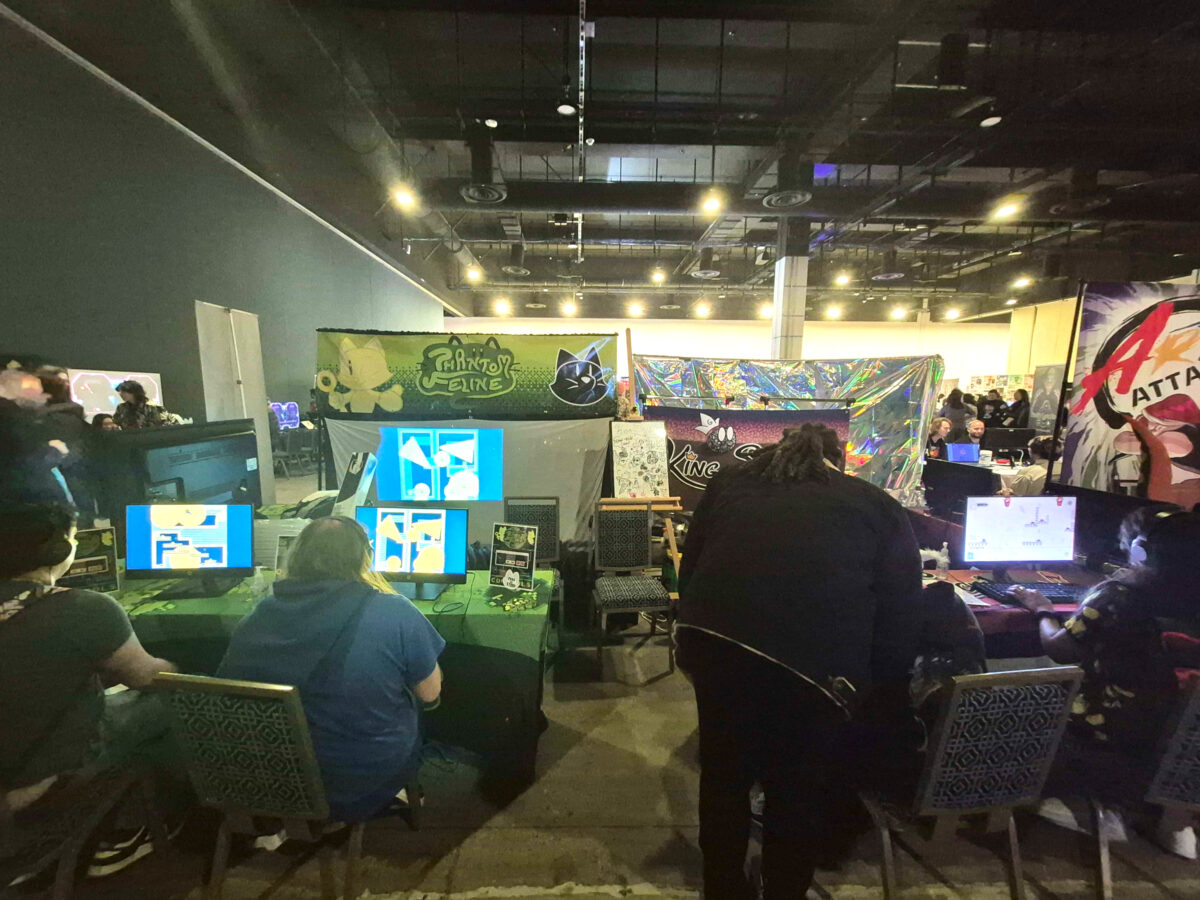 MAGFest attendees playing the games at the King Scribble and Phantom Feline booths. Seeing people play the games is “what meant the most to us as presenters at MAGFest,” McRae says. (Photo courtesy of McRae)
]]>
Two Retriever-led video game design teams were selected to present their games at Super MAGFest (short for “Music And Gaming Festival”), one of the largest and most prominent fan-driven festivals...
https://umbc.edu/stories/video-game-design-teams-at-magfest/
https://my3.my.umbc.edu/api/v0/pixel/news/156651/guest@my.umbc.edu/048db872ca6c370a5021fe36d99cdf44/api/pixel
cahss
coeit
community
csee
inds
music
news
science-and-tech
story
visual-arts
UMBC News & Magazine
https://my3.my.umbc.edu/groups/umbc-news-magazine
https://assets1-my.umbc.edu/system/shared/avatars/groups/000/001/943/24435aa6207c452e7bc15cc74b42c7bb/xsmall.png?1748556657
https://assets1-my.umbc.edu/system/shared/avatars/groups/000/001/943/24435aa6207c452e7bc15cc74b42c7bb/original.png?1748556657
https://assets2-my.umbc.edu/system/shared/avatars/groups/000/001/943/24435aa6207c452e7bc15cc74b42c7bb/xxlarge.png?1748556657
https://assets2-my.umbc.edu/system/shared/avatars/groups/000/001/943/24435aa6207c452e7bc15cc74b42c7bb/xlarge.png?1748556657
https://assets3-my.umbc.edu/system/shared/avatars/groups/000/001/943/24435aa6207c452e7bc15cc74b42c7bb/large.png?1748556657
https://assets1-my.umbc.edu/system/shared/avatars/groups/000/001/943/24435aa6207c452e7bc15cc74b42c7bb/medium.png?1748556657
https://assets2-my.umbc.edu/system/shared/avatars/groups/000/001/943/24435aa6207c452e7bc15cc74b42c7bb/small.png?1748556657
https://assets1-my.umbc.edu/system/shared/avatars/groups/000/001/943/24435aa6207c452e7bc15cc74b42c7bb/xsmall.png?1748556657
https://assets2-my.umbc.edu/system/shared/avatars/groups/000/001/943/24435aa6207c452e7bc15cc74b42c7bb/xxsmall.png?1748556657
UMBC News & Magazine
7
0
false
Tue, 17 Feb 2026 08:19:21 -0500
Tue, 17 Feb 2026 08:19:21 -0500
Electrical, biomedical, and computer science researchers team up to develop a ‘cybergut’
MAGFest attendees playing the games at the King Scribble and Phantom Feline booths. Seeing people play the games is “what meant the most to us as presenters at MAGFest,” McRae says. (Photo courtesy of McRae)
]]>
Two Retriever-led video game design teams were selected to present their games at Super MAGFest (short for “Music And Gaming Festival”), one of the largest and most prominent fan-driven festivals...
https://umbc.edu/stories/video-game-design-teams-at-magfest/
https://my3.my.umbc.edu/api/v0/pixel/news/156651/guest@my.umbc.edu/048db872ca6c370a5021fe36d99cdf44/api/pixel
cahss
coeit
community
csee
inds
music
news
science-and-tech
story
visual-arts
UMBC News & Magazine
https://my3.my.umbc.edu/groups/umbc-news-magazine
https://assets1-my.umbc.edu/system/shared/avatars/groups/000/001/943/24435aa6207c452e7bc15cc74b42c7bb/xsmall.png?1748556657
https://assets1-my.umbc.edu/system/shared/avatars/groups/000/001/943/24435aa6207c452e7bc15cc74b42c7bb/original.png?1748556657
https://assets2-my.umbc.edu/system/shared/avatars/groups/000/001/943/24435aa6207c452e7bc15cc74b42c7bb/xxlarge.png?1748556657
https://assets2-my.umbc.edu/system/shared/avatars/groups/000/001/943/24435aa6207c452e7bc15cc74b42c7bb/xlarge.png?1748556657
https://assets3-my.umbc.edu/system/shared/avatars/groups/000/001/943/24435aa6207c452e7bc15cc74b42c7bb/large.png?1748556657
https://assets1-my.umbc.edu/system/shared/avatars/groups/000/001/943/24435aa6207c452e7bc15cc74b42c7bb/medium.png?1748556657
https://assets2-my.umbc.edu/system/shared/avatars/groups/000/001/943/24435aa6207c452e7bc15cc74b42c7bb/small.png?1748556657
https://assets1-my.umbc.edu/system/shared/avatars/groups/000/001/943/24435aa6207c452e7bc15cc74b42c7bb/xsmall.png?1748556657
https://assets2-my.umbc.edu/system/shared/avatars/groups/000/001/943/24435aa6207c452e7bc15cc74b42c7bb/xxsmall.png?1748556657
UMBC News & Magazine
7
0
false
Tue, 17 Feb 2026 08:19:21 -0500
Tue, 17 Feb 2026 08:19:21 -0500
Electrical, biomedical, and computer science researchers team up to develop a ‘cybergut’
 Mehdi Kiani (Brad Ziegler/UMBC)
Personalized and precise treatments will improve patients’ quality of life in a fast-approaching future driven by AI, wearable tech, and other innovations. UMBC student and faculty researchers led by Mehdi Kiani, a professor in the Department of Computer Science and Electrical Engineering, are at the frontiers of these changes.
They recently teamed up with colleagues at New York Institute of Technology and Pennsylvania State University to develop a system that combines state-of-the-art, millimeter-sized medical implants, computational models, and machine learning to better monitor and treat stomach disorders. A grant from the National Institutes of Health will fund the work through 2029.
The research offers the promise of improving individual medical treatment for gastric disorders such as gastroparesis, a chronic condition causing nausea and unexplained vomiting that affects more than 1.5 million people in the U.S. It also has broader implications for improving our general understanding of how the nervous system controls organs.
“This type of research is vital, because it addresses fundamental gaps in how we monitor and treat complex organ functions,” says Kiani. “By integrating advanced sensing, modeling, and intelligent control, we can move beyond today’s limited approaches toward precise, adaptive therapies. These innovations have the potential to transform patient care not only for gastric disorders but across many areas of medicine.”
Shrinking medical implants
Kiani has extensive experience developing advanced, wireless medical implants. While at Penn State prior to joining UMBC, Kiani and his team developed a device that could harness energy from magnetic field and ultrasound sources simultaneously. The dual-powered feature is important, the researchers say, because it means the device can harness enough power to operate even as it is shrunk to millimeter-sized dimensions and implanted in a living body, where safety concerns limit the frequency of electromagnetic radiation that can be used to power and communicate with the device.
Shrinking medical devices makes implanting them less invasive. It also means that many devices can be implanted across a wide area in the body, improving the ability to both monitor and treat disease.
 Kiani holds a medical device that could harness energy from magnetic field and ultrasound sources simultaneously. (Brad Ziegler/UMBC)
As part of the new research, Kiani and his colleagues envision a network of multiple tiny devices, called “gastric seeds,” implanted in the submucosal tissue of the stomach. The seeds will wirelessly monitor the electrical signals in the stomach that control its rhythmic contractions. They can also deliver electrical stimulation to correct misfiring signals.
The seeds will be linked to a wearable band wrapped around the outside of the body, and will use the dual magnetic field and ultrasonic channels to both receive power and transmit and receive data.
Building a virtual stomach
In addition to developing advanced implantable medical devices, the team will also build a virtual stomach to model the complex electrical and mechanical dynamics of a real stomach. This information, in turn, will help determine how best to use the gastric seeds to deliver treatment.
The team will first construct an intricate and accurate model on a personal computer, and then use data from that model to train a machine learning model that can operate using the limited computing power of the wearable band. The machine learning model will efficiently interpret the sparse signals from the gastric seeds to determine optimal electrical stimulation treatments in real time.
What excites me most about this research is its truly multidisciplinary nature, bringing together expertise needed to tackle medical challenges no single field can solve alone.
Mehdi Kiani
The team will test the integrated system on anesthetized rats toward the end of the project.
Aydin Farajidavar, a professor of electrical and computer engineering at New York Institute of Technology and director of the Integrated Medical Systems Laboratory, and Farnaz Tehranchi, an assistant professor of engineering design and innovation at Penn State, will lead the computational organ model and machine learning model design elements of the project.
For the machine learning dimension of the work, the researchers will use computational models called physics-informed neural networks, which have attracted increasing attention for their ability to combine data-driven learning with fundamental physical laws. “When enhanced with human-like learning strategies, such as self-learning and adaptive optimization, these networks can evolve into significantly more powerful analytical tools,” Tehranchi says.
The advanced framework will provide deeper insights into stomach dynamics and disease progression, supporting more precise and personalized clinical interventions, she explains.
“What excites me most about this research is its truly multidisciplinary nature, bringing together expertise needed to tackle medical challenges no single field can solve alone,” Kiani says. “It’s also inspiring to work with talented students and help shape their careers as we develop technologies that can meaningfully advance patient care and improve quality of life.”
]]>
Mehdi Kiani (Brad Ziegler/UMBC) Personalized and precise treatments will improve patients’ quality of life in a fast-approaching future driven by AI, wearable tech, and other innovations. UMBC...
https://umbc.edu/stories/researchers-team-up-to-develop-a-cybergut/
https://my3.my.umbc.edu/api/v0/pixel/news/156377/guest@my.umbc.edu/032e9e97d6c510d0e698bd22ec6a2cf1/api/pixel
coeit
csee
news
research
science-and-tech
story
UMBC News & Magazine
https://my3.my.umbc.edu/groups/umbc-news-magazine
https://assets1-my.umbc.edu/system/shared/avatars/groups/000/001/943/24435aa6207c452e7bc15cc74b42c7bb/xsmall.png?1748556657
https://assets1-my.umbc.edu/system/shared/avatars/groups/000/001/943/24435aa6207c452e7bc15cc74b42c7bb/original.png?1748556657
https://assets2-my.umbc.edu/system/shared/avatars/groups/000/001/943/24435aa6207c452e7bc15cc74b42c7bb/xxlarge.png?1748556657
https://assets2-my.umbc.edu/system/shared/avatars/groups/000/001/943/24435aa6207c452e7bc15cc74b42c7bb/xlarge.png?1748556657
https://assets3-my.umbc.edu/system/shared/avatars/groups/000/001/943/24435aa6207c452e7bc15cc74b42c7bb/large.png?1748556657
https://assets1-my.umbc.edu/system/shared/avatars/groups/000/001/943/24435aa6207c452e7bc15cc74b42c7bb/medium.png?1748556657
https://assets2-my.umbc.edu/system/shared/avatars/groups/000/001/943/24435aa6207c452e7bc15cc74b42c7bb/small.png?1748556657
https://assets1-my.umbc.edu/system/shared/avatars/groups/000/001/943/24435aa6207c452e7bc15cc74b42c7bb/xsmall.png?1748556657
https://assets2-my.umbc.edu/system/shared/avatars/groups/000/001/943/24435aa6207c452e7bc15cc74b42c7bb/xxsmall.png?1748556657
UMBC News & Magazine
0
0
false
Mon, 09 Feb 2026 16:22:53 -0500
Mon, 09 Feb 2026 16:22:53 -0500
Meet a Retriever—Manpreet Suri ’14, M.S. ’15 is an entrepreneur and digital tool builder
Meet Manpreet Suri ’14, M.S. ’15, information systems, an entrepreneur, digital solutions problem solver, McNair Scholar, and a member of the Alumni Association Board of Directors. Suri found a community of support during his time at UMBC, and he credits his professors and UMBC Assistant Vice Provost and Assistant Dean Laila Shishineh for challenging him to meet his full potential. In his work, he finds fulfillment in building tools that make someone’s day easier and more efficient.
Q: What brought you to UMBC?
A: I wanted to be in a place where I wouldn’t get lost in the crowd—a place where I could learn, be challenged, and be supported. UMBC offered all of that, plus a community that genuinely cared about who I was becoming.
Q: What would you want another Retriever to know about you?
A: I recently joined Asurion as a group product manager on the Enterprise Client Experience team. At Asurion, I lead product strategy for tools that support the end-to-end experience of Fortune 500 partners and their customers, from digital onboarding to service delivery. I am a two-time master’s graduate, having earned my first degree at UMBC and my second at the University of Florida’s Warrington College of Business while working full time. My journey blends entrepreneurship, real estate, and digital innovation, always with a focus on solving real-world problems through community-driven solutions.
Q: What’s the one thing you’d want someone who hasn’t joined the UMBC community to know about the support you find here?
A: You’re never alone here. Whether it’s faculty, peers, or alumni—someone always shows up for you, challenges you to grow, and reminds you that your ideas and voice matter.
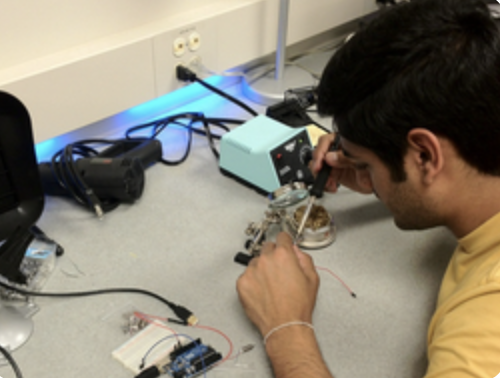
Left: Suri during his McNair Summer Research Fellowship designing a hardware-software prototype: a wearable Braille-based device for the visually impaired.
Q: Tell us about someone in the UMBC community who has inspired you or supported you, and how they did it.
A: Dr. Laila Shishineh encouraged me to merge my technical background with my passion for supporting others. Her mentorship helped me take risks, try new experiences, and believe that innovation can start in the classroom.
Dr. Shishineh was my Summer Bridge mentor and had an enormous influence on both my personal and professional trajectory. She encouraged me to take on extra credits early, accelerating my progress and building my confidence, and pushed me to get involved beyond the classroom—to form meaningful connections, volunteer, and embrace opportunities I otherwise might have overlooked.
With that encouragement, I joined the Refugee Youth Project through the Shriver Center, which eventually helped me connect with recruiters at General Electric. She supported my interest in becoming a resident assistant in the Discovery Scholars Living-Learning Community, and she constantly encouraged me to step into leadership roles, attend retreats like STRiVE, and explore other parts of campus life, including student government and community service.
 Suri at the McNair Scholars induction ceremony in 2012.
Her mentorship came at a time when I was navigating unfamiliar territory as a first-generation student. My parents didn’t go to college, so having someone who believed in me, challenged me, and celebrated my wins made an enormous difference. She even supported me in applying to the McNair Scholars Program and helped me think about potential future paths in tech.
In so many ways, Laila was the single most influential person in my college journey—a steady source of humor, enthusiasm, and encouragement. I truly wouldn’t be where I am today without her.
Q: Tell us about what you loved about your academic program at UMBC.
A: The information systems program provided a powerful blend of technical skills and practical application. What I appreciated most was how interdisciplinary it felt—it taught me to think not just about technology itself, but about the people, systems, and structures that surround it. That balance shaped the way I approach product management and innovation today.
My professors saw potential I didn’t see in myself. They helped me land my first internships, encouraged me to explore entrepreneurship, and taught me that curiosity and kindness are just as important as credentials.
Manpreet Suri '14, M.S. '15
Q: How did UMBC foster your interest in entrepreneurship?
A: My interest in entrepreneurship definitely sparked while at UMBC. While in Dr. Shaun Kane’s Prototyping and Design Lab I worked on a wearable Braille-based device for users with visual impairments. That was my first real experience with human-centered technology design. That project ultimately became the foundation of my McNair Scholars research and showed me how innovation and empathy can come together to solve real-world problems. It planted the seed for the entrepreneurial mindset I carry with me today.
Q: Since joining the UMBC community, in what ways have you felt supported and experienced personal growth?
A: My professors saw potential I didn’t see in myself. They helped me land my first internships, encouraged me to explore entrepreneurship, and taught me that curiosity and kindness are just as important as credentials.
Dr. Kimberly R. Moffitt remains one of the most memorable and impactful professors I’ve had in any academic setting. Her classes pushed me to consider identity, community, and social systems in ways I never had before. She introduced me to a world of nonfiction that I didn’t realize I’d been missing, and the discussions in her classroom helped balance the technical focus of my information systems coursework.
Her teaching style—thoughtful, engaging, and deeply human—broadened my perspective and made my overall academic experience richer and more holistic. I’m still grateful for the lasting impact her classes had on how I view people and the world.
Q: What’s your favorite thing about being a part of Retriever Nation?
A: Retriever Nation is about hustle, heart, and humility. I love how UMBC fosters change makers who don’t just talk about impact, they do the work and bring others with them.
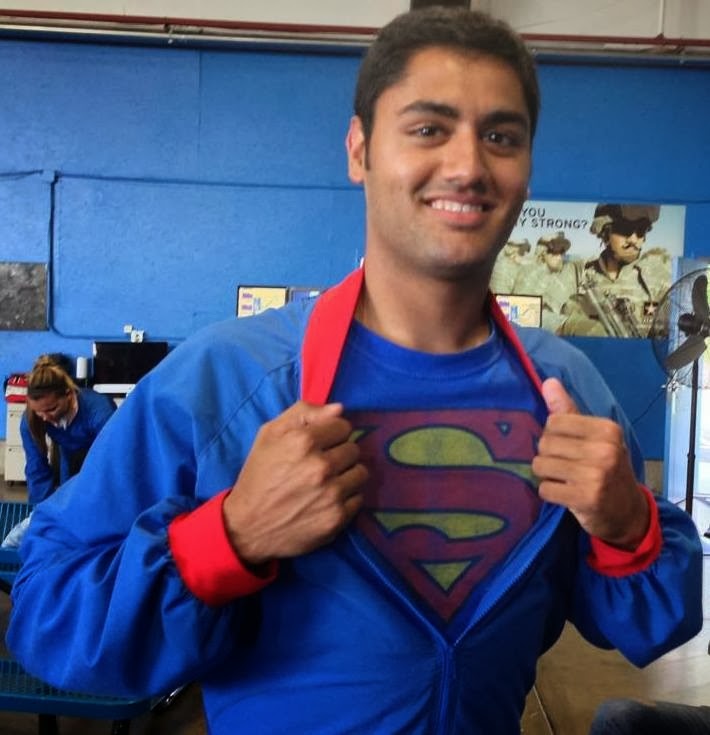
Right: Suri as an undergraduate student at a skydiving experience during his summer internship with GE Aviation.
Q: What drives you to support UMBC?
A: UMBC changed the trajectory of my life. Giving back is my way of paying it forward—especially to programs that support first-generation students and innovators who just need a chance to be seen and supported. I’ll always be proud to support and be part of a community that shows up for people the way UMBC showed up for me.
UMBC’s greatest strength is its people. When people meet Retrievers and hear about the passion they bring, the relationships they create, the ways they support each other, and the commitment they have to inclusive excellence, they truly get a sense of our community. That’s what “Meet a Retriever” is all about.
Learn more about how UMBC can help you achieve your goals.
]]>
Meet Manpreet Suri ’14, M.S. ’15, information systems, an entrepreneur, digital solutions problem solver, McNair Scholar, and a member of the Alumni Association Board of Directors. Suri found a...
https://umbc.edu/stories/meet-a-retriever-manpreet-suri-entrepreneur/
https://my3.my.umbc.edu/api/v0/pixel/news/156274/guest@my.umbc.edu/d5724b4c4bb823c631d2b22c6681ee2e/api/pixel
alumni
coeit
is
magazine
mcnair
meet-a-retriever
perspectives
story
trio
UMBC News & Magazine
https://my3.my.umbc.edu/groups/umbc-news-magazine
https://assets1-my.umbc.edu/system/shared/avatars/groups/000/001/943/24435aa6207c452e7bc15cc74b42c7bb/xsmall.png?1748556657
https://assets1-my.umbc.edu/system/shared/avatars/groups/000/001/943/24435aa6207c452e7bc15cc74b42c7bb/original.png?1748556657
https://assets2-my.umbc.edu/system/shared/avatars/groups/000/001/943/24435aa6207c452e7bc15cc74b42c7bb/xxlarge.png?1748556657
https://assets2-my.umbc.edu/system/shared/avatars/groups/000/001/943/24435aa6207c452e7bc15cc74b42c7bb/xlarge.png?1748556657
https://assets3-my.umbc.edu/system/shared/avatars/groups/000/001/943/24435aa6207c452e7bc15cc74b42c7bb/large.png?1748556657
https://assets1-my.umbc.edu/system/shared/avatars/groups/000/001/943/24435aa6207c452e7bc15cc74b42c7bb/medium.png?1748556657
https://assets2-my.umbc.edu/system/shared/avatars/groups/000/001/943/24435aa6207c452e7bc15cc74b42c7bb/small.png?1748556657
https://assets1-my.umbc.edu/system/shared/avatars/groups/000/001/943/24435aa6207c452e7bc15cc74b42c7bb/xsmall.png?1748556657
https://assets2-my.umbc.edu/system/shared/avatars/groups/000/001/943/24435aa6207c452e7bc15cc74b42c7bb/xxsmall.png?1748556657
UMBC News & Magazine
0
0
false
Thu, 05 Feb 2026 14:52:43 -0500
Thu, 05 Feb 2026 14:52:43 -0500
A place to spark scientific curiosity—UMBC hosts 1,200 high schoolers at Science Olympiad invitational
On a cloudy Saturday in January, UMBC buzzed with the energy of over 1,200 high school students from across the Mid-Atlantic region. For the third consecutive year, UMBC’s College of Natural and Mathematical Sciences (CNMS) hosted its Science Olympiad Invitational Tournament, transforming the campus into a vibrant hub of hands-on scientific discovery for the high school competitors.
From building hovercrafts and bridges to tackling exams in anatomy, astronomy, and beyond, the event showcased 23 competitive challenges across an array of STEM disciplines. What started as a modest gathering of 40 teams three years ago has ballooned into Maryland’s largest invitational, drawing participants from Virginia, Delaware, New Jersey, Pennsylvania, and D.C.
The tournament exemplifies UMBC’s commitment to nurturing young talent and building community connections. “A couple of years ago, I suggested a Science Olympiad tournament as a way to invite more high school students onto the campus and get them excited about science—and UMBC,” shared event co-organizer Bindu Abraham, Ph.D. ’06, chemistry, assistant teaching professor of chemistry and biochemistry, and executive director of Maryland Science Olympiad.
Abraham first encountered Science Olympiad as a homeschool parent watching a passion for science emerge in her son. Now, she is happy to be involved in encouraging a similar enthusiasm for science in students across the region. This year’s event also spotlighted partnerships with organizations like STEM Champions of Baltimore, ensuring under-resourced Baltimore City schools could participate in a dedicated league and envision futures at UMBC.
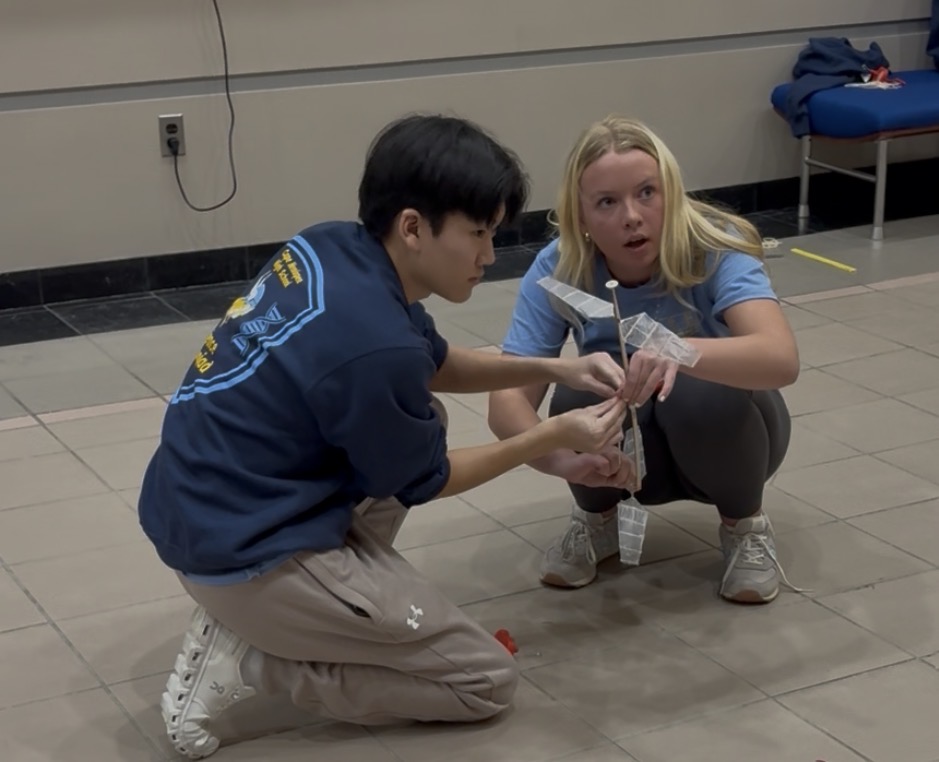
 Cape Henlopen High School in Delaware brought three complete teams to the Science Olympiad at UMBC. Left: Nathaniel Hoang and Ellie Sprague compete in the helicopter event. Right: Quinton Eisenmann and Ava Lewis prepare for the hovercraft event. (Photos courtesy of Priscilla Coolbaugh)
Inspiring students’ interest in science
Volunteers—including UMBC faculty, alumni, current students—made the day possible, each driven by motivations rooted in their own journeys. Mark Grzanna, M.S. ’15, biological sciences, today a Science Olympiad coach at John Carroll High School in Bel Air, Maryland, brought two teams of eager students for his third year at the UMBC tournament. Grzanna teaches biology, anatomy and physiology, and a biotech course he designed at John Carroll, and he views the Olympiad as a gateway to scientific curiosity.
“Education is so important. I became a teacher to get kids interested in science—or at least to help them understand enough science to navigate their world,” he said. His co-coach, John Carroll teacher Andrew Ketchum, echoed the sentiment: “It’s a great experience for our kids to see other students excited about science.”
Frank Tagaytay, a senior physics and math major, supervised the “boomilever” event, where teams tested structures’ strength and integrity. Based on experience as president of his high school Science Olympiad club, Tagaytay patiently guided participants through event regulations, offering encouragement amid the occasional structural mishap.

 Left: Frank Tagaytay (left), a senior UMBC physics and math major, encourages Aalyna Johnson (center) and Cassidy Mehegan from Cape Henlopen High School as they set up their “boomilever” for competition. (Photo by Sarah Hansen, M.S. ’15/UMBC) Right: Cape Henlopen students Theodore Noe Fellows, Shouta Sano, Quinton Eisenmann, and Ava Lewis (left to right) carry their equipment to the competition site in the UMBC Physics Building. (Photo courtesy of Priscilla Coolbaugh)
“It’s an early season event for teams to work out the kinks,” he explained, highlighting how the low-stakes environment builds confidence and resilience. For Tagaytay, volunteering bridges his past and present, reinforcing UMBC’s supportive community.
Fareedah Owolabi, a junior chemical engineering major who recently transferred from the Community College of Baltimore County, found the event particularly meaningful. “I have a soft spot for STEM outreach, because it’s how I was introduced to UMBC,” she shared. Through the Upward Bound Math and Science program, Owolabi connected with UMBC tutors as a high schooler. Now, as a volunteer, she fielded questions from participants about campus life. “I want to inspire younger students,” she said, embodying the cycle of mentorship that defines the tournament.
Broadening their horizons
Priscilla Coolbaugh, Science Olympiad coach at Cape Henlopen High School in Delaware, started her team three years ago after loving Science Olympiad as a student herself. “I want to share that love,” she said. Her three full teams traveled far to compete. “They get to see themselves at these universities. They might have planned to stay close to home, but this way they get exposure to out-of-state schools,” Coolbaugh said. “It broadens their horizons to different schools as well as different STEM fields.”

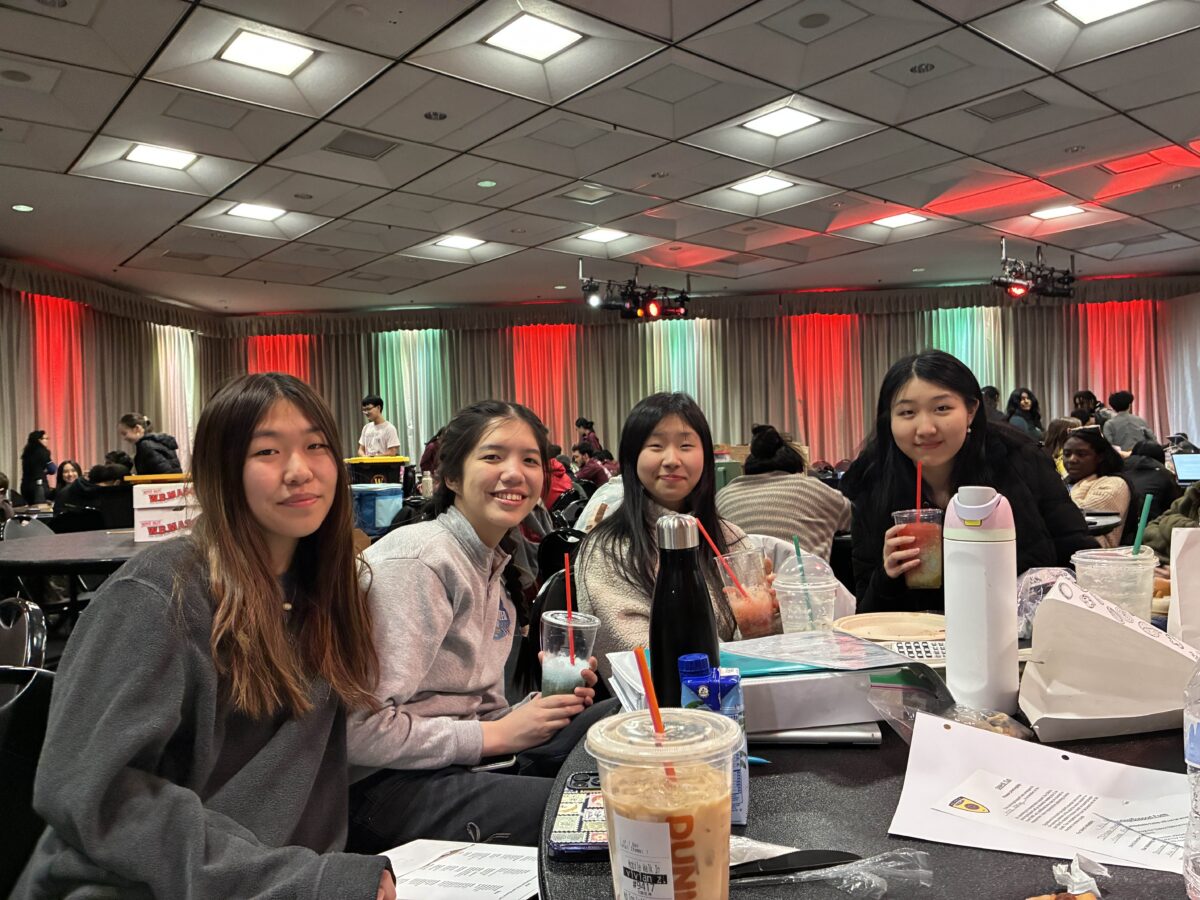 Students and a coach from Winston Churchill High School in Potomac, Maryland, relax in the UMBC Ballroom between events. (Photos courtesy of Jonathan Lee)
Students expressed their sense of community and excitement about their experiences at the UMBC event. Cape Henlopen freshman Aalya Desai noted how the event helped her make friends despite starting as a newcomer, and sophomore Grace Eanes appreciated the chance to bond with peers across grades while exploring the beautiful campus. Michael Song, a junior from Winston Churchill High School in Potomac, Maryland, who with his teammate, Leo Jiang, earned the top score in the hovercraft event, commented, “UMBC is much bigger than I expected. It’s a lot of fun to travel to Olympiad events.”
In good hands
Faculty and staff volunteers underscored the event’s broader impact. CNMS dean William R. LaCourse, surveying the awards ceremony, reflected on the promise of the participants. “As I stood on the stage looking over the ballroom filled with excited and creative students, I couldn’t help feeling as if I was looking into the future and thinking, ‘We (all of us) are in good hands,’” he said.
Zeev Rosenzweig, professor of chemistry and biochemistry, supervised the rocks and minerals test with three undergraduates and three of his graduate students. “Being here is just an important thing to do,” he said. “It’s a great outlet to show them that their interests matter,” he noted. “The kids who come to the Olympiad—they’re our people.” Ph.D. student Kushani Mendis, a Ph.D. student in Rosenzweig’s lab, added, “The best way to support the next generation in STEM is to organize events like this and spend time with them.”
In April, UMBC will host the Maryland State Science Olympiad for the first time, building on this invitational’s momentum. “It’s fun to see young people so excited about different areas of STEM,” shared Michelle Starz-Gaiano, professor and chair of biological sciences, adding, “It’s critical to foster the growth of young scientists. We love the energy and enthusiasm that they bring.”
]]>
On a cloudy Saturday in January, UMBC buzzed with the energy of over 1,200 high school students from across the Mid-Atlantic region. For the third consecutive year, UMBC’s College of Natural and...
https://umbc.edu/stories/1200-high-schoolers-at-science-olympiad/
https://my3.my.umbc.edu/api/v0/pixel/news/156251/guest@my.umbc.edu/8fcd1fc51406ee5d71336ef39bd47917/api/pixel
biology
cbee
chembiochem
cnms
coeit
community
news
physics
science-and-tech
story
trio
UMBC News & Magazine
https://my3.my.umbc.edu/groups/umbc-news-magazine
https://assets1-my.umbc.edu/system/shared/avatars/groups/000/001/943/24435aa6207c452e7bc15cc74b42c7bb/xsmall.png?1748556657
https://assets1-my.umbc.edu/system/shared/avatars/groups/000/001/943/24435aa6207c452e7bc15cc74b42c7bb/original.png?1748556657
https://assets2-my.umbc.edu/system/shared/avatars/groups/000/001/943/24435aa6207c452e7bc15cc74b42c7bb/xxlarge.png?1748556657
https://assets2-my.umbc.edu/system/shared/avatars/groups/000/001/943/24435aa6207c452e7bc15cc74b42c7bb/xlarge.png?1748556657
https://assets3-my.umbc.edu/system/shared/avatars/groups/000/001/943/24435aa6207c452e7bc15cc74b42c7bb/large.png?1748556657
https://assets1-my.umbc.edu/system/shared/avatars/groups/000/001/943/24435aa6207c452e7bc15cc74b42c7bb/medium.png?1748556657
https://assets2-my.umbc.edu/system/shared/avatars/groups/000/001/943/24435aa6207c452e7bc15cc74b42c7bb/small.png?1748556657
https://assets1-my.umbc.edu/system/shared/avatars/groups/000/001/943/24435aa6207c452e7bc15cc74b42c7bb/xsmall.png?1748556657
https://assets2-my.umbc.edu/system/shared/avatars/groups/000/001/943/24435aa6207c452e7bc15cc74b42c7bb/xxsmall.png?1748556657
UMBC News & Magazine
1
0
false
Thu, 05 Feb 2026 11:30:12 -0500
Thu, 05 Feb 2026 11:30:12 -0500
UMBC physicist wins Amazon award to build AI-orchestrated scientific assistant
Fabio Anza, an assistant professor in UMBC’s Department of Physics, Quantum Science Institute and Cybersecurity Institute, has won an Amazon Research Award to develop Physics Co-Pilot—a scientific AI assistant that combines large language model (LLM) orchestration with reliable computational algorithms to address critical bottlenecks in modern physics research.
The problem isn’t just coding. Theoretical physics, like many other areas of scientific research, is currently facing two major challenges: knowledge fragmentation and hyperspecialized computational tools. The open-access, online scientific paper repository ArXiv alone publishes over 25,000 new papers monthly across computer science, math, and physics. Meanwhile, using sophisticated computational methods requires mastering ultra-niche software ecosystems—work that diverts researchers from scientific discovery.
“Researchers spend increasingly large amounts of time wrestling with software issues rather than exploring scientific questions,” Anza explains. “Valuable human capital gets diverted from discovery to dealing with technical problems that could be avoided with better infrastructure.”
A hybrid approach to scientific computing
Physics Co-Pilot takes a fundamentally different approach from pure AI code generation systems. Rather than having language models write code—which, at scale, produces unreliable results—the system uses LLMs only for natural language understanding, while delegating all computational work to pre-written, validated algorithms.
Researchers spend increasingly large amounts of time wrestling with software issues rather than exploring scientific questions. Valuable human capital gets diverted from discovery to dealing with technical problems that could be avoided with better infrastructure. — Fabio Anza, assistant physics professor
“The LLM acts as an orchestrator, not a programmer,” Anza says. “It translates natural language into structured commands that call expertly implemented computational routines. This maintains computational rigor while making advanced techniques accessible through conversation.”
The tool features specialized software routines for literature analysis and physics simulations. For the initial release, the system will focus on modeling a a narrow set of physical systems, serving as proof-of-concept for future community-driven expansions.
From concept to open-source release
Anza has recruited computer science senior Samuel Truong to help develop the system over the next year, with plans to expand the team as the project progresses.
The project follows a short timeline: an initial prototype with literature analysis capabilities will be released in the first six months, enabling researchers to conduct natural language-driven searches and synthesis of ArXiv papers. The complete system, including simulation and visualization capabilities for dynamical systems, will be released (under the MIT open-source license) by the end of 2026.
“Physics Co-Pilot represents a new paradigm in scientific assistants,” Anza notes. “By combining conversational accessibility with computational reliability, we aim to give researchers access to advanced computational techniques without the need to know any programming languages.”
The system aims to enable physicists to discover and synthesize knowledge across disciplines, eliminate programming barriers to sophisticated analysis methods, and accelerate research cycles through rapid hypothesis testing—all without researchers writing a single line of code themselves.
]]>
Fabio Anza, an assistant professor in UMBC’s Department of Physics, Quantum Science Institute and Cybersecurity Institute, has won an Amazon Research Award to develop Physics Co-Pilot—a scientific...
https://umbc.edu/quick-posts/anza-ai-orchestrated-scientific-assistant/
https://my3.my.umbc.edu/api/v0/pixel/news/156016/guest@my.umbc.edu/381414bc27cf343cac1118e24912a032/api/pixel
cnms
coeit
csee
cybersecurity
physics
quick-post
science-and-tech
UMBC News & Magazine
https://my3.my.umbc.edu/groups/umbc-news-magazine
https://assets1-my.umbc.edu/system/shared/avatars/groups/000/001/943/24435aa6207c452e7bc15cc74b42c7bb/xsmall.png?1748556657
https://assets1-my.umbc.edu/system/shared/avatars/groups/000/001/943/24435aa6207c452e7bc15cc74b42c7bb/original.png?1748556657
https://assets2-my.umbc.edu/system/shared/avatars/groups/000/001/943/24435aa6207c452e7bc15cc74b42c7bb/xxlarge.png?1748556657
https://assets2-my.umbc.edu/system/shared/avatars/groups/000/001/943/24435aa6207c452e7bc15cc74b42c7bb/xlarge.png?1748556657
https://assets3-my.umbc.edu/system/shared/avatars/groups/000/001/943/24435aa6207c452e7bc15cc74b42c7bb/large.png?1748556657
https://assets1-my.umbc.edu/system/shared/avatars/groups/000/001/943/24435aa6207c452e7bc15cc74b42c7bb/medium.png?1748556657
https://assets2-my.umbc.edu/system/shared/avatars/groups/000/001/943/24435aa6207c452e7bc15cc74b42c7bb/small.png?1748556657
https://assets1-my.umbc.edu/system/shared/avatars/groups/000/001/943/24435aa6207c452e7bc15cc74b42c7bb/xsmall.png?1748556657
https://assets2-my.umbc.edu/system/shared/avatars/groups/000/001/943/24435aa6207c452e7bc15cc74b42c7bb/xxsmall.png?1748556657
UMBC News & Magazine
3
0
false
Thu, 29 Jan 2026 13:46:52 -0500
Thu, 29 Jan 2026 13:46:52 -0500
A season of change for UMBC’s Class of 2025
“As you step into the next stage of your journey—into this complex, technology-driven, and rapidly changing world—I want to challenge you to be an advocate for the irreplaceable value of human communication,” said Christine Mallinson, during last week’s Commencement exercises. The assistant vice president for research and scholarly impact and professor of language, literacy, and culture was tasked with sending UMBC’s new graduates onward and she emphasized the importance of humanity in their next steps.


Nearly 1,000 Retrievers crossed the stage on December 17 and 18 as UMBC celebrated Ph.D., graduate, and undergraduate Commencement ceremonies. At the heart of these celebrations were the people—the family members who offered support, the friends and classmates who were study buddies and allies, the faculty and staff who provided guidance and a listening ear, and the students themselves who pushed through growth even when the road was rocky.


“One of my favorite things this year has been seeing how supportive graduates are of one another,” shared Aminah Amjad, Ph.D. ’26, chemistry, and president of the Graduate Student Association, while addressing her peers. “Whether it’s sharing lab space or advertising about free food on campus or sharing memes that perfectly describe our collective suffering, you all made it through because you lifted each other.”


As these Retrievers prepare to embark on the exciting journey ahead, Provost Manfred H. M. van Dulmen left the class of 2025 with a final charge: “Let the values you lived here at UMBC guide you as you shape a more just, more inclusive, and more hopeful world. You are the future we’ve been waiting for.”
Visit commencement.umbc.edu to view livestreams of both Commencement ceremonies. All photos by Brad Ziegler/UMBC.
]]>
“As you step into the next stage of your journey—into this complex, technology-driven, and rapidly changing world—I want to challenge you to be an advocate for the irreplaceable value of human...
https://umbc.edu/stories/a-season-of-change-for-umbcs-class-of-2025/
https://my3.my.umbc.edu/api/v0/pixel/news/155450/guest@my.umbc.edu/bf5b5c8727825453526b61a7cc15385d/api/pixel
alumni
cahss
campus-life
cnms
coeit
magazine
story
UMBC News & Magazine
https://my3.my.umbc.edu/groups/umbc-news-magazine
https://assets1-my.umbc.edu/system/shared/avatars/groups/000/001/943/24435aa6207c452e7bc15cc74b42c7bb/xsmall.png?1748556657
https://assets1-my.umbc.edu/system/shared/avatars/groups/000/001/943/24435aa6207c452e7bc15cc74b42c7bb/original.png?1748556657
https://assets2-my.umbc.edu/system/shared/avatars/groups/000/001/943/24435aa6207c452e7bc15cc74b42c7bb/xxlarge.png?1748556657
https://assets2-my.umbc.edu/system/shared/avatars/groups/000/001/943/24435aa6207c452e7bc15cc74b42c7bb/xlarge.png?1748556657
https://assets3-my.umbc.edu/system/shared/avatars/groups/000/001/943/24435aa6207c452e7bc15cc74b42c7bb/large.png?1748556657
https://assets1-my.umbc.edu/system/shared/avatars/groups/000/001/943/24435aa6207c452e7bc15cc74b42c7bb/medium.png?1748556657
https://assets2-my.umbc.edu/system/shared/avatars/groups/000/001/943/24435aa6207c452e7bc15cc74b42c7bb/small.png?1748556657
https://assets1-my.umbc.edu/system/shared/avatars/groups/000/001/943/24435aa6207c452e7bc15cc74b42c7bb/xsmall.png?1748556657
https://assets2-my.umbc.edu/system/shared/avatars/groups/000/001/943/24435aa6207c452e7bc15cc74b42c7bb/xxsmall.png?1748556657
UMBC News & Magazine
1
0
false
Mon, 22 Dec 2025 13:13:11 -0500
Mon, 22 Dec 2025 13:13:11 -0500
Students in the Center for Women in Technology succeed by lifting each other up—and are spreading the model around the world
 Brazilian and UMBC students in front of a cultural center in Recife that they toured. (Photo courtesy of Seaman)
Last summer, Kaila Hoskins, a junior computer science major, Celine Anong, a senior information systems major, and Madeline Rippin and Hallel Dereb, both senior computer science majors, took a one-week trip to Recife, Brazil. Like many college students on an international adventure, they toured the city, visited the beaches, sampled the cuisine, and connected with locals. But the trip was more purposeful than a standard vacation. The quartet had come to Brazil to spread UMBC-style support structures for women in technology to four Brazilian universities.
Carolyn Seaman, the director of the Center for Women in Technology (CWIT) at UMBC, organized the trip as part of a Fulbright Brazil Specialist grant-funded project. She collaborated with colleagues in Brazil to establish a set of programs and activities, modeled on CWIT, to support undergraduate female computing students at the Universidade Federal de Pernambuco, a federal research-intensive university; the Universidade de Pernambuco, a state university; Universidade Católica de Pernambuco, a community university that reinvests all profits back into its educational activities; and CESAR School, a private school for continuing education in computing.
Hoskins, Anong, Rippin, and Dereb were able to join the project through separate funding from UMBC’s information systems and computer science and electrical engineering departments and the Center for Global Engagement. They helped analyze survey data about the experiences of women in tech in Brazilian universities and helped launch the peer mentoring program.
“The program was met with tons of enthusiasm from students, faculty, administrators, and local tech companies,” says Seaman. “The icing on the cake was that I was able to host four of my CWIT students.”
“There were so many ‘best parts’ of the trip,” says Anong. “We built connections, collaborated on meaningful work, immersed ourselves in Brazilian culture, and bonded with peers and mentors.”
Support breeds success
CWIT was founded at UMBC in the summer of 1998 by Joan Korenman, a professor of English and director of the Women’s Studies Program. It started with a speaker series on women in technology, and in subsequent years expanded to include outreach and training events, scholars programs, and much more.
It currently focuses on building a welcoming environment for women in tech by recruiting undergraduate women studying computing and engineering and their allies, and providing them with leadership opportunities, professional development, mentoring, networking, and a supportive community that they can turn to throughout their years in school and stay connected with once they enter the tech industry.
Since its inception, CWIT has served more than 500 students, about 75 percent of them women. Over the last 25 years, more than 95 percent of the undergraduate women in computing and engineering officially affiliated with the program have stayed in tech fields. These former students form a large and supportive network of tech leaders in the Maryland region and beyond.
Rippin says her own experience with the CWIT peer mentoring program—first as a mentee and then for two years as a mentor—motivated her to apply for the opportunity to spread the model in Brazil.
“I had such fond memories from building deep connections with like-minded women in tech fields,” Rippin says. “It’s been a really rewarding experience.”
 UMBC students Madeline Rippin, Kaila Hoskins, Celine Anong, and Hallel Dereb and CWIT director Carolyn Seaman join a planning meeting with some of the Brazilian student leaders of the Supporting Women In Technology Across Borders group. (Photo courtesy of Seaman)
Similar challenges and a shared sense of purpose
The CWIT students felt a similar bond with the Brazilian students they met on the trip. While the tech landscape of the two countries differs in some key respects, both countries face persistent underrepresentation of women in the field.
“I think a lot of the struggles that the women in tech in Brazil face are very similar to ours,” says Hoskins. “Things like how isolating the computer science community can feel.”
“Meeting the six Brazilian students we kept in contact with throughout our stay in Recife and sharing experiences about our journeys as women in computing was lovely,” Anong says. “Despite our evident cultural and language differences, we had so many similarities in terms of passion, struggles, and aspirations.”
Hoskins recalls how the students took a boat ride along the rivers that flow through Recife.
 UMBC students and their Brazilian hosts enjoy a relaxing boat ride on the Capibaribe River in Recife. (Photo courtesy of Seaman)
Every time the boat passed under a bridge, they’d follow local tradition and clap and make a wish. It was fun, and also an opportunity to connect, Hoskins says. “It was quiet and it was a chance for us to talk and really get to know each other.”
The UMBC students left with renewed commitment to supporting other women in tech all around the world. They have kept in contact with their Brazilian counterparts and have even debuted an acronym—Supporting Women In Technology Across Borders, or SWITAB—to label their collective efforts. By the end of 2025, the mentoring programs they helped launch had more than 130 participants across five universities in Recife.
“I definitely learned so much from the experience that I’ll continue to carry forward,” Rippin says. “This just solidified how widespread the issue of underrepresentation in technical fields is, and has only strengthened my passion to continue working towards the cause.”
Dereb echoed the sentiment: “One of the best parts of the trip was meeting motivated women who wanted to uplift each other. This experience solidified the importance of community for me, and I’ll carry that forward by being more intentional about creating and contributing to spaces where people feel supported.”
]]>
Brazilian and UMBC students in front of a cultural center in Recife that they toured. (Photo courtesy of Seaman) Last summer, Kaila Hoskins, a junior computer science major, Celine Anong, a...
https://umbc.edu/stories/cwit-supporting-women-in-tech-brazil/
https://my3.my.umbc.edu/api/v0/pixel/news/155432/guest@my.umbc.edu/9a0b72952a957fe72db1245ed52cd1aa/api/pixel
coeit
csee
cwit
is
news
science-and-tech
story
UMBC News & Magazine
https://my3.my.umbc.edu/groups/umbc-news-magazine
https://assets1-my.umbc.edu/system/shared/avatars/groups/000/001/943/24435aa6207c452e7bc15cc74b42c7bb/xsmall.png?1748556657
https://assets1-my.umbc.edu/system/shared/avatars/groups/000/001/943/24435aa6207c452e7bc15cc74b42c7bb/original.png?1748556657
https://assets2-my.umbc.edu/system/shared/avatars/groups/000/001/943/24435aa6207c452e7bc15cc74b42c7bb/xxlarge.png?1748556657
https://assets2-my.umbc.edu/system/shared/avatars/groups/000/001/943/24435aa6207c452e7bc15cc74b42c7bb/xlarge.png?1748556657
https://assets3-my.umbc.edu/system/shared/avatars/groups/000/001/943/24435aa6207c452e7bc15cc74b42c7bb/large.png?1748556657
https://assets1-my.umbc.edu/system/shared/avatars/groups/000/001/943/24435aa6207c452e7bc15cc74b42c7bb/medium.png?1748556657
https://assets2-my.umbc.edu/system/shared/avatars/groups/000/001/943/24435aa6207c452e7bc15cc74b42c7bb/small.png?1748556657
https://assets1-my.umbc.edu/system/shared/avatars/groups/000/001/943/24435aa6207c452e7bc15cc74b42c7bb/xsmall.png?1748556657
https://assets2-my.umbc.edu/system/shared/avatars/groups/000/001/943/24435aa6207c452e7bc15cc74b42c7bb/xxsmall.png?1748556657
UMBC News & Magazine
0
0
false
Fri, 19 Dec 2025 16:59:47 -0500
Fri, 19 Dec 2025 16:59:47 -0500
Strange Dance Partners
UMBC researchers are discovering building blocks of hand motions, aiming to improve physical therapy for humans and find better ways to program robots. They’re turning to a novel source material for these gestures: classical Indian dance.
Fossil records suggest that between four and six million years ago, the hominin ancestors of modern humans first stood up and walked on two legs—thus freeing their hands. Those hands went on to craft humanity’s story arc: cradling babies, carrying food, fashioning and wielding weapons, carving the woodblocks used to print the first paper books, running over the keys of a piano in a Rachmaninoff concerto, and even planting a flag on the surface of the moon.
“Hands are incredibly important to humans,” says Ramana Vinjamuri, an associate professor of computer science and electrical engineering whose work has focused on understanding how the brain controls complex hand movements.
Vinjamuri personally witnessed the debilitating impact of loss of hand movement when his mother suffered a stroke in 2014. “The very hand that taught me how to draw, how to write—I saw that hand irrevocably paralyzed. It was really hard for the family.”
The experience motivated Vinjamuri to work on technologies that could help people regain lost motor functions or serve as robotic replacements for injured body parts. As part of the research, the team began searching for and cataloging the building blocks of hand motions. Further inspiration struck when Vinjamuri attended a scientific conference on the brain, hosted by the Indian Institute of Technology Mandi in the serene foothills of the Himalayas. While brainstorming ideas for a session of the conference focused on ways that ancient Indian traditions might be applied to modern problems, Vinjamuri conceived a novel approach to deriving these building blocks—from the structured hand gestures of Indian classical dance.

Ramana Vinjamuri in the Vinjamuri lab, stands with a Unitree bipedal robot.
A Complex and Versatile Instrument

Mitra, a humanoid robot produced by Invento Robotics, a company founded by UMBC alumnus Balaji Viswanathan, M.S ’06, Ph.D. ’23, computer science. The researchers programmed Mitra to make letters of the American Sign Language alphabet by combining the mudras-derived alphabets of movement, in this case making the letter E.
Take a moment to consider your hands. Including the wrist, each hand has 27 joints. Some of those joints, such as the carpometacarpal joint at the base of the thumb, can move in multiple ways, such as rotating, bending, and moving toward or away from the center of the palm. The full hand encompasses billions of possible unique combinations of movements.
“To study something as complex as the hand is fascinating,” says Parthan Olikkal, a longtime member of Vinjamuri’s lab who is currently working toward his Ph.D in computer science and is deeply involved in recent research efforts.
To get a grip on the complexities, the team has turned to a concept called kinematic synergies. First extensively explored in the mid-20th century by Russian physiologist Nikolai Bernstein, synergies are essentially building blocks of movement in which the brain simultaneously coordinates multiple joint movements to simplify complex motions.
The concept can be used to deconstruct a dazzling diversity of movements into a limited number of fundamental units, similar to how the hundreds of thousands of different words in the English language can be broken down into only 26 letters.
Vinjamuri and his students have been on a quest to discover the “alphabets” of human hand movements we’ve collectively learned through hundreds of dropped sippy cups, hours of handwriting practice, and the like. The hope is that the knowledge could then be used as a “hack”—to more effectively train ourselves and our robotic assistants in the future.
“The way we interact with our surroundings—the way we grasp objects or move through space—feels so natural and effortless. We often forget we stumbled and fell as children while our brains and bodies were learning to coordinate.”
— Ramana Vinjamuri, associate professor of computer science and electrical engineering
Natural Versus Structured Movements

Ashwathi Menon, co-caption of the Adaa Indian fusion dance team, stopped by the lab for a photo shoot in October. Here she appears on the computer screen as the team demonstrates how to use a simple camera and software system to recognize hand movements.

A small statue representing the Hindu god Shiva in the form of Nataraja, the cosmic dancer. Ramana Vinjamuri keeps the statue in his office. (Photo courtesy of Vinjamuri)
As part of their latest research on alphabets of hand movements, Vinjamuri and his students analyzed a dataset of 30 natural hand grasps. The movements are used for picking up objects ranging in size from large water bottles to tiny beads. The researchers found six synergies, akin to an alphabet of six letters, that when combined could account for nearly 99 percent of the variations in movements represented in the full dataset.
The first two synergies alone—specifically a movement in which all five fingers wrap around an object and a movement in which the index finger and thumb pinch together—could account for more than 90 percent of the variations. Learning (or relearning) those two movements would be essential to training a hand to pick up objects, the researchers say.
However, the team also says that studying natural grasps has limitations.
“Natural grasp is unique to the motor learning history of an individual,” says Olikkal. “So the way I do something might be completely different from another person.” The grasps also represented limited functionality, containing only a small subset of ways that a person might use their hands.
“Hand gestures are part of the storytelling. They are very precise. They can be used to point, to represent an animal, to represent praying—those are just some examples.”
— Ashwathi Menon, a junior and co-captain of UMBC’s Adaa Indian fusion dance team
In search of richer alphabets of movement, the researchers turned to dance, specifically an Indian classical dance form called Bharatanatyam, which originated in the southern Indian state of Tamil Nadu. The term Bharatanatyam is often explained as a mnemonic blend of words combining the concepts of emotion, melody, rhythm, and dance. The holistic art form employs a variety of hand gestures, called mudras, to drive the storytelling at its heart.
“Bharatanatyam is an intricate, linear, and structured dance form with a lot of precision,” says Ashwathi Menon, a UMBC junior majoring in bioinformatics and computational biology who is co-captain of the university’s Adaa Indian fusion dance team and who has been performing classical Indian dances since she was four years old. “Hand gestures are part of the storytelling. They are very precise. They can be used to point, to represent an animal, to represent praying—those are just some examples.”
“We noticed dancers tend to age super gracefully: They remain flexible and agile because they have been training,” says Vinjamuri. “That was a huge inspiration for us when we started looking for richer alphabets of movement. With dance, we are looking not just at healthy movement but super healthy. And so the question became, could we find a ‘superhuman’ alphabet from the dance gestures?”

Mitra’s hands use three types of motors for movement. The strongest motor, located at the shoulder, handles shoulder flexion and extension, while a medium-torque motor at the elbow controls elbow movements, and five servo motors, one for each digit, are used to control the fingers.
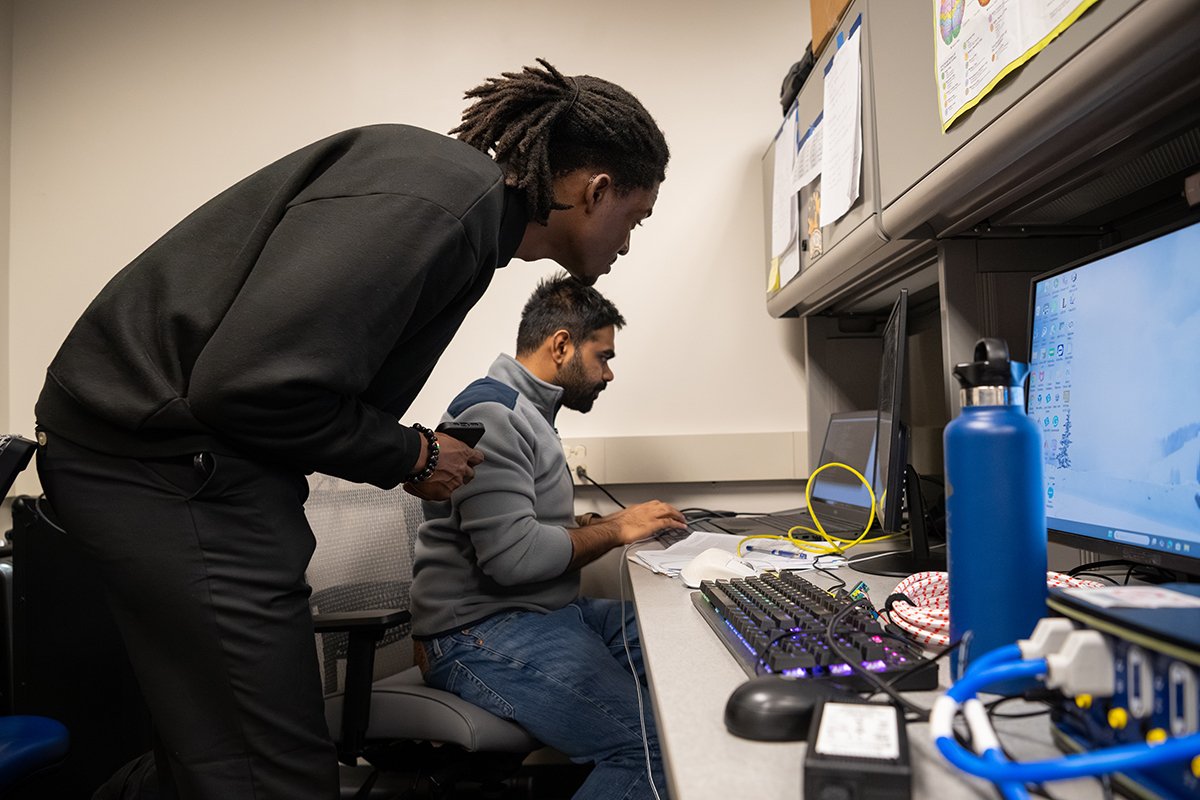
Chris Dollo (left), a senior computer science major and undergraduate researcher in the Vinjamuri lab, and Parthan Olikkal (right) work at the computer. Olikkal brought the concept of capturing hand movements using simple camera set-ups into the lab, a key step toward making cost-effective technologies.
Dance-Derived Alphabets of Movement

Ashwathi Menon demonstrates mudras, which are copied by an Inspire robotic hand. From top to bottom the mudras are: Ardhachandra, meaning “half moon;” Chandrakala, meaning “crescent moon;” and Tripataka, meaning “three parts of the flag.” The mudras can demonstrate various elements of a story, including weapons, trees, flowers, or concepts such as balance, unity, and beauty.
Using the same techniques they had deployed to deconstruct the 30 natural hand grasps, the research team also analyzed 30 single-hand mudras. They found six synergies that could account for around 94 percent of the mudras’ variations.
Crucially, the team then tested how well the six natural grasp-derived synergies could combine to construct unrelated hand motions—in this case 15 letters of the American Sign Language alphabet—compared to the mudras-derived synergies. The mudras synergies significantly outperformed the natural hand grasp synergies on that task.
“When we started this type of research more than 15 years ago, we wondered: Can we find a golden alphabet that can be used to reconstruct anything?” says Vinjamuri. “Now I highly doubt that there is such a thing. But the mudras-derived alphabet is definitely better than the natural grasp alphabet because there is more dexterity and more flexibility.”
Ultimately, Vinjamuri envisions coming up with libraries of task-specific alphabets that can be deployed depending on the needs, be it completing everyday household chores such as cooking or folding laundry, or something more complicated and precise, such as playing an instrument.
Robotic Helping Hands
Apart from advancing understanding of the fundamental roots of movement, the team has made great strides developing cost-effective and pragmatic methods of testing and implementing their ideas. When Vinjamuri first started the work, his team relied on motion-capture systems that required specialized gloves and other equipment. Now, the team uses a simple camera and software system to recognize, record, and analyze movements.
“Parthan brought the concept of capturing hand movements using cameras into the lab and really developed it,” Vinjamuri said. It’s an important contribution to ultimately making cost-effective technologies that people could use in their homes, he says, such as a virtual system to coach people through physical therapy sessions.
The team is also successfully developing techniques to “teach” robotic hands the alphabets of movements and how to combine them to make new hand gestures. The approach marks a departure from standard techniques of teaching robots to mimic hand gestures, and toward a method rooted in our understanding of how the human body and brain work.

Ashwathi Menon, left, demonstrates the Katakamukha mudra while a robotic hand mimics her gesture. The mudra is often used to represent actions like plucking flowers, holding a necklace, and pulling a bowstring.
“It’s called biomimetic learning,” says Vinjamuri. “We want to watch how a human body moves, how a hand moves and works, and we want to derive those principles and apply them to machines.”
The researchers are testing the techniques on a stand-alone robotic hand and a humanoid robot, each of which operates in a different way and requires a unique approach to translating the mathematical representations of synergies into physical movements.
“Once I learned about synergies, I became so curious to see if we could use them to make a robotic hand respond and perform the same way as a human hand,” says Olikkal. “Adding my own work to the research efforts and seeing the results has been gratifying.”
These moments of satisfaction in finding solutions to knotty problems will continue to propel the team’s voyage of discovery. They may even take a moment to celebrate their successes—perhaps with a fitting high-five.

Could A Dancing Robot Improve Humans’ Mental Health?
By Catherine Meyers • Photography by Kiirstn Pagan ’11
Searching for an alphabet of hand movements from the gestures in classical Indian dance is not the only way that art is inspiring and guiding new research in Ramana Vinjamuri’s lab. In a related project, Vinjamuri has teamed up with Andrea Kleinsmith, an associate professor in information systems who specializes in ways that computers can assess humans’ emotions, and Ann Sofie Clemmensen, an associate professor of dance, to explore whether and how dancing robots might offer humans new tools to improve their mental health. The research piggybacks off established practices of human-to-human dance/movement therapy, which can be used to treat some mental health challenges, such as schizophrenia, anxiety, and depression.
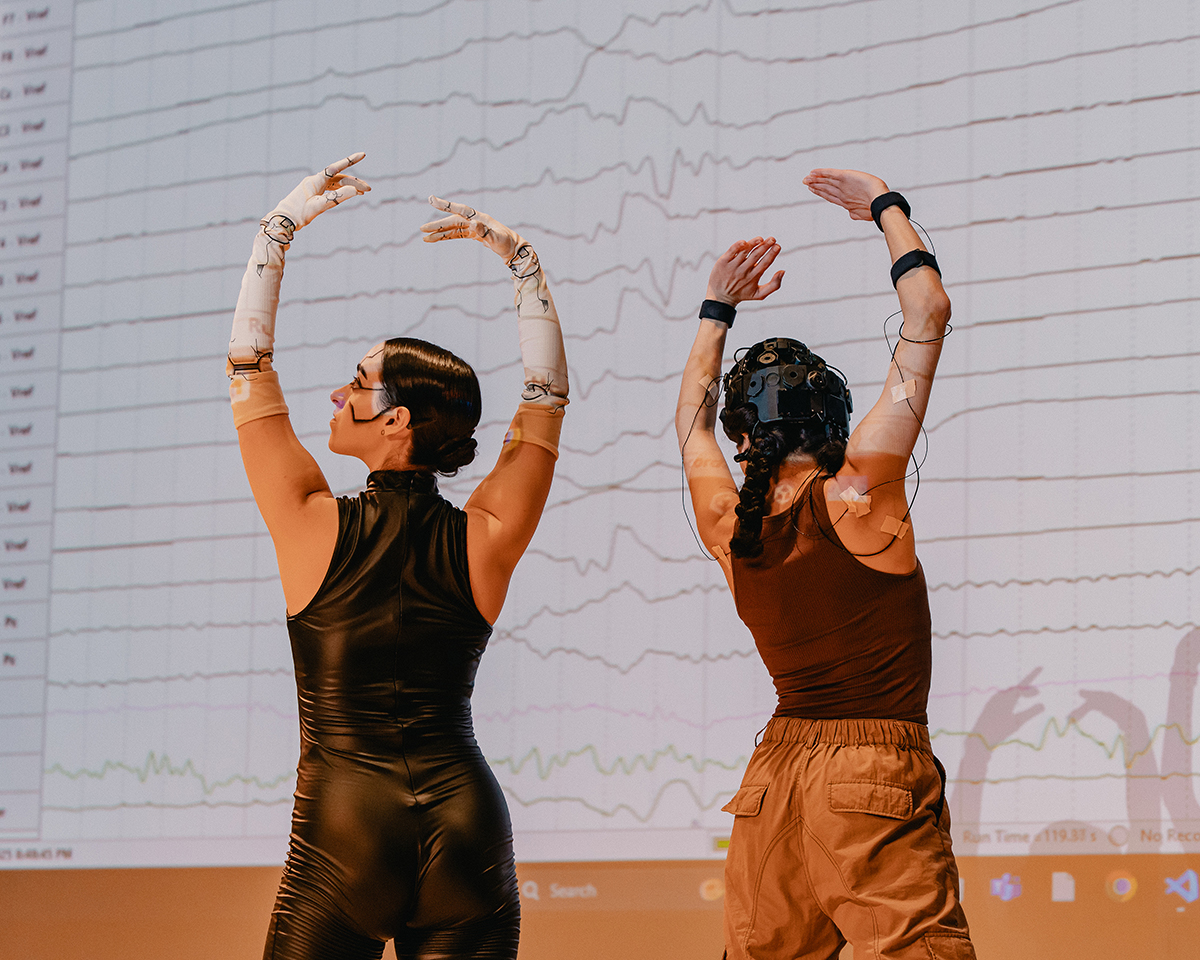
Dancers Sarah McHale ’24 and Juju Ayoub ’25 perform during the AccelNet meeting. The dance was a demonstration of a collaborative research project by UMBC faculty Ramana Vinjamuri, Andrea Kleinsmith, and Ann Sofie Clemmensen exploring stress reducing technology.
The spark for the interdisciplinary venture was struck when the College of Engineering and Information Technology launched a program to encourage faculty to explore collaborations across disciplines to tackle big challenges.
Together, Vinjamuri, Kleinsmith and Clemmensen developed a proposal to investigate questions such as whether the coordination in a person’s arms and legs could be a proxy measure of mental well-being, how existing dance therapy movements affect brain activity, and how a humanoid robot dance partner compares in effectiveness to a flesh-and-blood one.
“As a healthcare opportunity, dancing with a robot may sound weird at first,” notes Clemmensen. But, she says, people who are socially isolated or struggle with the stressors of human interactions might benefit from robot partners. “As humans, we project emotions on objects, but the objects do not judge back.”
In June, the team creatively demonstrated their progress to brain researchers and artists from around the world when they choreographed a technology-infused dance performance for the Movement, Music, and Brain Health National Science Foundation AccelNet meeting on the UMBC campus.
Two dancers—one representing a robot and the other a human—took turns moving around each other. Sensors monitored physiological signs of stress on the human dancer. As the dance progressed, the human was at first fearful, then curious, and finally happy—an ending the researchers hope their own project might one day also accomplish.
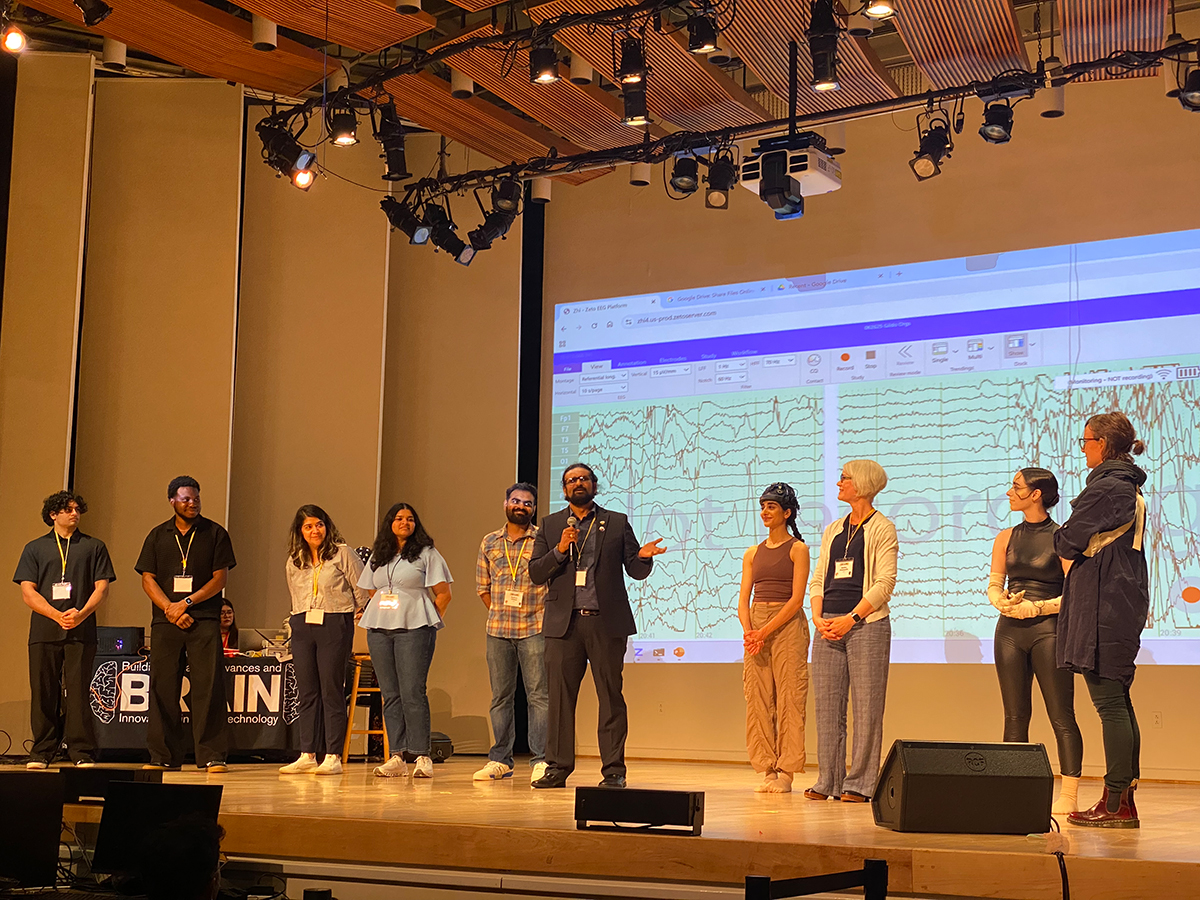
UMBC students and professors who worked on the project gather on the stage after the dance performance. From left to right are Viraj Janeja, Oritsejolomisan Mebaghanje, Golnaz Moharrer, Sruthi Sundharram, Parthan Olikkal, Ramana Vinjamuri, Juju Ayoub, Andrea Kleinsmith, Sarah McHale, and Ann Sofie Clemmensen.
Photo Credit: Niloufar Sarmast
 ]]>
UMBC researchers are discovering building blocks of hand motions, aiming to improve physical therapy for humans and find better ways to program robots. They’re turning to a novel source material...
https://umbc.edu/stories/strange-dance-partners/
https://my3.my.umbc.edu/api/v0/pixel/news/155312/guest@my.umbc.edu/f9ed6ebca522ae4dc141aea381fb8838/api/pixel
cahss
cnms
coeit
csee
dance
discovery
fall-2025
feature
magazine
research
story
UMBC News & Magazine
https://my3.my.umbc.edu/groups/umbc-news-magazine
https://assets1-my.umbc.edu/system/shared/avatars/groups/000/001/943/24435aa6207c452e7bc15cc74b42c7bb/xsmall.png?1748556657
https://assets1-my.umbc.edu/system/shared/avatars/groups/000/001/943/24435aa6207c452e7bc15cc74b42c7bb/original.png?1748556657
https://assets2-my.umbc.edu/system/shared/avatars/groups/000/001/943/24435aa6207c452e7bc15cc74b42c7bb/xxlarge.png?1748556657
https://assets2-my.umbc.edu/system/shared/avatars/groups/000/001/943/24435aa6207c452e7bc15cc74b42c7bb/xlarge.png?1748556657
https://assets3-my.umbc.edu/system/shared/avatars/groups/000/001/943/24435aa6207c452e7bc15cc74b42c7bb/large.png?1748556657
https://assets1-my.umbc.edu/system/shared/avatars/groups/000/001/943/24435aa6207c452e7bc15cc74b42c7bb/medium.png?1748556657
https://assets2-my.umbc.edu/system/shared/avatars/groups/000/001/943/24435aa6207c452e7bc15cc74b42c7bb/small.png?1748556657
https://assets1-my.umbc.edu/system/shared/avatars/groups/000/001/943/24435aa6207c452e7bc15cc74b42c7bb/xsmall.png?1748556657
https://assets2-my.umbc.edu/system/shared/avatars/groups/000/001/943/24435aa6207c452e7bc15cc74b42c7bb/xxsmall.png?1748556657
UMBC News & Magazine
0
0
false
Fri, 05 Dec 2025 16:55:00 -0500
Mon, 15 Dec 2025 12:55:36 -0500
Office Hours—President Sheares Ashby and Petra Janka ’25 discuss student-led inclusive excellence
]]>
UMBC researchers are discovering building blocks of hand motions, aiming to improve physical therapy for humans and find better ways to program robots. They’re turning to a novel source material...
https://umbc.edu/stories/strange-dance-partners/
https://my3.my.umbc.edu/api/v0/pixel/news/155312/guest@my.umbc.edu/f9ed6ebca522ae4dc141aea381fb8838/api/pixel
cahss
cnms
coeit
csee
dance
discovery
fall-2025
feature
magazine
research
story
UMBC News & Magazine
https://my3.my.umbc.edu/groups/umbc-news-magazine
https://assets1-my.umbc.edu/system/shared/avatars/groups/000/001/943/24435aa6207c452e7bc15cc74b42c7bb/xsmall.png?1748556657
https://assets1-my.umbc.edu/system/shared/avatars/groups/000/001/943/24435aa6207c452e7bc15cc74b42c7bb/original.png?1748556657
https://assets2-my.umbc.edu/system/shared/avatars/groups/000/001/943/24435aa6207c452e7bc15cc74b42c7bb/xxlarge.png?1748556657
https://assets2-my.umbc.edu/system/shared/avatars/groups/000/001/943/24435aa6207c452e7bc15cc74b42c7bb/xlarge.png?1748556657
https://assets3-my.umbc.edu/system/shared/avatars/groups/000/001/943/24435aa6207c452e7bc15cc74b42c7bb/large.png?1748556657
https://assets1-my.umbc.edu/system/shared/avatars/groups/000/001/943/24435aa6207c452e7bc15cc74b42c7bb/medium.png?1748556657
https://assets2-my.umbc.edu/system/shared/avatars/groups/000/001/943/24435aa6207c452e7bc15cc74b42c7bb/small.png?1748556657
https://assets1-my.umbc.edu/system/shared/avatars/groups/000/001/943/24435aa6207c452e7bc15cc74b42c7bb/xsmall.png?1748556657
https://assets2-my.umbc.edu/system/shared/avatars/groups/000/001/943/24435aa6207c452e7bc15cc74b42c7bb/xxsmall.png?1748556657
UMBC News & Magazine
0
0
false
Fri, 05 Dec 2025 16:55:00 -0500
Mon, 15 Dec 2025 12:55:36 -0500
Office Hours—President Sheares Ashby and Petra Janka ’25 discuss student-led inclusive excellence
“You are a valued and important voice.” “UMBC cares and listens.” “The diversity on UMBC’s campus helps to bring out the best in everyone.” Along with an eye-catching color gradient, these words adorn the walls of the Mezzanine Gallery in The Commons. And while the phrases may sound like something President Valerie Sheares Ashby would (and does) say quite often, they are actually part of an Arts+ initiative, student-sourced art installation that asked students: “Inclusive excellence: What does it mean to you?”
Created by students in the spring 2025 class Professional Practices in Graphic Design, the installation transforms the Mezzanine Gallery and nearby breezeway into spaces that reflect UMBC’s welcoming community. Funded by Student Affairs Communications and Marketing, the project included Petra Janka ’25, graphic design and modern languages and linguistics, and a current human-centered computing master’s student. In this Q&A, Janka and President Sheares Ashby talk about student-led inclusive excellence and the ways that UMBC welcomes people into its community.
President Valerie Sheares Ashby: How did your class approach this project?
Petra Janka: Our class was asked to help to reimagine and transform two spaces in The Commons: The Mezzanine Gallery and the entrance near the breezeway. We wanted students to interact with something enjoyable and inspirational. So our design approach focused on creating a multi-perspective experience.
There are three specific views you can take in this installation. From one side, you see this colorful gradient representing the diversity of residential life on campus. From the other angle, you can see the black and gold gradient symbolizing academic life at the university. If you look at it straight on, you can see the quotes included in the installation and the digital signage, which highlights additional answers. We sourced these quotes by surveying students about their connections, their advice, their challenges, their experiences on campus, and so on.

 Left: headshot of Petra Janka in front of the colorful gradient perspective; Right: Designed by the same class, “The Roots of Inclusive Excellence” mural takes over the entire wall of the breezeway entrance to The Commons. The flowers of all different colors, shapes, and sizes represent the many backgrounds and stories each UMBC student brings to campus.
Sheares Ashby: This is fantastic. It is a brilliant idea on multiple levels. I talk about inclusive excellence all the time because it is a core value of the institution, but hearing students’ experience lets me know we are doing something right. It also lets me know there is more for us to do, right? These quotes inspire me to keep going—to try to make the place even more inclusive for everyone.
It is one thing for me to say it, but to know that your student peer is saying—”Give everyone a chance”—well, that is far more powerful than if I were using my voice. When I read the quotes on the wall, I think, “Oh, that is different. That is more powerful. That is more meaningful.”
Janka: The motto of our group was: “From the students, for the students.” We wanted everyone who passes by to stop, read, and feel seen, heard, and valued, and I think we achieved that.
Sheares Ashby: This is a unique institution. It is a very different thing to be at an institution that has been around for more than 150 years, and one that has been around for 59. Older institutions are pretty hard to change. Students certainly have an impact everywhere they go, but you are not creating that institution anymore, not fundamentally changing the DNA.
But, here, we are still in a space where we are becoming clear about our values, but we are flexible and humble enough to recognize there is still more input to receive, still more growth to experience, still new ideas to include. We can be better and different, and it is our clarity about our core principle of inclusive excellence that enables us to do that.
Janka: Last spring, when we were scouting out the space, we saw how many people pass through because this is a place to eat, study, and meet friends. We wanted to add something that becomes part of that everyday experience at UMBC. And now the colors draw your eyes to it, and then you read the messages, and you feel connected, and you’re like, “Oh, this is nice. I feel inspired to do better, to give everyone a chance.” I hope it stays up for a long time.
Sheares Ashby: We are clearly better because you are here. This is what students do. Each time a new student joins us, UMBC gets better.
The project, part of UMBC’s Arts+ initiative, was completed and installed by commonvision, UMBC Student Design and Print Center students Shomapti Hussein ‘25 and Thomas Hammond ‘25, under the print and installation guidance of Tori Richner ‘22, general associate: print production, and the supervision of SACM staff. The Commons Facilities and Operations team installed the panels and screen in the Mezzanine Gallery, and were integral partners in this project.
]]>
“You are a valued and important voice.” “UMBC cares and listens.” “The diversity on UMBC’s campus helps to bring out the best in everyone.” Along with an eye-catching color gradient, these words...
https://umbc.edu/stories/office-hours-inclusive-excellence/
https://my3.my.umbc.edu/api/v0/pixel/news/155094/guest@my.umbc.edu/55f688a7135a5ae6d04417370cce03bc/api/pixel
cahss
campus-life
coeit
fall-2025
graphic-design
magazine
mll
office-hours
story
UMBC News & Magazine
https://my3.my.umbc.edu/groups/umbc-news-magazine
https://assets1-my.umbc.edu/system/shared/avatars/groups/000/001/943/24435aa6207c452e7bc15cc74b42c7bb/xsmall.png?1748556657
https://assets1-my.umbc.edu/system/shared/avatars/groups/000/001/943/24435aa6207c452e7bc15cc74b42c7bb/original.png?1748556657
https://assets2-my.umbc.edu/system/shared/avatars/groups/000/001/943/24435aa6207c452e7bc15cc74b42c7bb/xxlarge.png?1748556657
https://assets2-my.umbc.edu/system/shared/avatars/groups/000/001/943/24435aa6207c452e7bc15cc74b42c7bb/xlarge.png?1748556657
https://assets3-my.umbc.edu/system/shared/avatars/groups/000/001/943/24435aa6207c452e7bc15cc74b42c7bb/large.png?1748556657
https://assets1-my.umbc.edu/system/shared/avatars/groups/000/001/943/24435aa6207c452e7bc15cc74b42c7bb/medium.png?1748556657
https://assets2-my.umbc.edu/system/shared/avatars/groups/000/001/943/24435aa6207c452e7bc15cc74b42c7bb/small.png?1748556657
https://assets1-my.umbc.edu/system/shared/avatars/groups/000/001/943/24435aa6207c452e7bc15cc74b42c7bb/xsmall.png?1748556657
https://assets2-my.umbc.edu/system/shared/avatars/groups/000/001/943/24435aa6207c452e7bc15cc74b42c7bb/xxsmall.png?1748556657
UMBC News & Magazine
1
0
false
Fri, 05 Dec 2025 14:35:04 -0500
Fri, 05 Dec 2025 14:35:04 -0500