UMBC’s Chris Swan awarded NSF funding for U.S.-Brazil partnership on stream biodiversity
A new collaboration between scientists in the U.S. and Brazil hopes to increase our ability to predict how biological communities may change in a warming world. The researchers will investigate differences in biodiversity in tropical and temperate streams to better understand the differences between organisms in these ecosystems. The National Science Foundation has supported the project with a three-year, $500,000 seed award.
Biodiversity is under threat from shifts in temperature, weather patterns, and habitat availability worldwide, says Chris Swan, co-lead on the project and professor of geography and environmental systems at UMBC. “Scientists like myself study what regulates the number of species that you see and the combination of species that you see, and why they occur the way that they do,” Swan says. “Those patterns are changing due to global change.”
The new study will focus on functional diversity, a concept that looks at species’ traits and the roles they fill in the ecosystem, rather than just the number of different species present. For example, in a forest, there might be a large number of bird species, but if they all eat seeds, there’s low functional diversity. Functional diversity would be higher if, among the same number of species, some ate seeds, others ate insects, and others ate small rodents.
“What is the functional response in terms of biodiversity to this global change? That’s what we’re studying,” Swan says. The results could help scientists make predictions about how species in temperate climates might adapt to rising temperatures.
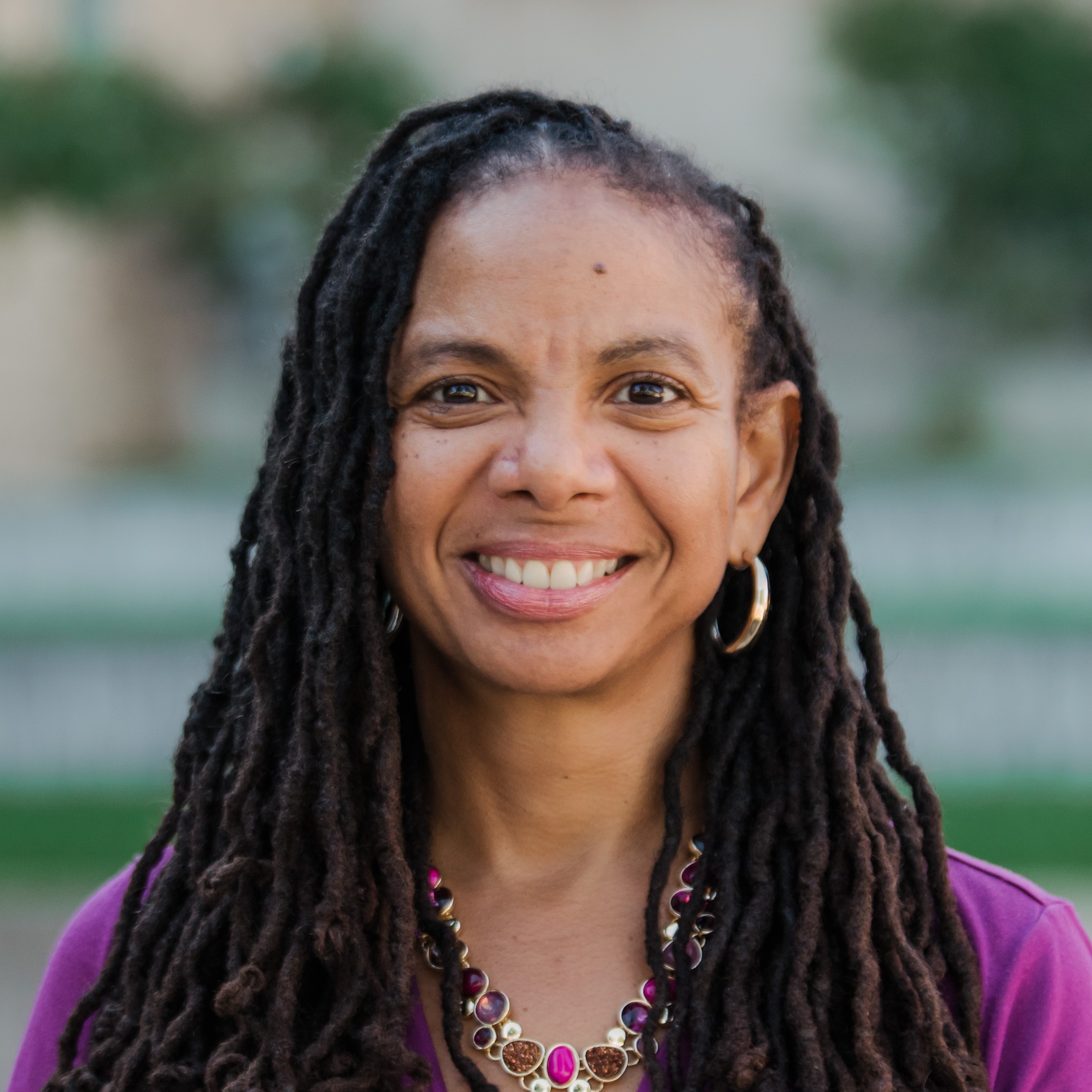
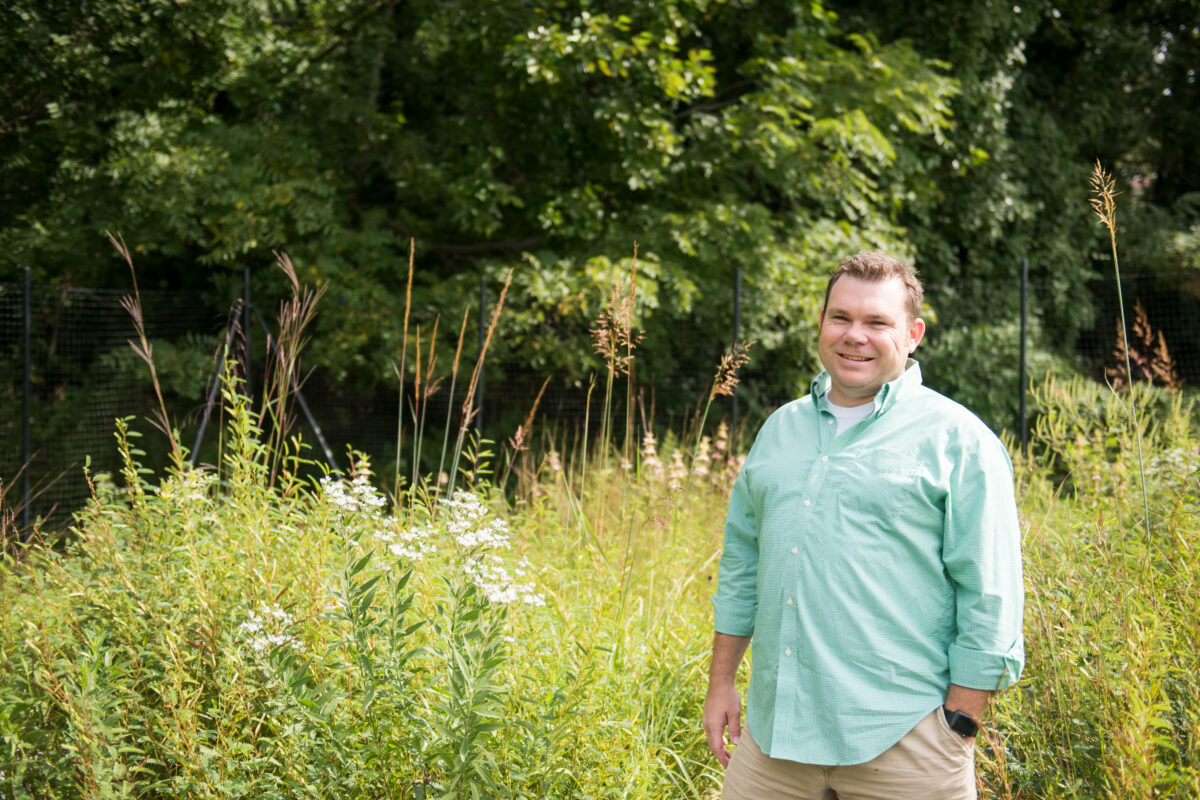 Chris Swan stands near native plantings. (Marlayna Demond ’11/UMBC)
Big questions, small organisms
The study will include researchers from UMBC, Virginia Tech, and University of California-Riverside in the U.S., and São Paulo State University and São Carlos State in Brazil. Streams near São Paulo, Brazil, and Blacksburg, Virginia, will represent tropical and temperate climates, respectively. The team will collect data from each stream monthly for a year.
They’ll manually measure the number of invertebrate species and how many of each species are present. Invertebrates they are likely to find include a wide variety of insects, worms, and crustaceans (such as crayfish). The team will also record traits of each individual, like its size and whether it was collected from the streambed, swimming in the water channel, or flying in the air above the stream.
On top of data on all the organisms, the researchers will also record information about the stream environment, like acidity, temperature, and the presence of nutrients like nitrogen, plus the streambed material (rock or sand, for example), the stream’s sun exposure, and more.
They will intentionally include large and small streams, too. The size of the stream “has practical implications,” Swan says, because in addition to small streams making up 60 percent of all river miles, “if you change a landscape, say by development, you are more likely to flatten a small stream than a large stream. So they are disproportionately under threat.”
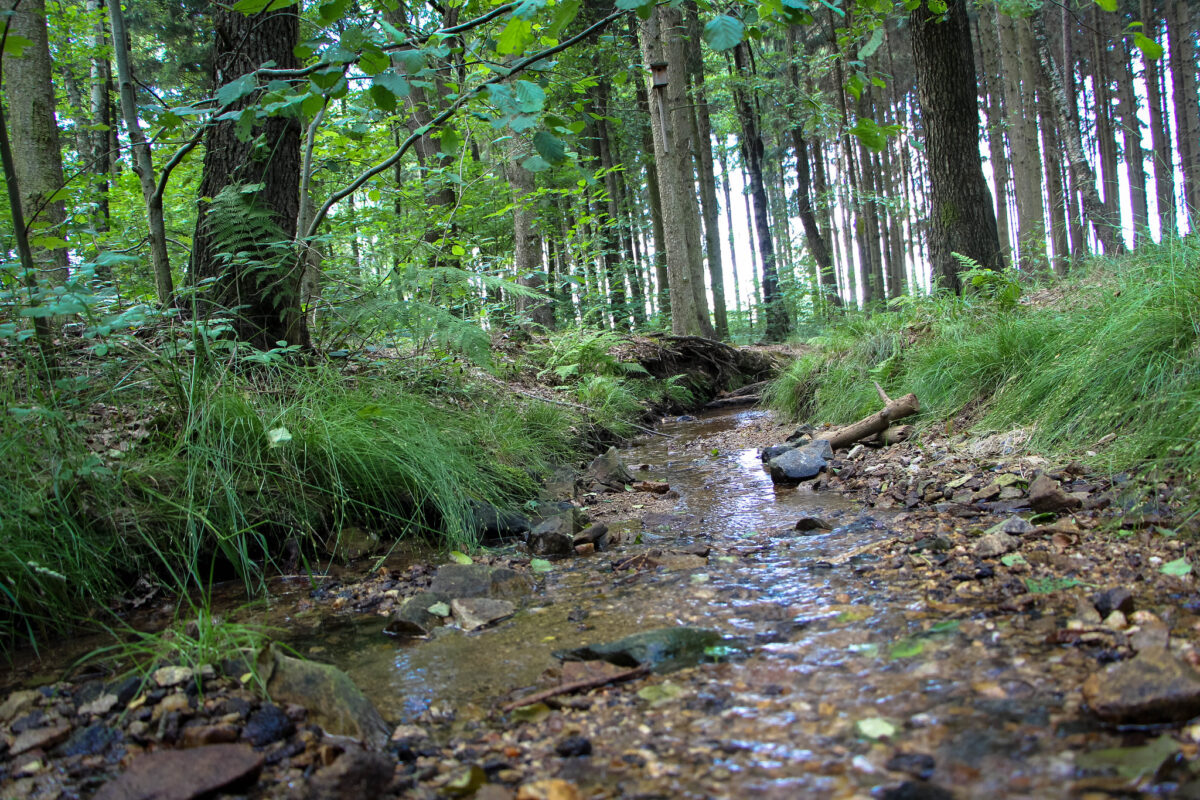 Small streams make up 60 percent of all river miles. (Tobias Wrzal/public domain)
Tropical trend
Some differences between species in tropical versus temperate streams are known. For example, tropical organisms tend to be smaller and have shorter life cycles. Their populations also tend to be smaller. This means local populations disappear through random effects more often in tropical ecosystems, creating space for other species to fill their functional roles.
The new study will produce a much larger data set than previously existed, to further clarify some of these differences between temperate and tropical stream ecosystems and possibly discover new ones.
One of the collaborators, Kurt Anderson at UC-Riverside, focuses on modeling ecological data. The team will “use the parameters that we estimate from the field data to tune his models,” Swan says, “so we can make predictions and test our hypotheses about what could happen in the future.” One hypothesis might be that as the world warms, organisms in temperate streams could start to take on traits more common in the tropics.
Biodiversity is the key to success
Beyond the research, the collaboration also presents unique opportunities for international education. The U.S. and Brazilian faculty leads will offer a joint online course for graduate and advanced undergraduate students, where they will read and analyze academic papers related to the study. “We realized that learning, teaching, and discussion styles are not the same in the two countries,” Swan says, so this class will give students and faculty alike the chance to navigate new ways of interacting along with discovering new science.
One core point Swan will emphasize with his students is the importance of biodiversity on a global scale. In ecology, the presence of a wide variety of organism types and the functions that they perform is called the “portfolio effect.” Just like a diverse financial portfolio, a diverse biological “portfolio” of species is less likely to suffer heavy losses across the board as conditions change—something is bound to adapt and survive. Also, “if you have more species, then you have more niches filled,” Swan says, “so resources are being used more efficiently.”
“Variety in life is the whole kit and caboodle,” Swan says. “If you didn’t have variety, nothing would be able to adapt. There would be no adaptation to change.”
With ample biodiversity, though, adaptation to change is much more likely. But what that looks like—which species will adapt successfully or will be most at risk—is still unknown. Starting with tiny organisms in streams, Swan and colleagues are working to help figure that out.
]]>
A new collaboration between scientists in the U.S. and Brazil hopes to increase our ability to predict how biological communities may change in a warming world. The researchers will investigate...
https://umbc.edu/stories/stream-biodiversity-us-brazil-partnership/
https://my3.my.umbc.edu/api/v0/pixel/news/127109/guest@my.umbc.edu/a77fbc7d806dc545e6c37b5998377c6d/api/pixel
cahss
ges
news
rca-2
research
science-and-tech
UMBC News & Magazine
https://my3.my.umbc.edu/groups/umbc-news-magazine
https://assets1-my.umbc.edu/system/shared/avatars/groups/000/001/943/24435aa6207c452e7bc15cc74b42c7bb/xsmall.png?1748556657
https://assets1-my.umbc.edu/system/shared/avatars/groups/000/001/943/24435aa6207c452e7bc15cc74b42c7bb/original.png?1748556657
https://assets2-my.umbc.edu/system/shared/avatars/groups/000/001/943/24435aa6207c452e7bc15cc74b42c7bb/xxlarge.png?1748556657
https://assets2-my.umbc.edu/system/shared/avatars/groups/000/001/943/24435aa6207c452e7bc15cc74b42c7bb/xlarge.png?1748556657
https://assets3-my.umbc.edu/system/shared/avatars/groups/000/001/943/24435aa6207c452e7bc15cc74b42c7bb/large.png?1748556657
https://assets1-my.umbc.edu/system/shared/avatars/groups/000/001/943/24435aa6207c452e7bc15cc74b42c7bb/medium.png?1748556657
https://assets2-my.umbc.edu/system/shared/avatars/groups/000/001/943/24435aa6207c452e7bc15cc74b42c7bb/small.png?1748556657
https://assets1-my.umbc.edu/system/shared/avatars/groups/000/001/943/24435aa6207c452e7bc15cc74b42c7bb/xsmall.png?1748556657
https://assets2-my.umbc.edu/system/shared/avatars/groups/000/001/943/24435aa6207c452e7bc15cc74b42c7bb/xxsmall.png?1748556657
UMBC News & Magazine
0
0
false
Mon, 29 Aug 2022 18:04:43 -0400
Mon, 29 Aug 2022 18:04:43 -0400
UMBC’s María Célleri and Yolanda Valencia receive Mellon Fellowships for research on an immigrant community in Washington and postcolonial transformation of Quito, Ecuador
Yolanda Valencia, assistant professor of geography and environmental studies, and María Célleri, assistant professor of gender, women’s, and sexuality studies, have received 12-month Career Enhancement Fellowships, funded by the Mellon Foundation and administered by the Institute for Citizens and Scholars. They represent two of nine junior faculty recipients across the country from hundreds of applicants in the 2022 award cycle. Their achievement marks the first time two UMBC junior faculty have received this award simultaneously.
The Career Enhancement Fellowship seeks to increase the presence of underrepresented junior and other faculty members in the humanities, social sciences, and arts by creating career development opportunities for selected Fellows with promising research projects. Valencia and Célleri will dedicate their fellowship to advancing their book projects.
“Both Drs. Célleri and Valencia conduct research that aligns well with the mission of the Institute to support scholars ‘committed to eradicating racial disparities.’ Their work further reifies UMBC’s commitment to community-engaged scholarship, in particular in often overlooked or ignored communities.”
Kimberly R. Moffitt
Dean of the College of Arts, Humanities, and Social Sciences
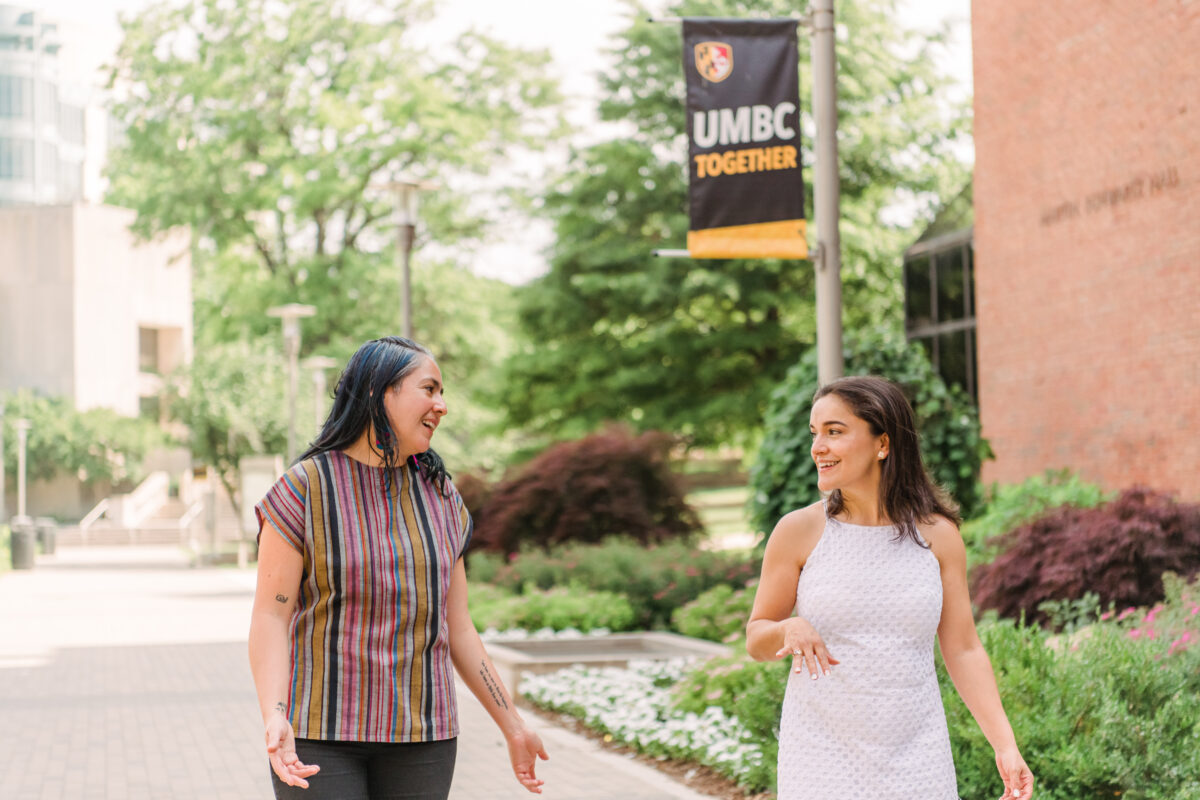 (l-r) María Célleri and Yolanda Valencia. (Marlayna Demond ’11/UMBC)
Thriving and oppressive geographies
In the forthcoming book Relational Life: Legal Death, Valencia will explore the Mexican immigrant community of Pasco, Washington, and how this community creates places of peace, tranquility, and family—places of belonging and meaning— under disadvantaged conditions. Her writing draws on years of fieldwork in Pasco, transnational ethnography, archival research, interviews with city leaders, and testimonies from undocumented Mexican immigrants.
“My research reveals that the city of Pasco maintains conditions that exploit immigrant labor by enforcing police violence, criminalization, and intimidation,” says Valencia. “I aim to provide a historical political economy analysis of geographies of oppression overlaid with an analysis of spaces where this community thrives, as they both happen simultaneously across scale, time, and border.”
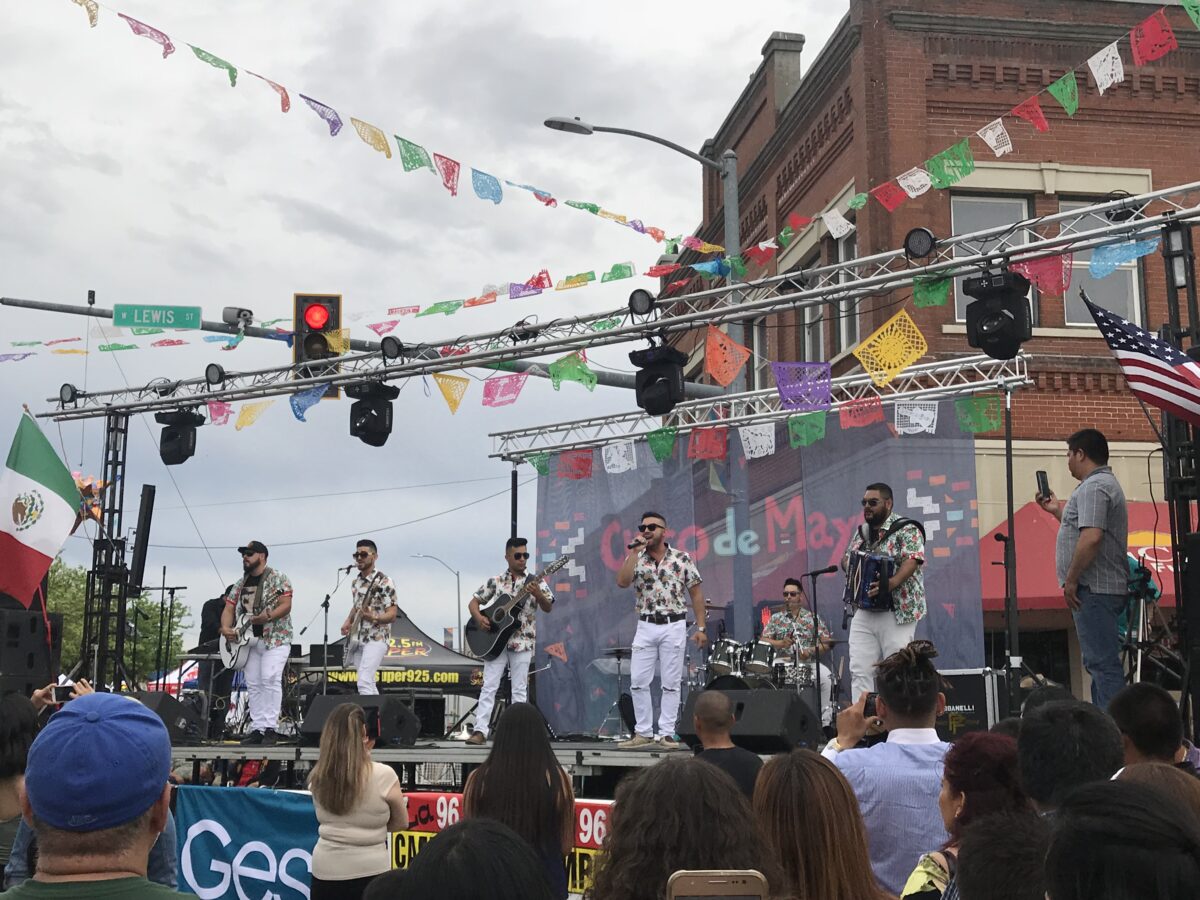 Valencia notes how music (familiar sounds and lyrics) plays an important role in making and experiencing spaces of belonging. This Cinco de Mayo event in Pasco features second-generation Mexican immigrant musicians who have learned how to play, sing, and love traditional Mexican (and Latinx) music. It is one way in which cultural knowledge is readapted and passed on across generations. (Image courtesy of Valencia)
While at UMBC, Valencia has designed three upper-level human geography courses: Geographies of Migration, Latin American Geographies, and Qualitative Methods. She is also developing graduate seminars focused on Geographies of Conquest and Liberation.
Community of support
In addition to the Career Enhancement Fellowship, Valencia has been selected as a 2020 – 2022 Summer Institute on Tenure and Professional Advancement (SITPA) Scholar. SITPA is a mentoring and professional initiative designed to facilitate junior faculty members’ successful transition to tenured associate professor status.
The goal of SITPA is to address the persistent underrepresentation of racial and ethnic minority faculty in academia. The program is funded by a grant from the Andrew W. Mellon Foundation and is administered and hosted by the Center for the Study of Race Ethnicity, and Gender in the Social Sciences (REGSS) at Duke University
“SITPA for me means an opportunity to be part of a diverse community of support in academia, which is helping me carve spaces of belonging as a scholar in higher education,” says Valencia. Mérida Rúa, professor of Latino/a studies at Northwestern University and editor of Latino Urban Ethnography and the Work of Elena Padilla, is her mentor for both awards.
Politics and symbolism of monuments
Uncovering the Virgen del Panecillo: Quito’s Postcolonial Urban Transformation and Decolonial Future is the tentative title of Célleri’s upcoming book. She uses print media, film, photography, and decolonial feminist social, cultural, and political analysis to bring greater understanding to the political and symbolic importance of the Virgen del Panecillo. This well-known monument is a 41-meter-tall aluminum statue of the Virgin of Immaculate Conception placed in Quito, Ecuador’s colonial city center in 1976.
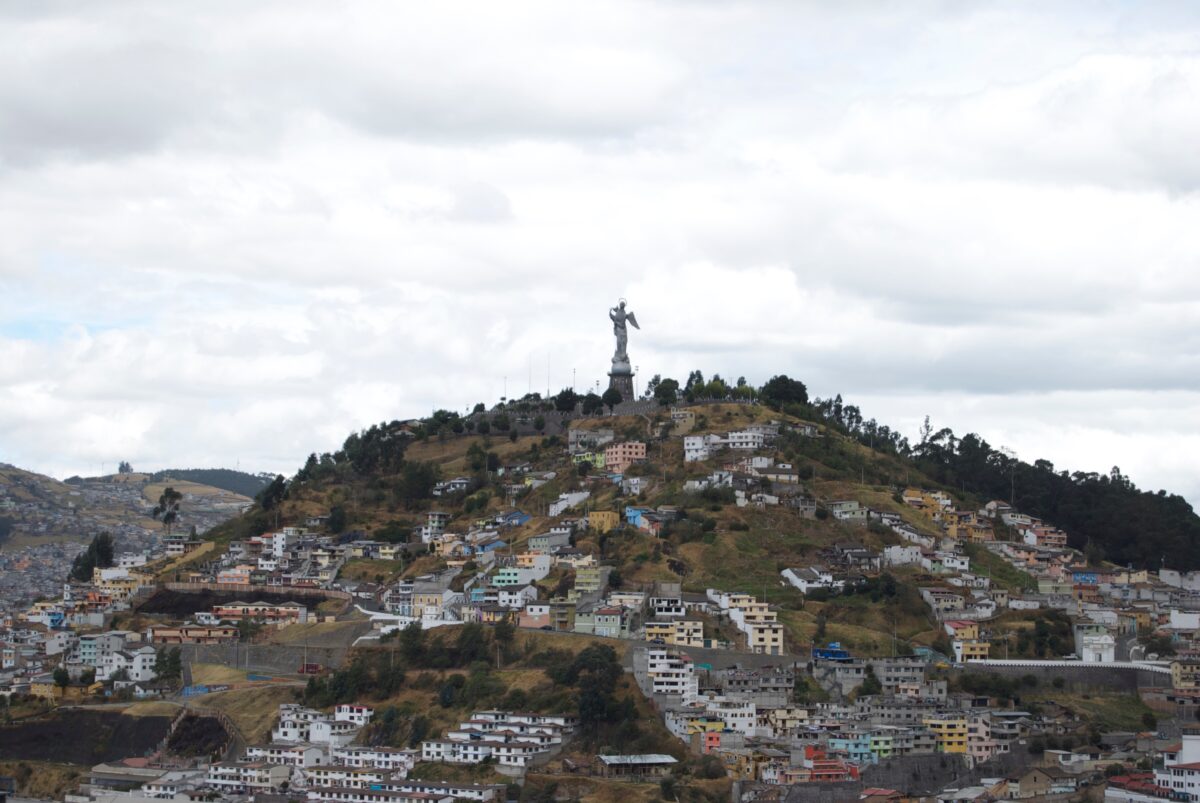 The Virgen del Panecillo statue standing over Quito’s colonial center. (Image from Wikimedia Commons)
“I demonstrate that uncovering the contentious history of monuments opens the possibilities for reimagining them as sites of decolonial feminist futures,” says Célleri.
“I frame the book around what I term Andean decolonial feminist imaginaries,” she explains. “This is a framework that centers Andean Indigenous cosmology as a tool for comprehensively confronting long-standing colonial logics of social control that haunt Quito’s urban landscape, and which materially affect racialized and gendered populations.”
Connecting with fellow researchers
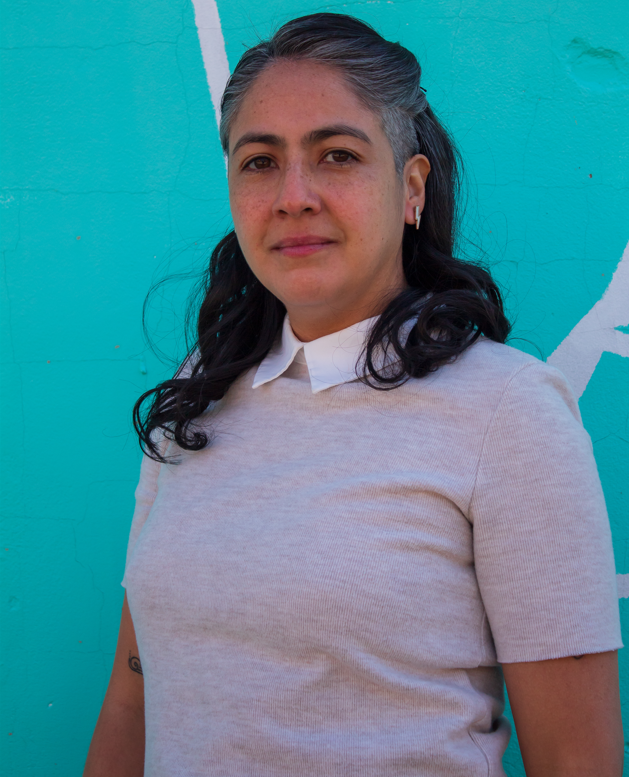 Célleri. (Image by Mariana Orellana)
In 2019, Célleri served as a panelist at the National Women’s Studies Association annual conference (on the theme “Protest, Justice, and Transnational Organizing”) and at the Sexuality and Borders Symposium at New York University. There she presented her research on transnational feminist struggles for reproductive rights in the Andes in relation to appropriations of the monument of the Virgen del Panecillo.
“The Career Enhancement Fellowship is a recognition of my hard work and offers the opportunity to work collaboratively on my book project with colleagues and mentors that I admire,” says Célleri. Maria Amelia Viteri, an associate professor of anthropology at the University of Maryland, College Park, and senior social and gender specialist at the Inter-American Development Bank, will mentor Célleri during her fellowship. Viteri is a recognized transnational sociocultural anthropologist of globalization, gender, queer, and migration studies.
Over the past two years at UMBC, Célleri has organized the Latin American Feminisms Working Group through UMBC’s Dresher Center for the Humanities. She teaches Transnational Feminist Film and the course on Gender, Humans Rights, and Political Violence in Latin America. She will teach Indigenous and Decolonial Feminisms, a course she developed, after her fellowship.
Continuing excellence
Valencia and Célleri came to UMBC in 2019. Their work continues a strong history of UMBC scholarship earning recognition and support from the Mellon Foundation and Institute for Citizens and Scholars.
Last year, Sharon Tran, assistant professor of English, became the fifth UMBC faculty member in the humanities to receive the prestigious award. The fellowship supported her book project, Minor Forms: The Affective and Aesthetic Economies of Asian Girlhood. The book examines how the minor figure of the “Asian girl” can provide a new way of understanding U.S. racism and imperialism.
“What an honor for two of our colleagues to be acknowledged by the Institute for Citizens and Scholars amongst this stellar group of junior faculty,” says Moffitt. “Kudos to them both for their efforts to shed light on important lived experiences.”
Both of this year’s recipients will return to teach and share their work at UMBC after their one-year fellowship.
]]>
Yolanda Valencia, assistant professor of geography and environmental studies, and María Célleri, assistant professor of gender, women’s, and sexuality studies, have received 12-month Career...
https://umbc.edu/stories/umbcs-maria-celleri-and-yolanda-valencia-receive-mellon-fellowships/
https://my3.my.umbc.edu/api/v0/pixel/news/126175/guest@my.umbc.edu/5732e21bd8a3a8c3b7269868a81ec070/api/pixel
award
cahss
cahssresearch
ges
gwst
international-stories
news
policy-and-society
UMBC News & Magazine
https://my3.my.umbc.edu/groups/umbc-news-magazine
https://assets1-my.umbc.edu/system/shared/avatars/groups/000/001/943/24435aa6207c452e7bc15cc74b42c7bb/xsmall.png?1748556657
https://assets1-my.umbc.edu/system/shared/avatars/groups/000/001/943/24435aa6207c452e7bc15cc74b42c7bb/original.png?1748556657
https://assets2-my.umbc.edu/system/shared/avatars/groups/000/001/943/24435aa6207c452e7bc15cc74b42c7bb/xxlarge.png?1748556657
https://assets2-my.umbc.edu/system/shared/avatars/groups/000/001/943/24435aa6207c452e7bc15cc74b42c7bb/xlarge.png?1748556657
https://assets3-my.umbc.edu/system/shared/avatars/groups/000/001/943/24435aa6207c452e7bc15cc74b42c7bb/large.png?1748556657
https://assets1-my.umbc.edu/system/shared/avatars/groups/000/001/943/24435aa6207c452e7bc15cc74b42c7bb/medium.png?1748556657
https://assets2-my.umbc.edu/system/shared/avatars/groups/000/001/943/24435aa6207c452e7bc15cc74b42c7bb/small.png?1748556657
https://assets1-my.umbc.edu/system/shared/avatars/groups/000/001/943/24435aa6207c452e7bc15cc74b42c7bb/xsmall.png?1748556657
https://assets2-my.umbc.edu/system/shared/avatars/groups/000/001/943/24435aa6207c452e7bc15cc74b42c7bb/xxsmall.png?1748556657
UMBC News & Magazine
1
0
false
Fri, 08 Jul 2022 12:43:58 -0400
Fri, 08 Jul 2022 12:43:58 -0400
Beyond “plant trees!”: UMBC research finds tree plantations encroaching on essential ecosystems
Trees store carbon, filter the air, create habitat, and supply a host of other benefits for animals and people. Planting the right trees, in the right places, in consultation with local communities, can support goals like addressing climate change and improving lives. However, new research led by Matthew Fagan, assistant professor of geography and environmental systems at UMBC, finds that some trees planted in the tropics may be doing more harm than good.
The study, published in Nature Sustainability, examined the increase in tree cover across the global tropics between 2000 and 2012. Fagan and colleagues found that, surprisingly, tree cover gains during that period were equally attributable to natural forest regrowth and the creation of tree plantations. The most common tree plantation species were rubber, eucalyptus, and oil palm.
Tree plantations are not always harmful to the environment, and even much-maligned oil palm can be farmed sustainably, Fagan explains. However, the study found that 92 percent of new tree plantations were in biodiversity hotspots, threatening a range of plant and animal species. Also, 14 percent of plantations were in arid biomes, where trees are unlikely to thrive and likely to damage existing ecosystems. And tree plantations had encroached into 9 percent of accessible protected areas in the humid tropics, such as national parks.
“Ecologists have been sounding the alarm on this for over a decade,” Fagan says. “But no one’s had a hard number about how much this is actually happening.”
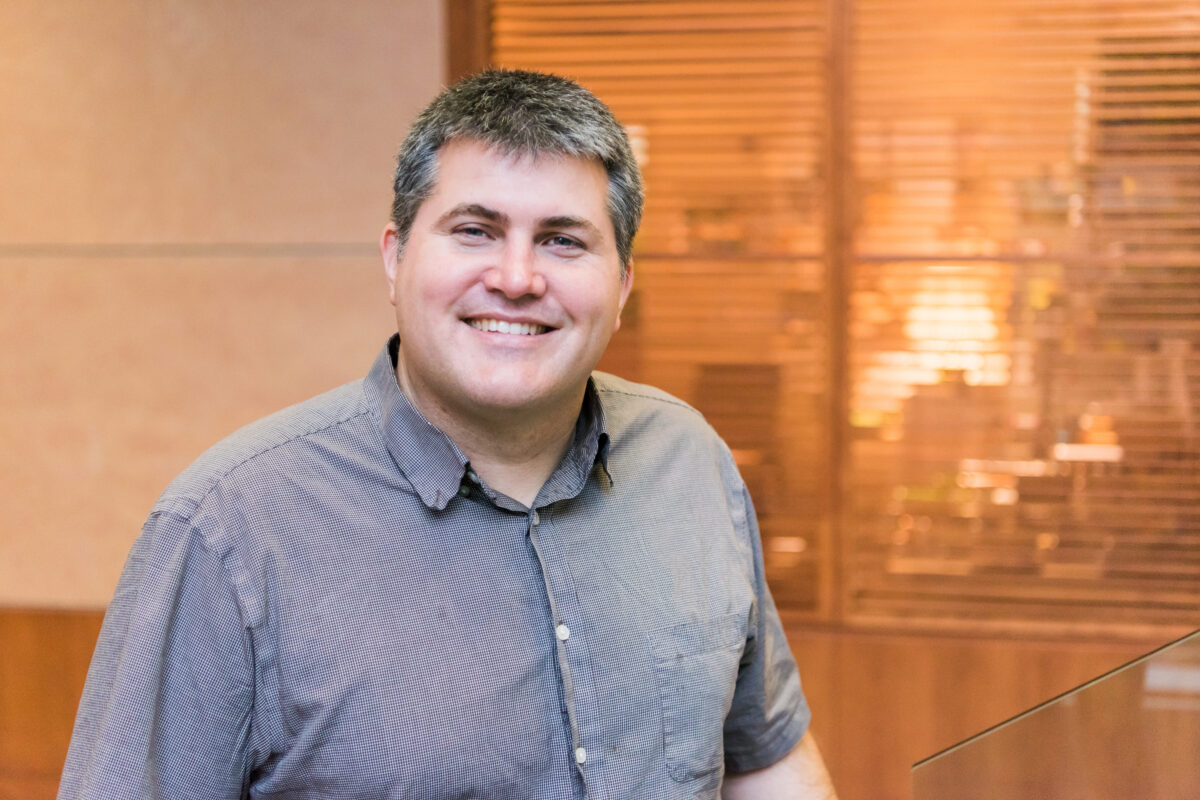 Matthew Fagan (Marlayna Demond ’11/UMBC)
When tree planting is lose-lose
In recent years, dozens of nations have committed to restoring large areas of forest. Tree plantations make up 45 percent of commitments to the Bonn Challenge, an international initiative to restore degraded and deforested landscapes. But Fagan is concerned that these plantations may have unintended consequences.
For example, China has undertaken a massive tree-planting effort at the edge of the Gobi desert, and many African countries have committed to planting trees at the transition between the Sahara desert and Sahel grassland. The goal is to prevent desert expansion, but the plantings can cause harm. Disturbing the soil releases carbon, and trees are water hogs. They end up “killing off the grassland that was there, and then they often die of drought,” Fagan says. In these situations, tree planting is lose-lose.
Similarly, in Brazil, soy farmers moved out of the Amazon and into the Cerrado, one of the world’s largest savannas. Pine and eucalyptus tree farms followed. The Cerrado supports a wealth of biodiversity, and the carbon it stores underground rivals rainforest carbon sequestration, Fagan explains. Tree crops in the Cerrado may count toward Brazil’s reforestation commitment, but could actually be a step backward in mitigating climate change and biodiversity loss.
“In the U.S., we have a huge area of relatively wet woods, and we tend to idolize planting trees as sort of the ultimate environmental act,” Fagan says. “But there’s a lot of value in grasslands and savannas that we don’t necessarily see. And when you plant trees, you essentially destroy that ecosystem.”
In response to his team’s new research, “I would really like to see governments around the world reassess their restoration plans,” Fagan says, “or at least be more transparent when their plans involve tree planting, especially in areas that may not be appropriate for planting trees.”
 A plantation of non-native Melina trees in Costa Rica (Matthew Fagan)
Park or plantation?
Fagan’s new paper also revealed the extent to which tree plantations are invading protected areas. The problem was so bad that he had to overhaul the algorithm his team used to differentiate between data representing natural forest regrowth and tree plantations.
Initially, the algorithm used park boundaries as a proxy for natural forest regrowth areas. But it wasn’t working. To figure out what was wrong, Fagan spot-checked 20 parks, and found that three had multiple plantations inside them. That got him curious.
Six weeks later, he had manually checked for plantations in every park in the tropics. When he found plantations, he either redrew the park’s boundaries or, if the park was too compromised, removed it from the data completely. Using the resulting new maps, the algorithm could detect natural forest regrowth versus tree plantations with more than 90 percent accuracy.
“It was very disturbing to see there were just so many parks that were compromised,” Fagan says.
The new maps allowed the team to find many more regrowth areas and plantations than expected from government estimates. Several UMBC undergraduates are authors on the paper because of their contributions to this data analysis. Each student manually checked at least 1,000 patches, some as many as 3,000.
“In the end, the tropics is a much more modified place than we were expecting,” Fagan says. “There’s a whole host of reasons that we see these encroachments, but they’re definitely happening all over the world. We see a steady erosion of these parks by plantations, and the industry is just getting started.”
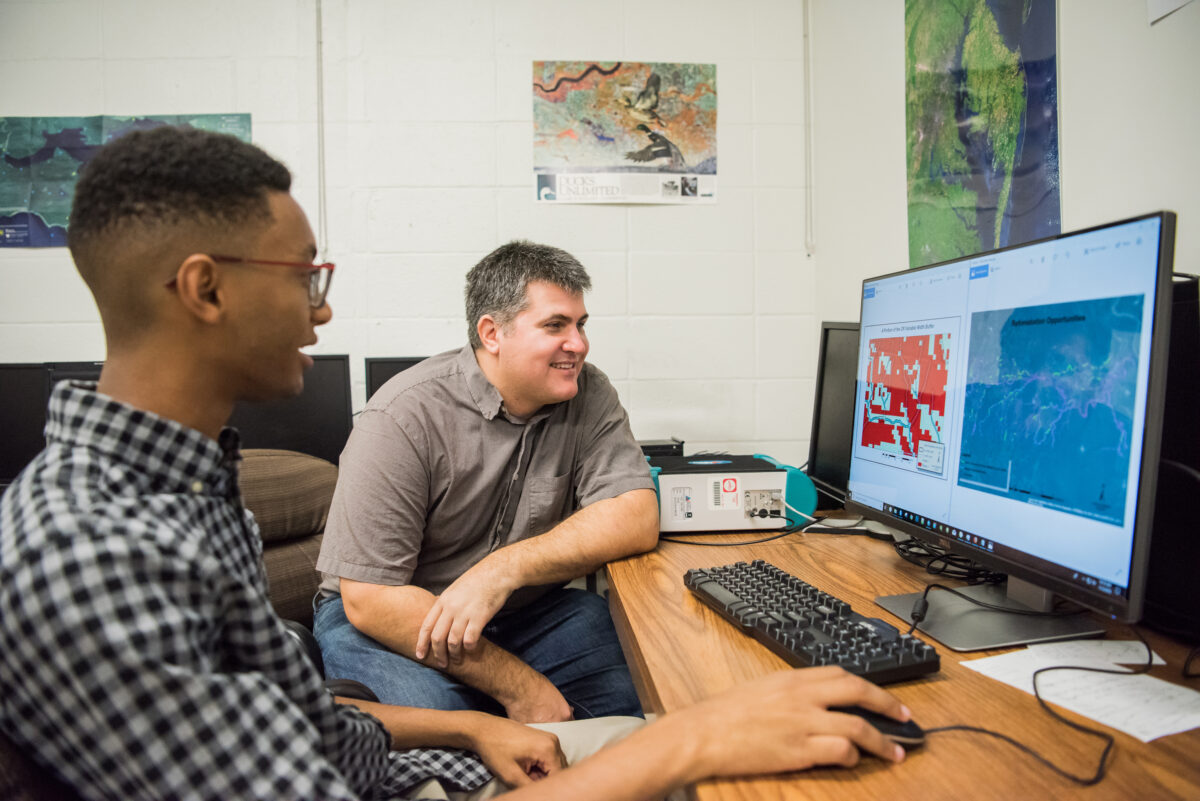 Matthew Fagan (right) and Joshua Slaughter ’22, computer engineering, who was a co-author on the current paper, examine data for a study on the longevity of secondary forests in Latin America. (Marlayna Demond ’11/UMBC)
Reason for hope
When setting out on this research, the team had a simple question: How many planted trees are there in the world? “It seemed like a strange thing not to know,” Fagan says. As the work progressed, they asked whether trees were being planted where they shouldn’t be and whether plantations were expanding into parks. They’ve found the results concerning, but they also have reason for hope.
Trees can do a lot of good, and planting more of them can be a significant factor in addressing the impacts of climate change. But it has to be done right. “This paper shows it’s possible to monitor natural forest versus plantation at a global scale,” Fagan says, “so we can encourage the results we want and discourage results we don’t want.”
He also hopes the results will inspire everyone to be more conscious of where their products—from paper to food to shampoo to tires—come from, and to demand that companies producing those products in tree plantations adopt more sustainable practices.
“If we make our choices en masse, it does shift the direction that these companies go in,” Fagan says. And despite our love for trees in the U.S., he notes, forests are not the only ecosystems that can help mitigate the effects of climate change and biodiversity loss. Savannas and prairies also have an important role to play.
“We need to be cognizant that not all tree planting is beneficial for the ecosystem involved,” Fagan says. “The right tree in the right place is the right answer.”
]]>
Trees store carbon, filter the air, create habitat, and supply a host of other benefits for animals and people. Planting the right trees, in the right places, in consultation with local...
https://umbc.edu/stories/beyond-plant-trees-umbc-research-finds-tree-plantations-encroaching-on-essential-ecosystems/
https://my3.my.umbc.edu/api/v0/pixel/news/125758/guest@my.umbc.edu/9804479d74e2b6f2bb876a0eaca1b229/api/pixel
cahss
ges
policy-and-society
research
science-and-tech
UMBC News & Magazine
https://my3.my.umbc.edu/groups/umbc-news-magazine
https://assets1-my.umbc.edu/system/shared/avatars/groups/000/001/943/24435aa6207c452e7bc15cc74b42c7bb/xsmall.png?1748556657
https://assets1-my.umbc.edu/system/shared/avatars/groups/000/001/943/24435aa6207c452e7bc15cc74b42c7bb/original.png?1748556657
https://assets2-my.umbc.edu/system/shared/avatars/groups/000/001/943/24435aa6207c452e7bc15cc74b42c7bb/xxlarge.png?1748556657
https://assets2-my.umbc.edu/system/shared/avatars/groups/000/001/943/24435aa6207c452e7bc15cc74b42c7bb/xlarge.png?1748556657
https://assets3-my.umbc.edu/system/shared/avatars/groups/000/001/943/24435aa6207c452e7bc15cc74b42c7bb/large.png?1748556657
https://assets1-my.umbc.edu/system/shared/avatars/groups/000/001/943/24435aa6207c452e7bc15cc74b42c7bb/medium.png?1748556657
https://assets2-my.umbc.edu/system/shared/avatars/groups/000/001/943/24435aa6207c452e7bc15cc74b42c7bb/small.png?1748556657
https://assets1-my.umbc.edu/system/shared/avatars/groups/000/001/943/24435aa6207c452e7bc15cc74b42c7bb/xsmall.png?1748556657
https://assets2-my.umbc.edu/system/shared/avatars/groups/000/001/943/24435aa6207c452e7bc15cc74b42c7bb/xxsmall.png?1748556657
UMBC News & Magazine
0
0
false
Mon, 06 Jun 2022 11:20:00 -0400
Mon, 06 Jun 2022 11:20:00 -0400
Giving voice to immigrant experiences
Melisa Argañaraz Gomez
Degree: Ph.D., Geography and Environmental Systems
Hometown: Longchamps, Buenos Aires
Plans: Assistant professor in residence, Urban and Community Studies program, UConn Waterbury
“When I arrived in Spain as a teenager, my teachers did not expect me to go to college because I didn’t have the resources to access certain learning opportunities. Now, as a graduate student in the U.S., remembering my experience as a teenager helps me connect with the students I support and empathize with their lives.”
Melisa Argañaraz Gomez has lived and learned around the world. She was born in Argentina and moved to Granada, Spain, at the age of thirteen. There she earned a B.A. in sociology from the Universidad de Granada, before earning a master’s in sociology at the University of Amsterdam. From there she moved to the U.S. to pursue a Ph.D. in geography and environmental systems (GES) with Dena Aufseeser, assistant professor of GES, researching the experiences of Baltimore’s immigrant adolescents.
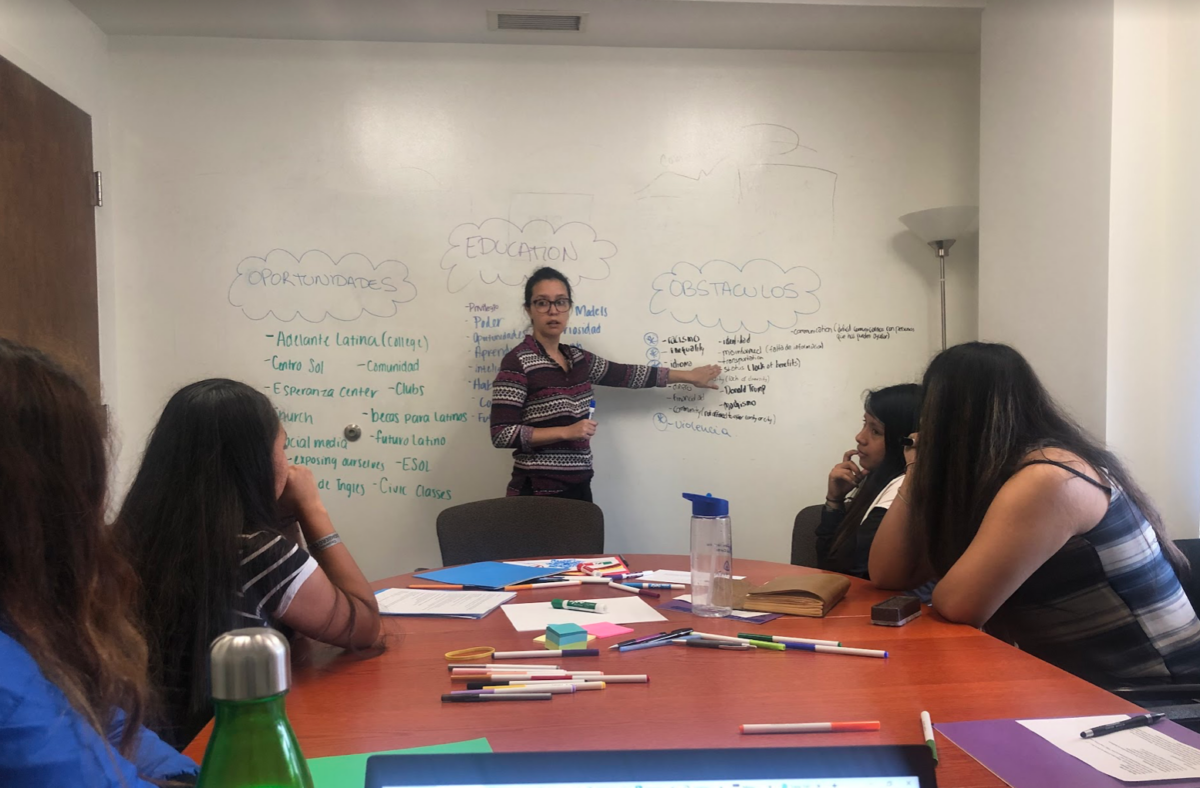 Melisa Argañaraz Gomez, leading a class at Centro Sol Summer Scholars Program.
(Image courtesy of Argañaraz Gomez)
Argañaraz Gomez’s areas of research include urban and feminist geographies and migration studies, as well as race and ethnicity. She studies migrant children and youth narratives of inclusion and (un)belonging in Baltimore. One of her projects, “PARqueología Migrante,” in collaboration with Latinas al Rescate and CASA de Maryland, received the 1st annual Spirit of Community Geography Award from the Community Geography Collective.
The youth engagement project seeks to counter stereotypes of Latin American immigrant teens by amplifying their voices through public presentations to media, neighborhood organizations, and elected officials. It also connects students to city resources and builds communities of solidarity and care.
Argañaraz Gomez also collaborated in UMBC’s Baltimore Field school to help build public humanities projects. The Mellon Foundation-funded project connects researchers with community organizations in developing methods for ethical research and teaching projects focused in Baltimore.
]]>
Melisa Argañaraz Gomez Degree: Ph.D., Geography and Environmental Systems Hometown: Longchamps, Buenos Aires Plans: Assistant professor in residence, Urban and Community Studies program,...
https://umbc.edu/stories/giving-voice-to-immigrant-experiences/
https://my3.my.umbc.edu/api/v0/pixel/news/119419/guest@my.umbc.edu/89c3ed2ee804263e7d0346c505a1c401/api/pixel
baltimorecommunities
cahss
cahssresearch
class-of-2022
ges
gradresearch
international-stories
news
UMBC News & Magazine
https://my3.my.umbc.edu/groups/umbc-news-magazine
https://assets1-my.umbc.edu/system/shared/avatars/groups/000/001/943/24435aa6207c452e7bc15cc74b42c7bb/xsmall.png?1748556657
https://assets1-my.umbc.edu/system/shared/avatars/groups/000/001/943/24435aa6207c452e7bc15cc74b42c7bb/original.png?1748556657
https://assets2-my.umbc.edu/system/shared/avatars/groups/000/001/943/24435aa6207c452e7bc15cc74b42c7bb/xxlarge.png?1748556657
https://assets2-my.umbc.edu/system/shared/avatars/groups/000/001/943/24435aa6207c452e7bc15cc74b42c7bb/xlarge.png?1748556657
https://assets3-my.umbc.edu/system/shared/avatars/groups/000/001/943/24435aa6207c452e7bc15cc74b42c7bb/large.png?1748556657
https://assets1-my.umbc.edu/system/shared/avatars/groups/000/001/943/24435aa6207c452e7bc15cc74b42c7bb/medium.png?1748556657
https://assets2-my.umbc.edu/system/shared/avatars/groups/000/001/943/24435aa6207c452e7bc15cc74b42c7bb/small.png?1748556657
https://assets1-my.umbc.edu/system/shared/avatars/groups/000/001/943/24435aa6207c452e7bc15cc74b42c7bb/xsmall.png?1748556657
https://assets2-my.umbc.edu/system/shared/avatars/groups/000/001/943/24435aa6207c452e7bc15cc74b42c7bb/xxsmall.png?1748556657
UMBC News & Magazine
0
0
false
Thu, 12 May 2022 12:22:18 -0400
Thu, 12 May 2022 12:22:18 -0400
UMBC faculty and staff award recipients place community at the core of their success
At UMBC’s 2022 Presidential Faculty and Staff Awards (PFASA), Tamra Mendelson, professor of biological sciences and recipient of the 2022 – 2025 Presidential Teaching Professor Award, said she loves “getting to the core of a concept” in her research and teaching. In her large introductory biology courses, which Mendelson has been teaching with humor, creativity, and enthusiasm since her arrival on campus in 2006, the concept might be an idea like natural selection. But as awardee after awardee addressed the audience, both in person and online, it became clear that all shared the same “core concept” of UMBC: community.
“Teaching and research make me want to come to work every day, but it’s the community here, and Dr. Hrabowski in particular, who’ve made me want to come to UMBC every day,” Mendelson said.
Yonathan Zohar, professor and chair of marine biotechnology and the 2022 – 2025 Presidential Research Professor, added, “This recognition is not about me, it’s about us,” adapting the opening quote from President Hrabowski’s book, The Empowered University. Zohar’s work, nurtured diligently over more than three decades, has in the last few years brought in more than $10 million dollars of research funding, earned international awards, and is poised to reimagine the seafood industry as we know it.
And yet, Zohar says, “None of my research accomplishments would have been possible without the ‘about us’ spirit at UMBC—the spirit that together we can make everything and anything happen.”
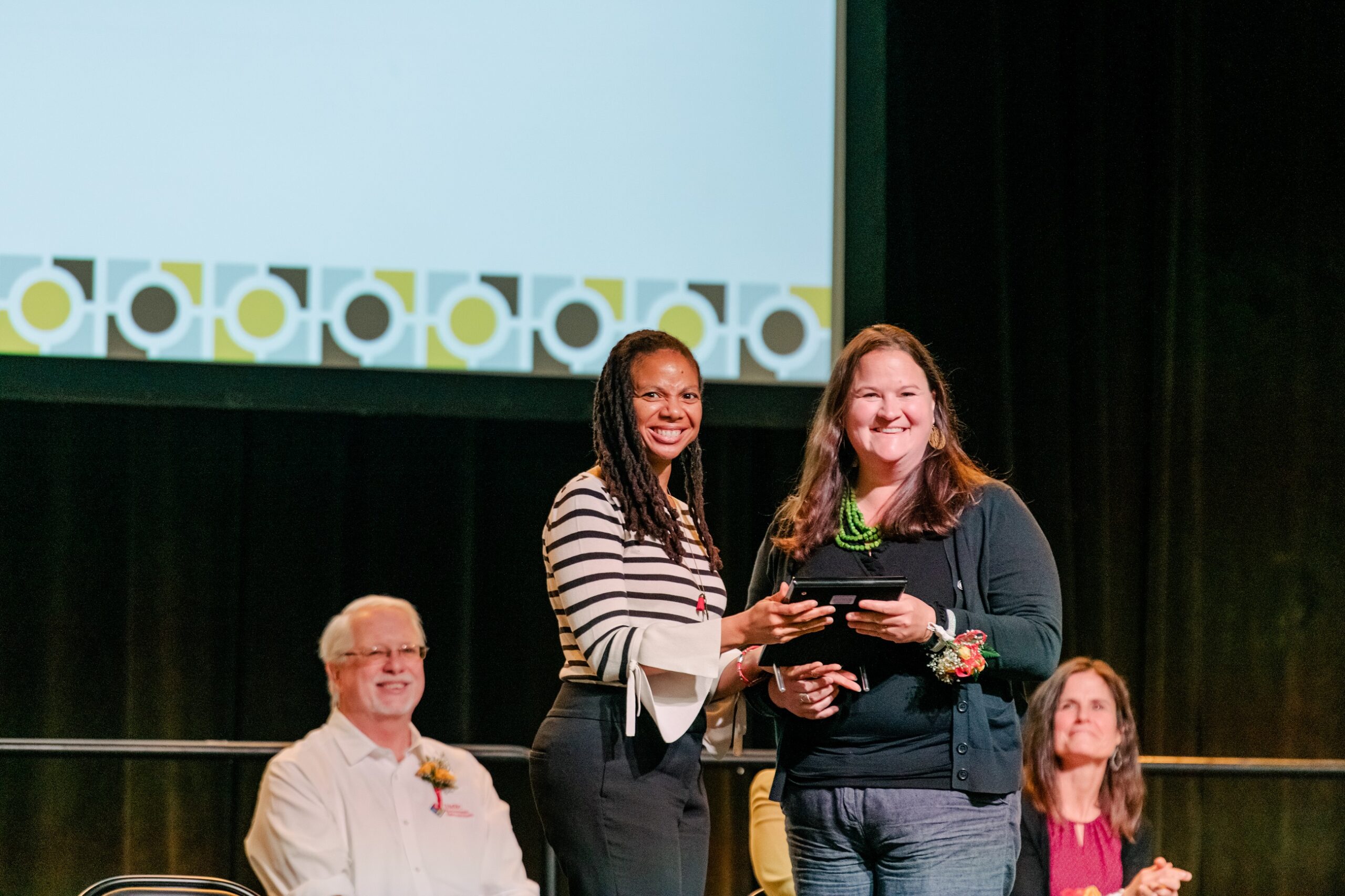
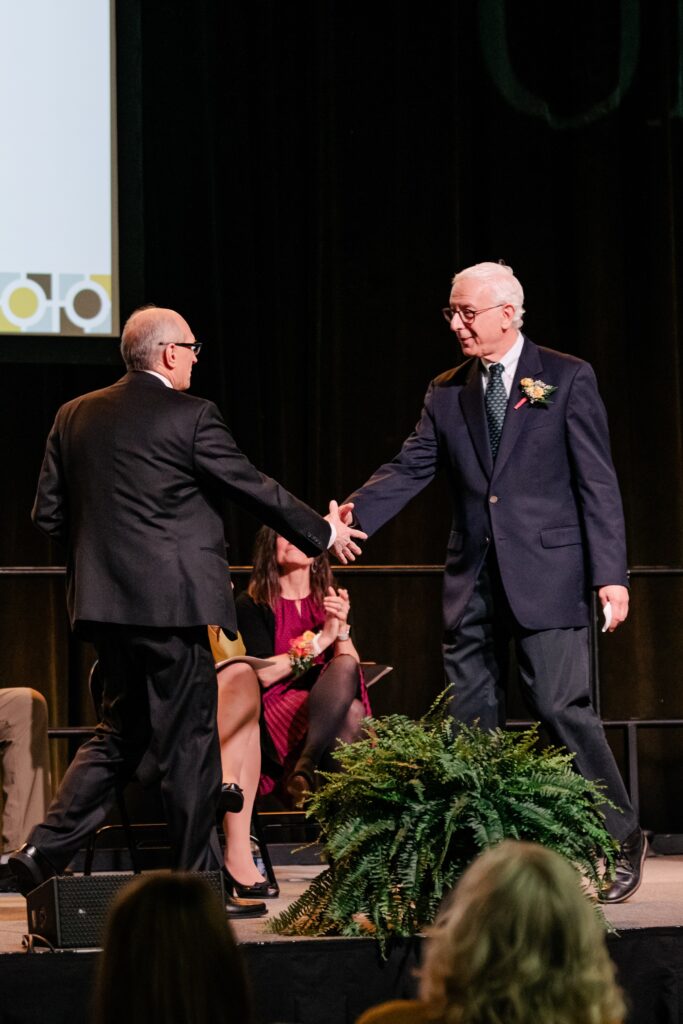 Yonathan Zohar, right, accepts his award from Bill LaCourse, dean of the College of Natural and Mathematical Sciences.
Supporting each other
Helena Dahlen, executive administrative assistant in the Division of Information Technology and the 2022 – 2023 Presidential Distinguished Staff Award for Non-exempt Staff recipient, recalled becoming an active member of the community when she started at UMBC in 2015. She joined book clubs, participated in wellness events, attended lectures, and more.
“It felt like I had moved into a small community,” she says. “Almost like a village, surrounded by brilliant people of all ages.” The supportive environment has allowed Dahlen to do her best work at UMBC and to give back. She generously contributes her energy to programs like Retriever Essentials and the Maryland Charity Campaign, and she serves as president of the Non-exempt Staff Senate.
Finally, Michael Pound, director of environmental safety and health and the 2022 – 2023 Presidential Distinguished Staff Award recipient, got to the heart of the matter. Recalling the challenges of managing the university’s response to the pandemic with a team of dedicated colleagues, he says, “I just couldn’t be prouder to work with these great folks.”
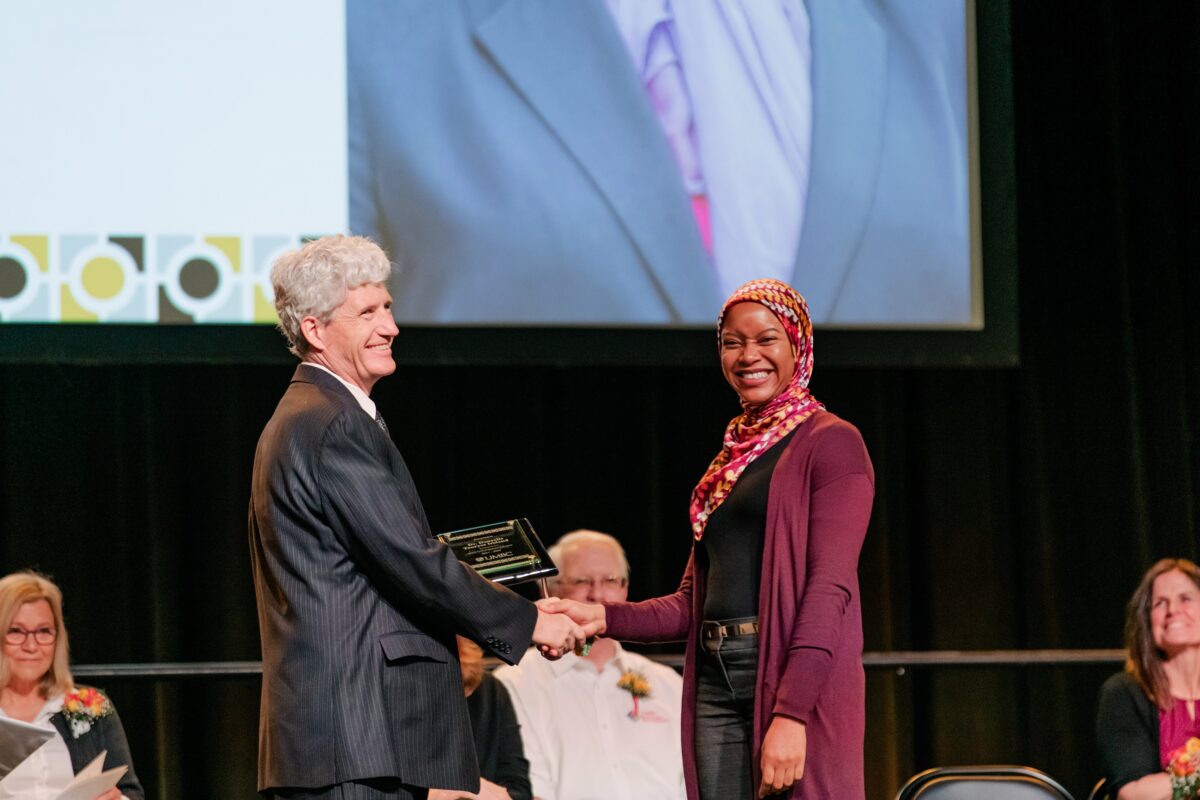 Danyelle Ireland, right, accepts her award from Marc Olano, associate dean of academic programs and learning in the College of Engineering and IT.
Beyond imagination
The UMBC community, all of the awardees emphasized, has grown through years of thoughtful care and collaboration. It’s taken decades to cultivate the UMBC ethos of community support and shared leadership.
“It’s hard to express how far we’ve come,” reflected President Hrabowski, as he offered remarks at his final PFASA as UMBC president. “Growing up, I could never have imagined the concept of UMBC—people from all over the world coming to study, to seek the truth, to get to know people different from themselves.”
UMBC’s newest awardees highlighted how that vision has become a reality, and Pres. Hrabowski honored all that they have contributed. “Leadership isn’t about one person at the top; it’s about what we all do,” Hrabowski said. “When we say we care about UMBC, what we’re saying is we care about each other.”
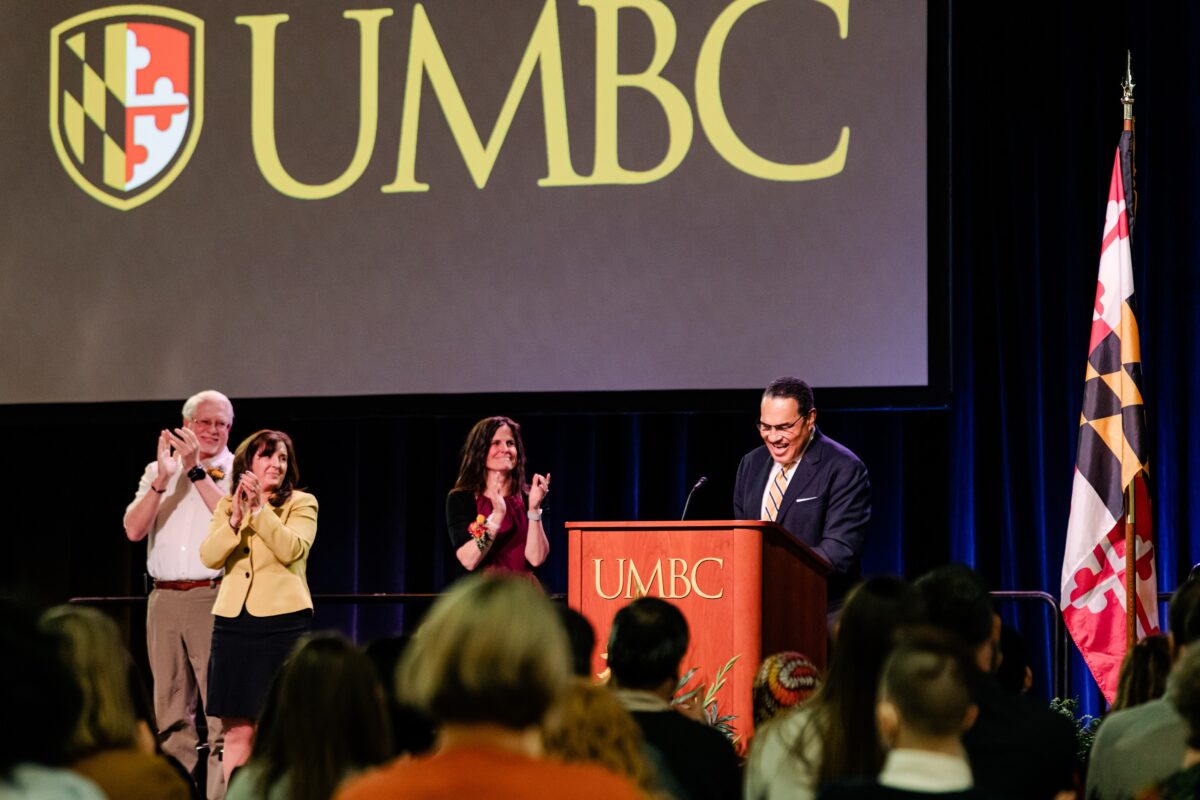 The audience applauds President Hrabowski as he makes remarks at his final Presidential Faculty and Staff Awards.
Honoring excellence
UMBC’s other named awards honor members of the UMBC community who embody the university’s ethos, such as Diane Lee, retired vice provost and dean of undergraduate education; Marilyn E. Demorest, professor emerita of psychology and former vice provost for faculty affairs; and Teresa Lupinek, the late former executive administrative assistant to the president. This year’s recipients include:
Mark Berczynski, M.S. ’17, lecturer, engineering and computing education program
Diane M. Lee Teaching Award
Danyelle Tauryce Ireland, associate director, Center for Women in Technology
Jakubik Family Endowment Staff Award
Nichole Zang Do, M.A. ’15, program management specialist, biological sciences
Karen L. Wensch Endowment Award for Outstanding Non-exempt Staff
C. Jill Randles, assistant vice provost and assistant dean, Academic Engagement and Transition Programs
Teresa Lupinek Endowment Award
Tamara Bhalla, associate professor, American studies
Marilyn E. Demorest Award for Faculty Advancement
Margaret Holland, associate professor, geography and environmental systems
Marilyn E. Demorest Award for Faculty Advancement
Narsingh B. Singh, research professor, chemistry and biochemistry, and affiliate faculty, computer science and electrical engineering
UMBC Research Faculty Excellence Award
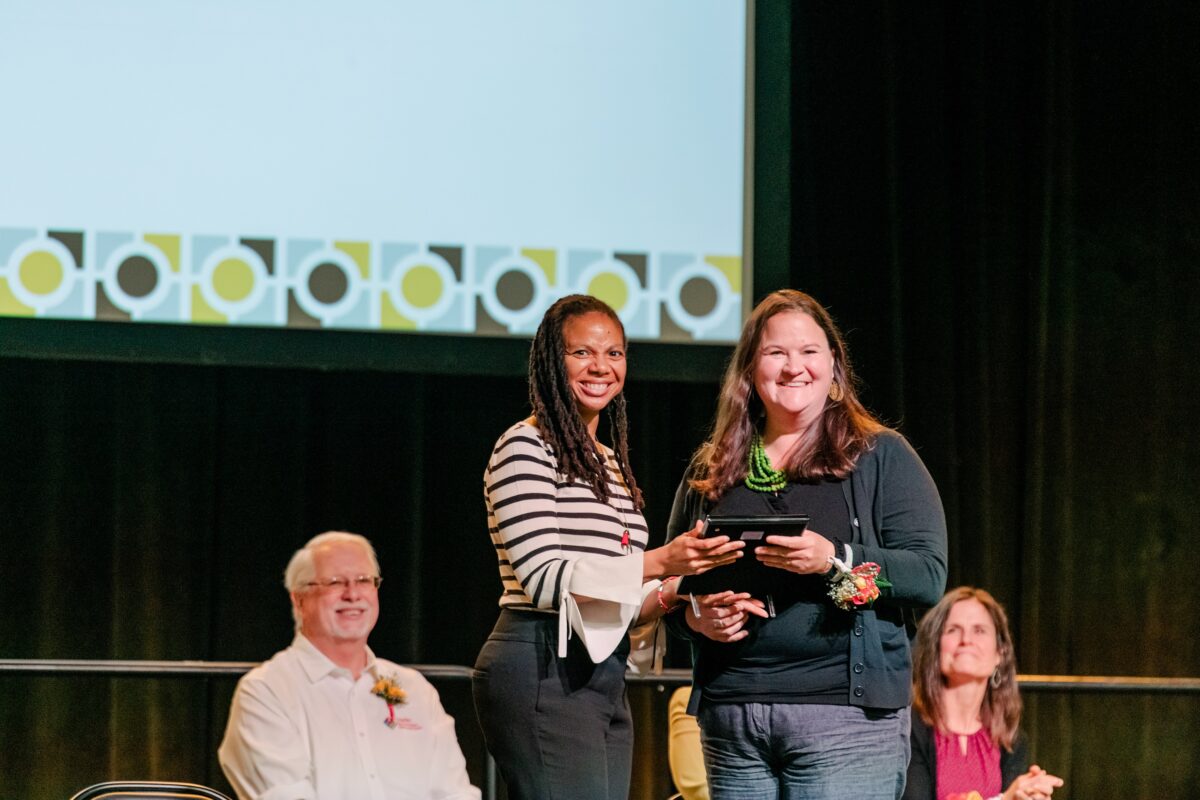 Margaret Holland, right, accepts her award from Kimberly Moffitt, dean of the College of Arts, Humanities, and Social Sciences.
USM Board of Regents awardees
This year, UMBC also had two University System of Maryland (USM) Board of Regents Award recipients. These awards represent the highest honor bestowed on faculty and staff across the USM by the Board of Regents. Awardees are selected by the Council of University System Staff and approved by the Board. The awards recognize faculty and staff for excellence in teaching; research, scholarship, and creative activity; public service; mentoring; or innovation.
UMBC has received an outsize share of these awards over the years, demonstrating the strength of our faculty and staff across all areas of achievement. This year, Marjoleine Kars, professor of history, received the 2022 USM Board of Regents Award for Excellence in Scholarship. Her latest book, Blood on the River: A Chronicle of Mutiny and Freedom on the Wild Coast, has received widespread acclaim for its discussion of a nearly successful rebellion of enslaved African and Indigenous people in the Dutch colony of Berbice in the 1860s.
Lee Blaney, associate professor of chemical, biochemical, and environmental engineering, received the 2022 USM Board of Regents Award for Excellence in Teaching. Blaney has received awards previously for exceptional mentoring and for engaging his students in high-impact research. His laboratory focuses on contaminants of emerging concern, such as compounds found in pharmaceuticals and personal care products, in waterways such as Chesapeake Bay.
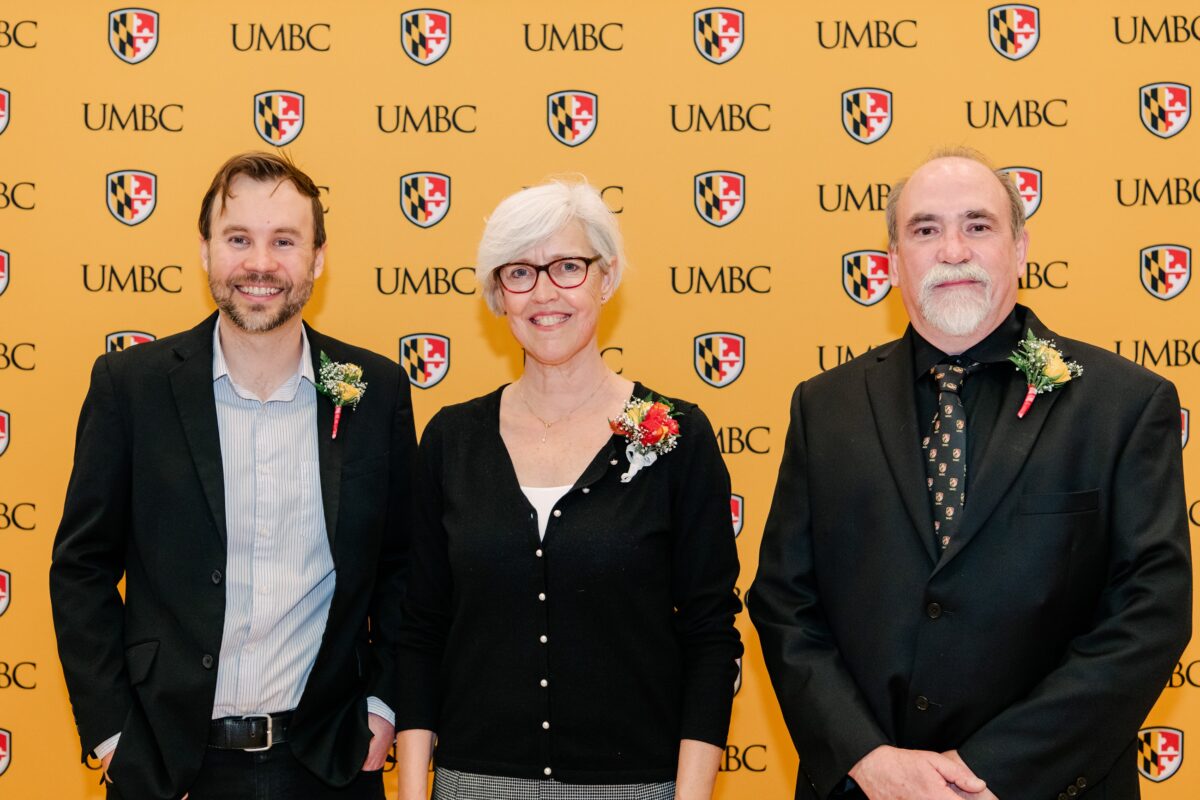 From left to right: Lee Blaney, Marjoleine Kars, and Victor Fulda.
Celebrating together
This year’s ceremony was the first in-person PFASA event since 2019. With that in mind, the ceremony also honored awardees from 2020 and 2021.
Victor Fulda, engineering technician, chemical, biochemical, and environmental engineering
2021 University System of Maryland Board of Regents Award for Exceptional Contribution to the Institution or Unit to which the Person Belongs
Jamie Gurganus ‘04, M.S. ‘11, Ph.D. ‘20; faculty, mechanical engineering; associate director, engineering education initiatives; and director, Center for the Integration of Research, Teaching, and Learning
2020 – 2021 Diane M. Lee Teaching Award
Jonathan Zwi, instructor and affiliate artist, music
2020 – 2021 Diane M. Lee Teaching Award
Header image: Recipients of awards who accepted them in person at this year’s PFASA. From left to right: Marjoleine Kars, Michael Pound, Jamie Gurganus, Maggie Holland, Nichole Zang Do, Jill Randles, Danyelle Ireland, Tamra Mendelson, Yonathan Zohar, Helena Dahlen, Freeman Hrabowski, Tamara Bhalla, Victor Fulda, Jonanthan Zwi, Narsingh Singh, Lee Blaney, Philip Rous.
All photos by Marlayna Demond ’11 for UMBC.
]]>
At UMBC’s 2022 Presidential Faculty and Staff Awards (PFASA), Tamra Mendelson, professor of biological sciences and recipient of the 2022 – 2025 Presidential Teaching Professor Award, said she...
https://umbc.edu/stories/umbc-faculty-and-staff-award-recipients-place-community-at-the-core-of-their-success/
https://my3.my.umbc.edu/api/v0/pixel/news/119452/guest@my.umbc.edu/f95ae1b8548d27f329239aad427f3da5/api/pixel
americanstudies
biology
cahss
cbee
chemistry
cnms
coeit
community
csee
cwit
ges
history
marinebiotech
music
news
UMBC News & Magazine
https://my3.my.umbc.edu/groups/umbc-news-magazine
https://assets1-my.umbc.edu/system/shared/avatars/groups/000/001/943/24435aa6207c452e7bc15cc74b42c7bb/xsmall.png?1748556657
https://assets1-my.umbc.edu/system/shared/avatars/groups/000/001/943/24435aa6207c452e7bc15cc74b42c7bb/original.png?1748556657
https://assets2-my.umbc.edu/system/shared/avatars/groups/000/001/943/24435aa6207c452e7bc15cc74b42c7bb/xxlarge.png?1748556657
https://assets2-my.umbc.edu/system/shared/avatars/groups/000/001/943/24435aa6207c452e7bc15cc74b42c7bb/xlarge.png?1748556657
https://assets3-my.umbc.edu/system/shared/avatars/groups/000/001/943/24435aa6207c452e7bc15cc74b42c7bb/large.png?1748556657
https://assets1-my.umbc.edu/system/shared/avatars/groups/000/001/943/24435aa6207c452e7bc15cc74b42c7bb/medium.png?1748556657
https://assets2-my.umbc.edu/system/shared/avatars/groups/000/001/943/24435aa6207c452e7bc15cc74b42c7bb/small.png?1748556657
https://assets1-my.umbc.edu/system/shared/avatars/groups/000/001/943/24435aa6207c452e7bc15cc74b42c7bb/xsmall.png?1748556657
https://assets2-my.umbc.edu/system/shared/avatars/groups/000/001/943/24435aa6207c452e7bc15cc74b42c7bb/xxsmall.png?1748556657
UMBC News & Magazine
0
0
false
Thu, 07 Apr 2022 22:12:22 -0400
Thu, 07 Apr 2022 22:12:22 -0400
Charting His Own Map for Success
Donovin Acaro Smith ’21, geography and environmental studies, was 11 years old when he did something bold, but not out of the ordinary for him. It was a sunny day. His school was taking a class trip to the local swimming pool, and parents were welcome to join. Smith’s mother Sonia, thought there was a problem. As far as she knew, her son didn’t know how to swim; he however, disagreed. Along with some buddies, he sprinted and leaped into the pool water, as his mom screamed, “Noooooooo, Donovin!”
But surprisingly, he wasn’t drowning, or even floating. He was swimming. It was a concerning, yet proud moment for his doting mother.
As he grew older, Smith would find himself surviving other sink and swim moments in life—two gunshot wounds as a teenager left him with anxiety and PTSD that would stop him from leaving his house for a year. And just last year, he overcame another obstacle he previously thought insurmountable: graduating from college.
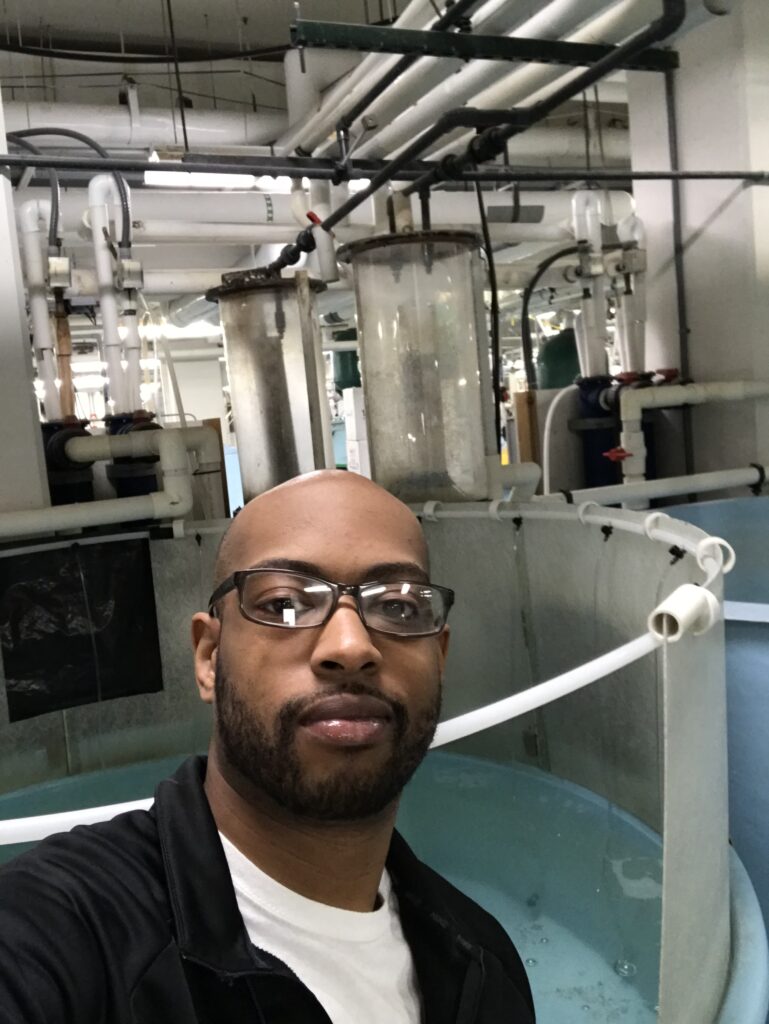 Smith while interning at the Institute of Marine and Environmental Technology (IMET).
Reimagining his future
In his late 20s, Smith followed in his maternal grandmother’s footsteps and pursued a new life focused around one goal: getting a four-year college degree. By the time he was 32, and after five internships in his field, he had a diploma in his hand and an unstoppable urge to keep moving forward.
Through his internships and connections in the Retriever Learning Center and Student Disability Services, Smith developed invaluable relationships with the people around him.
Matthew Baker, professor of geography and environmental systems, and associate dean of the College of Arts, Humanities, and Social Sciences, and Smith’s mentor and teacher says, “given the challenges he faced at the outset of his undergraduate program at UMBC, what he’s achieved is probably one of the greatest success stories that I’ve experienced in my 20 years of instruction.”
Growth pains
Even though he grew up just 20 minutes away from UMBC, the institution wasn’t on Smith’s radar as a young man.
At 18, when some kids were moving into their college dorm rooms, Smith told his mom he was heading to a cookout with some friends, just minutes away from his grandmother’s place. Later that same night, he called to say that he was on his way to the hospital. He’d been shot twice, once in his left thigh, and once in his lower ribcage.
The pain didn’t hit him right away, perhaps because gunshots weren’t new to Smith—when he was a child, he witnessed his father being shot.
“Not to sound like a tough guy, but I guess those experiences from my dad numbed me—he was set up when I was four. Somebody came in and shot him and he fell off the balcony and ever since then he’s been a parapelegic. So when it happened to me,” says Smith, “it didn’t really hurt. I was just trying to control my breathing so I could make it to the hospital.”
Even after surviving his gunshot wounds, Smith says he struggled to find purpose and meaning in his life. Smith’s mother recalls, “after Donovin got shot, for like a year he wouldn’t go out. He stayed in so much he ended up having a vitamin D deficiency.”
“Whatever lifestyle [my father] indulged in at the time, I saw those things firsthand,” says Smith of his teenage years. “I guess once you keep seeing the same things over and over, it just sorta keeps resonating in you, so when I got to that age, I wanted to do the same thing,” even though his father frequently warned him away from it.
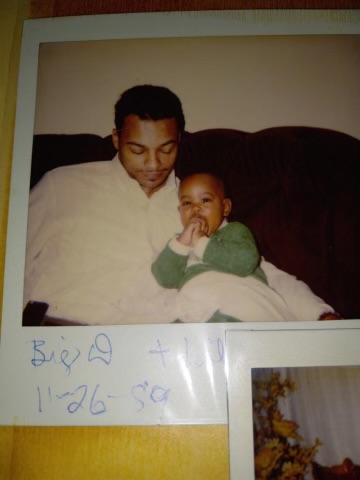
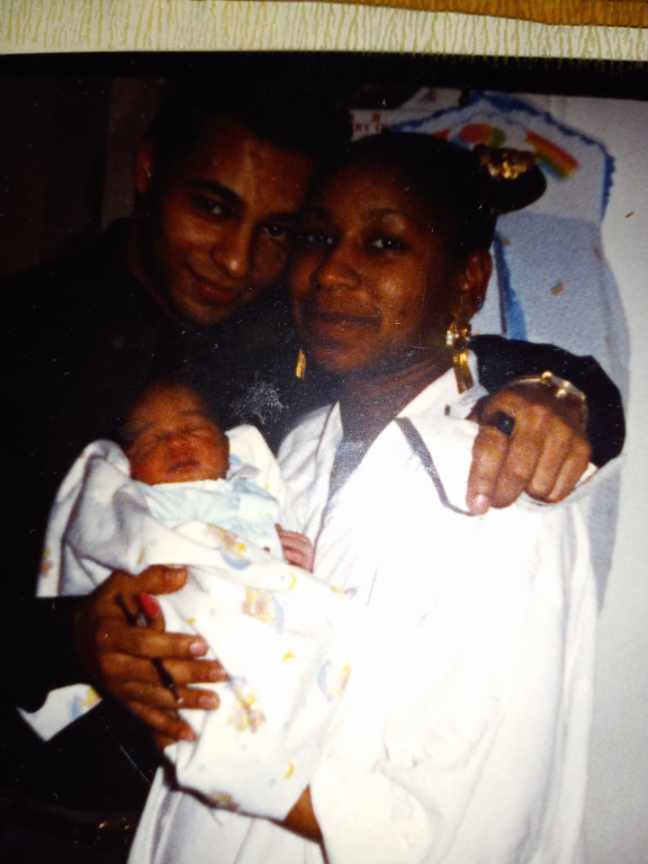
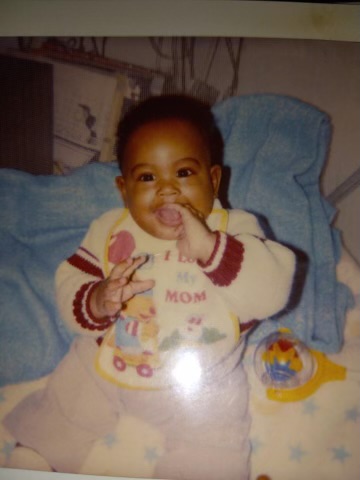 Family photos from Smith’s childhood. All photos courtesy of Smith unless otherwise noted.
“Some things I was doing I didn’t feel right about, or I felt bad about. Maybe because of those circumstances, I was confused about what it means to be a human being,” he says.
But he kept the right people around him from the start. His mother’s positive influence, and the love and support of other family members helped Smith through his most turbulent years.
A new mindset for a new environment
Smith wishes his interest in academics had started in high school. “I remember I used to walk into class, only thinking about getting through the day, I didn’t care what I learned about,” he says. “When I finally got to college, and I was in chemistry class, I could see how excited those students were to be in there. I just thought to myself, ‘Wow man, this is foreign to me.’ I wish I developed that attitude way earlier.”
At first, he only saw higher education as a way to please his family, but eventually it became Smith’s own passion. When he graduated from high school, Smith enrolled in the Community College of Baltimore County (CCBC), eventually earning an associate’s degree. He then applied to a few four year institutions. When he got into UMBC, he recalls his mother saying, “Wow Donovin! You gotta do it.”
“At first, I was just [going to college] to keep my mother and grandmother off my back, and to try and make my father happy, to make sure he knew that I’m grateful for some of the mistakes he made for me to be where I’m at. Then, when I started believing this was real, and not some kind of unrealistic reach or a joke, I knew I was doing it for myself, too,” says Smith.
A humble approach to learning
But before he got to that stage, he had to work to adapt to a new atmosphere and new environment. “The biggest obstacle to be honest, for me, was building up my self-esteem and feeling comfortable in my own skin. My first couple of years were rough. Like I might get a B or a C and then maybe like two D’s or an E,” shares Smith. “I was going to tutoring, I was trying. But I noticed when my self-esteem went up, my grades improved and I skyrocketed and I never looked back.”
The moment he started believing he could succeed at UMBC inversely began after failing GES 286, a mapping class. He retook the class a second time with a friend, and “I felt way more comfortable,” says Smith. “When I started excelling in that class, that’s when I started feeling like I could do it,” he says.

 Smith meets with Baker on a recent visit to campus. Photos by Marlayna Demond ’11.
Smith says he regularly reached out to friends for help studying and found a private tutor through Student Disability Services (SDS). “The Retriever Learning Center is where I did the majority of my tutoring and it was really helpful. But having anxiety and PTSD, I had to get my questions off. I was trying to survive,” Smith says.
“But sometimes with so many students attending, there wasn’t enough time for me to get as much help as I wanted. Thankfully I was able to get accommodation from SDS who granted me an individual tutor which made a big difference.”
“One of the things that has impressed me about Donovin the entire time that he was here was his resilience,” says Baker in GES, “his ability to bounce back from challenges, his perseverance and his absolute, unwavering dedication towards reaching his goals and because of those things it was really easy to support him, and it became an obligation to see that he did well.”
Also helpful was Smith’s fearlessness in regards to asking questions.
“He was always really clear about why he was asking what he was asking, and what he was trying to understand,” says Baker. “I think he was also willing to be humble about what he was learning so that he didn’t let embarrassment get in the way of his learning. As a result he made remarkable progress.”
Interning his way up
Smith, who is currently looking for a position in the conservation and environmental management field, began mastering these skills in a series of five internships.
In his first, under the wing of Baker, he researched sediment pollution in the Patapsco River. He also worked as a lab technician at the Institute of Marine and Environmental Technology. His most recent internship before graduation was at the Smithsonian Environmental Research Center, looking at the environmental influences on barnacles.
“The most rewarding part for me was working next to and being close to doctors and biologists every day, asking them as many questions as I wanted so I could really learn from them,” says Smith. “It taught me that you have to keep building your skills, learning how to compile fragments of information that might coincide with one another,” he continues.
Today, Smith sees his graduation from UMBC as his life’s crowning achievement. He describes his educational experience as a microcosm of his life as a whole. “There was a point at UMBC where my grades were looking so bad that I was about to switch to community college and try to come back. One of my highlights was being able to turn that around and just survive the tough academic atmosphere,” says Smith, who credits his mom, Baker, his friends, and some of UMBC’s organizations who helped him succeed.
To anyone that finds themselves in a similar position to the one he was in before attending UMBC, Smith recommends perseverance: “Give yourself a chance, and time to grow on your own. Separate yourself from your friends and environment and try to look at life from as many positive angles as possible.”
Looking at her son’s achievements today, Smith’s mother Sonia says, “He’s on his way, he is on his way.”
*****
Header image: Baker and Smith meet up on campus in 2022. Photo by Marlayna Demond ’11.
]]>
Donovin Acaro Smith ’21, geography and environmental studies, was 11 years old when he did something bold, but not out of the ordinary for him. It was a sunny day. His school was taking a class...
https://umbc.edu/stories/charting-his-own-map-for-success/
https://my3.my.umbc.edu/api/v0/pixel/news/119467/guest@my.umbc.edu/b630ddb4556d31be73d545c721ebf33c/api/pixel
alumni
ges
magazine
non-traditional-student
retriever-learning-center
student-disability-services
UMBC News & Magazine
https://my3.my.umbc.edu/groups/umbc-news-magazine
https://assets1-my.umbc.edu/system/shared/avatars/groups/000/001/943/24435aa6207c452e7bc15cc74b42c7bb/xsmall.png?1748556657
https://assets1-my.umbc.edu/system/shared/avatars/groups/000/001/943/24435aa6207c452e7bc15cc74b42c7bb/original.png?1748556657
https://assets2-my.umbc.edu/system/shared/avatars/groups/000/001/943/24435aa6207c452e7bc15cc74b42c7bb/xxlarge.png?1748556657
https://assets2-my.umbc.edu/system/shared/avatars/groups/000/001/943/24435aa6207c452e7bc15cc74b42c7bb/xlarge.png?1748556657
https://assets3-my.umbc.edu/system/shared/avatars/groups/000/001/943/24435aa6207c452e7bc15cc74b42c7bb/large.png?1748556657
https://assets1-my.umbc.edu/system/shared/avatars/groups/000/001/943/24435aa6207c452e7bc15cc74b42c7bb/medium.png?1748556657
https://assets2-my.umbc.edu/system/shared/avatars/groups/000/001/943/24435aa6207c452e7bc15cc74b42c7bb/small.png?1748556657
https://assets1-my.umbc.edu/system/shared/avatars/groups/000/001/943/24435aa6207c452e7bc15cc74b42c7bb/xsmall.png?1748556657
https://assets2-my.umbc.edu/system/shared/avatars/groups/000/001/943/24435aa6207c452e7bc15cc74b42c7bb/xxsmall.png?1748556657
UMBC News & Magazine
0
0
false
Mon, 07 Mar 2022 20:00:42 -0500
Mon, 07 Mar 2022 20:00:42 -0500
Smithsonian features Erle Ellis’s research on how humans have shaped ecology over millennia as a top discovery of 2021
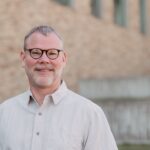
The Smithsonian National Museum of Natural History (NMNH) has announced its top ten discoveries of 2021, featuring “attention-grabbing findings” by UMBC’s Erle Ellis, professor of geography. Ellis collaborated with an international team of researchers, which included Torben Rick, study co-author and curator of North American archaeology at the museum. Their analysis revealed that people have sustainably shaped Earth’s ecosystems for over 12,000 years.
The boundless curiosity of the researchers at @nmnh drives them to explore Earth, the species that depend upon it, the cultures that inhabit it, and the forces that alter it.
Here are some of our scientists’ top natural history discoveries of 2021.https://t.co/UUG0lWRq4q
— Smithsonian’s NMNH (@NMNH) December 31, 2021
“Our work shows that most areas depicted as ‘untouched,’ ‘wild,’ and ‘natural’ are actually areas with long histories of human inhabitation and use,” Ellis previously shared with UMBC News. They might be interpreted like this, he suggests, because in these areas, “societies used their landscapes in ways that sustained most of their native biodiversity and even increased their biodiversity, productivity, and resilience.”
The team found the current biodiversity crisis is due to the appropriation, colonization, and intensified use of lands previously managed sustainably.
“It is so exciting to see our work recognized by the Smithsonian,” says Ellis, in response to the NMNH coverage. “I hope that 2022 will mark a turning point in our understanding and care for nature—by learning from and empowering the Indigenous and traditional peoples and practices that have sustained nature across the planet for more than 12,000 years.”
Ellis will be speaking about this discovery on Wednesday, January 19, 2022 at the Global Land Programme Webinar: Prehistoric land use reshaped most of terrestrial nature – does that matter now?
Banner image: Erle Ellis. Photo by Marlayna Demond ’11 for UMBC.
]]>
The Smithsonian National Museum of Natural History (NMNH) has announced its top ten discoveries of 2021, featuring “attention-grabbing findings” by UMBC’s Erle Ellis, professor of geography. Ellis...
https://umbc.edu/stories/meet-umbc-people-13/
https://my3.my.umbc.edu/api/v0/pixel/news/119489/guest@my.umbc.edu/7591156274f673693b7fb2af6ee610b2/api/pixel
cahss
cahssresearch
cs3
ges
science-and-technology
UMBC News & Magazine
https://my3.my.umbc.edu/groups/umbc-news-magazine
https://assets1-my.umbc.edu/system/shared/avatars/groups/000/001/943/24435aa6207c452e7bc15cc74b42c7bb/xsmall.png?1748556657
https://assets1-my.umbc.edu/system/shared/avatars/groups/000/001/943/24435aa6207c452e7bc15cc74b42c7bb/original.png?1748556657
https://assets2-my.umbc.edu/system/shared/avatars/groups/000/001/943/24435aa6207c452e7bc15cc74b42c7bb/xxlarge.png?1748556657
https://assets2-my.umbc.edu/system/shared/avatars/groups/000/001/943/24435aa6207c452e7bc15cc74b42c7bb/xlarge.png?1748556657
https://assets3-my.umbc.edu/system/shared/avatars/groups/000/001/943/24435aa6207c452e7bc15cc74b42c7bb/large.png?1748556657
https://assets1-my.umbc.edu/system/shared/avatars/groups/000/001/943/24435aa6207c452e7bc15cc74b42c7bb/medium.png?1748556657
https://assets2-my.umbc.edu/system/shared/avatars/groups/000/001/943/24435aa6207c452e7bc15cc74b42c7bb/small.png?1748556657
https://assets1-my.umbc.edu/system/shared/avatars/groups/000/001/943/24435aa6207c452e7bc15cc74b42c7bb/xsmall.png?1748556657
https://assets2-my.umbc.edu/system/shared/avatars/groups/000/001/943/24435aa6207c452e7bc15cc74b42c7bb/xxsmall.png?1748556657
UMBC News & Magazine
0
0
false
Thu, 13 Jan 2022 17:54:53 -0500
UMBC’s GRIT-X talks return for Homecoming 2021, highlighting research with a public impact

A hush fell over the excited audience in UMBC’s Proscenium Theatre last weekend, as Baltimore City Health Commissioner Letitia Dzirasa ‘03, biological sciences, stepped into the spotlight to present the first GRIT-X talk after a year hiatus for the event. Her topic particularly resonated in this moment: how data analysis is essential to addressing healthcare inequities.
Dzirasa was one of eight UMBC community members, including faculty and alumni, who spoke about their work, providing online and in-person audiences a glimpse of UMBC’s local, national, and global impact.
“We have such a diverse set of expertise within our UMBC community, with direct relevance to some of the most pressing issues within today’s society, including the impact of climate change on the environment, UMBC’s contribution to understanding and fighting the COVID-19 pandemic, and the importance of interpersonal human-to human interactions,” explains Karl V. Steiner, vice president for research at UMBC.
“We were especially thrilled to bring this showcase back to campus as part of this year’s homecoming activities, since last year the pandemic forced us to cancel the event,” Steiner shared. “It was great to be in the Performing Arts and Humanities Building.”
Watch the GRIT-X talks
More than a dashboard: The heightened role of data in driving equity
Dzirasa’s talk emphasized the interdisciplinary nature of her work, and how statistics and biological sciences play an important role in answering public health questions. She also described how data inform her work as a public health leader guiding Baltimore through the COVID-19 pandemic.
Nature needs culture: Conservation in the age of humans
Erle Ellis, professor of geography and environmental systems, discussed how human activity has transformed the world, and how the active human management of ecosystems is a defining feature of the past 12,000 years, not just the present. His talk dove into research he published earlier this year, with an international team, in the Proceedings of the National Academy of Sciences. The article and his talk emphasized the importance of empowering the environmental stewardship of Indigenous and local communities globally.
Fleximers: Bending over backwards for a cure
Kathie Seley-Radtke, professor of chemistry and biochemistry, has been studying coronaviruses since the early 2010s. Her GRIT-X presentation focused on her work to develop fleximers—distinctive compounds that interfere with virus replication, and whose flexible structure allows them to adjust shape and remain effective as viral variants evolve over time.
Stressing connections: Designing for affective awareness
Andrea Kleinsmith, associate professor of information systems, discussed her work to develop systems that support stress awareness and reflection, including with emergency responders. She shared a personal experience to illustrate the importance of addressing the effects and emotional impact of high stress situations.
Start small but start: The story behind a unique climate-observing site in Maryland
Belay Demoz, professor of physics, talked about an observation station in Beltsville, Maryland that conducts climate-related research. Demoz is known for his leadership in cultivating a diverse generation of climate scientists and prioritizing a culture of mentorship. He explained that who collects the data can impact research findings, which highlights the importance of collaboration among diverse researchers.
The math that explains the pandemic
Zoë McLaren, associate professor of public policy, is a health economist who uses statistical data analysis to inform health and economic policy, particularly related to combating infectious disease epidemics. In her GRIT-X talk, McLaren discussed “exponential growth” and “flattening the curve”—two concepts unfamiliar to much of the public prior to the COVID-19 pandemic, but which are now commonly used terms. These two concepts highlight the important role that mathematics and statistics play in understanding policies related to the pandemic.
Parenting: Looking for answers within and across cultural borders
Charissa Cheah, professor of psychology, presented her work understanding how parents around the world care for their children and teach them about culture. Culture is both big and abstract, as well as small and personal, Cheah explained, and parents have an important role in helping their children develop cultural competencies. Cheah is known for her research on how Chinese American parents and children have witnessed, experienced, and coped with discrimination due to COVID-19.
Saving our environment from the past: A story of chemicals and fish
Upal Ghosh, professor of chemical, biochemical, and environmental engineering, talked about his work understanding toxic pollutants and how they impact the environment. Even though some of the pollutants were banned from use 50 years ago, these contaminants can still be found in fish and wildlife today. Ghosh’s work also includes creative approaches to removing dangerous pollutants from waterways so they can’t cause further harm.
Learn more about past and future GRIT-X talks through UMBC’s Research and Creative Achievement site.
Banner image: Letitia Dzirasa presenting at GRIT-X. Photo by Kiirstn Pagan.
]]>
A hush fell over the excited audience in UMBC’s Proscenium Theatre last weekend, as Baltimore City Health Commissioner Letitia Dzirasa ‘03, biological sciences, stepped into the spotlight to...
https://umbc.edu/stories/umbcs-grit-x-talks-return-for-homecoming-2021-highlighting-research-with-a-public-impact/
https://my3.my.umbc.edu/api/v0/pixel/news/119544/guest@my.umbc.edu/976859d86fd533e50b43827aea37bfb5/api/pixel
cahss
cbee
chembiochem
cnms
coeit
community
ges
is
page1
physics
psychology
publicpolicy
research
UMBC News & Magazine
https://my3.my.umbc.edu/groups/umbc-news-magazine
https://assets1-my.umbc.edu/system/shared/avatars/groups/000/001/943/24435aa6207c452e7bc15cc74b42c7bb/xsmall.png?1748556657
https://assets1-my.umbc.edu/system/shared/avatars/groups/000/001/943/24435aa6207c452e7bc15cc74b42c7bb/original.png?1748556657
https://assets2-my.umbc.edu/system/shared/avatars/groups/000/001/943/24435aa6207c452e7bc15cc74b42c7bb/xxlarge.png?1748556657
https://assets2-my.umbc.edu/system/shared/avatars/groups/000/001/943/24435aa6207c452e7bc15cc74b42c7bb/xlarge.png?1748556657
https://assets3-my.umbc.edu/system/shared/avatars/groups/000/001/943/24435aa6207c452e7bc15cc74b42c7bb/large.png?1748556657
https://assets1-my.umbc.edu/system/shared/avatars/groups/000/001/943/24435aa6207c452e7bc15cc74b42c7bb/medium.png?1748556657
https://assets2-my.umbc.edu/system/shared/avatars/groups/000/001/943/24435aa6207c452e7bc15cc74b42c7bb/small.png?1748556657
https://assets1-my.umbc.edu/system/shared/avatars/groups/000/001/943/24435aa6207c452e7bc15cc74b42c7bb/xsmall.png?1748556657
https://assets2-my.umbc.edu/system/shared/avatars/groups/000/001/943/24435aa6207c452e7bc15cc74b42c7bb/xxsmall.png?1748556657
UMBC News & Magazine
0
0
false
Fri, 15 Oct 2021 18:16:16 -0400
UMBC’s Matthew Baker gets to the root of how trees cool cities
Extreme heat is on the rise, and people in urban areas with minimal tree canopy are especially susceptible to its harmful effects. Urban tree planting projects have proliferated in recent years, because trees are associated with lower urban temperatures, are relatively low-cost, and offer numerous benefits beyond cooling. A new study in Environmental Research Lettersdescribes nuances of how trees affect temperature in cities. The research findings could have a major public impact by helping urban planners reap the greatest benefits from tree planting efforts and protect their most vulnerable residents.
“Urban heat is a big deal, and tree canopy can help,” says Matthew Baker, second author on the study and a professor of geography and environmental systems at UMBC. Trees can shade heat-trapping surfaces, such as roads, roofs, and sidewalks. Transpiration from trees is also important to consider, but has gotten less attention. In transpiration, trees release water through their leaves that cools the air when it evaporates.
Both shading and transpiration are important contributors to cooling-by-trees, but they offer the greatest benefits in different conditions. “Different kinds of canopy do different kinds of work,” explains Baker, who also serves as associate dean for faculty affairs in the College of Arts, Humanities, and Social Sciences at UMBC. For example, trees above paved surfaces function differently than those above unpaved surfaces.
The new paper, which was funded by the National Science Foundation’s Geography and Spatial Sciences program, found that all the differences the researchers examined affect the role that trees play in cooling. Understanding which kinds of canopy could help the greatest number of residents most during heat events could improve quality of life in cities—and even save lives.

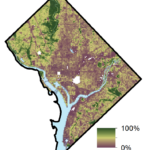
A figure from the paper by Matthew Baker and lead author Michael Alonzo visualizes the distribution of canopy cover in Washington, DC.
Canopy type matters
Baker and colleagues, including lead author Michael Alonzo at American University, analyzed more than 70,000 air temperature measurements collected on a hot summer day in 2018 in Washington, DC. They collected data using sensors attached to vehicles in the pre-dawn hours, during afternoon peak heat, and in the evening along different routes throughout the city.
In addition to looking at the effect of time of day, the researchers separated “hard canopy” (tree canopy above impervious surfaces, such as streets or rooftops) and “soft canopy” (tree canopy above unpaved surfaces, such as in yards or parks). They further divided soft canopy into patches (larger canopies found in large parks and forests) and “distributed” canopy (such as individual trees spread out among backyards or at a ball field).
Overall, and in agreement with previous studies, total tree canopy reduced temperature at every time tested. The amount of cooling increased linearly as the percentage of canopy cover in a location increased. For example, with 50 percent tree cover, the cooling effect was about twice as large as at 25 percent tree cover. The greatest overall effect was in the afternoon, when trees reduced the temperature by 1.8 degrees Celsius (3.2 degrees Fahrenheit).

An example of a forest patch, or clump. Clumped canopy demonstrated the ability to retain its lower temperatures even in afternoon heat. Photo by Michael Alonzo.
Cooler nights thanks to soft canopy
While the overall findings seem clear, once the researchers separated the different kinds of canopy, it got more complicated. Baker says, “The big story is that all tree canopy does not behave the same way, and soft canopy is more effective by far.”
For example, Baker notes that soft canopy seemed to do a better job cooling in the evening (more than 3 degrees Celsius) than in the afternoon. The authors suspect that’s because some trees shut off transpiration during peak heat to conserve water, and then start transpiring again in the evening. The evening bump could also be a side effect of the distribution of soft canopy throughout the city.
Hard canopy offered a slight cooling benefit (0.2 degrees Celsius) in the afternoon, even at less than 25 percent coverage, whereas soft canopy offered no apparent benefit at such a small amount of coverage. However, hard canopy created a very slight warming effect overnight, likely by trapping heat rising from hard surfaces.

Trees whose crowns hang over pavement or rooftops are examples of hard canopy. Photo by Michael Alonzo.
Missing the forest for the trees
Larger patches and more distributed forms of soft canopy also offer different benefits, but both produce significant cooling effects. Clumped patches were better at retaining their cooling effect in the peak afternoon heat, when distributed canopy was less effective. By contrast, distributed canopy cooling approached the effect of larger patches in the pre-dawn and evening, possibly because, with long shadows from low sun angles, distributed trees shade more of their surroundings.
Overall, “if you can increase the soft canopy, you are much more likely to reduce temperatures,” Baker says. Clumped soft canopy might be the most effective overall for cooling, because it retains its temperature reduction throughout peak heat and its cooling effects can extend to nearby areas beyond the clump’s boundary.
However, Baker also notes that distributed canopy is more accessible for many urban residents, who can more easily plant or maintain trees in yards than find the space for a microforest, so distinguishing the likely benefits of different kinds of canopy is important. “Of course” he says, “not everyone who needs the benefits of trees has a yard.”
Still, he emphasizes, “the benefits of a forest go well beyond the trees,” so “you can’t replace a forest with street trees.”
Strategies for the future
Urban tree-planting programs have the right idea, Baker suggests, because urban heat risk is almost certain to get worse and trees work to cool urban neighborhoods. But to make those efforts as effective as possible, more knowledge is needed about the relative benefits of different kinds of tree canopy.
Findings like those in this new research “affect how we might strategize future planting and woodland management,” Baker says. More nuanced understanding can help tree-planting programs, community groups, and individual residents make decisions about how to invest limited resources—in planting more street trees, yard trees, or forested tracts, but especially by protecting existing forest patches in and out of urban parks.
Header image: Matthew Baker at UMBC. Photo by Marlayna Demond ’11 for UMBC.
]]>
Extreme heat is on the rise, and people in urban areas with minimal tree canopy are especially susceptible to its harmful effects. Urban tree planting projects have proliferated in recent years,...
https://umbc.edu/stories/umbcs-matthew-baker-digs-deeper-into-the-cooling-benefits-of-urban-trees/
https://my3.my.umbc.edu/api/v0/pixel/news/119560/guest@my.umbc.edu/1ab3b106898732e68ede9a1c81d8fe28/api/pixel
cahss
ges
policy-and-society
research
science-and-technology
UMBC News & Magazine
https://my3.my.umbc.edu/groups/umbc-news-magazine
https://assets1-my.umbc.edu/system/shared/avatars/groups/000/001/943/24435aa6207c452e7bc15cc74b42c7bb/xsmall.png?1748556657
https://assets1-my.umbc.edu/system/shared/avatars/groups/000/001/943/24435aa6207c452e7bc15cc74b42c7bb/original.png?1748556657
https://assets2-my.umbc.edu/system/shared/avatars/groups/000/001/943/24435aa6207c452e7bc15cc74b42c7bb/xxlarge.png?1748556657
https://assets2-my.umbc.edu/system/shared/avatars/groups/000/001/943/24435aa6207c452e7bc15cc74b42c7bb/xlarge.png?1748556657
https://assets3-my.umbc.edu/system/shared/avatars/groups/000/001/943/24435aa6207c452e7bc15cc74b42c7bb/large.png?1748556657
https://assets1-my.umbc.edu/system/shared/avatars/groups/000/001/943/24435aa6207c452e7bc15cc74b42c7bb/medium.png?1748556657
https://assets2-my.umbc.edu/system/shared/avatars/groups/000/001/943/24435aa6207c452e7bc15cc74b42c7bb/small.png?1748556657
https://assets1-my.umbc.edu/system/shared/avatars/groups/000/001/943/24435aa6207c452e7bc15cc74b42c7bb/xsmall.png?1748556657
https://assets2-my.umbc.edu/system/shared/avatars/groups/000/001/943/24435aa6207c452e7bc15cc74b42c7bb/xxsmall.png?1748556657
UMBC News & Magazine
0
0
false
Mon, 13 Sep 2021 21:21:32 -0400
Ocean exploration to environmental justice: UMBC students seize on unique summer opportunities
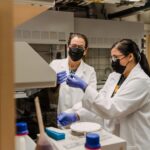
When COVID struck, students, families, and educators nationwide worried about the impact it would have on learning experiences and career opportunities. Throughout summer 2021, UMBC students have proven that with tenacity and support they can still access meaningful internships.
“We, as a UMBC community, are committed to the career success of our students,” says Christine Routzahn, director of the UMBC Career Center. “Internships provide students with opportunities to apply the skills, theories, and concepts they learn in the classroom while gaining valuable connections and career readiness. Working with our incredible employer partners and alumni, we’ve connected UMBC student talent with valuable, career-building experiences across industries.”
Goal #1: Secure that internship

Sandra Naylor. Photo courtesy of Naylor.
When Sandra Naylor ‘21, financial economics, was looking to transfer from community college to a four-year university, she had her sights set on securing an internship at a well-known company where she could gain hands-on experience in finance. She knew that UMBC had a strong Career Center that could connect her with these opportunities and she jumped at every chance to get her name in front of hiring managers.
“I came to UMBC specifically because I knew that they have really good connections,” says Naylor. Her two top priorities were her grades and accessing career opportunities. She shares, “I started going to meet and greets, and coffee chats to get my face out there as much as possible.”
Naylor attended a workshop at Morgan Stanley, which highlighted the company’s core values, including diversity, and she knew it was a company that could be a great fit for her. With the Career Center’s support, she secured an internship.
Her experience has largely been online, but that hasn’t limited her chances to build skills and network. “I am constantly in meetings and connecting with people,” she says. That includes regular meetings with her mentor, who is an executive director at Morgan Stanley. Senior management has also invited interns to meet at the company’s Baltimore offices.

Sandra Naylor’s photo appears on the Morgan Stanley building in Times Square, New York City. Photo courtesy of Naylor.
As she’d hoped, Naylor says that her internship has expanded her understanding of the finance industry. She particularly enjoyed deep dives designed to help interns understand how their work connects to the firm’s larger goals and initiatives—the kinds of work she might pursue in a finance career.
Find mentors who help you shine
Monika Arumalla, M.P.S,‘21, data science, has spent more than six months interning at BGE in Baltimore, and she will continue her internship through the fall. Like Naylor, Arumalla was eager to utilize the UMBC Career Center’s strong connections. She uploaded her résumé to UMBCworks during her first semester.

Monika Arumalla. Photo courtesy of Arumalla.
The energy company BGE approached Arumalla, inviting her to interview for a co-op—a type of work-based opportunity popular in engineering and technical fields, that’s often full-time, with hands-on projects. A committee interviewed Arumalla, asking her technical questions to assess her knowledge and approach to data science.
After hiring Arumalla, BGE onboarded her virtually, due to COVID. Still, “I’ve had constant interactions with my supervisor,” she says. “From day one, they made sure I was getting what I needed,” including helping her learn the company’s systems and processes.
Arumalla has been impressed with BGE’s office culture, which she describes as prioritizing safety, diversity, and inclusion. She has been able to connect with managers and leaders on her team, who have given her a sense of support and access to the tools she needs to complete her work.
That work included one particular project where she had a major impact. BGE call center agents are currently scattered across the region, primarily working remotely. Arumalla was asked to help determine how to support these agents in the event that they are affected by power outages in their home areas. The BGE team wanted fresh eyes on the project, and Arumalla came up with a solution that impressed her team.

Monika Arumalla working in her office space at home. Photo courtesy of Arumalla.
A few weeks later, she presented her idea to senior leadership at BGE. “My supervisor gave me an opportunity to showcase the work, something I’ll cherish,” she says. “Even as an intern, they always help me shine.”
See the impact of your work
Grace Tugado ‘23, chemical engineering, has spent her summer interning at SeeTrue Technology, which develops microcapillary needles for a range of biomedical needs, from IVF therapy to stem cell research. SeeTrue Technology is located on the UMBC campus, and is supporting Tugado’s internship through the Maryland Technology Internship Program.
Tugado learned about the internship from a professor and was excited by the opportunity to expand her biotech skills. For the first few days at SeeTrue she shadowed her mentor through the process of making the needles, and asked questions along the way.

Grace Tugado working in the SeeTrue Technology lab. Photo by Marlayna Demond ’11 for UMBC.
“There was a little bit of a learning curve,” says Tugado, who will also be a McNair Scholar this fall. Thanks to her prior research through UMBC’s STEM BUILD Program, she was able to make the most of each new challenge as a learning experience, without feeling discouraged.
One of the most rewarding parts of her internship at SeeTrue has been connecting with scientists, including her mentor Kinneret Rand-Yadin, founder and CEO of SeeTrue Technology. She’s also had the opportunity to connect with people who are using the needles. Receiving their feedback has impacted how she sees her work.
“It’s rewarding to think that labs around the world could potentially use the needles I’ve created,” she says. Tugado plans to continue interning at SeeTrue Technology through the fall semester.
Learn from people who have been there
Leaving nothing to chance Chi-Chi Onyekonwu ‘22, economics, worked with the UMBC Career Center team to apply for several summer opportunities. She was thrilled to be placed in her top choice, an economics research internship through the University of Chicago’s Leadership Alliance Summer Research Early Identification Program (held virtually this year).

Chi-Chi Onyekonwu. Photo courtesy of Onyekonwu.
The program helps students prepare for a Ph.D. in economics, explains Onyekonwu. It fosters interns’ connections with economics Ph.D.s, supports their research, and organizes lectures and other events.
Onyekonwu has worked with a group of six other economics research interns, including Seth Thomas ‘22, financial economics and global studies, and Lexi Smith ‘23, history and economics, on a project about global economies. Onyekonwu’s group studied global corporate transparency, and she also pursued an individual project focused on Italy’s economy. In addition to writing a research paper, she presented her work at a national symposium in July.
One of Onyekonwu’s favorite aspects of the program was connecting with 40 other economics students from around the world who were research interns at the University of Chicago this summer. Onyekowu plans to pursue a Ph.D. in economics after graduating from UMBC, and she valued the chance to grow her network.
“The first-hand accounts from people who have already gone through the process of getting their Ph.D., and hearing the mistakes they have made and what things have worked for them, has been the best part of the program,” she says.
Jump on a good opportunity
Terence Lesigues ‘23, biological sciences, first heard about interning at the Johns Hopkins University Applied Physics Laboratory (APL) through an email from UMBC’s Career Center in January. He’s glad he clicked on it. Within a few months, Lesigues was accepted into the program and identified a few particularly interesting projects to work on—not just during the summer, but for the coming year as well.
As a pre-med student with an interest in neuroscience, Lesigues joined a research group focused on brain analytics using machine learning. “We’re developing a deep learning algorithm to segment the brain at a micro level, including blood vessels and axons. With this, we can better understand the etiologies of neurological diseases, such as Alzheimer’s and schizophrenia,” he explains.

Terence Lesigues in front of the Johns Hopkins Applied Physics Lab. Photo courtesy of Lesigues.
“My lab at UMBC focuses on the neurobiological aspects of chemical sensory systems in the nose,” he notes. “This internship has allowed me to branch out and explore additional topics.”
While his internship is primarily virtual, Lesigues goes into APL once a week to meet with his cohort in person. Working remotely has not hindered his ability to make meaningful connections with professionals and his peers. Lesigues explains that he meets with his mentors each day, including for team-building activities, and also connects regularly with other interns.
Looking back, Lesigues says that he is grateful that he responded when the APL opportunity hit his inbox, and that he took the chance on applying. He encourages other students to keep an eye on Career Center messages and reach out to as many people as they can to get their foot in the door.
Gain experience in something you care about
Jaden Burke ‘24, political science, and Samara Pyfrom ‘24, M32, environmental science and geography both interned with the Chesapeake Bay Foundation, which focuses on conserving and protecting the Chesapeake Bay.
Pyfrom is the foundation’s diversity, equity, inclusion, and justice intern—a position she found on UMBCworks. Within the department of human resources, she works to provide data to the Chesapeake Bay Foundation’s board to support their planning and decision-making. She has also developed events that allow her fellow interns to network and has traveled to engage with interns across the organization.

Samara Pyfrom and Jaden Burke in front of oyster shells. Photo courtesy of Pyfrom.
Pyfrom is interested in scientific and environmental justice. She notes that climate change disproportionately impacts communities of color in the United States.
“My mentor has really centered this internship around my passions and helping me grow,” she says. “I’ve met with some litigation lawyers at the Chesapeake Bay Foundation and learned about how they approach environmental justice and work with corporations that misuse communities.”

Jaden Burke and Samara Pyfrom. Photo courtesy of Pyfrom.
Burke has supported community environmental education programs through his internship, including facilitating a trip for high school teachers to learn about oysters. He spent one week at the foundation’s Clagatt Farm, which he describes as the most physically challenging week of his internship.
Clagatt Farm has a community-supported agriculture program offering produce baskets each week of the summer. The organic farm connects community members to the local environment in meaningful ways, and Burke valued the chance to contribute to their work. Plus, he shares, “The networking opportunities have been valuable.”
Dive into unique opportunities
Adam Lees ‘21, biological sciences, remembers the day that he received an email from Routzahn about a highly unique opportunity to intern aboard the OceanX marine research vessel while it traveled from Portugal to Norway. “This program definitely jumped to the top of my list,” Lees says.

Adam Lees aboard the OceanX marine research vessel. Photo courtesy of Lees.
Fast forward a few months later, and Lees found out that he was one of about 15 interns selected for the research voyage. “I couldn’t believe it,” he says. The international group of interns—half from the U.S.—included students focused on biology as well as science communications.

Adam Lees, right, and his fellow interns. Photo courtesy of Lees.
Aboard the OceanX, Lees supported marine biologists and other scientists conducting research. Each day, he would have breakfast with the other interns before heading to lectures and shadowing scientists. He particularly enjoyed hands-on opportunities to send cameras and data collection tools deep into the ocean to gather samples.
Lees found most rewarding the friendships and connections that he made with others aboard the OceanX, from institutions all around the world. “Talking to scientists on OceanX and seeing what they do, how long it took them to get here, and what they do day to day was so helpful for me,” Lees explains.

A water sample collected by OceanX. Photo courtesy of Lees.
The OceanX has three dry labs filled with computers and servers, and one large wet lab that scientists use to study live samples. In addition to the students and scientists, the boat included a crew of about 35, from a person in charge of the computers and servers to a chef.

The OceanX vessel. Photo courtesy of Lees.
“The internship was inspiring and motivating,” Lees says, particularly having a front-row seat to science being conducted for the first time. “I can’t wait to be in school again now that I know what’s out there and what I can continue to work toward.”
Banner image: Grace Tugado, right, working in the SeeTrue Technology lab with her mentor Kinneret Rand-Yadin. Photo by Marlayna Demond ’11 for UMBC.
]]>
When COVID struck, students, families, and educators nationwide worried about the impact it would have on learning experiences and career opportunities. Throughout summer 2021, UMBC students have...
https://umbc.edu/stories/ocean-exploration-to-environmental-justice-umbc-students-seize-on-unique-summer-opportunities/
https://my3.my.umbc.edu/api/v0/pixel/news/119572/guest@my.umbc.edu/8648de9c519f0ec73297773038d6cdf2/api/pixel
biology
cahss
careercenter
cbee
cnms
coeit
community
datascience
economics
ges
globalstudies
history
mcnairscholars
page1
politicalscience
UMBC News & Magazine
https://my3.my.umbc.edu/groups/umbc-news-magazine
https://assets1-my.umbc.edu/system/shared/avatars/groups/000/001/943/24435aa6207c452e7bc15cc74b42c7bb/xsmall.png?1748556657
https://assets1-my.umbc.edu/system/shared/avatars/groups/000/001/943/24435aa6207c452e7bc15cc74b42c7bb/original.png?1748556657
https://assets2-my.umbc.edu/system/shared/avatars/groups/000/001/943/24435aa6207c452e7bc15cc74b42c7bb/xxlarge.png?1748556657
https://assets2-my.umbc.edu/system/shared/avatars/groups/000/001/943/24435aa6207c452e7bc15cc74b42c7bb/xlarge.png?1748556657
https://assets3-my.umbc.edu/system/shared/avatars/groups/000/001/943/24435aa6207c452e7bc15cc74b42c7bb/large.png?1748556657
https://assets1-my.umbc.edu/system/shared/avatars/groups/000/001/943/24435aa6207c452e7bc15cc74b42c7bb/medium.png?1748556657
https://assets2-my.umbc.edu/system/shared/avatars/groups/000/001/943/24435aa6207c452e7bc15cc74b42c7bb/small.png?1748556657
https://assets1-my.umbc.edu/system/shared/avatars/groups/000/001/943/24435aa6207c452e7bc15cc74b42c7bb/xsmall.png?1748556657
https://assets2-my.umbc.edu/system/shared/avatars/groups/000/001/943/24435aa6207c452e7bc15cc74b42c7bb/xxsmall.png?1748556657
UMBC News & Magazine
0
0
false
Fri, 20 Aug 2021 15:09:30 -0400