UMBC expands its next-generation tech analytics research with Phase II of the Center for Accelerated Real Time Analytics
UMBC’s Center for Accelerated Real Time Analytics (CARTA) team will advance its work in investigating data analytics using next-generation computing hardware with the launch of the next phase of the multi-institutional research collaboration.
UMBC is partnering with Rutgers University, the University of Miami, and Arizona State University to deploy CARTA Phase II, a five-year initiative that explores data analytics research to develop new accelerated and real-time approaches to address advanced technology integration in industries such as health care, finance, and security.
CARTA initially launched in 2018 with funding provided by the National Science Foundation’s Industry-University Cooperative Research Centers (IUCRC) program to develop next-generation computing hardware to address data-intensive infrastructure challenges. The IUCRC grant has been extended to fund new and existing CARTA sites with an additional $100,000 per year (for the next five years) to build on the centers’ work in data analytics research.
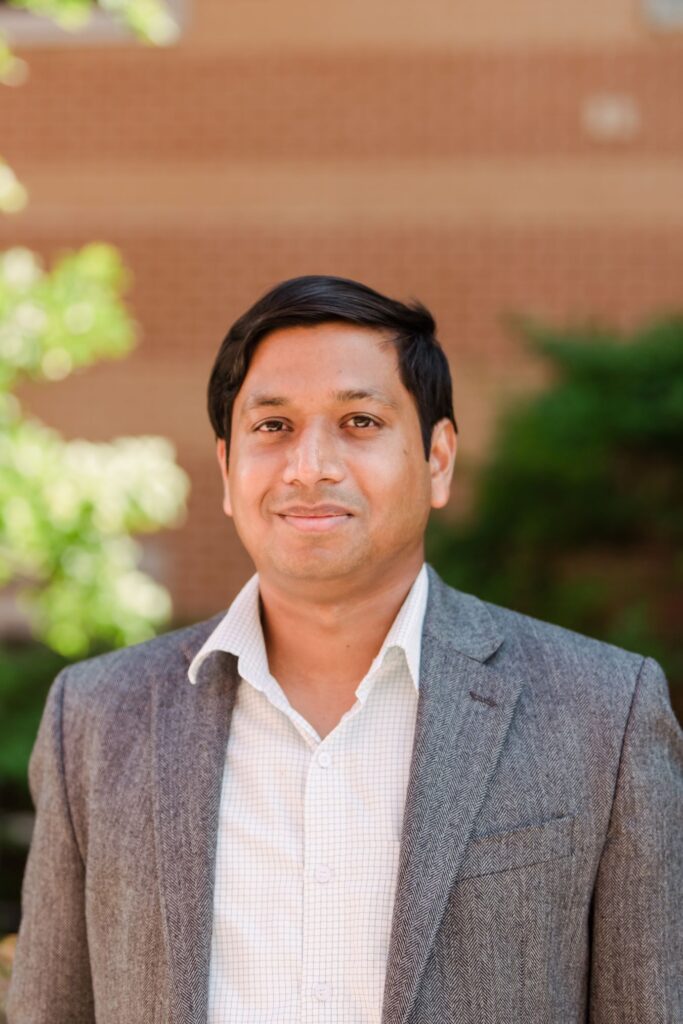
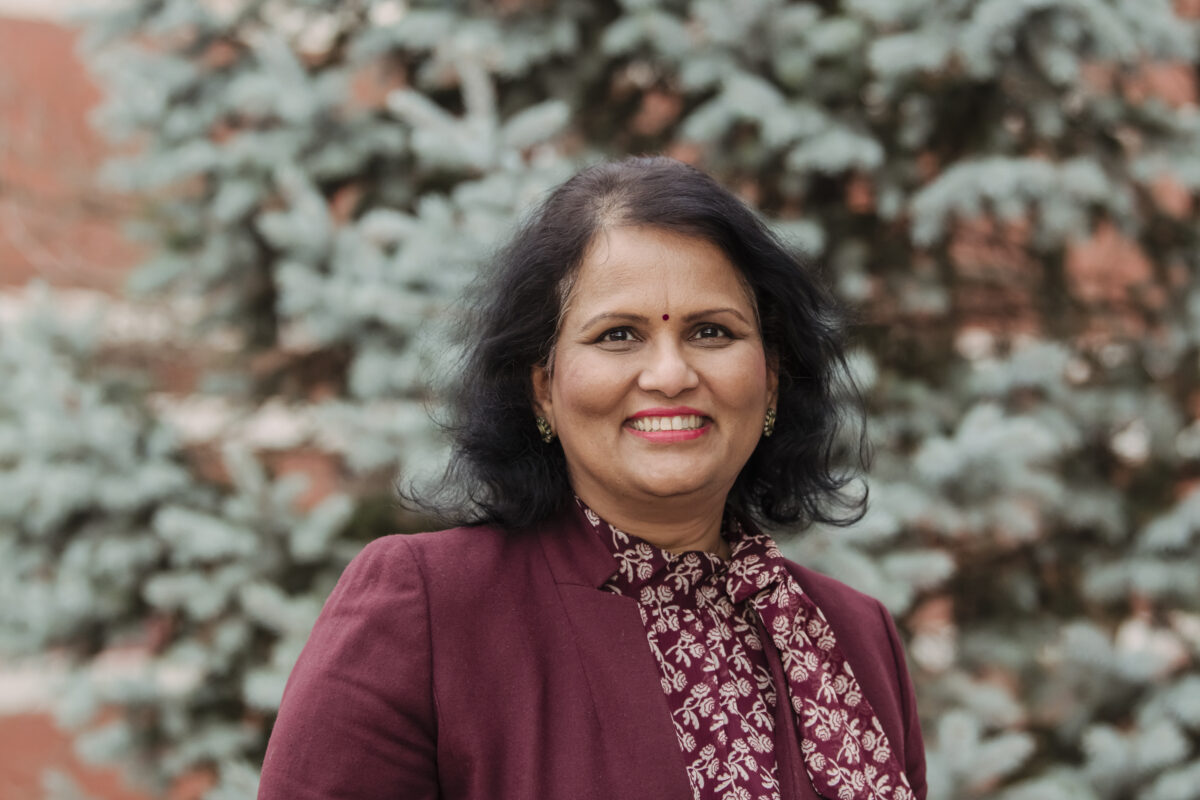 Karuna Joshi.
“CARTA’s focus has been on real-time analytics of large datasets on next generation technologies, or accelerated technologies, like high-performance computing, cloud computing, and quantum computing. This work will continue in Phase II,” says Karuna Joshi, associate professor of information systems and director of UMBC’s CARTA site.
Advancing industry collaborations
Since its launch, UMBC-CARTA faculty and student researchers have conducted more than 40 projects examining data analytics in Blockchain technology, malware analysis, medical data sharing, and evaluating bias in artificial intelligence in medical imaging. UMBC-CARTA collaborator Milton Halem, research professor of computer science and electrical engineering, will continue his work in weather and wildfire prediction research in the next phase of the initiative.
CARTA Phase II projects will largely focus on medical analytics (medical images and dataset sharing) and scientific and environmental datasets that can inform weather and wildfire predictions, Joshi explains, adding that “security is going to be the overlying paradigm across all of those various areas of research.”
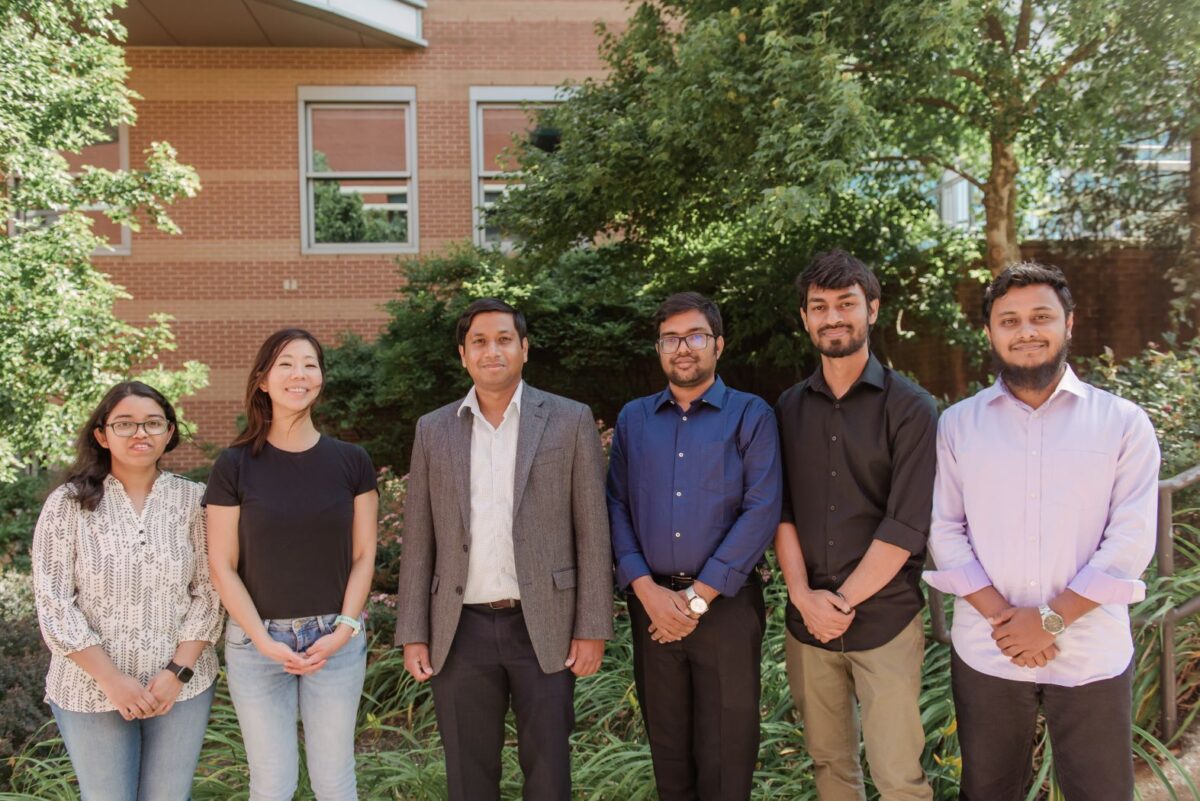
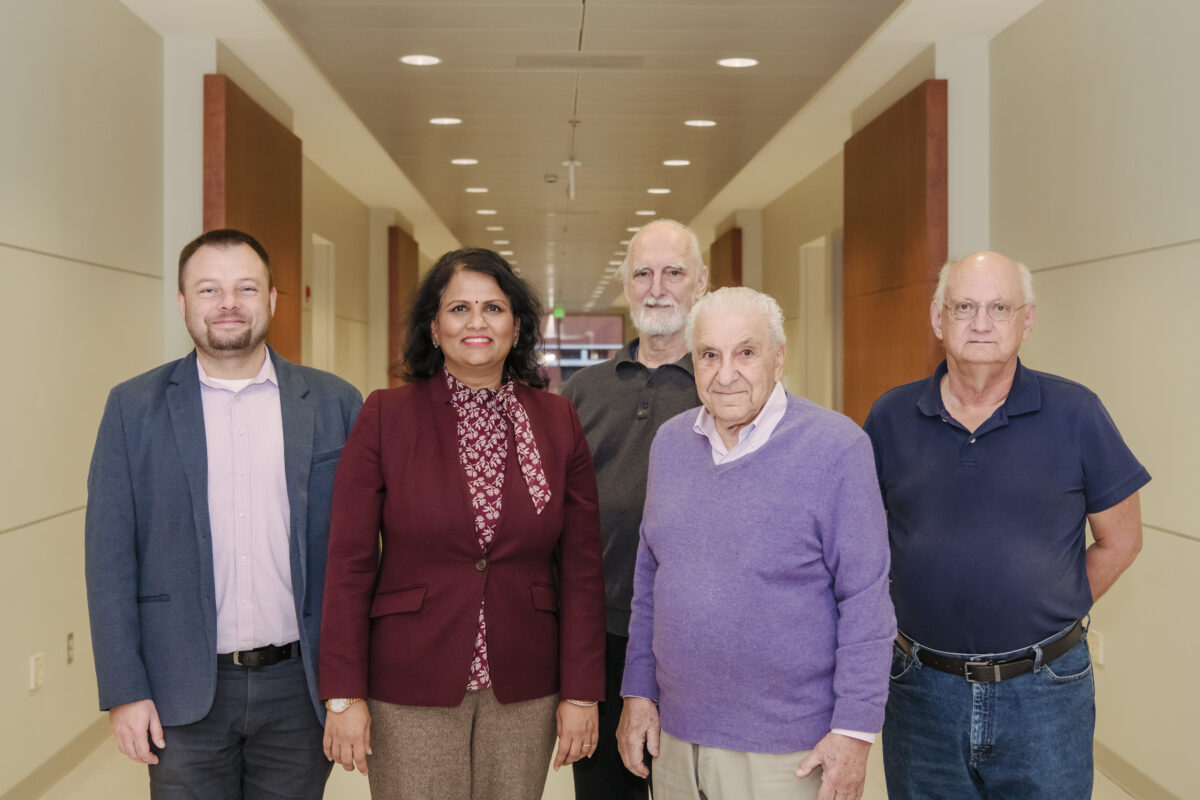 UMBC-CARTA faculty team, from left to right: Michal Mielech, Karuna Joshi, Tim Finin, Milton Halem, and John Dorband.
The CARTA sites are also aiming to expand their number of industry partner collaborations. In CARTA Phase I, UMBC worked with a range of industry partners that included NASA, IBM, the National Security Agency, Laboratory for Physical Sciences, the Department of Homeland Security, Morgan Stanley, RAD-AID, and Carestream.
“In Phase II, we are focusing more on collaborative projects with our university partners and building on those collaborations and making them stronger,” says Joshi. “We’re also looking at new avenues that our industry partners might be interested in such as smart cities, next-generation airports, and how to build secure image analytics and algorithms.”
As Phase II evolves, UMBC-CARTA research will also focus on large language models that are rising in popularity, such as ChatGPT, and digital twinning technologies, which is the process of creating a virtual model of a physical object.
Student collaboration at every level
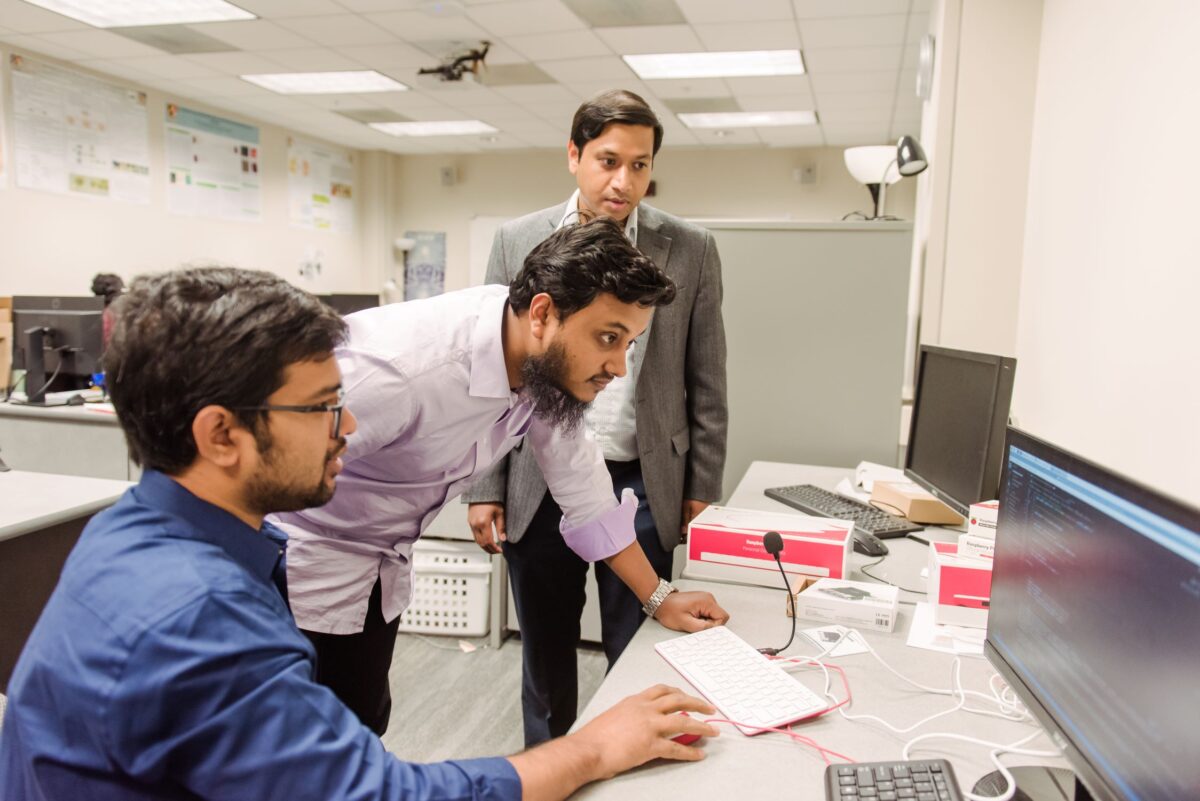
Undergraduate, graduate, and post-doctoral students will continue to work on research projects at UMBC-CARTA. Since its inception, UMBC-CARTA has supported more than 15 graduate students and has provided opportunities for undergraduate students to strengthen their research skills through the NSF-funded Research Experiences for Undergraduates program.
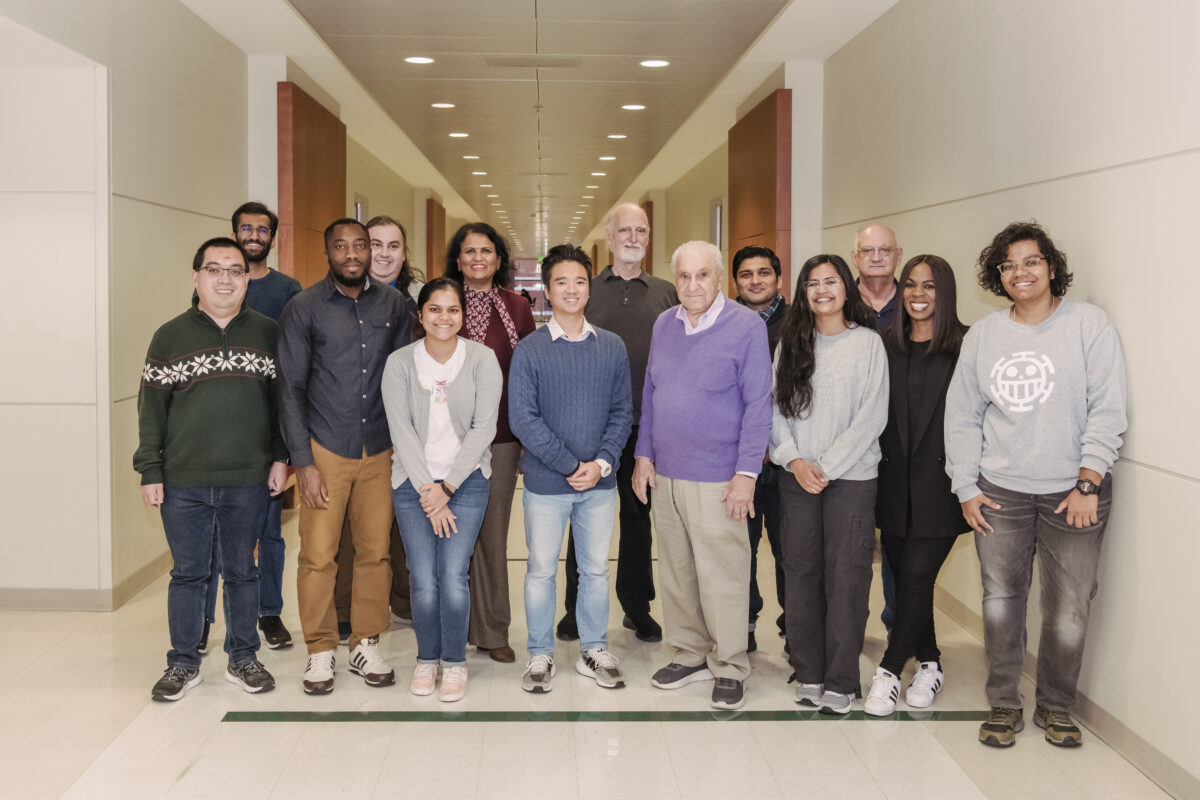 The UMBC-CARTA faculty and student team.
Kelvin Echenim, a second-year information systems Ph.D. student at UMBC, has worked on the CARTA team developing a scoring system to assess the comprehensiveness and user-friendliness of internet of things privacy policies.
“The scoring system aims to improve user comprehension and involvement in privacy matters by finding a balance between strict legal compliance and end-user practical accessibility,” says Echenim.
He adds that current and future research in CARTA Phase II will help expand his knowledge in solving complex problems in data-driven AI systems.
Read more about UMBC’s Center for Accelerated Real Time Analytics
]]>
UMBC’s Center for Accelerated Real Time Analytics (CARTA) team will advance its work in investigating data analytics using next-generation computing hardware with the launch of the next phase of...
https://umbc.edu/stories/center-for-accelerated-real-time-analytics/
https://my3.my.umbc.edu/api/v0/pixel/news/138235/guest@my.umbc.edu/e5020213f1745092504d89e69d3011f5/api/pixel
coeit
csee
is
news
research
science-and-tech
story
UMBC News & Magazine
https://my3.my.umbc.edu/groups/umbc-news-magazine
https://assets1-my.umbc.edu/system/shared/avatars/groups/000/001/943/24435aa6207c452e7bc15cc74b42c7bb/xsmall.png?1748556657
https://assets1-my.umbc.edu/system/shared/avatars/groups/000/001/943/24435aa6207c452e7bc15cc74b42c7bb/original.png?1748556657
https://assets2-my.umbc.edu/system/shared/avatars/groups/000/001/943/24435aa6207c452e7bc15cc74b42c7bb/xxlarge.png?1748556657
https://assets2-my.umbc.edu/system/shared/avatars/groups/000/001/943/24435aa6207c452e7bc15cc74b42c7bb/xlarge.png?1748556657
https://assets3-my.umbc.edu/system/shared/avatars/groups/000/001/943/24435aa6207c452e7bc15cc74b42c7bb/large.png?1748556657
https://assets1-my.umbc.edu/system/shared/avatars/groups/000/001/943/24435aa6207c452e7bc15cc74b42c7bb/medium.png?1748556657
https://assets2-my.umbc.edu/system/shared/avatars/groups/000/001/943/24435aa6207c452e7bc15cc74b42c7bb/small.png?1748556657
https://assets1-my.umbc.edu/system/shared/avatars/groups/000/001/943/24435aa6207c452e7bc15cc74b42c7bb/xsmall.png?1748556657
https://assets2-my.umbc.edu/system/shared/avatars/groups/000/001/943/24435aa6207c452e7bc15cc74b42c7bb/xxsmall.png?1748556657
UMBC News & Magazine
0
0
false
Wed, 17 Jan 2024 14:25:58 -0500
Wed, 17 Jan 2024 14:25:58 -0500
Before 3 amputations, Chandra Smith was already an accessibility-for-all advocate
By Jessie Newburn
It’s 4 a.m. on a Wednesday—earlier than most people rise, though a preference for Chandra Smith, M.S. ’21, information systems. After saying her daily devotion, she begins to get ready for the day ahead: brushing her teeth, taking a shower, getting dressed and having some breakfast.
If she’s lucky, the day ahead is one where her employer’s “reasonable accommodations” for her disabilities allow her to work from home rather than having to schedule a Paratransit bus pickup near Baltimore, then get on the Marc train to D.C., then get picked up by another Paratransit bus to take her to work at the Defense Intelligence Agency: a process that takes several hours—each way—assuming the bus even shows up, which doesn’t always happen.
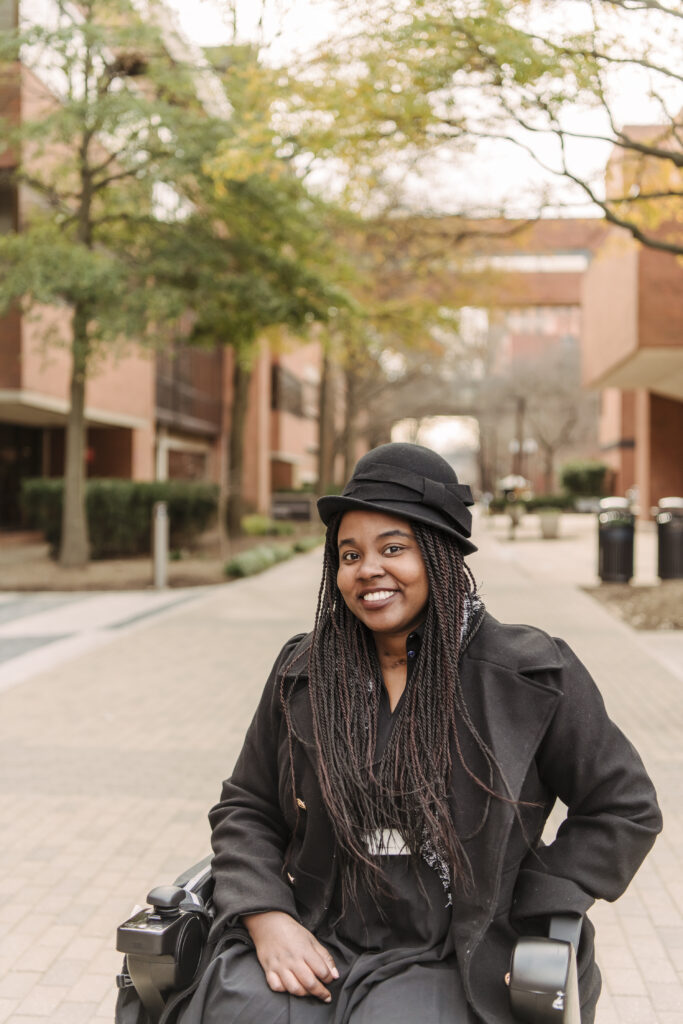 Smith on a visit to campus in 2023. (Marlayna Demond ’11/UMBC)
Everything Smith does now, even previously simple tasks such as getting dressed, have become complicated, time-consuming, and in her words, “close to an Olympic sport,” ever since Chandra’s Life As She Knew It screeched to a halt in the fall of 2021 when she fainted after fasting for religious purposes. She was medevaced to Georgetown University Hospital, when her body started shutting down, and then she was pumped with medicines to keep her organs functioning.
While life-saving, the emergency medicine she was given caused blood from her extremities to move to her core, essentially causing medical burns on 25 percent of her body and sepsis, triggering yet another medical emergency.
When a doctor told her she had 10 minutes to decide whether she wanted to live or die—with one small caveat: she’d be a triple amputee—Smith chose life.
She would go on to clock one year and one day from entering the hospital to exiting it, experiencing along the way: a stroke, dialysis, severe liver ketosis, three amputations, 10 painful surgeries (on one foot alone), and a host of other medical issues, procedures, and therapies.
Little did Smith know then, but the master’s degree in information systems she received from UMBC earlier that year would soon position her for a new role, a new voice and, ultimately, a new mission, not just within her job at the Defense Intelligence Agency (DIA), but in life.
“An upfront and center seat”
At age 32, Smith wasn’t looking for the campus-immersion experience she’d had when she was younger. “UMBC’s online masters program was the perfect mix of everything I wanted,” Smith says. Easy access to courses, professors with real-world experience, and fellow students from many walks of life and many parts of the world made picking UMBC an easy choice for Smith.
“I felt like I had an upfront and center seat in the field I was studying, as my professors wove challenges they faced in their jobs into the class instruction,” Smith says. Though, when reflecting on her experience at UMBC, the connections with other students stood out as most memorable to her.
“As I continued in the program, I often found myself in classes with people I’d met and worked with in previous classes,” she says. “To this day, I still come across people I recognize from the program when attending various professional conferences and events.”
A door opens
Long cloaked behind a “national-security exemption,” the nation’s seven intelligence agencies—including Smith’s employer, the DIA—had in recent years started addressing the complications of providing accessible technologies for disabled employees who needed what are called “reasonable accommodations” in order to do their work. This issue was particularly complex for those whose work involved top-clearance activities. For the DIA, a key area of concern was making sure their internal website met federal accessibility standards and requirements for online content.
The agency needed an IT engineer who could review various technologies used by employees—such as a Bluetooth hearing device for deaf or hard-of-hearing employees who need to access sensitive compartmented Information rooms or voice-to-text tools for someone with limited hand mobility. The official could then grant approval to use these technologies in national intelligence and top-secret environments. Smith, with her new degree in information systems, was the only person in her department with the skills to do this work.
 From left to right: Anne Arundel County Executive Steuart Pittman; Carol Beatty, Maryland Department of Disabilities; Chandra Smith, Ms. Wheelchair America 2024; Karrisa Kelly, director, Department of Aging and Disabilities. (Photo courtesy of Smith)
“The job just fell in my lap after I graduated,” Smith says, who notes that in this “before” version of her life, she saw the position as important, but it had yet to become personal to her. “As I dove in, I found the field and challenges fascinating in that I had to balance significant national-security concerns with the legitimate and legally compelling needs for people with various disabilities to be given ‘reasonable accommodations’ to do their intelligence-related work.”
And then things became personal
Only several months after earning her master’s degree, Smith experienced her medical trauma and began her year-long hospital stay of surgeries, occupational therapy, and recovery—including six months in the burn unit. But in the midst of this, Smith found time to apply for a higher government position, received the promotion, and came back to the DIA a notch up in her career, with more fire in her than ever and now positioned as a team lead, mentor, and accessibility policy creator.
“It’s one thing to try and think like someone who has various disabilities,” Smith says. “It’s another thing to be that person: to be a triple amputee and someone who, essentially, doesn’t have functioning appendages.” (Her one remaining appendage—her right hand—was rendered near-useless and stiff when she had a stroke in the hospital.) “There are so many more nuances and deeper levels of understanding about universal design and accessible technology I understand now because I have to face these hurdles and challenges myself.”
At UMBC, I felt like I had an upfront and center seat in the field I was studying, as my professors wove challenges they faced in their jobs into the class instruction.
Chandra Smith, M.S. ’21
In her new role, she still advocates for expanded definitions of reasonable accommodation hardware and software for employees, but now Smith gravitates toward policy and agency-wide mandates. And she’s creating change not just at the DIA, but across all the nation’s intelligence agencies. “I’m absolutely and avidly an advocate for universal design and making these technologies available to more people.”
Smith has had to advocate for herself and her own needs, too, including a desk printer she can access from her wheelchair, a sit-to-stand desk, working from home for a significant portion of the week, voice-recognition software, speech-to-text software, and a policy change for the need to provide biodata such as fingerprints. She asks, “How can someone provide a fingerprint if they don’t have a hand?”
There she is …
Of all the things a younger Smith never saw in her future, being crowned Ms. Wheelchair America 2024 was certainly one of them.
 Top 5 contestants and members of the board at the 2024 Ms. Wheelchair America (MWA) pageant. For the past 52 years, MWA has given women with disabilities an opportunity to enact meaningful change in society. (Photo courtesy of Smith)
But after her medical trauma, she was encouraged to compete in the Ms. Wheelchair Maryland 2023 contest, which she won; and that title allowed her to compete nationally, which she also won. More of a competition about resilience, advocacy, and helping to eliminate architectural and attitudinal barriers people with disabilities experience in the world, Smith’s response was, “I can do that!”
“The contest judges and members of the board were quite taken with Chandra’s presence, the clarity and logic with which she advocates about universal design, her personal story and challenges… and coming out all the stronger,” says Shelly Loose, president of Ms. Wheelchair America.
“Even before I was so personally impacted by these workplace and daily accessibility challenges of being disabled,” says Smith, “I could already see how designing for the few helps the many.”
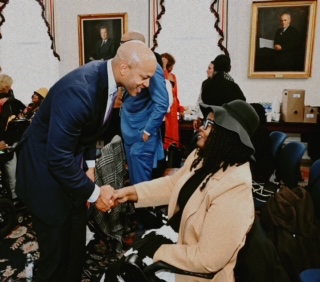 Maryland governor Wes Moore shakes hands with Smith at the governor’s mansion. (Photo courtesy of Smith)
For example, closed captioning of videos for hearing-impaired people helps many others with improved comprehension and retention. Ramps into buildings help people in wheelchairs and parents with strollers. “Universal design is inclusive. It should be the starting point, not an afterthought,” Smith says.
Maryland Governor Wes Moore heard of Smith’s work after she testified for a Prince George’s County universal-access bill. Soon after, he appointed her to a three-year term on the Maryland Commission on Disabilities, where she’s already working on accessibility policy recommendations to support a variety of disabilities. “We just recommended rewriting the MVA manual to a 6th-grade level to accommodate those with learning and reading disabilities,” Smith says. “Disabilities manifest in many ways—seen and unseen.”
Architecture and attitudes toward accessibility
For as much as Smith and others advocate for universal design and reasonable accommodations at work, at the end of the day, people and their attitudes about their peers with disabilities are the biggest hurdle to overcome, she says.
When Smith returned to work after her medical trauma, one coworker said, “If that happened to me, I’d kill myself.” Another one asked, “Do you know you’re missing a leg?”
Eyes rolled but mind set, Smith plows on. “There aren’t many people who look like me in a military-focused work environment, as most people who are disabled or use a wheelchair are discharged and don’t return to their former jobs,” she says.
While Smith has suffered quite a few “slings and arrows of outrageous fortune,” as Shakespeare put it, she knows the way forward is, well, forward. “When I was an able-bodied person, I had some bad days. As a disabled person, I have some incapacitating days. But I’ve come to understand that having difficult days doesn’t make a bad life. I appreciate more things now. I have more gratitude,” Smith says.
“I know it’s cliché and a bit corny, but if I help one employer add voice-to-text software for their employees or one property manager install a ramp for a building, I’ve done my job,” Smith says. “Universal design is a core value; it’s a perspective; it’s a way of seeing the world and making things accessible for all because—and I can speak from experience here—being disabled is a club anyone can join at any moment for any reason.”
]]>
By Jessie Newburn It’s 4 a.m. on a Wednesday—earlier than most people rise, though a preference for Chandra Smith, M.S. ’21, information systems. After saying her daily devotion, she begins...
https://umbc.edu/stories/chandra-smith-works-for-accessibility-for-all/
https://my3.my.umbc.edu/api/v0/pixel/news/138143/guest@my.umbc.edu/a99abdc07778f2d5e79b60d650ed79dc/api/pixel
alumni
coeit
is
magazine
story
UMBC News & Magazine
https://my3.my.umbc.edu/groups/umbc-news-magazine
https://assets1-my.umbc.edu/system/shared/avatars/groups/000/001/943/24435aa6207c452e7bc15cc74b42c7bb/xsmall.png?1748556657
https://assets1-my.umbc.edu/system/shared/avatars/groups/000/001/943/24435aa6207c452e7bc15cc74b42c7bb/original.png?1748556657
https://assets2-my.umbc.edu/system/shared/avatars/groups/000/001/943/24435aa6207c452e7bc15cc74b42c7bb/xxlarge.png?1748556657
https://assets2-my.umbc.edu/system/shared/avatars/groups/000/001/943/24435aa6207c452e7bc15cc74b42c7bb/xlarge.png?1748556657
https://assets3-my.umbc.edu/system/shared/avatars/groups/000/001/943/24435aa6207c452e7bc15cc74b42c7bb/large.png?1748556657
https://assets1-my.umbc.edu/system/shared/avatars/groups/000/001/943/24435aa6207c452e7bc15cc74b42c7bb/medium.png?1748556657
https://assets2-my.umbc.edu/system/shared/avatars/groups/000/001/943/24435aa6207c452e7bc15cc74b42c7bb/small.png?1748556657
https://assets1-my.umbc.edu/system/shared/avatars/groups/000/001/943/24435aa6207c452e7bc15cc74b42c7bb/xsmall.png?1748556657
https://assets2-my.umbc.edu/system/shared/avatars/groups/000/001/943/24435aa6207c452e7bc15cc74b42c7bb/xxsmall.png?1748556657
UMBC News & Magazine
0
0
false
Wed, 10 Jan 2024 16:06:00 -0500
Wed, 10 Jan 2024 16:06:00 -0500
UMBC’s Vandana Janeja aims to boost high-performance computing know-how to tackle environmental science challenges with a $1 million NSF grant

The discovery of the Higgs boson. The first picture of a black hole. The Covid-19 vaccine. Many recent scientific advances, such as these, owe much to a largely unsung hero: high-performance computing.

Vandana Janeja (Marlayna Demond ’11/UMBC)
Yet the use of high-performance computing is generally limited to a niche group. “Some researchers are very sophisticated in the use of these tools, but many are not,” says Vandana Janeja, a professor of information systems at UMBC.
Janeja is on a mission to spread advanced computing know-how far beyond its current borders. “It’s not just for the elites,” she says.
She was recently awarded a nearly $1 million grant from the National Science Foundation (NSF) that will help further that mission. The grant is part of a larger NSF collaborative award with the University of Maryland Center for Environmental Sciences (UMCES).
Janeja and her UMBC and UMCES colleagues will work to connect a wide range of students and faculty with high-performance computing experts, creating and nurturing what has been called the cyberinfrastructure pipeline. The ultimate goal is to facilitate the flow of knowledge.
“Once one person gains experience, they can turn around and help someone else,” Janeja says. “It’s about supporting and connecting people with resources and not just about setting up the hardware and software.”
Building a high-performance computing workforce
The need for fast computers in research is driven in part by a modern deluge of data. For example, NASA estimates that it will soon have accumulated hundreds of petabytes of Earth science data, from sources such as satellites flying overhead and sensors installed on the ground. Making full use of all that data requires new approaches to computing. While traditional computers generally perform calculations one at a time, high-performance computing facilities break up the work between multiple computing nodes and run processes in parallel.
UMBC has its own high-performance computing facility, which houses computing equipment that can process data significantly faster than a standard laptop. University researchers have employed the fast computers to study topics as diverse as weather modeling, cancer treatment, and flight dynamics.
“Learning how to use high-performance computing is not straight-forward,” says Janeja. Users have to gain a good understanding of the infrastructure of the computers, and also hone their skills in identifying the best techniques to take full advantage of that infrastructure.
People with a good understanding of how these machines and their software work will be in high demand, Janeja adds.
Many modern AI algorithms, which are used by scientific researchers and big tech companies alike, require high-performance computing to operate. “While everyone is running toward the shiny object of AI, many don’t realize that there is a backbone, called cyberinfrastructure, that runs AI,” says Janeja.
Part of Janeja’s goal with the new grant is to educate students who may pursue careers building, maintaining, utilizing, and improving that cyberinfrastructure backbone. She also cares deeply about ensuring diverse groups of people have access to these roles.
“We are trying to democratize the use of cyberinfrastructure and make it accessible to people who have never used it,” Janeja says.
Jack Suess, ‘81, M.S. ‘94, UMBC’s vice president of information technology, says he is excited for his division to play a key role in the award, helping shape best practices and build a national cyberinfrastructure support structure. “I look forward to watching how this work informs not just how we support faculty, but how we train and support advanced undergraduates and graduate students to evolve into these roles,” he says.
Tackling environmental challenges
While there is no shortage of scientific questions that might be tackled with high-performance computing, Janeja and her colleagues on the new grant will test-run their collaborative initiatives with projects in environmental science.

Changes to the ice and snow in Greenland could contribute to sea level rise. (Image credit: NASA)
Janeja is also director of iHARP, an NSF-funded institute that aims to harness big data and advanced computing tools to better model how climate change will affect the polar regions. As part of the new grant, iHARP and UMCES researchers will partner with cyberinfrastructure professionals to explore environmental science questions, such as in iHARP investigating how to predict the rate of snow melting in Greenland.
Scientists increasingly rely on big data and high-performance computing to understand and predict changes in the environment. As human activities continue to put pressure on natural systems, it will be more important than ever to forge collaborations between researchers and computing experts that advance the science.
“I’m excited to leverage high-performance computing to solve real-world problems and make it accessible to students and researchers of all backgrounds,” Janeja says.
]]>
The discovery of the Higgs boson. The first picture of a black hole. The Covid-19 vaccine. Many recent scientific advances, such as these, owe much to a largely unsung hero: high-performance...
https://umbc.edu/stories/vandana-janeja-nsf-grant-computing/
https://my3.my.umbc.edu/api/v0/pixel/news/136681/guest@my.umbc.edu/df7ee24459cf2e6c8d3cbbcb80877422/api/pixel
coeit
doit
is
news
rca-1
research
science-and-tech
UMBC News & Magazine
https://my3.my.umbc.edu/groups/umbc-news-magazine
https://assets1-my.umbc.edu/system/shared/avatars/groups/000/001/943/24435aa6207c452e7bc15cc74b42c7bb/xsmall.png?1748556657
https://assets1-my.umbc.edu/system/shared/avatars/groups/000/001/943/24435aa6207c452e7bc15cc74b42c7bb/original.png?1748556657
https://assets2-my.umbc.edu/system/shared/avatars/groups/000/001/943/24435aa6207c452e7bc15cc74b42c7bb/xxlarge.png?1748556657
https://assets2-my.umbc.edu/system/shared/avatars/groups/000/001/943/24435aa6207c452e7bc15cc74b42c7bb/xlarge.png?1748556657
https://assets3-my.umbc.edu/system/shared/avatars/groups/000/001/943/24435aa6207c452e7bc15cc74b42c7bb/large.png?1748556657
https://assets1-my.umbc.edu/system/shared/avatars/groups/000/001/943/24435aa6207c452e7bc15cc74b42c7bb/medium.png?1748556657
https://assets2-my.umbc.edu/system/shared/avatars/groups/000/001/943/24435aa6207c452e7bc15cc74b42c7bb/small.png?1748556657
https://assets1-my.umbc.edu/system/shared/avatars/groups/000/001/943/24435aa6207c452e7bc15cc74b42c7bb/xsmall.png?1748556657
https://assets2-my.umbc.edu/system/shared/avatars/groups/000/001/943/24435aa6207c452e7bc15cc74b42c7bb/xxsmall.png?1748556657
UMBC News & Magazine
0
0
false
Mon, 30 Oct 2023 15:12:27 -0400
Mon, 30 Oct 2023 15:12:27 -0400
Harnessing AI to improve healthcare: Sanjay Purushotham wins $590,000+ NSF CAREER award
Today, a plethora of technologies, from image recognition tools to chatbots, are powered by machine learning. A key component to the technique’s success is data—and lots of it. For doctors and hospitals who hope to use machine learning to improve healthcare, that need for copious data presents a problem: medical data is protected by privacy laws and often exists in incomplete or diverse forms—from doctor’s notes to medical scans—that make it difficult for machine learning models to use it effectively.
“Using data better to aid medical decisions is a grand challenge of the 21st century,” says Sanjay Purushotham, an assistant professor in information systems at UMBC. “We need innovations in existing techniques to take full advantage of artificial intelligence in healthcare.”
Together with his students, Purushotham is tackling that challenge. He recently received a prestigious NSF CAREER award to support his team’s efforts to develop new ways to train health-focused machine learning models.
Purushotham has been contributing his expertise in computer science to collaborations with doctors and hospitals for almost ten years. The NSF CAREER award will help Purushotham further that research in a new direction, and ultimately, his team hopes their work will improve medical treatments and reduce costs, benefiting patients around the world.
The need for data-driven healthcare
Sanjay Purushotham (Marlayna Demond ’11/UMBC)
When you visit the doctor, you may be asked about your general health, your family medical history, and your current symptoms. The doctor may order a series of tests and scans. All of this data could yield valuable insights into your health and the best course of medical treatment.
Bringing the data together in ways that make it accessible and illuminating is an ongoing challenge in health care. Synthesizing and presenting health information in new ways could improve individual medical care. Computer systems could ensure busy doctors see the most relevant information at the right time, aiding their decision making. It could also prove valuable for addressing public health challenges, such as the spread of infectious diseases.
“During the COVID pandemic, the health community realized the importance of having access to good data,” says Purushotham. Better data could help public officials make better decisions about when to take precautions, such as closing schools. It could also help individuals better understand the risks when choosing to partake in activities like attending large social gatherings or traveling.
Over the next five years, the award will support Purushotham and his students as they investigate ways to advance a technique called federated learning, which could allow hospitals and doctors to jointly build and evaluate a machine learning model without sharing sensitive medical data.
A new way to collaborate
Most machine learning models are trained centrally, on vast quantities of data that are often scrapped from the internet. However, a lot of data exists that cannot be sent to a central processing facility, for cost or privacy reasons. The term ‘federated learning’ was coined in 2016 to describe a decentralized machine learning technique that could train on data that never leaves users’ mobile phones. Instead, individual devices would take turns downloading the model, training it on their own data, and then sending the updated model parameters back to a central location.
Students Sultan Ahmed (left) and Zahid Hassan Tushar (center) work in the lab with Sanjay Purushotham (right). (Marlayna Demond ’11/UMBC)
The general approach could be beneficial in many industries, from finance to manufacturing. In health care, federated learning has clear appeal because privacy laws strictly limit how health data can be shared.
For example, federated learning could allow hospitals to train a joint model on their medical data, such as CT scans, without sharing the scans with each other. The jointly trained model might reveal new ways to detect disease.
Yet, many hurdles remain to successfully deploying the technique, including the non-uniformity and limited nature of some patient data, the varying computational resources available to different medical practitioners, and the threat of bad actors seeking access to private information.
Advancing federated learning
In the coming years, Purushotham and his team will pursue three main avenues of research to address the obstacles of deploying federated learning in healthcare. The project will develop new algorithms, methodologies, and software to make data-driven federated learning for healthcare more robust and trustworthy.
The first focus of the team will be to develop new ways to handle the diversity of health data. The team will then study potential methods of attacks on the federated learning systems, and develop defenses against such attacks. The researchers will also investigate ways that the system can “un-learn” in situations where users request the influence of their data be removed from the model. In all cases, the researchers will focus on developing fair and interpretable algorithms. Finally, the researchers will study ways to generate synthetic health data, which can be used to augment or replace real data to improve the AI models.
The scope of the work is ambitious, but Purushotham is confident in his team.
“I have great students and collaborators,” he says. “I’m really excited to make federated learning in healthcare work.”
Sanjay Purushotham (third from left) with members of his research team (from left to right): Shaswati Shah, Catherine Ordun, Sultan Ahmed, Md Mahmudur Rahman, and Zahid Hassan Tushar. (Marlayna Demond ’11/UMBC)
]]>
Today, a plethora of technologies, from image recognition tools to chatbots, are powered by machine learning. A key component to the technique’s success is data—and lots of it. For doctors and...
https://umbc.edu/stories/ai-to-improve-healthcare/
https://my3.my.umbc.edu/api/v0/pixel/news/134528/guest@my.umbc.edu/ac292788575b7521e503c80a5c66de03/api/pixel
coeit
is
news
rca-1
research
science-and-tech
UMBC News & Magazine
https://my3.my.umbc.edu/groups/umbc-news-magazine
https://assets1-my.umbc.edu/system/shared/avatars/groups/000/001/943/24435aa6207c452e7bc15cc74b42c7bb/xsmall.png?1748556657
https://assets1-my.umbc.edu/system/shared/avatars/groups/000/001/943/24435aa6207c452e7bc15cc74b42c7bb/original.png?1748556657
https://assets2-my.umbc.edu/system/shared/avatars/groups/000/001/943/24435aa6207c452e7bc15cc74b42c7bb/xxlarge.png?1748556657
https://assets2-my.umbc.edu/system/shared/avatars/groups/000/001/943/24435aa6207c452e7bc15cc74b42c7bb/xlarge.png?1748556657
https://assets3-my.umbc.edu/system/shared/avatars/groups/000/001/943/24435aa6207c452e7bc15cc74b42c7bb/large.png?1748556657
https://assets1-my.umbc.edu/system/shared/avatars/groups/000/001/943/24435aa6207c452e7bc15cc74b42c7bb/medium.png?1748556657
https://assets2-my.umbc.edu/system/shared/avatars/groups/000/001/943/24435aa6207c452e7bc15cc74b42c7bb/small.png?1748556657
https://assets1-my.umbc.edu/system/shared/avatars/groups/000/001/943/24435aa6207c452e7bc15cc74b42c7bb/xsmall.png?1748556657
https://assets2-my.umbc.edu/system/shared/avatars/groups/000/001/943/24435aa6207c452e7bc15cc74b42c7bb/xxsmall.png?1748556657
UMBC News & Magazine
0
0
false
Fri, 04 Aug 2023 15:00:09 -0400
Fri, 04 Aug 2023 15:00:09 -0400
UMBC softball nabs 4th consecutive America East title, advances to NCAA tournament
A year after becoming the first team to win three consecutive crowns since UAlbany in 2006 – 2008, UMBC softball has permanently inked their place in the record books with their fourth-straight America East Championship win. The Retrievers are only the second softball team to win four consecutive America East titles, the last one being Hofstra in 1998 – 2001.
Despite rainy conditions, the Retrievers defeated UAlbany for the second year in a row. Starting with a commanding lead in the first inning, the Retrievers never faltered and came out victorious with a 9-3 final score.
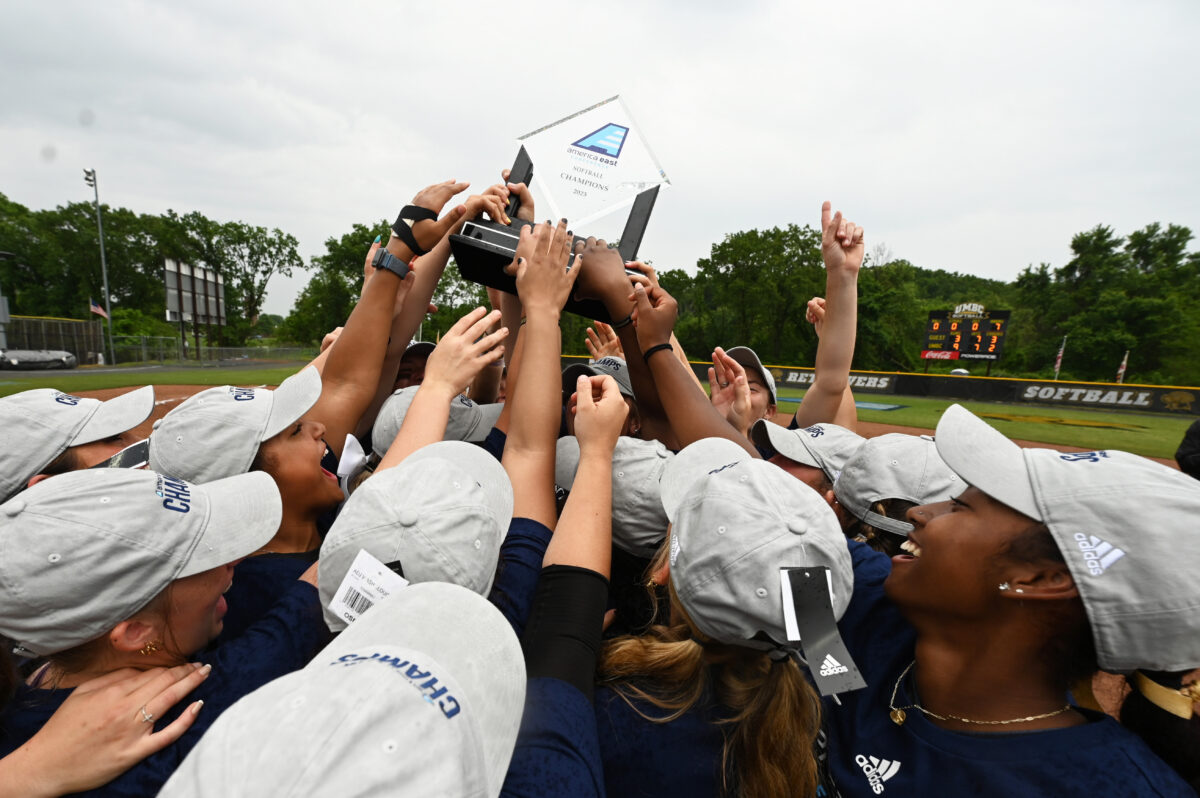 UMBC Retrievers hold high their America East trophy. (Gail Burton/UMBC)
“Winning never gets old,” says head coach Chris Kuhlmeyer. “Being able to watch this amazing group of high achieving women accomplish a four-peat—which is something that is very rare not just in our sport but across sports in general—was one of the most special things.”
During the annual NCAA Selection Show, it was announced that the Retrievers would be taking on No. 6 Oklahoma State University in Stillwater, OK on Friday, May 19 at 4 p.m. EST.
More than a softball title
In addition to the team’s success as a whole, several players took home additional honors. Madison Wilson ’23, media and communication studies, was named the Championship’s Most Outstanding Player. She was also named to the All-Championship Team with Shanel Stott ’23, information systems; Macy Granzow ’24, mechanical engineering; and Kya Matter ’25, public health.
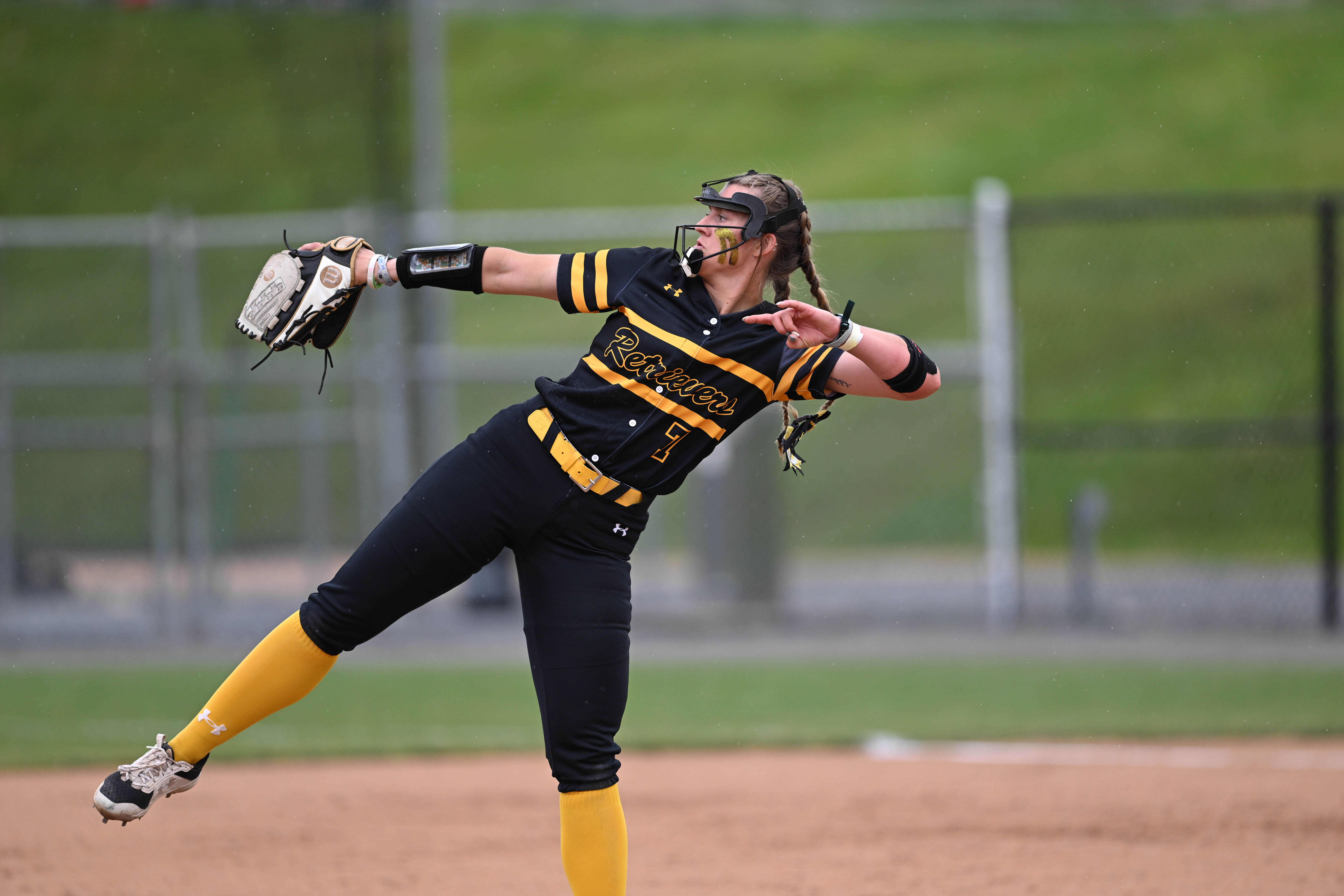 Coppersmith celebrates an out against UAlbany for the America East title. (Gail Burton/UMBC)
Chemistry graduate student Courtney Coppersmith ’22, biochemistry and molecular biology, earned Pitcher of the Year honors for the fourth consecutive season, becoming the first student-athlete in America East softball history to do so. Overall, she became just the third America East student-athlete (in any sport) to win a regular season major award four consecutive years.
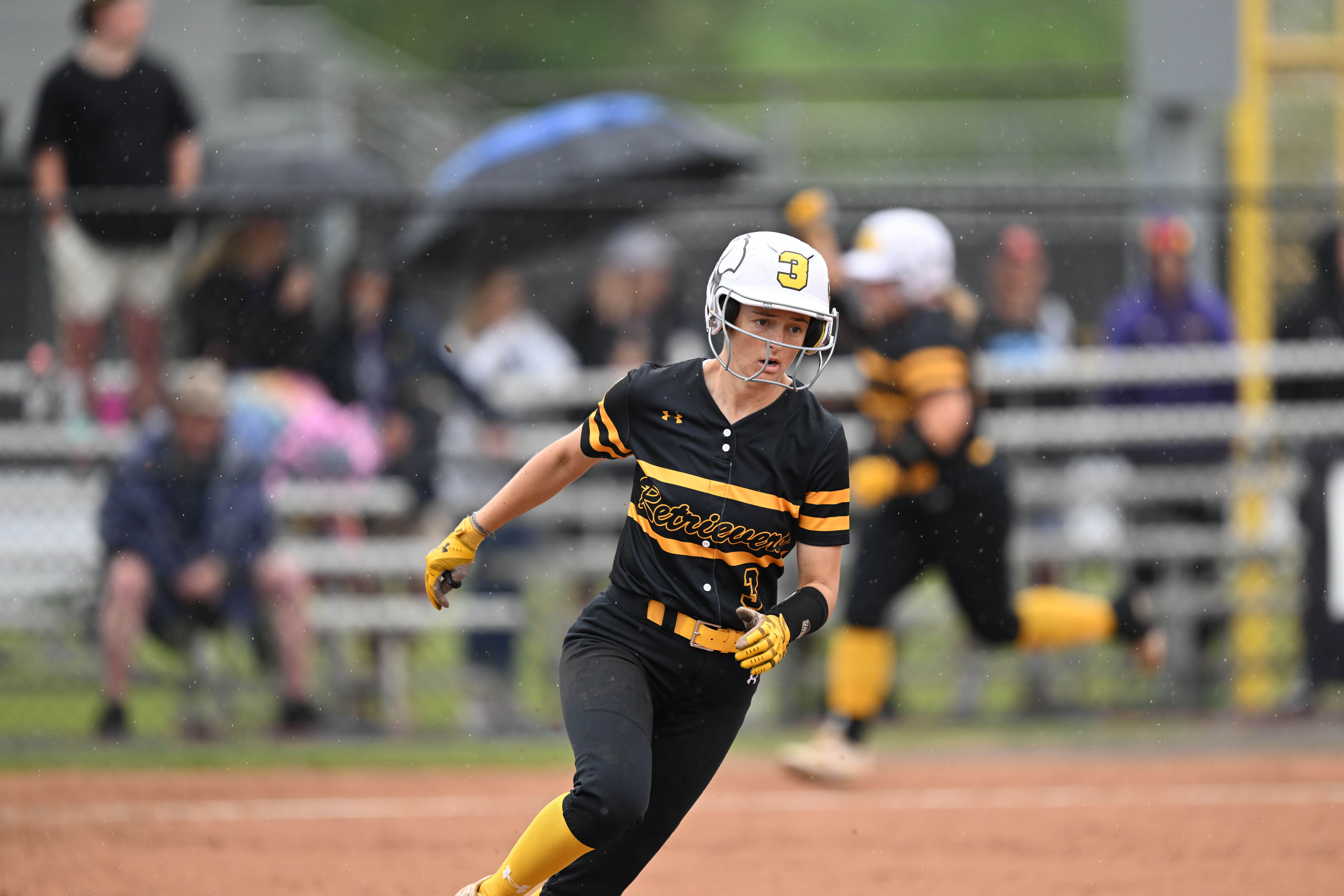 Karly Keating rounds the bases. (Joey Sussman)
UMBC’s coaching staff, led by Kuhlmeyer, again holds the honor of Coaching Staff of the Year—a third consecutive award for leadership.
“Winning the America East Conference Championship in general is an incredible feeling, but going four-peat is indescribable,” said graduate student Karly Keating ’22, media and communication studies, currently pursuing her entrepreneurship certificate. “This team has worked so hard to get where we are at and we’re still only going up. The best part is being able to celebrate with such amazing people, not only my team but with my family as well.”
#RetrieverNation fans can catch the action on Friday by following @UMBCsoftball on Twitter.
Story by Kait McCaffrey and UMBC Athletics.
]]>
A year after becoming the first team to win three consecutive crowns since UAlbany in 2006 – 2008, UMBC softball has permanently inked their place in the record books with their fourth-straight...
https://umbc.edu/stories/umbc-softball-nabs-4th-consecutive-america-east-title-advances-to-ncaa-tournament/
https://my3.my.umbc.edu/api/v0/pixel/news/133538/guest@my.umbc.edu/6b7f3821b4fbfe02cc200eb54fd023eb/api/pixel
athletics
cahss
cnms
coeit
community
is
meche
news
UMBC News & Magazine
https://my3.my.umbc.edu/groups/umbc-news-magazine
https://assets1-my.umbc.edu/system/shared/avatars/groups/000/001/943/24435aa6207c452e7bc15cc74b42c7bb/xsmall.png?1748556657
https://assets1-my.umbc.edu/system/shared/avatars/groups/000/001/943/24435aa6207c452e7bc15cc74b42c7bb/original.png?1748556657
https://assets2-my.umbc.edu/system/shared/avatars/groups/000/001/943/24435aa6207c452e7bc15cc74b42c7bb/xxlarge.png?1748556657
https://assets2-my.umbc.edu/system/shared/avatars/groups/000/001/943/24435aa6207c452e7bc15cc74b42c7bb/xlarge.png?1748556657
https://assets3-my.umbc.edu/system/shared/avatars/groups/000/001/943/24435aa6207c452e7bc15cc74b42c7bb/large.png?1748556657
https://assets1-my.umbc.edu/system/shared/avatars/groups/000/001/943/24435aa6207c452e7bc15cc74b42c7bb/medium.png?1748556657
https://assets2-my.umbc.edu/system/shared/avatars/groups/000/001/943/24435aa6207c452e7bc15cc74b42c7bb/small.png?1748556657
https://assets1-my.umbc.edu/system/shared/avatars/groups/000/001/943/24435aa6207c452e7bc15cc74b42c7bb/xsmall.png?1748556657
https://assets2-my.umbc.edu/system/shared/avatars/groups/000/001/943/24435aa6207c452e7bc15cc74b42c7bb/xxsmall.png?1748556657
UMBC News & Magazine
0
0
false
Tue, 16 May 2023 11:14:30 -0400
Tue, 16 May 2023 11:14:30 -0400
Support network helps an international student with a passion for computing find her career path

Shaniah Reece
Degree: B.S., Information Systems
Hometown: Beltsville, MD and Georgetown, Guyana
Post-grad plans: Ph.D. in Computer Science, Emory University
When Shaniah Reece came to UMBC as a first-generation college student from Guyana, she already had a passion for technology, but she was worried about finding the right path and uncertain how to navigate the college experience. Tapping into a support network in the UMBC community, she skillfully navigated her doubts while excelling in academics, research, and community leadership.
A CWIT scholar, Reece has served in numerous leadership roles on the CWIT student council. She has also served as a lead resident assistant in on-campus housing and volunteered with organizations such as Retriever Essentials, which tackles food insecurity in the UMBC community, and Building Steps, which partners with Baltimore schools to equip promising students with the tools to pursue STEM careers.
As Reece discovered a passion and aptitude for research, the McNair Scholars program and numerous mentors helped her navigate a successful path to graduate school. She enjoyed the opportunity to work with James Foulds, assistant professor of information systems, on improving the fairness of artificial intelligence systems and recently described to TV viewers how biases from the human world find their way into AI, with harmful effects.
Having found a career path that fits her values, Reece is more than prepared for the journey ahead.
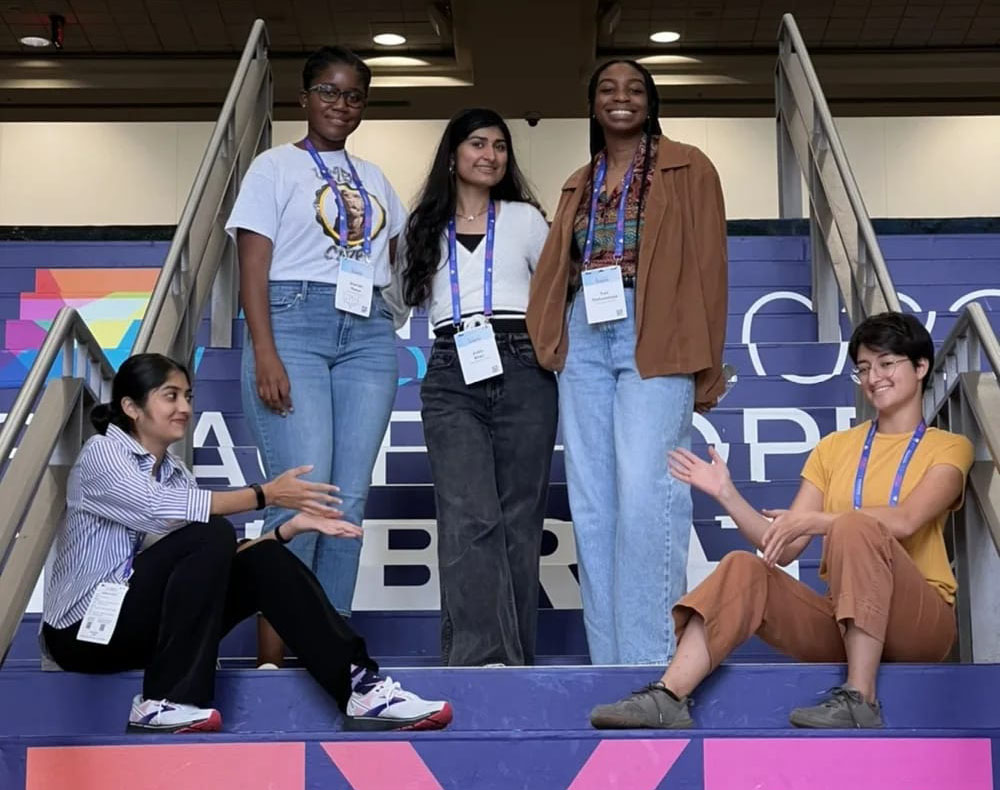 Reece and other CWIT scholars and students at the Grace Hopper Conference in Florida 2022. (Image courtesy of Shaniah Reece.)
Has there been a mentor or fellow student who influenced your time at UMBC?
“Dr. Maria Sanchez has been a mentor who has had a significant impact on my growth. Despite the numerous times I’ve experienced self-doubt, she consistently provided me with the support and encouragement I needed to realize my potential. As someone who shares a similar background, Dr. Sanchez has been a source of inspiration and motivation for me to overcome any challenges that come my way.”
What has been the best part of your UMBC experience?
“Without a doubt, the most rewarding aspect of my time at UMBC has been the sense of community I have experienced here. Since my freshman year I have been consistently surrounded by a diverse and supportive group of individuals who were committed to helping me achieve my goals. UMBC has been more than just an institution for higher learning to me. It has been a place where I have been able to thrive and show the world a version of me that I am proud of.”
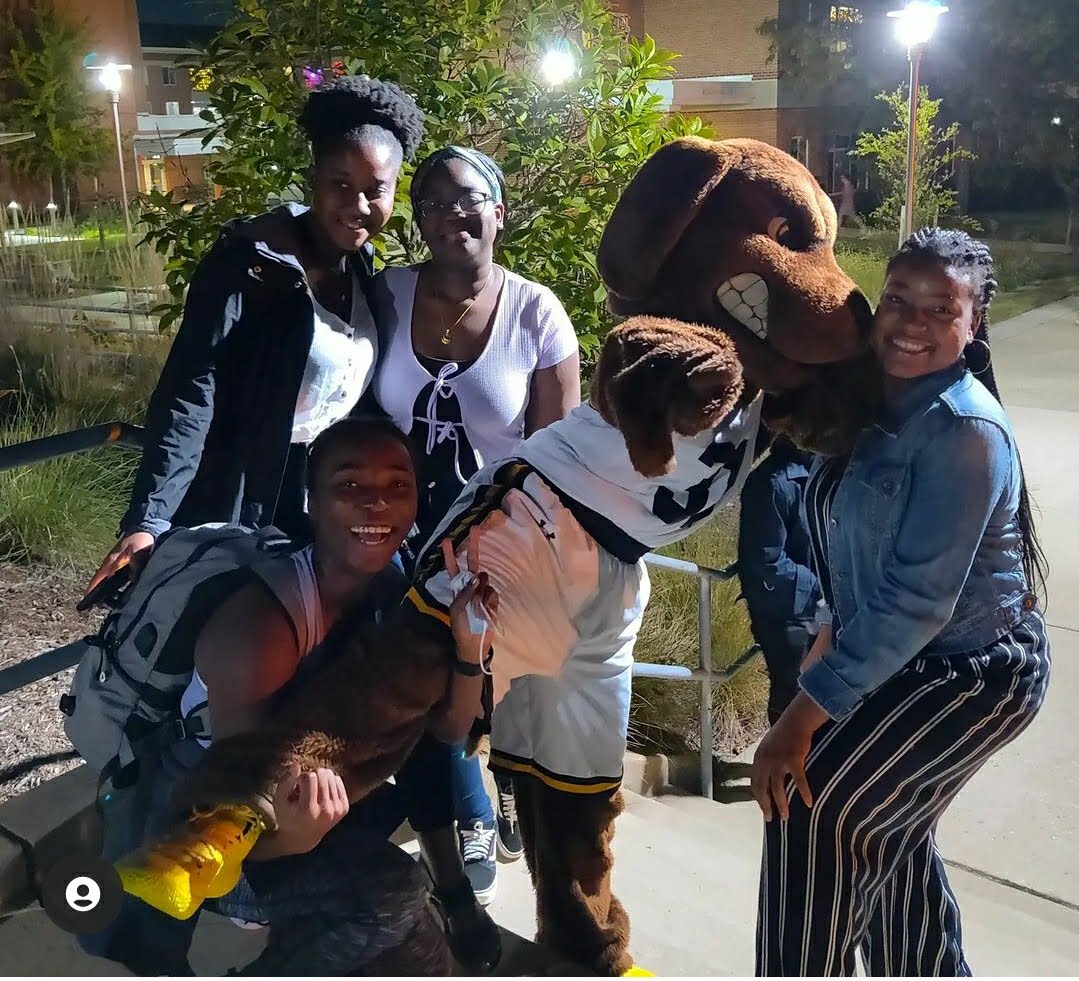 Reece and fellow students pose with mascot True Grit at the UMBC Bonfire in 2022. (Image courtesy of Shaniah Reece.)
]]>
Shaniah Reece Degree: B.S., Information Systems Hometown: Beltsville, MD and Georgetown, Guyana Post-grad plans: Ph.D. in Computer Science, Emory University When Shaniah Reece came to...
https://umbc.edu/stories/support-network-helps-international-student/
https://my3.my.umbc.edu/api/v0/pixel/news/133201/guest@my.umbc.edu/2acb390075eee57d2899f862c52380bc/api/pixel
class-of-2023
coeit
is
news
undergraduate-research
UMBC News & Magazine
https://my3.my.umbc.edu/groups/umbc-news-magazine
https://assets1-my.umbc.edu/system/shared/avatars/groups/000/001/943/24435aa6207c452e7bc15cc74b42c7bb/xsmall.png?1748556657
https://assets1-my.umbc.edu/system/shared/avatars/groups/000/001/943/24435aa6207c452e7bc15cc74b42c7bb/original.png?1748556657
https://assets2-my.umbc.edu/system/shared/avatars/groups/000/001/943/24435aa6207c452e7bc15cc74b42c7bb/xxlarge.png?1748556657
https://assets2-my.umbc.edu/system/shared/avatars/groups/000/001/943/24435aa6207c452e7bc15cc74b42c7bb/xlarge.png?1748556657
https://assets3-my.umbc.edu/system/shared/avatars/groups/000/001/943/24435aa6207c452e7bc15cc74b42c7bb/large.png?1748556657
https://assets1-my.umbc.edu/system/shared/avatars/groups/000/001/943/24435aa6207c452e7bc15cc74b42c7bb/medium.png?1748556657
https://assets2-my.umbc.edu/system/shared/avatars/groups/000/001/943/24435aa6207c452e7bc15cc74b42c7bb/small.png?1748556657
https://assets1-my.umbc.edu/system/shared/avatars/groups/000/001/943/24435aa6207c452e7bc15cc74b42c7bb/xsmall.png?1748556657
https://assets2-my.umbc.edu/system/shared/avatars/groups/000/001/943/24435aa6207c452e7bc15cc74b42c7bb/xxsmall.png?1748556657
UMBC News & Magazine
0
0
false
Wed, 03 May 2023 11:51:01 -0400
Amid surging demand for computing education, UMBC initiatives boost student success
Reece and fellow students pose with mascot True Grit at the UMBC Bonfire in 2022. (Image courtesy of Shaniah Reece.)
]]>
Shaniah Reece Degree: B.S., Information Systems Hometown: Beltsville, MD and Georgetown, Guyana Post-grad plans: Ph.D. in Computer Science, Emory University When Shaniah Reece came to...
https://umbc.edu/stories/support-network-helps-international-student/
https://my3.my.umbc.edu/api/v0/pixel/news/133201/guest@my.umbc.edu/2acb390075eee57d2899f862c52380bc/api/pixel
class-of-2023
coeit
is
news
undergraduate-research
UMBC News & Magazine
https://my3.my.umbc.edu/groups/umbc-news-magazine
https://assets1-my.umbc.edu/system/shared/avatars/groups/000/001/943/24435aa6207c452e7bc15cc74b42c7bb/xsmall.png?1748556657
https://assets1-my.umbc.edu/system/shared/avatars/groups/000/001/943/24435aa6207c452e7bc15cc74b42c7bb/original.png?1748556657
https://assets2-my.umbc.edu/system/shared/avatars/groups/000/001/943/24435aa6207c452e7bc15cc74b42c7bb/xxlarge.png?1748556657
https://assets2-my.umbc.edu/system/shared/avatars/groups/000/001/943/24435aa6207c452e7bc15cc74b42c7bb/xlarge.png?1748556657
https://assets3-my.umbc.edu/system/shared/avatars/groups/000/001/943/24435aa6207c452e7bc15cc74b42c7bb/large.png?1748556657
https://assets1-my.umbc.edu/system/shared/avatars/groups/000/001/943/24435aa6207c452e7bc15cc74b42c7bb/medium.png?1748556657
https://assets2-my.umbc.edu/system/shared/avatars/groups/000/001/943/24435aa6207c452e7bc15cc74b42c7bb/small.png?1748556657
https://assets1-my.umbc.edu/system/shared/avatars/groups/000/001/943/24435aa6207c452e7bc15cc74b42c7bb/xsmall.png?1748556657
https://assets2-my.umbc.edu/system/shared/avatars/groups/000/001/943/24435aa6207c452e7bc15cc74b42c7bb/xxsmall.png?1748556657
UMBC News & Magazine
0
0
false
Wed, 03 May 2023 11:51:01 -0400
Amid surging demand for computing education, UMBC initiatives boost student success
On a Friday afternoon in late February, two students hoisted a pair of oversized scissors and cut the ribbon for the space housing one of UMBC’s newest tutoring programs: the Computing Success Center. The Center is designed to provide peer-to-peer support to students from any major, taking any course, who have computing questions.
“The Computing Success Center started as just a few tables in the library,” says Amanda Knapp, who leads UMBC’s broader Academic Success Center. Since the Computing Success Center tutoring program launched in 2020, it has seen skyrocketing demand.
“We are so happy for our students to now have a dedicated space for computing support, as a result of successful collaborations and valued partnerships from across the university,” says Knapp, associate vice provost and assistant dean for Undergraduate Academic Affairs. “We are thrilled to introduce new tutoring options to the growing portfolio of academic support offerings available to all undergraduate students.”
The growing demand for Computing Success Center services reflects in part increased demand for computing education. Over the past ten years, the number of UMBC students pursuing a computing-related bachelor’s degree in the College of Engineering and Information Technology (COEIT) has increased by more than 60%. During that same time, the number of computing degrees awarded to women and students from racial and ethnic groups traditionally underrepresented in computing fields increased at an even higher rate.
The Computing Success Center is one of many UMBC initiatives that is boosting the success of diverse students in high-demand computing fields.
“At both the undergraduate and graduate level, applications for our programs from a broad diversity of students are incredibly strong,” says Keith Bowman, the dean of COEIT. “New students have shared that more senior students’ positive views of our programs inspired them to pursue computing degrees, which we find very gratifying.”
Careful course design
When Annamaria Palmiero came to UMBC as a freshman in 2021, she had never programmed before. Still, she was curious about the subject, and a good friend encouraged her to try it out. So, she enrolled in a class—called Computational Design and Thinking, or COMP101—designed with students like her in mind.
The course, which debuted in 2012 and has become increasingly popular, assumes no prior experience with computing. It provides students with a broad overview of the field, builds their technical and professional skills, and gives them opportunities to work on group projects. Since 2019, it has also focused on ethical considerations in computing, a component of the course that was designed and implemented under the leadership of UMBC’s Engineering and Computing Education Program.
“Many students say the course helps them feel less intimidated by coding. It also helps them decide which computing program is best for them,” says Mark Berczynski, a lecturer who has been teaching the course since 2019. UMBC offers a broad range of computing pathways, such as majors and minors in computer science and information systems and majors in business technology administration and computer engineering.
The course has been shown to increase the likelihood that students, especially women, will stay in a computing major. For Palmiero, the experience in the course convinced her to pursue a computer science degree in addition to her already planned statistics degree. She has also become a teaching fellow for the course.
“COMP101 provided a safe space for me to launch into programming, without the overwhelmingly fast-paced nature of other introductory computing courses. I’m unsure if I would have ever become a computer science major, let alone tried programming, if it wasn’t for the course,” Palmiero says.
Other students who have taken COMP101 agree. Drew Barlow took the course in 2019 because he hadn’t taken the precalculus math classes required for a typical first computer science course. He is now pursuing a Ph.D. in computer science at UMBC. “I can definitely attribute my love for this subject in many ways to my experience in COMP101,” he said.
The ethos behind the design of COMP101—to break down barriers to success in computing for students from a variety of backgrounds—also pervades other curriculum decisions in COEIT, from adding courses to help transfer students with backgrounds in different coding languages, to forging pathways for students who wish to transfer between computing degree programs.
Easy access to support
Carefully designed computing courses start students on the road to success, while services such as the Computing Success Center help students deepen their knowledge as they progress in their studies. The center offers drop-in tutoring, including both course-specific resources and general guidance in programming languages. All of the course-specific tutors are supporting students in classes they have taken themselves.
The Computing Success Center responds to expanding demand for this kind of support. In fall 2022, the Center logged nearly 1,500 student visits, a more than ten-fold increase from when it launched in fall 2020.
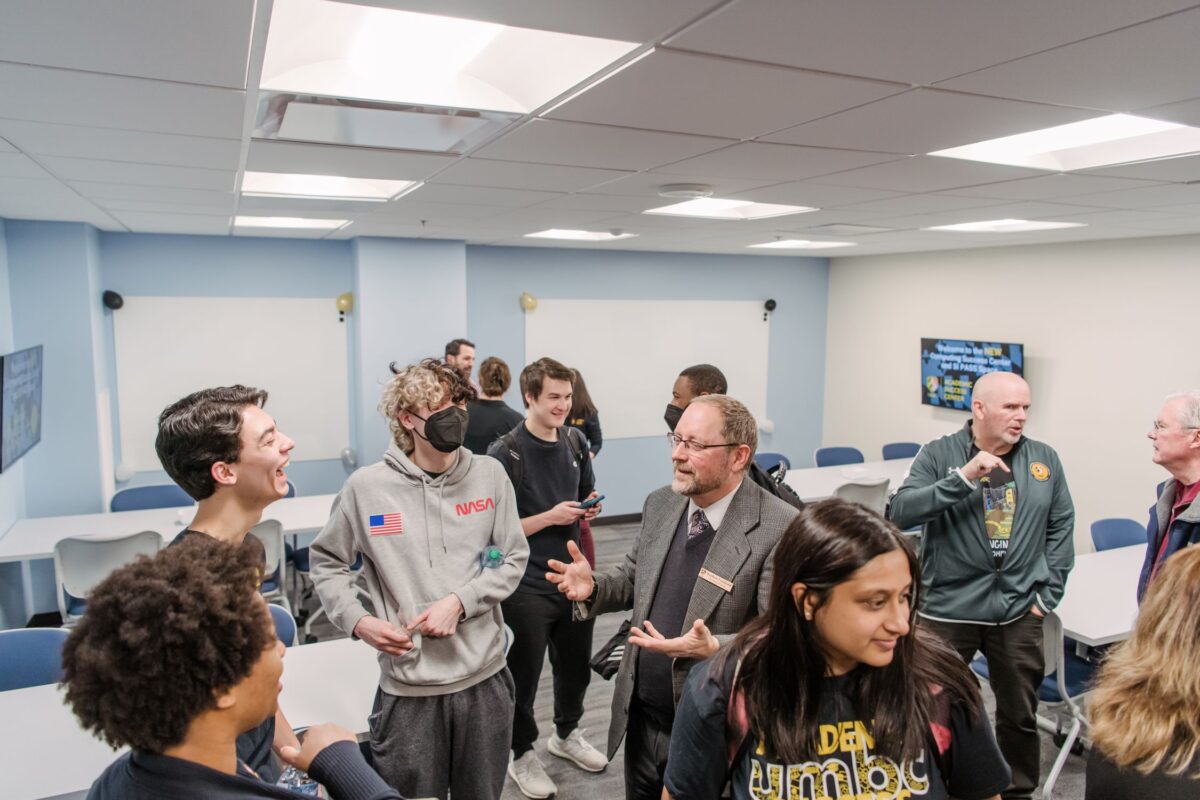 Students, faculty and staff gather to celebrate the opening of the new tutoring space on campus. (Marlayna Demond ’11/UMBC)
Ariana Pray, a sophomore computer science major, says the tutoring at the Center goes beyond helping her complete assignments, offering conceptual guidance that has made her a more efficient coder. She appreciates the wide range of tutoring times available and the opportunity to learn from her peers in person.
“I definitely recommend going to the Computing Success Center,” she says. “You’ll come away with a better understanding of the material and will be better prepared when it comes time for exams.”
Students can also access mentoring in study skills and time management, personalized assistance from academic advocates, and other support through the broader Academic Success Center. Meanwhile, departments that offer computing degrees have worked to foster a culture where students make it a habit to access additional learning resources early and often.
Opportunities to connect and explore
While supporting academic success is a priority for computing programs, that goes far beyond coursework. UMBC faculty and staff mentor students as they seek to discover their passions and find pathways to meaningful careers.
Shaniah Reece is a senior information systems major and Center for Women in Technology Scholar who credits the culture of UMBC for helping her discover how to connect a technical career to her values and passions.
“I care about social justice and equity,” she says. “I’ve realized I can apply technical tools to study and address these issues.”
Recently, Reece has been working with James Foulds, assistant professor of information systems, to identify biases in artificial intelligence systems and work to improve their fairness. She plans to continue her research career and is currently deciding between graduate programs at Emory University, the University of Southern California, and the University of Pittsburgh.
Reece says her classwork and her mentors helped her think outside the box and identify career options that were truly meaningful to her. She shares, “My whole experience at UMBC, not just in research but throughout my time here, helped me discover who I am.”
]]>
On a Friday afternoon in late February, two students hoisted a pair of oversized scissors and cut the ribbon for the space housing one of UMBC’s newest tutoring programs: the Computing Success...
https://umbc.edu/stories/amid-surging-demand-for-computing-education-umbc-initiatives-boost-student-success/
https://my3.my.umbc.edu/api/v0/pixel/news/132646/guest@my.umbc.edu/f95777d2b18ddad1bdf2f6bf3c969c53/api/pixel
coeit
community
csee
cwit
is
news
UMBC News & Magazine
https://my3.my.umbc.edu/groups/umbc-news-magazine
https://assets1-my.umbc.edu/system/shared/avatars/groups/000/001/943/24435aa6207c452e7bc15cc74b42c7bb/xsmall.png?1748556657
https://assets1-my.umbc.edu/system/shared/avatars/groups/000/001/943/24435aa6207c452e7bc15cc74b42c7bb/original.png?1748556657
https://assets2-my.umbc.edu/system/shared/avatars/groups/000/001/943/24435aa6207c452e7bc15cc74b42c7bb/xxlarge.png?1748556657
https://assets2-my.umbc.edu/system/shared/avatars/groups/000/001/943/24435aa6207c452e7bc15cc74b42c7bb/xlarge.png?1748556657
https://assets3-my.umbc.edu/system/shared/avatars/groups/000/001/943/24435aa6207c452e7bc15cc74b42c7bb/large.png?1748556657
https://assets1-my.umbc.edu/system/shared/avatars/groups/000/001/943/24435aa6207c452e7bc15cc74b42c7bb/medium.png?1748556657
https://assets2-my.umbc.edu/system/shared/avatars/groups/000/001/943/24435aa6207c452e7bc15cc74b42c7bb/small.png?1748556657
https://assets1-my.umbc.edu/system/shared/avatars/groups/000/001/943/24435aa6207c452e7bc15cc74b42c7bb/xsmall.png?1748556657
https://assets2-my.umbc.edu/system/shared/avatars/groups/000/001/943/24435aa6207c452e7bc15cc74b42c7bb/xxsmall.png?1748556657
UMBC News & Magazine
0
0
false
Fri, 14 Apr 2023 11:35:34 -0400
UMBC’s galleries deliver interactive and thoughtful art
UMBC’s art galleries are already in full bloom for the spring. With exhibits showcasing historic and innovative 20th century photography, interactive hip-hop data visualization, and the legacies of political resistance as seen through Black hair, the university’s exhibition spaces are bountiful with thought-provoking work.
Hip-Hop and Data at CADVC
Tahir Hemphill: Rap Research Lab runs at the Center for Art, Design, and Visual Culture (CADVC) through March 18. In this exhibition, Tahir Hemphill, the inaugural Fellow for Faculty Diversity in the Visual Arts at UMBC, presents a collection of interactive works that explore what he calls “the hybrid area between art, technology, social engagement, and interdisciplinary research.”
Visitors are invited to participate in Hemphill’s design and research process through evolving artworks, including “Visualisation of Authority,” a kinetic sculpture drawing on Library of Congress research data, and “Mapper’s Delight,” an interactive augmented reality-based middle-school curriculum Hemphill designed in collaboration with Verizon Innovative Learning.
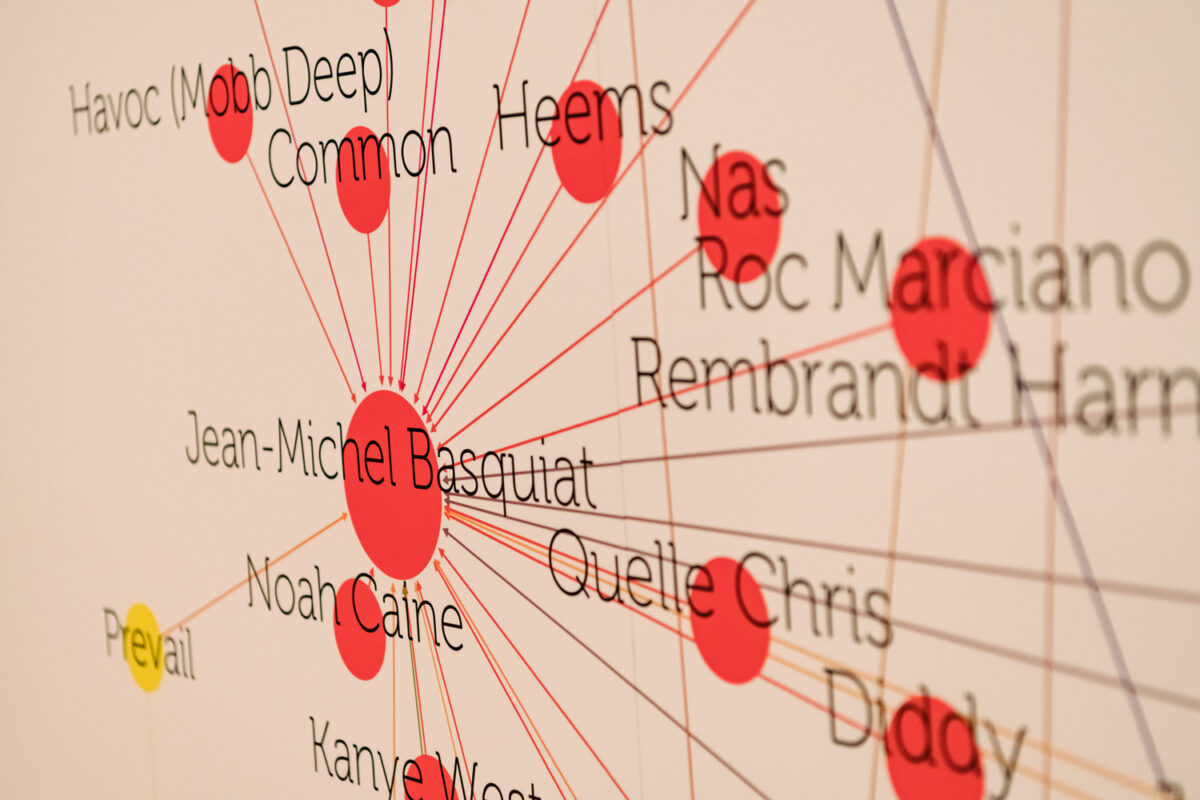 Data visualization from Hemphill’s Rap Research Lab at the CADVC. (Marlayna Demond ’11/UMBC)
Hemphill is using the exhibition space for teaching as well. In a course offered in collaboration between Visual Arts and the UMBC Image Research Center (IRC) students have the opportunity to mine the “Rap Almanac,” Hemphill’s expansive dataset of rap lyrics, to produce work in an internship-based research practicum.
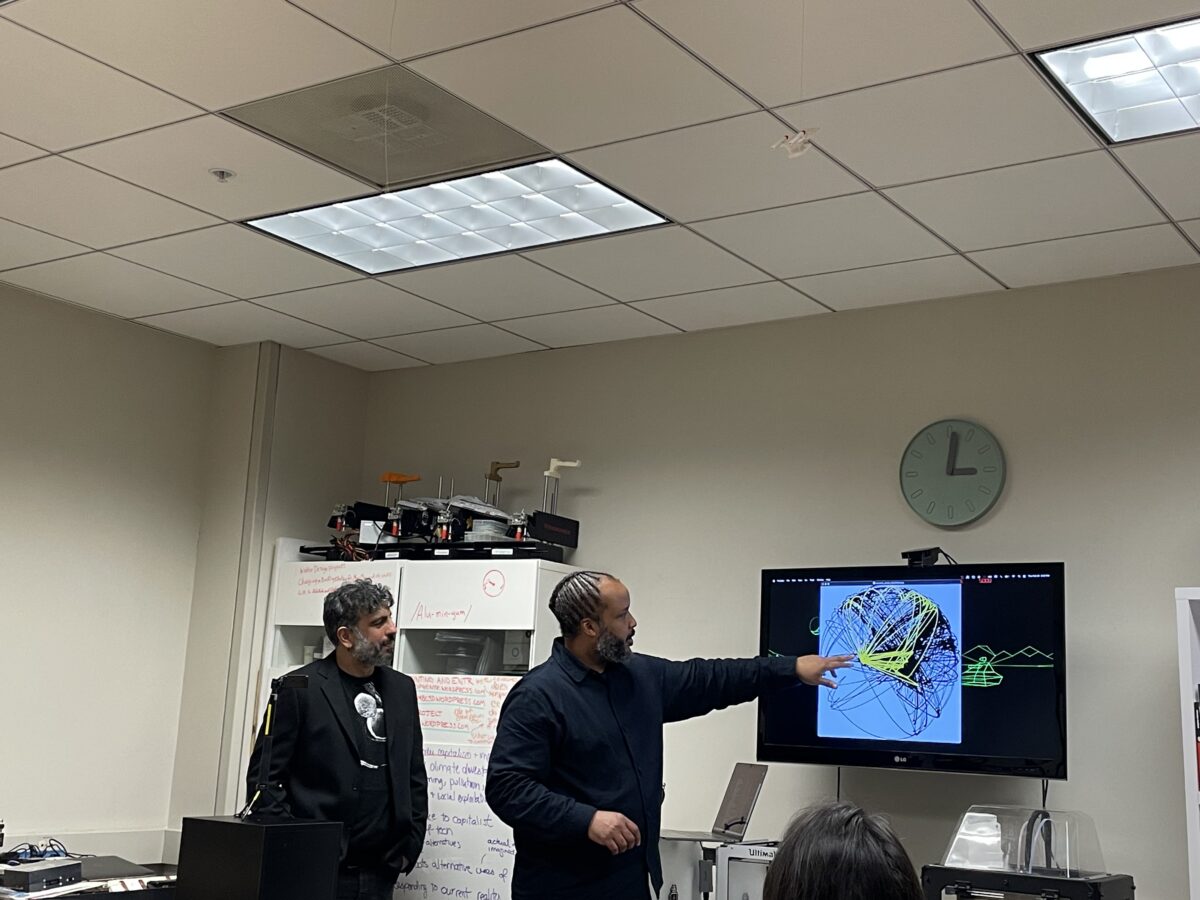 Hamidi, left, and Hemphill, right, talk through data visualization. (Marlayna Demond ’11/UMBC)
“CADVC operates as an art gallery and research center dedicated to scholarship and experimentation in art and culture,” says CADVC Director Rebecca Uchill. “This exhibition demonstrates a terrific range of scholarly inquiries, by Hemphill and his collaborators, into many facets of cultural history and the power of creative data visualization strategies. It is very exciting to watch this research develop in a public-facing presentation!”
Additional programming for the exhibition will include a series of public events such as a choreographed activation of a programmable robot arm, a partnership project with assistant professor Foad Hamidi from the Human-Centered Computing program in Information Systems, and a series of pop-up events.
Historic Hair and Formative Photography at AOK
The Albin O. Kuhn Library Gallery currently features two shows—Aaron Siskind: Formations and Sonya Clark: Hair/Craft—both on view through March 12.
Multidisciplinary artist Sonya Clark presents five works made with human hair and fiber art techniques to explore Black visibility and identity, and to examine the ways Black hair has been employed as an instrument of political resistance across the African diaspora. Clark, whose work explores issues of identity, race, cultural heritage, and collective memory, engages everyday objects and craft traditions to examine narrative threads connecting modern issues with historical origins, including the Black national anthem “Lift Every Voice and Sing” and the biography of Madam C. J. Walker, who became the first female self-made millionaire by selling hair care products to Black women.
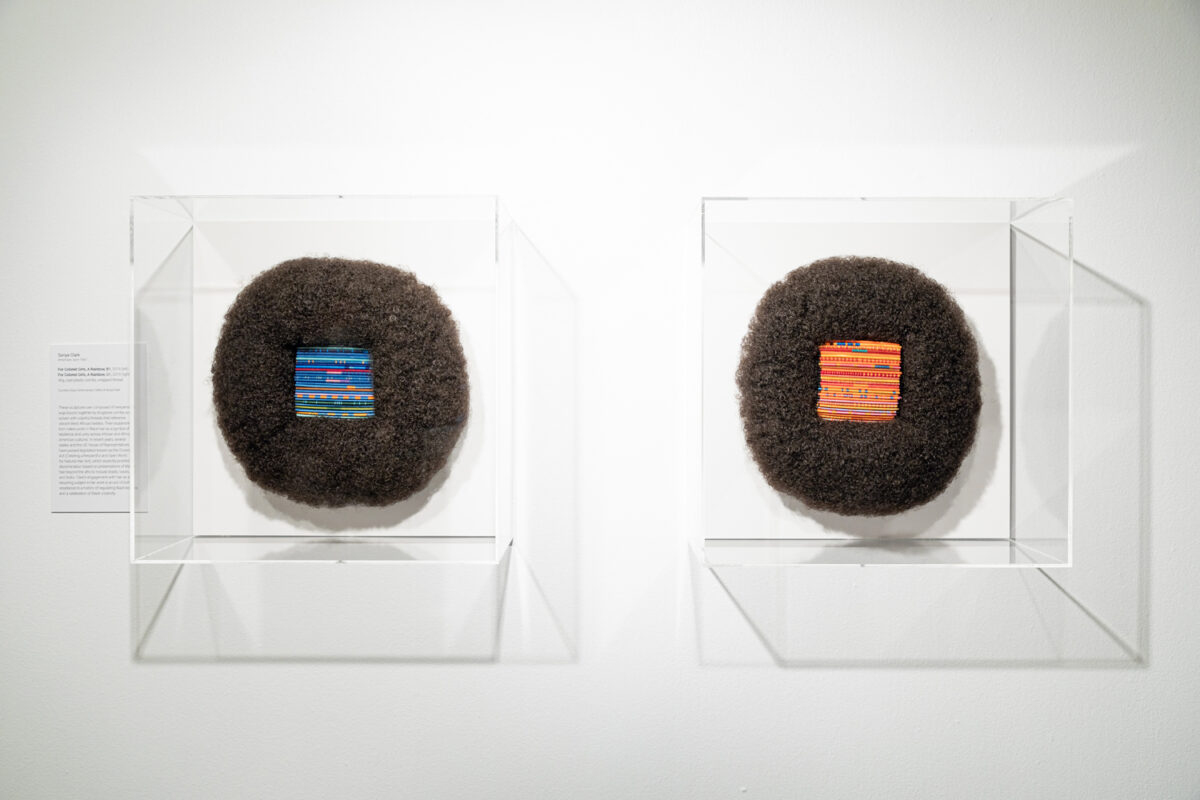 Sonya Clark’s Hair/Craft exhibit at the AOK Library Gallery. (Melissa Penley Cormier, M.F.A. ’17, for Research Graphics)
Influential photographer Aaron Siskind is celebrated through 55 works spanning his prolific career, all part of UMBC’s Photography Collections. Beginning with early documentary works Siskind made as part of the New York Film and Photo League in the 1930s and his groundbreaking abstract works of the 1940s and 1950s, the exhibition continues through phases of architectural studies, travel photography, and Siskind’s famous series focused on divers suspended in mid-air, “Terrors and Pleasures of Levitation.”
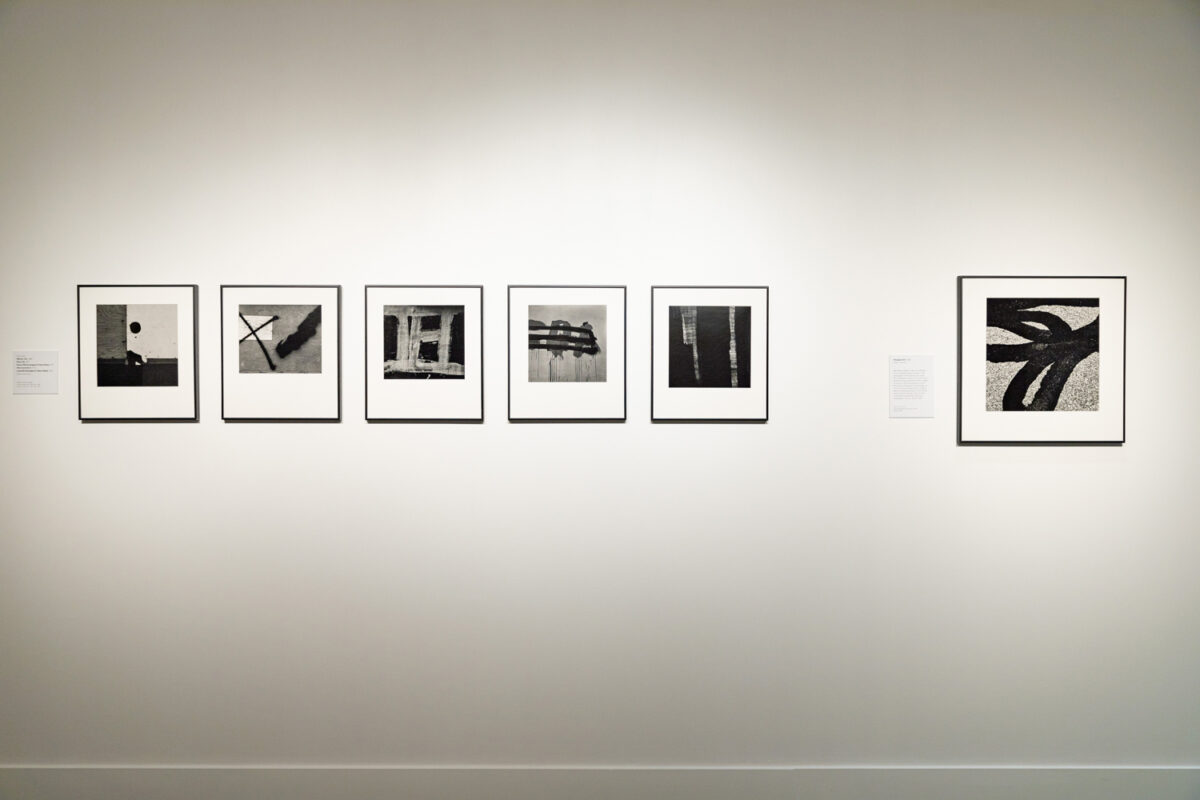 The Aaron Siskind exhibit in the AOK Library Gallery. (Melissa Penley Cormier, M.F.A. ’17, for Research Graphics)
Mind’s Eye in Toronto
With Mind’s Eye: The Psychic Photographs of Ted Serios, UMBC’s Special Collections has gone international. The Image Centre of Toronto Metropolitan University invited UMBC’s Curator of Exhibitions Emily Cullen to curate a show featuring one of AOK’s more fascinating collections, the Jule Eisenbud Collection on Ted Serios and Thoughtographic Photography.
Serios claimed to have the ability to psychically transfer his thoughts onto Polaroid film, a process called “thoughtography.” Chicago psychiatrist Jule Eisenbud investigated these claims, experimenting with Serios for several years in the mid-1960s, and the archive of those results is now part of UMBC’s permanent collection.
Mind’s Eye: The Psychic Photographs of Ted Serios opens at the IMC tomorrow, on view January 25–April 1!
]]>
UMBC’s art galleries are already in full bloom for the spring. With exhibits showcasing historic and innovative 20th century photography, interactive hip-hop data visualization, and the legacies...
https://umbc.edu/stories/umbcs-galleries-deliver-interactive-art/
https://my3.my.umbc.edu/api/v0/pixel/news/131356/guest@my.umbc.edu/5fd578a744572090ba95cb818c844cba/api/pixel
aok-library
arts-and-culture
cadvc
campus-life
is
magazine
media-and-communication-studies
news
special-collections
visual-arts
UMBC News & Magazine
https://my3.my.umbc.edu/groups/umbc-news-magazine
https://assets1-my.umbc.edu/system/shared/avatars/groups/000/001/943/24435aa6207c452e7bc15cc74b42c7bb/xsmall.png?1748556657
https://assets1-my.umbc.edu/system/shared/avatars/groups/000/001/943/24435aa6207c452e7bc15cc74b42c7bb/original.png?1748556657
https://assets2-my.umbc.edu/system/shared/avatars/groups/000/001/943/24435aa6207c452e7bc15cc74b42c7bb/xxlarge.png?1748556657
https://assets2-my.umbc.edu/system/shared/avatars/groups/000/001/943/24435aa6207c452e7bc15cc74b42c7bb/xlarge.png?1748556657
https://assets3-my.umbc.edu/system/shared/avatars/groups/000/001/943/24435aa6207c452e7bc15cc74b42c7bb/large.png?1748556657
https://assets1-my.umbc.edu/system/shared/avatars/groups/000/001/943/24435aa6207c452e7bc15cc74b42c7bb/medium.png?1748556657
https://assets2-my.umbc.edu/system/shared/avatars/groups/000/001/943/24435aa6207c452e7bc15cc74b42c7bb/small.png?1748556657
https://assets1-my.umbc.edu/system/shared/avatars/groups/000/001/943/24435aa6207c452e7bc15cc74b42c7bb/xsmall.png?1748556657
https://assets2-my.umbc.edu/system/shared/avatars/groups/000/001/943/24435aa6207c452e7bc15cc74b42c7bb/xxsmall.png?1748556657
UMBC News & Magazine
1
0
false
Wed, 01 Mar 2023 14:37:02 -0500
Wed, 01 Mar 2023 14:37:02 -0500
UMBC experts guide TV viewers through the promises and pitfalls of artificial intelligence
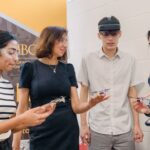
Over the past week, UMBC faculty and students have given primetime TV news watchers in Baltimore a glimpse of the frontiers of artificial intelligence (AI) research. WJZ, Baltimore’s CBS News affiliate, aired the AI series in six segments, four of which featured UMBC researchers.
Harnessing data to predict sea level rise
The Wednesday evening spot featured Vandana Janeja, chair of information systems (IS). She described how she and other researchers aim to harness artificial intelligence and new data analysis techniques to better predict how climate-driven changes at Earth’s poles, such as melting glaciers, could impact the rest of the world. Janeja directs iHARP, an NSF-funded institute based at UMBC that brings together data scientists and polar experts from across academia, industry, and the government to tackle a defining challenge of our times.
Connecting robots and AI
The Thursday evening segment featured UMBC faculty and students showcasing their work connecting AI and robots for applications such as disaster response and battlefield readiness. IS professors Aryya Gangopadhyay and Nirmalya Roy and computer science and electrical engineering (CSEE) associate professor Tinoosh Mohsenin from the Center for Real-time Distributed Sensing and Autonomy joined computer science students Kevin Rippy ’24, Warren Funk ’24, Hong Nguyen ’25, and Ben Polyakov ’23, computer engineering Ph.D. students Arnab Mazumder and Mozhgan Navardi, and information systems Ph.D. students Indrajeet Ghosh and Neil Kpamegan to explain the technology.
They demonstrated devices such as miniature drones and a robot that could be controlled from afar with hand motions. The researchers are working to develop the brains of such systems so that they can intelligently work with other robots and with human beings.
Explaining ChatGPT
On Friday, Anupam Joshi, professor of CSEE and director of the UMBC Center for Cybersecurity helped viewers grasp an AI invention now making headlines: ChatGPT. The sophisticated chatbot can write text ranging from computer code to essays on the American Revolution, but Joshi explained how it does make errors and should be used carefully.
Identifying harmful biases in AI
Finally, echoing the theme of responsible and cautious AI use, James Foulds, an assistant professor of IS, and Shaniah Reece, a senior majoring in IS, described to TV viewers how biases from the human world can find their way into AI systems, with harmful effects. They are working to identify such biases where they appear, improving the fairness of AI systems.
]]>
Over the past week, UMBC faculty and students have given primetime TV news watchers in Baltimore a glimpse of the frontiers of artificial intelligence (AI) research. WJZ, Baltimore’s CBS News...
https://umbc.edu/stories/umbc-experts-on-promises-and-pitfalls-of-artificial-intelligence/
https://my3.my.umbc.edu/api/v0/pixel/news/131162/guest@my.umbc.edu/d8926082f3b8d08e17786aea6f7aa9b4/api/pixel
cards
coeit
csee
iharp
is
news
research
science-and-tech
UMBC News & Magazine
https://my3.my.umbc.edu/groups/umbc-news-magazine
https://assets1-my.umbc.edu/system/shared/avatars/groups/000/001/943/24435aa6207c452e7bc15cc74b42c7bb/xsmall.png?1748556657
https://assets1-my.umbc.edu/system/shared/avatars/groups/000/001/943/24435aa6207c452e7bc15cc74b42c7bb/original.png?1748556657
https://assets2-my.umbc.edu/system/shared/avatars/groups/000/001/943/24435aa6207c452e7bc15cc74b42c7bb/xxlarge.png?1748556657
https://assets2-my.umbc.edu/system/shared/avatars/groups/000/001/943/24435aa6207c452e7bc15cc74b42c7bb/xlarge.png?1748556657
https://assets3-my.umbc.edu/system/shared/avatars/groups/000/001/943/24435aa6207c452e7bc15cc74b42c7bb/large.png?1748556657
https://assets1-my.umbc.edu/system/shared/avatars/groups/000/001/943/24435aa6207c452e7bc15cc74b42c7bb/medium.png?1748556657
https://assets2-my.umbc.edu/system/shared/avatars/groups/000/001/943/24435aa6207c452e7bc15cc74b42c7bb/small.png?1748556657
https://assets1-my.umbc.edu/system/shared/avatars/groups/000/001/943/24435aa6207c452e7bc15cc74b42c7bb/xsmall.png?1748556657
https://assets2-my.umbc.edu/system/shared/avatars/groups/000/001/943/24435aa6207c452e7bc15cc74b42c7bb/xxsmall.png?1748556657
UMBC News & Magazine
0
0
false
Wed, 22 Feb 2023 13:24:42 -0500
Wed, 22 Feb 2023 13:24:42 -0500
UMBC researchers listed among the world’s top 2% of most-cited scientists and engineers
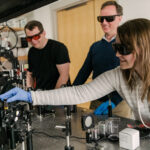
More than 40 active UMBC researchers are listed among the top 2% of the world’s most-cited scientists and engineers in an analysis recently published by Elsevier.
These researchers include faculty across all three of UMBC’s academic colleges as well as UMBC’s NASA-funded centers, such as the Goddard Earth Sciences Technology and Research (GESTAR II) Center. Their work covers an incredibly diverse array of topics. Represented academic departments include:
- biological sciences
- chemical, biochemical, and environmental engineering
- chemistry and biochemistry
- computer science and electrical engineering
- geography and environmental systems
- information systems
- mathematics and statistics
- mechanical engineering
- physics
- psychology
“We perform research to further our understanding of how the various aspects of our world function,” says Karl V. Steiner, vice president for research and creative achievement. “One of the highest recognitions in the scientific community is when other members of this community cite our work.”
He notes, “The Elsevier analysis shows that our researchers are truly impacting the scientific community in a significant way.”
History of citation honors
The list includes faculty researchers who have also received other “highly cited” researcher accolades. In 2022, Erle Ellis, professor of geography and environmental systems (GES), was featured on Clarivate’s Highly Cited Researchers list, which includes papers ranked in the top 1% of citations within Clarivate’s Web of Science database. About 0.1% of the world’s researchers have received this distinction. Ellis is known for his transformational work on human-managed ecosystems, with his research described as top discovery of 2021 by the Smithsonian National Museum of Natural History.
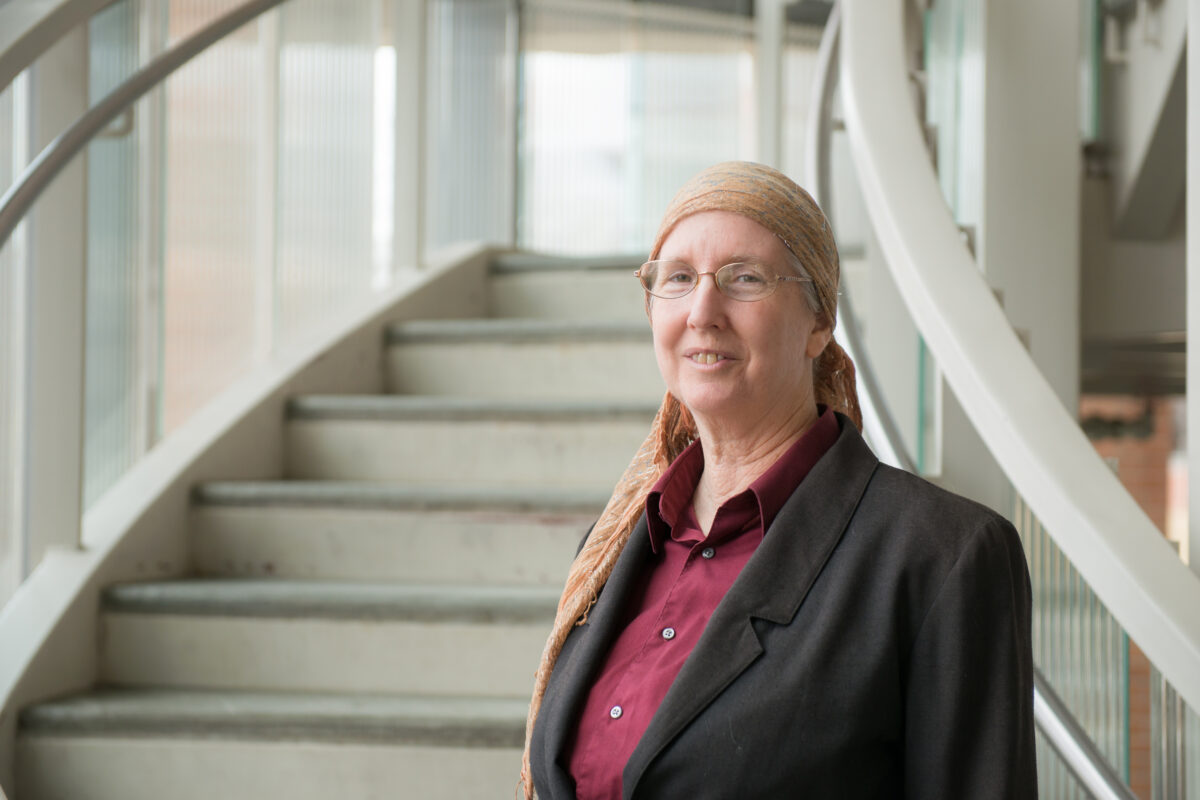 Lorraine Remer (Marlayna Demond ’11/UMBC)
Lorraine Remer, research professor for the Joint Center for Earth Systems Technology, who is affiliated with both GES and physics, is frequently honored for her geophysics publications. She received the 2019 UMBC Research Faculty Excellence Award following her recognition as one of “The Most Influential Scientific Minds” on the Thomson Reuters highly cited researchers list.
Anupam Joshi, director of UMBC’s Center for Cybersecurity and professor and chair of computer science and electrical engineering, was also included on Elsevier’s highly-cited list. His career trajectory demonstrates how UMBC faculty balance high-impact research with other forms of leadership. He has published more than 275 papers, has been granted nine patents, and has obtained research support from a variety of federal and industrial sources. At the same time, he is now serving as a 2022–23 American Council on Education (ACE) Fellow, an intensive program focused on agility and innovative problem solving among higher education leaders.
Measuring impact
This latest most-cited researchers list is based on data annually compiled from author profiles in Elsevier’s abstract and citation database, Scopus.
Elsevier’s 2022 database of standardized citation indicators classifies researchers into 22 fields and 174 subfields. Those with a composite indicator (c-score) within the top 2% of each subfield are included in the most-cited list. The list’s authors indicate that c-score is used because it “focuses on impact (citations) rather than productivity (number of publications)” and because it includes granular information on authorship, including co-authorship and author position (e.g., single, first, or last author).
]]>
More than 40 active UMBC researchers are listed among the top 2% of the world’s most-cited scientists and engineers in an analysis recently published by Elsevier. These researchers include...
https://umbc.edu/stories/most-cited-scientists-2022/
https://my3.my.umbc.edu/api/v0/pixel/news/130830/guest@my.umbc.edu/0a8209cd9947fb4136c6c8893cdbfae1/api/pixel
cahss
cbee
cnms
coeit
csee
cybersecurity
ges
gestar
is
jcet
meche
news
physics
rca-1
research
science-and-tech
UMBC News & Magazine
https://my3.my.umbc.edu/groups/umbc-news-magazine
https://assets1-my.umbc.edu/system/shared/avatars/groups/000/001/943/24435aa6207c452e7bc15cc74b42c7bb/xsmall.png?1748556657
https://assets1-my.umbc.edu/system/shared/avatars/groups/000/001/943/24435aa6207c452e7bc15cc74b42c7bb/original.png?1748556657
https://assets2-my.umbc.edu/system/shared/avatars/groups/000/001/943/24435aa6207c452e7bc15cc74b42c7bb/xxlarge.png?1748556657
https://assets2-my.umbc.edu/system/shared/avatars/groups/000/001/943/24435aa6207c452e7bc15cc74b42c7bb/xlarge.png?1748556657
https://assets3-my.umbc.edu/system/shared/avatars/groups/000/001/943/24435aa6207c452e7bc15cc74b42c7bb/large.png?1748556657
https://assets1-my.umbc.edu/system/shared/avatars/groups/000/001/943/24435aa6207c452e7bc15cc74b42c7bb/medium.png?1748556657
https://assets2-my.umbc.edu/system/shared/avatars/groups/000/001/943/24435aa6207c452e7bc15cc74b42c7bb/small.png?1748556657
https://assets1-my.umbc.edu/system/shared/avatars/groups/000/001/943/24435aa6207c452e7bc15cc74b42c7bb/xsmall.png?1748556657
https://assets2-my.umbc.edu/system/shared/avatars/groups/000/001/943/24435aa6207c452e7bc15cc74b42c7bb/xxsmall.png?1748556657
UMBC News & Magazine
0
0
false
Wed, 25 Jan 2023 11:47:33 -0500
Fri, 10 Feb 2023 17:01:24 -0500