New UMBC-UMB collaborations include research to reduce stress among long-term care workers
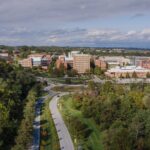
A strategic research alliance between UMBC and the University of Maryland, Baltimore (UMB) has selected four new interdisciplinary projects, each a fresh take on a complex challenge.
The Accelerated Translational Incubator Pilot (ATIP) Program funding this work brings together UMBC’s strengths in areas like cybersecurity, data science, artificial intelligence, statistics, and the social sciences with UMB expertise in medicine, pharmacy, nursing, and dentistry. The two universities have worked together on various shared graduate and research programs over the last decade. This partnership with UMB’s Institute for Clinical and Translational Research (ICTR) was launched in August 2019, and faculty have been quick to jump on the opportunity to pursue novel collaborative research.
“The UMB-ICTR is thrilled to partner with UMBC,” says ICTR Director Stephen N. Davis, chair of medicine at UMB and physician-in-chief at the University of Maryland Medical Center. “The ATIP grant program supports top quality clinical and community-based collaborative projects. The grant applications from UMBC are particularly innovative and exciting, scoring very highly in the review process.”
“All of the ATIP proposals are subject to a very rigorous internal peer review process,” says Karl V. Steiner, vice president for research at UMBC. “Their success is a strong indicator of the quality of the intellectual contributions of our faculty at UMBC.”
Meaningful research relationships
“A key goal for this strategic alliance is to develop meaningful partnerships among researchers at both institutions and to establish teams with complementary expertise,” Steiner explains.
Since early 2020, UMBC faculty have secured a total of 12 ATIP awards. This most recent round of UMBC grant recipients includes Lujie Karen Chen, information systems; Lira Yoon, psychology; Chein-I Chang, computer science and electrical engineering (CSEE); Yi Huang, mathematics and statistics; and Tinoosh Mohsenin, CSEE. UMB collaborators include Kelly Doran, School of Nursing; Mathangi Gopalakrishnan, School of Pharmacy; and Michael Domanski and Mohammad Sajadi, both of the School of Medicine.
The four new awards granted in this round focus on a broad range of topics: using machine learning algorithms for transfusion risk assessment, evaluating the effects of serum lipid levels on the progression of renal dysfunction, using a multimodal sensory machine learning framework to diagnose COVID-19, and examining how to predict and manage stress in healthcare workers who work in long-term care facilities.
These types of sustained partnerships help researchers gain insight into new fields and work with experts with whom they might not have otherwise collaborated, to generate novel findings.
Measuring stress to manage stress

UMBC’s Lujie Karen Chen
So, what does interdisciplinary research actually look like?
For the long-term care workers pilot project, Chen, Yoon, and Doran combine data science, clinical psychology, and nursing. From May 2021 through April 2022, they will examine workers’ experiences of job stress in long-term care facilities using both physiological and qualitative measures.
The challenges posed by COVID-19 have sharpened the team’s interest in supporting longer-term care workers through research.

UMBC’s Lira Yoon
“Their work has always been important, but especially given the pandemic, the importance of their work has really been highlighted,” says Yoon. “It’s a demanding job with high stress, and that’s reflected by high job turnover, which is not good for the clients at long-term care facilities.”
The goal of the project is to better identify stress triggers within moments of them happening. This could enable workers to address their stress before it gets to a higher level where it can negatively impact their health and work.
Stress monitoring in action
To identify stress on a more moment-to-moment basis, the team plans to use a combination of surveys and sensors to track exact times when workers become stressed in their workday.
Workers will wear the sensors throughout their shifts to measure heart rate and electrodermal activity, and will fill out surveys five to seven times per day. They will also complete end-of-day interviews to identify additional stressors and other critical information not captured by the surveys.
Information from the surveys and interviews will help the researchers to decipher data obtained from the sensors to understand stress triggers.
“Eventually, we want to be able to just use sensor data to be able to tell whether long-term care workers are about to experience stress or not,” Yoon says. With this knowledge, researchers can then design interventions to improve the work environment, Chen explains, to reduce stress triggers and stress experiences.
Once the pilot project is complete, the team hopes to undertake a larger scale study to collect data from multiple long-term healthcare sites.

UMB’s Kelly Doran
This work wouldn’t be possible without all three researchers bringing together their diverse expertise and perspectives. As Doran says, “The collaboration provides a support system for us to build relationships and kind of cross-train each other and build off each other’s ideas.”
“One of the reasons I love doing collaborative research,” she shares, “is because you’re expanding your networks and research to make meaningful differences.”
Article written by Allison Matyus for UMBC News.
]]>
A strategic research alliance between UMBC and the University of Maryland, Baltimore (UMB) has selected four new interdisciplinary projects, each a fresh take on a complex challenge. The...
https://umbc.edu/stories/new-umbc-umb-collaborations-include-research-to-reduce-stress-among-long-term-care-workers/
https://my3.my.umbc.edu/api/v0/pixel/news/119676/guest@my.umbc.edu/2fae8a3664a6e4bc1fe0fe72d19bb147/api/pixel
cahss
cnms
coeit
csee
is
mathstat
psychology
research
science-and-technology
UMBC News & Magazine
https://my3.my.umbc.edu/groups/umbc-news-magazine
https://assets1-my.umbc.edu/system/shared/avatars/groups/000/001/943/24435aa6207c452e7bc15cc74b42c7bb/xsmall.png?1748556657
https://assets1-my.umbc.edu/system/shared/avatars/groups/000/001/943/24435aa6207c452e7bc15cc74b42c7bb/original.png?1748556657
https://assets2-my.umbc.edu/system/shared/avatars/groups/000/001/943/24435aa6207c452e7bc15cc74b42c7bb/xxlarge.png?1748556657
https://assets2-my.umbc.edu/system/shared/avatars/groups/000/001/943/24435aa6207c452e7bc15cc74b42c7bb/xlarge.png?1748556657
https://assets3-my.umbc.edu/system/shared/avatars/groups/000/001/943/24435aa6207c452e7bc15cc74b42c7bb/large.png?1748556657
https://assets1-my.umbc.edu/system/shared/avatars/groups/000/001/943/24435aa6207c452e7bc15cc74b42c7bb/medium.png?1748556657
https://assets2-my.umbc.edu/system/shared/avatars/groups/000/001/943/24435aa6207c452e7bc15cc74b42c7bb/small.png?1748556657
https://assets1-my.umbc.edu/system/shared/avatars/groups/000/001/943/24435aa6207c452e7bc15cc74b42c7bb/xsmall.png?1748556657
https://assets2-my.umbc.edu/system/shared/avatars/groups/000/001/943/24435aa6207c452e7bc15cc74b42c7bb/xxsmall.png?1748556657
UMBC News & Magazine
0
0
false
Tue, 09 Mar 2021 22:15:02 -0500
UMBC receives 2020 Engaged Campus Award

Campus Compact Mid-Atlantic (CCMA) has recognized UMBC with its 2020 Engaged Campus Award. This award acknowledges UMBC faculty, staff, students, and community partners’ commitment to service-learning and community engagement within the greater Mid-Atlantic region.
UMBC has been selected out of 38 CCMA institutions across the Mid-Atlantic. This includes other institutions that, like UMBC, have been recognized with the Carnegie Community Engagement Classification.
 Students fill packages of healthy foods and other essential supplies for
UMBC’s Retriever Essentials program. Photo courtesy of Retriever Essentials.
CCMA honors UMBC’s deep dedication in five categories:
- Philosophy and mission of community engagement
- Student support for and involvement in community engagement
- Faculty support for involvement in community engagement
- Community participation and partnerships
- Institutional support for community engagement
The Engaged Campus Award reflects the UMBC community’s dedication to working in partnership with others to increase racial equity, inclusion, and social justice.
Supporting tomorrow’s college students
Kaitlynn Lilly ‘22, physics and mathematics, exemplifies this dedication to community. Lilly shares that until she came to UMBC, she did not have the mentorship and guidance to fully understand or access all the resources college could offer. At UMBC, she found support for her academic and professional goals and numerous opportunities for community engagement. This experience instilled in her a passion for working with students of all backgrounds to achieve their highest goals.

Kaitlynn Lilly.
Photo courtesy of Lilly.
Lilly has served as a tutor at UMBC’s Physics Tutorial Center and a technical aide at the Johns Hopkins University Applied Physics Laboratory. She has carried what she’s learned through those roles to her work as an advisor to two teams of high school girls participating in the Society of Women Engineers Next Design Challenge.
“I want to give that mentorship and academic assistance I didn’t have growing up to those that are coming after me,” shares Lilly. “My goal is to show every student that their dreams of higher education and careers are possible.”
Community engagement hub
The Shriver Center has led UMBC’s community-engaged work for over 30 years. It has prepared and connected faculty, staff, and students from all academic programs with community partners. Its applied learning experiences have helped thousands of students to develop as community-minded agents of change. At the same time, the center has helped hundreds of partner organizations to meet their goals.
 Maggie Holland (left), geography and environmental systems, and Lee Blaney (second from right), chemical, biochemical, and environmental engineering, prepare to plant trees in Costa Rica with a group of UMBC students. Photo courtesy Holland.
“UMBC’s community-engaged activity and the people who make this activity possible give me great hope,” shares Michele Wolff, director of the Shriver Center. “Now more than ever, our community and civic engagement can help change the current narrative and move us towards a more inclusive, equitable, and just society.”
Banner image: Mavis Sanders (center), professor of education, is director of the Sherman Center for Early Learning in Urban Communities. She talks with a parent participating in the Families, Libraries, and Early Literacy Project. A center staff member (right) shows a book to a child participating in the project. Image by Marlayna Demond ’11 for UMBC.
]]>
Campus Compact Mid-Atlantic (CCMA) has recognized UMBC with its 2020 Engaged Campus Award. This award acknowledges UMBC faculty, staff, students, and community partners’ commitment to...
https://umbc.edu/stories/umbc-receives-2020-engaged-campus-award/
https://my3.my.umbc.edu/api/v0/pixel/news/119687/guest@my.umbc.edu/88db7ce179e26deefbd4fa7aa66b3fb8/api/pixel
cnms
community
majoraward
mathstat
physics
shrivercenter
UMBC News & Magazine
https://my3.my.umbc.edu/groups/umbc-news-magazine
https://assets1-my.umbc.edu/system/shared/avatars/groups/000/001/943/24435aa6207c452e7bc15cc74b42c7bb/xsmall.png?1748556657
https://assets1-my.umbc.edu/system/shared/avatars/groups/000/001/943/24435aa6207c452e7bc15cc74b42c7bb/original.png?1748556657
https://assets2-my.umbc.edu/system/shared/avatars/groups/000/001/943/24435aa6207c452e7bc15cc74b42c7bb/xxlarge.png?1748556657
https://assets2-my.umbc.edu/system/shared/avatars/groups/000/001/943/24435aa6207c452e7bc15cc74b42c7bb/xlarge.png?1748556657
https://assets3-my.umbc.edu/system/shared/avatars/groups/000/001/943/24435aa6207c452e7bc15cc74b42c7bb/large.png?1748556657
https://assets1-my.umbc.edu/system/shared/avatars/groups/000/001/943/24435aa6207c452e7bc15cc74b42c7bb/medium.png?1748556657
https://assets2-my.umbc.edu/system/shared/avatars/groups/000/001/943/24435aa6207c452e7bc15cc74b42c7bb/small.png?1748556657
https://assets1-my.umbc.edu/system/shared/avatars/groups/000/001/943/24435aa6207c452e7bc15cc74b42c7bb/xsmall.png?1748556657
https://assets2-my.umbc.edu/system/shared/avatars/groups/000/001/943/24435aa6207c452e7bc15cc74b42c7bb/xxsmall.png?1748556657
UMBC News & Magazine
0
0
false
Tue, 09 Feb 2021 20:58:16 -0500
UMBC’s newest computing grads, from bachelor’s to Ph.D., share stories of connection, support, opportunity
UMBC’s newest graduates in computing and data science fields include students at all stages in their education and careers. Undergraduates, master’s students seeking to access new career opportunities, and Ph.D. students completing high-impact research have thrived at UMBC. Many cite the university’s strong academics, accessible faculty, research opportunities, and connections across disciplines as drawing them to UMBC. Connections with mentors and communities of support have helped carry them over the finish line to earn their degrees.
Impacting communities through service-learning
Fikir Ejigineh ‘20, information systems, remembers feeling intrigued by UMBC in high school, when she first heard about the university’s living learning communities (LLCs). Before long, she moved into UMBC’s Shriver Center LLC, a residential floor for students committed to civic engagement, service, and community-building.

Fikir Ejigineh. Photo courtesy of The Shriver Center.
As an information systems student focused on community-based problem-solving, she was selected for UMBC’s CoLab program in 2018. Ejigineh formed the Race and Social Justice CoLab with two other students. Together, they worked with new mapping software from UMBC’s Imaging Research Center, creating a 3D space to collect and share the multimedia stories of people living in Baltimore. The purpose of the project was to highlight voices that are oftentimes suppressed by the media’s representation of Baltimore City, Ejigineh explains.
As a France-Merrick Scholar through the Shriver Center, Ejigineh helped develop a creative art contest and leadership day for Baltimore youth that posed the question, ‘How do you envision your community?’. The project was another chance for her to work on a team with students from a broad range of majors. Together, they helped launch a display of youth artwork for the grand opening of OCA Mocha, a coffee shop and community gathering space in downtown Arbutus, founded by UMBC alumni.
Ejigineh has also served as vice-president of UMBC’s Ethiopian-Eritrean Student Association. A cultural organization that aims to support philanthropic causes by hosting annual events like the Awareness Banquet.
After graduation, Ejigineh will work as a business administrator at Alakrity, an IT startup company. In the future, she looks forward to combining her technical skills and creativity by furthering her education in user experience design.
 Fikir Ejigineh, third from right, meeting with her CoLabs group and mentors in 2018. Photo by Marlayna Demond ’11 for UMBC.
Her advice to incoming students is to focus not just on excelling in the classroom, but also finding opportunities to connect with students in other fields, and with communities on and off campus. “I’ve had a great UMBC experience because of what I’ve made out of it,” she says. “I would never be where I am now if I hadn’t gotten involved.”
Building connections
As an undergraduate at UMBC, Fabiha Mahmood ‘18, political science, M.P.S. ‘20, cybersecurity, knew that it was important to establish networks right away. “When I was visiting colleges, the one thing that really struck me about UMBC was how close-knit and diverse the community is,” she says. “For me, it’s really important to have interpersonal relationships with my professors.”

Mahmood at the 16 over 1 UMBC Basketball Celebration in the UMBC Event Center in 2018. Photo courtesy of Mahmood.
Mahmood was undecided about what major to pursue, but after meeting with Eric Brown, a lecturer in the individualized studies program, she was eager to begin a first-year seminar in security studies. “He was so invested in my journey here, and from that first interaction, I knew that UMBC was different,” she shares.
That trend of building close connections in the classroom and across campus continued. Mahmood went on to support UMBC students as a resident assistant and president of UMBC’s Panhellenic Association.
After completing her bachelor’s degree, Mahmood found that she was interested in careers that required technical skills that she didn’t yet have. She identified UMBC’s cybersecurity M.P.S. program as a strong complement to her political science degree.
In January 2020, Mahmood joined Residential Life again, this time as a graduate assistant, where she supervised resident assistants, and began a “whirlwind of a semester” in her new program. While she had no idea that the experience would involve a pandemic, she says that her mentors in Residential Life helped her stay motivated and feel connected when many things moved online. “I could tell that they genuinely cared about me, and can confidently say that I wouldn’t have gotten that anywhere else,” she says.
 Fabiha Mahmood, second from right in front row, at the Division of Student Affairs Holiday Party in 2019. Photo courtesy of Mahmood.
Mahmood plans to pursue a career as an intelligence analyst, combining her knowledge of political science and cybersecurity.
Opening doors in a high-demand field
Like Mahmood, Matthew Griff ‘17, mathematics, M.P.S. ‘20, data science, also found a UMBC master’s program to complement his undergraduate degree and open up doors in a high-demand field. After earning his bachelor’s degree, Griff completed a finance internship at the American Psychological Association. A master’s in data science was his “logical next step”—helping him explore impactful ways to apply knowledge from his mathematics courses.
Griff has enjoyed connecting with the data science program’s accessible faculty. He shares that Ergun Simsek, professor of practice and graduate program director for data science, was easy to approach and has served as a mentor for him. Building this one-on-one connection has helped him feel prepared for his next steps.
How tech impacts lives
William Easley took his first course on human-computer interaction as a curious undergraduate at UMBC. Ravi Kuber, associate professor of information systems, piqued his interest in how technology impacts peoples lives, particularly for people with disabilities. Easley, who has a visual impairment, went on to complete an M.S. in human-centered computing in 2015, and is now earning his Ph.D. in the field.
 William Easley talking about his work at event introducing UMBC’s User Studies Lab in January 2020. Photo by Britney Clause ’11.
Easley loves that as a researcher he is now on the cutting edge of “creating knowledge.” “The idea of designing and building technologies to help people with disabilities is super exciting to me. It’s something that’s worthwhile and meaningful,” he explains.
But Easley wasn’t always aware of the opportunities available to him through research. He recalls how much it meant to him as an undergraduate when mentors encouraged him to get involved with research and pursue his master’s degree. They included leaders like UMBC President Freeman Hrabowski and Renetta Tull, former associate vice provost for strategic initiatives at UMBC.
3D print shop creates opportunity
As a master’s student, Easley connected with Amy Hurst, former associate professor of information systems at UMBC, known for her high-impact community-engaged research. Hurst worked with the Digital Harbor Foundation’s 3D print shop in Baltimore City, helping youth develop technical skills that would serve them in future careers.
That experience and the connections he built over the years encouraged Easley to stay at UMBC to pursue his Ph.D. His work with youth at Digital Harbor became three years of dissertation research. Two youth from the first group continued to work in the print shop for all three years and took on more senior roles. Eventually, one of the youth became the shop manager, which Easley was excited about.
 William Easley, bottom center square, with his dissertation committee after he defended his dissertation in September 2020. Photo courtesy of Easley.
Throughout his time at UMBC, Easley says that support from faculty was important to his development as a researcher. Hurst helped him find opportunities to travel to present his research and connected him with fellow researchers in human-centered computing. Easley also worked closely with Helena Mentis, associate professor of information systems, and associate dean in the College of Engineering and Information Technology. Mentis and Foad Hamidi, assistant professor of information systems, were Easley’s co-advisors for his dissertation.
“Everyone that I worked with played a big role in helping me get to the finish line,” he says.
The COVID-19 pandemic shifted Easley’s final months at UMBC. He successfully defended his dissertation virtually in September, and interviewed and accepted a job as a human factors design engineer at Apple, and is currently working remotely.
Banner image: William Easley works with youth in the makerspace at the Digital Harbor Foundation in 2017. Photo by Marlayna Demond ’11 for UMBC.
]]>
UMBC’s newest graduates in computing and data science fields include students at all stages in their education and careers. Undergraduates, master’s students seeking to access new career...
https://umbc.edu/stories/umbcs-newest-computing-grads-from-bachelors-to-ph-d-share-stories-of-connection-support-opportunity/
https://my3.my.umbc.edu/api/v0/pixel/news/119724/guest@my.umbc.edu/c4a03d79eccd747a2b0e2bb8ca24e4cd/api/pixel
classof2020
coeit
community
cybersecurity
gradresearch
inds
is
mathstat
politicalscience
shrivercenter
UMBC News & Magazine
https://my3.my.umbc.edu/groups/umbc-news-magazine
https://assets1-my.umbc.edu/system/shared/avatars/groups/000/001/943/24435aa6207c452e7bc15cc74b42c7bb/xsmall.png?1748556657
https://assets1-my.umbc.edu/system/shared/avatars/groups/000/001/943/24435aa6207c452e7bc15cc74b42c7bb/original.png?1748556657
https://assets2-my.umbc.edu/system/shared/avatars/groups/000/001/943/24435aa6207c452e7bc15cc74b42c7bb/xxlarge.png?1748556657
https://assets2-my.umbc.edu/system/shared/avatars/groups/000/001/943/24435aa6207c452e7bc15cc74b42c7bb/xlarge.png?1748556657
https://assets3-my.umbc.edu/system/shared/avatars/groups/000/001/943/24435aa6207c452e7bc15cc74b42c7bb/large.png?1748556657
https://assets1-my.umbc.edu/system/shared/avatars/groups/000/001/943/24435aa6207c452e7bc15cc74b42c7bb/medium.png?1748556657
https://assets2-my.umbc.edu/system/shared/avatars/groups/000/001/943/24435aa6207c452e7bc15cc74b42c7bb/small.png?1748556657
https://assets1-my.umbc.edu/system/shared/avatars/groups/000/001/943/24435aa6207c452e7bc15cc74b42c7bb/xsmall.png?1748556657
https://assets2-my.umbc.edu/system/shared/avatars/groups/000/001/943/24435aa6207c452e7bc15cc74b42c7bb/xxsmall.png?1748556657
UMBC News & Magazine
0
0
false
Mon, 14 Dec 2020 20:40:43 -0500
Sam Patterson, UMBC’s newest Rhodes Scholar, plans to transform transportation
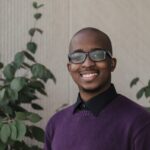
Sam Patterson ’21, M29, is now the second student in UMBC history to receive a Rhodes Scholarship. Only 32 American students are awarded the prestigious scholarship each year, which supports graduate study at the University of Oxford in England.
Patterson will pursue an M.Sc. in the Nature, Society, and Environmental Governance program at Oxford focusing on the economics of transportation. This research area will take full advantage of his three undergraduate degrees from UMBC. This spring, Patterson will earn bachelor of science degrees in mathematics and statistics and a bachelor of arts in economics.
A Meyerhoff Scholar and member of the Honors College, Patterson has steadily nurtured his interest in transportation economics at UMBC and through intensive summer internships. He conducted research supported by the Alfred P. Sloan Foundation at Harvard University with the Harvard Leadership Alliance and at the University of Chicago’s Booth School of Business. Most recently, at the National Bureau of Economic Research, he evaluated trends in transportation changes in urban centers due to the pandemic.
A strong network of support has been a cornerstone of Patterson’s UMBC experience. “From the Meyerhoff Scholars program to the Honors College to Dr. Householder to Naomi Mburu [UMBC’s first Rhodes Scholar] to my recommenders and mock interviewers and beyond, I’ve never had so many people on my team before, pushing me to achieve something I’m pursuing,” Patterson shares.
A commitment to equity
Patterson’s mentors all point out how his intelligence, drive, and charisma are balanced by a deep humility and desire to pursue the common good—a core expectation of Rhodes Scholars.
“Sam has an exceptionally fine mind, and couples to it diligence and determination,” shares Simon Stacey, director of the UMBC Honors College. “He has a genuine capacity for identification with others, and a deep commitment to justice, equity, and equality.”
That commitment translates to Patterson’s research—current and future—in transportation economics. “Sam has a strong interest in economic research that can inform the debate on public policy questions,” says Tim Gindling, professor of economics.
“Sam is a deep critical thinker who looks at car culture and considers its effects not only on the environment, but also in how it shapes access to education, work, healthcare, food, and culture,” adds April Householder, director of prestigious scholarships. “He raises questions about how class and race intersect with suburban and city planning to limit people’s lives.”
Community connections
Sam’s instructors also appreciate the way he approaches his coursework, which goes far beyond how he maintains a 4.0 GPA. “His obvious interest and earnest engagement inspire students around him, contributing to the classroom community,” shares Liz Stanwyck, senior lecturer in mathematics and statistics. “He was equally comfortable in applied and theoretical classes, always willing to speak up but also a great listener, drawing his peers out and helping to develop ideas.”
Beyond the classroom, Patterson is a dedicated community member who values connecting with and supporting others. He performs and produces music and has volunteered with Creative Coders, an afterschool program that teaches coding skills to middle school students.
As a newcomer to Baltimore when he joined the UMBC community four years ago, Patterson has taken full advantage of the opportunities the area offers and managed to maintain interests outside of his demanding academic schedule.
“I found new hobbies, interests, and activities that I hadn’t really considered before; now they’re key to keeping me relaxed and centered,” Patterson shares. “Producing music with Retriever Music Society and running their instrumental group, JOIS, has been one of my greatest pleasures here. Going down to Arbutus and perusing the shelves of Now and Then Music and Universal Comics has been essential to my weekends and birthdays.”
A transformative opportunity
Originally from Marietta, Georgia, Patterson’s education and internships have taken him around the U.S. However, he has never traveled abroad, so the Rhodes Scholarship offers a unique opportunity for him to broaden his perspective by studying in the U.K. and visiting other European countries. He hopes to further deepen his understanding of challenges—and potential solutions—related to a range of transportation systems.
“I’m so excited to go to the U.K.! I think it will do wonders for my research when I experience the European perspective on public transportation and its place in society and sustainability,” Patterson says. “There are so many brilliant academics at Oxford that I’m raring to meet. I just feel so fortunate to be where I am and to be going where I’m going.”
After Oxford, Patterson already has plans to attend Harvard University for a Ph.D. Before he gets there, though, Patterson and his mentors have no doubt the Rhodes experience will be transformative.
“The Rhodes Scholarship is a life-changing opportunity for exceptional young people with the potential to make a difference for good in the world. Sam has that mixture of grit and excellence that is the best of what UMBC represents,” Householder says. “His experience in the U.K. will enrich not only his academic path, but also his personal journey in so many profound ways. I can’t wait to see what he will accomplish.”
]]>
Sam Patterson ’21, M29, is now the second student in UMBC history to receive a Rhodes Scholarship. Only 32 American students are awarded the prestigious scholarship each year, which supports...
https://umbc.edu/stories/sam-patterson-umbcs-newest-rhodes-scholar-plans-to-transform-transportation/
https://my3.my.umbc.edu/api/v0/pixel/news/119744/guest@my.umbc.edu/8665c1f7f23bf23c61b975ddd5a2c164/api/pixel
cahss
classof2021
cnms
community
economics
majoraward
mathstat
page1
policy-and-society
undergradresearch
UMBC News & Magazine
https://my3.my.umbc.edu/groups/umbc-news-magazine
https://assets1-my.umbc.edu/system/shared/avatars/groups/000/001/943/24435aa6207c452e7bc15cc74b42c7bb/xsmall.png?1748556657
https://assets1-my.umbc.edu/system/shared/avatars/groups/000/001/943/24435aa6207c452e7bc15cc74b42c7bb/original.png?1748556657
https://assets2-my.umbc.edu/system/shared/avatars/groups/000/001/943/24435aa6207c452e7bc15cc74b42c7bb/xxlarge.png?1748556657
https://assets2-my.umbc.edu/system/shared/avatars/groups/000/001/943/24435aa6207c452e7bc15cc74b42c7bb/xlarge.png?1748556657
https://assets3-my.umbc.edu/system/shared/avatars/groups/000/001/943/24435aa6207c452e7bc15cc74b42c7bb/large.png?1748556657
https://assets1-my.umbc.edu/system/shared/avatars/groups/000/001/943/24435aa6207c452e7bc15cc74b42c7bb/medium.png?1748556657
https://assets2-my.umbc.edu/system/shared/avatars/groups/000/001/943/24435aa6207c452e7bc15cc74b42c7bb/small.png?1748556657
https://assets1-my.umbc.edu/system/shared/avatars/groups/000/001/943/24435aa6207c452e7bc15cc74b42c7bb/xsmall.png?1748556657
https://assets2-my.umbc.edu/system/shared/avatars/groups/000/001/943/24435aa6207c452e7bc15cc74b42c7bb/xxsmall.png?1748556657
UMBC News & Magazine
0
0
false
Sun, 22 Nov 2020 14:49:50 -0500
UMBC receives $900K from Maryland E-nnovation Initiative Fund to bolster Sinha Professorship in Statistics

Professor Bimal Sinha, who founded UMBC’s statistics department in 1985, is a beloved and decorated faculty member who has helped transform UMBC into a national leader in statistics education. He’s also transformed the lives of countless students, some of whom have gone on to become leading statisticians around the globe.
After more than 30 years at UMBC, in 2015, Sinha and his family decided to take their commitment to the university even further. Sinha and his sons, Jit and Shomo Sinha, pledged $750,000 to create the Dr. Bimal Sinha Professorship in Statistics at UMBC. The professorship will permanently fund a new statistics faculty position at UMBC. The family was joined in their commitment by 40 alumni and friends of the university. This summer the total endowment stood at $900,000.
This week, the Maryland E-nnovation Initiative Fund (MEIF), administered by the Maryland Department of Commerce, announced that it would match the amount currently pledged to the endowment with an additional $900,000. That will bring the total endowment of the professorship to $1.8 million. The fund is still open to receiving additional contributions to optimize the MEIF match and strengthen the endowment long into the future.
“Bringing the MEIF to UMBC will further enhance the university’s statistics program and its reputation, increasing our ability to recruit talented faculty and students from diverse backgrounds,” shared President Freeman Hrabowski.
 Bimal Sinha (left) and Yehenew Kifle, assistant professor of statistics at UMBC (center), with N.M. Mokgalongs, president of University of Limpopo, South Africa, at the 4th African International Conference on Statistics. Photo courtesy Yehenew Kifle.
Statisticians in demand
The department’s researchers specialize in many areas, including machine learning and big data analysis. The work of statisticians is often behind the scenes of headlines about other fields, such as cybersecurity, artificial intelligence, genomics, and drug development. According to the Bureau of Labor Statistics, statistics is one of the fastest growing career fields in the nation.
By supporting the Sinha Endowed Professorship, “MEIF is playing a crucial role in connecting philanthropy to the economic development mission of Maryland’s research universities,” shares Greg Simmons, vice president for institutional advancement. “MEIF is a compelling resource to universities and research parks like bwtech@UMBC as we work to build Maryland’s innovation economy.”
Teamwork delivers
Putting together the proposal for the MEIF funding demonstrated the teamwork ethos at UMBC. New Associate Vice President for Alumni Engagement and Development Stacey Sickels Locke, who assumed her role in May, spearheaded the effort. With close collaboration from the College of Natural and Mathematical Sciences and the mathematics and statistics department, the team was able to rapidly develop a compelling proposal ahead of a tight deadline.
 Bimal Sinha (foreground, right) speaks with young scholars at the 4th African International Conference on Statistics in Limpopo, South Africa. Photo courtesy Yehenew Kifle.
In addition to thanking Locke, Simmons, and Dean Bill LaCourse of the College of Natural and Mathematical Sciences, “I would like to thank and applaud the entire statistics faculty for springing into action and making this grant application possible,” shared Animikh Biswas, professor and chair of mathematics and statistics. “Their strong effort resulted in our proposal being funded.”
“Finding out that the MEIF grant had been funded was wonderful news, which is desperately needed in these difficult times,” LaCourse says. “I’m proud of the outstanding efforts of the faculty in statistics and Animikh’s leadership. The endowed professorship is an honor Bimal richly deserves after decades of meaningful contributions to UMBC.”
Supporting scholars of the future
The UMBC community also values this grant as a chance to recognize the impact Sinha has had on the university, his field, and students around the world.
“Kudos to Dean Bill LaCourse for his leadership, and to Professor Bimal Sinha for his amazing body of work,” Hrabowski shares. “Bimal has not only engaged in groundbreaking research for decades, but has also produced and championed an impressive number of influential Black statisticians throughout Africa.”
Sinha has spearheaded the African International Conference on Statistics, held in a different African country each year since 2014. In 2018, UMBC signed a memorandum of understanding with the University of Limpopo in South Africa to foster collaboration and exchange. A number of graduate students from African countries have also flourished with Sinha’s mentorship.
 Bimal Sinha gives the opening address at the 4th African International Conference on Statistics at the University of Limpopo, South Africa, in 2017. Photo courtesy Yehenew Kifle.
Sinha’s sons remember that beyond his academic accolades, the way their father has always interacted with his mentees is what made the deepest impression—whether meeting international students at the airport or inviting groups of students to their family home for dinner.
“We are proud of the contributions our father has made to the Department of Mathematics and Statistics,” Jit and Shomo shared in a statement. “Equally importantly, we believe that now more than ever, the health and growth of public higher education institutions such as UMBC play a pivotal role in advancing opportunities for the next generation of students.”
Leaving a legacy
Today, Sinha finds himself in the enviable position of approaching the sunset of his career knowing that he has made a significant positive impact on the lives of countless people, from his students and colleagues to his family. The results of his compassion, his leadership, and his generosity will ripple even farther than his impressive contributions to the field of statistics.
“When I joined UMBC in 1985, I could not have imagined the growth and success the university would go on to experience over the subsequent 35 years. I feel honored and fortunate to have played a small role in the evolution of this beloved institution,” Sinha says. “I am grateful to my colleagues, students, collaborators, friends and administrators for their partnership. Through this gift, I want to ensure that future generations of leading scholars will view UMBC as an attractive home to advance their contributions to the field of statistics.”
To learn more about ways to support UMBC, visit giving.umbc.edu.
Banner image: President Freeman Hrabowski (pointing), Bimal Sinha (foreground), and Duguma Adugna, President of Aris University in Ethiopia, take in the view from the roof of the UMBC Administration Building in October 2019. Photo courtesy Yehenew Kifle.
]]>
Professor Bimal Sinha, who founded UMBC’s statistics department in 1985, is a beloved and decorated faculty member who has helped transform UMBC into a national leader in statistics education....
https://umbc.edu/stories/umbc-receives-900k-from-maryland-e-nnovation-initiative-fund-to-endow-sinha-e-nnovate-chair-in-statistics/
https://my3.my.umbc.edu/api/v0/pixel/news/119771/guest@my.umbc.edu/11f9756e291bbaa3c7e8887495b2412f/api/pixel
cnms
mathstat
science-and-technology
UMBC News & Magazine
https://my3.my.umbc.edu/groups/umbc-news-magazine
https://assets1-my.umbc.edu/system/shared/avatars/groups/000/001/943/24435aa6207c452e7bc15cc74b42c7bb/xsmall.png?1748556657
https://assets1-my.umbc.edu/system/shared/avatars/groups/000/001/943/24435aa6207c452e7bc15cc74b42c7bb/original.png?1748556657
https://assets2-my.umbc.edu/system/shared/avatars/groups/000/001/943/24435aa6207c452e7bc15cc74b42c7bb/xxlarge.png?1748556657
https://assets2-my.umbc.edu/system/shared/avatars/groups/000/001/943/24435aa6207c452e7bc15cc74b42c7bb/xlarge.png?1748556657
https://assets3-my.umbc.edu/system/shared/avatars/groups/000/001/943/24435aa6207c452e7bc15cc74b42c7bb/large.png?1748556657
https://assets1-my.umbc.edu/system/shared/avatars/groups/000/001/943/24435aa6207c452e7bc15cc74b42c7bb/medium.png?1748556657
https://assets2-my.umbc.edu/system/shared/avatars/groups/000/001/943/24435aa6207c452e7bc15cc74b42c7bb/small.png?1748556657
https://assets1-my.umbc.edu/system/shared/avatars/groups/000/001/943/24435aa6207c452e7bc15cc74b42c7bb/xsmall.png?1748556657
https://assets2-my.umbc.edu/system/shared/avatars/groups/000/001/943/24435aa6207c452e7bc15cc74b42c7bb/xxsmall.png?1748556657
UMBC News & Magazine
0
0
false
Wed, 21 Oct 2020 14:06:58 -0400
UMBC duo using math to reveal how and why cells move with new NSF grant
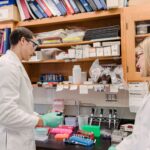
Cell migration—how, when, and why cells move—has important implications for understanding development and diseases such as blood cell disorders, rheumatoid arthritis, and metastatic cancer. Michelle Starz-Gaiano, associate professor of biological sciences, has learned a great deal about cell migration from observing Drosophila melanogaster, the humble fruit fly, in her lab. She’s also learned that experimental tools have their limitations.
“We have fantastic genetic tools in Drosophila, and we have great live imaging, so we can get pretty far doing that,” Starz-Gaiano says. “But then we encounter things that we can’t explain.”
That’s where her decade-plus collaboration with Brad Peercy, associate professor of mathematics, comes in. In their partnership, Peercy develops mathematical models to represent the movement of cells across developing eggs in the fly ovary. Now, a three-year, $370,000 NSF grant will support the duo as they combine their expertise to further explore the regulation of cell movement.
“I think this project has really big implications for how we think about development and how organs and tissues function,” Starz-Gaiano says, “because it’s looking at aspects that people haven’t yet paid attention to.”
A fresh perspective
Scientists can learn a lot about cell migration through experimental approaches like those Starz-Gaiano employs. However, some experiments are too complex or too expensive to attempt without a powerful reason to believe they will reveal new and useful information.
Turning to mathematical modeling has been particularly helpful for pointing wet lab scientists in the right direction before they invest in complicated experiments. “The collaboration has been incredible in making the best predictions for how to explain confusing results. It’s enabled us to narrow down the set of things to test,” Starz-Gaiano says.

Brad Peercy working from home this fall. Photo courtesy Brad Peercy.
For example, cell migration in the fruit fly ovary happens in several complex stages. Chemical signaling and the geometry of the ovary both play a role in regulating the process. “There are lots of different interesting features that are ripe for having a mathematical framework put around them,” Peercy says, “and the math can sometimes point to looking at something a little bit differently than biologists might otherwise.”
Now the challenge is that the math has pointed to certain attributes of the migration process that may be impossible to test in a live organism with today’s technology. “The models that Brad’s group has made are so compelling that now we have to figure out if we can show that biologically,” Starz-Gaiano says. “That’s a big focus of some of the work in the lab now.”
Uncharted territory
This new grant focuses on the math side of the work. Peercy and Starz-Gaiano have been collaborating since 2008, when they partnered to work with undergraduates as part of the former, NSF-funded Interdisciplinary Training for Undergraduates in Biological and Mathematical Sciences program.
Since then, Peercy and his team have developed several models for different aspects of the cell migration process. The next step is “integrating some of the models that we’ve already developed into a more comprehensive model of the system,” he explains. For that, Peercy and Starz-Gaiano will benefit from the computational expertise of Matthias Gobbert, professor of mathematics, who is another co-investigator on the grant. He will help make the computational processing more efficient, and therefore feasible in a reasonable amount of time.
Another aim of the project is to further investigate a set of chemical reactions, known as a signaling cascade, involved in triggering cell migration. “The signaling cascade that the model is for is very well conserved across species, and it’s implicated in a lot of human diseases,” Starz-Gaiano says. “The model pointed to a certain kind of regulation that hasn’t been very well explored, so we want to follow up on that.”
 Michelle Starz-Gaiano in the UMBC Biological Sciences Building. Photo by Marlayna Demond ’11 for UMBC.
The team will also work to better understand how the restricted space of the egg chamber affects how cells and chemical signals move, and how that affects cell migration. “Being able to map that complicated geometry into a computational framework is something we’re interested in,” Peercy says. For this part of the project, they’re collaborating with Tagide deCarvalho, director of UMBC’s Keith R. Porter Imaging Facility.
Looking at the space between cells is a new area of research. “People haven’t done that,” Starz-Gaiano says. “They just think this one sends a signal and that one gets it and it’s over, and we’re saying, well, what happens in between?” Failure of a signal to reach its final destination can contribute to some birth defects, Starz-Gaiano explains. She also wonders if the same could be true for some cancers.
A new approach
As scientific discovery marches onward, researchers in fields that were once seemingly disparate find themselves relying on each other more and more. “The biology is insufficient to capture what’s going on, so we need different approaches,” Starz-Gaiano says.
Collaborations between researchers in different fields can be tricky to navigate, as each side learns to speak a new language and engage in different ways of thinking. But when everyone involved is on board, the results can be groundbreaking.
“You see strong collaborations between experimentalists and theoreticians when they are willing to sit in uncomfortable situations,” Peercy says. That might mean a biologist thinking about differential equations or a mathematician trying to understand the reproductive process of a fruit fly.
Peercy and Starz-Gaiano’s easy rapport and long history of working together makes it clear that they’ve crossed that bridge and are comfortable taking on the unknown together. They recognize the benefits that combining their unique research skill sets can offer.
“The only way that you can solve complex problems now is to use multiple strategies at the same time,” Starz-Gaiano says. “And increasingly, that’s what we’re faced with in biology—these problems are too complicated for one method to tackle them.”
Banner image: Michelle Starz-Gaiano (right) works with Jeffrey Inen ’18 in her lab. Photo by Marlayna Demond ’11 for UMBC.
]]>
Cell migration—how, when, and why cells move—has important implications for understanding development and diseases such as blood cell disorders, rheumatoid arthritis, and metastatic cancer....
https://umbc.edu/stories/umbc-duo-using-math-to-reveal-how-and-why-cells-move-with-new-nsf-grant/
https://my3.my.umbc.edu/api/v0/pixel/news/119780/guest@my.umbc.edu/cbefb6d06bdc1a31f1cd7e18471324d9/api/pixel
biology
cnms
mathstat
research
science-and-technology
UMBC News & Magazine
https://my3.my.umbc.edu/groups/umbc-news-magazine
https://assets1-my.umbc.edu/system/shared/avatars/groups/000/001/943/24435aa6207c452e7bc15cc74b42c7bb/xsmall.png?1748556657
https://assets1-my.umbc.edu/system/shared/avatars/groups/000/001/943/24435aa6207c452e7bc15cc74b42c7bb/original.png?1748556657
https://assets2-my.umbc.edu/system/shared/avatars/groups/000/001/943/24435aa6207c452e7bc15cc74b42c7bb/xxlarge.png?1748556657
https://assets2-my.umbc.edu/system/shared/avatars/groups/000/001/943/24435aa6207c452e7bc15cc74b42c7bb/xlarge.png?1748556657
https://assets3-my.umbc.edu/system/shared/avatars/groups/000/001/943/24435aa6207c452e7bc15cc74b42c7bb/large.png?1748556657
https://assets1-my.umbc.edu/system/shared/avatars/groups/000/001/943/24435aa6207c452e7bc15cc74b42c7bb/medium.png?1748556657
https://assets2-my.umbc.edu/system/shared/avatars/groups/000/001/943/24435aa6207c452e7bc15cc74b42c7bb/small.png?1748556657
https://assets1-my.umbc.edu/system/shared/avatars/groups/000/001/943/24435aa6207c452e7bc15cc74b42c7bb/xsmall.png?1748556657
https://assets2-my.umbc.edu/system/shared/avatars/groups/000/001/943/24435aa6207c452e7bc15cc74b42c7bb/xxsmall.png?1748556657
UMBC News & Magazine
0
0
false
Tue, 06 Oct 2020 18:52:51 -0400
UMBC’s Daniel Lobo receives $1.9 million NIH grant to explore genetic control of development and regeneration
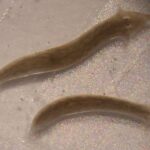
Salamanders regenerate their tails. Sea stars regenerate their arms. Most species of planaria, a type of flatworm, can regenerate everything from their heads (complete with brain) to their digestive organs. But if you lose part of a finger in a shop class accident, or while chopping vegetables for dinner, you’re out of luck—for now.
“Why can the worm do it, and we cannot?” asks Daniel Lobo, assistant professor of biological sciences. That’s not really the question, though, he explains.
“We were able to generate ourselves when we were embryos. So we have all the information of how to generate a new hand, for example,” Lobo points out. “The genes are there. You have the same information in your cells.” So why can’t humans generate body parts after that early stage of development?
“Actually, we could,” Lobo argues, if we could somehow reactivate the same genes that enabled us to develop in the womb. So, “Can we reactivate them?” he asks. That’s the real question, which he is working to answer with a five-year, $1.9 million grant from the National Institutes of Health.
 Left to right: Joy Roy ’19, bioinformatics and mathematics; Daniel Lobo; Caroline Larkin ’18, M26, bioinformatics; and Eric Cheung ’19, biochemistry and molecular biology. They’re looking at computational models of planaria. Photo by Marlayna Demond ’11 for UMBC.
Restoring independence
Lobo is tackling this question through a unique combination of techniques: wet lab experiments with planaria, and machine learning approaches that use computers to help deduce genetic regulatory networks. Previous work successfully restored the regeneration capacity of a species of planaria that had lost that ability. While still a long way from growing a human finger back, it’s a sign that the promise of reclaiming regeneration is not so far-fetched.
This line of research could eventually make it possible for people with limb loss, such as injured veterans, to regrow lost body parts. By increasing understanding of genetic regulation, Lobo’s work might also enhance knowledge of development and developmental diseases, and how cancerous tumors work around regulatory networks to grow unchecked.
The right worm for the job
Lobo uses an approach known as systems biology to tackle these big ideas. “We mix the fields of math, computer science, and biology,” he says. “We use computational techniques to extract knowledge from biological data sets.” The result is mathematical models that can explain observations the team makes in the lab. The models can also make predictions, which researchers can test in the lab.
Planaria are the ideal model organism for lab work, because of their astonishing ability to regenerate. Even a worm in eight pieces will grow back into eight complete worms with proper proportions. Like mammals, the worms also grow when they have enough to eat. However, when hungry, rather than simply getting thinner, their whole bodies shrink to maintain proper proportions. So, beyond regeneration, “The general idea is to understand how gene regulation works to specify shapes and forms in biology,” Lobo says.
 Planaria can grow and shrink their bodies and organs. Photo courtesy Daniel Lobo.
Teamwork and flexibility
“This program is too hard to do with just wet lab or just computational approaches,” Lobo says. “You need both.”
Because the work requires such a range of techniques, it also requires team members with a range of skills. Lobo’s lab includes undergraduate and graduate students in math, computer science, bioinformatics, and biology. The new grant will also allow him to bring on two new postdoctoral fellows, one on the wet lab side and one computational.
“We will be able to create that synergy and get people trained in both fields in the same lab,” says Lobo. He describes the interactions between lab members from different fields as essential to the success of the research.
Rather than fund a specific project, Lobo’s new Outstanding Investigator Grant will fund the lab as a whole. “It gives you a lot of freedom to adapt to whatever discoveries you make,” he says. “You have the flexibility to pursue the details that you need to.”
Teaching computers so they can teach us
The computers the team uses are powerful, but for now, they still benefit from some human guidance. To give the computers a head start on figuring out the genetic regulatory networks, the team inputs certain rules before they add loads of data from their own experiments and other labs’ work. That also ensures the computers don’t come up with a solution that is biologically impossible.
“We know that genes generally interact in certain fashions, and those interactions can be represented in different ways mathematically,” Lobo explains. “So we can tell the computer what kinds of interactions a gene can have. And then it is free to put those interactions together in ways that make sense.”
Lobo compares it to working with Lego blocks. “How many structures can you make with Legos? Unlimited, right?” he asks. “So the computer also has an unlimited space to search, but only with things that can be put together. You cannot make a perfectly round Lego ball, for example, if you only have square blocks.”
 Daniel Lobo, right, takes a break with Joy Roy (center) and Eric Cheung in the lab. Photo by Marlayna Demond ’11 for UMBC.
Speeding up the science
Combining wet lab and computational approaches will drastically increase the pace of discovery. A high performance cluster of computers can come up with a probable solution by testing more than a billion possible models of a regulatory network in a few days—a task that would take infinitely long for a team of humans.
Using computers to come up with plausible models, testing the models’ predictions in the lab, and then feeding the new data back into the computers to refine the model will bring researchers ever closer to understanding how different biological systems work. Research teams can apply the same investigative process to any number of biological questions, from regeneration to metastasis.
Some biologists may shy away from programming, but as Lobo says, “Biology is more and more computational. We are reaching a point that without a computer to process the data you cannot do almost any experimental work in biology.”
He argues that interdisciplinary teams like his are the future—that diverse groups of researchers will increasingly combine multiple approaches to answer the big questions, to speed up scientific progress in ways that will have real, positive impact.
Banner image: Daniel Lobo in front of the Biological Sciences Building mural. Photo by Marlayna Demond ’11 for UMBC.
]]>
Salamanders regenerate their tails. Sea stars regenerate their arms. Most species of planaria, a type of flatworm, can regenerate everything from their heads (complete with brain) to their...
https://umbc.edu/stories/umbcs-daniel-lobo-receives-1-9-million-nih-grant-to-explore-genetic-control-of-development-and-regeneration/
https://my3.my.umbc.edu/api/v0/pixel/news/119796/guest@my.umbc.edu/d6964b3ece2f6f9ffb9eebf351fbb6de/api/pixel
biology
cnms
mathstat
research
science-and-technology
UMBC News & Magazine
https://my3.my.umbc.edu/groups/umbc-news-magazine
https://assets1-my.umbc.edu/system/shared/avatars/groups/000/001/943/24435aa6207c452e7bc15cc74b42c7bb/xsmall.png?1748556657
https://assets1-my.umbc.edu/system/shared/avatars/groups/000/001/943/24435aa6207c452e7bc15cc74b42c7bb/original.png?1748556657
https://assets2-my.umbc.edu/system/shared/avatars/groups/000/001/943/24435aa6207c452e7bc15cc74b42c7bb/xxlarge.png?1748556657
https://assets2-my.umbc.edu/system/shared/avatars/groups/000/001/943/24435aa6207c452e7bc15cc74b42c7bb/xlarge.png?1748556657
https://assets3-my.umbc.edu/system/shared/avatars/groups/000/001/943/24435aa6207c452e7bc15cc74b42c7bb/large.png?1748556657
https://assets1-my.umbc.edu/system/shared/avatars/groups/000/001/943/24435aa6207c452e7bc15cc74b42c7bb/medium.png?1748556657
https://assets2-my.umbc.edu/system/shared/avatars/groups/000/001/943/24435aa6207c452e7bc15cc74b42c7bb/small.png?1748556657
https://assets1-my.umbc.edu/system/shared/avatars/groups/000/001/943/24435aa6207c452e7bc15cc74b42c7bb/xsmall.png?1748556657
https://assets2-my.umbc.edu/system/shared/avatars/groups/000/001/943/24435aa6207c452e7bc15cc74b42c7bb/xxsmall.png?1748556657
UMBC News & Magazine
0
0
false
Wed, 09 Sep 2020 20:14:27 -0400
UMBC alumnus Mark Doms is appointed chief economist of the Congressional Budget Office

UMBC alumnus Mark Doms ‘85, economics and mathematics, has been appointed chief economist of the Congressional Budget Office (CBO). Doms will be one of the leads of the agency that provides Congress with objective, nonpartisan, and high quality information about the economic and financial impacts of existing laws, new laws, and policies under consideration.
“It is really important to get the best information so policymakers can decide which path to move forward on,” explains Doms, who has served as an economics expert for over three decades.
“At CBO we strive to provide high quality, nonpartisan information so Congress can make their decisions,” Doms says. “We believe that better information makes better decisions, especially now, with the huge, adverse economic impacts of COVID-19.”
His team helps provide Congress with data to better understand ongoing public policy issues such as living conditions, government assistance, and poverty. Through quantitative analysis, the agency is able to look at different facets of an issue by asking questions about what is known, what needs to be known, and what may not be known. CBO projections and analysis provide valuable insights into complex issues, allowing for in-depth understanding of the costs and benefits of various policies.

Roy Meyers.
Photo by Marlayna Demond ’11.
Doms is one of four UMBC alumni currently serving in the Congressional Budget Office. Kate Green ‘05, information systems, is a human resource specialist. Jorge Salazar ‘02, graphic design, is a visual Information and data visualization specialist. Ryan Mutter ‘01, M.A., economics, and Ph.D. ‘06, public policy is a principal analyst in the Health, Retirement, and Long-Term Analysis Division of CBO. And Roy Meyers, professor of political science, was an analyst at CBO before joining UMBC.
The power of math and economics
Doms’s love of mathematics is a personal passion he fostered in high school and immersed himself in while at UMBC. He also remembers spending time at UMBC learning the computing and analytical skills needed to conduct research, and collect and analyze data.
“All of my professors at UMBC were inspiring,” shares Doms. “What was most valuable to me was their insistence that we learn a quantitative approach to inform policy not just from books, but from the real world,” he says.

Mark Doms in front of the U.S. Capitol.
Photo courtesy of Doms.
Doms also benefited from the professional experience of UMBC faculty in understanding the world from a quantitative lens. “Most of my professors had hands-on experience working with policymakers in Washington, D.C.,” he recalls. “They were able to share an invaluable insider’s perspective.”
From them he learned the power of research and data analysis to help inform policy and the challenges they present.
Quantitative analysis for the greater good
In addition to quantitative analysis skills, Doms also notes the importance of communication skills to anyone wanting to enter the field of economics. He appreciates the skills he learned in his English and philosophy classes, which help him communicate important ideas with different audiences. For Doms, the best data and analysis in the world is not of service if it can’t be communicated clearly to a general audience.
After UMBC, Doms earned a Ph.D. in economics from the University of Wisconsin–Madison.
He then served in the U.S. Census Bureau and the Board of Governors of The Federal Reserve as an economist. He was also the senior economist for The Federal Reserve Bank of San Francisco.

Mark Doms at alumni awards.
Photo by Marlayna Demond ’11.
Doms was appointed and confirmed by the U.S. Senate as the under secretary for economic affairs at the U.S. Department of Commerce under the Obama administration. He has also worked at Japan’s largest investment bank and at the Organisation for Economic Co-operation and Development in France. In 2018 UMBC recognized his leadership in the field of economics with an Outstanding Alumnus in Natural and Mathematical Sciences Award.
Strength in diversity
In his decades of experience, Doms has always studied and worked with people from diverse backgrounds. He sees diversity as a necessary aspect of strong teams that produce great ideas.
Doms encourages students interested in economics to study abroad and become fluent in another language. While his travel and language experience happened on the job, he has seen the benefits of having these experiences early on in a field that requires an understanding of interconnected global issues.
For Doms, diversity in the economic field is key to helping communities learn more from one another and address today’s major challenges. He welcomes students from all backgrounds to apply to the CBO’s summer internship program and he actively engages in helping diversify CBO’s workforce.
“I really enjoy that I can use the economics, math, and communications skills I learned at UMBC and elsewhere to help us understand the world just a little bit better,” says Doms.
Banner image: Doms in front of the U.S. Capitol. Photo by Tim Lordan .
]]>
UMBC alumnus Mark Doms ‘85, economics and mathematics, has been appointed chief economist of the Congressional Budget Office (CBO). Doms will be one of the leads of the agency that provides...
https://umbc.edu/stories/umbc-alumnus-mark-doms-is-appointed-chief-economist-of-the-congressional-budget-office/
https://my3.my.umbc.edu/api/v0/pixel/news/119807/guest@my.umbc.edu/27a8f7551593e731f1dfd31aef06f5c5/api/pixel
alumni
cahss
cnms
economics
mathstat
policy-and-society
UMBC News & Magazine
https://my3.my.umbc.edu/groups/umbc-news-magazine
https://assets1-my.umbc.edu/system/shared/avatars/groups/000/001/943/24435aa6207c452e7bc15cc74b42c7bb/xsmall.png?1748556657
https://assets1-my.umbc.edu/system/shared/avatars/groups/000/001/943/24435aa6207c452e7bc15cc74b42c7bb/original.png?1748556657
https://assets2-my.umbc.edu/system/shared/avatars/groups/000/001/943/24435aa6207c452e7bc15cc74b42c7bb/xxlarge.png?1748556657
https://assets2-my.umbc.edu/system/shared/avatars/groups/000/001/943/24435aa6207c452e7bc15cc74b42c7bb/xlarge.png?1748556657
https://assets3-my.umbc.edu/system/shared/avatars/groups/000/001/943/24435aa6207c452e7bc15cc74b42c7bb/large.png?1748556657
https://assets1-my.umbc.edu/system/shared/avatars/groups/000/001/943/24435aa6207c452e7bc15cc74b42c7bb/medium.png?1748556657
https://assets2-my.umbc.edu/system/shared/avatars/groups/000/001/943/24435aa6207c452e7bc15cc74b42c7bb/small.png?1748556657
https://assets1-my.umbc.edu/system/shared/avatars/groups/000/001/943/24435aa6207c452e7bc15cc74b42c7bb/xsmall.png?1748556657
https://assets2-my.umbc.edu/system/shared/avatars/groups/000/001/943/24435aa6207c452e7bc15cc74b42c7bb/xxsmall.png?1748556657
UMBC News & Magazine
0
0
false
Wed, 26 Aug 2020 17:27:26 -0400
UMBC mathematician Kathleen Hoffman receives new grants to improve HIV modeling

Kathleen Hoffman, professor of mathematics and statistics, thrives on solving puzzles. She has spent her career working to create and refine mathematical models of notoriously complex biological systems. For the last decade, she and colleague Katharine Gurski at Howard University have been working together to model the spread of HIV. Now, the pair has received two new grants to support their work.
Funding from the National Science Foundation (NSF) will support their efforts to improve the model of how HIV spreads between people. A grant from the Center for Undergraduate Research in Mathematics (CURM) will support work to model how HIV infects cells in the body and develops resistance to drug treatments.
Pieces of the puzzle
The CURM grant will support undergraduates in Hoffman and Gurski’s labs to model how HIV behaves inside the body. In particular, they want to know how it responds to a common treatment known as highly-active anti-retroviral treatment (HAART).
“Some strains of HIV are less likely to respond to treatment,” Hoffman says, “and when patients don’t follow the treatment regimen carefully, that can also lead to resistance.” If a person’s HIV becomes resistant to their current treatment, they can more easily pass the infection to others. So a better understanding of the presence of drug resistance in the population is critical to building accurate population-based models of HIV spread.
 Kathleen Hoffman. Photo by Jessica Hoffman and Lisa Comfort.
Hoffman enjoys working with undergraduates to give them exposure to research. Rebecca Laws ’21, mathematics, and Michael Klos ’21, mathematics, will work with her on this project.
“How can you expect people to enjoy research, if they don’t know what it is?” Hoffman asks. She says being accountable to students and their projects also helps keep her own research on track. “It accomplishes small but meaningful things toward my research that I might not do if I wasn’t working with a student,” she says. “They each contribute their own piece of the puzzle.”
Refining the model
Hoffman and Gurski’s previous collaboration on an HIV-transmission model included factors like demographic information and sexual behavior. Through their new NSF grant they will make the model more precise by incorporating two more major factors. They will account for the role of long-term relationships and usage of PrEP, a drug that reduces one’s risk of contracting HIV when taken every day. Hoffman’s Ph.D. student, Sylvia Gutowska, is taking the lead on the PrEP modeling.
Classical models of disease spread treat people “basically like molecules in a gas, where they’re moving all over the place, and there’s some probability that they will touch each other. And then, if they touch each other, there’s some probability that one will pass the infection to the other,” Hoffman says. “That’s the underlying assumption of all of these models.”
But the analogy between people and molecules breaks down when you start looking at complex human behaviors. For example, long-term partnerships dramatically reduce the likelihood of risky encounters between individuals.
Using PrEP adds more complexity. When taken regularly, PrEP reduces the likelihood of a person passing the disease to someone else. But research shows that if someone is taking PrEP, they are also more likely to behave in riskier ways. And if they forget to take their daily dose, they’re at higher risk again temporarily.
 HIV (yellow) attacks a human T-cell (blue). Image by ZEISS Microscopy, used under CC BY-NC-ND 2.0
These factors “make the modeling way more complicated from a mathematical perspective,” Hoffman says. Incorporating those two parameters will be the primary work of the NSF grant.
Hoffman and Gurski also want to validate the new model they develop. To do that, they’ll give the model real data from 2005 on disease rates, and then see how well it is able to predict disease rates a few years later (e.g. 2010 and 2015). Because these data already exist, they’ll be able to compare the real data to the model’s predictions.
Informing disease prevention
Once they have an upgraded model, the researchers can test individual parameters in the model to see which would have the biggest effects on the level of disease in a population. This can then inform public health decisions.
“By measuring the sensitivity of the parameters, it’s kind of like looking for the biggest bang for your buck in terms of resource allocation,” Hoffman explains. “For instance, if you have money to put toward an education campaign, should you put it toward making sure people take PrEP diligently? Or will it have more of an impact if you put it toward promoting condom use? Which will have a bigger impact on decreasing the amount of disease in society? That’s the kind of question this kind of work can usually answer, if the model is accurate.”
But even figuring out what the parameters are to begin with can be very difficult. The work goes way beyond math into HIV biology and even the sociology and psychology behind people’s behavior and relationships.
It’s hard, “but what I like about science and research is the fact that I’m not constrained by siloes. Sometimes I have to go read literature in the psychology and sociology fields, and I have to read biology papers that I struggle through,” Hoffman says. “That’s why I like it, because I never know what I’m going to need to learn next.”
Banner image: UMBC Biological Sciences Building. Photo by Marlayna Demond ’11 for UMBC.
]]>
Kathleen Hoffman, professor of mathematics and statistics, thrives on solving puzzles. She has spent her career working to create and refine mathematical models of notoriously complex biological...
https://umbc.edu/stories/umbc-mathematician-kathleen-hoffman-receives-new-grants-to-improve-hiv-modeling/
https://my3.my.umbc.edu/api/v0/pixel/news/119840/guest@my.umbc.edu/468b3d48252ba0be8786415302bc9835/api/pixel
cnms
mathstat
research
science-and-technology
UMBC News & Magazine
https://my3.my.umbc.edu/groups/umbc-news-magazine
https://assets1-my.umbc.edu/system/shared/avatars/groups/000/001/943/24435aa6207c452e7bc15cc74b42c7bb/xsmall.png?1748556657
https://assets1-my.umbc.edu/system/shared/avatars/groups/000/001/943/24435aa6207c452e7bc15cc74b42c7bb/original.png?1748556657
https://assets2-my.umbc.edu/system/shared/avatars/groups/000/001/943/24435aa6207c452e7bc15cc74b42c7bb/xxlarge.png?1748556657
https://assets2-my.umbc.edu/system/shared/avatars/groups/000/001/943/24435aa6207c452e7bc15cc74b42c7bb/xlarge.png?1748556657
https://assets3-my.umbc.edu/system/shared/avatars/groups/000/001/943/24435aa6207c452e7bc15cc74b42c7bb/large.png?1748556657
https://assets1-my.umbc.edu/system/shared/avatars/groups/000/001/943/24435aa6207c452e7bc15cc74b42c7bb/medium.png?1748556657
https://assets2-my.umbc.edu/system/shared/avatars/groups/000/001/943/24435aa6207c452e7bc15cc74b42c7bb/small.png?1748556657
https://assets1-my.umbc.edu/system/shared/avatars/groups/000/001/943/24435aa6207c452e7bc15cc74b42c7bb/xsmall.png?1748556657
https://assets2-my.umbc.edu/system/shared/avatars/groups/000/001/943/24435aa6207c452e7bc15cc74b42c7bb/xxsmall.png?1748556657
UMBC News & Magazine
0
0
false
Mon, 13 Jul 2020 17:31:51 -0400
Mentorship matters: UMBC connections help three students create their own paths

Like many new UMBC students, Jana Burns ‘20, information systems, was interested in so many topics when she stepped on campus that choosing a major initially proved challenging. When she transferred to UMBC from Brown’s Town Community College in Jamaica, she thought she wanted to study psychology and art. But she had also taken several programming courses and began to see the significant ways that technology impacts how people live.
The connections she made on campus led her to become a Cyber Scholar, which then opened more doors. She accessed the right opportunities at the right moments, and is now graduating with an exciting position in her field and a support network to carry her forward.
 Jana Burns, center, with two of her sorority sisters. Photo courtesy of Burns.
This experience is one many UMBC students share—building relationships that expand possibilities, for careers and for life.
Right mentors, right internship
Burns chose UMBC after experiencing the university’s welcoming and friendly environment during a campus tour. Once she became a Cyber Scholar, she connected with students and mentors on a new level through the Center for Women in Technology. “It seemed like a family,” she says.

Jana Burns with Richard Tapia at the Tapia Conference. Photo courtesy of Burns.
As a first-generation college student, says Burns, her UMBC community has been essential to her success in her academics, research, and personal life. “I was put in touch with people who I would not have met otherwise,” she shares, adding that she regularly texts with her industry mentor, Kijafa Saunders ‘02, information systems, M.S. ‘11, engineering management.
On campus, Burns has formed close connections with Vandana Janeja, professor and interim chair of information systems, and Cindy Greenwood, assistant director of the Cyber Scholars Program. They are always there and always supportive, says Burns.
Her experience in the Cyber Scholars Program has also encouraged her to become a leader in other communities on campus. She is the secretary and an executive board member of the Alpha Sigma Alpha sorority. She’s also a member of the UMBC Caribbean Student Council, which she calls her “cultural home on campus.”
Learning with a team
Last summer, as Burns began to take concrete steps toward her career after graduation, she completed an internship at Booz Allen Hamilton, a leading management and IT consulting firm. Burns was connected to the internship through Saunders, who had worked at Booz Allen as an associate systems engineer.
There, Burns worked alongside about 60 other interns from other institutions across the country. She had the opportunity to collaborate with a small group of other students to create an image change detection application for surveillance drones. Together, they tested and presented their work.
After graduation, Burns will work at Northrop Grumman as a systems engineer in the company’s rotational program—a program she learned about fromGreenwood. She will have the opportunity to work in different departments to learn which areas interest her most.
Community of support within the lab
Harper Montgomery ‘20, biochemistry, knew he wanted to be an entomologist since he was seven years old. He became fascinated by insects through spending time outdoors in Southern California, where he lived before moving to Howard County.
Once at UMBC, Montgomery began looking for the right research opportunity—something that would prepare him for a career studying the creatures he found so intriguing. Through another student, he heard about Mercedes Burns and her work on arachnids and daddy long legs, which is close to his interest in entomology. He reached out to Burns, assistant professor of biological sciences, was invited for an interview to work in her lab, and the rest is history.
 Mercedes Burns. Photo by Marlayna Demond ’11 for UMBC.
Montgomery shares that the lab has provided him with much more than the opportunity to do research. “I absolutely love my lab. It’s my home in the sciences,” he says. “The way that Burns approaches research and mentoring is one of the best that I’ve ever seen. She is a fantastic mentor who pushes her students.”
Not only does Montgomery get to work alongside Burns, but he says that the graduate students in the lab have been mentors to him. And everyone encourages each other to pursue unique opportunities and take their research to the next level.
Exploring different angles
Even as an undergraduate, Montgomery had the opportunity to present a poster, with two other students, at the American Arachnological Society meeting. He’s also presented his research at UMBC’s Undergraduate Research and Creative Achievement Day in 2019 and 2020.
 Montgomery presenting at the 2019 American Arachnological Society Conference. Photo by Genevieve Ahearn.
And like Jana Burns, Montgomery has accessed particular opportunities that have opened doors for his developing career.
Through a high school classmate, Montgomery was connected with an internship with the U.S. Department of Agriculture. For two summers, he was involved with genetics research focused on the microbiology of soybeans. Looking back at the experience, Montgomery says the internship inspired him to take a microbiology course at UMBC, and also enabled him to become well-versed on a broader range of biology topics, which has proven useful in connecting with mentors and industry professionals.
 Montgomery, center, with Kevin Omland, professor of biology, and a classmate. Photo courtesy of Rojin Najmabadi.
After graduation, Montgomery will pursue a Ph.D. in entomology at the University of California, Riverside, a top program. He consulted with Burns during the application and decision process, and describes her mentorship and support “invaluable.”
A nurturing network
Olusayo Adeleye ‘20, M28, mathematics, looks back on her experience during the summer bridge program of UMBC’s Meyerhoff Scholars Program fondly. She was drawn to the program because of its emphasis on community and supporting students academically and personally. “It was one of the best decisions that I made before college,” Adeleye says.
When Adeleye arrived on campus, she planned to major in mechanical engineering, but was drawn to mathematics and economics. She was eager to connect with people on topics that impact decisions they make every day.
Mentorship has played a significant role in her UMBC experience, and will continue to be a part of her academic journey after she graduates. Her mentors include Ivanna Abreu, program coordinator of the Meyerhoff Scholars Program, Mitsue Wiggs, assistant director of the Meyerhoff Scholars Program, as well as other students, particularly Anna Gifty Opoku-Agyeman, M26, ‘19, mathematics.
When Adeleye changed her major to math, Opoku-Agyeman quickly began introducing her to contacts on and off campus. She also recommended internship opportunities that she should apply for.
“Lifting others as I climb”
Eventually, Adeleye joined Opoku-Agyeman as a member of the organizing committee that launched the Sadie Collective. The group’s inaugural Sadie Tanner Mossell Alexander Conference for Economics and Related Fields, in 2019, was the first conference for black women economists in the United States.
Adeleye says that the Sadie Collective enabled her to develop important “soft skills” that she hadn’t focused on much before, in leadership, teamwork, and communication. “I believe so much in the goal of the Collective,” she explains. By being part of a group designed to support and increase the number of black women in economics, she says, “I am lifting others as I climb.”
 Olusayo Adeleye, third from right, with her friends after the first Sadie T.M Alexander Conference for Economics and Economics Related Fields. Photo courtesy of Adeleye.
Adeleye attended the American Economic Association’s annual conference in San Diego this year, where she connected with leading economics researchers.
Building on these unique, impactful experiences, Adeleye has earned a highly selective predoctoral fellowship at NYU’s Stern School of Business. The fellowship is supported by the Alfred P. Sloan Foundation, which provided funding to UMBC beginning in 2017 to support underrepresented students at the highest levels of economics.
Adeleye will be one of just two students selected for the program. She will be mentored by economist Peter Henry, who is the former dean of the NYU Stern School of Business. After her pre-doctoral fellowship, Adeleye plans to pursue her Ph.D. in business with a focus on corporate social responsibility and corporate strategy.
Banner image: Jana Burns in the ILSB. Photo courtesy of Burns.
]]>
Like many new UMBC students, Jana Burns ‘20, information systems, was interested in so many topics when she stepped on campus that choosing a major initially proved challenging. When she...
https://umbc.edu/stories/mentorship-matters-umbc-connections-help-three-students-create-their-own-paths/
https://my3.my.umbc.edu/api/v0/pixel/news/119884/guest@my.umbc.edu/64ed3847601e71b3f284c432ed308580/api/pixel
cahss
chembiochem
classof2020
cnms
coeit
cyberscholars
economics
is
mathstat
meyerhoffscholars
policy-and-society
science-and-technology
undergradresearch
UMBC News & Magazine
https://my3.my.umbc.edu/groups/umbc-news-magazine
https://assets1-my.umbc.edu/system/shared/avatars/groups/000/001/943/24435aa6207c452e7bc15cc74b42c7bb/xsmall.png?1748556657
https://assets1-my.umbc.edu/system/shared/avatars/groups/000/001/943/24435aa6207c452e7bc15cc74b42c7bb/original.png?1748556657
https://assets2-my.umbc.edu/system/shared/avatars/groups/000/001/943/24435aa6207c452e7bc15cc74b42c7bb/xxlarge.png?1748556657
https://assets2-my.umbc.edu/system/shared/avatars/groups/000/001/943/24435aa6207c452e7bc15cc74b42c7bb/xlarge.png?1748556657
https://assets3-my.umbc.edu/system/shared/avatars/groups/000/001/943/24435aa6207c452e7bc15cc74b42c7bb/large.png?1748556657
https://assets1-my.umbc.edu/system/shared/avatars/groups/000/001/943/24435aa6207c452e7bc15cc74b42c7bb/medium.png?1748556657
https://assets2-my.umbc.edu/system/shared/avatars/groups/000/001/943/24435aa6207c452e7bc15cc74b42c7bb/small.png?1748556657
https://assets1-my.umbc.edu/system/shared/avatars/groups/000/001/943/24435aa6207c452e7bc15cc74b42c7bb/xsmall.png?1748556657
https://assets2-my.umbc.edu/system/shared/avatars/groups/000/001/943/24435aa6207c452e7bc15cc74b42c7bb/xxsmall.png?1748556657
UMBC News & Magazine
0
0
false
Tue, 19 May 2020 12:35:41 -0400
 UMBC’s Lujie Karen Chen
 UMB’s Kelly Doran

