UMBC researchers listed among the world’s top 2% of most-cited scientists and engineers
More than 40 active UMBC researchers are listed among the top 2% of the world’s most-cited scientists and engineers in an analysis recently published by Elsevier.
These researchers include faculty across all three of UMBC’s academic colleges as well as UMBC’s NASA-funded centers, such as the Goddard Earth Sciences Technology and Research (GESTAR II) Center. Their work covers an incredibly diverse array of topics. Represented academic departments include:
- biological sciences
- chemical, biochemical, and environmental engineering
- chemistry and biochemistry
- computer science and electrical engineering
- geography and environmental systems
- information systems
- mathematics and statistics
- mechanical engineering
- physics
- psychology
“We perform research to further our understanding of how the various aspects of our world function,” says Karl V. Steiner, vice president for research and creative achievement. “One of the highest recognitions in the scientific community is when other members of this community cite our work.”
He notes, “The Elsevier analysis shows that our researchers are truly impacting the scientific community in a significant way.”
History of citation honors
The list includes faculty researchers who have also received other “highly cited” researcher accolades. In 2022, Erle Ellis, professor of geography and environmental systems (GES), was featured on Clarivate’s Highly Cited Researchers list, which includes papers ranked in the top 1% of citations within Clarivate’s Web of Science database. About 0.1% of the world’s researchers have received this distinction. Ellis is known for his transformational work on human-managed ecosystems, with his research described as top discovery of 2021 by the Smithsonian National Museum of Natural History.
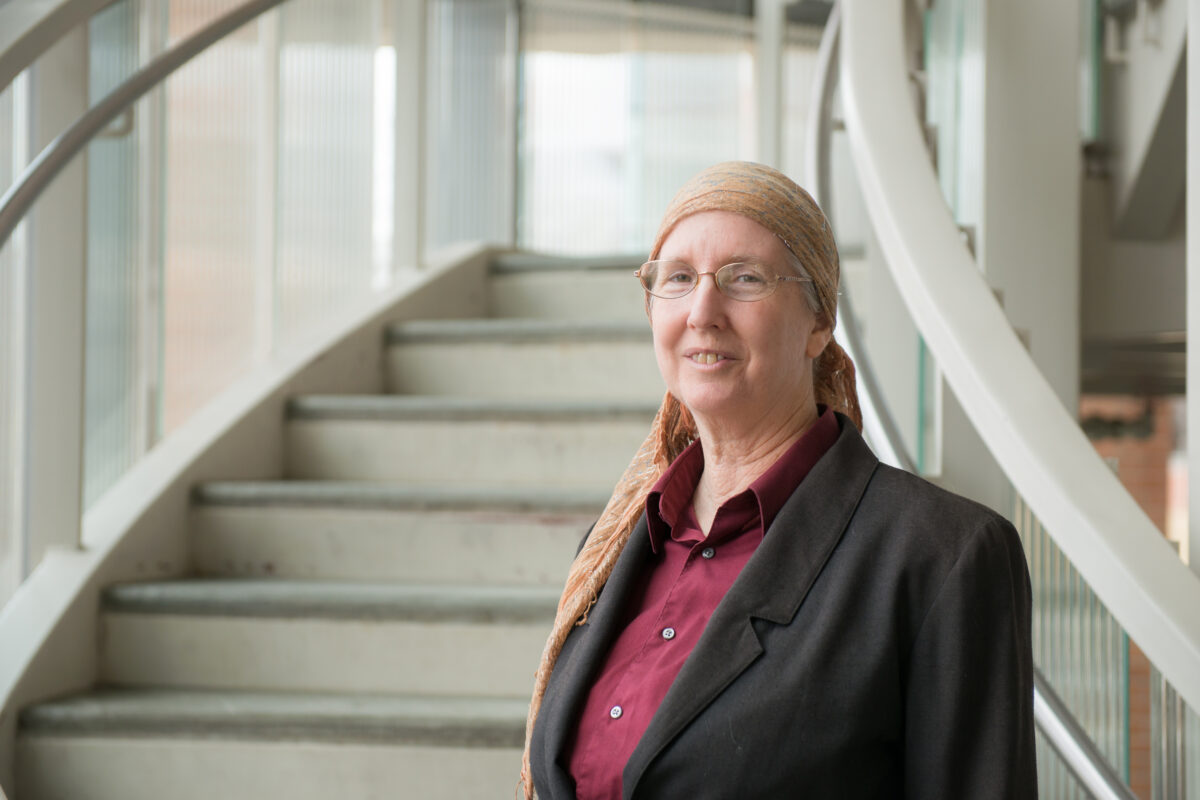 Lorraine Remer (Marlayna Demond ’11/UMBC)
Lorraine Remer, research professor for the Joint Center for Earth Systems Technology, who is affiliated with both GES and physics, is frequently honored for her geophysics publications. She received the 2019 UMBC Research Faculty Excellence Award following her recognition as one of “The Most Influential Scientific Minds” on the Thomson Reuters highly cited researchers list.
Anupam Joshi, director of UMBC’s Center for Cybersecurity and professor and chair of computer science and electrical engineering, was also included on Elsevier’s highly-cited list. His career trajectory demonstrates how UMBC faculty balance high-impact research with other forms of leadership. He has published more than 275 papers, has been granted nine patents, and has obtained research support from a variety of federal and industrial sources. At the same time, he is now serving as a 2022–23 American Council on Education (ACE) Fellow, an intensive program focused on agility and innovative problem solving among higher education leaders.
Measuring impact
This latest most-cited researchers list is based on data annually compiled from author profiles in Elsevier’s abstract and citation database, Scopus.
Elsevier’s 2022 database of standardized citation indicators classifies researchers into 22 fields and 174 subfields. Those with a composite indicator (c-score) within the top 2% of each subfield are included in the most-cited list. The list’s authors indicate that c-score is used because it “focuses on impact (citations) rather than productivity (number of publications)” and because it includes granular information on authorship, including co-authorship and author position (e.g., single, first, or last author).
]]>
More than 40 active UMBC researchers are listed among the top 2% of the world’s most-cited scientists and engineers in an analysis recently published by Elsevier. These researchers include...
https://umbc.edu/stories/most-cited-scientists-2022/
https://my3.my.umbc.edu/api/v0/pixel/news/130830/guest@my.umbc.edu/0a8209cd9947fb4136c6c8893cdbfae1/api/pixel
cahss
cbee
cnms
coeit
csee
cybersecurity
ges
gestar
is
jcet
meche
news
physics
rca-1
research
science-and-tech
UMBC News & Magazine
https://my3.my.umbc.edu/groups/umbc-news-magazine
https://assets1-my.umbc.edu/system/shared/avatars/groups/000/001/943/24435aa6207c452e7bc15cc74b42c7bb/xsmall.png?1748556657
https://assets1-my.umbc.edu/system/shared/avatars/groups/000/001/943/24435aa6207c452e7bc15cc74b42c7bb/original.png?1748556657
https://assets2-my.umbc.edu/system/shared/avatars/groups/000/001/943/24435aa6207c452e7bc15cc74b42c7bb/xxlarge.png?1748556657
https://assets2-my.umbc.edu/system/shared/avatars/groups/000/001/943/24435aa6207c452e7bc15cc74b42c7bb/xlarge.png?1748556657
https://assets3-my.umbc.edu/system/shared/avatars/groups/000/001/943/24435aa6207c452e7bc15cc74b42c7bb/large.png?1748556657
https://assets1-my.umbc.edu/system/shared/avatars/groups/000/001/943/24435aa6207c452e7bc15cc74b42c7bb/medium.png?1748556657
https://assets2-my.umbc.edu/system/shared/avatars/groups/000/001/943/24435aa6207c452e7bc15cc74b42c7bb/small.png?1748556657
https://assets1-my.umbc.edu/system/shared/avatars/groups/000/001/943/24435aa6207c452e7bc15cc74b42c7bb/xsmall.png?1748556657
https://assets2-my.umbc.edu/system/shared/avatars/groups/000/001/943/24435aa6207c452e7bc15cc74b42c7bb/xxsmall.png?1748556657
UMBC News & Magazine
0
0
false
Wed, 25 Jan 2023 11:47:33 -0500
Fri, 10 Feb 2023 17:01:24 -0500
A Space of One’s Own
On a chilly morning in early spring 2022, Eileen Meyer, Roy Prouty, and Erik Crowe were on the roof of the UMBC Physics Building. They were inside the observatory dome, trying to figure out what had gone wrong with the 32-inch telescope installed when the building was constructed in 1999. They had already determined that the shutters designed to keep dust off the mirrors were jammed, rendering the telescope temporarily unusable.
“So we’re up there with flashlights and ladders that are not quite tall enough,” Meyer recalls, “trying to figure out what is happening and realizing that some of the motors have died.” They weren’t terribly surprised, given the age of the instrument and the harsh conditions on the roof of a building: extreme heat in summer and cold in winter as well as high humidity. At one point, Meyer says, birds unfortunately had to be evicted from one of the ventilation grates, but not before they had spread debris around the dome.
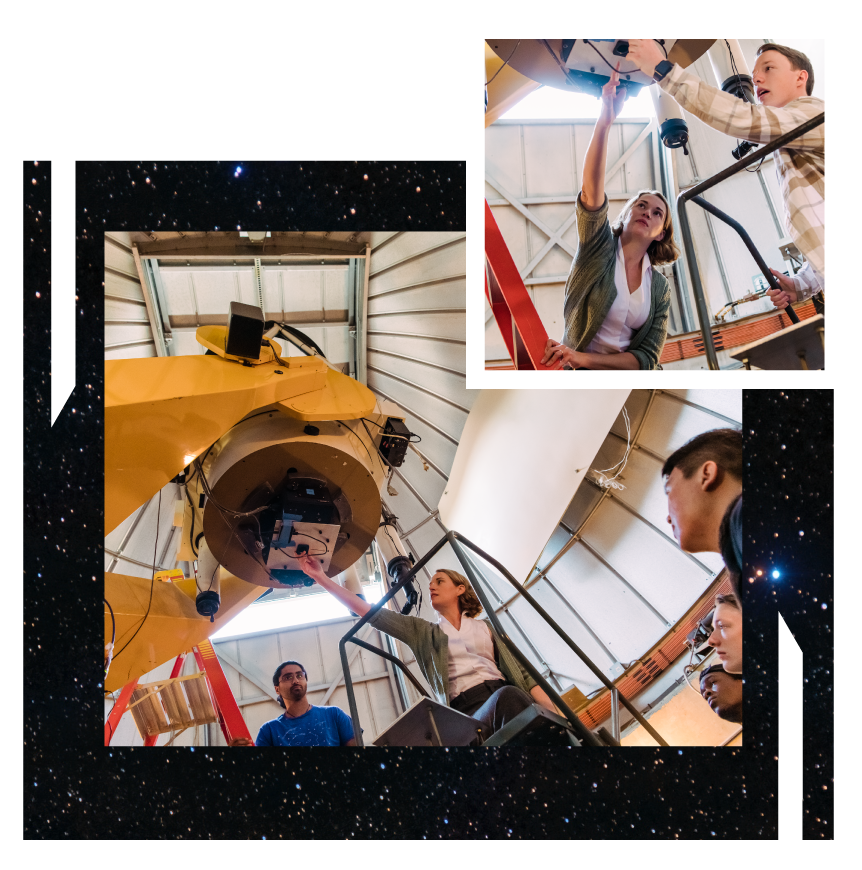 Eileen Meyer works on the observatory telescope with some of her students. (Marlayna Demond ’11/UMBC)
As someone who decided as a first-year graduate student that hands-on lab work wasn’t really her thing, Meyer may seem an unlikely candidate for climbing ladders, ordering parts, and figuring out wiring as the observatory refurbishment lead. In fact, Meyer, associate professor of physics, has spent the better part of the last decade using computers (often the “super” variety) to conduct astrophysics research, mostly on black holes (the supermassive variety)—but she is finding fulfillment in expanding her work.
“That’s the beauty of having a career that is hitting its mid-stage,” Meyer says. “You can start trying different things.”
Leaning into the turning points

The telescope renovation project is a symbol of Meyer’s evolution as a scientist. Because it requires expertise outside her wheelhouse, it’s enhancing her management and delegation skills, she says, and allowing her to collaborate with a wider range of students and colleagues, including engineers. Plus, the upgraded telescope will enable other projects she’s diving into now, creating new opportunities at a turning point in her career, she says.
When it was built, the observatory was a state-of-the-art facility, designed to conduct observations of the near-Earth atmosphere and to serve as a public-outreach tool. The latter function is still underway today, with programming offered by observatory director and current Ph.D. student Roy Prouty, M.S. ’16, atmospheric physics, but the aging of the telescope and its original cameras means it is no longer up to the task of cutting-edge research.
With generous financial support from the College of Natural and Mathematical Sciences and hands-on help from people like Prouty and Crowe, the Physics Building manager, Meyer says, “The goal is to modernize the observatory and bring it up to the level of something that we can actually put research-grade equipment on and do observations.”
The beauty of physics

While the details of Meyer’s research might be shifting, her overall drive to conduct research and create knowledge are longstanding and unchanged. “I always wanted to be a scientist from as soon as I knew what that was,” Meyer reflects—although astronomy was something “I fell into by degrees,” she says.
As an undergraduate at Rice University in Houston, physics won her over because “it’s so beautiful,” she says. “It’s this interplay of the natural world and the mathematical descriptions you can make of it. It can be deceptively simple.”
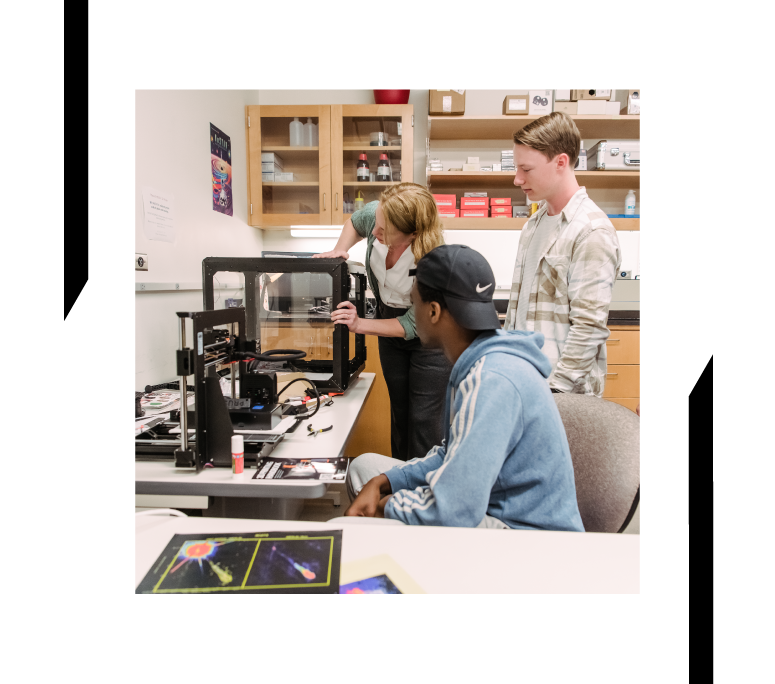 Meyer works with two students in her lab. (Marlayna Demond ’11/UMBC)
“And once you’ve been trained as a physicist, it’s something you can’t turn off,” she adds. “You’re driving down the highway, and you see something oscillating on a truck, and you start to think how you could model this with equations …You start seeing these things everywhere, and it explains to you why the world works the way it does. It takes away a lot of the mystery, but it does it in a beautiful way.”
Meyer initially pursued particle physics, thinking that was the frontier—the field where she could ask fundamental questions about the rules by which the universe operates. But after changing advisors early in her graduate career for a better personality match, she found herself in an astronomy research group, and has stuck with it since. “It turns out that astronomical observations allow us to constrain fundamental physics,” she says, “so it’s not like I went away from that after all.”
Plasma jets and giant mergers

To date, her work has largely focused on “understanding why black holes do what they do,” Meyer says, with a good deal of it focused on the giant jets of extremely high-energy plasma that often stream from them in opposite directions. The jets can be bigger than entire galaxies, carrying tremendous amounts of energy and material, Meyer explains. “And galaxies are enormous,” she adds. “Those themselves are already hard to imagine, they’re so big.”
Supermassive black holes, while denser than anything known in the universe, can have a volume about the size of our solar system. “It’s unbelievably tiny compared to the scale of the chaos that they’re unleashing” with their jets, Meyer says. The existence of the jets “was something that nobody predicted,” she adds. Even in the 1960s, some scientists were still arguing that black holes themselves (forget about their jets!) did not exist. Today, black holes are well established, but, Meyer says, “it’s still a major open question—how do they produce these jets?”
Black holes and their jets “are basically super extreme environments, so they’re interesting to study and to try to understand,” Meyer says. “There’s just major things that we don’t know about them. We’re hopeful we can understand them eventually, through observations and heavy-duty computational modeling—because that’s what they didn’t have in the ’60s. And even today, we regularly run up against the capabilities of what the computer can do.”
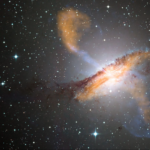
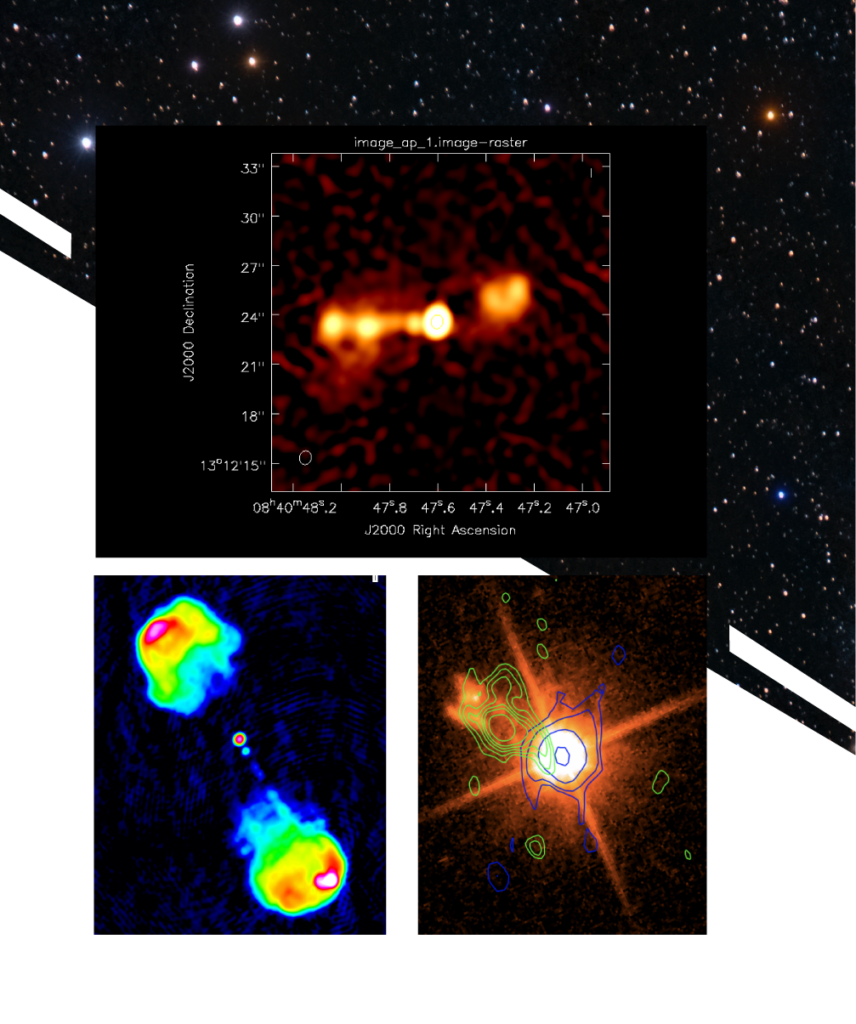 Top: Image using radio waves to visualize a faint jet of plasma (extending to the upper right), powered by a super-massive black hole (the bright white circle). Bottom right: Galaxy 3C 186, where Meyer and colleagues found a black hole that had been “kicked” out of the center of the galaxy. The black hole (blue lines/bright white area) is offset from its galaxy’s center (green lines). Bottom left: The red dot at the center represents a black hole. The rainbow blobs in either corner represent regions where intense radiation is being emitted. The entire image is about 1 million light-years across, and the galaxy is about 6 billion light-years from Earth. Images courtesy of Meyer.
Meyer also studies black hole mergers—the combining of two black holes into one. It’s another research area fraught with uncertainty and with much left to discover. Recently, she co-led a project that found the most convincing evidence yet of a merged black hole that has been “kicked” out of the center of its galaxy, in this case, at 4.5 million miles per hour.
“The history of studying black holes,” Meyer says, “is just one surprise or ‘what the heck’ after another.”
Striking out on her own
As exciting and rewarding as studying black holes is, when asked about major milestones in her career trajectory, rather than naming the funding of a huge proposal or a publication that moved the needle in her field, Meyer turns to more intangible matters. After completing a Ph.D., which Meyer did at Rice in 2012, a researcher should transition to becoming truly independent in setting goals and priorities, bringing in funding, managing a research group, and going beyond “the projects your advisor wanted to do,” she says.
After a postdoctoral fellowship at the Space Telescope Science Institute (STCsI) at Johns Hopkins University under an inspiring mentor, Bill Sparks, Meyer joined the UMBC faculty in 2015. It would be the first time she had a “lab of her own.” Sparks was confident she was on a path to great things at the time. “It was a real pleasure to work with Eileen at STScI; we considered ourselves very fortunate to bring her there,” he says, adding that her work there “was extremely favorably received. An eminent astronomer described it as ‘truly beautiful work.’”
Yet, like new faculty members everywhere, at UMBC Meyer says she went through a period of proving herself— working hard to bring in major grants, come up with fresh research ideas, and publishing high-impact papers as a lead investigator. The first major milestone “felt like it happened eventually after I’d been here a couple years,” she says. “I felt like I could call myself an independent researcher.”
Independent, but not alone
Even as she worked toward independence as a researcher, Meyer certainly wasn’t alone. Mentors like Sparks and Meyer’s husband, Markos Georganopoulos, professor of physics at UMBC, and others in the department and at the university have provided support along the way.
“He was a little bit ahead of me in the career stage,” Meyer says of Georganopoulos, “so everything I would go through he had gone through a few years before. You can kind of mentor each other because you have a sounding board.” Their research is similar enough that Georganopoulos is a co-author on some of Meyer’s publications.
Jane Turner, former director of the Center for Space Sciences and Technology, a UMBC partnership with NASA, also mentored Meyer in her early days at UMBC. “I’ve come to appreciate that UMBC is a very supportive place—the department, the college, and the school in general,” Meyer says. “It’s absolutely true that people want you to succeed here. I’ve always felt that.”
Meyer understands the importance of mentorship, as the first person in her family to earn a Ph.D. She enjoys paying that support forward to UMBC students. “I really love our student population. They’re just fantastic,” she says. “There’s a certain seriousness and maturity that they have that I really appreciate.”
Some of her students are the first person in their family to earn a college degree, and many more, like Meyer, are the first in their family to be considering graduate school. “I feel like I identify with our student population, which makes working with them really a joy.”
Life as a parent-researcher
In 2019, Meyer and Georganopoulos welcomed their son into the world, and she felt the strength of the UMBC community even more. “Parenting and being a highly active researcher is a real challenge,” Meyer says, especially when you’ve moved far from family in order to pursue your dream of being on the faculty at a research university. While “the department and UMBC in general has been very helpful,” parenting still hasn’t been easy given “systemic bigger issues that we have with supporting parents,” she says.
Always a determined problem solver, however, Meyer has found ways to succeed both as a parent and as a scientist. Mentors advised her to consider all of her unfinished projects (of which any researcher usually has many), and instead of trying in vain to complete them all, “focus on where you can make major progress in the field. Focus on impact, and let the others go,” she says. She has taken that advice to heart—especially through the pandemic.
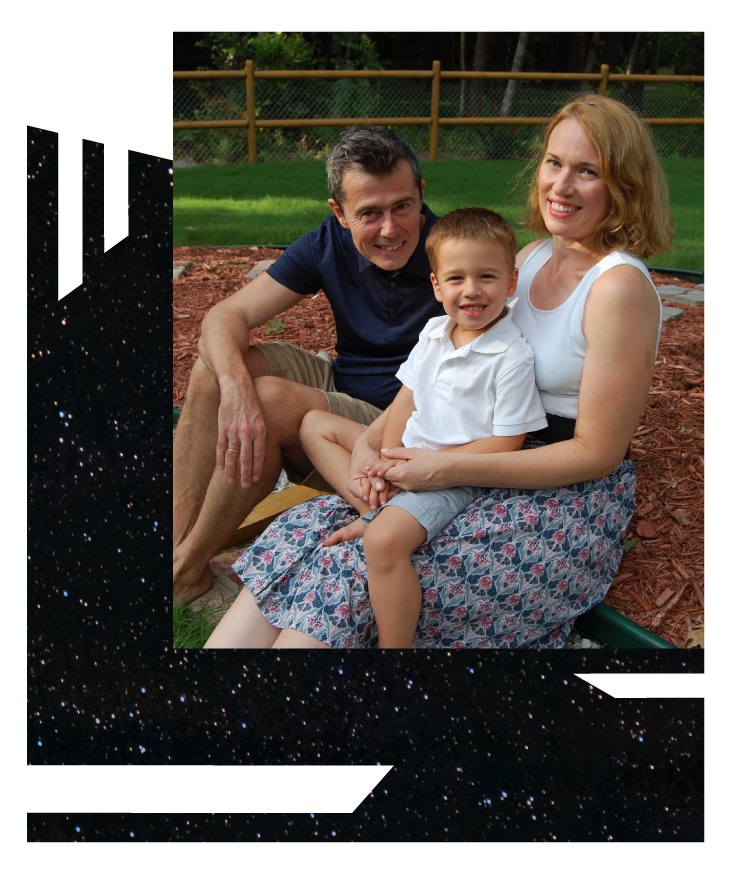 Meyer with husband, Markos Georganopoulos, and their son, Stefanos. (Photo courtesy of Meyer)
And now that she’s more established in her field and as a researcher, it’s time to step back from the “take every opportunity” mentality and learn to say no, which can be a special challenge for women and young scientists, Meyer says. “Bill [Sparks] was always very good at that,” though, she adds—and that’s not the only thing she’s taken from his mentorship.
“He is my model for what a scientist should be,” Meyer says. Especially with current pressures to publish and win grants at a rapid clip, Sparks “always did only what he was interested in,” even shifting focus from astrophysics to astrobiology later in his career. “I want to be as free as he is with how he does his work,” Meyer says.
Living the freedom
Today, Meyer is living that freedom by exploring new kinds of research using the UMBC observatory, and Sparks has joined UMBC as an adjunct faculty member to support the effort. In addition to fixing up broken motors and buying a much larger ladder, Meyer plans to build a new instrument called a polarimeter, which will make observations of objects in our solar system, phenomena farther away such as flare stars, and other targets possible with the UMBC telescope.
“It’s great to be working with Eileen again—she’s so darn good at everything and always open to taking on something new and unfamiliar, whether it’s building polarimeters, climbing wobbly ladders, or thinking about black holes and the origin of the universe,” Sparks says. “Eileen is one of the most capable and versatile researchers in astronomy—and our project should keep UMBC at the forefront of a unique, innovative scientific niche.”
Making new missions happen
She is also on the leadership team of a University of Maryland-led consortium competing for NASA funding for a new space-based satellite mission. NASA put out a call for proposals for high–energy astrophysics missions, and her team’s entry, the Advanced X-ray Imaging Satellite (AXIS), would capture extremely high resolution X-ray images to study galaxy formation, black holes, and much more.
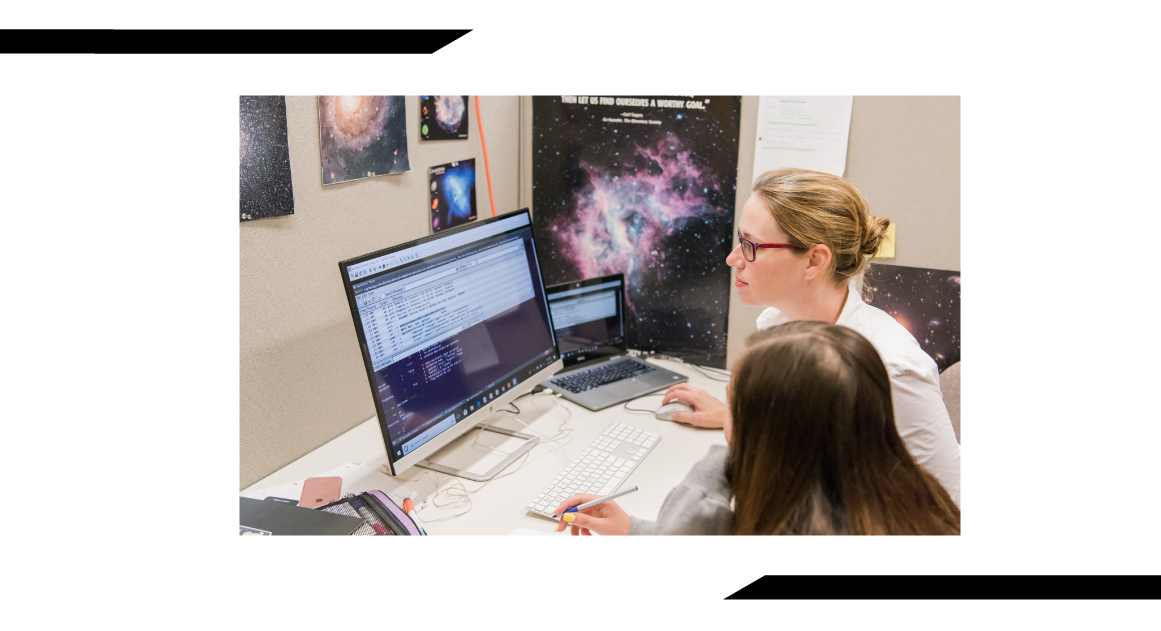 Meyer working with a student. (Marlayna Demond ’11/UMBC)
This role is an exciting change for Meyer. She describes herself as coming from “a classical academic path,” where she relied on data from both land- and space-based instruments but was never involved in their design, construction, or the bureaucracy often involved in actually putting a satellite in the sky. After attending a summer workshop at Harvard, however, her perspective shifted. A scientist on the original Chandra X-ray Observatory mission team gave a talk describing the iconic mission’s 30-year journey from concept to launch, which finally happened in 1999.
“I was astounded by how difficult it was—the immense challenge—but then also how amazing it is that eventually this thing flew, and it’s still working—it’s still taking amazing images all the time,” Meyer says. “Ever since then, I always thought I would love to get involved in that process, to help be an advocate for new observatories, new technologies. So when I was asked to join AXIS I was very happy, because it’s been a long-term side dream of mine to be involved in making new missions happen.”
The things that are mine
As her career—and her family—moves forward, Meyer is hitting her stride. “I love studying black holes and jets, but it’s still true that that was my advisor’s topic,” she says. But with AXIS, the observatory work, and other new collaborations, “I feel like I’m getting into the things that were really mine—the things that were interesting to me all along,” she says.
The UMBC physics department plans to hire at least one more faculty member in high-energy physics soon. That could also shape Meyer’s work, depending on her new colleague’s areas of interest. She’s also been approached by researchers in the Center for Space Sciences and Technology for collaboration. Put simply, the future is bright for Eileen Meyer, and she’s savoring it all.
“I think of myself as an open person; I could see myself doing work that I haven’t imagined yet,” she says. “I like it when people bring me problems to think about. We’ll see where we go next.”
]]>
On a chilly morning in early spring 2022, Eileen Meyer, Roy Prouty, and Erik Crowe were on the roof of the UMBC Physics Building. They were inside the observatory dome, trying to figure out what...
https://umbc.edu/stories/a-space-of-ones-own-black-hole-research/
https://my3.my.umbc.edu/api/v0/pixel/news/129656/guest@my.umbc.edu/dd748553777dae8acd9e475258d69b88/api/pixel
cnms
discovery
fall-2022
magazine
physics
UMBC News & Magazine
https://my3.my.umbc.edu/groups/umbc-news-magazine
https://assets1-my.umbc.edu/system/shared/avatars/groups/000/001/943/24435aa6207c452e7bc15cc74b42c7bb/xsmall.png?1748556657
https://assets1-my.umbc.edu/system/shared/avatars/groups/000/001/943/24435aa6207c452e7bc15cc74b42c7bb/original.png?1748556657
https://assets2-my.umbc.edu/system/shared/avatars/groups/000/001/943/24435aa6207c452e7bc15cc74b42c7bb/xxlarge.png?1748556657
https://assets2-my.umbc.edu/system/shared/avatars/groups/000/001/943/24435aa6207c452e7bc15cc74b42c7bb/xlarge.png?1748556657
https://assets3-my.umbc.edu/system/shared/avatars/groups/000/001/943/24435aa6207c452e7bc15cc74b42c7bb/large.png?1748556657
https://assets1-my.umbc.edu/system/shared/avatars/groups/000/001/943/24435aa6207c452e7bc15cc74b42c7bb/medium.png?1748556657
https://assets2-my.umbc.edu/system/shared/avatars/groups/000/001/943/24435aa6207c452e7bc15cc74b42c7bb/small.png?1748556657
https://assets1-my.umbc.edu/system/shared/avatars/groups/000/001/943/24435aa6207c452e7bc15cc74b42c7bb/xsmall.png?1748556657
https://assets2-my.umbc.edu/system/shared/avatars/groups/000/001/943/24435aa6207c452e7bc15cc74b42c7bb/xxsmall.png?1748556657
UMBC News & Magazine
2
0
false
Wed, 07 Dec 2022 12:59:50 -0500
Wed, 07 Dec 2022 12:59:50 -0500
UMBC’s Zhibo Zhang to clarify atmospheric dust’s role in climate with NSF grant
Natural dust particles and human-produced pollutants in the atmosphere affect Earth’s overall energy budget in different and nuanced ways. A new three-year, $620,000 NSF grant led by Zhibo Zhang, professor of physics, will study how dust, pollutants, and water vapor in the atmosphere interact, to increase understanding of their overall effects on the global climate.
Atmospheric dust particles are large enough that they can reflect the Sun’s energy back to space, producing a cooling effect—but they can also trap energy from the earth trying to escape, contributing to warming. Most pollutants are too small to contribute to cooling, and tend to warm the planet instead, Zhang explains. But when the two mix in the atmosphere, which is commonplace, things get complicated. The new project will work to disentangle the effects of different kinds of particles through a combination of techniques.
Zhang is particularly excited about the upcoming work, because research led by his former students made it possible. Qianqian Song, Ph.D. ’21, atmospheric physics, “wrote three papers over the last three years that gave us the credentials to apply for this program,” Zhang says. Olivia Norman’20, physics, also contributed substantially. Song is currently pursuing a postdoc at Princeton, and Norman is in graduate school at M.I.T.
Moving forward, Tony La Luna, a new Ph.D. student in Zhang’s lab, will focus on the project, and Zhang is looking forward to adding more students to his team.
Domino effect in the atmosphere
Wind is always lifting dust from Earth’s surface, especially in arid areas such as the Sahara and Gobi Deserts. Once airborne, the dust can travel long distances and interact with other particles in the atmosphere.
“When dust moves from its source region to a polluted area, it gets mixed with the pollution there. And we are interested in these interactions,” Zhang says. His team’s research has shown these interactions are most common in eastern China, India, and central Africa.
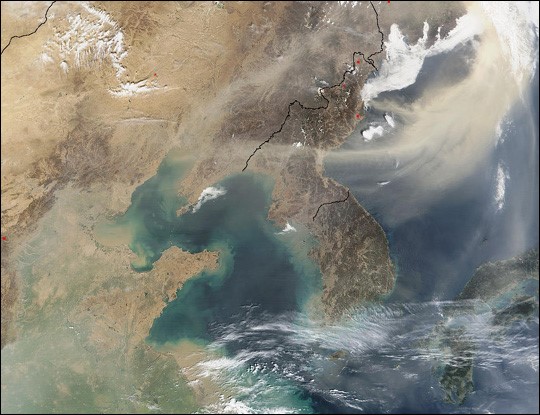 A satellite image centered on the Korean peninsula shows dust and clouds in the atmosphere. (Jacques Descloitres/NASA GSFC)
Until very recently, researchers typically modeled dust and pollutants separately, assuming they did not interact. But based on Zhang’s group’s research, that approach doesn’t produce a good approximation of what’s actually happening, he says.
Where dust and pollutants mix, tiny pollutant particles can condense onto larger dust particles. “The pollution particles can bump into the dust and stick together,” Zhang says. Then a domino effect ensues: “Once the pollution is coated on the dust,” he says, “it changes the way the dust interacts with water.”
Dust generally repels water, but pollutants are often attracted to water molecules. So dust coated with pollutants, called “coated dust,” can start to collect water. By changing how the dust reflects light, “This coating can change the net effect from cooling to warming,” Zhang says. By providing a surface to which water molecules can attach, the coated dust can also contribute to cloud formation, which affects precipitation.
Beyond satellite images
It can actually be difficult to tell whether a satellite image shows dust, pollution, or coated dust—so developing techniques to distinguish between different kinds of atmospheric particles is another one of the team’s goals.
“First, we need a good dust model,” Zhang says. His collaborator Dr. Diana Ortiz-Montalvo at the National Institute of Standards and Technology (NIST) uses a special imaging technique to precisely measure the shape of dust particles in the lab. Those measurements will help create models of different kinds of dust.
In general, pure dust has jagged edges. However, if the dust is thickly coated, it appears spherical again; this is called “smoothed dust.” A smoothing effect can also happen if water binds to dust and then evaporates.
Knowing exactly what each type of dust looks like will support efforts to more accurately identify them in satellite images, and understand how each type will behave in the sky.
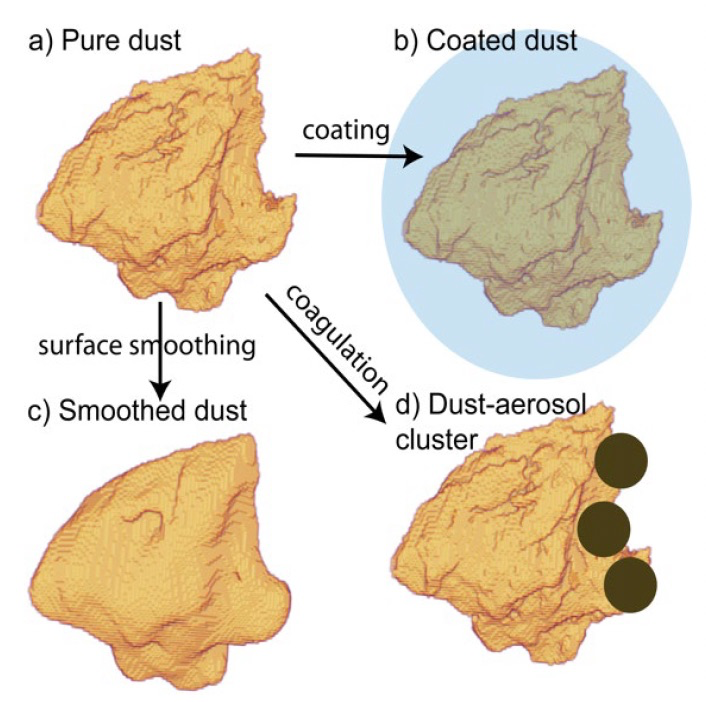 Different combinations of dust and pollutants take different shapes, which can be identified in the atmosphere through a combination of satellite data. (Image courtesy Zhibo Zhang)
Scattering light—and focusing on results
With the dust models in hand, Zhang’s team will calculate how the dust would interact with different particles it might encounter in the sky, like water, smoke, or industrial pollutants. Specifically, they will estimate how the dust would reflect—or “scatter”—light that strikes it. The scattering pattern depends on how rough or smooth the dust is.
The researchers will also analyze observational data that measure how dust all over the globe is scattering light. “Then we’ll combine lab measurements, the scattering calculations, and these satellite observations all together,” Zhang says, to answer the project’s ultimate question: Is dust and its interactions with other particles warming or cooling the planet, and how much?
Zhang’s research group melds computer science, physics, and climate science to address some of the least understood factors contributing to global climate. The new project will further those efforts, with the potential to clarify what roles dust and other atmospheric particles play. Along the way, it will also prepare students for successful careers in science.
“The new grant is indeed based on the success of the students. They laid the foundation for this project,” Zhang says. Much like his students, he adds, “I’m excited to take this essential next step in addressing an issue that affects our planet so profoundly.”
]]>
Natural dust particles and human-produced pollutants in the atmosphere affect Earth’s overall energy budget in different and nuanced ways. A new three-year, $620,000 NSF grant led by Zhibo Zhang,...
https://umbc.edu/stories/atmospheric-dusts-role-in-climate/
https://my3.my.umbc.edu/api/v0/pixel/news/129515/guest@my.umbc.edu/025047a936fc75ca4ae64cc21e4dfcd5/api/pixel
cnms
gradresearch
news
physics
rca-2
research
science-and-tech
undergraduate-research
UMBC News & Magazine
https://my3.my.umbc.edu/groups/umbc-news-magazine
https://assets1-my.umbc.edu/system/shared/avatars/groups/000/001/943/24435aa6207c452e7bc15cc74b42c7bb/xsmall.png?1748556657
https://assets1-my.umbc.edu/system/shared/avatars/groups/000/001/943/24435aa6207c452e7bc15cc74b42c7bb/original.png?1748556657
https://assets2-my.umbc.edu/system/shared/avatars/groups/000/001/943/24435aa6207c452e7bc15cc74b42c7bb/xxlarge.png?1748556657
https://assets2-my.umbc.edu/system/shared/avatars/groups/000/001/943/24435aa6207c452e7bc15cc74b42c7bb/xlarge.png?1748556657
https://assets3-my.umbc.edu/system/shared/avatars/groups/000/001/943/24435aa6207c452e7bc15cc74b42c7bb/large.png?1748556657
https://assets1-my.umbc.edu/system/shared/avatars/groups/000/001/943/24435aa6207c452e7bc15cc74b42c7bb/medium.png?1748556657
https://assets2-my.umbc.edu/system/shared/avatars/groups/000/001/943/24435aa6207c452e7bc15cc74b42c7bb/small.png?1748556657
https://assets1-my.umbc.edu/system/shared/avatars/groups/000/001/943/24435aa6207c452e7bc15cc74b42c7bb/xsmall.png?1748556657
https://assets2-my.umbc.edu/system/shared/avatars/groups/000/001/943/24435aa6207c452e7bc15cc74b42c7bb/xxsmall.png?1748556657
UMBC News & Magazine
0
0
false
Thu, 01 Dec 2022 16:46:00 -0500
Thu, 01 Dec 2022 16:46:00 -0500
GRIT-X 2022 brings to life the “essence” of UMBC research and creative achievement

Amid a bustling day filled with Homecoming excitement, GRIT-X returned to UMBC this month for its sixth year, delivering a wide-ranging lineup of Retriever excellence in action. Held in the Fine Arts Recital Hall, this year’s GRIT-X was the first for new UMBC President Valerie Sheares Ashby. Enjoying one engaging talk after another, she deemed the event “the essence of UMBC.”
“What a beautiful day,” said President Sheares Ashby, in her remarks to the GRIT-X audience. “Not only were [the presenters] brilliant, they were people-centric. They were thinking about things that were real and important to each one of our lives being better, the universe being better, our bodies being better, and our communities being better. I cannot have experienced a better first GRIT-X.”
Watch the GRIT-X 2022 talks
Rethinking digital divides: Creating access, experiential learning, and empathy in the digital world
Delali Dzirasa ‘04, computer engineering, opened this year’s GRIT-X event with a presentation detailing how his company, Fearless, led the development of the Searchable Museum to complement the Smithsonian National Museum of African American History and Culture (NMAAHC) “Slavery and Freedom” exhibition. Dzirasa elaborated on how his team, including several UMBC alumni, was able to reimagine this exhibit specifically for online audiences amid the pandemic. The Fearless CEO was the third in his family to deliver a GRIT-X talk, following his wife, Baltimore City Health Commissioner Letitia Dzirasa ‘03, biological sciences (GRIT-X 2021), and his brother Kafui Dzirasa ‘01, M8, chemical engineering (GRIT-X 2017).
Can we reduce the deluge in sea levels with a data deluge?
Vandana Janeja, professor and chair of information systems, discussed the research she’s leading as the director of the NSF HDR Institute for Harnessing Data and Model Revolution in the Polar Regions, or iHARP. Janeja outlined how she and the iHARP team are utilizing data science, machine learning, artificial intelligence, and polar science to analyze enormous volumes of climate data as well as Arctic and Antarctic observations in ways that could help populations respond to the harmful impacts of climate change.
Sounds of the world through the violin
Airi Yoshioka, professor of music, delivered her presentation on how the cultural background of a composer manifests in the music they create. Yoshioka played excerpts of music from several composers around the world, explaining how they were able to express their cultural identities through their music. The violinist then captured the imagination of the audience with her striking performance of “Sentimental” from “Five Little Milonguitas” by composer Pablo Ortiz from her 2015 album Sueños Misticos.
Community building: How to build with materials that are stronger than brick and mortar
Alicia Lynn Wilson ‘04, political science, serves as vice president for economic development at Johns Hopkins University. She has taken part in some of the largest redevelopment efforts in the country, overseeing more than $10 billion in redevelopment projects in the last decade. Wilson shared her perspective on how every person is involved in construction, being actively engaged in the community-building enterprise. Her presentation outlined five principles that she relies on when forging and maintaining community connections.
Glucosome: 4D Visualization of the secret society of metabolic enzymes
Minjoung Kyoung, associate professor of chemistry and biochemistry, started her presentation on metabolic enzymes in an unexpected way: by showing the audience a picture of donuts. The image helped to entice the audience as they listened to her research on how the food we eat transforms into glucose and the metabolic process that happens as a result. The presentation explored the glucose metabolism and its 4-dimensional network with mitochondria in living cells, and how Kyoung’s team built the Lattice Light Sheet Microscope to better visualize small features inside of living cells.
Green walls or greenwashing? Tree planting dreams meet reality
Matthew Fagan, associate professor of geography and environmental systems, delved into his research related to forest restoration and reforestation showing that sometimes, planting trees can cause more harm than good. He educated the audience on the rise of tree planting initiatives around the world and the reality of what has happened as a result of reforestation efforts.
The many faces of immune cells: Building back tissues after trauma
Kaitlyn Sadtler, ‘11, biological sciences, who earned an honorary doctorate from UMBC in 2022, presented on immunology and how the body works to heal after injuries. Sadtler is an investigator and chief of the section on immunoengineering at the NIH’s National Institute for Biomedical Imaging and Bioengineering. She earned a Ph.D. at Johns Hopkins University School of Medicine and completed a postdoctoral fellowship at MIT. She described her lab’s research into different immune cells and how they respond during injuries. She also shared how her team is working to develop new methods to help modulate the immune response to injury and implantation of medical devices.
The quantum universe is weird, but our world is not: Schrödinger’s cat is dead, right?
Sebastian Deffner, associate professor of physics, focused his presentation on demystifying the world of quantum physics and the quantum universe. He offered the audience an introduction to the components of this growing field of study. He also explained different interpretations of quantum mechanics with his analysis of the “Schrödinger’s cat” thought experiment.
Sometimes systems fail us: Designing alternatives for domestic violence survivors
Nkiru Nnawulezi, associate professor of psychology, has been working with the D.C. Coalition Against Domestic Violence to collect data on the experiences of domestic violence survivors in Washington D.C., particularly related to housing services. She closed the afternoon’s program by detailing her experience of conducting research interviews with the survivors. She explored what can be done to create more inclusive community responses that support domestic violence survivors in more effective and sustainable ways.
Karl V. Steiner, vice president for research and creative achievement, was the master of ceremonies for GRIT-X 2022. Moderators included: Keith J Bowman, dean of the College of Engineering and Information Technology; Kimberly R. Moffitt, dean of the College of Arts, Humanities, and Social Sciences; and William R. LaCourse, dean of the College of Natural and Mathematical Sciences.
]]>
Amid a bustling day filled with Homecoming excitement, GRIT-X returned to UMBC this month for its sixth year, delivering a wide-ranging lineup of Retriever excellence in action. Held in the Fine...
https://umbc.edu/stories/grit-x-2022/
https://my3.my.umbc.edu/api/v0/pixel/news/128765/guest@my.umbc.edu/3a6b060d8327cd311dbd3f355324b5d7/api/pixel
biology
cahss
chembiochem
cnms
coeit
community
csee
ges
grit-x
is
music
physics
politicalscience
psychology
rca-1
research
UMBC News & Magazine
https://my3.my.umbc.edu/groups/umbc-news-magazine
https://assets1-my.umbc.edu/system/shared/avatars/groups/000/001/943/24435aa6207c452e7bc15cc74b42c7bb/xsmall.png?1748556657
https://assets1-my.umbc.edu/system/shared/avatars/groups/000/001/943/24435aa6207c452e7bc15cc74b42c7bb/original.png?1748556657
https://assets2-my.umbc.edu/system/shared/avatars/groups/000/001/943/24435aa6207c452e7bc15cc74b42c7bb/xxlarge.png?1748556657
https://assets2-my.umbc.edu/system/shared/avatars/groups/000/001/943/24435aa6207c452e7bc15cc74b42c7bb/xlarge.png?1748556657
https://assets3-my.umbc.edu/system/shared/avatars/groups/000/001/943/24435aa6207c452e7bc15cc74b42c7bb/large.png?1748556657
https://assets1-my.umbc.edu/system/shared/avatars/groups/000/001/943/24435aa6207c452e7bc15cc74b42c7bb/medium.png?1748556657
https://assets2-my.umbc.edu/system/shared/avatars/groups/000/001/943/24435aa6207c452e7bc15cc74b42c7bb/small.png?1748556657
https://assets1-my.umbc.edu/system/shared/avatars/groups/000/001/943/24435aa6207c452e7bc15cc74b42c7bb/xsmall.png?1748556657
https://assets2-my.umbc.edu/system/shared/avatars/groups/000/001/943/24435aa6207c452e7bc15cc74b42c7bb/xxsmall.png?1748556657
UMBC News & Magazine
0
0
false
Wed, 26 Oct 2022 14:14:14 -0400
Wed, 26 Oct 2022 14:14:14 -0400
Ozone and thunderstorms: Two UMBC Ph.D. students receive prestigious NASA grants, mentor undergraduates
Two UMBC Ph.D. students in atmospheric physics, Maurice Roots and Kylie Hoffman, have received competitive Future Investigators in NASA Earth and Space Science and Technology (FINESST) awards that will support the remainder of their graduate studies. Roots’s research project will focus on air pollution and Hoffman will target thunderstorms, both using remote sensing techniques. Each will receive up to $150,000 over a maximum of three years for tuition, research, professional development, and other expenses.
Tracking ozone’s journey
Roots will further his study of ozone found near the Earth’s surface. Unlike ozone in the upper atmosphere, which is critical for protecting organisms on Earth from powerful solar radiation, ozone near the surface is a form of air pollution. It can lead to respiratory issues in animals (including humans) and reduce crop yields by damaging plants’ leaves.
Combustion engines are the main producers of surface-level ozone, because they release molecules that can convert to ozone when they interact with sunlight. Roots is particularly interested in ozone prevalence in the Chesapeake Bay region and other urban areas on bays, such as New York City and San Francisco, because “water is like a mirror,” he says, and with more light bouncing around, there are many more opportunities to generate harmful ozone.
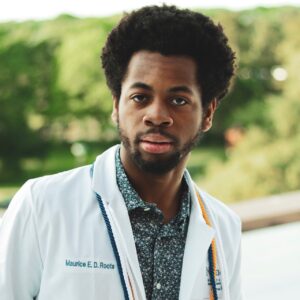 Maurice Roots (image courtesy of Roots)
Roots will use a network of ground-based remote sensing instruments to improve understanding of how ozone forms and moves around, with a focus on the Eastern United States.
It’s an exciting time to be in remote sensing and ozone studies, Roots says, in part because “we’re still finding out things about simply when and where high ozone is happening.” At the same time, the instrument network “is becoming a teenager. It’s grown up a lot, and a lot of changes are about to start happening.” One of Roots’s main goals with the new project is to generate a “synergy of NASA’s ground-based instruments,” where all of the data they produce can be easily gathered and interpreted together to form conclusions.
Understanding not just where ozone forms, but where it travels from there, is important, Roots says. For example, phenomena called “nocturnal low-level jets” can move air (and ozone and other pollutants with it) from Georgia to New York in one night, he explains, which “changes the whole regulatory perspective.” Right now, states or cities can be fined for having too many instances of high ozone—but if the ozone may have come from several states away, the picture gets more complicated.
While Roots isn’t directly involved in policy, his work to improve “process-level understanding” of where ozone is created, how it moves, and where it ends up could influence regulation in the future.
Predicting thunderstorms, protecting farmers
Hoffman’s work will explore how severe thunderstorms form in the southern United States, especially at night. The genesis of these storms is currently poorly understood, despite their important implications for community safety and agriculture.
Belay Demoz, professor of physics and director of the Goddard Earth Science Technology and Research (GESTAR) II Center, and also Hoffman’s and Root’s Ph.D. advisor, co-led the Plains Elevated Convection at Night (PECAN) mission in 2015. It used ground- and aircraft-based instruments to collect a huge amount of data about storms in the U.S. southern plains, much of which has the potential for more in-depth analysis, Hoffman says. She will develop a few in-depth case studies using PECAN data, seeking clues about which variables are most important for forming these storms, such as temperature, wind speed, and water vapor concentrations. After that, she’ll expand to determining the frequency of severe storms and what features differentiate them from milder events.
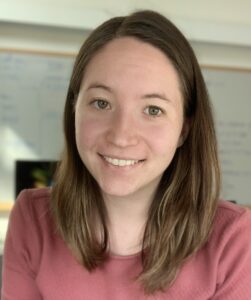 Kylie Hoffman (image courtesy of Hoffman)
“A lot of people research these storms with weather models and simulations, but there hasn’t been a ton of research done with remote sensing observations yet,” Hoffman says. “I plan to use the PECAN datasets to calculate atmospheric quantities that are typically only evaluated in model-based research, and determine what potential uses this approach has for improving our understanding of these storms.” Her eventual goal is to develop better forecasting for thunderstorms, especially to benefit the many farmers in the southern plains.
Hoffman’s research is interdisciplinary and brings together the work of NASA and the National Oceanic and Atmospheric Administration (NOAA), which previously awarded her a research fellowship. Better weather forecasting is “also one of NOAA’s main missions,” she explains, “to help us become a weather-ready nation, and improve our ability to inform people and small businesses” about the risks severe weather can pose to lives and livelihoods.
Making it official
Hoffman’s research as an undergraduate meteorology major also used remote sensing data, which she enjoyed. As a result, “I was looking specifically for a meteorology or atmospheric physics graduate program that worked with remote sensing data,” she says, “and that’s one of the strengths of the UMBC program.”
In preparing her FINESST application, “I felt very supported by Belay [Demoz] and the whole office. It was exciting. It felt really official,” she says. “Writing the application helped me clarify where I want to go with my research. And even if I hadn’t gotten the grant, it was helpful just to know the process.”
Demoz is thrilled to have two students receive the FINESST award—a rare event for any Ph.D. advisor. “I know firsthand how competitive this was, and I am very proud of their accomplishment,” Demoz says.
He’s also proud of the work they do outside the lab, supporting other students and choosing projects that could have real public impact. “This is what I would like all our grad students to do, since it prepares them well for entering the professoriate,” he shares. “I’m honored to say they are my graduate students.”
Paying it forward
Roots and Hoffman have already begun to pay forward the support they received from mentors at UMBC. This past summer, they and three more graduate students, including Emily Faber, M.S. ’21, atmospheric physics, a current Ph.D. student in the same field, served as mentors in the eight-week Student Airborne Science Activation (SaSa) program. The NASA-funded program offers high-achieving first- and second-year undergraduates at minority-serving institutions (MSIs) the opportunity to gain experience with airborne field research campaigns through a paid internship.
This year, SaSa welcomed 24 students, including four from UMBC, to UMBC’s main campus for four weeks. Participants spent the other four weeks at the NASA Wallops Flight Facility in Wallops Island, Virginia. The graduate students served as the participants’ primary mentors, Hoffman explains, from helping them develop research questions to guiding them through final presentations.
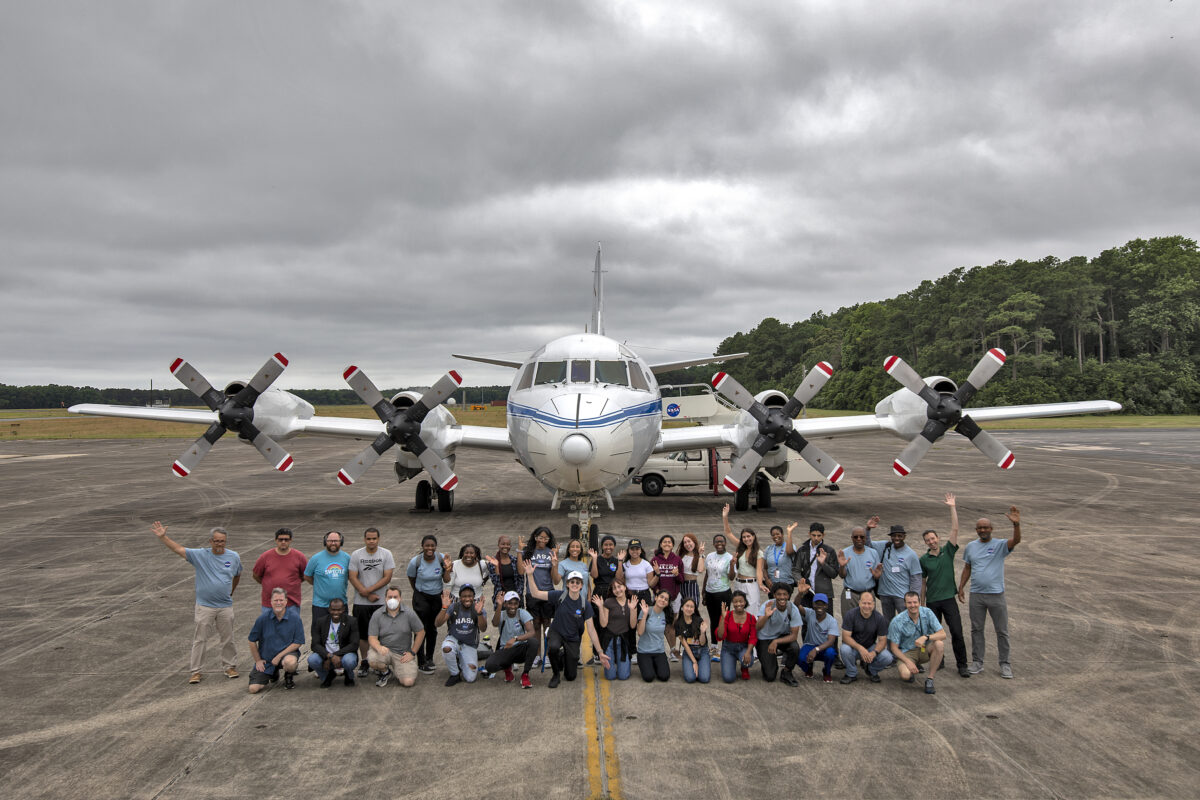 Participants in the 2022 SaSa program at NASA Wallops Flight Facility. (image courtesy of Belay Demoz)
Two of the UMBC participants decided to continue conducting research with Demoz’s group during the academic year. Trisha Joy Francisco ’25, mechanical engineering, is working with Hoffman on pollution measurements. Eric Ekey ’25, computer engineering, will start work soon with Roots.
Hoffman recalls a transformative summer internship that gave her the confidence to apply to graduate school. “That’s part of what I wanted to do for the students—replicate what my mentor did to help me during that experience,” she says.
SaSa was mutually beneficial for the students and their mentors; it helped Roots boost his confidence, too. After answering student questions for a month, “by the end,” he says with a smile, “I realized, I guess I actually know a lot.”
With their FINESST awards, Hoffman and Roots will continue to put their knowledge and mentoring skills to work as they conduct research to answer big questions about how atmospheric dynamics impact our daily lives.
]]>
Two UMBC Ph.D. students in atmospheric physics, Maurice Roots and Kylie Hoffman, have received competitive Future Investigators in NASA Earth and Space Science and Technology (FINESST) awards that...
https://umbc.edu/stories/ozone-and-thunderstorms-nasa-grants-to-ph-d-students/
https://my3.my.umbc.edu/api/v0/pixel/news/128761/guest@my.umbc.edu/ad4d4f8a25d0c84acca13b01cb3bee0b/api/pixel
cnms
coeit
csee
diversityandinclusion
meche
news
physics
research
science-and-tech
UMBC News & Magazine
https://my3.my.umbc.edu/groups/umbc-news-magazine
https://assets1-my.umbc.edu/system/shared/avatars/groups/000/001/943/24435aa6207c452e7bc15cc74b42c7bb/xsmall.png?1748556657
https://assets1-my.umbc.edu/system/shared/avatars/groups/000/001/943/24435aa6207c452e7bc15cc74b42c7bb/original.png?1748556657
https://assets2-my.umbc.edu/system/shared/avatars/groups/000/001/943/24435aa6207c452e7bc15cc74b42c7bb/xxlarge.png?1748556657
https://assets2-my.umbc.edu/system/shared/avatars/groups/000/001/943/24435aa6207c452e7bc15cc74b42c7bb/xlarge.png?1748556657
https://assets3-my.umbc.edu/system/shared/avatars/groups/000/001/943/24435aa6207c452e7bc15cc74b42c7bb/large.png?1748556657
https://assets1-my.umbc.edu/system/shared/avatars/groups/000/001/943/24435aa6207c452e7bc15cc74b42c7bb/medium.png?1748556657
https://assets2-my.umbc.edu/system/shared/avatars/groups/000/001/943/24435aa6207c452e7bc15cc74b42c7bb/small.png?1748556657
https://assets1-my.umbc.edu/system/shared/avatars/groups/000/001/943/24435aa6207c452e7bc15cc74b42c7bb/xsmall.png?1748556657
https://assets2-my.umbc.edu/system/shared/avatars/groups/000/001/943/24435aa6207c452e7bc15cc74b42c7bb/xxsmall.png?1748556657
UMBC News & Magazine
0
0
false
Wed, 26 Oct 2022 12:51:31 -0400
Wed, 26 Oct 2022 12:51:31 -0400
UMBC researchers build next-gen satellite tech to examine Earth’s atmosphere
The first Hyper-Angular Rainbow Polarimeter (HARP) was a nano-satellite about as big as a loaf of bread. Developed by Vanderlei Martins, professor of physics, and his team of scientists and engineers at UMBC’s Earth and Space Institute, the HARP cubesat launched to the International Space Station in November 2019 and was released into orbit in February 2020. HARP spent over two years collecting first-of-its-kind data on Earth’s atmosphere, and finally deorbited in April 2022.
But that was just the beginning. Soon, HARP2 will be part of NASA’s Plankton, Aerosol, Cloud, ocean Ecosystem (PACE) mission. And the HARP team is preparing now to compete for a spot on the future NASA Atmosphere Observing System (AOS) mission as MegaHARP.
From the HARP cubesat, “We have data now on clouds. We have data over the ocean. We have data over land surfaces in a way that we never had before,” Martins says. The instrument was so impressive that the American Institute of Aeronautics and Astronautics named it SmallSat Mission of the Year in August 2021. “Now,” Martins says, “we are using HARP data to develop algorithms and methodologies that we will use for these other missions.”
Proving it works
On its 27-month flight, HARP’s unique sensors collected new kinds of information about clouds and tiny particles in Earth’s atmosphere, such as wildfire smoke, desert dust, and human-generated pollutants. These particles, collectively known as aerosols, have many effects on the global climate and the health of organisms. The data may inform refined climate models or strategies to reduce the effects of air pollution.
HARP also broke ground in the way it collects data. HARP captures images, but “it’s not a camera that takes pictures. It’s something a lot more sophisticated,” Martins explains. “It’s taking thousands of these pictures and recombining them in a way that becomes a multi-dimensional scientific data set.”
A single composite image generated by HARP can contain the information from up to 1,000 original images. Each image and its information are extractable from the composite, which allows researchers to look at many different parameters depending on their goals.
“The HARP cubesat allowed us to prove that the idea we had of how to create the composite images worked,” Martins says.
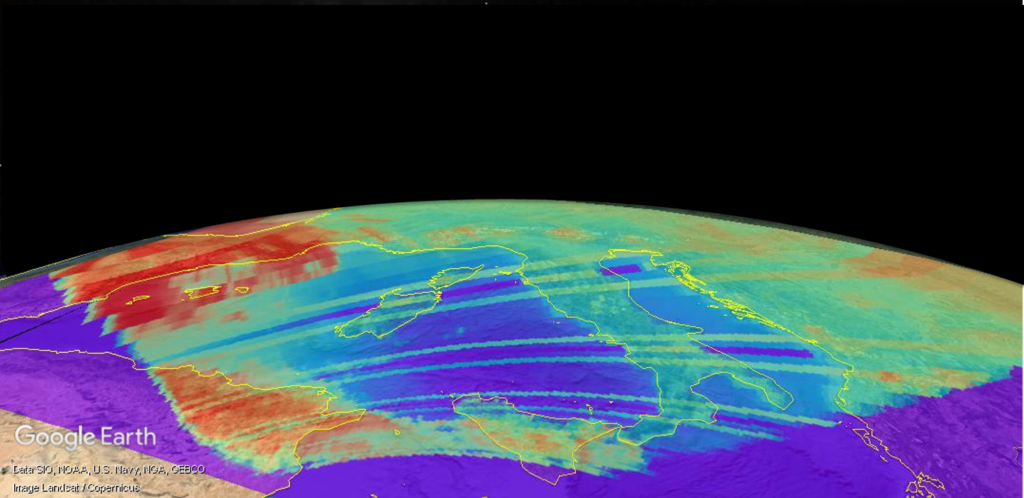 The stripes on this image HARP collected of the Mediterranean represent the many wavelengths of light, from near infrared to blue, that HARP’s sensors can detect. The HARP team combined hundreds of images like these to create smooth depictions of areas all around the world. (courtesy of Vanderlei Martins)
Opening the path
HARP’s physical design is also innovative. A single instrument with no moving parts houses the sensors and algorithms used to process all the different data types. That’s a big benefit for any instrument facing the harsh environment of space.
“For us, HARP was a pathfinder,” Martins says. “It was funded as a technology demonstration. So we launched HARP to demonstrate that this technology is possible, and to open the path for other missions that are coming after that.”
HARP2 is already taking advantage of lessons learned from HARP. It will fly on NASA’s PACE mission in 2024, but the team must deliver their instrument to the Goddard Space Flight Center this October.
“HARP2 is basically an advanced copy of the instrument payload in the HARP cubesat,” Martins says. Everything from calibration systems to the raw materials has undergone improvements.
Plus, due to greater availability of technical resources on the larger PACE mission compared to the original cubesat, Martins explains, “HARP2 in five hours will collect as much data as HARP cubesat collected in two years.”
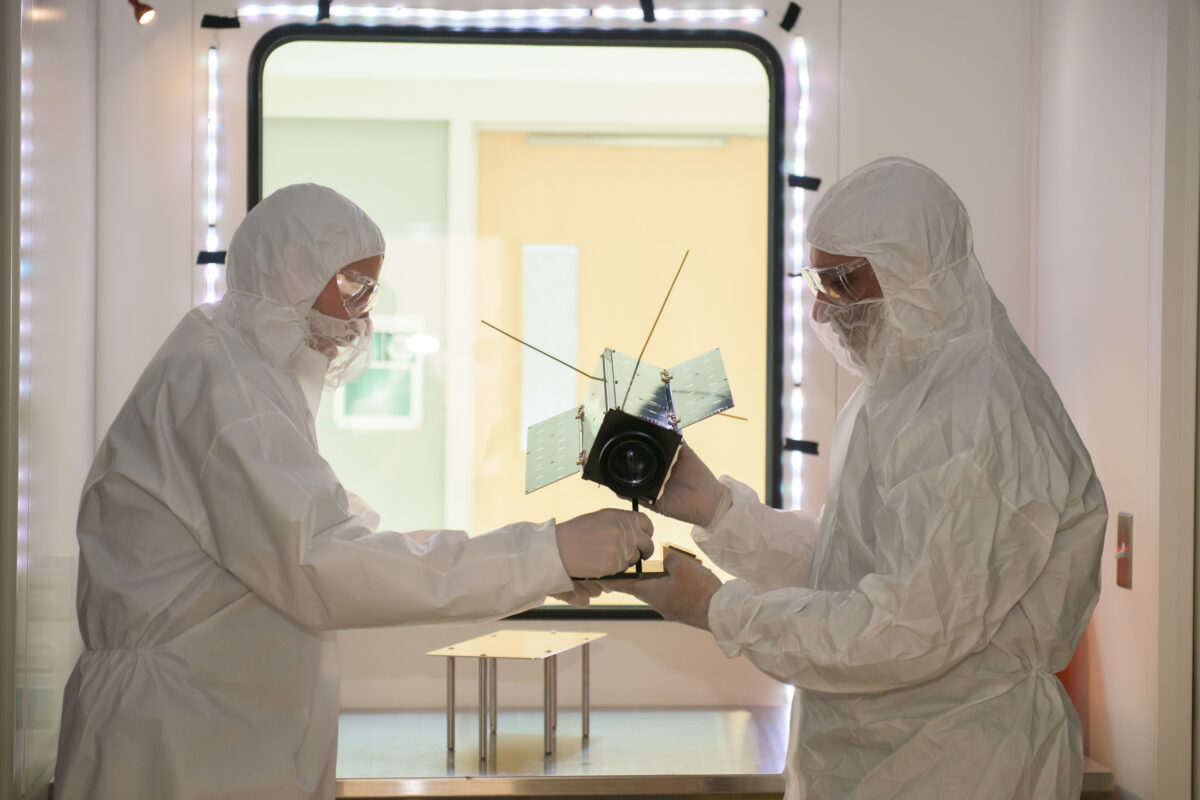 Researchers work on the HARP cubesat in a clean room. (Marlayna Demond/UMBC)
Launching satellites and careers
Since its inception, HARP has also lived up to UMBC’s mission to educate students and support the regional economy and workforce. Undergraduate and graduate students played key roles in the research, design, and construction phases for HARP and now HARP2.
“Relationships with federal agencies like NASA, all the work that we do with private companies around us, plus the training of students, who then go on to lead the same field they were working in, all fit very well the goals of our public research university,” Martins says.
Through HARP, HARP2, and early preparation for MegaHARP, every iteration of the project has prepared students for successful careers, proven new technologies, and generated new knowledge about the world. But, as an educator, perhaps the most rewarding part for Martins is seeing his students grow, find success, and then reach back to help others.
“We are seeing with HARP a full cycle. Students were involved in the inception of the idea for HARP from the beginning,” he says. “And today, students who were there working on HARP at the beginning are now in positions at NASA supporting the next generation.”
]]>
The first Hyper-Angular Rainbow Polarimeter (HARP) was a nano-satellite about as big as a loaf of bread. Developed by Vanderlei Martins, professor of physics, and his team of scientists and...
https://umbc.edu/stories/umbc-builds-next-gen-satellite-tech/
https://my3.my.umbc.edu/api/v0/pixel/news/128481/guest@my.umbc.edu/34ffd78318b57b5919988484353130bb/api/pixel
cnms
esi
news
physics
rca-2
research
science-and-tech
UMBC News & Magazine
https://my3.my.umbc.edu/groups/umbc-news-magazine
https://assets1-my.umbc.edu/system/shared/avatars/groups/000/001/943/24435aa6207c452e7bc15cc74b42c7bb/xsmall.png?1748556657
https://assets1-my.umbc.edu/system/shared/avatars/groups/000/001/943/24435aa6207c452e7bc15cc74b42c7bb/original.png?1748556657
https://assets2-my.umbc.edu/system/shared/avatars/groups/000/001/943/24435aa6207c452e7bc15cc74b42c7bb/xxlarge.png?1748556657
https://assets2-my.umbc.edu/system/shared/avatars/groups/000/001/943/24435aa6207c452e7bc15cc74b42c7bb/xlarge.png?1748556657
https://assets3-my.umbc.edu/system/shared/avatars/groups/000/001/943/24435aa6207c452e7bc15cc74b42c7bb/large.png?1748556657
https://assets1-my.umbc.edu/system/shared/avatars/groups/000/001/943/24435aa6207c452e7bc15cc74b42c7bb/medium.png?1748556657
https://assets2-my.umbc.edu/system/shared/avatars/groups/000/001/943/24435aa6207c452e7bc15cc74b42c7bb/small.png?1748556657
https://assets1-my.umbc.edu/system/shared/avatars/groups/000/001/943/24435aa6207c452e7bc15cc74b42c7bb/xsmall.png?1748556657
https://assets2-my.umbc.edu/system/shared/avatars/groups/000/001/943/24435aa6207c452e7bc15cc74b42c7bb/xxsmall.png?1748556657
UMBC News & Magazine
0
0
false
Fri, 14 Oct 2022 12:32:28 -0400
Fri, 14 Oct 2022 12:32:28 -0400
Meet a Retriever – Emily Faber, Ph.D. student in atmospheric physics
Meet Emily Faber, M.S. ’21, atmospheric physics, who is currently pursuing her doctorate in the same at UMBC. Emily is a first-generation college student who is also very involved as a student leader in the College of Natural and Mathematical Sciences. Take it away, Emily!
Q: What brought you to UMBC in the first place?
A: I came to UMBC for the department I am in. I knew I wanted to study Earth Science and I had a physics background so Atmospheric Physics is where I thought I could do the most good in the world. UMBC is also really well connected with the NASA and NOAA centers in the DMV area and I knew that is where I want to work, so it was a perfect match!
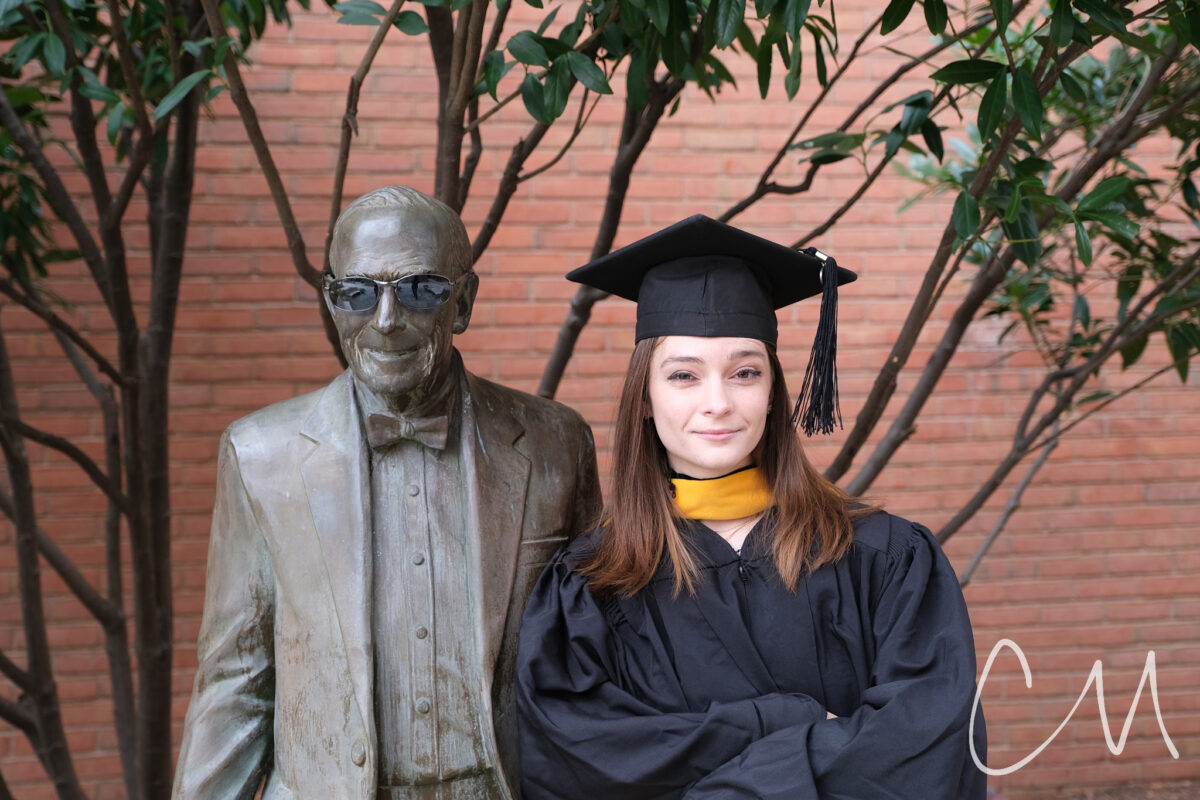 Faber poses with UMBC’s statue of Baltimore changemaker Walter Sondheim while celebrating the completion of her master’s degree in atmospheric physics. Photo courtesy of Faber.
Q: What’s the one thing you’d want someone who hasn’t joined the UMBC community to know about the support you find here?
A: It’s here! sometimes it seems hidden but there are people here that I’ve found that would do whatever they could to help me if I needed it. And I’ve seen them pull off some pretty amazing things for other students too! PROMISE, GSA (Graduate Student Association), individual faculty, and the deans are all great and supportive people!
“I knew I wanted to study Earth Science and I had a physics background so Atmospheric Physics is where I thought I could do the most good in the world. UMBC is also really well connected with the NASA and NOAA centers in the DMV area and I knew that is where I want to work, so it was a perfect match!”
Emily Faber, M.S. ’21, atmospheric physics
Q: Tell us about someone in the community who has inspired you or supported you, and how they did it.
A: I know, cheesy, but my advisor, Dr. Adriana Rocha Lima is a really great supporter of mine. They say you should find a mentor, a sponsor, and a coach, and Dr. Rocha Lima is really great at being all three for me! She explains things when I don’t understand without judgment, connects me with people and conferences in our field, and gives me advice when I need it. Find a great advisor; they are out there!
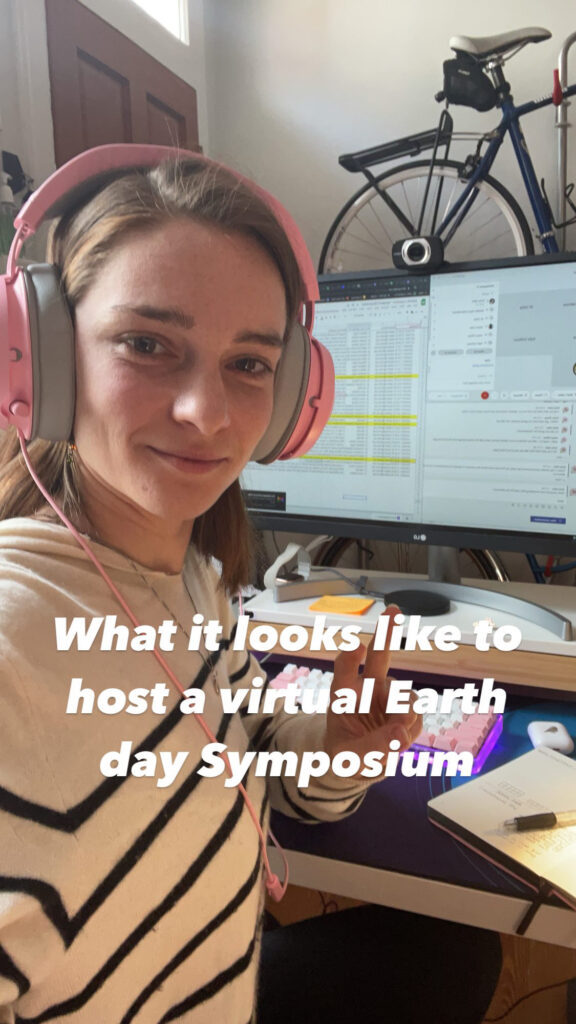 Faber shares an Instagram selfie from when she planned and hosted the first international Earth Day Symposium with the UMBC atmospheric physics department.
Q: Tell us about what you love about the atmospheric physics program or an organization you’re involved in.
A: I love how my program works with outside researchers and is really committed to Earth science as a whole. We routinely work with people from national lab offices that will hire our students one day and it really makes an impact in the skill sets we as students learn!
Q: What clubs and orgs are you a part of and why?
A: I’m a Graduate Student Association senator and Graduate Student Success Committee (GSSC) co-chair. I also help run the Graduate Gender-minorities in Physics group. In both of these I get to help people through their graduate school experience and help lift the graduate community up! I love seeing students succeed and hate seeing them struggle because they don’t find a resource that they need. These roles help me plug people in when they need help and that is incredibly rewarding for me!
* * * * *
UMBC’s greatest strength is its people. When people meet Retrievers and hear about the passion they bring, the relationships they create, the ways they support each other, and the commitment they have to inclusive excellence, they truly get a sense of our community. That’s what “Meet a Retriever” is all about.
Learn more about how UMBC can help you achieve your goals.
]]>
Meet Emily Faber, M.S. ’21, atmospheric physics, who is currently pursuing her doctorate in the same at UMBC. Emily is a first-generation college student who is also very involved as a student...
https://umbc.edu/stories/meet-a-retriever-emily-faber-atmospheric-physics/
https://my3.my.umbc.edu/api/v0/pixel/news/128044/guest@my.umbc.edu/e5a138b4273e9be71a77e228d9eaef54/api/pixel
cnms
graduateschool
impact
magazine
meet-a-retriever
perspectives
physics
UMBC News & Magazine
https://my3.my.umbc.edu/groups/umbc-news-magazine
https://assets1-my.umbc.edu/system/shared/avatars/groups/000/001/943/24435aa6207c452e7bc15cc74b42c7bb/xsmall.png?1748556657
https://assets1-my.umbc.edu/system/shared/avatars/groups/000/001/943/24435aa6207c452e7bc15cc74b42c7bb/original.png?1748556657
https://assets2-my.umbc.edu/system/shared/avatars/groups/000/001/943/24435aa6207c452e7bc15cc74b42c7bb/xxlarge.png?1748556657
https://assets2-my.umbc.edu/system/shared/avatars/groups/000/001/943/24435aa6207c452e7bc15cc74b42c7bb/xlarge.png?1748556657
https://assets3-my.umbc.edu/system/shared/avatars/groups/000/001/943/24435aa6207c452e7bc15cc74b42c7bb/large.png?1748556657
https://assets1-my.umbc.edu/system/shared/avatars/groups/000/001/943/24435aa6207c452e7bc15cc74b42c7bb/medium.png?1748556657
https://assets2-my.umbc.edu/system/shared/avatars/groups/000/001/943/24435aa6207c452e7bc15cc74b42c7bb/small.png?1748556657
https://assets1-my.umbc.edu/system/shared/avatars/groups/000/001/943/24435aa6207c452e7bc15cc74b42c7bb/xsmall.png?1748556657
https://assets2-my.umbc.edu/system/shared/avatars/groups/000/001/943/24435aa6207c452e7bc15cc74b42c7bb/xxsmall.png?1748556657
UMBC News & Magazine
0
0
false
Fri, 30 Sep 2022 08:28:48 -0400
Fri, 30 Sep 2022 08:28:48 -0400
UMBC’s Eileen Meyer and team find strongest evidence yet of a black hole zooming away from its galaxy’s center

A new study has confirmed that a black hole eight billion light years away is zipping away from its galaxy’s center at 2,000 kilometers per second, or more than 4.5 million miles per hour. The result also provides, for the first time, very strong evidence that it is possible for two black holes to merge.
The galaxy where this is happening, named 3C 186, was first discovered in 2017. Initial observations suggested that 3C 186 was the result of two galaxies (and their respective black holes) merging. However, there were still other possible explanations for the physical distance detected between the galaxy’s center and the black hole. The new study, published in Astronomy and Astrophysics, strongly supports only one of the remaining scenarios: that two black holes merged and the resulting black hole is moving away from the galaxy’s center.
“This is probably the most clear-cut case” illustrating this phenomenon that scientists are aware of, says Eileen Meyer, associate professor of physics. She is co-lead of the new study with Gianluca Castignani at the University of Bologna.
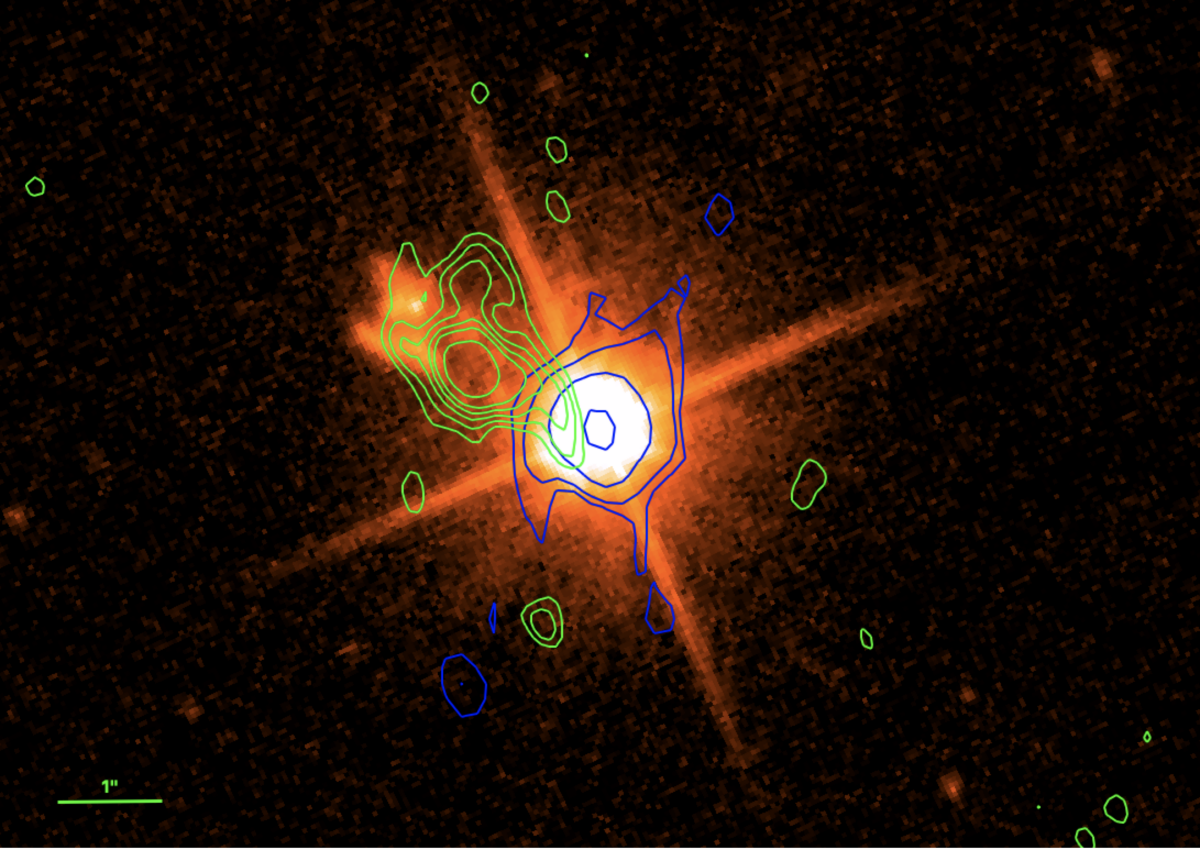 Figure 1 from Meyer and Castignani’s paper shows galaxy 3C 186. The black hole (blue lines/bright white area) is offset from its galaxy’s center (green lines).
Speedy departure
The two major findings—the black hole merger and its ouster from the galaxy’s center—are related. Theorists have predicted that if two black holes were to merge, they would release huge amounts of energy in the form of gravitational waves, Meyer explains.
Sometimes, “depending on how the black holes are spinning and their relative mass and how they’re oriented,” she says, that energy is not equally distributed in all directions. If there is “a lot of gravitational wave energy in one direction, there is consequently going to be literally kinetic energy given to the black hole in the other direction.” That means the black hole is going to move—in this case, very quickly.
“There were basically two pieces of evidence that made this story come together,” Meyer says. First, an earlier paper used high-resolution imaging from the Hubble Space Telescope to establish the physical offset between the black hole and the galaxy’s center. “That in itself might not have been weird,” Meyer says, because after two galaxies merge, “stuff is flying all over the place,” and it can take time for the black hole to settle in the center of the new, merged galaxy, she explains.
However, Castignani and Meyer’s new paper confirmed a critical second finding: the velocity of the black hole.
The imaging plus the velocity comes as close as you can in astronomy to proving the scenario that Meyer and her colleagues favor: a merged black hole has been kicked out from the center of its galaxy as a reaction to gravitational wave energy headed in the opposite direction. This is the first time both physical offset and velocity have come together so convincingly.
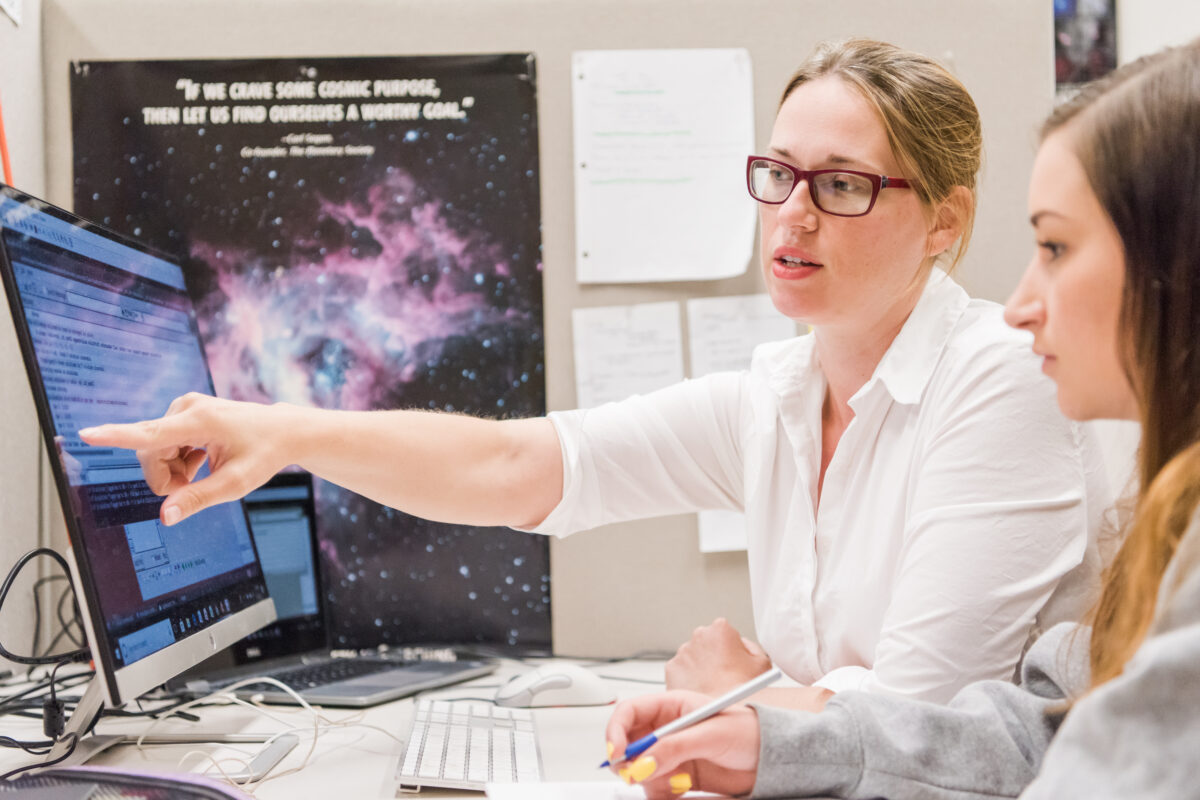 Eileen Meyer works with a student in her research space.
Shifting understanding
Meyer and colleagues figured out the velocity of the black hole by measuring the radiation emitted by carbon monoxide (CO) gas in the galaxy. They used a ground-based observatory called the Northern Extended Millimeter Array (NOEMA), located in the French alps, to collect the measurements.
The wavelength of the radiation emitted from CO gas increases as it travels across the universe from 3C 186 to NOEMA, a phenomenon referred to as red-shift. The farther away something is, the greater the red-shift will be. Galaxy 3C 186 is stable overall, so one would expect the radiation it emits to all have the same red-shift. However, NOEMA detected radiation with a smaller red-shift coming from the gas near the black hole. That indicates the black hole is moving quickly toward NOEMA relative to the center of 3C 186—in this case, at 2,000 km/s.
Detecting the velocity “was the thing that made us say, maybe this isn’t just some post-merger weirdness, but instead the black hole is offset because it has traveled out from what should have been the center of the galaxy,” Meyer says.
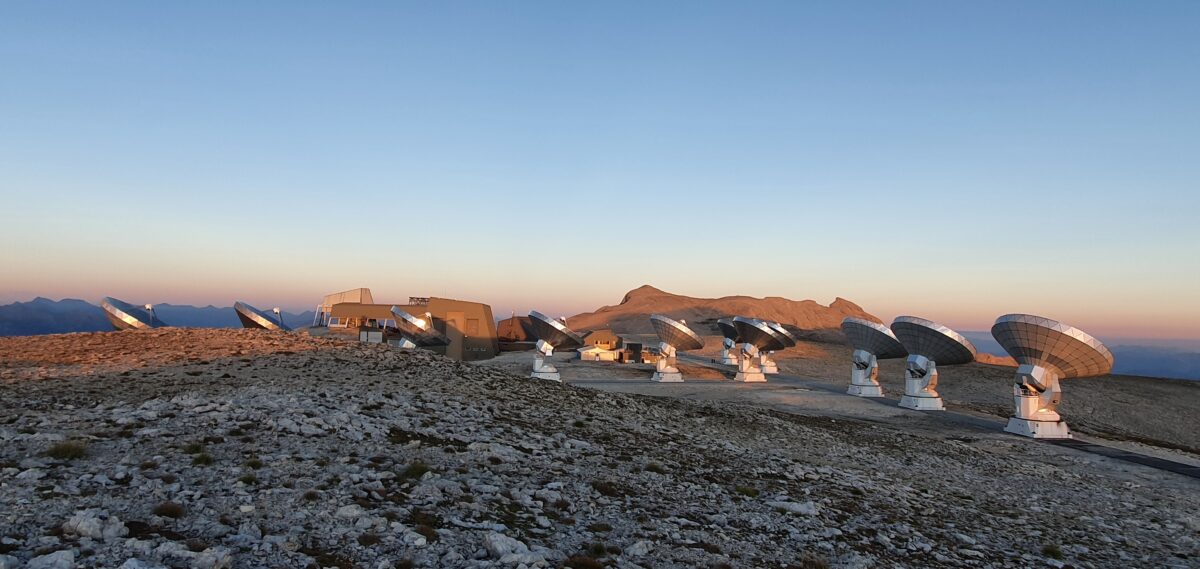 The NOEMA space observatory in the French Alps. (Institut de Radioastronomie Millimétrique)
Detective work
The research team wasn’t looking specifically for the galaxy 3C 186 when their study began. The initial observations came from what’s called a “snapshot proposal” with the Hubble Space Telescope.
Sometimes space-based observatories like Hubble make observations that require multiple orbits around Earth. But between these major observations, scientists can utilize smaller chunks of time for other studies that need only a quick “snapshot.” The data the researchers receive aren’t of the same quality as longer exposures, but they can be very useful.
In this snapshot study, the researchers received images of a couple dozen of their 100 or so preferred targets as Hubble traversed a partial orbit. “This black hole merger was observed by chance,” Meyer says. “There were odds against us.”
In astronomy, there can be pressure to choose a “safe” proposal, where researchers seek new data on a particular space object that’s already known to be interesting. In snapshot proposals, you often don’t know what you’re going to find, Meyer says, “but sometimes you need to take a chance on the unknown to make new discoveries.’”
As it turns out, this time they made a major discovery, adding to the story of how black holes merge. “When you build a story out of the evidence, it’s a bit like detective work,” Meyer says.
For systems so far away, scientists often can’t directly image everything that’s happening. Instead, Meyer explains, they have to infer what’s going on from the light produced, and it can be hard to narrow down the possible scenarios for what’s actually happening. This new study takes a big step forward by translating theoretical predictions into actual observed phenomena at galaxy 3C 186.
Finding the first
The new finding confirming that two black holes merged, and that the resulting black hole is traveling away from the galaxy’s center, “is actually very important,” Meyer says. “People always want the evidence for the scientific story, and now we have that evidence.”
The results are also encouraging for a new major mission led by the European Space Agency. The Laser Interferometer Space Antenna (LISA) will observe gravitational waves from space and could help detect more instances of merged black holes at the centers of galaxies.
“If you find one, you know there’s got to be many more,” given the sheer number of galaxies out there, Meyer says. “The first one is definitely important.”
]]>
A new study has confirmed that a black hole eight billion light years away is zipping away from its galaxy’s center at 2,000 kilometers per second, or more than 4.5 million miles per hour. The...
https://umbc.edu/stories/black-hole-zooms-away-from-galaxys-center/
https://my3.my.umbc.edu/api/v0/pixel/news/126431/guest@my.umbc.edu/abac999e9937cff4ae43af7cc6e922f5/api/pixel
cnms
news
physics
research
science-and-tech
UMBC News & Magazine
https://my3.my.umbc.edu/groups/umbc-news-magazine
https://assets1-my.umbc.edu/system/shared/avatars/groups/000/001/943/24435aa6207c452e7bc15cc74b42c7bb/xsmall.png?1748556657
https://assets1-my.umbc.edu/system/shared/avatars/groups/000/001/943/24435aa6207c452e7bc15cc74b42c7bb/original.png?1748556657
https://assets2-my.umbc.edu/system/shared/avatars/groups/000/001/943/24435aa6207c452e7bc15cc74b42c7bb/xxlarge.png?1748556657
https://assets2-my.umbc.edu/system/shared/avatars/groups/000/001/943/24435aa6207c452e7bc15cc74b42c7bb/xlarge.png?1748556657
https://assets3-my.umbc.edu/system/shared/avatars/groups/000/001/943/24435aa6207c452e7bc15cc74b42c7bb/large.png?1748556657
https://assets1-my.umbc.edu/system/shared/avatars/groups/000/001/943/24435aa6207c452e7bc15cc74b42c7bb/medium.png?1748556657
https://assets2-my.umbc.edu/system/shared/avatars/groups/000/001/943/24435aa6207c452e7bc15cc74b42c7bb/small.png?1748556657
https://assets1-my.umbc.edu/system/shared/avatars/groups/000/001/943/24435aa6207c452e7bc15cc74b42c7bb/xsmall.png?1748556657
https://assets2-my.umbc.edu/system/shared/avatars/groups/000/001/943/24435aa6207c452e7bc15cc74b42c7bb/xxsmall.png?1748556657
UMBC News & Magazine
0
0
false
Tue, 26 Jul 2022 16:54:22 -0400
Tue, 26 Jul 2022 16:54:22 -0400
UMBC’s 2022 Fulbright student scholars will travel the world to explore difficult questions
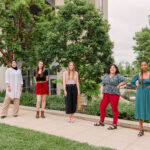
Eight recent UMBC graduates and alumni will soon travel to countries across three continents as 2022 Fulbright U.S. Student scholars. They include emerging leaders in education, astrophysics, cybersecurity, human rights, and more, and they are excited to explore difficult questions through fresh perspectives.
The Fulbright Program is the U.S. government’s flagship international exchange program. UMBC was named a Fulbright Top Producing Institution in 2019 – 2020. In the last decade, UMBC has received over 60 Fulbright U.S. Student Program awards for research and teaching placements in Africa, Asia and the Pacific, the Middle East, South America, and Europe.
Creating new paths
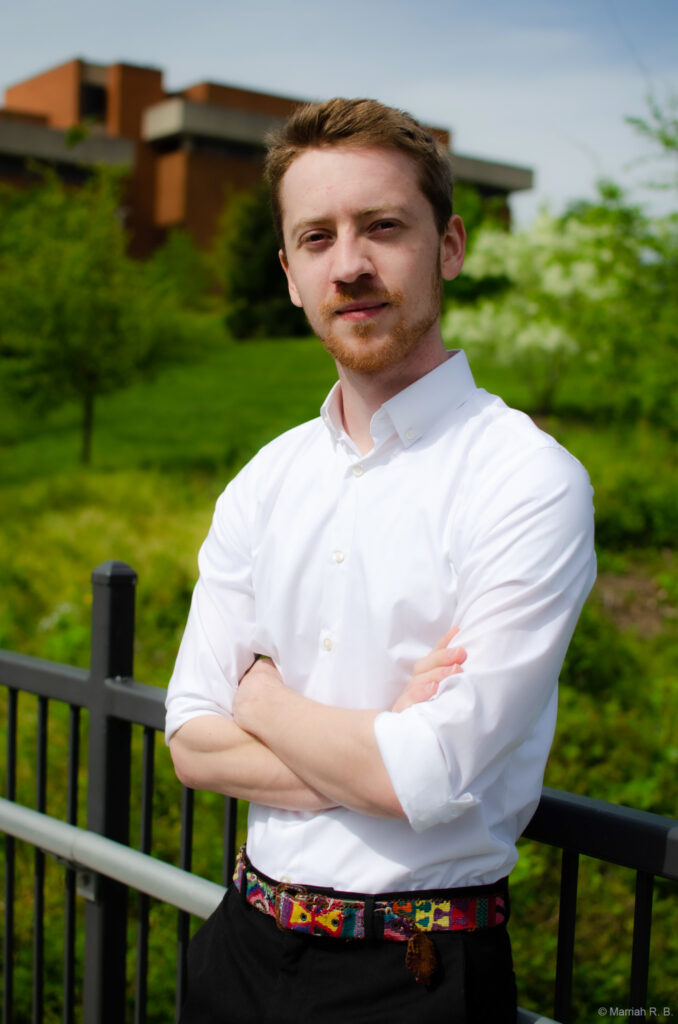 Caleb Jacobson.
(Image courtesy of Jacobson)
This year marks UMBC’s first Fulbright awards to El Salvador and to the UK. Caleb Jacobson ’21, global studies, and M.A. ’23, sociology, will research human rights and the transition to peace in post-conflict El Salvador. Kaitlyn Keaton ’22, computer engineering, a Cyber Scholar in the Center for Women In Technology, will head to Newcastle University (NU) in North East England to complete a master’s in cybersecurity. NU is recognized jointly by the UK’s National Cyber Security Center and the Engineering and Physical Sciences Research Council as an Academic Centre of Excellence in cyber security research.
Keaton has focused on making the most of her college education by pursuing a wide range of learning experiences. She has held competitive software engineering internships at General Dynamics Mission and Systems and Northrop Grumman Mission Systems, and has participated in Capture the Flags cybersecurity competitions, but this will be her first learning experience abroad.
As a Cyber Scholar and Tau Beta Pi Engineering Honors Society member, Keaton is determined to further develop the skills necessary to be on the cutting edge of cybersecurity research. She is also committed to creating new pathways for more women and girls to be leaders in engineering.
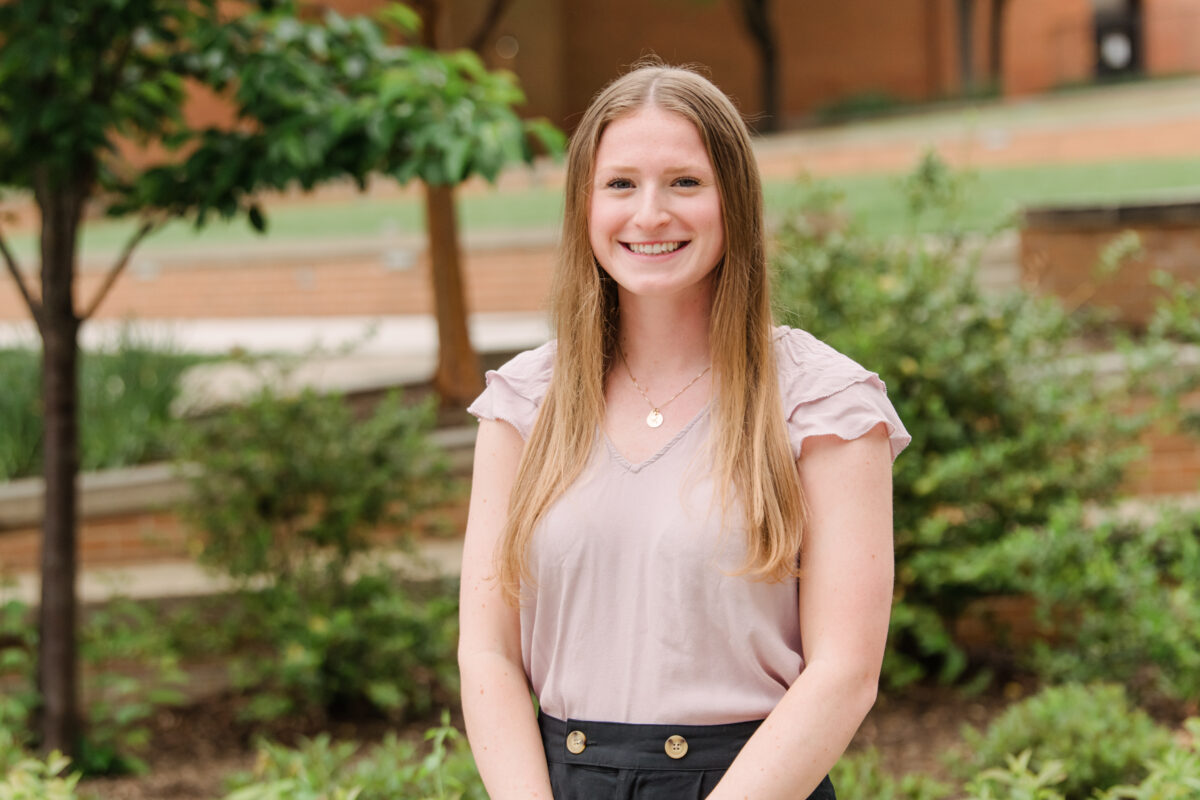 Kaitlyn Keaton. (Marlayna Demond ’11/UMBC)
“I want to inspire and encourage even more girls and young women to join the cybersecurity world,” says Keaton. “There is a critical need to get girls interested at younger ages to show them they can do it too.”
Intercultural understanding in medicine
Maryam Elhabashy ’21, anthropology, developed an interest in the process of healing early in her life while surrounded by a family of physicians. In high school, she shadowed a physician at a hospital and saw instances where patients’ cultural backgrounds sometimes conflicted with the physician’s concerns. She wondered if a lack of intercultural understanding in medicine can get in the way of good medical care, leading to health disparities.
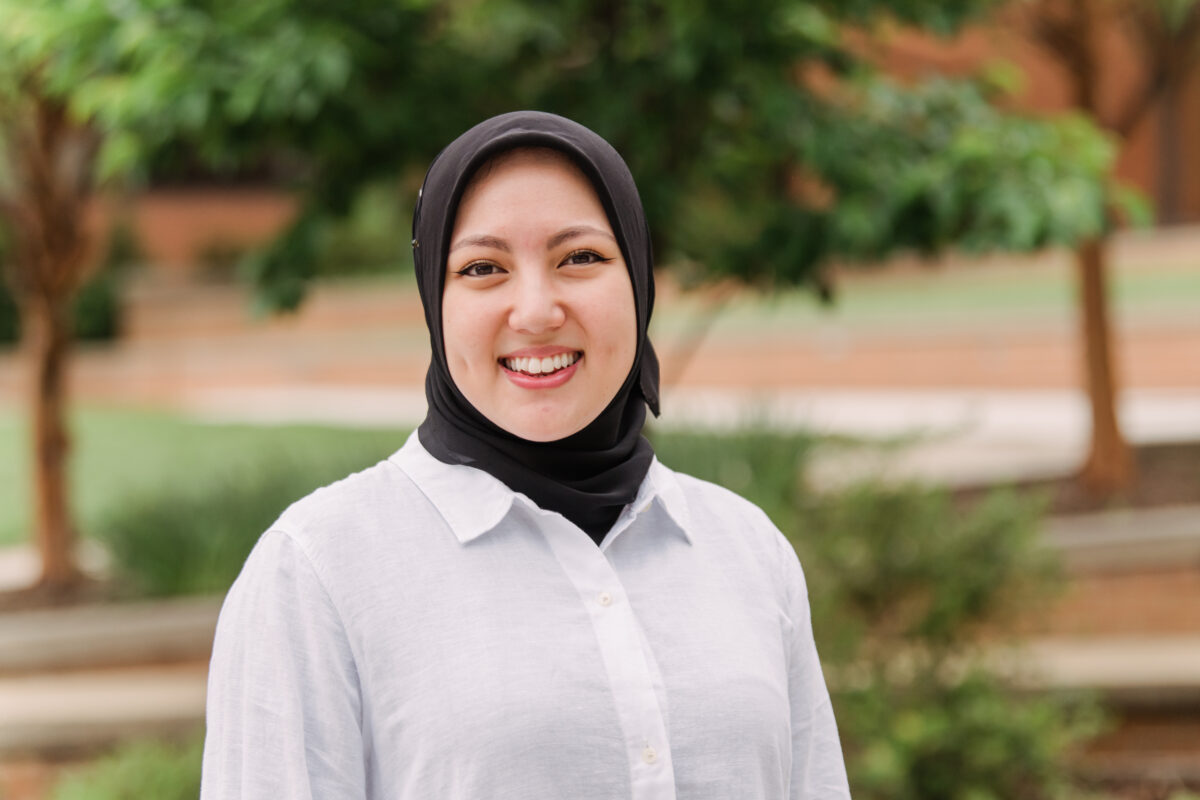 Maryam Elhabashy. (Marlayna Demond ’11/UMBC)
Elhabashy found an answer in listening to culturally diverse perspectives. As a student of anthropology with a focus on medical anthropology, she found that listening to people’s stories can help physicians develop empathy. This is one way to ensure patients feel heard, understood, and are able to navigate medical processes that can give them access to the best care possible.
While at UMBC, Elhabashy received an Undergraduate Research Award to research “Cupping and Wellness Among Muslims In the Baltimore-Washington Area.” She also served as a research assistant in sociology, anthropology, and public health (SAPH), studying physical activity among older African Americans in Baltimore.
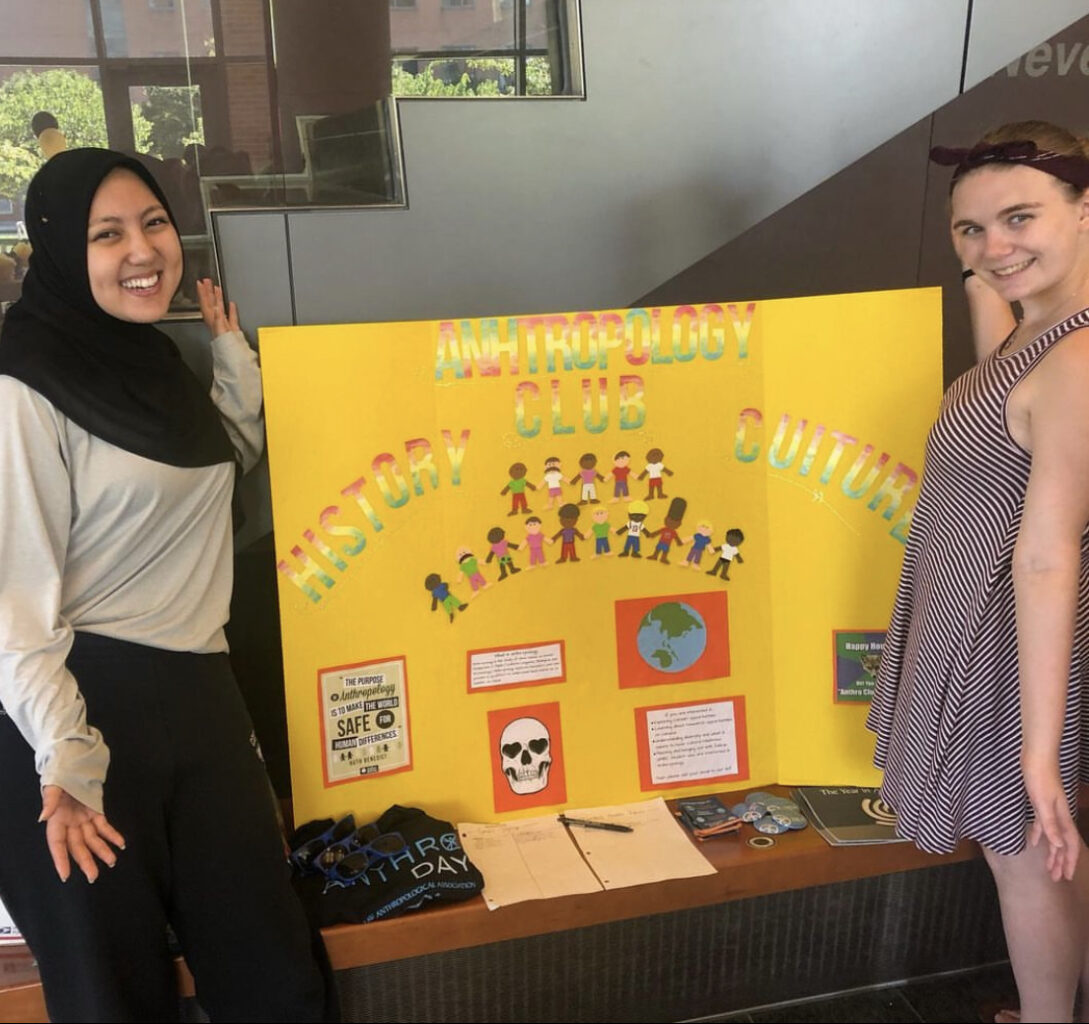 Elhabashy presenting with the Anthropology Club at SAPH’s Welcome Week Open House. (Image courtesy of Elhabashy)
After graduating, Elhabashy worked at Rutgers University as a research assistant studying tobacco and e-cigarette use among minority populations. In the past year, she interned at the Amgen Scholar Program at the National Institute of Health, working with leading biomedical scientists to identify and address health disparities as a potential result of societal, cultural, and environmental influences.
During her Fulbright year, Elhabashy will live in Kuwait City to work on her research project at Kuwait University titled, “Faith, Family, Food, and Fitness: Exploring Trends of Obesity Amongst Kuwaiti Women.”
“I hope to one day be at the forefront of a movement towards truly personalized medicine that embraces individuality and intercultural communication as a foundational tenet of the field,” she notes. “I hope my experience in Kuwait will serve as a strong foundation for this work.”
Latine teachers needed
Adrianna-Marie Urbina-Ruiz ’21, mathematics, and M.A.T., secondary education, was raised in Montgomery County, Maryland, but her roots are in Venezuela. She remembers only having four Hispanic teachers growing up. All were Spanish language teachers and supported her academic and personal growth. However, Urbina-Ruiz felt some of her other teachers had lower expectations of her, limiting her opportunities, and she saw other Hispanic students struggle with this same experience.
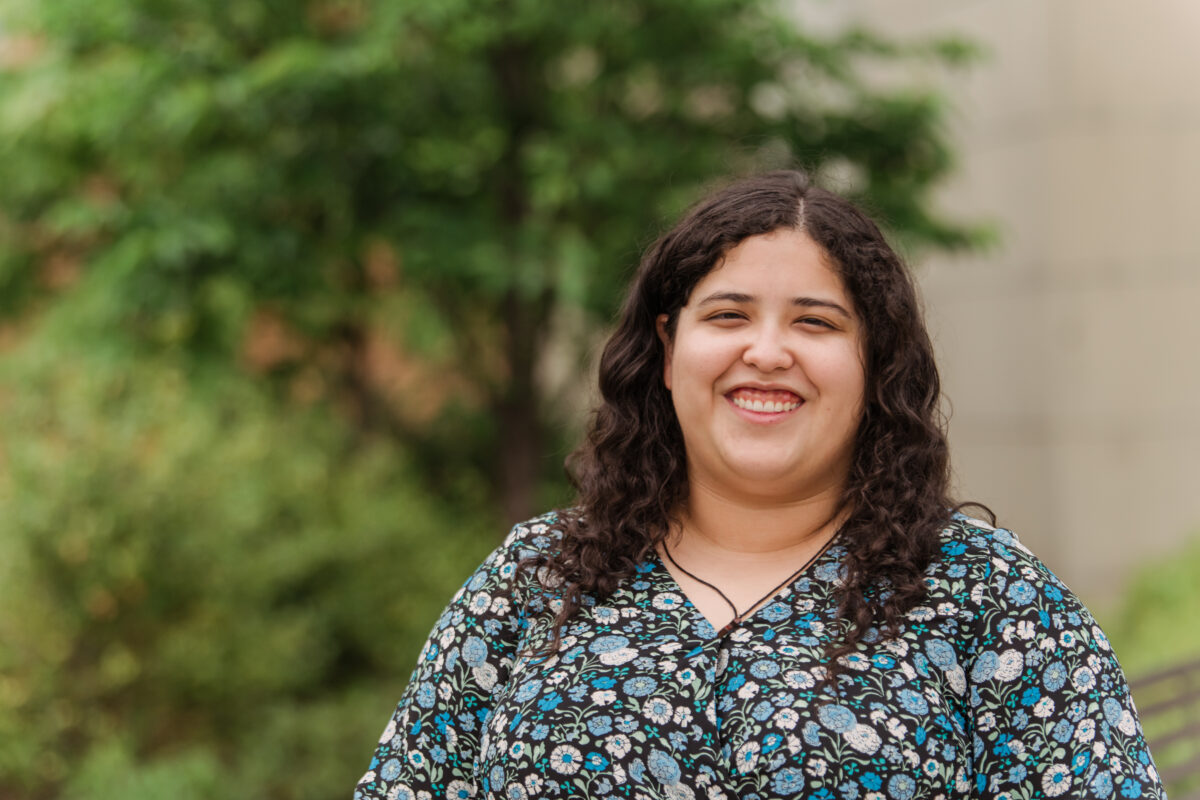 Adrianna-Marie Urbina-Ruiz. (Marlayna Demond ’11/UMBC)
“Many Hispanic students learning English and those who are bilingual have been seen as having limited academic knowledge, limited potential,” says Urbina-Ruiz. “I want to stop that narrative.”
At UMBC, Urbina-Ruiz met Bonny Tighe, a senior lecturer of mathematics, who encouraged her to become a math major and a math teacher through the Sherman STEM Teacher Scholars Program.
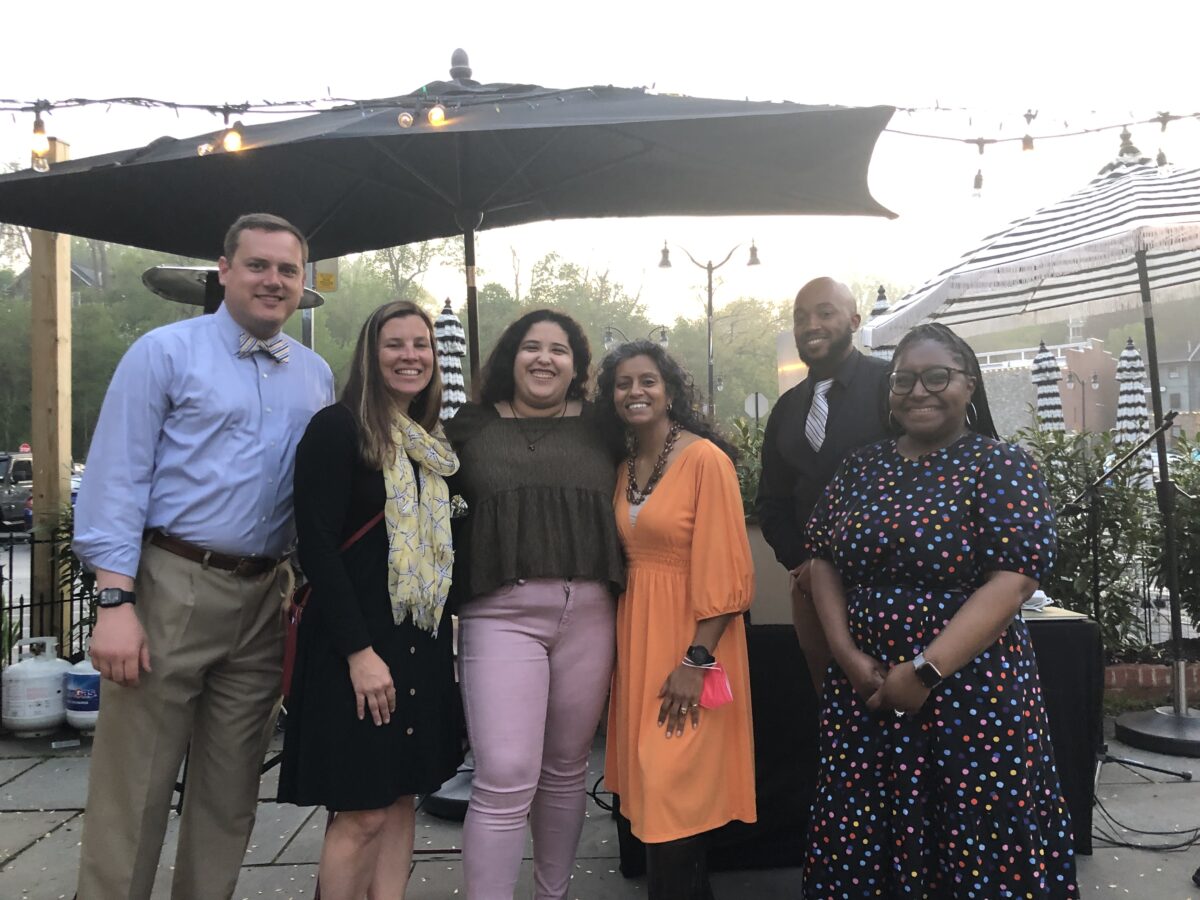 Urbina-Ruiz (in pink) with the Sherman STEM Teacher Scholar Program staff. (Image courtesy of Urbina-Ruiz)
“I will never forget walking into her office hours for the first time. She recognized me as having one of the highest grades in her Calculus I class,” says Urbina-Ruiz. “She and the Sherman staff had confidence that I would rise to any challenge. They built a strong foundation for my success.”
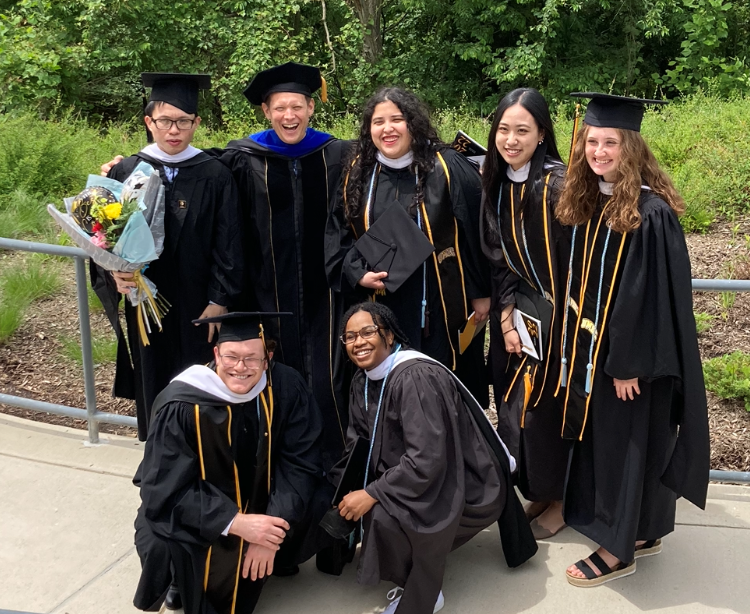 Urbina-Ruiz (standing row, center).
(Image courtesy of Urbina-Ruiz)
Urbina-Ruiz also completed a master’s in teaching and earned a certificate in teaching English to Speakers of Other Languages while student-teaching at Lakeland Elementary/Middle School in Baltimore City, which serves many Hispanic families. “I want to have as many tools at my disposal to make my classroom as accessible as possible,” says Urbina-Ruiz. “I want to be the Latine STEM teacher I never had.”
Urbina-Ruiz will work towards creating her first Collaborative Online International Learning program during her Fulbright year. She will connect college students at the Universidad Industrial de Santander in Colombia with students in Maryland while teaching English. “Latine teachers are needed around the world,” says Urbina-Ruiz.
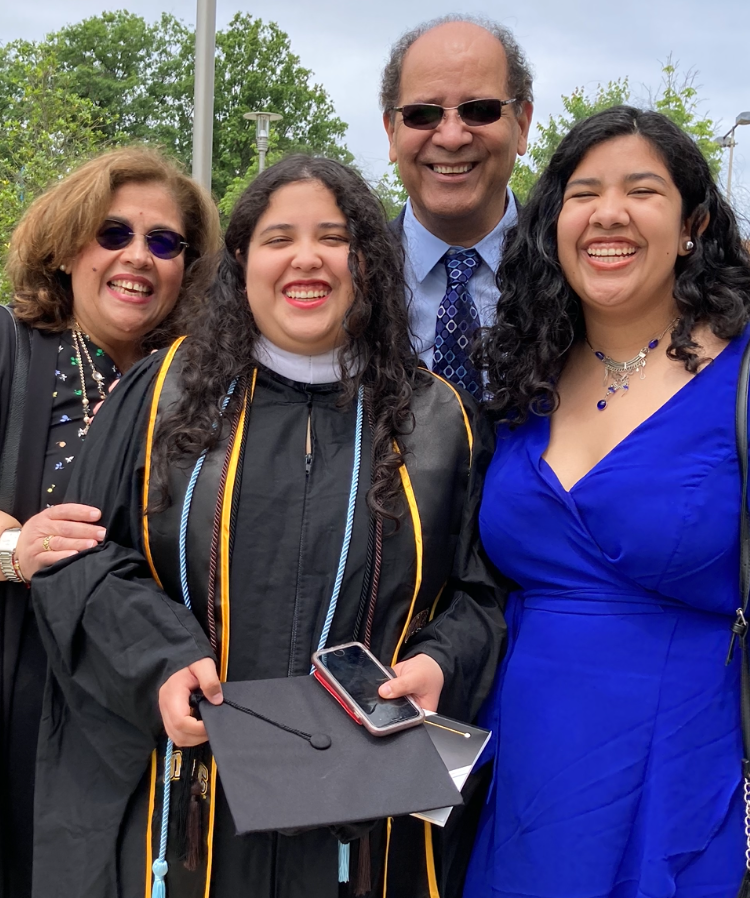 Urbina-Ruiz (wearing cap and gown) with her family at her master’s graduation. (Image courtesy of Urbina-Ruiz)
Urbina-Ruiz plans to return to teach in Baltimore City Public Schools where there is a high demand for bilingual Hispanic teachers.
Representation in science
Similar to Elhabashy, Maithily Diana Díaz ’21, biology and modern languages, linguistics, and intercultural communication, is pursuing a career focused on health equity. As a first-generation student, Díaz encourages other Latinos to go to college and to be ambitious even if it means they are in spaces where they are the only Latino, something she has experienced as a Latina in STEM.
“I’m usually the only Latina, but now it means something more,” says Díaz. “Now, it’s just the jump of saying Latinos can be scientists, researchers, physicians. If we believe in ourselves then someone else will too. And once that door is opened, then who knows how far we can go.”
Díaz recently moved to Tijuana, Mexico to work at a non-profit health clinic serving a largely refugee and migrant population. For the past school year she has been teaching science and medicine to predominantly Hispanic and African American K-12 students for Refugee Health Alliance in Harlem, while completing remote research in mental health at the Johns Hopkins School of Public Health.
During her Fulbright year, Díaz will complete a master’s in immunology and work on cancer research at the French National Institute of Health while mentoring undergraduate students at Sorbonne University. .
“It’s a dream come true that someone like me received a Fulbright at such prestigious institutions. My students were shocked,” says Díaz. “I want more and I intend to achieve it. But at the end of the day, this is for my community.”
While in France, Díaz will work with researchers seeking to identify more effective means of treating soft tissue sarcomas. The findings may reveal potentially novel immunotherapy targets for a variety of cancers.
As a linguist with proficiency in English, Spanish, French, Portuguese, and Russian, Díaz knows her ability to successfully communicate across multiple cultures and languages can lead to greater opportunities. She wants to show Latinos what can happen when they value their multicultural and multilingual lives as assets.
Following her Fulbright, Díaz plans to pursue an M.D., promoting equity in both research and healthcare.
Global education and disability
 Mimi Yaldram in traditional Pakistani dress. (Image courtesy of Yaldram)
Mimi Yaldram ’20, history, is very familiar with the process of acclimating to a new culture and country. When she was seven years old, her family left their home in Karachi, Pakistan for the United States to seek better mental health services.
“We came in 1999 right before 9/11,” says Yaldram. “It was a lot to manage the racism towards my Muslim family while learning how to live, study, access services, and work in the U.S.”
This experience inspired Yaldram’s passion for living and learning within multiple cultures, religions, and languages, which she began to explore at Montgomery College. There she held numerous executive student leadership roles and traveled abroad to Ethiopia, where she researched the influence of India on ancient trade routes and currency.
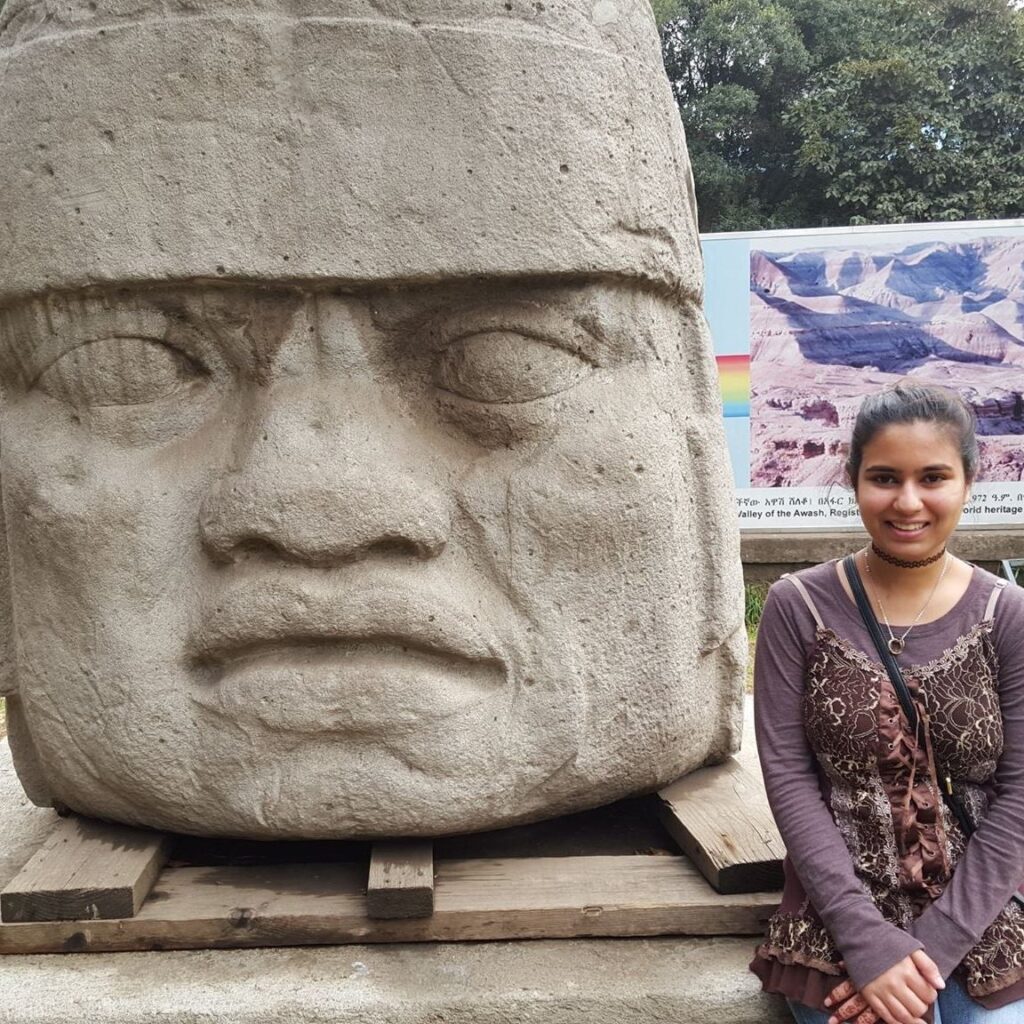 Yaldram in Ethiopia next to an ancient stone head sculpture of the Olmec civilization of Mexico. (Image courtesy of Yaldram)
In 2017, Yaldram joined UMBC’s Shady Grove campus, embarking on new student leadership opportunities, including serving as president of the Student History Association and studying abroad in Denmark. She learned about Viking history and participated in a dance project focusing on Danish pop dances and Pakistani Bollywood dances.
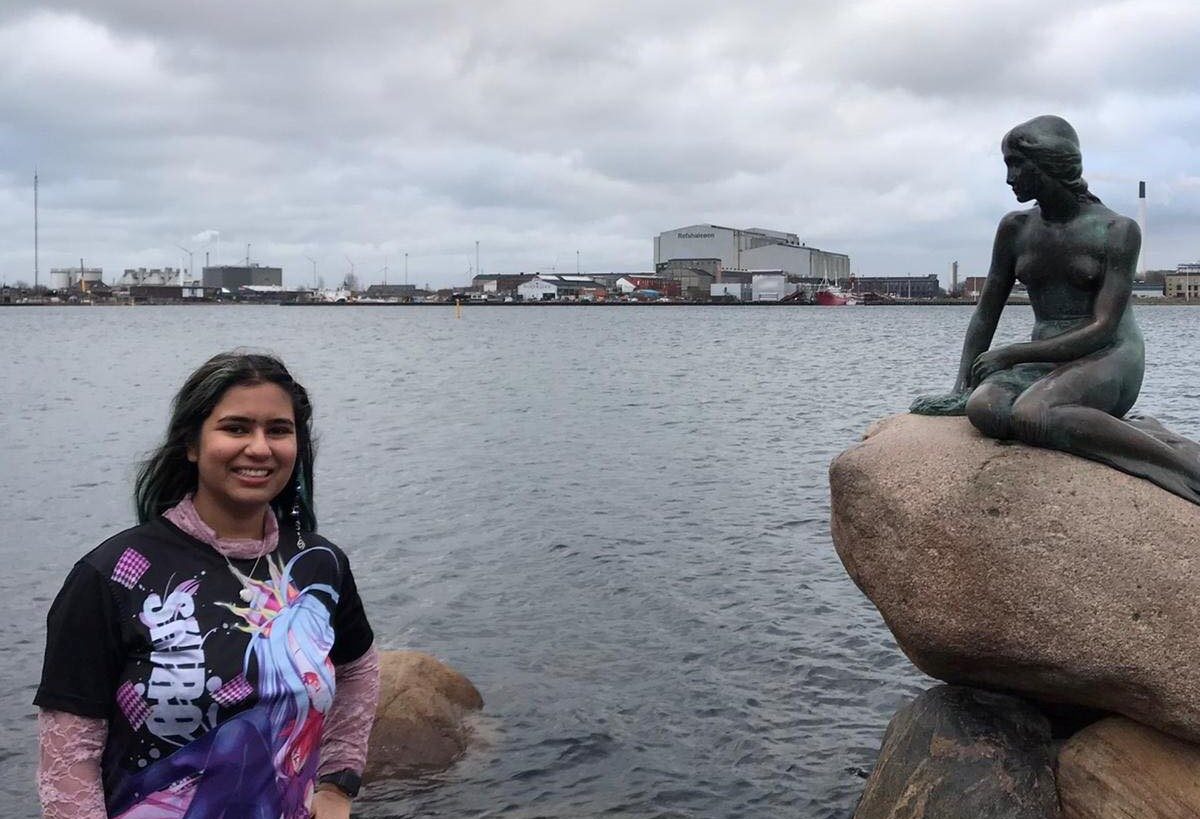 Yaldram next to a sculpture of the Little Mermaid in Copenhagen, Denmark. (Image courtesy of Yaldram)
Yaldram identifies as a student with a mental health disability, and she is passionate about advocating for and teaching other students with disabilities and neurological differences. For the past two years, she has tutored students with autism spectrum disorder on strengthening their writing, communication, and social skills.
Now that she has earned her both her Teaching English as a Second Language and mental health first-aid certifications, she is ready to spend her Fulbright year teaching English in Taiwan. She is excited to be part of Taiwan’s goal to become a bilingual nation by 2030 by raising English proficiency. She also looks forward to sharing her skills in disability education and services while teaching.
“My dream is to make a positive impact on immigrant communities by utilizing my own experiences and education,” says Yaldram. “I hope to make a difference and bring that to the Fulbright program in Taiwan.”
Yaldram plans on a career at the intersection of global education, social justice, and disability beginning with humanitarian work in Pakistan after her Fulbright experience.
Korean world influence
Chemutai Wangui Nganga ’21, global studies, comes from a Kenyan family in the United States. During elementary school, she lived in Kenya for four years where she improved her Swahili skills and learned more about her Kenyan culture. When she moved back to the U.S., her family settled in Howard County, Maryland, home to numerous international communities, especially a thriving Korean community. Nganga learned about the influence the Korean economy, cuisine, music, art, and technology have had on the world.
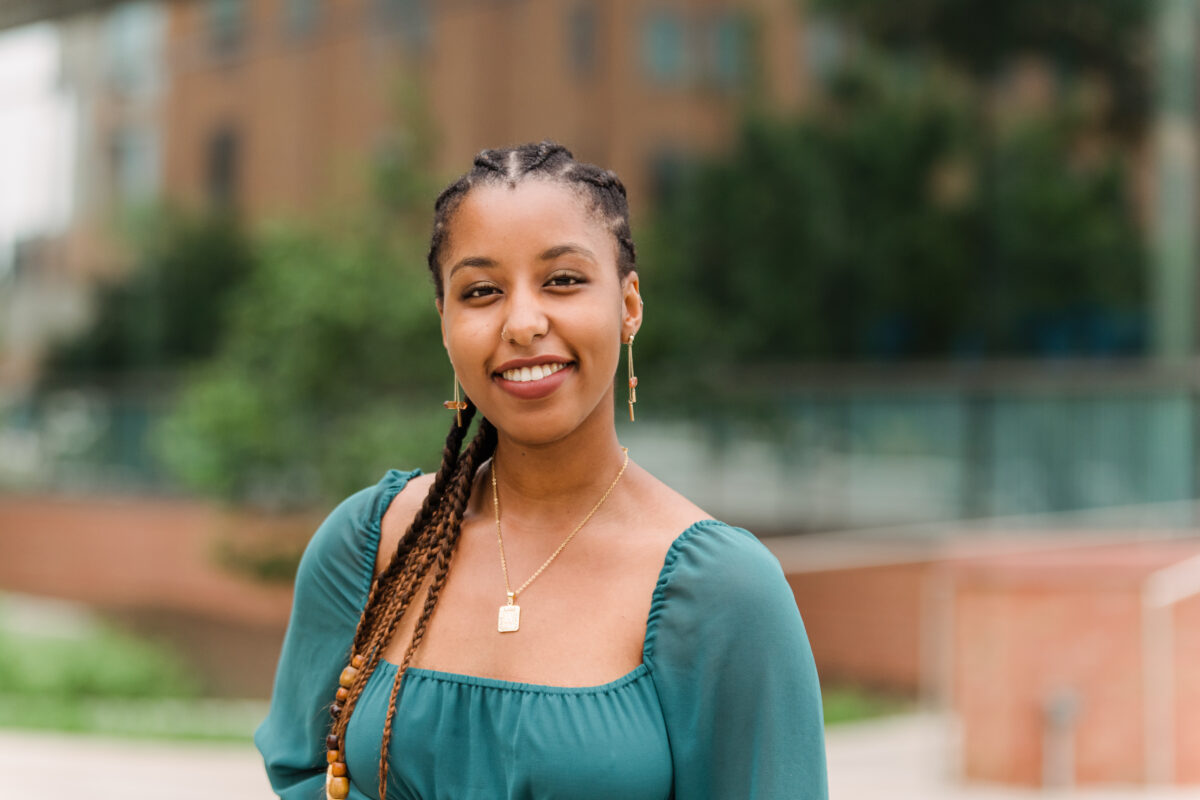 Chemutai Wangui Nganga. (Marlayna Demond ’11/UMBC)
Living in a diverse community, led Nganga to major in global studies at UMBC. She gained a greater understanding of the opportunities and conflicts of globalization and decided to focus on international politics and French. Her Asian studies courses increased her interest in Korean culture, which led her to pursue a Fulbright year in South Korea.
“For me, Korea is a full step into a new world,” says Nganga, who will be teaching English. “It is another chance to push the boundaries of my worldview as well as serve others.” She plans to explore a career path in foreign service on her return to the U.S.
Stellar research
As a burgeoning astrophysicist, Kaitlyn Szekerczes ’22, physics, lives and breathes for exploring the infinite universe. She didn’t know that all those nights stargazing on her deck with her dad and discussing the plausibility of science fiction shows would lead her to pursue a career in space science research.
 Kaitlyn Szekerczes. (Marlayna Demond ’11/UMBC)
“I was always fascinated by the questions we were not able to answer. We are not even close to knowing nearly everything when it comes to astronomy,” says Szekerczes. “My goal is to contribute to answering lesser-known big and challenging research questions.”
 Szekerczes (l) with her dad.
(Image courtesy of Szekerczes)
Szekerczes will lead a project on gravitational lensing of tidal disruption events at the Max-Planck Institute for Astrophysics in Garching, Germany. It will be the first study to apply the technique of gravitational lensing—the bending of light by gravity—to researching tidal disruption events, which are events that happen when a supermassive black hole tidally disrupts a star.
“My dream job is to work as an astrophysicist for NASA,” says Szekerczes. “UMBC was the perfect fit for me because I was encouraged to pursue my passion for tackling challenging unanswered questions. I was also given the resources and support to piece together the puzzle of how to work towards my goals.”
After returning from Germany, Szekerczes will begin a Ph.D. program in astrophysics at Penn State University in fall 2023.
]]>
Eight recent UMBC graduates and alumni will soon travel to countries across three continents as 2022 Fulbright U.S. Student scholars. They include emerging leaders in education, astrophysics,...
https://umbc.edu/stories/umbc-2022-fulbright-student-scholars/
https://my3.my.umbc.edu/api/v0/pixel/news/125930/guest@my.umbc.edu/ba2dfd241a4dc3b3530386c46cc83d0a/api/pixel
anthropology
biology
cahss
cahssresearch
cnms
coeit
community
computer-engineering
cwit
education
globalstudies
history
international-stories
mathematics
mlli
news
physics
policy-and-society
research
saph
science-and-tech
shermanscholars
UMBC News & Magazine
https://my3.my.umbc.edu/groups/umbc-news-magazine
https://assets1-my.umbc.edu/system/shared/avatars/groups/000/001/943/24435aa6207c452e7bc15cc74b42c7bb/xsmall.png?1748556657
https://assets1-my.umbc.edu/system/shared/avatars/groups/000/001/943/24435aa6207c452e7bc15cc74b42c7bb/original.png?1748556657
https://assets2-my.umbc.edu/system/shared/avatars/groups/000/001/943/24435aa6207c452e7bc15cc74b42c7bb/xxlarge.png?1748556657
https://assets2-my.umbc.edu/system/shared/avatars/groups/000/001/943/24435aa6207c452e7bc15cc74b42c7bb/xlarge.png?1748556657
https://assets3-my.umbc.edu/system/shared/avatars/groups/000/001/943/24435aa6207c452e7bc15cc74b42c7bb/large.png?1748556657
https://assets1-my.umbc.edu/system/shared/avatars/groups/000/001/943/24435aa6207c452e7bc15cc74b42c7bb/medium.png?1748556657
https://assets2-my.umbc.edu/system/shared/avatars/groups/000/001/943/24435aa6207c452e7bc15cc74b42c7bb/small.png?1748556657
https://assets1-my.umbc.edu/system/shared/avatars/groups/000/001/943/24435aa6207c452e7bc15cc74b42c7bb/xsmall.png?1748556657
https://assets2-my.umbc.edu/system/shared/avatars/groups/000/001/943/24435aa6207c452e7bc15cc74b42c7bb/xxsmall.png?1748556657
UMBC News & Magazine
0
0
false
Thu, 16 Jun 2022 15:23:06 -0400
Thu, 16 Jun 2022 15:23:06 -0400
First-generation grad reflects on the power of seeing potential, giving support

Kaitlynn Lilly
Degree: B.S., Mathematics and Physics
Hometown: Severna Park, MD
Post-grad plans: Ph.D. in applied mathematics, University of Washington
“As a first-generation college student … I didn’t know if going to graduate school would be possible for me, but people believed in me, saw my potential, and gave me the ability to succeed. Being able to give that back to other people has been really powerful for me and has made my UMBC experience very fulfilling.”

Kaitlynn Lilly (left) supports students at Arbutus Middle School. (Image courtesy of Lilly)
Kaitlynn Lilly ’22, mathematics and physics, is a Meyerhoff Scholar, member of the Honors College, and 2021-2022 Goldwater Scholar. She conducted research with Justin Webster, assistant professor of mathematics, and participated in summer research experiences with faculty at Carnegie Mellon University and University of Hawai’i. But more than thinking about those achievements, she often reflects on the support that helped her get there and how she can pay it forward.
When she started working with Webster in her first year, Lilly did not have substantial high-level math experience. But Webster “took me under his wing and made sure that I was learning the important background material that I needed,” she says. “And eventually, I was able to start my own independent project.”
As her skills and experience grew, she got involved in more and more difficult projects. “I think that’s one of the unique things that UMBC has to offer,” she says. “I feel like I’ve definitely made the most of my education here, and it’s been a really great experience being involved in so many different kinds of research.”
UMBC’s 2021-2022 Goldwater Scholars Karan Luthria (l), Kaitlynn Lilly (c), and Joshua Slaughter (r). (Marlayna Demond ’11/UMBC)
Lilly is a dedicated mentor to middle school, high school, and UMBC students through several different programs, for which she received the Ronald M. Shapiro Excellence in Mentoring Award.
While studying partial differential equations for her Ph.D. at University of Washington, she plans to create a group for women in applied math and contribute to an existing program that supports high school students.
]]>
Kaitlynn Lilly Degree: B.S., Mathematics and Physics Hometown: Severna Park, MD Post-grad plans: Ph.D. in applied mathematics, University of Washington “As a first-generation college...
https://umbc.edu/stories/first-generation-grad-reflects/
https://my3.my.umbc.edu/api/v0/pixel/news/125399/guest@my.umbc.edu/b4e1998d0d465c0fbedb535ec0597144/api/pixel
class-of-2022
cnms
honorscollege
mathstat
meyerhoffscholars
news
physics
supportingyouth
UMBC News & Magazine
https://my3.my.umbc.edu/groups/umbc-news-magazine
https://assets1-my.umbc.edu/system/shared/avatars/groups/000/001/943/24435aa6207c452e7bc15cc74b42c7bb/xsmall.png?1748556657
https://assets1-my.umbc.edu/system/shared/avatars/groups/000/001/943/24435aa6207c452e7bc15cc74b42c7bb/original.png?1748556657
https://assets2-my.umbc.edu/system/shared/avatars/groups/000/001/943/24435aa6207c452e7bc15cc74b42c7bb/xxlarge.png?1748556657
https://assets2-my.umbc.edu/system/shared/avatars/groups/000/001/943/24435aa6207c452e7bc15cc74b42c7bb/xlarge.png?1748556657
https://assets3-my.umbc.edu/system/shared/avatars/groups/000/001/943/24435aa6207c452e7bc15cc74b42c7bb/large.png?1748556657
https://assets1-my.umbc.edu/system/shared/avatars/groups/000/001/943/24435aa6207c452e7bc15cc74b42c7bb/medium.png?1748556657
https://assets2-my.umbc.edu/system/shared/avatars/groups/000/001/943/24435aa6207c452e7bc15cc74b42c7bb/small.png?1748556657
https://assets1-my.umbc.edu/system/shared/avatars/groups/000/001/943/24435aa6207c452e7bc15cc74b42c7bb/xsmall.png?1748556657
https://assets2-my.umbc.edu/system/shared/avatars/groups/000/001/943/24435aa6207c452e7bc15cc74b42c7bb/xxsmall.png?1748556657
UMBC News & Magazine
0
0
false
Tue, 17 May 2022 15:16:02 -0400
Tue, 17 May 2022 15:16:02 -0400