UMBC men’s and women’s swimming and diving shatter records, capture America East titles

After four days of intense competition, UMBC’s men’s and women’s swimming and diving teams have both been crowned 2019 America East champions. The men’s team successfully defended their title, giving them their 11th America East title win, and the women’s team collected their seventh conference win. This marks the first time both teams were named champions since the 2010-2011 season. The men also previously competed within the Coastal Collegiate Sports Association.

UMBC men’s and women’s swimming and diving teams celebrate their America East victory. Photo courtesy of Colleen Humel.
“At the beginning of the year, our captains chose the theme ‘enjoy it’ to help guide our season and that’s exactly what we did. We got to the championships and we added ‘live it’ and ‘love it,’ and we used that thinking to be the most relaxed and confident team,” says Coach Chad Cradock ’97, psychology. “From the minute the events started, we all rallied around each other to compete at our best.”
UMBC
]]>
After four days of intense competition, UMBC’s men’s and women’s swimming and diving teams have both been crowned 2019 America East champions. The men’s team successfully defended their title,...
https://umbc.edu/stories/umbc-mens-and-womens-swimming-and-diving-shatter-records-capture-america-east-titles/
https://my3.my.umbc.edu/api/v0/pixel/news/120208/guest@my.umbc.edu/24438ef7d09637fc1329de1f5e32dc9d/api/pixel
athletics
cahss
coeit
community
psychology
se
strategic-planning
visualarts
UMBC News & Magazine
https://my3.my.umbc.edu/groups/umbc-news-magazine
https://assets1-my.umbc.edu/system/shared/avatars/groups/000/001/943/24435aa6207c452e7bc15cc74b42c7bb/xsmall.png?1748556657
https://assets1-my.umbc.edu/system/shared/avatars/groups/000/001/943/24435aa6207c452e7bc15cc74b42c7bb/original.png?1748556657
https://assets2-my.umbc.edu/system/shared/avatars/groups/000/001/943/24435aa6207c452e7bc15cc74b42c7bb/xxlarge.png?1748556657
https://assets2-my.umbc.edu/system/shared/avatars/groups/000/001/943/24435aa6207c452e7bc15cc74b42c7bb/xlarge.png?1748556657
https://assets3-my.umbc.edu/system/shared/avatars/groups/000/001/943/24435aa6207c452e7bc15cc74b42c7bb/large.png?1748556657
https://assets1-my.umbc.edu/system/shared/avatars/groups/000/001/943/24435aa6207c452e7bc15cc74b42c7bb/medium.png?1748556657
https://assets2-my.umbc.edu/system/shared/avatars/groups/000/001/943/24435aa6207c452e7bc15cc74b42c7bb/small.png?1748556657
https://assets1-my.umbc.edu/system/shared/avatars/groups/000/001/943/24435aa6207c452e7bc15cc74b42c7bb/xsmall.png?1748556657
https://assets2-my.umbc.edu/system/shared/avatars/groups/000/001/943/24435aa6207c452e7bc15cc74b42c7bb/xxsmall.png?1748556657
UMBC News & Magazine
0
0
false
Tue, 19 Feb 2019 15:39:33 -0500
Tue, 19 Feb 2019 15:39:33 -0500
Dean Scott Casper continues UMBC’s strong partnership with Maryland Humanities and the Greater Baltimore Cultural Alliance as a new board member

Two leading advocates for the arts and humanities in Maryland have elected Scott Casper, dean of UMBC’s College of Arts, Humanities, and Social Sciences, to their boards of directors. Casper is now beginning three-year terms with Maryland Humanities and the Greater Baltimore Cultural Alliance (GBCA), continuing UMBC’s strong tradition of partnership with the two organizations.
Strong collaboration in the humanities
Maryland Humanities has long been a champion for UMBC’s humanities scholarship. Numerous UMBC faculty have received Maryland Humanities grants over the years. Most recently Felipe Filomeno, assistant professor of political science, and Tania Lizarazo, assistant professor of modern languages, linguistics, and intercultural communication, received support for their project “Honest Conversation: Faith Community Dialogues on Immigration and Race.” Additionally, Maryland Humanities has worked closely with the Dresher Center for the Humanities at UMBC to highlight humanities scholarship through the regular audio segment Humanities Connection, aired on WYPR.
 (L to R) Scott Casper with Angelica Frude, Lydia Yeh, and Paris Ye from Eastern Middle School, who won first place in a Junior Group Website in the Maryland History Day competition 2018, and Mishelle Johnson, from the office of Senator Van Hollen. Courtesy of Mitro Hood ’89, photography.
Both institutions have also partnered for the annual Maryland History Day, which is sponsored by Maryland Humanities and hosted at UMBC (this year on May 11). This program engages 27,000 middle and high school students across the state in historical research projects each year, to help them develop skills in research, critical thinking, writing, and public speaking.
In the spring of 2018, when Maryland Humanities celebrated its 45th anniversary, the organization also honored UMBC President Freeman Hrabowski for his dedication to the organization and his service as a former board member.
“We’re delighted to welcome Dr. Casper to our Board of Directors,” says Phoebe Stein, executive director of Maryland Humanities. “His belief in the value and power of the humanities in our everyday lives, his extensive knowledge of the humanities in Maryland, and his work as a scholar and vast experience as a nonprofit administrator will be immensely valuable.”
 Casper with students at an exhibit by Peggy Re, associate professor of graphic design, in UMBC’s CADVC.
A unique arts partnership
The GBCA has partnered with and supported UMBC’s arts community throughout its seventeen years as a vital arts organization for Baltimore artists. Several UMBC arts faculty have received GBCA awards to support their work, including Tim Nohe, professor of visual arts and director of the Center for Innovation, Research, and Creativity in the Arts (CIRCA); Lee Boot, director of the Imaging Research Center; and Kathy O’Dell, associate professor visual arts and special assistant to the dean for education and arts partnerships.
Numerous UMBC faculty, staff, and alumni have received GBCA Baker Artist Awards. Most recently, celebrated jazz pianist and composer Lafayette Gilchrist ‘92, Africana studies, received a Baker Artist Award to help him continue to compose, perform, and record as a soloist and leader of two genre-defying bands.
UMBC faculty have also supported the GBCA through service and professional development work, honoring the institutions’ shared commitment to innovation and leadership in the arts. O’Dell served for many years on the GBCA Board of Directors, and continues to serve as co-chair of its Equity and Inclusion committee. Additionally, UMBC’s CIRCA partnered with GBCA in professional development intensives for faculty and students.
“It is tremendously meaningful to have Scott on our board with his expertise in the Walters, Civil War monuments, and his humanities perspective,” says Jeannie L. Howe, Executive Director of the GBCA. “We are extremely excited to have his enthusiasm and balance to make great contributions and strengthen [our work] with Maryland Humanities and UMBC as cultural partners in the region, state, and country.”
“Both Maryland Humanities and the Greater Baltimore Cultural Alliance immeasurably enrich our communities, region, and state,” says Scott Casper. “They nurture our collective humanity, our creativity, and our understanding of contemporary and historical contexts for our challenges and endeavors.”
He shares, “I am honored to continue UMBC’s long partnerships with them and excited to participate in their essential work.”
Banner image: Scott Casper with colleagues. By Marlayna Demond ’11 for UMBC.
]]>
Two leading advocates for the arts and humanities in Maryland have elected Scott Casper, dean of UMBC’s College of Arts, Humanities, and Social Sciences, to their boards of directors. Casper is...
https://umbc.edu/stories/dean-scott-casper-continues-umbcs-strong-partnership-with-maryland-humanities-and-the-greater-baltimore-alliance-as-a-new-board-member/
https://my3.my.umbc.edu/api/v0/pixel/news/120218/guest@my.umbc.edu/fff02f97fb5644f78c299adb3d30aa56/api/pixel
cahss
dreshercenter
policy-and-society
visualarts
UMBC News & Magazine
https://my3.my.umbc.edu/groups/umbc-news-magazine
https://assets1-my.umbc.edu/system/shared/avatars/groups/000/001/943/24435aa6207c452e7bc15cc74b42c7bb/xsmall.png?1748556657
https://assets1-my.umbc.edu/system/shared/avatars/groups/000/001/943/24435aa6207c452e7bc15cc74b42c7bb/original.png?1748556657
https://assets2-my.umbc.edu/system/shared/avatars/groups/000/001/943/24435aa6207c452e7bc15cc74b42c7bb/xxlarge.png?1748556657
https://assets2-my.umbc.edu/system/shared/avatars/groups/000/001/943/24435aa6207c452e7bc15cc74b42c7bb/xlarge.png?1748556657
https://assets3-my.umbc.edu/system/shared/avatars/groups/000/001/943/24435aa6207c452e7bc15cc74b42c7bb/large.png?1748556657
https://assets1-my.umbc.edu/system/shared/avatars/groups/000/001/943/24435aa6207c452e7bc15cc74b42c7bb/medium.png?1748556657
https://assets2-my.umbc.edu/system/shared/avatars/groups/000/001/943/24435aa6207c452e7bc15cc74b42c7bb/small.png?1748556657
https://assets1-my.umbc.edu/system/shared/avatars/groups/000/001/943/24435aa6207c452e7bc15cc74b42c7bb/xsmall.png?1748556657
https://assets2-my.umbc.edu/system/shared/avatars/groups/000/001/943/24435aa6207c452e7bc15cc74b42c7bb/xxsmall.png?1748556657
UMBC News & Magazine
0
0
false
Wed, 30 Jan 2019 21:36:49 -0500
UMBC ranks among top 150 U.S. universities in federal research funding
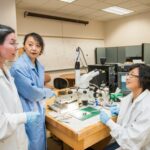
The National Science Foundation (NSF) recently released its latest Higher Education Research and Development (HERD) survey, including UMBC among the top 150 U.S. universities in federal research and development expenditures for fiscal year 2017. The annual HERD survey combines total funding from all federal agencies, including NSF and others, as well as research funding from non-federal and non-governmental sources.
UMBC is ranked #146 in federal funding for the 2017 fiscal year and #169 in total funding from all sources. The federal research investment figure includes funding sources such as the U.S. Department of Agriculture, Department of Defense, and Department of Health and Human Services (DHHS), among many others.
Partnering with NASA
The university is a strong national leader when it comes to NASA funding, where UMBC ranks #12 across all U.S. colleges and universities. This leadership also applies broadly to the overall category of research in the geosciences, atmospheric sciences, and ocean sciences, where UMBC ranks #28 nationwide.
The Center for Research and Exploration in Space Science and Technology (CRESST II) is one core research partnership UMBC maintains with NASA. UMBC and the University of Maryland, College Park, are leading partners in the consortium, which received a commitment of $87.5 million over five years from NASA’s Goddard Space Flight Center beginning in 2017 (following a successful 10-year agreement that launched in 2006).
The partnership supports cutting edge research in high energy astrophysics, gravitational waves, and other areas. Jane Turner, professor of physics, directs the Center for Space Sciences and Technology (CSST), which is the UMBC arm of CRESST. She explains that this research collaboration also creates important teaching and learning opportunities that benefit faculty, graduate, and undergraduate students.
 Jane Turner, director of CSST, at GRIT-X 2017.
The Joint Center for Earth Systems Technology (JCET) is another particularly active and robust UMBC-NASA partnership. NASA renewed JCET in 2015 at a level of $46 million over five years, affirming its commitment to this ongoing, highly productive research collaboration.
“UMBC has a terrific relationship with NASA,” says Susan Hoban, JCET’s associate director. “The UMBC-Goddard JCET is in its third decade, conducting research that advances our understanding of the Earth’s changing climate. NASA scientists, as well as UMBC faculty and students, benefit from this ongoing collaboration.”
Reflecting and informing society
The arts, humanities, and social sciences at UMBC regularly receive funding from a range of federal sources including the DHHS, USDA, National Endowment for the Humanities (NEH), and National Endowment for the Arts (NEA). The latest HERD rankings include projects in a broad range of fields in these areas, such as education, the environment, health disparities, and design. For fiscal year 2017, UMBC ranked #36 in social science research expenditures from federal sources, above institutions such as Princeton University (#48) and Brown University (#52).
Chris Curran, assistant professor of public policy, received a two-year $620,000 National Institute of Justice grant to study the role of law enforcement officers in public schools. Curran, has shared, “Law enforcement have become an increasingly common presence in school settings, particularly after high profile events like the tragedy at Sandy Hook. Our work seeks to understand the role of these officers in promoting safety, managing student behavior, and facilitating relationships with students.”
 F. Chris Curran
Also during the 2017 HERD survey period, Margaret Re, associate professor of visual arts, received a major Art Works grant from the NEA to develop the exhibition and catalog for “A Designed Life.” The project explores how the U.S. government sponsored exhibits of modern American textiles, wallpapers, containers, and packaging in the 1950s to promote American culture abroad. It’s now on display at UMBC’s Center for Art, Design, and Visual Culture.
Computing, information, and engineering
UMBC also has very strong federal support for research in computing, information sciences, and engineering disciplines. In all three areas, UMBC ranked in the top 125 U.S. universities in funding received from federal sources.
In the 2017 HERD period, UMBC received an NSF Major Research Instrumentation award to expand the university’s High Performance Computing Facility. Also in computing, Ting Zhu, assistant professor of computer science and electrical engineering, received a prestigious NSF CAREER Award for his work to develop “Internet of Things” technology.
Faculty also received numerous awards for innovative medical research. Erin Lavik, professor of chemical, biochemical, and environmental engineering, received funding from the National Eye Institute to develop a “living model of the human retina.”
Liang Zhu, professor of mechanical engineering, was PI on an NSF grant to study how applying heat to drug-carrying nanoparticles can cause tumors to shrink. Her research with UMBC colleagues in mechanical engineering, biological science, and chemistry and biochemistry could lead to a more targeted, non-surgical approach to treating tumors in cancer patients. “Not every patient can have surgery,” explained Zhu, “so this is an alternative treatment option.”
Karl V. Steiner, UMBC’s vice president for research, notes that these most recent research funding rankings highlight UMBC’s strength across disciplines. “I could not be more proud of the efforts of our faculty and students as we build our research community together. The HERD Rankings are one measurement of our scholarly impact, and represent a key method of national comparison,” he says.
Steiner continues, “Our top ranking is in NASA support, and the related research highlights areas of remarkable strength built over several decades. We are also thrilled about the strength of our social sciences research community and growing recognition for our important engineering and information sciences programs.”
Banner image: Marie Christine Daniel-Onuta, right, Liang Zhu, and Ronghui Ma working in the lab. All photo by Marlayna Demond ’11 for UMBC.
]]>
The National Science Foundation (NSF) recently released its latest Higher Education Research and Development (HERD) survey, including UMBC among the top 150 U.S. universities in federal research...
https://umbc.edu/stories/umbc-ranks-among-top-150-u-s-universities-in-federal-research-funding/
https://my3.my.umbc.edu/api/v0/pixel/news/120237/guest@my.umbc.edu/4c44aecd364e8e4e93001311bed63c8b/api/pixel
arts-and-culture
cahss
cbee
cnms
coeit
csee
meche
physics
policy-and-society
publicpolicy
research
science-and-technology
visualarts
UMBC News & Magazine
https://my3.my.umbc.edu/groups/umbc-news-magazine
https://assets1-my.umbc.edu/system/shared/avatars/groups/000/001/943/24435aa6207c452e7bc15cc74b42c7bb/xsmall.png?1748556657
https://assets1-my.umbc.edu/system/shared/avatars/groups/000/001/943/24435aa6207c452e7bc15cc74b42c7bb/original.png?1748556657
https://assets2-my.umbc.edu/system/shared/avatars/groups/000/001/943/24435aa6207c452e7bc15cc74b42c7bb/xxlarge.png?1748556657
https://assets2-my.umbc.edu/system/shared/avatars/groups/000/001/943/24435aa6207c452e7bc15cc74b42c7bb/xlarge.png?1748556657
https://assets3-my.umbc.edu/system/shared/avatars/groups/000/001/943/24435aa6207c452e7bc15cc74b42c7bb/large.png?1748556657
https://assets1-my.umbc.edu/system/shared/avatars/groups/000/001/943/24435aa6207c452e7bc15cc74b42c7bb/medium.png?1748556657
https://assets2-my.umbc.edu/system/shared/avatars/groups/000/001/943/24435aa6207c452e7bc15cc74b42c7bb/small.png?1748556657
https://assets1-my.umbc.edu/system/shared/avatars/groups/000/001/943/24435aa6207c452e7bc15cc74b42c7bb/xsmall.png?1748556657
https://assets2-my.umbc.edu/system/shared/avatars/groups/000/001/943/24435aa6207c452e7bc15cc74b42c7bb/xxsmall.png?1748556657
UMBC News & Magazine
0
0
false
Thu, 20 Dec 2018 21:01:09 -0500
Faculty receive START and SURFF awards to pursue new research and creative work
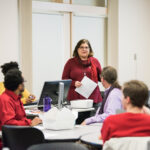
UMBC’s Office of the Vice President for Research recently presented awards to support the work of two dozen UMBC faculty examining topics from health disparities among people with diabetes to natural language processing.
UMBC offers a range of research awards to help faculty launch new research projects, advance ongoing work, and effectively compete for external funding as their projects progress and grow. Strategic Awards for Research Transitions (START) offer up to $25,000. These awards allow faculty to pursue new areas of research and compete for external funding. Summer Research Faculty Fellowship (SURFF) awards offer up to $6,000 in summer funding to non-tenured, tenure-track faculty. Current SURFF awardees received funding for summer 2018, and START awardees will begin their funding cycle in July 2019.
Health and aging
Christine Mair, associate professor of sociology, anthropology, and health administration policy, and a faculty member in the gerontology Ph.D. program, received START funding to complete foundational research visits in global regions that are underrepresented in aging research, across Eastern Europe, Southern Europe, South America, and Asia. She is working to clarify research questions and strengthen relationships with potential research collaborators for a proposal to the National Institute of Aging (NIA).
 Christine Mair, second from left, at the UMB-UMBC Partnership Symposium. Photograph by Marlayna Demond ’11 for UMBC.
With START funding, Sarah Chard, associate professor of sociology, anthropology, and health administration policy, is studying the activity levels of older African-American adults in Baltimore who have diabetes. She is conducting interviews and observing patients to better understand how they experience and manage their illness, their social and physical environments, and how they maintain physical activity routines. This work is helping Chard to develop more effective programs to address health disparities among people with diabetes.
“The aim of my START-funded project is to identify how belief systems and social processes work together to inform physical activity routines among older adult African Americans with diabetes. The project builds on my earlier research on diabetes, which identified many barriers to physical activity for older adults living in Baltimore,” Chard says. “Through START funding, I’m able to shift my focus to look at persons who are engaging in physical activity to see how they create support systems and navigate local barriers. The findings will help address a critical gap in the literature regarding successful community-based physical activity.” Chard will use data from this research for an NIA grant proposal.
 Tasneem Khambaty. Photo courtesy of psychology department.
Tasneem Khambaty, assistant professor of psychology, is using her SURFF award to continue research studying the symptoms and biomarkers of type 2 diabetes, which disproportionately affects African Americans. Khambaty examined how depressive symptoms and executive function impact these biomarkers in the long term, utilizing data from the Healthy Aging in Neighborhoods of Diversity across the Life Span (HANDLS) study, which was conducted in Baltimore. Khambaty is using this research to build a proposal for an NIH Mentored Patient-Oriented Research Career Development Award.
Jiaqi Gong, assistant professor of information systems, is developing innovative ways to understand cognitive and neural systems, specifically in people with multiple sclerosis and ACL injuries. Wearable sensors don’t all work equally well for all people. Previously, Gong developed wearable sensors that perform better in people with multiple sclerosis at different stages. Through his SURFF-funded work, he is utilizing those sensors to study brain mechanisms that control automatic and unconscious motor action, to inform his teaching and further research.
 Jiaqi Gong, right, connects with colleagues at campus event. Photo by Kait McCaffrey.
Drew Holladay, assistant professor of English, utilized SURFF funding to continue revisions of his 2017 dissertation “Articulating the New Normal(s): Mental Disability, Medical Discourse, and Rhetorical Action” for publication as a book. Holladay studies online discussion board posts written by people diagnosed with autism, post-traumatic stress disorder, and schizophrenia. He is expanding his earlier writing to include more linguistic analysis, analyzing how the medical community talks about these diagnoses, as well as adding in illustrations to complement the text.
 Drew Holladay, third from right, participating on UMBC’s Public Humanities and Health Justice Research Forum. Photo by Kait McCaffrey.
Cynthia Matuszek, assistant professor of computer science and electrical engineering (CSEE), was granted START funding to advance her work on robots that assist senior citizens in daily life and enable them to continue to live independently. She is collaborating with eldercare professionals to develop a library that will outline specific examples of how seniors can utilize assistive robots in daily life. Matuszek also received SURFF funding to develop a networking event at the Robotics: Science and Systems conference, to connect junior faculty and postdoctoral researchers with mentors in robotics.
Art, history, and society
Kathryn Bell, associate professor of visual arts, is using START funding to create Metempsychosis, a series of interactive digital video installations that combine art with science, technology, engineering, and math. She is shifting her work from project mapping art to art that is more accessible and less expensive to stage in galleries. Bell will travel to the United Kingdom to study under automata artist Matt Smith, who has exhibited at museums around the world.
Anne Rubin, professor of history, was awarded START funding to visualize the landscape of slavery and freedom in Early Baltimore. Rubin is building a virtual 3D prototype of early Baltimore between 1815 and 1820, in collaboration with UMBC’s Imaging Research Center.
Kathy Marmor, associate professor of visual arts, received START funding to create two new art installations called Mid-Life, inspired by the practice of compiling a book based personal knowledge, which has been common from the seventeenth century through modern times, and is based on one’s “habit of mind.” She is collaborating with faculty in UMBC’s English and computer science and electrical engineering departments. The installations will bring together digital and computer-based imagery, and analog drawings and fiber art to depict women facing mid-life challenges.
 A photo from The Glass Knife exhibition, by Kathy Marmor and Stephen Bradley, which ran in 2016. Image by Stephen Bradley.
Sarah Sharp, assistant professor of visual arts, is using START funding for her new project Off the Press. Sharp will look at small presses and self-published media from the women’s, gay rights, and environmental movements in the 1970s. She will examine the differences and similarities between common practices of that period and contemporary self-publishing practices, such as through social media and other online platforms. Sharp is combining traditional art practices, like quiltmaking and embroidery, with digital video, augmented reality, and 3D modeling.
Earl Brooks, assistant professor of English, utilized a SURFF award to continue his project Black Sonority: Rhetoric and Black Music. This work examines the intersections of Black music, life, and culture. Brooks explores the rhetorical nature of Black music and the various roles it had has in shaping public discussion.
Cross-cultural understanding
Kindel Nash, associate professor of early childhood education, has received SURFF funding to study the relationship between culture, language, and literacy development for young children in the United States and Peru. Nash is examining highly effective literacy practices in U.S. and Peruvian primary schools, which both include populations that are historically underserved in educational settings. She will work to determine the practices’ commonalities and underlying principles, and whether the approaches would be transferable across cultures.
Salem Abo-Zaid, assistant professor of economics, studied attitudes toward immigrant and minority populations in a sample of European countries between 2002 and 2016. He used longitudinal data from the European Social Survey to understand how economic conditions have impacted tolerance toward people in these groups. Abo-Zaid found that economic conditions, in addition to security, political, and cultural tensions, impacted countries’ tolerance of immigrant and minority populations.
Melissa Bailey Kutner, assistant professor of ancient studies, used SURFF funding to complete her book about economics in the Roman Empire. As a part of this work, Kutner studied coins, measured instruments, and wrote accounts of documents found at specific archaeological sites. She looked at how communities used these tools to trace how they shared information and negotiated economic value. Kutner found that how Romans represented value depended on social context, and she developed a model to examine related historical changes across multiple regions.
Technology and environment
Dillon Mahmoudi, assistant professor of geography and environmental systems, used SURFF funding to create a machine-learning algorithm to identify spaces for urban agriculture on single family tax lots. Mahmoudi will study whether urban agriculture plots are more frequently located in richer or poorer neighborhoods. This work focuses on the food production potential of lots in Seattle and Baltimore, expanding on prior research that analyzed lots through satellite images of Portland.
Tim Nohe, professor of visual arts and director of UMBC’s Center for Innovative Research in the Creative Arts, received START funding to use 360 degree immersive video and surround-sound technology to give people a deeper look into the environment through his project “Water Flowing Underground: Immersive Sound and Immersive Video Imaging.” His work will allow viewers to understand sources of pollution that impact Baltimore’s watershed. The research will reveal streams that have been used to collect raw sewage, or have been paved over, impacting the flow of water.
 Tim Nohe at Light City in 2017. Photo by Marlayna Demond ’11 for UMBC.
“This grant has allowed me to begin fieldwork and research on the fractured interface of Baltimore’s watershed and its sanitary sewer system. That breakdown is evident in my neighborhood, and throughout the city,” explains Nohe. “When the sewer system was nearing completion in 1909 it was called an ‘unexcelled marvel of the engineering world,’ but today sanitary sewers routinely spew waste into our streams, the bay, and city basements.”
“I’m forging partnerships with journalists, water quality scientists and nonprofit groups like Blue Water Baltimore to hunt down and expose these breakdowns,” says Nohe, “using the tools of archival research, and documentary immersive video and surround sound.”
Data and computing
Frank Ferraro, assistant professor of CSEE, used SURFF funding to advance his work in natural language processing. He studied how information extraction systems can help deconstruct and summarize highly complex documents. Over the summer, Ferraro developed, trained, and evaluated these systems to determine how they can be effectively used to can help people understand themes within dense and complicated texts.
Haibin Zhang, assistant professor of CSEE, developed an efficient, secure and scalable system that helps prevent compromised sensors from shifting aggregated data results based on polluted data. The system that Zhang designed and put in place helps solve the problem by keeping individual sensor inputs private.
Sisi Duan, assistant professor of information systems, used SURFF funding to study the scalability of blockchains—blocks of data linked using cryptography, that are resistant to tampering. She identified challenges that blockchain researchers sometimes face, and then redesigned and reimplemented a blockchain protocol called BChain, which she developed. Duan implemented BChain as part of the Hyperledger project, a global collaborative project aimed at advancing blockchain technologies across industries.
Curtis Menyuk, professor of CSEE, is working with collaborators at Bangladesh University of Engineering and Technology and at the Maryland Psychiatric Research Center to develop a model that can help explain what contributes to white matter deficits in the brain.
New directions in science
Theodosia Gougousi, professor of physics, received funding to address the shortage of semiconductor-compatible nonlinear optical materials. She will investigate the nonlinear properties of dielectric thin films and nanolaminates formed by atomic layer deposition. Her project is interdisciplinary, bridging the fields of electronics materials and nonlinear optics, with the goal of developing a broader materials toolkit that could be utilized for optoelectronic applications.
Gougousi explains that the funding will support the collaboration of her research group and that of Anthony Johnson, professor of physics. “Our groups have been working together for over a year,” she says. “We expect the award will enable us to complete the characterization of the structure and composition of these films, which is required for competitive proposals to national funding agencies.
Mercedes Burns, assistant professor of biological sciences, studied sexual reproduction in Japanese harvestman, an arachnid with long legs compared to other species. This work, supported by SURFF funding, allowed Burns to collect female Japanese harvestman in order to conduct genotyping analysis. During the summer, she attended the Society of Molecular Biology and Evolution scientific meeting to collaborate with fellow biologists from around the world.
Kathleen Cusick, assistant professor of biological sciences, received SURFF funding to characterize the role of an intracellular signaling molecule in bacteria that regulates cellular function, cell movement, intracellular communication, and how cells respond to the environment. The molecule (called c-di-GMP) has unique trails that make it a particularly good fit for this research into signaling networks.
For more information about UMBC’s START and SURFF programs, visit the UMBC Research website.
Banner image: Anne Rubin, standing, during the 2018 Frederick Douglass transcribe-a-thon. Banner image by Marlayna Demond ’11 for UMBC.
]]>
UMBC’s Office of the Vice President for Research recently presented awards to support the work of two dozen UMBC faculty examining topics from health disparities among people with diabetes to...
https://umbc.edu/stories/faculty-receive-start-and-surff-awards-to-pursue-new-research-and-creative-work/
https://my3.my.umbc.edu/api/v0/pixel/news/120243/guest@my.umbc.edu/714811ac2a01d4a647e7e1503f70268a/api/pixel
ancientstudies
biology
cahss
cirsca
cnms
coeit
csee
economics
education
english
ges
history
is
physics
research
saph
science-and-technology
strategic-planning
visualarts
UMBC News & Magazine
https://my3.my.umbc.edu/groups/umbc-news-magazine
https://assets1-my.umbc.edu/system/shared/avatars/groups/000/001/943/24435aa6207c452e7bc15cc74b42c7bb/xsmall.png?1748556657
https://assets1-my.umbc.edu/system/shared/avatars/groups/000/001/943/24435aa6207c452e7bc15cc74b42c7bb/original.png?1748556657
https://assets2-my.umbc.edu/system/shared/avatars/groups/000/001/943/24435aa6207c452e7bc15cc74b42c7bb/xxlarge.png?1748556657
https://assets2-my.umbc.edu/system/shared/avatars/groups/000/001/943/24435aa6207c452e7bc15cc74b42c7bb/xlarge.png?1748556657
https://assets3-my.umbc.edu/system/shared/avatars/groups/000/001/943/24435aa6207c452e7bc15cc74b42c7bb/large.png?1748556657
https://assets1-my.umbc.edu/system/shared/avatars/groups/000/001/943/24435aa6207c452e7bc15cc74b42c7bb/medium.png?1748556657
https://assets2-my.umbc.edu/system/shared/avatars/groups/000/001/943/24435aa6207c452e7bc15cc74b42c7bb/small.png?1748556657
https://assets1-my.umbc.edu/system/shared/avatars/groups/000/001/943/24435aa6207c452e7bc15cc74b42c7bb/xsmall.png?1748556657
https://assets2-my.umbc.edu/system/shared/avatars/groups/000/001/943/24435aa6207c452e7bc15cc74b42c7bb/xxsmall.png?1748556657
UMBC News & Magazine
0
0
false
Tue, 18 Dec 2018 20:22:13 -0500
From lab to museum, new UMBC grads show the powerful impact of original research
“I just had this feeling that there had to be more to this story,” says Nicolle “Niki” Konkel ’18, on the striking lack of women in her art history textbooks. So, with the support of faculty mentors, in her senior year she embarked on research that has opened new doors in the art world.
Student passion guided by faculty support is part of the fabric of UMBC. Konkel’s experience is one exciting example of how this winning combination can make possible big breakthroughs.
Hearing marginalized voices
Konkel is an art history and museum studies major who came to UMBC after attending Frederick Community College. While at FCC, She worked 30 hours a week in addition to her studies to fund her first trip to the Netherlands, a voyage that shaped her career goals. Now, she is contributing to a new branch of art history research on women of the De Stijl, an early 20th-century avant garde Dutch art movement.
“There’s so much still to learn, and that fuels my passion to go to graduate school and continue this research,” she says. “When marginalized voices can be heard and placed more within the mainstream, I think that’s so important.”
 DE STIJL “6 decades book.” Photo by de stijl, CC BY 2.0.
This fall, Konkel was also able to gain professional experience as an curatorial intern at the Smithsonian National Museum of American History. She was part of the curatorial team for an entertainment exhibit that will be on display for two decades.
Konkel says the support of her mentors helped make it all possible, especially her senior thesis mentor, visual arts professor Kathy O’Dell. All of the professors “are so invested in us here. They care a lot about my growth and what I’m going to do afterward,” Konkel says. “They want to help you channel your passion.”
Confidence boost
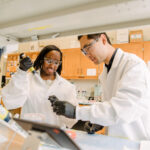
Alexis Waller ’18, biological sciences, has had similarly powerful experiences with research and mentorship. UMBC STEM BUILD, an NIH-funded initiative to increase diversity in the biomedical workforce, “showed me what research actually was,” Waller says. Before UMBC, she shares, “I’d never been inside a lab.” Now? “I just love being in the lab setting and doing hands-on research.”
In her first year, Waller presented at the UMBC Undergraduate Research Symposium with BUILD. With support from Laura Ott, the active learning coordinator for STEM BUILD, Waller joined Michael Summers’s lab in 2016. The lab’s research focuses on how the HIV-1 retrovirus assembles copies of itself within infected cells, so that the copies can emerge to infect other cells.
In addition to Summers, postdoc Pengfei Ding provides direct research mentorship to Waller. “He has always been very patient and encouraged me to ask questions,” Waller says.
 Alexis Waller ’18, right, and her mentor Pengfei Ding at work in Michael Summers’s biochemistry lab. Photo by Marlayna Demond ’11 for UMBC.
Waller started out in a shadowing role in the lab, but says, “as I’ve gotten more confident and knowledgeable, the more responsibility I’ve been given.”
Now a MARC U*STAR Scholar, Waller is continuing work on her team’s project studying a step in the replication of HIV. By contributing to a better understanding of that step, she’s helping provide the knowledge necessary for other scientists to develop treatments to block HIV replication, preventing spread of the infection.
After graduation, Waller will continue to work in the Summers lab as a research assistant while she applies to Ph.D. programs in microbiology. “Being a part of BUILD and MARC, and working in the Summers lab, has all led to me deciding to pursue a Ph.D.,” she says.
Bench to bedside
Like Waller, Abby Cruz ‘18 is also a biological sciences major and a MARC U*STAR Scholar. When she came to UMBC, she believed science was a solitary pursuit, but that changed after she joined Fernando Vonhoff’s biology lab. “I look forward to going to lab because of the collaboration with other people,” she says.
 Abby Cruz ’18, left, and her mentor Fernando Vonhoff discuss an experimental protocol. Photo by Marlayna Demond ’11 for UMBC.
Cruz has been looking at whether certain genes may be associated with human motor neuron diseases, such as ALS, using fruit flies as a model. Scientists at Yale University will use her results to inform their study of motor neuron disease in human cells.
She also works part time in a neurology clinic, where she interacts directly with patients. “I love it,” she says. “It’s what gets me up every day—that I’m part of a community where I can see the research and the clinical side go hand in hand.”
Cruz reached out to Vonhoff just before she joined UMBC from Howard Community College in 2016, and he’s been a supporter ever since. “If it wasn’t for Dr. Vonhoff I wouldn’t have been able to do everything I did,” she says. “If you’re willing to try and put in the effort, his attitude is, ‘Let’s make it happen.’”
 Abby Cruz ’18 and her mentor Fernando Vonhoff check on a vial of fruit flies, their study organism. Photo by Marlayna Demond ’11 for UMBC.
Before starting work in the lab, Cruz was planning on medical school. Now she’s looking toward an M.D./Ph.D. or D.O./Ph.D. (doctor of osteopathic medicine). “Focusing on that connection between the research and the clinic has really solidified my future goals,” she says.
Bridging cultures
When Julian Tash ’18 approached Constantine Vaporis, history professor and former director of UMBC’s Asian studies program, after an art history class one day, he expected a helpful conversation about his career goals. He came away with a game-changing connection to Robert Mintz, the curator of Japanese art at the Walters Art Museum in Baltimore.
Tash, a Humanities Scholar, had noticed Asian art was given less attention than Western art in his high school courses. His further exposure at UMBC to the rich traditions found in Asian art, however, inspired him to pursue a double major in Asian studies and history. With Vaporis’s support, he began an internship at the Walters.
Cataloguing Buddhist statuary at the Walters got Tash “interested in the question of how to connect museum visitors with these statues, when they don’t have a background in the culture in which the objects were produced,” he shares. That interest led to a project he pursued with guidance from Vaporis and visual arts professor Preminda Jacob.
 Julian Tash ’18 says most of his research, when he isn’t doing fieldwork, involves a lot of reading in the library. Photo by Marlayna Demond ’11 for UMBC.
Tash received funding from a UMBC Undergraduate Research Award and a Bridging Scholarship from the American Association of Teachers of Japanese to travel throughout Japan and in the U.S. to explore how Buddhist statues are displayed in their native context compared to in American museums. His resulting research paper, which has been selected for publication in the UMBC Review, recommends that U.S. museums use technology to help visitors see more clearly how the statues appear in their original contexts, in Japanese temples.
Tash has already shared his research with curators at the Metropolitan Museum of Art, British Museum, and Freer and Sackler Galleries. He has also presented other work at the Bard Conference on Asia and the Environment, with research partner Jennifer Christhilf ’19, geography and environmental systems. That project was a new direction for Tash, exploring the impacts of dam construction projects in China and downstream countries such as Vietnam and Cambodia.
 Julian Tash ’18 and one of his mentors, Julie Rosenthal, stand by his research poster about dam removals on the Mekong River in China. Photo by Marlayna Demond ’11 for UMBC.
“Working with someone in the sciences is really emblematic of UMBC, because we’re bringing it all together, in a way that’s vitally important to this region,” says Tash. “That was a great experience and it got me thinking about the intersection of the humanities and policy.”
Although he’s graduating, collaborations Tash has helped build will continue at UMBC, including a Perspectives on Asia conference that will be co-sponsored by Johns Hopkins University.
Tash has applied for a Fulbright Fellowship to conduct research in Taiwan as well as graduate programs.
Like Konkel, Cruz, and Waller, when Tash reflects on his UMBC experience, it all comes back to mentorship and support. “Even though these professors all have really busy schedules, I would go to them with an idea, and even if it wasn’t in their immediate area of study, they all made such phenomenal efforts to support me,” he shares.
“UMBC put the resources in front of me,” Tash says. “I just thought, I could do all these things—I just have to try to pursue them.”
December commencement ceremonies will be livestreamed through both the UMBC Commencement website and UMBC Facebook page. Share well wishes for our grads using #UMBCgrad and #UMBCproud.
Banner image: Alexis Waller ’18 and her mentor, Pengfei Ding, at work in the lab. Photo by Marlayna Demond ’11 for UMBC.
]]>
“I just had this feeling that there had to be more to this story,” says Nicolle “Niki” Konkel ’18, on the striking lack of women in her art history textbooks. So, with the support of faculty...
https://umbc.edu/stories/from-lab-to-museum-new-umbc-grads-show-the-powerful-impact-of-original-research/
https://my3.my.umbc.edu/api/v0/pixel/news/120244/guest@my.umbc.edu/8feb90d9cbb819b272a89488968dd7d0/api/pixel
arts-and-culture
asianstudies
biology
cahss
chembiochem
cirsca
cnms
community
diversityandinclusion
history
marcustar
policy-and-society
science-and-technology
stembuild
strategic-planning
visualarts
UMBC News & Magazine
https://my3.my.umbc.edu/groups/umbc-news-magazine
https://assets1-my.umbc.edu/system/shared/avatars/groups/000/001/943/24435aa6207c452e7bc15cc74b42c7bb/xsmall.png?1748556657
https://assets1-my.umbc.edu/system/shared/avatars/groups/000/001/943/24435aa6207c452e7bc15cc74b42c7bb/original.png?1748556657
https://assets2-my.umbc.edu/system/shared/avatars/groups/000/001/943/24435aa6207c452e7bc15cc74b42c7bb/xxlarge.png?1748556657
https://assets2-my.umbc.edu/system/shared/avatars/groups/000/001/943/24435aa6207c452e7bc15cc74b42c7bb/xlarge.png?1748556657
https://assets3-my.umbc.edu/system/shared/avatars/groups/000/001/943/24435aa6207c452e7bc15cc74b42c7bb/large.png?1748556657
https://assets1-my.umbc.edu/system/shared/avatars/groups/000/001/943/24435aa6207c452e7bc15cc74b42c7bb/medium.png?1748556657
https://assets2-my.umbc.edu/system/shared/avatars/groups/000/001/943/24435aa6207c452e7bc15cc74b42c7bb/small.png?1748556657
https://assets1-my.umbc.edu/system/shared/avatars/groups/000/001/943/24435aa6207c452e7bc15cc74b42c7bb/xsmall.png?1748556657
https://assets2-my.umbc.edu/system/shared/avatars/groups/000/001/943/24435aa6207c452e7bc15cc74b42c7bb/xxsmall.png?1748556657
UMBC News & Magazine
0
0
false
Tue, 18 Dec 2018 20:14:09 -0500
CS3 leads research summit on community-based violence prevention in Baltimore
Lauren and Vibha sit in a conference room deep in the middle of the University of Maryland School of Medicine. They wait patiently as faculty and staff from UMBC; the University of Maryland, Baltimore (UMB); the University of Maryland, College Park; Baltimore City government officials; and staff from Baltimore-based non-profit organizations fill the round tables.
This is the Research Summit on Violence Prevention and Community Engagement hosted by UMBC and UMB. In a room of about fifty attendees ready to discuss the impact of violence prevention efforts in Baltimore, Lauren and Vibha look at each other, knowing they bring a different voice. Both recent UMBC alumni and graduate presidential fellows at UMB, they are here to speak as young Baltimore researchers, who care deeply about their communities and want to be involved in the research aimed at making their city safer.
 UMB graduate students discuss violence prevention in Baltimore with UMBC’s Lauren Edwards, public policy (right). Photo by Marlayna Demond ’11 for UMBC.
“I am the community”
Lauren Highsmith ‘15, education, introduces herself to the room after a conversation about the need to work with the community. “I am the community. Please remember me,” she says. “I am a master’s student in social work at the University of Maryland, Baltimore. I was born in West Baltimore and continue to live in the area. Don’t assume the community is just what you see on television. The community are also people like me who are working in the field and doing research.”
Vibha Rao ‘14, biological sciences, M22, claps after her friend’s statement. She is from Gaithersburg, Maryland, but lives, studies, and works in Baltimore. In the last decade, she has earned her undergraduate degree and a medical degree from the University of Maryland School of Medicine, and she is currently pursuing an M.S. in clinical research.
Rao has been deeply affected by the experiences of her undergraduate and graduate peers from Baltimore whose family members have been killed by gun violence. “Their experience having grown up and gone to college and medical school in Baltimore is starkly different than students outside of Baltimore,” she says. She worries about the normalization of gun violence and wants to be part of research to address it from a medical perspective. She shares, “I don’t want violence to be normal anymore.”
Human- and community-centered research
The research summit was organized by Christine Mallinson, director of UMBC’s Center for Social Science Scholarship (CS3) and professor of Language, Literacy, and Culture, and Kate Tracy ‘03 Ph.D. and ‘01 M.A., psychology and human services, who is associate professor of epidemiology and public health and director of The Richard and Jane Sherman Center for Health Care Innovation at the University of Maryland, Baltimore. As one focus for the day’s work, Mallinson and Tracy asked participants to explore both immediate and long-term supports for communities served through the UMB Community Engagement Center. During the breakout sessions, they asked attendees to identify how they might engage more undergraduate and graduate students from Baltimore, like Highsmith and Rao, in community-facing research on violence prevention.
 Mallinson (l) and Tracy (r) address the purpose of the summit. Photo courtesy of UMB.
“We wanted to purposefully use this summit to convene as many researchers as possible to examine, discuss, and share expertise and data,” Mallinson says. “Our intent is increasing collaboration and resources beyond this room, between institutions and the community, to create tangible, applicable and responsive human- and community-centered research in violence prevention with and for Baltimore.”
During the day-long event, UMBC faculty and staff representing the School of Public Policy, media and communication studies, visual arts, The Hilltop Institute, The Shriver Center, Division of Student Affairs, emergency health services, and psychology gathered for group discussion in different areas of violence prevention research. They met as cohorts focused on data, community involvement, K-12 and higher education, clinical interventions, and the intersection of the correctional and health systems.
Responding to the call from the morning discussion, the groups developed ideas for how to support the UMB Community Engagement Center through each of their focus areas, particularly building on existing work by community members. They also identified a timeline to continue the cohort work beyond the conference.
 UMBC President Freeman Hrabowski (l) speaks to summit participants. Photo courtesy of UMB.
“Collaboration between academic and community partners is key for successful violence prevention research, and developing the next generation of innovators by harnessing the talents of our undergraduate and graduate students in this process is essential,” shared Lucy Wilson, M.D., graduate program director of emergency health services at UMBC.
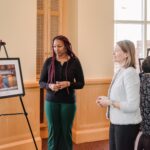
After the summit, the participants walked through two thought-provoking exhibitions, David Hess’s “Gun Show,” with life-size sculptures of assault rifles made from ordinary objects, and a photo series of homicide locations in Baltimore City by Amy Berbert’s ’17, visual arts. Both artists created the pieces to foster dialogue and awareness about guns and violence.
 Highsmith and Berbert discussing the photo exhibit. Photo by Marlayna Demond ’11, for UMBC.
As everyone spoke with the artists, and with each other, reflecting on the day, Mallinson took this opportunity to connect with Lauren Highsmith and Vibha Rao. She wanted to hear their perspectives, and their advice, on how to engage and include more undergraduate and graduate students from Baltimore in violence prevention work, to ensure it tackles the most pressing issues, recognizes community work already underway, and can have a lasting impact.
Banner image: Event organizer Christine Mallinson (r) speaks with summit participants. Photo by Marlayna Demond ’11 for UMBC.
]]>
Lauren and Vibha sit in a conference room deep in the middle of the University of Maryland School of Medicine. They wait patiently as faculty and staff from UMBC; the University of Maryland,...
https://umbc.edu/stories/cs3-leads-research-summit-on-community-based-violence-prevention-in-baltimore/
https://my3.my.umbc.edu/api/v0/pixel/news/120250/guest@my.umbc.edu/0c1a83adcf2fb9ee8ac4430723901b48/api/pixel
cahss
cec
cirsca
cs3
ehs
hilltopinstitute
mcs
policy-and-society
psychology
publicpolicy
shrivercenter
strategic-planning
visualarts
UMBC News & Magazine
https://my3.my.umbc.edu/groups/umbc-news-magazine
https://assets1-my.umbc.edu/system/shared/avatars/groups/000/001/943/24435aa6207c452e7bc15cc74b42c7bb/xsmall.png?1748556657
https://assets1-my.umbc.edu/system/shared/avatars/groups/000/001/943/24435aa6207c452e7bc15cc74b42c7bb/original.png?1748556657
https://assets2-my.umbc.edu/system/shared/avatars/groups/000/001/943/24435aa6207c452e7bc15cc74b42c7bb/xxlarge.png?1748556657
https://assets2-my.umbc.edu/system/shared/avatars/groups/000/001/943/24435aa6207c452e7bc15cc74b42c7bb/xlarge.png?1748556657
https://assets3-my.umbc.edu/system/shared/avatars/groups/000/001/943/24435aa6207c452e7bc15cc74b42c7bb/large.png?1748556657
https://assets1-my.umbc.edu/system/shared/avatars/groups/000/001/943/24435aa6207c452e7bc15cc74b42c7bb/medium.png?1748556657
https://assets2-my.umbc.edu/system/shared/avatars/groups/000/001/943/24435aa6207c452e7bc15cc74b42c7bb/small.png?1748556657
https://assets1-my.umbc.edu/system/shared/avatars/groups/000/001/943/24435aa6207c452e7bc15cc74b42c7bb/xsmall.png?1748556657
https://assets2-my.umbc.edu/system/shared/avatars/groups/000/001/943/24435aa6207c452e7bc15cc74b42c7bb/xxsmall.png?1748556657
UMBC News & Magazine
0
0
false
Fri, 14 Dec 2018 18:56:55 -0500
Third annual UMBC GRIT-X talks highlight thought-provoking ideas, experiences, and discoveries

Artists, scientists, and social change agents from across UMBC presented the third annual GRIT-X talks on October 13, sharing their ideas and perspectives on stage in UMBC’s Dance Cube. “All our talks gave a different facet, a different beam of light, on what we do at UMBC,” said Vice President for Research Karl Steiner, who spearheaded the event.
The value of stories
Documentary filmmaker Richard Chisolm ’82, interdisciplinary studies, explained how many documentaries and reality television shows today are tightly scripted and controlled, and how, in contrast, he uses an in-the-moment style of filmmaking to produce films that honestly represent a microcosm of the larger story.
Through films like Cafeteria Man, focused on school food reform, and Gun Show, about an artist who makes sculptures of assault weapons out of found objects, Chisolm gives viewers an entry point into thorny issues. Each topic he tackles is a “huge iceberg, the tip of which is an hour documentary,” Chisolm says. “The noblest thing to do is to tell stories in a way that the tip of the iceberg represents the iceberg fairly.”
Manil Suri, mathematics, emphasized in his talk that storytelling can benefit disciplines beyond literature and film. “Stories underlie so much of what we do, including math and other STEM subjects,” he said.
Suri weaves together his passions for storytelling and math on a daily basis: He teaches a course with Michele Osherow, English, about the relationship between math and the humanities, and he’s written a novel, The Godfather of Numbers, that is a sort of creation story for mathematics. He’s using excerpts from it in his math classes this fall.
Suri also urges people who are less keen on mathematics to broaden their perspective of what math is. “Math is about more than calculations,” he says. “It’s about ideas, and ideas, such as infinity, can be enjoyed by everyone.”
 Nicole King, American studies, at GRIT-X.
Nicole King, American studies, enjoys listening to and learning from others’ stories, with a focus on residents of Baltimore City. After an accident totaled her Corolla in 2010, King decided to go carless, which, she says, removed a barrier to her truly listening to Baltimore. Through taking the bus and more closely connecting with Baltimore in other ways, King shared, “I started to really see the beauty—that cacophony of voices and sounds—that make a city a city.”
King’s research seeks to understand how Baltimore residents are responding to change across the city, with a particular focus on public markets like Lexington Market, and arts districts like Station North. Through that work, “I found listening, really listening, has been the most important, but also the most difficult, method I have used in my research,” she said. She creates opportunities for her students to “show up and listen” through immersive class projects.
Listening to her students has helped shape her teaching and research, too. “Give students the agency to shape projects,” she recommends. “They have good ideas and should be taken seriously.”
Doing things differently
Deborah Thompson Eisenberg ’91, political science, is a professor of law at the University of Maryland Carey School of Law, where she directs the Center for Dispute Resolution. She was motivated to pursue a law career because, she explained, “When our democracy encounters crisis, lawyers and the judiciary tend to step in to give voice to the powerless, enforce our laws and our Constitutional rights, and protect the most vulnerable.” However, over time, she reflected, “I’ve come to believe that if lawyers and judges truly want to foster a culture of conflict resolution, we need more than the power of the rule of law.”
Eisenberg began to focus on alternatives to traditional litigation: mediation and restorative justice practices, teaching our youth to “talk it out to work it out,” and teaching our politicians “to use consensus-building policies.” Conflict is inevitable and has been intensifying, Eisenberg argued, but “we can transform our culture of conflict to a culture of conflict resolution if we use all of our superpowers,” combining the rule of law, alternative dispute resolution, community connections, and education.
 Kimberly Moffitt, language, literacy, and culture and Africana studies, at GRIT-X.
Disney’s Princess Tiana may not be a superhero, but, as the first black Disney princess, she is larger than life in the eyes of many young girls of color. Kimberly Moffitt, associate professor of language, literacy, and culture and Africana studies, discussed how Tiana broke the mold of the traditional Disney princess with her entrepreneurial, ambitious spirit in The Princess and the Frog. “Princess Tiana pushes the bounds of the princess trope and says, ‘No more. We can do this differently,’” Moffitt said.
However, Moffitt explained, Tiana is also an example of the “glass cliff,” a phenomenon in business where companies are more likely to hire women and people of color to leadership roles when those companies are in times of crisis and the risk of failure is highest. When Tiana came out in 2009, Disney hadn’t had a new princess-style protagonist since Mulan in 1998, and the brand was faltering. The Princess and the Frog didn’t achieve box office success itself, but, Moffitt argued, “Tiana created space for the next three princesses,” who all were more independent than their predecessors: Rapunzel in Tangled, Merida in Brave, and Moana in Moana. “Tiana was a catalyst to shift our perception of what a princess could look like—in skin tone as well as her actions.”
 Eric Dyer ’95, visual arts, demonstrates his art at GRIT-X.
Eric Dyer ’95, professor of visual arts, shifts our perception of what moving pictures can be by reimagining the zoetrope, one of the original forms of motion picture. Zoetropes use a series of snapshots in a spinning cylinder to trick the mind into seeing a moving scene. “As an artist, I pick up the tactile and interactive zoetrope where it was abandoned 120 years ago,” Dyer said, “and continuously reinvent it to make films, interactive animated sculptures, and immersive installations.”
At GRIT-X, Dyer demonstrated his work for the audience and, for the first time, shared the story behind each piece. Attendees enjoyed frolicking onions and peppers and reflected on Dyer’s exploration of the industrial heydays of the U.S. and China. “Thank you for sharing this performance storytelling experience with me today,” Dyer shared as he closed. “There’s something very human about it that isn’t possible either virtually or remotely.”
Shifting the culture
Diane Bell McKoy ’73, social work and sociology, is the CEO of Associated Black Charities of Maryland. She used her GRIT-X talk as an opportunity to share a powerful personal story of seeking treatment for depression in a broken mental healthcare system. Systems in place in the United States, she argued, perpetuate stigma and fail to support a sense of self-worth for people of color, and she is working to change them.
 Diane Bell McKoy ’73, social work and sociology, at GRIT-X.
McKoy’s work has a particular focus on closing the racial wealth gap. If wealth continues to accrue at current rates, it would take a black family 228 years to accrue as much wealth as a white family, McKoy said, and it would take a Latino family 84 years. McKoy encouraged attendees to “look at the world through a new lens” and be willing to question current systems, from employment to education to healthcare.
Shawn Bediako, psychology, is also interested in changing perceptions around race, with a focus on health and science. “Ideas about race can become inscribed in our minds if they’re repeated often enough,” he said at GRIT-X, using the example that many people seem to believe, incorrectly, that sickle cell disease is exclusive to black people.
 Bediako went on to explain how race is a complex legal, social, and cultural construct that impacts people’s lives in dramatic ways. But he also shared that he has hope this can change, and that UMBC can develop leaders who will impact the way we think about race. “I feel confident that an institution like ours, with a commitment to inclusive excellence at all levels of the arts, humanities, and sciences,” he said, “can help…change this inscription and hopefully shift this paradigm.”
To close the program, Kavita Krishnaswamy ’07, computer science and mathematics, Ph.D. ’19, computer science, shared her work developing solutions to assist people with disabilities and mobility challenges. Krishnaswamy, who has spinal muscular atrophy, gave her presentation via a telepresence device that allows her to navigate the world from her home in Columbia, Maryland.
Krishnaswamy is the recipient of the Google Lime Scholarship, was named a Microsoft Fellow, and was included among the Baltimore Sun’s “25 Women to Watch.” She is currently working on projects including a bed that allows people with mobility challenges to adjust their position along many different axes of movement, and a robot to enable people who previously could not use the bathroom unassisted to do so independently.
 Alumna and Ph.D. student Kavita Krishnaswamy presents at GRIT-X via telepresence device.
“We have a lot of problems in the world, and I really feel that robotics can solve many of those problems,” Krishnaswamy said. “So in that way we can really promote social progress and elevate the global living standards. That, in turn, can increase the quality of life for people with disabilities, seniors, and their families.”
One of her closing remarks echoed the sentiments of others at GRIT-X. “Even though our perspectives are many and diverse, our vision is one,” she concluded. Whether dismantling stigma, finding new ways to connect students with intimidating subjects, or changing how we think about conflict, all the speakers emphasized how the UMBC community can reach together to improve the world of tomorrow.
Banner image: Manil Suri, mathematics, at GRIT-X. All photos by Marlayna Demond ’11 for UMBC.
Explore video of all GRIT-X talks on the Research at UMBC website.
]]>
Artists, scientists, and social change agents from across UMBC presented the third annual GRIT-X talks on October 13, sharing their ideas and perspectives on stage in UMBC’s Dance Cube. “All our...
https://umbc.edu/stories/third-annual-umbc-grit-x-talks-highlight-thought-provoking-ideas-experiences-and-discoveries/
https://my3.my.umbc.edu/api/v0/pixel/news/120305/guest@my.umbc.edu/9d191177a3ec74be6f5c96ff2de1b313/api/pixel
africanastudies
americanstudies
cahss
cnms
coeit
community
csee
inds
llc
mathstat
politicalscience
psychology
saph
socialwork
visualarts
UMBC News & Magazine
https://my3.my.umbc.edu/groups/umbc-news-magazine
https://assets1-my.umbc.edu/system/shared/avatars/groups/000/001/943/24435aa6207c452e7bc15cc74b42c7bb/xsmall.png?1748556657
https://assets1-my.umbc.edu/system/shared/avatars/groups/000/001/943/24435aa6207c452e7bc15cc74b42c7bb/original.png?1748556657
https://assets2-my.umbc.edu/system/shared/avatars/groups/000/001/943/24435aa6207c452e7bc15cc74b42c7bb/xxlarge.png?1748556657
https://assets2-my.umbc.edu/system/shared/avatars/groups/000/001/943/24435aa6207c452e7bc15cc74b42c7bb/xlarge.png?1748556657
https://assets3-my.umbc.edu/system/shared/avatars/groups/000/001/943/24435aa6207c452e7bc15cc74b42c7bb/large.png?1748556657
https://assets1-my.umbc.edu/system/shared/avatars/groups/000/001/943/24435aa6207c452e7bc15cc74b42c7bb/medium.png?1748556657
https://assets2-my.umbc.edu/system/shared/avatars/groups/000/001/943/24435aa6207c452e7bc15cc74b42c7bb/small.png?1748556657
https://assets1-my.umbc.edu/system/shared/avatars/groups/000/001/943/24435aa6207c452e7bc15cc74b42c7bb/xsmall.png?1748556657
https://assets2-my.umbc.edu/system/shared/avatars/groups/000/001/943/24435aa6207c452e7bc15cc74b42c7bb/xxsmall.png?1748556657
UMBC News & Magazine
0
0
false
Wed, 17 Oct 2018 21:09:38 -0400
30th UMBC Alumni Awards celebrate leadership, service, and community

UMBC community members from the university’s first class to today kicked off Homecoming 2018 on October 4 with a celebration of UMBC Alumni Award winners. Held in the Earl and Danielle Linehan Concert Hall, the moving and memorable ceremony reflected the rich community that is UMBC and honored the tremendous achievements of eight exceptional awardees.
As the evening began, John Becker ’01, information systems, president of the UMBC Alumni Association, remarked, “The alumni and faculty we will recognize tonight truly capture the depth of the UMBC community.” President Freeman Hrabowski encouraged attendees to “listen, learn, and be inspired.”
Kimberly Ellison-Taylor ’93, information systems, received the 2018 Outstanding Alumna in Engineering and Information Technology Award. She bridges her knowledge in technology and finance as a global strategy director at Oracle. She is also the youngest person and first African-American woman to be elected as chair of the American Institute of Certified Public Accountants.
 Awardee Kimberly Ellison-Taylor ’93 (left) with Karen Shaheed ’85.
Greg Simmons, M.P.P. ’04, public policy, and vice president of institutional advancement, described Ellison-Taylor as “a visionary in her field” who can “see the future in the work that she does.” Still, he says, despite her success, “she’s never forgotten where she’s come from, and she’s made sure she’s opened pathways for others to have success that she’s modeled so well.”
Ellison-Taylor grew up in Baltimore’s Sandtown-Winchester neighborhood. “Statistically, I shouldn’t be here,” she shared, but “UMBC provided a foundation of unparalleled opportunity. It empowered, enabled, equipped, and energized me to succeed.”
Through her participation in the Sigma Gamma Rho sorority, Ellison-Taylor began paying it forward, supporting others in finding their paths. “Everyone deserves respect and dignity,” she said, “whether they’re the CEO or the janitor.”
Allan Kittleman ’81, political science, introduced Zainab Alkebsi ’09, political science, this year’s Rising Star Award recipient. Alkebsi serves as policy counsel for the National Association for the Deaf.
As a child, Alkebsi was frustrated by the lack of accessibility for deaf and hard-of-hearing people like herself. She recalled attending a movie and seeing everyone around her laughing while she couldn’t follow the dialogue. So, at 11 years old, “I resolved that I was going to go to law school and advocate for full, equal access,” she told the crowd through an interpreter. “Now, here I am—in the trenches of the battle to break down barriers to accessibility for the Deaf and hard-of-hearing communities.”
 Awardee Zainab Alkebsi ’09 (center) with family members.
Among her many achievements as an advocate, Alkebsi recently negotiated 100 percent captioning for in-flight entertainment on several major airlines. Now a mother, she imagines her daughter “boarding a flight and knowing the role her mother played in ensuring greater accessibility.”
Alkebsi thanked her UMBC professors for encouraging her personal and professional growth. She shared that she continues to give back to UMBC by presenting guest lectures focused on the Deaf community.
Kathleen Hoffman, mathematics, and David Mitch, economics, introduced Mark Doms ’86, mathematics and economics, the 2018 Outstanding Alumnus in Natural and Mathematical Sciences Award recipient. A leading economic policy expert, Doms served on the Board of Governors for the Federal Reserve and as the Under Secretary for Economic Affairs at the Department of Commerce under the Obama administration, and worked at Japan’s largest investment bank.
“I couldn’t have gotten a better education anywhere else,” Doms shared, of his time at UMBC. His math classes taught him to analyze data appropriately, and his economics classes taught him “how to think about the world’s problems in a rigorous manner.”
In addition to a strong academic preparation, “UMBC instilled in me a sense of public service,” Doms said. His career has been primarily in the public sector, and he intends to teach at a public university when he returns to the United States from his current work in Europe.
 Award recipient Saira Khan ’09 addresses the audience.
Saira Khan ’09, English, is UMBC’s 2018 Outstanding Alumna in the Humanities. Chris Corbett, English, noted, “She has achieved more in just a few years than some aspiring journalists achieve in an entire career.”
Khan began her career as a freelancer for Dawn, an English-language publication in her native Pakistan, “moving seamlessly between two very complicated worlds,” Corbett said. Less than a decade later, she is now director of social media for The New Yorker.
Attending UMBC was “one of the best decisions I have made in my life,” Khan shared. “I left this place with relationships that I have carried with me for the last 10 years, and I know I will have them with me for the rest of my life. For that, I will be forever grateful.”
Mina Cheon, M.F.A. ’02, imaging and digital arts, also moves seamless between worlds, from Korea to New York City to UMBC. She says “artists are agents of change,” and they become leaders who “perform art projects in social spaces that matter.”
Her often-controversial art includes a series of political videos framed as art history lessons, which she placed on flash drives inside balloons and launched from South Korea over the border with North Korea. The South Korean president and first lady visited her most recent exhibition.
 Awardee Mina Cheon, M.F.A. ’02, speaks at the Alumni Awards.
Cheon’s connection to the university has been long-lasting. She graduated from UMBC with her infant son in her arms, and now he is studying math at UMBC. “Thank you for being the leading, visionary STEAM research community where I grew abundantly and where my son will be nurtured to flourish in his academic track,” she shared.
Cheon also mentioned her gratitude for UMBC faculty and staff’s dedication to “shaping the future by empowering the artist in society.” Her nominator, Kathy O’Dell, visual arts, said simply, “Dr. Cheon is a treasure.”
Wanda Keyes Heard ’79, political science, the 2018 Outstanding Alumna in Social Sciences Award recipient, is the first female chief judge of the 8th Judicial Circuit. Keyes Heard holds this position following 19 years of service as a circuit court judge in Baltimore City. She has mentored dozens of UMBC students and fellow judges.
 Carolyn Forestiere (left), Wanda Keyes Heard ‘79 (center), and President Freeman Hrabowski.
“UMBC helped prepare me to accomplish my professional goals,” she says, “to break through race and gender bias and barriers, because I was a woman headed into a field where people just didn’t look like me.”
Like other recipients, Keyes Heard also talked about relationships and community. “I embraced this campus, and it embraced me,” she said. She described UMBC as “not only my academic home, but my home away from home.” Many of her former classmates, who remain her close friends, attended the ceremony to cheer her achievement. “They’re here tonight,” Keyes Heard said, “because they are still my family after 40 years.”
Mimi Haw Dietrich ’70, American studies, received the 2018 Outstanding Alumna for Distinguished Service Award. As a founder of the “Fab Four” group (comprised of members of UMBC’s first four graduating classes), Dietrich remembers a time when UMBC included just three buildings.
“We planted the seeds for UMBC’s greatness many years ago just by believing in a new university,” she shared. She chose to attend because Albin O. Kuhn, UMBC’s first president, “promised that we would be pioneers.”
 Mimi Haw Dietrich ’70 hugs her close friend and nominator, Donna Hekler ’70, English, at the Alumni Awards.
For UMBC’s 50th anniversary, Dietrich was one of the first to galvanize alumni to organize and participate in the celebrations. She continues to serve UMBC by organizing Fab Four events. She previously served on the Alumni Association Board of Directors and was named UMBC Volunteer of the Year in 1999 along with her husband, Bob Dietrich ’70, biological sciences.
Professionally, Dietrich has been dedicated to spreading her love of quilting and needlework as an educator for 50 years. She was inducted into the Quilters Hall of Fame in 2015 and named the Professional Quilter of the Year in 2013.
Mariajose Castellanos, chemical, biochemical, and environmental engineering, is the 2018 Outstanding Faculty Award recipient. Castellanos, a teaching faculty member, expressed gratitude that her department supported her when she “chose to pursue teaching and leadership through service,” rather than continue in research.
 Left to right: John Becker ’01, Jeremy Drew ’17, Mariajose Castellanos, and President Hrabowski.
Jeremy Drew ’17, chemical engineering, reflected on the great impact of her work as an educator, for him and so many others. “She showed me the value of trying a problem I wasn’t sure how to solve,” said Drew. He continued,“Dr. C. cares about the well-being of her students, and adapts to each of their individual needs in order to bring them the most comprehensive education possible.”
Throughout the event, speaker after speaker reflected on meaningful friendships and strong bonds with mentors at UMBC—connections that have lasted over decades. President Hrabowski drew on this theme as he offered closing remarks. “The older I get, the more I realize there’s nothing more important than friends and family,” he said. “It is the notion of community through which we are all connected.”
Banner image: Wanda Keyes Heard ’79 speaks to a full Linehan Concert Hall. All images by Marlayna Demond ’11 for UMBC.
]]>
UMBC community members from the university’s first class to today kicked off Homecoming 2018 on October 4 with a celebration of UMBC Alumni Award winners. Held in the Earl and Danielle Linehan...
https://umbc.edu/stories/30th-umbc-alumni-awards-celebrate-leadership-service-and-community/
https://my3.my.umbc.edu/api/v0/pixel/news/120313/guest@my.umbc.edu/b269c3c6f473b3cbaf42d76bf4a30cc3/api/pixel
americanstudies
biology
cahss
cbee
cnms
coeit
community
economics
english
is
mathstat
politicalscience
visualarts
UMBC News & Magazine
https://my3.my.umbc.edu/groups/umbc-news-magazine
https://assets1-my.umbc.edu/system/shared/avatars/groups/000/001/943/24435aa6207c452e7bc15cc74b42c7bb/xsmall.png?1748556657
https://assets1-my.umbc.edu/system/shared/avatars/groups/000/001/943/24435aa6207c452e7bc15cc74b42c7bb/original.png?1748556657
https://assets2-my.umbc.edu/system/shared/avatars/groups/000/001/943/24435aa6207c452e7bc15cc74b42c7bb/xxlarge.png?1748556657
https://assets2-my.umbc.edu/system/shared/avatars/groups/000/001/943/24435aa6207c452e7bc15cc74b42c7bb/xlarge.png?1748556657
https://assets3-my.umbc.edu/system/shared/avatars/groups/000/001/943/24435aa6207c452e7bc15cc74b42c7bb/large.png?1748556657
https://assets1-my.umbc.edu/system/shared/avatars/groups/000/001/943/24435aa6207c452e7bc15cc74b42c7bb/medium.png?1748556657
https://assets2-my.umbc.edu/system/shared/avatars/groups/000/001/943/24435aa6207c452e7bc15cc74b42c7bb/small.png?1748556657
https://assets1-my.umbc.edu/system/shared/avatars/groups/000/001/943/24435aa6207c452e7bc15cc74b42c7bb/xsmall.png?1748556657
https://assets2-my.umbc.edu/system/shared/avatars/groups/000/001/943/24435aa6207c452e7bc15cc74b42c7bb/xxsmall.png?1748556657
UMBC News & Magazine
0
0
false
Mon, 08 Oct 2018 19:40:48 -0400
Baltimore Magazine’s “Best of Baltimore” highlights UMBC arts and athletics

Baltimore Magazine’s 2018 “Best of Baltimore” issue features some of the region’s standout people, places, and events of the past year, including highlights from UMBC. The magazine hails the UMBC men’s basketball team’s historic March Madness appearance as “Best Upset” of the year. It also honors Lisa Moren, professor visual arts, with the “Best Public Art” title for her innovative NONUMENT 01::McKeldin Fountain app.
It’s been a year of firsts for the UMBC men’s basketball team—from the buzzer-beater shot heard ‘round the world to clinch the America East championship, to the unforgettable U Must Be Cinderella win against no. 1 seed University of Virginia, to an ESPY Award nomination for “Best Moment,” and things show no sign of slowing down now.
Head coach Ryan Odom reflects on the whirlwind year saying, “I’m just so proud of these guys and what they were able to accomplish in making history and inspiring our community as a whole.”
Senior captain Jourdan Grant ‘18, media and communication studies, recognizes that none of this would be possible without hometown fans, adding, “We just wanted to say thank you to Retriever Nation and the whole city of Baltimore for giving us so much support and love this season.”
“This has been such a meaningful year for the team and for UMBC, and this is further recognition of that,” said President Freeman Hrabowski. “We took that amazing March Madness moment as a chance to show the world what we’ve known all along about UMBC—that this is a community that believes in grit and achievement, and also in supporting each other. With hard work and passion, we can reach for greatness together.”
 NONUMENT 01::McKeldin Fountain app. Photo courtesy of Lisa Moren.
In the category of “Best Public Art-Virtual,” Moren’s NONUMENT app extends beyond the confines of traditional art forms by bringing an iconic public artwork back to life through technology. Baltimore’s McKeldin Fountain was demolished in 2016. Working with Jaimes Mayhew, MFA ’10, IMDA, and Slovenian artists Martin Bricelj Baraga and Neja Tomšič, Moren was able to recreate the structure in the virtual world this past May.
“We set out to make an experience that would claim public space and celebrate the people who used it,” Moren said to Bmore Art. “I hope Baltimoreans will feel like they own this as 21st century monument to everyday people, that this is part of their city now…No other city has a monument like this.”
Downloadable on iOS and Android devices, guests are able to revisit the Brutalist fountain by using “memory artifacts” to experience the events and visitors that made it a hub for social discourse. The app includes animated waterfalls and interviews with Baltimore residents, including teachers, protestors, and rappers.
About the award, Moren shared, “It’s very gratifying that ephemeral technologies are validated as a form of public art in Baltimore through this award.”

In the Best of Baltimore Readers’ Poll, UMBC’s student-run radio station WMBC was a runner-up for “Best Radio Station” in the news and media category.
The Baltimore Sun also recently released its 2018 “Best of Baltimore” rankings, which recognized UMBC for offering the area’s “Best Summer Camp” (a readers’ choice award). This year marks the 40th anniversary of UMBC Summer Day Camp, which is operated through the athletics and recreation at UMBC. The camp is designed for kids in elementary and middle school, and includes a very active curriculum of sports, games, and art and craft activities.
In addition to Summer Day Camp, UMBC’s youth basketball camp has continue to soar in popularity since its inception in 2016, with more than 150 campers attending this summer. The Retriever Aquatic Club also plays an important role in UMBC’s summer youth athletics programming. The Retriever Aquatic Club, now in its 32nd year, helps swimmers of all ages develop athletic skills, as well as teamwork, motivation, and resilience.
Club director and UMBC swimming and diving coach Chad Cradock ‘97, psychology, recently told the Baltimore Sun, “We want to give them lessons in discipline, focus, drive and goal-setting.” With a message shared by his colleagues across UMBC Athletics and beyond, Cradock said, “Our mission is to develop them in swimming as well as life.”
Banner image: Retrievers showing off their school spirit, by Marylana Demond ’11 for UMBC. Video by Corey Jennings ’10 for UMBC.
]]>
Baltimore Magazine’s 2018 “Best of Baltimore” issue features some of the region’s standout people, places, and events of the past year, including highlights from UMBC. The magazine hails the UMBC...
https://umbc.edu/stories/baltimore-magazines-best-of-baltimore-highlights-umbc-arts-and-athletics/
https://my3.my.umbc.edu/api/v0/pixel/news/120362/guest@my.umbc.edu/3c29a259445fcd56c8e2494d6320e4f9/api/pixel
athletics
cahss
community
rankings
visualarts
UMBC News & Magazine
https://my3.my.umbc.edu/groups/umbc-news-magazine
https://assets1-my.umbc.edu/system/shared/avatars/groups/000/001/943/24435aa6207c452e7bc15cc74b42c7bb/xsmall.png?1748556657
https://assets1-my.umbc.edu/system/shared/avatars/groups/000/001/943/24435aa6207c452e7bc15cc74b42c7bb/original.png?1748556657
https://assets2-my.umbc.edu/system/shared/avatars/groups/000/001/943/24435aa6207c452e7bc15cc74b42c7bb/xxlarge.png?1748556657
https://assets2-my.umbc.edu/system/shared/avatars/groups/000/001/943/24435aa6207c452e7bc15cc74b42c7bb/xlarge.png?1748556657
https://assets3-my.umbc.edu/system/shared/avatars/groups/000/001/943/24435aa6207c452e7bc15cc74b42c7bb/large.png?1748556657
https://assets1-my.umbc.edu/system/shared/avatars/groups/000/001/943/24435aa6207c452e7bc15cc74b42c7bb/medium.png?1748556657
https://assets2-my.umbc.edu/system/shared/avatars/groups/000/001/943/24435aa6207c452e7bc15cc74b42c7bb/small.png?1748556657
https://assets1-my.umbc.edu/system/shared/avatars/groups/000/001/943/24435aa6207c452e7bc15cc74b42c7bb/xsmall.png?1748556657
https://assets2-my.umbc.edu/system/shared/avatars/groups/000/001/943/24435aa6207c452e7bc15cc74b42c7bb/xxsmall.png?1748556657
UMBC News & Magazine
0
0
false
Fri, 27 Jul 2018 20:00:01 -0400
National “Humanities for All” initiative features innovative work by UMBC scholars

How are scholars across the country creating humanities-centered solutions for our communities’ most pressing challenges? The National Humanities Alliance (NHA) is working to answer this question through Humanities for All, a new website connecting researchers, students, and community members with a database of over 1,400 public humanities projects across all fifty states, Washington, D.C., and Puerto Rico. Over fifteen UMBC projects are included in the site, half of them from UMBC’s Baltimore Traces initiative.
Jessica Berman, director of the UMBC Dresher Center for the Humanities, is proud of the work the center supports, and how it is featured through Humanities for All. “Word is getting out that UMBC is a powerhouse school for humanities teaching and research,” she says. Our faculty are showing how exciting publicly-engaged humanities work can be, and how crucial the humanities are to the way we live and imagine our future now.”
 Jessica Berman (l) and Denise Meringolo (r) in the UMBC Dresher Center. Photo by Marlayna Demond ’11 for UMBC.
Daniel Fisher, project director at the NHA, notes that the goal was not to define “publicly-engaged humanities,” but to provide an active resource. “First, we want to encourage humanities faculty members and students to engage with the public in their research, teaching, and programming. Second, we want to help humanities advocates tell a broader story about the value of the humanities in higher education and in communities across the U.S.,” shares Fisher.
The site is also intended to grow and change over time. “We have built into the website a submissions portal so the database will always be reflective of the evolution of the field as it engages diverse audiences in the creation of knowledge and solutions,” Fisher explains. “UMBC’s humanities projects are reflective of this. We want to provide support for the kind of work Baltimore Traces produces.”
Bill Shewbridge, professor of practice in media and communication studies, has multiple collaborative projects represented under the broader Baltimore Traces initiative. He appreciates being included in Humanities for All, with its potential to connect his work to new audiences.
 L-R: Najla Nadeem ’19, media and communications; E. Keith Colton, administrative director of the Maryland Commission on Indian Affairs; Bill Shewbridge; and Tyler Roseberry ’19, media and communications.
“A site like Humanities for All is an opportunity to have these stories heard beyond our immediate community,” says Shewbridge. “Seeing Baltimore Traces included in this showcase of publicly-engaged humanities work reinforces that these stories resonate beyond Baltimore and should be a part of a wider conversation.”
Through Humanities for All, the NHA has also sought to show how these kinds of projects are advancing teaching and learning at universities and enriching communities through partnership. “These projects highlight what is possible in the humanities and focus not on the transfer of knowledge but the creation of an experience and the strengthening of communities,” says Fisher. “Projects like Baltimore Traces are creating innovative and practical learning experiences for undergraduates and are creating forums for dialogue to talk about what is happening in the community.”
Several projects by Nicole King, associate professor and chair of American studies, are featured on the NHA site, particularly under the Baltimore Traces feature. King’s work is representative of the variety of multimedia projects included in the database, incorporating not just written materials but also apps, podcasts, websites, and photography, to effectively facilitate and enhance conversations about identity, history, self-expression, culture, political agency, and power.
 King’s 2017 Learning from Lexington students hosted their Zine Launch + Open Mic at Lexington Market. Image by Kimberly Zerfas.
“Public-engaged humanities are essential to UMBC’s vision, specifically its commitment to civic engagement and social justice,” she says. “It is essential for our students to show up and to listen to the neighborhoods and communities that surround the university in ways that are honest, respectful, and ethical.”
Shewbridge and King’s work includes collaborations with several essential partners, including Kate Drabinski, senior lecturer in gender and women’s studies; Dustin Roddy ’14, manager of New Media Studio; Steve Bradley, associate professor of visual arts; Michelle Stefano, Library of Congress folklife specialist; Stefanie Mavronis ’12, political science and media and communication studies; and Marc Steiner, radio host.
The Humanities for All database also includes “Revolution of the Eye: Modern Art and the Birth of American Television” and “For All the World to See: Visual Culture and the Struggle for Civil Rights,” led by Maurice Berger, research professor of visual arts. Additionally, it features Preserve the Baltimore Uprising, led by Denise Meringolo, associate professor of history, and Joe Tropea ‘06, history, M.A. ‘08, historical studies, and the Breaking Ground civic engagement movement initiated by David Hoffman and collaborators.
Banner image: Discover Baltimore group tour of historic Lexington Market, UMBC summer session 2017, by Marylana Demond ’11 for UMBC.
]]>
How are scholars across the country creating humanities-centered solutions for our communities’ most pressing challenges? The National Humanities Alliance (NHA) is working to answer this question...
https://umbc.edu/stories/national-humanities-for-all-initiative-features-innovative-work-by-umbc-scholars/
https://my3.my.umbc.edu/api/v0/pixel/news/120364/guest@my.umbc.edu/e711e5e61d40f11d03433146c2559d50/api/pixel
cahss
dreshercenter
gwst
history
mcs
policy-and-society
visualarts
UMBC News & Magazine
https://my3.my.umbc.edu/groups/umbc-news-magazine
https://assets1-my.umbc.edu/system/shared/avatars/groups/000/001/943/24435aa6207c452e7bc15cc74b42c7bb/xsmall.png?1748556657
https://assets1-my.umbc.edu/system/shared/avatars/groups/000/001/943/24435aa6207c452e7bc15cc74b42c7bb/original.png?1748556657
https://assets2-my.umbc.edu/system/shared/avatars/groups/000/001/943/24435aa6207c452e7bc15cc74b42c7bb/xxlarge.png?1748556657
https://assets2-my.umbc.edu/system/shared/avatars/groups/000/001/943/24435aa6207c452e7bc15cc74b42c7bb/xlarge.png?1748556657
https://assets3-my.umbc.edu/system/shared/avatars/groups/000/001/943/24435aa6207c452e7bc15cc74b42c7bb/large.png?1748556657
https://assets1-my.umbc.edu/system/shared/avatars/groups/000/001/943/24435aa6207c452e7bc15cc74b42c7bb/medium.png?1748556657
https://assets2-my.umbc.edu/system/shared/avatars/groups/000/001/943/24435aa6207c452e7bc15cc74b42c7bb/small.png?1748556657
https://assets1-my.umbc.edu/system/shared/avatars/groups/000/001/943/24435aa6207c452e7bc15cc74b42c7bb/xsmall.png?1748556657
https://assets2-my.umbc.edu/system/shared/avatars/groups/000/001/943/24435aa6207c452e7bc15cc74b42c7bb/xxsmall.png?1748556657
UMBC News & Magazine
0
0
false
Wed, 25 Jul 2018 22:13:56 -0400


