Retrievers learn the art and heart of cooking Salvadoran food at True Grit’s Test Kitchen
“Recipes are like an address to a homeland, but they’re also very personal to your own story,” said Karla T. Vasquez, author of The SalviSoul Cookbook, in True Grit’s Test Kitchen. Celia Bonilla, a business technology administration sophomore, grinned and nodded—the addresses for her own recipes come from El Salvador and Maryland. Bonilla joined other UMBC students earlier this fall for the “More than Pupusas” cooking demonstration, sponsored by the Dresher Center for the Humanities, to learn how to cook Salvadoran street food.
Bonilla sat at one of two tables set with brown butcher paper with her classmates, Stephania Fonseca, a social work sophomore, and Jeffrey Molina Soriano, a computer science junior. They also have roots in Maryland and El Salvador. “Pastelitos [pah-steh-lee-tos] means little pie and it’s the Salvadoran version of empanadas [em-pah-nah-dahs],” said Vasquez. “Empanadas are well known all over Latin America. Greeks, Italians, and other Europeans make meat pies, too.”
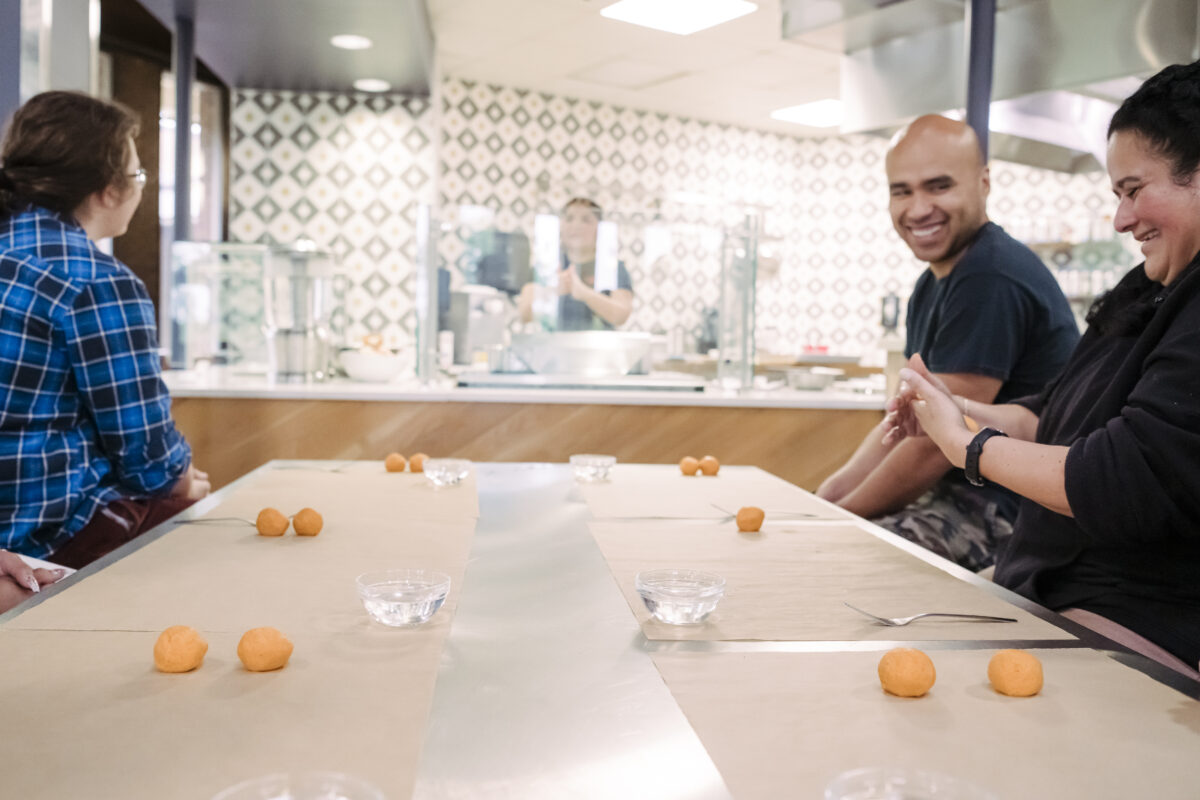 Celia Bonilla and Jeffrey Molina Soriano learn how to mold pastelito dough. (Marlayna Demond ’11/UMBC)
Like many Salvadoran students at UMBC, their journeys to UMBC are as complex as the ingredients they use for this meal. “Sometimes Hispanic Heritage Month events portray Latinx culture as a monolith, often focusing on the Caribbean or Mexican American experience,” said Courtney C. Hobson ’10, M.A. ’14, history, program manager at the James T. and Virginia M. Dresher Center for the Humanities. “I grew up in Prince George’s County, Maryland, where a significant part of the Latinx immigrant community comes from Central America, specifically El Salvador. Many of our Latinx students have roots in Central America—I wanted to organize an event that celebrated the rich culture they represent.”
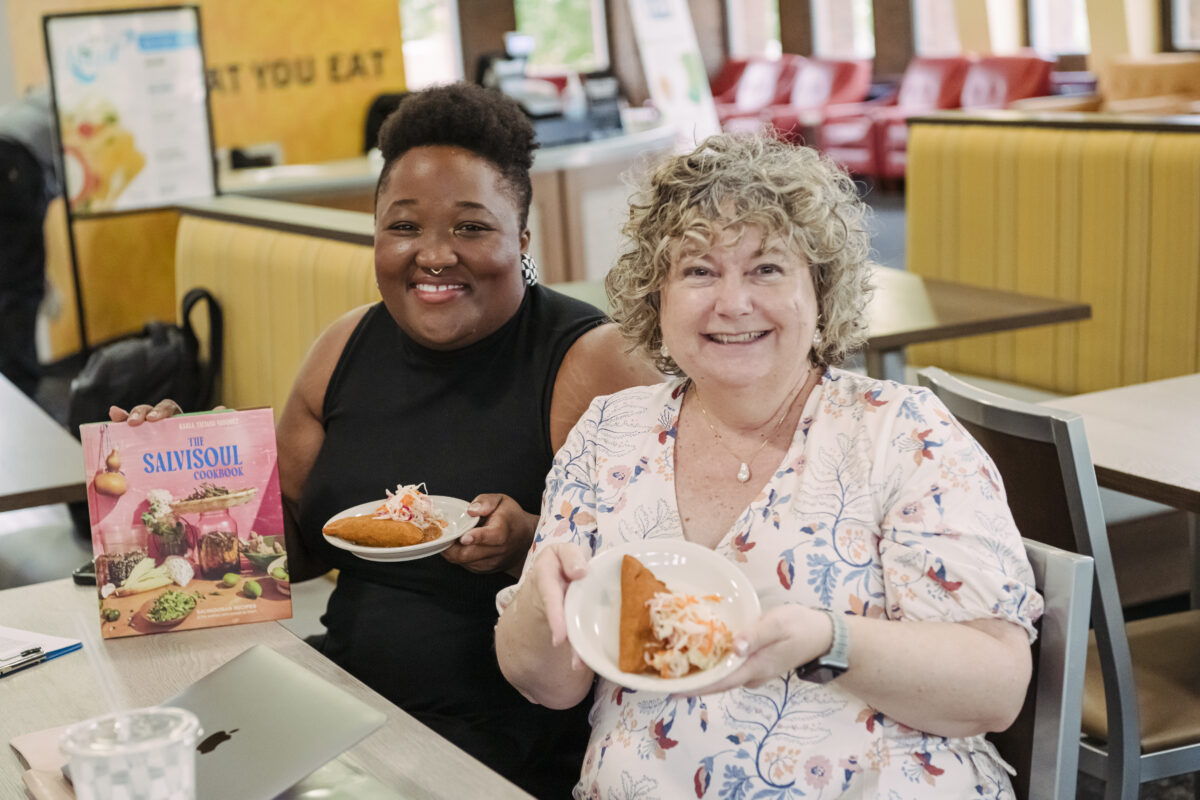 (l-r): Courtney C. Hobson and Amy Froide, professor of history and director of the Dresher Center for the Humanities. (Marlayna Demond ’11/UMBC)
“I came here when I was six years old from El Salvador,” said Bonilla, who attended the event as part of an assignment for the Spanish for Heritage Spanish Speakers class. Students must participate in two on-campus and two off-campus cultural events that celebrate Hispanic/Latinx culture. While Bonilla is familiar with campus events as the parent of a UMBC alum Jasmine Esmeralda Bonilla ’21, chemical engineering, this event felt different. “This class gives me a chance to learn more about my culture and language by engaging with people from various countries and age groups.”
Culinary traditions
Most students at the event said they had eaten pupusas (puh-poo-suhz) at home or at a restaurant. This flat corn flour cake, stuffed with cheese, beans, and sometimes meat is the national dish of El Salvador. “I have an aunt who is from El Salvador. She taught my mom, and then my mom taught me how to make pupusas with my sister,” said Fonseca. “My dad is from El Salvador, and my mom is from Mexico. We learned to make pupusas together as a family. So it became a typical food from my home.”
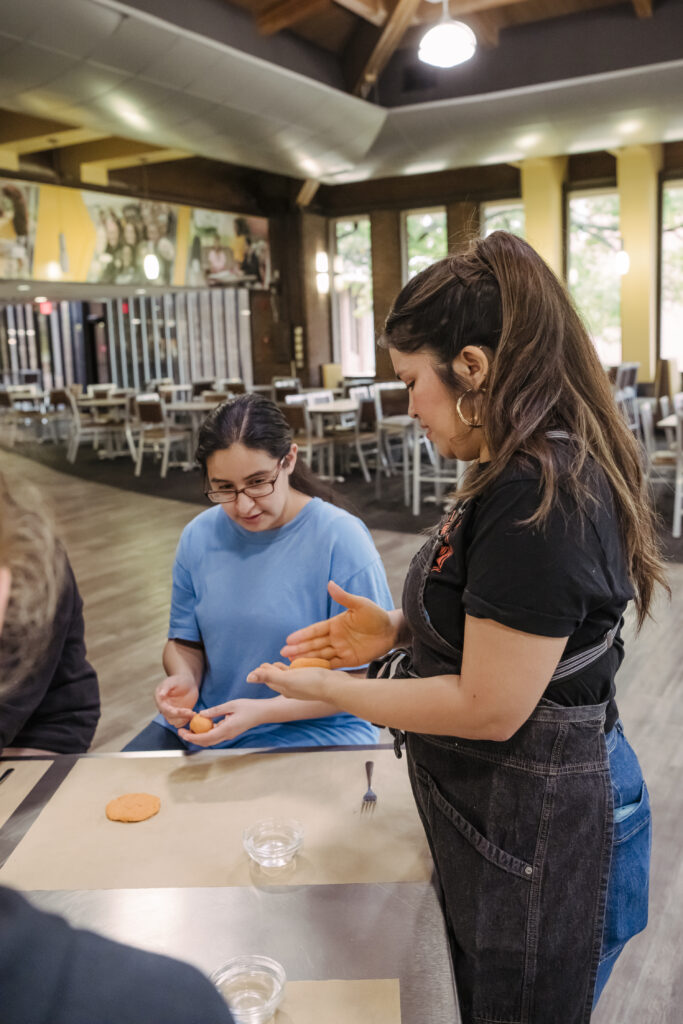
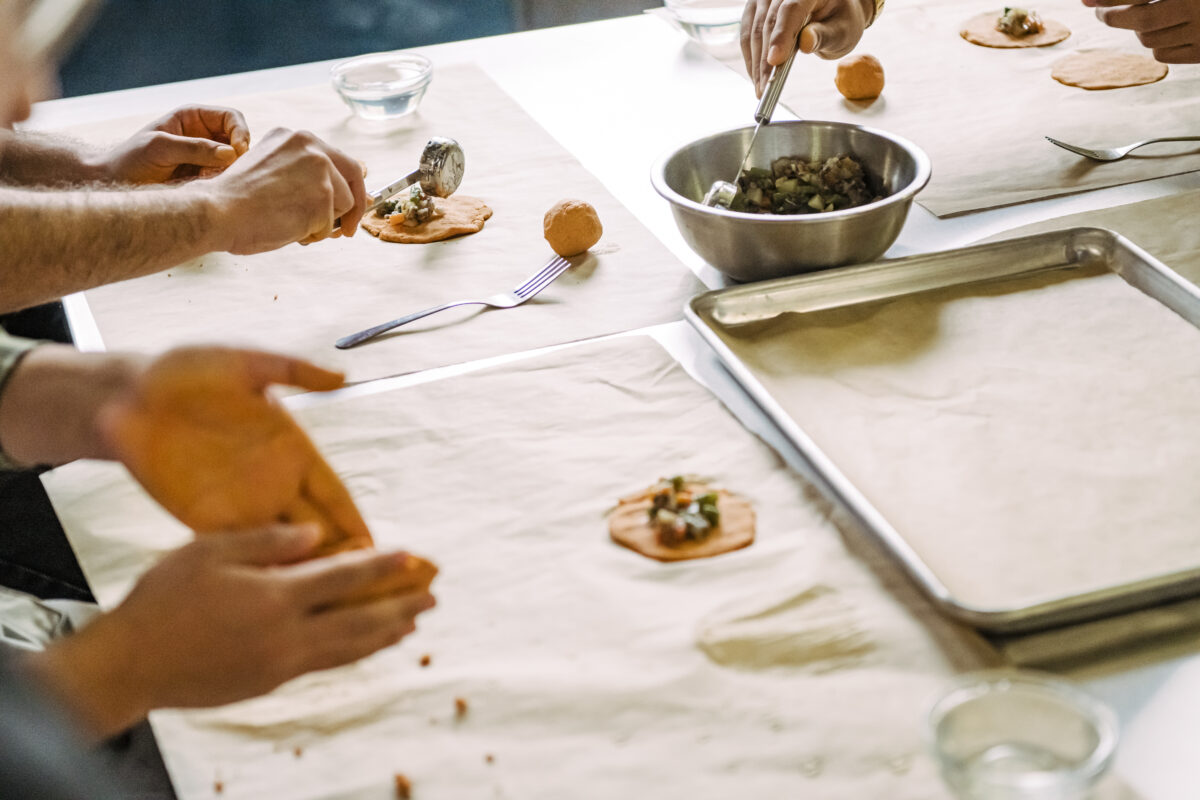
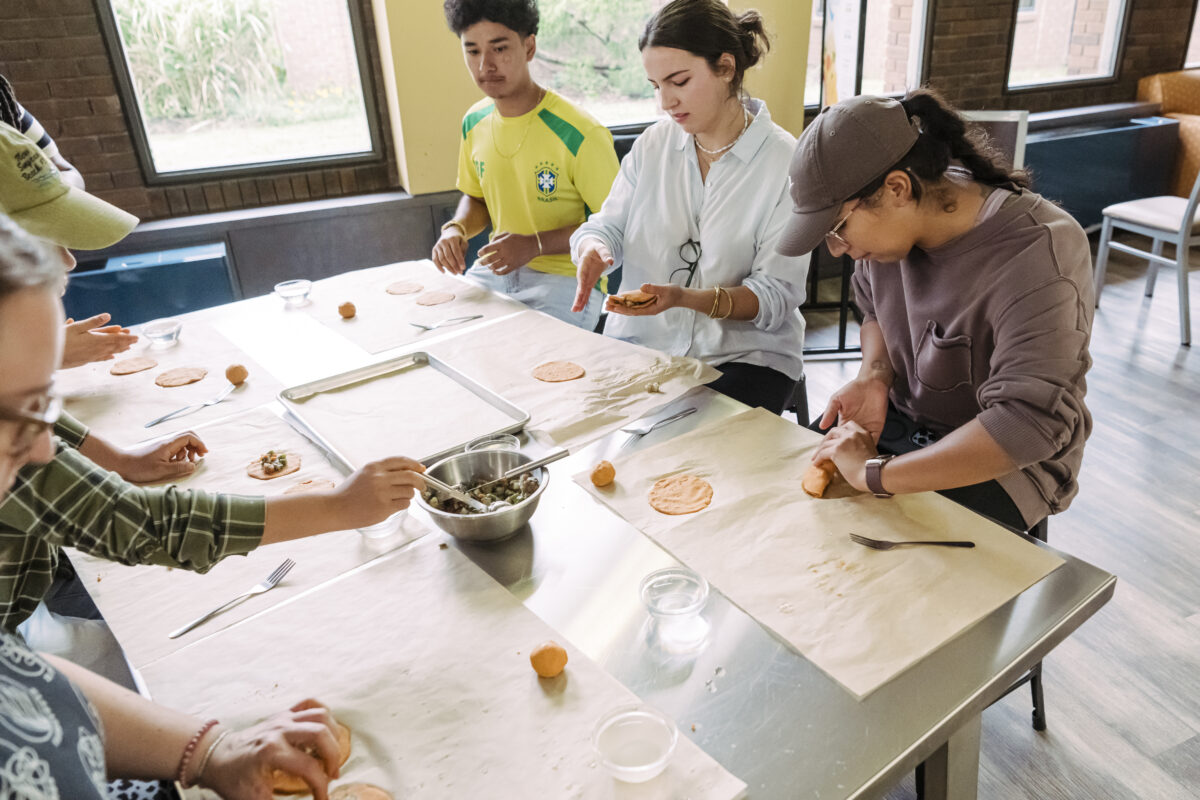 (l-r): Stephania Fonseca watches Vasquez fold the dough to make a pocket. Students fill the pastelitos with a mushroom filling. (Marlayna Demond ’11/UMBC)
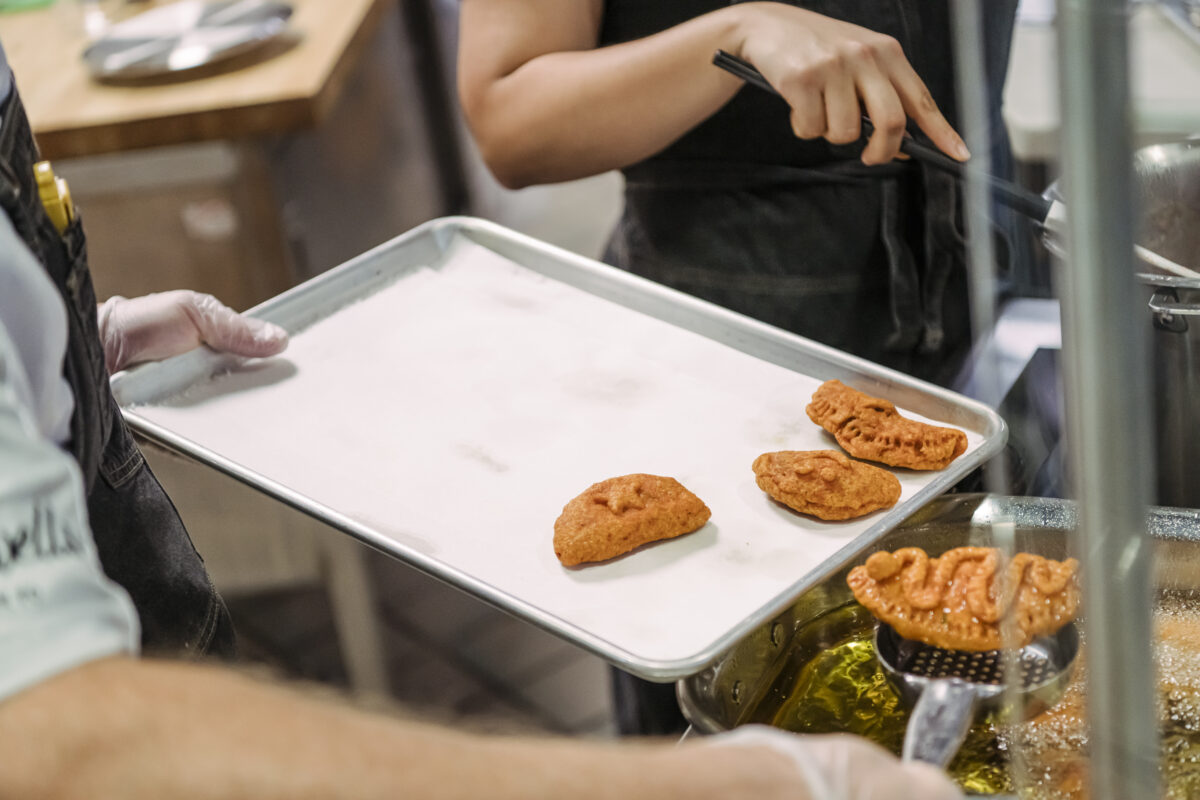
As students kneaded the dough into a palm-sized disc, filled it with sautéed mushrooms, and pinched the edges to seal the pastelitos, they also shared what food meant to them in the context of their family and student life. A clear theme emerged, culinary traditions can extend beyond the kitchen. “We have the Philly pretzel factory. I’ve never been able to find a soft pretzel as good as the Philly Pretzel Factory,” said Ashley Gutshall about her hometown of Royersford, Pennsylvania. Gutshall, a history and Spanish sophomore, shares, “It’s our family tradition to get Philly soft pretzels after doctor’s appointments.”
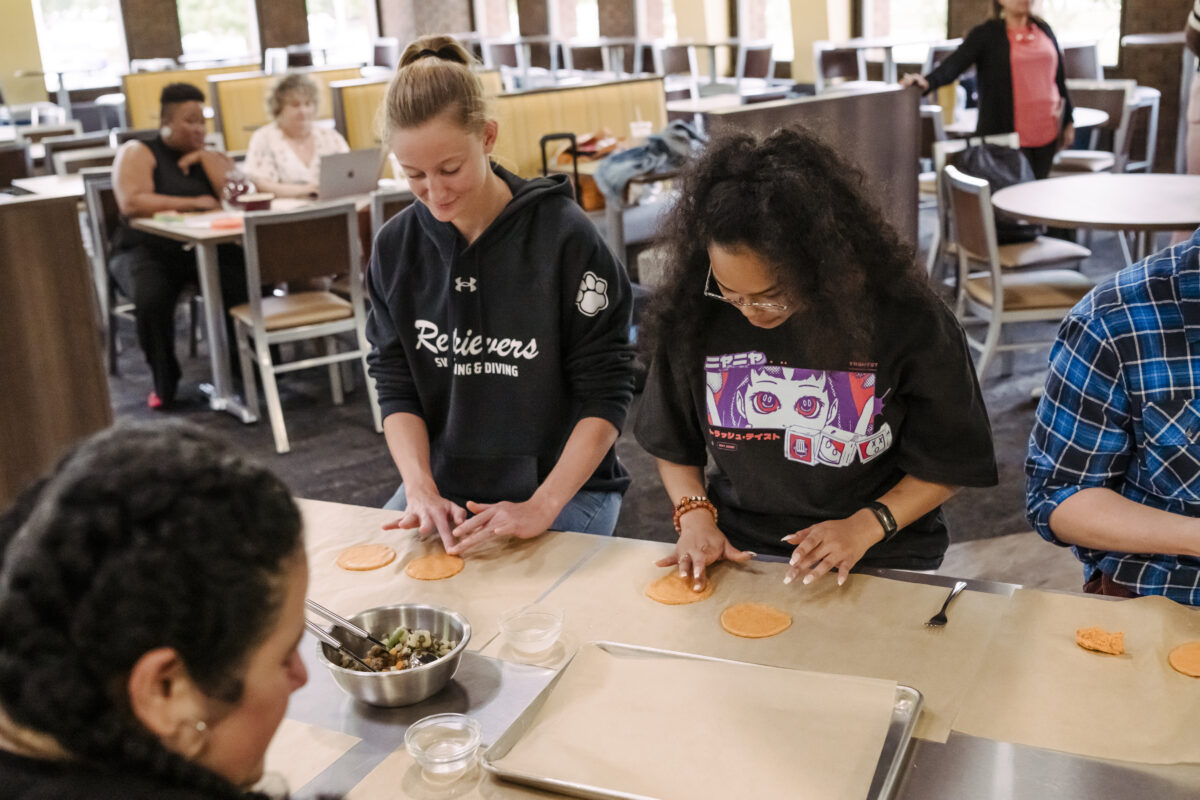 (l): Ashley Gutshall presses dough into a circular shape to make a pastelito. (Marlayna Demond ’11/UMBC)
Snack routines also create taste memories. “I was born in El Salvador during the Civil War [1980-1992] but was raised in Los Angeles. I would often fantasize about the routines my family would have had if they had been able to stay in their homeland,” said Vasquez, as she cooked down strawberries that she used to sweeten a large container of water filled with chan seeds—similar to chia seeds in texture and nutrition. “Fresco de chan satisfied that question for me because it’s a drink students have after school,” said Vasquez.
Food as a cultural bridge
Dishes are a fingerprint of a family’s traditions and tastes that can also serve as a timeline marking the evolution of ingredients locally and globally. “When my mom hears of these new trending food ingredients like chia seeds or quinoa,” says Vasquez, “she argues that they have been used in El Salvador and Central American communities for a long time.”
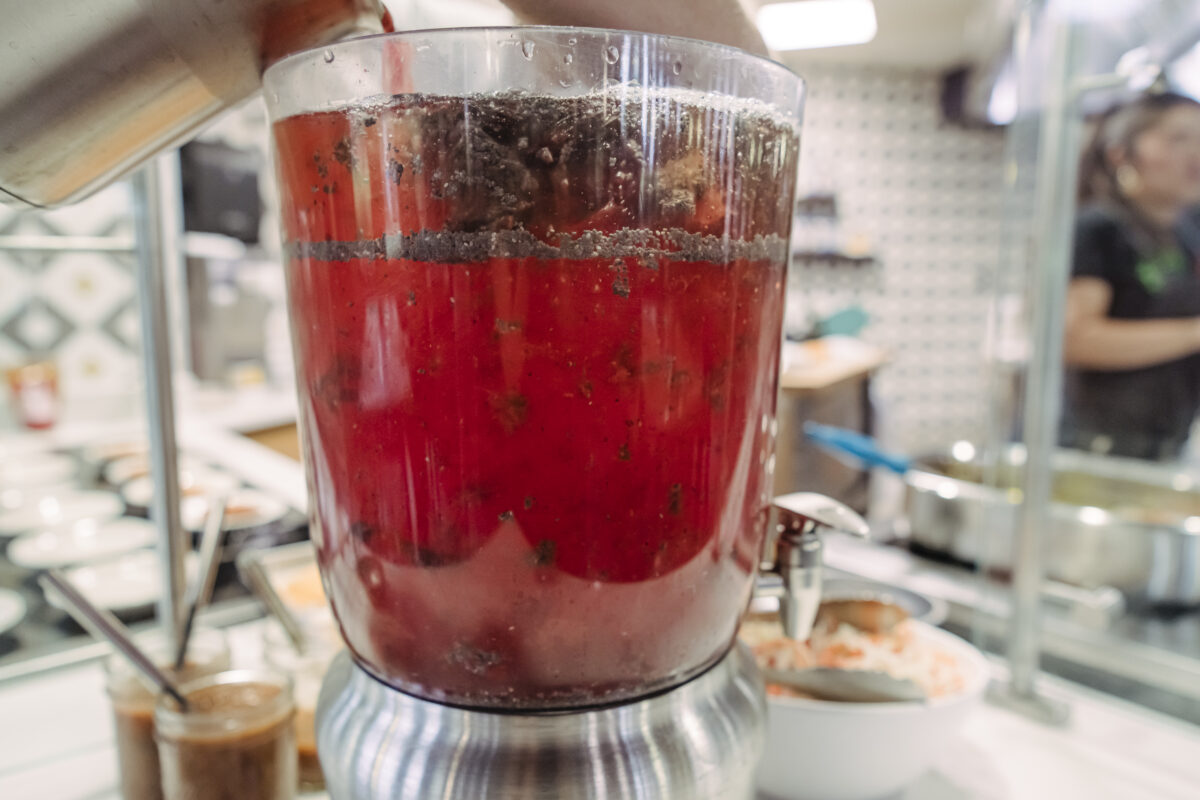
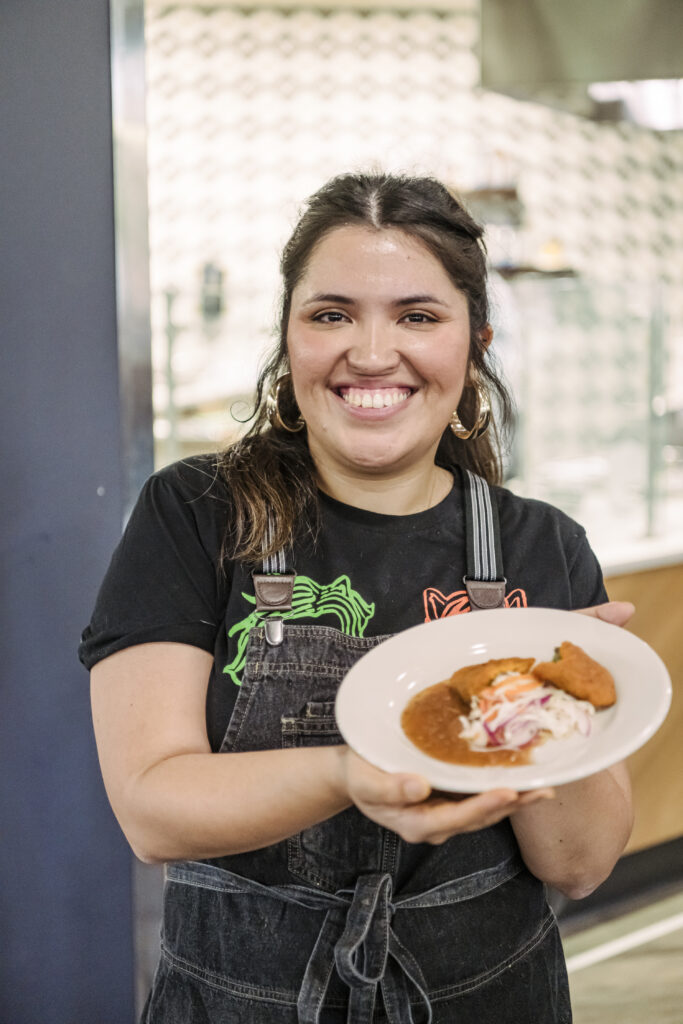
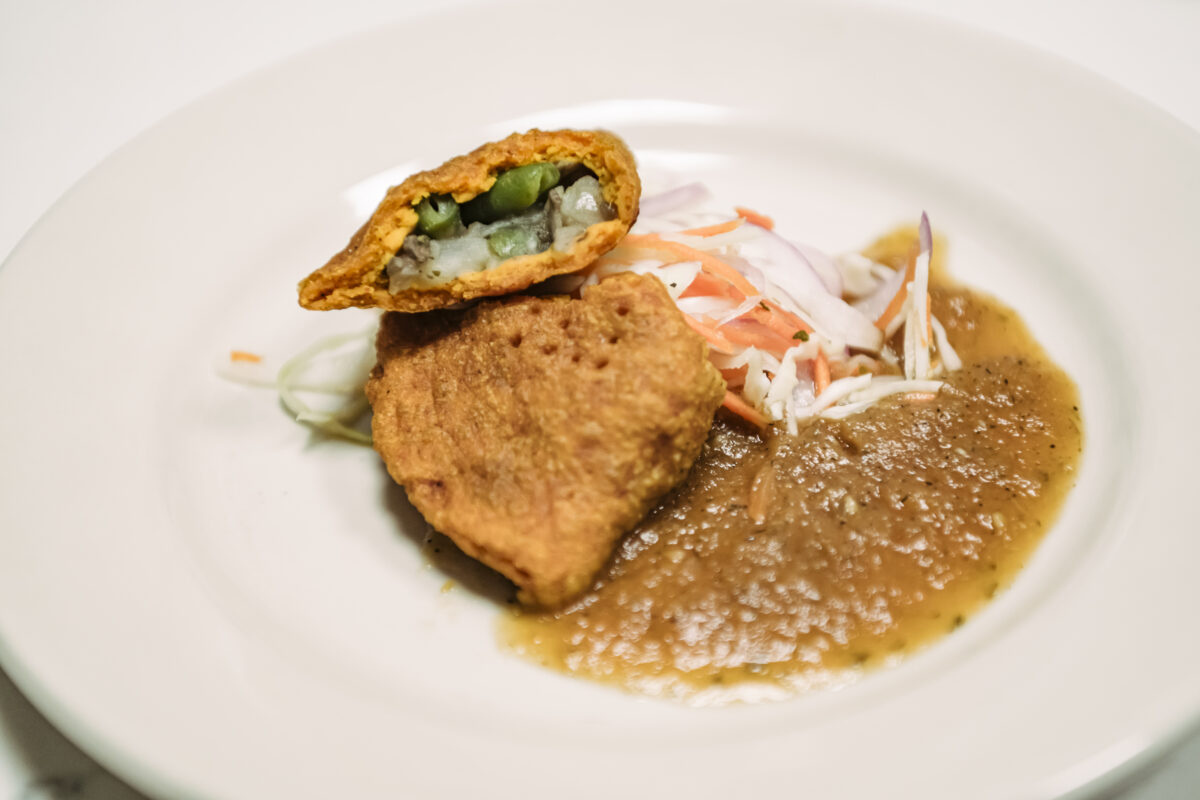 (l-r): Fresco de chan. Karla T. Vasques presents a Salvadoran mushroom pastelito with salsa and slaw. (Marlayna Demond ’11/UMBC)
Whether savory or sweet, the names of foods and spices across Latin America, and the dishes they inspire, are rooted in indigenous, African, and European languages and culinary traditions often fused to create unique dishes with local variations. Vasquez noted that achiote [ah-chee-oh-teh], the spice used to season and enhance the yellow color of the corn flour dough for the pastelitos, is a Nahuat word. Nahuat is a widely spoken indigenous language in Mexico and Central America. The rich legacy of Salvadoran food is seldom recognized alongside Western cuisine, even though many of its ingredients are sourced from the Global South—reinforcing cultural divisions. The Dresher Center’s “More than Pupusas” cooking event aimed to bridge this gap and celebrate the cultural footprint of Salvadoran cuisine.
“I interviewed more than 100 women while I’ve been working on this project. It’s taken me nine years,” says Vasquez about her recent release, The SalviSoul Cookbook. “I wanted to make sure that we’re giving credit where credit is due.”
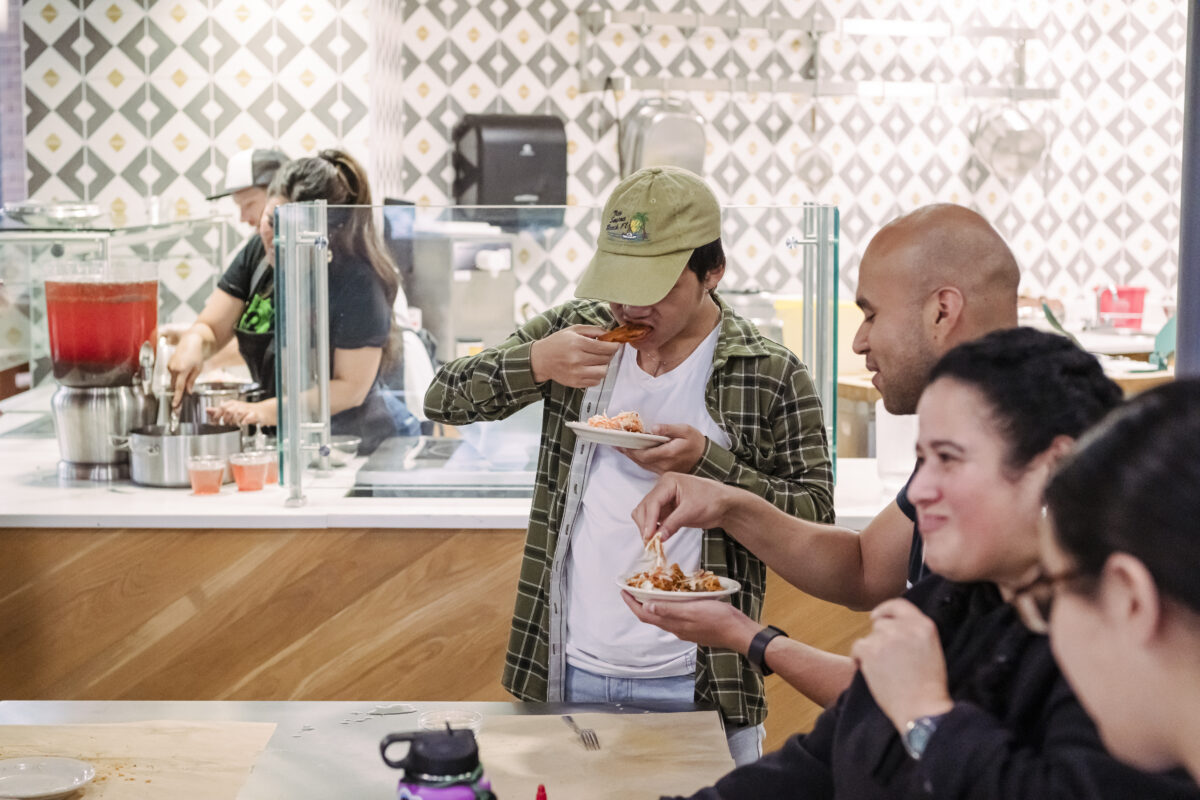
(r): Bonilla and Molina Soriano taste the fried pastelitos. (Marlayna Demond ’11/UMBC)
The tasters and aspiring chefs were grateful to be part of the long tradition of communities brought together across borders and time to learn, cook, and share a meal with new and old friends. They stamped their seal of approval with dough—a squiggly line, a star, a smile—sealing each pastelito with personal flair.
]]>
“Recipes are like an address to a homeland, but they’re also very personal to your own story,” said Karla T. Vasquez, author of The SalviSoul Cookbook, in True Grit’s Test Kitchen. Celia Bonilla,...
https://umbc.edu/stories/retrievers-learn-to-cook-salvadoran-food/
https://my3.my.umbc.edu/api/v0/pixel/news/145379/guest@my.umbc.edu/0e0931c682bcda13e479d7afdd5d4a25/api/pixel
business-technology-administration
cahss
campus-life
chemical-engineering
computer-science
dresher-center
history
magazine
mlli
spanish
story
UMBC News & Magazine
https://my3.my.umbc.edu/groups/umbc-news-magazine
https://assets1-my.umbc.edu/system/shared/avatars/groups/000/001/943/24435aa6207c452e7bc15cc74b42c7bb/xsmall.png?1748556657
https://assets1-my.umbc.edu/system/shared/avatars/groups/000/001/943/24435aa6207c452e7bc15cc74b42c7bb/original.png?1748556657
https://assets2-my.umbc.edu/system/shared/avatars/groups/000/001/943/24435aa6207c452e7bc15cc74b42c7bb/xxlarge.png?1748556657
https://assets2-my.umbc.edu/system/shared/avatars/groups/000/001/943/24435aa6207c452e7bc15cc74b42c7bb/xlarge.png?1748556657
https://assets3-my.umbc.edu/system/shared/avatars/groups/000/001/943/24435aa6207c452e7bc15cc74b42c7bb/large.png?1748556657
https://assets1-my.umbc.edu/system/shared/avatars/groups/000/001/943/24435aa6207c452e7bc15cc74b42c7bb/medium.png?1748556657
https://assets2-my.umbc.edu/system/shared/avatars/groups/000/001/943/24435aa6207c452e7bc15cc74b42c7bb/small.png?1748556657
https://assets1-my.umbc.edu/system/shared/avatars/groups/000/001/943/24435aa6207c452e7bc15cc74b42c7bb/xsmall.png?1748556657
https://assets2-my.umbc.edu/system/shared/avatars/groups/000/001/943/24435aa6207c452e7bc15cc74b42c7bb/xxsmall.png?1748556657
UMBC News & Magazine
1
0
false
Tue, 05 Nov 2024 16:30:49 -0500
Retrievers learn the art and heart of cooking Salvadoran food at True Grit’s Test Kitchen
“Recipes are like an address to a homeland, but they’re also very personal to your own story,” said Karla T. Vasquez, author of The SalviSoul Cookbook, in True Grit’s Test Kitchen. Celia Bonilla, a business technology administration sophomore, grinned and nodded—the addresses for her own recipes come from El Salvador and Maryland. Bonilla joined other UMBC students earlier this fall for the “More than Pupusas” cooking demonstration, sponsored by the Dresher Center for the Humanities, to learn how to cook Salvadoran street food.
Bonilla sat at one of two tables set with brown butcher paper with her classmates, Stephania Fonseca, a social work sophomore, and Jeffrey Molina Soriano, a computer science junior. They also have roots in Maryland and El Salvador. “Pastelitos [pah-steh-lee-tos] means little pie and it’s the Salvadoran version of empanadas [em-pah-nah-dahs],” said Vasquez. “Empanadas are well known all over Latin America. Greeks, Italians, and other Europeans make meat pies, too.”
Celia Bonilla and Jeffrey Molina Soriano learn how to mold pastelito dough. (Marlayna Demond ’11/UMBC)
Like many Salvadoran students at UMBC, their journeys to UMBC are as complex as the ingredients they use for this meal. “Sometimes Hispanic Heritage Month events portray Latinx culture as a monolith, often focusing on the Caribbean or Mexican American experience,” said Courtney C. Hobson ’10, M.A. ’14, history, program manager at the James T. and Virginia M. Dresher Center for the Humanities. “I grew up in Prince George’s County, Maryland, where a significant part of the Latinx immigrant community comes from Central America, specifically El Salvador. Many of our Latinx students have roots in Central America—I wanted to organize an event that celebrated the rich culture they represent.”
(l-r): Courtney C. Hobson and Amy Froide, professor of history and director of the Dresher Center for the Humanities. (Marlayna Demond ’11/UMBC)
“I came here when I was six years old from El Salvador,” said Bonilla, who attended the event as part of an assignment for the Spanish for Heritage Spanish Speakers class. Students must participate in two on-campus and two off-campus cultural events that celebrate Hispanic/Latinx culture. While Bonilla is familiar with campus events as the parent of a UMBC alum Jasmine Esmeralda Bonilla ’21, chemical engineering, this event felt different. “This class gives me a chance to learn more about my culture and language by engaging with people from various countries and age groups.”
Culinary traditions
Most students at the event said they had eaten pupusas (puh-poo-suhz) at home or at a restaurant. This flat corn flour cake, stuffed with cheese, beans, and sometimes meat is the national dish of El Salvador. “I have an aunt who is from El Salvador. She taught my mom, and then my mom taught me how to make pupusas with my sister,” said Fonseca. “My dad is from El Salvador, and my mom is from Mexico. We learned to make pupusas together as a family. So it became a typical food from my home.”
(l-r): Stephania Fonseca watches Vasquez fold the dough to make a pocket. Students fill the pastelitos with a mushroom filling. (Marlayna Demond ’11/UMBC)
As students kneaded the dough into a palm-sized disc, filled it with sautéed mushrooms, and pinched the edges to seal the pastelitos, they also shared what food meant to them in the context of their family and student life. A clear theme emerged, culinary traditions can extend beyond the kitchen. “We have the Philly pretzel factory. I’ve never been able to find a soft pretzel as good as the Philly Pretzel Factory,” said Ashley Gutshall about her hometown of Royersford, Pennsylvania. Gutshall, a history and Spanish sophomore, shares, “It’s our family tradition to get Philly soft pretzels after doctor’s appointments.”
(l): Ashley Gutshall presses dough into a circular shape to make a pastelito. (Marlayna Demond ’11/UMBC)
Snack routines also create taste memories. “I was born in El Salvador during the Civil War [1980-1992] but was raised in Los Angeles. I would often fantasize about the routines my family would have had if they had been able to stay in their homeland,” said Vasquez, as she cooked down strawberries that she used to sweeten a large container of water filled with chan seeds—similar to chia seeds in texture and nutrition. “Fresco de chan satisfied that question for me because it’s a drink students have after school,” said Vasquez.
Food as a cultural bridge
Dishes are a fingerprint of a family’s traditions and tastes that can also serve as a timeline marking the evolution of ingredients locally and globally. “When my mom hears of these new trending food ingredients like chia seeds or quinoa,” says Vasquez, “she argues that they have been used in El Salvador and Central American communities for a long time.”
(l-r): Fresco de chan. Karla T. Vasques presents a Salvadoran mushroom pastelito with salsa and slaw. (Marlayna Demond ’11/UMBC)
Whether savory or sweet, the names of foods and spices across Latin America, and the dishes they inspire, are rooted in indigenous, African, and European languages and culinary traditions often fused to create unique dishes with local variations. Vasquez noted that achiote [ah-chee-oh-teh], the spice used to season and enhance the yellow color of the corn flour dough for the pastelitos, is a Nahuat word. Nahuat is a widely spoken indigenous language in Mexico and Central America. The rich legacy of Salvadoran food is seldom recognized alongside Western cuisine, even though many of its ingredients are sourced from the Global South—reinforcing cultural divisions. The Dresher Center’s “More than Pupusas” cooking event aimed to bridge this gap and celebrate the cultural footprint of Salvadoran cuisine.
“I interviewed more than 100 women while I’ve been working on this project. It’s taken me nine years,” says Vasquez about her recent release, The SalviSoul Cookbook. “I wanted to make sure that we’re giving credit where credit is due.”
(r): Bonilla and Molina Soriano taste the fried pastelitos. (Marlayna Demond ’11/UMBC)
The tasters and aspiring chefs were grateful to be part of the long tradition of communities brought together across borders and time to learn, cook, and share a meal with new and old friends. They stamped their seal of approval with dough—a squiggly line, a star, a smile—sealing each pastelito with personal flair.
]]>
“Recipes are like an address to a homeland, but they’re also very personal to your own story,” said Karla T. Vasquez, author of The SalviSoul Cookbook, in True Grit’s Test Kitchen. Celia Bonilla,...
https://umbc.edu/stories/teaching-pupusas/
https://my3.my.umbc.edu/api/v0/pixel/news/145381/guest@my.umbc.edu/9ca276cb76c35ec0df767c000aca50ec/api/pixel
business-technology-administration
cahss
campus-life
chemical-engineering
computer-science
dresher-center
history
magazine
mlli
spanish
story
UMBC News & Magazine
https://my3.my.umbc.edu/groups/umbc-news-magazine
https://assets1-my.umbc.edu/system/shared/avatars/groups/000/001/943/24435aa6207c452e7bc15cc74b42c7bb/xsmall.png?1748556657
https://assets1-my.umbc.edu/system/shared/avatars/groups/000/001/943/24435aa6207c452e7bc15cc74b42c7bb/original.png?1748556657
https://assets2-my.umbc.edu/system/shared/avatars/groups/000/001/943/24435aa6207c452e7bc15cc74b42c7bb/xxlarge.png?1748556657
https://assets2-my.umbc.edu/system/shared/avatars/groups/000/001/943/24435aa6207c452e7bc15cc74b42c7bb/xlarge.png?1748556657
https://assets3-my.umbc.edu/system/shared/avatars/groups/000/001/943/24435aa6207c452e7bc15cc74b42c7bb/large.png?1748556657
https://assets1-my.umbc.edu/system/shared/avatars/groups/000/001/943/24435aa6207c452e7bc15cc74b42c7bb/medium.png?1748556657
https://assets2-my.umbc.edu/system/shared/avatars/groups/000/001/943/24435aa6207c452e7bc15cc74b42c7bb/small.png?1748556657
https://assets1-my.umbc.edu/system/shared/avatars/groups/000/001/943/24435aa6207c452e7bc15cc74b42c7bb/xsmall.png?1748556657
https://assets2-my.umbc.edu/system/shared/avatars/groups/000/001/943/24435aa6207c452e7bc15cc74b42c7bb/xxsmall.png?1748556657
UMBC News & Magazine
0
0
false
Tue, 05 Nov 2024 16:30:49 -0500
Tue, 05 Nov 2024 16:30:49 -0500
On the Eve of Election 2024
Dear UMBC Community,
Tomorrow is a milestone occasion in our civic life and, no matter the outcomes, a historic event. On the eve of Election Day, we write with a reminder of our values as an inclusive community and with encouragement to seek resources for support as you need them, whether today, tomorrow, or in the days and weeks ahead.
First, VOTE! The early voting period in Maryland has now ended, but we encourage all who are eligible to and have not yet voted to show up to the polls tomorrow, 7 a.m. to 8 p.m., and cast your ballot. For more information, please see UMBC’s
Election Central website.
It may seem obvious, but it is important for us to remember that we do not all hold the same political views. That is a very good thing. We treasure the diversity of this community, which enriches us all and shapes the educational experience that UMBC provides. Please continue to hold close our shared values of inclusive excellence, respectful discourse, and civic engagement. Doing so can take many forms today and in the coming days. Among other things, it could be students expressing viewpoints respectfully, whether in the classroom or a social setting; it could be faculty setting clear expectations for discussion and leading by example; it could mean honoring others’ wishes to not discuss politics; or it could mean giving grace to friends, classmates, colleagues, and others who are struggling.
Nationally, election-related stress has been building for months and is peaking now, and our community members are likely feeling a range of emotions. After the polls close, emotions will still be wide-ranging, perhaps for quite some time. Beyond election-related stress, it also is true that we are in what is always a busy time of the semester, when workloads are heavy and deadlines loom large. Please use and share these resources:
Resources for Care and Support
Resources for Building Support for Social Change and Constructive Dialogue for Dissenting Views
We are grateful every day for this community and for the commitment of our students, faculty, and staff to being engaged and informed global citizens. You know that your voice matters and that it is our shared responsibility to attend to our community and our democracy. Thank you for your dedication and care.
Sincerely,
President Valerie Sheares Ashby
Manfred H. M. van Dulmen
Provost and Senior Vice President for Academic Affairs
]]>
Dear UMBC Community, Tomorrow is a milestone occasion in our civic life and, no matter the outcomes, a historic event. On the eve of Election Day, we write with a reminder of our values as...
https://my3.my.umbc.edu/groups/announcements/posts/145327
https://my3.my.umbc.edu/api/v0/pixel/news/145336/guest@my.umbc.edu/0d0413f686ee106349cd7b5ca5f846d5/api/pixel
president
story
UMBC News & Magazine
https://my3.my.umbc.edu/groups/umbc-news-magazine
https://assets1-my.umbc.edu/system/shared/avatars/groups/000/001/943/24435aa6207c452e7bc15cc74b42c7bb/xsmall.png?1748556657
https://assets1-my.umbc.edu/system/shared/avatars/groups/000/001/943/24435aa6207c452e7bc15cc74b42c7bb/original.png?1748556657
https://assets2-my.umbc.edu/system/shared/avatars/groups/000/001/943/24435aa6207c452e7bc15cc74b42c7bb/xxlarge.png?1748556657
https://assets2-my.umbc.edu/system/shared/avatars/groups/000/001/943/24435aa6207c452e7bc15cc74b42c7bb/xlarge.png?1748556657
https://assets3-my.umbc.edu/system/shared/avatars/groups/000/001/943/24435aa6207c452e7bc15cc74b42c7bb/large.png?1748556657
https://assets1-my.umbc.edu/system/shared/avatars/groups/000/001/943/24435aa6207c452e7bc15cc74b42c7bb/medium.png?1748556657
https://assets2-my.umbc.edu/system/shared/avatars/groups/000/001/943/24435aa6207c452e7bc15cc74b42c7bb/small.png?1748556657
https://assets1-my.umbc.edu/system/shared/avatars/groups/000/001/943/24435aa6207c452e7bc15cc74b42c7bb/xsmall.png?1748556657
https://assets2-my.umbc.edu/system/shared/avatars/groups/000/001/943/24435aa6207c452e7bc15cc74b42c7bb/xxsmall.png?1748556657
UMBC News & Magazine
0
0
false
Mon, 04 Nov 2024 16:05:22 -0500
PANTHYR instrument installed in Chesapeake Bay to monitor water quality, validate satellite data
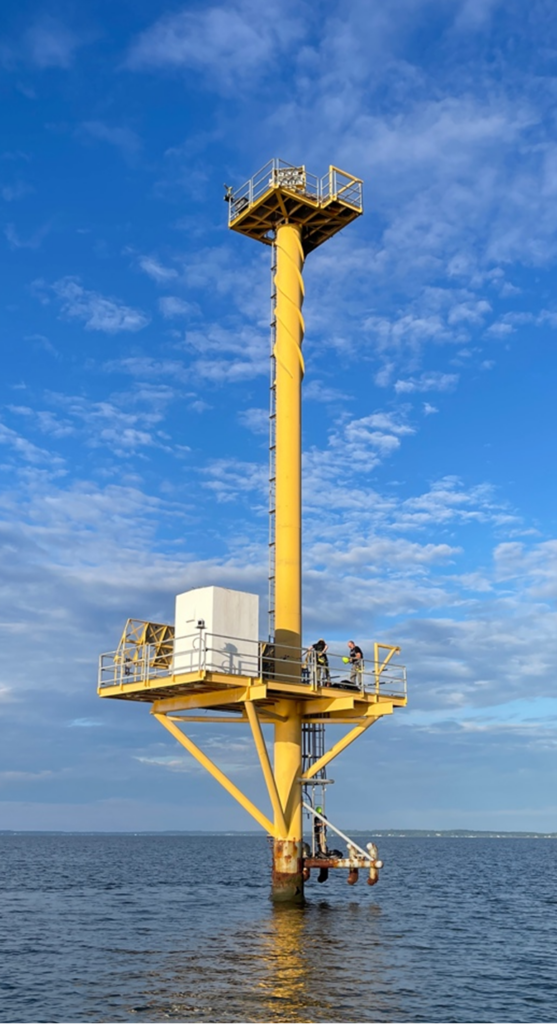 The PANTHYR instrument system is on the upper platform of the Chesapeake Bay Tower on the corner out of view. (Kevin Turpie, GSFC/UMBC)
Climbing 30-meter ladders and avoiding osprey nests might not sound like typical activities for scientists who usually work with equations and models—but it’s all in a day’s work for Kevin Turpie’s team, which includes an international group of scientists and engineers from UMBC, NASA, the Royal Belgian Institute of Natural Sciences (RBINS) and the Vlaams Instituut voor de Zee (VLIZ), also known as the Flanders Marine Institute, also in Belgium. Over the last 15 months, they have collaborated with Maryland Department of the Environment (MDE) staff, with the blessing of the U.S. Coast Guard, to install, monitor, and repair a new instrument on top of a Coast Guard navigation tower in Chesapeake Bay near Tolchester, Maryland.
The instrument, called the Pan-and-Tilt Hyperspectral Radiometer (PANTHYR) and developed by VLIZ, is one of multiple PANTHYRs deployed worldwide. Each is part of the WATERHYPERNET—a growing network of automated instruments that provide measurements to validate observations from space. The WATERHYPERNET concept was developed by RBINS and VLIZ and supported by the European Space Agency (ESA). Another instrument called the HYPSTAR is installed at some other WATERHYPERNET sites, and the Chesapeake Bay station may add one in the future.
The Chesapeake Bay PANTHYR station is the first WATERHYPERNET station installed in North America; others operate off the coasts of France, Italy, Belgium, and Argentina. The new station “will provide a wealth of information regarding water quality and the environmental and ecological conditions in the Upper Chesapeake Bay,” says Turpie, a research associate professor with the Goddard Earth Science Technology and Research Center (GESTAR II), a UMBC partnership with NASA.
A “rigorous test”
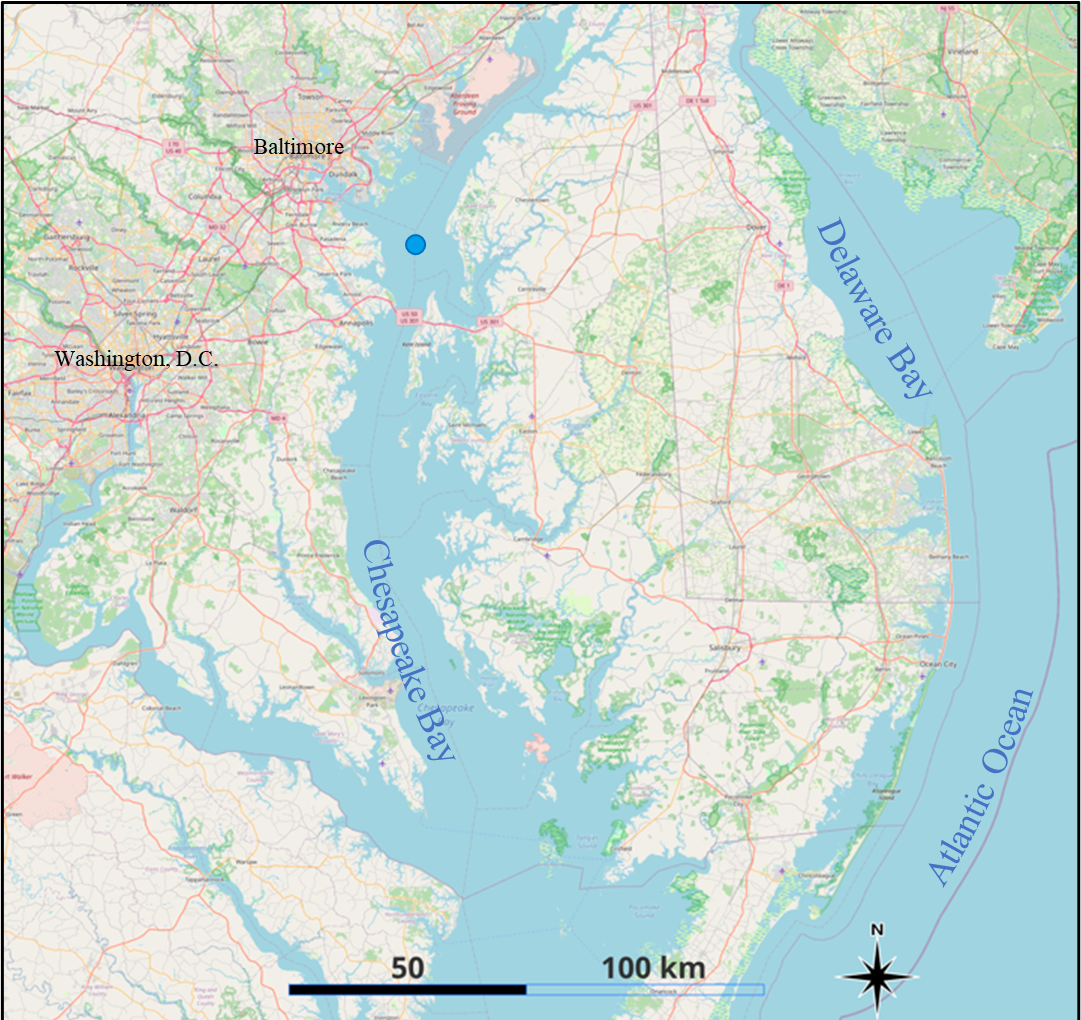 The blue dot marks the location of the new Chesapeake Bay WATERHYPERNET station. (Courtesy of Kevin Turpie)
The Chesapeake PANTHYR will also help validate data coming from the Ocean Color Instrument (OCI) aboard the recently-launched NASA PACE satellite, which also carries HARP2, an instrument designed and built by UMBC researchers. The station will also provide data to validate many other satellite missions, including NASA’s future Surface Biology and Geology (SBG) mission, part of the upcoming Integrated Earth System Observatory.
“Observations from space are critical to understanding how our planet functions as a system and how that system is changing. But such measurements are done in the harsh environment of space, looking through the entire atmosphere, and always from several hundred kilometers away,” Turpie explains. “So, we need to compare those data against the same kind of measurements taken at the surface. PANTHYR offers a rigorous test for PACE and its ability to glean vital information about our world’s most critical coastal resources.”
PANTHYR is the newest instrument in the WATERHYPERNET, a global network of instruments managed by the Royal Belgian Institute of Natural Sciences and supported by the European Space Agency.
A challenging work location
The Chesapeake Bay PANTHYR station was installed in July 2023, but encountered challenges due to winter weather, complex logistics, and the collapse of Baltimore’s Key Bridge and subsequent environmental threat assessments. However, after a repair mission in September 2024, PANTHYR is up and running again, and data are streaming in.
Arranging each trip to service PANTHYR is complicated. MDE staff pilot the boats that take the researchers to and from the site, and only tower climbers with special training can access the instrument. Calm weather is a necessity. Plus, in the spring, there’s always a risk that ospreys or eagles will choose the tower for nesting. That makes the instrument inaccessible if young birds are present.
But the team is committed, because the data PANTHYR produces are valuable. Every 20 minutes, PANTHYR measures the intensity of light encountering the surface of the water, the brightness of the sky, and how much light is reflected back from the water’s surface. PANTHYR detects visible and near-infrared light. These are some of the same data collected by satellites like PACE. WATERHYPERNET instruments also help scientists develop improved algorithms for processing the data and monitor phenomena like harmful algal blooms.
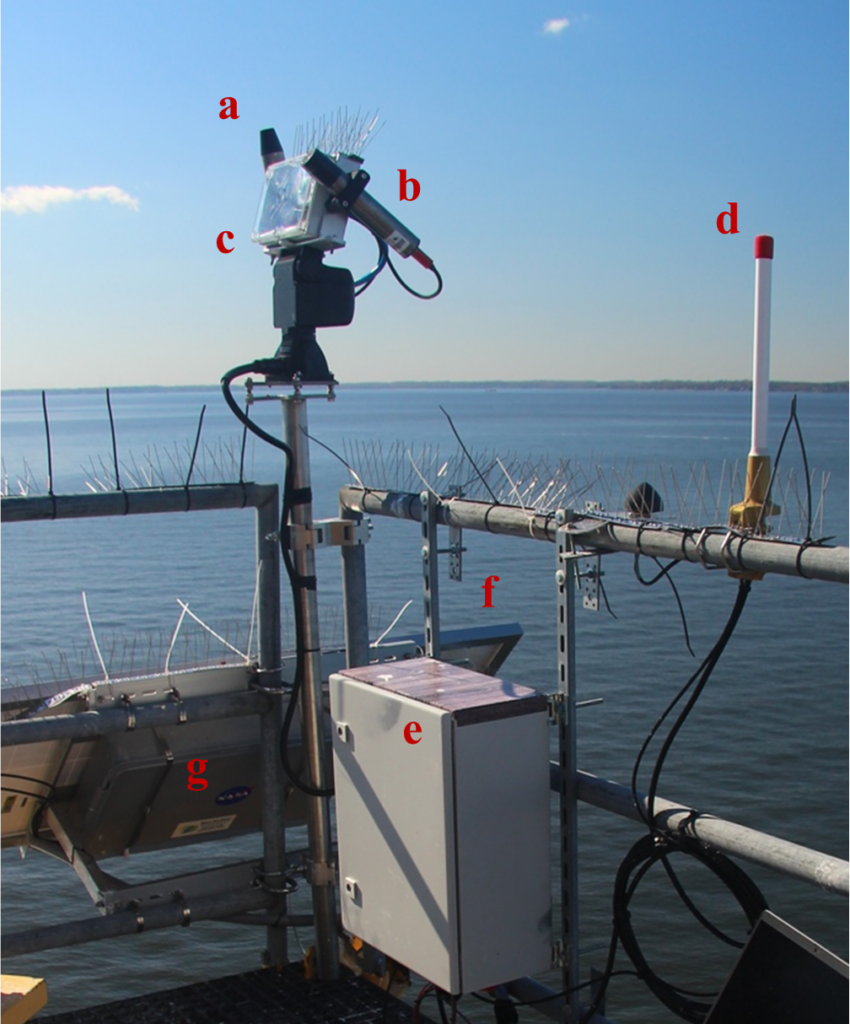 A closer view of the PANTHYR instrument on the tower’s upper platform. Components of the station instrument system include (a) solar spectral irradiance instrument, (b) sky and surface radiance instrument, (c) robotics package (with the “pan/tilt” device), (d) cellular antenna, (e) instrument control box, (f) photovoltaic panel, (g) power control box. (Photo by Dieter Vansteenwegen, VLIZ)
“Autonomous stations like this collect a wealth of validation information—more than we get from science cruises or other means, which can be very expensive,” Turpie says. “It’s exciting to get multiple observations a day of the changing water quality and ecosystem conditions of this important coastal estuary. For surface radiometry, this is very important in order to build up as many match ups with satellite observations as possible.”
Moving forward, UMBC is responsible for the maintenance and operation of the PANTHYR station. Turpie and his colleagues will be working hard to keep the station in tip-top shape so that it can continue to produce useful data and inform future satellite missions—with or without the “help” of neighborhood ospreys.
]]>
The PANTHYR instrument system is on the upper platform of the Chesapeake Bay Tower on the corner out of view. (Kevin Turpie, GSFC/UMBC) Climbing 30-meter ladders and avoiding osprey nests...
https://umbc.edu/stories/panthyr-in-chesapeake-bay/
https://my3.my.umbc.edu/api/v0/pixel/news/145273/guest@my.umbc.edu/9d518e886633877b7b70494fab57822b/api/pixel
gestar2
nasa
news
research
science-and-tech
story
UMBC News & Magazine
https://my3.my.umbc.edu/groups/umbc-news-magazine
https://assets1-my.umbc.edu/system/shared/avatars/groups/000/001/943/24435aa6207c452e7bc15cc74b42c7bb/xsmall.png?1748556657
https://assets1-my.umbc.edu/system/shared/avatars/groups/000/001/943/24435aa6207c452e7bc15cc74b42c7bb/original.png?1748556657
https://assets2-my.umbc.edu/system/shared/avatars/groups/000/001/943/24435aa6207c452e7bc15cc74b42c7bb/xxlarge.png?1748556657
https://assets2-my.umbc.edu/system/shared/avatars/groups/000/001/943/24435aa6207c452e7bc15cc74b42c7bb/xlarge.png?1748556657
https://assets3-my.umbc.edu/system/shared/avatars/groups/000/001/943/24435aa6207c452e7bc15cc74b42c7bb/large.png?1748556657
https://assets1-my.umbc.edu/system/shared/avatars/groups/000/001/943/24435aa6207c452e7bc15cc74b42c7bb/medium.png?1748556657
https://assets2-my.umbc.edu/system/shared/avatars/groups/000/001/943/24435aa6207c452e7bc15cc74b42c7bb/small.png?1748556657
https://assets1-my.umbc.edu/system/shared/avatars/groups/000/001/943/24435aa6207c452e7bc15cc74b42c7bb/xsmall.png?1748556657
https://assets2-my.umbc.edu/system/shared/avatars/groups/000/001/943/24435aa6207c452e7bc15cc74b42c7bb/xxsmall.png?1748556657
UMBC News & Magazine
0
0
false
Fri, 01 Nov 2024 15:34:10 -0400
Fri, 01 Nov 2024 15:34:10 -0400
Meet a Retriever—Emma Swartling ’10, prenatal and pediatric chiropractor
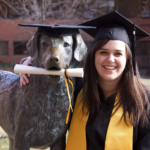
Meet Emma Swartling ‘10, anthropology, prenatal and pediatric chiropractor and owner of Lumos Chiropractic in Tacoma, Washington. She was drawn to UMBC to experience the East Coast after being raised on the West Coast. Emma combined her interests in cultural and biological anthropology, pre-medicine, and working with children to shape her career as a chiropractor. Take it away, Emma!
Q: What’s one essential thing you’d want another Retriever to know about you?
A: Born and raised in the Pacific Northwest (PNW), I started college with the intent to major in pre-medicine but ended up falling in love with anthropology. I was fortunate to find a career that allowed me to combine many of my multiple interests by following the path to chiropractic. Chiropractic has allowed me to use many of the skills in empathy and understanding that cultural anthropology teaches, and biological anthropology offers insights into human anatomy and function. It was the Chesapeake Bay Retriever that initially sparked my interest into learning more about UMBC. I love dogs and spent my childhood involved with dog training and showing, as well as teaching younger children involved in the same program. This is how I learned I enjoy working with children.
Q: Tell us about your current job. What do you enjoy most about it?
A: I am a prenatal and pediatric chiropractor and own my practice in Washington state. The best part about my work is being part of the village that supports people during the huge transition periods of pregnancy, postpartum, and childhood.

Q: Tell us about your primary WHY, and how it led you to UMBC.
A: What brought me to UMBC was the beginning of my love to travel and explore. After finishing the first two years of college in my home state, I decided to transfer to the East Coast to visit a part of our country that I had never seen. The initial reasons UMBC stood out are superficial: Maryland was a central location to explore north and south along the East Coast; the Maryland State flag is amazing; and most importantly, I wanted to say I went to a school where the mascot is a unique dog breed like the Chesapeake Bay Retriever!
I wanted an adventure and to try something new. I can honestly say, when my airplane landed at BWI in the dead of winter, I started to question my decision. Coming from the lush, always green PNW it looked like I was about to land in a brown and desolate land. I grew to appreciate the seasons while in Maryland and was awed by the abruptness of changes in weather. My first semester was timid—I was finding my footing and trying to discover my place. There were other students and professors who helped me make the most of the next three semesters, who helped me step out of my comfort zone and learn more about myself. I love the small community of UMBC, the ease in moving around a campus that felt both big and compact.
Pictured left: Emma in a treatment room at her chiropractic practice, Lumos Chiropractic
Q: Tell us about the people who helped you grow at UMBC and how they helped shape your next steps.
A: UMBC helped to shape “my why.” I really enjoyed learning from many of the professors in the anthropology department, in particular a former professor, Seth Messinger, who taught many of my favorite courses including a course on Medical Anthropology. Anthropology courses that combined the study of other cultures and their medicinal practices were particularly engaging to me. I began to imagine my future career—what direction would anthropology take me?
My first semester was timid—I was finding my footing and trying to discover my place. There were other students and professors who helped me make the most of the next three semesters, who helped me step out of my comfort zone and learn more about myself.
Emma Swartling ’10
After graduating from UMBC, I took some time to travel and consider my career opportunities. It was when my chiropractor cousin suggested I come listen to a talk hosted by a chiropractic school that I began to consider it as a career. The presenters shared about their unique experience opening a chiropractic clinic abroad, living in a country other than their own, and interacting with and helping a small community that I started to put the pieces together. I could combine my many interests: cultural anthropology and working with different people, cultures, populations, pre-medicine, and biological anthropology by working with bodies, studying the human form and its function, and be able to work with children, support childhood development, and help to grow a healthier community.
Q: What’s your favorite part of being a part of Retriever Nation?
A: I really appreciated UMBC’s focus on academics and on inclusion. Also, I found an amazing group of people at UMBC who were kind, generous, and fun in the fraternity of Phi Mu. Some of those friendships led to future travel and experiences that helped to shape my career choice.
* * * * *
UMBC’s greatest strength is its people. When people meet Retrievers and hear about the passion they bring, the relationships they create, the ways they support each other, and the commitment they have to inclusive excellence, they truly get a sense of our community. That’s what “Meet a Retriever” is all about.
]]>
Meet Emma Swartling ‘10, anthropology, prenatal and pediatric chiropractor and owner of Lumos Chiropractic in Tacoma, Washington. She was drawn to UMBC to experience the East Coast after being...
https://umbc.edu/stories/meet-a-retriever-emma-swartling-chiropractor/
https://my3.my.umbc.edu/api/v0/pixel/news/145291/guest@my.umbc.edu/fef18060bb3c130fef64b2f8be92df5b/api/pixel
alumni
anthropology
cahss
impact
magazine
meet-a-retriever
phi-mu
story
UMBC News & Magazine
https://my3.my.umbc.edu/groups/umbc-news-magazine
https://assets1-my.umbc.edu/system/shared/avatars/groups/000/001/943/24435aa6207c452e7bc15cc74b42c7bb/xsmall.png?1748556657
https://assets1-my.umbc.edu/system/shared/avatars/groups/000/001/943/24435aa6207c452e7bc15cc74b42c7bb/original.png?1748556657
https://assets2-my.umbc.edu/system/shared/avatars/groups/000/001/943/24435aa6207c452e7bc15cc74b42c7bb/xxlarge.png?1748556657
https://assets2-my.umbc.edu/system/shared/avatars/groups/000/001/943/24435aa6207c452e7bc15cc74b42c7bb/xlarge.png?1748556657
https://assets3-my.umbc.edu/system/shared/avatars/groups/000/001/943/24435aa6207c452e7bc15cc74b42c7bb/large.png?1748556657
https://assets1-my.umbc.edu/system/shared/avatars/groups/000/001/943/24435aa6207c452e7bc15cc74b42c7bb/medium.png?1748556657
https://assets2-my.umbc.edu/system/shared/avatars/groups/000/001/943/24435aa6207c452e7bc15cc74b42c7bb/small.png?1748556657
https://assets1-my.umbc.edu/system/shared/avatars/groups/000/001/943/24435aa6207c452e7bc15cc74b42c7bb/xsmall.png?1748556657
https://assets2-my.umbc.edu/system/shared/avatars/groups/000/001/943/24435aa6207c452e7bc15cc74b42c7bb/xxsmall.png?1748556657
UMBC News & Magazine
0
0
false
Thu, 31 Oct 2024 14:12:25 -0400
Thu, 31 Oct 2024 14:12:25 -0400
UMBC community, families celebrate Homecoming 2024

Families, friends, furry pals, and Retrievers of all ages returned to UMBC’s campus last week for the 2024 Homecoming celebration. Retrievers were in high spirits as they enjoyed more than 30 events, including UMBC Homecoming staples like the beloved carnival and bonfire, and some attendees kicked off their Halloween festivities with costumes, pumpkins, and fall treats.
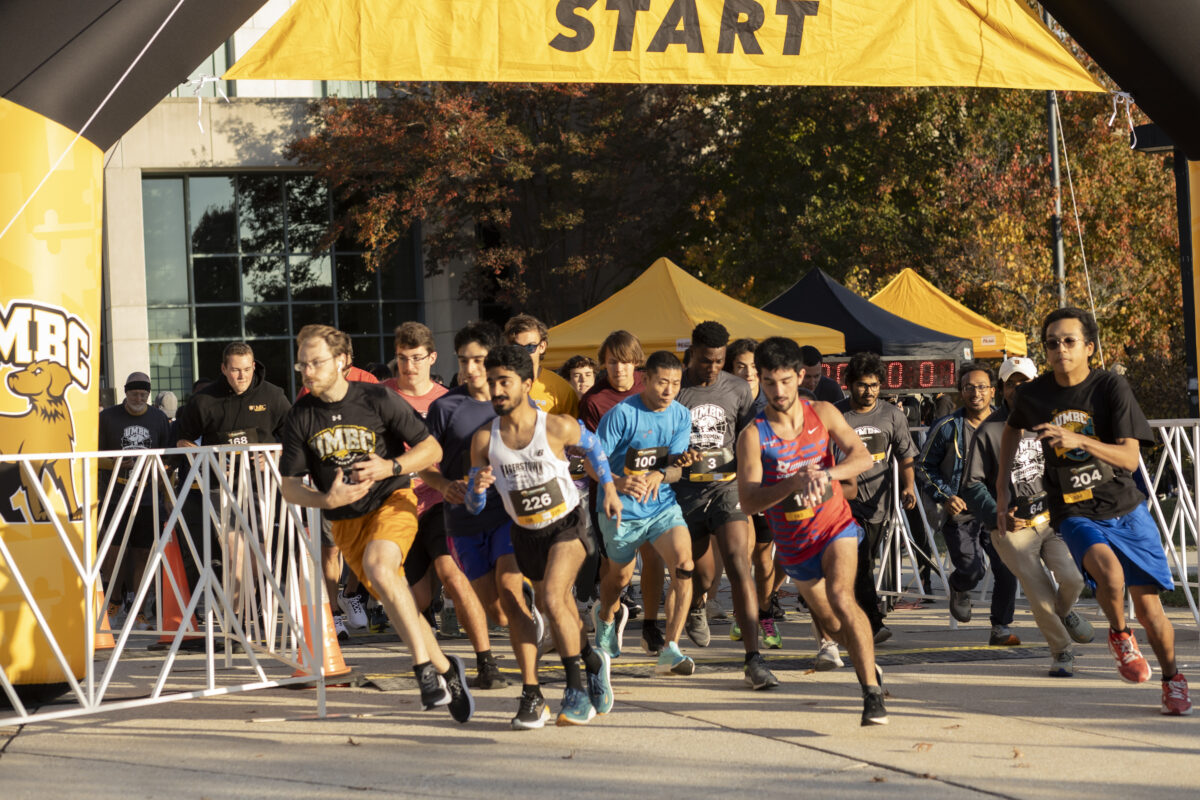
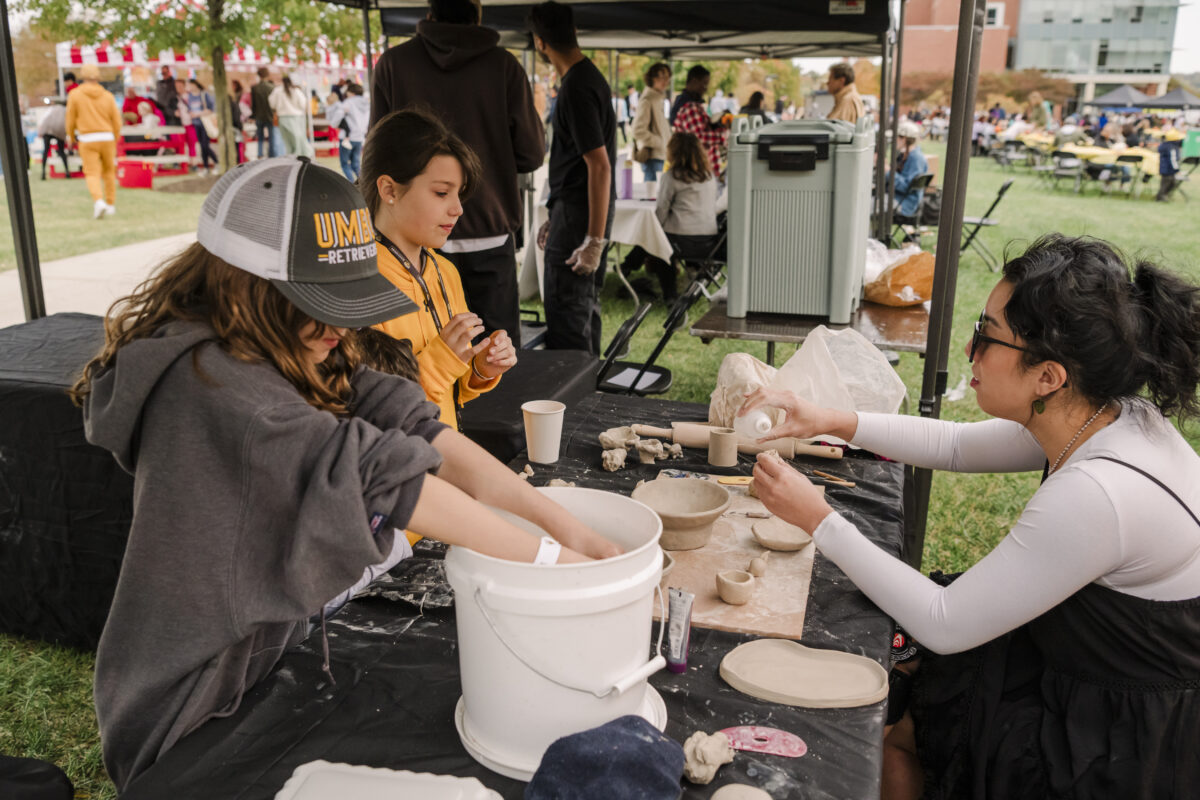 UMBC families and friends partaking in the 2024 Homecoming Family and Friends Weekend activities including the Retriever 5K race which had more than 250 participants, and the carnival celebration. (Photo on the left by Kiirstn Pagan for UMBC)
Robots, pups, and Retriever traditions
In UMBC tradition, the Homecoming celebration had something for everyone. Leading up to main Homecoming weekend, students kicked Homecoming fun into high gear with the return of the student org kickball tournament. UMBC faculty and staff also took part in the fun at the annual faculty-staff social.
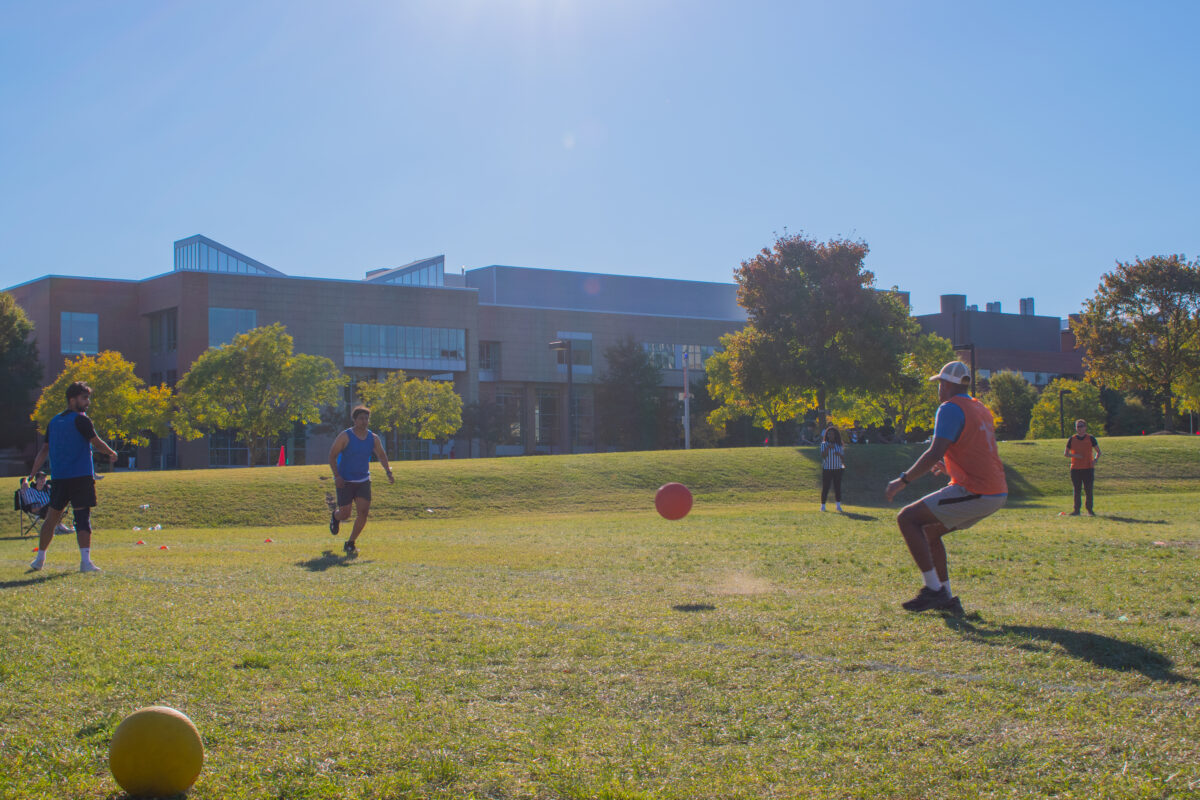
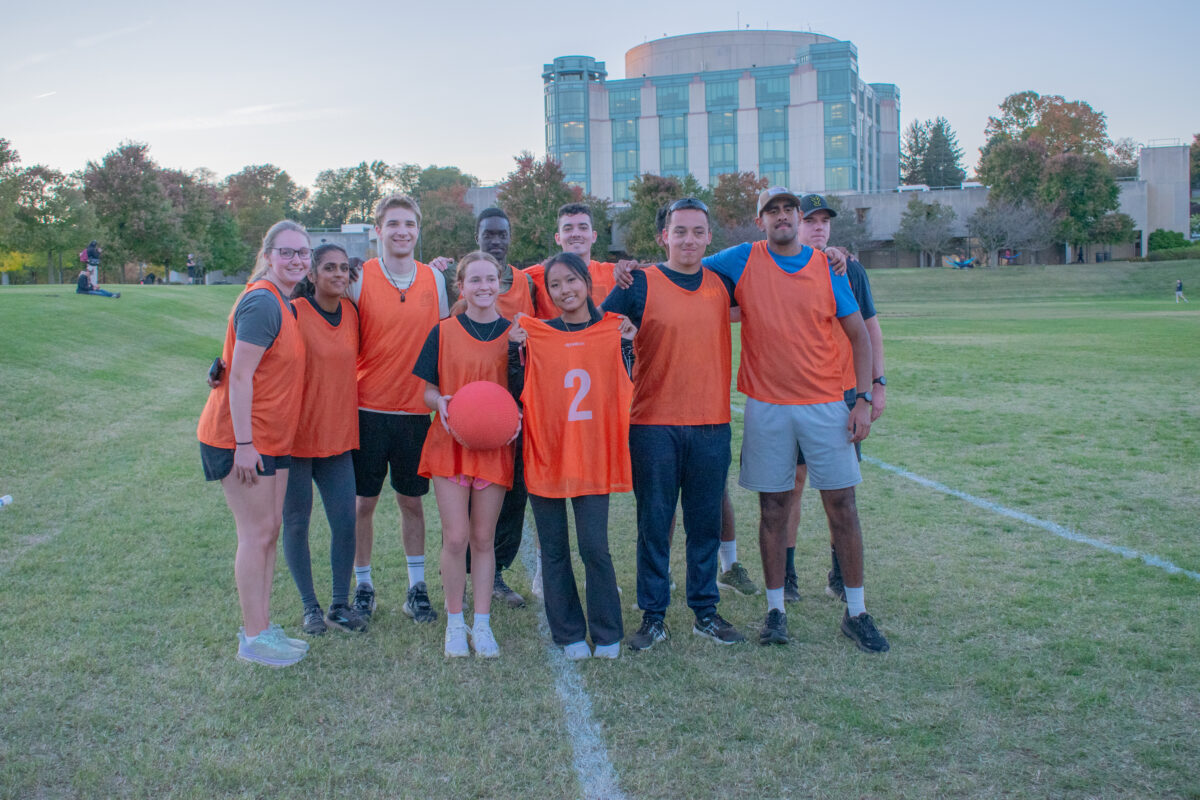 UMBC students kicked off the Homecoming 2024 excitement at the Student Org Kickball Tournament on October 20 at Erickson Field. The first place team (right) were all smiles following their victory. (Photos by Maashal Awan ’25 for UMBC)
A diverse breadth of UMBC’s research and creative achievement was on display at the eighth annual GRIT-X event. First-year computer science student Morgan Robbins attended this year’s GRIT-X with her mother, Nicole Robbins. The pair were impressed by GRIT-X speaker Aryya Gangopadhyay, professor of information systems, and student researchers in UMBC’s Center for Real-time Distributed Sensing and Autonomy (CARDS) who led a demonstration of their autonomous robotics technology.
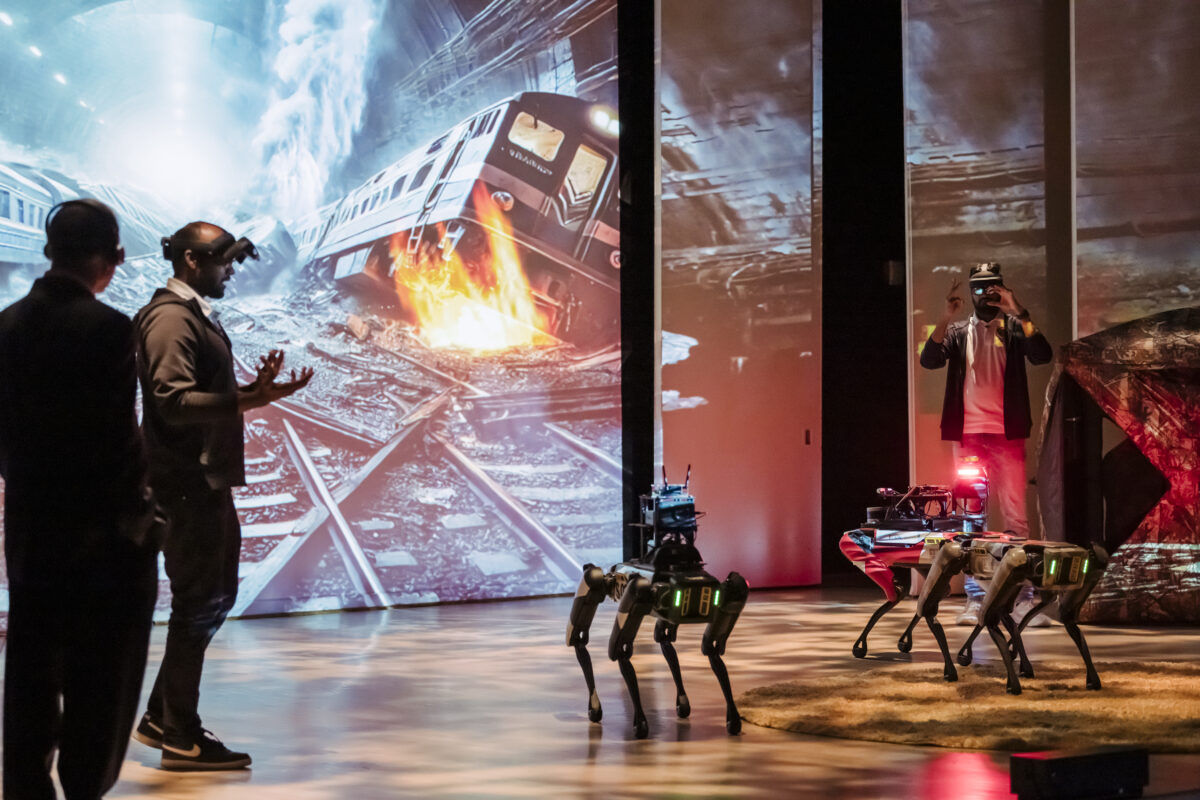 Center for Real-time Distributed Sensing and Autonomy student researchers leading the demonstration of their autonomous robots and how the robots are providing crucial support in rescue operations and human-robot teaming.
“I’m interested in autonomous communication, and I like combining computing with helping people,” said Robbins. “This was my first time seeing research talks, and it was great to see the research happening at UMBC.”
During Homecoming and Family Weekend, there were smiles, cheers, and barks all around for the annual Puppy Parade, which featured dozens of animals in wild costumes. Dharma Bhatt ’23, psychology, said he came to Homecoming for one reason: “The puppy parade—entirely the puppy parade.”
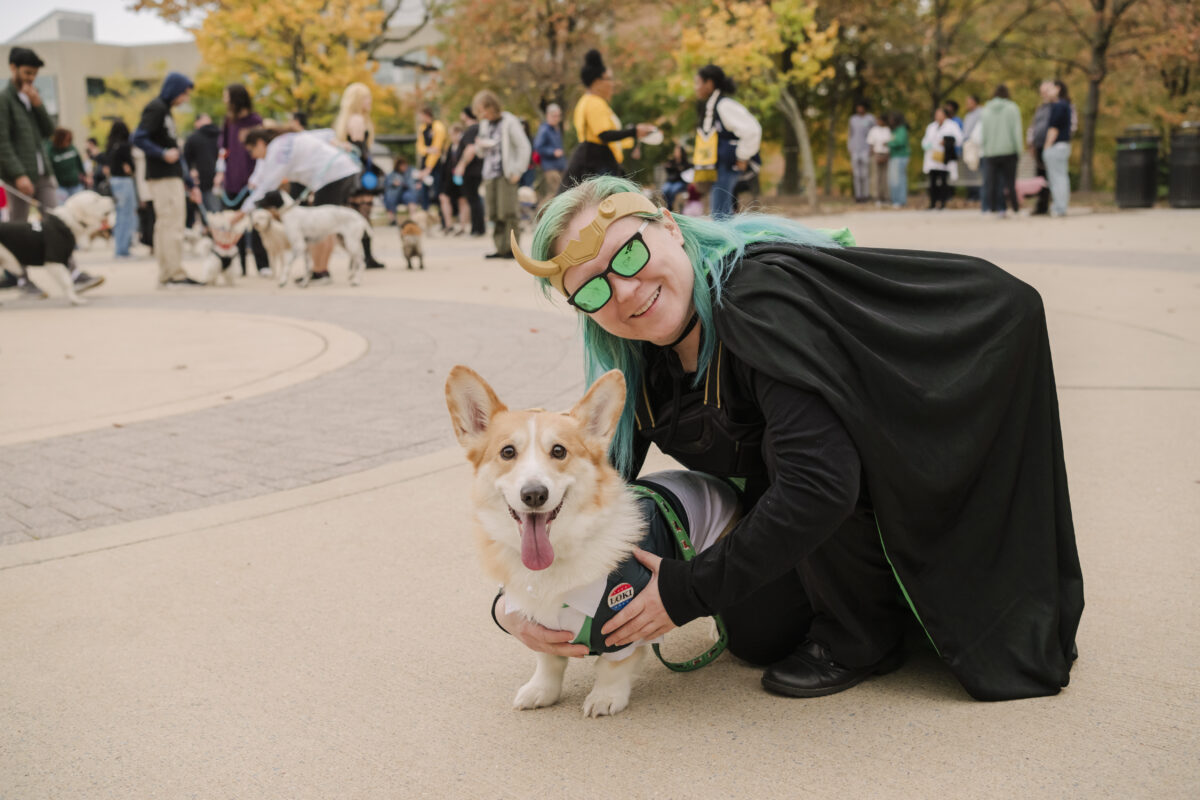
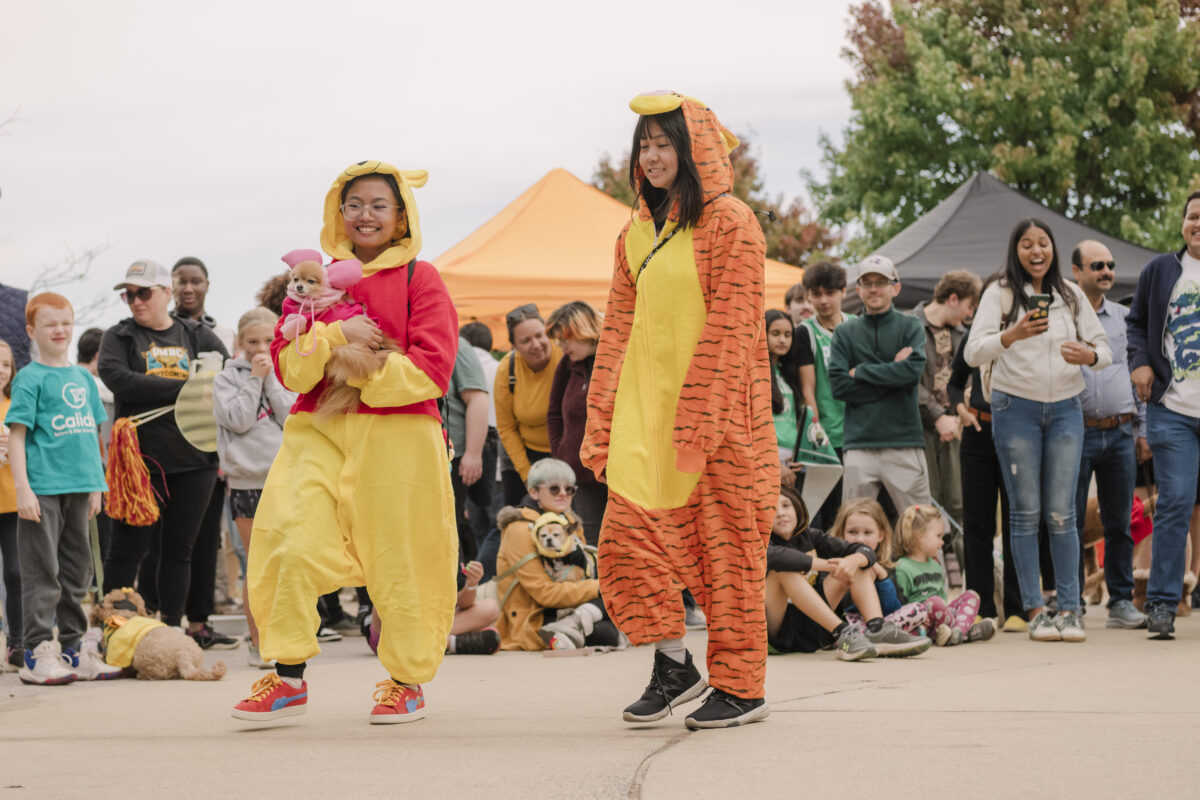
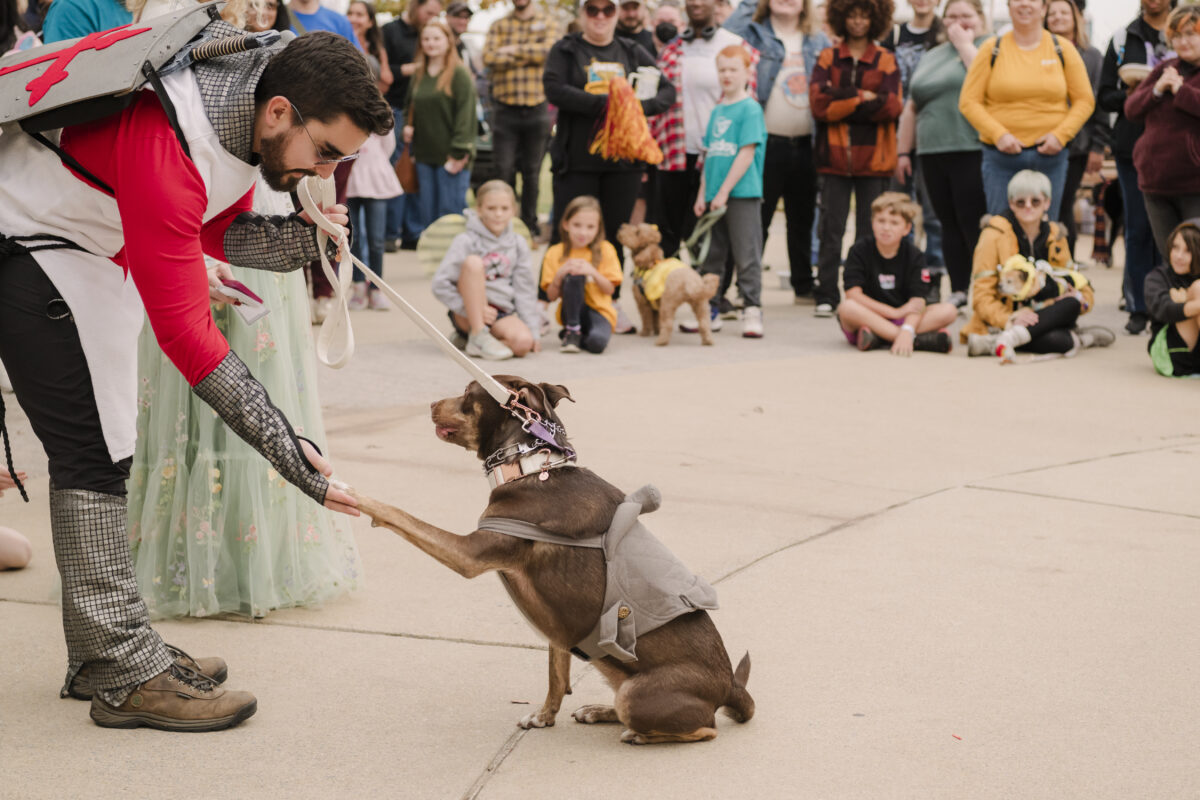
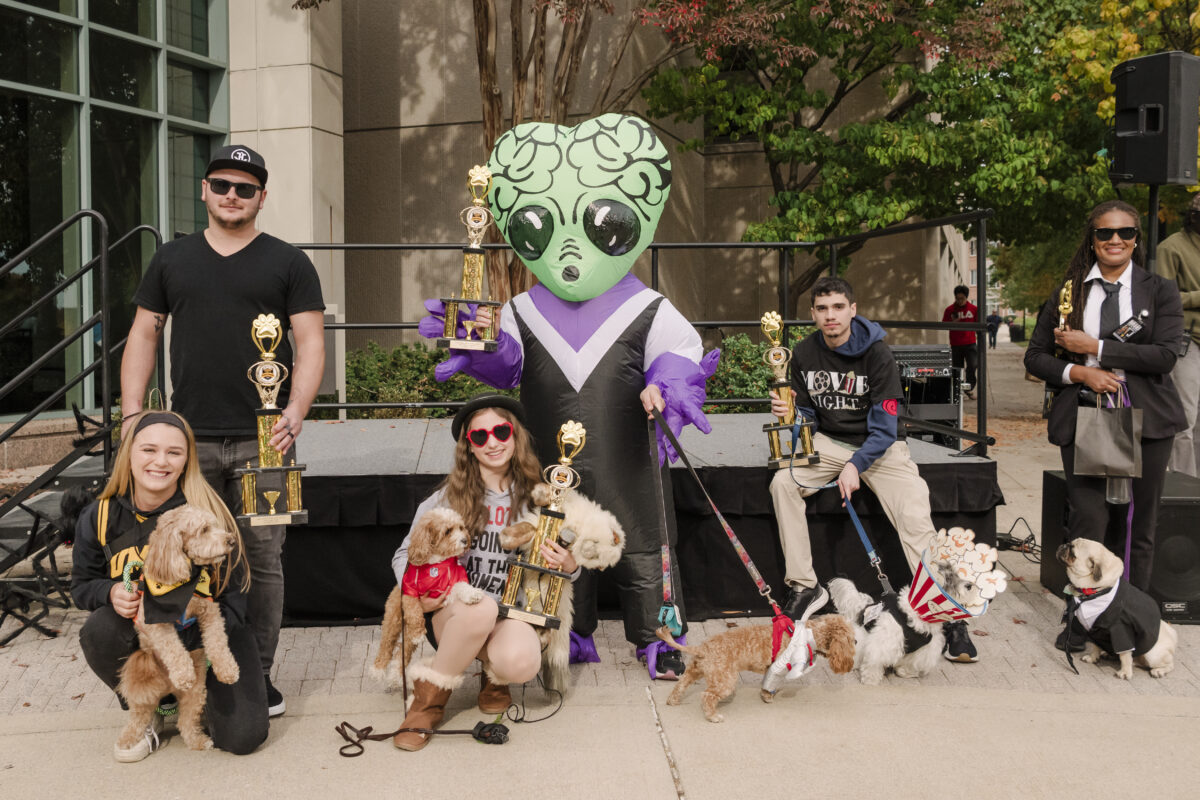 2024 Puppy Parade participants and winners showing off their Halloween spirit during this year’s Homecoming weekend celebration.
A weekend for family and friends
Homecoming weekend also featured several get-togethers for various groups across the community, including reunions for UMBC’s “Founding Four” group and members of the university’s Honors College and scholars programs. President Valerie Sheares Ashby took part in the Alpha Kappa Alpha sorority Lambda Phi chapter’s celebration of their 15th reunion. The group helped to raise more than $1,600 for UMBC’s Second Generation Scholarship Fund.
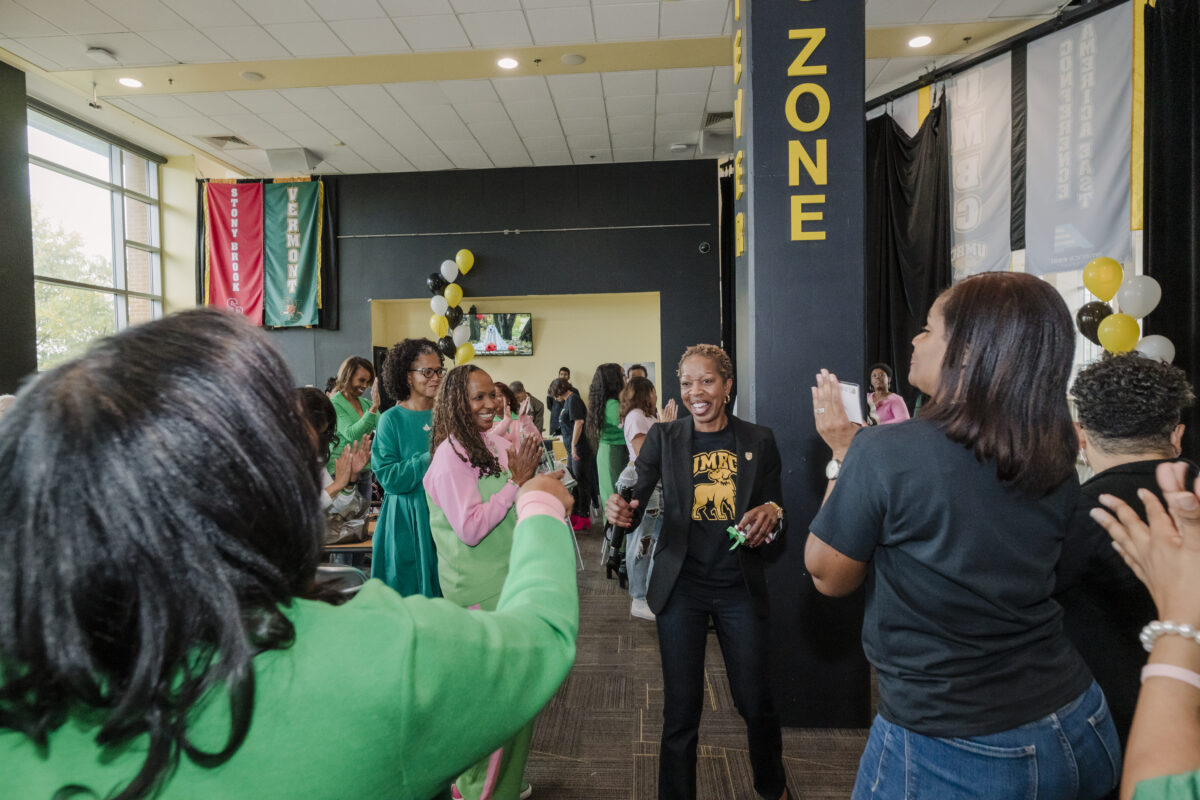 President Valerie Sheares Ashby during the Alpha Kappa Alpha sorority Lambda Phi chapter’s celebration of their 15th reunion.
Jim Lotfi ’89, visual and performing arts, kept the party rocking during the annual Greek alumni reunion party. Lotfi shared that he loves hosting the Greek alumni party, saying that, “It’s a great time for fraternity and sorority members across all organizations to come together and reconnect. This is one of my favorite Homecoming events to participate in.”
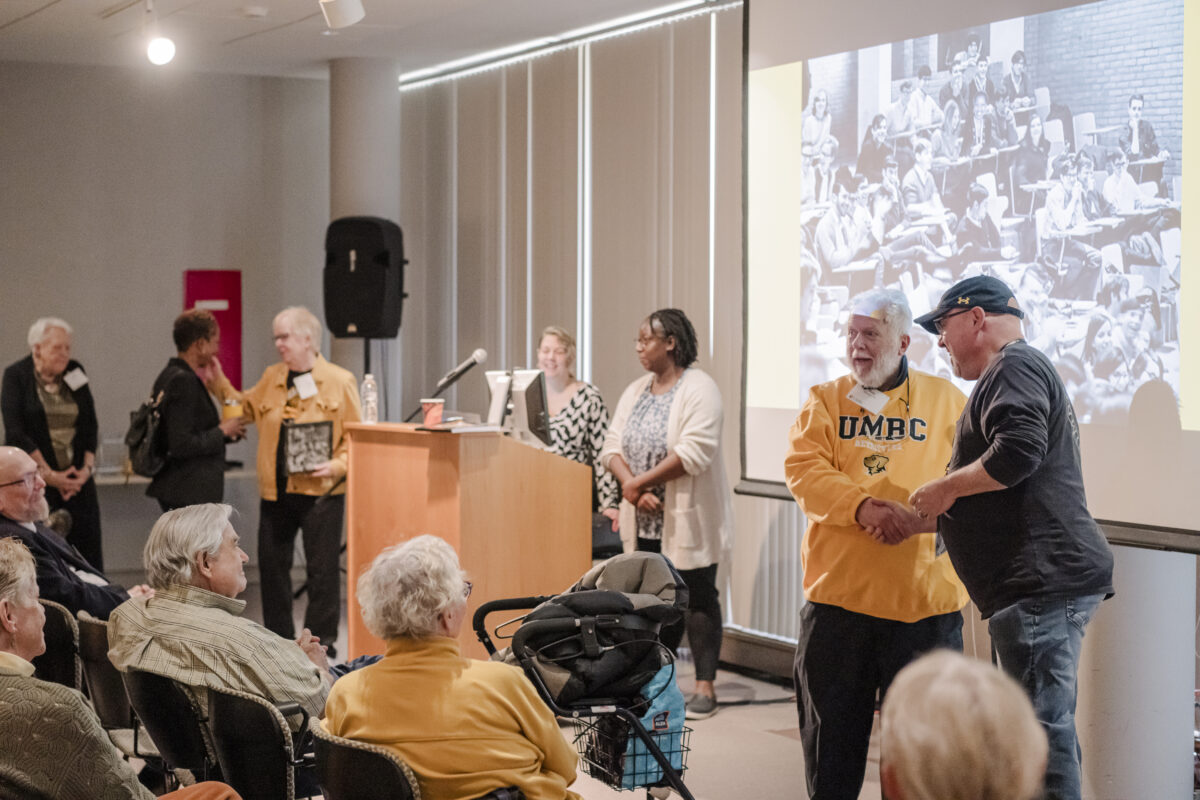
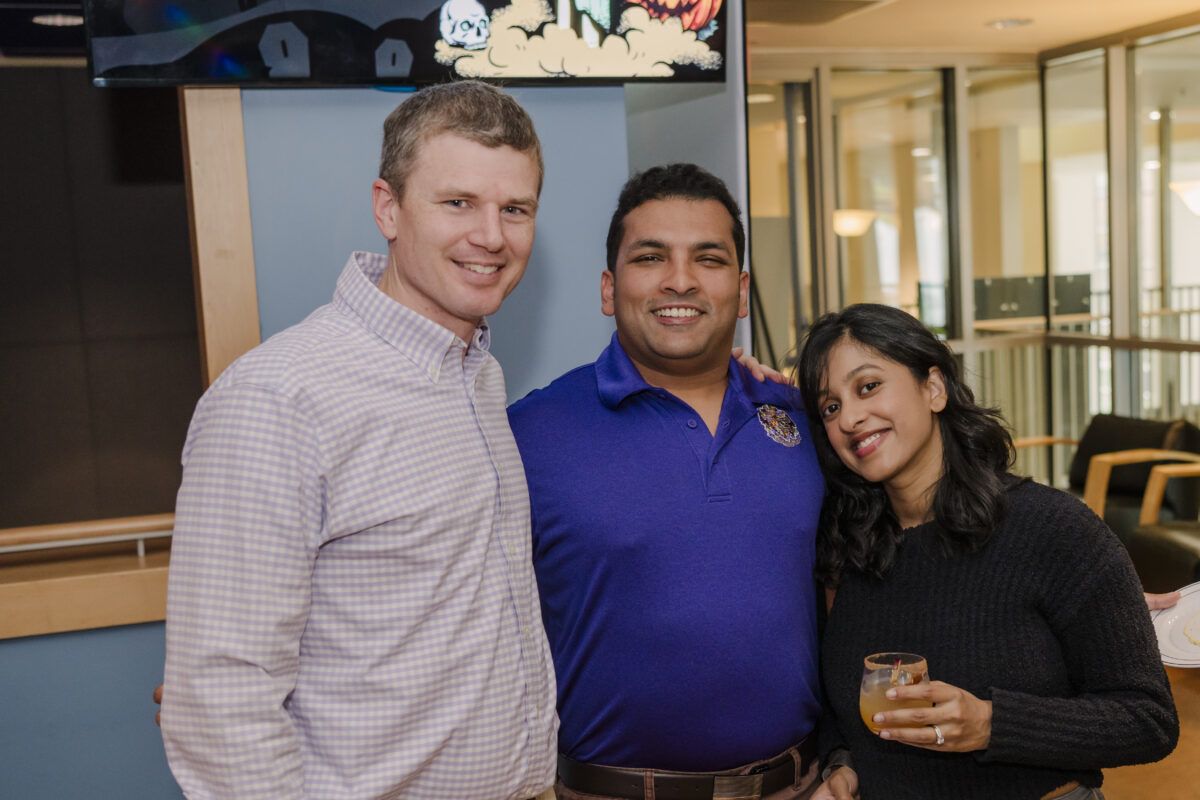
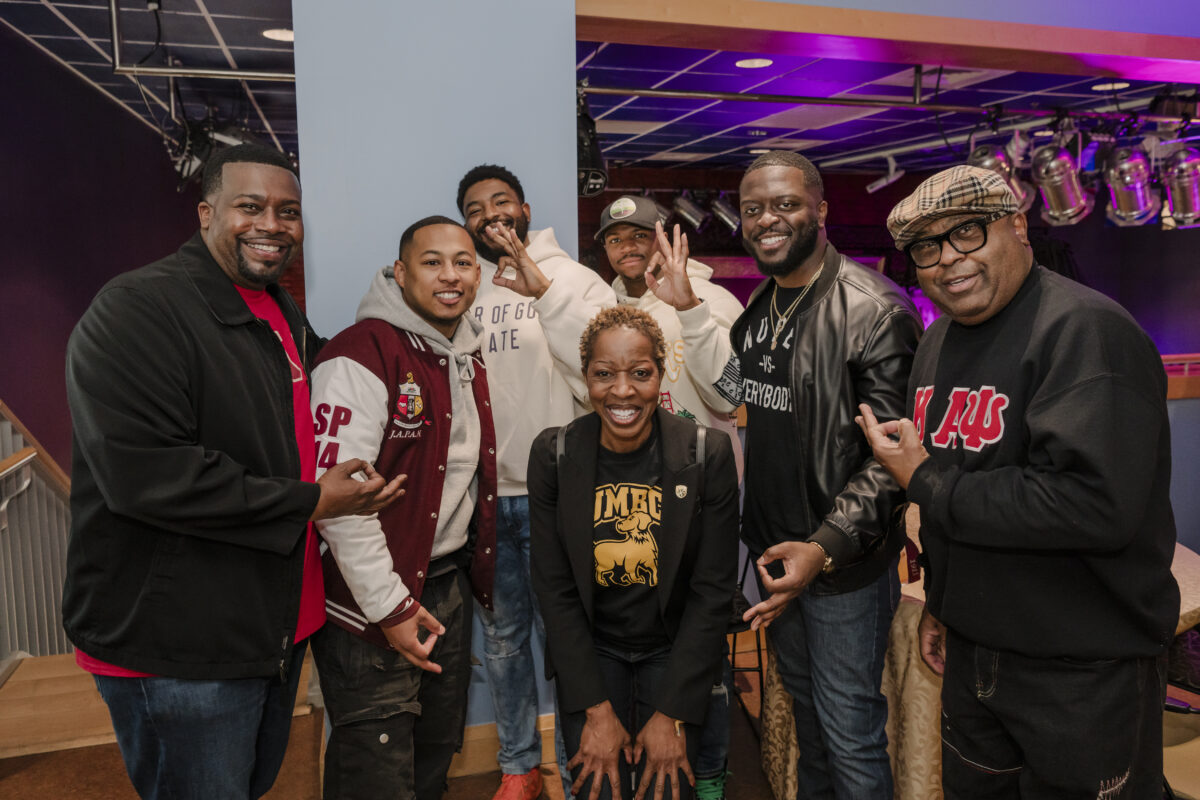
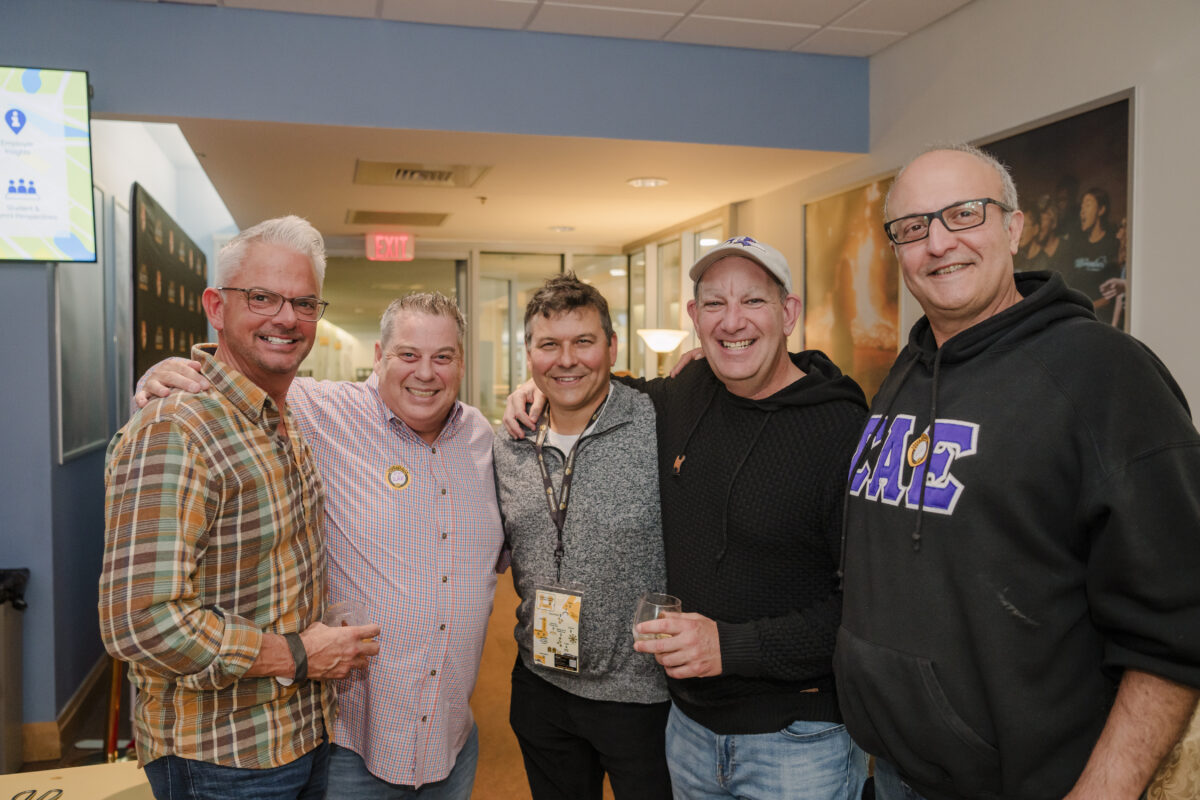 Homecoming 2024 brought together members of several group across UMBC’s community. The Founding Four (top left) came together for their annual reunion. More than 100 attendees reconnected during the Greek Alumni reunion, hosted by alum Jim Lotfi (pictured in the final photo, far right).
In the Alumni and Friends tent on Erickson Field, attendees enjoyed games, food, petting zoo fun, and moments of reconnecting with old classmates and other familiar faces. Senior Emily Trentalance said she attended Homecoming to be able to see friends and professors again. “It’s hard hanging out, especially with your alumni friends when people are busy, so it’s nice to see everyone,” she shares.
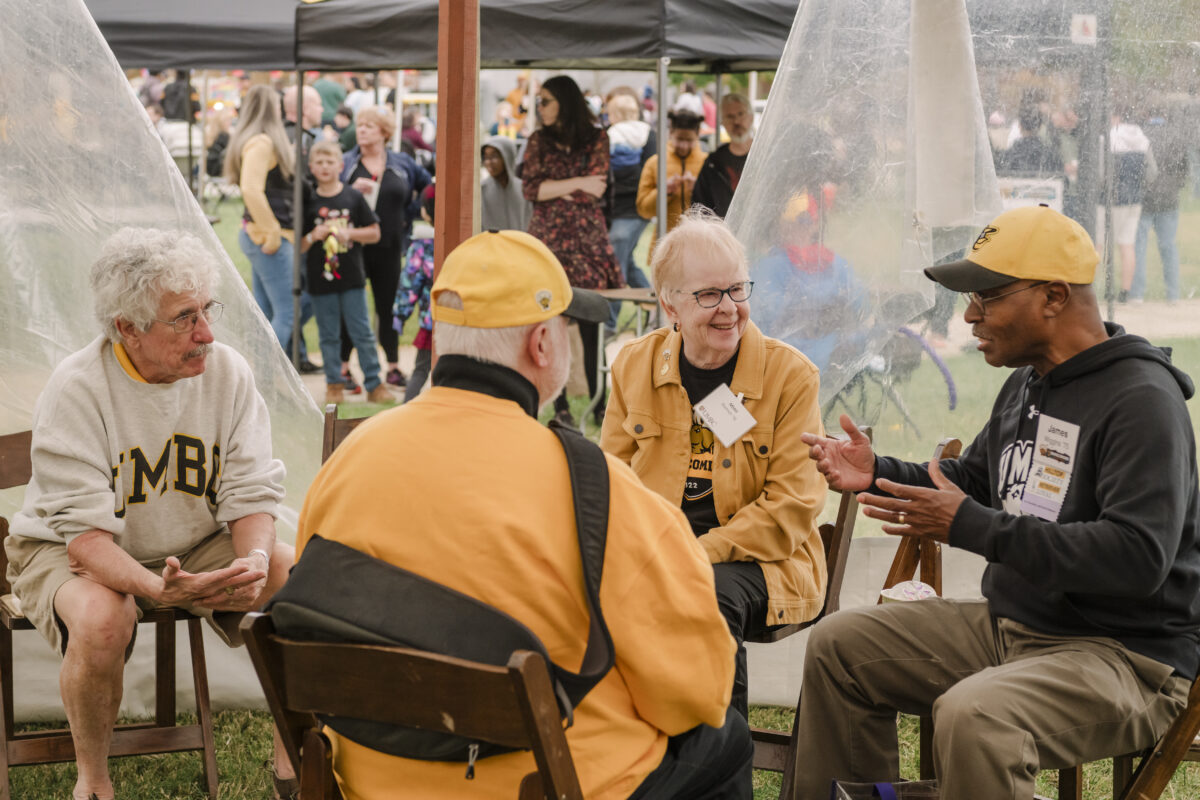
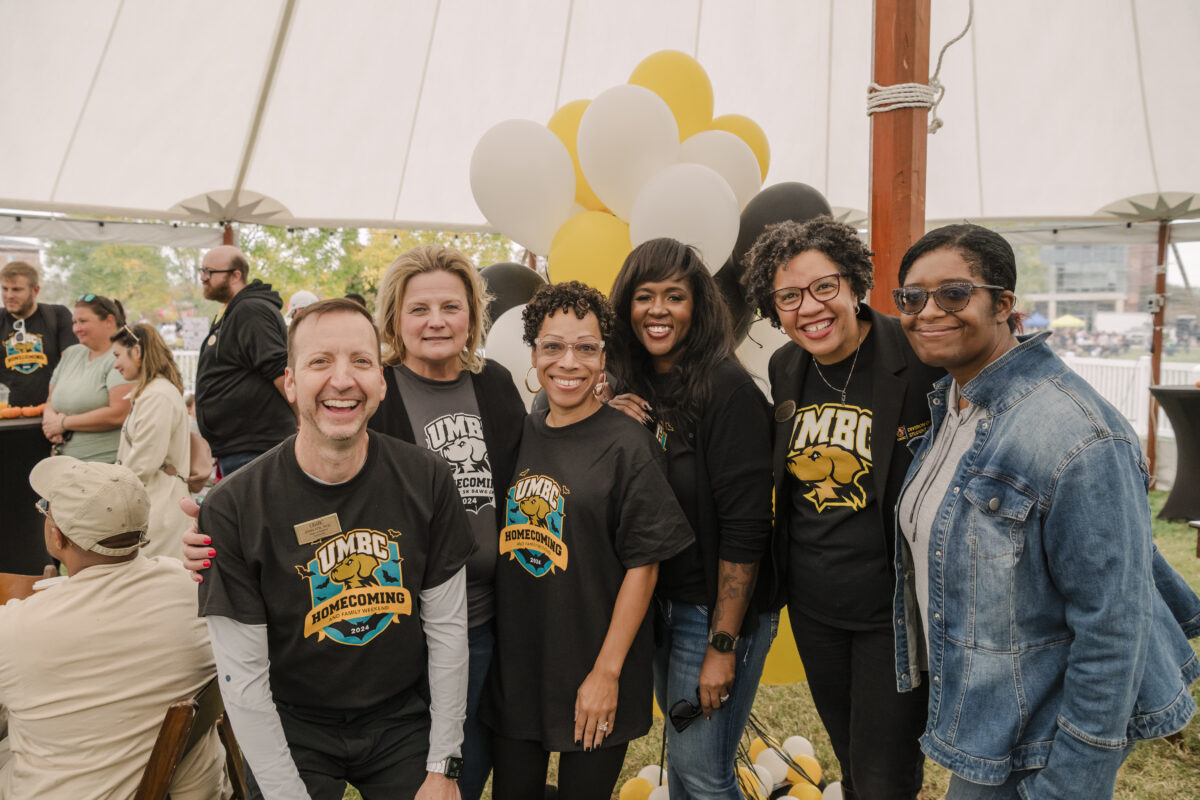
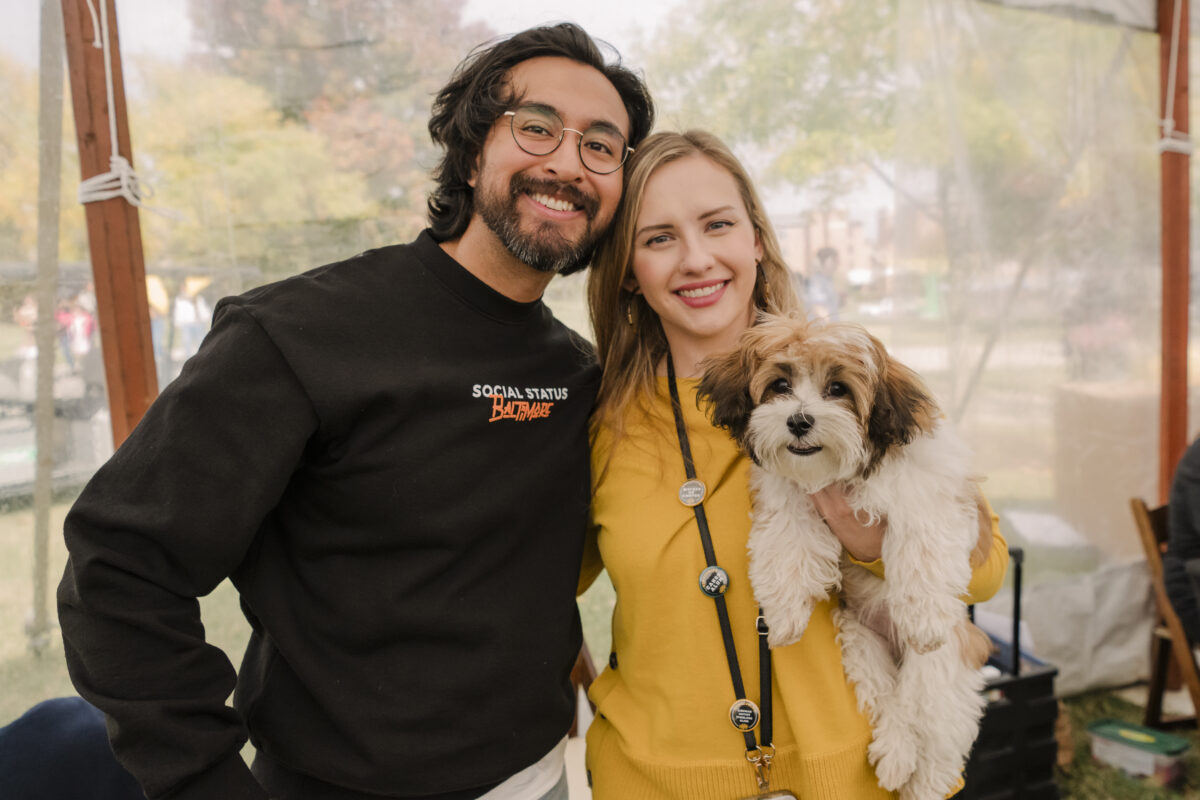 Retriever connections in the Alumni and Friends tent gathering during Homecoming Family and Friends Weekend.
During this year’s Taste of Maryland Homecoming event, 100 attendees gathered across from UMBC’s Bookstore in The Commons for a crab and assorted buffet feast. Alumni Association President Kevin Yang ’07, computer science and financial economics, and his wife Katelyn Niu ’05, biochemistry, brought their son along for the Homecoming fun. The family enjoyed the endless bushels of crabs with fellow alumni friends.
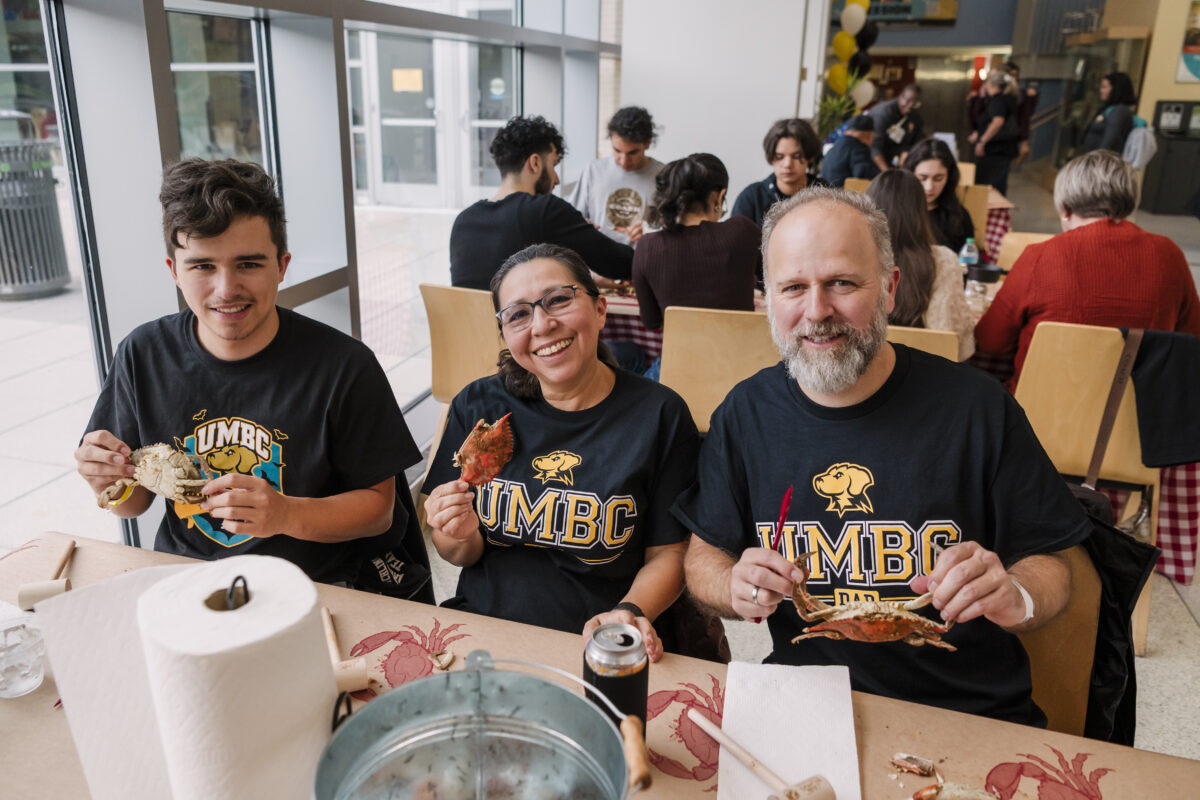
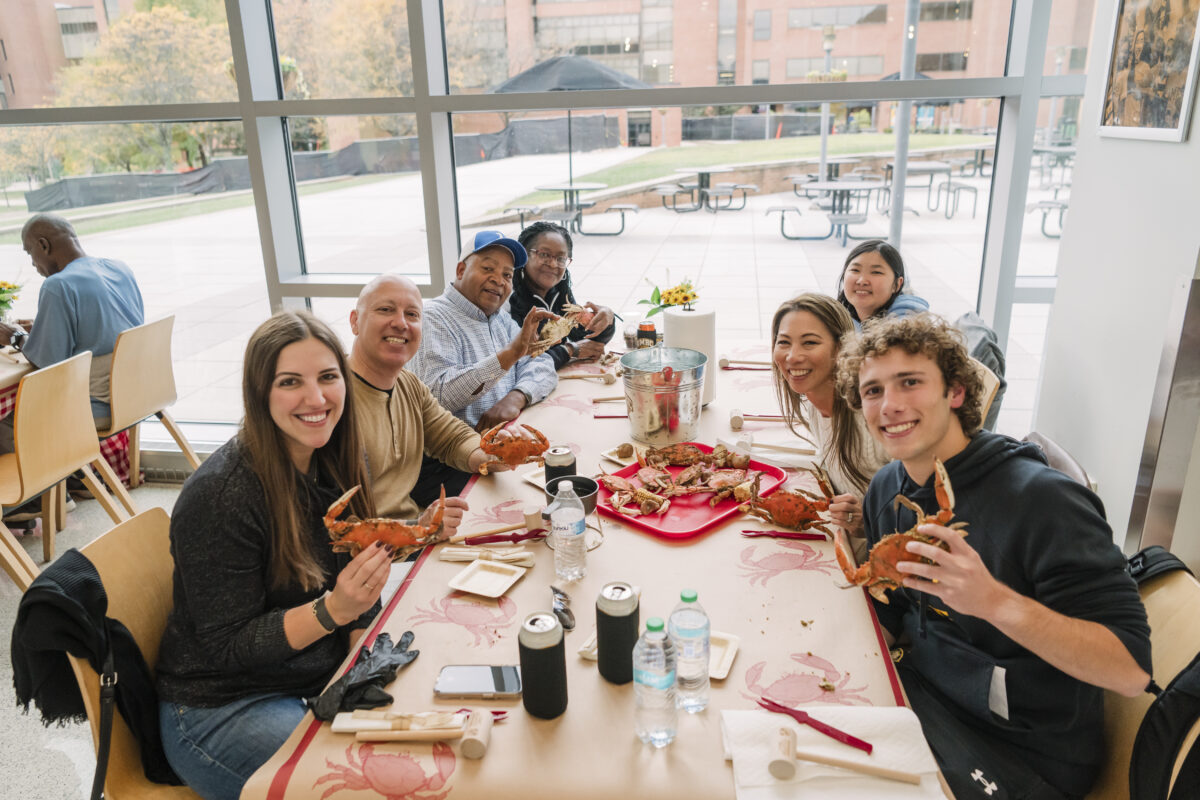 Taste of Maryland attendees enjoying a crab feast.
“There’s nothing like a UMBC celebration, and what better way to reconnect and reminisce with old friends than with crabs,” said Yang.
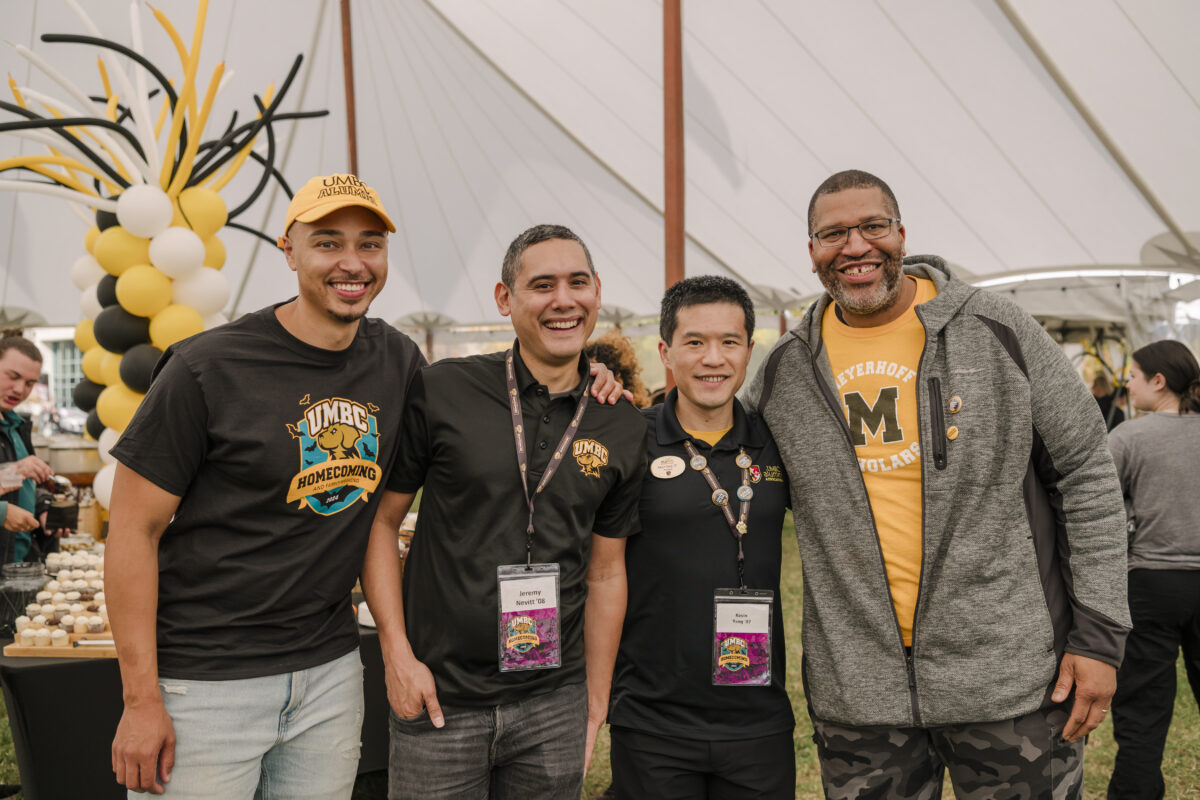 Alumni Association president Kevin Yang ’07 (third from left) with fellow UMBC alumni and staff at the Alumni and Friends tent gathering during Homecoming 2024.
As the carnival lit up the night sky, many attendees made their way to the annual Homecoming Tailgate where they cheered on the men’s soccer team in their victory against the University of Vermont.
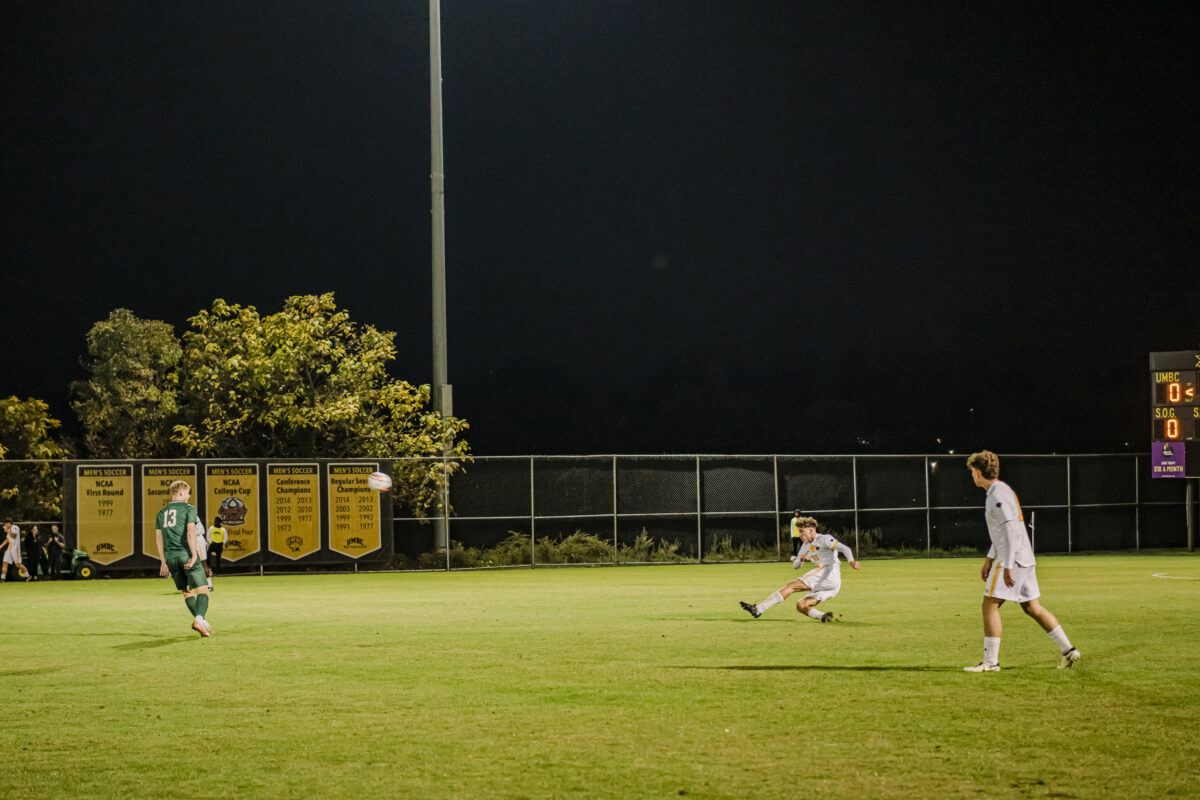 The men’s soccer team triumph over the University of Vermont with a 1-0 victory during their Homecoming 2024 match up.
Additional reporting provided by JJ Gee ’25 and Maashal Awan ’25 for UMBC.
]]>
Families, friends, furry pals, and Retrievers of all ages returned to UMBC’s campus last week for the 2024 Homecoming celebration. Retrievers were in high spirits as they enjoyed more than 30...
https://umbc.edu/stories/homecoming-2024-recap/
https://my3.my.umbc.edu/api/v0/pixel/news/145219/guest@my.umbc.edu/fde7c1aa48a1b6dcb07c196dcb189032/api/pixel
alumni
alumni-association
community
homecoming
news
story
UMBC News & Magazine
https://my3.my.umbc.edu/groups/umbc-news-magazine
https://assets1-my.umbc.edu/system/shared/avatars/groups/000/001/943/24435aa6207c452e7bc15cc74b42c7bb/xsmall.png?1748556657
https://assets1-my.umbc.edu/system/shared/avatars/groups/000/001/943/24435aa6207c452e7bc15cc74b42c7bb/original.png?1748556657
https://assets2-my.umbc.edu/system/shared/avatars/groups/000/001/943/24435aa6207c452e7bc15cc74b42c7bb/xxlarge.png?1748556657
https://assets2-my.umbc.edu/system/shared/avatars/groups/000/001/943/24435aa6207c452e7bc15cc74b42c7bb/xlarge.png?1748556657
https://assets3-my.umbc.edu/system/shared/avatars/groups/000/001/943/24435aa6207c452e7bc15cc74b42c7bb/large.png?1748556657
https://assets1-my.umbc.edu/system/shared/avatars/groups/000/001/943/24435aa6207c452e7bc15cc74b42c7bb/medium.png?1748556657
https://assets2-my.umbc.edu/system/shared/avatars/groups/000/001/943/24435aa6207c452e7bc15cc74b42c7bb/small.png?1748556657
https://assets1-my.umbc.edu/system/shared/avatars/groups/000/001/943/24435aa6207c452e7bc15cc74b42c7bb/xsmall.png?1748556657
https://assets2-my.umbc.edu/system/shared/avatars/groups/000/001/943/24435aa6207c452e7bc15cc74b42c7bb/xxsmall.png?1748556657
UMBC News & Magazine
0
0
false
Thu, 31 Oct 2024 11:00:14 -0400
Thu, 31 Oct 2024 11:00:14 -0400
Study shows natural regrowth of tropical forests has immense potential to address environmental concerns

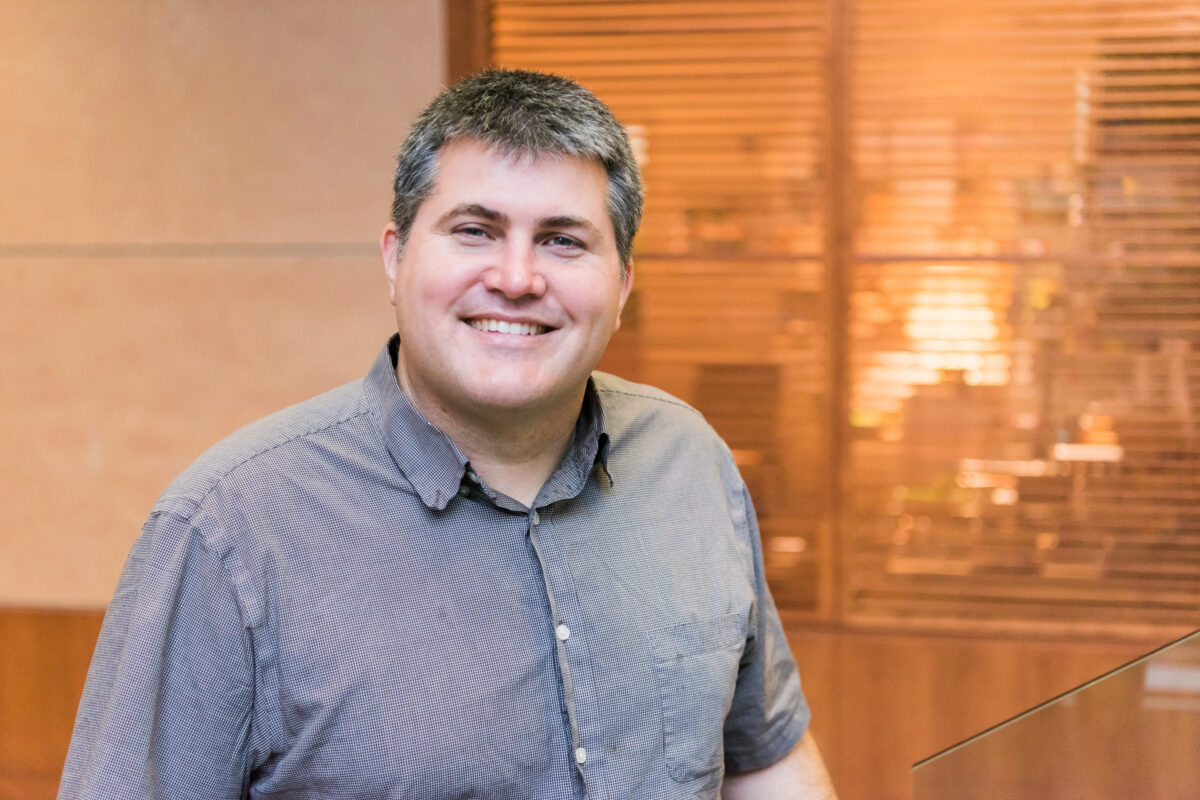 Matthew Fagan led development of the forest patches database that the current study relied on. (Marlayna Demond ’11/UMBC)
A new study in Naturefinds that up to 215 million hectares of land (an area larger than Mexico) in humid tropical regions around the world has the potential to naturally regrow. That much forest could store 23.4 gigatons of carbon over 30 years and also significantly help enhance biodiversity and water quality. The study showed that more than half of the area with strong potential for regrowth was in five countries: Brazil, Mexico, Indonesia, China, and Colombia.
“Tree planting in degraded landscapes can be costly. By leveraging natural regeneration techniques, nations can meet their restoration goals cost effectively,” says the study’s co-lead author, Brooke Williams, a researcher at the Queensland University of Technology, Australia, and the Institute for Capacity Exchange in Environmental Decisions. “Our model can guide where these savings can best be taken advantage of,” she says.
A culmination of decades of work
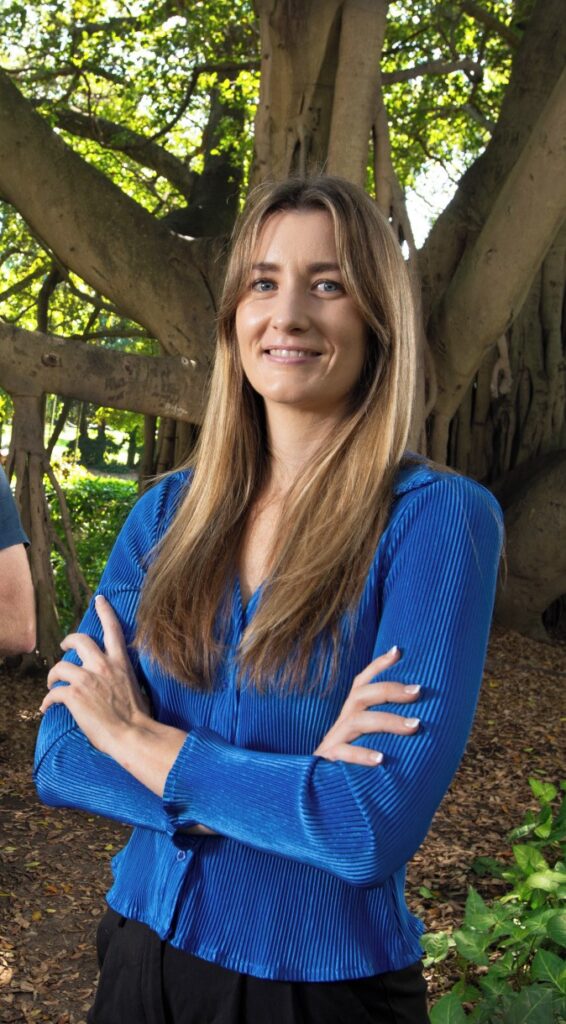 Brooke Williams co-led the new research study. (Courtesy of Williams)
Matthew Fagan, associate professor of geography and environmental systems at UMBC and second author on the new study, developed a data set the authors relied on.
In that work, “We used satellite images to identify millions of small areas where tree cover increased over time. We then excluded the areas planted by humans with machine learning, focusing on natural regrowth,” Fagan says. The study tracked regrowth between 2000 and 2012, and then checked if the regrowth was maintained through 2015. “Those natural patches were the input data for this novel study,” he says, “the first to predict where future forest regrowth will occur, given observed past regrowth.”
The study, co-led by Hawthorne Beyer, head of geospatial science at Mombak, a Brazilian startup which aims to generate high-quality carbon credits through reforestation of the Amazon, and director of science at Institute for Capacity Exchange in Environmental Decisions, also pulled in global data sets describing factors like soil quality, slope, road and population density, local wealth, distance from urban centers and from healthy forest, and more. “Any time you build one of these global studies, you’re standing on the backs of so many other scientists,” Fagan says. “Each one of these studies represents years of work.”
The study found that the factors most strongly associated with high regrowth potential were a patch’s proximity to existing forest, the density of nearby forest, and the content of carbon in the soil. Those factors in particular “seem to do a really good job explaining the patterns of regrowth we see across the world,” Fagan says. Being close to existing forest, for example, is key to supplying a variety of seeds to the area to support diverse regrowth, Fagan explains.
Keeping it local—by supplying a global map
The end product of the study is a digital map of the global tropics, where each pixel—representing 30 x 30 square meters of land—indicates the estimated potential for regrowth. That map, made possible by n extensive international collaboration of researchers, is a boon to environmentalists worldwide hoping to advocate locally for their efforts.
“Our goal and our hope is that this is used democratically by local people, organizations, and localities from the county level all the way up to the national level, to advocate for where restoration should happen,” Fagan says. “The people who live there should be in charge of what happens there—where and how to restore really depends on local conditions.”
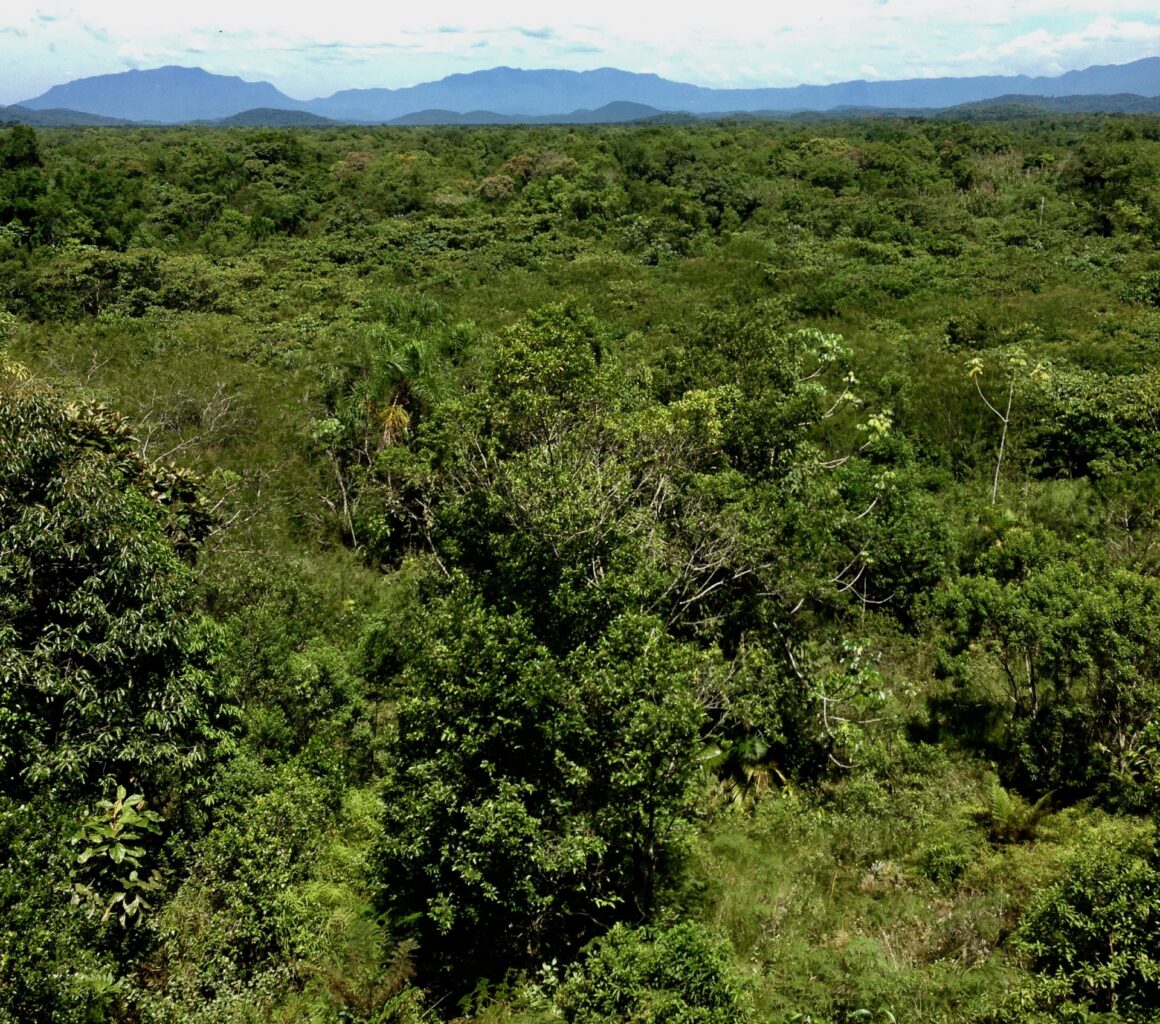 An example of forest regrowth in the state of Parana, Brazil. (Photo by Robin Chazdon)
Fagan points out that some of the potential regrowth areas the study identified are unlikely to be restored for a variety of reasons, such as being in active use for ranching or crops or located on prime real estate near roads and urban centers. However, a meaningful portion of the 215 million hectares is abandoned and degraded cattle pastures or previously logged forests, where encouraging natural regeneration would have minimal cost to local economies and a long list of benefits.
“If you restored that to rainforest, the benefit to water quality, water provision, local biodiversity, and to soil quality would be immense,” Fagan says. “It would also be an immense benefit for pulling carbon out of the atmosphere, so really it’s just a question of, ‘Where can we do this most efficiently?’ That’s what this paper is all about.”
]]>
Matthew Fagan led development of the forest patches database that the current study relied on. (Marlayna Demond ’11/UMBC) A new study in Naturefinds that up to 215 million hectares of land (an...
https://umbc.edu/stories/natural-forest-regrowth/
https://my3.my.umbc.edu/api/v0/pixel/news/145197/guest@my.umbc.edu/584f94dc9b8ed6146ad2849e8f3ebb1d/api/pixel
cahss
ges
news
policy-and-society
research
science-and-tech
story
UMBC News & Magazine
https://my3.my.umbc.edu/groups/umbc-news-magazine
https://assets1-my.umbc.edu/system/shared/avatars/groups/000/001/943/24435aa6207c452e7bc15cc74b42c7bb/xsmall.png?1748556657
https://assets1-my.umbc.edu/system/shared/avatars/groups/000/001/943/24435aa6207c452e7bc15cc74b42c7bb/original.png?1748556657
https://assets2-my.umbc.edu/system/shared/avatars/groups/000/001/943/24435aa6207c452e7bc15cc74b42c7bb/xxlarge.png?1748556657
https://assets2-my.umbc.edu/system/shared/avatars/groups/000/001/943/24435aa6207c452e7bc15cc74b42c7bb/xlarge.png?1748556657
https://assets3-my.umbc.edu/system/shared/avatars/groups/000/001/943/24435aa6207c452e7bc15cc74b42c7bb/large.png?1748556657
https://assets1-my.umbc.edu/system/shared/avatars/groups/000/001/943/24435aa6207c452e7bc15cc74b42c7bb/medium.png?1748556657
https://assets2-my.umbc.edu/system/shared/avatars/groups/000/001/943/24435aa6207c452e7bc15cc74b42c7bb/small.png?1748556657
https://assets1-my.umbc.edu/system/shared/avatars/groups/000/001/943/24435aa6207c452e7bc15cc74b42c7bb/xsmall.png?1748556657
https://assets2-my.umbc.edu/system/shared/avatars/groups/000/001/943/24435aa6207c452e7bc15cc74b42c7bb/xxsmall.png?1748556657
UMBC News & Magazine
1
0
false
Wed, 30 Oct 2024 12:22:29 -0400
Wed, 30 Oct 2024 12:22:29 -0400
Alumna introduces horseshoe crabs to K-12 classrooms to raise these scientifically useful arthropods
Most people wouldn’t guess horseshoe crabs—ancient arthropods with hard, round carapaces and long, spiky tails—when asked what animals you might find in a K-12 classroom. But Jessica Baniak ’23, biological sciences, is collaborating with the Maryland Department of Natural Resources (DNR) to shift kids’ perspectives of the alien-looking critters and create opportunities for inquiry-based learning.
Today, Baniak is a student in the ICARE program, an environmental science master’s program led by UMBC biology professor Tamra Mendelson. ICARE students study local environmental issues and include community partners on their master’s thesis committees.
Horseshoe crabs congregate on Maryland and Delaware beaches to mate each spring, and the last two years Baniak has collected some of their eggs with a research permit from the Maryland DNR. Each female can produce upwards of 20,000 eggs. Baniak takes the eggs back to a lab at the Institute of Marine and Environmental Technology (IMET), a multi-institution research facility on Baltimore’s Inner Harbor, and raises them until they’re about a centimeter across.
Then Baniak delivers the baby crabs to elementary, middle, and high school classrooms in Howard, Carroll, and Baltimore counties. This year, 10 schools received crabs. Some teachers use the crabs in their curriculum, and some crabs are tended by student environmental clubs. Students run basic experiments that develop their science reasoning skills, like comparing growth rates in different hatchery setups.
Finding the sweet spot
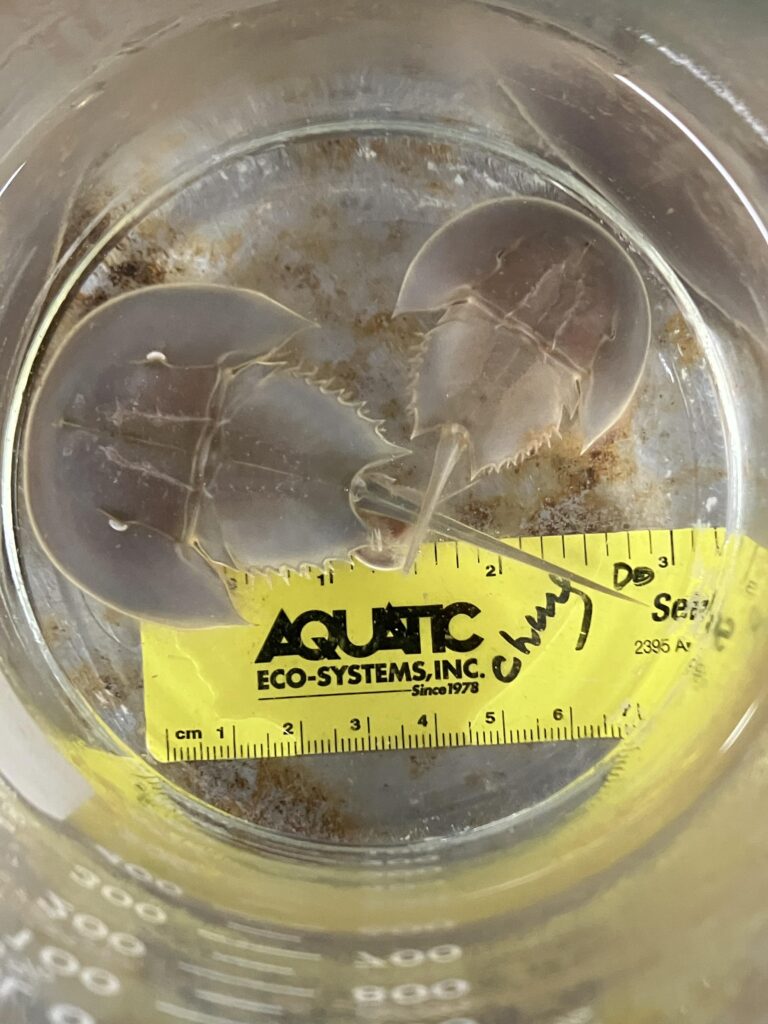 These baby crabs are about six months old, and Baniak grew them at the highest temperature in her study—so they are a little larger than average. (Courtesy of Baniak)
It’s tricky to successfully raise the crabs to adulthood. Baniak visits each classroom a couple of times a year and makes suggestions to improve the crab habitats. Factors like feed, temperature, salinity, and more play a role in their survival. For her master’s research, Baniak is working out the ideal setup for successful crab-rearing with a focus on temperature. Higher temperatures produce faster growth, but some baby crabs perish in the heat. Cooler temps cut the mortality rate, but slow growth.
Baniak’s goal is to find the sweet spot that produces the most healthy crabs in a short amount of time. Why does efficiency matter? Because eager students aren’t the only ones interested in raising crabs.
Companies extract a compound from horseshoe crab blood that is used to detect bacterial contamination in pharmaceuticals. The blood can’t be harvested until the crabs are about 10 years old, Baniak explains, so raising them in captivity isn’t economical (it’s also challenging). Instead, reintroducing young crabs to their natural habitat is “a way that companies can help mitigate how much they’ve taken out of the wild,” Baniak says. Baniak’s work will help optimize these reintroduction programs for the industry—and at the same time, give kids a unique learning opportunity.
‘Everything all at once’
As a child, the National Aquarium in Baltimore—directly across the pier from IMET—inspired Baniak to pursue marine biology. Today her experiences range well beyond horseshoe crabs. As an undergraduate, she had a summer internship at an oyster hatchery. “During the breeding season—that’s when you work really long hours,” she says. “You have to do everything all at once.”
Counting surviving oysters, mating specific oyster pairs, and cleaning tanks—all while squeezing in work on experiments running at the hatchery—filled her days. One project involved developing a protocol to anesthetize oysters, which made it possible to collect tissue samples without killing the oyster. Baniak also assisted with the hatchery’s softshell clam initiative.
For another internship, she worked at the Maryland Pesticide Education Network, which promotes safer alternatives to harmful pesticides. During the academic year, she found time to participate in UMBC’s tae-kwon do club and play club volleyball.
Sharing the joy in science
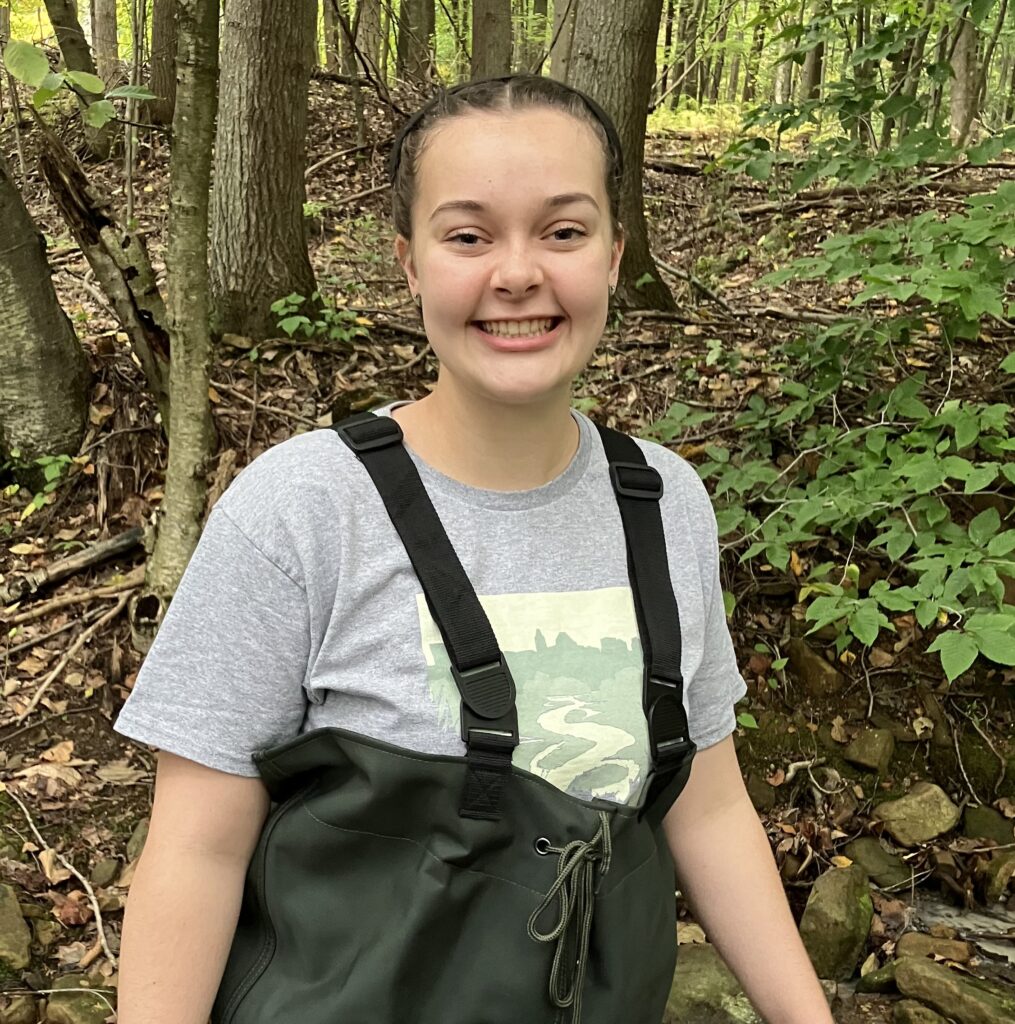 Jessica Baniak ’23 (Courtesy of Baniak)
After she graduates with her master’s next spring, Baniak hopes to move on to a role in a federal agency like the U.S. Fish and Wildlife Service. She wants to continue to contribute to outreach programs like the horseshoe crab project.
“That’s my motivation for continuing in science, because I want to make more programs like that,” Baniak says. “I like ICARE because you’re working with other people in the community and not just researching a really niche subject.”
After she transferred to UMBC during the pandemic to be closer to home, UMBC faculty members helped her stay committed to her biological sciences degree. Maggie Holland, professor of geography and environmental systems, “brought back the joy into science after returning from online learning,” Baniak says. “She seemed to genuinely care about me as a student and about the subject she was teaching.”
Mendelson, too, made an impact. “She’s put a lot of effort into the ICARE program and wants to see all of us succeed,” Baniak says.
At the end of the school year, Baniak will travel with the students to release their horseshoe crabs at Sandy Point State Park and watch them wriggle across the sand and swim into the Chesapeake Bay, heading for life’s next phase.
]]>
Most people wouldn’t guess horseshoe crabs—ancient arthropods with hard, round carapaces and long, spiky tails—when asked what animals you might find in a K-12 classroom. But Jessica Baniak ’23,...
https://umbc.edu/stories/horseshoe-crabs-in-the-classroom/
https://my3.my.umbc.edu/api/v0/pixel/news/145121/guest@my.umbc.edu/bed35689905753f7e8e4a73a2ba71d5f/api/pixel
alumni
alumni-profile
biology
cahss
cnms
fall-2024
ges
icare
imet
magazine
story
UMBC News & Magazine
https://my3.my.umbc.edu/groups/umbc-news-magazine
https://assets1-my.umbc.edu/system/shared/avatars/groups/000/001/943/24435aa6207c452e7bc15cc74b42c7bb/xsmall.png?1748556657
https://assets1-my.umbc.edu/system/shared/avatars/groups/000/001/943/24435aa6207c452e7bc15cc74b42c7bb/original.png?1748556657
https://assets2-my.umbc.edu/system/shared/avatars/groups/000/001/943/24435aa6207c452e7bc15cc74b42c7bb/xxlarge.png?1748556657
https://assets2-my.umbc.edu/system/shared/avatars/groups/000/001/943/24435aa6207c452e7bc15cc74b42c7bb/xlarge.png?1748556657
https://assets3-my.umbc.edu/system/shared/avatars/groups/000/001/943/24435aa6207c452e7bc15cc74b42c7bb/large.png?1748556657
https://assets1-my.umbc.edu/system/shared/avatars/groups/000/001/943/24435aa6207c452e7bc15cc74b42c7bb/medium.png?1748556657
https://assets2-my.umbc.edu/system/shared/avatars/groups/000/001/943/24435aa6207c452e7bc15cc74b42c7bb/small.png?1748556657
https://assets1-my.umbc.edu/system/shared/avatars/groups/000/001/943/24435aa6207c452e7bc15cc74b42c7bb/xsmall.png?1748556657
https://assets2-my.umbc.edu/system/shared/avatars/groups/000/001/943/24435aa6207c452e7bc15cc74b42c7bb/xxsmall.png?1748556657
UMBC News & Magazine
0
0
false
Mon, 28 Oct 2024 10:14:45 -0400
Mon, 28 Oct 2024 10:14:45 -0400
Alumna introduces horseshoe crabs to K-12 classrooms to raise these scientifically useful arthropods
Most people wouldn’t guess horseshoe crabs—ancient arthropods with hard, round carapaces and long, spiky tails—when asked what animals you might find in a K-12 classroom. But Jessica Baniak ’23, biological sciences, is collaborating with the Maryland Department of Natural Resources (DNR) to shift kids’ perspectives of the alien-looking critters and create opportunities for inquiry-based learning.
Today, Baniak is a student in the ICARE program, an environmental science master’s program led by UMBC biology professor Tamra Mendelson. ICARE students study local environmental issues and include community partners on their master’s thesis committees.
Horseshoe crabs congregate on Maryland and Delaware beaches to mate each spring, and the last two years Baniak has collected some of their eggs with a research permit from the Maryland DNR. Each female can produce upwards of 20,000 eggs. Baniak takes the eggs back to a lab at the Institute of Marine and Environmental Technology (IMET), a multi-institution research facility on Baltimore’s Inner Harbor, and raises them until they’re about a centimeter across.
Then Baniak delivers the baby crabs to elementary, middle, and high school classrooms in Howard, Carroll, and Baltimore counties. This year, 10 schools received crabs. Some teachers use the crabs in their curriculum, and some crabs are tended by student environmental clubs. Students run basic experiments that develop their science reasoning skills, like comparing growth rates in different hatchery setups.
Finding the sweet spot
These baby crabs are about six months old, and Baniak grew them at the highest temperature in her study—so they are a little larger than average. (Courtesy of Baniak)
It’s tricky to successfully raise the crabs to adulthood. Baniak visits each classroom a couple of times a year and makes suggestions to improve the crab habitats. Factors like feed, temperature, salinity, and more play a role in their survival. For her master’s research, Baniak is working out the ideal setup for successful crab-rearing with a focus on temperature. Higher temperatures produce faster growth, but some baby crabs perish in the heat. Cooler temps cut the mortality rate, but slow growth.
Baniak’s goal is to find the sweet spot that produces the most healthy crabs in a short amount of time. Why does efficiency matter? Because eager students aren’t the only ones interested in raising crabs.
Companies extract a compound from horseshoe crab blood that is used to detect bacterial contamination in pharmaceuticals. The blood can’t be harvested until the crabs are about 10 years old, Baniak explains, so raising them in captivity isn’t economical (it’s also challenging). Instead, reintroducing young crabs to their natural habitat is “a way that companies can help mitigate how much they’ve taken out of the wild,” Baniak says. Baniak’s work will help optimize these reintroduction programs for the industry—and at the same time, give kids a unique learning opportunity.
‘Everything all at once’
As a child, the National Aquarium in Baltimore—directly across the pier from IMET—inspired Baniak to pursue marine biology. Today her experiences range well beyond horseshoe crabs. As an undergraduate, she had a summer internship at an oyster hatchery. “During the breeding season—that’s when you work really long hours,” she says. “You have to do everything all at once.”
Counting surviving oysters, mating specific oyster pairs, and cleaning tanks—all while squeezing in work on experiments running at the hatchery—filled her days. One project involved developing a protocol to anesthetize oysters, which made it possible to collect tissue samples without killing the oyster. Baniak also assisted with the hatchery’s softshell clam initiative.
For another internship, she worked at the Maryland Pesticide Education Network, which promotes safer alternatives to harmful pesticides. During the academic year, she found time to participate in UMBC’s tae-kwon do club and play club volleyball.
Sharing the joy in science
Jessica Baniak ’23 (Courtesy of Baniak)
After she graduates with her master’s next spring, Baniak hopes to move on to a role in a federal agency like the U.S. Fish and Wildlife Service. She wants to continue to contribute to outreach programs like the horseshoe crab project.
“That’s my motivation for continuing in science, because I want to make more programs like that,” Baniak says. “I like ICARE because you’re working with other people in the community and not just researching a really niche subject.”
After she transferred to UMBC during the pandemic to be closer to home, UMBC faculty members helped her stay committed to her biological sciences degree. Maggie Holland, professor of geography and environmental systems, “brought back the joy into science after returning from online learning,” Baniak says. “She seemed to genuinely care about me as a student and about the subject she was teaching.”
Mendelson, too, made an impact. “She’s put a lot of effort into the ICARE program and wants to see all of us succeed,” Baniak says.
At the end of the school year, Baniak will travel with the students to release their horseshoe crabs at Sandy Point State Park and watch them wriggle across the sand and swim into the Chesapeake Bay, heading for life’s next phase.
]]>
Most people wouldn’t guess horseshoe crabs—ancient arthropods with hard, round carapaces and long, spiky tails—when asked what animals you might find in a K-12 classroom. But Jessica Baniak ’23,...
https://umbc.edu/stories/alumna-introduces-horseshoe-crabs-to-k-12-classrooms-to-raise-these-scientifically-useful-arthropods/
https://my3.my.umbc.edu/api/v0/pixel/news/145114/guest@my.umbc.edu/740ef73058e1b1c2c43f965fda03acb2/api/pixel
alumni
alumni-profile
biology
cahss
cnms
fall-2024
ges
icare
imet
magazine
story
UMBC News & Magazine
https://my3.my.umbc.edu/groups/umbc-news-magazine
https://assets1-my.umbc.edu/system/shared/avatars/groups/000/001/943/24435aa6207c452e7bc15cc74b42c7bb/xsmall.png?1748556657
https://assets1-my.umbc.edu/system/shared/avatars/groups/000/001/943/24435aa6207c452e7bc15cc74b42c7bb/original.png?1748556657
https://assets2-my.umbc.edu/system/shared/avatars/groups/000/001/943/24435aa6207c452e7bc15cc74b42c7bb/xxlarge.png?1748556657
https://assets2-my.umbc.edu/system/shared/avatars/groups/000/001/943/24435aa6207c452e7bc15cc74b42c7bb/xlarge.png?1748556657
https://assets3-my.umbc.edu/system/shared/avatars/groups/000/001/943/24435aa6207c452e7bc15cc74b42c7bb/large.png?1748556657
https://assets1-my.umbc.edu/system/shared/avatars/groups/000/001/943/24435aa6207c452e7bc15cc74b42c7bb/medium.png?1748556657
https://assets2-my.umbc.edu/system/shared/avatars/groups/000/001/943/24435aa6207c452e7bc15cc74b42c7bb/small.png?1748556657
https://assets1-my.umbc.edu/system/shared/avatars/groups/000/001/943/24435aa6207c452e7bc15cc74b42c7bb/xsmall.png?1748556657
https://assets2-my.umbc.edu/system/shared/avatars/groups/000/001/943/24435aa6207c452e7bc15cc74b42c7bb/xxsmall.png?1748556657
UMBC News & Magazine
0
0
false
Mon, 28 Oct 2024 10:14:45 -0400
Colonialism’s legacy has left Caribbean nations much more vulnerable to hurricanes
Written by Farah Nibbs, assistant professor of emergency and disaster health systems at UMBC
Long before colonialism brought slavery to the Caribbean, the native islanders saw hurricanes and storms as part of the normal cycle of life.
The Taino of the Greater Antilles and the Kalinago, or Caribs, of the Lesser Antilles developed systems that enabled them to live with storms and limit their exposure to damage.
On the larger islands, such as Jamaica and Cuba, the Taino practiced crop selection with storms in mind, preferring to plant root crops such as cassava or yucca with high resistance to damage from hurricane and storm winds, as Stuart Schwartz describes in his 2016 book “Sea of Storms.”
The Kalinago avoided building their settlements along the coast to limit storm surges and wind damage. The Calusa of southwest Florida used trees as windbreaks against storm winds.
In fact, it was the Kalinago and Taino who first taught the Europeans – primarily the British, Dutch, French and Spanish – about hurricanes and storms. Even the word ‘hurricane’ comes from Huracán, a Taino and Mayan word denoting the god of wind.
But then colonialism changed everything.
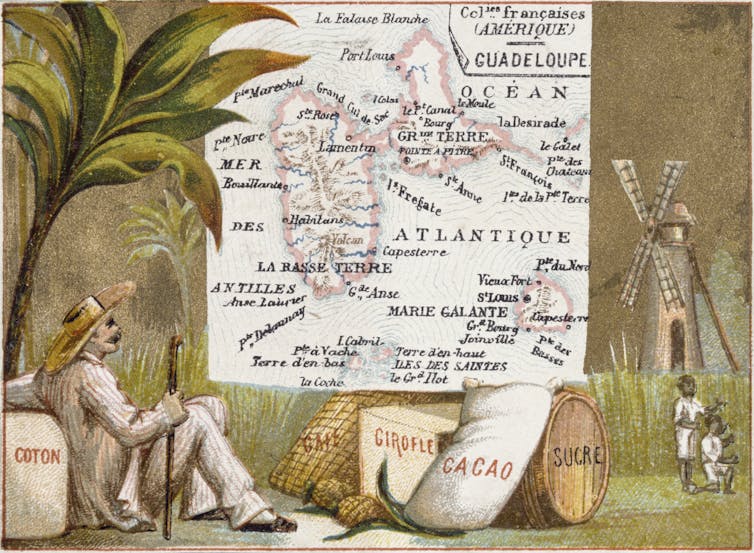 A French advertising card from around 1900 depicts colonial power in Guadeloupe, with a trader sitting comfortably among sacks of cotton, cocoa and coffee while islanders work in the field. Universal History Archive/Universal Images Group via Getty Images
I study natural disasters in the Caribbean, including how history molded responses to disasters today.
The current disaster crisis that the Caribbean’s small islands are experiencing as hurricanes intensify did not start a few decades ago. Rather, the islands’ vulnerability is a direct result of the exploitative systems forced upon the region by colonialism, its legacies of slave-based land policies and ill-suited construction and development practices, and its environmental injustices.
Forcing people into harm’s way
The colonial powers changed how Caribbean people interacted with the land, where they lived and how they recovered from natural hazard events.
Rather than growing crops that could sustain the local food supply, the Europeans who began arriving in the 1600s focused on exploitative extractive economic models and export cash crops through the plantation economy.
They forced Indigenous people off their lands and built settlements along the coast, which made it easier to import enslaved peoples and goods and to export cash crops such as sugar and tobacco to Europe – and also left communities vulnerable to storms. They also developed settlements in low-lying areas, often near rivers and streams, which could provide transportation for agricultural produce but which became flood risks during heavy rains.
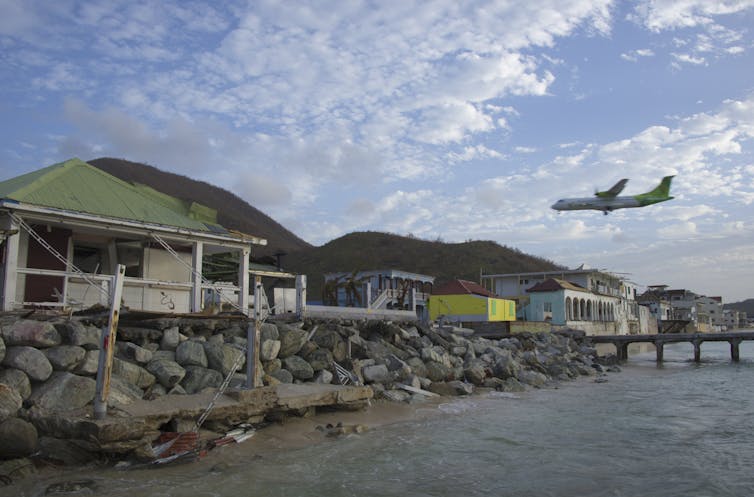 Homes built to the water’s edge in Saint-Martin, an overseas collectivity of France, were devastated when Hurricane Irma hit in 2017. Helene Valenzuela/AFP via Getty Images
Today, more than 70% of the Caribbean’s population lives along the coast, often less than a mile from the shore. These coastlines are not only highly exposed to hurricanes but also to sea-level rise fueled by climate change.
Legacies of slave-based land policies
Colonialism’s legacy of land policies has also made recovery from disasters much harder today.
When colonial powers took over, a few landowners were given control of most of the land, while the majority of the population was forced onto marginal and small areas. The local population had no legal right to the land, as the people did not possess land certificate titles or deeds and were often forced to pay rent to landlords.
After independence, most island governments tried to acquire land from former plantations or estates and to redistribute it to the working class. But these efforts, mainly in the 1960s and ’70s, largely failed to transform land ownership, improve economic development or reduce vulnerability.
One colonial legacy perpetuating vulnerability to this day is known as crown land, or state land. In the English-speaking Caribbean, all land for which there was no land grant was considered property of the British crown. Crown land can be found in every English-speaking island to this day. https://www.youtube.com/embed/YTckM-cNeII?wmode=transparent&start=0 How colonial powers controlled the Caribbean over time.
For example, in Barbuda, all land is vested in the “crown in perpetuity” on behalf of Barbudans. This means that an individual born on the island of Barbuda cannot individually own land.
Instead, land is communally owned, which limits access to the credit and development opportunities that were sorely needed to reconstruct the island after Hurricane Maria in 2017. Most Barbudans were unable to insure their homes because they had no title deeds to their property.
This and other collective land tenure systems created by colonialism places Caribbean residents at greater risk from a variety of natural hazards and limits their ability to seek financial credit for disaster recovery today.
The roots of poor construction
Vulnerability to disasters in the Caribbean also has roots in post-slavery housing construction and subsequent failures to institute proper building codes.
After emancipation from slavery, freed people had no right nor access to land. To build houses, they were forced to lease land from the former enslavers who at a whim could terminate their employment or kick them off the land.
This led to the development of a particular type of housing structure known as chattel houses in countries such as Barbados. These houses are tiny and were constructed in a way in which they could be easily taken apart and loaded onto carts, should the residents be forced out by their former enslavers. Many Bajans still live in these houses today, although quite a few have been converted to restaurants or shops.
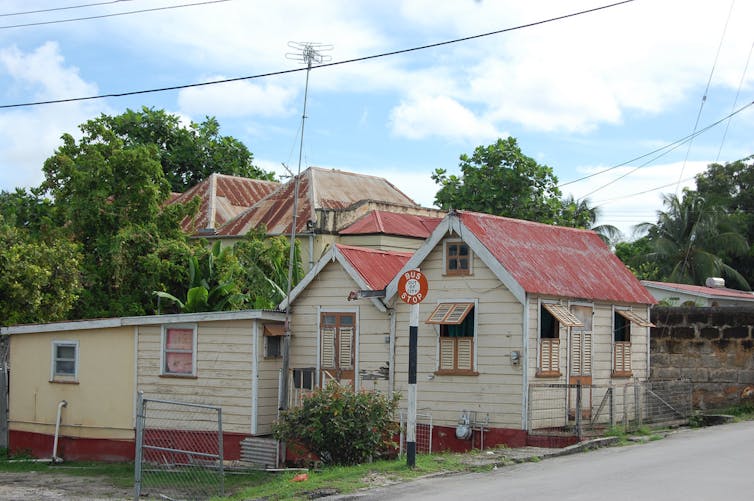 Chattel houses are still used as homes in Barbados. Shardalow via Wikimedia, CC BY
In Aruba, Bonaire and Curaçao, owned by the Dutch, slave huts were built along the coast, on land not suitable for agriculture and easily damaged by storms. These former slave huts are now tourist attractions, but the colonial patterns of settling along the coast has left many coastal communities exposed to hurricane damage and rising seas.
The vulnerability of such houses is not only a result of their exposure to natural hazards but also the underlying social structures.
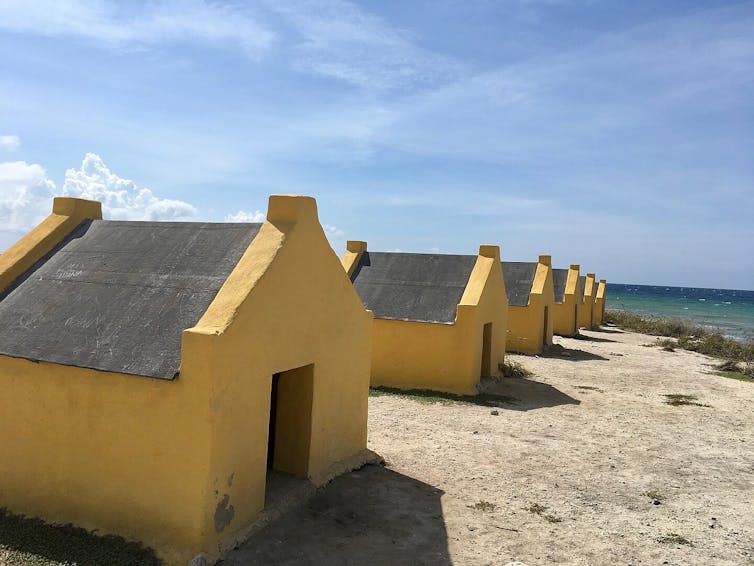 Slave huts were built on the coast in Bonaire, where they were vulnerable to storm surge. Leslie Ket via Wikimedia, CC BY-SA
In many islands today, poorer residents can’t afford protective measures, such as installing storm shutters or purchasing solar-powered generators.
They often live in marginal and disaster-prone areas, such as steep hillsides, where housing tends to be cheaper. Houses in these areas are also often poorly constructed with low-grade materials, such as galvanized sheeting for roofs and walls.
This situation is made worse by the informal and unregulated nature of residential housing construction in the region and the poor enforcement of building codes.
Due to the legacy of colonialism, most housing or building standards or codes in the Commonwealth Caribbean are relics from the United Kingdom and in the French Antilles from France. Building standards across the region lack uniformity and are generally subjective and uncontrolled. Financial limitations and staffing constraints mean that codes and standards more often than not remain unenforced.
Progress, but still a lot of work to do
The Caribbean has made progress in developing wind-related building codes to try to increase resilience in recent years. And while damage from torrential rain is still not properly addressed in most Caribbean building standards, scientific guidance is available through the Caribbean Institute for Meteorology and Hydrology in Barbados.
Individual islands, including Dominica and Saint Lucia, have new minimum building standards for recovery after disasters. The island of Grenada is hoping to guide new construction as it recovers from Hurricane Beryl. Trinidad and Tobago has developed a national land use strategy but has struggled to use it.
Construction standards can help the islands build resilience. But work remains to be done to overcome the legacy of colonial-era land policies and development that have left island towns vulnerable to increasing storm risks.
This article is republished from The Conversation under a Creative Commons license. Read the original article and see more than 250 UMBC articles available in The Conversation.
]]>
Written by Farah Nibbs, assistant professor of emergency and disaster health systems at UMBC Long before colonialism brought slavery to the Caribbean, the native islanders saw hurricanes and...
https://umbc.edu/stories/colonialisms-legacy-left-caribbean-vulnerable-to-hurricanes/
https://my3.my.umbc.edu/api/v0/pixel/news/144976/guest@my.umbc.edu/d4e68de413c4a368d4df374422ffcd90/api/pixel
cahss
cahss-research
discovery
edhs
international
magazine
research
story
UMBC News & Magazine
https://my3.my.umbc.edu/groups/umbc-news-magazine
https://assets1-my.umbc.edu/system/shared/avatars/groups/000/001/943/24435aa6207c452e7bc15cc74b42c7bb/xsmall.png?1748556657
https://assets1-my.umbc.edu/system/shared/avatars/groups/000/001/943/24435aa6207c452e7bc15cc74b42c7bb/original.png?1748556657
https://assets2-my.umbc.edu/system/shared/avatars/groups/000/001/943/24435aa6207c452e7bc15cc74b42c7bb/xxlarge.png?1748556657
https://assets2-my.umbc.edu/system/shared/avatars/groups/000/001/943/24435aa6207c452e7bc15cc74b42c7bb/xlarge.png?1748556657
https://assets3-my.umbc.edu/system/shared/avatars/groups/000/001/943/24435aa6207c452e7bc15cc74b42c7bb/large.png?1748556657
https://assets1-my.umbc.edu/system/shared/avatars/groups/000/001/943/24435aa6207c452e7bc15cc74b42c7bb/medium.png?1748556657
https://assets2-my.umbc.edu/system/shared/avatars/groups/000/001/943/24435aa6207c452e7bc15cc74b42c7bb/small.png?1748556657
https://assets1-my.umbc.edu/system/shared/avatars/groups/000/001/943/24435aa6207c452e7bc15cc74b42c7bb/xsmall.png?1748556657
https://assets2-my.umbc.edu/system/shared/avatars/groups/000/001/943/24435aa6207c452e7bc15cc74b42c7bb/xxsmall.png?1748556657
UMBC News & Magazine
0
0
false
Tue, 22 Oct 2024 11:12:41 -0400
Tue, 22 Oct 2024 11:12:41 -0400


