Robert Barry ’25 returns to Greece as a summer research assistant at an archaeological field school
For the last seven weeks, Robert Barry ’25, ancient studies and visual arts, worked in a trench under the sweltering 90-degree sun. It may sound grueling, but this is Barry’s second year working in this archeological site in Greece with Michael F. Lane, associate professor of ancient studies and field director on the Kopaic Cultures, Economies, and Landscapes (KOCECOLA) research program. KOCECOLA is an archaeological investigation of a prehistoric settlement in its physical, human, and historical circumstances in the Kopaic Basin of central mainland Greece. Lane has conducted fieldwork in this area since 2010.
“What I really like about ancient studies is the faculty,” shares Barry. “They show a lot of interest in their students, and I feel like I belong.” Barry has taken archaeology and ancient Greek language classes with Lane, where he has excelled.
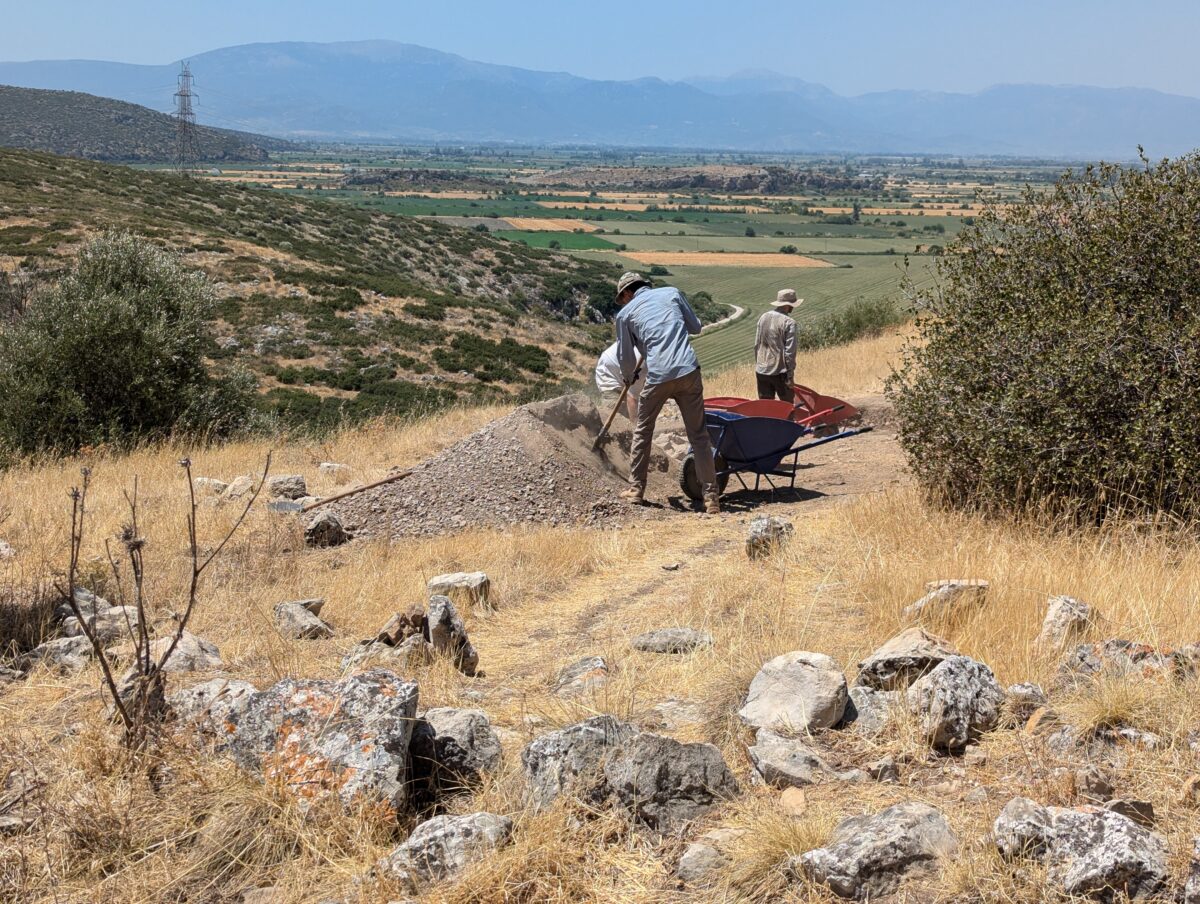 Students at UMBC’s 2024 archeological field school in Greece prepare the site for winter by backfilling trenches with soil. (Michael F. Lane/UMBC)
Barry learned about the project in Lane’s ancient Greek language class. Lane was seeking undergraduate research assistants to join the 2023 six-week summer archeological fieldwork opportunity, and Barry joined the team. This year, he returned as a trench supervisor with more responsibilities.
From excavating to supervising
Student research assistants use satellite-based differential Global Navigation Satellite Systems (DGNSS) and optical survey equipment. “We use the DGNSS and optical equipment both to plot the location of our trenches and to record the position of discoveries in three dimensions: latitude, longitude, and elevation above sea level,” explains Lane. Once an excavation site is identified, students use trigonometry to measure trenches and then large shovels to reveal distinct layers of soil. Excavation teams are made up of 2 – 3 students spread across six trenches.
“This year, I was a trench supervisor and learned a lot about myself. My priorities changed,” explains Barry. “Last year, I was digging and following directions from my supervisor. Now, I’m giving the orders and having to be responsible for the health and safety of everyone else while getting the job done.”
Lane says the senior staff at KOCECOLA regarded Barry as a peer. “He’s smart, meticulous, punctual, responsible, untiring, even-keeled, good-humored, and funny,” says Lane. “For this reason, I gave him a trench of his own to supervise for the last three weeks this summer, and he exceeded expectations.”
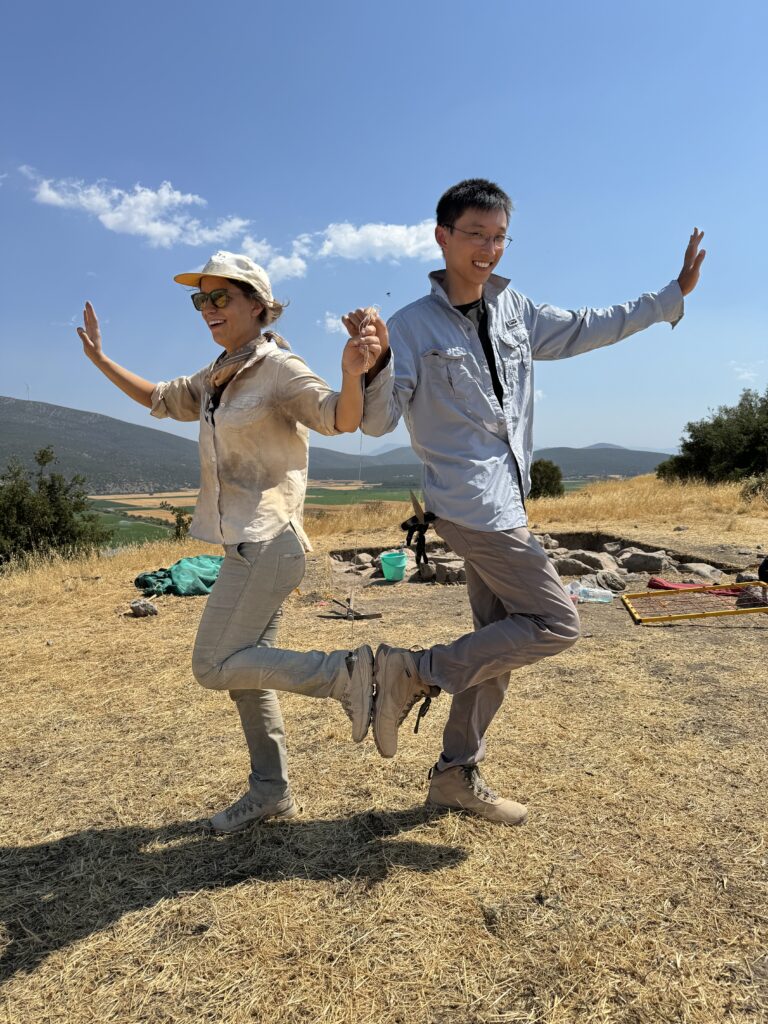 (l-r): Rachel Channell, a crew supervisor from Greece, teaches Barry a traditional Greek dance. (Brady E. Cavanagh/UMBC)
To get the job done, the team’s daily routine meant leaving the village at 5 a.m., taking a 20-minute drive to the dig site, hiking up a mountain, and beginning work around 5:30 a.m. Barry’s team of three students used small hand trowels and brushes to help reveal soil layers and artifacts, such as pottery. A fine mesh screen helped sift the soil removed during excavation, leaving behind finer artifacts. They would take soil samples for scientific dating and chemical analysis, as well as basic soil and sedimentary descriptions. Thanks to a 2024 UMBC Strategic Awards for Research Transitions grant that Lane received, students also had the opportunity to sample for radiocarbon dating and luminescence dating, which measures the energy of photons released from minerals to determine the age of exposed strata.
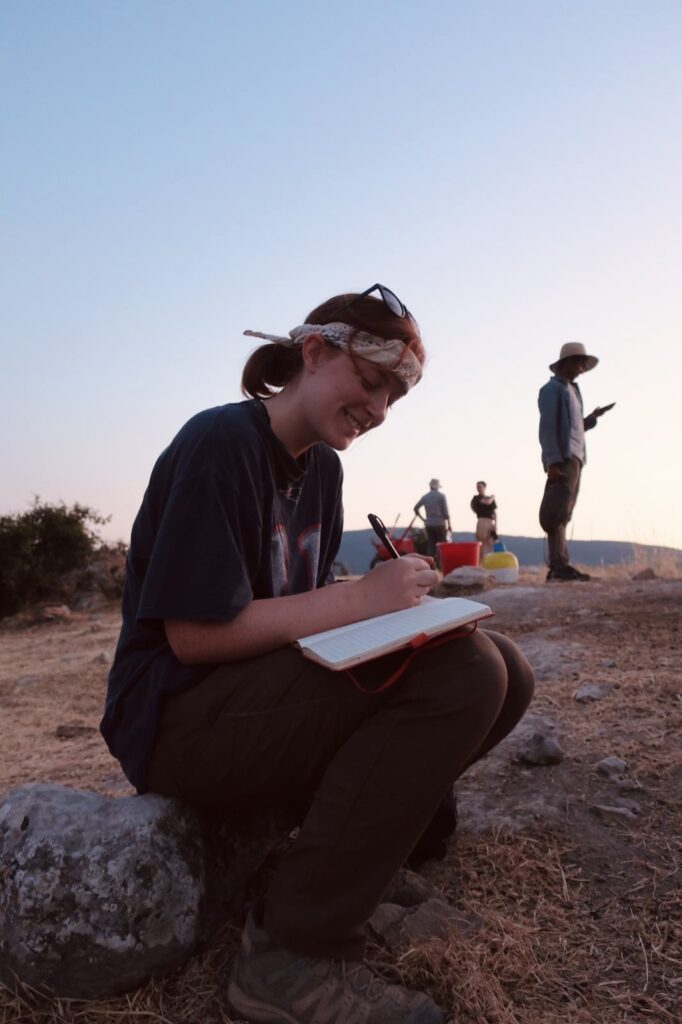 Brady E. Cavanagh ’26, visual arts, documents her work. (Elliott G. Alvey/University of Virginia)
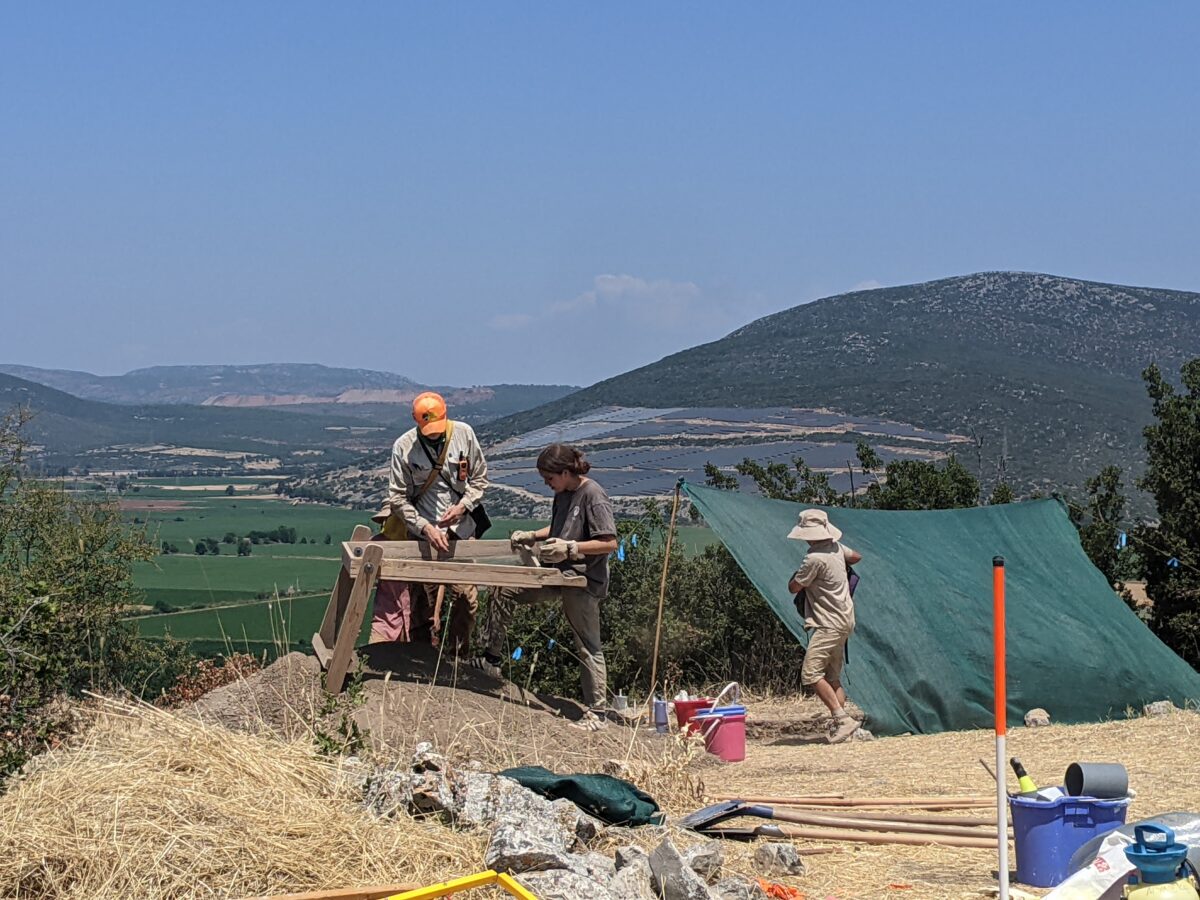 2023 crew screen soil for fine artifacts. (l-r): Damian V. Koropeckyj ’16, global studies, supervises India J. Kelly ’24, history, and Naomi Morales Glen, a master’s student at the University of the Peloponnese in Kalamata, Greece. (Michael F. Lane/UMBC)
“We record where each artifact is, define its features and its chronological, historical, cultural, and social contexts,” says Barry. “It can get complicated when there are numerous artifacts to identify, map, excavate, bag, and label.” At 1 p.m., the crew would head to the lab for three hours to wash the day’s finds, scrub them with toothbrushes, and catalog finds. The rest of the afternoon would be all theirs until 8 p.m. when they would gather for a communal dinner at the local taverna (Greek for restaurant).
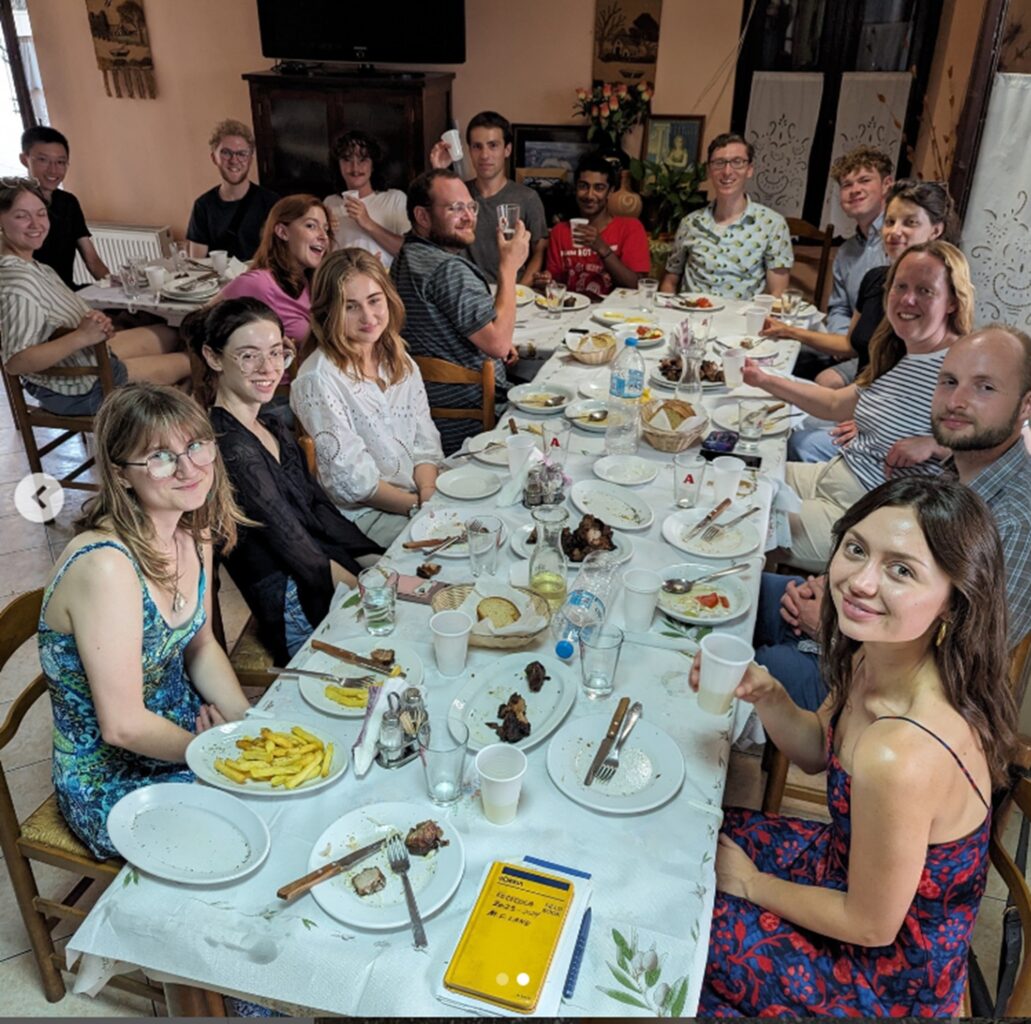 The 2024 crew enjoys dinner in the local village after a long day. (Michael F. Lane/UMBC)
To Greece and beyond
Now that the internship has ended, Barry is sightseeing in Austria before returning to the U.S. “My favorite part of this year’s experience was the international collaboration. I enjoyed getting to know students from the United Kingdom, the Netherlands, Germany, and Greece,” says Barry, who used these opportunities to practice his Greek and Latin skills, which are important in the ancient studies graduate programs he’ll apply to after returning to UMBC.
“Probably the moment that most touched me this summer was when Robert sat down at the kitchen table at the staff house with me and said, ‘Lane, can I tell you something…? I think I want to do this for the rest of my life’,” Lane shares. “I now consider it my duty to help him continue to excel, doing everything in my power to get him into the best academic programs and relevant jobs.”
Learn more about UMBC’s ancient studies program.
]]>
For the last seven weeks, Robert Barry ’25, ancient studies and visual arts, worked in a trench under the sweltering 90-degree sun. It may sound grueling, but this is Barry’s second year working...
https://umbc.edu/stories/robert-barry-in-greece-research-assistant-archaeological-field-school/
https://my3.my.umbc.edu/api/v0/pixel/news/143021/guest@my.umbc.edu/d761882da02d66065b8dad941c9ce281/api/pixel
ancient-studies
arts-and-culture
cahss
cahss-research
careercenter
global-studies
history
international
news
story
visual-arts
UMBC News & Magazine
https://my3.my.umbc.edu/groups/umbc-news-magazine
https://assets1-my.umbc.edu/system/shared/avatars/groups/000/001/943/24435aa6207c452e7bc15cc74b42c7bb/xsmall.png?1748556657
https://assets1-my.umbc.edu/system/shared/avatars/groups/000/001/943/24435aa6207c452e7bc15cc74b42c7bb/original.png?1748556657
https://assets2-my.umbc.edu/system/shared/avatars/groups/000/001/943/24435aa6207c452e7bc15cc74b42c7bb/xxlarge.png?1748556657
https://assets2-my.umbc.edu/system/shared/avatars/groups/000/001/943/24435aa6207c452e7bc15cc74b42c7bb/xlarge.png?1748556657
https://assets3-my.umbc.edu/system/shared/avatars/groups/000/001/943/24435aa6207c452e7bc15cc74b42c7bb/large.png?1748556657
https://assets1-my.umbc.edu/system/shared/avatars/groups/000/001/943/24435aa6207c452e7bc15cc74b42c7bb/medium.png?1748556657
https://assets2-my.umbc.edu/system/shared/avatars/groups/000/001/943/24435aa6207c452e7bc15cc74b42c7bb/small.png?1748556657
https://assets1-my.umbc.edu/system/shared/avatars/groups/000/001/943/24435aa6207c452e7bc15cc74b42c7bb/xsmall.png?1748556657
https://assets2-my.umbc.edu/system/shared/avatars/groups/000/001/943/24435aa6207c452e7bc15cc74b42c7bb/xxsmall.png?1748556657
UMBC News & Magazine
0
0
false
Wed, 31 Jul 2024 16:35:54 -0400
Wed, 31 Jul 2024 16:35:54 -0400
UMBC scientists show twisted carbon nanotubes might power “wind-up” sensors and other devices
An international team of scientists, including two researchers who now work in the Center for Advanced Sensor Technology (CAST) at UMBC, has shown that twisted carbon nanotubes can store three times more energy per unit mass than advanced lithium-ion batteries. The finding may advance carbon nanotubes as a promising solution for storing energy in devices that need to be lightweight, compact, and safe, such as medical implants and sensors. The research was published recently in the journal Nature Nanotechnology.
Sanjeev Kumar Ujjain, from CAST, was a lead researcher on the work. He started the project while at Shinshu University, in Nagano, Japan, and continued after arriving at UMBC in 2022. Preety Ahuja, from CAST, also contributed to the material characterization aspects of the research.


Sanjeev Kumar Ujjain (left) and Preety Ahuja (right). (Images courtesy of Kumar Ujjain and Ahuja)
Straws of 1-atom-thick carbon
The researchers studied single-walled carbon nanotubes, which are like straws made from pure carbon sheets only 1-atom thick. Carbon nanotubes are lightweight, relatively easy to manufacture, and about 100 times stronger than steel. Their amazing properties have led scientists to explore their potential use in a wide range of futuristic-sounding technology, including space elevators.
To investigate carbon nanotubes’ potential for storing energy, the UMBC researchers and their colleagues manufactured carbon nanotube “ropes” from bundles of commercially available nanotubes. After pulling and twisting the tubes into a single thread, the researchers then coated them with different substances intended to increase the ropes’ strength and flexibility.
The team tested how much energy the ropes could store by twisting them up and measuring the energy that was released as the ropes unwound. They found that the best-performing ropes could store 15,000 times more energy per unit mass than steel springs, and about three times more energy than lithium-ion batteries. The stored energy remains consistent and accessible at temperatures ranging from -76 to +212 °F (-60 to +100 °C). The materials in the carbon nanotube ropes are also safer for the human body than those used in batteries.
 The researchers envision that twisted carbon nanotube ropes may one day power a range of devices, including wearable health sensors and medical implants that could harvest energy from the body’s movements. (Graphic “NanoRope Mobility” created by Sanjeev Kumar Ujjain using Copilot AI.)
“Humans have long stored energy in mechanical coil springs to power devices such as watches and toys,” Kumar Ujjain says. “This research shows twisted carbon nanotubes have great potential for mechanical energy storage, and we are excited to share the news with the world.” He says the CAST team is already working to incorporate twisted carbon nanotubes as an energy source for a prototype sensor they are developing.
]]>
An international team of scientists, including two researchers who now work in the Center for Advanced Sensor Technology (CAST) at UMBC, has shown that twisted carbon nanotubes can store three...
https://umbc.edu/stories/carbon-nanotubes-power-source/
https://my3.my.umbc.edu/api/v0/pixel/news/142988/guest@my.umbc.edu/9c4f6492762d621d47bf444b4420ded4/api/pixel
cbee
coeit
news
research
science-and-tech
story
UMBC News & Magazine
https://my3.my.umbc.edu/groups/umbc-news-magazine
https://assets1-my.umbc.edu/system/shared/avatars/groups/000/001/943/24435aa6207c452e7bc15cc74b42c7bb/xsmall.png?1748556657
https://assets1-my.umbc.edu/system/shared/avatars/groups/000/001/943/24435aa6207c452e7bc15cc74b42c7bb/original.png?1748556657
https://assets2-my.umbc.edu/system/shared/avatars/groups/000/001/943/24435aa6207c452e7bc15cc74b42c7bb/xxlarge.png?1748556657
https://assets2-my.umbc.edu/system/shared/avatars/groups/000/001/943/24435aa6207c452e7bc15cc74b42c7bb/xlarge.png?1748556657
https://assets3-my.umbc.edu/system/shared/avatars/groups/000/001/943/24435aa6207c452e7bc15cc74b42c7bb/large.png?1748556657
https://assets1-my.umbc.edu/system/shared/avatars/groups/000/001/943/24435aa6207c452e7bc15cc74b42c7bb/medium.png?1748556657
https://assets2-my.umbc.edu/system/shared/avatars/groups/000/001/943/24435aa6207c452e7bc15cc74b42c7bb/small.png?1748556657
https://assets1-my.umbc.edu/system/shared/avatars/groups/000/001/943/24435aa6207c452e7bc15cc74b42c7bb/xsmall.png?1748556657
https://assets2-my.umbc.edu/system/shared/avatars/groups/000/001/943/24435aa6207c452e7bc15cc74b42c7bb/xxsmall.png?1748556657
UMBC News & Magazine
0
0
false
Tue, 30 Jul 2024 14:01:50 -0400
Tue, 30 Jul 2024 14:01:50 -0400
With eye to research, UMBC expands partnership with Baltimore-based energy company Constellation

UMBC is strengthening the university’s research connection with the energy company Constellation, expanding on a partnership of more than 20 years with the Baltimore-based business. Constellation, the nation’s largest producer of carbon-free energy, funds scholarships and has endowed a professorship in mechanical engineering at UMBC, regularly recruits students for internships and jobs, and hosts its annual Youth Energy Summit on the UMBC campus.
In March, UMBC and Constellation signed a Master Research Agreement, which will facilitate greater research collaboration between the two organizations. In April, Constellation sent representatives to the College of Engineering and Information Technology’s (COEIT’s) inaugural Research Day to connect with UMBC faculty and students. And in June, research leaders from both organizations met to discuss potential areas of joint work, including carbon-free energy generation, environmental protection and pollution remediation, and efforts to make the power grid more resilient and secure.
“The best research will happen as we grow this partnership organically,” says Anupam Joshi, acting dean of COEIT. “We are proud to be a Tier 1 university partner of Constellation Energy. The interactions of our faculty and students with Constellation’s representatives during Research Day have already led to initial ideas where we can work together. We are also actively pursuing collaborations in other areas of mutual interest and environmental importance.”
“As part of our efforts to accelerate the nation’s clean energy future, it’s vital that we enhance our understanding of the emerging technologies being developed today,” said Uuganbayar “Ugi” Otgonbaatar, Constellation’s director of Technology Strategy, Grants, and Partnerships. “We are grateful for our longstanding partnership with a leading local institution in UMBC and look forward to continuing to explore its research portfolio as part of our broader collaboration.”
]]>
UMBC is strengthening the university’s research connection with the energy company Constellation, expanding on a partnership of more than 20 years with the Baltimore-based business. Constellation,...
https://umbc.edu/quick-posts/umbc-constellation-partnership/
https://my3.my.umbc.edu/api/v0/pixel/news/142981/guest@my.umbc.edu/85f14ead3eafe355cc228b0ff363b64e/api/pixel
cfr
coeit
news
quick-post
research
science-and-tech
UMBC News & Magazine
https://my3.my.umbc.edu/groups/umbc-news-magazine
https://assets1-my.umbc.edu/system/shared/avatars/groups/000/001/943/24435aa6207c452e7bc15cc74b42c7bb/xsmall.png?1748556657
https://assets1-my.umbc.edu/system/shared/avatars/groups/000/001/943/24435aa6207c452e7bc15cc74b42c7bb/original.png?1748556657
https://assets2-my.umbc.edu/system/shared/avatars/groups/000/001/943/24435aa6207c452e7bc15cc74b42c7bb/xxlarge.png?1748556657
https://assets2-my.umbc.edu/system/shared/avatars/groups/000/001/943/24435aa6207c452e7bc15cc74b42c7bb/xlarge.png?1748556657
https://assets3-my.umbc.edu/system/shared/avatars/groups/000/001/943/24435aa6207c452e7bc15cc74b42c7bb/large.png?1748556657
https://assets1-my.umbc.edu/system/shared/avatars/groups/000/001/943/24435aa6207c452e7bc15cc74b42c7bb/medium.png?1748556657
https://assets2-my.umbc.edu/system/shared/avatars/groups/000/001/943/24435aa6207c452e7bc15cc74b42c7bb/small.png?1748556657
https://assets1-my.umbc.edu/system/shared/avatars/groups/000/001/943/24435aa6207c452e7bc15cc74b42c7bb/xsmall.png?1748556657
https://assets2-my.umbc.edu/system/shared/avatars/groups/000/001/943/24435aa6207c452e7bc15cc74b42c7bb/xxsmall.png?1748556657
UMBC News & Magazine
1
0
false
Tue, 30 Jul 2024 11:57:47 -0400
Tue, 30 Jul 2024 11:57:47 -0400
New experimental archeology course connects students with premodern craft traditions

Aidan Taylor ’25, history, whittles rush stalks, exposing the spongy pith for use as a candle substitute. Halima Jama ’25, English, works with a mortar and pestle, grinding herbs for a medicinal tincture. Hannah Looman ’26, history, writes with a goose-feather quill and handmade ink, while two faculty instructors troubleshoot at a loom.
It’s just another day in ARCH 365: Experimental Archeology, a new summer course offered by the ancient studies department at UMBC. A mix of handiwork and historical research into craft traditions of the past, the course teaches students about the daily life of premodern individuals from a range of cultures. Each student then investigates their own research question about historic ways of life for a capstone project.
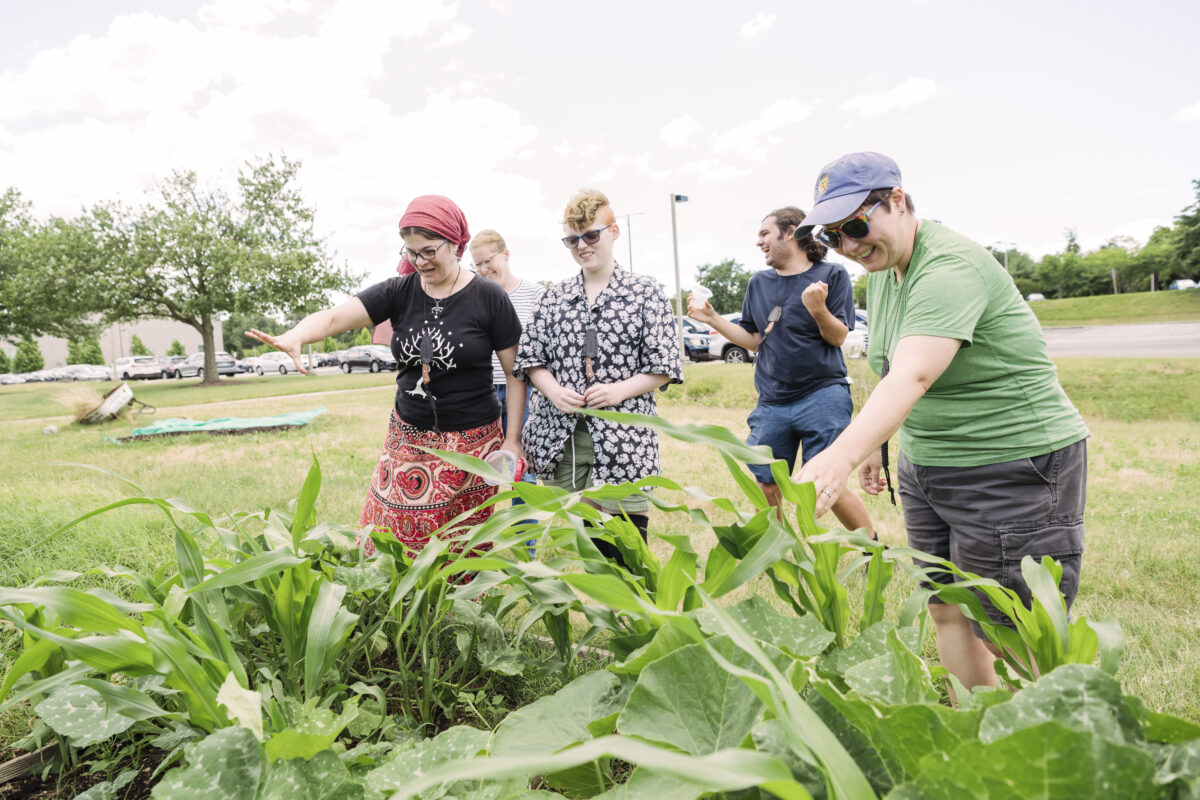

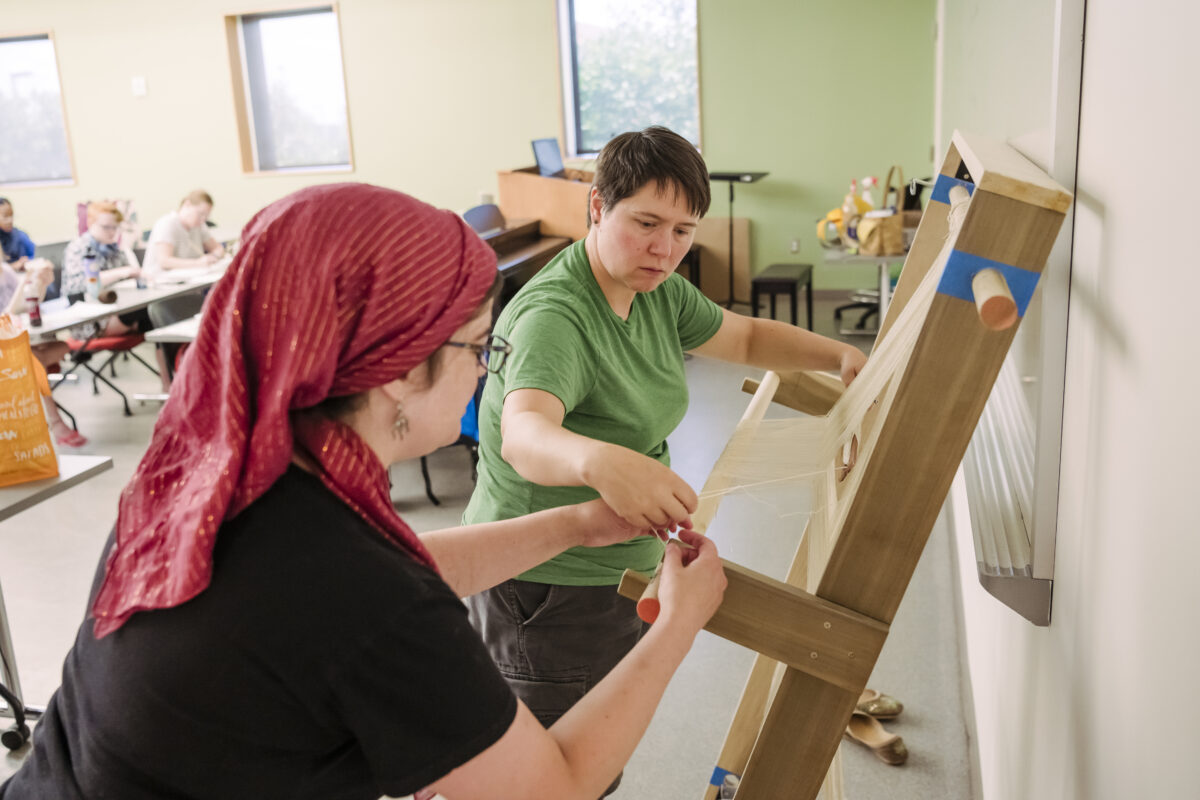
From left: A visit to the UMBC community garden; grinding herbs with a mortar and pestle; troubleshooting at the loom. (Marlayna Demond ’11/UMBC)
“We’re using art and hands-on activities to research the past,” says Molly Jones-Lewis, senior lecturer of ancient studies and an instructor for Experimental Archeology. “It’s a way of bringing working people’s lives back into the curriculum.”
“Putting your body through the motions people did hundreds of years ago” is a valuable educational tool, adds Jones-Lewis’ co-instructor, Lindsay Johnson, senior lecturer of music.
The course exposes students to some of the challenges premodern people faced in everyday life, and the innovative ways they addressed them. “Some things are just mind-blowing,” Looman shares. “The creativity people had to have to think of things to survive is a completely different way of thinking and being in your environment.”
History from the bottom up
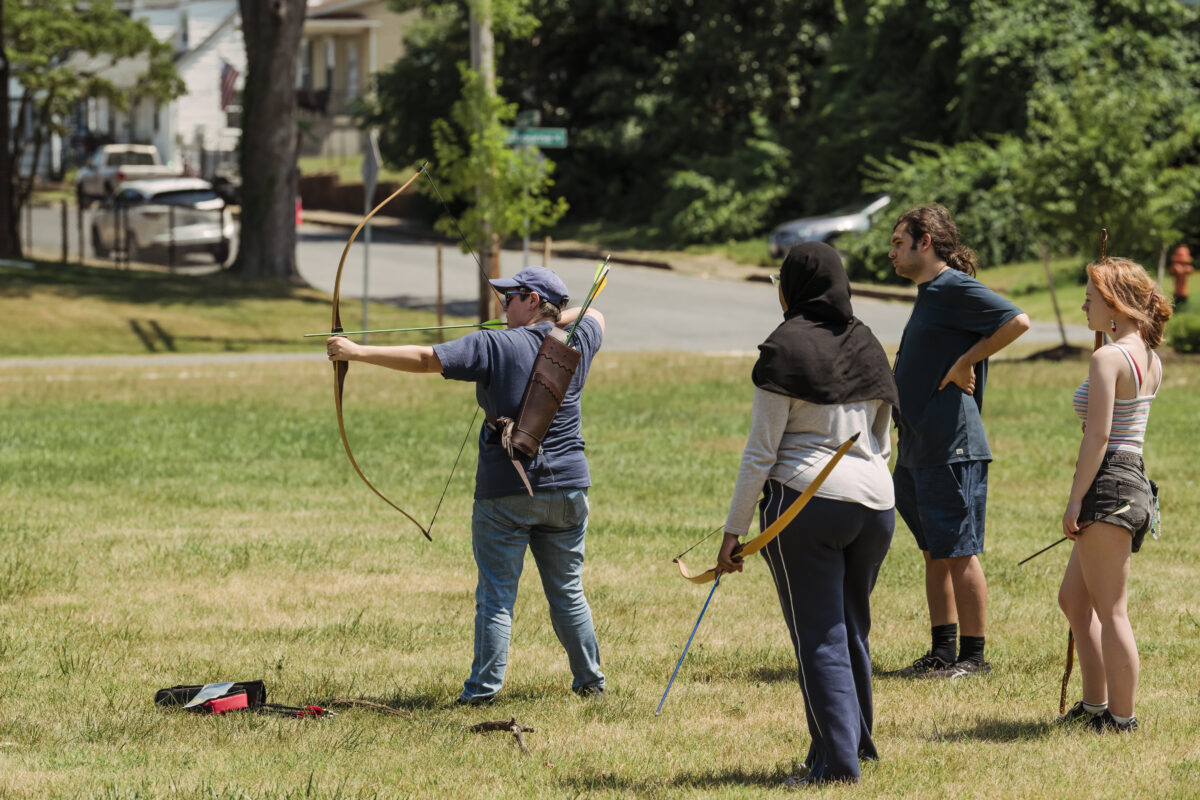
The course included experiences foraging on campus, creating musical instruments with found materials, cooking and preserving food, creating natural textiles and dyes, archery, and more. In the final week, the students offered a “community day” near the UMBC Community Garden, where the students demonstrated the skills they’d learned and explained their research projects to a small crowd.
Sarah Itzel, a returning student in ancient studies, shared her recipes for premodern electrolyte drinks, while Jama explained how she adapted an old family herbal recipe for treating mild illnesses. Looman showed off an embroidery project, and visitors got to taste foraged berries fermented with honey from campus bees.

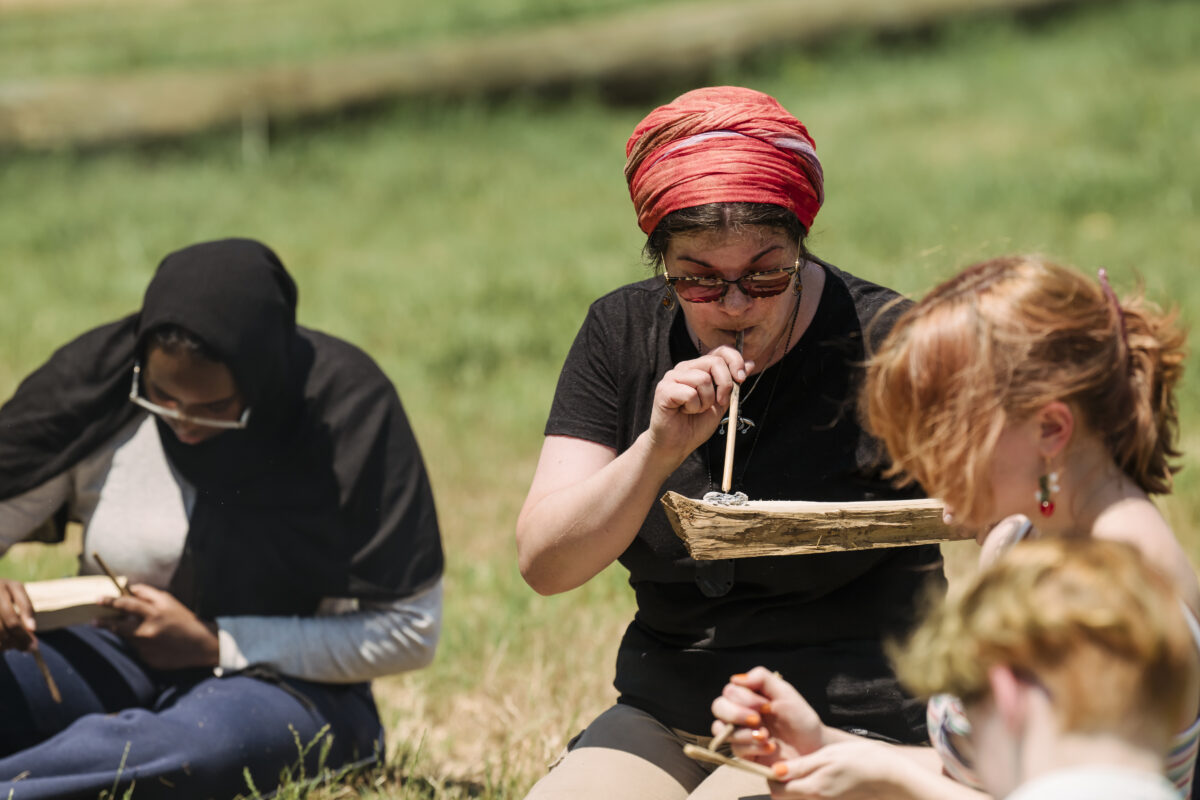
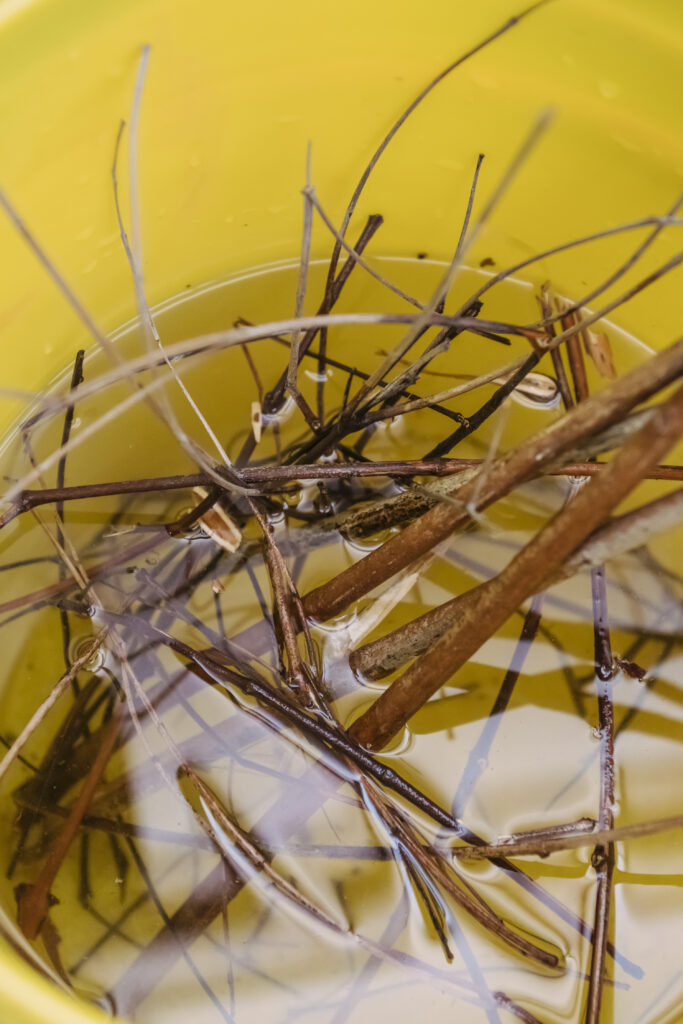

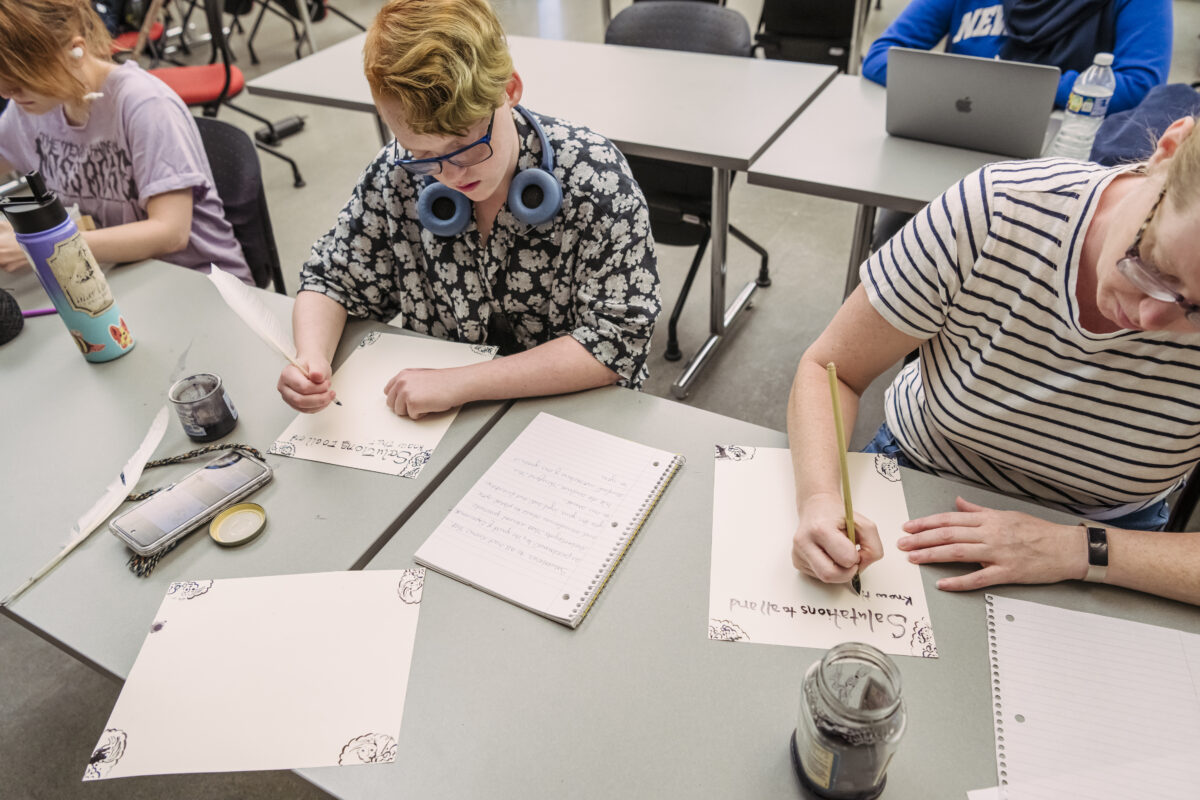
Clockwise from top left: Fermented berries soak in a jar; Molly Jones-Lewis works on creating a depression in a piece of wood that will eventually become a ladle; rushes soak in water before being peeled to reveal the pith within; a close-up on the class’s loom; students work with quill pens. (Marlayna Demond ’11/UMBC)
The course invited students to interact with the campus environment in a new way, including involving UMBC grounds maintenance staff and the Office of Sustainability and Environmental Health and Safety. “We found community resources we didn’t know existed,” Jones-Lewis added. “There is a ton of expertise and knowledge among the staff.”
Jones-Lewis and Johnson see the course as part of a “history from the bottom up movement,” where the focus is on the lives and contributions of ordinary people throughout history. Overall, the students came away with what the instructors call “heritage skills” while developing a foundation in research methodology that will serve them as they move through the rest of their coursework and into careers.
Reflecting on the experience of working with one’s hands in the class versus a world mediated through screens, Itzel says, “It’s an old-new way for the brain to work.”
Lindsay Johnson demonstrates how to use a bow. (Marlayna Demond ’11/UMBC)
]]>
Aidan Taylor ’25, history, whittles rush stalks, exposing the spongy pith for use as a candle substitute. Halima Jama ’25, English, works with a mortar and pestle, grinding herbs for a medicinal...
https://umbc.edu/stories/experimental-archeology/
https://my3.my.umbc.edu/api/v0/pixel/news/142922/guest@my.umbc.edu/f8f1baf2a34df90c580356de2c8dfe96/api/pixel
ancient-studies
cahss
campus-life
magazine
music
story
UMBC News & Magazine
https://my3.my.umbc.edu/groups/umbc-news-magazine
https://assets1-my.umbc.edu/system/shared/avatars/groups/000/001/943/24435aa6207c452e7bc15cc74b42c7bb/xsmall.png?1748556657
https://assets1-my.umbc.edu/system/shared/avatars/groups/000/001/943/24435aa6207c452e7bc15cc74b42c7bb/original.png?1748556657
https://assets2-my.umbc.edu/system/shared/avatars/groups/000/001/943/24435aa6207c452e7bc15cc74b42c7bb/xxlarge.png?1748556657
https://assets2-my.umbc.edu/system/shared/avatars/groups/000/001/943/24435aa6207c452e7bc15cc74b42c7bb/xlarge.png?1748556657
https://assets3-my.umbc.edu/system/shared/avatars/groups/000/001/943/24435aa6207c452e7bc15cc74b42c7bb/large.png?1748556657
https://assets1-my.umbc.edu/system/shared/avatars/groups/000/001/943/24435aa6207c452e7bc15cc74b42c7bb/medium.png?1748556657
https://assets2-my.umbc.edu/system/shared/avatars/groups/000/001/943/24435aa6207c452e7bc15cc74b42c7bb/small.png?1748556657
https://assets1-my.umbc.edu/system/shared/avatars/groups/000/001/943/24435aa6207c452e7bc15cc74b42c7bb/xsmall.png?1748556657
https://assets2-my.umbc.edu/system/shared/avatars/groups/000/001/943/24435aa6207c452e7bc15cc74b42c7bb/xxsmall.png?1748556657
UMBC News & Magazine
0
0
false
Wed, 24 Jul 2024 16:07:58 -0400
Wed, 24 Jul 2024 16:07:58 -0400
Christopher K. Tong, MLLI, returns from a research award in Mongolia to inform his work in Asian studies

Christopher K. Tong, an associate professor of modern languages, linguistics, and intercultural communication, has taught Asian studies for years. This fall, Tong brings a fresh perspective to his classes after spending two weeks in Mongolia as part of an award from the Council of American Overseas Research Centers (CAORC) to participate in the Overseas Faculty Development Seminar: Climate Change and Public Health—What Does Climate Change Mean for the People of Mongolia? Tong used this opportunity to advance research for his forthcoming book on the emergence of modern science and ecological consciousness in Asian and Western societies.
“Despite the grandeur of this country’s history, Mongolia as a modern nation is often understudied in Asian studies. Within China, Mongolians are an ethnic minority struggling to preserve their language and culture,” explains Tong. “Historically, the Mongolian empire stretched from Asia to Europe, so there is intrinsic value to studying Mongolia from a humanistic perspective. It was also interesting to see how present-day Mongolians understand and represent this history, for example, the life and legacy of Genghis Khan.”
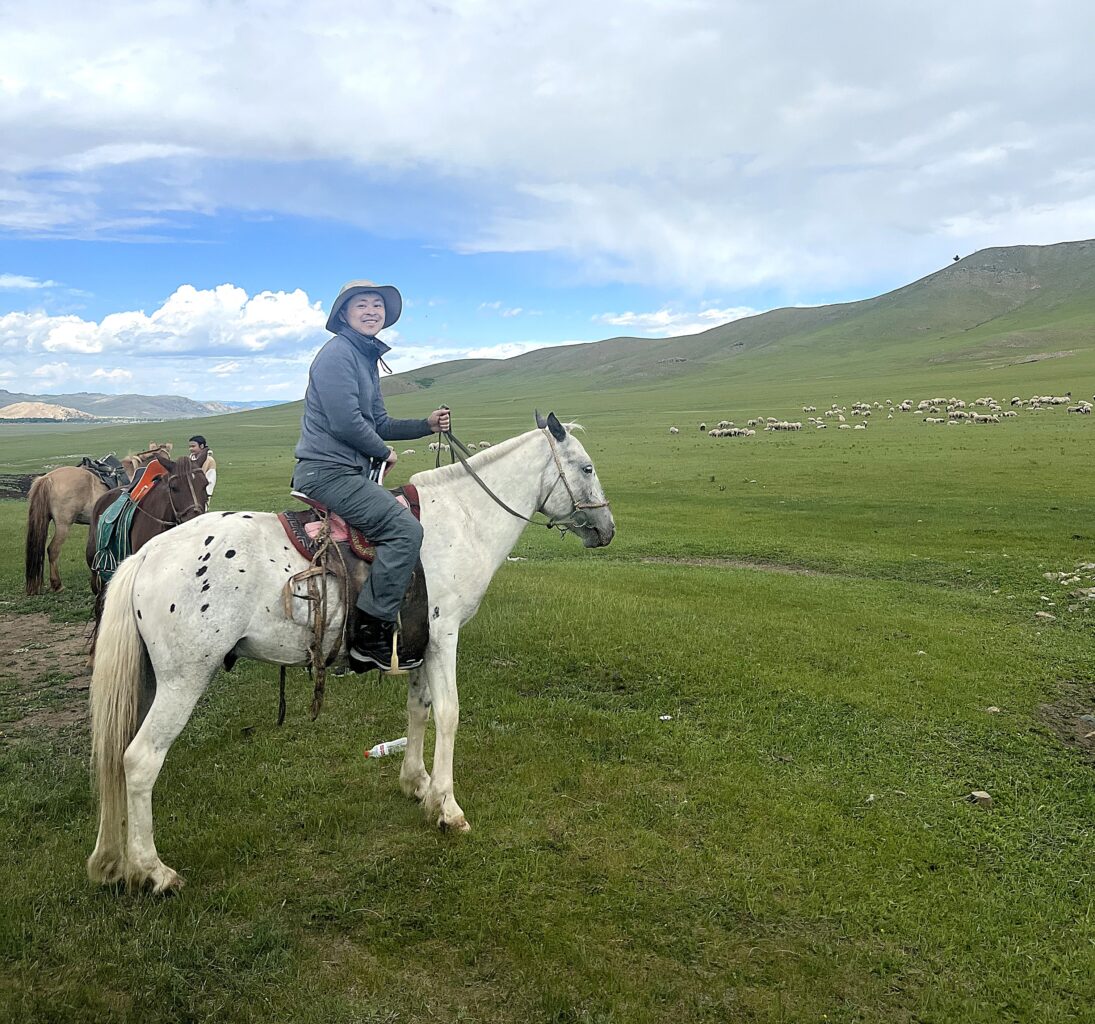 Tong rides a Mongolian horse during a visit to a nomadic family in the countryside near Ikh-Tamir in central Mongolia. (Image courtesy of Tong)
CAORC is a private, nonprofit federation of independent overseas research centers that promotes advanced research with an emphasis on the humanities and social sciences, the conservation and recording of cultural heritage, and the understanding and interpretation of modern societies. Tong was one of 44 faculty members from community colleges and minority-serving institutions, like UMBC, placed in one of three seminars that aimed to help faculty and administrators gain first-hand experience needed to develop and improve international courses, curricula, and teaching materials.
Learning from Mongolians
The seminar took place at the American Center for Mongolian Studies (ACMS) in Ulaanbaatar, the capital city of Mongolia. The 14 faculty assigned to the seminar in Mongolia visited Ulaanbaatar; the rural communities at Kharkhorin, the historic capital of the Mongol Empire; Erdene Zuu Monastery—the oldest Buddhist monastery in Mongolia; and Hustai National Park, home to the rare and endangered Przewalski’s horses. They also gained first-hand knowledge of the impact of hotter days, increasing wildfires, storms, colder winters, and drought on Mongolia’s communities and environment.
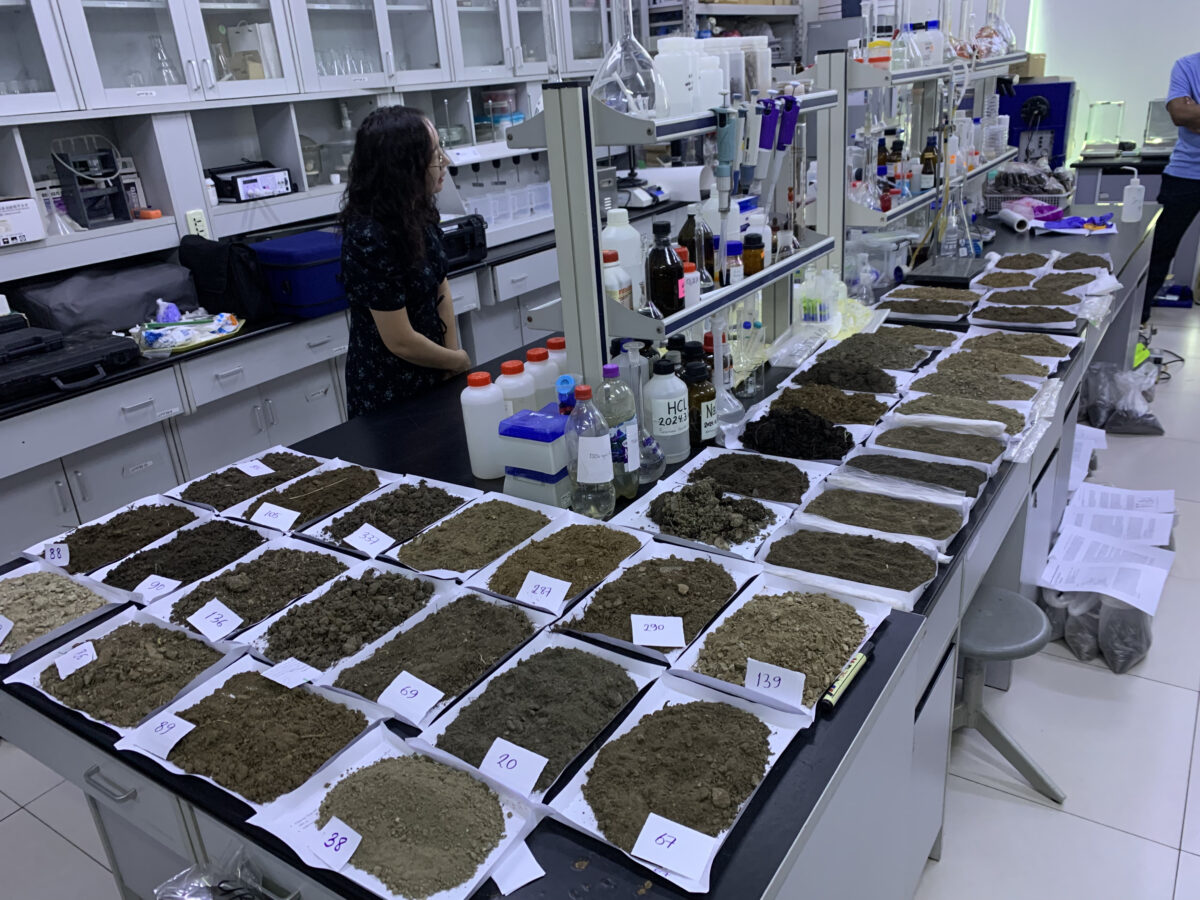 A soil scientist at the National University of Mongolia explains the different types of soil collected in the city of Ulaanbaatar and its vicinities. (Image courtesy of Tong)
“It was an eye-opening experience visiting Mongolia—meeting its people and experiencing the landscape. I have read novels and research about Mongolia,” shares Tong, “but visiting in person enriched my understanding and challenged my preconceptions.” He notes that Mongolia’s unusually cold winter this year wiped out entire herds of livestock, the primary source of income for nomadic families. Meanwhile, the use of low-grade coal for heating in Ulaanbaatar has increased air pollution and negatively impacted public health. “The effects of climate change are particularly noticeable to the people of Mongolia.”
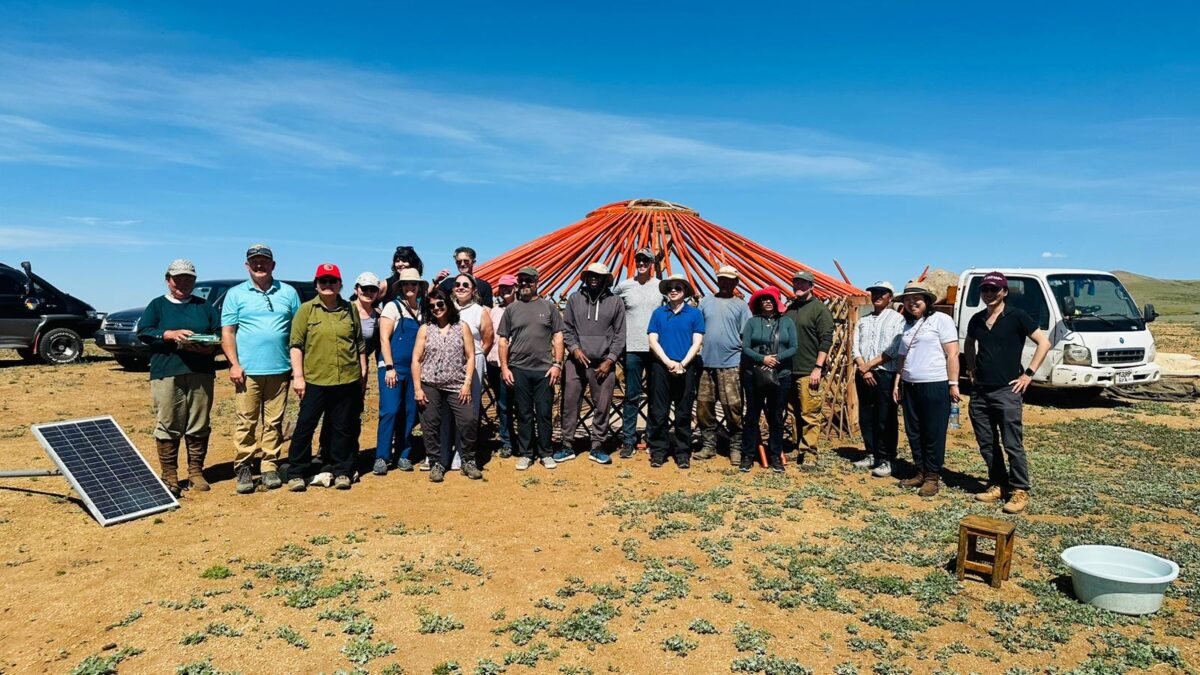 Tong (center with a blue polo and hat) stands with his CAORC colleagues and the nomadic family the team assisted in constructing their ger, a traditional Mongolian yurt. (Image courtesy of Tong)
The faculty met local officials, health specialists, climate scientists, and nomadic pastoralists to learn about their country and way of life from them. The scholars also assisted a nomadic family in constructing their ger, a traditional Mongolian yurt. These interactions and collaborations helped Tong better understand the Mongolian people’s perspectives on development and its relationship with China and the U.S. “My experience in Mongolia will inform my research in Asian studies and help me connect with Mongolian Americans back in the U.S.,” says Tong. “I’m very grateful that CAORC and ACMS allowed me to visit Mongolia.”
Bringing Mongolia to the classroom
This transformative experience will also benefit UMBC students. Tong has been teaching a course on China’s ethnic minorities, MLLI 335: Modern China: Culture, Society, and Environment, for many years. “A part of the traditional Mongolian homeland is in present-day China, an autonomous region known as Inner Mongolia,” says Tong. He teaches the novel Wolf Totem by Jiang Rong, which tells the story of a student from Beijing who travels to Inner Mongolia to live among the Mongols in the 1960s.
“Of course, the country of Mongolia is different from the Chinese region of Inner Mongolia. The field trip made these differences clear,” says Tong, who will develop new course materials on Mongolia as a modern nation and contextualize it within the broader field of Asian studies.
In addition to the CAORC award, Tong received a 2023 – 2024 short-term residential research fellowship from the American Philosophical Society to conduct research at the society’s library and museum in Philadelphia. During this time, Tong researched the history of evolutionary science in the U.S., including the contributions of Asian and African American scientists. He also helped launch UMBC’s new Mellon-funded Global Asias Initiative. The initiative supports rethinking Asian American issues on campus in a global, diasporic, and collaborative framework through community-engaged, public-facing scholarship, and teaching.
These work and research awards, along with a 2021 Early Career Fellowship in China Studies from the American Council of Learned Societies and a 2018 – 2019 Fulbright U.S. Scholar Program grant to China, have given Tong the time and resources to contribute new research to the field and new approaches to the teaching and learning of Asian studies.
Learn more about UMBC’s Asian Studies program and the Global Asias Initiative.
]]>
Christopher K. Tong, an associate professor of modern languages, linguistics, and intercultural communication, has taught Asian studies for years. This fall, Tong brings a fresh perspective to his...
https://umbc.edu/stories/christopher-tong-returns-from-mongolia-2024/
https://my3.my.umbc.edu/api/v0/pixel/news/142900/guest@my.umbc.edu/3a0919dba2696309e62ee8ca7517086e/api/pixel
asian-studies
cahss
cahss-research
international
mlli
news
policy-and-society
research
story
UMBC News & Magazine
https://my3.my.umbc.edu/groups/umbc-news-magazine
https://assets1-my.umbc.edu/system/shared/avatars/groups/000/001/943/24435aa6207c452e7bc15cc74b42c7bb/xsmall.png?1748556657
https://assets1-my.umbc.edu/system/shared/avatars/groups/000/001/943/24435aa6207c452e7bc15cc74b42c7bb/original.png?1748556657
https://assets2-my.umbc.edu/system/shared/avatars/groups/000/001/943/24435aa6207c452e7bc15cc74b42c7bb/xxlarge.png?1748556657
https://assets2-my.umbc.edu/system/shared/avatars/groups/000/001/943/24435aa6207c452e7bc15cc74b42c7bb/xlarge.png?1748556657
https://assets3-my.umbc.edu/system/shared/avatars/groups/000/001/943/24435aa6207c452e7bc15cc74b42c7bb/large.png?1748556657
https://assets1-my.umbc.edu/system/shared/avatars/groups/000/001/943/24435aa6207c452e7bc15cc74b42c7bb/medium.png?1748556657
https://assets2-my.umbc.edu/system/shared/avatars/groups/000/001/943/24435aa6207c452e7bc15cc74b42c7bb/small.png?1748556657
https://assets1-my.umbc.edu/system/shared/avatars/groups/000/001/943/24435aa6207c452e7bc15cc74b42c7bb/xsmall.png?1748556657
https://assets2-my.umbc.edu/system/shared/avatars/groups/000/001/943/24435aa6207c452e7bc15cc74b42c7bb/xxsmall.png?1748556657
UMBC News & Magazine
0
0
false
Tue, 23 Jul 2024 13:21:46 -0400
Tue, 23 Jul 2024 13:21:46 -0400
Incoming Athletics Director Tiffany Tucker brings student-centric leadership to the role

She may be new to Retriever Nation, but it seems like Tiffany D. Tucker won’t have any problem as UMBC’s leader of the pack. Addressing a crowd of student-athletes, administrators, coaches, and staff, at a press conference on Monday, Tucker, UMBC’s newly-appointed director of athletics, physical education, and recreation, made a promise to uphold the values that have become synonymous with the UMBC community.
“As we take this journey together, let’s embrace the Retriever spirit—tenacious, innovative, always punching above our weight class. Together, we will write the next chapter of UMBC’s athletic legacy,” she said.
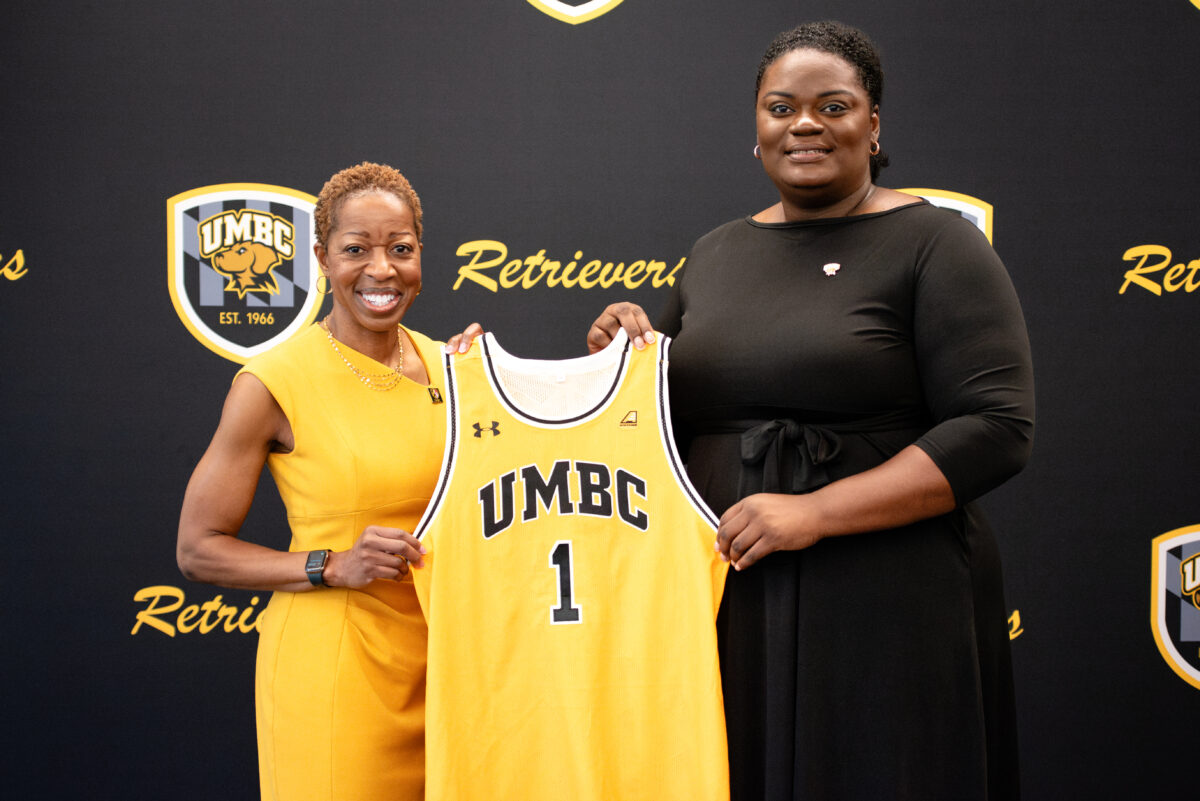 President Shears Ashby welcomes Tucker to #RetrieverNation with her own jersey. (Photo by Eric Thompson ’12)
When Tucker was announced as UMBC’s sixth athletics director (AD) last week, she began laying the groundwork to leave a lasting legacy of her own. When she officially starts on August 15, she’ll be the first woman and person of color to lead the university’s athletics program.
“This isn’t just about making history, it’s about creating a new standard where diversity in leadership is the norm, not the exception,” said Tucker.
Seeing the whole student
Tucker joins UMBC from the University of North Carolina Wilmington, where she has served as deputy athletics director since August 2021. Her appointment follows a nationwide search, during which she emerged as a highly-experienced and accomplished athletics administrator.
“Tiffany’s experience and growing leadership roles would make her a great fit for many AD positions at D1 schools. But let me tell you why she is especially perfect for us,” President Valerie Sheares Ashby said at the press conference. “Here, student-athletes can participate in a Division I program while also reaching the highest levels of academic achievement. Here, we have a diverse student body that excels academically across all subjects. We believe there is no excellence without inclusion, and to be truly inclusive, we know we need to create an environment where everyone can thrive.”
Tucker knows the mindset of an athlete firsthand. She was a four-year member of the women’s basketball team at the University of North Carolina at Chapel Hill. This experience allows her to understand the unique rigors of performing both academically and athletically. This also means that Tucker knows the value of seeing students as more than just who they are on the field, court, or track.
“As we nurture our student-athletes, we will focus on their holistic development—not just as competitors, but as scholars, leaders, and engaged citizens,” she said.
“Our program is in good hands”
Tucker will join an athletics program that has won dozens of America East titles, individual and team honors, and coaching awards. This past academic year, 12 UMBC athletic programs posted perfect Academic Progress Rate (APR) scores in the NCAA Academic Progress Rate Report. Implemented in 2003 as part of an ambitious academic reform effort in Division I, APR holds institutions accountable for the educational progress of their student-athletes through a team-based metric that accounts for the eligibility and retention of each student-athlete for each academic term.
This past season, UMBC volleyball secured their fourth-straight America East championship and returned to the NCAA tournament. Volleyball head coach Kasey Crider looks forward to Tucker taking charge.
“The last couple of months have been tough, without a doubt. To be on the other side of the transition with a leader of Tiffany’s caliber is a big deal,” Crider said. “Our department has demonstrated its resolve and character, and now with her vision and guidance, it feels like we’re on the brink of something pretty special.”
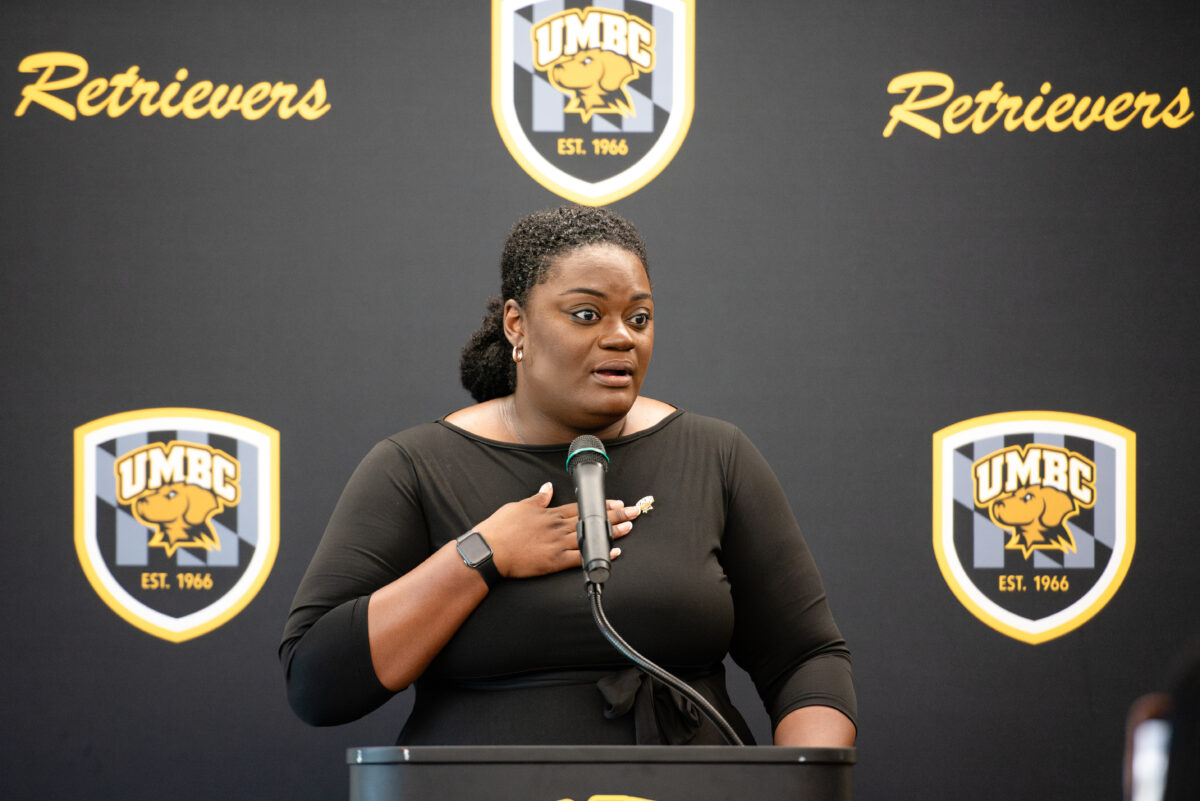 Tucker addresses the crowd at a press conference on July 22. (Photo by Eric Thompson ’12)
Just one of the over two dozen student-athletes bedecked in black and gold at Monday’s press conference, volleyball player Aysia Miller ’24, biological sciences, echoed Crider’s excitement.
“Tiffany’s innovative approach and mindset give me hope that our program is in good hands,” said Miller. “As a student-athlete, it is refreshing to hear someone care so much about our well-being and success.”
Tucker made it clear that students will be her priority when she takes the helm in August. She closed yesterday’s press conference by directly addressing the student-athletes in the room.
“You are the heart and soul of UMBC athletics. Your well-being—physical, mental, and emotional—are paramount. I’m here to support you, challenge you, and celebrate you.”
]]>
She may be new to Retriever Nation, but it seems like Tiffany D. Tucker won’t have any problem as UMBC’s leader of the pack. Addressing a crowd of student-athletes, administrators, coaches, and...
https://umbc.edu/stories/incoming-athletics-director-tiffany-tucker-b/
https://my3.my.umbc.edu/api/v0/pixel/news/142898/guest@my.umbc.edu/fb8c4ecbde07ecd96dd572dba3c9ef9b/api/pixel
athletics
community
feature
news
story
UMBC News & Magazine
https://my3.my.umbc.edu/groups/umbc-news-magazine
https://assets1-my.umbc.edu/system/shared/avatars/groups/000/001/943/24435aa6207c452e7bc15cc74b42c7bb/xsmall.png?1748556657
https://assets1-my.umbc.edu/system/shared/avatars/groups/000/001/943/24435aa6207c452e7bc15cc74b42c7bb/original.png?1748556657
https://assets2-my.umbc.edu/system/shared/avatars/groups/000/001/943/24435aa6207c452e7bc15cc74b42c7bb/xxlarge.png?1748556657
https://assets2-my.umbc.edu/system/shared/avatars/groups/000/001/943/24435aa6207c452e7bc15cc74b42c7bb/xlarge.png?1748556657
https://assets3-my.umbc.edu/system/shared/avatars/groups/000/001/943/24435aa6207c452e7bc15cc74b42c7bb/large.png?1748556657
https://assets1-my.umbc.edu/system/shared/avatars/groups/000/001/943/24435aa6207c452e7bc15cc74b42c7bb/medium.png?1748556657
https://assets2-my.umbc.edu/system/shared/avatars/groups/000/001/943/24435aa6207c452e7bc15cc74b42c7bb/small.png?1748556657
https://assets1-my.umbc.edu/system/shared/avatars/groups/000/001/943/24435aa6207c452e7bc15cc74b42c7bb/xsmall.png?1748556657
https://assets2-my.umbc.edu/system/shared/avatars/groups/000/001/943/24435aa6207c452e7bc15cc74b42c7bb/xxsmall.png?1748556657
UMBC News & Magazine
0
0
false
Tue, 23 Jul 2024 12:47:06 -0400
Tue, 23 Jul 2024 12:47:06 -0400
Massive IT outage spotlights major vulnerabilities in the global information ecosystem

Written by Richard Forno, principal lecturer in computer science and electrical engineering, UMBC
The global information technology outage on July 19, 2024, that paralyzed organizations ranging from airlines to hospitals and even the delivery of uniforms for the Olympic Games represents a growing concern for cybersecurity professionals, businesses and governments.
The outage is emblematic of the way organizational networks, cloud computing services and the internet are interdependent, and the vulnerabilities this creates. In this case, a faulty automatic update to the widely used Falcon cybersecurity software from CrowdStrike caused PCs running Microsoft’s Windows operating system to crash. Unfortunately, many servers and PCs need to be fixed manually, and many of the affected organizations have thousands of them spread around the world.
For Microsoft, the problem was made worse because the company released an update to its Azure cloud computing platform at roughly the same time as the CrowdStrike update. Microsoft, CrowdStrike and other companies like Amazon have issued technical work-arounds for customers willing to take matters into their own hands. But for the vast majority of global users, especially companies, this isn’t going to be a quick fix.
Modern technology incidents, whether cyberattacks or technical problems, continue to paralyze the world in new and interesting ways. Massive incidents like the CrowdStrike update fault not only create chaos in the business world but disrupt global society itself. The economic losses resulting from such incidents – lost productivity, recovery, disruption to business and individual activities – are likely to be extremely high.
As a former cybersecurity professional and current security researcher, I believe that the world may finally be realizing that modern information-based society is based on a very fragile foundation.
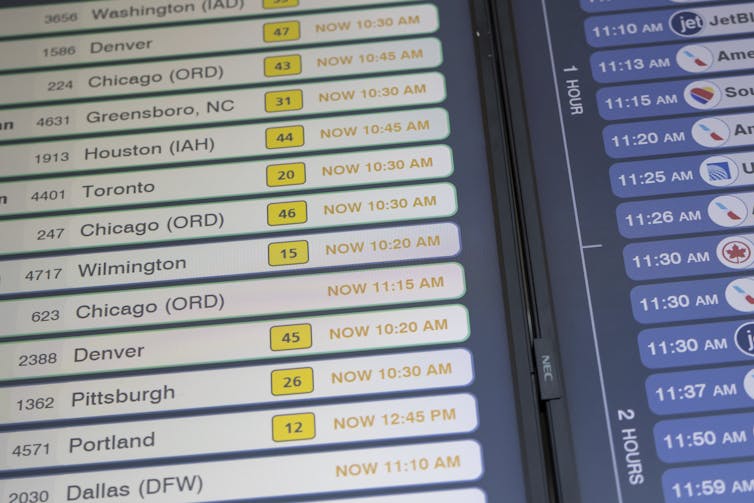 The outage led to thousands of flight delays on July 19, 2024. AP Photo/Yuki Iwamura
The bigger picture
Interestingly, on June 11, 2024, a post on CrowdStrike’s own blog seemed to predict this very situation – the global computing ecosystem compromised by one vendor’s faulty technology – though they probably didn’t expect that their product would be the cause.
Software supply chains have long been a serious cybersecurity concern and potential single point of failure. Companies like CrowdStrike, Microsoft, Apple and others have direct, trusted access into organizations’ and individuals’ computers. As a result, people have to trust that the companies are not only secure themselves, but that the products and updates they push out are well-tested and robust before they’re applied to customers’ systems. The SolarWinds incident of 2019, which involved hacking the software supply chain, may well be considered a preview of today’s CrowdStrike incident.
CrowdStrike CEO George Kurtz said “this is not a security incident or cyberattack” and that “the issue has been identified, isolated and a fix has been deployed.” While perhaps true from CrowdStrike’s perspective – they were not hacked – it doesn’t mean the effects of this incident won’t create security problems for customers. It’s quite possible that in the short term, organizations may disable some of their internet security devices to try and get ahead of the problem, but in doing so they may have opened themselves up to criminals penetrating their networks.
It’s also likely that people will be targeted by various scams preying on user panic or ignorance regarding the issue. Overwhelmed users might either take offers of faux assistance that lead to identity theft, or throw away money on bogus solutions to this problem.
 Transportation Secretary Pete Buttigieg explains the effects of the outage on airlines and other transportation systems.
What to do
Organizations and users will need to wait until a fix is available or try to recover on their own if they have the technical ability. After that, I believe there are several things to do and consider as the world recovers from this incident.
Companies will need to ensure that the products and services they use are trustworthy. This means doing due diligence on the vendors of such products for security and resilience. Large organizations typically test any product upgrades and updates before allowing them to be released to their internal users, but for some routine products like security tools, that may not happen.
Governments and companies alike will need to emphasize resilience in designing networks and systems. This means taking steps to avoid creating single points of failure in infrastructure, software and workflows that an adversary could target or a disaster could make worse. It also means knowing whether any of the products organizations depend on are themselves dependent on certain other products or infrastructures to function.
Organizations will need to renew their commitment to best practices in cybersecurity and general IT management. For example, having a robust backup system in place can make recovery from such incidents easier and minimize data loss. Ensuring appropriate policies, procedures, staffing and technical resources is essential.
Problems in the software supply chain like this make it difficult to follow the standard IT recommendation to always keep your systems patched and current. Unfortunately, the costs of not keeping systems regularly updated now have to be weighed against the risks of a situation like this happening again.
This article is republished from The Conversation under a Creative Commons license. Read the original article and see more than 250 UMBC articles available in The Conversation.
]]>
Written by Richard Forno, principal lecturer in computer science and electrical engineering, UMBC The global information technology outage on July 19, 2024, that paralyzed organizations...
https://umbc.edu/stories/massive-it-outage-spotlights-major-vulnerabilities-in-the-global-information-ecosystem/
https://my3.my.umbc.edu/api/v0/pixel/news/142876/guest@my.umbc.edu/6fa07b0e8478a717e68cfaad43f21ee5/api/pixel
coeit
discovery
magazine
story
the-conversation
UMBC News & Magazine
https://my3.my.umbc.edu/groups/umbc-news-magazine
https://assets1-my.umbc.edu/system/shared/avatars/groups/000/001/943/24435aa6207c452e7bc15cc74b42c7bb/xsmall.png?1748556657
https://assets1-my.umbc.edu/system/shared/avatars/groups/000/001/943/24435aa6207c452e7bc15cc74b42c7bb/original.png?1748556657
https://assets2-my.umbc.edu/system/shared/avatars/groups/000/001/943/24435aa6207c452e7bc15cc74b42c7bb/xxlarge.png?1748556657
https://assets2-my.umbc.edu/system/shared/avatars/groups/000/001/943/24435aa6207c452e7bc15cc74b42c7bb/xlarge.png?1748556657
https://assets3-my.umbc.edu/system/shared/avatars/groups/000/001/943/24435aa6207c452e7bc15cc74b42c7bb/large.png?1748556657
https://assets1-my.umbc.edu/system/shared/avatars/groups/000/001/943/24435aa6207c452e7bc15cc74b42c7bb/medium.png?1748556657
https://assets2-my.umbc.edu/system/shared/avatars/groups/000/001/943/24435aa6207c452e7bc15cc74b42c7bb/small.png?1748556657
https://assets1-my.umbc.edu/system/shared/avatars/groups/000/001/943/24435aa6207c452e7bc15cc74b42c7bb/xsmall.png?1748556657
https://assets2-my.umbc.edu/system/shared/avatars/groups/000/001/943/24435aa6207c452e7bc15cc74b42c7bb/xxsmall.png?1748556657
UMBC News & Magazine
1
0
false
Fri, 19 Jul 2024 15:46:13 -0400
Fri, 19 Jul 2024 15:46:13 -0400
Meet a Retriever—Fritzie Charne-Merriwether, student affairs superstar

Meet Fritzie Charne-Merriwether, associate vice president for administration and chief of staff in the Division of Student Affairs. Fritzie started her career at UMBC as a community director in Residential Life, left to pursue other passions, and came back to serve our Retriever community for the last 14 years. What excites Fritzie so much about her work with students? We’ll let her tell you herself!
Q: What’s one essential thing you’d want another Retriever to know about you?
A: I am a native New Yorker. I have a B.A. in psychology from Roger Williams University and a M.Ed. in student affairs higher education from the University of Vermont. I have over 20 years of professional experience in a variety of leadership positions in student affairs and with the federal government. This includes serving as the contractor installation manager for the Army Career and Alumni Program (ACAP) at Fort Campbell, Kentucky.
In this role I was responsible for overseeing the ACAP Resource Center that provided social work services to Warriors in Transition Soldiers, and disabled veterans/retirees, as well as transitioning service personnel and family members in support of rehabilitation and transition to civilian life. I began my career at UMBC as a community director in Residential Life, and returned to the university in 2010. Currently I serve as the associate vice president for administration and chief of staff for the Division of Student Affairs.
Q: What’s the one thing you’d want someone who hasn’t joined the UMBC community to know about the support you find here?
A: UMBC is such a caring place. We really go above and beyond to support each other. I feel that at all levels and see examples of this daily. If you are looking to join a strong and supportive community, this is the place for you.
Q: What do you love most about your job and why?
A: Working with students and their families. It so rewarding to be able to help a student or family member. I know that I am making a difference and helping prepare our next generation of leaders.

Q: Tell us about someone in the community who has inspired you or supported you, and how they did it.
A: It is really hard to narrow to just one person specifically. I feel like I have been inspired and supported by countless people in the Division of Student Affairs. So I would have to say our whole division. I get to work with amazing people and they give me life. I am consistently inspired by how amazing each person is and how they go above and beyond to support our students. They push me to a higher standard because they are so amazing. So from the VP’s office to our leadership team to each department, they all inspire and support me in some capacity.
 At the Division of Student Affairs BBQ in June (left-right): Fritzie Charne-Merriwether, and Renique Kersh, and John Fox. Photo courtesy of Charne-Merriwether.
Q: Tell us what you love about your department.
A: I laugh a lot with our team. Even when things are really hard we find ways to lift each other and find a sliver of joy. This work can be really difficult at times. I appreciate our team’s humanity and ability to find the light.
Q: Tell us about your primary WHY, and how it led you to UMBC.
A: I originally came to UMBC because I felt I had great opportunities to grow professionally. It seemed like an exciting place that was growing and brimming with potential. I came back to UMBC because of the people. It truly is a special place. Even after being away for a few years, I still felt very much connected to this place and coming back felt like home.
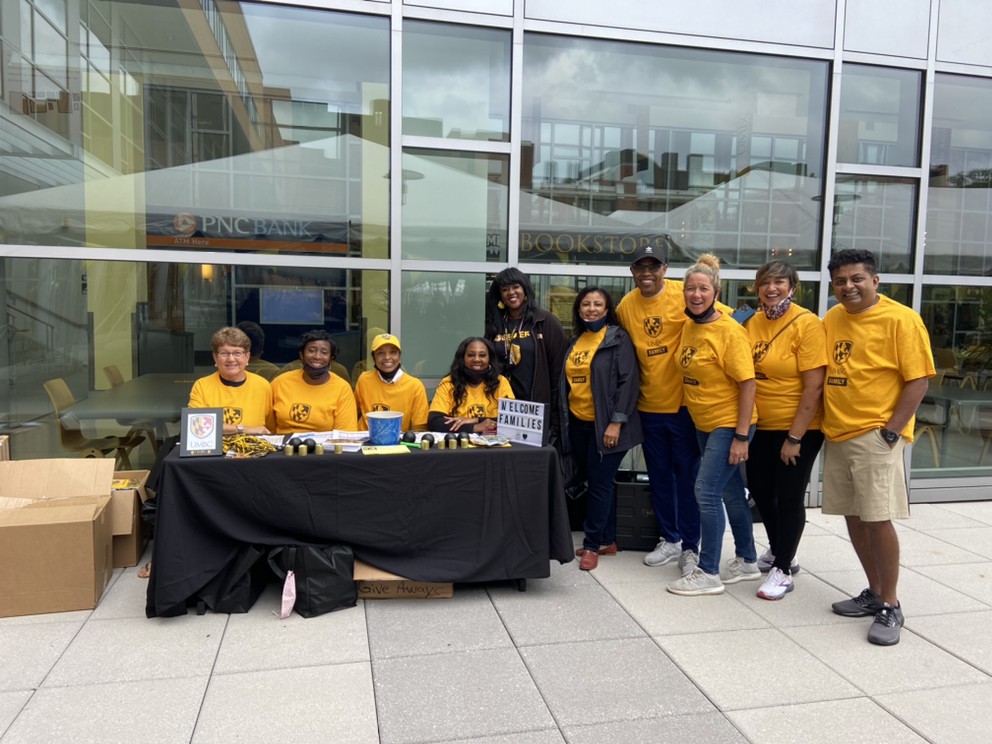 Members of the Family Advisory Board in student affairs enjoy Homecoming & Family Weekend 2022. Photo courtesy of Charne-Merriwether.
I laugh a lot with our team. Even when things are really hard we find ways to lift each other and find a sliver of joy. This work can be really difficult at times. I appreciate our team’s humanity and ability to find the light.
Fritzie Charne-Merriwether
Q: Since you’ve been a part of the UMBC community, how have you found support of your WHY?
A: A great example of support occurred a few years back when my mother passed away. As an only child, my mom and I were really close and losing her rocked my entire foundation. The outpouring of support from our VP and leadership team allowed me to take all the time I needed to grieve and find my new normal. The love and support I received from fellow colleagues got me through some of my most difficult moments. That continues to this day. Our division has gone through significant change recently. During that time, countless individuals have stepped up to support me from all over campus. Our new VP and members of our leadership team have been incredibly supportive as I have stepped into my new role. I feel very fortunate to be part of such a caring community.
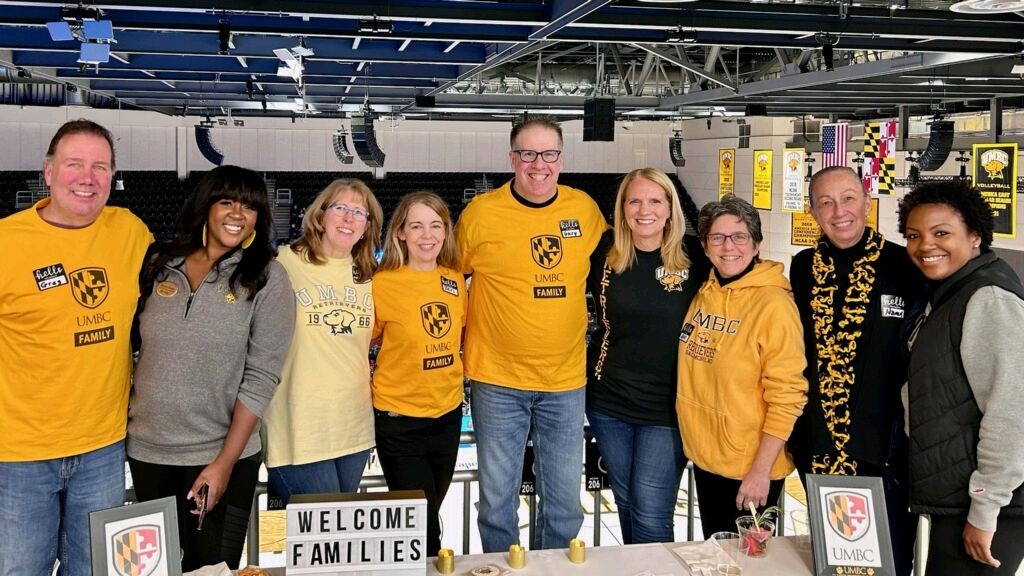 Family Night at a men’s basketball game. Photo courtesy of Charne-Merriwether.
Q: What would you tell someone who is considering a career at UMBC?
A: It is a great community to belong to and depending on your interest you can find ample opportunities to grow and develop.
* * * * *
UMBC’s greatest strength is its people. When people meet Retrievers and hear about the passion they bring, the relationships they create, the ways they support each other, and the commitment they have to inclusive excellence, they truly get a sense of our community. That’s what “Meet a Retriever” is all about.
Learn more about how UMBC can help you achieve your goals.
]]>
Meet Fritzie Charne-Merriwether, associate vice president for administration and chief of staff in the Division of Student Affairs. Fritzie started her career at UMBC as a community director in...
https://umbc.edu/stories/fritzie-charne-merriwether-umbc-student-affairs/
https://my3.my.umbc.edu/api/v0/pixel/news/142891/guest@my.umbc.edu/a50d1dcf04effacd9f0795bc2e8b6679/api/pixel
meet-a-retriever
story
student-affairs
uncategorized
UMBC News & Magazine
https://my3.my.umbc.edu/groups/umbc-news-magazine
https://assets1-my.umbc.edu/system/shared/avatars/groups/000/001/943/24435aa6207c452e7bc15cc74b42c7bb/xsmall.png?1748556657
https://assets1-my.umbc.edu/system/shared/avatars/groups/000/001/943/24435aa6207c452e7bc15cc74b42c7bb/original.png?1748556657
https://assets2-my.umbc.edu/system/shared/avatars/groups/000/001/943/24435aa6207c452e7bc15cc74b42c7bb/xxlarge.png?1748556657
https://assets2-my.umbc.edu/system/shared/avatars/groups/000/001/943/24435aa6207c452e7bc15cc74b42c7bb/xlarge.png?1748556657
https://assets3-my.umbc.edu/system/shared/avatars/groups/000/001/943/24435aa6207c452e7bc15cc74b42c7bb/large.png?1748556657
https://assets1-my.umbc.edu/system/shared/avatars/groups/000/001/943/24435aa6207c452e7bc15cc74b42c7bb/medium.png?1748556657
https://assets2-my.umbc.edu/system/shared/avatars/groups/000/001/943/24435aa6207c452e7bc15cc74b42c7bb/small.png?1748556657
https://assets1-my.umbc.edu/system/shared/avatars/groups/000/001/943/24435aa6207c452e7bc15cc74b42c7bb/xsmall.png?1748556657
https://assets2-my.umbc.edu/system/shared/avatars/groups/000/001/943/24435aa6207c452e7bc15cc74b42c7bb/xxsmall.png?1748556657
UMBC News & Magazine
3
0
false
Fri, 19 Jul 2024 15:24:20 -0400
Karen Chen wins NSF CAREER award to build tools to empower students with data
When Karen Chen’s now teenage son was in third grade, he would complain that math homework was “boring.” Chen wanted to change his perspective. She presented him with extracurricular math problems and coached him through the most challenging ones. Being a data scientist, she also recorded the sessions and rigorously analyzed the video and audio for insights about his learning experience. One of her key takeaways: Her son rode an emotional roller coaster as he worked through difficult problems. Her attentive tutoring helped him through the confusion and frustration to reach the joy at the end.
Since the project with her son eight years ago, Chen, an assistant professor in the Department of Information Systems at UMBC, has made learning analytics a pillar of her research. The field seeks to collect and analyze data about students and their environment with the goal of improving learning outcomes. Chen recently won a National Science Foundation (NSF) CAREER award to advance this research with a new project that puts students at the center of learning analytics—not just as subjects who supply data, but also as the designers of analytical tools and users of the insights they provide.
Chen’s CAREER award marks the 50th time a UMBC faculty member has received the prestigious grant, which the NSF established to support early-career faculty who have the potential to serve as leaders in integrating research and education.
“I’m really excited about this project,” Chen says. “I love teaching and interdisciplinary research and this is an excellent opportunity to combine them.”
Learning analytics, “for students, by students”
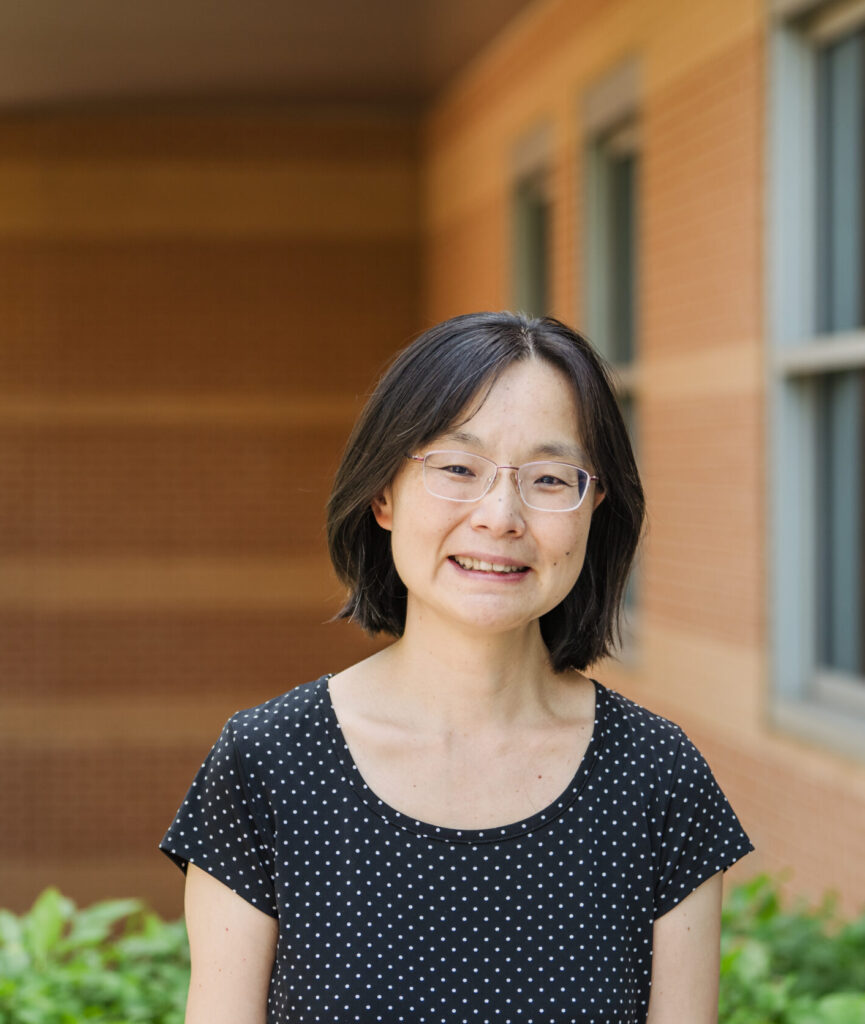 Karen Chen (Marlayna Demond ’11/UMBC)
Chen’s Lab for Informatics for Human Flourishing at UMBC is dedicated to using data to improve people’s lives. “I like to center all my research on promoting human flourishing, meaning people are not just surviving, but thriving. I use this concept as a North Star,” explains Chen.
Education is a key pathway to advance human flourishing, Chen says, and she looks forward to improving student learning experiences and outcomes through her CAREER award project.
The project will start by engaging students enrolled in Foundations of Data Science (IS 296), a relatively new undergraduate course at UMBC, introduced by Vandana Janeja, information systems. IS 296 recently became a general education program course at UMBC, open to all majors with no prerequisites.
Under Chen’s guidance, students in the class will collect data about their lives—how much sleep and exercise they get, how much time they spend talking to friends and family, how stressed they are feeling, and more. They’ll also gather information related to their classes, such as already available data about how often they log into and use the university’s learning management system, Blackboard, and track how much time they spend focusing on classwork (versus, say, becoming distracted by other open tabs on their computers.) The data will be available only to individual students and those they designate as trusted collaborators.
Students will then work through data science activities, analyzing the information they gathered and seeing if they can gain insights to improve their well-being and academic success. At the same time, they will build a critical competency called self-regulated learning, says Chen.
Based on feedback from the class, Chen will then work with students to design and develop an online platform, called “Live Data Lab,” where a broader student community can find tools to track and analyze their own well-being while learning basic data science concepts and techniques. This platform will also provide opportunities for students to explore creative expression of data through mediums such as digital data stories, data art, data comics, or data memes.
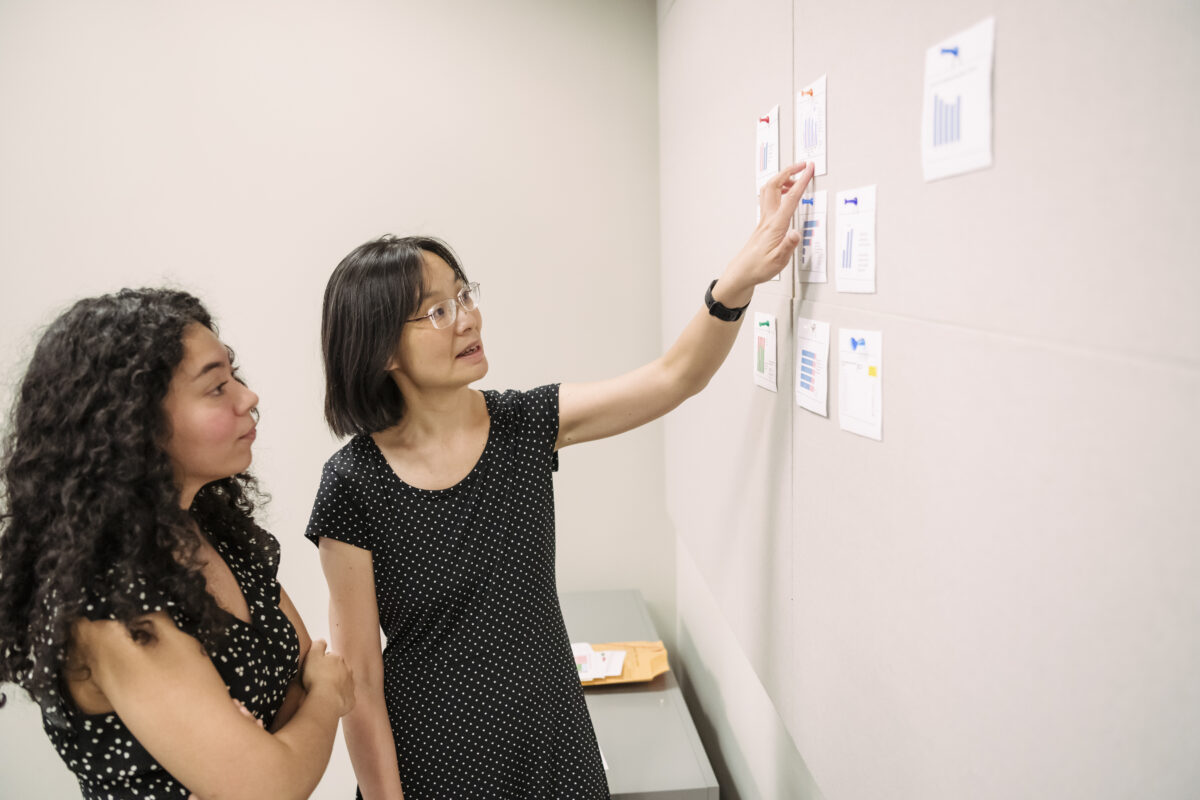
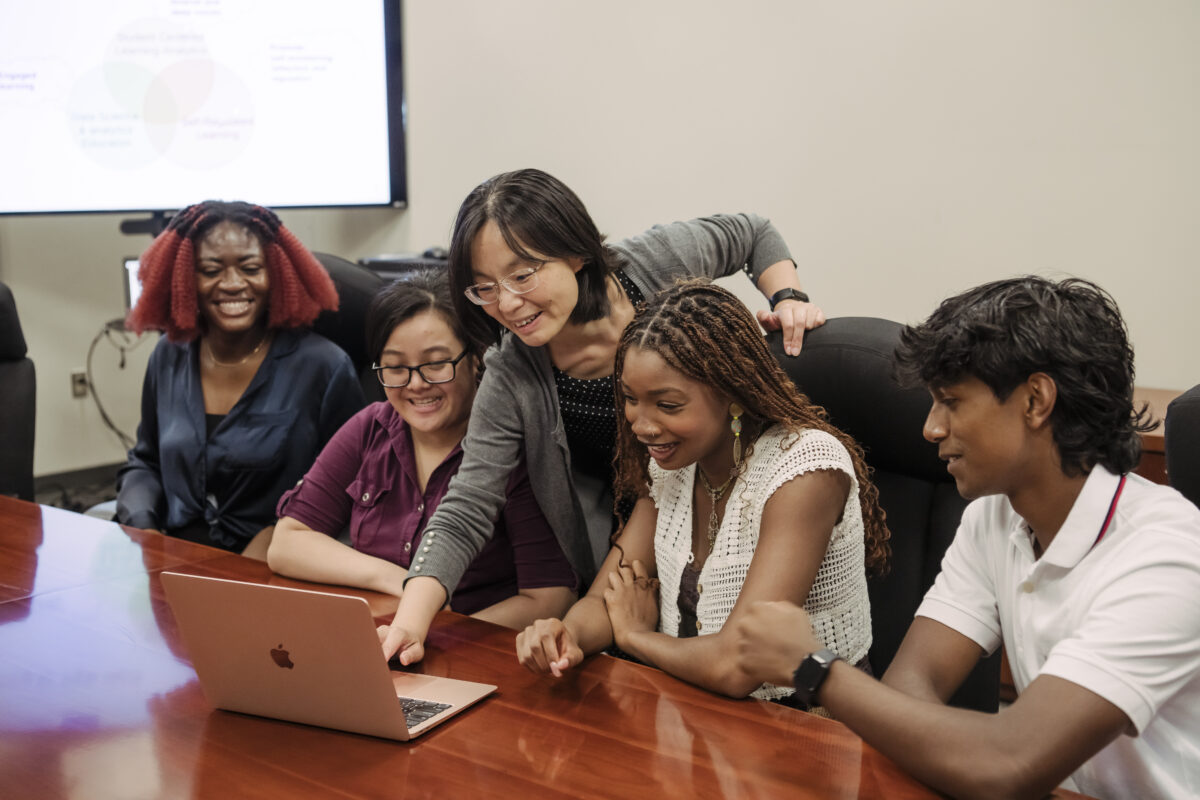
Left: Jennifer Posada Granados ’21, an incoming Ph.D. student in the human-centered computing program, and Karen Chen look at printed visualizations of data gathered from UMBC students. Right: Chen talks with students, from left to right, Yetunde Okueso, Kara Nguyen, Joy Ware, and Kavin Manivannan. (Marlayna Demond ’11/UMBC)
Chen will test-run the platform with around 500 students, including first-year UMBC students enrolled in a new seminar course offered by Academic Engagement and Transition Programs, as well as students enrolled in UMBC’s Department of Education pre-service teacher preparation programs. The project will also engage students from community college partners such as Montgomery College.
Empowering students for success
UMBC is an excellent place to conduct the project, Chen says, because it has a culture of promoting student success in its diverse community by empowering students with support and tools. UMBC has also been a leader in learning analytics, already gathering data about how students use its learning management systems to improve students’ learning outcomes, and protecting that data’s privacy, Chen adds.
“This project would not be possible without the support of the Division of Information Technology, in particular John Fritz and his team, who created the Check-My-Activity tool, a student-facing learning analytics tool that has been in operation in UMBC for more than a decade,” Chen says. The project will also be supported by information systems faculty Andrea Kleinsmith, an expert in human-centered design,and Zhiyuan Chen, an expert in data privacy, Chen adds.
“The question driving the work is: How can we best center students’ voices and empower them in the data-driven decision-making process?” Chen says. “This project will provide many opportunities for undergraduates and graduate students at UMBC to get involved. Not only will they contribute to the research, but I hope they will also become deeply engaged with their learning and empowered to become better versions of themselves through data, scientific evidence, and reasoning.”
]]>
When Karen Chen’s now teenage son was in third grade, he would complain that math homework was “boring.” Chen wanted to change his perspective. She presented him with extracurricular math problems...
https://umbc.edu/stories/karen-chen-nsf-career-award-student-data/
https://my3.my.umbc.edu/api/v0/pixel/news/142816/guest@my.umbc.edu/bb4449241f7f0dab1b921efdc9601d04/api/pixel
coeit
is
news
nsf-career-award
research
science-and-tech
story
UMBC News & Magazine
https://my3.my.umbc.edu/groups/umbc-news-magazine
https://assets1-my.umbc.edu/system/shared/avatars/groups/000/001/943/24435aa6207c452e7bc15cc74b42c7bb/xsmall.png?1748556657
https://assets1-my.umbc.edu/system/shared/avatars/groups/000/001/943/24435aa6207c452e7bc15cc74b42c7bb/original.png?1748556657
https://assets2-my.umbc.edu/system/shared/avatars/groups/000/001/943/24435aa6207c452e7bc15cc74b42c7bb/xxlarge.png?1748556657
https://assets2-my.umbc.edu/system/shared/avatars/groups/000/001/943/24435aa6207c452e7bc15cc74b42c7bb/xlarge.png?1748556657
https://assets3-my.umbc.edu/system/shared/avatars/groups/000/001/943/24435aa6207c452e7bc15cc74b42c7bb/large.png?1748556657
https://assets1-my.umbc.edu/system/shared/avatars/groups/000/001/943/24435aa6207c452e7bc15cc74b42c7bb/medium.png?1748556657
https://assets2-my.umbc.edu/system/shared/avatars/groups/000/001/943/24435aa6207c452e7bc15cc74b42c7bb/small.png?1748556657
https://assets1-my.umbc.edu/system/shared/avatars/groups/000/001/943/24435aa6207c452e7bc15cc74b42c7bb/xsmall.png?1748556657
https://assets2-my.umbc.edu/system/shared/avatars/groups/000/001/943/24435aa6207c452e7bc15cc74b42c7bb/xxsmall.png?1748556657
UMBC News & Magazine
3
0
false
Wed, 17 Jul 2024 14:43:28 -0400
Wed, 17 Jul 2024 14:43:28 -0400
Susan McDonough, history, receives prestigious membership to the Institute for Advanced Studies to continue research on sex workers in medieval Mediterranean

Susan McDonough, associate professor of history, received a 2024 – 2025 research membership to the Institute for Advanced Studies (IAS) at the School of Historical Studies in Princeton, New Jersey.
McDonough will join scholars from around the world in one of the leading centers for theoretical historical research. This includes research on the history of medieval, early modern, and modern Europe, the Islamic world, East Asian studies, art history, history of science, and musicology. McDonough will spend the year writing chapters of her forthcoming book about the lives of sex workers in the medieval Mediterranean and sharing her progress in weekly seminars with historians as well as mathematicians, natural scientists, philosophers, and social scientists.
“I am incredibly energized by this opportunity to immerse myself in the archival materials I’ve been gathering concerning sex workers and their communities in the medieval Mediterranean,” she shares. Previously, McDonough earned a 2019 – 2020 National Endowment for the Humanities fellowship to conduct archival research at six Mediterranean Sea ports: Barcelona, Mallorca, and Valencia in Spain; Marseille, France; and Genoa and Palermo, Italy.
 Susan McDonough in Nervi, a suburb of Genoa, Italy. (Image courtesy of McDonough)
“I tell a story of movement, of community, of connection, and of resistance. Sex workers lived under the threat of forced expulsion and were usually migrants to the towns in which they sold sex,” explains McDonough. “They worked, fought, competed against each other in brothels, and left each other precious belongings in their final wills and testaments.”
 Marseille’s Vieux Port, with a view of the Cathedral of Notre Dame de la Garde. (Image courtesy of McDonough)
Her research is developing a more inclusive understanding of women’s experiences during this period. “To have the freedom to refine and deepen my ideas in the company of some of the most exciting thinkers, writers, and scholars—many of whose ideas have already been foundational in my conceptualization of this book—is extraordinarily lucky.”
McDonough is the second faculty member at UMBC to receive an IAS membership. Constantine Vaporis, professor of history, received a 2020 – 2021 IAS membership to work on his upcoming book, Sword and Brush: Portraits of Samurai in Early Modern Japan, 1600 – 1868.
Learn more about UMBC’s history department.
]]>
Susan McDonough, associate professor of history, received a 2024 – 2025 research membership to the Institute for Advanced Studies (IAS) at the School of Historical Studies in Princeton, New...
https://umbc.edu/quick-posts/susan-mcdonough-receives-institute-advanced-studies-membership/
https://my3.my.umbc.edu/api/v0/pixel/news/142815/guest@my.umbc.edu/4949dc6dc4a138945696caae2fb65986/api/pixel
cahss
cahss-research
history
news
policy-and-society
quick-post
research
UMBC News & Magazine
https://my3.my.umbc.edu/groups/umbc-news-magazine
https://assets1-my.umbc.edu/system/shared/avatars/groups/000/001/943/24435aa6207c452e7bc15cc74b42c7bb/xsmall.png?1748556657
https://assets1-my.umbc.edu/system/shared/avatars/groups/000/001/943/24435aa6207c452e7bc15cc74b42c7bb/original.png?1748556657
https://assets2-my.umbc.edu/system/shared/avatars/groups/000/001/943/24435aa6207c452e7bc15cc74b42c7bb/xxlarge.png?1748556657
https://assets2-my.umbc.edu/system/shared/avatars/groups/000/001/943/24435aa6207c452e7bc15cc74b42c7bb/xlarge.png?1748556657
https://assets3-my.umbc.edu/system/shared/avatars/groups/000/001/943/24435aa6207c452e7bc15cc74b42c7bb/large.png?1748556657
https://assets1-my.umbc.edu/system/shared/avatars/groups/000/001/943/24435aa6207c452e7bc15cc74b42c7bb/medium.png?1748556657
https://assets2-my.umbc.edu/system/shared/avatars/groups/000/001/943/24435aa6207c452e7bc15cc74b42c7bb/small.png?1748556657
https://assets1-my.umbc.edu/system/shared/avatars/groups/000/001/943/24435aa6207c452e7bc15cc74b42c7bb/xsmall.png?1748556657
https://assets2-my.umbc.edu/system/shared/avatars/groups/000/001/943/24435aa6207c452e7bc15cc74b42c7bb/xxsmall.png?1748556657
UMBC News & Magazine
5
0
false
Wed, 17 Jul 2024 14:38:27 -0400
Wed, 17 Jul 2024 14:38:27 -0400
