New iCyberCenter will help international cyber companies establish U.S. presence at bwtech@UMBC

The bwtech@UMBC research and technology park has officially launched the iCyberCenter@bwtech to support companies from the United Kingdom and other nations as they establish themselves in Maryland. Maryland Governor Larry Hogan initially announced plans for the iCyberCenter@bwtech, as a collaboration of UMBC and the Maryland Department of Commerce, during a trade mission to the United Kingdom in mid-June, prior to the formal U.S. launch event on July 6, 2017, at bwtech@UMBC.
The iCyberCenter@bwtech will offer an intensive training program for the executives of select international companies seeking to connect with the U.S. market. The first executive training session will be held September 11 – 15, 2017, and organizers anticipate running three such sessions annually, with each including 6-8 entrepreneurs. Through the program, participants will increase their understanding of the U.S. cyber market and develop custom market entry plans for their businesses.
 Jennifer Reynolds explains the iCyberCenter’s intensive training program.
Companies accepted into the program will also benefit from the 12-month U.S. Market Entry Incubator Program, which will offer support while they launch their U.S. operations. Participants in the year-long support program will have access to mentorship from industry experts, and will engage in trainings, events, and networking opportunities.
Jennifer Reynolds, bwtech’s director of venture creation, and Andy Williams, most recently the United Kingdom’s first cyber trade envoy to the U.S., will lead the iCyberCenter, with Williams serving as CEO. Reynolds is focused on developing the right supports to meet the needs of incoming companies, noting, “There is not a one-size-fits-all for getting into the U.S. market in cybersecurity.” Williams sees his role as educating people about why “there is no better place for an overseas company to develop a U.S. presence than Maryland.”
Ellen Hemmerly, executive director of bwtech@UMBC, sees the iCyberCenter as an economic development engine. She notes that, in addition to helping to create at least 100 permanent jobs over the next several years, it “will support Maryland’s desire to increase foreign direct investment in the state” by boosting the state’s international visibility as a home for cybersecurity leaders. “We believe the economic impact of the iCyberCenter will be significant…and secure Maryland’s place in cybersecurity innovation in the world,” she explained at the launch event.
 President Hrabowski speaks at the iCyberCenter launch event.
“The creation of the iCyberCenter@bwtech will further develop UMBC’s cybersecurity ecosystem, and will continue to build Maryland’s reputation as a leader in the cyber industry,” said UMBC President Freeman Hrabowski in an early announcement about the iCyberCenter@bwtech. At the launch, he further emphasized the tremendous potential he sees in the new center, noting, “The opportunities for business development are limitless when thinking about this industry and international partnerships.”
 Secretary Mike Gill speaks at the iCyberCenter launch.
Quite simply, Maryland Secretary of Commerce Mike Gill told the crowd, “this is a big deal” as an economic development opportunity, and as a chance to show the international business and tech communities that UMBC “stands for excellence, innovation, and grit.”
When it comes down to it, said Williams, “We have a hunger here to get things done, but we also have a community.” He sees UMBC’s combination of support, talent, knowledge, and drive as essential to the success of the iCyberCenter@bwtech itself.
Read more coverage of the iCyberCenter@bwtech in The Baltimore Sun, the Baltimore Business Journal, Technical.ly Baltimore, and Southern Maryland Online. Another article appeared in The Baltimore Sun in October 2017.
Header image features Andy Williams speaking at the iCyberCenter launch. All photos by Marlayna Demond ’11 for UMBC.
]]>
The bwtech@UMBC research and technology park has officially launched the iCyberCenter@bwtech to support companies from the United Kingdom and other nations as they establish themselves in...
https://umbc.edu/stories/new-icybercenter-will-help-international-cyber-companies-establish-u-s-presence-at-bwtechumbc/
https://my3.my.umbc.edu/api/v0/pixel/news/120719/guest@my.umbc.edu/8b70d33fa9d5b98974028eeae471f194/api/pixel
bwtech
cybersecurity
international
science-and-technology
UMBC News & Magazine
https://my3.my.umbc.edu/groups/umbc-news-magazine
https://assets1-my.umbc.edu/system/shared/avatars/groups/000/001/943/24435aa6207c452e7bc15cc74b42c7bb/xsmall.png?1748556657
https://assets1-my.umbc.edu/system/shared/avatars/groups/000/001/943/24435aa6207c452e7bc15cc74b42c7bb/original.png?1748556657
https://assets2-my.umbc.edu/system/shared/avatars/groups/000/001/943/24435aa6207c452e7bc15cc74b42c7bb/xxlarge.png?1748556657
https://assets2-my.umbc.edu/system/shared/avatars/groups/000/001/943/24435aa6207c452e7bc15cc74b42c7bb/xlarge.png?1748556657
https://assets3-my.umbc.edu/system/shared/avatars/groups/000/001/943/24435aa6207c452e7bc15cc74b42c7bb/large.png?1748556657
https://assets1-my.umbc.edu/system/shared/avatars/groups/000/001/943/24435aa6207c452e7bc15cc74b42c7bb/medium.png?1748556657
https://assets2-my.umbc.edu/system/shared/avatars/groups/000/001/943/24435aa6207c452e7bc15cc74b42c7bb/small.png?1748556657
https://assets1-my.umbc.edu/system/shared/avatars/groups/000/001/943/24435aa6207c452e7bc15cc74b42c7bb/xsmall.png?1748556657
https://assets2-my.umbc.edu/system/shared/avatars/groups/000/001/943/24435aa6207c452e7bc15cc74b42c7bb/xxsmall.png?1748556657
UMBC News & Magazine
0
0
false
Fri, 07 Jul 2017 13:32:07 -0400
Hackathon inspires participants to “Innovate Good” through technology

Ahead of final exams this spring, nearly 200 students gathered at UMBC for “Innovate Good,” a hackathon co-hosted by HackUMBC and The Shriver Center, UMBC’s hub for service-learning, civic engagement, and community-based service delivery. During the 24-hour tech innovation marathon, students collaborated to build mobile, web, and hardware projects focused on solving problems and creating positive social outcomes. Four overarching categories inspired participants in their tech development: health and environment, housing, legal and justice, and education.
Collaborating with The Shriver Center to host the hackathon was an exciting experience, says Celeste Wong ‘18, computer science, co-president of HackUMBC. “There were different aspects to the hackathon we had to think about and work through since we’ve never done a social good Hackathon,” she explained. “In the end it was very rewarding to see students who are passionate about different areas of social justice. Seeing the participants demo and explain their projects really showcased their passion and heart for others at our school and in our community.”
 Students presenting their hacks at the “Innovate Good” hackathon.
Rick Forno, assistant director for UMBC’s Center for Cybersecurity and director of the Cybersecurity Graduate Program, serves as faculty advisor of the HackUMBC student organization. “Hackathons like HackUMBC are diverse, high-energy events that bring together novices, experts, and mentors to share and apply their knowledge, skills, and personal enthusiasm toward exploring the world of technology and/or developing innovative solutions with technology,” he says. He was delighted at the success of this first themed HackUMBC event in bringing together participants with diverse interests, experiences, and perspectives.
Hannah Schmitz, program coordinator of public service scholars programs in The Shriver Center, agreed, sharing, “So often we see a divide between ‘techie’ and ‘non-techie’ students. The Shriver Center and HackUMBC designed ‘Innovate Good’ to bridge that divide, bringing students together to harness their skills and experiences to co-create interdisciplinary solutions to social challenges.” She explained, “Participants had a chance to collaborate with students with varying disciplinary perspectives, and had an opportunity to learn from, work with, and teach each other.”
 Students presenting their hacks at the “Innovate Good” hackathon.
An “expo” portion toward the end of the event gave participants an the opportunity to share the hacks that they developed with their peers and receive feedback from faculty judges.
“It’s our hope that each participant walked away with new skill sets and a deepened interest in using their talents to make an impact in their community,” says Schmitz.
For more information about upcoming hackathons at UMBC, visit the HackUMBC website.
Header image: Students presenting their hacks at the “expo” portion of the hackathon. All photos by Marlayna Demond ’11 for UMBC.
]]>
Ahead of final exams this spring, nearly 200 students gathered at UMBC for “Innovate Good,” a hackathon co-hosted by HackUMBC and The Shriver Center, UMBC’s hub for service-learning, civic...
https://umbc.edu/stories/hackathon-inspires-participants-to-innovate-good-through-technology/
https://my3.my.umbc.edu/api/v0/pixel/news/120741/guest@my.umbc.edu/8e41cabfb4dd11fadb848147cc5c47c2/api/pixel
coeit
csee
cybersecurity
science-and-technology
shrivercenter
UMBC News & Magazine
https://my3.my.umbc.edu/groups/umbc-news-magazine
https://assets1-my.umbc.edu/system/shared/avatars/groups/000/001/943/24435aa6207c452e7bc15cc74b42c7bb/xsmall.png?1748556657
https://assets1-my.umbc.edu/system/shared/avatars/groups/000/001/943/24435aa6207c452e7bc15cc74b42c7bb/original.png?1748556657
https://assets2-my.umbc.edu/system/shared/avatars/groups/000/001/943/24435aa6207c452e7bc15cc74b42c7bb/xxlarge.png?1748556657
https://assets2-my.umbc.edu/system/shared/avatars/groups/000/001/943/24435aa6207c452e7bc15cc74b42c7bb/xlarge.png?1748556657
https://assets3-my.umbc.edu/system/shared/avatars/groups/000/001/943/24435aa6207c452e7bc15cc74b42c7bb/large.png?1748556657
https://assets1-my.umbc.edu/system/shared/avatars/groups/000/001/943/24435aa6207c452e7bc15cc74b42c7bb/medium.png?1748556657
https://assets2-my.umbc.edu/system/shared/avatars/groups/000/001/943/24435aa6207c452e7bc15cc74b42c7bb/small.png?1748556657
https://assets1-my.umbc.edu/system/shared/avatars/groups/000/001/943/24435aa6207c452e7bc15cc74b42c7bb/xsmall.png?1748556657
https://assets2-my.umbc.edu/system/shared/avatars/groups/000/001/943/24435aa6207c452e7bc15cc74b42c7bb/xxsmall.png?1748556657
UMBC News & Magazine
0
0
false
Tue, 06 Jun 2017 16:25:32 -0400
Wikileaks hack highlights importance of cyberdefense basics, UMBC experts write

The Central Intelligence Agency’s latest leak is the most recent major hack exposing information that could possibly compromise national security. In The Conversation, Anupam Joshi and Rick Forno, explain that this hack is a reminder of how cyberdefense strategies must be continually improved to ensure sensitive information is protected.
Joshi is a professor and chair of the department of computer science and electrical engineering and director of UMBC’s Center for Cybersecurity, and Forno is the assistant director of the UMBC Center for Cybersecurity and director of UMBC’s graduate program in cybersecurity. Their latest article has been republished by media across the globe and has been read more than 20,000 times.
“This round of leaks, of documents dating from 2013 to 2016,…reinforces perhaps the most troubling piece of information we already know: Individuals and the government itself must step up cyberdefense efforts to protect sensitive information,” write Joshi and Forno.
 Rick Forno
They ask readers to consider the risk to security and privacy compared with the benefits and convenience of modern technologies. “As citizens, we must decide what level of risk we — as a nation, a society and as individuals — are willing to face when using internet-connected products.”
Any electronic device connected to the internet is susceptible to a cyber attack, Joshi and Forno go on to explain, noting, “It’s not necessarily a good idea to have always-on and network-enabled microphones or cameras in every room of the house.”
Joshi also spoke with CBS Baltimore about how hacks can impact technologies consumers use every day, such as cars that now feature high tech navigation and entertainment systems. “The more electronic gizmos you have in your car, the newer the car you have, the more you’re connected to the network with your car, the greater the probability something can be done to your car,” he explained. Still, he noted, a hacker would need to have advanced technical knowledge and, likely, close proximity to the car to carry out such an attack.
To ensure that sensitive information is protected, Joshi and Forno say that focusing on “the mundane tasks of cyberdefense” is essential to maintaining security for everyone, from government to individuals, although they emphasize that no internet-connected technologies are immune to cyber hacks. Ultimately, they write, “Keeping others out of key systems is crucial to American national security, and to the proper function of our government, military and civilian systems.”
Read the full article in The Conversation, and watch the complete interview on CBS Baltimore.
]]>
The Central Intelligence Agency’s latest leak is the most recent major hack exposing information that could possibly compromise national security. In The Conversation, Anupam Joshi and Rick Forno,...
https://umbc.edu/stories/wikileaks-hack-highlights-importance-of-cyberdefense-basics-umbc-experts-write/
https://my3.my.umbc.edu/api/v0/pixel/news/120858/guest@my.umbc.edu/6fbcbc9c66029027fe87459441b0d969/api/pixel
coeit
csee
cybersecurity
science-and-technology
UMBC News & Magazine
https://my3.my.umbc.edu/groups/umbc-news-magazine
https://assets1-my.umbc.edu/system/shared/avatars/groups/000/001/943/24435aa6207c452e7bc15cc74b42c7bb/xsmall.png?1748556657
https://assets1-my.umbc.edu/system/shared/avatars/groups/000/001/943/24435aa6207c452e7bc15cc74b42c7bb/original.png?1748556657
https://assets2-my.umbc.edu/system/shared/avatars/groups/000/001/943/24435aa6207c452e7bc15cc74b42c7bb/xxlarge.png?1748556657
https://assets2-my.umbc.edu/system/shared/avatars/groups/000/001/943/24435aa6207c452e7bc15cc74b42c7bb/xlarge.png?1748556657
https://assets3-my.umbc.edu/system/shared/avatars/groups/000/001/943/24435aa6207c452e7bc15cc74b42c7bb/large.png?1748556657
https://assets1-my.umbc.edu/system/shared/avatars/groups/000/001/943/24435aa6207c452e7bc15cc74b42c7bb/medium.png?1748556657
https://assets2-my.umbc.edu/system/shared/avatars/groups/000/001/943/24435aa6207c452e7bc15cc74b42c7bb/small.png?1748556657
https://assets1-my.umbc.edu/system/shared/avatars/groups/000/001/943/24435aa6207c452e7bc15cc74b42c7bb/xsmall.png?1748556657
https://assets2-my.umbc.edu/system/shared/avatars/groups/000/001/943/24435aa6207c452e7bc15cc74b42c7bb/xxsmall.png?1748556657
UMBC News & Magazine
0
0
false
Fri, 24 Mar 2017 13:45:20 -0400
Baltimore Sun highlights how UMBC is enhancing the student experience in and out of the classroom

Student success has long been a pillar of UMBC’s mission as a public research university, and the Baltimore Sun‘s latest special section on education highlights multiple UMBC programs focused on enhancing student achievement and experiences in and out of the classroom.
APA refresher course helps graduate students advance in their careers
UMBC’s master’s program in industrial/organizational (I/O) psychology offers its students an opportunity to take a refresher course in the American Psychological Association (APA) technical-style writing. Elliot Lasson, professor of the practice and I/O program director, worked with the Center for Academic Success to establish a summer workshop in APA writing after he learned from faculty that a number of students would benefit from extra training in that important skillset.
 Elliot Lasson teaches students about the APA style. Photo by Marlayna Demond.
“The APA-style technical writing is less prose, more succinct, more formulaic, and typically written in third person. There’s a very specific way to report the result of a study,” said Lasson. “We hope they know it, but the reality is that students do not all have a strong background in research coming into our program.”
Lasson explained that its essential for psychology students to develop this skill to have continued success as they advance in their careers.
Providing students with technology skills to address workforce needs
The U.S. government and industry have spoken out about a growing, critical demand for skilled cybersecurity professionals. “Between 200,000 to 300,000 cybersecurity jobs need to be filled,” Gib Mason, chief operating officer of UMBC Training Centers told the Baltimore Sun. “The jobs are there waiting.”
The RX5 program, developed by the UMBC Training Centers and Bowie State University, simultaneously addresses the shortage of talented professionals in the cybersecurity industry and the need to improve career opportunities for military veterans and diverse populations. Participants in the RX5 program complete 18 weeks of cybersecurity training, plus a 12-week fellowship, to prepare for a new cybersecurity career.
The program provides students with “a pathway to getting hired,” Mason explained.
UMBC students work with refugee youth in Baltimore to boost college access
UMBC’s College JUMP program provides near-peer college access mentoring for refugee youth in Baltimore City and Baltimore County. Current UMBC students are paired with refugee high school students through The Shriver Center to provide resources, support, and guidance throughout the college application process.
Christina Smith ’15, global studies, serves as the coordinator for the program as UMBC’s Maryland-DC Campus Compact (MDCCC) AmeriCorps VISTA. She said mentors meet with students on a weekly basis to navigate the college application process.
 A group of mentors, students, and a Chesapeake Hall resident pose at the College JUMP kickoff event. Photo by Brittany DeNovellis.
“They discuss goal setting, career planning, how to adjust to college life, professional email writing skills, how to talk to a professor, interpersonal skills, time management and self advocacy,” said Smith. “The mentor is there to listen and respond, not tell the high school students what to do. The high schooler is the driver of the process.”
Nuam Lun, a high school senior in Baltimore who grew up in Myanmar, is participating in the College JUMP program after learning about it from a friend. At first, she found the college application process to be daunting, but she said the program has helped by providing her with useful resources.
“It was tough at first as a refugee. My English skills have improved. I know how to write better, speak better and how to listen better. I’ve applied to six colleges and for scholarships,” she said.
Read the full education section in The Baltimore Sun.
Header image: UMBC I/O Psychology Professor Elliot Lasson reviews the basics of APA writing style with students Wilson Merida, Faith Kamei, and Wendy Lopez. From L-R: Wilson Merida, Elliot D. Lasson, Ph.D., Faith Kamei, and Wendy Lopez. Photo by Marlayna Demond ’11 for UMBC.
]]>
Student success has long been a pillar of UMBC’s mission as a public research university, and the Baltimore Sun‘s latest special section on education highlights multiple UMBC programs focused on...
https://umbc.edu/stories/umbc-is-featured-in-the-baltimore-sun-for-enhancing-the-student-experience-in-and-out-of-the-classroom/
https://my3.my.umbc.edu/api/v0/pixel/news/120886/guest@my.umbc.edu/5031031c8229f1510dcf505bff399d38/api/pixel
cahss
community
cybersecurity
innovation
policy-and-society
psychology
shadygrove
shrivercenter
trainingcenters
UMBC News & Magazine
https://my3.my.umbc.edu/groups/umbc-news-magazine
https://assets1-my.umbc.edu/system/shared/avatars/groups/000/001/943/24435aa6207c452e7bc15cc74b42c7bb/xsmall.png?1748556657
https://assets1-my.umbc.edu/system/shared/avatars/groups/000/001/943/24435aa6207c452e7bc15cc74b42c7bb/original.png?1748556657
https://assets2-my.umbc.edu/system/shared/avatars/groups/000/001/943/24435aa6207c452e7bc15cc74b42c7bb/xxlarge.png?1748556657
https://assets2-my.umbc.edu/system/shared/avatars/groups/000/001/943/24435aa6207c452e7bc15cc74b42c7bb/xlarge.png?1748556657
https://assets3-my.umbc.edu/system/shared/avatars/groups/000/001/943/24435aa6207c452e7bc15cc74b42c7bb/large.png?1748556657
https://assets1-my.umbc.edu/system/shared/avatars/groups/000/001/943/24435aa6207c452e7bc15cc74b42c7bb/medium.png?1748556657
https://assets2-my.umbc.edu/system/shared/avatars/groups/000/001/943/24435aa6207c452e7bc15cc74b42c7bb/small.png?1748556657
https://assets1-my.umbc.edu/system/shared/avatars/groups/000/001/943/24435aa6207c452e7bc15cc74b42c7bb/xsmall.png?1748556657
https://assets2-my.umbc.edu/system/shared/avatars/groups/000/001/943/24435aa6207c452e7bc15cc74b42c7bb/xxsmall.png?1748556657
UMBC News & Magazine
0
0
false
Thu, 09 Feb 2017 20:30:48 -0500
UMBC’s Cyber Scholars program stands out as a national model in “Diverse”
At a time when just 12 percent of information security analysts are black, Hispanic or Asian, and only 20 percent of information security analysts are women, successful student support programs like UMBC’s Cyber Scholars are poised to make a major impact on the field, suggests a new article in Diverse: Issues in Higher Education. The article focuses on this UMBC program as a model for increasing diversity in cyber-related fields through supporting the success of women and underrepresented minority students in cybersecurity, including providing them with opportunities to expand their professional networks.
The UMBC Cyber Scholars program currently includes 40 scholars and 10 associates, and over 97 percent of the scholars and associates in the program have graduated in their intended major, or are pursuing degrees in computer science, computer engineering or information systems, said Cindy Greenwood, assistant director of the program. Of those participating students, 53 percent are women and 40 percent are underrepresented minorities, in stark contrast to national averages for information security professions.
The Cyber Scholars program stands out in higher education because of the variety of elements offered to students, explained Anupam Joshi, professor and chair of computer science and electrical engineering, and director of the Center for Cybersecurity at UMBC. “Many other programs only focus on imparting technology training in cybersecurity,” he said. “Our program is part of formal degree requirements in computer science, computer engineering and information systems” and students can take a broad range of elective courses, which, Joshi noted, “mix instruction in the theory with hands-on projects.”
Each week, Joshi explained, the students in the Cyber Scholars program hear from industry leaders and government officials on topics such as professional development and technical aspects of the field. “They also conduct peer-led workshops in cybersecurity and work with faculty in research labs,” he added. “They are encouraged to do internships in the industry multiple times and get security clearances in the process.”
Alejandra Diaz ‘17, computer science, has been involved with the Cyber Scholars program since she was a freshman at UMBC, and described how the program has helped her grow and access new opportunities. After she met with UMBC President Freeman Hrabowski and Wes Bush, CEO of Northrop Grumman, Diaz interviewed for an internship with Northrop Grumman. Diaz has now interned twice with Northrop Grumman and plans to return to the company before pursuing her master’s degree.

Read “Programs Aim to Open Doors to Diversity in Cybersecurity” in Diverse: Issues in Higher Education.
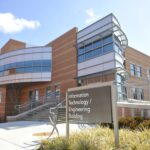
Images: The ITE building at UMBC (top), and Alejandra Diaz, left, with fellow Cyber Scholars (bottom). Header photo by Marlayna Demond ’11 for UMBC, and photo within story by Cindy Greenwood.
]]>
At a time when just 12 percent of information security analysts are black, Hispanic or Asian, and only 20 percent of information security analysts are women, successful student support programs...
https://umbc.edu/stories/umbcs-cyber-scholars-program-stands-out-as-a-national-model-in-diverse/
https://my3.my.umbc.edu/api/v0/pixel/news/120889/guest@my.umbc.edu/193469867bf98f6e526d8e8930ee7665/api/pixel
coeit
csee
cwit
cyberscholars
cybersecurity
diversityandinclusion
innovation
science-and-technology
UMBC News & Magazine
https://my3.my.umbc.edu/groups/umbc-news-magazine
https://assets1-my.umbc.edu/system/shared/avatars/groups/000/001/943/24435aa6207c452e7bc15cc74b42c7bb/xsmall.png?1748556657
https://assets1-my.umbc.edu/system/shared/avatars/groups/000/001/943/24435aa6207c452e7bc15cc74b42c7bb/original.png?1748556657
https://assets2-my.umbc.edu/system/shared/avatars/groups/000/001/943/24435aa6207c452e7bc15cc74b42c7bb/xxlarge.png?1748556657
https://assets2-my.umbc.edu/system/shared/avatars/groups/000/001/943/24435aa6207c452e7bc15cc74b42c7bb/xlarge.png?1748556657
https://assets3-my.umbc.edu/system/shared/avatars/groups/000/001/943/24435aa6207c452e7bc15cc74b42c7bb/large.png?1748556657
https://assets1-my.umbc.edu/system/shared/avatars/groups/000/001/943/24435aa6207c452e7bc15cc74b42c7bb/medium.png?1748556657
https://assets2-my.umbc.edu/system/shared/avatars/groups/000/001/943/24435aa6207c452e7bc15cc74b42c7bb/small.png?1748556657
https://assets1-my.umbc.edu/system/shared/avatars/groups/000/001/943/24435aa6207c452e7bc15cc74b42c7bb/xsmall.png?1748556657
https://assets2-my.umbc.edu/system/shared/avatars/groups/000/001/943/24435aa6207c452e7bc15cc74b42c7bb/xxsmall.png?1748556657
UMBC News & Magazine
0
0
false
Fri, 03 Feb 2017 18:54:43 -0500
Cybersecurity experts weigh in on securing the president’s smartphone and avoiding “cyber-fatigue”

With a new administration in the White House, securing the president’s smartphone is a national security priority, but exactly what steps are taken to secure the phone are not made public. In a new article in The Conversation, Anupam Joshi, professor and chair of computer science and electrical engineering, and director of the Center for Cybersecurity at UMBC, discusses several likely ways President Trump’s security team is building protections into his phone, through everything from hardware to settings to app restrictions.
Limiting the number of people who have the president’s new phone number and keeping the unique International Mobile Equipment Identity number guarded can prevent potential attackers from accessing confidential information stored on the phone. This method is called “security by obscurity,” says Joshi.
Joshi also says the device Trump will use was likely made by a trusted manufacturer with carefully created and checked parts, explaining that this minimizes the “risk that the hardware would have any vulnerabilities that an attacker could exploit.”
Customizing the operating system, and allowing the phone to connect only with predetermined networks that are regularly monitored can also help protect against attacks, says Joshi. “Limiting its contact with the internet would, of course, by key,” he notes, “though that would also significantly limit the phone’s usefulness to a president whose routine involves constant connection.” Joshi says that limiting the number of apps on the phone, reducing the ability for additional apps to be downloaded and installed, and disabling automatic updates to the phone could keep the device even more secure.
While it is not certain which methods have been employed to secure the presidential smartphone, Joshi says that Trump trading in his commercial-grade phone for a government-secured device is an important first step in protecting the U.S. from hacks and attacks.
In another article in The Conversation, Rick Forno, assistant director of the UMBC Center for Cybersecurity and director of the Cybersecurity Graduate Program at UMBC, addresses the importance of addressing both short-term and long-term cybersecurity issues. He explains that ignoring underlying problems and only addressing small, attention-grabbing issues does not lead to lasting progress.

“Cyber-fatigue,” explains Forno, is an “inability to think critically about what needs to happen for meaningful, lasting cybersecurity improvements while focusing only on near-term problems.”
He says that while it is important to evaluate the benefits, conveniences and savings that new products and services may offer, the potential risks and problems should be considered, too. “So instead of repeating the same guidelines and recommendations of the past, it’s time to take a new and unconventional look at our approach to technology and how we secure it,” Forno explains. “Unless we’re willing to go beyond our traditional cybersecurity ‘comfort zone’ and explore new solutions, our cyber-fatigue will worsen.”
Read “How to secure a smartphone for the tweeter-in-chief” and “Overcoming ‘cyber-fatigue’ requires users to step up for security” in The Conversation. Joshi’s piece also appeared in Mashable and Channel Newsasia, and together the articles have already been read over 36,000 times.
Images: Anupam Joshi (top), and Rick Forno (bottom). Photos by Marlayna Demond ’11 for UMBC.
]]>
With a new administration in the White House, securing the president’s smartphone is a national security priority, but exactly what steps are taken to secure the phone are not made public. In a...
https://umbc.edu/stories/cybersecurity-experts-weigh-in-on-securing-the-presidents-smartphone-and-avoiding-cyber-fatigue/
https://my3.my.umbc.edu/api/v0/pixel/news/120894/guest@my.umbc.edu/866b83d4b36d89aee4917a2fa2541bad/api/pixel
coeit
csee
cybersecurity
science-and-technology
UMBC News & Magazine
https://my3.my.umbc.edu/groups/umbc-news-magazine
https://assets1-my.umbc.edu/system/shared/avatars/groups/000/001/943/24435aa6207c452e7bc15cc74b42c7bb/xsmall.png?1748556657
https://assets1-my.umbc.edu/system/shared/avatars/groups/000/001/943/24435aa6207c452e7bc15cc74b42c7bb/original.png?1748556657
https://assets2-my.umbc.edu/system/shared/avatars/groups/000/001/943/24435aa6207c452e7bc15cc74b42c7bb/xxlarge.png?1748556657
https://assets2-my.umbc.edu/system/shared/avatars/groups/000/001/943/24435aa6207c452e7bc15cc74b42c7bb/xlarge.png?1748556657
https://assets3-my.umbc.edu/system/shared/avatars/groups/000/001/943/24435aa6207c452e7bc15cc74b42c7bb/large.png?1748556657
https://assets1-my.umbc.edu/system/shared/avatars/groups/000/001/943/24435aa6207c452e7bc15cc74b42c7bb/medium.png?1748556657
https://assets2-my.umbc.edu/system/shared/avatars/groups/000/001/943/24435aa6207c452e7bc15cc74b42c7bb/small.png?1748556657
https://assets1-my.umbc.edu/system/shared/avatars/groups/000/001/943/24435aa6207c452e7bc15cc74b42c7bb/xsmall.png?1748556657
https://assets2-my.umbc.edu/system/shared/avatars/groups/000/001/943/24435aa6207c452e7bc15cc74b42c7bb/xxsmall.png?1748556657
UMBC News & Magazine
0
0
false
Mon, 30 Jan 2017 14:45:27 -0500
UMBC cybersecurity instructor selected for prestigious Brookings Legis Congressional Fellows Program

Diana Parr, adjunct instructor for the Cybersecurity Graduate Program, has been selected to participate in the highly competitive Brookings Legis Congressional Fellows Program. The year-long program allows professionals in the public and private sectors to work on Capitol Hill alongside individual members of the U.S. Congress or on a congressional committee to understand the policy-making side of government.
 “I am most excited about the opportunity to work for a member of Congress and to learn how the legislative process flows. It will be a huge time for change on Capitol Hill—a new president and many newly elected officials. I would like to bring my technical knowledge to the Hill as those new officials discuss legislation relating to cybersecurity,” she said.
In addition to her role at UMBC, Parr is a cybersecurity technical leader for the National Security Agency. She anticipates that her work in Congress will focus on cybersecurity education.
“There are many opportunities for new legislation this year to make our nation stronger and safer,” Parr said. “My biggest hope is to build awareness of the need to grow educational opportunities for young people, especially young women, in the growing field of cybersecurity.”
Jeff Hayter ’09, political science and mathematics, has also been selected to participate in the Brookings Legis Congressional Fellows Program. He is currently a program analyst at the Bureau of International Information Programs, where he is a responsible for the strategic planning and resource oversight.

“I recognize this fellowship as a unique opportunity to peer behind the curtain of the legislative process. Very few people are afforded such a great learning opportunity,” Hayter said. “In addition to learning the ins-and-outs of policymaking, I hope to use to the fellowship to grow as a leader and broaden my expertise in foreign policy. To be honest, I’m not sure there has ever been a more interesting time to be on the Hill.”
During his time at UMBC, Hayter interned with the State Department. After graduation, he accepted a full-time position as a Freedom of Information Act Specialist with the State Department, where he worked until he moved to his current role at the Bureau of International Information Programs.
More information about the Brookings Legis Congressional Fellows Program can be found on the Brookings Institution website.
Header image by Robert Lyle Bolton, CC by 2.0. Parr’s headshot by Marlayna Demond ’11 for UMBC. Hayter’s headshot courtesy of Jeff Hayter.
]]>
Diana Parr, adjunct instructor for the Cybersecurity Graduate Program, has been selected to participate in the highly competitive Brookings Legis Congressional Fellows Program. The year-long...
https://umbc.edu/stories/umbc-cybersecurity-instructor-selected-for-prestigious-brookings-legis-congressional-fellows-program/
https://my3.my.umbc.edu/api/v0/pixel/news/120939/guest@my.umbc.edu/7735b1af7540b0f52c2118d76a42ed22/api/pixel
alumni
coeit
cybersecurity
mathstat
politicalscience
science-and-technology
UMBC News & Magazine
https://my3.my.umbc.edu/groups/umbc-news-magazine
https://assets1-my.umbc.edu/system/shared/avatars/groups/000/001/943/24435aa6207c452e7bc15cc74b42c7bb/xsmall.png?1748556657
https://assets1-my.umbc.edu/system/shared/avatars/groups/000/001/943/24435aa6207c452e7bc15cc74b42c7bb/original.png?1748556657
https://assets2-my.umbc.edu/system/shared/avatars/groups/000/001/943/24435aa6207c452e7bc15cc74b42c7bb/xxlarge.png?1748556657
https://assets2-my.umbc.edu/system/shared/avatars/groups/000/001/943/24435aa6207c452e7bc15cc74b42c7bb/xlarge.png?1748556657
https://assets3-my.umbc.edu/system/shared/avatars/groups/000/001/943/24435aa6207c452e7bc15cc74b42c7bb/large.png?1748556657
https://assets1-my.umbc.edu/system/shared/avatars/groups/000/001/943/24435aa6207c452e7bc15cc74b42c7bb/medium.png?1748556657
https://assets2-my.umbc.edu/system/shared/avatars/groups/000/001/943/24435aa6207c452e7bc15cc74b42c7bb/small.png?1748556657
https://assets1-my.umbc.edu/system/shared/avatars/groups/000/001/943/24435aa6207c452e7bc15cc74b42c7bb/xsmall.png?1748556657
https://assets2-my.umbc.edu/system/shared/avatars/groups/000/001/943/24435aa6207c452e7bc15cc74b42c7bb/xxsmall.png?1748556657
UMBC News & Magazine
0
0
false
Tue, 06 Dec 2016 16:31:13 -0500
UMBC voices discuss opportunities for today’s students in rapidly growing cybersecurity field

Responding to the rapid growth of the cybersecurity industry, including a steep uptick in the demand for qualified cybersecurity professionals, Lauren Mazzoli ‘15, computer science and mathematics, and Eric Conn ‘85, computer science, joined President Freeman Hrabowski for “Building the Cyber Workforce,” a livestreamed, interactive conversation hosted by Northrop Grumman.
The panelists discussed how to engage young students in cybersecurity, what cybersecurity professionals do day-to-day, and the importance of partnerships between academic institutions and industry leaders, to create internship and research opportunities for students. Mazzoli, a cyber software engineer at Northrop Grumman, decided to pursue a career in cybersecurity after she was required to take a computer science course as part of her math degree at UMBC. “I got over the intimidation factor and…[realized] it was okay that I didn’t know everything,” she said.
UMBC’s Cyber Scholars program supported Mazzoli through challenging courses, and helped her learn more about the industry, connecting her with experts from various areas of the cybersecurity industry as well as other students who shared her interest in the field. Mazzoli explained that she found it helpful to “get a little taste here and there” of different career pathways in the profession, “since cybersecurity is so big and so broad.” And once the door to the field was opened, she said, “I realized that I could do it if I worked hard enough.”
President Hrabowski firmly agreed. “Anyone can do math or computer science,” he said, arguing that educators need to push back against stereotypes about who succeeds in STEM if they are to effectively engage students from diverse backgrounds in cybersecurity. “We have to stop thinking ‘these kids are good at math and science, and these [students] are not’. We [at UMBC] use the word ‘grit’…It’s about how hard you are willing to work, to ask questions, to get involved, to get help.”
Hrabowski highlighted several ways that young students learn about computer science and other STEM areas at UMBC, including a Mind, Body & Coding summer camp for middle school girls. He noted, “starting in middle school and all the way up to graduate programs, you’ve got an ecosystem developing in Maryland, including teaching teachers in K-12 how to go about teaching these courses in computer science that can lead to cybersecurity”.
Conn, co-founder and CEO of the tech company Leverage, encouraged students and professionals at all levels to explore their interests in technology and shared that, ultimately the success of a company like his is all about the people. “I’ve been running software companies for 20 years, and software companies are driven by people,” he emphasized, noting that talented and driven employees are his largest investment, and he prioritizes ongoing training for them as his company grows.
That continuous professional growth is key, Mazzoli agreed: “in this growing field of cybersecurity…things change every single day.”
Watch the full panel discussion on the Northrop Grumman YouTube channel. Read “How to build ideal candidates for all those cybersecurity job openings” in The Christian Science Monitor.
Image: Lauren Mazzoli at UMBC in 2015. Photo by Marlayna Demond ’11 for UMBC.
]]>
Responding to the rapid growth of the cybersecurity industry, including a steep uptick in the demand for qualified cybersecurity professionals, Lauren Mazzoli ‘15, computer science and...
https://umbc.edu/stories/umbc-voices-discuss-opportunities-for-todays-students-in-rapidly-growing-cybersecurity-field/
https://my3.my.umbc.edu/api/v0/pixel/news/120969/guest@my.umbc.edu/0f0bdc8785560957a0a25f5ae4b598b7/api/pixel
alumni
coeit
csee
cyberscholars
cybersecurity
hrabowski
science-and-technology
UMBC News & Magazine
https://my3.my.umbc.edu/groups/umbc-news-magazine
https://assets1-my.umbc.edu/system/shared/avatars/groups/000/001/943/24435aa6207c452e7bc15cc74b42c7bb/xsmall.png?1748556657
https://assets1-my.umbc.edu/system/shared/avatars/groups/000/001/943/24435aa6207c452e7bc15cc74b42c7bb/original.png?1748556657
https://assets2-my.umbc.edu/system/shared/avatars/groups/000/001/943/24435aa6207c452e7bc15cc74b42c7bb/xxlarge.png?1748556657
https://assets2-my.umbc.edu/system/shared/avatars/groups/000/001/943/24435aa6207c452e7bc15cc74b42c7bb/xlarge.png?1748556657
https://assets3-my.umbc.edu/system/shared/avatars/groups/000/001/943/24435aa6207c452e7bc15cc74b42c7bb/large.png?1748556657
https://assets1-my.umbc.edu/system/shared/avatars/groups/000/001/943/24435aa6207c452e7bc15cc74b42c7bb/medium.png?1748556657
https://assets2-my.umbc.edu/system/shared/avatars/groups/000/001/943/24435aa6207c452e7bc15cc74b42c7bb/small.png?1748556657
https://assets1-my.umbc.edu/system/shared/avatars/groups/000/001/943/24435aa6207c452e7bc15cc74b42c7bb/xsmall.png?1748556657
https://assets2-my.umbc.edu/system/shared/avatars/groups/000/001/943/24435aa6207c452e7bc15cc74b42c7bb/xxsmall.png?1748556657
UMBC News & Magazine
0
0
false
Thu, 03 Nov 2016 17:42:21 -0400
Anupam Joshi offers advice on limiting risk with internet-connected devices after far-reaching cyberattack

Last week’s cyber attack interrupted internet use for millions of people, and while this particular attack is likely over, the possibility of future similar attacks remains. Anupam Joshi, professor and chair of computer science and electrical engineering, and director of the Center for Cybersecurity at UMBC, explained what took place during the attack, and his ongoing concerns for the future, in a live interview on Maryland Public Television on October 24.
“Tens of millions of devices across the world were taken over…and then they were used to send fake traffic to this address book…denying legitimate users access to the devices’ services,” Joshi said of the attack.
Imagine you are in a grocery story, he explained. The recent cyber attack is like a flood of people going to the grocery store, asking the cashier to check the price of an item, and then leaving the store without purchasing the item, tying up the system and making it impossible for you to purchase what you came to buy in the store. In the cyber world, this is called the “distributed denial of service,” noted Joshi.
Attacks of this nature can affect systems that rely on the internet to work properly and deliver certain services, such as cameras that monitor homes. “Increasingly, computing is embedding itself into our day-to-day lives,” he said, adding that cyber-physical systems like the power grid, driverless cars, and smart cities are all potentially subject to these kinds of attacks.
To minimize risk, consumers should be aware of and maintain control over their devices’ internet connectivity. “People should know that these kinds of devices have logins and passwords, and, of course, change them,” said Joshi.
Watch the full video segment on Maryland Public Television’s Direct Connection.
]]>
Last week’s cyber attack interrupted internet use for millions of people, and while this particular attack is likely over, the possibility of future similar attacks remains. Anupam Joshi,...
https://umbc.edu/stories/anupam-joshi-offers-advice-on-limiting-risk-with-internet-connected-devices-after-far-reaching-cyberattack/
https://my3.my.umbc.edu/api/v0/pixel/news/120974/guest@my.umbc.edu/36352dba5559feca1b67e2e6b044a68f/api/pixel
coeit
csee
cybersecurity
science-and-technology
UMBC News & Magazine
https://my3.my.umbc.edu/groups/umbc-news-magazine
https://assets1-my.umbc.edu/system/shared/avatars/groups/000/001/943/24435aa6207c452e7bc15cc74b42c7bb/xsmall.png?1748556657
https://assets1-my.umbc.edu/system/shared/avatars/groups/000/001/943/24435aa6207c452e7bc15cc74b42c7bb/original.png?1748556657
https://assets2-my.umbc.edu/system/shared/avatars/groups/000/001/943/24435aa6207c452e7bc15cc74b42c7bb/xxlarge.png?1748556657
https://assets2-my.umbc.edu/system/shared/avatars/groups/000/001/943/24435aa6207c452e7bc15cc74b42c7bb/xlarge.png?1748556657
https://assets3-my.umbc.edu/system/shared/avatars/groups/000/001/943/24435aa6207c452e7bc15cc74b42c7bb/large.png?1748556657
https://assets1-my.umbc.edu/system/shared/avatars/groups/000/001/943/24435aa6207c452e7bc15cc74b42c7bb/medium.png?1748556657
https://assets2-my.umbc.edu/system/shared/avatars/groups/000/001/943/24435aa6207c452e7bc15cc74b42c7bb/small.png?1748556657
https://assets1-my.umbc.edu/system/shared/avatars/groups/000/001/943/24435aa6207c452e7bc15cc74b42c7bb/xsmall.png?1748556657
https://assets2-my.umbc.edu/system/shared/avatars/groups/000/001/943/24435aa6207c452e7bc15cc74b42c7bb/xxsmall.png?1748556657
UMBC News & Magazine
0
0
false
Wed, 26 Oct 2016 18:49:40 -0400
HackUMBC inspires students to create fresh technical solutions in whirlwind 24-hour hackathon

Nearly 500 students from UMBC and colleges across the region gathered on campus for HackUMBC 2016, a 24-hour hackathon for students to develop technological solutions (“hacks”) to problems that matter to them. The event enables students, both with and without coding experience, to work on innovative projects independently and collaboratively, to network and expand their skills, and to learn directly from leaders in the industry.
“I was completely blown away by how many people came out not only from UMBC but schools from across the East Coast. Seeing how much HackUMBC has grown and is continuing to grow is an overwhelming feeling that continues to leave me in awe year after year,” said Celeste Wong ‘18, computer science and social work, a HackUMBC co-organizer.
Participating student teams submitted 71 hacks at the end of the event. Twelve hacks received awards from the HackUMBC organization and from sponsors.
The award-winning app Parking Pronto was designed to help users find parking spots on campus through crowdsourcing, showing available spots based on permit type. Another app, Beige, won the award for the “Best Hack Against Online Harassment.” This app automatically blocks from a Twitter user’s view those accounts that post a certain number of “user-defined trigger words.”
Katherine Gibson ’08, computer science, and John Park, both lecturers of CSEE, and Rick Forno, assistant director of the UMBC Center for Cybersecurity, director of the Cybersecurity Graduate Program at UMBC, and faculty advisor to HackUMBC student organization, served as judges.
“Now in its fourth year, HackUMBC continues to grow in standing and regional attraction,” said Forno. “It’s always an awesome feeling to see the amazing intellectual energy and technical results these students—novices and experts alike—generate at this prominent, intense, around-the-clock campus event.”
In addition to becoming a very popular regional event, HackUMBC is gaining steam on a larger scale. The official student hackathon league Major League Hacking recently released standings for the North American Spring 2016 season, listing UMBC as eighth out of 47 schools. Wong explained that while the ranking shows HackUMBC has become a popular event with students, it also shows that the university’s “hackathon community is representing UMBC well across North America.”
For more information about the entries and winners of HackUMBC 2016, visit the HackUMBC website.
Logo courtesy of HackUMBC.
]]>
Nearly 500 students from UMBC and colleges across the region gathered on campus for HackUMBC 2016, a 24-hour hackathon for students to develop technological solutions (“hacks”) to problems that...
https://umbc.edu/stories/hackumbc-inspires-students-to-create-fresh-technical-solutions-in-whirlwind-24-hour-hackathon/
https://my3.my.umbc.edu/api/v0/pixel/news/120982/guest@my.umbc.edu/3ed614f37685a51e80dfc8faad5e3081/api/pixel
cfr
coeit
community
csee
cybersecurity
science-and-technology
socialwork
UMBC News & Magazine
https://my3.my.umbc.edu/groups/umbc-news-magazine
https://assets1-my.umbc.edu/system/shared/avatars/groups/000/001/943/24435aa6207c452e7bc15cc74b42c7bb/xsmall.png?1748556657
https://assets1-my.umbc.edu/system/shared/avatars/groups/000/001/943/24435aa6207c452e7bc15cc74b42c7bb/original.png?1748556657
https://assets2-my.umbc.edu/system/shared/avatars/groups/000/001/943/24435aa6207c452e7bc15cc74b42c7bb/xxlarge.png?1748556657
https://assets2-my.umbc.edu/system/shared/avatars/groups/000/001/943/24435aa6207c452e7bc15cc74b42c7bb/xlarge.png?1748556657
https://assets3-my.umbc.edu/system/shared/avatars/groups/000/001/943/24435aa6207c452e7bc15cc74b42c7bb/large.png?1748556657
https://assets1-my.umbc.edu/system/shared/avatars/groups/000/001/943/24435aa6207c452e7bc15cc74b42c7bb/medium.png?1748556657
https://assets2-my.umbc.edu/system/shared/avatars/groups/000/001/943/24435aa6207c452e7bc15cc74b42c7bb/small.png?1748556657
https://assets1-my.umbc.edu/system/shared/avatars/groups/000/001/943/24435aa6207c452e7bc15cc74b42c7bb/xsmall.png?1748556657
https://assets2-my.umbc.edu/system/shared/avatars/groups/000/001/943/24435aa6207c452e7bc15cc74b42c7bb/xxsmall.png?1748556657
UMBC News & Magazine
0
0
false
Tue, 18 Oct 2016 14:44:30 -0400

