There’s No Such Thing As Small Politics
As election season heats up and campaign posters begin to cram our sidewalks, the public eye is often drawn to government leaders. In UMBC’s own community, you’ll find alumni serving in impressive positions, including state legislators and the speaker of Maryland’s House of Delegates, a county executive, and even the surgeon general of the U.S.
But beyond the red, white, and blue banners are folks who contribute to the system in quieter—but just as vital—ways. Students learning to be engaged citizens, professionals protecting our census and voting data, artists finding ways of illustrating complex ideas, and more—Retrievers are proving that when it comes to democracy, every voice really does count.
Peek Behind the Scenes
Most of the work at all levels of government happens beyond public view. Matt Clark ’00, history, and Yaakov “Jake” Weissmann ’06, social work, know this firsthand. Clark served as chief of staff to Maryland Governor Larry Hogan while Weissmann is chief of staff to Maryland Senate President Bill Ferguson.
Both agree that the behind-the-scenes nature of their roles helps them get things done. Clark explains that “if you are doing it right, politics and public policy are all about compromise and patience” and that you need to “build coalitions and trust with others to move your agenda forward.” Weissmann emphasizes the importance of relationships, noting that his social work major has aided his work in Annapolis.
Public service is “at its core a people business,” Weissmann says. Jim Bembry, associate professor of social work, taught him that: “You need to be where your clients are”—words he says help him understand what senators and their constituents need and how to help fill those needs.
Clark says his undergraduate history studies taught him “how to blend multiple points of view to construct your own ideas and perspectives,” a helpful skill for both the political and public policy aspects of his job. Clark adds that his ongoing public policy graduate studies at UMBC “help [him] to think about how theoretical concepts and actual policy-making interact.”
Clark explains that “not all public service [jobs involve] politics,” but rather “public service is about choosing to look beyond your own needs to serve your community.” Weissmann agrees, noting that the General Assembly consists of people “who all want to make a difference,” he says, and Maryland’s legislature is an example of “how government is supposed to function.”
UMBC is well-represented in Annapolis, and both Clark and Weissmann interact with fellow alumni—including each other—on a regular basis. Clark attributes the prevalence of Retrievers in public service as “a testament to the quality of the University as well as the values and grittiness that we pick up there.” Weissmann agrees, sharing “UMBC is where I fell in love with the General Assembly” as part of a student group that met with legislators about and testified against proposed tuition increases.
Clark advises fellow Retrievers who want to pursue a career in public services to “put your heart into the work and believe in what you are doing,” noting that “it can take years to see the fruits of your labor, but it’s well worth the wait.”
— Mary Ann Richmond ’93
Predictive Polling
As the November elections draw near, we are flooded with polls anxious to tally how we will vote. But, have you ever wondered about the science behind these polls? Designing surveys to help understand American voting behavior is what gets Ian Anson out of bed and excited for the day.
During the 2018 midterm primaries, Anson, a professor of political science, saw an opportunity for his voting and polling class. Thus the 2018 UMBC Retriever Exit Poll was created.
“I wanted to expose my students to the real-life experience of tapping into the mind of the public and figuring out what the public thinks, and how they react to political stimuli,” says Anson.
The class created a 34-question, voluntary, anonymous, and scientific exit poll. Questions covered the Maryland economy, voting behavior along party lines, the state income tax, and switching party lines for specific items. On a rainy mid-term Election Day, 25 undergraduate students, wearing UMBC Political Science T-shirts, stationed themselves in eight precincts across Baltimore County in four-hour shifts. They organized and coded the answers on-site.
At the end of the day, Anson processed the data. Everyone gathered at UMBC’s Election Night Extravaganza where they presented their data and correctly predicted Governor Hogan would be reelected. The students gained insight into the voting behavior of Maryland Democrats who voted for a Republican governor and the issues that concerned them.
“We left the bubble of campus to see how real voters act and think instead of just reading and writing about them,” says Samuel Deschenaux ’20, political science, now a legislative aide in the Maryland General Assembly for state Sen. Kathy Klausmeier. Anson looks forward to the next Retriever Exit Poll this fall.
— Catalina Sofia Dansberger Duque
Outsmarting the Hackers
During election years, if there’s one thing scrutinized more than the candidates themselves, it’s the security of electronic voting machines. Because this technology can be susceptible to hacks and other vulnerabilities, it is incredibly important to know how best to keep voting safe and accessible for all.
Enter Rick Carback ’05, M.S. ’08, Ph.D. ’10, computer science, who has spent his career deflecting would-be hackers, and who helped develop Scantegrity, a technology that since 2007 has influenced improvements to election systems nationwide. At UMBC, he worked alongside and was mentored by Alan Sherman, professor of computer science and electrical engineering.
As an undergraduate at UMBC, Carback first heard David Chaum, a cryptographer known for his work on privacy-centered technology, talk about the security of voting machines and the voting technology that he was working on. Carback approached Chaum after the event and expressed his interest in being involved with the building of the technology that Chaum had discussed. From there, a lifelong interest in security took off.
First tested with student elections at the University of Ottawa and later broadened to handle higher stakes cases, Scantegrity connects each submitted vote with a confirmation number so that people can make sure their votes were counted. It helps verify election ballots submitted and allows individuals to essentially audit the election— while protecting individuals’ data.
Carback’s work also takes accessibility into account. The initial version of Scantegrity included ballot marking systems, which can make voting easier for people with disabilities. The ballot marking system used invisible ink that would not show up outside the official voting space on the ballots. With this system, the machine would only count a vote based on where the ink is most dense on the ballot, Carback explains.
“I view [voting security] as a national security issue,” says Carbeck, who also does computer security, risk assessment, and software development from Boston. “If you can control an election, you can then you can direct the entire course of a country.”
— Megan Hanks Mastrola
Stories Are Everything
In grade school, we learn about the importance of voting. At UMBC, we learn that civic life can really mean much more. It is a mindset, strengthened by places and relationships, to empower change at big and small levels. And the Civic Courage Journaling Project, launched last year by UMBC’s Center for Democracy and Civic Life, is helping students imagine exactly what that might mean on an individual basis.
-
 Art courtesy of Tess McRae ’21.


“We give them a way to really see themselves without all of the kind of filters that are placed on you when you’re under so much pressure and when you have all these different tensions,” says Tess McRae, a junior English major who both participates and shares prompts with the group. Members respond in visuals as well as with words. Then, they all circle up to discuss and discover.
“People don’t realize that we talk about civic life everywhere, even in our day-to-day interactions, even in the conversations that we have with each other, even in spaces where we didn’t realize,” says McRae, who personally prefers using muted highlighters in her drawings. “We kind of give people a space to just really be authentic and honorable about their stories. It’s wonderful.”
— Jenny O’Grady
Safety in Numbers
Every 10 years, the U.S. Census Bureau conducts a massive survey to answer one question: Who lives in the United States? The results inform federal funding allocations for things like schools and parks and determine the number of congressional representatives for each state. The raw data are also used by researchers all over the country, whose findings can inform decisions at the state and local level about medical services, urban planning, job training programs, and so much more.
Analyzing all that data—consisting largely of personal information about members of communities across the U.S.—can lead to a lot of good, so it’s important that researchers can access it. But even with obvious identifying information like names, addresses, and social security numbers removed, it still wouldn’t be hard for skilled hackers to identify some people using the remaining information, putting them at high risk for identity theft. That’s why Bimal Sinha, professor of mathematics and statistics at UMBC, has been working with the Center for Statistical Research and Methodology at the U.S. Census Bureau for the last seven years to help safeguard people’s information.
It turns out the “raw data” the Census Bureau delivers to researchers doesn’t exactly match the real data. “Before releasing the data, some sensitive items are changed,” Sinha explains. That can include numeric responses, such as salary, or categorical ones, like whether a person owns a car and what type. The process of changing the data is called perturbation,” and the techniques used depend on the kind of data.
The tricky part is that the “perturbed” version of the data still has to accurately reflect reality in the country. Change it too much or in the wrong ways, and it becomes useless. “It’s a balance between perturbation and utility,” Sinha says. As a statistician, it’s Sinha’s job to develop techniques to change the data in ways that protect people’s privacy but don’t render it unusable.
Once that’s been done, it’s also critical to help researchers analyze the data effectively. The method for analyzing a perturbed dataset is different than for a standard data set. So Sinha also helps develop a toolkit that researchers receive with the census data.
Overall, Sinha’s work allows researchers, state and local governments, non-profits, and others nationwide to make use of the largest dataset about humanity in the United States, without compromising people’s privacy or safety.
— Sarah Hansen, M.S. ’15
Walking the Walk
We all know the importance of getting an internship—real-world experience, networking opportunities, a chance to confirm you’re on the right career path. For these UMBC students, it was also the opportunity to see the inner workings of the political realm as they embarked on semester-long internships with Maryland delegates.
You might think a legislative internship would be all work and no play, but that’s not always the case. One day when Wangui Nganga ’22, global studies, was answering phones in Del. Mike Griffith’s office, she got a bit of a surprise on the other end of the line.
“I heard ‘hello’…and they proceeded to tell me a joke and hung up,” she remembers. “I told my coworker I thought I was prank called by a constituent, but she started laughing and said it was her. This was one of my favorite moments because it showed that people don’t take everything super seriously.”
Nganga’s involvement as a research assistant for a professor in UMBC’s School of Public Policy and speaker of UMBC’s Student Government Association prepared her to do the research necessary to succeed in her internship. The environment itself is welcoming and understands that the purpose of everyone’s work, regardless of political affiliation, is to improve the lives of Marylanders.
Through the Maryland General Assembly Internship Program, Matthew Harrington ’20, political science, had the chance to explore his passions even further.
“I chose to work for Del. Julie Palakovich Carr because she sits on the Ways and Means Committee, which deals with tax policy, which is my policy area of interest,” says Harrington.
In his short time there, Harrington had the opportunity to present a bill about reforming zone programs in the Ways and Means Committee on behalf of his delegate. In addition to the numerous hands-on ways he’s able to be part of the process, Harrington also notes that the free food at Annapolis receptions doesn’t hurt either.
— Kait McCaffrey
Seeing Is Believing
Many of us have trouble digesting straight numbers. And for every hour a journalist might put into clearly explaining a complex topic in a story, an accompanying image can either support or derail that work for the reader in a matter of seconds.
That’s where Christina Animashaun ’13, visual arts and media and communication studies, comes in. As a data journalist for places like Vox, and formerly Politico and The Washington Post, she marries art and data to make the big numbers tangible.
It often starts with a simple question, says Animashaun, who grew up watching the evening news and reading comics before coming to UMBC as a Linehan Artist Scholar.
“A lot of times we have a lot of ideas, and in order to turn them into something tangible—art, or an article—you really have to be able to hone in one question. One big idea.” In the case of a recent major news topic like coronavirus, for example, that might mean drilling through dozens of numbers to help quantify a question like “What do I need to be safe?” Animashaun has made some equally beautiful and scary coronavirus charts recently but also loves to layer archival photographs in fun and surprising ways.
Of course, with great power comes great responsibility. Because Animashaun understands just how much a color or shape choice can sway opinions, she does everything she can to stay as neutral and accurate as possible and bring an ethical point of view to her work.
“You’re not going to see any pinks from me,” she says. “And if it’s blue, it’s going to be a partisan blue.”
— Jenny O’Grady
*****
Illustrations by Christina Animashaun ’13.
]]>
As election season heats up and campaign posters begin to cram our sidewalks, the public eye is often drawn to government leaders. In UMBC’s own community, you’ll find alumni serving in impressive...
https://umbc.edu/stories/theres-no-such-thing-as-small-politics/
https://my3.my.umbc.edu/api/v0/pixel/news/119870/guest@my.umbc.edu/c1a6937c9e9bb4851097f755f5c0963b/api/pixel
feature
impact
polisci
spring-2020
umbctogether
UMBC News & Magazine
https://my3.my.umbc.edu/groups/umbc-news-magazine
https://assets1-my.umbc.edu/system/shared/avatars/groups/000/001/943/24435aa6207c452e7bc15cc74b42c7bb/xsmall.png?1748556657
https://assets1-my.umbc.edu/system/shared/avatars/groups/000/001/943/24435aa6207c452e7bc15cc74b42c7bb/original.png?1748556657
https://assets2-my.umbc.edu/system/shared/avatars/groups/000/001/943/24435aa6207c452e7bc15cc74b42c7bb/xxlarge.png?1748556657
https://assets2-my.umbc.edu/system/shared/avatars/groups/000/001/943/24435aa6207c452e7bc15cc74b42c7bb/xlarge.png?1748556657
https://assets3-my.umbc.edu/system/shared/avatars/groups/000/001/943/24435aa6207c452e7bc15cc74b42c7bb/large.png?1748556657
https://assets1-my.umbc.edu/system/shared/avatars/groups/000/001/943/24435aa6207c452e7bc15cc74b42c7bb/medium.png?1748556657
https://assets2-my.umbc.edu/system/shared/avatars/groups/000/001/943/24435aa6207c452e7bc15cc74b42c7bb/small.png?1748556657
https://assets1-my.umbc.edu/system/shared/avatars/groups/000/001/943/24435aa6207c452e7bc15cc74b42c7bb/xsmall.png?1748556657
https://assets2-my.umbc.edu/system/shared/avatars/groups/000/001/943/24435aa6207c452e7bc15cc74b42c7bb/xxsmall.png?1748556657
UMBC News & Magazine
0
0
false
Fri, 29 May 2020 21:39:01 -0400
A Day in the Life of a Student Teacher

“In the Sherman STEM Teacher Scholars Program, we drive home two points. One: we teach children. Two: children are people. It sounds simple, but we tend to forget that children are younger versions of us. Sometimes in a “STEM” program, we become fixated on the math or biology, when what belongs at the center of all we do is the students.” — Rehana Shafi, director, Sherman STEM Teacher Scholars Program
Lydia Coley ’20, American studies, has started a new adventure this semester. Twice a week she wakes up by 5:30 a.m., crosses Baltimore City from north to south, and arrives at Maree G. Farring Elementary/Middle School by 7 a.m. to do what she has been preparing for over the last three years—be a student-teacher. As a scholar in the Sherman STEM program, Coley is among a group of future mathematics and science teachers who will eventually work throughout the Baltimore region and across the state, focusing on high-need schools.
She listens, observes, supports, and learns from her mentor teacher. Sometimes, this means she’s in the front of the classroom or leading small groups as she begins to transition into next semester’s role as a full-time lead student teacher. But what we found when UMBC Magazine followed Coley for a day, was not a student but a natural leader.
Coley smiles at the beginning of the day and enthusiastically welcomes each of the 90 students she is there to support. “This is a collaborative effort. I am here to learn from my mentor and to support students, but really most of the learning comes from what students are willing to share with me. They are also my teachers.”

It is 7 a.m. and Lydia Coley, a first-semester student teacher at Maree G. Farring Elementary/Middle School smiles at her day ahead. Her duties include supporting students while her mentor teacher leads lessons and, when possible, Coley leads parts of the lesson in small groups.
Coley runs into her mentor teacher, Theresa Frey, who has been teaching for 19 years. They take a few minutes to review the day and head in to prepare.

Coley signs in at the office and makes her way to her classroom. Maree G. Farring is 23% English language learners. Many students’ first language is Spanish.
It’s preparation time! Coley finalizes the details as she changes the date and takes note of the objective for the day. The cactus theme of the classroom encourages students with signs like “Looking Sharp” and “We Are on Point.” Coley’s classroom has about 30 students in each of the three blocks throughout the day. She helps the first block by putting all the chairs down for them because soon the students will come in with breakfast baskets and books in hand.

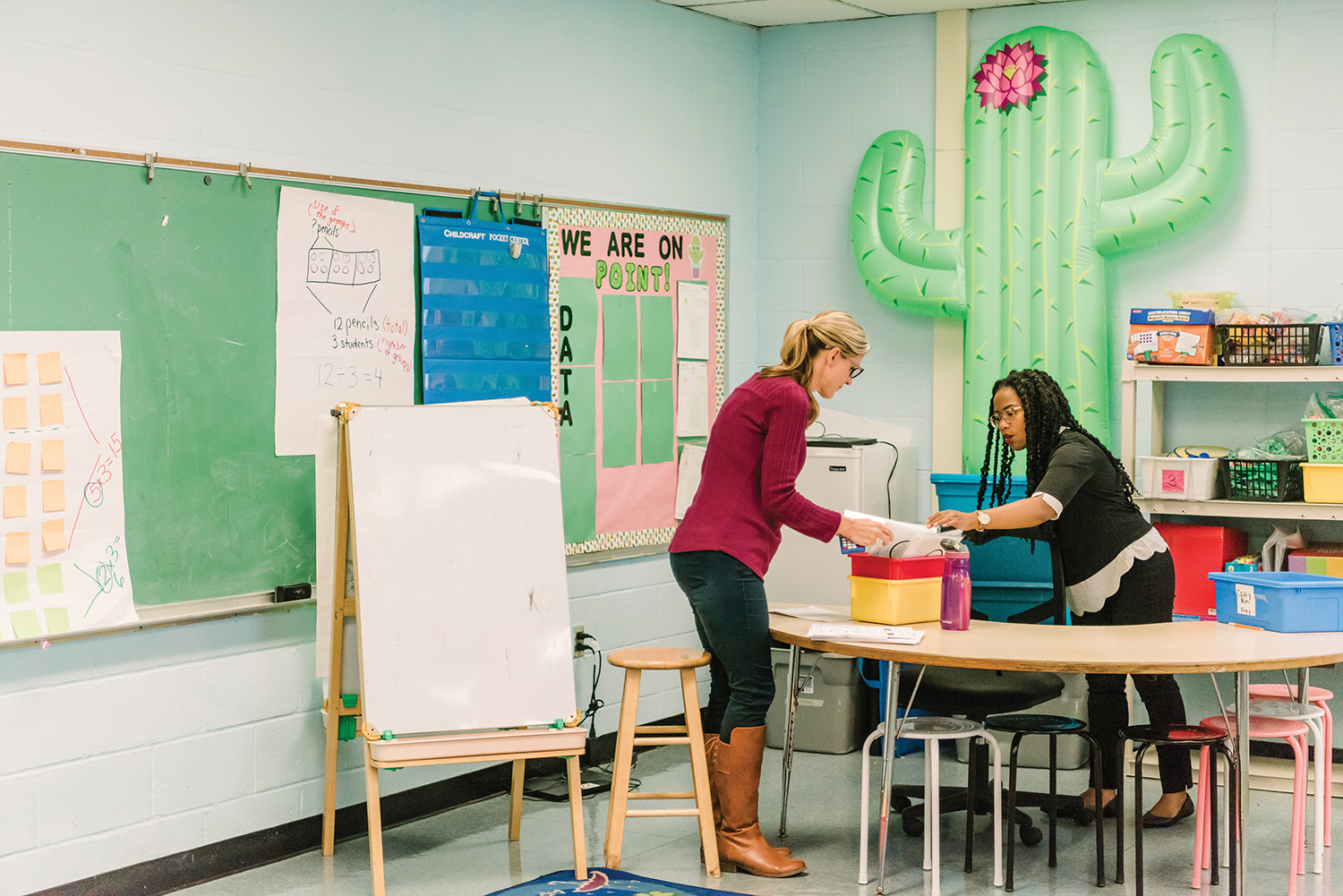
The day starts quickly. Frey and Coley go over the materials for today’s lesson—telling time counting by fives and a number line. Every minute literally counts!
Students begin to arrive but there is no time to waste. Coley goes over last night’s homework with a student while she finishes her breakfast. One-on-one time is precious and Coley is happy to provide it. She is also passionate about students eating fresh food as she studies the correlation between nutrition and academic behavior. She wants them to have time to eat so they also have time to think.

Coley leads the students through some critical thinking about how a clock ties into multiplication and number lines. Students compare answers and discuss the possible options by using their own clocks.
It’s time to delve deeper. Coley engages students to identify parts of a clock and determine the correct time using a variety of strategies. When she asks what time is shown on the clock (2:30 p.m.) one student smartly calls out “dismissal time!” The rest of the students show their work on whiteboards and raise them for a quick check.
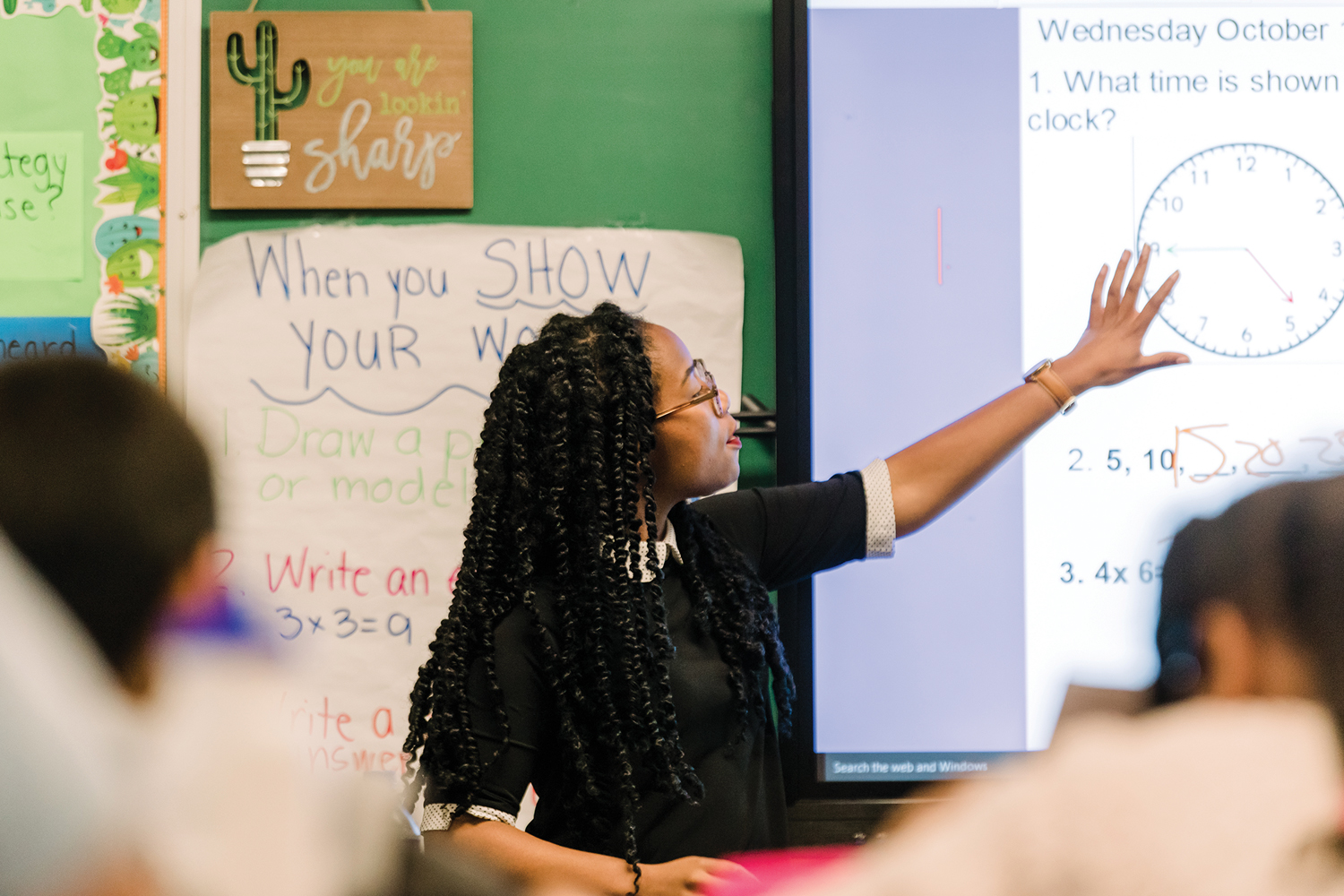

Coley becomes a student as she quietly observes her mentor teacher think out loud about the various ways to solve a word problem. “I became a teacher because I love learning. The classroom is full of ideas. It’s not only a place for academics but a place to build empathy,” she explains. “It is important for students to experience someone that respects, supports, and has a positive influence over them.” Coley looks forward to transitioning into a lead student teacher for third-grade mathematics and sixth-grade social science in the spring.

Each student requires a different type of support. Coley takes time to help a student think through the connection between her diagram and her multiplication process. “One of the greatest challenges in teaching math is that many students don’t feel they are good at math,” she explains. “It is my job to help them believe in themselves by showing them how these skills are connected to their lives.”
The first block of math is done. Students follow Coley to computer science for more applied math. Two more 90-minute blocks of math follow with two other classes of students to support before calling it a day.

The bell rings. It’s 2:30 p.m. and raining but students don’t mind. It is time to head home. Coley helps a student keep their hood on as they rush out the door. Teachers and students share smiles all around.

Quiet fills the classrooms and the hallways. It is the perfect time to catch up with a fellow alumna, Olivia Grimes ’19, individualized study and early childhood education, a first-year teacher at MGF. They exchange stories and Grimes gives advice on how to adjust to the full-time workload when Coley comes back in the spring.
It’s 3:15 p.m. and the day is done. Grimes and Coley head home with thoughts of equations, stories, and fun ways to educate their students tomorrow.

*****

Since its inception 12 years ago, the Sherman STEM Teaching Scholars Program has supported more than 150 students in becoming culturally responsive and compassionate STEM educators by collaborating with UMBC faculty and local, high-need schools. Currently, nine students and 13 alumni of the program are leading and learning in zip codes across Baltimore City.
All photos by Marlayna Demond ’11.
]]>
“In the Sherman STEM Teacher Scholars Program, we drive home two points. One: we teach children. Two: children are people. It sounds simple, but we tend to forget that children are younger...
https://umbc.edu/stories/a-day-in-the-life-of-a-student-teacher/
https://my3.my.umbc.edu/api/v0/pixel/news/119976/guest@my.umbc.edu/ad81663bbec19b26539af52c31c37913/api/pixel
cahss
discovery
fall-2019
feature
sherman-stem-teacher-scholars-program
shermanscholars
UMBC News & Magazine
https://my3.my.umbc.edu/groups/umbc-news-magazine
https://assets1-my.umbc.edu/system/shared/avatars/groups/000/001/943/24435aa6207c452e7bc15cc74b42c7bb/xsmall.png?1748556657
https://assets1-my.umbc.edu/system/shared/avatars/groups/000/001/943/24435aa6207c452e7bc15cc74b42c7bb/original.png?1748556657
https://assets2-my.umbc.edu/system/shared/avatars/groups/000/001/943/24435aa6207c452e7bc15cc74b42c7bb/xxlarge.png?1748556657
https://assets2-my.umbc.edu/system/shared/avatars/groups/000/001/943/24435aa6207c452e7bc15cc74b42c7bb/xlarge.png?1748556657
https://assets3-my.umbc.edu/system/shared/avatars/groups/000/001/943/24435aa6207c452e7bc15cc74b42c7bb/large.png?1748556657
https://assets1-my.umbc.edu/system/shared/avatars/groups/000/001/943/24435aa6207c452e7bc15cc74b42c7bb/medium.png?1748556657
https://assets2-my.umbc.edu/system/shared/avatars/groups/000/001/943/24435aa6207c452e7bc15cc74b42c7bb/small.png?1748556657
https://assets1-my.umbc.edu/system/shared/avatars/groups/000/001/943/24435aa6207c452e7bc15cc74b42c7bb/xsmall.png?1748556657
https://assets2-my.umbc.edu/system/shared/avatars/groups/000/001/943/24435aa6207c452e7bc15cc74b42c7bb/xxsmall.png?1748556657
UMBC News & Magazine
0
0
false
Tue, 07 Jan 2020 18:35:23 -0500
Climate Shift
From Eritrea to UMBC, this physicist is cultivating a diverse generation of climate scientists.
It’s a nearly cloudless afternoon at UMBC in early October. A group of physics students and their two faculty advisors, Belay Demoz and Ruben Delgado, make their way to the roof of the physics building to continue their conversation about atmospheric research. Earlier, gathered in a small, dimmed lecture hall, the students engaged their advisors and each other in robust discussions about their research while practicing their presentation skills.
In that session, Amanze Ejiogu ’22, physics, had the chance to explain his findings on the Bay Breeze. Rather than an adult beverage, it refers to breezes coming in off the Chesapeake Bay that redirect back to land air masses (and the pollutants they contain) that would otherwise blow offshore.
The Bay Breeze effect is a complicated phenomenon. Many factors contribute to it, from precipitation to wind speed to the overall quality of the air. Understanding it is a multidisciplinary effort, requiring chemistry, fluid dynamics, statistics, and meteorology skills. That’s exactly the kind of challenge that Demoz, physics professor and director of UMBC’s Joint Center for Earth Systems Technology (JCET), likes to help his students tackle.
After Ejiogu’s presentation, Demoz asks questions. His elbow leaning casually against a railing, he breaks into a grin—he is in his element. Of a certain result, he asks, “Is that expected?” And a minute later, “That’s for you to figure out,” his Eritrean accent inflecting his speech.
 Demoz regularly engages his students in robust discussions about their research. Photo by Marlayna Demond ’11.
Climate change and other environmental issues like air and water quality disproportionately affect people of color. Today, Demoz sees his role at UMBC as empowering students, especially students from underrepresented backgrounds, to take ownership of their research and contribute to their communities. Eventually, he hopes his graduates will also become mentors and advocates for their own students and colleagues—behaviors he models for them every day.
This wasn’t always Demoz’s idea of what his life’s work would be. After a challenging childhood in what is now the East African country of Eritrea, Demoz came to the United States for graduate school in the 1980s. His original goal was to learn how to seed clouds—to bring rain to his drought-stricken homeland. He’s still doing climate research, but his focus has shifted. His experiences as a youth in Eritrea and his years as an African in the United States have shaped who he has become and what he seeks to achieve.
Graduates from all backgrounds have left Demoz’s lab and taken roles at places like NASA, the National Oceanic and Atmospheric Administration (NOAA), the Environmental Protection Agency (EPA), and other research institutions. These alumni create a ripple effect that will continue to enhance diversity in atmospheric research and answer questions that have the potential to change the lives of people around the globe, in part because of Belay Demoz.
Maurice Roots, a graduate student in atmospheric physics, has already felt the effects of Demoz’s efforts. Roots, who graduated from Hampton University, only applied to UMBC for graduate school because Demoz approached him at a conference. “Belay has a great set of stories to tell,” Roots says. “His journey shows that perseverance is possible.”
A changing homeland
“It’s where the desert and the green are always fighting.”
That’s how Demoz describes the location of Eritrea. It’s a small African country on the Red Sea, sandwiched between Sudan and Ethiopia, right where the Sahara Desert and the jungles of central Africa meet. Many people there are subsistence farmers, including generations of the physicist’s family.
It used to be that when drought or floods hit, Eritrean farmers moved to where the grass was literally greener. But that changed after their land was colonized by the Italians and later the British. Strict political borders limited movement. “Once you put a wall, that valve of mitigating drought disappears,” Demoz says.
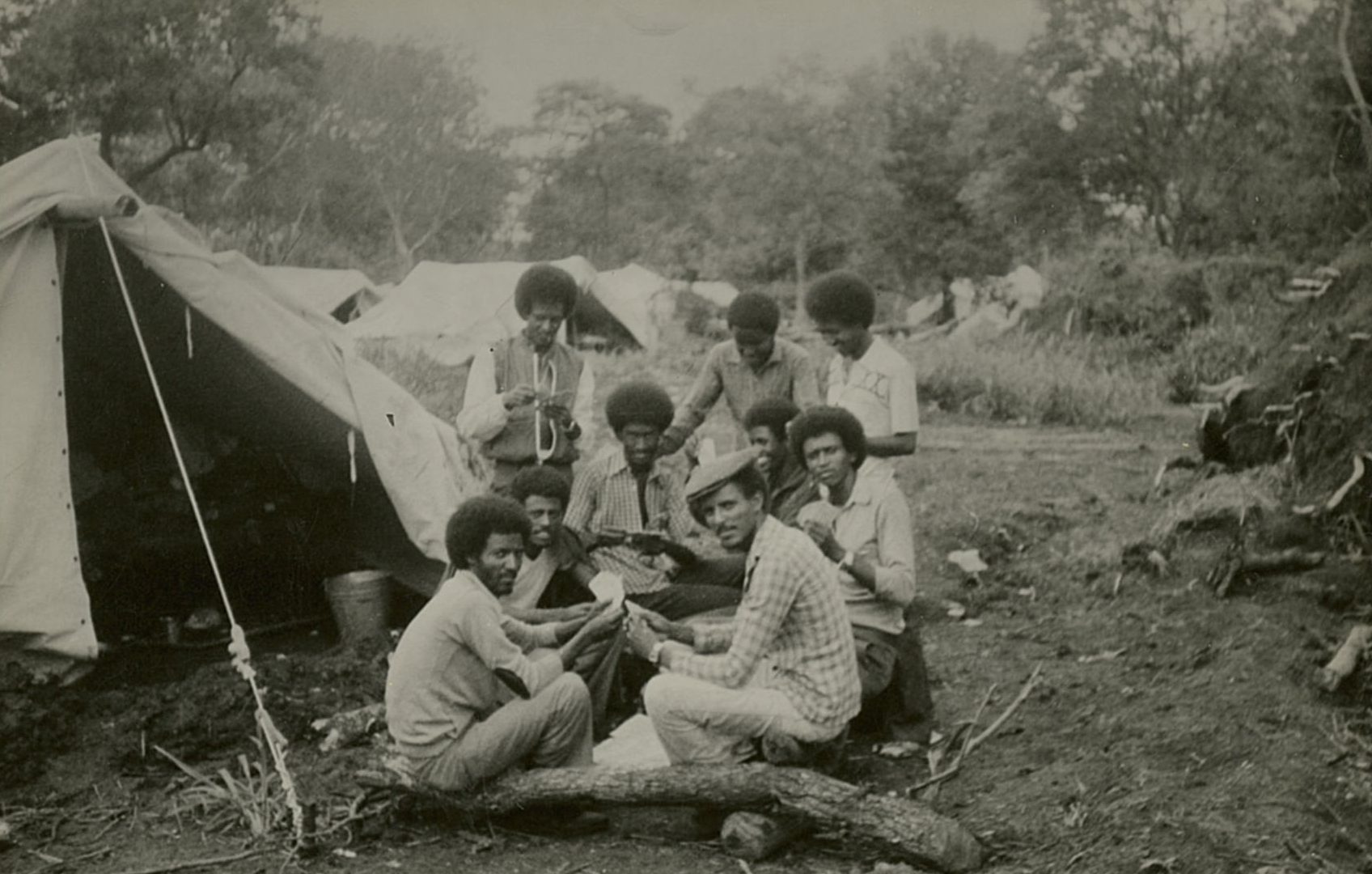
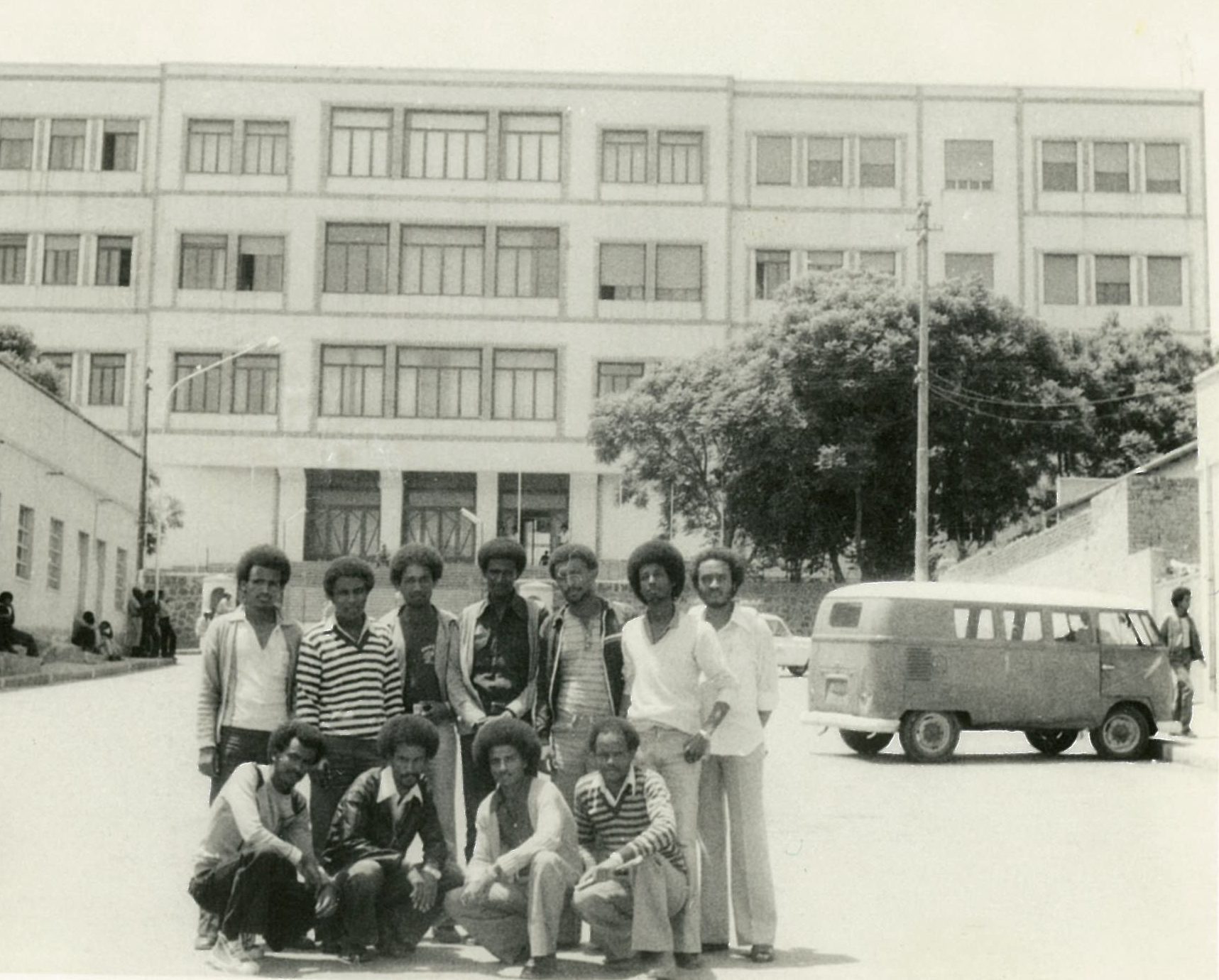
His childhood and youth in Eritrea, in the 1960s and ’70s, was one of the most volatile times for the region, when an internal resistance movement was fighting Ethiopia to gain independence. “My time was a time of coups, a time of drought, a time of war,” Demoz says. “Those are the times when a lot of heartache happened.”
Many people died because they weren’t allowed to migrate. Their crops failed in the drought, and some starved. Some died when they attempted to migrate and met violence along the way. Demoz’s older brother and many of his friends perished fighting in the resistance.
An unlikely advocate
Belay Demoz knew the challenges his people were facing. So in 1980, when he finished high school and was assigned to study physics as an undergraduate at the University of Asmara in what was to become Eritrea, he knew he wanted to find a way to use his education to make things better for his family.
At first, he struggled. He failed his first three exams. And then the first of several major turning points in his life happened, the first time help came from where he least expected it.
Demoz and his roommate frequently played soccer together. Both were highly talented but knew there was no career for them in the sport. So, after Demoz failed his third physics exam, his roommate decided it was time for an intervention.
“You can play soccer so well, but you’re going to let physics twist you?” he asked Demoz. “No, you study with me.” So he did. And by the next semester, Demoz was at the top of his class. “Part of me was afraid,” Demoz admits. Why? His roommate had recently been released from prison on a murder conviction. But “if I didn’t find him, I don’t think I would have made it.”
As his undergraduate career was coming to a close in 1984, another severe drought hit Eritrea. Demoz wanted to do something, but he didn’t know how his nuclear physics degree could help the situation. Then, he learned about cloud seeding in a Physics Today article.
In the 1980s, cloud seeding seemed like the next big revolution in weather modification. In order for clouds to produce rain, the water molecules they contain need to condense into liquid form. That happens around tiny solid particles inside the cloud. Cloud seeding adds these particles, creating more opportunities for raindrops to form.
“That’s when I switched from nuclear to atmospheric physics,” Demoz says. “I wanted to help make it rain.”
He applied and was accepted to the atmospheric physics program at the University of Nevada, Reno, but to leave Eritrea, he had to promise that he would come back. Without the required funds to guarantee that promise, his parents had to put their family home on the line so that he could study in the U.S.
“I was given $50 and a plane ticket,” Demoz remembers. “My dad didn’t blink. He just said, ‘Go. We will find a way.’”
Peaks and valleys
In Nevada, everything was new and different. “At 22, it was my first time to see snow,” Demoz says. And not just through his dorm room window—his courses and research involved spending ample time in the Sierra Nevada Mountains. After replacing his dress shoes with snow boots and skis, Demoz began to learn his way around the mountains.
In addition to the new climate, there were other steep learning curves for Demoz in graduate school. One of the core courses required computer programming skills. One day, Professor Jim Telford—Demoz refers to him as a “cloud giant”—called Demoz into his office.
Telford devised the stochastic rain theory when he was a master’s student in the 1960s, which describes why and predicts when clouds will produce rain. Today there is still no better theory. Demoz describes him as an arrogant, brilliant Australian scientist, who also went to great lengths to ensure his students’ success. Demoz remembers their first conversation going something like this:
“You must be pretty good in programming,” Telford says.
“No, I’m not.” Demoz replies.
“Well, have you used a computer?” Telford asks.
“No.”
“Have you touched a computer?”
“No.”
As Demoz recalls, Telford roared with laughter and rushed to another room to share with a colleague the ridiculousness of a Ph.D. student in physics who had never touched a computer.
“At this point, I’m thinking, I’m doomed!” Demoz remembers. “But there’s something inside me saying, I am an Eritrean, and others are fighting for independence. There’s something instilled in me. And so I stood there.” And instead of throwing him out, Telford agreed to give Demoz a crash course in computing.
 Demoz in grad school, after mastering the necessary computing skills. Photo courtesy of Demoz.
For two weeks, Demoz sat with a clunky 1985 desktop and a pile of Fortran books in Telford’s office, learning how to program. Today, Demoz tells his students, “If you cannot compute, you cannot compete. Everyone who has achieved something in our field is good in programming.” But his experience with Telford was about more than programming. It was about a mentor making a special effort to help a student succeed. Belay carries that memory with him today and strives to pay it forward to his own students.
In addition to learning all about clouds and weather modification, and completing a dissertation titled, “Sierra Nevada Winter Storms Using Microwave Radiometry, Ice Crystal, and Isotopic Techniques,” Demoz learned something else important in Reno—what it felt like to be black in the United States, especially in higher education and especially in physics.
 In front of the Desert Research Institute circa 1991 with a fellow graduate student. Photo courtesy of Demoz.
He noticed it right away in his courses (he was the only black person) and in the city. “It takes a toll,” he says. “Reno had a very tough police force.” He was stopped on many occasions as he drove home late from doing research in the mountains, seemingly for nothing. “I tend to be an outlier,” he reflects. “You don’t see a lot of black people doing cloud seeding and working with snow.”
Only later would he find out that the graduate program had accepted him as a “test case”—he was the first African accepted to the program and the first to graduate with a Ph.D. He remembers John Hallett (another “cloud giant” and another of Demoz’s important mentors) telling him, years later, “We wanted to see if those schools [in East Africa] were any good. That’s why we admitted you.” That, of course, didn’t sit well with Demoz and stayed with him as his future in physics unfolded.
Shifting the landscape
Once he finished his Ph.D., Demoz pursued postdoctoral studies at the University of Illinois in cloud chemistry. In 1997, UMBC finally entered his experience. He completed a second postdoc with UMBC at the NASA Goddard Space Flight Center in Greenbelt, Maryland.
Demoz continued his work at NASA after his postdoc ended. Then, another life-changing moment: He got a call from Howard University to help create a new atmospheric research center there in 2006. “The whole reason I studied this field was to go back and seed clouds,” Demoz reflects. “That wasn’t happening, but I realized, there is plenty to be done here.” So Demoz jumped at the chance to contribute to the historically black university while continuing his research program at NASA.
“It was around that time that I started to be conscious of my status as a minority in the field,” Demoz remembers. “It bothered me, being one of the only ones.”
At a conference around then, Demoz and a handful of other atmospheric researchers of color met in the lobby. “And we asked, OK, what is our part?” Their first step was to join efforts in developing the Howard research center together.
In 2005, Demoz was awarded a NASA Administrators Fellowship—a two-year sabbatical during which recipients are expected to build up a program at a minority-serving institution. The fellowship allowed Demoz to focus full time on building up the research center in Beltsville, which is administered by NOAA. When the two years were up, Demoz didn’t go back to his research program at NASA, choosing instead to commit himself permanently to the work of increasing the success of minorities in atmospheric science.
“Most people thought I was crazy because NASA is a stable job for life,” Demoz says. “But thinking about all the support that I had growing up, I decided my place was there.”
Building the pipeline
Over the next several years, Demoz and colleagues built up the NOAA Center for Atmospheric Science (NCAS) at Howard University’s campus in Beltsville, Maryland. The NCAS is a “super-site” among the Global Climate Observing System (GCOS) Reference Upper Air Network (GRUAN), a set of sites worldwide that looks at air and cloud chemistry. People around the world rely on the data it collects and the analyses the Beltsville researchers (including many students) conduct for their own work. The Beltsville GRUAN site contributes powerfully to science and also to increasing the diversity of scientists. It is the only GRUAN site in the world operated by a university, which is a source of pride for Demoz.
Students who’ve studied at the GRUAN site from Howard, UMBC, and elsewhere—many of them from underrepresented backgrounds—have gone on to careers at preeminent government and private research organizations. “You can involve students no matter how specialized and difficult your science is,” Demoz says. “The Beltsville site has made quite a number of important scientific advances and also brought diversity to the federal agencies.”
At the same time, the small group of African and African-American climate researchers who had met at the conference in the early 1990s started to formalize their lobby conversations into an official event at other meetings. “It paid off. We used to meet in a bar in the hotel lobby at the American Meteorological Society conferences. Right now, Colour of Weather is perhaps the biggest minority-focused group in atmospheric sciences, and it is what we started,” Demoz says with pride. “It’s held in a ballroom. I look at that and I think, I didn’t go back to Eritrea and seed clouds, but I’m making a difference here.”
Bringing a meaningful vision to life
With his experience at NASA and as a professor of physics at Howard, and his commitment to mentoring students from all backgrounds, Demoz was a perfect fit to serve as the next director of UMBC’s JCET, a partnership with NASA formed in 1995, when the position opened up in 2014.
As JCET director, Demoz has clear ideas about what he wants to accomplish. “If I can get a really strong, diverse graduate program here, that would be great. And I think that’s possible here.” In addition to recruiting and mentoring students from diverse backgrounds, Demoz says continuing to diversify the faculty is also a worthy goal. The UMBC physics department is already off to a strong start, with faculty members from Brazil, Eritrea, China, Hungary, Greece, and Puerto Rico.
Students are noticing the changes Demoz has modeled. “He really cares about his students and wants them to succeed,” adds Kylie Hoffman, a third-year graduate student. “He wants to help you do what you want to do.”
 Demoz and Ruben Delgado with a group of their students on top of the physics building. Photo by Marlayna Demond ’11.
He supports graduate and undergraduate students alike. After giving his presentation at the lab meeting, sophomore Amanze Ejiogu expected that “a seasoned atmospheric science veteran would pull it apart like cotton candy,” he says. But Demoz didn’t. “He was very respectful and asked genuine, thoughtful questions that will help me take my research forward.”
“Belay has been a great mentor for teaching lessons that are never covered in a classroom,” says Brian Carroll, a fifth-year Ph.D. candidate. “I’m proud to be part of such a diverse research group,” Carroll adds. “Thanks to my experiences with the group, I will pursue and highlight diversity in my own workplaces and the community at large as I progress in my own career.”
When asked about Demoz’s mentoring, Maurice Roots is more straightforward: “He’s good at it,” Roots replied. “So I’m taking notes.”
Demoz himself benefited from support and mentoring—sometimes from unlikely places. “Help will come from the place you least expect it, so be open,” Demoz says, maybe remembering the time a convicted murderer got him through his nuclear physics degree or an arrogant scientist made sure he was ready for programming class. Or maybe even the time he got the green light from Howard University to start the Beltsville Climate program or the call from UMBC to apply for the JCET directorship.
It’s all part of Demoz’s story. Now he’s taken it as his mission to help students create their own stories, with a strong start at UMBC.
“By seeing us,” he says, “I hope that students say, ‘I belong here.’”
*****
Header image: Demoz meets with students on top of the physics building. Photo by Marlayna Demond ’11.
]]>
From Eritrea to UMBC, this physicist is cultivating a diverse generation of climate scientists. It’s a nearly cloudless afternoon at UMBC in early October. A group of physics students and their...
https://umbc.edu/stories/climate-shift/
https://my3.my.umbc.edu/api/v0/pixel/news/119996/guest@my.umbc.edu/82f73445ca4996ccbf0f34cd279495b8/api/pixel
climate-change
cnms
discovery
fall-2019
feature
graduateschool
jcet
nasa
physics
UMBC News & Magazine
https://my3.my.umbc.edu/groups/umbc-news-magazine
https://assets1-my.umbc.edu/system/shared/avatars/groups/000/001/943/24435aa6207c452e7bc15cc74b42c7bb/xsmall.png?1748556657
https://assets1-my.umbc.edu/system/shared/avatars/groups/000/001/943/24435aa6207c452e7bc15cc74b42c7bb/original.png?1748556657
https://assets2-my.umbc.edu/system/shared/avatars/groups/000/001/943/24435aa6207c452e7bc15cc74b42c7bb/xxlarge.png?1748556657
https://assets2-my.umbc.edu/system/shared/avatars/groups/000/001/943/24435aa6207c452e7bc15cc74b42c7bb/xlarge.png?1748556657
https://assets3-my.umbc.edu/system/shared/avatars/groups/000/001/943/24435aa6207c452e7bc15cc74b42c7bb/large.png?1748556657
https://assets1-my.umbc.edu/system/shared/avatars/groups/000/001/943/24435aa6207c452e7bc15cc74b42c7bb/medium.png?1748556657
https://assets2-my.umbc.edu/system/shared/avatars/groups/000/001/943/24435aa6207c452e7bc15cc74b42c7bb/small.png?1748556657
https://assets1-my.umbc.edu/system/shared/avatars/groups/000/001/943/24435aa6207c452e7bc15cc74b42c7bb/xsmall.png?1748556657
https://assets2-my.umbc.edu/system/shared/avatars/groups/000/001/943/24435aa6207c452e7bc15cc74b42c7bb/xxsmall.png?1748556657
UMBC News & Magazine
0
0
false
Tue, 10 Dec 2019 16:47:44 -0500
Beautiful Dreamer
The film begins, a fast-moving montage of seemingly unrelated images: eyes, people dancing, an airplane landing, artillery, President Kennedy, wrestlers, a woman applying hairspray, all interspersed with wacky cartoon-like animated images.
It’s the start of Breathdeath, Stan VanDerBeek’s experimental 1963 masterpiece that would influence a generation of artists, including Monty Python’s Terry Gilliam. VanDerBeek’s genius and visionary thinking—not only as a filmmaker, but also as a video artist, computer animator, and futurist—would earn him worldwide fame and, in 1975, a full professorship at UMBC, where he taught until his untimely death in 1984.
VanDerBeek’s vision can still be seen in the programs he helped found and the alumni he inspired at UMBC.
Underground Artist
Born in 1927 in New York to immigrant parents, VanDerBeek’s early interest in painting, architecture, and design led him to Black Mountain College, where he befriended pioneering composer John Cage, choreographer Merce Cunningham, and inventor Buckminster Fuller, all of whom were to prove deeply influential on the artist. In the early 1950s, working as a designer on the CBS children’s program Winky Dink and You—which featured plastic screens children could apply to the television and draw on with special crayons—VanDerBeek learned basic animation skills and, by 1955, began to create his own animated films. In 1959, he organized a New York film festival entitled “Films from the Underground,” and the term “underground film” was born.
 A portrait of Stan VanDerBeek.
Throughout his 30-year career, VanDerBeek was more than an artist; he became a visionary who thought beyond limits and boundaries, often dreaming up fascinating ideas that couldn’t be executed—at least in his lifetime. In 1980, midway through his tenure at UMBC, he imagined, “You’ll sit in your backyard and look up at beautiful paintings I and other artists will do for you on a 10,000 square mile screen of clouds. The strokes and colors will be images projected by laser beams. I call it ‘painting with light’ or optical painting.”
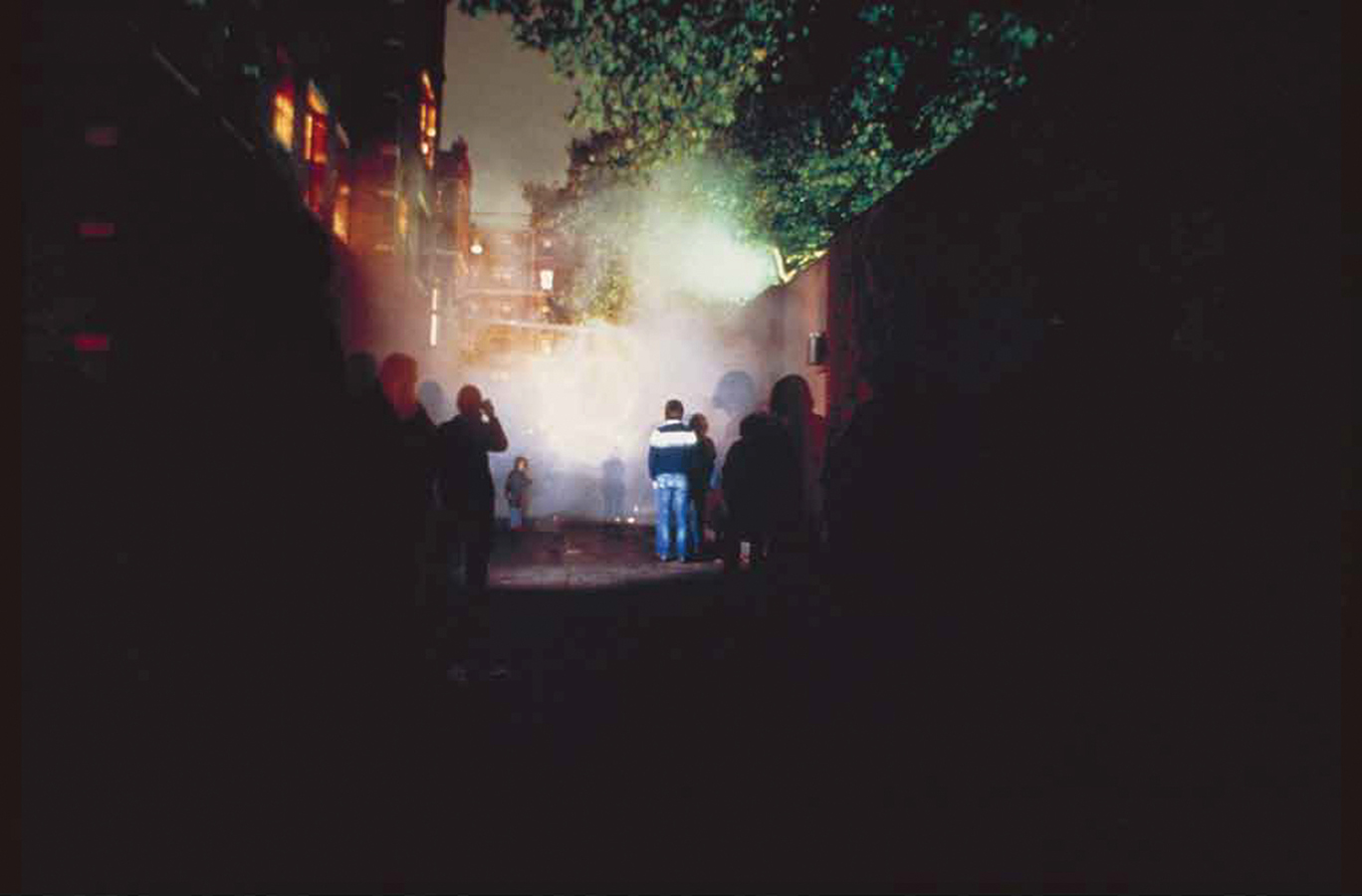
At UMBC, recalls Ellsworth Hall ’82, visual arts, the cloud projections were realized on a smaller scale. “A good friend of mine, Ed Hopf, with whom I’ve made films with since we were 13, helped Stan on his multimedia presentations. He would have film projected on the ‘smoke’ created by melting dry ice. At one point there wasn’t enough ‘smoke’ and Stan was in a hurry trying to coordinate some other aspect of the production so he grabbed the dry ice with his bare hands and threw it in the container to melt!”

For VanDerBeek, moving images weren’t only material for his artwork—they had the power to facilitate global understanding and to help the world move toward peace. In a manifesto, “CULTURE: Intercom and Expanded Cinema,” he wrote, “I propose the following: that immediate research begin on the possibility of a picture-language based on motion pictures; that we combine audio-visual devices into an educational tool: an experience machine or ‘culture-intercom’; that audio-visual research centers be established on an international scale to explore the existing audio-visual devices and procedures, develop new image-making devices, and store and transfer image materials, motion pictures, television, computers, video-tape, etc.; that artists be trained on an international basis in the use of these image tools…” He set forth ideas with the certainty that they could be accomplished and even needed to be accomplished.
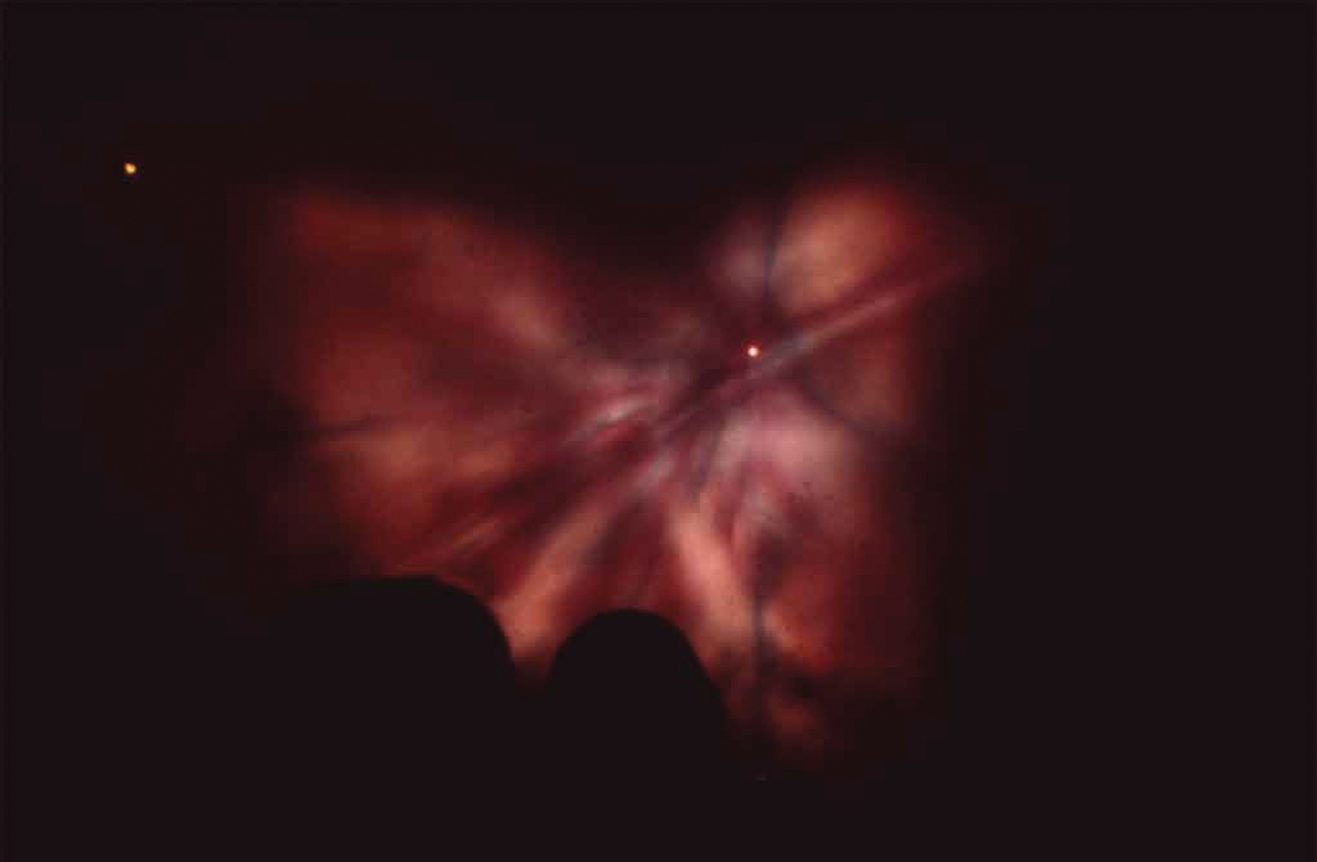
To facilitate that vision of global communication, VanDerBeek forged what was perhaps his best-known creation, the Movie-Drome. Located at Stony Point, New York, at the Gate Hill Cooperative (populated by the young VanDerBeek family in addition to others who had migrated from Black Mountain College, including John Cage, pianist David Tudor, and potter M.C. Richards), the Movie-Drome was the top of a grain silo dome. Guests were invited inside, asked to lie down, and, looking up, watched a mosaic of continually changing films and slides that were concurrently projected across the dome’s interior. VanDerBeek imagined a network of Movie-Dromes operating internationally, linked by satellite, presaging the internet.
Endless Possibilities
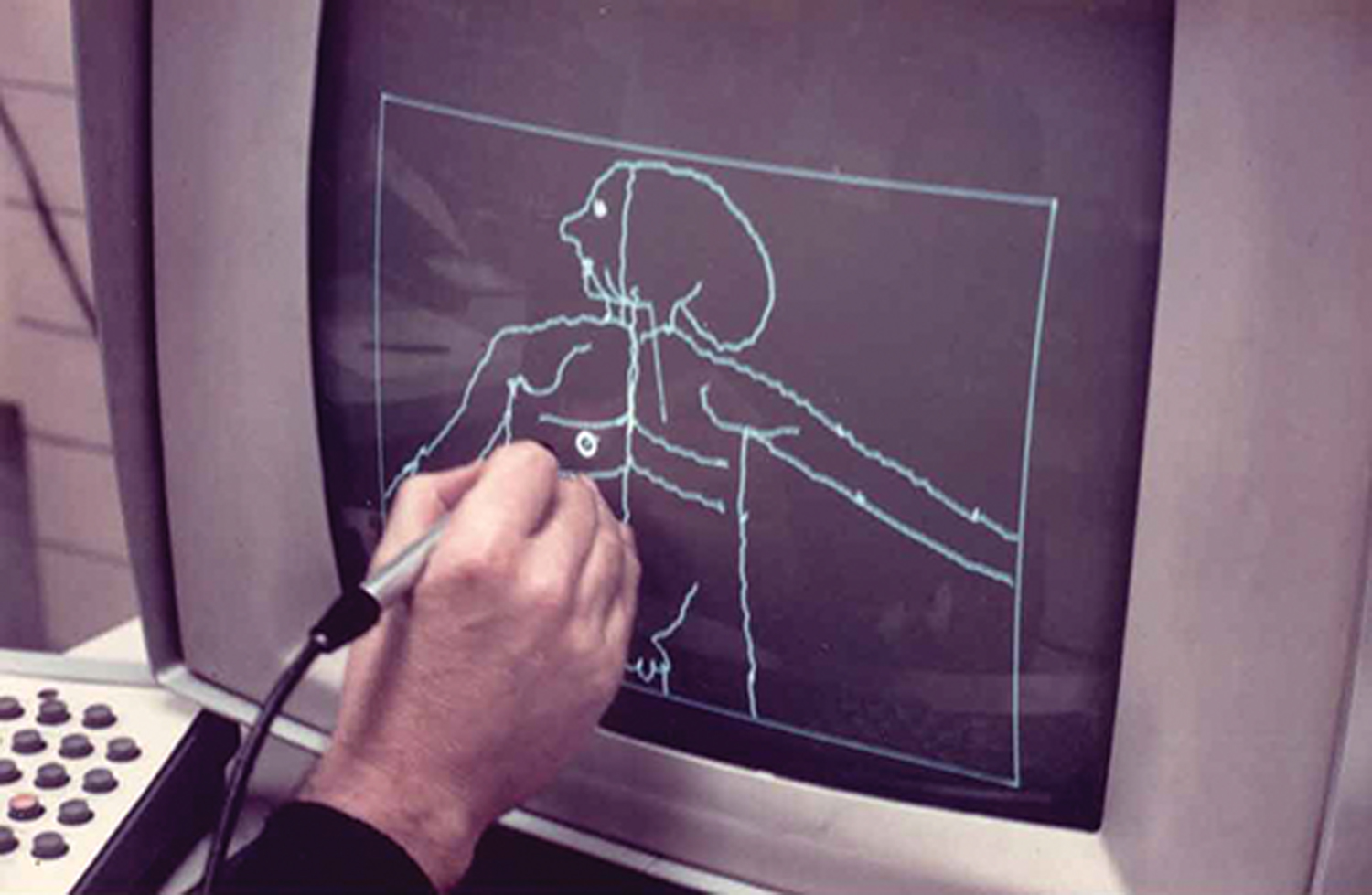
By the time VanDerBeek arrived at UMBC in 1975, he was already in the international limelight—a filmmaker whose works had won awards at festivals worldwide and who had received support from the Guggenheim Foundation, the Ford Foundation, the National Endowment for the Arts, and the Rockefeller Foundation. He had taught, lectured, or been in residence at Columbia University, MIT, the Walker Arts Center, the Smithsonian Institution, WGBH (Boston), NASA, and dozens of other institutions and had enjoyed a 1968 retrospective at the Museum of Modern Art. Ever fascinated by the possibilities of emerging technologies, VanDerBeek had branched out from film to embrace videography and computer animation, which seemed to offer endless possibilities. (His early computer-generated films were produced at MIT and at Bell Labs, where he was in residence and assisted by computer art pioneer Ken Knowlton.) An exhibition of VanDerBeek’s work Machine Art: An Exhibit of “Inter-Graphics” was presented in UMBC’s Library Gallery in spring 1976.
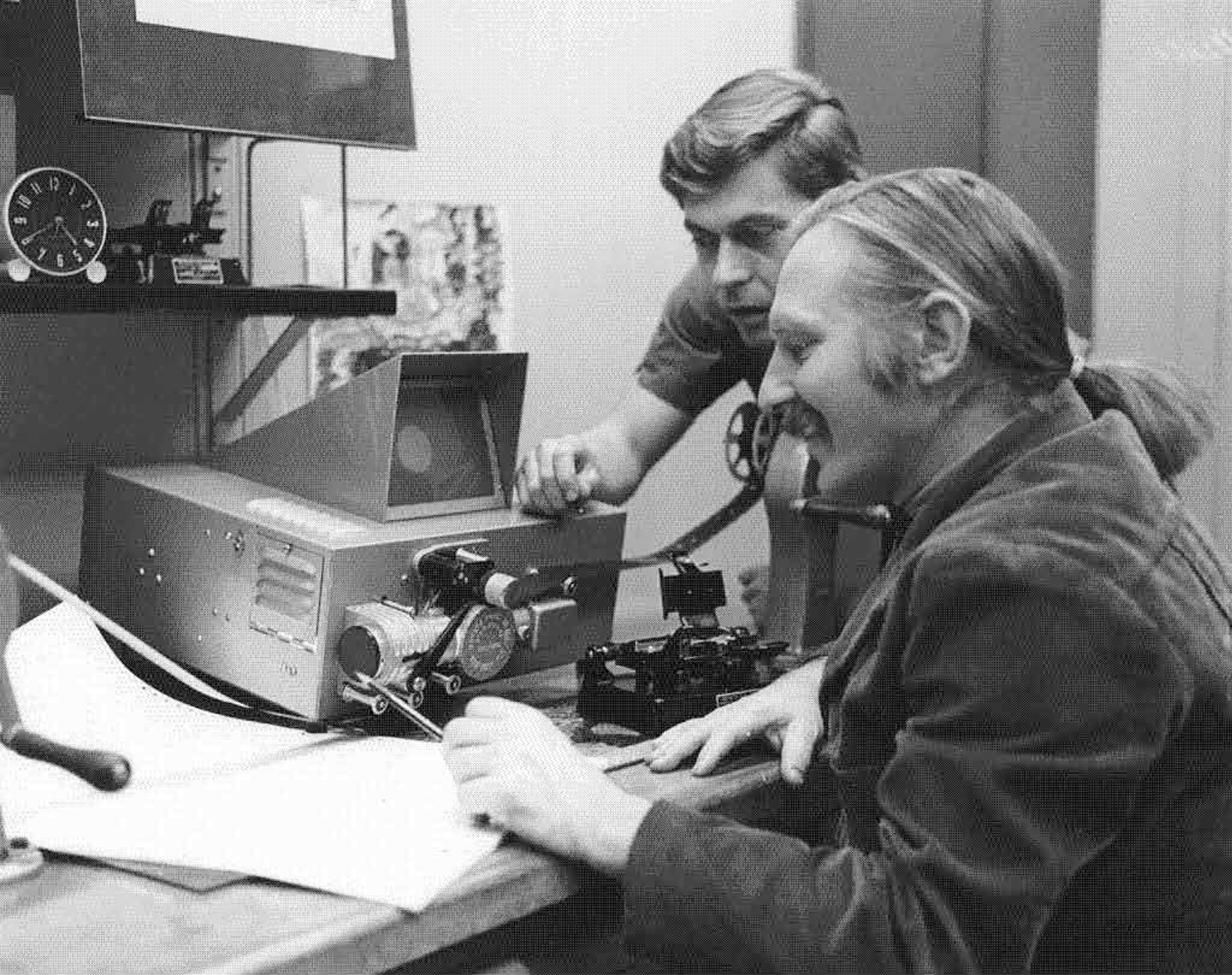
“It was a dynamic time,” remembers Ferdinand Maisel, who studied at UMBC and also worked in the dance department, “and Stan was maybe among the first interdisciplinary/collaborative artists of the 20th century. He was fascinated with how other people would think and solve problems. I met Stan via my work with Liz Walton—I worked for the dance department back then as a composer. Stan immediately had me push his shopping cart of films (which he was known to walk around campus) to a Steenbeck film machine, where I watched, with amazement, some of the films for which he wanted music.” VanDerBeek tapped Maisel to help run his Image Lab, a precursor to UMBC’s present-day Imaging Research Center.
While at UMBC, VanDerBeek recreated the Movie-Drome. Baltimore newscaster Denise Koch, who taught acting and theatre performance at UMBC, recalled, “Stan built a geodesic dome in the center of a large field and projected clouds and nighttime sky-lines, and had people come and lay on the floor for the experience.” (He had planned to erect on campus a 70-foot dome housing a 40-foot planetarium screen.)
 VanDerBeek’s award-winning 1963 film Breathdeath was described by the filmmaker as “a film experiment that deals with the photo reality and the surrealism of life…a black comedy, a fantasy that mocks at death.”
Koch also stars in a 1979 VanDerBeek film, Mirrored Reason. “He came to me and told me he’d been given a studio at the Voice of America for a day, and wanted to play with some of the equipment and asked if I’d participate as his actor—how could I refuse! We went to the studio, and he placed me in a room and just asked me to do an improvisation. I think I used a Kafka story to fall into a state of paranoia as Stan fooled around with my image. At one point my head splits in two and then I’m facing myself—thus, I believe, Mirrored Reason. Stan and our theatre company, Kraken, collaborated a number of times. Once, he took video of each actor’s head in the exact same position and then had us bleeding or melting into and out of each other as if we were a company made up of one face that held the persona of eight different people. It’s hard to explain, but I remember I was stunned!”
Ellsworth Hall remembers that VanDerBeek’s “office was rather messy with stacks of magazines, books, and film cans, but he knew where everything was!” Always encouraging his students to branch out with novel techniques, “In Experimental Film class Stan would have us put objects directly on unexposed film and then move them and expose each frame so as to create a direct animation on the emulsion. Very unusual technique, but it resulted in some interesting images.”
 A frequent collaborator across artistic disciplines, VanDerBeek worked in 1965 on the Merce Cunningham Dance Company’s Variations V with John Cage, Nam June Paik, and others. (Pictured: composers David Tudor and Gordon Mumma, dancer Carolyn Brown.)
Steve Estes, who studied film at UMBC as an undergraduate and then returned to earn an MFA in 1997, remembers VanDerBeek as an encouraging, supportive force. “He was very open, and very open to whatever you really wanted to do. Stan was the kind of guy who was helpful by basically just being there, and letting you do what you did, and providing whatever assistance he could. He had suggestions about this or that, but he was pretty much, ‘Go for it! Freedom, man, just go ahead and do it. Explore! Play!’”
Filmmaker Richard Chisolm ’82, interdisciplinary studies, recalls VanDerBeek as a character whose mind was sometimes racing so quickly that he wasn’t always focused on teaching, but says, “This dreamer personality, this charming dreamer, is kind of by definition boundary-less, and wild, and expressive. We need Stan VanDerBeeks to challenge our otherwise concrete, boring, structured way of looking at the arts. True art is extremely messy. It requires taking risks, and it requires trying things that are going to fail, and losing money, and losing time during those failures, and people like Stan are just fearless and have no regard for whether this dream is going to come true or be doable or not. It’s the old cliché about throwing things at the wall and seeing what sticks—that’s definitely how he looked at ideas. He got ideas every day, and every week, and he tried to contagiously get people to jump in with him, and sometimes they would. He was going super fast every day, always walking and talking fast and could never sit still.”
Dreaming at UMBC
VanDerBeek’s “dreamer” personality was, in fact, fascinated by dreams. He posted a note in a 1970s-era publication, Dreamworks, encouraging readers to send him brief written descriptions of their dreams, saying, “I am seeking this material for developing my ‘dream theater’ and for other futuristic dream-related media projects…. I am convinced that movies are the visual enactment of the dream state. I do not know how specific this function of pre-visualizing and making tangible the dream state is in our lives. But my own instincts move me further into experimenting with such illusory systems, such as freedom of metamorphosis to create ‘meta’ images that can approximate the geometry and forms of dreams.”
 The computer-generated Poemfield series, created between 1965 and 1969, were the artist’s exploration of “image-based poetry language.”
UMBC’s connections to the VanDerBeek family run deep. Two of his children—August and Max— studied briefly at UMBC, and his daughter Julie graduated in 2003 with a degree in theatre. Max returned in the 1990s to teach for the Department of Music; his son, Clay, was a Linehan Artist Scholar who graduated in 2017 with a degree in theatre. Another of Stan’s daughters, artist Sara VanDerBeek, has exhibited and spoken at UMBC’s Center for Art, Design, and Visual Culture. Stan VanDerBeek’s second wife, Louise, graduated in 1976 with a degree in interdisciplinary studies and an arts emphasis and then returned to earn a master’s in 1995 in instructional development systems.
“If I had to draw a cartoon for The New Yorker that was about Stan VanDerBeek?” Richard Chisolm asks rhetorically. “It would be Stan VanDerBeek buys furniture at IKEA, and then you see him in a room with the boxes, and then in the next frame you would see something that didn’t look at all like furniture, and the instructions would be curled up in the corner, and what he built would be this anarchistic mound of panels and windows that was not at all what the IKEA people were telling you to build.”
VanDerBeek served as chair of UMBC’s Department of Visual Arts for only a short time in 1983 and 1984 before becoming ill. Several days before his death in September 1984, he received a poignant good-bye letter from fellow experimental filmmaker Stan Brakhage, who wrote, “I grow more sure of what we’ve done, and that someday…our works and lives will be fully known to the ears and minds of human beings….”
— Tom Moore
*****
To learn more about Stan VanDerBeek’s work, visit stanvanderbeek.com. An exhibition, VanDerBeek + VanDerBeek, which presents artwork by Stan VanDerBeek alongside work by Sara VanDerBeek, is on display at the Black Mountain College Museum + Arts Center through January 4, 2020.
Thanks to Max VanDerBeek, August VanDerBeek, Chelsea Spengemann, the Stan VanDerBeek Archives, and Judy Taylor.
All images, including header, courtesy of the Estate of Stan VanDerBeek.
]]>
The film begins, a fast-moving montage of seemingly unrelated images: eyes, people dancing, an airplane landing, artillery, President Kennedy, wrestlers, a woman applying hairspray, all...
https://umbc.edu/stories/beautiful-dreamer/
https://my3.my.umbc.edu/api/v0/pixel/news/119999/guest@my.umbc.edu/46195ac1524849cc0a8a2f2d0b14052a/api/pixel
cahss
department-of-theatre
fall-2019
feature
graduateschool
mfa
theatre
umbc-history
visual-arts
UMBC News & Magazine
https://my3.my.umbc.edu/groups/umbc-news-magazine
https://assets1-my.umbc.edu/system/shared/avatars/groups/000/001/943/24435aa6207c452e7bc15cc74b42c7bb/xsmall.png?1748556657
https://assets1-my.umbc.edu/system/shared/avatars/groups/000/001/943/24435aa6207c452e7bc15cc74b42c7bb/original.png?1748556657
https://assets2-my.umbc.edu/system/shared/avatars/groups/000/001/943/24435aa6207c452e7bc15cc74b42c7bb/xxlarge.png?1748556657
https://assets2-my.umbc.edu/system/shared/avatars/groups/000/001/943/24435aa6207c452e7bc15cc74b42c7bb/xlarge.png?1748556657
https://assets3-my.umbc.edu/system/shared/avatars/groups/000/001/943/24435aa6207c452e7bc15cc74b42c7bb/large.png?1748556657
https://assets1-my.umbc.edu/system/shared/avatars/groups/000/001/943/24435aa6207c452e7bc15cc74b42c7bb/medium.png?1748556657
https://assets2-my.umbc.edu/system/shared/avatars/groups/000/001/943/24435aa6207c452e7bc15cc74b42c7bb/small.png?1748556657
https://assets1-my.umbc.edu/system/shared/avatars/groups/000/001/943/24435aa6207c452e7bc15cc74b42c7bb/xsmall.png?1748556657
https://assets2-my.umbc.edu/system/shared/avatars/groups/000/001/943/24435aa6207c452e7bc15cc74b42c7bb/xxsmall.png?1748556657
UMBC News & Magazine
0
0
false
Tue, 03 Dec 2019 21:36:22 -0500
Urgent Care

This is what it looks like when researchers push beyond band-aid solutions and design better answers to pressing medical and mental-health issues.
The Patapsco Valley might not bring to mind the disruption of the technology industry the way Silicon Valley has defined itself, but UMBC student and faculty researchers are aggressively tackling disparities related to health care and changing the way people around the world access health technologies.
As a public university, UMBC’s scientific community is actively researching ways to alleviate public-health problems. In some labs this means changing the focus of research to address a more pressing medical issue, like Ph.D. student Mustafa Al-Adhami did when he veered away from studying water purification to address sepsis, a life-threatening condition that strikes over a million Americans each year.
Another example is UMBC faculty member Govind Rao, who feels a sense of urgency in addressing critical challenges that are impacting people’s quality of life. Rao, a professor of chemical, biochemical, and environmental engineering, and director of UMBC’s Center for Advanced Sensor Technology (CAST), sees UMBC students and professors using their skills and interests to make health technologies more equitable, more affordable, and more sustainable. A central focus of Rao’s collaborative work is creating health-care solutions that are not restrained by cost or geography, like an award-winning cardboard incubator his lab produced, accessible for communities with limited resources.
Rao refers to his research and the technologies he’s developed as “disruptive innovations,” and he’s not the only UMBC researcher who is working to help people change how they approach and access medical care. These developments offer novel solutions to challenges facing the world, and faculty and staff at UMBC are changing the way people receive medical care and support from medical providers.
“If I can empower students to think and come up with solutions that have a green footprint and are lower cost and sustainable, I think we can bend the curve,” explains Rao.
Treating sepsis with more accuracy
Mustafa Al-Adhami, M.S ’15, Ph.D. ’19, mechanical engineering, credits a conversation with his wife Stephanie Al-Adhami, a nurse, in changing the focus of his research. At the time Al-Adhami was working to develop a device to determine whether water was safe to consume, but after discovering devices on the market that could already filter most water to make it potable, he shifted his work to address another prevalent challenge that people around the world are facing. “We just pivoted from water to actual blood with this specific application,” he says.
Sepsis is a serious blood infection that, if not treated properly and promptly, can lead to serious complications and even death in mere days. Those at highest risk are the most vulnerable: infants, children, the elderly, and those already facing severe medical problems. According to the Centers for Disease Control and Prevention, more than one million people fight sepsis each year and about a quarter of these cases are fatal. Discouragingly, the number of sepsis cases each year is also on the rise. Al-Adhami and others are working to reverse the trend.

The challenge for physicians isn’t determining whether a person has sepsis, explains Al-Adhami, but rather identifying which antibiotics to administer to the patient. “With every one hour without proper treatment, there is a 7% less chance of survival,” he says.
Working with faculty and student researchers in CAST, Al-Adhami developed a rapid bacterial-detection test that can determine whether a patient has an infection within an hour and helps physicians determine which specific antibiotics should be administered to help fight the infection. Al-Adhami’s device, ASTEK, costs a fraction of the price of the current antibiotic susceptibility test, can reduce the duration of hospital stays, and can prevent antibiotic resistance by avoiding unnecessary antibiotic use.
In addition to its cost effectiveness, ASTEK only requires one milliliter of blood to be run. This is a breakthrough in detecting sepsis in young children. “For [traditional] blood cultures, they take four bottles of blood. Each one is eight milliliters,” explains Al-Adhami. “Because we don’t need this much blood, it could be used for newborns…the concentration of bacteria is much higher in infants.”
The device has successfully been tested in mice, and Al-Adhami hopes that it will be ready for human testing in the next couple of years. If the device is approved for human use, it has the potential to save thousands of patients each year by speeding up the process of diagnosing and administering the correct antibiotics.
Understanding behavior through social media analytics
According to the U.S. Department of Health and Human Services, more than 130 people die from opioid-related overdoses each day, and there are over 14,000 substance abuse facilities across the U.S. that treat people facing these addictions. The opioid epidemic affects every region of the country, and those watching loved ones go through the cycle of substance abuse are seeking any new ways to halt this disease in its tracks.
 Shimei Pan, assistant professor of information systems, is studying human behavior in the context of monitoring, preventing, and treating substance-abuse by analyzing how people with substance use disorders behave on social media. “On social media, there is a lot of information about each individual. Some are related to substance use, like drinking, smoking, and illicit drug use,” she says.
Pan and her collaborator Warren Bickel, a well-known behavior scientist at the Virginia Tech Addiction Treatment Center, are employing large-scale social media analytics to better understand addiction and help medical professionals provide personalized treatment to people facing addiction and substance abuse.
The clues Pan and Bickel are looking for in social media data are subtle, but have the potential to alter the way substance abuse is identified and subsequently treated. “Sometimes, people explicitly mention substance use in their social media posts,” she shares. “These are useful signals. But there are other signals in social media, sometimes even stronger than explicit mentions of substances. Substance abuse is frequently linked to mental disorders such as depression, anxiety and impulsivity. As a result, social media behavior signals related to depression, anxiety and impulsivity can also be very useful in helping us detect and understand substance abuse”
Since substance abuse could be explained by both genetic and environmental factors, with large-scale social media analytics it is possible to identify distinct patterns in its manifestation on social media, says Pan. “We want to see whether we can find those behavioral markers of addiction on social media. By identifying these markers, we can understand substance abuse a little bit better.”
Pan and her collaborators plan to continue conducting basic research, and hope to help develop new screening, diagnostic, and intervention tools in the future—another way of building a bridge to proper health care access for all.
Studying stigma and pain
Another UMBC faculty member studying human behavior is Shawn Bediako, associate professor of psychology, who focuses on the psychosocial impact of sickle cell disease. Bediako is using new technologies to assess sickle cell patients’ pain and experiences.
Previously, Bediako and his collaborators collected data using paper surveys that were sent to patients and required that patients mail them back each week. “We didn’t know when they filled [the surveys] out,” he says. “All we knew is that they would send us a packet back.”
The development of a new app-based tool, however, lessened the lag in survey responses. This new approach gives researchers a more accurate picture by providing data with integrity. Bediako explains that the app allows patients to submit their experiences directly and enables researchers like him to pose bold, new questions to patients. Each night at 7 p.m., the patients automatically receive a survey to fill out by midnight. The rapid turnaround and ease of completing the survey also “cut down on data contamination,” he says.
“Now that data analytics has expanded the range of online behaviors that we can examine, researchers like me can think about the links between health care and health outcomes in a different way,” Bediako explains.
Bediako, who is also the facilitator for UMBC’s Collaborative for the Interdisciplinary Promotion of Health Equity Research (CIPHER), hopes that his work bridges the gap between people who are doing research on sickle cell disease and people who are studying how innovative technologies can be utilized to help people with the disease. “I’m currently integrating information from history, policy, sociology, psychology, and medicine to better understand the genetics of sickle cell pain,” he says, adding this requires some “out-of-the-box type thinking.”
Like Pan, Bediako is interested in how people’s social media use differs depending on whether they are in pain versus not in pain. “Now that data analytics has expanded the range of online behaviors that we can examine, researchers like me can think about the links between health care and health outcomes in a different way,” he explains.
Supporting first responders
In a broad collaboration to understand how the stressful situations first responders encounter in their jobs can lead to anxiety and other mental health issues, UMBC faculty in emergency health services (EHS) and information systems are using existing technologies to tackle the task. Principal investigator Andrea Kleinsmith, assistant professor of information systems, is collaborating with J. Lee Jenkins, associate professor and chair of emergency health services; Helena Mentis, associate professor of information systems and associate dean in the College of Engineering and Information Technology; and Gary Williams, acting paramedic director in emergency health services.
Trainees and first responders on the job may experience an array of physiological responses when they are in a situation that is tense or challenging. UMBC students in their third and fourth years of the emergency health services program move through a series of often intense scenarios in the simulation lab in Sherman Hall to prepare them for a range of situations they may encounter on the job. Involuntary bodily reactions such as increased heart rates or perspiration are tracked by wearable devices, and allow the instructors and trainees the opportunity to assess and manage stress and improve the preparedness for future emergency scenarios.

Working with student researchers, the faculty members design, develop, and evaluate the system to assess how discussions and intentional in-class reflections on stressful situations can help trainees implement stress management strategies during their work. The team is studying how a Team Stress Reflection system can be used by paramedic trainees to “understand the events that trigger stress increases and their ability to mitigate that stress,” according to the grant proposal. This technology allows the students to identify and better understand the correlations between stressful situations and their physiological responses.
Stress, explains Kleinsmith, can lead to errors during care and long-term health concerns for medical personnel, including emergency health professionals. Williams says that it’s important for students to debrief and reflect on the simulation to make sure that they can address any stressors or points that caused them to have strong physiological responses.
“The ability to monitor and manage stress in medical personnel has the potential to improve medical care provided in stressful situations,” explains Kleinsmith.
Understanding the physiological responses during training exercises is important for trainees, explains Williams, because it allows them to improve how they cope with stress in situations that they may encounter on the job. This research is being funded by a three-year grant from the National Science Foundation, which supports the faculty in collecting data from the EHS students and developing the interface to help the students come to their own conclusions about the correlation between physiological measurements and stress to understand their stress triggers. The interface also helps facilitate the team’s discussion about stress.
Motion sensors to inform treatment

Helena Mentis is also using activity trackers and other motion sensors to assess movement and inform treatment for patients with Parkinson’s disease. In collaboration with faculty at the University of Maryland Parkinson Disease and Movement Disorders Center, Mentis designed and developed a sensor using Leap Motion devices to track and assess the movement of patients with Parkinson’s disease during deep brain stimulation.
One observation that Mentis and her collaborators made was that the presentation of data collected from the sensors impacted how the data was interpreted and used to develop customized treatment plans for patients. In 2017, Mentis presented a paper at the Association for Computing Machinery Special Interest Group on Computer-Human Interaction Conference. The paper explains that the data collected by the patients’ activity trackers led to more informed conversations between the patient with Parkinson’s and their physician.
In a well-researched disease like Parkinson’s, there’s still always room for improvements in care and access to care. Researchers have been studying Parkinson’s disease and treatment options for people with Parkinson’s since the 1960s, but there is still work to be done. Every advancement leads to better outcomes and an increased quality of life for Parkinson’s patients. Mentis and her collaborators are now using self-tracking technologies to help physicians customize treatment plans and advocate for patients.
“Determining how sensor data can be incorporated in shared decision-making is fundamental to effective patient-centered care,” explains Mentis. “Even more so for low-resource and marginalized communities, where sensor data could easily be used by medical caregivers to argue for diagnoses or treatments that are based on assumptions and biases. The sensor data in itself does not embody truth and instead should be taken into account alongside a holistic understanding of the patient and their circumstances.”
Doing good through “disruptive innovations”
Through his work, Rao focuses on addressing critical challenges by answering the fundamental question: “How can we help them?”
“These are real lives, real people who are living in desperate conditions,” Rao says, noting that he aims to empower his students to think about how they can make positive changes through their work. Rao explains that his multidisciplinary approach to research has allowed him and his colleagues and students to make tremendous impacts related to health technology. CAST allows him to work with faculty and students from a range of disciplines, and he believes it is important for engineers, scientists, sociologists and psychologists, and policymakers to have a seat at the table, because each perspective is so valuable.

“Disruptive innovation” refers to technologies and other developments that offer novel solutions to challenges facing the world. Like Bediako and other colleagues at UMBC, Rao challenges his students to consider new approaches to addressing challenges and needs in the health technologies space.
While Rao leads this research, he is quick to point out that the collaborative nature of the work and the contributions of his students are crucial to its success. “It’s not about me,” he says. “I’m just privileged enough to have such an amazing team across several disciplines and backgrounds. It’s just a blast.”
With funding and support from federal agencies, including the Defense Advanced Research Projects Agency, Rao has developed a bioreactor or “biomod” that fits inside a suitcase and allows pharmaceuticals to be produced on demand and with limited resources and time. The device was developed with soldiers in conflict zones in mind because it allows them to quickly create customized medicines to save lives based on the needs of the patient.
Additionally, Rao and his colleagues have developed low-cost incubators to support premature babies in communities with limited resources and in areas that do not have access to robust medical facilities. His research team was presented with the 2019 Global Health Research Award at the Pediatric Academic Societies Meeting in Baltimore.
The question “What have you done for others?” is the driving force behind Rao’s lab. He says that many of the health technologies that are currently available are only affordable to a small group of people, and are only helping the people who can afford them. “Just spending five to 10 minutes a day thinking about what they [students] can do with their skill set to improve the lives of others, that’s all it takes to change the world,” Rao says.
*****
All illustrations by Brucie Rosch.
]]>
This is what it looks like when researchers push beyond band-aid solutions and design better answers to pressing medical and mental-health issues. The Patapsco Valley might not bring to mind the...
https://umbc.edu/stories/tackling-disparities-related-to-healthcare-and-care-access/
https://my3.my.umbc.edu/api/v0/pixel/news/120106/guest@my.umbc.edu/2fe6c14f2765ff8f2122bf8dbbdfe314/api/pixel
cast
coeit
discovery
feature
graduateschool
spring-2019
UMBC News & Magazine
https://my3.my.umbc.edu/groups/umbc-news-magazine
https://assets1-my.umbc.edu/system/shared/avatars/groups/000/001/943/24435aa6207c452e7bc15cc74b42c7bb/xsmall.png?1748556657
https://assets1-my.umbc.edu/system/shared/avatars/groups/000/001/943/24435aa6207c452e7bc15cc74b42c7bb/original.png?1748556657
https://assets2-my.umbc.edu/system/shared/avatars/groups/000/001/943/24435aa6207c452e7bc15cc74b42c7bb/xxlarge.png?1748556657
https://assets2-my.umbc.edu/system/shared/avatars/groups/000/001/943/24435aa6207c452e7bc15cc74b42c7bb/xlarge.png?1748556657
https://assets3-my.umbc.edu/system/shared/avatars/groups/000/001/943/24435aa6207c452e7bc15cc74b42c7bb/large.png?1748556657
https://assets1-my.umbc.edu/system/shared/avatars/groups/000/001/943/24435aa6207c452e7bc15cc74b42c7bb/medium.png?1748556657
https://assets2-my.umbc.edu/system/shared/avatars/groups/000/001/943/24435aa6207c452e7bc15cc74b42c7bb/small.png?1748556657
https://assets1-my.umbc.edu/system/shared/avatars/groups/000/001/943/24435aa6207c452e7bc15cc74b42c7bb/xsmall.png?1748556657
https://assets2-my.umbc.edu/system/shared/avatars/groups/000/001/943/24435aa6207c452e7bc15cc74b42c7bb/xxsmall.png?1748556657
UMBC News & Magazine
0
0
false
Mon, 17 Jun 2019 19:56:07 -0400


