Ten million reads: UMBC researchers hit milestone in sharing knowledge through The Conversation
UMBC researchers regularly share their work and expertise with the public through The Conversation—a nonprofit news outlet that provides current, informative content to news publications worldwide, free of charge. This week, these authors have hit a milestone: 224 Conversation articles written by 125 different UMBC researchers have earned a cumulative 10 million reads.
The stories offer context to current events, explain natural phenomena, introduce new research in an accessible way, and more. There’s even a Curious Kids section to answer the youngest readers’ questions.
The 10 million reads milestone demonstrates the commitment of UMBC researchers to sharing their expertise with the broader community. It also shows that UMBC researchers are helping meet public demand for high-quality content on timely topics.
“The Conversation helps us contribute to our public service mission as a public university,” says Karl V. Steiner, vice president for research. “This milestone underscores the importance of academic researchers actively participating in the public discourse of complex issues.”

Sebastian Deffner, physics, wrote a piece for The Conversation in 2017 explaining static electricity. Every winter, when dry air and static increase, the article gets a fresh boost of views. Photo by Marlayna Demond ’11 for UMBC.
Career impact
Many readers have likely seen articles from The Conversation without realizing it, due to the free-to-republish model. Top republishers of UMBC’s Conversation content include Quartz, Smithsonian Magazine, Fast Company, Scientific American, Business Insider, andCNN, along with countless local newspapers around the nation. And these articles often inspire additional original news coverage on faculty research as well.

Charissa Cheah’s April 2021 Conversation article on anti-Asian violence and school safety was followed by related coverage on NBC News and WYPR. Photo by Crystal Tseng, courtesy Charissa Cheah.
The Conversation has a global impact. Forty-two percent of readers of UMBC-authored Conversation articles are based outside the U.S. Many of these readers are based in Canada, India, Australia, the United Kingdom, France, the Philippines, and Singapore, among other nations. They access both English-language content and UMBC articles that have been translated into other languages, such as Spanish and French.
The authors benefit, too. “Working with The Conversation taught me the ropes of writing for the general public,” says Zoë McLaren, associate professor of public policy. “It helped me develop a reputation as a respected COVID-19 expert. And it helped develop the skills I needed to be able to write for FiveThirtyEight, WIRED and The New York Times. The editors at The Conversation are knowledgeable and helpful and a real pleasure to work with.”
McLaren has written nine Conversation articles on topics like the role of rapid tests for COVID-19 and how the clinical trials process works.
Katherine Seley-Radtke, professor of chemistry and biochemistry, has also had success with The Conversation. “The experience of writing several pieces for The Conversation has had a significant impact on my career,” she says. “Since publishing my first piece at the beginning of the pandemic, I have given more than 60 interviews for print, radio, and television.”
As a medicinal chemist whose research group focuses on antiviral drug development, Seley-Radtke says, “it is important to have these types of platforms to help educate and inform the public.”
From technical to accessible
Even research areas that aren’t frequently in the news can find an enthusiastic audience on The Conversation. Preminda Jacob, associate professor of visual arts and associate dean of the College of Arts, Humanities, and Social Sciences, has discovered this first-hand. With her expertise in the history of modern and contemporary art, Jacob’s articles in The Conversation have helped the public better understand artists’ social and political impacts.
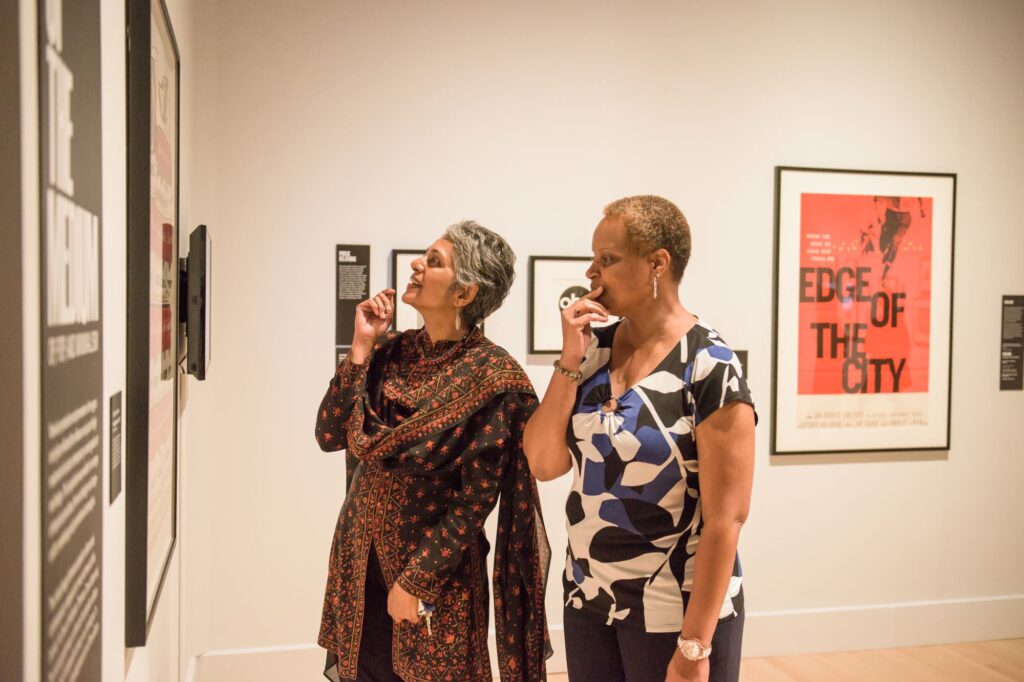
Preminda Jacob (l) and Andrea Lorick (r) at at exhibition at UMBC’s Center for Art, Design, and Visual Culture. Photo by Marlayna Demond ’11 for UMBC.
Mercedes Burns, assistant professor of biological sciences, studies the evolution of reproductive systems in arachnids commonly referred to as daddy longlegs. She published an article about the ability of some animal species to reproduce with just one parent’s genetic material. Published just before Christmas with the title “Virgin births from parthenogenesis,” the story garnered a huge readership. It subsequently appeared on CNN, Gizmodo, IFLScience, and more.
“I enjoy the challenge of taking technical writing and making it accessible for a wider audience,” says Burns, who is also very active within the science community on Twitter. She in part credits that public engagement for additional opportunities to comment on stories for The New York Times, The Atlantic, Science News, and Smithsonian Magazine.
Burns’s Conversation editor “gave me clear feedback over just two sessions, so I could easily make the changes she suggested,” she says. “All in all, I was glad to have a broader venue for my research, and the process wasn’t too complicated or time-consuming. I would certainly write a Conversation article again.”
Fostering public understanding
Richard Forno, principal lecturer and director of the cybersecurity graduate program, is one of UMBC’s most frequent contributors to The Conversation, writing on topics from election security to ransomware attacks. Forno views sharing his expertise as a civic duty, given cybersecurity threats facing the public. He sees The Conversation as an excellent way to connect with a broad range of readers.
“To me, what’s refreshing about The Conversation‘s role in the world—and why I appreciate contributing to it—is their commitment to providing easily accessible and jargon-free exploration and objective analysis of often-complex issues, technology, and events,” Forno says.
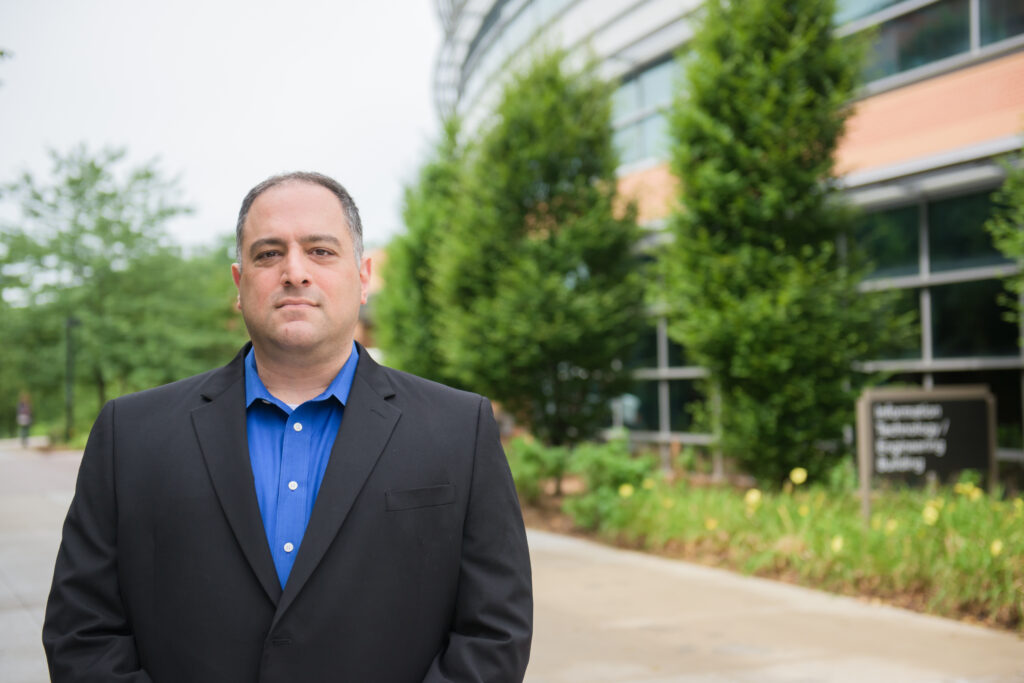
Richard Forno outside the Information Technology and Engineering Building. Photo by Marlayna Demond ’11 for UMBC.
For example, an article by Priyanka Ranade ’18, M.S. ’19, information systems, a Ph.D. student in computer science, and Anupam Joshi and Tim Finin, professors of computer science and electrical engineering, discusses how artificial intelligence can generate fake reports about medical research, cyberattacks, and more, that fool even cybersecurity experts. Public understanding and vigilance around cybersecurity is critical in today’s world, but the issues can seem opaque to those outside the field unless communicated clearly.
“The Conversation reminds academics, researchers, and other experts that knowledge discovery is just as important as how it’s conveyed to others,” Forno says. “This work is so important to fostering public understanding and supporting a more informed global citizenry.”
Banner image: Mercedes Burns (right) and Sarah Stellwagen at work in Burns’s laboratory. Photo by Marlayna Demond ’11 for UMBC.
]]>
UMBC researchers regularly share their work and expertise with the public through The Conversation—a nonprofit news outlet that provides current, informative content to news publications...
https://umbc.edu/stories/ten-million-reads-umbc-researchers-hit-milestone-in-sharing-knowledge-through-the-conversation/
https://my3.my.umbc.edu/api/v0/pixel/news/119466/guest@my.umbc.edu/0e228e0d31c7ce4ea3b40f5577e24360/api/pixel
biology
cahss
chembiochem
cnms
coeit
community
csee
cybersecurity
is
news
page1
physics
psychology
publicpolicy
research
visualarts
UMBC News & Magazine
https://my3.my.umbc.edu/groups/umbc-news-magazine
https://assets1-my.umbc.edu/system/shared/avatars/groups/000/001/943/24435aa6207c452e7bc15cc74b42c7bb/xsmall.png?1748556657
https://assets1-my.umbc.edu/system/shared/avatars/groups/000/001/943/24435aa6207c452e7bc15cc74b42c7bb/original.png?1748556657
https://assets2-my.umbc.edu/system/shared/avatars/groups/000/001/943/24435aa6207c452e7bc15cc74b42c7bb/xxlarge.png?1748556657
https://assets2-my.umbc.edu/system/shared/avatars/groups/000/001/943/24435aa6207c452e7bc15cc74b42c7bb/xlarge.png?1748556657
https://assets3-my.umbc.edu/system/shared/avatars/groups/000/001/943/24435aa6207c452e7bc15cc74b42c7bb/large.png?1748556657
https://assets1-my.umbc.edu/system/shared/avatars/groups/000/001/943/24435aa6207c452e7bc15cc74b42c7bb/medium.png?1748556657
https://assets2-my.umbc.edu/system/shared/avatars/groups/000/001/943/24435aa6207c452e7bc15cc74b42c7bb/small.png?1748556657
https://assets1-my.umbc.edu/system/shared/avatars/groups/000/001/943/24435aa6207c452e7bc15cc74b42c7bb/xsmall.png?1748556657
https://assets2-my.umbc.edu/system/shared/avatars/groups/000/001/943/24435aa6207c452e7bc15cc74b42c7bb/xxsmall.png?1748556657
UMBC News & Magazine
0
0
false
Mon, 07 Mar 2022 21:35:09 -0500
Mon, 07 Mar 2022 21:35:09 -0500
UMBC research group tackles ongoing hurdles to efficient solar power tech
Two new papers from Can Ataca’s research group at UMBC set the stage for further advances in solar power and other renewable energy technologies. Daniel Wines, Ph.D. candidate in physics, led research using computational modeling to explain surprising properties of materials with potential for use in solar cells. Gracie Chaney, Ph.D. candidate in physics, led a project that used machine learning to characterize a new type of material that could improve lithium ion batteries.
Solving a puzzle
Wines’s paper, published in Applied Materials and Interfaces, will make it easier to design the best material for certain technologies that require energy transfer, from solar cells to LEDs. A research group at Arizona State University led by Sefaattin Tongay had run experiments on a class of materials called perovskites, which have a crystal structure well-suited to a range of engineered materials. They are an attractive candidate for use in solar cells, but the group was struggling to interpret its results.
Tongay and graduate student Han Li, the lead author on the paper, thought Ataca’s group might be able to figure out what was happening by modeling their experiments. They were right. By running computational simulations, Wines was able to confirm the group’s findings and determine the underlying physics causing Li’s surprising observations.
Under pressure
Li was studying how perovskites performed under different amounts of physical pressure. Pressure can change how electrons move through a material, which in turn changes the ideal conditions for generating electricity. In solar cell applications, for example, pressure can affect which frequencies of light will most efficiently produce power when they strike the material.
“It’s all about tuning the structure for the sunlight spectrum,” says Ataca, assistant professor of physics. “You want to absorb at certain frequencies so that you will have the best efficiency if you were making a photovoltaic cell from this.”
Both Wines and Li found that when the perovskite took a one-dimensional form, where the molecules are bound together in a long line, the amount of energy required to initiate conduction decreased linearly as pressure increased. However, in two-dimensional perovskites, which look more like a flat plane, there was an initial decrease, and then at a certain level of pressure, the required energy increased again. That inflection point was what puzzled Li, and where the simulations at UMBC became crucial.

This portion of figure 1 from Wines’s paper shows the atomic structure of the perovskite he and colleagues studied in its one-dimensional (left) and two-dimensional forms.
Structural change
Simulating the experiments allowed Wines to examine the structure of the perovskite crystals at each pressure level. He found that in one-dimensional perovskites, the primary structure stayed constant, but “stretched” as the pressure increased. However, in the two-dimensional perovskites, “there’s a critical point where there’s a phase transition, and there’s a certain rotation of some of the bonds and atoms,” Wines explains. That transition fundamentally changed the properties of the crystal, and explained the unusual observations.
Understanding why the properties changed at a molecular level will make it much easier to determine the best combination of structure and pressure for different applications of perovskite materials. While it might be possible to determine their properties with experiments alone, using computational simulations will make the discovery process much faster and less resource-intensive.
Two-faced materials
While Wines’s work may help develop solar cells that are more efficient at collecting the sun’s energy, Chaney’s research, also published in Applied Materials and Interfaces, looks at the next step—how to store that energy. “The sun doesn’t always shine, and sometimes it shines too much during the day and overwhelms the grid,” she says. “So we need something to store all that excess energy in the daytime and release it at night and on cloudy days. That’s why we need to improve batteries.”
Lithium ion batteries work by storing positively-charged lithium ions, which can be moved between electrodes inside the battery to generate electric current. A class of materials called transition metal dichalcogenides, or TMDs, are often used in lithium ion batteries to store lithium ions.
TMDs usually take the form of a molecular sandwich: two chalcogens (elements from a column on the right side of the periodic table) surround an atom from the transition metal family (several columns in the center of the periodic table). These sandwiches can form a plane, called a monolayer, or the layers can be stacked on top of each other to form a 3D structure.
Typical TMDs have the same atom on the top and bottom of the sandwich. But Chaney’s study investigated “Janus” materials, which have a different element on each side. These materials are named after Janus, the two-faced god in Roman mythology. “It’s not a typical TMD, and that’s what makes this special,” Chaney says. Her study looked at six different combinations of top and bottom elements.
 Current members of Ataca’s lab group. From left to right: Akram Ibrahim, Gracie Chaney, undergraduate Brenna Turnbull, postdoc Yelda Kadioglu, Daniel Wines, and Can Ataca. Photo courtesy Can Ataca.
Narrowing the “circle of searching”
Chaney and Akram Ibrahim, another Ph.D. candidate in Ataca’s group, used machine learning to predict the properties of the different combinations. One key property was how tightly the lithium ions would bind to the material. That’s important, “because we want the lithium not to escape from the 2D material where we are storing it,” Ibrahim says. “So we are searching for materials that lithium binds to strongly.”
Using machine learning to find the best composition for battery materials “saves a lot of time and resources,” Ibrahim says. After using the model to identify high-potential materials, only then would the lab use more energy- and time-intensive methods to get an even more accurate and detailed understanding of the materials’ properties. By using the model, Ibrahim says, “we have narrowed down the circle of searching.”
“Something that was really interesting was that the lithium transport and the binding energy really depended on which side you looked at,” Chaney says. The machine learning model was able to predict those differences, suggesting it is useful for better understanding both Janus materials and traditional TMDs.
Using computational models to learn more about how these materials store and transport lithium ions can inform future experimental studies to improve battery efficiency. That information could guide advances in anything from solar power storage to electric vehicle range.
Impact of collaboration
It may be some time before this research finds its way into solar panels or batteries. However, growing the fundamental understanding of how materials function – how they interact with light or store lithium ions – makes future technological advances possible.
“There’s being able to synthesize the material reliably, and then understanding the physics of the material itself and how you can tune the properties,” Wines says—which is where his and Chaney’s work is now. “Then, after that, implementing it into devices and testing the devices in the lab are the next steps” before technologies with the new material can be produced on a large scale.
Along the way, modeling and experiments complement each other, which is why collaborations like the one between the UMBC and Arizona State research groups are so valuable. “There’s a need for both kinds of research at every stage,” Wines says.
Header image: Current and former members of the Ataca lab group. From left: Former postdoc Fatih Ersan; Can Ataca; Gracie Chaney; Jaron Kropp, Ph.D. ’20; and Daniel Wines. Photo by Marlayna Demond ’11.
]]>
Two new papers from Can Ataca’s research group at UMBC set the stage for further advances in solar power and other renewable energy technologies. Daniel Wines, Ph.D. candidate in physics, led...
https://umbc.edu/stories/umbc-research-group-tackles-ongoing-hurdles-to-efficient-solar-power-tech/
https://my3.my.umbc.edu/api/v0/pixel/news/119495/guest@my.umbc.edu/1312916854cdd8d369ed0efda5c20dd4/api/pixel
cnms
gradresearch
physics
research
science-and-technology
UMBC News & Magazine
https://my3.my.umbc.edu/groups/umbc-news-magazine
https://assets1-my.umbc.edu/system/shared/avatars/groups/000/001/943/24435aa6207c452e7bc15cc74b42c7bb/xsmall.png?1748556657
https://assets1-my.umbc.edu/system/shared/avatars/groups/000/001/943/24435aa6207c452e7bc15cc74b42c7bb/original.png?1748556657
https://assets2-my.umbc.edu/system/shared/avatars/groups/000/001/943/24435aa6207c452e7bc15cc74b42c7bb/xxlarge.png?1748556657
https://assets2-my.umbc.edu/system/shared/avatars/groups/000/001/943/24435aa6207c452e7bc15cc74b42c7bb/xlarge.png?1748556657
https://assets3-my.umbc.edu/system/shared/avatars/groups/000/001/943/24435aa6207c452e7bc15cc74b42c7bb/large.png?1748556657
https://assets1-my.umbc.edu/system/shared/avatars/groups/000/001/943/24435aa6207c452e7bc15cc74b42c7bb/medium.png?1748556657
https://assets2-my.umbc.edu/system/shared/avatars/groups/000/001/943/24435aa6207c452e7bc15cc74b42c7bb/small.png?1748556657
https://assets1-my.umbc.edu/system/shared/avatars/groups/000/001/943/24435aa6207c452e7bc15cc74b42c7bb/xsmall.png?1748556657
https://assets2-my.umbc.edu/system/shared/avatars/groups/000/001/943/24435aa6207c452e7bc15cc74b42c7bb/xxsmall.png?1748556657
UMBC News & Magazine
0
0
false
Fri, 17 Dec 2021 17:19:46 -0500
Paving the Way in Python-Tracking

Jennifer Hewitt ’18, physics, didn’t know that her casual interest in reptiles would lead to a one-of-a-kind study that helps snake hunters track down Burmese pythons in the Florida Everglades.
Hewitt, a doctoral candidate at the University of Central Florida (UCF), and fellow researchers at UCF CREOL, The College of Optics and Photonics, are using near-infrared (NIR) cameras to detect and identify Burmese pythons. The snakes, which can reach up to 26 feet in length and 200 pounds, have threatened the native species in the Everglades since they were first introduced into the region in the late 1990s by the hands of irresponsible exotic pet owners and breeders. Since then, previous studies have shown that pythons have caused a drop in the number of common native species—such as raccoons, opossums, and rabbits—by more than 90 percent.
 Headshot of Hewitt in Florida. All photos courtesy of Hewitt unless otherwise noted.
Working around natural camouflage
Hewitt, who is a part of CREOL’s Infrared Systems and Imaging Group, led the python-tracking study, which was published in Applied Optics earlier this year. Her work is paving the way in decreasing the pesky python problem in the Everglades, while further advancing optics research and system design.
The Maryland native joined the project to build off of the work that was already being done in analyzing the spectral reflectivity characterizations of pythons—which would then allow the NIR camera to effectively circumvent the python’s natural camouflage.
“We went to a local zoo and took spectral measurements of the [snake] hide so that we could take a look at their reflectivity,” said Hewitt. “We compared that to similar spectral measurements of plant life, both the living and dead, that are local to the region. We noticed that there is a pretty good contrast between the pythons and the background in the NIR starting at around 750 nanometers and longer.” At lower ranges, said Hewitt, there isn’t very much visible difference between python and plant.
Hewitt collected images of pythons in different locations and with different background scenery. She then conducted a human perception test on volunteers to evaluate the effectiveness of the system she developed.
“For both day and night conditions, volunteers were able to detect the pythons further away with NIR than with visible imagery [basically, the naked eye]. From here, we are continuing to fine tune the camera system to further improve the detection rate,” Hewitt shared in a press release announcing her published study.
The study’s results showed that the enhanced contrast from the NIR enabled participants to detect pythons at 20 percent longer ranges than the use of visible imagery. Hewitt’s research could potentially be later used to develop automated snake detection systems.
Early beginnings in optics
Hewitt is no stranger to capturing and analyzing imaging data. While pursuing her undergraduate degree at UMBC, she worked in Eileen Meyer’s physics lab studying black hole imaging and the structure of jets emitted from the black holes. Meyer, associate professor in UMBC’s Department of Physics, advised Hewitt during her undergraduate career and immediately recognized her aptitude in understanding the physics and mathematics of interferometry, which is used in astronomy for radio-wavelength observations.
“I first noticed [Hewitt’s] aptitude in my junior optical lab course, where she wrote the most beautiful lab reports I ever saw in the course. After she joined the research group, Hewitt very quickly mastered the ‘art’ of analyzing astronomy images made at radio wavelengths,” said Meyer. “She made so many useful images for our archive that we still regularly use them today.”
 Pictures of pythons taken with near-infrared (NIR) cameras.
Even though Hewitt shared that she was initially interested in being an astronomer, Meyer encouraged the young physicist to explore optics graduate programs after taking notice of her success in optics research.
“I knew right away from seeing her work in my optics lab that she had talent for research—conscientiousness, clarity of thought, and an analytical mind. I am beyond happy to see how well Hewitt is doing,” Meyers said. “I am particularly grateful that UMBC supports undergraduate research so well.”
Hewitt was a 2017 – 2018 recipient of UMBC’s Undergraduate Research Award for her work “Characterizing Hotspots of Extragalactic Jets and the Connection Between Jet Speed and Let Power.” While her current research pursuits have gone in a different direction, Hewitt shared that she “liked what I was doing in astronomy, but I very much prefer the field work that I’m doing as a more closer-to-earth scientist.”
Supporting a growing demographic in physics
Hewitt doesn’t take it lightly that she’s among the small percentage of women who have a career in physics. According to the American Institute of Physics, in 2017, women earned 21 percent of physics bachelor’s degrees and 20 percent of physics doctorates. At UCF, Hewitt said women comprised about one-third of the physics classes.
 Jennifer Hewitt with tracking equipment in the field.
Hewitt’s mother, Jeanne Toussaint, works in systems engineering and shared with her daughter the drastic difference of the number of women currently in physics compared to when she was a student.
“I find myself doing the mental tally of how many of us women there are,” said Hewitt, “and my mother says that’s already far better than what I used to have. She said that maybe one or two women were in her classrooms, and sometimes she was the only one.”
Hewitt’s hoping to add to the growing demographic of women working in her industry. Her snake-tracking research will be used by the Florida Fish and Wildlife Conservation Commission on a project that will possibly assist professional hunters with locating Burmese pythons. Her work has already garnered attention from major research entities. Hewitt was awarded a scholarship by the U.S. Air Force and will work in the Air Force’s research labs after she graduates from UCF.
“It’s going to be a huge change from what I’m currently doing because most of my research has been applied to single band imagery,” Hewitt noted. “I’m hopefully going to be using a lot of the stuff that I’ve learned for overall general system design to assist with some of the research that they’re doing in the labs.”
— Adriana Fraser
Header image: Portrait of a Burmese Python, Python bivittatus curling on a branch.
ID 153913085 © Dwiputra18 | Dreamstime.com
]]>
Jennifer Hewitt ’18, physics, didn’t know that her casual interest in reptiles would lead to a one-of-a-kind study that helps snake hunters track down Burmese pythons in the Florida Everglades....
https://umbc.edu/stories/paving-the-way-in-python-tracking/
https://my3.my.umbc.edu/api/v0/pixel/news/119514/guest@my.umbc.edu/71e76ae507d26a100d38858484b4f0f0/api/pixel
alumni
cnms
discovery
fall-2021
physics
UMBC News & Magazine
https://my3.my.umbc.edu/groups/umbc-news-magazine
https://assets1-my.umbc.edu/system/shared/avatars/groups/000/001/943/24435aa6207c452e7bc15cc74b42c7bb/xsmall.png?1748556657
https://assets1-my.umbc.edu/system/shared/avatars/groups/000/001/943/24435aa6207c452e7bc15cc74b42c7bb/original.png?1748556657
https://assets2-my.umbc.edu/system/shared/avatars/groups/000/001/943/24435aa6207c452e7bc15cc74b42c7bb/xxlarge.png?1748556657
https://assets2-my.umbc.edu/system/shared/avatars/groups/000/001/943/24435aa6207c452e7bc15cc74b42c7bb/xlarge.png?1748556657
https://assets3-my.umbc.edu/system/shared/avatars/groups/000/001/943/24435aa6207c452e7bc15cc74b42c7bb/large.png?1748556657
https://assets1-my.umbc.edu/system/shared/avatars/groups/000/001/943/24435aa6207c452e7bc15cc74b42c7bb/medium.png?1748556657
https://assets2-my.umbc.edu/system/shared/avatars/groups/000/001/943/24435aa6207c452e7bc15cc74b42c7bb/small.png?1748556657
https://assets1-my.umbc.edu/system/shared/avatars/groups/000/001/943/24435aa6207c452e7bc15cc74b42c7bb/xsmall.png?1748556657
https://assets2-my.umbc.edu/system/shared/avatars/groups/000/001/943/24435aa6207c452e7bc15cc74b42c7bb/xxsmall.png?1748556657
UMBC News & Magazine
0
0
false
Thu, 02 Dec 2021 21:55:25 -0500
New study led by UMBC’s Qianqian Song furthers understanding of atmospheric dust’s role in climate
Tiny particles of mineral dust in the atmosphere transport nutrients around the globe, influence cloud cover and precipitation, and affect how much heat the planet reflects or absorbs. Although these abundant particles play an important role in overall climate, they are still poorly understood. A new study in Atmospheric Chemistry and Physics led by Qianqian Song, Ph.D. candidate in atmospheric physics at UMBC, sheds new light on how dust moves through the atmosphere and how that’s changed over time. The findings also lay the groundwork for further studies to examine dust’s role in climate and its global movement in more detail.
In their study, Song; Zhibo Zhang, professor of physics; and colleagues used data collected between 2007 and 2019 by NASA satellites to distinguish dust from among all the tiny particles in the atmosphere, called aerosols. Smoke and particles that enter the air from the sea’s surface are other examples. MODIS, an instrument on the Aqua satellite, detects dust based on the size of the particles. CALIOP, an instrument on the CALIPSO satellite, can detect dust based on its shape, which tends to be irregular rather than spherical.
 A train of several satellites, including CALIPSO and Aqua, orbits Earth in formation. Each one collects different kinds of data about clouds and aerosols, generating a more comprehensive picture. Rendering courtesy of NASA.
‘Dust aerosols in nature are irregular, non-spherical, and large in size,” Song explains. “By using sensor-specific methods, we were able to separate dust from the total aerosols in size-based MODIS observations and shape-based CALIOP observations.”
While previous studies have looked at dust in specific locations, Song’s study is the most comprehensive look to date at the presence of dust globally over time. The study generated two giant datasets representing the presence of dust globally over 13 years. Song and colleagues used the datasets to determine year-over-year changes in several dust-laden regions.
New data, new questions
There is huge potential for Song, Zhang, and others to use these datasets to learn more about how dust impacts climate. The study also demonstrates a new way to use satellite data to answer questions about dust, opening the door for significant further research in this area.
“These results are important because spatial variation of dust around the globe can help determine whether dust is cooling or warming the planet overall,” which is still unknown, Song says. On the one hand, dust can reflect sunlight back to space, cooling the planet. On the other hand, it can trap heat coming from Earth’s surface, contributing to warming.
Examining how high the dust is in the atmosphere and how thick the dust layer is in various places will help answer this question. And it’s finally possible to better understand these factors with the new data.

Members of Zhang’s research group. Clockwise from lower left: Qianqian Song, Chamara Raja, Kevin Zheng, Zhibo Zhang, Olivia Norman. Photo by Marlayna Demond ’11 for UMBC.
The new study could also help scientists understand the global circulation of various nutrients within dust. While dust may generally have a bad reputation in our homes, it is a normal and healthy part of the global climate. Atmospheric dust contains essential nutrients like iron and calcium, and previous studies showed that Saharan dust is critical for fueling the nutrient-rich Amazon ecosystem. Any big shifts in dust’s production or circulation could have wide-ranging effects.
In addition to affecting Earth’s energy balance and transporting nutrients, “Dust has even been shown to transport pathogens,” Zhang says. For example, “When there are major dust storms in Arizona, valley fever spikes.”
A greening China
One striking finding from the study was that dust over the northwest Pacific Ocean, near China, decreased by about two percent per year over the study period. Dust also decreased up to five percent per year over the Gobi Desert, which spans southern Mongolia and northern central China.
Song and Zhang hypothesize that climate change is partly responsible, because it is already making parts of China wetter and warmer. The Chinese “great green wall” initiative to plant more trees could also be a factor.
These shifts have increased vegetation and decreased the amount of dust taken up from this region, which previously was extremely arid. How the localized decrease in dust will affect dust’s global distribution, and whether the change will be a net negative or positive, is still unknown—but those are the kinds of questions that researchers can ask using the new methods Song and Zhang are employing.
Song has a personal connection to changes in the Gobi Desert, too. While completing her master’s degree in Beijing, “We traveled several hours by bus to Mongolia to plant trees,” she says. “So it’s especially interesting to me to see how dust has changed in that area, possibly as a result of changes in vegetation.”

An analysis of data from NASA satellites shows that China and India have become greener over the last two decades. Image courtesy of NASA.
Pushing the limits
Taking an even broader view, Song’s new study confirms what other studies have found: that the results from the two methods for detecting dust (by shape and by size) do not exactly match up. Having such large datasets from this study will aid the effort to better under these models’ limitations. The study’s datasets (one for each method) “may also be used to evaluate the dust simulations in global climate models,” write the study’s authors.
Moving forward, dust distribution is likely to continue to change as ecosystems and weather patterns shift. But with the huge new datasets this study generated, scientists will have a head start on understanding how those changes are likely to affect communities around the world.
“We plan to keep working with this data to learn more,” Song says, “and we hope other researchers will, too, so we can learn as much as possible and better understand dust’s role in our climate.”
 Zhang’s research group during a lab meeting. From left to right: Chamara Raja, Qianqian Song, Olivia Norman, Kevin Zheng, Zhibo Zhang. Photo by Marlayna Demond ’11 for UMBC.
Header image: Qianqian Song presents at a lab meeting. Photo by Marlayna Demond ’11 for UMBC.
]]>
Tiny particles of mineral dust in the atmosphere transport nutrients around the globe, influence cloud cover and precipitation, and affect how much heat the planet reflects or absorbs. Although...
https://umbc.edu/stories/new-study-led-by-umbcs-qianqian-song-furthers-understanding-of-atmospheric-dusts-role-in-climate/
https://my3.my.umbc.edu/api/v0/pixel/news/119532/guest@my.umbc.edu/c4dca50bf4ff58428ef14735e0be14ac/api/pixel
cnms
gradresearch
physics
research
science-and-technology
UMBC News & Magazine
https://my3.my.umbc.edu/groups/umbc-news-magazine
https://assets1-my.umbc.edu/system/shared/avatars/groups/000/001/943/24435aa6207c452e7bc15cc74b42c7bb/xsmall.png?1748556657
https://assets1-my.umbc.edu/system/shared/avatars/groups/000/001/943/24435aa6207c452e7bc15cc74b42c7bb/original.png?1748556657
https://assets2-my.umbc.edu/system/shared/avatars/groups/000/001/943/24435aa6207c452e7bc15cc74b42c7bb/xxlarge.png?1748556657
https://assets2-my.umbc.edu/system/shared/avatars/groups/000/001/943/24435aa6207c452e7bc15cc74b42c7bb/xlarge.png?1748556657
https://assets3-my.umbc.edu/system/shared/avatars/groups/000/001/943/24435aa6207c452e7bc15cc74b42c7bb/large.png?1748556657
https://assets1-my.umbc.edu/system/shared/avatars/groups/000/001/943/24435aa6207c452e7bc15cc74b42c7bb/medium.png?1748556657
https://assets2-my.umbc.edu/system/shared/avatars/groups/000/001/943/24435aa6207c452e7bc15cc74b42c7bb/small.png?1748556657
https://assets1-my.umbc.edu/system/shared/avatars/groups/000/001/943/24435aa6207c452e7bc15cc74b42c7bb/xsmall.png?1748556657
https://assets2-my.umbc.edu/system/shared/avatars/groups/000/001/943/24435aa6207c452e7bc15cc74b42c7bb/xxsmall.png?1748556657
UMBC News & Magazine
0
0
false
Mon, 08 Nov 2021 13:30:00 -0500
UMBC’s GRIT-X talks return for Homecoming 2021, highlighting research with a public impact

A hush fell over the excited audience in UMBC’s Proscenium Theatre last weekend, as Baltimore City Health Commissioner Letitia Dzirasa ‘03, biological sciences, stepped into the spotlight to present the first GRIT-X talk after a year hiatus for the event. Her topic particularly resonated in this moment: how data analysis is essential to addressing healthcare inequities.
Dzirasa was one of eight UMBC community members, including faculty and alumni, who spoke about their work, providing online and in-person audiences a glimpse of UMBC’s local, national, and global impact.
“We have such a diverse set of expertise within our UMBC community, with direct relevance to some of the most pressing issues within today’s society, including the impact of climate change on the environment, UMBC’s contribution to understanding and fighting the COVID-19 pandemic, and the importance of interpersonal human-to human interactions,” explains Karl V. Steiner, vice president for research at UMBC.
“We were especially thrilled to bring this showcase back to campus as part of this year’s homecoming activities, since last year the pandemic forced us to cancel the event,” Steiner shared. “It was great to be in the Performing Arts and Humanities Building.”
Watch the GRIT-X talks
More than a dashboard: The heightened role of data in driving equity
Dzirasa’s talk emphasized the interdisciplinary nature of her work, and how statistics and biological sciences play an important role in answering public health questions. She also described how data inform her work as a public health leader guiding Baltimore through the COVID-19 pandemic.
Nature needs culture: Conservation in the age of humans
Erle Ellis, professor of geography and environmental systems, discussed how human activity has transformed the world, and how the active human management of ecosystems is a defining feature of the past 12,000 years, not just the present. His talk dove into research he published earlier this year, with an international team, in the Proceedings of the National Academy of Sciences. The article and his talk emphasized the importance of empowering the environmental stewardship of Indigenous and local communities globally.
Fleximers: Bending over backwards for a cure
Kathie Seley-Radtke, professor of chemistry and biochemistry, has been studying coronaviruses since the early 2010s. Her GRIT-X presentation focused on her work to develop fleximers—distinctive compounds that interfere with virus replication, and whose flexible structure allows them to adjust shape and remain effective as viral variants evolve over time.
Stressing connections: Designing for affective awareness
Andrea Kleinsmith, associate professor of information systems, discussed her work to develop systems that support stress awareness and reflection, including with emergency responders. She shared a personal experience to illustrate the importance of addressing the effects and emotional impact of high stress situations.
Start small but start: The story behind a unique climate-observing site in Maryland
Belay Demoz, professor of physics, talked about an observation station in Beltsville, Maryland that conducts climate-related research. Demoz is known for his leadership in cultivating a diverse generation of climate scientists and prioritizing a culture of mentorship. He explained that who collects the data can impact research findings, which highlights the importance of collaboration among diverse researchers.
The math that explains the pandemic
Zoë McLaren, associate professor of public policy, is a health economist who uses statistical data analysis to inform health and economic policy, particularly related to combating infectious disease epidemics. In her GRIT-X talk, McLaren discussed “exponential growth” and “flattening the curve”—two concepts unfamiliar to much of the public prior to the COVID-19 pandemic, but which are now commonly used terms. These two concepts highlight the important role that mathematics and statistics play in understanding policies related to the pandemic.
Parenting: Looking for answers within and across cultural borders
Charissa Cheah, professor of psychology, presented her work understanding how parents around the world care for their children and teach them about culture. Culture is both big and abstract, as well as small and personal, Cheah explained, and parents have an important role in helping their children develop cultural competencies. Cheah is known for her research on how Chinese American parents and children have witnessed, experienced, and coped with discrimination due to COVID-19.
Saving our environment from the past: A story of chemicals and fish
Upal Ghosh, professor of chemical, biochemical, and environmental engineering, talked about his work understanding toxic pollutants and how they impact the environment. Even though some of the pollutants were banned from use 50 years ago, these contaminants can still be found in fish and wildlife today. Ghosh’s work also includes creative approaches to removing dangerous pollutants from waterways so they can’t cause further harm.
Learn more about past and future GRIT-X talks through UMBC’s Research and Creative Achievement site.
Banner image: Letitia Dzirasa presenting at GRIT-X. Photo by Kiirstn Pagan.
]]>
A hush fell over the excited audience in UMBC’s Proscenium Theatre last weekend, as Baltimore City Health Commissioner Letitia Dzirasa ‘03, biological sciences, stepped into the spotlight to...
https://umbc.edu/stories/umbcs-grit-x-talks-return-for-homecoming-2021-highlighting-research-with-a-public-impact/
https://my3.my.umbc.edu/api/v0/pixel/news/119544/guest@my.umbc.edu/976859d86fd533e50b43827aea37bfb5/api/pixel
cahss
cbee
chembiochem
cnms
coeit
community
ges
is
page1
physics
psychology
publicpolicy
research
UMBC News & Magazine
https://my3.my.umbc.edu/groups/umbc-news-magazine
https://assets1-my.umbc.edu/system/shared/avatars/groups/000/001/943/24435aa6207c452e7bc15cc74b42c7bb/xsmall.png?1748556657
https://assets1-my.umbc.edu/system/shared/avatars/groups/000/001/943/24435aa6207c452e7bc15cc74b42c7bb/original.png?1748556657
https://assets2-my.umbc.edu/system/shared/avatars/groups/000/001/943/24435aa6207c452e7bc15cc74b42c7bb/xxlarge.png?1748556657
https://assets2-my.umbc.edu/system/shared/avatars/groups/000/001/943/24435aa6207c452e7bc15cc74b42c7bb/xlarge.png?1748556657
https://assets3-my.umbc.edu/system/shared/avatars/groups/000/001/943/24435aa6207c452e7bc15cc74b42c7bb/large.png?1748556657
https://assets1-my.umbc.edu/system/shared/avatars/groups/000/001/943/24435aa6207c452e7bc15cc74b42c7bb/medium.png?1748556657
https://assets2-my.umbc.edu/system/shared/avatars/groups/000/001/943/24435aa6207c452e7bc15cc74b42c7bb/small.png?1748556657
https://assets1-my.umbc.edu/system/shared/avatars/groups/000/001/943/24435aa6207c452e7bc15cc74b42c7bb/xsmall.png?1748556657
https://assets2-my.umbc.edu/system/shared/avatars/groups/000/001/943/24435aa6207c452e7bc15cc74b42c7bb/xxsmall.png?1748556657
UMBC News & Magazine
0
0
false
Fri, 15 Oct 2021 18:16:16 -0400
The Hospitality of UMBC’s Student Clubs
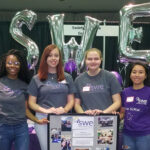
¿No hablas español? Not a problem. The Spanish Conversation Club is happy to have you! Don’t identify as a woman or engineering major? The Society of Women Engineers (SWE) still welcomes you. Interested in philosophy but not a philosophy major? Didn’t deter the past president of Philosophers Anonymous from taking office.
As a new semester gets underway (make sure to visit Involvement Fest, September 9), these and dozens of other student organizations readily welcome Retrievers who may not assume that the club is for them. Not surprisingly, UMBC clubs and orgs thrive when new perspectives show up.
Join the forum
 Headshot provided by Quinlan Murphy.
When Quinlan Murphy ’21, political science, served as president of Philosophers Anonymous, the council of majors for philosophy students, he was determined to make the club feel like home to any interested student. This includes inviting discussions about Hannah Arendt’s warning against the preconditions for totalitarianism to attending online art tours as museums opened their doors virtually during the pandemic. Another of the club’s goals, he says, was to make the department’s physical space in the Performing Arts & Humanities Building a welcoming place for students in between classes. “We wanted to create a little bit of a domestic vibe, so students felt invited into the building—we wanted a tangible space for them to feel at home,” says Murphy, who also obtained a certificate in philosophy.
Known better as PhilAnon, the group traditionally meets at noon on Tuesdays to allow students to present ideas—their own or others—and then follow a group discussion. “We want people to discuss these ideas outside of class with a little bit less formality, without assignments, without quizzes or tests,” says Murphy. The group also invites other majors and departments to participate, giving talks on bioethics or the hard sciences to discuss the ethical and philosophical corollaries of their academic expertise.
“Philosophy majors and other members are people who are going to go on to work in the humanities or academics,” says Murphy, “and a critical part of performing that job is being able to present ideas effectively and quickly, and then also having those ideas be criticized and poked by others.”
 Student groups make use of The Forum sculpture outside of the Performing Arts & Humanities Building in 2019. Photo by Marlayna Demond ’11.
Murphy, as a non-traditionally aged student and a commuter, has high hopes for PhilAnon and other clubs on campus. “I certainly think that the more involvement people have in school, the better college will be—it’s not just about grades and tests and essays. It’s also about growing as a person. And I think that requires interacting with your classmates outside of the classroom.”
 Headshot courtesy of Sheila Yeboah.
Pull up a silla (chair)
One of Sheila Yeboah ’23, biological sciences, favorite memories of the last semester is playing online pictionary on Webex with the Spanish Conversation Club. “The combination of the members’ poor drawing skills and the wealth of Spanish synonyms made the game extra difficult,” laughs Yeboah, but she adds that the easy-going nature of the club’s president James Angle and the other executive officers makes the student org a relaxed place to learn and have fun.
Yeboah says that previously her struggle with Spanish was having opportunities to speak it, and the low pressure of the conversation club was exactly what she needed. Yeboah, who is minoring in Spanish, joined the Spanish Conversation Club last semester when they were meeting virtually. “This club is primarily focused on forming friendships and practicing communication,” says Yeboah. “If you are a person that is a little more reserved, like me, it’s a very welcoming environment and you’re not going to feel like you can’t fit in.”
Angle ’22, modern languages and linguistics, became club president his sophomore year when the club had a vacuum of leadership. He and his friend Kyndall Hardwick ’22, English, the vice president, aim to make everyone feel welcome. “So many people get scared away because they think ‘I don’t know enough Spanish at that high level,’” says Angle, “but it could literally be your first day of Spanish class and we’d say ‘Come in.’”
Angle, who recently started taking Russian classes, knows that the hardest part of language learning can be getting comfortable speaking. “That’s the biggest battle,” he says, “but come play some fun games with us and get comfortable speaking Spanish while enjoying yourself.”
Building connections
 Lilly, left, and other SWE members at the National Conference in Anaheim, California in 2019. Photo courtesy of Kaitlynn Lilly.
At previous Involvement Fests, some students have balked at joining the Society of Women Engineers (SWE), says current president Kaitlynn Lilly, who is not an engineering major. Lilly, who is studying mathematics and physics, says that she and other club leaders emphasize that the space is accessible for anyone who “wants to empower women and move society forward,” says Lilly. “It’s a mix between creating a community of people who support women in STEM and also providing opportunities to meet with companies, practice professional development, and also be social.”
This three-fold goal is the intentional result of Lilly and others on the executive board asking themselves what the purpose of their community was. “We didn’t always have a third of our meetings mixed between social, professional development, and career,” says Lilly, a 2021 Goldwater Scholar. “We made a very conscious decision last year to do that because we used to have a company present to us at every single meeting. And it was really hard for club members to really form that community.”
Before the pandemic, says Lilly, the group was already hosting hybrid meetings to broaden the horizons of what companies they could invite to present. SWE will keep the hybrid format going forward for the convenience of people who commute or people who can’t make the meeting time.
Jessica Adams ’22, mechanical engineering, is starting her fourth year as a SWE member and her first as a leader. As the public relations chair, she’s eager to see the group grow its membership. “As we get a wider range of perspectives in our club, it allows us to learn about other people’s backgrounds so that we can understand where other people are coming from,” says Adams. “These interactions will make each of us a better candidate for any sort of jobs or internships we apply for in the future.”
Find your space
Murphy, who graduated last spring but hopes to stay connected to PhilAnon virtually, unsurprisingly sees students’ extracurricular involvement through the lens of what is morally and ethically good.
“I think students should see their time at UMBC as an opportunity for social and personal growth and not just like a job training program,” he says. “They should be able to ask hard questions and explore ideas informally. I think it’s really critical that there’s these spaces for people to have these conversations away from professors and with their peers.”
Whether that conversation is in Spanish or takes place online or in person, there’s a student club waiting to welcome all newcomers with open arms. Find out more at Involvement Fest, September 9 or online all year.
*****
Header image: SWE at Involvement Fest in 2019. Photo courtesy of Kaitlynn Lilly.
]]>
¿No hablas español? Not a problem. The Spanish Conversation Club is happy to have you! Don’t identify as a woman or engineering major? The Society of Women Engineers (SWE) still welcomes you....
https://umbc.edu/stories/the-hospitality-of-umbcs-student-clubs/
https://my3.my.umbc.edu/api/v0/pixel/news/119563/guest@my.umbc.edu/526653cd933bbc885f2d14ae66fba8b9/api/pixel
biological-sciences
campus-life
involvement-fest
mathematics
mechanical-engineering
mlli
philosophy
physics
UMBC News & Magazine
https://my3.my.umbc.edu/groups/umbc-news-magazine
https://assets1-my.umbc.edu/system/shared/avatars/groups/000/001/943/24435aa6207c452e7bc15cc74b42c7bb/xsmall.png?1748556657
https://assets1-my.umbc.edu/system/shared/avatars/groups/000/001/943/24435aa6207c452e7bc15cc74b42c7bb/original.png?1748556657
https://assets2-my.umbc.edu/system/shared/avatars/groups/000/001/943/24435aa6207c452e7bc15cc74b42c7bb/xxlarge.png?1748556657
https://assets2-my.umbc.edu/system/shared/avatars/groups/000/001/943/24435aa6207c452e7bc15cc74b42c7bb/xlarge.png?1748556657
https://assets3-my.umbc.edu/system/shared/avatars/groups/000/001/943/24435aa6207c452e7bc15cc74b42c7bb/large.png?1748556657
https://assets1-my.umbc.edu/system/shared/avatars/groups/000/001/943/24435aa6207c452e7bc15cc74b42c7bb/medium.png?1748556657
https://assets2-my.umbc.edu/system/shared/avatars/groups/000/001/943/24435aa6207c452e7bc15cc74b42c7bb/small.png?1748556657
https://assets1-my.umbc.edu/system/shared/avatars/groups/000/001/943/24435aa6207c452e7bc15cc74b42c7bb/xsmall.png?1748556657
https://assets2-my.umbc.edu/system/shared/avatars/groups/000/001/943/24435aa6207c452e7bc15cc74b42c7bb/xxsmall.png?1748556657
UMBC News & Magazine
0
0
false
Thu, 09 Sep 2021 15:27:02 -0400
Hurricanes, well-being, and AI: START Awards set up UMBC researchers for success

Soon, Steve Guimond and his students will begin exploring a new angle of his hurricane research. They want to better understand the fundamental physics that drives hurricanes. Specifically, they want to know how small disturbances in a hurricane’s wind flow, similar to a strong gust on a windy day, may affect its overall structure and intensity. The findings could have implications for hurricane forecasting.
A new, $682,000 National Science Foundation (NSF) grant in collaboration with the New Jersey Institute of Technology will fund the team’s work, which primarily involves developing, running, and analyzing complex numerical models on supercomputers. However, Guimond might never have received the grant if he hadn’t received a UMBC Strategic Award for Research Transitions (START) first.
In 2018, the NSF rejected a related proposal from Guimond, who is an associate research professor with UMBC’s physics department and the Joint Center for Earth Systems Technology, a partnership with NASA. The proposal outlined a broad research program using two different methods to learn more about hurricanes: remote sensing and numerical modeling. “The START funding helped us evaluate those two sides of the project,” he says.
The START program funded initial research that was carried out by Guimond, Devin Protzko ’20, physics and mathematics, and Badrul Hasan, a Ph.D. student in mechanical engineering. They gathered preliminary data showing that the modeling path had significant potential, so they wrote a fresh NSF proposal with a narrower focus. It won approval. The small START grant, Guimond says, “was key to helping us identify the most fruitful path for follow-on funding from NSF.”

A simulation of a “large eddy,” an instance of turbulence, in a rapidly intensifying hurricane. Running this kind of simulation is part of Steve Guimond’s research. Animation courtesy Steve Guimond.
Turbulence in focus
The NSF proposal will support work to understand the role of turbulence in how or whether hurricanes intensify. Guimond’s team will also look at the value of using numerical hurricane models with very high resolution. High resolution is important because a hurricane’s “gusts” appear and disappear very quickly. They also generally take up very little physical space. Because they’re so ephemeral, you can’t simulate them precisely or accurately with current models. And if you can’t simulate them, you can’t figure out their role in overall hurricane development. High resolution models would make those simulations possible, which can feed back into improved forecasts in the future.
The fact that Guimond has the chance to do this work exemplifies START’s goal. The program, funded by UMBC’s Office of the Vice President for Research, offers a maximum of $25,000 to UMBC faculty who wish to pursue new avenues of research. The hope is that the funds will put them in a stronger position for much larger external grants from places like NSF—exactly what happened for Guimond.

Steve Guimond. Courtesy Steve Guimond.
A first step
A new cohort of UMBC faculty will receive START funding this summer. Lira Yoon, associate professor of psychology, hopes to follow a similar path to Guimond. Yoon will collect initial data on how Asian Americans regulate their emotions in response to overt racism, and how or whether the strategies they practice affect their well-being. This work is particularly relevant given the sharp rise in anti-Asian discrimination during the pandemic. Yoon is also working on a project to help long-term care workers better manage their stress, another group impacted heavily by the pandemic.
“I’m eager to start a new line of research examining the effects of racial discrimination on psychological well-being, particularly in Asian Americans,” Yoon shares. “Although the ultimate solution to the problems resulting from racial discrimination lies at the policy and systems levels, understanding mechanisms operating at an individual level could help mitigate the adverse effects of discrimination.”
“This project will be the first step in that direction,” she says, “and it will provide preliminary data to secure external funding for future larger-scale research.”

Lira Yoon. Photo courtesy Lira Yoon.
Real-world impact
Maryam Rahnemoonfar, information systems, is another member of the new START cohort. Her team is developing algorithms for use on drones flying over affected areas after natural disasters. The goal is for the drones to relay important information about conditions on the ground in real time. Her team has created a unique dataset, called FloodNet, that can train the algorithms to recognize disaster impacts—for example, roads that are flooded or blocked by debris.
With a previous AI for Earth grant from Microsoft, more than 20 students at all levels in Rahnemoonfar’s research group spent more than a thousand hours creating the FloodNet dataset. Input from first responders and the Federal Emergency Management Administration (FEMA) guided their work, plus mentoring from faculty and more advanced students. Team members labeled each pixel in images to teach the artificial intelligence (AI) system what a flooded road or damaged building looks like.
“It was a very difficult and challenging task, but we are the first in the world to prepare this sophisticated dataset,” Rahnemoonfar says.
Already, German authorities have requested (and been granted) access to the FloodNet set of labeled images to help them respond to recent catastrophic flooding in the country. The FloodNet dataset is the first and only dataset of its kind that can be used for training AI systems in the wake of natural disasters.

Maryam Rahnemoonfar. Courtesy Maryam Rahnemoonfar.
Saving time, saving lives
With the new START funding, Rahnemoonfar’s team hopes to improve the algorithm that evaluates how much damage buildings have sustained, on a scale from none to total destruction. Rahnemoonfar also hopes to build an interface where a person can ask the AI system a verbal question and get a useful answer. Her team is developing this ability for data already collected, “but when a new hurricane happens, we hope that while a drone is flying you can ask and get answers to these questions in real time,” she says.
To save time—of the essence during disaster response—Rahnemoonfar’s graduate students are working on adding a layer to the algorithms that would allow the AI to learn on its own, with a minimal training dataset.
“Now that we have developed this AI system, for any new hurricane that happens, we don’t need to label data again,” she says. “With the algorithm that we are developing, with very few labeled images we can get insights for any new hurricane.”
A ripple effect
The START program has a ripple effect beyond UMBC faculty. Many of the awardees involve students in their work, enhancing the students’ UMBC experience and helping set them up for success later on. Students in Guimond’s group, for example, get first-hand experience with NASA scientists and facilities.
Also, by helping researchers hone their projects and, as a result, future proposals, START increases their chance of success with applying for larger grants. Like Guimond, Rahnemoonfar is already looking to use the START support to lead to bigger research awards.
“The START program enables UMBC faculty members (and with them, UMBC students) to move in new directions with their scholarly work,” shares Don Engel, associate vice president for research. “We are proud of the success past recipients have found in turning their proposed ideas into longer-term initiatives.”
Banner image: Hurricane Matthew bears down on Haiti in 2016. Image by NASA Goddard Space Flight Center.
]]>
Soon, Steve Guimond and his students will begin exploring a new angle of his hurricane research. They want to better understand the fundamental physics that drives hurricanes. Specifically, they...
https://umbc.edu/stories/hurricanes-well-being-and-ai-start-awards-set-up-umbc-researchers-for-success/
https://my3.my.umbc.edu/api/v0/pixel/news/119577/guest@my.umbc.edu/ebb9d64242a961e91d0ab1a2c8ab62ed/api/pixel
cahss
cnms
coeit
is
jcet
physics
psychology
research
science-and-technology
UMBC News & Magazine
https://my3.my.umbc.edu/groups/umbc-news-magazine
https://assets1-my.umbc.edu/system/shared/avatars/groups/000/001/943/24435aa6207c452e7bc15cc74b42c7bb/xsmall.png?1748556657
https://assets1-my.umbc.edu/system/shared/avatars/groups/000/001/943/24435aa6207c452e7bc15cc74b42c7bb/original.png?1748556657
https://assets2-my.umbc.edu/system/shared/avatars/groups/000/001/943/24435aa6207c452e7bc15cc74b42c7bb/xxlarge.png?1748556657
https://assets2-my.umbc.edu/system/shared/avatars/groups/000/001/943/24435aa6207c452e7bc15cc74b42c7bb/xlarge.png?1748556657
https://assets3-my.umbc.edu/system/shared/avatars/groups/000/001/943/24435aa6207c452e7bc15cc74b42c7bb/large.png?1748556657
https://assets1-my.umbc.edu/system/shared/avatars/groups/000/001/943/24435aa6207c452e7bc15cc74b42c7bb/medium.png?1748556657
https://assets2-my.umbc.edu/system/shared/avatars/groups/000/001/943/24435aa6207c452e7bc15cc74b42c7bb/small.png?1748556657
https://assets1-my.umbc.edu/system/shared/avatars/groups/000/001/943/24435aa6207c452e7bc15cc74b42c7bb/xsmall.png?1748556657
https://assets2-my.umbc.edu/system/shared/avatars/groups/000/001/943/24435aa6207c452e7bc15cc74b42c7bb/xxsmall.png?1748556657
UMBC News & Magazine
0
0
false
Fri, 06 Aug 2021 17:56:40 -0400
NASA, Dept. of Energy grant prestigious research awards to UMBC physics Ph.D. students

Noah Sienkiewicz is working alongside NASA and UMBC colleagues to design and build HARP2, an instrument that will launch on NASA’s PACE mission in 2024. Nathan Myers is partnering with top scientists across the country at Los Alamos National Laboratory in New Mexico on innovative quantum computing research. And both physics Ph.D. students have just received highly competitive grants that will help them take their work even further.
Myers received an Office of Science Graduate Student Research award from the U.S. Department of Energy (DOE), which will fund an 11-month experience at Los Alamos. Sienkiewicz received a Future Investigators in NASA Earth and Space Science and Technology (FINESST) Fellowship, which will fund his Ph.D. thesis work at UMBC for up to the next three years.
Fresh ideas
Myers is looking forward to infusing fresh ideas from Los Alamos scientists into his research on non-linear quantum systems. His work fits into the field of quantum thermodynamics, which is critical to the future of computing. The non-linear quantum systems he explores have the potential to be much faster than the already super-fast linear quantum systems that researchers have modeled and begun to fabricate.
Myers had already planned to pursue this area of research, but “now we’ll have the resources and the collaboration with all the researchers at Los Alamos, which is one of the foremost quantum computing research centers in the U.S.,” he says. “So it’s pretty exciting.”

Nathan Myers (left) and Sebastian Deffner at Myers’s master’s graduation. Photo courtesy Nathan Myers.
Begin with the end in mind
Sebastian Deffner, assistant professor of physics and Myers’s mentor, has gone the extra mile to make sure he is in a strong position for the future. In addition to supporting his students’ research, Deffner also helps his mentees develop “related skills, in terms of how to write and apply for these funding opportunities, awards, and grants, and just how to build your network and get in contact with people,” Myers says.
In fact, “When I was first starting research,” Myers says, “one of the first conversations we had was, ‘So, when you graduate, what are some of the places where you might be interested in working? And who can we talk to, to start that process as early as possible?”
Los Alamos was on Myers’s list. Deffner connected Myers with Yigit Subasi, a Los Alamos scientist, and their conversation revealed significant overlap between their research interests. They were coming at the same questions from different angles. So, they collaborated on the proposal for the DOE funding to blend their ideas and work on a breakthrough together.
“Winning this award will give Nathan a unique opportunity to interact with and learn from world-leading experts at a top-tier research location,” Deffner says. “The potential impact on his scientific career can hardly be overestimated, and I hope that this will set a new benchmark for the excellence of our graduate education at UMBC.”

The Los Alamos National Laboratory is perched at 7,355 feet, atop the Pajarito Plateau in the Jemez Mountains in northern New Mexico. Photo courtesy LANL.
The full arc
Sienkiewicz started his UMBC career in a research rotation with Zhibo Zhang, associate professor of physics. He then rotated to work with Vanderlei Martins, professor of physics and director of UMBC’s Earth and Space Institute, who is now his Ph.D. advisor. Zhang gave Sienkiewicz an introduction to computational techniques. And with Martins, he learned how to apply those techniques to data that address the most fundamental physics describing an instrument or phenomenon.
Those two experiences informed Sienkiewicz’s path forward. Now he wants to be involved in “the full arc” of atmospheric research projects— “to make sure the whole process is interconnected and well-informed,” starting with design, and progressing through testing and data processing.
These days, Sienkiewicz is working on both HARP2 and the original HARP, which he helped develop before it launched successfully in fall 2019. In the morning, he analyzes incoming HARP data. Then, in the afternoon, he uses what he observed to inform decisions about HARP2. Both instruments have the potential to inform how climate models account for clouds and tiny particles in the air called aerosols, such as dust, smoke, and other airborne chemicals.

Bands of cirrus clouds above Australia. Clouds are one of the hardest factors for climate models to account for. Data collected by HARP and HARP2 should help. Photo: NASA.
“My goals are to straddle that line between someone who runs code all day and someone who goes into the lab and does the testing,” Sienkiewicz says. It’s a rarer path among atmospheric physicists, but one that offers exciting opportunities. In particular, Sienkiewicz’s comprehensive perspective will be beneficial in the planning process for NASA’s next decade, he believes.
A childhood dream
Both HARP and HARP2 are examples of polarimeters, which will be a major focus of NASA experiments over the next 10 years. Sienkiewicz hopes to stay involved in their development after he graduates, in 2023 or 2024, by transitioning to a role at NASA proper just in time for the PACE mission launch that will carry HARP2 into space.
Through UMBC’s strong connections with the space agency, “I’ve gotten to be more exposed to actual NASA work, and sit in meetings with NASA officials,” Sienkiewicz says. “So, as far as the childhood dream of ‘I want to work for NASA,’ I feel like it’s been a great stepping stone to doing that and having direct interaction with those people and building a network.”

Just after the HARP launch in 2019, Sienkiewicz (far left) and other UMBC students listen to Vanderlei Martins (right) as he offers an impromptu lesson in atmospheric physics. Photo by Sarah Hansen, M.S. ’15.
Support at every level
With Sienkiewicz focused on space and climate science and Myers on quantum computing, their physics research could hardly be farther apart. But they actually have a lot in common.
Sienkiewicz and Myers began their graduate studies at UMBC at the same time. “We sat shoulder to shoulder in the first-year grad student office in 2017,” Sienkiewicz says. “Especially in that first year, our whole cohort really stuck together and helped each other a lot.”
They became friends and housemates. Even as their research trajectories diverged, living in the same house during a pandemic exposed them to each other’s work in new ways. “I’ve probably learned more about quantum thermodynamics in the last year than I ever have, because I hear him in the other room going on and on about anyons,” Sienkiewicz says with a smile.
Their personal camaraderie speaks to a larger graduate student support network in physics at UMBC. For both Myers and Sienkiewicz, the application process for their awards was a group effort, with multiple rounds of feedback from faculty, peers, and staff at UMBC’s Joint Center for Earth Systems Technology (JCET).
In addition to the DOE award, Myers is also funded by the private sector arm of NASA, Paraton, and benefits from a National Science Foundation grant awarded to Deffner. Sienkiewicz received a Graduate Assistant in Areas of National Need award from the U.S. Department of Education in his first year, and, later, a JCET fellowship.
“Getting the funding opportunities through UMBC and making those connections has been instrumental to my progress,” Sienkiewicz says. “Our department really supports students by keeping them funded and showing them opportunities. They help set us up for success.”
Banner image: Two scientists work on the HARP polarimeter in a clean room at UMBC. Sienkiewicz helped fabricate the HARP satellite, including time in the clean room, and now is working on HARP2. Photo by Marlayna Demond ’11 for UMBC
]]>
Noah Sienkiewicz is working alongside NASA and UMBC colleagues to design and build HARP2, an instrument that will launch on NASA’s PACE mission in 2024. Nathan Myers is partnering with top...
https://umbc.edu/stories/nasa-dept-of-energy-grant-prestigious-research-awards-to-umbc-physics-ph-d-students/
https://my3.my.umbc.edu/api/v0/pixel/news/119588/guest@my.umbc.edu/fb5190cb8d681163d2c9d465666b0f5c/api/pixel
cnms
esi
gradresearch
graduateschool
page1
physics
science-and-technology
UMBC News & Magazine
https://my3.my.umbc.edu/groups/umbc-news-magazine
https://assets1-my.umbc.edu/system/shared/avatars/groups/000/001/943/24435aa6207c452e7bc15cc74b42c7bb/xsmall.png?1748556657
https://assets1-my.umbc.edu/system/shared/avatars/groups/000/001/943/24435aa6207c452e7bc15cc74b42c7bb/original.png?1748556657
https://assets2-my.umbc.edu/system/shared/avatars/groups/000/001/943/24435aa6207c452e7bc15cc74b42c7bb/xxlarge.png?1748556657
https://assets2-my.umbc.edu/system/shared/avatars/groups/000/001/943/24435aa6207c452e7bc15cc74b42c7bb/xlarge.png?1748556657
https://assets3-my.umbc.edu/system/shared/avatars/groups/000/001/943/24435aa6207c452e7bc15cc74b42c7bb/large.png?1748556657
https://assets1-my.umbc.edu/system/shared/avatars/groups/000/001/943/24435aa6207c452e7bc15cc74b42c7bb/medium.png?1748556657
https://assets2-my.umbc.edu/system/shared/avatars/groups/000/001/943/24435aa6207c452e7bc15cc74b42c7bb/small.png?1748556657
https://assets1-my.umbc.edu/system/shared/avatars/groups/000/001/943/24435aa6207c452e7bc15cc74b42c7bb/xsmall.png?1748556657
https://assets2-my.umbc.edu/system/shared/avatars/groups/000/001/943/24435aa6207c452e7bc15cc74b42c7bb/xxsmall.png?1748556657
UMBC News & Magazine
0
0
false
Fri, 02 Jul 2021 15:38:45 -0400
UMBC’s Anthony Johnson, pulse laser innovator, elected a member of the American Academy of Arts and Sciences
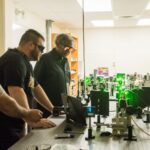
Anthony Johnson, professor of physics and computer science and electrical engineering, and director of UMBC’s Center for Advanced Studies in Photonics Research (CASPR), has received the prestigious honor of election to the American Academy of Arts and Sciences.
The Academy, founded during the American Revolution, “honors excellence and convenes leaders from every field of human endeavor to examine new ideas, address issues of importance to the nation and the world, and”—in the words of its original founders—“work together ‘to cultivate every art and science which may tend to advance the interest, honor, dignity, and happiness of a free, independent, and virtuous people.’”
Being elected as a member is one of the highest honors a scholar can receive. The Academy has elected approximately 13,500 members since its founding in 1780.
The Optical Society also recently recognized Johnson’s more than 40-year career in photonics and his commitment to mentorship with the Stephen D. Fantone Distinguished Service Award.

Anthony Johnson. Photo courtesy Anthony Johnson.
High-impact research
Johnson joined the UMBC faculty in 2003 after launching his career at Bell Labs and then spending eight years at the New Jersey Institute of Technology. In his research, he works on creative applications for ultrashort pulse lasers. These have included shrinking cancerous tumors, optimizing long-distance communications, preventing viruses in seafood from causing food-borne illness, and developing new nanoscale materials.
Mentoring emerging researchers has also been a key priority throughout Johnson’s life and career, and he is well known for his dedication to students and colleagues. “Anthony understands the role of nurturing students, helping them to find their inner spring and to fulfill their potential and their own personal dreams,” says long-time colleague and friend Stephen Fantone.
Commitment to the next generation
At the same time that Johnson received the Optical Society recognition, he was also named to the Committee on Diversity and Inclusion on the Technical Advisory Board of the Institute for Electrical and Electronics Engineers (IEEE). Having benefited as an undergraduate from an internship focused on opportunities for people from underrepresented groups in physics, Johnson has always prioritized diversifying his field.
“There’s still a lot to be done in our professional societies to build up and attract both women and minorities,” Johnson told UMBC News for a story on the Optical Society award. “We still have work to do to expand the opportunities to a broader set of people and bring in new ideas.”
President Freeman Hrabowski is the only other person at UMBC who has been elected to the American Academy of Arts and Sciences.
“Anthony Johnson is a true pioneer, and he has had a profound impact on the world through his research and teaching,” Hrabowski says. “What’s especially significant is his deep commitment to guiding, supporting, and inspiring the next generation of scientists. I can think of no one more deserving of this honor.”
Banner image: Anthony Johnson, right, with students in his laboratory. Photo by UMBC.
]]>
Anthony Johnson, professor of physics and computer science and electrical engineering, and director of UMBC’s Center for Advanced Studies in Photonics Research (CASPR), has received the...
https://umbc.edu/stories/umbcs-anthony-johnson-pulse-laser-innovator-elected-a-member-of-the-american-academy-of-arts-and-sciences/
https://my3.my.umbc.edu/api/v0/pixel/news/119649/guest@my.umbc.edu/c3b591c504a436e6fc306b6ac52e8260/api/pixel
cnms
coeit
community
csee
majoraward
page1
physics
science-and-technology
UMBC News & Magazine
https://my3.my.umbc.edu/groups/umbc-news-magazine
https://assets1-my.umbc.edu/system/shared/avatars/groups/000/001/943/24435aa6207c452e7bc15cc74b42c7bb/xsmall.png?1748556657
https://assets1-my.umbc.edu/system/shared/avatars/groups/000/001/943/24435aa6207c452e7bc15cc74b42c7bb/original.png?1748556657
https://assets2-my.umbc.edu/system/shared/avatars/groups/000/001/943/24435aa6207c452e7bc15cc74b42c7bb/xxlarge.png?1748556657
https://assets2-my.umbc.edu/system/shared/avatars/groups/000/001/943/24435aa6207c452e7bc15cc74b42c7bb/xlarge.png?1748556657
https://assets3-my.umbc.edu/system/shared/avatars/groups/000/001/943/24435aa6207c452e7bc15cc74b42c7bb/large.png?1748556657
https://assets1-my.umbc.edu/system/shared/avatars/groups/000/001/943/24435aa6207c452e7bc15cc74b42c7bb/medium.png?1748556657
https://assets2-my.umbc.edu/system/shared/avatars/groups/000/001/943/24435aa6207c452e7bc15cc74b42c7bb/small.png?1748556657
https://assets1-my.umbc.edu/system/shared/avatars/groups/000/001/943/24435aa6207c452e7bc15cc74b42c7bb/xsmall.png?1748556657
https://assets2-my.umbc.edu/system/shared/avatars/groups/000/001/943/24435aa6207c452e7bc15cc74b42c7bb/xxsmall.png?1748556657
UMBC News & Magazine
0
0
false
Thu, 22 Apr 2021 17:07:29 -0400
UMBC students set new record in prestigious Goldwater Scholarships for STEM research
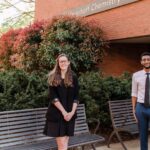
Four UMBC students have been named 2021-2022 Goldwater Scholars, setting a new university record for the most Retrievers to earn this prestigious undergraduate award in a single year. They are Joshua Slaughter ‘22, computer engineering; Kaitlynn Lilly ‘22, physics and mathematics; Gerson Kroiz ‘22, mathematics; and Karan Luthria ‘22, bioinformatics. Their awards make UMBC one of the highest-producing universities for Goldwater Scholars in the nation, directly alongside Harvard, MIT, and Johns Hopkins.
The goal of the Barry Goldwater Scholarship and Excellence in Education Program is to provide the United States with “a continuing source of highly qualified scientists, mathematicians, and engineers” to move the nation forward. UMBC’s prior Goldwater Scholars, including Rhodes Scholar Naomi Mburu ‘18, chemical engineering, have gone on to top graduate programs and promising research careers.
That four UMBC students won awards, from over 1,250 STEM student applicants across the country is remarkable, notes April Householder ’95, director of undergraduate research and prestigious scholarships at UMBC. “Winning the Goldwater means that Slaughter, Lilly, Kroiz, and Luthria join a legacy of scholars who have gone on to become this country’s leading scientists, engineers, and mathematicians,” she says.
“The impact that these students will have in their respective fields is immense,” Householder shares, “and they are ready for the challenge. All four of them had their research internships moved online because of COVID, and they have proved that they are resilient.”
 Joshua Slaughter, left, Kaitlynn Lilly, center, and Karan Luthria on campus.
Slaughter, Lilly, Kroiz, and Luthria are among the 410 winners selected this year from a highly competitive national pool of applicants. They will receive substantial scholarship funding that advances their undergraduate work and supports their educational paths.
The students met each other early in their UMBC careers and are close friends, all involved in the Meyerhoff community—Slaughter, Lilly, and Luthria as scholars, and Kroiz as an affiliate.
The impact of algorithms
Joshua Slaughter actually began doing research at UMBC when he was in high school, starting in environmental science. As he explored his interests, he discovered his fascination with using machine learning to evaluate the replicability and reproducibility of algorithms.
 Joshua Slaughter
Currently, Slaughter works with Distinguished University Professor Tulay Adali, computer science and electrical engineering (CSEE). Their machine learning research has applications in fields like neuroimaging, which uses data-driven algorithms to identify features of neurological disease. Slaughter says that it’s essential to diversify the field of machine learning and that people of all backgrounds need to be involved in the development of algorithms.
“Machine learning algorithms will be crucial in future decision-making. If they are developed without intersectionality being considered, we will have nightmarish outcomes for certain underrepresented populations,” he explains. “That’s a huge reason why I’m pursuing machine learning.”
When Slaughter applied to UMBC, he already had his sights set on the Goldwater. He was researching in the lab when he learned he won the scholarship—working alone due to COVID-19 restrictions. “I screamed,” he said, overjoyed by the news.
In addition to being a Meyerhoff Scholar, Slaughter is in the UMBC Honors College, and a member of the URISE program, which supports undergraduate juniors and seniors who are majoring in the science, engineering and mathematics. He is a member of the National Society of Black Engineers and Tau Beta Pi, the engineering honors society. He has completed research internships at Princeton University and Carnegie Mellon University, has presented his research at conferences, and has published two scientific papers.
Slaughter looks forward to pursuing a Ph.D. after his senior year, and says that receiving the Goldwater Scholarship proves to him that he can succeed in a research career. He’s thankful to UMBC for guiding him, from providing an Undergraduate Research Award to connecting him with internship opportunities.
“UMBC does a great job of putting students first,” says Slaughter. He’s already paying that forward by mentoring high school students in Baltimore and as a CSEE teaching fellow.
STEM role models matter
Kaitlynn Lilly actually applied to the Goldwater program as a sophomore but didn’t receive the award—an experience shared by Slaughter. She says the feedback she received from UMBC faculty and staff throughout the process was instrumental in her resilience and continued growth as a researcher, and earning the scholarship this year was all the more gratifying.
 Kaitlynn Lilly
Lilly’s research focuses on using partial differential equations to understand how large structures, such as bridges, interact with air flow and are impacted by aerodynamics. Lilly currently conducts research with Justin Webster, assistant professor of mathematics. Webster himself received a Goldwater Scholarship in 2007 and knows the impact of receiving the award.
Webster and Lilly are also collaborating with researchers at Carnegie Mellon University. Lilly also has experience working with Carnegie Mellon researchers through an enriching virtual internship last summer, secured after her internship at MIT’s Lincoln Lab was cancelled due to COVID-19.
In addition to conducting research at Carnegie Mellon and UMBC, she has completed internships at the Johns Hopkins Applied Physics Lab and University of Hawaii. This summer, Lilly plans to conduct research at the University of Leiden in the Netherlands.
Beyond the lab, Lilly is committed to volunteering at the local Arbutus Middle School, supporting students one-on-one who need extra help in STEM classes. “I’m a first-generation college student, and having someone that has gone through it tell you that you can do it really matters,” she says. “Being that inspiration for someone else has been very rewarding.”
Lilly, who is also a member of the Honors College, explains that receiving the Goldwater Scholarship confirms to her that “what I’m doing matters.” She plans to pursue her Ph.D. in applied mathematics when she graduates from UMBC next year.
Safer cancer treatment through math
Gerson Kroiz began his UMBC undergraduate experience at 16 years old, passionate to pursue research with public impact. He had his eye on the Goldwater Scholarship early, knowing the doors it could open. Receiving the Goldwater “really validates where I am at, and the hard work that I’ve put into my academic path,” as well as the value of UMBC support for undergraduate researchers, he says.

Gerson Kroiz. Photo courtesy of Kroiz.
Kroiz has refined his research interests through experiences at institutions across the country. This past summer, he completed a virtual internship at UCLA, adding to his resume of internships at the National Institute of Standards and Technology and UMBC.
Today, Kroiz’s research focuses on using machine learning techniques to improve real-time imaging for safer cancer treatments. The technology he studies will help physicians treat people with cancer by “reducing possible side-effects from common cancer treatment methods,” Kroiz explains.
In addition to being an affiliate of the Meyerhoff Scholars program, Kroiz is a member of the Honors College and won an Undergraduate Research Award. He volunteers with UMBC’s Creative Coders program at Arbutus Middle School. There, he helps middle school students learn about computer science through hands-on applications such as game design.
He is also a teaching assistant in mathematics, working with Matthias Gobbert, professor of mathematics and statistics. And Kroiz is vice president of the Korean Student Association, ready to serve as president in the 2021-2022 academic year.
Kroiz plans to pursue his Ph.D. in applied mathematics with a focus in high-performance computing and big data after graduating next year.
Public impact research
As an undergraduate who aspires to become a physician-scientist, Karan Luthria is inspired by the profound impact that lab research can have on patients’ treatment and health outcomes. His research focuses on studying similarities between diseases hoping to identify new avenues for drug repurposing.
 Karan Luthria
Luthria explains that he is looking at “how previously developed drugs can be used to treat different conditions.” Although he has been working on this research since freshman year, and has presented his findings at conferences around the country, he says COVID-19 has brought much attention to the value of drug repurposing.
On the day that the Goldwater Scholarship recipients were announced, Luthria refreshed the award page, awaiting the results. When he finally saw his name appear, “I was humbled,” he says. “Just seeing how I have the potential to make a difference in science and to have my research recognized by the Goldwater Committee is exciting.”
Luthria has held several internships, including at Harvard Medical School, the National Institutes of Health (NIH), and the Johns Hopkins Applied Physics Lab. Maricel Kann, associate professor of biological sciences, is his research mentor at UMBC. He says that Kann and his mentors at Harvard and at the NIH played a particularly important role in supporting him to achieve his career goals and throughout the Goldwater application process.
Outside of the lab, Luthria is a teaching assistant in math and biology, and a tutor in the Chemistry Tutorial Center. He is also the logistics director for HackUMBC, a student organization that plans 24-hour-long hackathons for students to develop technological solutions to problems that matter to them. As a member of HackUMBC, Luthria connects with corporations and campus partners to secure funding that supports the annual event, sharing his passion for collaborative public impact research.
Banner image: Karan Luthria, left; Kaitlynn Lilly, center; and Joshua Slaughter. All photos by Marlayna Demond ’11 for UMBC unless otherwise noted.
]]>
Four UMBC students have been named 2021-2022 Goldwater Scholars, setting a new university record for the most Retrievers to earn this prestigious undergraduate award in a single year. They are...
https://umbc.edu/stories/umbc-students-set-new-record-in-prestigious-goldwater-scholarships-for-stem-research/
https://my3.my.umbc.edu/api/v0/pixel/news/119655/guest@my.umbc.edu/24fe6228731f8b927730cb5c5e7871e6/api/pixel
chembiochem
cnms-csee
coeit
honorscollege
majoraward
mathstat
meyerhoffscholars
page1
physics
science-and-technology
undergradresearch
UMBC News & Magazine
https://my3.my.umbc.edu/groups/umbc-news-magazine
https://assets1-my.umbc.edu/system/shared/avatars/groups/000/001/943/24435aa6207c452e7bc15cc74b42c7bb/xsmall.png?1748556657
https://assets1-my.umbc.edu/system/shared/avatars/groups/000/001/943/24435aa6207c452e7bc15cc74b42c7bb/original.png?1748556657
https://assets2-my.umbc.edu/system/shared/avatars/groups/000/001/943/24435aa6207c452e7bc15cc74b42c7bb/xxlarge.png?1748556657
https://assets2-my.umbc.edu/system/shared/avatars/groups/000/001/943/24435aa6207c452e7bc15cc74b42c7bb/xlarge.png?1748556657
https://assets3-my.umbc.edu/system/shared/avatars/groups/000/001/943/24435aa6207c452e7bc15cc74b42c7bb/large.png?1748556657
https://assets1-my.umbc.edu/system/shared/avatars/groups/000/001/943/24435aa6207c452e7bc15cc74b42c7bb/medium.png?1748556657
https://assets2-my.umbc.edu/system/shared/avatars/groups/000/001/943/24435aa6207c452e7bc15cc74b42c7bb/small.png?1748556657
https://assets1-my.umbc.edu/system/shared/avatars/groups/000/001/943/24435aa6207c452e7bc15cc74b42c7bb/xsmall.png?1748556657
https://assets2-my.umbc.edu/system/shared/avatars/groups/000/001/943/24435aa6207c452e7bc15cc74b42c7bb/xxsmall.png?1748556657
UMBC News & Magazine
0
0
false
Thu, 15 Apr 2021 16:48:32 -0400
 Sebastian Deffner, physics, wrote a piece for The Conversation in 2017 explaining static electricity. Every winter, when dry air and static increase, the article gets a fresh boost of views. Photo by Marlayna Demond ’11 for UMBC.
  Charissa Cheah’s April 2021 Conversation article on anti-Asian violence and school safety was followed by related coverage on NBC News and WYPR. Photo by Crystal Tseng, courtesy Charissa Cheah.
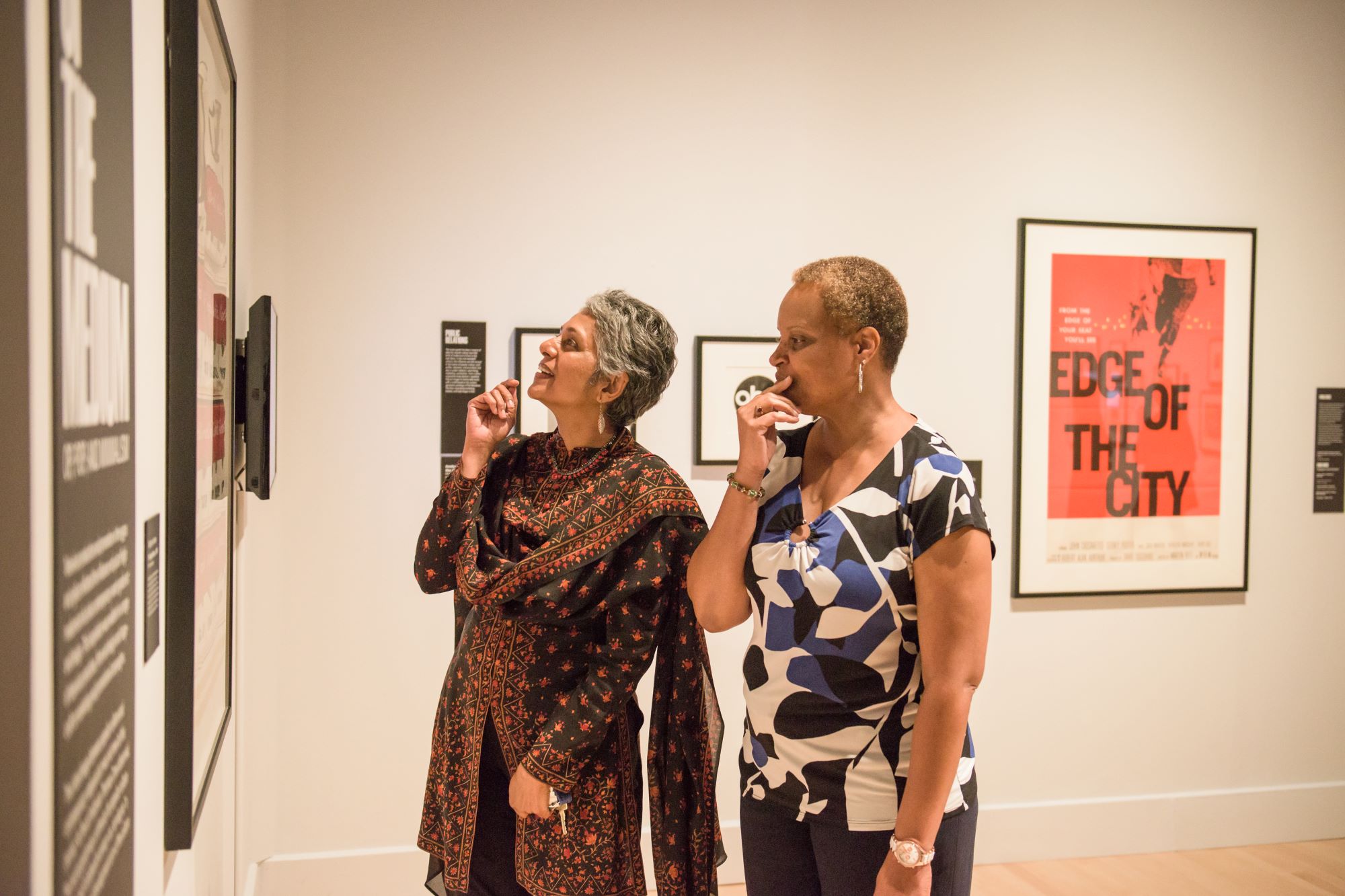 Preminda Jacob (l) and Andrea Lorick (r) at at exhibition at UMBC’s Center for Art, Design, and Visual Culture. Photo by Marlayna Demond ’11 for UMBC.
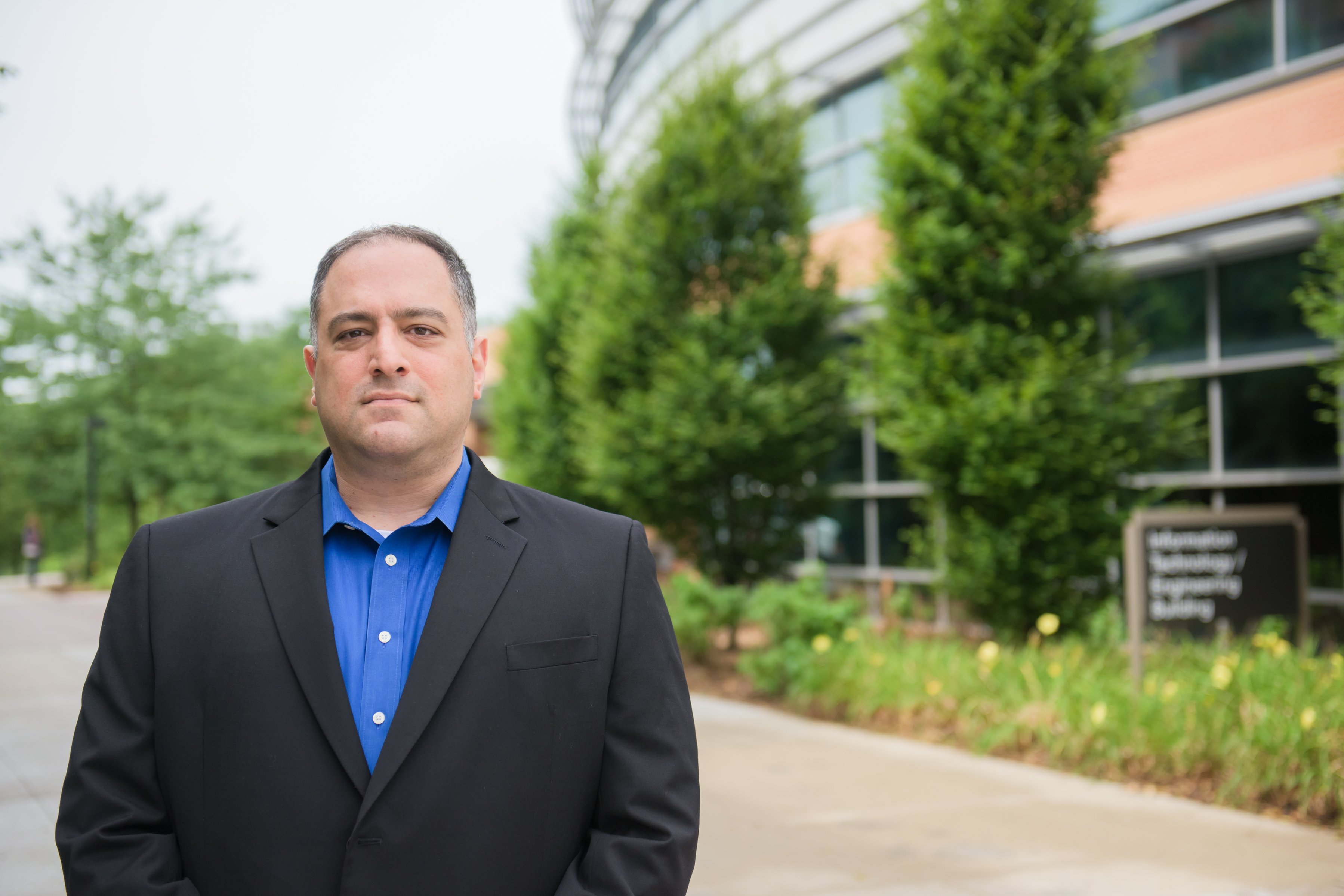 Richard Forno outside the Information Technology and Engineering Building. Photo by Marlayna Demond ’11 for UMBC.


