To Save Threatened Plants and Animals, Restore Habitat on Farms, Ranches and Other Working Lands
By Erle C. Ellis, professor, Geography and Environmental Systems, UMBC; Lucas Alejandro Garibaldi, Universidad Nacional de Rio Negro; Claire Kremen, University of British Columbia; and Sandra Díaz, Universidad de Córdoba (Argentina)
The Research Brief is a short take about interesting academic work.
The big idea
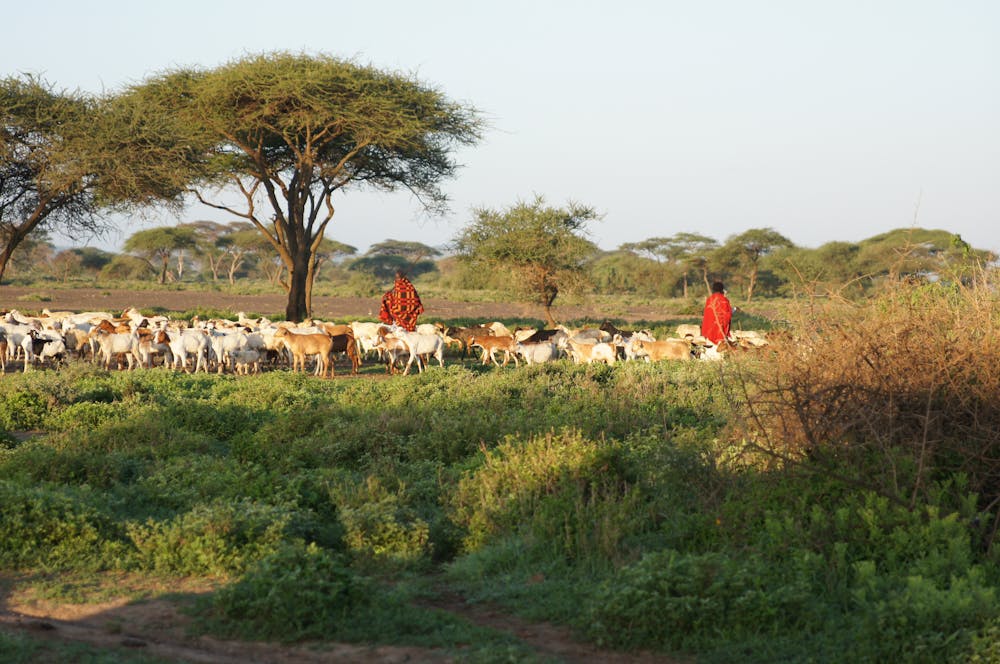
Restoring native habitats to at least 20% of the world’s land currently being used by humans for farming, ranching and forestry is necessary to protect biodiversity and slow species loss, according to a newly published study conducted by a team of environmental scientists including us. Our analysis found that this can be done in ways that minimize trade-offs and could even make farms more productive by helping to control pests, enhancing crop pollination and preventing losses of nutrients and water from soil. These working landscapes can still be grazed, mowed, harvested or burned, as long as these activities sustain or restore native species diversity.
So-called “zero-net-loss policies” would prevent any further destruction or conversion of wild lands on developed property. There are creative and experimental options for the most heavily cultivated regions, such as incorporating strips of prairie plants into crop fields across the U.S. Midwest or planting flower strips to restore pollinators in Switzerland.
Only 38% of the 82 countries we reviewed have national laws requiring native habitat on working lands. Most were in Europe and required that just 5% be kept wild. In many countries only forest habitats are regulated, while grasslands and other highly threatened landscapes are ignored. These decisions are driven by politics, economics and cultural values, but overall they lack clear scientific guidelines.
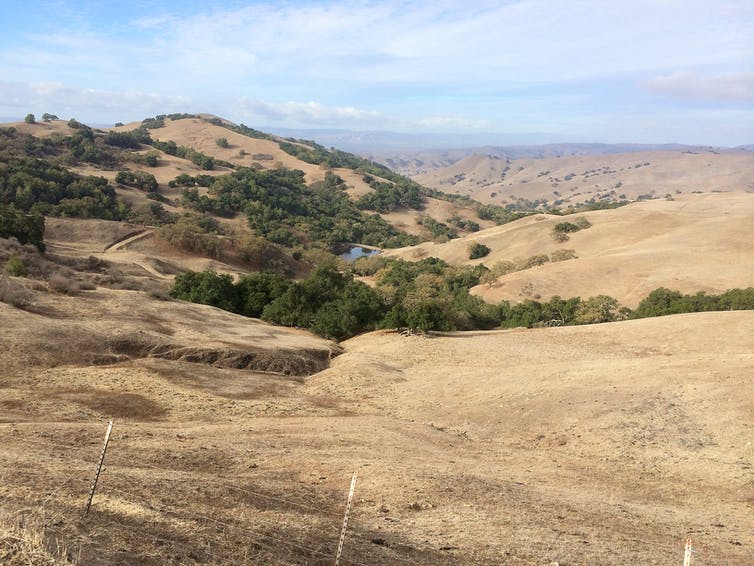 Through the establishment of a conservation bank on the Sparling Ranch in California, more than 2,000 acres of valuable habitat for tiger salamanders and red-legged frogs will be protected, including 14 breeding ponds, while the Sparling family continues to raise and graze cattle on their land. Steve Rottenborn, USFWS/Flickr
Why it matters
Restoring habitat creates homes for wildlife, but it also contributes to human well-being and supports all life on Earth. Native vegetation prevents erosion and purifies the water we drink and the air we breathe. It sequesters carbon, mitigating climate change, and acts as a buffer against flooding, landslides and storms. The wildlife species that move in may pollinate crops or control pests.
For more than a century, conservationists have worked to save threatened species by protecting them within large national parks and refuges. This clearly hasn’t been enough: The Earth is losing plants and animals at more than 100 times the normal rate, in what some scientists believe is the Earth’s sixth mass extinction event.
Under the 1992 Convention on Biological Diversity, an international treaty ratified by 196 nations, countries have pledged to conserve 17% of the planet’s land area in protected zones by 2020. So far, they have failed to meet that target. Now many conservationists are proposing an expanded effort that would conserve as much as 30% of land by 2030, and as much as half by 2050. Where will all this land come from?
With global land use expanding and becoming more intensive and dominated by monocultures, there is an urgent need to conserve and restore native species outside of protected areas – within landscapes managed for people.
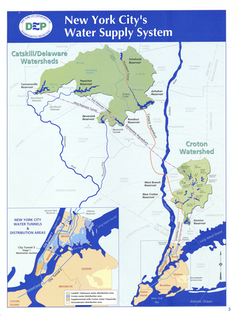 Forests in upstate New York protect and filter New York City’s drinking water supply. The forests are managed and monitored to ensure water quality; they also provide habitat for wildlife and recreation opportunities. NYDEC
What’s next
Though the benefits are many and there are numerous successful restoration models to draw upon, wild habitats continue to be degraded, razed and eliminated.
Preventing, stopping and reversing the degradation of ecosystems is also an essential strategy for meeting United Nations Sustainable Development Goals and commitments for the U.N. Decade on Ecosystem Restoration that launches next year.
Critical policy opportunities are just ahead. Europeans are now deciding how much agricultural land to devote to “landscape and habitat features.” New conservation targets will be part of the post-2020 global biodiversity framework negotiated at next spring’s 15th meeting of the Convention on Biological Diversity. Its ambitious global vision is nothing less than “living in harmony with nature” by 2050.
*****
Lucas Alejandro Garibaldi, Professor and Director, Institute for Research in Natural Resources, Agroecology and Rural Development, Universidad Nacional de Rio Negro; Claire Kremen, Professor of Resources, Environment and Sustainability and Professor of Zoology, University of British Columbia; Erle C. Ellis, Professor of Geography and Environmental Systems, University of Maryland, Baltimore County, and Sandra Díaz, Professor of Community and Ecosystem Ecology, Universidad de Córdoba (Argentina)
This article is republished from The Conversation under a Creative Commons license. Read the original article.
Header image: Planting strips of native prairie grasses on a farm in Iowa provides habitat for pollinators and protects soil and water. Omar de Kok-Mercado/Iowa State University, CC BY-ND
]]>
By Erle C. Ellis, professor, Geography and Environmental Systems, UMBC; Lucas Alejandro Garibaldi, Universidad Nacional de Rio Negro; Claire Kremen, University of British Columbia; and Sandra...
https://umbc.edu/stories/to-save-threatened-plants-and-animals-restore-habitat-on-farms-ranches-and-other-working-lands/
https://my3.my.umbc.edu/api/v0/pixel/news/119763/guest@my.umbc.edu/6879c11697aa6265b65022f91b83d31e/api/pixel
cahss
discovery
ges
the-conversation
UMBC News & Magazine
https://my3.my.umbc.edu/groups/umbc-news-magazine
https://assets1-my.umbc.edu/system/shared/avatars/groups/000/001/943/24435aa6207c452e7bc15cc74b42c7bb/xsmall.png?1748556657
https://assets1-my.umbc.edu/system/shared/avatars/groups/000/001/943/24435aa6207c452e7bc15cc74b42c7bb/original.png?1748556657
https://assets2-my.umbc.edu/system/shared/avatars/groups/000/001/943/24435aa6207c452e7bc15cc74b42c7bb/xxlarge.png?1748556657
https://assets2-my.umbc.edu/system/shared/avatars/groups/000/001/943/24435aa6207c452e7bc15cc74b42c7bb/xlarge.png?1748556657
https://assets3-my.umbc.edu/system/shared/avatars/groups/000/001/943/24435aa6207c452e7bc15cc74b42c7bb/large.png?1748556657
https://assets1-my.umbc.edu/system/shared/avatars/groups/000/001/943/24435aa6207c452e7bc15cc74b42c7bb/medium.png?1748556657
https://assets2-my.umbc.edu/system/shared/avatars/groups/000/001/943/24435aa6207c452e7bc15cc74b42c7bb/small.png?1748556657
https://assets1-my.umbc.edu/system/shared/avatars/groups/000/001/943/24435aa6207c452e7bc15cc74b42c7bb/xsmall.png?1748556657
https://assets2-my.umbc.edu/system/shared/avatars/groups/000/001/943/24435aa6207c452e7bc15cc74b42c7bb/xxsmall.png?1748556657
UMBC News & Magazine
0
0
false
Thu, 29 Oct 2020 13:36:28 -0400
How Can Smoke from West Coast Fires Cause Red Sunsets in New York?
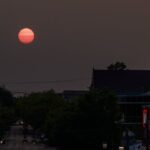
By Jeffrey B. Halverson, professor, Geography and Environmental Systems, associate dean, Graduate School, UMBC
If you are one of the millions of people in the Midwest and Eastern U.S. who turned your gaze toward the sky recently, you may have noticed the sun shining through an odd, milky haze. This widespread opaque veil was caused not by clouds, but rather by smoke from wildfires in the Western U.S.
The smoke was cruising by in the middle levels of the atmosphere many thousands of feet above the ground. While far too high to smell, it caused spectacularly hued sunsets from New York to D.C. to Missouri.
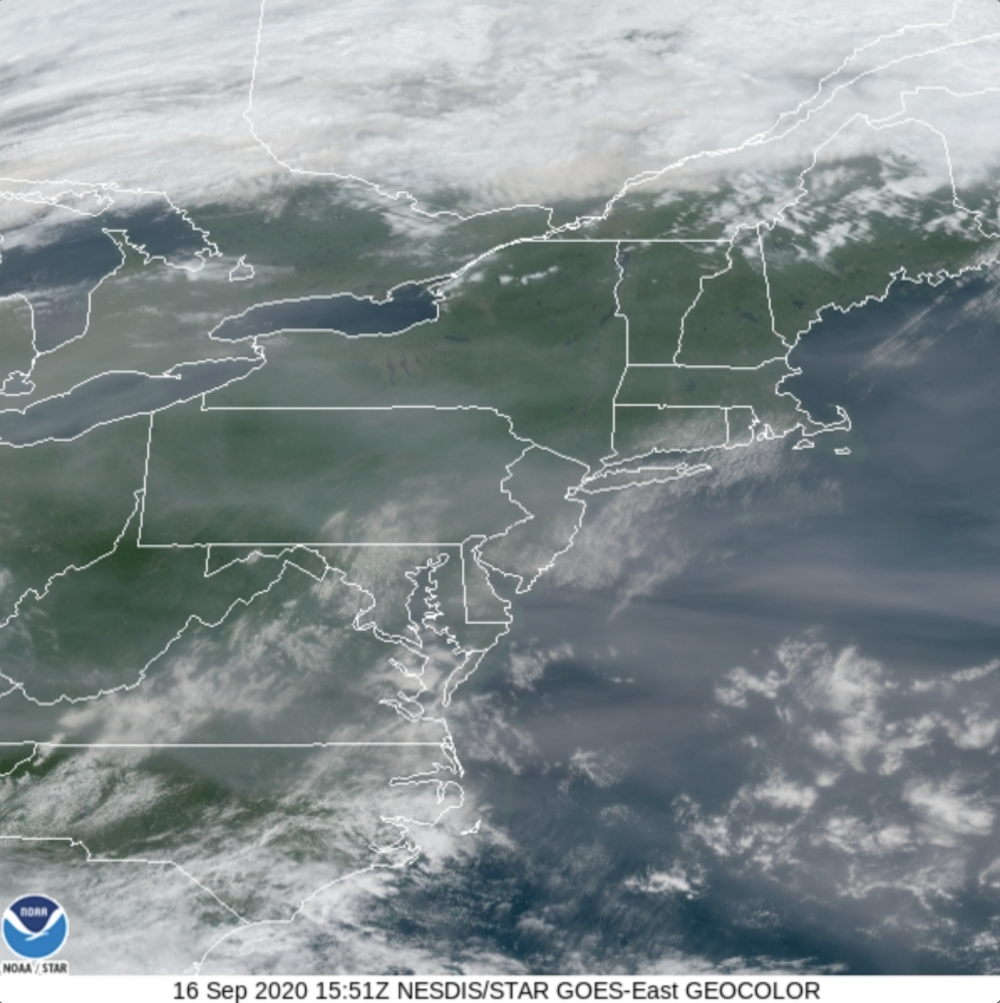
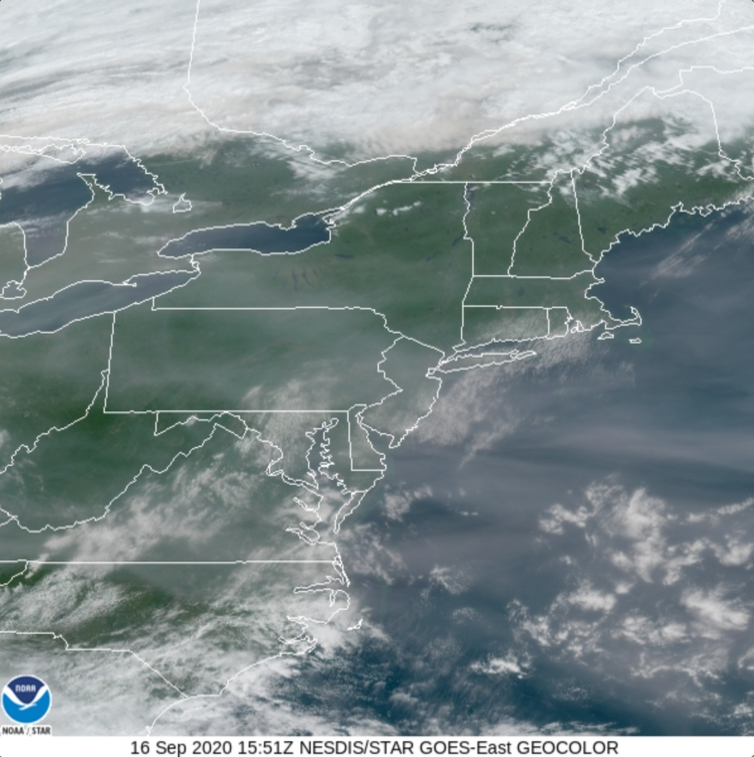 The thin haze, easily visible in this satellite photo over Pennsylvania and New York, is smoke that traveled over a thousand miles on air currents from the fires on the West Coast. NOAA
Red sky at night
Lasting for about a week from Sept. 12 to Sept. 19, the smoke could be seen in satellite images as wisps and patches of light gray and was especially apparent over the darkly contrasting water of the Atlantic.
Soot particles are much larger than air molecules and are more adept at scattering the yellow, orange and red wavelengths of sunlight. The enhanced oranges, pinks and reds during sunset occur when the Sun’s rays have to travel through more smoke. That happens when the Sun is very low near the horizon rather than when it is directly overhead, hence the fiery sunsets.
Riding the jet stream
The smoke on the East Coast is coming from the horrifically large and persistent wildfires in the Western states. Smoke from those fires is showing up not only on the Eastern Seaboard, but even across the Atlantic in Europe.
How has all that smoke migrated so far? Blame this on the vagaries of the jet stream.
The jet stream is a high-altitude belt of fast wind that sails from west to east around the hemisphere in the middle latitudes. The jet stream is always present, but its wind speeds and exact path around the globe vary daily.
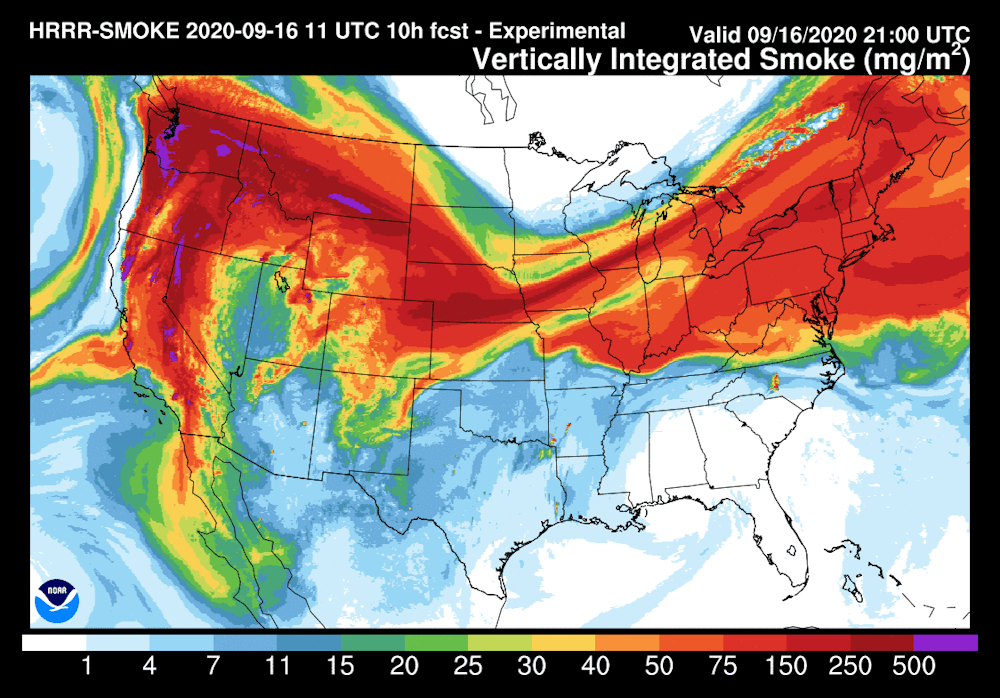
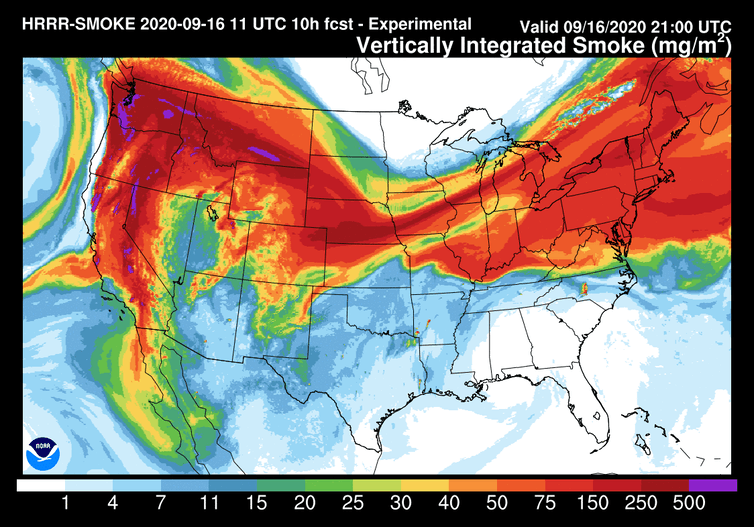 Smoke, highlighted by the darker colors, follows the course of the jet stream once it gets high enough into the atmosphere. NOAA
In early September, the jet stream’s path abruptly dipped south, draping it through the Western states. When this happened, the air current picked up the rising plumes of smoke and transported them across the U.S. in a layer of air between 10,000 and 20,000 feet above sea level. As the smoke layer raced eastward at up to 100 mph, it spread over cities along the way – dimming the Sun and creating red sunsets.
A connected world
Smoke isn’t the only aerosol that can sail around the Earth on wind currents. Pollution from China regularly travels to the U.S., where it’s been detected along the East Coast. Fine dusts lofted from the Sahara Desert in Africa can be swept westward to the Southeastern U.S., as happened just a few months ago.
After a week of hazy skies, a large air mass from Canada blew into the East Coast bringing in smoke-free air. But the Western U.S. fire season continues, and if the jet stream dips south again, the East could experience additional blasts of smoke-laden air. The globe may be vast, but wind currents connect us all.
*****
Jeffrey B. Halverson, Professor of Geography & Environmental Systems, Associate Dean of the Graduate School, University of Maryland, Baltimore County
This article is republished from The Conversation under a Creative Commons license. Read the original article.
Header image: A red hazy sunset over Indiana caused by wildfire smoke from the Western U.S. SOPA Images/LightRocket va Getty Images
[Deep knowledge, daily. Sign up for The Conversation’s newsletter.]
]]>
By Jeffrey B. Halverson, professor, Geography and Environmental Systems, associate dean, Graduate School, UMBC If you are one of the millions of people in the Midwest and Eastern U.S. who...
https://umbc.edu/stories/how-can-smoke-from-west-coast-fires-cause-red-sunsets-in-new-york/
https://my3.my.umbc.edu/api/v0/pixel/news/119787/guest@my.umbc.edu/e9d920697b80aee36f496674c4e59b71/api/pixel
climate-change
discovery
ges
the-conversation
UMBC News & Magazine
https://my3.my.umbc.edu/groups/umbc-news-magazine
https://assets1-my.umbc.edu/system/shared/avatars/groups/000/001/943/24435aa6207c452e7bc15cc74b42c7bb/xsmall.png?1748556657
https://assets1-my.umbc.edu/system/shared/avatars/groups/000/001/943/24435aa6207c452e7bc15cc74b42c7bb/original.png?1748556657
https://assets2-my.umbc.edu/system/shared/avatars/groups/000/001/943/24435aa6207c452e7bc15cc74b42c7bb/xxlarge.png?1748556657
https://assets2-my.umbc.edu/system/shared/avatars/groups/000/001/943/24435aa6207c452e7bc15cc74b42c7bb/xlarge.png?1748556657
https://assets3-my.umbc.edu/system/shared/avatars/groups/000/001/943/24435aa6207c452e7bc15cc74b42c7bb/large.png?1748556657
https://assets1-my.umbc.edu/system/shared/avatars/groups/000/001/943/24435aa6207c452e7bc15cc74b42c7bb/medium.png?1748556657
https://assets2-my.umbc.edu/system/shared/avatars/groups/000/001/943/24435aa6207c452e7bc15cc74b42c7bb/small.png?1748556657
https://assets1-my.umbc.edu/system/shared/avatars/groups/000/001/943/24435aa6207c452e7bc15cc74b42c7bb/xsmall.png?1748556657
https://assets2-my.umbc.edu/system/shared/avatars/groups/000/001/943/24435aa6207c452e7bc15cc74b42c7bb/xxsmall.png?1748556657
UMBC News & Magazine
0
0
false
Tue, 22 Sep 2020 16:24:46 -0400
UMBC engages Howard Community College students with environmental science—online and in their own backyards
It’s a mere hour after sunrise, and Wajhee Zaidi, a student at Howard Community College (HCC), is out in his neighborhood, looking for birds, insects, and whatever other critters he can spot. “Never would I have thought that I would go out at 7 a.m. just to look for different species of animals,” he says. “It got me out of my comfort zone.”
Zaidi’s early morning birding and bug-hunting was part of a three-week program collaboratively organized by HCC and UMBC. The practicum immersed HCC students in an authentic environmental science research experience and helped them connect with UMBC faculty.
Orioles and orb weavers
Each morning, Kevin Omland, professor of biological sciences, and Chris Hawn, assistant professor of geography and environmental systems, guided the students through activities like analyzing data on Caribbean orioles, collecting spider webs for air quality monitoring, and safely seeking out and documenting local creatures.
The students gained foundational research skills like observation, data collection, and collaboration. They also made real contributions to research and service projects. “They participated in three ongoing scientific research projects, all from their living rooms,” Hawn says.
 The students collected spider webs as part of Chris Hawn’s Spidey Senser project. Photo courtesy Mary Lenahan.
As part of a service-learning project for Baltimore Green Space, the students created tutorials about how to use the iNaturalist platform. And Omland shared their analysis of the interactions between the endangered Bahama Oriole and the parasitic Shiny Cowbird, which lays its eggs in other birds’ nests, with his lab’s research partners at the Bahamas National Trust.
Hawn also asked the students to test protocols for a program designed to help communities take greater control of their air quality. Hawn has found that analyzing the chemistry of spider webs works well as a proxy to measure hyper-local air quality, and they’re launching the program in Baltimore and Portland, Oregon in partnership with a non-profit. This project also introduced the students to the importance of citizen science.
“My goal for the students was to capture what I think is the most important part of scientific research—curiosity through observation,” Hawn says. By training their eyes and learning to see in new ways, Hawn says, “People were making discoveries literally inside their houses, or on a walk, or in their yard. It was really wonderful to see that transformation.”
“It was great to have this real, authentic experience,” shares Mary Lenahan, an environmental science major at HCC and an aspiring reptile field researcher. “I didn’t realize I’d be able to learn this much in just three weeks,” she added, a feeling echoed by the other participants.
 Chris Hawn (center) talks with graduate students inside UMBC’s Interdisciplinary Life Sciences Building in 2019. Photo by Marlayna Demond ’11 for UMBC.
A broader view
“This experience has broadened my view of research,” says Oluwasemilore Oluwagbenro,a general studies major at HCC who wants to be a doctor. “Researchers aren’t just either looking at the internet and books or confined within the four walls of a laboratory—research can also be walking in your backyard.”
Beyond expanding their perspective on what research can be, the summer experience offered new insight shaping how the students imagine their future careers.
Pilar Thomas, a life science and nutrition major at HCC, says, “This research experience helped me get to know this whole sector of biology that I hadn’t really looked at at all, because my biology classes focused on human biology and physiology.”
 A juvenile Northern Mockingbird spotted by Oluwasemilore Oluwagbenro perches on a fence post. Photo courtesy Oluwasemilore Oluwagbenro.
Zaidi, who also plans to pursue medicine, agrees. “Understanding all life and species plays a big part in medicine, so I think this definitely helped me toward my career goal by offering some insight and background knowledge.”
Oluwagbenro put it simply: “In the end, who is a good medical doctor without understanding the environment?”
Digital fluency
In addition to learning quite a bit about birds, spiders, and the scientific process, the students gained digital skills. They became proficient in Blackboard, UMBC’s learning management system, and learned how to use various online tools for their culminating project, a digital story.
Thomas was excited and surprised to learn more than science. “Prior to this research collaboration I could barely take a video on my phone,” she says, “so it was so cool to go through the process of making a final digital story, using screenshot slideshows, screen recordings, and everything. I would never have thought I would gain those types of skills in three weeks, so it helped me learn more about myself as a student, too.”
Enthusiasm “right through the screen”
The students and their instructors were surprised by the strong connections they were able to forge online. Hawn and Omland set the tone for a collegial, challenging, and fun experience. “I like to say that I throw them in the deep end and then cheer really hard and give them good advice,” Omland says with a smile. With Omland and Hawn’s coaching, the students learned to swim quickly.
 Kevin Omland (center) goes bird watching with students in 2019. Photo by Marlayna Demond ’11 for UMBC.
“They expected a lot from us, and they also answered any questions we had. We had a lot of fun moments,” Thomas shares, “and with Dr. Hawn and Dr. Omland, I definitely felt connected.” Lenahan agreed, saying that working with the faculty was “like talking to a colleague.”
As colleagues, the group worked on solving problems together. “Like real research, there were problems. We had to figure out different ways of doing things,” Omland says, from teaching the students how to identify birds, to collaboratively working to find the best way to display their data, all without being together in person. “I gave them plenty of responsibility, and they came up with great solutions,” Omland says.
Omland and Hawn’s excitement for their work also made a powerful impression on the students. “We got to know them as people, and to know why they were passionate about this and what drove that fascination,” Thomas says. “You could just feel their enthusiasm through the screen.”
For example, “I was telling Dr. Hawn about this spider that I found with this really awesome web, and they started telling me all about it,” Lenahan says, “and you could really see the joy that they had knowing that I experienced the same sense of awe that they had about these creatures.”
 A basilica orb weaver, a common spider species that Mary Lenahan noticed for the first time during the summer program. Photo courtesy Mary Lenahan (HCC).
A VIP view
Even though the students weren’t physically on campus, the summer program gave them plenty of chances to get to know UMBC. Each afternoon, a panel discussion with staff and faculty from different departments introduced the group to a different aspect of the university.
Scholars programs, service learning, academic support opportunities like the Writing Center and advising, financial aid, and admissions all made an appearance. So did the Initiatives for Identity, Inclusion, and Belonging, which includes the Interfaith Center, Pride Center, and Mosaic Center; and resources for transfer and commuting students, like the Transfer Student Network and Off-Campus Student Services.
Learning about the transfer process “made everything smoother, because you’ve met all the right people already,” Oluwagbenro shares. Thomas adds, “The transfer department talked to us about everything, like financial aid, and applying, and how to get involved early with the Transfer Student Alliance. That really helped solidify everything.”
The panels were even tailored to the particular students participating this year, several of whom are interested in medical careers. By getting to ask questions about academic preparation for health professions and learn about research opportunities with faculty in different departments, “We got a VIP view of UMBC, which was really cool,” Oluwagbenro says.
 Mary Lenahan is prepared for bird watching. Photo courtesy Mary Lenahan.
Collaborative creation
All the elements of the program worked together to help prepare students for transfer—to UMBC or another institution. “We want to give students lots of opportunities to think deeply about their educational goals and trajectories,” Sarah Jewett says, “but also to build the skills, knowledge, and connections that will really help them to transfer more successfully.”
Jewett, director of innovations in transfer research and practice, designed the summer program in collaboration with Hawn and Omland, as well as Charlotte Keniston, Kasey Venn, and Emily Passera at the UMBC Shriver Center. Jewett learned about birds and spiders alongside the students, and the students appreciated her engagement throughout the experience.
As with last year’s program in Baltimore’s urban forest patches, Patricia Turner, Dean of Science, Engineering and Technology at HCC was a critical partner in the summer program. She recruited the students and provided the field supplies for their investigations.
Expanding and evolving
The program, funded by the UMBC provost’s office, has so far focused on environmental science research themes. Now, Jewett is brainstorming ways for it to evolve. This year’s model, with multiple, one-week sessions on thematically connected topics, could translate well to other disciplines. “What might that look like in history, or in art, for example?” Jewett asks. She’s already been meeting with UMBC faculty in other departments to explore options.
The program’s format might also evolve to meet more students’ and instructors’ needs. “Last year, we were completely outside for eight weeks, and now we’ve been completely online for three weeks,” Jewett reflects, “So now, where do we mix those pieces together? What would a hybrid model look like for next year?”
For now, at least these four students have found new opportunities, new ways to think about science—and even new neighbors in their own local environments. Lenahan, for example, spotted a basilica orb weaver and its dome-shaped web near her house for the first time.
“I love nature and going out and exploring, so the fact that there was this common spider in my backyard that I had never noticed before was so weird to think about.” Lenehan’s orb weaver is much like UMBC to many students at the region’s community colleges—compelling and right in their backyard, yet sometimes not on their radar. Thanks to this summer’s UMBC-HCC partnership, these students are seeing the possibilities.
Banner image: An American Goldfinch perches at a bird feeder. Photo by Jim McGlone. Used under CC BY-NC 2.0
]]>
It’s a mere hour after sunrise, and Wajhee Zaidi, a student at Howard Community College (HCC), is out in his neighborhood, looking for birds, insects, and whatever other critters he can spot....
https://umbc.edu/stories/umbc-engages-howard-community-college-students-with-environmental-science-online-and-in-their-own-backyards/
https://my3.my.umbc.edu/api/v0/pixel/news/119793/guest@my.umbc.edu/fe49083bf3ff89006459c5b62a35adbb/api/pixel
biology
cahss
cnms
community
ges
science-and-technology
undergradresearch
UMBC News & Magazine
https://my3.my.umbc.edu/groups/umbc-news-magazine
https://assets1-my.umbc.edu/system/shared/avatars/groups/000/001/943/24435aa6207c452e7bc15cc74b42c7bb/xsmall.png?1748556657
https://assets1-my.umbc.edu/system/shared/avatars/groups/000/001/943/24435aa6207c452e7bc15cc74b42c7bb/original.png?1748556657
https://assets2-my.umbc.edu/system/shared/avatars/groups/000/001/943/24435aa6207c452e7bc15cc74b42c7bb/xxlarge.png?1748556657
https://assets2-my.umbc.edu/system/shared/avatars/groups/000/001/943/24435aa6207c452e7bc15cc74b42c7bb/xlarge.png?1748556657
https://assets3-my.umbc.edu/system/shared/avatars/groups/000/001/943/24435aa6207c452e7bc15cc74b42c7bb/large.png?1748556657
https://assets1-my.umbc.edu/system/shared/avatars/groups/000/001/943/24435aa6207c452e7bc15cc74b42c7bb/medium.png?1748556657
https://assets2-my.umbc.edu/system/shared/avatars/groups/000/001/943/24435aa6207c452e7bc15cc74b42c7bb/small.png?1748556657
https://assets1-my.umbc.edu/system/shared/avatars/groups/000/001/943/24435aa6207c452e7bc15cc74b42c7bb/xsmall.png?1748556657
https://assets2-my.umbc.edu/system/shared/avatars/groups/000/001/943/24435aa6207c452e7bc15cc74b42c7bb/xxsmall.png?1748556657
UMBC News & Magazine
0
0
false
Fri, 11 Sep 2020 18:17:27 -0400
Bedrock to treetops: NSF awards $4.8M to urban environment study led by UMBC’s Claire Welty
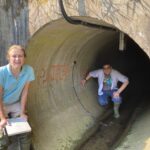
There is an essential resource constantly flowing beneath our feet: groundwater. Urban denizens may not think about it often, or at all, because they don’t rely on wells, “but it’s still there,” says hydrologist Claire Welty, and it’s critical to understanding the health of urban ecosystems.
Welty is director of UMBC’s Center for Urban Environmental Research and Education (CUERE) and a professor of chemical, biochemical, and environmental engineering. Groundwater is just one piece of a complicated puzzle that she and her team will work to put together over the next five years. A $4.8 million Critical Zone Collaborative Network grant from the National Science Foundation will make the large-scale project possible. The grant will support researchers at UMBC and eight other institutions that are part of the UMBC-led Urban Critical Zone Cluster.
Welty’s team will explore Earth’s critical zone, which extends from the tops of trees to the base of weathered bedrock, in urban centers along the Eastern Seaboard. In particular, they’re interested in how natural, geological processes occurring below the Earth’s surface and human-driven processes interact. Human influences include road salt application, polluted stormwater runoff, and soil-disturbing construction. These factors can all significantly influence urban water quality, water chemistry, and weathering processes.
Most Critical Zone grants are for work in more pristine wilderness areas, because the added effects of urban processes make the research more complicated. But, Welty says, “that’s the most interesting part.”
 The Earth’s critical zone extends from the treetops down to bedrock below ground. Image by the National Science Foundation.
Focus on the Fall Zone
The research will take place in four East Coast cities: Philadelphia, Baltimore, Washington, and Raleigh. The researchers strategically selected these urban centers because they align in a north-to-south corridor along what geologists call the “Fall Zone.” The Fall Zone exists at the transition from the Piedmont to the Coastal Plain, and is an area of intense interest for geologists.
“We think of this landscape as ancient, but recent research has led to a different understanding about how the Fall Zone in our region has evolved,” says geomorphologist Andrew Miller, UMBCprofessor of geography and environmental systems and a collaborator on the new grant. Glaciers to the region’s north played a role, and “human activity has also caused profound changes,” Miller says. “All of this forms the background for the work we are planning to do on this project.”
 Miller (left) and Welty in Catonsville at one of their research field sites. Photo by Victor Fulda.
Philadelphia to Raleigh: An urban corridor
The Fall Zone’s unique topography made it a natural place for some of the first American cities to emerge. Dramatic elevation changes characterize the Fall Zone, “so that’s where waterfalls formed, providing hydropower, so mills were set up,” Welty explains. Population centers grew up around the mills. Elevation changes at the Fall Zone boundary also limited water transport further inland, making it the natural place to build port cities. Today’s I-95 corridor links these urban centers.
The north-south corridor also gives the researchers an opportunity to examine how climate affects the movement of substances, such as sediment and dissolved materials, through the natural and built environments. Natural and human-introduced substances can affect everything from water quality to how quickly the bedrock wears away over time.
Of the four cities, Raleigh is distinct in ways that offer unique opportunities. As a younger city, it’s laid out differently. It may also have newer water, sewer, and other systems that could affect its underground properties in ways that differ from older, industrial cities like Baltimore and Philadelphia.
 The U.S. Northeast and mid-Atlantic at night, showing the urban corridor. Image courtesy NASA Earth Observatory, by Joshua Stevens.
Long-term legacy
Baltimore, in particular, is well-suited to host this research, because scientists have collected environmental data on the region for over twenty years through the Baltimore Ecosystem Study Long-Term Ecological Research Project (BES). The BES team has installed scientific instruments all over the region. Students, faculty, and sensors have been recording data consistently for decades, painting a picture of Baltimore’s watershed, ecology, and social issues related to the environment.
However, “the subsurface has for the most part been ignored,” Welty says. With funding from other sources, she and her field assistants have drilled 35 monitoring wells—but there’s more to be learned.
“We’ve got all this incredible science that’s been going on for 20 years of the BES,” Welty says. With the Critical Zone grant, “Now we want to look at the subsurface to complement all the data and information and instrumentation—you name it, we have it,” Welty says. “We think it’s really important to marry these two together.”
In addition to adding more and different data to an already huge archive, the Baltimore-based team also plans to leverage their existing data in new ways. “We’re going to use stream chemistry as a window into the subsurface,” Welty says. The researchers will also examine land use patterns and analyze bedrock and soil cores. Tools that act like an x-ray or MRI will enable them to visualize the structure and properties of the subsurface that are impossible to observe directly.
 Baltimore skyline. Photo by Adam Lindquist, used under CC-BY-NC 2.0.
Putting science into practice
Urban groundwater processes fascinate Welty. She’s driven by a fundamental desire to better understand what’s going on underneath cities in the Fall Zone. And there are practical reasons why this work is important, too.
“At UMBC, we’re always interested in informing policy with the scientific projects we do,” she says. “We have strong relationships with partners in Baltimore, and folks in the other cities do as well. They pay attention to what we do.”
Those relationships work in both directions. Sometimes the research informs new policies around development, water treatment, or salt use. Other times, questions from regional leaders inspire additional research, including student projects.
Some public concerns have involved hazards to the urban drinking water supply and salinization of streams, which could be detrimental to wildlife. “We’re making connections and providing a foundation of knowledge,” Welty says, so policymakers can make decisions grounded in science.
In addition, Alan Berkowitz from the Cary Institute is on the team to help bring these important ideas to K-12 students. Berkowitz will work with the researchers to develop an Earth science module for local schools, which will eventually be available to educators nationwide. Berkowitz will also work with the team to develop a citizen science program focused on the urban critical zone theme.
“Alan has his ear to the ground on what the schools are interested in, and he knows how to make that translation from the scientific project to this kind of outreach,” Welty says. This work will bring the project full circle, inspiring another generation of minds to explore the world beneath their feet.
Banner image: Claire Welty (left) and Andrew Miller at a field research site in Catonsville. The site is a buried stream that doubles as a storm drain and is part of a restoration project. Photo by Victor Fulda, an engineering technician in UMBC’s chemical, biochemical, and environmental engineering department.
]]>
There is an essential resource constantly flowing beneath our feet: groundwater. Urban denizens may not think about it often, or at all, because they don’t rely on wells, “but it’s still there,”...
https://umbc.edu/stories/bedrock-to-treetops-nsf-awards-4-8m-to-urban-environment-study-led-by-umbcs-claire-welty/
https://my3.my.umbc.edu/api/v0/pixel/news/119801/guest@my.umbc.edu/178c230cb8be7e31515048d7b62f7845/api/pixel
cahss
cbee
coeit
cuere
ges
research
science-and-technology
UMBC News & Magazine
https://my3.my.umbc.edu/groups/umbc-news-magazine
https://assets1-my.umbc.edu/system/shared/avatars/groups/000/001/943/24435aa6207c452e7bc15cc74b42c7bb/xsmall.png?1748556657
https://assets1-my.umbc.edu/system/shared/avatars/groups/000/001/943/24435aa6207c452e7bc15cc74b42c7bb/original.png?1748556657
https://assets2-my.umbc.edu/system/shared/avatars/groups/000/001/943/24435aa6207c452e7bc15cc74b42c7bb/xxlarge.png?1748556657
https://assets2-my.umbc.edu/system/shared/avatars/groups/000/001/943/24435aa6207c452e7bc15cc74b42c7bb/xlarge.png?1748556657
https://assets3-my.umbc.edu/system/shared/avatars/groups/000/001/943/24435aa6207c452e7bc15cc74b42c7bb/large.png?1748556657
https://assets1-my.umbc.edu/system/shared/avatars/groups/000/001/943/24435aa6207c452e7bc15cc74b42c7bb/medium.png?1748556657
https://assets2-my.umbc.edu/system/shared/avatars/groups/000/001/943/24435aa6207c452e7bc15cc74b42c7bb/small.png?1748556657
https://assets1-my.umbc.edu/system/shared/avatars/groups/000/001/943/24435aa6207c452e7bc15cc74b42c7bb/xsmall.png?1748556657
https://assets2-my.umbc.edu/system/shared/avatars/groups/000/001/943/24435aa6207c452e7bc15cc74b42c7bb/xxsmall.png?1748556657
UMBC News & Magazine
0
0
false
Wed, 02 Sep 2020 16:23:32 -0400
A Career of Putting Others First—Q&A with Nicki Fiocco ’11

If volunteer coordination is “all about finding the right person to do the right job,” as Nicki Fiocco ’11, geography and environmental systems, explains, then the Hogan Administration found the exact right person to direct the Governor’s Office of Service and Volunteerism. Fiocco—who started in that role in December 2019—shares how her UMBC grit laid the foundation for her career in public service and how Marylanders can assist one another during, and after, the COVID-19 pandemic.
UMBC Magazine: You’ve worked in volunteer coordination roles since you’ve graduated. How did you get started with that career?
Nicki Fiocco: Volunteer coordination is all about finding the right person to do the right job. You could say I started by coordinating parent volunteers while coaching my kids in soccer. Then I got plugged into a regional service ecosystem, after graduating UMBC in 2011 through an internship with Smithsonian Environmental Research Center (SERC). Coordinating student volunteers for SERC, I witnessed firsthand their resilient spirit (in every imaginable kind of weather!) and was inspired to pursue a service career path.
My AmeriCorps service year with Volunteer Maryland paved the next step. Launching environmental projects allowed me to learn about volunteer program management on a larger scale. I’ve been hooked ever since! AmeriCorps has been a door-opener for my career. It led directly to my Program Director role with Volunteer Maryland, an AmeriCorps program, and my current leadership role in a state service commission for the Hogan Administration. I’m honored to engage with dedicated volunteer networks throughout Maryland.
UMBC Magazine: Your work in the Governor’s office is relatively new— what’s it been like to face such a large crisis like COVID-19 early on?
Nicki Fiocco: A decade of service-based career experiences has informed and shaped how I’m approaching the challenges we’re facing right now. No matter how “prepared” we may be on paper, in any crisis there’s no substitute for the daily workout I’ve had—listening closely, learning how to respond, and adapting with limited resources at hand.
 Fiocco joined Frostburg University’s AmeriCorps members during MLK Day 2020 celebration, making hats for terminally ill children. Photo courtesy of Fiocco.
Fortunately, being part of a strong service community also means I’m not facing these challenges alone. I’m grateful to be backed by the leadership of the Hogan Administration, and supported by over 600 boots-on-the-ground Maryland AmeriCorps members, program directors, and partners of the Governor’s Office on Service and Volunteerism (GOSV).
We’re getting things done by drawing on the deep experience of a service network that’s always had its finger on the pulse of critical community needs. I’m humbled and energized by what I’m seeing everyday in response to this crisis: a state-wide landscape of service and compassion meeting critical needs.
It’s easy to lead when things are going well. The true test is how well you function through a crisis. We are all capable of meaningful, impactful service. Marylanders have an opportunity to come out of this crisis stronger and more united through acts of service and volunteerism.
UMBC Magazine: How has your role supported efforts in fighting COVID-19?
Nicki Fiocco: Governor Hogan prioritizes getting things done, through a united response to COVID-19. We’re all being called upon to pivot where necessary, and we’re empowered to do so. For example, in addition to my regular duties, I was activated to serve in the Maryland Emergency Management Agency (MEMA), which means I’ve been working on connecting Marylanders to relevant and geographically accessible opportunities to serve their neighbors.
So far, Maryland AmeriCorps members are helping by checking on seniors through the Maryland Department of Aging; establishing support networks; addressing access to education and the digital divide; and by distributing 20,000 pounds of fresh produce and prepared meals, 5,000 bottles of hand sanitizer and bars of soap, 1,000 rolls of toilet paper, and 200 handmade face masks.
 Responding to COVID-19 by delivering food in Baltimore to seniors through an effort organized by the Salvation Army and supported by the Army National Guard. Photo courtesy of Fiocco.
For the Maryland Unites initiative, my team partnered with the Governor’s Office of Community Initiatives to launch Marylanders Serving Marylanders, a webpage for sharing coronavirus resources. GOSV’s Acting Deputy Director Kerry Ose and I are leading a collaborative effort capturing best practices for the Governor’s “Maryland Strong: Roadmap to Recovery.” Our non-profit working group listens to and elevates the voices of a diverse mix of 30 large and small non-profit organizations, with the common goal of strengthening our state’s response, recovery, and re-building after COVID-19.
UMBC Magazine: What have been some of the biggest challenges / biggest rewards (of your job)?
Nicki Fiocco: My personal philosophy is to approach challenges as opportunities and focus on removing any obstacles for the people around me. Being tapped into so many organizations and agencies, I see the pendulum swing between great needs and tremendous generosity. During this pandemic, a constant challenge has been connecting the right dots in a thoughtful and timely fashion. I bear this responsibility seriously. I’m approaching my role as a platform for solving problems.
UMBC Magazine: How does your geography and environmental systems (GES) major play a role in what you do today?
Nicki Fiocco: My GES major at UMBC really laid the framework for my thinking about ecosystems, and the unexpected relationships woven throughout. In our service ecosystem, I apply those lessons to being mindful when we’re planning and accommodating for regional, local, and cultural needs.
In the same way that my GES studies taught me knowledge of local flora (when you want to install a rain garden or increase wildflowers along a park trail), it’s also internalized the importance of socio-economic boundaries that could impact volunteer recruitment, local community buy-in, and long-term program sustainability.
UMBC Magazine: So many of us feel so useless right now—how would you encourage Marylanders outside of public service to volunteer/help right now?
Nicki Fiocco: Marylanders who are staying home and practicing physical distancing are already serving by protecting our public health and safety. It’s a tremendous sacrifice, and I want to thank Marylanders on behalf of the Hogan Administration for doing so.
 Fiocco, second from right, with a group of fellow alumni in Maryland legislature in Annapolis, February 2020. Photo by Marlayna Demond ’11.
For those who want to help more, the number one priority of GOSV is safety. We have on-site essential volunteer opportunities on Maryland Unites (Medical Reserve Corps, Maryland Food Bank, Red Cross), and virtual opportunities on Marylanders Serving Marylanders. Volunteerism can also look like sharing state and community resources to friends in your network who may not be aware, and checking in with them regularly.
UMBC Magazine: What are some UMBC lessons that have stuck with you over time?
Nicki Fiocco: GRIT. Sticking with things, doing what is right, and not letting anything throw you off course is my favorite value I gained at UMBC. I make it a point to participate in the UMBC alumni receptions in Annapolis, and I enjoy hearing President Hrabowski speak about grit!
The implications in public service—the grit to serve while putting others first—returns tenfold in growth and development. Grit is a muscle you build and take to any career or field.
UMBC Magazine: Does a specific professor’s advice come to mind, or has a particular class stayed with you?
Nicki Fiocco: My UMBC experience is something I continue to lean on. The lessons (and contacts) I’m able to draw from and share with others have been invaluable. A true mentor for me is Sandy Parker. He was my advisor, (and department chair for geography and environmental studies at the time). Funny thing is, our daughters are the same age—so we not only had ongoing conversations about school and my path forward—we were constantly talking about parenting.
I remember the semester before my graduation, Dr. Parker told me I needed to apply for graduation to finish my degree. At the time, I was resistant. There was nothing I wanted more than to stay forever at UMBC and just continue to learn. I was afraid I didn’t have what it would take to be successful; I wasn’t even sure what I would even do after school. Dr. Parker encouraged and assured me that I would find my way. Ultimately, getting my degree was about achieving a major personal milestone—I’m really glad I did it for me!
UMBC Magazine: Is there anything we haven’t asked yet, that you’d still like to share with alumni?
Nicki Fiocco: “The obstacle is the way.” Meaning, that when things are getting tough, you need to keep going through, not around. Working through the big, bad, ugly thing you may be afraid of is exactly what will make you stronger, wiser, and better. It’s not always about the big things you do, it’s about the things you do consistently. Your consistent actions provide the momentum; then suddenly—you are living your purpose.
*****
Header image: Fiocco at an Annapolis reception for alumni in Maryland legislature, February 2020. Photo by Marlayna Demond ’11.
]]>
If volunteer coordination is “all about finding the right person to do the right job,” as Nicki Fiocco ’11, geography and environmental systems, explains, then the Hogan Administration found the...
https://umbc.edu/stories/a-career-of-putting-others-first-qa-with-nicki-fiocco-11/
https://my3.my.umbc.edu/api/v0/pixel/news/119859/guest@my.umbc.edu/f486f824a5542dae70c239991d74e7a3/api/pixel
alumni
covidresearch
ges
umbctogether
UMBC News & Magazine
https://my3.my.umbc.edu/groups/umbc-news-magazine
https://assets1-my.umbc.edu/system/shared/avatars/groups/000/001/943/24435aa6207c452e7bc15cc74b42c7bb/xsmall.png?1748556657
https://assets1-my.umbc.edu/system/shared/avatars/groups/000/001/943/24435aa6207c452e7bc15cc74b42c7bb/original.png?1748556657
https://assets2-my.umbc.edu/system/shared/avatars/groups/000/001/943/24435aa6207c452e7bc15cc74b42c7bb/xxlarge.png?1748556657
https://assets2-my.umbc.edu/system/shared/avatars/groups/000/001/943/24435aa6207c452e7bc15cc74b42c7bb/xlarge.png?1748556657
https://assets3-my.umbc.edu/system/shared/avatars/groups/000/001/943/24435aa6207c452e7bc15cc74b42c7bb/large.png?1748556657
https://assets1-my.umbc.edu/system/shared/avatars/groups/000/001/943/24435aa6207c452e7bc15cc74b42c7bb/medium.png?1748556657
https://assets2-my.umbc.edu/system/shared/avatars/groups/000/001/943/24435aa6207c452e7bc15cc74b42c7bb/small.png?1748556657
https://assets1-my.umbc.edu/system/shared/avatars/groups/000/001/943/24435aa6207c452e7bc15cc74b42c7bb/xsmall.png?1748556657
https://assets2-my.umbc.edu/system/shared/avatars/groups/000/001/943/24435aa6207c452e7bc15cc74b42c7bb/xxsmall.png?1748556657
UMBC News & Magazine
0
0
false
Mon, 15 Jun 2020 18:17:24 -0400
Three years in, UMBC’s Inclusion Imperative connects humanities scholars focused on diversity, inclusion, equity, and justice

UMBC’s Inclusion Imperative is now in its third year of promoting diversity and inclusion in the humanities—on campus and across the region. The five-year initiative, funded by a $750,000 grant from The Andrew W. Mellon Foundation, began in March 2017. This grant provides support for a Visiting Faculty Fellows Program, Diversity Teaching Network in the Humanities, and Humanities Teaching Labs. All three programs have had a notable impact and continue to grow.
The Inclusion Imperative is led by Scott Casper, dean of UMBC’s College of Arts Humanities and Social Sciences, and Jessica Berman, director of the Dresher Center for the Humanities. The three core Inclusion Imperative programs support a regional community of scholars committed to diversity in the humanities. They also focus on expanding community-engaged humanities research and implementing new approaches to teaching and learning in the humanities.
“The Inclusion Imperative has created real excitement about the benefits of connecting humanities faculty with one another,” shares Berman. “Faculty at UMBC have learned a variety of new tools to practice inclusive and engaged teaching. They have been able to exchange ideas with visiting scholars about methods of inclusive research in the humanities.”
Humanities Teaching Labs
Lindsay DiCuirci, associate professor of English, is the director of the Interdisciplinary Humanities Teaching Labs (HT Labs). They bring together visiting fellows, UMBC faculty, graduate and undergraduate students, and Baltimore community partners. Together, these collaborators examine issues of race, equity, inclusion, and justice. The labs share different approaches and strategies in humanities work, and show how faculty can create active learning projects.

Anne Rubin, assistant professor of history, leading the Frederick Douglass Transcription Lab.
Photo by Marlayna Demond ’11.
One popular UMBC faculty-led HT Lab focused on integrating crowdsourced transcription projects into undergraduate coursework. Others have explored diversity-focused digital humanities projects in the classroom and best practices for interviewing and collecting oral histories.

Faculty and staff review images from
The Baltimore Sun archives at UMBC.
Photo courtesy of the Dresher Center.
HT Labs led by external experts have demonstrated how to use software to create content and analyze data. Faculty also participated in a workshop on how to engage diverse communities by using Baltimore Sun photographs housed in UMBC’s Special Collections.
Course transformations
The HT Labs initiative also offers Course Transformation Support Grants. With these grants, faculty redesign their courses to reflect new approaches and technologies, and more diverse perspectives.
One of the first three faculty members awarded a transformation grant was Earl Brooks, assistant professor of English. He used the funding to purchase recording equipment for students to use in his Sounds Like Social Justice course. They created interactive media projects that use sound to tell stories related to social justice.

Brooks presenting his course transformation work.
Photo courtesy of the Dresher Center.
“The grant made it possible for my students to have the technology they needed to create high-quality digital media projects,” shares Brooks. “This was a pivotal improvement that strengthened our collective commitment to the digital humanities.”
Jennifer Maher, associate professor of English, combined two of her classes to create a more community-engaged experience. Maher’s communication and technology seminar focused on race, rhetoric, and technology. Students worked closely with Nina Duzhikhin’s Community Closet to create new marketing materials for the clothing donation group. The class also collaborated with UMBC’s Choice Program, New Media Studio, and WombWork Productions on promotions. They developed effective and culturally-sensitive marketing materials to create awareness of clothing drop-off locations throughout Southwest Baltimore.
“The intersections among race, rhetoric, and technology materialized for students in very real and important ways,” says Maher. “Topics such as gentrification manifested right in front of our eyes. These experiences could not be happen in a more traditional class environment.”
Nicole King, professor and chair of American studies and director of the UMBC Orser Center for the Study of Place, Community, and Culture, also received a grant. She used it to engage radio producer Aaron Henkin in her Public Humanities course. She also brought in local speakers to share their expertise in community-engaged humanities work.
Visiting faculty fellows
The Inclusion Imperative also invites full-time faculty from colleges and universities across the region to apply for visiting faculty appointments at UMBC. This fellows program supports humanities scholars who commit to advancing diversity through research. The program works to connect them to the UMBC campus community. Fellows work with UMBC faculty in similar research areas.

(L to R) Bediako, Bankole-Medina, Runstedtler, King.
Photo by Marlayna Demond ’11.
UMBC has so far hosted four visiting faculty fellows. Katherine Bankole-Medina, professor of history at Coppin State University, researched the history of African Americans in clinical care settings based on 40 years of the Maryland Medical Journal. Her foundational work at UMBC evolved into a book project. She collaborated with Shawn Bediako, associate professor of psychology and director of UMBC’s Collaborative for the Interdisciplinary Promotion of Health Equity Research (CIPHER).
Theresa Runstedtler, associate professor of history at American University, explored the intersection of blackness, masculinity, labor, and criminalization through the lens of 1970s professional basketball. In the fall of 2019, Runstedtler received a National Endowment for the Humanities Public Scholar award for the project she worked at UMBC. Nicole King collaborated with Runstedtler during her time at UMBC, which led to joint presentations at national meetings and other continuing projects.
This year’s fellows
This year’s fellows are Elizabeth Groeneveld, assistant professor of women’s studies at Old Dominion University, and Tracy Perkins, assistant professor of sociology and criminology at Howard University.
Groenveld is exploring how lesbian pornographic media has shaped ideas about objectification and the body by developing a discourse of sex-positive feminism. Kate Drabinski, senior lecturer of gender, women’s, and sexuality studies, is her faculty collaborator.

L to R: DiCuirci, Groenveld, Perkins, and Berman.
Photo courtesy of the Dresher Center.
“Working with Liz has been a great experience. We learn about each other’s research and write together regularly. It keeps both of us on track while also building real community around the writing process itself,” shares Drabinski. “I am excited for the ways our work in queer histories will intersect long after the fellowship year is over.”
Perkins’s project covers a 1990s campaign to stop the construction of a nuclear waste landfill in the Mojave Desert’s Ward Valley. Dillon Mahmoudi, assistant professor of geography and environmental systems, serves as her UMBC collaborator.
Diversity Teaching Network
The Diversity Teaching Network brings together faculty at UMBC, HBCU partners, and other institutions in the Baltimore-DC region. The network’s activities expand conversations on diversity in curricula, socially-aware humanities pedagogies, and community-engaged research. These activities create a supportive environment for faculty to pursue inclusive teaching practices.
The inaugural Diversity Teaching Network event last year was headlined by noted scholar Gloria Ladson-Billings. Kerrie Kephart, associate director of the UMBC Faculty Development Center, led a workshop about practicing inclusive teaching in the classroom.
The workshop “challenged faculty to collaboratively develop responses to real-life teaching challenges,” she explains. “This includes how to create inclusive syllabi and assignments, and how to facilitate class discussions around ‘hot button’ topics.”
One event included discussions about the history and evolution of African texts. It provided suggestions on how to integrate them into U.S. university settings. Another discussed linguistic diversity as a cultural resource.
In the spring of 2019, the Diversity Teaching Network held its inaugural symposium, “Being Human: How the Arts and Humanities Expand Boundaries and Inspire Action in the 21st Century” at Bowie State University. Faculty from UMBC, Bowie State University, Coppin State University, American University, and Howard University participated in panels on the intersection of teaching, action, and justice.
Faculty at the event shared best practices in community-engaged humanities research. They built on connections developed over the past three years and generating ideas for future work together.
“The Inclusion Imperative is fostering an increasingly collaborative, inclusive approach to humanities teaching and scholarship,” shares Dean Casper. “I’m excited about continuing this work, both within UMBC and with our partner institutions.”
Banner image: (L to R) Courtney C. Hobson M.A.’14, history, coordinator for the Dresher Center; Joby Taylor ’05, Ph.D., LLC, director of the Shriver Peaceworker Program; and Beverly Bickel, clinical associate professor of language, literacy, and culture doctoral program. Photo by Marlayna Demond ’11 for UMBC.
]]>
UMBC’s Inclusion Imperative is now in its third year of promoting diversity and inclusion in the humanities—on campus and across the region. The five-year initiative, funded by a $750,000 grant...
https://umbc.edu/stories/three-years-in-umbcs-inclusion-imperative-connects-humanities-scholars-focused-on-diversity-inclusion-equity-and-justice/
https://my3.my.umbc.edu/api/v0/pixel/news/119923/guest@my.umbc.edu/237763579340d0df2d86e9015f89cfe0/api/pixel
cahss
dreshercenter
english
ges
gwst
history
policy-and-society
psychology
UMBC News & Magazine
https://my3.my.umbc.edu/groups/umbc-news-magazine
https://assets1-my.umbc.edu/system/shared/avatars/groups/000/001/943/24435aa6207c452e7bc15cc74b42c7bb/xsmall.png?1748556657
https://assets1-my.umbc.edu/system/shared/avatars/groups/000/001/943/24435aa6207c452e7bc15cc74b42c7bb/original.png?1748556657
https://assets2-my.umbc.edu/system/shared/avatars/groups/000/001/943/24435aa6207c452e7bc15cc74b42c7bb/xxlarge.png?1748556657
https://assets2-my.umbc.edu/system/shared/avatars/groups/000/001/943/24435aa6207c452e7bc15cc74b42c7bb/xlarge.png?1748556657
https://assets3-my.umbc.edu/system/shared/avatars/groups/000/001/943/24435aa6207c452e7bc15cc74b42c7bb/large.png?1748556657
https://assets1-my.umbc.edu/system/shared/avatars/groups/000/001/943/24435aa6207c452e7bc15cc74b42c7bb/medium.png?1748556657
https://assets2-my.umbc.edu/system/shared/avatars/groups/000/001/943/24435aa6207c452e7bc15cc74b42c7bb/small.png?1748556657
https://assets1-my.umbc.edu/system/shared/avatars/groups/000/001/943/24435aa6207c452e7bc15cc74b42c7bb/xsmall.png?1748556657
https://assets2-my.umbc.edu/system/shared/avatars/groups/000/001/943/24435aa6207c452e7bc15cc74b42c7bb/xxsmall.png?1748556657
UMBC News & Magazine
0
0
false
Tue, 07 Apr 2020 19:52:01 -0400
Teaching among trees: Field research project grows UMBC partnership with community colleges
When Caitlin Beckjord stepped onto campus for the first time as a UMBC student in fall 2019, she felt energized and prepared to succeed, thanks to a unique, new summer program on urban forestry.
Earlier in the summer, six Howard Community College (HCC) students, including Beckjord, participated in the Baltimore Forest Patches Summer Research Collaboration. This unique pilot project between UMBC and HCC is designed to expand research opportunities for community college students, provide important data on urban forests, and ease students’ transition to UMBC. It also serves to build and strengthen the kinds of relationships that were forged between UMBC and HCC faculty during the STEM Transfer Student Success Initiative (t-STEM).
During the provost-funded pilot, HCC students enrolled in research courses instructed by HCC faculty Will Gretes and Cheryl Campo. Then they participated in fieldwork under the mentorship of UMBC faculty and graduate students. Once they learned about research design and forest ecology in the classroom, they headed outdoors to work in patches of green space across Baltimore City. During their fieldwork, they participated in a practicum course through UMBC’s Shriver Center to help them reflect on their experience.
 Caitlin Beckjord among Phragmites reeds, an invasive species prevalent in Maryland.
The students are encouraged to return to this forest project for multiple summers, developing more expertise and taking more responsibility each time. Those who transfer to UMBC come in already engaged in a research project and connected to members of the campus community.
“It’s a great example of the relationships we’re building with the community colleges,” says Sarah Jewett, director of transfer innovations in research and practice. “What I love about this program is that it utilizes curricular infrastructure that’s in place at the community colleges, and networks and research expertise here at UMBC. We’re really drawing on the assets at both institutions to make this work.” In particular, Howard Community College’s Dean of Science, Engineering, and Technology Patti Turner was an instrumental partner who made the pilot possible and continues to collaborate with UMBC on a variety of projects.
 Caitlin Beckjord scrambles on a tree in one of the project’s study sites.
At home in the forest
The experience opened students’ eyes to the life of an urban forest. After learning about what species they might find, the students took inventory of the plants present and their abundance in forest patches across Baltimore City. Carol Frimpong, who is studying life science and computer science at HCC, became particularly interested in fungi and bacteria along the way.
“This introduced me to environmental microbiology,” she says. “I didn’t realize there was a subfield of microbiology that focuses on the environment. So I hope to go into more of that.”
For Laura Wortman, the experience has changed her relationship with nature. “I feel like I know more about the forest,” she shares, “and I feel more at home there now that I know different trees and groundcovers.”
Matthew Baker, professor of geography and environmental systems (GES) at UMBC, mentored the students in the program. “Hearing these stories is the best part of my job,” he says. “Most professors get involved in the work that they do because they want to see others be inspired the way they were. It’s really rewarding to listen to students who have found something they enjoyed in this experience.”
 Laura Wortman collects data in a forest patch.
Connections across campuses
The program created opportunities for faculty, graduate student mentors, and participating students to build meaningful relationships with one another. For Beatriz Shobe, who is in the GES Ph.D. program at UMBC, the program confirmed her interest in teaching and fieldwork. “I found that teaching in an interactive, hands-on way is a good skill to have that can be beneficial for both traditional classroom teaching as well as community outreach and engagement,” Shobe says.
Shobe’s teaching resonated with Wortman. “Just hearing Beatriz talk about her research was really interesting, because I’d never talked to someone in a casual context before about their research,” Wortman says. “She told us what had gone wrong with her research, and how that changed the entire trajectory of the project.” She explains, “I learned all this stuff that you wouldn’t hear from someone just presenting on their paper, and that was really enlightening.”
As a result of participating in the program, Wortman is now interested in transferring to UMBC to pursue a combined bachelor’s/master’s degree in GES.
 Laura Wortman (left) and Caitlin Beckjord doing fieldwork together.
Caitlin Beckjord ‘22, geography and environmental systems, already knew she was passionate about research when she joined the program, and it helped her make connections at UMBC. “Meeting with Dr. Baker and Dr. Jewett allowed me to ask questions about UMBC’s classes and opportunities, and get more in-depth campus tours where I was introduced to several other UMBC professors, students, and advisors,” she shares.
This fall, Beckjord transferred to UMBC, and the experience continues to offer benefits. “Learning how to identify trees and ground cover and work with soils has put me at an advantage in my forest ecology class at UMBC,” she says. Beckjord also has a built-in community on campus; she connects with students and faculty she met during the program on a daily basis.
 Laura Wortman (left) and Carol Frimpong back at UMBC after conducting fieldwork.
Commitment to conservation
In addition impacting the students and educators involved, this program also contributes to scientists’ understanding of urban forests, through the data the students collect.
Baker has been working for the last seven years “to study urban forest patches and understand their composition, their structure, how they’re managed, and how these factors will affect their future,” he says. “We work to provide information to the public through Baltimore Green Space so that they can inform forest stewards and local community members,” such as private landowners whose property includes forest patches. “At the same time, we’ve been asking questions about urban forest patches in general, and developing techniques for studying them and mapping them in concert with the USDA Forest Service.”
This work is important because urban green space and cohabitation of humans with wildlife are critical to modern environmental conservation. Sometimes the research manifests as big findings about the makeup of urban woods and how to preserve or restore them. At other times, the results are more personal.
 Carol Frimpong (center) takes a measurement while Laura Wortman (left) looks on and Beatriz Shobe (right) records the result.
As they were gathering important scientific data and learning about research methods, the students in this program also enjoyed the chance to connect with nature in their daily lives. Growing evidence suggests this kind of experience is critical for our physical and mental health, and for growing the next generation’s commitment to conservation.
“I often go on walks, and there is this one beautiful tree I always sit under, but I never knew what it was before this summer,” Frimpong shares. “But then I looked at it recently and I realized it was a red maple.” She’s also learned the names of local birds and, with her new interest in fungi, mushrooms. Growing thoughtful, she shares, “It’s good to know them by name.”
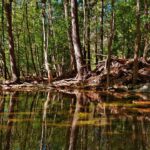
Banner image: A scene from Patapsco Valley State Park in Baltimore County. Photo by Matthew Beziat, used under CC BY-NC 2.0.
All other photos are courtesy of Caitlin Beckjord.
]]>
When Caitlin Beckjord stepped onto campus for the first time as a UMBC student in fall 2019, she felt energized and prepared to succeed, thanks to a unique, new summer program on urban forestry....
https://umbc.edu/stories/teaching-among-trees-field-research-project-grows-umbc-partnership-with-community-colleges/
https://my3.my.umbc.edu/api/v0/pixel/news/119964/guest@my.umbc.edu/6f833da67b959f1b903dcea573733409/api/pixel
cahss
ges
policy-and-society
science-and-technology
undergradresearch
UMBC News & Magazine
https://my3.my.umbc.edu/groups/umbc-news-magazine
https://assets1-my.umbc.edu/system/shared/avatars/groups/000/001/943/24435aa6207c452e7bc15cc74b42c7bb/xsmall.png?1748556657
https://assets1-my.umbc.edu/system/shared/avatars/groups/000/001/943/24435aa6207c452e7bc15cc74b42c7bb/original.png?1748556657
https://assets2-my.umbc.edu/system/shared/avatars/groups/000/001/943/24435aa6207c452e7bc15cc74b42c7bb/xxlarge.png?1748556657
https://assets2-my.umbc.edu/system/shared/avatars/groups/000/001/943/24435aa6207c452e7bc15cc74b42c7bb/xlarge.png?1748556657
https://assets3-my.umbc.edu/system/shared/avatars/groups/000/001/943/24435aa6207c452e7bc15cc74b42c7bb/large.png?1748556657
https://assets1-my.umbc.edu/system/shared/avatars/groups/000/001/943/24435aa6207c452e7bc15cc74b42c7bb/medium.png?1748556657
https://assets2-my.umbc.edu/system/shared/avatars/groups/000/001/943/24435aa6207c452e7bc15cc74b42c7bb/small.png?1748556657
https://assets1-my.umbc.edu/system/shared/avatars/groups/000/001/943/24435aa6207c452e7bc15cc74b42c7bb/xsmall.png?1748556657
https://assets2-my.umbc.edu/system/shared/avatars/groups/000/001/943/24435aa6207c452e7bc15cc74b42c7bb/xxsmall.png?1748556657
UMBC News & Magazine
0
0
false
Mon, 27 Jan 2020 16:02:50 -0500
UMBC researchers find many countries will not meet ambitious forest restoration goals without support
The U.N. and other international organizations agree that forest restoration is a critical part of the collective global effort to combat climate change, reduce extinctions, and improve the lives of people in rural communities. Dozens of nations have pledged to restore 230 million hectares of forest so far as part of projects such as the Bonn Challenge and REDD+. The Bonn Challenge goal is to restore 350 million hectares by 2030.
The leaders behind this work agree that ambitious goals are important if humanity is going to avoid the worst effects of climate change. However, a new paper in Conservation Letters has generated the first comprehensive data set that describes how countries are doing so far—and it’s not looking good. The paper looked at 62 countries that have made restoration commitments, and reports that 54 percent of the Bonn Challenge’s goal area for 2020 has not yet been pledged. It then digs into the data to understand why some countries are doing better than others, and what could help those that are struggling.
 Matt Fagan and Joshua Slaughter ’22, computer engineering, examine data for a prior research project that stimulated the new Conservation Letters paper. Photo by Marlayna Demond ’11 for UMBC.
Aiming high
The authors found that most of the gap between goals and reality exists in the global South, a group of nations generally south of the equator previously referred to as developing countries. These are also the countries that pledged to restore the greatest amounts of land, the paper reports. For example, Rwanda pledged to restore 81 percent of its total land area, and Burundi pledged 79 percent. One-third of the countries pledged greater than 10 percent of their total area, which would require significant shifts in land use and food production.
The authors hypothesize multiple reasons for the large pledges from global South countries. “It could be that global South countries are more aware of the risks they face from climate change, and are therefore more interested in doing something about it,” says Matthew Fagan, assistant professor of geography and environmental systems at UMBC and lead author on the paper. “They also generally have lower labor and land costs, making it easier for them to do restoration.” On the other hand, they could be trying to access more dollars from international donor organizations to reach these aspirational goals, or could have underestimated the challenges of restoration at that scale.
 Maggie Holland in the Amazon region of Ecuador, where she has conducted forest conservation research for the past decade. Photo courtesy Maggie Holland.
The paper also attempted to predict which countries would have the greatest difficulty meeting their goals based on a dozen factors the team analyzed, such as population growth, government corruption, and previous deforestation rates.
Justin Drew ’20, computer science, and a co-author on the paper, compiled the data for all 12 factors by writing computer code to pull quantitative information from public international databases. He also scoured the internet for information on individual countries’ progress. Drew collected reliable information on the 12 factors for all 62 countries making restoration commitments, and progress information for 12 of them. “When we asked how they did based on these twelve factors, we found they did about as well as we expected,” says Fagan. Countries with the lowest combined score considering all the implementation factors tended to be farther from meeting their goals.
Local engagement
But all is not lost. “We’ve identified countries that need help” to achieve their ambitious environmental goals, says Fagan. “It’s clear that there’s a whole set of countries that are facing headwinds, and if we expect them to be able to accomplish their goals, then the international community needs to support them.”
Increased financial aid is important, but so are other means of support. That might mean providing technical tools and training to help governments and local communities make informed decisions about restoration efforts. Above all, it means listening to local communities’ needs and working in collaboration to create solutions.
“Restoration efforts have a better chance of achieving sustained improvement when local communities have a voice early in the process, feel empowered to participate actively throughout, and can experience direct and long-term benefits from these efforts,” says Maggie Holland. She is an associate professor of geography and environmental systems at UMBC and a co-author on the paper.
 Maggie Holland (center, rear) interviews a group of farmers in the Amazon about the forests on their properties. Photo courtesy Maggie Holland.
In one location, the best solution might be planting trees on agricultural land, such as shade-grown coffee. Other places, it might be tree plantations, reclaiming agricultural land for forest, or thinning existing forests to prevent fires.
“Different efforts will yield different benefits for mitigating climate change, for helping people, for restoring ecosystem health and conserving biodiversity,” Holland says. She suggests that more social science research on the results of different strategies is needed to deploy them most effectively.
There are other, less direct, efforts that can also have a huge effect on forests. “Even if countries haven’t necessarily made big strides in restoration, in some cases they’re making big policy changes that will hopefully result in restoration in the longer term,” Fagan says. For example, bringing electricity to more rural communities reduces the need for fuel wood and charcoal. That reduces forest loss while also improving human health by removing smoke from homes.
Investing in the foundation
Ultimately, the researchers argue that while it may sound good to pledge huge areas of land, that might not be the best strategy to reach the goals of combating climate change, improving people’s lives, and protecting species from extinction. If countries feel pressured to meet their ambitious goals, they might employ the easiest restoration strategies, such as thinning forest. The U.S., for example, has already met its goal of 15 million hectares, and the vast majority of it was through this method. That may have some beneficial effects, like decreasing the chance of forest fires, but it’s not the same as planting trees on agricultural land or shifting land use patterns.
 Maggie Holland runs a focus group with farmers in Ecuador. Photo courtesy Maggie Holland.
In addition to supporting countries in need, “I think the wealthier countries need to get on this bandwagon and do more themselves as well,” Fagan says. Ambitious, but realistic, and locally appropriate goals are the best way to succeed, Fagan and Holland agree.
Overall, Fagan is “guardedly optimistic.” “There’s a lot of potential and a lot of interesting policy work going on. I believe, though, that there’s a time to build your castles in the air, and now it’s time to put foundations under them. We’re underinvesting in the foundations, and we need to spend more international aid money on helping countries figure out how to meet these commitments,” he says.
“I’d like to hope that this article helps generate more support for that kind of work,” Fagan shares, “because I think it is possible to make this kind of change.”
Banner image: Maggie Holland (far left) and Lee Blaney (second from right), associate professor of chemical, biochemical, and environmental engineering, about to plant trees at a coffee plantation in Costa Rica with a group of UMBC students. Photo courtesy Maggie Holland.
]]>
The U.N. and other international organizations agree that forest restoration is a critical part of the collective global effort to combat climate change, reduce extinctions, and improve the lives...
https://umbc.edu/stories/umbc-researchers-find-many-countries-will-not-meet-ambitious-forest-restoration-goals-without-support/
https://my3.my.umbc.edu/api/v0/pixel/news/119969/guest@my.umbc.edu/588fa1d4c2d236d902d2537e8d6643b2/api/pixel
cahss
ges
page1
policy-and-society
research
UMBC News & Magazine
https://my3.my.umbc.edu/groups/umbc-news-magazine
https://assets1-my.umbc.edu/system/shared/avatars/groups/000/001/943/24435aa6207c452e7bc15cc74b42c7bb/xsmall.png?1748556657
https://assets1-my.umbc.edu/system/shared/avatars/groups/000/001/943/24435aa6207c452e7bc15cc74b42c7bb/original.png?1748556657
https://assets2-my.umbc.edu/system/shared/avatars/groups/000/001/943/24435aa6207c452e7bc15cc74b42c7bb/xxlarge.png?1748556657
https://assets2-my.umbc.edu/system/shared/avatars/groups/000/001/943/24435aa6207c452e7bc15cc74b42c7bb/xlarge.png?1748556657
https://assets3-my.umbc.edu/system/shared/avatars/groups/000/001/943/24435aa6207c452e7bc15cc74b42c7bb/large.png?1748556657
https://assets1-my.umbc.edu/system/shared/avatars/groups/000/001/943/24435aa6207c452e7bc15cc74b42c7bb/medium.png?1748556657
https://assets2-my.umbc.edu/system/shared/avatars/groups/000/001/943/24435aa6207c452e7bc15cc74b42c7bb/small.png?1748556657
https://assets1-my.umbc.edu/system/shared/avatars/groups/000/001/943/24435aa6207c452e7bc15cc74b42c7bb/xsmall.png?1748556657
https://assets2-my.umbc.edu/system/shared/avatars/groups/000/001/943/24435aa6207c452e7bc15cc74b42c7bb/xxsmall.png?1748556657
UMBC News & Magazine
0
0
false
Fri, 17 Jan 2020 12:48:54 -0500
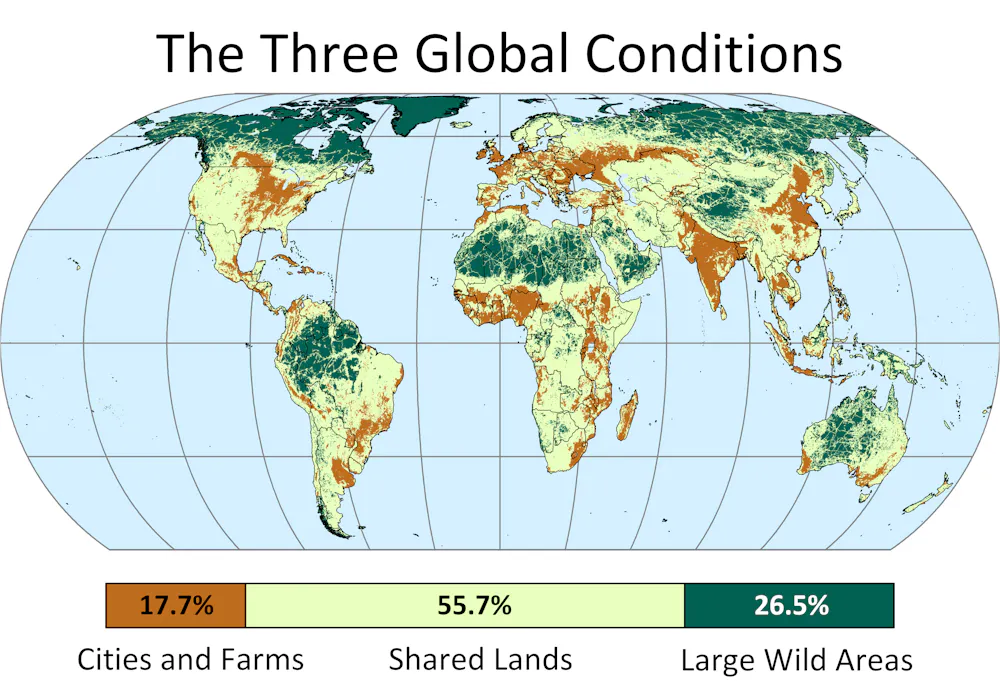
3 Global Conditions—and a Map—for Saving Nature and Using it Wisely
By Erle C. Ellis, professor of geography and environmental systems, UMBC, and James Watson, professor, The University of Queensland
Nature urgently needs our help. Wild creatures, from songbirds to butterflies and from primates to tortoises, are disappearing so rapidly that they could be lost forever together with the wild forests, grasslands and other habitats that long sustained them. We humans already use nearly half of all Earth’s land to sustain ourselves, and the most productive parts at that. Meanwhile, the habitats remaining for the rest of life are shrinking to levels too low to sustain themselves.
To ensure a future in which humanity thrives together with the rest of nature, people around the world will need to work together like never before.
To help make this happen, our team of scientists and conservation experts have developed a new world map highlighting three conditions of landscapes across the planet that will need to be approached differently if we are to succeed in conserving biodiversity globally. These conditions are cities and farms, large wild areas and shared lands.
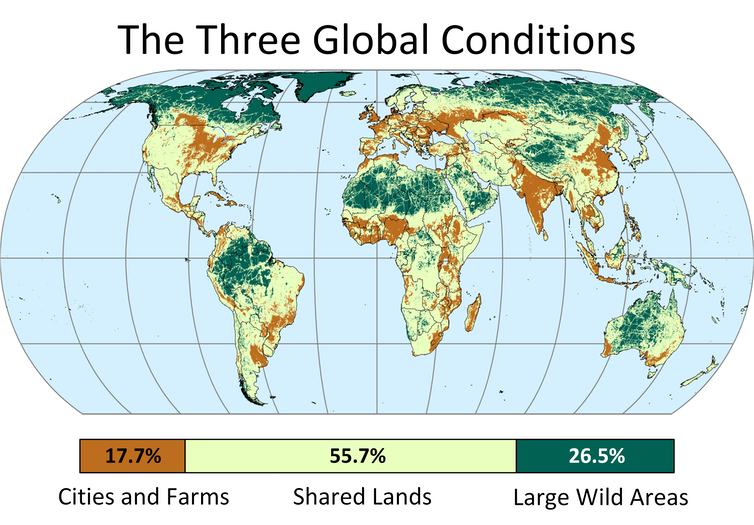 Cities and Farms are more than half covered by intensive agriculture and cities, Large Wild Areas are scarcely altered, and Shared Lands have a level of use somewhere in between. Each landscape condition requires a different conservation strategy. Harvey Locke et al. (2019), CC BY-ND
In a commentary accompanying our map, we argue that for too long, efforts to conserve nature globally have acted as if this entire planet is equally influenced by the human world. Yet different landscapes differ profoundly in how they are used and influenced by people, demanding different strategies to conserve biodiversity. Our map aims to clarify these conditions to enable people to work together to conserve biodiversity more fairly and equitably.
Biodiversity is our natural heritage
The extraordinary richness of life we’ve inherited is an irreplaceable treasure that makes the world an immeasurably better place for people. Biodiversity underpins many of the ecological functions that sustain us, from healthy soils to a stable climate, and provides a wide variety of benefits to human health – mental and physical.
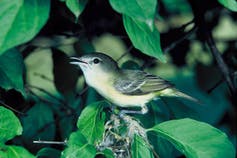 An endangered Bell’s vireo. Steve Maslowski/US Fish & Wildlife Service, CC BY
Yet the ultimate value of our biodiverse natural heritage is beyond any economic measure. Wild nature is our lifeblood and our heritage, connecting us with each other and the rest of life on this planet.
The good news is that people have already begun to rise to the challenge. For example, international commitments now aim to protect 17% of Earth’s land. But it is widely agreed that these and other existing conservation efforts are not nearly strong enough to halt nature’s decline.
In October 2020, nations working together through the global Convention on Biological Diversity will meet in Kunming, China to negotiate more ambitious international targets for conserving nature across the planet. One of the bolder proposals is to develop international commitments to officially protect 30% of Earth’s land area by 2030, and 50% by 2050.
But for any bold conservation agenda to succeed, an unprecedented level of international commitment will be needed. Perhaps the greatest obstacle is the many profound differences in social, economic and natural conditions that persist around the world. Some nations remain rich in unprotected biodiversity and wild habitats but are much less developed economically. Some are the opposite.
So how can such different nations and regions join together to make shared commitments and investments to save nature across this entire planet?
Three conditions for conserving nature
The first step is to build a basic consensus that conserving biodiversity can benefit all people, as long we share the efforts fairly at every level, from backyards to biosphere reserves, and across every social, economic and natural context, from the densest of cities to the most remote wild areas. To succeed, strategies need to be suited to the many different types of landscapes to conserve.
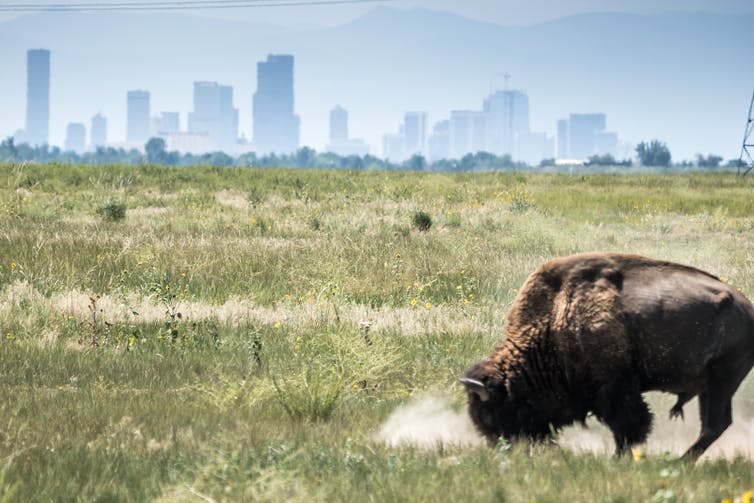 Buffalo grazing near Denver, Colorado, in Rocky Mountain Arsenal National Wildlife Refuge. Mark Byzewski, CC BY
Let’s start with the parts of the world where most of us live and most of our food comes from – the cities and farmlands that take up 18% of Earth’s land surface. These are not just full of people, crops and livestock, but also include some of the densest concentrations of vertebrate diversity on Earth, including many imperiled species of mammals and birds.
In these parts of the world, there needs to be widespread adoption of wildlife-friendly farming practices. Remnant and recovering habitats must be conserved within farmlands and agrichemical production reduced, even while increasing agricultural production. And even in the densest of cities, interconnecting small areas of protected habitat, such as parks and nature reserve networks, can successfully sustain some populations of highly endangered species. In the Indian city of Mumbai, for example, a national park conserves leopards.
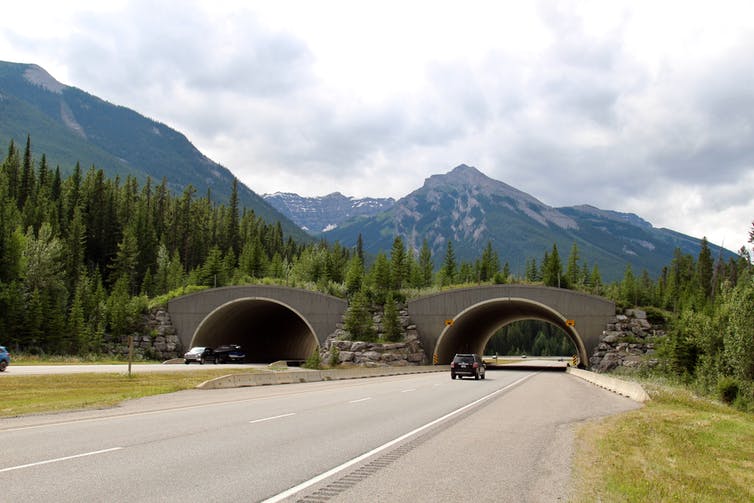 A bridge for wildlife in Banff National Park in Canada, one way to enhance biodiversity in protect lands. David Fulmer, CC BY
Large wild areas, where human influences are lowest, including large parts of Amazonia and Canadian boreal forests, still cover about a quarter of Earth’s land. Here, an emphasis on large-scale protection, such as the Five Great Forests Initiative in Central America, will be the most effective strategy. To avoid damaging the last of Earth’s unaltered ecosystems, new infrastructure and land uses, including mining, should be limited as much as possible. Recognizing indigenous people’s rights to land, so they can conserve their own lands, can also be highly effective; a large proportion of large wild areas are indigenous-owned and managed lands.
Perhaps the greatest conservation opportunities of all may reside within the most common condition of Earth’s land today – shared landscapes. Though parts of these working landscapes are still used intensively for agriculture and settlements, most of their area is composed of remnant and recovering habitats and areas lightly used for extensive grazing and forestry.
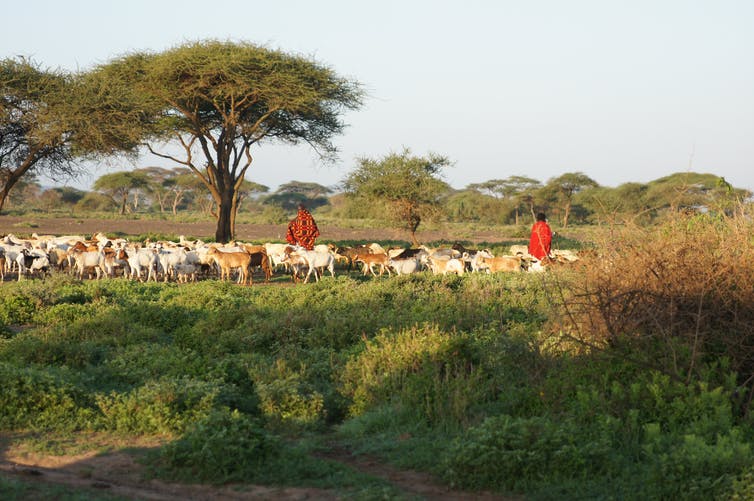 Maasai in Tanzania work on shared lands. jjmusgrove, CC BY
Conservation in shared lands can include regional protected area networks, such as the Yellowstone to Yukon Conservation Initiative, community conservation reserves, and conservation-friendly farms and cities that prioritize the needs of local people. For example, the Lewa community conservancy in Kenya, which protects habitat for endangered black rhinos, includes programs to assist local farmers to maximize their production while minimizing any negative impacts to protected habitats.
Shared lands are also home to almost half of Earth’s indigenous sovereign lands, another reason why expanding and empowering indigenous land sovereignty is considered essential to global efforts to expand conservation.
Doing your part to save nature
Distant wildlands are critical habitat for so many species, but effective conservation also depends on efforts in our own neighborhoods and the regions where our food comes from.
Think of nature when making new friends, caring for family, shopping, working, casting your vote, or donating your time or money to make the world a better place. The challenges ahead are not small, but working together across our farms and cities, shared landscapes, and large wild areas, we can make the nature of our planet whole and healthy again.
*****
Header image: The Snake River in Idaho is an area of ‘critical environmental concern.’ U.S. Bureau of Land Management, CC BY-SA
Contributors to the creation of the Three Conditions map include Harvey Locke of the International Union for Conservation of Nature World Commission on Protected Areas, Oscar Venter of University of Northern British Columbia, Richard Schuster of Carleton University, Keping Ma of the Chinese Academy of Sciences, Xiaoli Shen of the Chinese Academy of Sciences, Stephen Woodley, IUCN World Commission on Protected Areas, Naomi Kingston and Nina Bhola of the UN Environment Programme World Conservation Monitoring Centre, Bernardo B. N. Strassburg of the Pontifícia Universidade Católica and International Institute for Sustainability in Brazil, Axel Paulsch of the Institute for Biodiversity in Regensburg, Germany and Brooke Williams, University of Queensland.
 Erle Ellis is a member of the American Association of Geographers. The association is a funding partner of The Conversation US.
Erle C. Ellis, Professor of Geography and Environmental Systems, University of Maryland, Baltimore County and James Watson, Professor, The University of Queensland
This article is republished from The Conversation under a Creative Commons license. Read the original article.
]]>
By Erle C. Ellis, professor of geography and environmental systems, UMBC, and James Watson, professor, The University of Queensland Nature urgently needs our help. Wild creatures, from songbirds...
https://umbc.edu/stories/3-global-conditions%e2%81%a0-and-a-map%e2%81%a0-for-saving-nature-and-using-it-wisely/
https://my3.my.umbc.edu/api/v0/pixel/news/120025/guest@my.umbc.edu/bc72ab50576ff2c852f85400ea3fa764/api/pixel
cahss
erle-ellis
ges
perspectives
the-conversation
UMBC News & Magazine
https://my3.my.umbc.edu/groups/umbc-news-magazine
https://assets1-my.umbc.edu/system/shared/avatars/groups/000/001/943/24435aa6207c452e7bc15cc74b42c7bb/xsmall.png?1748556657
https://assets1-my.umbc.edu/system/shared/avatars/groups/000/001/943/24435aa6207c452e7bc15cc74b42c7bb/original.png?1748556657
https://assets2-my.umbc.edu/system/shared/avatars/groups/000/001/943/24435aa6207c452e7bc15cc74b42c7bb/xxlarge.png?1748556657
https://assets2-my.umbc.edu/system/shared/avatars/groups/000/001/943/24435aa6207c452e7bc15cc74b42c7bb/xlarge.png?1748556657
https://assets3-my.umbc.edu/system/shared/avatars/groups/000/001/943/24435aa6207c452e7bc15cc74b42c7bb/large.png?1748556657
https://assets1-my.umbc.edu/system/shared/avatars/groups/000/001/943/24435aa6207c452e7bc15cc74b42c7bb/medium.png?1748556657
https://assets2-my.umbc.edu/system/shared/avatars/groups/000/001/943/24435aa6207c452e7bc15cc74b42c7bb/small.png?1748556657
https://assets1-my.umbc.edu/system/shared/avatars/groups/000/001/943/24435aa6207c452e7bc15cc74b42c7bb/xsmall.png?1748556657
https://assets2-my.umbc.edu/system/shared/avatars/groups/000/001/943/24435aa6207c452e7bc15cc74b42c7bb/xxsmall.png?1748556657
UMBC News & Magazine
0
0
false
Fri, 25 Oct 2019 17:56:42 -0400
UMBC receives $2.8M from NSF for master’s program to prepare a diverse environmental science workforce
An interdisciplinary team of UMBC professors has received $2.8 million from the National Science Foundation to create a new master’s program focused on developing a more diverse environmental science workforce. The program, called the Interdisciplinary Consortium for Applied Research in Ecology and Evolution (ICARE), is funded by a highly competitive NSF Research Traineeship (NRT) grant.
Student projects through the program will focus on environmental issues faced by the Baltimore Harbor and the surrounding region. To ensure students are developing research projects with tangible impacts, they will collaborate with partners in all levels of government as well as non-profit and community organizations focused on the environment.
 Tamra Mendelson at a research field site. Photo courtesy Tamra Mendelson.
The ICARE NRT also creates new opportunities to build a more diverse environmental workforce. “The primary mission of UMBC is inclusive excellence, and our NRT applies that mission to the environmental sciences,” says Tamra Mendelson, professor of biological sciences and the lead on the project. “Our main objectives are to bring a diversity of backgrounds to the environmental workforce and to improve the way that scientific research is applied to environmental problems.”
Baltimore in focus
UMBC is known for its links to Baltimore City, and ICARE’s deliberate focus on the Baltimore Harbor and its surroundings builds on that connection. “The students’ thesis projects need to be tied directly to solving problems in the Baltimore Harbor, which is in the spirit of what UMBC does,” says Chris Swan, professor of geography and environmental systems.
 Lee Blaney and Daniel Ocasio ’17, chemical engineering, working in UMBC’s Engineering Building.
The challenges the region is facing reflect environmental challenges the country and planet are facing on a larger scale, from shifting weather patterns, to air pollution and heat island effects, to water quality concerns.
“The health of the Baltimore Harbor is improving, and I am hopeful that the work of ICARE will bolster ongoing efforts to make the Baltimore Harbor a model for the whole country,” says Lee Blaney, associate professor of chemical, biochemical, and environmental engineering. “It is my hope that the research focus on the Baltimore Harbor will set up ICARE and UMBC to make lasting, sustainable, and positive impacts in our city.”
 Colleen Burge in her lab at the Institute of Marine and Environmental Technology.
For faculty who live in the city, the new program is personal. “As a UMBC employee who lives in Baltimore and works at the Institute of Marine and Environmental Technology in Baltimore’s Inner Harbor, I am especially looking forward to the opportunity to train students who can impact the quality of the environment in Baltimore,” shares Colleen Burge, assistant professor of marine biotechnology. “I’m extremely hopeful that this program will attract local students who will be trained to be the next generation of scientists in their communities.”
 From left to right: Postdoc Sarah Stellwagen, Ph.D. student Tyler Brown, assistant professor Mercedes Burns, and two undergraduate students check out a harvestman, a type of arachnid related to spiders, in a research lab in the Interdisciplinary Life Sciences Building (ILSB).
“As part of developing the ICARE NRT proposal, we identified a number of stakeholders in and around Baltimore City that have a strong interest in better understanding and improving the community,” adds Mercedes Burns, assistant professor of biological sciences, “and since I live in the city, I consider myself a beneficiary, too.”
Many of UMBC’s students come from the region, so this program is also an opportunity for them to make a difference to a resource that is at the center of city life, both literally and figuratively. “Baltimore’s harbor is really integral to the fabric of the city,” says Kevin Omland, professor of biological sciences, “the same way that the Chesapeake Bay is embedded in the culture of the state of Maryland.”
 Kevin Omland, rear, goes birdwatching near UMBC’s Library Pond with some of his students. Left to right: Jon Sikora ’20, Ph.D. student Janine Antalffy, Ph.D. student Evangeline Rose, and Aiman Raza ’22.
Direct career development
The unique structure of the program will create opportunities that students might not find in a more traditional master’s program. “We provide a degree program that allows students to get real-world experience in environmental problems, by partnering with government agencies, nonprofits, industry, and community stakeholders,” shares Mendelson.
Students are required to have someone from outside UMBC—in fact, outside any academic institution—on their master’s thesis committee. In that way, “The program is a catalyst for partnerships,” Swan says.
Maggie Holland, associate professor of geography and environmental systems, agrees. “We have been able to involve partner organizations working actively in the city from the very beginning of our planning for this program,” she says. “It’s thrilling to think that we can continue to deepen those collaborations and extend the network over the next several years. Their involvement is part of what will help us to innovate and adapt graduate student training as we move forward.”
 Maggie Holland (right) and Chris Swan in an ILSB lab.
The environment needs everyone
Creating a master’s program that serves as a direct pathway to environmental careers, and funding students to participate (which is rare in master’s programs), opens the door to a wider range of people who want to pursue this line of work, but who may not be in a position to commit to a five-plus year Ph.D. program or an unfunded master’s degree.
“I’m excited to help diversify environmental science through this program,” shares Burns, “as I think the perspectives of people of color are desperately needed in this field.”
“Big picture, the planet is being challenged in huge ways. So it’s totally a situation of needing all hands on deck,” Omland says. “We think this is a really good way to help broaden the kinds of people who are able to make contributions to basic research and applied action. Ultimately, some of these people might end up working for environmental non-profits, on the policy end, or in other capacities.”
 Kevin Omland and Sheridan Danquah ’20, biological sciences.
This program builds on successes UMBC has had in diversifying other fields. “UMBC has done a singularly outstanding job preparing underrepresented students for careers in the biomedical sciences,” Mendelson says. “We’re thrilled to apply these best practices to the environmental sciences and tackle some of the biggest problems facing our city, nation, and planet.”
Now, everyone involved is excited to get to work designing new courses, cultivating partnerships, and, overall, making a difference in Baltimore and beyond. In short, “We’re super jazzed about this,” says Swan. “It’s something we can be really proud of.”
Banner image: Mercedes Burns (left), Maggie Holland (center), and Chris Swan are all part of the ICARE NRT project. All photos by Marlayna Demond ’11 for UMBC unless otherwise noted.
]]>
An interdisciplinary team of UMBC professors has received $2.8 million from the National Science Foundation to create a new master’s program focused on developing a more diverse environmental...
https://umbc.edu/stories/umbc-receives-2-8m-from-nsf-for-masters-program-to-prepare-a-diverse-environmental-science-workforce/
https://my3.my.umbc.edu/api/v0/pixel/news/120042/guest@my.umbc.edu/478c50d75222bb5c7fe1a006a1aa11a0/api/pixel
biology
cahss
cbee
cnms
coeit
ges
graduateschool
marinebiotech
page1
policy-and-society
science-and-technology
UMBC News & Magazine
https://my3.my.umbc.edu/groups/umbc-news-magazine
https://assets1-my.umbc.edu/system/shared/avatars/groups/000/001/943/24435aa6207c452e7bc15cc74b42c7bb/xsmall.png?1748556657
https://assets1-my.umbc.edu/system/shared/avatars/groups/000/001/943/24435aa6207c452e7bc15cc74b42c7bb/original.png?1748556657
https://assets2-my.umbc.edu/system/shared/avatars/groups/000/001/943/24435aa6207c452e7bc15cc74b42c7bb/xxlarge.png?1748556657
https://assets2-my.umbc.edu/system/shared/avatars/groups/000/001/943/24435aa6207c452e7bc15cc74b42c7bb/xlarge.png?1748556657
https://assets3-my.umbc.edu/system/shared/avatars/groups/000/001/943/24435aa6207c452e7bc15cc74b42c7bb/large.png?1748556657
https://assets1-my.umbc.edu/system/shared/avatars/groups/000/001/943/24435aa6207c452e7bc15cc74b42c7bb/medium.png?1748556657
https://assets2-my.umbc.edu/system/shared/avatars/groups/000/001/943/24435aa6207c452e7bc15cc74b42c7bb/small.png?1748556657
https://assets1-my.umbc.edu/system/shared/avatars/groups/000/001/943/24435aa6207c452e7bc15cc74b42c7bb/xsmall.png?1748556657
https://assets2-my.umbc.edu/system/shared/avatars/groups/000/001/943/24435aa6207c452e7bc15cc74b42c7bb/xxsmall.png?1748556657
UMBC News & Magazine
0
0
false
Wed, 18 Sep 2019 20:44:36 -0400
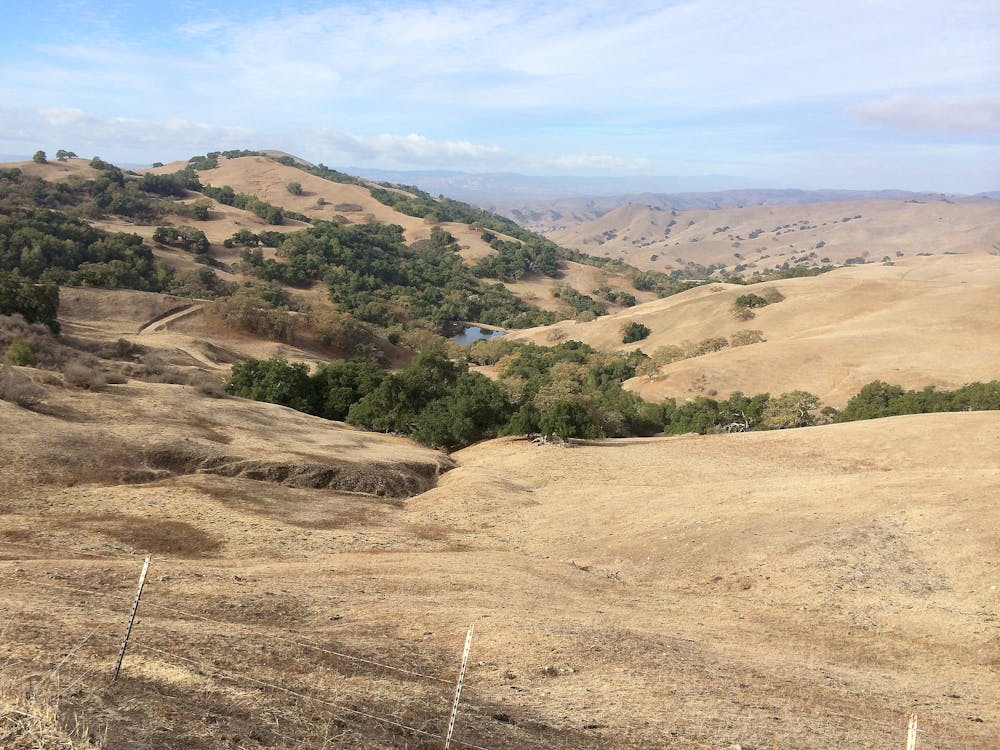 Through the establishment of a conservation bank on the Sparling Ranch in California, more than 2,000 acres of valuable habitat for tiger salamanders and red-legged frogs will be protected, including 14 breeding ponds, while the Sparling family continues to raise and graze cattle on their land. Steve Rottenborn, USFWS/Flickr
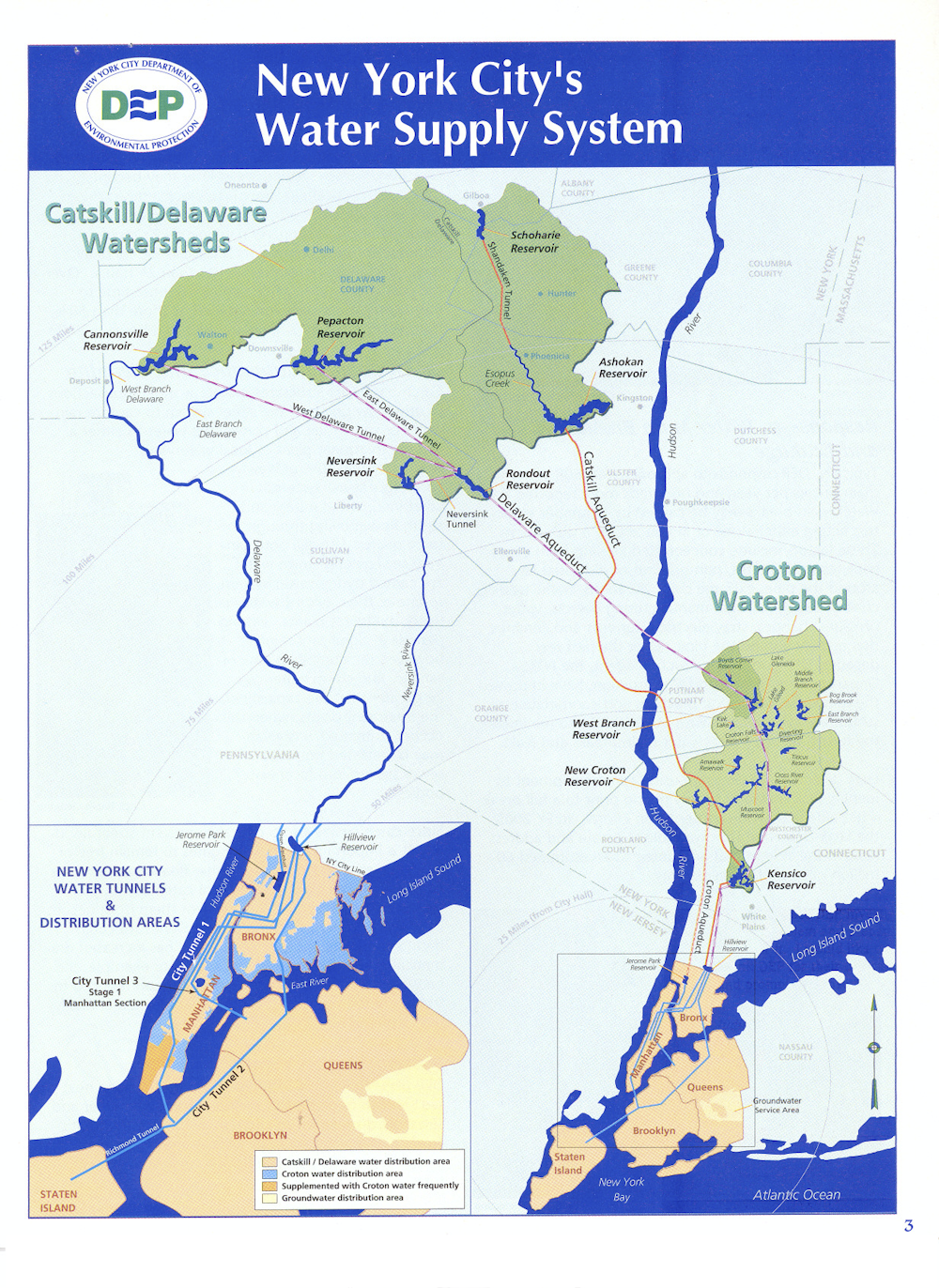 Forests in upstate New York protect and filter New York City’s drinking water supply. The forests are managed and monitored to ensure water quality; they also provide habitat for wildlife and recreation opportunities. NYDEC