UMBC to lead climate-focused NSF data science institute through $13M award
Tens of millions of people live in areas that are at risk for flooding due to climate change, sea level rise, and melting of glaciers. UMBC’s Maryam Rahnemoonfar and a team of researchers are using data science, machine learning, and artificial intelligence (AI) to analyze enormous volumes of climate data, and Arctic and Antarctic observations in ways that could help populations prepare for and respond to these risks.
Rahnemoonfar, associate professor of information systems, is the principal investigator on a new five-year, $13 million grant from the National Science Foundation’s Harnessing the Data Revolution (HDR) Big Idea program. Through the grant, she will launch and direct iHARP, the NSF HDR Institute for Harnessing Data and Model Revolution in the Polar Regions.

Maryam Rahnemoonfar.
“It is so exciting to be selected as one of the five HDR institutes in the nation, however, this comes with huge responsibility,” she says. “We are the first data science and machine learning institute in the world that is dedicated to research in polar regions.”
Data science meets climate science
Climate scientists rely on data that are incredibly challenging to disentangle, Rahnemoonfar explains. AI offers solutions to analyzing these large datasets, providing sophisticated models that make the most use of the quantity and quality of data available.
 Maryam Rahnemoonfar, right, discussing the imaging iHARP research.
The researchers involved with this grant will reduce uncertainties in projecting sea level rise by combining physics modeling, machine learning techniques, and data analysis. The results of their work will inform policymaking to address national and global priorities related to the climate crisis. Further, Rahnemoonfar notes, the team will investigate novel data science techniques that can be applied to other disciplines encountering challenges related to complex data.
Tackling challenges together
This project builds on research from Rahnemoonfar’s prior collaborative project, Intelligent Solutions for Navigating Big Data from the Arctic and Antarctic, supported by a 2018 NSF grant and a 2019 Amazon Machine Learning Research Award. The team will continue this work on a larger scale.
“I am proud of our strong convergence team with many members who are leaders in their fields, including our domain scientists and data scientists, and I am thrilled to lead this effort,” says Rahnemoonfar. She is working with co-PIs Jianwu Wang, associate professor of information systems at UMBC; Mathieu Morligehm at Dartmouth College; Shashi Shekhar at the University of Minnesota; and Jan Lenaerts at the University of Colorado Boulder.

Jianwu Wang.
Project collaborators have expertise in computer and information science, electrical engineering, civil and environmental engineering, Earth science, atmospheric science, oceanic science, mathematics, statistics, physics, geology, glaciology, and data science. An interdisciplinary approach, supported by the nimble nature of information systems, is essential to the team’s success, says Vandana Janeja, chair and professor of IS at UMBC.
“Dr. Rahnemoonfar’s ground-breaking climate change research involves a highly multidisciplinary team within IS and across multiple institutions,” says Janeja. “This grant is an example of our faculty’s bold research agenda and strong teams. This type of work has both led to wide community impacts and also translated into curriculum innovations with strong student engagement.”
In addition to working with UMBC faculty, Rahnemoonfar will lead a group of researchers from institutions across the country, as well as government and industry researchers. These partners include the University of Colorado Boulder, Dartmouth College, University of Minnesota, University of Alaska Fairbanks, Bowie State University, Amherst College, University of Texas at Austin, NASA Universities Space Research Association, NASA Jet Propulsion Laboratory, NVIDIA, IBM, and Amazon.
Educational impact
The grant will also involve dozens of undergraduate and graduate students and postdoctoral researchers. Rahnemoonfar and her team will engage students from underrepresented groups by working with UMBC’s Center for Women in Technology and similar programs, as well as the Baltimore’s Women in Machine Learning and Data Science chapter, which she currently leads.
 Jianwu Wang (left), Maryam Rahnemoonfar, and Masoud Yari.
Additionally, the project will support educational and outreach activities, with an eye toward workforce development. This includes programming for K-12 and college students, and lectures and training opportunities for data science and domain science professionals. Students will work alongside partners including NASA, Amazon, and IBM, and will have internship opportunities with federal and industry partners.
The research teams also plan to develop museum exhibits to help public audiences access their work.
Impact of multidisciplinary teams
“This major multi-institutional NSF award reflects so much hard work and ingenuity. National programs like iHARP, with its focus on some of the great challenges our society is facing, add to UMBC’s growing reputation for innovation and excellence in public impact research,” says Karl V. Steiner, vice president for research at UMBC.
“The College is experiencing extraordinary research growth. This is made possible by both the development of multidisciplinary teams and our increased focus on leadership development,” says Keith J Bowman, dean of the College of Engineering and Information Technology. “This project team, and others recently funded or pending, benefit from the tremendous faculty talent we have recruited in the last several years.”
The solutions that are developed through this work will have applications beyond environmental issues. Rahnemoonfar anticipates the team’s research will impact the future of medicine, autonomous driving, and remote sensing, and that the students working on the project will become the next generation of experts addressing these global issues.
In addition to Rahnemoonfar and Wang, the UMBC team also includes Janeja; Aryya Gangopadhyay, professor of information systems; Masoud Yari, research assistant professor in information systems; Karen Chen, assistant professor of information systems; Osman Gani, assistant professor of information systems; and Don Engel, associate vice president for research development, and assistant professor of computer science and electrical engineering.
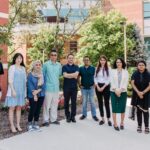
Banner image: Some of the iHARP research team. All photos by Marlayna Demond ’11 for UMBC.
]]>
Tens of millions of people live in areas that are at risk for flooding due to climate change, sea level rise, and melting of glaciers. UMBC’s Maryam Rahnemoonfar and a team of researchers are...
https://umbc.edu/stories/climate-focused-data/
https://my3.my.umbc.edu/api/v0/pixel/news/119551/guest@my.umbc.edu/265099189831df53c8a57f8ccc53a50a/api/pixel
coeit
is
majoraward
page1
research
science-and-technology
UMBC News & Magazine
https://my3.my.umbc.edu/groups/umbc-news-magazine
https://assets1-my.umbc.edu/system/shared/avatars/groups/000/001/943/24435aa6207c452e7bc15cc74b42c7bb/xsmall.png?1748556657
https://assets1-my.umbc.edu/system/shared/avatars/groups/000/001/943/24435aa6207c452e7bc15cc74b42c7bb/original.png?1748556657
https://assets2-my.umbc.edu/system/shared/avatars/groups/000/001/943/24435aa6207c452e7bc15cc74b42c7bb/xxlarge.png?1748556657
https://assets2-my.umbc.edu/system/shared/avatars/groups/000/001/943/24435aa6207c452e7bc15cc74b42c7bb/xlarge.png?1748556657
https://assets3-my.umbc.edu/system/shared/avatars/groups/000/001/943/24435aa6207c452e7bc15cc74b42c7bb/large.png?1748556657
https://assets1-my.umbc.edu/system/shared/avatars/groups/000/001/943/24435aa6207c452e7bc15cc74b42c7bb/medium.png?1748556657
https://assets2-my.umbc.edu/system/shared/avatars/groups/000/001/943/24435aa6207c452e7bc15cc74b42c7bb/small.png?1748556657
https://assets1-my.umbc.edu/system/shared/avatars/groups/000/001/943/24435aa6207c452e7bc15cc74b42c7bb/xsmall.png?1748556657
https://assets2-my.umbc.edu/system/shared/avatars/groups/000/001/943/24435aa6207c452e7bc15cc74b42c7bb/xxsmall.png?1748556657
UMBC News & Magazine
0
0
false
Tue, 28 Sep 2021 16:01:00 -0400
UMBC’s Jack Suess and instructional tech team earn national awards for leadership, innovation
Jack Suess, vice president for information technology at UMBC, has received a 2021 Capital CEO of the Year ORBIE Award. Suess ‘81, mathematics, M.S. ‘94, information systems, has been part of the UMBC community for more than 40 years. As a university leader, he has spearheaded transformative technology initiatives. His work includes advancing the use of technology in courses, operational systems, and student success initiatives in ways that have fundamentally reshaped the UMBC experience for all community members.
“What makes this award special is that it truly recognizes the work of our entire Division of Information Technology (DoIT),” Suess says. “Our team’s work, particularly in helping the university quickly shift to remote learning last year, due to COVID, reflects a spirit of empathy and collaboration. This spirit has made IT true partners in the university’s success, not just technology experts.”
“I won this award as the leader of the division, but really this is an award that belongs to everyone in DoIT,” he shares.
Innovative solutions advance opportunities
Under Suess’s leadership, UMBC’s Division of Information Technology has developed innovative solutions to a very broad range of technology needs. The COVID-19 pandemic in particular significantly changed how faculty, staff, and students utilized and relied on technology to teach, work, and learn.
 Jack Suess, right, at the 2021 Fall Opening Meeting.
“Our leadership relied on robust data Suess’s team had collected to provide the information and insights needed to safely reopen the campus for research and in-person learning opportunities,” says UMBC President Freeman Hrabowski. “Without his forethought and his team’s commitment and creativity, we could not have provided the level of education, innovation, and critical research for which UMBC is known.”
In 2020, Suess received the EDUCAUSE Leadership Award for his success as a leader in the field and for advancing UMBC’s reputation as leader in higher education.
Honoring a transformative online teaching initiative
DoIT’s instructional technology team recently received an award specifically recognizing this essential, innovative work during the transition to remote learning. The Online Learning Consortium (OLC) is honoring the team with an Effective Practice Award for the UMBC’s Planning Instructional Variety for Online Teaching (PIVOT) program.
 Victor Adebanjo ’23, mechanical engineering, was a student worker in the Division of Information Technology during the pandemic.
The PIVOT program was developed last year in collaboration with faculty across all three colleges and UMBC’s Faculty Development Center to help faculty provide students with engaging online courses. The program guided faculty through the elements of course design for the virtual space, as well as how to teach effectively online. Faculty who participated in PIVOT also connected with peer mentors who provided insight into pedagogy and the technology used.
The OLC is recognizing the DoIT instructional technology team for developing digital educational tools that elevated UMBC’s efforts to continue to offer exceptional courses to students throughout the remote learning period of the pandemic. The Consortium evaluated UMBC’s PIVOT program against its five pillars of quality in digital education, and sought out peer reviews. They found that the PIVOT program was strong in all five areas: learning effectiveness, scale, access, faculty satisfaction, and student satisfaction. More than 70% of UMBC faculty utilized the program, and it received positive feedback from the participants.
Mariann Hawken, acting director of instructional technology, led PIVOT program development and will accept the award at the OLC Accelerate conference in October.
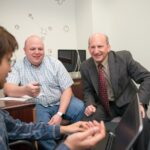
Banner image: Jack Suess, right, and a few of his colleagues. All photos by Marlayna Demond ’11 for UMBC.
]]>
Jack Suess, vice president for information technology at UMBC, has received a 2021 Capital CEO of the Year ORBIE Award. Suess ‘81, mathematics, M.S. ‘94, information systems, has been part of the...
https://umbc.edu/stories/umbcs-jack-suess-and-instructional-tech-team-earn-national-awards-for-leadership-innovation/
https://my3.my.umbc.edu/api/v0/pixel/news/119555/guest@my.umbc.edu/96881aed53d863cc38a456f849bdd7e7/api/pixel
campus
coeit
community
is
mathstat
meche
science-and-technology
staff
UMBC News & Magazine
https://my3.my.umbc.edu/groups/umbc-news-magazine
https://assets1-my.umbc.edu/system/shared/avatars/groups/000/001/943/24435aa6207c452e7bc15cc74b42c7bb/xsmall.png?1748556657
https://assets1-my.umbc.edu/system/shared/avatars/groups/000/001/943/24435aa6207c452e7bc15cc74b42c7bb/original.png?1748556657
https://assets2-my.umbc.edu/system/shared/avatars/groups/000/001/943/24435aa6207c452e7bc15cc74b42c7bb/xxlarge.png?1748556657
https://assets2-my.umbc.edu/system/shared/avatars/groups/000/001/943/24435aa6207c452e7bc15cc74b42c7bb/xlarge.png?1748556657
https://assets3-my.umbc.edu/system/shared/avatars/groups/000/001/943/24435aa6207c452e7bc15cc74b42c7bb/large.png?1748556657
https://assets1-my.umbc.edu/system/shared/avatars/groups/000/001/943/24435aa6207c452e7bc15cc74b42c7bb/medium.png?1748556657
https://assets2-my.umbc.edu/system/shared/avatars/groups/000/001/943/24435aa6207c452e7bc15cc74b42c7bb/small.png?1748556657
https://assets1-my.umbc.edu/system/shared/avatars/groups/000/001/943/24435aa6207c452e7bc15cc74b42c7bb/xsmall.png?1748556657
https://assets2-my.umbc.edu/system/shared/avatars/groups/000/001/943/24435aa6207c452e7bc15cc74b42c7bb/xxsmall.png?1748556657
UMBC News & Magazine
0
0
false
Tue, 21 Sep 2021 15:22:44 -0400
Hurricanes, well-being, and AI: START Awards set up UMBC researchers for success

Soon, Steve Guimond and his students will begin exploring a new angle of his hurricane research. They want to better understand the fundamental physics that drives hurricanes. Specifically, they want to know how small disturbances in a hurricane’s wind flow, similar to a strong gust on a windy day, may affect its overall structure and intensity. The findings could have implications for hurricane forecasting.
A new, $682,000 National Science Foundation (NSF) grant in collaboration with the New Jersey Institute of Technology will fund the team’s work, which primarily involves developing, running, and analyzing complex numerical models on supercomputers. However, Guimond might never have received the grant if he hadn’t received a UMBC Strategic Award for Research Transitions (START) first.
In 2018, the NSF rejected a related proposal from Guimond, who is an associate research professor with UMBC’s physics department and the Joint Center for Earth Systems Technology, a partnership with NASA. The proposal outlined a broad research program using two different methods to learn more about hurricanes: remote sensing and numerical modeling. “The START funding helped us evaluate those two sides of the project,” he says.
The START program funded initial research that was carried out by Guimond, Devin Protzko ’20, physics and mathematics, and Badrul Hasan, a Ph.D. student in mechanical engineering. They gathered preliminary data showing that the modeling path had significant potential, so they wrote a fresh NSF proposal with a narrower focus. It won approval. The small START grant, Guimond says, “was key to helping us identify the most fruitful path for follow-on funding from NSF.”

A simulation of a “large eddy,” an instance of turbulence, in a rapidly intensifying hurricane. Running this kind of simulation is part of Steve Guimond’s research. Animation courtesy Steve Guimond.
Turbulence in focus
The NSF proposal will support work to understand the role of turbulence in how or whether hurricanes intensify. Guimond’s team will also look at the value of using numerical hurricane models with very high resolution. High resolution is important because a hurricane’s “gusts” appear and disappear very quickly. They also generally take up very little physical space. Because they’re so ephemeral, you can’t simulate them precisely or accurately with current models. And if you can’t simulate them, you can’t figure out their role in overall hurricane development. High resolution models would make those simulations possible, which can feed back into improved forecasts in the future.
The fact that Guimond has the chance to do this work exemplifies START’s goal. The program, funded by UMBC’s Office of the Vice President for Research, offers a maximum of $25,000 to UMBC faculty who wish to pursue new avenues of research. The hope is that the funds will put them in a stronger position for much larger external grants from places like NSF—exactly what happened for Guimond.

Steve Guimond. Courtesy Steve Guimond.
A first step
A new cohort of UMBC faculty will receive START funding this summer. Lira Yoon, associate professor of psychology, hopes to follow a similar path to Guimond. Yoon will collect initial data on how Asian Americans regulate their emotions in response to overt racism, and how or whether the strategies they practice affect their well-being. This work is particularly relevant given the sharp rise in anti-Asian discrimination during the pandemic. Yoon is also working on a project to help long-term care workers better manage their stress, another group impacted heavily by the pandemic.
“I’m eager to start a new line of research examining the effects of racial discrimination on psychological well-being, particularly in Asian Americans,” Yoon shares. “Although the ultimate solution to the problems resulting from racial discrimination lies at the policy and systems levels, understanding mechanisms operating at an individual level could help mitigate the adverse effects of discrimination.”
“This project will be the first step in that direction,” she says, “and it will provide preliminary data to secure external funding for future larger-scale research.”

Lira Yoon. Photo courtesy Lira Yoon.
Real-world impact
Maryam Rahnemoonfar, information systems, is another member of the new START cohort. Her team is developing algorithms for use on drones flying over affected areas after natural disasters. The goal is for the drones to relay important information about conditions on the ground in real time. Her team has created a unique dataset, called FloodNet, that can train the algorithms to recognize disaster impacts—for example, roads that are flooded or blocked by debris.
With a previous AI for Earth grant from Microsoft, more than 20 students at all levels in Rahnemoonfar’s research group spent more than a thousand hours creating the FloodNet dataset. Input from first responders and the Federal Emergency Management Administration (FEMA) guided their work, plus mentoring from faculty and more advanced students. Team members labeled each pixel in images to teach the artificial intelligence (AI) system what a flooded road or damaged building looks like.
“It was a very difficult and challenging task, but we are the first in the world to prepare this sophisticated dataset,” Rahnemoonfar says.
Already, German authorities have requested (and been granted) access to the FloodNet set of labeled images to help them respond to recent catastrophic flooding in the country. The FloodNet dataset is the first and only dataset of its kind that can be used for training AI systems in the wake of natural disasters.

Maryam Rahnemoonfar. Courtesy Maryam Rahnemoonfar.
Saving time, saving lives
With the new START funding, Rahnemoonfar’s team hopes to improve the algorithm that evaluates how much damage buildings have sustained, on a scale from none to total destruction. Rahnemoonfar also hopes to build an interface where a person can ask the AI system a verbal question and get a useful answer. Her team is developing this ability for data already collected, “but when a new hurricane happens, we hope that while a drone is flying you can ask and get answers to these questions in real time,” she says.
To save time—of the essence during disaster response—Rahnemoonfar’s graduate students are working on adding a layer to the algorithms that would allow the AI to learn on its own, with a minimal training dataset.
“Now that we have developed this AI system, for any new hurricane that happens, we don’t need to label data again,” she says. “With the algorithm that we are developing, with very few labeled images we can get insights for any new hurricane.”
A ripple effect
The START program has a ripple effect beyond UMBC faculty. Many of the awardees involve students in their work, enhancing the students’ UMBC experience and helping set them up for success later on. Students in Guimond’s group, for example, get first-hand experience with NASA scientists and facilities.
Also, by helping researchers hone their projects and, as a result, future proposals, START increases their chance of success with applying for larger grants. Like Guimond, Rahnemoonfar is already looking to use the START support to lead to bigger research awards.
“The START program enables UMBC faculty members (and with them, UMBC students) to move in new directions with their scholarly work,” shares Don Engel, associate vice president for research. “We are proud of the success past recipients have found in turning their proposed ideas into longer-term initiatives.”
Banner image: Hurricane Matthew bears down on Haiti in 2016. Image by NASA Goddard Space Flight Center.
]]>
Soon, Steve Guimond and his students will begin exploring a new angle of his hurricane research. They want to better understand the fundamental physics that drives hurricanes. Specifically, they...
https://umbc.edu/stories/hurricanes-well-being-and-ai-start-awards-set-up-umbc-researchers-for-success/
https://my3.my.umbc.edu/api/v0/pixel/news/119577/guest@my.umbc.edu/ebb9d64242a961e91d0ab1a2c8ab62ed/api/pixel
cahss
cnms
coeit
is
jcet
physics
psychology
research
science-and-technology
UMBC News & Magazine
https://my3.my.umbc.edu/groups/umbc-news-magazine
https://assets1-my.umbc.edu/system/shared/avatars/groups/000/001/943/24435aa6207c452e7bc15cc74b42c7bb/xsmall.png?1748556657
https://assets1-my.umbc.edu/system/shared/avatars/groups/000/001/943/24435aa6207c452e7bc15cc74b42c7bb/original.png?1748556657
https://assets2-my.umbc.edu/system/shared/avatars/groups/000/001/943/24435aa6207c452e7bc15cc74b42c7bb/xxlarge.png?1748556657
https://assets2-my.umbc.edu/system/shared/avatars/groups/000/001/943/24435aa6207c452e7bc15cc74b42c7bb/xlarge.png?1748556657
https://assets3-my.umbc.edu/system/shared/avatars/groups/000/001/943/24435aa6207c452e7bc15cc74b42c7bb/large.png?1748556657
https://assets1-my.umbc.edu/system/shared/avatars/groups/000/001/943/24435aa6207c452e7bc15cc74b42c7bb/medium.png?1748556657
https://assets2-my.umbc.edu/system/shared/avatars/groups/000/001/943/24435aa6207c452e7bc15cc74b42c7bb/small.png?1748556657
https://assets1-my.umbc.edu/system/shared/avatars/groups/000/001/943/24435aa6207c452e7bc15cc74b42c7bb/xsmall.png?1748556657
https://assets2-my.umbc.edu/system/shared/avatars/groups/000/001/943/24435aa6207c452e7bc15cc74b42c7bb/xxsmall.png?1748556657
UMBC News & Magazine
0
0
false
Fri, 06 Aug 2021 17:56:40 -0400
UMBC to partner with UMD, Army Research Lab to advance AI and autonomy through $68M collaboration
From surveillance tools to autonomous machines, countries around the world are ramping up their military artificial intelligence (AI) assets. Such robust technologies are necessary to protect the United States from surprise attacks, which occur these days not only on the ground, but also on the cloud.
Advancing AI-based autonomous systems for military use will be the goal for a team of UMBC researchers that has recently been awarded a $20-million subcontract. UMBC will partner with the University of Maryland, College Park (UMD), and the DEVCOM Army Research Lab (ARL) on the $68-million, five-year endeavor, which ARL is funding. The goal is to strengthen Army AI technology so it is able to meet the demands of today’s national defense.
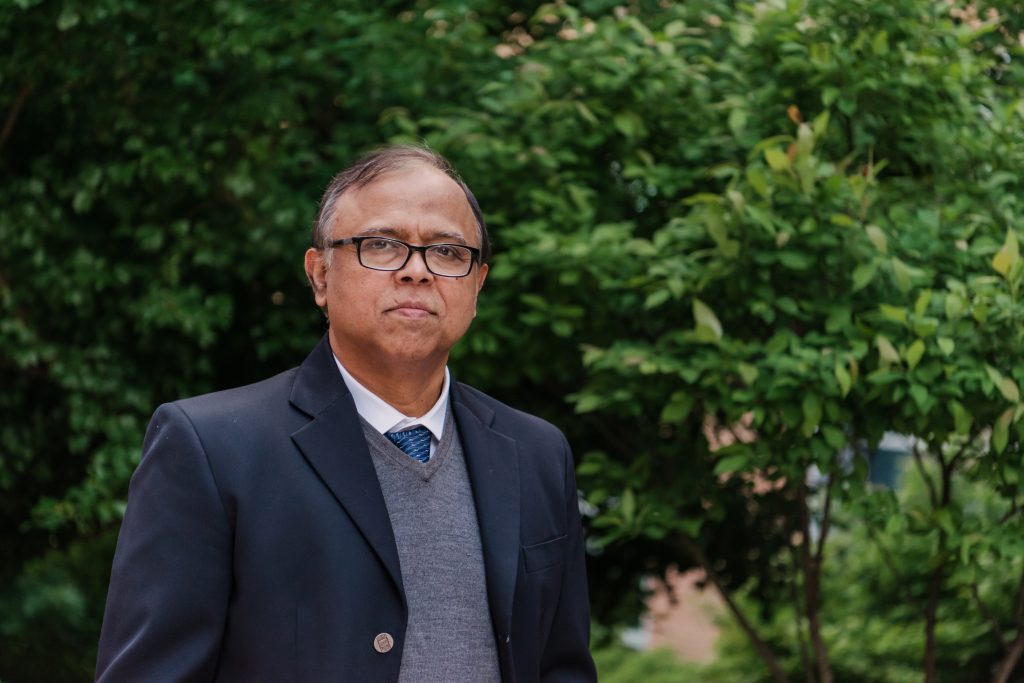 Aryya Gangopadhyay.
“The question we’re trying to solve is: Can we design and develop tools, techniques, algorithms, software, and hardware that can work autonomously and make their own decisions, but also collectively, interfacing with human decision makers?” says UMBC’s principal investigator Aryya Gangopadhyay, professor of information systems. “The landscape of war is changing, and we must build systems that can make human-like decisions in real time and under real-world pressure.”
Secure, effective, and resilient
The project, AI and Autonomy for Multi-Agent Systems (ArtIAMAS), aims to advance science and technology around three core research areas: collaborative autonomy; harnessing the data revolution; and human-machine teaming. UMBC’s role in the project will center on the second and third research thrusts.
More specifically, the UMBC team will develop solutions for AI-based networking, sensing, and edge computing — which brings data storage and computation closer to a location — for battlefield Internet of Things (IoT). This will allow them to deliver secure, effective, and resilient U.S. Army assets including AI systems related to search-and-rescue, surveillance, robots and machinery, and augmenting humans in performing decision-making tasks.
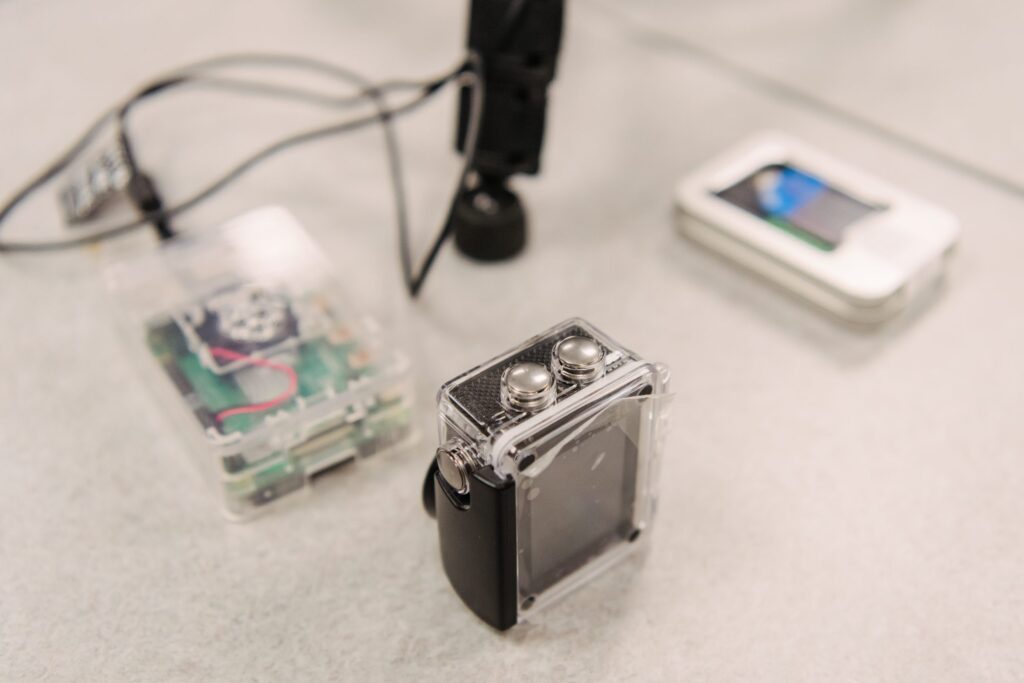 Sensors that will be used for research.
“As one of the research institutions in the University System of Maryland, we are delighted with this exciting next step in our statewide partnership with our colleagues at UMD and at the Army Research Lab,” says Karl V. Steiner, vice president for research at UMBC. “Artificial intelligence is one of the key technologies in the ongoing transition to autonomous systems, both in the defense and civilian sectors, and it does take researchers from a variety of backgrounds to innovate and develop the most promising solutions. This alliance builds on the expertise and commitment of many of our colleagues.”
Today’s conflict landscape
In the battlefield, there are soldiers with body cameras, guns with sensors, as well as ground-based and airborne machines operating in rough and volatile terrains. Retrieving data and making decisions from these multi-model sources can be difficult, especially in challenging networking conditions. Understanding and developing adaptable cross-domain solutions for these environments will be at the forefront of the work of co-principal investigator Nirmalya Roy, associate professor in information systems.
“There may not be time to send data to an army base or the cloud, so some of the processing, computing, and interference may be done on the devices themselves. How do you navigate the available computing resources in-hand and process data on the devices themselves to make an informed decision, and in real time? These are the concepts I’ll be working on,” Roy says.
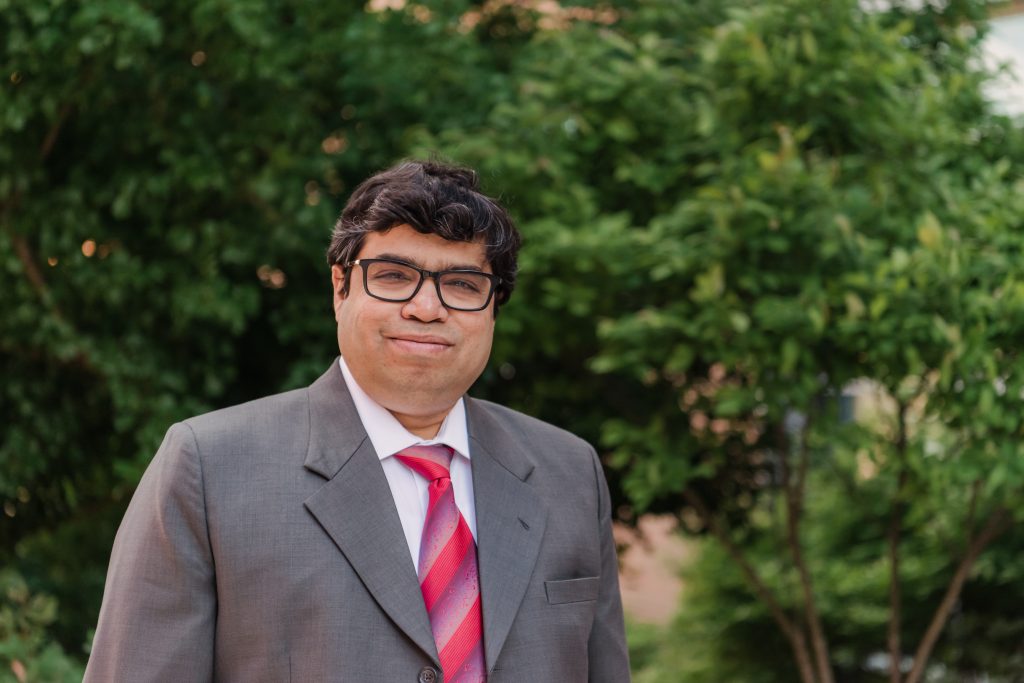 Nirmalya Roy
With the work set to begin in mid-May 2021, the UMBC team will initially include more than eight researchers from the departments of information systems and computer science and electrical engineering, as well as scientists and engineers from the ARL. The Center for Real-time Distributed Sensing and Autonomy (CARDS) will lead the research being conducted by UMBC faculty.
Eventually, the team will grow to nearly 50 researchers, and future projects will include other University System of Maryland institutions. Together, the group will publish fundamental research and identify similar and cross-cutting research endeavors, improving collective information-sharing.
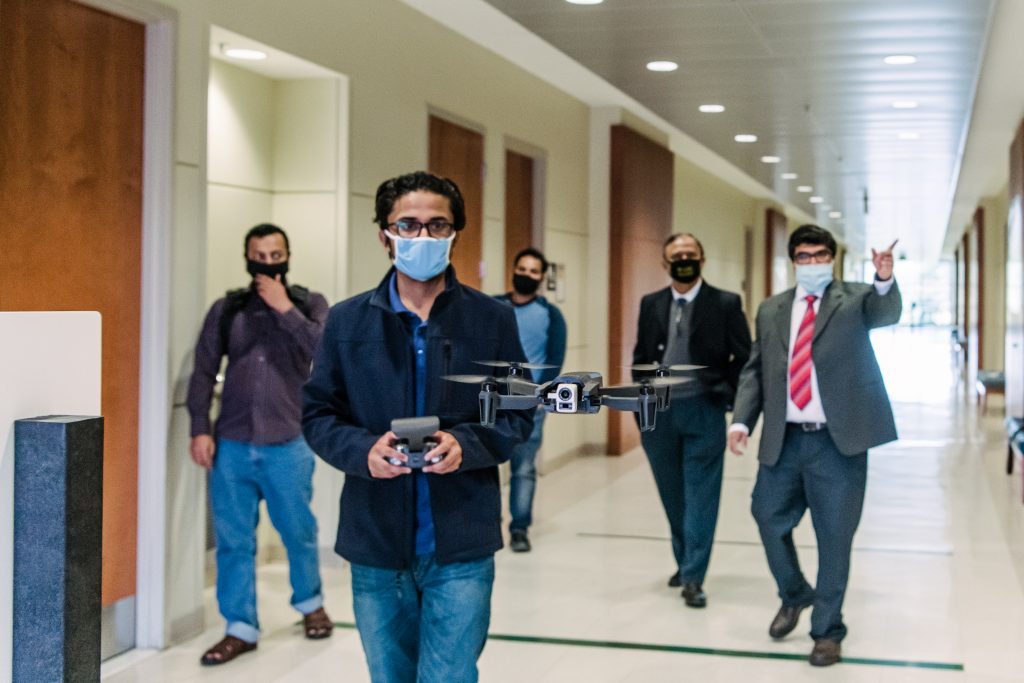 Aryya Gangopadhyay and Nirmalya Roy with several students.
“The cross-disciplinary nature of this project is well-suited to our College, which brings together computing, engineering, and information systems faculty and student researchers. The project team includes a significant number of the exceptional faculty we have recruited through recent hiring made possible through our state’s support,” says Keith J Bowman, dean of UMBC’s College of Engineering and Information Technology.
Advancing AI research
While the work will undoubtedly improve military AI, it will also enhance AI research in other domains. A goal of the project is to establish a long-term center with a vision of advancing AI-based autonomy.
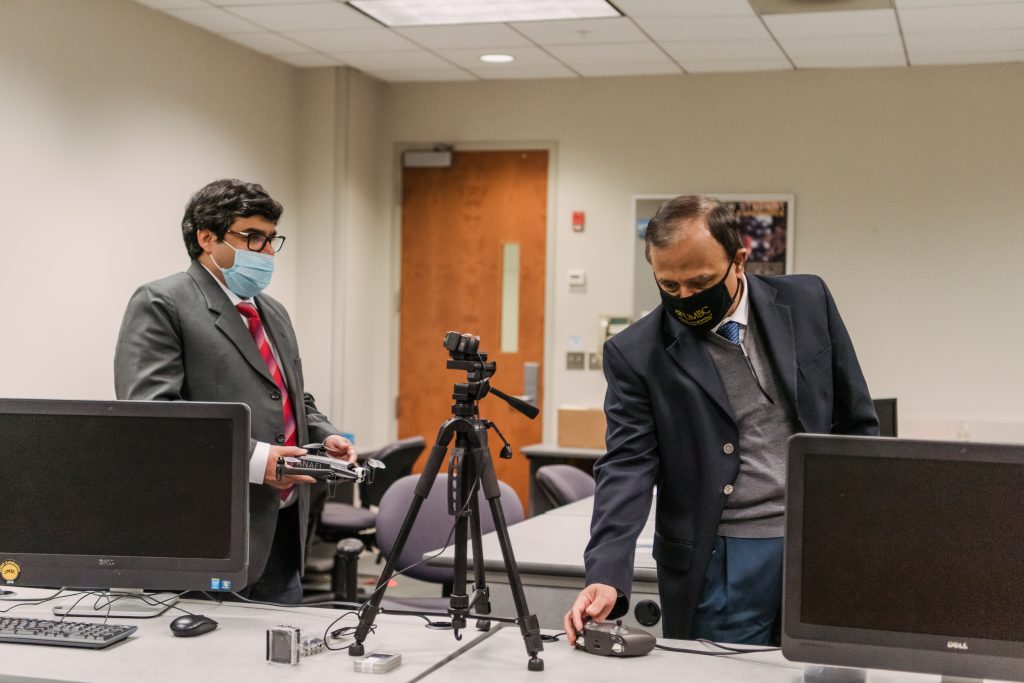 Nirmalya Roy, left, and Aryya Gangopadhyay working together in the lab.
“This is an opportunity for UMBC to bring together talented researchers from across departments to participate in fundamental, and potentially groundbreaking, research,” says Gangopadhyay. “To make a big impact in the research space, you need long-term, multi-institutional partnerships and collaborations. Working with the University of Maryland, College Park and the Army Research Lab will allow us to collectively advance AI in the military space.”
In addition to Gangopadhyay and Roy, the UMBC team also includes Anupam Joshi, Tinoosh Mohsenin, Dmitri Perkins, Sanjay Purushotham, Maryam Rahnemoonfar, Jianwu Wang, and Ting Zhu. The ArtIAMAS cooperative agreement is led by PI Derek Paley, director of UMD’s Maryland Robotics Center.
Written by B. Rose Huber for UMBC News.
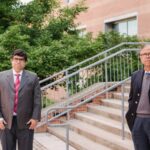
Banner image: Nirmalya Roy, left, and Aryya Gangopadhyay. All photos by Marlayna Demond ’11 for UMBC.
]]>
From surveillance tools to autonomous machines, countries around the world are ramping up their military artificial intelligence (AI) assets. Such robust technologies are necessary to protect the...
https://umbc.edu/stories/umbc-to-partner-with-umd-army-research-lab-to-advance-ai-and-autonomy-through-68m-collaboration/
https://my3.my.umbc.edu/api/v0/pixel/news/119615/guest@my.umbc.edu/f31a6951092406482407bb15b6d8ce3e/api/pixel
coeit
is
page1
research
science-and-technology
UMBC News & Magazine
https://my3.my.umbc.edu/groups/umbc-news-magazine
https://assets1-my.umbc.edu/system/shared/avatars/groups/000/001/943/24435aa6207c452e7bc15cc74b42c7bb/xsmall.png?1748556657
https://assets1-my.umbc.edu/system/shared/avatars/groups/000/001/943/24435aa6207c452e7bc15cc74b42c7bb/original.png?1748556657
https://assets2-my.umbc.edu/system/shared/avatars/groups/000/001/943/24435aa6207c452e7bc15cc74b42c7bb/xxlarge.png?1748556657
https://assets2-my.umbc.edu/system/shared/avatars/groups/000/001/943/24435aa6207c452e7bc15cc74b42c7bb/xlarge.png?1748556657
https://assets3-my.umbc.edu/system/shared/avatars/groups/000/001/943/24435aa6207c452e7bc15cc74b42c7bb/large.png?1748556657
https://assets1-my.umbc.edu/system/shared/avatars/groups/000/001/943/24435aa6207c452e7bc15cc74b42c7bb/medium.png?1748556657
https://assets2-my.umbc.edu/system/shared/avatars/groups/000/001/943/24435aa6207c452e7bc15cc74b42c7bb/small.png?1748556657
https://assets1-my.umbc.edu/system/shared/avatars/groups/000/001/943/24435aa6207c452e7bc15cc74b42c7bb/xsmall.png?1748556657
https://assets2-my.umbc.edu/system/shared/avatars/groups/000/001/943/24435aa6207c452e7bc15cc74b42c7bb/xxsmall.png?1748556657
UMBC News & Magazine
0
0
false
Wed, 26 May 2021 10:01:00 -0400
UMBC’s Cangialosi Business Innovation Competition winners focus on tech innovations, social impact
When Balaji Viswanathan’s grandfather was injured in a fall at a senior care facility a few years ago, he committed to seeing what he could do to prevent it from happening again, to his grandfather or other older adults. Viswanathan, M.S ‘06, Ph.D. ‘21, computer science, developed Invento, a technology that analyzes movement patterns to determine fall risk and notify caregivers if a fall seems likely, helping caretakers prevent injuries from falls.

Balaji Viswanathan. Photo courtesy of Viswanathan.
Invento earned first place in the technology track of UMBC’s eighth annual Cangialosi Business Innovation Competition hosted by the Alex. Brown Center for Entrepreneurship. The event was held virtually on April 29, with one track focused on technology and the other focused on social impact ideas beyond tech.
Vivian Armor ‘73, American studies, director of the Alex. Brown Center for Entrepreneurship, explains that the two tracks offered this year allowed students to propose a broader range of ideas. “Special thanks to entrepreneurial alums Khuram Zaman ‘05, political science, and Asif Khan ‘04, information systems and computer science, co-founders of FifthTribe, for reaching out to support the new social impact track this year. It’s a wonderful addition to the competition originally founded by Greg Cangialosi ‘96, English, in 2014,” says Armor. “It’s very rewarding to see our Retriever alums generously give back to help develop the next wave of entrepreneurs for the future.”
The competition provides opportunities for students interested in entrepreneurship to connect with alumni and advisors. “The CBIC competition is a great platform for startups to get discovered by investors,” Viswanathan says. “We participated in the competition, winning the top prize in our category. And through that we got a key advisor and also connected with investors.”
Affordability and sustainability
Second place in the technology track went to Edullo, led by Esha Vangara ‘23, economics. Vangara explains that Edullo offers affordable and personalized tutoring that is fast for students to access. The system is structured differently than traditional tutoring companies. All of the tutors are also students, tutoring is fully online, and students who access tutoring aren’t required to sign up for subscriptions or to sign longer-term contracts.
Kayleigh Nelson ‘23, global studies, presented Digitize My Closet, which placed third on the technology track. Rather than producing physical clothing, Digitize My Closet produces digital clothing for users to “wear” while on video calls. The clothing moves with the model on screen, providing users with a way to wear clothing that they may only need for a singular event without needing to purchase new pieces. This approach, explains Nelson, is a more environmentally and financially sustainable way for people to expand their wardrobes.
Innovation with social impact
In the social impact category, Mariah Qureshi ‘23, computer science, took first place with a proposal to grow codeHer. Qureshi is an executive board member of codeHer, a nonprofit organization that works to address the gender gap in STEM fields by empowering women and providing them with tools to help them succeed in computing and science.

Mariah Qureshi. Photo courtesy of Qureshi.
CodeHer plans to expand the course offerings in and around Baltimore, explains Qureshi, to support underserved youth who are interested in STEM disciplines. She says that they plan to develop after-school programs for high school and middle school students, as well as provide personalized mentoring to students.
Kelvin Johnson M.P.S. ‘21, entrepreneurship, innovation, and leadership, presented Businessaire and earned second place. Businessaire is a board game that increases financial literacy by teaching business principles and information about the economy.
Sotonye Koko ‘21, information systems, and Yvann Tientcheu ‘21, information systems, earned third prize for EndeaVR. They propose using virtual reality technology to provide online services such as job training, to address high recidivism rates among people in the U.S. prison system.
Through this annual competition, winners receive funding to continue to advance their idea. They also access the opportunity to connect with local entrepreneurs who serve as mentors and help connect them with Baltimore’s entrepreneurship community.
“CBIC was an enriching experience that I’d recommend for every UMBC student who is entrepreneurship-oriented. I’m grateful for the immense help provided by the competition mentors and coordinators, even during COVID-19,” says Qureshi. “I learned of several different ways to further my own social venture, and have had many professional and personal takeaways from this experience.”
Banner image: The UMBC Albin O. Kuhn Library in spring 2017. Photo by Marlayna Demond ’11 for UMBC.
]]>
When Balaji Viswanathan’s grandfather was injured in a fall at a senior care facility a few years ago, he committed to seeing what he could do to prevent it from happening again, to his...
https://umbc.edu/stories/umbcs-cangialosi-business-innovation-competition-winners-focus-on-tech-innovations-social-impact/
https://my3.my.umbc.edu/api/v0/pixel/news/119621/guest@my.umbc.edu/f2b4da03ed0de03033e531913ae3218e/api/pixel
alexbrowncenter
americanstudies
community
csee
economics
english
entrepreneurship
globalstudies
is
politicalscience
UMBC News & Magazine
https://my3.my.umbc.edu/groups/umbc-news-magazine
https://assets1-my.umbc.edu/system/shared/avatars/groups/000/001/943/24435aa6207c452e7bc15cc74b42c7bb/xsmall.png?1748556657
https://assets1-my.umbc.edu/system/shared/avatars/groups/000/001/943/24435aa6207c452e7bc15cc74b42c7bb/original.png?1748556657
https://assets2-my.umbc.edu/system/shared/avatars/groups/000/001/943/24435aa6207c452e7bc15cc74b42c7bb/xxlarge.png?1748556657
https://assets2-my.umbc.edu/system/shared/avatars/groups/000/001/943/24435aa6207c452e7bc15cc74b42c7bb/xlarge.png?1748556657
https://assets3-my.umbc.edu/system/shared/avatars/groups/000/001/943/24435aa6207c452e7bc15cc74b42c7bb/large.png?1748556657
https://assets1-my.umbc.edu/system/shared/avatars/groups/000/001/943/24435aa6207c452e7bc15cc74b42c7bb/medium.png?1748556657
https://assets2-my.umbc.edu/system/shared/avatars/groups/000/001/943/24435aa6207c452e7bc15cc74b42c7bb/small.png?1748556657
https://assets1-my.umbc.edu/system/shared/avatars/groups/000/001/943/24435aa6207c452e7bc15cc74b42c7bb/xsmall.png?1748556657
https://assets2-my.umbc.edu/system/shared/avatars/groups/000/001/943/24435aa6207c452e7bc15cc74b42c7bb/xxsmall.png?1748556657
UMBC News & Magazine
0
0
false
Fri, 21 May 2021 15:41:26 -0400
UMBC’s 2021 grads advance research with public impact—from disaster response to assistive tech

Students from across all of UMBC’s colleges and schools are graduating this week having taken advantage of the unique undergraduate research opportunities and supportive mentorship UMBC offers. They’re poised to take their research to the next level and move on to new challenges through graduate school and careers.
For example, Davis Cappabianca ’21 is recommending reforms to better coordinate multi-agency disaster relief efforts. Hana Flores ’21is conducting cutting-edge HIV studies. Keren Herrán ’21, M29, is incorporating environmental science to improve public health. Ali Abdolrahmani, Ph.D. ’21, is developing innovative assistive technologies for the blind community, and Briscoe Turner ’21 is reimagining public safety with an eye to community empowerment.
Big breakthroughs
Cappabianca took advantage of UMBC’s individualized study program (INDS) to tailor his degree around his interests. As a U.S. Navy veteran, Cappabianca knows that coordination between the military and civilian relief groups in the aftermath of disasters is often clumsy. He also expects, as an aspiring Navy medical doctor, that he will be involved in these situations in the future. He wanted to find a way to improve outcomes in these situations, because, he says, “The end goal [is] helping the most people possible in the most effective way.”

Davis Cappabianca ’21 in his U.S. Navy uniform. Photo courtesy of Cappabianca.
“I realized that my background in the U.S. Navy provided me with a lot of unique experiences,” he shares, “and what I found in INDS was a way for me to bring those experiences into my education and claim my own degree.” His two degree mentors, Stephen Kosloski, joint director of Naval ROTC at UMBC and University of Maryland, College Park and Joby Taylor, director of the Peaceworker Program at UMBC, brought very different perspectives to his research.
“More often than not, the melding of their ideas was what got me to major breakthroughs in my research,” Cappabianca says. Learning to always consider multiple perspectives was one of the most valuable takeaways from his INDS degree, he adds. “I think it will fundamentally change the way you approach problems, even if it’s subconsciously.” He plans to pursue medical school or a master’s degree in emergency management.
Environmental science meets public health
Herrán also designed her degree around her experiences. Answering a call for more Spanish-speaking participants, she spent spring break of her first year at UMBC in Nicaragua with the UMBC chapter of Global Medical Brigades, a student-run organization committed to implementing sustainable health systems worldwide.
She noticed the relationship between water quality and community health in Nicaragua, and reflected on similar challenges she observed during her childhood summers in Puerto Rico and El Salvador (the birthplaces of her parents). “Coming back to UMBC, I thought, this is what I want to dedicate my life to,” she says.
 Keren Herrán ’21, right, In Honduras while participating in the Honduras Leadership Institute. Photo courtesy of Herrán.
Her degree has included courses in environmental science, sociology, research methods, and writing—even cartography. Why? Herrán sees significant overlap between study of the environment and public health, but, in practice, doesn’t see the fields as very connected in today’s world. She says, “I want to be in that overlap.”
“I think INDS has been crucial to my acceptance to graduate school, because it’s given me the opportunity to be intentional in my choice of classes, and to claim my education,” Herrán notes. “I knew that I wanted to pursue research and partner with communities, not just come in and tell them what to do,” she says. She has had the opportunity to take that approach in her undergraduate work.
This fall, Herrán will begin a Ph.D. at University of South Carolina as a Presidential Fellow in health promotion, education, and behavior.

Keren Herrán in her graduation regalia, spring 2021. Photo courtesy of Herrán.
Asking challenging questions
Turner and Abdolrahmani also focused on issues close to their hearts. As a Sondheim Public Affairs Scholar and psychology major, Turner has studied community building in the context of reimagining public safety and justice.
“I’m really interested in the community aspect, alternatives to policing, and understanding how you build as a community and solve these problems without the use of force—with understanding and restorative practices,” she says. “I’ve grown in that way, and thought about, ‘What does abolition look like? How do we expand our thinking and make sure that we’re tapping into new ideas of how we operate with each other, and how we communicate with each other, and how we treat each other, rather than sticking to historical practices?’”
 Briscoe Turner ’21, rear, second from right, with other members of the UMBC Black Lives Matter Club in 2019. Photo courtesy of Turner.
Her current research with Bronwyn Hunter, assistant professor of psychology, focuses on college students who have had parents incarcerated or struggle with substance use, and understanding the students’ ideas of what justice looks like. In addition to her work with Hunter, a Public Policy and International Affairs Junior Summer Institute at Princeton University “opened my eyes to how public policy works,” Turner says. Now, she’s asking big questions: “I’m trying to understand what the world could look like, and how do we get there?”
This summer, Turner is headed to Brown University to pursue a master’s of public affairs. “I’ve really enjoyed my UMBC experience. That’s why I picked Brown,” she says. “I felt like it had a lot of similar aspects to it as UMBC, so I want to continue that community feel and the support that I got here.”
 Briscoe Turner ’21, left front, with UMBC’s Black Lives Matter Club in the UMBC Commons. Photo courtesy of Turner.
Inclusive design
Abdolrahmani has spent the last seven years investigating and developing assistive technologies for the blind community in the human-centered computing Ph.D. program. He decided to pursue a Ph.D. after being exposed to the field of assistive technology while working in his home country to improve the internet banking experience for blind customers. Intrigued and wanting to make a bigger contribution to the field, Abdolrahmani, who is legally blind, moved to the U.S. with his wife at age 36 to study with UMBC faculty in information systems.
“I wanted to understand how I could develop technologies to improve the independent living of the blind community or other people with disabilities,” Abdolrahmani says. He first worked on a project to develop a wearable indoor navigation assistive device. Later, he worked to enhance the user experience of mainstream voice assistants such as Amazon Alexa and Google assistant for the blind. And, finally, he brought the two together for his thesis project, which focused on the use of mainstream voice assistants for navigating airports.
Along the way, he learned that not only did blind people appreciate the technologies he was developing, but so did sighted people and members of other groups. His research “shows that these technologies have great potential for future use for different groups of users in different contexts,” he explains.
Now, Abdolrahmani is looking for roles where he can have an even more direct impact as a member of a product design team, “so that I can inspire more accessibility and inclusive design in products, to see that products are designed in such a way that people with different abilities can use them right away out of the box.”
Becoming a scientist
A culture of supportive mentorship has helped sustain all of these students on their path to commencement. For Hana Flores, her first mentor on campus was none other than President Freeman Hrabowski.

Hana Flores ’21, center, with Phyllis Robinson, right, and Ernestine Baker, after Floes received an award for her presentation at the Annual Biomedical Research Conference for Minority Students in 2019. Photo courtesy of Flores.
The CEO of Prince George’s County Public Schools connected Flores with Hrabowski after hearing her deliver the valedictorian address at Bowie High School and learning that she would attend UMBC. On the day of their meeting, when Flores heard Hrabowski’s booming voice from the anteroom to his office, she was nervous. “But once he entered the room, any nerves I had went away,” she recalls. “He was so interested, and genuinely wanted to know what my goals and aspirations were.”
Soon thereafter, she joined the lab of Michael Summers, Distinguished University Professor of chemistry and biochemistry and Howard Hughes Medical Institute investigator. And she’s been conducting research with his team on the structure of HIV since.
 Hana Flores ’21, left, Pengfei Ding, center, and Ridhi Chaudry ’22, right, at UMBC’s Summer Undergraduate Research Fest in 2019. Photo courtesy Flores.
Postdoc Pengfei Ding, in particular, spurred her growth by encouraging his mentees to contribute to the intellectual direction of the research, rather than simply teaching them specific laboratory techniques. “Dr. Pengfei Ding essentially was a catalyst for me to grow into a more independent researcher,” Flores says.
Her many professors in chemical engineering also had a role to play. “They are really focused on students being able to achieve. I felt comfortable going to office hours,” she says. “And I feel like they didn’t just care about me accomplishing in my classes, they also cared about how I was as a person.”
Flores has presented at national conferences, conducted summer research at MIT, and joined the UMBC Honors College and U-RISE Program. Shes also a contributing author for one published and two pending research articles. This fall, she’ll begin a Ph.D. at MIT as a Dean of Science Fellow, where she hopes to pursue interests in protein engineering and regeneration.

Hana Flores ’21. Photo courtesy Flores.
The power of mentoring
Herrán had support from research mentor Dawn Biehler, associate professor of geography and environmental systems, as well as her INDS and Meyerhoff Scholar communities. Biehler “is invested in her mentees and their growth and development, and she’s just incredibly kind and supportive,” Herrán says.
On her Meyerhoff experience, Herrán reflects, “I’m a minority in many aspects, and Meyerhoff is so beautiful, because it’s so rare to be in a cohort of more than 50 other students who are also minorities, who are also trailblazers within their families and their cultural communities. You relate to one another, you support one another—it’s a family for life.”
Abdolrahmani also received support from multiple angles. Stacey Branham, formerly of UMBC and now on the faculty at University of California, Irvine, “had a very deep trust in me and my abilities and my creativity for different research projects that we collaborated on together,” he says. Ravi Kuber, associate professor of information systems, was his primary advisor and “the first one who trusted me when I arrived in 2014.”

Keren Herrán ’21, right, at the University of Pennsylvania, where she gave a poster presentation on research completed during the Leadership Alliance Summer Research – Early Identification Program in 2018. Photo courtesy Herrán.
A strong believer in peer mentoring, Abdolrahmani thinks back to the supportive relationships he developed with both graduate and undergraduate students. With the undergrads, in particular, “I trained them academically, but also how to interact with me as a blind person, what kind of support I need,” Abdolrahmani says, “so I had the support that Ph.D. students need through the collaboration of my mentors and colleagues in the team.”
Circle of support
Turner’s research mentor, Hunter, offered valuable insights beyond their specific research project, supporting Turner as a whole person. “I’ve learned a lot from her about criminal justice and research and just about life,” Turner says of Hunter.
That support included walking her through the graduate school application process and providing an emotional anchor point. “I really appreciated her and the graduate students sharing their experiences,” Turner says. “She would also check in with me during our one-on-one meetings to see how I was doing throughout the process, given how difficult this past year has been.”

Briscoe Turner ’21 in graduation regalia. Photo courtesy Turner.
Faculty in the Sondheim Scholars and Honors College programs completed Turner’s circle of support. “All of them have been there for me, which I really appreciate, for personal growth and also my career goals,” she reflects.
Connections and pathways
Other graduating students, too, have benefited from strong mentorship and rich research experiences. Caleb Robelle ’21, M29, mathematics and computer science, had the opportunity to connect with research mentors across UMBC, Rutgers, Texas A&M, and Johns Hopkins, and was accepted into all 17 of the Ph.D. programs he applied to. He will pursue his Ph.D. in theoretical computer science at MIT. Olumide Fagboyegun ’21, M29, biochemistry, will pursue a Ph.D. in neuroscience at Harvard as a Herchel Smith and NSF Graduate Research Fellow after completing neurological research with Erin Green, assistant professor of biological sciences.
Jordan Troutman ’21, M29, computer science and mathematics, is UMBC’s first Knight-Hennessy Scholar. He will pursue a Ph.D. in computer science at Stanford. And Samuel Patterson ’21, economics and mathematics, will attend Oxford as the second Rhodes Scholar in UMBC’s history, with a focus on transportation economics.
Thinking ahead
In UMBC tradition, on the eve of their graduation these students are already thinking about how they can support those coming after them. Flores, for example, benefited from being paired with a graduate student as part of her summer research experience at MIT. She’s planning to become a mentor once she arrives on campus to begin her Ph.D.
They all agree that community connections matter. “It’s powerful to give people the platform to share their stories, their lives, their hopes, their dreams,” Turner says. “There’s a lot of power in community—building with each other and climbing as you go.”
Banner image: Hana Flores, left, and Keren Herrán, right, on campus. Photo by Marlayna Demond ’11 for UMBC.
]]>
Students from across all of UMBC’s colleges and schools are graduating this week having taken advantage of the unique undergraduate research opportunities and supportive mentorship UMBC offers....
https://umbc.edu/stories/umbcs-2021-grads-advance-research-with-public-impact-from-disaster-response-to-assistive-tech/
https://my3.my.umbc.edu/api/v0/pixel/news/119624/guest@my.umbc.edu/6e9d91d1885cc087c2aaa37d2c9da9ee/api/pixel
cahss
cbee
chembiochem
civic
classof2021
cnms
coeit
community
csee
economics
ges
gradresearch
honorscollege
inds
is
marcustar
mathstat
meyerhoffscholars
naval
policy-and-society
psychology
research
science-and-technology
shrivercenter
sondheimscholars
undergradresearch
UMBC News & Magazine
https://my3.my.umbc.edu/groups/umbc-news-magazine
https://assets1-my.umbc.edu/system/shared/avatars/groups/000/001/943/24435aa6207c452e7bc15cc74b42c7bb/xsmall.png?1748556657
https://assets1-my.umbc.edu/system/shared/avatars/groups/000/001/943/24435aa6207c452e7bc15cc74b42c7bb/original.png?1748556657
https://assets2-my.umbc.edu/system/shared/avatars/groups/000/001/943/24435aa6207c452e7bc15cc74b42c7bb/xxlarge.png?1748556657
https://assets2-my.umbc.edu/system/shared/avatars/groups/000/001/943/24435aa6207c452e7bc15cc74b42c7bb/xlarge.png?1748556657
https://assets3-my.umbc.edu/system/shared/avatars/groups/000/001/943/24435aa6207c452e7bc15cc74b42c7bb/large.png?1748556657
https://assets1-my.umbc.edu/system/shared/avatars/groups/000/001/943/24435aa6207c452e7bc15cc74b42c7bb/medium.png?1748556657
https://assets2-my.umbc.edu/system/shared/avatars/groups/000/001/943/24435aa6207c452e7bc15cc74b42c7bb/small.png?1748556657
https://assets1-my.umbc.edu/system/shared/avatars/groups/000/001/943/24435aa6207c452e7bc15cc74b42c7bb/xsmall.png?1748556657
https://assets2-my.umbc.edu/system/shared/avatars/groups/000/001/943/24435aa6207c452e7bc15cc74b42c7bb/xxsmall.png?1748556657
UMBC News & Magazine
0
0
false
Thu, 20 May 2021 15:02:24 -0400
New UMBC grads find entrepreneurial ways to positively impact communities

Kiaron Bailey will soon become the very first graduate of UMBC’s new master’s degree program in community leadership, a path she hadn’t envisioned for herself while working in finance just a few years ago. “From a very young age, my parents instilled in me the importance of giving back. I just didn’t realize that I could pursue that passion and actually sustain myself,” Bailey says. In deciding to make the career shift, “I kind of had a heart-to-heart with myself,” and she realized that entrepreneurship and community impact can go hand in hand.
Bailey learned about the program when she connected with Sonya Crosby at her place of worship. Today, Crosby is assistant vice provost for applied and off-campus programs, but at the time she was director of the Office of Professional Programs, which offered the new master’s degree. Crosby told Bailey about the practical emphasis of the program—how it combined coursework community-based service-learning—and Bailey knew it was what she was looking for.
 Bailey, second from left in second row, and her classmates in a virtual class. Photo courtesy of Bailey.
Appreciating the nuances
As someone who studied finance as an undergraduate—where one plus one equals two—Bailey found the nuanced world of community leadership a bit shocking, she says, laughing. She particularly enjoyed connecting with nonprofits in Baltimore City, using her skills to support their missions while learning more about running community-based organizations.
Next One Up helps Black male youth in their academics, including preparing for the SATs and other college prep. The nonprofit did not yet have a physical space, and Bailey researched possible locations, preparing them to strengthen their services and community connections post-pandemic.
 Bailey, second from right, with her classmates in Baltimore. Photo courtesy of Bailey.
She also worked with The Lazarus Rite, which helps formerly incarcerated people prepare for jobs, obtain gainful employment, learn about budgeting, and develop soft skills to support their success. Bailey developed a survey to help the organization prepare to apply for a grant, and analyzed the survey data.
UMBC’s community leadership program, “definitely helped me get a holistic perspective of what it actually takes to run an organization and the type of tenacity and creativity you need,” she says. Bailey currently works for the Interagency Commission on School Construction for the State of Maryland, and also serves as an administrator of programs and finance, and the liaison for the Maryland Board of Education. She plans to continue that while starting to build a nonprofit supporting physical, mental, and financial wellness.
Creative problem solver
When Princess Sara Njemanze ‘21, chemical engineering, came to UMBC as a freshman, she knew that she wanted to find opportunities to build and to support communities. She started by joining the Shriver Center’s Living Learning Community, a residential floor bringing together students focused on meaningful social change. The experience proved so significant that she remained connected to the group for four years, transitioning through roles as a peer mentor and then as a resident assistant. “It’s my life,” she says, smiling.
 Njemanze, second from right in second row, with her fellow Orientation Peer Advisors in 2018. Photo by Marlayna Demond ’11 for UMBC.
As she explored possibilities for her degree and career paths, Njemanze knew she enjoyed fixing problems through science and engineering and that she loved connecting with people. After meeting Vivian Armor ‘73, American studies, director of the Alex. Brown Center for Entrepreneurship, Njemanze decided to register for an entrepreneurship class. There, she got a chance to partner with students from all different majors and to come up with a product to pitch for a Shark Tank-style presentation. Before long, she added minors in both computer science and entrepreneurship to her degree.
As a France-Merrick Fellow, Njemanze worked with a group of her peers to create initiatives that work to address challenges in Baltimore City and Baltimore County. “Something that I’m really proud of that we worked on and saw the fruits was hosting a leadership program for high school students at Lansdowne High School,” she explains, adding that they asked the students to envision their ideal communities.
 Njemanze, fifth from right, and the France-Merrick 2018-2019 cohort. Photo by Raquel Hamner ’20.
The high school students came to UMBC for a day-long leadership training and created art that was displayed at OCA Mocha, a coffee shop and community gathering space in downtown Arbutus. Njemanze says the opportunity to connect with younger students was meaningful to her and impacted her UMBC experience.
 Njemanze, second from right in front row, with her classmates in Introduction to Intercultural Communication class. Photo courtesy of Njemanze.
During her time at UMBC, Njemanze interned at the Naval Surface Warfare Center, where she was offered a job that will begin after graduation, combining her passion for engineering and creative problem solving. Her long-term vision is creating a nonprofit to support underserved communities gain access to knowledge and skills such as financial literacy, college readiness, and leadership development.
Supporting mental health through tech
Tristan King ‘21, individualized studies, created his own path at UMBC after transferring from Howard Community College (HCC), where he earned an associates degree in computer science. While King was at HCC, he met Joshua Massey ‘14, individualized studies, who was teaching an entrepreneurship course. By talking with Massey during his office hours King learned that at UMBC he could design his own major, and he began to explore the possibilities.
King shares that his personal mental health struggles led him to create a major at UMBC that focused on how technology could support mental health and wellbeing. Through an emerging field called digital therapeutics, he explains, some health care providers are prescribing apps and websites to provide support and resources to people with depression and other mental health challenges.
 King testing the UMBC-UCI-Toyota research prototype. Photo by Sarah King.
At UMBC, King began learning more about tech and accessibility. He worked with Ravi Kuber, associate professor of information systems, on creating obstacle-detection tools so that blind runners could complete their runs independently and safely (research supported by Toyota). King also worked with Lee Boot, director of UMBC’s Imaging Research Center, on data visualization research.
In 2020, he participated in UMBC’s annual Idea Competition through the Alex. Brown Center for Entrepreneurship. His team earned second place for the Sproutful System, which includes a plant container outfitted with sensors that transmit to a phone app, helping the user know what their plant needs to thrive. The app also features daily guided meditations. The idea is that a person will care for themselves and their plant in a daily meditative practice that is both relaxing and rewarding.
 King, top, and his collaborator Andrew Park ’21, individualized studies, presenting at the Idea Competition in 2020.
King’s senior capstone project uses virtual reality to translate metaphor therapy to an immersive environment. “It looks at how people describe depression and anxiety, and sort of visualizes it,” he says. The project combined what he learned through health psychology coursework with his computer science skills, interest in supporting mental health, creativity, and ingenuity to yield a thought-provoking tool.
Energy and commitment
When Amina Mahmood ‘21, computer science, was younger, she would routinely get viruses on her family’s desktop computer while playing online games. Her computing skill set has certainly grown and changed over the years, but her passion for the field remains the same.
As she was applying to colleges, Mahmood focused on institutions with strong resources for students pursuing computer science. She felt elated when offered a spot in UMBC’s Cyber Scholars program, housed within the Center for Women in Technology. She wanted to make the most of each and every opportunity that came her way.
 Mahmood, right, at a CWIT event. Photo courtesy of Mahmood.
That is how Mahmood, as a new freshman at UMBC, found herself at the UMBC Career Center’s campus career fair, 10 copies of her resume in hand. She didn’t yet have work experience in computing, and wasn’t quite sure of the protocol, but she committed to handing out each one of those resumes before she left.
Before the end of the day, Mahmood connected with Huntress Labs, a start-up company based in bwtech@UMBC. Huntress Labs offered her an internship, and she worked there part-time through her sophomore year.
She also went on to complete internships at Parsons, a company that develops digital solutions in the security, defense, and infrastructure industries; Systems and Tech Research; and the Johns Hopkins University Applied Physics Lab. There, she will soon begin a full-time job as a cyber engineer, where she will focus on reverse engineering, one of her computing-related passions.
A world of opportunities
While completing her courses and interning, Mahmood took advantage of unique learning opportunities. She received a scholarship to attend the Grace Hopper Celebration, the world’s largest gathering of women in technology. She also studied abroad in the United Kingdom in spring 2020, traveling to Paris and London before the program ended early due to the emergence of COVID-19.
 Mahmood in Paris. Photo courtesy of Mahmood.
Mahmood’s approach of taking on new challenges with energy and commitment extended to other aspects of her life at UMBC. When she found that UMBC offered limited on-campus halal dining options, she worked with the Student Dining Advisory Committee to expand those options. In her junior year her tenacity paid off. UMBC opened Halal Shack as a permanent halal dining option in The Commons, also popular with vegetarian and vegan diners.
 Mahmood, third from right, at the ribbon cutting event opening Halal Shack in The Commons. Photo by UMBC Dining.
Knowing the potential of her organizing to positively impact other people motivated Mahmood to push forward the work until it became a reality. “I’m the youngest in my family, but what if I have a daughter or a nephew and they come to UMBC, what would I want them to experience?” she asked herself. “I just want to use my skill set and whatever I can do to be beneficial to other people.”
Gaining confidence as entrepreneur
Jason Jozwiak, M.S. ‘21, information systems, came to UMBC with a bachelor’s degree in fine arts, a decade working as a software developer, and two years teaching English in Ukraine through the Peace Corps. As a Peaceworker Fellow with UMBC’s Shriver Center, he had an opportunity to pursue his master’s degree in information systems while working part-time with Baltimore City’s Department of General Services, and completing a social change leadership program.
 Jozwiak (in blue hat) and fellow Peaceworkers in Baltimore, 2020. Photo by Charlotte Keniston.
Jozwiak began working with the City of Baltimore before the COVID-19 pandemic began, developing software to help his department digitize records. During the pandemic, the City began using that same software to record COVID-19 data to support contact tracing efforts.
That experience broadened his sense of the kinds of community impacts he could have through a career in computing. After graduation, he plans to expand his software development work in partnership with another emerging entrepreneur.
 Jozwiak giving a presentation related to his work with Baltimore City. Photo by James Trimarco of the Department of General Services.
“UMBC helped open my eyes to the possibilities and opportunities that are available,” says Jozwiak. “Entrepreneurship is something that I’ve been interested in for a long time. There are inherent risks involved and it’s kind of scary trying to piece it together. But I learned that I know what I’m doing. It helped give me the confidence.”
Finding community
Jameka Wiggins ‘21, chemical engineering, remembers when representatives from UMBC’s Center for Women in Technology (CWIT) visited her high school in Prince George’s County, Maryland. They offered a glimpse into the kind of experience she might have as a CWIT Scholar, including a tight-knit community of mutual support. She was accepted into the scholars program and says, simply, “CWIT was my community coming into UMBC. They always made sure we had a community of supporters, that we were engaged in the program, and that we felt welcome at the university.”
That community proved particularly important when Wiggins struggled with the transition to college life, worrying that she didn’t belong. Working through that challenging time motivated her to shift from focusing on lab research to engineering education itself as a career path.
 Wiggins, second from left, with Elfreda Atoe ’19, political science; Krystal Ogun, ’19, information systems; Alayla Stone-Abernathy ’20, health administration and policy; and Cheyenne Oliver ’20, biological sciences, at an event for The Lambda Phi Chapter of Alpha Kappa Alpha Sorority, Incorporated. Photo courtesy of Wiggins.
During her sophomore year, Wiggins, who is also a member of the UMBC chapter of the National Society of Black Engineers, decided that she wanted to gain research experience. She applied to the NSF’s Louis Stokes Alliance for Minority Participation (LSAMP) program, which supported her summer research on optimizing oleaginous yeast cell factories in UMBC’s chemical, biochemical, and environmental engineering department.
The next year she accessed a very different kind of experience as a Shattuck Fellow through the UMBC Career Center and as a participant in the Maryland Technology Internship Program for Entrepreneurship. These initiatives allowed her to intern multiple semesters for the start-up Athena Environmental Sciences, with Sheldon Broedel, associate director of UMBC’s master’s in professional studies in biotechnology program.
As she was exploring these opportunities, Wiggins realized that she was not the only student who would benefit from academic support outside of the classroom. She and a group of her peers worked with the UMBC Academic Success Center to provide tutors for upper-level engineering courses. And she also began looking at career pathways in engineering that were focused on community and belonging.
Change agent
In fall 2020, Wiggins, also a McNair Scholar, began working with Jamie Gurganus, associate director of engineering education, on a project that would shape her trajectory. They conducted research on the engineering mindset and experiences of Black first-year students, including those who are and are not in scholars programs.
Wiggins and Gurganus explored how to foster a sense of community among these students, which has been demonstrated to support resilience and degree attainment. Their study found that participants experienced particular challenges during the COVID-19 pandemic, such as isolation and difficulty finding their footing in classes.
 Wiggins, second from right, with Delegate Samuel Rosenberg, second from left, in Annapolis as a bill hearing. Photo courtesy of Wiggins.
In addition to her interest in supporting college students, Wiggins committed time to supporting younger students as well. She volunteered for the Refugee Youth Project’s College Journey Upward Mentoring Program (College JUMP), where she mentored a high school student in Baltimore City and helped her with the college admissions process. This experience led Wiggins to become a leader in the program, creating curricula for students and supporting mentors.
She also worked with some of her peers to create the LIFT Mentoring Program, which connects upper-level students with underclassmen in the same or similar majors to support informal mentorship and guidance outside of the classroom.
And along the way, she took on other leadership roles through UMBC’s Truth, Racial Healing, and Transformation Center and UMBC’s Inclusion Council.
These research, mentoring, and leadership experiences have inspired Wiggins to pursue a Ph.D. in engineering education. Her emphasis will be on developing undergraduate student support services to increase the retention and representation of underrepresented populations in engineering. “I will serve as a change agent,” she says.
Banner image: Kiaron Bailey, second from right, with her classmates in Baltimore. Photo courtesy of Bailey.
]]>
Kiaron Bailey will soon become the very first graduate of UMBC’s new master’s degree program in community leadership, a path she hadn’t envisioned for herself while working in finance just a few...
https://umbc.edu/stories/new-umbc-grads-find-entrepreneurial-ways-to-positively-impact-communities/
https://my3.my.umbc.edu/api/v0/pixel/news/119629/guest@my.umbc.edu/b5d4e100348ac4461677fa8df30efc6b/api/pixel
alexbrowncenter
bwtech-at-umbc
careercenter
cbee
classof2021
coeit
community
csee
entrepreneurship
inds
irc
is
shrivercenter
UMBC News & Magazine
https://my3.my.umbc.edu/groups/umbc-news-magazine
https://assets1-my.umbc.edu/system/shared/avatars/groups/000/001/943/24435aa6207c452e7bc15cc74b42c7bb/xsmall.png?1748556657
https://assets1-my.umbc.edu/system/shared/avatars/groups/000/001/943/24435aa6207c452e7bc15cc74b42c7bb/original.png?1748556657
https://assets2-my.umbc.edu/system/shared/avatars/groups/000/001/943/24435aa6207c452e7bc15cc74b42c7bb/xxlarge.png?1748556657
https://assets2-my.umbc.edu/system/shared/avatars/groups/000/001/943/24435aa6207c452e7bc15cc74b42c7bb/xlarge.png?1748556657
https://assets3-my.umbc.edu/system/shared/avatars/groups/000/001/943/24435aa6207c452e7bc15cc74b42c7bb/large.png?1748556657
https://assets1-my.umbc.edu/system/shared/avatars/groups/000/001/943/24435aa6207c452e7bc15cc74b42c7bb/medium.png?1748556657
https://assets2-my.umbc.edu/system/shared/avatars/groups/000/001/943/24435aa6207c452e7bc15cc74b42c7bb/small.png?1748556657
https://assets1-my.umbc.edu/system/shared/avatars/groups/000/001/943/24435aa6207c452e7bc15cc74b42c7bb/xsmall.png?1748556657
https://assets2-my.umbc.edu/system/shared/avatars/groups/000/001/943/24435aa6207c452e7bc15cc74b42c7bb/xxsmall.png?1748556657
UMBC News & Magazine
0
0
false
Tue, 18 May 2021 14:36:51 -0400
UMBC together: Graduating Retrievers reflect on building community through conversations
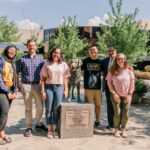
When listeners tune in to the Retriever Tales podcast hosted by Tirzah Khan ‘21, information systems, who is graduating this week, they’ll hear UMBC voices sharing their journeys of finding and creating community. Moving, inspiring, funny, and thought-provoking, the show is a testament to Khan’s own UMBC experience and a broader culture of co-creating community at UMBC.
One key experience kick-started Khan’s growth as a student leader: STRiVE, a leadership for social impact retreat led by the Center for Democracy and Civic Life (CDCL). “Everything began for me when I went to STRiVE during my sophomore year,” she shares. “Before STRiVE, I stuck to myself and didn’t venture outside my comfort zone often. I gained so many insights about myself during the retreat, and I learned to reimagine the world as it could be.”

Tirzah Khan. Photo courtesy of Khan.
After returning from the retreat, Khan says, “I developed the confidence to get involved in other organizations,” like hackUMBC (becoming a design team lead) and the Student Events Board (as vice president for design). Along with STRiVE 2019 members Shrijana Khanal ’21, economics; Sofía Encarnación ’22, economics and mathematics; and Juhi Naik ’21, history and political science, she also founded the TEDxUMBC student organization, launching her work as a community storyteller.
Reimagining the world through stories
When Khan dives into something, she does it in a big way. She committed to UMBC community work through CDCL, serving as a ConnectionCorps intern to create Retriever Tales; helping to coordinate Election Night Extravaganza, an election night returns watch program; and joining other community members in facilitating and organizing “Together Beyond November” post-election discussions. She also participated in initiatives like the fall 2020 Cast Your Whole Vote campaign, featuring events to encourage the UMBC community to recognize voting as just one of many ways to make a difference.

Tirzah Khan. Photo courtesy of Khan.
Khan is passionate about the intersection of graphic design and social impact. She worked as a social media engagement and design intern with the Mosaic: Center for Culture and Diversity, and she has also been active with Retriever Immigrants United and the Women of Color Coalition.
In her final semester, Khan wanted to focus on bringing the UMBC experience to community members who had largely been away from campus for a year due to COVID-19. She brought the Retriever Tales podcast to life, featuring authentic conversations with Retrievers about what brought them to UMBC, what it means to them to be here, and what hopes they have for the UMBC community. Khan shares,“These conversations have truly reshaped my understanding of what it means to be part of a community, and what it means to be part of UMBC’s community.”
“As students we have the opportunity to try and mold UMBC’s future and its impact,” says Khan. “There’s this idea that I think describes UMBC’s culture really well: that we’re all co-creating UMBC. What that means is everyone here has the ability to help shape this institution in some way. We all have both the opportunity and the responsibility to create the UMBC that we want to see together.”
Visible, actionable change
Like Khan, graduating senior and Honors College member Brandon Liu ‘21, biological sciences and visual arts, says STRiVE and CDCL transformed his time at UMBC.
As a first-year student, Liu and friends Ella Hawkins ‘20, biochemistry and molecular biology, and Manny Ali, ‘20, computer engineering, who is hard of hearing, learned UMBC didn’t offer American Sign Language (ASL) classes or clubs, so they co-founded Sign of Life. The club teaches ASL and educates students interested in being more involved in the Deaf community. “This was my first experience collaborating with friends, reaching out to stakeholders, and making a visible, actionable change on something as large as a university campus community,” says Liu.
 Brandon Liu. Photo by Alexis Harris ‘19.
Building on that experience, Liu attended the STRiVE retreat in his second year at UMBC. Over the next three years he returned to STRiVE as the campus civic engagement intern, supporting faculty, staff, and student coaches who guided groups of undergraduate student participants.
“The Center’s Alternative Spring Break and STRiVE are the most important experiences I can recommend, especially for those who don’t feel like they have what it takes to make change or think that change doesn’t happen,” says Liu. “STRiVE transformed me from a student that kept my head down and didn’t think I was powerful enough, smart enough, connected enough to make change into someone who knew that coming as I am, I am already valuable and capable of affecting my communities.”
Strength in community
Those around Liu quickly began to see his impact and his potential as a leader. In 2018, he received the Lavender Award for Emerging LGBTQ+ Leader from the Initiatives for Identity, Inclusion, and Belonging. He kept his focus on community leadership and, today, says the agency students have at UMBC is what makes a UMBC education so valuable.
“As assistant speaker of the senate for our Student Government Association (SGA), one of my biggest responsibilities was coordinating undergraduate participation in UMBC’s shared governance committees,” says Liu. “I connected the undergraduate senators with chairs of key university committees, to make sure undergraduate voices were heard in campus decision-making.”
 Brandon Liu and other members of UMBC’s delegation at the 2018 Civic Learning and Democratic Engagement Meeting. Photo courtesy of Hoffman.
Seeing fellow students grow in their ownership of the UMBC community and learn to increase student agency on campus was both gratifying and motivating to continue the work, he shares.
“The real strength of UMBC is within the community,” says Liu. “I’ve been able to learn so much more about myself and surround myself with many other genuine, compassionate, caring, and active people. The academic rigor allows students to receive a valuable degree, but the community is what makes UMBC a home.”
 Front row (l-r): Tess McRae, Romy Hübler, Brandon Liu, and David Hoffman. Back row (l-r): Pat Michael and Timothy Farrell. Photo courtesy of Hoffman, 2019.
Liu is graduating as a Sherman STEM Teacher Scholar and will soon begin his master of arts in teaching for secondary biology at UMBC. He shares, “I know that UMBC values the same things I do. And with a master’s in teaching from UMBC I know I’ll be able to take on the responsibility of building and supporting communities in the schools and classrooms where I’ll teach in the future.”
Creating shared spaces
Meghan Lynch ‘18, political science, and M.P.P. ‘21, will soon become a double alumna of UMBC, after earning her master’s in public policy. She says she still thinks about one particular class on civic agency during her undergraduate years, which shaped her UMBC experience, her career path, and her perspective on the world. Her a-ha moment: “I realized that the idea of creating shared spaces and bringing democracy into the classroom was a very concrete way to realize the power we all have in every space,” she says.
Lynch describes UMBC as a place that supports, nurtures, and encourages political engagement in all forms. Creating spaces for community dialogue and mutual support was especially important during COVID-19 and the intense election cycle. As vice president of UMBC’s Graduate Student Association (GSA), Lynch is proud of how the group helped to offer space for dialogue and build community as a co-host for the CDCL’s “Together Beyond November” post-election discussions.
 Meghan Lynch. Photo by Poulomi Banerjee ‘16.
“Amidst all the fatigue and difficult news in the world, the Center, SGA, and GSA were able to coordinate very meaningful and well-attended events leading up to and after the election,” says Lynch. “It was clear that the UMBC community wanted to spend time coming together to think about our role in bringing about change and hearing about the issues. I left every one of these events feeling refreshed in a humble and grateful way.”
Resources for success
During the COVID-19 pandemic, Lynch and other GSA officers created a well-being committee, recognizing the importance of students’ mental, physical, and spiritual well-being. “We’ve had an excellent turnout to committee meetings in part because people are looking for a place to reflect on how to help each other,” she says.
“Amidst all the chaos and uncertainty, I’m so proud that GSA has found ways to connect students to the resources they need and serve as a gathering space–even virtually,” Lynch says. “I’m also proud of the strides we are making to ensure that graduate students are intentionally included in programming and other opportunities across campus.”
Creating community, Lynch reflects, “is a way for people from different departments across campus to collectively work towards solutions that benefit all of us.” And every new relationship or new project “starts from just one conversation,” she shares, so “there’s beauty in just talking with people.”
 Meghan Lynch and True Grit. Photo by Poulomi Banerjee ‘16.
After graduation, Lynch will teach an introductory political science class at UMBC and serve as the new director for the Catonsville Chamber of Commerce. She says, “I hope to take all of the transformative experiences I’ve had at UMBC beyond Hilltop Circle to help others realize their ability to make their communities better for everyone.”
One person who looks forward to seeing the impact of her work is CDCL Director David Hoffman Ph.D. ‘13, language, literacy, and culture. Hoffman shares that Lynch, Liu, and Khan all “embody the idea that we can bring our whole, unique selves to the work of shaping our communities.” He says, “Their contributions have helped make UMBC even more deeply and visibly what it has been all along: caring, inclusive, and engaged.”
Featured image (l-r): Mariam Abalo-Toga, Roy Prouty, Anjali Dassarma, Brandon Liu, President Freeman Hrabowski, and Lilly Keplinger stand by True Grit, 2018. Photo by Marlayna Demond ’11 for UMBC.
Article written by Eleanor Lewis, communication specialist in the Division of Student Affairs.
]]>
When listeners tune in to the Retriever Tales podcast hosted by Tirzah Khan ‘21, information systems, who is graduating this week, they’ll hear UMBC voices sharing their journeys of finding and...
https://umbc.edu/stories/umbc-together-graduating-retrievers-reflect-on-building-community-through-conversations/
https://my3.my.umbc.edu/api/v0/pixel/news/119630/guest@my.umbc.edu/a9c7cde047268802ca3299e83938e6cb/api/pixel
biology
cahss
classof2021
cnms
coeit
community
honorscollege
is
page1
publicpolicy
visualarts
UMBC News & Magazine
https://my3.my.umbc.edu/groups/umbc-news-magazine
https://assets1-my.umbc.edu/system/shared/avatars/groups/000/001/943/24435aa6207c452e7bc15cc74b42c7bb/xsmall.png?1748556657
https://assets1-my.umbc.edu/system/shared/avatars/groups/000/001/943/24435aa6207c452e7bc15cc74b42c7bb/original.png?1748556657
https://assets2-my.umbc.edu/system/shared/avatars/groups/000/001/943/24435aa6207c452e7bc15cc74b42c7bb/xxlarge.png?1748556657
https://assets2-my.umbc.edu/system/shared/avatars/groups/000/001/943/24435aa6207c452e7bc15cc74b42c7bb/xlarge.png?1748556657
https://assets3-my.umbc.edu/system/shared/avatars/groups/000/001/943/24435aa6207c452e7bc15cc74b42c7bb/large.png?1748556657
https://assets1-my.umbc.edu/system/shared/avatars/groups/000/001/943/24435aa6207c452e7bc15cc74b42c7bb/medium.png?1748556657
https://assets2-my.umbc.edu/system/shared/avatars/groups/000/001/943/24435aa6207c452e7bc15cc74b42c7bb/small.png?1748556657
https://assets1-my.umbc.edu/system/shared/avatars/groups/000/001/943/24435aa6207c452e7bc15cc74b42c7bb/xsmall.png?1748556657
https://assets2-my.umbc.edu/system/shared/avatars/groups/000/001/943/24435aa6207c452e7bc15cc74b42c7bb/xxsmall.png?1748556657
UMBC News & Magazine
0
0
false
Tue, 18 May 2021 02:48:57 -0400
UMBC offers new Research Experiences for Undergraduates in smart computing, big data

Starting out at UMBC, Meyerhoff Scholar Timothy Potteiger wasn’t certain what direction he wanted to take. However, he benefited from UMBC programs that brought the world to his doorstep, inviting universities to pitch him their summer research experiences. One conversation with Washington State University particularly resonated. They spoke about researching smart home sensor technologies to help improve the daily lives of older adults and people with disabilities.
Potteiger ’14, computer engineering, was drawn to that purpose-driven approach. Little did he know that the program manager for that undergraduate research experience in 2013, Nirmalya Roy, would soon join UMBC’s faculty and expand research opportunities for even more undergraduates.
 Nirmalya Roy
Research Experiences for Undergraduates (REUs) are critical for students like Potteiger. Roy, now associate professor of information systems at UMBC, is principal investigator leading a new REU in Smart Computing and Communications funded by the National Science Foundation (NSF). The program is accepting applications through March 31 for this summer from students nationwide.
Potteiger is excited for students to take advantage of this opportunity. “I know Dr. Roy has a good vision on how to actually impact society with research,” he shares.
Transformative experience
The program will bring together ten undergraduate students in a paid 10-week, full-time research experience from June 7 to August 13. While the summer 2021 program will be remote, each student will work closely with a research group and mentor. They will receive guidance from Roy and co-PI Dmitri Perkins, as well as other information systems and computer science and electrical engineering (CSEE) faculty.
In the final week, the students will have a chance to present their research through UMBC’s popular Summer Undergraduate Research Fest. They will also have the opportunity to develop peer-reviewed articles and continue their research throughout the year with faculty.
“The idea of this experience is not only to give them exposure to hands-on research problems, but to also help undergraduates with professional development,” says Roy. “Developing a peer network and encouraging them to build confidence talking with professors and researchers in their field will be important for their careers.”
Real-world applications
One REU project will tackle privacy protection in COVID-19 contact tracing programs, while another will study a chatbox method for studying cryptocurrency. Roy will also give students the chance to optimize smart home sensors for seniors or work on the FloodBot project, a collaboration with nearby Ellicott City to create an early flood warning system after a 2018 flash flood caused catastrophic damage.
 Sensors placed in Ellicott City through the FloodBot project. Photo courtesy of Nirmalya Roy.
Students can also work with Perkins, a CSEE professor, on research into wireless devices capable of “situational awareness,” the ability to switch from one frequency to the next along a limited radio spectrum highway. The interdisciplinary project is crucial to staving off what some experts fear is a looming, massive traffic jam for wireless devices globally.
“The hallmarks of all our projects is that they have community impact,” says Vandana Janeja, chair of information systems.
 Vandana Janeja
Expanding opportunity
Providing undergraduates with real, hands-on research experiences resonates personally with Perkins. He grew up in a no stop-light town in Mississippi and attended Tuskegee University, which had well-regarded academic programs but more limited lab research opportunities at the time. Perkins was able to gain research experience in a broader range of areas by participating in REUs at two other universities.

Dmitri Perkins. Photo courtesy of Perkins.
Recognizing that many students come from similar backgrounds where research opportunities may be rare, the REU specifically encourages applicants from community colleges and groups traditionally underrepresented in the STEM fields.
“With students from traditionally underserved communities, there is often some apprehension or insecurity about pursuing a career in research,” Perkins says. “Once students complete their UMBC summer experience, they will have more information, more understanding of what research looks like, and the knowledge that they can actually do this.”
Unique online experience
Jianwu Wang, information systems, has also joined the wave of faculty from UMBC’s College of Engineering and Information Technology (COEIT) launching new REUs. Wang is assistant professor of data science and director of the Big Data Analytics Lab. With co-PI Matthias Gobbert, professor of mathematics, he’s just received NSF funding to launch an online interdisciplinary Big Data REU.
 Jianwu Wang
They will provide an 8-week summer online research experience to undergraduates from across the country. Students will explore “how to utilize modern data science and high-performance computing techniques to process and analyze big data in many science and engineering disciplines,” Wang explains. This includes fields ranging from atmospheric science to mechanical engineering to medicine.
“We’ve designed the program to be purely online so it is particularly useful for students in remote areas or who might have health concerns or concerns about travel,” says Wang. “We also want to make sure it is accessible to students with family responsibilities and disabilities, who may not be able to leave their home for an extended period of time.”
Big data research
This program will combine formal instruction, team-based research, and experience disseminating that research. The goal is to ignite students’ interest in “how data science and high-performance computing techniques could help the scientific discovery process” while giving them essential hands-on research skills and preparing them for the workforce.
Students will learn how to identify research questions and conduct research using advanced cyberinfrastructure software technologies and hardware resources. Tentative research themes for summer 2021 research projects include big data and machine learning techniques for sea ice prediction and for medical image classification.
The summer 2021 program will run June 7 through July 31. Applications are due by April 15, 2021, and the organizers invite undergraduates in all STEM fields to apply. Students who complete the fully-funded program will also be eligible for additional funds to present their research at conferences around the country.
Roy and Wang credit COEIT for encouraging their efforts to launch new REUs. Erin Lavik, associate dean for research and faculty development and professor of chemical, biochemical, and environmental engineering, describes the new programs as “fantastic.” She shares, “This is an exciting chance to connect undergraduates from across the country with unique UMBC student research experiences and our outstanding, innovative faculty.”
 Graduate student Adam Day (left) works with Erin Lavik (right) in her lab, 2017.
Featured image: Nirmalya Roy with a student in 2018. All photos by Marlayna Demond ’11 for UMBC unless otherwise noted.
Article written by Nick Ford for UMBC News.
]]>
Starting out at UMBC, Meyerhoff Scholar Timothy Potteiger wasn’t certain what direction he wanted to take. However, he benefited from UMBC programs that brought the world to his doorstep, inviting...
https://umbc.edu/stories/umbc-offers-new-research-experiences-for-undergraduates-in-smart-computing-big-data/
https://my3.my.umbc.edu/api/v0/pixel/news/119669/guest@my.umbc.edu/4a22ba23ba6c1bc35a72077da93f5685/api/pixel
cnms
coeit
csee
is
mathstat
science-and-technology
undergradresearch
UMBC News & Magazine
https://my3.my.umbc.edu/groups/umbc-news-magazine
https://assets1-my.umbc.edu/system/shared/avatars/groups/000/001/943/24435aa6207c452e7bc15cc74b42c7bb/xsmall.png?1748556657
https://assets1-my.umbc.edu/system/shared/avatars/groups/000/001/943/24435aa6207c452e7bc15cc74b42c7bb/original.png?1748556657
https://assets2-my.umbc.edu/system/shared/avatars/groups/000/001/943/24435aa6207c452e7bc15cc74b42c7bb/xxlarge.png?1748556657
https://assets2-my.umbc.edu/system/shared/avatars/groups/000/001/943/24435aa6207c452e7bc15cc74b42c7bb/xlarge.png?1748556657
https://assets3-my.umbc.edu/system/shared/avatars/groups/000/001/943/24435aa6207c452e7bc15cc74b42c7bb/large.png?1748556657
https://assets1-my.umbc.edu/system/shared/avatars/groups/000/001/943/24435aa6207c452e7bc15cc74b42c7bb/medium.png?1748556657
https://assets2-my.umbc.edu/system/shared/avatars/groups/000/001/943/24435aa6207c452e7bc15cc74b42c7bb/small.png?1748556657
https://assets1-my.umbc.edu/system/shared/avatars/groups/000/001/943/24435aa6207c452e7bc15cc74b42c7bb/xsmall.png?1748556657
https://assets2-my.umbc.edu/system/shared/avatars/groups/000/001/943/24435aa6207c452e7bc15cc74b42c7bb/xxsmall.png?1748556657
UMBC News & Magazine
0
0
false
Thu, 25 Mar 2021 16:36:10 -0400
UMBC’s James Foulds receives NSF CAREER Award to improve the fairness, robustness of AI
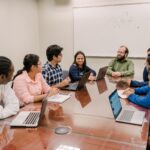
UMBC’s James Foulds was drawn to working in artificial intelligence (AI) and machine learning (ML) by “the possibility to make a direct impact on people’s lives and the health of our society” through advancing technology. He has now earned a National Science Foundation CAREER Award of nearly $550,000 over five years to support his research on improving the fairness and robustness of AI algorithms.
Foulds, assistant professor of information systems, joined UMBC in 2017. His lab focuses on human-centered approaches to AI fairness, working to address many practical limitations in the field.
Implementing an AI algorithm is often presented as a trade-off, Foulds explains. Do you want the program to be as productive as possible or as fair as possible? Foulds sees this as a false and harmful dichotomy.
Thanks to advances in AI, computers can accomplish tasks that would take a human a lifetime, but technologies built by people also perpetuate people’s biases, Foulds says. These biases can then have real impacts on people’s lives, often disproportionately harming already disadvantaged groups. For example, skewed AI and ML models have informed college admissions, credit card approvals, and recommendations for bail in court rooms.
The ethics of adopting such systems and ways to mitigate their potential harms have become focal points in Foulds’s work.
Fair AI implementation across applications
Foulds’s research demonstrates that developing an AI algorithm that prioritizes fairness can in fact yield more robust results. Models are often used to make generalizations about a population of interest, which can be helpful. But when a model is developed based on biased data, the prediction can suffer from “overfitting,” where the model describes a relationship between variables that doesn’t actually reflect reality.
In these cases, the model’s predictions can be misleading, rather than useful, and can cause real harm. A model that underscores fairness could provide more stable generalizations and help to avoid perpetuating or amplifying existing biases and false interpretations.
 James Foulds
Researchers currently quantify fairness in a variety of ways. Through his CAREER Award-supported research, Foulds wants to develop a unifying framework. From there, he will create a user interface to study how people come to a consensus on defining fairness in a given situation.
The project will target decisions or advice based on things like Medicaid waitlist data, career recommendations, and social media usage data. These all have intrinsic biases that can significantly impact trends and outcomes in society, or the way industry addresses specific problems.
For example, each U.S. state has a different way of determining who receives health coverage through Medicaid. Creating a better model to perform a needs-based ranking of the waitlist for Medicaid coverage could help officials make more informed, equitable decisions about who should receive coverage.
Bringing more people into the conversation
Foulds believes his research will mitigate barriers to responsible and effective deployment of AI technologies by showing that it is possible to develop a discipline-standard model for fairness. He hopes to make his lab a source of user-friendly AI tools for those who want to implement the model in their work.
As an educator, “I want to inspire the students I come into contact with to see how fascinating and exciting (and potentially lucrative) AI, ML, and data science are,” Foulds shares. “And I want to instill in them the importance of ethical thinking in the practice of data science.”
 James Foulds (third from right) meets with students in his lab in 2019.
Beyond his own courses, he hopes to partner with Baltimore Polytechnic Institute, a local STEM-focused high school, to provide students with exposure to a range of new career options that can have a major societal impact.
Public impact research
In addition to Foulds, UMBC is celebrating the recent CAREER Award of Ramana Vinjamuri, who joined the university’s computer science and electrical engineering faculty in 2020.
Vinjamuri’s project revolves around brain-computer interfaces and understanding the complex relation between the hand and the brain. His goal is to understand how the brain controls the hand and how the hand sends motor and sensory information back to the brain.
 Ramana Vinjamuri. Courtesy of Vinjamuri.
Vinjamuri hopes to be able to demonstrate how a person might more quickly learn skilled movements (like playing the piano) or relearn lost movements after experiencing a stroke. Like Foulds, he feels energized to tackle big questions with the potential for significant public impact.
Banner image: James Foulds with his students in 2019. Photos by Marlayna Demond ’11 unless otherwise noted.
Story by Travis McKay ’19, chemical engineering, for UMBC News.
]]>
UMBC’s James Foulds was drawn to working in artificial intelligence (AI) and machine learning (ML) by “the possibility to make a direct impact on people’s lives and the health of our society”...
https://umbc.edu/stories/umbcs-james-foulds-receives-nsf-career-award-to-improve-the-fairness-robustness-of-ai/
https://my3.my.umbc.edu/api/v0/pixel/news/119671/guest@my.umbc.edu/b2fa7d7b9b30448e0dfa1ee7e577b840/api/pixel
coeit
is
majoraward
science-and-technology
UMBC News & Magazine
https://my3.my.umbc.edu/groups/umbc-news-magazine
https://assets1-my.umbc.edu/system/shared/avatars/groups/000/001/943/24435aa6207c452e7bc15cc74b42c7bb/xsmall.png?1748556657
https://assets1-my.umbc.edu/system/shared/avatars/groups/000/001/943/24435aa6207c452e7bc15cc74b42c7bb/original.png?1748556657
https://assets2-my.umbc.edu/system/shared/avatars/groups/000/001/943/24435aa6207c452e7bc15cc74b42c7bb/xxlarge.png?1748556657
https://assets2-my.umbc.edu/system/shared/avatars/groups/000/001/943/24435aa6207c452e7bc15cc74b42c7bb/xlarge.png?1748556657
https://assets3-my.umbc.edu/system/shared/avatars/groups/000/001/943/24435aa6207c452e7bc15cc74b42c7bb/large.png?1748556657
https://assets1-my.umbc.edu/system/shared/avatars/groups/000/001/943/24435aa6207c452e7bc15cc74b42c7bb/medium.png?1748556657
https://assets2-my.umbc.edu/system/shared/avatars/groups/000/001/943/24435aa6207c452e7bc15cc74b42c7bb/small.png?1748556657
https://assets1-my.umbc.edu/system/shared/avatars/groups/000/001/943/24435aa6207c452e7bc15cc74b42c7bb/xsmall.png?1748556657
https://assets2-my.umbc.edu/system/shared/avatars/groups/000/001/943/24435aa6207c452e7bc15cc74b42c7bb/xxsmall.png?1748556657
UMBC News & Magazine
0
0
false
Mon, 22 Mar 2021 15:53:52 -0400
 Maryam Rahnemoonfar.
 Maryam Rahnemoonfar, right, discussing the imaging iHARP research.
 Jianwu Wang.
  Jianwu Wang (left), Maryam Rahnemoonfar, and Masoud Yari.


